The Paraclete as a “replacement Jesus” and the Doctrine of the Trinity (John 16; Trinity Sunday, Year C)

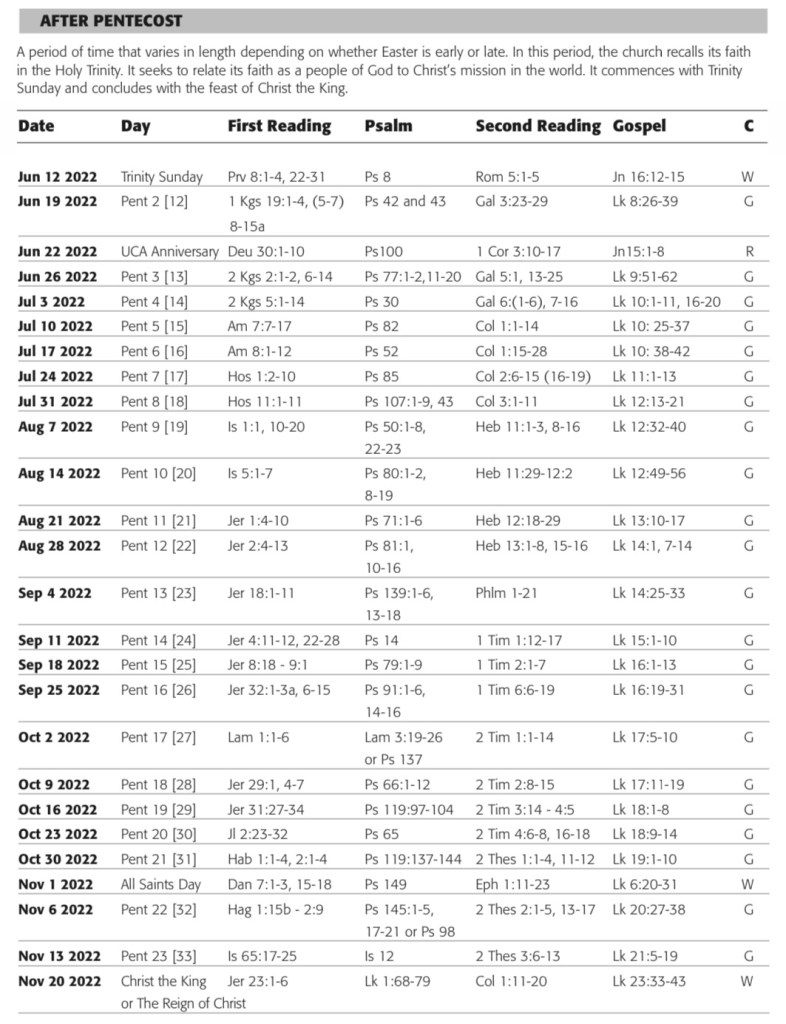
This coming Sunday is designated as Trinity Sunday. It’s an unusual occurrence, for two reasons. First, it’s the only time in the Christian calendar that a Sunday is named for a doctrine, rather than for a biblical story. And second, it is unusual in that it presents problems for the shapers of the lectionary, since (in my view) the Doctrine of the Trinity is not actually proclaimed in the biblical texts.

Yes, there are passages that canvass some aspects of the Doctrine—how the Son relates to the Father, what is the essential character of God, how the Spirit was experienced and understood, and how Son and Spirit might relate. But there is no biblical passage which articulates the full scope of the Doctrine of the Trinity: God is three, God is one, Father, Son, and Spirit, consubstantial, co-eternal, while unending ages run (as it were).

That’s quite understandable, since the full expression of this Doctrine took a number of centuries to develop, after the period in which the texts of the New Testament were written. If the latest NT text comes from the end of the first century, the earliest form of the Doctrine of the Trinity is found in the Apostles’ Creed, adopted by the Council of Nicea in 325 CE, and a more fulsome and complex form is to be found in the Nicene Creed, adopted by the Council of Constantinople in 381 CE.

So we should not expect the lectionary to provide any texts which set out the Doctrine of the Trinity. What we do find, however, is that certain texts are offered, in which some, or all, of the three persons of the Trinity—Father, Son, and Spirit—are in view.

In fact, two texts name all three persons in a quasi-formulaic way: the benediction at the close of 2 Corinthians 13, and final words of Jesus in Matthew 28. Indeed, these two passages are set for Trinity Sunday in the first of the three years of the lectionary, Year A. Associated with these two passages is a text that expounds something of the nature of one of these persons, God the Creator, in Genesis 1.

In Year B, two texts are offered which focus somewhat on the third person of the Trinity, the Spirit: Romans 8, where Paul wrestles with the role of the Sprit, and John 3, the conversation between Jesus and Nicodemus, which includes reference to the Spirit. The Hebrew Scripture offering in Year C draws from the wonderful depiction of Wisdom in Proverbs 8; while the epistle in Year C, from Romans 5, appears to be included because it manages to refer to each of the three person of the Trinity within the space of five verses.

The Gospel offered in Year C (the current year) is just a short section (John 16:12–15) from the last chapter in the lengthy “farewell discourses” of Jesus (chs. 14–16), which John reports as being given to the disciples at the last meal that Jesus shared with his followers (from 13:1 onwards). It contains the fourth of four brief references in these “farewell discourses” to the Spirit, identified as “the Spirit of truth” (14:17; 15:26; 16:13), the parakletos (14:16, 26; 15:26; 16:7) and “the Holy Spirit” (14:26).
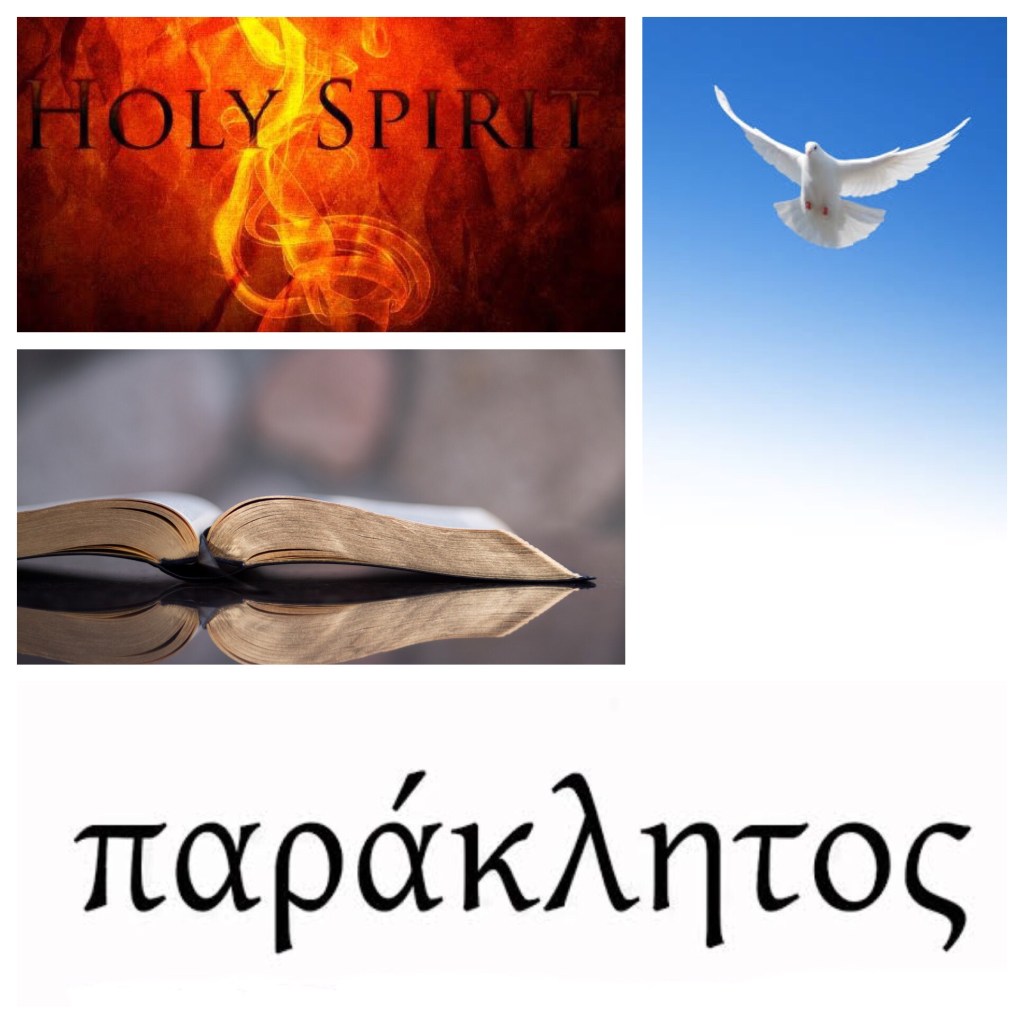
These passages are considered to provide some biblical material for the Doctrine of the Trinity relating specifically to the third person, the Holy Spirit. In particular, I am interested in how the Spirit is defined in relation to the other two persons of the Trinity.

There are three ways in which the Spirit is defined in relation to Jesus. First, the Spirit is identified as a parakletos—a word with multiple translation options. It could mean one who advocates for, one who provides counsel, one who offers help, or one who gives comfort.

See https://johntsquires.com/2019/06/07/the-paraclete-in-john-15-exploring-the-array-of-translation-options/

Whatever option we take in translating this word, it is striking that Jesus says that the main role of the Spirit (at least as we encounter the explanation in this gospel) is to be “another parakletos” (14:16). The implication is that Jesus himself has been a parakletos—an implication that is confirmed when we read the statement in 1 John, that “we have a parakletos with the Father, Jesus Christ the righteous; and he is the atoning sacrifice for our sins, and not for ours only but also for the sins of the whole world” (1 John 2:1–2).

This first statement about the Spirit thus places the Spirit in the position that Jesus had whilst living in human form amongst the people of Israel. The Spirit is the present manifestation of the role that Jesus of Nazareth had all those centuries ago. The Spirit is, in effect, a “replacement Jesus”.

Indeed, this is strengthened by the affirmation that this figure will “abide with you … and be in you”, precisely the same terminology used of Jesus in the earlier parable of the vine (“abide in me and I abide in you”, 15:4) and in the final prayer that Jesus prays before his arrest (“may [they] be one, as we are one, I in them and you in me, that they may become completely one”, 17:22–23]). The reality of the presence of the Spirit is the same as the reality of the presence of Jesus when he was with the disciples.

This idea is confirmed by the second statement about the parakletos, who is the one “whom the Father will send in my name” (14:26), the one “whom I will send to you from the Father” (15:26). Indeed, Jesus makes it clear that “if I do not go away, the parakletos will not come to you; but if I go, I will send him to you” (16:7). This seems to suggest that the Spirit is unable to take up the role assigned to it until Jesus has departed from his followers—the Spirit is a “replacement Jesus”.

Indeed, at an earlier point in the narrative, on “the last day of the festival, the great day” (7:37; the festival referred to was Booths, 7:2), Jesus was speaking about the Spirit, and portraying the “rivers of living water” that the Spirit would give, as something still to come. The narrator informs us that he was speaking “about the Spirit, which believers in him were to receive; for as yet there was no Spirit, because Jesus was not yet glorified” (7:37–39).

This, of course, is directly contradicted by the many references in Hebrew Scripture to the activity of the Spirit in Israel (Gen 1:1–2; Job 33:4; Ps 104:30; Isa 42:5, 44:3, 48:16, 59:21, 61:1, 63:11–14; Num 11:16–17; Deut 34:9; 1 Sam 10:6, 19:23–24; Ezek 37:1; Joel 2:28–29). Nevertheless, the definitive arrangement of things that is held to quite firmly in the book of signs, is that the Spirit comes only after Jesus has returned to the Father.

The language of sending is used frequently in the fourth Gospel, in describing the relationship between the Father and the Son. The Father is regularly described as the one who sent the Son (3:34; 4:34; 5:23, 30; 6:29, 39, 44, 57; 7:16, 18, 28–29, 33; 8:16, 18, 26, 29, 42; etc). In the final prayer of Jesus, the Father is “him who sent me” (17:3, 8, 18, 21, 23, 25). Amongst the final words of the risen Jesus, we hear Jesus say again, “as the Father has sent me” (20:21).

So, when Jesus refers to the parakletos as the one “whom the Father will send in my name” (14:26), he is reinforcing the notion that the Spirit is the “replacement Jesus”. This is further strengthened by the affirmation that the parakletos will “teach you everything, and remind you of all that I have said to you” (14:26). The language of teaching also recalls a key function of Jesus, who “went up into the temple and began to teach” (7:14), who “sat down and began to teach” the people in the temple (8:2), who characterises his ministry as “I have always taught in synagogues and in the temple, where all the Jews come together” (18:20).

Further, Jesus describes the role of the parakletos as “he will take what is mine and declare it to you” (16:15). Jesus has already declared that “my teaching is not mine but his who sent me” (7:16) and “the word that you hear is not mine, but is from the Father who sent me” (14:24); now he passes that divinely-given material on to the parakletos, clearly stating that “he will take what is mine and declare it to you. All that the Father has is mine. For this reason I said that he will take what is mine and declare it to you” (16:14–15). The teaching function that the parakletos performs is to replicate the teaching role that Jesus has already enacted.

The content of the teaching provided by the parakletos is also evocative of the teaching that Jesus has provided. The parakletos will teach “about sin and righteousness and judgment” (16:8, expanded in 16:9–11). In relation to sin, what Jesus does as “the lamb of God” is to “take away the sin of the world” (1:29); he provides freedom from the slavery of sin (8:34–36), and the final commission that he gives his disciples (who are sent just as he has been sent) is to decree that they have the authority of grant forgiveness of sins (20:23).

Likewise, in relation to judgement, Jesus has stated, “as I hear, I judge; and my judgment is just, because I seek to do not my own will but the will of him who sent me” (5:30), and again, “even if I do judge, my judgment is valid; for it is not I alone who judge, but I and the Father who sent me” (8:16)—although later, Jesus asserts that “I came not to judge the world, but to save the world. The one who rejects me and does not receive my word has a judge; on the last day the word that I have spoken will serve as judge” (12:47–48).

Thus, as the parakletos teaches about sin, and about judgement, the teachings of Jesus on these matters are repeated. (On the matter of righteousness—apart from a single reference to God as “righteous Father”, 17:25—this Gospel is silent.) Again, we see that the parakletos is a “replacement Jesus”.

Finally, the distinctive term used in this Gospel to describe the Spirit, “the Spirit of truth”, also reinforces this way of viewing the relationship between the Son and the Spirit. The Johannine Jesus is “the Word became flesh” who “lived among us … full of grace and truth” (1:14). It is through Jesus Christ that “grace and truth came” (1:17). Jesus describes himself to the leaders in Jerusalem as “a man who has told you the truth that I heard from God” (8:40), and to the Roman Governor, Pilate, he declares, “for this I was born, and for this I came into the world, to testify to the truth. Everyone who belongs to the truth listens to my voice” (18:37).

So Jesus tells his followers that “if you continue in my word, you are truly my disciples; and you will know the truth, and the truth will make you free” (8:31–32), and even affirms unreservedly that “I am the truth” (14:6). Again, the language applied to the Spirit links in with key terminology that describes Jesus and his role. The Spirit of truth now teaches “the truth that will make you free”, that the one who is the truth had taught.

Finally, it is noteworthy that nowhere in the book of signs is there any direct statement about the relationship between Father and Sprit. Although Jesus states that “God is spirit” (4:24), the relationship is always, apparently, mediated through the Son: the Father sends the Son, the Son sends the parakletos; the Son teaches what the Father provides, the parakletos continues the teaching of Jesus; the Father incarnates the Word “in truth”, the Son teaches and is “the truth”, so the Spirit is named as “the Spirit of truth”.

In summary, the relationship between Son and Spirit reads to me as a quite hierarchical style of relationship—not at all a relationship of equals who abide in each other, who are of the same nature and share the same substance with one another, who exist co-eternally and inherit co-equally. Indeed, in the relationship between Father and Spirit/Parakletos, there is no direct link, as there is in the classic Doctrine of the Trinity; all is mediated through the Son, as we have seen. The fourth Gospel offers a different, distinctive—we might even say, unorthodox—theology of Father, Son, and Spirit/Parakletos.

The Trinity is a complex idea, a doctrine with many subsets and dimensions and component parts. Although there are passages in scripture which many say point to this doctrine, nevertheless gaining a full understanding of this doctrine really means entering into the world of metaphysics, philosophy, and linguistics of a later age.

All of this is beyond the capacity of the lectionary to provide, nor can it be done in a relatively brief reflection time within a Sunday worship service—and it runs the risk of charging away from the world of ideas in which the biblical texts were written, and opening up the danger of imposing later ideas, anachronistically, onto those texts.

The little passage from the Gospel of John that we encounter in the lectionary this coming Sunday actually points us in quite another direction!

*****

See also
50 years of NAIDOC WEEK 4 (1991–1997)

Today, 3 June, we remember the day in 1992 that the legal case brought by Eddie (Koiki) Mabo was decided by the Australian High Court. The court effectively recognised the existence of Native Title rights and rejected the concept of terra nullius, which claimed Australia was a land belonging to no-one prior to British occupation. The judgement opened the way for the passing of the Native Title Act in 1993.

See https://www.creativespirits.info/aboriginalculture/land/native-title

This decision of the High Court was one of the highlights in the area of indigenous affairs during the period that Paul Keating led the federal government. The Mabo case was decided just six months after Keating had become Prime Minister (in December 1991).

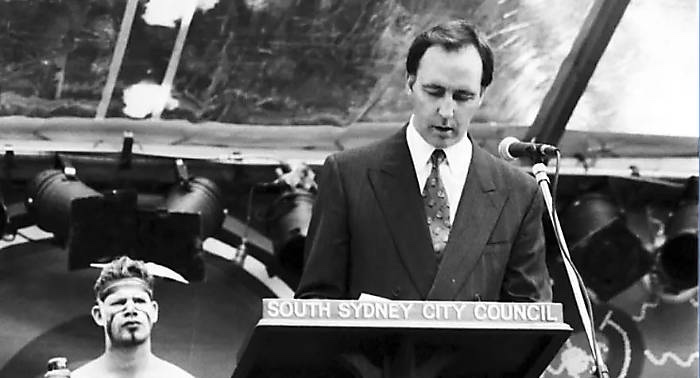
The other highlight was the powerful speech that Keating delivered a year later, in December 1992, which is known as the Redfern Speech. In this speech, Keating acknowledged the role played in destroying the culture of the First Peoples by those who invaded and colonised the continent in the early decades of British settlement.

Paul Keating delivers the Redfern Speech in December 1992

“The problem starts with us non-Aboriginal Australians”, he declared. “It was we who did the dispossessing. We took the traditional lands and smashed the traditional way of life. We brought the diseases. The alcohol. We committed the murders. We took the children from their mothers. We practised discrimination and exclusion. It was our ignorance and our prejudice.”

See https://www.creativespirits.info/aboriginalculture/politics/paul-keatings-redfern-speech

It was a searing recognition of the multitude of ways in which white Australian society had impacted the long-established cultures of the First Peoples; a recognition of the complicity of white Australia in the devastation of black Australians. It was a clear step beyond anything articulated in public in previous years.

In assessing the period when the Keating Government was in power, Dr John Gardiner-Garden began by referencing Keating’s Redfern speech of December 1992, as well as “his government’s decision to set up a national inquiry into the separation of Indigenous children”. Keating “sought to encourage recognition of past injustices. In his government’s native title and land fund legislation and proposed ‘Social Justice Package’ he sought to advance the process of making amends for the disregard of Indigenous common law rights which the 1992 Mabo judgement had found to have occurred.”

See https://www.aph.gov.au/about_parliament/parliamentary_departments/parliamentary_library/pubs/bn/1011/indigenousaffairs2#_Toc295218057

During the years that the Keating Government was in power, the following themes were chosen for each year of NAIDOC WEEK:

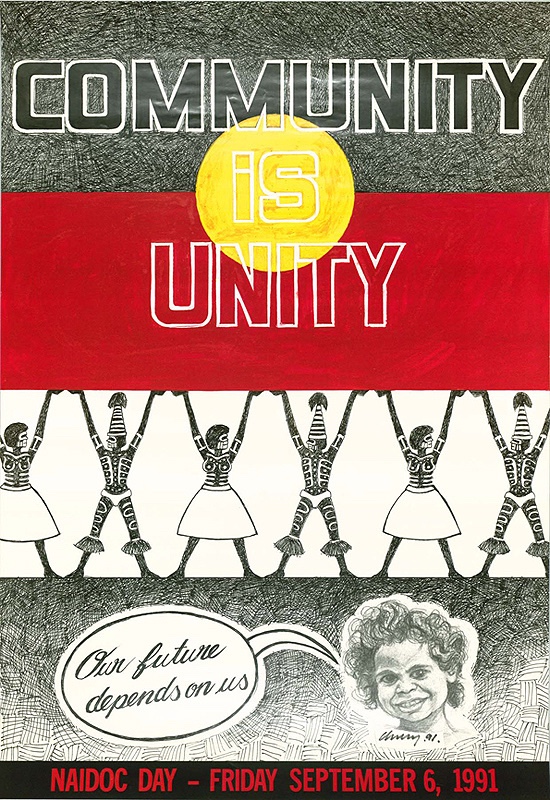
1991: Community is Unity—Our Future Depends On Us

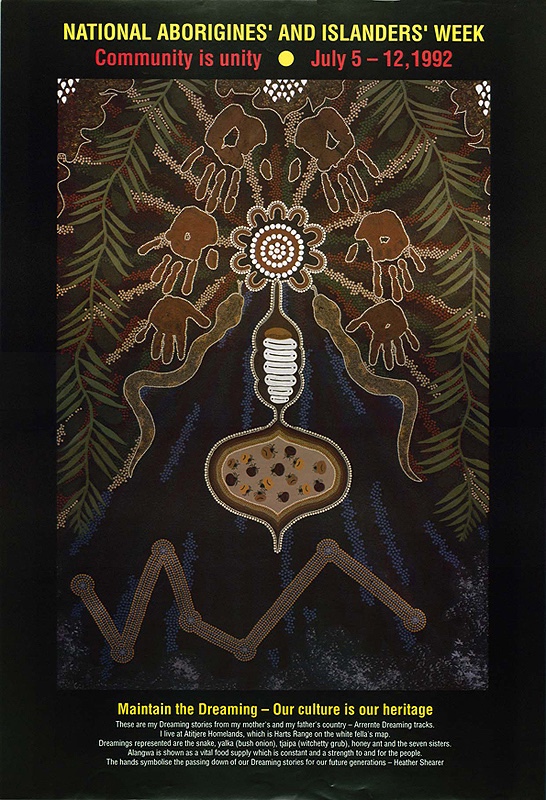
1992: Maintain the Dreaming—Our Culture is Our Heritage

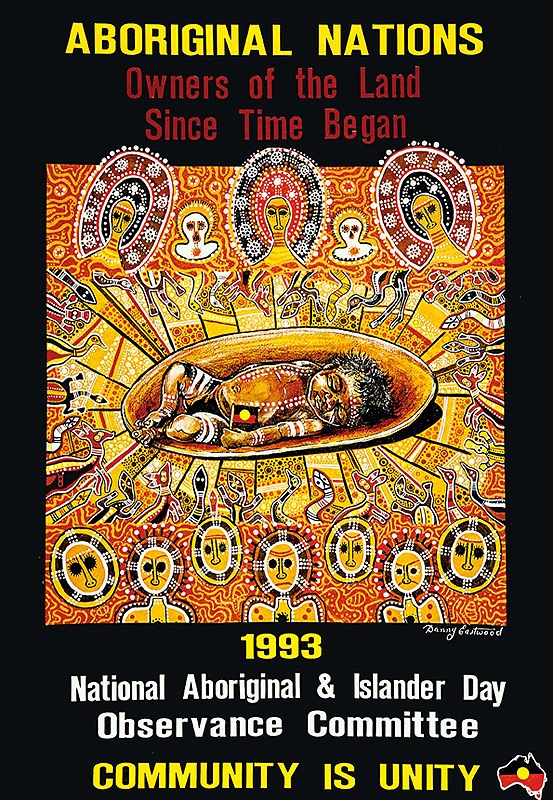
1993: Aboriginal Nations—Owners of the Land Since Time Began—Community is Unity

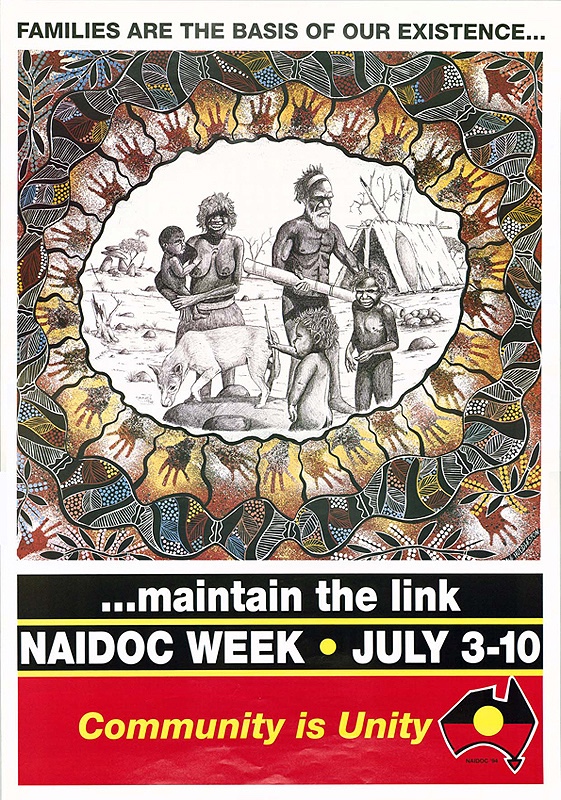
1994: Families Are the Basis of Our Existence—Maintain the Link

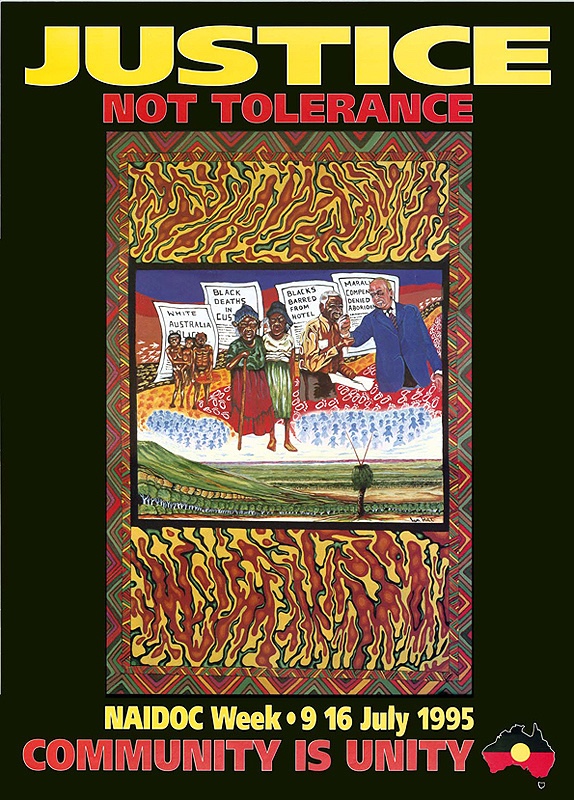
1995: Justice Not Tolerance

*****

In 1991, the focus on community in the theme, Community is Unity—Our Future Depends On Us, echoed the earlier themes that referred to community: talking together in the 1983 theme, Let’s talk—we have something to say; seeking understanding in the 1985 theme, Understanding: it takes the two of us; and working towards peace in the 1986 theme, Peace, not for you, not for me, but for all of us. The theme also had a future orientation, expressing hope for what might lie ahead for Aboriginal people: Our Future Depends On Us. That “us” clearly included white and black together, working in common in community.

The 1992 theme, Maintain the Dreaming—Our Culture is Our Heritage, looked back just a couple of years, to the 1990 theme, Don’t Destroy, Learn and Enjoy our Cultural Heritage, and to the 1988 theme, Recognise and Share the Survival of the Oldest Culture in the World. It also referenced the 1978 theme, Cultural Revival is Survival. All four years focussed attention on the long-exisiting culture that was maintained and passed on by indigenous peoples around the continent.

In addition, the 1992 theme included a reference to Dreaming; this is a term, somewhat contentious amongst First Nations people, which has nevertheless seen widespread acceptance and adoption in the wider Australian society. It is generally understood to be a way to refer to the collection of stories that form the foundational mythology of Aboriginal peoples.

Reconciliation Australia, on its website shareourpride.org.au, states that “it is impossible to find words that adequately capture this core element of who we are but it’s something you feel when you sit with us on our country and hear our stories with an open mind and heart.”

The website affirms that “Dreaming is more than a mythical past; it prescribes our connection as Aboriginal people with the spiritual essence of everything around us and beyond us. Dreaming stories are not in the past, they are outside of time – always present and giving meaning to all aspects of life.”

See https://www.shareourpride.org.au/sections/our-culture/index.html

*****

The 1993 theme, Aboriginal Nations—Owners of the Land Since Time Began—Community is Unity, incorporated three distinct phrases. The final phrase looked back by incorporating one phrase of the 1991 theme, Community is Unity. However, the full theme included a clear reference to the struggle that had culminated in the 1992 Mabo decision. It identified Aboriginal people as Owners of the Land Since Time Began. This was the principle underlying the High Court’s Mabo decision, and which then enabled the development of the Native Title Act of that year (1993).

Furthermore, the 1993 theme included a clear declaration that Aboriginal people had not simply been “one nation” before British invasion and settlement commenced in 1788; the reference to the plural, Aboriginal Nations, was highly strategic. It had been the custom in the 19th and 20th centuries for Aboriginal people to be described and treated as a single cultural and historical unit.

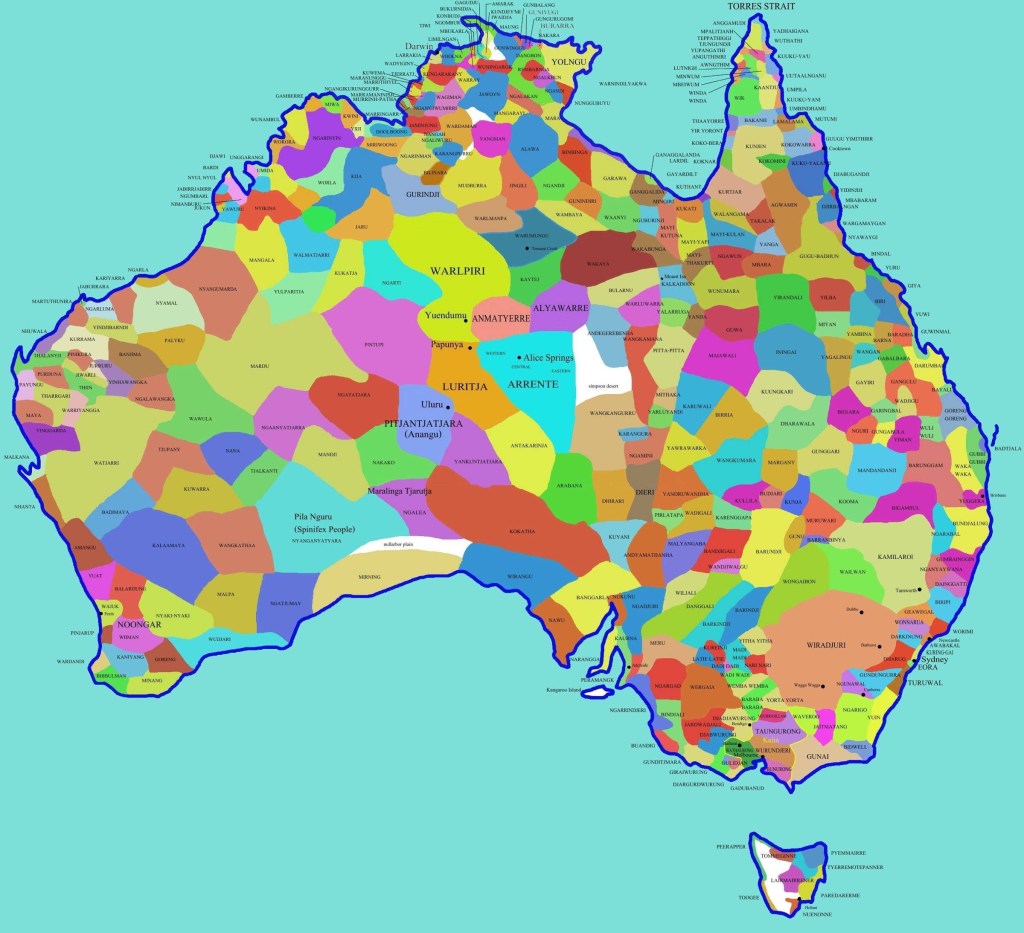
By contrast, today, two decades into the 21st century, the claim made by the 1993 theme is widely accepted and commonly spoken. British settlers have dispossessed people from well over 250 different nations right across the continent and its associated islands. The clearest example of this recognition is the map published by the government agency AIATSIS (the Australian Institute of Aboriginal and Torres Strait Islander Studies).

On a website explaining this map, AIATSIS explains that it “attempts to represent the language, social or nation groups of Aboriginal Australia. It shows only the general locations of larger groupings of people which may include clans, dialects or individual languages in a group.”

The map presents a clear lesson in a graphic manner: there were many, many nations across the continent prior to 1788.

See https://aiatsis.gov.au/explore/map-indigenous-australia

*****

The NAIDOC WEEK themes of the next two years continued to articulate core beliefs within Aboriginal culture. The 1994 theme, Families Are the Basis of Our Existence—Maintain the Link, alluded to the 1979 theme, What about our kids?, and would provide a prophetic looking-forward to the key findings of the Bringing Them Home report issued just a few years later, in 1997.

The 1995 theme, Justice Not Tolerance, was a plea to move beyond ideas of merely tolerating indigenous people, and adopt the principles of justice that would see them treated equitably, with wrongs righted and reparations made for past errors.

*****

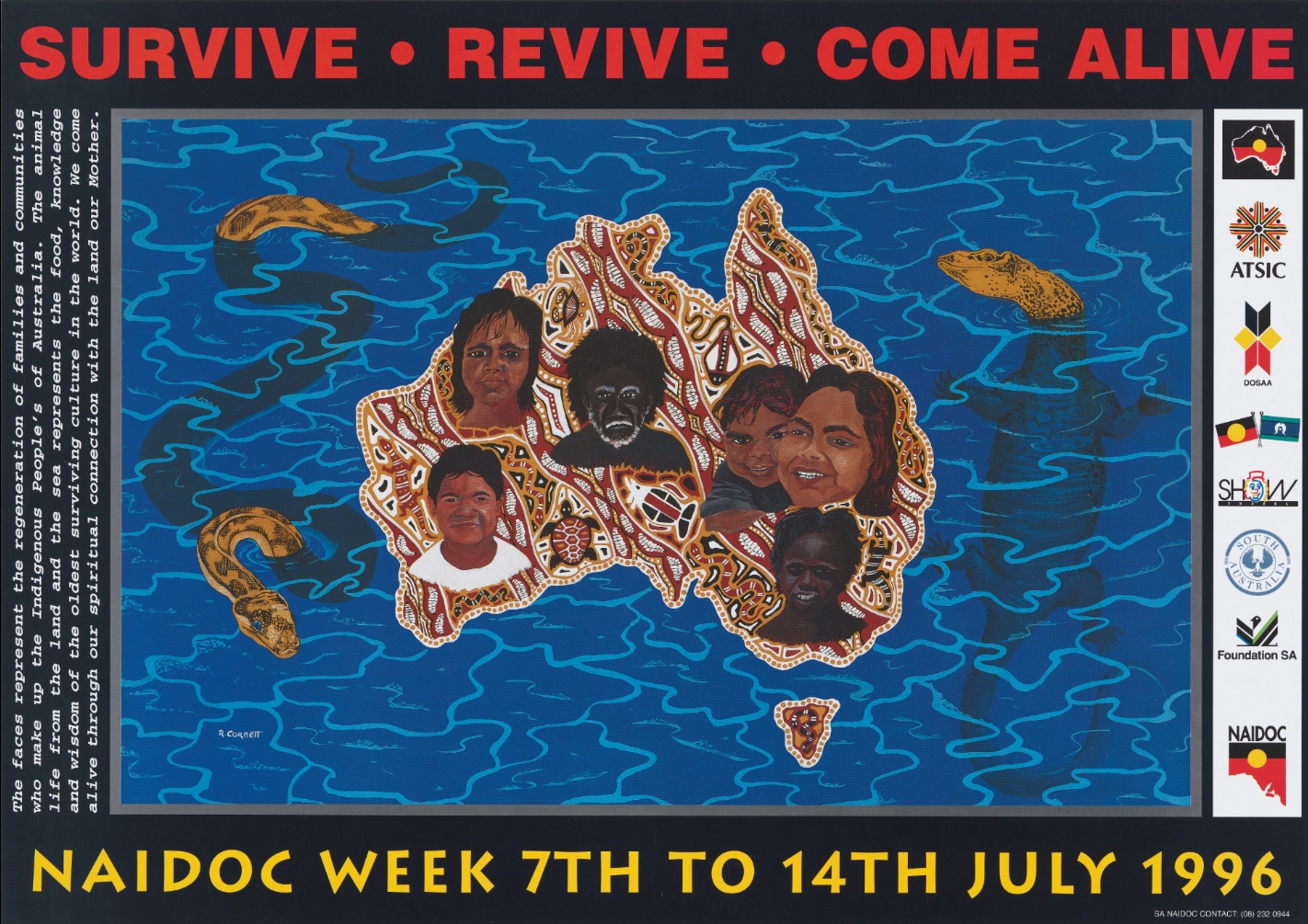
In March 1996, John Howard’s Liberal Party, in coalition with the National Party, was elected, and formed a government that lasted for the next 11 years. The 1996 and 1997 themes for NAIDOC WEEK continued to provide sharp insights into what was needed in Australian society, even with a more conservative government at the helm. In 1996, the theme was Survive—Revive—Come Alive.

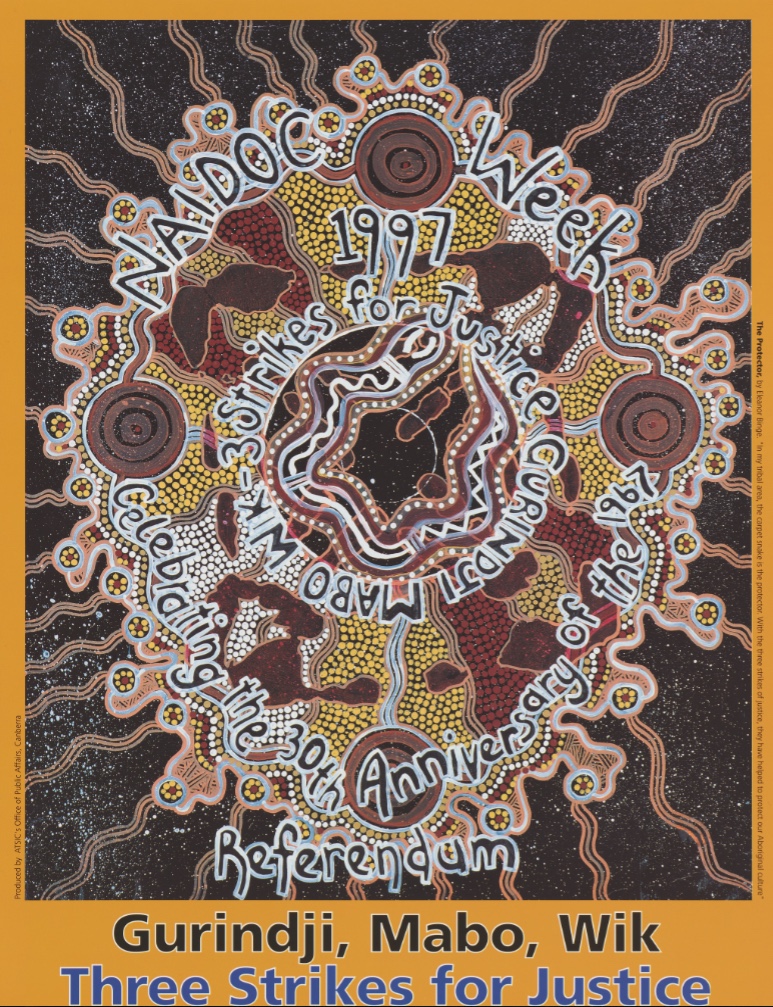
In 1997, the theme was equally pointed, as it,celebrated the 30th anniversary of the 1967 referendum,

Dr John Gardiner-Garden notes the many retrograde steps taken by the new Howard Government: they “dropped the terms ‘social justice’ and ‘self-determination’, withdrew support from many of the initiatives and institutions for which these terms were the raison-d’etre and declared its new priorities to be ‘accountability’, ‘improving outcomes in key areas’ and ‘promoting economic independence’.”

He furthered noted that “Government actions such as creating a Special Auditor, reducing Aboriginal and Torres Strait Islander Commission (ATSIC) funding, amending the Native Title Act and perceived inactions on reconciliation and in responding to the rhetoric of the new One Nation Party placed a strain on relations with the Indigenous community.”

See https://www.aph.gov.au/about_parliament/parliamentary_departments/parliamentary_library/pubs/bn/1011/indigenousaffairs2#_Toc295218057

The three events referenced in the 1997 theme, Gurindji, Mabo, and Wik, were pivotal moments in the advancement of Aboriginal claims in the 20th century.

The Gurindji Strike of 1966 was led by Vincent Lingiari. A protest against the Wave Hill station managers resulted in the return of some traditional lands to the Gurindji people under a lease arrangement in 1975, and later led to the granting of inalienable freehold title to this area in 1984.

In the Mabo decision of the High Court, handed down on 3 June 1992, the court recognised the land rights of the Meriam people. They were the traditional owners of some islands in the Torres Strait. Marked on the map as the Murray Islands, the Torres Strait Islanders called these islands Mer, Dauer and Waier). The case is significant because it rejected the view that at the time of colonisation, Australia was terra nullius, or land belonging to no one.

The case had initially been brought in 1982 by five indigenous people. Because Eddie Koiki Mabo was the first plaintiff in the case, it became known as the Mabo Case. In its judgement, the High Court acknowledged that “Indigenous peoples had lived in Australia for thousands of years and enjoyed rights to their land according to their own laws and customs.” See https://aiatsis.gov.au/explore/mabo-case

On Eddie Mabo, see https://aiatsis.gov.au/explore/eddie-koiki-mabo#toc-the-mabo-case

The Wik judgement of 1996 built on the basis of the Mabo decision. The case related to the right to hold native title in an area where there were pastoral,leases in place. By a majority of 4–3, the High Court agreed that the pastoral leases did not extinguish the native title of the Wik and Tahyorre people of Cape York.

Sadly, the remembering of these three key events during the early years of the retrogressive Howard government, strikes a note of pathos. These advances were not built on by the Howard government. In the ensuing decade, due to the intransigence of the government, things would actually go backwards.

*****

See also
50 years of NAIDOC WEEK 3 (1984–1990)

Today, 30 May, is Reconciliation Day in the Australian Capital Territory. It is a day to focus on the steps that have been taken—and the steps that still need to be taken—in the relationship between the First Peoples of the hundreds of nations which existed on the continent of Australia, and its associated islands, in the late 18th century, and those who have come to this island continent in the years since.

One way that the First Peoples have articulated how they see things, and what they would like to see happen in terms of such relationships, has been in the annual NAIDOC WEEK. Starting as a national day in 1972, since 1978 a whole week has been designated to remember and honour the First Peoples of Australia.

In continuing my series about NAIDOC WEEK, I turn to the years of the Hawke Government. Bob Hawke led the Labor Party to power in the federal election of March 1983. During the nine years that the Hawke Government was in power, the following themes were chosen for each year of NAIDOC WEEK:

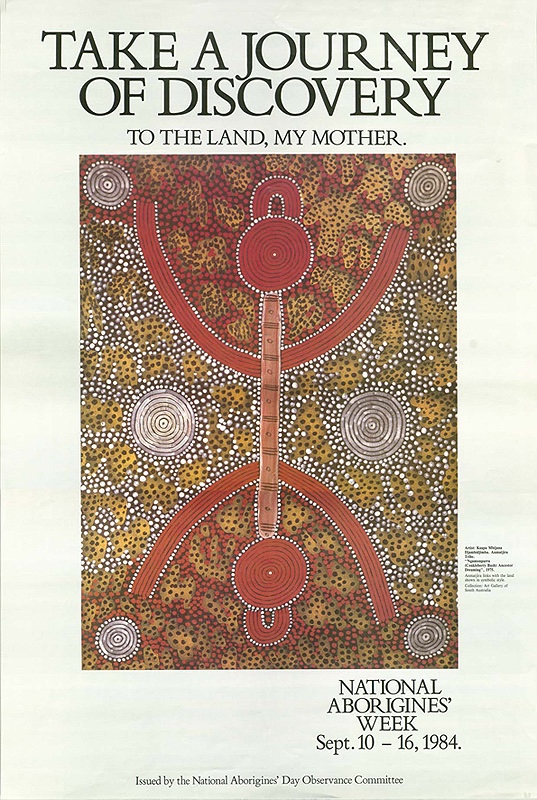
1984: Take a Journey of Discovery—To the Land My Mother

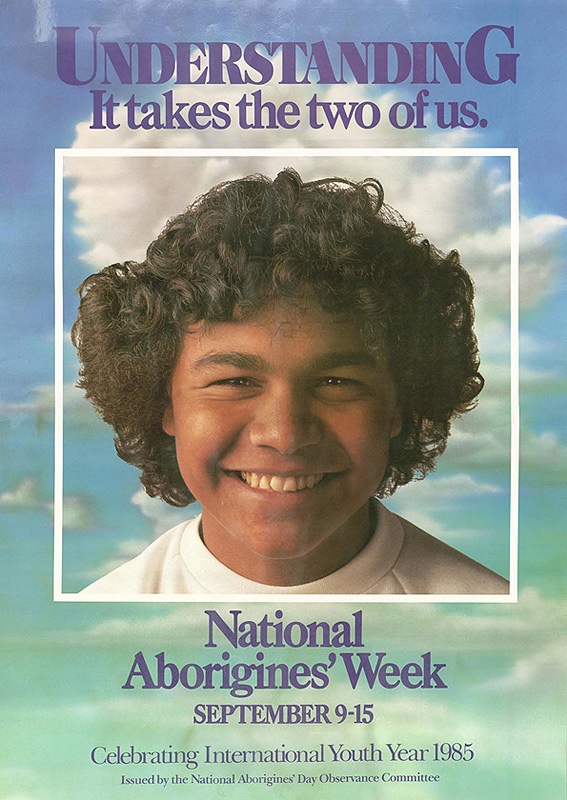
1985: Understanding: It Takes the Two of Us

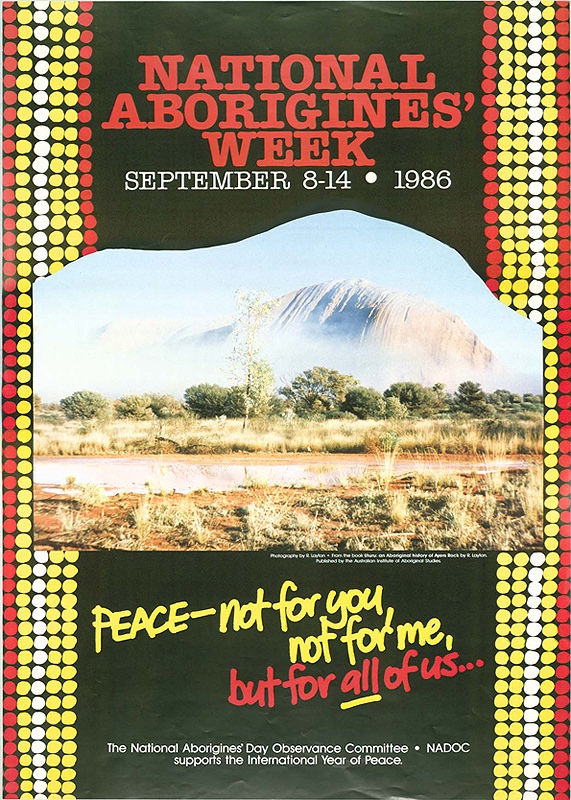
1986: Peace—not for you, not for me, but for all

1987: White Australia has a Black History

1988: Recognise and Share the Survival of the Oldest Culture in the World

1989: The Party is Over—Let’s Be Together as a Aboriginal Nation

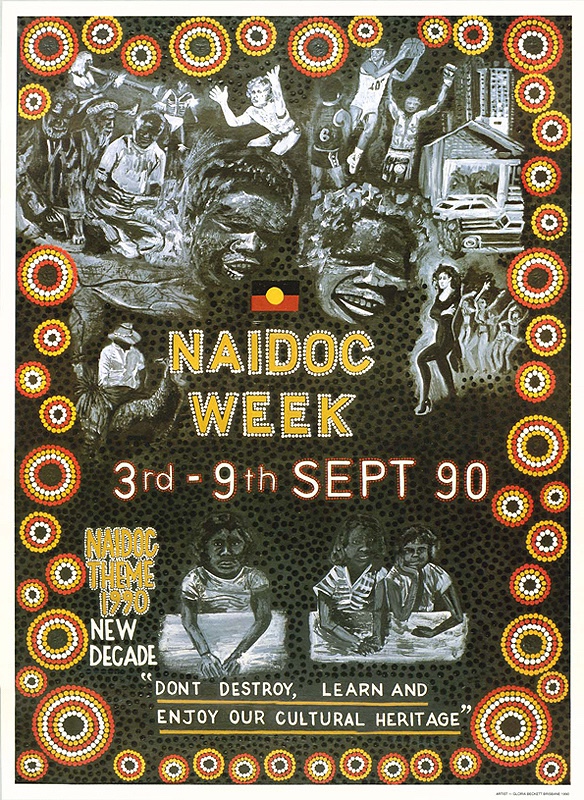
1990: New Decade—Don’t Destroy, Learn and Enjoy Our Cultural Heritage

The themes of the first few years during this period canvassed various motifs. The first in this sequence, in 1984 (Take a Journey of Discovery—To the Land My Mother) is striking in that it referred to the land as “Mother”. In considering the significance of land to indigenous people, the Aboriginal site, Creative Spirits, retells the story of “The Lost Girl”. Separated from her family, separated from the camp, the girl spent the night underneath an overhanging rock, before following a crow which took her back to her people.

“The people laughed and cried at once to see that the girl was safe. They growled at her for her foolishness, and cuddled her, and gave her a place by the fire. Her little brother asked her if she had been afraid; but the girl said – ‘How could I be frightened? I was with my Mother. When I was thirsty, she gave me water; when I was hungry, she fed me; when I was cold, she warmed me. And when I was lost, she showed me the way home.’”

See “Meaning of land to Aboriginal people—Creative Spirits”, retrieved from https://www.creativespirits.info/aboriginalculture/land/meaning-of-land-to-aboriginal-people

See https://www.creativespirits.info/aboriginalculture/land/meaning-of-land-to-aboriginal-people

*****

The next two years saw themes selected to indicate what work was needed, to ensure that black and white could do-exist together in modern Australia. In 1985, the theme was Understanding: It Takes the Two of Us. The poster also referenced the 1985 International Youth Year, with an image of a smiling younger indigenous person.
In 1986, moving beyond understanding, the theme referenced peace: Peace—not for you, not for me, but for all. The poster, highlighting the colours of red, yellow, and black, had an image of Uluṟu (then known as Ayer’s Rock) at its centre.

A key event during the Hawke period was the bicentenary of white settlement of Australia. Along with the public celebrations planned and held on Australia Day in January 1988, the opening of the new Parliament House took place in May 1988.

The location for Canberra was chosen after much debate in the early 20th century. The region is generally understood to have been a meeting place for different Aboriginal clans, suggesting that there was a reliable food and water supply. So placing the building where representatives from around the continent gathered, to debate and decide the laws of the country, sends a powerful symbol.

Michael Nelson Jagamara (born 1945) Luritja/Warlpiri peoples
Possum and Wallaby Dreaming 1985, synthetic polymer paint on canvas, Parliament House Art Collection, Canberra, ACT.
© The artist licensed by Aboriginal Artists’ Agency Ltd.

The name Canberra is believed to have been derived from a local Indigenous word Kamberri, which identifies the location as a meeting place of these many nations, for a gathering focussed around the bogong moth. See https://johntsquires.com/2019/01/30/learning-of-the-land-3-tuggeranong-queanbeyan-and-other-canberra-place-names/

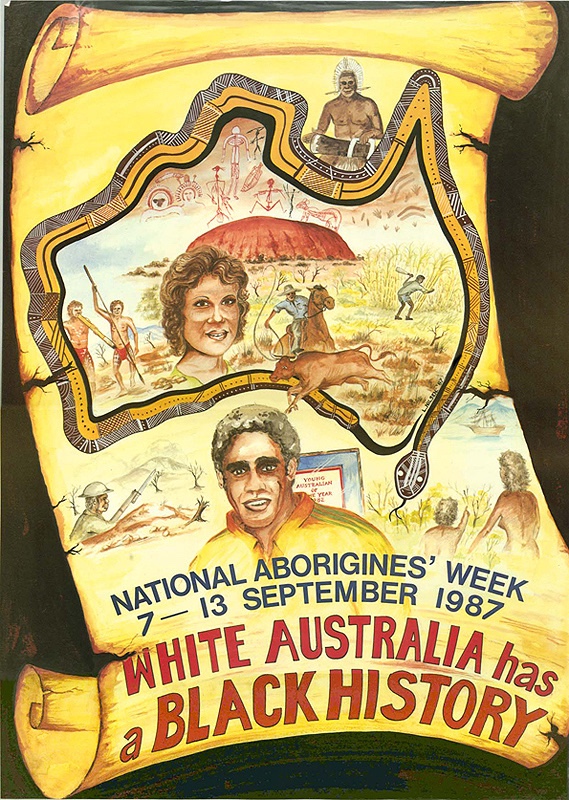
Three NAIDOC WEEK themes reflect this watershed year. In the year before the bicentenary, 1987, there was a focus on black history, as a counterpoint to the intense focus that there was on the history of Australia since European colonisation from 1788 onwards. Mandandanji descendant and Queensland based multidisciplinary artist, Laurie Nilsen, designed the poster illustrating this theme.

The design features “a rolled paper scroll against a black background, with a large snake forming a silhouette of Australia and an assemblage of indigenous people and motifs spread throughout the composition, with red and blue printed text below”, according to a description on https://culturalcommons.edu.au/white-australia-has-a-black-history/

The site continues, “Nilsen has used a palette of warm and natural earthy tones of ochre, red and black to represent Indigenous figures and iconography including a stockman riding a horse in front of Uluru; a man wearing a dhari (traditional dancer’s headdress); rock paintings; a mother and son watching a tall ship; a soldier in a trench and a portrait of rugby player Mark Ella, recipient of Young Australian of the Year in 1982.”

The 1987 theme, White Australia has a Black History, can be understood to refer to the lack of meaningful acknowledgment, at that time, of past atrocities committed against First Nations people—an attitude which has been reversed in recent years, as it attested by the University of Newcastle’s project to map all massacre sites across the continent. See https://c21ch.newcastle.edu.au/colonialmassacres/map.php

*****

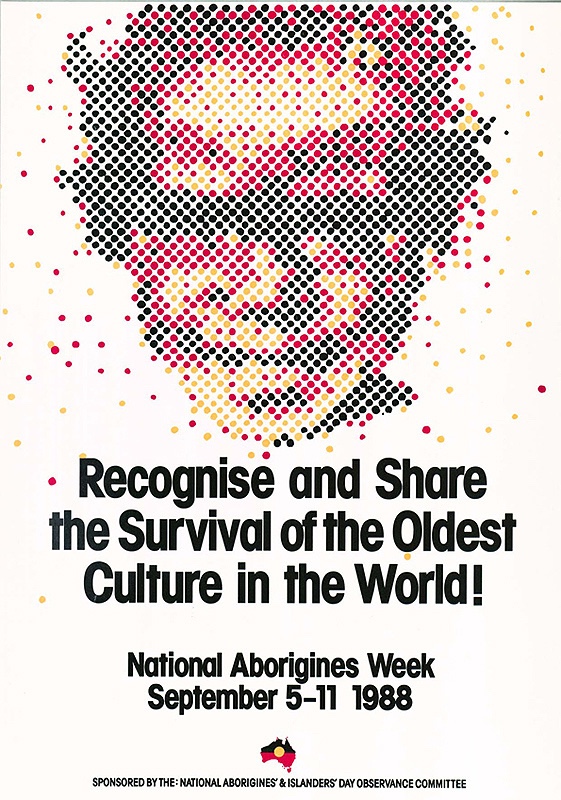
In 1988, the year of the bicentenary, the theme was clear and direct: Recognise and Share the Survival of the Oldest Culture in the World. The image of an Aboriginal face on the poster is made up of dots, coloured in the schema of the Aboriginal flag (red, yellow, black).

This theme provides a strong recognition of a fact that is now accepted without question; that the culture that is evident in traditional Aboriginal groups today has continued without interruption for millennia—at least 60,000 years, perhaps 75,000 years, maybe even longer.

Luke Pearson writes that “Aboriginal cultures are acknowledged as the first makers of bread, the first astronomers, have the earliest evidence of religious beliefs and practices, were the creators of the oldest still standing man-made structure (the Brewarrina fish traps), and more other firsts.”

Yet, he says, a focus on where a particular item was first developed is an inadequate way to assess a culture. He maintains that Aboriginal culture had long been living in accord with principles that “‘modern societies’ are only now fumbling around the edges of trying to understand and attain.”

He cites those principles as “Environmental sustainability; not being in a state of perpetual war; not needing to exploit others for resources and labour; equitable wealth and resource distribution”; but even then, he declares, “this is not the true lens through which other cultures should be viewed, because the true value of Aboriginal cultures is not simply how its practices and philosophies can assist others with the challenges they now face.”

See https://www.sbs.com.au/nitv/article/2016/12/21/what-continuous-culture-and-are-aboriginal-cultures-oldest

*****

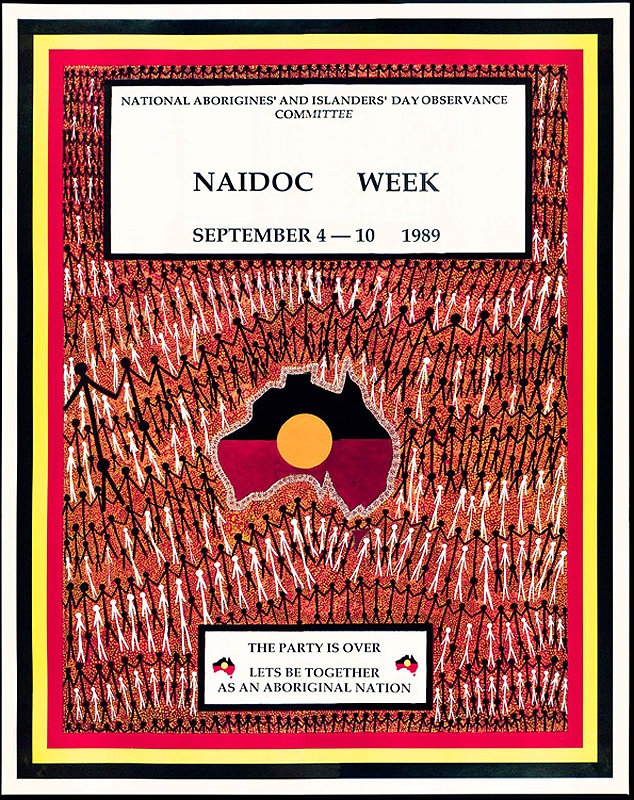
In 1989, after the year of partying throughout the bicentenary, NAIDOC WEEK turned the focus back to a key claim of indigenous leadership: The Party is Over—Let’s Be Together as a Aboriginal Nation. The theme articulated a plea for a way to move forward as a united nation, with true recognition of the foundational and central place of Aboriginal people in the nation. It signalled that froth and bubble of the public celebrations of 1988 (in which many indigenous people felt unable to participate) needed now to be followed by some hard, sustained work, to develop a unified nation.

The poster showed white fellas and black fellas lined up together, symbolising that plea to work towards unity. It’s a plea that has fallen on deaf ears, sadly—and worse, and the following era under the Howard government saw the development of the “history wars”, a retrograde opposition to recognising black history, and a fanning of the flames of racists xenophobia, turned even into the First People of the continent and its islands.

The theme for 1990 recognised the start of the new decade, it the theme New Decade—Don’t Destroy, Learn and Enjoy Our Cultural Heritage. The theme refers back to the 1988 theme, giving it a forward-looking orientation.

Sadly, vested interests have continued to disregard this plea from First Peoples, as various sacred sites have been reclaimed, destroyed, and concreted over in the interests of “development”. The most tragic instance of this was in the disgusting blasting of the Juukan Gorges by Rio Tinto in 2020. This irresponsible act must surely be seen as a criminal act.

The shelters that were destroyed were the only inland site in Australia showing human occupation continuing through the last Ice Age. Their tragic destruction is a clear sign that we refuse to learn, that we continue to disrespect Aboriginal culture. See https://theconversation.com/rio-tinto-just-blasted-away-an-ancient-aboriginal-site-heres-why-that-was-allowed-139466

*****

See also