John whose other name was Mark (April 25)

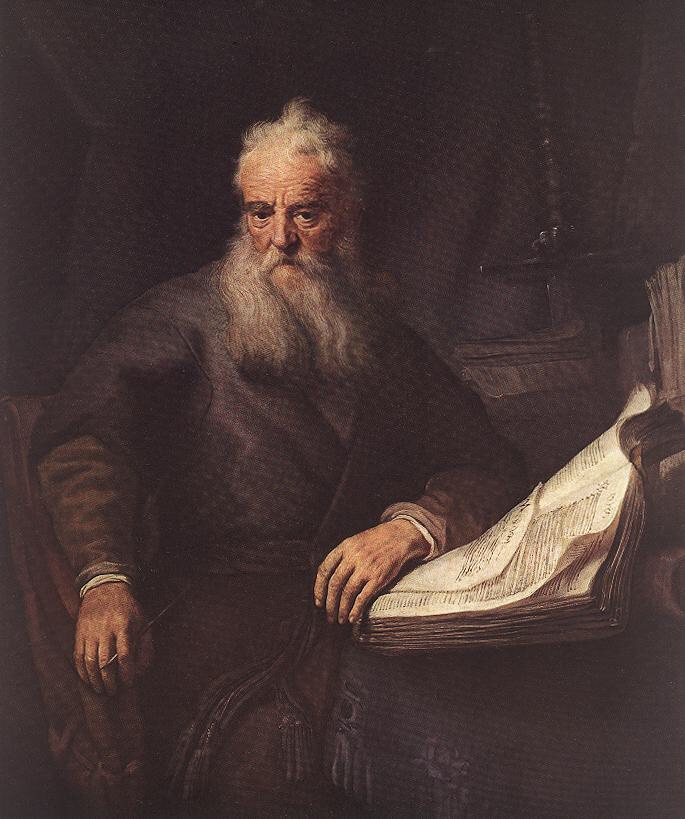
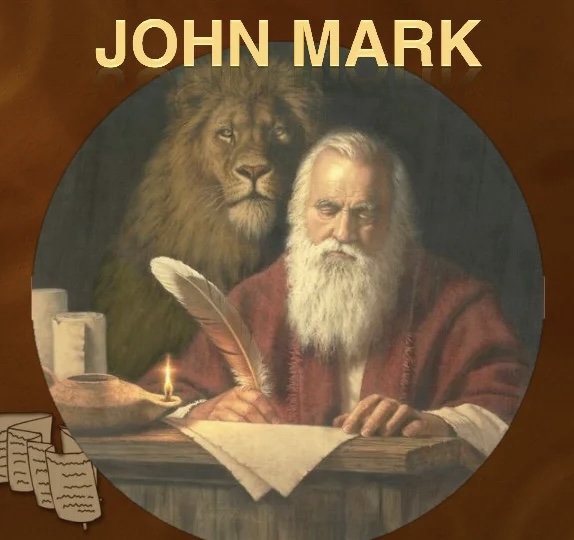
In the Uniting Church’s resource provided for worship leaders, Uniting in Worship, there is a Calendar of Commemorations, based on the cycle of annual feast days for saints in the Anglican, Catholic, and Orthodox churches—but broadened out to be much wider than this. Many days of the year are designated to remember specific people. Today (25 April) is the day allocated to remember John Mark, fellow worker with Paul and, by tradition, the author of the earliest Gospel.

Mark, it is believed, was a young man at the time of Jesus. The first explicit mention of this young man comes in Luke’s description of the community of believers, gathered together. When Peter was released from prison, he went to “the house of Mary, the mother of John whose other name was Mark, where many had gathered and were praying” (Acts 12:12).

It’s interesting to wonder whether this gathering in the house of this Mary might have been in the same place, with many of the same people, who gathered in Jerusalem, after the resurrection and ascension of Jesus, but before the Day of Pentecost. That gathering was in “the room upstairs where they were staying”, without the owner of the house being noted. Included in the people participating in this gathering was “Mary the mother of Jesus, as well as his brothers” (Acts 1:12–14). John Mark is not mentioned amongst those named in this group on that earlier occasion.

John Mark is mentioned further time in Acts after the gathering in Jerusalem in Acts 12. After working for a year in Antioch (11:26), Barnabas and Saul “returned to Jerusalem and brought with them John, whose other name was Mark” (12:25). It seems that John Mark had been sharing in ministry with Barnabas and Saul in Antioch.

The final reference to John Mark occurs at a critical moment in the narrative about the mission that Barnabas and Saul had been undertaking. They had spent time in Antioch in Syria (11:22–30), Cyprus (13:4–12), Antioch in Pisidia (13:13–52), Iconium (14:1–5), Lystra and Derbe (14:6–20), Barnabas and Saul travelled back to Antioch in Pisidia (14:21–23) and then on back to Antioch in Syria (14:24–28).

After a council of the church was held in Jerusalem (15:1–29) and a report from that was given in Antioch (15:30–35), there was some discussion about revisiting “the believers in every city where we proclaimed the word of the Lord and see how they are doing” (15:36).
Luke reports that “Barnabas wanted to take with them John called Mark. But Paul decided not to take with them one who had deserted them in Pamphylia and had not accompanied them in the work” (15:37–38). This earlier desertion of the apostles—not actually noted in the text at the time it was said to have taken place—was the basis for Paul’s opposition to this proposal.
Luke indicates that “the disagreement became so sharp that they parted company”; the word that is used here, paroxysmos, is sharp and cutting (we derive the word paroxysm from it). So “Barnabas took Mark with him and sailed away to Cyprus; but Paul chose Silas and set out, the believers commending him to the grace of the Lord (15:39–40). Silas would be the ongoing companion of Paul for some time thence.

There is an ancient church tradition, however, that identifies John Mark with “a certain young man”, not named in the text, who was “wearing nothing but a linen cloth” (Mark 14:51). This young man, perceived to be one of the followers of Jesus, was with Jesus in the garden at the critical time when, as the Gospel reports, all those who were with him “deserted and fled” (14:50). The text explicitly notes of this “certain young man” that the “crowd with swords and clubs, from the chief priests, the scribes and the elders” (14:43) caught hold of him as the others fled, “but he left the linen cloth and ran off naked” (14:52).

This young man—the first Christian streaker!—has been identified as John Mark, and it’s further claimed that he was the author of the work we know as the Gospel according to Mark. The “evidence” in the text is as clear as the clothing that the young man was wearing—it slips away in an instant, it is nothing of any substance at all.

What else do we know of John Mark? Is he the “Mark, cousin of Barnabas” mentioned at Col 4:10? His name appears here and in Philemon 24, amidst a similar cluster of men identified as fellow-workers of Paul (Epaphras, Mark, Aristarchus, Demas, and Luke; see Col 4:10–14). The names of three of these men (Mark, Delmas, and Luke) recur amidst the people noted at 2 Tim 4:9–11; also named are Crescens, Titus, Alexander, and Tychicus).

This section of 2 Tim may well be an historical fragment from the time of Paul, inserted into a letter written at a later time, claiming Pauline authorship (but betraying many signs of a later composition). But nothing definitively links this Mark with the John Mark of Acts (nor, for that matter, with the author of the earliest extant Gospel).

The later relationship between John Mark and Paul is also hinted at in a further letter, attributed to Peter (but most likely not authored by either him), which concludes with a note that Silvanus (whom some think may have been Silas) assisted in writing the letter, and that “my son Mark sends greetings” (1 Pet 5:12–13).

This verse has contributed to the tradition that Mark was a disciple of Peter (the word translated “son” could also infer he was a “disciple”)—and thus, that Mark’s Gospel came from when Mark, “in his capacity as Peter’s interpreter, wrote down accurately as many things as he recalled from memory—though not in an ordered form—of the things either said or done by the Lord”, as Papias declared (Eusebius, Church History 3.39). The lion is the symbol that is traditionally attached to this Gospel.

But this claim about authorship comes from a later century, and is not an observation made at the time the Gospel was written. See

The closing words of the letter attributed to Peter are a fitting conclusion to our consideration of the mercurial John Mark: “Greet one another with a kiss of love. Peace to all of you who are in Christ.” (1 Pet 5:14). If he was, indeed, with Peter, and if this was, indeed, their wish for “the exiles of the Dispersion in Pontus, Galatia, Cappadocia, Asia, and Bithynia” (1 Pet 1:1), it stands as a fine testimony from this first century follower of Jesus.

Mark is subsequently credited as being the founder of the church in Egypt. The Coptic Church (the Church of Alexandria) is called the “See of St. Mark”; it is claimed as one of the four earliest sees: Jerusalem, Antioch, Alexandria, and Rome. John Mark regarded in the Coptic Church as the first of their unbroken 117 patriarchs, and also the first of a stream of Egyptian martyrs.

An apocryphal story told about John Mark concerns an incident soon after he had left Jerusalem and arrived in Alexandria. On his arrival, the strap of his sandal was loose. He went to a cobbler to mend it. When the cobbler, named Anianos, took an awl to work on it, he accidentally pierced his hand and cried aloud “O One God”. At this utterance, it is said that Mark miraculously healed the man’s wound. This gave him courage to preach to Anianos. The spark was ignited and Anianos took the Apostle home with him. He and his family were baptized, and many others followed.

It is said that John Mark went to Rome, but left there after Peter and Paul had been martyred; he then returned to Alexandria and was martyred there in the year 68, after an altercation with a crowd attempting to celebrate the feast of Serapis at the same time as the Christians were celebrating Easter.

Seeking peace amidst the turmoil: the terrible tragedy of warfare

As we draw nearer to the annual ANZAC Day commemorations, we prepare to remember those who have served in military forces in many theatres of war over the past decades. As I keep on hearing, now, this annual day is not a day to glorify the exploits of those who took part in those wars (which is how I experienced it, growing up in the 1960s and 1970s), but rather, a day to reflect on the cost, even the sacrifice, of those combatants.

Certainly, the mood of sober reflection on the cost of war, the damage that it does to those who have served, and also the courage that many showed under situations of great adversity and danger—this is what usually predominates in our time. (Although my liturgical sensitivities still cringe, every time a local RSL branch leads an ANZAC Day service using antiquated language and creakingly-obsolete theology via the “approved order of service” and the hymns that are taken straight from the vault of Antiques Roadshow.)

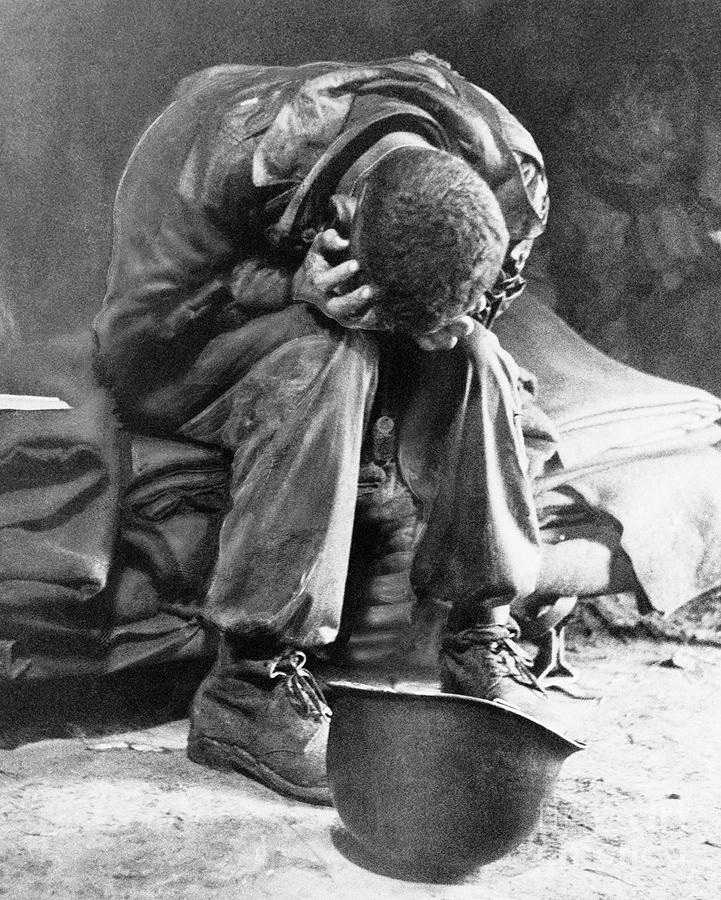
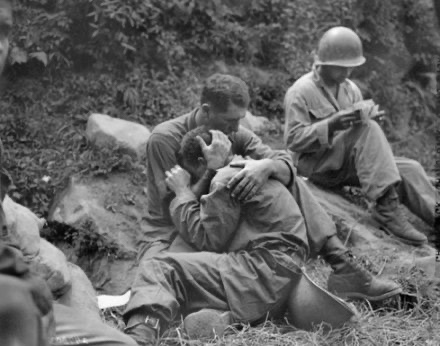
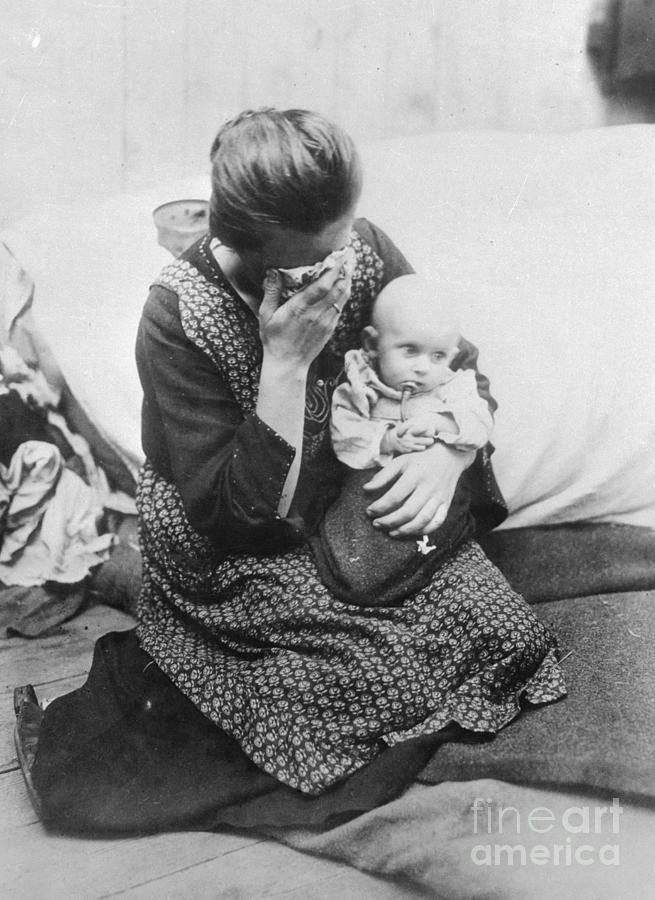
I recently read about a visit that Pope Francis made to Italy’s largest military cemetery. It was in 2014, but what the Pope said merits our consideration: “war is madness; humanity needs to weep, and this is the time to weep.”

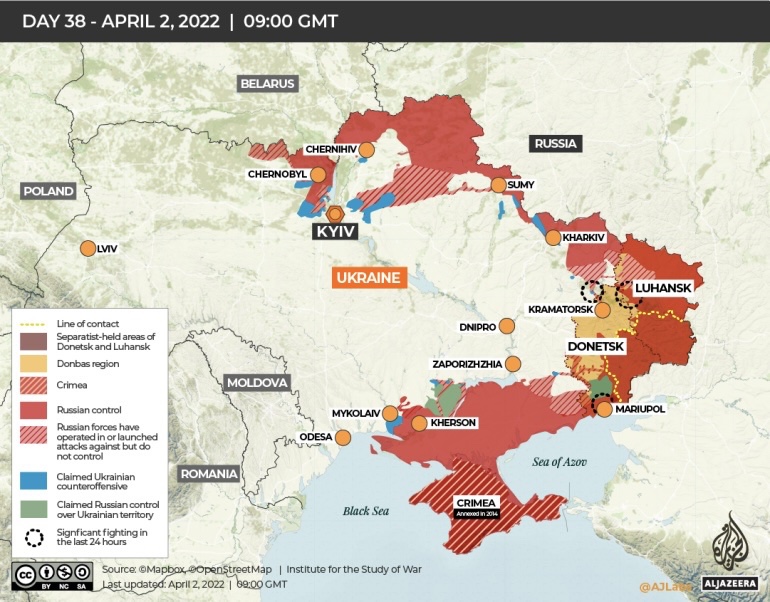
The report indicated that the Pope believed, even back in 2014, that we were in the midst of a Third World War—a piecemeal war, but a world war, nevertheless. The current Russian invasion of the Ukraine, the sturdy resistance of the people of Ukraine, and the consequent involvement of NATO and western nations, could well be seen to be the most immediate sign of this war.

(See https://www.abc.net.au/news/2022-04-10/russia-invasion-ukraine-rumblings-world-war-three-decades-ago/100977334

If this is a world war, and if the West is heavily invested in this war, then will the West be able to gain victory? The bottom line, for me, is that war is never a winning strategy. There are no winners in warfare. Certainly, there appears to be winners—in the short term—as well as losers—also in the short term. But in the long term, everyone loses. There are no winners. War causes such pain, such turmoil, such hurt, such dislocation. “War is madness; humanity needs to weep, and this is the time to weep.”

World War I was supposed to be “the war to end all wars”. The Armistice signed in late 1918 was supposed to ensure peace in Europe, and across the world. However, within two decades, the world was at war again. World War II was, in many ways, dealing with the consequences of the way that World War I was resolved, both on the battlefields, and in the negotiating rooms. The League of Nations became the United Nations, pursuing a programme of seeking peace across the world—a programme that still, today, is ongoing, and never-ending.

Can this current war be won? Should resources and personnel be devoted to “winning the war”? Certainly, Russia is showing every sign that it intends to “win the war”; whether they will, remains to be seen. And the Ukraine is valiantly demonstrating that it intends not to be the “loser” of the current war being waged in its territory; whether this will be the result, will depend on the tenacity of Ukrainian troops and the level of support (military, sanctions, trade embargoes, and the like) from NATO and others. Only time will tell who the short-term “winner” and “loser” will be.

It is true that going to war is seen by many as a legitimate way to resolve disputes and solve arguments, on a large scale. There have even been, through the ages, sophisticated arguments mounted to justify warfare. The Just War theory (originating in Ancient Greece, developed by St Augustine, and further developed by Thomas Aquinas) could presumably be used to support a western pushback to the current Russian invasion. Fighting evil is seen as essential. War is reckoned as the way to do this.

But, as the Pope said, “war is madness; humanity needs to weep, and this is the time to weep.” We know that war has many consequences. It damages individuals, communities, societies, and nations. It has many more innocent victims than the casualty lists of enrolled personnel indicate. And there is abundant evidence that one war might appear to resolve one issue, but often will cause other complications which will lead to another war.

As I have noted, when we look at the outcome of the Armistice at the end of World War One, we can trace a direct sequence of events that led from World War One to World War Two. The same connections can be made, for instance, between colonisation (itself a process that involves warfare, as invasions require the subduing of Indigenous Peoples) and subsequent civil wars in the USA, Sri Lanka, and in various countries in Africa and Asia.

Sometimes, pitched battle warfare seems to be the only possible way forward. In the current situation, resisting the Russian invasion seems to be a vital strategy, especially as we see the pictures beamed from building reduced to rubble, lines of homeless people seeking to find refuge, hospitals that have been bombed but are seeking to continue to operate under difficulties. These pictures pull at our heartstrings, and validate our support for a direct western response to Russian aggression. A non-violent response seems harsh, uncaring, selfish, and doomed to failure.

Yet, overall, a commitment to peace is surely what we need to foster. An aversion to war is what we need to develop. As we follow the man from Nazareth who advocated turning the other cheek, praying for those who abuse you, and loving the enemy—the man who blessed those who work for peace—it would seem that a non-violent response is essential. And that is the ultimate goal.

To achieve that ultimate goal, a culture of respectful disagreement and honest negotiation, rather than pitched rhetoric and savage violence, is surely what we ought to aspire towards. However, that can’t suddenly be brought to bear in the current situation. I think the imperative to respond “in kind” is too strong to ignore. The justification for an aggressive western response is strong.

But over time, our leaders need to foster a much more constructive sense of relating in positive ways through diplomacy that is nurtured over time—rather than public posturing and media-oriented sound bites. That takes hard work and persistent commitment. Instead of rattling the sabres to grow in popularity during the current battle, why not commit to the military response that is currently required, but also seek to develop robust ways of developing respectful and mutually-constructive ways of operating.

That longer path of peace must surely be the direction that our governments must work for in the coming years. The Uniting Church has had a long commitment to seeking peace in local, national, and international spheres, stretching right back to a 1982 decision of the National Assembly, affirming that “the Uniting Church is committed to be a peacemaking body, seeking to follow the Lord of the Church by encouraging political authorities to resolve political tensions by peaceful means.” (82.57(1)(c))

See https://www.unitingjustice.org.au/uniting-for-peace

We know that “war is madness; humanity needs to weep, and this is the time to weep.” Those papal words might inspire us to pause, reflect, weep—and pray. And as people of faith, the ultimate goal of peace (not just of “winning the war”, but of “bringing peace with justice”) must surely be the focus of our prayers—as we pray for those displaced, injured, or mourning in this current war, so too, we pray and work for peace in the world on the basis of justice.

So may it be.

*****

On civil war in the USA, see https://www.journalofthecivilwarera.org/2020/03/a-war-for-settler-colonialism/

On civil war in Sri Lanka, see https://hir.harvard.edu/sri-lankan-civil-war/

On civil wars in former colonies in Africa and Asia, see https://history.state.gov/milestones/1945-1952/asia-and-africa

It was yet another Passover meal—or was it? (Maundy Thursday, Year C)

The following liturgy was written in April 2022 and conducted at Tuggeranong Uniting Church on Maundy Thursday, 14 April 2022. The liturgy was conducted around a labyrinth, laid out in the worship area. There were six tables, each forming the focus of one section of the liturgy.

Seven candles were lit at the end of the first section, as reflective music played. Participants were invited to remove their shoes for the service, to sit and meditate or gently walk the labyrinth whilst the reflective music was playing.

After the words for each following section, a candle was extinguished, and reflective music was played, during which participants could sit and meditate, or walk a section of the labyrinth. Participants were encouraged to stay in their place on the labyrinth, or move to a nearby chair, as the words of each section were spoken.

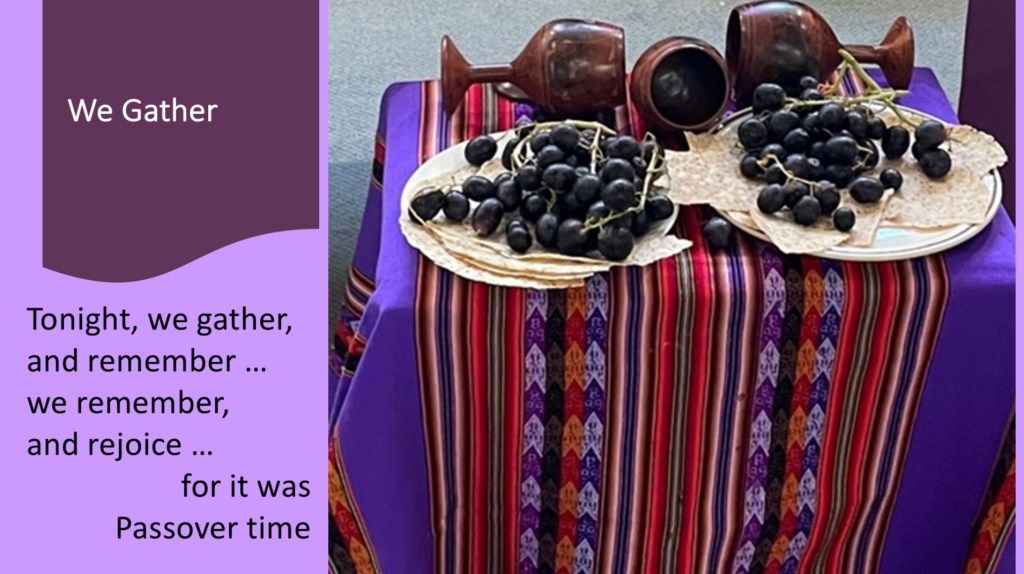
The first and last sections took place focused around a table on which some cups, grapes, and bread were set, forming the elements for communion in the last section.

***** *****

A LITURGY FOR MAUNDY THURSDAY in the YEAR OF LUKE (Year C)

1 The Room

(Please remove your shoes)

Tonight, we gather, and remember;

we remember, and rejoice …

for it was Passover time.

Now of course, it began in celebration;

a gathering of friends and family;

a joyful occasion, with the drinking of wine,

some singing, some laughing; a meal shared together;

but then, a kiss … a betrayal … a denial … a trial …

Yet it began in celebration.

For years, it was so; for decades, for centuries,

on this very night, we would gather, joined as family,

to remember, to rejoice, to recall the act of liberation.

So we praise you, Lord our God, King of the universe;
You who have chosen us and made us holy,

a nation of priests, a people set apart.


Yes, we praise you, Lord our God, King of the universe;
You who create the fruit of the vine.
Yes, we praise you, Lord our God, King of the universe;
You who bring forth bread from the earth.

We praise you in the lighting of the candles,

signs of your presence amongst us tonight;

in these sparkling, enlivening lights,

we remember that we are a light to the nations.

THE CANDLES ARE LIT

SONG: Bless the Lord, my soul (Taize)

*****

2 The Road

It was yet another Passover meal — or was it?

We began like every other Passover meal;

we began by recalling the story …

and yet, although we did not know it,

this time it would be different;

a different Passover celebration;

a different time entirely.

It probably began with what he said

as he went on ahead, going up to Jerusalem.

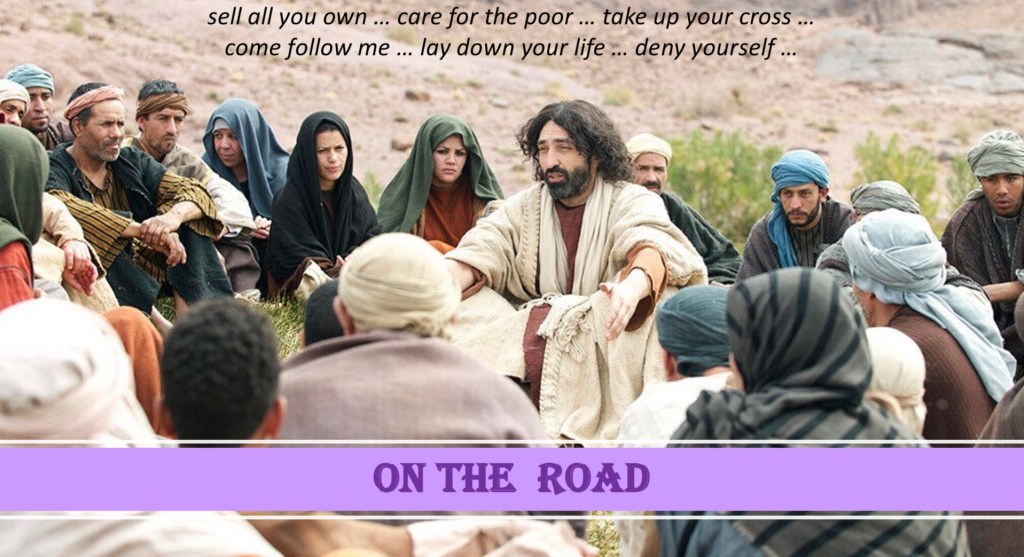
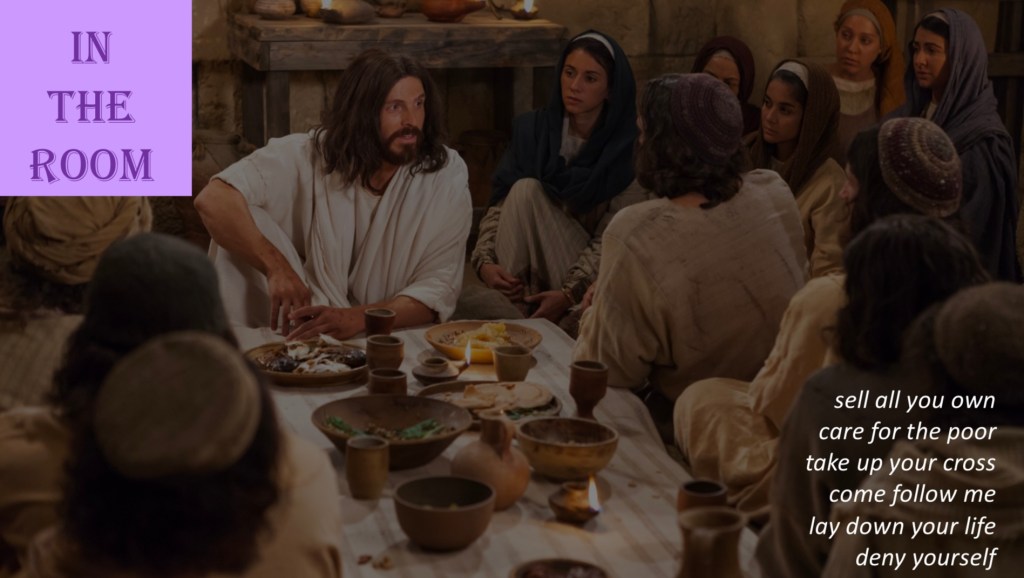
“Sell all you own, care for the poor;

Take up your cross, come follow me;

Lay down your life, deny yourself.”

Looking back, we can hear the resonances;

the hints were there; but we were deaf.

We couldn’t grasp these words;

for the journey was the moment,

the crowds that surged as he healed,

the crowds that marvelled as he taught,

the crowds that continued with him on the way,

enthralled, persuaded, believing.

You see, the journey was the moment,

destination Jerusalem, holy city,

city of the prophets, city of the kings,

the holy place where God still dwells.

Hosanna, blessings, celebration;

“Bless the king, sound hosannas;

peace in heaven, the promise is near,

glory abounds”, the crowd cries out;

the day of salvation is at hand.

“Sell all you own, care for the poor;

Take up your cross, come follow me;

Lay down your life, deny yourself.”

We cared not for those hard words now;

the swirl of the crowd, the shouts of acclamation,

the spreading of cloaks and waving of branches,

reminders of the times of triumph,

anticipation of the coming glory.

Blessed is the king;

he comes in God’s name.

He comes in God’s glory,

he comes bearing peace.

When would we see it?

A CANDLE IS EXTINGUISHED on table 2

SONG: Hosanna, hosanna, hosanna to the king of kings

*****

3 The Room

Now the festival drew near:

unleavened bread, called the Passover,

the celebration of redemption,

the time of God’s salvation.

God came, God saved us,

we hurried to respond;

no time to prepare, no time to bake the bread;

we gathered what we could, left hurriedly,

in haste, intent on being ready—

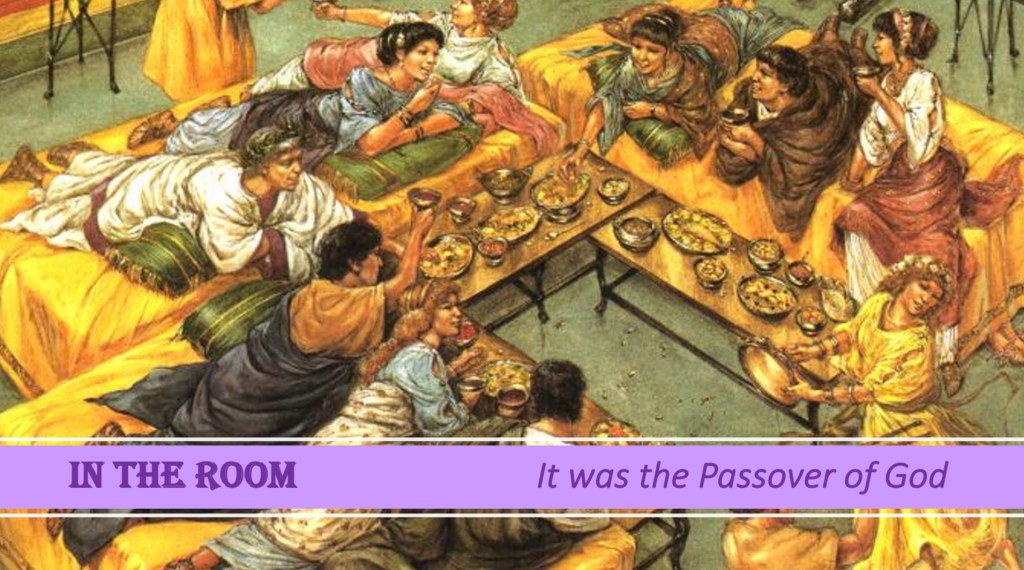
it was the Passover of God,

when God saved the people.

So we gathered, now, to remember,

retell the ancient story,

relive the present promise.

The table was set, with bread and wine,

for this festival of the Lord,

the celebration of Passover …

We met around the table; a family extended,
with brothers and sisters, children and friends;
aunts … uncles … cousins … disciples …
a cacophony of colleagues, family and followers.

As we met around the table, we joined our voices,

with a psalm of celebration; a psalm of hallelujah.

We gathered as a family,

with roasted lamb and bitter herbs,

unleavened bread, four cups of wine;

we gather now, to celebrate,

and as we do, we anticipate:

God, you saved us then;

O God, save us now.

A CANDLE IS EXTINGUISHED on table 3

SONG: Laudate Dominum

*****

4 The Room

You know the Passover is coming,

when God will save the people;

“and the Son of Man will be handed over;

they will mock him, they will whip him,

they will nail him to the cross, to die.”

For the Passover is coming,

when God will save the people.

“I have eagerly desired to share this time,

to celebrate this Passover, with you, my friends.”

First, the cup which signals the kingdom to come;

“take it, drink from it, remember as you drink”;

then the bread, “this is my body”,

words that strained our incredulity.

Then yet again a cup, the covenant renewed;

familiar ground? yet curiously,

“the cup poured out, a new covenant,

sealed in my blood, shed for you”.

Then words of betrayal; woe to that one,

one we had trusted, one we had honoured.

What was going on in his mind?

We could not know:

of the gathering of leaders, we knew not,

of the plot to seize him quietly, we knew not,

of the thirty pieces of silver, we knew not.

Unthinkable, it turns out, what he was doing:

unimaginable, the consequence of this squalid deal.

But we were at a meal that was filled with celebration;

the somber notes he sounded were lost amidst the joy.

It was the Passover of God,

when God has saved the people.

It was a gathering of friends and family;

a joyful occasion, with the drinking of wine,

some singing, some laughing; a meal shared together.

A CANDLE IS EXTINGUISHED on table 4

SONG: Jesus, remember me, when you come into your kingdom (Taize)

*****

5 The Garden

Not too long after the betrayer left him,

not too long after, they came for him.

Not just the crowd in the garden,

not just the priests from the temple,

not just the elders who had formed an unholy alliance,

scribes and priests together, on the hunt;

but they came with their thugs, the temple police,

intent on arresting him, as if he were a criminal.

“I was with you, day after day, in the temple,

and you didn’t come for me there. But now—

but here, in this dark moonlit moment,

under cover of night, you seize me?

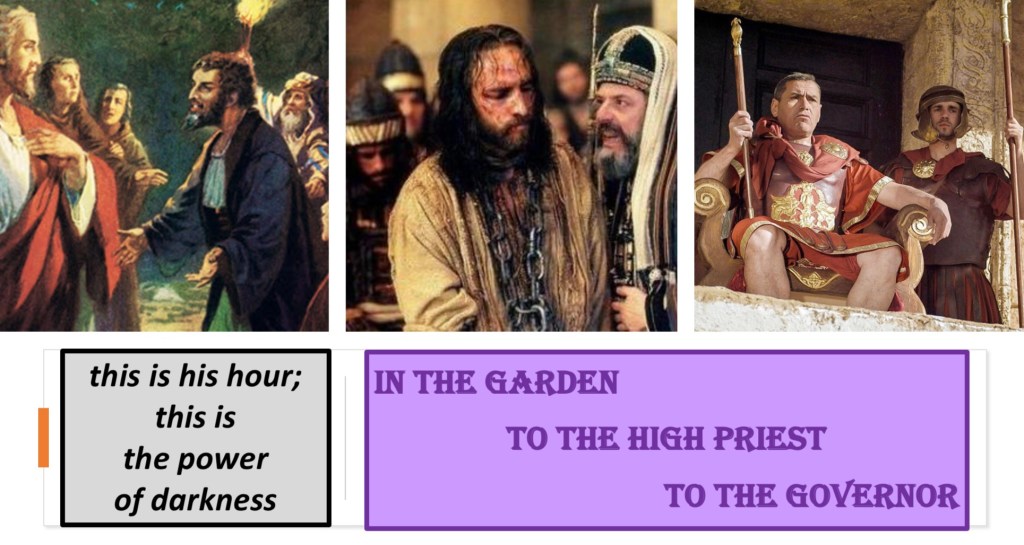
This is your hour; this is the power of darkness.”

So began this cruel, twisted fate,

from Gethsemane to Golgotha.

With brute force they manhandled him;

to the High Priest, mocking him on the way.

The mocking continued in the assembly,

priests and scribes, elders of the people,

taunting, baiting, condemning.

And then to Pilate, accusing him of crimes

that made no sense to our listening ears.

“Sell all you own, care for the poor;

Take up your cross, come follow me;

Lay down your life, deny yourself.”

That’s what we remembered him saying.

They said, however, that he perverts the nation,

forbids the paying of taxes,

claiming to be Messiah,

claiming to be king.

So Pilate sends him to Herod;

and Herod sends him back to Pilate;

and Pilate insists there is no charge to answer.

Of course there was no charge to answer!

His words cut to the heart of what it means

to be a disciple, to be committed to the covenant,

to share generously with those in need,

to put the concerns of others before oneself,

to open the eyes of the blind

and enable the lame to walk,

to proclaim good news for the poor

and liberation for the captives …

… then again, then perhaps,

that can sound somewhat …

confrontational …

revolutionary …

no wonder that they say he came

to turn the world upside down.

But we had no notion of this

as we walked the road, while he healed and taught,

or as we entered the city, surrounded by jubilations,

or as we sat with him at table, remembering with joy.

Yet there he stood:

charged, condemned;

sentenced to be crucified,

the punishment of slaves,

the fate in store for rebels,

perhaps, even, the inevitable outcome

of a predetermined plan?

Lord, have mercy;

Lord, have mercy …

A CANDLE IS EXTINGUISHED on table 5

SONG: Stay with me (Taize)

*****

6 The Hill

So they led him away, to the top of the hill,

the place of punishment for rebels and criminals.

There were no echoes, now,

of the jubilant cries of the crowd;

there was no sound that fitted

with family celebrations at Passover;

there most certainly was no longer the basis

for acclaiming him as King,

for announcing him as Saviour,

for decreeing he was Lord.

Naked, bloodied, scourged, humiliated,

brought down to common status

as the wooden beam was lifted high;

the mocking words of the soldiers,

the scornful tongues of the leaders,

the taunting cry of the disbelieving thief;

the silent sobbing of companions on the way,

the eerie overshadowing, the turmoil of darkness.

This, to be sure,

was a cruel, twisted fate.

So he died.

What cry pierced the air?

Distraught rejection, some would say;

a cry of sheer abandonment.

Others claim it was far more serene;

“Abba, Father, into your hands

I commend my being, I place my spirit.”

“Sell all you own, care for the poor;

Take up your cross, come follow me;

Lay down your life, deny yourself.”

Who remembers those words now?

A CANDLE IS EXTINGUISHED on table 6

SONG: Be still, and know that I am God

*****

7 The Room

We returned to the room;

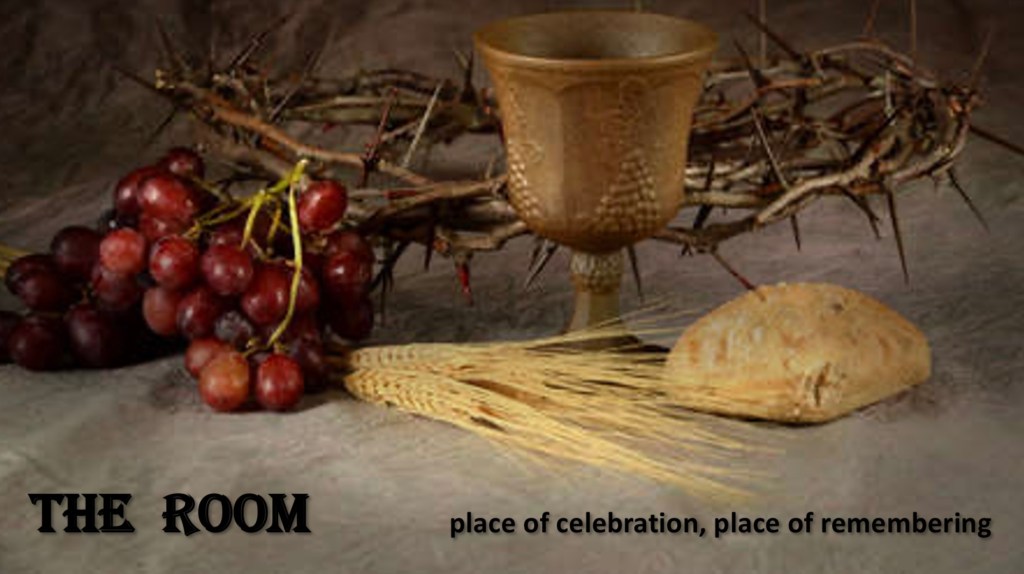
the place of celebration;

the place of remembering.

There is no doubt that we would remember;

the events of the past few days

are seared into memory,

caught in the web of recollection,

every year, every month, every day.

But how could we celebrate?

The Passover of God,

the time of salvation,

the deed of redemption,

in the days of Moses.

That surely would continue;

we would most certainly recall,

we would indeed remember,

embedding the story for our children

and their children.

Would this passing of the master

be a Passover for God?

How could this untimely ending

be the cause of celebration?

So we gather, we remember.

It began in celebration;

a gathering of friends and family;

a joyful occasion, with the drinking of wine,

some singing, some laughing; a meal shared together;

but then, a kiss … a betrayal … a denial … a trial …

“Sell all you own, care for the poor;

Take up your cross, come follow me;

Lay down your life, deny yourself.”

SONG: Eat this bread (Taize) as we exit the labyrinth

(Around the final table)

So he took the bread,

as they had always taken the bread;

and lifting it high, he offered his prayers to God.

And we take the bread, and break it:
and we praise you, Lord our God, King of the universe;
You who bring forth bread from the earth.

WE EAT THE BREAD

Then he took the cup,

as they had always taken the cup;

and lifting it high, he offered his prayers to God.

And we take the cup, and drink it,

and we praise you, Lord our God, King of the universe;
You who create the fruit of the vine,

You who bring forth hope from anguish,

You who bring forth what was promised,

You who bring forth life from death.

WE DRINK THE CUP

A CANDLE IS EXTINGUISHED

For it was the Passover of God,

when God redeemed the people,

when God saved his chosen people.

And it is the Passover of God,

when God still redeems his people,

when God still saves his faithful people.

And the shouts of acclamation

and the silent shedding of tears

join mysteriously in celebration,

join as one across the years.

In this cruel, twisted fate

is the Passover of God;

for God still redeems his people,

for God saves his faithful ones.

THE FINAL CANDLE IS EXTINGUISHED

We step out in faith

we walk forth in hope

treading the path before us

walking into life as his follow ers …

WE LEAVE TO THE MUSIC of Wait for the Lord

***** *****

Song playlist

0 As people gather, a selection of quiet meditative songs and chants

1 Bless the Lord my soul

2 Hosanna, hosanna

3 Laudate dominum

4 Jesus, remember me

5 Stay with me

6 Be still and know

7 Eat this bread

8 Wait for the Lord

Tables

1 In the Foyer, with communion elements. White

2 The Road. Green. Branches, cloaks

3, 4 The Room. Purple. Each has a cup and plate

5 The Garden. Red. Sword.

6 The Hill. Black. Cross.

7 In the Foyer. White. Broken cups and plates with elements