This month, the 16th National Assembly meeting of the Uniting Church is being held. Assembly meets every three years, rotating around state capitals. This year, the plan was to meet in Brisbane—but last year the decision was made to meet online.
Each Synod reports to the Assembly. The report of the Synod of NSW and the ACT includes a section that provides a description of “who we are” as the Uniting Church in this Synod.
That description uses data from the 2016 NCLS results and also a single respondent Census of Congregations (2019) which included an estimate of average worship attendance and an actual headcount.
I thought it was worth extracting this part of the Synod report and hinting it a wider airing. So, when we look into the mirror of these surveys, what do we see? What is the Uniting Church like, right across Australia.
The 2019 Congregational Census reported that the NSW—ACT Synod has 23570 worship attenders each week, including 2896 children under 15 and 2556 youth and young adults aged 15-30. There are 533 local churches oversighted by 375 church councils and 85% of congregations participated in the census.
80% of our churches were monocultural (more than 80% one group), 14% multicultural with one group making up 50-80% and there were 6% of churches where the largest ethnic group made up less than 50% of the population.
In 2019, just 14% of congregations had direct relationship with Aboriginal or Torres Strait Islander people, although we know from the 2016 NCLS that 26% of churches conduct an acknowledgement of country in worship.
Just 12 churches had a weekly average of more than 150 people in worship.
31% of churches had no children, 34% had less than 5 children, but there were also 29 congregations had more than 20 children involved in congregational life, 6 of which had more than 50. 40% of churches had no young adults, 30% had less than 5, but 36 congregations had more than 20 young adults and 3 had more than 50.
As reported to the previous Assembly, the 2016 National Church Life Survey (NCLS) surveyed 10,183 adults and 392 children (8 to 14) from 275 local Churches across the Synod. The 2021 NCLS will be conducted in August-September this year.
The average age of UCA members was 66, compared to the average age 38 for the Australian population at the same time. In 2016 70% of NSW-ACT UCA attenders were over 60, compared to 21% of the wider population. 63% of NSW-ACT UCA attenders were women and 37% were men.
That’s who we are, according to these surveys. Ask yourself, as you look into the mirror: do you recognise yourself?
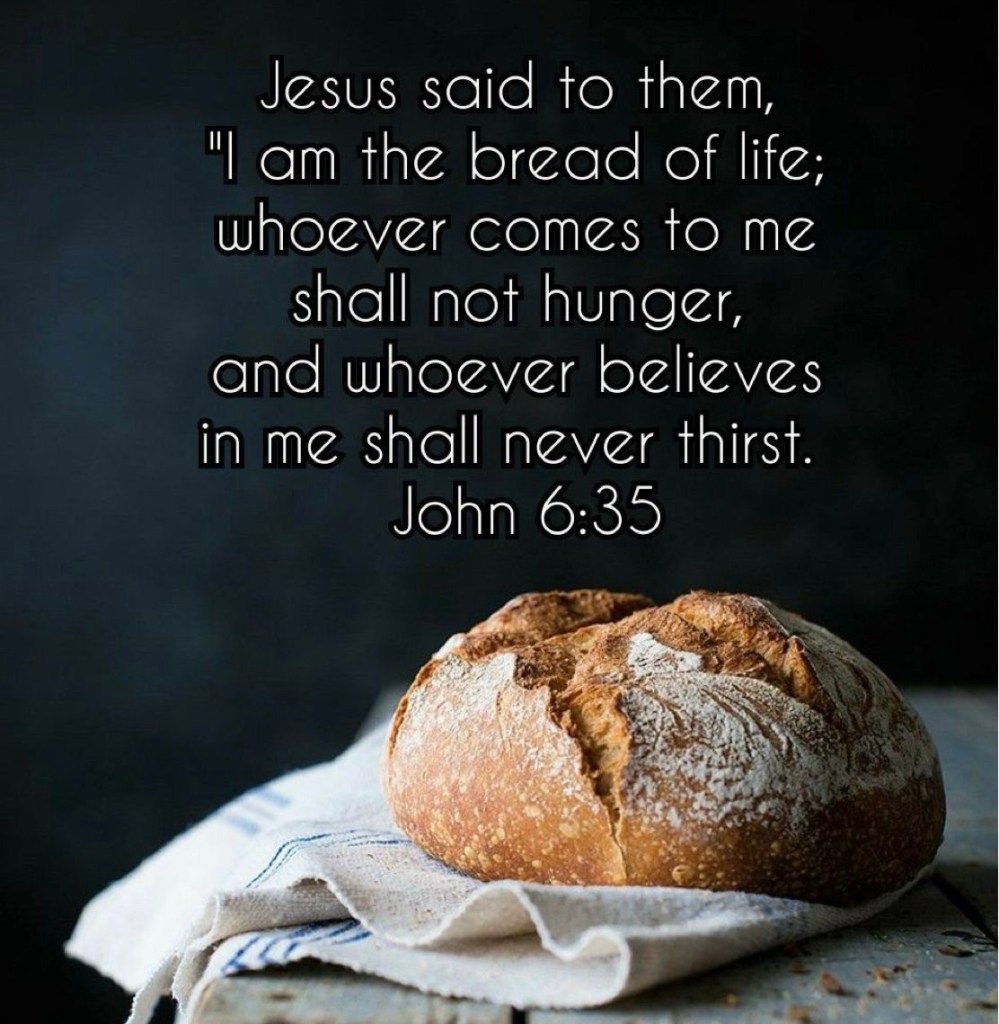
At this time of the year, every Year B, the lectionary offers us five weeks of readings from John 6, revolving around the motif of Jesus as “the living bread which came down from heaven”. The story of the feeding of the crowd of “men … about 5,000 in all” (John 6:1–14) replicates the story omitted from the last week by the lectionary, where the crowd also comprises “5,000 men” (Mark 6:44).
The Gospel offering provided by the lectionary last week omitted the feeding narrative (Mark 6:35–44) and provided only the surrounding sections (Mark 6:30–34, 53–56). It also omitted the account of Jesus walking on the water (Mark 6:45–52)—a story paralleled in Matt 14:22-33 as well as John 6:16–21.
In doing this, the lectionary had excised the important reference to Jesus crossing over “to the other side”, from the Decapolis across to Bethsaida (Mark 6:45). In this Gospel, Jesus had left Jewish territory earlier, when he crossed “to the other side of the sea, to the country of the Gerasenes” (5:1), then returned “to the other side” (5:21), where he visited “his own country” (6:1) before venturing again across “to the other side” (6:45–52). See https://johntsquires.com/2021/07/14/whats-in-and-whats-out-mark-6-pentecost-8b/
In the book of signs, the Gospel of John, Jesus moves freely between Galilee and Judea, a number of times; but there is no indication that he visited Gentile territory, despite the question of people in Jerusalem, “does he intend to go to the Dispersion among the Greeks and teach the Greeks?” (John 7:35).
The story of feeding the crowd is also retold by the other two evangelists. In the book of origins (Matt 14:15–21), the crowd comprises “about five thousand men, besides women and children (Matt 14:21). In the orderly account of things fulfilled (Luke 9:12–17), the crowd is recorded, as in the Markan source, as being “about 5,000 men” (Luke 9:14). The Johannine version, as we have seen, also estimates the total number of men present as being “about 5,000” (John 6:11).
So the early sections of John chapter 6 tell of incidents that are told also by the authors of the Synoptic Gospels: feeding a crowd (6:1–14) and walking on the water (6:16–21).
Woven through this long chapter, however, are a series of encounters that Jesus had with people around him—the crowds in Galilee (6:2, 22), his own disciples (6:3, 16, 60, 66-67), and a group of leaders who had come north from Judea into Galilee, to hear and see him (6:41, 52).
Note: Most translations describe this latter group simply as “the Jews”. The Greek word used, however, can equally be translated as “the Judeans”. There is a good case that has been mounted that the way the word is used in the fourth Gospel means that it should be translated as “a group of Jewish leaders who exercise great authority among their compatriots and are especially hostile to Jesus and his disciples … it refers to certain authorities rather than to the people as a whole.” See D. Moody Smith, “Judaism and the Gospel of John”, accessible at https://www.bc.edu/content/dam/files/research_sites/cjl/sites/partners/cbaa_seminar/Smith.htm
The sixth chapter of John’s Gospel thus offers a series of encounters that reveal misunderstanding, antagonism, and conflict in the ways that people relate to Jesus, even whilst he sets forth this significant teaching that he is “the bread of life” (6:35, 48).
*****
The first of these encounters takes place in the opening scene of this chapter, near to Passover, when Jesus and his disciples are gathered with “a large crowd” beside the Sea of Galilee (6:1-15). The issue, of course, is how to feed the large crowd; the scene thus provides the pressing situation which enables Jesus to speak, at length, about the gift of living bread that he offers.
The scene, as we have noted, is reminiscent of the Synoptic scene of feeding recounted at Mark 6:32-44, Matt 14:13-21, and Luke 9:10-17; and also the parallel scene of feeding “4,000 men” recounted at Mark 8:1-10 and also at Matt 15:32-39; although Matthew indicates that there were “4,000 men, besides women and children”.
In each of those cases, the accounts provide the opportunity for Jesus to model the traditional pattern of a Jewish meal, as he “looked up to heaven, and blessed, and broke the loaves, and gave them to the disciples to set before the people” (Mark 6:41; Matt 14:19; Luke 9:16; and again at Mark 8:6 and Matt 15:36), prefiguring the familiar pattern from the last supper (Mark 14:22; Matt 26:26; Luke 22:19; 1 Cor 11:24; and see also Acts 20:7, 27:35).
In John’s Gospel, the last supper (13:1 onwards) does not contain any such remembrance of bread (and wine); whatever Eucharistic overtones are contained in the book of signs appear later in chapter 6, with references to “feeding on my flesh and drinking my blood” (6:63-58).
In the opening scene, nevertheless, there is an allusion to this pattern in the description of Jesus as he “took the loaves, and when he had given thanks, he distributed them to those who were seated” (6:11)—although this is immediately followed, not by drinking wine, but by distributing fish (6:11b).
The miracle that is experienced by “the large crowd”—five barley loaves and two fish (6:9), which not only feeds the crowd (6:12) but also provides twelve baskets of left-overs (6:13)—is, understandably, interpreted by the people as a prophetic sign (6:14).
Jesus is this described as “the Prophet who is to come into the world”, alluding to the eschatological expectation of “the prophet to come” (Deut 18:15–18; Mal 4:4–6). Prophets were know to be capable of performing signs, following the model set by Moses (Acts 7:36; Exodus 4:1–17; Deut 34:10–12).
*****
The insight that Jesus was a prophet has already been expressed by the woman of Samaria, beside the well (John 4:19). In that encounter, the woman moves from a recognition of Jesus as prophet, to an awareness that he is Messiah (4:25-26, 29), and then to her testimony that he was the saviour of the world (4:39-42). So the initial response of the crowd is positive, affirming Jesus as “the Prophet who is to come into the world!” (6:14)
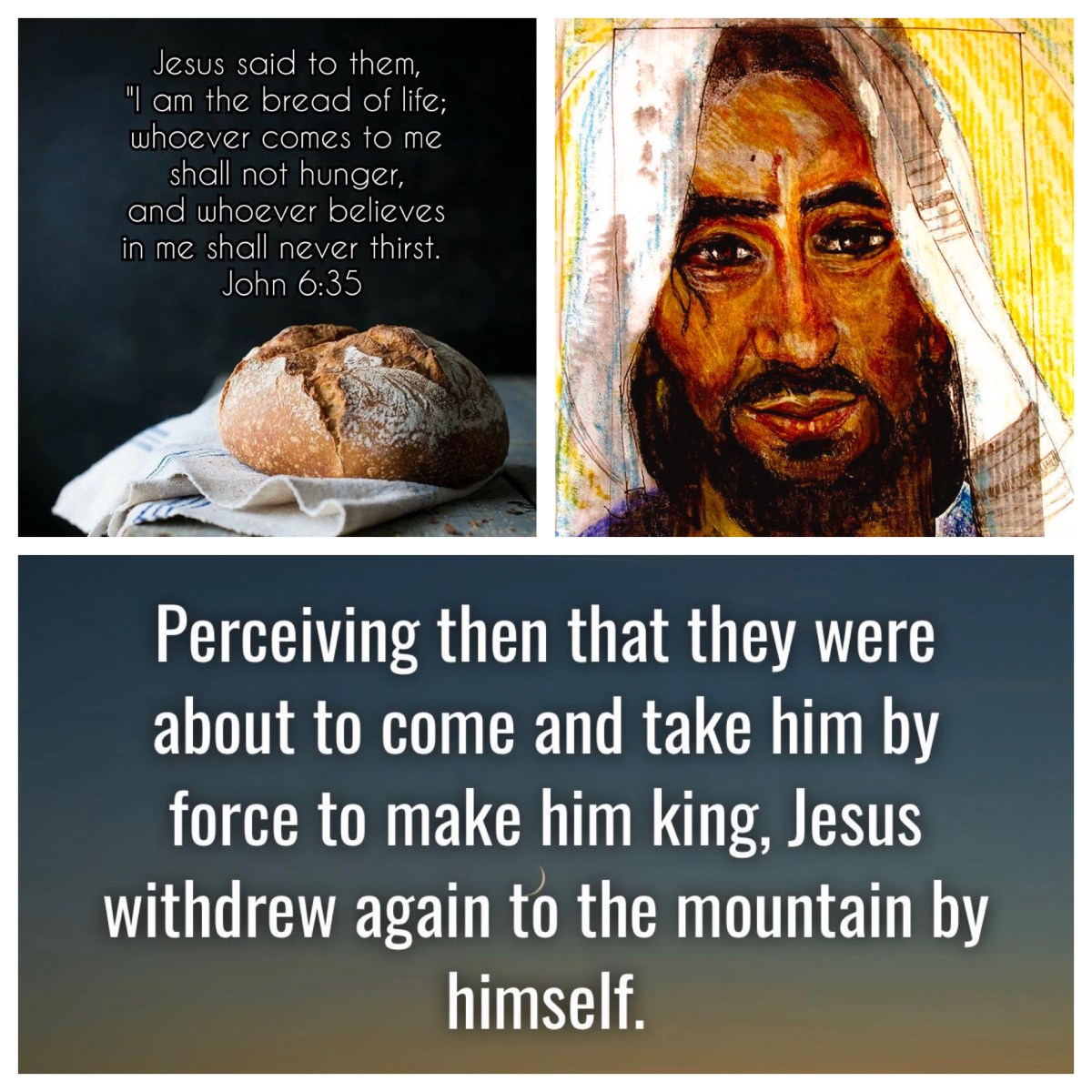
Immediately, however, it turns sour: “when Jesus realized that they were about to come and take him by force to make him king, he withdrew again to the mountain by himself” (6:15).
To make him king: this is the first misunderstanding of Jesus that can be identified in this chapter. (There are a number of other misunderstandings that can be noted in the remainder of this chapter.)
The appointment of a king in Israel was contested, according to the narratives included in 1 Samuel. The prophet Samuel did not wish to anoint a king (1 Sam 8:6) and argued against this before the people (1 Sam 8:10–18). But the voice of the people (1 Sam 8:5, 19–20) prevailed; Samuel duly anointed the first king, Saul (1 Sam 10:1) and begrudgingly declared him to be king (1 Sam 10:17–24). So Israel had kings, and they ruled for some centuries.
Of course, by the time of Jesus, the institution of the monarchy had been well established, and had flourished under David and Solomon, Omri and Josiah. Then the monarchy had been dismantled through the violence of foreign invasion and the upheaval of large scale movements into exile, from 721 BCE in the northern kingdom, then from 587 BCE in the southern kingdom.
The accounts that we have of the role of kings in Israel (in 1–2 Kings, and 1–2 Chronicles) comes from later, after the return from exile on the 6th century BCE. The vision of the king in these documents was highly romanticised; the tradition about David and Solomon in particular had minimised their numerous faults and strongly valorised their virtues (1 Chr 18:14; 2 Chr 9:13–28).
In Christian tradition, this trajectory continues. Jesus is acknowledged as King of the Jews (Mark 15:2 and parallels) and even has a feast day in the liturgical cycle named after this: Christ the King. The author of the book of signs knows the irony of the fact that this is where Jesus will come undone: from the moment when Pilate put to Jesus the notion that he might be “the King of the Jews” (18:33). The very claim was enough to ensure that he would be scorned and ultimately crucified (19:3, 19-21).
To the Romans, a king was not a position to be valued. The terrible experience they had with Julius Caesar, the one-man ruler called rex, was enough to turn them away from having a king for centuries. There was a political naïveté in the Jewish crowd’s actions in acclaiming Jesus as king, at least in terms of how the Romans would have viewed him.
And to a pious Jew like Jesus, it was clear beyond doubt that only God was king over Israel (Ps 72)—indeed, over the whole earth (Ps 47). Jesus definitely wants to avoid such an acclamation about him at this point. The crowd are misunderstanding him. So he withdraws.
The author includes this clear indication, dripping (as is typical in this Gospel) with irony. The one whom the crowds excitedly wanted to crown as king, will be savagely put to death by the Romans as “King of the Jews”, pretender and aggravant.
At this time of the year, every Year B, the lectionary strays away from choosing the Gospel readings from the beginning of the good news of Jesus, the Gospel of Mark. Next week, we will launch into a series of five weeks of readings drawn from John 6. That chapter revolves around the motif of Jesus as “the living bread which came down from heaven” (John 6:51). Because of this looming focus, the Gospel passage provided by the lectionary for this Sunday is curiously shaped. It takes two separate sections of Mark’s Gospel, and omits a large section that sits in between these two passages.
The story of the feeding of the crowd of “about 5,000 in all” (John 6:1–14) which we will read next Sunday replicates the story omitted from this Sunday’s reading, where the Jesus was able to feed a crowd comprising “5,000 men” (Mark 6:44).
The lectionary provides the surrounding sections (Mark 6:30–34, 53–56) and omits the feeding narrative (Mark 6:35–44). It also omits the account of Jesus walking on the water (Mark 6:45–52)—a story paralleled in Matt 14:22-33). Thus, we have a curiously disrupted passage for consideration.
We need, then, to consider, both what’s in, and what’s out, in this week’s lectionary selection.
What’s in: three key terms
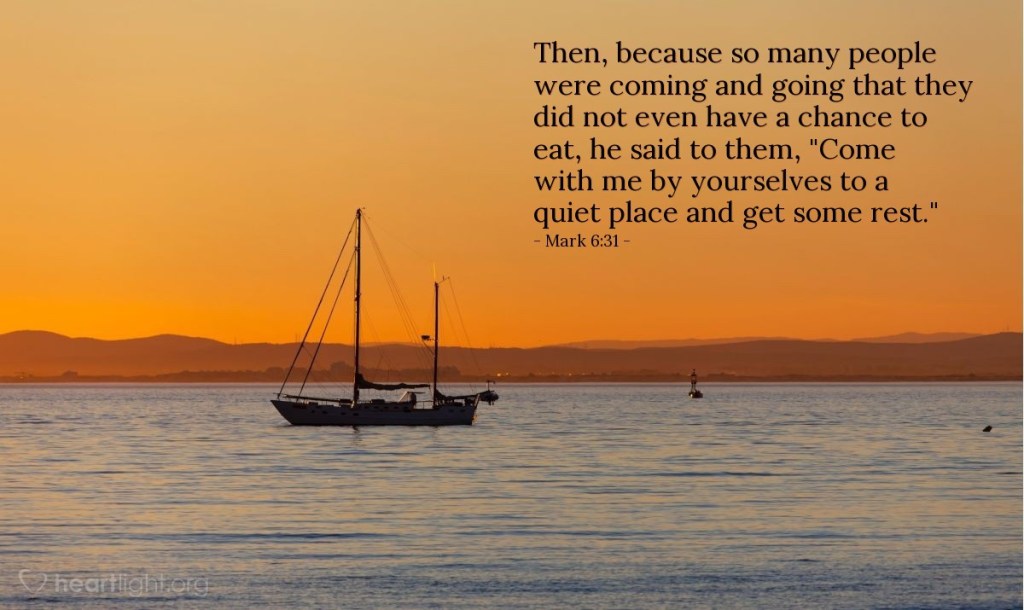
The selection offered by the lectionary includes reference to Jesus taking his followers aside, to rest (6:31). We know well the words that Jesus spoke, offering rest to his followers (Matt 11:28–30). But we perhaps give little thought to the need that Jesus had, along with this followers, to rest from the bustling business that he engaged in. Mark states it well: “many were coming and going, and they had no leisure even to eat” (6:31).
Jesus moves away to a deserted place with his followers. He goes into the wilderness. The Greek word used here, eremon, is significant. This is where Jesus goes when he is tested by God (1:12), immediately after he had been completely immersed in the water by John the baptiser, resident in that wilderness (1:3, 4).
It was in the wilderness that Israel came to know its essential identity: a people, beloved by God, rescued from slavery, called into covenant, equipped for the battles of entry into the land, as the great myth from the past declared. It was, likewise, in the wilderness that Jesus came to know his mission in life, and where he came to know his identity as the Son of God, chosen for that mission. So it is fitting that he moves to a deserted place, seeking respite from the crowds.
Yet the crowds will not let the healer and his followers rest; they continue to press on Jesus, and as they saw him, with his followers, in the boat, they hurried on foot to that deserted place, “and arrived ahead of them” (6:33).
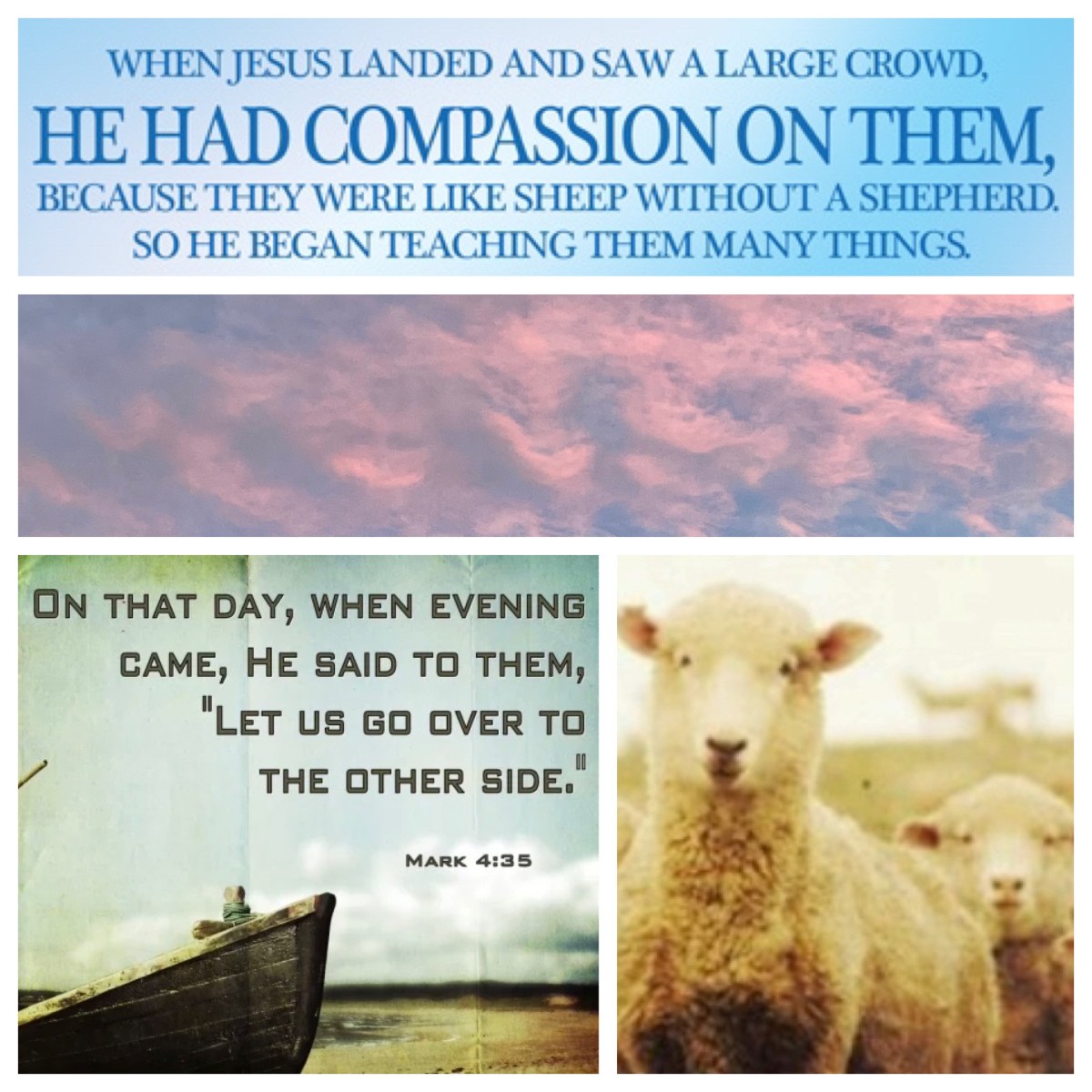
The response of Jesus is instructive. Here we find a second significant term. He “had compassion for them”, the NRSV reports (6:34). The distinctive Greek term used (esplangnisthē) appears here, and in the parallel of Matt 14:14 (as well as an editorial comment at Matt 9:36).
The term refers to that deep-seated churning in the gut that takes place when an emotional cord is struck. It is a profound and penetrating feeling. The same term is found in the paired story of the feeding of the 4,000, where Jesus tells his followers, “I have compassion on the crowd” (Mark 8:2, par Matt 15:32).
Such compassion is characteristic of Jesus on many occasions. The term has already appeared in Mark’s report of the leper who came to Jesus, seeking to be made clean, where it describes the way that Jesus responds to him (“moved with pity” in the NRSV, reflecting a textual variant in Mark 1:41, par Matt 10:6). It’s also used to characterise the way Jesus deals with two blind men near Jericho (“Jesus in pity touched their eyes”, NRSV Matt 20:34).
Other places where the word appears are in the story of the mute boy who suffers convulsions (Mark 9:14–29). The father of the boy begs Jesus to cast out the spirit which possesses the boy, imploring him, “if you can do anything, have compassion on us and help us” (9:22). Jesus responds by rebuking the spirit, which leaves the boy (9:25–27).
In the orderly account which we attribute to Luke, the compassion of Jesus is noted when he interacts with a widow who is mourning her dead son (Luke 7:13), and is also found within two of the parables told by Jesus, reported only in this Gospel. The Samaritan has compassion (Luke 10:33), as does the father when he sees his prodigal son returning home (Luke 15:20).
A third important idea is found when the author implicitly draws an analogy between Jesus, and a shepherd (6:34). In the book of signs, Jesus explicitly calls himself “the good shepherd” (10:1–18). This evokes the scriptural imagery of the good shepherd as the true and faithful leader in Israel (Num 21:16–17; Ezek 34:1–31; Jer 23:4). The phrase also alludes to the people as the sheep who are cared for (Pss 95, 100; Ezek 34:31).
People who are “sheep without a shepherd” recall the description of Israel in Hebrew Scriptures (Num 27:17; 1 Kings 22:17, par 2 Chron 18:16; and Judith 11:19). The narrator’s reference in Mark 6:34 contains these deep scriptural resonances. The compassion demonstrated by Jesus fits with his role as shepherd of the sheep.
A third key idea is contained in the brief statement that the compassion of Jesus is expressed as “he began to teach them many things” (Mark 6:34). The teaching activity of Jesus runs through this Gospel. Jesus teaches beside the sea (4:1), in the synagogue (1:21–27; 6:2), beside the lake (2:13; 4:1–2; 6:34), in the villages (6:6), and as he and his followers walk along the way towards Jerusalem (8:31; 9:31).
When Jesus reaches Jerusalem, he is said to be teaching the crowd in the courtyard of the Temple (11:15–18). A little later, some Pharisees and Herodians approach him, observing that “you are not swayed by appearances, but truly teach the way of God” (12:14). “Day after day I was with you in the Temple teaching”, he says to the armed crowd sent from the Jewish authorities to arrest him (14:43–49).
The same emphasis on his teaching is found on the other Synoptics (Matt 4:23; 7:28–29; 9:35; 21:23; 22:33; 26:55; Luke 4:31–32; 5:17; 6:6; 10:39; 13:10; 13:22; 19:47; 20:1; 21:37; 23:5).
What’s out: two substantial scenes
So much for what’s in this week’s selection. What about what’s out?
First, the Gospel offering provided by the lectionary includes the surrounding sections (Mark 6:30–34, 53–56) but omits what it surrounds—the feeding narrative (Mark 6:35–44). That feeding story is also retold by the other two evangelists. In the book of origins (Matt 14:15–21), the crowd comprises “about five thousand men, besides women and children (Matt 14:21). In the orderly account of things fulfilled (Luke 9:12–17), the crowd is recorded, as in the Markan source, as being “about 5,000 men” (Luke 9:14).
The scene is reminiscent also of the parallel scene of feeding “4,000 men” recounted at Mark 8:1-10 and also at Matt 15:32-39; although Matthew indicates that there were “4,000 men, besides women and children”. (Luke omits this story.)
In each of those cases, the accounts provide the opportunity for Jesus to model the traditional pattern of a Jewish meal, as he “looked up to heaven, and blessed, and broke the loaves, and gave them to the disciples to set before the people” (Mark 6:41; Matt 14:19; Luke 9:16; and again at Mark 8:6 and Matt 15:36). This prefigures the familiar pattern from the last supper (Mark 14:22; Matt 26:26; Luke 22:19; 1 Cor 11:24; and see also Acts 20:7, 27:35).
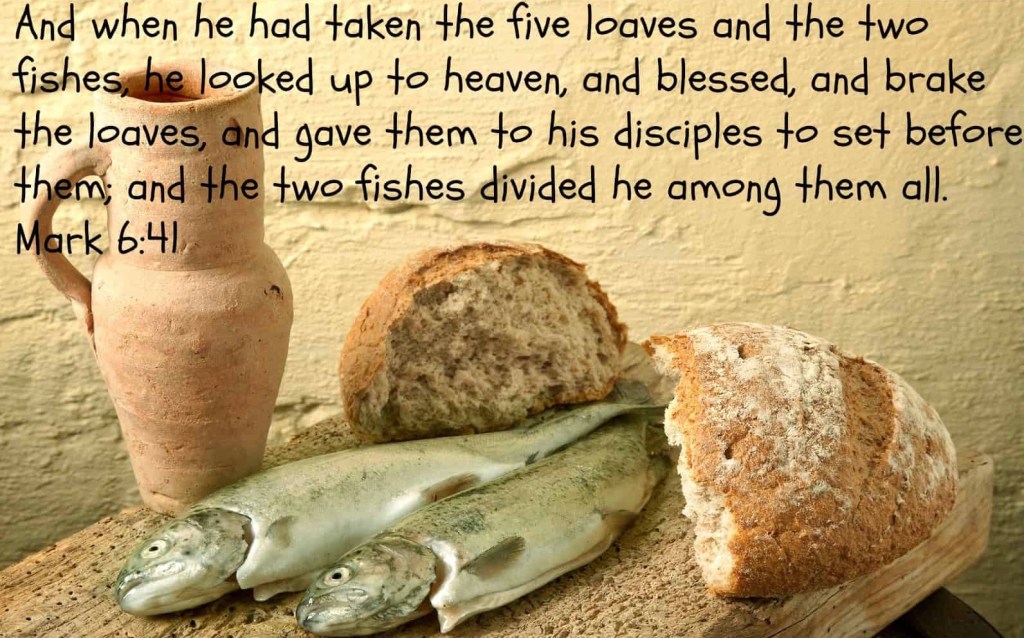
So Mark recounts the scene: “And taking the five loaves and the two fish, he looked up to heaven and said a blessing and broke the loaves and gave them to the disciples to set before the people. And he divided the two fish among them all. And they all ate and were satisfied. And they took up twelve baskets full of broken pieces and of the fish. And those who ate the loaves were five thousand men.” (Mark 6:41–44).
And the resonances with the central Christian ritual, the remembrance of the last supper, are surely strong and deep.
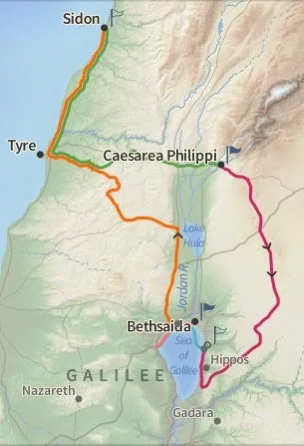
Second, the lectionary omits the account of Jesus walking on the water (Mark 6:45–52) which plays an important role in Mark’s account. By omitting this, the lectionary has excised the important reference to Jesus crossing over “to the other side”, from the Decapolis across to Bethsaida (Mark 6:45).
In this earliest Gospel, Jesus had left Jewish territory earlier, when he crossed “to the other side of the sea, to the country of the Gerasenes” (5:1), then returned “to the other side” (5:21), where he visited “his own country” (6:1) before venturing again across “to the other side” (6:45–52).
This maritime movement makes an important symbolic point for the the author: the ministry of Jesus incorporated not only territories in Jewish areas (to 4:41, then 5:21 to 6:44) as well as the Gentile territories. Jesus firstly crosses into the Decapolis (5:1–20), where he cast out multiple demons from the tomb-dwelling man, sending them into the nearby pigs. (This story is also omitted by the lectionary during this particular year.)
One of the striking aspects in this story is that this man, possessed by an unclean spirit, fettered in chains, dwelling beside tombs, self-harming and acting inappropriately (5:2–6), becomes the first active missionary in this Gospel; after the encounter with Jesus, “he began to proclaim in the Decapolis how much Jesus had done for him, and everyone marvelled” (5:20). A pity we missed that this year.
Jesus is active on “the other side” again from Mark 6:53, when he enters the regions of Gennesaret (6:53). Subsequently, Jesus is located at Tyre and Sidon (7:24), and then “the region of the Decapolis” (7:31), before returning to Bethsaida (8:22) and Caesarea Philippi (8:27), in Jewish territory.
These geographical references are treated variably in the later accounts which used Mark as a source. Matthew retains Genessaret (Matt 14:34) and Tyre and Sidon (15:21), but removes the reference to the Decapolis (15:29). The geographical references from Caesarea Philippi onwards then appear in his ongoing narrative. Luke omits the whole section containing these earlier references (Mark 6:53–8:26), removing the clear indication that Jesus spent quite some time on Gentile soil.
Omitting the “crossing over” movement in the narrative lessens the significance of this observation: much of what takes place in the ensuing four chapters, takes place on Gentile soil. This is very important for our understanding of the stories that Mark reports. We need to hear that in mind as we read the later stories in this section of the Gospel: Jesus is “on the other side”, moving amongst the Gentiles of the Decapolis.
In the revised Preamble to the Constitution of the Uniting Church, adopted at the 2009 Assembly meeting in Sydney, our church made the affirmation that “the First Peoples had already encountered the Creator God before the arrival of the colonisers; the Spirit was already in the land revealing God to the people through law, custom and ceremony.”
That statement articulates something deeply important. The Spirit had been at work, long before the time of Jesus, millennia before the time of Israel, revealing God, through ancient indigenous stories, customs, and ceremonies.
What our First Peoples have long known about God, is consistent with what Christian people are discovering about God through Jesus. “The same love and grace that was finally and fully revealed in Jesus Christ sustained the First Peoples and gave them particular insights into God’s ways”, the revised Preamble continues. So we listen to the voice of the First Peoples. We listen, and learn. We hear resonances with the Gospel. And in this way, we encounter God.
I am writing this at the end of NAIDOC WEEK (4-11 July 2021). Each year, NAIDOC WEEK has a theme. And as I reflect on the themes of the past few years, I realise that each of them articulates something that is central to the faith that we hold and the Gospel that we proclaim.
In 2017, the theme was Our Languages Matter. That’s a message which is integral to the Gospel—the Gospel that says, in the beginning, God spoke … and there was life (Gen 1). The Gospel that claims that “in the beginning was the Word, and the Word was with God, and the Word was God”, and that “the Word became flesh and dwelt among us, and we have seen his glory” in the person of Jesus of Nazareth (John 1).
We know God best of all, most intimately of all, because God speaks, God is word. Language connects us with God. Language matters. Language connects us with one another, enables us to know one another. Languages matter for First Peoples. They communicate, they articulate deep truths. Languages matter.
In 2018, the theme was the inspired message: Because of her, we can. That is another theme that resonates with countless stories throughout scripture. Because of the faithfulness of Mary, his mother, Jesus came. Because of the witness of Mary of Magdala, exclaiming “I have seen the Lord”, the male disciples believed.
Because of the proactive intervention of Shiphrah and Puah, Hebrew midwives in the court of the Egyptian Pharaoh, Moses survived and grew to lead Israel. Because of the fiercely powerful leadership of Deborah, centuries later, Israel survived the onslaught from the troops of Sisera, commander of the army of Canaan. Because of her, we can. (And there are many more such women; just ask the people who took part in Elizabeth’s Bible Studies last year, on women in the Bible!)
Two years ago, inspired by Statement from the Heart that was adopted in 2017 at Uluru, the 2019 theme was Voice. Treaty. Truth. The Statement called us to listen to the Voice of Indigenous peoples. As we do so, we realise that the settlement of this continent was a colonising movement, generated by foreign imperialism, manifesting in violent invasion and genocidal massacres, spread from north to south, from east to west, of this continent. This is the Truth we must hear.
The Voice of First Peoples speaks Truth. And truth is something that we value in our Christian faith. Jesus said, “I am the truth” (John 14:6); and he declared that “the truth will set you free” (John 8:32). Truth liberates. Truth is important.
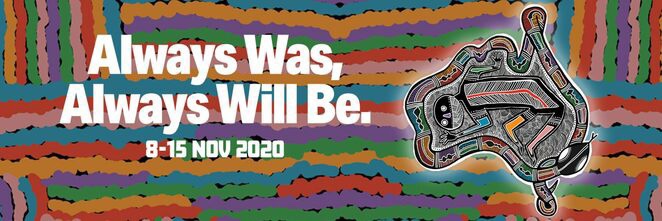
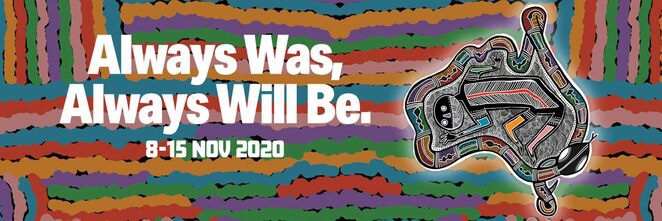
The next year, 2020, building on the call from the Statement from the Heart, we heard the theme of Always Was. Always Will Be. This recognised that these lands of the continent of Australia and its surrounding islands had not, indeed, been terra nullius. Rather, a complex interrelated web of nations had been living on the land, and the islands, fishing in the seas, meeting in ceremony and trading with each other, and caring for country in a deeply spiritual way for millennia upon millennia.
We know the importance of land in biblical stories—the identity of Israel is completely bound up with land. The land where Jesus walked, we call “The Holy Land”. Land is important.
This year, the theme is Heal Country. This theme takes us to the heart of the Gospel. In scripture, Paul offers his vision of hope for the whole of creation, “the glory that is to be revealed to us” (Rom 8:18–22). Because he can see that those who are in Christ are “a new creation”, he charges the followers of Jesus to commit to “the ministry of reconciliation” (2 Cor 5:16–19). That includes reconciliation with people, but it also points to “that coming reconciliation and renewal which is the end in view for the whole creation” as articulated in the Uniting Church’s Basis of Union (para. 3).
This vision of reconciliation is built upon the affirmation that the land, earth, sea and skies which God created, are indeed “very good” (Gen 1:1–31), and that human beings have a responsibility of respectful care for that creation (Gen 2:15). Furthermore, scripture tells of the ancient Israelite understanding that God made a covenant, not only with human beings, but with “the beasts of the field and the birds of the air and the creatures that move along the ground” (Hosea 2:18; see the narrative of Gen 9:8–17).
And the view of scripture is that God will ultimately “heal the land” (2 Chron 7:13–14), “renew the face of the earth” (Psalm 104:29–30), at that time when God will restore everything (Acts 3:21) and bring universal reconciliation (Col 1:20; Eph 1:10).
So the theme of Heal Country is a central motif throughout the books of scripture. And we can see how, in our time, it draws together environmental concerns with indigenous matters. This theme recognises that respect and care for country has been integral to the life of indigenous peoples for millennia, and there is a need to recapture that care and respect in the present time. The impact of just two centuries of western living on this ancient country has been incredibly damaging. It is time for us to listen to the wisdom of the elders, and Heal Country.
The Spirit was already in the land, “revealing God to the people through law, custom and ceremony”. The Spirit had been at work, long before the time of Jesus, millennia before the time of Israel, revealing God, through ancient indigenous stories, customs, and ceremonies, Indeed, “the same love and grace that was finally and fully revealed in Jesus Christ sustained the First Peoples and gave them particular insights into God’s ways”, as the revised Preamble states.
Our continent is greatly blessed by the long and faithful heritage of the people of those nations which have called this country home: for millennia, across this continent, and in the adjacent islands, they have cared for the land, nurtured their law, and showed resilience, and they are gracious enough now to seek continued relationship with those of us whose forbears have invaded, colonised, and decimated their lifestyle. We are living in the midst of a people of persistence and determination, and of abundant grace. For this, we give thanks.
From their stories, we can learn the importance of caring for country, of honouring the land in which we walk and live. Something that has been so important from so long ago; something that is so important in our own time, as we respond to the challenge of climate change, with global issues such as rising sea levels, widespread deforestation, the destruction of species and a deliberate blindness to the perils of continuing to burn fossil fuels with impunity; and the pressing personal demands of environmental responsibility and sustainable lifestyle. From the testimony of the First Peoples, to care for country, we are challenged.
So we listen to the voice of the First Peoples. We listen, and learn. And we encounter God. Thanks be to God!
NAIDOC WEEK is usually held in the first week (Sunday to Sunday) of July that incorporates the second Friday. Historically, it began life as ‘National Aborigines Day’, then it became known as ‘The Day of Mourning’, before it was taken on by the National Aboriginal Day Observance Committee (NADOC). Some time later, the National Aborigines and Islanders Day Observance Committee (NAIDOC) was formed, and this provides the name to the week.
Each year, NAIDOC WEEK has a theme. Two years ago, inspired by the Statement from the Heart that was adopted in 2017 at Uluru, the theme was Voice. Treaty. Truth.
In that same year, the NSW.ACT Synod of the Uniting Church adopted a proposal to lobby the commonwealth government to establish a Makarratta Commission and to advocate with state governments that they make treaties with the indigenous peoples of their region.
In the Uniting Church, as we have drawn on the voices of Indigenous peoples, we have named the settlement of this continent as a colonising movement, generated by foreign imperialism, manifesting in violent invasion and genocidal massacres, spread from north to south, from east to west, of this continent. The commission and these treaties would have Voice to the First Peoples, ensuring that their Truth was known.
The next year, building on the call from the Statement from the Heart, was the theme of Always Was. Always Will Be. (It was held later in the year, because of the COVID-19 pandemic.)
This theme recognised that these lands of the continent of Australia and its surrounding islands had not, indeed, been terra nullius. Rather, a complex interrelated web of nations had been living on the land, and the islands, fishing in the seas, meeting in ceremony and trading with each other, and caring for country in a deeply spiritual way for millennia upon millennia.
In the Uniting Church, the National Assembly adopted a proposal in 2018 that affirmed “that the First Peoples of Australia, the Aboriginal and Islander Peoples, are sovereign peoples in this land.” The proposal noted “the Statement from the Heart’s acknowledgment that sovereignty is a spiritual notion, reflecting the ancestral tie between the land and First Peoples”. Connection to country is deeply important, profoundly spiritual, amongst all of the First Peoples of this land.
We have continued to strengthen the covenant relationship with the United Aboriginal and Islander Christian Congress (UAICC) and we have worked hard to give priority to the Voice of First Peoples in our church. See https://uniting.church/sovereignty/
This year, the theme is Heal Country.
This theme takes us to the heart of the Gospel. In scripture, Paul offers his vision of hope for the whole of creation, “the glory that is to be revealed to us” (Rom 8:18–22). Because he can see that those who are in Christ are “a new creation”, he charges the followers of Jesus to commit to “the ministry of reconciliation” (2 Cor 5:16–19).
That includes reconciliation with people, but it also points to “that coming reconciliation and renewal which is the end in view for the whole creation” as articulated in the Uniting Church’s Basis of Union (para. 3). Such a vision is offered in a highly imaginative, and much more detailed way, in the final book of scripture, where “a new heaven and an new earth” is described (Rev 21:1–2, 21:9–22:5, drawing on the vision of Isa 65:17–25).
These visions are built upon the affirmation that the land, earth, sea and skies which God created, are indeed “very good” (Gen 1:1–31; so also Neh 9:6; Psalm 104:24–25; Job 26:7—14), and that human beings have a responsibility of respectful care for that creation (Gen 2:15; and see the laws that command respect for the land, such as Lev 18:26, 28; 25:23–24; Num 35:33–34; Deut 20:19).
Further to that, scripture tells of the ancient Israelite understanding that God made a covenant, not only with human beings, but with “the beasts of the field and the birds of the air and the creatures that move along the ground” (Hosea 2:18; see the narrative of Gen 9:8–17). The eschatological view of scripture is that God will “heal the land” (2 Chron 7:13–14), “renew the face of the earth” (Psalm 104:29–30), at the time when God will restore everything (Acts 3:21) or bring universal reconciliation (Col 1:20; Eph 1:10).
So the theme of Heal Country is a central motif throughout the books of scripture. And we can see how, in our time, it draws together environmental concerns with indigenous matters. This theme recognises that respect and care for country has been integral to the life of indigenous peoples for millennia, and there is a need to recapture that care and respect in the present time. The impact of just two centuries of western living on this ancient country has been incredibly damaging. It is time for us to listen to the wisdom of the elders, and Heal Country.
Our continent is greatly blessed by the long and faithful heritage of the people of those nations which have called this country home: for millennia, across this continent, and in the adjacent islands, they have cared for the land, nurtured their law, and showed resilience, and they are gracious enough now to seek continued relationship with those of us whose forbears have invaded, colonised, and decimated their lifestyle. We are living in the midst of a people of persistence and determination, and of abundant grace. For this, we give thanks.
From their stories, we can learn the importance of caring for country, of honouring the land in which we walk and live. Something that has been so important from so long ago; something that is so important in our own time, as we respond to the challenge of climate change, with global issues such as rising sea levels, widespread deforestation, the destruction of species and a deliberate blindness to the perils of continuing to burn fossil fuels with impunity; and the pressing personal demands of environmental responsibility and sustainable lifestyle.
The theme of Heal Country is important for the life of the whole of Australia at this moment in time. It is also a theme that draws deeply from the scriptural witness. It is a theme that people of faith should embrace, proclaim, and live with all our being—this week, this year, and on into the future.
*****
A whole series of statements and policies relating to the environment have been produced by the Uniting Church, at national, regional, and local levels. The national statements and policies are collected at https://www.unitingjustice.org.au/environment.
Many local churches of various denominations have participated in projects promoted by the Five Leaf Eco-Awards, which has its own website at https://fiveleafecoawards.org
The Roman Catholic Church has been guided by the papal document Laudato si’, which provides an extensive exploration of environmental issues from a faith perspective. I’ve posted a series of reflections on this important statement at
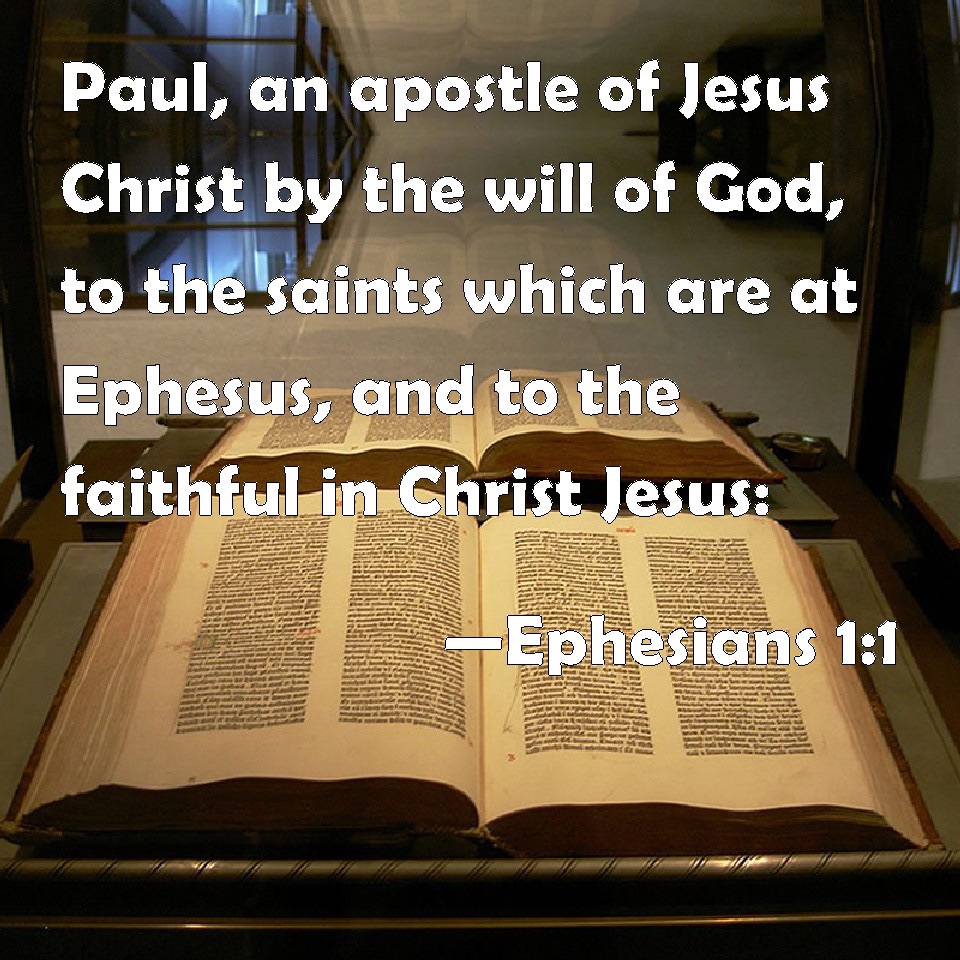
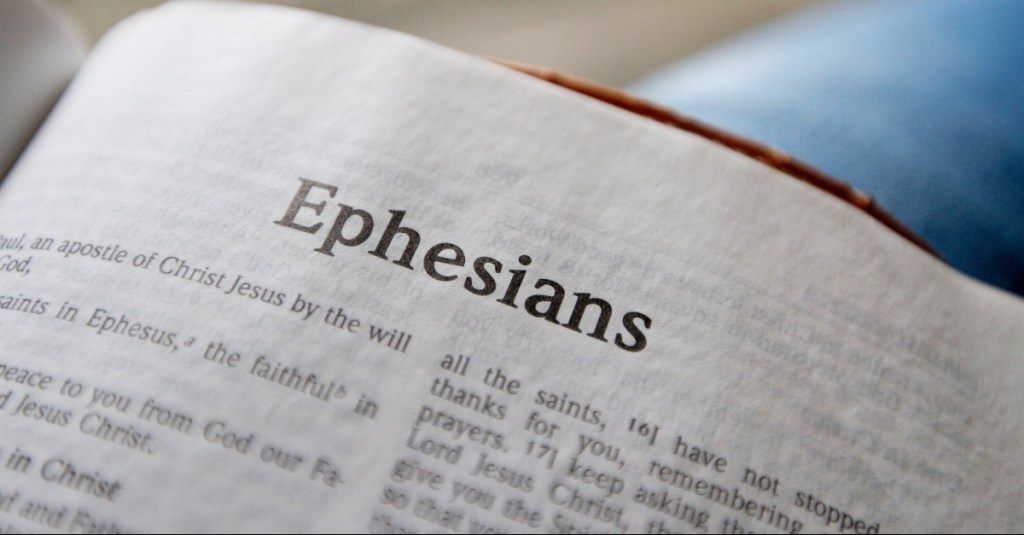
This Sunday, we start a series of readings from the letter to the Ephesians. Your Bible may state that it is “Paul’s letter to the Ephesians”. Indeed, when you read the opening words of the letter, the first thing you note is that the letter says that Paul wrote it (Eph 1:1a). Then it goes on to say that the letter was written to “the saints who are in Ephesus, and are faithful in Christ Jesus” (1:1b).
What do we know about the situation in Ephesians, to which this letter is addressed? This letter is not like many of the letters of Paul, where we can glean much information from those letters about the faith community in the city to which it is addressed (Corinth, in Achaea; Thessaloniki and Philippi, in Macedonia; the region of Galatia; and Rome, in Italia). We know little, if anything, about the situation in Ephesus from this letter.
The letter does not begin with a thanksgiving. In most letters by Paul, the thanksgiving identifies the key characteristics of the community to which the letter is sent, as well as the issues which will be canvassed later in the letter. Instead, here there is a lengthy blessing in which a grand theological statement is developed (1:3–14), before a brief thanksgiving is offered for the faith and love of the recipients (1:15–16).
This opening blessing (1:3–14) is the reading set for this Sunday. In the CEV, there are no less than 12 sentences in these 12 verses; in the GNB, there are 10 sentences. In the NIV, there are 8 sentences in this passage, whilst the NRSV offers it all in 6 sentences. (Decades earlier, the RSV had also used 6 sentences for the whole.) In the KJV, there are just 3 sentences, although a punctuating colon (:) appears on six occasions, with a further three semicolons (;).
But in the original Greek, this whole passage is just one long sentence — a main clause (“Blessed be the God and Father of our Lord Jesus Christ”, 1:3), followed by a long series subordinate clauses, setting out what this God has done: “who has blessed us in Christ … who predestined us in love for adoption … in him we have redemption … according to the riches of his grace, which he lavished upon us … making known to us the mystery of his will … according to his purpose, which he set forth in Christ … in him we have obtained an inheritance … In him you also, when you heard the word of truth, the gospel of your salvation, and believed in him, were sealed with the promised Holy Spirit”.
These parallel charts (left in English, right in Greek) show the syntactical structure and the relationship of each subsidiary clause in the long single sentence in Eph 1:3–14 (accessed at http://www.teleiosministries.com/ephesians.html)
Incidentally, the ASV grasps the mantle, rendering all 12 verses in one long, complex sentence (with numerous colons and semicolons interspersed). It reads very heavily in English. At the other extreme, The Message (more of a paraphrase than a translation, in my mind) takes no less than 16 sentences to translate it (in expanded, colloquial form). And the NCB takes a poetic approach,,putting the whole section into unrhymed verse, using 6 sentences for the whole poem.
So this blessing sets out a number of wonderful claims about Jesus—as God works through him, we have redemption, the forgiveness of trespasses; we are adopted as his children, grace is lavished upon us, revealing the mystery of his purpose; and he offers the promise of an inheritance. The blessing ends with a final exultation, “to the praise of his glory” (1:14b).
There is nothing in these opening verses—this one, long sentence—to give any indication of the specifics of the particular situation in Ephesus. And, it must be said, the existence in this letter of this mammoth long sentence—along with other complex multi-clause sentences in later section (1-9, 11-15, 19-22; 3:1-13, 14-21; 4:1-6, 7-16) is a very strong suggestion that the document was not actually written by the apostle Paul.
Like this general opening blessing, the elements which follow also have broad, generic qualities, as the general prayer which is offered (1:15–16) veers off almost immediately into further theological exposition (1:17–23).
The end of the letter also offers no clues as to what is happening in Ephesus. The final section actually replicates, almost completely word-for-word, some of the greetings at the end of Colossians, in an abbreviated form, suggesting a later writer imitating the style of an earlier letter—but in a rather clumsy way, simply copying word-for-word.
Colossians concludes, “Tychicus will tell you all the news about me; he is a beloved brother, a faithful minister, and a fellow servant in the Lord. I have sent him to you for this very purpose, so that you may know how we are and that he may encourage your hearts; he is coming with Onesimus, the faithful and beloved brother, who is one of you.” (Col 4:7–9).
Compare this with the final greetings in Ephesians: “Tychicus will tell you everything. He is a dear brother and a faithful minister in the Lord. I am sending him to you for this very purpose, to let you know how we are, and to encourage your hearts.” (Eph 6:21–22). It is so similar, with the same structure, and many phrases in common. (If I were looking for plagiarism—which I once did as part of a job that I had—I would rate this as a direct copy.)
Did the author of this sermon-letter actually know Tychicus? Or did he simply copy something that was at hand, to lend an air of “authenticity” to the document?
In the body of the letter, we find indications a few sparse details. We learn that Paul is a prisoner (3:1; 4:1) and that the recipients are Gentiles (2:11; 3:2). But that’s it. Not much at all to go on. After that, the final prayer and grace (6:23–24) is likewise entirely generic. These are very slim clues to work from, if we want to reconstruct a picture of the community to which the letter was sent.
*****
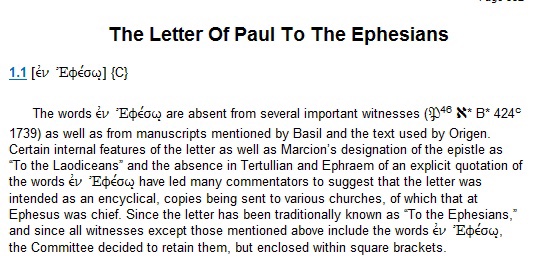
Another clue emerges from the first verse of the letter, for it contains a striking textual variant. Although we commonly read the letter as sent “to the saints who are in Ephesus and are faithful in Christ Jesus” (1:1), a number of early manuscripts of this letter omit “in Ephesus”. This is a most important phrase, as it identifies the people purportedly addressed in the letter.
Whilst we traditionally read the letter as being addressed to “the saints who are in Ephesus, and are faithful in Christ Jesus”, it is far more likely that the original document was addressed to “the saints who are faithful in Christ Jesus”—a generic, all-encompassing orientation, rather than a letter to specific group of people in a particular place.
Indeed, one early Christian writer knew this document as a letter “to the the Laodiceans”—not to the Ephesians!
An important fact that sits alongside this claim, and validates the idea that this was not a context-specific letter, but a widely-offered sermon, is the observation that the letter contains no other indications that it is specifically related to the city of Ephesus and the community of faith established there.
We can find references to people being “blown about by every wind of doctrine, by people’s trickery, by their craftiness in deceitful scheming” (3:14) and to those who “deceive you with empty words” (5:6), but these are no more than generalised description of opponents.
The main content of the letter reflects the general situation developing in the early churches, as Gentiles have found their place alongside Jews within the communities. It gives no clues of a specific context which is grounded in a particular community of faith.
The body of the letter reads more like a sermon, offering general theological teaching and ethical instruction. It’s highly likely the letter wasn’t sent by Paul to believers in Ephesus, but originated later in the first century, after the lifetime of Paul, as a sermon setting out the fundamentals of the teaching that began with Paul, and was handed on by those who followed him in proclaiming the good news to gatherings of believers.
The theological teaching in the letter—sermon provides doctrinal instruction about the divine plan, beginning in the opening blessing and prayer (1:3–23), followed by sections explaining the role of Jesus Christ (2:1–10); the inclusive nature of the church, in which Jews and Gentiles are brought into one body (2:11–3:6); an excursus on Paul’s role (3:7–21); and further reflections on the church (4:1–16).
Paul is presented as the one who reveals God’s plan, which had been hidden until his ministry (3:1–12). Key concepts in this plan include wisdom (1:8, 17; 2:10; 5:15), mystery (1:9; 3:3–5, 9; 5:32; 6:19), God’s will (1:1, 5, 9, 11; 5:17; 6:6), revelation (1:7; 3:3, 5) and fullness (1:10, 23; 3:19). These elements underline the assessment that this letter—sermon showed significant developments and elaborations of ideas, when compared with the authentic letters of Paul.
Like Colossians and the three Pastoral Epistles, Ephesians testifies to a more enculturated church, from a period later than the time in which Paul was active—a time and place in which the way of Jesus has begun to merge with the dominant ethos of the society. The sharp edges of The Way have been softened; the clear focus of the teachings of Paul, the energetic preacher of good news, has become blurred and fuzzy under the weight of pressures from the dominant Greco-Roman culture.
Although the rhetoric of this letter purports to present a distinctive Christian ethic, in fact it is becoming much more strongly influenced by hellenistic ethics. It demonstrates the way that the radical movement initiated by Jesus gradually becomes domesticated, institutionalised, and less distinguishable from the dominant culture.
Today we start NAIDOC WEEK (4-11 July 2021). NAIDOC WEEK is usually held in the first week of July (Sunday to Sunday) that incorporates the second Friday – which historically was celebrated as ‘National Aboriginal Day’. (Yes, like Easter, it moves around in a rather arcane fashion!)
On Australia Day, 1938, protestors marched through the streets of Sydney, followed by a congress attended by over a thousand people. One of the first major civil rights gatherings in the world, it was known as the Day of Mourning. Following the congress, a deputation led by William Cooper presented Prime Minister Joseph Lyons with a proposed national policy for Aboriginal people. This was again rejected because the Government did not hold constitutional powers in relation to Aboriginal people.
From 1940 until 1955, the Day of Mourning was held annually on the Sunday before Australia Day and was known as Aborigines Day. In 1955 Aborigines Day was shifted to the first Sunday in July after it was decided the day should become not simply a protest day but also a celebration of Aboriginal culture.
Major Aboriginal organisations, state and federal governments, and a number of church groups all supported the formation of the National Aborigines Day Observance Committee (NADOC). At the same time, the second Sunday in July became a day of remembrance for Aboriginal people and their heritage.
In 1974, the NADOC committee was composed entirely of Aboriginal members for the first time. The following year, it was decided that the event should cover a week, from the first to second Sunday in July. In 1984, NADOC asked that National Aborigines Day be made a national public holiday, to help celebrate and recognise the rich cultural history that makes Australia unique. While this has not happened, other groups have echoed the call.
Next, the committee became known as the National Aborigines and Islanders Day Observance Committee (NAIDOC). This new name has become the title for the whole week, not just the day. Each year, a theme is chosen to reflect the important issues and events for NAIDOC Week.
Last year, 2020, the theme of NAIDOC WEEK was Always Was, Always Will Be—a reference to the reality that the lands of Australia have been cared for over millennia by the First Peoples of the continent and its nearby islands. The now-discredited ‘Doctrine of Discovery’ and the notion of terra nullius undergirded the colonial enterprise of “claiming the country” for Britain? See https://johntsquires.com/2018/08/13/affirming-the-sovereignty-of-first-peoples-undoing-the-doctrine-of-discovery/
That focus is further developed in this year’s theme, Heal Country—a theme that draws together environmental concerns with indigenous matters. This theme recognises that respect and care for country has been integral to the life of indigenous peoples for millennia, and there is a need to recapture that care and respect in the present time. The impact of just two centuries of western living on this ancient country has been incredibly damaging. It is time for us to listen to the wisdom of the elders, and Heal Country.
Our continent is greatly blessed by the long and faithful heritage of the people of those nations which have called this country home: for millennia, across this continent, and in the adjacent islands, they have cared for the land, nurtured their law, and showed resilience, and they are gracious enough now to seek continued relationship with those of us whose forbears have invaded, colonised, and decimated their lifestyle. We are living in the midst of a people of persistence and determination, and of abundant grace. For this, we give thanks.
From their stories, we can learn the importance of caring for country, of honouring the land in which we walk and live. Something that has been so important from so long ago; something that is so important in our own time, as we respond to the challenge of climate change, with global issues such as rising sea levels, widespread deforestation, the destruction of species and a deliberate blindness to the perils of continuing to burn fossil fuels with impunity; and the pressing personal demands of environmental responsibility and sustainable lifestyle.
The theme of Heal Country is an important and entirely relevant theme for all Australians, this year!
This week, also, the Uniting Church Assembly launches its first Covenant Action Plan (ACAP) – a strategic and practical framework which gives shape to our commitment as a national church to walk together as First and Second Peoples.
The narrative of the beginning of the good news of Jesus the chosen one that ensues provides a sequence of events in which individuals, groups, and crowds all respond to this charge to follow Jesus. In this narrative, Jesus challenges people to respond to him with an active, informed discipleship; to leave the comfort of the familiar and set out, walking alongside him.
But following Jesus is not just about walking along beside him. The Gospel account makes it clear that followers are to step beyond Jesus, to walk out ahead of him, into unchartered territory. Following Jesus (discipleship) involves being sent forth (mission). And Jesus does this very thing with his followers. He sends them out, on mission.
Later in this narrative, leave Jesus and undertake his mission in the wider community (6:7–13). In this enterprise of mission, the disciples model their words and deeds on Jesus: “they proclaimed that all should repent…they cast out many demons and anointed with oil many who were sick and cured them” (6:12–13).
As they undertake this mission, the followers of Jesus are to be characterised by an ascetic mode of dress (6:8–9) as they undertake their public proclamation (6:10–11). And Jesus instructs them to “read the room” when they are welcomed into the houses in the villages and towns they visit. They are to be sensitive to the reception that they receive.
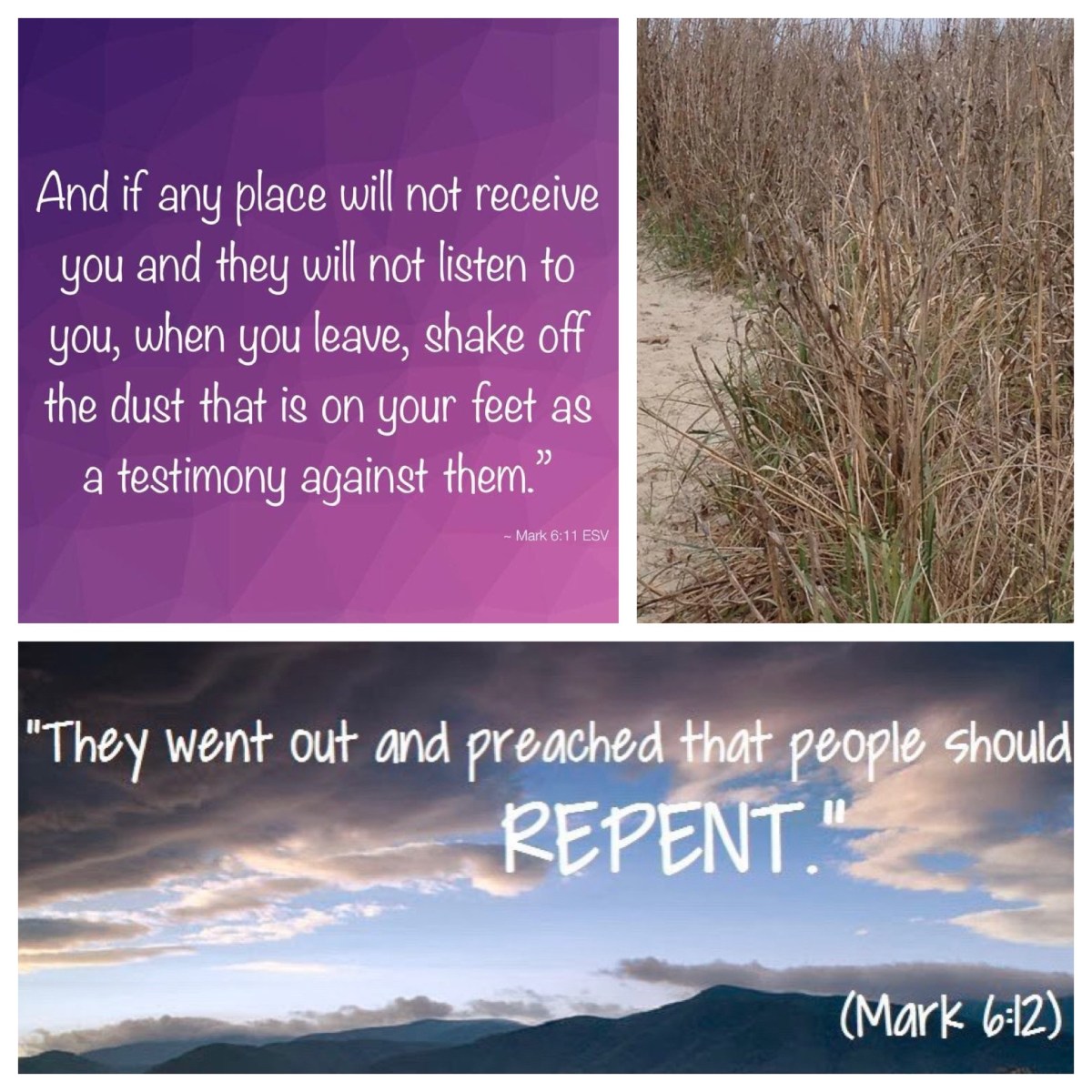
“So they went out and proclaimed that people should repent”, Mark reports (6:12). But with the caveat: “If any place will not welcome you and they refuse to hear you, as you leave, shake off the dust that is on your feet as a testimony against them.” So Jesus advises his followers (6:11). What did it mean, in the ancient world, to “shake the dust off your feet”?
Dust is central to who we are as human beings. The story of the creation of human beings indicates that the man was “formed from dust of the ground” before God breathed the breathe of life into him (Gen 2:7). But in the foundational myth that is told in the earliest chapters of scripture, dust is at the centre, also, of the punishments that are handed out after the sin committed by Adam and Eve.
The serpent, as a result of its role in tempting them, is told, “Because you have done this, cursed are you above all livestock and above all beasts of the field; on your belly you shall go, and dust you shall eat all the days of your life” (Gen 3:14; Isa 65:25).
The man is told, “By the sweat of your face you shall eat bread, till you return to the ground, for out of it you were taken; for you are dust, and to dust you shall return” (Gen 3:19).
Dust is used as a sign of cursing in various stories: in the plague of dust (Exod 9:8-10); in the ritual for cursing an unfaithful wife, when dust from the floor of the tabernacle is mixed into the water of bitterness (Num 5:11-31); in the destruction of the golden calf (Deut 9:21); and in various punishments by the Lord (Deut 28:24, Ps 78:27, Isa 25:12, 26:5, 2 Sam 22:43, 2 Ki 53:7, 2 Chr 34:4).
And the action of shaking out one’s clothing is integral to the scene in Nehemiah, where the leaders of the people who have returned to the land are required to “shake out their mantle” as a sign of their agreement to the economic arrangements made (Neh 5:13). Nehemiah warns them: “so May God shake out every man from his house and from his labour who does not keep this promise”. Shaking out has a sense of judgement, of being cursed by God.
However, in association with the tearing of clothes, the placing of dust on a person’s head is also a symbol of repentance. Joshua repents of the sin of Achan by tearing his clothes and placing dust on his head (Joshua 7:6). Ezekiel speaks of the people of Tyre, lamenting, as “they cast dust on their heads and wallow in ashes” (Ezek 27:30). Jeremiah reports that “ the elders of the daughter of Zion sit on the ground in silence; they have thrown dust on their heads and put on sackcloth; the young women of Jerusalem have bowed their heads to the ground” (Lam 2:20; see also Isa 25:12; 29:1–4).
The three friends of Job see him coming, and they “raised their voices and wept, and they tore their robes and sprinkled dust on their heads toward heaven”, before they then sat, grieving with him, “on the ground seven days and seven nights” (Job 2:12–13). Dust means mourning and repenting.
In like manner, after being raped by Ammon, Tamar put ashes on her head and tore her robe (2 Sam 13:19), as did Judas and his brothers when preparing for battle (1 Macc 3:47) and when they entered the ravaged temple (1 Macc 4:39).
The same actions involving dust are performed by Judas after being deceived by Simon (2 Macc 10:25), Jews at the news of Nicanor’s imminent invasion (2 Macc 14:15), and grieving daughters and mothers in Jerusalem when the victorious Ptolemy attempts to enter the temple (3 Macc 1:18). We might also note the messengers who arrive with torn clothes and dirt on their heads (1 Sam 4:12; 2 Sam 1:2, 15:32). These are all stories involving grief and despair.
Job himself uses dust and sackcloth to signify that “my face is red with weeping, and on my eyelids is deep darkness” (Job 16:15–16). As a result, he laments, “ God has cast me into the mire, and I have become like dust and ashes” (Job 30: 19). Returning to dust is the final state for those punished by God (Job 34:5; see also 10:9; 17:6; 20:11; 21:26; Ps 7:5; 22:15; 90:3; 104:29; Isa 26:5; Lam 2:21)—or, indeed, for all human beings (Eccles 3:20; 12:7).
In the end, though, Job “repents of dust and ashes” (42:6). He has had enough of being repentant. The book ends with a return of the defiant Job. He will have no more use for the dust and ashes of repentance.
In a number of scriptural incidents, dust is used in curses signalling divine punishment. Shimei, for instance, casts dust into the air to curse David (2 Sam 16:13). When Deutero-Isaiah speaks of the coming salvation that God will bring, to remove the punishment of exile, he exhorts Jerusalem to “shake yourself from the dust and arise” (Isa 52:2).
Dust had been a sign of the place of mourning, the place of despair, the place which signifies worthlessness and emptiness. Dust had been where the poor sat (1 Sam 2:8; Amos 2:7); it was where the enemies of Israel were pressed down and beaten into fine particles by the Lord (2 Sam 22:4 3; 2 Ki 13:7; Job 40:13; Ps 18:42; 44:24–25; 72:9; 83:13; Isa 41:2; Micah 7:17). Now, the people were called to leave that dust behind and move on in hope.
Jesus instructs his followers to shake the dust off their feet “as a testimony against them” (6:11). This seems to be an action warning the listeners that they are liable to judgement because they have failed to repent. However, the phrase could also be translated, “as a witness for their benefit”, suggesting that the action was intended to provoke the listeners to think further, after the disciples have left, about their message of repentance?
This latter sense is how the same construction functions earlier in Mark’s narrative, where the cleansed leper is to show himself to the priests “for a proof to them” (1:44). But later in the narrative, the very same phrase (eis martyrion autois) describes the function of the disciples defending themselves when on trial before “governors and kings” (13:9).
Could the action of shaking the dust off their feet signal that there would be hope, in the future, from the message of good news that the disciples proclaimed? The implication would be that this is the hope that they carry, and their “witness for the benefit” of their unwilling hosts is that this hope. This hope travels on with them as they journey onwards, with their proclamation of repentance. It also rests, along with the dust, with those they leave behind, who have not yet come to that point of repentance.
Or could the action of shaking off the dust have the function of warning recalcitrants—a graphic demonstration of the warning, ‘God will turn you to ashes if you do not repent’? As the disciples move on to the next town, they were leaving behind a warning with an implicit demand for their repentance.
That seems more likely to be the effect of the phrase, “as a testimony against them” (6:11). Certainly, that’s how it is understood in the parallel account in Matthew, where the action of shaking off the dust (Matt 10:14) is immediately followed by a reference to the fate experienced by Sodom and Gomorrah on the day of judgement (Matt 10:15).also ev
This is ident in the Lukan parallel, where a slight tweaking of the Greek makes it clear that this is understood as “a testimony against them” (Luke 9:5). Then, in the Lukan doublet of the sending out of the 72, the saying about the day of judgement (here referring only to Sodom) clarifies the expected judgement beyond doubt (Luke 10:12).
By implication from these later interpretations of the action, shaking the dust off the feet and moving on would appear to provide a sign of judgement to those who refuse to accept the message of the disciples, and repent.
Mark’s Gospel emphasises the necessity of faithful discipleship; “follow me” is an important refrain from the beginning of Mark’s story. In three early scenes, the command of Jesus, “follow me”, is met each time with an immediate response: Simon and Andrew follow him (1:17), then James and John follow him (1:19), and then Levi the tax collector follows him (2:14). Each leave what they are doing and follow Jesus.
These scenes set the pattern for the rest of the narrative bout the beginning of the good news of Jesus the chosen one: Jesus challenges people to respond to him with an active, informed discipleship; to leave the comfort of the familiar and set out following him. He reiterates the call, “follow me”, in later scenes (8:34; 10:21).
The disciples in the narrative of Mark’s Gospel readily demonstrate this response. The disciples, and indeed a larger crowd, did indeed follow Jesus in his journeys around Galilee (2:15; 3:7; 5:24; 6:1; 10:28, 32, 52) and then southwards towards Jerusalem (11:9). Indeed, a group of women who followed him in Galilee continue all the way to Golgotha, watching from a distance as he dies (15:41).
But following Jesus is not just about walking along beside him. The Gospel account makes it clear that followers are to step beyond Jesus, to walk out ahead of him, into unchartered territory. Following Jesus (discipleship) involves being sent forth (mission). And Jesus does this very thing with his followers. He sends them out, on mission.
On the very first occasion when Jesus gathers all twelve apostles together, he gives them a twofold commission: “he appointed twelve … to be with him and to be sent out to proclaim the message and to have authority to cast out demons” (3:14–15). To be with him, following as disciples; and to be sent out, engaged in mission.
As the Gospel then reports how Jesus speaks and acts, the meaning of this discipleship and mission is spelled out. The apostles—and other followers—have the opportunity to learn from his teachings and to witness his actions while they are with Jesus, and then to replicate these teachings and actions through their presence in other places.
“Proclaiming the message and casting out demons” is how the activities of Jesus are characterised from the start of the narrative (1:39). His earliest message was clear: “the kingdom of God is at hand; repent, believe the good news” (1:15). His activity, also, was striking: he rebukes unclean spirits (1:23–26), “healed many who were sick with various diseases, and cast out many demons” (1:34).
These same activities form the basis for the work of the twelve as they leave Jesus and undertake his mission in the wider community (6:7–13). In this enterprise of mission, the disciples model their words and deeds on Jesus: “they proclaimed that all should repent…they cast out many demons and anointed with oil many who were sick and cured them” (6:12–13).
As they undertake this mission, the followers of Jesus are to be characterised by an ascetic mode of dress (6:8–9) as they undertake their public proclamation (6:10–11). Both elements deserve careful attention.
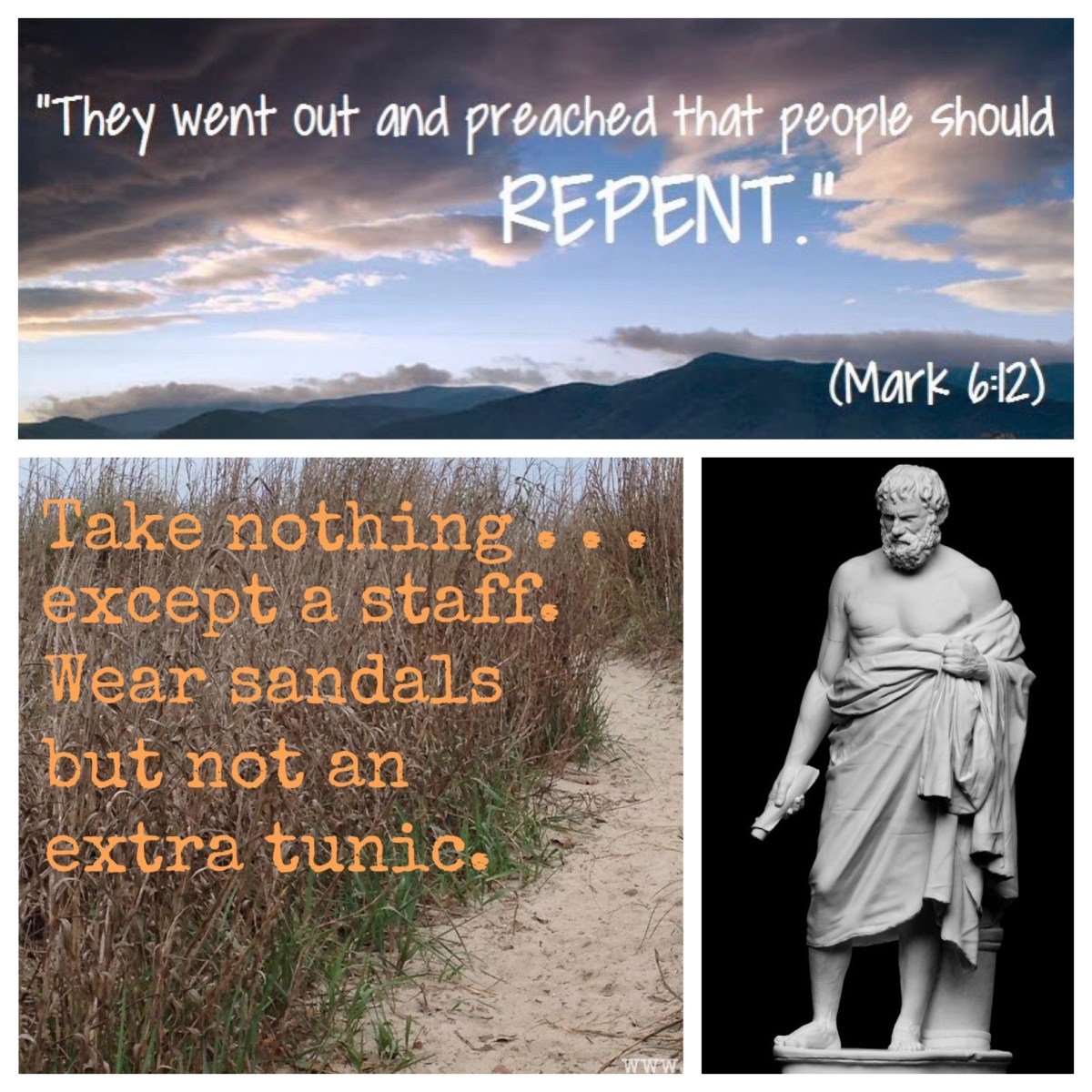
“He charged them to take nothing for their journey except a staff—no bread, no bag, no money in their belts— but to wear sandals and not put on two tunics.” So Jesus instructs his followers (6:8–9). In the parallel passages for this incident, Jesus is even more strict. In Luke, he prohibits sandals as well (Luke 10:3), and in Matthew, he prohibits both sandals and staff (Matt 10:10)
The description of the mode of dress for the followers of Jesus given here is often compared with the form of dress of a wandering philosopher, particularly of a Cynic philosopher.
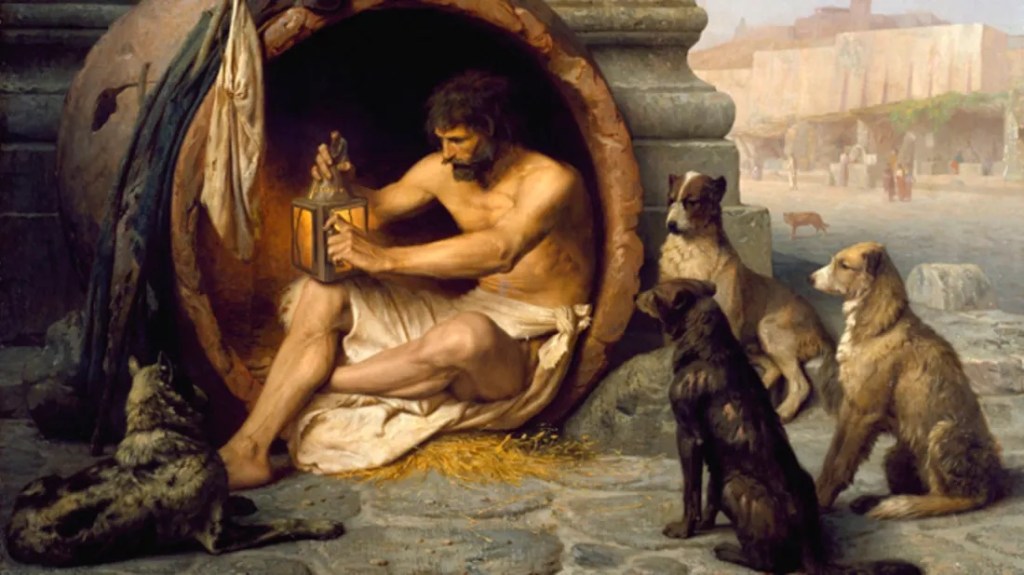
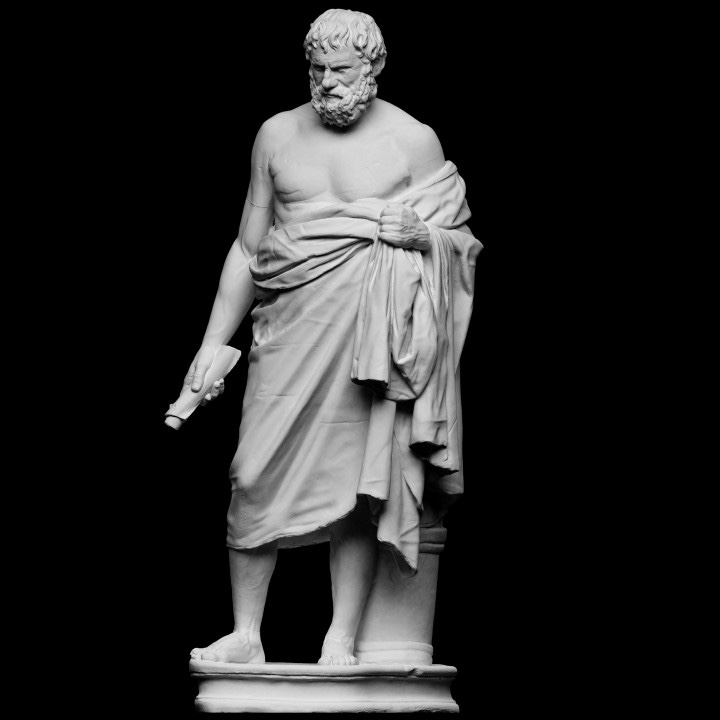
Cynic philosophy is named after Diogenes of Sinope, who lived c.400–325 BCE. Diogenes was known as “the dog” (kunos, in Greek) because of his shameless and primitive style of living. Diogenes was given the nickname ‘the dog’ because of his shamelessness. He used to live in a barrel with his only possessions being a robe to wear and a stick to walk.
There are many stories told about Diogenes’ rebellious and nonconformist character. Those who promulgated his philosophy of life, called Cynicism, lived equally simple, basic lives. Sandals, a staff and a cloak characterised many of them (although it seems that a double cloak was worn by many).
Was Jesus telling his disciples to emulate the Cynic philosophers? They were itinerants, travelling from town to town, speaking their views with frankness and then moving on to the next town or village. The followers of Jesus were also to be itinerant, travelling from place to place, boldly proclaiming their message, and staying nowhere for too long.
The second century document, TheDidache, clearly instructs followers of Jesus not to remain for more than two or three days in any one place (Didache 11–13). Jesus here is a bit more lenient; he doesn’t set a time limit, but instructs his followers to move on if they meet resistance. In this way, still, they were to emulate Jesus, as “the Son of Man who has nowhere to lay his head” (Matt 8:20; Luke 9:58).
It’s not at all clear that Jesus knew Cynic philosophy; the evidence of Cynic activity comes from places outside Israel. The Cynics were active long before Jesus, but continued on into his time, and beyond. Diogenes lived four centuries before Jesus, and adherents to his type of philosophy are known three centuries after the death of Jesus.
The second century CE writer, Diogenes Laertius, includes accounts of a number of key Cynic philosophers in his large work, Lives of Eminent Philosophers. The second century CE philosopher and orator, Dio of Prusa (nicknamed Chrysostom, meaning “golden-mouthed”), noted how many wandering Cynic philosophers were encountered in every town or village.
In his 32nd Oration, Dio describes the typical Cynic: “posting themselves at street-corners, in alley-ways, and at temple-gates, [they] pass around the hat and play upon the credulity of lads and sailors and crowds of that sort, stringing together rough jokes and much tittle-tattle and that low badinage that smacks of the market-place.”
Dio’s criticism continues: “they declaim speeches intended for display, and stupid ones to boot, or else chant verses of their own composition, as if they had detected in you a weakness for poetry. To be sure, if they themselves are really poets or orators, perhaps there is nothing so shocking in that, but if in the guise of philosophers they do these things with a view to their own profit and reputation, and not to improve you, that indeed is shocking.”
For Jesus to be calling his followers to a way of life that could be seen as comparable to this way of living, would be quite a challenge—and quite a shock.
Indeed, there may be a sign of differentiation from the Cynics. The Stoic philosopher Epictetus is reported as saying that the features which distinguish a Cynic are “his provision-bag (peran) and his staff and his big mouth” (Arian, Discourses of Epictetus 3.22.50). Jesus states that his followers should carry a staff, and speak their message—but here he prohibits them from carrying a provision-bag (peran, 6:8).
Another point of differentiation may be the command not to put on two tunics (6:9). The Greek word used is chiton. The chiton was a knee-length tunic worn as an undergarment; Josephus reports the common practice of wearing two chitones when travelling (Antiquities 17.136).
Musonius Rufus (Epistle 19) notes that Cynics typically wore two tunics—a tribon over their chiton. The tribon was a more humble garment than a chiton, so the outward appearance projected by a Cynic would have been, quite deliberately, that of a person of very lowly status. But for Jesus, the direction to wear only one tunic reflects an even more ascetic mode of living.
Was Jesus deliberately projecting an image—and a reality—deliberately differentiated from the Cynics? Certainly, direct contact by Jews with wandering Cynic philosophers was most likely reasonably rare. And I think that Jesus isn’t advocating specifically that his followers emulate the Cynics.
Jesus has his own reasons for the call he makes. Being on the move and not tied down to one place, and living simply without all the extraneous baggage, reflected an ethos that Jesus wished to cultivate. The focus was to be on the message and the key actions of the disciples, not on any extraneous or additional elements.
Perhaps what is in mind here is the Exodus story, in which the Israelites prepare themselves to be on the move, with minimal complications. They are to wear their clothes (which lasted them the whole time—Deut 8:4, 29:5). They are to fasten their belt and carry their staff (Exod 12:11), and wear their sandals (Exod 12:11; Deut 29:5). They are to take no bread—God will provide in the form of manna and quail, falling from heaven.
The attention of the disciples, as they engage in mission, proclaiming the message, healing, and casting out demons, is to be directed entirely to the task at hand. They are directed away from carrying too many accoutrements, worrying about provisions, and to focus on the task of proclamation and healing. In this way they are to follow the example and pattern of Jesus.
For that is what he himself taught: “do not be anxious, saying ‘what shall we eat?’ or ‘what shall we wear’?” (Matt 6:31). And that is what Jesus himself did: “the Son of Man has nowhere to lay his head” (Matt 8:20; Luke 9:58).
Cases of COVID-19 continue to occur in Australia. Lockdowns and enforced periods of isolation have taken place in numerous locations over the last few months; they are taking place again now across the country; and given the slow vaccine rollout and the emergence of variants that spread far more easily and rapidly, they will take place again in the future.
As these new strains of the virus emerge with greater rates of infections, uncertainty continues as to how long and and how hard the restrictions will be needed, and where the next outbreak will occur. In this context of uncertainty, people of faith would do well to reflect on how we respond to the guidance provided by our leaders.
Our faith offers us some support as we navigate the difficulties and dangers that we find ourselves in. There is comfort, as well as guidance, in the beliefs we hold, and in the ways that they are applied to our current situation of pandemic. Whether we gather together for worship and fellowship, or we are gathering-apart by online means, there are principles which hold good for us.
So here are some key principles, along with some associated biblical passages that, in my thinking, shape our ethos and inform how we make responsible ethical decisions about how we gather as church.
1. Gathering for worship is important, but safety of people is more important
We know that, across society, there are many people who are vulnerable, who needs our particular care, support, and attention. Whilst gathering-together for worship, prayer, discussion, fellowship, and conversation, is highly valued, our highest priority must be to act in a manner that ensures the lowest risk for people in society, that offers a safe place and safe manner for people to gather-together.
We have committed to being a Safe Place some years ago, and whilst we have applied that to matters such as the safety of children and young people, the physical arrangement in our buildings, and acceptance of diversity. Can we now apply that to the matter of community health and wellbeing?
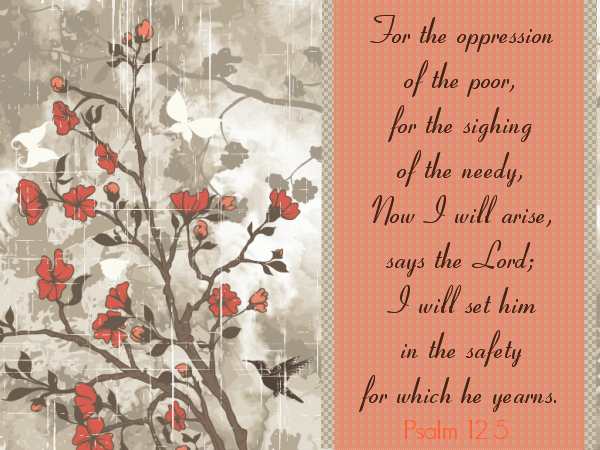
The psalmist reflects, “Because the poor are despoiled, because the needy groan, I will now rise up,” says the LORD; “I will place them in the safety for which they long” (Psalm 12:5). In another psalm, we hear the prayer, “O Lord, let your steadfast love and your faithfulness keep me safe forever” (Psalm 40:11). We need to echo that sentiment and follow that commitment to safety as we gather together.
2. The weakest or most vulnerable is the test for any decision we make
The people who have high risk of infection are those who have the following vulnerabilities: an impaired immune system, one of a number of chronic medical conditions, age, and people with Aboriginal and Islander descent.
Paul writes to the believers in a number of his communities, exhorting those who are “stronger” to attend to “the weak”, with the fundamental principle that “orientation to the needs of the other” undergirds everything. That orientation should govern how we think about, and how we act in, the days ahead. Those who are most vulnerable in terms of age or health should be the litmus test for anything that we consider doing when we gather-together.
Our own personal needs (or desires), the hopes and wants (or desires) of a community of faith, need to have this first consideration governing all that they decide. As Paul writes:
“Do nothing from selfish ambition or conceit, but in humility regard others as better than yourselves. Let each of you look not to your own interests, but to the interests of others.” (Phil 2:3-4)
“Let us therefore no longer pass judgment on one another, but resolve instead never to put a stumbling block or hindrance in the way of another.” (Rom 14:13)
You can read more about this way of operating in Romans 14:1-15:13. This would form an excellent focus for a Bible Study to go alongside a Church Council discussion of what steps can be taken as we consider gathering-together once more.
3. Relationships with others are our first priority. Loving our neighbour takes priority over programs and activities
“Which commandment is the first of all?” Jesus answered, “The first is, ‘Hear, O Israel: the Lord our God, the Lord is one; you shall love the Lord your God with all your heart, and with all your soul, and with all your mind, and with all your strength.’ The second is this, ‘You shall love your neighbour as yourself.’ There is no other commandment greater than these.” (Mark 12:28-31)
Relationships with other people are given priority in this passage, and in the teachings of Jesus throughout the Gospels. That’s a fairly simple observation, but it is incredibly potent in the current situation. How do we ensure that we are “loving our neighbour” in what we decide and what we do together?
Jesus places this as the second “greatest commandment”, alongside the first, of loving God. We need to hold these two aspects in tension, and ensure that we do not focus solely on “loving God” (and doing that in the old, familiar ways, unthinkingly), but we hold together “loving our neighbour” with “loving God”, and that we prioritise these over “returning to business as usual”. If business as usual is just about ourselves as a group, then our higher priority needs to be about how we operate in relation to all those around us.
4. We have a commitment to the common good—the good of all people in society
Almost a decade ago, the Uniting Church adopted a snappy slogan which expressed our commitment to “the common good”. This has been a rallying cry at many gatherings where matters of social justice are being addressed and advocated for—refugees and asylum seekers, affordable housing, care for the creation and environmental policies, sheltering the homeless and feeding the hungry, for instance.
Now, in this challenging time, we need to apply that same commitment “to the common good” to the question of what the implications are when we gather-together, after a time of gathering-apart. We need to ensure that whatever steps we take do contribute to that common good, not simply to the benefit of the group gathering together—be that Congregation, Church Council, Fellowship Group, Bible Study Group, our informal lunch gathering at the church.
And let us remember that “the common good” is itself an important biblical marker:
“So then, whenever we have an opportunity, let us work for the good of all, and especially for those of the family of faith.” (Gal 6:10)
“To each is given the manifestation of the Spirit for the common good.” (1 Cor 12:7)
5. We need to ensure the safety of vulnerable people in leadership (ministry leaders, both ordained and lay)
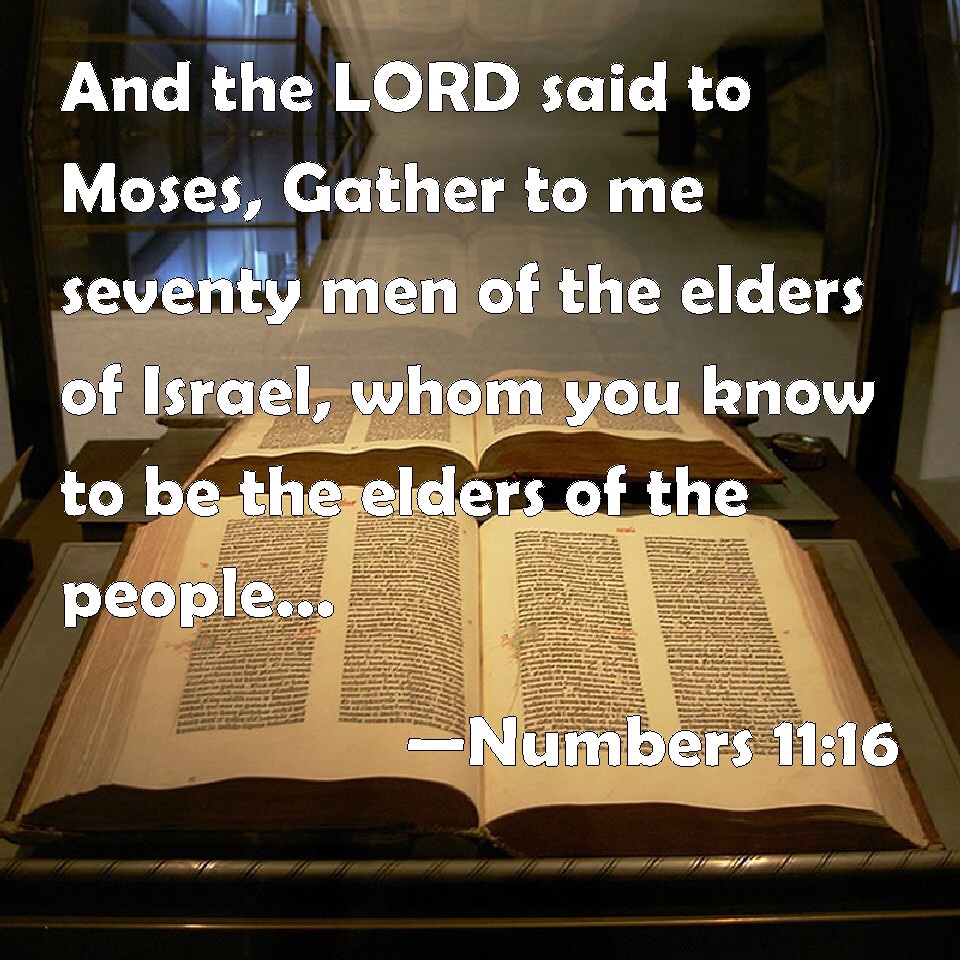
“So the LORD said to Moses, “Gather for me seventy of the elders of Israel, whom you know to be the elders of the people and officers over them; bring them to the tent of meeting, and have them take their place there with you. I will come down and talk with you there; and I will take some of the spirit that is on you and put it on them; and they shall bear the burden of the people along with you so that you will not bear it all by yourself.” (Num 11:16-17)
This story from the Hebrew Scriptures demonstrates that God was concerned to take care of the leadership of the people of Israel. The seventy Elders were he people. appointed to assist Moses in his growing role as a leader of the people in a stressful and challenging time (as they journey through the wilderness, seeking a way to the promised land). The story from of old has strong resonances with our current situation!
If we accept that God demonstrated concerns for the pressures on Moses, can we see that this provides an analogy for the way that we offer care for our leaders, especially those who are vulnerable themselves, or living in a household with another vulnerable person?
Pressures on ministry leaders (both those ordained, and those lay people who are providing local leadership) to lead their people in gatherings should not be countenanced, until such time as it is clear that all the required protocols can be, and are being, adhered to, and they are not in any position of extra vulnerability because of this. That requires careful discernment and wise leadership at the local level.


















![To the saints [not just in Ephesus] who are faithful (Ephesians 1; Pentecost 7B)](https://johntsquires.com/wp-content/uploads/2021/07/img_7178.jpg?w=597)

















 An Informed Faith