On the mount of the Lord it shall be provided (Genesis 21–22; Narrative Lectionary for Pentecost 14)

Discussion of the passages from Genesis 21–22 for the Narrative Lectionary.

The pair of passages from Genesis proposed by the Narrative Lectionary for this coming Sunday contain a paradox. On the one hand, after years of Abraham and Sarah yearning in vain for a son, “the Lord did for Sarah as he had promised; Sarah conceived and bore Abraham a son in his old age” (Gen 21:1–2). The son was named Isaac, meaning laughter; as Sarah, aged 100, declares, “God has brought laughter for me; everyone who hears will laugh with me” (21:6).

Yet in the second passage offered by the lectionary, we read some chilling words: “Abraham reached out his hand and took the knife to kill his son” (Gen 22:10). How does this relate to the joy seen at the birth of Isaac? There is no laughter in this story. It’s a horrifying story. How is this edifying material for hearing in worship?
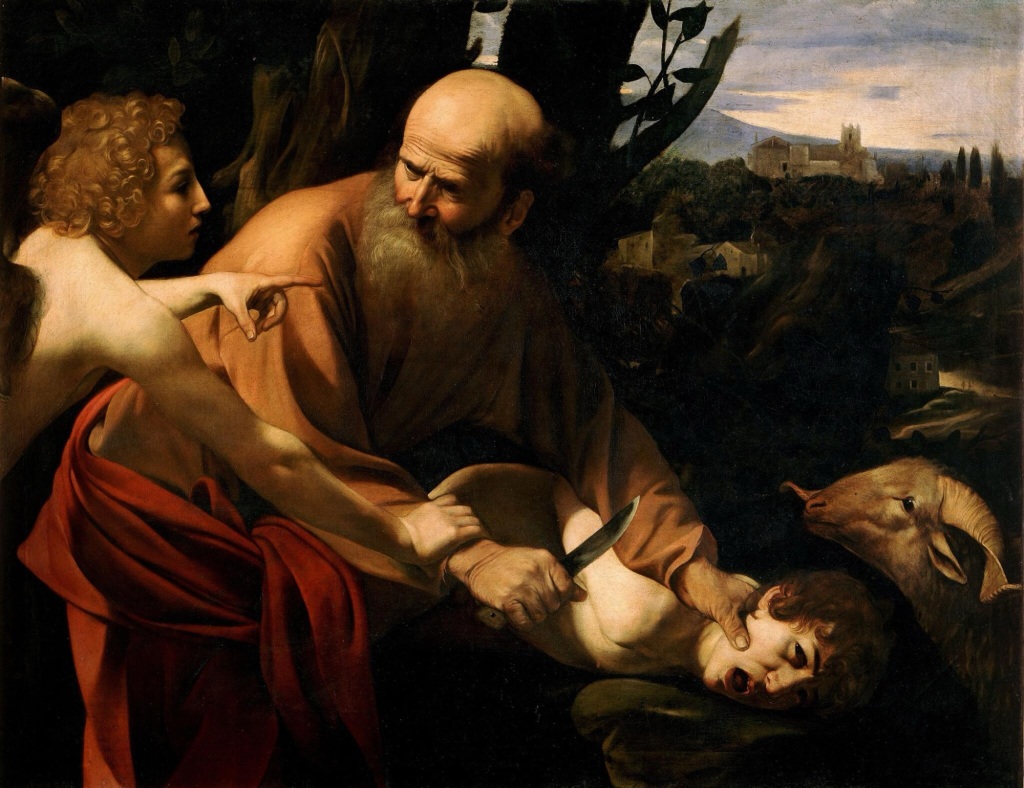
Questions abound. Who is this God who calls Abraham to take his “only son” up the mountain and “offer him there as a burnt offering” (22:2)? Where is the God who, it is said, has shown “steadfast love” to the people of Israel (Exod 15:13), and before that to Joseph (Gen 39:21), to Jacob (Gen 32:9–19), and indeed to Abraham himself (Gen 24:27)? Why has God acted in a way that Is seemingly so out of character in this incident in Gen 22? Or is this the real nature of God, and these later displays of “steadfast love” are simply for show?

This story is indeed troubling: it presents a God who demands a father to kill his beloved son, with no questions asked. It is not just the knife in Abraham’s hand which is raised (22:10)—there are many questions raised by this seemingly callous story. 

My wife, Elizabeth Raine, has a cracker of a sermon in which she compares this story with the account of Jephthah and his daughter (Judg 11:29–40). Whilst the Lord commands Abraham to kill his son as a burnt offering, it is the vow made by Jephthah to sacrifice “whoever comes out of the doors of my house to meet me, when I return victorious from the Ammonites” as a burnt offering (Judg 11:30).

And whilst the Lord intervenes in what Abraham is planning to do at the very last moment, sending an angel to command him, “do not lay your hand on the boy or do anything to him” (Gen 22:11–12), Jephthah is held to the vow he has made—by his very own daughter, who knows that she will be the victim of this vow (Judg 11:39). There is no divine intervention in this story. 

And worse, whilst Abraham had carefully prepared for the sacrifice, taking his donkey, two servants, and the wood for the fire up the mountain with him (Gen 22:3–6), Jephthah’s vow was made on the spur of the moment (Judg 11:30–31), and when his daughter insisted that he must carry through with this vow, he gives her, as requested, two full months for her to spend with her companions before he sacrificed her (Judg 11:37–39). Surely he might have had time in those two months to reconsider his vow and turn away from sacrificing his daughter?

It would seem, then, that the daughter was dispensable; the son, the much loved only son of Sarah and Abraham, was clearly indispensable. That would clearly reflect the values of the patriarchal society of the day, in which “sons are indeed a heritage from the Lord, the fruit of the womb a reward” (Ps 127:3). 

And Abraham would have followed the same pathway, sacrificing his only son, had not the Lord intervened. Neither father is looking very appealing in these two stories! Which makes it hard to see how the story of the sacrifice told in Judg 11, and the story of the almost-sacrifice told in Gen 22, can be “the word of the Lord” for us, today, in the 21st century. Indeed, the story of Abraham and Isaac comes perilously close to being a story of child abuser—if not physical abuse, by the end of the story, at least emotional and spiritual abuse.

Situations of abuse destroy trust. After such an experience, how could Isaac ever trust his father again? And as we hear the story, how can we trust God? How could we ever believe that his commands to us are what we should follow?—if he follows the pattern of this story, and changes his mind at the last minute, after pushing us to the very brink of existence? How could we trust a God like this?

Or, if the story involving poor Isaac is really about God providing, as Abraham intimates early on (22:8), and then concludes at the end (22:14), then it is a rather malicious way for God to go about showing how he is able to “provide”. Provision, and providence, should be something positive—not perilous and threatening, as in this story.

Or yet again, if the story is about testing Abraham’s faith, as many interpreters conclude, then it is a particularly nasty and confronting way for God to do this—and that points to a nasty streak in the character of God. Is this really what we want to sit with? Was there not some other way for God to push Abraham to test his faith? 

What do we do with such a story within our shared sacred scriptures?

The Jewish site, My Jewish Learning, states that “although the story itself is quite troubling, it does contain a message of hope for Rosh Hashanah. In the liturgy we ask God to “remember us for life.”  The binding of Isaac concludes with his life being spared, and he too is “remembered for life.”  Abraham’s devotion results in hope for life.”

How does the message of hope for life emerge from this story? Clearly, the life of Isaac is spared; but this is a terrible way to teach that message!

James Goodman, writing in My Jewish Learning, explains how he was taught to understand this story. “I learned that the story was God’s way of proclaiming his opposition to human sacrifice”, Goodman writes. 

He refers to the way his Hebrew-school teacher explained this story: “God had brought Abraham to a new land. A good and fertile land, where it was common for pagan tribes, hoping to keep the crops and flocks coming, to sacrifice first-born sons to God. Then one day, God commanded Abraham to sacrifice Isaac, the beloved son of his old age. 

“Abraham set out to do it, and was about to, when God stopped him. He sacrificed a ram instead. In the end, Abraham had ‘demonstrated his—and the Jews’—heroic willingness to accept God and His law,’ and God had ‘proclaimed’ that ‘He could not accept human blood, that He rejected all human sacrifices’.”

See https://www.myjewishlearning.com/2013/09/11/understanding-genesis-22-god-and-child-sacrifice/

Setting the story in the broader context of the practice of child sacrifice is a way of accepting that this terrible story might indeed have some value. Seeing the story is a dramatised version of God’s command not to sacrifice children can be a way to deal with it. “Do not lay your hand on the boy or do anything to him”, the angel says; so Abraham obeys, finds a ram, offers the ram as a burnt offering (22:12–13). And so, the name of the place is given: “the Lord will provide”(22:14).

Three kings of Israel, at different times in the history of Israel, are said to have practised child sacrifice, as they turned to practices found in nations other than Israel. Solomon in his old age is said to have turned to the worship of Molech (1 Ki 11:7); this practice was subsequently adopted by Ahaz, who “made offerings in the valley of the son of Hinnom, and made his sons pass through fire, according to the abominable practices of the nations whom the Lord drove out before the people of Israel” (2 Chron 28:3). Likewise, Manasseh “made his son pass through fire; he practiced soothsaying and augury, and dealt with mediums and with wizards” (2 Ki 21:6). 

Direct commands not to sacrifice children are found in two books of Torah in the scriptural texts. Most direct is “you shall not give any of your offspring to sacrifice them to Molech, and so profane the name of your God: I am the Lord” (Lev 20:18). In Deuteronomy, other nations are condemned as they “burn their sons and their daughters in the fire to their gods” (Deut 12:31), so the command is “no one shall be found among you who makes a son or daughter pass through fire” (Deut 18:10). The prophet Jeremiah also asserts that this practice is not something that the Lord God had thought of (Jer 7:31). 

So the passage we have in the lectionary responds to this practice by telling a tale which has, as its punchline, the command “do not lay your hand on the boy or do anything to him” (22:12). Might this be the one redeeming feature of this passage? 

But if that is the case, the story belongs back in the days when child sacrifice was, apparently, widely practised. What, then, does it say to us today??

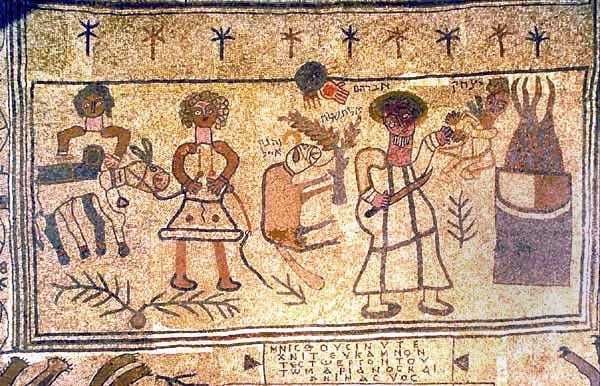
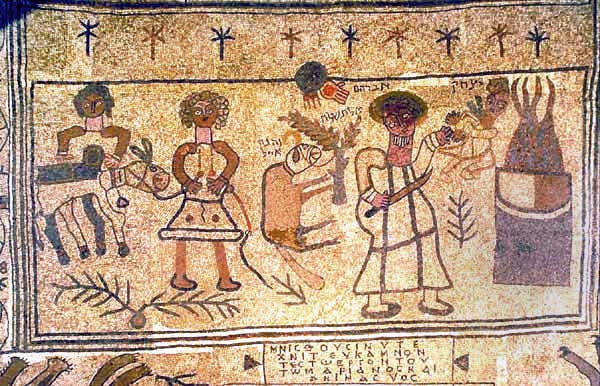
A sixth-century CE floor mosaic from the Beth Alpha synagogue, in Israel’s Jezreel Valley. The mosaic lay near the door, so that anyone who entered was confronted by the scene. In this mosaic, Abraham and Isaac are identified in Hebrew. The hand of God extends from heaven to prevent Abraham from proceeding. Below the hand are the Hebrew words, “Lay not [your hand].” Next to the ram are the words, “Behold a ram.”

Look toward heaven and count the stars … so shall your descendants be (Gen 15; Narrative Lectionary for Pentecost 17C)

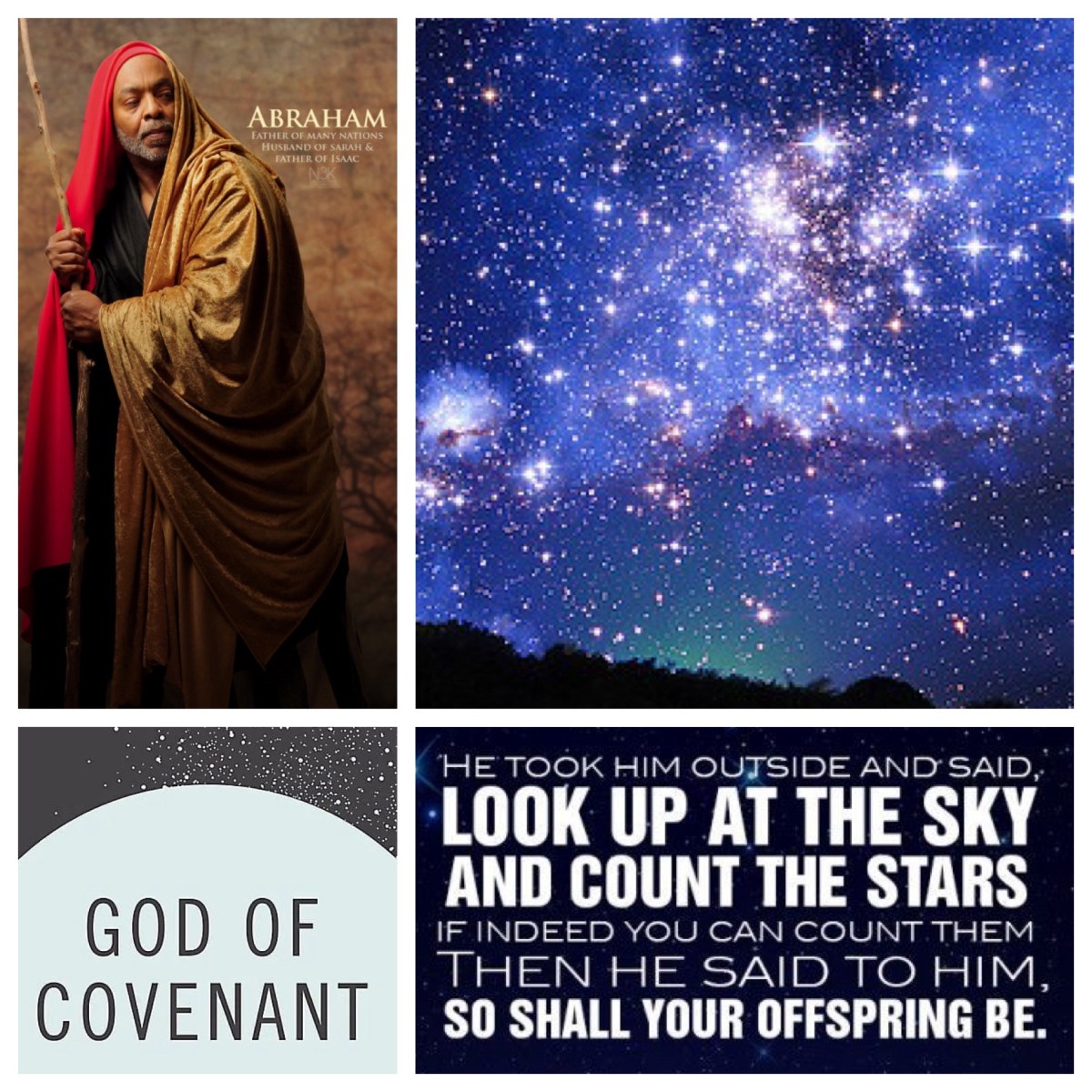
This Sunday, the Narrative Lectionary takes us from the story of The Garden of Eden, into the Negeb, where “Abram the Chaldean” (Gen 11:27–28) had become “Abram the Hebrew” (Gen 14:13). In this week’s passage (Gen 15:1–6), Abram experiences a vision which 

In these chapters, the long saga of Israel begins with stories about the ancestors held in highest regard as the mother and father of the nation: Sarai and Abram. The command that they heard is set out at the beginning of their story: “Go from your country and your kindred and your father’s house to the land that I will show you” (Gen 12:1). The saga of this couple that is told in the ensuing chapters will reach fulfilment, many centuries later, when their descendants enter the land and settle in Canaan.

This sequence of passages offers us stories which were told, retold, and probably developed over quite some time by the elders in ancient Israel. They are stories which define the nature of the people and convey key values which were important in ancient Israel.  These faithful people from the past stand, for us today, as role models to encourage us, centuries later, in our own journey of faith. They are stories which are worth holding up for our reflection and consideration. 

These stories each have the function of an aetiology—that is, a mythic story which is told to explain the origins of something that is important in the time of the storyteller. The online Oxford Classical Dictionary defines an aetiology as “an explanation, normally in narrative form (hence ‘aetiological myth’), of a practice, epithet, monument, or similar.” 

Whilst telling of something that is presented as happening long back in the past, the focus is on present experiences and realities, for “such explanations elucidate something known in the contemporary world by reference to an event in the mythical past”. 

See https://oxfordre.com/classics/display/10.1093/acrefore/9780199381135.001.0001/acrefore-9780199381135-e-7050;jsessionid=3DB38C42C54D01E1CBFA8682FB55DA4C

The ancestral narratives of Israel (Gen 12–50), as well as the series of books known as “the historical narratives” (Exodus to 2 Kings, Ezra—Nehemiah) are all written at a time much later that the presumed events which they narrate. The final form of the books as we have them most likely date to the Exile or post-exilic times, although pre-existing sources would have been used for many of these stories. (There are specific references to earlier written documents—now lost to us—scattered throughout 1—2 Kings.)

Those older stories were remembered, retold, and then written down, because they spoke into the present experiences of the writers. Common scholarly belief is that the stories found in Gen 12–50 were originally oral tales, that were collected together, told and retold over the years, and ultimately written down in one scroll, that we today call Genesis.

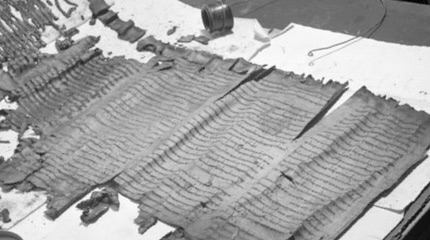
One of the leaves of the Genesis Apocryphon,
a text found in the Qumran Caves which contains narratives
not found in the biblical text, involving Noah and Abraham.

At the start of the ancestral narratives, Abram sets off, with his extended family: “his wife Sarai and his brother’s son Lot, and all the possessions that they had gathered, and the persons whom they had acquired in Haran” (12:5). Haran was a strategic city in the upper reaches of the area we know as the Fertile Crescent, far from the land of Canaan (over 12,000km). The call was to travel that distance, to Canaan. For support and sustenance along the way, Abram and Sarai were called into covenant relationship with God. The formalising of the covenant is reported later in this chapter, at 15:18, with a promise that the descendants of Abram and Sarah will indeed have the land that is specified.

Abram and Sarah had left their homeland with some assured promises from God; they would be parents of a great nation, blessed by God, remembered as having a great name, and that all the nations of the earth would be blessed through them (12:1–3). Those promises were intended to hold Sarai and Abram to the journey, despite all that they might encounter. The end result would make the travails along the way bearable.

However, Abram expresses some doubt that the promises made by God would come to pass (15:2–3). God’s response is to provide further reassurance; the multitude of stars in the sky is testimony to that (15:5). Abraham’s resulting affirmation of faith leads to the famous phrase, so central to Paul’s later argument about righteousness: “he believed the Lord; and the Lord reckoned it to him as righteousness” (15:6; see Rom 4:3,9,22).

The ceremony that follows adheres to the traditional cultic practices of the time. A collection of sacrificial victims, two animals and two birds, are offered and slaughtered, and the animals are cut in two (15:9–11). (The phrase, “to make a covenant” in Hebrew, can literally be rendered as ”to cut a covenant”.) Such practices signal the seriousness of the moment and symbolise that each party will keep their word on pain of death. 

Indeed, the prophet Jeremiah later alludes to this specific provision, when he warns recalcitrant Israelites that “those who transgressed my covenant and did not keep the terms of the covenant that they made before me, I will make like the calf when they cut it in two and passed between its parts” (Jer 34:18, referring to Gen 15:10). The prophet continues, “their corpses shall become food for the birds of the air and the wild animals of the earth” (Jer 34:20, referring to Gen 15:11).

This ancient cultic sacrificial practice of cutting animals does not reflect modern practices and is, in fact, distasteful to contemporary sensitivities. That might prod current readers to dismiss this passage as archaic, irrelevant, obsolete. That would be a shame. It remains relevant to us in a striking way.

Abram and Sarai reveal both trust in the promises they have been given, but also articulate some uncertainty about whether God would continue to be faithful to those promises. How human this is! In this regard, they reflect the somewhat ambivalent way that each of us relate to the promises of God: living out our trust and hope in the midst of the challenges, changes, and obstacles along the way, yet still holding back, somewhat dubious, about the ultimate reality this all.

We cannot hear of this covenant without thinking of the current inhabitants of the land defined by these verses (vv.18–21). Some claim the land through Abram, some through Ishmael, some through Isaac. Each of these peoples have sought to justify their claim to the land through politics and power, and sometimes bombs and guns. Yet the way to participate in this promise is to recognise that God offers up God’s own life as God’s pledge of faithfulness.

It’s a perfect vignette for those in the northern hemisphere (where the Narrative Lectionary originates) as people regather after the summer and face the year that lies ahead. This gathering back together offers an opportunity to reconsider how God had been at work in our midst, when we reconsider our commitment to the covenant we have made with God, and how live out that covenant in the realities of discipleship. It reminds us of the call to full-blooded, whole-scale, all-of-life commitment to the covenant that we have with God through Jesus.

See my reflections on the current situation in Gaza at

On the mount of the Lord it shall be provided (Gen 22; Pentecost 5A)

“Abraham reached out his hand and took the knife to kill his son” (Gen 22:10). We read these chilling words in the passage that the lectionary offers for our reflection and consideration this coming Sunday (Gen 22:1–14). It’s hardly edifying reading material for worship, is it?

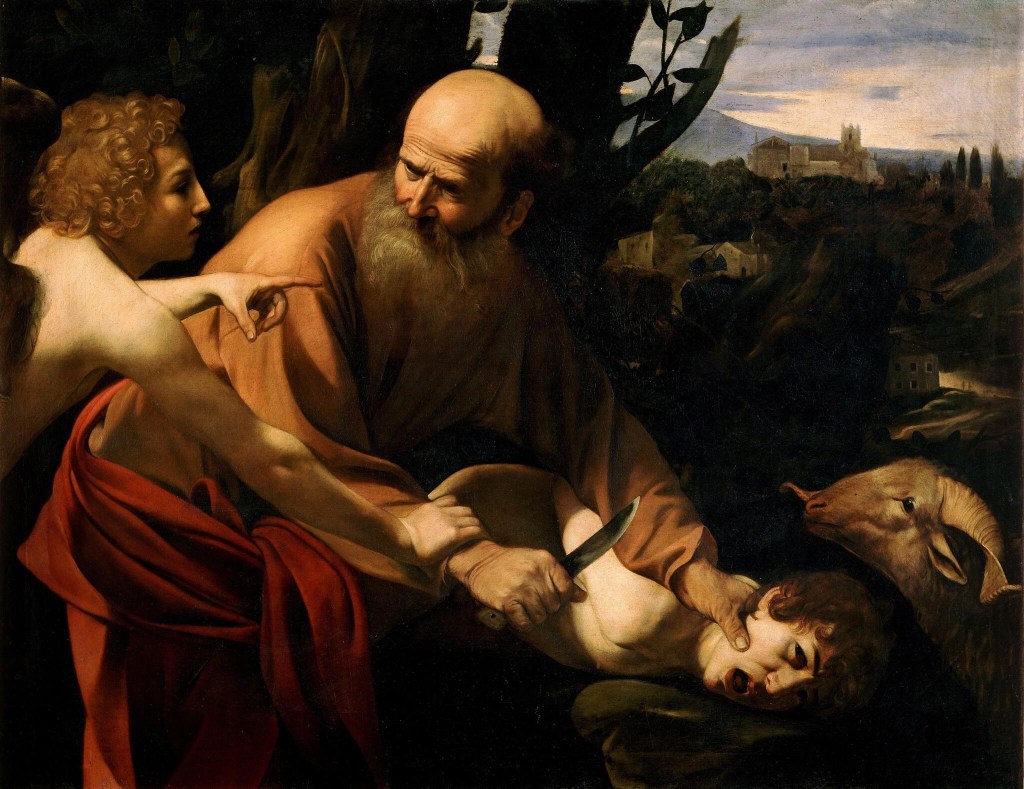
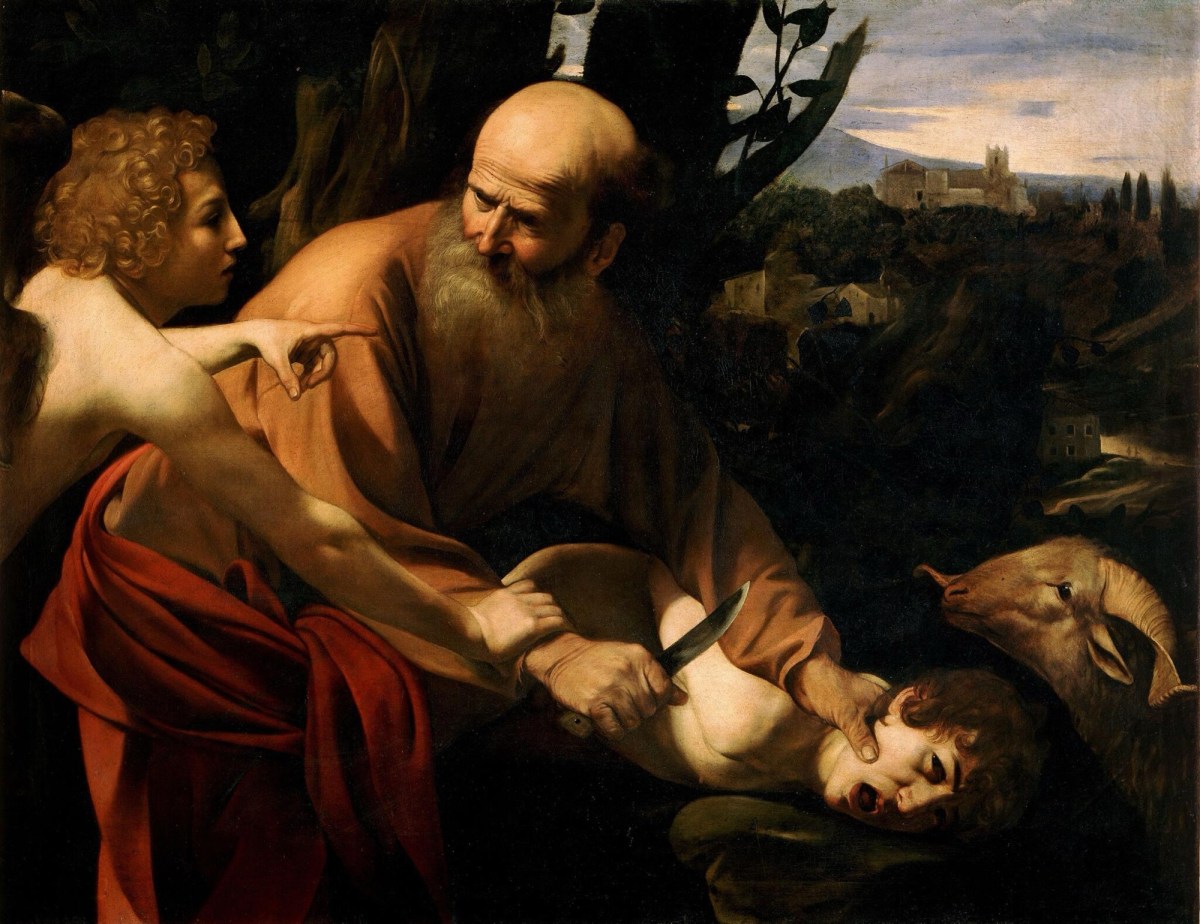
The Sacrifice of Isaac, by Caravaggio, c. 1603

It’s a horrifying story. Who is this God who calls Abraham to take his “only son” up the mountain and “offer him there as a burnt offering” (22:2)? How does this God relate to the God who, it is said, has shows “steadfast love” to the people of Israel (Exod 15:13), and before that to Joseph (Gen 39:21), to Jacob (Gen 32:9–19), and indeed to Abraham himself (Gen 24:27)? Why has God acted in a way that Is seemingly so out of character in this incident in Gen 22? Or is this the real nature of God, and later displays of “steadfast love” are simply for show?

Writing in With Love to the World, the Revd Sophia Lizares, a Uniting Church Minister originally from the Philippines, now serving in Perth, WA, says that this story is “an improbable and troubling reading: a God who demands a father to kill his beloved son, a father who questions not.” It is not just the knife in Abraham’s hand which is raised (22:10)—there are many such questions raised by these seemingly callous story.

My wife, Elizabeth Raine, has a cracker of a sermon in which she compares this story with the account of Jephthah and his daughter (Judg 11:29–40). Whilst the Lord commands Abraham to kill his son as a burnt offering, it is the vow made by Jephthah to sacrifice “whoever comes out of the doors of my house to meet me, when I return victorious from the Ammonites” as a burnt offering (Judg 11:30).

And whilst the Lord intervenes in what Abraham is planning to do at the very last moment, sending an angel to command him, “do not lay your hand on the boy or do anything to him” (Gen 22:11–12), Jephthah is held to the vow he has made—by his very own daughter, who knows that she will be the victim of this vow (Judg 11:39). There is no divine intervention in this story.

And worse, whilst Abraham had carefully prepared for the sacrifice, taking his donkey, two servants, and the wood for the fire up the mountain with him (Gen 22:3–6), Jephthah’s vow was made on the spur of the moment (Judg 11:30–31), and when his daughter insisted that he must carry through with this vow, he gives her, as requested, two full months for her to spend with her companions before he sacrificed her (Judg 11:37–39). Surely he might have had time in those two months to reconsider his vow and turn away from sacrificing his daughter?

It would seem, then, that the daughter was dispensable; the son, the much loved only son of Sarah and Abraham, was clearly indispensable. That would clearly reflect the values of the patriarchal society of the day, in which “sons are indeed a heritage from the Lord, the fruit of the womb a reward” (Ps 127:3).

And Abraham would have followed the same pathway, sacrificing his only son, had not the Lord intervened. Neither father is looking very appealing in these two stories! Which makes it hard to see how the story of the sacrifice told in Judg 11, and the story of the almost-sacrifice told in Gen 22, can be “the word of the Lord” for us, today, in the 21st century. Indeed, the story of Abraham and Isaac comes perilously close to being a story of child abuser—if not physical abuse, by the end of the story, at least emotional and spiritual abuse.

Situations of abuse destroy trust. After such an experience, how could Isaac ever trust his father again? And as we hear the story, how can we trust God? How could we ever believe that his commands to us are what we should follow?—if he follows the pattern of this story, and changes his mind at the last minute, after pushing us to the very brink of existence? How could we trust a God like this?

Or, if the story involving poor Isaac is really about God providing, as Abraham intimates early on (22:8), and then concludes at the end (22:14), then it is a rather malicious way for God to go about showing how he is able to “provide”. Provision, and providence, should be something positive—not perilous and threatening, as in this story.

Or yet again, if the story is about testing Abraham’s faith, as many interpreters conclude, then it is a particularly nasty and confronting way for God to do this—and that points to a nasty streak in the character of God. Is this really what we want to sit with? Was there not some other way for God to push Abraham to test his faith?

What do we do with such a story within our shared sacred scriptures?

A sixth-century CE floor mosaic from the Beth Alpha synagogue, in Israel’s Jezreel Valley. The mosaic lay near the door, so that anyone who entered was confronted by the scene. In this mosaic, Abraham and Isaac are identified in Hebrew. The hand of God extends from heaven to prevent Abraham from proceeding. Below the hand are the Hebrew words, “Lay not [your hand].” Next to the ram are the words, “Behold a ram.”

*****

The Jewish site, My Jewish Learning, states that “although the story itself is quite troubling, it does contain a message of hope for Rosh Hashanah. In the liturgy we ask God to “remember us for life.” The binding of Isaac concludes with his life being spared, and he too is “remembered for life.” Abraham’s devotion results in hope for life.”

How does the message of hope for life emerge from this story? Clearly, the life of Isaac is spared; but this is a terrible way to teach that message!

James Goodman, writing in My Jewish Learning, explains how he was taught to understand this story. “I learned that the story was God’s way of proclaiming his opposition to human sacrifice”, Goodman writes.

He refers to the way his Hebrew-school teacher explained this story: “God had brought Abraham to a new land. A good and fertile land, where it was common for pagan tribes, hoping to keep the crops and flocks coming, to sacrifice first-born sons to God. Then one day, God commanded Abraham to sacrifice Isaac, the beloved son of his old age.

“Abraham set out to do it, and was about to, when God stopped him. He sacrificed a ram instead. In the end, Abraham had ‘demonstrated his—and the Jews’—heroic willingness to accept God and His law,’ and God had ‘proclaimed’ that ‘He could not accept human blood, that He rejected all human sacrifices’.”

See https://www.myjewishlearning.com/2013/09/11/understanding-genesis-22-god-and-child-sacrifice/

Setting the story in the broader context of the practice of child sacrifice is a way of accepting that this terrible story might indeed have some value. Seeing the story is a dramatised version of God’s command not to sacrifice children can be a way to deal with it. “Do not lay your hand on the boy or do anything to him”, the angel says; so Abraham obeys, finds a ram, offers the ram as a burnt offering (22:12–13). And so, the name of the place is given: “the Lord will provide” (22:14).

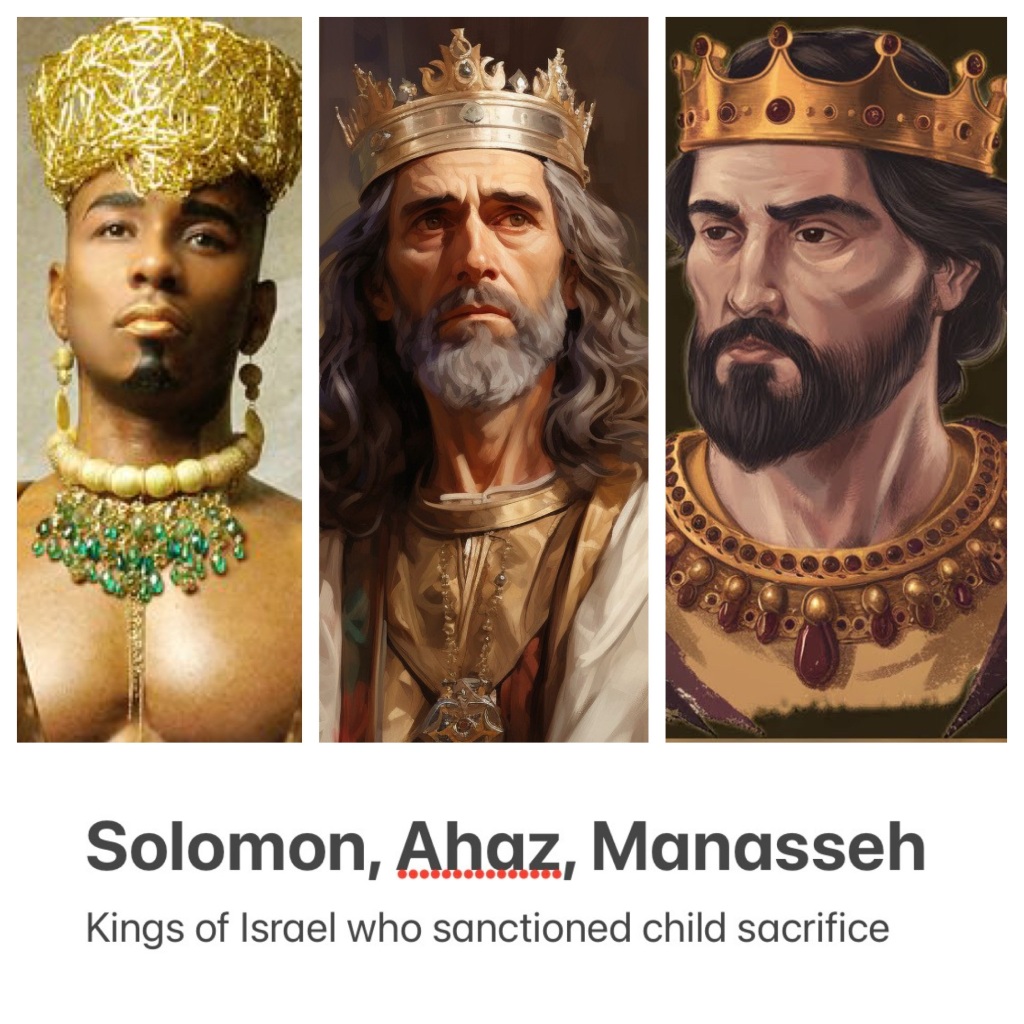
Three kings of Israel, at different times in the history of Israel, are said to have practised child sacrifice, as they turned to practices found in nations other than Israel. Solomon in his old age is said to have turned to the worship of Molech (1 Ki 11:7); this practice was subsequently adopted by Ahaz, who “made offerings in the valley of the son of Hinnom, and made his sons pass through fire, according to the abominable practices of the nations whom the Lord drove out before the people of Israel” (2 Chron 28:3). Likewise, Manasseh “made his son pass through fire; he practiced soothsaying and augury, and dealt with mediums and with wizards” (2 Ki 21:6).
Direct commands not to sacrifice children are found in two books of Torah in the scriptural texts. Most direct is “you shall not give any of your offspring to sacrifice them to Molech, and so profane the name of your God: I am the Lord” (Lev 20:18). In Deuteronomy, other nations are condemned as they “burn their sons and their daughters in the fire to their gods” (Deut 12:31), so the command is “no one shall be found among you who makes a son or daughter pass through fire” (Deut 18:10). The prophet Jeremiah also asserts that this practice is not something that the Lord God had thought of (Jer 7:31).

So the passage we have in the lectionary responds to this practice by telling a tale which has, as its punchline, the command “do not lay your hand on the boy or do anything to him” (22:12). Might this be the one redeeming feature of this passage?

But if that is the case, the story belongs back in the days when child sacrifice was, apparently, widely practised. What, then, does it say to us today???

See also

Visiting Abraham and Sarah by the oaks at Mamre (Gen 18; Pentecost 3A)

During the long season of “ordinary time” After Pentecost, the lectionary offers stories of some quite extraordinary people, drawn from the sagas that tell of the key moments in the story of Israel. These sagas are found in the narrative books, Genesis, Exodus, Deuteronomy, Joshua, and Judges. These stories run through until the Twenty-Fifth Sunday after Pentecost, in mid-November.

This coming Sunday, we hear a well-known story relating to the patriarch and matriarch whose adventures comprises significant part of Genesis (12:1—25:11). The story tells of how Abraham and Sarah undertook the long journey from Ur to Canaan (12:1–9), spent time in Egypt (12:10–20) and the Negeb (13:1–14:24), entered into covenant with God (15:1–21) and sealed this with a ceremony of circumcision (17:1–27).

Abraham himself has also fathered a child with his servant, Hagar (16:1–16); that dimension of the story appears important as it signals that there would be a descendant of Abraham, to fulfil the promise made earlier (12:2; 15:12–21). Yet the child who arrives is the son of Hagar, not Sarah. So the passage which is offered by the lectionary for this coming Sunday (Gen 18:1–15) addresses the infertility of Abraham and Sarah, by telling of how this couple learnt that they would, indeed, become parents together.

Abraham was allegedly aged 100 years, while Sarah was aged 90 years (see 17:17). It is no wonder that Sarah, when she learns of her forthcoming pregnancy, laughs (18:12)—although when confronted about this, she denies having laughed (18:15). Yet the name of the son to be born to Sarah, Isaac, means “the one who laughs”. So the joke is on her!

In the next two weeks, the lectionary will offer stories from subsequent chapters of Genesis, that focus on the two sons of Abraham: first, Ishmael, banished to the desert by his father, where he and his mother were vulnerable (21:8–21); and then Isaac, called to his own sacrifice under the hand of his own father (22:1–14). Certainly, Abraham does not come out of either of these stories looking very good!

The news about Isaac comes to Sarah and Abraham after a visit from three men, one of whom looks forward to the birth of a son to Sarah (18:10). Abraham had welcomed the visitors, as was the custom, saying “let a little water be brought, and wash your feet, and rest yourselves under the tree; let me bring a little bread, that you may refresh yourselves” (18:4–5).

Quite tellingly—given the strongly patriarchal nature of ancient society—we next learn that “Abraham hastened into the tent to Sarah, and said, ‘Make ready quickly three measures of choice flour, knead it, and make cakes’”. There we have it: the man decides, the woman implements. Has this changed in today’s society? A little? A lot? The jury is still out …

But more than this; “Abraham ran to the herd, and took a calf, tender and good, and gave it to the servant, who hastened to prepare it” (18:7). The master selects the animal; the servant prepares the meal. Again, all in accord with the customs of the time. But the next verse has always jarred with me: “Then he took curds and milk and the calf that he had prepared, and set it before them” (18:8). The food that he had prepared??? The food that he had ordered others to prepare, surely!

In his commentary on this passage in With Love to the World, the Revd Dr John Jegasothy, a retired Uniting Church Minister who came to Australia some decades ago, seeking asylum from civil war in Sri Lanka, observes that “strangers and aliens were considered as enemies in the ancient times. We, today, warn our children not to talk to strangers, because they could be predators”. He notes that, in the experience of his own family, “we have met many strangers in our lives, like new neighbours or new migrants in this multicultural country, who have become friends and channels of blessings to us. We too have become good neighbours and friends to them.”

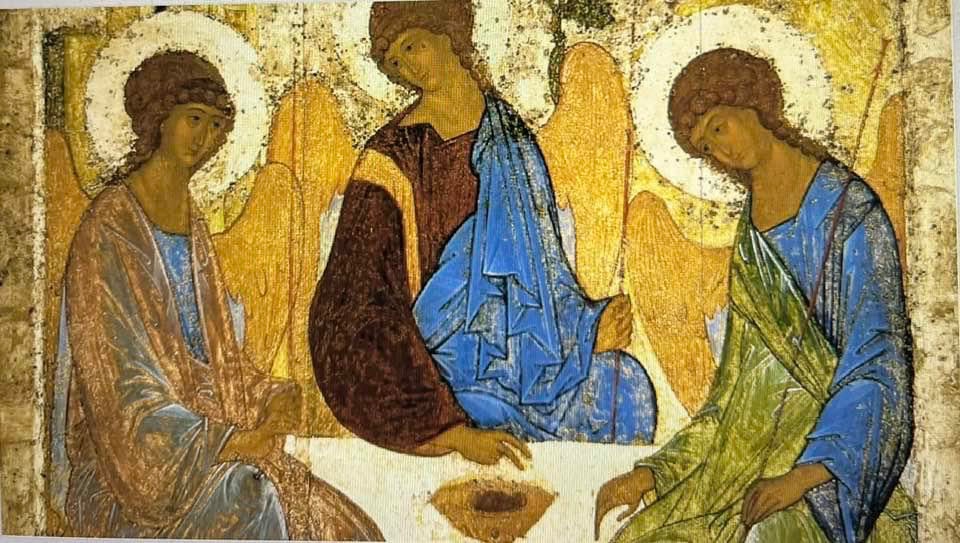
The visitors, offered hospitality by Sarah and Abraham, bring an important revelation to them. These three travellers are the means by which God speaks into the ongoing story. Later Christian interpreters have, unhelpfully and inaccurately, seen the “three men” as a visitation of the Triune God—an interpretation made famous through Andrew Rublev’s early 15th century icon (pictured).

The story, of course, is an ancient Jewish legend, which tells of hospitality and progeny; the Christian doctrine of the Trinity was shaped amidst the patriarchal polemics of the state-sponsored church of the later Roman Empire as church leaders argued about complex matters of speculative philosophical questions. (Was Jesus truly human? Was he truly divine? How are God and Jesus related? Do they share the same essence? Are they of like nature, or of exactly the same nature? and so on …)

The two are worlds apart. It’s another case where Christian interpreters, wanting to find “biblical proof” for that doctrine, have done great damage to a passage of Hebrew Scripture, forcing it to say something that clearly is not evident from a plain reading within the ancient Israelite context.

If we focus on the dynamic that is evident in the story, we see how it highlights the importance of hospitality. And that should encourage and inspire us, as we go about our daily lives, to offer that hospitality to others: to welcome the stranger, invite into our homes and our lives those in need of food, drink, and shelter; to reach out to those caught in the prisons of their minds, their poverty, their crimes, their inadequacies.

All of which sounds like sage words … now, where have we heard that before?

*****

See also

It was reckoned to him; it will be reckoned to us (Rom 4; Pentecost 2A)

This Sunday, we start into a series of readings offered by the lectionary from the longest and most theologically weighty letter written by Paul—that addressed “to all God’s beloved in Rome, who are called to be saints” (Rom 1:7). Although it has this specific, localised audience in view, the letter has become a declaration heard and taken up and studied carefully by Christians right around the world, across millennia of years.

A reading from Romans will be offered each week until the Sixteenth Sunday after Pentecost (this year, 2023, that falls on 17 September). So we will have many weeks to consider the theological exposition that Paul provides. This letter is generally regarded as the most explicit and detailed exposition of the theological commitments which had energised Saul of Tarsus to spend years of his life “to be a minister of Christ Jesus to the Gentiles in the priestly service of the gospel of God, so that the offering of the Gentiles may be acceptable, sanctified by the Holy Spirit” (Rom 15:16). For this enterprise, he is well-known as the “Apostle to the Gentiles”.

In the structuring of the lectionary, the sequence of excerpts from Romans should begin with a declaration of the central theme of the letter (1:16–17) and the rich passage that details how God death with human sinfulness through Jesus (3:21–28). These two short, but central, sections of the letter are offered on the Sunday known as Proper 4, the first Sunday after Pentecost.

However, because Easter was (relatively) later this year, Pentecost is also later, and so this reading is not offered by the lectionary this year. Proper 4 is to occur “on the Sunday in between May 29 and June 4 inclusive, if after Trinity Sunday”; as Trinity Sunday this year fell on 4 June, there is no Proper 4 in 2023.

So we begin with Proper 5, for “the Sunday between June 5 and June 11 inclusive”—this year, Sunday 11 June. Which means that we have missed the initial declaration of the Gospel which Paul proclaims in this long letter; the Gospel which is “the power of God for salvation to everyone who has faith, to the Jew first and also to the Greek”, the Gospel in which “the righteousness of God is revealed through faith for faith” (Rom 1:16–17).

This theological understanding is set forth, initially, through a quotation from a short book in Hebrew Scripture, that of the prophet Habakkuk. This prophet is a shadowy figure, known, really, for only one statement—just half of one verse. That is the short statement, “the righteous live by their faith [or faithfulness]” (2:4b), which stands as the text upon which Paul developed his important theological statement in Romans: “in it [the gospel] the righteousness of God is revealed through faith for faith; as it is written, ‘the one who is righteous will live by faith’” (Rom 1:17).

In the context of Habakkuk’s prophetic activity, the affirmation that “the righteous live by their faith [or faithfulness]” (2:4b) is the word that God gives to the prophet, responding to his complaints about what sufferings are taking place. Habakkuk’s complaints come because God is “rousing the Chaldeans, that fierce and impetuous nation, who march through the breadth of the earth to seize dwellings not their own” (1:6), and through their dreadful and fearsome activities, God is “destroying nations without mercy” (1:17).

You can read more of my take on the short book of Habakkuk at

The claim that God is using foreigners to deal with Israel is a striking theological development—one that is at odds with the traditions that emphasise Israel as a chosen nation, holy and set apart, dedicated to the Lord; the nation alone through whom the Lord God works. That this God will use foreigners is a theme found also in the later writings of Deutero-Isaiah (Isa 40–55), where Cyrus, the Persian ruler, is acclaimed as the one chosen by God, the Messiah, to allow the people of Judah to return to their land (Isa 44:24–45:13).

That God is at work amongst people who are not of Israel resonates, of course, with the activity that Paul and his fellow-workers had been undertaking amongst the Gentiles (those not of the people of Israel)—although Paul is not working in a context of oppression and threatening invasion. So this brief citation from Habakkuk is entirely apposite for Paul’s work and his writings. And as the later chapters of Roman clearly show, God has indeed been at work amongst the Gentiles in Rome.

On the overall theological argument developed in Romans, see

*****

So in the passage that the lectionary offers us for this Sunday (4:13–25), we have the second part of Paul’s discussion of the patriarch Abraham—“the father of all nations” (4:17, citing Gen 17:5) and the figure who stands as the archetype for the message of the Gospel, that “the one who is righteous will live by faith” (1:17, citing Hab 2:4).

In this discussion, Paul is insistent that Abraham stands as the example supreme for that Gospel, since “his faith was reckoned to him as righteousness” (4:3, quoting Gen 15:6, and repeating this at Rom 4:9 and 4:22–23). And more than this: what was done with Abraham “will [also] be reckoned to us who believe in him who raised Jesus our Lord from the dead” (4:24).

This second half of the discussion of Romans 4 comes after Paul has established the universal scope of God’s providential grace—for this is how God meets the universal spread of sinfulness amongst human beings. So Paul focusses on the faith that Abraham showed, and its importance for believers in Rome (and elsewhere). The thesis for this part of the argument is that the promise to Abraham (which he was given in Gen 12:1–3) was “not through the law but through the righteousness of faith” (4:13).

First, Paul indicates that the promise cannot be fulfilled only through “the adherents of the law”, for “the law brings wrath” (4:14–15; he expands on this in chapter 7). Then, he asserts that the promise must rest on faith, both to those who adhere to the law but also “to those who share the faith of Abraham” (4:16). Abraham is here described as “the father of all of us”, drawing on yet another scripture citation (Gen 17:5; Paul uses the same argument at Gal 3:15–18, and the phrase is also at play in the debate reported in John 8:41–59).

Then follows further explication of this scripture (Gen 17:5), particularly explaining how Abraham, “hoping against hope”, became “the father of many nations” (4:17b—21). Despite the barrenness of Sarah’s womb (4:19), Abraham “was fully convinced that God was able to do what he had promised” (4:21). To conclude this exegetical foray, Paul quotes, for the third time, the foundational text: “his faith ‘was reckoned to him as righteousness’” (4:22, quoting Gen 15:6).

Paul then explains that these words describe not only the situation of Abraham, long ago in the past, but also the immediate situation of those to whom he writes (4:23–24). This is a foundational aspect of Paul’s hermeneutic; he restates it at Rom 15:4, declaring that the scripture “written in former days was written for our instruction”. See

And so the argument draws to a close, moving back into the heart of Paul’s concern, to expound the Gospel concerning God “who raised Jesus Christ from the dead” (4:24–25). The final verse is most likely a traditional formulaic expression; we find a similar pattern at 1 Cor 15:3–4, a midrashic-style reflection on this pattern at 1 Cor 15:42–44, and a variant form at 2 Cor 5:14–15.

There is also an extended discussion later in the letter to the Romans using the pattern of “Christ, dead and raised”, as the model for believers: “we are buried with him by baptism into death, so that, just as Christ was raised from the dead by the glory of the Father, so we too might walk in newness of life” (Rom 6:4). Paul provides a fuller discussion of this paradigm at 6:3–11, and there is a similar discussion, albeit varied for the different context, at Col 3:11–15.

And so the extended argument set out in all of this chapter takes us from an initial question about Abraham, through an exploration of the story of Abraham and Sarah, to a conclusion about the life of those who place their trust in what God has done through Jesus Christ. That God “will justify [or, reckon as righteous] the circumcised on the ground of faith and the uncircumcised through that same faith” (3:30) is the foundation for then claiming that, in like manner, “it will be reckoned to us who believe in him who raised Jesus our Lord from the dead” (4:24). It is all about being reckoned as righteous on the basis of faith. Thanks be to God!

*****

On the diatribe style that Paul uses here and throughout much of the letter to the Romans, which is reflected in that pattern (“it was reckoned to him … it will be reckoned to us”), see

“In you all the families of the earth shall be blessed” (Gen 12; Pentecost 2A)

Each year during the Sundays which follow after the festival of Pentecost, the Gospel readings offer a series of stories, encounters, and parables from the Gosepl attributed to Matthew. In parallel to those stories, in the Hebrew Scripture readings, the lectionary offers a sequence of passages telling some of the key moments in the story of Israel, from the narrative books, Genesis, Exodus, Deuteronomy, Joshua, and Judges. These stories run through until the Twenty-Fifth Sunday after Pentecost, in mid-November.

This sequence of passages offers us stories which were told, retold, and probably developed over quite some time by the elders in ancient Israel. They are stories which define the nature of the people and convey key values which were important in ancient Israel. These faithful people from the past stand, for us today, as role models to encourage us, centuries later, in our own journey of faith. They are stories which are worth holding up for our reflection and consideration.

These stories each have the function of an aetiology—that is, a mythic story which is told to explain the origins of something that is important in the time of the storyteller. The online Oxford Classical Dictionary defines an aetiology as “an explanation, normally in narrative form (hence ‘aetiological myth’), of a practice, epithet, monument, or similar.”

Whilst telling of something that is presented as happening long back in the past, the focus is on present experiences and realities, for “such explanations elucidate something known in the contemporary world by reference to an event in the mythical past”.

See https://oxfordre.com/classics/display/10.1093/acrefore/9780199381135.001.0001/acrefore-9780199381135-e-7050;jsessionid=3DB38C42C54D01E1CBFA8682FB55DA4C

The ancestral narratives of Israel (Gen 12–50), as well as the series of books known as “the historical narratives” (Exodus to 2 Kings, Ezra—Nehemiah) are all written at a time much later that the presumed events which they narrate. The final form of the books as we have them most likely date to the Exile or post-exilic times, although pre-existing sources would have been used for many of these stories. (There are specific references to earlier written documents—now lost to us—scattered throughout 1—2 Kings.)

Those older stories were remembered, retold, and then written down, because they spoke into the present experiences of the writers. Common scholarly belief is that the stories found in Gen 12–50 were originally oral tales, that were collected together, told and retold over the years, and ultimately written down in one scroll, that we today call Genesis.

*****

For this coming Sunday (the Second Sunday after Pentecost), we are offered the account of the calling of Abram, who journeys into a new future (Gen 12:1–9). This has been a key passage for Jews throughout the centuries; Abram is remembered and honoured as “the father of the nation”—indeed, as “the father of all nations”; and this passage claims that it was God’s intention to grant the blessing of abundant descendants to Abram and his wife, to fulfil this promise.

The passage is found after the opening 11 chapters, which are often labelled the “Primeval History”, since they recount the creation of the world and the sequence of events which were fundamental for understanding human existence (such as human sinfulness and conflict, the expansion of humanity, the great flood, the growth of tribal entities, and the diversification of languages).

The passage also stands at the head of those stories, originally oral, which were collected because they revealed much about the nature of Israel as a people and as a nation. These chapters tell stories about the patriarchs and their wives (Abram and Sarai, Isaac and Rebekah, Jacob and Leah and Rachel). This particular passage introduces key themes for the people of Israel.

The passage indicates that Abram took his wife Sarai and his nephew Lot with him, “and all the possessions that they had gathered, and the persons whom they had acquired in Haran; and they set forth to go to the land of Canaan” (Gen 12:5). They would also have had the (always unnamed) wife of Lot with them, for their companions would undoubtedly have included both males and females within the extended family grouping. We need to read this ancient aetiology with a contemporary critical awareness. Certainly, the faith of Abram and Sarai and their extended family is a key message conveyed by this passage.

The story explains four important aspects of life and faith for the people of ancient Israel and on into contemporary Judaism: the land is given to this people, the people (of Israel) will become “a great nation”, the name (of Abram) will be blessed, and the descendants of Abram, “all the families of the earth”, will likewise be blessed. These four points—land, pepople, name, descendants—loom large throughout the history of Israel. Indeed, they maintain their potency into the present age—and need to be read and understood with political and cultural sensitivity today.

*****

This passage sounds the initial claim of the people of Israel to the land of Canaan. This was promised by God to Abram and his descendants, we are told. They set out towards that land; “when they had come to the land of Canaan, Abram passed through the land to the place at Shechem, to the oak of Moreh. At that time the Canaanites were in the land. Then the Lord appeared to Abram, and said, ‘To your offspring I will give this land.’ So he built there an altar to the Lord, who had appeared to him.” (Gen 12:5–7). The claim recurs at various points throughout the ensuing narratives, culminating in the conquest narrated in the book of Joshua.

See more on this aspect of the passage at

and on the difficulties involved in the story of invasion and violent colonisation, see

In his commentary on this passage in With Love to the World, the Revd Dr John Jegasothy, a retired Uniting Church Minister originally from Sri Lanka, reflects on this story of journeying to a new land, from his own perspective as an asylum seeker some decades ago. “As a family we had to decide to leave Sri Lanka and migrate to Australia on Special Humanitarian Visa as I was a human rights advocate and death came close. God had a plan for me to be an advocate for refugees here.”

Dr Jegasothy continues, “I look at our journey as a journey like Abram and Sarai undertook. They absolutely trusted in God’s promises and because of their faith they were counted as righteous.” There is an invitation here for each of us to ponder this story, in terms of our own journey of faith. How and when has God called us on to journey into new places or new experiences?

*****

Alongside the claim to the land of Canaan, the story of Gen 12 portrays Abram (and Sarai) as the origin of a multitude of descendants; through them, “all the families of the earth shall be blessed” (12:3). Initially, this claim appears to be quite precarious; after all, the first mention of Sarai indicates that “Sarai was barren; she had no child” (11:29–30).

Later, when Sarai advises Abram, “see that the Lord has prevented me from bearing children; go in to my slave-girl; it may be that I shall obtain children by her” (16:1–2), Abram diligently obeys; he “went in to Hagar, and she conceived; and when she saw that she had conceived, she looked with contempt on her mistress” (16:4). Tensions between the wife, Sarai, and the slave-girl, Hagar, lead to Hager’s flight into the wilderness, where she gave birth to Abram’s son, Ishmael (16:7–16).

Still later, when Abram (now Abraham) sealed the covenant with the Lord God through the ritual of circumcision (17:1–14), he is told that Sarai (now Sarah) will now be blessed by the Lord, for “I will give you a son by her; I will bless her, she shall give rise to nations; kings of peoples shall come from her” (17:16). And in due time—despite the laughter of Sarah (18:12)—Isaac is born (21:1–3).

The lectionary studiously avoids the story of the birth of Ishmael, but provides us with a sequence of passages that recount the promise to Sarah (18:1–15, Pentecost 3A), the banishing of Hagar and Ishmael (21:8–21, Pentecost 4A), and the near-sacrifice of Isaac (22:1–14, Pentecost 5A), before turning to the story of Isaac and his wife Rebekah (Pentecost 6A) and then on to Jacob (with excerpts from chs. 25 to 37, Pentecost 7A to 11A).

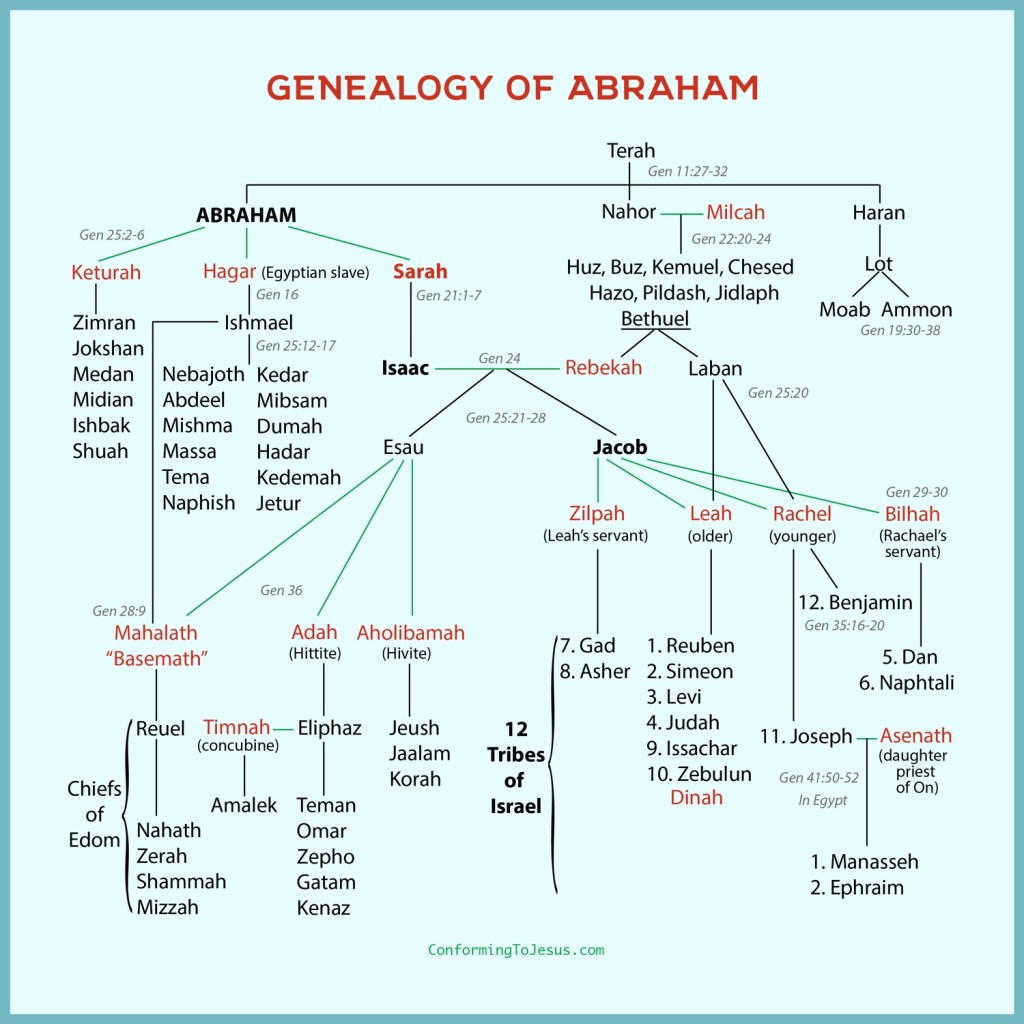
After Sarah died, Abraham married Keturah and had six sons with her (25:1–4). He also “gave gifts to the sons of his concubines while he was living” (25:6), so there were other (unnamed) progeny of Abraham. In due time, Abraham and Sarah’s son Isaac and his wife Rebekah gave birth to twins, Jacob and Esau (25:19–26), whilst Ishmael, the son of Abraham and Hagar, was the father of twelve sons who had many descendants (25:12–18), as well as a daughter who was the ancestor of the Edomites. Abraham’s brothers Nahor fathered twelve sons (22:20–24) whilst Haran was the father of Lot (11:27), who himself fathered Moab and Ammon. Many of these descendants continued reproducing, and so the line of Abraham grew and expanded, generation by generation.

Collectively, this family was responsible for a multitude of descendants, which brings to fulfilment God’s promise to Abraham, “I have made you the ancestor of a multitude of nations; I will make you exceedingly fruitful; and I will make nations of you, and kings shall come from you” (17:5–6). The tenuous moments in the story leave us, as readers, wondering whether this promise would come to fruition; in time, of course, that fulfilment is reported in the Genesis narrative. Abraham does indeed become “father of all nations”, and a key figure in the sagas about Israel that were told and retold throughout the ages.