Why I am voting YES

I have been thinking about the upcoming referendum,,now announced for 14 October, for quite some time. I was recently asked why I planned to vote YES, and after giving this some consideration, I decided that there are eight key reasons to Vote YES:

1. There has been a long period of preparation leading to this present moment. Many Prime Ministers, each one since Gough Whitlam, have spoken in support of according a special place for First Peoples (yes—even John Howard!) In the last decade, our federal leadership has acted by setting up an Expert Panel in 2010 (Gillard), and then a Joint Select Committee in 2012 (Abbott), and then the Referendum Council in 2015 (Turnbull). This has been a bi-partisan political trajectory, culminating in the decision to go to a referendum in 2023 (Albanese).

2. As a result, Indigenous consultations have taken place, led by intelligent, compassionate, informed Elders, leading to the 2017 Consultation at Uluṟu. The Uluṟu Statement provides a clear Indigenous voice which speaks clearly about what is required: recognition in the Australian Constitution, a permanent Voice to Parliament, the telling of truth about our national history, and a Makarrata Commission to oversee the formalisation of treaties with the various First Nations. This is what the Elders of the First Nations are now asking of us.

3. Reputable polling shows that a vast majority of Aboriginal and Torres Strait Islander people support the request of the Statement from the Heart, which forms the basis for the proposed referendum. We all need to listen, acknowledge, and respond to that clear request. Voting YES will not solve everything, but it will be a very important basis for future action in this regard.

4. Many community groups and organisations are supporting a YES vote. This proposal has seized the imagination of people around the country. Sporting organisations, religious organisations, members of all major political parties, leaders of many ethnic and cultural community groups, leaders of many businesses, first ministers of every state and territory as well as our Prime Minister, each have joined their voice to the call for a YES vote. Support cuts across all distinctions and divisions in our society to unify in a strong call to vote YES.

5. Regular advice from the Indigenous-elected Voice will shape future policies of the national government in ways that will provide practical support to First Peoples, and help move us closer towards Closing the Gap in all areas. There is much work to be done. Governments in recent years have said that they want to Close the Gap, but progress has been slow. Regular, informed advice from the people most impacted will surely help us to move forward in this regard.

6. A resounding YES vote, akin to what took place in the 1967 referendum, will give a clear indication of how we have, at last, matured as a nation, moving beyond the xenophobic fear of the white Australia era and its continuation into the “white blindfold” years in the “history wars” of the late 20th and early 21st centuries. In recent decades in our society, we have taken a number of important steps in this regard, and this vote invites us to take a very important leap forward.

7. A YES vote will not be a divisive decision. Recognising First Peoples in the Constitution will not drive a wedge between “us” and “them”, nor will it give any privilege to these people. It will simply be a formal, legal recognition of the reality of the fact that when British colonisers invaded and settled on this continent, claiming it is their land, that land had in fact been cared for over millennia by the people already living on that land. In fact, a YES vote will provide good grounds for coming together in a more cohesive way in our society. It will speak truth about our past. Any future progress towards real reconciliation within our society depends on our taking this step, now.

8. A strong YES vote will provide a solid foundation for positive, constructive, hope-giving actions in the coming years, that will ensure we address the situation and redress the disadvantages of Aboriginal and Islander peoples. We recognise them with flags, we acknowledge them when we are on country, we encourage their languages and nurture their community groups; now we need to recognise them within our Constitution and ensure that there is a permanent Voice which can speak clearly on their behalf into the public arena.

I think that for the sake of First Nations peoples and for the health of the country as a whole, it is imperative that we vote YES!!!

Constitutional Trivia #1

Thanks to my colleague, the Rev. Dr Avril Hannah—Jones, and as Australians look ahead to voting in a referendum to make a change to our national constitution, here are some constitutional trivia questions—the answers are well worth considering!

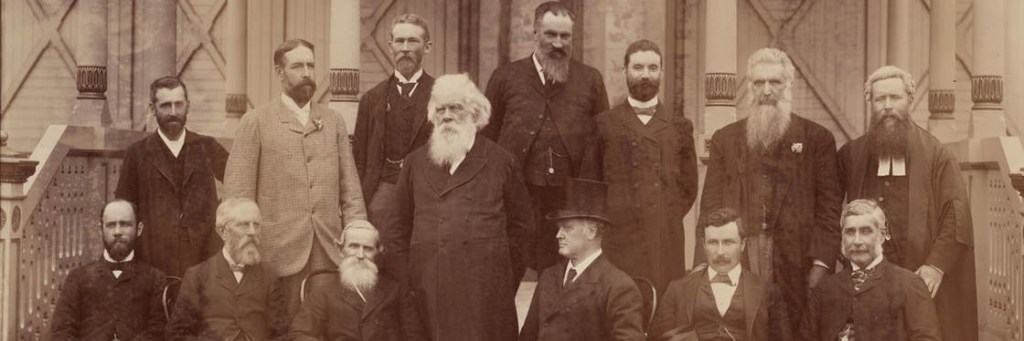
The Australasian Federation Conference, Melbourne, 1890.
Source: National Library of Australia

Constitution Trivia 1: Did you know that neither the Prime Minister nor Cabinet is mentioned in the Constitution?

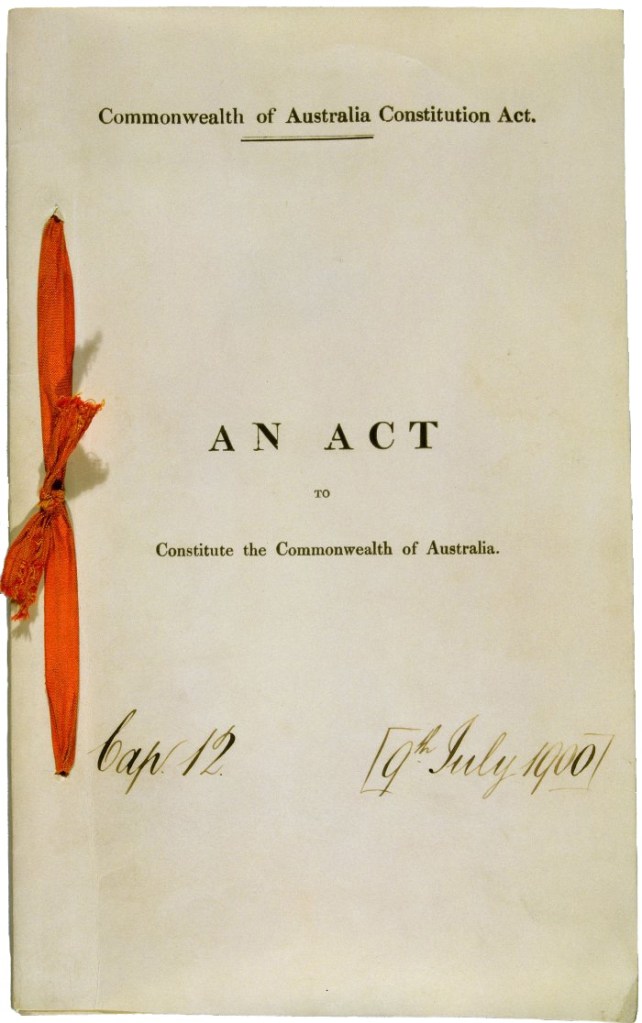
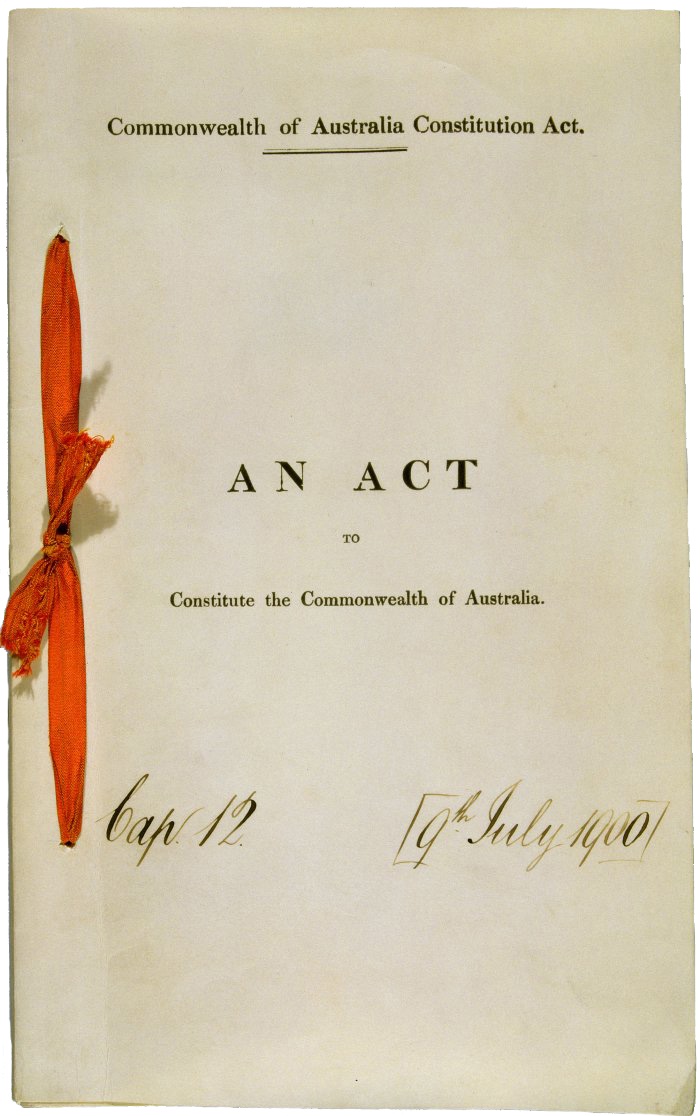
Constitution Trivia 2: Did you know that the Australian Constitution is an Act of the British Parliament?

In 1986 two simultaneous Acts were passed to formally sever all legal ties between Australia and the UK apart from the monarchy: the Australia Act 1986 (Cth) and the Australia Act 1986 (UK). These Acts had to be passed by both the Parliament of Australia and the Parliament of the UK because lawyers were unsure whether Australia alone had the authority to enact the legislation. The two Acts came into effect simultaneously, on 3 March 1986. Until 1986, the Privy Council was Australia’s highest court of appeal, and the UK Parliament could still have made laws for Australian states.

Constitution Trivia 3: Did you know Australians only have five constitutional rights?

These are the right to vote (s. 41); the right to receive ‘just terms’ if our property is acquired (s. 51 [xxxi]); trial by jury for offences against Commonwealth law (s. 80); freedom from the imposition of any religion (s. 116); and freedom from discrimination on the basis of residence in any state, so that a Western Australian cannot be discriminated against for not being a Tasmanian, for example (s. 117).

Constitution Trivia 4: Did you know New Zealand was almost part of the Commonwealth?

Covering Clause 6 of the Commonwealth of Australia Constitution Act, ‘Definitions,’ says that ‘the States’ in the Constitution means “such of the colonies of New South Wales, New Zealand, Queensland, Tasmania, Victoria, Western Australia, and South Australia, including the northern territory of South Australia, as for the time being are parts of the Commonwealth, and such colonies or territories as may be admitted into or established by the Commonwealth as States; and each of such parts of the Commonwealth shall be called a State”. If New Zealand does ever want to join us it can under s. 121 ‘New States may be admitted or established’.

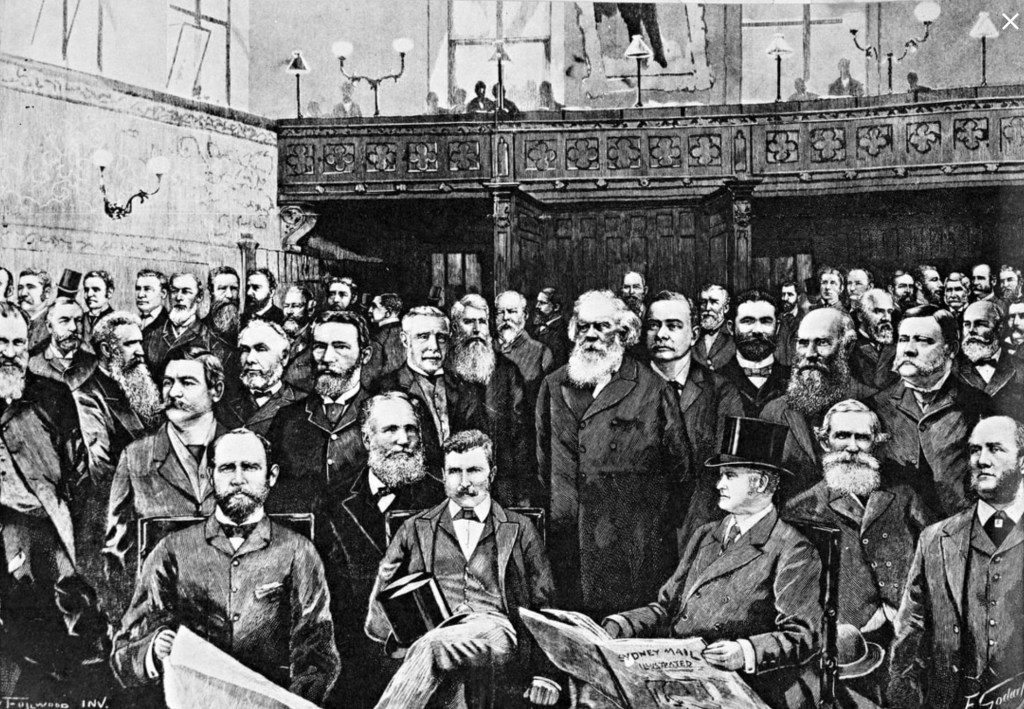
Delegates to the 1891 Federation Convention in Sydney.
Source: National Archives of Australia

Constitution Trivia 5: Did you know ‘race’ is mentioned twice in the Constitution?

Section 25 says that for the purposes of determining the population of a State, in order to determine how many House of Representative seats it may have: “if by the law of any State all persons of any race are disqualified from voting at elections for the more numerous House of the Parliament of the State, then, in reckoning the number of the people of the State or of the Commonwealth, persons of that race resident in that State shall not be counted”.

Under section 51 (xxvi) the Commonwealth has the right to make laws with respect to “the people of any race for whom it is deemed necessary to make special laws”. This section was amended by the Constitution Alteration (Aboriginals) 1967, and previously read “(xxvi) the people of any race, other than the aboriginal race in any State, for whom it is deemed necessary to make special laws.” The Constitution Alteration (Aboriginals) 1967 also repealed section 127 which had said: “In reckoning the numbers of the people of the Commonwealth, or of a State or other part of the Commonwealth, aboriginal natives shall not be counted.”

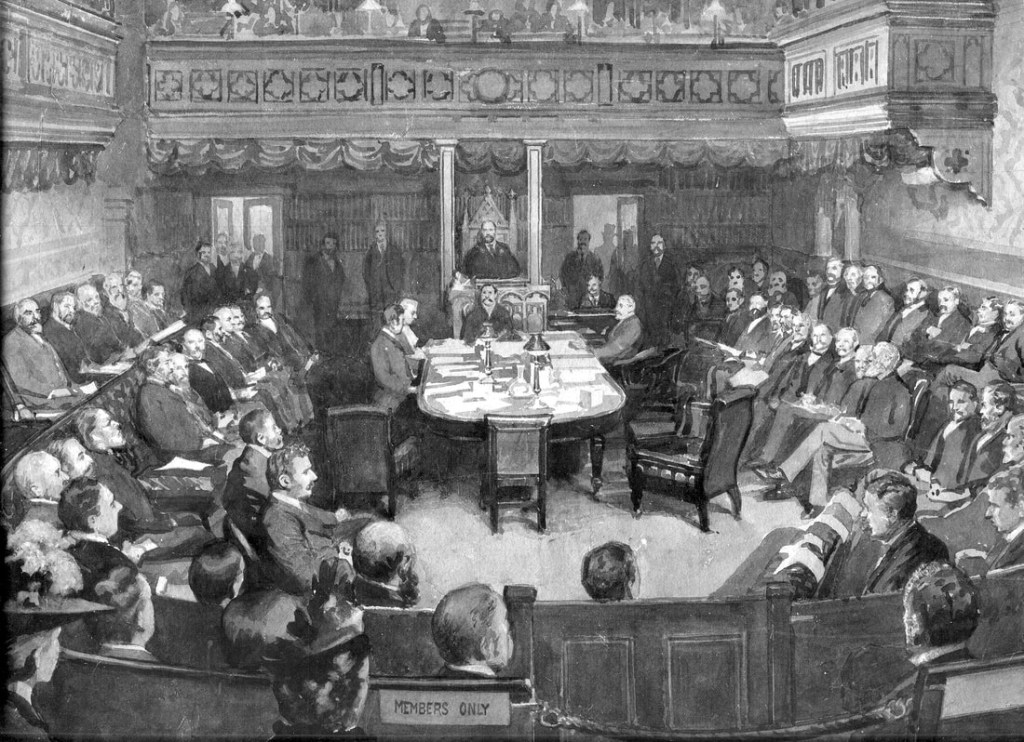
The Constitutional Convention in Sydney, 1897.
Source: NSW Parliamentary Archive

Constitution Trivia 6: Did you know political parties are only mentioned in section 15 of the Constitution, and have only been there since 1977?

Section 15 covers casual vacancies in the Senate and now says that if the place of a Senator becomes vacant (for instance through resignation or death) they must be replaced by someone of the same political party. This clause was introduced after New South Wales Liberal Party Premier, Tom Lewis, appointed independent Cleaver Bunton to fill the vacancy left after ALP Senator Lionel Murphy became a High Court judge, and Queensland Country Party Premier John Bjelke-Petersen appointed independent Albert Field to fill the vacancy left after ALP Senator Bertie Milliner suddenly died, both in 1975. To prevent this from happening again section 15 was amended by Constitution Alteration (Senate Casual Vacancies) 1977.

Constitution Trivia 7: Did you know section 25. ‘Provisions as to races disqualified from voting’ is an anti-racist clause?

Andrew Inglis Clark introduced it to penalise any State that enacted racially discriminatory voting laws. If a State was to disqualify the people of any race from voting in State elections, then those people would not be counted to work out how many seats each State got in the House of Representatives, and so that State would have fewer seats than States without racially discriminatory voting laws. Sadly, there was no attempt made to penalise States that denied women the vote, and when the Constitution was being drafted some of them did!

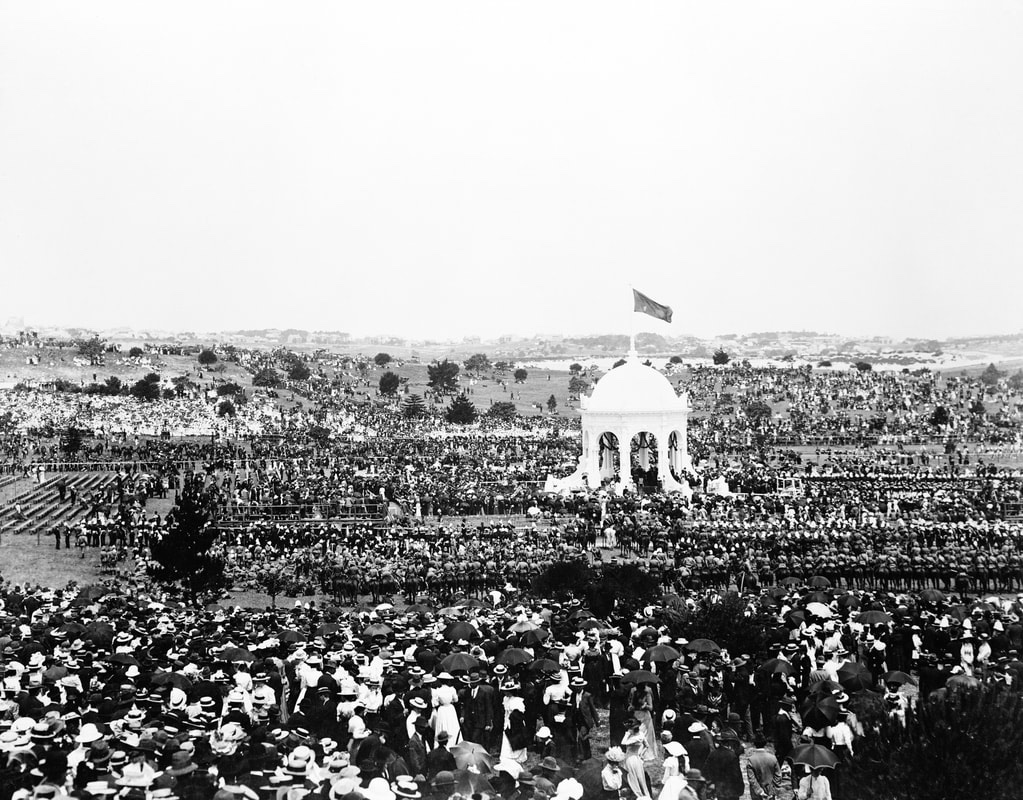
On 1 January 1901, the Constitution of Australia came into effect.
A five mile parade was held to commemorate Federation, which included horse-drawn floats and specially constructed Federation Arches that the procession passed through. 500,000 people lined the route from the Domain to Centennial Park. More than 60,000 people poured into Centennial Park, including 7,000 dignitaries and guests and 300 members of the press, all watching as the first Federal Government was formed (pictured above).
Three choirs sang for the occasion, including a choir of 10,000 school children, a church choir of 400 people and another choir of a thousand.
Source: The Parliamentary Education Office, Canberra

Avril has promised that there are more trivia questions to come … so stay tuned!!

Voting on 21 May (7): Contributing to a Just and Peaceful World

Australian citizens go to the polls to elect a federal government on 21 May. The 17 million people eligible to vote will be electing both a local member to sit in the House of Representatives for the next three years; and a number of senators, to sit in the Senate for the next six years.

To assist voters in considering how they might vote, the Uniting Church has prepared a resource that identifies a number of issues, in seven key areas, that should inform the way that we vote, if we take seriously how the Gospel. calls us to live.

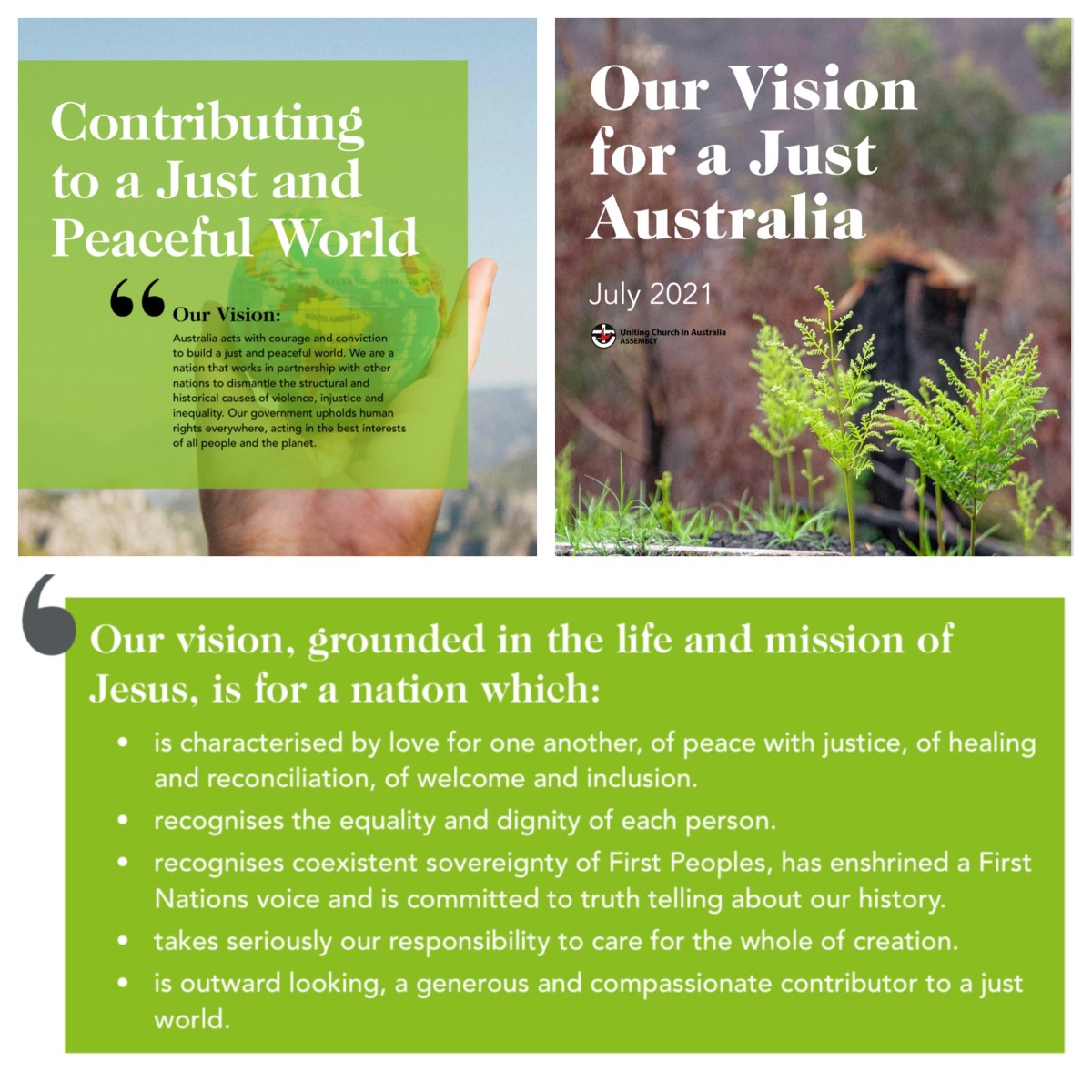
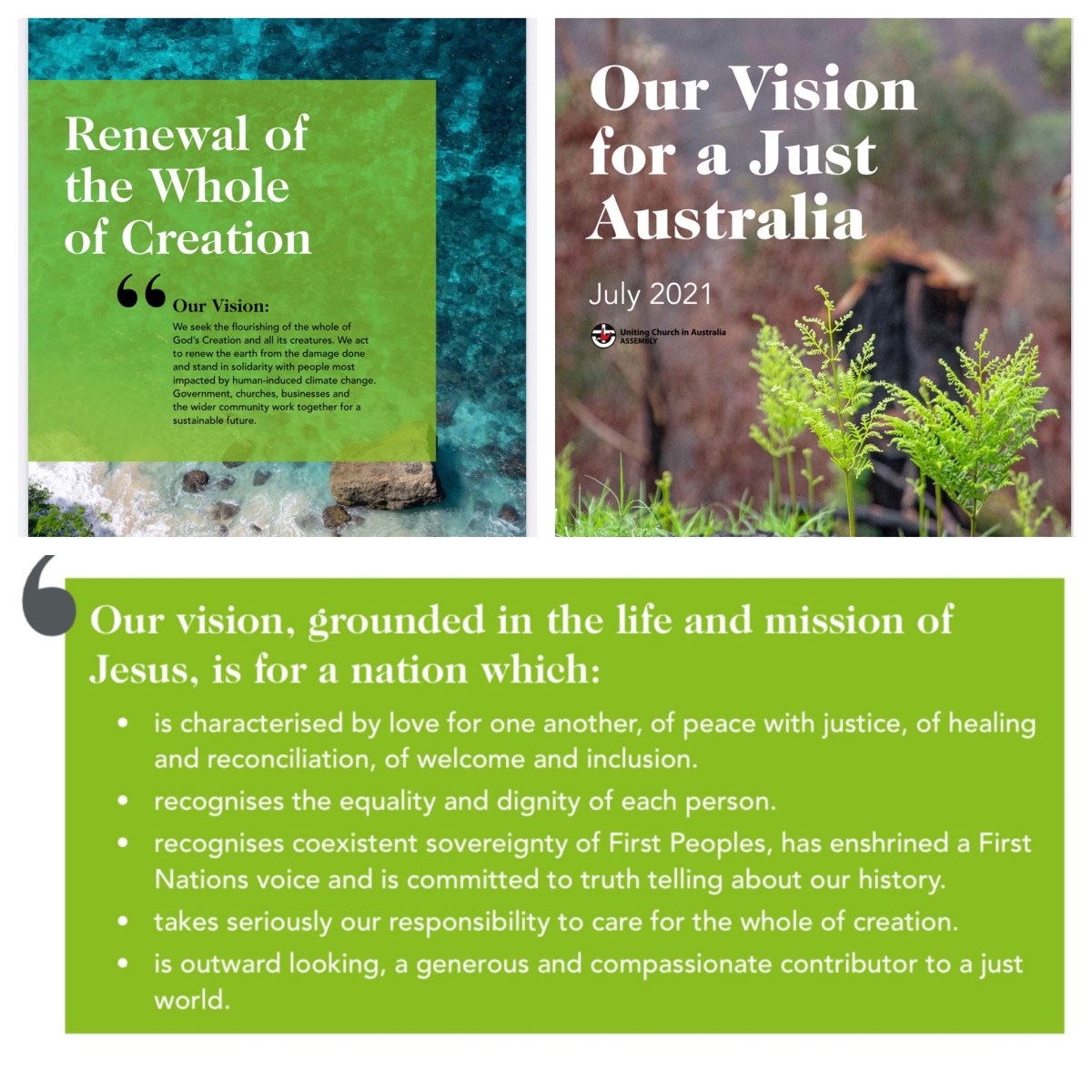
The seven areas are drawn from Our Vision for a Just Australia, a 40-page document expressing the Uniting Church vision for a just Australia and why our Christian faith calls us to work towards its fulfilment. It can be read in full at https://uniting.church/wp-content/uploads/2021/07/Our-Vision-For-a-Just-Australia_July2021.pdf

The Assembly has prepared a shorter 8-page document as a Federal Election Resource, in which key matters in each of the seven areas are identified. That document is found at https://uniting.church/wp-content/uploads/2022/04/Federal-Election-Resources-2022_11-April.pdf

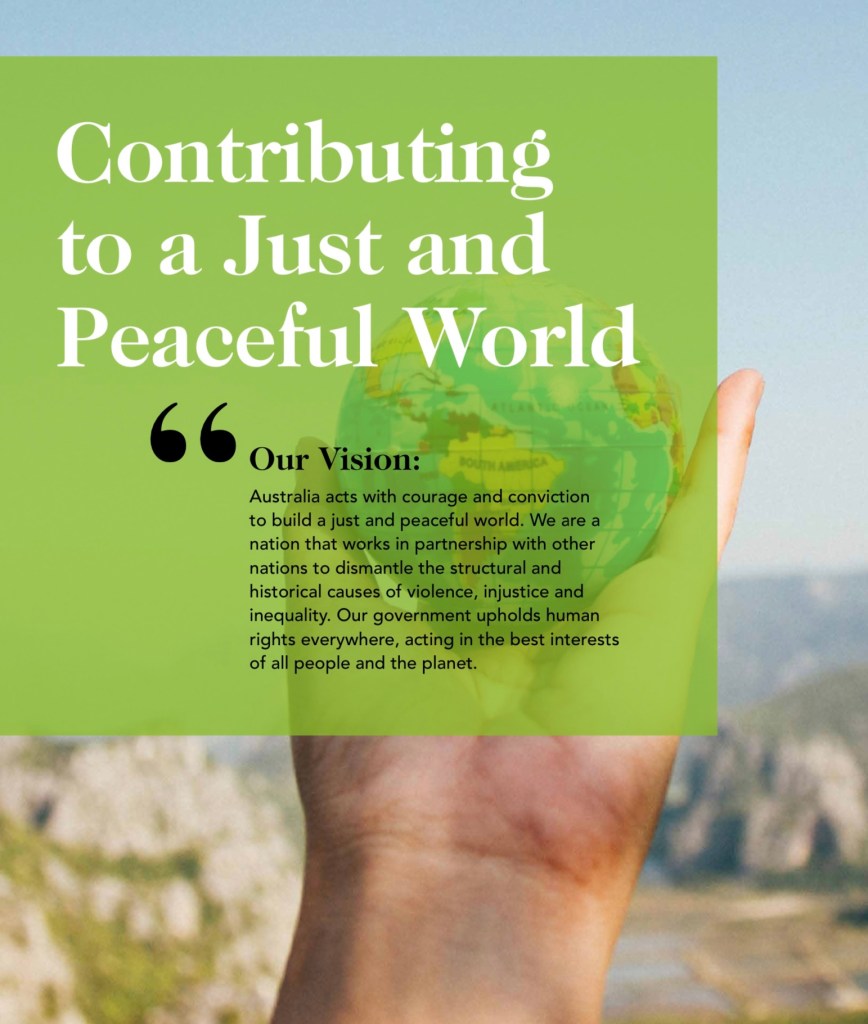
The final area reflects the vision of the Uniting Church for Contributing to a Just and Peaceful World.

The UCA resource notes that “we are a nation that works in partnership with other nations to dismantle the structural and historical causes of violence, injustice and inequality. Our government upholds human rights everywhere, acting in the best interests of all people and the planet.”

It further notes that we remain one of the wealthiest countries in the world, with the highest median wealth per adult, and fourth highest average wealth per adult. “Historically, we played a significant part in reducing world poverty and making significant gains in human flourishing. COVID-19 has made the world poorer, less equal and less secure.”

“Climate change and increased geopolitical competition is destabilising democracies and increasing the number of refugees in the world. In 2020, Australia boosted aid to our local region to support pandemic response, however, the current government has capped ongoing aid to pre-COVID levels, the lowest since 1961.”

“Despite our relative wealth, we are ranked an ungenerous 21st on the global list of overseas development aid as a percentage of gross national income. The recent and ongoing conflict in Ukraine reminds us again of the urgent need to rid the world of weapons capable of catastrophic, widespread destruction.”

The key issues to inform our voting in this regard are what each candidate or their party says about:

• Centering Australia’s foreign policy on a commitment to justice and peace; collaborating internationally to deliver community development and human rights.

• Legislate Australian Aid to reach 0.5% GNI by 2026 and 0.7% GNI by 2030.

• Increase support to fight COVID globally.

• Sign on to the global treaty banning nuclear weapons.

• Increase support to vulnerable nations to help address the impact of climate change.

For the full series of seven posts, see:

Voting on 21 May (6): Flourishing Communities, Regional, Remote, and Urban

Australian citizens go to the polls to elect a federal government on 21 May. The 17 million people eligible to vote will be electing both a local member to sit in the House of Representatives for the next three years; and a number of senators, to sit in the Senate for the next six years.

To assist voters in considering how they might vote, the Uniting Church has prepared a resource that identifies a number of issues, in seven key areas, that should inform the way that we vote, if we take seriously how the Gospel. calls us to live.

The seven areas are drawn from Our Vision for a Just Australia, a 40-page document expressing the Uniting Church vision for a just Australia and why our Christian faith calls us to work towards its fulfilment. It can be read in full at https://uniting.church/wp-content/uploads/2021/07/Our-Vision-For-a-Just-Australia_July2021.pdf

The Assembly has prepared a shorter 8-page document as a Federal Election Resource, in which key matters in each of the seven areas are identified. That document is found at https://uniting.church/wp-content/uploads/2022/04/Federal-Election-Resources-2022_11-April.pdf

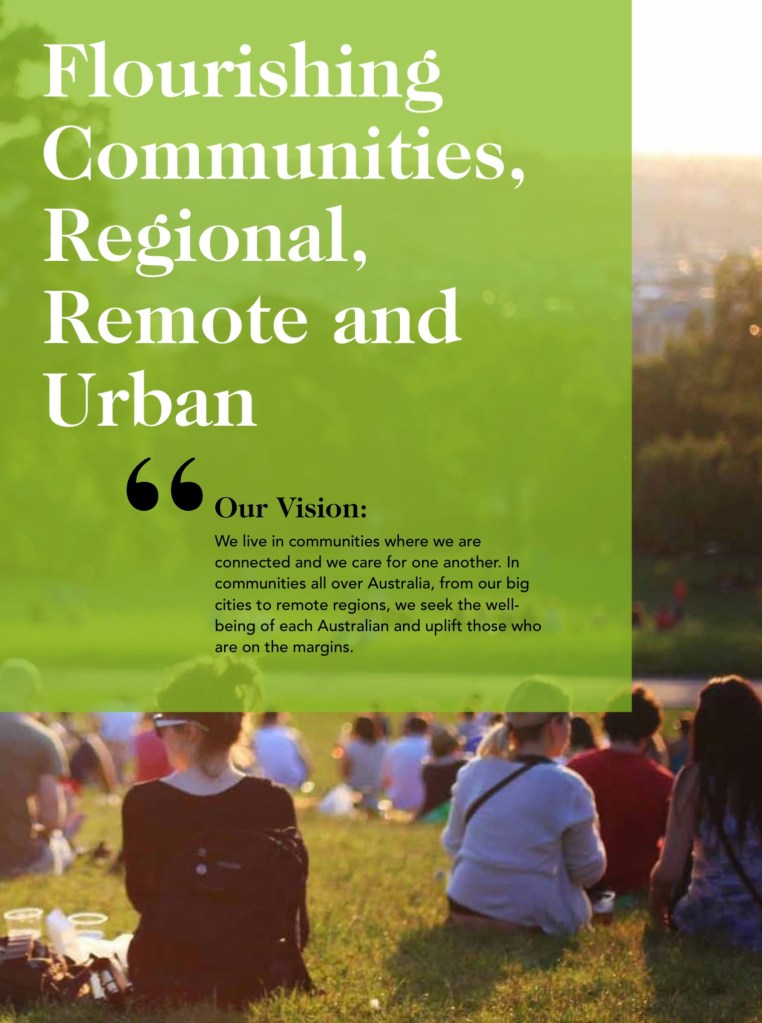
The sixth area reflects the vision of the Uniting Church for Flourishing Communities, Regional, Remote, and Urban—with particular reference to issues of housing and mental health in rural and remote areas.

We live in communities where we are connected and we care for one another. In communities all over Australia, from our big cities to remote regions, we seek the well-being of each Australian and uplift those who are on the margins.

People in Australia living in rural and remote areas tend to have shorter lives, higher levels of disease and injury and poorer access to and use of health services, including mental health care, compared to people living in metropolitan areas. The housing crisis and mental health crisis are converging in regional Australia as rental vacancy rates in some regions fall below 1%.

Regional towns have experienced a significant reduction in available properties and rental affordability, particularly since the onset of the pandemic. The Queensland Alliance for Mental Health, the state’s peak body for community mental health said the situation was “pushing people experiencing mental distress into homelessness”

The key issues to inform our voting in this regard are what each candidate or their party says about these two major areas:

(1) Improved mental health support for people in rural and remote Australia that is adequately funded, able to be flexibly used and well managed locally.

(2) Governments to do more to provide affordable housing in the regions – to boost housing for vulnerable people and strengthen local economies.

For the full series of seven posts, see:

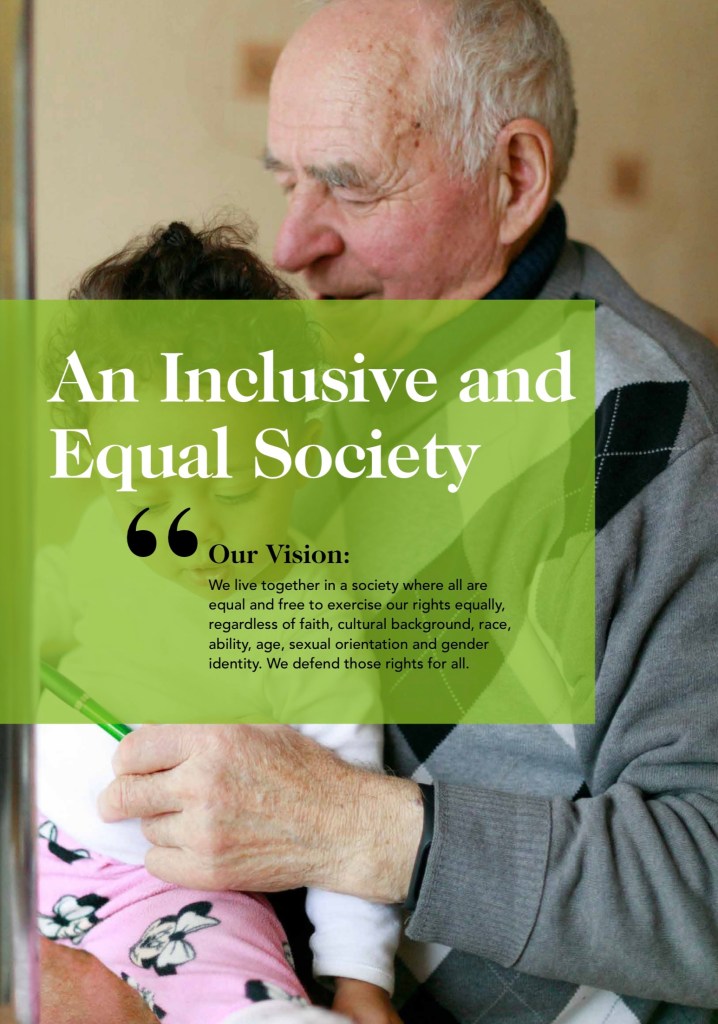
Voting on 21 May (5): An Inclusive and Equal Society

Australian citizens go to the polls to elect a federal government on 21 May. The 17 million people eligible to vote will be electing both a local member to sit in the House of Representatives for the next three years; and a number of senators, to sit in the Senate for the next six years.

To assist voters in considering how they might vote, the Uniting Church has prepared a resource that identifies a number of issues, in seven key areas, that should inform the way that we vote, if we take seriously how the Gospel. calls us to live.

The seven areas are drawn from Our Vision for a Just Australia, a 40-page document expressing the Uniting Church vision for a just Australia and why our Christian faith calls us to work towards its fulfilment. It can be read in full at https://uniting.church/wp-content/uploads/2021/07/Our-Vision-For-a-Just-Australia_July2021.pdf

The Assembly has prepared a shorter 8-page document as a Federal Election Resource, in which key matters in each of the seven areas are identified. That document is found at https://uniting.church/wp-content/uploads/2022/04/Federal-Election-Resources-2022_11-April.pdf

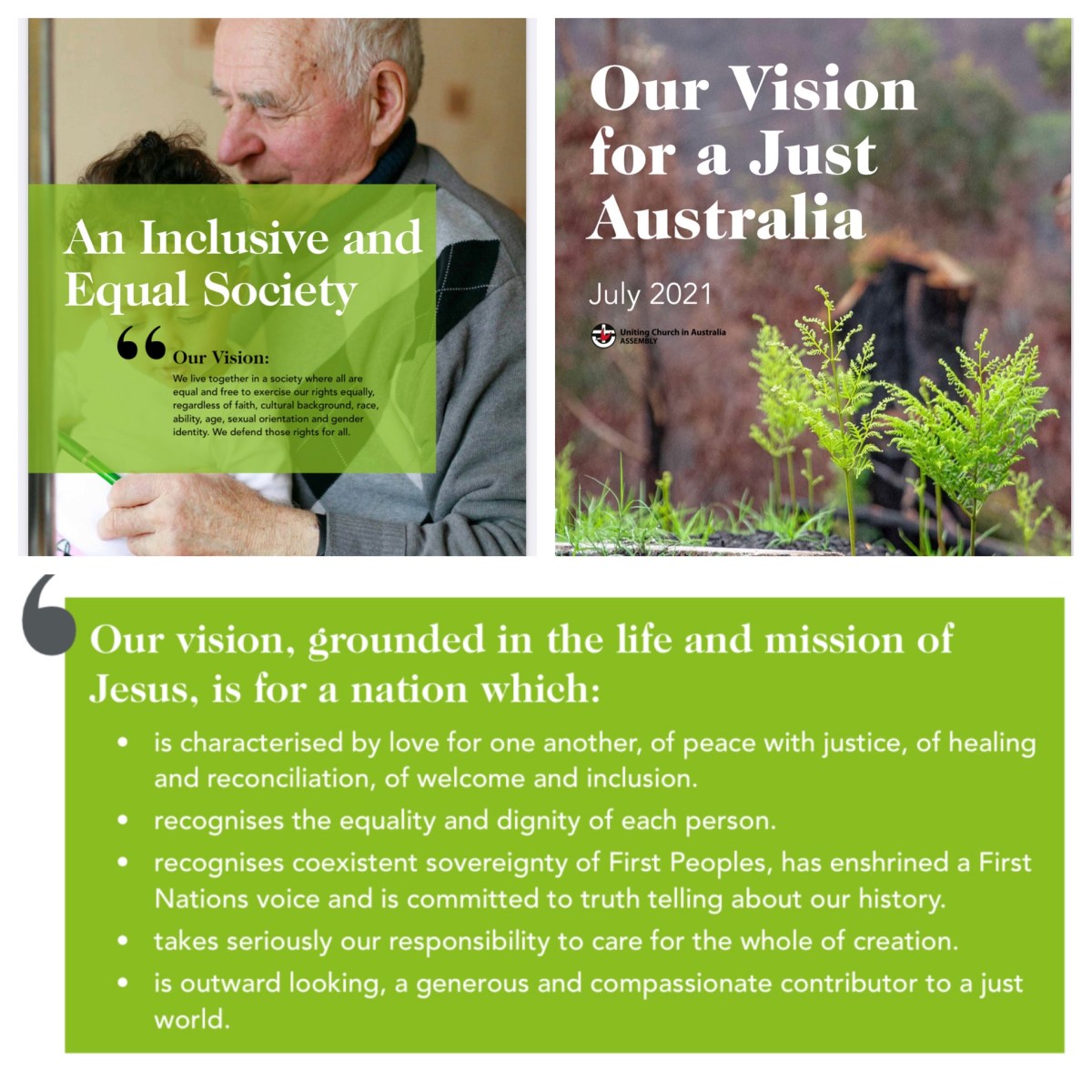
The fifth area reflects the vision of the Uniting Church for An Inclusive and Equal Society, with particular reference to how we age well within contemporary society.

The Uniting Church seeks a fairer Australia where wellbeing in older years is protected and defended, and is also committed to appreciating and recognising the value of care work undertaken in Australia. This vision is based on the dignity of all human beings created in the image of a loving God. “We believe in a world-class aged care system. Older Australians should have access to the appropriate and affordable support and care services that they need, when they need them”, the resource notes.

It further notes that “the Royal Commission into Aged Care Quality and Safety identified many barriers to providing universal access to high quality aged care. Over the past two years in particular, the aged care crisis has escalated significantly and threatens the continued operations of the sector. A key component of that threat is the capacity to attract and retain enough workers; aged care workers are the lowest paid caring workforce and yet are doing some of the most important work in the nation, supporting our ageing and aged citizens.”

The key issues to inform our voting in this regard are what each candidate or their party says about a clear commitment to makes sure all parts of the aged care system have adequate funding, and to fair wages for aged care workers.

For the full series of seven posts, see:

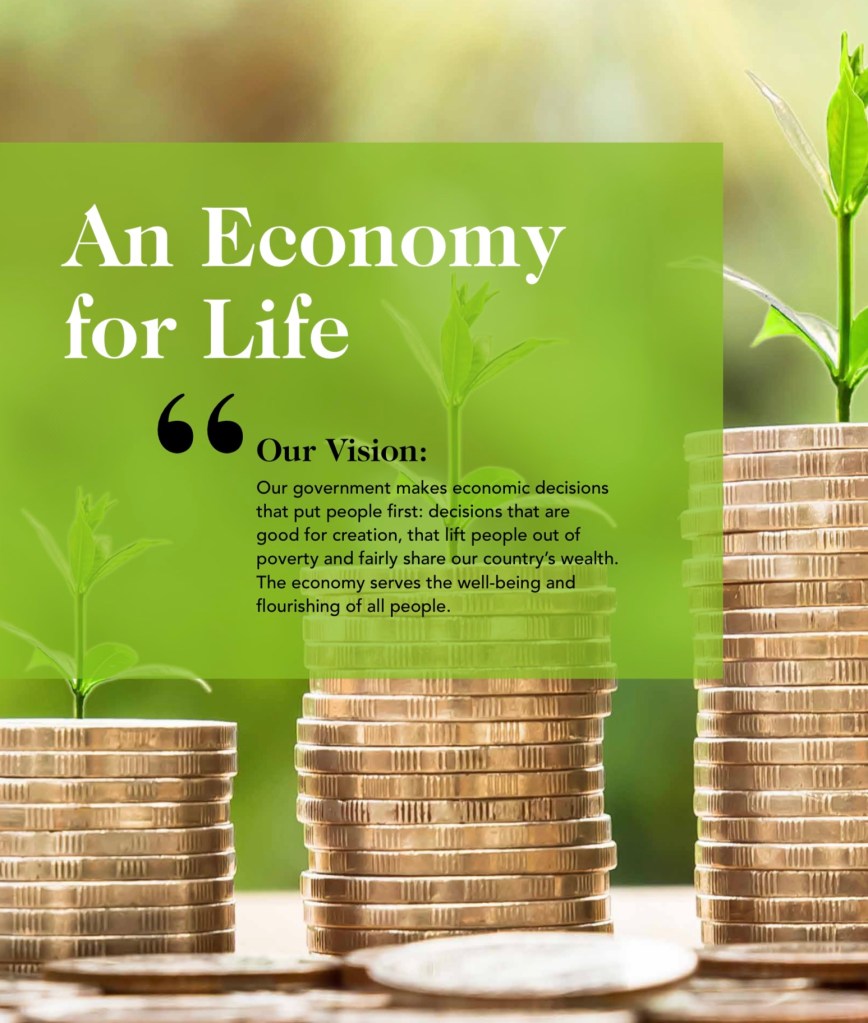
Voting on 21 May (4): An Economy for Life

Australian citizens go to the polls to elect a federal government on 21 May. The 17 million people eligible to vote will be electing both a local member to sit in the House of Representatives for the next three years; and a number of senators, to sit in the Senate for the next six years.

To assist voters in considering how they might vote, the Uniting Church has prepared a resource that identifies a number of issues, in seven key areas, that should inform the way that we vote, if we take seriously how the Gospel. calls us to live.

The seven areas are drawn from Our Vision for a Just Australia, a 40-page document expressing the Uniting Church vision for a just Australia and why our Christian faith calls us to work towards its fulfilment. It can be read in full at https://uniting.church/wp-content/uploads/2021/07/Our-Vision-For-a-Just-Australia_July2021.pdf

The Assembly has prepared a shorter 8-page document as a Federal Election Resource, in which key matters in each of the seven areas are identified. That document is found at https://uniting.church/wp-content/uploads/2022/04/Federal-Election-Resources-2022_11-April.pdf

The fourth area reflects the vision of the Uniting Church for An Economy of Life. This was the title of an extensive document on economic policy which the Twelfth Assembly adopted in 2009. See https://ucaassembly.recollect.net.au/nodes/view/17

The resource notes that our “government makes economic decisions that put people first: decisions that are good for creation, that lift people out of poverty and fairly share our country’s wealth. The economy serves the well-being and flourishing of all people. We believe in an Australia where prosperity is shared fairly, embracing all people regardless of their privilege or upbringing.”

The resource makes these observations: “Aspirations for shared prosperity in Australia are unravelling under the sustained, twin trends of weak wage growth and rising asset prices. Over the past 10 years wage growth has limped under 2.5 per cent annually. Over the same period share portfolio and real estate values have grown around 10 per cent annually.”

“These settings deliver economic gains toward those with assets and away from those doing it tough, resulting in a greater and growing gap between the haves and the have-nots. Greater inequality strongly tracks with stress, hunger, poor physical health, poor mental health, homelessness and social exclusion, and has a negative impact on economic growth.”

“Older women are more at risk of reduced financial security after a lifelong gender pay-gap, interruptions to employment for care and reduced superannuation. The retirement savings gap between males and females in 2019 was almost one quarter. The result is that 34 percent of single women in Australia live in poverty.”

The key issues to inform our voting in this regard are what each candidate or their party says about:

• A clear commitment to undertake a review into the past decade of low-income growth.

• An increase in social security payments, especially Jobseeker.

• Tax reforms to increase the progressive nature of the Australian tax system to address unhealthy inequality.

• A clear commitment to make superannuation contributions on top of the government Parental Leave Pay.

For the full series of seven posts, see

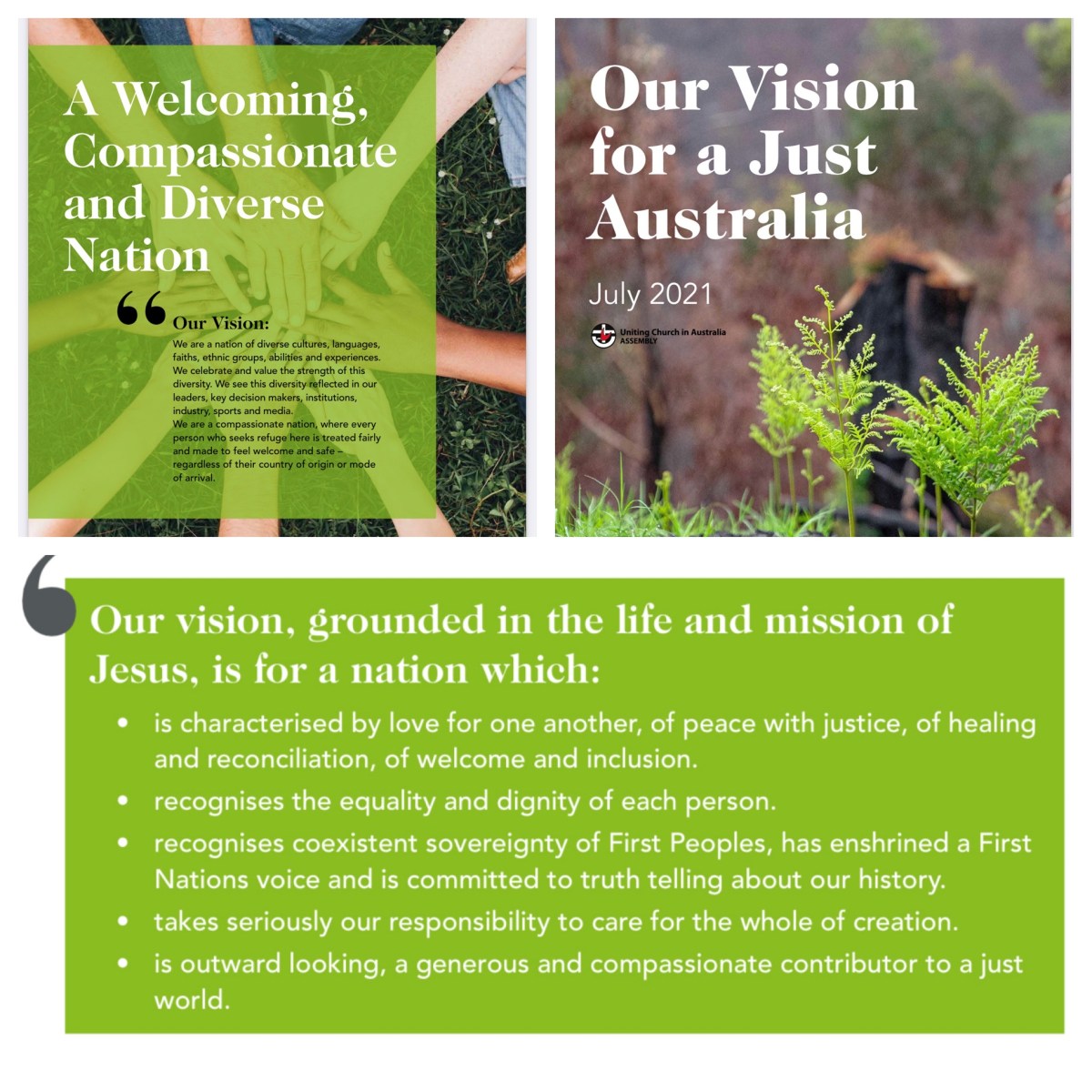
Voting on 21 May (3): A Welcoming, Compassionate, and Diverse Nation

Australian citizens go to the polls to elect a federal government on 21 May. The 17 million people eligible to vote will be electing both a local member to sit in the House of Representatives for the next three years; and a number of senators, to sit in the Senate for the next six years.

To assist voters in considering how they might vote, the Uniting Church has prepared a resource that identifies a number of issues, in seven key areas, that should inform the way that we vote, if we take seriously how the Gospel. calls us to live.

The seven areas are drawn from Our Vision for a Just Australia, a 40-page document expressing the Uniting Church vision for a just Australia and why our Christian faith calls us to work towards its fulfilment. It can be read in full at https://uniting.church/wp-content/uploads/2021/07/Our-Vision-For-a-Just-Australia_July2021.pdf

The Assembly has prepared a shorter 8-page document as a Federal Election Resource, in which key matters in each of the seven areas are identified. That document is found at https://uniting.church/wp-content/uploads/2022/04/Federal-Election-Resources-2022_11-April.pdf

*****

The third area reflects the vision of the Uniting Church for A Welcoming, Compassionate, and Diverse Nation. The election resource acknowledges that we are a nation of diverse cultures, languages, faiths, ethnic groups and experiences, and affirms: “We celebrate and value the strength of this diversity. We see this diversity reflected in our leaders, key decision makers, institutions, industry, sports and media. We are a compassionate nation, where every person who seeks refuge here is treated fairly and made to feel welcome and safe – regardless of their country of origin or mode of arrival.”

Australia’s immigration policies continue to leave some people in indefinite detention. Some refugees and asylum seekers in Melbourne’s Park Hotel have been in offshore and onshore detention for up to nine years. Across the country, it is estimated more than 70 people are being held in hotel detention, and, as of 31 December 2021, 105 people remained in PNG and 114 on Nauru. In response to the Afghanistan crisis, the Australian Government has committed to 10,000 humanitarian and 5,000 family reunion places over four years.

However, the 10,000 places will be taken from Australia’s current refugee and humanitarian program, which was cut by 5,000 places a year from 2020. Australia has received applications from more than 145,000 Afghan nationals and very few of those people have any hope of building a life of safety in Australia1. In addition, the recent and ongoing conflict in Ukraine will see more people fleeing their homes in fear, seeking refuge in other countries.

The key issues to inform our voting in this regard are what each candidate or their party says about:

• An end to mandatory and indefinite off-shore and on-shore detention either in Alternative Places of Detention (hotels) or detention centres.

• Community detention of refugees and asylum seekers must allow access to education, work and housing support.

• A target for Afghan and Ukrainian refugee resettlement much higher and appropriate to the magnitude of the problem.

• Permanent protection for Afghan people already in Australia but on temporary visas.

• Enhance safeguards for people on temporary visas including including overseas students andmigrant workers.

For the full series of seven posts, see:

Voting on 21 May (2): the Renewal of the Whole Creation

Australian citizens go to the polls to elect a federal government on 21 May. The 17 million people eligible to vote will be electing both a local member to sit in the House of Representatives for the next three years; and a number of senators, to sit in the Senate for the next six years.

To assist voters in considering how they might vote, the Uniting Church has prepared a resource that identifies a number of issues, in seven key areas, that should inform the way that we vote, if we take seriously how the Gospel. calls us to live.

The seven areas are drawn Our Vision for a Just Australia, a 40-page document expressing the Uniting Church vision for a just Australia and why our Christian faith calls us to work towards its fulfilment. It can be read in full at https://uniting.church/wp-content/uploads/2021/07/Our-Vision-For-a-Just-Australia_July2021.pdf

The Assembly has prepared a shorter 8-page document as a Federal Election Resource, in which key matters in each of the seven areas are identified. That document is found at https://uniting.church/wp-content/uploads/2022/04/Federal-Election-Resources-2022_11-April.pdf

*****

The second area reflects the vision of the Uniting Church for living sustainably and responsibly as an integral part of the global environment. The Renewal of the Whole Creation is a vision and a commitment that was articulated in the Uniting Church’s Basis of Union, adopted in 1977, and which has continued to inform policies and practices over the ensuing decades.

The church seeks the flourishing of the whole of God’s Creation and all its creatures, in which “we act to renew the earth from the damage done and stand in solidarity with people most impacted by human-induced climate change”. To achieve this, government, churches, businesses and the wider community need to work together for a sustainable future.

The UCA resource acknowledges the current Government commitment to net zero carbon emissions by 2050, but notes that “we need to do more, and sooner. Global temperatures are rising as human activity continues to pollute the atmosphere with greenhouse gases. Australia faces significant climate change impacts: rising sea levels, extreme heat and flooding, longer droughts and bushfire seasons and the loss of coral reef. Our neighbours in the Pacific and elsewhere are suffering the impacts of climate change, to their lands and waters, their livelihoods, their culture and identity.”

The key issues to inform our voting in this regard are what each candidate or their party says about:


• Setting more ambitious targets for 2030 – committing to a 45-50% carbon reduction as a minimum but working towards a target closer to 70%.
• A strong renewables target – which embraces the potential for Australia as a global leader.
• Just transitions for impacted communities currently dependent on fossil fuels.
• Australia must play a significant role in our region and globally in addressing the causes and
impacts of climate change, responding to the call from Pacific countries, including the Pacific Conference of Churches, for our country to act more decisively to reduce carbon emissions.

For the UCA national climate action plan, see https://uniting.church/wp-content/uploads/2020/09/Assembly-National-Climate-Action-Plan.pdf

For the full series of seven posts, see:

Voting on 21 May (1): Putting First Peoples First

Australian citizens go to the polls to elect a federal government on 21 May. The media, in true form, has dumbed things down, making us think that it’s about voting directly for a Prime Minister, and that it’s all about the mistakes the candidates make and the economic impact of their policies.

Our system, of course, is not simply a two- person contest; the 17 million people eligible to vote will be electing both a local member to sit in the House of Representatives for the next three years; and a number of senators, to sit in the Senate for the next six years.

And it’s not just about personalities; it’s actually about policies. We need to think about each party is promising to do, in relation to a wide array of policy areas—not just economics, but a whole array of matters.

To assist voters in considering how they might vote, the Uniting Church has prepared a resource that identifies a number of issues, in seven key areas, that should inform the way that we vote, if we take seriously how the Gospel. calls us to live.

The seven areas are drawn from a fine 40-page document that was prepared and published last year, Our Vision for a Just Australia, expressing the Uniting Church vision for a just Australia and why our Christian faith calls us to work towards its fulfilment. It can be read in full at https://uniting.church/wp-content/uploads/2021/07/Our-Vision-For-a-Just-Australia_July2021.pdf

The Assembly has prepared a shorter 8-page document as a Federal Election Resource, in which key matters in each of the seven areas are identified. That document is found at https://uniting.church/wp-content/uploads/2022/04/Federal-Election-Resources-2022_11-April.pdf

*****

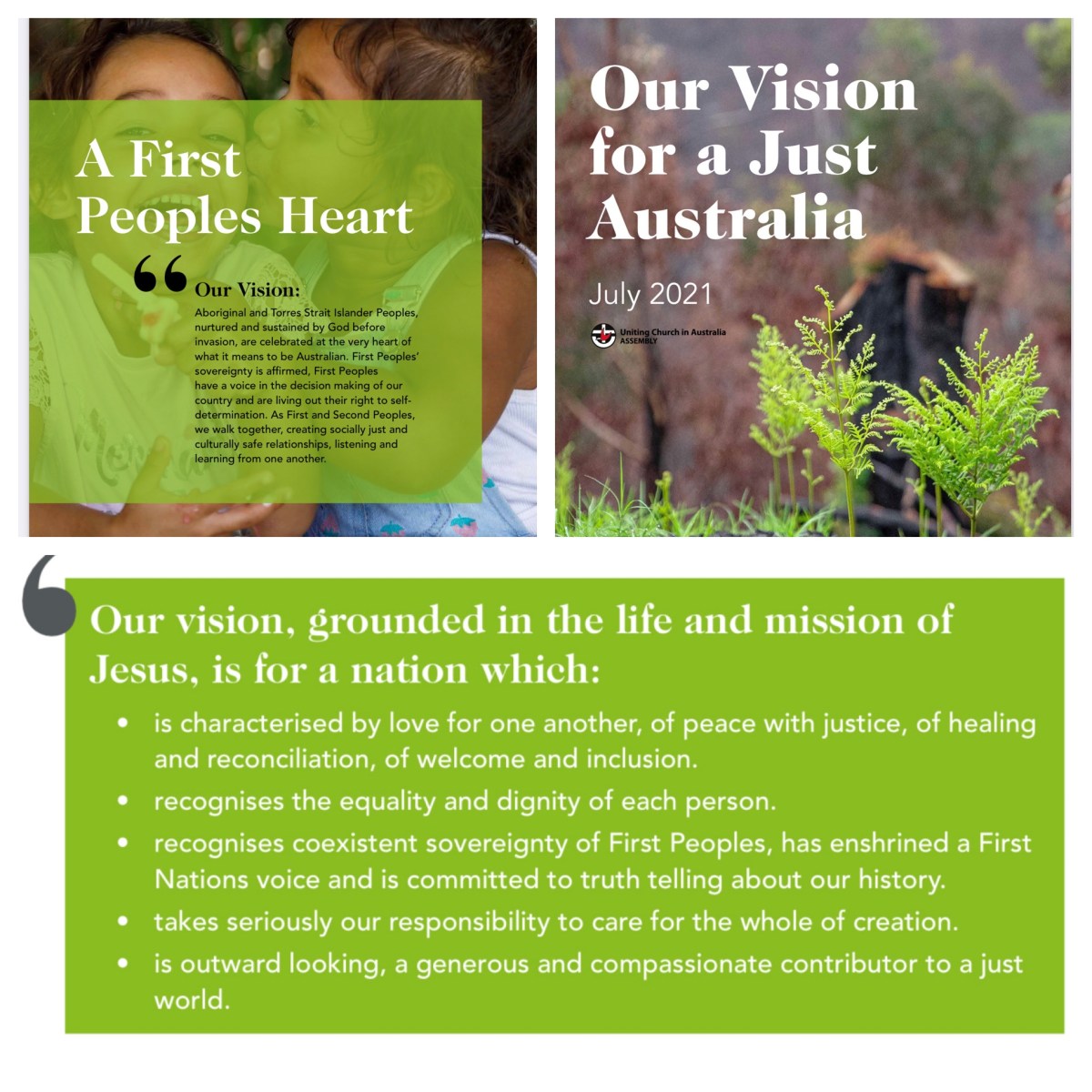
The first area featured in this resource reflects the vision of the Uniting Church for Aboriginal and Torres Strait Islander Peoples. It acknowledges that these people were nurtured and sustained by God before invasion, and so are to be celebrated at the very heart of what it means to be Australian.

The Uniting Church affirms First Peoples’ sovereignty, and believes that First Peoples have a voice in the decision making of our country and in how they live out their right to self-determination. “As First and Second Peoples”, the resource states, “we walk together, creating socially just and culturally safe relationships, listening and learning from one another”.

The Statement from the Heart developed at Uluru has been given to us by First Peoples as the basis for how we can work together to build a better future, but governments have not followed their lead. First Peoples communities, whether remote, regional or urban, experience heightened levels of disadvantage, including a lower life expectancy and worse health, education and employment outcomes than other people in Australia.

The key issues to inform our voting in this regard are what each candidate or their party says about:

• Constitutional change to enshrine a First Nations Voice to Federal Parliament.

• Recognising the sovereignty of First Nations People and establish a commission for treaty making, truth telling, justice and reconciliation.

• Sufficient funding to achieve the Closing the Gap targets, prioritising Aboriginal and Torres Strait Islander community-controlled organisations to deliver services wherever possible.

Subsequent posts are at:

Convicted (3): James Jackson

My ancestor James Jackson arrived in the colony of New South Wales on the ship Mariner 205 years ago today, on 11 October 1816. James was my great-great-great-great-grandfather on my father’s maternal line. He is the third reason that I was born in Sydney.

The others are my ancestors Joseph Pritchard and Bridget Ormsby. See https://johntsquires.com/2021/09/14/convicted-1-joseph-pritchard/ and https://johntsquires.com/2021/09/27/convicted-2-bridget-ormsby/

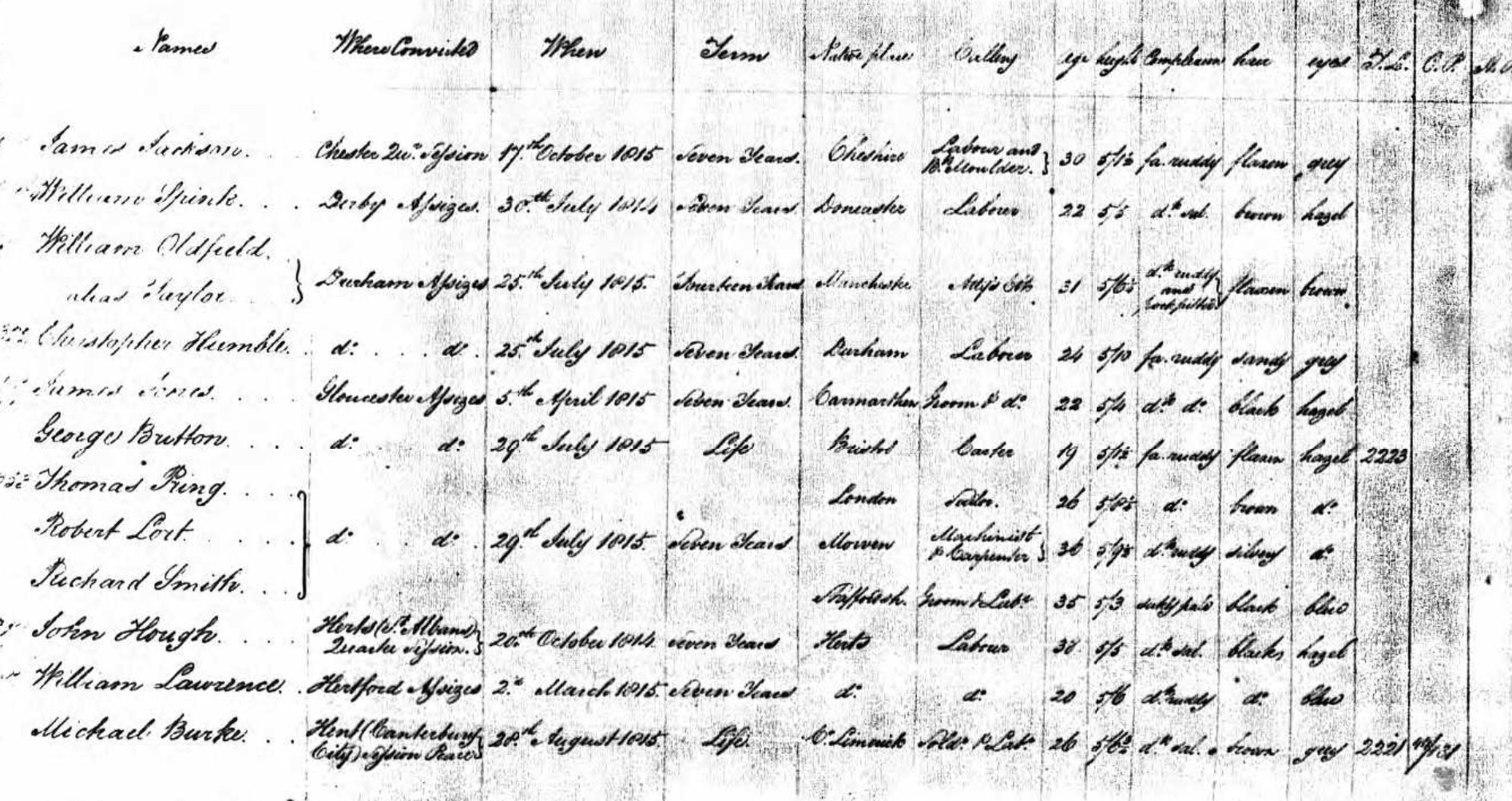
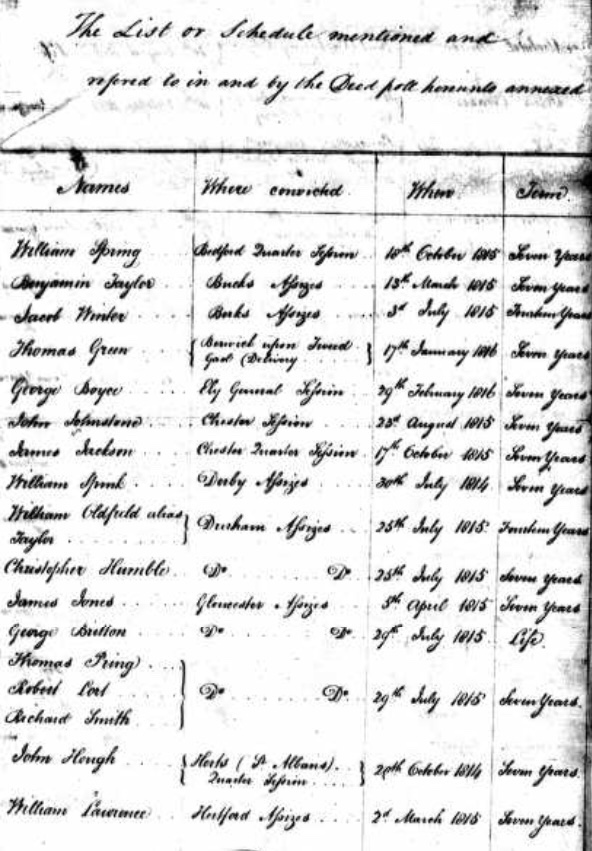
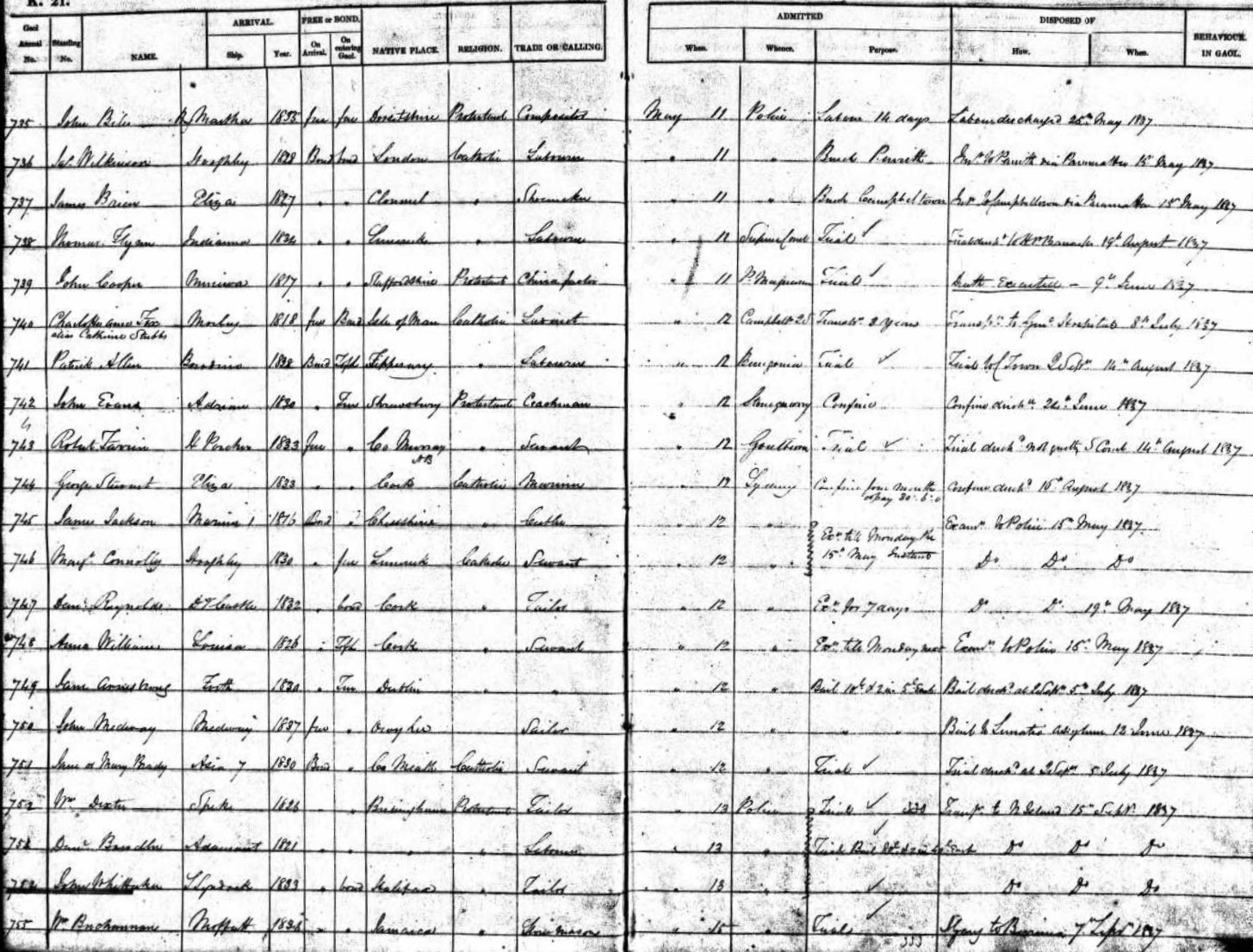
James Jackson first appears in the records in a list of men who appeared at the Chester Quarter Sessions on 17 October 1815. He is identified as a Labourer and Brick Moulder. He was aged 30. He was found guilty (the crime was not specified) and sentenced to transportation for 7 years.

The court record describes him as being 5 feet 1 1/2 inches, with a fair ruddy complexion, flaxen hair and grey eyes. James is recorded as being 30 years of age, meaning that he would have been born in 1785 in Cheshire. (This is corroborated by the record of a later marriage, noting that he was 46 when he marred Bridget Ormsby in 1832.)

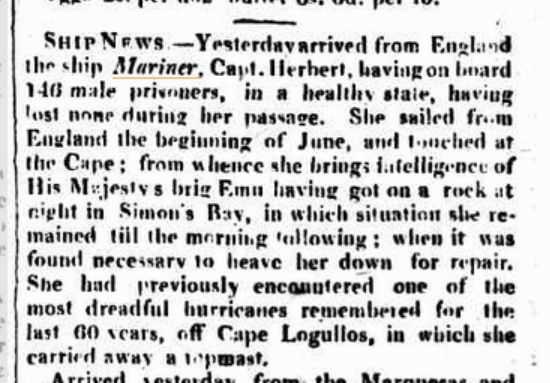
James was one of many convicts transferred to the ship Mariner in May 1816, and the ship set sail for NSW in June 1816, under Captain John Herbert, with 146 male convicts on board. John Haslam was the Surgeon Superintendent; under his watch, all convicts arrived in a healthy state in NSW.

Those on board had experienced an eventful journey which included weathering “one of the most dreadful hurricanes remembered for the last 60 years” off Cape Logullos, in which she lost a topmast. (This was noted in the Sydney Gazette of 12 October 1816, reporting on the arrival of the ship at Sydney.)

Surgeon Haslam kept a very detailed account of the journey, which survives today in the State Library of Victoria. He described some of the events in September: “On the 3rd September when we were off the Cape of Good Hope, a heavy squall came on during the time I was officiating in the prison. There was a general apprehension that the vessel could not long withstand its fury.

“This appeared to me to be the favourable opportunity to impress the minds of the convicts with a due sense of their awful situation; and, as well as I was able from my own apprehensions I endeavoured to exhort them to a consideration of the necessity of employing the short time that probably remained in prayer and repentance – but in vain; the violence of the tempest had inspired them with additional excitement, and my admonitions were drowned in a roar of blasphemy.

“They recollected that it was the time of Bartholomew fair, and began a song commemorating the scenes of its licentiousness; and compared the rolling and pitching of the vessel to the swings which are employed during that festival.

“Notwithstanding the utmost vigilance was exerted to prevent their confederation for the purpose of seizing the ship, yet they made the attempt at a time when it was least expected. On the 8th September they contrived to open the prison door communicating with the forhold; this was speedily detected, but not until several articles had been stolen.

“On the 28th of the same month, during a tremendous storm at night, which excited the greatest alarm amongst those who navigated the ship; they found means during the general distress to cut a hole in the deck of the prison communicating with the hold, by which in a short time they might have rendered themselves masters of the arm chest, had they not been discovered. When I went into the prison accompanied by the master and a sufficient guard, they pretended the most perfect ignorance of the transaction, said they had been asleep and wondered how it could have been effected.”

James arrived in Sydney on the ship Mariner on 11 October 1816. The Mariner was one of nine convicts ships arriving in New South Wales in 1816, the others being the Fanny, Mary Anne, Ocean, Guildford, Atlas, Elizabeth, and Surry. Approximately 1,415 prisoners arrived in NSW in 1816.

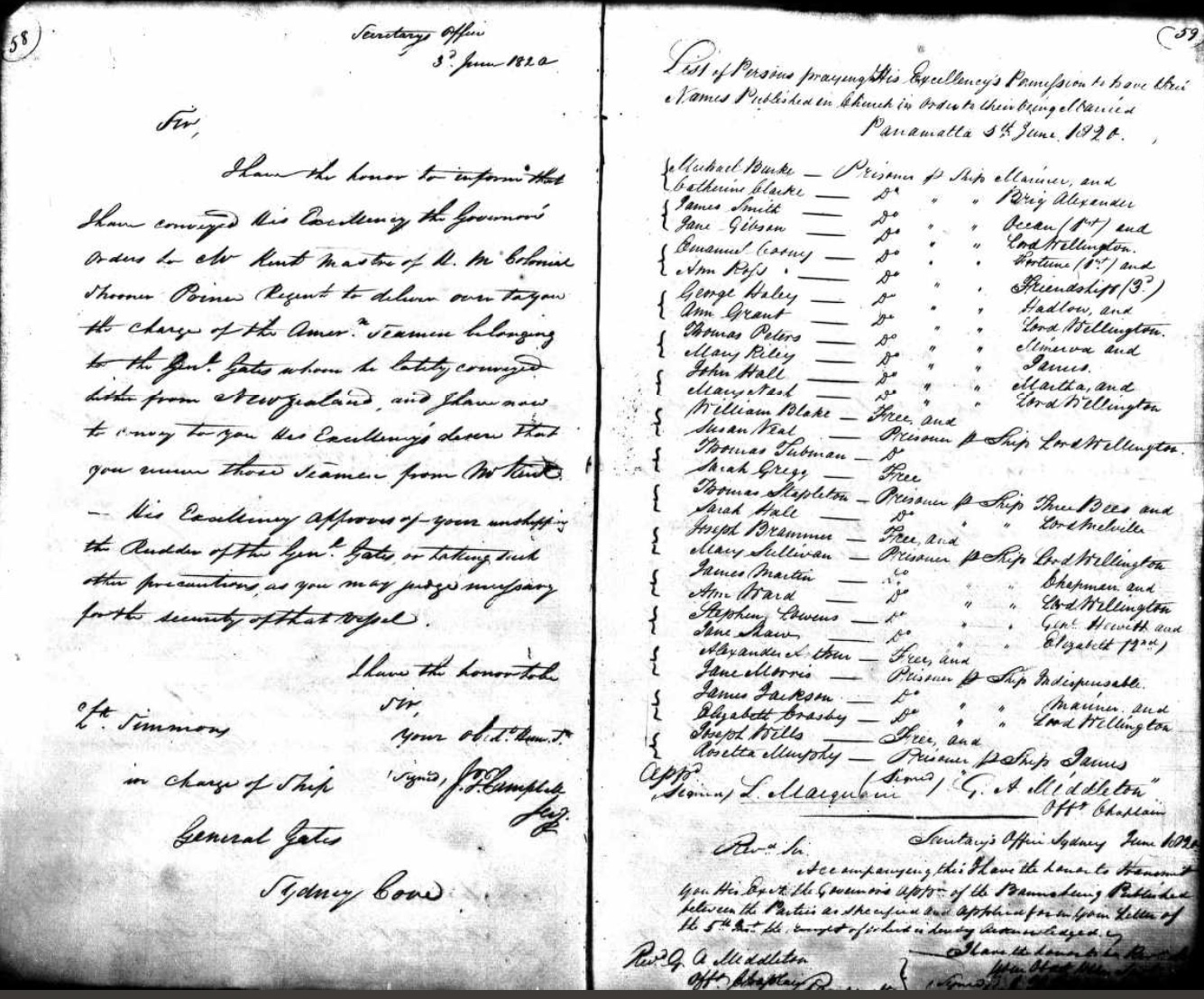
James was to marry three times in the coming decades. A few years after arriving in the colony, he married his first wife, Elizabeth Crasby, on 5 June 1820.

Elizabeth had come to NSW on the Lord Wellington, which arrived in Port Jackson on 19 January 1820, with 120 female prisoners and 45 children. Further information about Elizabeth is lacking at the moment.

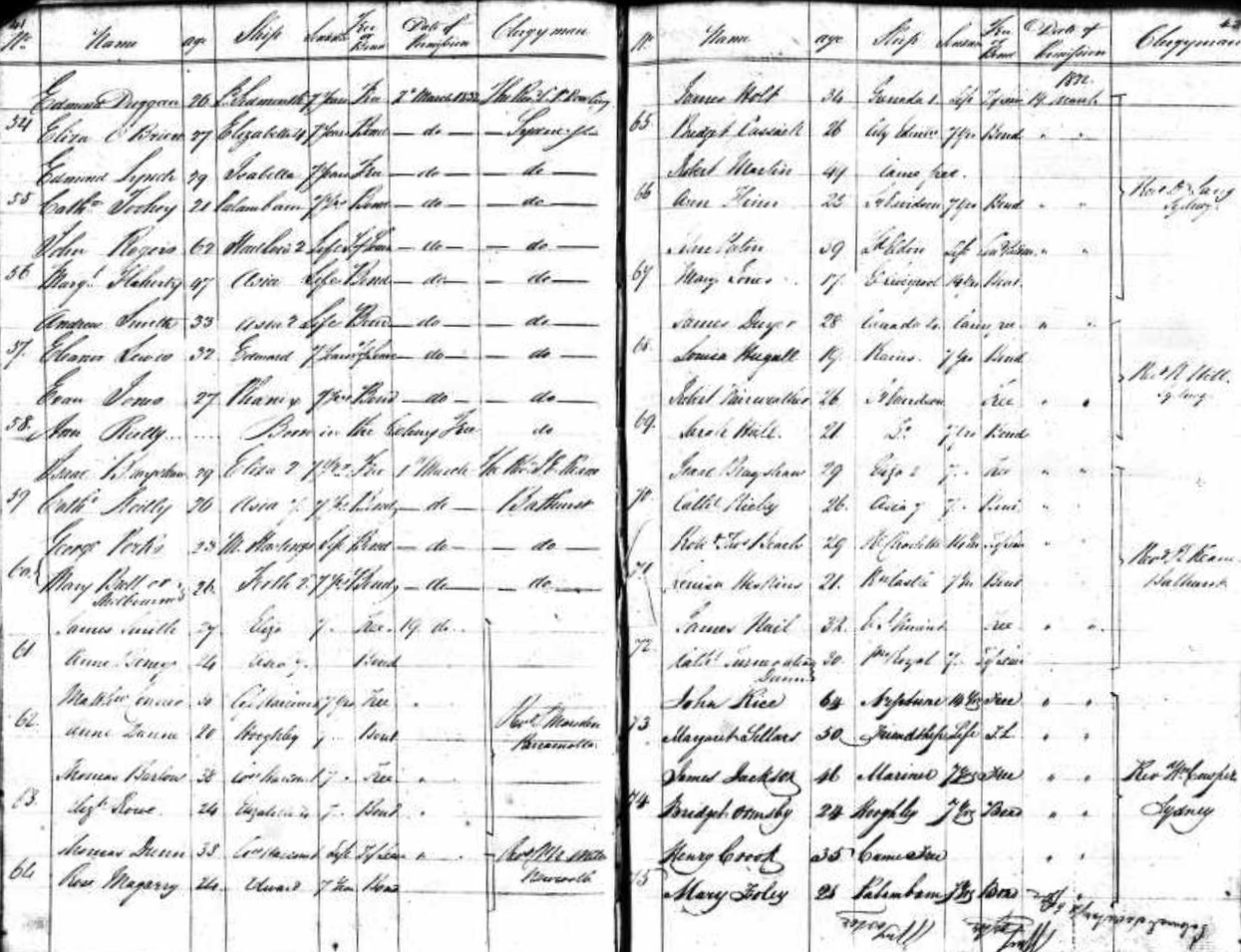
At the age of 46, James Jackson married Bridget Ormsby, aged 24, on 19 March 1832. The ceremony was one of three for convict couples conducted on the same day by Rev William Cowper in Sydney. The couples being married were all identified by the ship on which they had arrived (James Jackson, Mariner; Bridget Ormsby, Hooghley).

The couple had a son, James, born in 1832. This son, James Jnr, married Margaret Jane Crowley in 1856. Their daughter, Maria, born in 1862, married Joseph Pritchard in 1880. Two further sons were born: John in 1834, William in 1836. I am descended from this 1880 marriage, of Joseph and Maria Pritchard.

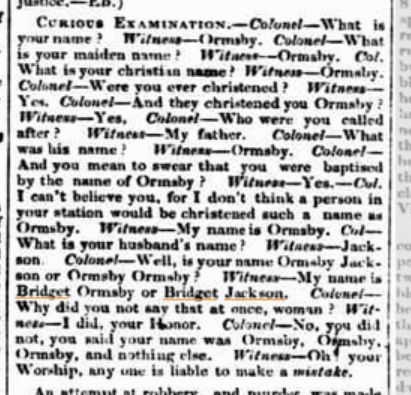
Two years after she gained her Certificate of Freedom in 1837, Bridget was cross-examined in relation to a crime. The interchange is recorded in the Sydney Monitor & Commercial Advertiser, on page 2 of the issue of Monday 26 August 1839.

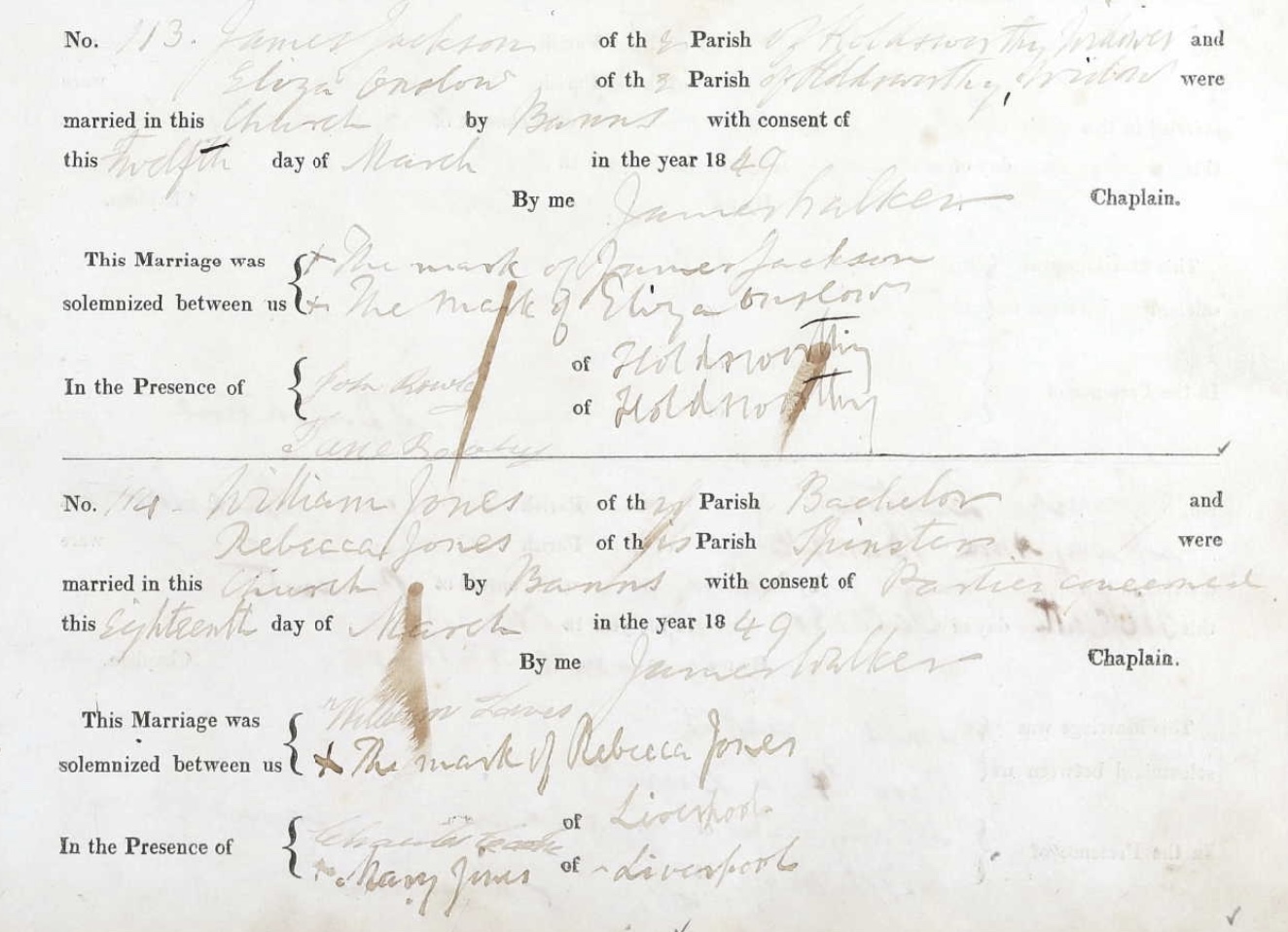
For more on Bridget, see https://johntsquires.com/2021/09/27/convicted-2-bridget-ormsby/. Unfortunately, the date of her death is not known. We do know that James married Eliza Onslow in 1849, so we presume Bridget had died by then.

Eliza was born Eliza Davis; she had married George Onslow in 1826, then George had died in 1841. James and Eliza had a daughter, Emma Jackson, born 2 June 1850. Eliza Jackson (née Davis) died on 13 September 1879. Emma Jackson died 30 Dec 1923 at Marrickville.

James Jackson died at the Liverpool Asylum on 30 May 1868. This death is registered at 4506/1868 and notes that the deceased was aged 77 years.