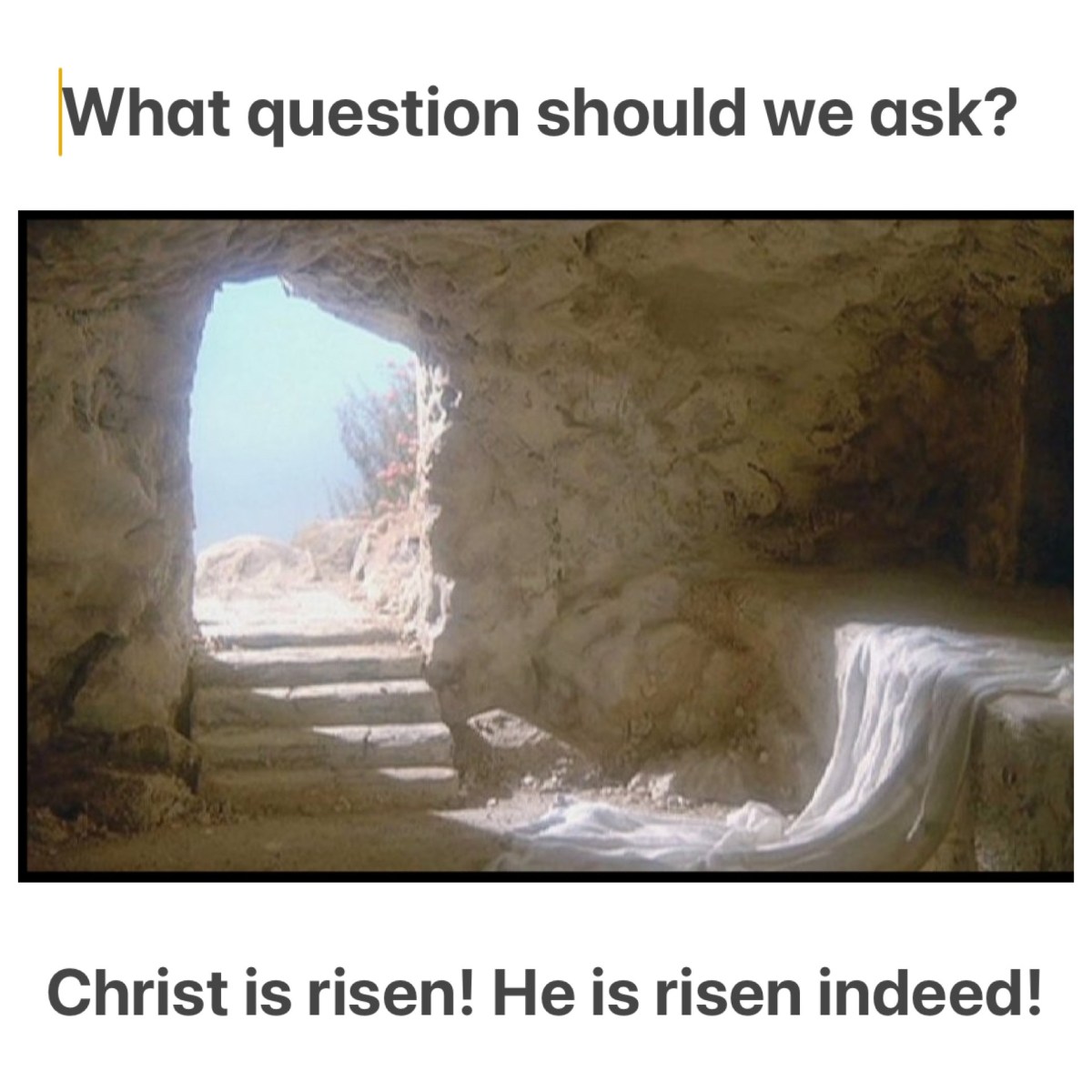
What question should we ask? (for Easter Sunday)

A sermon preached at Dungog Uniting Church on Easter Sunday 2025.

Today is a day of celebration. We gather, we sing, we exclaim “Christ is risen!” Joy fills the air; expectation and hope are abundant. It’s a fine way to emerge from the sombre mood of Friday, when we last gathered, on day of mourning, to remember the sombre reality, “Christ has died”. 

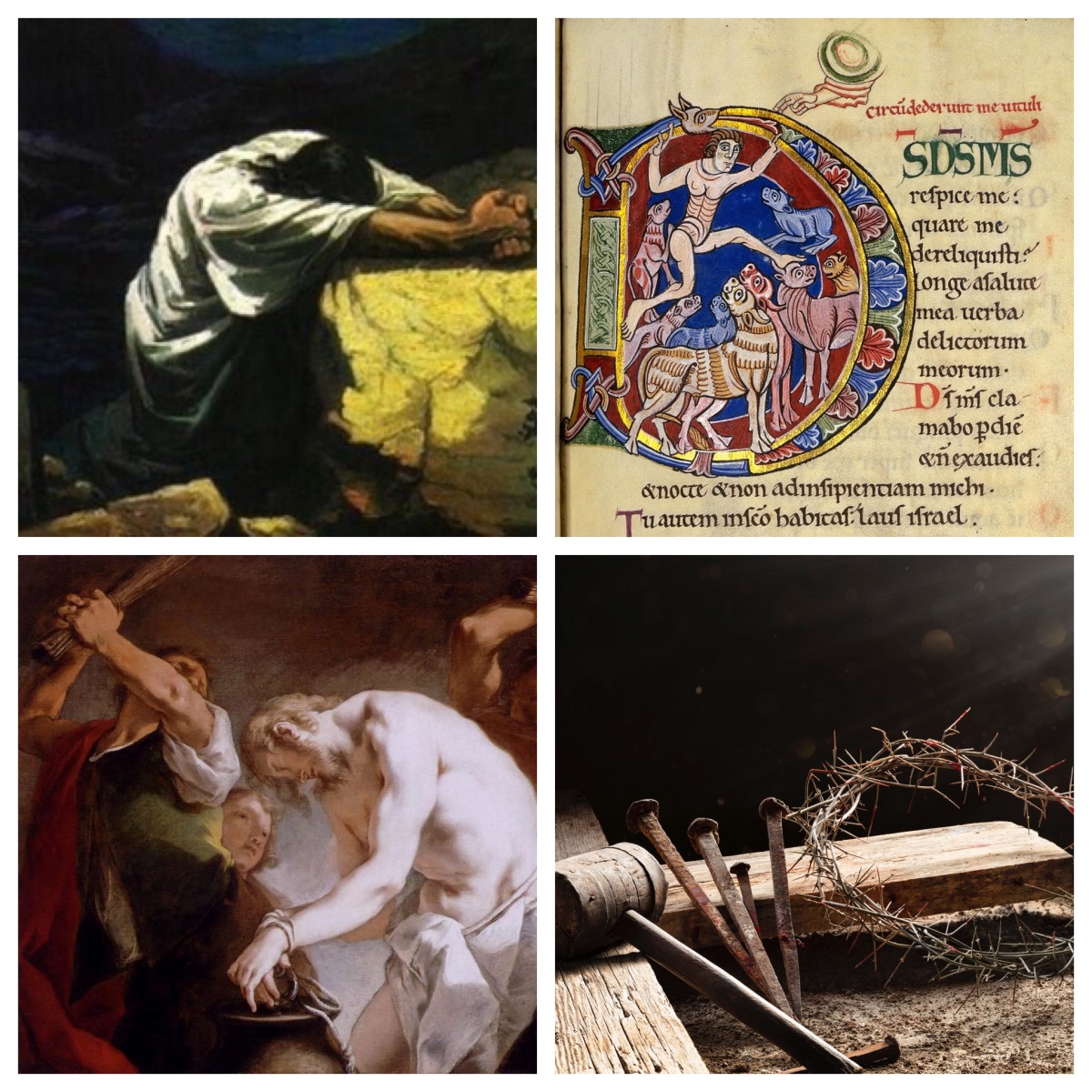
On that day, we remembered again the story of the last days of Jesus: a story of betrayal and denial, of physical abuse and verbal mocking, of abandonment and death, of grief and despair. 

And yet, today, we have moved from that deep despair, into abundant joy. 

Today is a day of celebration.

Today is also a day of mystery. It is a day that we cannot fully explain with simple phrases and formulaic responses. It is a day that invites us to pause, reflect, and ponder. 

Last week, Lurline quoted what she called “the most electric sentence of the Bible”: “he is not here; he has risen!” 

We have heard that electric expression of joy in the reading from Luke’s Gospel. “Why do you look for the living among the dead? He is not here, but has risen.” (Luke 16:5)

And so we greet one another on this day: Christ is risen! Christ is risen indeed!!

That electric sentence provokes many questions. 

What is it that actually happened? 

How was the stone moved? 

Where is the body of Jesus? 

How exactly was Jesus raised from the dead? 

What is the form that Jesus now takes? 

What does it mean for us to hold the hope that we, too, will be raised from our death? 
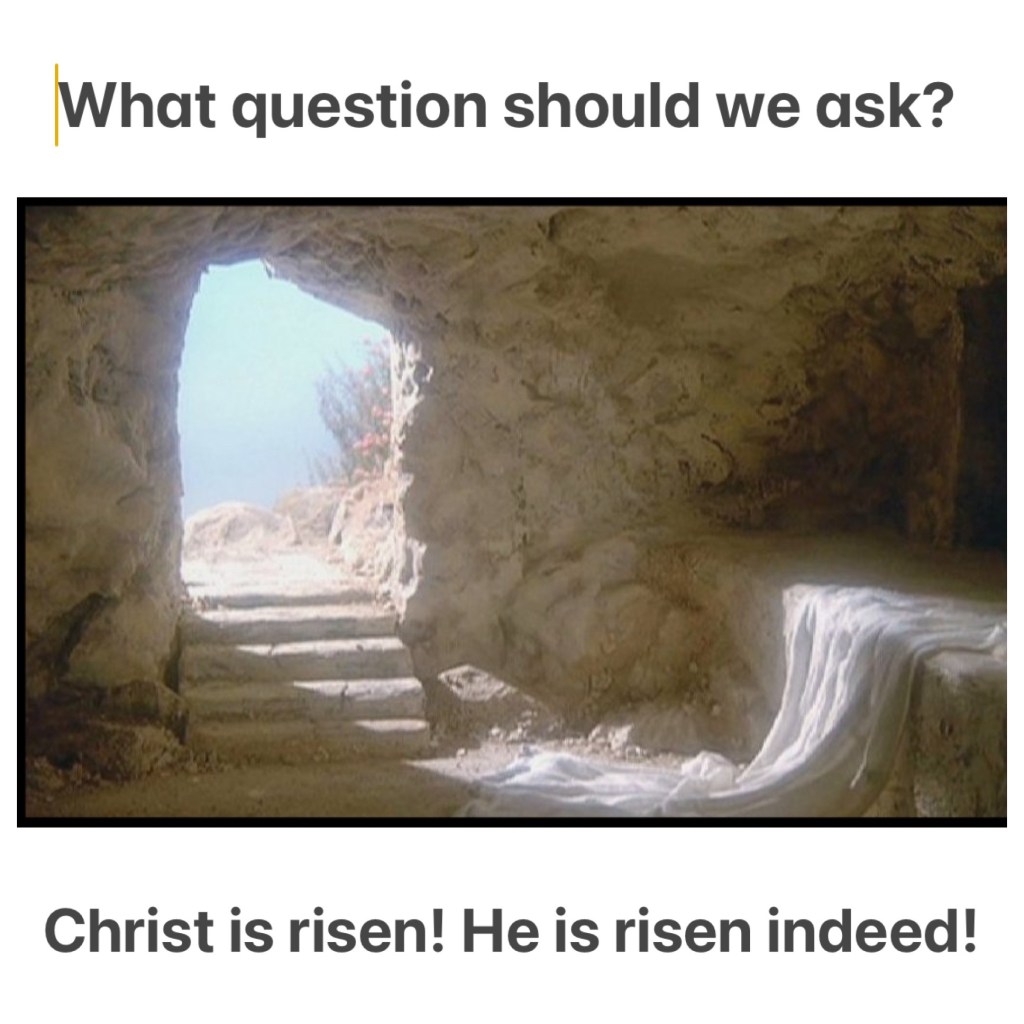
This day of mystery confronts us with a host of questions. Preachers and priests, scholars and writers, over decades and centuries, have asked these questions, have explored them in their words, have sought to provide explanations, all the while intending to buttress and strengthen our faith on this day of mystery.

Did the resurrection really happen? is one of the questions that is often asked on or around this day. What was the historical reality of the day? I have to say, that is a very modern question. It may surprise you, but for centuries, this was not a question that troubled the minds of believers. It is really only something that has concerned us in the last few centuries—from the time of The Enlightenment, when the focus shifted from lives lived by faith to lives exploring scientific and historical realities. 

The question about “what really happened?” is a classic post-Enlightenment question. It’s not something that occurred to those of ancient times. So the biblical texts of antiquity don’t provide any explanation that satisfies us modern listeners and readers. 

Indeed, this is a question that cannot be answered by a simple historical “proof”. The resurrection is, by its nature, something that transcends the material, earthly focus of our modern era. It resists clearcut scientific or historical questions. It remains, in the end, a mystery.

What actually happened to the body of Jesus? is another question that is often asked about today—which also reflects the time in which we live, when “what happened?” is often an important question. And the answer offered by numerous writers has varied, ranging from “the body was stolen” through to “a miracle happened”. Again, a satisfactory explanation is beyond us. It is a mystery.

How was the stone removed from the doorway to the tomb? is another question that is asked. Mark’s Gospel says that when the women came to the tomb to anoint Jesus, “they saw that the stone, which was very large, had already been rolled back” (Mark 16:4). So, too, does Luke (Luke 16:2); neither evangelist was interested in providing any explanation about this curious feature.

The account in Matthew’s gospel, however, does venture an answer: when the women arrive at the, “suddenly there was a great earthquake; for an angel of the Lord, descending from heaven, came and rolled back the stone and sat on it” (Matt 28:2). That’s the explanation, it seems. This evangelist then continues, “his appearance was like lightning, and his clothing white as snow; for fear of him the guards shook and became like dead men” (Matt 28:3–4). Understandably! 

However, we need to note that Matthew’s account had also reported an earthquake at the very moment that Jesus had died on the cross: “Jesus cried again with a loud voice and breathed his last. At that moment the curtain of the temple was torn in two, from top to bottom. The earth shook, and the rocks were split. The tombs also were opened, and many bodies of the saints who had fallen asleep were raised. After his resurrection they came out of the tombs and entered the holy city and appeared to many.” (Matt 27:50–53).

That’s quite a story! and even more striking, perhaps, is the fact that none of the other evangelists report this incredible series of events: an earthquake and the raising of dead people at the moment Jesus died. It’s not in Mark’s earliest version; and it’s not in Luke’s later account, that we heard this morning. We can see, I hope, that this is part of the particular way that Matthew—a faithful Jew who held to the hope that God would act to come to earth to bring in the kingdom of God—tells the story of Jesus. 

The earthquake that happens as Jesus dies and the second earthquake that comes just as the women discover the empty tomb both draw on apocalyptic imagery that the later prophets used and developed in their prophetic oracles. It’s not an actual historical account. It’s a vivid, dramatic telling of the story, designed to highlight this one central fact: God acted, God came to us, God raised Jesus from the dead, the kingdom of God is now present!

So today is a day of celebration; we celebrate that God has determined to be amongst us in a new, startling, and dramatic way. That is what motivated the women, when the discovered the tomb to be empty, made haste to return to the other disciples, to tell them “he is not here; he has risen” (Luke 24:8).

This is also a day of mystery, for the way that God came to us, raising Jesus from the dead, poses a range of questions, as I have considered. There is much to celebrate, and yet so many questions to consider. And that is probably why the apostles—Peter and Andrew, James and John, Matthew and Bartholomew and Thaddeus and Thomas—all men, it must be noted, heard what the women told them, and as Luke crisply reports: “it seemed to them an idle tale, and they did not believe them” (Luke 24:11). Ah, the patriarchy!

It was, they presumed, a strange story, told by hysterical women, completely unbelievable—even though the men in the tomb had explicitly reminded the women of what Jesus had said “while he was still in Galilee, that the Son of Man must be handed over to sinners, and be crucified, and on the third day rise again” (Luke 24:7). 

It’s a day of celebration; a day of mystery; and perhaps, in the end, today is a day that calls for faith. At the heart of the story of Jesus, as we have heard over the last few days, is a story of betrayal and denial, of physical abuse and verbal mocking, of abandonment and death, of grief and despair. It could very well lead us to a pessimistic view of the world, and to dampen our hopes.

Yet today is a day that calls us to have faith. To have faith that death is not the end of life. To have faith that there is more to our existence than our physical bodies. To have faith that God’s desire and intention is to work through even the despair of the lowest moments and to offer us the hope of what we can but glimpse today. 

For that is what the resurrection of Jesus stands for. We may not be able to answer the many questions that it poses. But we can affirm, with the faithful people of ages past, and across the world M.today, and those still to come in the future beyond us, that “Christ has died. Christ is risen“ … “Christ is risen indeed! Alleluia!” For God is with us.
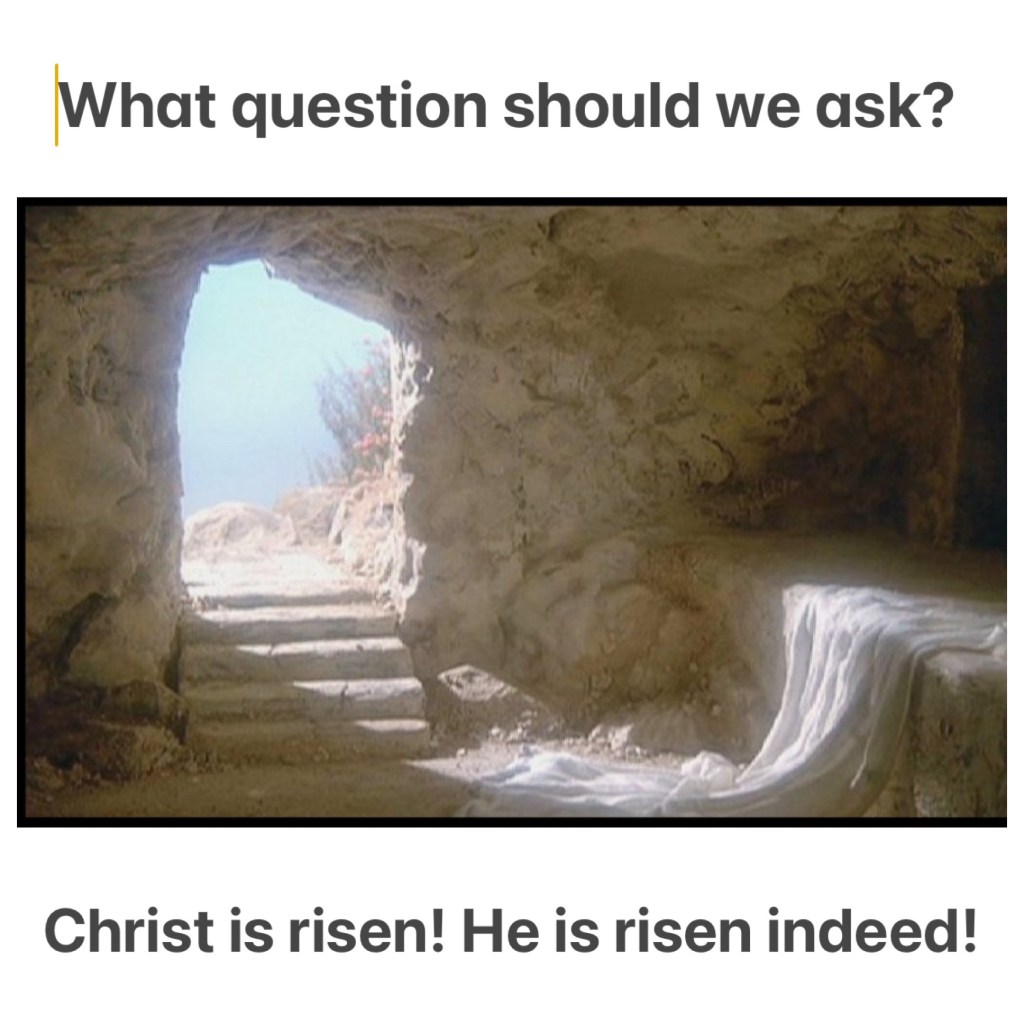
Receiving and passing on a living tradition: died and buried, raised and appeared (1 Cor 15; Easter Sunday)

On Easter Sunday, we say: “Christ is risen! He is risen indeed!”, to celebrate that “God raised Jesus from the dead” (Gal 1:1; Rom 4:24; 10:9; Acts 2:32). Paul affirms this good news in this extract from his first letter to the saints in Corinth, which is the Epistle reading that the lectionary offers for Easter Sunday (1 Cor 15:1–11). Some verses in this passage have played a key role in the development of Christian tradition, which affirms in creeds and confessions a belief in “Jesus Christ … who was crucified, died, and was buried … who rose again from the dead on the third day”.

What is the nature of the confessional affirmation that Paul offers in this passage? The previous chapters of 1 Corinthians have alerted us to the disorganised ethos of the community in the cosmopolitan port city of Corinth. Those earlier chapters have indicated a number of problems that existed within the community of followers of Jesus. There was factionalism (chs.1–4), immorality (ch.5), resorting to civil lawsuits (ch.6), and dissension regarding marriage, celibacy, and sexuality (ch.7). There were differing attitudes towards consuming meat bought in the marketplace after it had been offered to idols (chs.8–10), and multiple issues that manifested in their gatherings for worship (chs.11–14).

Paul addresses each of these matters with the same intention, to bring about order in the midst of the chaos that he has been told about. His words in the midst of the lengthy discussion about marriage, celibacy, and sexuality state his purpose with clarity: “I say this for your own benefit, not to put any restraint upon you, but to promote good order and unhindered devotion to the Lord” (7:35).

The disorder and chaos evident in worship, in particular, led Paul, in the chapter immediately preceding this passage, to advise the Corinthians to seek to speak to others in worship “for their upbuilding and encouragement and consolation” (14:3). He advises them to exercise their spiritual gifts appropriately; to “strive to excel in them for building up the church” (14:12), to “not be children in your thinking … but in thinking be adults” (14:20). He advises them, “let all things be done for building up” (14:26), noting that “all things should be done decently and in order” (14:40), for “God is a God not of disorder but of peace” (14:33).

People speaking over the top of each other in worship, not attending to important words of prophecy and tongues, reflected the disordered chaos of the apparently quite libertine community. The infamous words ordering women to “keep silent” (14:33b—36), along with the adjacent commands to “keep silent” while one interprets tongues that are spoken (14:27–28) and “keep silent” to those seeking to offer a word of prophecy while others are still prophesying (14:29–31), are included in this letter precisely to address this chaotic disorder. And not for the first time in this letter, Paul invokes his higher authority to support his directions: “[you] must acknowledge that what I am writing to you is a command of the Lord” (14:37; see also 5:3–4; 7:40; 10:20–22; 11:27–28; 16:10; and cf. 7:25).

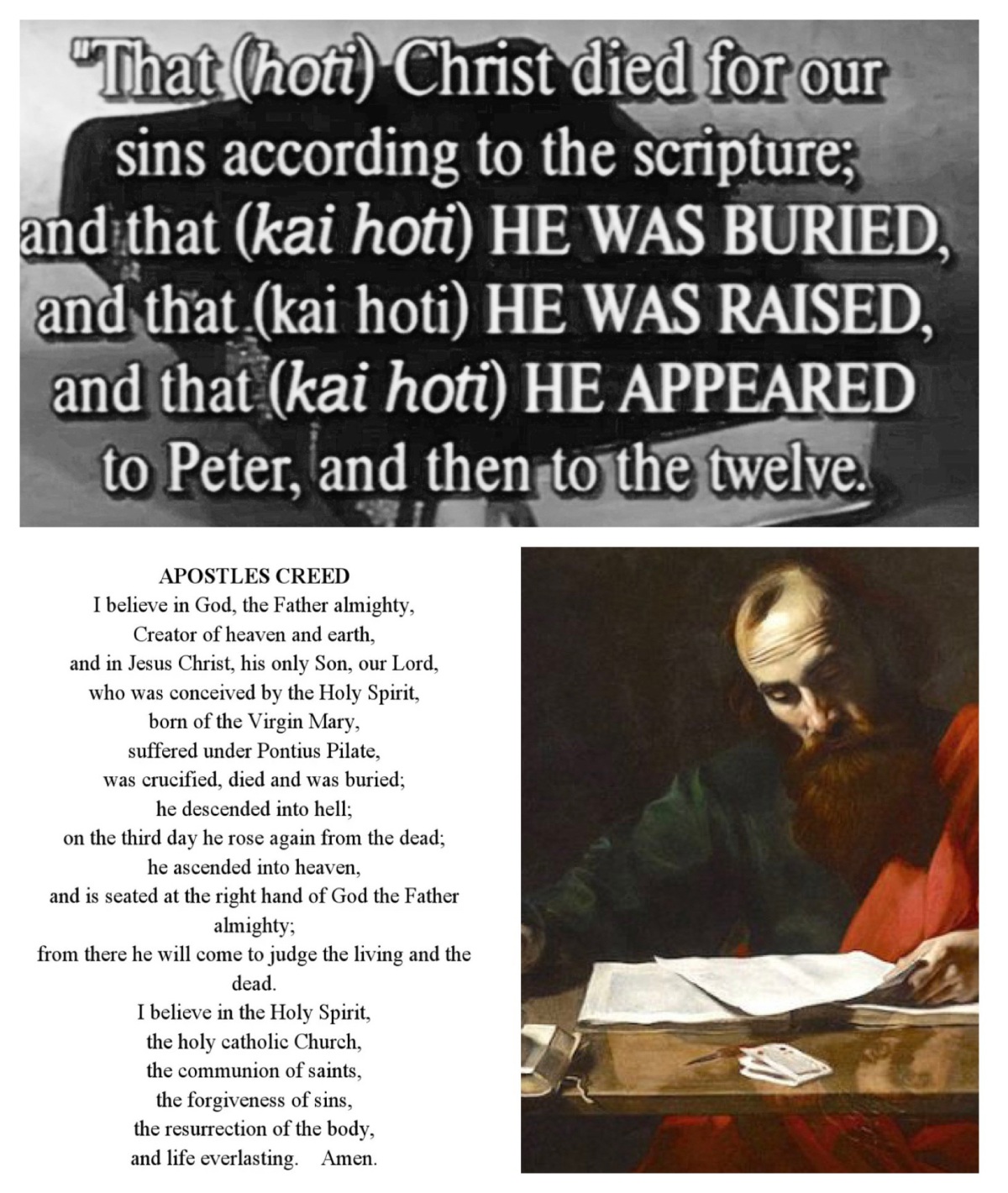
Immediately after this extensive discussion about worship, Paul turns to his foundational message about Jesus, in a four-part statement: Christ died—was buried—was raised—and then appeared to various people (15:3–5). He uses terms that denote the passing on of traditions: “I received … I handed on … which you received … in which you stand” (15:1); and he insists on the importance of what he passes on: “you are being saved, if you hold firmly to the message that I proclaimed to you” (15:2). These two verses provide a strong, insistent introduction to what follows in the ensuing verses.

We see this dynamic also in an earlier chapter, in the familiar words associated with the Last Supper: “I received from the Lord what I also handed on to you” (1 Cor 11:23), as well as in the commendation of the Corinthians as they “maintain the traditions just as I handed them on to you” (11:2).

The core tradition that Paul cites is the fourfold declaration that Jesus died, was buried, was raised, and appeared (vv.3–5). It may have already have been an existing formula; we know that Paul, in this letter and elsewhere, makes use of very short credal-like statements that it is likely had already been developed by others, some of which he cites in order to refute, such as: “is well for a man not to touch a woman” (7:1), “all of us possess knowledge” (8:1), “all things are lawful” (10:23), and “how can some of you say there is no resurrection of the dead?” (15:12).

There are other succinct sayings which Paul uses as the basis for further developments in his argument, such as “I decided to know nothing among you except Jesus Christ, and him crucified” (2:2), “knowledge puffs up, but love builds up” (8:1), “there is no God but one” (8:4), and “all things are lawful, but not all things build up” (10:24). The discussion of factions in chs.1–4 is built off “I belong to Paul … I belong to Apollos … [but] what then is Apollos? what is Paul?” (3:4–5), while Paul’s lengthy discussion of spiritual gifts (12:4—14:40) jumps off from the unspiritual “Jesus be cursed!” and the spirit-inspired response, “Jesus is Lord” (12:3).

Furthermore, Paul writes a number of longer credal-like statements, some of which seem shaped for liturgical usage: the words which became the “words of institution” in the church’s eucharistic practice (1 Cor 11:23–26), and others such as Rom 8:28; 2 Cor 4:14; Gal 1:3–5; Phil 2:6–11. The writers in the school of Paul who later wrote letters claiming to have his authority ( the “pastoral epistles”) followed this practice (see 1 Tim 2:5–6; 3:16; 2 Tim 2:11–13; Titus 2:11–14).

Two clauses in Paul’s tradition-based affirmation of 1 Cor 15:3–5 are buttressed by reference to scripture, another voice of authority alongside “the tradition”. What the specific scripture passages are, Paul does not state; this has left open the door for speculation by later interpreters.

Supporting arguments by reference to scripture is not unknown in Paul’s writings; as a Pharisee, he had attained a good awareness of Torah and its application to life (see Gal 1:14; Phil 3:5–6). He bases his magnum opus, Romans, on a scripture citation (Rom 1:17, citing Hab 2:4) and there is barely a chapter of this letter that does not contain scripture quotations and allusions in abundance.

Key moments in 1 Corinthians are likewise supported by verses from Hebrew Scripture (1 Cor 1:19, 31; 2:9, 16; 3:19–20; 14:21; 15:54–55), and the well-known “words of institution” themselves (11:23–26) reference the tradition which emerges in later decades in the Synoptic Gospels, recording the words of Jesus himself at the last supper (Mark 14:22–25; Matt 26:26–29; Luke 22:14–20).

By using the terminology of traditions being received and handed on, Paul is reining in the wayward Corinthians, recalling them to the fundamentals of their faith. So he sets out the dynamic of died—buried—raised—appeared (15:3–5) as the foundation for then discussing, in the remainder of the chapter, issues associated with the resurrection of Jesus (15:6–58).

Who saw the risen Jesus? First, Paul tells of an appearance to the early leaders, Cephas (Peter) (v.5) and James (v.7)—of which, neither appearance is reported in any Gospel. Then, Paul indicates that Jesus appeared to “the twelve” (v.5) and “all the apostles” (v.8)—apparently alluding to narratives found in the later texts of three Gospels Matt 28:16–20, Luke 24:33–48; John 20:19–23, 24–29; 21:1–14. (The appearances narrated in the shorter and longer endings of Mark, added after 16:8, are not relevant; these are later patristic additions based on the other three Gospels, designed to harmonise the ending of Mark with these others.) Acts 1:6–11 might also be relevant here.

An interesting question is, how did he distinguish between these two groups—“the twelve” on the one hand, and “all the apostles” on the other. Indeed, these terms appear to be inherited by Paul from earlier traditions. This is the only place in all Pauline letters which refer to “the twelve”; and besides, the Gospel narratives noted above do not have Jesus appearing to “the twelve”, as Judas was absent from all of them, and so was Thomas in John 20:19–23.

As far as the word “apostle” is concerned, in 16 of the 18 occurrences in the Pauline corpus (including those not authentic to Paul) Paul explicitly apply the term to himself. Paul acknowledges others as apostles: James (Gal 1:19), Peter (Gal 2:8), perhaps Barnabas (1 Cor 9:1, 5–6), an unspecified number of believers who were given gifts to be apostles (1 Cor 12:28–29; see also Eph 4:11), and most strikingly, Andronicus, a male, with Junia, a female (Rom 16:7). Are these the people that Paul has in mind at 1 Cor 15:8? Or is this simply a phrase inherited from the tradition, which Paul has repeated?

Next, Paul identifies an appearance to “more than five hundred brothers and sisters at one time” (v.6), which again has no place in any Gospel account. Last, Jesus appears to Paul himself (v.8), which he briefly reports at 1 Cor 9:1 and Gal 1:1. Strikingly absent from his list is the empty tomb and the appearances to Mary in the garden (John 20:14), to the women as they left the tomb (Matt 28:9–10), to the two travellers to Emmaus (Luke 24:15), or to the seven fishing by the Sea of Tiberias (John 21:1–4). What a perplexing inconsistency between the various testimonies to these appearances!!

This is an early collection of “witnesses to the resurrection”; Paul wrote to the Corinthians in the mid 50s. But there is no mention of what was important to all four evangelists, writing in later decades: the women at the empty tomb and the role that women played in bearing testimony to the risen one. Is this accidental? or deliberate? Given what we have noted about 1 Corinthians as a whole—and especially what ch.14 reveals about the disorderly behaviour of Corinthian women—we might well wonder, is Paul shaping the received tradition to “fit the context” already at this early stage? It is a tantalising suggestion.

There is a wonderful quote that is pertinent to this issue, which is attributed to Gustav Mahler, the late 19th century Austro—Bohemian composer: “Tradition is not the worship of ashes, but the preservation of fire.” These words indicate that if tradition stands still, it will run out of momentum and fizzle out of energy. Tradition always needs to be reinvigorated and renewed, in the way that fire sizzles and snaps as it continually changes its shape and form.

And that’s a fine thought for us to have as we consider the resurrection of Jesus. As the Apostles Creed affirms, echoing 1 Cor 15:3–5, “we believe in Jesus Christ … who was crucified, died, and was buried … who rose again from the dead on the third day”. We need to renew and rekindle that tradition, to find fresh ways to understand and proclaim that mysterious happening, which sits at the heart of classic Christian confessions.

I’ve offered my own initial reflections on precisely that task in this blog:

He is not here. He is risen (Mark 16; Easter Sunday year B)

The time is early in the morning – quiet, dark, peaceful; the same time of day as when we came to this place. The cast of characters is well-known; Mary Magdalene; Salome, Joanna, another Mary; we know these women. And the message is, likewise, a comforting, familiar refrain: The tomb is empty. He is not here. He is risen. In all that we have heard, we are on familiar ground.

It is most likely that each of us are also well-acquainted with the flow of the story—the women come, bearing their spices, to anoint the body; the stone is found rolled away; the tomb is seen to have no body; and the message is delivered in short, succinct phrases: The tomb is empty. He is not here. He is risen.

The place may be a little unusual, in our way of thinking: it is a tomb, carved out of the rock, large enough to enable a number of adults to be buried together. As people of Anglo heritage, we are used to individual plots, dug deep into the ground, where one person, or maybe a married couple, are laid to rest.

But this is different: it is a large cavity in the side of a rockface, carved out to enable space for a number of adults to enter; space enough for generations of a family to be laid to rest within the one very large tomb. This practice can be seen in phrases, frequently used in mentioning the Patriarchs and David, in Hebrew Scriptures: when such an eminent person died, he would be “gathered unto his fathers,” “sleeping with his fathers,” or “gathered unto his people.”

But these aren’t just euphemisms for death—like we say, ‘passed away’, or ‘went to their eternal rest’; no, this was a literal, physical description of what was done with the bodies of deceased people in ancient times: they were placed in the family tomb, alongside the resting-places of relatives and ancestors.

So the physical location, and the cultural custom, is rather unfamiliar to us today. But the rest of the story, we reassure ourselves, runs along familiar lines, following the well-trodden pathway.

Or does it?

Step back from the empty tomb; walk away, for a moment, from the Easter narrative. Consider the broad sweep of our Christian faith; the overarching drama of our Christian lives.

What do we expect to be central and essential to our Christian faith? What is it that we anticipate finding at the very heart of our faith? How does faith function in the lives of people today, in or time, amidst the stresses and pressures of 21st century living?

Psychologists—those who study the human mind—tell us that people in our times are more likely than ever before to be depressed. Our deepest yearning is to be happy, to feel appreciated, to have assurance that we are valued, that we are loved.

Sociologists—those who study human societies—tell us that people in our times feel disconnected, isolated, and cut off from one another. Our common yearning is to be a part of a group, to feel that we belong. We need to know that others need us.
What this analysis often leads to, is a sense that people today are looking for certainty—we want to be grounded in a group, we want to be part of the tribe, we want to be loved and appreciated, we want to know the assurance of the absolute.

And faith—Christian faith, or indeed any form of faith—can then be offered as the way for people, in their fear and anxiety, in their loneliness and uncertainty—faith can be offered as an answer to these ills. ‘Just take this pill (this pill of absolute faith) and you will be right.’ ‘Just switch your allegiance in one fell swoop, and all will be different.’

Let me invite you to think about these issues in the light of the story which we have heard retold today. For as we encounter and engage with the unfamiliar dimensions of the story, we will find a rather different response to our situation emerging from the interplay.

There are two striking and unfamiliar elements in the story of the empty tomb. The first has to do with who is there. And the second has to do with who is NOT there.

Who is there, that early morning, in the tomb where the body of Jesus had been laid, just a few days earlier? Who are the ones who see, and hear, and experience for themselves, the jarring reality of that early morning encounter?

In a society so dominated by males—male priests, male scribes, male teachers of the Law, male heads of each household—is it not striking and jarring that the great news of Easter is entrusted, first of all, and in all its fullness, to a group of women?

Women—who come to perform their traditional female role, of anointing the freshly-interred body. Women—who come in subservience and devotion, to enact the ritual which has been set aside for them to undertake, as befits their allocated role in society. Women—who, if the traditional pattern is to be followed, will come, unwind the covering on the body, anoint the body with spices, reroll the covering and replace the body, and reverently leave the tomb.

But these women are unable to carry out the male-determined ritual for the body of the recently deceased. The familiar pattern is interrupted; the servant role is removed; and it is these women to whom the striking news of Easter is given.

It is to these women that the responsibility is given, for declaring that the body of Jesus is no longer gripped by death. It is to these women that the role of being the first, the primary, witnesses, to the interrupting action of God: the one who was dead, Jesus, our Master, is no longer here.

The tomb is empty. He is not here. He is risen.

God is now working in ways that challenge, disturb, and overturn the well-worn, familiar, traditional patterns of society. The women cannot carry out the duties and responsibilities that they have long been given. The women, now, are to be witnesses to what God has done. They are to return and tell the men—the apostles, the pillars, the chosen ones—what God has been doing. He is not here. He is risen.

It is the women, and not the men, as expected, who are the ones to break the news: He is not here. He is risen. It is the women who become the first evangelists, the first to proclaim the good news of God. It is the women who become apostles, even to the apostles, the men waiting in the city, unaware of what has occurred at the tomb, and unacquainted with what God has been doing through Jesus. He is not here. He is risen.

If the first striking feature of this story is, who IS here; then the second arresting aspect, is who is NOT here. This is a story about Jesus, in which Jesus does not appear.

This is an account of the most dramatic and significant moment in the whole narrative about Jesus—but there is no Jesus to be seen!   No Jesus to be touched!
No Jesus with whom to talk!   No Jesus to stand, centre-stage, as demonstration of the realities of how God is now at work.

So here is the conundrum: this is the precise moment in the story when God acts in a new and surprising way. This is the pivot point upon which the whole of the narrative turns.

And yet, at the heart of the story, there is—nothing!   No central character. No resurrected Jesus, shining forth God’s glory for all to see. No dramatic, booming voice from the heavens, declaring the risen Jesus as the Lord of all. All that we have, are the words of the young men: He is not here. He is risen. There is nothing, but a startling absence, precisely at the moment when we expect a dramatic presence.

In my mind, this paradoxical turnaround is highly significant, hugely important. At the centre of our faith, there is an enticing invitation—to explore, to ponder, to imagine, to wonder.

There is no clear, black-and white, unequivocal proof. There is no definitive dogmatic assertion, no unquestionable, unambiguous deed, no unarguable proclamation—no resurrected Jesus standing in the tomb. There are simply the women, stunned; and the young men, explaining: He is not here. He is risen.

So, at the heart of the Easter story, we find absence; mystery; the glimpse of a possibility; the wisp of a wondering; the beginnings of a pondering: ‘how can this be’; ‘what does this mean?’; ‘what do we do next?’; ‘where is this all leading?’.

And in my mind, this central absence, at the heart of the story, reminds us of the essence of our faith. In our faith, we have no clearcut, unquestionable dogma; we have no unchangeable given, no unarguable declaration.  We have no absolute assurance, no certainty set in concrete.

Rather, we have an invitation to walk the way of faith, with openness; an invitation to delight in the mysteries which God unravels before our eyes, in our own lives; an invitation to search, to explore, to ponder; and perhaps then, to encounter, to marvel, and to rejoice.

He is not here. He is risen. So let us enter into the mystery, the enticement, and the joy, of faith!

Reflecting on scripture for Good Friday

We are offered an abundance of richness in the scripture passages that the lectionary proposes for our use during the coming week. The passages in the opening days of Holy Week help us to prepare for what follows over the Easter weekend. As well as passages for each day in Holy Week, there is a collection of four important passages that are offered for Good Friday: Isaiah 52–53, Psalm 22, Hebrews 4–5, and the full passion narrative of John’s Gospel.

Unlike the majority of Sundays throughout the year, when the selections in each category (First Reading, Epistle, Gospel) run largely in parallel and do not regularly correlate with one another—except for the choice of Psalm on many Sundays—these four readings have been chosen deliberately to focus in on a common theme, as befits the day, Good Friday.

The first passage comes from prophetic words within the second main section of Isaiah (chs. 40—55), known as Deutero-Isaiah. These chapters are fundamental for the theological developments that we find in the New Testament. In these chapters, Israel,is addressed as “my servant, Jacob, whom I have chosen,the offspring of Abraham, my friend; you whom I took from the ends of the earth, and called from its farthest corners” (Isa 41:8–9; see also 42:1; 43:10; 44:1–2, 21; 45:4; 48:20; 49:3, 5–6; 52:13; 53:11).

Scattered through this section, we find four oracles known as the Songs of the Servant—three relatively brief (42:1–9; 49:1–7; 50:4–11); and the fourth, best-known within Christian circles, a longer description of the servant who “was despised and rejected by others; a man of suffering and acquainted with infirmity” (Isa 52:13–53:12).

The resonances that this longer song has with the passion narrative of Jesus are crystal clear. The song is explicitly linked with Jesus six times in the New Testament (Matt 8:14–17; Luke 22:35–38; John 12:37–41; Acts 8:26–35; Romans 10:11–21; 1 Pet 2:19–25); furthermore, so many of the details of the passion narrative are shaped in the light of this song, along with a number of psalms of the righteous sufferer. (See https://johntsquires.com/2021/03/22/3-mark-placing-suffering-and-death-at-the-heart-of-the-gospel/)

The prophet describes the marred appearance of the Servant (52:14); he is despised, rejected, and suffering (53:3), bearing our infirmities (53:4), and wounded for our transgressions (53:5). The Servant is led like a lamb to the slaughter (53:7), suffering “a perversion of justice” (53:8). We can hear clear prefigurings of the passion of Jesus.

Furthermore, the Servant does not act with violence nor speak deceit (53:9). He is buried with the rich (53:9); the song declares that he gives his life as “an offering for sin” (53:10), carrying the iniquities of many (53:11), making them righteous (53:11), bearing the sin of many (53:12), making “intercession for the transgressors” (53:12). The resonances with the way that the death of Jesus is understood in later Christian theology are strong.

The narrative of the death of Jesus that Mark narrates in his passion narrative (and which was offered for last Sunday’s Passion Sunday) relates Jesus to the figure of the righteous person who suffers injustice, who appears in various Hebrew Scripture passages beyond this fourth, and longest, Servant Song. The author of this Gospel takes great pains to show that Jesus sought to remain faithful to his calling despite the pressures he faced, just as the righteous sufferers of old also held to their faith.

The Gethsemane scene draws on imagery from Hebrew Scripture to underline this. The narrative evokes the suffering of the faithful righteous person, referring especially to some phrases found in the Psalms. The Golgotha scene also contains this orientation. What takes place is interpreted with reference to scripture; here, the allusions are both subtle, and more direct.

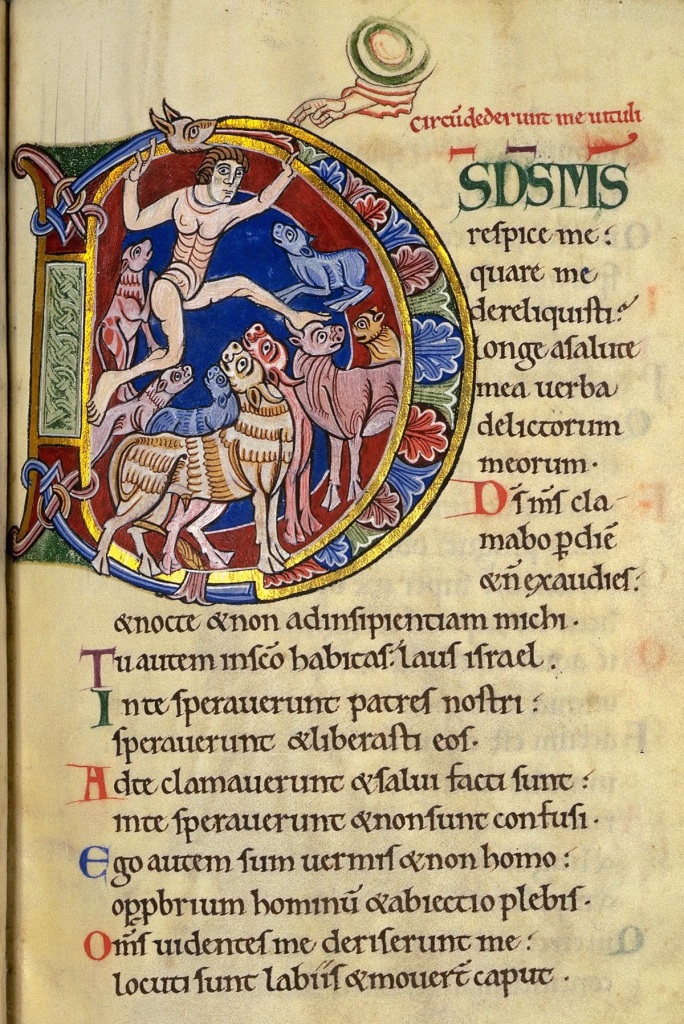
However, at the end, Jesus appears to lament that God has abandoned him; yet the cry which Jesus utters at the ninth hour, Eloi, Eloi, lama sabachthani (15:34), is a clear reference to Psalm 22, one of the psalms of the righteous sufferer, as he quotes its first verse.

Psalm 22:1-8 in the St. Albans Psalter.
The first words of the Psalm in the Latin Vulgate are
Deus, Deus meus, abbreviated here as DS DS MS.

This is the Psalm, unsurprisingly, which the lectionary offers for Good Friday. It is a psalm of individual lament, as the psalmist reflects the wretched condition of a person who is suffering unjustly, crying out, “why are you so far from helping me, from the words of my groaning? … I am a worm, and not a human … all who see me mock at me; they make mouths at me, they shake their heads …. I am poured out like water, and all my bones are out of joint; my heart is like wax; it is melted within my breast; my mouth is dried up like a potsherd, and my tongue sticks to my jaws; you lay me in the dust of death.” (Ps 22:1, 6, 14–15). It is a psalm most suitable to,shape our reflection as we hear the narrative of crucifixion and death on Good Friday.

Two passages from Hebrews are suggested by the lectionary for this day. The “word of encouragement” to the Hebrews is best known for its thoroughly theological explanation of the death of Jesus as both the new high priest and also the sacrifice supreme. It is strongly supercessionist in its dismissal of the Jewish sacrifical system that was practised in the Temple; it posits that Jesus and his sacrifice replaces all of that. We need to take great care as we preach on such passages!

The first section of Hebrews that is offered for Good Friday (Heb 10:16–25) affirms “the confession of our faith” which is offered by the writer in response to God’s fidelity to the covenant in which “I will put my laws in their hearts, and I will write them on their minds” (10:16, quoting Jer 31:33b). This covenant provides “confidence” as it assures believers that “our hearts [are] sprinkled clean from an evil conscience and our bodies [are] washed with pure water” (10:22).

The writer affirms that “he who has promised is faithfully (10:23), for God asserts “I will remember their sins and their lawless deeds no more” (10:17, quoting Jer 31:34b). This understanding of the significance of the death of Jesus, as God’s chosen victim who effects redemption, plays a key role in the development of an understanding of the atonement in later generations. The writer rejoices with his audience that they have “our hearts sprinkled clean from an evil conscience and our bodies washed with pure water” (10:22).

The other excerpt from Hebrews (4:14–16; 5:7–9) provides two brief snapshots of Jesus. These two excerpts focus more on the humanity of Jesus, helping us to enter more fully into the Good Friday story. Jesus is tested as we are, yet has the strength of character not to submit to sin (4:15). The effect of the story of his passion in light of this would therefore be to provide the exemplar supreme for faithful people, holding fast in the midst of suffering.

This letter also indicates that Jesus knew the anguish and despair of human tragedy, as he prayed “with loud cries and tears” (5:7). Submission, suffering, and obedience lead, for Jesus, to perfection (5:9), making him “the source of eternal salvation for all who obey him” (5:10). As we reflect on this story from centuries ago, may we know the same dynamic, moving us from our sufferings into a sense of God’s salvation.

Last week, the lectionary offered Mark’s account of the passion of Jesus, in preparation for Passion Sunday. On Good Friday the whole story is offered again for our reflection on those events, from John’s account, which has some distinctive features. As we consider the significance of the death of Jesus, the comment in 18:14 (hearking back to 11:50) provides a classic political (and theological) insight. Jesus then asserts that “I have always taught in synagogues and in the temple … I have said nothing in secret” (18:20). His words and life are for all.

When he is before Pilate, rather than being silent (Mark 15:5), Jesus here engages in a quasi-philosophical debate about kingship and truth which is reported only in John’s Gospel (John 18:33–38; 19:8–12). Mocked by the Roman soldiers as a king (19:1–3), Jesus is sentenced by the Roman Governor under the ironic accusation, “King of the Jews” (19:15, 19–22). The irony in this title is made clear by the Johannine author’s observation that “the chief priests of the Jews said to Pilate, “Do not write, ‘The King of the Jews,’ but, ‘This man said, I am King of the Jews.’ ” (19:21).

Distinctive to John’s account is the presence of the mother of Jesus and the beloved disciple (19:25–27), witnessing a majestic final moment for Jesus. “It is finished” (19:30), the final word of Jesus in this Gospel, is better translated, “It now comes to complete fulfilment”, a recognition that now “the hour has come for the Son of Man to be glorified” (12:23).

The whole sequence of events recounted in this narrative (John 18–19) is understood as fulfilment of scripture (19:24, 28, 36, 37). God’s will is done. That is the ultimate perspective that this particular narrative offers each Good Friday.

Father of orphans and protector of widows (Psalm 68; Easter 7A)

The psalm that is offered by the lectionary for this coming Sunday, the Seventh Sunday in Easter, is a song in which the psalmist prays for the enemies of Israel to be scattered (v.1) and the wicked to perish (v.2), celebrating that God has restored the languishing heritage of the people (v.9) and praying for God to give “power and strength to his people” (v.35).

It is a psalm most clearly marked by celebration and praise, with exhortations to “be joyful … exult before God … be jubilant with joy … sing praises to God’s name, and lift up a song to the Lord (verses 3–4, 32). It would seem that it comes from a time and a place of stability and prosperity for Israel.

Of particular importance are two verses which set out some central tenets of Israelite faith for the society of the day. Just as God takes care of orphans and protects widows (v.5), so are people of faith to do likewise. Just as God gives the desolate a home to live in (v.6a), so in Israelite society those on the edge are to be cared for. And just as God releases prisoners into prosperity (v.6b), so the Jubilee release was meant to be practised in society, as a time every fifty years during which debts are to be remitted (Lev 25:8–17; see esp. v.13).

The practice of the Jubilee is, however, dubious. The levitical prescriptions appear to be the ideal that the priests hoped for; actual evidence that this was ever implemented in Israelite society is lacking. Indeed, it is suggested that while the people were in Exile, the land of Israel would “lie desolate”, and “enjoy its sabbath years” (Lev 26:34), providing recompense for all those years when “it did not have on your sabbaths when you were living in it” (Lev 26:35).

A similar claim concludes the work of the Chronicler; the land was to keep sabbath, to “make up for its sabbaths”, in order “to fulfil the word of the Lord by the mouth of Jeremiah“ (2 Chron 36:20–21). After the return to the land, under Nehemiah, the law of sabbath rest was to be followed, it was decreed (Neh 10:31); whether this was the case is not clear from this or any other biblical text.

Likewise, the only evidence before the Exile for the release of slaves, as the levitical text prescribed, comes in the time of Zedekiah, spurred on by a prophetic word from Jeremiah (Jer 34:8–9). After initial compliance, the officials reneged and “took back the make and female slaves they had set free, and brought them again into subjection as slaves” (Jer 34:10–11).

Jeremiah accordingly predicts, in very graphic terms, the disaster that will ensure. “I will make you a horror to all the kingdoms of the earth”, he declares; the bodies of those handed over to the enemy “shall become food for the birds of the air and the wild animals of the earth” and the Babylonian forces will capture and burn Jerusalem and make the towns of Judah “a desolation without inhabitant” (Jer 34:12–22).

On the other hand, the statement regarding widows and orphans does reflect an ethos which was both advocated and implemented in society. The evidence for this claim is prolific.

Widows in ancient Hebrew society were in a perilous position. In a strongly patriarchal society, the patronage of a man was vital: a man as husband and provider, a man as father and protector, a man as the household head. Children without fathers—orphans—as well as women without husbands—widows—were in equally perilous situations. They were vulnerable people, often at risk of being mistreated and exploited, of being pushed to the edge of society and being forgotten. They could well be the desolate who needed housing (Ps 68:6).

In our time, we require those in leadership in the church to have obtained a Working With Vulnerable People card, to signal that they are aware of the power imbalances present in situations where they minister. In the ancient world, no such system existed; but we do find in the Hebrew Scriptures that there are regular exhortations and instructions to the people to take care of widows and orphans, the key classes of vulnerable people in that society.

In the Torah, we find the command, “you shall not mistreat any widow or fatherless child” (Exod 22:22) and the instruction to gather a tithe of produce and invite “the Levite, the foreigner, the fatherless, and the widow to come and eat and be filled” (Deut 14:28–29). Even in ancient society, vulnerable people needed protection.

More that this, the Torah provides that the widow and the fatherless child were to included along with the sojourner in celebratory moments in Israel, at the Feast of Weeks (Deut 16:9–12) and the Feast of Booths (Deut 16:13–15). This was also to be the practice when the men were in the field harvesting; they were to leave some for gleaning by ”the alien, the orphan, and the widow” (Deut 24:19–22); and similar prescriptions govern the time when tithing (Deut 26:12–13; also 14:28–29).

A widower’s brother was expected to marry a widow (Deut 25:5–10), for it was the duty of a widower’s kin to provide a widow with children if she didn’t have any. If it was not possible for a widow to remarry, it was the duty of the community to care for her (Exod 22:22–23; Deut 10:18; 24:17; Isa 1:17). Beyond the biblical period, in the Diaspora, a portion of the offering collected in the synagogues was be given to the widows and poor, on the analogy of the gleaning provision whilst living in the land.

Not everyone adhered to these prescriptions. Among the prophets, Isaiah proclaims God’s judgement on those who “turn aside the needy from justice … and rob the poor of my people”, including the way that they exploit the fatherless and widows (Isa 10:1–2). Likewise, Ezekiel includes those who “have made many widows” in Israel amongst those who will experience the full force of God’s vengeance (Ezek 22, see verse 25). He observes that “the sojourner suffers extortion in your midst; the fatherless and the widow are wronged in you” (Ezek 22:7).

Jeremiah assures the people of Edom, to the south of Israel, of God’s care for them: “leave your fatherless children; I will keep them alive; and let your widows trust in me” (Jer 49:11). He encourages the people of Jerusalem with a promise that God will allow them to continue to dwell in their land if they “do not oppress the sojourner, the fatherless, or the widow, or shed innocent blood in this place … or go after other gods” (Jer 7:5–7).

In a later chapter, Jeremiah is instructed to tell the King of Judah, “do no wrong or violence to the resident alien, the fatherless, and the widow, nor shed innocent blood in this place” (Jer 22:1–3). The prophet Zechariah speaks similarly: “do not oppress the widow, the fatherless, the sojourner, or the poor, and let none of you devise evil against another in your heart” (Zech 7:10).

Accordingly, the people of Israel would regularly have sung, in the words of the psalmist, “the Lord watches over the sojourners; he upholds the widow and the fatherless, but the way of the wicked he brings to ruin” (Ps 146:9). Care for widows was central to the life of holiness required amongst the covenant people. This psalm reminds them of that claim on their lives.

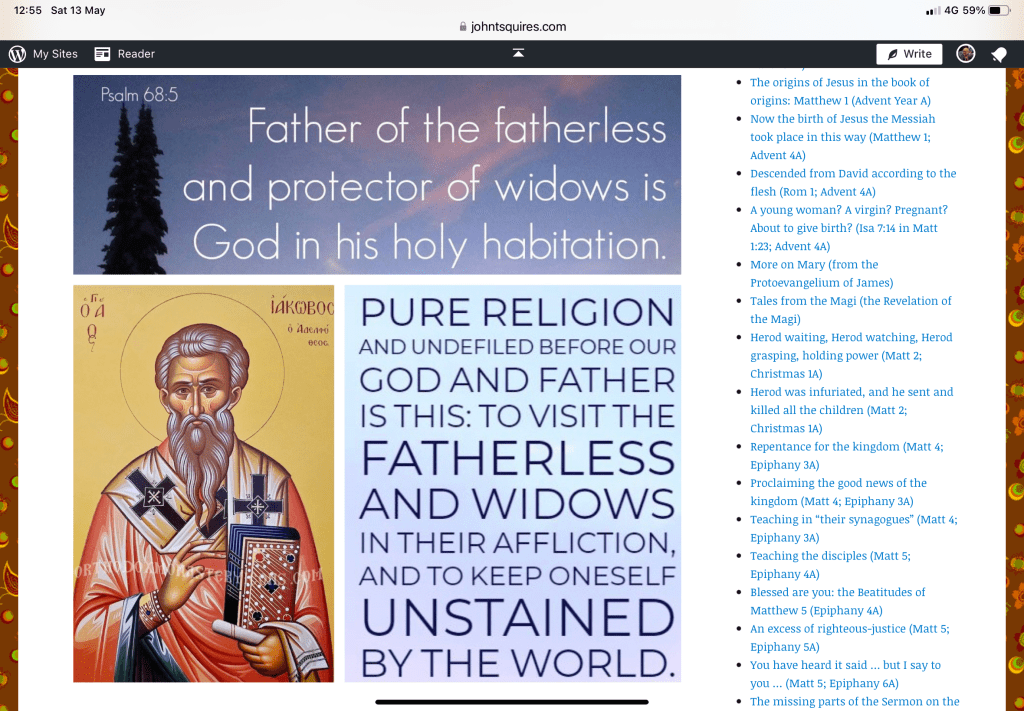
This reflected the standard set by God; “Father of orphans and protector of widows is God in his holy habitation” (Ps 68:5); this God is the one who “executes justice for the fatherless and the widow” (Deut 10:18). At the very heart of the holiness of God, the holy people are to exhibit this just and compassionate care for the vulnerable.

So the curses of Deuteronomy 27 include the declaration, “Cursed be anyone who perverts the justice due to the sojourner, the fatherless, and the widow” (Deut 27:19). The book of Psalms includes a prayer for God to rise up against the wicked, who “kill the widow and the sojourner, and murder the fatherless” (Ps 94:6). That psalm ends with an assurance that “the Lord … wipe them out for their wickedness; the Lord our God will wipe them out” (Ps 94:23).

The prophet Malachi includes this in his vision of the coming day of the Lord: “I will draw near to you for judgment. I will be a swift witness … against those who oppress the hired worker in his wages, the widow and the fatherless, against those who thrust aside the sojourner, and do not fear me” (Mal 3:4).

What is wished for the wicked who persecute the faithful is expressed with vitriol in Psalm 109: “May his children be fatherless and his wife a widow” (Ps 109:9). Another psalm expresses similar hopes, but in a less aggressive manner: “The Lord watches over the sojourners; he upholds the widow and the fatherless, but the way of the wicked he brings to ruin” (Ps 146:9). Who would be so foolish as to act differently? Yet people did; and prophets called, again and again, for justice.

And so we read that “religion that is pure and undefiled before God, the Father, is this: to care for orphans and widows in their distress, and to keep oneself unstained by the world” (James 1:27). This is what the brother of Jesus, James, affirms in the letter attributed to him, summing up a strong thread running through Israelite religion and on into Second Temple Judaism.

It is no wonder that Jesus himself had positive words to say about widows (Mark 12:41–44; Luke 18:1–8) and children (Mark 10:13–16), and that the early church cared for widows (Acts 6:1–6) and honoured those who were of this status (1 Tim 5:3–16). This is, after all, the way of God, “father of orphans and protector of widows”, who houses the desolate and releases the prisoners (Ps 68:5–6).

Bless our God; truly God has listened (Psalm 66; Easter 6A)

“Bless our God, O peoples, let the sound of his praise be heard” (v.8). That’s the opening line of the section of Psalm 66 which offered by the lectionary for this coming Sunday, the Sixth Sunday in Easter (Ps 66:8–20). In these words, the call is made for people to bless and praise God because he is the one “who has kept us among the living” (v.9). This makes this psalm a most suitable song for the season of Easter, when the church celebrates the new life offered to believers through the resurrection of Jesus from the dead.

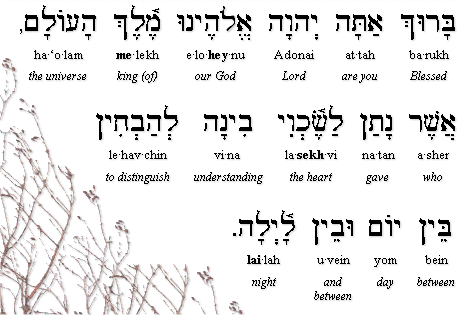
Blessing God is a favourite Jewish activity—indeed, so many prayers still used by Jews today begin with a phrase of blessing: “Blessed are you, O Lord our God …”. Blessed are You, O Lord our God, Ruler of the universe, Who brings forth bread from the earth is prayed before a meal. Blessed are You, o Lord our God, Ruler of the universe, who creates the fruit of the vine is prayed before drinking wine.

And a favourite blessing which I learnt from Jews is Blessed are you, O Lord our God, Ruler of the Universe, who has kept us alive, sustained us, and brought us to this moment. It’s a prayer to mark momentous occasions in life. All of these prayers of blessing begin with the Hebrew words, Baruch atah Adonai Elohenu melekh ha’olam, the same formula of approaching, acknowledging, and blessing God.

We can see that formula used in blessings spoken by David, who exhorts the people to “bless the Lord your God” (1 Chron 29:19), and the psalmist, who prays, “Blessed are you, O Lord; teach me your statutes” (Ps 119:12), as well as in later Jewish texts such as Tobit 3:11; 8:5, 15–17; Judith 13:17; 14:7; the Prayer of Azariah (six times), and 1 Maccabees 4:20. It appears also in New Testament texts such as Luke 1:68; Rom 9:5; 2 Cor 1:3; Eph 1:3; and 1 Pet 1:3.

More familiar, perhaps, is when Jesus uses a prayer of blessing, but speaks it to human beings; “blessed are you, Simon son of Jonah” (Matt 16:17), or “blessed are the eyes that see what you see”, to his disciples (Luke 10:23), or “blessed are those who have not seen and yet have come to believe” (John 20:29), and most famously of all, in a set of blessings spoken to a crowd on a level place (Luke 6:20–22) or to his disciples on a mountain top (Matt 5:3–12). Jesus blessed people. But blessing God is something that is not unknown within Judaism.

The primary reason to bless God, then, is that we are “kept among the living” (v.9). What follows from that affirmation is the statement, “You, O God, have tested us; you have tried us as silver is tried” (v.10). We know that life entails testing; no human being has avoided those moments in their lives when trials and testings are presented, seeking to entice us to think or act in unhelpful ways.

Scripture reflects this reality, that life entails testing, at many places. The fundamental paradigm is set out in the paradigmatic story of Abraham and Isaac (Gen 22:1–19), and then in narratives about Joseph (Ps 105:16–19), the years when the people wandered in the wilderness (Deut 8:2), the incident at Rephidim (Exod 17:1–7; Deut 6:16; 33:8; Ps 81:7), and then whilst the people were living alongside hostile nations when in the land (Judg 3:1–6). And, of course, there is the similar paradigmatic testing story in the life of Jesus (Mark 1:12-13 and parallels).

The Psalmist notes that “the Lord tests the righteous and the wicked” (Ps 11:5) and the prophet declares the word of the Lord, that “I have refined you, but not like silver; I have tested you in the furnace of adversity” (Isa 48:10; so also Zech 13:7–9). In the words of the sage, then, “I said in my heart with regard to human beings that God is testing them to show that they are but animals” (Eccles 3:18) and, using the same imagery as Ps 66, notes that “the crucible is for silver, and the furnace is for gold, but the Lord tests the heart” (Prov 17:3).

After listing various ways in which the people have been tested—“you brought us into the net; you laid burdens on our backs; you let people ride over our heads; we went through fire and through water” (vv.10–11), the psalmist declares, “you have brought us out to a spacious place” (v.12 in the NRSV translation), or “a place of great abundance” (in the NIV).

The unusual Hebrew word which is translated as “spacious place”, la-yerawah, appears also in Psalm 23 in the affirmation, “my cup overflows” (Ps 23:5); the root word, ravah, has a sense of saturation, abundance, or being filled to overflowing (according to the Brown—Driver—Briggs Lexicon). The end result of testing is a place of fulfilment and satisfaction.

In response, the psalmist states, “I will come into your house with burnt offerings; I will pay you my vows” (v.13). Prescriptions for burnt offerings, to be offered at the altar of burnt offerings (Deut 12:27; Exod 20:24), are detailed in Lev 1:1–17 and 6:8–13. They are integral to the rituals of the Temple and have a firm place in the piety of faithful people in ancient Israel.

Also integral to the temple liturgy are the vows which are to be paid to God. The psalmist elsewhere affirms, “I will pay my vows” (Ps 22:25; 50:14; 61:8; 65:1; 66:13; 76:11; 116:14, 18). The words of the psalmist are echoed by Eliphaz in one of his speeches to Job: “you will delight yourself in the Almighty, and lift up your face to God; you will pray to him, and he will hear you, and you will pay your vows” (Job 22:26–27).

So the psalm continues, “I will offer to you burnt offerings of fatlings, with the smoke of the sacrifice of rams; I will make an offering of bulls and goats” (v.15). This correlates with the levitical provisions, as already noted. The psalmists inevitably write from within the religious system of the time—which makes sense, since the psalms were composed for singing within the Temple liturgy.

This contrasts with many of the words of the prophets, who in a sense stand on the edge of the religious life of the nation, and offer their criticisms of the excesses and injustices that were part of life at that time (as, indeed, they continue to be, sadly, today). We might think, for instance, of how the prophets criticised the people for their offerings and sacrifices whilst tolerating such injustice in their communal life (Isa 1:11–14; Jer 6:20; Ezek 20:27–28; Hos 8:13; 9:4; Mal 1:14).

So the prophetic critique of Temple practices (which Jesus picks up at Matt 9:13; 12:7, quoting Hos 6:6) needs to be held in tension with the psalmists’ affirmations of those practices when they are performed faithfully. Although Jesus, following Hosea, appears to place mercy (hesed) in opposition to sacrifice, both mercy and sacrifice are integral to Israelite religion.

To end this song, the psalmist offers an exhortation followed by an affirmation. The exhortation is to “come and hear, all you who fear God, and I will tell what he has done for me” (v.16). “Those who fear God” is a typical characterisation of faithful people who trust in God and adhere to God’s ways of justice and righteousness, including Abraham (Gen 22:12), Joseph (Gen 42:18), leaders appointed by Moses (Exod 18:21), and indeed all who are faithful amongst the people (Lev 19:14, 32; 25:17, 36, 43; Deut 4:10; 6:2, 13, 24; etc; 1 Sam 12:14, 24; 1 Ki 8:40–43).

As Moses declares, “O Israel, what does the Lord your God require of you? Only to fear the Lord your God, to walk in all his ways, to love him, to serve the Lord your God with all your heart and with all your soul, and to keep the commandments of the Lord your God” (Deut 10:12).

“What God has done” is an occasional biblical phrase, appearing in assorted places (Num 23:23; Deut 3:21; Josh 23:3; Ps 64:9; Eccles 3:11; Jer 5:19; Dan 9:14). In the New Testament, it is picked up in what Jesus says to a healed demoniac (Luke 8:39) and then in writings of his disciples (Rom 3:24–26; 8:3; Acts 2:22, 36; 14:27; 15:12; 21:19; John 3:16–17). It affirms the continuing and ongoing actions of God—what a former generation of scholars called “salvation history”—which is known through the stories of Israel and then through the life of Jesus and his followers.

The affirmation which closes this psalm is offered in typical Hebraic style, with parallel phrases that repeat and develop the central idea. In verse 19, the first statement, “truly God has listened”, is mirrored in the next phrase, “he has given heed to the words of my prayer”. In verse 20, “he has not rejected my prayer” is then expressed in a varied manner in the closing phrase, “[he has not] removed his steadfast love (hesed) from me”.

From Exodus to Nehemiah, God’s steadfast love and faithfulness (hesed) is praised, in a refrain which recurs in many places (Exod 34:6; 2 Chron 30:8–9; Neh 9:17, 32; Jonah 4:2; Joel 2:13; Ps 86:15; 103:8, 11; 111:4; 145:8–9). Here, the psalmist uses this central insight into the nature of God to conclude the song, in which human trust in God and fidelity to God’s way have been well-expressed throughout.

The final words of the psalm form a blessing (linking back to verse 8) which emphasises the hesed of God (variously translated as mercy, or steadfast love). The psalm as a whole thus ties together the religious practices of the people (vows and sacrifices) and the understanding of God’s essential being (merciful and loving). It is a reminder that we need to hold the whole of the biblical witness together as revelatory of God; not select one aspect, not preference one over another, but hold all together. For in that, we draw near to the fullness of God.

On suffering as a virtue (1 Peter 3; Easter 6A)

Continuing our reading from 1 Peter during this Easter season, the lectionary this week offers a section dealing with suffering (1 Pet 3:13–22). The reality of the suffering which is being experienced by believers is a constant refrain in this letter. It is noted briefly in the opening blessing (1:6–7) and described in more detail in this section, as well as four other occasions (2:19–20; 3:13–17; 4:1–2; 4:12–19; 5:6–11).

There is never any suggestion that this suffering involved the physical persecution or even death of the believers; the “abuse” referred to comprised verbal criticism of believers (2:23; 3:16), as the lengthy scriptural citation indicates (3:9–12). Relationships with the Roman state appear to be favourable (2:13–17); there is no sign of systematic persecution.

In all but one of these discussions, suffering is interpreted with reference to the sufferings of Jesus (2:21–25; 3:18; 4:1; 4:13). The Spirit testified to the sufferings of Jesus through the words of the prophets (1:11). Jesus provides an example of how to deal with suffering; slaves in particular are instructed to “follow in his steps” (2:21), for the way of Jesus involves endurance in suffering (2:19–20) and adopting a joyful approach to life (1:8; 4:13) even in the midst of sufferings.

Suffering is known and addressed in the books of the Hebrew Scriptures. The archetype of suffering in those books is, of course, Job, who although “blameless and upright, one who feared God and turned away from evil” (Job 1:1), was nevertheless struck by a series of events that left his without property, without family, without animals, without servants (1:13–19).

The extended series of speeches in Job 3—42 address this situation of unjust, unmerited suffering, with a variety of points of view put forward. Although Job initially laments his fate, tearing his robe, shaving his head, and falling prostrate on the ground (1:20), he maintains his faith, acknowledging that “the Lord gave, and the Lord has taken away; blessed be the name of the Lord” (1:21). Yet in subsequent chapters, whilst his friends seek to persuade him to accept his fate as God’s will, Job himself despairs at his condition: “I am not at ease, nor am I quiet; I have no rest” (3:26),

Job rails at God: “the terrors of God are arrayed against me” (6:4), “when disaster brings sudden death, [God] mocks at the calamity of the innocent” (9:23), “why did you bring me forth from the womb? would that I had died before any eye had seen me” (10:18), God “uncovers the deeps out of darkness, and brings deep darkness to light” (12:22), “you write bitter things against me” (13:26), “God gives me up to the ungodly, and casts me into the hands of the wicked … I was at ease, and he broke me in two; he seized me by the neck and dashed me to pieces; he slashes open my kidneys, and shows no mercy; he pours out my gall on the ground (16:11–13).

Mocking the words of the psalmist, “if I ascend to heaven, you are there; if I make my bed in Sheol, you are there; if I take the wings of the morning and settle at the farthest limits of the sea, even there your hand shall lead me, and your right hand shall hold me fast” (Ps 139:8–10), Job instead insists, “if I go forward, he is not there; or backward, I cannot perceive him; on the left he hides, and I cannot behold him; I turn to the right, but I cannot see him” (Job 23:8).

Although the psalmist insists, “even the darkness is not dark to you; the night is as bright as the day, for darkness is as light to you” (Ps 139:12), Job persists that God “uncovers the deeps out of darkness, and brings deep darkness to light” (Job 12:22), for “when I looked for good, evil came; and when I waited for light, darkness came” (Job 30:26). Job can see no joy in accepting his fate; he continues in perpetual lament and anger because of his suffering.

The other well-known passage in Hebrew Scripture which relates to suffering is the fourth and last of the “Servant Songs” found in Second Isaiah (Isa 42:1–9; 49:1–7; 50:4–11; and 52:13–53:12). In this long song, the “man of suffering, acquainted with infirmity” is portrayed as despised, rejected, stricken, and afflicted (53:3–4); wounded, bruised, and crushed (53:5); crushed with pain (53:10) and caught up in anguish (53:11). There can be no doubt that this figure—whether the corporate people of Israel, as in Jewish interpretation, or an individual chosen for this role, as many Christian interpreters prefer—is well acquainted with suffering.

Yet in the words of the song, the suffering of this servant is redemptive; although “we held him of no account” (53:3), yet “he has borne our infirmities and carried our diseases” (53:4), “he was wounded for our transgressions, crushed for our iniquities, upon him was the punishment that made us whole, and by his bruises we are healed” (53:5).

Since “the Lord has laid on him the iniquity of us all” (53:6), he was “stricken for the transgression of my people” (53:8), his life was made “an offering for sin” (53:10) who “bore the sin of many, and made intercession for the transgressors” (53:12). The redemptive suffering of this servant “shall make many righteous, and he shall bear their iniquities” (53:11).

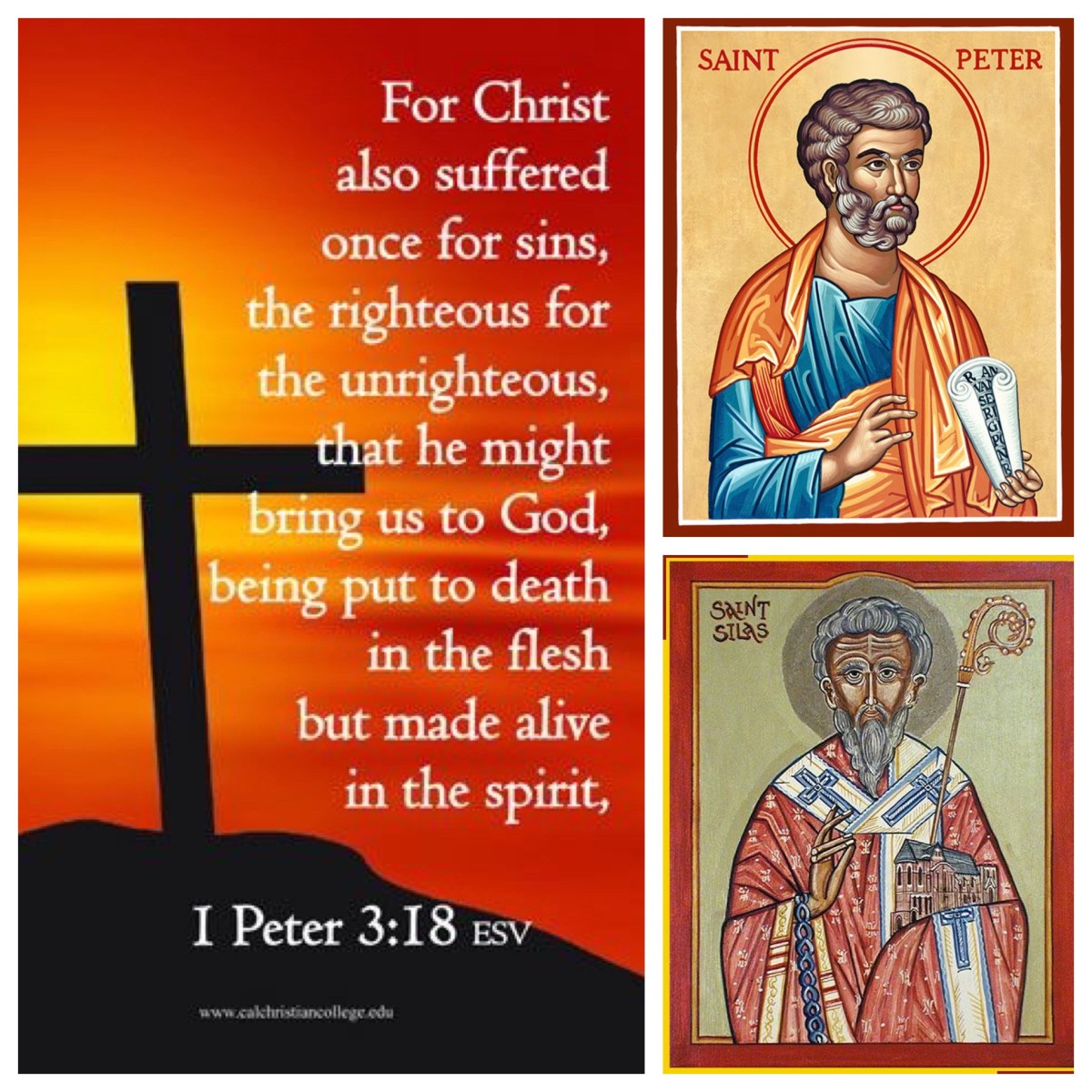
Such suffering is not in vain; and when later Christian writers drew from the rich theology of this song, they attributed to Jesus the same dynamic of redemptive suffering. This is clearly the case in this week’s epistle, where we hear, “Christ also suffered for sins once for all, the righteous for the unrighteous, in order to bring you to God” (1 Pet 3:18). The words provide a strong and clear echo of the fourth Servant Song. There is hope to be found in the midst of this suffering.

This motif of hope runs throughout this letter (1:3, 13, 21; 3:15; 4:13). What follows after suffering, the author writes with assurance, is God’s “eternal glory in Christ” (5:10); this is “the true grace of God” (5:12). Elders within the community of faith are to exercise their leadership with humility, and thereby provide “examples to the flock” (5:1–5). In this way, they will “win the crown of glory that never fades away” (5:4).

This, then, is the “inheritance that is imperishable, undefiled, and unfading, kept in heaven for you” which was promised in the initial thanksgiving (1:4). This hope is what undergirds the distinctive identity of believers seeking to remain faithful to the way of Jesus in their society.

You in me and I in you: the Johannine interrelationship of Father, Son, and disciples (John 14; Easter 6A)

The fourteenth chapter of John’s Gospel contains some lines spoken by Jesus that are widely known in today’s society—courtesy of the fact that they appear in many of the funeral services that are conducted each week. For people with a distant relationship with the Christian faith (as in, “I believe in God, but I don’t go to church”), this chapter is often the go-to when faced with the option of having a reading from the Bible in the funeral service of a recently-deceased relative.

“In my Father’s house there are many dwelling places” (John 14:2, in last week’s lectionary Gospel passage for the Fifth Sunday in Easter) often appears, as this is a comforting statement for people worrying about what the afterlife will be like. Or “I will not leave you orphaned; I am coming to you” (14:18, in this week’s lectionary Gospel offering for the Sixth Sunday in Easter), as a further note of reassurance about what lies ahead.

Or, indeed, “peace I leave with you; my peace I give to you. I do not give to you as the world gives. Do not let your hearts be troubled, and do not let them be afraid” (14:27, in the lectionary Gospel for the Sixth Sunday in Easter in Year C), as a comforting affirmation for mourners to hear at the time of parting. All quite appropriate and pastorally helpful.

The Gospel passage for this Sunday, however, contains more than this note of reassurance. It also offers one of the rare references, in this fourth Gospel, to the Holy Spirit, here identified as “another Advocate … the Spirit of truth” (14:16–17). The word translated by the NRSV as Advocate appears here, and at John 14:26; 15:26; 16:7—but nowhere else in this Gospel, nor indeed does it feature in any other canonical Gospel.

The word used is a Greek word that is capable of various English translations: Advocate, Counsellor, Helper, Comforter, or Friend; or it can simply be transliterated, as the New Jerusalem Bible does, as Paraclete. See my explorations of this word at

As well as this relatively rare Johannine reference to the Spirit, this Gospel passage has Jesus speak words that are characteristic of how the unknown author of the book of signs understands the relationship of Jesus, the Son, to the Father: “I am in my Father, and you in me, and I in you” (14:20). These words express the mystical relationship of mutual in dwelling that characterises the way that this Gospel depicts the Father—Son relationship: I in him, you in me, I in you.

“If I am not doing the works of my Father, then do not believe me; but if I do them, even though you do not believe me, believe the works, so that you may know and understand that the Father is in me and I am in the Father”, says Jesus, during an extended debate in Jerusalem (10:37–38), provoking the Jewish authorities to attempt to arrest him.

In the conflict that is reported throughout chapters 8–11, Jesus debates these Jewish authorities with quite some vehemence. At the end of his disputation, he makes a bold assertion: “The Father and I are one” (10:30). The mutual indwelling of Father and Son has merged into an essential unity of being, a complete coherence of identity—at least, in the words of the Jesus we encounter in this Gospel. (It is quite different in the Synoptic Gospels.)

Wayne Meeks (in his classic article, “The Man from Heaven in Johannine Sectarianism”, JBL 91 (1972) 44–72) notes that the claims made about Jesus in the fourth Gospel function as reinforcements of the sectarian identity of the community. As this community had come into existence because of the claims that it had made about Jesus, so the reinforcement of the life of the new community took place, to a large degree, through the strengthening and refining of its initial claim concerning Jesus. What is said about Jesus can also be said about his followers.

Claims made about Jesus, the Messiah (Christ) thus function as markers of the emerging self–identity of the new community, over against the inadequate understandings of Jesus which continue to be held in the old community (the synagogue), still under the sway of the Pharisees. See

Some time after the conflict that took place in Jerusalem, Jesus responds to a request from Philip to “show us the Father” (14:8), saying, “Do you not believe that I am in the Father and the Father is in me? The words that I say to you I do not speak on my own; but the Father who dwells in me does his works. Believe me that I am in the Father and the Father is in me” (14:10–11).

This mutual indwelling is reaffirmed in the words that Jesus prays before his arrest: “you, Father are in me and I am in you” (17:21). In that prayer, he goes on to extend the scope of his mutual in dwelling; he dwells, not only in the Father, but also in his disciples, and they dwell in him. “As you, Father, are in me and I am in you, may they also be in us, so that the world may believe that you have sent me … [may they] be one, as we are one, I in them and you in me, that they may become completely one” (17:21–23).

The mutual indwelling of the Son with the disciples is developed particularly in the teachings that Jesus gives concerning the vine: “Abide in me as I abide in you. Just as the branch cannot bear fruit by itself unless it abides in the vine, neither can you unless you abide in me. I am the vine, you are the branches.” (15:4–5).

The vine, of course, was a standard image for Israel (Ps 80:8–10; Jos 10:1) featuring in this way in assorted prophetic parables (Isa 5:1–7; Jer 2:21; 8:13; Ezek 15:1–8; 17:3–19; 18:10–14). In developing this parabolic image, Jesus applies it to his followers: “Those who abide in me and I in them bear much fruit, because apart from me you can do nothing. Whoever does not abide in me is thrown away like a branch and withers; such branches are gathered, thrown into the fire, and burned. If you abide in me, and my words abide in you, ask for whatever you wish, and it will be done for you.” (John 15:5–7).

The sense of “abiding in” is a mysterious inner connection that binds followers to their master; but because that master has likewise been bound with the Father, the intimacy of connection between Father, Son, and disciples is clear. Thus, “you will know that I am in my Father, and you in me, and I in you” (14:20), as we hear this coming Sunday. Those who are linked inextricably with the Son are linked through his intimate connection with the Father. Father, Son, and Disciples: the Johannine version of the trinity!

On my view of the way that this three-part unity is developed in John’s Gospel, see more detail at

A living stone, for a spiritual house (1 Peter 2; Easter 5A)

For the last few weeks, we have been reading through the letter known as 1 Peter during the Easter season. We have read parts of chapters 1 and 2 so far. This Sunday, however, the lectionary does something strange: it takes us back before the passage we heard last week, to a section of chapter 2 that focusses on the way that holiness is to be understood.

The theme of holiness has already been sounded earlier in the letter. The people who are receiving this letter are “the exiles of the Dispersion” (v.1), people of Israel living in other nations. For such people, holiness was an important idea. The fundamental charge of this letter was sounded earlier: “as he who called you is holy, be holy yourselves in all your conduct” (v.15). This is supported by a quotation from scripture (Lev 11:44), which was a foundational text for the people of Israel.

Holiness characterized Israel; those who ministered to God within the Temple, as priests, were to be especially concerned about holiness in their daily life and their regular activities in the Temple (Exod 28-29; Lev 8-9). The priests oversaw the implementation of the Holiness Code, a large section of Leviticus (chapters 17–26), which explained the various applications of the word to Israel, that “you shall be holy, for I the Lord your God am holy” (Lev 19:2; also 20:7,26).

Holiness was also a concern of the Pharisees. The scribes and the Pharisees devoted their lives to teaching and explaining each of the 613 commandments and ordinances that were included within the books of Torah (the books of the Law—the first five books of Hebrew Scriptures), and showing the common people how they could live in holiness, as they followed each of those commandments. Holiness was at the heart of the Law, so adhering to each commandment ensured holiness.

And holiness characterised the followers of Jesus, for he was leader of a holiness movement in a holiness society. Jesus debated often with the scribes and Pharisees. He seems to share much in common with them. They were all committed to living in accordance with the commandments of Torah, although they had differing interpretations of how to do this. Jesus advocated for the living out of holiness in daily life, as did the scribes and Pharisees. His teachings also focussed on adhering to God’s will, maintaining the justice-righteousness that God required, in all of life. He teaches his followers to adhere to that way in order the take part in the kingdom that God has planned for all.

Holiness, to all of these groups, meant being consecrated, dedicated, set apart for a designated purpose. It is often (mis)understood as signalling a superior status, an exalted place—”up there” above the unholy ones, just as God is “up there” above the earth. Of course, that old worldview is now obsolete. And the sense of elitism in “holiness” is also obsolete.

Further, whilst a holy person is to be an ethical person, overtones of morality are not the first and last aspect of holiness. To be holy is to be dedicated to the task, following Jesus with the whole of our lives, sensing the eternal in the moments of the present, experiencing the divine in the midst of human life. Excitedly, joyously (v.6), all this is to be shared with others who have not yet “caught the vision”.

There are many references to, and quotations from, the scriptures of the Hebrew people in chapter 2 of this letter. That makes sense, for—as we have seen—it was sent to “the exiles of the Dispersion” (1:1). These were their familiar scriptures. To live according to holiness (Lev 11:44) is the key principle (1 Pet 1:15).

In 2:4–10, part of the lectionary passage for this Sunday, we learn what that means, as the writer plays with a series of texts from the psalms and Isaiah. Each text contains a reference to “stone”, and relates an understanding of holiness to those hearing the letter.

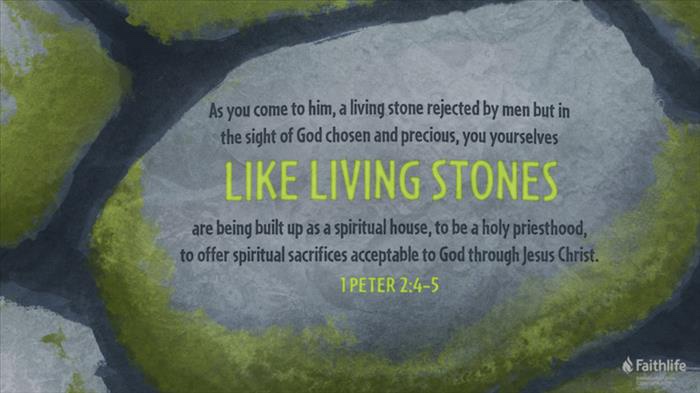
The first reference point for “stone” is to Jesus, the “living stone” who is the cornerstone of the whole building. That slips quickly into applying “stones” to the people of faith who are hearing this letter: as “living stones” they are to be built into the structure as integral parts of the whole. Then, to reinforce that affirmation, a verse from Hosea 2 is quoted to emphasize how intimately and enduringly the people are connected with God.

Echoing still more scriptural terms, they are described as “chosen” (Deut 7:6), “a royal priesthood” (Exod 19:6), “holy” (Lev 20:7), and God’s own people (Hos 2:23) who are “a light to the nations” (Isa 42:6). Many passages are rolled into one sentence!

Later sections of the letter provide specific guidance as to how we are to live in that condition of holiness; what behaviours and actions are appropriate for being “living stones” in a “spiritual house”. The challenge for us, this week, as we hear and preach on this particular passage, is to help people to grasp the relevance of these important theological terms for ourselves today.

*****

See also