I am the good shepherd [who] lays down his life for the sheep (John 10; Easter 4B)

Each year, on the fourth Sunday of the season of Easter, the Revised Common Lectionary provides a section of John 10 as the Gospel reading for the Sunday. That chapter is where Jesus teaches about his role as “the good shepherd” who lays down his life for the sheep. The chapter is divided over the three years: 10:1–10 in Year A, then 10:11–18 in Year B, and 10:22–30 in Year C. For this reason, this particular Sunday is sometimes called the Good Shepherd Sunday.

The section offered in Year A concludes with the classic claim of Jesus, “I came that they may have life, and have it abundantly” (10:10). The passage set for Year B, this year, begins with the famous affirmation, “I am the good shepherd; the good shepherd lays down his life for the sheep” (10:14-15).

Both passages develop the image of Jesus as the shepherd of the sheep, in intimate relationship with the sheep; the shepherd knows his own (10:15), calls them by name (10:3), shows them the way of salvation (10:9), and lays down his life for the sheep (10:11, 15, 17–18).

These two sections of this chapter (10:1–10, 11–18) follow on from the story of the man born blind (9:1–41), which itself has emerged out of the conflicts between Jesus and Jewish authorities (7:10—8:59), reported as taking place in Jerusalem during the Festival of Booths (7:2). That sequence of conflicts had culminated with the Jewish authorities picking up stones to throw at Jesus (8:59).

The story told in chapter 9, like the whole Gospel, reflects the situation of a group of followers of Jesus towards the end of the first century CE, inheriting the richness of the Jewish faith, convinced that they have found The Teacher of the way that God requires, in Jesus of Nazareth. As a result, they have encountered opposition, argumentation, and expulsion from their familiar faith community, and through this they have engaged in verbal warfare with those who have pushed them out.

Retelling the story of the man born blind, who encounters Jesus and claims faith in him, validates their perspective on life and faith. The story reveals what God intends and desires, through the way that an unknown member of their community has constructed this narrative. The story reinforces the views that have been developed by members of the community, as they hope that others might “come to believe that Jesus is the Messiah, the Son of God, and that through believing [they] may have life in his name” (20:31).

See

John’s Gospel is known for its series of I AM statements. In the first offering from John 10 (verses 1–10), Jesus has said, “I am the gate” (v.9)—the avenue for entry into the sheepfold, which was a place of care and protection for the sheep.

But “I am the gate” makes sense only because of what goes before it; the gatekeeper, who opens the gate for the sheep (v.3). This image then morphs into the more familiar image of the shepherd of the sheep (vv.11, 14)—the one who knows the sheep, calls them by name, and guides them in the paths that they should follow.

In fact, Jesus refers to his followers as “sheep” 13 times throughout the chapter. This draws on the common description of the people of Israel as sheep, found in a number of psalms. The exodus from Egypt is described as the time when “he led out his people like sheep, and guided them in the wilderness like a flock; he led them in safety, so that they were not afraid” (Ps 78:52–53).

The psalmist encourages the people to sing with joy, for “he is our God, and we are the people of his pasture, and the sheep of his hand” (Ps 95:7). The people rejoice that it is this God who “made us, and we are his; we are his people, and the sheep of his pasture” (Ps 100:3; see also Ps 44:11, 22; 74:1).

Alongside this, in Hebrew Scripture, God is explicitly identified as a shepherd; the psalmist declares that God is the “Shepherd of Israel, who lead[s] Joseph like a flock” (Ps 80:1). Elsewhere, the opening line of perhaps the best-known psalm is simply, “the Lord is my shepherd” (Ps 23:1).

But many other passages contain mentions of shepherds. As he was dying, with his sons gathered around him, Jacob spoke to his son Joseph, praying, “the God before whom my ancestors Abraham and Isaac walked, the God who has been my shepherd all my life to this day … bless the boys [Ephraim and Manasseh]” (Gen 48:15–16).

Later, Jacob indicated that Joseph’s strength came “by the hands of the Mighty One of Jacob, by the name of the Shepherd, the Rock of Israel, by the God of your father, who will help you, by the Almighty who will bless you” (Gen 49:24–25). Then, when David was anointed as king, Samuel said to him “it is you who shall be shepherd of my people Israel, you who shall be ruler over Israel” (2 Sam 5:2; 1 Chron 11:2).

Subsequent rulers in Israel were accorded this title; yet key prophets during the exile lamented that there had been “stupid shepherds” with “no understanding” (Jer 10:21; Isa 56:11) and had done evil (Jer 12:10–13; 23:1–2; 50:6–7; Ezek 34:1–10). Some prophets in the Exile then looked beyond this to a better kind of shepherd-leader.

The anonymous exilic figure we know as Second Isaiah declared that the Lord God “will feed his flock like a shepherd; he will gather the lambs in his arms, and carry them in his bosom, and gently lead the mother sheep” (Isa 40:11). Later, he declares that Cyrus, king of Persia, would be anointed as Messiah, to carry out God’s purpose (Isa 44:28–45:1). He is the one of whom the Lord says, “he is my shepherd and he shall carry out all my purpose” (Isa 45:28). That is a striking extension of the strong scriptural imagery of the shepherd, normally applied to the God of Israel or rulers within Israel, which is now placed onto a foreign ruler.

Also during the exile, the prophet Jeremiah looked to the time when God would restore “shepherds after my own heart” in their midst (Jer 3:15) and Ezekiel prophesied God’s intentions: “I myself will search for my sheep, and will seek them out. As shepherds seek out their flocks when they are among their scattered sheep, so I will seek out my sheep. I will rescue them from all the places to which they have been scattered on a day of clouds and thick darkness.” (Ezek 34:12). Ezekiel then extends this role to the king when he reports God’s words: “my servant David shall be king over them; and they shall all have one shepherd” (Ezek 37:24).

This is the scriptural heritage that Jesus draws on in his famous statement, “I am the good shepherd” (John 10:11, 14). Jesus refers to his followers as “sheep” 13 times throughout the chapter, drawing on the equally common description of the people of Israel as sheep, found in a number of psalms (Ps 44:11, 22; 74:1; 78:52; 95:7; 100:3).

Jews would have recognised immediately the claim that he was making for himself—and the way that he has intensified it by noting that “the good shepherd lays down his life for the sheep” (John 10:11; see also v.15). The passage thus looks forward to the death he will suffer on the cross—the example supreme of “the good shepherd”.

See also

and

The priority of the Torah: love God, love neighbour (Mark 12; Narrative Lectionary for Lent 4)

“You shall love the Lord your God with all your heart, and with all your soul, and with all your strength, and with all your mind” (Deuteronomy 6:5). “You shall love your neighbour as yourself” (Leviticus 19:8). These two commandments are cited in a story about Jesus engaging in a discussion with a scribe, a teacher of the Law, which ends with Jesus saying, “there is no commandment greater than these” (Mark 12:31).

The Narrative Lectionary includes this story (Mark 12:28–34) as the opening section of a longer Gospel passage that is proposed for worship this coming Sunday (12:28–44). It’s a passage that takes us deep into the heart of Torah—those guidelines for living all of life in covenant faithfulness with God. Torah sits at the centre of Judaism. See more on this at

Of course, Jesus hasn’t answered the question precisely in the terms that it was asked; he doesn’t indicate what is “the first” commandment, but which two are “greatest”. It’s like a dead heat in an Olympic race: a race when even a finely-tuned system can’t differentiate between the two winners, even down to one thousandth of a second. Both love of God and love of neighbour are equally important. Joint winners—like that high jump competition a year or two back where the two leading jumpers just decided to share the gold medal, rather than keep competing—and risk not getting gold.

Both commands are biblical commands, found within the foundational books of scripture within Judaism. They were texts that Jewish people, such as Jesus and his earliest followers would have known very well. Each command appears in a significant place within the books of Torah, the first five books of Hebrew Scriptures.

The command to “love God” sits at the head of a long section in Deuteronomy, which reports a speech by Moses allegedly given to the people of Israel (Deut 5:1–26:19). The speech rehearses many of the laws that are reported in Exodus and Leviticus, framing them in terms of the repeated phrases, “the statutes and ordinances for you to observe” (4:1,5,14; 5:1; 6:1; 12:1; 26:16–17), “the statutes and ordinances that the Lord your God has commanded you” (6:20; 7:11; 8:11).

After proclaiming the Ten Commandments which God gave to Israel through Moses (Deut 5:1–21; cf. Exod 20:1–17) and rehearsing the scene on Mount Sinai and amongst the people below (5:22–33; cf. Exod 19:1–25; 20:18–21). Moses then delivers the word which sits at the head of all that follows: “Hear, O Israel: The LORD is our God, the LORD alone. You shall love the LORD your God with all your heart, and with all your soul, and with all your might. Keep these words that I am commanding you today in your heart” (Deut 6:4–6). This, it would seem, is the key commandment amongst all the statutes and ordinances.

These words are known in Jewish tradition as the Shema, a Hebrew word literally meaning “hear” or “listen”. It’s the first word in this key commandment; and more broadly than simply “hear” or “listen”, it caries a sense of “obey”. These words are important to Jews as the daily prayer, to be prayed twice a day—in keeping with the instruction to recite them “when you lie down and when you rise” (Deut 6:7). As these daily words, “love the Lord your God” with all of your being are said, they reinforce the centrality of God and the importance of commitment to God within the covenant people.

The command to “love your neighbour” in Leviticus 19 culminates a series of instructions regarding the way a person is to relate to their neighbours: “you shall not defraud your neighbour … with justice you shall judge your neighbour … you shall not profit by the blood of your neighbour … you shall not reprove your neighbour … you shall love your neighbour” (Lev 19:13–18).

These instructions sit within the section of the book which is often called The Holiness Code—a section which emphasises the word to Israel, that “you shall be holy, for I the Lord your God am holy” (Lev 19:2; also 20:7, 26). Being holy means treating others with respect. Loving your neighbour is a clear manifestation of that ethos. Loving your neighbour exemplifies the way to be a faithful person in covenant relationship with God.

So it is for very good reasons that Jesus extracts these two commandments from amongst the 613 commandments that are to be found within the pages of the Torah. (The rabbis counted them all up—there are 248 “positive commandments”, giving instructions to perform a particular act, and 365 “negative commandments”, requiring people to abstain from certain acts.)

Jesus, of course, was a Jew, instructed in the way of Torah. He knew his scriptures—he argued intensely with the teachers of the Law over a number of different issues. He frequented the synagogue, read from the scroll, prayed to God, and went on pilgrimage to Jerusalem and into the Temple—where, once again, he offered a critique of the practices that were taking place in the courtyard of the Temple (11:15–17).

Then he engaged in debate and disputation with scribes and priests (11:27), Pharisees and Herodians (12:13), and Sadducees (12:18). Each of those groups came to Jesus with a trick question, which they expected would trap Jesus (12:13). Jesus inevitably bests them with his responses (11:33; 12:12, 17, 27). It was at this point that the particular scribe in our passage approached Jesus, perhaps intending to set yet another trap for him (12:28).

So Jesus, good Jew that he was, is well able to reach into his knowledge of Torah in his answer to the scribe. The commandments that he selects have been chosen with a purpose. They contain the essence of the Torah. His answer draws forth the agreement of the scribe—there will be no robust debate now! In fact, in affirming Jesus, the scribe reflects the prophetic perspective, that keeping the covenant in daily life is more important that following the liturgical rituals of sacrifice in the Temple (see Amos 5:21–24; Micah 6:6–8; Isaiah 1:10–17).

The scene is similar to a Jewish tale that is reported in the Babylonian Talmud, a 6th century CE work. In Shabbat 31a, within a tractate on the sabbath, we read: “It happened that a certain non-Jew came before Shammai and said to him, ‘Make me a convert, on condition that you teach me the whole Torah while I stand on one foot.’ Thereupon he repulsed him with the builder’s cubit that was in his hand. When he went before Hillel, he said to him, ‘What is hateful to you, do not to your neighbour: that is the whole Torah, the rest is the commentary; go and learn it.’”

Hillel, of course, had provided the enquiring convert, not with one of the 613 commandments, but with one that summarised the intent of many of those commandments. We know it as the Golden Rule, and it appears in the Synoptic Gospels as a teaching of Jesus (Matt 7:12; Luke 6:31).

Some Jewish teachers claim that the full text of Lev 19:18 is actually an expression of this rule: “You shall not take vengeance or bear a grudge against any of your people, but you shall love your neighbour as yourself: I am the LORD.” Later Jewish writings closer to the time of Jesus reflect the Golden Rule in its negative form: “do to no one what you yourself dislike” (Tobit 4:15), and “recognise that your neighbour feels as you do, and keep in mind your own dislikes” (Sirach 31:15).


Paul clearly knows the command to love neighbours, for he quotes it to the Galatians: “the whole law is summed up in a single commandment, ‘You shall love your neighbour as yourself’” (Gal 5:14), and James also cites it: “you do well if you really fulfill the royal law according to the scripture, ‘You shall love your neighbour as yourself’” (James 2:8). Both writers reflect the fact that this was an instruction that stuck in people’s minds!

And I wonder … perhaps there’s a hint, in these two letters, that the greater of these two equally-important commandments is actually the instruction to “love your neighbour”?

*****

I have provided a more detailed technical discussion of the words used in this passage, and its Synoptic parallels, in this blog:

On the Pharisees and Torah, see

In praise of Torah (Psalm 19; Lent 3B)

The compilers of the Revised Common Lectionary have selected a psalm for each Sunday of the year, noting that this has normally been in order to provide a passage that complements the First Reading, which is most often a passage from Hebrew Scripture.

The psalm for this coming Sunday, Psalm 19, was obviously chosen as a companion reading alongside the Hebrew Scripture passage from Exodus 20, which recounts The Ten Words given to Israel, through Moses, when he met with the Lord on Mount Sinai (Exod 20:1–17). For that passage, see

Creation is the focus in the first six verses of the psalm, where the psalmist’s view is fixed on “the heavens”, which are “telling the glory of God” (v.1). In those heavens the Lord “has set a tent for the sun, which comes out like a bridegroom from his wedding canopy, and like a strong man runs its course with joy” (v.4–5)—clearly a description of the daily movement of the sun across the sky (from our perspective), from east to west, as verse 6 then elucidates.

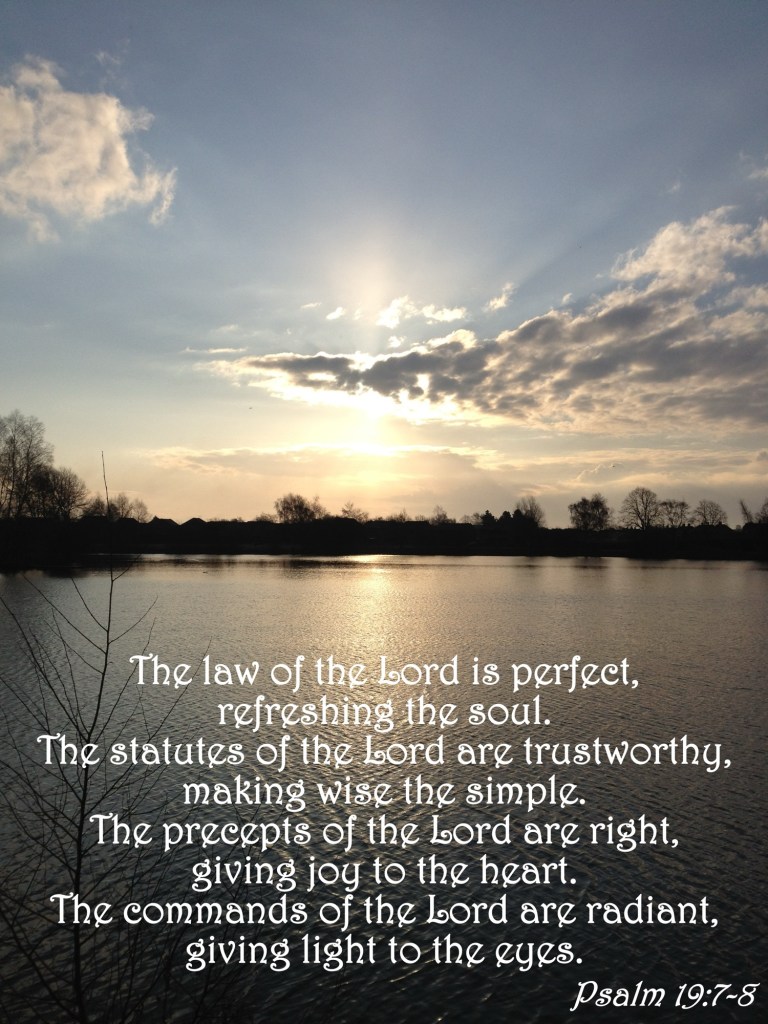
However, at this point the focus changes to Torah. The psalmist expresses a consistently positive attitude towards Torah in verses 7–14. Those verses contain a ringing affirmation of the Torah as “perfect, reviving the soul … sure, making wise the simple … right, rejoicing the heart … clear enlightening the eyes … pure, enduring forever … true and righteous altogether … more to be desired than gold … sweeter also than honey” (Ps 19:7–14).

The terms used here in parallel to describe Torah (law, decrees, precepts, commandment, fear, ordinances) are found regularly in the narrative books to describe the collection of laws (Deut 8:11; 11:1; 1 Ki 2:3; 6:12; 8:58; 2 Ki 17:34–37; 1 Chron 22:13; 28:17; Neh 9:13; 10:29) as well as right throughout Psalm 119. See

Such affirmations of Torah sound out insistently throughout the majestically grand doublets of the longest psalm, Psalm 119. The 176 verses of this psalm, artistically arranged into acrostic stanzas of eight verses at a time, are bracketed by delight and confidence (“happy are those … who walk in the way of the Lord … I long for your salvation, O Lord, and your law is my delight”, vv.1, 174). This psalm indicates that the Law shapes the way that the covenant is kept; and the covenant gives expression to the steadfast love and grace of God.

*****

So much is Torah valued, that it apparently offers perfection: “the law of the Lord is perfect” (Ps 19:7), which we might compare with “I have seen a limit to all perfection, but your commandment is exceedingly broad” (Ps 119:96). In this regard, the psalmist’s appreciation for Torah as perfection seems to reflect the priestly desire for people to offer perfect sacrifices, without blemish (Lev 22:21), and Solomon’s desire to build the Temple as a perfect house for God (1 Ki 6:22).

Indeed, such a conception of perfect Torah also resembles the sage’s musings regarding Wisdom: “to fix one’s thought on her is perfect understanding” (Wisdom 6:15), and thoughts found in a prayer attributed to Solomon: “even one who is perfect among human beings will be regarded as nothing without the wisdom that comes from you” (Wisdom 9:6).

Much value is accorded to these words of Torah. As well as calling the law “perfect”, we hear that “the decrees of the Lord are sure” (Ps 19:7), a claim echoed in another psalm (Ps 93:5). The precepts of the Lord that are right (Ps 19:8; see also 119:75, 137, 172) means that one who is faithful and obedient will be led “in right paths” (Ps 23:3) as they pray “put a new and right spirit within me” (Ps 51:10). “The commandment of the Lord is clear” (Ps 19:8) is a claim that informs the later portrayal of those who trace the course of Wisdom “from the beginning of creation … [who] make knowledge of her clear” (Wisd Sol 6:22).

The psalmist extends the adoration of the Law, declaring that “the fear of the Lord is pure” (Ps 19:9), a claim extended in another statement found in wisdom texts, “the fear of the Lord is the beginning of wisdom” (Ps 111:10; Prov 1:7; 9:10; 15:33; Sir 1:18, 27; 19:20). A further elaboration, “the ordinances of the Lord are true and righteous altogether” (Ps 19:9), is the way that Ezra describes the laws given to Moses on Mount Sinai (Neh 9:13). They are righteous (Ps 119:7, 62, 106, 160, 164), good (119:39), the basis of hope (119:43) and comfort (119:52).

The closing affirmation in this shorter psalm, “more to be desired are they than gold, even much fine gold; sweeter also than honey, and drippings of the honeycomb” (Ps 19:10), is echoed in the longest psalms, “how sweet are your words to my taste, sweeter than honey to my mouth!” (Ps 119:103).

By contrast, when Job asks, “where shall wisdom be found? and where is the place of understanding?”, he proposes that “gold and glass cannot equal it, nor can it be exchanged for jewels of fine gold” (Job 28:12–19), and concludes, “the fear of the Lord, that is wisdom; and to depart from evil is understanding” (Job 28:28).

Wisdom, love, the fear of the Lord, enlightenment, and rejoicing—these are the fruits of Torah, as the psalmist sings. These are the benefits of the law which are to be valued even into our own times, as this Sunday we hear again the words of this ancient psalm and affirm its relevance and importance in the contemporary world.

With Love to the World for Lent and Easter 2024

The latest issue of the daily Bible reading resource, With Love to the World, is currently being distributed tcsubscribers. It features a stunning wraparound cover photograph of “Reflection at Circular Pool”, taken at Walpole, WA, by Steph Waters of Perth.

Steph offers her own reflection on the significance of the seasons of Lent and Easter, which are the focus of this particular issue. I’ve included an introduction to each season in the opening pages of this issue, and the issue concludes with a wonderful poem on resurrection, “Seasons gone south”, by Alison Bleyerveen of Sydney.

With Love to the World has always sought to provide a resource which assists worshippers to come to Sunday worship with an awareness of the Bible passages they will hear read and proclaimed. So each day has not only a succinct commentary on a biblical passage, but also a prayer, a song, and a question for discussion, all related to the day’s passage. This means that Sunday worshippers will hear more acutely and respond more directly to the scripture in focus.

The writers of these commentaries in this issue are all experienced in pastoral ministry, and so as they reflect on the daily passage, they bring their theological training as well as their engagement in pastoral ministry to bear on what the passage is saying. In keeping with the commitment of With Love to the World, the writers are drawn from Asian, Pasifika, Maori, South African, and Anglo-Australian heritages.

Yvonne, Peter, Radhika, Simon, Jason, Alimoni, and Rob (and yours truly) each write with the intention of drawing from scripture ideas and provocations that are expressed in an accessible way. They write so that the the faith of their readers is deepened and their discipleship is strengthened.

As always, as Editor, I have a number of complimentary copies to distribute to encourage new subscribers. Please send me a direct message if you (a) would like to sample With Love to the World for yourself, or (b) know of a friend or someone in your congregation who might be interested in sampling an issue. I can mail them direct to you or to the person you nominate. (Please include your mailing address in your message to me.)

In addition, you can take out an annual subscription to With Love to the World on your phone or iPad via an App, for just $28 per year. (That’s just 54 cents a week, or seven and a half cents a day!) Search for With Love to the World on the App Store, or UCA—With Love to the World on Google Play. For the hard copy resource, for just $28 for a year’s subscription, email Trevor at wlwuca@bigpond.com or phone +61 (2) 9747-1369.

Stereotyping Jesus: coming home in Mark 6 (Narrative Lectionary for Epiphany 5)

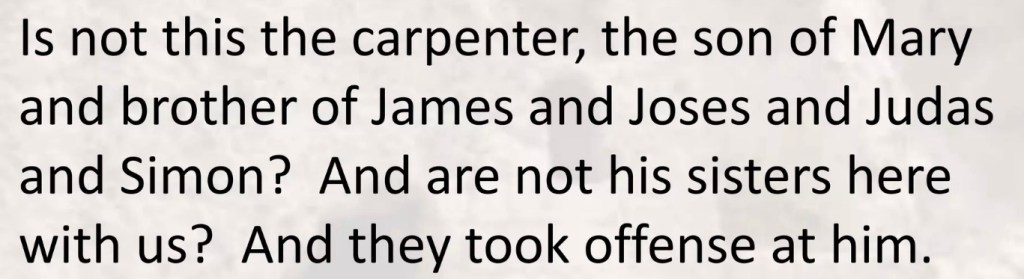
The offering from the narrative lectionary this coming Sunday (Mark 6:1–29) begins with the scene where Jesus goes to the synagogue in his hometown, Nazareth (6:1–6) and is rejected by those who “took offence at him” (6:3). Although he spoke with wisdom and performed acts of power (6:2), he is scorned as merely “the carpenter, the son of Mary and brother of James and Joses and Judas and Simon … and his sisters, here with us” (6:3).

You can imagine the murmurs amongst the people of the town. “He was not the eloquent preacher. Not the erudite teacher. Not the compassionate healer. Not the dazzling miracle-worker. Just plain old Jesus, the carpenter, from a local family. Nothing to look at here. Nothing of importance. A nobody, really. But he has pretensions. And we can’t stand for that, can we?”

Perhaps I’m being a little harsh on the townsfolk? Perhaps there is more to Jesus than they recognised, and perhaps Mark’s narrative might indicate that it is not wise to stereotype Jesus, as they were doing?

Earlier in his narrative, Mark has told of an encounter that Jesus had with his family when he came out of a house in Capernaum (3:20). Some onlookers in Capernaum describe him as being “out of his mind” (ἐξέστη, 3:21). This is a term that literally means that he was “standing outside of himself”, as if in a kind of dissociative state. It may be that this was the reason that Jesus was returning to his family?

The encounter doesn’t go well, however. Scribes have come from Jerusalem. They have already been antagonistic towards Jesus, questioning whether Jesus was blaspheming (2:6–7), and casting doubts on his choice of dinner guests (“why does he eat with tax collectors and sinners.”, 2:16). There will be further disputation with scribes (7:1–5; 9:14; 12:28, 38–41) and they will be implicated in the plot to arrest Jesus (11:18, 27; 14:1, 43, 53; 15:1) and in his death (8:31; 10:33).

These scribes—hardly friends—articulate what others present may well have been thinking: “he has Beelzebul” (3:22). The charge of demon possession correlates with the accusation levelled at John 10:20. It appears to have been one way that Jesus was stereotyped by others.

Beelzebul (Βεελζεβοὺλ), “the ruler of the demons”, is known from earlier scriptural references to Baal-zebub in 1 Kings 1:2–6, 16, where he is described as “the god of Ekron”, a Philistine deity. There is scholarly speculation that Beelzebul may have meant “lord of the temple” or “lord of the dwelling”, from the Hebrew term for dwelling or temple (as found at Isa 63.15 and 1 Kings 8.13); or perhaps it was connected with the Ugaritic word zbl, meaning prince, ruler.

Jesus refutes the charge in typical form, by telling a parable (3:23–27) that ends with the punchline about “binding the strong man” (τὸν ἰσχυρὸν δήσῃ). This potent phrase encapsulates something that sits right at the heart of the activities of Jesus in Galilee—when he encounters people who are possessed by demons, and when he casts out those demons, he is, in effect “binding the strong man”.

The notion that a demon would bind the person that they inhabited is found at Luke 13:16, and in the book of Jubilees (5:6; 10:7-11). The book of the same title by Ched Myers provides a fine guide to reading the whole of Mark’s Gospel through this lens (see https://chedmyers.org/2013/12/05/blog-2013-12-05-binding-strong-man-25-years-old-month/)

The accusation that refers to “blasphemy against the Holy Spirit” (3:29) may well reflect the stereotype that Jesus was demon-possessed (3:30). That stereotyped view of Jesus cannot be allowed to stand, for it cannot be justified in any way—at least, in Mark’s view.

So we see that there was dispute about Jesus, even beyond his hometown of Nazareth. There were those who sought to stereotype him in a negative way.

So Jesus goes to his hometown, with his disciples, and participates in the local synagogue on the sabbath. What do we know of his status in his hometown?

“In those days Jesus came from Nazareth of Galilee and was baptized by John in the Jordan” (Mark 1:9) is how Jesus is introduced in this Gospel. Mark takes us straight to the adult Jesus, bypassing the newborn infant who appears in other narratives. There is no explanation of his background; no stories from his childhood, to show the nature,of his character (such as were common in biographies written by educated folks in the Hellenistic world).

There is certainly no mention of Bethlehem, nor the rampage of Herod; nor any reference to magi travelling from the east, bearing gifts; nor to a census ordered under Quirinius, necessitating short-term accommodation. There is no story of the infant Jesus at all—and most strikingly, no mention of Mary and Joseph as the parents of Jesus in the opening scenes of this earliest Gospel.

Rather, in Mark’s narrative reporting the beginning of the good news about Jesus, the chosen one, Jesus explicitly distances himself from his family. “Who are my mother and my brothers?”, he asks, when confronted by scribes from Jerusalem and labelled as “out of his mind” by his own family (Mark 3:21, 33).

In this week’s passage, the people of his hometown (Nazareth) do not identify as “son of Joseph”—only in John’s book of signs do his fellow-Jews identify him as “son of Joseph” (John 6:42). So it is up to Luke and Matthew, each in their own way, to link Jesus, as a newborn, to these parents.

In Mark’s account of the scene when the adult Jesus returns to his hometown, he is “the carpenter, the son of Mary” (6:3). This is the only time that the name of his mother appears in this earliest account of Jesus; and there is simply no mention, by name, or by relationship, of his putative father. (Some scribes later modified this verse (Mark 6:3) to refer to him as “son of the carpenter and of Mary”, to align Mark’s account with how Matthew later reports it at Matt 13:55.)

Other than this one reference, Mark makes no reference to Jesus’s parents. He is simply, and consistently identified as “the son of God” (Mark 1:1; 3:11; 5:7; 9:7; 15:39). On one occasion, he is addressed as “son of David” (10:47–48; although this description is the subject of debate at 12:35–37).

More often, in this earliest of Gospels, using a term taken from Hebrew Scripture, Jesus refers to himself, or others refer to him, as “the son of humanity” (more traditionally translated as “the son of man”) (2:10, 28; 8:31, 38; 9:9, 12, 31; 10:33, 45; 13:26; 14:21, 41, 62; see Ezek 2:1, 8; 3:1, 4, 16; etc; and Dan 7:13). The origins and identity of Jesus, in Mark’s eyes, relate more to the larger picture—of his Jewish heritage, in his relationship to the divine, and with his role for all humanity—than to the immediacy of parental identification.

Mark ensures that we grasp this larger picture of Jesus in the way he presents Jesus. He also indicates that it is not proper to stereotype Jesus, describing him in demeaning terms, objectifying him as problematic or as “other”. It is a practice that we would do well to emulate in our relationships with others. And in considering Jesus, we should push beyond the stereotypes to discover the person who Jesus really is.

The man was convulsing and crying; the people were astounded and amazed (Mark 1; Epiphany 4B)

In earlier posts on the Gospel of Mark, on passages that are proposed by the lectionary during the season of Epiphany, we have seen that Mark tells of the beginning of the good news of Jesus, chosen one, with stories in which Jesus is commissioned for his role (1:12–13), announces his message (1:14–15), and calls people to follow him (1:16–20). It is a strikingly energetic start to his narrative.

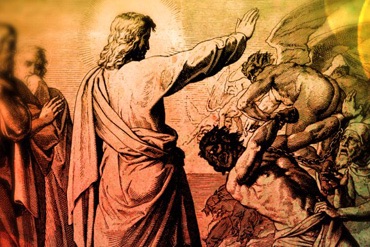
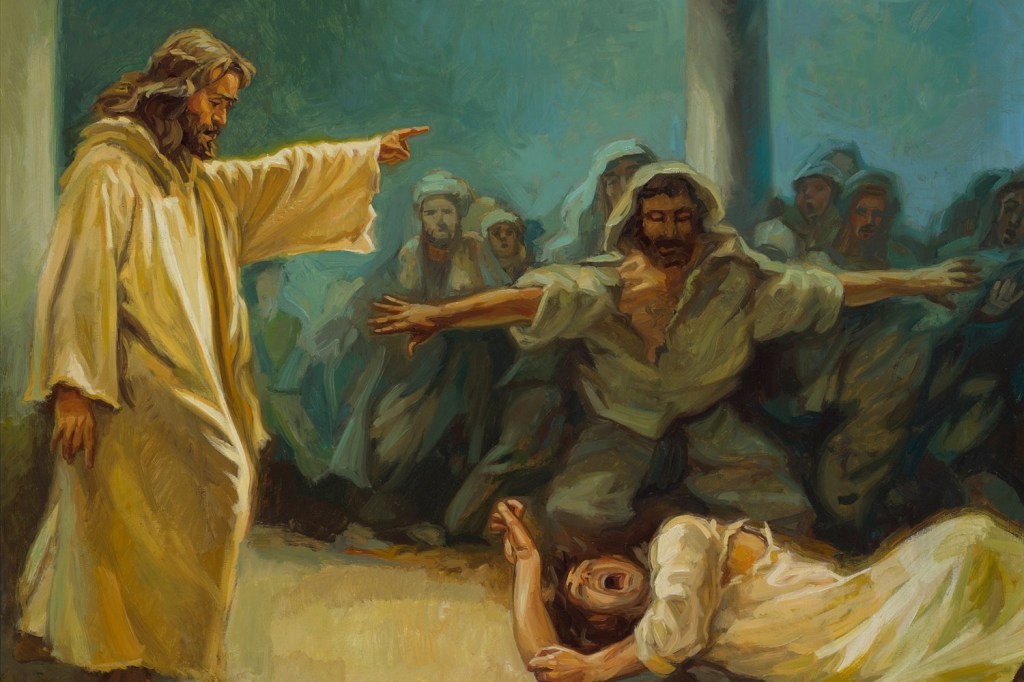
After these scenes Mark takes us to a scene in a synagogue, where he reveals the authority that Jesus had, in calling people, to command “the unclean spirit, convulsing him and crying with a loud voice, [to] come out of him” (Mark 1:21–28). This is offered by the lectionary as the Gospel for the fourth Sunday after Epiphany.

The initial impression of the people in the synagogue regarding Jesus is positive; they were “astounded at his teaching” (1:22). Teaching is one of the key characteristics of the activity of Jesus (4:2; 6:6, 34; 8:31; 9:31; 11:17; 12:14, 35). In Galilee, “he went about among the villages teaching” (6:6); in Jerusalem, “day after day I was with you in the temple teaching”, Jesus tells the crowd in the Garden of Gethsemane (14:49).

However, we have not heard anything of the teaching of Jesus at this early point in Mark’s narrative; detailed teaching will come later, in parables beside the sea (4:1–34), in Genessaret (6:53—7:23), on the road to Jerusalem (8:31–38), in Judea (10:1–16), in the temple forecourt (11:27—12:24), and on the Mount of Olives opposite the temple (13:3–37). This synagogue scene in Capernaum is thus the first glimpse of the power of Jesus’ words.

The polemic that will dog Jesus all the way through his public activities is signalled in this synagogue scene. The people in the synagogue were astounded at his teaching “for he taught them as one having authority, and not as the scribes” (1:22). Those scribes will be seen in conflict with Jesus in subsequent scenes; in Capernaum (2:1–12), in the house of Levi son of Alphaeus (2:13–17), in Nazareth (3:19–35), in Genessaret (6:53–7:23), in Galilee (9:14), and in Jerusalem (11:18, 27). Eventually they join with the priests (1:1) and then with the earlier conspirators, Pharisees and Herodians (3:6) to implement the plot “to arrest Jesus by stealth and kill him” (14:1).

By the end of the scene, the people have become even more convinced; Mark says that they are amazed, and are asking, “what is this? a new teaching—with authority! he commands even the unclean spirits, and they obey him” (1:27). The response of amazement occurs also when Jesus heals a paralyzed man (2:12), when the demoniac from the Gerasene tombs declares “how much Jesus had done for him” (5:20), and when he confounded the Pharisees and Herodians with his clever riposte (12:17).

The disciples, walking on the road to Jerusalem, are amazed with the response that Jesus gives to a comment by Peter (10:28–32); as was Pilate, when he presses Jesus to respond to the charges brought against him, but “Jesus made no further reply, so that Pilate was amazed” (15:5).

This synagogue scene not only places Jesus into conflict with the scribes; it also defines the cosmic dimension in which the story of Jesus is set, as he grapples with unclean spirits (1:23–26; 3:11; 5:1–13; 6:7; 7:14–29), also identified as demons (7:24–30; 1:32–34, 39; 3:14–15, 22; 5:14–18; 6:13; 9:38). Jesus is a human being, situated in first century occupied Palestine—but he is engaged in a contest in a cosmic dimension.

Ched Myers offers a compelling interpretation of the scene in the synagogue: “The synagogue on the Sabbath is scribal turf, where they exercise the authority to teach Torah. This “spirit” personifies scribal power, which holds sway over the hearts and minds of the people. Only after breaking the influence of this spirit is Jesus free to begin his compassionate ministry to the masses (1:29ff).”

See https://radicaldiscipleship.net/2015/01/29/lets-catch-some-big-fish-jesus-call-to-discipleship-in-a-world-of-injustice-2/, and the complete commentary on Mark by Ched Myers, Binding the Strong Man: A Political Reading of Mark’s Story of Jesus (Maryknoll: Orbis, 1988).

We may be tempted, today, to look at the way that Jesus operated in these scenes of conflict with “unclean spirits” or “demons” who had possessed a person, and dismiss them as primitive attempts to explain what we now understand as mental illnesses. The many developments in psychology over the last century have certainly enabled us to have a better appreciation of the way the human mind works, and how it meets challenges and disruptions. People possessed by spirits or demons may simply have been people suffering trauma, epilepsy, or psychosis, for instance. And so, we may be tempted to dismiss these exorcisms as unbelievable miracles.

But the approach that Myers takes invites us to give more sober consideration to the structural and societal factors that were at work in these stories. The activity of Jesus was not simply relating to individuals; he was sending a signal to the leaders of his society, confronting them with some of the unpleasant dysfunctions that were the realities for common people living under foreign oppression.

What has generated this conflict from the authorities, and this amazement from the people? It is what Jesus does in the synagogue, when he meets “a man with an unclean spirit” (1:23), who cries out, “what have you to do with us, Jesus of Nazareth?”, then accuses him, “have you come to destroy us?” (1:24).

Destroy is a very strong word. It is used to describe the conspiracy that is afoot against Jesus from early in the Gospel—after some Pharisees watch Jesus heal a man with a withered hand, and “the Pharisees went out and immediately conspired with the Herodians against him, how to destroy him” (3:6).

And Jesus himself uses this term in a parable, to describe what the owner of the vineyard will do after the tenants kill the slaves, and even the son, sent to them by the owner (12:9). Since the audience of Jerusalem authorities recognise that Jesus “had told this parable against them” (12:12), it is clearly directed at the scribes and other authorities (cf. 11:27).

So, paradoxically, the man with an unclean spirit is aligned with those charged with the responsibility of overseeing the Holiness Code and ensuring that people are “clean”—the scribes and Pharisees, and especially the priests—in articulating this aggressive conflict with Jesus.

And yet, also paradoxically, this unclean man reveals a key matter about Jesus, when he continues, saying, “I know who you are, the Holy One of God” (1:24). It is the spirits and demons in Mark’s narrative who have this insight (see also 3:11; 5:7).

The man calls Jesus “Holy One”. This is a term applied to God in the writings of Hebrew Scripture (Ps 71:22; 78:41; 89:18; Prov 9:10; Job 6:10; Sir 4:14; 23:9; 53:10; 47:8; 48:20) and also by the Prophets (Isa 1:4; 5:19, 24; and a further 24 times; Jer 50:29; Ezek 8:13; Hos 11:9, 12; Hab 1:12; 3:3). It is a central element of who God is, and a key factor in understanding Jesus.

Of course, Holiness was a central element of piety in ancient Israel, exemplified by the Holiness Code of Leviticus (Lev 11:44–45; 19:2; 20:7–8; see also Deut 7:6; 14:2, 21; 28:9). But this man, possessed by an unclean spirit and therefore not in a state of holiness, is able to speak the truth about Jesus as “the Holy One of God”. He was on the edge of society, and yet he was able to perceive a central reality about Jesus and his society. Perhaps it might be our experience, that people on the edge of society are able to see things with a clearer perspective, and illuminate central,realities of society in our time?

Mark indicates that when Jesus instructs the spirit to “be silent, and come out of him!” (1:25), the man is “convulsing him and crying with a loud voice” (1:26). Convulsions caused by a spirit leaving a possessed person are evident also in the scene immediately after the Transfiguration of Jesus, when that spirit “convulsed the boy, and he fell on the ground and rolled about, foaming at the mouth” (9:20).

Such convulsions may perhaps have been associated, in the mind of first century Jews, with King Saul, after he has been defeated by the Philistines (1 Sam 31:1–3). Sensing what this meant for him, Saul took his own life (1 Sam 31:4). One of Saul’s troops escaped the battle; he recounted to David how Saul had implored that man, “come, stand over me and kill me; for convulsions have seized me, and yet my life still lingers” (2 Sam 1:9).

In the modern mind, these convulsions are known to be a part of the medical condition of epilepsy, so we assume that both Saul, the spirit-possessed people in Capernaum, and the spirit- possessed boy in Galilee, were each afflicted with this condition. The healing that Jesus performs appeared impressive to those present; “he commands even the unclean spirits, and they obey him” (Mark 1:25–26).

Yet, curiously, the acclamation of the crowd relates, not to the healing powers of Jesus, but to his words of instruction: “what is this? a new teaching—with authority!” (1:27). Neither the details of this teaching, nor the actual process of drawing out the spirit, are recounted in this scene; simply, “Jesus rebuked him” (1:25). It is from this time that “his fame began to spread throughout the surrounding region of Galilee” (1:28).

And so Jesus is followed by crowds in Galilee (2:4, 13; 3:9, 20, 32; 4:1, 36; 5:21–34; 6:34, 45; 7:14, 17; 8:34; 9:14–17, 25), in the Decapolis (7:33; 8:1–9), in Jericho (10:46), and in Jerusalem (11:8, 18, 32; 12:12, 37). The tragedy of the last days of Jesus is acted out in front of crowds of people, when he is arrested (14:43) and brought before Pilate (15:6–15); by implication, numbers of people witness his crucifixion (15:29–32, 40–42).

But the crowds in Capernaum, early in his public ministry, have witnessed him at the height of his powers. And the man in the synagogue, impaired by his condition, has taken us right to the heart of who Jesus is, and what he is doing as he travels around Galilee.

Fishing for people: not quite what you think! (Mark 1; Epiphany 3B)

Jesus said to them, “Follow me and I will make you fish for people” (Mark 1:17). That’s the famous verse in the Gospel reading that is suggested for this coming Sunday, the third Sunday in the season of Epiphany. They are striking words, coming at the very start of the public activity that Jesus undertook in the region of Galilee (see Mark 1:28, 39; 6:6b, 56; 9:30).

What do you think of when you hear these words? Perhaps you are guided by many sermons you have heard and devotional material you have read, and so you imagine that Jesus is calling his earliest followers to participate in the mission that he has in view for his life and for those who follow him? After all, at a crucial point in his ministry, he sent his earliest followers through the villages of Galilee with a message of proclamation (6:12).

Inspired by this instruction, and despairing at the lack of a satisfactory conclusion to this shortest of Gospels, one scribe later added a “longer ending” that concludes by re-affirming this missionary orientation: “they went out and proclaimed the good news everywhere, while the Lord worked with them and confirmed the message by the signs that accompanied it.” (This appears as Mark 16:20 in many Bibles today.)

In like manner, another scribe provided a much more succinct “shorter ending”, declaring that “Jesus himself sent out through them, from east to west, the sacred and imperishable proclamation of eternal salvation.” (The language is most un-Markan—just one of the clues that this ending was a later addition to the Gospel.)

This line of interpretation is fostered, no doubt, by the fact that other Gospels frame their accounts of the life of Jesus with statements about his missional directives. “As you go, make disciples of all nations, baptizing them … and teaching them …” is how Matthew ends his Gospel (Matt 28:19)—leading multiple interpreters to regard the visit of the Magi from the east (Matt 2:1–12) as a prefiguring of this mission. (I have a different take on the role played by the Magi.)

Luke is more forthright from the start of his “orderly account”. Inspired by the Spirit as he lays eyes on the infant Jesus, the aged Simeon tells his parents, “my eyes have seen your salvation, which you have prepared in the presence of all peoples, a light for revelation to the Gentiles and for glory to your people Israel” (Luke 2:30–32). Decades later, as he reports the activity of John the baptiser, the author includes the affirmation that “all flesh shall see the salvation of God” (Luke 3:6, quoting Isa 40:5).

Luke ends his account with Jesus telling his followers that “repentance and forgiveness of sins is to be proclaimed in his name to all nations, beginning from Jerusalem” (Luke 24:47). He then begins the second volume of his account with Jesus commissioning these followers, “you will be my witnesses in Jerusalem, in all Judea and Samaria, and to the ends of the earth” (Acts 1:8). The missionary impulse is clear.

These passages play a large role in shaping our understanding of the words and activities of Jesus as being oriented strongly towards mission. Certainly, that was a key impulse as the followers of Jesus grew and the faith gatherings that were established made inroads into their local communities with the message of the good news. But is that what is going on in the excerpt from Mark (1:14–20) that we will hear this Sunday? Let me offer some different thoughts.

(The direction that I have taken in the comments below has been inspired by a short commentary by Chad Bird, in his daily devotional book, Unveiling Mercy, pub. 2020.)

Was Jesus focussed on a world-wide mission from the very start? I want to propose that Mark’s account—the earliest “story of Jesus” that we have—does not suggest this. Not only is there no “mission commission” at the end of his Gospel, if we accept the earliest manuscripts do not include this; there is no call to mission anywhere in his narrative.

It is true that in chapter 6, Mark notes that the disciples are sent out to proclaim repentance; but this does not build through the following chapters into a persistent and expanding mission. In fact, in Mark’s narrative, rather than being empowered for mission, the disciples remain ignorant and unknowing.

“Do you not understand this parable?”, Jesus has asked them as he was teaching, continuing, “Then how will you understand all the parables?” (4:13). A little later, Mark notes that “they did not understand about the loaves, but their hearts were hardened” (6:52). Mark reinforces this view of the disciples as he reports Jesus asking them, “do you also fail to understand?” (7:17), then “do you still not perceive or understand?” (8:17) and “do you not yet understand?” (8:21), before concluding “they did not understand what he was saying and were afraid to ask him” (9:32). The disciples, in Mark’s narrative, remain unrelentingly obdurate. So much for the idea of energetic, enthusiastic missionaries!!

Jesus, according to Mark, is not intent on developing a crack mission team. Rather, he is focussed on calling people to metanoia—to a full, deep, all-pervading change of being that reorients their lives and resets their priorities. The first word of Jesus in Mark’s early account is clear: “the time is fulfilled, and the kingdom of God has come near; repent (metanoeite) and believe (pisteuete) in the good news” (1:15).

In this programmatic Markan announcement, the two statements (in the indicative mood) about “the time” and “the kingdom” are followed by two commands (in the imperative mood) to “repent” and “believe”. The imminence of the kingdom is the motivation for the call to repent and believe.

This fourfold declaration sits immediately before the story of the call of the fishermen, who are called to follow and told, “I will make you fish for people” (1:17). It is the imperative of metanoia and pistis that is at the heart of the enterprise that Jesus is engaged in. It is this dual imperative that should most strongly inform the way that we hear and understand the call to “fish for people”.

Fish are referenced in Hebrew Scripture texts on a number of occasions. Along with “every animal of the earth, and every bird of the air, and everything that creeps on the ground”, all the fish of the sea are integral to God’s created world (Gen 1:26, 28; 9:2; Deut 4:17–18; 1 Ki 4:33; Job 12:7–8; Ps 8:7–8; Ezek 38:20; Hos 4:3). But the Markan text is not quite about the fish of the sea; rather, the language of fishing is used as a metaphor for what Jesus is calling his disciples to undertake.

The prophet Jeremiah displays this kind of use of language, with metaphorical references to describe a known process. After he has warned Israel that the Lord God is “weary of relenting” and is now determined to bring punishment on a sinful people (Jer 15:2–9), he envisages that there will come a time when he “will bring them back to their own land that [he] gave to their ancestors” (Jer 16:15).

However, before this occurs, God makes this threatening promise: “I am now sending for many fishermen, says the Lord, and they shall catch them; and afterward I will send for many hunters, and they shall hunt them from every mountain and every hill, and out of the clefts of the rocks … I will doubly repay their iniquity and their sin, because they have polluted my land with the carcasses of their detestable idols, and have filled my inheritance with their abominations” (Jer 16:16–18). The men looking to catch fish, and the hunters looking to catch miscreants, are carrying out the work of the Lord God, bringing judgement on the people.

Is this the task that Jesus is calling his followers to undertake, when he says, “I will make you fish for people”? Centuries earlier than Jeremiah, Amos had warned the “cows of Bashan who are on Mount Samaria” of the punishment in store for them: “the time is surely coming upon you, when they shall take you away with hooks, even the last of you with fishhooks” (Amos 4:1–2).

A little later, Habakkuk uses similar imagery as he complains to God, “you have made people like the fish of the sea, like crawling things that have no ruler; the enemy brings all of them up with a hook; he drags them out with his net, he gathers them in his seine; so he rejoices and exults” (Hab 1:14–15). This is the way that God undertakes his task of “destroying nations without mercy” (Hab 1:17). To fish for people is to execute God’s righteous judgement.

Consistent with this understanding, the prophet-in-exile, Ezekiel, is charged with proclaiming this oracle of judgment against the Pharaoh of Egypt: “I will put hooks in your jaws, and make the fish of your channels stick to your scales. I will draw you up from your channels, with all the fish of your channels sticking to your scales. I will fling you into the wilderness, you and all the fish of your channels; you shall fall in the open field, and not be gathered and buried.” (Ezek 29:4–5). Once again, in the prophetic rhetoric, the metaphor of fishing for a human being indicates the means of carrying out the judgement of God.

Is Jesus, in Mark’s Gospel, engaged in a mission to declare divine judgement and warn of the wrath to come? Most certainly he is! Indeed, the instruction that he gives his disciples as he sends them out on mission (Mark 6:7–11) appears to be that they are to preach judgement; Mark comments that “they went out and proclaimed that all should repent” (6:12). Such repentance is the foundation of the message of Jesus (1:15; cf. 4:12).

Repentance, metanoia, entails a complete and thoroughgoing transformation of the individual, in light of the imminent appearance of God’s realm (1:14; 9:1; 14:25). This apocalyptic orientation (“the kingdom is coming, and coming soon”) governs the distinctive flavour of the preaching of Jesus, which is apocalyptic in that it is oriented towards the message of divine judgement. The coming kingdom of God, and the present need for metanoia, together show this clear orientation.

That Jesus expected God to act, to intervene in history, to redeem the faithful, is evident in his teaching: people will see “‘the Son of Man coming in clouds’ with great power and glory” (Mark 13:26, quoting Dan 7:13). Indeed, the expectation is that this will be very soon: “there are some standing here who will not taste death until they see that the kingdom of God has come with power” (Mark 9:1) and “this generation will not pass away until all these things have taken place” (13:30). So he warns his followers to “beware … keep alert … keep awake” (13:33, 35, 37).

There is no doubt that the Jesus portrayed in each of the Synoptic Gospels was an apocalyptic preacher with a fervent presentation of an intense message. It required a whole-hearted and equally intense response. “Follow me” is his clarion call (1:17; 2:14). Such following means that they must “deny themselves and take up their cross” (8:34); it is akin to losing their own lives (8:35–37).

No wonder when Jesus called one man in Judea to “sell what you own, and give the money to the poor … then come, follow me”, we are told that “he was shocked and went away grieving” (10:21–22). It is equally unsurprising that people in Galilee were saying of him, “he has gone out of his mind” and “he has an unclean spirit” (3:21, 30). Following Jesus was not for the faint hearted! Mark makes this clear; Matthew and Luke each intensify this in their portrayals of Jesus.

On the apocalyptic preaching of Jesus in Mark, see

and

So the call to “follow me” and the indication that “I will make you fish for people” (Mark 1:17) is intense. Fishing for people, if we understand it in the light of the Hebrew scriptural usage of this idea, is an apocalyptic enterprise, which means undertaking the daunting task of announcing the imminent judgement of God, calling those who listen to a complete life-transforming metanoia, and letting them know that “life as you once knew it is over”, as Chad Bird says (Unveiling Mercy, 11 Nov).

Here I am; speak, for your servant is listening (1 Sam 3; Epiphany 2B)

Next Sunday is the second Sunday in the season of Epiphany. The word epiphany refers to the manifesting of light, the shining forth of revelation. It is applied to this season, which follows on from Christmas, and is initiated by the story of “the star in the east” told in Matthew 2:1-12.

The birth of Jesus, and the story of the Magi following the star, signals the early Christian belief that God was acting in a new way through this child. The Magi come from the east, following the star, to pay homage to the infant Jesus. Light is of symbolic significance in this story, as is the theological claim that the child Jesus provides a revelation of God.

Throughout the five Sundays of Epiphany, as indeed throughout much of the year, we hear and read the stories contained in the earliest account of Jesus, the beginning of the good news of Jesus, which we know more typically as the Gospel according to Mark. During these five Sundays, we will hear and read most of the opening chapter of this Gospel (with a detour this coming Sunday to the first chapter of John’s Gospel).

Alongside these Gospel excerpts, the passages set by the lectionary from the Hebrew Scriptures for the season of Epiphany have been carefully chosen. These passages illuminate the message of the Gospel which we hear each week from the New Testament, as we celebrate Christ as the light that comes into the world, illuminating and enlightening.

This week, we hear the story of the call of Samuel to be a prophet of the Lord (1 Sam 3:1–20). We may think of prophets as loud and assertive, boldly proclaiming their “word of the Lord” in the marketplace; but today we learn that Samuel was different. In this story, he is marked by obedience and an openness to listen.

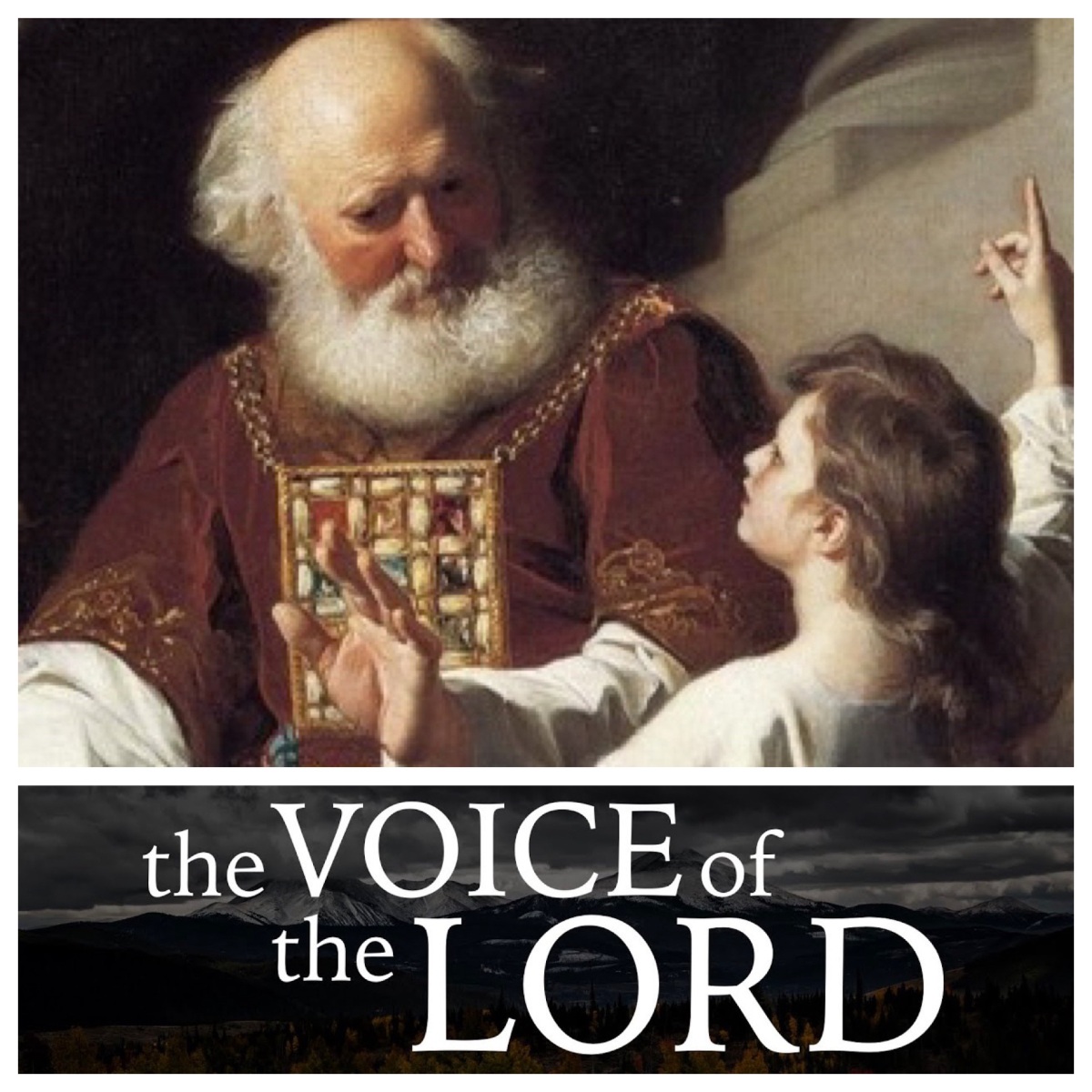
Young Samuel was in the temple, where the elderly Eli was priest. In the evening, while the lamp was still burning, Samuel hears a voice. The voice simply calls his name. “Here I am”, Samuel responds when he hears that voice. He is sure that it is Samuel,speaking to him—there is nobody else around. Three times, he hears “Samuel”; and three times, he responds “here I am” (vv.4,6,8).

Samuel had been thinking that it was Eli speaking to him; but it was not the priest, it was the voice of the Lord. The story conveys a sense of confusion and unknowing. This reflects something of the uncertainty that people of faith often have with regard to “hearing the voice of the Lord”.

Indeed, the fragility of living by faith without clear and obvious demonstration of he presence of God is signalled in the opening verse: “the word of the Lord was rare in those days; visions were not widespread” (v.1). The poor vision of the elderly priest, Eli (v.2), is a second signal of this uncertainty. The priest cannot see; the child hears but does not understand.

Paying attention to the voice of the Lord is a persistent refrain in Hebrew Scriptures. Indeed, the psalmist rejoices in the clarity of God’s voice: “the voice of the Lord is over the waters; the God of glory thunders, the Lord, over mighty waters; the voice of the Lord is powerful; the voice of the Lord is full of majesty” (Ps 29:3–4). Yet another psalmist recalls the time, in the wilderness, when the people of Israel “grumbled in their tents, and did not obey the voice of the Lord” (Ps 106:25). The people were not always faithful, even though the voice sounded with clarity. They needed reminders of that voice.

In the foundational saga of Israel, Moses is called by the voice of God while tending sheep on Mount Horeb (Exod 3:4). In obedience, he leads the people to freedom—and then informs the people, “if you will listen carefully to the voice of the Lord your God, and do what is right in his sight, and give heed to his commandments and keep all his statutes”, then God promises not to inflict them with disease (Exod 15:26). Later, when Moses has delivered to them “all the words of the Lord and all the ordinances”, the response of the people is an affirmative “all the words that the Lord has spoken we will do” (Exod 24:3).

A number of the prophets indicate that they are impelled to declare “the word of the Lord” to a sinful people because they have heard, and are obedient to, “the voice of the Lord”. Isaiah hears the voice of the Lord calling him: “whom shall I send, and who will go for us?” (Isa 6:8). Isaiah is given words of woe to pronounce over the people (Isa 6:9–13); he warns the leaders of Israel, “listen, and hear my voice; pay attention, and hear my speech” (Isa 28:23).

His fellow-southerner, the shepherd Amos, opens his words with the bold declaration, “the Lord roars from Zion, and utters his voice from Jerusalem” (Amos 1:2), before he launches into his long series of oracles against the surrounding nations (Amos 1:3—2:3) and then against Judah and Israel (Amos 2:4–16).

The image of the Lord God as a roaring lion is used also by Joel, “the Lord roars from Zion, and utters his voice from Jerusalem, and the heavens and the earth shake” (Joel 3:16), while in another oracle he says, “the Lord utters his voice at the head of his army; how vast is his host!” (Joel 2:11).

Joel’s words of judgement penetrate to the heart of the evil of the people: the coming day will be “a day of darkness and gloom, a day of clouds and thick darkness!” (Joel 2:2), and so he calls the people to “return to [the Lord] with all your heart, with fasting, with weeping, and with mourning; rend your hearts and not your clothing” (Joel 2:12–13).

Micah also declares, “the voice of the Lord cries to the city (it is sound wisdom to fear your name)” (Mic 6:9) before he lambasts the people for their wickedness: “your wealthy are full of violence; your inhabitants speak lies, with tongues of deceit in their mouths” (Mic 6:12; the whole damning oracle is 6:9–16).

Called as a youth by “the word of the Lord” (Jer 1:4–8), Jeremiah hears the assurance, “I have put my words in your mouth” (Jer 1:9); the prophet later instructs the people, “amend your ways and your doings, and obey the voice of the Lord your God, and the Lord will change his mind about the disaster that he has pronounced against you” (Jer 26:13). Again, he tells them, “obey the voice of the Lord in what I say to you, and it shall go well with you, and your life shall be spared” (Jer 38:20). Eventually, the people affirm, “whether it is good or bad, we will obey the voice of the Lord our God to whom we are sending you, in order that it may go well with us when we obey the voice of the Lord our God” (Jer 42:6).

In the return from exile, both Haggai (Hag 1:12) and Zechariah (Zech 6:15) rejoice that Israel “obeyed the voice of the Lord their God”; but Daniel laments that his people “have not obeyed the voice of the Lord our God by following his laws, which he set before us by his servants the prophets; Israel has transgressed your law and turned aside, refusing to obey your voice” (Dan 9:10).

And yet, various prophets had hesitated when first hearing “the voice of the Lord”. The initial response of Moses is “who am I that I should go to Pharaoh, and bring the Israelites out of Egypt?” (Exod 3:11), followed by a series of further objections that he raises (Exod 3:13; 4:1; 4:10). Amos explains to the priest Amaziah how his call had surprised him: ““I am no prophet, nor a prophet’s son; but I am a herdsman, and a dresser of sycamore trees” (Amos 7:14).

Isaiah seeks to excuse himself from the prophetic task: “I am lost, for I am a man of unclean lips, and I live among a people of unclean lips” (Isa 6:5). Jeremiah objects, “truly I do not know how to speak, for I am only a boy” (Jer 1:6). A number of the prophets are, initially at least, reluctant spokespersons for the Lord God.

By contrast, in the story told in 1 Sam 3, after hearing his name spoken by the Lord for a third time, Samuel responds with a declaration of obedience: “speak, for your servant is listening” (v.10). This was just as the priest Eli had instructed him (v.9). Here, Samuel demonstrates careful listening, patience, openness to what he encounters, and complete obedience to that voice.

His response is similar to that of Mary when she is given startling news: “Here am I, the servant of the Lord; let it be with me according to your word” (Luke 1:38). Soon after that, she produced an amazing prophetic oracle, which we know as the Magnificat, declaring that God has “scattered the proud in the thoughts of their hearts … brought down the powerful from their thrones, and lifted up the lowly … filled the hungry with good things, and sent the rich away empty” (Luke 1:51–53). Like Samuel, she proves to be an important prophetic voice.

This story from the early years of Samuel’s life is remembered and retold because it instructs those who hear it in later generations, to listen, and to obey. It is a reminder that being “guided by God” is not always clear and obvious. It is also a reminder of the need to respond with faith and openness; to be obedient. It is a story worth hearing, and pondering.

We have found him of whom Moses and the prophets spoke (John 1; Epiphany 2B)

“Follow me”. We most likely know these words of Jesus as the words that he spoke to Peter and his brother Andrew, as they were fishing in the Sea of Galilee (Mark 1:16–17). This was also, presumably, what Jesus said to the brothers James and John, soon after (Mark 1:20), as well as to Levi the tax collector (Mark 2:14), and then, later on, to the crowd that was following him through Galilee (Mark 8:34) and, quite poignantly, to the rich man who felt unable to follow (Mark 10:21–22).

We encounter these words in the Synoptic parallels to these incidents; but as well, we hear them spoken by Jesus in the book of signs which we know as the Gospel according to John. The resurrected Jesus tells Peter, “follow me” (John 21:19), and soon after, speaks the same words to the beloved disciple (John 21:22). At the last meal he shared with his followers, he had warned them, “where I am going, you cannot follow me now; but you will follow afterward” (John 13:36), and a little before that, he had said to Philip and Andrew, “whoever serves me must follow me, and where I am, there will my servant be also; whoever serves me, the Father will honour” (John 12:26).

The first time these words occur in the book of signs is in the scene when Jesus first meets Philip (1:43–51). This is the passage which is offered by the lectionary for this coming Sunday, the second Sunday after Epiphany. The scene also involves Nathaniel, who poses the sceptical question to Philip concerning Jesus: “can anything good come out of Nazareth?” (1:46). The following interaction with Jesus leads to Nathaniel making a high claim about Jesus: “Rabbi, you are the Son of God! You are the King of Israel!” (1:49). The scene itself ends with another description of Jesus, from his own lips, as “the Son of Man”, upon whom the very angels of heaven are resting (1:51).

This scene concludes the extended prose narrative (1:19–51) that follows the majestic poetic prologue which opens this opening chapter (1:1–18). Throughout the various scenes in this prose narrative (which I call the Prelude to the Gospel), a series of revelations of the identity and significance of Jesus are made.

It is noteworthy that there are a number of Jewish titles which are embedded in this prose narrative, as key characters confess the significance of Jesus throughout this extended preface (1:19–51). Jesus is addressed as “Rabbi” (1:38, 49), “Messiah” (1:41), “King of Israel” (1:49), and “Son of God” (1:49). It is worth noting that these claims about Jesus are each made also within the Synoptic traditions. Indeed, the Johannine Jesus himself refers, in the allusive synoptic fashion, to the “Son of Man” (thirteen times, from 1:51 to 13:31), which we must presume to be a self–reference.

In later scenes in the book of origins, Jesus is also addressed by these Jewish terms, when he is called “prophet” (4:19), “Messiah” (4:29; 11:27), and “Rabbouni” (my teacher, 20:16). Then, the ultimate Christological confession of the Gospel is uttered by Thomas, when he moves beyond this viewpoint in the phrase, “my Lord and my God” (20:28), echoing the perception of the Jews, that Jesus was “making himself equal to God” (5:18).

Perhaps we tend to remember the fourth Gospel as the one which reveals the extensive cosmic significance of Jesus—the Word made flesh (1:14), the one closest to the heart of the Father who has “made the Father known” (1:18), and most famously, the one through whom God shows that “God so loved the world” (3:16). This Gospel seems to offer much in terms of a Saviour for the whole world (4:42), a sign for Greeks (that is, Gentiles) from beyond Judaism (12:20).

Yet, for the most part of this Gospel, Jesus is presented in terms drawn from within a Jewish context. Indeed, even the final, climactic confession by Thomas can be understood within a particular stream of Jewish tradition, for the hellenistic Jewish author Philo uses the terms “Lord” and “God” to designate the two major divine powers of creation (signified by “God”) and eschatological judgement (signified by “Lord”). In light of this usage of the terms by Philo, Jerome Neyrey wisely concludes that “Jesus is correctly called ‘God’ because he exercises creative power, and ‘Lord’ because he has full eschatological power”; see https://www3.nd.edu/~jneyrey1/MyLord.God.htm

So an important clue to a central motif running throughout this Gospel is placed in the mouth of Philip, when he says to Nathanael, “We have found him about whom Moses in the law and also the prophets wrote, Jesus son of Joseph from Nazareth” (1:45). The Jewish terms point to this reality about how Jesus was understood in the community within which the book of signs was written: Jesus is to be regarded as the fulfilment of scripture.

Notice that the author of this Gospel takes Philip, an almost anonymous figure in the Synoptic Gospels, and places in his mouth these key sayings, about the fulfilment of the scriptures (1:45), and the relevance of Jesus to Gentiles (12:20–26), and, indeed, the fundamental request, “Lord, show us the Father” (14:8). Philip articulates what the author of the book of signs seeks.

Now, it is true that the affirmation that Jesus fulfils scripture is common to all four canonical Gospels. It is very clear in the Synoptic accounts; we should not, however, diminish its significance on the fourth Gospel. This interpretive stance is hinted at as early as the Prologue, in the comparison between Jesus and Moses (1:17).

This perspective is stated explicitly, as we have noted, in the claim put on the mouth of Philip, “we have found him of whom Moses and the prophets wrote” (1:45), and later in the words attributed to Jesus, “You search the scriptures, because you think that in them you have eternal life; and it is they that bear witness to me” (5:39).

There are fifteen clear quotations from Hebrew Scriptures in this Gospel. There are eight explicit references to scripture in the early chapters (1:23; 2:17; 6:31; 6:45; 7:38; 7:42; 10:34; 12:13–15), while a “fulfilment formula” is used in later chapters, to introduce seven such scriptural quotations (12:38–40; 13:18; 15:25; 18:9; 19:24, 28, 36–37). There is also a passing note that Judas died after betraying Jesus “so that the scripture might be fulfilled” (17:12).

However, the total significance of the Hebrew Scriptures in this Gospel is much greater than these sixteen occurrences, as the Gospel contains numerous allusions to specific scripture passages, such as references to Jacob’s ladder (1:51) and the sacrificial lamb (1:29, 36), as well as more generalised allusions to scripture. These allusions are much freer in their form and indicate that, for the author of this Gospel, the Hebrew Scriptures had become an integral part of his mind and heart, for he treats them with a freedom born from intimate familiarity. (For this last phrase, I am indebted to an unpublished paper on this topic by my first New Testament teacher, the late Rev. Dr Robert Maddox.)

So this Gospel passage for the second Sunday in Epiphany reminds us of the Jewish origins of Jesus and also the continuing appreciation of Jesus in Jewish terms, throughout the early decades of the movement that was initiated by his proclamation and action in Galilee and (especially in John’s account) in Jerusalem, over some years. In our Christian appropriation of the figure of Jesus, we would do well to remember his Jewish origins, and the strongly Jewish nature of early Christian interpretation of Jesus. We owe much to Judaism, both as our ancient heritage and indeed as an enduring living faith which continues to proclaim faith in the God whom Jesus knew, and loved, and revealed.

My son, the beloved, with whom I am well pleased (Mark 1; Epiphany 1B)

In this year of the lectionary, the focus is on the narrative offered by “the beginning of the good news of Jesus, Chosen One”, which we know as Mark’s Gospel. The author of this work plunges right in to the story from the very beginning. There is no preface, no prologue, no extended set up, like we have in other Gospels; just straight down to business. The various scenes in this opening chapter are offered in the revised common lectionary in Year B, largely during the season of Epiphany.

These scenes offer a snapshot of the key features of the lead character in the story that is told. That figure, Jesus of Nazareth, is intensely religious (Mark 1:9–11, 35), articulately focussed on his key message (1:14–15, 22, 39), building a movement of committed followers (1:16–20), regularly living out his faith in actions alongside his words (1:26, 31, 34, 39). Jesus is energised by personal contacts with individuals: the brothers whom he called (1:17, 20), the man in the synagogue (1:25), Simon’s mother-in-law (1:30–31), and a begging leper (1:40). In the midst of all of this, he makes sure that his central message (1:14–15) is conveyed with clarity and passion (1:27, 39, 45).

Jesus is nourished by quiet moments, in his wilderness testing (1:12–13) and in early morning prayer (1:35), and yet is consistently immersed in the public life of his community. The author most likely exaggerates, but he does indicate that Jesus was with “people from the whole Judean countryside and all the people of Jerusalem” (1:5), teaching a crowd in the synagogue in Capernaum (1:21), renowned “throughout the surrounding region of Galilee” (1:28).

The author also notes that Jesus is visited by “all who were sick or possessed with demons”, indeed by “the whole city” (1:32–33), told that “everyone is searching for you” (1:37), and touring throughout Galilee (1:39), where “people came to him from every quarter” (1:45). He is quite the drawcard!

It is an holistic portrayal of Jesus, setting the scene for the story that follows. Jesus is passionate and articulate, compassionate and caring, energised and engaged, focused on a strategy that will reap benefits as the story emerges. And yet, as we know, that passion and energy will also lead to conflict, suffering, and death; a conflict already depicted in some of these opening scenes, as the story commences, but soon to make its presence felt in full force as the narrative continues.

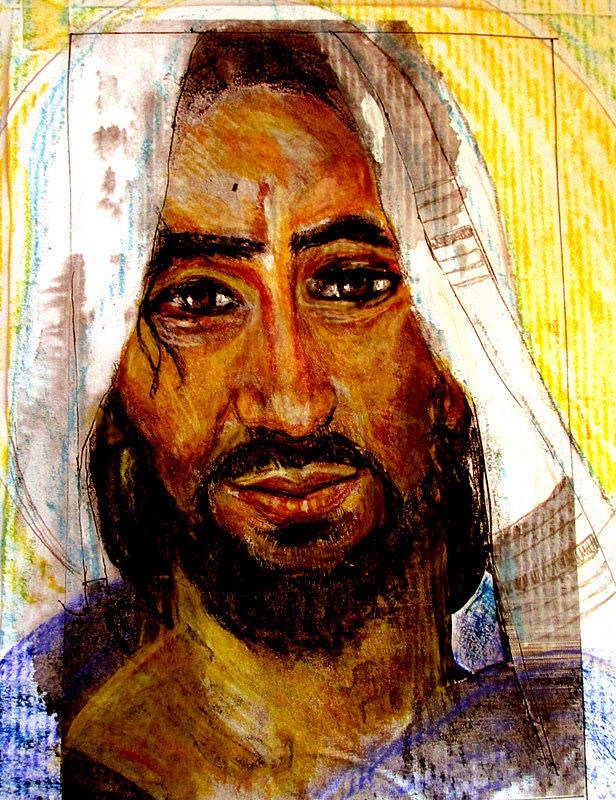
An image that depicts the way a first century Jewish male,
like Jesus, might well have appeared

The author of this narrative—known by tradition as “Mark”—begins this series of scenes with the striking moment when Jesus of Nazareth was declared to be the beloved Son, anointed by the Spirit, equipped for his role of proclaiming the kingdom of God (Mark 1:1–13), which we hear this coming Sunday when the focus is on the Baptism of Jesus.

We know that Jesus was raised as a good Jew. We can hypothesise much about his upbringing and faith. He knew the daily prayer of the Jews, the Shema (“Hear, O Israel, the Lord our God is One”). He also knew the major annual festivals of his people: Passover, Harvest (later called Pentecost) and Tabernacles.

Jesus attended the synagogue each Sabbath, where he watched the scrolls containing the Hebrew scriptures unrolled, before they were read (in Hebrew, the sacred language) and explained (in Aramaic, the language of the common Jewish folk). Jesus, like all his fellow–Jews, believed that his God, Yahweh, was the one true God. He followed the traditional practices of worship and studied the scriptures under the guidance of the scribes in his synagogue.

At a mature age (by tradition, in his early 30’s), Jesus made his way south towards Jerusalem, into the desert regions, along with other Jews of the day. Beside the Jordan River he listened to the preaching of a strange figure—a desert-dwelling apocalyptic prophet named John (Mark 1:4–8). This appears to have been a pivotal moment for the pious Jewish man from Nazareth. His encounter with John deepens his faith and sharpens his commitment.

John’s message was the traditional prophetic call to repent (1:4). Prophets occasionally call directly for teshuva (Hebrew; in Greek, metanoia). These words are usually translated into English as “repentance” (see Isa 1:27; Jer 8:4-7, 9:4-5, 34:15; Ezek 14:6, 18:30; Zech 1:1-6). Indeed, so many of the oracles included in both major and minor prophets provide extended diatribes against the sinfulness of Israel and call for a return to the ways of righteousness that are set out in the convening with the Lord. When prophets called for metanoia, repentance, they were seeking a striking and thoroughgoing change of mind, a reversal of thinking and acting, a 180 degree turnaround, amongst the people. This is what metanoia means.

Accompanying this, however, was a very distinctive action that John the desert dweller performed, of immersing people into the river (Mark 1:5). Our Bibles translate this as “baptising”, but it was actually a wholesale dunking right down deep into the waters of the river.

Our refined ecclesial terminology of “baptism” is often associated, in the popular mind, with cute babies in beautiful christening gowns surrounded by adoring grandparents, aunties and uncles. This leads us far away from the stark realities of the act: being pushed down deep into the river, being completely surrounded by the waters, before emerging saturated and maybe gasping for air.

Such a dramatic dunking was designed to signify the cleansing of the repentant person. Repentance and baptism were necessary for the ushering in of the reign of God, according to John. Jesus appears to have accepted this point of view; it is most likely that his baptism was an intense religious experience for him. He underwent a whole scale change of mind, a reorientation towards the mission that was thrust upon him.

Certainly, the way that the experience is presented by Mark (and also in the other canonical Gospels) presents Jesus as being singled out by God for a special role. There are multiple signs on the short account of this moment (Mark 1:9–11).

FIrst, Jesus sees “the heavens torn apart” (1:10). This breaking apart is mirrored in the water of the river, which parts “as he was coming up out of the water”. The breaking of the heavens perhaps echoes the cry of the prophet of old: “O that you would tear open the heavens and come down, so that the mountains would quake at your presence … to make your name known to your adversaries, so that the nations might tremble at your presence!” (Isa 64:1).

Then, he sees a vision of “the Spirit like a dove” (Mark 1:10). A dove, of course, appeared at a key moment early in the biblical narrative: as the waters of the Great Flood recede (Gen 8:6–12); but the association of the dove with the Spirit (a commonplace in our thinking today, surely) is not actually made anywhere in scripture before this moment. The dove which appears seems, to Jesus, to come from beyond rest on him, in the way that the prophet declares that “the spirit of the Lord God is upon me” (Isa 61:1). The dove brings a signal from the sky—from the Lord God, perhaps?

A third signal comes through “a voice from heaven” (Mark 1:11). This is a common note regarding the hearing of the divine voice. Moses tells the Israelites, “from heaven he made you hear his voice to discipline you” (Deut 4:36). In the wilderness, God “came down upon Mount Sinai, and spoke with them from heaven, and gave them right ordinances and true laws, good statutes and commandments” (Neh 9:13; also Exod 20:22). Ben Sirach tells the story of the judges, when “the Lord thundered from heaven, and made his voice heard with a mighty sound” (Sir 46:17). David sang that “the Lord thundered from heaven; the Most High uttered his voice” (2 Sam 22:14). So a voice speaking from heaven, in Jewish understanding, is a communication from God.

Finally, the actual words which that voice speaks are deeply significant. “You are my son” are words spoken by God to David (Ps 2:7). “With you I am well pleased” echoes what God says about “my servant, whom I uphold, my chosen, in whom my soul delights” (Isa 42:1); indeed, of the Servant, the prophet declares, God indicates that “I have put my spirit upon him; he will bring forth justice to the nations” (Isa 42:2). What is heard at the moment of the baptism of Jesus is confirmation of the place of Jesus as one beloved, chosen, and equipped by God for what lies ahead of him.

So it is that from the moment of this intense experience, Jesus was fervently committed to the renewal and restoration of Israel. His first words, as reported in this shortest and earliest account of his ministry, were clear and focussed (1:14–15). There are four key elements: fulfilment of the time, nearness of the kingdom, the need to repent, and belief in the good news. Repentance is pivotal in this succinct summary of his message. It was the heart of the message that Jesus instructed his followers to proclaim (6:12).

After this dramatic dunking by the desert dweller, Jesus left his family and began travelling around Galilee, announcing that the time was near for dramatic changes to take place. He gathered a group of men and women who accepted his teachings, journeying with him as he spread the news throughout Galilee.

The intense religious experience of his dunking meant that the fierce apocalyptic message spoken by the desert dweller was lived out in a radical way in daily life by this group of deeply committed associates of Jesus. The intense religious experience associated with his dramatic dunking by the desert dweller had a deep and abiding impact. The challenge, for those of us who follow him, is to live out this radical way of life today.