Paul, the law of the Spirit, and life in the Spirit (Rom 8; Pentecost 7A)

Last week, we considered the section of Paul’s letter to the Romans which the lectionary offered: Paul grappling within “the sin that lives within me” (Rom 7:14–25a). In probing that state, Paul came to a rather pessimistic conclusion: “wretched man that I am! who will rescue me from this body of death?” (7:24), before immediately switching to a grateful “thanks be to God through Jesus Christ our Lord!” (7:25). See

This week, the lectionary continues the argument that Paul is developing, as he presses on to rejoice that “there is now no condemnation for those who are in Christ Jesus” (8:1). The passage proposed by the lectionary (8:1–11) marks a dramatic change in tone. Whilst he still recognises that “the mind that is set on the flesh is hostile to God; it does not submit to God’s law” (8:7), the primary focus that Paul now has is on the claim that “the law of the Spirit of life in Christ Jesus has set you free from the law of sin and of death” (8:2).

Paul considers the state of humanity: “to set the mind on the flesh is death … the mind that is set on the flesh is hostile to God; it does not submit to God’s law—indeed it cannot, and those who are in the flesh cannot please God” (Rom 8:6–8). He has already grappled with this in the previous chapter. Here, he presses on to celebrate that, as he tells the believers in Rome, “you are not in the flesh; you are in the Spirit, since the Spirit of God dwells in you” (8:9).

Because of what the Spirit effects in the lives of believers, Paul is embued with great hope—a quality that he expresses in other letters he wrote. He rejoices with the Thessalonians that they share with him in “hope in our Lord Jesus Christ” (1 Thess 1:3) and tells the Galatians that “through the Spirit, by faith, we eagerly waits for the hope of righteousness” (Gal 5:5).

He reminds the Corinthians that “faith, hope and love abide” (1 Cor 13:13), and then in a subsequent letter to believers in Corinth, he asserts that “he who rescued us from so deadly a peril will continue to secure us; on him we have set our hope that he will rescue us again” (2 Cor 1:10)

Paul has already reported to the Romans that “we boast in our hope of sharing the glory of God” (Rom 4:2) and that “we boast in our hope of sharing the glory of God” (5:2). He will go on to refer to “the law of the Spirit of life in Christ Jesus” (8:2), and explain how the work of the Spirit gives hope to the whole creation, currently “in bondage to decay”, which will “obtain the freedom of the glory of the children of God” (8:21). And so, Paul declares, it is “in hope that we were saved” (8:24).

Towards the end of the letter, Paul offers a blessing to the Romans: “may the God of hope fill you with all joy and peace in believing, so that you may abound in hope by the power of the Holy Spirit” (15:13). That the Spirit produces this hope is a fundamental dynamic in the process of “setting [believers] free from the law of sin and of death” (8:2).

The Spirit is rarely mentioned in the first seven chapters of this letter. Paul does note that it was “according to the spirit of holiness by resurrection from the dead” that Jesus was “declare to be Son of God with power” (1:4), and that it was “through the Holy Spirit that has been given to us” that “God’s love has been poured into our hearts” (5:5). And he notes that it was by being “discharged from the law” that believers entered into “the new life of the Spirit” (7:6).

But from 8:1 onwards, the Spirit becomes an active presence in what Paul writes about. The Greek word pneuma appears 33 times in the letter to the Romans; most of these are referring to the Holy Spirit. Strikingly, 19 of these occurrences are in chapter 8; a further eight instances then occur in chapters 9–15.

We might contrast this with the word that is often seen to be the key to this letter, dikaiosunē, which appears 57 times in Romans—including the programmatic key verse of 1:17, 13 times in ch.3, 11 times in ch.4, nine times in ch.5, and then nine more times in chs.9–11. Whilst righteousness is indeed an important word, the Spirit is also of crucial significance in Paul’s argument throughout Romans.

Rom 8:1–11 makes a strategic contribution to what Paul is explaining in this letter—that in the Gospel, “the righteousness of God is revealed through faith for faith” (1:17), that “the righteousness of God has been disclosed, and is attested by the law and the prophets, the righteousness of God through faith in [or of] Jesus Christ for all who believe” (3:21–22).

As he develops his argument, drawing on the story of Abraham (Gen 15), Paul affirms that this righteousness “will be reckoned to us who believe in him who raised Jesus our Lord from the dead, who was handed over to death for our trespasses and was raised for our justification” (4:24–25), concluding that “since we have been made righteous by faith, we have peace with God through our Lord Jesus Christ” (5:1), and asserting that “if Christ is in you … the Spirit is life because of righteousness” (8:10).

Incidentally, when we look at the statistics of word occurrences in the seven authentic letters of Paul, we see that “righteousness” occurs a total of 87 times (57 of them in Romans, 13 in Galatians), whilst “spirit” can be found 117 times: as well as the 33 times in Romans, there are 39 occurrences in 1 Corinthians and a further 15 occurrences in 2 Corinthians, and then 19 more appearances in Galatians. Spirit is a fundamental component in Paul’s theology.

Paul believes that it is by the Spirit that the gift of righteousness is enlivened and activated within the believer. He hammers this point with a series of clear affirmations in this week’s passage (8:1–11): “there is no condemnation” (v.1), “the law of the Spirit has set me free” (v.2), “God has done what the law, weakened by the flesh, could not do: by sending his own Son in the likeness of sinful flesh, and to deal with sin” (v.3), “the Spirit of God dwells in you” (v.9), “the Spirit is life” (v.10), and “he who raised Christ from the dead will give life to your mortal bodies also through his Spirit that dwells in you” (v.11).

Important for Paul is for the believer to know that “you are in the Spirit, since the Spirit of God dwells in you” (8:9) and that “his Spirit … dwells in you” (8:11). This is an idea that Paul also articulates in his first letter to a Corinth, when he poses the rhetorical question, “do you not know that you are God’s temple and that God’s Spirit dwells in you?” (1 Cor 3:16). The answer to this rhetorical question which is expected (but not stated) is, of course, “yes, we do know that God’s Spirit dwells in us”.

A similar rhetorical strategy can be seen as Paul draws this section (Rom 8:1–11) to a close. He poses a matched pair of conditional possibilities: “if Christ is in you” (v.10), “if the Spirit dwells in you” (v.11). The possibility, in each case, is crystal clear: since Christ is in you, “the Spirit is life because of righteousness” (v.10), and since the Spirit dwells in you, “he who raised Christ from the dead will give life to your mortal bodies also through his Spirit that dwells in you” (8:11).

For Paul, then, the role of the Spirit in enlivening and energising the believer is crucial. That is the important contribution that this passage makes to Pauline theology, and to our understanding of the Christian life.

See also
A fully-developed theology from just one psalm? (Psalm 119; Pentecost 7A) §1

I set myself a challenge: develop a fully-rounded theology from just one psalm. Easy, I thought; the shortest psalm, 117, has a number of key elements in its two verses: praise (“praise the Lord” twice, at the beginning and the end), adoration (“extol him”), a recognition of divine love (“great is his steadfast love towards us”), the universal orientation of that love (“all peoples”), and the assurance of divine fidelity (“the faithfulness of the Lord endures forever”).

There: done and dusted! … although, I think, on further reflection, that this looks more like the outline of a litany (praise—adoration—intercession —blessing) than a fully-developed theology. As a litany, it is succinct; as a theology, it is still quite deficient.

So, what about a challenge to develop a fully-rounded theology, not from the shortest psalm, but from the longest psalm? For just two psalms later, we have the 176–verse grand acrostic of the Hebrew Scriptures: Psalm 119—a small portion of which (119:105–112) is offered by the lectionary this coming Sunday. What would a theology look like, using only the verses in this psalm? And how full (or inadequate) would that theology be?

I love the way that this wonderfully artistic creation contains key elements of a theological understanding of the world. There are components regarding the nature of God, the human condition, and the divine response to that human condition. There is much to be gleaned regarding revelation and also salvation. And there are indications that touch on the character of living a faithful life, as well as signs of what the future is to be. All of these elements contribute to a fully-developed theology, surely?

This longest psalm of all, Psalm 119, is an acrostic series of 22 eight-verse stanzas (arranged alphabetically) in which the author(s) consistently affirm the value and importance of the teaching (Hebrew, torah) which sits at the centre of faith for the person singing this psalm. “I will delight in your statutes; I will not forget your word” (Ps 119:16). By contrast to “the arrogant”, whose “hearts are fat and gross”, the psalmist declares, “I delight in your law” (Ps 119:70).

The psalm includes the petition, “let your mercy come to me, that I may live, for your law is my delight” (Ps 119:77), noting that “if your law had not been my delight, I would have perished in my misery” (Ps 119:92). It also affirms, “I long for your salvation, O Lord, and your teaching (torah) is my delight” (Ps 119:74). Echoing these words many centuries later, Paul, in the midst of his agonising about Torah in Romans 7, is able to affirm, “I delight in the law of God in my inmost self” (Rom 7:22). Delight for the Law runs through Jewish history.

This longest of all psalms is a series of 22 meditations on teachings, or Torah, which is usually translated as “law”. It contains regular affirmations of the place of Torah in personal and communal piety: “give me understanding, that I may keep your law and observe it with my whole heart” (v.34); “Oh, how I love your law! it is my meditation all day long” (v.97).

The psalmist contrasts their devotion to Torah with those who neglect or ignore it: “I hate the double-minded, but I love your law” (v.113); “I hate and abhor falsehood, but I love your law” (v.163). They rejoice that “great peace have those who love your law; nothing can make them stumble” (v.165). From this long and persistent affirmation of Torah throughout all 22 stanzas, we can indeed devise a fully-fledged theology, canvassing many of the key issues that we have come to associate with theology.

(In what follows, I will refer to the psalmist as “they”, making no assumptions about who they were, even their gender. As psalms were collective songs, it is reasonable to suggest that they were developed within the community, by members of the community—so “ they” is a reasonable assumption, I feel.)

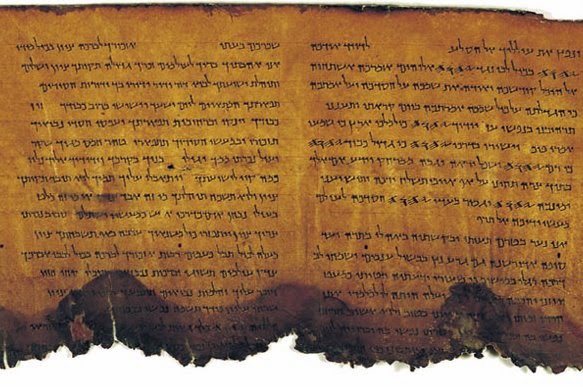
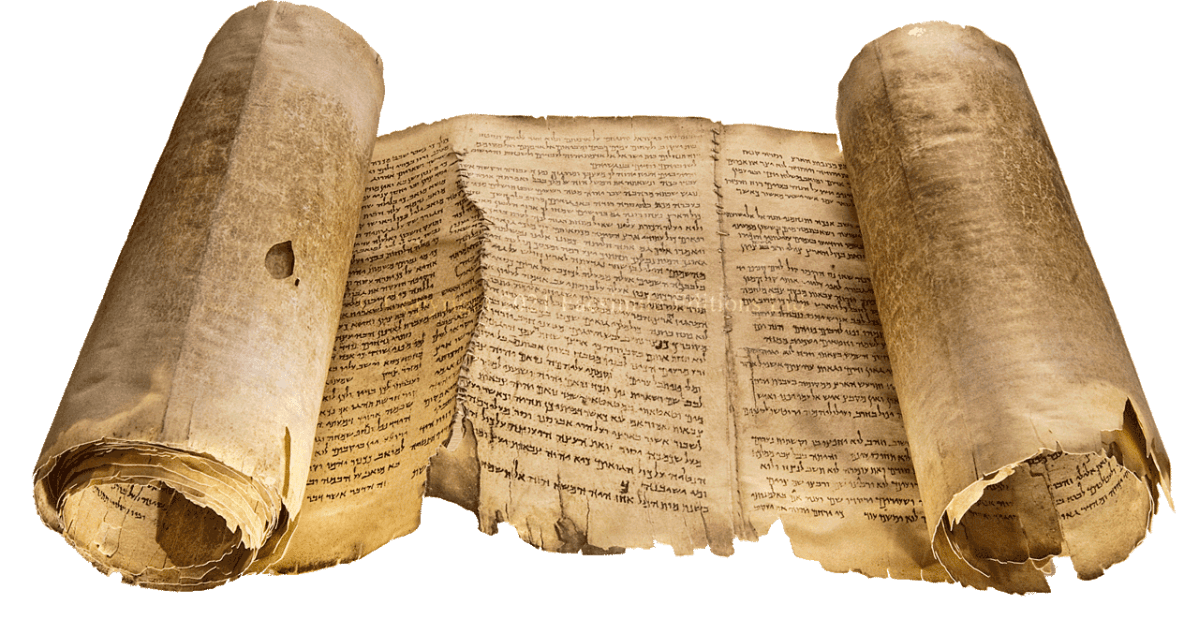
4QPs Dead Sea Scroll Psalm 119 from the First Century CE

1 God

Undergirding the joyful appreciation of Torah in the lengthy psalm is a consistent trust in God, who is consistently acknowledged as the author and giver of Torah, but is also celebrated as creator: “your hands have made and fashioned me” (v.73). That affirmation reflects famous words sung in another psalm, “I praise you [God], for I am fearfully and wonderfully made; wonderful are your works; that I know very well” (Ps 139:14).

God’s creative power is at the centre of Hebrew Scripture. It is celebrated in passing in many psalms (Ps 8:3–8; 33:6–7; 74:16–17; 95:4–5; 96:5; 100:3; 103:14; 115:15; 121:2; 124:8; 136:4–9; 146:5–6); in the majestic celebratory psalm, Psalm 104, which rejoices, “Lord, how manifold are your works! In wisdom you have made them all” (Ps 104:24); and in the carefully-crafted priestly account of creation that stands at the head of Hebrew Scripture (Gen 1:1–2:4a). It is noted with appreciation also in psalm 119 (v.73).

A second element in this psalm is that God’s mercy is valued; “great is your mercy, O Lord” (v.156), and so the psalmist prays, “let your mercy come to me, that I may live; for your law is my delight” (v.77). This is a common refrain in other psalms, where God is asked to show mercy (Ps 25:6; 40:11; 51:1; 123:2, 3). As one proverb says, “no one who conceals transgressions will prosper, but one who confesses and forsakes them will obtain mercy” (Prov 28:13). A similar sentiment is offered by Isaiah: “the Lord waits to be gracious to you; therefore he will rise up to show mercy to you, for the Lord is a God of justice; blessed are all those who wait for him” (Isa 30:18).

Then, we might note the love of God. A recurrent refrain in Hebrew Scripture is a celebration of “the steadfast love of the Lord” (Exod 34:6; 2 Chron 30:8–9; Neh 9:17, 32; Jonah 4:2; Joel 2:13; Ps 86:15; 103:8, 11; 111:4; 145:8–9). This affirmation presents God as “merciful and gracious, slow to anger, and abounding in steadfast love and faithfulness, keeping steadfast love for the thousandth generation”.

God is praised for showing love by redeeming the people in the Exodus (Exod 15:13) and then guaranteeing abundance in the land is promised to the people: “he will love you, bless you, and multiply you; he will bless the fruit of your womb and the fruit of your ground, your grain and your wine and your oil, the increase of your cattle and the issue of your flock, in the land that he swore to your ancestors to give you”, says Moses (Deut 7:13).

Solomon later praises God, saying “you have shown great and steadfast love to your servant my father David … and you have kept for him this great and steadfast love, and have given him a son to sit on his throne today” (1 Ki 3:6; also 2 Chron 1:8), and then as he dedicates the Temple, he prays “there is no God like you in heaven above or on earth beneath, keeping covenant and steadfast love for your servants who walk before you with all their heart” (1 Ki 8:23; 2 Chron 6:14).

When the foundations of the Temple are laid, after it has been destroyed by the Babylonians, the people sing, “praising and giving thanks to the Lord, ‘for he is good, for his steadfast love endures forever toward Israel” (Ezra 3:11). When a covenant renewal ceremony takes place under Nehemiah, he addresses God as “a gracious and merciful God” and continues, “the great and mighty and awesome God, keeping covenant and steadfast love” (Neh 9:31–32). A number of prophets refer to God’s enduring, steadfast love (Isa 16:5; 43:4; 54:8, 10; 63:7; Jer 9:24; 31:3; 33:11; Dan 9:4; Hos 2:19; 11:3–4; Jonah 4:2; Micah 7:18–19; Zeph 3:17).

Reference is made to the steadfast love of God on seven occasions in this psalm (verses 41, 64, 76, 88, 124, 149, and 159). Such love is often linked with Torah—“the earth, O Lord, is full of your steadfast love; teach me your statutes” (v.64); and again, “deal with your servant according to your steadfast love, and teach me your statutes” (v.124). An important function of Torah is thus to communicate the extent of divine live.

In tandem with God’s mercy and steadfast love, so divine justice is also noted. “Great is your mercy, O Lord; give me life according to your justice” (v.156); and “in your steadfast love hear my voice; O Lord, in your justice preserve my life” (v.149).

Justice, of course, is at the heart of the covenant that God made with Israel. Moses is said to have instructed, “justice, and only justice, you shall pursue” (Deut 16:20), the king is charged with exhibiting justice (Ps 72:1–2; Isa 32:1), whilst many prophets advocate for justice (Isa 1:17; 5:7; 30:18; 42:1–4; 51:4; 56:1; Jer 9:24; 22:3; 23:5; 33:15; Ezek 18:5–9; 34:16; Dan 4:37; Hos 12:6; Amos 5:15, 24; Mic 3:1–8; 6:8).

So God, says the psalmist, holds the people of the covenant to the standard set in Torah: “you rebuke the insolent, accursed ones, who wander from your commandments” (Ps 119:21). The assumption throughout this psalm is that the creator God is personal, approachable, relatable; just and fair, kind and loving.

See further posts at

Paul and the Law, sin and the self (Rom 7; Pentecost 6A)

“I delight in the law of God in my inmost self, but I see in my members another law at war with the law of my mind” (Rom 7:23). So Paul writes, in the section of the letter written “to all God’s beloved in Rome, who are called to be saints” which is offered by the lectionary for this coming Sunday (Rom 7:15–25a).

The lectionary wants us to end this reading with the words of gratitude, “thanks be to God through Jesus Christ our Lord!” (15:25a). But in my analysis, Paul’s argument reaches its conclusion with the stalemate of verse 23—a clash between “the law of God” and “the law of my mind”. “Wretched man that I am”, he explodes in exasperation (7:24), after a lengthy and complex consideration of the issues which has led him to this damning conclusion.

What Paul is writing about in this complex section (7:1–25) is about the battle of wills, as God’s will comes into conflict with human will. The argument throughout this chapter—as, indeed, the argument throughout much of Romans—is presented as a dialectic, in which one point of view is put, to be met by an opposite point of view; followed by a rebuttal by the first voice, and a further oppositional claim by the second voice.

The thesis for discussion has been set out in 7:1–6, using the marriage relationship between husband and wife and “another man” (7:1–3) as the basis for an analogy (“in the same way”, 7:4) for the relationship between humans, “living in the flesh” (7:5) whilst also having “the new life of the Spirit” (7:6).

The use of analogy, already developed in earlier Greek rhetoric and used extensively by philosophers and political orators, does reflect rabbinic practice. The deployment of analogy, gezerah shewah, was one of Hillel’s principles of interpretation, indicating the influence of hellenistic thought and ideas on Jewish teachers and writers. So Paul here may well be operating as a rabbi, in the way that he sets out and developed his case.

But the fundamental dualism which underlies this whole chapter—the law of sin and death, the holy law of God—is thoroughly Greek in origin and character. Plato’s view of the soul trapped in the prison of the material world, which he set out in his Allegory of the Cave and which marks so many of his Dialogues: a clear line of demarcation between the spirit and the flesh, the body and the mind, the idea and the particular object.

So Paul, trained as a Pharisee, being “far more zealous for the traditions of my ancestors” (Gal 1:14), brings into the discussion a “delight in the law of God in my inmost self” (Rom 7:22). He affirms that he upholds the Torah (Rom 3:31), alluding to various commands in The Ten Words which he insists are worth obeying (2:17–22), and affirming that, in its essential character, “the law is holy, and the commandment is holy and just and good” (7:12).

Yet his calling to be “apostle to the Gentiles” (Rom 11:23; Gal 2:8) led to his experience of eating at table with Jews and Gentiles together, in breach of kosher food laws (Gal 2:11–13)—an issue that is clearly in view decades later, as Luke writes his account of the early years of the Jesus movement, siding with Paul in the view that God has set aside the requirement for separate foods and separate tables (Acts 10:1–11:18; 15:19–20, 28–29).

This, in turn, leads Paul to his missionary goal of bridging the gap between Jews and Gentiles in practical ways (Rom 15:25–27), undergirded by the message that he preaches, affirming that salvation is offered “to everyone who has faith, to the Jew first and also to the Greek” (Rom 1:16; see also 2:10; 10:12; Gal 3:28; and the post-Pauline development in Eph 2:11–22). He is driven by the scriptural claim that “God shows no partiality” (Rom 2:11; Deut 16:19–20; 2 Chron 19:7; Sir 35:15–16).

So Paul brings a firm commitment of this universal availability of salvation into this discussion in Rom 7:1–25. The argument that he has set out in the thesis of 5:1, “since we are justified by faith, we have peace with God through our Lord Jesus Christ, through whom we obtained access to this grace in which we stand”, is argued throughout the ensuing verses, and given a ringing affirmation at the end in 6:23, that all humanity is able to know and access “the free gift of God [which is] eternal life in Christ Jesus our Lord” (6:23).

This sounds, to us today, like a formal debate: three speakers, alternating between the Government for the proposition, the Opposition against the proposition, and then short concluding remarks, before the adjudicator declares a result and announces a winner. In the ancient world, however, Paul is writing in the style of a diatribe—a form that was developed in Ancient Greece and which was widely practised by Greek rhetoricians, philosophers, and teachers during the Hellenistic period.

See my analysis of the diatribe style in Rom 4 at

In the diatribe that Paul develops in Rom 7, he needs to address what he now sees as the inadequacy of Torah, given his affirmation that “God shows no partiality” (2:11) and his commitment to Jews and Gentiles eating together, without scruples regarding the food being shared. This deficiency in the law runs throughout the argument of Romans; it is impossible to keep the law (2:17–3:20).

Since his calling to work amongst the Gentiles, Paul has come to see that the law brings wrath (4:15) and increases sin (5:20), and indeed he maintains that the law “brought death” (7:9). As a consequence, righteousness must be gifted by God “apart from law”(3:21).

Paul, as we have seen, uses the scriptural example of Abraham, who “believed God, and it was reckoned to him as righteousness” (4:3), to argue that “the promise may rest on grace and be guaranteed to all his descendants, not only to the adherents of the law but also to those who share the faith of Abraham” (4:16). See

And so, he declares that “you have died to the law through the body of Christ, so that you may belong to another, to him who has been raised from the dead” (7:4), and thus “we are discharged from the law” (7:6). Paul then demonstrates this in what immediately follows. The law is not sin in and of itself; and yet, “if it had not been for the law, I would not have known sin” (7:6). This is seen, first, through the educational function of the law, which teaches for example, about covetousness (7:7–8a).

Then Paul notes that, paradoxically, the essential nature of the law reveals and activates sin (7:8b—10), so that “the very commandment which promised life proved to be death to me”, before he intensifies this with the claim that “sin, finding opportunity in the commandment, deceived me and by it killed me” (7:11).

He concludes this section with affirmation of the law as “holy, just, and good” (7:12), before clarifying that it was not the Law which brought death to him, but rather “it was sin … working death in me through what is good … through the commandment” (7:13). Paul has worked hard to differentiate sin from the Law; the one is evil, the other is good.

And yet, as he continues his diatribal discussion, more problems emerge (of course, since this is the nature of a diatribe!). Here is the dilemma: “we know that the law is spiritual; but I am of the flesh, sold into slavery under sin” (7:14). What follows is a foray into the murky mind of Paul, where, as he says, “I do not do what I want, but I do the very thing I hate” (7:15)—although he immediately attempts to excuse himself by stating that “it is no longer I that do it, but sin that dwells within me” (7:17).

That sits uncomfortably alongside Paul’s claim to the Galatians, that “it is no longer I who live, but it is Christ who lives in me”, and thus, Paul now “lives to God” (Gal 2:19–20). In writing to the Romans, Paul claims that “nothing good dwells within me, that is, in my flesh” (7:18), for it is “sin that dwells within me” (7:17, 20). The contradiction is confusing. What is the essential force that “lives within” Paul; it is Christ, as in Gal 2, or sin, as in Rom 7?

The confusion caused by “sin that dwells within me” (7:20) whilst still claiming that “I delight in the law of God in my inmost self” (7:22), drives Paul deeper into the hellenistic dualism, seeing “in my members another law at war with the law of my mind, making me captive to the law of sin that dwells in my members” (7:23). No wonder he throws his hands up in despair, exclaiming, “wretched man that I am! who will rescue me from this body of death?” (7:24).

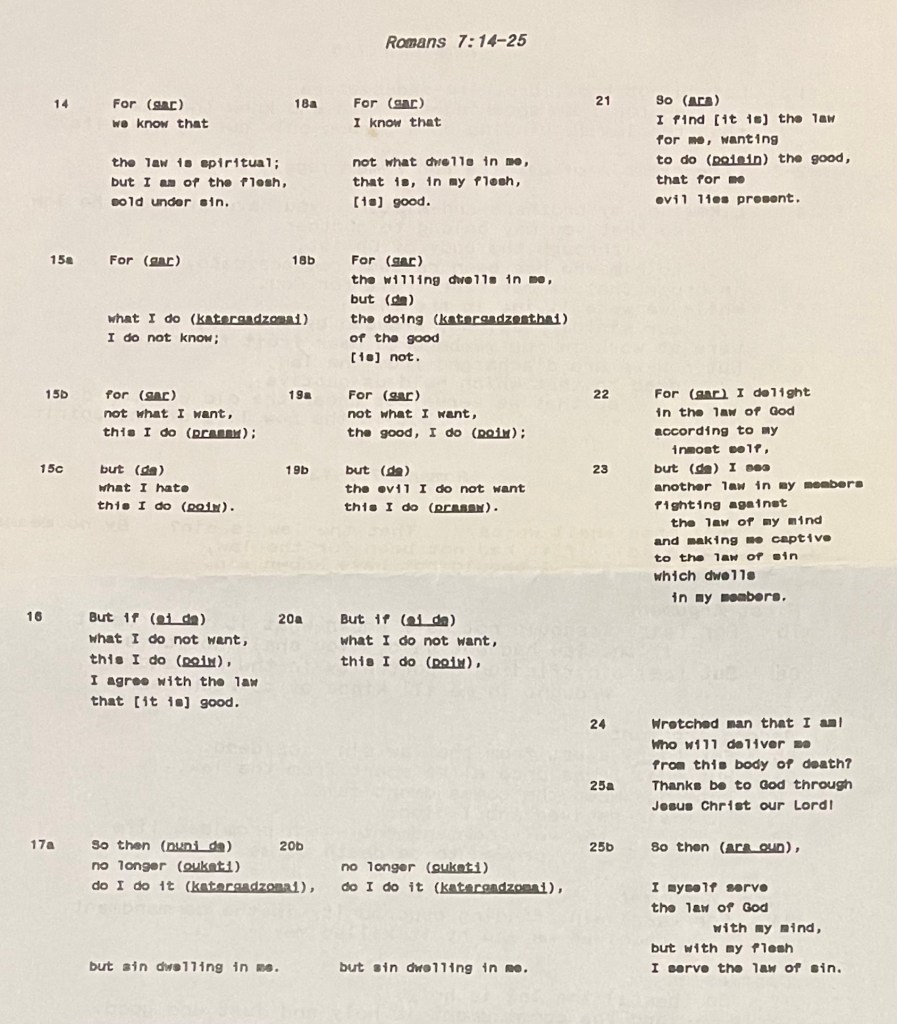
The argument runs a parallel course three times, as my schematic structuring (below) demonstrates. For each proposition that is put (introduced often by the Greek particle gar, “for”), a counter-proposition is offered (introduced by the Greek particle de, “but”).

Modern psychological insights have been used to dig deeper into what Paul writes in Romans 7. Paul appears to be fixated on his own self, using the Greek word egō many times (7:9, 10, 14, 17, 18, 20, 21, 24, and 25). And the language of “sin” and “death” which runs through this chapter exacerbates the tendency to adopt this approach. Declaring that these malicious forces are at work within his inmost being appears to present Paul as a figure consumed with internal contradictions and unresolved tensions. In short, he is a prime candidate for psychological investigation, if not psychiatric intervention!

Who is the person, the egō, who is referenced in these verses? Some interpreters consider that Paul here is talking about his “old self”—the person he was before he encountered the risen Jesus and was commissioned for the task he now undertakes, as “apostle to the Gentiles”. This chapter, reflecting Paul the pious and intense Jew, living under the Law, desperately seeking to obey it in every detail, is thus contrasted with the following chapter, portraying Paul the apostle, fervent and passionate for the mission he is undertaking, freed from the Law and living in the liberty of divine grace.

That simplistic analysis, however, owes more to the 19th century Pietism that was driving interpreters of that time, who considered the Christian life inevitably involved a fierce inner struggle with sin which fermented and eventually erupted into an existential crisis that would, hopefully, ultimately result in a decision to live a new, Christ-centered life. We can see how that dynamic can be extracted from Paul’s agonising words in Rom 7.

A second way of dealing with this chapter, by contrast, has been to claim that the struggle about which Paul here writes reflects precisely the struggle he was enduring after that dramatic encounter with Christ.

The commission that Paul received in that encounter is reported in graphic terms, many decades later, by Luke, who makes the moment into a grand call–and–commissioning scene (Acts 9:3–8; 22:6–11; 26:12–18). Of course, Luke was not present for this event, so he shaped in along the lines of classic call-and-commissioning narratives that existed in earlier Jewish writings. (I have explored this in detail in my commentary on Acts in the Eerdman’s Commentary on the Bible, 2003). In Paul’s own writings, by contrast, this mentioned only briefly, in passing (1 Cor 9:1 and Gal 1:1, 11–12).

Whatever took place in that encounter, it is clear that, as a believer, Paul was not exempt from the ongoing struggle between the desire to do what is pleasing to oneself, but is sinful (Rom 7), on the one hand; and on the other hand, the delight of living a life redeemed by grace (Rom 8). So the passage offered by this week’s lectionary (7:14–25a) is offered as a counterpoint to that which we have on the following Sunday (8:1–11).

This has been the line of interpretation advocated, to various degrees, by Augustine, Aquinas, Luther, and Calvin—but it has fallen into disfavour with contemporary interpreters, who see this as too simplistic and as presenting an unresolved and unintegrated egō. Surely Paul was not caught in that immature state?

So a third line of interpretation has been that Paul here is setting forth the general, universal condition of the human being. The egō is Paul’s way to talk about “all of us”, for we are all still wrestling with that key characteristic of the human condition: we all, each one of us, “do not do the good [we] want, but the evil [we] do not want is what [we] do” (7:19).

This interpretation was proposed by Kümmel and has been followed by Bultmann, Käsemann, and Dunn, amongst others. Dunn argues that the struggle of Rom 7 provides the key to the argument developed by Paul throughout Rom 5—8 as a whole.

Beyond that, Kristen Stendhal has mounted a persuasive case, that the egō of Rom 7 should not be connected with Paul’s inner being, but rather with the broader issue to which Paul is addressing himself throughout the whole letter of Romans—what place does the Law have in the new community of faith, where both Jews and Gentiles are sharing together in fellowship? How might the demands of the Law function within such a context?

It’s a proposal that I find attractive and helpful, for indeed that broader question is what Paul comes back to in 8:1–8, and then in 9:30–33, 10:1–4, and 11:25–32; and finally in 13:8–10. The egō of Rom 7 is not the last word on this matter; Paul has “yet more light and truth to break forth” on this complex matter!

*****

You can look ahead to what I have to say about some of those passages, at

A ring on her nose, and bracelets on her arms (Gen 24; Pentecost 6A)

For this coming Sunday, the lectionary provides us with part of a larger story from the section of Genesis dealing with Abraham (Gen 24:34–38, 42–49, 58–67). As Abraham’s son Isaac comes to age, Abraham knows that there is a need to find him a wife.

Abraham now appears not to be living with his wife, Sarah—he is in Beersheba, with his servants (22:19) whilst Sarah remains at Hebron, where she dies (23:1–2). Was this because of the tension that grew between the patriarch and the matriarch after he had almost sacrificed his son? This is the story we read last week; see

Tensions were already evident earlier in the story, when Sarah had banished Hagar and Ishmael into the wilderness of Beersheba (21:10–14). To send them on their way, Abraham made sure that they had bread and water to sustain them in the wilderness (21:14). We do not see Abraham and Sarah together again in the story. In discussing this with my wife, Elizabeth Raine, last week, she proposed that Sarah was so upset with Abraham’s actions on Mount Mariah, threatening the life of their son Isaac (Gen 22:1–14), that she left him behind at Beersheba and moved to Hebron, some 42km to the north.

It is only on her death that Abraham travels to where Sarah had been living, in Hebron. Abraham sought to purchase a field there to serve as the burial place for Sarah. Ephron the Hittite, moved with compassion, wanted to gift him a field with a cave where Sarah’s body could be laid (23:7–12), but Abraham insisted and paid Ephron the value of the field, 400 shekels of silver (23:12–16). So he was doing the honourable thing for his wife after her death, even though there seems to have been a relationship breakdown prior to this.

Despite the fact that he willingly enters into these dealings with the Hittites in Beersheba, and the fact that he had earlier entered into a covenant with Abimelech, King of Gerar, a Philistine (21:22–34), Abraham is now concerned that Isaac not marry locally, to a Canaanite, but that a wife be found for him in “my country” and amongst “my people”, as he instructs his servant (24:4–5).

We may perhaps know of people who share that desire that their children not marry “foreigners”, but find a partner from amongst their own. So it is an ancient story with very modern resonances. Marlene Andrews, Church leader at Ngukurr, shares her perspective on this passage in the current issue of With Love to the World, a daily Bible study resource.

(Ngukurr is a town of about 1,000 people, located about 330 kilometres south-east of Katherine on the Roper Highway. Ngukurr is one of the largest Aboriginal communities in the Roper Gulf region.)

She says: “This story is about Abraham, his son. Abraham wanted the best for his son in marriage. Abraham knew that God was with him at the time of his decision-making. Abraham was faithful to God’s calling. Abraham knew how to go about finding a good wife for his son, Isaac. It was important that his son’s wife came from Abraham’s country. That is where Abraham came from, and where he wanted his son to connect to. Abraham knew the culture and the background of his people. Abraham knew in finding a wife for his son, she had to come from his homeland.”

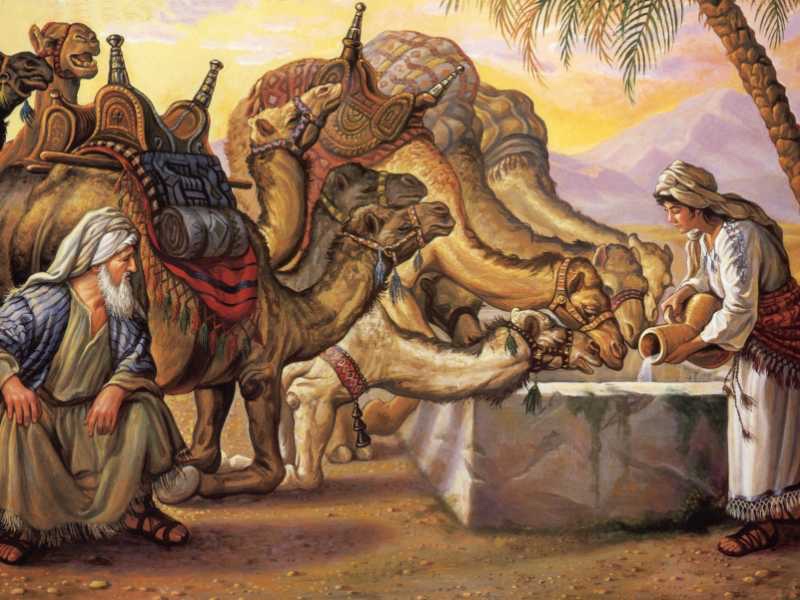
The marriage is arranged, at a distance, by Abraham. Isaac plays no part in the whole saga that is recounted in detail in Genesis 24. Abraham sends his servant all the way north to a well near the city of Nahor, which was back in Aramea, the homeland of Abraham. This was in the area we know as the Fertile Crescent, in between the two rivers of the Tigris and the Euphrates (24:10). The well near Nahor becomes the location for the match-making that Abraham undertakes, through the servant whom he sent there (24:10–14).

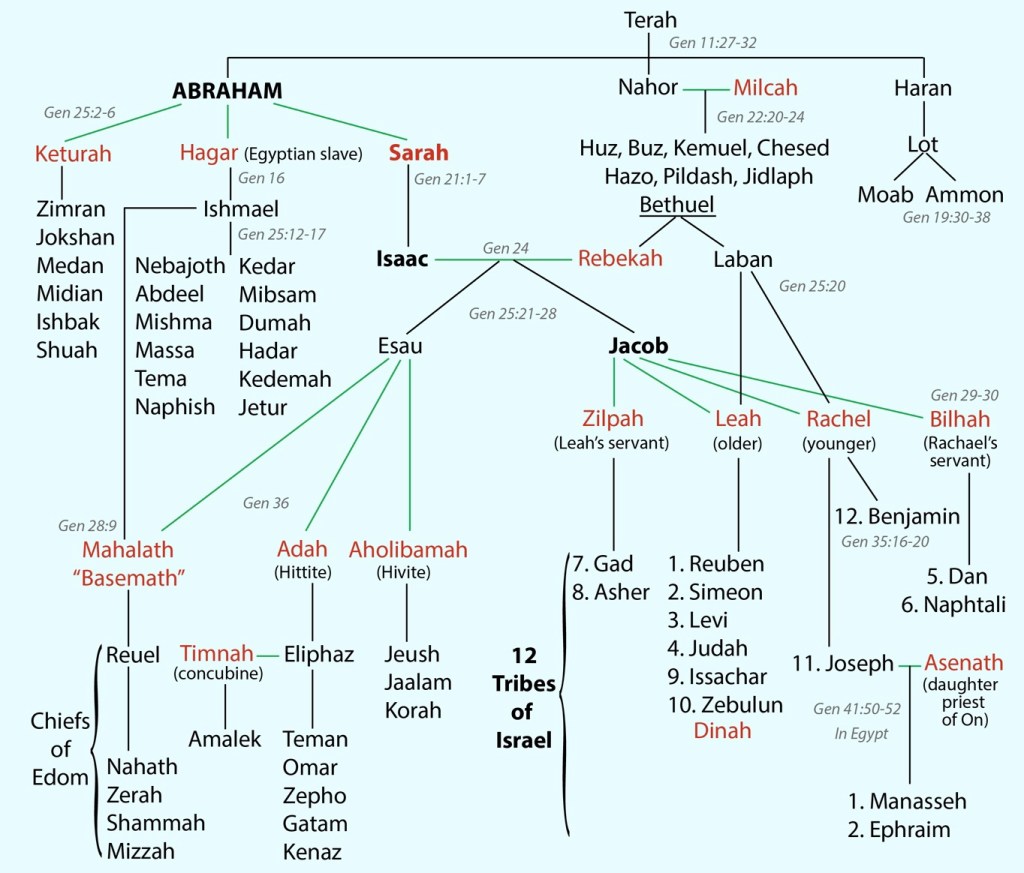
Isaac will, much later in time, notice Rebekah, the daughter of Bethuel, “son of Milcah, the wife of Nahor, Abraham’s brother” (24:15), but this is not until the story has almost come to its close (24:62–67). It is understandable that Isaac was agreeable to the arrangement that his father had made, for “the girl was very fair to look upon, a virgin, whom no man had known” (24:16).

This last comment is important, in the light of the drastic provision in the Torah that, if evidence of the young woman’s virginity is lacking, “they shall bring the young woman out to the entrance of her father’s house and the men of her town shall stone her to death, because she committed a disgraceful act in Israel by prostituting herself in her father’s house” (Deut 22:21).

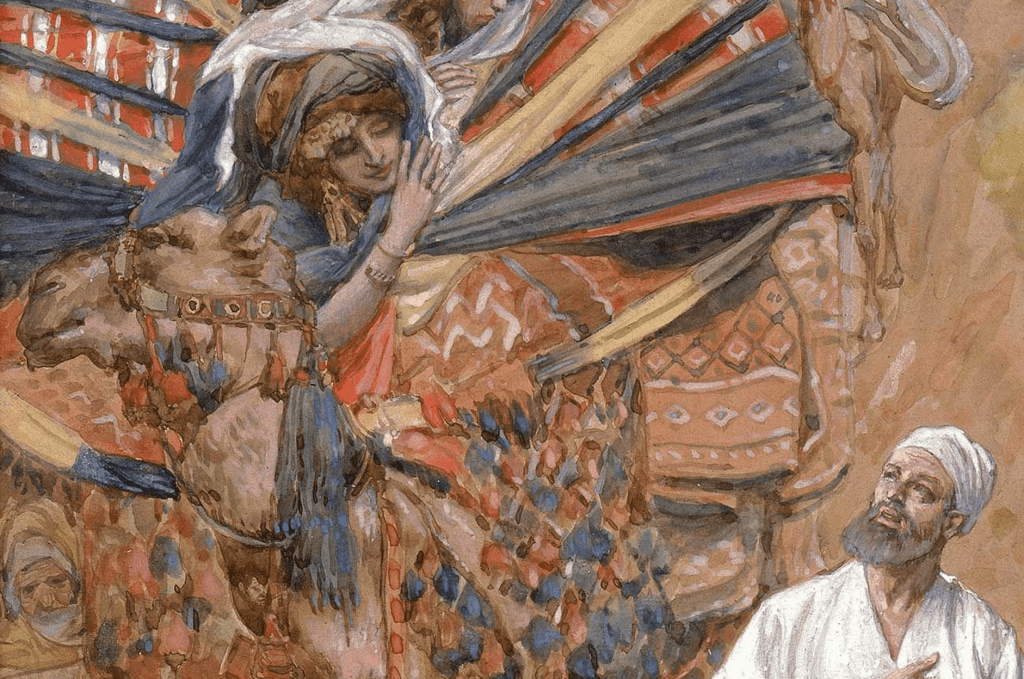
Reckoning that the woman was able to be considered for marriage (we have to trust the insight of the narrator at this point), the servant was prepared for what he hoped would transpire; he had with him “a gold nose-ring weighing a half shekel, and two bracelets for her arms weighing ten gold shekels” (24:22).

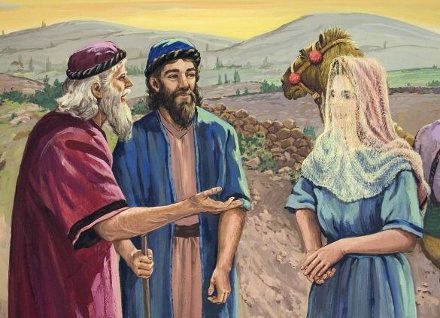
After Rebekah has brought her brother Laban into the story (24:28–29), and he noticed the nose-ring and bracelets (24:30), he offered hospitality to the servant, which was duly accepted (24:31–33). The purpose of the nose-ring and bracelets is then revealed—although surely those who heard this story in antiquity would be well aware of their significance. Brokering a marriage is the clear intention (24:34–41).

The woman had had a ring placed in her nose, and bracelets put around her arms (24:47); the action presumably took place at 24:22–27, although it was not explicitly narrated there. The ring and bracelets were obviously the custom for women in the time when the story was initially told, and they held their place within the story as it was passed down from generation to generation, even if customs may have changed.

Marriage customs do vary across time and place, from one culture to another. What held in the days of the patriarchs (or, at least, in the days in ancient Israel when people told stories about how they imagined things were in the “olden days” of the patriarchs) does not necessarily hold good for our time, today. A story of a man who married a woman so that, after a prescribed period of time (seven years!) he could marry her sister, as was the case with Jacob, Rachel, and Leah (Gen 29–30), for instance, would not hold today! And whilst rings remain the most common sign of a marriage, they are placed around fingers, and not into noses, in most modern cultures!

So Isaac, eventually, enters the story (some 47 verses after Rebekah was first introduced!). He notices, first, the camels which had come all the way from Nahor to the Negeb (24:62–63); and then, “Isaac brought her into his mother Sarah’s tent; he took Rebekah, and she became his wife; and he loved her” (24:67). All is well, that ends well—thanks to the well!

However, even though Isaac had never been to the well at Nahor where the marriage agreement was made, this well was the first of a number of wells where marriages were negotiated and confirmed within the sagas of ancient Israel. Jacob met his wife-to-be, Rachel, beside a well in Canaan, later Samaria (Gen 29:1–3). Moses, when travelling in Midian, “sat down by a well”, where, in due time, the local priest Jethro gave one of his daughters, Zipporah, to Moses in marriage (Exod 2:15–21).

The well in Canaan, known as Jacob’s well, is much later on the location for another famous encounter, between Jesus of Nazareth and an unnamed woman of Samaria (John 4:4–30)—although no marriage resulted from this encounter!

The two marriages, of the son and grandson of Abraham, which resulted from encounters beside the two wells, are important, for they demonstrate that the promise made to Abraham, of many descendants who will be blessed by God (Gen 12:2–3), will be guaranteed. Sure enough, Isaac and Rebekah produce twin boys, Esau and Jacob; and Jacob, in turn, is the father of twelve sons, whose names provide the identification of the twelve tribes of Israel. So these wells are integral to the divine promise!

Isaac was the son of Abraham; Rebekah was the granddaughter of Nahor, the brother of Abraham; so they were cousins. Tracy M. Lemos, Associate Professor of Hebrew Bible and ancient Near Eastern language and literature in the Faculty of Theology of Huron University College at Western University in London, Ontario, writes in Bible Odyssey that “Biblical texts make clear that marriages between cousins were strongly preferred”. She continues, “different Israelite communities and authors had diverse viewpoints on marriage and that Israelite viewpoints evolved over time”. See

https://www.bibleodyssey.org/passages/related-articles/weddings-and-marriage-traditions-in-ancient-israel/

The conclusion of Prof. Lemos, that “many biblical customs would be unfamiliar or even objectionable to many people living in western societies today”, certainly stands with regard to the passage we are offered for this coming Sunday. The detailed story that is told in Gen 24 is a fascinating insight into another world, another time, another culture. Yet it is part of our shared heritage, as Jews and Christians, in the modern era. It is good to hear the story, once again, as the lectionary offers it to us this Sunday.

She laughed. But what else do we know about Sarah? (Gen 11–23, for Pentecost 6A)

We know that “she laughed”. And that she produced a miracle baby at the ripe old age of 90 (or so it is said). But what else do we know about Sarah? Before she disappears from view in the Hebrew Scripture passages that the lectionary is offering us, let’s spend some time thinking about Sarah.

During this season after Pentecost, the lectionary has been offering us stories selected from the ancestral sagas of Israel, tracing the way that the promise to Abraham—“I will make of you a great nation” (Gen 12:1), “look toward heaven and count the stars … so shall your descendants be” (Gen 15:5)—was able to come to fruition.

Over successive Sundays, we have read of the call to Abram (ch.12), the promise of a child to Sarah (ch.18), the banishment of Abraham’s son through his slave girl Hagar (ch.21), the near-sacrifice of the preferred son, Isaac (ch.22), and the manoeuvring by Abraham to ensure a wife for Isaac who is of “my country and my kindred” (ch.24).

In future Sundays, we move on to stories about the twin boys born to Isaac and his wife Rebekah (ch.25), Jacob’s dream at the Jabbok (ch.28), Jacob and his marriages to, first Leah, and then Rachel (ch.29), and then the story of Jacob at Penuel, which explains how he had his name changed to Israel (ch.32). The story then focusses on one of Jacob’s twelve sons, Joseph, who is taken to Egypt (ch.37) and later saves his brothers during a famine (ch.45).

These stories—have you noticed?—follow the male line of descent, and place the male at the centre of the story. It is Abram’s call, Abraham’s near-sacrifice of Isaac, Isaac who needs a wife, Jacob who has a dream, Jacob who obtains two wives, Jacob who wrestled with God, and Joseph who becomes the saviour of his brothers.

What role is played by the women in the story? We do know the names of the matriarchs—Sarah, Rebekah, Leah and Rachel—and they do figure in the stories; but the focus is quite patriarchal, as would befit the nature of ancient society.

Sarah, whom we meet initially as Sarai (11:29), is essential to the storyline at various points; and she has come to be venerated alongside Abraham in later traditions. Paul refers to her as the means by which God’s promise is fulfilled (Rom 9:9) and he even offers her and Hagar together as providing an allegory for “the present Jerusalem, in slavery … and the Jerusalem above [who is] free, our mother” (Gal 4:21–26).

In the letter to the Hebrews, Sarah is named (in contrast to many other women) and takes her place alongside Abraham as part of “so great a cloud of witnesses” (Heb 12:1)—although all that is said of her is the stark declaration, “Sarah herself was barren” (Heb 11:11). The miracle, it would seem, was that “from one person, and this one as good as dead, descendants were born” (Heb 11:12)—that is to say, it was the transformation of the “as good as dead Abraham” that is being celebrated here.

In 1 Peter, Sarah is put forward as one of the “holy women who hoped in God”—although, in this instance, what is said of her again mirrors the patriarchal dominance of society; “Sarah obeyed Abraham and called him lord. You have become her daughters as long as you do what is good and never let fears alarm you” (1 Pet 3:5–6).

It takes an exilic prophet, whose words were appended to the earlier scroll of Isaiah, to give Sarah (almost) equal billing with Abraham: “Listen to me, you that pursue righteousness, you that seek the Lord. Look to the rock from which you were hewn, and to the quarry from which you were dug. Look to Abraham your father and to Sarah who bore you; for he was but one when I called him, but I blessed him and made him many.” (Isa 51:1–2).

So, what do we know of Sarah from those ancestral narratives which were told by word of mouth, handed down the generations, and ultimately (sometime in the Exile in Babylon) written down in the form we now have them, in the scroll entitled Bereshit, which we know as the book of Genesis?

We meet Sarai (meaning “my princess”) in the list of descendants of Terah, the father of Abraham (Gen 11:29), although (as in the Hebrews reference) it is simply noted that “Sarai was barren; she had no child” (11:30). That’s a serious roadblock in a passage that is listing descendant upon descendant!

In that same passage, we are told that Sarai, daughter-in-law of Terra, accompanied the family when they journeyed from Ur of the Chaldeans to Haran, where they settled (11:31). The journey had been intended to go as far as Canaan; that would not take place until the Lord called Abram to “go from your country and your kindred and your father’s house to the land that I will show you” (12:1). Sarai is there, as well as Lot and his perpetually-unnamed wife, “and all the possessions that they had gathered, and the persons whom they had acquired in Haran” (12:5).

The next story involving Sarai is perplexing and disturbing. Because of a famine, Abram “went down to Egypt to reside there as an alien” (12:10). We know that Sarai accompanies him, because he forewarns her, “I know well that you are a woman beautiful in appearance; and when the Egyptians see you, they will say, ‘This is his wife’; then they will kill me, but they will let you live. Say you are my sister, so that it may go well with me because of you, and that my life may be spared on your account.” (12:11–13).

The story is repeated twice more in Genesis; once when Abraham repeats this ruse in Gerar, before King Abimelech (20:1–7), and again when Isaac tells the same Abimelech that Rebekah is his sister (26:6–11)! It seems that the fruit does not fall far from the tree; Isaac exactly replicates his father’s devious strategy.

In between those two instances of spousal deception in Gen 12 and Gen 20, Sarai has been the cause of plagues falling onto Pharaoh and his house (12:17), settled with her husband “by the oaks of Mamre, which are at Hebron” (13:1, 18), and presumably learnt from Abram about the covenant which the Lord made with him (15:1–21)—although the text is silent about where Sarai was as this revelation came to Abram.

Sarai is front and centre, however, in the next story told, as she offers her Egyptian slave-girl, Hagar, to Abram so that he might reproduce, and fulfil the divine promise (16:1–3). Tension between the servant girl and her mistress resulted, so “Sarai dealt harshly with her, and she [Hagar] ran away from her [Sarai]” (16:6). Eventually, an angel instructed Hagar to “return to your mistress, and submit to her” (16:9), so she did, and in time bore a child to Abram.

In the next story, the circumcision of Abram and “every male among you” (17:1–27), we might wonder what role was played by Sarai. Did she witness the ceremony? Did she and her women assist those who were subjected to this procedure? Certainly, in the midst of the conversation that Abram has with God at this time, both he and his wife are given new names: “no longer shall your name be Abram, but your name shall be Abraham” (17:5), and “as for Sarai your wife, you shall not call her Sarai, but Sarah shall be her name” (17:15).

Abram, whose name describes his status in the story as “exalted ancestor”, will henceforth be known as Abraham, “ancestor of a multitude”, in keeping with the promise of God that “you shall be the ancestor of a multitude of nations” (17:4), while Sarai, “my princess”, will henceforth be known simply as “princess”, without any inflection indicating that she is “owned” by anyone.

So Sarah takes her place at the centre of the story at this point. Her status as princess means that “she shall give rise to nations; kings of peoples shall come from her” (17:16), and the birth of a son, Isaac, is predicted (17:19) and his role in continuing the lineage is confirmed (17:20). That birth is again foreshadowed when three visitors stay with Abraham and Sarah at Mamre (18:10). Sarah’s sceptical laughter (18:12) was already prefigured in the name allocated to her son, Isaac—meaning “he laughs” (17:19).

Before Isaac is born, however, the terrible story of inhospitality and divine vengeance on Sodom and Gomorrah is told in some detail (18:16–19:29), and the origins of the southern neighbours of Israel, the Moabites and Ammonites, is told (19:30–38), as well as the deception of Abraham in Gerar, when he passes the pregnant Sarah off as his sister (20:1–7).

Then comes the birth of Isaac (21:2–3), after which she rejoices, “God has brought laughter for me; everyone who hears will laugh with me” (21:6)—after which Sarah again orders Hagar, and also Ishmael, to depart into the wilderness. Sarah instructs Abraham to “cast out this slave woman with her son” (21:10); “the matter was very distressing to Abraham on account of his son” (21:11).

And so the schism between Abraham and Sarah is opened up; the events of the next incident, when Abraham takes Isaac to a mountain in Mariah, to sacrifice him (22:1–3), appear to seal the split. As I was talking with my wife, Elizabeth Raine, about this difficult story last week, she pointed out to me that we do not see Abraham and Sarah together in the same place after this.

Abraham now appears not to be living with his wife, Sarah—he is in Beersheba, with his servants (22:19) whilst Sarah remains at Hebron, where she dies (23:1–2). Was this because of the tension that grew between the patriarch and the matriarch after he had almost sacrificed his son? This is the story we read last week; see

Tensions were already evident earlier in the story, when Sarah had banished Hagar and Ishmael into the wilderness of Beersheba (21:10–14). To send them on their way, Abraham made sure that they had bread and water to sustain them in the wilderness (21:14). As Elizabeth noted, we do not see Abraham and Sarah together again in the story.

It is only on her death that Abraham travels to where Sarah had been living, in Hebron, some 42km further north. Abraham sought to purchase a field there to serve as the burial place for Sarah. Ephron the Hittite, moved with compassion, wanted to gift him a field with a cave where Sarah’s body could be laid (23:7–12), but Abraham insisted and paid Ephron the value of the field, 400 shekels of silver (23:12–16). He dies at least honour her appropriately at the point of her death.

*****

Writing in My Jewish Learning, Jewish educator Rachael Gelfman Schultz notes that “Genesis contains the greatest concentration of female figures in the Bible (32 named and 46 unnamed women). The fact that Genesis consists of a series of family stories (including several genealogies) accounts for the remarkable concentration of female figures.” Sarah is an important figure in that list of women. Rabbinic tradition lists her among the seven women prophets, the others being Miriam, Deborah, Hannah, Abigail, Huldah, and Esther.

See https://www.myjewishlearning.com/article/sarah-in-the-bible/

Nissan Mindel, writing in Chabad.org, observes that “Sarah was just as great as Abraham. She had all the great qualities that Abraham had. She was wise and kind, and a prophetess. And G‑d told Abraham to do as she says.”

He describes the home that they made in Beersheba, noting that whilst Abraham received visitors, offered them hospitality, and conversed with them (following the pattern shown in Gen 18), “Sarai was busy with the women folk, and long after all visitors were gone, or had retired to sleep, Sarai would sit up in her tent, making dresses and things for the poor and needy.

“When everybody was fast asleep, there was still a candle burning in Sarai’s tent, where she was sitting doing some hand-work, or preparing food for the next day. So G‑d sent a special Cloud of Light to surround her tent. For miles and miles around, the Cloud of Glory could be seen hovering over Sarai’s tent, and everybody said, “’There dwells a woman of worth.’”

See https://www.chabad.org/library/article_cdo/aid/112057/jewish/Abraham-And-Sarah.htm

So there is much to value, and honour, about Sarah, princess, prophet, and matriarch supreme. We would do well not to overlook her, the matriarch of matriarchs, amidst the stories of the patriarchs.

Among egalitarian religious congregations of Jews throughout the world, the most popular addition to the traditional liturgy is the mention of the Matriarchs in birkat avot (the blessing of the ancestors), the opening blessing of the Amidah:

Praised are You, Adonai our God and God of our ancestors, God of Abraham, Isaac, and Jacob, God of Sarah, Rebekah, Rachel, and Leah, great, mighty, awesome, exalted God who bestows lovingkindness, Creator of all. You remember the pious deeds of our ancestors and will send a redeemer to their children’s children because of Your loving nature.

https://jwa.org/encyclopedia/article/matriarchs-liturgical-and-theological-category

On the mount of the Lord it shall be provided (Gen 22; Pentecost 5A)

“Abraham reached out his hand and took the knife to kill his son” (Gen 22:10). We read these chilling words in the passage that the lectionary offers for our reflection and consideration this coming Sunday (Gen 22:1–14). It’s hardly edifying reading material for worship, is it?

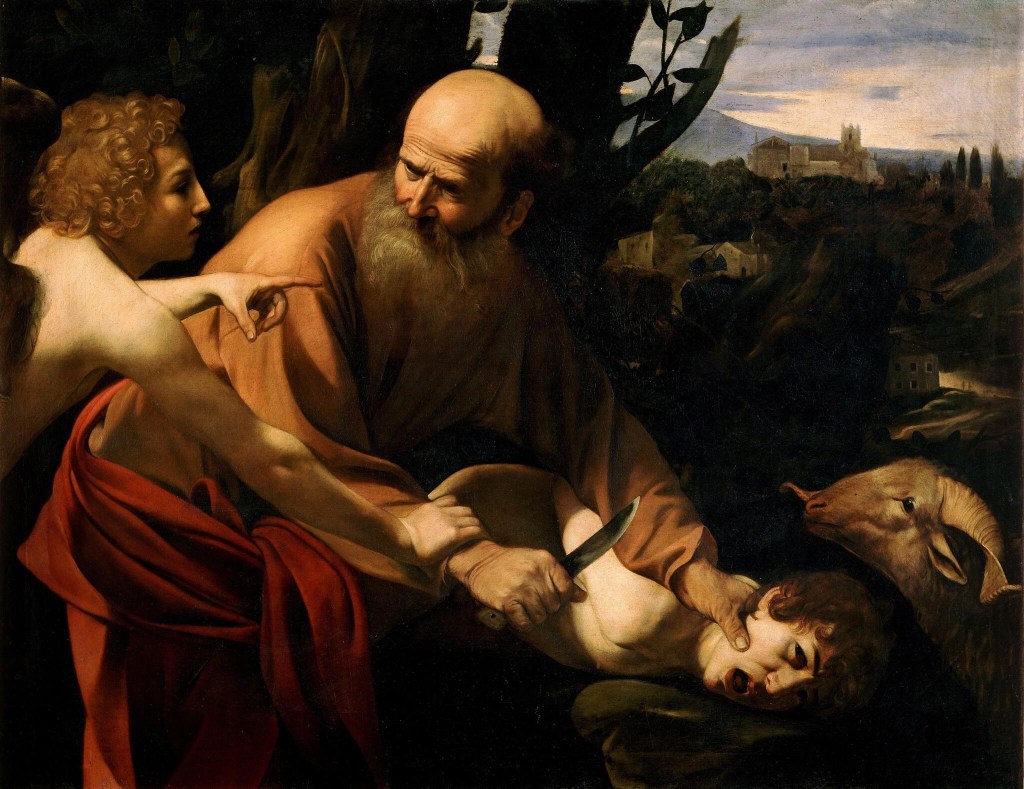
The Sacrifice of Isaac, by Caravaggio, c. 1603

It’s a horrifying story. Who is this God who calls Abraham to take his “only son” up the mountain and “offer him there as a burnt offering” (22:2)? How does this God relate to the God who, it is said, has shows “steadfast love” to the people of Israel (Exod 15:13), and before that to Joseph (Gen 39:21), to Jacob (Gen 32:9–19), and indeed to Abraham himself (Gen 24:27)? Why has God acted in a way that Is seemingly so out of character in this incident in Gen 22? Or is this the real nature of God, and later displays of “steadfast love” are simply for show?

Writing in With Love to the World, the Revd Sophia Lizares, a Uniting Church Minister originally from the Philippines, now serving in Perth, WA, says that this story is “an improbable and troubling reading: a God who demands a father to kill his beloved son, a father who questions not.” It is not just the knife in Abraham’s hand which is raised (22:10)—there are many such questions raised by these seemingly callous story.

My wife, Elizabeth Raine, has a cracker of a sermon in which she compares this story with the account of Jephthah and his daughter (Judg 11:29–40). Whilst the Lord commands Abraham to kill his son as a burnt offering, it is the vow made by Jephthah to sacrifice “whoever comes out of the doors of my house to meet me, when I return victorious from the Ammonites” as a burnt offering (Judg 11:30).

And whilst the Lord intervenes in what Abraham is planning to do at the very last moment, sending an angel to command him, “do not lay your hand on the boy or do anything to him” (Gen 22:11–12), Jephthah is held to the vow he has made—by his very own daughter, who knows that she will be the victim of this vow (Judg 11:39). There is no divine intervention in this story.

And worse, whilst Abraham had carefully prepared for the sacrifice, taking his donkey, two servants, and the wood for the fire up the mountain with him (Gen 22:3–6), Jephthah’s vow was made on the spur of the moment (Judg 11:30–31), and when his daughter insisted that he must carry through with this vow, he gives her, as requested, two full months for her to spend with her companions before he sacrificed her (Judg 11:37–39). Surely he might have had time in those two months to reconsider his vow and turn away from sacrificing his daughter?

It would seem, then, that the daughter was dispensable; the son, the much loved only son of Sarah and Abraham, was clearly indispensable. That would clearly reflect the values of the patriarchal society of the day, in which “sons are indeed a heritage from the Lord, the fruit of the womb a reward” (Ps 127:3).

And Abraham would have followed the same pathway, sacrificing his only son, had not the Lord intervened. Neither father is looking very appealing in these two stories! Which makes it hard to see how the story of the sacrifice told in Judg 11, and the story of the almost-sacrifice told in Gen 22, can be “the word of the Lord” for us, today, in the 21st century. Indeed, the story of Abraham and Isaac comes perilously close to being a story of child abuser—if not physical abuse, by the end of the story, at least emotional and spiritual abuse.

Situations of abuse destroy trust. After such an experience, how could Isaac ever trust his father again? And as we hear the story, how can we trust God? How could we ever believe that his commands to us are what we should follow?—if he follows the pattern of this story, and changes his mind at the last minute, after pushing us to the very brink of existence? How could we trust a God like this?

Or, if the story involving poor Isaac is really about God providing, as Abraham intimates early on (22:8), and then concludes at the end (22:14), then it is a rather malicious way for God to go about showing how he is able to “provide”. Provision, and providence, should be something positive—not perilous and threatening, as in this story.

Or yet again, if the story is about testing Abraham’s faith, as many interpreters conclude, then it is a particularly nasty and confronting way for God to do this—and that points to a nasty streak in the character of God. Is this really what we want to sit with? Was there not some other way for God to push Abraham to test his faith?

What do we do with such a story within our shared sacred scriptures?

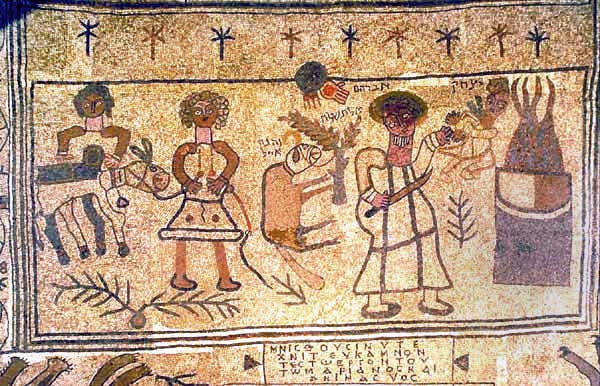
A sixth-century CE floor mosaic from the Beth Alpha synagogue, in Israel’s Jezreel Valley. The mosaic lay near the door, so that anyone who entered was confronted by the scene. In this mosaic, Abraham and Isaac are identified in Hebrew. The hand of God extends from heaven to prevent Abraham from proceeding. Below the hand are the Hebrew words, “Lay not [your hand].” Next to the ram are the words, “Behold a ram.”

*****

The Jewish site, My Jewish Learning, states that “although the story itself is quite troubling, it does contain a message of hope for Rosh Hashanah. In the liturgy we ask God to “remember us for life.” The binding of Isaac concludes with his life being spared, and he too is “remembered for life.” Abraham’s devotion results in hope for life.”

How does the message of hope for life emerge from this story? Clearly, the life of Isaac is spared; but this is a terrible way to teach that message!

James Goodman, writing in My Jewish Learning, explains how he was taught to understand this story. “I learned that the story was God’s way of proclaiming his opposition to human sacrifice”, Goodman writes.

He refers to the way his Hebrew-school teacher explained this story: “God had brought Abraham to a new land. A good and fertile land, where it was common for pagan tribes, hoping to keep the crops and flocks coming, to sacrifice first-born sons to God. Then one day, God commanded Abraham to sacrifice Isaac, the beloved son of his old age.

“Abraham set out to do it, and was about to, when God stopped him. He sacrificed a ram instead. In the end, Abraham had ‘demonstrated his—and the Jews’—heroic willingness to accept God and His law,’ and God had ‘proclaimed’ that ‘He could not accept human blood, that He rejected all human sacrifices’.”

See https://www.myjewishlearning.com/2013/09/11/understanding-genesis-22-god-and-child-sacrifice/

Setting the story in the broader context of the practice of child sacrifice is a way of accepting that this terrible story might indeed have some value. Seeing the story is a dramatised version of God’s command not to sacrifice children can be a way to deal with it. “Do not lay your hand on the boy or do anything to him”, the angel says; so Abraham obeys, finds a ram, offers the ram as a burnt offering (22:12–13). And so, the name of the place is given: “the Lord will provide” (22:14).

Three kings of Israel, at different times in the history of Israel, are said to have practised child sacrifice, as they turned to practices found in nations other than Israel. Solomon in his old age is said to have turned to the worship of Molech (1 Ki 11:7); this practice was subsequently adopted by Ahaz, who “made offerings in the valley of the son of Hinnom, and made his sons pass through fire, according to the abominable practices of the nations whom the Lord drove out before the people of Israel” (2 Chron 28:3). Likewise, Manasseh “made his son pass through fire; he practiced soothsaying and augury, and dealt with mediums and with wizards” (2 Ki 21:6).

Direct commands not to sacrifice children are found in two books of Torah in the scriptural texts. Most direct is “you shall not give any of your offspring to sacrifice them to Molech, and so profane the name of your God: I am the Lord” (Lev 20:18). In Deuteronomy, other nations are condemned as they “burn their sons and their daughters in the fire to their gods” (Deut 12:31), so the command is “no one shall be found among you who makes a son or daughter pass through fire” (Deut 18:10). The prophet Jeremiah also asserts that this practice is not something that the Lord God had thought of (Jer 7:31).

So the passage we have in the lectionary responds to this practice by telling a tale which has, as its punchline, the command “do not lay your hand on the boy or do anything to him” (22:12). Might this be the one redeeming feature of this passage?

But if that is the case, the story belongs back in the days when child sacrifice was, apparently, widely practised. What, then, does it say to us today???

See also

A prophet, a righteous person, and a little one (Matt 10; Pentecost 5A)

This Sunday, the lectionary offers a Gospel passage of just three succinct verses (Matt 10:40–42). In those verses, three key terms are used Jesus: prophet, righteous one, and little one. “Whoever welcomes you welcomes me, and whoever welcomes me welcomes the one who sent me,” Jesus asserts (Matt 10:42), before he proceed to extend this saying to include those who welcome a prophet, a righteous person, and “whoever gives even a cup of cold water to one of these little ones in the name of a disciple”. In each case, a reward is certain, says Jesus.

The last of these sayings, about “one of these little ones”, links these verses with the saying of Jesus he spoke after the disciples had been arguing about “who was the greatest”. This saying is reported in the triple tradition (Mark 9:33–37 and parallels in Matt 18 and Luke 9). In that scene, Jesus took a child in his arms and said, “whoever welcomes one such child in my name welcomes me, and whoever welcomes me welcomes not me but the one who sent me” (Mark 9:37; Matt 18:5; Luke 9:48).

Matthew here reports an expanded version of that saying, which is applied directly to the disciples. He begins by reversing Mark’s saying, taking the end of that version by referring initially to all the disciples: “whoever welcomes you”, before extending this to include “welcoming me” (10:40).

The disciples represent Jesus as “the one who sent me”, namely, God. This last phrase, found in the three Synoptic versions of this saying, is a favourite Johannine phrase for God (John 1:33; 6:44; 7:28; 8:26, 29; 9:4). The Johannine version of this saying is “whoever receives one whom I send receives me; and whoever receives me receives him who sent me” (John 13:20). That is very similar to the version that Matthew reports.

However, Matthew extends his version of Mark’s saying still further by adding “whoever welcomes a prophet”, then “whoever welcomes a righteous one” (10:41), before concluding with “whoever gives even a cup of cold water to one of these little ones in the name of a disciple” (10:52). The “little one” is presumably equivalent to “the child” which had begun Mark’s saying.

Jesus’ other saying about “the little ones” appears in all three Synoptic Gospels. The saying is highly likely to be authentic, if we adopt the classic form-critical criteria that were developed some decades ago. One marker of authenticity is for a saying to be hard, difficult, or unexpected. Jesus instructs his disciples, “if any of you put a stumbling block before one of these little ones who believe in me, it would be better for you if a great millstone were hung around your neck and you were thrown into the sea” (Mark 9:42; Luke 17:2; Matt 18:6).

This is a shocking, confronting instruction. It is undoubtedly a hard saying. In Mark 9, that shocking statement is extended regarding a hand or a foot or an eye causing a person to stumble; “it is better for you to enter life maimed … lame …[or] with one eye”, he advises (Mark 9:43-48). So Jesus is strenuously advocating for “the little ones”, and giving them a cup of water (Matt 10:42) is an essential act of discipleship.

*****

We have seen, then, that Matthew has inverted the order he received from Mark and extended the comparison he makes about welcoming a person who comes in his name. Adding the prophet to this saying (10:41) brings in another dimension to the story.

One line of interpretation that has been proposed intrigues me. Could these sayings reflect the on-the-ground nature of the earliest period of the movement that Jesus initiated? He had called disciples to follow him (4:18-22; 9:9), warned people of the difficulties that this would entail (8:18–22), selected an inner group to be designated as “emissaries—translating the Greek apostoloi (10:1–4), and commissioned them to proclaim the nearness of God’s presence in this world (10:5–15).

Jesus then warned these emissaries of the dangers that lay in store for them (10:16–25) and encourages them with the words, “do not fear those who kill the body but cannot kill the soul” (10:26–31), assuring them that “everyone who acknowledges me before others, I also will acknowledge before my Father in heaven” (10:32–33). The short lectionary passage brings the whole “mission discourse l (10:1–42) to a close. These words encapsulate the commission and the anticipated experience of the disciples.

How were the followers of Jesus to implement this? Gerd Theissen, a German New Testament scholar, has proposed that the message of Jesus was spread by itinerants within the early Jesus movement who travelled from village to village with their message. They were dependent on those who received them for hospitality and lodging, in literal obedience to what Jesus had told his disciples (Mark 6:10–11). They were living in complete obedience to “the Son of Man [who] has nowhere to lay his head” (Matt 8:20; Luke 9:58).

Evidence for such itinerant preachers can also be found in the Didache, which instructs: “Whosoever, therefore, comes and teaches you all these things that have been said before, receive him … Let every apostle that comes to you be received as the Lord. But he shall not remain except one day; but if there be need, also the next; but if he remain three days, he is a false prophet. And when the apostle goes away, let him take nothing but bread until he lodges; but if he ask money, he is a false prophet.” (Didache 11:1, 4–6).

The reference to prophets in Matthew’s account of the words of Jesus resonate with this portrayal of the early church. Receiving a prophet and welcoming them (providing them with hospitality—food, drink, and shelter) is affirmed, for the prophet comes as a representative of Jesus (10:41).

Throughout the story of Israel, the prophet has been the one who, literally, “speaks forth”; so the prophets sent by Jesus proclaim the message that “the kingdom of heaven has come near” (Matt 10:7). The prophets proclaiming this message, as prophets did in earlier times, accompany their message with acts that manifest the truth of what is proclaimed: “cure the sick, raise the dead, cleanse the lepers, cast out demons” (10:8).

*****

Matthew also adds a saying about receiving “a righteous one” 10:42). This is language which is very important to Matthew. The word dikaios, translated as righteous, refers to a person who adheres carefully to the prescriptions of Torah, who is faithfully trusting God, who follows the ways that God sets out, who contributes constructively to society so that it functions in a just and equitable way.

Torah and righteous-justice are linked in Jewish understanding. The psalmist, characteristically, places them in synonymous parallelism, when they sing, “your righteousness is an everlasting righteousness, and your law is the truth” (Ps 119:142). The prophet Habakkuk, lamenting the “destruction and violence” that surrounds him as the Babylonian army presses into Jerusalem, observes that “the law becomes slack and justice never prevails; the wicked surround the righteous—therefore judgment comes forth perverted” (Hab 1:4). The two go hand-in-hand.

Matthew reflects this close connection between Torah and righteous-justice, as he presents Jesus as being completely faithful to Torah. In reporting his baptism, only Matthew has Jesus declare to John, “it is proper for us in this way to fulfill all righteousness” (3:15). In beginning the Sermon on the Mount, Jesus declares blessed “those who hunger and thirst for righteousness” (5:6) and “those who are persecuted for righteousness’ sake” (5:10).

Jesus follows this by announcing his intention to intensify the demands of the Law (5:18) by demanding that his followers exhibit a righteous-justice that exceeds that demonstrated by the Pharisees (5:20). Only Matthew reports these words of Torah fidelity, and only Matthew has the various parables which affirm “the righteous” over against those who disobey the law (13:36–43; 13:47–49; 25:31–46).

Matthew presents Jesus as thoroughly Jewish, for he knows that God is righteous, as is declared in scripture (Deut 32:4; Ps 145:7; Job 34:17). The psalmists regularly thank God for God’s righteousness (Ps 5:8; 7:17; 9:8; 33:5; 35:24, 28; 36:6; 50:6; etc) and note the importance of humans living in that way for righteousness (Ps 18:20, 24; 85:10–13; 106:3, 31; 112:1–3, 9).

The book of Proverbs advises that the wisdom it offers is “for gaining instruction in wise dealing, righteousness, justice, and equity” (Prov 1:3) and the prophets consistently advocated for Israel to live in accordance with righteousness (Hos 10:12; Amos 5:24; Isa 1:22; 5:7; 28:17; 32:16–17; 54:14; Jer 22:3; Ezek 18:19–29; Dan 9:24; 12:3; Zeph 2:3; Mal 4:1–3; Hab 2:1–4).

So welcoming a righteous one is welcoming a person who follows, intensely and faithfully, the way that Jesus sets out, the way of God’s righteous law—just as welcoming a prophet is welcoming one who faithfully and persistently declares the message of that righteous law. That is the measure of faith that Matthew sets out in this saying. That is the intensity that the Jesus of Matthew presents.

Dead to sin and alive to God (Romans 6; Pentecost 4A)

“What then are we to say? Should we continue in sin in order that grace may abound? By no means! How can we who died to sin go on living in it? Do you not know that all of us who have been baptized into Christ Jesus were baptized into his death?”

Paul, in typical style, starts into this section of his letter to the Romans (6:1–14) with a string of questions—interrupted only by his typical exclamation, “by no means!” The chapter divisions in our Bibles lead us to read the text in self-contained chunks—and the lectionary, by choosing clearly-defined collections of verses, exacerbates this tendency. But if we read in the way that the letter was written—as a continuous stream, with no chapter divisions or verse markings—we can see the downside of this approach.

What we know as Romans 6:1–14 (offered under a heading such as “dying and rising with Christ”) is actually a continuation of the discussion in the previous section, about sin. The sentence immediately before these words (5:21) refers to “sin exercising dominion in death”; this passage explores how the dominion of death is dealt with by Christ. Before that, Paul has undertaken a discussion of the sin of all people (5:18–20), citing the effect of “the one man’s trespass”.

That passage in turn has been a development from the claim that “sin came into the world through one man, and death came through sin, and so death spread to all because all have sinned” (5:12), itself introducing a carefully-structured argument, proceeding step by step through parallel clauses, using a typical Jewish line of argument whereby the one (Adam) functions as a representative of all (humanity). This line of argument sets up the basis for the claim that it is the work of another one man (Christ) to provide “grace exercis[ing] dominion through justification leading to eternal life” (5:21).

And the pinning of the blame for universal sinfulness on the one representative man, Adam, itself is an exposition of the earlier claim that “while we still were sinners Christ died for us” (5:8), which in turn rests on the need for God to demonstrate how sinful people are “reckoned as righteous”—something asserted at 4:6 and explained through a midrashic treatment of Gen 15:6 throughout Rom 4:1–25.

And Paul’s midrash of the Abraham story in turn expounds the tightly-declared announcement of 3:21–26, concerning how God “showed his righteousness” (3:25–26) by means of “the redemption that is in Christ Jesus, whom God put forward as a sacrifice of atonement by his blood, effective through faith” (3:24–25).

This sacrifice of atonement itself is premised on the understanding that “all have sinned and fall short of the glory of God” (3:23), which is a statement which repeats and refines the earlier “all, both Jews and Greeks, are under the power of sin” (3:9), a gathering up of those under law who have sinned (2:1–29) and those not under law who also have sinned (1:18–32)—which in turn explains the need for the Gospel of which Paul was not ashamed, “the gospel [which is] the power of God for salvation to everyone who has faith, to the Jew first and also to the Greek” (1:16).

Or, to put it all the other way around (as Paul writes it), there is good news (1:16–17) which deals with the sinfulness of Gentiles (1:18–31) and of Jews (2:1–29), a universal sinfulness (3:1–20) which God has dealt with through the sacrifice of Jesus (3:21–31), consistent with the pattern already shown centuries before in Abraham, of “reckoning as righteous” those who have faith (4:1–25), which manifests God’s grace (5:1–11); all of which has been necessary because of the introduction of sin through one man, Adam (5:12–21).

And so: “What then are we to say? Should we continue in sin in order that grace may abound? By no means!” (6:1).

Turning to the particular verses offered by the lectionary for this coming Sunday (6:1b—11): what do we find? The rhetorical pattern of the diatribe is evident here, also. The posing of a rhetorical question, followed by the definitive “by no means!”, followed up with further rhetorical questioning, is characteristic of a diatribe—a form that was developed in Ancient Greece and which was widely practised by Greek rhetoricians, philosophers, and teachers during the Hellenistic period.

Paul wants to explain that baptism signals the way that Jesus deals with human sinfulness. “Do you not know that …” (6:3) is the typical way to introduce a new matter for consideration (see also 6:16; 7:1; 11:2; 1 Cor 3:16: 5:6; 6:2, 3, 9, 15, 16, 19; 9:13, 24). In this case, the standard question introduces the subject of baptism. Whilst baptism is a sign of belonging to the community of faith, as is stated in 1 Cor 12:13 and Gal 3:27, baptism is also a joining with Christ into the mystical union that characterises Paul’s thinking.

In other letters, Paul writes about “being found in him” (Phil 3:9),

“In Christ” appears frequently in Paul’s letters: grace is given “in Christ” (1 Cor 1:4), redemption is “in Christ” (Rom 3:24), sanctification is “in Christ” (1 Cor 1:2), justification is “in Christ” (Gal 2:16–17), reconciliation is “in Christ” (2 Cor 5:19), “the blessing of Abraham” is “in Christ” (Gal 3:14), peace guards the hearts and minds of believers “in Christ” (Phil 4:7), “the riches in glory” of God are “in Christ” (Phil 4:19), encouragement is “in Christ” (Phil 2:1), and eternal life is “in Christ Jesus our Lord” (Rom 6:23). Or, as Paul writes to the Galatians, “I have been crucified with Christ; and it is no longer I who live, but it is Christ who lives in me; and the life I now live in the flesh I live by faith in the Son of God, who loved me and gave himself for me” (Gal 2:20).

So this mystical union with Christ, which shapes the life of a believer, is both symbolised and, it would seem, enacted through the ritual of baptism. Paul here pushes beyond the forensic argumentation of the previous chapters, where the status of “being justified” is a transaction that is effected by placing trust (faith) in what Jesus has done, and is doing. (Jesus, or rather Christ, for Paul, is always both past and present; perhaps, even more the active presence in a believer’s life, that the historical figure of Galilee.)

Being baptised is being “buried with him by baptism into death” which leads, inevitably, to emerging from that state into “newness of life”: “just as Christ was raised from the dead by the glory of the Father, so we too might walk in newness of life” (Rom 6:4). To drive the point home, Paul restates this union in verse 5: “if we have been united with him in a death like his”, through the act of baptism, then “we will certainly be united with him in a resurrection like his”, as we emerge from the waters of baptism. The dynamic of what is believed to take place in baptism is clear.

Then he finds another way to describe this process, introducing it by another stock standard introductory phrase, “we know” (6:6). Paul uses this phrase also at 6:9, and quite regularly elsewhere in Romans (2:2; 3:19; 7:14; 8:22, 28) as well,as in other letters )1 Cor 8:1, 4; 13:9; 2 Cor 1:7; 5:1, 6, 16; Gal 2:16; 1 Thess 1:4). In each case, the phrase functions to underline and reaffirm something that Paul presumably has previously communicated to those hearing his letter.

So, for a third time, Paul states the first, most important, half dynamic: “we know that our old self was crucified with him so that the body of sin might be destroyed” (6:6). The result is that “we might no longer be enslaved to sin”, repeated and amplified in the next clause, “for whoever has died is freed from sin” (6:7).

Then, Paul moves to the second half of this dynamic: “if we have died with Christ, we believe that we will also live with him” (6:8). Death, in the baptismal dynamic, leads inevitably into life. That is the value that it has for believers; an assurance of a “newness of life” in union with Christ, as believers “live with him”.

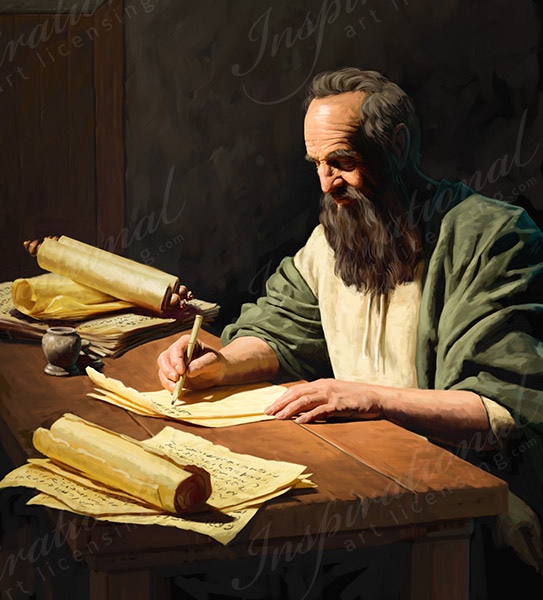
To make sure the Roman’s grasp the point, Paul says, once again, “we know”. The style of Romans is more oral rhetoric than written argumentation; I always like to imagine Paul, his brow furrowed, his shoulders slightly stooped, pacing up and down his small room, as Tertius (the scribe who actually wrote the letter, according to Rom 16:22) furiously scribbles the phrases that pour forth from Paul’s mouth. Syntactical omissions and irregularities, peculiar grammatical forms, idiosyncratic vocabulary: all of this is due to the lack of a careful, third-party, editorial eye. The letter was dictated, scribed, and sent off post haste!

At any rate, “we know”, says Paul, “that Christ, being raised from the dead, will never die again; death no longer has dominion over him, [for] the death he died, he died to sin, once for all; but the life he lives, he lives to God” (6:9–10).

Which brings us to the punchline for this particular collection of verses. Nothing new is said; the same thing has been said four or five times, and that one thing has been said, with variations throughout, to drive the point home. For the Romans, hearing this letter read in their various house gatherings, the consequence of their baptism, and of what God has done in Jesus, and of how they are to understand God’s atoning actions, and of how they are regard themselves, as justified by faith: “so you also must consider yourselves dead to sin and alive to God in Christ Jesus” (6:11).

And so the conclusion itself is then expanded, once again by stylistically varied repetitions, in 6:12–14, ending with the definitive conclusion, “sin will have no dominion over you”, and the strong and clear affirmation, “you are not under law, but under grace” (6:14).

*****

On the central theme of the letter to the Romans, see

On the use of the diatribe form in Romans, and particularly in 4:1–25, see

For my take on a key theological issue in 5:12–21, see

We have obtained access to this grace (Romans 5, Pentecost 3A)

During Lent we heard a key passage from Romans, much of which is offered again as the Epistle reading for this coming Sunday. It is a passage replete with fundamental theological affirmations (Rom 5:1–11, Lent 3A; Rom 5:1–8, Pentecost 3A). In an earlier blog, we explored two of the key elements that Paul sets out in this passage: being made righteous by faith, a central affirmation for the apostle; and being at peace with God.

In this post, as we revisit this passage for the Third Sunday after Pentecost, we look at other theological aspects of Paul’s writing. Paul writes this letter to a group of faith communities which include both Jews and Gentiles; this is a fundamental commitment in his theology and practice (Rom 3:29; 4:11–12; 9:22–24; 11:11–14; 15:7–13) and the list of names in 16:3–16 indicate that people of both Jewish and Gentile origins were present. Nevertheless, the theological commitments that Paul articulates here have strong Jewish origins.

Access to God’s grace (v.2) is a fundamental element in Paul’s affirmation in Rom 5:1–11, as well as in his whole body of writings. (I am here canvassing just the seven letters generally accepted as authentic to Paul.) God’s grace is what gripped Paul, calling him to his work as apostle, preaching the Gospel, establishing new communities of faith, and nurturing them as new disciples.

It is through Jesus, says Paul, that “we have received grace and apostleship to bring about the obedience of faith among all the Gentiles for the sake of his name” (Rom 1:5; 1 Cor 3:10; 15:10; 2 Cor 1:12; Gal 1:15). That grace is evident in the lives of believers in Corinth (1 Cor 1:4) and Philippi (Phil 1:7); by contrast, the Galatians, in Paul’s eyes, “are so quickly deserting the one who called you in the grace of Christ and are turning to a different gospels (Gal 1:6).

Paul is drawing on his Jewish heritage and the understanding of God in Hebrew Scripture. God’s graciousness was repeatedly offered to the people of Israel (Exod 34:6; Num 6:25; 1 Sam 1:22; 2 Ki 13:23; 2 Chron 30:9; Ezra 7:9; 8:18, 22; Neh 2:8, 18; 9:17, 31).

Prophets declared that God yearned to be gracious (Isa 30:18–19; 63:7; Joel 2:13; Amos 5:15; Jonah 4:2; Zech 1:13), as do the psalmists (Ps 86:15; 103:8; 111:4; 116:5; 135:3; 145:8, 13;147:1). The prophets therefore implore the Lord to manifest that grace (Isa 33:2; Mal 1:9), as do the psalmists (Ps 4:1; 6:2; 9:13;25:16; 26:11; 27:7; 30:10; 31:9; 41:4, 10; 56:1; 67:1; 86:3, 16; 119:58, 132). Grace is a fundamental scriptural concept, integral to the nature of God.

*****

Sharing in the glory of God (v.2) follows; in this regard, Paul also draws from his Jewish heritage. The glory of God is present in the stories that recount the formation of Israel, through the years in the wilderness (Exod 16:6–10; Num 14:22), on Mount Sinai (Exod 24:16–17; Deut 5:22–24), in the Tabernacle (Exod 40:34–35; Lev 9:23; Num 14:10; 16:19, 42; 20:16), and in the temple (1 Ki 8:1–11; 2 Chron 7:1–4).

The psalmists reinforce the notion that the glory resides in the sanctuary (Ps 26:8; 63:2; 102:16; Hag 2:3) and in the land of Israel (Ps 85:9). In some psalms the realm of God’s glory is extended to be “over the waters” (Ps 29:1–4), “over all the earth” (Ps 57:5; 72:19; 97:6; 102:15; 108:5; also Isa 6:3; 24:15–16; 60:1–2; Hab 2:14) and even to “the heavens” (Ps 19:1; 113:4; 148:13; and Hab 3:3).

The concept of God’s glory plays an important role in Paul’s argument in Romans. “All have sinned and fallen short of the glory of God”, Paul brazenly declares (Rom 3:23); some who claim to know God “exchanged the glory of the immortal God for images resembling a mortal human being” (1:23), in contrast to “those who by patiently doing good seek for glory and honour”, to whom “glory and honour and peace” will be given (2:7, 10).

To Abraham, who “grew strong in his faith as he gave glory to God”, his faith would be “reckoned as righteousness” (4:20–22). In God’s time, “the freedom of the glory of the children of God” will given to the creation (8:21). Within the communities of faith in Rome, the imperative of “welcoming one another” is to be done “for the glory of God” (15:7). This glory is God’s gift to people of faith, and indeed to the whole creation.

*****

The next important theological claim, the connection of sufferings and endurance with hope (vv.3–5), is a link that is made elsewhere in Paul’s writings. Paul itemises the sufferings that he has experienced throughout his ministry (2 Cor 6:3–10; 11:24–29; see also 1 Cor 4:9–13; 15:30–32; 2 Cor 12:10; Phil 4:12; 1 Thess 2:2)—all of which fulfils the second element of the call which Luke claims that Paul received from God, “I myself will show him how much he must suffer for the sake of my name” (Acts 9:16).

The hope in God that Paul holds fast throughout those sufferings is also quite clearly expressed (Rom 8:22–25; and especially in 2 Cor 1:3–11). “Rejoice in hope, be patient in suffering”, he advises the Romans (12:12), and he informs them that “whatever was written in former days was written for our instruction, so that by steadfastness and by the encouragement of the scriptures we might have hope” (15:4).

Indeed, the long saga of Israel told in those writings is a story of hoping in the face of sufferings: hoping for the promise declared to Abraham, hoping for liberation whilst in the oppressive conditions of Egypt, hoping to reach the promised land throughout the years of wilderness wandering; and then, centuries later, hoping for release from the second captivity of Exile, and hoping for the restoration and rebuilding of city and land to last long into the future.

Just as story of Israel can be told in terms of hope, so faithful people through the ages sang of hoping in the steadfast love of the Lord (Ps 33:18; 147:11), in the ordinances of the Lord (Ps 119:43) and the word of the Lord (Ps 119:81, 114, 147; 130:5). The invocation to “hope in God” is a regular refrain in the psalms (Ps 42:5, 11; 43:5; 130:7; 131:3). “Happy are those whose help is the God of Jacob, whose hope is in the Lord their God”, says one psalmist (Ps 146:5); another sings “God of our salvation, you are the hope of all the ends of the earth and of the farthest seas” (Ps 65:5).

*****

After grace, glory, and hope, Paul next refers to the gift of the Holy Spirit (v.5), the means by which “God’s live has been poured into our hearts”. In his first letter to Corinth, the activity of the Spirit is a central focus (1 Cor 2:9–16; 3:16; 6:19;12:3–11) and is especially in view in the manifestation of spiritual gifts within the community (1 Cor 14:1–40).

To the Romans, Paul explains that it was “the spirit of holiness” who raised Jesus from death (Rom 1:4) and who now “dwells in you” (Rom 8:11), helping believers “in our weakness” and enabling them to “pray as we ought” (Rom 8:26). He exhorts them to “be ardent in spirit, serve the Lord” (Rom 12:11), to “abound in hope by the power of the Holy Spirit” (Rom 15:13), and “by the love of the Spirit, join me in earnest prayer to God on my behalf” (Rom 15:30).

The Spirit was active throughout Hebrew Scripture. Ezra recalls that “you gave your good spirit to instruct them, and did not withhold your manna from their mouths, and gave them water for their thirst” (Neh 9:20–22). It was the work of the Spirit to release the captives from Egypt, lead them through the challenges of the wilderness, and then bring them into the promised land..

The Spirit which had guided Moses and was then gifted to chosen elders (Num 11:16–25) was subsequently imparted to Joshua (Num 27:18; Deut 34:9) and then to a string of Judges: Othniel (Judg 3:10), Gideon (6:34), Jephthah (11:29), and Samson (13:24–25; 14:6,19; 15:14). Each of these men led their people through dangerous, challenging, and turbulent experiences, as they sought to impose Israelite domination on the peoples already living in Canaan.

And in Exile, as they reflected on the whole sweep of the story of Israel and placed it into a grand cosmic context, the priests gave the Spirit pride of place in their account of creation: “the earth was a formless void and darkness covered the face of the deep, while a wind [or a spirit] from God swept over the face of the waters” (Gen 1:2). The Spirit is present and active in the pages of Hebrew Scripture!

*****

In the following verses, Paul offers a clear salvific interpretation of the death of Jesus when he declares that “Christ died for the ungodly” (v.6), that “while we were still sinners, Christ died for us” (v.8). This is another central element in the theological structure that Paul, throughout his letters, demonstrates. And it, to, can best be understood in the light of the development of thinking throughout the story of Israel.

What follows are two striking affirmations about Jesus. The first is that “we have been justified by his blood” (v.9). This appears to have been an early credal-like claim within the early Christian movement; it appears in various forms at Acts 20:28; Rom 3:25; Eph 1:7; 2:13; Col 1:20; Heb 9:14; 10:19; 12:24; 13:12, 20; 1 Pet 1:2, 19; 1 John 1:7; Rev 1:5; 5:9;12:11.

The claim made depends on ancient Hebraic understandings of life and the role that blood plays in that. “You shall not eat flesh with its life, that is, its blood”, Noah is commanded (Gen 9:4); “the life of the flesh is in the blood”, the Lord declares to Moses (Lev 17:11). This understanding undergirds the whole sacrificial system; when sacrifices are made, blood must be shed, for “I have given it to you for making atonement for your lives on the altar; for, as life, it is the blood that makes atonement” (Lev 17:11; also Deut 12:23). Thus, a much later priestly writer is able to claim, “under the law almost everything is purified with blood, and without the shedding of blood there is no forgiveness of sins” (Heb 9:22).

Paul then follows with the assertion that, through the shedding of this blood and the death which ensues, “we will be saved through him from the wrath of God” (v.9). This particular claim brings us to what is seen by many as the most difficult aspect of Christian belief; the heart of the doctrine of the Atonement is based on the premise of endemic human sinfulness which merits the unrelenting wrath of God as punishment. I’ve addressed the difficulties in this view of the human being at

Paul is well aware of the place that “the wrath of God” had in what the prophets spoke about (Isa 1:24; 13:9, 13; 51:17; 63:1–6; Jer 7:20; 18:3–7; 25:15; 32:30–41;42:18–19; 44:6; 50:25; Ezek 7:5–12; 8:18; 13:13–16; 20:8–32; 22:20–22; 36:18; 38:18–19; Dan 8:19; 11:36; Hos 5:10; Amos 1:11–12; Micah 5:10–15; Nah 1:6; Zeph 1:15–18; 2:1–3; Zech 7:12; 8:14). As Nahum succinctly declares,”a jealous and avenging God is the Lord, the Lord is avenging and wrathful” (Nah 1:2).

His argument in his letter to the Romans is premised on the need to find a way to deal with God’s wrath, which is “revealed from heaven against all ungodliness and wickedness” (Rom 1:18). On “the day of wrath … God’s righteous judgement will be revealed” (2:5), such that “for those who are self-seeking and who obey not the truth but wickedness, there will be wrath and fury” (2:8).

Paul asserts that it is not unjust for God to inflict wrath on us (3:5), and so the remedy that he proposes is that God “put forward [Jesus] as a sacrifice of atonement by his blood, effective through faith … to show his righteousness” (3:25). Jesus is the central means by which human sin is dealt with; this is a repeated motif in Paul’s letters, for in five of his seven letters he asserts that “Christ died for us” (Rom 5:6,8; 14:15; 1 Cor 8:11, 15:3; 2 Cor 5:14–15; Gal 2:21; and 1 Thess 5:10). This claim is reminiscent of Jesus’ saying that “the Son of Man came not to be served but to serve, and to give his life a ransom for many” (Mark 10:45).

Certainly, atoning for sin is a central ritual in the Torah (Exod 30:10 and the details set out in Lev 1, 4–5). Thus, “the blood of the covenant” sealed under Moses (Exod 24:8; Heb 9:20) is renewed through Jesus (Mark 14:24; Matt 26:28; Heb 7:22; 8:6–13; 9:15–17; 10:12–17;12:24). Paul is adopting, extending, and reinterpreting this language in the way that he explains the significance of the death of Jesus.

See more at

*****

Throughout the compressed argument of this very rich section, Paul uses multiple images to interpret the significance of the death of Jesus. The final image is reconciliation, drawn from interpersonal relationships: “having been reconciled, we will be saved by his life” (v.10), and that it is “through our Lord Jesus Christ [that] we have now received reconciliation” (v.11).

Reconciliation is to the fore in part of what we know as Paul’s second letter to the Corinthians. It was actually his fourth letter; 1 Cor 5:9 indicates a letter was sent prior to 1 Cor itself, while 2 Cor 2:3–4 and 7:8 indicate a further “painful letter” was sent in between the letters we know as 1 Cor and 2 Cor. He has obviously had a fractious relationship with the believers in Corinth; much of the first long section of this (fourth) letter to them is seeking to repair relationships.

In encouraging the believers in Corinth in the midst of their distress (2 Cor 1:6–7), Paul writes about being “treasure in clay jars” (4:7), not losing heart (4:16), and walking by faith, not sight (5:7). In this context, he sets out a detailed exposition of “the ministry of reconciliation” (5:11–21). What he offers the Corinthians is “the message of reconciliation” (5:19), that they should “be reconciled to God” (5:20), to “become the righteousness of God” (5:21).

This motif of reconciliation is taken up in later letters written by students of Paul. One, writing to “the saints and faithful brothers and sisters in Christ in Colossae”, declares that in Christ, “all the fullness of God was pleased to dwell”, and affirming that “through him God was pleased to reconcile to himself all things, whether on earth or in heaven, by making peace through the blood of his cross” (Col 1:19–20). The reconciliation effected by Jesus, in this view, had a cosmic scope and impact.

Another student, in creating a letter which most likely was originally a circular letter to a number of churches, took this motif as the key to understanding how Jews and Gentiles were both to be included within the people of God. (We know this letter, because of a textual variant in the opening verses, as Ephesians.)

Writing with Gentiles in mind, the author of this letter declares that “now in Christ Jesus you who once were far off have been brought near by the blood of Christ” (Eph 2:13). Accordingly, Christ “is our peace; in his flesh he has made both groups into one and has broken down the dividing wall, that is, the hostility between us” (2:14).

The writer declares that Jesus abolished the law (a statement that goes beyond what Paul ever wrote), “that he might create in himself one new humanity in place of the two, thus making peace, and might reconcile both groups to God in one body through the cross, thus putting to death that hostility through it” (2:15–16). Reconciliation, manifested in social relationships, is the central feature of the church. This is a clear and pertinent application of the view that Paul had expressed in Rom 5:10–11 and 2 Cor 5:11–21.

What a rich passage!

It was reckoned to him; it will be reckoned to us (Rom 4; Pentecost 2A)

This Sunday, we start into a series of readings offered by the lectionary from the longest and most theologically weighty letter written by Paul—that addressed “to all God’s beloved in Rome, who are called to be saints” (Rom 1:7). Although it has this specific, localised audience in view, the letter has become a declaration heard and taken up and studied carefully by Christians right around the world, across millennia of years.

A reading from Romans will be offered each week until the Sixteenth Sunday after Pentecost (this year, 2023, that falls on 17 September). So we will have many weeks to consider the theological exposition that Paul provides. This letter is generally regarded as the most explicit and detailed exposition of the theological commitments which had energised Saul of Tarsus to spend years of his life “to be a minister of Christ Jesus to the Gentiles in the priestly service of the gospel of God, so that the offering of the Gentiles may be acceptable, sanctified by the Holy Spirit” (Rom 15:16). For this enterprise, he is well-known as the “Apostle to the Gentiles”.

In the structuring of the lectionary, the sequence of excerpts from Romans should begin with a declaration of the central theme of the letter (1:16–17) and the rich passage that details how God death with human sinfulness through Jesus (3:21–28). These two short, but central, sections of the letter are offered on the Sunday known as Proper 4, the first Sunday after Pentecost.

However, because Easter was (relatively) later this year, Pentecost is also later, and so this reading is not offered by the lectionary this year. Proper 4 is to occur “on the Sunday in between May 29 and June 4 inclusive, if after Trinity Sunday”; as Trinity Sunday this year fell on 4 June, there is no Proper 4 in 2023.

So we begin with Proper 5, for “the Sunday between June 5 and June 11 inclusive”—this year, Sunday 11 June. Which means that we have missed the initial declaration of the Gospel which Paul proclaims in this long letter; the Gospel which is “the power of God for salvation to everyone who has faith, to the Jew first and also to the Greek”, the Gospel in which “the righteousness of God is revealed through faith for faith” (Rom 1:16–17).

This theological understanding is set forth, initially, through a quotation from a short book in Hebrew Scripture, that of the prophet Habakkuk. This prophet is a shadowy figure, known, really, for only one statement—just half of one verse. That is the short statement, “the righteous live by their faith [or faithfulness]” (2:4b), which stands as the text upon which Paul developed his important theological statement in Romans: “in it [the gospel] the righteousness of God is revealed through faith for faith; as it is written, ‘the one who is righteous will live by faith’” (Rom 1:17).

In the context of Habakkuk’s prophetic activity, the affirmation that “the righteous live by their faith [or faithfulness]” (2:4b) is the word that God gives to the prophet, responding to his complaints about what sufferings are taking place. Habakkuk’s complaints come because God is “rousing the Chaldeans, that fierce and impetuous nation, who march through the breadth of the earth to seize dwellings not their own” (1:6), and through their dreadful and fearsome activities, God is “destroying nations without mercy” (1:17).

You can read more of my take on the short book of Habakkuk at

The claim that God is using foreigners to deal with Israel is a striking theological development—one that is at odds with the traditions that emphasise Israel as a chosen nation, holy and set apart, dedicated to the Lord; the nation alone through whom the Lord God works. That this God will use foreigners is a theme found also in the later writings of Deutero-Isaiah (Isa 40–55), where Cyrus, the Persian ruler, is acclaimed as the one chosen by God, the Messiah, to allow the people of Judah to return to their land (Isa 44:24–45:13).

That God is at work amongst people who are not of Israel resonates, of course, with the activity that Paul and his fellow-workers had been undertaking amongst the Gentiles (those not of the people of Israel)—although Paul is not working in a context of oppression and threatening invasion. So this brief citation from Habakkuk is entirely apposite for Paul’s work and his writings. And as the later chapters of Roman clearly show, God has indeed been at work amongst the Gentiles in Rome.

On the overall theological argument developed in Romans, see

*****

So in the passage that the lectionary offers us for this Sunday (4:13–25), we have the second part of Paul’s discussion of the patriarch Abraham—“the father of all nations” (4:17, citing Gen 17:5) and the figure who stands as the archetype for the message of the Gospel, that “the one who is righteous will live by faith” (1:17, citing Hab 2:4).

In this discussion, Paul is insistent that Abraham stands as the example supreme for that Gospel, since “his faith was reckoned to him as righteousness” (4:3, quoting Gen 15:6, and repeating this at Rom 4:9 and 4:22–23). And more than this: what was done with Abraham “will [also] be reckoned to us who believe in him who raised Jesus our Lord from the dead” (4:24).

This second half of the discussion of Romans 4 comes after Paul has established the universal scope of God’s providential grace—for this is how God meets the universal spread of sinfulness amongst human beings. So Paul focusses on the faith that Abraham showed, and its importance for believers in Rome (and elsewhere). The thesis for this part of the argument is that the promise to Abraham (which he was given in Gen 12:1–3) was “not through the law but through the righteousness of faith” (4:13).

First, Paul indicates that the promise cannot be fulfilled only through “the adherents of the law”, for “the law brings wrath” (4:14–15; he expands on this in chapter 7). Then, he asserts that the promise must rest on faith, both to those who adhere to the law but also “to those who share the faith of Abraham” (4:16). Abraham is here described as “the father of all of us”, drawing on yet another scripture citation (Gen 17:5; Paul uses the same argument at Gal 3:15–18, and the phrase is also at play in the debate reported in John 8:41–59).

Then follows further explication of this scripture (Gen 17:5), particularly explaining how Abraham, “hoping against hope”, became “the father of many nations” (4:17b—21). Despite the barrenness of Sarah’s womb (4:19), Abraham “was fully convinced that God was able to do what he had promised” (4:21). To conclude this exegetical foray, Paul quotes, for the third time, the foundational text: “his faith ‘was reckoned to him as righteousness’” (4:22, quoting Gen 15:6).

Paul then explains that these words describe not only the situation of Abraham, long ago in the past, but also the immediate situation of those to whom he writes (4:23–24). This is a foundational aspect of Paul’s hermeneutic; he restates it at Rom 15:4, declaring that the scripture “written in former days was written for our instruction”. See

And so the argument draws to a close, moving back into the heart of Paul’s concern, to expound the Gospel concerning God “who raised Jesus Christ from the dead” (4:24–25). The final verse is most likely a traditional formulaic expression; we find a similar pattern at 1 Cor 15:3–4, a midrashic-style reflection on this pattern at 1 Cor 15:42–44, and a variant form at 2 Cor 5:14–15.

There is also an extended discussion later in the letter to the Romans using the pattern of “Christ, dead and raised”, as the model for believers: “we are buried with him by baptism into death, so that, just as Christ was raised from the dead by the glory of the Father, so we too might walk in newness of life” (Rom 6:4). Paul provides a fuller discussion of this paradigm at 6:3–11, and there is a similar discussion, albeit varied for the different context, at Col 3:11–15.

And so the extended argument set out in all of this chapter takes us from an initial question about Abraham, through an exploration of the story of Abraham and Sarah, to a conclusion about the life of those who place their trust in what God has done through Jesus Christ. That God “will justify [or, reckon as righteous] the circumcised on the ground of faith and the uncircumcised through that same faith” (3:30) is the foundation for then claiming that, in like manner, “it will be reckoned to us who believe in him who raised Jesus our Lord from the dead” (4:24). It is all about being reckoned as righteous on the basis of faith. Thanks be to God!

*****

On the diatribe style that Paul uses here and throughout much of the letter to the Romans, which is reflected in that pattern (“it was reckoned to him … it will be reckoned to us”), see