On remembering, celebrating, and contextualising (Halloween, All Saints, and All Souls) … and Samhain.

Today, 31 October, begins a special sequence of days, which in traditional Roman Catholic piety form a triduum (simply meaning, “three days”). There is one set of three days that is very well-known: the Great Three Days of Easter (Good Friday—Holy Saturday—Easter Sunday). This current sequence of three days is the “other” three days—standing in the shadow of those other three days. Whilst the three days of Easter celebrate new life (the Triduum of Life), this “other” set of three days has been called the Triduum of Death.

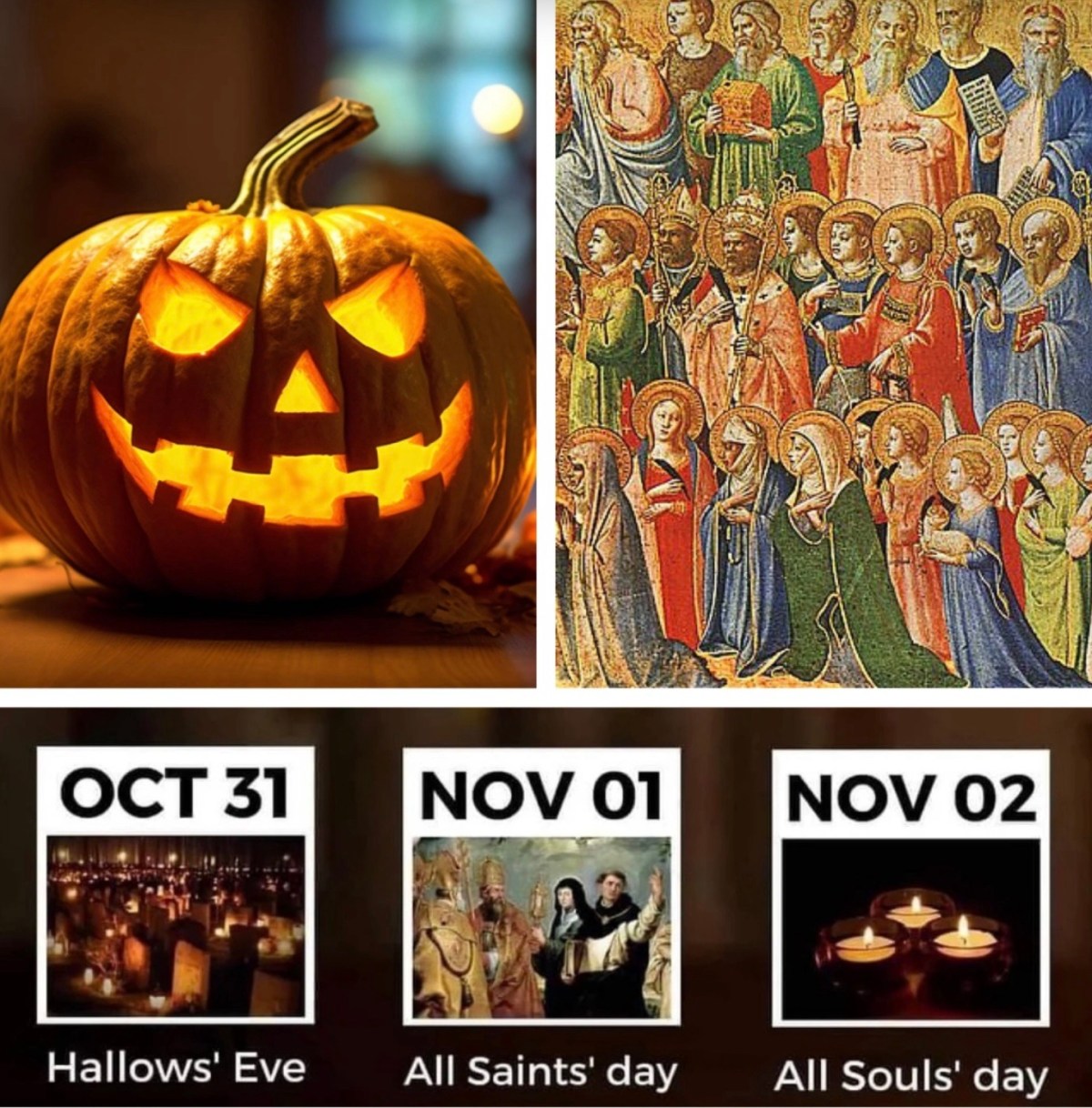
Why, death? Well, the explanation lies in the three particular days that are included: All Hallows’ Eve, All Saints’ Day, and All Souls’ Day. All three have to do with life beyond this life as we know it, in one form or another—that is, they are dealing with death and those who have died.

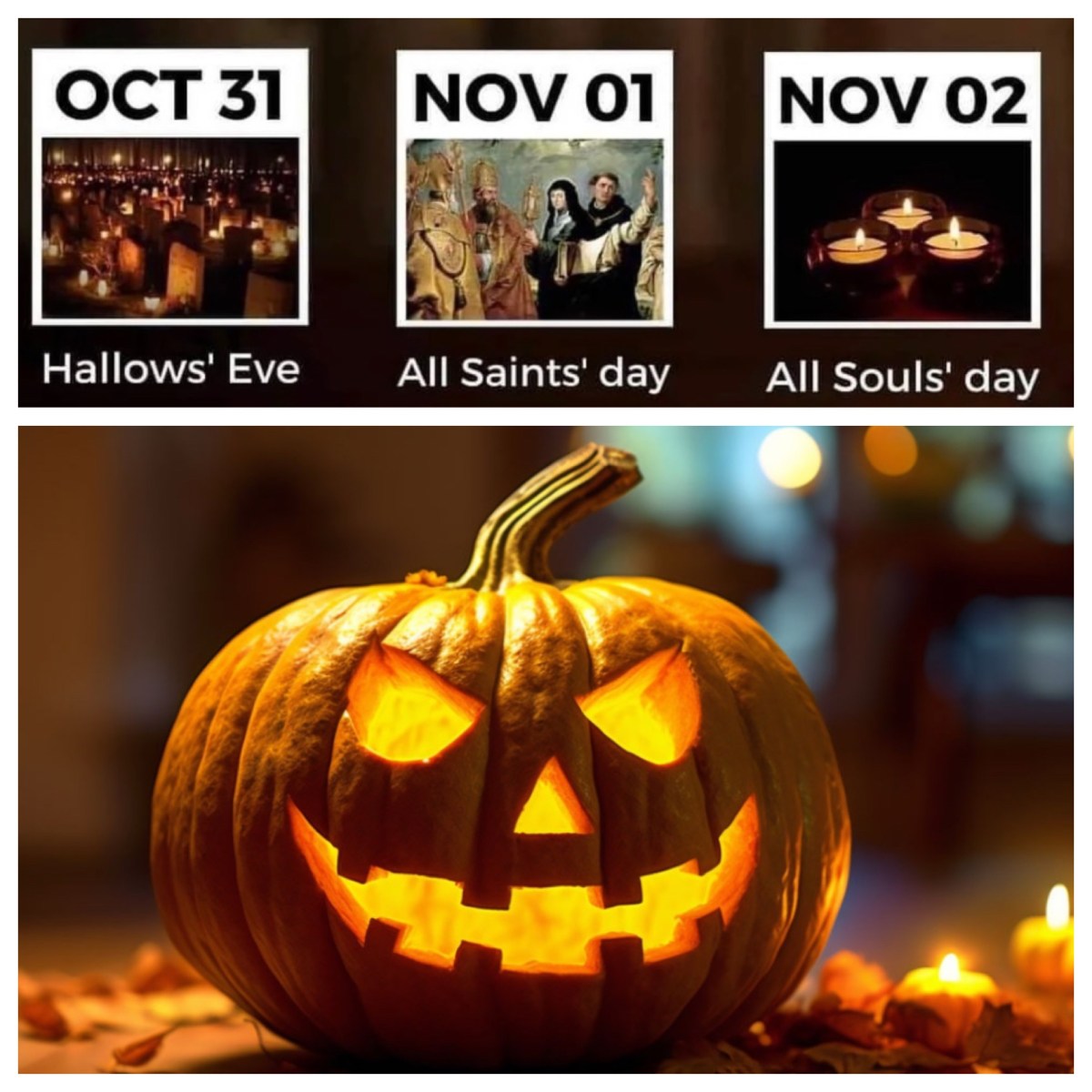
All Hallows’ Eve is best known to us as Halloween; it falls, every year, on 31 October, round about six months after Easter Sunday. Unlike Easter, however, this is not a “moveable feast”, following the pattern of the lunar cycle (which does not lineup with our solar-based calendar). Halloween falls, each and every year, on the very last day of October.

It needs to be said that the contemporary commercialised celebration of Halloween is a long way from its origins in medieval Christian piety. And so it also needs to be emphasised that Halloween is not a pagan festival. It has its origins deep in Christian history and tradition.

The English word ‘Halloween’ is a shortening of All Hallows’ Eve(n), which long ago began this series of three holy days, designed to enable the faithful to remember the saints of old (All Saints’ Day on 1 November) and the faithful who have died, “the souls of the faithful departed” (All Souls’ Day on 2 November). These three days, Halloween—All Saints’ Day—All Souls’ Day, belong together—as the “other” Christian triduum (like Good Friday—Holy Saturday—Easter Sunday).
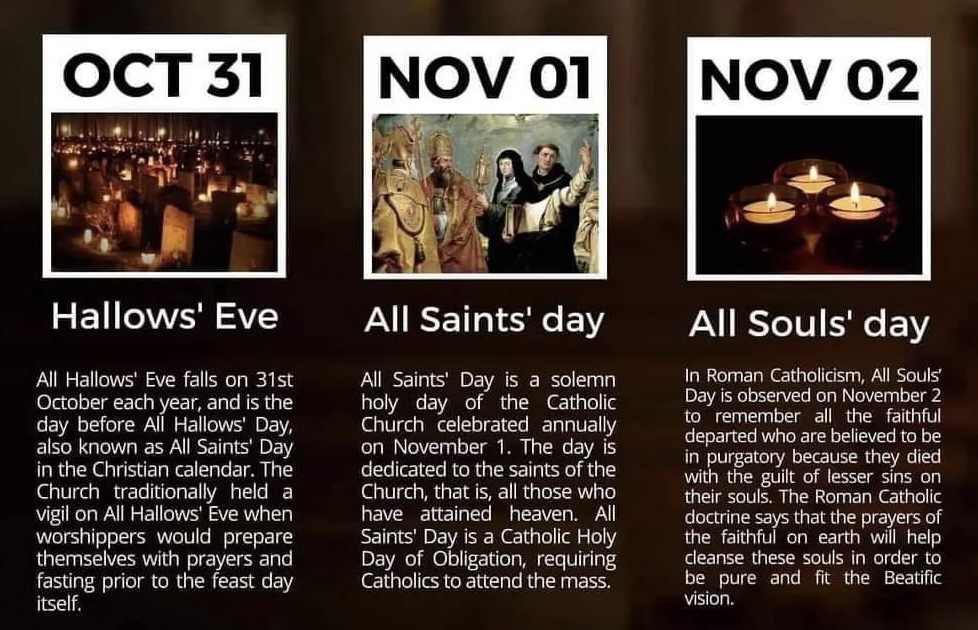
How long ago this sequence began is not clear, as local customs varied. There is evidence that some days had been identified as the time to remember individual saints or groups of saints in some locations in the 7th to 9th centuries. By around 800, churches in Northumbria and Ireland apparently remembered “all saints” on 1 November.

In the online resources of the Northumbria Community, there is a good statement about the significance of this time: “The old belief was that there was danger and vulnerability at this time of transition, which was neither in one year nor the next. Spiritual barriers could be dissolved. Inevitably, looking back led to the remembrance of those who had died and gone before; and, as the dark, cold days were awaited, protection was sought against the evil spirits that were bound to be abroad until spring returned. These old beliefs were never quite eradicated by the coming of Christianity, but lingered as a persistent superstition, a residual folk memory.” See

https://www.northumbriacommunity.org/saints/celtic-new-year-all-hallows-eve-and-all-saints-tide-october-31stnovember-1st/

By the 12th century, All Saints’ and All Souls’ had become holy days of obligation in the medieval churches, and various rituals developed for each day. Baking and sharing cakes for the souls of baptised people is evidenced in some European countries in the 15th century; this may be the origins of trick-or-treat. Lighting candles in homes on these days was done in Ireland in the 19th century—another element which is reflected in current Halloween practices.
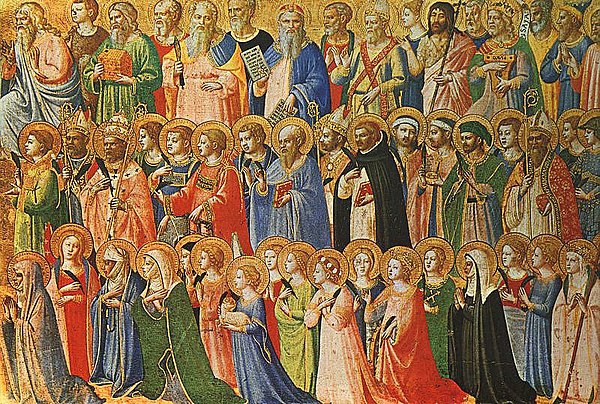
The Forerunners of Christ with Saints and Martyrs
by Fra Angelico (1395–1455)

I have had the experience, in churches today, of being caught up in a grand worship experience for All Saints’ Day, the middle of the three days (a number of these were memorable experiences where my wife Elizabeth Raine created and presided at the liturgy). We surrounded ourselves with the memory of saints of ancient and more recent times, and recalled with gratitude saints of the present times, particularly those important to the immediate locality or congregation.

In those times of worship, we joined in singing “for all the saints who from their labour rest—alleluia! alleluia!” (from a hymn by William Walsham How), and then “a world without saints forgets how to praise; in loving, in living, they prove it is true— their way of self-giving, Lord, leads us to you” (from a hymn by Jacob Friedrich).

It is sometimes claimed that Halloween originated as a response to existing pagan rituals—but we need some considered nuance as we reflect on this. A number of the current practices involved in Halloween certainly do show the strong influence of folk customs with pagan origins in a number of Celtic countries.

This is especially so in relation to Samhain in Ireland, marking the start of winter with a festival from sundown on 31 October to sundown on 1 November. This was a liminal time when the boundary between this world and the world beyond was thinned; at this time, it was thought, the spirits could more easily enter this world. The connection with the Christian days of All Saints’ and All Souls’ is thus clear to see.
However, this does not mean that we can simply (and simplistically) conclude that these days have pagan origins; rather, what we ought to recognise is that, like other Christian festivals, there has been a blurring of customs and practices and a linking of Christian patterns with pagan festivities.

This blurring and linking is a natural tendency that has taken place time after time in place after place. This is what historians and scholars of religion call syncretism—the merging and assimilating of traditions that were originally discrete, with separate origins. It can also be called eclecticism; but I prefer to see this more accurately as contextualisation, the shaping of a tradition in the light of the immediate social and cultural context.

For that is what Halloween did in the mists of the time when it was being created and shaped—existing practices of pagan neighbours were co-opted and adapted by faithful Christians. Then, the practices were extended with the introduction of days to remember All Saints and All Souls. (The same dynamic was at work in the ways that Easter was shaped, drawing on northern hemisphere Spring practices, and the way that Christmas also developed, drawing on northern hemisphere Winter Solstice practices—but these are stories for other times of the year!)

The same perspective can be applied to the ways that Halloween, in particular, is commemorated each year. Lamenting the commercialisation of a festival that was originally Christian is a poor strategy. (And, as noted, this commercialisation has already happened with Christmas—which is now peak selling period for so many businesses and peak holiday period for many families—and in a different way with Easter—which is now a second peak holiday period for so many families.)
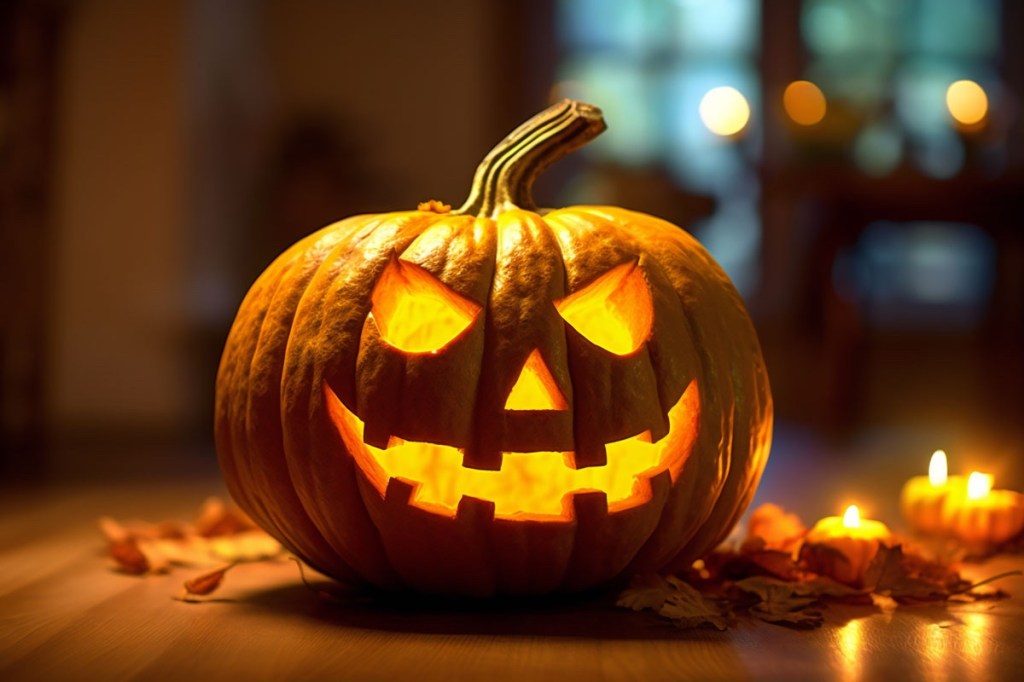
This kind of commercialisation (Jack-o’-Lantern pumpkins, bright lanterns, all manner of costumes, the proliferation of sweets for Halloween, trick-or-treat, and more) is now well underway with Halloween. We won’t turn the clock back. People of faith can simply hold to Christian understandings and practices in the midst of the increasing changes being made in broader society. As we observe what is taking place around us, the best strategy, surely, is to inform ourselves of the origins of, and reasons for, the season, and to reflect on those matters that take us to the heart of our faith.

*****

To close, here is my poetic musing on this season in the life of the church:

Every year in the church we remember,

we remember the saints of old;

those who kept silence, those who spoke clearly,

monks and ascetics, sisters and nurses,

teachers and preachers, writers and poets,

mystics and prophets, all serving faithfully;

saints who were blessed in their lives,

saints who blessed others through their lives.

Every year in the church we remember,

we remember those souls now departed;

family, friends, acquaintances, strangers,

known and remembered, hallowed in death.

To commemorate all the faithful departed,

we mark this time as All Souls’ Day.

And the evening before All Saints’ Day,

it is best known as “Halloween”.

Hallowed, sanctified, sainted in memory,

recalled in remembrance, all saints and all souls.

Once in each year, that is our focus;

once in each year, year after year.
The “other” three days: on remembering, celebrating, and contextualising (Halloween, All Saints, and All Souls)

Today, 1 November, we are in the middle of a special sequence of days, which in traditional Roman Catholic piety form a triduum (simply meaning, “three days”). This current sequence of three days is the “other” three days—standing in the shadow of the Great Three Days of Easter (Good Friday—Holy Saturday—Easter Sunday). Whilst the three days of Easter celebrate new life (the Triduum of Life), this “other” three days has been called the Triduum of Death.

Why, death? Well, the explanation lies in the three particular days that are included: All Hallows’ Eve, All Saints’ Day, and All Souls’ Day. All three have to do with life beyond this life as we know it, in one form or another—that is, they are dealing with death and those who have died.

All Hallows’ Eve is best known to us as Halloween; it falls, every year, on 31 October, round about six months after Easter Sunday. Unlike Easter, however, this is not a “moveable feast”, following the pattern of the lunar cycle (which does not lineup with our solar-based calendar). Halloween falls, each and every year, on the very last day of October.

It needs to be said that the contemporary commercialised celebration of Halloween is a long way from its origins in medieval Christian piety. And so it also needs to be emphasised that Halloween is not a pagan festival. It has its origins deep in Christian history and tradition.

The English word ‘Halloween’ is a shortening of All Hallows’ Eve(n), which long ago began this series of three holy days, designed to enable the faithful to remember the saints of old (All Saints’ Day on 1 November) and the faithful who have died, “the souls of the faithful departed” (All Souls’ Day on 2 November). These three days, Halloween—All Saints’ Day—All Souls’ Day, belong together—as the “other” Christian triduum (like Good Friday—Holy Saturday—Easter Sunday).

How long ago this sequence began is not clear, as local customs varied. There is evidence that some days had been identified as the time to remember individual saints or groups of saints in some locations in the 7th to 9th centuries. By around 800, churches in Northumbria and Ireland apparently remembered “all saints” on 1 November.

In the online resources of the Northumbria Community, there is a good statement about the significance of this time. (Elizabeth and I use the resources of the Northumbria Community as the basis for our daily devotional, with Morning Prayer and Evening Compline serving to mark each day and night and provide a faith-focus at those moments which, it is intended, will carry through the full 24-hour cycle each day and night.)

The Northumbria Community resource says: “The old belief was that there was danger and vulnerability at this time of transition, which was neither in one year nor the next. Spiritual barriers could be dissolved. Inevitably, looking back led to the remembrance of those who had died and gone before; and, as the dark, cold days were awaited, protection was sought against the evil spirits that were bound to be abroad until spring returned. These old beliefs were never quite eradicated by the coming of Christianity, but lingered as a persistent superstition, a residual folk memory.” See

https://www.northumbriacommunity.org/saints/celtic-new-year-all-hallows-eve-and-all-saints-tide-october-31stnovember-1st/

By the 12th century, All Saints’ and All Souls’ had become holy days of obligation in the medieval churches, and various rituals developed for each day. Baking and sharing cakes for the souls of baptised people is evidenced in some European countries in the 15th century; this may be the origins of trick-or-treat. Lighting candles in homes on these days was done in Ireland in the 19th century—another element which is reflected in current Halloween practices.

The Forerunners of Christ with Saints and Martyrs
by Fra Angelico (1395–1455)

I have had the experience, in churches today, of being caught up in a grand worship experience for All Saints’ Day, the middle of the three days (a number of these were memorable experiences where my wife Elizabeth Raine created and presided at the liturgy). We surrounded ourselves with the memory of saints of ancient and more recent times, and recalled with gratitude saints of the present times, particularly those important to the immediate locality or congregation.

In those times of worship, we joined in singing “for all the saints who from their labour rest—alleluia! alleluia!” (from a hymn by William Walsham How), and then “a world without saints forgets how to praise; in loving, in living, they prove it is true— their way of self-giving, Lord, leads us to you” (from a hymn by Jacob Friedrich).

It is sometimes claimed that Halloween originated as a response to existing pagan rituals—but we need some considered nuance as we reflect on this. A number of the current practices involved in Halloween certainly do show the strong influence of folk customs with pagan origins in a number of Celtic countries.

This is especially so in relation to Samhain in Ireland, marking the start of winter with a festival from sundown on 31 October to sundown on 1 November. This was a liminal time when the boundary between this world and the world beyond was thinned; at this time, it was thought, the spirits could more easily enter this world. The connection with the Christian days of All Saints’ and All Souls’ is thus clear to see.

However, this does not mean that we can simply (and simplistically) conclude that these days have pagan origins; rather, what we ought to recognise is that, like other Christian festivals, there has been a blurring of customs and practices and a linking of Christian patterns with pagan festivities.

This blurring and linking is a natural tendency that has taken place time after time in place after place. This is what historians and scholars of religion call syncretism—the merging and assimilating of traditions that were originally discrete, with separate origins. It can also be called eclecticism; but I prefer to see this more accurately as contextualisation, the shaping of a tradition in the light of the immediate social and cultural context.

For that is what Halloween did in the mists of the time when it was being created and shaped—existing practices of pagan neighbours were co-opted and adapted by faithful Christians. Then, the practices were extended with the introduction of days to remember All Saints and All Souls. (The same dynamic was at work in the ways that Easter was shaped, drawing on northern hemisphere Spring practices, and the way that Christmas also developed, drawing on northern hemisphere Winter Solstice practices—but these are stories for other times of the year!)

The same perspective can be applied to the ways that Halloween, in particular, is commemorated each year. Lamenting the commercialisation of a festival that was originally Christian is a poor strategy. (And, as noted, this commercialisation has already happened with Christmas—which is now peak selling period for so many businesses and peak holiday period for many families—and in a different way with Easter—which is now a second peak holiday period for so many families.)

This kind of commercialisation (Jack-o’-Lantern pumpkins, bright lanterns, all manner of costumes, the proliferation of sweets for Halloween, trick-or-treat, and more) is now well underway with Halloween. We won’t turn the clock back. People of faith can simply hold to Christian understandings and practices in the midst of the increasing changes being made in broader society. As we observe what is taking place around us, the best strategy, surely, is to inform ourselves of the origins of, and reasons for, the season, and to reflect on those matters that take us to the heart of our faith.

*****

To close, here is my poetic musing on this season in the life of the church:

Every year in the church we remember,

we remember the saints of old;

those who kept silence, those who spoke clearly,

monks and ascetics, sisters and nurses,

teachers and preachers, writers and poets,

mystics and prophets, all serving faithfully;

saints who were blessed in their lives,

saints who blessed others through their lives.

Every year in the church we remember,

we remember those souls now departed;

family, friends, acquaintances, strangers,

known and remembered, hallowed in death.

To commemorate all the faithful departed,

we mark this time as All Souls’ Day.

And the evening before All Saints’ Day,

it is best known as “Halloween”.

Hallowed, sanctified, sainted in memory,

recalled in remembrance, all saints and all souls.

Once in each year, that is our focus;

once in each year, year after year.
The “other” three days: on remembering, celebrating, and contextualising (Halloween, All Saints, and All Souls)

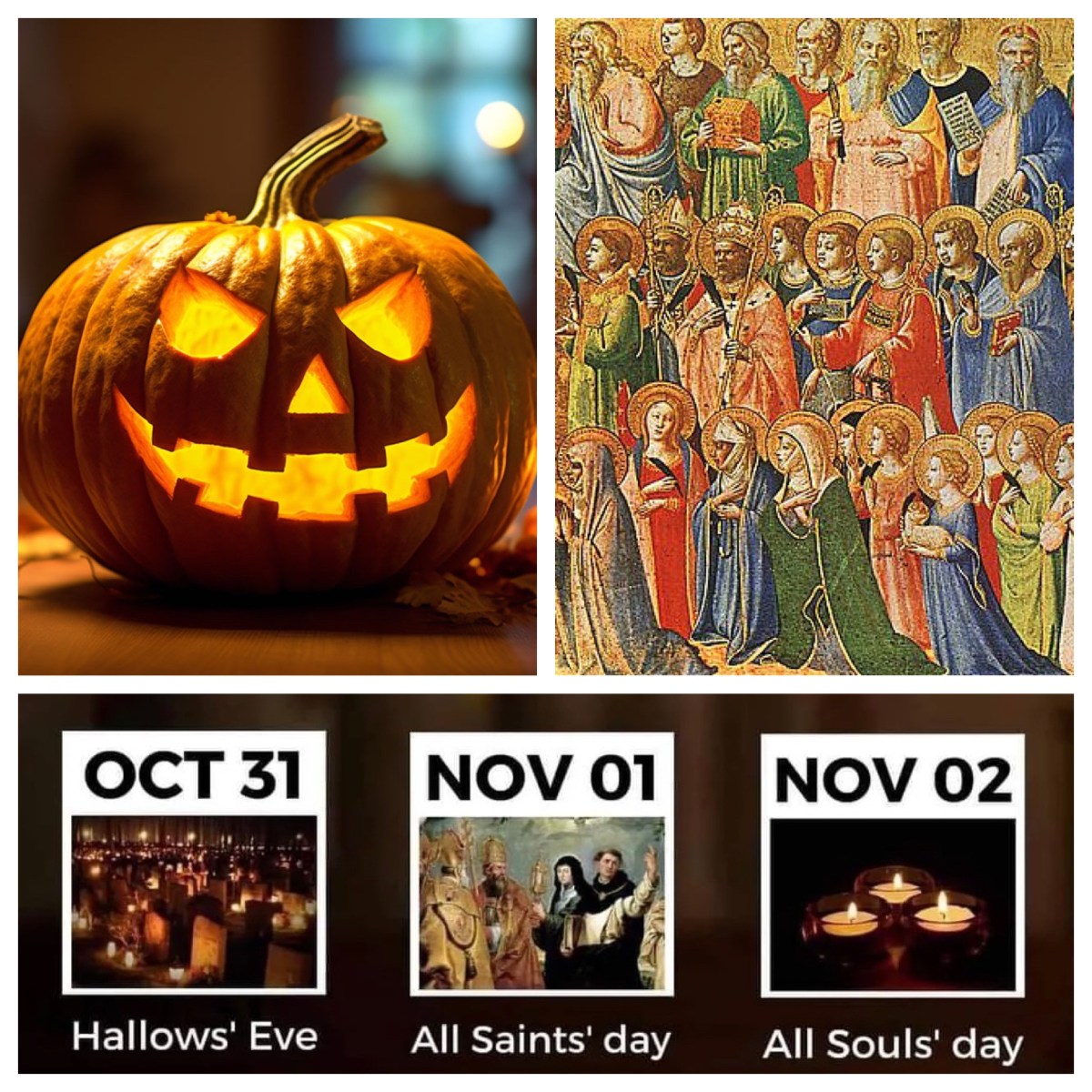
Today we are in the middle of a special sequence of days, which in traditional Roman Catholic piety form a triduum (simply meaning, “three days”). This current sequence of three days is the “other” three days—standing in the shadow of the Great Three Days of Easter (Good Friday—Holy Saturday—Easter Sunday). Whilst the three days of Easter celebrate new life (the Triduum of Life), this “other” three days has been called the Triduum of Death.

Why, death? Well, the explanation lies in the three particular days that are included: All Hallows’ Eve, All Saints’ Day, and All Souls’ Day. All three have to do with life beyond this life as we know it, in one form or another—that is, they are dealing with death and those who have died.

All Hallows’ Eve is best known to us as Halloween; it falls, every year, on 31 October, round about six months after Easter Sunday. Unlike Easter, however, this is not a “moveable feast”, following the pattern of the lunar cycle (which does not lineup with our solar-based calendar). Halloween falls, each and every year, on the very last day of October.

It needs to be said that the contemporary commercialised celebration of Halloween is a long way from its origins in medieval Christian piety. And so it also needs to be emphasised that Halloween is not a pagan festival. It has its origins deep in Christian history and tradition.

The English word ‘Halloween’ is a shortening of All Hallows’ Eve(n), which long ago began this series of three holy days, designed to enable the faithful to remember the saints of old (All Saints’ Day on 1 November) and the faithful who have died, “the souls of the faithful departed” (All Souls’ Day on 2 November). These three days, Halloween—All Saints’ Day—All Souls’ Day, belong together—as the “other” Christian triduum (like Good Friday—Holy Saturday—Easter Sunday).

How long ago this sequence began is not clear, as local customs varied. There is evidence that some days had been identified as the time to remember individual saints or groups of saints in some locations in the 7th to 9th centuries. By around 800, churches in Northumbria and Ireland apparently remembered “all saints” on 1 November.

In the online resources of the Northumbria Community, there is a good statement about the significance of this time. (Elizabeth and I use the resources of the Northumbria Community as the basis for our daily devotional, with Morning Prayer and Evening Compline serving to mark each day and night and provide a faith-focus at those moments which, it is intended, will carry through the full 24-hour cycle each day and night.)

The Northumbria Community resource says: “The old belief was that there was danger and vulnerability at this time of transition, which was neither in one year nor the next. Spiritual barriers could be dissolved. Inevitably, looking back led to the remembrance of those who had died and gone before; and, as the dark, cold days were awaited, protection was sought against the evil spirits that were bound to be abroad until spring returned. These old beliefs were never quite eradicated by the coming of Christianity, but lingered as a persistent superstition, a residual folk memory.” See

https://www.northumbriacommunity.org/saints/celtic-new-year-all-hallows-eve-and-all-saints-tide-october-31stnovember-1st/

By the 12th century, All Saints’ and All Souls’ had become holy days of obligation in the medieval churches, and various rituals developed for each day. Baking and sharing cakes for the souls of baptised people is evidenced in some European countries in the 15th century; this may be the origins of trick-or-treat. Lighting candles in homes on these days was done in Ireland in the 19th century—another element which is reflected in current Halloween practices.

The Forerunners of Christ with Saints and Martyrs
by Fra Angelico (1395–1455)

I have had the experience, in churches today, of being caught up in a grand worship experience for All Saints’ Day, the middle of the three days (a number of these were memorable experiences where my wife Elizabeth Raine created and presided at the liturgy). We surrounded ourselves with the memory of saints of ancient and more recent times, and recalled with gratitude saints of the present times, particularly those important to the immediate locality or congregation.

In those times of worship, we joined in singing “for all the saints who from their labour rest—alleluia! alleluia!” (from a hymn by William Walsham How), and then “a world without saints forgets how to praise; in loving, in living, they prove it is true— their way of self-giving, Lord, leads us to you” (from a hymn by Jacob Friedrich).

It is sometimes claimed that Halloween originated as a response to existing pagan rituals—but we need some considered nuance as we reflect on this. A number of the current practices involved in Halloween certainly do show the strong influence of folk customs with pagan origins in a number of Celtic countries.

This is especially so in relation to Samhain in Ireland, marking the start of winter with a festival from sundown on 31 October to sundown on 1 November. This was a liminal time when the boundary between this world and the world beyond was thinned; at this time, it was thought, the spirits could more easily enter this world. The connection with the Christian days of All Saints’ and All Souls’ is thus clear to see.

However, this does not mean that we can simply (and simplistically) conclude that these days have pagan origins; rather, what we ought to recognise is that, like other Christian festivals, there has been a blurring of customs and practices and a linking of Christian patterns with pagan festivities.

This blurring and linking is a natural tendency that has taken place time after time in place after place. This is what historians and scholars of religion call syncretism—the merging and assimilating of traditions that were originally discrete, with separate origins. It can also be called eclecticism; but I prefer to see this more accurately as contextualisation, the shaping of a tradition in the light of the immediate social and cultural context.

For that is what Halloween did in the mists of the time when it was being created and shaped—existing practices of pagan neighbours were co-opted and adapted by faithful Christians. Then, the practices were extended with the introduction of days to remember All Saints and All Souls. (The same dynamic was at work in the ways that Easter was shaped, drawing on northern hemisphere Spring practices, and the way that Christmas also developed, drawing on northern hemisphere Winter Solstice practices—but these are stories for other times of the year!)

The same perspective can be applied to the ways that Halloween, in particular, is commemorated each year. Lamenting the commercialisation of a festival that was originally Christian is a poor strategy. (And, as noted, this commercialisation has already happened with Christmas—which is now peak selling period for so many businesses and peak holiday period for many families—and in a different way with Easter—which is now a second peak holiday period for so many families.)

This kind of commercialisation (Jack-o’-Lantern pumpkins, bright lanterns, all manner of costumes, the proliferation of sweets for Halloween, trick-or-treat, and more) is now well underway with Halloween. We won’t turn the clock back. People of faith can simply hold to Christian understandings and practices in the midst of the increasing changes being made in broader society. As we observe what is taking place around us, the best strategy, surely, is to inform ourselves of the origins of, and reasons for, the season, and to reflect on those matters that take us to the heart of our faith.

*****

To close, here is my poetic musing on this season in the life of the church:

Every year in the church we remember,

we remember the saints of old;

those who kept silence, those who spoke clearly,

monks and ascetics, sisters and nurses,

teachers and preachers, writers and poets,

mystics and prophets, all serving faithfully;

saints who were blessed in their lives,

saints who blessed others through their lives.

Every year in the church we remember,

we remember those souls now departed;

family, friends, acquaintances, strangers,

known and remembered, hallowed in death.

To commemorate all the faithful departed,

we mark this time as All Souls’ Day.

And the evening before All Saints’ Day,

it is best known as “Halloween”.

Hallowed, sanctified, sainted in memory,

recalled in remembrance, all saints and all souls.

Once in each year, that is our focus;

once in each year, year after year.
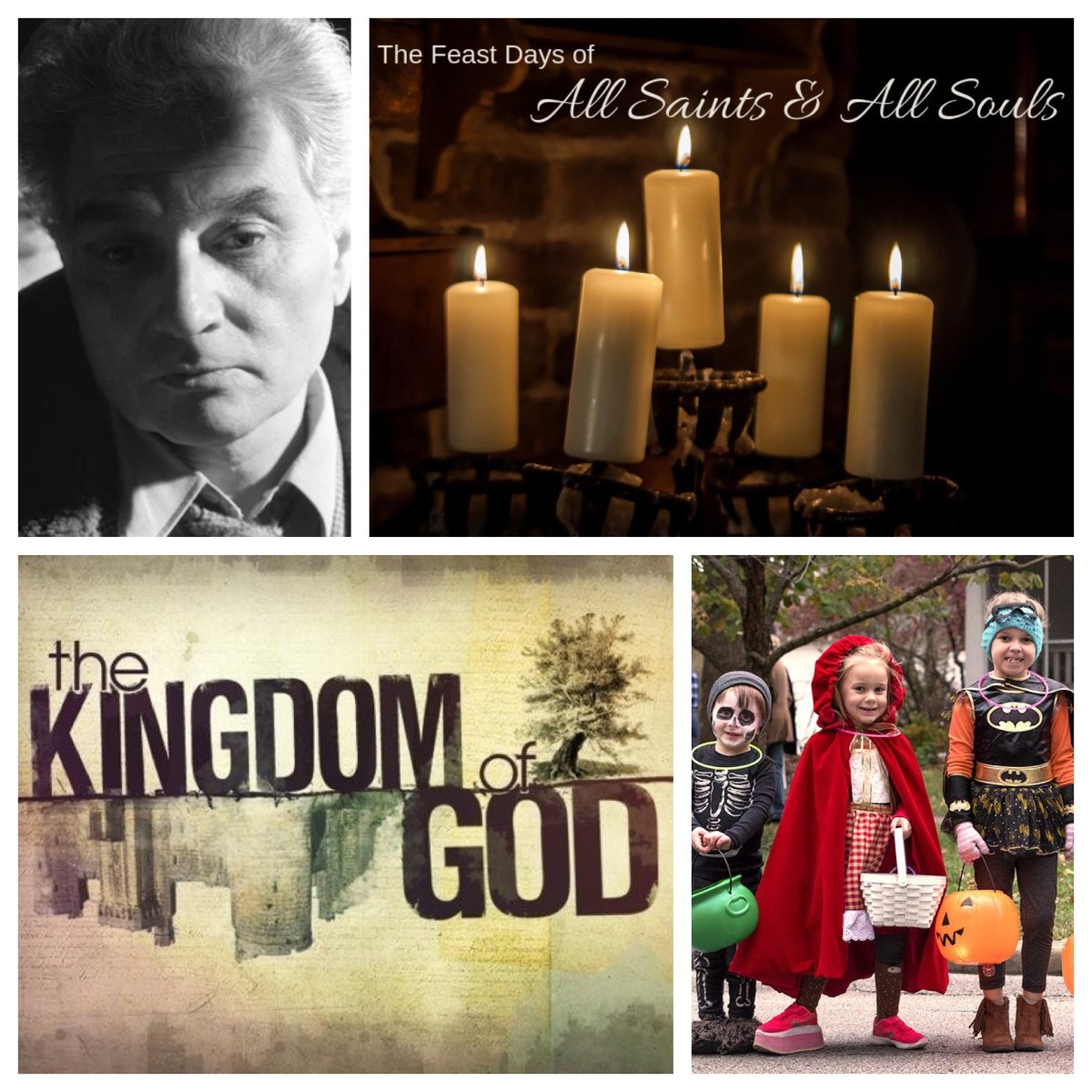
On Halloween, All Saints, and the ghosts of the past (All Saints Year C)

A sermon preached by the Rev. Elizabeth Raine at Tuggeranong Uniting Church on 6 November 2022, in a service remembering All Saints.

*****

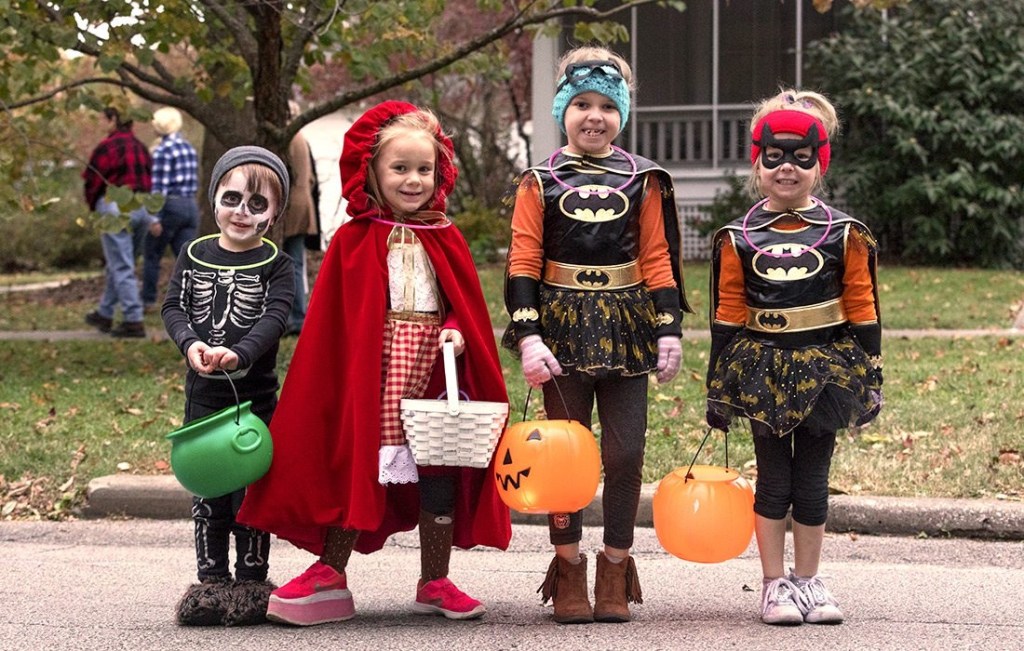
Halloween seems to be a thing that has crept up on Australia more recently. Halloween trick or treating was not something I did as a child, nor was it even considered. But many Australian kids seem to have taken to Halloween including my grandchildren, and roam the street in spooky costumes in search of sugary and chocolatey treats. What they would do as a trick if they were refused is an interesting thought, and I am not sure they have worked that out yet.

We also seem to be having the Halloween equivalent of Christmas lights in streets around us, with house fronts covered in spiderwebs and large spiders, ghouls, witches and ghosts in front yards. My daughter even had three graves in hers.

But what is Halloween really? Is it dancing with the devil? A celebration of something sinister? An import from American culture we don’t need? Or is it imaginative good fun and giving kids a chance to be creative and neighbourhoods to come together and neighbours get to know each other? Is it representing the choosing of life over death, hope over despair, and good over evil?

Wikipedia informs us that Halloween (also known as All Hallows’ Eve, or All Saints’ Eve) is a “celebration observed in many countries on 31 October, the eve of the Western Christian feast of All Hallows’ Day. It begins the observance of Allhallowtide, the time in the liturgical year dedicated to remembering the dead, including saints (hallows), martyrs, and all the departed.”

Some scholars believe that Halloween traditions grew out of Celtic harvest festivals, particularly the Gaelic festival Samhain, which is believed to have pagan roots. Some go further and suggest that Samhain may have been Christianized as All Hallow’s Day, along with its eve, by the early Church in the same way Christmas was.

Other academics believe Halloween began solely as a Christian holiday, being the vigil of All Hallow’s Day. Celebrated in Ireland and Scotland for centuries, Irish and Scottish immigrants took many Halloween customs to North America in the 19th century, and then through American influence Halloween had spread to other countries by the late 20th and early 21st century.

Despite the ghoulies and ghosties and long-legged beasties that may have roamed the drier streets of Canberra last Monday, Halloween and All Saints Day are predominantly Christian festivals, still celebrated as such in many parts of the world. Since the time of the early Church, the feast of All Hallows began the night before, as did the feast of Christmas. These days are collectively called Allhallowtide and are a time when Western Christians honour all saints and pray for departed souls.

It is easy to talk about All Saints Day, but not so easy to get a sermon from Halloween. Yet that is where I am heading. I read a really interesting article in the conversation on the topic of Halloween. By Alasdair Macintyre, it is on the topic of ‘hauntology’, a study of the memories and dreams that follow us through life. Macintyre writes, hauntology “is that eerie zone where time collapses and our past memories and associations haunt our minds, like a ghost”.

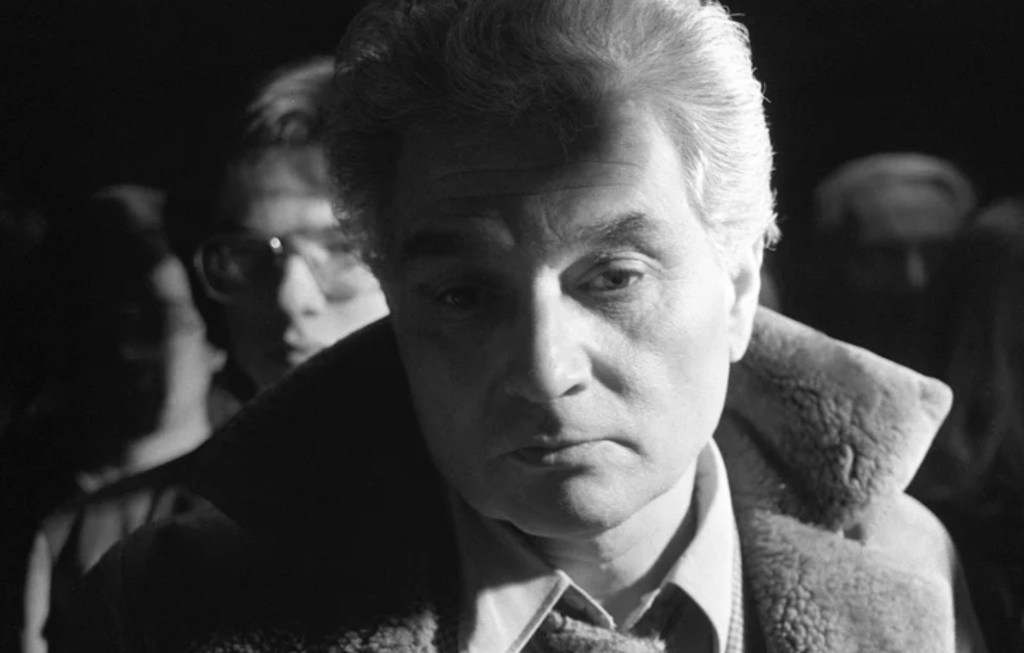
This philosophical concept of “hauntology” was invented by the French philosopher Jacques Derrida for his 1993 lecture Spectres of Marx. Apparently the words “hauntology” and “ontology” both sound identical when spoken in French, something which tickled Derrida’s fancy. Ontology is the philosophical and theological study of existence and being, dating back as far as ancient Greece and important in Christian theology, especially in regard to the Trinity. But in Derrida’s mind, the concept of ontology was shadowed by hauntology, a state of non-being.

French philosopher Jacques Derrida

I have been thinking the modern day church just might be stuck in hauntology, both haunted by memories of its past practices and by visions of the future that did not eventuate. Nobody 30-40 years ago foresaw that the church would be dwindling and aging. And John and I have found, when you talk to small churches as a Presbytery minister they are haunted by memories Sunday school numbers form 1950s and 60s.

It’s an interesting idea, this one of hauntology. The church is not is the place it planned to be 30 years ago. It hasn’t evolved in the way that people thought it would. Not everything that was planned was executed into action. Are these unfulfilled hopes haunting us now us a church?

Apparently such hauntings by unfulfilled expectations is a thing and has been studied. English theorist and academic Dr. Mark Fisher called this concept “cancelled futures” and associated it with a lack of action and cultural stagnation. He believed very little that was innovative was happening in our culture and there was instead an endless repetition and recycling of old ideas, just now in high definition and on social media.

He wasn’t referring to technology (which is advancing) but to the collapse of hopes that politically, economically and socially, the world might be improved.the regular and often startling upheavals of the 1960s have disappeared to be slowly replaced by a culture which struggles to imagine truly the possibility of a better future. Instead, such cultural upheavals and flights of imagination have been replaced by advances in mobile communication technology that have intensified superficiality and isolation rather than brought people together in healthy ways. Community, relationship, logic, and compassion are seen asfrighteningly diminished and being replaced by social networking, short-term thinking, individualism and fake news.

To put it another way, being haunted by memories and nostalgia from the past along with unrealised hauntings of unfulfilled dreams has led to a crisis of imagination on our present times. For example, society as a whole has failed informulating new ways of living in the face of a looming climate disaster. We largely continue with business as usual, though expressing concern over the potential consequences.

This apathy or fear or inertia or whatever it is will not help us as the climate warms and things worsen. We are creating more ghosts with loss of habitat, loss of species, loss of faith in something. So what needs to be done? How are we to deal with unfulfilled hopes still being all around us, albeit unseen? Whether you believe in ghosts or not, people, traditions and events from decades past continue to appear and influence our minds and our behaviour.

Firstly, we need to rethink our relationship to the past. We can’t stay trapped in it or use it to develop excuses for not addressing the needs of the future. And we can’t just be critical of things such as non-action by governments on climate change. We need to do some re-imagining of what is needed and move beyond critique to alternative modes of living and being – from hauntology to ontology if you like.

Next, we need the skills to deconstruct the memories and stories we have created that no longer serve us well and make new ones. Jesus was a master at this. Derrida saw Jesus as the “greatest” and “most incomprehensible of ghosts.” He saw Jesus as having spectral and life-exceeding attributes. Why?

I assume it is because Jesus challenged the comfortable institutions of his day with a radical reinterpretation of the narrative of their inheritance and tradition. Refusing to be haunted by the ghosts of comfortable living in the knowledge the Jews were the chosen people, Jesus recast and reframed the narrative of justice and righteousness for his context. “Blessed are you who are poor … who are hungry now … who week now … you will laugh, you will be filled, yours is the kingdom of God” (Luke 6:20–21).

Jesus reimagined a future of equity and justice in the vision of the kingdom of God. “I say to you that listen, ‘Love your enemies, do good to those who hate you, bless those who curse you, pray for those who abuse you” (Luke 6:27–28).

He inspired followers who caught the vision and ran with it through the Roman empire and beyond. He started a movement that would lead people to transform lives and live in ways that supported fairness, acceptance and justice for everyone. “Do to others as you would have them do to you”, he instructs his followers ( Luke 6:31).

Jesus was present to his community through relationships and story, focused on being in an ontological sense rather than yearning for the ghosts of hauntology.

What has happened to this movement? What has happened to this story that lives in churches’ past and traditions but seems to have lost its transforming power and its bite? What is the story of the future that church should be telling? How do we reframe the story of the future in the face of instability, uncertaintyand failed futures? Can we escape the “eerie zone where time collapses and our past memories and associations haunt our minds, like a ghost?”

Instead of being haunted by things already done or by wistful thinking on unfulfilled futures, we need to listen to Jesus, the messiah who brought in new ways of perceiving life and faith and “who haunts our self-presence, our self-sufficiency, who disturbs the order of the same, who comes to us as the voice of the dead to whom we bear a responsibility, and as the voice of the one still to come.” (John D. Caputo 1997).

Jesus, as a messianic figure, holds “open the door” of the would-be closed system of empire. He disrupts the legacy of his heritage. He takes a stand with everyone and everything that has been rejected or expelled by heritage and empire, all that are disempowered by these powers,and demands a revisioned future of fairness.

The church, like Jesus, needs to haunt people and society in meaningful ways. Things do not evolve, thrive or disappear in isolation. Something or someone is creating the conditions to allow such things. It is only by transforming our narrative, our lifestyles, our faith stories that the church bring about the radical social change that Jesus was committed to.

It is only by transforming what we have that we can effectively alter what is bad and what is destructive in our lives and our communities. The ghouls and ghosts of uncritical thinking, fake news, war, patriarchy, racism, individualism, unbridled climate change and non-acceptance of the other have no place in our community, and we as the church are called by Jesus to do nothing less.

Prof. Rosalyn Diprose, from the UNSW, states that “In the extraordinary responsibility of inheriting the future-to-come, it is all of this that we must continue to interrupt, transform, and put at risk.” (2006, 446)

As a church, must develop this new narrative, this story of hope, metanoia and courage. We must take risks for the gospel, and not allow the ghosts of the past or the unfulfilled future to rob us of these things. And we must continue to pray, From ghoulies and ghosties / and long-leggéd beasties / and things that go bump in the night, / Good Lord, deliver us. Amen.

The Prayers of the People are at https://johntsquires.com/2022/11/06/prayers-of-the-people-for-pentecost-22c/