The ruler of the Kings of the earth (Rev 1; The Reign of Christ, Pentecost 27B)

We are drawing to the end of the long “season after Pentecost” that began back in June and has run through half the year. This coming Sunday is celebrating The Festival of the Reign of Christ, as the climactic moment of this long “season of growth”, as it is often called. The Epistle reading proposed by the lectionary for this Sunday (Rev 1:4b—8) fits well with the theme of “the reign of Christ”, as it contains a greeting from the author which refers to “Jesus Christ, the faithful witness, the firstborn of the dead, and the ruler of the kings of the earth” (1:5).

It is also fitting that, on the last Sunday in the church year, we hear from the last book in the New Testament, commonly called the Revelation of John. This book has some indications that it is to be understood as a letter. The opening section (1:1–20) includes an explicit identification of the author (1:4) and the location of his writing (1:9); a brief description of the situation of the recipients (1:9) along with a listing of the specific cities in which they lived (1:11); and a short blessing and doxology (1:4–5).

The book also contains the text of seven short letters, to the churches in these seven cities (2:1–3:22). The closing section (22:8–21) reiterates the role of the author (22:8) and concludes with a blessing formula (22:21). Each of these elements reflects traditional letter-writing style.

The author identifies himself as John (1:4, 9; 22:8) and notes that he was living on the island of Patmos (1:9); church tradition has equated him with John, the disciple of Jesus, as well as the author of the fourth Gospel and three letters. However, this book is strikingly different from the Gospel and the three letters.

Some have argued that the tone of the book might reflect the style of one of “the sons of Thunder”, as the disciple John was labelled (Mark 3:17); but such a generalisation is not grounded in specific evidence.

Both the style of Greek employed and the way that biblical imagery is deployed sets this book apart from the Gospel which bears John’s name; whilst that book is steeped in biblical imagery and language, it is done in a more subtle and sophisticated manner.

The recipients of the book, identified generically as “the seven churches that are in Asia” (1:4), are subsequently named one by one, by city (1:11). In the details of the seven letters which are addressed specifically to these seven churches (2:1– 3:22), we might imagine that we will find insight into the specific situation in these churches, which is being addressed in this book.

Yet, a careful reading of these particular letters indicates that they are written and delivered in response to a dramatic vision of a distinguished figure with an ominous presence, who instructs the author to write the letters to the angels of the various churches (1:9–20). This figure can well be understood to be the “ruler of the kings of the earth” already referred to (see 1:4)—Jesus, reigning supreme over all. 

Indeed, this opening section of the book is rich with imagery which describes the significance of Jesus. Many of the phrases used here to describe Jesus are later employed in connection with those who follow him. In the initial doxology of 1:4–6, four key phrases are used to describe Jesus. First, the author affirms the traditional view of the redemptive power of the blood which Jesus has shed (1:5); the same language appears in other New Testament books (Rom 3:25; 5:9; 1 Cor 11:25–27; Col 1:20; Eph 1:7; 2:13; Heb 9:12–14; 10:19; 13:20; 1 Pet 1:2, 19; 1 John 1:7; 5:6–8).

This affirmation, of Jesus as the lamb who is sacrificed in order to effect redemption, returns as a common refrain in Revelation (5:10; 7:14; 12:11; 14:3–4; 19:13). In the regulations for temple sacrifice, the purity of the sacrificial lamb was seen as essential (Num 28:3; Lev 1:10). Jesus is depicted in this book as the supreme authority, the one who has risen from the dead and is at one with God. Yet there is a stark counterpoint running throughout the whole book. Jesus is the one who has been pierced (1:7); perhaps this evokes the piercing of Jesus’ side as he hung on the cross (John 19:34–37, citing this as a fulfillment of Zech 12:10). Such power comes only through complete submission. 

Next comes the affirmation that he is “the firstborn of the dead” (1:5; see also 1:18; 2:8); resurrected believers will follow the same path he treads (20:6). This resonates with the Pauline language about Jesus as firstborn from the dead (Rom 8:29; Col 1:15, 18; and see 1 Cor 15:20, 23; and Heb 1:6).

A third affirmation is that he is “the faithful witness” who testifies to the purposes of God (1:5; 3:14); those who follow his way are given insight into God’s will and in turn, they become witnesses to Jesus (17:6).

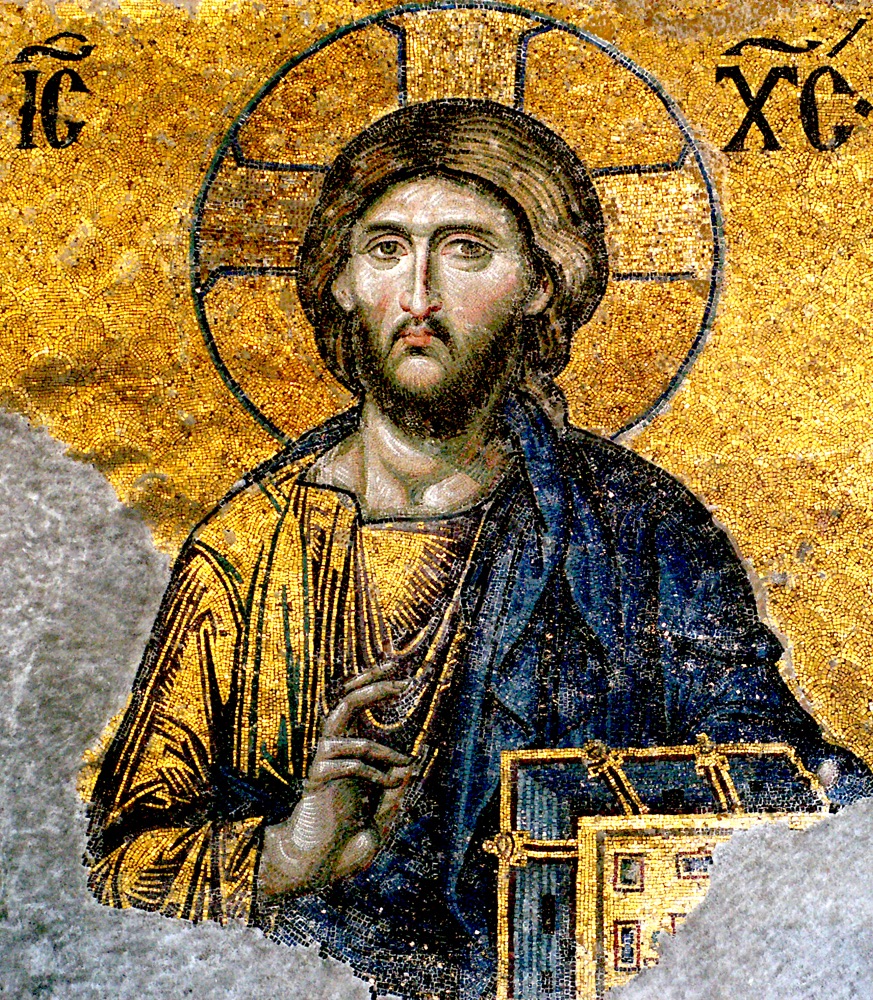
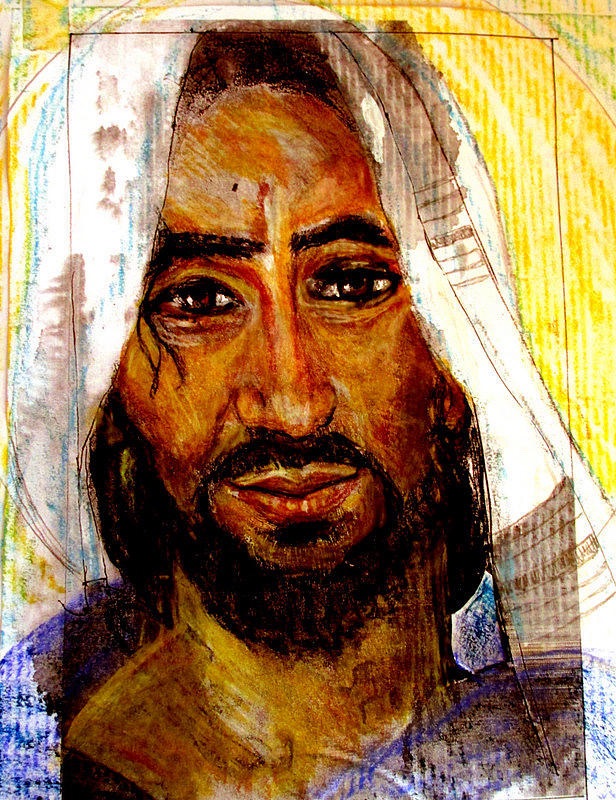
Jesus Christ Pantocrator,
from a mosaic in the Hagia Sophia Church
(now a Mosque) in Istanbul

Finally, as the risen one, Jesus is “the ruler of the kings of the earth” (1:5) who exercises the sovereign powers of God over earthly authorities (6:15–17); ultimately these rulers will either be destroyed (19:17–21) or acknowledge his authority (21:22– 24). His supreme authority is conveyed by a later reference to the keys given to him (1:18; see Isa 22:20–22; Matt 16:19); these keys grant him power over Death and Hades (1:18; see also 6:8; 20:13–14). This element certainly resonates with the theme of The Reign of Christ, which originated when it was introduced by Pope Pius XI in 1925. 

The 1920s were a time when Fascist dictators were rising to power in Europe.  I have read that “the specific impetus for the Pope establishing this universal feast of the Church was the martyrdom of a Catholic priest, Blessed Miguel Pro, during the Mexican revolution”; see Today’s Catholic, 18 Nov 2014, at https://todayscatholic.org/christ-the-king/

The article continues, “The institution of this feast was, therefore, almost an act of defiance from the Church against all those who at that time were seeking to absolutize their own political ideologies, insisting boldly that no earthly power, no particular political system or military dictatorship is ever absolute. Rather, only God is eternal and only the Kingdom of God is an absolute value, which never fails.” The vision of Rev 1:4b—8 is certainly consistent with this perspective. And the distinctive vision of this book, concerning “the lamb who was slain” (5:1–14), offers a distinctive way by which this political power is exercised. See

The work as a whole  is characterised as being “words of prophecy” (1:3; 22:10, 18–19). The prophecy which is presented in this book is summarised as “what must soon take place” (1:1; 22:6). Both at the beginning and at the end of the book, the author declares that he is looking forward in time, reporting events that will soon take place. When, exactly, those events will take place has been the focus of investigation by numerous people of faith over many centuries—“the end of the world is nigh” has been proclaimed in every century since the first century, and always (as we know) without success. Any claims in this regard, today, should be dismissed as not at all correct.

In the ways that Revelation has been interpreted, and the problems associated with each of them, see 

So, enjoy reading and hearing this very brief excerpt from this most unusual biblical book at this time of the year!

A kingdom not from this world (John 18; The Reign of Christ, Pentecost 27B)

I preached this sermon for Project Reconnect, to be used in the resources they distribute for Sunday 24 November 2024, the Festival of the Reign of Christ. For information about Project Reconnect, see the end of this blog.

The church’s year is currently designated as Year B. During the year, on most Sundays we have heard from the Gospel of Mark, along with passages from the narrative of Samuel and Kings, some of the Wisdom Literature, and letters written by Paul and James, and more recently, the letter to the Hebrews. And each Sunday, one of the Psalms is designated also for us to hear, sing, and reflect on. 

The lectionary provides a rich offering throughout the three years that form the full cycle, ensuring that we read passages from all four Gospels and all major sections of scripture. The current year draws to a close this coming Sunday, as happens at the end of each church year, with the Festival of the Reign of Christ. After this Sunday, we enter a new church year, as the season of Advent begins for Year C, when the focus is on Luke, the prophets, and other letters.

The church’s year is organised differently from the calendar year; it revolves around the key events of our faith: the birth of Jesus, which we celebrate each Christmas, the death and resurrection of Jesus, which comes into focus at Easter, the birth of the Church, which we recall at the celebration of Pentecost, and the long season after Pentecost, when we attend to our life as disciples and the mission into which we are called as people of faith.

This Sunday, the day I am referring to as the festival of the Reign of Christ, has been known traditionally as the festival of Christ the King, when we commemorate the reign that Christ exercises over the world. I prefer the term Reign of Christ as at least one step away from the connotations that are associated with that archaic institution of monarchy. 

And that flags one of the questions that I have with this feast day: how do we maintain a contemporary feel about aspects of our faith that seem to be bound to older patterns and customs? It’s a question that relates to many aspects of our life in the church; how do we demonstrate the relevance for today of the ancient faith? It’s a question worth pondering.

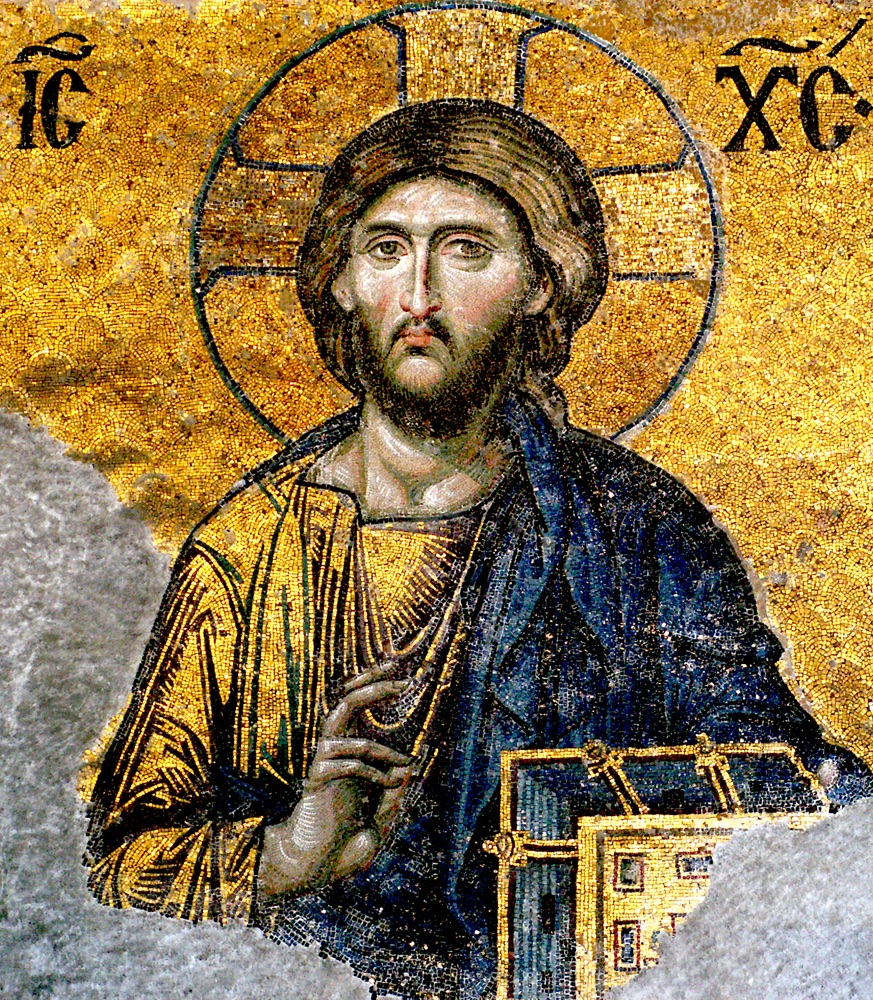
A depiction of Jesus Christ Pantocrator (ruler of all)
in the Hagia Sophia church (now Mosque) in Istanbul

The Reign of Christ is a relatively new festival in the calendar of church festivals—it was introduced by Pope Pius XI in 1925, and has since been adopted by Lutheran, Anglican, and various Protestant churches around the world, and also, apparently, by the Western Rite parishes of the Russian Orthodox Church Outside Russia. (Yes, that is a real denomination!) 

So that is a second question that I have relating to this day—along with Trinity Sunday, it sits as a day devoted to “a doctrine” developed later in the church’s life, rather than “a time in the life of Jesus”, which is what Christmas and Easter is, or “a time in the life of the church”, namely, Pentecost. Does it really belong in our pattern of seasonal celebrations?

In Roman Catholic tradition, the day is explained by some words from Cyril of Alexandria, a fifth century Doctor of the Church who served as Patriarch of Alexandria, in Egypt, from 412 to 444. In establishing this festival, Pope Pius XI quoted from the writings of Cyril: “Christ has dominion over all creatures … by essence and by nature … the Word of God, as consubstantial with the Father, has all things in common with him, and therefore has necessarily supreme and absolute dominion over all things created. From this it follows that to Christ angels and men [sic] are subject. Christ is also King by acquired, as well as by natural right, for he is our Redeemer. …’ We are no longer our own property, for Christ has purchased us with a great price; our very bodies are the members of Christ.”

However, the festival of the Reign of Christ has only been celebrated in the Roman Catholic Church since it was introduced by Pope Pius XI in 1925. This was a time when Fascist dictators were rising to power in Europe.  I have read that “the specific impetus for the Pope establishing this universal feast of the Church was the martyrdom of a Catholic priest, Blessed Miguel Pro, during the Mexican revolution”; see Today’s Catholic, 18 Nov 2014, at 

The article continues, “The institution of this feast was, therefore, almost an act of defiance from the Church against all those who at that time were seeking to absolutize their own political ideologies, insisting boldly that no earthly power, no particular political system or military dictatorship is ever absolute. Rather, only God is eternal and only the Kingdom of God is an absolute value, which never fails.”

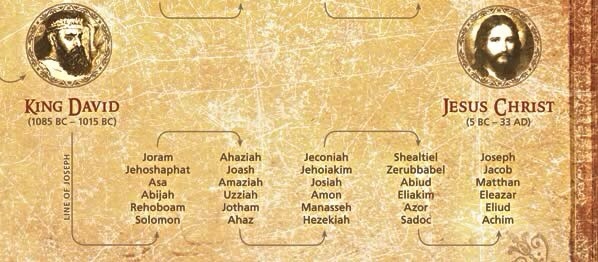
The scriptures, as a whole, puncture the pomposity of powerful kings, and subversively present Jesus as the one who stands against all that those kings did. This festival provides a unique way of reflecting on the eternal kingship of Jesus. It offers a distinctive way for considering how the kingship bestowed upon David has been understood to last “forever”.

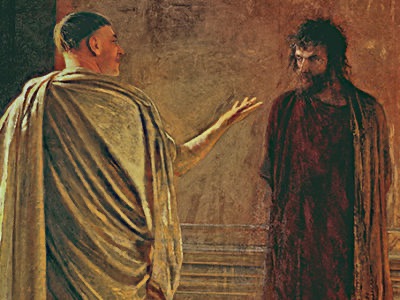
Indeed, if you had listened carefully to the Gospel reading, you would have heard the interaction between Pilate and Jesus, on this very matter. When Jesus is brought before the Roman Governor by the priests who had religious authority in Jerusalem, Governor Pilate asks him a direct question: “So, you are a king?”. I hear the question in this way: “So, Jesus, you think you are a king, do you?” 

Pilate, in this way of understanding his question, seems quite sceptical about such a claim, because the priests have brought their prisoner Jesus to him, indicating that he was “a criminal”, and seeking to have the Roman authority pass a sentence of death upon him. “Are you the King of the Jews?”, Pilate had asked Jesus—to which Jesus replies with his own question, “do you ask this on your own, or did others tell you about me?” The prisoner from Galilee knows that the Roman Governor is really just following the line presented to him by the Jerusalem priests.

Pilate’s response to this is to observe that “your own nation and the chief priests have handed you over to me”, so there must be an issue of some sort here. “What have you done?” is the naive question that Pilate then poses; Jesus answers, “my kingdom is not from this world”. In this response, Jesus seems to be accepting that he is a king—but not a king in the form that the rulers of the nations would recognise. It is no wonder that Pilate seems not to grasp the point. How can this bedraggled Galilean be a king over a kingdom “not from this world”.

So he presses the point. “So you are a king, then?” Jesus will not give a straightforward answer. He will not say, “yes, I am a king”; nor will he deny it, “no, of course I am not a king”. Rather, he diverts the focus, from the political reality of kingship, to the esoteric philosophical concept of “truth”. “For this I came into the world”, Jesus says, “to testify to the truth; everyone who belongs to the truth listens to my voice.” 

The implication is that he was not planning to lead a political uprising that would use force try to take over control of the land from the Romans; so Pilate should not have any fears on that account. Rather, says Jesus, “I came into the world to testify to the truth”.

Which draws from Pilate his most famous words, “What is truth?” According to the author of John’s Gospel, this trial scene morphed into a philosophical discussion—a development quite unexpected, and indeed, quite unrealistic. Which means, I think, that the whole scene is filled with irony. 

The first point of irony is when the Jewish priests, whose nation once did boast a king, tell the Roman Governor, “we have no king but the emperor”. The second irony is when the Roman Governor, whose nation had banned kings and despised this autocratic form of government, questions Jesus, “are you the king of the Jews?”. And the third moment of irony comes when Galilean prisoner, dressed with a crown of thorns around his head a purple robe on his shoulders, passes by the opportunity to give a clear answer and instead asserts, “my kingdom is not from this world”. 

From our point of view, as people of faith, many centuries later, we could well consider this ancient account quite strange. From our perspective, informed by centuries when deeper theological understandings have been developed and complex doctrine has been articulated, we may well see Jesus as God’s chosen human being, imbued with divine powers, enthroned as the King over all the earth. 

Why, we sing of him in this way: “Jesus shall reign where’er the sun does his successive journeys run”, “At the name of Jesus every knee shall bow”, “King of kings and Lord of lords”, “Come, Thou Almighty King … come, and reign over us”, “Rejoice, the Lord is King: your Lord and King adore!”, “Glory, glory, glory to the King of kings” … and many more.

So it is deeply embedded in our collective understanding that Jesus is, indeed, King who reigns over all, whose power and dominion covers the whole earth. And yet, in this passage, offered to us for the very festival of The Reign of Christ, the words of scripture invite us to reconsider: the nature of the Reign that Jesus envisages is radically different from the kind of reign that kings—and queens—have demonstrated throughout history. 

He is, as Graham Kendrick’s song so powerfully expresses it, our Servant King, who came as a “helpless babe”, who “entered our world … not to be served but to serve, and give [his] life that we might live”; for “This is our God, The Servant King, [who] calls us now to follow him, to bring our lives as a daily offering of worship to The Servant King”.

On this day, this festive celebration of the Reign of Christ, let us commit to following him not along the pathway of power, authority, prestige … but rather in service, with humility, through compassion, standing firm for justice, holding fast to a righteous way of living. For this is our king, the one who reigns, and this is the path that he calls us to walk.

Project Reconnect is a ministry of The Hunter Presbytery of the Uniting Church in Australia which provides a weekly worship resource for congregations, including a video sermon and a video all-age address, with music resources and discussion starters. See https://projectreconnect.com.au

To watch my sermon, see

24th November 2024 (Year B – Reign of Christ Sunday) “A Kingdom not of this World”

Ten Things about the Greatest Commandment(s) (Mark 12; Pentecost 24B)

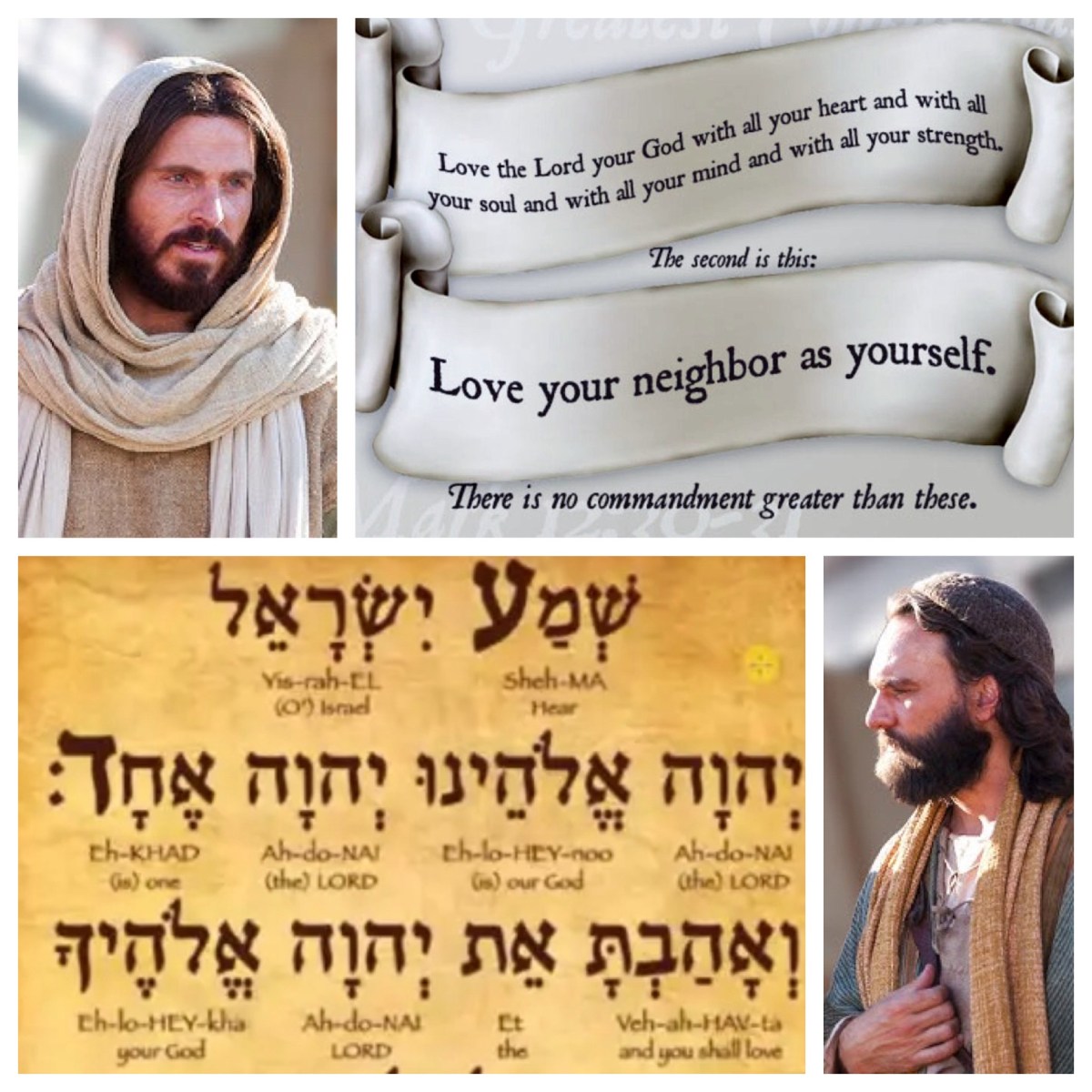
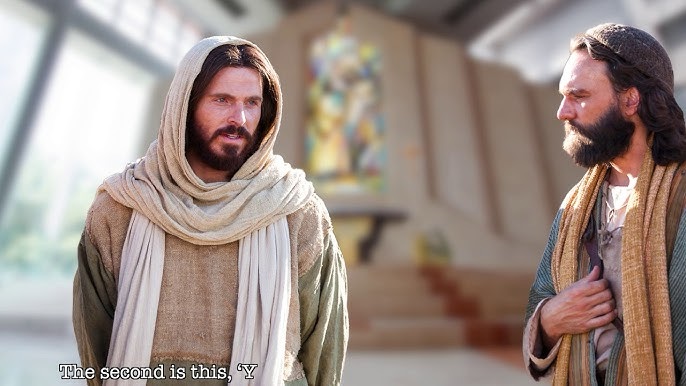
The Gospel reading for this coming Sunday contains some very well-known words of Jesus, which we remember as “the greatest commandment” (Mark 12:28–34). Here are ten things worth knowing about these words.

ONE.   The greatest commandment identified by Jesus comes from Hebrew Scripture. When Jesus says that the greatest commandment is to “love the Lord your God”, he is repeating words from the start of a long section in Deuteronomy, which reports a speech by Moses allegedly given to the people of Israel (Deut 5:1–26:19). The speech retells many of the laws that are reported in Exodus and Leviticus, framing them in terms of the repeated phrases, “the statutes and ordinances for you to observe” (4:1,5,14; 5:1; 6:1; 12:1; 26:16–17), “the statutes and ordinances that the Lord your God has commanded you” (6:20; 7:11; 8:11).

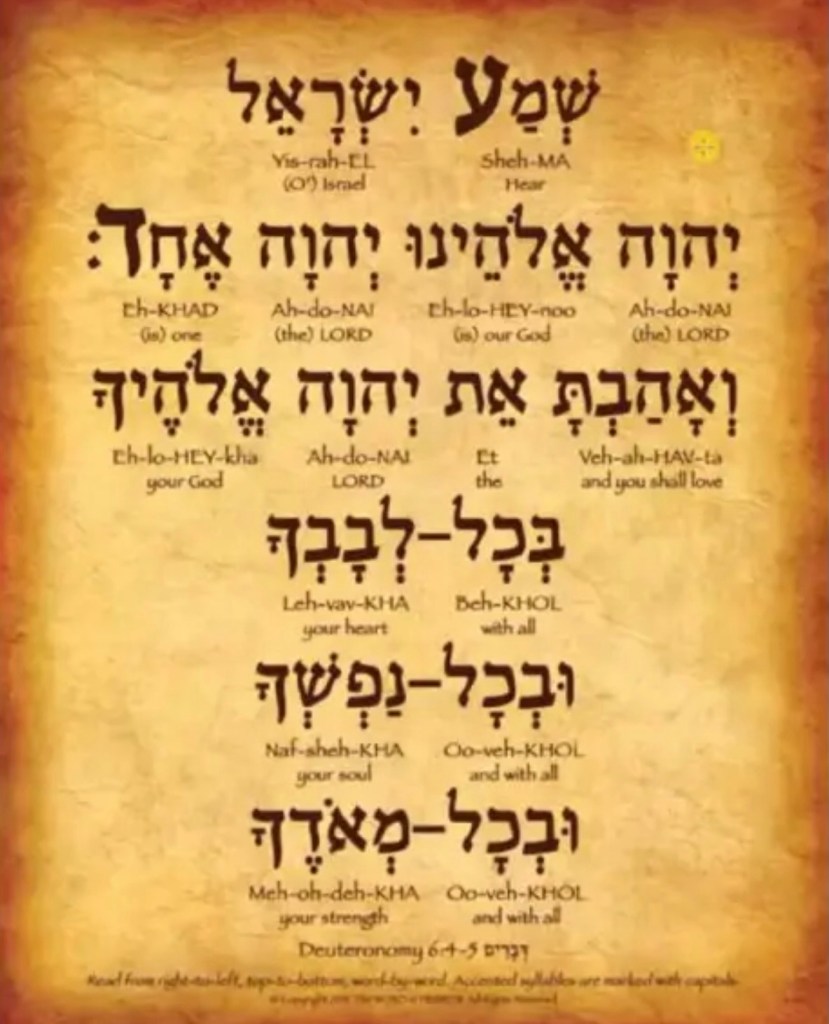
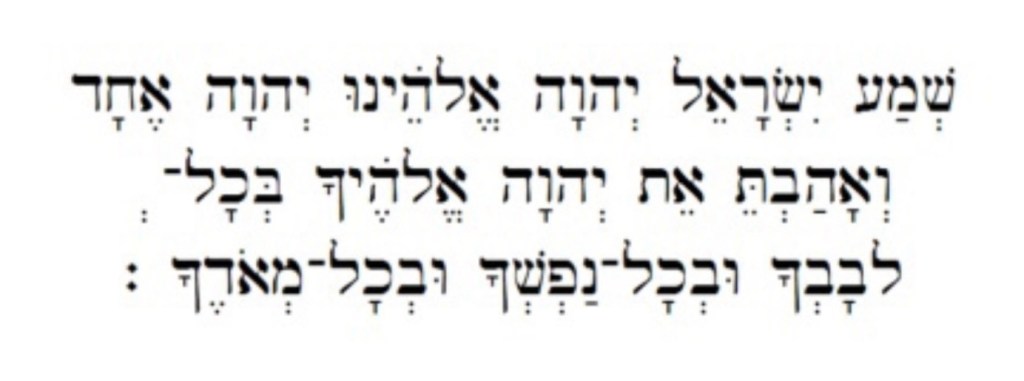
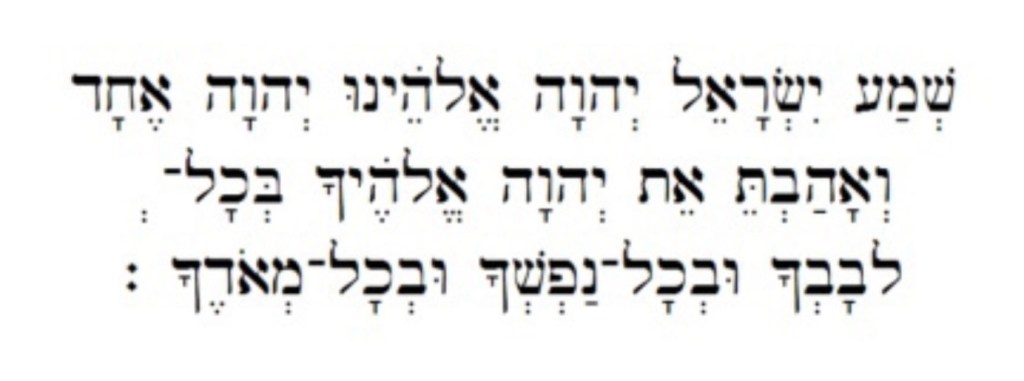
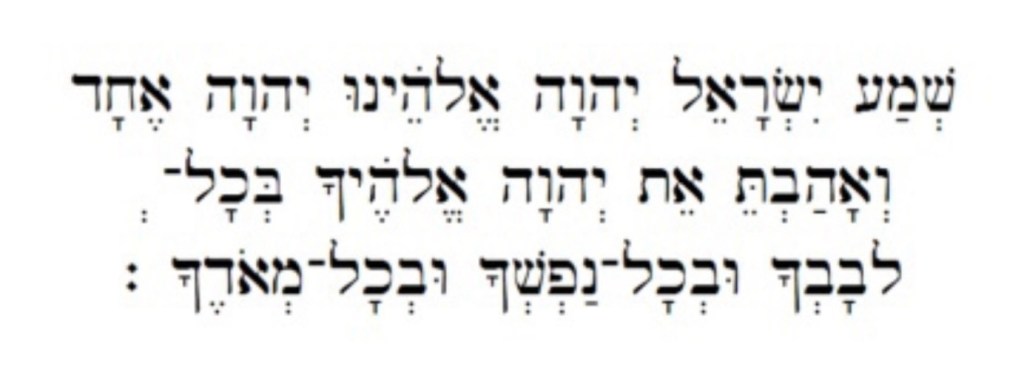
After proclaiming the Ten Commandments which God gave to Israel through Moses (Deut 5:1–21; cf. Exod 20:1–17) and rehearsing the scene on Mount Sinai and amongst the people below (5:22–33; cf. Exod 19:1–25; 20:18–21), Moses then delivers the word which provides the heading of all that follows: “Hear, O Israel: The Lord is our God, the Lord alone. You shall love the Lord your God with all your heart, and with all your soul, and with all your might. Keep these words that I am commanding you today in your heart” (Deut 6:4–6). Love, it would seem, is the key commandment amongst all the statutes and ordinances found in this book.

These words are known in Jewish tradition as the Shema, a Hebrew word literally meaning “hear” or “listen”. It’s the first word in this key commandment; and more broadly than simply “hear” or “listen”, it carries a sense of “obey”. These words are important to Jews as the daily prayer, to be prayed twice a day—in keeping with the instruction to recite them “when you lie down and when you rise” (Deut 6:7). As these daily words, “love the Lord your God” with all of your being are said, they reinforce the centrality of God and the importance of commitment to God within the covenant people.

TWO.   The original version of this commandment in Deuteronomy 6 has three parts: “with all your heart, and with all your soul, and with all your might” (Deut 6:4). This is typical of Jewish speech; repetition, using different words which are related to the same concept, expressing the importance of what is being said; and especially, repetition in groups of three. So, the prophet Micah urges people to “do justice,  love kindness, and walk humbly with God” ( Mic 6:8). Second Isaiah praises those messengers who proclaim peace, bring good news, and announce salvation (Isa 52:7). 

The psalmist exhorts the people to “tell of his salvation … declare  his glory … his marvelous works among all the peoples” (Ps 96:2-3). And the priestly authors of the creation story identifies all living creatures created by God in the threefold “fish of the sea … birds of the air … and every living thing that moves upon the earth” (Gen 1:28). That’s kind of like an ancient version of our “animal—mineral—vegetable” classification, I guess.

So the prayer of Deut 6:4 adheres to a widespread and longstanding literary feature in ancient Hebrew, of using three words in parallel. Just how parallel they are, we will now explore.

THREE.   With all your heart: The Hebrew word translated as heart is לֵבָב, lebab. It’s a common word in Hebrew Scripture, and is understood to refer to the mind, will, or heart of a person—words which seek to describe the essence of the person. It is sometimes described as referring to “the inner person”. The word appears 248 times in the scriptures, of which well over half (185) are translated as “heart”. 

Many of those occurrences are in verses which contrast heart with flesh—that is, “the inner person” alongside “the outer person”. For example, the psalmists declare that “my flesh and my heart may fail, but God is the strength of my heart and my portion forever” (Ps 73:26), and “my heart and my flesh sing for joy to the living God” (Ps 84:2b), whilst the prophet Ezekiel refers to “foreigners, uncircumcised in heart and flesh” (Ezek 44:7,9). When used together, these two terms (heart and flesh) thus often refer to the whole person, the complete being. 

The Hebrew word lebab, heart, is rendered by the Greek word, kardia, in Mark 12:30. That word can refer directly to the organ which circulates blood through the body; but it also has a sense of the central part of a being—which is variously rendered as will, character, understanding, mind, and even soul. These English translations are attempting to grasp the fundamental and all-encompassing. It seems that this correlates well with the Hebrew word lebab, which indicates the seat of all emotions for the person.

FOUR.   With all your soul: The second Hebrew word in the commandment articulated in Deut 6:4 is נֶפֶשׁ, nephesh. This is another common Hebrew word, appearing 688 times in Hebrew Scripture, of which the most common translation (238 times) is “soul”; the next most common translation is “life” (180 times). The word is thus a common descriptor for a human being, as a whole. 

However, to use the English word “soul” to translate nephesh does it a disservice. We have become acclimatised to regarding the soul as but one part of the whole human being—that is the influence of dualistic Platonic thinking, where “body and soul” refer to the two complementary parts of a human being. In Hebrew, nephesh has a unified, whole-of-person reference, quite separate from the dualism that dominates a Greek way of thinking.

Nephesh appears a number of times in the first creation story in Hebrew scripture, where it refers to “living creatures” in the seas (Gen 1:20, 21), on the earth (Gen 1:24), and to “every beast of the earth, and to every bird of the air, and to everything that creeps on the earth, everything that has the breath of life (nephesh hayah)” (Gen 1:30). It is found also in the second creation story, where it likewise describes how God formed a man from the dust of the earth and breathed the breath of life into him, and “the man became a living being (nephesh hayah)” (Gen 2:7). The claim that each living creature is a nephesh is reiterated in the Holiness Code (Lev 11:10, 46; 17:11). 

The two words, nephesh and lebab, appear linked together many times. One psalmist exults, “my ‘heart’ is glad, and my ‘soul’ rejoices” (Ps 16:9a), whilst another psalmist laments, “how long must I bear pain in my ‘soul’, and have sorrow in my ‘heart’ all day long?” (Ps 13:2). Proverbs places these words in parallel in sayings such as “wisdom will come into your ‘heart’, and knowledge will be pleasant to your ‘soul’” (Prov 2:10), and “does not he who weighs the ‘heart’ perceive it? does not he who keeps watch over your ‘soul’ know it?” (Prov 24:12). In Deuteronomy itself, the combination of “heart and soul” appears a number of times (Deut 4:29; 10:12; 11:13, 18; 13:3; 26:16; 30:2, 6, 10), where it references the whole human being. 

In each of these instances, rather than taking a dualistic Greek approach (seeing “heart” and “soul” as two separate components of a human being), we should adopt the integrated Hebraic understanding. Both “heart” and “soul” refer to the totality of a human being. The repetition is a typical Hebraic style, using two different words to refer to the same entity (the whole human being). The repetition underlines and emphasises the sense of totality of being.

FIVE.   With all your might: The third Hebrew word to note in Deut 6:5 is מְאֹד, meod, which is usually translated as “might” or “strength”. Its basic sense in Hebrew is abundance or magnitude; it is often rendered as an adverb, as “very”, “greatly”, “exceedingly”, or as an adjective, “great”, “more”, “much”. The function of this word, “might” or “strength”, in Deut 6:5 is to reinforce the totality of being that is required to love God. 

In light of this, we could, perhaps, paraphrase the command of Deuteronomy as love God with all that you are—heart and soul, completely and entirely. Love God with “your everythingness” (to coin a word). There’s a cumulative sense that builds as the commandment unfurls—love God with all your emotions, all your being, all of this, your entire being.

We find the same threefold pattern in the description of King Josiah, who reigned in the eighth century (640–609 BCE): “before him there was no king like him, who turned to the Lord with all his heart, with all his soul, and with all his might, according to all the law of Moses; nor did any like him arise after him” (2 Kings 23:25). Most often, however, it is used as an intensifier, attached directly to another term, providing what we today would do in our computer typing by underlining, italicising, and bolding a key word or phrase.

Rendering this Hebrew word in Greek—as the translators of the Septuagint did—means making a choice as to what Greek word best explicated the intensifying sense of the Hebrew word, meod. The LXX settled on the word δύναμις, usually translated as power (the word from which we get, in English, dynamic, and dynamite). Dynamis often has a sense of physical strength and capacity, and that resonates well with the sense of the Hebrew term as it is used in Deut 6:5. So the LXX has dynamis as the third element in the Shema commandment.

SIX.   In the version we find at Mark 12, Jesus adds a fourth element: with all your mind. Where does this addition come from? Centuries before Jesus, an ancient scribe wrote an account of events in his society in a time long before his life. He reports the instruction that King David spoke to his chosen successor, his son, Solomon: “set your mind and heart to seek the Lord your God” (1 Chron 22:19). He reinforces that in a later address, telling Solomon to “know God and serve [the Lord] with single mind and willing heart” (1 Chron 28:9). The book of Proverbs (attributed by tradition to Solomon) then advocates both attending to the mind (Prov 22:17; 23:12, 19) and “inclining your heart” towards God (Prov 2:2; 3:1–6; 4:4, 20–23; 6:21; 7:3) as integral parts of the life of faith.

The injunction of David is echoed in the way that Jesus extends the traditional commandment to “love the Lord your God with all your heart, and with all your soul, and with all your might” (Deut 6:5), adding “and with all your mind” (Mark 12:30). There are scriptural resonances underpinning this addition made by Jesus.

SEVEN.   The combined effect of these four phrases in the version of the command that Jesus speaks in Mark 12 is telling: Jesus instructs his followers that life with him requires a complete, total, fully-immersed commitment. He conveys this quite directly in other sayings: to a grieving person, “follow me, and let the dead bury their own dead” (Matt 8:22; Luke 9:60); to a farmer, “no one who puts a hand to the plow and looks back is fit for the kingdom of God” (Luke 9:62); and to a rich man, “go, sell what you own, and give the money to the poor, and you will have treasure in heaven; then come, follow me” (Mark 10:21 a d parallels).

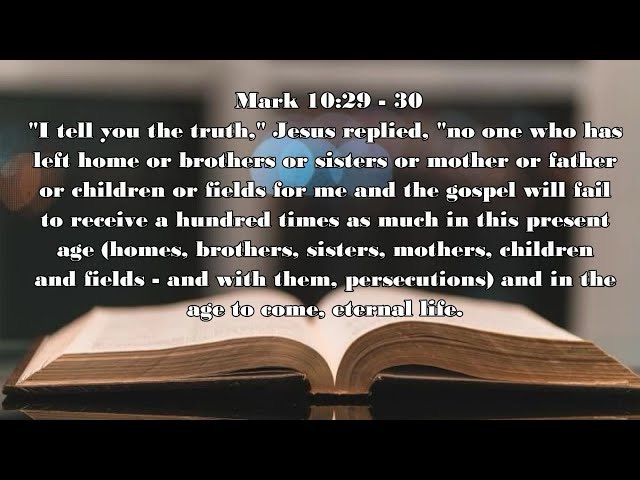
Jesus also declares that “whoever loves father or mother more than me is not worthy of me; and whoever loves son or daughter more than me is not worthy of me; and whoever does not take up the cross and follow me is not worthy of me” (Matt 10:37–38; Luke 14:26–27), leading to his claim that those who have left “house or brothers or sisters or mother or father or children or fields, for my sake and for the sake of the good news” will indeed receive “eternal life in the age to come” (Mark 10:29–30). Discipleship is full-on!

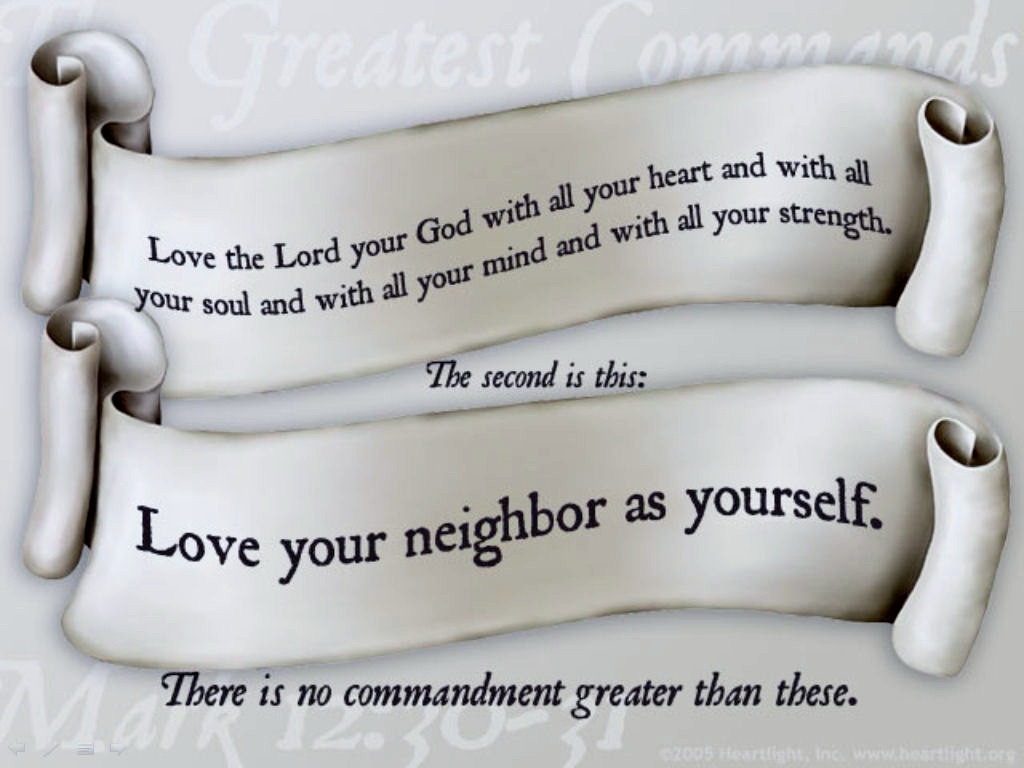
EIGHT.   Jesus then adds a second ”great commandment”, which also comes from Hebrew Scripture. As a good Jew, Jesus was well able to reach into his knowledge of Torah in his answer to the scribe who had asked him “which commandment is the first of all?”. The commandments that he selects have been chosen with a purpose. They contain the essence of the Torah: love God, love your neighbour. His answer draws forth the agreement of the scribe; in affirming Jesus, the scribe reflects the prophetic perspective, that keeping the covenant in daily life is more important that following the liturgical rituals of sacrifice in the Temple (see Amos 5:21–24; Micah 6:6–8; Isaiah 1:10–17). 

The scene is similar to a Jewish tale that is reported in the Babylonian Talmud, a 6th century CE work. In Shabbat 31a, within a tractate on the sabbath, we read: “It happened that a certain non-Jew came before Shammai and said to him, ‘Make me a convert, on condition that you teach me the whole Torah while I stand on one foot.’ Thereupon he repulsed him with the builder’s cubit that was in his hand. When he went before Hillel, he said to him, ‘What is hateful to you, do not to your neighbour: that is the whole Torah, the rest is the commentary; go and learn it.’”

Hillel, of course, had provided the enquiring convert, not with one of the 613 commandments, but with one that summarised the intent of many of those commandments. We know it as the Golden Rule, and it appears in the Synoptic Gospels as a teaching of Jesus (Matt 7:12; Luke 6:31). 

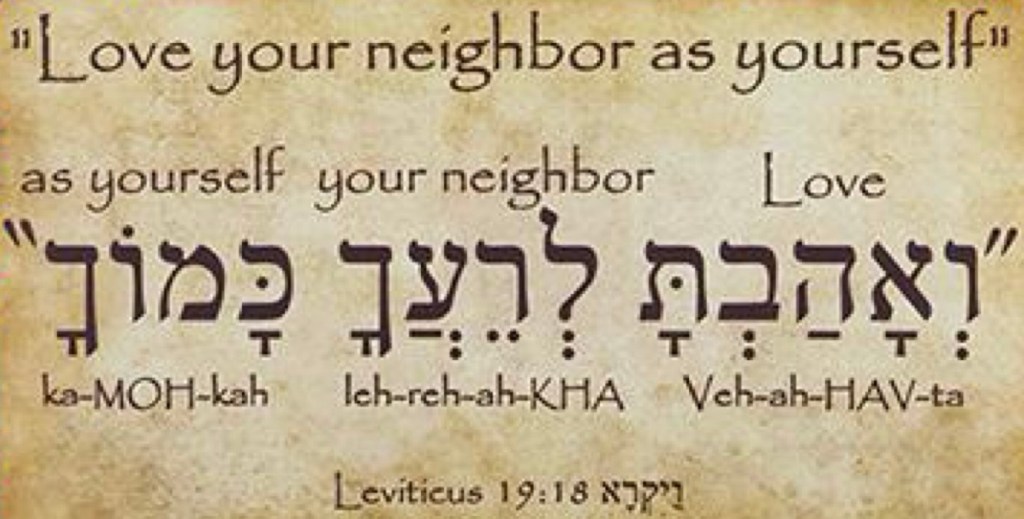
Some Jewish teachers claim that the full text of Lev 19:18 is actually an expression of this rule: “You shall not take vengeance or bear a grudge against any of your people, but you shall love your neighbour as yourself: I am the Lord”. Later Jewish writings closer to the time of Jesus reflect the Golden Rule in its negative form: “do to no one what you yourself dislike” (Tobit 4:15), and “recognise that your neighbour feels as you do, and keep in mind your own dislikes” (Sirach 31:15).

NINE.   Love of God is a thread running right through both testaments of scripture. The command is repeated in later chapters of Deuteronomy (10:12; 11:1; 13:3; 30:6) and in Joshua (22:5; 23:11). It is then picked up in all three Synoptic Gospels (Mark 12:30; Matt 22:37; Luke 10:27; 11:42) and echoed by Paul (Rom 8:28 and perhaps 2 Thess 3:5). 

Finally, this claim is developed by the author of 1 John, who focusses on love as integral to the nature of God, declaring that “God is love” (1 John 4:16) and “love is from God” (4:7); and then explains that such love is expressed in the way that believers “love one another [for] if we love one another, God lives in us, and his love is perfected in us” (4:11–12), or that “the love of God is this, that we obey his commandments” (5:3); and that “those who do not love their brothers and sisters” are “not from God” (3:10; see also 4:19–20). 

And so, the bold declarations are made that “whoever obeys [Christ’s] word, truly in this person the love of God has reached perfection” (2:5), and that “those who love God must love their brothers and sisters also” (4:21). In this way, the two commands to love are knitted together most completely.

TEN.   Love of neighbour is also a consistent theme throughout scripture. After the command to “love your neighbor as yourself” (Lev 19:18), the Torah specifies that “the alien who resides with you shall be to you as the citizen among you; you shall love the alien as yourself” (19:34). Israelites are commanded not to defraud a neighbour (19:13), judge a neighbour “with justice” (19:15), not profit “by the blood of your neighbour” (19:16) and to deal justly with the neighbour in matters of  commerce (25:14–15). The word of Moses in Deuteronomy is clear in the command to “open your hand to the poor and needy neighbour in your land” (Deut 15:11).

The book of Proverbs likewise counsels “do not plan harm against your neighbour who lives trustingly beside you” (Prov 3:29), “do not be a witness against your neighbor without cause, and do not deceive with your lips” (24:28), and warns that “like a war club, a sword, or a sharp arrow is one who bears false witness against a neighbour” (25:18). Its advice is, “better is a neighbour who is nearby than kindred who are far away” (27:10b). 

Paul clearly knows the command to love one’s neighbour, for he quotes it to the Galatians: “the whole law is summed up in a single commandment, ‘You shall love your neighbour as yourself’” (Gal 5:14), and to the Romans: “the commandments … are summed up in this word, ‘Love your neighbor as yourself.’ Love does no wrong to a neighbor; therefore, love is the fulfilling of the law.” (Rom 13:9–10).

James also cites it: “you do well if you really fulfill the royal law according to the scripture, ‘You shall love your neighbour as yourself’” (James 2:8). Both writers reflect the fact that this was an instruction that stuck in people’s minds! And I wonder … perhaps there’s a hint, in these two letters, that the greater of these two equally-important commandments is actually the instruction to “love your neighbour”?

So it is for very good reasons that Jesus extracts these two commandments from amongst the 613 commandments that are to be found within the pages of the Torah. (The rabbis counted them all up—there are 248 “positive commandments”, giving instructions to perform a particular act, and 365 “negative commandments”, requiring people to abstain from certain acts.)

Jesus, of course, was a Jew, instructed in the way of Torah. He knew his scriptures—he argued intensely with the teachers of the Law over a number of different issues. He frequented the synagogue, read from the scroll, prayed to God, and went on pilgrimage to Jerusalem and into the Temple—where, once again, he offered a critique of the practices that were taking place in the courtyard of the Temple (11:15–17). 

Then he engaged in debate and disputation with scribes and priests (11:27), Pharisees and Herodians (12:13), and Sadducees (12:18). Each of those groups came to Jesus with a trick question, which they expected would trap Jesus (12:13). Jesus inevitably bests them with his responses (11:33; 12:12, 17, 27). It was at this point that the particular scribe in our passage approached Jesus, perhaps intending to set yet another trap for him (12:28). We have seen how masterful Jesus was, in engaging with—and besting in debate—this scribe in the way he responded to him. These two “greatest commandments” have endured for centuries!

See also

God’s care for the widow; the widow’s care for the prophet (1 Kings 17; Narrative Lectionary for Pentecost 24C)

This blog explores the passage which the Narrative Lectionary offers for this Sunday (1 Kings 17:1–24), in which the prophet Elijah is introduced. But let me begin with Jesus.

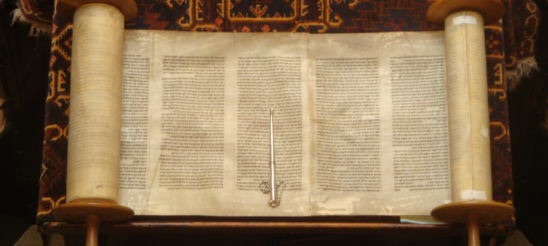
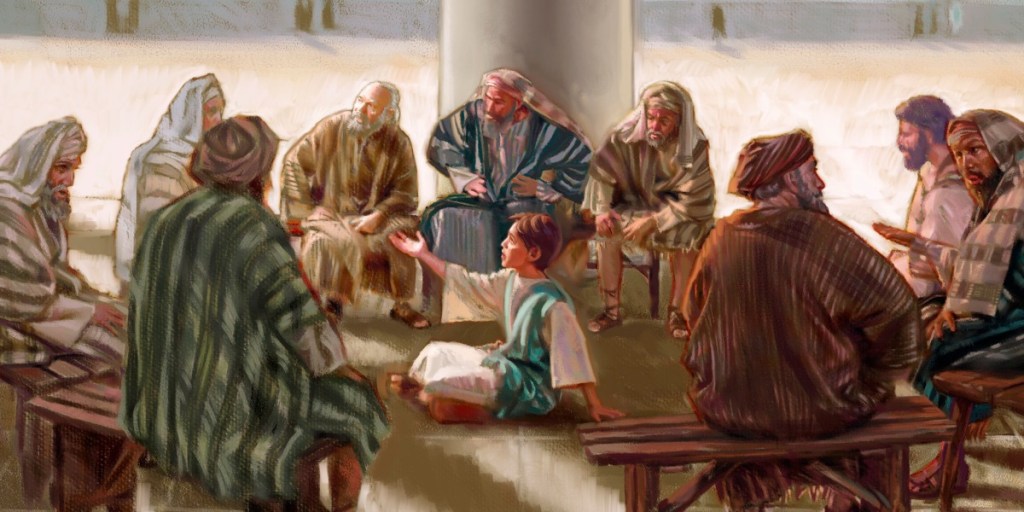
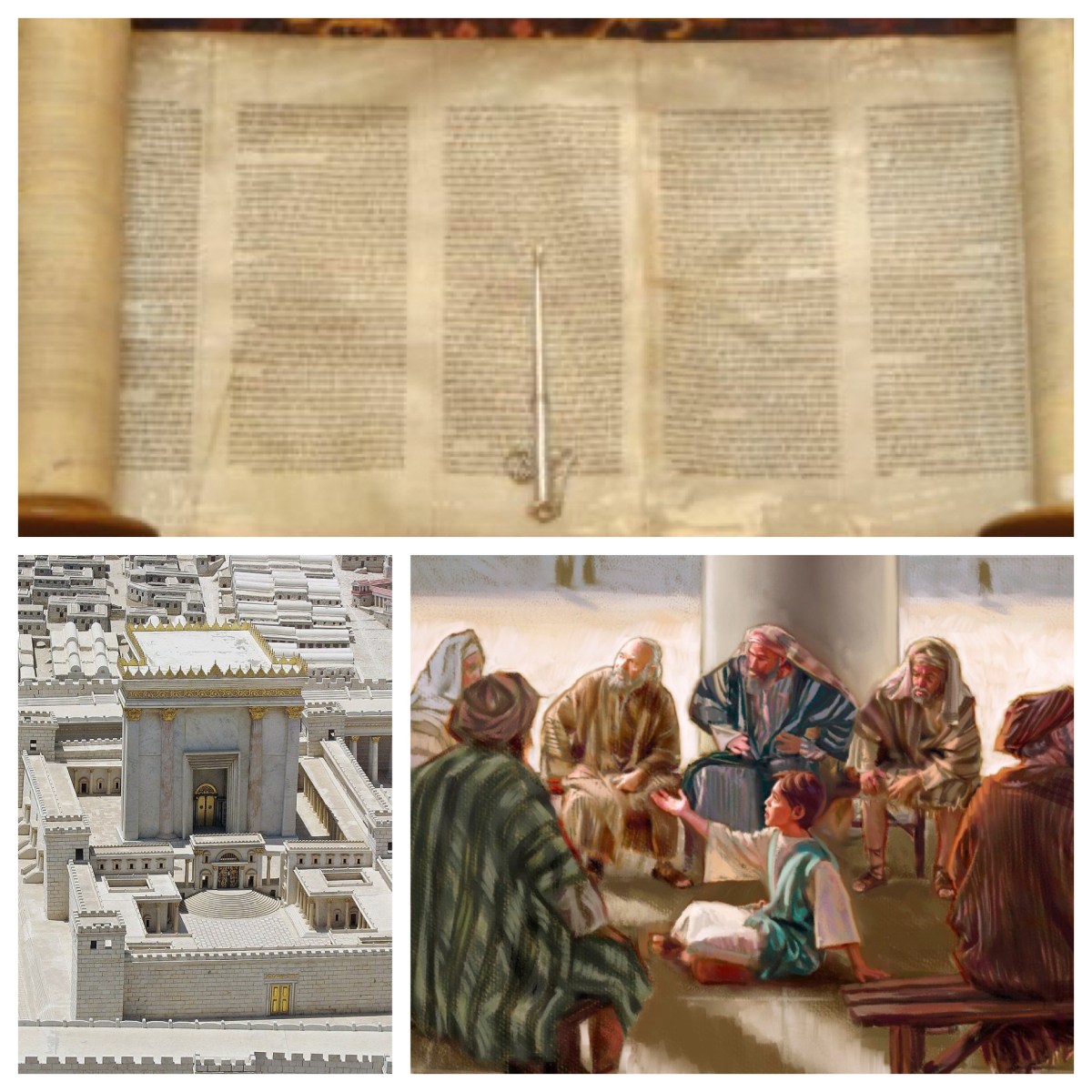
Jesus was a Jew, raised in the manner of his time, taught to read Torah, the scrolls which held prime place in his religion. He was schooled in the detailed requirements of the Law which expressed commitment to the covenant made by the Lord God with ancestors of old (Noah, Abraham, Jacob, David). He actively participated in the practice of prayer and study which occurred in the synagogues and the rituals of offerings and sacrifices that took place in the Temple in Jerusalem.

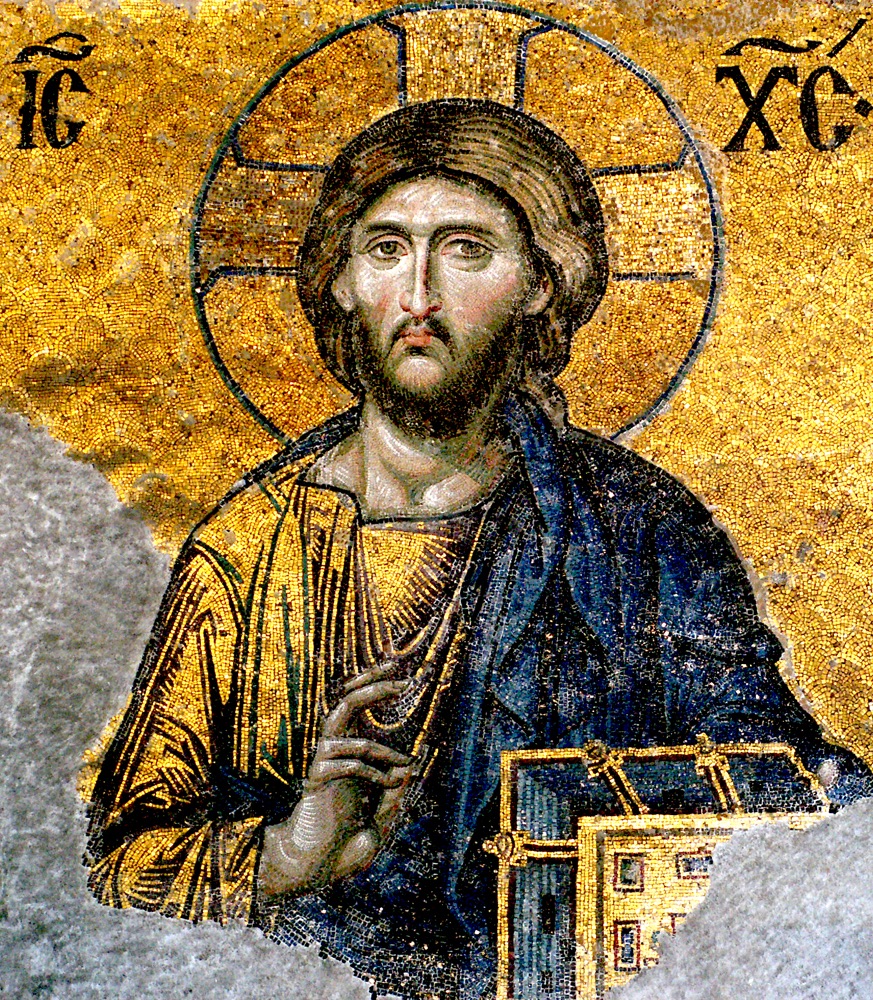
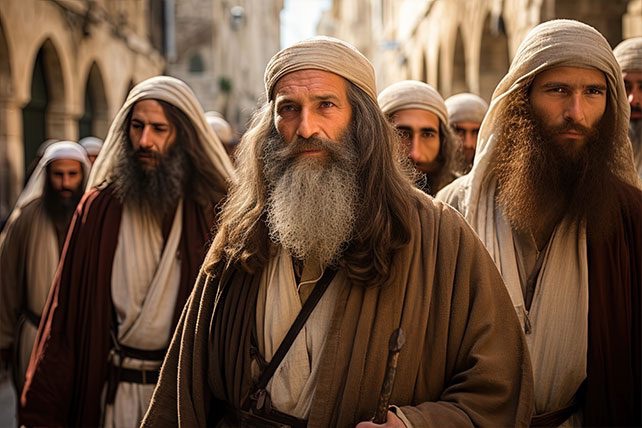
A depiction of Jesus the Jew

As an adult, Jesus broke with his family and began to exercise an itinerant ministry, travelling from place to place with a small, but growing, group of followers, dependant upon the hospitality of those who welcomed him to the villages and towns he visited. In this regard, Jesus was following the practice of prophets in the traditions of the Israelites who travelled from place to place, not settling anywhere. Both Elijah and Elisha lived in this manner; Elijah was known as “hairy man, with a leather belt around his waist” (2 Ki 1:8). 

This mode of living, of course, was adopted by John the Baptist, who was “clothed with camel’s hair, with a leather belt around his waist, and he ate locusts and wild honey” (Mark 1:6). And, of course, there are indications that Jesus—and some of his own disciples—had been followers of John before he launched into his own public mission. Jesus continued the message proclaimed by John, to “repent, for the kingdom of heaven has come near” (Matt 3:2; 4:17) and he continued the emphasis of John to “bear fruits worthy of repentance” (Matt 3:8–10; 7:17–20)  and to share one’s own clothing and food with others who are lacking these essentials of life (Luke 3:11; 12:42; and see Matt 25:34–40). 

For more on how Jesus and John are related, see the groundbreaking work of Prof. James McGrath in Christmaker, which I have reviewed at 


As an adult, Jesus travelled from village to village, preaching his intense message that “the kingdom of God” was drawing near, fervently calling people to repent of their sins and commit completely to the ethical way of living that Torah required. It was all in for Jesus, both in terms of what he preachers, and in terms of how he lived—there was no halfway point for him!

In this regard, Jesus shared the key characteristics of a wild-eyed, desert-dwelling, fiery apocalyptic preacher, vigorously proclaiming the imminent coming of the reign of God. This itinerant, apocalyptic Jesus was resolutely Jewish, standing in the tradition of a string of earlier wild-eyed, rhetorically powerful prophetic figures: Elijah, Nathan, Isaiah, Jeremiah, Joel, Malachi—and his own relative and mentor, John the baptiser. 

A depiction of Elijah the Tishbite, “a hairy man”

It is Elijah the Tishbite whom we meet in the passage which the Narrative Lectionary offers for this Sunday (1 Kings 17:1–24)—Elijah, who is later described as “a hairy man, with a leather belt around his waist” (2 Ki 1:8). This initial portrayal of Elijah is nested within the accounts of that long period of time when Israel was ruled by kings, when prophets functioned as the conscience of the king and the voice of integrity within society. 

Elijah operated during the period when Ahab ruled Israel; he figures in various incidents throughout the remainder of 1 Kings—most famously, in the conflict with the prophets of Baal which came to a showdown on Mount Carmel (1 Ki 18), and then later in his confrontation with Ahab and his wife Jezebel, over the matter of Naboth’s vineyard (1 Ki 21). Like Jesus, Elijah was no shrinking violet!

Elijah first appears in the narrative of kings, seemingly out of nowhere, at the beginning of this lectionary passage (1 Ki 17)—just as he disappears from sight when he hands over his role to his successor, Elisha, and as “a chariot of fire and horses of fire separated the two of them”, Elijah ascends in a whirlwind into heaven (2 Kings 2:1–15).

So in 1 Kings 17, Elijah predicts a drought and takes himself into the desert, where ravens fed him food and he drank from the wadi, until the wadi dried up (vv.1–6). Elijah did as he was commanded and travelled out of Israel, to the neighbouring region of Sidon (v.7). Is this start of Elijah’s public activity mirrored, centuries later, in the account of Jesus retreating into the wilderness near the Jordan, before his public activity got underway?

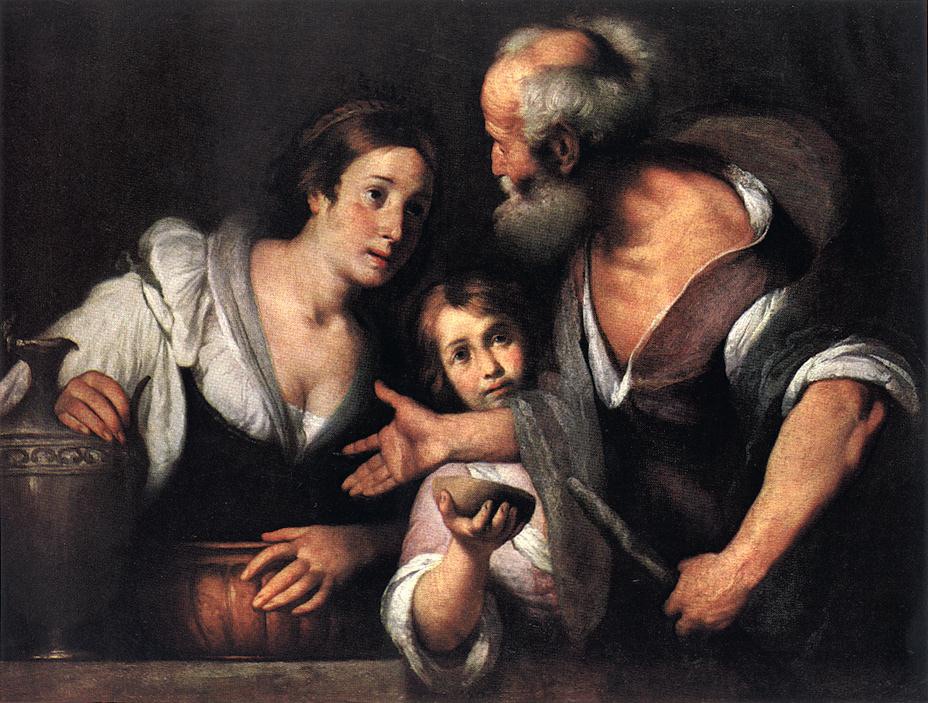
However, whilst Jesus meets the tempter, Elijah meets a widow who, despite being unnamed, is nevertheless well known in Christian circles because Jesus himself, according to Luke, refers to her in a keynote sermon. This took place when he came to his hometown on Nazareth, and was given opportunity to speak in the synagogue (Luke 4:14–30). After reading from the scroll of Isaiah, Jesus refers to stories of two prophets—Elijah and Elisha—and honours this particular widow amongst “the many widows in Israel at the time of Elijah” (Luke 4:25–26). These verses form the short subsidiary reading which the Narrative Lectionary places alongside 1 Kings 17.

The widow offers hospitality to the prophet. Hospitality was a fundamental cultural practice in ancient Israel; there are many stories of the hospitality offered by people such as Abraham (Gen 18:1–15), Rahab (Josh 2:1–16), and David (2 Sam 9:7–13), and hospitality offered earlier to Moses in Midian (Exod 2:15–25), here to Elijah in Zarephath (1 Ki 17:10–24), and later Elijah in Shunem (2 Ki 4:8–17). Welcoming hospitality is commanded in relation to aliens in Israel (Lev 19:33–34) and is advocated in relation to exiles returning to the land (Isa 58:7). The passage from 1 Kings 17 that is proposed by the Narrative Lectionary well exemplifies this practice. The widow had very little; and yet she finds enough to provide for Elijah, in a display of warm hospitality to this foreign Israelite in her territory. 

Hospitality had a fundamental significance in the cultural practices of the day. Writing in Bible Odyssey, Peter Altman notes that “hospitality serves as an underlying core value for how the characters in the Hebrew Bible should treat others, for they, too, understood the precarious nature of life as an outsider”.

See https://www.bibleodyssey.org/articles/hospitality-in-the-hebrew-bible/

In the same resource, Carolyn Osiek notes that this value continues strongly throughout New Testament books, which are “full of images and stories of guests received, both those already known as friends and those strangers who are taken in and transformed into guests. Among nomadic tribes, the guest comes under the protection of the host, who guarantees inviolable safety. The important elements of hospitality include the opportunity for cleansing dusty feet, scented oil to soften dried skin and mask odors of the road, food, shelter, security, and companionship.”

See https://www.bibleodyssey.org/articles/hospitality-in-the-new-testament/

Gerd Theissen, a German New Testament scholar, has proposed that the message of Jesus was spread by itinerants within the early Jesus movement who travelled from village to village with their message. They were dependent on those who received them for hospitality and lodging, in literal obedience to what Jesus had told his disciples (Mark 6:10–11; see also Matt 10:41 and Didache 11:1, 4–6). Jesus and his followers were living in complete obedience to “the Son of Man [who] has nowhere to lay his head” (Matt 8:20; Luke 9:58). In a sense, they are also continuing the pattern which we see in this story of Elijah, as he travels to Sidon during the famine, receiving hospitality from the widow of Zarephath. 

Widows in ancient Hebrew society were in a perilous position. In a strongly patriarchal society, the patronage of a man was vital: a man as husband and provider, a man as father and protector, a man as the household head. Children without fathers—orphans—as well as women without husbands—widows—were in equally perilous situations. They were vulnerable people, often at risk of being mistreated and exploited, of being pushed to the edge of society and being forgotten. They could well be the desolate who needed housing (Ps 68:6).

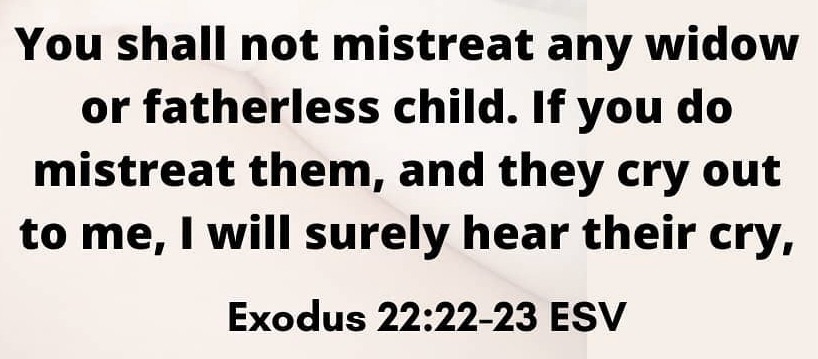
In the Hebrew Scriptures there are regular exhortations and instructions to the people to take care of widows and orphans, the key classes of vulnerable people in that society: “you shall not mistreat any widow or fatherless child” (Exod 22:22) and the instruction to gather a tithe of produce and invite “the Levite, the foreigner, the fatherless, and the widow to come and eat and be filled” (Deut 14:28–29). Even in ancient society, vulnerable people needed protection.

More that this, the Torah provides that the widow and the fatherless child were to included along with the sojourner in celebratory moments in Israel, at the Feast of Weeks (Deut 16:9–12) and the Feast of Booths (Deut 16:13–15). This was also to be the practice when the men were in the field harvesting; they were to leave some for gleaning by ”the alien, the orphan, and the widow” (Deut 24:19–22); and similar prescriptions govern the time when tithing (Deut 26:12–13; also 14:28–29).

Not everyone adhered to these prescriptions. Among the prophets, Isaiah proclaims God’s judgement on those who “turn aside the needy from justice … and rob the poor of my people”, including the way that they exploit the fatherless and widows (Isa 10:1–2). Likewise, Ezekiel includes those who “have made many widows” in Israel amongst those who will experience the full force of God’s vengeance (Ezek 22, see verse 25). He observes that “the sojourner suffers extortion in your midst; the fatherless and the widow are wronged in you” (Ezek 22:7). Jeremiah encourages the people of Jerusalem with a promise that God will allow them to continue to dwell in their land if they “do not oppress the sojourner, the fatherless, or the widow, or shed innocent blood in this place … or go after other gods” (Jer 7:5–7). 

Accordingly, the people of Israel would regularly have sung, in the words of the psalmist, “the Lord watches over the sojourners; he upholds the widow and the fatherless, but the way of the wicked he brings to ruin” (Ps 146:9). Care for widows was central to the life of holiness required amongst the covenant people. This psalm reminds them of that claim on their lives.

And so the brother of Jesus, James, writes that “religion that is pure and undefiled before God, the Father, is this: to care for orphans and widows in their distress, and to keep oneself unstained by the world” (James 1:27), summing up a strong thread running through Israelite religion and on into Second Temple Judaism. See more on widows in biblical texts at 

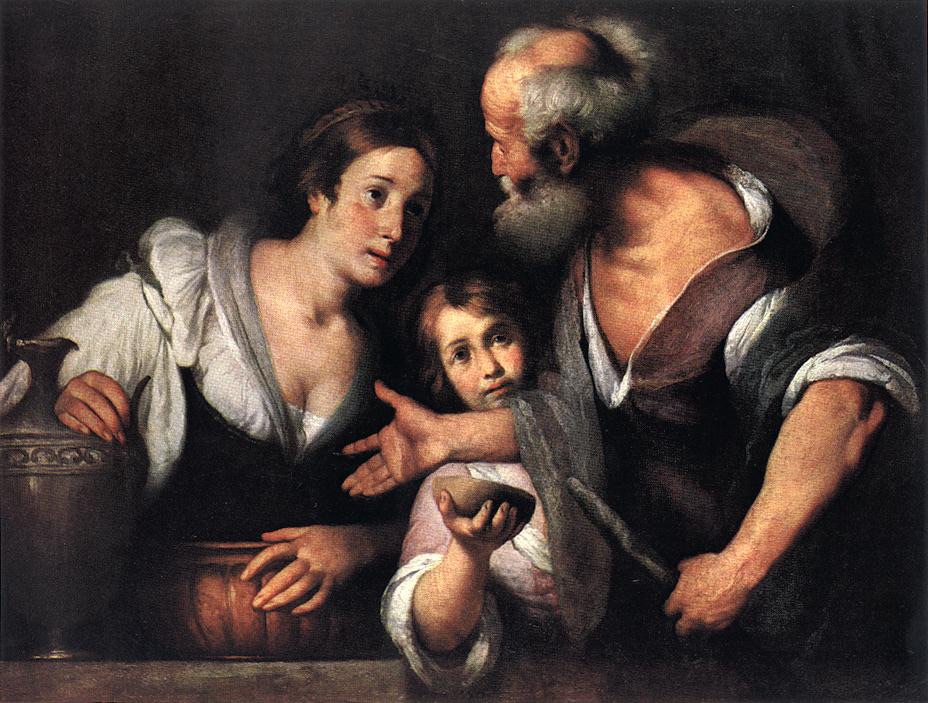
In 1 Kings 17, the first two key incidents that we are told of regarding Elijah both involve this widow: the widow who offers hospitality to Elijah, and the widow whose son had died, but whom Elijah brought back to life. In the first scene, the tables are turned on the typical biblical view of widows, as vulnerable and in need of protection. Here,it is the widow who serves and nourishes the prophet at his time of need. In another evocation of what Jesus taught, we see the humble exalted, the man of power brought down to a position of dependence, perhaps?

Both scenes involving the widow of Zarephath, a non-Israelite, are evoked in the stories about Jesus: first, the generosity of the widow, offering hospitality out of her meagre provisions, is echoed in the positive words Jesus spoke about widows giving in the temple (Mark 12:41–44; and see also Luke 18:1–8).

Second, the raising of the widow’s son from the dead is paralleled in the story Luke tells about Jesus when he visited Nain (Luke 7:10–17). That story ends with the people declaring, “A great prophet has risen among us!” and “God has looked favorably on his people!” (Luke 7:16). The story of Elijah bringing the widow’s son back to life ends in similar fashion, as the woman confesses, “Now I know that you are a man of God, and that the word of the Lord in your mouth is truth” (1 Ki 17:24). The prophetic vocation of both Jesus and Elijah is confirmed by their performing such a deed. And that is precisely the point in mind as the narrator introduces the prophet Elijah to us in these two stories.

Male and female he made them (Mark 10; Pentecost 20B)

The passage that is set forth by the lectionary for this Sunday (Mark 10:2–16) comes at a pivotal moment in the narrative that Mark narrates. For almost all of the nine chapters that have come before, Jesus has been in Galilee (see 1:14, 16–20, 28, 39; 3:7; 7:31; 9:30), including time in Capernaum (1:21; 2:1; 9:33) and Nazareth (6:1–6; Jesus was known as “Jesus of Nazareth”, see 1:9, 24; 10:47; 14:67; 16:6). Now he makes a decision to turn south and head to Jerusalem, the southern capital. 

Mark makes a very bare geographical report: “he left that place and went to the region of Judea and beyond the Jordan” (Mark 10:1). Luke, at the equivalent place in his narrative, declares “when the days drew near for him to be taken up, he set his face to go to Jerusalem” (Luke 9:51). For Luke, this is a momentous turning point; he uses  some weighty theological terms to mark the moment. When Jesus “set his face” to go to Jerusalem, he echoes the prophetic decision to pronounce judgement on Jerusalem (Isa 50:7; Jer 21:10; Ezek 4:3, 7; 6:2; 13:17; 14:8; 15:7; 20:46; 21:2; 25:2; 28:21; 29:2; 35:2; 38:2).

By noting that “the days drew near”, Luke uses a verb (symplērousthai) found also at Acts 2:1, to announce the coming of the Spirit at Pentecost. And the days that were drawing near were when he was “to be taken up”, looking ahead to the ascension (analēmpsin) which concludes Luke’s first volume (Luke 25:50–53)  and opens his second volume (Acts 1:6–11).

All of that is missing from the simple geographical comment of Mark 10:1. In this Gospel, the significant theological weighting that is inherent in the turn to Jerusalem that Jesus undertakes is invested in the scene where he has his followers find a donkey, and he rides into the city to the acclaim of the crowd: “Hosanna! Blessed is the one who comes in the name of the Lord! Blessed is the coming kingdom of our ancestor David! Hosanna in the highest heaven!” (Mark 11:9–10).

Before that, however, Jesus has to deal, yet again, with some Pharisees (10:2). He had previously had debates with northern Pharisees in Galilee a number of times (2:15–17, 18–22, 23–28; 3:1–6; 7:1–13; 8:11–12). This time, amidst the crowds gathered to hear Jesus in “the region of Judea and beyond the Jordan”, some southern Pharisees now come “to test him” (10:2), as their brothers had done earlier (8:11)—the same dynamic that Mark had reported at the very start of the public activity of Jesus, when the Spirit cast him out into the wilderness “being tested by Satan” (1:12–13).

The test set by the Pharisees relates to the matter of divorce. They had a clear cut point of view about this, although in typical Pharisaic—rabbinic style they begin by posing a question. We have seen this technique before. “Why do John’s disciples and the disciples of the Pharisees fast, but your disciples do not fast?” they ask in Galilee (2:18); and then, “Look, why are they doing what is not lawful on the sabbath?” in a grain field (2:24). 

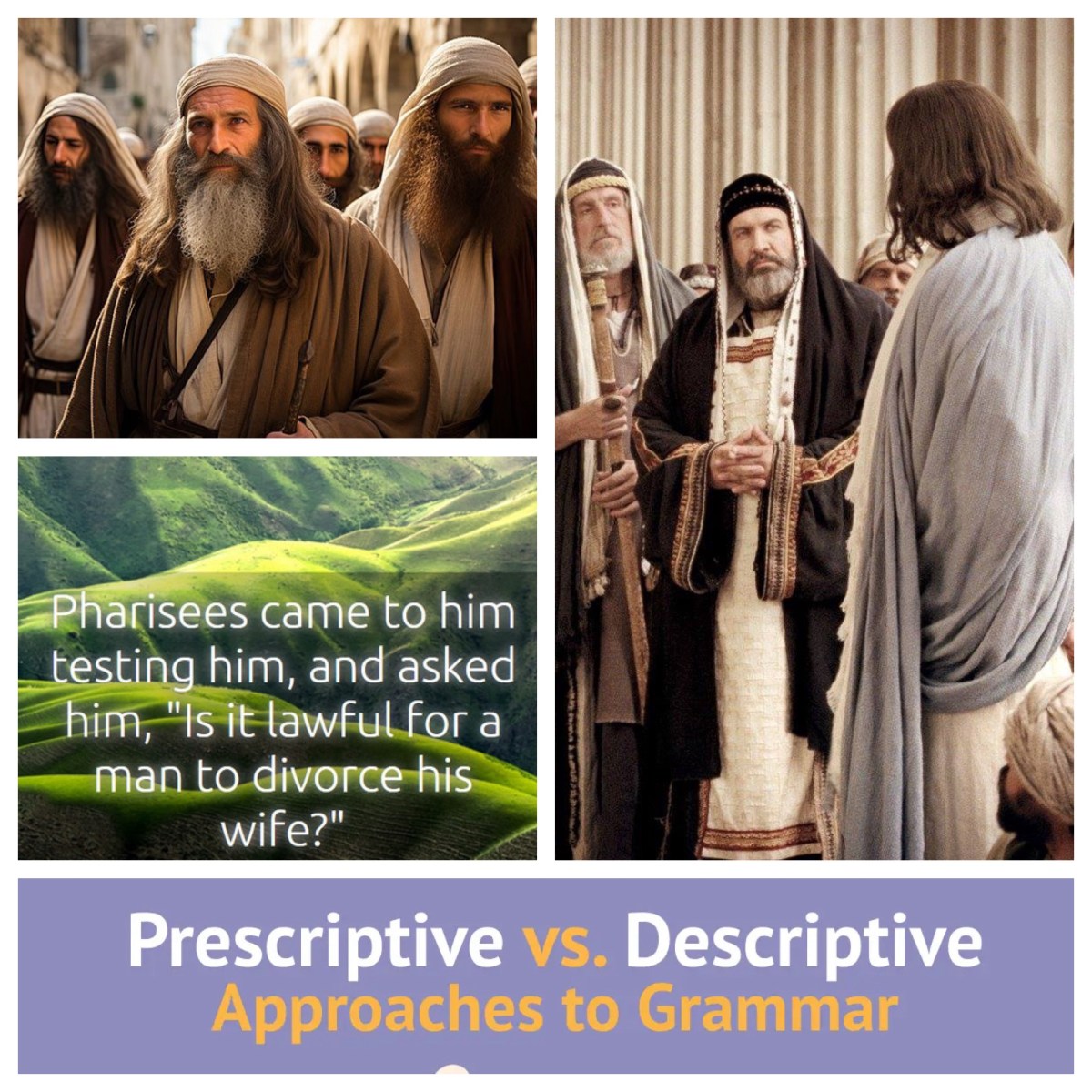
After Jesus had returned from a trip across the Sea of Galilee to “the other side”, a group of Pharisees ask him, “Why do your disciples not live according to the tradition of the elders, but eat with defiled hands?” (7:5 ). In Dalmanutha, some Pharisees approached Jesus “and began to argue with him, asking him for a sign from heaven, to test him” (8:11). And then, in the passage before us this week, once Jesus is in Judea some Pharisees come “to test him” by asking this question, “Is it lawful for a man to divorce his wife?” (10:2).

Jesus, of course—being well-schooled in the business of public disputation on matters of Torah—responds to their question with his own question: “What did Moses command you?” (10:3). This, of course, steers the discussion into the heart of the matter: the specific text from Torah which provided guidance on this matter. From here, the debate continues along a familiar pathway, with the Pharisees offering a scripture passage (10:4, referring to Deut 24:1), Jesus responding with an interpretation (10:5) followed by his proposing one scripture passage of relevance (10:6, quoting Gen 1:27) followed immediately by another passage (10:7–9, quoting Gen 2:24). The to-and-fro of scripture citation, interpretation, counter-proposal, and argumentation, is familiar ground for Jesus.

On the matter of divorce, there were different schools of thought amongst Jewish teachers. In biblical law, a husband has the right to divorce his wife, but a wife cannot initiate a divorce (Deut 24:1). A husband could initiate a divorce if he believes there is some uncleanness in his wife. Understandings as to what such uncleanness might varied. At one extreme was the narrow interpretation that divorce was possible only because of adultery. According to the Mishnah (Gittin 9.10), this view was articulated by Beit Shammai, those following the interpretation set forth by rabbi Shammai.

A much broader understanding was adopted within Beit Hillel, that almost any dissatisfaction with his wife’s behaviour could validate a man’s application for a divorce. The Mishnah tractate reports “he may divorce her … because she burned or over-salted his dish … even if he found another woman who is better looking than her and wishes to marry her” (Mishnah, Gittin 9.10).

The line that Jesus takes is to reject the wider understanding; he tells the Pharisees this was decreed by Moses “because of your hardness of heart” (Mark 10:5). That seems to indicate something contingent about the nature of this particular commandment. So Jesus here is practising the kind of evaluation of texts that we know various Torah interpreters practised. He does not simply quote the text and then say “that’s it, case closed”; he undertakes an evaluative interpretation of those older words.

This is a very rabbinic way to operate. A later rabbinic text, Makkot 23b—24a in the Babylonian Talmud (probably compiled in the 6th century CE) reports a debate between rabbis as to how many commandments were included in the Torah. Rebbi Simlai ventured a count of 613 (“two hundred and sixty five prohibtions in accordance with the days of the sun; and two hundred and forty eight positive commandments in accordance with the limbs of a person”). Rav Hamnunya then suggested that David had identified eleven commandments (citing Psalm 15), then Isaiah narrowed this to six (Isa 33:15), then Micah spoke the three key commandments (“do justly, and love mercy, and walk discreetly with your God”, Mic 6:8).

Next, Isaiah is cited once more, from the beginning of what we identify as Third Isaiah (“guard justice and do righteousness”, Isa 56:1). Finally, Amos is cited, with the singular command, “seek me and live” (Amos 5:4). To which Rav Nachman bar Yitzchak responded, saying “maybe it means to seek out the entire Torah?”—although he then proceeds to cite Hab 2:4, “the righteous shall live by his faith”, as the foundational commandment. (We know this obscure prophetic text because it forms the basis for Paul’s declaration of the Gospel to the saints in Rome at Rom 1:16–17). 

You can read the whole debate (in Aramaic, with English translation) on the website Sefaria:

https://www.sefaria.org/Makkot.24a.27?ven=Sefaria_Community_Translation&lang=bi

All of which is to say that, as we read and hear the passage from Mark 10 that is offered by the lectionary, we need to understand the context and apply our learnings from that to the text. The words of Jesus should not be plucked out of context, made to stand in bare isolation, and treated as an eternal, unchanging word of the Lord. That is to misunderstand what is going on in this passage.

Jesus and the Pharisees are setting forth their different understandings. Through this process of debate and discussion, deeper understanding emerges. Rabbis even to this day value vigorous debate and robust questioning, for this is the way that God’s truth emerges. I learnt this with a vengeance some decades ago, when ministering in a congregation set in the Eastern Suburbs of Sydney, where there was a high concentration of Jewish residents. 

Many of the Jewish residents came to the weekly School for Seniors that we ran in the church building, and quite a few Jews joined with Christians in the weekly Jewish—Christian Dialogue group that I ran. We had many Fridays of vigorous disputation and robust argumentation—all in a good cause, all as friends together. And the same congenial experience was repeated many times during my years on the National Uniting Church Dialogue with the Jewish Community!

So let us not read the declaration of Jesus about divorce as a set-in-stone decree, valid for all times. As a divorced and remarried person, I know all too well the dangers that are inherent in such a reading. For a time, some decades after my divorce, I was pursued online by a rabid fundamentalist who condemned me as “doomed to hell”, told me that I was an “apostate” who “has been deceived”, that I am “hell bound without repentance”, and offering the graphic description of my fate, that I was condemned to the eternal lake of burning sulphur (Rev 20:7–10 and 21:8). All because I was divorced and remarried!!!

Society changes, situations develop, understandings deepen and are reshaped by our contexts. We rightly, today, accept that divorce may be the best way ahead for some people, on pastoral and personal grounds. Our laws accept that, and my denomination, the Uniting Church in Australia, accepts that. We bring more factors into the discussion that were not being considered in the brief interaction that Mark reports in ch.10.

In like fashion, countless people have been hurt—many of them deeply hurt—by the fundamentalist insistence that, when he debated the Pharisees in this encounter, Jesus was setting forth “a biblical definition of marriage” that is immutable, when he said, “from the beginning of creation, ‘God made them male and female.’ ‘For this reason a man shall leave his father and mother and be joined to his wife, and the two shall become one flesh.’” (Mark 10:6–7).

Such people place the words of Jesus over and against those people who identify as “queer”—gay, lesbian, bisexual, and also now transgender—and whose love, deep and abiding, for a person of the same gender as they are. Forbidden by law to marry until recent years (2017 in Australia), these people are told “marriage is between a man and a woman”, citing the words of Jesus from this week’s Gospel passage. Again, the argument is simplistic: “Jesus said this, this is what it means, end of discussion, case closed”. It’s a hurtful and uninformed way to operate, in my opinion.

What would Jesus have done if confronted with scenarios of increased domestic violence and toxic masculinity feeding unhealthy and damaging relationships? Would he have replied as a fundamentalist: “that’s what Moses said, that’s it”? Or would he have offered a rabbinic explanation, offering different factors and exploring new pathways of understanding? I suspect the latter.

So let’s not use this passage as a word that is prescriptive—that says something like “this is what the text says, and it expresses exactly how God defines marriage and forbids divorce, and that stands for all times and all places”. The text, in my opinion, gives no indication that a general principle, prescribing human behaviour, is being set forth. Indeed, the Genesis passage about marriage that is cited by Jesus is not from a book that sets out Torah commandments; rather, it is from a narrative work. 

Rather, I see it as descriptive—that offers a description of how human beings behave and what should guide us as we navigate our way through life, based on our experiences and reflection on how things have been for us. Indeed, whilst the quote from Moses (in Deut 24) does have a legal tone to it, it needs to be understood within the back-and-forth that characterised rabbinic interpretation of Torah (an ethos shared by Jesus); and the Genesis quote, it should be noted, comes from a book that contains aetiological narratives (which I have explained in my earlier blogs on the Genesis narratives), describing the world and the place of humans in that world on the basis of observation and experience.

So let’s offer Jesus—and the Pharisees—the respect that they deserve as they discuss and debate, and not try to press their words in a direction that they never intended.

For more on this passage, see

For more on the matter of same-gender marriage, which has been permissible within my church since 2018, see

Following Mark: a commentary for people on the road (a review)

In following the Revised Common Lectionary through the year, each year the Gospel reading has a focus, for a large part of the year, on one of the Synoptic Gospels. So this year we have been following stories in Mark’s Gospel (with the obvious exception of the past five weeks, when we took a detour into John 6).

Mark’s Gospel majors on discipleship, on what it means to follow Jesus as a faithful disciple. “Follow me” is an early exhortation of Jesus; to the four fishing disciples (Mark 1:16–20), to Levi the tax collector (2:13–14), to the crowd following him on the road (8:34), and to a rich man (10:17–22). One of my ministry colleagues, Peter Hobson, coined the term “followship” (blending following and discipleship) to characterise this focus. 

So it is no surprise to receive a book focussed on Mark’s Gospel, with the clever title Following Mark. The subtitle, A commentary for people on the road, also picks up on the repeated motif of Jesus and the disciples being “on the way” or “on the road” (3:23; 7:31; 8:27; 9:33–34; 10:32, 52; 11:8). The book is written by William Loader, professor emeritus at Murdoch University, Perth, a minister in the Uniting Church in Australia, and an internationally recognised New Testament scholar with extensive publications.

Bill Loader, as I know him, always writes with an open, inviting style that encourages thoughtful engagement with the biblical text. This short book is no exception. The pages brim with lucid explanations, grounded in thorough scholarship; vivid images, designed to bring the story to life; and provocative questions, to deepen the life of discipleship of those who read this book. 

There are five main sections to the book, each with a title that encapsulates the key focus of the stories in that part of the Gospel: The Beginning (1:1–4:41), The Expansion (5:1–8:26), The Identity (8:27–10:52), Jesus and the Temple (11:1–13:37), and The End? (14:1–16:8). These are the logical groupings of sections of text which many commentators have recognised. You can compare it with my own brief analysis of the nature and structure of Mark’s Gospel at

Within each of those sections, there are four or five subsections in which a translation of the passage is given under the heading Listening to Mark, followed by three to five pages of discussion under the heading Thinking about Mark, and a short conclusion called Reflection, which offers two or three questions designed to stimulate ongoing thinking, or perhaps as the basis for a small group discussion of the relevant section.

Loader’s own translation of Mark that is included is peppered with some wonderful turns of phrase that reflect how Australian ears hear the stories about Jesus. He maintains the Markan use of present in the midst of past tenses, which gives the whole narrative a much less formal style, more in the manner of telling stories while gathered around a campfire, perhaps. John is baptising in the outback instead of the wilderness (1:4, 12); the healed leper, in his rejoicing, “began to blab all about it” (1:45). There is a man with a shrunken hand (3:1, 3), a more prosaic description; “a great crowd” becomes “a great mob” (3:8). 
When Jesus encounters some unclean spirits, “he had to tell many of them off” (3:12), while when the disciples encounter Jesus walking on the water, he says “Cheer up. It’s me. Don’t be scared!” (6:50). At one point, people from the synagogue remonstrate with Jairus, saying, “Why keep hassling the teacher?” (5:35). In Gethsemane, Jesus tells the disciples, “I’m terribly sad enough to die” (14:34). All of this adds a fine Aussie touch to the work. (But I did notice that denarii are still denarii.)

For those preaching from the Gospel text each Sunday, there are many comments which will spark further thinking and provide material to enrich their thinking as they develop their sermon. For those reading through Mark’s Gospel in the midst of their already-busy lives, this book provides a concise, handy guide for negotiating the stories it contains. 
This book is a fine piece of work which I was invited to recommended, along with others who are teaching New Testament or are engaged in ministry formation processes. Assoc. Prof. Robyn Whitaker, of the University of Divinity, notes that Loader’s “deep knowledge of the text and its historical setting shines through”.
Prof. Paul Foster, of Edinburgh University, says that the book “distills the insights of a seasoned scholar and brilliant communicator into a highly readable format”. Cathie Lambert, formation coordinator in the Uniting Church in Western Australia, comments that “Loader’s clear and accessible explanation of nuances of translation, cultural and geographical contexts, and links to the Hebrew Bible provide the reader with a firm foundation for contemporary interpretation”.

You can order a copy at https://www.amazon.com.au/Following-Mark-Commentary-People-Road/dp/B0CYWDT3KR

You can view a full list of Bill Loader’s publications at https://billloader.com

For my review of his earlier book What can love hope for? see

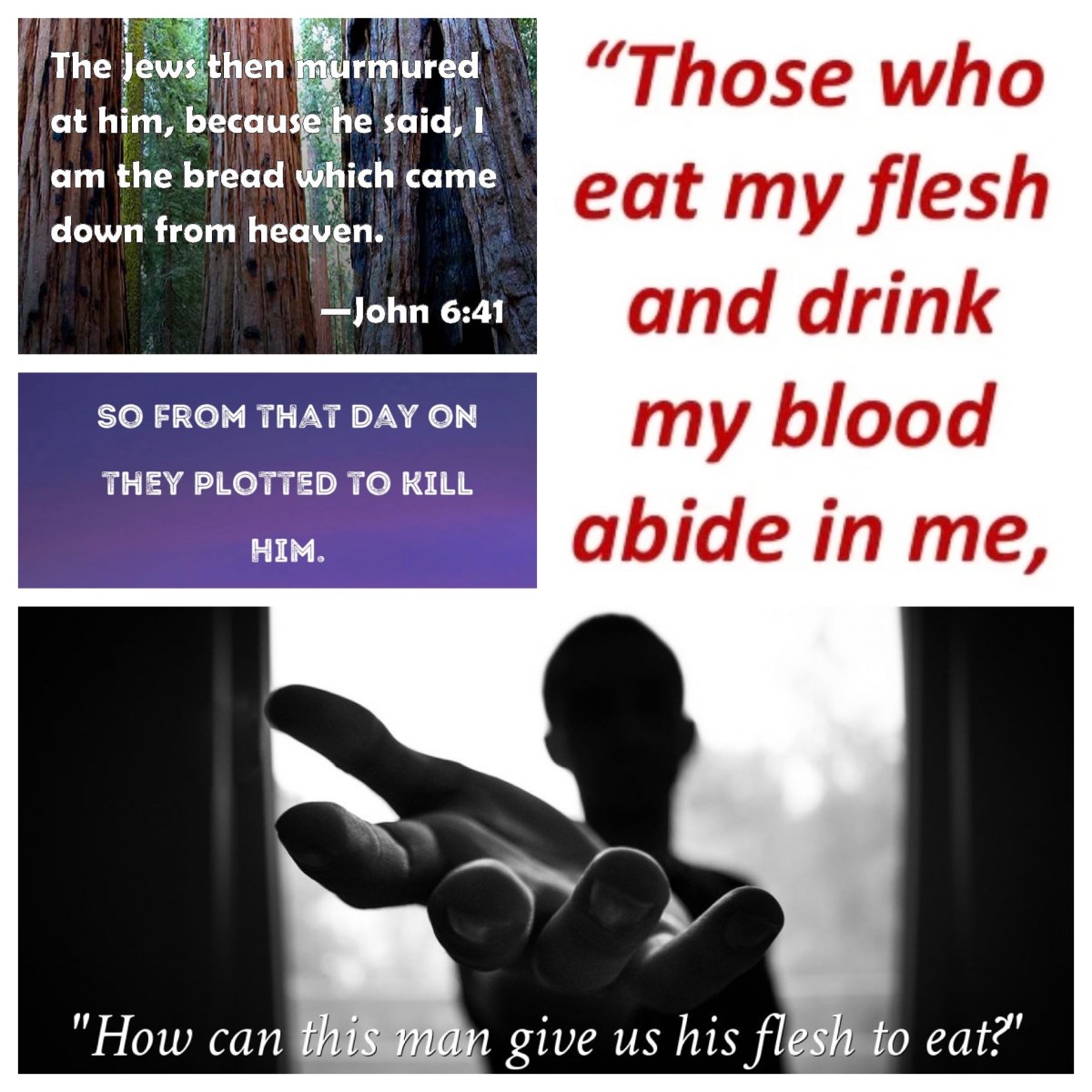
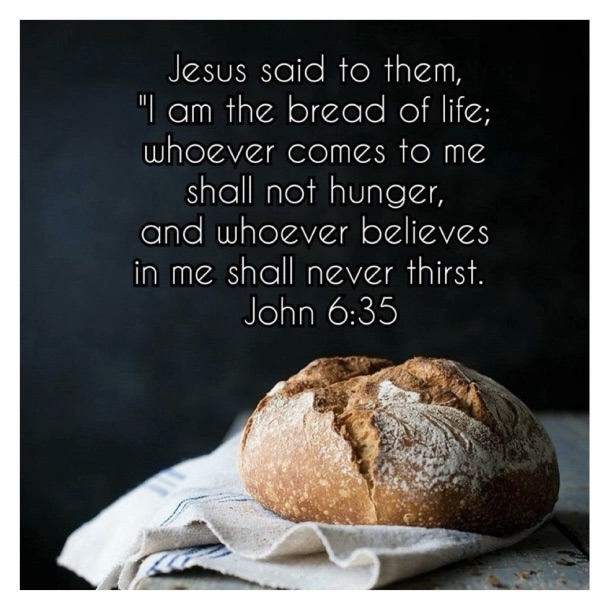
Disputing the claim of Jesus to be “the bread of life” (John 6; Pentecost 13B)

Under the guidance of the lectionary, we have been following a pathways which has deviated from the story of “the beginning of the good news of Jesus, Messiah” (which we know as the Gospel of Mark) that we have been following each Sunday since Pentecost. For the moment, we read and hear excerpts from “the book of signs”, which contains just some of “the many things that Jesus did” (which we know as the Gospel of John).

We have read or heard the account that John gives of when Jesus “took the loaves, and when he had given thanks, he distributed them to those who were seated; so also the fish, as much as they wanted” (John 6:1–13). From that day, we have then been guided to follow the extensive discourse that Jesus gives to a crowd that “went to Capernaum looking for Jesus” (John 6:25–71).

First, we heard a passage that ends with the first of seven I AM declarations made by the Johannine Jesus, “I am the bread of life” (6:24–35). Then, in the next section of that discourse, we encountered an elaborated exposition of that “bread of life” (6:35–51). This Sunday we hear about the disputes that this teaching generated with the Judaean authorities (6:51–58), and then the following Sunday takes us to the final section of the discourse where Jesus then has to deal with dissent from his own disciples (6:56–69).

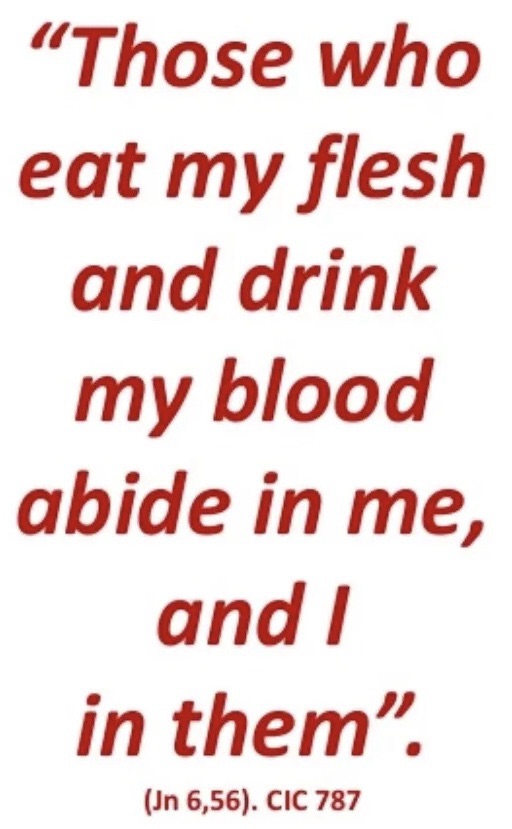
The passage for this coming Sunday (John 6:51–58) is introduced, as we saw in the previous blog on this discourse, with a restatement of the theme that Jesus had what has just been declared: first, the primary affirmation about Jesus: “I am the living bread that came down from heaven” (v.51a); followed by the consequence for those who believe in him: “whoever eats of this bread will live forever” (v.51b)—and then a further step, following this summary, with and immediate extension of the argument: “the bread that I will give for the life of the world”, Jesus declares, “is my flesh” (v.51c).

Whilst a superficial, or impatient, reading of this chapter reacts with “here we go again, ‘I am the bread of life’ yet again”, a more careful reading will reveal to us the developments and new elements that are being added into the discourse at each reiteration of this fundamental claim. This restatement does just that.

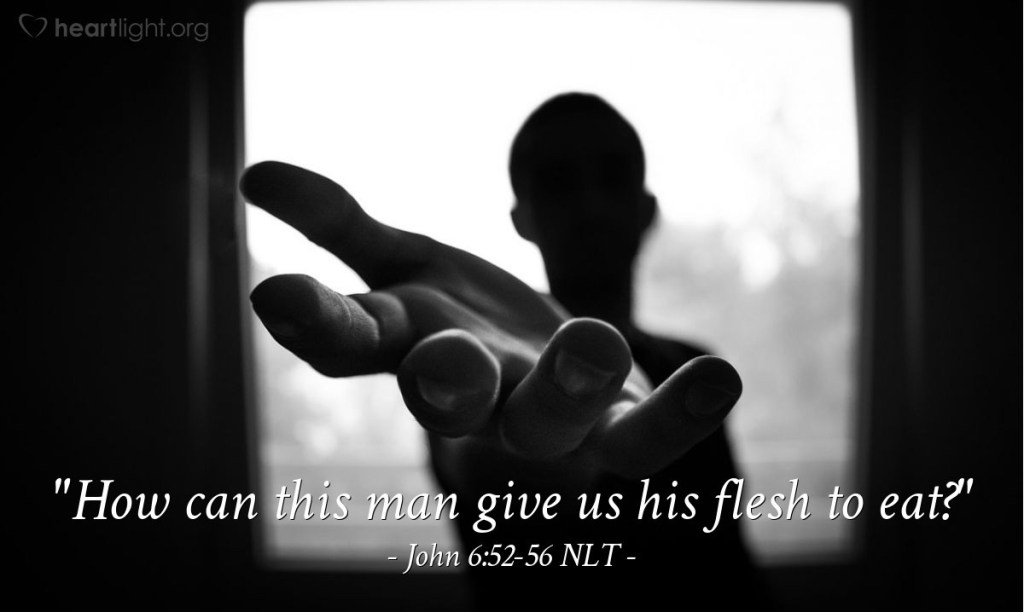
A strong response to the statement of Jesus made in v.51 comes immediately. Most contemporary translations refer to “the Jews” when they report the immediate kickback: “[they] disputed among themselves, saying, ‘How can this man give us his flesh to eat?’” (v.52).

It’s a fair question, I reckon, since it’s a curious, and confronting, thing for Jesus to say. Who talks about giving his own flesh to others for them to eat?

I am reminded of the criticism of the Christians made in the early centuries of the movement. Second century Roman writer Suetonius wrote that “Nero inflicted punishment on the Christians, a sect given to a new and mischievous religious belief” (Suetonius, The 12 Caesars, Nero Claudius Caesar, XVI). A similar comment is found in the Annals of Tacitus: “Nero fastened the guilt and inflicted the most exquisite tortures on a class hated for their abominations, called Christians by the populace” (Tacitus, Annals 15.44).

In a third century work written by Minucius Felix we gain a glimpse of the accusation of cannibalism being levelled against the Christians, in a “story about the initiation of young novices” (Octavius 30). Minucius Felix reports the criticism that an infant, “covered over with meal, that it may deceive the unwary, is placed before him who is to be stained with their rites” (that is, before the person about to be baptised).

He continues with a description of the alleged horrors: “this infant is slain by the young pupil, who has been urged on as if to harmless blows on the surface of the meal, with dark and secret wounds”, and then gives a graphic description of what ensues: “thirstily … they lick up its blood; eagerly they divide its limbs; by this victim they are pledged together; with this consciousness of wickedness they are covenanted to mutual silence.” It’s quite a take on what believers know as the celebration of Holy Communion.

(We will come back to the strangely-different language and the distinctive Eucharistic resonances of the discourse of the Johannine Jesus in John 6 in my blog on next week’s lectionary passage.)

Who are these “Jews” who are criticizing Jesus in this way? I have already noted (in my blog on John 6:1–15) that most translations describe this latter group simply as “the Jews”. The Greek word used, however, can equally be translated as “the Judeans”. It’s a preferable option, I believe, as it avoids having a sense of antisemitism creep into our understanding of the text, every time we hear “the Jews” criticising and arguing with Jesus.

To be fair to the whole population of Judaea at the time, however, I’ll refer to them as “Judaean leaders”, as it seems clear that this is the particular group that is generating and exacerbating the conflict.

In doing so, I am taking the lead from D. Moody Smith, who argues that that the way the word is used in the fourth Gospel means that it should be translated as “a group of Jewish leaders who exercise great authority among their compatriots and are especially hostile to Jesus and his disciples … it refers to certain authorities rather than to the people as a whole.” See D. Moody Smith, “Judaism and the Gospel of John”, accessible at https://www.bc.edu/content/dam/files/research_sites/cjl/sites/partners/cbaa_seminar/Smith.htm

The sixth chapter of John’s Gospel offers a series of encounters that reveal misunderstanding, antagonism, and conflict in the ways that people relate to Jesus, even whilst he sets forth this significant teaching that he is “the bread of life” (6:35, 48). To be sure, the earlier interactions between Jesus and “the crowd” (6:24–40) appear to be amenable, offering Jesus the opportunity to explain himself.

However, when this group of Judaean leaders come into the foreground (v.41), this become more tense. The antagonism of these leaders is palpable. This mood continues through their complaining (vv.41–51) and disputing (vv.52–58), on into the complaining of the disciples of Jesus (v.60–65) and the rejection of Jesus by some of them (vv.66–71).

We have already met opponents of Jesus very early in John’s narrative. Indeed, in the prosaic interpolation into the poetic prologue, even before the story proper begins, there is a clear indication of looming opposition to Jesus: “the world did not know him … his own people did not accept him” (1:10–11).

Early in the narrative that John the evangelist presents, a group of Judaean leaders had questioned John the baptiser, asking him “who are you?” (1:19); then they had questioned Jesus, “what sign can you show us?” (2:18). These questions are not necessarily antagonistic. (You could read them as a form of “appreciative enquiry”.)

The explicit opposition to Jesus from these Judaean leaders emerges, however, after he has healed on the sabbath (5:10). Here, the narrator declares that these Judaean leaders “started persecuting Jesus” (5:16) and indeed “were seeking all the more to kill him” because of what he was saying (5:18). From this point on, the conflict just deepens.

After they began to complain about Jesus (6:41) and quarrel about him (6:52), these leaders have success: “many of his disciples turned back and no longer went about with him” (6:66). They intensify their opposition, “looking for an opportunity to kill him” (7:1), intimidating people to silence (7:13), further questioning the teaching of Jesus (7:35–36; 8:22, 57; 10:24), accusing him of being a Samaritan (8:48) and possessed by a demon (8:48, 52; 10:20)—although not everyone holds this view (10:19, 21) and there are indeed Judaean leaders who “believed in him” (11:45; 12:11).

Twice the Judaean leaders take up stones to kill Jesus (8:59; 10:31–33; 11:8), accusing him of blasphemy in “making yourself God” (10:33, alluding back to their assessment of 5:18). Their success in persecuting the followers of Jesus is reflected in the observation that they “had already agreed that anyone who confessed Jesus to be the Messiah would be put out of the synagogue” (9:22; and see later references at 12:52; 16:2). The plot to kill Jesus is finalised when Pharisees and priests combine, in the face of the greatest sign performed by Jesus, in raising Lazarus from death (11:46–53).

Where these Judaean leaders stand in relation to Jesus and the truth that he declares (1:14, 17; 8:23, 40, 45–47; 14:6; 18:37) is clear from the division outlined in the vehement vitriol of the debate in chapter 8. “You are from below, I am from above”, Jesus tells them; “you are of this world, I am not of this world” (8:23). Not content with this (characteristically Johannine) dualistic assessment, he then confronts them with the clear reality, as he sees it: “I told you that you would die in your sins, for you will die in your sins unless you believe that I am he” (8:24).

I read the whole sequence of scenes in this Gospel, from the wedding in Cana, with its implicit criticism of “the Jewish rites of purification” (2:1–11), through the heated debates of chs. 5—8, the high drama of the multi-scene conflict with Jewish leaders and “expulsion from the synagogue” in ch.9, on into the plot of ch.11, as a story that reflects the position of the followers of Jesus who comprised the community in which this book was eventually written.

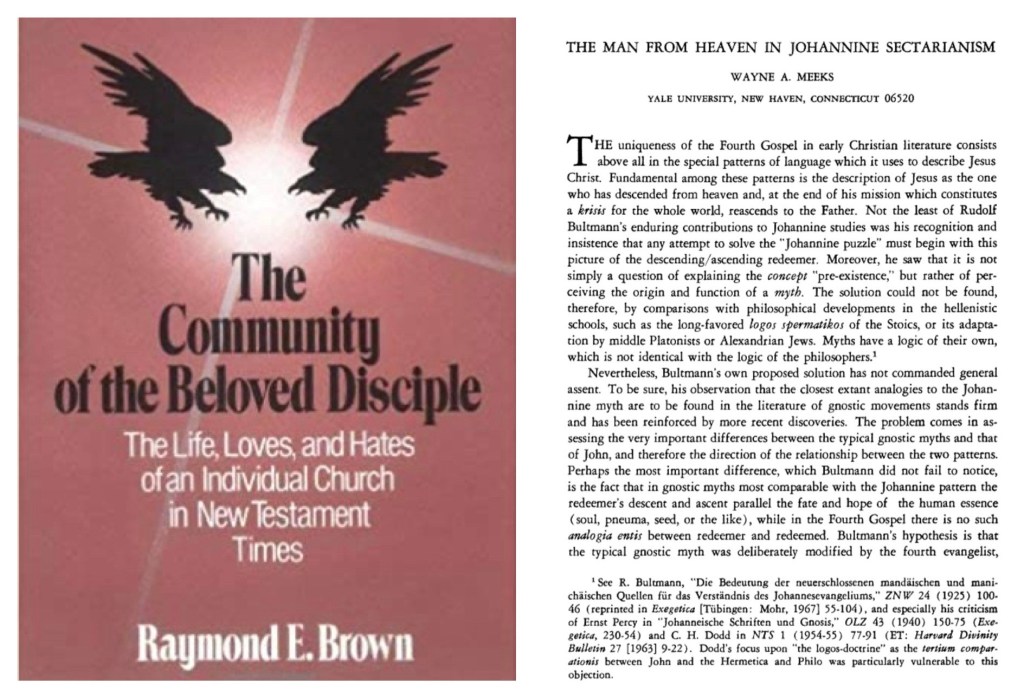
This group of people (what Raymond Brown called “the community of the beloved disciple”) had been rejected by their fellows, expelled from their community of faith, because of their views about Jesus. They had become yet another sectarian group in the mixture of late Second Temple Judaism, which then bled into early Rabbinic Judaism.

It is this “Johannine sectarianism”, as Wayne Meeks called it, which explains the bruising debates in this Gospel; Jesus, “the man from heaven”, as Meeks styles him, is being remembered as “standing up for the truth” in the face of intense criticism, by a group of people who had been pillaged and persecuted for standing up for what they saw as “the truth”. They had become outsiders; some of them had met death for the stand they took. This was what it meant for them to be faithful to Jesus.

So in the Johannine story of Jesus, the Judaean authorities, and the disciples of Jesus, the die is cast; the antagonism is set. Jesus will head to his death and his followers also will experience “an hour … when those who kill you will think that by doing so they are offering worship to God” (16:2). The fate that is in store for Jesus is the same fate for his followers.

Using the commonplace image of “a grain of wheat [that] falls into the earth and dies” (12:24), Jesus appears to foreshadow his imminent death; “the hour has come for the Son of Man to be glorified” (12:23) is the way that the Johannine Jesus refers to his death (7:39; 11:4; 12:16, 28–33; 13:31–33; 17:1–5).

He follows the saying about the grain of wheat dying, only to “bear much fruit”, with an assertion about his followers: “those who love their life lose it, and those who hate their life in this world will keep it for eternal life” (12:25; the language reflects Mark 8:35; Matt 10:39; 16:25; Luke 9:24; 17:33). The way of Jesus is also the way of his followers.

(At this point, we might want to reflect on how appropriate for us—or how distant from us—this portrayal of Jesus is. How much do I know, personally, of the opposition and conflict that puts my very life in peril, because of what I believe and how I live? In this light, the Johannine Jesus and the community faithful adhered to his way can appear to be alien from the comfortable existence of so many Christians—myself included—in the western world.)

The final verse of this section (not included in the lectionary selection, 6:51–58) is a surprise: “he said these things while he was teaching in the synagogue at Capernaum” (6:59). The chapter had begun on “the other side of the Sea of Galilee, also called the Sea of Tiberias” (v.1), where Jesus had fed the large crowd, before moving “across the sea to Capernaum” (v.17), where Jesus had walked on the water.

When those left on “the other side” of the sea saw the crowd across the lake, “they got into the boats and went to Capernaum looking for Jesus” (v.24), where they found him, engaging him in discussion (v.25). The mention of the synagogue in 6:59 provides a pivot for the narrative then to focus on the disciples, who had been with Jesus “on the other side” (v.3) and then in the boat (vv.6–7). What ensues (v.60 onwards) then maintains a focus on Jesus interacting with the disciples. On which, see next week’s blog …

See previous blogs at

and on the whole sequence of this chapter

A midrashic exposition on “the bread of life” (John 6; Pentecost 12B)

Two weeks ago, the lectionary directed us to turn off the road we were following through the story of “the beginning of the good news of Jesus, Messiah” (which we know as the Gospel of Mark), and spend five weeks with “the book of signs”, which contains just some of “the many things that Jesus did” (which we know as the Gospel of John).

This detour came just at the point when we were going to read the story of when Jesus took “five loaves and two fish, looked up to heaven, and blessed and broke the loaves, and gave them to his disciples to set before the people; and he divided the two fish among them all … [and] those who had eaten the loaves numbered five thousand men” (Mark 6:30–44). The wording is strongly evocative of the Eucharistic words that Mark later reports: “he took a loaf of bread, and after blessing it he broke it, gave it to them …” (Mark 14:22).

Instead, two Sundays ago we read or heard the account that John gives us, with a less-eucharistic flavour, when Jesus “took the loaves, and when he had given thanks, he distributed them to those who were seated; so also the fish, as much as they wanted” (John 6:1–13); and from that passage, we are then guided over the following four Sundays to follow the extensive discourse that Jesus gives to a crowd that “went to Capernaum looking for Jesus” (John 6:25–71).

Last Sunday, John 6:24–35 was the passage that the lectionary proposed as the Gospel reading. This passage ends with the first I AM declaration by Jesus, “I am the bread of life” (6:35).

After hearing that, on the next Sunday (this coming Sunday) we will read or hear the next section of that discourse, dealing with an elaborated exposition of that “bread of life” (6:35–51). That is to be followed by an account of the disputes that this teaching generated with the Judaean authorities (6:51–58), and then the final section of the discourse where Jesus then has to deal with dissent from his own disciples (6:56–69).

I have already offered comments on those two earlier sections, and plan to continue to trace the words and interactions of Jesus from this long chapter in the coming weeks. For today, we focus on the way that Jesus expands and develops his theme of “the living bread which came down from heaven” (6:35–51). And interestingly, after having eschewed a direct eucharistic allusion in the miracle reported earlier, here the Johannine Jesus takes us step-by-step towards a strongly eucharistic understanding. (More on that in coming weeks.)

A key observation that can assist us in understanding this lengthy discourse is that it has the nature of a Jewish midrashic discussion. The Jewish Virtual Library notes that there are two main types of midrash, and defines it as follows: “Midrash aggada derive the sermonic implications from the biblical text; Midrash halakha derive laws from it.”

The article continues: “When people use the word midrash, they usually mean those of the sermonic kind. Because the rabbis believed that every word in the Torah is from God, no words were regarded as superfluous. When they came upon a word or expression that seemed superfluous, they sought to understand what new idea or nuance the Bible wished to convey by using it.” That is how I am understanding the relevance of this section of the discourse in John 6.

See https://www.jewishvirtuallibrary.org/halakha-aggadata-midrash#google_vignette

My Jewish Learning defines midrash as “an interpretive act, seeking the answers to religious questions (both practical and theological) by plumbing the meaning of the words of the Torah. Midrash responds to contemporary problems and crafts new stories, making connections between new Jewish realities and the unchanging biblical text.”

See https://www.myjewishlearning.com/article/midrash-101/

That would indicate that the words of Jesus, in John 6 (as, indeed, elsewhere in the Gospel) were being remembered and retold, expanded and developed, in light of the hopes, concerns, and needs of the community within which this Gospel came into being. In other words, whilst we do not have an accurate historical reporting of “what Jesus actually said”, we do have words which give us a pathway into understanding how at least this group of followers of Jesus understood him, and how they lived in response.

It seems to me that applying a Jewish understanding of how biblical texts are appropriated and understood, through midrash, helps to explain what is happening in John 6. Although it seems repetitive to us moderns, the discourse is actually probing the possibilities and exploring the options in understanding the scripture text that was provided to Jesus by the crowd around him.

Earlier in the chapter, a series of questions have been put to Jesus, moving to a key matter, when the crowd asks: “what sign are you going to give us? … what work are you performing?” (v.30). They continue by quoting scripture (v.31)—a move that is fundamental for the nature of what follows.

By quoting scripture, the crowd gives Jesus his “text” for the teaching that follows. And, of course, as they are Jews, and as Jesus was a Jew, the argument is developed by means of a typical midrashic “playing with the text” in the words that follow. More than that, when we look for the text that the crowd speaks, we find it is a compilation text—something that draws on the post-exilic narrative of the manna from heaven (Exod 16:4 and 15), a poetic retelling of this scene (Psalm 78:24), and an even later Hellenistic-era reporting of this incident (Wisdom of Solomon 16:20).

The fact that we do not have a precise quotation of the text “as we know it” should alert us to the fluidity that was commonplace in the ancient world, when texts were referred to. My own teacher, the late Dr. Robert Maddox (in an unpublished paper entitled “The Use of the Old Testament in John’s Gospel”) put it very clearly:

“The freedom of wording of John’s quotations and allusions is due not to ignorance nor to the nature of the texts he used, but to the fact that he had steeped himself in the Scriptures, as Jesus had before him; and the Biblical text was no longer something external to be reached for to bolster an argument, but something which had become a part of the author’s mind and heart.”

Dr Maddox offers this concise summation of how the author operated: “He treats the Biblical text not with the deference of polite respect but with the freedom of intimate familiarity.”

So, what follows here is a typical Jewish midrash—a use of the text in a somewhat fluid and flexible way that develops and expands a theme. How does Jesus do this? We can be helped by the work of Scandinavian scholar Peder Borgen. He offers a detailed (book-length) analysis of this discourse in the context of the practices and techniques found in rabbinic literature. The book is entitled Bread from Heaven: An Exegetical Study of the Concept of Manna in the Gospel of John and the Writings of Philo (NovTSup 10, 1965).

Borgen compares the midrash undertaken by the Johannine Jesus with midrahim on the same theme found in a third century rabbinic work, the Mekhilta on Exodus 16:15, as well as in a tractate written about a century before John’s Gospel by the Alexandrian scholar Philo, with the title That the Worse is Wont to Attack the Better (Quod det. potior.). (And yes: in preparing to teach John’s Gospel at tertiary level some 25 years ago, I worked carefully through the detailed argument that Borgen has provided!)

Borgen proposes two sections to this midrash: what he calls “a miniature elaboration” in three parts (vv.31–35), followed by “a more detailed elaboration” in four parts (vv.41–51). The first section begins with the scripture citation: “he gave them bread from heaven to eat” (v.31b) and concludes within the full statement of the theme by Jesus: “I am the bread of life. Whoever comes to me will never be hungry, and whoever believes in me will never be thirsty” (v.35).

The second section recapitulates theme, in words attributed to “the Judaeans”, repeating (and expanding) the earlier words of Jesus: “he said, “I am the bread that came down from heaven” (v.41). In between, Jesus engages in a (typical) excursus, discussing “the will of my Father”, which is what he is charged with carrying out (vv.36–40). Belief (v.36) will lead to eternal life (v.40)—a central Johannine motif (see John 3:14–16, 36; 5:24–29; 6:68–69; 11:25–27; 14:6–7; 17:1–3; 20:31).

In the “miniature elaboration” (vv.31–35), after the crowd has stated the key issue in their scripture citation (v.31), Jesus offers an interpretation of this scripture by means of a classic rabbinic-style contrast statement; it is “not Moses … but my Father in heaven” who provided the bread (v.32).

The allusion back to the earlier programmatic declaration in the Johannine prologue is clear: “the law indeed was given through Moses; grace and truth came through Jesus Christ” (1:17). In what follows, Jesus will seek to place himself, as “the bread of life”, in the position occupied by “the Father” in that earlier statement.

So at this point, he pivots from speaking about the bread that God gave from heaven, to speaking about “the true bread from heaven”, himself. An explanation, introduced by the little word gar (“for”), is that Jesus is the bread which “gives life to the world” (v.33). Then, instead of a question, the crowd puts a request to Jesus; “Sir, give us this bread always” (v.34). Which means that Jesus can now make very clear what his thesis is: “I am the bread of life” (v.35).

After the excursus about “doing the will of my Father” (6:40; a matter found also at 4:34; 7:17; 14:13), it is “the Judaeans” who bring Jesus back to the topic at hand. In the “more detailed elaboration” that follows, we find that the restatement of the theme is put onto their lips, as they complain about what he has said (6:41). The use of the verb Ἐγόγγυζον is a deliberate reference to “the murmuring tradition” in the Pentateuch, when the Israelites complained about the hardships of the desert (Exod 15:24; 16:2, 7; 17:3; Num 11:1–2; 14:2–4; 27, 29, 36).

In the objection raised these critics question the authority of Jesus to speak in this way: “Is not this Jesus son of Joseph?” (v.42a), followed by a further repetition of what Jesus is declaring: “how can he now say, ‘I have come down from heaven’?” (v.42b). The placing of the claim made by Jesus on the lips of his opponents—not once, but twice—is a delicious irony!

There follows an answer to this objection, given at some length, by Jesus (vv.43–48). In so doing, Jesus draws himself on another scripture passage (Isa 54:13, at John 6:45). This is absolutely typical of the rabbinic style of midrashic argumentation, in which (as we have seen) an explanation of one text is provided by reference to another scripture text , related by means of a key word or idea.

What Jesus says to them also draws on the typical Joannine motif of Jesus as the one who has “come down from heaven” (v.38; see also 3:13, 27, 31; 12:28; 17:1–5). Another one of my teachers, Professor Wayne Meeks of Yale University, picked up n on the importance of this motif in an article he published just over 50 years ago.

Meeks notes that the claims made about Jesus in the fourth Gospel function as reinforcements of the sectarian identity of the community. As this community had come into existence because of the claims that it had made about Jesus, so the reinforcement of the life of the new community took place, to a large degree, through the strengthening and refining of its initial claim concerning Jesus. What is said about Jesus can also be said about his followers. So what the Johannine Jesus is doing in this long discourse is not simply clarifying his identity; these words provide a reinforcement of how the members of the later community of believers saw themselves in the world. (Again, we will come back to this in a later blog.)

Joh has Jesus make one of his typically exclusivist claims at this point: “not that anyone has seen the Father except the one who is from God” (v.46). Here, Jesus stakes out his claim: he is The Teacher, The Revealer, The One who has seen God and who conveys that truth to those who follow him. This is how “eternal life” is gained: through access to this knowledge, passed on in what Jesus reveals.

So Jesus returns to the main theme with his repeated assertion, “I am the bread of life” (v.48, repeating v.35), and then continues with an expositional development in the following verses. Again he compares “your ancestors” who, although they “ate the manna in the wilderness”, nevertheless died (v.49) with his role, as “the bread that came down from heaven”, which means that anyone eating it will not die (v.50). We are edging into the centre of eucharistic theology at this point, with talk of eating “the bread from heaven”, that is, Jesus. (More on this in a subsequent blog.)

Verse 51 restates what has just been declared: first, the primary affirmation about Jesus: “I am the living bread that came down from heaven”; followed by the consequence for those who believe in him: “whoever eats of this bread will live forever”. It seems redundant to us, but in the midrashic style it is important to synthesize and summarise in this manner.

There is a further step that Jesus takes in what he says at the end of v.51. This also is typical of midrashic style texts; summarise but immediately extend the argument. And the extension that Jesus gives here opens u0 a new issue—one which will be the focus in the following verses, which the lectionary reserves for us to read and hear on the Sunday after this coming Sunday. “The bread that I will give for the life of the world”, Jesus declares, “is my flesh” (v.51c). And so a new matter requires attention … which we will explore in the blog for the Sunday after this coming Sunday.

See also

and on the whole sequence of this chapter