Beginning Lent with a message of belonging: shaping the identity of a people of faith (Deut 26; Lent 1C)

During Lent, the lectionary sets before us a string of passages that canvass key theological elements in the story of Israel. These stories, of course, also resonate also with the story of Jesus and his followers (and that is largely why they have been selected, I assume). We begin this coming Sunday with the promise of the land (Deut 26), and then follows passages focussed on the covenant with Israel (Gen 15), the provisions of God for the people (Isa 55), the renewing moment at Gilgal (Josh 5), the promise of “a new thing” (Isa 43), and the gift of The Servant (Isa 50). It is a stirring and inspiring sequence!

There is much debate amongst Christian thinkers, these days, about what comes first as we invite people to be a part of the church. Do we say, “this is what we believe, expressing our fundamental understanding of life; do you want to sign up to show you have the same beliefs?” Or do we say, “this is how we behave, guided by our fundamental ethical principles; would you like to act the same way and join us?” Or perhaps the invitation is simply, “come along, join in with us, see what we believe, what we are on about, and soon you’ll feel like you belong”?
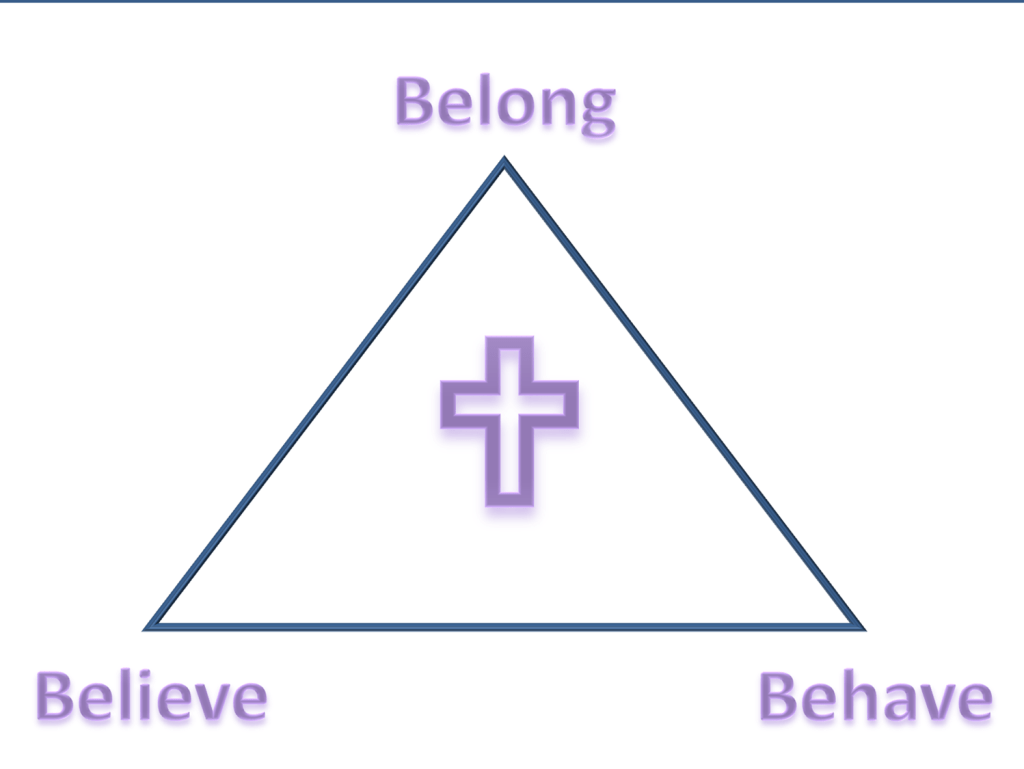
Is it believe first? Or behave? Or simply, belong? The tendency to put a creed at the forefront of our invitations—to show that we are a people who believe, first and foremost—is widespread and deeply ingrained. Whether it be affirming The Apostles Creed in baptism, or saying The Believer’s Prayer at conversion, or working out a new Mission Statement for the Congregation, giving priority to belief is a very familiar pattern for us. We tend to think that, whatever formula we are repeating, that is exactly what declares and confirms our identity as people of faith.

So it’s no surprise that when we read Deuteronomy 26 (the Hebrew Scripture passage in next Sunday’s lectionary), we gravitate to the middle part of the passage, and lay claim to what looks to be an early affirmation of faith that sets out the identity of the people of Israel: “A wandering Aramean was my ancestor; he went down into Egypt and lived there as an alien, few in number, and there he became a great nation, mighty and populous” (Deut 26:5). This affirmation seems to go right back to the start, affirming what sets the people of Israel apart as a distinctive entity.
This way of reading this passage gained influence from the analysis of Gerhard von Rad, a German scholar of the 20th century. Von Rad claimed that the credal statement in verses 5 following was most likely a formula much older than the era when the book of Deuteronomy was written. And the origins of this creed, he claims, most likely lay in ancient cultic remembrances of the origins of the people. The wandering Aramean (Jacob, grandson of Abraham of Aramn) and the time in Egypt (leading up to Moses) reflect those times of origin.

*****

But the whole of this “creed” is not actually a “statement of faith”. It is more a narrative that tells a story. Such was the way of the ancient world; central beliefs were not articulated in crisp propositional statements (for this is the way of the post-Enlightenment western world); rather, a story was told, in the course of which key events pointed to central affirmations for the people. The ancients were story-tellers, more concerned to tell the story than state the faith. This is the story of the people; it is their saga.

God is important in the story that is told, nevertheless. God is the one who “heard our voice and saw our affliction, our toil, and our oppression … who brought us out of Egypt with a mighty hand and an outstretched arm, with a terrifying display of power, and with signs and wonders” (26:7–8). The rescue of the people by their powerful God is central to the story. This, of course, if the story of the Exodus, which stands at the heart of Israelite identity and later Jewish identity. It is the central story of the people of Israel.

More than this, God is the one who “brought us into this place and gave us this land, a land flowing with milk and honey” (26:9). The land of Israel is the second aspect of ancient Israelite life that is central and fundamental; and so it continues to be, in the 20th and 21st centuries, in which the land of Israel has been one of the most contested pieces of land in the world.

The story is told, however, for a purpose. Not just to remember—although remembering is important, for it recurs as a regular refrain in the book of Deuteronomy (7:18: 8:2, 18: 9:7, 27; 11:2; 15:15; 16:12; 24:9, 18, 22; 25:17; 32:7). The story is told, also, to inculcate the ethos, the values, the very identity of the people. And central to that ethos, taking prime place amongst the things that were seen to be important to affirm about who the people of Israel were, is this: giving back to God the first fruits produced by the land.

“So now I bring the first of the fruit of the ground that you, O LORD, have given me”, are the words that the people are to say, each time a harvest is produced. “You shall set it down before the LORD your God and bow down before the LORD your God”, the instruction declares (26:10). Gratitude is to the fore; gifting back the beginnings of “the fruit of the ground” to the God who gave the people the land to grow this fruit.
*****

Of course, there is a dark story submerged, for the most part, underneath that celebratory action. The land was “given” by God over the resistance of the people who were already IN the land, producing fruit, settled and content with their lot in life. The battles recounted in the book of Joshua—most likely not actual historical events, but reflecting a reality of submission to the Hebrews who took control of the land—reflect this dark story.

This dark story does not figure in the “received tradition” and “authorised affirmation” that we read in Deut 26. Nor do we find this in the affirmation of Deut 6:20–24, which begins “we were Pharaoh’s slaves in Egypt, but the Lord brought us out …”. Mention of the Exodus jumps straight across to life in the land—no mention of the conquest that (in other biblical texts) is reported in detail.

This conquest is part, by contrast, of the larger recitation of Josh 24:2–13, “I brought you out of Egypt … and I handed the Amorites over to you, and you took possession of their land, and I destroyed them before you … and also the Amorites, the Perizzites, the Canaanites, the Hittites, the Girgashites, the Hivites, and the Jebusites; and I handed them over to you … I gave you a land on which you had not labored, and towns that you had not built, and you live in them; you eat the fruit of vineyards and oliveyards that you did not plant.” At least this version of the affirmation is honest about the cost to the earlier inhabitants, and the benefits enjoyed with relative ease by the invading Hebrews.

*****

Yet the affirmation of Deut 26 highlights the central importance of gratitude for the gift of the land; and not only that, for it especially indicates the importance of making this celebration inclusive: “you, together with the Levites and the aliens [or, sojourners] who reside among you, shall celebrate with all the bounty that the LORD your God has given to you and to your house” (26:11). So the instructions for the annual festival of the first fruits provide.
The inclusion of the aliens in this annual festival reflected a gracious openness to others in the developing people of Israel. These texts differ from the xenophobic antagonism of earlier texts, recounting the conquest of Israel. They reflect a later understanding of the identity of the people, as they were collated during and after the Exile, centuries after the formation of Israel. People designated as aliens (non-Israelites), sojourners in the land, were welcome to bring offerings to the Lord (Lev 22:18), to adhere to Israelite food prescriptions (Lev 17:12), to keep the Sabbath (Exod 20:8–11; 23:12), to have gleaning rights (Lev 23:22), and to join in the annual process of atonement (Lev 16:29–31; Num 15:29).

The foundational Passover narrative indicates that aliens, or sojourners, were able to join (under certain conditions) in the Passover celebrations (Exod 12:47–49); a second narrative (Num 9:14) is much less restrictive. Aliens were to be subject to the same laws regarding murder (Lev 24:17–22), able to have right of access to cities of refuge (Num 35:13–15), and indeed to enter into the covenant at the annual covenant renewal ceremony (Deut 29:10–13; see also 31:10–13). The voice of the alien even sounds appreciation for the Law: “I live as an alien in the land; do not hide your commandments from me” (Ps 119:19).

Because Israelites were once “an alien residing in the land” of Egypt, the people were instructed, “you shall not abhor any of the Edomites, for they are your kin; you shall not abhor any of the Egyptians” (Deut 23:7); by the third generation, the children of aliens “may be admitted to the assembly of the Lord” (Deut 23:8).

This meant that “the alien who resides with you shall be to you as the citizen among you; you shall love the alien as yourself, for you were aliens in the land of Egypt: I am the LORD your God” (Lev 19:34; a similar affirmation is made at Num 15:14–16).

The principle of equality is clear: “you shall not deprive a resident alien or an orphan of justice; you shall not take a widow’s garment in pledge” (Deut 24:17; see also Jer 7:5–7; 23:5–7; Zech 7:9–10; Mal 3:5). The alien, or sojourner, deserves the same measure of justice as all residents of Israel.

Accordingly, amongst the curses at the end of Deuteronomy, we read, “cursed be anyone who deprives the alien, the orphan, and the widow of justice. All the people shall say, ‘Amen!'” (Deut 27:19). The curse outlines the negative consequences from not adhering to the positive principle of welcoming and including those sojourning for a time innIsrael, the “alien”. That is integral to the celebrations each year, when the harvest produces its fruit from the land.

Gratitude. Belonging. Celebration. Inclusion. All of this is embedded in the story; and all of this comes before believing, repeating doctrinal claims, affirming credal statements. We are a people of welcome, including, belonging. This much is embedded in the ancient Hebrew tradition. This much should be living, still, in Christianity today.

See also
Maintaining faith in God in difficult circumstances (Psalm 22; Lent 2B)

In the psalm that is set for the Second Sunday in Lent (a section of Psalm 22), the psalmist exults the worldwide dominion of the Lord God and sings that “to [the Lord], indeed, shall all who sleep in the earth bow down; before him shall bow all who go down to the dust, and I shall live for him” (Ps 22:29).

This psalm is best known for its opening line, “my God, my God, why have you forsaken me?” (Ps 22:1a), as this is the last word of Jesus as he dies on the cross, at least according to two evangelists (Mark 15:34; Matt 27:46). The psalm is one of the psalms of individual lament, as the psalmist reflects the wretched condition of a person who is suffering unjustly, as the psalmist cries, “why are you so far from helping me, from the words of my groaning? … I am a worm, and not a human … all who see me mock at me; they make mouths at me, they shake their heads …. I am poured out like water, and all my bones are out of joint; my heart is like wax; it is melted within my breast; my mouth is dried up like a potsherd, and my tongue sticks to my jaws; you lay me in the dust of death.” (Ps 22:1, 6, 14–15).

The other psalms usually considered to express individual lament reflect similar ideas: Ps 3 (“O Lord, how many are my foes! many are rising against me), Ps 6 (“be gracious to me, O Lord, for I am languishing”, Ps 13 (“how long will you hide your face from me?), Ps 25 (“I am lonely and afflicted; relieve the troubles of my heart, and bring me out of my distress”), Ps 31 (“my eye wastes away from grief, my soul and body also; for my life is spent with sorrow, and my years with sighing”), Ps 71 (“in your righteousness deliver me and rescue me; incline your ear to me and save me”), Ps 77 (“I think of God, and I moan; I meditate, and my spirit faints”), Ps 86 (“O God, the insolent rise up against me; a band of ruffians seeks my life, and they do not set you before them”), and Ps 142 (“with my voice I cry to the Lord; with my voice I make supplication to the Lord”).

However, the section of the psalm that is offered for this coming Sunday (Ps 22:23–31) comes from the second half of the psalm, where—as is typical of many psalms of lament—the mood turns from internal personal introspection, to an external offering of praise and adoration to God. In each psalm the undergirding assumption is that God does care, God will act, and the trials of the present will be swept away. They are psalms imbued both with the sober reality of the human condition, and an unswerving optimism that faith in God will ensure an ultimate condition of salvation, deliverance, redemption.

Although the psalms offered by the lectionary are chosen each Sunday to provide a companion piece to the Hebrew Scripture passage, this element of this psalm makes it a most fitting accompaniment to the Gospel passage offered this coming Sunday in Lent, as the path that Jesus walks towards the cross is in view during this season.

So the psalmist rejoices. God has dominion over the whole earth: “all the ends of the earth shall remember and turn to the Lord and all the families of the nations shall worship before him; for dominion belongs to the Lord and he rules over the nations” (vv.27–28). This affirmation reflects other parts of Hebrew Scripture where the global reach of God is asserted.

One psalmist calls the ends of the earth “the possession of the Lord” (Ps 2:8), for they “have seen the victory of our God” (Ps 98:3). Both the name and the praise of the Lord “reaches to the ends of the earth” (Ps 48:10), for when God acts to judge the nations, “the it will be known to the ends of the earth that God rules over Jacob” (Ps 59:13). One psalmist declares that God is “the hope of all the ends of the earth and of the farthest seas” (Ps 65:5) and another prays, “may God continue to bless us; let all the ends of the earth revere him” (Ps 67:7).

But in this psalm, the dominion of God reaches beyond this life, to humans who lie in the realm of those who have died. “To him shall all who sleep in the earth bow down; before him shall bow all who go down to the dust” (v.29). A number of other psalms indicate that “in the dust” is where the dead rest (Ps 7:5; 30:9; 90:3; 104:29; likewise Job 10:9; 17:16; 20:11; 21:23–26; 40:12–13).

In Daniel’s grand vision “at the time of the end” (11:40–12:13) he refers to “many of those who sleep in the dust of the earth shall awake, some to everlasting life, and some to shame and everlasting contempt” (12:2). This is a key Hebrew Scripture text which is used in discussions of the resurrection as reported in the New Testament. Clearly, those who “sleep in the dust” are dead.

In the archetypal story that opens Hebrew Scripture, “the dust of the ground” is identified as the source for God’s creation of humanity (Gen 2:7)—and as the place where people’s bodies go when they die. The man Adam is told, “you return to the ground, for out of it you were taken; you are dust, and to dust you shall return.”

God, indeed, “knows how we were made; he remembers that we are dust” (Ps 103:14), and in the end, “all go to one place; all are from the dust, and all turn to dust again” (Eccles 3:20). The Preacher wistfully observes that at the end, “when the years draw near … the silver cord is snapped, and the golden bowl is broken, and the pitcher is broken at the fountain, and the wheel broken at the cistern, and the dust returns to the earth as it was, and the breath returns to God who gave it”, before drawing his inevitable and well-known conclusion, “Vanity of vanities, says the Teacher; all is vanity” (Eccles 12:1, 6–7).

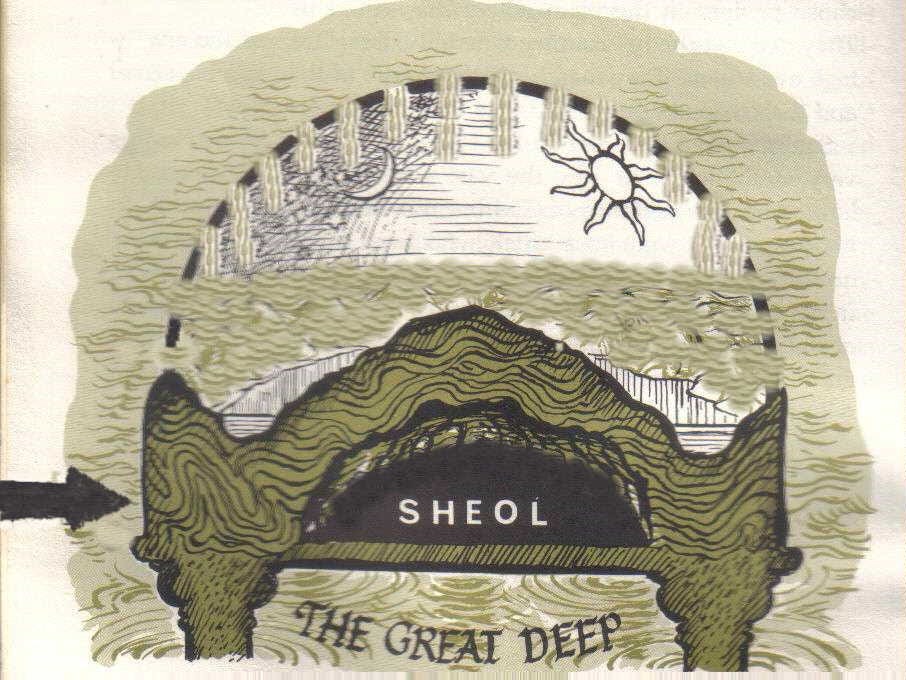
In other passages in the Hebrew Scriptures, those who are dead are located, not in the dust, but in Sheol, in The Pit. These terms each describe the state of the nephesh (the essence of being) of those whose bodies have died. In one psalm, the pit that is dug for “the wicked” describes this place as “the land of silence” (Ps 94:17), while the prophet Ezekiel imagines it as the place where the dead, the “people of long ago” lie “among primeval ruins” (Ezek 26:20).

In Psalm 88, when the psalmist laments “my soul is full of troubles”, they use these and other terms in poetic parallelism to describe their fate: “my life draws near to Sheol; I am counted among those who go down to the Pit; I am like those who have no help, like those forsaken among the dead, like the slain that lie in the grave, like those whom you remember no more, for they are cut off from your hand; you have put me in the depths of the Pit, in the regions dark and deep” (Ps 88:3–6).

In this state, people simply lie in darkness, not living, with no future in view, no hope in store. Job laments, “if I look for Sheol as my house, if I spread my couch in darkness, if I say to the Pit, ‘You are my father,’ and to the worm, ‘My mother,’ or ‘My sister,’ where then is my hope?” (Job 17:13-15). Job also equates entering the Pit with “traversing the River” (Job 33:18), in words that seem to reflect the River Hubur (in Sumerian cosmology) or the River Styx (in Greek cosmology), the place where the souls of the dead cross over into the netherworld.

Other words for Sheol in Hebrew Scripture include Abaddon, meaning ruin (Ps 88:11; Job 28:22; Prov 15:11) and Shakhat, meaning corruption (Isa 38:17; Ezek 28:8). These terms indicate the forlorn, lost, irretrievable nature of this state of being. This is the fate in store for all human beings, whether righteous or wicked; there is no sense of judgement or punishment associated with this state. It is simply a state of non-being.

And yet, even in this state—this state where “my mouth is dried up like a potsherd, and my tongue sticks to my jaws; you lay me in the dust of death” (Ps 22:15)—the psalmist finds hope. They are confident that the Lord God “raises up the needy out of distress” (Ps 107:41) and “lifts up the downtrodden” (Ps 147:5). In like manner, Hannah has sung that the Lord “raises the poor from the dust and lifts the needy from the ash heap” (1 Sam 2:8; also Ps 113:7).

And so the psalmist bursts into praise for what, they are confident, God will do. Calling for their listeners to “praise [the Lord] … glorify him … stand in awe of him” (Ps 22:23), they affirm that God “did not despise or abhor the affliction of the afflicted; he did not hide his face from me, but heard when I cried to him” (v.24) and rejoice that “the poor shall eat and be satisfied” (v.26).

The psalmist is certain not only that “the ends of the earth shall remember and turn to the Lord and all the families of the nations shall worship before him” (v.27), but also that “posterity will serve him; future generations will be told about the Lord, and proclaim his deliverance to a people yet unborn, saying that he has done it” (vv.30–31).

And so, they offer this resounding declaration of hope: “to him, indeed, shall all who sleep in the earth bow down; before him shall bow all who go down to the dust” (v.29). It is that hope which we hear, and affirm, when these closing verses of this psalm (vv.23–31) are read or sung during this coming Sunday’s worship.

A ransom for many: a hint of atonement theology? (Mark 10; Narrative Lectionary for Lent 2)

When Jesus instructed his followers to tread the pathway of humility and submission (Mark 8:34–38; 9:35–37; 10:38–44)—the same pathway that he himself has been following as he walks towards Jerusalem (8:31; 9:31: 10:32–34), he speaks about laying down his own life, just as he urges his followers to lay down their lives (10:45). This has been a regular refrain throughout his teachings.

See https://johntsquires.com/2024/02/17/not-to-be-served-but-to-serve-the-model-provided-by-jesus-mark-10-narrative-lectionary-for-lent-2/

However, in this particular saying, Jesus indicates that the laying- down of his life is to be seen, not just as the model for his followers to emulate, but as “a ransom for many” (10:45). There are two important observations to make about this short statement. The first relates to the word “ransom”; the second will be canvassed in a later post.

Ransom is a term that we associate with the forced kidnapping of a person and the demand for a payment in order for them to be released. This is not the way the term is used in biblical texts, where payment in return for release of a captive is not in view. Rather, the orientation is towards the idea that there is a significant cost involved in the process of ransoming.

The Greek word used in Mark 10:45, lutron, comes from a verb, lutrein, which means “to release”. It was a common term for the payment needed to secure the release of slaves, debtors, and prisoners of war. The noun, translated as ransom, occurs in the Septuagint. It identifies the price paid to redeem a slave or captive (Lev 25:51–52) or a firstborn (Num 18:15). It also indicates the price to be paid as recompense for a crime (Num 35:31–32) or injury (Exodus 21:30). In these instances, it translates the Hebrew word koper, which has the basic meaning of “covering”.

Another form of that word appears in another form in the name of the Great High Holy Day in Judaism—Yom Kippur, the Day of Atonement (see Lev 16:1–34; Num 29:7–11). On that day, as the cloud of incense covers the mercy seat (kapporeth, Lev 16:13), the mercy seat is smeared with the blood of the sacrificed bull (16:14) and then the blood of the goat which provides the sin offering (16:15). According to Leviticus, it is these actions which “shall make atonement (kipper) for the sanctuary, because of the uncleannesses of the people of Israel, and because of their transgressions, all their sins” (16:16).

The process of atonement in the Israelite religion was to cover up, to hide away from view, the sins of the people. This is developed to some degree in the fourth Servant Song of Deutero-Isaiah, when the prophet honours the servant because “he was wounded for our transgressions, crushed for our iniquities” (Isa 53:5). His life was understood as “an offering for sin” (53:10) which “shall make many righteous” (53:11). Indeed, as the Song ends, it affirms that “he bore the sin of many” (53:12). The Song resonates with the language and imagery of righteous suffering as the means of dealing with, and perhaps atoning for, sins.

That notion is further expounded in a later text which provides an account of the way that a righteous man, Eleazar, was martyred as a means of ransoming the nation during the time of upheaval under Antiochus Epiphanes (175–167 BCE). “Be merciful to your people, and let our punishment suffice for them”, he prays; “make my blood their purification, and take my life in exchange for theirs” (4 Macc 6:28–29).

The idea then appears in New Testament texts which describe the effect of the death of Jesus for those who have placed their trust in him. Paul uses ransom language tells the saints that they were “bought with a price” (1 Cor 6:20; 7:23). He also uses apolutrosis, a compound word but from the base word lutrein, to describe the redemption which was accomplished by Jesus, both in a formulaic way (1Cor 1:30) and in a more discursive manner (Rom 3:24; 8:23). The term recurs in later letters which likely were not written by Paul (Col 1:14; Eph 1:7, 14; 4:30), as well as in the Lukan redaction of the final eschatological speech of Jesus (Luke 21:28).

In another later letter attributed to Paul, most likely written by one of his students, we read of “one mediator between God and humans, the man Christ Jesus, who gave himself as a ransom for all” (1 Tim 2:6), using the term lutron. In another later work providing guidance an account of Paul by an author at some remove from him, the book of Acts, Paul was said to have declared of the church that God “obtained [it] with the blood of his own Son” (Acts 20:28).

It was the combination of such passages that led the third century scholar, Origen of Alexandria to develop an idiosyncratic theory of the atonement (the way that Jesus enables God to deal with human sinfulness). Origen’s ransom theory of atonement reads Genesis 3 as an account of Adam and Eve being taken captive by Satan; this state was then inherited by all human beings. The death of Jesus is what enables all humans to be saved; the means for this was that the blood shed by Jesus was the price paid to Satan to ransom humanity (or, in a variant form, a ransom paid by Jesus to God to secure our release).

However, none of these texts—and particularly not Mark 10:45—require this overarching theological superstructure to make sense of what they say. Origen’s ransom theory held sway for some centuries, but was definitively rejected by the medieval scholar Anselm of Canterbury. It is not a favoured theory of atonement in much of the contemporary church (though it is still advocated in various fundamentalist backwaters). Certainly, none of this should be attributed to the saying of Jesus in Mark 10:45. It is far more likely that he is drawing on the Jewish tradition of the righteous sufferer in his words.

Jesus himself draws on various psalms of the righteous sufferer; psalms 22, 27, 31, 69, and 109 would each seem to express the despair and anguish being felt by Jesus in his passion. However, it is the fourth of the four Servant Songs (Isa 42:1–9; 49:1–7; 50:4–11; 52:13–53:12) to which this statement in Mark 10:45 might best be correlated.

The passion narratives that we have in scripture, recounting events leading to the death of Jesus, offer many connections with details of this fourth song (Isa 52:13–53:12). The prophet describes the marred appearance of the Servant (52:14); he is despised, rejected, and suffering (53:3), bearing our infirmities (53:4), and wounded for our transgressions (53:5).

The Servant is led like a lamb to the slaughter (53:7), suffering “a perversion of justice” (53:8), not practising violence or speaking deceit (53:9), and is buried with the rich (53:9). The Servant gives his life as “an offering for sin” (53:10), carrying the iniquities of many (53:11), making them righteous (53:11), bearing the sin of many (53:12), making “intercession for the transgressors” (53:12).

The role that the Servant plays in relation to sin, for the sake of the many, shapes the important saying of Jesus, that “the Son of Man came not to be served but to serve, and to give his life a ransom for many” (Mark 10:45). Jesus, according to Mark, foresees his role as that chosen one, destined to suffer for the sake of many. As we look to the cross, we can see that this was an ominous foreboding.

Fairly sourced, fairly traded: a Lenten discipline

It’s the beginning of Lent, a 40-day season in the Christian calendar. In Ash Wednesday services around the world, believers have lined up for the “imposition of ashes” after they joined in prayers confessing their sin and seeking divine forgiveness.

The words of Jesus about “true righteousness” have been read and imbibed: “whenever you give alms, do not sound a trumpet before you … whenever you pray, go into your room and shut the door and pray … when you fast, put oil on your head and wash your face” (Matt 6:1–6, 16–21).

These worshippers may well have listened to the strident call of the prophet Joel, conveying his message from the Lord: “return to me with all your heart, with fasting, with weeping, and with mourning; rend your hearts and not your clothing” (Joel 2:1–2, 12–17), as this is the Hebrew Scriptures passage proposed by the lectionary.

And they have joined with fervent intensity, on this Ash Wednesday, as on every Ash Wednesday, in the words attributed to the shepherd-king, David, after his infamous episode of the murder (of Uriah) and adultery (with Bathsheba), “have mercy on me, O God, according to your steadfast love; according to your abundant mercy blot out my transgressions, wash me thoroughly from my iniquity, and cleanse me from my sin” (Ps 51:1–17). The day begins a period of intense self-reflection and, for many, a time of abstinence from designated items of food or drink.

Perhaps they also heard the exhortation of the apostle Paul: “we urge you also not to accept the grace of God in vain … see, now is the acceptable time; see, now is the day of salvation!” (2 Cor 5:20—6:10). It is the grace of God which undergirds this day, and the Lenten season that follows.

After this intense time of self-reflection, of opening up a life to the forgiveness and grace of God, and of being sent forth with a blessing for the days that lie ahead, one would think that there would be a marked change in the practices of many people of faith, cleansed and renewed, forgiven and restored, in the days of Lent which lie ahead.

And Lent, after all, is a discipline offered by the church to continue that process of self-reflection and of clarifying what is most important: what is “is true, honourable, just, pure, pleasing, commendable”, as Paul elsewhere writes (Phil 4:4). Lent is the season of forty days of personal, and perhaps also social, negation of the desires that impede and damage the inner goodness of who we are as human beings.

Yet I wonder how many of those who have had ashes imposed and prayers heard, have left those Ash Wednesday services and are walking through the season of Lent without really seeking to abandon what is harmful, transform what is questionable, and adopt what is commendable, in their lives? Only they will know, each person, one by one, whether they are doing good this, and how they are doing this.

And I wonder how many of those Ash Wednesday worshippers turn their thoughts during Lent to the great festival which comes at the end of Lent: the celebration of Easter, Christ risen, joyful songs, hallelujahs! And how many start the process of buying the goods that are needed for that celebration, even during the period of self-reflection during Lent? And how many start to scour the shops for bargain chocolate eggs for their children or grandchildren (or great-grandchildren) for Easter Sunday?

Chocolate is one of the (many) places where deep injustice continues to be felt. It is one of the (relatively few) places where decisions made by individuals can have a positive effect. We know that there are great imbalances in the world, with poverty widespread across all countries, with a concentration in Africa (19 of the 20 poorest countries are all located in Africa) and with some of the island nations who are near neighbours of Australia also high on the list.

And, indeed, even in many of the wealthiest of countries (the USA, China, Japan, Germany, the UK, Singapore, even Australia) there are noteable pockets of poverty and disadvantage. And although collectively we might well have the economic capacity to rectify this situation, emotionally there is little if any movement towards such a resolution of the gross inequities that exist.

So chocolate is one of the places we can start, personally, individually, to act with justice. Every small step taken to ameliorate the problems of one small group of people is a step in the right direction, and helps to move us all towards global equity. Knowing where the chocolate we buy comes from, what wages are paid to those who harvest, transport, and process it, is something that we all can do.

Fairtrade is a way to support those who are most vulnerable, those who are most exposed to the impacts of climate change. There are more than 1.9 million farmers and workers in Fairtrade certified producer organisations, in 71 countries in Asia, South America, and Africa—some of the countries that are most at risk because of rising sea levels, the spread of drier desert climates, the increasing number of catastrophic weather events such as floods or bushfires, and other effects of climate change.

47% of all Fairtrade farmers produce coffee, and 41% of all Fairtrade workers produce flowers. But many other products are produced in ways that ensure they are fairly produced and fairly traded: tea, chocolate, sugar, bananas, rice, honey, nuts, vanilla wine—but also textiles and cotton, used in our clothing. There is even, now, a Fairtrade Carbon Credit scheme operating under the auspices of Fairtrade International.

An easily-recognised symbol on products marks them as Fairtrade. This symbol that designates products certified in accordance with Fairtrade Standards.

These Fairtrade Standards require producers to meet minimum social, economic and environmental requirements. In addition, participating organisations are encouraged to provide an ongoing improvement of farmers’ employment conditions or the situation of estate workers. 

In the Fair Trade Lent 2024 resources, we read:

“In a Fair Trade Lent we ask ourselves about an aspect of how we spend our money. We all purchase goods: food, clothes, household products, motorcars etc. Mostly we look for a bargain, pleased with ourselves when we save a dollar or two.

“Fair Trade Lent encourages us to think, not only of our selves when we buy things, but those who produced the goods: miners, farmers, artisans, and factory workers. Were they paid a living wage? Did they work in healthy conditions? Was the means of production environmentally sustainable?”

For more information about Fair Trade, see https://fairtradeanz.org/what-is-fairtrade

For resources relating to a range of areas, see http://www.fta.org.au/resources

For the 2024 Fair Trade Lent resources, see

https://www.canva.com/design/DAF7gUse8uA/xJvCIdE6JD-b48DON6KfSw/edit

The season of Lent 2024 (With Love to the World 17/6)

On Ash Wednesday each year, Christians around the world begin forty days (plus six Sundays) of the season of Lent. This is the focus for the first half of issue 17/6 of With Love to the World.

So often, when the season of Lent comes around each year, preachers inevitably start to talk about our “journey”, and seek to relate our “walk of faith” to the pathway that Jesus trod as he led his disciples, with firm and steadfast resolve, towards Jerusalem—the city where he knew what his fate would be.

Yet we are not tramping determinedly to our death at the end of Lent—at least, I hope we are not! And, in a sense, nor was Jesus. Yes, he would die in Jerusalem; he dies there because of the intersection of the plotting of Jewish leaders (always anxious about prophetic pretenders, as they probably saw him) and the co-operation of Roman authorities (always willing to act harshly to squash potential problems). But each Gospel attests, in its own way, to a life beyond the life that Jesus lived in Galilee and Judea.

Jesus has an ‘afterlife’ that leads him to appear to his followers, charge them with a global mission, and send the Spirit to renew and energise them in that mission. That’s how Matthew, Luke, and John portray what transpired around the time we mark as Easter—each in their own idiosyncratic way.

But this year (2024), we are following the story that the Gospel of Mark tells about Jesus; and we know that this account comes to an abrupt ending, right at the point where the news about Jesus, raised from the dead, is about to be broadcast (Mark 16:7–8). “They said nothing to nobody, for …” [my translation] is one way to render the awkward ending of this earliest Gospel. It is a peculiar way to end the story; many suggest that we may have lost Mark’s intended ending, as this sentence seems to trail off into nothing …

So here we face the question: how do we proclaim the good news that God raised Jesus from the dead, when our primary text (at least for this year) doesn’t report that? Yes, we can find hints in the words of Jesus (Mark 14:28) that are repeated by the young man in the empty tomb (Mark 16:7)—but the Gospel itself does not give us much more than this.

It is as if the author of this earliest written account of Jesus wants to hand the responsibility over to us—invite us to run with the story, to shape for ourselves the words and the actions which bear witness to the reality that Jesus has, indeed, “gone to Galilee”, and that we ourselves have seen him. What is the way that we, having traced the story of Jesus to this point, pick up the story and offer our own testimony to the living one who is in our midst?

In Mark’s Gospel, Jesus asks many questions; so do his followers, and his opponents. (I once counted them: this Gospel has 118 questions, in 668 verses!) I see the ending to Mark as another question—a big question, for us. He is not here. Jesus is risen. How do we proclaim that? How do we share this news? That is the big question addressed to us by this Gospel.

*****

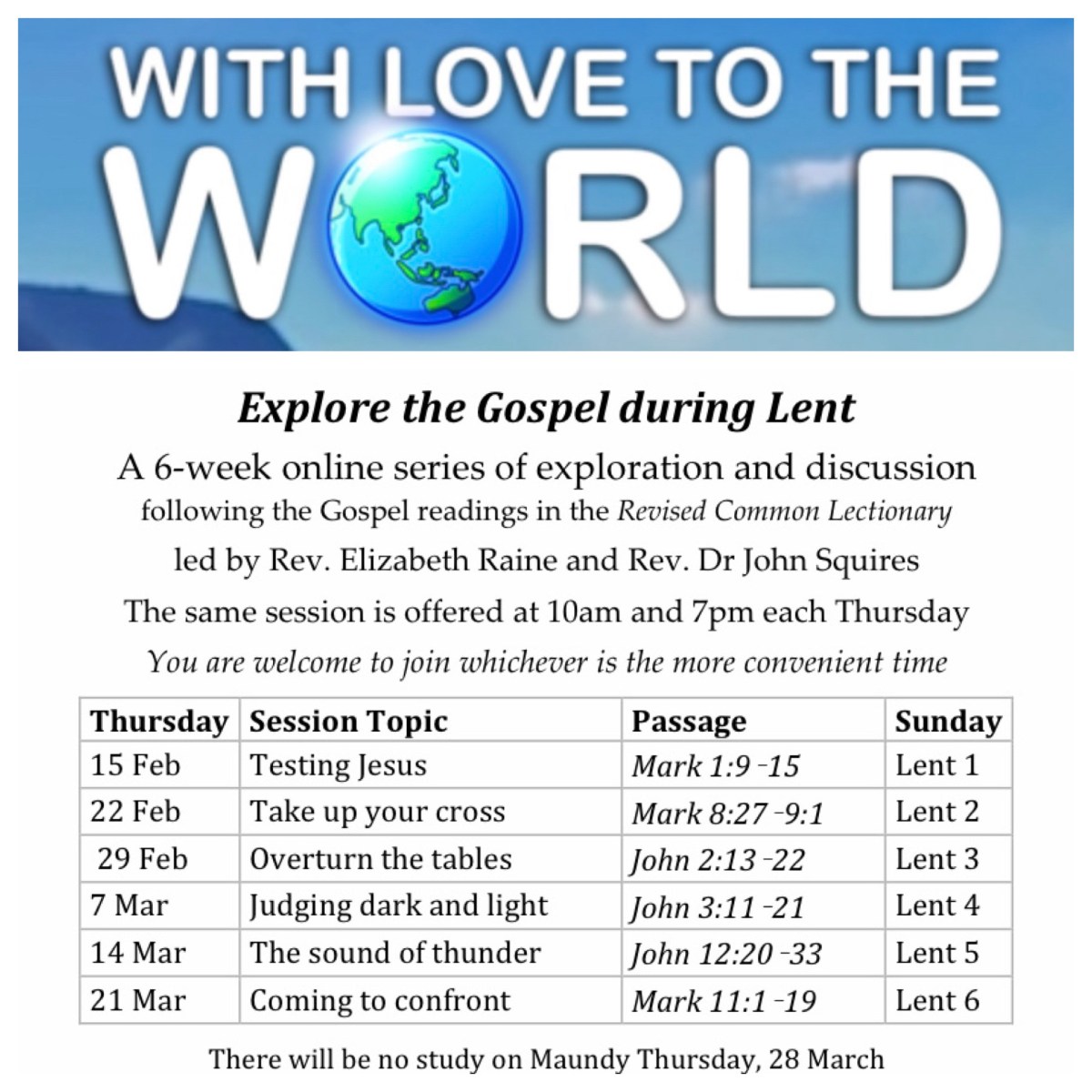
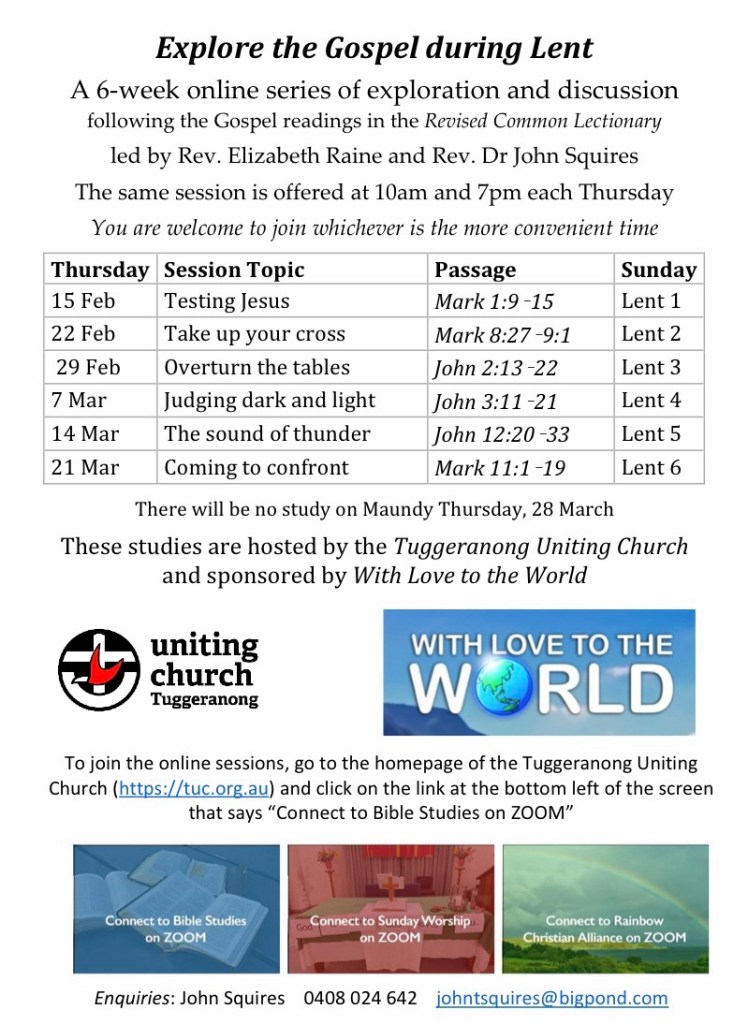
During Lent, you are invited to join an online Bible Study sponsored by With Love to the World, each Thursday, at either 10:00am or 7:00pm.

The desert waits … the city beckons (Lent Year A)

The period of Lent is forty days—although it actually takes 46 days to get from Ash Wednesday to Easter Sunday. The reason for this is that Lent is reckoned by omitting the six Sundays in this period, since Sundays are not counted in the season of Lent itself. An explanation for this was given in a statement from the Second Vatican Council (1962–1965), reflecting on ancient practice: “The Lord’s Day is the original feast day.… Other celebrations, unless they be truly of greatest importance shall not take precedence over the Sunday which is the foundation and kernel of the whole liturgical year” (Sacrosanctum Concilium, No. 106).

As the forty days draw to a close, I am reflecting on how the experience has been this year. There is always a lot of focus at the end of Lent, for it is then that we move into the high season of Easter, filled with the emotions of Good Friday, the liminal space of Holy Saturday, and the joyful celebrations of Easter Sunday. There is also a focus, somewhat less, at the start of Lent, with Shrove Tuesday—the original Mardi Gras (meaning “Fat Tuesday”) followed by the solemn Ash Wednesday rituals.

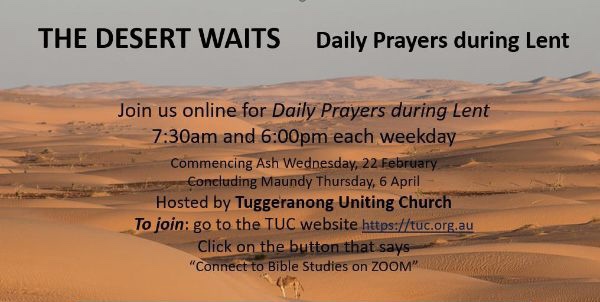
These reflections explain how Lent has been held within the Congregation where I am a member: Tuggeranong Uniting Church, in the southern suburbs of Canberra, in the Australian Capital Territory. Each weekday during Lent, first thing in the morning and then again at the end of the working day, before evening sets in, a group of people from the Congregation, and some beyond, gather online for a brief (8–12 minutes) of prayer and reflection. It is a way of marking the season in a distinctive fashion.

At each gathering, there is an opening prayer, taken from a prayer by Ruth Burgess, published in the Iona liturgical resources: the desert waits. It is a theme that invites us to pause, slow down, listen, and pray. So we hear a short scripture reading, a brief reflection in response, and then listen to a psalm. (There are many wonderful videos of psalms being sung by contemporary artists—the Sons of Korah, Francesca LaRosa, Poor Bishop Hooper, The Psalms Project, Jason Silver, and more). The session ends with a closing prayer and blessing.

The desert waits is also a theme that resonates with a key New Testament story—that of Jesus, in the wilderness for forty days, tested by the devil and sustained by angels. By tradition, it is the Gospel reading for the First Sunday in Lent every year (this year, we heard Matt 4:1–11).

That story, of course, draws deeper from the wells of Hebrew Scripture, where many stories include the time frame of forty days, or forty years. Rain fell during the flood for “forty days and forty nights” (Gen 7:4); then Noah waited for forty days after the tops of mountains were seen after the flood, before releasing a raven (Gen 8:6–7). The people wandered in the wilderness for forty years, to “suffer for their faithlessness” (Num 14:33) at the decree of the Lord, “until all the generation that had done evil in the sight of the Lord had disappeared” (Num 32:13). The spies which Moses sent into the land returned to report to Moses after forty days (Num 13:25).

Moses was said to have spent three consecutive periods of “forty days and forty nights” on Mount Sinai; first, to receive the Torah (Deut 9:9–11), then to beg forgiveness on behalf of the people (Deut 9:25–29), and for a third time seek again God’s forgiveness (Deut 10:10–11). A number of leaders in Israel were said to have reigned for forty years: Eli (1 Sam 4:18), Saul (Acts 13:21), David (2 Sam 5:4), and Solomon (1 Kings 11:42). The prophet Elijah walked for forty days to Mount Horeb, where he meets God “in the sound of sheer silence” (1 Kings 19:12).

All of this indicates that the period of forty days or years was a rounded-out way of describing “a long period of time”—not an accurate reporting of precise days or years, but an indication that whatever was being described was an extended, lengthy period of time. It was a story-teller’s phrase, not an historian’s precise chronicling.

During the extended period of this current Lent, in the online daily prayers each morning being hosted by Tuggeranong Uniting Church, we have traced the theme of wilderness, through a series of readings that commenced in the stories of the ancestors: Abraham and Hagar (Gen 16:7), Hagar and Ishmael (Gen 21:14, 20–21); and Moses on Mount Horeb where he saw the burning bush (Exod 3:1–7).

After that, we spent a week hearing of the travails of the Israelites in the wilderness (Exodus 13–17) and then passages which indicated the extent of the land that was promised to them (Exod 23:31–32; Deut 32:8–10; Joshua 5:6–9; and Joshua 20:7–9) before ending the week with a song about the power of God, seen in creation (Psalm 29:5–11). These stories each morning were coupled each evening with a psalm which was read and then sung, during which our personal reflections were voted.

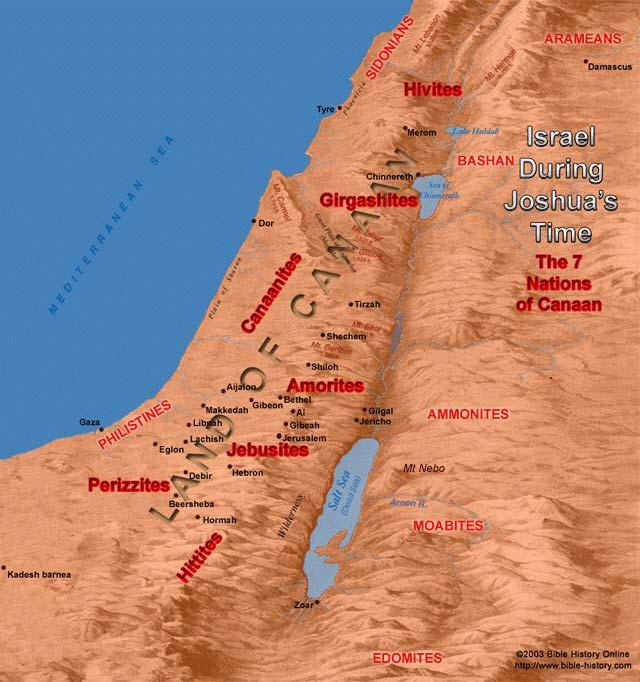
Following that, the focus of morning prayers was on hearing the names of the people who already lived in the land that had been promised to Israel from the time of Abraham onwards: “the Kenites, Kenizzites, Kadmonites, Hittites, Perizzites, Rephaim, Amorites, Canaanites, Girgashites, and Jebusites.

We heard the genealogical list of the descendants of Canaan, the grandson of Noah (Gen 10:1–20), then the promise to Abraham (Gen 18:1, 18–20) and then to Moses (Exod 3:7–10), the instructions given through Moses to “make no covenant with them and show them no mercy” (Deut 20:1–5), and the list of “the kings of the land whom Joshua and the Israelites defeated” (Joshua 12:7–8). Each time, a list of these original peoples was given. Again, a psalm for reflection was matched with these passages.

This list of people already inhabiting the land, but confronted by—and in some cases annihilated by—the invading Israelites, is sobering. For each day during this week, we viewed, firstly, the map of peoples in Canaan, and then the map of peoples on the continent of Australia that we know were here before the British invasion and colonisation of 1788 onwards.

There were many more nations in Australia than there were in Canaan, which is of course understandable since the land mass of the continent is far, far larger than that of Canaan. However, there are very strong resonances between the fate of the First Peoples of Australia and the fate of many of the peoples of Canaan. (The graphic description provided in the battle scenes of Joshua and Judges were not read during the daily prayers; these are available in our Bibles for people to read and reflect on individually.)

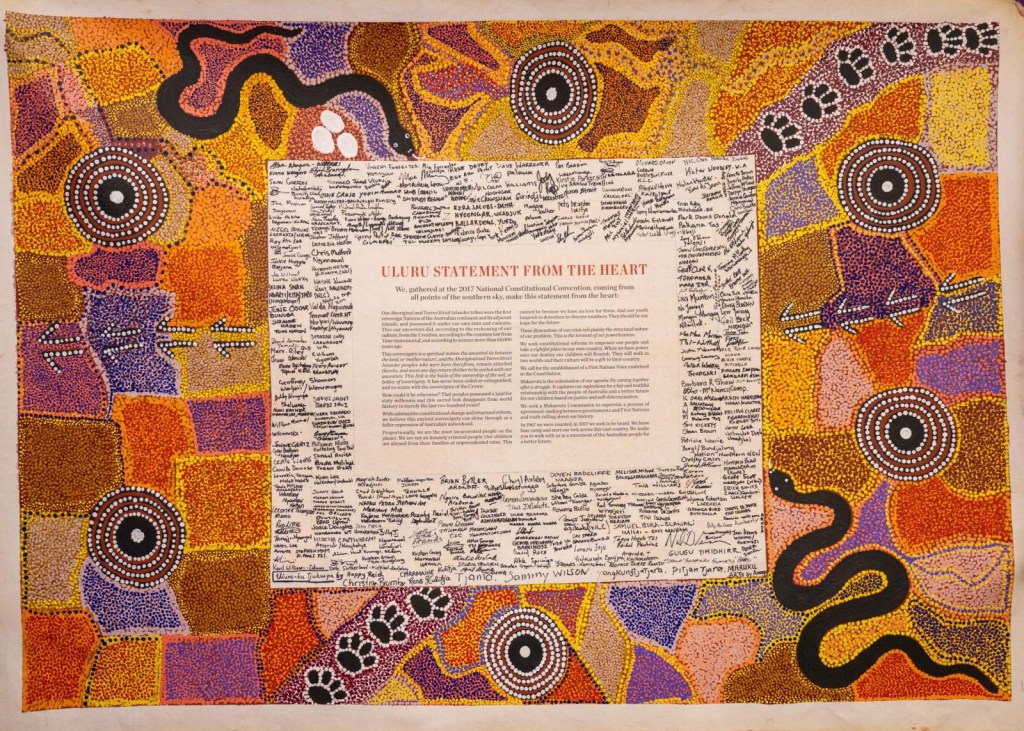
So alongside the map of those First Nations, we began to reflect on the experience of those peoples. We heard how the Uniting Church has described this period of history in the opening clauses of the Revised Preamble to the Constitution of the UCA (adopted in 2009 by the National Assembly). We listened, each day, to Aboriginal singers, singing both in their own languages as well as in English: the late Dr. G. Yunupingu (known as Gurrumul), Frank Yamma, Archie Roach, the group Wildflower, and then Yothu Yindi, singing their key song, “Treaty”. And we heard sentences from the 2017 Statement to the Nation read each day.

After this week of listening to the voices of the indigenous people in the morning prayers, the following week offered a series of reflections with a different psalm sung each day, drawn from the quieter, reflective psalms in which the psalmist reaches out to God to seek support and healing. It is as if these psalms might be sung by the First Peoples, in the light of their experiences of invasion and colonisation, the many massacres that took place, and the intergenerational trauma that resulted.

As we heard these psalms sung, we began also to listen to the series of psalms known as the “Psalms of Ascent”. They are so called because it is believed they were sung by faithful Israelites as they made their pilgrimage to Jerusalem on one of the three annual festivals—the Feast of Unleavened Bread (Passover), the Feast of Weeks (Pentecost), and the Feast of Tabernacles (as listed in Deut 16:16). They begin “in my distress I cry to the Lord” (Ps 120:1), moving on to “I lift up my eyes to the hills” (Ps 121:1), as the outline of the city on Mount Zion appears in the far distance.

We can imagine the pilgrims drawing closer to the walls of the city as the psalmist sings, “I was glad when they said to me, ‘Let us go to the house of the Lord!’l (Ps 122:1), then offers an expression of trust in God (Ps 124:8; 125:1–2) and confidence in God’s house (Ps 127:1). I imagine that, entering the city, the psalmist offers to a heartfelt cry to God from “out of the depths” (Ps 130:1), and as the Temple comes into view, sings, “Let us go to his dwelling place, let us worship at his footstool” (Ps 132:7).

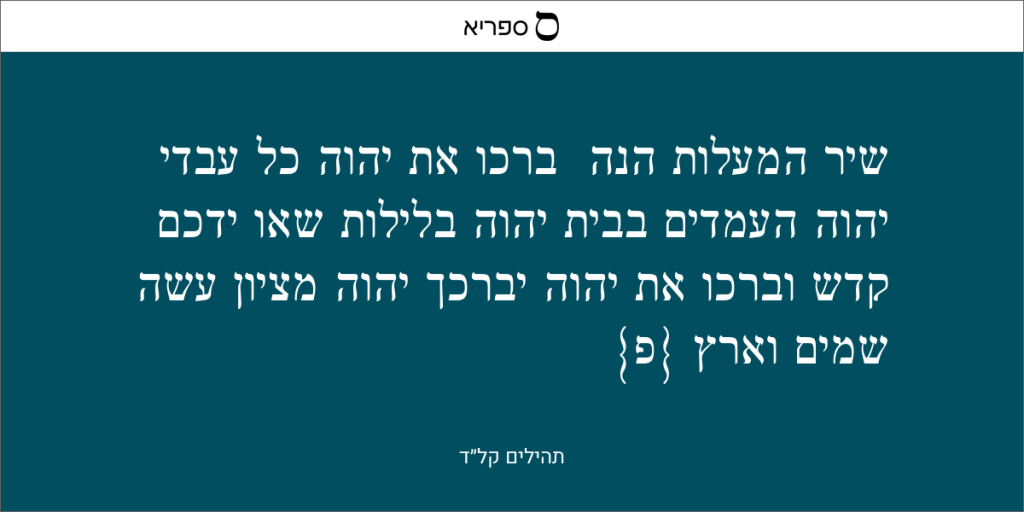
Psalm 134 in Hebrew

As our daily prayers continue, we hear the shortest of all the Psalms of Ascent, with the pilgrims “stand[ing] by night in the house of the Lord”, concluding with the prayer, “may the Lord, maker of heaven and earth, bless you from Zion” (Ps 134:3). As the season of Lent had begun with the theme “the desert waits”, so as we draw near to the end of the season, “the city beckons”. It is in the city that the pilgrims of long ago offered their sacrifices and praised their God. It is in the city that the story of Jesus, recalled especially in the days of Holy Week, reaches its climax.

This brings us to readings which recollect the entry of Jesus himself into the city of Jerusalem (Matt 21:1–11), the week of scenes in the Temple precincts (Matt 21:12—23:39) and nearby (Matt 24:1—26:2), and the hatching of the plot to arrest him (Matt 26:3–5) which would lead to his death, which is recalled as Good Friday ends the period of Lent.

We end daily prayers during Holy Week, on the morning of Maundy Thursday, with a section of Psalm 22. We know this psalm best from the fact that Jesus was said to have begun to say it, as he hung on the cross (Mark 15:34; Matt 27:46). Whether he intended only to speak the first verse, or whether his waning strength meant he could get no further than this, we do not know.

We cannot know whether Jesus intended to end with the words of praise from the later part of the psalm (vv.21b to 31), with an exultant “praise in the great congregation”, proclaiming “his deliverance to a people yet unborn”, as some scholars speculate. More likely, in my thinking, he was content to stay in the despair and agony of the opening section (vv.1–21a), feeling forsaken, his prayers going unanswered, one scorned and mocked, “poured out like water, all of my bones out of joint, my heart like wax, melted within my breast “ (v.14).

The psalm portrays a man, completely human, utterly defeated, with no hope, crushed by events. Both Mark and Matthew report that this is how he ended his life. The end of our Lenten journey takes us to this place of abandonment. It will be the work of Easter to process the powerful emotions generated by this devastating state of being, and move through the testimony offered about the ensuing moments, to come through the tunnel of darkness, into “deliverance [for] a people yet unborn” (v.31). Those days are still ahead.

It’s Holy Week again: a week set apart, in a time set apart

Today we begin Holy Week. This is the final part of a longer period leading up to Easter, called Lent. We do this every year, as part of the annual cycle. It is a familiar and comforting ritual for many people of Christian faith.

Holy Week culminates the season of Lent, which is an ancient practice for a Christian people. It lasts for 40 days, serving as a time of preparation for Easter. But whereas Lent is an ancient tradition, Holy Week is a more recent development. Designating the week leading up to Easter as Holy Week most probably comes from the narration of chapters 11 and 12 of Mark’s Gospel, in which Jesus is understood as being in Jerusalem from a Sunday until his last meal on a Thursday.

We can see those time markers embedded in Mark’s account of Jesus’ final days:
Sunday – “when they were approaching Jerusalem …” [Mark 11:1]
Monday – “on the following day …” [Mark 11:12]
Tuesday – “In the morning …” [Mark 11:20]
Wednesday – “It was two days before Passover …” [Mark 14:1]
Thursday – “On the first day of Unleavened Bread …” [Mark 14:12]
Friday – “As soon as it was morning …” [Mark 15:1]
Saturday – “When the Sabbath was over …” [Mark 16:1]
Sunday – “Early on the first day of the week …” [Mark 16:2]”
(Thanks to Greg Jenks for setting this out so clearly in his blog.)

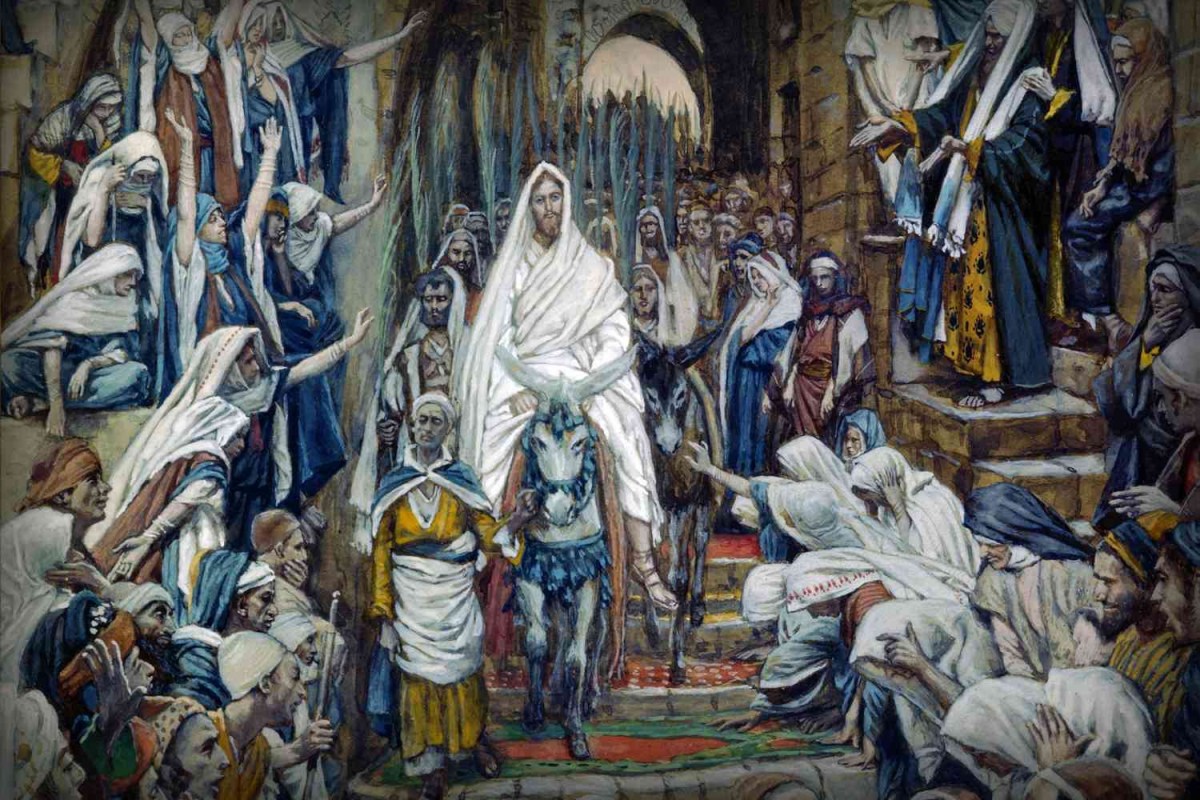
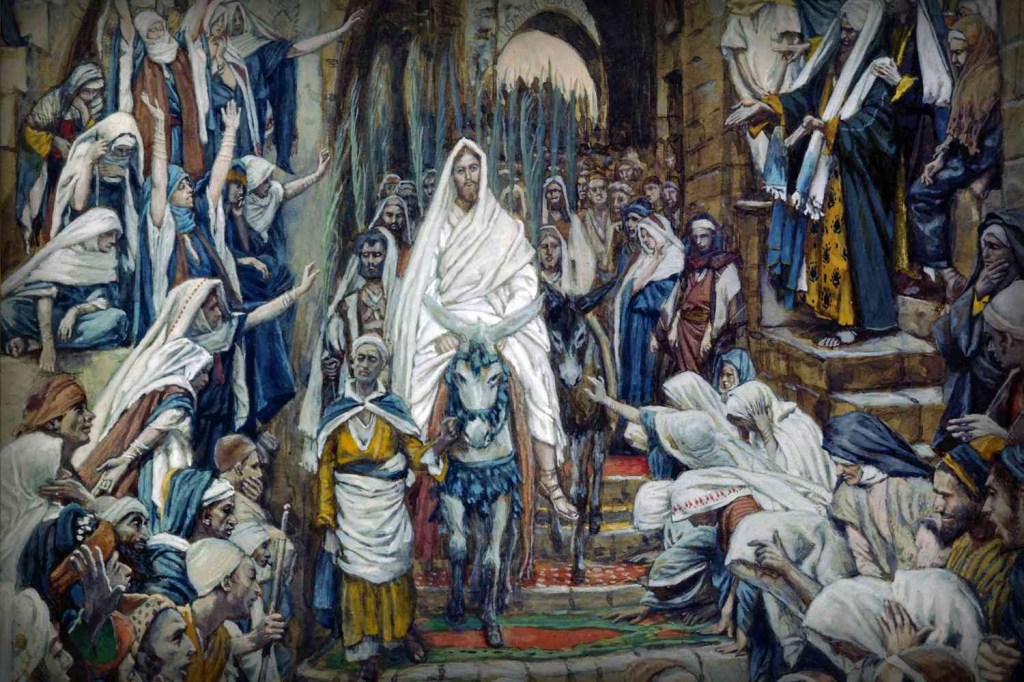
The week starts with Palm Sunday, when Christians remember Jesus entering Jerusalem and the crowds waving palm leaves as he enters the city. Jesus stays near to the city for the remainder of the week. On this day, we remember that event with festive processions and cheerful hymns.

Each day during Holy Week, from Monday to Thursday, many churches hold daily prayers that are pertinent to the week.

On Maundy Thursday, Christians remember Jesus washing his disciples’ feet. His words are recorded in John 13:34, “A new command I give you: Love one another. As I have loved you, so you must love one another.” This gives rise to the name for the day. The Latin for “commandment” is mandatum—hence the name of the day, Maundy.

Some people believe that Lent officially ends at sundown on Maundy Thursday, so they celebrate that with Holy Communion, or with a meal known as an agapé or a “love feast”. It is a remembrance of the last meal that Jesus shared with his followers. Others maintain that Lent continues through into Easter Saturday, until the end of the day just before the empty tomb is discovered.

After Maundy Thursday comes Good Friday, remembering when Jesus was crucified. Why is this day called Good? It comes from the theological evaluation that, on this Friday, Jesus died on the cross “for our sins”, thereby securing our redemption. This is the basis for the “good news” which the Church has proclaimed for centuries.

Churches all around the world normally hold various rituals for people to attend. Roman Catholics have the Adoration of the Cross, the Mass of the Pre-Sanctified, the Stations of the Cross, and Evening Prayers. Anglicans have a three-hour service with reflections on the Last Words of Christ. Many people come for these times of gathering together.

The Stations of the Cross are focused around the events of Good Friday, recalling the various events which took place as Jesus made his way from his trial to his death on the cross. These Stations have been appropriated, in art or through personal creative responses, as ways of moving attention from the story as a singular ‘history’, to the significance of the story and the resonance of the events with universal human experiences.

Next comes Holy Saturday or Easter Eve—a day of vigil, when believers watch, wait and pray. This is an in-between time, a day when time can be spent reflecting back on the traumatic events that have just taken place, and looking forward with hope to the new possibilities that might emerge from those event.

After Holy Saturday, the celebration of Easter Sunday bursts through the gloom and despair with a vibrant message: Jesus is risen, Jesus has conquered death. Counting inclusively, as was done at the time, beginning from Friday, means that Sunday is the third day. So the traditional affirmation is that Jesus rose “on the third day”. This leads into an expression of joy, that the trauma and grief, the uncertainty and fear, are now passed. Life is different; hope is renewed; the future, even if it looks different, will still be viable.

For the next period of time, the Church moves into a new season—the season of Easter, 40 days when the celebration of resurrection continues. And so the cycle continues, death turning into life, despair breaking out into hope, frustration moving into promise.

Easter itself emerged out of the Jewish festival of Passover, for this is the setting of the story about the arrest, trial, and crucifixion of Jesus that is reported in the Gospels (Mark 14:1–25; John 13:1; 18:28; 19:14).

There is a meme that circulates every year at this time, claiming that Waster was originally a pagan celebration, focussed on the fertility goddess Eostre—but this has no basis in fact. It derives from what seemed, to him, to be an educated guess made by the 8th century scholar, Bede, but this is completely incorrect.

See https://www.christianitytoday.com/history/2009/april/was-easter-borrowed-from-pagan-holiday.html

Save us, we beseech you: singing a Hallel psalm (Psalm 118; Lent 6A, Palm Sunday)

“Save us, we beseech you, O Lord!” This is the cry we hear in the psalm which is offered by the lectionary for this coming Sunday, Palm Sunday, the Sunday in Lent. Psalm 118 is one of the Hallel Psalms—six psalms (113 to 118) which are sung or recited on high festival days, such as Passover (Pesach), the Festival of Weeks (Shavuot), and the Festival of Booths (Sukkot), as well as Hanukkah and the beginning of each new month. This final Hallel Psalm, like the other five, is intended to be an uplifting, celebratory song, suitable for the congregation to hear and to sing as a way to inspire and rejoice.

See

It is no surprise that this psalm is offered by the lectionary for this coming Sunday, Palm Sunday—because the Gospel story for this day, of Jesus entering the city of Jerusalem to the acclaim of the crowd (Matt 21:1–11), is certainly one of celebration and joy. It is also, equally unsurprisingly, offered as the psalm for a week later, on Easter Sunday, which celebrates something much greater and more enduring: the raising of Jesus from the dead (Matt 28:1–10).

But clearly the psalm has a good fit with the Palm Sunday story that we will hear on Sunday; indeed, the Gospel writers report that the crowd cheering Jesus was singing, “Blessed is the one who comes in the name of the Lord”—which is, of course, a verse from the final Hallel Psalm (Ps 118:26).

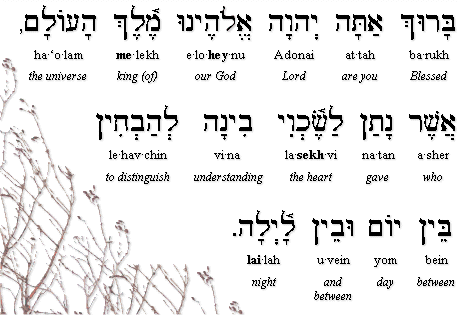
Blessing God is a favourite Jewish activity—indeed, so many prayers still used by Jews today begin with a phrase of blessing: “Blessed are you, O Lord our God …”. Blessed are You, O Lord our God, Ruler of the universe, Who brings forth bread from the earth is prayed before a meal. Blessed are You, O Lord our God, Ruler of the universe, who creates the fruit of the vine is prayed before drinking wine. And a favourite blessing which I learnt from Jews is Blessed are you, O Lord our God, Ruler of the Universe, who has kept us alive, sustained us, and brought us to this moment. It’s a prayer to mark momentous occasions in life.

All of these prayers of blessing begin with the Hebrew words, Baruch atah Adonai Elohenu melekh ha’olam, the same formula of approaching, acknowledging, and blessing God.

We can see that formula used in blessings spoken by David (1 Chron 29:19 and the psalmist (Ps 119:12), as well as in later Jewish texts such as Tobit 3:11; 8:5, 15–17; Judith 13:17; 14:7; the Prayer of Azariah (six times), and 1 Maccabees 4:20. It appears also in New Testament texts such as Luke 1:68; Rom 9:5; 2 Cor 1:3; Eph 1:3; and 1 Pet 1:3.

More familiar, perhaps, is when Jesus uses a prayer of blessing, but speaks it to human beings; “blessed are you, Simon son of Jonah” (Matt 16:17), or “blessed are the eyes that see what you see”, to his disciples (Luke 10:23), or “blessed are those who have not seen and yet have come to believe” (John 20:29), and most famously of all, in a set of blessings spoken to a crowd on a level place (Luke 6:20–22) or to his disciples on a mountain top (Matt 5:3–12).

So the cry of the crowd as Jesus enters Jerusalem, “Blessed is the one who comes in the name of the Lord” (Ps 118:26) is a typical Jewish exclamation at a moment of joyful celebration.

*****

A further reason for linking this psalm with the Gospel narrative might well be that the cry of the crowd, “Hosanna!” (Mark 11:9–10; Matt 21:9; John 12:13). The word transliterated as “Hosanna” might actually be better translated as “save us”—another quote from the previous verse in that same psalm (Ps 118:25). The Hebrew comprises two words: hosha, which is from the verb “to save”, and then the word na, meaning “us”. Hosanna is not, in the first instance, a cry of celebration; rather, it is a cry of help, reaching out to God, pleading for assistance—and yet with the underlying confidence that God will, indeed, save, for “his steadfast love endures forever” (vv.1, 29).

See

Whilst the psalm, overall, sounds thanks for a victory that has been achieved, the petition, “save us” (v. 25) lies behind the first substantial section of this psalm (vv.5–14), which is largely omitted by the lectionary offering for this coming Sunday (which is Ps 118:1–2, 14–24). That section begins “out of my distress I called on the Lord” (v.5), claims that “the Lord is on my side to help me” (v.7), and concludes with rejoicing, “I was pushed hard, so that I was falling, but the Lord helped me; the Lord is my strength and my might; he has become my salvation” (vv.13–14).

Save us” is a prayer offered in other psalms (Ps 54:1; 80:2; 106:47); the petition appears more often in the singular, “save me” (Ps 7:1; 22:21; 31:16; 54:1; 55:16; 59:2; 69:1; 71:2; 109:26; 119:94, 146; 142:6; 143:9). “Save us” when faced with danger is the prayer of the elders of Israel as they faced the Philistine army (1 Sam 4:3) and the all the people a little later (1 Sam 7:8), David when the ark was put in place in Jerusalem (1 Chron 16:35), Hezekiah when Judah was being threatened by the Assyrians (2 Ki 19:19), as well as the prophet Isaiah at the same time (Isa 25:9; 33:22; 37:20).

This prayer in the context of festive celebrations—the context for which Psalm 118 appears to have been written—expresses the firm confidence of the people, trusting in the power of their God. That viewpoint is perfectly applicable to the Palm Sunday story (and even more so to the Easter Sunday narrative!).

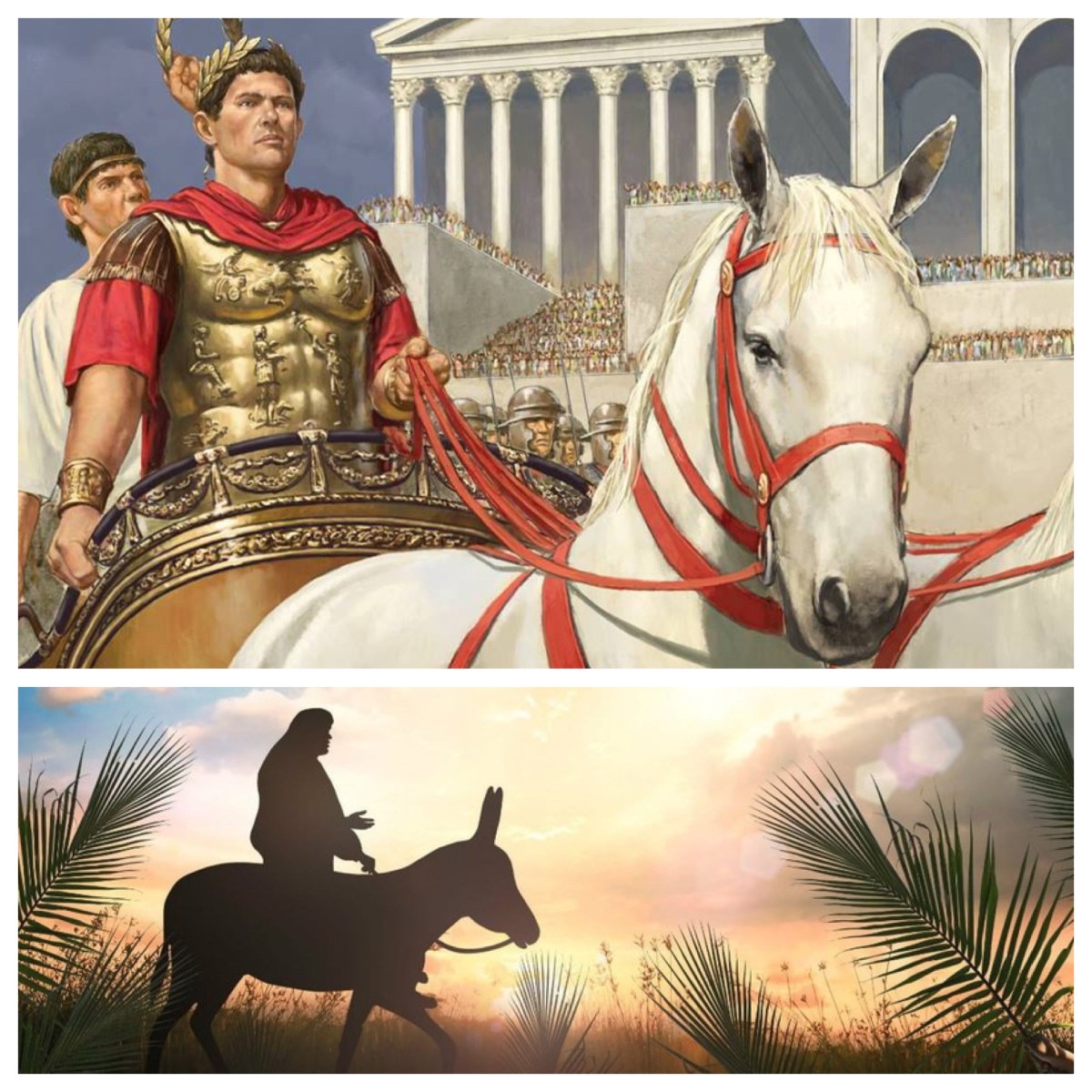
But this psalm is not only a prayer of celebration; it is also a strong statement about the resilience and trust of the people, expressing their belief that God will give them redemption, even in the face of their Roman overlords, who had held political and military power for many decades. If this is what the crowd intended with their cry as Jesus enters the city—and I have no reason to see otherwise—then this is a striking, courageous political cry embedded in the story! It is a cry that affirms that salvation is at hand.

*****

Salvation is what is in the mind of the people as they cry, “save us” (v.25) and the earlier affirmation, “I thank you that you have answered me and have become my salvation” (v.21). As we have noted, “save us” was a recurring cry amongst the Israelites. In the song sung after the Exodus, the people acclaim God, singing “the Lord is my strength and my might, and he has become my salvation” (Exod 15:2). In his song of thanksgiving after battles with the Philistines, David praises God as “my rock, my shield and the horn of my salvation” (2 Sam 22:3; also vv.36, 47, 51; and 1 Chron 16:23, 35).

The same language, of salvation, appears in the psalms (Ps 13:5; 18:2, 35, 46; 24:5; 25:5; and another 40 times) and the prophets (Isa 12:2–3; 25:9; 33:2, 6; 45:8, 17; 46:13; 51:5–6; 52:7, 10; 56:1; 59:11; 61:10; 62:11; Mer 3:23; Mic 7:7; Hab 3:18). From the psalms, we remember “the Lord is my light and my salvation” (Ps 27:1); from Isaiah, “I will give you as a light to the nations, that my salvation may reach to the end of the earth” (Is 49:6).

There are a dozen occasions in Hebrew Scripture when God is identified as Saviour (2 Sam 22:3; Ps 17:7; 106:21; Isa 43:3, 11; 45:15, 21; 49:26; 60:16; 63:8; Jer 14:8); as the Lord God declares through Hosea, “I have been the Lord your God ever since the land of Egypt; you know no God but me, and besides me there is no Saviour” (Hos 14:4).

Salvation is linked with righteousness; “the salvation of the righteous is from the Lord … he rescues them from the wicked and saves them” (Ps 37:39–40). Being righteous is a quality of the Lord God (Ps 11:7; 35:28; 50:6; 71:16; 85:10; 89:16; 97:2, 6; 103:17; 111:3; 116:5; 119:137, 152; 129:4; Isa 45:21; Jer 23:6; 33:16; Dan 9:16; Zeph 3:5) which is thus desired of those in covenant with God (Gen 18:19; 1 Sam 26:23; 2 Sam 22:21, 25; 1 Ki 10:9; 2 Chron 9:8; Job 29:14; Ps 5:8; 9:8; 11:7; 33:5; Prov 1:3; Isa 1:27; 5:7; 28:17; 42:6; 61:11; Jer 22:3; Ezek 18:5–9; Hos 10:12; Amos 5:24; Zeph 2:3; Mal 3:3).

It is no surprise, then, that this psalm celebrates that “[God] has become my salvation” (Ps 118:21) by holding a “festal procession with branches” (v.27), entering through “the gates of righteousness” (v.19) and proceeding all the way “up to the horns of the altar” (v.27), singing “save us, Lord” (v.25) and “blessed is the one who comes in the name of the Lord” (v.26). This is a high celebratory moment!

So the closing verses take us back to the opening refrain, “O give thanks to the Lord, for he is good, for his steadfast love endures forever” (v.29; see also vv.1–4). The celebration is lifted to the highest level, with praise and thanksgiving abounding. And that makes this a perfect psalm for Palm Sunday!
****(

On the indications of the political nature of the Palm Sunday scene, see

Reading scripture with attention to its context (John 11, Year A)

The lectionary has offered us a series of readings during Lent which show Jesus encountering and conversing with others (John 3, 4, 9, and 11). The anonymous author of the Gospel of John had high-level literary and dramatic skills. The lectionary has very clearly demonstrated this in the series of readings offered in weeks 2–5 of Lent.

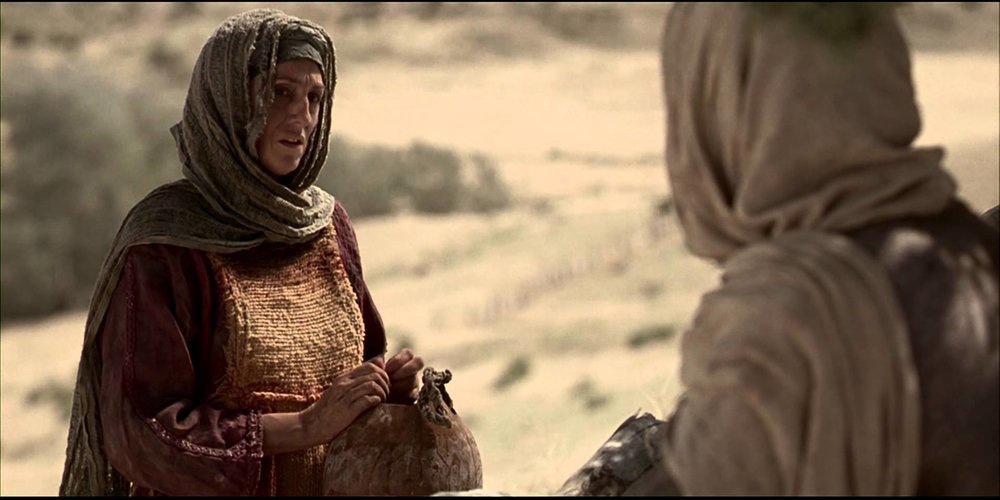
The Pharisee in Jerusalem (Ch.3) is really a foil who asks leading questions which offer Jesus the opportunity to speak forth at some length for the first time in the Gospel (3:11–21). The woman in Samaria is a genuine dialogue partner for Jesus who learns through the back-and-forth of their conversation about a number of matters (4:7–26). The story of the man born blind (9:1–41) is presented as a seven-part comedic drama, illustrating the “light of the world” claim of Jesus (8:12; 9:5) and showing how people respond in varied ways to that.

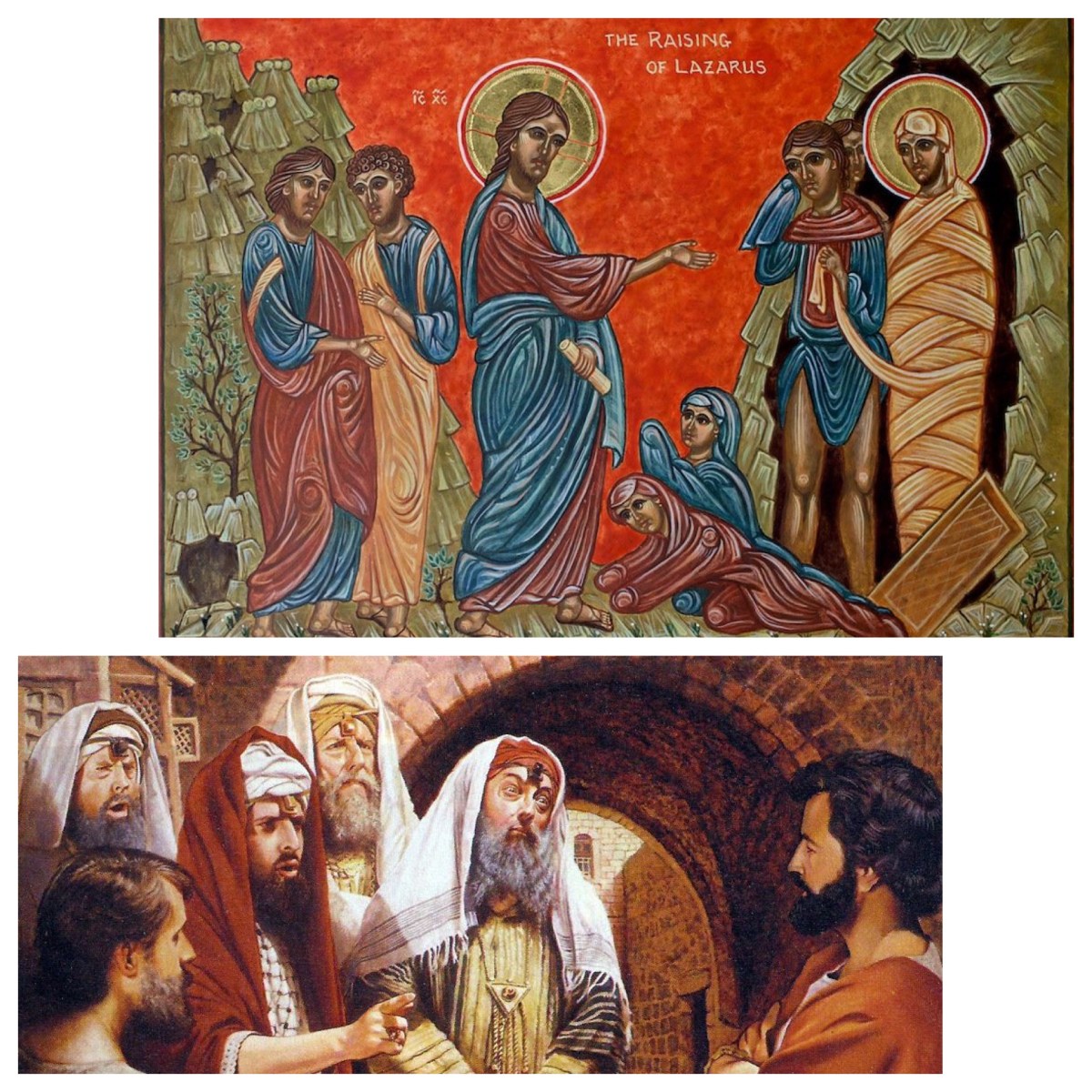
Then, the story of Lazarus (11:1–45) is a complex dramatic moment, a story with its own integrity and form, with a range of characters and varied dramatic moments. This story also serves as the seventh and final sign in the Gospel; these signs commenced at 2:1–11 and are interspersed throughout the ensuing narrative (4:46–54; 5:1–9; 6:1–15; 6:16–21; 9:1–7; and 11:38–44). This sign, like others before, has lead many to believe (11:45), but it serves also to confirm the plot of the Sanhedrin leaders to arrest and kill Jesus: the reason for the crucifixion, in this author’s eyes (11:46–53; 11:57; 18:1–12).
All of this is a masterly dramatic development through the first half of this “book of signs”. These stories are certainly worth hearing in full every three years!

These encounters, however, are told in the context of an emerging story which places Jesus into a position of antagonist, arguing and dissenting, disputing and disagreeing, with some regularity. This thread comes to a head in the story of Martha and Mary, their recently-deceased brother Lazarus, and Jesus (John 11:1–45).

The emergence of Lazarus from the tomb marks a climactic moment, for the family in Bethany and many of their neighbours (11:44–45), but also for the chief priests and Pharisees, who together determine to put Jesus to death (11:53). The seventh sign recounted in this Gospel is the most significant miracle of Jesus, but also the deed that determines the fate of Jesus, for it leads immediately to the plot to arrest Jesus (11:53) and then inevitably to his death at the hands of the Romans (19:30).

Soon after he has raised Lazarus back to life in Bethany, Jesus says, “I have come to this hour” (12:27), the hour when “I am lifted up from the earth, [when I] will draw all people to myself” (12:32), the hour when the Father will “glorify your Son so that the Son may glorify you” (17:1). The death of Jesus is to be, paradoxically, the complete fulfilment of his mission (19:30). Its inevitability has been flagged since early in the Gospel narrative.

Antagonism begins early in that narrative. It is initially signalled by “the incident in the Temple” (John 2:13–22). In his conversation with Nicodemus, Jesus tells the Pharisee, “we speak of what we know and testify to what we have seen; yet you do not receive our testimony. If I have told you about earthly things and you do not believe, how can you believe if I tell you about heavenly things?” (3:11–12). The plural form of the Greek word translated “you” makes it clear that the “you” being addressed is at least the collective Sanhedrin Council, if not the whole population of Judea. It is an oppositional, confrontational encounter at this point.

In talking with the Samaritan woman, Jesus reflects the historical antagonism between the Judeans of the south and those of the north. “Our ancestors worshiped on this mountain, but you say that the place where people must worship is in Jerusalem”, the woman says to Jesus (4:20). Jesus replies, pugnacious oh, “you worship what you do not know; we worship what we know, for salvation is from the Jews” (4:22). The use of the plural “you” once again in these verses makes clear the antagonism between the peoples, especially if we translate that final phrase, “salvation is from the Judeans”.

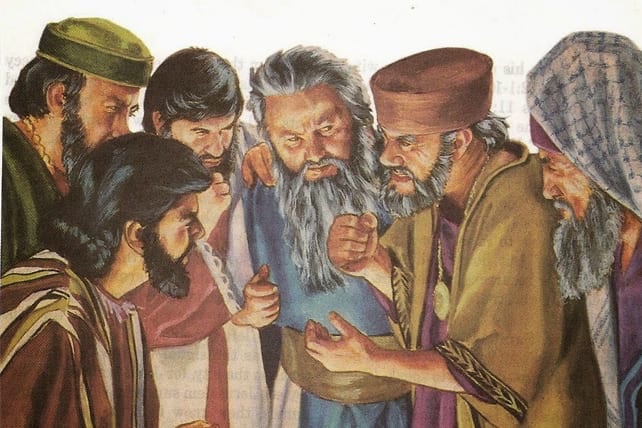
When Jesus heals a man born blind, the Jewish authorities function as the chorus reflecting on, and reacting to, the events taking place in Jerusalem. First, some Pharisees declare, “This man is not from God, for he does not observe the sabbath” (9:16). Then, they declare to the healed man, “we know that God has spoken to Moses, but as for this man, we do not know where he comes from” (9:29).

Their view of Jesus is quite negative— in an earlier debate with him, they had called him “a Samaritan and have a demon” (8:48), and that encounter ends, “they picked up stones to throw at him” (8:59). Mind you, Jesus had said to them, “you are from your father the devil, and you choose to do your father’s desires” (8:44), so it was a vigorous two-way argument!

So Jesus responds to the negativity of the Jewish authorities who questioned his credentials after learning of the healing of the man born blind, with a statement, “I came into this world for judgment so that those who do not see may see, and those who do see may become blind” (9:39), followed by, “if you were blind, you would not have sin; but now that you say, ‘We see,’ your sin remains” (9:41). This encounter ends, yet again, on a negative note.

Then, after Jesus has raised Lazarus back to life, the Jewish authorities decide to make their move. Worried that, “if we let him go on like this, everyone will believe in him, and the Romans will come and destroy both our holy place and our nation” (11:48), Caiaphas leads with these prophetic words: “it is better for you to have one man die for the people than to have the whole nation destroyed” (11:50). And so, “from that day on they planned to put him to death” (11:53).

Jesus is clearly aware of this antagonism; he later warns his disciples, “the world hates you” (15:19), and then, “they will put you out of the synagogues; indeed, an hour is coming when those who kill you will think that by doing so they are offering worship to God” (16:2). And of course, the narrative of the Gospel ends with Jesus handed over to die by crucifixion (18:28). We need to think carefully about how we interpret this antagonism.

*****

Was the world an evil place, in the sway of the devil, which would inevitably turn against Jesus? But what, then, of the claim that God sent Jesus because he “so loved the world” (3:16)? How are we to see the relationship between Jesus and “the world”?

Of course, it needs to be said that none of these scenes offered by the lectionary—nor any of the intervening scenes in this Gospel—come as eyewitness (or rather, earwitness) accounts of what actually happened in a real, historical encounter. Of none of the scenes can we say with certainty that they actually occurred, let alone that the dialogue recorded by the author of the book of signs was what was actually said. These scenes are all literary creations, perhaps based on a report of an encounter that took place, but most certainly elaborated and developed over a period of time, worked into a narrative that catches attention, invites reflection, and has a life all of its own.

“John” wrote his book of signs some 50 to 80 years after the lifetime of Jesus. The account of each of these conversations—at night with Nicodemus, at noon with the woman, in Jerusalem with the authorities, and then the encounter in Bethany and the council meeting in Jerusalem—are thus far removed from each of these events. (How could we possibly claim to know verbatim what was said in a Sanhedrin meeting in the early 30s CE? — especially since the High Priest articulates a central tenet of later Christian doctrine!).

I recently read a comment that said, “The television show MASH was set during the Korean War but was about the Vietnan War. While the framework was faithful to the earlier conflict with regard to combatants, equipment, etc., the issues selected reflected Vietnam: distrust of authority, questioning blind patriotism, the need to get around the rules, the effort to ‘get out of this place’, the cynicism-based humor.”

Similarly, John tells a story set in the the time of Jesus; but this period is seen through the lens of the division of Christians and Jews that has eventuated and the heartache that comes when there’s a separation. I think that’s a helpful analogy. The later situation, when the work is created, is reflected in so many ways, even though the story is set decades earlier. As with MASH, so with John’s Gospel.

The depictions of these encounter scenes in the first half of John’s Gospel are shaped by the events that have taken place over those intervening decades—particularly, the rising antagonism between “messianic Jews” following Jesus, and “rabbinic Jews” adhering to the teachings of their teachers. The antagonism reflects the situation.

John’s Gospel indicates, three times, that followers of Jesus were expelled from the synagogue (9:22; 12:42; 16:1–2). That’s quite a schism! So any negative comments or portrayals of people from years back may well have as much to do with what has transpired in those intervening years, as with the actual event—probably, I think, much more to do with those intervening years than with the conversations and encounters as reported in the book of signs. All of this is basic Gospel interpretation.

The church to which I belong, the Uniting Church in Australia, adopted a Statement on Jews and Judaism in 2009 (I was on the working group that developed initial material for this) which offered guidance about our theology, exegesis, and preaching. It is in the same vein as many other statements issued by various enlightened denominations around the world, ever since the lead was taken by the Roman Catholic Church in promulgating Nostra Aetate in 1965.

(I published an analysis of these statements as “Christians relating to Jews: key issues in public statements”, Journal of Ecumenical Studies 44/2, 2009, 180–202.)

Nostra Aetate covered important new ground: it repudiated the centuries-old “deicide” charge against all Jews, stressed the religious bond shared by Jews and Catholics, reaffirmed the eternal covenant between God and the People of Israel, and dismissed church interest in trying to baptize Jews. It called for Catholics and Jews to engage in friendly dialogue and biblical and theological discussions to better understand each other’s faith. Many other Christian denominations have followed suit in the decades since.

The 2009 Uniting Church Statement declares that “The Uniting Church acknowledges with repentance a history of interpretation of New Testament texts which has often failed to appreciate the context from which these texts emerged, viz. the growing separation of Christianity and Judaism with attendant bitterness and antagonism, resulting in deeply rooted anti-Jewish misunderstandings” (para. 9).

See https://assembly.uca.org.au/resources/key-papers-reports/item/1704-jews-and-judaism

That’s a key guiding principle for me, as I read and interpret the Gospels—particularly those attributed to John and Matthew, for these books contain texts which have been grossly and inventively distorted and misused by the Church over many centuries, to fuel the false doctrine of supersessionism and thus the hatred of antisemitism. They do provide evidence for the growing separation between Judaism and Christianity, but they should not be used in a supersessionist way or to fuel antisemitism.

The Uniting Church Statement offers concise definitions of supersessionism (“the belief that Christians have replaced Jews in the love and purpose of God”) and antisemitism (“a term coined in imperial Germany during the 1870s by propagandists who did not wish Jews to enjoy equal rights with Christians. Its true political meaning is ‘I am against the Jews’.”). We should take care not to reflect either of these in our interpretation of scripture. Passages from John’s Gospel, especially, present us with the temptation to be negative about “the Jews”. We need to resist these temptations with all our heart!

*****

See also