Ten Things about the Greatest Commandment(s) (Mark 12; Pentecost 24B)

The Gospel reading for this coming Sunday contains some very well-known words of Jesus, which we remember as “the greatest commandment” (Mark 12:28–34). Here are ten things worth knowing about these words.

ONE.   The greatest commandment identified by Jesus comes from Hebrew Scripture. When Jesus says that the greatest commandment is to “love the Lord your God”, he is repeating words from the start of a long section in Deuteronomy, which reports a speech by Moses allegedly given to the people of Israel (Deut 5:1–26:19). The speech retells many of the laws that are reported in Exodus and Leviticus, framing them in terms of the repeated phrases, “the statutes and ordinances for you to observe” (4:1,5,14; 5:1; 6:1; 12:1; 26:16–17), “the statutes and ordinances that the Lord your God has commanded you” (6:20; 7:11; 8:11).

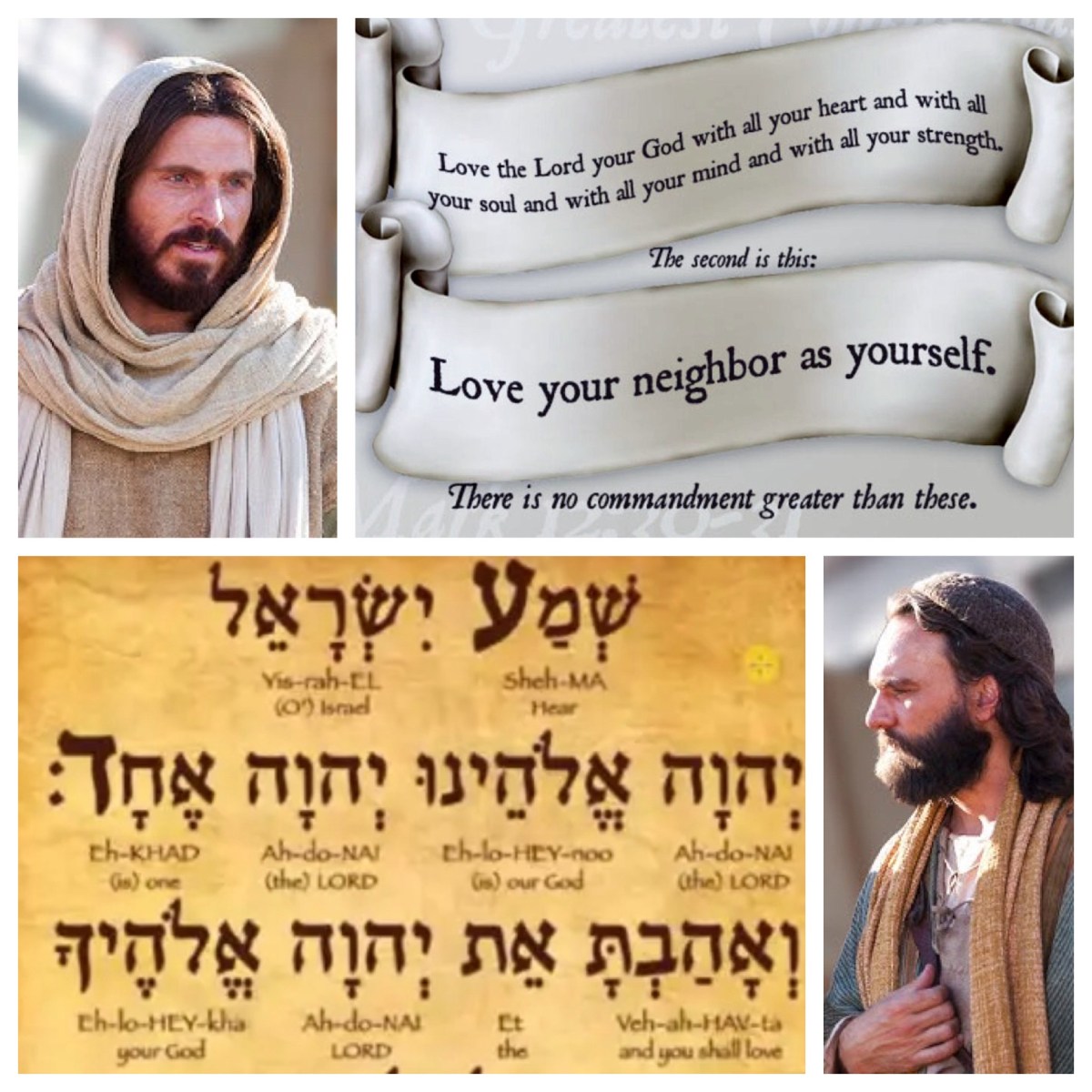
After proclaiming the Ten Commandments which God gave to Israel through Moses (Deut 5:1–21; cf. Exod 20:1–17) and rehearsing the scene on Mount Sinai and amongst the people below (5:22–33; cf. Exod 19:1–25; 20:18–21), Moses then delivers the word which provides the heading of all that follows: “Hear, O Israel: The Lord is our God, the Lord alone. You shall love the Lord your God with all your heart, and with all your soul, and with all your might. Keep these words that I am commanding you today in your heart” (Deut 6:4–6). Love, it would seem, is the key commandment amongst all the statutes and ordinances found in this book.

These words are known in Jewish tradition as the Shema, a Hebrew word literally meaning “hear” or “listen”. It’s the first word in this key commandment; and more broadly than simply “hear” or “listen”, it carries a sense of “obey”. These words are important to Jews as the daily prayer, to be prayed twice a day—in keeping with the instruction to recite them “when you lie down and when you rise” (Deut 6:7). As these daily words, “love the Lord your God” with all of your being are said, they reinforce the centrality of God and the importance of commitment to God within the covenant people.
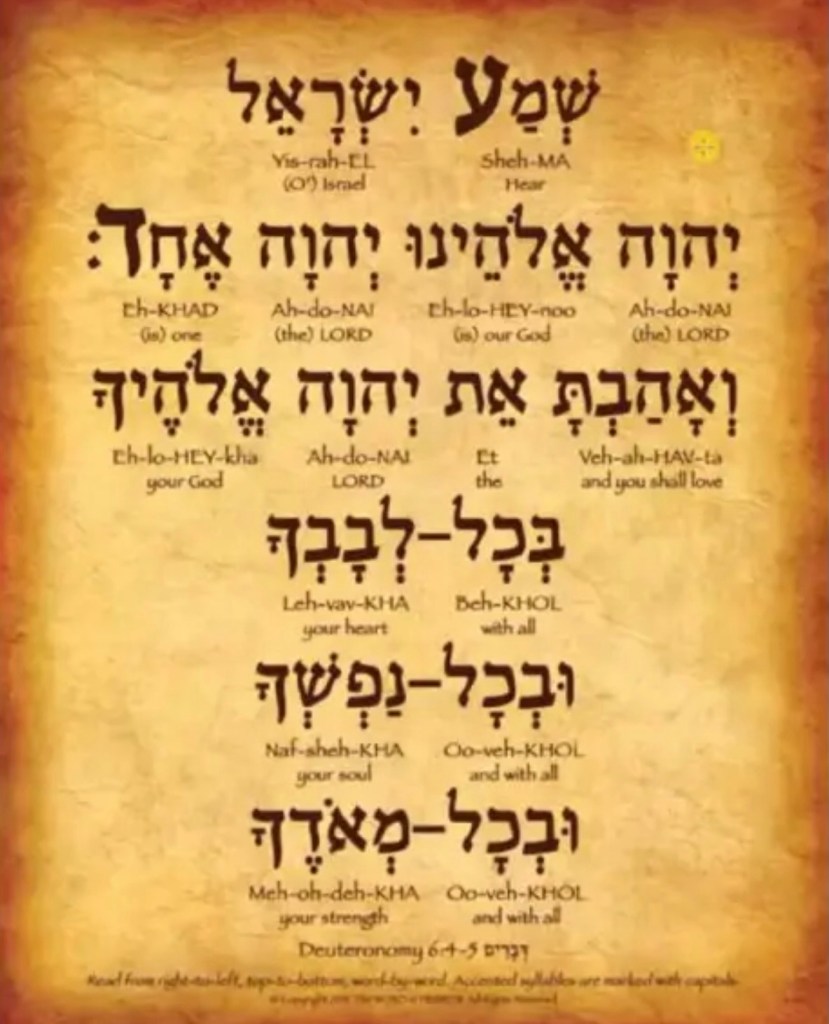
TWO.   The original version of this commandment in Deuteronomy 6 has three parts: “with all your heart, and with all your soul, and with all your might” (Deut 6:4). This is typical of Jewish speech; repetition, using different words which are related to the same concept, expressing the importance of what is being said; and especially, repetition in groups of three. So, the prophet Micah urges people to “do justice,  love kindness, and walk humbly with God” ( Mic 6:8). Second Isaiah praises those messengers who proclaim peace, bring good news, and announce salvation (Isa 52:7). 

The psalmist exhorts the people to “tell of his salvation … declare  his glory … his marvelous works among all the peoples” (Ps 96:2-3). And the priestly authors of the creation story identifies all living creatures created by God in the threefold “fish of the sea … birds of the air … and every living thing that moves upon the earth” (Gen 1:28). That’s kind of like an ancient version of our “animal—mineral—vegetable” classification, I guess.

So the prayer of Deut 6:4 adheres to a widespread and longstanding literary feature in ancient Hebrew, of using three words in parallel. Just how parallel they are, we will now explore.
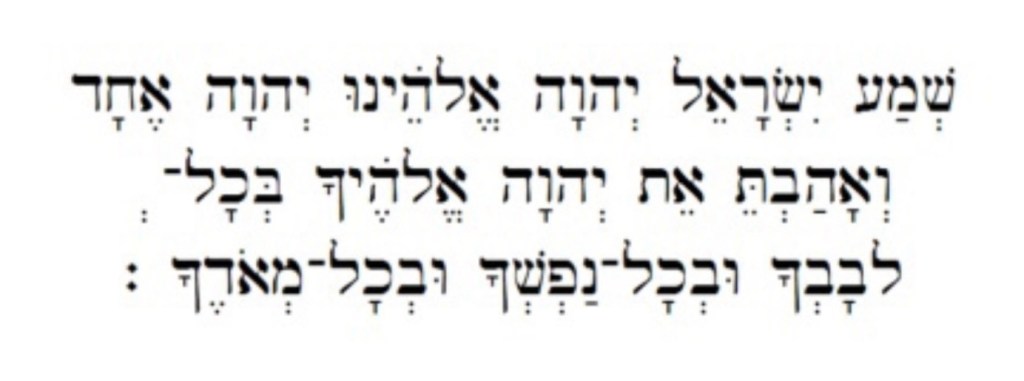
THREE.   With all your heart: The Hebrew word translated as heart is לֵבָב, lebab. It’s a common word in Hebrew Scripture, and is understood to refer to the mind, will, or heart of a person—words which seek to describe the essence of the person. It is sometimes described as referring to “the inner person”. The word appears 248 times in the scriptures, of which well over half (185) are translated as “heart”. 

Many of those occurrences are in verses which contrast heart with flesh—that is, “the inner person” alongside “the outer person”. For example, the psalmists declare that “my flesh and my heart may fail, but God is the strength of my heart and my portion forever” (Ps 73:26), and “my heart and my flesh sing for joy to the living God” (Ps 84:2b), whilst the prophet Ezekiel refers to “foreigners, uncircumcised in heart and flesh” (Ezek 44:7,9). When used together, these two terms (heart and flesh) thus often refer to the whole person, the complete being. 

The Hebrew word lebab, heart, is rendered by the Greek word, kardia, in Mark 12:30. That word can refer directly to the organ which circulates blood through the body; but it also has a sense of the central part of a being—which is variously rendered as will, character, understanding, mind, and even soul. These English translations are attempting to grasp the fundamental and all-encompassing. It seems that this correlates well with the Hebrew word lebab, which indicates the seat of all emotions for the person.
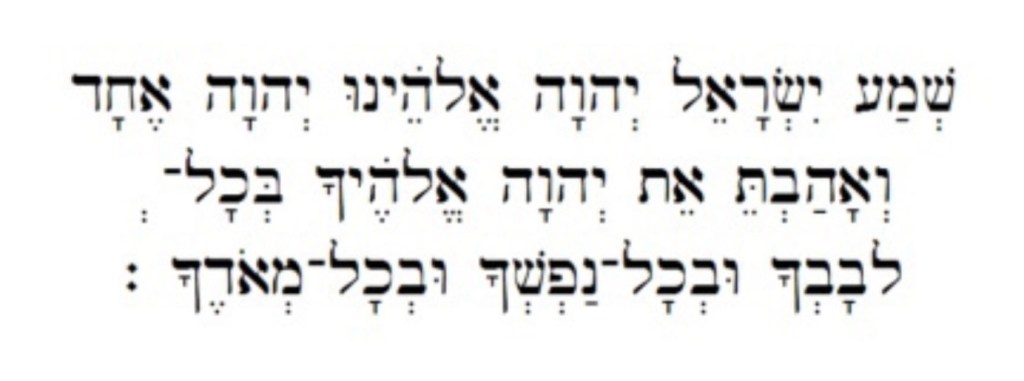
FOUR.   With all your soul: The second Hebrew word in the commandment articulated in Deut 6:4 is נֶפֶשׁ, nephesh. This is another common Hebrew word, appearing 688 times in Hebrew Scripture, of which the most common translation (238 times) is “soul”; the next most common translation is “life” (180 times). The word is thus a common descriptor for a human being, as a whole. 

However, to use the English word “soul” to translate nephesh does it a disservice. We have become acclimatised to regarding the soul as but one part of the whole human being—that is the influence of dualistic Platonic thinking, where “body and soul” refer to the two complementary parts of a human being. In Hebrew, nephesh has a unified, whole-of-person reference, quite separate from the dualism that dominates a Greek way of thinking.

Nephesh appears a number of times in the first creation story in Hebrew scripture, where it refers to “living creatures” in the seas (Gen 1:20, 21), on the earth (Gen 1:24), and to “every beast of the earth, and to every bird of the air, and to everything that creeps on the earth, everything that has the breath of life (nephesh hayah)” (Gen 1:30). It is found also in the second creation story, where it likewise describes how God formed a man from the dust of the earth and breathed the breath of life into him, and “the man became a living being (nephesh hayah)” (Gen 2:7). The claim that each living creature is a nephesh is reiterated in the Holiness Code (Lev 11:10, 46; 17:11). 

The two words, nephesh and lebab, appear linked together many times. One psalmist exults, “my ‘heart’ is glad, and my ‘soul’ rejoices” (Ps 16:9a), whilst another psalmist laments, “how long must I bear pain in my ‘soul’, and have sorrow in my ‘heart’ all day long?” (Ps 13:2). Proverbs places these words in parallel in sayings such as “wisdom will come into your ‘heart’, and knowledge will be pleasant to your ‘soul’” (Prov 2:10), and “does not he who weighs the ‘heart’ perceive it? does not he who keeps watch over your ‘soul’ know it?” (Prov 24:12). In Deuteronomy itself, the combination of “heart and soul” appears a number of times (Deut 4:29; 10:12; 11:13, 18; 13:3; 26:16; 30:2, 6, 10), where it references the whole human being. 

In each of these instances, rather than taking a dualistic Greek approach (seeing “heart” and “soul” as two separate components of a human being), we should adopt the integrated Hebraic understanding. Both “heart” and “soul” refer to the totality of a human being. The repetition is a typical Hebraic style, using two different words to refer to the same entity (the whole human being). The repetition underlines and emphasises the sense of totality of being.
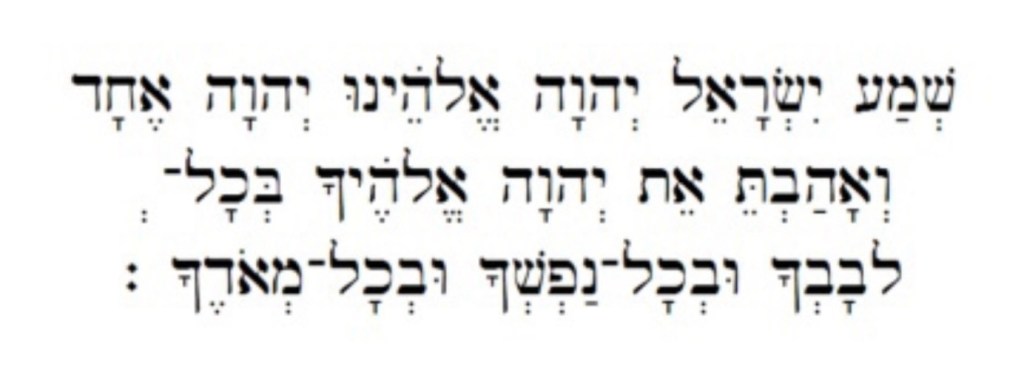
FIVE.   With all your might: The third Hebrew word to note in Deut 6:5 is מְאֹד, meod, which is usually translated as “might” or “strength”. Its basic sense in Hebrew is abundance or magnitude; it is often rendered as an adverb, as “very”, “greatly”, “exceedingly”, or as an adjective, “great”, “more”, “much”. The function of this word, “might” or “strength”, in Deut 6:5 is to reinforce the totality of being that is required to love God. 

In light of this, we could, perhaps, paraphrase the command of Deuteronomy as love God with all that you are—heart and soul, completely and entirely. Love God with “your everythingness” (to coin a word). There’s a cumulative sense that builds as the commandment unfurls—love God with all your emotions, all your being, all of this, your entire being.

We find the same threefold pattern in the description of King Josiah, who reigned in the eighth century (640–609 BCE): “before him there was no king like him, who turned to the Lord with all his heart, with all his soul, and with all his might, according to all the law of Moses; nor did any like him arise after him” (2 Kings 23:25). Most often, however, it is used as an intensifier, attached directly to another term, providing what we today would do in our computer typing by underlining, italicising, and bolding a key word or phrase.

Rendering this Hebrew word in Greek—as the translators of the Septuagint did—means making a choice as to what Greek word best explicated the intensifying sense of the Hebrew word, meod. The LXX settled on the word δύναμις, usually translated as power (the word from which we get, in English, dynamic, and dynamite). Dynamis often has a sense of physical strength and capacity, and that resonates well with the sense of the Hebrew term as it is used in Deut 6:5. So the LXX has dynamis as the third element in the Shema commandment.
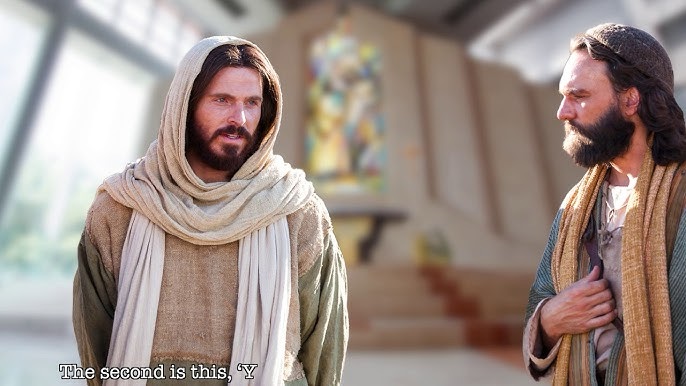
SIX.   In the version we find at Mark 12, Jesus adds a fourth element: with all your mind. Where does this addition come from? Centuries before Jesus, an ancient scribe wrote an account of events in his society in a time long before his life. He reports the instruction that King David spoke to his chosen successor, his son, Solomon: “set your mind and heart to seek the Lord your God” (1 Chron 22:19). He reinforces that in a later address, telling Solomon to “know God and serve [the Lord] with single mind and willing heart” (1 Chron 28:9). The book of Proverbs (attributed by tradition to Solomon) then advocates both attending to the mind (Prov 22:17; 23:12, 19) and “inclining your heart” towards God (Prov 2:2; 3:1–6; 4:4, 20–23; 6:21; 7:3) as integral parts of the life of faith.

The injunction of David is echoed in the way that Jesus extends the traditional commandment to “love the Lord your God with all your heart, and with all your soul, and with all your might” (Deut 6:5), adding “and with all your mind” (Mark 12:30). There are scriptural resonances underpinning this addition made by Jesus.

SEVEN.   The combined effect of these four phrases in the version of the command that Jesus speaks in Mark 12 is telling: Jesus instructs his followers that life with him requires a complete, total, fully-immersed commitment. He conveys this quite directly in other sayings: to a grieving person, “follow me, and let the dead bury their own dead” (Matt 8:22; Luke 9:60); to a farmer, “no one who puts a hand to the plow and looks back is fit for the kingdom of God” (Luke 9:62); and to a rich man, “go, sell what you own, and give the money to the poor, and you will have treasure in heaven; then come, follow me” (Mark 10:21 a d parallels).

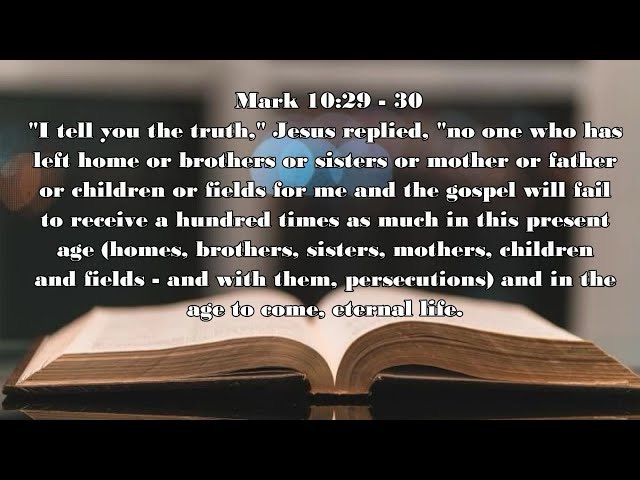
Jesus also declares that “whoever loves father or mother more than me is not worthy of me; and whoever loves son or daughter more than me is not worthy of me; and whoever does not take up the cross and follow me is not worthy of me” (Matt 10:37–38; Luke 14:26–27), leading to his claim that those who have left “house or brothers or sisters or mother or father or children or fields, for my sake and for the sake of the good news” will indeed receive “eternal life in the age to come” (Mark 10:29–30). Discipleship is full-on!
EIGHT.   Jesus then adds a second ”great commandment”, which also comes from Hebrew Scripture. As a good Jew, Jesus was well able to reach into his knowledge of Torah in his answer to the scribe who had asked him “which commandment is the first of all?”. The commandments that he selects have been chosen with a purpose. They contain the essence of the Torah: love God, love your neighbour. His answer draws forth the agreement of the scribe; in affirming Jesus, the scribe reflects the prophetic perspective, that keeping the covenant in daily life is more important that following the liturgical rituals of sacrifice in the Temple (see Amos 5:21–24; Micah 6:6–8; Isaiah 1:10–17). 

The scene is similar to a Jewish tale that is reported in the Babylonian Talmud, a 6th century CE work. In Shabbat 31a, within a tractate on the sabbath, we read: “It happened that a certain non-Jew came before Shammai and said to him, ‘Make me a convert, on condition that you teach me the whole Torah while I stand on one foot.’ Thereupon he repulsed him with the builder’s cubit that was in his hand. When he went before Hillel, he said to him, ‘What is hateful to you, do not to your neighbour: that is the whole Torah, the rest is the commentary; go and learn it.’”

Hillel, of course, had provided the enquiring convert, not with one of the 613 commandments, but with one that summarised the intent of many of those commandments. We know it as the Golden Rule, and it appears in the Synoptic Gospels as a teaching of Jesus (Matt 7:12; Luke 6:31). 

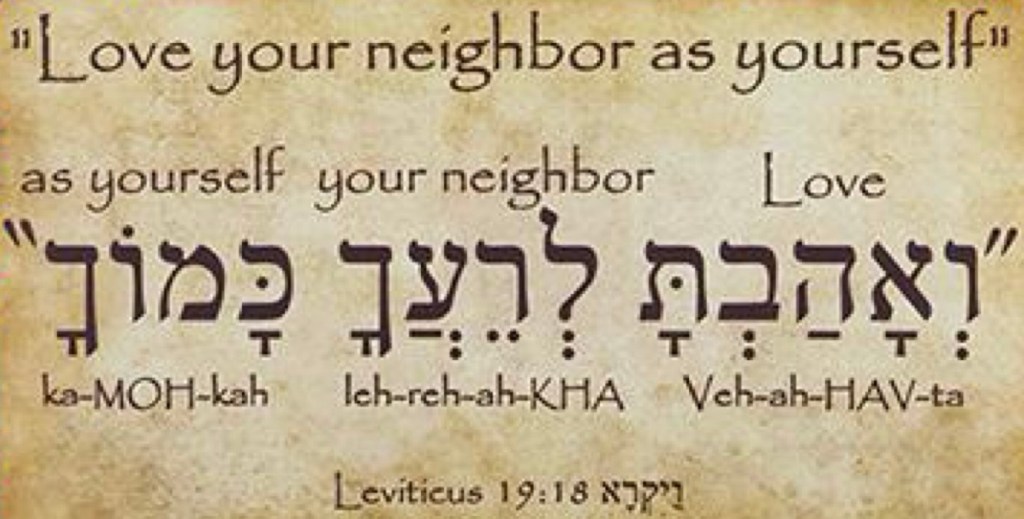
Some Jewish teachers claim that the full text of Lev 19:18 is actually an expression of this rule: “You shall not take vengeance or bear a grudge against any of your people, but you shall love your neighbour as yourself: I am the Lord”. Later Jewish writings closer to the time of Jesus reflect the Golden Rule in its negative form: “do to no one what you yourself dislike” (Tobit 4:15), and “recognise that your neighbour feels as you do, and keep in mind your own dislikes” (Sirach 31:15).
NINE.   Love of God is a thread running right through both testaments of scripture. The command is repeated in later chapters of Deuteronomy (10:12; 11:1; 13:3; 30:6) and in Joshua (22:5; 23:11). It is then picked up in all three Synoptic Gospels (Mark 12:30; Matt 22:37; Luke 10:27; 11:42) and echoed by Paul (Rom 8:28 and perhaps 2 Thess 3:5). 

Finally, this claim is developed by the author of 1 John, who focusses on love as integral to the nature of God, declaring that “God is love” (1 John 4:16) and “love is from God” (4:7); and then explains that such love is expressed in the way that believers “love one another [for] if we love one another, God lives in us, and his love is perfected in us” (4:11–12), or that “the love of God is this, that we obey his commandments” (5:3); and that “those who do not love their brothers and sisters” are “not from God” (3:10; see also 4:19–20). 

And so, the bold declarations are made that “whoever obeys [Christ’s] word, truly in this person the love of God has reached perfection” (2:5), and that “those who love God must love their brothers and sisters also” (4:21). In this way, the two commands to love are knitted together most completely.

TEN.   Love of neighbour is also a consistent theme throughout scripture. After the command to “love your neighbor as yourself” (Lev 19:18), the Torah specifies that “the alien who resides with you shall be to you as the citizen among you; you shall love the alien as yourself” (19:34). Israelites are commanded not to defraud a neighbour (19:13), judge a neighbour “with justice” (19:15), not profit “by the blood of your neighbour” (19:16) and to deal justly with the neighbour in matters of  commerce (25:14–15). The word of Moses in Deuteronomy is clear in the command to “open your hand to the poor and needy neighbour in your land” (Deut 15:11).

The book of Proverbs likewise counsels “do not plan harm against your neighbour who lives trustingly beside you” (Prov 3:29), “do not be a witness against your neighbor without cause, and do not deceive with your lips” (24:28), and warns that “like a war club, a sword, or a sharp arrow is one who bears false witness against a neighbour” (25:18). Its advice is, “better is a neighbour who is nearby than kindred who are far away” (27:10b). 

Paul clearly knows the command to love one’s neighbour, for he quotes it to the Galatians: “the whole law is summed up in a single commandment, ‘You shall love your neighbour as yourself’” (Gal 5:14), and to the Romans: “the commandments … are summed up in this word, ‘Love your neighbor as yourself.’ Love does no wrong to a neighbor; therefore, love is the fulfilling of the law.” (Rom 13:9–10).

James also cites it: “you do well if you really fulfill the royal law according to the scripture, ‘You shall love your neighbour as yourself’” (James 2:8). Both writers reflect the fact that this was an instruction that stuck in people’s minds! And I wonder … perhaps there’s a hint, in these two letters, that the greater of these two equally-important commandments is actually the instruction to “love your neighbour”?
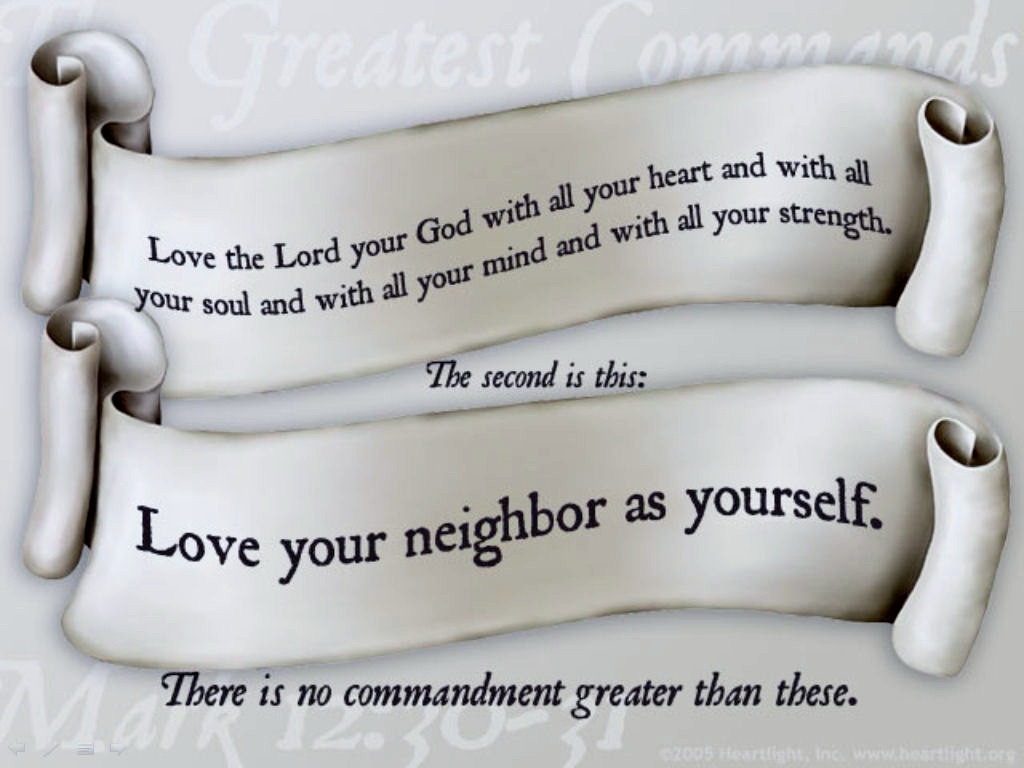
So it is for very good reasons that Jesus extracts these two commandments from amongst the 613 commandments that are to be found within the pages of the Torah. (The rabbis counted them all up—there are 248 “positive commandments”, giving instructions to perform a particular act, and 365 “negative commandments”, requiring people to abstain from certain acts.)

Jesus, of course, was a Jew, instructed in the way of Torah. He knew his scriptures—he argued intensely with the teachers of the Law over a number of different issues. He frequented the synagogue, read from the scroll, prayed to God, and went on pilgrimage to Jerusalem and into the Temple—where, once again, he offered a critique of the practices that were taking place in the courtyard of the Temple (11:15–17). 

Then he engaged in debate and disputation with scribes and priests (11:27), Pharisees and Herodians (12:13), and Sadducees (12:18). Each of those groups came to Jesus with a trick question, which they expected would trap Jesus (12:13). Jesus inevitably bests them with his responses (11:33; 12:12, 17, 27). It was at this point that the particular scribe in our passage approached Jesus, perhaps intending to set yet another trap for him (12:28). We have seen how masterful Jesus was, in engaging with—and besting in debate—this scribe in the way he responded to him. These two “greatest commandments” have endured for centuries!

See also
“Male and female he made them” … and more? (Pentecost 20B; Mark 10 and Gen 1)

The lectionary Gospel reading for this Sunday (Mark 10:2–16) reports an encounter between Jesus and some Pharisees—the first such encounter in Judea, as earlier encounters had been in Galilee. I have already explored this story in the context of the cultural and religious context of the time, in late Second Temple Judaism.

In the debate that takes place in this encounter, Jesus quotes from the first creation story, the grand priestly narrative that occupies pride of place at the start of Bereshith, the first scroll of Torah, and thus at the beginning also of the scriptures collected by the followers of Jesus that formed what we know as The Holy Bible.

Words in origin stories have a particular power—and origin stories, such as this one (Gen 1:1–2:4a), are chosen with care and deliberation. That is certainly the case with this particular verse. In debating the Pharisees, Jesus says, “from the beginning of creation, ‘God made them male and female’” (Mark 10:6).

Here Jesus uses the verse as the claim that seals his particular stance regarding divorce—that it was not part of the plan that God had for humanity, since the male—female gender structure is integral to our humanity, and underscores his conclusion regarding divorce, that “what God has joined together, let no one separate“ (Mark 10:9). This, in turn, is his deduction from what the second creation story sets forth about marriage, that “a man leaves his father and his mother and clings to his wife, and they become one flesh” (Gen 2:24; quoted at Mark 10:7–8a). See

The statement by Jesus that God made human beings as male and female sounds like a definitive declaration: this is the reality, this is who we are, there is nothing more to debate! Certainly, that’s the way this verse has been used in the “gender wars” that have swirled through western societies in recent times. “God made male and female” became “God made Adam and Eve, not Adam and Steve”, in an early salvo against the emerging number of people who were “outing” themselves as same-gender attracted. “Not so” was the sloganeers’ reply; two genders, each attracted to the opposite, is who we are. Definitively. Resolutely. Absolutely.

It’s worth going back to the quote from Genesis in its original context. What the priestly authors of the creation story wrote was “God created humankind in his image, in the image of God he created them; male and female he created them” (Gen 1:27). The emphasis is not so much on defining who we are are gendered people—but rather, the verse is reflecting on the amazing feature that, within humanity, signs of divinity are reflected. And in association with that, the statement indicates that the two genders familiar from humanity are somehow reflected in the very nature of God.

As God’s creatures, we are images of that creating being. The Hebrew word used, tselem (image), indicates a striking, detailed correlation between the human and the deity. This was the insight brought by the authors of this passage, perhaps shaped and honed over generations of telling and retelling the story, passing on through the oral tradition the insights of older generations.

My sense is that these ancients were not so much making a definite declaration about the nature of humanity—an early dogmatic assertion, if you like—as they were actually reflecting on their experience. They sensed that there was something within humanity that reaches out, beyond the material, into the unknown, beyond the tangible, into “the spiritual”. They surely knew the kind of experience that Celtic mystics have known, of coming to a place where “heaven meets earth”—what they call “a thin place”, where God can be sensed in the ordinariness of life. Indeed, such a “thin place” might well be being described in Gen 28:10–22, where Jacob comes to the realisation that “surely, the Lord is in this place” (Gen 28:16).

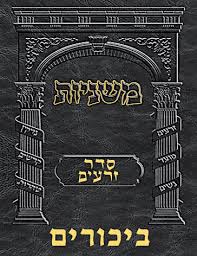
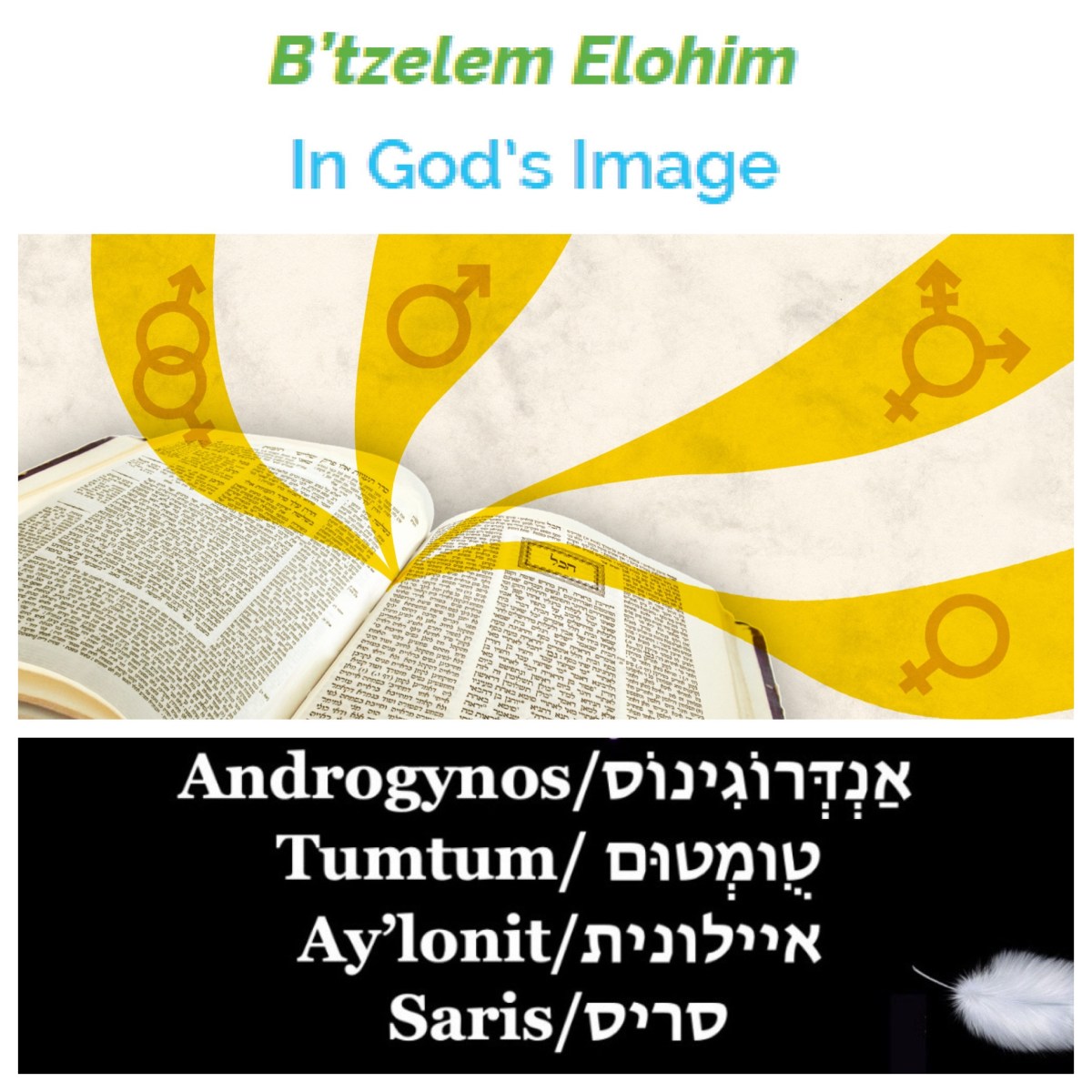
Indeed, as Jewish tradition developed over time, this fundamental duality of human gender—male and female—was questioned, probed, explored, and developed. Rabbis of late antiquity and the early medieval period (using the standard Western terminology) actually identified six genders. The first move takes place in the Mishnah (early 3rd century). Tractate Bikkurim 4.1 contains the assertion, “an Androginus (a hermaphrodite, who has both male and female reproductive organs) is similar to men in some ways and to women in other ways, in some ways to both and in some ways to neither”. It is interesting that the term androginus, a Greek term, is simply transliterated in this Aramaic work, as אדדוגינוס. That’s a sign that the consideration of this issue encompassed more than just rabbinic scholars, as they were drawing on insights and term androginus from the hellenised world.

The tractate Bikkurim (first fruits) is part of the first order
of the Mishnah, entitled Zera’im (seeds).

The text of Bikkurim goes on to offer indications of the ways that an androginus person is similar to, and dissimilar to, each gender (4.2–3). Another passage in the Mishnah identifies people known as a saris, סריס (Yevamot 8.4). These are people we identify as eunuchs; whether these are “eunuchs who have been so from birth … eunuchs who have been made eunuchs by others … [or] eunuchs who have made themselves eunuchs” (as Matthew reports Jesus saying, Matt 19:12) is not relevant in this context; but we do meet such a person at Acts 8:27. Presumably, the rabbis refer to males with arrested sexual development who are unable to procreate.  The female term for such people is given as aylonit, אילונית. The discussion that follows makes it clear that these people are women with arrested sexual development who cannot bear children.

So this means that rabbis recognised four genders: male, female, androgyne, and eunuch. In the Babylonian Talmud (sixth century CE), Rabbi Ammi is quoted as stating that “Abraham and Sarah were originally tumtumim” (טומטמין). Here we find another gender identity term; this time, describing people a person whose sex was unknown because their genitalia were hidden, undeveloped, or difficult to determine. (The Hebrew word tumtum means “hidden”.)

Thus, Abraham and Sarah lived most of their life as infertile, as their sex was not clear; and then, in Rabbi Ammi’s explanation, miraculously turned into a fertile husband and wife in their old age. The Rabbi points to Isa 51:1–2, saying that the instruction to “look to the rock from where you were hewn, and to the hole of the pit from where you were dug […] look to Abraham your father and to Sarah who bore you” explains their genitals being uncovered and miraculously remade.

(Explaining one scripture passage by drawing on another passage, however distantly related—often through their sharing a common word or phrase—was a common rabbinic mode of scripture interpretation.)

Today, we would explain the phenomenon of a tumtum as being an intersex person, born with both male and female characteristics, including genitalia—although modern science would not go so far as to accept a miraculous reversal of the condition, as Rabbi Ammi proposed. 

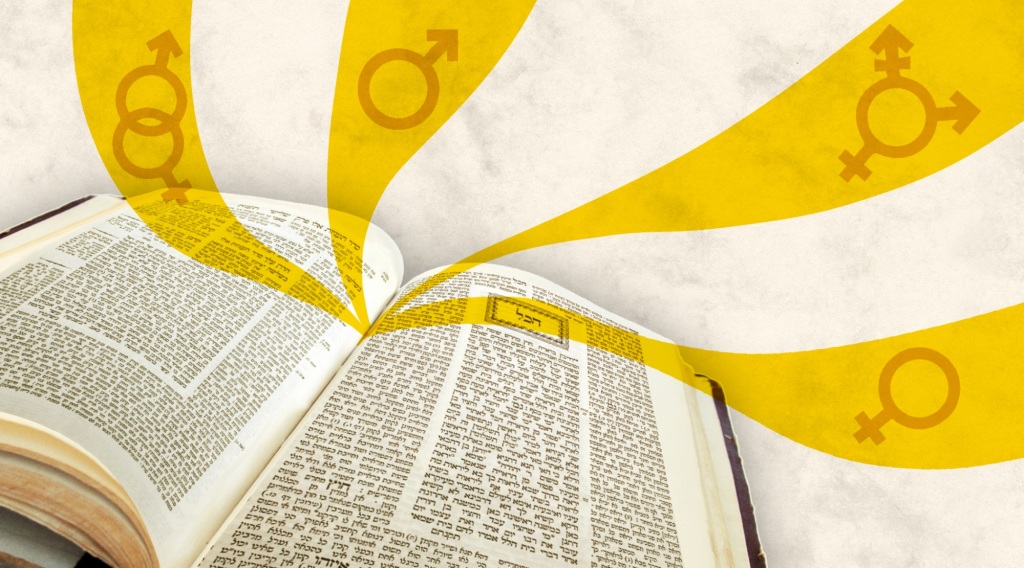
There’s a quite accessible discussion of these issues in an article on My Jewish Learning by Dr Rachel Scheinerman, entitled “The Eight Genders in the Talmud”. The title reflects the fact that Dr Scheinerman divides both aylonit and saris into two, on the basis of birth identification. So she lists: (1) zachar, male; (2) nekevah, female; (3) androgynos, having both male and female characteristics; (4) tumtum, lacking sexual characteristics; (5) aylonit hamah, identified female at birth but later naturally developing male characteristics; (6) aylonit adam, identified female at birth but later developing male characteristics through human intervention; (7) saris hamah, identified male at birth but later naturally developing female characteristics; and (8) saris adam, identified male at birth and later developing female characteristics through human intervention.

Dr Scheinerman concludes, “In recent decades, queer Jews and allies have sought to reinterpret these eight genders of the Talmud as a way of reclaiming a positive space for nonbinary Jews in the tradition. The starting point is that while it is true that the Talmud understands gender to largely operate on a binary axis, the rabbis clearly understood that not everyone fits these categories.”

https://www.myjewishlearning.com/article/the-eight-genders-in-the-talmud/

Dr. Charlotte Elisheva Fonrobert, a Talmudic scholar in the Department of Religious Studies at Stanford University, California, has provided a much more detailed and technical discussion of the matter of gender identity, in the online resource the Jewish Women’s Archive. See 

https://www.myjewishlearning.com/article/the-eight-genders-in-the-talmud/

The abstract of this article reads:

“Jewish law is based on an assumption of gender duality, and fundamental mishnaic texts indicate that this halakhic duality is not conceived symmetrically (as seen through the gendered exemptions of some commandments). Rabbinic halakhic discourse institutes a functional gender duality, anchored in the need of reproduction of the Jewish collective body. As such, it aims to enforce and normalize a congruence between sexed bodies and gendered identities. Furthermore, the semiotics of body surfaces produces other different and seemingly more ambiguous gender possibilities, and rabbinic discourse has widely discussed the halakhic implications of these ambiguities.”

What that means, I think, is that whilst Torah prescriptions are based on a definite duality of gender (you re either male or female), later rabbinic discussions entertained the possibility of a range of gender identifications. In this regard, the rabbinic discussions prefigured the move in contemporary society to recognise the full spectrum of diversity amongst human beings: some men are gay, some women are lesbian; some people are bisexual, attracted to both genders, while others are asexual, having no sexual-attraction feelings at all.

Biologically, we know that some are born intersex, with both male and female physical characteristics; whilst psychologically, some people are born into a body that is clearly one gender have an internal energy that leads them to identify with the opposite gender, and so they undergo a medical transition to that gender, and we identify them as transgender people. And so, we have the now-widespread “alphabet soup” of LGBTIQA+ (where the plus sign indicates there may well be other permutations within this widely diverse spectrum).

So we would do well not to remain in a static state of assertion that the Genesis text is a prescription for how human beings should be identified (and a definition for marriage). I think it is preferable to add into the discussion both the rabbinic understandings,  contemporary medical understandings, and psychological insights that reveal a wide spectrum of gender identities; a dazzling kaleidoscope of “letters”, as it were. For this is how we human beings are made, in an image that reflects the diversity and all-encompassing nature of God. Rather than misusing the Genesis/Mark text as a club to batter people into submission, let’s rejoice in the diversity we see amongst humanity, and affirm that, no matter whether L or G, whether B or A, whether T or I, all people who are Q, and all who are straight, are “fearfully and wonderfully made” (Ps 139:14).

There is a helpful collection of Jewish texts relating to this matter in the online resource, Sefaria, entitled “More Than Just Male and Female: The Six Genders in Ancient Jewish Thought”, collated by Rabbi Sarah Freidson of Temple Beth Shalom in Mahopac, NY, USA. See

https://www.sefaria.org/sheets/37225?lang=bi

See also 


Male and female he made them (Mark 10; Pentecost 20B)

The passage that is set forth by the lectionary for this Sunday (Mark 10:2–16) comes at a pivotal moment in the narrative that Mark narrates. For almost all of the nine chapters that have come before, Jesus has been in Galilee (see 1:14, 16–20, 28, 39; 3:7; 7:31; 9:30), including time in Capernaum (1:21; 2:1; 9:33) and Nazareth (6:1–6; Jesus was known as “Jesus of Nazareth”, see 1:9, 24; 10:47; 14:67; 16:6). Now he makes a decision to turn south and head to Jerusalem, the southern capital. 

Mark makes a very bare geographical report: “he left that place and went to the region of Judea and beyond the Jordan” (Mark 10:1). Luke, at the equivalent place in his narrative, declares “when the days drew near for him to be taken up, he set his face to go to Jerusalem” (Luke 9:51). For Luke, this is a momentous turning point; he uses  some weighty theological terms to mark the moment. When Jesus “set his face” to go to Jerusalem, he echoes the prophetic decision to pronounce judgement on Jerusalem (Isa 50:7; Jer 21:10; Ezek 4:3, 7; 6:2; 13:17; 14:8; 15:7; 20:46; 21:2; 25:2; 28:21; 29:2; 35:2; 38:2).

By noting that “the days drew near”, Luke uses a verb (symplērousthai) found also at Acts 2:1, to announce the coming of the Spirit at Pentecost. And the days that were drawing near were when he was “to be taken up”, looking ahead to the ascension (analēmpsin) which concludes Luke’s first volume (Luke 25:50–53)  and opens his second volume (Acts 1:6–11).

All of that is missing from the simple geographical comment of Mark 10:1. In this Gospel, the significant theological weighting that is inherent in the turn to Jerusalem that Jesus undertakes is invested in the scene where he has his followers find a donkey, and he rides into the city to the acclaim of the crowd: “Hosanna! Blessed is the one who comes in the name of the Lord! Blessed is the coming kingdom of our ancestor David! Hosanna in the highest heaven!” (Mark 11:9–10).

Before that, however, Jesus has to deal, yet again, with some Pharisees (10:2). He had previously had debates with northern Pharisees in Galilee a number of times (2:15–17, 18–22, 23–28; 3:1–6; 7:1–13; 8:11–12). This time, amidst the crowds gathered to hear Jesus in “the region of Judea and beyond the Jordan”, some southern Pharisees now come “to test him” (10:2), as their brothers had done earlier (8:11)—the same dynamic that Mark had reported at the very start of the public activity of Jesus, when the Spirit cast him out into the wilderness “being tested by Satan” (1:12–13).

The test set by the Pharisees relates to the matter of divorce. They had a clear cut point of view about this, although in typical Pharisaic—rabbinic style they begin by posing a question. We have seen this technique before. “Why do John’s disciples and the disciples of the Pharisees fast, but your disciples do not fast?” they ask in Galilee (2:18); and then, “Look, why are they doing what is not lawful on the sabbath?” in a grain field (2:24). 

After Jesus had returned from a trip across the Sea of Galilee to “the other side”, a group of Pharisees ask him, “Why do your disciples not live according to the tradition of the elders, but eat with defiled hands?” (7:5 ). In Dalmanutha, some Pharisees approached Jesus “and began to argue with him, asking him for a sign from heaven, to test him” (8:11). And then, in the passage before us this week, once Jesus is in Judea some Pharisees come “to test him” by asking this question, “Is it lawful for a man to divorce his wife?” (10:2).

Jesus, of course—being well-schooled in the business of public disputation on matters of Torah—responds to their question with his own question: “What did Moses command you?” (10:3). This, of course, steers the discussion into the heart of the matter: the specific text from Torah which provided guidance on this matter. From here, the debate continues along a familiar pathway, with the Pharisees offering a scripture passage (10:4, referring to Deut 24:1), Jesus responding with an interpretation (10:5) followed by his proposing one scripture passage of relevance (10:6, quoting Gen 1:27) followed immediately by another passage (10:7–9, quoting Gen 2:24). The to-and-fro of scripture citation, interpretation, counter-proposal, and argumentation, is familiar ground for Jesus.

On the matter of divorce, there were different schools of thought amongst Jewish teachers. In biblical law, a husband has the right to divorce his wife, but a wife cannot initiate a divorce (Deut 24:1). A husband could initiate a divorce if he believes there is some uncleanness in his wife. Understandings as to what such uncleanness might varied. At one extreme was the narrow interpretation that divorce was possible only because of adultery. According to the Mishnah (Gittin 9.10), this view was articulated by Beit Shammai, those following the interpretation set forth by rabbi Shammai.

A much broader understanding was adopted within Beit Hillel, that almost any dissatisfaction with his wife’s behaviour could validate a man’s application for a divorce. The Mishnah tractate reports “he may divorce her … because she burned or over-salted his dish … even if he found another woman who is better looking than her and wishes to marry her” (Mishnah, Gittin 9.10).

The line that Jesus takes is to reject the wider understanding; he tells the Pharisees this was decreed by Moses “because of your hardness of heart” (Mark 10:5). That seems to indicate something contingent about the nature of this particular commandment. So Jesus here is practising the kind of evaluation of texts that we know various Torah interpreters practised. He does not simply quote the text and then say “that’s it, case closed”; he undertakes an evaluative interpretation of those older words.

This is a very rabbinic way to operate. A later rabbinic text, Makkot 23b—24a in the Babylonian Talmud (probably compiled in the 6th century CE) reports a debate between rabbis as to how many commandments were included in the Torah. Rebbi Simlai ventured a count of 613 (“two hundred and sixty five prohibtions in accordance with the days of the sun; and two hundred and forty eight positive commandments in accordance with the limbs of a person”). Rav Hamnunya then suggested that David had identified eleven commandments (citing Psalm 15), then Isaiah narrowed this to six (Isa 33:15), then Micah spoke the three key commandments (“do justly, and love mercy, and walk discreetly with your God”, Mic 6:8).

Next, Isaiah is cited once more, from the beginning of what we identify as Third Isaiah (“guard justice and do righteousness”, Isa 56:1). Finally, Amos is cited, with the singular command, “seek me and live” (Amos 5:4). To which Rav Nachman bar Yitzchak responded, saying “maybe it means to seek out the entire Torah?”—although he then proceeds to cite Hab 2:4, “the righteous shall live by his faith”, as the foundational commandment. (We know this obscure prophetic text because it forms the basis for Paul’s declaration of the Gospel to the saints in Rome at Rom 1:16–17). 

You can read the whole debate (in Aramaic, with English translation) on the website Sefaria:

https://www.sefaria.org/Makkot.24a.27?ven=Sefaria_Community_Translation&lang=bi

All of which is to say that, as we read and hear the passage from Mark 10 that is offered by the lectionary, we need to understand the context and apply our learnings from that to the text. The words of Jesus should not be plucked out of context, made to stand in bare isolation, and treated as an eternal, unchanging word of the Lord. That is to misunderstand what is going on in this passage.

Jesus and the Pharisees are setting forth their different understandings. Through this process of debate and discussion, deeper understanding emerges. Rabbis even to this day value vigorous debate and robust questioning, for this is the way that God’s truth emerges. I learnt this with a vengeance some decades ago, when ministering in a congregation set in the Eastern Suburbs of Sydney, where there was a high concentration of Jewish residents. 

Many of the Jewish residents came to the weekly School for Seniors that we ran in the church building, and quite a few Jews joined with Christians in the weekly Jewish—Christian Dialogue group that I ran. We had many Fridays of vigorous disputation and robust argumentation—all in a good cause, all as friends together. And the same congenial experience was repeated many times during my years on the National Uniting Church Dialogue with the Jewish Community!

So let us not read the declaration of Jesus about divorce as a set-in-stone decree, valid for all times. As a divorced and remarried person, I know all too well the dangers that are inherent in such a reading. For a time, some decades after my divorce, I was pursued online by a rabid fundamentalist who condemned me as “doomed to hell”, told me that I was an “apostate” who “has been deceived”, that I am “hell bound without repentance”, and offering the graphic description of my fate, that I was condemned to the eternal lake of burning sulphur (Rev 20:7–10 and 21:8). All because I was divorced and remarried!!!

Society changes, situations develop, understandings deepen and are reshaped by our contexts. We rightly, today, accept that divorce may be the best way ahead for some people, on pastoral and personal grounds. Our laws accept that, and my denomination, the Uniting Church in Australia, accepts that. We bring more factors into the discussion that were not being considered in the brief interaction that Mark reports in ch.10.

In like fashion, countless people have been hurt—many of them deeply hurt—by the fundamentalist insistence that, when he debated the Pharisees in this encounter, Jesus was setting forth “a biblical definition of marriage” that is immutable, when he said, “from the beginning of creation, ‘God made them male and female.’ ‘For this reason a man shall leave his father and mother and be joined to his wife, and the two shall become one flesh.’” (Mark 10:6–7).

Such people place the words of Jesus over and against those people who identify as “queer”—gay, lesbian, bisexual, and also now transgender—and whose love, deep and abiding, for a person of the same gender as they are. Forbidden by law to marry until recent years (2017 in Australia), these people are told “marriage is between a man and a woman”, citing the words of Jesus from this week’s Gospel passage. Again, the argument is simplistic: “Jesus said this, this is what it means, end of discussion, case closed”. It’s a hurtful and uninformed way to operate, in my opinion.

What would Jesus have done if confronted with scenarios of increased domestic violence and toxic masculinity feeding unhealthy and damaging relationships? Would he have replied as a fundamentalist: “that’s what Moses said, that’s it”? Or would he have offered a rabbinic explanation, offering different factors and exploring new pathways of understanding? I suspect the latter.

So let’s not use this passage as a word that is prescriptive—that says something like “this is what the text says, and it expresses exactly how God defines marriage and forbids divorce, and that stands for all times and all places”. The text, in my opinion, gives no indication that a general principle, prescribing human behaviour, is being set forth. Indeed, the Genesis passage about marriage that is cited by Jesus is not from a book that sets out Torah commandments; rather, it is from a narrative work. 

Rather, I see it as descriptive—that offers a description of how human beings behave and what should guide us as we navigate our way through life, based on our experiences and reflection on how things have been for us. Indeed, whilst the quote from Moses (in Deut 24) does have a legal tone to it, it needs to be understood within the back-and-forth that characterised rabbinic interpretation of Torah (an ethos shared by Jesus); and the Genesis quote, it should be noted, comes from a book that contains aetiological narratives (which I have explained in my earlier blogs on the Genesis narratives), describing the world and the place of humans in that world on the basis of observation and experience.

So let’s offer Jesus—and the Pharisees—the respect that they deserve as they discuss and debate, and not try to press their words in a direction that they never intended.

For more on this passage, see

For more on the matter of same-gender marriage, which has been permissible within my church since 2018, see

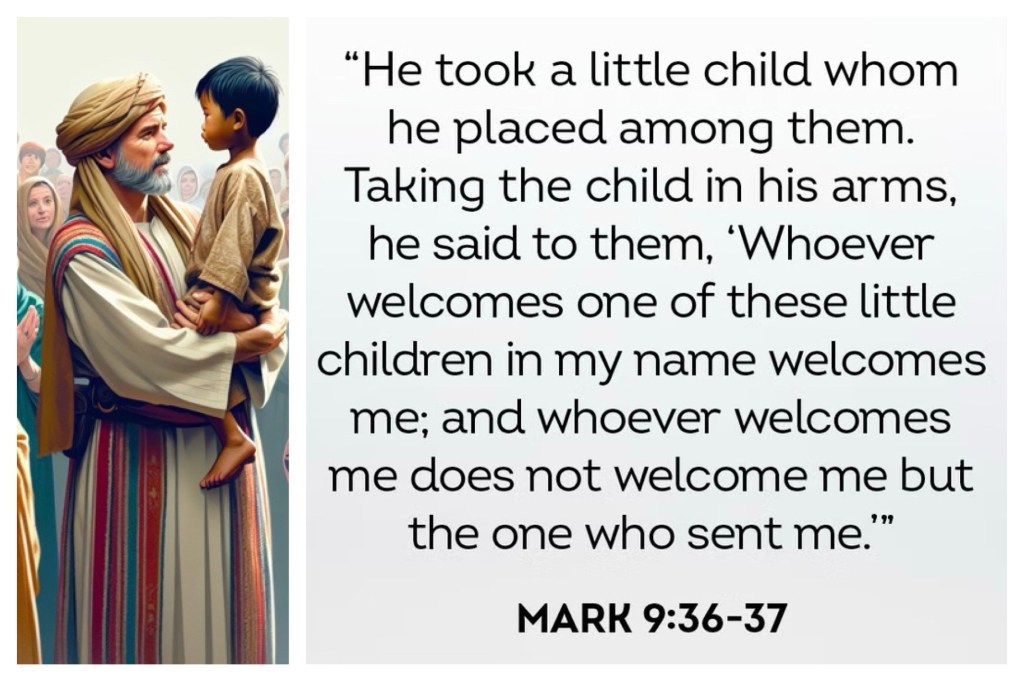
He took a little child … and taking it in his arms … (Mark 9; Pentecost 18B)

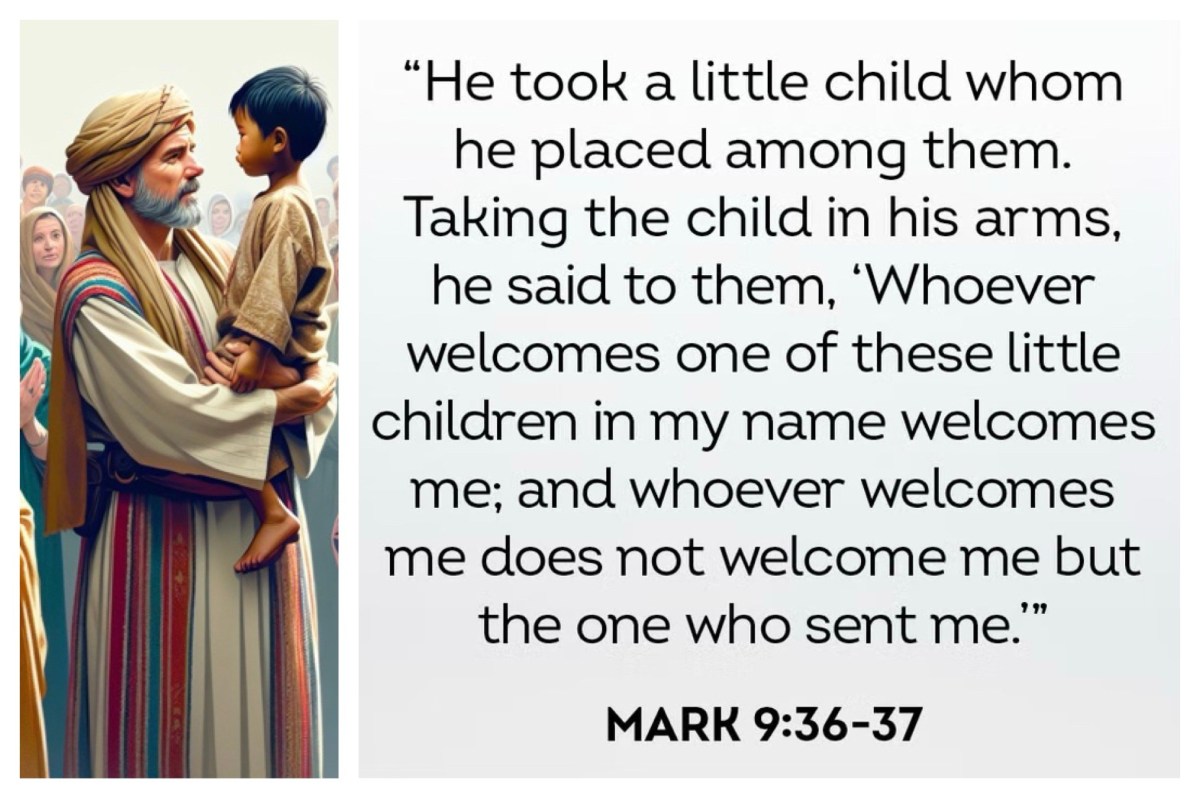
“Whoever welcomes one such child in my name welcomes me, and whoever welcomes me welcomes not me but the one who sent me.” In this striking statement, which occurs in the lectionary Gospel passage we hear this coming Sunday (Mark 9:30–37), Jesus does two important things.

The first is that he prioritises one of the least important figures in ancient society—a child—and puts them forth as a representative of him The second is that he then uses this affirmation as the basis for making a statement about his relationship to God.

First, Jesus affirms the central significance of a child in his consideration of this issue. Mark notes that Jesus “took a little child and put it among them” (9:36), using the presence of this child to undergird his statement about welcoming such a child (9:37). Still earlier, Jesus had placed the health of a child at the centre of his focus, when approached by a synagogue leader, who pleads with Jesus, “my little daughter is at the point of death; come and lay your hands on her, so that she may be made well, and live” (5:23).

In ancient times, a child was inevitably a person with no authority, no status, no prestige or power, in the society of the day; yet the low-status, not-important child is the exemplar, not only of Jesus, but of God, “the one who sent me” (9:37). Welcoming the  child is a clear manifestation of the paradox that lies at the heart of the Gospel. Jesus is the one who will walk resolutely towards death (8:31: 9:31: 10:34), becoming “the slave of all” (10:44) who will “give his life a ransom for many” (10:45). Along this pathway, it is the child who best exemplifies the simplicity of this sacrificial service; it is the child who best prefigures the fullness of life promised in the coming age.

Interestingly, in the Hebrew Scriptures which formed the context for Jesus’ faith development, there are some fascinating examples of the value and power of younger people. Young Isaac questions his father Abraham, who is about to sacrifice him, asking him, “where is the lamb for a burnt offering?” (Gen 22:7). 17-year-old Joseph boldly shares his dreams with his brothers, taking the risk of alienating himself from them (Gen 37:1–11). The young boy Samuel hears God’s call in the temple (1 Sam 3:1–18); he grows to become “a trustworthy prophet of the Lord” (1 Sam 3:20) who will play a pivotal role in events leading to the establishment of a king in Israel. And before he became one of those kings, a youthful David enters the battlefield and, against all the odds, slays the giant Goliath (1 Sam 17). 

Alongside these young men in scripture, there are girls who also have significant roles to play. An adolescent Rebekah eagerly offers hospitality to visitors and ultimately receives the blessing of “thousands of myriads” of descendants (Gen 24:15–60). The young Miriam bravely negotiates with Pharaoh’s daughter to ensure the safety of her newly-born brother Moses (Exod 2:1–10). A young princess Tamar speaks eloquently to Amnon; ultimately, she is unsuccessful in resisting his sexual assault, but this is the beginning of his downfall (2 Sam 13:1–20). Then, at the end of his life, it is the young Abishag who faithfully serves the ageing king, David (1 Kgs 1:1–4).

Jesus has many role models of children, young people, to draw on from his heritage. He knows that they are able to speak the truth and act with integrity. So he happily receives children as they come to him and highlights them as models of the kind of life that is needed to enter the kingdom of God. Those who follow Jesus on his pathway to that kingdom will need to take up their crosses (8:34), lose their lives (8:35), be “last of all and servant of all” (9:35), “receive the kingdom of God as a little child” (10:15), sell all that they possess (10:21), leave their families (10:29), and become “last of all” (10:31). (See https://johntsquires.com/2021/09/06/the-paradoxes-of-discipleship-mark-8-pentecost-16b/)

So, the children show how Jesus is in relationship with God; “whoever welcomes one such child in my name welcomes me, and whoever welcomes me welcomes not me but the one who sent me” (Mark 9:37). In this saying, Jesus offers a description of God as “the one who sent me”. This Markan saying is found also in a Lukan form, with the same words followed by the tag, “for the least among all of you is the greatest” (Luke 9:48).

A related version of this saying appears in the Q tradition, which lacks direct reference to the child (Matt 10:40 and Luke 10:16), although the context in Matt 10 does develop the central idea of the saying, and adds a further saying about giving “a cup of cold water to one of these little ones” (Matt 10:42).

The saying has close links with a turn of phrase found in another strand of the tradition—that found in John’s Gospel. Identifying God as “the one who sent me” first appears in this Gospel on the mouth of John, who refers to “the one who sent me to baptize with water” (John 1:33). This phrase is picked up by the Johannine Jesus, who uses it no less than 22 times to refer to God. It is an interesting overlap of the streams of tradition that are usually considered in isolation from one another, as if they never overlapped. Yet here, Johannine tradition bears similarities with Markan tradition and Q material.

In John’s Gospel, Jesus declares that “my food is to do the will of him who sent me and to complete his work” (4:34; 9:4) and “I seek to do not my own will but the will of him who sent me” (5:30; 6:38–39). The Johannine Jesus refers to God as the one who sent him as he declares that “my teaching is not mine but his who sent me” (7:16) and notes that “the Father who sent me has himself given me a commandment about what to say and what to speak” (12:49; 14:24).

As Jesus affirms that “the one who sent me is true” (7:28; 8:26), he looks to his return to be with God in sayings that use this phrase: “I will be with you a little while longer, and then I am going to him who sent me” (7:33; 16:5). Indeed, Jesus asserts that “the one who sent me is with me; he has not left me alone, for I always do what is pleasing to him” (8:29). 

Because of this belief, in the first farewell discourse at his last meal with his disciples, Jesus speaks the same word that we have heard in Mark 9:37, namely, “whoever receives one whom I send receives me; and whoever receives me receives him who sent me” (John 13:20). The phrase is integral to the Johannine concept of the Union of Father and Son, most famously expressed as “the Father and I are one” (10:20). 

That intimate relationship that Jesus has with God is emphasised in the final High Priestly Prayer of the Johannine Jesus, where Jesus prays “you, Father, are in me and I am in you” (17:21), for the Father has given him his glory (17:22). This intimacy provides the basis for the charge that Jesus gives his disciples: “as the Father has sent me, so I send you” (20:21); as he has prayed for them, “the glory that you have given me I have given them, so that they may be one, as we are one, I in them and you in me, that they may become completely one, so that the world may know that you have sent me and have loved them even as you have loved me” (17:22–23).

This rich and extensive theological understanding of the relationship between Jesus as Son and God as Father is developed throughout John’s Gospel. It is hinted at in the saying found at Mark 9:37 and its synoptic parallels, but receives no development in those three Gospels. There, Jesus is chosen by God for a purpose—sent, if you will—but no thought of organic unity of the two persons is ventured in those works. 

Jesus is the messenger of God, telling in his words and showing in his life how God wishes people to live. And most powerfully of all, Jesus declares, this life that he, the special child of God, advocates, is seen simply in “a little child” from within our midst.

The head of John and the politics of ancient Judea (Mark 6; Pentecost 8B)

The passage we explore today takes us into the world of politics in ancient Judea. It is the story of Herod, Herodias, and John the baptiser (Mark 6:14–29). The Herod in this story is Herod Antipas, the son of Herod the Great, who features in Matthew’s account of the birth of Jesus, as the ruler ordering the killing of “all the children in and around Bethlehem who were two years old or under” (Matt 2:16). He is the same Herod to whom Jesus was sent in the course of his trial before Pilate—at least, according to Luke’s account (Luke 23:6–12).

Just as the birth and death of Jesus are each immersed in the politics of the day, so too the death of John the Baptist is best understood in terms of the politics of the day. The story appears at this point, midway through Mark’s narrative, even though John had been beheaded at the command of Herod Antipas some time earlier (Mark 6:17).

Luke, in fact, locates the arrest of John immediately after reporting his baptising and preaching activity “in the wilderness” (Luke 3:1–20), before mentioning, in a brief aside, that Herod had beheaded John (Luke 9:9).

Mark, once again, provides us with plentiful details about the incident: Herod’s protection of John (Mark 6:20), that he liked to listen to John (6:21), his granting of a wish to his daughter Herodias (6:22), the consultation Herodias then had with her mother (6:24), the grief of Herod when he had to adhere to his promise to fulfil the wishes of Herodias (6:26), and the reverent disposal of John’s body by his disciples (6:29). Matthew reports each of these elements, with far fewer words—although he does add that John’s disciples, after burying his body, “went and told Jesus” (Matt 14:12).

Luke omits all of these details, noting only the arrest and the beheading of John in terse narrative comments. John makes no mention at all of Herod, and in his Gospel the figure of the Baptist serves primarily to point to Jesus as Messiah (John 1:6–8, 15, 19–28, 29–34; 3:25–30; 5:33; 10:41). John the evangelist knows that John was baptising (3:23), in apparent competition with the disciples of Jesus (4:1–2); perhaps these were the disciples of John who left him to follow Jesus (1:35–42)? The evangelist also knows that he was arrested (3:24), but reports nothing of his death.

So Mark offers a rich narrative with many details. It seems that this was a story “doing the rounds” at the time. The story criticised Herod—who was not popular among the Jews. Telling the story gave an indirect way to criticise him, albeit in an indirect way. The “hero” of the story—John, who tragically meets his death—is the polar opposite of Herod. John was austere, ascetic, and obedient to God; Herod was profligate, extravagant, and ran his territory of Galilee according to Roman custom.

Herod and John

One detail that neither Mark, nor the other evangelists, includes, is that the Hebrew name of Herodias, the daughter of Herod Antipas, was Salome—the name by which she is best known in subsequent art and literature. Salome’s “dance of the seven veils” (another detail absent from the Gospel narratives!) is renowned, having inspired paintings by Titian and Moreau, an 1891 play by Oscar Wilde, a 1905 opera by Richard Strauss, and a 1953 film starring Rita Hayworth.

Indeed, in his recent book Christmaker (Eerdmans, 2024), Prof. James McGrath observes that “the best-known elements of the story—the dance of Salome, the promise of Herod, and John’s head on a platter—are the ones about which a historian has the most reason to be sceptical” (p.116).

James McGrath with his book on John, Christmaker

In fact, even in a number of manuscripts (from the 500s onwards, and especially in the Latin versions), the name of the woman we find named in our Bibles as Herodias (6:22) is missing; in these, she is called “the daughter of Herodias” (and thus the granddaughter of Herod Antipas). But this is a minor point compared to some other factors.

So what do we make of this story? Why has Mark chosen to tell it?

Three Herods: untangling the knots

The Herod who appears in this story that Mark and Josephus each tell is one of three Herods mentioned in the New Testament. What follows is an attempt to untangled the knots of history and make clear where each Herod fits.

We begin with the Roman general Pompey leading Roman troops into Jerusalem in 63 BCE. Pompey granted Hyrcanus II the throne, under Roman oversight; Hyrcanus II ruled until 40 BCE. As a Roman protectorate, Judea had the right to have a king. Hyrcanus was a Hasmonean, a member of a priestly family that had worked itself into a position of power in Jerusalem after the revolt in the time of Antiochus Epiphanes (175—167 BCE).

The revolutionary activity of the Maccabees, led by a priest, Mattathias, and his five sons, sought to expel the foreigners from Israel. When Antiochus had a pagan symbol placed into the holy Temple, “Mattathias and his sons tore their clothes, put on sackcloth, and mourned greatly” (1 Macc 2:14). In the face of orders from the king’s officers, Mattathias declared, “I and my sons and my brothers will continue to live by the covenant of our ancestors. Far be it from us to desert the law and the ordinances. We will not obey the king’s words by turning aside from our religion to the right hand or to the left” (1 Macc 2:20–22).

The family of Mattathias and their followers were given the Hebrew name Maccabees, meaning hammer—reflecting the hammer blows they struck, again and again, against their enemies. From 167 BCE they fought an armed insurgency which eventually brought victory over the Seleucids in 164 BCE. For a time, Jews would rule Israel once again.

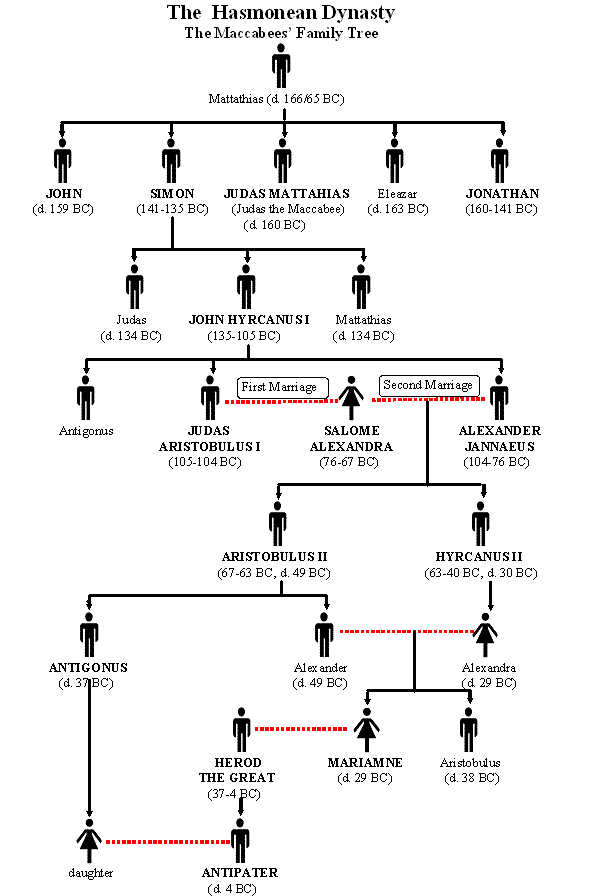
The Hasmonean dynasty

The family given the name Maccabees had at its centre a number of descendants of Hashmon (referred to by Josephus as Asmoneus at Jewish Antiquities 12.265). Thus the string of rulers drawn from this family for the ensuing century, until 63 BCE, are known as the Hasmoneans. The first three rulers from this family were sons of Mattathias: Judah (164–160), his youngest brother Jonathan (160–142), and then his oldest brother Simon (142–134). Each, in turn, moved the religious and cultural practices away from the initial zealous intention to restore Torah and Temple to Israel.

The Hasmoneans believed they should not only sit on the throne of Judah, but also exercise the responsibilities of the High Priest. Claiming this religious leadership was not in accord with the tradition that the priests came from the descendants of Aaron, the brother of Moses, descending through the tribe of Levi (Num 1:48–54; 1 Chron 6:48; 2 Chron 13:10–12; Ezek 44:15). That the Hasmonean high priests were not priests in this precise lineage was a problem for the more traditional members of Israelite society, and would foster discontent and rivalry amongst various groups with Israelite society.

In the midst of growing discontent and instability, in 40 BCE the Roman Senate declared Herod of Idumea to be “King of the Jews”. One of Herod’s many wives was Marianne, the granddaughter of both Aristobulus II and Hyrcanus II. (Aristobulus’s son, Alexander, had married Alexandria, the daughter of Hyrcanus. They were the parents of Marianne.) So he had married into the Hasmonean family.

It is said that Antigonus, the brother of Alexander and son of Aristobulus, had cut off Hyrcanus’s ears to make him unsuitable for the High Priesthood, so Antigonus ruled for three years in defiance of Rome’s decree. Herod, with the support of Mark Anthony, seized power in 37 BCE and held power until his death in 4 BCE. Hasmonean rule was at an end; Herod was an Idumean, the son of an Idumean man, Antipater, who served in the court of Hyrcanus II, and his wife Cypros, from a Nabatean Arab princess. He has been raised as a Jew, but to many Jews he was not a Jew, but an Idumean (the kingdom that had evolved from the Edomites, to the south of Judah).

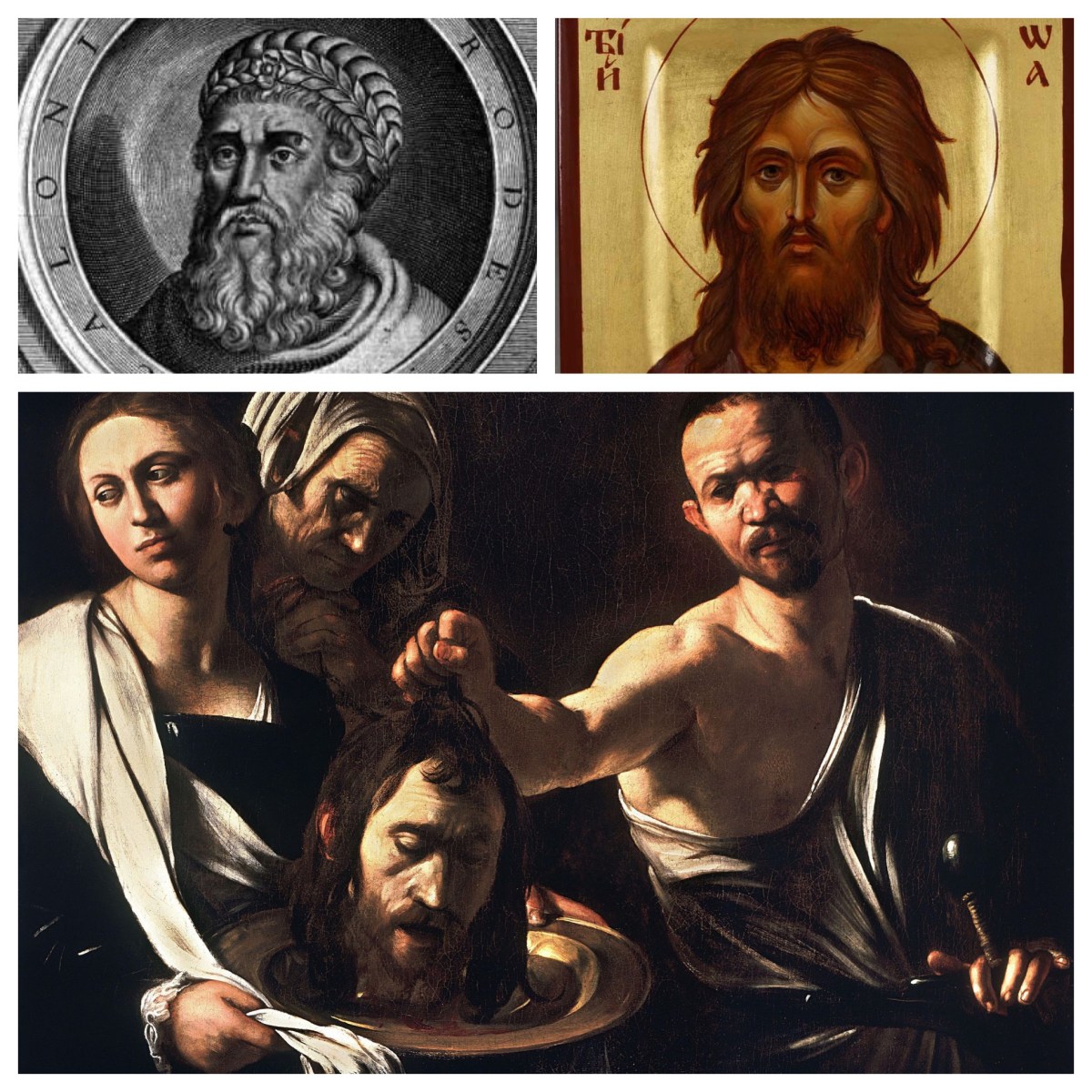
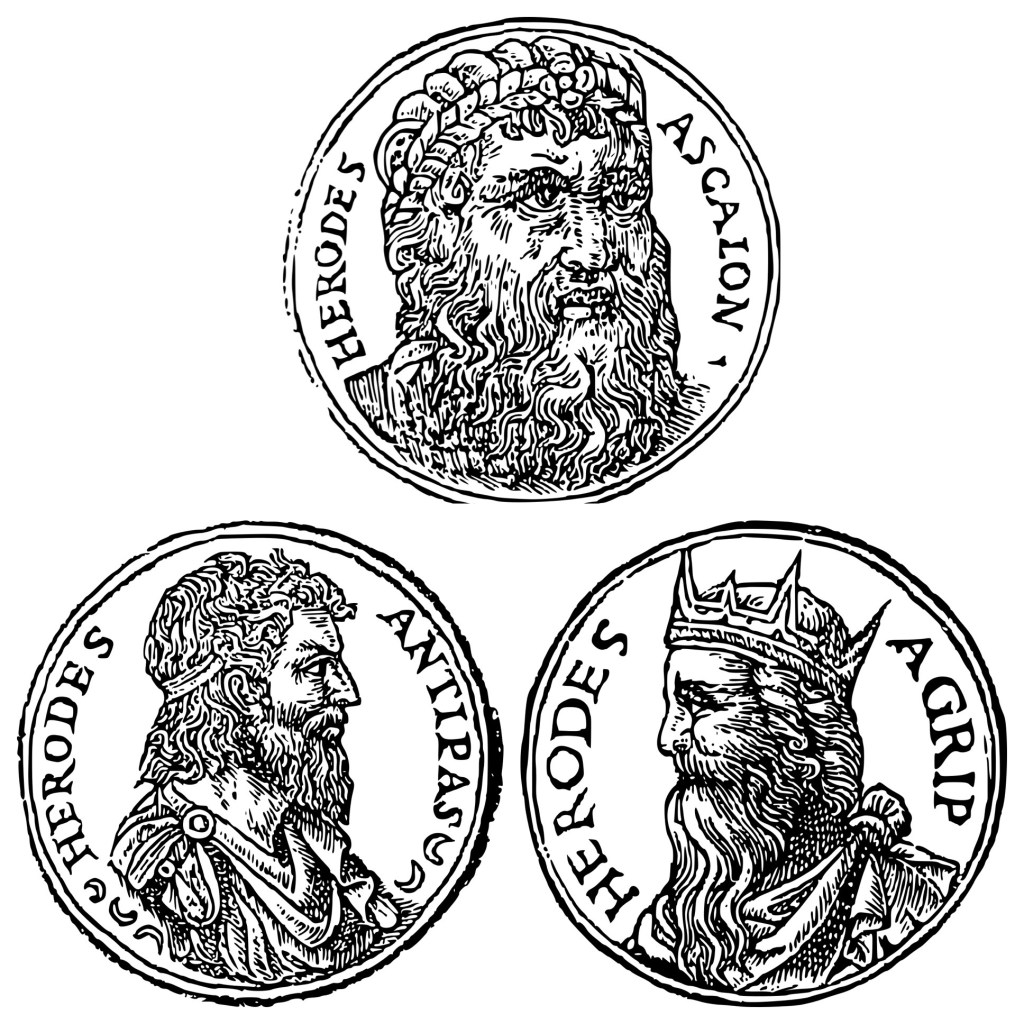
Herod the Great (top), titled “Herod Ascalon”
in light of the tradition that he was born in Ashkelon;
one of his younger sons, Herod Antipas (bottom left),
and his grandson through Aristobulus,
Herod Agrippa (bottom right)

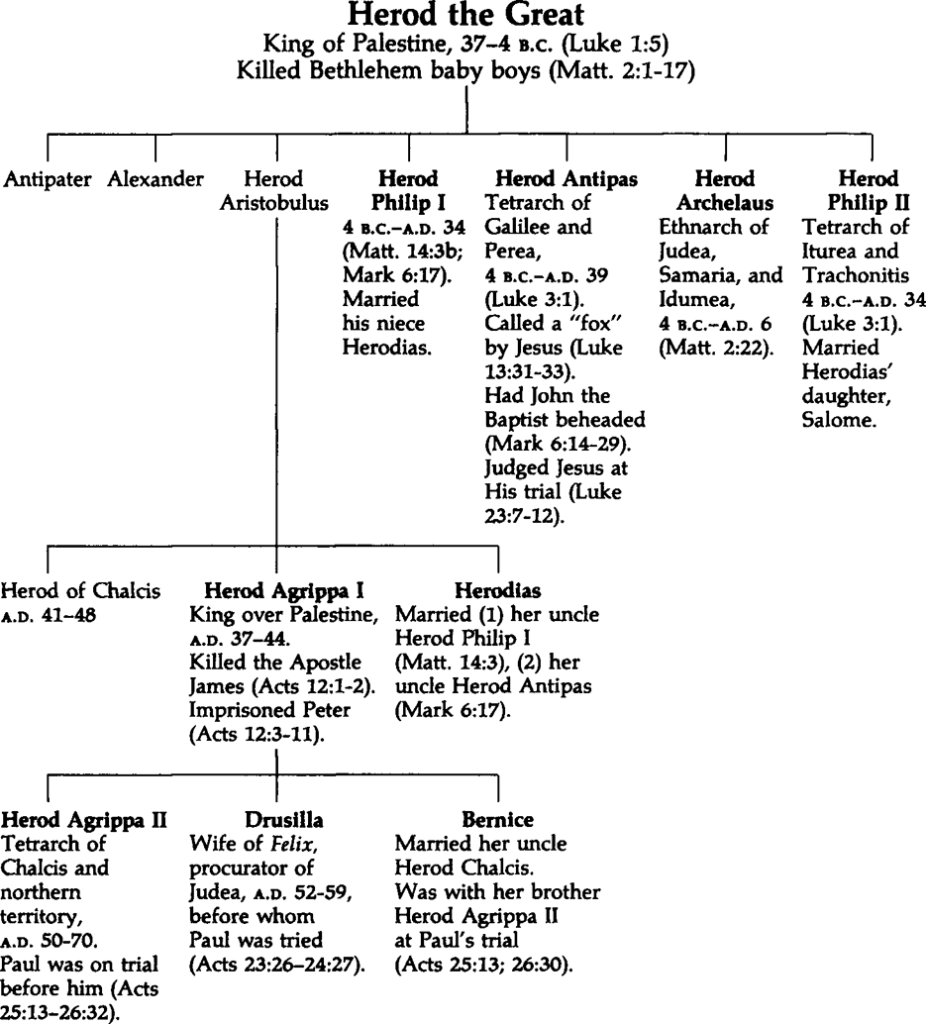
Later, after the death of Herod, one third of his kingdom (the region of Galilee) came under the control of Herod Antipas, the son of Herod the Great and one of his wives, Malthace, from Samaria. Herod senior was “Herod the Great”, the king who, according to Matthew, ordered the slaughter of all males born in Israel (Matt 2:16–18).

The Herodian family

Herod Antipas, his son, was, according to Mark, the ruler who, against his better judgement, ordered the beheading of John the baptiser (Mark 6:17–29). Herod Agrippa was another member of the family, a grandson of King Herod by another of his wives, Mariamne, who ruled as King of Judea from 41 to 44 CE. He appears as “King Agrippa” in Acts 24—25, when Paul is brought to Caesarea, the seat of government, to be judged by Agrippa, his consort Bernice, and the Roman Governor Festus.

So today’s story from Mark 6 involves the middle Herod, Herod Antipas. His relationship with John the Baptist is what lies at the heart of the account in Mark 6.

Why did Herod put John to death?

We actually have two detailed accounts of the death of John. Mark, as we have seen, portrays Herod as equivocating. He tries to move the primary responsibility of John’s death away from Herod, by interspersing his daughter and her request. Perhaps Mark feels the need to excuse the Roman-supported ruler of the time, to avoid having the Jesus movement portrayed as a terrorist movement?

After all, even though Jesus was clearly crucified under orders from the Roman Governor, Pilate (Mark 15:15), Mark does have Pilate bow to the pressure of the crowd that is calling out “crucify him”, by asking the question, “what evil has he done?” (15:12–14). It is Mark who provides our earliest source for placing the blame on the chief priests”, who had stirred up the crowd to press for Jesus to be crucified (15:10–11). So if there an apologetic purpose in the passion narrative—blame the Jews, excuse the Romans–then is a similar apologetic happening in the story of John’s death?—blame Herodias, excuse Herod.

There is an account written later than Mark, by the Jewish historian Flavius Josephus, in his history of the Jews, which he wrote under Roman patronage in the latter decades of the first century CE. Here, Josephus pins the blame squarely on Herod.

Herod Antipas had divorced his first wife Phasael, who was the daughter of the king of Nabataea. Herod Antipas then married Herodias, who had previously been married to Herod’s half-brother Herod II. John was publically critical of this (Mark 6:18; Matt 14:4; Luke 3:18).

John’s criticisms of Herod’s divorce and subsequent marriage did not sit well with Herod. John’s popularity meant that he was persuading many others to this negative view of Herod. Indeed, God later vindicates the criticisms made by John, according to Josephus, who says that God punished Herod by his later defeat in battle. Josephus writes:

“Herod had put him to death, though he was a good man and had exhorted the Jews to lead righteous lives, to practise justice towards their fellows and piety towards God, and so doing to join in baptism.

“In [John’s] view this was a necessary preliminary if baptism was to be acceptable to God. They must not employ it to gain pardon for whatever sins they committed, but as a consecration of the body implying that the soul was already thoroughly cleansed by right behaviour.

“When others too joined the crowds about him, because they were aroused to the highest degree by his sermons, Herod became alarmed. Eloquence that had so great an effect on mankind might lead to some form of sedition, for it looked as if they would be guided by John in everything that they did.

“Herod decided therefore that it would be much better to strike first and be rid of him before his work led to an uprising, than to wait for an upheaval, get involved in a difficult situation and see his mistake. Though John, because of Herod’s suspicions, was brought in chains to Machaerus, the stronghold that we have previously mentioned, and there put to death, yet the verdict of the Jews was that the destruction visited upon Herod’s army was a vindication of John, since God saw fit to inflict such a blow on Herod.” (Jewish Antiquities 18.116–19)

Josephus sides with God, in arguing that Herod did the wrong thing by putting John to death—and he paid for it later on. Mark sides a little more with Herod, in seeking to excuse him and shift the blame elsewhere.

So we might well ponder: How do we respond to the idea that as they tell the story of John and Herod, both the evangelist Mark, and Flavius Josephus have apologetic purposes? Josephus puts the blame on Herod. Mark shapes the story to excuse certain people and shift the blame to others. Does this cause us to question the historical value of these texts? Are we more inclined to believe Mark rather than Josephus? or the other way around? Why might that be?

John and the prophetic tradition

The fact that Herod finds John to be of interest is rather unusual. As a ruler under Roman control, he might be expected to want to repress Jewish voices, to ensure that order is kept in society. And yet, Herod has a Jewish heritage, and would know of the importance of the voice of the prophets within that heritage.

Nathan called out David for his adultery (2 Sam 12). Elijah spoke boldly against King Ahab (1 Ki 17–19, 21) and King Ahaziah in Samaria (2 Ki 1). Elisha spoke out to King Jehoram (2 Ki 3). Amos spoke out against King Jeroboam (Amos 7). Isaiah declared the word of the Lord to Hezekiah (2 Ki 20).

Haggai likewise guided Zerubbabel, the governor of Judah, after the exile (Hag 1) and at the same time Zechariah was making declarations to King Darius of Persia (Zech 7). The role of the prophet was to be an essential, irritant in the ears of rulers, to be the niggling (and perhaps even booming) voice in the ears of rulers.

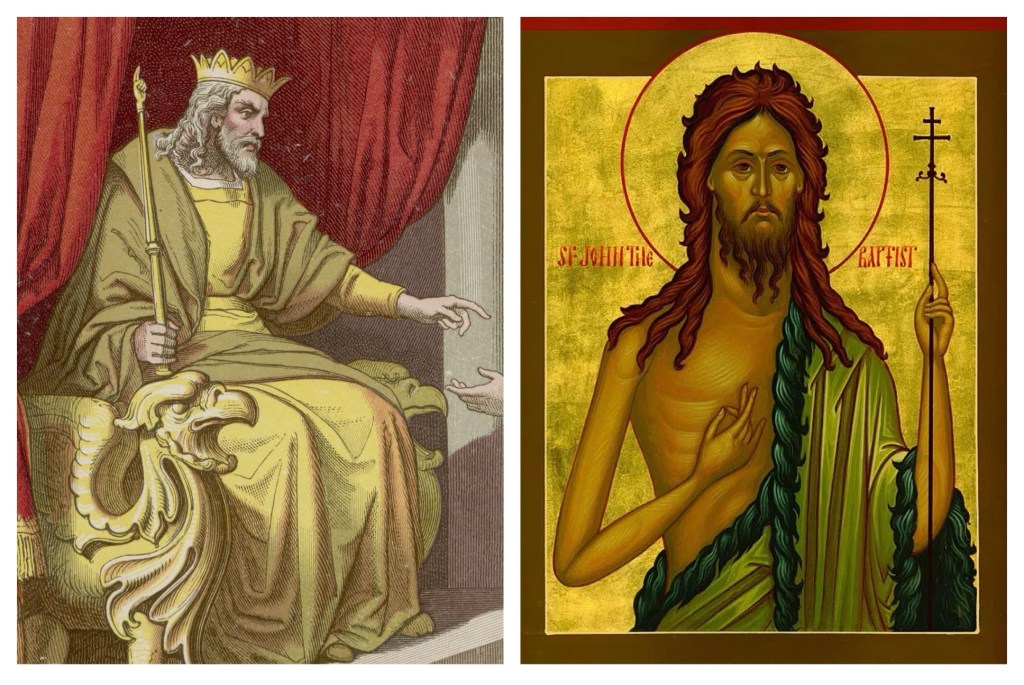
A depiction of John

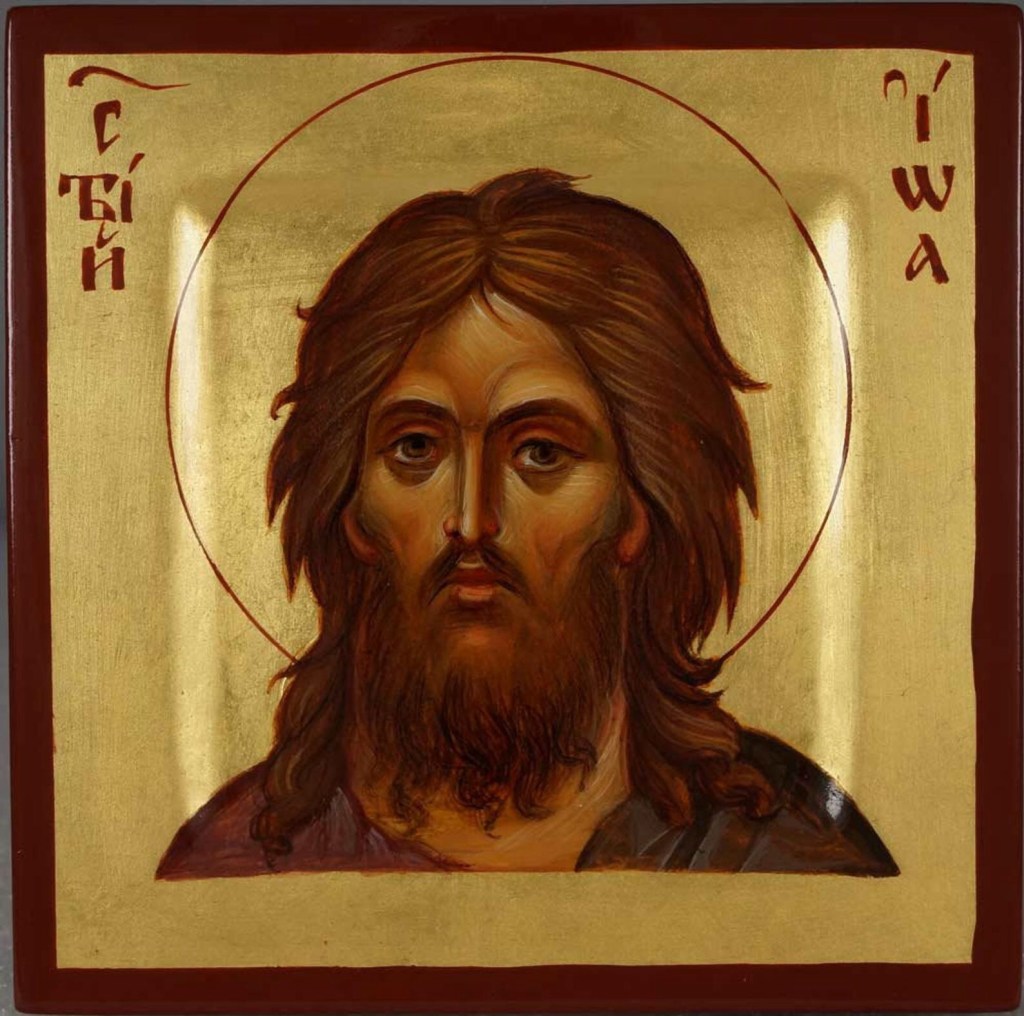
John stands, it would seem, in that tradition. Not only was he an irritant to “people from the whole Judean countryside and all the people of Jerusalem” (Mark 1:5), calling them to repentance and baptizing them as they confessed their sins. He was also, according to this story, an irritant to the ruler of the time—Herod Antipas. Herod, Mark says, regarded John as “a righteous and holy man” (6:20)—high praise indeed. Herod, Mark says, “protected” John and “liked to listen to him” (6:20). And yet, he is persuaded to arrest and then behead John, not of his own initiative, but by keeping the promise he had made to Herodias (6:26–28).

We have noted briefly that the stories of the death of John and the death of Jesus have certain similarities. John functioned as a prophet, apparently speaking to those in power. Jesus also conducted himself in a prophetic manner, speaking about the kingdom which God was going to bring in—although he talked about this, not directly to those in power, but to the people of Galilee and, ultimately, of Jerusalem.

John’s popularity was his undoing; it seemed that many liked to listen to John and accepted his criticisms of Herod and Herodias. Jesus’s popularity was also his undoing. Large crowds had followed Jesus since early in Galilee (2:13; 3:20, 32; 4:1; 5:21; 24, 30–31; 6:34; 7:14; 8:1–2, 34; 9:14–15, 25; 10:1, 46; 11:18; 12:37).

The Jewish leadership in Jerusalem were offended at the teachings they heard from Jesus in the temple; “they wanted to arrest him, but they feared the crowd” (Mark 12:12). in similar fashion, Mark notes that those priests and scribes “were afraid of the crowd, for all regarded John [the Baptist] as truly a prophet” (11:32).

In many churches today, “good discipleship” or “being a good Christian” would seem to be equated with “being a good citizen”. John provides a model that steps out of the bounds of “good citizenship”. Is this a model for us to consider? For instance, in the Code of Ethics and Ministry Practice in my own church (the Uniting Church in Australia), section 6.2 states that “It is unethical for Ministers deliberately to break the law or encourage another to do so. The only exception would be in instances of political resistance or civil disobedience.”

Ministers have been arrested for protesting against laws that they believe, as a matter of conscience, to be unethical, or against their principles. They are standing in the tradition of John and the prophets before him—although nobody who has done this has, to my knowledge, been beheaded like John was!!

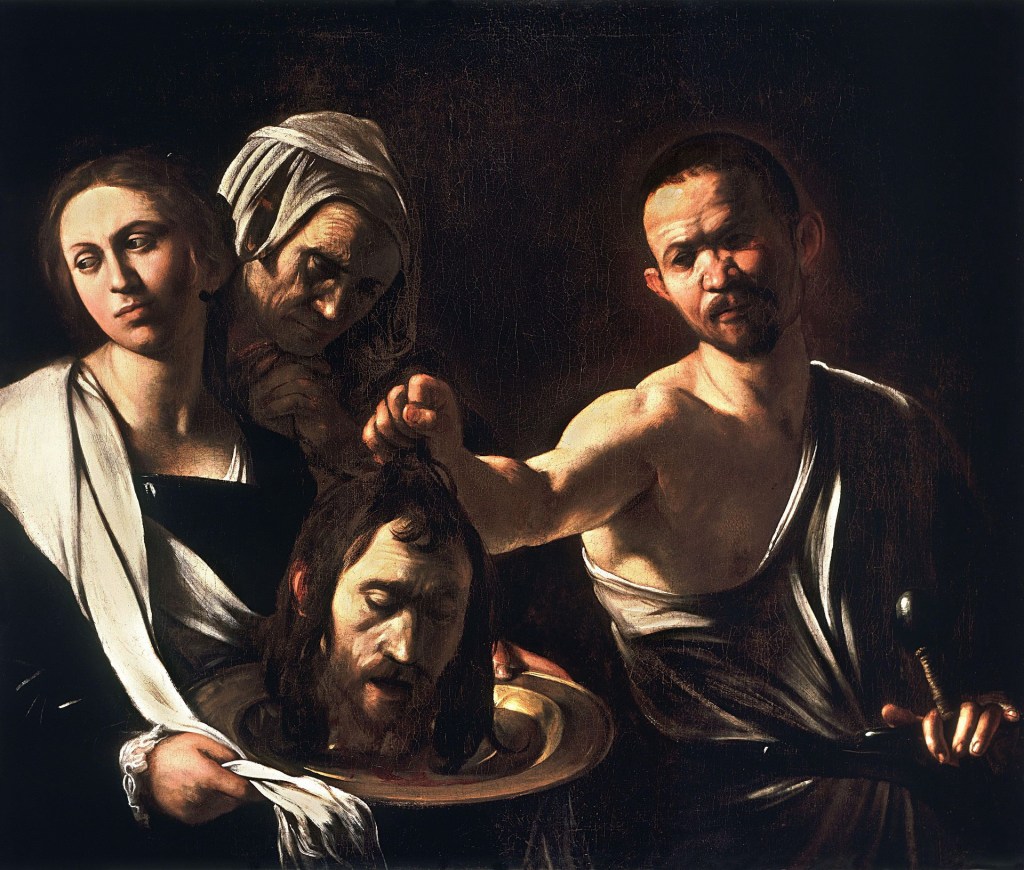
The famous painting of Caravaggio,
Salome with the Head of John the Baptist
(c. 1607–1610; National Gallery, London)

The kingdom, God’s justice, an invitation to all (Mark 4; Pentecost 4B)

In following the Revised Common Lectionary, we’ve just returned to passages from the beginning of the good news of Jesus, chosen one, after many months away in other gospel accounts of Jesus and his activity. See https://johntsquires.com/2021/03/19/1-where-has-mark-gone/

The work we know as “the Gospel according to Mark” is the shortest and earliest of the extant accounts that we have. It is a story-telling narrative, moving from one incident to the next in short order. It’s a dramatic and vivid account. See https://johntsquires.com/2021/03/20/2-mark-collector-of-stories-author-of-the-passion-narrative/

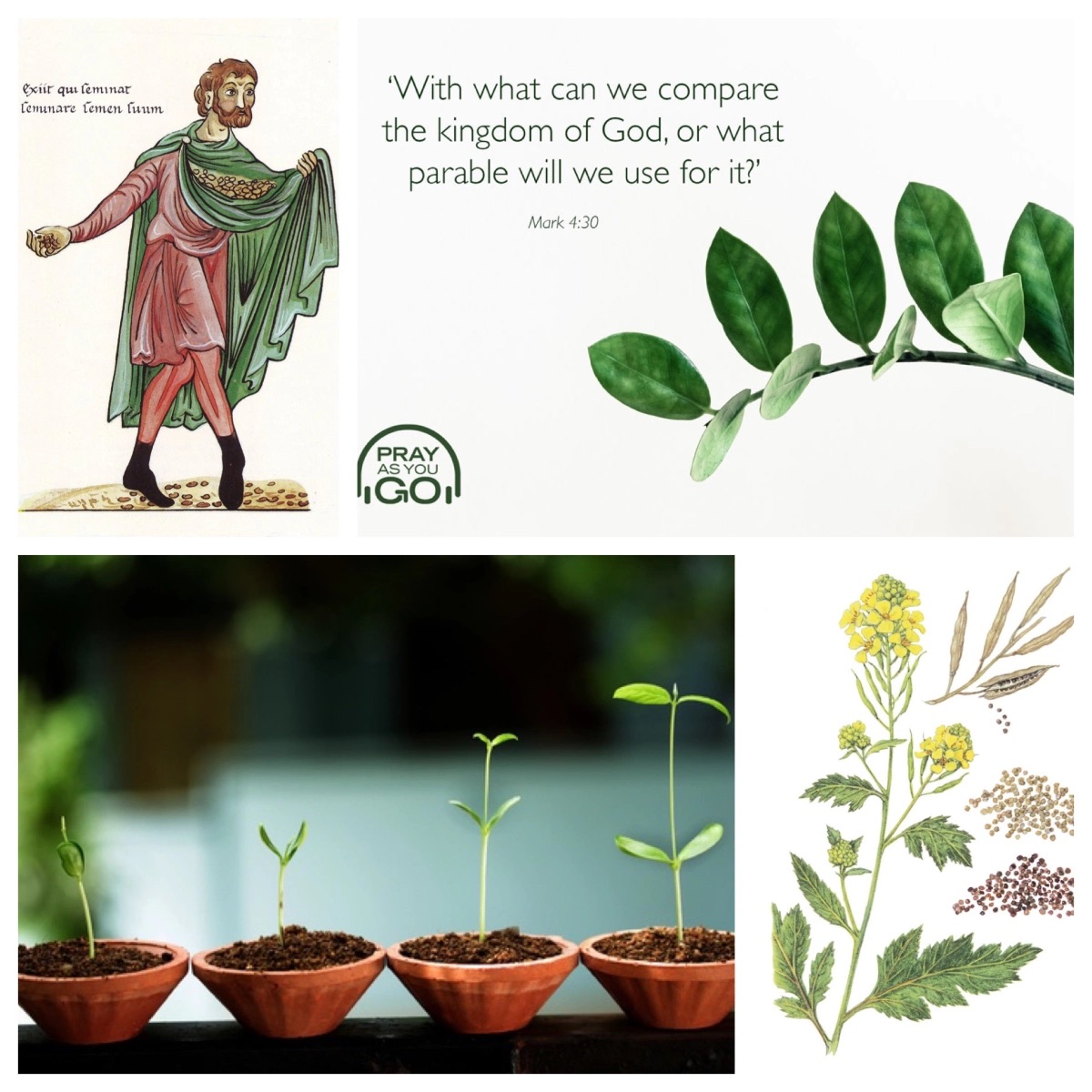
It’s fitting, therefore, that we hear today two of the really short stories that Jesus told. We know these short stories as parables. There is the parable of seed, scattered in the ground, that grows of its own accord (Mark 4:26–29). Then there’s the parable of the smallest seed that grows to a large shrub (4:30–32). These two short stories each reveal something about the way that God wants things to be, the kingdom of God. Such parables were typical of the way that Jesus taught his followers (4:33–34).

Parables were quite widespread in the society of Jesus’ day. They were evocative and effective means for telling stories. The most common means of entertainment in the ancient world was telling stories. This was done by word of mouth, from one person to another, or in small groups gathered in market places, courtyards or houses. Education also relied on the voice. Children were taught by word of mouth. Adults also learned by listening, discussing, debating.

Written materials were costly and only a small percentage of the population was literate. The natural tendency to tell stories was widely accepted in Jewish society, so that the most familiar pattern was that learning took place through the passing on of stories. So oral story telling was commonplace in the synagogues where Jews gathered for worship and instruction.

We can see the dominance of the oral medium most clearly in the literature which tells about the rabbis of Judaism. The story was the foundational building block for all the rabbis’ teaching activities. Beyond Judaism, we see it in the popularity of written biographies, romances, histories and adventure stories, throughout the ancient world.

Indeed, a second century Christian (Papias, the Bishop of Hierapolis) is reported as having stated that stories spoken by teachers are to be preferred as more reliable than written works (such as the Gospels)—an attitude that sounds incredible to our modern ears! See https://johntsquires.com/2020/10/15/what-do-we-know-about-who-wrote-the-new-testament-gospels-2/

A parable is an important type of story-telling. A parable is a story told in a specific way to make a single clear point. Parables are found in Jewish literature; the most famous examples in the Hebrew Bible are Samuel’s parable comparing David with a callous rich herdsman in 2 Samuel 12 and the prophet’s parable comparing Israel with an unfruitful vineyard in Isaiah 5.

Rabbis at the time of Jesus, and later, have used parables to make their point in their teachings. The Hebrew word for this form was mashal, a word meaning “to be like” or “a comparison”. Parables were told to make a point about something that may not be easily understood, by drawing a comparison with something else that was well-known or easily understood.

The mashal also opens up the possibility of a more developed form of comparison, the similitude, of which the best example is Nathan’s parable to David concerning the stolen lamb (2 Sam 12:1–4). This form flourishes in later Judaism, both in rabbinic literature, and in the Gospel accounts of Jesus’ parables (“the kingdom of heaven is like…”). In fact, the parables told by Jesus follow the patterns and customs of the rabbinic mashal.

Both the parable of the seed growing in secret (4:26–29) and the parable of the mustard seed (4:30–32) are examples of a simple parable with a short plot development. The first parable moves quickly to the key point, when the farmer “goes in with the sickle, for the harvest has come”.

Judgement is integral to the message that Jesus preached. His vision of the kingdom involves standards that God imposes and that God judges. The seeds growing in secret will face this reckoning at the harvest. Our lives of discipleship will be measured by the righteous-justice of God that Jesus proclaimed. The harvest was an image of divine judgement for some of the prophets (Hosea 6:1–11, 8:1–10; Joel 3:9–16; and see Ps 126:1–6; Prov 22:8).

The second parable has a similar focus on the climax: “it becomes the greatest of shrubs”. The mustard seed grown into a shrub with branches in which the birds nest, indicates the inclusivity that is offered in the kingdom. It seems that Jesus May have been referencing the oracle of Ezekiel, about a sprig of cedar that grows so big that “under the shade of its branches birds of every sort will nest” (Ezek 17:22–24).

Measured by the standards of the righteous-justice of God, the kingdom is open to those who adhere to this measure, regardless of their status or origins. This was the message of Jesus, offering hope to all who followed in his way.

This pair of parables contain two key elements of the message of Jesus: justice, and inclusivity. We find these themes in the stories told and the guidance taught by Jesus throughout his ministry. The parables convey these messages in short, sharp, dramatic style.

In his house, out of his mind (Mark 3; Pentecost 3B)

This Sunday, we continue reading and hearing from the earliest and shortest account of the story of Jesus, the beginning of the good news of Jesus, chosen one, which we know as the Gospel according to Mark. This week, we hear a story from the middle of chapter 3, as Jesus “went home” (as the NRSV reports).

In fact, the Greek simply notes that Jesus went “into a house” (εἰς οἶκον, 3:20). Is this the same house that was referred to, in Capernaum, at 2:1? The notion that it was his family home comes from the fact that his family came out of the house to meet him (3:21), and then his mother and brothers are noted once more, later in the scene (3:31).

Jesus, of course, is known as coming from Nazareth (Mark 1:9, 24; 10:47; 16:6; Matt 21:11; 26:71; Luke 4:16, 34; 18:37; 24:19; John 1:45–46; 18:5, 7; 19:19), but Matthew’s account explicitly states that he moved from Nazareth to Capernaum (Matt 4:13). Yet the occasion when Jesus returned to his hometown is inevitably located at Nazareth (Mark 6:1–6 and the parallel, Matt 13:55-58).

If this is the family home, in Capernaum, it is an interesting location; there is very little in the Gospels, apart from this scene, that brings the adult Jesus into direct contact with his family. So this is a distinctive scene.

However, it is also a typical, somewhat unremarkable scene, in that Jesus is found in a house. He has previously been in the house of Simon and Andrew in Capernaum (1:29) and then of Levi the tax collector (2:15). Later, he is found at the house of a synagogue ruler (5:38), a house of an unidentified resident (7:17), a house in the region of Tyre (7:24), the house of an epileptic child (9:28), another house in Capernaum (9:33), a house in Judea (10:10), and the house of Simon the leper in Bethany (14:3). Indeed, Jesus instructs his disciples that, when they go out to proclaim the kingdom of God, they are to enter houses (6:10).

In Mark’s Gospel, Jesus is regularly to be found in houses. Yes, he taught in the open spaces in public (2:13; 2:23; 4:1; 10:1), and engaged with people whom he encountered as he was walking along the road (3:7–12; 5:1–2; 5:21, 35; 6:53–56; 7:1–2; 8:22–26; 8:34; 9:14–15; 10:13, 32–34, 46). Jesus was to be found at times in synagogues (1:21–28; 1:39; 3:1–6; 6:1–6) and, once in Jerusalem, in the Temple precincts (11:11, 15, 27, on through to 13:1).

However, whilst travelling around Galilee, Jesus consistently undertook his ministry in houses. That, say some interpreters of this Gospel, most likely reflects the reality that the followers of Jesus, in the decades following, were gathered most often in houses—not in the Temple (except for the idealised account that Luke offers in the early chapters of Acts), not even in the synagogues (although some would have been there), but in houses.

These houses were the sites for hospitality, which was so important in the cultural practices of the day (see https://www.bibleodyssey.org/en/passages/related-articles/hospitality-in-the-new-testament) One scholar describes the house as “the dominant architectural marker” in Mark’s Gospel (https://open.library.ubc.ca/media/download/pdf/24/1.0070991/2 — this is a whole thesis on the topic!)

The work of Carolyn Osiek on the importance of the house for the early church is most significant in this regard (see her overview from a 1995 address at http://www1.lasalle.edu/~dolan/2003/Osiek.pdf). “The local house church or apartment church”, she writes, “provided, among other things, a sense of communal life and individual commitment, theological pluralism, a base for mission, and a model of the universal church.” (See p.21 of this article).

The prominence of the house is certainly reflected in the letters of Paul, who refers often to “the church in the house of …” (Rom 16:5; 1 Cor 11:22, 16:19; Col 4:15; Philemon 2; and 1 Tim 5:13). The early Jesus movement was a house church movement! The standard work in this area has long been the book by Australian scholar Robert Banks, on Paul’s idea of community (http://www.lifeandleadership.com/book-summaries/banks-pauls-idea-of-community.html).

When Jesus comes out of his house in Capernaum, some onlookers describe him as being “out of his mind” (ἐξέστη, 3:21). This is a term that literally means that he was “standing outside of himself”, as if in a kind of dissociative state. It may be that this was the reason that Jesus was returning to his family?

The encounter doesn’t go well, however. Scribes have come from Jerusalem. They have already been antagonistic towards Jesus, questioning whether Jesus was blaspheming (2:6–7), and casting doubts on his choice of dinner guests (“why does he eat with tax collectors and sinners.”, 2:16). There will be further disputation with scribes (7:1–5; 9:14; 12:28, 38–41) and they will be implicated in the plot to arrest Jesus (11:18, 27; 14:1, 43, 53; 15:1) and in his death (8:31; 10:33).

These scribes—hardly friends—articulate what others present may well have been thinking: “he has Beelzebul” (3:23). The charge of demon possession correlates with the accusation levelled at John 10:20. This sits as the fundamental reason for perceiving Jesus as being “out of his mind”.

Beelzebul (Βεελζεβοὺλ), “the ruler of the demons”, is known from earlier scriptural references to Baal-zebub in 1 Kings 1:2–6, 16, where he is described as “the god of Ekron”, a Philistine deity. There is scholarly speculation that Beelzebul may have meant “lord of the temple” or “lord of the dwelling”, from the Hebrew term for dwelling or temple (as found at Isa 63.15 and 1 Kings 8.13); or perhaps it was connected with the Ugaritic word zbl, meaning prince, ruler.

Jesus refutes the charge in typical form, by telling a parable (3:23–27) that ends with the punchline about “binding the strong man” (τὸν ἰσχυρὸν δήσῃ). This potent phrase encapsulates something that sits right at the heart of the activities of Jesus in Galilee—when he encounters people who are possessed by demons, and when he casts out those demons, he is, in effect “binding the strong man”.

The notion that a demon would bind the person that they inhabited is found at Luke 13:16, and in the book of Jubilees (5:6; 10:7-11). The book of the same title by Ched Myers provides a fine guide to reading the whole of Mark’s Gospel through this lens (see https://chedmyers.org/2013/12/05/blog-2013-12-05-binding-strong-man-25-years-old-month/)

The accusation that refers to “blasphemy against the Holy Spirit” (3:29) may well reflect this claim that Jesus was demon-possessed (3:30). That is a claim that cannot be allowed to stand, that cannot be justified in any way—and thus, that cannot be forgiven or set aside. This is a critical dimension for the Jesus who is active in Mark’s Gospel.

We may think of Jesus as a preacher, a story teller, delivering parables and aphorisms. Much of Mark’s account, however, is focussed on the healing and exorcising activities of Jesus.

Some of the most striking stories told of Jesus were those relating the miraculous deeds he performed: curing lepers, healing the sick, casting out demons, controlling the forces of nature, even raising the dead. Jesus, it was recounted, was able to cure illnesses such as a fever (1:30–31), leprosy (1:40–42), paralysis (2:1–12), haemorrhaging (5:25–29), deafness (7:31–37), and blindness (8:22–26).

He is said to have engaged in conversations with demons which were possessing individuals, and he was able to command the demons to leave those individuals (1:23–26; 5:1–15; 7:24–30). In some cases, demonic possession was manifested in the body in medical ways: epilepsy (9:19–29), or an inability to speak (9:32–33), coupled with blindness (12:22).

The action of “casting out” or “driving out” a demon (3:22, 23) is expressed in a word which contains strong elements of force. The phrase is ἐκβάλλει τὰ δαιμόνια. The verb is used regularly to describe the confrontational moment of exorcism (1:34, 39; 3:15, 22-23; 6:13; 9:18, 28, 38). It first appears in the account of Jesus being tempted in the wilderness—here, however, it is the Spirit who casts Jesus out into the wilderness. The story reflects a moment when Jesus comes face to face with his adversary, Satan—and casts his power aside. (The more developed dialogues in Matthew 4 and Luke 4 expand on this understanding of the encounter.)

On the first occasion when Jesus has gathered all twelve apostles together, he gives them a twofold commission: “he appointed twelve…to be with him and to be sent out to proclaim the message and to have authority to cast out demons” (3:14–15). As the Gospel then proceeds to report how Jesus speaks and acts, the meaning of this discipleship is spelled out. The apostles—and other followers—have the opportunity to learn from his teachings and to witness his actions while they are with Jesus, and then to replicate these teachings and actions through their presence in other places.

“Proclaiming the message and casting out demons” is how the activities of Jesus are characterised (1:39). These same activities form the basis for the mission of the twelve as it is reported at 6:7–13. They model their words and deeds on Jesus: “they proclaimed that all should repent…they cast out many demons and anointed with oil many who were sick and cured them” (6:12–13).

Their mission is to be characterised by an ascetic mode of dress (6:8–9) and a focussed mode of proceeding (6:10–11). Their attention is to be directed entirely to the task at hand. In this way they are to follow the example and pattern of Jesus, confronting the powers and casting them out of their strongholds. This is what is at stake in the scene we read this Sunday (3:20–35).

The final section of this scene (3:31–35) depicts the breach between Jesus and his family—those who had earlier come to greet him and care for him in his state of being “out of his mind” (3:20–21). No longer are they to function as his family; those who are closest to him, “whoever does the will of God”, now serves as his brother, sister, mother. The work of challenging and exorcising “the ruler of demons” is deeply costly. The challenge to follow him is likewise incredibly costly.

He is not here. He is risen (Mark 16; Easter Sunday year B)

The time is early in the morning – quiet, dark, peaceful; the same time of day as when we came to this place. The cast of characters is well-known; Mary Magdalene; Salome, Joanna, another Mary; we know these women. And the message is, likewise, a comforting, familiar refrain: The tomb is empty. He is not here. He is risen. In all that we have heard, we are on familiar ground.

It is most likely that each of us are also well-acquainted with the flow of the story—the women come, bearing their spices, to anoint the body; the stone is found rolled away; the tomb is seen to have no body; and the message is delivered in short, succinct phrases: The tomb is empty. He is not here. He is risen.

The place may be a little unusual, in our way of thinking: it is a tomb, carved out of the rock, large enough to enable a number of adults to be buried together. As people of Anglo heritage, we are used to individual plots, dug deep into the ground, where one person, or maybe a married couple, are laid to rest.

But this is different: it is a large cavity in the side of a rockface, carved out to enable space for a number of adults to enter; space enough for generations of a family to be laid to rest within the one very large tomb. This practice can be seen in phrases, frequently used in mentioning the Patriarchs and David, in Hebrew Scriptures: when such an eminent person died, he would be “gathered unto his fathers,” “sleeping with his fathers,” or “gathered unto his people.”

But these aren’t just euphemisms for death—like we say, ‘passed away’, or ‘went to their eternal rest’; no, this was a literal, physical description of what was done with the bodies of deceased people in ancient times: they were placed in the family tomb, alongside the resting-places of relatives and ancestors.

So the physical location, and the cultural custom, is rather unfamiliar to us today. But the rest of the story, we reassure ourselves, runs along familiar lines, following the well-trodden pathway.

Or does it?

Step back from the empty tomb; walk away, for a moment, from the Easter narrative. Consider the broad sweep of our Christian faith; the overarching drama of our Christian lives.

What do we expect to be central and essential to our Christian faith? What is it that we anticipate finding at the very heart of our faith? How does faith function in the lives of people today, in or time, amidst the stresses and pressures of 21st century living?

Psychologists—those who study the human mind—tell us that people in our times are more likely than ever before to be depressed. Our deepest yearning is to be happy, to feel appreciated, to have assurance that we are valued, that we are loved.

Sociologists—those who study human societies—tell us that people in our times feel disconnected, isolated, and cut off from one another. Our common yearning is to be a part of a group, to feel that we belong. We need to know that others need us.

What this analysis often leads to, is a sense that people today are looking for certainty—we want to be grounded in a group, we want to be part of the tribe, we want to be loved and appreciated, we want to know the assurance of the absolute.

And faith—Christian faith, or indeed any form of faith—can then be offered as the way for people, in their fear and anxiety, in their loneliness and uncertainty—faith can be offered as an answer to these ills. ‘Just take this pill (this pill of absolute faith) and you will be right.’ ‘Just switch your allegiance in one fell swoop, and all will be different.’

Let me invite you to think about these issues in the light of the story which we have heard retold today. For as we encounter and engage with the unfamiliar dimensions of the story, we will find a rather different response to our situation emerging from the interplay.

There are two striking and unfamiliar elements in the story of the empty tomb. The first has to do with who is there. And the second has to do with who is NOT there.

Who is there, that early morning, in the tomb where the body of Jesus had been laid, just a few days earlier? Who are the ones who see, and hear, and experience for themselves, the jarring reality of that early morning encounter?

In a society so dominated by males—male priests, male scribes, male teachers of the Law, male heads of each household—is it not striking and jarring that the great news of Easter is entrusted, first of all, and in all its fullness, to a group of women?

Women—who come to perform their traditional female role, of anointing the freshly-interred body. Women—who come in subservience and devotion, to enact the ritual which has been set aside for them to undertake, as befits their allocated role in society. Women—who, if the traditional pattern is to be followed, will come, unwind the covering on the body, anoint the body with spices, reroll the covering and replace the body, and reverently leave the tomb.

But these women are unable to carry out the male-determined ritual for the body of the recently deceased. The familiar pattern is interrupted; the servant role is removed; and it is these women to whom the striking news of Easter is given.

It is to these women that the responsibility is given, for declaring that the body of Jesus is no longer gripped by death. It is to these women that the role of being the first, the primary, witnesses, to the interrupting action of God: the one who was dead, Jesus, our Master, is no longer here.

The tomb is empty. He is not here. He is risen.

God is now working in ways that challenge, disturb, and overturn the well-worn, familiar, traditional patterns of society. The women cannot carry out the duties and responsibilities that they have long been given. The women, now, are to be witnesses to what God has done. They are to return and tell the men—the apostles, the pillars, the chosen ones—what God has been doing. He is not here. He is risen.

It is the women, and not the men, as expected, who are the ones to break the news: He is not here. He is risen. It is the women who become the first evangelists, the first to proclaim the good news of God. It is the women who become apostles, even to the apostles, the men waiting in the city, unaware of what has occurred at the tomb, and unacquainted with what God has been doing through Jesus. He is not here. He is risen.

If the first striking feature of this story is, who IS here; then the second arresting aspect, is who is NOT here. This is a story about Jesus, in which Jesus does not appear.

This is an account of the most dramatic and significant moment in the whole narrative about Jesus—but there is no Jesus to be seen!   No Jesus to be touched!
No Jesus with whom to talk!   No Jesus to stand, centre-stage, as demonstration of the realities of how God is now at work.

So here is the conundrum: this is the precise moment in the story when God acts in a new and surprising way. This is the pivot point upon which the whole of the narrative turns.

And yet, at the heart of the story, there is—nothing!   No central character. No resurrected Jesus, shining forth God’s glory for all to see. No dramatic, booming voice from the heavens, declaring the risen Jesus as the Lord of all. All that we have, are the words of the young men: He is not here. He is risen. There is nothing, but a startling absence, precisely at the moment when we expect a dramatic presence.

In my mind, this paradoxical turnaround is highly significant, hugely important. At the centre of our faith, there is an enticing invitation—to explore, to ponder, to imagine, to wonder.

There is no clear, black-and white, unequivocal proof. There is no definitive dogmatic assertion, no unquestionable, unambiguous deed, no unarguable proclamation—no resurrected Jesus standing in the tomb. There are simply the women, stunned; and the young men, explaining: He is not here. He is risen.

So, at the heart of the Easter story, we find absence; mystery; the glimpse of a possibility; the wisp of a wondering; the beginnings of a pondering: ‘how can this be’; ‘what does this mean?’; ‘what do we do next?’; ‘where is this all leading?’.

And in my mind, this central absence, at the heart of the story, reminds us of the essence of our faith. In our faith, we have no clearcut, unquestionable dogma; we have no unchangeable given, no unarguable declaration.  We have no absolute assurance, no certainty set in concrete.

Rather, we have an invitation to walk the way of faith, with openness; an invitation to delight in the mysteries which God unravels before our eyes, in our own lives; an invitation to search, to explore, to ponder; and perhaps then, to encounter, to marvel, and to rejoice.

He is not here. He is risen. So let us enter into the mystery, the enticement, and the joy, of faith!

I did not hide my face from insult and spitting (Isa 50 and the Passion Narrative; Lent 6B)

The passage of Hebrew Scripture we hear this coming Sunday (Isa 50:4–9a) is a significant passage. It comes from the second section of this long book (Isa 40—55), which opens with the familiar song, “comfort, comfort all my people” (Isa 40:1). Widely considered to be written in a period later than the earlier section (Isa 1—39), this section of Isaiah is called Second Isaiah. (The third main section, chapters 56—66, is called Third Isaiah.)

The comfort sung about by the prophet speaks to the situation of the people: their forebears had been taken into exile by the Babylonians in 587 BCE, and now a new generation (perhaps four to five decades later) yearns to return to the land of Israel, given to the people in ancient times, as recounted in the foundational myth—story of the Exodus. Other parts of the Hebrew Bible reflect the anguish of the people during their time of Exile (Ps 137 is the most famous instance). Deutero-Isaiah, however, focuses consistently on the hope of return to the land of Israel.

Looking to the new power of Persia to permit this return, the prophet of this later period speaks with hope and joy, to the people living in exile, using vivid imagery and dramatic scenes of promise and confidence. A joyous, positive tone runs right through the oracles in this section of Isaiah. “I am about to do a new thing”, says the Lord; “I will make a way in the wilderness and rivers in the desert” (43:19). “I will pour water on the thirsty land and streams on the dry ground”, the Lord continues; “I will pour my spirit upon your descendants, and my blessing on your offspring” (44:3).

Deutero-Isaiah is fundamental for the theological developments that we find in the New Testament. Scattered through this section, we find four Songs of the Servant—three relatively brief (42:1–9; 49:1–7; 50:4–11); and the fourth, best-known within Christian circles, a longer description of the servant who “was despised and rejected by others; a man of suffering and acquainted with infirmity” (Isa 52:13–53:12).

The resonances that this longer song has with the passion narrative of Jesus are crystal clear. The song is explicitly linked with Jesus six times in the New Testament (Matt 8:14–17; Luke 22:35–38; John 12:37–41; Acts 8:26–35; Romans 10:11–21; 1 Pet 2:19–25); furthermore, so many of the details of the passion narrative are shaped in the light of this song, along with a number of psalms of the righteous sufferer. (See

The third of these songs, which we hear this coming Passion Sunday, portrays the speaker as a Teacher. The resonances of this song with the story of Jesus are also clear. The punishment experienced by the Teacher—his back is struck, his beard is pulled, he is insulted, people spit on his face (Isa 50:6)—is echoed in the punishments inflicted on Jesus by Roman soldiers and Jewish passers-by. He is struck with a reed by Roman soldiers and spat upon (Mark 15:19). He is insulted by passers-by and the Jewish authorities (Mark 15:29–32).
The lectionary offers us this passage for Passion Sunday, a time when we reflect at some length on the passion of Jesus, which we recall also each Good Friday. The lectionary also offers the full story of the fate of Jesus after he entered Jerusalem at Passover. This part of the Gospel story (chapters 14–15 in Mark) is known as the passion narrative, because it tells about what Jesus suffered in his final days. (“Passion” comes from the Latin word passio, meaning suffering.)

The author of the beginning of the good news, which we know as Mark’s Gospel, seems to have been the first person (as far as we know from the evidence) who drew together a number of expressions about the way of Jesus, and worked them into a single, cohesive whole, in a continuous narrative style.

This narrative recounts the death of Jesus by relating it to the figure of righteous person who suffers injustice, who appears in various Hebrew Scripture passages. The author of this Gospel takes great pains to show that Jesus remains faithful to his calling despite the pressures he faces, just as the righteous sufferer of old also held to their faith.

The Gethsemane scene (Mark 14:32–42) draws on imagery from Hebrew Scripture to underline this. The narrative evokes the suffering of the faithful righteous person, referring especially to some phrases found in the Psalms. The Golgotha scene (Mark 15:21–41) also contains this orientation. What takes place is interpreted with reference to scripture; here, the allusions are both subtle, and more direct. The cry which Jesus utters at the ninth hour, Eloi, Eloi, lama sabachthani (15:34), is a clear reference to Psalm 22, by quoting its first verse. See more at

The offering of Isa 50:4–9a thus “fits” with the way that the author of the Markan passion narrative presents to story of the final hours of Jesus. His intense feeling of the agony inflicted on him, and yet his steadfast grappling with the faith he holds, is to the fore. The story invites us into sombre meditation as we approach the annual return of Easter.

The priority of the Torah: love God, love neighbour (Mark 12; Narrative Lectionary for Lent 4)

“You shall love the Lord your God with all your heart, and with all your soul, and with all your strength, and with all your mind” (Deuteronomy 6:5). “You shall love your neighbour as yourself” (Leviticus 19:8). These two commandments are cited in a story about Jesus engaging in a discussion with a scribe, a teacher of the Law, which ends with Jesus saying, “there is no commandment greater than these” (Mark 12:31).

The Narrative Lectionary includes this story (Mark 12:28–34) as the opening section of a longer Gospel passage that is proposed for worship this coming Sunday (12:28–44). It’s a passage that takes us deep into the heart of Torah—those guidelines for living all of life in covenant faithfulness with God. Torah sits at the centre of Judaism. See more on this at

Of course, Jesus hasn’t answered the question precisely in the terms that it was asked; he doesn’t indicate what is “the first” commandment, but which two are “greatest”. It’s like a dead heat in an Olympic race: a race when even a finely-tuned system can’t differentiate between the two winners, even down to one thousandth of a second. Both love of God and love of neighbour are equally important. Joint winners—like that high jump competition a year or two back where the two leading jumpers just decided to share the gold medal, rather than keep competing—and risk not getting gold.

Both commands are biblical commands, found within the foundational books of scripture within Judaism. They were texts that Jewish people, such as Jesus and his earliest followers would have known very well. Each command appears in a significant place within the books of Torah, the first five books of Hebrew Scriptures.

The command to “love God” sits at the head of a long section in Deuteronomy, which reports a speech by Moses allegedly given to the people of Israel (Deut 5:1–26:19). The speech rehearses many of the laws that are reported in Exodus and Leviticus, framing them in terms of the repeated phrases, “the statutes and ordinances for you to observe” (4:1,5,14; 5:1; 6:1; 12:1; 26:16–17), “the statutes and ordinances that the Lord your God has commanded you” (6:20; 7:11; 8:11).

After proclaiming the Ten Commandments which God gave to Israel through Moses (Deut 5:1–21; cf. Exod 20:1–17) and rehearsing the scene on Mount Sinai and amongst the people below (5:22–33; cf. Exod 19:1–25; 20:18–21). Moses then delivers the word which sits at the head of all that follows: “Hear, O Israel: The LORD is our God, the LORD alone. You shall love the LORD your God with all your heart, and with all your soul, and with all your might. Keep these words that I am commanding you today in your heart” (Deut 6:4–6). This, it would seem, is the key commandment amongst all the statutes and ordinances.

These words are known in Jewish tradition as the Shema, a Hebrew word literally meaning “hear” or “listen”. It’s the first word in this key commandment; and more broadly than simply “hear” or “listen”, it caries a sense of “obey”. These words are important to Jews as the daily prayer, to be prayed twice a day—in keeping with the instruction to recite them “when you lie down and when you rise” (Deut 6:7). As these daily words, “love the Lord your God” with all of your being are said, they reinforce the centrality of God and the importance of commitment to God within the covenant people.

The command to “love your neighbour” in Leviticus 19 culminates a series of instructions regarding the way a person is to relate to their neighbours: “you shall not defraud your neighbour … with justice you shall judge your neighbour … you shall not profit by the blood of your neighbour … you shall not reprove your neighbour … you shall love your neighbour” (Lev 19:13–18).

These instructions sit within the section of the book which is often called The Holiness Code—a section which emphasises the word to Israel, that “you shall be holy, for I the Lord your God am holy” (Lev 19:2; also 20:7, 26). Being holy means treating others with respect. Loving your neighbour is a clear manifestation of that ethos. Loving your neighbour exemplifies the way to be a faithful person in covenant relationship with God.

So it is for very good reasons that Jesus extracts these two commandments from amongst the 613 commandments that are to be found within the pages of the Torah. (The rabbis counted them all up—there are 248 “positive commandments”, giving instructions to perform a particular act, and 365 “negative commandments”, requiring people to abstain from certain acts.)

Jesus, of course, was a Jew, instructed in the way of Torah. He knew his scriptures—he argued intensely with the teachers of the Law over a number of different issues. He frequented the synagogue, read from the scroll, prayed to God, and went on pilgrimage to Jerusalem and into the Temple—where, once again, he offered a critique of the practices that were taking place in the courtyard of the Temple (11:15–17).

Then he engaged in debate and disputation with scribes and priests (11:27), Pharisees and Herodians (12:13), and Sadducees (12:18). Each of those groups came to Jesus with a trick question, which they expected would trap Jesus (12:13). Jesus inevitably bests them with his responses (11:33; 12:12, 17, 27). It was at this point that the particular scribe in our passage approached Jesus, perhaps intending to set yet another trap for him (12:28).

So Jesus, good Jew that he was, is well able to reach into his knowledge of Torah in his answer to the scribe. The commandments that he selects have been chosen with a purpose. They contain the essence of the Torah. His answer draws forth the agreement of the scribe—there will be no robust debate now! In fact, in affirming Jesus, the scribe reflects the prophetic perspective, that keeping the covenant in daily life is more important that following the liturgical rituals of sacrifice in the Temple (see Amos 5:21–24; Micah 6:6–8; Isaiah 1:10–17).

The scene is similar to a Jewish tale that is reported in the Babylonian Talmud, a 6th century CE work. In Shabbat 31a, within a tractate on the sabbath, we read: “It happened that a certain non-Jew came before Shammai and said to him, ‘Make me a convert, on condition that you teach me the whole Torah while I stand on one foot.’ Thereupon he repulsed him with the builder’s cubit that was in his hand. When he went before Hillel, he said to him, ‘What is hateful to you, do not to your neighbour: that is the whole Torah, the rest is the commentary; go and learn it.’”

Hillel, of course, had provided the enquiring convert, not with one of the 613 commandments, but with one that summarised the intent of many of those commandments. We know it as the Golden Rule, and it appears in the Synoptic Gospels as a teaching of Jesus (Matt 7:12; Luke 6:31).

Some Jewish teachers claim that the full text of Lev 19:18 is actually an expression of this rule: “You shall not take vengeance or bear a grudge against any of your people, but you shall love your neighbour as yourself: I am the LORD.” Later Jewish writings closer to the time of Jesus reflect the Golden Rule in its negative form: “do to no one what you yourself dislike” (Tobit 4:15), and “recognise that your neighbour feels as you do, and keep in mind your own dislikes” (Sirach 31:15).

Paul clearly knows the command to love neighbours, for he quotes it to the Galatians: “the whole law is summed up in a single commandment, ‘You shall love your neighbour as yourself’” (Gal 5:14), and James also cites it: “you do well if you really fulfill the royal law according to the scripture, ‘You shall love your neighbour as yourself’” (James 2:8). Both writers reflect the fact that this was an instruction that stuck in people’s minds!

And I wonder … perhaps there’s a hint, in these two letters, that the greater of these two equally-important commandments is actually the instruction to “love your neighbour”?

*****

I have provided a more detailed technical discussion of the words used in this passage, and its Synoptic parallels, in this blog:

On the Pharisees and Torah, see