Going into the kingdom of God ahead of you (Matt 21; Pentecost 18A)

Two weeks ago, in following along with the excerpts from the Gospel of Matthew which the Revised Common Lectionary has been offering us this year, we heard a parable that threatened that God would torture a person until they forgave a person who owed them a modest debt (18:23–35). Where is the compassion in that? Is this really what we understand God to be like? Should this story really be in our scriptures?

Last week, we heard a parable in which people who laboured in a vineyard for quite different lengths of time were given the same pay at the end of the day (20:1–16). Where is the justice in that? The rationale for this is that “the last will be first, and the first will be last” (20:16)—a saying that Jesus utters on other occasions, as well. Is this really what we understand the kingdom will be like? Does this unjust story really deserve a place in our scriptures?

This week, we will be confronted with a parable in which two sons each say one thing, but do the opposite (21:28–30). Where is the honesty in that? Be a person of your word—do what you say, say what you mean to do! But there is even more, as Jesus continues on after having spoken this parable with words that are even more confronting: “the tax collectors and the prostitutes are going into the kingdom of God ahead of you” (21: 31). Is this really what we have to look forward to? It makes me want to cry out, “Hey! there’s a queue here—just wait your turn!”

Parables, according to Tim Mackie and Jon Collins of the Bible Project, were used by Jesus as “a means of indirect communication to critique and dismantle his listener’s views of the world to show them the true nature of God’s Kingdom.” See https://bibleproject.com/podcast/parables-subversive-critique/

And so that is the case in each of these parables. There’s a good amount of critiquing and dismantling going on; and a fair bit, also, of reconstructing a picture of what that kingdom might well be like. Whilst we might expect—indeed, we might yearn—to have stories which reinforce our view that God is loving, kind, and compassionate to all, the fact is that the parable of the unjust steward—and other sayings of Jesus—insist that God exercises vengeance in the course of ensuring justice.

We might well hope to have stories that communicate that God’s justice means equity and fairness for everyone; yet the parable of the labourers in the vineyard—and other sayings of Jesus—insist that God operates in ways that are counter-cultural and in opposition to the expected norms of fairness in society.

And certainly we might anticipate that Jesus will tell stories that assure us of the claim that a life of faithful obedience and careful adherence to stringent ethical standards will lead to our experiencing the welcoming arms of God, perhaps a prioritised means of entry into the loving embrace of God; yet the conclusion that Jesus offers to the parable of the two sons is completely different, with a shocking declaration that those entering the kingdom ahead of us will be precisely the people that we would expect to be debarred from entry!

What is going on? And in particular, why does Jesus assert that “the tax collectors and the prostitutes are going into the kingdom of God ahead of you” (21:31)?

*****

In the three Synoptic Gospels, Jesus is presented as one who “eats with tax collectors and sinners” (Mark 2:15–16; Matt 9:10–11; Luke 5:30–31). Jesus clearly declares, “I have come to call not the righteous but sinners” (Mark 2:17; Matt 9:13; Luke 5:32). Two of those Gospels also report that he was known as “a glutton and a drunkard, a friend of tax collectors and sinners” (Matt 11:19; Luke 7:34).

Indeed, Matthew, one of the twelve men initially called to be a disciple, was a tax collector (Matt 9:9; 10:3), although in Luke’s narrative he is named as Levi (Luke 5:27). This man, Levi, does not appear amongst the twelve named disciples (Luke 6:13–16; Acts 1:13), and the Matthew named in these Lukan lists is not identified as a tax collector.

In a striking parable reported only by Luke, a tax collector is presented favourably, in contrast to a Pharisee (Luke 18:9–14); that story resonates with the affirmation of tax collectors given at Matt 21:31–32. Soon after that parable is told, Luke reports an encounter that Jesus had with a rich chief tax collector named Zacchaeus (Luke 19:1–10). In this passage, the tax collector acts above and beyond the call,of duty, announcing that “half of my possessions, Lord, I will give to the poor; and if I have defrauded anyone of anything, I will pay back four times as much” (Luke 19:8).

By contrast, in a teaching passage found only in Matthew’s Gospel, tax collectors are linked with Gentiles in a declaration that a recalcitrant sinner who refuses to repent after being given multiple opportunities should be considered “as a Gentile and a tax collector” (Matt 18:17), clearly indicating that they are to be expelled from the community.

That statement appears to be in direct contradiction to the later declaration of the Matthean Jesus that we hear in this coming Sunday’s passage—a declaration that “the tax collectors and the prostitutes are going into the kingdom of God” ahead of the (presumably) faithful disciples, because “John came to you in the way of righteousness and you did not believe him, but the tax collectors and the prostitutes believed him; and even after you saw it, you did not change your minds and believe him” (Matt 21:31–32).

These words seem to correlate with the earlier aphorism of Jesus, “the last will be first, and the first will be last” (Matt 20:16), a saying that recurs in other contexts, when Jesus points to a child as a sign of the kingdom (Mark 9:35) and in response to a declaration of fidelity made by Peter (Mark 10:31; Matt 19:30). Indeed, this latter occurrence in Matthew’s Gospel not only concludes a sequence of incidents set in Judea (Matt 19:1–30), but also introduces the parable we heard last Sunday (20:1–16)—a parable which ends with the very same saying.

“The last will be first, and the first will be last” thus bookends that parable, indicating that it has a programmatic significance. And it is that claim from which Jesus then launches, in this coming Sunday’s reading, into the parable that drives home this upside-down character of the coming kingdom, noting that “the tax collectors and the prostitutes are going into the kingdom” ahead of the disciples, which he then drives home the point with intensity: “even after you saw it, you did not change your minds and believe him” (21:32).

That’s fair warning: Jesus is giving plenty of opportunity for his disciples to hear, understand, and respond to his message. And if we don’t, then he won’t pull any punches! Perhaps that’s actually the point of this parable. So it seems we are back to judgement—a motif that I have noted is intensified and amplified in Matthew’s account of Jesus, when compared with the Gospels of either Mark or Luke. See

Darkness, weeping, and gnashing of teeth: the scene of judgement (Matt 22; Pentecost 20A)

A final parable from the book of origins: on sheep and goats, on judgement and righteous-justice (Matt 25; Pentecost 26A)

We have been given fair warning!!

A parable of grace—and a story of grace (Matt 20 and Matt 27; Pentecost 17A)

A sermon on Matthew 20:1–16, written and preached by the Rev. Elizabeth Raine

The Gospel of Matthew was the subject of my PhD research, and I so enjoy teaching that Gospel to groups of people, especially when it comes around in the lectionary (as it has this year). And this might well lead you to think that I look forward to being able to share something of my interest in that gospel in weekly sermons.

However, I have found that as much as I like teaching Matthew, I actually don’t like preaching Matthew—at least not the passages that have fallen to my lot in recent months. You may have noticed that in most of the gospel readings we have heard over the few months, there is almost always a line or two about judgment, eternal punishment, and wailing and gnashing of teeth. Last week’s reading was no exception, with the unforgiving slave finding himself not only unforgiven, but also condemned to be tortured.

Matthew is very fond of predicting a harsh judgment and eternal punishment for his enemies. His gospel contains more references to hell and eternal punishment that most of the New Testament put together, with the possible exception of the book of Revelation. He sneaks these references into his material wherever possible, changing his Markan source to reflect his own interests in God’s wrath.

Now while this is interesting to teach, it is not very helpful when trying to construct a sermon that is meant to give food for thought and help folk reflect on their faith. Not all of us want our enemies to be gnashing teeth and wailing in hell. When I teach and research Matthew, I find myself often asking this question of Matthew’s gospel: what are its redeeming features as far as nurturing faith goes?

This is actually tricky to answer. Even last week’s teaching on forgiveness was undermined by the harsh punishment of the slave. And Matthew is actually a grace-free gospel, in that the Greek word for grace, charis, is never used by the author. Many of the stories in Matthew have a pronounced down side. Matthew often includes things such as alienation from family, name-calling, murder, impossible ethical demands and eternal damnation in his gospel.

However, Matthew does have one unique and I think, extraordinary act of redemption in his gospel, apart from Jesus’ death.

I will start with explaining what this is by using this week’s reading. The parable we encounter in this passage (Matt 20:1–16) is unique to Matthew’s Gospel. As such, it may be considered an insight into the special focus of the Gospel, and reflect something of the writer’s understanding of life around him in first century Palestine.

This story of the vineyard workers may well be taken straight from agricultural life in a Palestinian village. Like many of Jesus’ parables, it draws on images and practices familiar to the lifestyle of the crowds who gathered around Jesus to listen to him. Such familiarity would have caught the crowd’s attention and helped them understand the religious teaching that Jesus wanted to convey.

Like many of Jesus’ parables, though, the story has an unexpected twist. Even in first century Palestine, the concept of equal work for equal pay was an established principle. But here we find the vineyard owner paying the same wage to the labourers, regardless of how much or how little time they worked during the day. Such an uneconomical practice must have taken the crowd by surprise. What lord or owner would make such a foolishly generous offer?

The clue is in the last verse of the story, in a saying that Jesus has used a number of times, and one that was no doubt familiar to his disciples and regular followers: “the last shall be first and the first shall be last”.

With this phrase, the vineyard is revealed as the kingdom of heaven, and the owner is, of course, God – the God who is as generous to those who seek his kingdom at the last minute as he is to those who found it much earlier.

The verses which follow after this parable show that it must have been difficult for the disciples to hear, especially James and John! The request of the mother of James and John made it clear that they and the other disciples had given up everything they had to follow Jesus, with the expectation of heavenly reward. Now those who would join the movement later, who have not given up so much or suffered as long, would be greeted by God as equals.

Most scholars think that Matthew may have included this story to defend Jesus’ inclusion of sinners in the kingdom as well as the righteous, though this doesn’t explain why the emphasis is on those who come to the kingdom later. Maybe Jesus meant the story to be understood symbolically, with the ‘last’ being the same as the ‘least’, and thus servanthood and humbleness are being emphasised.

I have another take on this. In a swift segue, I am now jumping into another story in Matthew that does not make it into the lectionary. And that is the story of Judas.

What do we remember Judas for? What is his story? Does anyone remember how Judas died?

All the gospels state that Judas goes to the chief priests and asks for money to betray Jesus. Luke and John both state that Satan entered into Judas. John also calls him a devil and a thief. All the gospels have Judas arrive in the Garden of Gethsemane to betray Jesus with a kiss. It is what happens after this that is unique to Matthew.

Judas, as befitting his actions, meets with an untimely end. There is one version of Judas’ death in Acts: this man acquired a field with the reward of his wickedness; and falling headlong, he burst open in the middle and all his bowels gushed out. This became known to all the residents of Jerusalem, so that the field was called in their language Hakeldama, that is, Field of Blood. (Acts 1:18).

Another less familiar version of Judas’ death is found in the second century church father Papias. Papias obviously had a colourful imagination. A fourth century bishop named Apollonius cites what a second century bishop named Papias apparently claimed about Judas: Judas did not die by hanging, but lived on, having been cut down before choking. And this the Acts of the Apostles makes clear, that falling headlong his middle burst and his bowels poured forth.

Apollonius goes on to say that Papias the disciple of John records this most clearly, saying thus in the fourth of the Exegeses of the Words of the Lord: Judas walked about as an example of godlessness in this world, having been bloated so much in the flesh that he could not go through where a chariot goes easily, indeed not even his swollen head by itself. For the lids of his eyes, they say, were so puffed up that he could not see the light, and his own eyes could not be seen, not even by a physician with optics, such depth had they from the outer apparent surface. And his genitalia appeared more disgusting and greater than all formlessness, and he bore through them from his whole body flowing pus and worms, and to his shame these things alone were forced [out]. And after many tortures and torments, they say, when he had come to his end in his own place, from the place became deserted and uninhabited until now from the stench, but not even to this day can anyone go by that place unless they pinch their nostrils with their hands, so great did the outflow from his body spread out upon the earth.

One of the exercises we do in introduction to New Testament Studies is to examine which, or indeed, any account of the death of Judas could be historical. Most of the students find these two versions to be fiction. But we do have another account in the gospel of Matthew.

Matthew treats Judas differently from the beginning. For a start, only Matthew mentions the sum of 30 pieces of silver being Judas’ fee for the betrayal. The sum of 30 shekels of silver was the value put on the Lord by the corrupt leaders of Israel in the book of Zechariah.

Only in Matthew does Judas ask the question “Is it I, Rabbi?” when Jesus states that one of them will betray him. Just as an aside here, in Matthew’s gospel, Jesus is only called rabbi twice, and both times it is by Judas.

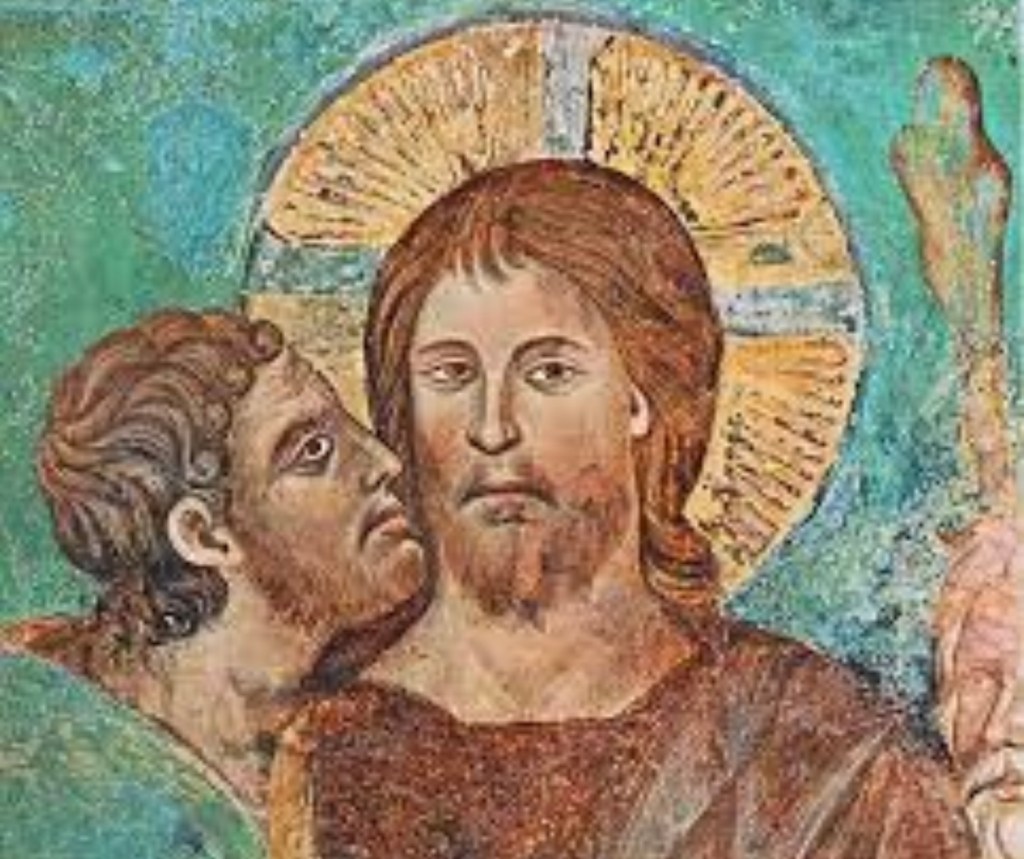
At the moment of the betrayal, only in Matthew does Jesus refer to Judas as ‘friend’, and he also tells him “may that for which you are here be done”. This is rather different to the question of Luke’s Jesus: “Judas, do you betray me with a kiss?” The Jesus of Mark and John says nothing to Judas at this point.

Whilst the account found in Luke—Acts indicates that Judas goes off to enjoy his ill-gotten gains, and is only cut short in this aim by some judicious punishment on God’s part, the story is very different in Matthew.

In a passage unique to this gospel, the Judas of Matthew is overcome with remorse when he sees Jesus is condemned. He repents, returns the thirty pieces of silver to the chief priests and elders, and states that he has “sinned by betraying innocent blood”. Met with disinterest and no compassion by the priests, Judas throws the money down in the temple, then leaves, to hang himself. The Greek in Matthew leaves us in no doubt as to Judas’ self-inflicted fate, despite Papias’ attempts to resurrect him so he can then unrepent, and go off and buy his field as per the account in Acts.

Judas, through Christian history, has been demonized for his actions. One can see this beginning in the later gospels of Luke and John, who insist that Judas was a sinner possessed by the devil or Satan, and of course in the later Papias, whose Judas is a very caricature of evil. Matthew does not join in this demonisation of Judas. Not only that though, Matthew goes even further, in that Matthew offers to Judas one of the greatest acts of salvation in our New Testament – he actually redeems Judas.

How can you be sure of that?, I hear you cry. Firstly, note that Judas repents. Repent is a word used sparingly in this gospel. It first appears with John the Baptist, he cries to people to ‘repent for the kingdom of heaven draws near”. John also tells them to ‘bear fruit worthy of repentance’. Jesus echoes the cry of ‘Repent, for the kingdom has drawn near’ in the next chapter.

In chapter 11, Jesus upbraids the cities of Chorazin and Bethsaida for not repenting, despite having many miracles carried out in them. In chapter 12, he reminds the unrepentant that the city of Ninevah repented when hearing Jonah’s proclamation about God. Where does Judas’ repentance fit with this?

The depiction of Judas throughout Christian history as infamy embodied has led most exegetes to the conclusion that this repentance in Matthew is merely regret, and not genuine repentance.

I have two things to say to this view. Firstly, it would seem that suicide is a rather drastic reaction to mere regret. Suicide speaks of deep remorse and repentance to me. Secondly, Matthew does not use ‘repent’ unless he means it. In fact, in the parable that follows this one in chapter 22, Matthew uses this very word to describe the actions of the son that initially refused to work in the vineyard, then changed his mind (or repented) and went. Jesus makes the point it is this son who did the will of the father.

So we should assume that Judas’ repentance is genuine. This is underscored by Judas not keeping the money but returning it.

Last of all, we need to consider Judas’ motivation in his act of betrayal. In looking at this, we should note firstly that Jesus goes to his death obedient to the will of God. Judas, therefore, becomes part of enacting the will of God. So the question is raised, “Does Judas have a choice”? I am sure that Matthew doesn’t think so, despite Jesus saying earlier ‘woe to the one who betrays the son of man’. The eventual fate of Judas bears out Jesus words, but does not damn him eternally.

The next surprise is that Jesus calls Judas ‘friend’ at the moment of betrayal, and makes the thoughtful statement “may that for which you are here be done” to Judas, implying some sort of foreordained action. 

The knock down argument is the scriptural fulfillment that follows hard on the telling of Judas’ demise, when the priests decide to purchase a field with the money:

Then was fulfilled what had been spoken through the prophet Jeremiah, “And they took the thirty pieces of silver, the price of the one on whom a price had been set, on whom some of the people of Israel had set a price, and they gave them for the potter’s field, as the Lord commanded me.” (Matt 27:9–10)

And Judas’ actions in betraying Jesus for 30 pieces of silver, is from the prophet Zechariah, another scriptural fulfillment allusion to the betrayal and sale of the Lord.

Now Matthew’s God is somewhat wrathful in his judgments, but is always just. If Judas had no choice, how can he then be condemned?

Judas’ suicide resembles that of Ahithophel, the man who had assisted Absalom in his rebellion against King David, and was thus the betrayer of David. Like Judas, Ahithophel hangs himself, yet is still described by many of the rabbis as having entered the world to come, or heaven as this world was known.

Judas not only shows regret and remorse, he repents, and in doing so, makes a confession to the priests of his guilt. He returns his ill-gotten gains. When the priests refuse to take the money, Judas throws it into the temple. When they do not reconsider his crime for the shedding of innocent blood, Judas enacts the appropriate punishment on himself. He seeks to make atonement through his own death.

Christians have always given lip service to the notion that even in the last days of life, true repentance is possible. However, the tradition in regard to Judas has consistently and systematically denied him this.

Not so Matthew. His parable of the workers in the vineyard insists that all who come to the right understanding of Jesus and God, even if it be very late in the day, will be welcome in the kingdom. Surely, in accord with the story he tells, this must include Judas.

Matthew, this grace-free, most judgmental of gospels, is also the gospel that extends the most mercy to one of Christianity’s most hated characters. Whatever Matthew’s exact reasons for his version of events, the parable – and its corollary in the story of Judas – surely must remind us of God’s overwhelming grace, a grace that is inclusive of all who would seek God.

Matthew: tax collector, disciple, apostle, evangelist—and “scribe trained for the kingdom”?

Today, 21 September, is the day in Roman Catholic and Anglican (and some Protestant) churches when Matthew is honoured as a saint. Matthew is best known for the fact that his name is attached to the first Gospel, in the order that the four Gospels appear, in the New Testament. So today is a good day to reflect on the figure remembered by many as Saint Matthew.

We know, however, that this Gospel wasn’t the first written Gospel—that was Mark’s, which clearly was a source used by the author of Matthew’s Gospel. By tradition, the attributed author of this Gospel, Matthew, was a tax collector whom Jesus called to follow him. (Why a tax collector who followed Jesus would take the work of a junior and erratic follower as the basis for his work, remains unexplained.)

At any rate: after this tax collector became a disciple of Jesus, he was appointed as an apostle, and later he allegedly wrote an eye-witness account of the time he spent with Jesus. That account runs up until the crucifixion and burial of Jesus, and is wrapped around with some opening chapters about the beginnings of the life of Jesus, and a closing chapter relating to the body of Jesus, his resurrection and departure from his followers.

The tradition that this first Gospel was an eye-witness account by one of the twelve apostles has come under careful scrutiny from biblical scholars, exploring the language, structure, imagery, and ideas found in that narrative.

The consensus from this scholarly work is that the first Gospel in the New Testament was not an eye-witness account, but a carefully crafted account of Jesus, originating in a community of people who had maintained their Jewish culture and practices whilst affirming that Jesus of Nazareth was the long-awaited Messiah—a community that was, therefore, in conflict with the views and teachings of the synagogue leaders in their town, who did not see Jesus in that way.

Within ecclesial tradition, the picture of Matthew, tax collector—disciple—apostle, who subsequently wrote an eye-witness account of the time he spent with Jesus, holds sway. Within biblical scholarship, Matthew is simply a character who appears briefly in the story told by the first Gospel in the New Testament.

Matthew is identified in one short verse narrating his call by Jesus (Matt 9:9). He is also included in the list of twelve who were called to be apostles, with the added descriptor, “the tax collector” (Matt 10:3). He is also named in three other books, with nothing further said about him (Mark 3:18; Luke 6:15; and Acts 1:13). But little else about him is conveyed in the four books that name him. See

Those five fleeting references are the only times we see directly this person in the biblical narratives. He is surely there in other scenes, but he simply blends into the collection of “the disciples” (Mark 2:23; 3:7; 5:31: 6:1, 35, 41, 45; 7:17; 8:1–10, 14, 27, 34: 9:14, 28, 31; 10:10, 13, 23–24; 11:19; 12:43; 13:1; 14:12–16; and Synoptic parallels), “the twelve” (Mark 4:10; 6:7; 9:35; 14:20; and Synoptic parallels; and John 6:66–71; 20:24), or, even more anonymously, into “the crowd” (Mark 2:4, 13; 4:1; Matt 7:28; 13:2; Luke 5:1; 6:17; 7:11–12; 8:4; John 6:2; 12:9, 12; Acts 1:15; 2:6; etc.).

And yet, in the evolving church traditions, Matthew emerges from the shadows to take centre stage as disciple, apostle, saint, and author of the Gospel which is placed first in the New Testament. Some churches even maintain the patristic claim that Matthew wrote in Aramaic, and was later translated into the Greek version that forms the basis of the New Testament text.

The claim about Aramaic comes from a fourth century report by Eusebius of Caesarea that a second century bishop, Papias of Heirapolis, claimed that Matthew “put the logia in an ordered arrangement in the Hebrew language (Ἑβραΐδι διαλέκτῳ), but each person interpreted them as best he could” (Eusebius, Ecclesiastical History 3.39.16). We should note that this is a somewhat indirect witness at quite some remove, and also that the Greek word Ἑβραΐδι can be translated either as Hebrew or as Aramaic.

But this claim falls down from the clear evidence of the Greek text of Matthew’s Gospel, which mirrors very closely both the Gospel of Mark, at many points, and the Gospel of Luke, at other points, in passages found only in Matthew and Luke.

The two key conclusions drawn by many scholars are twofold: first, that Matthew (like Luke) used the Gospel of Mark as a basis for writing a narrative about Jesus—but modified and adapted both the order and wording of passages; and second, that Luke and Matthew had access to another source (whether oral or written) for many of the sayings of Jesus (the source is known as Q). This makes it completely unlikely that Matthew wrote, in Aramaic, or in Hebrew, the earliest account of Jesus.

And ascribing the authorship of this Gospel to the tax collector identified at Matt 9:9 is also a patristic move. The title of this (and the other) Gospels, identifying the alleged author, is found only in later manuscripts and patristic writings; the narrative itself fails to identify anyone as the author, let alone the tax collector named Matthew. This claim is a later apologetic move, most likely made to provide an “apostolic authorisation” to the Gospel.

See

So what do we say, then, of “Matthew”, the purported author of this Gospel, a work which the author declares at the start to be “the book of origins of Jesus, Messiah” (Matt 1:1)? For me, a key to the way that the author of this “book of origins” operated is provided at Matt 13:52, where Jesus concludes a sequence of parables with the statement that “every scribe who has been trained for the kingdom of heaven is like the master of a household who brings out of his treasure what is new and what is old”.

That description encapsulates very clearly, for me, who the author of this Gospel was—a scribe, “trained for the kingdom”, drawing on old resources, but reshaping them so that they are seen to be new. We can see this in many ways in the narrative that he constructs. We can especially see this in the way he presents Jesus as an authoritative teacher of Torah—the one whose words are to be heard, remembered, studied, and passed on. Thus, the reason for his writing of this Gospel.

In this Gospel, we are offered a distinctive, at times unique, portrayal of Jesus. Only in this Gospel does Jesus affirm that all of “the law and the prophets” stand, are not to be annulled, and indeed have been “fulfilled”, or given new life and meaning, by what Jesus teaches (Matt 5:17–20).

So the encounters between Jesus and his disciples, and the scribes and Pharisees, at various moments in the narrative (9:2–8, 10–13; 12:38–42; 15:1–20; 16:1–4; 19:3–9; 21:15–16; 22:34–46) inevitably revolve around differing interpretations of Torah prescriptions and include regular references to (Hebrew) scriptural passages.

Jesus debates the way that the scribes and Pharisees interpret Torah; he meets them on their terms, and engages in these debates in accordance with “the rules” of scripture interpretation. Far from abandoning the Torah, he rather keeps the commandments, valued as “what is old”, and provides distinctive insights and understandings, “what is new”, as he intensifies and radicalises them. (“You have heard it said …”, hard enough; “but I say to you …”, an impossible counsel of perfection?)

In this Gospel alone, Jesus affirms “the scribes and the Pharisees” as those who “sit on Moses’ seat” and teach well—but fail to live by that teaching in their lives (23:1–3). Accordingly, Jesus not only teaches how to live by the law, with a ferocious intensity (5:21–48; 23:13–36), but he puts his teachings into practice; he maintains the old but fills it with new meaning. He “brings out … what is new and what is old”. All of this is central to the way that this anonymous scribe has told the story of Jesus. And that is worth remembering today.

Dealing with divine violence (Matt 18; Pentecost 16A)

“Lord, if another member of the church sins against me, how often should I forgive? As many as seven times?” (Matt 18:21). We know the question—and we know the answer. “If a person sins against you seven times a day, and turns back to you seven times and says, ‘I repent,’ you must forgive”, Jesus says, at least according to Luke’s Gospel (Luke 17:4).

Not so in Matthew’s Gospel. Forgiving seven times, as demanding as that is, is not enough—at least according to the Jesus of Matthew’s Gospel. “Not seven times”, says this Jesus, “but, I tell you, seventy-seven times” (Matt 18:22).

We hear this conversation, and an ensuing parable, on this coming Sunday, as it is the Gospel passage proposed by the lectionary. It follows on from last week’s passage dealing with conflict within the community (18:15–20).

And so, this particular Matthean representation of Jesus appears, on the face of it, to be a more generous, accepting, grace-filled version, than even the Jesus of Luke’s Gospel! Forgiveness is important—so important that it needs to be offered, over and over again, we might assume.

Well, hold on—not so fast. Because immediately after reporting this word of Jesus, the author of Matthew’s Gospel reports him offering a parable which contains a number of difficult—indeed, troublesome—elements. He sets a scene involving a king and a number of slaves. How those characters behave is interesting. The end result is that one slave is thrown into prison “to be tortured until he would pay his entire debt” (18:34).

Slaves, of course, were present in the world in which Jesus lives. Their presence is noted in scenes, such as when we see mention of the sick slave of a centurion (Matt 8:5–13; Luke 7:1–10) and a slave of the high priest (Mark 14:47; Matt 26:51; Luke 22:50; John 18:10). They are recurrent characters in the parables of Jesus (Mark 12:1–12 and parallels; Matt 24:45–51; Luke 12:35–40, 42–48; 14:15–24; 19:11–27; 20:9–19). Slaves are also referred to in a number of the sayings of Jesus (Mark 10:44; Matt 6:24; 10:24–25; 20:27; Luke 16:13; 17:7–10; John 8:34–36).

The character of a king appears in a number of parables of Jesus, in both the Gospel of Luke (Luke 14:31–32; and see also 19:27) and that of Matthew (Matt 18:23–35; 22:1–14; 25:31–46). In this last parable, the final scene of judgement of the nations (25:31–46), the king functions as God’s representative, delivering his commendation of those who acted correctly, but judgement on those who failed to do so.

In the parable we will hear this coming Sunday (18:21–35), the king initially demands repayment of a large debt owed to him by one of his slaves. When the slave cannot pay, he plans to sell him and all his goods and family. However, after being begged by the slave, the king remits the debt (18:27). This part of the parable clearly illustrates the instruction of Jesus concerning forgiveness (18:22).

In the next parable found in Matthew’s Gospel (22:1–14), whilst dealing with guests who turn down his invitation to attend a wedding feast and murder the slaves he had sent to them, the king does not act so graciously; we are told that he “was enraged; he sent his troops, destroyed those murderers, and burned their city” (22:7).

Then, when a guest does enter dressed without his wedding robe, the king was initially rendered speechless, before ordering his attendants, “Bind him hand and foot, and throw him into the outer darkness, where there will be weeping and gnashing of teeth” (22:13). This is hardly the action of a leader who is following the exhortation to “forgive seventy times seven”!

This destructive rampage by the king fits alongside the reaction of the slave in the earlier parable. Although himself forgiven of his massive debt of “ten thousand talents” (18:27)—an impossible huge debt, completely unrealistic—he refuses to forgive his fellow-slave who owes him much less, “a hundred denarii” (18:28–30)—a more realistic amount to owe. He has this slave thrown into prison—but on hearing of this, his master, the king, who had earlier practised forgiveness (18:25–27), turns on his slave, now seen as “you wicked slave”, and condemns him “to be tortured until he would pay his entire debt” (18:34).

So I am somewhat bemused by the inclusion of this parable. Had Jesus stopped at verse 27 (“out of pity for him, the lord of that slave released him and forgave him the debt”), the parable would have been a fine example of the principle of “forgive seventy times seven”. But it doesn’t stop there. It continues on for another eight verses, and those verses tell of the complete opposite of gracious forgiveness.

The idea of forgiving someone who himself had failed to show forgiveness is thus doomed to failure. And not only that—it is not simply the king in the parable who acts with vengeance, it is the “heavenly Father” who will act in this way towards anybody who “does not forgive your brother or sister from your heart” (18:35). It seems that God is fundamentally a God of vengeance, not of grace.

This should not surprise us if we look elsewhere in this Gospel, to see how Jesus portrays God. Whilst God feeds the birds of the air (6:24), “clothes the grass of the field” (6:30), casts out demons through the Spirit (12:28), commands the honouring of parents (15:4), joins together man and woman to be come “one flesh” (19:4–6), and is able to deliver “the one who trusts in him” (27:43), there are more ominous actions of the divine being that Jesus reflects in his teachings.

Whilst Jesus teaches that the kingdom of heaven will be characterised by being like a child (18:1–5), a number of parables indicate that what transpires in the kingdom will vary, depending on how a person has behaved in life. Those who commit to the righteous-justice that Jesus teaches (5:20; 6:33; 21:32) “will shine like the sun in the kingdom of their Father” (13:53) and will hear gracious words of welcome: “come, inherit the kingdom prepared for you from the foundation of the world” (25:34). Their fate is to enter into “eternal life” (25:46).

However, those who fail to live in accord with this way of righteous-justice will encounter a different message: “you that are accursed, depart from me into the eternal fire prepared for the devil and his angels” (25:41). Their fate is terrible; the “eternal punishment” that is noted at the conclusion of this parable (25:46) is variously described in other places within this Gospel.

The slave who was not prepared for the return of his master—in the first of four parables (24:45–51) which conclude the final teaching discourse of Jesus—ends with clear punishment: “put him with the hypocrites, where there will be weeping and gnashing of teeth” (24:51). Jesus had spoken the instruction to “throw him into the outer darkness, where there will be weeping and gnashing of teeth” in the parable where a person came to a wedding inappropriately dressed (22:14). This is a recurrent motif in Matthew’s Gospel.

He has also pointed to the same punishment for lawless and disobedient people in other places: in his words of judgement spoken in Capernaum, where he encounters a distressed centurion (8:12); in his explanation of the parable of the weeds and the wheat (13:42); in the parable of the good and bad fish (13:50); and in the parable of the talents (25:30).

It is a punishment that is taken from Hebrew Scripture texts: “the wicked plot against the righteous and gnash their teeth at them (Ps 37:12); “the wicked gnash their teeth and melt away; the desire of the wicked comes to nothing” (Ps 112:10); “malicious witnesses … impiously mocked more and more, gnashing at me with their teeth” (Ps 35:11,16). The prophet laments that when Jerusalem is ransacked, “all your enemies open their mouths against you, they hiss, they gnash their teeth, they cry ‘we have devoured her!’” (Lam 2:16). It is a well-known form of torment and punishment.

The parable of the unprepared servant also has this apparently savage instruction: “he will cut him in pieces” (24:51). We find that in Hebrew Scripture, this was an action used in sacrificing animals (1 Kings 18:23, 33) and as a warning of judgement against sinners—in the terrible story of the Levite’s concubine (Judges 19:29), after Saul defeated the Ammonites (1 Sam 11:7), and also in direct prophetic warnings (Isa 45:2; 51:9; Ezek 16:40; Dan 2:34; also Judith 5:22). This is the fate decreed for the unprepared slave—a terrible end, indeed!

Throughout this Gospel, Jesus declares that sinners are destined for “the judgement of fire” (Matt 5:22; 7:19; 13:40, 42, 50; 18:8–9; 25:41). This picks up from the warning of John the baptiser, which Matthew has added to his Markan source: “You brood of vipers! who warned you to flee from the wrath to come? … even now the ax is lying at the root of the trees; every tree therefore that does not bear good fruit is cut down and thrown into the fire” (Matt 3:7, 10).

That place is described by Jesus, in parables unique to Matthew, as “the furnace of fire” (Matt 13:43, 50; 25:41). Sinners will be sent to a place of “eternal fire” (18:8; 25:41), “the hell of fire” (5:22; 18:9), the “unquenchable fire” threatened by John: “the chaff he will burn with unquenchable fire” (3:12). This builds on the warnings found in Mark’s Gospel about the punishment in store for those who put stumbling blocks in the way of “these little ones”—they will be condemned to “the unquenchable fire” (Mark 9:42–48). These warnings are repeated by Jesus in Matt 18:6–9.

Matthew’s portrayal of Jesus is consistent in reporting that he warns his followers, again and again, of the fiery fate that awaits evildoers. Once again, this picks up on Hebrew Scripture passages in which various prophets declare that God will use fire to destroy people and places because of their sinfulness (Isa 1:7; 5:24; 30:27–28, 30, 33 18–19; Jer 4:4; 6:27–30; 20:47–48; Hos 8:14; Joel 2:1–3; Amos 1:4—2:5; Nah 1:15).

Amongst those prophetic oracles, Zephaniah, for instance, portrays utter devastation through divine judgement: “neither their silver nor their gold will be able to save them on the day of the Lord’s wrath; in the fire of his passion the whole earth shall be consumed” (Zeph 1:18).

However, the final prophet in the Christian Old Testament, Malachi, reworks this imagery, offering some hope; God’s messenger on The Day of the Lord “is like a refiner’s fire and like fullers’ soap; he will sit as a refiner and purifier of silver, and he will purify the descendants of Levi and refine them like gold and silver, until they present offerings to the Lord in righteousness” (Mal 3:1–4).

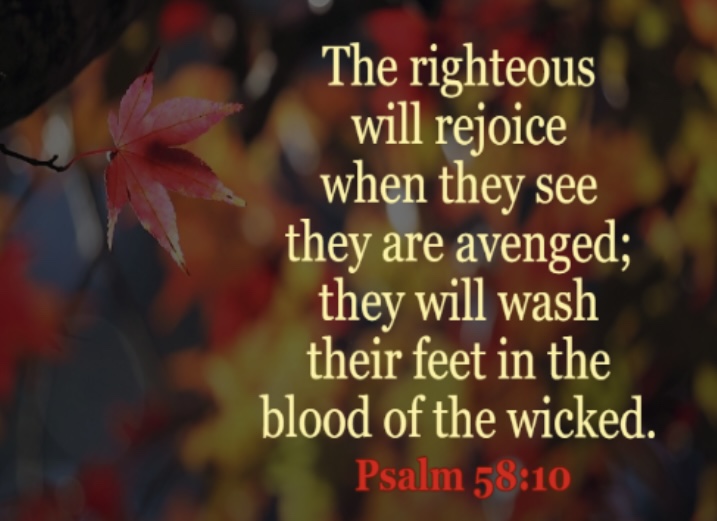
A number of psalms reflect the desire for God to punish evildoers severely; “pour out your indignation upon them, and let your burning anger overtake them” is the cry of one psalm (Ps 69:24). Another psalm notes the vengeance of God—“in your hearts you devise wrongs; your hands deal out violence on earth” (Ps 58:2)—and suggests that “the righteous will rejoice when they see vengeance done; they will bathe their feet in the blood of the wicked” (Ps 58:10). We must wonder: did Jesus pray these psalms? did he concur with their ideas? did he pray for God to act with vengeance?

The image of fiery punishment comes from the story of Daniel (Dan 3:1–30) and appears again in the last book of the New Testament, where the prophet describes his visions of “the lake of fire that burns with sulfur” (Rev 19:20; 20:10, 14–15), also described as “the second death” (Rev 20:14; 21:8). It is there that the devil, the beast, and the false prophet “will be tormented day and night forever and ever” (Rev 20:10). Matthew appears to share some similarities with the writer of this book, for as we have noted, eternal punishment in a fiery furnace features also in the words of Jesus in Matthew’s Gospel.

So we can’t simply brush aside the closing words of the parable which is in focus this coming Sunday—the Heavenly Father, we are told, will follow the example of the unforgiving servant, who will be “tortured until he would pay his entire debt” (18:34–35), in the service of ensuring that faithful people do indeed forgive one another! (How he will be able to pay off his debt while he is being tortured in prison, I do not know!)

Such punishment is consistent with the way that God’s justice will be implemented, according to the various teachings and parables of Jesus in Matthew’s Gospel that we have already noted. It will be incredibly hard to be let off the hook by this fierce, punitive God!! We are left with the conundrum: what are we to make of this aggressively violent, retributive God?

*****

I have had a go at addressing this conundrum in terms of how it is presented in Hebrew Scripture, at

and

Let such a one be to you as a Gentile and a tax collector (Matt 18; Pentecost 15A)

The Gospel we ascribe to the authorship of Matthew the tax collector, the first of the four in the canon of the New Testament, is distinctive for a number of reasons. One of those is that it contains a collection of the sayings of Jesus which relate to life in the community of faith—a kind of a miniature “community rule” for the people for whom the author was writing.

Those sayings are collected together in chapter 18, which is the fourth of five teaching blocks in the arrangement made by the author of this Gospel. We will hear and read some of those words this coming Sunday (Matt 18:15–20, Pentecost 15A), and then a parable relating to these teachings next week (Matt 18:21–35, Pentecost 16A). And this week’s reading contains some stridently harsh words from Jesus: if a person who has “sinned against” refuses to be reconciled, then “let such a one be to you as a Gentile and a tax collectors” (18:17)!

These five teaching blocks canvass ethical imperatives (5:1–7:29), missional guidelines (10:5–11:1), parables of the kingdom (13:1–53), relationships within the community of faith (18:1–19:1), and apocalyptic predictions about the coming kingdom along with strengthened indications of what righteousness is required in that kingdom (23:1–26:2). These teachings are demanding and comprehensive.

In each block of material, the author has drawn together teachings of Jesus that have been assembled from various sources, and arranged in a manner that presents these collected sayings and teachings as a cohesive, sermon-like presentation. The hand of the author is clear, just as the voice of Jesus is strong.

So the first fourteen verses of this chapter comprise words which are found at various places in the Gospel of Mark, one of Matthew’s sources, as well as in the sayings material which is believed to have been collected earlier, in the hypothetical source known as Q. (Material in Q, according to this theory, was known to and used by both Matthew and Luke, but in different ways and in different places in their works.)

The first five verses (18:1–5) report the words of Jesus about the child and the kingdom of heaven, which are included in all three Synoptic Gospels. When a child is placed before him, Jesus declares that “unless you change and become like children, you will never enter the kingdom of heaven; whoever becomes humble like this child is the greatest in the kingdom of heaven” (18:3–4). The same saying is found in slightly varied forms at Mark 10:14–15 and Luke 18:16–17.

The conclusion to this short scene, “whoever welcomes one such child in my name welcomes me” (Matt 18:5), is a variant on an earlier Matthean saying, “whoever welcomes you welcomes me, and whoever welcomes me welcomes the one who sent me” (Matt 10:40; and the subsequent variations, 10:41–42).

This, in turn, is derived from Mark’s own earlier account of when Jesus “took a little child and put it among them; and taking it in his arms, he said to them, ‘Whoever welcomes one such child in my name welcomes me, and whoever welcomes me welcomes not me but the one who sent me’” (Mark 9:36–37). Luke replicates this at Luke 9:47–48.

So the first section of this chapter already shows the dependence of the author on an earlier source, and his willingness to appropriate and reshape the material for his own purposes.

The next four verses (18:6–9) deal with skandala, a group of sayings that Mark reports in his account: “if any of you put a stumbling block [a skandalon] before one of these little ones who believe in me, it would be better for you if a great millstone were hung around your neck and you were thrown into the sea” (Mark 9:42). Mark himself then extends this saying with reference to having a hand or foot cut off, if it is a skandalon, as well as an eye plucked out if it, also, is a skandalon (Mark 9:43–48).

Matthew includes all the material that he finds in his Markan source—the little ones, the errant hand and foot, and the eye—and expands it, adding some words that intensify the warning: “Woe to the world because of stumbling blocks! Occasions for stumbling are bound to come, but woe to the one by whom the stumbling block comes!” (Matt 18:7).

Luke reports the initial words of Jesus (Luke 17:1–2), but then places the word about forgiving another member of the community (Luke 17:3) and the command to “forgive seven times seven” (Luke 17:4)—a word which provides the basis for the last section in Matthew’s fourth teaching block (Matt 18:15–35). So Luke and Matthew have each collated diverse words of Jesus, but in different combinations.

Before that, however, Matthew has Jesus tell the parable of the lost sheep (Matt 18:10–14), which is found also in Luke 15. In Luke’s recounting of the story, it is the first of three parables focussed on seeking the lost and welcoming them home with joy.: a list sheep, a list coin, and then two sons, each list for very different reasons

In Matthew’s narrative, however, the parable stands on its own, as a hinge between the warnings about skandala and instructions about dealing with conflict. The orientation is clear: stumbling blocks present problems, but the Gospel includes a call to seek reconciliation and embrace the return of a repentant one—for “it is not the will of your Father in heaven that one of these little ones should be lost” (18:14).

So the theme is set for passage which is offered by the lectionary this Sunday (18:15–20), which deals with conflict within the community. There is a short and direct statement about such a situation that is made by Jesus in Luke’s account: “if another disciple sins, you must rebuke the offender, and if there is repentance, you must forgive; and if the same person sins against you seven times a day, and turns back to you seven times and says, ‘I repent,’ you must forgive” (Luke 17:2–3).

It seems that this word comprises a reflection that sits neatly alongside an independent Markan saying: “whenever you stand praying, forgive, if you have anything against anyone; so that your Father in heaven may also forgive you your trespasses” (Mark 11:25). That word provides the undergirding for the instruction to forgive: God offers forgiveness.

Divine forgiveness is a theme that the Hebrew prophets of old surely knew (see Isa 33:24; Jer 31:34; 33:8; 36:3; Ezek 16:62–63; Dan 9:9, 17–19; Amos 7:1–3; Hos 4:4–7) and which the psalmists regularly sought (Ps 25:18; 32:1; 65:3; 79:9). They know that, “if you, O Lord, should mark iniquities, Lord, who could stand? But there is forgiveness with you, so that you may be revered” (Ps 130:3–4). And so Jesus instructs his disciples, when praying, to ask God to “forgive us our sins, for we ourselves forgive everyone indebted to us” (Luke 11:4; and compare Matt 6:12).

In Matthew’s reworking of this Q material, it takes no less than twenty verses to get from the presenting problem—“if another member of the community sins against you” (18:15)—to the final resolution, that we are to show mercy and forgive—for “if you do not forgive your brother or sister from your heart”, neither will God forgive you (18:35). Matthew does this through some direct instructions (18:15–20), which we hear in this week’s lectionary readings, and then an extended parable (18:21–35), which we will hear in the following week’s lectionary offerings.

The construction of this instructional section is clear and informative. There are four “if” clauses, setting out a hypothetical situation: “if another member sins” (v.15a), “if the member listens” (v.15b), “if you are not listened to” (v.16), and “if the member refuses to listen” (v.17). We know that this is a hypothetical situation, because the syntax of the Greek at this point does not use the simple construction for a “real present condition”, ei followed by the verb in the indicative mood, with a resolution also in the indicative.

Here, the syntax is ean followed by the verb in the subjunctive mood, followed by a resolution in the indicative. That pattern appears four times in these three verses. Jesus (via Matthew) is setting out a possible scenario, with clear guidance as to what course of action is to be taken in that scenario.

For the first three times, the response is clear and compassionate. If a sin occurs, “go and point out the fault” (v.15a). If the person listens, “you have regained that person” (v.15b). If the person does not listen, “take one or two others with you” (v.16). And as the situation increases, the inclusion of others in the process broadens the responsibility for possible resolution.

It is thought that the “one or two others” in the third step reflects the need for “two or three witnesses” in the prescriptions of Torah (Deut 17:6, and especially 19:15). Indeed, the author of this Gospel, as a pious Jew immersed in the details of Torah, would have known well the process that is outlined in Deut 19:15–21, which provides that “a single witness shall not suffice to convict a person of any crime or wrongdoing” (Deut 19:15).

It is this passage, famously, that proceeds through a process of clarification—particularly in relation to identifying a false witness (Deut 19:16–19)—before the culminating sentence is pronounced: “so you shall purge the evil from your midst … show no pity: life for life, eye for eye, tooth for tooth, hand for hand, foot for foot” (Deut 19:19, 21). Justice is clear; justice is hard; justice is demanded.

Seen in the light of this Torah provision, we can therefore understand the sequence that Jesus, via Matthew, envisages: a private conversation, then a conversation with witnesses , and then, if required, a full, public declaration of the sin—and the punishment, “let such a one be to you as a Gentile and a tax collector” (Matt 18:17).

The process that Matthew envisages is oriented towards “regaining” the one who has sinned. The Greek word in verse 15 which is translated in this way was used by Paul to indicate success as he seeks to convince people to follow Jesus as Messiah (1 Cor 9:19–23; notice the reacting “so that I might win”). It may be that Matthew has this in mind in his use of the word in verse 15; the aim is to “win” or “regain” a person back into the community, through a process of intensified persuasion.

I confess that I once wrote a detailed exegesis of this passage which argued that this word provided the key to the passage: the aim was to regain a person, to have reconciliation. I even went on to claim that “like a Gentile or a tax collector” in verse 17 did not mean, banish this person from the community, but consider them to be providing a new opportunity for them to be “converted”, persuaded of the value of the Gospel. My professor said it was very well argued, even though he did not agree with my somewhat optimistic conclusion. (I got a good grade, though!)

In the decades since then, a number of conversations with my wife Elizabeth—who has spent more time focussing on Matthew’s Gospel than I have, even though I have taught courses on Matthew for 20 years now—convinced me that the clue lies in the words used in verse 17. After all, neither a Gentile nor a tax collector is highly regarded in this Torah-informed Gospel.

Jesus, in Matthew’s account, instructs his disciples “do not heap up empty phrases as the Gentiles do” (6:7), noting that “if you greet only your brothers and sisters, what more are you doing than others? do not even the Gentiles do the same.” (5:47), and also that “it is the Gentiles who strive for these things” that are of passing value—food and drink, the length of life and our clothing—on contrast to “the kingdom of God and God’s righteous-justice” (Matt 6:32–33). The Gentiles do not get a good rap from the Matthean Jesus.

Indeed, in this Gospel, Jesus quite distinctively commands his disciples, “go nowhere among the Gentiles, and enter no town of the Samaritans, but go rather to the lost sheep of the house of Israel” (10:5-6), and dismissively informs a Canaanite woman, “I was sent only to the lost sheep of the house of Israel”, and so “it is not fair to take the children’s food and throw it to the dogs” (15:24, 26). Keep away from the Gentiles is his persistent message! (Until that is reversed by the risen Jesus, in a great turnaround, at 28:19–20).

And as for tax collectors: the first thing to say ist hat whilst the traditional understanding is that this Gospel was written by a tax collector (the one identified at 9:9), scholarly interpreters regularly dismiss this as later tradition, and note that working from the text leads us to conclude that the author was more likely a fervent, pious Jew, Torah-abiding and also deeply committed to regarding Jesus as rabbi, teacher, and Messiah.

Of course, Jesus was known for eating with tax collectors (Mark 2:15–16 and parallels)—but not so much with Gentiles (especially in Matthew’s Gospel!). Here, however, the tax collectors to whom the errant community member are to be dispatched (18:17) are those linked with sinners (9:10–11; 11:19) and with prostitutes (21:32), those who, rather than loving their enemies (5:44), “love those who love you”. “Do not even the tax collectors do the same?”, Jesus asks (5:46), placing them on par with the Gentiles, as we have already noted (5:47). So in this Gospel, it seems that to be with tax collectors and Gentiles is to be amongst those, outcast from God, who are determined to live in a way that does not reflect how Jesus understands God wants his people to live.

So the Matthew passage results in the Sam end as the Deuteronomy passage” “purge the evil from your midst” (Deut 19:19), let the sinful one “be to you as a Gentile and a tax collector” (Matt 18:17). In both cases, the need for a clear boundary, marking off the faithful from the evil ones who surrounded them, was paramount. No gentle Jesus, meek and mild, here!!

The decision is undergirded by words about binding and loosing which harken back to the authority given to Peter (16:19). It is a decision reinforced by divine authority—what is decided on earth “will have been bound (or loosed) in heaven”.

The paradox of discipleship (Matt 16; Pentecost 14A)

The section of the Gospel that is offered in the lectionary this coming Sunday (Mark 16:21–28) contains a striking paradox. As the author of this passage portrays Jesus, looking forward to the public shaming that he will experience on the cross, he places on his lips a call to his followers, to take up the cross themselves. The cross is at the centre of the story that the evangelists tell—and at the heart of Christian faith. And yet that cross subjects Jesus to the shame of being subjected to this degrading punishment.

The cross is introduced by Jesus himself, when he teaches his followers “that he must go to Jerusalem and undergo great suffering at the hands of the elders and chief priests and scribes, and be killed, and on the third day be raised” (16:21). So important is this teaching, that Jesus repeats it twice more, following the threefold appearance of this prediction in one of Matthew’s key sources, “the beginning of the good news of Jesus, Messiah”, which we know as Mark’s Gospel (Mark 9:31; 10:33–34).

So Jesus restates this briefly: “the Son of Man is going to be betrayed into human hands, and they will kill him, and on the third day he will be raised” (Matt 17:23); and then, with more details: “the Son of Man will be handed over to the chief priests and scribes, and they will condemn him to death; then they will hand him over to the Gentiles to be mocked and flogged and crucified; and on the third day he will be raised” (Matt 20:18–19).

I don’t think that these three predictions were spoken, historically, by Jesus, as he made his way towards Jerusalem. Rather, the author of a placed them in this strategic place in the centre of his narrative (Mark 8:27–38). The author of “the book of origins of Jesus, Messiah”, which we know as Matthew’s Gospel, sees the value of this repetition, and follows his source.

These statements mark the turn in the story from Galilee, where the earlier activity of Jesus took place (Matt 4:12—18:35), towards Jerusalem, where the final days of Jesus will play out (19:1—28:15). The dynamic of the narrative indicates that, as Jesus leaves behind the days of preaching and teaching, healing and casting out demons, his focus turns to the confrontation that he knows lies in store for him.

The public nature of crucifixion was humiliating and shaming. The typical process of crucifixion involved moment after moment of humiliation, undermining any sense of honour that the victim had, increasing the sense of public shame that they were experiencing.

In the Roman world, crucifixion was variously identified as a punishment for slaves (Cicero, In Verrem 2.5.168), bandits (Josephus, War 5.449-451), prisoners of war (Josephus, War 5.451), and political rebels (Josephus, Ant. 17.295). These were people whose situations or actions had generated shame.

In the case of Jesus, he is accused of treason through the inference that he is King of the Jews—a claim that was anathema to the Romans (John 19:12)—and he is crucified in the company of political rebels (Mark 15:27; Matt 27:38; the term used, lēstēs, is the one most often found in the writings of Josephus to denote a political rebel).

A public trial, followed by a public execution on the cross, was a ritual in which the accused person was shamed, through a public ritual of status degradation. Cicero, in speaking as the counsel of Rabinio, a man accused of treason, asserted that “the ignominy of a public trial is a miserable thing” and described a public execution as “the assembly being polluted by the contagion of an executioner … [exhibiting] traces of nefarious wickedness” (Pro Rabinio 11, 16).

I have explored the humiliation and shaming inherent in the act of crucifixion in more detail in a blog at

And yet, immediately after he spoke this prophetic word, Jesus issued his disciples with a call to take up their crosses themselves: “if any want to become my followers, let them deny themselves and take up their cross and follow me” (Matt 16:24). He invites them—indeed, he commands them—to enter into the public shame that he will experience in his own crucifixion.

In the narratives that recount the crucifixion of Jesus, it is not so much the physical torment of Jesus which is highlighted (although, admittedly, a slow death by suffocation whilst hanging on a cross for hours, even days, was a terrible fate). Rather, it is the various ways in which Jesus was shamed: he was spat upon, physically struck on the face and the head, verbally ridiculed and insulted, and treated contemptuously.

This is the way of Jesus; and the way of his followers. Instead of saving their life, the followers of Jesus are instructed to lose their life (16:25). Instead of aiming to “gain the whole world”, and thereby “forfeit their life”, a follower is, by implication, to let go of all hopes of “gaining the world” (16:25–26). To gain the world was presumably referring to occupying a position of power, prestige, and popularity—precisely the kind of issues that later writers, Matthew and Luke, reflected in their more detailed accounts of the testing of Jesus in the wilderness. (See https://www.google.com.au/amp/s/johntsquires.com/2019/03/05/a-testing-time-forty-days-in-the-wilderness-1/)

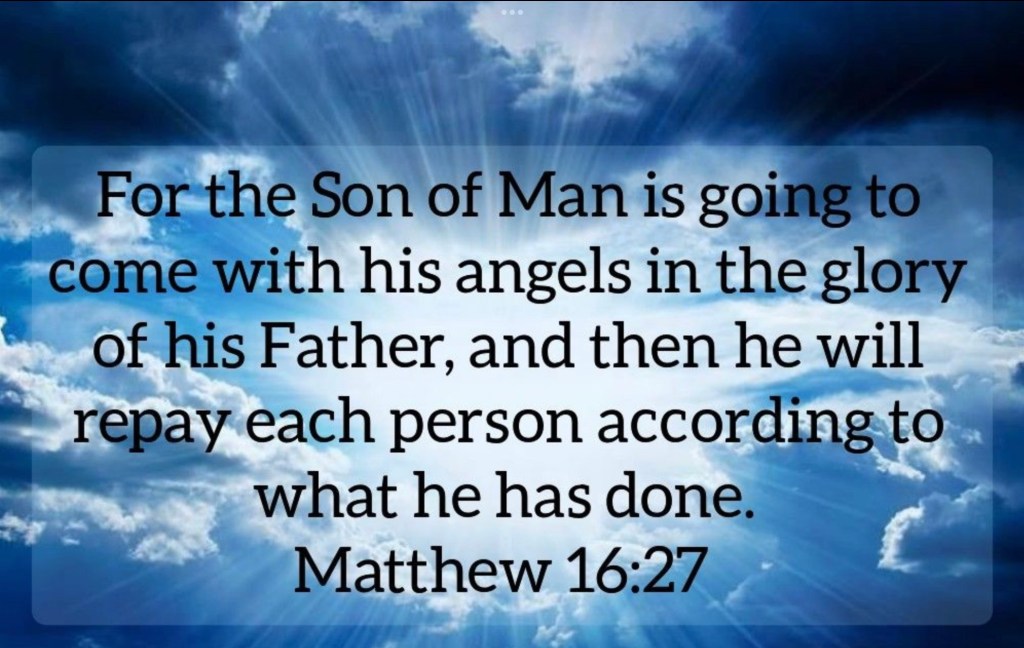
Then, Jesus specifies the sense of shame that is involved in “taking up your cross” and “losing your life”, but he turns the tables as he declares that “the Son of Man is to come with his angels in the glory of his Father, and then he will repay everyone for what has been done” (16:27).

This reversal of fortune, repaying everyone for their deeds, reflects the shame, in God’s eyes, of rejecting Jesus. (The way this saying is expressed in Mark’s earlier version is clearer in this regard; see Mark 8:38.) Here is the paradox: to gain honour, Jesus had to be subjected to the shame of the cross.

Likewise, to gain honour as a disciple following Jesus, a person must take up the shameful instrument of punishment (the cross), lay aside all desire to gain prestigious and powerful positions of honour, give up any claim on life itself, and (as Jesus later asserts), live as a servant, being willing to be dishonoured for the sake of the shame of the Gospel.

And that’s the paradox of discipleship that this passage illuminates.

Demons and dogs, crumbs from the table and lost sheep—and faith (Matt 15; Pentecost 12A)

A dialogue sermon on Jesus’ encounter with a Canaanite Woman (Matt 15), written by the Rev. Elizabeth Raine and the Rev. Dr John Squires, and preached by them on Project Reconnect for Sunday 20 August 2023.

The Gospel story we have heard today is an interesting one. It tells of an encounter that took place between Jesus, the disciples and a Canaanite woman, near the ambiguous are of the borders of the lands of Tyre and Sidon. The unnamed woman has come out from there to seek Jesus’ help. Initially repulsed both by Jesus and the disciples, she remains undeterred.

Today, we invite you to join us on an imaginative journey, which may well lead you to think about the story from different perspectives, to engage with different assumptions, and perhaps lead you to different conclusions. We are going to offer you the opportunity to listen in to a conversation about what might have happened that day when Jesus encountered the Canaanite woman.

We will not be listening directly to the conversation between Jesus and the woman—although it will figure in the discussion that takes place. Instead, we will be eavesdropping on a conversation between an acquaintance of the woman, Tamar, and a relative of one of the followers of Jesus, known as Baruch.

Baruch and Tamar are somewhat different people. Tamar is a Canaanite, from the land of Canaan which was taken over by the Israelites who conquered its original inhabitants. Baruch is an Israelite who has become a follower of Jesus, and who has heard a version of the story from his cousin Zebedee. They have accidentally met up in one of the Palestinian market places and have been drawn into a conversation about Jesus’ latest miracle.

So now, please imagine yourself watching this scene.

*****

B: Have you heard of the latest miracle performed by our Lord? Why, he healed the daughter of a Canaanite – and by long distance! A truly remarkable feat.

T: Can I enquire as to the details of this miracle, Baruch? I believe I may have some knowledge of it.

B: Sure. She was an unaccompanied Canaanite woman – a woman without a male relative! I ask you, do these Canaanites have no sense of decorum? She came crying after Jesus and his disciples, all alone, no male to chaperone her, demanding that he heal her daughter. Such presumption!

T: Now just a minute. I object to you pronouncing the word ‘Canaanite’ as if we were a nasty plague of insects. I also do not think you appreciate the desperation of a loving mother, worried about her child.

B:  If this Canaanite woman was a decent woman, she would have approached Jesus with her husband, let him do the talking, and remained quiet, eyes down and head bent.

T: What if she was widowed, or her husband did not want to beg a favour of a Jew – after all, it was the Jews who drove many of the Canaanites from their traditional homelands?

B: You must know that Canaan was the land that God promised to the Israelite people. It was foreordained that the Canaanites would have to relinquish it. And rightly so. Just look at some of the dreadful practices they had – worshipping strange gods, boiling baby goats in their mother’s milk – disgusting! All stopped when Israel took over the land.

T: I believe you are exaggerating – both about their practices and whether Israel indeed stopped them. But what right do you have to use this ancient history to belittle this woman? Whatever her ancestors did, it was hardly her fault.

B: I disagree. We all know these things can be passed down from generation to generation. And I reiterate – what was she doing running around alone on the public roadways crying after strange men? And a why would a Canaanite seek help from their Jewish conquerors like that?

T: I believe you know the answer to that. She understood that Jesus was a healer, someone special. I heard she called him “Lord”.

B: Well, there is that. I suppose his fame and reputation had spread far. But this is no excuse for her behaviour, and she must have known that the Messiah was to come only to the Jews!

T: I have heard he made that abundantly clear to the woman – and called her names. I thought a Messiah was meant to love everyone, not to mention have some sympathy with a race that had originally shared a homeland.

B: Nonsense. The Messiah was sent only to the lost sheep of Israel – everyone knows that. And a lone woman shrieking like a mad thing out in public – she deserved to be called names! And for presuming to quarrel with our Lord.

T: Don’t you think calling someone “dog” is rather insulting? Even if it is the Lord who says so? And as the Canaanites were killed or were hustled out of their land by God’s orders, I would think that it is time to make some amends to them. Why shouldn’t the Messiah share the love around a bit? And what would you do if your daughter was demon possessed? Maybe she was right to quarrel with Jesus.

B: Hmmmmm, I see your point. Of course we all want what is best for our children. And the scriptures do occasionally say that God is the God of other people. But you must admit that she behaved in a somewhat irregular way.

T: I am admitting nothing of the sort. This poor woman goes in search for help for her daughter, and she is told to go away, she is scorned for not being a Jew, and called a dog into the bargain. It is to her credit that she persisted with such a rude lot.

B: You are not telling the whole story. She was helped by Jesus, remember?

T: Let me recap as I heard this story. The woman called Jesus ‘Lord’, and asked for help. The disciples wanted her sent away. So Jesus tells her that he is sent only to the lost sheep of Israel. He then informs her that this is because it is wrong to take bread from the children (that is, the Jews) and throw it to the dogs (that is, the Canaanites). Are you honestly telling me she did not have a right to feel insulted?

B: (reservedly) Well, I suppose when you put it that way, you have a point. But still, a woman alone in public, crying out – I am not sure about this at all.

T: Then let me put it another way. If Jesus decided that after all, she had a case, and he decided to help her, then what is your problem? Remember what the law says about caring for widows and the oppressed. Baruch, you place great value in these laws, don’t you? So surely you should be prepared to some sympathy to this woman?

B: I am not entirely convinced. She must have been some sort of sinner or outcast to behave that way.

T: Nonsense. And actually, she behaved exactly like Lady Wisdom in the scroll of Proverbs. Bold, unafraid, in public alone and demanding justice. Are you saying Wisdom is a bad role model? After all, when Jesus did engage her in conversation, he accepted the woman’s argument as the right one and healed her daughter. I have also heard that he called her faith ‘great’.

B: Lady Wisdom? What rubbish. And why would Jesus commend the faith of a Canaanite woman?

T: Well, he did. And I believe that once she had convinced him that her faith was sound, he was making a point to those men in the Jewish faith who didn’t believe. Seems she knew the scripture about the Messiah better than they.

B: I grant you that there may have been extenuating circumstances. But you must understand that in Jewish custom, men do not speak to strange women in public. No wonder Jesus acted the way he did in the first instance.

T: Jesus did not shame her for being a woman. His quarrel with her was the fact she was not an Israelite. You Jews are so exclusive!

B: But he did concede the argument to her.

T: Are you saying then that she changed Jesus’ mind?

B: I suppose I am. I guess she must have been someone pretty special.

T: As I said, just like Wisdom. This woman stuck to her beliefs and cried out for justice. She was persistent, she was not going to be oppressed or pushed to the side. There is great power in the way that this woman acted.

B: She took quite a risk, then, in acting like this.

T: Indeed she did. It is an interesting point, isn’t it? Some people I have heard speaking about Jesus tend to claim that he is always the one who was right; that he will always persuade the other person, always win the debate. But in this instance, it is the woman who seems to be the one who speaks the deepest truth. In the end, Jesus admits that she is right, and he grants her request. Perhaps Jesus was the one who was transformed. So that doesn’t suggest a woman who is an outcast, does it? It suggests a woman brimming over with wisdom and spirit!

B: Well, it is clear that Jesus was affected by her. And I guess it follows that this must be good news for all of those people who aren’t Jews, but who want to follow Jesus.

T: Ah, now I think you are on to something. If the Messiah allows himself to be transformed, just think; if we emulate this, then we could transform our world, not just our two peoples. Think of it. The Canaanites were despised by Israel, whose ancestors took over their land. So the way that the disciples and Jesus responded to her at first, was simply the customary way. Such a response perpetuates resentment and hatred that then runs from people to people, from generation to generation.

B: Yes, I can see that humiliation, resentment, and violence have been passed down by people who do not stop to think that things may have changed, that there may be a better way. Jesus, with his final acceptance of the woman and his gift of healing, has set aside these conventions of ethnic hatred. In his final words, he treats the woman as one of the faithful, and opens up the way for all of us to do the same.

T: That appeals to me, for this is the attitude that can heal these historical rifts and create community. Imagine if our peoples reached out to each other in love and acceptance. And that in spite of a long history of enmity between us, we accepted that we are all equally loved by God, and that our faith and worship could be shared and celebrated together. What is to stop it happening now?

Why is it that we all just cannot talk to one another to heal the hurts of history?

*****

Today there are voices that want us to think that the foreigner or our indigenous and colonised races are a threat –a danger to be kept away, or a problem to be ignored. There are voices that press us to toe the line and follow the well-worn traditions of society and remain comfortable, settled, and unchanging. But the path of discipleship instead takes us to liminal borders and beckons us into an uncertain future. It invites us to question, consider and maybe even change our minds. It calls us to live out our beliefs, to put into practice our ideals, to venture into ambiguous places and to travel along the path less followed. Then maybe, like Jesus, we too will be transformed.

Mercy: doesn’t need to be pristine, nor need to be huge. It doesn’t need to be protected, nor kept in a pot with a lid and a lock – and oh-so-carefully parcelled out to those deemed ‘deserving’. And … just a crumb will do.

Mercy: is not like pie, nor is it mealy-mouthed or stingy. It can’t be measured, cannot help itself cannot be contained. No matter how some try, still, it overspills the tables of power and privilege, subversively escaping in scraps and crumbs that are limitless, boundary-breaking and render tables irrelevant. And … just a crumb will do.

Mercy: is subversive, spilling out for all, even those deemed (by some) as: ‘undeserving’, ‘different’, ‘not one of us’. It re-draws the circle wider than the edges of our imagination. Just a crumb contains more than enough: more grace and love than we will ever need. And … just a crumb will do.

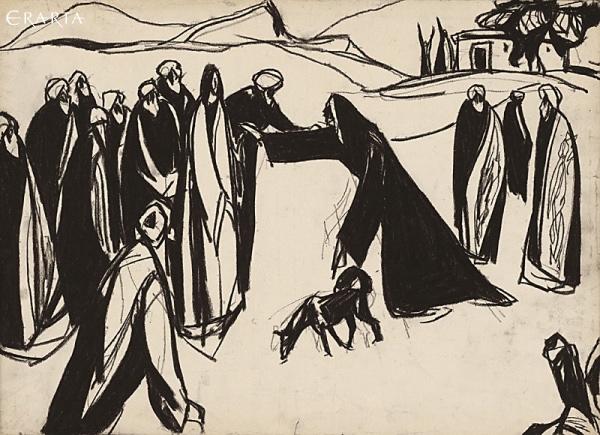
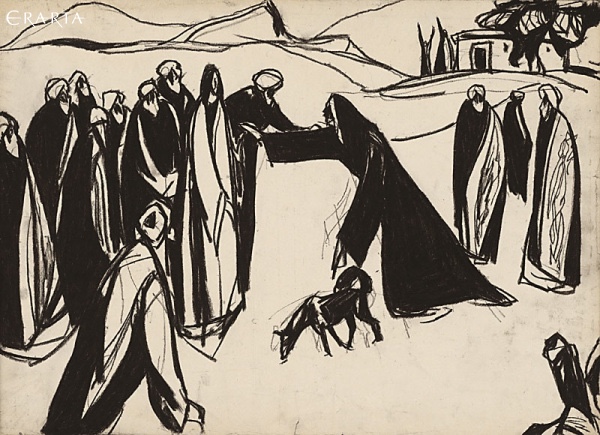
Exorcising the Canaanite Woman’s Daughter
by Peter Gorman (1990)

Liminal experiences and thin places (Matt 14; Pentecost 11A)

“Immediately he made the disciples get into the boat and go on ahead to the other side, while he dismissed the crowds” (Matt 14:22). And then, “early in the morning he came walking toward them on the sea; but when the disciples saw him walking on the sea, they were terrified, saying, ‘It is a ghost!’, and they cried out in fear” (Matt 14:25–26).

Both incidents come from the Gospel passage which is offered in the schedule of lectionary readings for this coming Sunday (Matt 14:22–33). The first excerpt, telling of a crossing of the Sea of Galilee by boat, reports a liminal experience, as the disciples cross over from one side of the lake to the other side. The second excerpt tells of a thin place moment, when the eyes of the disciples are opened up to see Jesus in a new way. Both liminal experiences and thin place moments are important in the Christian life. And often they are interconnected and occur almost simultaneously, as in this story.

Liminal experiences occur at times of transition, when we move from one place to another. The word liminal comes from the Latin word līmen, which means “a threshold”. Technically, that is the place that marks off one space from another. Its origin was the strip of wood or stone at the bottom of a doorway, which was crossed in entering a house or room.

The thresh is the place where one treads as one enters a room. So the threshold is where you take hold of the thresh, where you put your foot as you walk into a new room or new place. Anthropologists define liminality as “the quality of ambiguity or disorientation that occurs in the middle stage of a ritual”. It is the moment when participants no longer hold their preritual status but have not yet begun the transition to the status they will hold when the rite is complete.

Sociologists say that in the liminal stage of a rite, participants “stand at the threshold” between their previous way of structuring their identity, time, or community, and a new way, which completing the rite establishes. I wonder how that might apply the story of Jesus sending his disciples away, across the lake, while he went “up a mountain” to pray. Why has he sent them on ahead of him? What kind of experience was he anticipating that they might have, without him?

The concept of liminality was developed in the early twentieth century sociologists. It was applied particularly to religious rituals marking the movement of a person from one stage to another. More recently, usage of the term has broadened to the political and cultural arena, alongside the religious or faith area.

During liminal periods of all kinds, the experts tell us, “social hierarchies may be reversed or temporarily dissolved, continuity of tradition may become uncertain, and future outcomes once taken for granted may be thrown into doubt. The dissolution of order during liminality creates a fluid, malleable situation that enables new institutions and customs to become established.”

[I found this on Wikipedia, which references the source as Agnes Horvath, Bjørn Thomassen, and Harald Wydra, Introduction: Liminality and Cultures of Change (International Political Anthropology 2009). Accessed 18 March 2019.]

That’s where the disciples found themselves, as they sailed across the lake, pushing from land on one side of the lake, heading towards the land they could see on the other side, but on the water, in the midst of the lake: in a liminal moment.

And the liminal moment is precisely where change takes place, where a new reality can be experienced. In liminal moments, a thin place might be experienced. Is that what happened to the disciples on the lake, as they saw a figure walking towards them? A figure that they recognised as Jesus—for when “the disciples saw him walking on the sea, they were terrified, saying, ‘It is a ghost!’ And they cried out in fear” (14:26).

In the Celtic world, thin places are those places where the veil between this world and the otherworld is porous. They are places where human beings on the earth sense that they are standing in a place where the sky opens up, as it were, and they are drawn into a strong connection with the world beyond—with the spiritual realm, with the place where the deity is, with heaven, if you like.

The thin place is the place where the thick, dividing barrier between “heaven” and “earth” is lessened, where it becomes thin—a place where a person feels that they could reach out and “touch God”.

Thin places are often experienced where there is a sense of mystery in the landscape, or where there is a deep sense of belonging to the land as a sacred place, a sense of being so deeply earthed, yet at a place, paradoxically, which opens up to reveal something of a transcending reality, enabling contact beyond the immediate time and place. This is particularly the case among peoples whose connection to place has remained unbroken through the ages—indigenous people in Australia, in the United States and Canada, and Celtic people in Ireland and Scotland.

For the disciples, the Sea of Galilee was familiar territory. Indeed, four of them had made their living by fishing in that sea before they encountered Jesus and responded to his call to “follow me” (4:18-22). Would they have regarded that sea as a thin place where they could encounter God? Perhaps it had become a holy place for them, as they carried out their daily tasks, and felt that the difference between themselves and the sea was falling away?

Earlier in Matthew’s narrative, the disciples had been in a boat with Jesus on the sea (8:23), when a dramatic experience took place. Crossing the sea, a huge storm whips up the water. Mark’s earlier account had described this as a lailaps, a ferocious wind (Mark 4:37); Matthew modifies his version, such that the disturbance of the water was explained as being due to a seismos, an earthquake (Matt 8:24).

In both versions, the sleeping Jesus is woken, and he stills the storm (Mark 4:39; Matt 8:26). Seeing this, the disciples have an epiphany; the moment has opened up a new insight into Jesus for his disciples, as they utter the words, “What sort of man is this, that even the winds and the sea obey him?” (Matt 8:27). In asking this question, the disciples are alluding to Psalm 107, which affirms of God, “he made the storm be still, and the waves of the sea were hushed” (Ps 107:29–30). In like manner, another psalm praises God that “you rule the raging of the sea; when its waves rise, you still them” (Ps 89:9).

The question of the disciples is rhetorical; it is clear that when Jesus stills the storm, he is manifesting divine powers. Indeed, Matthew’s reworking of the story to introduce the earthquake links this “thin place” experience with other moments in the story of Jesus when the divine interposes into human life—as Jesus dies on the cross (27:51, 54), as soldiers keep watch at the tomb (28:2), and at the predicted “beginning of the birth pangs” at the coming “end of the age” (24:7–8).

That moment on the sea, in the midst of the earthquake-indicted storm, is a liminal experience that functions like a thin place for the disciples; the reality of God’s presence is glimpsed by the disciples. So it seems that on the second journey across the lake to “the other side” (8:18; 14:22), another thin place experience takes place for them. The ferocious wind and the battering of the waves places them, once again, in a precarious situation. Did they have in mind the earlier experience,when Jesus stilled the storm? The terra that leads them to exclaim” it is a ghost” (14:26) suggests that they were quite discombobulated.

Jesus had sent the disciples on across the lake ahead of himself, while he took time to go “up the mountain by himself to pray” (14:23). Jesus, of course, is often up a mountain in Matthew’s Gospel: early on, when he is tested by the devil (4:8); then as he teaches his disciples (5:1–8:1), after he had cured many people beside the Sea of Galilee (15:29), and when he is transfigured (17:1–9); and in the very final scene of the Gospel, after his resurrection (28:16–20).

The mountain, in earlier stories, had been the place where Moses engaged with God (Exod 19:3–25), where Joshua is appointed to succeed Moses (Num 27:12–23), where Solomon builds the Temple (1 Ki 5:5; 6:1–38), where Elijah experiences “the sound of sheer silence” (1 Ki 19:11–18), and where generations of faithful Israelites worshipped the Lord God (Ps 99:9). In Matthew’s narrative, Jesus is on the mountain to draw near to his Father—to find his own thin place, as it were.

So this narrative has elements that invite us to consider our own faith journey; to reflect on the liminal moments in that journey, when we have moved from one place, through a transition, into another; and to ponder when it was that we felt closest to God, to the extent that we were at a thin place, where we could reach out and touch God. The story we hear this coming Sunday, a story about Jesus and his disciples, invites us yet again to ponder our own story.

Nothing but five loaves and two fish (Matt 14; Pentecost 10A)

My post about this week’s Gospel passage is once again indebted to conversations that I have had with my wife Elizabeth about this story, and the surrounding material, in Matthew’s Gospel. She has undertaken much careful research into the way that Matthew redacts his Markan source.

*****

The story that the lectionary invites us to hear this coming Sunday (Matt 14:13–21) is Matthew’s account of “the feeding of the five thousand”, a much-beloved miracle of Jesus. It is also one of a handful of miracle stories that is narrated by all four canonical Gospels (Mark 6:30–44; Matt 14:13–21; Luke 9:12–17; and John 6:1–14).

The set-up for this story is that Jesus and the disciples are surrounded by a large crowd, time is drawing on, and there appears to be no food to eat. The punchline for the miracle is that, whilst at the start there was “nothing but five loaves and two fish”, by the end,,after “all ate and were filled”, there were “twelve baskets full” of leftovers!

For John, the feeding takes place “on the other side of the Sea of Galilee, also called the Sea of Tiberias” (John 6:1), before Jesus and the disciples cross the Sea of Galilee, back to Capernaum (John 6:16–17). Mark, however, locates this feeding in Jewish territory, after the first trip that Jesus had made to the Decapolis, on “the other side” (Mark 4:35—5:21). Matthew and Luke follow Mark in locating this scene in Jewish territory.

Then, following Mark, Matthew recounts a second feeding, of four thousand, which Mark locates on the Gentile side of the lake (Mark 8:1–10). The geography in Matthew’s narrative of this scene (Matt 15:32–39) is, as we shall see, somewhat vaguer; the incident is, however, the same in most details as that found in Mark. Luke omits all mention of this second feeding, as does John.

The number fed is consistently reported in all four accounts as being five thousand—although there are variations here. John offers this figure as an approximation of the whole crowd present (John 6:10). Mark and Luke both specify that those fed were men only (Mark 6:44; Luke 9:14), whilst Matthew teases out the implications: “those who ate were about five thousand men, besides women and children” (Matt 14:21).

Mark notes that Jesus organised the crowd in smaller groups, sitting on “green grass” (Mark 6:39), noting that “they sat down in groups of hundreds and of fifties” (Mark 6:40). Matthew simply notes that they sat on grass, colour not specified, and makes no reference to sitting in groups (Matt 14:19). This is typical of the way that Matthew omits much of the detailed narrative colouring that Mark regularly reports—such as the groups on the green grass.

So Matthew’s account is somewhat shorter than Mark’s account (seven verses in Matthew, ten verses in Mark). Both accounts, as well as Luke’s version, report the actions of Jesus as he “looked up to heaven, and blessed and broke the loaves, and gave them to his disciples to set before the people” (Mark 6:41; Matt 14:19; Luke 9:16).

This sequence clearly reflects the liturgically-developed pattern (repeated religiously in eucharistic settings over the centuries) of the last supper of Jesus: “he took a loaf of bread, and after blessing it he broke it, gave it to them … then he took a cup, and after giving thanks he gave it to them, and all of them drank from it” (Mark 14:22–23 and parallels; and see also 1 Cor 11:23–25).

The pattern is missing from John’s account, which simply notes that “Jesus took the loaves, and when he had given thanks, he distributed them to those who were seated” (John 6:11). John’s Gospel omits any specific report of eating at that “last supper”, focussing rather on the washing of feet and discussion of Jesus’s imminent departure (John 13).

Johannine allusions to eucharistic practice appear later in chapter 6, after a long sequence of midrashic exposition by Jesus, around the theme of “the living bread … that came down from heaven” (John 6:22–59)—a discourse that we learn, at the end, is set “in the synagogue at Capernaum” (John 6:59)—back on the side of the lake from whence Jesus had departed (John 6:16).

*****

All four stories contain the significant detail that “all ate and were filled; and they took up what was left over of the broken pieces, twelve baskets” (Matt 14:20; see also Mark 6:43; Luke 9:17; John 6:13). Now twelve was an important number for the Jewish people; perhaps the twelve baskets are symbolic for the Jewish people? In which case, we might ponder how much of the story is symbolic, and how much “actually happened”?

To think a little about twelve … There were 12 sons of Jacob (Gen 49:1–28), then 12 tribes of Israel (Deut 27:12–13). On the table in the Tabernacle were placed 12 silver plates, 12 silver dishes, and 12 golden plates (Num 7:84–89), and the breastplate of the priest contained 12 precious stones (Exod 28:21) as emblems of the 12 tribes as they camped round about the Sanctuary. Moses built an altar at the foot of Mount Sinai with 12 pillars (Exod 24:4) and Joshua had the people take 12 stones from the River Jordan to be placed as a memorial to their entry into the land (Josh 4:1–10).

As the story continues in the Gospels, Jesus chose 12 apostles as his inner circle (Mark 3:13–19 and parallels in Matt 10 and Luke 6; and John 6:67–71). Jesus indicates that this signified the link between his movement and the traditions of Israel (Matt 19:28; Luke 22:30; and see James 1:1). And when Jesus feeds the great crowd of 4,000 people beside the Sea of Galilee (Mark 8:1–9), there are twelve baskets of bread left over (Mark 8:19).

And in the final dramatic visions written about the promised future by the aged seer John, the number 12 figures prominently. We see this first in the vision of a woman wearing a crown with 12 stars (Rev 12:1). The number then appears in the architecture of “the holy city Jerusalem coming down out of heaven from God” (Rev 21:10), with its 12 gates with 12 angels and the names of the 12 tribes (Rev 21:12), and its 12 foundations with the names of the 12 apostles (Rev 21:14). Finally, there are 12 pearls on these 12 gates (Rev 21:21) and 12 fruits on the tree of life (Rev 22:2).

Is the emphasis on 12 in this narrative in Mark 6 and Matthew 14 and the other gospels deliberately underlining the Jewish setting, and pointing to the centrality of Jewish matters in the story? It’s a fascinating thought, which is strengthened by the observation that in the accounts of the feeding of the 4,000 (Mark 8:1–10; Matt 15:32–39) there were “seven baskets full” (Mark 8:8; Matt 15:37).

Mark locates this scene “on the other side” of the Sea of Galilee. In this Gospel, Jesus had just been “in the region of the Decapolis” (Mark 7:31), and after this feeding, he returns to Jewish territory on “the other side” (Mark 8:13).

Matthew removes any reference to Jesus being in the Decapolis; after the journey by sea that Jesus undertakes with his disciples to “the other side” (Matt 14:22), Jesus apparently returns immediately to Genessaret, on the western (Jewish) side of the lake (Matt 14:34), and has gone “up the mountain” beside the Sea of Galilee, where “he sat down” (Matt 15:29). That is a strong clue that Jesus is on Jewish territory, teaching and healing.

For Matthew, the second crowd that Jesus feeds is entirely Jewish. For Mark, the crowd that was being fed most likely included many Gentiles, as well as Jews who lived “on the other side”. The significance of seven has been the focus of attention for many interpreters (does it refer to the seven gentile nations which were in the land of Canaan? the seven days of creation? or the seventy nations, 7×10, that are listed as “the nations” at Gen 10:1–32?) Whilst the symbolism of twelve is clear, the symbolism of seven is less obvious.

*****

Each account of the feeding of the 5,000 also notes that, as well as the five loaves, there were two fish provided for distribution to the crowd (Mark 6:38; Matt 14:17; Luke 9:13; John 6:9). Only Mark notes that the twelve baskets of leftovers included fish as well as “broken pieces” of bread (Mark 6:41). Interestingly, in Matthew’s account of the feeding of the 4,000, “a few small fish” were provided along with the seven loaves (Matt 15:34).

Mark’s account, presumably known to Matthew, did not mention this detail. Was Matthew unconsciously harmonising the narratives of the two feedings? Certainly, a fish would become an important symbol used by the early Christians (and still seen today) to mark their identity. The Greek word for fish, ichthus, written in capitals as IXTHUS, was used as an acronym to signal faith in Jesus: I (Iēsous, Jesus), X (Christos, Messiah), TH (theou, of God), U (huios, Son), S (sōtēr, Saviour).

Of the four accounts, only John notes that the loaves of bread had been made from barley (John 6:9), perhaps evoking the story of the twenty loaves of barley provided to Elisha to feed a hundred people (2 Kings 4:42–44). And only John included the detail, much beloved by flowery preachers, that the five loaves and two fish were provided by a boy (John 6:9). It adds a simplicity to a wonderfully impressive miracle, perhaps. However, in each of three Synoptic accounts, those loaves and fish simply appear from within the crowd.

*****

Finally, we turn to the way that this feeding story is introduced by the evangelists. All four evangelists note that a large crowd was gathering: “many were coming and going … [Jesus] saw a great crowd” (Mark 6:31, 34; Matt 14:13–14; Luke 9:11; John 6:2, 5). In John’s account, the presence of this “large crowd” leads Jesus simply to ask a straightforward logistical question, “where are we to buy bread for these people to eat?” (John 6:5).

In the Synoptic accounts, it is the disciples who get worried about the numbers present, and advise Jesus to “send the crowd away” so that they can get provisions elsewhere (Mark 6:36; Matt 14:15; Luke 9:12).

In two of the Synoptic narratives, however, the crowd has previously drawn words of compassion from Jesus. Mark reports that “he saw a great crowd and he had compassion for them, because they were like sheep without a shepherd, and he began to teach them many things” (Mark 6:34). Matthew simply notes that Jesus “had compassion for them and cured their sick” (Matt 14:14). It’s a neat pastoral touch, I think, to have Jesus healing, rather than teaching, with this large crowd.

The lack of food at hand signals that the scene is set well away from the towns and villages that Jesus frequented. Indeed, in Mark’s narrative, Jesus had intentionally taken his apostles into a boat and moved away into “a deserted place” (Mark 6:31); Matthew follows Mark in this regard (Matt 14:13). In the biblical tradition, the wilderness plays a pivotal role in the story of the Israelites, freed from captivity in Egypt, yearning for the promise of land and safety still ahead of them.

The wilderness was the place where the character of Israel was forged. It was in the wilderness, throughout that long period of wandering, that they had encounters with the divine, that their identity was shaped, that their foundations as a nation were laid. The stories told in Exodus, Numbers, and Deuteronomy tell of thirst and hunger in the wilderness, encounters with snakes and other trials—as well as the giving of the law, on Sinai, a mountain in the middle of the wilderness.

The journey through the wilderness figured in the songs of Israel. It is regularly recalled in the Psalms (68:7, 78:15-20, 40, 52, 95:8, 106:14-33, 136:16) as well as in various prophetic oracles prophetic oracles (Isaiah 40:3-5, 41:17-20, 43:19-20, Jer 2:6, 31:2-3, Ezekiel 20:8b-21, Hosea 13:4-6, Amos 2:9-10, Wisdom of Solomon 11:1-4) and occasional narrative references. The exodus from Egypt and the subsequent wilderness wandering, provided the foundational story for Israel, from long ago, and still through into the present.

The wilderness was where Israel met God; where Israel’s commitment was tested; where Israel’s faith was shaped. That is where, in the narratives of Mark and Matthew, Jesus expresses his compassion for the crowd and feeds “five thousand men, besides women and children” (Matt 14:21).

Luke, by contrast, has Jesus take his followers to “withdraw privately to a city called Bethsaida” (Luke 9:10), whilst John reports that Jesus “went up the mountain and sat down there with his disciples” (John 6:3), adding the note that “the Passover, the festival of the Jews, was near” (John 6:4)—the second of three Passovers in this narrative (John 2:13; 6:4; 11:55).

The four accounts differ in remarkably few details, overall, indicating either that there was a high level of memory retention by those who told and retold the story orally, before the Gospels took written firm; or else, that some kind of manuscript with an account of this incident (as well as some other stories) was known amongst the followers of Jesus at a relatively early stage of development of the Gospels. Either way, it is an intriguing and informative narrative for us to reflect on this coming Sunday.

Parables, riddles, and allegories: the craft of Jewish storytelling (Matt 13; Pentecost 8A)

Jesus used parables as the chief means of his story-telling. A parable is a story told in a specific way, often to make a single clear point. Parables are conundrums. They contain unresolved tensions. They invite multiple understandings. They press for exploration and investigation. We have another parable in the Gospel reading for this coming Sunday!

The accounts of Jesus that we have in scripture—Mark’s beginning of the good news of Jesus, Matthew’s book of origins of Jesus, Chosen One, and Luke’s orderly account of the things fulfilled—each contain a number of parables. Even in John’s book of signs, there are some parable-like sections, buried in the midst of the long discourses that this book contains.

Last week (Pentecost 7A), we had the parable of the seeds and the sower (13:3-9) and its interpretation (13:18-23). This week (Pentecost 8A), we will hear the parable of the weeds among the wheat (13:24-30) and its interpretation (13:36-43). Then in the following week (Pentecost 9A), we will hear the other five parables in this chapter: the mustard seed (13:31-32), the yeast in the flour (13:33), hidden treasure (13:44), a pearl of great value (13:45-46), and the net that caught fish (13:47-48)—each one offered without interpretation.

As with last week, so also this week we are given a parable, followed immediately by an interpretation of the parable. I had a spout last week about the way that a later allegorising understanding of the parable has been placed on the lips of Jesus, in this Gospel account. You can read that at https://johntsquires.com/2020/07/09/parables-the-craft-of-storytelling-in-the-book-of-origins-matt-13/

However, Elizabeth and I have had a rolling conversation about parables, and how they were seen and used in Judaism. The idea that the allegorising interpretation was a later addition, beyond the time of Jesus, has held sway for a number of decades in critical biblical scholarship. Christian scholars are dubious about whether Jesus would have utilise this somewhat hellenised approach to stories. (We know that allegories were in evidence centuries before Jesus in Greek literature. Whether Jesus knew this long tradition is debatable.)

Yet this critical Christian perspective overlooks the claim that Judaism, and the long stream of Jewish tellers of parables, have on such stories. Parables are found, in Jewish literature, in various forms. There are, for a start in Hebrew Scripture, a number of short, succinct, one-liners, often introduced as a simple comparison (“this is like that”), making just one focussed point. (Indeed, that is what the Greek word parabolē means—it signals two things that are “thrown beside” each other.)

The widow in Tekoa explains her plight to King David, explaining that “your servant had two sons, and they fought with one another in the field; there was no one to part them, and one struck the other and killed him; now the whole family has risen against your servant” (2 Sam 14:6–7).

When Ahab was king, a prophet waited beside the road, disguised with a bandage over his eyes, and taunts the king: “your servant went out into the thick of the battle; then a soldier turned and brought a man to me, and said, ‘Guard this man; if he is missing, your life shall be given for his life, or else you shall pay a talent of silver.’ While your servant was busy here and there, he was gone.” (1 Ki 20:38–40).

The “song of my lover about his vineyard” that Isaiah tells (Isa 5:1–7) is longer, but drives relentlessly to the single point: the Lord of hosts “expected justice, but saw bloodshed; righteousness, but heard a cry!”. Another agricultural parable relates the skill of the farmer who utilises good practices to produce abundant harvests; “they are well instructed; their God teaches them”, and so “this also comes from the Lord of hosts; he is wonderful in counsel, and excellent in wisdom” (Isa 28:24–29).

The classic example from Hebrew Scripture comes after David pursues Bathsheba, the wife of Uriah, after he has sent Uriah off into battle. The adultery of King David leads the prophet Nathan to confront him with a story about “a rich man who had many flocks” and “a poor man who had nothing but one little ewe lamb” (2 Sam 12:1–4).

As the story develops, and the rich man took the poor man’s lamb to feed a visitor, the king explodes into anger (2 Sam 12:5–6)—only to be met by the damning words of the prophet: “you are the man!” (2 Sam 12:7). The parable had drawn David into the web of the story, and there was now no escape!

In the parable of the weeds and the wheat which Jesus tells (Matt 13:24–30), there is a simple contrast drawn between the weeds and the wheat, and a story which develops so that the conclusion that is drawn can only be seen as inevitable. That simplicity, and also that technique of drawing the listener into the story, is typical of parables that Jesus told.

A number of the parables told be Jesus were indeed short and direct, making a single point and needing little explanation: see the parables of the treasure (13:44) and the pearl (13:45), for instance. This made the parable easy to remember and repeat orally.

These parables are little more than an introduction (“the kingdom of heaven is like…”) and a single image which is used to describe a characteristic of the kingdom (hidden treasure, or fine pearls). The first part of this week’s parable (13:24–26) has this form. It is short and direct.

It starts with the classic introduction, “the kingdom of heaven may be compared to …”. It goes on to tell of the good seeds, which grow into wheat, and the bad seeds, which grow into weeds. This part of the parable has a simple contrasting form, like the parable of the good fish and the bad fish caught in the net, as told in the last of the seven parables (13:47–48).

But the parable has a story attached to these weeds among the wheat (13:27–30). So Jesus continues with a little plot development, which brings in a reflection on the human characters who sowed the seeds. In this regard, this is like other parables of Jesus, which are a little more developed; they still make a single point, but it is developed or explained a little more. And the questions are raised … and the listeners ponder, and consider their responses …

This parable plays,quite cleverly, on the fact that there is, indeed, a type of “weed” which, for much of its life, looks quite like wheat (the bearded darnel, lolium temulentum, or Darnel Ryegrass). So it is a story which is quite credible in the scenario it proposes. And then, added to the actual parable, there comes a separate section that provides a strongly allegorised interpretation of what happened in the field where the wheat and the weeds grew (13:24–30).

That development in the plot of this parable, and the subsequent allegorical interpretation, might well relate to the fact that the Hebrew Scriptures also contain parables with developed plots and allegorical elements. In an allegory, particular individual features can play an independently figurative role, so that the story told becomes a kind of riddle which invites a response from the listener. “What do you think?” becomes the implied way that the allegory-riddle ends. Listening to the story is not enough—the listener needs to engage, enter the conundrum, make up their mind!

A classic short, simple riddle is that spoken by Samson, “out of the eater came something to eat; out of the strong came something sweet” (Judg 14:14). The narrative comment that follows is delightful: “for three days they could not explain the riddle”! Another example is the proverb quoted by two prophets, about the impact of the Exile: “the parents have eaten sour grapes, and the children’s teeth are set on edge” (Jer 31:29; Ezek 18:2). The point of this saying is clear, and telling.

In Hebrew Scripture, the allegory of the Eagles and the Vine (Ezek 17:3–10) is described as both ḥidah (“riddle”) and mashal in verse 2. The parable first describes “a great eagle, with great wings and long pinions”, who carried seed far away where it took root and became a vine (a classic symbol of Israel). It then offers a further description of “another great eagle, with great wings and much plumage”, which the teller of the parable fears may seek to uproot the vine.

“When it is transplanted, will it thrive”, the parable ends (v.10)—will Israel, transplanted into exile, manage to survive that experience? Then follows an explanation of the details of the parable (Ezek 17:11–21), relating the story to the immediate situation of Israel.

Further parable-riddles occur in subsequent chapters in Ezekiel. There is the Lamenting of the Lioness (Ezek 19:2–9) and the Transplanted Vine (Ezek 19:10–14), and the stories of the Harlot Sisters (ibid. 23:2–21). There is also one of my favourites, the very vivid—and gruesome—parable of the Cooking-Pot (Ezek 24:3b—5).

In this parable, the prophet warns the people of judgement: “set on the pot … pour in water … put in the pieces, the thigh and the shoulder … fill it with choice bones” (that is, the meat and bones of the Israelites being punished). The prophet concludes with a booming denunciation: “woe to the bloody city … the blood is shed inside it … to rouse my wrath, I have placed the blood she shed on on a bare rock” (Ezek 24:6–8, and then the metaphor extended still further in 24:9–14).

Each of these parables are clearly allegorical, in that the overall point is clear, and yet also the details in the story invite connection with specific people or events. Ezekiel is a powerful speaker, who utilises this dramatic story-form with great flair, and effect.

A third type of mashal is the fable, where animals or inanimate objects are made to speak and act like men. We know about fables in Greek literature from Aesop, of course, and in more recent literature through those tales collected by the Brothers Grimm; but the article on “Parables” in the Jewish Virtual Library notes a number of instances where Hebrew Scripture contains fables. One good example is Judges 9:8–15, where the trees confer as to who will become king. Another is 2 Kings 14:9–10, where a thornbush sends a message to a cedar, but a wild animal tramples down the thornbush. These fables can be seen to relate directly to the political situation of Israel at different times in their history.

The article on “Parable” in the Jewish Virtual Library also notes: “Mashal and ḥidah are used almost synonymously in Ezekiel 17:2; Habakkuk 2:6; Psalms 49:5 and 78:2; and Proverbs 1:6. Certain proverbs are in effect parable-riddles, e.g., Proverbs 30:15a, 15b–16, 18–19, and 21–31.

“Other biblical forms related to the parable type of mashal are: prophetic oracles where a metaphor is extended into a lively description, e.g., Isaiah 1:5–6; Hosea 2:2–15; 7:8–9, 11–12; Joel 4:13; and Jeremiah 25:15–29; prophetic oracles proclaimed through symbolic actions, e.g., I Kings 11:29; II Kings 13:15–19, and Isaiah 20:2–6; extended personifications as of Wisdom and Folly in Proverbs 1:20–33; 8:1–36; 9:1–6, 13–18; and revelatory dreams and visions having symbolism which the sequel interprets as allegorical, e.g., Genesis 37:6–11; 40:9–13, 16–19; Zechariah 1:8–11; 2:1–4; and Daniel 2:31–45.

Beyond these many examples, there are the multitudes of parables in rabbinic literature (about which, see the further resources listed at the end of this blog).

Returning to the parable of the wheat and the weeds: if we take an agricultural approach to the story, it is a mystery why the weeds had to be burnt, and not just pulled out—as in the version of this parable found in the Gospel of Thomas—and composted—as would occur in my own gardening!

My own take would be that this links with the Jewish prophetic tendency to connect burning with God’s judgement (see Isa 27:2–4; Jer 4:4, 7:20, 15:14, 17:4; Nahum 1:13; Malachi 4:1; see also Ps 79:5, 89:46, and Exod 15:7). And we saw in my comments on the earlier parable that God’s judgement was a strong motif in the parables and teachings of Jesus, especially strengthened in Matthew’s account.

The parable of the mustard seed (13:31–32) is another example of a simple parable with a short plot development. This parable uses the same introductory phrase, “the kingdom of heaven is like …”, and conveys its main point in an image (mustard seed, 13:31) which is further developed to convey what happens to the mustard seed as it grows and forms “the greatest of shrubs” (13:32).

So the plot of the parable of the wheat and the weeds continues until the punchline is reached. It is not during the growing that any distinction is to be made; it is at the harvest that this distinction is enforced. Wheat that grew from good seeds is to be collected and stored; weeds that grew from bad seeds are to be bundled and burnt (13:28–30).

That much, as a parable, has a clear message: don’t intervene into the process of growing, don’t judge (recalling words of Jesus reported at Matt 7:1), but let the end result of the process of growing be the moment when the judgement occurs—and let that judgement be undertaken by God. And that taps into a strong interest, throughout the book of origins, for depicting Jesus as the eschatological preacher of judgement. See

This probably explains one curious aspect of the parable, that we noted above: why the weeds had to be burnt, and not just pulled out. It connects with Jewish understandings of judgement. Consistently throughout the book of origins, Jesus is presented as a prophetic eschatological figure. And yet alongside that, he functions as a master story-teller, in the mode of prophets of old as well as the rabbis to come!

In his capacity as God’s Messiah, Jesus frequently promises (or threatens) judgement (5:21–26; 7:1–2; 10:15; 11:21–24; 12:36–37; 19:28– 30; 21:33–44; 22:1–14; 24:29–31, 36-44, 45–51; 25:1–13, 14–30, 31–46; 26:64). The language of burning in the eternal fire characterises both conclusions to parables of Jesus, and the warnings of earlier prophets. Many of these declarations occur in eschatological contexts, where Jesus is warning about the punishment that is to come at “the end of time”, unless the righteous-justice that he advocates is followed in the present.

In the previous chapter, a quotation from the prophet Isaiah (Isa 42:1–4, at Matt 12:15–21) includes an extended quotation from Isaiah 42, where the servant of the Lord proclaims judgement to the Gentiles and they are said to have hope in his name (presumably because they repent and believe him). This is the function that Jesus, as God’s servant, the Chosen One, carries out. It’s not for us human beings to take on the role of judge. That belongs to God, carried out through his chosen agent, Jesus.

The parable of the wheat and the weeds has an intensity because of its focus and orientation towards this fearsome judgement, executed by Jesus as “the Son of Man” (24:30–31), in obedience to the desire of God. The interpretation of the parable might be seen to defuse the intensity of the parable by fussing about what each element refers to: the Sower is the Son of Man, the good seeds are the children of the kingdom, the bad seeds are the children of the evil one, the enemy is the devil, and so on (13:39). But the end point remains clear: judgement is a hand!

The interpretation of the parable ends with a repetition and expansion of the scene of judgement that ended the parable—but the good seed is not simply stored, it morphs into the righteous in the kingdom, and the bad seed is not burnt as seed, but it becomes the ones who disobeyed the law, burning in the furnace (13:41–43). And there will be “weeping and gnashing of teeth” (13:42; see also 13:50; 22:14; 25:30). So the same punchline holds in this section, as in the parable itself.

Interestingly, the interpretation ends with the same punchline that concluded the parable of the seeds and the sower: let anyone with ears, listen! (13:43, cf. 13:9). Jesus continues to press the point. Judgement is inevitable. He will continue to articulate this ominous message throughout the remainder of the Gospel—right through to the sequence of the four parables of judgement that conclude the final teachings of Jesus (24:44—25:46). Let anyone with ears, listen, indeed!

This blog draws on material in MESSIAH, MOUNTAINS, AND MISSION: an exploration of the Gospel for Year A, by Elizabeth Raine and John Squires (self-published 2012), and from ongoing conversations that Elizabeth and I have had about parables, Christian interpretation, Jewish storytelling techniques, and associated matters.

On Jesus’ language of judgement elsewhere in Matthew’s book of origins, see

The Jewish Virtual Library is a project of the American-Israeli Cooperative Enterprise (AICE), which was established in 1993 as a nonprofit and nonpartisan organization to strengthen the U.S.-Israel relationship by emphasizing the fundamentals of the alliance — the values which those two nations share. The extensive online resource on Jewish history, politics and culture provides a one-stop shop for users from around the world seeking answers to questions on subjects ranging from anti-Semitism to Zionism.
AICE seeks to provide a vehicle for the research, study, discussion and exchange of views concerning nonmilitary cooperation (Shared Value Initiatives) between the peoples and governments of the United States and Israel.

The Jewish Virtual Library article on “Parable” can be found at https://www.jewishvirtuallibrary.org/parable

For further reading on parables in the rabbinic tradition, see

https://www.cfi.org.uk/downloads/rabinnic-parables.pdf

https://www.jewishencyclopedia.com/articles/11898-parable

https://www.jerusalemperspective.com/2721/