Greater honour to the inferior member (1 Cor 12; Epiphany 3C)

We continue this week hearing from a well-known section of the letter that Paul and Sosthenes wrote to the believers in Corinth. In the chapter proposed in the lectionary passages last Sunday and this coming Sunday (1 Cor 12:1–31), Paul and Sosthenes address the nature of the community that has been formed by those who formerly were “pagans … led astray to idols” (12:2). They have now have come to believe that “Jesus is Lord” (v.3) and desire to follow his way in their lives through offering their gifts in service (vv.4–7).

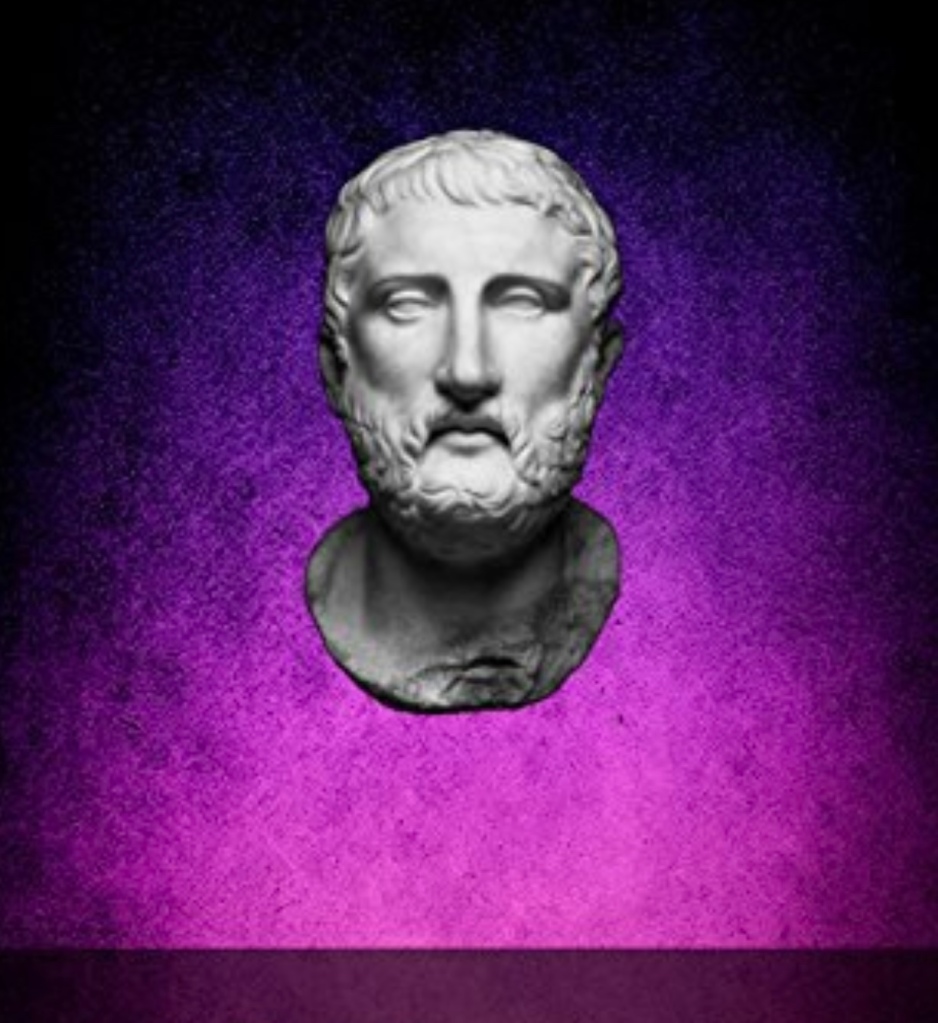
Paul and Sosthenes

In Corinth, however, the gifting of the Spirit has been claimed by some as a basis for unedifying behaviour, which as Paul and Sosthenes say,  tears apart, rather than builds up, the community. This is manifested in various ways, including (as we noted last week) in the worship of the Corinthian community, where, fuelled by their sense of being “the spiritual ones”, some people unleash chaos in the gathering. This is in contrast to the desire of the letter writers that in this gathering “all things should be done decently and in order” (14:40), as befits the God who is “a God not of disorder but of peace” (14:33).

In the passage from 1 Cor 12 proposed as the Epistle for this coming Sunday (1 Cor 12:12–31), Paul and Sosthenes offer a strong affirmation to the Corinthians about the wide reach and inclusive invitation that characterises the work of the spirit: “For in the one Spirit we were all baptized into one body—Jews or Greeks, slaves or free—and we were all made to drink of one Spirit.” (1 Cor 12:13).
I rejoice that these words have been taken up in my church, the Uniting Church in Australia, as the basis for fostering a broad community of faith, across multiple social factors which could divide rather than unite (in paragraph 13 of the Basis of Union). Ministry is enabled by the gift of the spirit. To anyone. To everyone. It is a fine ideal.

That paragraph of the Basis affirms that “every member of the Church is engaged to confess the faith of Christ crucified and to be his faithful servant”. It continues with a declaration, grounded in the scriptural witness (1 Cor 12) that “the one Spirit has endowed the members of Christ’s Church with a diversity of gifts”. 

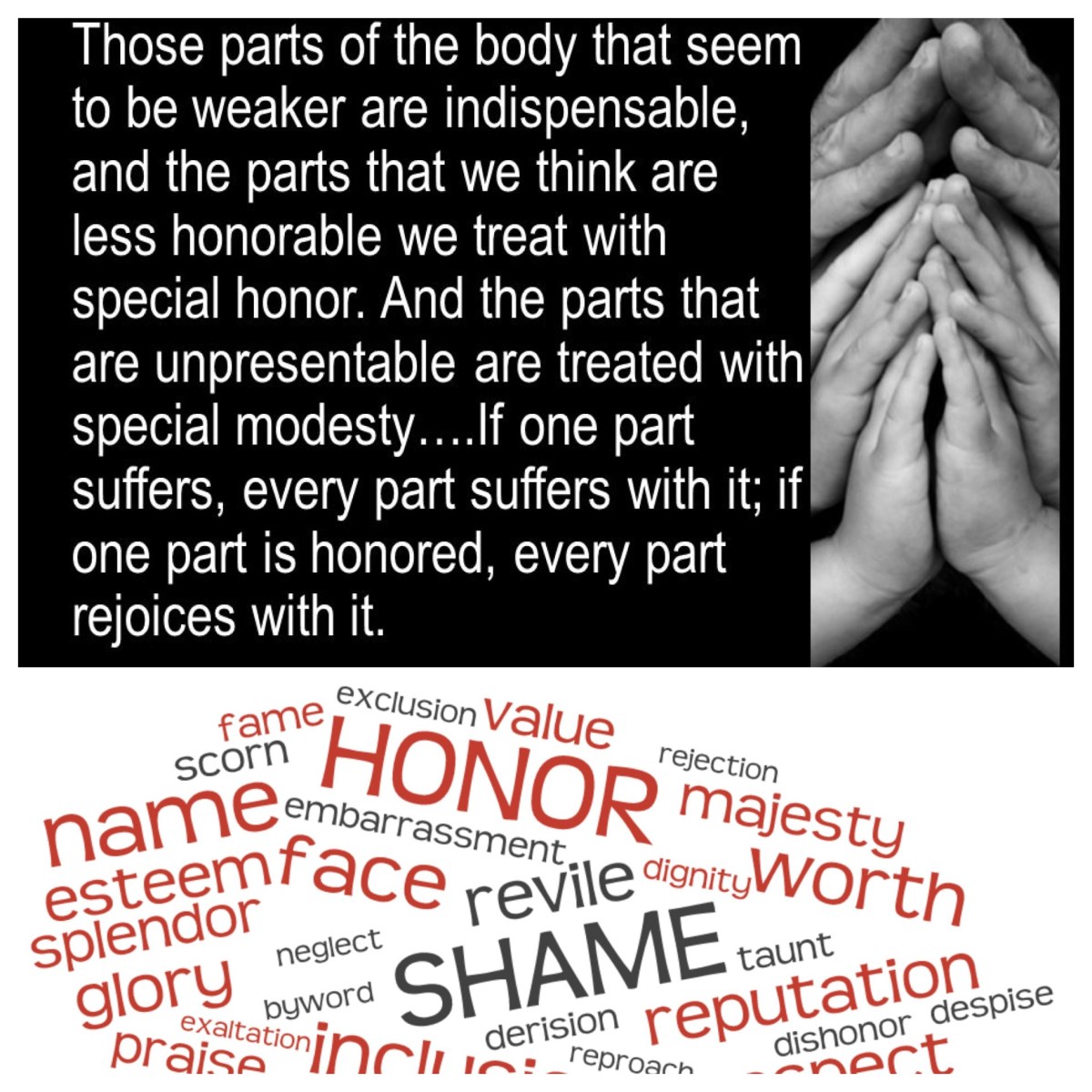
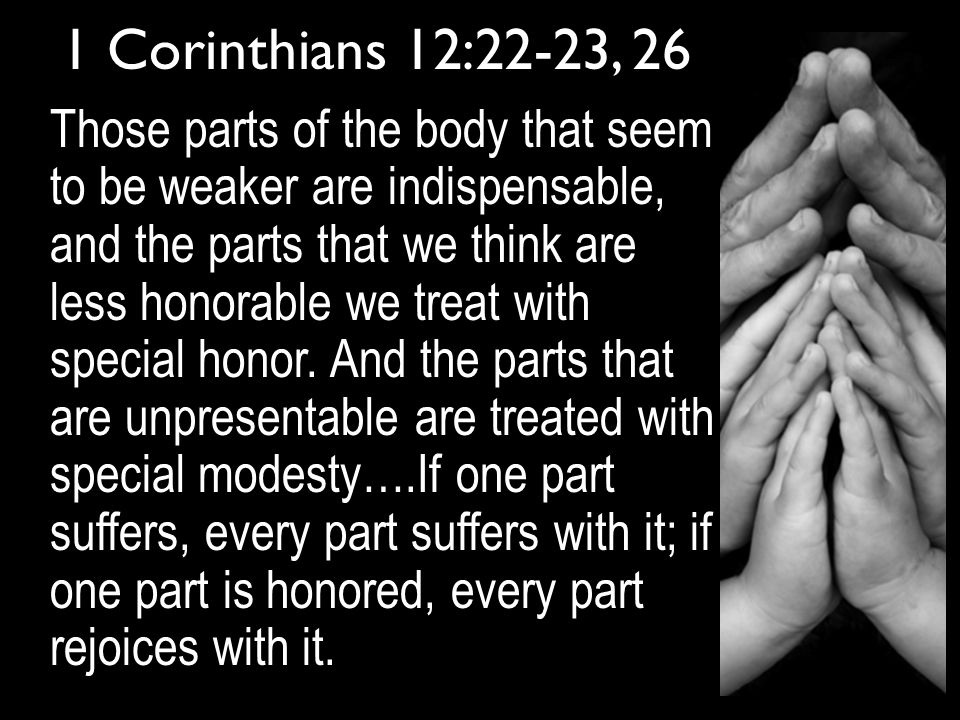
In writing to the Corinthians, Paul and Sosthenes first identified a range of gifts (1 Cor 12:8–10), and then emphasised the claim that “the body does not consist of one member, but of many” (1 Cor 12:14). As a result, each and every member plays an integral role in the whole. From this, they deduce that “the members of the body that seem to be weaker are indispensable … God has so arranged the body, giving the greater honour to the inferior member” (1 Cor 12:22–25). The context in Corinth has shaped the direction into which Paul develops this image.

Honour and shame were central features of ancient Mediterranean societies. Possessing much honour reflected a high social status; gathering much shame reflected low social status. Public debate amongst males was a key way in which honour was demonstrated; besting another person in such a debate was a means by which an increase in honour could be attained. Acting in a way that brought shame upon oneself meant that the amount of honour attributed to you would diminish. Women acting in ways that were not in accord with the patriarchal structures of the time would also be considered as shameful. A woman’s place was, literally, in the home.

Jesus did not shy away from the challenge to his honour and authority that public debating posed. He engaged in many debates, responding with confidence to challenges to his honour as various questions were posed to him, as is reported in Mark’s Gospel: “why does this fellow speak in this way? it is blasphemy! who can forgive sins but God alone?” (Mark 2:7); “why does he eat with tax collectors and sinners?” (2:16); “why do your disciples do not fast?” (2:18); “by what authority are you doing these things?” (11:28); “is it lawful to pay taxes to the emperor, or not?” (12:14). According to Mark, he bested his opponents on each of these occasions; he was a public debater of the first order. 

Honour was praised by the Greek philosopher Aristotle as “the greatest of all external goods” (Aristotle, Nic. Eth. 1), whilst Xenophon considered that honour was what differentiated humans from animals (Hiero 7.3). Philo of Alexandria, bridging both Jewish and Hellenistic worlds, affirmed that “fame and honour are a most precarious possession, tossed about on the reckless tempers and flighty words of careless men” (Abraham 264).

The honour—shame culture runs through the Hebrew Scriptures. The ancient Hebrews affirmed that honour belongs primarily to God (1 Chron 16:27), so that God could bestow honour on those who were faithful to his ways (Ps 92:14-15). The same idea is expressed in the version of Isa 28:16 which is cited at 1 Pet 2:6, which  modifies the ending to provide explicit reference to the claim that God will not shame believers. God can thus honour human beings (Ps 8:5), even those regarded as shameful (Zeph 3:19); and conversely, God could shame those accorded honour by humans (Isa 23:9). Paul later reflects this early in his first letter to Corinth (1 Cor 1:27).

And later in that letter, Paul and Sosthenes addressed the hierarchical ranking that is integral to the honour—shame culture, and offered a completely counter—cultural perspective. “The members of the body that seem to be weaker are indispensable”, he asserts; and so too, “those members of the body that we think less honourable we clothe with greater honour” (1 Cor 12:22–23). Accordingly, he advocates that “our less respectable members” should be “treated with greater respect; whereas our more respectable members do not need this” (12:23:—24). This is how this part of the letter upends the conventions of his time.

Then Paul and Sosthenes provide the theological rational that undergirds this perspective; “God has so arranged the body, giving the greater honour to the inferior member, that there may be no dissension within the body, but the members may have the same care for one another” (12:24–25). The pastoral conclusion that they draw from this—reinforcing the sense of equality that should mark the community of followers of Jesus—is that “if one member suffers, all suffer together with it; if one member is honoured, all rejoice together with it” (12:26). It is the fundamental lesson in standing firm against the culture because of the demands that the Gospel places on believers.
All are activated by the same Spirit (1 Cor 12; Epiphany 2C)

This coming Sunday and the following Sunday, the lectionary suggests that we read and hear a well-known section of Paul’s letter to the believers in Corinth. In this chapter (1 Cor 12:1–31), Paul addresses the nature of the community that has been formed by those who formerly were “pagans … led astray to idols” (12:2) and have now have come to believe that “Jesus is Lord” (v.3) and desire to follow his way in their lives through offering their gifts in service (vv.4–7). 

What follows in this chapter—and in the subsequent ones that the lectionary proposes on the Sundays ahead—provides a good basis for considering fundamental matters of faith and discipleship throughout the season of Epiphany. It is, after all, a season focussed on revelation; and Paul’s words are quite revealing!

Actually, they are not just Paul’s words (although that is how we usually refer to them). Paul collaborated in the writing of many of his letters—of the seven agreed authentic letters, only two are written by Paul alone. The others are written in association with Timothy (2 Cor, Phil, 1 Thess and Phlm), Silvanus (1 Thess), and Sosthenes (1 Cor). So it is words from this last letter, co-written with Sosthenes, that the creators of the lectionary are offering us during the season of Epiphany. 

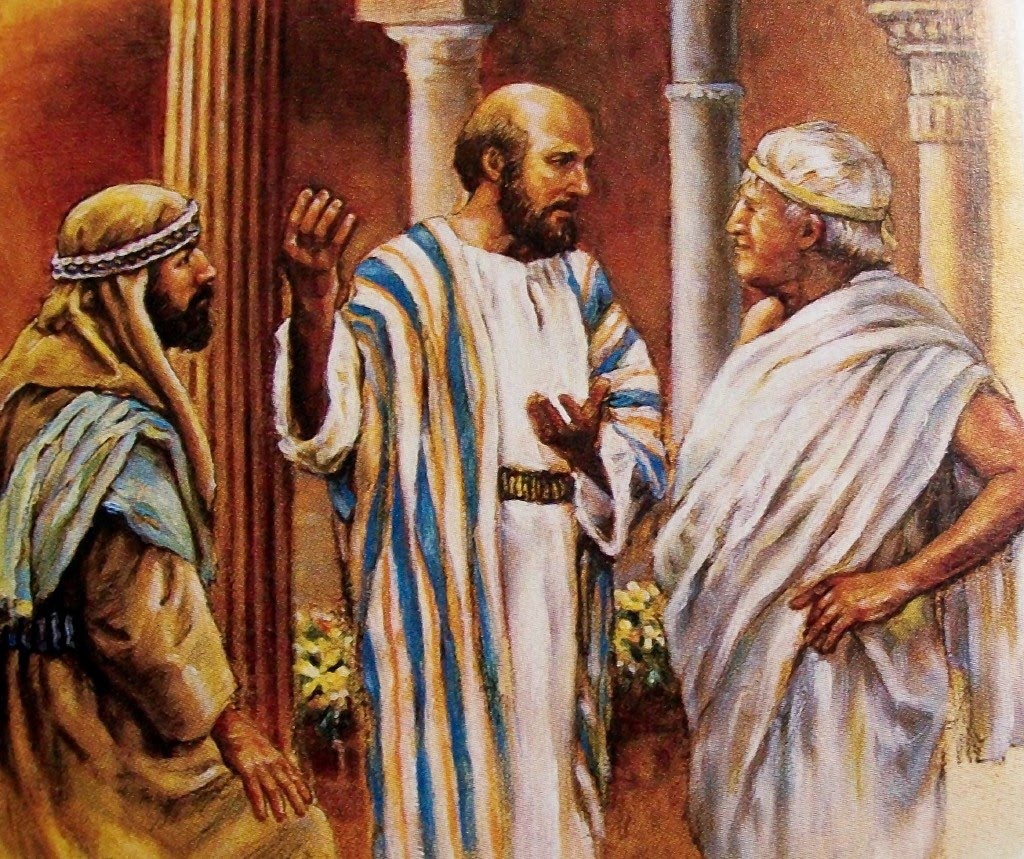
A depiction of Paul and Sosthenes

In opening this letter, Sosthenes and Paul tell the Corinthians that they write to “give thanks” (1:4) and also to “appeal to you” (1:10); and later, to “admonish you as my beloved children” (4:14). The constructive approach that they bring is made clear in the opening prayer of thanksgiving (1:4–9). Writing in chapter four, the author (here, presumably Paul) exhorts the Corinthians: “I appeal to you, then, be imitators of me” (1 Cor 4:16; see also 1 Thess 1:6). The letter contains many points of appeal, exhortation, encouragement—and also challenge, correction, and criticism!

This coming Sunday we focus on verses 1–11 of chapter 12. This is an instance of exhortation and encouragement (in the later part of the chapter, which we read and hear on the following Sunday, challenge and correction will occur). In these verses, Paul considers the diversity of expressions of faith that can be found in the faith community in Corinth—as, indeed, there are in many other communities of faith. He notes the diversity of gifts, the various ways of providing service, and the range of activities undertaken by “those who are sanctified in Christ Jesus, called to be saints” (1 Cor 1:2). 

Each gift, service, or activity, however, has a common origin. It is “the same Spirit” who grants the diversity of gifts evident in the community (12:4), “the same Lord” who is the motivator for the array of offering service by those believers (v.5), and “the same God” who activates all of the activities that is evident in Corinth (v.6).

It is worth noting that an alternative way to translate this might be “the same God who energizes all of the expressions of energy”. The Greek words being translated as “activate” and “activities” relate to the central idea of energy; indeed, the foundational word is ἐνεργήμα, which when transliterated letter-for-letter results in “energēma”, from which we get the English word “energy”. So the Spirit is presented as an active, dynamic force, which is at work in a lively, tireless, and vital fashion. 

In this passage, Paul places a particular emphasis on the unity that is—or at least, should be—a key feature of the group of people who are joined together by the common affirmation, “Jesus is Lord” (v.3). He affirms that the gifts, acts of service, and activities expressed by those people “are activated by one and the same Spirit” (v.11a). It is that Spirit who “allots to each one individually just as the Spirit chooses” (v.11b).

The irony, however, is that in the eleven chapters preceding this passage, there have been multiple signs of the many ways in which disagreement, conflict, division, and factionalism mark the community of believers in Corinth. There have been ethical breaches, instances of sexual misbehaviour, diverse views regarding marriage and related issues, and mistreatment of fellow members of the community who are seen as “weak” by some who perhaps regard themselves as “strong”. Has the Spirit be so energizing that the disruptions caused by the Spirit’s activity have promulgated all of these problems?

Further, the critical issues which Paul addresses in the chapters immediately following, in the later part of the letter (1 Cor 12–14), arise out of the highly spontaneous, seemingly chaotic situation that characterised worship in Corinth. How the Spirit was active—energizing—those who worship in this gathering! It was anything but a reverent gathering of people unified by their faith; it was a chaotic frenzy of activity and words, if Paul’s severe wording is to be believed.

Such worship had more the nature of a dialogue between conversation partners, rather than a monologue delivered by one person to a group of silent listeners. We can see this in a simple way, with the references to “interpreters” in what Paul writes to the Corinthians. Whilst there are people who contribute words of prophecy, pray in tongues, or speak in tongues (1 Cor 14), in each case there is the need for someone to interpret these phenomena. It seems that many things were happening simultaneously, creating a frenzied cacophony during worship. If we see the energizing of the Spirit as a disruptive force, then much disruption has occurred!

For my reflections on the disruptive work of the Spirit in Corinth, see

So in 1 Cor 12, Paul adapts an image which was extensively used in political discussions about the city state (“the body is one and has many members”, 12:12) as well as what may be a reference to a developing baptismal liturgy within the early church (“we were all baptised into one body”, 12:13) and a very early creedal statement (“Jesus is Lord”, 12:3).

The work of the Spirit was supposed to provide a range of gifts for the mutual benefit of all involved in the community. Paul provides a list of just such gifts in verses 8–10. He notes wisdom, knowledge, faith, healing, miracles, prophecy, discernment, tongues, and interpretation of tongues. This should not be taken as an exhaustive list; in other places, Paul refers to other gifts, such as teaching, exhorting, giving,leading, and offering compassion (Rom 12:7–8), as well as power and assistance later in this chapter (1 Cor 12:28). 

He also identifies some offices exercised by people alongside gifts already noted, as he concludes this same discussion of gifts: “Are all apostles? Are all prophets? Are all teachers? Do all work miracles? Do all possess gifts of healing? Do all speak in tongues? Do all interpret?” (1 Cor 12:29–30). Similar offices are noted in a later letter written in the name of Paul: “apostles … prophets … evangelists … pastors … teachers”, all,of which are said to be “to equip the saints for the work of ministry” (Eph 4:11–12).

Nor should this list of 1 Cor 12:8–10 be regarded as a prioritising of such gifts by the order in which they are listed. In fact, the concluding comment of v.11 specifically places all of the gifts noted on the same level, each equally “activated by the one and the same Spirit” and “allocated … just as the Spirit chooses”. We should affirm that today; all gifts for service come from the same source.

The last enemy to be destroyed is death (1 Cor 15; Narrative Lectionary for Easter 7)

Paul’s letter to the Corinthians canvasses a wide range of matters. First, he spends time addressing the serious divisions emerging within the Corinthian community. Paul declares that this matter “has been reported to me by Chloe’s people” (1:11); it is thought that this must have been a verbal report passed on to Paul when he met with a group from Corinth, perhaps slaves, sent by Chloe (about whom nothing else is revealed).

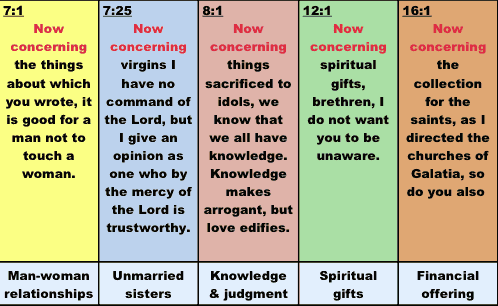
A second matter is introduced by a similar phrase, “it is actually reported…” (5:1), although the informant is not named. Some scholars think that the similarity of wording suggests that this news may also have been conveyed by “Chloe’s people”. A little later on, another matter is introduced by Paul with the phrase, “now concerning the matters about which you wrote” (7:1). Clearly, there had been written correspondence with Paul as well as the verbal report already indicated.

Towards the end of the letter, Paul refers to “the coming of Stephanas and Fortunatus and Achaichus” (16:17). This might suggest that they visited Paul; perhaps they bore a letter from the community (or a section of it), asking for Paul’s opinions about these matters? The fact that their names are Roman names reflecting an educated status, would lend support to this hypothesis.

Regardless of who actually brought this news, Paul is willing to deal with the matters raised, introducing them in turn by the shorthand formula, “now concerning”. Such matters include “food sacrificed to idols” (8:1), “spiritual matters” (12:1), “the collection for the saints” (16:1), and “our brother Apollos” (16:12).

The final theological issue which Paul addresses in his first letter to the Corinthians concerns the resurrection of believers. A rather stronger formula is used to introduce a major theological issue at 15:1: “now I would remind you, brothers and sisters, of the good news that I proclaimed to you…”.
Paul writes at length about this matter, which many scholars regard as the fundamental problem in the Corinthian community of faith, underlying other issues already explored. From comments later in this chapter (15:12, 15:29, and possibly 15:35), it is clear that divergent views about resurrection were held within the community of faith in Corinth. Paul’s response deals with each of them in a theological and rhetorical fashion.

Paul begins dealing with the issue with a series of affirmations concerning the crucifixion and resurrection of Jesus. There is an apologetic tone at the start, as Paul insistently underlines the validity and authority of what he says (15:1–3a). The “good news” which “I proclaimed” is described in technical terms indicating the passing-on of pre-existing tradition: “I received”, “I handed on”, “you received”.

Associated with this is an insistence that the Corinthians “stand” in this news, and must “hold firmly” to it, as the basis for “being saved”.

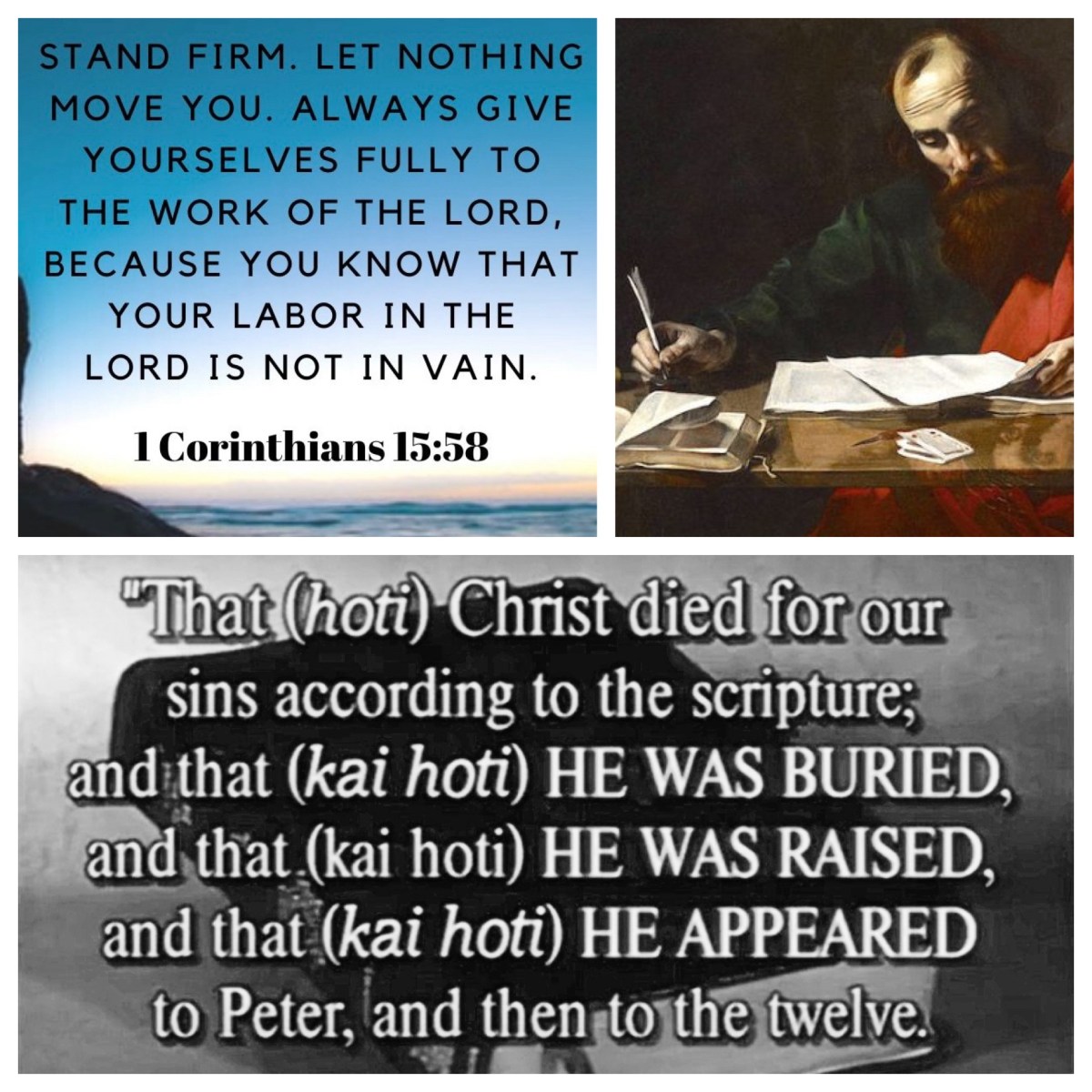
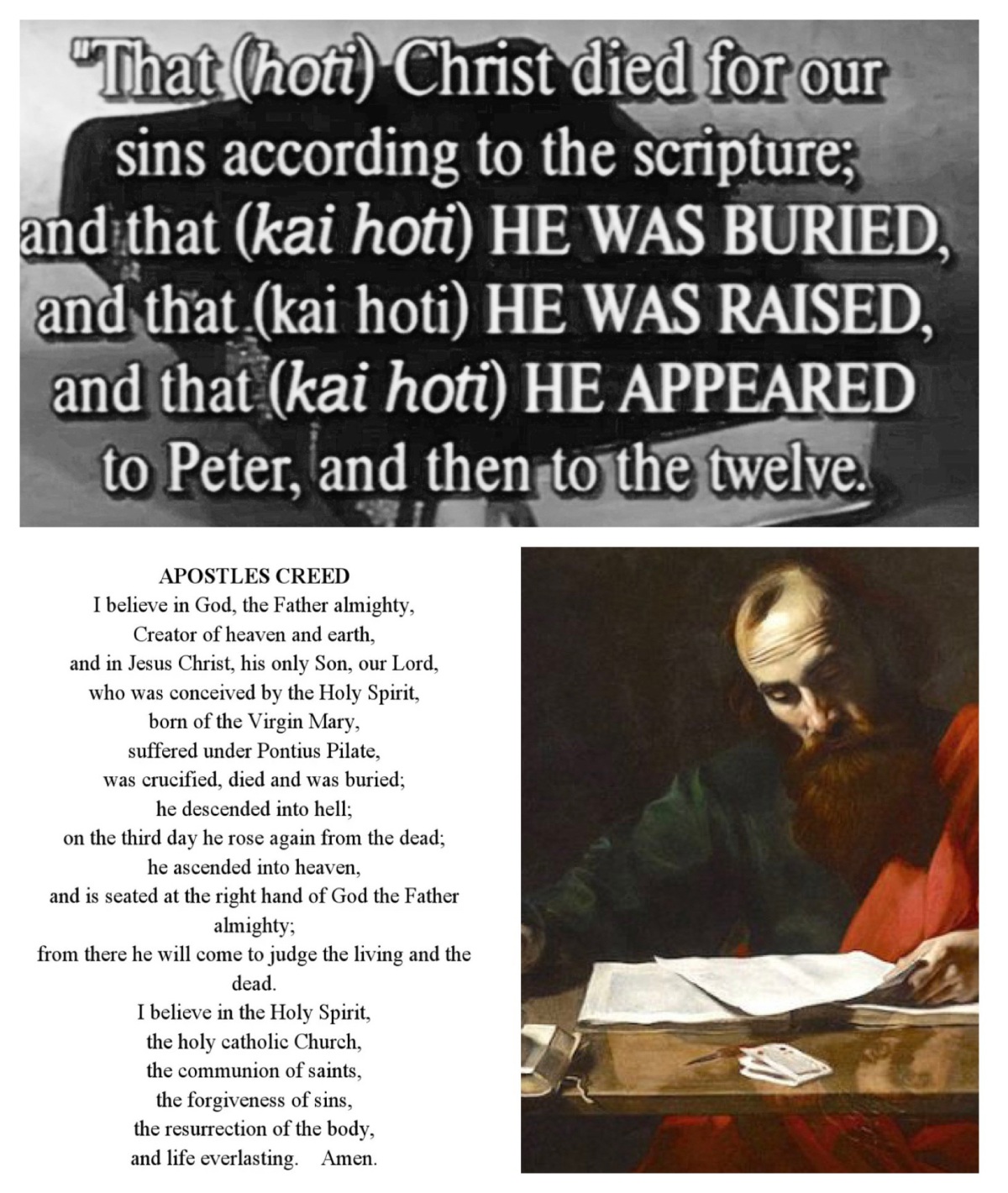
The foundational tradition which he then reports (15:3b–7) is based on an early four-part affirmation of faith: “Christ died…he was buried…he was raised…he appeared”.

The first and third elements are elaborated with the formulaic “in accordance with the scriptures”. The fourth element, the appearances of the risen Jesus, is extended beyond the list received by Paul (to Cephas, the twelve, more than 500, James, all the apostles; 15:5–7) to include Paul himself (“as to one untimely born”, 15:8), leading on to an assertion of Paul’s apostolic credentials and divinely-assisted activities (15:9–11).

The beginning of this lengthy discussion of resurrection reaches back to the “theology of the cross” at the start of the letter by references to the crucifixion and death of Jesus; but Paul does not develop this connection. Instead, he moves straight to the first pastoral situation in Corinth regarding the resurrection (15:12–19).

The “resurrection of the dead” (the Greek word is plural, reflecting a raising of many believers) was a Jewish belief that had developed in preceding centuries; not all Jews accepted it (see Acts 23:6–8) and amongst some Gentiles there was scepticism about the idea (see Acts 17:32).

The community in Corinth contained sceptics (15:12); Paul’s counter-argument attempts to refute their opinion in a series of logic-based steps, beginning with a questioning of the reality of the resurrection of the one person, Jesus (15:13–16) and leading to the conclusion that “your faith is futile” (15:17). He cannot countenance this, so launches into an exposition of what he sees as eschatological realities (15:20–28), explaining the places allocated, at the end, to humans, Jesus, and God.

The rhetorical structure of the first part of this argument (15:21–22) returns to the pattern of juxtaposing two different entities, which Paul has used in earlier sections of the letter. We can see this pattern as follows: for since death came through a human being / the resurrection of the dead has also come through a human being; for as all die in Adam / so all will be made alive in Christ. An expanded version of this argument takes place in Rom 5:12–21.

Paul then continues by explaining that Christ is “the first fruits”, who has “all things put in subjection under his feet” (15:23–27). But Christ himself is subjected to God; finally, God is “all in all” (15:28). Paul has not proven the resurrection as such, but has explained how it fits into his view of the end days.

A second pastoral situation is noted (15:29) but abruptly dismissed with two rhetorical questions; the clear inference is that there is no validity at all in the viewpoint held by those who practice “baptism on behalf of the dead”. Then follows a poetic reflection (15:30–34) in which Paul draws on Hebrew scripture (Isaiah 22:13) and Greek poetry (Menander, Thais) to denounce those who “have no knowledge of God” (15:34).

A third pastoral situation might possibly be indicated at 15:35, although the form employed (a rhetorical question attributed to an indefinite person) was commonly used by a skilled rhetorician to raise an objection which he knew could be raised, allowing it to be dealt with in advance (the same technique is found in Rom 2–6 and 9–11).

The question provides an opportunity for further eschatological teachings about the nature of the resurrection body (15:35–49) and a further display of Paul’s rhetorical prowess.

Once again, the rhetorical structure of the argument provides contrast by juxtaposition, advanced in a sequence of logical steps:

What is sown is perishable / what is raised is imperishable.

It is sown in dishonour / it is raised in glory.

It is sown in weakness / it is raised in power.

It is sown a physical body/ it is raised a spiritual body.

If there is a physical body / there is also a spiritual body.

Thus it is written, “The first man, Adam, became a living being”/ the last Adam became a life-giving spirit.

But it is not the spiritual that is first / but the physical, and then the spiritual.

The first man was from the earth, a man of dust; / the second man is from heaven.

As was the man of dust, so are those who are of the dust; / and as is the man of heaven, so are those who are of heaven.

Just as we have borne the image of the man of dust, / we will also bear the image of the man of heaven.

The symmetry is certainly poetically and rhetorically satisfying.

Some concluding reflections (15:50–58) allow for a final glimpse into the eschatological drama that awaits. The argument now is no longer logic-based, as Paul moves through a sequence of vividly-imagined images in a dramatic rhetorical style. The whole long discussion of this matter ends with the concise ethical exhortation, “be steadfast, immovable” (15:58).

The last word after this word of encouragement is a word of hope-filled assurance to the Corinthians, whom he has criticised so mercilessly at many places throughout the letter: “you know that in the Lord your labor is not in vain” (15:58).

The greatest of these is love (1 Cor 13; Narrative Lectionary for Easter 6)

For the passage to be read and heard this coming Sunday, the Narrative Lectionary has proposed what is perhaps the most well-known part of Paul’s first letter to the Corinthians: the chapter on love (1 Cor 13:1–13). Paul waxes lyrical about love, telling the Corinthians that love “bears all things, believes all things, hopes all things, endures all things; love never ends” (13:7–8), and builds to a wonderful rhetorical climax in which he affirms that “faith, hope, and love abide, these three; and the greatest of these is love” (13:13).

As well as being a rhetorical tour de force, and the most beloved part of this letter of Paul, this chapter is also, in my view, the most misunderstood and misused chapter of this letter—as I will attempt to explain below.

It is clear from Paul’s description that, when the community in Corinth gathered for worship, there was a high degree of disorder manifested. Paul devotes four chapters to this issue (11:1—14:40). Throughout this section of the letter, Paul writes with a single focus in mind; he writes to bring order and decency to this situation (14:40).

He begins his consideration of the disorder evident in the community by asserting the importance of maintaining “the traditions just as I handed them on to you” (11:2), reminding them of words that “I received from the Lord” and duly “handed on to you” (11:23). He instructs the Corinthians to seek to speak to others in worship “for their upbuilding and encouragement and consolation” (14:3).

He advises them to exercise their spiritual gifts appropriately; to “strive to excel in them for building up the church” (14:12), to “not be children in your thinking … but in thinking be adults” (14:20). He advises them, “let all things be done for building up” (14:26), noting that “all things should be done decently and in order” (14:40), for “God is a God not of disorder but of peace” (14:33).

The hymn in chapter 13 is an integral part of that overarching purpose. As well as his reminder of “the traditions just as I handed them on to you” (11:1), Paul asserts that they must acknowledge that “what I am writing to you is a command of the Lord” (14:37). He happily draws from various authorities; he alludes to scriptural ideas (11:3, 7–9, 10; 14:4), directly cites Hebrew scripture (14:21, 25), refers to the words of Jesus (11:24–25), claims the precedent of nature (11:14) and church custom (11:16), and in a controversial passage, refers to what takes place “in all the churches of the saints” (14:33b–34).

Chapter 12 contains an adaptation of an image which was extensively used in political discussions about the city state (“the body is one and has many members”, 12:12) as well as what may be a reference to a developing baptismal liturgy within the early church (“we were all baptised into one body”, 12:13) and a very early creedal statement (“Jesus is Lord”, 12:3).

Throughout these chapters, those who are inclined to diverge from Paul’s commands are portrayed in negative terms: they are “contentious” (11:16), showing “contempt” (11:22), acting “in an unworthy manner” (11:27) and with “dissension” (12:25); their behaviour conveys dishonour (12:22–26) and shame (14:35).

The selfish behaviour of some at the common meal warrants their condemnation (11:32) and justifies the illness and death that has occurred within the community (11:30). The individualistic participation of others in communal worship builds up themselves, but not others (14:4, 17); they are not intelligible in speech (14:9), but are unproductive in their minds (14:14) and childish in their thinking (14:20), leaving themselves open to the risk, “will they not say that you are out of your mind? (14:23).

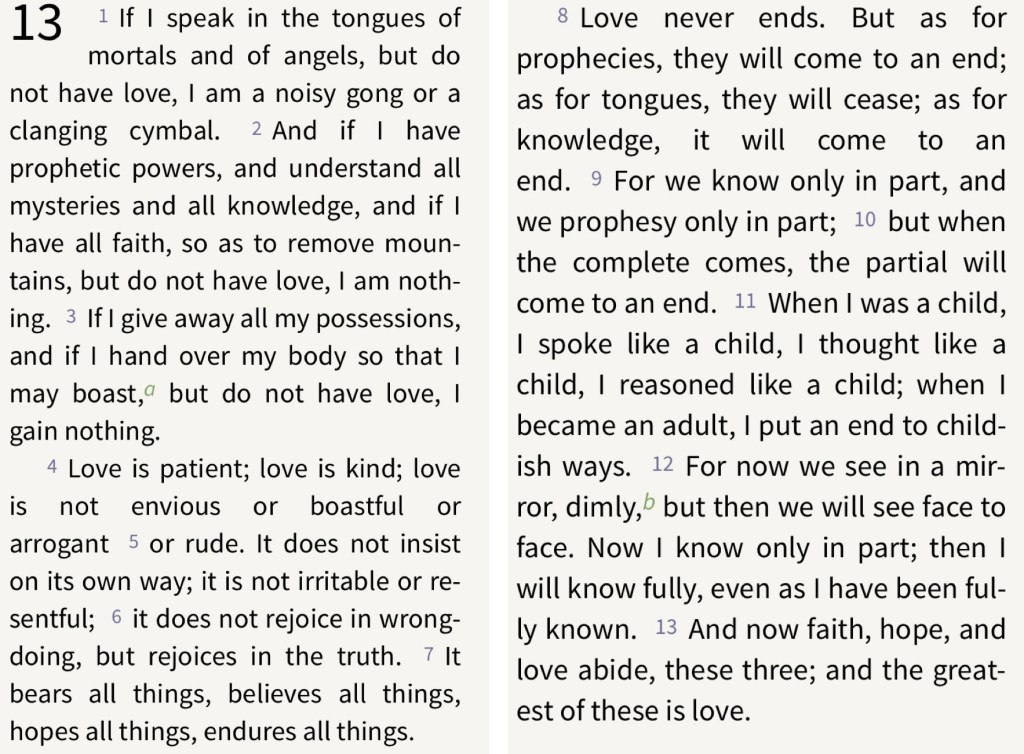
In the centre of this section stands the famous “hymn to love” (12:31–13:13), now often treated in isolation and over-romanticised. In context, the passage provides a sharp, pointed polemic against the Corinthian community. The qualities they possess are consistently inadequate when measured against love.

The speech of the Corinthians is like “a noisy gong or a clanging cymbal” (13:1), an allusion to the mayhem brought about by speaking in tongues in worship (1:5; 12:10, 28–30; 14:6–8). Whilst they readily express their “prophetic powers” in worship (11:4–5; 12:10, 28–30; 14:1, 4–5, 23–24, 29–32, 37, 39), for Paul, these abilities are nothing without love (13:2).

Likewise, they claim that they are able to understand mysteries (2:7; 4:1; 14:2, 23) and have knowledge (1:5; 8:1–3, 7, 10, 11; 12:8; 14:6) as well as faith (2:5; 12:9; 15:14, 17; 16:13); but Paul insists that all of these are nothing in isolation from love (13:2).

Elsewhere in his letter, Paul directly accuses the Corinthians that they are precisely what love is not. Love does not boast (13:4), but Paul regards the the Corinthians as being boastful (1:29; 3:21; 4:7; 5:6). Love is not arrogant (13:4), but in Paul’s eyes the Corinthians are arrogant or “puffed up” (translating the same Greek word in 4:6, 18–19; 5:2; 8:1).

Love does not rejoice in wrongdoing (13:6), but Paul berates the Corinthians for taking fellow-believers to court to seek redress for wrongs; indeed, “you yourselves wrong and defraud—and believers at that” (6:7–8). Love means that people do not insist on their own way (13:5), but Paul considers that the way that some behave in relation to meat offered to idols in the marketplace advantage; “do not seek your own advantage”, he advises them, “but that of the other” (10:24).

In like manner, when they gather to celebrate the supper of the Lord, “when the time comes to eat, each of you goes ahead with your own supper, and one goes hungry and another becomes drunk” (11:21). Selfishness and acting without regard for the other characterises their common life.

Love “hopes all things” (13:7), but some in the community at Corinth are accused of failing to share in the hope of the resurrection (15:12–19). The assertion that “we know only in part” (13:9–10) is directed squarely against the Corinthian claim to have full knowledge (8:1, 10–12) whilst the image of the child, not yet adult (13:11), reflects Paul’s criticism of the Corinthians as infants, not yet ready for solid food (3:1–2; 14:20).

So the hymn alleged to be in praise of love is, more accurately, a polemical censure of the Corinthians’ shortcomings, in which every word used and every phrase shaped by Paul cuts to the heart of the inadequacies of the Corinthian community. Try preaching that at a wedding!!

Receiving and passing on a living tradition: died and buried, raised and appeared (1 Cor 15; Easter Sunday)

On Easter Sunday, we say: “Christ is risen! He is risen indeed!”, to celebrate that “God raised Jesus from the dead” (Gal 1:1; Rom 4:24; 10:9; Acts 2:32). Paul affirms this good news in this extract from his first letter to the saints in Corinth, which is the Epistle reading that the lectionary offers for Easter Sunday (1 Cor 15:1–11). Some verses in this passage have played a key role in the development of Christian tradition, which affirms in creeds and confessions a belief in “Jesus Christ … who was crucified, died, and was buried … who rose again from the dead on the third day”.

What is the nature of the confessional affirmation that Paul offers in this passage? The previous chapters of 1 Corinthians have alerted us to the disorganised ethos of the community in the cosmopolitan port city of Corinth. Those earlier chapters have indicated a number of problems that existed within the community of followers of Jesus. There was factionalism (chs.1–4), immorality (ch.5), resorting to civil lawsuits (ch.6), and dissension regarding marriage, celibacy, and sexuality (ch.7). There were differing attitudes towards consuming meat bought in the marketplace after it had been offered to idols (chs.8–10), and multiple issues that manifested in their gatherings for worship (chs.11–14).

Paul addresses each of these matters with the same intention, to bring about order in the midst of the chaos that he has been told about. His words in the midst of the lengthy discussion about marriage, celibacy, and sexuality state his purpose with clarity: “I say this for your own benefit, not to put any restraint upon you, but to promote good order and unhindered devotion to the Lord” (7:35).

The disorder and chaos evident in worship, in particular, led Paul, in the chapter immediately preceding this passage, to advise the Corinthians to seek to speak to others in worship “for their upbuilding and encouragement and consolation” (14:3). He advises them to exercise their spiritual gifts appropriately; to “strive to excel in them for building up the church” (14:12), to “not be children in your thinking … but in thinking be adults” (14:20). He advises them, “let all things be done for building up” (14:26), noting that “all things should be done decently and in order” (14:40), for “God is a God not of disorder but of peace” (14:33).

People speaking over the top of each other in worship, not attending to important words of prophecy and tongues, reflected the disordered chaos of the apparently quite libertine community. The infamous words ordering women to “keep silent” (14:33b—36), along with the adjacent commands to “keep silent” while one interprets tongues that are spoken (14:27–28) and “keep silent” to those seeking to offer a word of prophecy while others are still prophesying (14:29–31), are included in this letter precisely to address this chaotic disorder. And not for the first time in this letter, Paul invokes his higher authority to support his directions: “[you] must acknowledge that what I am writing to you is a command of the Lord” (14:37; see also 5:3–4; 7:40; 10:20–22; 11:27–28; 16:10; and cf. 7:25).

Immediately after this extensive discussion about worship, Paul turns to his foundational message about Jesus, in a four-part statement: Christ died—was buried—was raised—and then appeared to various people (15:3–5). He uses terms that denote the passing on of traditions: “I received … I handed on … which you received … in which you stand” (15:1); and he insists on the importance of what he passes on: “you are being saved, if you hold firmly to the message that I proclaimed to you” (15:2). These two verses provide a strong, insistent introduction to what follows in the ensuing verses.

We see this dynamic also in an earlier chapter, in the familiar words associated with the Last Supper: “I received from the Lord what I also handed on to you” (1 Cor 11:23), as well as in the commendation of the Corinthians as they “maintain the traditions just as I handed them on to you” (11:2).

The core tradition that Paul cites is the fourfold declaration that Jesus died, was buried, was raised, and appeared (vv.3–5). It may have already have been an existing formula; we know that Paul, in this letter and elsewhere, makes use of very short credal-like statements that it is likely had already been developed by others, some of which he cites in order to refute, such as: “is well for a man not to touch a woman” (7:1), “all of us possess knowledge” (8:1), “all things are lawful” (10:23), and “how can some of you say there is no resurrection of the dead?” (15:12).

There are other succinct sayings which Paul uses as the basis for further developments in his argument, such as “I decided to know nothing among you except Jesus Christ, and him crucified” (2:2), “knowledge puffs up, but love builds up” (8:1), “there is no God but one” (8:4), and “all things are lawful, but not all things build up” (10:24). The discussion of factions in chs.1–4 is built off “I belong to Paul … I belong to Apollos … [but] what then is Apollos? what is Paul?” (3:4–5), while Paul’s lengthy discussion of spiritual gifts (12:4—14:40) jumps off from the unspiritual “Jesus be cursed!” and the spirit-inspired response, “Jesus is Lord” (12:3).

Furthermore, Paul writes a number of longer credal-like statements, some of which seem shaped for liturgical usage: the words which became the “words of institution” in the church’s eucharistic practice (1 Cor 11:23–26), and others such as Rom 8:28; 2 Cor 4:14; Gal 1:3–5; Phil 2:6–11. The writers in the school of Paul who later wrote letters claiming to have his authority ( the “pastoral epistles”) followed this practice (see 1 Tim 2:5–6; 3:16; 2 Tim 2:11–13; Titus 2:11–14).

Two clauses in Paul’s tradition-based affirmation of 1 Cor 15:3–5 are buttressed by reference to scripture, another voice of authority alongside “the tradition”. What the specific scripture passages are, Paul does not state; this has left open the door for speculation by later interpreters.

Supporting arguments by reference to scripture is not unknown in Paul’s writings; as a Pharisee, he had attained a good awareness of Torah and its application to life (see Gal 1:14; Phil 3:5–6). He bases his magnum opus, Romans, on a scripture citation (Rom 1:17, citing Hab 2:4) and there is barely a chapter of this letter that does not contain scripture quotations and allusions in abundance.

Key moments in 1 Corinthians are likewise supported by verses from Hebrew Scripture (1 Cor 1:19, 31; 2:9, 16; 3:19–20; 14:21; 15:54–55), and the well-known “words of institution” themselves (11:23–26) reference the tradition which emerges in later decades in the Synoptic Gospels, recording the words of Jesus himself at the last supper (Mark 14:22–25; Matt 26:26–29; Luke 22:14–20).

By using the terminology of traditions being received and handed on, Paul is reining in the wayward Corinthians, recalling them to the fundamentals of their faith. So he sets out the dynamic of died—buried—raised—appeared (15:3–5) as the foundation for then discussing, in the remainder of the chapter, issues associated with the resurrection of Jesus (15:6–58).

Who saw the risen Jesus? First, Paul tells of an appearance to the early leaders, Cephas (Peter) (v.5) and James (v.7)—of which, neither appearance is reported in any Gospel. Then, Paul indicates that Jesus appeared to “the twelve” (v.5) and “all the apostles” (v.8)—apparently alluding to narratives found in the later texts of three Gospels Matt 28:16–20, Luke 24:33–48; John 20:19–23, 24–29; 21:1–14. (The appearances narrated in the shorter and longer endings of Mark, added after 16:8, are not relevant; these are later patristic additions based on the other three Gospels, designed to harmonise the ending of Mark with these others.) Acts 1:6–11 might also be relevant here.

An interesting question is, how did he distinguish between these two groups—“the twelve” on the one hand, and “all the apostles” on the other. Indeed, these terms appear to be inherited by Paul from earlier traditions. This is the only place in all Pauline letters which refer to “the twelve”; and besides, the Gospel narratives noted above do not have Jesus appearing to “the twelve”, as Judas was absent from all of them, and so was Thomas in John 20:19–23.

As far as the word “apostle” is concerned, in 16 of the 18 occurrences in the Pauline corpus (including those not authentic to Paul) Paul explicitly apply the term to himself. Paul acknowledges others as apostles: James (Gal 1:19), Peter (Gal 2:8), perhaps Barnabas (1 Cor 9:1, 5–6), an unspecified number of believers who were given gifts to be apostles (1 Cor 12:28–29; see also Eph 4:11), and most strikingly, Andronicus, a male, with Junia, a female (Rom 16:7). Are these the people that Paul has in mind at 1 Cor 15:8? Or is this simply a phrase inherited from the tradition, which Paul has repeated?

Next, Paul identifies an appearance to “more than five hundred brothers and sisters at one time” (v.6), which again has no place in any Gospel account. Last, Jesus appears to Paul himself (v.8), which he briefly reports at 1 Cor 9:1 and Gal 1:1. Strikingly absent from his list is the empty tomb and the appearances to Mary in the garden (John 20:14), to the women as they left the tomb (Matt 28:9–10), to the two travellers to Emmaus (Luke 24:15), or to the seven fishing by the Sea of Tiberias (John 21:1–4). What a perplexing inconsistency between the various testimonies to these appearances!!

This is an early collection of “witnesses to the resurrection”; Paul wrote to the Corinthians in the mid 50s. But there is no mention of what was important to all four evangelists, writing in later decades: the women at the empty tomb and the role that women played in bearing testimony to the risen one. Is this accidental? or deliberate? Given what we have noted about 1 Corinthians as a whole—and especially what ch.14 reveals about the disorderly behaviour of Corinthian women—we might well wonder, is Paul shaping the received tradition to “fit the context” already at this early stage? It is a tantalising suggestion.

There is a wonderful quote that is pertinent to this issue, which is attributed to Gustav Mahler, the late 19th century Austro—Bohemian composer: “Tradition is not the worship of ashes, but the preservation of fire.” These words indicate that if tradition stands still, it will run out of momentum and fizzle out of energy. Tradition always needs to be reinvigorated and renewed, in the way that fire sizzles and snaps as it continually changes its shape and form.

And that’s a fine thought for us to have as we consider the resurrection of Jesus. As the Apostles Creed affirms, echoing 1 Cor 15:3–5, “we believe in Jesus Christ … who was crucified, died, and was buried … who rose again from the dead on the third day”. We need to renew and rekindle that tradition, to find fresh ways to understand and proclaim that mysterious happening, which sits at the heart of classic Christian confessions.

I’ve offered my own initial reflections on precisely that task in this blog:

Born of a woman, born under the law (Gal 4; Christmas 1B)

At this time of the year, as we celebrate the birth of Jesus at Christmas, the beloved story from Luke’s Gospel, with census, donkey, manger, shepherds, and angels, is the dominant biblical text that most churchgoers will hear. Perhaps it is closely followed by the highly-developed theological interpretation that begins John’s Gospel. The Matthean account of the wrath of King Herod and the visit of the Magi has its place, twelve days after Christmas, at Epiphany.

Other biblical passages come a long way behind these Gospel texts. Yet, as I have noted in other posts, the Revised Common Lectionary does provide a series of additional passages, drawn from the psalms and the prophets, as well as the epistles, for worship on and around Christmas. These passages are offered for the Nativity of the Lord as Proper I, Proper II, and Proper III. See

Each of these passages provides another way for us to celebrate the Christmas event; they are clearly supplementary rather than primary in their function. As I have sought to explain, the psalms provide celebratory songs, while the prophetic passages offer hope and promise. Alongside these, the epistle passages proposed by the lectionary serve a different function.

It is well-known that Paul makes very little reference to the life of Jesus in his letters. His focus is intently on the death and resurrection of Jesus, rather than the teachings and miracles, parables and exorcisms, debates and disputations, that we read about in the canonical Gospels.
For Paul, it is the twofold statement that “Christ Jesus, who died, yes, who was raised” (Rom 8:34), the claim that Jesus “gave himself for our sins to set us free from the present evil age” (Gal 1:4), the affirmation of “the redemption that is in Christ Jesus” (Rom 3:4), and the hopeful declaration that “Christ, being raised from the dead, will never die again; death no longer has dominion over him” (Rom 6:9), which is the heart of the message he proclaims. This death-resurrection movement also forms the basis of his credal exposition at 1 Cor 15:3–8.

One of the few places where Paul clearly describes something in the life of Jesus other than this death-resurrection complex is in the Epistle passage that is provided by the lectionary for the first Sunday after Christmas (Gal. 4:4–7). Here, Paul acknowledges that Jesus was “born of a woman, born under the law” (Gal 4:4). This is a slightly more developed claim than is made in Romans, where he acknowledges that Jesus “was descended from David according to the flesh” (Rom 1:4).

This passage from Galatians is offered because it provides the earliest confessional statement about the birth of Jesus (since Paul wrote this letter to the Galatians decades before the Gospels were written). What he says is concise and clear: Jesus was “born of a woman, born under the law”. The first phrase indicates that Jesus was a human being—born of a woman, like all of us. That is an affirmation made explicit in the fourth Gospel (John 1:14) and which undergirds the narratives of the three Synoptic Gospels.

The second phrase indicates that he was a Jew—born into a society that valued and appreciated the law that long had shaped the practices and customs of the Jews. The Jewishness of Jesus is described with clarity at so many points in each of the Gospels, in which he attends synagogue on the sabbath, demonstrates his detailed knowledge Torah, and takes part in festivals in Jerusalem. The Johannine Jesus affirms that “salvation is of the Jews” and the Synoptic Jesus lays claim to the command to “love God … and love your neighbour” as the key element of his teaching.

This is a fundamental element in our Christian confession; in the Apostles’ Creed, we affirm that we believe in Jesus, “born of the virgin Mary”. Paul says nothing here about Mary’s status, other than she was a Jewish woman. Apart from the passing reference in verse 4, Paul’s focus is not so much on the fact that Jesus was born a Jew, but on the significance of the birth of this child.

So he writes that Jesus was born “in order to redeem … so that we might receive adoption” (Gal 4:5), and goes on to say more about adoption, inheritance, and the receiving of the Spirit as a child of God (Gal 4:6–7). For Paul, the creation of the human family that is presumed by his statement (infant and mother; and father, although not mentioned here) also means the creation of a wider, larger family of faith, of each one of us who is “an heir through God”. Which is, of course, why believers celebrate with joy each Christmas.

In the resources offered by the lectionary for Christmas, in the three sets of readings for the Nativity of the Lord I, II, and III, we have three excerpts from Epistles which provide similar insights—fleeting, incomplete, not fully developed—about the coming of Jesus and the significance of this event. (None of these passages refer to the “birth” of Jesus, nor do they refer directly to Jesus by name; each of them offers allusion and inference, rather than direct description.)

For Proper I, a brief affirmation is offered: “the grace of God has appeared, bringing salvation to all” (Titus 2:11). The allusion to the birth of Jesus may well be deduced; the precise wording is generalised and remote from “the birth of Jesus”. That Jesus is “the grace of God” might well be argued from other scriptural texts (John 1:17; Rom 1:5; 5:2, 15; 1 Cor 1:4; Eph 1:6–8; 1 Tim 1:14; 2 Tim 1:9) but is not made explicit in this brief statement in Titus 2.

For Proper II, another excerpt from the same epistle notes that “when the goodness and loving kindness of God our Saviour appeared, he saved us, not because of any works of righteousness that we had done, but according to his mercy, through the water of rebirth and renewal by the Holy Spirit” (Titus 3:4–5). Strikingly, the appearance of the kindness of God is here portrayed as an act of the Spirit; Jesus is nowhere named or identified!

And for Proper III, an excerpt from Hebrews declares, “in these last days he has spoken to us by a Son, whom he appointed heir of all things, through whom he also created the worlds” (Heb 1:2), and then goes on to articulate a grand vision of this Son (not explicitly named as Jesus).

The author is drawing from language in the Wisdom tradition to state that “[the Son] is the reflection of God’s glory and the exact imprint of God’s very being, and he sustains all things by his powerful word” (Heb 1:3). (Of course, Wisdom was feminine in Hebrew Scripture; here, as in other New Testament books, the key features of Wisdom are masculinised as they are applied to the man, Jesus.)

Reflecting God’s glory and being the exact imprint of God, as set forth in this passage, are striking claims. Although they appear in a letter addressed to “the Hebrews”, in which scriptural citations undergird the theological argument proposed, these phrases take us far and away from the Jewish baby born to Mary, into speculative philosophical musings about the eternal nature of the Son.

In these three texts, as in the short excerpt from Galatians 4, claims are made about the consequence of what Jesus achieved. In each case they take us far from the story of the birth of the child

In the first except from Titus, after stating that “the grace of God has appeared”, a standard Pauline catchphrase follows (“who gave himself for us”; see Gal 1:4; 2:20; and see Eph 5:2) followed by references to redemption from iniquity (still Pauline; see Rom 3:24; 8:23; 1 Cor 1:30), before adding “and purify for himself a people of his own who are zealous for good deeds” (Titus 2:14). The reference to purification and the affirmation of “good deeds” has moved us far from Paul, and tells us nothing additional about Jesus, the Jewish infant.

The next excerpt from Titus (3:7), noting “when the goodness and loving kindness of God our Saviour appeared”, describes the consequences of this appearance. The author here uses terms that are thoroughly Pauline. First, “he saved us” (see Rom 1 Cor 1:18; Rom 1:16; 10:1; 13:11; Phil 2:22); second, “having been justified by his grace” (see Rom 3:24; 5:1–2; Gal 2:15–21); and third, “that we might become heirs” (see Rom 8:15–17; Gal 3:28–29). Then the writer adds “according to the hope of eternal life”. Paul himself does refer to “eternal life” (Gal 6:8; Rom 2:7; 5:21; 6:22–23), although this is a very Johannine idea. But once again, we are far from the infancy born to Mary “under the law”.

In the excerpt from Hebrews, after offering the Wisdom-inspired cosmic vision of the Son, the writer declares, “when he had made purification for sins, he sat down at the right hand of the Majesty on high” (Heb 1:3). Again, such a statement redirects attention away from the birth of the infant, and his Jewish origins, into the heavenly realm, far away from earth (according to the ancient cosmological understanding).

My sense is that these three Epistle readings offer elements which have been taken up into the development of Christological thinking; but they offer little in the way of deepening our appreciation of the actual “story of Christmas” which is, inevitably, the focus in worship services at Christmas.

To the only wise God, be glory forever! (Rom 16; Advent 4B)

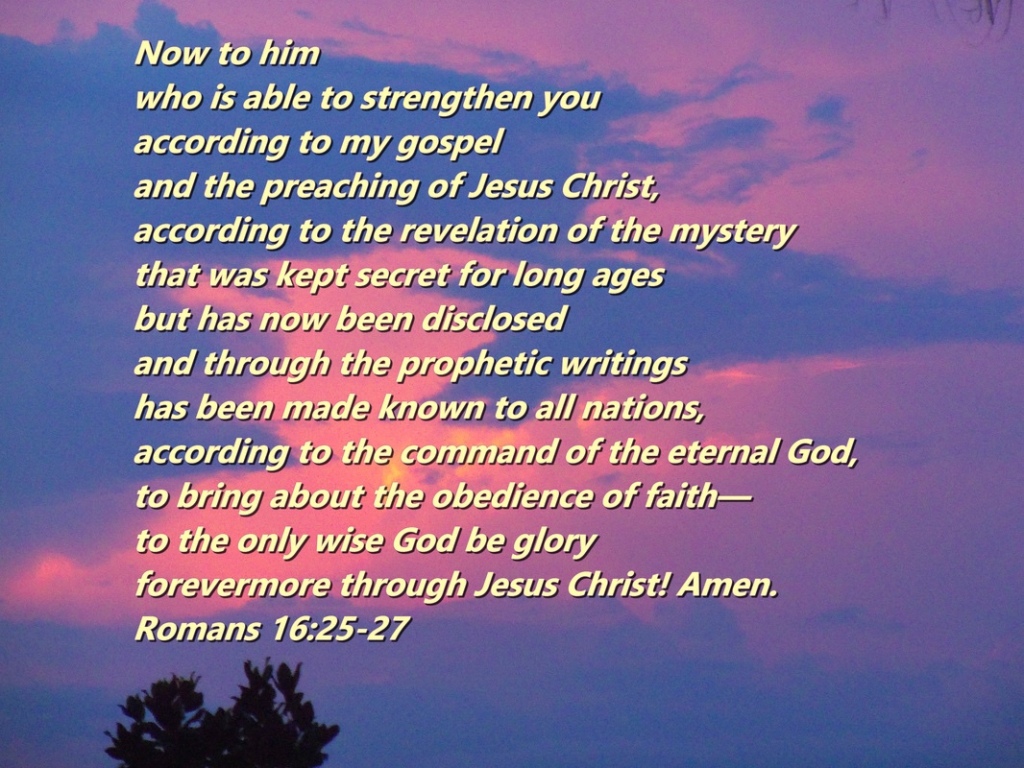
For some reason, the Epistle reading that is set for this coming Sunday, the Fourth Sunday in Advent, is the last few verses of Paul’s long and complex letter to the Romans. This short passage is just one sentence in length; it offers a benedictory closure to this long and complex letter: “now to God who is able to strengthen you … to the only wise God, through Jesus Christ, to whom be the glory forever! Amen” (Rom 16:25–27).

It is a somewhat flowery benediction which is quite similar to the closing verses of the letter of Jude: “now to him who is able to keep you from falling … to the only God our Savior, through Jesus Christ our Lord, be glory, majesty, power, and authority, before all time and now and forever; Amen” (Jude 24–25).

Some commentators observe that the wording of this benediction is somewhat alien to the theological argumentation that Paul sets forth in the body of the letter. “The revelation of the mystery that was kept secret for long ages but is now disclosed” and reference to “the eternal God” are the key terms in view. Perhaps this benediction was added after the letter itself was completed, they suggest, arguing that these words were likely written by another hand who did not like the way the series of greetings (Rom 16:21–23) ends quite abruptly.

In fact, the Roman closure reads like an extension of a typical Pauline blessing found in some other letters he wrote. “Grace to you and peace from God our Father and the Lord Jesus Christ”, he begins his early letter to the Galatians, continuing “who gave himself for our sins to set us free from the present evil age, according to the will of our God and Father, to whom be the glory forever and ever; Amen” (Gal 1:3–5).

“To our God and Father be glory forever and ever; Amen” he writes in a later letter, as he prepares to conclude his words to the Philippians (Phil 4:20). And still later, an unknown writer claiming the authority of Paul writes a slightly extended blessing in similar form, “Now to him who by the power at work within us is able to accomplish abundantly far more than all we can ask or imagine, to him be glory in the church and in Christ Jesus to all generations, forever and ever; Amen” (Eph 3:20-21).

From another perspective, these three verses look straightforward; they bring to a fine conclusion “the proclamation of Jesus Christ” that Paul has offered in his long letter to the Romans, especially noting that the Gospel has been “made known to all the Gentiles” and that this has been evident “through the prophetic writings”. Each of these phrases pick up key elements in the theological argument that Paul has developed in Romans.

However, although we will read them here, at the very end of the letter, in all current versions of our Bibles, these verses are missing from a number of important early manuscripts of this letter. Further, some other manuscripts place them after 14:23; still others after 15:33; and some even add a short blessing after this longer benediction. This reminds us that the finely-crafted Bibles that we have today are a long way from the ragged manuscripts that circulated in the early centuries of the church.

Still, there are gems in these words of benediction, which it would be a shame to miss. That the story of Jesus is “made known to all the Gentiles” is a significant statement. Paul himself had a firm commitment to bringing the good news to the Gentiles (1:5, 13; 3:29; 9:24; 11:11–13; 15:9–12, 15–21). He declares that “I am an apostle to the Gentiles” (Rom 11:13) who had been “entrusted with the gospel for the uncircumcised” (Gal 2:7–9; see also 1 Tim 2:7).

That the letter has aimed “to bring about the obedience of faith” is a second affirmation worth remembering. This affirmation links back with a very early statement by Paul, as he introduced himself to the believers in Rome, where he indicates that “we have received grace and apostleship to bring about the obedience of faith among all the Gentiles for the sake of his name” (Rom 1:5).

There is a peculiar textual variation in the closing section of this benediction. Some manuscripts include the phrase “to whom”, but others omit it. Its inclusion seems to place a bump in what would be the usual conclusion to a benedictory sentence, which would read, “to the only wise God be the glory through Jesus Christ forever. Amen”. That flow of words brings the letter to a most fitting climax of praise.

Finally, the last hope expressed in this letter is that God might strengthen those who read it. This has been part of Paul’s intention in writing to the Romans, and in planning to visit them; as he declares in the opening phrases of the letter, “I am longing to see you so that I may share with you some spiritual gift to strengthen you” (1:11).

This has been Paul’s practice in relation to other communities. “May [the Lord] so strengthen your hearts in holiness”, he prays for the Thessalonians (1 Thess 3:13; see also 2 Thess 2:17). He assures the Corinthians that the Lord “will also strengthen you to the end, so that you may be blameless on the day of our Lord Jesus Christ” (1 Cor 1:8) and exhorts them, “stand firm in your faith, be courageous, be strong” (1 Cor 16:13).

Others writing later letters in the name of Paul echo this prayer: “may you be made strong with all the strength that comes from his glorious power” (Col 1:11), “be strong in the Lord and in the strength of his power” (Eph 6:10), and “you then, my child, be strong in the grace that is in Christ Jesus” (2 Tim 2:1).

Why is this closing benediction included as the Epistle reading for this fourth Sunday in Advent? Perhaps because “the mystery that was kept secret for long ages” is “now disclosed” by a “revelation” in the story of Jesus, whose birth we are soon to celebrate? Perhaps because it is in Jesus that Christians most clearly perceive “the glory of God” to be evident? I can’t be sure; but there it is, for us to hear and ponder, this coming Sunday.

Like a father with his children … gentle as a nurse tenderly caring for her children (1 Thess 2; Pentecost 22A and 23A)

“As you know, we dealt with each one of you like a father with his children, urging and encouraging you and pleading that you lead a life worthy of God, who calls you into his own kingdom and glory.” So the followers of Jesus in the community that had formed in Thessalonica in the early 50s of the first century would have heard, when a letter sent to them from Paul, Silvanus, and Timothy was read to them in their community gathering (1 Thess 2:11–12).

Ancient letters normally followed clear formulaic patterns (as,minded, modern letters do). They began by identifying the parties involved in a short opening address, followed by a prayer for their wellbeing. So in such letters, we often find something like “Publius to Demetrius, greetings; I pray you may be well”.

So it is no surprise that the letters we have in the New Testament reflect this pattern. Almost all of what we describe as “Paul’s letters” begin with a greeting from the writer to members of the church at the designated location. In one letter (Philemon), three individuals are named as the recipients (Philemon, Apphia and Archippus) as well as the whole church community. The three “pastoral letters” (1 Tim, 2 Tim, Titus) are addressed to an individual person.

It is often overlooked that seven of the letters specified co-writers along with Paul: Timothy (2 Cor, Phil, 1 Thess and Phlm; Col and 2 Thess), Sosthenes (1 Cor) and Silvanus (1 Thess and 2 Thess). Paul was the sole designated writer in only two “authentic” letters (Rom and Gal) and in four “debated” letters (Eph, 1 Tim, 2 Tim, Titus).

So “Paul’s first letter to the Corinthians” was actually “a letter from Paul and Sosthenes to the Corinthians” (see 1 Cor 1:1). And “Paul’s first letter to the Thessalonians”, which appears at the moment in the lectionary sequence for Pentecost 21A to 25A), was actually “a letter from Paul, Silvanus, and Timothy, to the church of the Thessalonians” (see 1 Thess 1:1).

This coming Sunday, the lectionary offers us an excerpt from this letter, from the place after the greetings and opening prayer (1:1–10), which we heard last Sunday. This is where we would normally expect the body of the letter to begin (2:1), exploring the matters of substance in the community that the authors wanted to raise with the recipients. However, Paul and his co-writers turn their attention at this point away from the community in Thessalonica, to focus more specifically on the way that they had been operating whilst they had been with the Thessalonians (2:1–12).

There are two striking matters to note in this section. The writers of this letter lay claim to behaving “like a father with his children” as they relate to the Thessalonians. This is unusual—although in other letters bearing his name, Paul does claim to be father to Timothy (Phil 2:22) and to Onesimus (Phlm 10).

Whilst all letters written in the name of Paul refer to God as Father (Rom 1:7; Gal 1:1–5; 1 Cor 8:6; Phil 4:20; Eph 4:6; and in other places), claiming a paternal relationship with those who are being addressed in the letter is unusual. In the case of the Thessalonians, it would seem that this claim rests on the fact that Paul and his fellow-missionaries were the ones who brought them to faith in Jesus.

“Our message of the gospel came to you not in word only, but also in power and in the Holy Spirit and with full conviction”, they declared (1 Thess 1:5), and so “we had courage in our God to declare to you the gospel of God in spite of great opposition” (2:2), and then “you became imitators of us and of the Lord” (1:6), as “you turned to God from idols, to serve a living and true God, and to wait for his Son from heaven, whom he raised from the dead—Jesus, who rescues us from the wrath that is coming” (1:9–10). This paternal glow at the response of these believers to the preaching of the three evangelists in Thessalonica is clear.

A second claim that is even more striking is the assertion that “we were gentle among you, like a nurse tenderly caring for her own children” (2:8). It’s a claim that is distinctive, in that the three male authors of this letter are using female imagery to describe their modus operandi whilst in Thessalonica.

Gentleness is not a quality often associated with evangelists or those called by God to proclaim “the word of the Lord” to the people, although one proverb does state that “a gentle tongue is a tree of life” (Prov 15:4) and the prophet Jeremiah notes that when his life was threatened by the people of Anathoth, “I was like a gentle lamb led to the slaughter” (Jer 11:19). Gentleness is seen as a sign of “the righteous man” in the Wisdom of Solomon 2:19.

The claim to be “gentle as a nurse” comes, as we have noted, in the context of describing, in some detail, the way in which those who proclaimed the good news in Thessalonica were operating while they had been with the Thessalonians (2:1–12).

As they write to the Thessalonians, the authors of this letter feel the need to defend themselves, pointing out that their motivation in proclaiming the gospel was not based on “deceit or impure motives or trickery” (2:3), nor did they speak “with words of flattery or with a pretext for greed” (2:5). Rather, they undertook their task with deep-seated care (2:8) and purity of motive (2:10).

The three writers invoke the divine no less than nine times in twelve verses, proclaiming that the methods used were “approved by God” and that the spoke only “to please God” (2:4). Their invocation of God serves to underline the truth of what they write, and what they have said and done, with the Thessalonians.

The language which Paul, Silvanus, and Timothy use in this part of the letter is reminiscent of discussions of rhetoricians and philosophers of the time, a number of whom were accused of having base motives, an interest in self-promotion and a desire for immediate financial rewards!

The three who were writing to the Thessalonians could well have been accused of functioning in such a self-serving way, especially if their modus operandi was seen to be very similar to those wandering preachers of philosophical messages—deceitful, self-serving, using flattery and trickery, seeking financial gain. The power of their words (1:5; 2:12) could have fuelled such a critical perspective of their activities.

In addition, the itinerant way of life adopted by Paul, and his various companions, could easily leave them open to such a criticism. Yet, how Paul and the others defend themselves is similar to the way that the better class of philosophers and rhetoricians of the day tried to defend themselves. We know about this through the writings of pagan philosophers who canvassed the different types of itinerant philosophers that were known at the time.

In particular, the writings of Dio Chrysostom are relevant and helpful in this regard. Dio was an orator of the second century, but the phenomena that he described had been in existence for decades before. We can assume, with a reasonable degree of confidence, that his words describe a phenomenon akin to what was happening in the first century.

In the 32nd discourse of Dio Chrysostom, delivered “to the people of Alexandria”, he talks about a range of people who wandered from village to village, spruiking their own moral teachings. (In what follows I am quoting from the translation of Dio’s Oration 32 by J.W. Cohoon and H. Lamar Crosby in the Loeb Classical Library.)

First, Dio refers to a class of rather undesirable people; itinerants “whose tenets, to be sure, comprise practically nothing spurious or ignoble, yet who must make a living”. He describes them as Cynics, noting that “posting themselves at street-corners, in alley-ways, and at temple-gates, [they] pass round the hat and play upon the credulity of lads and sailors and crowds of that sort, stringing together rough jokes and much tittle-tattle and that low badinage that smacks of the market-place”.

His assessment is that “they achieve no good at all, but rather the worst possible harm, for they accustom thoughtless people to deride philosophers in general, just as one might accustom lads to scorn their teachers, and, when they ought to knock the insolence out of their hearers, these Cynics merely increase it”.

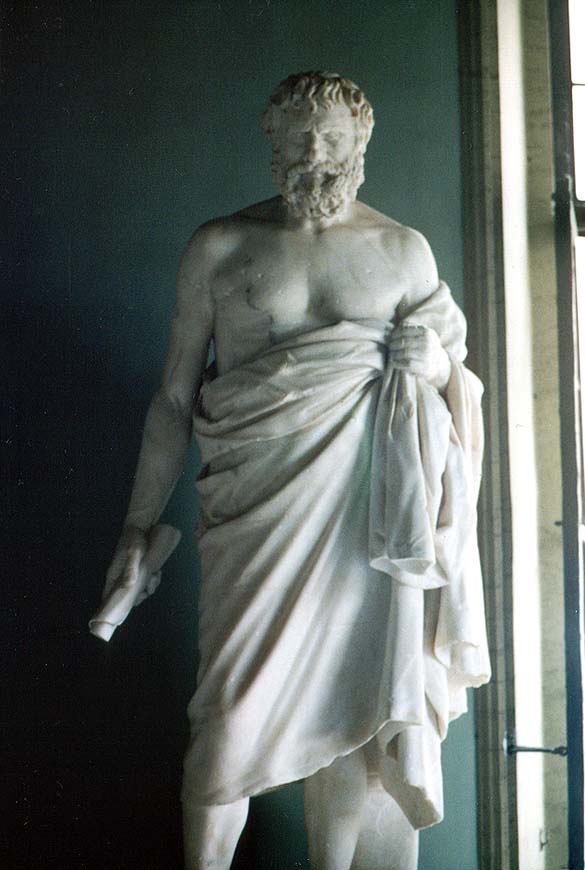
Statue of an unknown Cynic philosopher
from the Capitoline Museums in Rome.

Dio then notes that such people come “in the guise of philosophers” but that “they do these things with a view to their own profit and reputation, and not to improve you”. He declares that this is “shocking; for it is as if a physician when visiting patients should disregard their treatment and their restoration to health, and should bring them flowers and courtesans and perfume”.

He then moves on to describe “only a few who have displayed frankness in your presence, and that but sparingly, not in the same way as to fill your ears therewith nor for any length of time; nay, they merely utter a phrase or two, and then, after berating rather than enlightening you, they make a hurried exit, anxious lest before they have finished you may raise an outcry and send them packing, behaving in very truth quite like men who in winter muster up courage for a brief and hurried voyage out to sea”.

“But to find a man”, Dio continues, “who in plain terms and without guile speaks his mind with frankness, and neither for the sake of reputation nor for gain makes false pretensions, but out of good will and concern for his fellow-men stands ready, if need be, to submit to ridicule and to the disorder and the uproar of the mob — to find such a man as that is not easy, but rather the good fortune of a very lucky city, so great is the dearth of noble, independent souls and such the abundance of toadies, mountebanks, and sophists”.

And then, he puts forward his own situation, calling on the (unidentified) deity whom he worships: “I feel that I have chosen that rôle, not of my own volition, but by the will of some deity”, and he concludes by affirming that “when divine providence is at work for men, the gods provide, not only good counsellors who need no urging, but also words that are appropriate and profitable to the listener”.

As Dio has explained his own mode of operating, in contrast to the imperfect and self-serving ways of others, so too Paul, Silvanus, and Timothy are pressing their case, using similar language and concepts to articulate their cause. They present as called by God, speaking to please God, eschewing morally questionable practices, and sharing their very lives with their audience. The similarities are striking.

These similarities are explored in detail in the Anchor Bible Commentary on 1 Thessalonians by Abraham Malherbe. There is a good summary of Malherbe’s analysis of 1 Thess 2 in this vein, at http://www.religion.emory.edu/faculty/robbins/SRI/Examples/textures/inter/echo2.cfm The initial article in Novum Testamentum (1970) in which Malherbe argued this case can be read at https://library.mibckerala.org/lms_frame/eBook/atla0000721845%20Cynic%20Background.pdf

I confess to having a clear bias in regard to this line of interpretation; Abe Malherbe was my doktorvater, the supervisor of my doctoral thesis, on hellenistic apologetics, Josephus, and Luke-Acts, at Yale University. Before that, I took classes with him during my coursework year, including an exegesis class on “Paul’s Macedonian Correspondence” (1 and 2 Thessalonians and Philippians), and I participated in a doctoral seminar on “Paul and the Moral Philosophers”—so I am well-schooled in the details of his case; and in full agreement with his view on this particular matter. (There were other exegetical matters in which we disagreed; the papers I wrote to argue against Malherbe’s views were nail-biting pieces, as he could be a fierce critic, as well as a warm encourager, on such matters.)