Paul, the law of the Spirit, and life in the Spirit (Rom 8; Pentecost 7A)

Last week, we considered the section of Paul’s letter to the Romans which the lectionary offered: Paul grappling within “the sin that lives within me” (Rom 7:14–25a). In probing that state, Paul came to a rather pessimistic conclusion: “wretched man that I am! who will rescue me from this body of death?” (7:24), before immediately switching to a grateful “thanks be to God through Jesus Christ our Lord!” (7:25). See

This week, the lectionary continues the argument that Paul is developing, as he presses on to rejoice that “there is now no condemnation for those who are in Christ Jesus” (8:1). The passage proposed by the lectionary (8:1–11) marks a dramatic change in tone. Whilst he still recognises that “the mind that is set on the flesh is hostile to God; it does not submit to God’s law” (8:7), the primary focus that Paul now has is on the claim that “the law of the Spirit of life in Christ Jesus has set you free from the law of sin and of death” (8:2).

Paul considers the state of humanity: “to set the mind on the flesh is death … the mind that is set on the flesh is hostile to God; it does not submit to God’s law—indeed it cannot, and those who are in the flesh cannot please God” (Rom 8:6–8). He has already grappled with this in the previous chapter. Here, he presses on to celebrate that, as he tells the believers in Rome, “you are not in the flesh; you are in the Spirit, since the Spirit of God dwells in you” (8:9).

Because of what the Spirit effects in the lives of believers, Paul is embued with great hope—a quality that he expresses in other letters he wrote. He rejoices with the Thessalonians that they share with him in “hope in our Lord Jesus Christ” (1 Thess 1:3) and tells the Galatians that “through the Spirit, by faith, we eagerly waits for the hope of righteousness” (Gal 5:5).

He reminds the Corinthians that “faith, hope and love abide” (1 Cor 13:13), and then in a subsequent letter to believers in Corinth, he asserts that “he who rescued us from so deadly a peril will continue to secure us; on him we have set our hope that he will rescue us again” (2 Cor 1:10)

Paul has already reported to the Romans that “we boast in our hope of sharing the glory of God” (Rom 4:2) and that “we boast in our hope of sharing the glory of God” (5:2). He will go on to refer to “the law of the Spirit of life in Christ Jesus” (8:2), and explain how the work of the Spirit gives hope to the whole creation, currently “in bondage to decay”, which will “obtain the freedom of the glory of the children of God” (8:21). And so, Paul declares, it is “in hope that we were saved” (8:24).

Towards the end of the letter, Paul offers a blessing to the Romans: “may the God of hope fill you with all joy and peace in believing, so that you may abound in hope by the power of the Holy Spirit” (15:13). That the Spirit produces this hope is a fundamental dynamic in the process of “setting [believers] free from the law of sin and of death” (8:2).

The Spirit is rarely mentioned in the first seven chapters of this letter. Paul does note that it was “according to the spirit of holiness by resurrection from the dead” that Jesus was “declare to be Son of God with power” (1:4), and that it was “through the Holy Spirit that has been given to us” that “God’s love has been poured into our hearts” (5:5). And he notes that it was by being “discharged from the law” that believers entered into “the new life of the Spirit” (7:6).

But from 8:1 onwards, the Spirit becomes an active presence in what Paul writes about. The Greek word pneuma appears 33 times in the letter to the Romans; most of these are referring to the Holy Spirit. Strikingly, 19 of these occurrences are in chapter 8; a further eight instances then occur in chapters 9–15.

We might contrast this with the word that is often seen to be the key to this letter, dikaiosunē, which appears 57 times in Romans—including the programmatic key verse of 1:17, 13 times in ch.3, 11 times in ch.4, nine times in ch.5, and then nine more times in chs.9–11. Whilst righteousness is indeed an important word, the Spirit is also of crucial significance in Paul’s argument throughout Romans.

Rom 8:1–11 makes a strategic contribution to what Paul is explaining in this letter—that in the Gospel, “the righteousness of God is revealed through faith for faith” (1:17), that “the righteousness of God has been disclosed, and is attested by the law and the prophets, the righteousness of God through faith in [or of] Jesus Christ for all who believe” (3:21–22).

As he develops his argument, drawing on the story of Abraham (Gen 15), Paul affirms that this righteousness “will be reckoned to us who believe in him who raised Jesus our Lord from the dead, who was handed over to death for our trespasses and was raised for our justification” (4:24–25), concluding that “since we have been made righteous by faith, we have peace with God through our Lord Jesus Christ” (5:1), and asserting that “if Christ is in you … the Spirit is life because of righteousness” (8:10).

Incidentally, when we look at the statistics of word occurrences in the seven authentic letters of Paul, we see that “righteousness” occurs a total of 87 times (57 of them in Romans, 13 in Galatians), whilst “spirit” can be found 117 times: as well as the 33 times in Romans, there are 39 occurrences in 1 Corinthians and a further 15 occurrences in 2 Corinthians, and then 19 more appearances in Galatians. Spirit is a fundamental component in Paul’s theology.

Paul believes that it is by the Spirit that the gift of righteousness is enlivened and activated within the believer. He hammers this point with a series of clear affirmations in this week’s passage (8:1–11): “there is no condemnation” (v.1), “the law of the Spirit has set me free” (v.2), “God has done what the law, weakened by the flesh, could not do: by sending his own Son in the likeness of sinful flesh, and to deal with sin” (v.3), “the Spirit of God dwells in you” (v.9), “the Spirit is life” (v.10), and “he who raised Christ from the dead will give life to your mortal bodies also through his Spirit that dwells in you” (v.11).

Important for Paul is for the believer to know that “you are in the Spirit, since the Spirit of God dwells in you” (8:9) and that “his Spirit … dwells in you” (8:11). This is an idea that Paul also articulates in his first letter to a Corinth, when he poses the rhetorical question, “do you not know that you are God’s temple and that God’s Spirit dwells in you?” (1 Cor 3:16). The answer to this rhetorical question which is expected (but not stated) is, of course, “yes, we do know that God’s Spirit dwells in us”.

A similar rhetorical strategy can be seen as Paul draws this section (Rom 8:1–11) to a close. He poses a matched pair of conditional possibilities: “if Christ is in you” (v.10), “if the Spirit dwells in you” (v.11). The possibility, in each case, is crystal clear: since Christ is in you, “the Spirit is life because of righteousness” (v.10), and since the Spirit dwells in you, “he who raised Christ from the dead will give life to your mortal bodies also through his Spirit that dwells in you” (8:11).

For Paul, then, the role of the Spirit in enlivening and energising the believer is crucial. That is the important contribution that this passage makes to Pauline theology, and to our understanding of the Christian life.

See also

Paul and the Law, sin and the self (Rom 7; Pentecost 6A)

“I delight in the law of God in my inmost self, but I see in my members another law at war with the law of my mind” (Rom 7:23). So Paul writes, in the section of the letter written “to all God’s beloved in Rome, who are called to be saints” which is offered by the lectionary for this coming Sunday (Rom 7:15–25a).

The lectionary wants us to end this reading with the words of gratitude, “thanks be to God through Jesus Christ our Lord!” (15:25a). But in my analysis, Paul’s argument reaches its conclusion with the stalemate of verse 23—a clash between “the law of God” and “the law of my mind”. “Wretched man that I am”, he explodes in exasperation (7:24), after a lengthy and complex consideration of the issues which has led him to this damning conclusion.

What Paul is writing about in this complex section (7:1–25) is about the battle of wills, as God’s will comes into conflict with human will. The argument throughout this chapter—as, indeed, the argument throughout much of Romans—is presented as a dialectic, in which one point of view is put, to be met by an opposite point of view; followed by a rebuttal by the first voice, and a further oppositional claim by the second voice.

The thesis for discussion has been set out in 7:1–6, using the marriage relationship between husband and wife and “another man” (7:1–3) as the basis for an analogy (“in the same way”, 7:4) for the relationship between humans, “living in the flesh” (7:5) whilst also having “the new life of the Spirit” (7:6).

The use of analogy, already developed in earlier Greek rhetoric and used extensively by philosophers and political orators, does reflect rabbinic practice. The deployment of analogy, gezerah shewah, was one of Hillel’s principles of interpretation, indicating the influence of hellenistic thought and ideas on Jewish teachers and writers. So Paul here may well be operating as a rabbi, in the way that he sets out and developed his case.

But the fundamental dualism which underlies this whole chapter—the law of sin and death, the holy law of God—is thoroughly Greek in origin and character. Plato’s view of the soul trapped in the prison of the material world, which he set out in his Allegory of the Cave and which marks so many of his Dialogues: a clear line of demarcation between the spirit and the flesh, the body and the mind, the idea and the particular object.

So Paul, trained as a Pharisee, being “far more zealous for the traditions of my ancestors” (Gal 1:14), brings into the discussion a “delight in the law of God in my inmost self” (Rom 7:22). He affirms that he upholds the Torah (Rom 3:31), alluding to various commands in The Ten Words which he insists are worth obeying (2:17–22), and affirming that, in its essential character, “the law is holy, and the commandment is holy and just and good” (7:12).

Yet his calling to be “apostle to the Gentiles” (Rom 11:23; Gal 2:8) led to his experience of eating at table with Jews and Gentiles together, in breach of kosher food laws (Gal 2:11–13)—an issue that is clearly in view decades later, as Luke writes his account of the early years of the Jesus movement, siding with Paul in the view that God has set aside the requirement for separate foods and separate tables (Acts 10:1–11:18; 15:19–20, 28–29).

This, in turn, leads Paul to his missionary goal of bridging the gap between Jews and Gentiles in practical ways (Rom 15:25–27), undergirded by the message that he preaches, affirming that salvation is offered “to everyone who has faith, to the Jew first and also to the Greek” (Rom 1:16; see also 2:10; 10:12; Gal 3:28; and the post-Pauline development in Eph 2:11–22). He is driven by the scriptural claim that “God shows no partiality” (Rom 2:11; Deut 16:19–20; 2 Chron 19:7; Sir 35:15–16).

So Paul brings a firm commitment of this universal availability of salvation into this discussion in Rom 7:1–25. The argument that he has set out in the thesis of 5:1, “since we are justified by faith, we have peace with God through our Lord Jesus Christ, through whom we obtained access to this grace in which we stand”, is argued throughout the ensuing verses, and given a ringing affirmation at the end in 6:23, that all humanity is able to know and access “the free gift of God [which is] eternal life in Christ Jesus our Lord” (6:23).

This sounds, to us today, like a formal debate: three speakers, alternating between the Government for the proposition, the Opposition against the proposition, and then short concluding remarks, before the adjudicator declares a result and announces a winner. In the ancient world, however, Paul is writing in the style of a diatribe—a form that was developed in Ancient Greece and which was widely practised by Greek rhetoricians, philosophers, and teachers during the Hellenistic period.

See my analysis of the diatribe style in Rom 4 at

In the diatribe that Paul develops in Rom 7, he needs to address what he now sees as the inadequacy of Torah, given his affirmation that “God shows no partiality” (2:11) and his commitment to Jews and Gentiles eating together, without scruples regarding the food being shared. This deficiency in the law runs throughout the argument of Romans; it is impossible to keep the law (2:17–3:20).

Since his calling to work amongst the Gentiles, Paul has come to see that the law brings wrath (4:15) and increases sin (5:20), and indeed he maintains that the law “brought death” (7:9). As a consequence, righteousness must be gifted by God “apart from law”(3:21).

Paul, as we have seen, uses the scriptural example of Abraham, who “believed God, and it was reckoned to him as righteousness” (4:3), to argue that “the promise may rest on grace and be guaranteed to all his descendants, not only to the adherents of the law but also to those who share the faith of Abraham” (4:16). See

And so, he declares that “you have died to the law through the body of Christ, so that you may belong to another, to him who has been raised from the dead” (7:4), and thus “we are discharged from the law” (7:6). Paul then demonstrates this in what immediately follows. The law is not sin in and of itself; and yet, “if it had not been for the law, I would not have known sin” (7:6). This is seen, first, through the educational function of the law, which teaches for example, about covetousness (7:7–8a).

Then Paul notes that, paradoxically, the essential nature of the law reveals and activates sin (7:8b—10), so that “the very commandment which promised life proved to be death to me”, before he intensifies this with the claim that “sin, finding opportunity in the commandment, deceived me and by it killed me” (7:11).

He concludes this section with affirmation of the law as “holy, just, and good” (7:12), before clarifying that it was not the Law which brought death to him, but rather “it was sin … working death in me through what is good … through the commandment” (7:13). Paul has worked hard to differentiate sin from the Law; the one is evil, the other is good.

And yet, as he continues his diatribal discussion, more problems emerge (of course, since this is the nature of a diatribe!). Here is the dilemma: “we know that the law is spiritual; but I am of the flesh, sold into slavery under sin” (7:14). What follows is a foray into the murky mind of Paul, where, as he says, “I do not do what I want, but I do the very thing I hate” (7:15)—although he immediately attempts to excuse himself by stating that “it is no longer I that do it, but sin that dwells within me” (7:17).

That sits uncomfortably alongside Paul’s claim to the Galatians, that “it is no longer I who live, but it is Christ who lives in me”, and thus, Paul now “lives to God” (Gal 2:19–20). In writing to the Romans, Paul claims that “nothing good dwells within me, that is, in my flesh” (7:18), for it is “sin that dwells within me” (7:17, 20). The contradiction is confusing. What is the essential force that “lives within” Paul; it is Christ, as in Gal 2, or sin, as in Rom 7?

The confusion caused by “sin that dwells within me” (7:20) whilst still claiming that “I delight in the law of God in my inmost self” (7:22), drives Paul deeper into the hellenistic dualism, seeing “in my members another law at war with the law of my mind, making me captive to the law of sin that dwells in my members” (7:23). No wonder he throws his hands up in despair, exclaiming, “wretched man that I am! who will rescue me from this body of death?” (7:24).

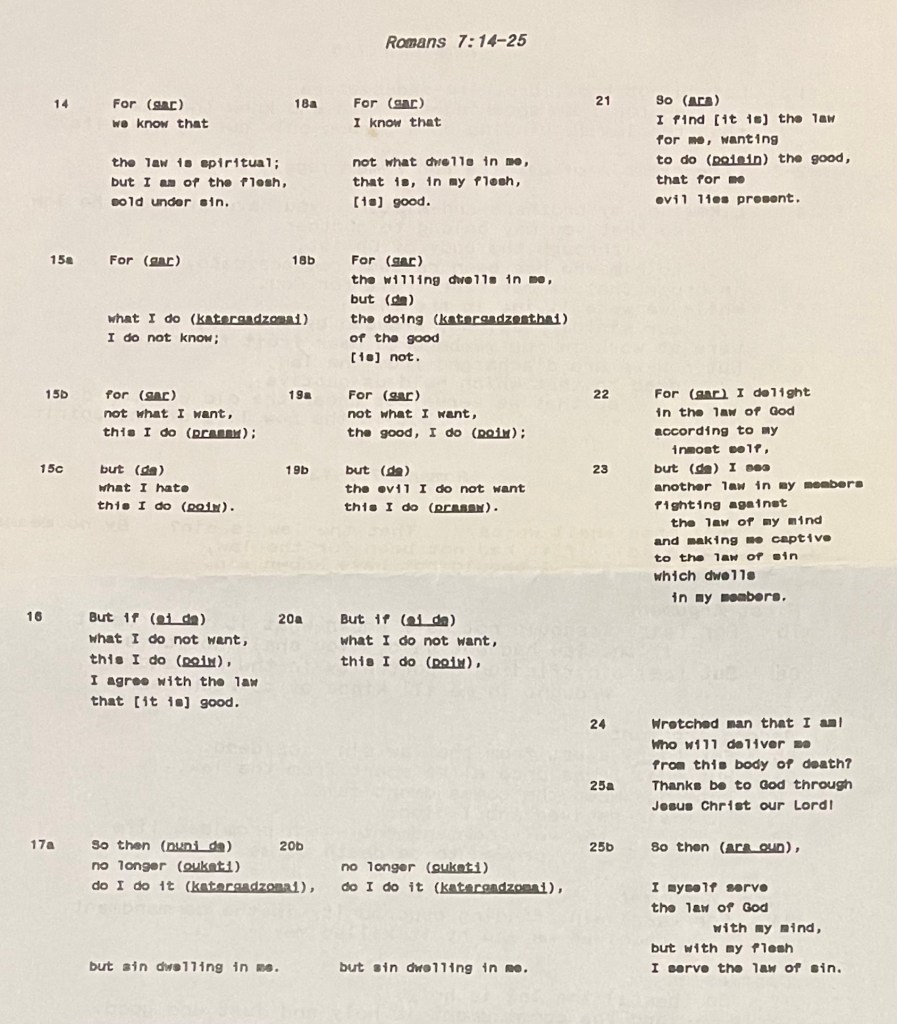
The argument runs a parallel course three times, as my schematic structuring (below) demonstrates. For each proposition that is put (introduced often by the Greek particle gar, “for”), a counter-proposition is offered (introduced by the Greek particle de, “but”).

Modern psychological insights have been used to dig deeper into what Paul writes in Romans 7. Paul appears to be fixated on his own self, using the Greek word egō many times (7:9, 10, 14, 17, 18, 20, 21, 24, and 25). And the language of “sin” and “death” which runs through this chapter exacerbates the tendency to adopt this approach. Declaring that these malicious forces are at work within his inmost being appears to present Paul as a figure consumed with internal contradictions and unresolved tensions. In short, he is a prime candidate for psychological investigation, if not psychiatric intervention!

Who is the person, the egō, who is referenced in these verses? Some interpreters consider that Paul here is talking about his “old self”—the person he was before he encountered the risen Jesus and was commissioned for the task he now undertakes, as “apostle to the Gentiles”. This chapter, reflecting Paul the pious and intense Jew, living under the Law, desperately seeking to obey it in every detail, is thus contrasted with the following chapter, portraying Paul the apostle, fervent and passionate for the mission he is undertaking, freed from the Law and living in the liberty of divine grace.

That simplistic analysis, however, owes more to the 19th century Pietism that was driving interpreters of that time, who considered the Christian life inevitably involved a fierce inner struggle with sin which fermented and eventually erupted into an existential crisis that would, hopefully, ultimately result in a decision to live a new, Christ-centered life. We can see how that dynamic can be extracted from Paul’s agonising words in Rom 7.

A second way of dealing with this chapter, by contrast, has been to claim that the struggle about which Paul here writes reflects precisely the struggle he was enduring after that dramatic encounter with Christ.

The commission that Paul received in that encounter is reported in graphic terms, many decades later, by Luke, who makes the moment into a grand call–and–commissioning scene (Acts 9:3–8; 22:6–11; 26:12–18). Of course, Luke was not present for this event, so he shaped in along the lines of classic call-and-commissioning narratives that existed in earlier Jewish writings. (I have explored this in detail in my commentary on Acts in the Eerdman’s Commentary on the Bible, 2003). In Paul’s own writings, by contrast, this mentioned only briefly, in passing (1 Cor 9:1 and Gal 1:1, 11–12).

Whatever took place in that encounter, it is clear that, as a believer, Paul was not exempt from the ongoing struggle between the desire to do what is pleasing to oneself, but is sinful (Rom 7), on the one hand; and on the other hand, the delight of living a life redeemed by grace (Rom 8). So the passage offered by this week’s lectionary (7:14–25a) is offered as a counterpoint to that which we have on the following Sunday (8:1–11).

This has been the line of interpretation advocated, to various degrees, by Augustine, Aquinas, Luther, and Calvin—but it has fallen into disfavour with contemporary interpreters, who see this as too simplistic and as presenting an unresolved and unintegrated egō. Surely Paul was not caught in that immature state?

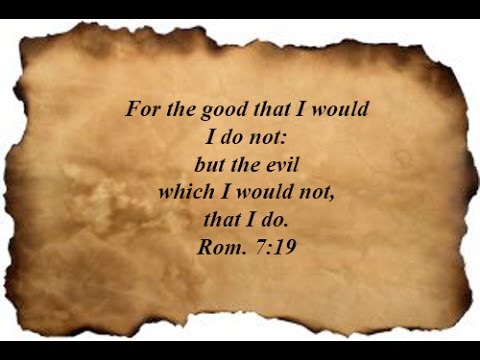
So a third line of interpretation has been that Paul here is setting forth the general, universal condition of the human being. The egō is Paul’s way to talk about “all of us”, for we are all still wrestling with that key characteristic of the human condition: we all, each one of us, “do not do the good [we] want, but the evil [we] do not want is what [we] do” (7:19).

This interpretation was proposed by Kümmel and has been followed by Bultmann, Käsemann, and Dunn, amongst others. Dunn argues that the struggle of Rom 7 provides the key to the argument developed by Paul throughout Rom 5—8 as a whole.

Beyond that, Kristen Stendhal has mounted a persuasive case, that the egō of Rom 7 should not be connected with Paul’s inner being, but rather with the broader issue to which Paul is addressing himself throughout the whole letter of Romans—what place does the Law have in the new community of faith, where both Jews and Gentiles are sharing together in fellowship? How might the demands of the Law function within such a context?

It’s a proposal that I find attractive and helpful, for indeed that broader question is what Paul comes back to in 8:1–8, and then in 9:30–33, 10:1–4, and 11:25–32; and finally in 13:8–10. The egō of Rom 7 is not the last word on this matter; Paul has “yet more light and truth to break forth” on this complex matter!

*****

You can look ahead to what I have to say about some of those passages, at

Dead to sin and alive to God (Romans 6; Pentecost 4A)

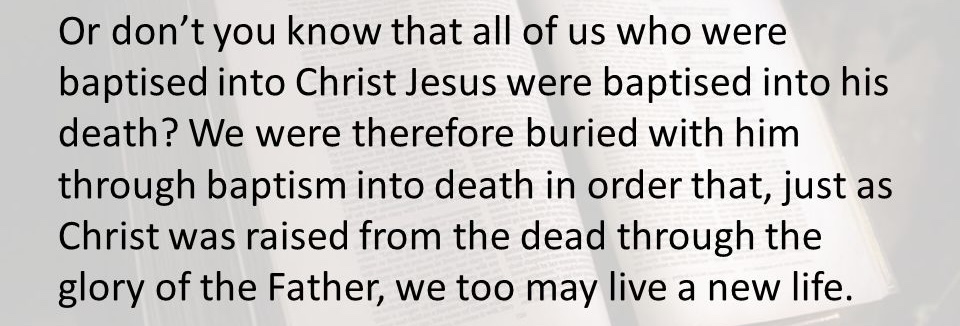
“What then are we to say? Should we continue in sin in order that grace may abound? By no means! How can we who died to sin go on living in it? Do you not know that all of us who have been baptized into Christ Jesus were baptized into his death?”

Paul, in typical style, starts into this section of his letter to the Romans (6:1–14) with a string of questions—interrupted only by his typical exclamation, “by no means!” The chapter divisions in our Bibles lead us to read the text in self-contained chunks—and the lectionary, by choosing clearly-defined collections of verses, exacerbates this tendency. But if we read in the way that the letter was written—as a continuous stream, with no chapter divisions or verse markings—we can see the downside of this approach.

What we know as Romans 6:1–14 (offered under a heading such as “dying and rising with Christ”) is actually a continuation of the discussion in the previous section, about sin. The sentence immediately before these words (5:21) refers to “sin exercising dominion in death”; this passage explores how the dominion of death is dealt with by Christ. Before that, Paul has undertaken a discussion of the sin of all people (5:18–20), citing the effect of “the one man’s trespass”.

That passage in turn has been a development from the claim that “sin came into the world through one man, and death came through sin, and so death spread to all because all have sinned” (5:12), itself introducing a carefully-structured argument, proceeding step by step through parallel clauses, using a typical Jewish line of argument whereby the one (Adam) functions as a representative of all (humanity). This line of argument sets up the basis for the claim that it is the work of another one man (Christ) to provide “grace exercis[ing] dominion through justification leading to eternal life” (5:21).

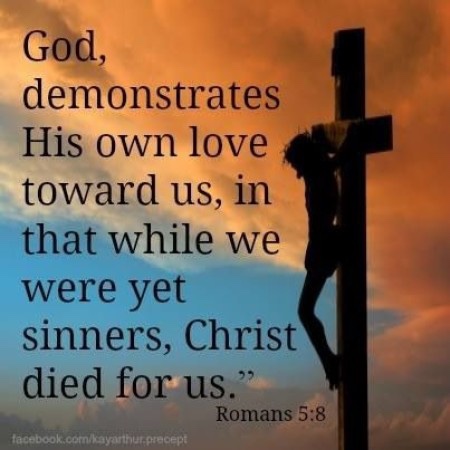
And the pinning of the blame for universal sinfulness on the one representative man, Adam, itself is an exposition of the earlier claim that “while we still were sinners Christ died for us” (5:8), which in turn rests on the need for God to demonstrate how sinful people are “reckoned as righteous”—something asserted at 4:6 and explained through a midrashic treatment of Gen 15:6 throughout Rom 4:1–25.

And Paul’s midrash of the Abraham story in turn expounds the tightly-declared announcement of 3:21–26, concerning how God “showed his righteousness” (3:25–26) by means of “the redemption that is in Christ Jesus, whom God put forward as a sacrifice of atonement by his blood, effective through faith” (3:24–25).

This sacrifice of atonement itself is premised on the understanding that “all have sinned and fall short of the glory of God” (3:23), which is a statement which repeats and refines the earlier “all, both Jews and Greeks, are under the power of sin” (3:9), a gathering up of those under law who have sinned (2:1–29) and those not under law who also have sinned (1:18–32)—which in turn explains the need for the Gospel of which Paul was not ashamed, “the gospel [which is] the power of God for salvation to everyone who has faith, to the Jew first and also to the Greek” (1:16).

Or, to put it all the other way around (as Paul writes it), there is good news (1:16–17) which deals with the sinfulness of Gentiles (1:18–31) and of Jews (2:1–29), a universal sinfulness (3:1–20) which God has dealt with through the sacrifice of Jesus (3:21–31), consistent with the pattern already shown centuries before in Abraham, of “reckoning as righteous” those who have faith (4:1–25), which manifests God’s grace (5:1–11); all of which has been necessary because of the introduction of sin through one man, Adam (5:12–21).

And so: “What then are we to say? Should we continue in sin in order that grace may abound? By no means!” (6:1).

Turning to the particular verses offered by the lectionary for this coming Sunday (6:1b—11): what do we find? The rhetorical pattern of the diatribe is evident here, also. The posing of a rhetorical question, followed by the definitive “by no means!”, followed up with further rhetorical questioning, is characteristic of a diatribe—a form that was developed in Ancient Greece and which was widely practised by Greek rhetoricians, philosophers, and teachers during the Hellenistic period.

Paul wants to explain that baptism signals the way that Jesus deals with human sinfulness. “Do you not know that …” (6:3) is the typical way to introduce a new matter for consideration (see also 6:16; 7:1; 11:2; 1 Cor 3:16: 5:6; 6:2, 3, 9, 15, 16, 19; 9:13, 24). In this case, the standard question introduces the subject of baptism. Whilst baptism is a sign of belonging to the community of faith, as is stated in 1 Cor 12:13 and Gal 3:27, baptism is also a joining with Christ into the mystical union that characterises Paul’s thinking.

In other letters, Paul writes about “being found in him” (Phil 3:9),

“In Christ” appears frequently in Paul’s letters: grace is given “in Christ” (1 Cor 1:4), redemption is “in Christ” (Rom 3:24), sanctification is “in Christ” (1 Cor 1:2), justification is “in Christ” (Gal 2:16–17), reconciliation is “in Christ” (2 Cor 5:19), “the blessing of Abraham” is “in Christ” (Gal 3:14), peace guards the hearts and minds of believers “in Christ” (Phil 4:7), “the riches in glory” of God are “in Christ” (Phil 4:19), encouragement is “in Christ” (Phil 2:1), and eternal life is “in Christ Jesus our Lord” (Rom 6:23). Or, as Paul writes to the Galatians, “I have been crucified with Christ; and it is no longer I who live, but it is Christ who lives in me; and the life I now live in the flesh I live by faith in the Son of God, who loved me and gave himself for me” (Gal 2:20).

So this mystical union with Christ, which shapes the life of a believer, is both symbolised and, it would seem, enacted through the ritual of baptism. Paul here pushes beyond the forensic argumentation of the previous chapters, where the status of “being justified” is a transaction that is effected by placing trust (faith) in what Jesus has done, and is doing. (Jesus, or rather Christ, for Paul, is always both past and present; perhaps, even more the active presence in a believer’s life, that the historical figure of Galilee.)

Being baptised is being “buried with him by baptism into death” which leads, inevitably, to emerging from that state into “newness of life”: “just as Christ was raised from the dead by the glory of the Father, so we too might walk in newness of life” (Rom 6:4). To drive the point home, Paul restates this union in verse 5: “if we have been united with him in a death like his”, through the act of baptism, then “we will certainly be united with him in a resurrection like his”, as we emerge from the waters of baptism. The dynamic of what is believed to take place in baptism is clear.

Then he finds another way to describe this process, introducing it by another stock standard introductory phrase, “we know” (6:6). Paul uses this phrase also at 6:9, and quite regularly elsewhere in Romans (2:2; 3:19; 7:14; 8:22, 28) as well,as in other letters )1 Cor 8:1, 4; 13:9; 2 Cor 1:7; 5:1, 6, 16; Gal 2:16; 1 Thess 1:4). In each case, the phrase functions to underline and reaffirm something that Paul presumably has previously communicated to those hearing his letter.

So, for a third time, Paul states the first, most important, half dynamic: “we know that our old self was crucified with him so that the body of sin might be destroyed” (6:6). The result is that “we might no longer be enslaved to sin”, repeated and amplified in the next clause, “for whoever has died is freed from sin” (6:7).

Then, Paul moves to the second half of this dynamic: “if we have died with Christ, we believe that we will also live with him” (6:8). Death, in the baptismal dynamic, leads inevitably into life. That is the value that it has for believers; an assurance of a “newness of life” in union with Christ, as believers “live with him”.

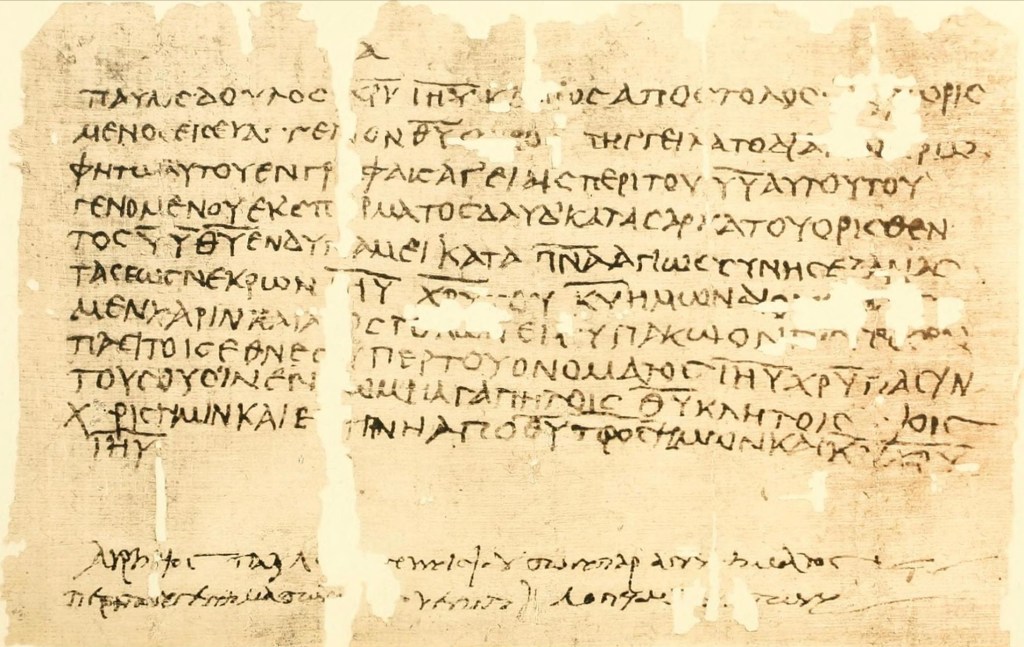
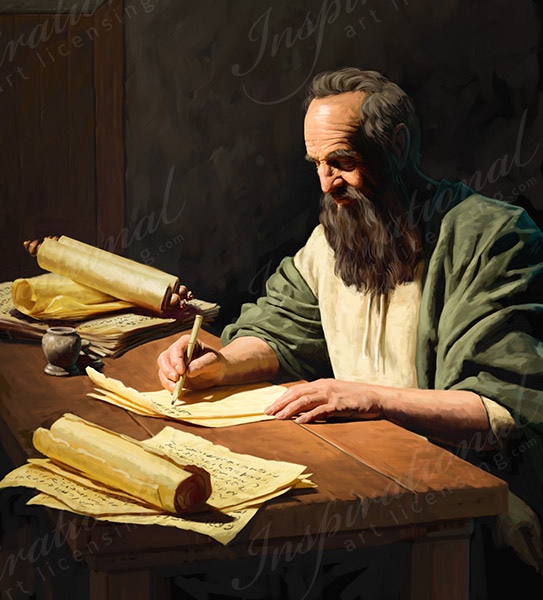
To make sure the Roman’s grasp the point, Paul says, once again, “we know”. The style of Romans is more oral rhetoric than written argumentation; I always like to imagine Paul, his brow furrowed, his shoulders slightly stooped, pacing up and down his small room, as Tertius (the scribe who actually wrote the letter, according to Rom 16:22) furiously scribbles the phrases that pour forth from Paul’s mouth. Syntactical omissions and irregularities, peculiar grammatical forms, idiosyncratic vocabulary: all of this is due to the lack of a careful, third-party, editorial eye. The letter was dictated, scribed, and sent off post haste!

At any rate, “we know”, says Paul, “that Christ, being raised from the dead, will never die again; death no longer has dominion over him, [for] the death he died, he died to sin, once for all; but the life he lives, he lives to God” (6:9–10).

Which brings us to the punchline for this particular collection of verses. Nothing new is said; the same thing has been said four or five times, and that one thing has been said, with variations throughout, to drive the point home. For the Romans, hearing this letter read in their various house gatherings, the consequence of their baptism, and of what God has done in Jesus, and of how they are to understand God’s atoning actions, and of how they are regard themselves, as justified by faith: “so you also must consider yourselves dead to sin and alive to God in Christ Jesus” (6:11).

And so the conclusion itself is then expanded, once again by stylistically varied repetitions, in 6:12–14, ending with the definitive conclusion, “sin will have no dominion over you”, and the strong and clear affirmation, “you are not under law, but under grace” (6:14).

*****

On the central theme of the letter to the Romans, see

On the use of the diatribe form in Romans, and particularly in 4:1–25, see

For my take on a key theological issue in 5:12–21, see

We have obtained access to this grace (Romans 5, Pentecost 3A)

During Lent we heard a key passage from Romans, much of which is offered again as the Epistle reading for this coming Sunday. It is a passage replete with fundamental theological affirmations (Rom 5:1–11, Lent 3A; Rom 5:1–8, Pentecost 3A). In an earlier blog, we explored two of the key elements that Paul sets out in this passage: being made righteous by faith, a central affirmation for the apostle; and being at peace with God.

In this post, as we revisit this passage for the Third Sunday after Pentecost, we look at other theological aspects of Paul’s writing. Paul writes this letter to a group of faith communities which include both Jews and Gentiles; this is a fundamental commitment in his theology and practice (Rom 3:29; 4:11–12; 9:22–24; 11:11–14; 15:7–13) and the list of names in 16:3–16 indicate that people of both Jewish and Gentile origins were present. Nevertheless, the theological commitments that Paul articulates here have strong Jewish origins.

Access to God’s grace (v.2) is a fundamental element in Paul’s affirmation in Rom 5:1–11, as well as in his whole body of writings. (I am here canvassing just the seven letters generally accepted as authentic to Paul.) God’s grace is what gripped Paul, calling him to his work as apostle, preaching the Gospel, establishing new communities of faith, and nurturing them as new disciples.

It is through Jesus, says Paul, that “we have received grace and apostleship to bring about the obedience of faith among all the Gentiles for the sake of his name” (Rom 1:5; 1 Cor 3:10; 15:10; 2 Cor 1:12; Gal 1:15). That grace is evident in the lives of believers in Corinth (1 Cor 1:4) and Philippi (Phil 1:7); by contrast, the Galatians, in Paul’s eyes, “are so quickly deserting the one who called you in the grace of Christ and are turning to a different gospels (Gal 1:6).

Paul is drawing on his Jewish heritage and the understanding of God in Hebrew Scripture. God’s graciousness was repeatedly offered to the people of Israel (Exod 34:6; Num 6:25; 1 Sam 1:22; 2 Ki 13:23; 2 Chron 30:9; Ezra 7:9; 8:18, 22; Neh 2:8, 18; 9:17, 31).

Prophets declared that God yearned to be gracious (Isa 30:18–19; 63:7; Joel 2:13; Amos 5:15; Jonah 4:2; Zech 1:13), as do the psalmists (Ps 86:15; 103:8; 111:4; 116:5; 135:3; 145:8, 13;147:1). The prophets therefore implore the Lord to manifest that grace (Isa 33:2; Mal 1:9), as do the psalmists (Ps 4:1; 6:2; 9:13;25:16; 26:11; 27:7; 30:10; 31:9; 41:4, 10; 56:1; 67:1; 86:3, 16; 119:58, 132). Grace is a fundamental scriptural concept, integral to the nature of God.

*****

Sharing in the glory of God (v.2) follows; in this regard, Paul also draws from his Jewish heritage. The glory of God is present in the stories that recount the formation of Israel, through the years in the wilderness (Exod 16:6–10; Num 14:22), on Mount Sinai (Exod 24:16–17; Deut 5:22–24), in the Tabernacle (Exod 40:34–35; Lev 9:23; Num 14:10; 16:19, 42; 20:16), and in the temple (1 Ki 8:1–11; 2 Chron 7:1–4).

The psalmists reinforce the notion that the glory resides in the sanctuary (Ps 26:8; 63:2; 102:16; Hag 2:3) and in the land of Israel (Ps 85:9). In some psalms the realm of God’s glory is extended to be “over the waters” (Ps 29:1–4), “over all the earth” (Ps 57:5; 72:19; 97:6; 102:15; 108:5; also Isa 6:3; 24:15–16; 60:1–2; Hab 2:14) and even to “the heavens” (Ps 19:1; 113:4; 148:13; and Hab 3:3).

The concept of God’s glory plays an important role in Paul’s argument in Romans. “All have sinned and fallen short of the glory of God”, Paul brazenly declares (Rom 3:23); some who claim to know God “exchanged the glory of the immortal God for images resembling a mortal human being” (1:23), in contrast to “those who by patiently doing good seek for glory and honour”, to whom “glory and honour and peace” will be given (2:7, 10).

To Abraham, who “grew strong in his faith as he gave glory to God”, his faith would be “reckoned as righteousness” (4:20–22). In God’s time, “the freedom of the glory of the children of God” will given to the creation (8:21). Within the communities of faith in Rome, the imperative of “welcoming one another” is to be done “for the glory of God” (15:7). This glory is God’s gift to people of faith, and indeed to the whole creation.

*****

The next important theological claim, the connection of sufferings and endurance with hope (vv.3–5), is a link that is made elsewhere in Paul’s writings. Paul itemises the sufferings that he has experienced throughout his ministry (2 Cor 6:3–10; 11:24–29; see also 1 Cor 4:9–13; 15:30–32; 2 Cor 12:10; Phil 4:12; 1 Thess 2:2)—all of which fulfils the second element of the call which Luke claims that Paul received from God, “I myself will show him how much he must suffer for the sake of my name” (Acts 9:16).

The hope in God that Paul holds fast throughout those sufferings is also quite clearly expressed (Rom 8:22–25; and especially in 2 Cor 1:3–11). “Rejoice in hope, be patient in suffering”, he advises the Romans (12:12), and he informs them that “whatever was written in former days was written for our instruction, so that by steadfastness and by the encouragement of the scriptures we might have hope” (15:4).

Indeed, the long saga of Israel told in those writings is a story of hoping in the face of sufferings: hoping for the promise declared to Abraham, hoping for liberation whilst in the oppressive conditions of Egypt, hoping to reach the promised land throughout the years of wilderness wandering; and then, centuries later, hoping for release from the second captivity of Exile, and hoping for the restoration and rebuilding of city and land to last long into the future.

Just as story of Israel can be told in terms of hope, so faithful people through the ages sang of hoping in the steadfast love of the Lord (Ps 33:18; 147:11), in the ordinances of the Lord (Ps 119:43) and the word of the Lord (Ps 119:81, 114, 147; 130:5). The invocation to “hope in God” is a regular refrain in the psalms (Ps 42:5, 11; 43:5; 130:7; 131:3). “Happy are those whose help is the God of Jacob, whose hope is in the Lord their God”, says one psalmist (Ps 146:5); another sings “God of our salvation, you are the hope of all the ends of the earth and of the farthest seas” (Ps 65:5).

*****

After grace, glory, and hope, Paul next refers to the gift of the Holy Spirit (v.5), the means by which “God’s live has been poured into our hearts”. In his first letter to Corinth, the activity of the Spirit is a central focus (1 Cor 2:9–16; 3:16; 6:19;12:3–11) and is especially in view in the manifestation of spiritual gifts within the community (1 Cor 14:1–40).

To the Romans, Paul explains that it was “the spirit of holiness” who raised Jesus from death (Rom 1:4) and who now “dwells in you” (Rom 8:11), helping believers “in our weakness” and enabling them to “pray as we ought” (Rom 8:26). He exhorts them to “be ardent in spirit, serve the Lord” (Rom 12:11), to “abound in hope by the power of the Holy Spirit” (Rom 15:13), and “by the love of the Spirit, join me in earnest prayer to God on my behalf” (Rom 15:30).

The Spirit was active throughout Hebrew Scripture. Ezra recalls that “you gave your good spirit to instruct them, and did not withhold your manna from their mouths, and gave them water for their thirst” (Neh 9:20–22). It was the work of the Spirit to release the captives from Egypt, lead them through the challenges of the wilderness, and then bring them into the promised land..

The Spirit which had guided Moses and was then gifted to chosen elders (Num 11:16–25) was subsequently imparted to Joshua (Num 27:18; Deut 34:9) and then to a string of Judges: Othniel (Judg 3:10), Gideon (6:34), Jephthah (11:29), and Samson (13:24–25; 14:6,19; 15:14). Each of these men led their people through dangerous, challenging, and turbulent experiences, as they sought to impose Israelite domination on the peoples already living in Canaan.

And in Exile, as they reflected on the whole sweep of the story of Israel and placed it into a grand cosmic context, the priests gave the Spirit pride of place in their account of creation: “the earth was a formless void and darkness covered the face of the deep, while a wind [or a spirit] from God swept over the face of the waters” (Gen 1:2). The Spirit is present and active in the pages of Hebrew Scripture!

*****

In the following verses, Paul offers a clear salvific interpretation of the death of Jesus when he declares that “Christ died for the ungodly” (v.6), that “while we were still sinners, Christ died for us” (v.8). This is another central element in the theological structure that Paul, throughout his letters, demonstrates. And it, to, can best be understood in the light of the development of thinking throughout the story of Israel.

What follows are two striking affirmations about Jesus. The first is that “we have been justified by his blood” (v.9). This appears to have been an early credal-like claim within the early Christian movement; it appears in various forms at Acts 20:28; Rom 3:25; Eph 1:7; 2:13; Col 1:20; Heb 9:14; 10:19; 12:24; 13:12, 20; 1 Pet 1:2, 19; 1 John 1:7; Rev 1:5; 5:9;12:11.

The claim made depends on ancient Hebraic understandings of life and the role that blood plays in that. “You shall not eat flesh with its life, that is, its blood”, Noah is commanded (Gen 9:4); “the life of the flesh is in the blood”, the Lord declares to Moses (Lev 17:11). This understanding undergirds the whole sacrificial system; when sacrifices are made, blood must be shed, for “I have given it to you for making atonement for your lives on the altar; for, as life, it is the blood that makes atonement” (Lev 17:11; also Deut 12:23). Thus, a much later priestly writer is able to claim, “under the law almost everything is purified with blood, and without the shedding of blood there is no forgiveness of sins” (Heb 9:22).

Paul then follows with the assertion that, through the shedding of this blood and the death which ensues, “we will be saved through him from the wrath of God” (v.9). This particular claim brings us to what is seen by many as the most difficult aspect of Christian belief; the heart of the doctrine of the Atonement is based on the premise of endemic human sinfulness which merits the unrelenting wrath of God as punishment. I’ve addressed the difficulties in this view of the human being at

Paul is well aware of the place that “the wrath of God” had in what the prophets spoke about (Isa 1:24; 13:9, 13; 51:17; 63:1–6; Jer 7:20; 18:3–7; 25:15; 32:30–41;42:18–19; 44:6; 50:25; Ezek 7:5–12; 8:18; 13:13–16; 20:8–32; 22:20–22; 36:18; 38:18–19; Dan 8:19; 11:36; Hos 5:10; Amos 1:11–12; Micah 5:10–15; Nah 1:6; Zeph 1:15–18; 2:1–3; Zech 7:12; 8:14). As Nahum succinctly declares,”a jealous and avenging God is the Lord, the Lord is avenging and wrathful” (Nah 1:2).

His argument in his letter to the Romans is premised on the need to find a way to deal with God’s wrath, which is “revealed from heaven against all ungodliness and wickedness” (Rom 1:18). On “the day of wrath … God’s righteous judgement will be revealed” (2:5), such that “for those who are self-seeking and who obey not the truth but wickedness, there will be wrath and fury” (2:8).

Paul asserts that it is not unjust for God to inflict wrath on us (3:5), and so the remedy that he proposes is that God “put forward [Jesus] as a sacrifice of atonement by his blood, effective through faith … to show his righteousness” (3:25). Jesus is the central means by which human sin is dealt with; this is a repeated motif in Paul’s letters, for in five of his seven letters he asserts that “Christ died for us” (Rom 5:6,8; 14:15; 1 Cor 8:11, 15:3; 2 Cor 5:14–15; Gal 2:21; and 1 Thess 5:10). This claim is reminiscent of Jesus’ saying that “the Son of Man came not to be served but to serve, and to give his life a ransom for many” (Mark 10:45).

Certainly, atoning for sin is a central ritual in the Torah (Exod 30:10 and the details set out in Lev 1, 4–5). Thus, “the blood of the covenant” sealed under Moses (Exod 24:8; Heb 9:20) is renewed through Jesus (Mark 14:24; Matt 26:28; Heb 7:22; 8:6–13; 9:15–17; 10:12–17;12:24). Paul is adopting, extending, and reinterpreting this language in the way that he explains the significance of the death of Jesus.

See more at

*****

Throughout the compressed argument of this very rich section, Paul uses multiple images to interpret the significance of the death of Jesus. The final image is reconciliation, drawn from interpersonal relationships: “having been reconciled, we will be saved by his life” (v.10), and that it is “through our Lord Jesus Christ [that] we have now received reconciliation” (v.11).

Reconciliation is to the fore in part of what we know as Paul’s second letter to the Corinthians. It was actually his fourth letter; 1 Cor 5:9 indicates a letter was sent prior to 1 Cor itself, while 2 Cor 2:3–4 and 7:8 indicate a further “painful letter” was sent in between the letters we know as 1 Cor and 2 Cor. He has obviously had a fractious relationship with the believers in Corinth; much of the first long section of this (fourth) letter to them is seeking to repair relationships.

In encouraging the believers in Corinth in the midst of their distress (2 Cor 1:6–7), Paul writes about being “treasure in clay jars” (4:7), not losing heart (4:16), and walking by faith, not sight (5:7). In this context, he sets out a detailed exposition of “the ministry of reconciliation” (5:11–21). What he offers the Corinthians is “the message of reconciliation” (5:19), that they should “be reconciled to God” (5:20), to “become the righteousness of God” (5:21).

This motif of reconciliation is taken up in later letters written by students of Paul. One, writing to “the saints and faithful brothers and sisters in Christ in Colossae”, declares that in Christ, “all the fullness of God was pleased to dwell”, and affirming that “through him God was pleased to reconcile to himself all things, whether on earth or in heaven, by making peace through the blood of his cross” (Col 1:19–20). The reconciliation effected by Jesus, in this view, had a cosmic scope and impact.

Another student, in creating a letter which most likely was originally a circular letter to a number of churches, took this motif as the key to understanding how Jews and Gentiles were both to be included within the people of God. (We know this letter, because of a textual variant in the opening verses, as Ephesians.)

Writing with Gentiles in mind, the author of this letter declares that “now in Christ Jesus you who once were far off have been brought near by the blood of Christ” (Eph 2:13). Accordingly, Christ “is our peace; in his flesh he has made both groups into one and has broken down the dividing wall, that is, the hostility between us” (2:14).

The writer declares that Jesus abolished the law (a statement that goes beyond what Paul ever wrote), “that he might create in himself one new humanity in place of the two, thus making peace, and might reconcile both groups to God in one body through the cross, thus putting to death that hostility through it” (2:15–16). Reconciliation, manifested in social relationships, is the central feature of the church. This is a clear and pertinent application of the view that Paul had expressed in Rom 5:10–11 and 2 Cor 5:11–21.

What a rich passage!

It was reckoned to him; it will be reckoned to us (Rom 4; Pentecost 2A)

This Sunday, we start into a series of readings offered by the lectionary from the longest and most theologically weighty letter written by Paul—that addressed “to all God’s beloved in Rome, who are called to be saints” (Rom 1:7). Although it has this specific, localised audience in view, the letter has become a declaration heard and taken up and studied carefully by Christians right around the world, across millennia of years.

A reading from Romans will be offered each week until the Sixteenth Sunday after Pentecost (this year, 2023, that falls on 17 September). So we will have many weeks to consider the theological exposition that Paul provides. This letter is generally regarded as the most explicit and detailed exposition of the theological commitments which had energised Saul of Tarsus to spend years of his life “to be a minister of Christ Jesus to the Gentiles in the priestly service of the gospel of God, so that the offering of the Gentiles may be acceptable, sanctified by the Holy Spirit” (Rom 15:16). For this enterprise, he is well-known as the “Apostle to the Gentiles”.

In the structuring of the lectionary, the sequence of excerpts from Romans should begin with a declaration of the central theme of the letter (1:16–17) and the rich passage that details how God death with human sinfulness through Jesus (3:21–28). These two short, but central, sections of the letter are offered on the Sunday known as Proper 4, the first Sunday after Pentecost.

However, because Easter was (relatively) later this year, Pentecost is also later, and so this reading is not offered by the lectionary this year. Proper 4 is to occur “on the Sunday in between May 29 and June 4 inclusive, if after Trinity Sunday”; as Trinity Sunday this year fell on 4 June, there is no Proper 4 in 2023.

So we begin with Proper 5, for “the Sunday between June 5 and June 11 inclusive”—this year, Sunday 11 June. Which means that we have missed the initial declaration of the Gospel which Paul proclaims in this long letter; the Gospel which is “the power of God for salvation to everyone who has faith, to the Jew first and also to the Greek”, the Gospel in which “the righteousness of God is revealed through faith for faith” (Rom 1:16–17).

This theological understanding is set forth, initially, through a quotation from a short book in Hebrew Scripture, that of the prophet Habakkuk. This prophet is a shadowy figure, known, really, for only one statement—just half of one verse. That is the short statement, “the righteous live by their faith [or faithfulness]” (2:4b), which stands as the text upon which Paul developed his important theological statement in Romans: “in it [the gospel] the righteousness of God is revealed through faith for faith; as it is written, ‘the one who is righteous will live by faith’” (Rom 1:17).

In the context of Habakkuk’s prophetic activity, the affirmation that “the righteous live by their faith [or faithfulness]” (2:4b) is the word that God gives to the prophet, responding to his complaints about what sufferings are taking place. Habakkuk’s complaints come because God is “rousing the Chaldeans, that fierce and impetuous nation, who march through the breadth of the earth to seize dwellings not their own” (1:6), and through their dreadful and fearsome activities, God is “destroying nations without mercy” (1:17).

You can read more of my take on the short book of Habakkuk at

The claim that God is using foreigners to deal with Israel is a striking theological development—one that is at odds with the traditions that emphasise Israel as a chosen nation, holy and set apart, dedicated to the Lord; the nation alone through whom the Lord God works. That this God will use foreigners is a theme found also in the later writings of Deutero-Isaiah (Isa 40–55), where Cyrus, the Persian ruler, is acclaimed as the one chosen by God, the Messiah, to allow the people of Judah to return to their land (Isa 44:24–45:13).

That God is at work amongst people who are not of Israel resonates, of course, with the activity that Paul and his fellow-workers had been undertaking amongst the Gentiles (those not of the people of Israel)—although Paul is not working in a context of oppression and threatening invasion. So this brief citation from Habakkuk is entirely apposite for Paul’s work and his writings. And as the later chapters of Roman clearly show, God has indeed been at work amongst the Gentiles in Rome.

On the overall theological argument developed in Romans, see

*****

So in the passage that the lectionary offers us for this Sunday (4:13–25), we have the second part of Paul’s discussion of the patriarch Abraham—“the father of all nations” (4:17, citing Gen 17:5) and the figure who stands as the archetype for the message of the Gospel, that “the one who is righteous will live by faith” (1:17, citing Hab 2:4).

In this discussion, Paul is insistent that Abraham stands as the example supreme for that Gospel, since “his faith was reckoned to him as righteousness” (4:3, quoting Gen 15:6, and repeating this at Rom 4:9 and 4:22–23). And more than this: what was done with Abraham “will [also] be reckoned to us who believe in him who raised Jesus our Lord from the dead” (4:24).

This second half of the discussion of Romans 4 comes after Paul has established the universal scope of God’s providential grace—for this is how God meets the universal spread of sinfulness amongst human beings. So Paul focusses on the faith that Abraham showed, and its importance for believers in Rome (and elsewhere). The thesis for this part of the argument is that the promise to Abraham (which he was given in Gen 12:1–3) was “not through the law but through the righteousness of faith” (4:13).

First, Paul indicates that the promise cannot be fulfilled only through “the adherents of the law”, for “the law brings wrath” (4:14–15; he expands on this in chapter 7). Then, he asserts that the promise must rest on faith, both to those who adhere to the law but also “to those who share the faith of Abraham” (4:16). Abraham is here described as “the father of all of us”, drawing on yet another scripture citation (Gen 17:5; Paul uses the same argument at Gal 3:15–18, and the phrase is also at play in the debate reported in John 8:41–59).

Then follows further explication of this scripture (Gen 17:5), particularly explaining how Abraham, “hoping against hope”, became “the father of many nations” (4:17b—21). Despite the barrenness of Sarah’s womb (4:19), Abraham “was fully convinced that God was able to do what he had promised” (4:21). To conclude this exegetical foray, Paul quotes, for the third time, the foundational text: “his faith ‘was reckoned to him as righteousness’” (4:22, quoting Gen 15:6).

Paul then explains that these words describe not only the situation of Abraham, long ago in the past, but also the immediate situation of those to whom he writes (4:23–24). This is a foundational aspect of Paul’s hermeneutic; he restates it at Rom 15:4, declaring that the scripture “written in former days was written for our instruction”. See

And so the argument draws to a close, moving back into the heart of Paul’s concern, to expound the Gospel concerning God “who raised Jesus Christ from the dead” (4:24–25). The final verse is most likely a traditional formulaic expression; we find a similar pattern at 1 Cor 15:3–4, a midrashic-style reflection on this pattern at 1 Cor 15:42–44, and a variant form at 2 Cor 5:14–15.

There is also an extended discussion later in the letter to the Romans using the pattern of “Christ, dead and raised”, as the model for believers: “we are buried with him by baptism into death, so that, just as Christ was raised from the dead by the glory of the Father, so we too might walk in newness of life” (Rom 6:4). Paul provides a fuller discussion of this paradigm at 6:3–11, and there is a similar discussion, albeit varied for the different context, at Col 3:11–15.

And so the extended argument set out in all of this chapter takes us from an initial question about Abraham, through an exploration of the story of Abraham and Sarah, to a conclusion about the life of those who place their trust in what God has done through Jesus Christ. That God “will justify [or, reckon as righteous] the circumcised on the ground of faith and the uncircumcised through that same faith” (3:30) is the foundation for then claiming that, in like manner, “it will be reckoned to us who believe in him who raised Jesus our Lord from the dead” (4:24). It is all about being reckoned as righteous on the basis of faith. Thanks be to God!

*****

On the diatribe style that Paul uses here and throughout much of the letter to the Romans, which is reflected in that pattern (“it was reckoned to him … it will be reckoned to us”), see

Forcing scripture to support doctrine: texts for Trinity Sunday (2 Cor 13, Matt 28; Trinity A)

This coming Sunday is one of those extremely rare moments in the course of the church year. It’s a Sunday that raises some difficulties for me. First, it’s one of the very few times in the Christian calendar that a Sunday is named for a doctrine, rather than for a biblical story (Easter, Pentecost, Christmas, and the like). And second, it is unusual in that it presents problems for the shapers of the lectionary, since (in my view) the Doctrine of the Trinity is not actually proclaimed in the biblical texts.

Indeed, we might well argue that the texts which are selected for this coming Sunday are actually being asked to undertake work that they weren’t intended to do, and that they can’t actually do without significant violence being done to them. I have already explored the two Hebrew Scripture passages (Genesis 1 and Psalm 8); see

In this post I turn to the two New Testament passages (2 Corinthians 13 and Matthew 28). What then, first, of Paul’s closing words of his second letter to the Corinthians? This provides one of the rare instances in the New Testament where Jesus, God, and the Holy Spirit appear in close proximity within the same sentence. Could this be an early statement of a three-in-one deity? Some interpreters would have us think so.

However, the blessing that is offered at the end of this letter is not Paul making a doctrinal declaration about the inner nature of God. It is, rather, a poetically-inspired literary variation and expansion of the typical closing words that we find at the end of his letters.

“The grace of the Lord Jesus be with you” is how he has ended his earlier letter to the Corinthians (1 Cor 16:23), a closure similar to “the grace of our Lord Jesus Christ be with you” (1 Thess 5:28), “the grace of the Lord Jesus Christ be with your spirit” (Phil 4:23 and also Phlmn 25), and “may the grace of our Lord Jesus Christ be with your spirit, brothers and sisters. Amen” (Gal 6:18). Each ending has a very minor stylistic variation.

Writing to the believers in Rome, where dissension had gripped the house gatherings in that city, Paul most likely ended his long letter with a different blessing, “the God of peace be with all of you. Amen” (Rom 15:33). At some point, the extended greetings of Rom 16:1–16 was added, leading to a later word of blessing, “the God of peace will shortly crush Satan under your feet; the grace of our Lord Jesus Christ be with you” (Rom 16:20), after which yet more greetings are offered (Rom 16:21–23) and then a quite uncharacteristically flowery closure is appended–most likely by a later scribe, wanting to give a grand finale to Paul’s longest letter (Rom 16:25–27). In place of that excessive ending, another scribe substituted the more typical Pauline blessing, “the grace of our Lord Jesus Christ be with all of you. Amen” (marked as Rom 16:24 in our numbering).

All of which indicates that the closing blessing in Paul’s authentic letters was both predictable, in that it offered grace, and also variable, in that it was occasionally nuanced and modified from the basic form. Such is the case in 2 Cor, where the standard blessing is extended.

The first phrase picks up Paul’s concerns in this letter for God’s grace, manifest to the Corinthians (2 Cor 1:12; 4:15; 6:1; 8:1; 9:14; 12:9). The second phrase adds God’s love, evident not only in Paul’s earlier words in 1 Cor 13, but also in this letter (2 Cor 5:14; 13:11). And the third phrase evokes the compassionate outpouring of the opening chapter of this letter, as Paul expresses his fellowship with the Corinthians by offering them consolation in their sufferings (2 Cor 1:3–11) and his fervent desire to visit them (2 Cor 1:15—2:4), culminating in his passionate expression, “I wrote you out of much distress and anguish of heart and with many tears, not to cause you pain, but to let you know the abundant love that I have for you” (2 Cor 2:4).

Indeed, it in in this letter that Paul most clearly articulated his understanding of, and commitment to, “the ministry of reconciliation ” (2 Cor 5:11–21). This understanding has surely come to fullest expression in the context of his relationship with the Corinthians, with whom he has certainly struggled, yet for whom he has a profound depth of compassion and love. He yearns to be held within “the communion of the Holy Spirit” with them.

The closing blessing at 2 Cor 13:13 is thus a personal, compassionate expression of his love and concern for the Corinthians-a fitting ending to a most passionate letter. It is far away from being a statement of the doctrine of God.

Which leaves, last of all, the closing words of Matthew’s Gospel (Matt 28:16–20), in which Jesus is said to have given a final command to his disciples, and assured them of his enduring ongoing presence with them “to the end of the age”? Here, embedded in the primary command to “go to all nations”, there is the subsidiary instruction to “make disciples”, as well as a further subsidiary instruction to “baptise in the name”. It is this last clause, of course, which motivates the offering of this passage for Trinity Sunday.

The focus of the passage which is commonly referred to as “the Great Commission” in Matthew’s Gospel (28:19–20) need to be read carefully. There are four key verbs (doing words) in these two verses: go, teach, baptise, teach. In strict syntactical analysis, the main verb is the one in the imperative (expressing a command): “make disciples”. Subsidiary to that are the other three verbs, each of which is in a participial form (indicating an action that is related to, or consequent from, that main verb). So making disciples is the key factor in this commission.

The act of making disciples is directed towards “the nations”—that is, to anyone with whom the followers of Jesus come into contact. It is to be expressed through two activities: baptising, and teaching. The act of making disciples is also to take place “as you are going”, that is, as followers of Jesus are making their way through the world in the days ahead.

Teaching orients the focus of the disciples back to the time that they spent with Jesus; they are to teach the people of the nations “to obey everything that I have commanded you”. As Matthew has taken great care to compile and collate the teachings of Jesus into five clear sections of his Gospel (chs. 5–7, 10, 13, 18, 23–25), the guidelines provided by Jesus are evident. What he has taught in his time with the disciples is to be passed on (in good rabbinic style) to those whom they then instruct. Teaching is an activity for life in this world, very clearly.

Baptising orients the focus of the disciples to the life of the church in the future. Belonging to Jesus involves submitting to the ritual of immersion into water, signalling the new life that is taken on through faith. So, when we look at each of these factors—the syntax, the content, the focus of the passage, we must conclude that thispassage is clearly directed towards the activity that the disciples of Jesus are to undertake from this time onwards. It is not offering a doctrinal definition.

The formula used in Matt 28:19 is, in fact, something that emerges only later in the life of the church (probably not until the time of Constantine, as far as we can tell from other Christian literature). Once again, life in community on this earth is the focus. There is no sense of being baptised (“christened” in the old language) into a mysteriously complex entity of a triune being in order to “get into heaven” in accordance with institutional theological dogma. The emphasis is on community building and discipleship development within the evolving faith communities of the Jesus movement.

The focus here is on what the disciples need to do in the earthly life that stretches ahead of them: bear witness, make disciples, teach and baptise, continue out amongst “the nations” the mission that the earthly Jesus has been undertaking amongst “the lost sheep of the house of Israel”. That is far removed from any abstract speculative hypothesising about the nature of a transcendent divine being.

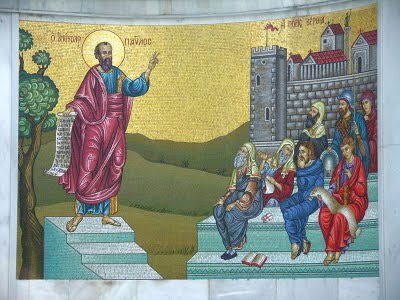
Paul, Demetrius and Damaris: an encounter in Athens (Acts 17:16-17,22–34)

The following dialogue was written by Elizabeth Raine and John Squires,and delivers as the sermon for the Tuggeranong Uniting Church on Sunday 14 May 2023.

*****

While Paul was waiting in Athens for Silas and Timothy, he was greatly upset when he noticed how full of idols the city was. So he argued in the synagogue with the Jews and the gentiles who worshipped God, and in the public square every day with the people who happened to come by.

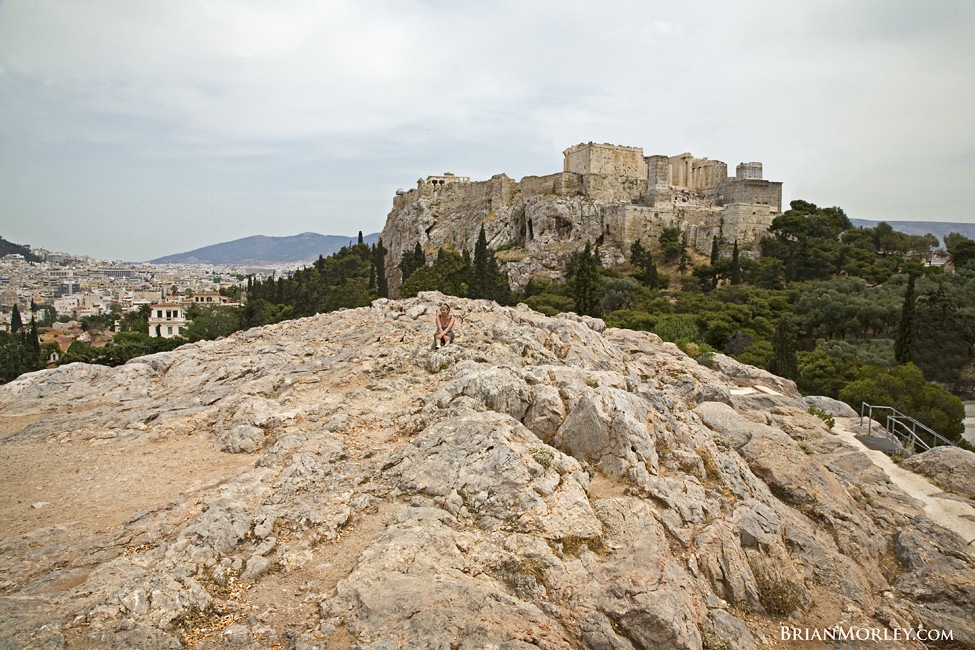
Then Paul was brought before the city council, which met at the Areopagus in Athens. Today, as we listen to what Paul said to the council, we are also going to listen in to what might have been going through the minds of two people in his audience: a learned Greek man called Demetrius, and a woman of deep faith, known as Damaris.

Paul stood up in front of the meeting of the Areopagus and said, “People of Athens, I see that in every way you are very religious.”

Demetrius: Yes, this is correct. We are very proud of our religions here in Athens. As religious people, we worship lots of gods. Just look around you, and you will see altars and temples of every size, shape, and description. Over there, is the fine temple to Zeus. And beside it, the shrine to Apollo; it, too, is a remarkable holy building. It is not for nothing that we in Athens have the reputation of great piety.

And, of course, when you turn your eyes to the top of the hill, you will see the pride and joy of our city: the magnificent temple of Artemis, where our ancestors have long worshipped the greatest of all goddesses. This temple is world famous. It is respected — even envied, dare I say — by peoples of all other nations.

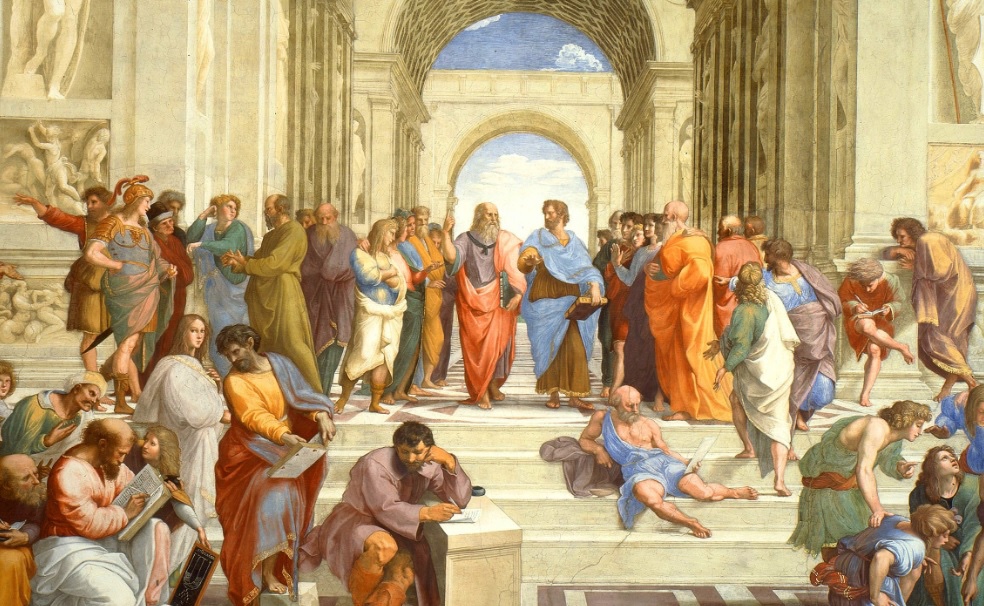
And Athens has also been blessed by many famous teachers of philosophy. Plato and Socrates, Aristotle and Pythagoras, Epicurus and many more. Why, even today, I believe that you could find no better array of teachers in any other city!

Yes, all of this shows you just how religious we are. This Paul is so right when he describes us in such generous terms.

Damaris: Indeed, it is true that we do have a lot of temples in our city. And we certainly have many fine teachers, as you say. Lots of people say that we are the most religious city in the world.

But something is missing, I think. There is so much ritual and pomp and ceremony that goes on; sometimes, I think that this can get in the way of worshipping the gods, rather than helping us to worship them.

And there are so many teachers who speak truths that are complex;  sometimes it hurts my head just to listen to them all! And all those poor animals that are sacrificed to all of these gods and goddesses. I wonder whether this really is such a good idea.

I have heard it said that Paul believes in a god that cannot be depicted on stone. It’s a curious idea to us Athenians; but some of my friends have told me about the group that believes this idea. A god that exists, but that we can’t see, or know much about at all is an odd idea.

23Paul continued, “For as I walked through your city and looked at the places where you worship, I found also an altar on which is written, ‘To an Unknown God.’ That which you worship, then, even though you do not know it, is what I now proclaim to you. God, who made the world and everything in it, is Lord of heaven and earth, and does not live in temples made by humans. Nor does God need anything that people can supply by working for him, since it is God himself who gives life and breath and everything else to all people. From the one person God created all human beings, and he made them live over the whole earth. God himself fixed beforehand the exact times and the limits of the places where they would live.”

Demetrius: Mmm, yes. Good point. I agree. Paul has said some important things about this God. When you boil it all down, there is a force in human history that looks over all things. Providence, or Fate, we call it.

And despite all of these shrines and images of the gods, there is a quality about the divine that is rather unknown to us. In the end, we would have to say that the gods are beyond our understanding. This is what our revered teacher, Plato, said about them. The gods transcend this earthly life and really have no need of our human worship.

Many of the priests in our city would be horrified by this, as they insist that we get access to the gods by offering sacrifices. But this kind of other-worldly god is very attractive. I like what Paul has to say.

Damaris: Yes, I too find Paul’s words attractive, Demetrius. And it is reassuring to know that all the things that happen in life are ultimately under the control of Divine Providence. But I am a little bit worried about what Paul seems to be saying. The god he is talking about seems to be rather removed from us all. I wonder how Paul thinks this god of his could be accessible to us? How could we relate to this god, if we can’t see his image?

Paul went on to say, “God did this so that they would look for him, and perhaps find him as they felt around for him. Yet God is actually not far from any one of us; as someone has said, ‘In him we live and move and exist.’ It is as some of your poets have said, ‘We too are his children.’”

Demetrius: Well, this is a surprising turn. From a god who is so far away from us, to a god who is near to us. Come to think of it, Paul is on to something here. In fact, he is quoting from our own Greek traditions here. I recognise those words he said — Aratus, I think it was, the poet, who said of god “in him we live and move and exist”. And “we are god’s children” — I know that, too. Well, that is very good, a Jew like Paul, showing that he knows our poetry and philosophical writings.

Damaris: I quite like the idea of a god who is with me all the time. All of these holy places and holy rituals can get too much, and tend to place too many things in between the gods and ourselves. Sometimes I’d just like to be able to relate to a god in an intimate, and personal way. So a god who is with me all the time — not just when I visit his shrine or place a sacrifice on his altar — is an appealing concept. “We are God’s children” — God as the one who gives birth to us, who nurtures us, who disciplines us, and who loves us. This sounds really good.

Demetrius: Yes, this is great. A god who is always with us. Why don’t we build an altar to him! I’ll get in touch with my friend Stephanas, he has a very good stone mason as one of his slaves, and we’ll see what we can come up with. I can just see it now; “To the god in whom we live and move and exist: this statue was erected by Demetrius and Stephanas” — no, “this statue was erected by Demetrius, with help from Stephanas”. Oh, why not just, “erected by Demetrius, a leading citizen of the city”. In large letters. Yes, that will look fine. And we’ll use the best stone; and have it trimmed in gold, with bright colours, so that it stands out, and….

“No!”, said Paul. “Since we are God’s children, we should not suppose that his nature is anything like an image of gold or silver or stone, shaped by the art and skill of a human being.”

Demetrius: No?

Damaris: I think I see the point. If this god is always near to us, then it would be silly to build an altar or erect a temple for him. After all, the temple is where the god or goddess lives, so that we know where to go to visit them. But if the god is always with us, then we don’t need to build him or her a home. So, if we aren’t going to build an altar or put up a statue, how are we going to worship this god?

Then Paul explained, “God has overlooked the times when people did not know, but now he commands all people everywhere to turn away from their evil ways. For God has fixed a day in which he will judge the whole world with justice, by means of a man he has chosen. He has given proof of this to everyone by raising that man from death!”

Demetrius: Oh, now he has spoilt it. What! How can a person be raised from the dead? Everyone knows that once we die, we go down into the underworld and live as shadows. Once you cross the river Styx, your previous life is left far behind. Who would want to go back into the earthly body once again?

No, this claim by Paul raises too many questions that are just not able to be answered satisfactorily. Any talk about raising the dead and bringing back their bodies is stupid.

Damaris: Well, to tell you the truth, I’ve always been worried by this idea. The thought of being a shadow after I die doesn’t really hold any attraction for me. I am much more interested in the story of a god who is able to transform death. What a powerful and caring god this must be! After all, death is what we all must face, and what we all fear so much.

And further, I am starting to see something quite special in what Paul is talking about. He has mentioned a special man, a chosen human being, who will be the one to carry out God’s justice in all the world. This idea is what really grabs me. To think that a god can not only be with us, but that this god can be a human being, just one of us, is really very special.

Now that I think about, this message reminds me of a letter that I received from my sister in Corinth just recently. As I recall now, she spoke about this man named Paul, who had visited the city, and had preached about a man from Nazareth, in the province of Galilee. Paul said that this man, Jesus, was not only a great prophet, but that he had been raised from the dead, and that he is the one who will bring God’s justice into the world. Perhaps this Paul that we are listening to today is the same person that she was talking about?

As Paul puts it, this God has a presence and a power that touches human life in profound and moving ways. This kind of power is lacking in the stone images that I see around me. Paul is leading me right into the heart of this God. So I think I will take his advice, and turn away from the gods I used to worship, and wait for the coming of divine justice through this man who is raised from the dead.

When the people heard Paul speak about a raising from death, some of them made fun of him, but others said, “We want to hear you speak about this again.”

Demetrius: Well, I have to say that this Paul is a bit of a surprise. I admit that he has said one or two foolish things — but not quite as many as I thought he would when he started. But this business of being raised from death is just not on. Yet some of the things that he has said are worth pondering. He is quite a philosopher, isn’t he? I can’t make up my mind about him, and about the god that he has proclaimed to us, and the religion that he has told us about. I’ll need some time to reflect on what he has said.

Perhaps he will be back in the public square tomorrow; I hope so. Maybe I will go there with my kitchen slaves in the morning, when they go to buy our household food for the midday dinner.

Then Paul left their meeting. Some men joined him and believed; among them was Dionysius, a member of the Areopagus, a woman named Damaris, and some others.

*****

As we return to the 21st century, it is worthwhile pondering Paul’s words and actions, and the response that both Damaris and Demetrius had to these words.

The words of Luke suggests that perhaps Paul was “off duty”, as his prime reason for being in Athens was to wait for Silas and Timothy to rejoin him there. Unable to do nothing or ignore the temples of idols around him, Paul’s idea of “off duty” appears to be to argue with everyone he meets in the town square. However this may have been perceived, Paul’s message of “the God you are looking for, the God you don’t even have a name for, the God who is in danger of getting lost in the plethora of all the other idols you are worshipping – let me tell you about that God…” is the God that we surely could take with us into our own town squares – maybe represented today by our cathedrals of consumerism in the large shopping malls, clubs and coffee shops we frequent today.

Paul presents his “new teaching” and “strange ideas” by meeting the Athenians on their own ground, by quoting two of the Greek poets: the Cretan Epimenides (600 BCE), that “in him we live and move and have our being,” and then the opening lines of the Phaenomena by Aratus (315-240 BCE), a Greek poet and Stoic of Cilicia, that “we are his children.”

It is also worth noting that Paul does not condemn them as unredeemed pagans on a one-way trip to hell, he tells them that both he and they worship the same God. Paul plainly saw God at work in the world through all people, and we would do well to remember this as well. Paul viewed the venerable Areopagus as just another place where the Lord of all creation had gone before him and was already present; indeed, as Paul said to the Athenians, “He is not far from each one of us.”

We Christians need to be aware of isolating and insulating ourselves from our culture’s mainstream. We must avoid being inward-looking, self-absorbed, and judgmental, instead of engaging people in our contemporary Areopagus. Instead, we need to follow Paul’s example of living, learning and sharing the gospel in the marketplace of ideas, engaging real people where they live, work, and think, in order to gain a hearing for our “strange ideas” about God, grace, and the resurrection.

*****

See also

Flesh and bones, spirit and life (Ezek 37, Psalm 130, Rom 8, John 11, Lent 5A)

On the Fifth Sunday in Lent, the scripture passages offered by the lectionary revolve around a central theme: life in contrast to death. It’s not every Sunday that all four passages line up to provide a clear and obvious focus on a single theme. For more than half of the Sundays in the year, the Hebrew Scripture, Epistle, and Gospel each follow their own course, and any overlap of theme is accidental, not planned. For Sundays in Advent, Christmas, and Lent, as well as key days like Pentecost, Trinity, and the Reign of Christ, the thematic overlap is intentional. This week we have just such a Sunday!

Death is at the heart of the story of Lazarus that forms the Gospel passage for Sunday (John 11:1–45). Initially, Jesus is told “he whom you love is ill” (John 11:3), but when he arrives in Bethany, Martha accosts him with “Lord, if you had been here, my brother would not have died” (11:21)—an accusation repeated by her sister Mary (11:31); and then comes a graphic description provided by Martha as they draw near to the tomb: “already there is a stench because he has been dead four days” (11:39).

The emergence of Lazarus from the tomb marks a climactic moment, for the family in Bethany and many of their neighbours (11:44–45), but also for the chief priests and Pharisees, who together determine to put Jesus to death (11:53). The seventh sign recounted in this Gospel is the most significant miracle of Jesus, but also the deed that determines the fate of Jesus. Soon after this event in Bethany, he says, “I have come to this hour” (12:27), the hour when “I am lifted up from the earth, [when I] will draw all people to myself” (12:32), the hour when the Father will “glorify your Son so that the Son may glorify you” (17:1). The death of Jesus is to be, paradoxically, the complete fulfilment of his mission (19:30)—the pathway into life eternal (3:16; 10:28; 17:3).

This climactic movement, of death moving to life in Bethany, resonates with the words of the prophet Ezekiel and also the writings of the apostle Paul that are offered for this coming Sunday. Ezekiel confronts the signs of death: “The Lord set me down in the middle of a valley; it was full of bones. He led me all around them; there were very many lying in the valley, and they were very dry” (Ezek 37:1–2). Paul considers the state of humanity: “to set the mind on the flesh is death … the mind that is set on the flesh is hostile to God; it does not submit to God’s law—indeed it cannot, and those who are in the flesh cannot please God” (Rom 8:6–8).

So, death is in view in these three readings. It is no wonder that the psalm we are offered alongside them speaks a cry of deep despair: “out of the depths I cry to you, O Lord” (Ps 130:1). The depths of the earth were the place where sinful people went (Ps 63:9; Isa 14:15), following the lead of the Egyptians who pursued the Israelites and “went down into the depths like a stone” (Exod 5:4–5; Neh 9:11; Isa 63:11–13). There, in the depths, God’s anger burned (Deut 32:22).

However, those banished to the depths were able to be brought back from the depths by God’s decree (Ps 68:22; 71:20; 86:13), so the cry of the psalmist from the depths is followed by the plea, “Lord, hear my voice! Let your ears be attentive to the voice of my supplications!” (Ps 103:2). As the prophet Micah affirms, God’s steadfast love will rescue those who “lick dust like a snake,

like the crawling things of the earth”, and will indeed “cast all our sins into the depths of the sea” (Mic 7:17, 19). So the psalmist affirms, “I wait for the Lord, my soul waits, and in his word I hope” (Ps 103:5).

Just as Lazarus emerges from the tomb where his dead body was laid, so Ezekiel foresees a wondrous revival amongst the dead bones of the people of Israel: “I will put my spirit within you, and you shall live, and I will place you on your own soil; then you shall know that I, the Lord, have spoken and will act,” says the Lord” (Ezek 37:11). The vision he sees emac s that dramatically. Likewise, Paul glimpses that same hope: “if the Spirit of him who raised Jesus from the dead dwells in you, he who raised Christ from the dead will give life to your mortal bodies also through his Spirit that dwells in you” (Rom 8:11).

Both prophet and apostle hold to the hope enacted in the Gospel and articulated by the psalmist: “Israel, hope in the Lord! For with the Lord there is steadfast love, and with him is great power to redeem. It is he who will redeem Israel from all its iniquities” (Ps 103:7–8).

*****

Ezekiel was both a prophet and a priest (Ezek 1:3). He had been exiled to Babylon during the siege of Jerusalem by King Nebuchadnezzar II of Babylon (599 BCE; see 2 Kings 24:10–17). His prophetic activity was thus undertaken entirely in exile. He addresses both those in exile with him in Babylon, and also those left behind in Judah. His prophecies continue through the period when the people in Judah were conquered and taken to join Ezekiel in exile (587 BCE; see 2 Ki 25:1–21), and then for some time after that.

A dramatic vision opens the book, in which “the glory of God” appears in the form of a fiery, flaming chariot (1:4–28). Priestly attention to detail marks the account of this vision, whilst contains multiple allusions to other scriptural stories. The bright cloud and flashing fire evokes the scene on Mount Sinai, when God gave Moses the Law (Exod 19:16–19); the “burning coals of fire” (1:13) remind us of the burning coals in the scene of the call of Isaiah (Isa 6:6); and “the bow in the cloud on a rainy day” evokes the sign of the covenant made with Noah (Gen 9:12–17). In seeing this vision, Ezekiel has had a life-transforming experience!

Ezekiel is impelled to play his role as a prophet by “the hand of the Lord” (1:3; 3:22; 8:1; etc); indeed, he says, “the spirit lifted me up” (3:12). That same spirit continues to lift him up with regularity (8:3; 11:1, 24; 37:1; 43:5) to show him vision after vision. More than this, Ezekiel declares that “the spirit entered me” (3:24), a process which he promises will be experienced by Israel as a whole (36:26–28)—for the Lord says he will “pour out my spirit upon the house of Israel” (39:29).

This emphasis on the renewing spirit of God is seen, most dramatically, by Ezekiel when he is taken by the spirit into “the middle of a valley … full of bones” (37:1) and sees a vision that he conveys in what must be his most famous oracle. What Ezekiel sees in this valley of dry bones is the work of God, as God puts sinews and flesh and skin on the bones, and breathes into the bodies so created, so that they live (37:5–6, 8, 10).

The vision indicates what God will do: “I will put my spirit within you, and you shall live, and I will place you on your own soil” (37:14). The end of the exile, it seems, is in sight. This passage is often interpreted in a Christian context as a pointer both to the resurrection of Jesus, and also to the general resurrection; indeed, its appearance on the Fifth Sunday in Lent means that it complements, and indeed illuminates, the dramatic story of Jesus bringing Lazarus back to life, as he approaches the tomb, and cries in a loud voice, “Lazarus, come out!” (John 11:38–44).

For Ezekiel, however, this vision is not a far-into-the-future prediction (foretelling), but a word of hope to the people in their immediate situation (forthtelling). Indeed, the very next section of this chapter reports a proclamation of Ezekiel which is quite directly forthtelling. The two sticks that he takes (37:16) stand for Judah and Israel; as he joins the sticks, so he points to the return of these peoples from their exile, their return “to their own land”, and a cleansing which will mean “they shall be my people, and I will be their God” (37:21–23, 27).

That final phrase is a common covenantal affirmation made by God (Lev 26:12; Ruth 1:16; Jer 7:23; 11:4; 24:7; 30:22; 31:1, 33; 32:38; Ezek 11:20; 14:11; 36:28; Zech 2:11; and Hos 1:10–11, overturning Hos 1:9). The reunited people shall have one king (37:24) and they will observe “an everlasting covenant” (37:26).

So the dramatic story that the prophet Ezekiel reports from his vision set in the middle of a valley full of dry bones is intended to speak directly into the life of the covenant people of God, the people of Israel, offering them hope despite their current circumstances.

*****

Paul also was commissioned for his task through a vision—reported in graphic terms by Luke, who makes the moment into a grand call-and-commissioning scene (Acts 9:3–8; 22:6–11; 26:12–18), but mentioned only briefly, in general terms, in passing by Paul himself (1 Cor 9:1; and perhaps Gal 1:1, 12). Of course, Luke was not present for this event, so he shaped in along the lines of classic call-and-commissioning narratives that existed in earlier Jewish writings. (I have explored this in detail in my commentary on Acts in the Eerdman’s Commentary on the Bible, 2003).

That vision turned Paul from persecutor of the followers of Jesus to an apostle fervently declaring “the good news of Jesus Christ” as far as possible, “from Jerusalem and as far around as Illyricum” (Rom 15:19). (Illyricum was a Roman province that covered the coastal area of the Balkans, northwest of Macedonia stretching towards Italy.) Paul delivers this good news in person to many communities, but he sets it out at length in his letter to believers in Rome, which he had not yet visited.

Paul is embued with the same hope that the psalmist and the prophet demonstrate. He rejoices with the Thessalonians that they share with him in “hope in our Lord Jesus Christ” (1 Thess 1:3), tells the Galatians that “through the Spirit, by faith, we eagerly waits for the hope of righteousness” (Gal 5:5), and reminds the Corinthians that “faith, hope and love abide” (1 Cor 13:13). In a subsequent letter to believers in Corinth, he asserts that “he who rescued us from so deadly a peril will continue to secure us; on him we have set our hope that he will rescue us again” (2 Cor 1:10)

Paul reports to the Romans that “we boast in our hope of sharing the glory of God” (Rom 4:2) and that it is “in hope that we were saved” (Rom 8:24). He affirms that it is “by steadfastness and the encouragement of the scriptures, we might have hope” (Rom 15:4), notes that scripture promises that “the root of Jesses shall come … in him the Gentiles shall hope” (Rom 15:12), and so characterises God as “the God of hope” (Rom 15:13). He shares in that strong hope which is sung by the psalmist and spoken by the prophet, and which is acted out in the Gospel reading for this Sunday.

Righteous by faith and at peace with God (Rom 5; Lent 3A)

We are being offered a veritable feast by the lectionary during the season of Lent, through Hebrew Scripture passages which recall key moments in the story of Israel (Abraham, Moses, David, return after exile) as well as in Gospel narratives telling of the transformative encounters which Jesus had with a range of people (a Pharisee and a Samaritan woman, a man born blind and two sisters of a dead man).

Alongside this, the lectionary offers us a set of readings from Paul’s longest and most richly-developed theological letter, that which he wrote to “all God’s beloved in Rome, who are called to be saints” (Rom 1:7). After exploring the rationale for human sinfulness (Rom 5:12–19, Lent 1A), we have read of Paul’s use of Abraham as a model to explain how God “reckons us to be righteous” (Rom 4:1–5, 13–17, Lent 2A).

Today we are offered another passage replete with fundamental theological affirmations (Rom 5:1–11, Lent 3A) and in two more weeks we will hear yet another “purple passage” from Romans (Rom 8:6–11, Lent 5A). In the intervening week we are diverted in Ephesians, most likely because the passage illuminates the Gospel story of Jesus enabling the man born blind to see (John 9).

Whilst Romans 4 exhibits many signs of the diatribe style, as we have noted, Paul seems to set this to one side for a time. He will pick up the pattern of apostrophe (posing questions to a hypothetical listener) and speech-in-character (providing answers to those questions from an imaginary person) in the next chapter: “What then are we to say? Should we continue in sin in order that grace may abound? By no means! How can we who died to sin go on living in it?” (Rom 6:1–3).

He will extend that through the agonising of the following chapter: “What then should we say? That the law is sin? By no means! Yet, if it had not been for the law, I would not have known sin.” (Rom 7:7). He will pick this up again at the end of his lengthy argument begun in 5:1 when he exclaims: “What then are we to say about these things? If God is for us, who is against us? He who did not withhold his own Son, but gave him up for all of us, will he not with him also give us everything else? Who will bring any charge against God’s elect? It is God who justifies.” (Rom 8:31–34).

Paul uses these techniques because he is, in the depths of his being, what we would call a “pastoral practitioner”. He is a good theological thinker, but he is oriented at every point to the pastoral engagement that he has with people in the churches which (mostly) he has founded—the church in Rome being a key exception to this, since he writes to a community that he has not yet visited.

Paul tells the Thessalonians that he seeks to operate “like a father with his children” (1 Thess 2:11), “like a nurse tenderly caring for her own children” (1 Thess 2:7). He tells the Philippians “how I long for all of you with the compassion of Christ Jesus” (Phil 1:8), and the Corinthians that “I wrote you out of much distress and anguish of heart and with many tears, not to cause you pain, but to let you know the abundant love that I have for you” (2 Cor 2:4). And he assures the Romans that he prays that “by God’s will I may come to you with joy and be refreshed in your company” (Rom 15:32).

Amidst all the harsh rhetoric, direct intervention, and controlling instructions that pepper all the letters of Paul, this kind, compassionate, caring heart can be glimpsed. Paul does what he does for the sake of the people whom he serves. Rabbinic midrash and rhetorical diatribe a pre pressed into the service of compassionate care for his people.

The opening of Paul’s letter to the Romans,
from an early fourth century papyrus (p10)

*****

But for the passage from Romans which we are offered this coming Sunday (Rom 5:1–11), the style changes. Rather than the diatribe style of question—response, shaped by the Pharisaic midrashic pattern of exploring key scripture passages, Paul seems to switch, to become a doctrinal pedagogue much as we find in later patriotic, medieval, and reformed writers.

In just eleven verses, Paul identifies and names a sequence of ten key theological claims—perhaps the closest he ever gets to becoming what we know as a “systematic theologian”. Paul mentions, in turn, justification by faith, peace with God, access to God’s grace, the glory of God, the place of sufferings, endurance, and hope, the gift of the Holy Spirit, the function of the death of Christ and the process of being justified by his blood, salvation from God’s wrath, and finally, reconciliation with God. They are each worth pondering.

Being justified by faith—or, in another English translation, being made righteous by faith—is the first concept which has pride of place in this passage—and, indeed, forms the basis for the theological argument that is developed throughout this Gospel. Paul’s opening statement is that, in the Gospel, “the righteousness of God is revealed through faith for faith”, quoting a scripture passage to provide the basis for his assertion (Rom 1:17); that righteousness is explained at length through the ensuing chapters, canvassing a range of matters in the process.

Righteousness, of course, has its origins deep in the Hebrew Scriptures. Abram had been given promises by God but he expresses doubt that these promises would come to pass (15:2-3). God provides further reassurance; the multitude of stars in the sky is testimony to that (15:5). Abraham’s resulting affirmation of faith leads to the famous phrase, so central to Paul’s later argument about righteousness: “he believed the Lord; and the Lord reckoned it to him as righteousness” (15:6; see Rom 4:3,9,22).

The psalmists regularly thank God for God’s righteousness (Ps 5:8; 7:17; 9:8; 33:5; 35:24, 28; 36:6; 50:6; etc) and note the importance of humans living in that way for righteousness (Ps 18:20, 24; 85:10–13; 106:3, 31; 112:1–3, 9), whilst the book of Proverbs advises that the wisdom it offers is “for gaining instruction in wise dealing, righteousness, justice, and equity” (Prov 1:3) and the prophets consistently advocated for Israel to live in accordance with righteousness (Hos 10:12; Amos 5:24; Isa 1:22; 5:7; 28:17; 32:16–17; 54:14; Jer 22:3; Ezek 18:19–29; Dan 9:24; 12:3; Zeph 2:3; Mal 4:1–3; Hab 2:1–4).

So “being made righteous with God” (Rom 5:1) is both a central element of Paul’s theology, and a strong thread running from Hebrew scriptural texts into the life of the early church.

Peace with God is the second element in this section. Paul regularly commences his letters with the formulaic “grace and peace to you” (Rom 1:7; 1 Cor 1:3; 2 Cor 1:2; Gal 1:3; Phil 1:2; 1 Thess 1:1; Phlm 3), but the peace spoken of at 5:1 goes deeper than this formula. God is “the God of peace” (1 Thess 5:23) who offers peace “which surpasses all understanding” (Phil 4:7). “God is a God not of disorder but of peace” (1 Cor 14:33) so believers are urged to live in peace (2 Cor 13:11). The Galatians are told that of the fruits of the Spirit is peace (Gal 5:22); the Philippians are informed that “the peace of God, which surpasses all understanding, will guard your hearts and your minds in Christ Jesus” (Phil 4:7).

Such peace is grounded in the understanding of God expressed in Hebrew Scriptures. The Psalmist prays, “may the Lord bless his people with peace” (Ps 29:11), celebrates that God “will speak peace to his people, to his faithful, to those who turn to him in their hearts”, such that “steadfast love and faithfulness will meet; righteousness and peace will kiss each other” (Ps 84:8, 10), and gives thanks that God “grants peace within [Jerusalem’s] borders” (Ps 147:4).

The vision of peaceful co-existence amongst all creatures is declared. by various prophets (Isa 2:2–5; Mic 4:1–5; Isa 52:7; 57:19; 60:17; 65:25) and amongst the names of the one whom Isaiah foresees as the hope for Israel’s future is “Prince of Peace” (Isa 9:2). Both Ezekiel (Ezek 13:8–16) and Jeremiah (Jer 14:13–22) decry those who cry out “peace when there is no peace”. Ezekiel states that God promises, “I will make a covenant of peace with them; it shall be an everlasting covenant with them” (Ezek 37:26; also 34:25, and Zech 8:12).

*****

This being-made-righteous and the consequent gift of peace comes, according to Paul’s comments later in this passage, through the death of Jesus on the cross. He uses a number of phrases to describe this death, and its “benefits” for believers. In verse 6, he notes that “Christ died for the ungodly”, and in verse 8, “while we still were sinners, Christ died for us”.

“Christ died for us” is a common phrase in Paul’s letters—so much so that it is regarded as a formulaic statement (an early credal affirmation?) which appears in various forms (Rom 6:10; 8:34; 14:9; 1 Cor 8:11; 2 Cor 5:14–15; 1 Thess 5:9–10; see also Gal 1:4; 2:20; Rom 7:4; 1 Thess 4:14; and the later formula of 1 Tim 2:5–6). Specifically relating the death of Christ to dealing with sin is also addressed by Paul in some detail earlier in this letter (Rom 3:9–26; 5:15–21; 6:5–14) as well more briefly as in other letters (1 Cor 15:56–57; 2 Cor 5:21; Gal 3:22).

To explain how this death deals with our sins, Paul here specifies that “we have been made righteous by his blood” (Rom 5:9). This clearly relates to the practice of faithful Jews, who for centuries brought their sacrifice to the Temple, so that the priests could kill the animals brought as offerings to God. Shedding blood was integral to this process.

The Torah specifies that the priests should receive “a bull of the herd” as a sin offering, and “the bull shall be slaughtered before the Lord; the anointed priest shall take some of the blood of the bull and bring it into the tent of the meeting … and dip his finger in the blood and sprinkle some of the blood seven times before the Lord” (Lev 4:3–6). Some of the blood is also placed on the horns of the altar and the rest “he shall pour out at the base of the altar of burnt offering” (Lev 4:7).

Likewise, the priest was to “slaughter the guilt offering, and its blood shall be dashed against all sides of the altar” (Lev 7:2); to purify a leper, two lambs are offered, and the priest “shall slaughter the lamb … and take some of the blood of the guilt offering and put it on the lobe of the right ear of the one to be cleansed [the leper] and on the thumb of the right hand and on the big toe of the right foot” (Lev 14:13–14; so also 14:25).

So likewise for the bull on the Day of Atonement: “Aaron … shall slaughter bull as a sin offering for himself … and sprinkle the blood with his finger on the front of the mercy seat … seven times” (Lev 16:11, 14), and then do the same with “the goat of the sin offering” (Lev 16:15–19), before then releasing a live goat (the “scapegoat”) or “bear all their iniquities to a barren region, and the goat shall be set free in the wilderness” (Lev 16:22).

The significance of the shedding of blood is clearly and strikingly articulated in the Torah: “the life of the flesh is in the blood; and I have given it to you for making atonement for your lives on the altar; for, as life, it is the blood that makes atonement” (Lev 7:11). When the blood of the animal is shed, that life is given as an offering to effect atonement. So, too, when the blood of Jesus was shed, his life functioned as an atoning offering for human beings.

The slaughter of animals and the sprinkling of blood thus signifies the sacrificial offering of a gift to God, seeking cleansing or forgiveness. Applying this common practice to Jesus makes sense in the context of the time—but it is an image which is far more difficult for us to accept and appreciate in the modern world, where we might feel that we have moved beyond such “primitive practices”, as some callously call those ancient practices.

What we can take from this language, perhaps, is the observation that sacrifice for sin, seeking to remove the tarnish of that sinfulness and find restoration and wholeness, was a dynamic signalled elsewhere in Hebrew Scripture—most clearly in that famous fourth Servant Song in Second Isaiah, which refers to the servant as the one who “has borne our infirmities and carried our diseases … wounded for our transgressions, crushed for our iniquities; upon him was the punishment that made us whole, and by his bruises we are healed” (Isa 53:4–5). As “the Lord has laid on him the iniquity of us all”, so “it was the will of the Lord to crush him with pain [to] make his life an offering for sin” (Isa 53:6, 10).

That same dynamic is at work every year in Australia, as those military people who have died in battle over the past century are remembered each ANZAC Day for their sacrifice and thanked for what they have bequeathed to our society. It is the same dynamic of sacrifices offered by some to ensure the safety of the many.

So, Paul is able to affirm that when Jesus died, it was to assure us of forgiveness, to deal with our sinfulness, and to restore us to the original state of goodness (Gen 1:26–31) that was God’s gift and intention for humankind.

See more on this at

*****

This passage is so beloved within the church, and was so highly regarded by the creators of the lectionary, that it appears again, slightly reduced in length, in the readings for the Third Sunday after Pentecost, later in this year (5:1–8), as well as in an even shorter form in the readings for Trinity Sunday in Year C (5:1–5). So I am going to reserve my comments on the remainder of the elements I have identified in this passage until it returns, later this year, in the readings for the Third Sunday after Pentecost! I will leave you, simply, with Paul’s clear affirmation that, “since we are made righteous through faith, we have peace with God through our Lord Jesus Christ” (5:1).

See also

Reckoning what is right (Romans 4; Lent 2A) part two

In a previous post, I explored the first half of Romans 4, sections of which are offered by the lectionary as the Epistle reading for this coming Sunday, the Second Sunday in Lent (Rom 4:1–5, 13–17). See

There we noted that Paul quotes scripture texts, poses questions, and provides immediate answers to those questions, as he develops his argument. In this post, I will explore the origins of this style of developing an argument and continue on with an analysis of Paul’s argument in Romans 4.

What we see at work in the rhetorical style that Paul utilises in this letter is that he is not only functioning as a Pharisee, schooled in the methods of midrashic treatment of scriptural texts; but that, as a hellenised Jew (educated in Jerusalem, yes, but living in Tarsus in the diaspora, according to Acts 22:3), he utilises the rhetorical techniques of the diatribe. This was a way of speaking in public that had been created by Bion of Borysthenes in the 4th century BCE, and then developed and refined amongst Greek rhetoricians and utilised particularly by Cynic philosophers in the ensuing centuries.

We know that diatribes were well-known in Ancient Greece; the 4th century playwright Euripides commented that “the peculiarity of the diatribe as distinct from other forms of popular moralizing lies in the assumed presence of an opponent. He is not permitted to reply, but his position is indicated by statements or rhetorical questions put into his mouth by the speaker, and thus the introduction of an objection in the form of a question becomes one of the characteristic features of the diatribe.” It is clear that this is a development of the dialogue form, so its origin is usually traced to the dialogues of Plato.

The popularity of the long-used form of diatribe is well attested into the Common Era in the work entitled Diatribes (more commonly translated as Discourses), published in the early 2nd century CE by Arrian, reporting the diatribes of Epictetus, a first century slave who studied Stoic philosophy and, after he gained his freedom, taught in Rome until Domitian banished all philosophers from Rome in 93CE. (Epictetus moved to Nicopolis and established a school there where he continued to teach Stoic philosophy.)

This demonstrates the enduring character and the widespread know,edge of this particular form of rhetorical argumentation. That Paul was using it quite extensively and to good effect in his letter to Rome (and also at places in other letters he wrote, it must be said) cannot be gainsaid.

Biblical scholars have explored how Paul adapts and utilises the diatribe method. Stanley Stowers pioneered this analysis in his book A Rereading Romans: Justice, Jews, and Gentiles (Yale, 1997), and Douglas Campbell has developed this approach most extensively in The Deliverance of God: an Apocalyptic Rereading of Justification in Paul (Eerdmans, 2009).

Campbell offers a clear explanation of the style: “Ancient diatribe is essentially a distinctive mode of discourse built largely with apostrophe [addressing a fictitious person as if they were present] and speech-in-character (a figure of speech in which an absent or imaginary person is represented as speaking; the technical name for this is prosopopoeia].”

Campbell explains that “A constructed character is generally addressed by the discourse’s central protagonist—who is a broadly Socratic figure—by means of the literary technique of apostrophe, so much of the discourse unfolds through the use of second person singular grammar. And that interlocutor then responds, whether in brief or at length, through the literary technique of speech-in-character, so here the author puts words in this character’s mouth.”

Campbell concludes, “The result is a dramatic discourse mimicking the to and fro of debate and conversation, although slipping were necessary into more extended speeches by one or the other party.” (Campbell, The Deliverance of God, p.535)

We can see the resemblance of Paul’s style of argumentation in Romans, to this rhetorical strategy.

*****

In the second section of Romans 4, then, after having established the universal scope of God’s providential grace—for this is how God meets the universal spread of sinfulness amongst human beings—Paul focusses on the faith that Abraham showed, and it’s importance for believers in Rome( and elsewhere). The thesis for this part of the argument is immediately posed: the promise to Abraham (which he was given in Gen 12:1–3) was “not through the law but through the righteousness of faith” (4:13).

First, Paul indicates that the promise cannot be fulfilled only through “the adherents of the law”, for “the law brings wrath” (4:14–15; he expands on this in chapter 7). Then, he asserts that the promise must rest on faith, both to those who adhere to the law but also “to those who share the faith of Abraham” (4:16). Abraham is here described as “the father of all of us”, drawing on yet another scripture citation (Gen 17:5; Paul uses the same argument at Gal 3:15–18, and the phrase is also at play in the debate reported in John 8:41–59).

Then follows further explication of this scripture (Gen 17:5), particularly explaining how Abraham, “hoping against hope”, became “the father of many nations” (4:17b—21). Despite the barrenness of Sarah’s womb (4:19), Abraham “was fully convinced that God was able to do what he had promised” (4:21). To conclude this exegetical foray, Paul quotes, for the third time, the foundational text: “his faith ‘was reckoned to him as righteousness’” (4:22, quoting Gen 15:6).

Paul then explains that these words describe not only the situation of Abraham, long in the last, but also the situation of those to whom he writes (4:23–24). This is a foundational aspect of Paul’s hermeneutic; he restates it at Rom 15:4, declaring that the scripture “written in former days was written for our instruction”. See

And so the argument draws to a close, moving back into the heart of Paul’s concern, to expound the Gospel concerning God “who raised Jesus Christ from the dead” (4:24–25). The final verse is most likely a traditional formulaic expression; we find a similar pattern at 1 Cor 15:3–4, a midrashic-style reflection on this pattern at 1 Cor 15:42–44, a variant form at 2 Cor 5:14–15, and extended discussion using the pattern of Christ, dead and raised, as the model for believers, “buried with him by baptism into death, so that, just as Christ was raised from the dead by the glory of the Father, so we too might walk in newness of life” (Rom 6:4). Paul provides a fuller discussion of this paradigm at 6:3–11, and there is a similar discussion, albeit varied for the different context, at Col 3:11–15.

The extended argument of this chapter (represented, unfortunately, by truncated excerpts in the lectionary offering) takes us from an initial question about Abraham, through an exploration of the story of Abraham, and Sarah, to a conclusion about the life of those who place their trust in what God has done through Jesus Christ; namely, that God “will justify [or, reckon as righteous] the circumcised on the ground of faith and the uncircumcised through that same faith” (3:30), and so, in like manner, “it will be reckoned to us who believe in him who raised Jesus our Lord from the dead” (4:24). It is all about being reckoned as righteous on the basis of faith.

As Paul would say: Thanks be to God!