Speak, for your servant is listening (1 Sam 3; Pentecost 2B)

For three months—the first half of the long season “after Pentecost”—the lectionary offers a sequence of passages which comprise some key narratives from the books of Samuel and the early chapters of Kings. These stories recount the development of the monarchy in Israel, with stories of Saul, David, and Solomon, the first three men charged with the responsibility of leading Israel and ensuring that there was justice in the land. “Give the king your justice, O God”, the psalmist sings (Ps 72:1), so that they might rule with justice and righteousness (Ps 99:4; Prov 29:4; Isa 32:1; Jer 23:5). That is what these kings, and their successors, were charged with ensuring.

These stories also engage us with the lives of prophets, Samuel and Nathan—men who were called to speak the word of God. We are told that as the young Samuel grew up, “the Lord was with him and let none of his words fall to the ground; and all Israel from Dan to Beer-sheba knew that Samuel was a trustworthy prophet of the Lord” (1 Sam 3:20–21). Years later, Nathan is commissioned by “the word of the Lord” to “go and tell my servant David, ‘thus says the Lord’” (2 Sam 7:4–5). That is the role of the prophet—to listen to what God says to them, and then to speak forth the word of the Lord to the people of their society.

Samuel, Nathan, and other prophets were particularly called to speak truth to the king and to recall them to the centrality of their role, to ensure that God’s justice was a reality in Israelite society (Isa 42:1–4; 61:1–2; Mic 3:8). We see this when Nathan confronts David (2:Sam 12), when Elijah confronts Ahab and the priests of Baal (1:Ki 18), when Isaiah advises Hezekiah (2 Ki 20), and when Josiah consults Huldah (2 Ki 22; 2 Chron 34).

As we pay attention to the details of the stories, let us remember that these stories are not “history” as we know it today. Rather, they are ancient tales told and retold, passed on by word of mouth and then written down, because of their enduring significance for the people of ancient Israel. Scholars call such stories “myths”, meaning that they convey something of fundamental importance. (We might best define myth as “a traditional story, usually associated with the time of origins, of paradigmatic significance for the society in which it is told”.)

See more on the nature of these stories at

and on the sequence of stories told in Genesis and Exodus, at

Identifying the stories in the narrative books of the Hebrew Scriptures doesn’t mean they are “not true”—rather, it means that we need to read them, not as historically accurate accounts, but as stories which convey fundamentally important ideas. These stories were valued by people of ancient times. They may well offer us, in our own times, insights and guidance of value.

So we read and ponder these stories from old once again, in our time, because we believe that there is wisdom and guidance in the dynamics we see at work in this ancient society. We pay attention to them because we believe that the same Spirit who anointed the kings, and who called and equipped the prophets, is the very Spirit who today meets us, calls us, and equips us.
We begin with a narrative that recounts the call of the young boy, Samuel, to the role of prophet (1 Sam 3:1–10). This series of narratives from Samuel and Kings provide insights into the leadership of the people of Israel in the crucial years when a key transition was taking place, moving from a group of invading tribes, consolidating into a coherent kingdom. Prophets and Kings provided leadership in challenging times.

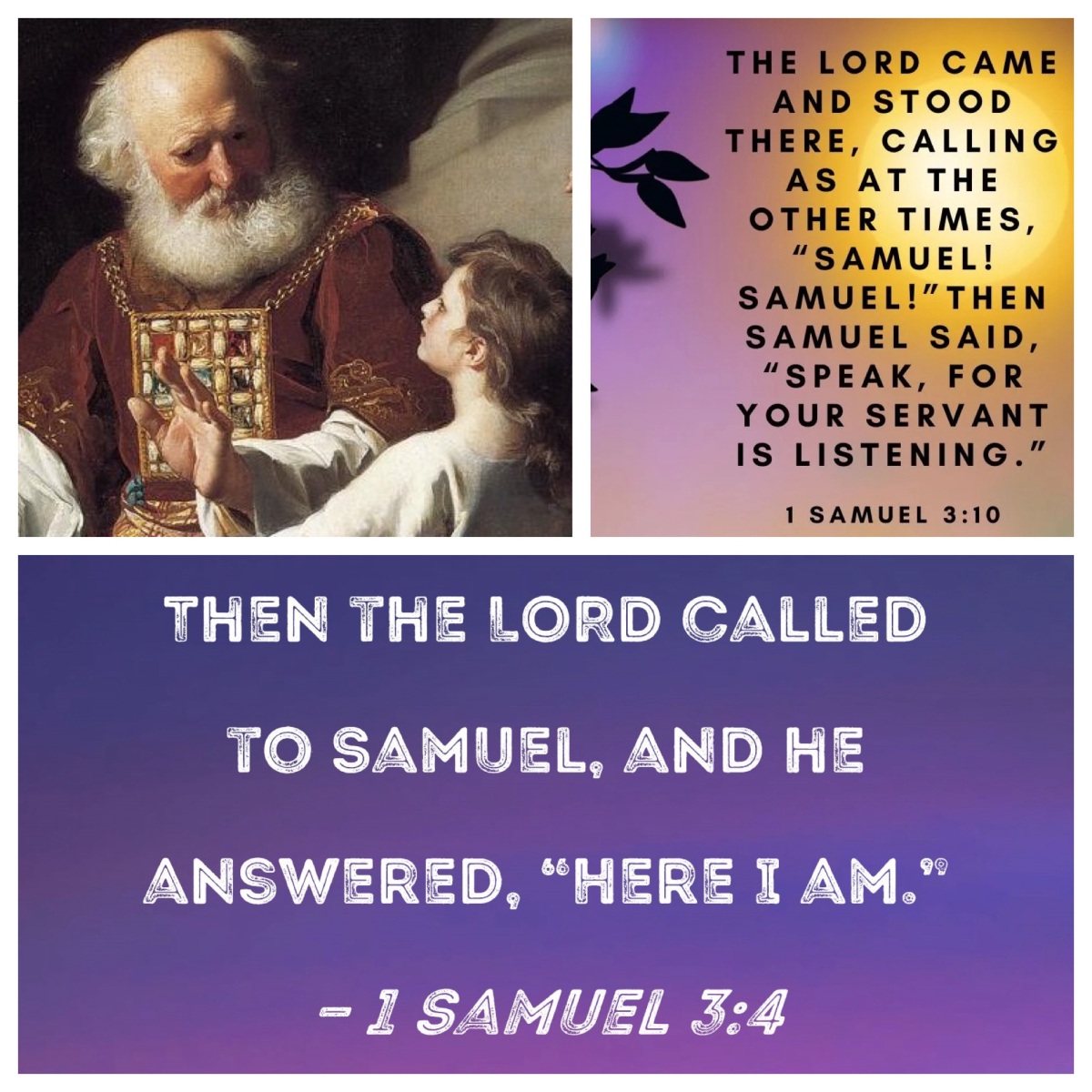
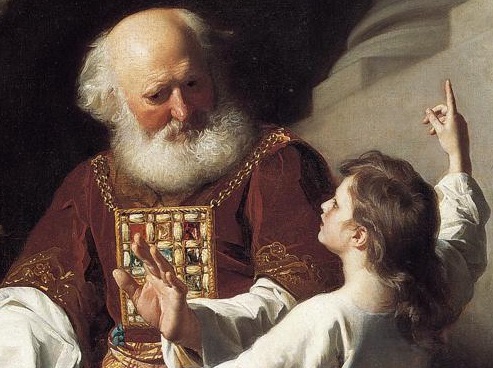
Samuel was the designated prophet whose wisdom guided the people in the early period of the monarchy. This story from the early years of Samuel’s life instructs us as we hear it in later times, to listen to God’s voice, and to respond with obedience. Young Samuel was in the temple, where the elderly Eli was priest. In the evening, while the lamp was still burning, Samuel hears a voice. The voice simply calls his name. “Here I am”, Samuel responds when he hears that voice. He is sure that it is Samuel who is speaking to him—there is nobody else around. Three times, he hears “Samuel”; and three times, he responds “here I am” (vv.4,6,8).

Samuel had been thinking that it was Eli speaking to him; but it was not the priest, it was the voice of the Lord. The story conveys a sense of confusion and unknowing. This reflects something of the uncertainty that people of faith often have with regard to “hearing the voice of the Lord”.

Indeed, the fragility of living by faith without clear and obvious demonstration of he presence of God is signalled in the opening verse: “the word of the Lord was rare in those days; visions were not widespread” (v.1). The poor vision of the elderly priest, Eli (v.2), is a second signal of this uncertainty. The priest cannot see; the child hears but does not understand.

Paying attention to the voice of the Lord is a persistent refrain in Hebrew Scriptures. Indeed, the psalmist rejoices in the clarity of God’s voice: “the voice of the Lord is over the waters; the God of glory thunders, the Lord, over mighty waters; the voice of the Lord is powerful; the voice of the Lord is full of majesty” (Ps 29:3–4). Yet another psalmist recalls the time, in the wilderness, when the people of Israel “grumbled in their tents, and did not obey the voice of the Lord” (Ps 106:25). The people were not always faithful, even though the voice sounded with clarity. They needed reminders of that voice.

In the foundational saga of Israel, Moses is called by the voice of God while tending sheep on Mount Horeb (Exod 3:4). In obedience, he leads the people to freedom—and then informs the people, “if you will listen carefully to the voice of the Lord your God, and do what is right in his sight, and give heed to his commandments and keep all his statutes”, then God promises not to inflict them with disease (Exod 15:26). Later, when Moses has delivered to them “all the words of the Lord and all the ordinances”, the response of the people is an affirmative “all the words that the Lord has spoken we will do” (Exod 24:3).

A number of the prophets indicate that they are impelled to declare “the word of the Lord” to a sinful people because they have heard, and are obedient to, “the voice of the Lord”. Isaiah hears the voice of the Lord calling him: “whom shall I send, and who will go for us?” (Isa 6:8). Isaiah is given words of woe to pronounce over the people (Isa 6:9–13); he warns the leaders of Israel, “listen, and hear my voice; pay attention, and hear my speech” (Isa 28:23).

His fellow-southerner, the shepherd Amos, opens his words with the bold declaration, “the Lord roars from Zion, and utters his voice from Jerusalem” (Amos 1:2), before he launches into his long series of oracles against the surrounding nations (Amos 1:3—2:3) and then against Judah and Israel (Amos 2:4–16).

The image of the lord as a roaring lion is used also by Joel, “the Lord roars from Zion, and utters his voice from Jerusalem, and the heavens and the earth shake” (Joel 3:16), while in another oracle he says, “the Lord utters his voice at the head of his army; how vast is his host!” (Joel 2:1). Joel’s words of judgement penetrate to the heart of the evil of the people: the coming day will be “a day of darkness and gloom, a day of clouds and thick darkness!” (Joel 2:2), and so he calls the people to “return to [the Lord] with all your heart, with fasting, with weeping, and with mourning; rend your hearts and not your clothing” (Joel 2:12–13).

Micah also declares, “the voice of the Lord cries to the city (it is sound wisdom to fear your name)” (Mic 6:9) before he lambasts the people for their wickedness: “your wealthy are full of violence; your inhabitants speak lies, with tongues of deceit in their mouths” (Mic 6:12; the whole damning oracle is 6:9–16).

Called as a youth by “the word of the Lord” (Jer 1:4–8), Jeremiah hears the assurance, “I have put my words in your mouth” (Jer 1:9); the prophet later instructs the people, “amend your ways and your doings, and obey the voice of the Lord your God, and the Lord will change his mind about the disaster that he has pronounced against you” (Jer 26:13). Again, he tells them, “obey the voice of the Lord in what I say to you, and it shall go well with you, and your life shall be spared” (Jer 38:20). Eventually, the people affirm, “whether it is good or bad, we will obey the voice of the Lord our God to whom we are sending you, in order that it may go well with us when we obey the voice of the Lord our God” (Jer 42:6).

In the return from exile, both Haggai (Hag 1:12) and Zechariah (Zech 6:15) rejoice that Israel “obeyed the voice of the Lord their God”; but Daniel laments that his people “have not obeyed the voice of the Lord our God by following his laws, which he set before us by his servants the prophets; Israel has transgressed your law and turned aside, refusing to obey your voice” (Dan 9:10).

And yet, various prophets had hesitated when first hearing “the voice of the Lord”. The initial response of Moses is “who am I that I should go to Pharaoh, and bring the Israelites out of Egypt?” (Exod 3:11), followed by a series of further objections that he raises (Exod 3:13; 4:1; 4:10). Amos explains to the priest Amaziah how his call had surprised him: “I am no prophet, nor a prophet’s son; but I am a herdsman, and a dresser of sycamore trees” (Amos 7:14).

Isaiah seeks to excuse himself from the prophetic task: “I am lost, for I am a man of unclean lips, and I live among a people of unclean lips” (Isa 6:5). Jeremiah objects, “truly I do not know how to speak, for I am only a boy” (Jer 1:5). A number of the prophets are, initially at least, reluctant spokespersons for the Lord God.

By contrast, in the story told in 1 Sam 3, after hearing his name spoken by the Lord for a third time, Samuel responds with a declaration of obedience: “speak, for your servant is listening” (v.10). This was just as the priest Eli had instructed him (v.9). Here, Samuel demonstrates careful listening, patience, openness to what he encounters, and complete obedience to that voice.

Just beyond the passage set by the lectionary, the narrator indicates that what will follow will be dramatic and compelling; it will “make both ears of anyone who hears of it to tingle” (v.11). The immediate drama which les ahead will tell of punishment for the sins of the house of Eli. Young Samuel is given his first commission: tell his patron Eli about what lies in store for him. Samuel, in fear and trembling, dutifully does so (v.18); Eli recognises the word of the Lord in the voice of the prophet, and accepts his fate.

The pattern of Samuel’s life is thus set: he will need to summon inner strength, demonstrate commitment to the cause, use clarity of speech, and model integrity of life. The fact that the young Samuel already demonstrated these qualities may well be why this story is remembered and retold. These two stories from the early years of Samuel’s life are remembered in order to instruct those who hear them in later generations, to listen and to obey, to be brave and focussed. And so we, in our time, are to hear the story, reflect on it, and respond appropriately.
The year of the Lord’s favour (Isa 61; Advent 3B)

As we move on in the new year in the church’s calendar, this coming Sunday we celebrate the third Sunday in the season of Advent, and continue our preparations for Christmas—the coming of Jesus, Saviour, chosen one, and Lord (Luke 2:11). During Advent, the lectionary offers a selection of biblical passages designed to help us in our preparations, building to the climactic moment of Christmas Day, when we remember that “the Word became flesh and lived among us, and we have seen his glory, the glory as of a father’s only son, full of grace and truth” (John 1:14).

These scripture passages include a sequence of excerpts from the Hebrew Scriptures—largely from the book of Isaiah—which orient us to the saving work of God, experienced by faithful people in Israel through the ages. These scripture passages inform us to sense how God was at work in the story of Jesus.

The passage proposed by the lectionary for this third Sunday in Advent (Isa 61:1–11) is another very well-known one. It comes from the third main section of Isaiah (chs.56—66), recording the words spoken by an unnamed during the return to the land after exile in Babylon. This prophet is often called Third Isaiah.

This passage is best known because the opening few verses are the words read by Jesus when he was handed the scroll to read in his hometown synagogue (Luke 4:16–19). Following that story offered by Luke, we read that Jesus “rolled up the scroll, gave it back to the attendant, and sat down, and the declared, “Today this scripture has been fulfilled in your hearing” (Luke 4:20–21). That statement shapes the interpretive approach of Christians to the words in Isaiah 61; we are guided to read them as a prophetic declaration about Jesus.

However, we need to take care not to override and exclude the intention of the message (to the extent that we can assess it) of the original speaker and the faithful scribe in that ancient post-exilic context. To do so would be to perpetuate a supersessionist reading of scripture, which claims that “the old” is no longer relevant because “the new” has superseded it. This is poor interpretive practice and bad theology.

How might we best understand this passage? Understanding the dynamics at play at the time the words were spoken and then written down is instructive. For the returning exiles, preparing to re-establish their distinctive society in their much-loved land, the call of the prophet, through the gifting of the Spirit, was orienting them clearly to face the ethical issues of that society. Oppression and captivity had been the experience of past decades; liberty and joyful encouragement were now to be the markers of life in the land.

So central to the task of rebuilding society was the age-old commitment of care for the vulnerable and support for the needy. Prophets of times past had expressed this in terms of care for the widow, the orphan, and the foreigner in the land. Isaiah proclaims God’s judgement on those who “turn aside the needy from justice … and rob the poor of my people, that widows may be your spoil, and that you may make the orphans your prey!” (Isa 10:1–2).

Other prophets join their voices to Isaiah’s declaration. Ezekiel laments that “the sojourner suffers extortion in your midst; the fatherless and the widow are wronged in you” (Ezek 22:7). Jeremiah encourages the people of Jerusalem with a promise that God will allow them to continue to dwell in their land if they “do not oppress the sojourner, the fatherless, or the widow” (Jer 7:5–7).

The words of Third Isaiah continue in this prophetic stream. They also resonate with the psalmist, who praises “the God of Jacob … who executes justice for the oppressed; who gives food to the hungry … [who] sets the prisoners free, [who] opens the eyes of the blind, [who] lifts up those who are bowed down [and] loves the righteous, [who] watches over the strangers [and] upholds the orphan and the widow” (Ps 146:5, 7–9). See

https://johntsquires.com/2023/05/14/father-of-orphans-and-protector-of-widows-psalm-68-easter-7a/

The distinctive contribution of this particular prophet is to frame the task through the story of the Jubilee, “the year of the Lord’s favour” (v.2). That Jubilee year had, as its flip side, the ominous “day of vengeance of our God” for those who failed to follow the way of Jubilee justice. The Jubilee entailed the release of slaves and the cancelling of debts; it was meant to be practised in society every fifty years during the year of Jubilee (Lev 25:8–17; see esp. v.13).

Whilst these levitical prescriptions appear to be the ideal that the priests hoped for, actual evidence that this was ever implemented in Israelite society is lacking. Indeed, it is suggested that while the people were in Exile, the land of Israel would “lie desolate”, and “enjoy its sabbath years” (Lev 26:34), providing recompense for all those years when “it did not have on your sabbaths when you were living in it” (Lev 26:35).

The return to the land, as far as Third Isaiah is concerned, meant that these levitical prescriptions should indeed be adhered to, as the people promised “to walk in God’s law, which was given by Moses the servant of God, and to observe and do all the commandments of the Lord our Lord and his ordinances and his statutes” (Neh 10:29). In the way that Jesus cited this prophetic passage in his hometown synagogue (Luke 4:16), implementing the Jubilee prescriptions in his own time was also what he envisaged.

The prophet lays claim to the work of the Spirit in setting forth this programme for the people. “The spirit of the Lord is upon me”, he declares (Isa 61:1), placing himself in a long line of spirit- inspired leaders in Israel. The Spirit had guided Moses and was then gifted to chosen elders (Num 11:16–25). That Spirit was subsequently imparted to Joshua (Num 27:18; Deut 34:9) and then to a string of Judges: Othniel (Judg 3:10), Gideon (6:34), Jephthah (11:29), and Samson (13:24–25; 14:6,19; 15:14).

In later years, the Spirit guides Saul (1 Sam 10:6–7), David (2 Sam 23:2), Solomon (Wisd Sol 7:7), the line of prophets (Neh 9:30), the servant of the Lord (Isa 42:1), Ezekiel (Ezek 3:12, 14; 8:3; and many subsequent references), Daniel (Dan 5:12), Micah (Mic 3:8), and Zechariah (Zech 4:6). The activity that the Spirit undertook in these instances was invariably to provide guidance regarding the conduct of Israelite society, through these anointed leaders and inspired prophetic voices.

The oracle of the post-exilic prophet thus blends notes of celebration and justice, such that “righteousness and praise [will] spring up before all the nations” (v.11). There will be “a garland instead of ashes, the oil of gladness instead of mourning” (v.3), “everlasting joy” (v.7), with rejoicing and exultation akin to a wedding celebration (v.10). Society will be marked by righteousness (vv.3, 10, 11), to demonstrate that “I the Lord love justice, I hate robbery and wrongdoing” (v.8).

Jesus stands firmly in this line. His connection of Spirit with justice in society is drawn directly from Third Isaiah. The Jubilee he announces in his hometown (Luke 4:19) is explained in his series of blessing and woes (Luke 6:20–26), his welcome of and advocacy for poor and outsiders (Luke 7:34; 10:8–9; 15:1–2), and in a number of parables which prefigure reversals in society (for instance, 14:7–24; 16:19–31).

Alongside these sounds of justice, a note of joy runs through the public activities of Jesus (Luke 6:23; 8:13; 10:17; 15:6, 7, 9, 10, 32). It is in this sense that we can affirm that Jesus has “fulfilled this scripture”, and that this prophetic passage is a helpful guide for us during Advent.

A new thing, springing forth (Isaiah 43; Lent 5C)

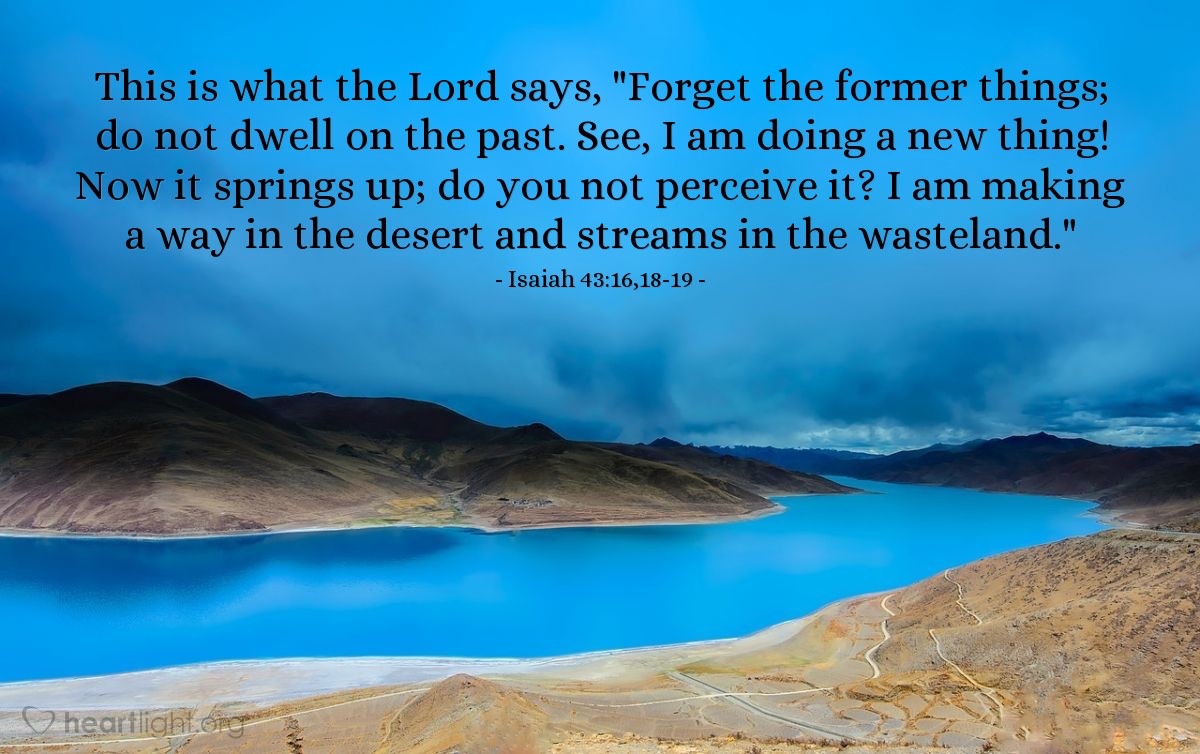
“Do not remember the former things, or consider the things of old. I am about to do a new thing; now it springs forth, do you not perceive it?” (Isa 43:18–19).

These words are attributed to the prophet Isaiah, who lived in the southern kingdom of Judea eight centuries before Jesus, serving as a “court prophet” during times of abundance. Isaiah was active a time when the southern kingdom of Judah was flourishing. He became active in the last years of the reign of Uzziah, who, it was said, ruled as king for fifty-two years (788–736). He lived through the reigns of Jotham and Ahaz (16 years each), and died towards the end of the reign of Hezekiah, who himself enjoyed 29 years on the throne.

The year of Isaiah’s death is uncertain; he may well have been alive, still, when the Assyrian army of Sennacherib laid waste to the northern kingdom (722–721) and deported the northerners to clear the land. In such a context of stability, however, the promise that God would do “a new thing” sits somewhat uneasily in the situation we can reconstruct.

This is one reason why many scholars maintain that the section of the book of Isaiah where we find this passage (Isaiah 40–55) is set some centuries later, after the southern kingdom itself had been conquered by the Babylonians (587–586), and the people taken into exile in Babylon. This became the pivotal event in the history of Israel, the people as a whole—at least in terms of the stories that we have gathered in the scrolls of the Hebrew Scriptures.

The first 39 chapters of the book of Isaiah focus on Jerusalem and Judah (2:1; 3:1; 5:3; 11:12-16; 22:5-8, 20-25; 26:1) and Assyria (7:10–25; 8:1–10; 10:5–12; 14:24–27); 19:23–25; 20:1–6; 30:29–33). The final section of the book (chs. 36—39) is clearly the describing events of the 720s which led to the Assyrian invasion and conquest of the northern kingdom, Israel.

By contrast, second section of the book of Isaiah has a primary concern for the power which had taken the people of Judah into exile—Babylon (43:14–21; 47:1–15; 48:14, 20–21). The prophet promises a return to Jerusalem (40:1–2), but it is identified as Zion (40:9; 41:27; 46:13; 49:14; 51:3, 11, 16; 52:1-2, 7-8).

There are many stories in Isa 1—39 relating to the personal life of the prophet, but no such personal connections in Isa 40—55. By contrast, a very direct historical reference, in a section referring to Cyrus, King of Persia (44:24–45:19), indicates a later setting. Cyrus ruled the Achaemenid Empire from 559 to 530 BCE and, after defeating the Babylonians in 539, issued a decree permitting the exiled Israelites to return to their homeland.

We have already reflected on one passage from this section of Isaiah (55:1–12, Lent 3), noting how it differs from the worldview and understanding of God from earlier periods in the life of Israel.

This passage thus comes from a time when the Israelites were in exile in Babylon. It was not a happy time for many of the people of Israel. (Psalm 137 is the classic expression of this; note especially the anger expressed in verses 8–9.) The people of Israel yearned to return home (Jer 29:10–14; 30:1–31:26). They looked back on the past with longing eyes. They remembered their years in the land which God had given to them. Now, they were living among Babylonians—foreigners, conquerors.

Soon, they would leave behind these memories, and grasp hold of the future that God has for them. God would “send to Babylon and break down all the bars” (43:14). God, the prophet declares, is doing a new thing! (43:19).

And yet, that “new thing” is informed by the past. The people once travelled out of slavery in Egypt, into freedom in Canaan, leaving behind the Egyptian “chariot and horse, army and warrior”, stuck in the waters of the sea that suddenly swamped them—“extinguished, quenched like a wick” (43:17; cf. Exod 14:26–31, 15:4–12, 19, 21). In the time of the prophet, “the shouting of the Chaldeans will be turned to lamentation” as the people depart (43:14).

In like manner, now, the people will take the journey back home, pass through the desert, and return to their land. The one who made “a way in the sea, a path in the mighty waters” (43:16) during the Exodus from Egypt (Exod 15), will now “make a way in the wilderness” (43:19) for the people to follow, leading them right back to the land from which they had been forcibly removed decades earlier (2 Kings 25:1–21; 2 Chron 35:15–21).

As they were sustained in that desert journey long ago, so God now will give “rivers in the desert” (43:19) which will provide “water in the wilderness … to give drink to my chosen people” (43:20) as they travel on that way. That caled for shouts of praise to God! (43:21).

The Exodus imagery was potent for Israel; not only was the story developed over centuries to provide a story of origins for Israel, but it was also co-opted into the prophecies predicting the return to the land, providing those oracles with greater strength and rigour. (And, of course, the story continued on into the feast of Passover, the annual celebrations which continue amongst Jews right through until the present day.)

The Exodus imagery also undergirds the Christian story. Jesus, declared by John the Baptist to be the lamb of God (John 1:29, 36), affirmed by Paul as the new Passover lamb (1 Cor 5:7), envisaged by the ageing prophet on Patmos to be the slaughtered lamb (Rev 5:6–14), is believed to enact a new Passover for his followers, according to the developing Christian tradition.

Just as the shedding of the blood smeared on the doorposts of the Israelites was their salvation (Exod 12:7, 13, 22–23), so the shedding of Christ’s blood is understood to effect salvation (Rom 5:8–10; 1 Pet 1:18–21). So the age-old imagery and symbolism is reworked by the early Christian writers, continuing the process seen in the words of the prophet speaking during the return from Exile (Isa 43:16–21).

See also