
The last enemy to be destroyed is death (1 Cor 15; Epiphany 6C)

The lectionary is currently offering sections from the latter chapters of the letter written by Paul and Sosthenes to “those who are sanctified in Christ Jesus, called to be saints” (1 Cor 1:2). In the earlier chapters of the letter, the authors have canvassed a wide range of matters. First, they spend time addressing the serious divisions emerging within the Corinthian community. The letter notes that this matter “has been reported to me by Chloe’s people” (1:11); the singular suggests that Paul has already taken the primary role in writing this letter. It is thought that this must have been a verbal report passed on to Paul and Sosthenes when they met with a group from Corinth, perhaps slaves, sent by Chloe (about whom nothing else is revealed).

A second matter is introduced by a similar phrase, “it is actually reported…” (5:1), although the informant is not named. Some scholars think that the similarity of wording suggests that this news may also have been conveyed by “Chloe’s people”. A little later on, another matter is introduced with the phrase, “now concerning the matters about which you wrote” (7:1). Clearly, there had been written correspondence with Paul, at least, as well as the verbal report already indicated. 

Towards the end of the letter, the authors refer to “the coming of Stephanas and Fortunatus and Achaichus” (16:17). This might suggest that they visited Paul and anyone else with him; a few verses later, there is the note that “Aquila and Prisca, together with the church in their house, greet you warmly in the Lord”, as well as “all the brothers and sisters” who send greetings (16:19–20). 
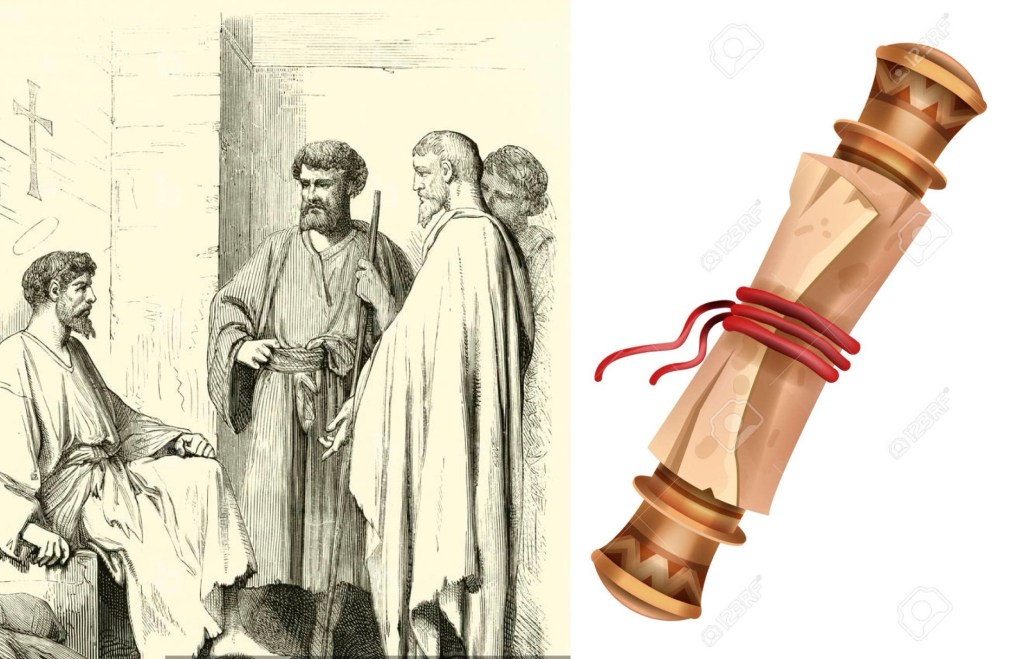
Perhaps these three emissaries bore a letter from the community (or a section of it), asking for Paul’s opinions about these matters? The fact that their names are Roman names reflecting an educated status, would lend support to this hypothesis. Alongside this, we can also note that Paul personally concludes the letter by writing “I, Paul, write this greeting with my own hand” (16:21). This suggests that a scribe—perhaps Sosthenes?—had actually been writing the letter to this point, most likely using pen and ink to commit the words dictated to them by Paul onto the papyrus. How much (or how little) the scribe would have had input into the letter is not clear.

Regardless of who actually brought this news, Paul and Sosthenes are willing to deal with the matters raised, introducing them in turn by the shorthand formula, “now concerning”. Such matters include “food sacrificed to idols” (8:1), “spiritual matters” (12:1), “the collection for the saints” (16:1), and “our brother Apollos” (16:12). 

The final theological issue which they address in this first (extant) letter to the Corinthians, at quite some length, concerns the resurrection of believers. A rather strong formula is used to introduce a major theological issue at 15:1: “now I would remind you, brothers and sisters, of the good news that I proclaimed to you…”.

The letter considers this matter at length; many scholars regard it as the fundamental problem in the Corinthian community of faith, underlying other issues already explored. From comments later in this chapter (15:12, 15:29, and possibly 15:35), it is clear that divergent views about resurrection were held within the community of faith in Corinth. The response found in this chapter deals with each of them in a theological and rhetorical fashion.

Paul begins dealing with the issue with a series of affirmations concerning the crucifixion and resurrection of Jesus. There is an apologetic tone at the start, as Paul insistently underlines the validity and authority of what he says (15:1–3a). The “good news” which “I proclaimed” is described in technical terms indicating the passing-on of pre-existing tradition: “I received”, “I handed on”, “you received”. It is a matter of “first importance”.

Associated with this is an insistence that the Corinthians “stand” in this news, and must “hold firmly” to it, as the basis for “being saved”. The foundational tradition which is then reported (15:3b–7) is based on an early four-part affirmation of faith: “Christ died … he was buried … he was raised … he appeared …”.

The first and third elements are elaborated with the formulaic “in accordance with the scriptures”. The fourth element, the appearances of the risen Jesus, is extended beyond the list received by Paul (to Cephas, the twelve, more than 500, James, all the apostles; 15:5–7) to include Paul himself (“as to one untimely born”, 15:8), leading on to an assertion of Paul’s apostolic credentials and divinely-assisted activities (15:9–11).

All of this forms a solid foundation for the extended theological discussion that develops in the remainder of this chapter, as Paul explores various aspects of “the resurrection of the dead”. His personal experience of the risen Jesus presumably qualifies him, in his eyes, to develop the argument that unfolds. 

This foundation reaches back to the “theology of the cross” at the start of the letter, where references to the crucifixion and death of Jesus provided a basis for the opening theological discussion of his letter (1:17–18, 22–25; 2:1–2, 7–10). However, Paul does not develop this connection beyond the opening 11 verses of chapter 15. Instead, he moves straight to a consideration of various pastoral situations in Corinth that have arisen regarding the resurrection (15:12–58).

The “resurrection of the dead” (the Greek word is plural, reflecting a raising of many believers) was a Jewish belief that had developed in preceding centuries; not all Jews accepted it (see Acts 23:6–8) and amongst some Gentiles there was scepticism about the idea (see Acts 17:32). 
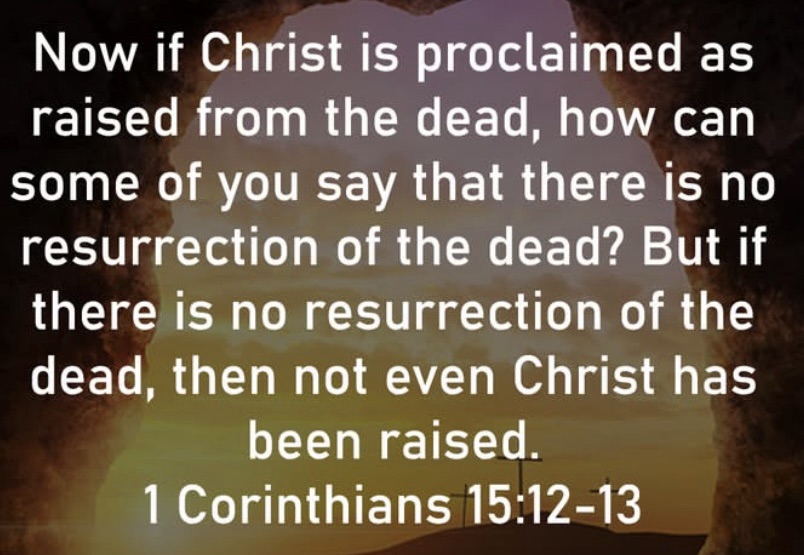
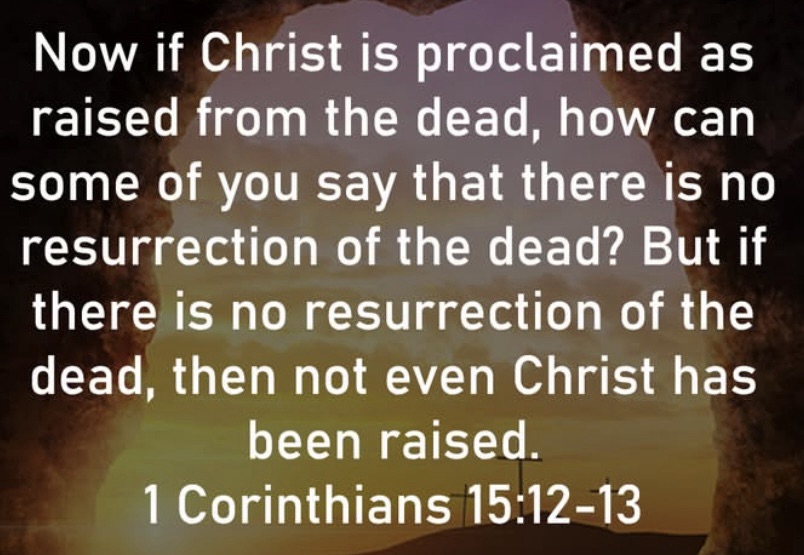
The community in Corinth contained sceptics (15:12); as a counter-argument to their scepticism the argument which is advanced in this chapter attempts to refute their opinion by setting out a series of logic-based steps. It begins by noting that people question the reality of the resurrection of the one person, Jesus (15:13–16). This leads to the accusation that “your faith is futile” (15:17). Paul and Sosthenes cannot countenance this, so they launch into an exposition of what they see as eschatological realities (15:20–28), explaining the places allocated, at the end, to humans, Jesus, and God. 

Unfortunately, the lectionary omits these verses and jumps next week to v.35, where Paul raises questions which, he says, “someone will ask”, namely: “How are the dead raised? With what kind of body do they come?” In preparing to deal with these questions, Paul employs a rhetorical structure in the first part of this argument (15:21–22) which returns to the pattern of juxtaposing two different entities, which has already appeared in earlier sections of the letter. 

We can see this pattern as follows:

for since death came through a human being / the resurrection of the dead has also come through a human being;

for as all die in Adam  / so all will be made alive in Christ.

An expanded version of this argument takes place in Rom 5:12–21. 

The argument countering Corinthian scepticism continues with an explanation that Christ is “the first fruits”, who has “all things put in subjection under his feet” (15:23–27). But Christ himself is subjected to God; finally, God is “all in all” (15:28). Paul has not proven the resurrection as such, but has explained how it fits into his view of the end days.

This deals with one factor in the Corinthian situation. There follows consideration of a second pastoral situation, raised through the question, “what will those people do who receive baptism on behalf of the dead?” (15:29). Paul abruptly dismisses this with two counter-punching rhetorical questions. First, “if the dead are not raised at all, why are people baptized on their behalf?” (v.29), inferring that such baptism could be completely ineffective. Second, “why are we putting ourselves in danger every hour?” (v.30), diverting attention to the claim that “I die every day!” (v.31). The clear inference is that there is no validity at all in the viewpoint held by those who practice “baptism on behalf of the dead”. 

Then follows a poetic reflection (15:30–34) which includes sayings found in both Jewish and pagan sources, deployed to denounce those who “have no knowledge of God” (15:34). First, there is a reference to Hebrew scripture where the words “let us eat and drink, for tomorrow we die” are found (Isa 22:13). In the context of the prophet, this saying refers to the sinners among “my beloved people” who are doomed for destruction (Isa 22:4) in the “day of tumult and trampling and confusion in the valley of vision” (Isa 22:5). Their fate is sealed; they can be only fatalistic. 

The way it is used in 1 Cor 15, however, is that it conveys the nihilistic attitude of those who believe that “the dead are not raised”. They, too, exude a fatalistic attitude to life—perhaps echoing the fatalism of the Preacher, who reiterates the declaration that “there is nothing better for mortals than to eat and drink” (Eccles 2:24; 3: 3; 5:18; 8:15; 9:7), as befits his overarching view, “vanity of vanities … all is vanity” (Eccles 1:2;  12:8). This existential nihilism is where Paul places those in Corinth who refuse to accept the notion of resurrection.

Then, in 1 Cor 15:33, a saying is found in Greek poetry is quoted. The King James Version rendered this saying “evil communications corrupt good manners”, inclining us to understand that those who received these words from Paul were being warned to be careful with their words, for the constant repetition of an immoral saying might well,condemn a person to an immoral life.

However, the NRSV more accurately renders this saying as “bad company ruins good morals” (1 Cor 15:33); the Greek word here translated as “company” is homilia, which can simply mean communicating with someone, being associated with someone such as a close companion; or a more complex sense of exchanging intimate ideas, thoughts, and feelings through communion with another. 

The words quoted are taken from the works of Menander, in a play called Thais which exists today in only a few small fragments. Thais was the companion of Ptolemy and held a powerful position in his court; in delivering a powerful speech to Alexander the Great during a drunken banquet, she convinced him to burn down the palace of Persepholis. (The story is told by Plutarch in his Life of Alexander book 38, and by  Diodorus Siculus in his Universal History 17.72.) 

Perhaps by quoting just a line from the play, Paul and Sosthenes were intending to evoke the scene of the drunken banquet at which Thais spoke. The affirmation that good morals are ruined by associating with bad company sits well with the licentious ethos conveyed by the saying  “eat and drink, for tomorrow we die”. This is precisely the trap that some in Corinth have fallen into. So this section ends with the exhortation, “come to a sober and right mind, and sin no more” (15:34), and with the clear inference that, to their shame, there are some within the community who “have no knowledge of God”. Paul and Sosthenes are not willing to back down on their criticism of the Corinthians!

See also

The greatest of these is love (1 Cor 13; Narrative Lectionary for Easter 6)

For the passage to be read and heard this coming Sunday, the Narrative Lectionary has proposed what is perhaps the most well-known part of Paul’s first letter to the Corinthians: the chapter on love (1 Cor 13:1–13). Paul waxes lyrical about love, telling the Corinthians that love “bears all things, believes all things, hopes all things, endures all things; love never ends” (13:7–8), and builds to a wonderful rhetorical climax in which he affirms that “faith, hope, and love abide, these three; and the greatest of these is love” (13:13).

As well as being a rhetorical tour de force, and the most beloved part of this letter of Paul, this chapter is also, in my view, the most misunderstood and misused chapter of this letter—as I will attempt to explain below.

It is clear from Paul’s description that, when the community in Corinth gathered for worship, there was a high degree of disorder manifested. Paul devotes four chapters to this issue (11:1—14:40). Throughout this section of the letter, Paul writes with a single focus in mind; he writes to bring order and decency to this situation (14:40).

He begins his consideration of the disorder evident in the community by asserting the importance of maintaining “the traditions just as I handed them on to you” (11:2), reminding them of words that “I received from the Lord” and duly “handed on to you” (11:23). He instructs the Corinthians to seek to speak to others in worship “for their upbuilding and encouragement and consolation” (14:3).

He advises them to exercise their spiritual gifts appropriately; to “strive to excel in them for building up the church” (14:12), to “not be children in your thinking … but in thinking be adults” (14:20). He advises them, “let all things be done for building up” (14:26), noting that “all things should be done decently and in order” (14:40), for “God is a God not of disorder but of peace” (14:33).

The hymn in chapter 13 is an integral part of that overarching purpose. As well as his reminder of “the traditions just as I handed them on to you” (11:1), Paul asserts that they must acknowledge that “what I am writing to you is a command of the Lord” (14:37). He happily draws from various authorities; he alludes to scriptural ideas (11:3, 7–9, 10; 14:4), directly cites Hebrew scripture (14:21, 25), refers to the words of Jesus (11:24–25), claims the precedent of nature (11:14) and church custom (11:16), and in a controversial passage, refers to what takes place “in all the churches of the saints” (14:33b–34).

Chapter 12 contains an adaptation of an image which was extensively used in political discussions about the city state (“the body is one and has many members”, 12:12) as well as what may be a reference to a developing baptismal liturgy within the early church (“we were all baptised into one body”, 12:13) and a very early creedal statement (“Jesus is Lord”, 12:3).

Throughout these chapters, those who are inclined to diverge from Paul’s commands are portrayed in negative terms: they are “contentious” (11:16), showing “contempt” (11:22), acting “in an unworthy manner” (11:27) and with “dissension” (12:25); their behaviour conveys dishonour (12:22–26) and shame (14:35).

The selfish behaviour of some at the common meal warrants their condemnation (11:32) and justifies the illness and death that has occurred within the community (11:30). The individualistic participation of others in communal worship builds up themselves, but not others (14:4, 17); they are not intelligible in speech (14:9), but are unproductive in their minds (14:14) and childish in their thinking (14:20), leaving themselves open to the risk, “will they not say that you are out of your mind? (14:23).

In the centre of this section stands the famous “hymn to love” (12:31–13:13), now often treated in isolation and over-romanticised. In context, the passage provides a sharp, pointed polemic against the Corinthian community. The qualities they possess are consistently inadequate when measured against love.

The speech of the Corinthians is like “a noisy gong or a clanging cymbal” (13:1), an allusion to the mayhem brought about by speaking in tongues in worship (1:5; 12:10, 28–30; 14:6–8). Whilst they readily express their “prophetic powers” in worship (11:4–5; 12:10, 28–30; 14:1, 4–5, 23–24, 29–32, 37, 39), for Paul, these abilities are nothing without love (13:2).

Likewise, they claim that they are able to understand mysteries (2:7; 4:1; 14:2, 23) and have knowledge (1:5; 8:1–3, 7, 10, 11; 12:8; 14:6) as well as faith (2:5; 12:9; 15:14, 17; 16:13); but Paul insists that all of these are nothing in isolation from love (13:2).

Elsewhere in his letter, Paul directly accuses the Corinthians that they are precisely what love is not. Love does not boast (13:4), but Paul regards the the Corinthians as being boastful (1:29; 3:21; 4:7; 5:6). Love is not arrogant (13:4), but in Paul’s eyes the Corinthians are arrogant or “puffed up” (translating the same Greek word in 4:6, 18–19; 5:2; 8:1).

Love does not rejoice in wrongdoing (13:6), but Paul berates the Corinthians for taking fellow-believers to court to seek redress for wrongs; indeed, “you yourselves wrong and defraud—and believers at that” (6:7–8). Love means that people do not insist on their own way (13:5), but Paul considers that the way that some behave in relation to meat offered to idols in the marketplace advantage; “do not seek your own advantage”, he advises them, “but that of the other” (10:24).

In like manner, when they gather to celebrate the supper of the Lord, “when the time comes to eat, each of you goes ahead with your own supper, and one goes hungry and another becomes drunk” (11:21). Selfishness and acting without regard for the other characterises their common life.

Love “hopes all things” (13:7), but some in the community at Corinth are accused of failing to share in the hope of the resurrection (15:12–19). The assertion that “we know only in part” (13:9–10) is directed squarely against the Corinthian claim to have full knowledge (8:1, 10–12) whilst the image of the child, not yet adult (13:11), reflects Paul’s criticism of the Corinthians as infants, not yet ready for solid food (3:1–2; 14:20).

So the hymn alleged to be in praise of love is, more accurately, a polemical censure of the Corinthians’ shortcomings, in which every word used and every phrase shaped by Paul cuts to the heart of the inadequacies of the Corinthian community. Try preaching that at a wedding!!

Let your gentleness be known to everyone (Philippians 4; Pentecost 20A)

In the movement that Jesus initiated, women exercised leadership equally with men; think of Mary Magdalene, Priscilla and Phoebe, Junia the apostle, Mary of Jerusalem, Euodia and Syntyche of Philippi, Tryphosa, Julia and Olympus of Rome, and many more unnamed. The continuing prominence of women leadership in subsequent decades (much to the consternation of some prominent male leaders!) attests to the valuing of female leadership in the movement that became Christianity.

Paul demonstrated, time and time again, that he was able to work constructively with female colleagues. He commends to the Romans the leader of the church in Cenchreae, Phoebe (Rom 16:1), whom he recognises as both diakonos—the same term he uses for Timothy and himself (Phil 1:1) as well as Apollos and himself (1 Cor 3:5, 9; 4:1)—and prostatis, a term indicating leadership exercised as a patron (cf. Rom 12:8 and 1 Thess 5:12).

Paul affirms as equally important the ministries of Prisca and Aquila, (Rom 16:3; 1 Cor 16:19; also 2 Tim 4:19), affirming that they “work[ed] with me in Christ Jesus, and risked their necks for my life” (Rom 16:4)—high praise indeed. Indeed, Paul strikingly named Prisca ahead of Aquila in two of these references, an unusual order which draws particular attention to his female co-worker.

In sending greetings to the believers in Rome (where he had not yet visited), Paul affirms the leadership of “Mary, who has worked very hard among you” (Rom 16:6) and Junia, who along with Andronicus is described as “my relatives who were in prison with me; they are prominent among the apostles, and they were in Christ before I was” (Rom 16:7).

Paul also notes with approval the mother of Rufus, “a mother to me also” (Rom 16:13) and a number of other females, named amd unnamed—Tryphaena and Tryphosa (Rom 16:12), “Julia, Nereus and his sister, and Olympas, and all the saints who are with them” (Rom 16:15) and “the brothers and sisters who are with them” (Rom 16:14).

See more at

Women in the New Testament (1): the positive practices of Jesus and the early church

So in writing to the Philippians, Paul values his colleagues Euodia (a name meaning “sweet fragrance”) and Syntyche (a name meaning “with fate”—perhaps, blessed by fortune?). They are loyal (a fine quality); they have worked alongside Paul (and that would have been no mean feat!). Their names are “in the book of life”, an ancient Israelite idea (Mal 3:16; Isa 4:3; Ps 69:28) which continues on into Christianity (see the many references in Revelation).

There appears to have been some dissension between these two women—but they are not alone on that score! Think of the “sharp disagreement” (paroxysm in Greek) that occurred between Barnabas and Paul in Antioch (Acts 15:36–39); or the antagonism from “those who unsettle you” in Galatia—the ones of whom Paul wrote, “I wish [they] would castrate themselves” (Gal 5:12); or indeed the aggression that Paul shows towards “the dogs … the evil workers … those who mutilate the flesh!” (Phil 3:2). Paul himself is no role model of irenic collegial co-operation!

In this passage, Paul prays for joy, gentleness, and peace amongst the community in Philippi (4:5–7), and then exhorts them all to model in their lives “what you have learned and received and heard and seen” (4:9). Wise words for all of us, indeed.

*****

Years ago, when I was immersed in studying the letters of Paul, in the original Greek and in the context of relevant Hellenistic literature of the time, I came across a fine Greek word, parrhesia. This noun, and its related verb, appear 40 times in the New Testament (most often in the Gospel attributed to John). I studied it. It was an intriguing word.

Ten of these New Testament occurrences of parrhesia are in letters written by, or attributed to, Paul, and most of these are places where Paul refers to this concept with great admiration. Indeed, he explicitly applies it to his own way of operating (1 Thess 2:2; 2 Cor 3:12, 7:4; Phil 1:20).

Parrhesia seems a most suitable and fitting word for Paul to use to describe his modus operandi. It is variously translated as boldness, frankness, courage, assurance, a fearless freedom in expression, an unreserved style of speaking … or, perhaps most simply, “plain speaking”.

Sound like Paul? Yep, I reckon it does. A common picture of Paul is just this: he told it like it was, he stood tall and let it rip, proclaiming for all to hear exactly what he thought, how he saw things. Paul made regular use of parrhesia. And rightly so, for it was a quality in public speaking which had been valued, long before his time, and would continue to be valued, after his own lifetime.

Parrhesia—boldness, frankness, sheer unvarnished honesty—was a moral virtue, prized amongst philosophers and rhetoricians, and regularly used by Jewish and Christian orators. Even into our own time. Christian preachers who are famous in history are revered and honoured for their fine public speaking skills—Jonathan Edwards, Charles Spurgeon, William Wilberforce, Martin Luther King, Billy Graham, Nelson Mandela all spring to mind.

(Yikes, all men … shows my bias and the bias of public speaking throughout history … with apologies. Then again, such boldness and frankness has long been a very masculine characteristic in public discourse.)

No doubt you have encountered a preacher or pastor who exemplifies parrhesia. Who tells it like it is. Who does not hold back. Indeed, I have encountered such people, right throughout my adult life. Even up into the present. Even in the last few days. Even as my church continues to debate and argue about how we understand marriage and how we might (or should) ((or must!!)) practice it. My goodness, there have been instances of this very recently.

*****

But in the midst of this noisy discussion, I came across a comment by a colleague about another verse in one of Paul’s letters … another word, another late praised by Paul, another quality which had long been valued and honoured and promoted within the Hellenistic literature.

The verse is a short one in this passage in Philippians 4, where Paul is addressing the believers in the Roman colony of Philippi in Macedonia. There had been some tensions amongst this group of believers; Paul exhorts them to express unity of purpose, to support one another, and to live in a way that honours the faith they share together. He explicitly encourages them to support two women, Eudoia and Synthche, who are especially beloved of Paul.

He instructs them to “rejoice in the Lord”. Then, he says, “let your gentleness be known to everyone” (Phil 4:5). That instruction is striking for two reasons. First, it is oriented towards “everyone” … perhaps a more literal translation would be, “to every human being”. Not just within the community of faith, but to everyone whom they encounter and engage with, anywhere in society.

The second, even more striking, feature, is Paul’s use of the Greek word epieikes, which the NRSV translates as “gentleness”. This is almost the polar opposite of parrhesia. Instead of boldness, frankness, and the tub-thumping directness of a hard-hitting public argument, Paul encourages gentleness, mildness, a sense of fairness, in the way that believers are to engage with others. To be reasonable. To offer generosity in attending carefully to the other. To offer forbearance and patience.

But there is more. That word epieikes, and related words, are found in various places in Hellenistic literature, in writings which encourage an honest and thoughtful engagement between people. It is used by rhetoricians, philosophers, and historians, to indicate a way of engaging constructively, respectfully, openly, with other people. Indeed, the word has, at its root, the short verb eiko, which means, to yield, to give way to, to surrender.

So, Paul instructs the Philippians, at this point, to engage in respectful conversations with each other, in which one party yields to the other party—one party steps back, steps aside, pulls back from their boldness and frankness, stops and listens, ponders and reflects, allows the other party to express their view and to have it heard and registered.

And the same word pops up in a couple of other places in New Testament letters, where it appears in contrast to “quarrelling” in 1 Tim 3:3 and Titus 3:2, and in connection with being “peaceable” and “open to reason” in James 3:17. So these verses urge those who are fighting within the church to settle their dispute and focus on more important issues in the gospel. To do this would a provide a positive testimony, in a context where disputes about honour and reputation were common and all too unhelpful.

It seems to me that this is surely “a word of the Lord” for our time. For our place. For our current discussion. For our church, rent by divergent and disputing views. For our society, plunged into the morass of fake news and false accusations and incessant tweeting. And for the Uniting Church in Australia, continuing to grapple with its prophetic commitment to diversity, inclusivism, and an affirming welcome to all.

Let’s just demonstrate some epieikes. Let’s yield. Let’s be gentle. Let’s live the Gospel of abundant grace and liberating hope. May it be so.

See also