Let your face shine (Psalm 80; Advent 1B)

As we start a new year in the church’s calendar, this coming Sunday we will enter into the season of Advent, and begin our preparations once more for Christmas—the coming of Jesus, Saviour, chosen one, and Lord (Luke 2:11). During Advent, the lectionary offers a selection of biblical passages designed to help us in our preparations, building to the climactic moment of Christmas Day, when we remember that “the Word became flesh and lived among us, and we have seen his glory, the glory as of a father’s only son, full of grace and truth” (John 1:14).

These scripture passages include a sequence of psalms which orient us to the saving work of God, experienced by faithful people in Israel through the ages. In the psalms, faithful people over the ages have sung of their trust in God and their joy at what God has been doing. These psalms thus bring us to the point of anticipation that we can sense God’s work in the story of Jesus.

For Advent 1, we hear the psalmist’s prayer, “restore us, O God; let your face shine, that we may be saved” (Ps 80:3, 7, 19). “Surely his salvation is at hand for those who fear him, that his glory may dwell in our land” (Ps 85:9) is the affirmation for Advent 2, while on Advent 3 we join with the psalmist to confirm, “the Lord has done great things for us, and we rejoiced” (Ps 126:3).

Then, on Advent 4, we sing joyfully with the psalmist, “I will sing of your steadfast love, O Lord, forever; with my mouth I will proclaim your faithfulness to all generations” (Ps 89:1), before a rich series of three joyous psalms are offered for our Christmas celebrations: “sing to the Lord a new song” (Ps 96:1), “light dawns for the righteous, and joy for the upright in heart” (Ps 97:11), and “make a joyful noise to the Lord, all the earth; break forth into joyous song and sing praises” (Ps 98:4).

*****

In the psalm offered for this Sunday, Psalm 80, the writer prays for God to act. However, this is not just a single-sentence prayer; rather, the writer pleads incessantly with God to restore Israel to her former glory. “Restore us” is a repeated request (80:3, 7, 19), along with calls to “give ear” (80:1), “stir up your might” (80:2), “turn again” (80:14), “come to save us” (80:2), and “give us life” (80:18).

This recurring refrain of petitions is accompanied by the request for God to “let your face shine” (80:3, 7, 19); the prayers accumulate in intensity, reflected in the wording that builds throughout the psalm: “restore us, O God” (80:3); “restore us, O God of hosts” (80:7); “turn again, O God of hosts” (80:14); “restore us, O Lord God of hosts” (80:19).

Restore us, O God

This prayer of the psalmist, “restore us, O God”, reflects the same prayer found in a number of psalms. In penitence, a psalm traditionally associated with the repentant David asks God to “restore to me the joy of your salvation, and sustain in me a willing spirit” (Ps 51:12). Another psalm, associated with David after defeat in battle (according to the title included in the Hebrew text) implores God, “you have rejected us, broken our defenses; you have been angry; now restore us!” (Ps 60:1).

A psalm “of the Korahites” pleads, “restore us again, O God of our salvation, and put away your indignation toward us” (Ps 85:4), while the seventh Song of Ascent celebrates “when the Lord restored the fortunes of Zion, we were like those who dream”, rejoicing that “our mouth was filled with laughter, and our tongue with shouts of joy” (Ps 126:1–2), offering the prayer “restore our fortunes, O Lord, like the watercourses in the Negeb” (Ps 126:4).

Prophets also sought God’s restoration. In the midst of his incessant despair, Jeremiah yet sees hope: “the days are surely coming, says the Lord, when I will restore the fortunes of my people, Israel and Judah, says the Lord, and I will bring them back to the land that I gave to their ancestors and they shall take possession of it” (30:3). It is in this context that Jeremiah indicates that the Lord “will make a new covenant with the house of Israel and the house of Judah … I will put my law within them, and I will write it on their hearts” (31:31, 33).

The final oracle in the book of Amos (9:11–15)—most likely a later exilic addition—envisages a restored and rebuilt Israel after their time of exile, in a land once again productive, and ends with a strong expression of confidence in the people: “I will plant them upon their land, and they shall never again be plucked up out of the land that I have given them, says the Lord” (9:15).

Restoration after exile is also foreseen towards the end of the book of Deuteronomy, when Israel is told that “the Lord your God will restore your fortunes and have compassion on you, gathering you again from all the peoples among whom the Lord your God has scattered you” (Deut 30:3).

In Second Isaiah, the servant is chosen “to raise up the tribes of Jacob and to restore the survivors of Israel” and God says, “I will give you as a light to the nations, that my salvation may reach to the end of the earth” (Isa 49:6). Likewise, Ezekiel’s final,sequence of visions includes God’s promise, “I will restore the fortunes of Jacob, and have mercy on the whole house of Israel” (Ezek 39:25). Other prophets similarly look to a time of restoration (Hos 6:11; Joel 3:1; Zeph 2:7; 3:20; Zech 9:12).

So in the book of Nehemiah, the Governor issues the instruction, “Restore to them, this very day, their fields, their vineyards, their olive orchards, and their houses, and the interest on money, grain, wine, and oil that you have been exacting from them”; and the response is, “We will restore everything and demand nothing more from them. We will do as you say” (Neh 5:11–12).

Let your face shine

Another request that the psalmist makes, for God to shine their face upon people (Ps 80:3), is a request that is found in other psalms. “There are many”, says the psalmist, “who say, ‘O that we might see some good! Let the light of your face shine on us, O Lord!’” (Ps 4:6). In Psalm 31, the psalmist sings, “Let your face shine upon your servant; save me in your steadfast love” (Ps 31:16).

In Psalm 67, the psalmist echoes more explicitly the Aaronic Blessing, praying, “May God be gracious to us and bless us and make his face to shine upon us—Selah—that your way may be known upon earth, your saving power among all nations” (Ps 67:1–3). This reflects the ancient priestly blessing recorded in Num 6:24–26: “The Lord bless you and keep you; the Lord make his face to shine upon you, and be gracious to you; the Lord lift up his countenance upon you, and give you peace.”

In this three-line prayer, the second line includes the phrase, “the LORD make his face to shine upon you”. The simple parallelism in this blessing indicates that for God to “make his face shine” (v.25) is equivalent to blessing (v.24) and lifting up his countenance (v.26). The second verb in each phrase is, likewise, in parallel: the psalmist asks God to keep (v.24), be gracious (v.25), and grant peace (v.26). These words offer a prayer seeking God’s gracious presence for the people of Israel.

The face of God was a matter of some significance in the ancestral story of Jacob, who becomes Israel. Estranged for decades from his twin, Esau, when they meet up again, Jacob has just spent the night wrestling with a man (Gen 32:22–32). Jacob’s hip is struck, and he walks with a limp; yet he describes the place where this happened as Peniel, “the face of God”, and characterises the encounter as a time when “I have seen God face to face, and yet my life is preserved” (32:30). To see God face-to-face was a rare and intense experience. Jacob was, indeed, blessed.

In the seventeenth section of the longest of all psalms, Psalm 119, a prayer asking for God to help the psalmist keep the Law culminates with the request for God’s face to shine: “Turn to me and be gracious to me, as is your custom toward those who love your name. Keep my steps steady according to your promise, and never let iniquity have dominion over me. Redeem me from human oppression, that I may keep your precepts. Make your face shine upon your servant, and teach me your statutes.” (Ps 119:132–135).

Come to save us

The plea of the psalmist for God to “save” them (v.2) is another persistent refrain throughout the psalms—both “save me” (Ps 6:4; 7:1; 22:21; 31:2, 16; 44:6; 54:1; 57:3; 59:2; 69:1; 71:2, 3; 109:26, 116:4; 119:94, 146; 142:6; 143:9) and “save us” (Ps 28:9; 31:2; 80:2; 106:47; 118:25).

The plea for saving is a request also found in prayers attributed to Samuel (1 Sam 7:8), David (2 Sam 22:2–4; 1 Chron 16:35), Hezekiah (2 Ki 19:18; Isa 37:20), Isaiah (Isa 25:9), and Jeremiah (Jer 17:14)—a prayer to which Jeremiah says that the Lord has said, “I will surely save you, and you shall not fall by the sword; but you shall have your life as a prize of war, because you have trusted in me” (Jer 39:18).

This request is grounded in the assurance that “God is my shield, who saves the upright in heart” (Ps 7:10); “the Lord is near to the brokenhearted, and saves the crushed in spirit” (Ps 34:18); God “fulfils the desire of all who fear him; he also hears their cry, and saves them” (Ps 145:19).

There are many indications in the narratives included in the Hebrew Scriptures that point to the saving purposes of God. The Chronicler reports that when David places the ark of God into the tent on Mount Zion, he instructs the Levites to sing, “save us, O God of our salvation, and gather and rescue us from among the nations” (1 Chron 16:35).

The prophet Isaiah affirms that “the Lord will save me” (Isa 38:20) and the prophet Habakkuk reflects that the Lord God “came forth to save your people, to save your anointed” (Hab 3:13). Later, when King Sennacherib of Assyria besieges Jerusalem and presses King Hezekiah of Judah to surrender, he addresses “all the people of Judah that were in Jerusalem”, ironically asking them, “Is not Hezekiah misleading you … when he tells you, ‘The Lord our God will save us?'” (2 Chron 32:9–11).

Subsequently, the prophet Jeremiah assures his fellow exiles that “the Lord of hosts, the God of Israel” promises, “I am going to fulfill my words against this city for evil and not for good … but I will save you on that day” (Jer 39:16–17). It is no wonder that God is addressed as Saviour by kings (David, 2 Sam 22:3) and prophets (Isa 43:3, 11; 45:15, 21; 49:26; 60:16; 63:8; Jer 14:8; Hos 13:4), in psalms (Ps 17:7; 106:21) and in later wisdom literature (Judith 9:11; Wisdom of Solomon 16:7; Sirach 51:1).

In the longest psalm, Psalm 119, as the psalmist cries out, “let your steadfast love come to me, O Lord”, they equate that love precisely with “your salvation according to your promise” (v.41). Unsurprisingly, the psalmist places their trust in Torah as the means for attaining that salvation: “my [whole being] languishes for your salvation, I hope in your word” (v.81).

Indeed, this waiting requires persistence; “my eyes fail from watching for your salvation, and for the fulfillment of your righteous promise” (v.123). By contrast, “salvation is far from the wicked, for they do not seek your statutes” (v.155). This salvation is intimately bound up with keeping Torah (vv.94, 146, 166, 174); “I do not forget [Torah]” is a persistent affirmation (vv.16, 61, 109, 141, 153, and in the final verse, 176).

Of course , God as Saviour is an important Hebraic way of understanding the divine, that then has implications and influence as the New Testament documents are written, centuries later. “Christ Jesus came into the world to save sinners” (1 Tim 1:15) is a classic Christian formulation, valued as central to Christian theology over the centuries.

In the Gospels, Jesus declares, “the Son of Man came to seek out and save the lost” (Luke 19:10). Paul identifies Jesus as Saviour (Phil 3:20), proclaims good news “through which also you are being saved” (1 Cor 15:2), and celebrates that “everyone who calls on the name of the Lord shall be saved” (Rom 10:13, quoting Joel 2:32). So the psalmist (in Psalm 80) is sounding a foundational claim, made throughout scripture: O God, “come and save us”.

From this repeated refrain in this psalm, we can appreciate that it is an appropriate word for us to hear and reflect on, as we start a new year in the church’s calendar, enter into the season of Advent, and begin our preparations once more for Christmas—when in the coming of Jesus, Saviour, chosen one, and Lord, we celebrate that the face of God has shone upon us, that God will restore us, that God has come to save us.
I drew him out of the water (Exodus 1–2 and Psalm 124; Pentecost 13A)

With this Sunday’s Hebrew Scripture passage, we move on from the ancestral sagas that featured the three patriarchs of Israel (Abraham, Isaac, and Jacob) and their four matriarchs (Sarah and Rebekah, Leah and Rachel), as well as the twelve sons of Jacob, their sister Dinah, and the escapades in Egypt that proved to be their salvation. We move now into the story of Moses, who occupies a unique place in the story of Israel: Moses the lawgiver, Moses the prophet, Moses the teacher.

Whereas land has been the location for the Genesis stories, with movement happening between Chaldea (later Babylonia), Canaan (later Israel), and Egypt, water now enters the story in a significant way. Indeed, water is present and plays a prominent role in both readings from the Hebrew Scriptures that the lectionary provides for this coming Sunday (Exod 1:8–2:10; Psalm 124).

In the story told in Exodus, the situation of the Israelites is grim. Whilst life in the time of Joseph had been flourishing, in this story, “a new king arose over Egypt who did not know Joseph” (Exod 1:8). The situation of the Israelite descendants of Joseph was marred by envy (v.9), distrust and scheming (v.10), oppression (v.11), intensified fear (v.12), and the ruthless imposition of tasks (v.13).

Life for the enslaved Israelites was bitter (v.14), and then in peril, as the king of Egypt plotted to murder all the males born to the Israelites (v.15–16). That scheme, however, was foiled by Shiphrah and Puah, who refused to follow through the instructions of the king (v.17) and gave a devious answer about this (v.19). The role that these women play—the first of a number of women—will provide to be important.

In this narrative, the river Nile features prominently (Exod 1:22; 2:4–6). The Nile was the place where Pharaoh threatened to drown “every boy that is born to the Hebrews” (1:22). That river is where the woman married to “a man from the house of Levi” placed her child, inside “a papyrus basket … plastered with bitumen and pitch” to make it waterproof (2:3). It is where the daughter of Pharaoh bathes, and discovers the basket, and the child inside it (2:5–6). That river was the salvation for this particular child, even if it was the threatened place of death for many other children.

In the Psalm, water is present in the floods that threaten the people of Israel. “The flood would have swept us away, the torrent would have gone over us; then over us would have gone the raging waters” (Ps 124: 4–5). That water surges and sweeps with menace, generating fear and anxiety amongst the land-living Israelites. Those waters portended doom.

The sea was integral to God’s creative works: “yonder is the sea, great and wide, creeping things innumerable are there, living things both small and great” (Ps 104:25). The early part of the priestly narrative about God’s creating activity indicates that controlling and corralling the waters was an essential first step (see Gen 1:6–7, 9–10), and also that those waters provided the source of life for “swarms of living creatures” (Gen 1:20).

Yet the sea was a threatening place for the people of Israel, accustomed to life on the land, planting grapevines and herding sheep in “the land of milk and honey”. Later in the story of Moses, the sea of reeds was the place of destruction for Egypt (Ps 114:1–8), although it was also the location of salvation for Israel, as is celebrated in David’s song of praise (2 Sam 22:1–4, repeated at Ps 18:6, 12–19).

For sailors, the sea could be a place of great danger (Ps 107:23–31)—the story of Jonah attests to this (Jon 1:4–17), as does the final trip of Paul as he is taken as a prisoner to Rome (Acts 27:14–20). Yet the power of the roaring sea, as majestic as it is, pales into insignificance beside the majesty of the Lord on high (Ps 93:3–4). In the sea lurks the great sea monster, Leviathan (Job 3:8; Ps 104:26) of whom Job muses, “who can confront it and be safe?” (Job 41:11). It is only the Lord who is able to subdue Leviathan (Ps 74:14; Isa 27:1).

The dangers of the sea which the Israelites escaped may well be reflected in Psalm 124, recalling the threat of floods sweeping them away, torrents rising over them, raging waters submerging them. That psalm concludes, with a sigh of relief, “our help is in the name of the Lord, who made heaven and earth” (Ps 124:8). The Lord is somehow able to overcome that threat for the Israelites. And that story, as we shall note, has resonances with the earlier narrative of “the great flood” that subsumed the whole earth, and from which only a chosen handful of people and animals survived (Gen 7—9).

The same movement towards salvation takes place in the Exodus narrative, as the unnamed baby is taken out of the river, brought into the household of Pharaoh, the very one who would have the child killed, and nurtured by his own daughter’s nursemaid (Exod 2:6–10). The waters are paradoxical forces, for they sustain and protect life even as they threaten to overwhelm life.

And lest we overlook this element too quickly: the saving of this child depends on a sequence of women who took steps to ensure his safety. We have already noted the actions of Shiphrah and Puah (1:19). Now, we should note the unnamed mother of this child, who placed him in the basket on the river (2:3), and her sister-in-law, also unnamed, who “stood at a distance to see what what happen to him” (2:4).

Then, there was the daughter of Pharaoh, who saw the basket (2:5), her unnamed maid, who took pity on the child (2:6), the sister of this maid, who suggested and then procured someone to nurse the child (2:7). And then, another unnamed woman, “a nurse from the Hebrew women to nurse the child” (2:7–9), which ensured that the child would survive (2:9–10). And finally, back to Pharaoh’s daughter (still unnamed), who bequeathed the name Moses on the rescued child (2:10). So many women, so many important interventions—and so many names not known!

The name of the child taken out of that river is known, and it is given at the end of the story: Moses. This is considered to be an Egyptian name, not an Israelite name—for although the child was born to an Israelite mother, he was raised in the household of an Egyptian family (and a privileged and powerful one, at that!). Moses (Hebrew Mosheh) signifies the “drawing out” of the child from the water (Exod 2:10). And just as he was saved by Egyptian women, so he will later be instrumental in the saving of his people from the Egyptians. A neat piece of irony in the larger storyline.

The story, like many others in these early narrative books, is told as an aetiology, to explain the meaning of the person’s name, as here, or as with Ishmael, Esau, and Jacob, and the new name, Israel, and his twelve sons and two grandsons Ephraim and Manasseh, and others; or the name of a place, as with Beersheba, or Bethel, or Peniel, amongst quite a number of locations named in Genesis. The story is constructed to explain the significance of the name of the people (or place). So for Moses, it is that he was “drawn out” of the waters, where by rights he should have died.

Which provides the groundwork for another ironic twist in the story, for as Moses is rescued out of the water and nurtured to ensure that he lives, so in a subsequent chapter of the story, the people he comes to lead will likewise be rescued from out of the waters of the sea, and will celebrate their saving at the hand of the Lord God (Exod 14:15–15:21). His name and his origins encapsulate a central feature of the story that will unfold in his life.

And those pursuing them, the Egyptian army, meet the fate that was most feared by the Israelites: “you blew with your breath, the sea covered them, they sank like lead in the mighty waters” (Exod 15:10; see a narrative explanations of this, that the sea was held back by the outstretched hands of Moses, at 14:21–28).

But this is jumping ahead to the story told in the lectionary excerpt we are offered in two weeks time! For today, we sit with the story of the origins of the one who was “drawn out of the water”—the child Moses.

Save us, we beseech you: singing a Hallel psalm (Psalm 118; Lent 6A, Palm Sunday)

“Save us, we beseech you, O Lord!” This is the cry we hear in the psalm which is offered by the lectionary for this coming Sunday, Palm Sunday, the Sunday in Lent. Psalm 118 is one of the Hallel Psalms—six psalms (113 to 118) which are sung or recited on high festival days, such as Passover (Pesach), the Festival of Weeks (Shavuot), and the Festival of Booths (Sukkot), as well as Hanukkah and the beginning of each new month. This final Hallel Psalm, like the other five, is intended to be an uplifting, celebratory song, suitable for the congregation to hear and to sing as a way to inspire and rejoice.

See

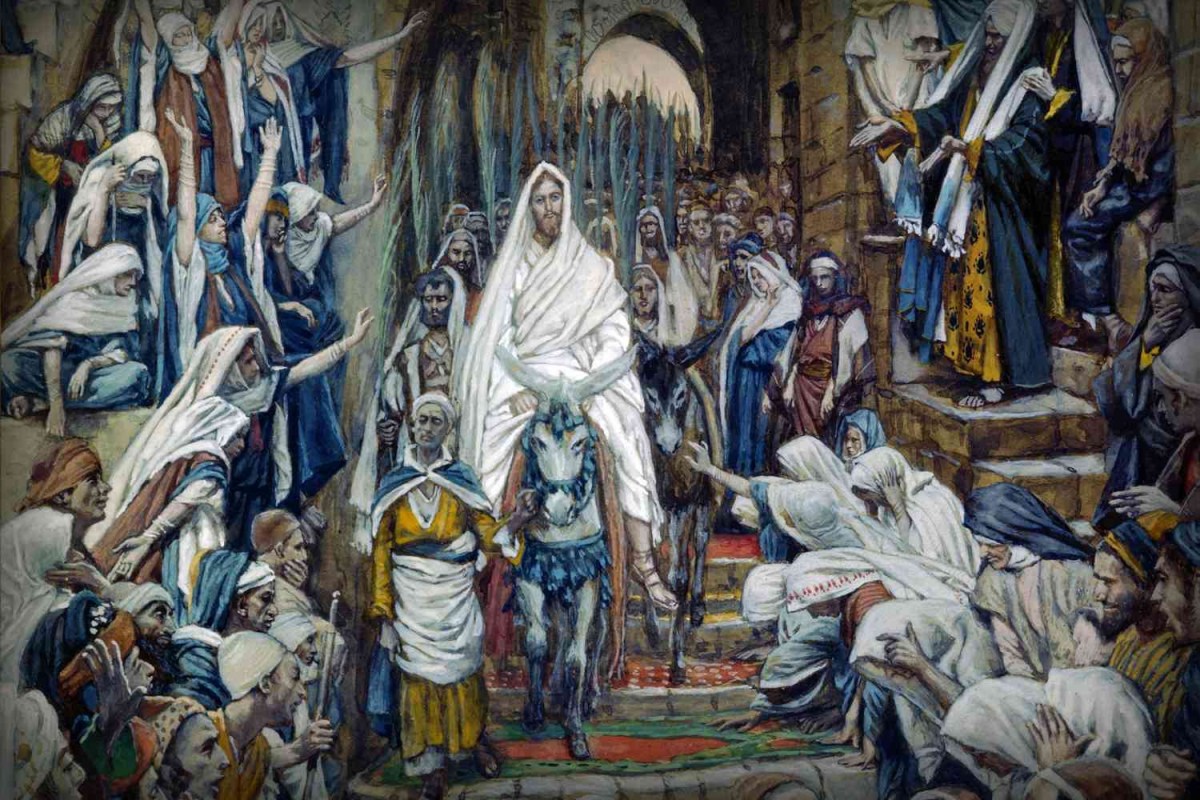
It is no surprise that this psalm is offered by the lectionary for this coming Sunday, Palm Sunday—because the Gospel story for this day, of Jesus entering the city of Jerusalem to the acclaim of the crowd (Matt 21:1–11), is certainly one of celebration and joy. It is also, equally unsurprisingly, offered as the psalm for a week later, on Easter Sunday, which celebrates something much greater and more enduring: the raising of Jesus from the dead (Matt 28:1–10).

But clearly the psalm has a good fit with the Palm Sunday story that we will hear on Sunday; indeed, the Gospel writers report that the crowd cheering Jesus was singing, “Blessed is the one who comes in the name of the Lord”—which is, of course, a verse from the final Hallel Psalm (Ps 118:26).

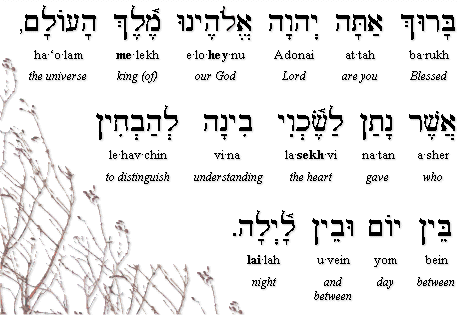
Blessing God is a favourite Jewish activity—indeed, so many prayers still used by Jews today begin with a phrase of blessing: “Blessed are you, O Lord our God …”. Blessed are You, O Lord our God, Ruler of the universe, Who brings forth bread from the earth is prayed before a meal. Blessed are You, O Lord our God, Ruler of the universe, who creates the fruit of the vine is prayed before drinking wine. And a favourite blessing which I learnt from Jews is Blessed are you, O Lord our God, Ruler of the Universe, who has kept us alive, sustained us, and brought us to this moment. It’s a prayer to mark momentous occasions in life.

All of these prayers of blessing begin with the Hebrew words, Baruch atah Adonai Elohenu melekh ha’olam, the same formula of approaching, acknowledging, and blessing God.

We can see that formula used in blessings spoken by David (1 Chron 29:19 and the psalmist (Ps 119:12), as well as in later Jewish texts such as Tobit 3:11; 8:5, 15–17; Judith 13:17; 14:7; the Prayer of Azariah (six times), and 1 Maccabees 4:20. It appears also in New Testament texts such as Luke 1:68; Rom 9:5; 2 Cor 1:3; Eph 1:3; and 1 Pet 1:3.

More familiar, perhaps, is when Jesus uses a prayer of blessing, but speaks it to human beings; “blessed are you, Simon son of Jonah” (Matt 16:17), or “blessed are the eyes that see what you see”, to his disciples (Luke 10:23), or “blessed are those who have not seen and yet have come to believe” (John 20:29), and most famously of all, in a set of blessings spoken to a crowd on a level place (Luke 6:20–22) or to his disciples on a mountain top (Matt 5:3–12).

So the cry of the crowd as Jesus enters Jerusalem, “Blessed is the one who comes in the name of the Lord” (Ps 118:26) is a typical Jewish exclamation at a moment of joyful celebration.

*****

A further reason for linking this psalm with the Gospel narrative might well be that the cry of the crowd, “Hosanna!” (Mark 11:9–10; Matt 21:9; John 12:13). The word transliterated as “Hosanna” might actually be better translated as “save us”—another quote from the previous verse in that same psalm (Ps 118:25). The Hebrew comprises two words: hosha, which is from the verb “to save”, and then the word na, meaning “us”. Hosanna is not, in the first instance, a cry of celebration; rather, it is a cry of help, reaching out to God, pleading for assistance—and yet with the underlying confidence that God will, indeed, save, for “his steadfast love endures forever” (vv.1, 29).

See

Whilst the psalm, overall, sounds thanks for a victory that has been achieved, the petition, “save us” (v. 25) lies behind the first substantial section of this psalm (vv.5–14), which is largely omitted by the lectionary offering for this coming Sunday (which is Ps 118:1–2, 14–24). That section begins “out of my distress I called on the Lord” (v.5), claims that “the Lord is on my side to help me” (v.7), and concludes with rejoicing, “I was pushed hard, so that I was falling, but the Lord helped me; the Lord is my strength and my might; he has become my salvation” (vv.13–14).

Save us” is a prayer offered in other psalms (Ps 54:1; 80:2; 106:47); the petition appears more often in the singular, “save me” (Ps 7:1; 22:21; 31:16; 54:1; 55:16; 59:2; 69:1; 71:2; 109:26; 119:94, 146; 142:6; 143:9). “Save us” when faced with danger is the prayer of the elders of Israel as they faced the Philistine army (1 Sam 4:3) and the all the people a little later (1 Sam 7:8), David when the ark was put in place in Jerusalem (1 Chron 16:35), Hezekiah when Judah was being threatened by the Assyrians (2 Ki 19:19), as well as the prophet Isaiah at the same time (Isa 25:9; 33:22; 37:20).

This prayer in the context of festive celebrations—the context for which Psalm 118 appears to have been written—expresses the firm confidence of the people, trusting in the power of their God. That viewpoint is perfectly applicable to the Palm Sunday story (and even more so to the Easter Sunday narrative!).

But this psalm is not only a prayer of celebration; it is also a strong statement about the resilience and trust of the people, expressing their belief that God will give them redemption, even in the face of their Roman overlords, who had held political and military power for many decades. If this is what the crowd intended with their cry as Jesus enters the city—and I have no reason to see otherwise—then this is a striking, courageous political cry embedded in the story! It is a cry that affirms that salvation is at hand.

*****

Salvation is what is in the mind of the people as they cry, “save us” (v.25) and the earlier affirmation, “I thank you that you have answered me and have become my salvation” (v.21). As we have noted, “save us” was a recurring cry amongst the Israelites. In the song sung after the Exodus, the people acclaim God, singing “the Lord is my strength and my might, and he has become my salvation” (Exod 15:2). In his song of thanksgiving after battles with the Philistines, David praises God as “my rock, my shield and the horn of my salvation” (2 Sam 22:3; also vv.36, 47, 51; and 1 Chron 16:23, 35).

The same language, of salvation, appears in the psalms (Ps 13:5; 18:2, 35, 46; 24:5; 25:5; and another 40 times) and the prophets (Isa 12:2–3; 25:9; 33:2, 6; 45:8, 17; 46:13; 51:5–6; 52:7, 10; 56:1; 59:11; 61:10; 62:11; Mer 3:23; Mic 7:7; Hab 3:18). From the psalms, we remember “the Lord is my light and my salvation” (Ps 27:1); from Isaiah, “I will give you as a light to the nations, that my salvation may reach to the end of the earth” (Is 49:6).

There are a dozen occasions in Hebrew Scripture when God is identified as Saviour (2 Sam 22:3; Ps 17:7; 106:21; Isa 43:3, 11; 45:15, 21; 49:26; 60:16; 63:8; Jer 14:8); as the Lord God declares through Hosea, “I have been the Lord your God ever since the land of Egypt; you know no God but me, and besides me there is no Saviour” (Hos 14:4).

Salvation is linked with righteousness; “the salvation of the righteous is from the Lord … he rescues them from the wicked and saves them” (Ps 37:39–40). Being righteous is a quality of the Lord God (Ps 11:7; 35:28; 50:6; 71:16; 85:10; 89:16; 97:2, 6; 103:17; 111:3; 116:5; 119:137, 152; 129:4; Isa 45:21; Jer 23:6; 33:16; Dan 9:16; Zeph 3:5) which is thus desired of those in covenant with God (Gen 18:19; 1 Sam 26:23; 2 Sam 22:21, 25; 1 Ki 10:9; 2 Chron 9:8; Job 29:14; Ps 5:8; 9:8; 11:7; 33:5; Prov 1:3; Isa 1:27; 5:7; 28:17; 42:6; 61:11; Jer 22:3; Ezek 18:5–9; Hos 10:12; Amos 5:24; Zeph 2:3; Mal 3:3).

It is no surprise, then, that this psalm celebrates that “[God] has become my salvation” (Ps 118:21) by holding a “festal procession with branches” (v.27), entering through “the gates of righteousness” (v.19) and proceeding all the way “up to the horns of the altar” (v.27), singing “save us, Lord” (v.25) and “blessed is the one who comes in the name of the Lord” (v.26). This is a high celebratory moment!

So the closing verses take us back to the opening refrain, “O give thanks to the Lord, for he is good, for his steadfast love endures forever” (v.29; see also vv.1–4). The celebration is lifted to the highest level, with praise and thanksgiving abounding. And that makes this a perfect psalm for Palm Sunday!

****(

On the indications of the political nature of the Palm Sunday scene, see

The paradox of “the word of the cross” in Corinth (1 Cor 1; Epiphany 4A)

The cross is the benchmark for understanding how believers are to behave, how they are to relate to one another, and how the community that they form is to be described. This is the thesis that Paul and Sosthenes propose near the start of their lengthy letter to “the church of God that is in Corinth, to those who are sanctified in Christ Jesus, called to be saints” (1 Cor 1:1–2), and also to “all those who in every place call on the name of our Lord Jesus Christ” (1:2). And as we have already noted, “the word of the cross” features prominently in the authentic letters of Paul.

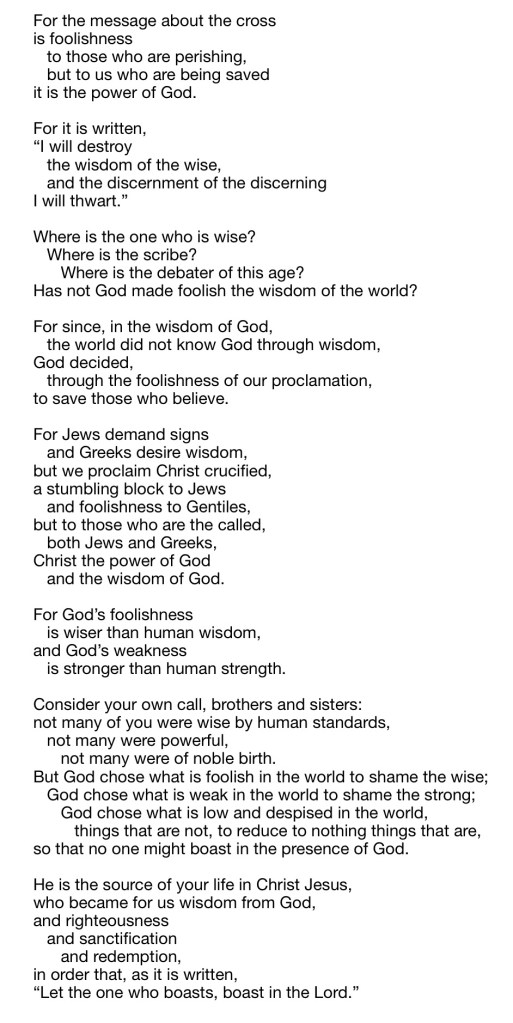
The thesis is stated in a rhetorically balanced, theologically incisive two-part statement, the message about the cross is foolishness to those who are perishing, but to us who are being saved it is the power of God (1:18). The claim is worked out in the first two chapters of the letter, in passages that we will hear this week (1 Cor 1:18–31) and then next week (2:1–12). It then serves as the basis for much of the ethical and theological discussion that follows in later chapters of the letter.

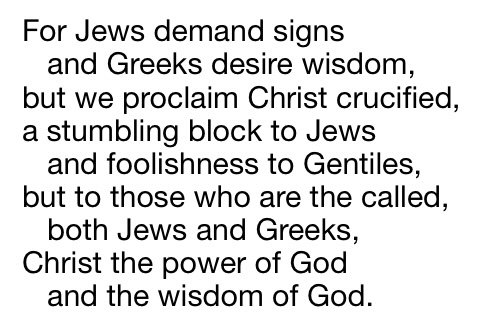
In the two passages currently in view, Sosthenes and Paul remind the Corinthians that “we proclaim Christ crucified, a stumbling block to Jews and foolishness to Gentiles” (1:23), that they “decided to know nothing among you except Jesus Christ, and him crucified” (2:2), and that the paradoxical wisdom that is at the heart of the story of Jesus, “none of the rulers of this age understood this; for if they had, they would not have crucified the Lord of glory” (2:8).

The rhetorical structuring of this paradoxical argument is evident throughout the whole of the passage that the lectionary offers for this Sunday (1:18–31). There is a neat symmetry of clauses in each verse of the passage, with frequent use of balancing subsidiary phrases continuing the symmetrical structure. I’ve attempted to show this schematically as follows:

*****

To begin, Sosthenes and Paul ground their argument in prophetic declarations drawn from the Hebrew scriptures—in fact, explicit citations bookmark their argument at 1:19 (quoting Isaiah) and 1:31 (quoting Jeremiah). This is typical of rabbinic literature, where an initial citation (a subsidiary text) begins an argument, and then the primary text for the matter being addressed concludes the argument. This was the fourth of Rabbi Hillel’s seven principles for scripture interpretation (Aboth de Rabbi Nathan 37).

So there should be no surprise that we find such a technique employed in a letter written by Sosthenes, a leader of the synagogue (the place where scripture interpretation was taught and debates about scripture flourished), and Paul, trained as a Pharisee (at the feet of Gamaliel, if Acts 22:3 reflects historical reality) and well-versed in the Torah, the first five books of the Hebrew Scriptures (Phil 3:5; Rom 7:12, 22). As Jews immersed in the knowledge of Torah and the application of scripture to daily life, this way of speaking and writing was second nature to them.

After stating their thesis (1:18), Sosthenes and Paul cited the prophet Isaiah in support (Isa 29:14). In the typical rabbinic fashion of arguing a point, this first quotation is the subsidiary text for their argument. The words come from an oracle that the prophet delivers when Israel and Judah had been invaded by the Assyrian power to the north (2 Kings 17–19). This invasion of 721 BCE is characterised by Isaiah as an expression of God’s judgement (Isa 28:21–22). The northern kingdom had been conquered (2 Kings 17) and the southern kingdom was invaded (2 Kings 18). Two decades later, under Sennacherib, the city of Jerusalem itself was under siege (Isa 29:1–3). Ultimately Sennacherib withdrew his army back to Nineveh and was killed by his sons (2 Kings 19:36–37).

Whilst the experience of the people in the besieged city of Jerusalem was one of “moaning and lamentation” (Isa 29:2), the prophet presses the claim that this is brought about by God himself: “the Lord has poured out upon you a spirit of deep sleep; he has closed your eyes, you prophets, and covered your heads, you seers” (Isa 29:10). This, the prophet insists, “comes from the Lord of hosts; he is wonderful in counsel, and excellent in wisdom” (Isa 28:29).

Because the people claim allegiance to God but fail to live according to the covenant they have made with God—“their worship of me is a human commandment learned by rote” (Isa 29:13)–God’s intervention through the Assyrian encirclement of Jerusalem will mean that “the wisdom of their wise shall perish, and the discernment of the discerning shall be hidden” (Isa 29:14). Eventually, through this intense hardship, “those who err in spirit will come to understanding, and those who grumble will accept instruction” (Isa 29:24).

It is this message of the paradoxical inversion of the widely-accepted wisdom by divine intervention that the apostle and his co-author draw on, when they remind the Corinthians of God’s way: “I will destroy the wisdom of the wise, and the discernment of the discerning I will thwart” (1 Cor 1:19, quoting Isa 29:14b).

*****

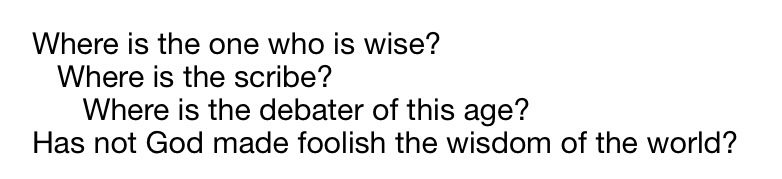
In developing their argument in the following verses, Sosthenes and Paul explain this inversion to the Corinthians in three compact sequences. First, they pose a series of three rhetorical questions ending with a fourth question that expounds the paradoxical nature of how God acts:

The implied answer, of course, is “yes”.

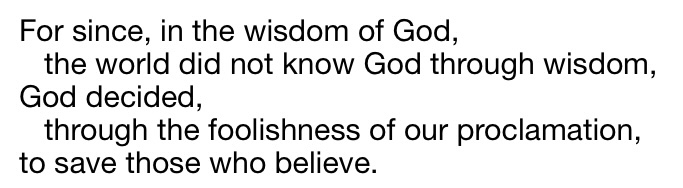
Then follows a doublet with matching halves (wisdom of God, wisdom of the world; foolishness, salvation):

The pattern of wisdom-wisdom, folly-?? is broken with the declaration of salvation for believers; this is what “God decided”.

The third sequence contrasts Jews with Greeks (that is, Gentiles) but then places both of them in contrast to the proclamation of “Christ crucified”. The word of the cross functions as the definitive marker; this is the pivot on which the section turns.

The word of the cross—the proclamation of “Christ crucified”—might be understood as a stumbling block and a folly, but is actually a demonstration of divine power and wisdom. It is in the cross that the age-old dynamic of how God works is seen: it is an upheaval, a reversal, an overturning of received wisdom—just as Isaiah had been proclaiming to his fellow Judahites eight centuries earlier.

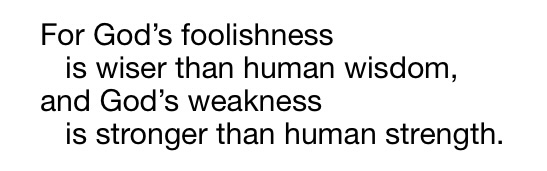
The conclusion is made clear in a punchy doublet in parallel paradox:

*****

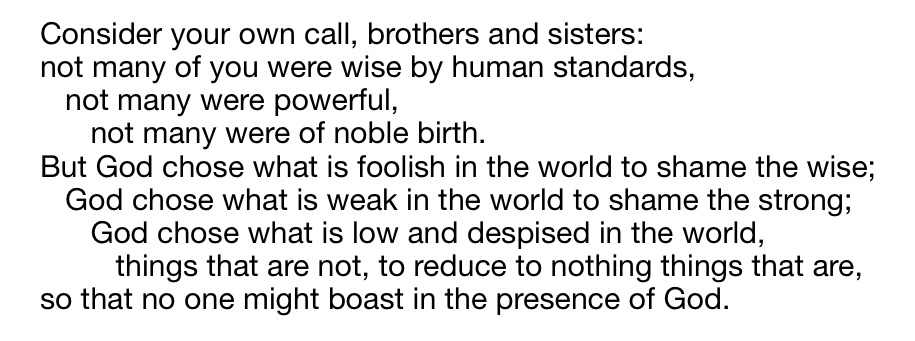
In what follows next, attention turns to the actual community of believers in Corinth. The letter writers invite the believers in Corinth to “consider your own call, brothers and sisters”, followed by two triplets of rhetorically powerful statements:

That few were wise, powerful, or born as nobles in Corinth should come as no surprise. Certainly, a number of high-status names are mentioned in the letter (Stephanus, Fortunatus, and Acaicus at 16:17; and perhaps Chloe, if “Chloe’s people” at 1:11 are her servants), and other letters demonstrate a similar presence of high-status people, such as those who host “the church in the house of” Aquila and Priscilla (1 Cor 16:19; Rom 16:3), as well as a number of those mentioned in the string of names in Rom 16:3–16.

However, later in the letter we learn that when the community of believers comes together, some enjoy a rich meal and get drunk, while others starve (1 Cor 11:21). The condemnation is on those who “humiliate those who have nothing” (11:22); they are instructed, “when you come together to eat, wait for one another” (11:33). Here, as in a number of other places in the letter, the teaching is given that all members of the community are to be regarded as equal, for “in the one Spirit we were all baptized into one body—Jews or Greeks, slaves or free—and we were all made to drink of one Spirit” (12:13).

Indeed, in the second century, Pliny would describe Christians as being “of every age, of every rank, of both sexes” and “not only in the towns, but also in the villages and farms” (Pliny, Epist. 10.96.9). And social-scientific commentators on the early Jesus movement have published careful analyses that support the notion that early Christian communities contained a cross-section of society (see Gerd Thiessen, The First Followers of Jesus, on the rural origins of the movement, and Wayne Meeks, The First Urban Christians, on its consolidation in the cities of the Roman Empire).

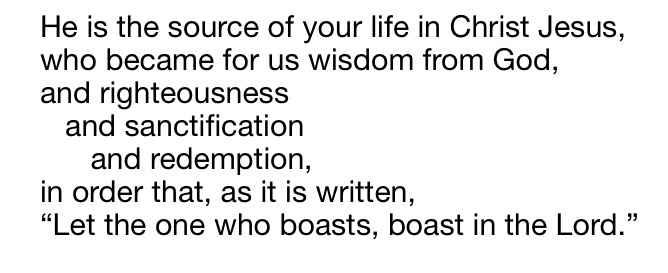
So in the rhetorically powerful argument of 1:18–31, God’s paradoxical choice is emphasised; God chose fools, weaklings, and lowly despised people, not wise, powerful, noble-born. In the second triplet, the final affirmation is extended with another rhetorical intensifier, reinforcing “the wisdom from God” with three additional theological claims (righteousness, sanctification, and redemption).

*****

At the end of the argument, in typical rabbinic style, a closing citation clinches the case, with words from the prophet Jeremiah (Jer 9:23–24): “as it is written, ‘Let the one who boasts, boast in the Lord’” (1 Cor 1:31). This is the primary scripture passage which undergirds the argument that commenced in 1 Cor 1:19 with the citation of the subsidiary passage from Isaiah.

Jeremiah lived at a turning point in the history of Israel. The northern kingdom had been conquered by the Assyrians in 721 BCE; the elite classes were taken into exile, the land was repopulated with people from other nations (2 Kings 17). The southern kingdom had been invaded by the Assyrians in 701 BCE, but they were repelled (2 Kings 18:13–19:37). King Hezekiah made a pact with the Babylonians, but the prophet Isaiah warned that the nation would eventually fall to the Babylonians (2 Kings 20:12–19). Babylon conquered Assyria in 607 BCE and pressed hard to the south; the southern kingdom fell in 587 BCE (2 Kings 24–25) and “Judah went into exile out of its land” (2 Kings 25:21).

Jeremiah lived in the latter years of the southern kingdom, through into the time of exile. He was sent into exile in Egypt (Jer 43:1–8), even though most of his fellow Judahites were taken to Babylon. The difficult experiences of Jeremiah as a prophet colour many of his pronouncements. That is certainly the case for the long oracle from which the one-line quotation at 1 Cor 1:31 is drawn.

“My joy is gone, grief is upon me, my heart is sick”, the prophet laments (Jer 8:18), posing a question that has come into popular speech in later times: “Is there no balm in Gilead? Is there no physician there? Why then has the health of my poor people not been restored?” (Jer 8:22).

Jeremiah warns of the coming devastation that the Babylonians will bring, framing it as God’s righteous judgement: “I will make Jerusalem a heap of ruins, a lair of jackals; and I will make the towns of Judah a desolation, without inhabitant” (Jer 9:11). Accordingly, the prophet poses the question, “who is wise enough to understand this?” (Jer 9:12), calls for the people to mourn (Jer 9:17–23), and advises them that the Lord declares, “Do not let the wise boast in their wisdom, do not let the mighty boast in their might, do not let the wealthy boast in their wealth; but let those who boast boast in this, that they understand and know me, that I am the Lord; I act with steadfast love, justice, and righteousness in the earth, for in these things I delight, says the Lord” (Jer 9:23–24).

This is the declaration from which Sosthenes and Paul take the one line to draw the argument to a close, pressing the paradoxical way by which God overturns the power of the world and inverts the wisdom of the world. There can be no boasting in human wisdom. Trust can only be placed in the wisdom of God, which has its own logic and distinctive purpose. Boasting is feasible only in this context: “as it is written, ‘Let the one who boasts, boast in the Lord’” (1 Cor 1:31). That is what “the word of the cross” is, to the believers in Corinth–and to “all those who in every place call on the name of our Lord Jesus Christ”.

*****