Why Jesus never was, and never should be called, “meek and mild” (Lent 6; Palm Sunday)

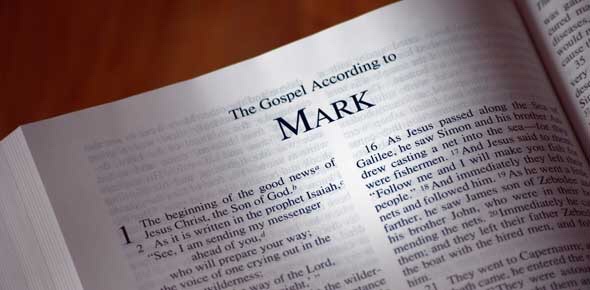
This coming Sunday, known as Palm Sunday, we will hear the story of Jesus, riding into Jerusalem, acclaimed by the crowds, for the festival of Passover. This year, we hear the story as it is told by Mark (Mark 11:1–11). It is a story which is well-known across the church, and is often re-enacted by children waving branches, adults singing songs—and sometimes a co-opted donkey—at this time of the year. It is a story which is often misinterpreted as portraying the gentle Jesus, meek and mild, receiving the accolades of the crowd with a beatific smile as he gently trots in to the city amidst the cheering crowd of pilgrims.

The actual story is far from that, however. If we read it carefully, we will find a number of indications that point us in quite a different direction entirely. There is no “gentle Jesus, meek and mild” in this story. Instead, we find a politically acute Jesus, provocatively and deliberately entering the city at the start of the important festival of Passover, with a clear message to the people of Israel and to the powers of Rome.

(The interpretation that follows is the result of careful exploration of the text in the context of Jewish and Roman history, that my wife Elizabeth and I have undertaken. See the end of the blog for more details.)

The political focus of Passover

The festival of Passover recalls the story that is told in the Hebrew Scriptures, about the exodus of Israel out of Egypt. This is a story of the liberation of an oppressed people, suffering under the burdens of forced labour. Every year throughout the centuries, Jews have recounted the sequence of events that led to the miraculous escape from slavery of their ancestors, crossing through the Sea of Reeds, travelling unhindered through the wilderness, towards a land which the story claims was promised by God—a promised land, gifted to a chosen people by a holy God (Exod 13–15).

Passover is therefore a political festival, recalling a central event in which the leader of a group of enslaved people confronted the leader of an oppressive power and gained liberation through divine intervention. In the time of Jesus, Jews from around the ancient world flocked to Jerusalem for this high moment of celebration, and the story was retold each year with notes of jubilation and joy.

During feast days, especially at each Passover, tensions reached fever pitch. Fervent Jews known as Zealots would use the opportunity of the many pilgrims in the city to mingle in the crowd with daggers hidden under their tunic—and take the opportunity to cause a commotion in the crowd, hoping that they could stab Roman soldiers, their dreaded enemy. The Romans increased their military presence to prevent open revolt. (See Josephus, Jewish War 2:255; Jewish Antiquities 20:186.)

So the Roman soldiers charged with keeping the peace in Jerusalem at Passover would therefore have been on high alert as the pilgrims entered the city. It is in this context that the story of Mark 11 takes place.

Riding on a donkey shows messianic intention

Jesus, seated on the colt, riding on a donkey, was the centre of attention—at least for his own followers (Mark 11:7). Those in the crowd who knew their scriptures, would have immediately recognised the allusion. What did this mean for observant Jews? First, Jesus was on a donkey, not a horse. Indeed, Jesus, as a faithful Jew, would never ride in triumph on a horse! See more at

The account of this story that we find in Matthew’s Gospel actually specifies the verse that interprets the significance of the donkey (Matt 21:4-5). Matthew refers to Zechariah 9:9, where a clear vision is offered: “your king comes to you, triumphant and victorious, humble and riding on a donkey”. And Zechariah himself may well have been referencing the moment when the young Solomon is summonsed to his father, the old king, David, and instructed to “ride on my own mule, and bring him down to Gihon” (1 Ki 1:33)—which Solomon duly does (1 Ki 1:38).

On his arrival, “the priest Zadok took the horn of oil from the tent and anointed Solomon. Then they blew the trumpet, and all the people said, “Long live King Solomon!” And all the people went up following him, playing on pipes and rejoicing with great joy, so that the earth quaked at their noise.” (1 Ki 1:39–40). Solomon’s journey on a mule is the journey to his accession to the throne. The resonances in the story about Jesus are clear.

That is what the reference to the words of the prophet evokes. In this story of Passover pilgrims, Jesus can be seen to be bringing the prophetic vision to fruition, as the fulfilment of the role that kingship plays in Israel. Zechariah’s vision declares that this coming ruler “shall command peace to the nations, and his dominion will be from sea to sea, from the river to the ends of the earth” (Zech 9:10). That is the vision that Jesus evokes as he rides into Jerusalem on this donkey.

The cries of the crowd evoke political resistance to Rome

The crowd sings out, “Hosanna! Blessed is the one who comes in the name of the Lord” (Mark 11:9). The words were familiar words to observant Jews; they clearly evoke a well-known and oft-sung psalm, Psalm 118: “Save us, we beseech you, O Lord! Blessed is the one who comes in the name of the Lord” (Ps 118:25–26).

Why were they singing this psalm? Psalm 118 was one of the Hallel Psalms, the Praise Psalms, which were associated with celebrations on each of the three great festival days—the Feast of Tabernacles, or Booths; the Feast of Weeks, or Pentecost; and the Feast of Passover. These psalms of praise became particularly associated with the celebrations of the rebuilding of the Temple.

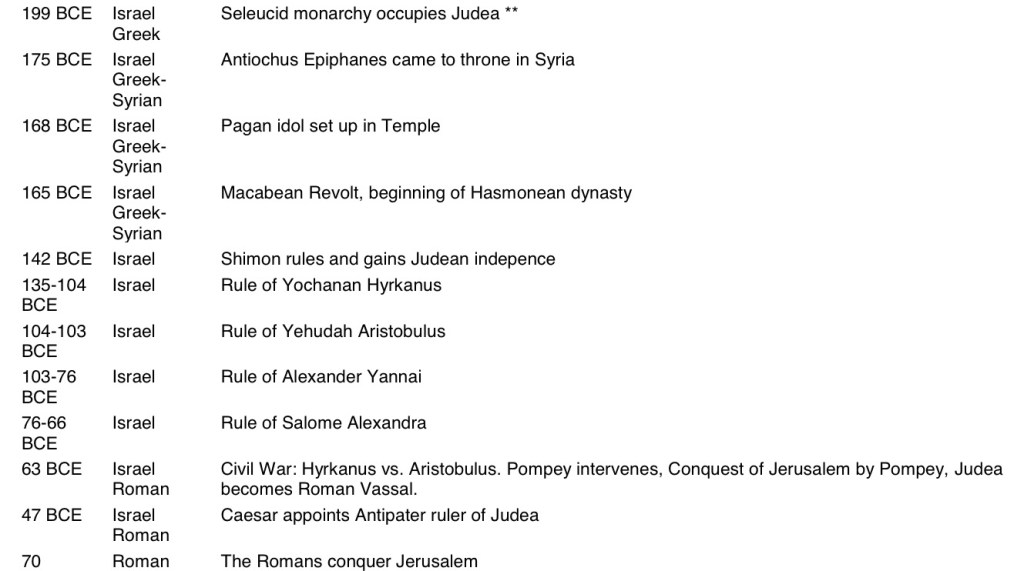
Rebuilding the Temple was an inherently political action. It was the foreign invasion of Palestine by the Hellenistic Seleucids some two centuries before Jesus which had led to the destruction of the Temple. It was the political activity of the Jewish Maccabees which had led to the reclaiming of the Temple two decades later.

The Hallel Psalms had become Psalms of Praise for liberating political activity. When the people cried out “hosanna”, a word from their native Hebrew language, they were crying “save us”. It is a cry for salvation; a yearning for deliverance. This is what the people were singing out; so the people singing this at the festival of Passover as Jesus entered the city was a strong political statement. See more at

The (palm) branches recall a political victory

This Sunday in the church year is traditionally called Palm Sunday. However, no palms are mentioned in the reading we have heard from Mark’s version of the story (nor in Matthew or Luke). That the branches are from palm trees is noted only in John’s version (John 12:13). Both Mark (11:8) and Matthew (21:8) refer to branches that the people cut and placed on the ground, even though they don’t specify that they are palm branches. (Nevertheless, waving palm branches has come to define this day—Palm Sunday—in contemporary re-enactments.)

This waving of palm branches was an activity intimately associated with the actions of the Maccabees, who were men from a priestly family who took up arms to fight back the Seleucid overlords and reclaim the Temple. The instructions in one of the Jewish books (2 Maccabees 10) direct the people to “carry ivy-wreathed wands and beautiful branches and fronds of palms, and offer hymns of thanksgiving to [God] who had given success to the purifying of their own holy place”. So the palms that are noted in John’s Gospel, at least, evoke the famous military campaign of centuries earlier.

The cloaks on the ground recall political leadership

Some people threw their cloaks over the donkey before Jesus sat on it—but Mark also notes that “many people spread their cloaks on the ground” (Mark 11:8). This is a curious detail; what can this mean? Perhaps the more astute of the Jews along the side of the road, would have had some insight; perhaps they recalled the story of the time when a young prophet from Ramoth-gilead declared that God was anointing Jehu, the son of Jehoshaphat, as the next king of Israel.

The story is recounted in 2 Kings 9, and it contains this striking detail, as the prophet decreed, “Thus says the Lord, ‘I anoint you king over Israel’”, and so they took their cloaks and spread them for him on the bare steps, and blew the trumpet, and proclaimed, ‘Jehu is King’” (2 Kings 9:13). There are clear resonances with the story of the Passover pilgrims. The cloaks on the steps, when Jehu is King … the cloaks on the wayside, when Jesus comes as King.

So Jesus, the prophet from Nazareth in Galilee, entered the city in the midst of the pilgrims, for the festival of Passover. Did he come as King, in the minds of the crowd? The festival of Passover was a most appropriate time for him to enter the city and make his mark as God’s chosen King. The donkey and the songs, the branches and the cloaks, all point to the immediate political significance of this event.

The incident in the temple sets the ball rolling

Once in the city, Jesus goes to the temple, where another famous incident occurs. Jesus, as he is portrayed in the striking account of this incident, demonstrates very little gracious, self-effacing humility. There is no “gentle Jesus, meek and mild” here, to be sure! Rather, Jesus is acting out his righteous anger, embodying zealous piety.

Jesus enters the temple precincts, overturning the tables of the money changers (Mark 11:15; Matt 21:12) and driving them out of the temple area (Mark 11:15; Matt 21:12; Luke 19:45). In John’s account, Jesus also tips out the coins of those money changers and knits together cords to form a whip (John 2:15), by which he drives out the moment changers. (Of course, John has completely relocated this scene to the beginning of the public activity of Jesus, rather than near its end, as in the Synoptic accounts of this scene).

Jesus was entering the area with intention and purpose. What was taking place there was, in his eyes, contrary to God’s will. So he performs a prophetic action designed to convey his message to those present (and to those of us in later times who hear and read the account of this incident).

James McGrath notes that “both the selling of animals for sacrifices and the payment of the temple tax were activities required by Jewish law and central to the temple’s functions” (see https://www.bibleodyssey.org/en/passages/main-articles/jesus-and-the-moneychangers). What Jesus does is therefore not an incidental act of anger; it is part of a deliberate plan of action.

McGrath suggests that the reference to the Temple as a marketplace might be an allusion to the eschatological prophecy of Zechariah, that “there shall no longer be traders in the house of the Lord of hosts on that day” (Zech 14:21). Is Jesus enacting this prophecy through his actions in the Temple forecourt?

Certainly, the actions of Jesus when “he would not allow anyone to carry anything through the temple” was confronting. He accuses the money changers of making the temple “a den of robbers” (Mark 11:17, Matt 21:13, and Luke 19:46). That most likely references the rhetorical question of the prophet Jeremiah: “Has this house, which is called by my name, become a den of robbers in your sight?” (Jer 7:11).

Gail O’Day considers that “by going to the Jerusalem temple and disrupting the practices that were necessary for the celebration of Passover, Jesus places himself in a long line of Israel’s prophets who go to Jerusalem, the center of religious and political power, and announce and enact the word of God.” (see https://www.bibleodyssey.org/en/passages/related-articles/cleansing-or-cursing)

In this dramatic prophetic action, Jesus acts and speaks carefully, deliberately, with “righteous anger”. He makes it clear what he is standing against, and what he is working towards—and he knows what the cost will be for him. After his dramatic entry into the city (Mark 11:1–11), he then presses on relentlessly into the temple (Mark 11:15–17), even symbolising his message in what he says to the fig tree: “may no one ever eat fruit from you again” (Mark 11:12–14).

Jesus knows exactly what he is doing. He has set in motion the events that will lead to his death: “when the chief priests and the scribes heard it, they kept looking for a way to kill him; for they were afraid of him” (Mark 11:18). His actions in the temple precincts were just as political as his entry into the city.

This is no “gentle Jesus, meek and mild”. This is a leader acting with a clear, focussed intent, regardless of the cost to himself and his followers. So this Palm Sunday, let us banish the Sunday School stereotype of Jesus, and acknowledge him in his full and fierce expression of his faith.

This blog on the Palm Sunday story is based on research by Elizabeth Raine and John Squires, published in Validating Violence—Violating Faith? Religion, Scripture and Violence. Edited by W. Emilsen & J.T. Squires, ATF Press, Adelaide 2008. See https://assembly.uca.org.au/rof/images/stories/interfaithsep/25sept.pdf

A version of this dialogue is also accessible at https://ruralreverend.blogspot.com/2019/04/palm-sunday-ps-1181-2-19-29-luke-1928.html

You lack one thing: Jesus and a rich man (Mark 10; Narrative Lectionary for Lent 1)

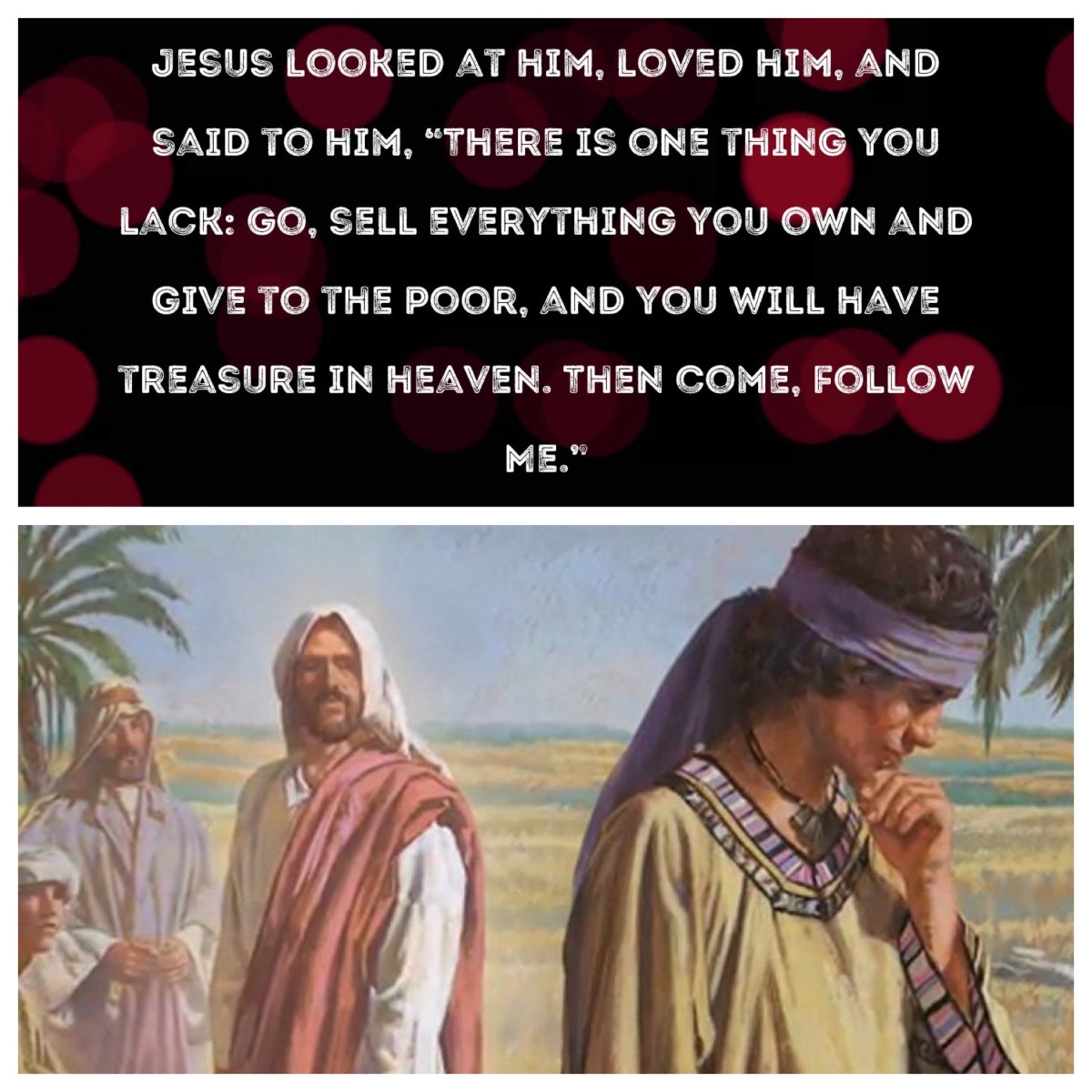
Next Sunday, the first Sunday in Lent, we will hear a Gospel passage in which Jesus sadly informs a man of means who prides himself on keeping all the commandments, that still “you lack one thing: go, sell what you own, and give the money to the poor, and you will have treasure in heaven; then come, follow me” (Mark 10:21).

The man left, shocked and grieving; he could not do what Jesus instructed. Jesus here draws the line of belonging or being alienated from him on the basis of whether a person is able to implement radical actions of obedience. It’s not just a matter of believing—it’s a matter of doing, of implementing radical, practical changes.

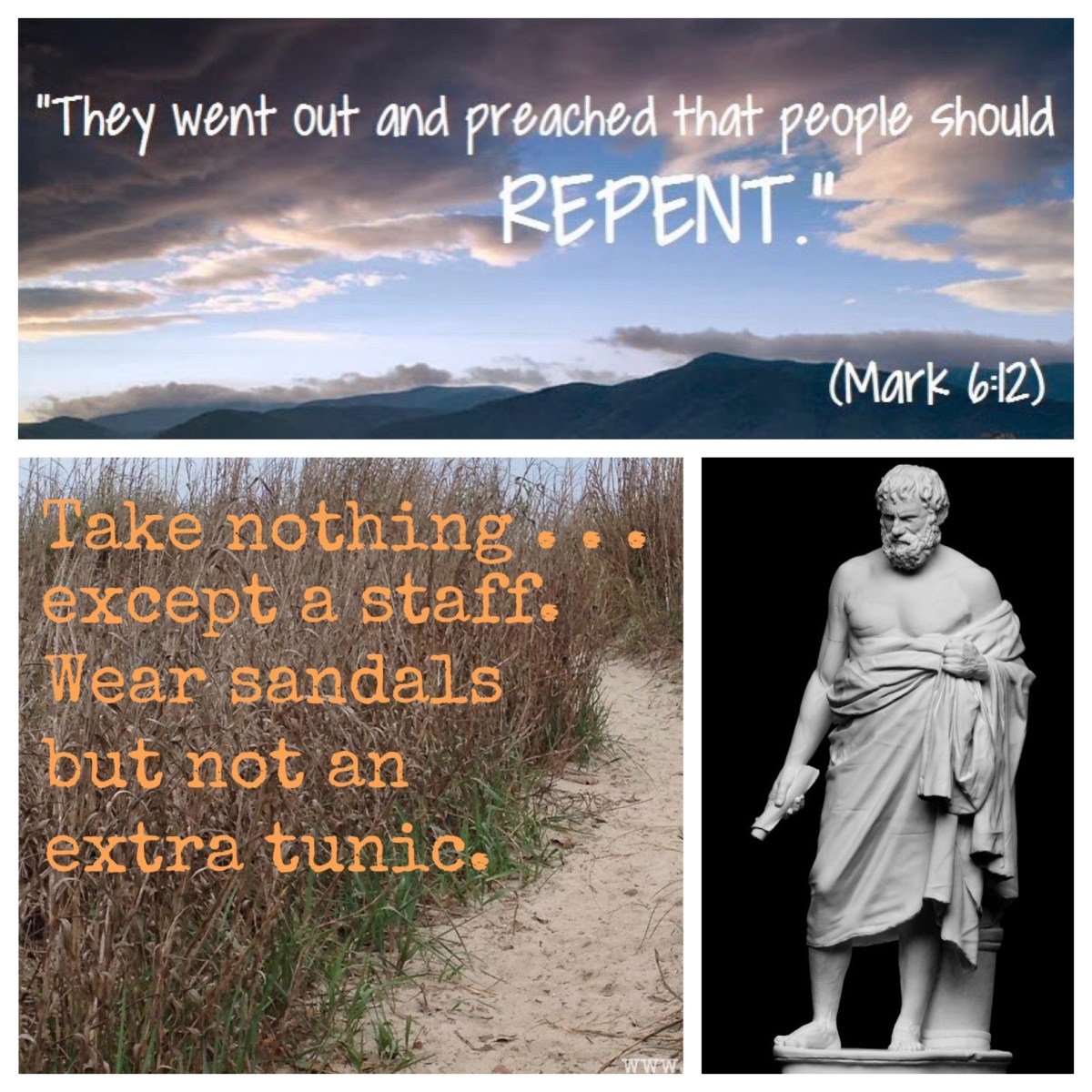
Quite some time earlier, Jesus had instructed his followers of that they were to be characterised by an ascetic way of life (6:8–9) as they undertook their public proclamation “that all should repent” (6:12). As Jesus sent them out on mission, “he charged them to take nothing for their journey except a staff—no bread, no bag, no money in their belts— but to wear sandals and not put on two tunics” (6:8–9).

The description given here is often compared with the form of dress of a wandering philosopher, particularly of a Cynic philosopher, renowned for their poverty and dependence on others for food and shelter. The fact that Jesus also instructs his followers to accept hospitality when offered (6:10) but not to stay on if there is no welcome offered (6:11) reinforces the similarities.

On this comparison, see

The teachings of Jesus contain many indications that this way of life is what is expected of those who follow Jesus. He tells them, “if any want to become my followers, let them deny themselves and take up their cross and follow me” (8:34). He then reinforces this after his encounter with the rich man by noting, “how hard it will be for those who have wealth to enter the kingdom of God!” (10:23). Later, in Jerusalem, Jesus concludes a debate with some Pharisees and Herodians with the instruction, “give to the emperor the things that are the emperor’s, and to God the things that are God’s” (12:17).

Beyond Mark’s narrative, Jesus was remembered for sayings in which he taught his followers to “love your enemies, do good, and lend, expecting nothing in return” (Luke 6:35) and “sell your possessions, and give alms” (Luke 12:33; Matt 19:21). “When you give a banquet”, he advised, “invite the poor, the crippled, the lame, and the blind” (Luke 14:13). “You cannot serve God and wealth”, he asserts (Luke 16:13; Matt 6:24). Accumulating possessions is not part of the agenda that Jesus set forth!

David Bentley Hart has written about the encounter between Jesus and the rich man: “Whatever else capitalism may be, it is first and foremost a system for producing as much private wealth as possible by squandering as much as possible of humanity’s common inheritance of the goods of creation. But Christ condemned not only an unhealthy preoccupation with riches, but the getting and keeping of riches as such. The most obvious example of this, found in all three synoptic Gospels, is the story of the rich young ruler, and of Christ’s remark about the camel and the needle’s eye.”

See https://www.plough.com/en/topics/faith/discipleship/what-lies-beyond-capitalism

As we listen to this story, from long ago, in our present context, we can sense how it remains pertinent for us. It remains a challenging word to disciples, caught in the swirl of constant consumption and encouragement to get more, more, more, in our contemporary capitalist society. “Go, sell what you own, and give the money to the poor, and you will have treasure in heaven; then come, follow me.”

A bleeding woman, a dying child in Mark 5 (Narrative Lectionary for Epiphany 4)

This coming Sunday, the section of Mark’s Gospel that the narrative lectionary proposes contains a pair of interlinked stories: one about the dying girl who had lived for 12 years (Mark 5:25–34) and one about the woman who has bled for 12 years (Mark 5:21–24, 35–43). These are stories with a Jewish focus. They each contain the number 12, a very important number in Judaism. I have reflected on the significance of this number in these stories in this blog:

These two stories each tell of a way that Jesus offered hope to the woman and the girl. And they each deal with matters of protocol and behaviour within the Jewish holiness system.

Holiness was central to the people of Israel. Those who ministered to God within the Temple, as priests, were to be especially concerned about holiness in their daily life and their regular activities in the Temple (Exod 28-29; Lev 8-9). The priests oversaw the implementation of the Holiness Code, a large section of Leviticus (chapters 17–26), which explained the various applications of the word to Israel, that “you shall be holy, for I the Lord your God am holy” (Lev 19:2; also 20:7,26).

As well as overseeing the various offerings and sacrifices that were to be brought to the Temple, the priests provided guidance and interpretation in many matters of daily life, including sexual relationships and bodily illnesses, as well as the annual festivals and other ritual practices.

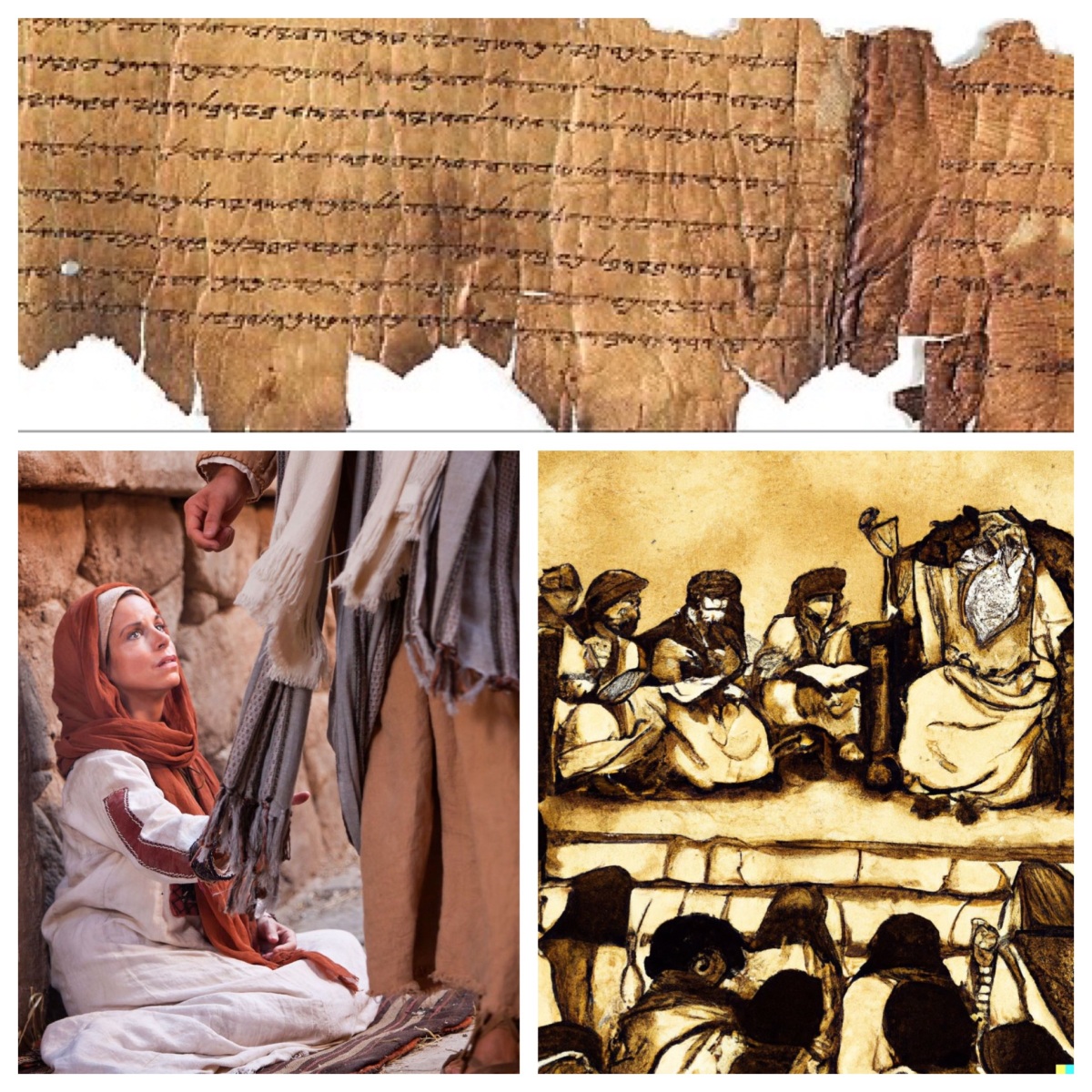
Part of the Paleo-Hebrew Leviticus scroll (discovered 1956; dated C2–C1 BCE)
which contains the oldest known copy of the Holiness Code.

In the towns and villages of Israel, by contrast, the scribes and Pharisees provided guidance in the interpretation of Torah and in the application of Torah to ensure that holiness was observed in daily living. They undertook the highly significant task of showing how the Torah was relevant to the daily life of Jewish people. It was possible, they argued, to live as God’s holy people at every point of one’s life, quite apart from any pilgrimages made to the Temple in Jerusalem.

So the encounter of the bleeding woman with Jesus had implications in terms of how he interacted with someone suffering from a physical illness. This was a matter regulated by various laws, including, most prominently, a comprehensive catalogue of laws relating to skin diseases, or leprosy (Lev 13–14) and, more relevant to this story, bodily discharges (Lev 15).

These laws specify that, if blood was being discharged from the woman as menstrual blood (“her regular discharge from her body”) that required specific actions to deal with the uncleanness that this produced (Lev 15:19-24).

An image generated by AI,
illustrating an ancient synagogue gathering
where the Law is read

If it was for other reasons (“a discharge of blood … not at the time of her impurity”) another set of laws applies (Lev 15:25-30). The woman herself is not seen as unclean; but anything she touches, anything she sits or lies on, is regarded as unclean. The processes for maintaining a clean status in her household, avoiding these items of furniture, or even direct contact with the woman, would have been onerous.

Furthermore, the request of the synagogue leader to Jesus could possibly bring him into contact with a dead body—a matter that was regulated by laws (Lev 22:4; Num 5:1-2, 9:6-12, 19:11-13). Jairus says that the girl is “at the point of death” (5:23). The cries of the crowd (“your daughter is dead”, 5:35) and the weeping and wailing of the people outside the house (5:38) suggest that the rituals of mourning for a deceased person had already begun. Nevertheless, Jesus assures Jairus that the girl is not dead, but sleeping (5:35).

Another strongly Jewish element in the story of the bleeding woman in her belief that, if she touched the clothing of Jesus (most likely the fringes or tassels), she would be cured. Whilst the laws relating to bleeding indicate that the “direction” of things is that an unclean state touching a clean state renders the clean state unclean, the direction is reversed in this story. The power that resides in Jesus is able to overcome the uncleanness associated with the woman (5:29).

The way that Christians have often read the Levitical prescriptions has been to dismiss the so-called “cultic laws” and maintain adherence only to the moral imperatives embedded within the pages of details about ritual and worship. From this perspective, the stories included in the section of Mark’s Gospel that we are focussing on, it is said, reveal that Jesus ignored or dismissed the prescriptions of the Law. Jesus is seen to validate the attitude that the laws in the Old Testament are no longer valid.

But neither of these Gospel stories give any warrant for such a negative approach to the Holiness Code. In neither case does Jesus actually breach the provisions of the Law. Indeed, the way that the Law functions is misunderstood in so many Christian readings of this story, as well as other parts of the Gospels.

Rather than operating as a constraining imposition, the Law actually deals with real life situations and provides ways that these situations are to be dealt with or managed. The woman with a discharge “beyond the time of her impurity”, for instance, could remove her uncleanness by offering two turtle doves or two pigeons (Lev 15:29–30).

The Pharisees, it is often said, imposed numerous demands on the people. They “made a fence around the law”—a phrase derived from the opening words of Pirke Aboth (The Sayings of the Fathers), a tractate in the Mishnah. The tractate begins: “Moses received the Torah at Sinai and transmitted it to Joshua, Joshua to the elders, and the elders to the prophets, and the prophets to the Men of the Great Assembly. They said three things: Be patient in [the administration of] justice, raise many disciples and make a fence round the Torah.”

Making a fence around the Law is apparently derived from Deut 22:8, which in one translation instructs that when you are building a house, you must build a fence around the roof in order to avoid guilt should someone fall off the roof.

The Pharisees were operating as ancient fence-makers (or gatekeepers, if you will), ensuring that people operated within the bounds of what was required by the Law. Of course, each time a particular law is invoked in a specific situation, it needs to be applied to that situation, interpreted as to how it might apply. That goes for laws in society today, as much as it does for laws in the ancient Jewish society. See

The criticisms that Jesus makes of those who follow the Law and teach the Law need to be seen as debates taking place within Judaism, not as criticisms made from outside Judaism. Jesus was a Jew, living in Jewish lands, trained in understanding the Torah, engaged in applying it to situations in life. His words reflect his interpretation of the Law, not a rejection per se of the Law, as he participates in the culture, practices, and customs of his people.

Christians and Jews have had difficult relationships over the years. The difficulties have been based on misunderstandings, accusations, and the damaging intensification that comes through polemical debate, where careful listening and understanding have been absent. That has been the case, sadly, when matters associated with the application of the Law is concerned.

The Gospel passage for this Sunday reminds us of this lack of appreciation, and invites us to commit to a positive appreciation of Jewish traditions and practices, recognising that Judaism continues as a living faith today, and acknowledging that Jesus was engaged in interpretation, not rejection, of the Law. And in the midst of this, he offers hope to a woman who had suffered for 12 years, and a girl of 12 who was on the point of death.

Jesus and the Demoniac in Mark 5 (Narrative Lectionary for Epiphany 3)

The story provided by the narrative lectionary this coming Sunday (Mark 5:1–20) contains a potent question. The story concerns an encounter that Jesus has with a man who is introduced in graphic terms: he lived among tombs and was “restrained with shackles and chains”—but he broke open the chains, “and no one had the strength to subdue him” (5:3–4). More than that, “he was always howling and bruising himself with stones” (5:5). This description bodes no good for Jesus. How would he deal with this troubled and threatening, figure?

Gerasene demon by toonfed (Federico Blee)
https://www.deviantart.com/toonfed/art/Gerasene-demon-102415150

When the man saw Jesus from a distance, the narrative says that he ran and bowed down before him; and he shouted at the top of his voice, “What have you to do with me, Jesus, Son of the Most High God?” (5:7).

It’s a good question. It’s a question that, in a sense, jumps out from the story and confronts us directly. What does Jesus, Son of the Most High God, have to do with us? with me?

It is this question that is in focus, for me, as I consider this passage—and indeed, this whole Gospel. Indeed, many interpreters argue that Mark’s Gospel can best be characterised by the central question of Jesus: “who do you say that I am?” (8:29). The identity of Jesus is, indeed, central to this Gospel (as it is, also, in the other canonical Gospels).

A passage earlier in the Gospel, Mark 1:21–28, contains another confronting question, which a demon-possessed man asked of Jesus in the early stages of his public ministry: “what have you to do with us, Jesus of Nazareth?” (1:24). Now this is a question worth pondering.

In Mark’s Gospel as a whole, there are (according to the NRSV) no less than 118 questions. Since there are 668 verses in total in Mark’s Gospel, this means that the reader (or hearer) of this Gospel is confronted with a question, on average, every 5.66 verses! (Why not try reading a couple of chapters through, looking out especially for the questions?)

Some of these questions are simple conversational enquiries—the kind of questions that we ask one another every day. “should we go there? should I do this? do you have any? can I get you something?” and so on.

Some questions are genuine requests for information, and reflect people who really want to learn from Jesus—“what must I do to inherit eternal life?” (10:17), or “which commandment is the first of all?” (12:28), or “what will be the sign that all these things are about to be accomplished?” (13:4). Jesus, good teacher that he is, responds with information and insight; he takes the opportunity to convert the question into a step forward in the life of discipleship.

Indeed, Jesus himself follows the rabbinic practice of teaching by questioning—he often poses a question which leads the disciples, or the crowd, into further discussion and debate (see, for instance, 3:33; 4:30; 10:3; 10:51). It is interesting to note that this is often how Jesus uses scripture; he does not simply quote it, but he says, “have you not read that…?” or, “do you not known the scripture which says…?”. (Look at 11:17; 12:10; and 12:26.)

This style invites conversation and leads to deepened understanding. Scripture is not being used to squash debate, but to open up insights about God. Now that is an insight worth recalling and preserving in our current context!

As Mark tells his story, some people pose questions to Jesus which are quite sharp—and may be designed to create controversy or to challenge the authority of Jesus. For instance: “why does this fellow speak in this way? it is blasphemy! who can forgive sins but God alone?” (2:7); “why does he eat with tax collectors and sinners?” (2:16); “why do your disciples do not fast?” (2:18); “by what authority are you doing these things?” (11:28); “is it lawful to pay taxes to the emperor, or not?” (12:14). Jesus did not shy away from the challenge to his honour and authority that such questions posed. According to Mark, he was a public debater of the first order.

Throughout this Gospel, Jesus poses pointed questions of his own for his disciples and the crowds who follow him. Think about the provocations and challenges in these phrases of Jesus: “why are you afraid? have you still no faith?” (4:40); “do you also fail to understand?” (7:18); “do you still not perceive or understand? are your hearts hardened? do you have eyes, and fail to see? do you have ears, and fail to hear?” (8:17–18); “you faithless generation, how much longer must I be among you? how much longer must I put up with you?” (9:19). There is certainly no “gentle Jesus, meek and mild” in this Gospel!!

The teachings of Jesus are demanding: to his disciples, he asks, “for what will it profit a person to gain the whole world and forfeit their life?” (9:36); or, with eyes fixed towards the cross, he prods them further: “are you able to drink the cup that I drink, or be baptized with the baptism that I am baptized with?” (10:38). For their part, the disciples are not afraid to confront their leader when required, as we have seen: “Teacher, do you not care that we are perishing?” (4:38). Discipleship means entering into the rough-and-tumble of these difficult questions.

Theologically, perhaps the most challenging question in the Gospel is when Jesus quotes the Psalmist: “my God, my God, why have you forsaken me?” (15:34). Is this an expression of the deepest despair of a human being who feels alienated, abandoned, utterly alone? Mark gives a great gift to followers of Jesus in all generations, when he takes us to the heart of the struggle which Jesus faced on the cross. This question shows us the human dimension of Jesus, as he was confronted by the starkness of life and death.

Of course, the identity of Jesus remains the central motif of this Gospel. It is the focus of the very first verse (“Jesus, Messiah, Son of God”, 1:1) and is reiterated in a variety of ways in statements made at crucial moments in the story (see 1:11; 8:29; 9:7; 10:45; 14:62; 15:39). But it also forms a recurring question, asked by many characters throughout the story.

We can’t read Mark’s Gospel without being confronted, again and again, by this question, in whatever guise it comes:  “what have you to do with us, Jesus of Nazareth?” (1:24, from a possessed man); “who then is this, that even the wind and the sea obey him?” (4:41, from the disciples); “what have you to do with me, Jesus, Son of the Most High God?” (5:6, from the Gadarene demoniac); “where did this man get all this? what is this wisdom that has been given to him?” (6:2, from his extended family in Nazareth).

Once he is in Jerusalem, Jesus encounters the same question from the High Priest: “are you the Messiah, the Son of the Blessed One?” (14:61); and from the Roman governor: “are you the King of the Jews?” (15:2). So, the key question remains for us: “who do people say that I am?” (8:27, asked by Jesus)—a question which he immediately sharpens into “who do you say that I am?” (8:29).

For this coming Sunday, let’s invite people to take some time to consider this particular question, amongst the many questions that we will encounter in reading Mark’s Gospel. What does Jesus have to do with us??

And in the coming weeks, as we meditate on Mark’s Gospel in our personal devotions, as we hear it read in worship, as we prepare sermons to preach from it, or however it is that we encounter it—may the questions it poses strengthen our discipleship, expand our understanding and deepen our faith.

The political function of the apocalyptic speech of Jesus in Mark 13 (Pentecost 25B)

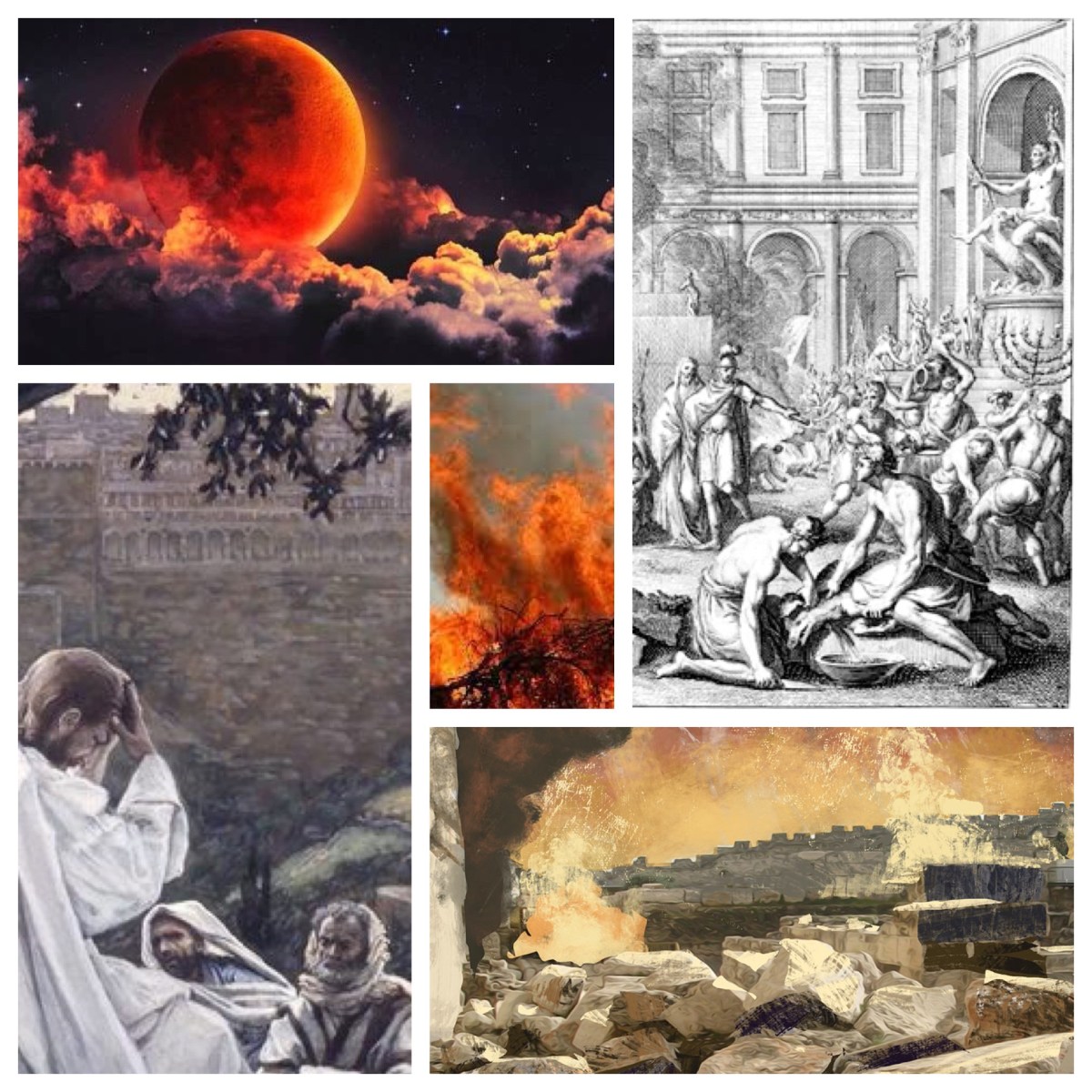
The Gospel reading for this coming Sunday (Mark 13:1–8) comprises the beginning of longer speech, a block of teaching which Jesus delivered to his disciples (13:3–37), some time after they had arrived in the city of Jerusalem (11:1–11). It’s a striking speech, with vivid language and dramatic imagery, drawn from the increasingly apocalyptic fervour of prophetic oracles delivered through the history of Israel. The apocalyptic character of the speech means that it certainly makes a mark!

There are some important questions to be asked about apocalyptic texts such as Mark 13. We need to locate such texts in their historical context—something I have done in https://johntsquires.com/2021/11/10/faithfulness-in-the-turmoil-of-the-time-the-historical-context-of-mark-13-pentecost-25b/

We also need to consider the nature of such literature, the purpose for which each of the apocalyptic oracles and speeches were given in their own time. It is important to understand the literary nature of apocalyptic writings, as well as the social-historical context in which such works came into being. The same applies for the apocalyptic speech of Jesus reported in Mark 13.

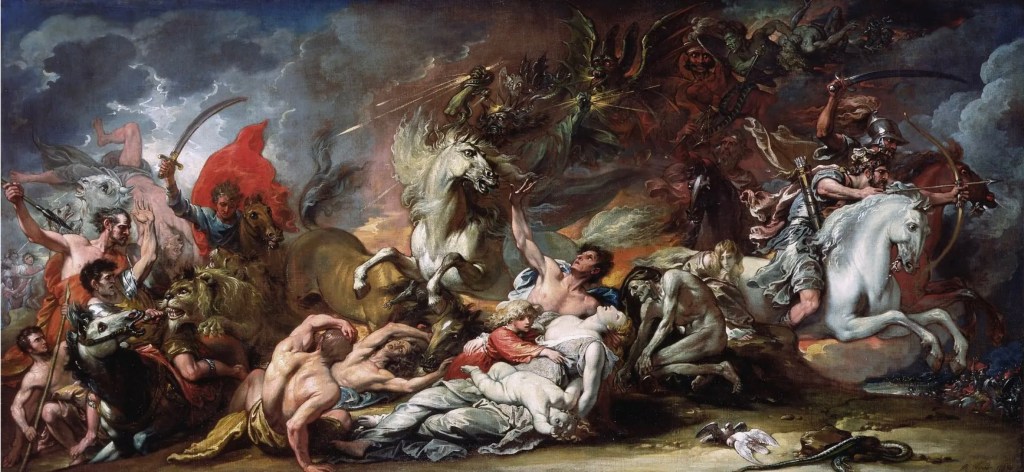
“Death on the Pale Horse” (1796)
by the American artist Benjamin West

The typical literary characteristics of apocalyptic texts are well-documented. There are a number of features which are found consistently throughout such texts, features which are striking in their impact and powerful in their capacity to invite attention. What is central to all apocalyptic writings is a clear portrayal of a stark conflict between good and evil, which often comes to a head in a grand cosmic battle. To put it in populist terms, apocalyptic texts “spin a good yarn”. They use the techniques of dramatic storytelling, or of good action films.

An apocalyptic text is typically composed in a narrative style, relaying a divine revelation which has been given to a human figure in a visionThat human figure is often someone from the pages of the Hebrew Scriptures. The claim that this figure dictated the revelation is a literary device, designed to claim authority for the work; linguistic and historical analysis inevitably demonstrates that the figure claimed as author could not actually have written the work.

Often an angel will interpret the vision (or visionary journey) that has been revealed to this figure. We can see this, for instance, in Rev 1:1–2. In the case of Mark 13, however, such a revelation comes directly from Jesus, without any angelic mediation.

When relating the events of the end times, apocalyptic literature may include a chronology of events that are to occur; frequently these events are placed in the near future, giving sense of urgency to the message being proclaimed. So Jesus outlines a sequence of events that are yet to take place (13:8, 10, 14, 21).

The present time is painted in bleak tones in apocalyptic texts (13:11–13, 17–19, 24–25); by contrast, the visions of the future are bright, positive, and hopeful (13:26–31). God will ensure that the final conflict results in victory; the world as is currently known will be replaced by a glorious period. Often the visions of these end times mirror the language and ideas of creation stories, telling of how God triumphs over the primordial forces of chaos. The darkness that enshrouds the earth (13:24–25) will be replaced by glorious divine light (13:26).

In such revelations, some human beings belong to a group that will assuredly be saved—thus, Jesus refers to “the elect” (13:27); by contrast, the rest of humanity will face utter destruction. In the speech by Jesus, this fate can be inferred from the insistent repetition of “keep alert … keep awake … keep awake” in 13:33–37.

Many apocalyptic works will describe this fate in gruesome detail, often in surreal or fantastic terminology, through grand visionary accounts.

Whilst inferred in Mark’s account of the speech by Jesus, the gruesome details are added in Matthew’s version; the master will “cut the slave in pieces and put him with the hypocrites, where there will be weeping and gnashing of teeth” (Matt 24:51; this is repeated at 25:30, and reinforced at 25:46).

Alongside this, the fate of “ the elect” is celebrated: in the story of the bridesmaids, “those who were ready went with him into the wedding banquet; and the door was shut”, leaving the unprepared locked outside (25:10). In the parable of the talents, those affirmed are told, “I will put you in charge of many things; enter into the joy of your master’” (25:21, 23). In the parable of the sheep and the goats, the righteous are invited to “inherit the kingdom prepared for you from the foundation of the world” (25:34) and “enter into eternal life” (25:46). The dichotomy is clear.

So Jesus is, by and large, adhering to the conventions of the genre, as he presents his graphic portrayal of what lies on store for his followers in this speech, delivered on the Mount of Olives, opposite the Temple (Mark 13:3). An in making use of this genre, Jesus demonstrates that speaking in apocalyptic terms is actually doing political theology within a specific socio-historical context.

Apocalyptic is doing theology, in a particular way. It can best be regarded as political theology—that is, it explores faith in the context of the realities of life in the polis, the city. It often provides a counter-narrative to the dominant story of the rulers and those in power, exposing the evil of their ways and proposing an alternative world in which righteous-justice will reign supreme.

Paul D. Hanson developed a strong case for understanding the apocalyptic literature of the second century BCE and the following centuries as being the result of “a long development reaching back to pre-exilic times and beyond, and not the new baby of second century foreign parents”, as some other scholars have maintained. See https://www.readings.com.au/products/6590310/the-dawn-of-apocalyptic-the-historical-and-sociological-roots-of-jewish-apocalyptic-eschatology

The people of Israel, even from the time before they were taken into exile, lived under the shadow of the dominant world power of the time—the Assyrians, who conquered the northern kingdom; then the Babylonians, who took the southern kingdom into exile; then, after a return under the Persians, an apparently more benign power, before the crushing power of the Macedonian empire under Alexander the Great and his successors.

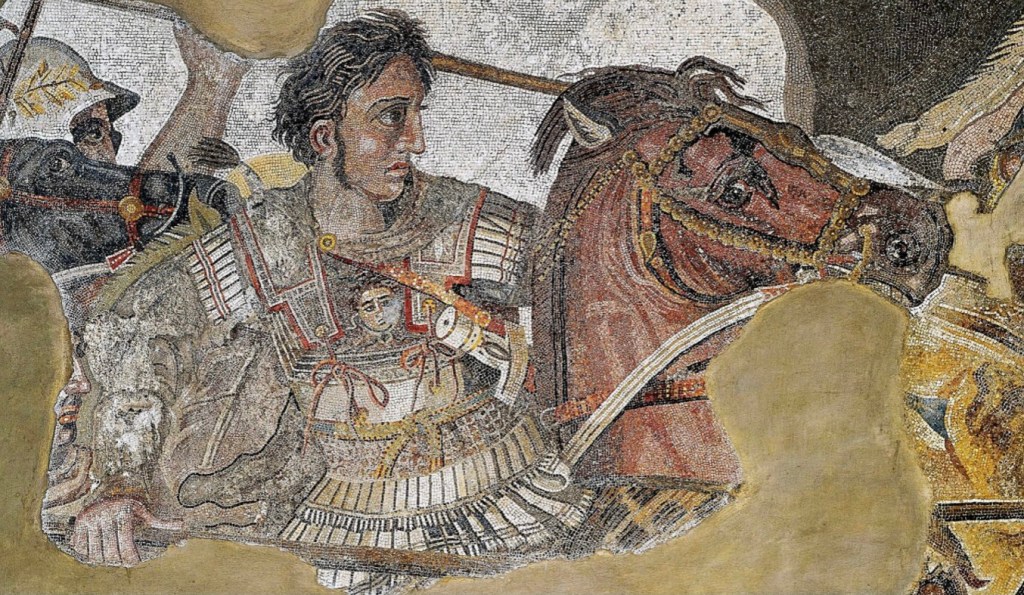
Detail from a mosaic at Pompei,
showing Alexander the Great in battle

This pattern of an unbroken development from preexilic and exilic prophecy through to the inter testamental period and on into the time of Jesus and the early church, and the ensuing centuries. (We traced some dimensions of that in the earlier post exploring “ the end”, ***

John J. Collins writes that “Apocalyptic literature evokes an imaginative world that is set in deliberate counterpoint to the experiential world of the present. Apocalypticism thrives especially in times of crisis, and it functions by offering a resolution of the relevant crisis, not in practical terms but in terms of imagination and faith.” See https://readingreligion.org/books/apocalyptic-imagination

We might well say, from this, that the function of apocalyptic is like that if a fairy story, or a fable-or a longer book or play or film, in which the reader or viewer is invited to “willingly suspend disbelief” and enter into the story that is being offered.

Tellers of apocalyptic tales invite their listeners, living in times of crisis, to suspend disbelief, watch the vision unfolding, hear the angelic interpretation, even undertake the heavenly journey that the author retells; and to do this with expectation and hope.

Apocalyptic texts are written in the midst of despair fuelled by foreign invasion, murder and rape during the pillaging of that invasion, enforced slavery, religious repression, cultural imperialism, and societal oppression, with the loss of much-loved traditional practices and customs, disconnection from the homeland (the place where God resided), and a continuing sense of having been abandoned by God.

In the midst of all of this, readers and listeners of apocalyptic texts are invited to have hope: hope that God would act; hope that despair would be dispelled and life would flourish once now; hope that the familiarity of traditions would be reinstated; hope that the evils perpetrated by the invading oppressors would be rectified by acts of divine revenge; hope that life, even in their own time, would be transformed into a realm where righteous-justice was in force, where the evils of lawlessness were dispelled.

There are clear, sharp pointers to the political situation of the time in which works of apocalyptic are written–from the time of the Seleucid rulers (from the 180s BCE) through to the Roman conquest of Judaea (63 BCE) and on into the period we call the first century CE, when Jesus lived and then the Gospels were written. These works are political.

All of this, this, it should now be clear, is what Jesus was looking to in his parables of the kingdom, in his teachings about living with fidelity to the covenant with God, in his invitations to his followers to walk the way he walks, leading to the realm of God’s kingdom. His visions of cataclysmic times, in the apocalyptic speech of Mark 13, point to the reality that God is now acting to intervene in events, overturn evil, and institute the righteous-justice of God.

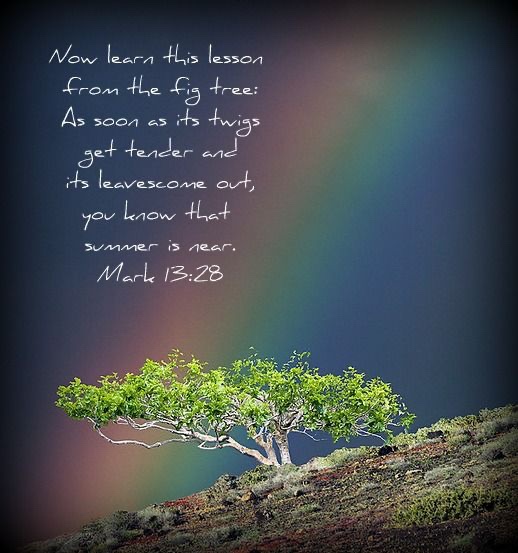
And all of this is intensely contextual, thoroughly political, firmly directed towards the injustices perpetrated under the religious and economic system of the Temple and the cultural and religious oppression of the Roman colonisers. The birth pangs that are just beginning (13:8) herald the coming good times when “the great power and glory” of the Lord is evident (13:26) as “the Son if Man … will gather his elect” (13:27), a time when “summer is near” (13:28). That is the kingdom of God, in which much fruit is borne (4:20, 28), much growth occurs (4:32), new life will emerge (8:31; 9:31; 10:34); 12:27), righteous-justice is enacted by God (12:9-11) and love of God and neighbour is practised by those in that kingdom (12:32-34). Indeed, Jesus says that “when you see these things taking place, you know that the kingdom of God is near”, in the parallel (and expanded) account in Luke (see Luke 21:31).

Out of the darkness and despair, the agony of the birthpangs point to the hope of abundance that has been persistently proclaimed by Jesus. And so, we might pray: may that time come, may that kingdom be a reality, even in our time, even in our place; or, as Jesus taught us to pray: “your kingdom come, your will be done, on earth, as in heaven”.

Love God, love neighbour: prioritising the Law (Mark 12; Pentecost 23B)

“You shall love the Lord your God with all your heart, and with all your soul, and with all your strength, and with all your mind” (Deuteronomy 6:5). “You shall love your neighbour as yourself” (Leviticus 19:8). These two commandments are cited in a story about Jesus engaging in a discussion with a scribe, a teacher of the Law, which ends with Jesus saying, “there is no commandment greater than these” (Mark 12:31). We hear this story in our Gospel reading for worship this coming Sunday (12:28–34).

Of course, Jesus hasn’t answered the question precisely in the terms that it was asked; he doesn’t indicate what is “the first” commandment, but which two are “greatest”. It’s like a dead heat in an Olympic race: a race when even a finely-tuned system can’t differentiate between the two winners, even down to one thousandth of a second. Both love of God and love of neighbour are equally important. Joint winners!

Both commands are biblical commands, found within the foundational books of scripture within Judaism. They were texts that Jewish people, such as Jesus and his earliest followers would have known very well. Each command appears in a significant place within the books of Torah, the first five books of Hebrew Scriptures.

The command to “love God” sits at the head of a long section in Deuteronomy, which reports a speech by Moses allegedly given to the people of Israel (Deut 5:1–26:19). The speech rehearses many of the laws that are reported in Exodus and Leviticus, framing them in terms of the repeated phrases, “the statutes and ordinances for you to observe” (4:1,5,14; 5:1; 6:1; 12:1; 26:16–17), “the statutes and ordinances that the Lord your God has commanded you” (6:20; 7:11; 8:11).

After proclaiming the Ten Commandments which God gave to Israel through Moses (Deut 5:1–21; cf. Exod 20:1–17) and rehearsing the scene on Mount Sinai and amongst the people below (5:22–33; cf. Exod 19:1–25; 20:18–21). Moses then delivers the word which sits at the head of all that follows: “Hear, O Israel: The LORD is our God, the LORD alone. You shall love the LORD your God with all your heart, and with all your soul, and with all your might. Keep these words that I am commanding you today in your heart” (Deut 6:4–6). This, it would seem, is the key commandment amongst all the statutes and ordinances.

These words are known in Jewish tradition as the Shema, a Hebrew word literally meaning “hear” or “listen”. It’s the first word in this key commandment; and more broadly than simply “hear” or “listen”, it caries a sense of “obey”. These words are important to Jews as the daily prayer, to be prayed twice a day—in keeping with the instruction to recite them “when you lie down and when you rise” (Deut 6:7). As these daily words, “love the Lord your God” with all of your being are said, they reinforce the centrality of God and the importance of commitment to God within the covenant people.

See further discussion of the way that this commandment appears in the Synoptic Gospels at https://johntsquires.com/2021/10/26/love-with-all-that-you-are-heart-and-soul-completely-and-entirely-deut-6-in-mark-12-pentecost-23b/

The command to “love your neighbour” in Leviticus 19 culminates a series of instructions regarding the way a person is to relate to their neighbours: “you shall not defraud your neighbour … with justice you shall judge your neighbour … you shall not profit by the blood of your neighbour … you shall not reprove your neighbour … you shall love your neighbour” (Lev 19:13–18).

These instructions sit within the section of the book which is often called The Holiness Code—a section which emphasises the word to Israel, that “you shall be holy, for I the Lord your God am holy” (Lev 19:2; also 20:7, 26). Being holy means treating others with respect. Loving your neighbour is a clear manifestation of that ethos. Loving your neighbour exemplifies the way to be a faithful person in covenant relationship with God.

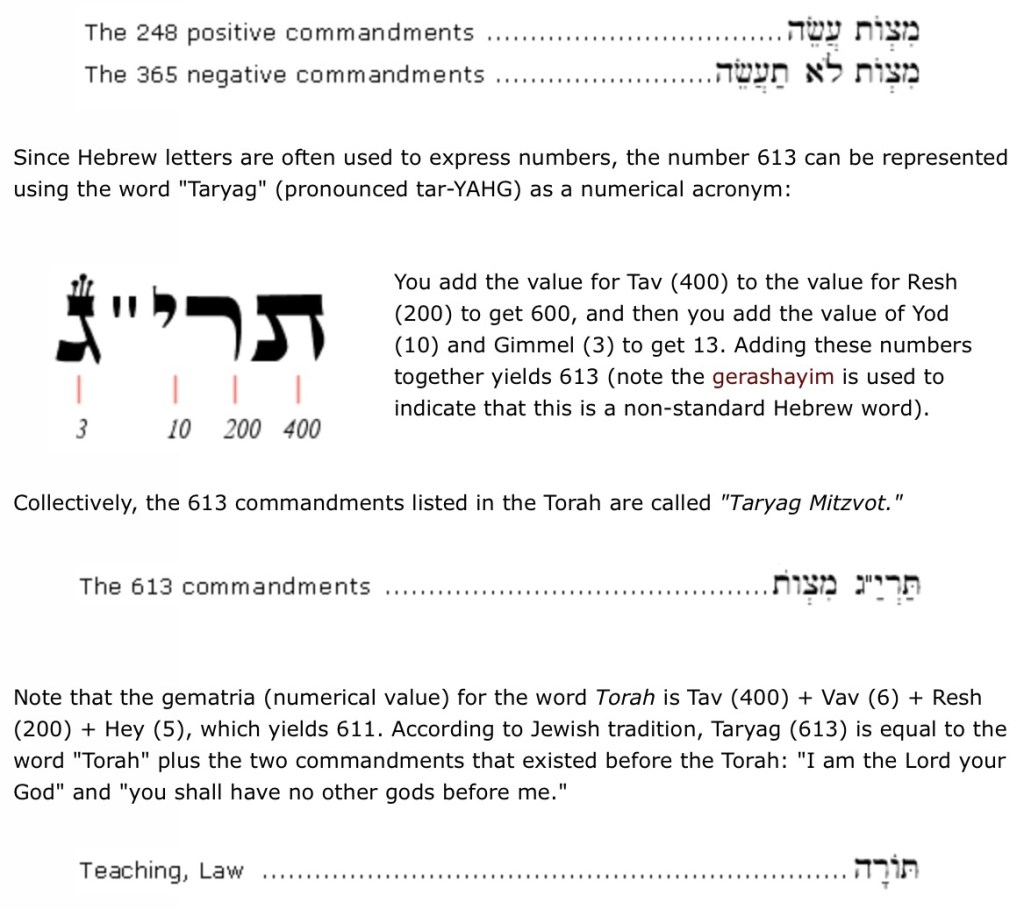
So it is for very good reasons that Jesus extracts these two particular commandments from amongst the 613 commandments that are to be found within the pages of the Torah. (The rabbis counted them all up—there are 248 “positive commandments”, giving instructions to perform a particular act, and 365 “negative commandments”, requiring people to abstain from certain acts.)

Jesus, of course, was a Jew, instructed in the way of Torah. He knew his scriptures—he argued intensely with the teachers of the Law over a number of different issues. He frequented the synagogue, read from the scroll, prayed to God, and went on pilgrimage to Jerusalem and into the Temple—where, once again, he offered a critique of the practices that were taking place in the courtyard of the Temple (11:15–17).

Then he engaged in debate and disputation with scribes and priests (11:27), Pharisees and Herodians (12:13), and Sadducees (12:18). Each of those groups came to Jesus with a trick question, which they expected would trap Jesus (12:13). Jesus inevitably bests them with his responses (11:33; 12:12, 17, 27). It was at this point that the particular scribe in our passage approached Jesus, perhaps intending to set yet another trap for him (12:28).

So Jesus, good Jew that he was, is well able to reach into his knowledge of Torah in his answer to the scribe. The commandments that he selects have been chosen with a purpose. They contain the essence of the Torah. His answer draws forth the agreement of the scribe—there will be no robust debate now! In fact, in affirming Jesus, the scribe reflects the prophetic perspective, that keeping the covenant in daily life is more important that following the liturgical rituals of sacrifice in the Temple (see Amos 5:21–24; Micah 6:6–8; Isaiah 1:10–17).

The scene is similar to a Jewish tale that is reported in the Babylonian Talmud, a 6th century CE work. In Shabbat 31a, within a tractate on the sabbath, we read: “It happened that a certain non-Jew came before Shammai and said to him, ‘Make me a convert, on condition that you teach me the whole Torah while I stand on one foot.’ Thereupon he repulsed him with the builder’s cubit that was in his hand. When he went before Hillel, he said to him, ‘What is hateful to you, do not to your neighbour: that is the whole Torah, the rest is the commentary; go and learn it.’”

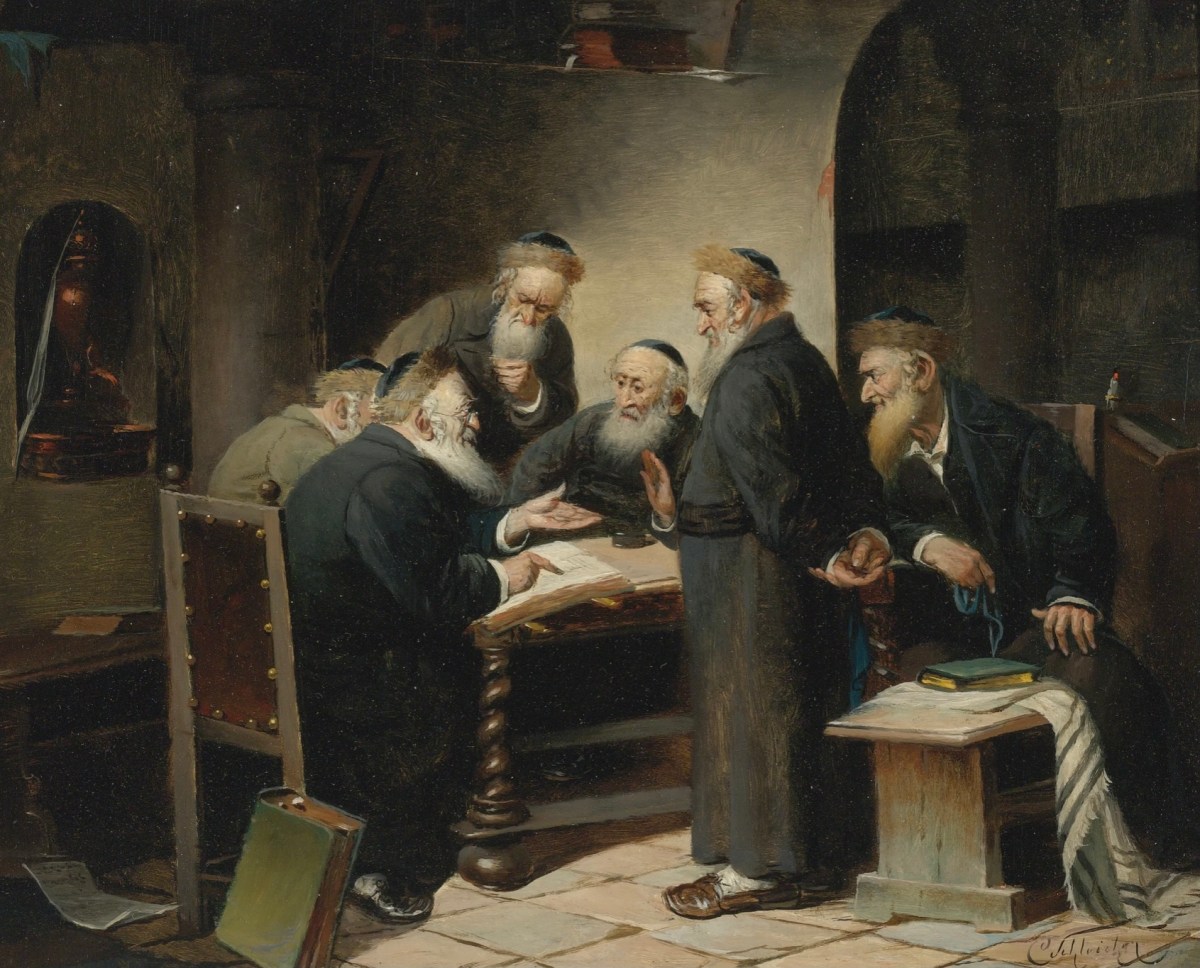
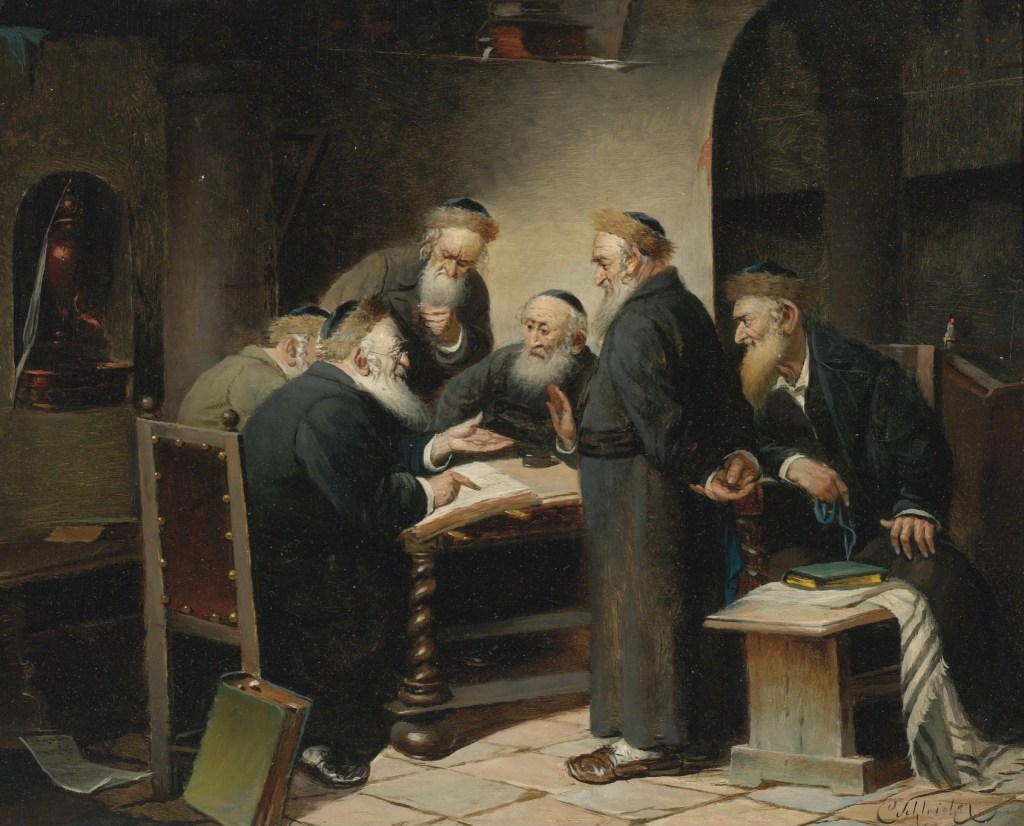
Carl Schleicher (1825–1903)
“A Discussion of the Talmud”

Hillel, of course, had provided the enquiring convert, not with one of the 613 commandments, but with one that summarised the intent of many of those commandments. We know it as the Golden Rule, and it appears in the Synoptic Gospels as a teaching of Jesus (Matt 7:12; Luke 6:31).

Some Jewish teachers claim that the full text of Lev 19:18 is actually an expression of this rule: “You shall not take vengeance or bear a grudge against any of your people, but you shall love your neighbour as yourself: I am the LORD.” Later Jewish writings closer to the time of Jesus reflect the Golden Rule in its negative form: “do to no one what you yourself dislike” (Tobit 4:15), and “recognise that your neighbour feels as you do, and keep in mind your own dislikes” (Sirach 31:15).

Paul clearly knows the command to love neighbours, for he quotes it to the Galatians: “the whole law is summed up in a single commandment, ‘You shall love your neighbour as yourself’” (Gal 5:14), and James also cites it: “you do well if you really fulfill the royal law according to the scripture, ‘You shall love your neighbour as yourself’” (James 2:8). Both writers reflect the fact that this was an instruction that stuck in people’s minds!

And I wonder … perhaps there’s a hint, in these two letters, that the greater of these two equally-important commandments is actually the instruction to “love your neighbour”?

Not to be served, but to serve: the model provided by Jesus (Mark 10; Pentecost 21B)

“The Son of Man came not to be served but to serve, and to give his life a ransom for many” (Mark 10:35-45). So Jesus instructs his followers, after a bruising encounter with James and John, two of the leading followers of Jesus (10:35-40) which enraged the rest of the disciples (10:42).

The dispute was over status; James and John wanted to claim the places next to Jesus: “one at your right hand and one at your left, in your glory” (10:37). This was not unusual in the world of that time (indeed, this is still the case in our own times). Public debate that was intended to best the other person was common in ancient Mediterranean societies. Seeking greater honour (higher status) by getting the upper hand, or the last word, in public debate, was common.

In an honour—shame society, such as that in which Jesus, James, and John lived, the culture was characterised by a constant and ongoing “challenge—riposte,” enacted in the public arena. Jesus engaged in such challenges on a regular basis; see the disputations of 2:1-3:6, early in Jesus’s time in Galilee, and later in Jerusalem, in 11:27-12:34.

Such challenge—riposte encounters typically involved the challenger setting forth a claim, through either words or actions; a response to the challenge by the persons who was challenged; then, after further back-and-forth amongst the participants, once the challenge and riposte has run its course, the verdict is declared by the public who was watching the encounter. (See a clear description of this process, as it applies in Mark 11:27–12:34, using the analysis of Jerome Neyrey and Bruce Malina, at https://www.etsjets.org/files/JETS-PDFs/43/43-2/43-2-pp213-228_JETS.pdf)

At this moment, Jesus critiques the common process of public disputation; he distances himself from the common cultural practice of seeking honour and working for a higher status. Those who lord it over others, who act as tyrants, are not to be the role models for his followers; “it is not so among you; but whoever wishes to become great among you must be your servant, and whoever wishes to be first among you must be slave of all” (10:43–44). Indeed, Jesus rubs salt into the wound by inferring that James and John were acting like Gentiles (10:52). That was an insult, to be sure, for good Jews (see the sayings attributed the Jesus at Matt 5:47; 6:7, 32).

This was the third time, after demonstrating their misunderstanding of what Jesus was teaching, that his disciples were directly rebuked for their attitude. First, Peter represents the disciples’ lack of clarity about Jesus (8:27–38); then a number of the disciples arguing about being great, and John fails to welcome the activity of a person casting out demons (9:33–48); and now, James and John demonstrate their continued inability to understand the attitude of Jesus towards status (10:35–40).

At least in this last scene, the other ten disciples are angry about what James and John have asked for (10:41). Far too often, on earlier occasions, Jesus has lamented that the disciples failed to understand (4:22, 13; 6:52; 7:18: 8:17, 21; 9:32). It seems that finally, at this moment, things had fallen into place for the disciples. (Or were they simply annoyed at the way the brothers promoted their own interests over the hopes of the other disciples?)

On each of those three occasions of misunderstanding, Jesus responds by correcting the inadequacies displayed by his followers: he refers to the fate that is in store for him in Jerusalem (8:31; 9:31: 10:32–34), and then he indicates that his followers must tread that same pathway of humility and submission (8:34–38; 9:35–37; 10:38–44). See https://johntsquires.com/2021/09/28/boundary-lines-and-the-kingdom-of-god-mark-9-10-pentecost-18b-to-20b/

On this occasion, Jesus goes one step further. His own life—or, more precisely, the laying-down of his own life—is to be seen, not just as the model for his followers to emulate, but as “a ransom for many” (10:45). There are important observations to make about this short statement. Those matters will be the focus of a subsequent blog post.

Boundary lines and the kingdom of God (Mark 9–10; Pentecost 18B to 20B)

Last week (Pentecost 18) we heard a Gospel passage in which Jesus affirmed that “whoever is not against us is for us” (Mark 9:40). He refused to draw strong and clear boundaries around his “inner group” simply on the basis of explicit identification with him—rather, he affirmed that it is the actions of people that define where people are to be placed in relation to him. Deeds, not words, define the followers of Jesus.

That line of argument would be take up by his brother, James, in his “letter” affirming that “faith without works is dead” (James 2:26), and by another follower (by radiation, the evangelist Matthew), who quoted him as saying, “not everyone who says to me, ‘Lord, Lord,’ will enter the kingdom of heaven, but only the one who does the will of my Father in heaven” (Matt 7:21). It is a strong theme in the testimony to Jesus in Christian scripture: actions, not words, define allegiance to Jesus.

This week (Pentecost 19), we hear a Gospel passage in which Jesus becomes indignant with his closest followers, rebuking them for hindering children from gaining access to him. In contrast to the attempts of the disciples to keep the children at a distance, Jesus drew children close to himself and blessed them, saying, “whoever does not receive the kingdom of God as a little child will never enter it” (Mark 10:15). The boundary line which Jesus draws is clearly not based on age. The ability to articulate a complex theological affirmation is not the key criterion. Rather, it seems that a willingness to search out Jesus, a desire to be with him, is the key criterion.

Jesus has already affirmed the central significance of a child in his consideration of this issue. Mark notes that “he took a little child and put it among them” (9:36), speaking the very clear affirmation that “whoever welcomes one such child in my name welcomes me, and whoever welcomes me welcomes not me but the one who sent me” (9:37). Still earlier, Jesus had placed the health of a child at the centre of his focus, when approached by a synagogue leader, who pleads with Jesus, “my little daughter is at the point of death; come and lay your hands on her, so that she may be made well, and live” (5:23).

We have noted that the child was a person with no authority, no status, no prestige or power, in the society of the day; yet the low-status, not-important child is the exemplar, not only of Jesus, but of God, “the one who sent me” (9:37). Welcoming the child is a clear manifestation of the paradox that lies at the heart of the Gospel. Jesus is the one who will walk resolutely towards death (8:31: 9:31: 10:34), becoming “the slave of all” (10:44) who will “give his life a ransom for many” (10:45).

Those who follow Jesus on this pathways will need to take up their crosses (8:34), lose their lives (8:35), be “last of all and servant of all” (9:35), “receive the kingdom of God as a little child” (10:15), sell all that they possess (10:21), leave their families (10:29), and become “last of all” (10:31). (See https://johntsquires.com/2021/09/06/the-paradoxes-of-discipleship-mark-8-pentecost-16b/)

Next week (Pentecost 20), we will hear a Gospel passage in which Jesus sadly informs a man of means who prides himself on keeping all the commandments, that still “you lack one thing: go, sell what you own, and give the money to the poor, and you will have treasure in heaven; then come, follow me” (Mark 10:21). The man left, shocked and grieving; he could not do what Jesus instructed. Jesus here draws the line of belonging or being alienated from him on the basis of whether a person is able to implement radical actions of obedience.

We have seen the way that the author of this account of Jesus (by tradition, Mark the evangelist) redraws the boundaries of the people of God, by his actions in relating to people in need (see https://johntsquires.com/2021/06/24/on-not-stereotyping-judaism-when-reading-the-gospels-mark-5-pentecost-5b/) and by the geography that he traverses, as he edges outside of the land of Israel (see https://johntsquires.com/2021/08/24/stretching-the-boundaries-of-the-people-of-god-mark-7-pentecost-14b-15b/).

We have also seen that it was the courageous rhetorical challenging of Jesus by a Gentile woman which provoked him to be absolutely clear about this more inclusive boundary (see https://johntsquires.com/2021/09/02/on-jesus-and-justa-tyre-and-decapolis-mark-7-pentecost-15b/) And again, in this incident, it is the health of a young child which draws action from Jesus (7:26, 29).

The passages in our current stream of lectionary readings reinforce the perspective already developed in these earlier sections of the Gospel (chapters 5 to 10). Jesus is not an exclusivist, drawing hard boundary lines close around his group. He is an inclusivist, looking to welcome those from beyond the traditional inner group, inviting in those on the fringe or outside this conventional group.

That’s the consistent message about Jesus in the stories that we read through the central chapters of this account. It’s the consistent theme that followers of Jesus in the 21st century need to ensure are the key markers of the Christian church today.

Just sandals and a staff—and only one tunic (Mark 6; Pentecost 6B)

Mark’s Gospel emphasises the necessity of faithful discipleship; “follow me” is an important refrain from the beginning of Mark’s story. In three early scenes, the command of Jesus, “follow me”, is met each time with an immediate response: Simon and Andrew follow him (1:17), then James and John follow him (1:19), and then Levi the tax collector follows him (2:14). Each leave what they are doing and follow Jesus.

These scenes set the pattern for the rest of the narrative bout the beginning of the good news of Jesus the chosen one: Jesus challenges people to respond to him with an active, informed discipleship; to leave the comfort of the familiar and set out following him. He reiterates the call, “follow me”, in later scenes (8:34; 10:21).

The disciples in the narrative of Mark’s Gospel readily demonstrate this response. The disciples, and indeed a larger crowd, did indeed follow Jesus in his journeys around Galilee (2:15; 3:7; 5:24; 6:1; 10:28, 32, 52) and then southwards towards Jerusalem (11:9). Indeed, a group of women who followed him in Galilee continue all the way to Golgotha, watching from a distance as he dies (15:41).

But following Jesus is not just about walking along beside him. The Gospel account makes it clear that followers are to step beyond Jesus, to walk out ahead of him, into unchartered territory. Following Jesus (discipleship) involves being sent forth (mission). And Jesus does this very thing with his followers. He sends them out, on mission.

On the very first occasion when Jesus gathers all twelve apostles together, he gives them a twofold commission: “he appointed twelve … to be with him and to be sent out to proclaim the message and to have authority to cast out demons” (3:14–15). To be with him, following as disciples; and to be sent out, engaged in mission.

As the Gospel then reports how Jesus speaks and acts, the meaning of this discipleship and mission is spelled out. The apostles—and other followers—have the opportunity to learn from his teachings and to witness his actions while they are with Jesus, and then to replicate these teachings and actions through their presence in other places.

“Proclaiming the message and casting out demons” is how the activities of Jesus are characterised from the start of the narrative (1:39). His earliest message was clear: “the kingdom of God is at hand; repent, believe the good news” (1:15). His activity, also, was striking: he rebukes unclean spirits (1:23–26), “healed many who were sick with various diseases, and cast out many demons” (1:34).

These same activities form the basis for the work of the twelve as they leave Jesus and undertake his mission in the wider community (6:7–13). In this enterprise of mission, the disciples model their words and deeds on Jesus: “they proclaimed that all should repent…they cast out many demons and anointed with oil many who were sick and cured them” (6:12–13).

As they undertake this mission, the followers of Jesus are to be characterised by an ascetic mode of dress (6:8–9) as they undertake their public proclamation (6:10–11). Both elements deserve careful attention.

“He charged them to take nothing for their journey except a staff—no bread, no bag, no money in their belts— but to wear sandals and not put on two tunics.” So Jesus instructs his followers (6:8–9). In the parallel passages for this incident, Jesus is even more strict. In Luke, he prohibits sandals as well (Luke 10:3), and in Matthew, he prohibits both sandals and staff (Matt 10:10)

The description of the mode of dress for the followers of Jesus given here is often compared with the form of dress of a wandering philosopher, particularly of a Cynic philosopher.

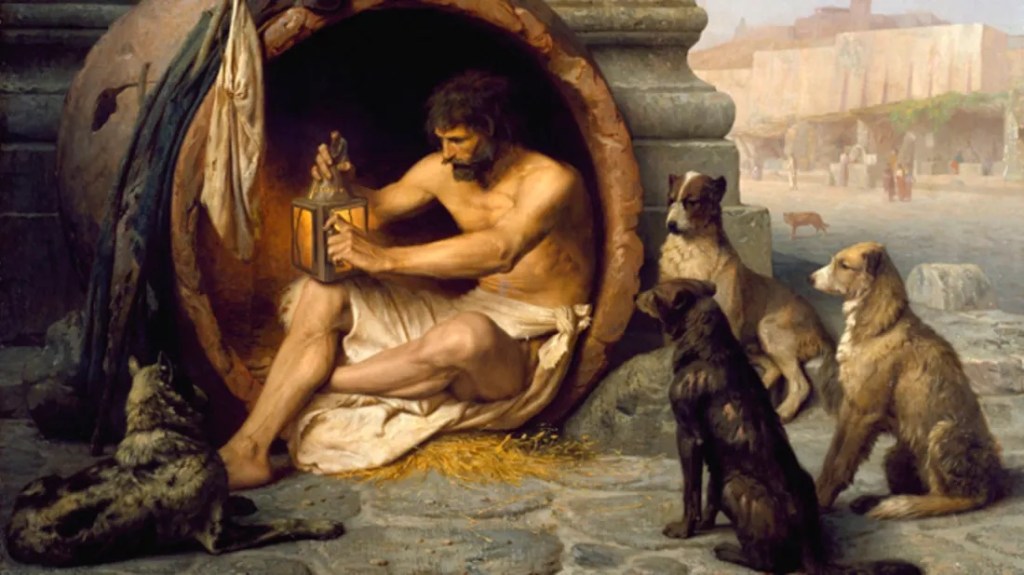
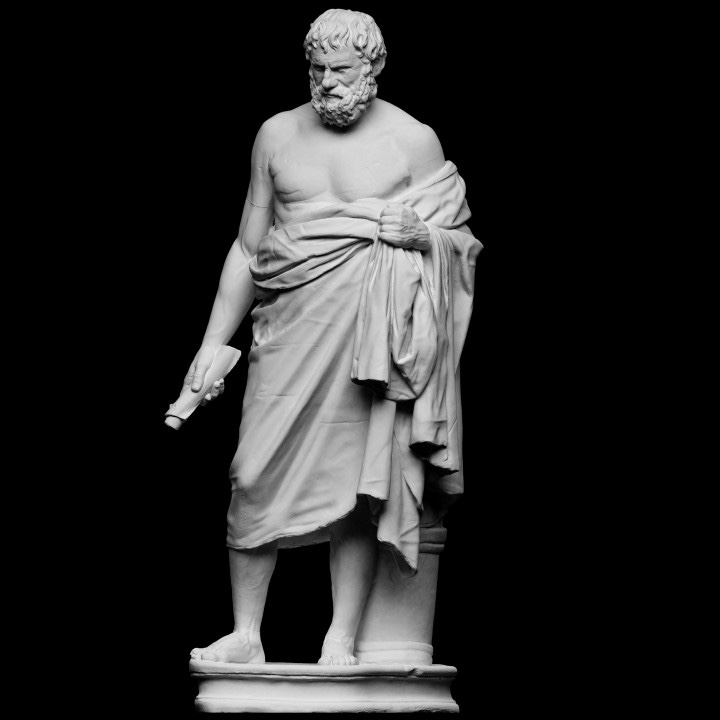
Cynic philosophy is named after Diogenes of Sinope, who lived c.400–325 BCE. Diogenes was known as “the dog” (kunos, in Greek) because of his shameless and primitive style of living. Diogenes was given the nickname ‘the dog’ because of his shamelessness. He used to live in a barrel with his only possessions being a robe to wear and a stick to walk.

There are many stories told about Diogenes’ rebellious and nonconformist character. Those who promulgated his philosophy of life, called Cynicism, lived equally simple, basic lives. Sandals, a staff and a cloak characterised many of them (although it seems that a double cloak was worn by many).

Was Jesus telling his disciples to emulate the Cynic philosophers? They were itinerants, travelling from town to town, speaking their views with frankness and then moving on to the next town or village. The followers of Jesus were also to be itinerant, travelling from place to place, boldly proclaiming their message, and staying nowhere for too long.

The second century document, The Didache, clearly instructs followers of Jesus not to remain for more than two or three days in any one place (Didache 11–13). Jesus here is a bit more lenient; he doesn’t set a time limit, but instructs his followers to move on if they meet resistance. In this way, still, they were to emulate Jesus, as “the Son of Man who has nowhere to lay his head” (Matt 8:20; Luke 9:58).

It’s not at all clear that Jesus knew Cynic philosophy; the evidence of Cynic activity comes from places outside Israel. The Cynics were active long before Jesus, but continued on into his time, and beyond. Diogenes lived four centuries before Jesus, and adherents to his type of philosophy are known three centuries after the death of Jesus.

The second century CE writer, Diogenes Laertius, includes accounts of a number of key Cynic philosophers in his large work, Lives of Eminent Philosophers. The second century CE philosopher and orator, Dio of Prusa (nicknamed Chrysostom, meaning “golden-mouthed”), noted how many wandering Cynic philosophers were encountered in every town or village.

In his 32nd Oration, Dio describes the typical Cynic: “posting themselves at street-corners, in alley-ways, and at temple-gates, [they] pass around the hat and play upon the credulity of lads and sailors and crowds of that sort, stringing together rough jokes and much tittle-tattle and that low badinage that smacks of the market-place.”

Dio’s criticism continues: “they declaim speeches intended for display, and stupid ones to boot, or else chant verses of their own composition, as if they had detected in you a weakness for poetry. To be sure, if they themselves are really poets or orators, perhaps there is nothing so shocking in that, but if in the guise of philosophers they do these things with a view to their own profit and reputation, and not to improve you, that indeed is shocking.”

For Jesus to be calling his followers to a way of life that could be seen as comparable to this way of living, would be quite a challenge—and quite a shock.

Indeed, there may be a sign of differentiation from the Cynics. The Stoic philosopher Epictetus is reported as saying that the features which distinguish a Cynic are “his provision-bag (peran) and his staff and his big mouth” (Arian, Discourses of Epictetus 3.22.50). Jesus states that his followers should carry a staff, and speak their message—but here he prohibits them from carrying a provision-bag (peran, 6:8).

Another point of differentiation may be the command not to put on two tunics (6:9). The Greek word used is chiton. The chiton was a knee-length tunic worn as an undergarment; Josephus reports the common practice of wearing two chitones when travelling (Antiquities 17.136).

Musonius Rufus (Epistle 19) notes that Cynics typically wore two tunics—a tribon over their chiton. The tribon was a more humble garment than a chiton, so the outward appearance projected by a Cynic would have been, quite deliberately, that of a person of very lowly status. But for Jesus, the direction to wear only one tunic reflects an even more ascetic mode of living.

Was Jesus deliberately projecting an image—and a reality—deliberately differentiated from the Cynics? Certainly, direct contact by Jews with wandering Cynic philosophers was most likely reasonably rare. And I think that Jesus isn’t advocating specifically that his followers emulate the Cynics.

Jesus has his own reasons for the call he makes. Being on the move and not tied down to one place, and living simply without all the extraneous baggage, reflected an ethos that Jesus wished to cultivate. The focus was to be on the message and the key actions of the disciples, not on any extraneous or additional elements.

Perhaps what is in mind here is the Exodus story, in which the Israelites prepare themselves to be on the move, with minimal complications. They are to wear their clothes (which lasted them the whole time—Deut 8:4, 29:5). They are to fasten their belt and carry their staff (Exod 12:11), and wear their sandals (Exod 12:11; Deut 29:5). They are to take no bread—God will provide in the form of manna and quail, falling from heaven.

The attention of the disciples, as they engage in mission, proclaiming the message, healing, and casting out demons, is to be directed entirely to the task at hand. They are directed away from carrying too many accoutrements, worrying about provisions, and to focus on the task of proclamation and healing. In this way they are to follow the example and pattern of Jesus.

For that is what he himself taught: “do not be anxious, saying ‘what shall we eat?’ or ‘what shall we wear’?” (Matt 6:31). And that is what Jesus himself did: “the Son of Man has nowhere to lay his head” (Matt 8:20; Luke 9:58).