
The “resurrection of the dead ones” (the Greek word translated as “the dead” is plural, reflecting a raising of many believers) was a Jewish belief that had developed in preceding centuries; not all Jews accepted it (see Acts 23:6–8) and amongst some Gentiles there was scepticism about the idea (see Acts 17:32). There was also dispute about this matter in Corinth, resulting in a number of debates about particular aspects of this belief. In the section of 1 Cor 15 dealt with last week, two such matters have been explored, debated, and dispatched.
Thus week the lectionary picks up at v.35, where a third pastoral situation might possibly be indicated. The form employed (a rhetorical question attributed to an indefinite person) was commonly used by a skilled rhetorician to raise an objection which he knew could be raised, allowing it to be dealt with in advance (the same technique is found in Rom 2–6 and 9–11). The question provides an opportunity for further eschatological teachings about the nature of the resurrection body (15:35–50) and a further display of Paul’s rhetorical prowess.
The issue at stake here is the nature of the resurrection body, identified in an opening pair of questions: “how are the dead raised? with what kind of body do they come?” (15:35). These are not mere rhetorical questions; Paul and Sosthenes fully intend to address such enquiries with a detailed exposition. The weight of the argument, in my mind, lies in a set of contrasts by juxtaposition, advanced in a sequence of logical steps in vv.42–49:
What is sown is perishable / what is raised is imperishable.
It is sown in dishonour / it is raised in glory.
It is sown in weakness / it is raised in power.
It is sown a physical body/ it is raised a spiritual body.
If there is a physical body / there is also a spiritual body.
Thus it is written, “The first man, Adam, became a living being”/
the last Adam became a life-giving spirit.
But it is not the spiritual that is first /
but the physical, and then the spiritual.
The first man was from the earth, a man of dust; /
the second man is from heaven.
As was the man of dust, so are those who are of the dust; /
and as is the man of heaven, so are those who are of heaven.
Just as we have borne the image of the man of dust, /
we will also bear the image of the man of heaven.
The symmetry is certainly poetically and rhetorically satisfying. The argument is a straightforward typology, in which one thing is seen to correspond to another thing on a different plane, or in a different dimension—but also to differ from them: the first man correlates with the second man, but while the first is “the man of dust”, the second is “the man of heaven; and while “the living being” shares the same living existence with “the life-giving spirit”, this being also differs from that spirit.
The language found here draws on terms used by the authors of the letter in earlier chapters. A contrast between “perishable” and “imperishable” has already been made in the discussion of the race in which “all runners compete” in the statement that “athletes exercise self-control in all things; they do it to receive a perishable wreath, but we an imperishable one” (9:25). The perishable reward is the winner’s wreath (9:25), while the imperishable reward is clearly the salvation referred to in an earlier verse (9:22). This language will return in the concluding couplet at the end of the discussion of this particular issue (v.50).
The clear contrast of the saying about the wreath carries over into the discussion in ch.15 where “the perishable” is contrasted with “the imperishable”, and “what is sown” is juxtaposed alongside “what is raised”. This contrast would seem to draw strongly on the Platonic distinction between spirit and flesh, in which the spirit is the realm of ultimate reality, but the flesh represents the prison in which human beings are trapped during this life.
The letter proposes that the former is sown “in dishonour, in weakness”—features characterising sinful humanity—while the latter is raised “in glory, in power”—attributes of the divine. These are the characteristics of “the man of dust”, Adam, who encompasses those who are set to experience death (15:21–22). It is through “the life-giving spirit”, the “last Adam”, that resurrection life is granted (15:45). We might thus consider that the argument here is thoroughly dualistic; the Platonic influence is undoubted.
So a similar contrast is drawn between “spiritual” and “physical”; this has been an important factor in the argument of the early chapters of this letter. In their opening thanksgiving, Sosthenes and Paul noted that the saints in Corinth “are not lacking in any spiritual gift” (1:7). However, a little later they lament that they could not address them as “spiritual people”, for they still need milk, not solid food, as befits “infants in Christ” (3:1–2). And the exercise of “spiritual gifts” in Corinth, canvassed in quite some detail in ch.12—14, reveals a chaotic exuberance in which the “building up of the assembly” is almost entirely lacking. Perhaps the note in the opening thanksgiving was ironic, then?
Indeed, in one section of the letter (in ch.2), the spiritual / physical contrast is very strong; the contrast is set in stark fashion. First, the human heart is unable to conceive “what God has prepared for those who love him” (2:9, introduced as scripture, most likely paraphrasing Isa 52:15 or Isa 64:4). Accordingly, God’s wisdom is “secret and hidden”, for “no one comprehends what is truly God’s except the Spirit of God” (2:7, 11).
Thus, there is a clear distinction between “those who are unspiritual”, who “do not receive the gifts of God’s Spirit … and are unable to understand them”, and “those who are spiritual [who] discern all things” (2:14–15). It is the believers in this latter group who have been granted “the Spirit that is from God, so that we may understand the gifts bestowed on us by God” (2:12). The closing word in this section is, “we have the mind of Christ” (2:16, riffing off the affirmation of Isa 40:13).
This spiritual / physical contrast is bound up with the contrasts between wisdom / folly (1:18–25) and weakness / power (1:26–31) that formed the basis for the clarion declaration, “when I came to you, brothers and sisters, I did not come proclaiming the mystery of God to you in lofty words or wisdom; for I decided to know nothing among you except Jesus Christ, and him crucified” (2:1–2). That is the foundation for the message articulated throughout this letter.
Although Paul maintains that “my speech and my proclamation were not with plausible words of wisdom” (2:4), the message that he brought the Corinthians was indeed imbued with wisdom—although he maintains that “it is not a wisdom of this age or of the rulers of this age, who are doomed to perish”; rather it is “God’s wisdom, secret and hidden, which God decreed before the ages for our glory” (2:6–7). In like fashion, whilst Paul declares that he came to the Corinthians “in weakness and in fear and in much trembling” (2:3), there was nevertheless “a demonstration of the Spirit and of power” when he was with them (2:4).
So there is a deep paradox in this language, for in any one word there can be two related, but quite distinct, meanings. Wisdom is both human and divine; power is both absent and yet present. It is perhaps this paradox, in which qualities overlap and inter-relate, rather than a simplistic dualism of spheres, keeping the two entities far apart, that we might best see in these words of chapter 15.
Although the language appears sharp and polemical, the contrast is rhetorical rather than existential: wisdom is made foolish in order to convey wisdom, power is rendered weak in order to express power, and spiritual matters are gifted to those whom we might regard as thoroughly physical, fleshly, material, in order that the Spirit might be at work in and through human beings. It’s a paradox.
So here is the paradox at play: it is the expression of spiritual things—the gifts of wisdom, knowledge, faith, healing, miracles, prophecy, discernment, tongues, and interpretation (12:8–10), or the gifts granted to “apostles … prophets … teachers”, as well as “deeds of power, gifts of healing, forms of assistance, forms of leadership, various kinds of tongues, [and] interpret[ation]” (12:28–30)—which are manifested amongst the human beings in the community of faith in Corinth, and indeed in other such communities in other places and other times. There is no fundamental dualism; rather, the spiritual infuses and works in and through the physical. That is the key to the paradox.
So the “man of dust” is but a type for the “man of heaven”; and those who believe, who are “called to be saints” (1:2; see also 6:1–2) share in both images. The “man of dust”, of course, evokes the second version of the creation story, in which “the Lord God formed humankind (ha-adam) from the dust (aphar) of the ground” (Gen 2:7a). And in that verse lies also the seed of the idea that the “man of heaven” would be “a living being” (1 Cor 15:45), for the creation narrative continues, “and [God] breathed into his nostrils the breath of life (nishmat hay-yim); and the man became a living being (nephesh hay-yah)” (Gen 2:7b). The wordplay in Hebrew is delicious!
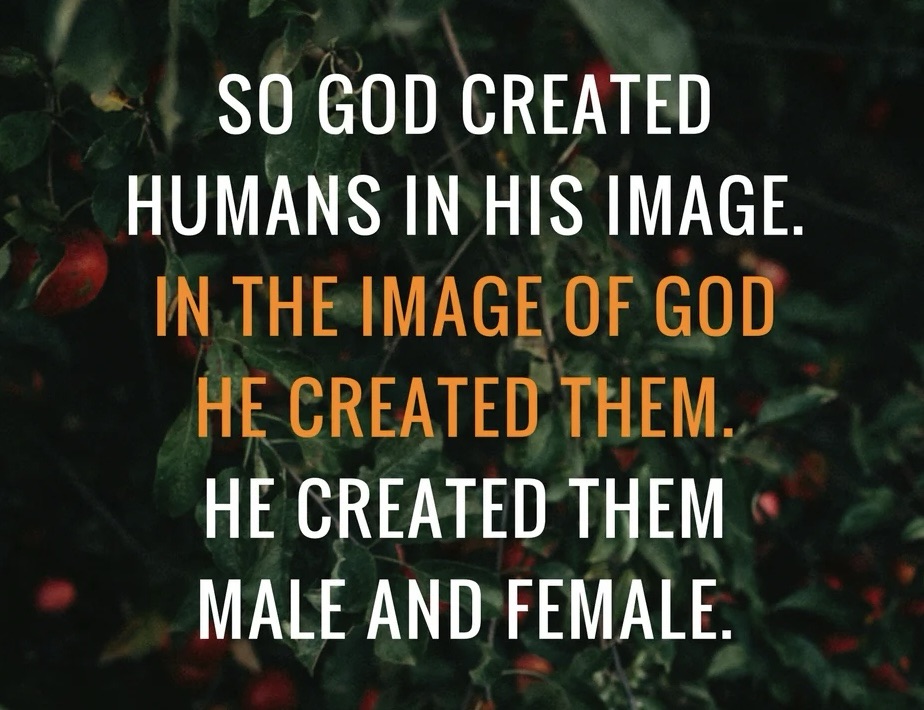
So the argument presented in 1 Cor 15:42–49 is in fact, in its form, a midrashic exposition of scripture. Its foundation is this twofold portrayal of the “man of dust” and the “living being” (Gen 2:7). Its climax draws from another scripture—this time, from the first creation narrative, which itself reaches its narrative climax in the poetic affirmation that “God created humankind (ha-adam) in his image, in the image of God (betselem elohim) he created them; male and female he created them” (Gen 1:27).
One final note is that it is Paul’s use of the reference to “the last Adam” (that is, Jesus) as “a life-giving spirit” (1 Cor 15:45) that ties the whole argument into this discussion of resurrection. Spirit and resurrection are closely linked. The same connection is stated quite explicitly by Paul in the letter that he, alone, wrote to the Romans. When he is discussing “those who live according to the Spirit” (Rom 8:5), he declares “the Spirit of him who raised Jesus from the dead dwells in you, he who raised Christ from the dead will give life to your mortal bodies also through his Spirit that dwells in you” (Rom 8:11). The indwelling of the Spirit in the lives of believers is equivalent to the act of “giv[ing] life to your mortal bodies”.
Then, however, the authors conclude their discussion of the resurrection body with a pair of contrasts that make it perfectly clear that resurrection life exists in an altogether different plane from this earthly life: “flesh and blood cannot inherit the kingdom of God, nor does the perishable inherit the imperishable” (1 Cor 15:50). We will think more on this in next week’s blog.
Suffice to say that, in my mid, this conclusion has lapsed back into the Platonic dualism inherent in the language; but as I have noted, I don’t think this was entirely what Paul (and Sosthenes) actually meant to do. Theologically, in my mind, the kingdom of God is precisely evident in the flesh and blood that characterises ice as we currently know it. Is this not what Jesus meant in his most provocative sayings about the kingdom?
See also




 An Informed Faith