Have mercy on me … wash me thoroughly … blot out my iniquities (Psalm 51; Pentecost 11B)

Last Sunday we heard the story of David’s adultery with Bathsheba (2 Sam 11:1–15). In the passage that we hear this Sunday (2 Sam 11:26—12:13), the prophet Nathan regales him with a tale of a rich man with “very many flocks and herds” and a poor man with “nothing but one little ewe lamb” who was much loved and was “like a daughter to him” (12:1–3).

See

Nathan’s story ends with a powerful punchline: “he took the poor man’s lamb, and prepared that for the guest who had come to him” (12:4). The point is clear; the rich man has acted unjustly. David immediately erupts in anger at the selfish acts of the rich man. “As the Lord lives”, he exclaims, “the man who has done this deserves to die” (12:5). And yet, after a lengthy diatribe from the prophet, speaking forth the word of the Lord to the king (12:7–14), David changes his tune.

Nathan confronts David

“I have sinned against the Lord”, David says to Nathan, who then reassures him, “now the Lord has put away your sin; you shall not die” (12:13). Nathan has executed his prophetic role with power: calling David to account. At least the king recognises his sin and repents. God both punishes and forgives him.

Reflecting on the nature of repentance, and forgiveness, we are led to ponder Psalm 51: “have mercy on me, O God, according to your steadfast love; according to your abundant mercy blot out my transgressions”, the psalmist sings. The first half of this song (Ps 51:1–12) is offered by the lectionary as the Psalm for this coming Sunday.

The ascription at the head of this psalm makes the traditional connection with David (as is also the case with 72 other psalms in the book), and provides a specific occasion for the writing of this psalm: “when the prophet Nathan came to him, after he had gone in to Bathsheba”. It would seem that the psalm first this occasion quite neatly.

This is one of a dozen psalms that each has an ascription which relates the particular song to an incident in David’s life: “when he fled from his son Absalom” (Ps 3; 2 Sam 15); “when the Lord delivered him from the hand of all his enemies and from the hand of Saul” (Ps 18; 2 Sam 22); “when he pretended to be insane before Abimelech, who drove him away, and he left” (Ps 34; 1 Sam 21); “when Doeg the Edomite had gone to Saul and told him, ‘David has gone to the house of Ahimelech’” (Ps 52; 1 Sam 22); “when the Ziphites had gone to Saul and said, ‘Is not David hiding among us?’” (Ps 54; 1 Sam 23); “when the Philistines had seized him in Gath” (Ps 56; 1 Sam 21); “when he had fled from Saul into the cave” (Ps 57; 1 Sam 22); “when he fought Aram Naharaim and Aram Zobah, and when Joab returned and struck down twelve thousand Edomites in the Valley of Salt” (Ps 60; 2 Sam 8); “when he was in the Desert of Judah” (Ps 63; 1 Sam 22–23); and “when he was in the cave” (Ps 142; 1 Sam 22).

Whether any of these ascriptions do report the actual incident that motivated the psalm—or whether the historical note was added subsequently by a later person, on the basis that “this seems to fit”—we cannot definitively say. So whether this particular ascription for Ps 51 is historically accurate or not, it does provide an appropriate insight into the emotions that the writer presents, on an occasion when deep grief and profound contrition appears to have been stirred up.

If this psalm was written by David after he had raped Bathsheba, it could well indicate a profound transformation, from the all-powerful monarch to the humbly repentant sinner. If it is (as many scholars believe, on the basis of language and style) a later exilic creation, it still expresses the inner this formation that can come to a person of faith when they understand the extent of their sin and seek the loving forgiveness of the Lord. In this latter case, it is a psalm for all of us, when confronted with our sinfulness, and challenged to repent. It is a song that envisages a thoroughgoing moral transformation.

Personally, I am sceptical about the historical value of this ascription. Aside from the specific linguistic criticisms that have been advanced, it does not sit well with the character of David as revealed elsewhere in the historical narratives of 1–2 Samuel. The scheming of the king and the aggression of David’s men in battle after battle, both before and after this incident, do not indicate someone with a deep reflective capacity or a totally transformed personality.

David rose to power, maintained his power, and consolidated his kingdom through brute military force in many battles over the years. His kingship was a reign of sheer power; he was a warrior king. I have surveyed the battles that David was engaged in throughout his time as king in an earlier blog; see

After his confrontation with Nathan, David continues in this vein; he goes on to conclude his war against the Ammonites (2 Sam 12:26–31), refuses to punish Amnon for his rape of Tamar (ch.13), did battle against Absalom when he usurped the throne (chs. 15—18), put down an uprising led by Sheba son of Bichri (ch.20), and fought various battles against the Gibeonites and the Philistines (ch.21) before he dies (1 Ki 2:10). His character as warrior king remains unabated.

It is true that after his confrontation with Nathan, David does show mercy to various men: first, to his third son, Absalom (ch.14), and then to Shimei son of Gera, Mephibosheth the grandson of Saul, and Barzillai the Gileadite (ch.19).

However, it is quite telling that the final remembrance of King David is the list of “the warriors of David” with recounting of some of their exploits (ch.23) and then the census that he ordered (24:1–9)—although this latter act was something that he immediately regretted (24:10). Nevertheless, it seems that his character remains consistent with the warrior king David who raped Bathsheba and ordered the death of Uriah the Hittite.

So is Psalm 51 an authentically Davidic expression of remorse and repentance? J. Richard Middleton believes that, whilst there are some indications that do link this psalm with the narrative of 2 Sam 11–12, there are a number of disjunctures. He outlines his case in a carefully-argued article that compares the two passages of scripture.

“A Psalm against David? A Canonical Reading of Psalm 15 as a Critique of David’s Inadequate Repentance in 2 Samuel 12” (ch.2, pp.26 in Explorations in Interdisciplinary Reading. Theological, Exegetical, and Reception-Historical Perspectives, ed. Robbie F. Castleman, Darian R. Lockett, and Stephen O. Presley; Pickwick, 2017). See https://jrichardmiddleton.com/wp-content/uploads/2017/08/middleton-a-psalm-against-david-explorations-in-interdisciplinary-reading-20171.pdf

First, Middleton notes that the psalmist pleads to be delivered from death (Ps 51:16), yet David is explicitly told he will not die (2 Sam 12:13). Second, the psalmist envisages that the process of forgiveness will be lengthy and repetitive (Ps 51:1–2, 7, 9), whilst David receives immediate forgiveness (2 Sam 12:13).

Third, the psalmist offers petitions for many different things, but David only “pleaded with God for [his] child; David fasted, and went in and lay all night on the ground” (2 Sam 12:16). Finally, whilst the psalmist confesses “against you, you alone, have I sinned, and done what is evil in your sight” (Ps 51:4), David’s sins (as I have noted in previous blogs) are against Bathsheba and Uriah, as well as “against the Lord” (2 Sam 12:13).

Middleton adds to this the observation that there is a noticeable dissonance between the prose narrative and the poetic song in terms of the extent of moral reformation that follows on from the confession of sin. The psalmist prays “in verse 10 for a pure heart and a steadfast spirit and in verse 12 for a willing spirit—a request that is related to God’s desire for faithfulness in the inner person (which was articulated in verse 6)”.

In contrast to this, Middleton argues (on p.39) that “not only is this request never voiced by the David of the Samuel narrative, it is (more importantly) never fulfilled in David’s life”. He notes that “the David of the narrative certainly has the broken spirit and broken and crushed heart that the psalmist says is a true, godly sacrifice in verse 17”, he nevertheless “does not get beyond this to the moral reformation of character presupposed in the psalm”.

Middleton deduces from this that “while the psalmist is broken and crushed in spirit prior to receiving forgiveness, and so pleads desperately for cleansing and restoration, the David of 2 Samuel is broken and crushed in spirit after receiving forgiveness and remains an ambivalent character for the rest of the Samuel” (p.40). So what the narrator has conveyed in the account of David’s rather knee-jerk (and perhaps superficial) response to Nathan’s confronting words indicates that he falls far short of the personal angst that led the author of Psalm 51 to a deep personal transformation.

Which means both, that we treat with caution the way that David is so lauded and exalted and painted in such a positive way in much of the 1–2 Samuel narrative; and that we appreciate the profound nature of the thoughts and feelings expressed by the psalmist (most likely NOT King David) in Psalm 51. It could well be a psalm that each one of us could pray, at an appropriate occasion.

See also

The Golden Bull (Exod 32 and Psalm 106; Pentecost 20A)

The psalm which is offered for this coming Sunday (an excerpt from Psalm 106) was surely chosen to complement the reading from Exodus offered by the lectionary. The first cluster of verses from this psalm (Ps 106:1–6) invite us to praise the Lord, for God’s “steadfast love endures forever” (v.1). The Lord is one who is able to show favour to people, to deliver them, and to grant prosperity to “his chosen ones” (vv.4–5).

The final verse of this selection offers a contrast, noting that “both we and our ancestors have sinned; we have committed iniquity, have done wickedly” (v.6), before the second selection of verses (vv.19–23) recounts the famous episode of sinful behaviour by Israel, known popularly as “the Golden Calf episode”—which is what is told in the narrative of Exodus 32, the Hebrew Scripture reading for this coming Sunday (Exod 32:1–14).

This story most likely relates to the god who was regarded as the head of the gods amongst the Canaanites—El, who was often depicted as a bull. The bull was the strongest animal in the ancient farmyard, and thus a fitting symbol for a powerful god. The Israelites chose to imitate that god through their golden construction. The story told in Exodus 32 and summarised in Ps 106:19–23 mocks the Canaanite god, depicting him as more like a calf.

By adopting a Canaanite symbol, the Israelites had turned from God (v.21). It seems they would deserve their fate—although Moses interceded and saved them from divine wrath (v.23). Moses is the hero who stands in the breach, to convince God to change God’s mind. This is a difficult statement, worth pondering further. What sort of god wishes to wreak savage wrath on people? And also, what kind of god is one who changes their mind in response to human petition? Both aspects challenge elements of classic theological understandings of God.

The language of the wrath of God “burning hot” (vv.10, 11, 22) resonates with the constant prophetic warning that God will use fire to destroy people and places because of their sinfulness (Isa 1:7; 5:24; 30:27–28, 30, 33 18–19; Jer 4:4; 6:27–30; 20:47–48; Hos 8:14; Joel 2:1–3; Amos 1:4—2:5; Nah 1:15). Zephaniah portrays utter devastation through divine judgement: “neither their silver nor their gold will be able to save them on the day of the Lord’s wrath; in the fire of his passion the whole earth shall be consumed” (Zeph 1:18). That is an intense fire indeed!

However, the final prophet in the Christian Old Testament, Malachi, reworks this imagery, offering some hope; God’s messenger on The Day of the Lord “is like a refiner’s fire and like fullers’ soap; he will sit as a refiner and purifier of silver, and he will purify the descendants of Levi and refine them like gold and silver, until they present offerings to the Lord in righteousness” (Mal 3:1–4).

The references to good and silver in these prophetic oracles sits interestingly in juxtaposition to the Exodus story, in which Aaron “took the gold [from the ears of the people], formed it in a mold, and cast an image of a calf” (Exod 32:4), before he “built an altar before it” and proclaimed, “Tomorrow shall be a festival to the Lord” (v.5).

So the people gladly “offered burnt offerings and brought sacrifices of well-being” on that altar. The burnt offerings mimick the daily burnt offerings (Exod 29:42), where the Lord God promises “I will meet with you, to speak to you there; I will meet with the Israelites there, and it shall be sanctified by my glory” (Exod 29:42–43). The sacrifices of well-being recall “the burnt offerings and sacrificed oxen as offerings of well-being to the Lord” made during the ceremony to ratify the covenant (Exod 24:5).

The people, under the leadership of Aaron, are deliberately imitating key components of the worship of the Lord God, but in this instance, they are worshipping an idol made with their own hands—in direct disobedience to the commandment “not [to] make for yourself an idol, whether in the form of anything that is in heaven above, or that is on the earth beneath, or that is in the water under the earth” (Exod 20:4).

And so, having offered their sacrifices, “the people sat down to eat and drink, and rose up to revel” (v.6). But not so God, for as he had warned the people, “I the Lord your God am a jealous God, punishing children for the iniquity of parents, to the third and the fourth generation of those who reject me” (Exod 20:5). God will not let this transgression pass; as he says to Moses, “I have seen this people, how stiff-necked they are; now let me alone, so that my wrath may burn hot against them and I may consume them” (Exod 32:10).

A number of psalms reflect the desire for God to punish evildoers severely; “pour out your indignation upon them, and let your burning anger overtake them” is the cry of one psalm (Ps 69:24). Another psalm notes the vengeance of God—“in your hearts you devise wrongs; your hands deal out violence on earth” (Ps 58:2)—and suggests that “the righteous will rejoice when they see vengeance done; they will bathe their feet in the blood of the wicked” (Ps 58:10). The graphic picture of a furious God intent on wreaking damage raises difficult theological questions for us as we read such passages.

The image of fiery punishment comes from the story of Daniel (Dan 3:1–30) and appears again in the last book of the New Testament, where the prophet describes his visions of “the lake of fire that burns with sulfur” (Rev 19:20; 20:10, 14–15), also described as “the second death” (Rev 20:14; 21:8). It is there that the devil, the beast, and the false prophet “will be tormented day and night forever and ever” (Rev 20:10).

In the Gospel of Matthew, in particular, eternal punishment in a fiery furnace features also in the words of Jesus, as he threatens sinners with “the furnace of fire” (Matt 13:43, 50; 25:41), a place of “eternal fire” (Matt 18:8; 25:41), “the hell of fire” (Matt 5:22; 18:9). This builds on the warnings found in Mark’s Gospel about the punishment in store for those who put stumbling blocks in the way of “these little ones”—they will be condemned to “the unquenchable fire” (Mark 9:42–48). These warnings are repeated by Jesus in Matt 18:6–9.

So Jesus follows the prophetic and narrative insistence, in Hebrew Scripture, on the judgement of God being rightly expressed when sinfulness abounds. And the story of Aaron and the golden calf is a clear demonstration of God’s intent to exact punishment.

*****

But the story takes a turn, when Moses mounts a passionate plea to God, asking for the divine fury to be turned away from the sinful people. Invoking the covenant made with Abraham, Isaac, and Jacob, Moses implores, “turn from your fierce wrath; change your mind and do not bring disaster on your people” (Exod 32:12–13).

In this week’s commentaries in With Love to the World, my friend Jione Havea has offered an incisive insight into this story as recounted in Exodus 32. He writes as follows:

The plot is straightforward: Israel complained to Aaron that Moses has disappeared for too long, Aaron organized a golden calf as their God, the Lord became angry and decided to wipe Israel off, Moses appealed for Israel’s sake, and “the Lord changed his mind about the disaster that he planned to bring on his people” (32:14). The Lord reconsidered, and changed their mind.

Previously, in Exodus 2:23–25, God had changed their mind and re-membered the covenant with Abraham, Isaac, and Jacob. In that instance, God responded to the groans and cries of the people. There is a comparable event in Nineveh: “When God saw what they did, how they turned from their evil ways, God changed his mind about the calamity that he had said he would bring upon them” (Jonah 3:10).

In the case of Nineveh, the people changed God’s mind on the basis of their own actions (Jonah 3:5) and agenda (Jonah 3:9); in the golden calf episode, Moses interceded on behalf of Israel. The story line is the same: God changed their mind. Change of mind (read: repentance) is not evidence of weakness in the character of God. Rather, it is evidence of being present, and of honouring the Tongan quality of va (relationship) over against immutable doctrines. We are called to do likewise.

And so, in the story, as he saw the golden calf at base camp, Moses burned in anger—because of the people, and because his own brother Aaron played a key role in their going astray. He was so angry that he broke the tablets of the covenant that the Lord godself wrote. The Lord repented (v.14) but Moses revenged (vv.19–20). He burned and grounded the golden calf into water, and made the people drink it. And he ordered the sons of Levi to kill people—whether “your brother, your friend, and[or] your neighbour”—who were NOT on the Lord’s side (v.27).

The Lord changed their mind—but to the opposite effect. This time, the Lord decided to blot out the people who sinned against the Lord (v.33). Because of the golden calf sinners, the Lord sent a plague (v.35). This time, divine repentance led to destruction—echoing the divine repentance that led to the flood (see Gen 6:5–7).

These stories show that the Lord’s book may have been written (cf. Exod 32:33), but it has not been closed. The Lord may still change their mind, and there is no guarantee that it will be for the reparation of covenant or for the destruction of people. Caveat emptor.

Paul, the law of the Spirit, and life in the Spirit (Rom 8; Pentecost 7A)

Last week, we considered the section of Paul’s letter to the Romans which the lectionary offered: Paul grappling within “the sin that lives within me” (Rom 7:14–25a). In probing that state, Paul came to a rather pessimistic conclusion: “wretched man that I am! who will rescue me from this body of death?” (7:24), before immediately switching to a grateful “thanks be to God through Jesus Christ our Lord!” (7:25). See

This week, the lectionary continues the argument that Paul is developing, as he presses on to rejoice that “there is now no condemnation for those who are in Christ Jesus” (8:1). The passage proposed by the lectionary (8:1–11) marks a dramatic change in tone. Whilst he still recognises that “the mind that is set on the flesh is hostile to God; it does not submit to God’s law” (8:7), the primary focus that Paul now has is on the claim that “the law of the Spirit of life in Christ Jesus has set you free from the law of sin and of death” (8:2).

Paul considers the state of humanity: “to set the mind on the flesh is death … the mind that is set on the flesh is hostile to God; it does not submit to God’s law—indeed it cannot, and those who are in the flesh cannot please God” (Rom 8:6–8). He has already grappled with this in the previous chapter. Here, he presses on to celebrate that, as he tells the believers in Rome, “you are not in the flesh; you are in the Spirit, since the Spirit of God dwells in you” (8:9).

Because of what the Spirit effects in the lives of believers, Paul is embued with great hope—a quality that he expresses in other letters he wrote. He rejoices with the Thessalonians that they share with him in “hope in our Lord Jesus Christ” (1 Thess 1:3) and tells the Galatians that “through the Spirit, by faith, we eagerly waits for the hope of righteousness” (Gal 5:5).

He reminds the Corinthians that “faith, hope and love abide” (1 Cor 13:13), and then in a subsequent letter to believers in Corinth, he asserts that “he who rescued us from so deadly a peril will continue to secure us; on him we have set our hope that he will rescue us again” (2 Cor 1:10)

Paul has already reported to the Romans that “we boast in our hope of sharing the glory of God” (Rom 4:2) and that “we boast in our hope of sharing the glory of God” (5:2). He will go on to refer to “the law of the Spirit of life in Christ Jesus” (8:2), and explain how the work of the Spirit gives hope to the whole creation, currently “in bondage to decay”, which will “obtain the freedom of the glory of the children of God” (8:21). And so, Paul declares, it is “in hope that we were saved” (8:24).

Towards the end of the letter, Paul offers a blessing to the Romans: “may the God of hope fill you with all joy and peace in believing, so that you may abound in hope by the power of the Holy Spirit” (15:13). That the Spirit produces this hope is a fundamental dynamic in the process of “setting [believers] free from the law of sin and of death” (8:2).

The Spirit is rarely mentioned in the first seven chapters of this letter. Paul does note that it was “according to the spirit of holiness by resurrection from the dead” that Jesus was “declare to be Son of God with power” (1:4), and that it was “through the Holy Spirit that has been given to us” that “God’s love has been poured into our hearts” (5:5). And he notes that it was by being “discharged from the law” that believers entered into “the new life of the Spirit” (7:6).

But from 8:1 onwards, the Spirit becomes an active presence in what Paul writes about. The Greek word pneuma appears 33 times in the letter to the Romans; most of these are referring to the Holy Spirit. Strikingly, 19 of these occurrences are in chapter 8; a further eight instances then occur in chapters 9–15.

We might contrast this with the word that is often seen to be the key to this letter, dikaiosunē, which appears 57 times in Romans—including the programmatic key verse of 1:17, 13 times in ch.3, 11 times in ch.4, nine times in ch.5, and then nine more times in chs.9–11. Whilst righteousness is indeed an important word, the Spirit is also of crucial significance in Paul’s argument throughout Romans.

Rom 8:1–11 makes a strategic contribution to what Paul is explaining in this letter—that in the Gospel, “the righteousness of God is revealed through faith for faith” (1:17), that “the righteousness of God has been disclosed, and is attested by the law and the prophets, the righteousness of God through faith in [or of] Jesus Christ for all who believe” (3:21–22).

As he develops his argument, drawing on the story of Abraham (Gen 15), Paul affirms that this righteousness “will be reckoned to us who believe in him who raised Jesus our Lord from the dead, who was handed over to death for our trespasses and was raised for our justification” (4:24–25), concluding that “since we have been made righteous by faith, we have peace with God through our Lord Jesus Christ” (5:1), and asserting that “if Christ is in you … the Spirit is life because of righteousness” (8:10).

Incidentally, when we look at the statistics of word occurrences in the seven authentic letters of Paul, we see that “righteousness” occurs a total of 87 times (57 of them in Romans, 13 in Galatians), whilst “spirit” can be found 117 times: as well as the 33 times in Romans, there are 39 occurrences in 1 Corinthians and a further 15 occurrences in 2 Corinthians, and then 19 more appearances in Galatians. Spirit is a fundamental component in Paul’s theology.

Paul believes that it is by the Spirit that the gift of righteousness is enlivened and activated within the believer. He hammers this point with a series of clear affirmations in this week’s passage (8:1–11): “there is no condemnation” (v.1), “the law of the Spirit has set me free” (v.2), “God has done what the law, weakened by the flesh, could not do: by sending his own Son in the likeness of sinful flesh, and to deal with sin” (v.3), “the Spirit of God dwells in you” (v.9), “the Spirit is life” (v.10), and “he who raised Christ from the dead will give life to your mortal bodies also through his Spirit that dwells in you” (v.11).

Important for Paul is for the believer to know that “you are in the Spirit, since the Spirit of God dwells in you” (8:9) and that “his Spirit … dwells in you” (8:11). This is an idea that Paul also articulates in his first letter to a Corinth, when he poses the rhetorical question, “do you not know that you are God’s temple and that God’s Spirit dwells in you?” (1 Cor 3:16). The answer to this rhetorical question which is expected (but not stated) is, of course, “yes, we do know that God’s Spirit dwells in us”.

A similar rhetorical strategy can be seen as Paul draws this section (Rom 8:1–11) to a close. He poses a matched pair of conditional possibilities: “if Christ is in you” (v.10), “if the Spirit dwells in you” (v.11). The possibility, in each case, is crystal clear: since Christ is in you, “the Spirit is life because of righteousness” (v.10), and since the Spirit dwells in you, “he who raised Christ from the dead will give life to your mortal bodies also through his Spirit that dwells in you” (8:11).

For Paul, then, the role of the Spirit in enlivening and energising the believer is crucial. That is the important contribution that this passage makes to Pauline theology, and to our understanding of the Christian life.

See also

Paul and the Law, sin and the self (Rom 7; Pentecost 6A)

“I delight in the law of God in my inmost self, but I see in my members another law at war with the law of my mind” (Rom 7:23). So Paul writes, in the section of the letter written “to all God’s beloved in Rome, who are called to be saints” which is offered by the lectionary for this coming Sunday (Rom 7:15–25a).

The lectionary wants us to end this reading with the words of gratitude, “thanks be to God through Jesus Christ our Lord!” (15:25a). But in my analysis, Paul’s argument reaches its conclusion with the stalemate of verse 23—a clash between “the law of God” and “the law of my mind”. “Wretched man that I am”, he explodes in exasperation (7:24), after a lengthy and complex consideration of the issues which has led him to this damning conclusion.

What Paul is writing about in this complex section (7:1–25) is about the battle of wills, as God’s will comes into conflict with human will. The argument throughout this chapter—as, indeed, the argument throughout much of Romans—is presented as a dialectic, in which one point of view is put, to be met by an opposite point of view; followed by a rebuttal by the first voice, and a further oppositional claim by the second voice.

The thesis for discussion has been set out in 7:1–6, using the marriage relationship between husband and wife and “another man” (7:1–3) as the basis for an analogy (“in the same way”, 7:4) for the relationship between humans, “living in the flesh” (7:5) whilst also having “the new life of the Spirit” (7:6).

The use of analogy, already developed in earlier Greek rhetoric and used extensively by philosophers and political orators, does reflect rabbinic practice. The deployment of analogy, gezerah shewah, was one of Hillel’s principles of interpretation, indicating the influence of hellenistic thought and ideas on Jewish teachers and writers. So Paul here may well be operating as a rabbi, in the way that he sets out and developed his case.

But the fundamental dualism which underlies this whole chapter—the law of sin and death, the holy law of God—is thoroughly Greek in origin and character. Plato’s view of the soul trapped in the prison of the material world, which he set out in his Allegory of the Cave and which marks so many of his Dialogues: a clear line of demarcation between the spirit and the flesh, the body and the mind, the idea and the particular object.

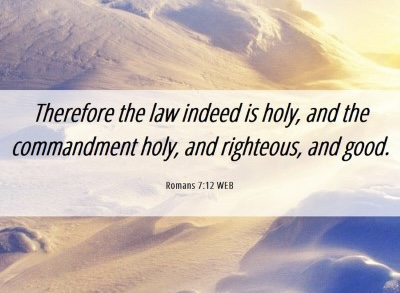
So Paul, trained as a Pharisee, being “far more zealous for the traditions of my ancestors” (Gal 1:14), brings into the discussion a “delight in the law of God in my inmost self” (Rom 7:22). He affirms that he upholds the Torah (Rom 3:31), alluding to various commands in The Ten Words which he insists are worth obeying (2:17–22), and affirming that, in its essential character, “the law is holy, and the commandment is holy and just and good” (7:12).

Yet his calling to be “apostle to the Gentiles” (Rom 11:23; Gal 2:8) led to his experience of eating at table with Jews and Gentiles together, in breach of kosher food laws (Gal 2:11–13)—an issue that is clearly in view decades later, as Luke writes his account of the early years of the Jesus movement, siding with Paul in the view that God has set aside the requirement for separate foods and separate tables (Acts 10:1–11:18; 15:19–20, 28–29).

This, in turn, leads Paul to his missionary goal of bridging the gap between Jews and Gentiles in practical ways (Rom 15:25–27), undergirded by the message that he preaches, affirming that salvation is offered “to everyone who has faith, to the Jew first and also to the Greek” (Rom 1:16; see also 2:10; 10:12; Gal 3:28; and the post-Pauline development in Eph 2:11–22). He is driven by the scriptural claim that “God shows no partiality” (Rom 2:11; Deut 16:19–20; 2 Chron 19:7; Sir 35:15–16).

So Paul brings a firm commitment of this universal availability of salvation into this discussion in Rom 7:1–25. The argument that he has set out in the thesis of 5:1, “since we are justified by faith, we have peace with God through our Lord Jesus Christ, through whom we obtained access to this grace in which we stand”, is argued throughout the ensuing verses, and given a ringing affirmation at the end in 6:23, that all humanity is able to know and access “the free gift of God [which is] eternal life in Christ Jesus our Lord” (6:23).

This sounds, to us today, like a formal debate: three speakers, alternating between the Government for the proposition, the Opposition against the proposition, and then short concluding remarks, before the adjudicator declares a result and announces a winner. In the ancient world, however, Paul is writing in the style of a diatribe—a form that was developed in Ancient Greece and which was widely practised by Greek rhetoricians, philosophers, and teachers during the Hellenistic period.

See my analysis of the diatribe style in Rom 4 at

In the diatribe that Paul develops in Rom 7, he needs to address what he now sees as the inadequacy of Torah, given his affirmation that “God shows no partiality” (2:11) and his commitment to Jews and Gentiles eating together, without scruples regarding the food being shared. This deficiency in the law runs throughout the argument of Romans; it is impossible to keep the law (2:17–3:20).

Since his calling to work amongst the Gentiles, Paul has come to see that the law brings wrath (4:15) and increases sin (5:20), and indeed he maintains that the law “brought death” (7:9). As a consequence, righteousness must be gifted by God “apart from law”(3:21).

Paul, as we have seen, uses the scriptural example of Abraham, who “believed God, and it was reckoned to him as righteousness” (4:3), to argue that “the promise may rest on grace and be guaranteed to all his descendants, not only to the adherents of the law but also to those who share the faith of Abraham” (4:16). See

And so, he declares that “you have died to the law through the body of Christ, so that you may belong to another, to him who has been raised from the dead” (7:4), and thus “we are discharged from the law” (7:6). Paul then demonstrates this in what immediately follows. The law is not sin in and of itself; and yet, “if it had not been for the law, I would not have known sin” (7:6). This is seen, first, through the educational function of the law, which teaches for example, about covetousness (7:7–8a).

Then Paul notes that, paradoxically, the essential nature of the law reveals and activates sin (7:8b—10), so that “the very commandment which promised life proved to be death to me”, before he intensifies this with the claim that “sin, finding opportunity in the commandment, deceived me and by it killed me” (7:11).

He concludes this section with affirmation of the law as “holy, just, and good” (7:12), before clarifying that it was not the Law which brought death to him, but rather “it was sin … working death in me through what is good … through the commandment” (7:13). Paul has worked hard to differentiate sin from the Law; the one is evil, the other is good.

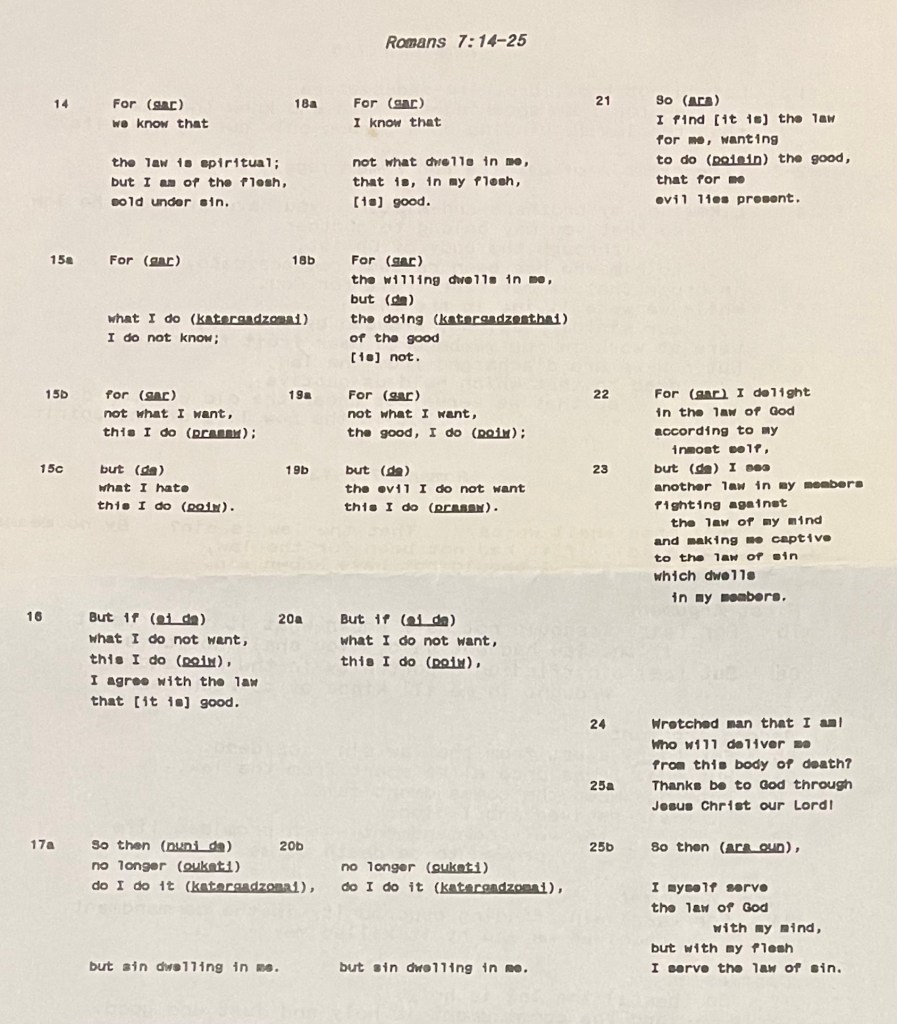
And yet, as he continues his diatribal discussion, more problems emerge (of course, since this is the nature of a diatribe!). Here is the dilemma: “we know that the law is spiritual; but I am of the flesh, sold into slavery under sin” (7:14). What follows is a foray into the murky mind of Paul, where, as he says, “I do not do what I want, but I do the very thing I hate” (7:15)—although he immediately attempts to excuse himself by stating that “it is no longer I that do it, but sin that dwells within me” (7:17).

That sits uncomfortably alongside Paul’s claim to the Galatians, that “it is no longer I who live, but it is Christ who lives in me”, and thus, Paul now “lives to God” (Gal 2:19–20). In writing to the Romans, Paul claims that “nothing good dwells within me, that is, in my flesh” (7:18), for it is “sin that dwells within me” (7:17, 20). The contradiction is confusing. What is the essential force that “lives within” Paul; it is Christ, as in Gal 2, or sin, as in Rom 7?

The confusion caused by “sin that dwells within me” (7:20) whilst still claiming that “I delight in the law of God in my inmost self” (7:22), drives Paul deeper into the hellenistic dualism, seeing “in my members another law at war with the law of my mind, making me captive to the law of sin that dwells in my members” (7:23). No wonder he throws his hands up in despair, exclaiming, “wretched man that I am! who will rescue me from this body of death?” (7:24).

The argument runs a parallel course three times, as my schematic structuring (below) demonstrates. For each proposition that is put (introduced often by the Greek particle gar, “for”), a counter-proposition is offered (introduced by the Greek particle de, “but”).

Modern psychological insights have been used to dig deeper into what Paul writes in Romans 7. Paul appears to be fixated on his own self, using the Greek word egō many times (7:9, 10, 14, 17, 18, 20, 21, 24, and 25). And the language of “sin” and “death” which runs through this chapter exacerbates the tendency to adopt this approach. Declaring that these malicious forces are at work within his inmost being appears to present Paul as a figure consumed with internal contradictions and unresolved tensions. In short, he is a prime candidate for psychological investigation, if not psychiatric intervention!

Who is the person, the egō, who is referenced in these verses? Some interpreters consider that Paul here is talking about his “old self”—the person he was before he encountered the risen Jesus and was commissioned for the task he now undertakes, as “apostle to the Gentiles”. This chapter, reflecting Paul the pious and intense Jew, living under the Law, desperately seeking to obey it in every detail, is thus contrasted with the following chapter, portraying Paul the apostle, fervent and passionate for the mission he is undertaking, freed from the Law and living in the liberty of divine grace.

That simplistic analysis, however, owes more to the 19th century Pietism that was driving interpreters of that time, who considered the Christian life inevitably involved a fierce inner struggle with sin which fermented and eventually erupted into an existential crisis that would, hopefully, ultimately result in a decision to live a new, Christ-centered life. We can see how that dynamic can be extracted from Paul’s agonising words in Rom 7.

A second way of dealing with this chapter, by contrast, has been to claim that the struggle about which Paul here writes reflects precisely the struggle he was enduring after that dramatic encounter with Christ.

The commission that Paul received in that encounter is reported in graphic terms, many decades later, by Luke, who makes the moment into a grand call–and–commissioning scene (Acts 9:3–8; 22:6–11; 26:12–18). Of course, Luke was not present for this event, so he shaped in along the lines of classic call-and-commissioning narratives that existed in earlier Jewish writings. (I have explored this in detail in my commentary on Acts in the Eerdman’s Commentary on the Bible, 2003). In Paul’s own writings, by contrast, this mentioned only briefly, in passing (1 Cor 9:1 and Gal 1:1, 11–12).

Whatever took place in that encounter, it is clear that, as a believer, Paul was not exempt from the ongoing struggle between the desire to do what is pleasing to oneself, but is sinful (Rom 7), on the one hand; and on the other hand, the delight of living a life redeemed by grace (Rom 8). So the passage offered by this week’s lectionary (7:14–25a) is offered as a counterpoint to that which we have on the following Sunday (8:1–11).

This has been the line of interpretation advocated, to various degrees, by Augustine, Aquinas, Luther, and Calvin—but it has fallen into disfavour with contemporary interpreters, who see this as too simplistic and as presenting an unresolved and unintegrated egō. Surely Paul was not caught in that immature state?

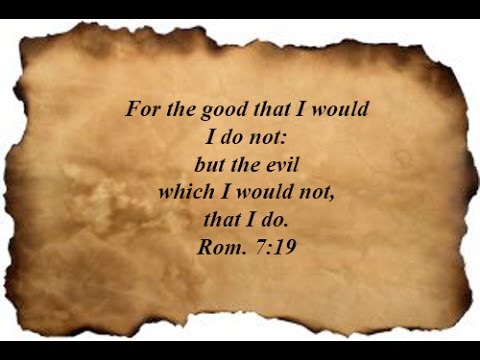
So a third line of interpretation has been that Paul here is setting forth the general, universal condition of the human being. The egō is Paul’s way to talk about “all of us”, for we are all still wrestling with that key characteristic of the human condition: we all, each one of us, “do not do the good [we] want, but the evil [we] do not want is what [we] do” (7:19).

This interpretation was proposed by Kümmel and has been followed by Bultmann, Käsemann, and Dunn, amongst others. Dunn argues that the struggle of Rom 7 provides the key to the argument developed by Paul throughout Rom 5—8 as a whole.

Beyond that, Kristen Stendhal has mounted a persuasive case, that the egō of Rom 7 should not be connected with Paul’s inner being, but rather with the broader issue to which Paul is addressing himself throughout the whole letter of Romans—what place does the Law have in the new community of faith, where both Jews and Gentiles are sharing together in fellowship? How might the demands of the Law function within such a context?

It’s a proposal that I find attractive and helpful, for indeed that broader question is what Paul comes back to in 8:1–8, and then in 9:30–33, 10:1–4, and 11:25–32; and finally in 13:8–10. The egō of Rom 7 is not the last word on this matter; Paul has “yet more light and truth to break forth” on this complex matter!

*****

You can look ahead to what I have to say about some of those passages, at

Original Sin? or Innate Goodness? (Genesis 2, Romans 5; Lent 1A)

In one of his most memorable sayings, repeated by many in the centuries since he wrote his letter to the Romans, Paul declares that “God proves his love for us in that while we still were sinners Christ died for us” (Rom 5:8). In the following verses, he goes on to discuss precisely how Jesus deals with sinfulness by drawing on his understanding of the second creation story (Gen 2:4b—3:24). Paul places Jesus alongside Adam, declaring that “just as one man’s trespass led to condemnation for all, so one man’s act of righteousness leads to justification and life for all” (Rom 5:18).

The argument forms the basis of the Epistle reading for this coming Sunday, the First Sunday in Lent (Rom 5:12–19).

Paul then restates this equation in the following paired affirmation, “just as by the one man’s disobedience the many were made sinners, so by the one man’s obedience the many will be made righteous” (Rom 5:19), before he concludes, “where sin increased, grace abounded all the more, so that, just as sin exercised dominion in death, so grace might also exercise dominion through justification leading to eternal life through Jesus Christ our Lord” (Rom 5:20b—21).

The reality of sinful behaviours amongst human beings cannot be denied. Throughout history, people have always experienced the selfishness, greed, manipulation, abuse, and hatred manifested by others (as well, of course, as loving, selfless, caring, supportive and encouraging behaviours and ways of relating). That this sinfulness needs to be addressed and dealt with cannot be ignored. That God, in Hebrew Scriptures, stands firm for justice and calls for covenant fidelity, is important. That Jesus, in turn, calls out unjust actions and invites sinful people to repent, is consistent with this earlier witness. As a society, we need to function in healthy ways that foster co-operation. Dealing with sin, which impedes this healthy functioning, is vitally important.

Where many people come unstuck in relation to sin, however, is when we consider the origin of that sinfulness. Are human beings born innately sinful? Or is this a way of behaving and relating to others that we learn as we grow and develop? Or, to put it in explicitly theological terms: are we human beings all caught in the grip of original sin?

*****

That is a view that was advocated centuries ago by Augustine of Hippo, and which has come to dominate theological understanding in the church of he ensuing centuries. Augustine read Paul’s words in Romans as a clear statement that every human being is born already scarred by sin. His view was that Paul understood the story in the early chapters of Genesis to be an explanation of this incontrovertible reality. As a result, Augustine declared that “the deliberate sin of the first man is the cause of original sin” (On Marriage and Concupisence, book 2, 26.43).

(Concupisence has a Latin origin: the root term is cupid, meaning desire or passion; it is given a suffix, –escere, used to change a noun into a verb and to signify entering into a particular state of being; and a prefix, con-, which serves to intensify the compound word. As a whole, it means “to desire strongly”; in theological usage, it usually refers to the innate tendency within human beings to sinfulness.)

Augustine based his view on a particular way of reading on Romans 5:12. The NRSV renders this verse as “just as sin came into the world through one man, and death came through sin, and so death spread to all because all have sinned”. A fair warning needs to be given: the argument about this verse is rather technical, because it depends on how we translate just two small words in the Greek original of this verse.

The two words in question are the preposition, epi, and the personal pronoun, ho, which comes immediately after it. Because the pronoun starts with an h sound (a “hard breathing” in Greek) and the preposition ends with a vowel, the natural inclination in Greek is that the preposition is modified so that it slides seamlessly into the pronoun. So epi hobecomes eph’ho.

But how to translate this short and seemingly simply phrase? Here’s where it really gets complicated! We need to take into account the phrase which comes before it, about sin, death, and one man, as well as the words which follow immediately after it, which are hugely significant: “all have sinned” (which of course goes to the heart of the idea of original sin).

Augustine wanted to read this text as stating that sin entered the world through Adam. Technically, he reads the Greek, eph’ho, as referring to the man, Adam. But scholars of Paul’s Greek have seen the problem with this interpretation: eph’ho [(ἐφ’ ᾧ)] as a reference to Adam is “both grammatically and exegetically impossible”, one says.

Rather, “eph’ho pantes hemarton [(ἐφ’ ᾧ πάντες ἥμαρτον)], can be safely interpreted as modifying the word, thanatos [(θάνατος)], which precedes it, and which grammatically is the only word which fits the context.” Each time the grammatical construction of the preposition epi [(ἐπί)] with the dative is used by Paul, it is always used as a relative pronoun which modifies a preceding noun (Rom 9:33; 10:19; 15:12; 2 Cor 5:4; Rom 6:21) or phrase (Phil 4:10).

So eph’ho [(ἐφ’ ᾧ)] is understood to modify thanatos [(θάνατος)]—kai houtos eis pantas anthropous ho thanatos dielthen eph’ho (thanato) pantes hemarton [(καὶ οὕτως εἰς πάντας ἀνθρώπους ὁ θάνατος διῆλθεν, ἐφ’ ᾧ (θάνατο) πάντες ἥμαρτον)]—”because of which” (death), or “on the basis of which” (death), or “for which (death) all have sinned.”

The quotes in the preceding paragraphs come from the technical discussion of this verse at https://hermeneutics.stackexchange.com/questions/14268/translation-of-romans-512

*****

Augustine bases his claim about original sin on his reading of the story of Genesis 2–3 (some of which appears in the lectionary for this coming Sunday, the First Sunday in Lent), which depicts the fall of Adam, from which all humans inherited innate sinfulness (original sin).

However, the problem is that the Genesis 1 account of creation which precedes this story (and which we read later in the year, on Trinity Sunday) makes it quite clear that the original state of humanity was that human beings, like all that God created, “was good”—indeed, that as the final act of that sequence of creation, humanity was “very good” (Gen 1:31). So much for original sin; humanity, according to this narrative, was part of a “very good” creation.

Indeed, Augustine was reading the sequence of early chapters in Genesis as historical narrative, and his understanding was that the consequences of “the fall” in Gen 3 was that every person born after Adam inherited that fallen state from the first human being. However, we know from a careful application of literary criticism, that the Adam story is myth which has an aetiological purpose, and that it is not an historical account.

That is, it does not give a realistic account of “things as they happened”, but rather, it is an imaginative story which tells of the reasons for the origin of things. It doesn’t answer the question, “what happened?”; rather, it responds to the question, “why are things like this?” So the Genesis story as a whole explains the good original state of humanity, before any decline or corruption took place. It is descriptive of how we find things, not prescriptive for how things should be.

In fact, we can see this nature of the story in the names given to these mythical first two human beings: the man, Adam (adam) was created “from the dust of the earth” (haadamah), and so his name signifies “the earth person” (Gen 2:7), whilst the woman, Eve (havah) was to be “the mother of all living creatures” (hay), and thus her name signifies “the giver of life” (Gen 3:20).

It’s not the case that what “occurs” with Adam and Eve has been passed on through human beings ever since; but, rather, it is the case that how we experience humanity has led to the creation of a story about Adam (the earth person) and Eve (the giver of life) as an explanation for the way that we experience ourselves, and other people on this earth.

*****

Augustine’s distinctive interpretation was his own initiative; most patristic writers prior to him who addressed this topic (Barnabas, Hermas, Justin Martyr, Origen of Alexandria, Clement of Rome, Ignatius of Antioch, Cyril of Jerusalem) offered explicitly different interpretations of the human state. By contrast, Clement of Alexandria accepted that sin was inherited from Adam, and Cyprian of Carthage argued for the necessity of infant baptism on the basis of a belief that humans were born sinful.

Augustine had developed his views in opposition to the view of his contemporary, Pelagius; the debates continued on into the medieval period, with significant contributions being made by the great theologians Anselm of Canterbury and Thomas Aquinas, as well as Franciscans such as Duns Scotus and William of Ockham. The Reformers, Martin Luther and Jean Calvin, adopted and developed the Augustinian view, which has held sway in the Western Church over subsequent centuries. Eastern Orthodoxy, by contrast, attributes the origin of sin to the Devil; what we humans have inherited from Adam is our mortality, but not any innate sinfulness.

This is all a long way, then, from prophetic fulminations against foolish, stupid, evil Israelites, caught in the error of their sinful ways, or the grace-filled encounters that Jesus had with sinners as he called “not the righteous but sinners”, or the formulaic affirmation of the first letter to Timothy, that “Christ Jesus came into the world to save sinners”, which has become the bedrock of certain contemporary theologies.

Whilst a recognition of sin is inherent in each of those texts, there is no indication in any way that such sinfulness is innate, inherited from birth, of the very essence of our human nature. The doctrine of original sin is not a biblical idea; it’s not something that we should be maintaining in our theological discourse and spiritual understanding.

But I think we are stuck with the scenario that Jesus ben Sirach described when he wrote his book, “pertaining to instruction and wisdom, so that … those who love learning might make even greater progress in living according to the law” (prelude to Sirach). He admonished his readers, “do not say, ‘His mercy is great, he will forgive the multitude of my sins,’ for both mercy and wrath are with him, and his anger will rest on sinners” (Sirach 5:6). That’s the paradox that sits, unresolved, throughout scripture, that we still need to grapple with for ourselves, when we think about human sinfulness.

*****

See also