The Uniting Church Statement to the Nation (1977)

A sermon preached by the Rev. Elizabeth Raine in Sunday worship of the Tuggeranong Uniting Church on Sunday 18 June, the Sunday before the 46th Anniversary of the UCA (22 June). (Passages in italics are taken from the 1977 Statement to the Nation issued by the First Assembly.)

In a few days time it will be the 46th birthday of the Uniting Church in Australia. At the time, it was certainly a risky and brave adventure, combining three denominations to make one uniquely Australian church.

It seemed to me that the journey of the Uniting church reflected our readings this week – like Abraham, this church stepped out in faith on a journey where a lot was unknown but also where faith in God committed people to the journey. Like the disciples in Matthew, this church sought to go into the communities surrounding them with the good news to make the world a better place.

At the time of the UCA inauguration, a statement was issued to all of the Australian nation, unsurprisingly called the Statement to the Nation. How many of you know it exists? Have read it? Know what’s in it?
After 46 years, sometimes we need to be reminded of the vision of the Uniting Church in Australia, and to recognise that witnessing to this vision is still vital and attainable. This vision called the church to act with love, live with hope, witness in faith, and work for justice.

Today as we celebrate the UCA’s birthday, we are going to read this statement as I think it is one of the greatest and most enlightened documents ever produced by a church.

People of the Congregational, Methodist and Presbyterian Churches have united. A new church has been born. We, who are members of the first Assembly of the Uniting Church in Australia address the people of Australia in this historic moment. The path to unity has been long and at times difficult, but we believe this unity is a sign of the reconciliation we seek for the whole human race.

We acknowledge with gratitude that the churches from which we have come have contributed in various ways to the life and development of this nation. A Christian responsibility to society has always been regarded as fundamental to the mission of the Church. In the Uniting Church our response to the Christian gospel will continue to involve us in social and national affairs.

We are conscious of our responsibilities within and beyond this country. We particularly acknowledge our responsibilities as one branch of the Christian church within the region of South-East Asia and the Pacific. In these contexts we make certain affirmations at the time of our inauguration.

We affirm our eagerness to uphold basic Christian values and principles, such as the importance of every human being, the need for integrity in public life, the proclamation of truth and justice, the rights for each citizen to participate in decision-making in the community, religious liberty and personal dignity, and a concern for the welfare of the whole human race.
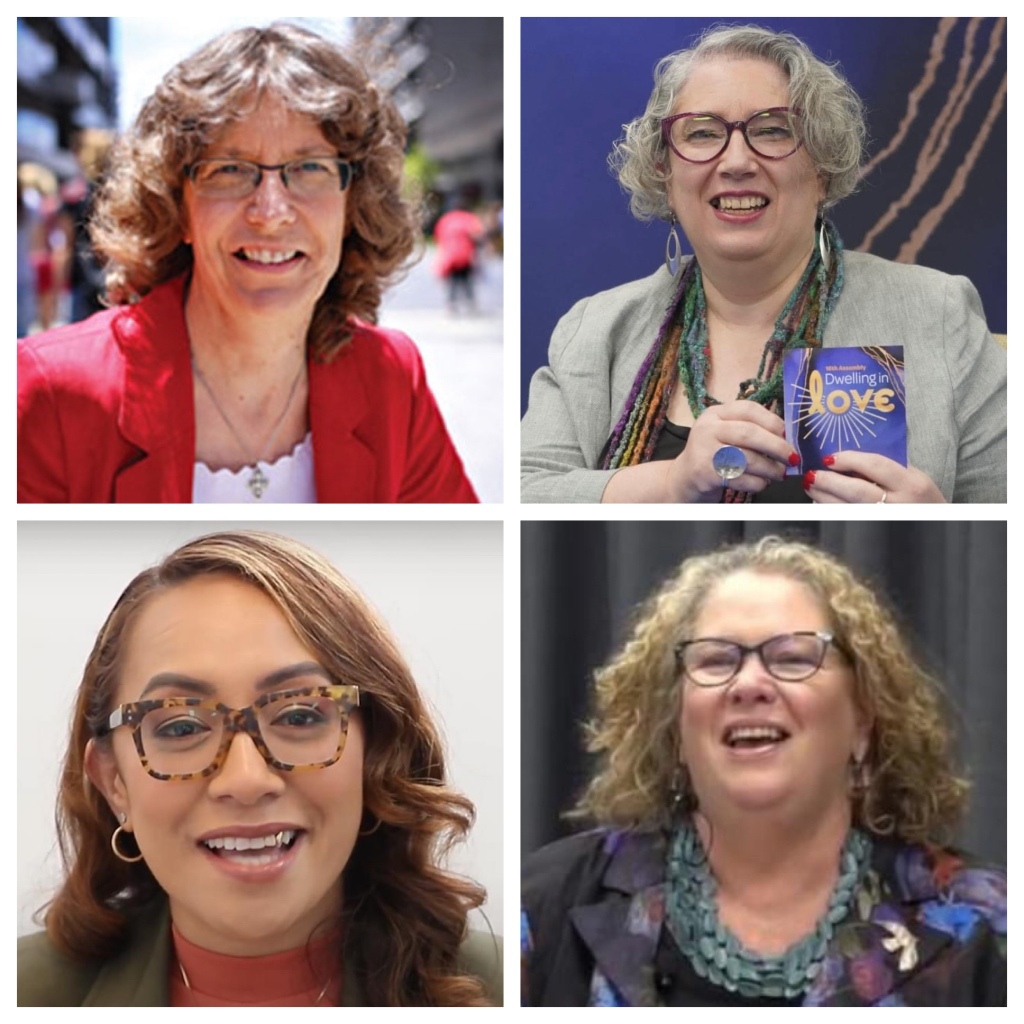
Assembly General Secretary, Colleen Geyer (bottom right),
along with Past President Dr Deidre Palmer (top left),
President (2022–2024) the Rev. Sharon Hollis (top right),
and President-Elect the Rev. Charissa Suli (bottom left)

Our Assembly General Secretary, Collen Geyer, has stated that every time [she] read[s] these words, she “feel[s] proud that, as a church, we had the guts to say these things, were courageous enough to set the bar high, and wanted there to be no doubt about what Australia could expect of us. Read these words and you will know how we’re intending to be true to who we are. Our unity, which is a sign of the reconciliation we seek for the whole human race, will look like this.”

What a wonderful aim for a church, to be an entity that embodies basic Christian values and principles, the importance of every human being, integrity in public life, truth and justice, democracy for all, religious freedom and personal dignity, and a concern for the welfare of the whole human race. Have we lived up to this? What do we need to do to make sure we do?

Did we realise as a church how extraordinary these words were? Did we understand what we were saying? These words tell of the great courage it took to make this announcement and embark on this journey of faith and justice. And since that time, we have seen that courage played out in the 46 years since Union as the Uniting church continues to stand with the voiceless, the marginalised and the poor, and continue to be activists for climate change reform. The Statement to the Nation commits us to acting in ways that are often considered political.
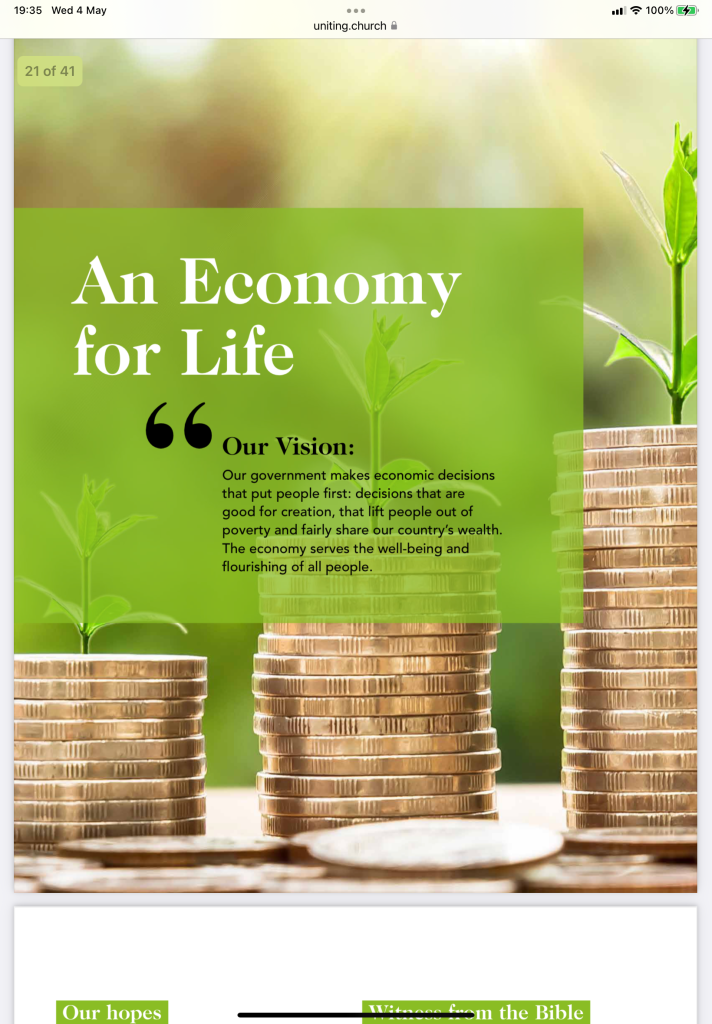
An Economy for Life is a later statement by the UCA Assembly which develops key themes that were articulated in the Statement to the Nation

We can see that such activities are built into the DNA in this church, yet sometimes we hesitate in implementing them. We lack the confidence in ourhomegrown models of mission and in ourselves. We can baulk at stepping out on new journeys. We have more trouble engaging around faith with our communities in an increasingly secular world. We shy away from being ‘political’ forgetting that Jesus also stood with the voiceless, the marginalised and the poor and was incredibly political.

We will challenge values which emphasise acquisitiveness and greed in disregard of the needs of others and which encourage a higher standard of living for the privileged in the face of the daily widening gap between the rich and poor.

In many churches, Western culture has created a culture of consumerism that permeates our congregations. Faith dwindles to “what’s in it for me” rather than homothumadon, discerning the common good. This leads to a reduced willingness to engage beyond the immediate and ourselves and look at ways in which various parts of the church can partner with others around us or how we can become the church of the future, a church still relevant, vital and life-giving not only to ourselves, but to the communities around us.

We are concerned with the basic human rights of future generations and will urge the wise use of energy, the protection of the environment and the replenishment of the earth’s resources for their use and enjoyment.

This small but direct statement let Australia know that as a church we weren’t just focused on the here and now but that we aim to be a future-focused church. We don’t want just to make a difference for the generations now, but we want to implement actions now that are “concerned with the basic human rights of future generations”. God’s love and commitment to humanity is not limited by time, space or matter and nor should ours be.
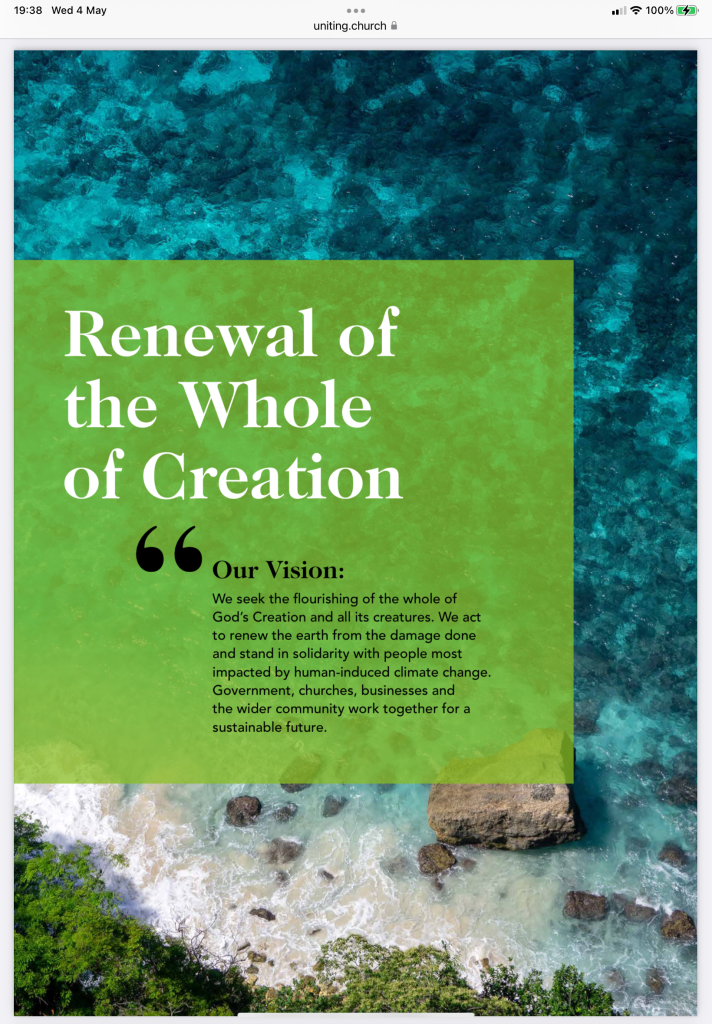
Renewal of the Whole Creation is a later statement by the UCA Assembly
which develops the brief sentence about the environment
that is found in the Statement to the Nation

This whole statement calls us to look now to identify injustices and at how we can influence change for the better and have improved outcomes for the future. It also acknowledges the impact of our actions for the future, particularly on our environment, God’s good creation that we are meant to be stewards of. Climate Change is a looming threat to most life on the planet, loss of biodiversity and loss of species are accelerating. This statement calls us into action now to prevent what may well be a very bleak future.

Finally we affirm that the first allegiance of Christians is God, under whose judgment the policies and actions of all nations must pass. We realise that sometimes this allegiance may bring us into conflict with the rulers of our day.

But our Uniting Church, as an institution within the nation, must constantly stress the universal values which must find expression in national policies if humanity is to survive.

We are clear about who we belong to – “the first allegiance of Christians is God”. As the Uniting Church, this is our foundation. It defines who we are and why we speak and act the way we do. Because of this belonging, we acknowledge that this may mean we could come into “conflict with the rulers of our day”, not because we want it, but because we will be speaking out for “the universal values which must find expression in national policies if humanity is to survive.” This isn’t a statement that holds back, and we should be proud of it as it leads us to live in the way of Jesus.

We pledge ourselves to hope and work for a nation whose goals are not guided by self-interest alone, but by concern for the welfare of all persons everywhere — the family of the One God — the God made known in Jesus of Nazareth the One who gave His life for others. In the spirit of His self-giving love we seek to go forward.

We pledge ourselves to hope … Can you think of anything better to pledge yourself to? Because of this hope, we pledge ourselves to work for our nation – a strong commitment which calls us to action. Our work however, is for a nation “whose goals are not guided by self-interest alone”. Everything that has come prior to this in the statement has been about being God’s church for others. Here, “all persons everywhere” are identified as “the family of the One God, through Jesus who “gave His life for others”. In this statement, we are called to be part of the work of God’s church in Australia.
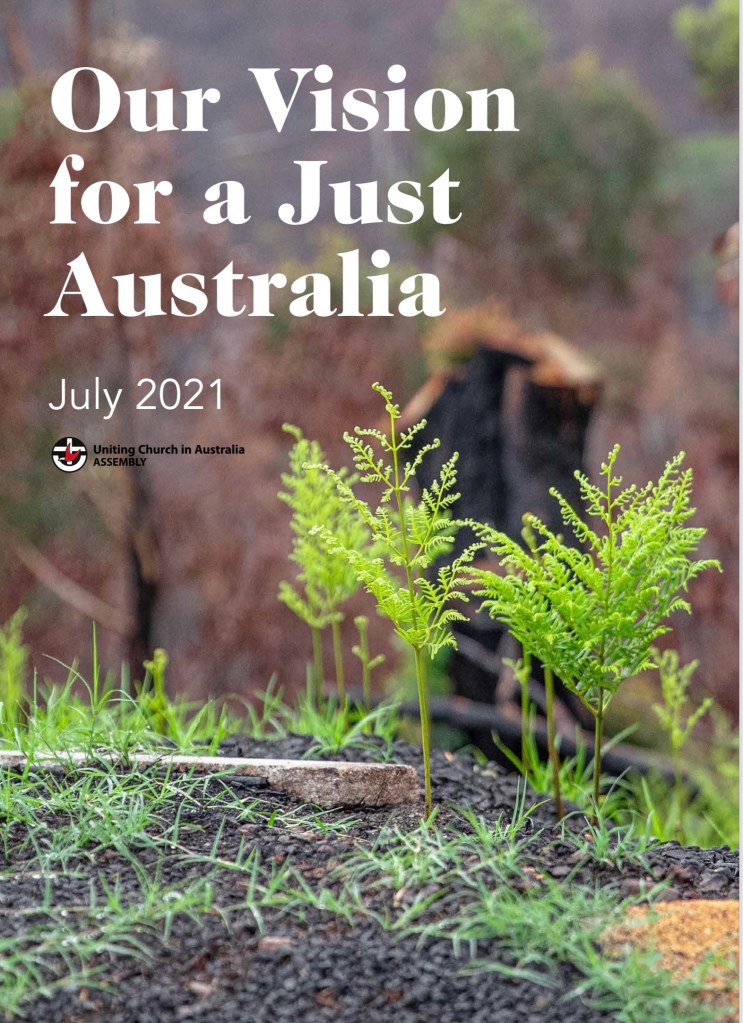
In 2021, the National Assembly of the UCA issued
Our Vision for a Just Australia, which develops and applies
many of the core commitments made in the Statement to the Nation

Today, how can we be more purposeful and intentional about how we achieve this vision? This is a question to ponder. We could start by reclaiming this statement, andbeing deliberate in our efforts to live into it.

As the Uniting Church, we can’t make these commitments and then be silent. Our voice has had to be loud and strong at points of justice, fairness and what is best for the common good. At times our voice has had to be a lone voice, a voice that isn’t popular, even amongst our own members and among other Christians.

I suggest this should remind you of someone, who also wasn’t popular within his own religion and who voice often howled across the wilderness of the white noise of religious self-interest and disregard for how others were treated, and championed the notion that the future kingdom embodied a place of justice and equity for all.

The Statement to the Nation draws us back to our foundations. It reminds us that like Abraham and the disciples, we too are sent by God in the now to prepare the futurefor all. To help us in this quest, I am closing with a prayer by the Rev. Dorothy McRae-McMahon.

Gracious God,
we believe in the wonder of life in you.
In every moment, we know that
you call us on towards creativity and hope,
never giving up on us, your church.

Christ Jesus, we celebrate
that you have journeyed with us
over these last 46 years together,
never leaving us alone in our humanness
and inviting us towards
fullness of life together.

Holy Spirit of Wisdom,
we believe that you will be discovered
in unexpected places around us,
your shining life emerging before us
and inspiring us to believe
that we can share in your power
to change the world
towards your goodness and grace.
This we believe, O God. Amen.


(Source: Dorothy McRae-McMahon, slightly adapted from a prayer for the WCC 70th anniversary)
 

World Mental Health Day, 10 October

Every year during October, Mental Health Month is held. It is based around World Mental Health Day, which was first celebrated in 1992, as an initiative of the World Federation for Mental Health, a global mental health organization with members and contacts in more than 150 countries. World Mental Health Day falls on 10 October every year and is now promoted internationally by the World Health Organisation.

The day, and the month, offers a way of raising awareness of mental health issues around the world through government health departments and civil society organizations across the globe. The WHO says that “World Mental Health Day provides an opportunity for all stakeholders working on mental health issues to talk about their work, and what more needs to be done to make mental health care a reality for people worldwide.”

This year, the theme for World Mental Health Day is Making Mental Health & Well-Being for All a Global Priority. The hope is that focussing attention on the mental health of people will result in a better general awareness in society as well as improvements in services offered. 2019, before the COVID-19 pandemic, it was estimated that one in eight people globally were living with a mental disorder. So this is a much-needed focus on a long-established matter. See https://www.who.int/news-room/feature-stories/mental-well-being-resources-for-the-public

Certainly, the years of the pandemic have exacerbated short- and long-term stresses, undermining the mental health of millions. As mental health services were disrupted by restrictions and lockdowns, so the treatment gap for mental health conditions has widened. The need for ongoing attention to providing good mental health support is even more evident.

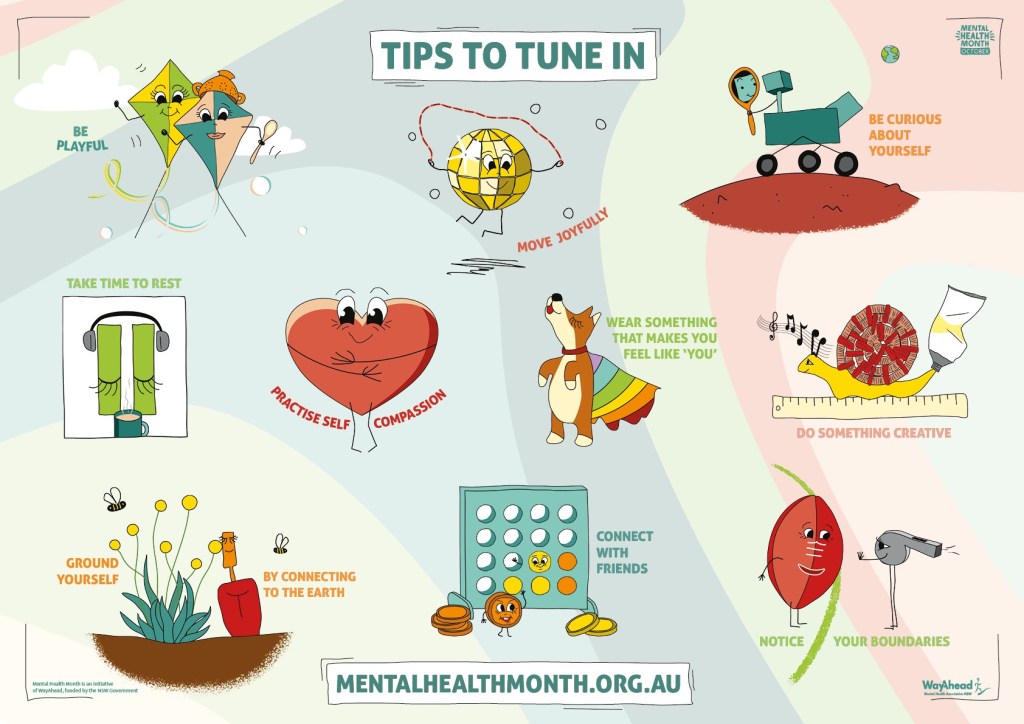
In NSW, people are being encouraged to Tune In this mental health month, with resources providing Tips to Tune In (practise self-compassion, take time to rest, notice your boundaries, connect with friends) as well as tips for a less-stressed workplace and colourful posts for social media, to spread awareness of the month. See https://mentalhealthmonth.wayahead.org.au/downloadable-resources/

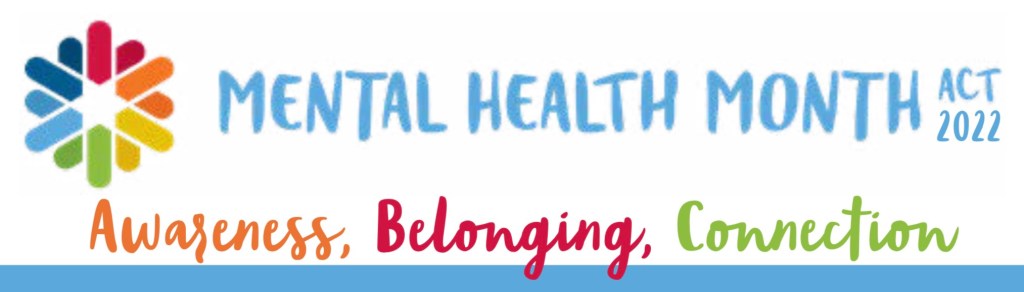
In the ACT this year, the theme for the month is as simple as A—B—C: namely, Awareness—Belonging—Connection. Awareness is about understanding how to maintain and boost our mental wellbeing, realising when we need to reach out for help, and knowing where to get it. Belonging is about looking out for each other, feeling safe and supported, and knowing that we’re not alone: there are others going through the same thing. Connection is about our relationships: not just with our friends, families and those we care about, but also the groups, clubs, and networks we rely on to help us stay happy and healthy. See https://www.mentalhealthmonthact.org/

Loneliness is one significant cause of mental health issues. The Australian Institute of Health and Welfare reports that most Australians will experience loneliness at some point in their lives. 1 in 3 (33%) Australians reported an episode of loneliness between 2001 and 2009. 40% of these people reported experiencing more than 1 episode. In surveys undertaken since the onset of the COVID-19 pandemic, just over half (54%) of respondents reported that they felt more lonely since the start of the pandemic. See https://www.aihw.gov.au/reports/australias-welfare/social-isolation-and-loneliness-covid-pandemic

Friendship, care and support is something that the church can offer to people—especially to people who are experiencing loneliness. A supportive community can help lonely people to strengthen their mental health and have a more positive life. It’s something that every local congregation can easily do. Look around in your community; who are the lonely people? How can you offer them friendship and support? How can you live out the Gospel by giving compassionate care to such people?

*****

For myself, I have lived with an awareness of the importance of taking care of my own mental health for some decades. Long before the pandemic, I recognised the importance of accessing support services and taking steps to ensure that my mental health remained robust. It hasn’t always been so—there have been some difficult periods of depression, anxiety, and dysfunction that I have experienced. Some of those times were really tough. Fortunately, there were other times—more times, I am pleased to say—that were positive, enjoyable, hope-filled times.

I am most grateful for the consistent, loving support and the always perceptive guidance that I have had over all those years from my wife Elizabeth. There have been a number of times when she has made sure that I was safe, helped me to seek professional assistance, and let people know that I wouldn’t be able to carry through some of my responsibilities at those times. I am sure that I wouldn’t have made it through all those years without her.

I was also very fortunate that the church made generous provision for me to have extended periods of leave when that was necessary, following medical advice. I am so glad that I came through those periods of time and was able to continue in ministry and have the opportunity to serve in a variety of roles.

There are various learnings that I have taken from these experiences. In the early times, when I had no explanation for what was happening, working with various professionals to explore matters was certainly very hard work. In time, when a clear diagnosis was made and then a workable treatment regime was put into place, there was a clear pathway to enjoying better mental health. But it would take quite some time to get there.

Those were difficult and, at times, scary times. Coming to grips with the realities of life—learning to be honest about myself, with myself, and with trusted others—was a slow process, full of challenges, but ultimately a very important pathway to follow.

Integral to my particular process of therapy was dealing with memories of the past that surfaced. This can be a real challenge—especially when there has been no clear, present memory of those traumatic experiences back in the past. I had to be prepared to learn new things about myself. This was hugely confronting. Eventually, realising that many of these learnings provide insightful explanations about “the way I am”, and especially my specific idiosyncrasies, proved to be a helpful process. Difficult, costly, but ultimately quite rewarding.

In this process, I learnt the importance of building resilience to engage at deeper levels with what life presents. Dealing with a series of shocks that surfaced during periods of deepened depression, increased anxiety, and gradually-clarifying memories, needed constant inner strength. It was draining and demanding. Over time, looking back, I can see how I learnt to accept and integrate those learning experiences into my sense of who I am as a whole person.

For myself, I found that balancing personal and professional needs was very important. In crisis periods, prioritising the personal over the professional was essential. As each of those crises lessened in intensity, the integration of specific professional tasks became possible, so a phased “return to work” could take place in an appropriate way.

At times, my work in ministry, either in educational or in organisational/oversight roles, presented challenging emotional situations. In the regular run of things, being aware of the saturation level of emotional intensity in my life was quite important. I needed to know when to plunge in to such situations, and when to step back from those situations and leave others to deal with them.

This has helped me develop, I believe, a growing capacity to balance honesty and care: to know when it was most important to confront the truth in a situation, and when it was wiser to offer pastoral care to a person, or persons, caught in such a situation. I like to think that my own psychological journey, exploring and strengthening my own mental health, has given me some capacity to empathise with hurting people, to engage sensibly with angry people, to speak clearly to confused people. I don’t for one second imagine that I am world’s best at these kind of things— far from it! But I have tried to develop skills in such things over the decades.

When I look back on the three decades during which good mental health has been an important focus for me, I think that I can see how I began to forge a new way of being, in the midst of realising that I was actually a rather motley collection of battered and bruised pieces dating from various incidents in my life, long, Iong ago. I have thus had a focus on “becoming integrated” as a person (or, at least, becoming “more integrated” than previously). I think that this has been important for me to do as a person, and it has helped me to function effectively as a minister. I hope that has been the experience of other people.

So this year, on World Mental Health Day, I join with interested people around the globe in emphasising the importance of taking care of our own mental health, being alert to the signs of stress in other people’s mental health, and advocating for the provision of strong mental health services in our society. I hope you will share in that same commitment.

Refugee Week 2022: a time to seek Healing

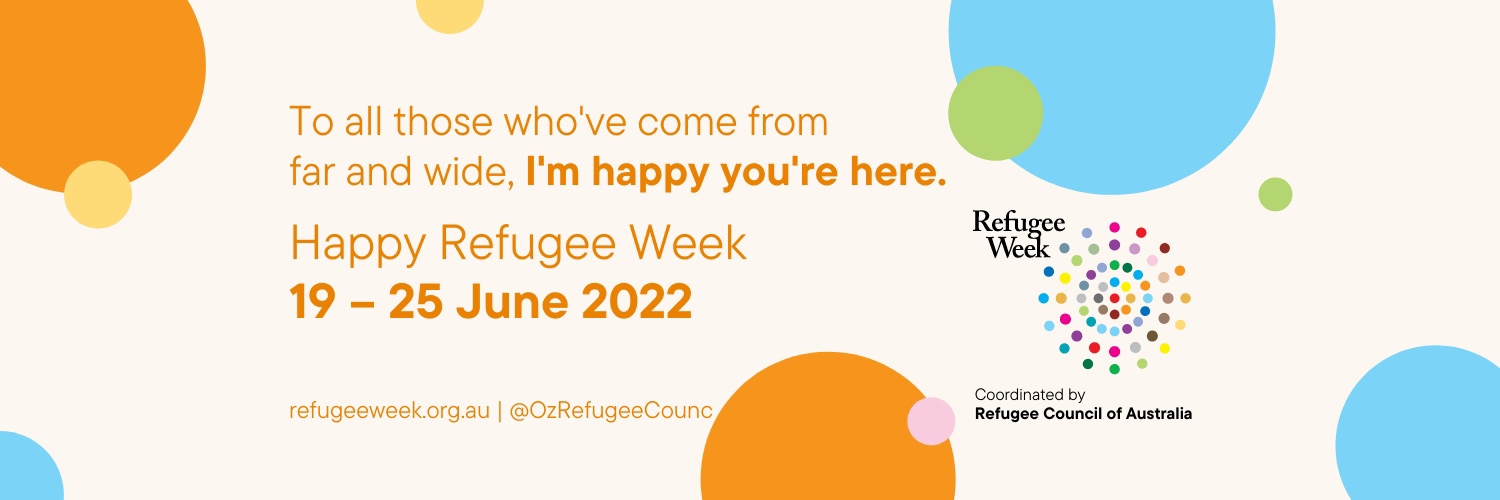
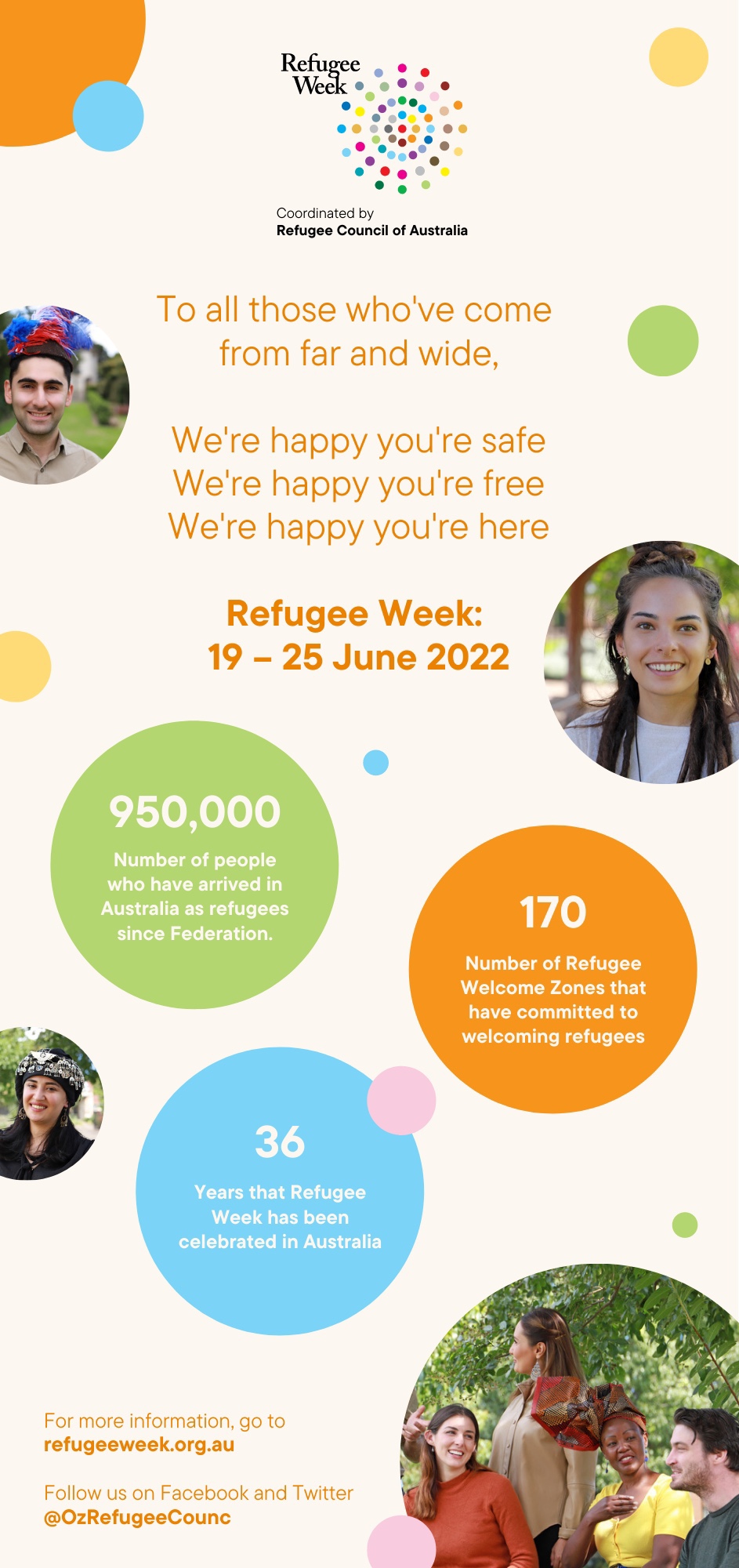
Refugee Week is held each year, providing an opportunity to highlight aspects of the refugee experience and help the broader community to understand what it is like to be a refugee.

This year, Refugee Week runs from Sunday 19 June to Saturday 25 June. Healing is the theme of Refugee Week 2022. This theme builds on a recognition of the importance of human connections, which has been underscored by the current pandemic. 

The website for this year’s Refugee Week says, “Mainstream and refugee communities alike can draw upon shared hardship to heal wounds, to learn from each other and to move forward. Healing can occur through storytelling, through community and also through realisation of our intrinsic interconnectedness as individuals.”

The first Refugee Week events were organised in Sydney in 1986 by Austcare (Australians Caring for Refugees). Austcare’s mission is to assist refugees overseas, displaced people and those affected by landmines to rebuild their lives, through the expert delivery of development programs in partnership with local communitities and other agencies.

In 1987, the Refugee Council of Australia (RCOA) became a co-organiser of the week, and the week became a national event from 1988. RCOA took on responsibility for the national coordination of Refugee Week from 2004.

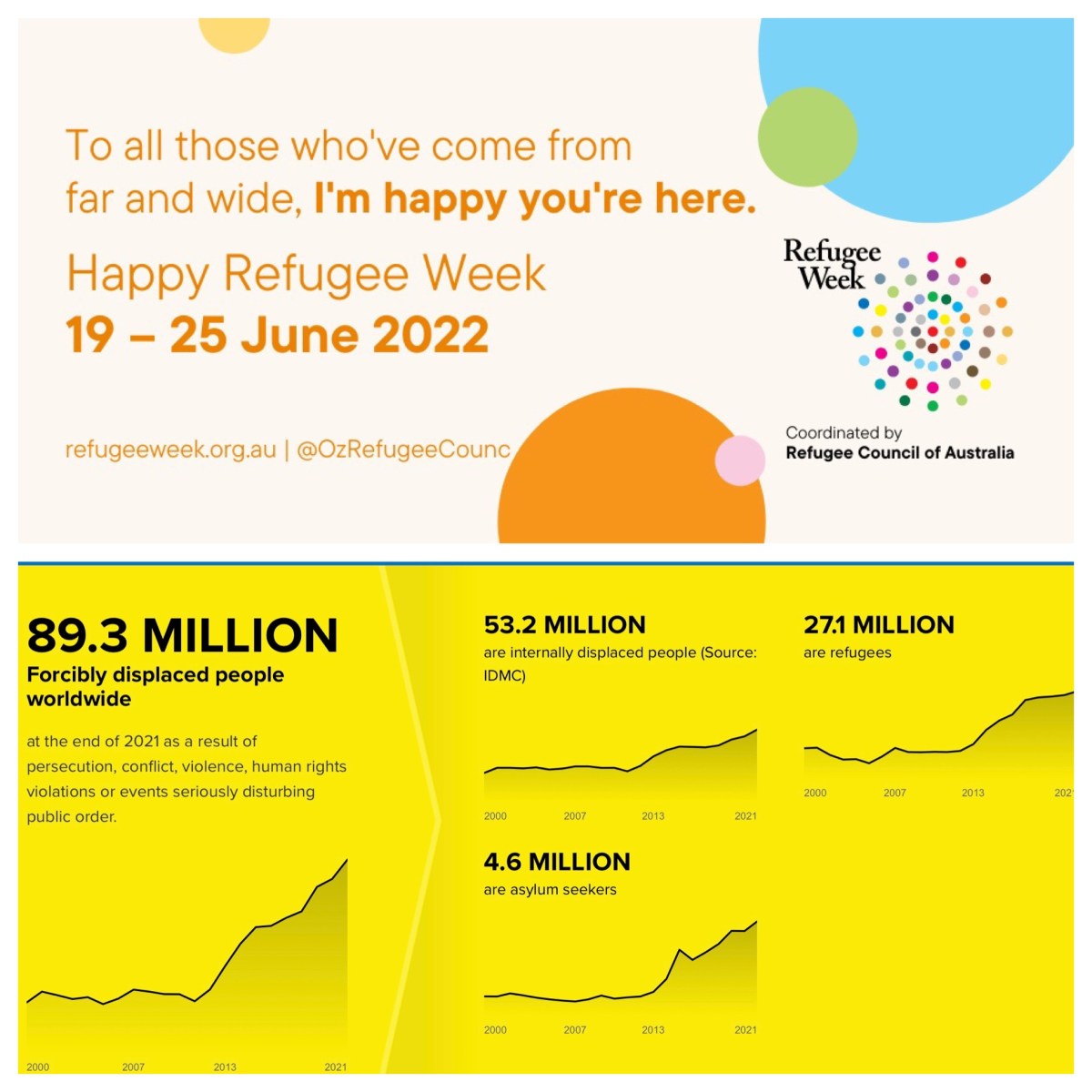
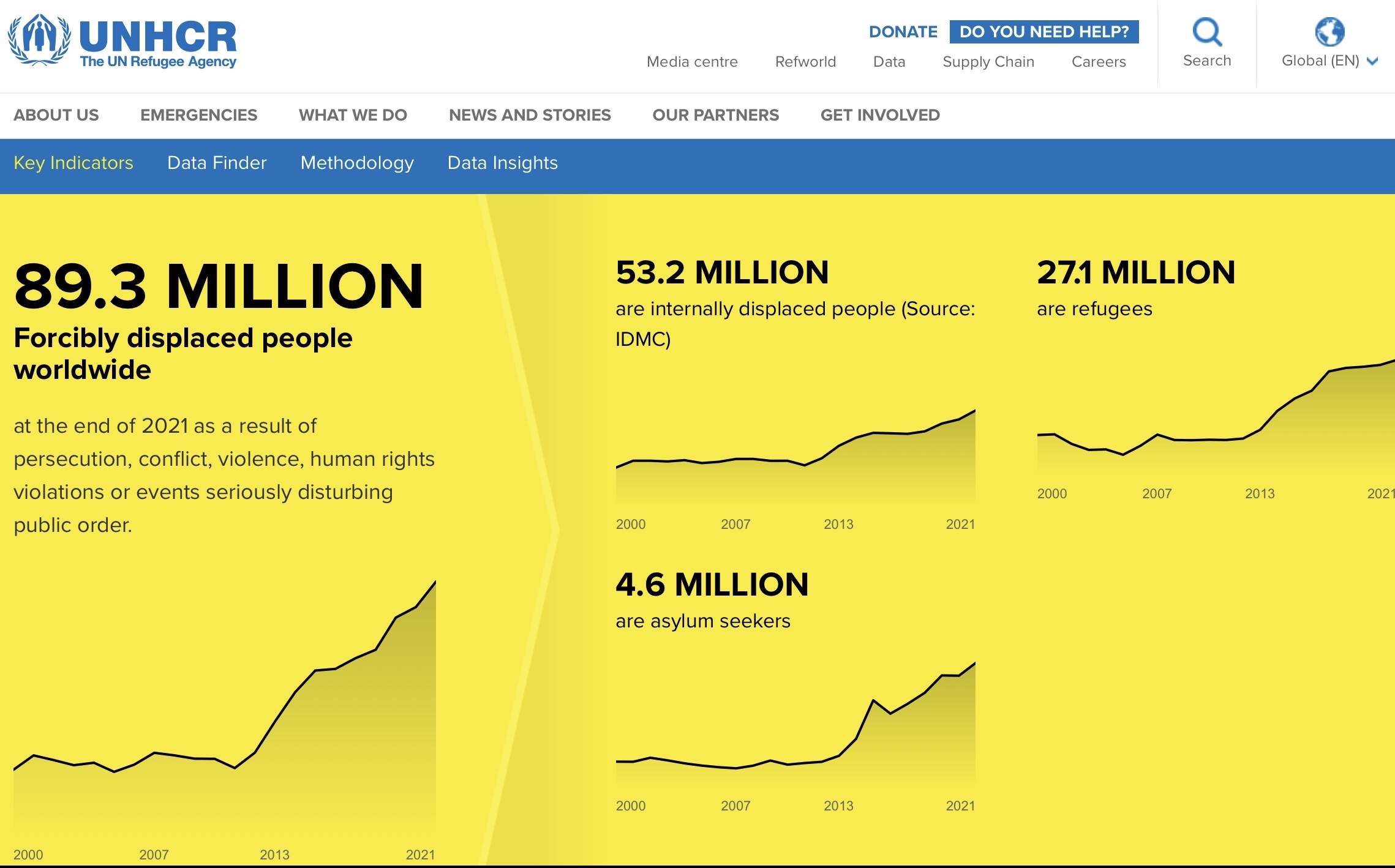
According to the UNHCR, the United Nation’s Refugee Agency, there are now 89.3 million forcibly displaced people, as a result of persecution, conflict, violence, human rights violations or events seriously disturbing public order in their countries of origin. (A year ago, the figure was 82.4 million forcibly displaced people.)

35 million of these people are children, aged under 18 years. 1 million of these children were born as refugees; in the years 2018 to 2020, an average of between 290,000 and 340,000 children were born into a refugee life per year.

Over half of these people (53.2 million) are classified as “internally displaced”, meaning that they are homeless within their own country. 27.1 million are officially classified as refugees, meaning that they are “unable or unwilling to return to their country of origin owing to a well-founded fear of being persecuted for reasons of race, religion, nationality, membership of a particular social group, or political opinion.” This is the definition in the Convention and Protocol Relating to the Status of Refugees—an international agreement which Australia signed in 1951, the year it was published.

These statistics, from the UNHCR, illustrate
the significant rise, globally, of displaced people,
refugees, and asylum seekers in the past decade.

A further 4.6 million people are classified as asylum seekers. Under Article 14 of the 1948 Universal Declaration of Human Rights, everyone has the right to seek asylum The 1951 Refugee Convention prohibits states from imposing penalties on those entering ‘illegally’ who come directly from a territory where their life or freedom is threatened. (Terms such as ‘illegals’, ‘queue jumpers’ and ‘boat people’ are both inaccurate and unhelpful—even though they appear in the media with saddening regularity, they are terms that should be avoided.)

See https://www.unhcr.org/en-au/1951-refugee-convention.html

More than two thirds of all refugees currently under the UNHCR’s mandate come from just five countries: the Syrian Arabic Republic (6.7 million), Venezuela (4.0 million), Afghanistan (2.6 million), South Sudan (2.2 million), and Myanmar (1.1 million).

The countries which are currently hosting the most number of refugees are Turkey (3.6 million), Pakistan (1.4 million), Uganda (1.4 million), Germany (1.1 million), Sudan (just over 1 million), and the Islamic Republic of Iran (just under 1 million). Developing countries host 86 per cent of the world’s refugees, and the Least Developed Countries provide asylum to 27 per cent of the total.

In the last full year (2020–2021), Australia’s Refugee and Humanitarian Program was set at 13,750 places. We willingly accept this amount of incoming refugees, and recognise the value that such people do bring to the Australian society. we have fallen victim to the fear pedalled by unscrupulous elements in society, and in government, over the past decade, about the “hordes” of people seeking the safety of refuge in ur country.

In Australia, the most enduring myth about people seeking asylum is that most arrive by boat. They don’t. The clear fact is that most people seeking asylum arrive by air. It’s time for us to throw overboard the fear of people who come here seeking refuge and asylum on boats, and recognise that the fear fuelled by right-wing agitators over the past decade has not served us well at all.

Adhering to the provisions of the Refugee Convention, as a,country, would be an excellent step,for us to take this year. That would be a significant step towards Healing in our national life.

See stories and additional statistics at https://www.refugeeweek.org.au/wp-content/uploads/2022/05/RCOA-Refugee-Myths-and-Facts-2022-WEB.pdf