
“Lord, if another member of the church sins against me, how often should I forgive? As many as seven times?” (Matt 18:21). We know the question—and we know the answer. “If a person sins against you seven times a day, and turns back to you seven times and says, ‘I repent,’ you must forgive”, Jesus says, at least according to Luke’s Gospel (Luke 17:4).
Not so in Matthew’s Gospel. Forgiving seven times, as demanding as that is, is not enough—at least according to the Jesus of Matthew’s Gospel. “Not seven times”, says this Jesus, “but, I tell you, seventy-seven times” (Matt 18:22).
We hear this conversation, and an ensuing parable, on this coming Sunday, as it is the Gospel passage proposed by the lectionary. It follows on from last week’s passage dealing with conflict within the community (18:15–20).
And so, this particular Matthean representation of Jesus appears, on the face of it, to be a more generous, accepting, grace-filled version, than even the Jesus of Luke’s Gospel! Forgiveness is important—so important that it needs to be offered, over and over again, we might assume.
Well, hold on—not so fast. Because immediately after reporting this word of Jesus, the author of Matthew’s Gospel reports him offering a parable which contains a number of difficult—indeed, troublesome—elements. He sets a scene involving a king and a number of slaves. How those characters behave is interesting. The end result is that one slave is thrown into prison “to be tortured until he would pay his entire debt” (18:34).
Slaves, of course, were present in the world in which Jesus lives. Their presence is noted in scenes, such as when we see mention of the sick slave of a centurion (Matt 8:5–13; Luke 7:1–10) and a slave of the high priest (Mark 14:47; Matt 26:51; Luke 22:50; John 18:10). They are recurrent characters in the parables of Jesus (Mark 12:1–12 and parallels; Matt 24:45–51; Luke 12:35–40, 42–48; 14:15–24; 19:11–27; 20:9–19). Slaves are also referred to in a number of the sayings of Jesus (Mark 10:44; Matt 6:24; 10:24–25; 20:27; Luke 16:13; 17:7–10; John 8:34–36).
The character of a king appears in a number of parables of Jesus, in both the Gospel of Luke (Luke 14:31–32; and see also 19:27) and that of Matthew (Matt 18:23–35; 22:1–14; 25:31–46). In this last parable, the final scene of judgement of the nations (25:31–46), the king functions as God’s representative, delivering his commendation of those who acted correctly, but judgement on those who failed to do so.
In the parable we will hear this coming Sunday (18:21–35), the king initially demands repayment of a large debt owed to him by one of his slaves. When the slave cannot pay, he plans to sell him and all his goods and family. However, after being begged by the slave, the king remits the debt (18:27). This part of the parable clearly illustrates the instruction of Jesus concerning forgiveness (18:22).
In the next parable found in Matthew’s Gospel (22:1–14), whilst dealing with guests who turn down his invitation to attend a wedding feast and murder the slaves he had sent to them, the king does not act so graciously; we are told that he “was enraged; he sent his troops, destroyed those murderers, and burned their city” (22:7).
Then, when a guest does enter dressed without his wedding robe, the king was initially rendered speechless, before ordering his attendants, “Bind him hand and foot, and throw him into the outer darkness, where there will be weeping and gnashing of teeth” (22:13). This is hardly the action of a leader who is following the exhortation to “forgive seventy times seven”!
This destructive rampage by the king fits alongside the reaction of the slave in the earlier parable. Although himself forgiven of his massive debt of “ten thousand talents” (18:27)—an impossible huge debt, completely unrealistic—he refuses to forgive his fellow-slave who owes him much less, “a hundred denarii” (18:28–30)—a more realistic amount to owe. He has this slave thrown into prison—but on hearing of this, his master, the king, who had earlier practised forgiveness (18:25–27), turns on his slave, now seen as “you wicked slave”, and condemns him “to be tortured until he would pay his entire debt” (18:34).
So I am somewhat bemused by the inclusion of this parable. Had Jesus stopped at verse 27 (“out of pity for him, the lord of that slave released him and forgave him the debt”), the parable would have been a fine example of the principle of “forgive seventy times seven”. But it doesn’t stop there. It continues on for another eight verses, and those verses tell of the complete opposite of gracious forgiveness.
The idea of forgiving someone who himself had failed to show forgiveness is thus doomed to failure. And not only that—it is not simply the king in the parable who acts with vengeance, it is the “heavenly Father” who will act in this way towards anybody who “does not forgive your brother or sister from your heart” (18:35). It seems that God is fundamentally a God of vengeance, not of grace.
This should not surprise us if we look elsewhere in this Gospel, to see how Jesus portrays God. Whilst God feeds the birds of the air (6:24), “clothes the grass of the field” (6:30), casts out demons through the Spirit (12:28), commands the honouring of parents (15:4), joins together man and woman to be come “one flesh” (19:4–6), and is able to deliver “the one who trusts in him” (27:43), there are more ominous actions of the divine being that Jesus reflects in his teachings.
Whilst Jesus teaches that the kingdom of heaven will be characterised by being like a child (18:1–5), a number of parables indicate that what transpires in the kingdom will vary, depending on how a person has behaved in life. Those who commit to the righteous-justice that Jesus teaches (5:20; 6:33; 21:32) “will shine like the sun in the kingdom of their Father” (13:53) and will hear gracious words of welcome: “come, inherit the kingdom prepared for you from the foundation of the world” (25:34). Their fate is to enter into “eternal life” (25:46).
However, those who fail to live in accord with this way of righteous-justice will encounter a different message: “you that are accursed, depart from me into the eternal fire prepared for the devil and his angels” (25:41). Their fate is terrible; the “eternal punishment” that is noted at the conclusion of this parable (25:46) is variously described in other places within this Gospel.
The slave who was not prepared for the return of his master—in the first of four parables (24:45–51) which conclude the final teaching discourse of Jesus—ends with clear punishment: “put him with the hypocrites, where there will be weeping and gnashing of teeth” (24:51). Jesus had spoken the instruction to “throw him into the outer darkness, where there will be weeping and gnashing of teeth” in the parable where a person came to a wedding inappropriately dressed (22:14). This is a recurrent motif in Matthew’s Gospel.
He has also pointed to the same punishment for lawless and disobedient people in other places: in his words of judgement spoken in Capernaum, where he encounters a distressed centurion (8:12); in his explanation of the parable of the weeds and the wheat (13:42); in the parable of the good and bad fish (13:50); and in the parable of the talents (25:30).
It is a punishment that is taken from Hebrew Scripture texts: “the wicked plot against the righteous and gnash their teeth at them (Ps 37:12); “the wicked gnash their teeth and melt away; the desire of the wicked comes to nothing” (Ps 112:10); “malicious witnesses … impiously mocked more and more, gnashing at me with their teeth” (Ps 35:11,16). The prophet laments that when Jerusalem is ransacked, “all your enemies open their mouths against you, they hiss, they gnash their teeth, they cry ‘we have devoured her!’” (Lam 2:16). It is a well-known form of torment and punishment.
The parable of the unprepared servant also has this apparently savage instruction: “he will cut him in pieces” (24:51). We find that in Hebrew Scripture, this was an action used in sacrificing animals (1 Kings 18:23, 33) and as a warning of judgement against sinners—in the terrible story of the Levite’s concubine (Judges 19:29), after Saul defeated the Ammonites (1 Sam 11:7), and also in direct prophetic warnings (Isa 45:2; 51:9; Ezek 16:40; Dan 2:34; also Judith 5:22). This is the fate decreed for the unprepared slave—a terrible end, indeed!
Throughout this Gospel, Jesus declares that sinners are destined for “the judgement of fire” (Matt 5:22; 7:19; 13:40, 42, 50; 18:8–9; 25:41). This picks up from the warning of John the baptiser, which Matthew has added to his Markan source: “You brood of vipers! who warned you to flee from the wrath to come? … even now the ax is lying at the root of the trees; every tree therefore that does not bear good fruit is cut down and thrown into the fire” (Matt 3:7, 10).
That place is described by Jesus, in parables unique to Matthew, as “the furnace of fire” (Matt 13:43, 50; 25:41). Sinners will be sent to a place of “eternal fire” (18:8; 25:41), “the hell of fire” (5:22; 18:9), the “unquenchable fire” threatened by John: “the chaff he will burn with unquenchable fire” (3:12). This builds on the warnings found in Mark’s Gospel about the punishment in store for those who put stumbling blocks in the way of “these little ones”—they will be condemned to “the unquenchable fire” (Mark 9:42–48). These warnings are repeated by Jesus in Matt 18:6–9.
Matthew’s portrayal of Jesus is consistent in reporting that he warns his followers, again and again, of the fiery fate that awaits evildoers. Once again, this picks up on Hebrew Scripture passages in which various prophets declare that God will use fire to destroy people and places because of their sinfulness (Isa 1:7; 5:24; 30:27–28, 30, 33 18–19; Jer 4:4; 6:27–30; 20:47–48; Hos 8:14; Joel 2:1–3; Amos 1:4—2:5; Nah 1:15).
Amongst those prophetic oracles, Zephaniah, for instance, portrays utter devastation through divine judgement: “neither their silver nor their gold will be able to save them on the day of the Lord’s wrath; in the fire of his passion the whole earth shall be consumed” (Zeph 1:18).
However, the final prophet in the Christian Old Testament, Malachi, reworks this imagery, offering some hope; God’s messenger on The Day of the Lord “is like a refiner’s fire and like fullers’ soap; he will sit as a refiner and purifier of silver, and he will purify the descendants of Levi and refine them like gold and silver, until they present offerings to the Lord in righteousness” (Mal 3:1–4).
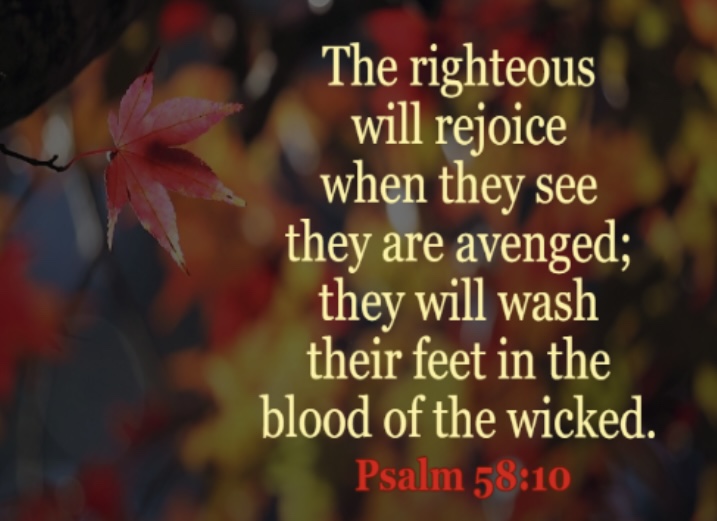
A number of psalms reflect the desire for God to punish evildoers severely; “pour out your indignation upon them, and let your burning anger overtake them” is the cry of one psalm (Ps 69:24). Another psalm notes the vengeance of God—“in your hearts you devise wrongs; your hands deal out violence on earth” (Ps 58:2)—and suggests that “the righteous will rejoice when they see vengeance done; they will bathe their feet in the blood of the wicked” (Ps 58:10). We must wonder: did Jesus pray these psalms? did he concur with their ideas? did he pray for God to act with vengeance?
The image of fiery punishment comes from the story of Daniel (Dan 3:1–30) and appears again in the last book of the New Testament, where the prophet describes his visions of “the lake of fire that burns with sulfur” (Rev 19:20; 20:10, 14–15), also described as “the second death” (Rev 20:14; 21:8). It is there that the devil, the beast, and the false prophet “will be tormented day and night forever and ever” (Rev 20:10). Matthew appears to share some similarities with the writer of this book, for as we have noted, eternal punishment in a fiery furnace features also in the words of Jesus in Matthew’s Gospel.
So we can’t simply brush aside the closing words of the parable which is in focus this coming Sunday—the Heavenly Father, we are told, will follow the example of the unforgiving servant, who will be “tortured until he would pay his entire debt” (18:34–35), in the service of ensuring that faithful people do indeed forgive one another! (How he will be able to pay off his debt while he is being tortured in prison, I do not know!)
Such punishment is consistent with the way that God’s justice will be implemented, according to the various teachings and parables of Jesus in Matthew’s Gospel that we have already noted. It will be incredibly hard to be let off the hook by this fierce, punitive God!! We are left with the conundrum: what are we to make of this aggressively violent, retributive God?
*****
I have had a go at addressing this conundrum in terms of how it is presented in Hebrew Scripture, at
and
 An Informed Faith