This week the lectionary offers us an excerpt from the second chapter of the first letter to Timothy, attributed by tradition to Paul, “a herald and an apostle, a teacher of the Gentiles in faith and truth” (1 Tim 2:7). The passage is 1 Tim 2:1–7.
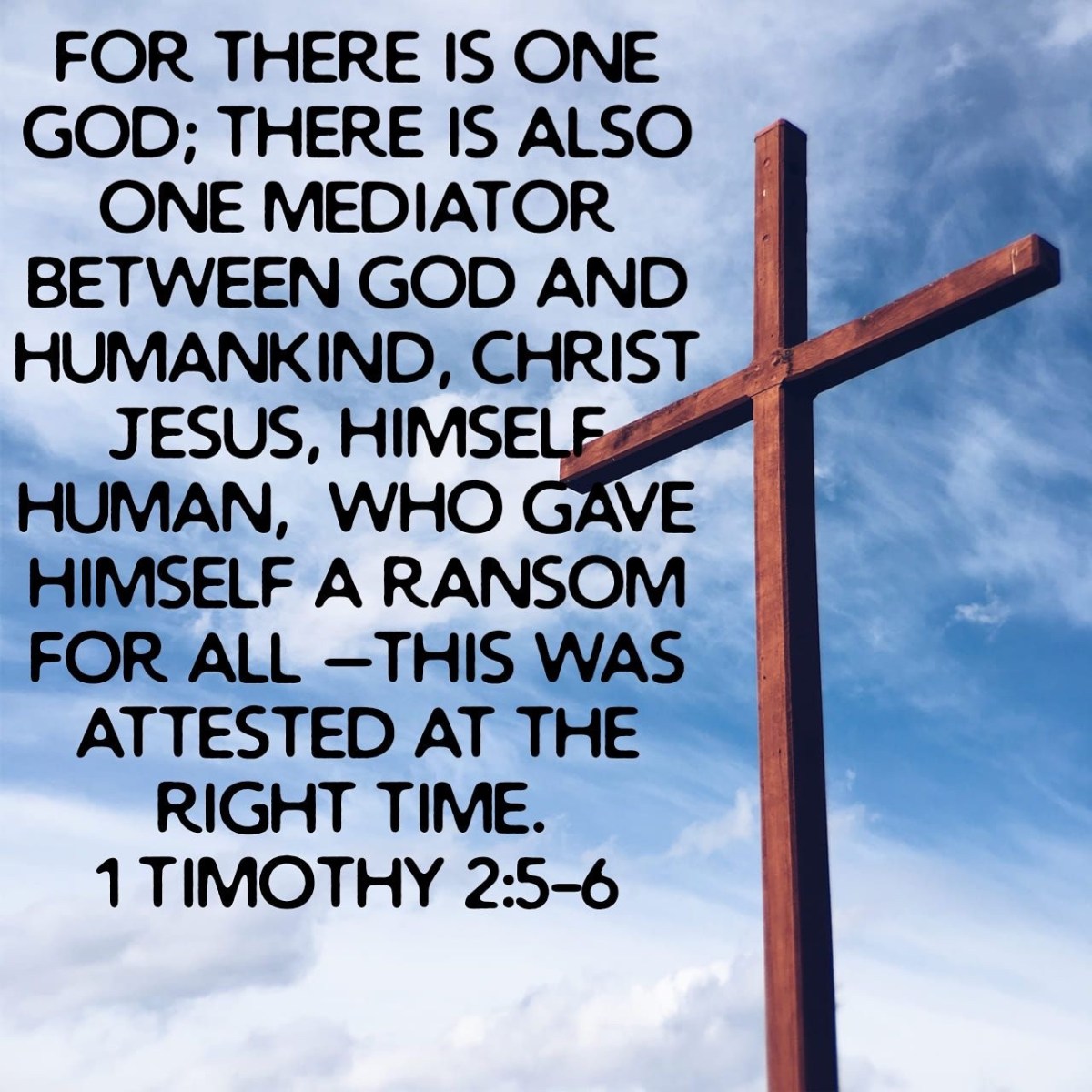
Just before making this authorial statement, the author offers one of the assorted short, formulaic statements about “the faith” that pepper the three pastoral letters: “there is one God; there is also one mediator between God and humankind, Christ Jesus, himself human, who gave himself a ransom for all” (1 Tim 2:5–6). (The other instances of such formulaic statements are at 1:15; 3:1; 3:16; 4:9–10; 6:15–16.)
Ransom is a term that we associate with the forced kidnapping of a person and the demand for a payment in order for them to be released. This is not the way the term is used in biblical texts, where payment in return for release of a captive is not in view. Rather, the orientation is towards the idea that there is a significant cost involved in the process of ransoming.
The Greek word used here is antilutron, a compound word comprised of the prefix anti- (in the place of) and the noun lutron. This noun also appears in a saying of Jesus, “the Son of Man came not to be served but to serve, and to give his life a ransom for many” (Mark 10:45).
The noun lutron comes from a verb, lutrein, which means “to release”. It was a common term for the payment needed to secure the release of slaves, debtors, and prisoners of war. The noun, translated as ransom, occurs in the Septuagint. It identifies the price paid to redeem a slave or captive (Lev 25:51–52) or a firstborn (Num 18:15). It also indicates the price to be paid as recompense for a crime (Num 35:31–32) or injury (Exodus 21:30). In these instances, it translates the Hebrew word koper, which has the basic meaning of “covering”.
Another form of that word appears in another form in the name of the Great High Holy Day in Judaism—Yom Kippur, the Day of Atonement (see Lev 16:1–34; Num 29:7–11). On that day, as the cloud of incense covers the mercy seat (kapporeth, Lev 16:13), the mercy seat is smeared with the blood of the sacrificed bull (16:14) and then the blood of the goat which provides the sin offering (16:15). According to Leviticus, it is these actions which “shall make atonement (kipper) for the sanctuary, because of the uncleannesses of the people of Israel, and because of their transgressions, all their sins” (16:16).
The process of atonement in the Israelite religion was to cover up, to hide away from view, the sins of the people. This is developed to some degree in the fourth Servant Song of Deutero-Isaiah, when the prophet honours the servant because “he was wounded for our transgressions, crushed for our iniquities” (Isa 53:5). His life was understood as “an offering for sin” (53:10) which “shall make many righteous” (53:11). Indeed, as the Song ends, it affirms that “he bore the sin of many” (53:12). The Song resonates with the language and imagery of righteous suffering as the means of dealing with, and perhaps atoning for, sins.
That notion is further expounded in a later text which provides an account of the way that a righteous man, Eleazar, was martyred as a means of ransoming the nation during the time of upheaval under Antiochus Epiphanes (175–167 BCE). “Be merciful to your people, and let our punishment suffice for them”, he prays; “make my blood their purification, and take my life in exchange for theirs” (4 Macc 6:28–29).
The idea then appears in New Testament texts which describe the effect of the death of Jesus for those who have placed their trust in him. Paul uses ransom language tells the saints that they were “bought with a price” (1 Cor 6:20; 7:23). He also uses apolutrosis, a compound word but from the base word lutrein, to describe the redemption which was accomplished by Jesus, both in a formulaic way (1 Cor 1:30) and in a more discursive manner (Rom 3:24; 8:23).
The term recurs in later letters which likely were not written by Paul (Col 1:14; Eph 1:7, 14; 4:30), as well as in the Lukan redaction of the final eschatological speech of Jesus (Luke 21:28). In another late first century work, providing an account of Paul by an author at some remove from him, the book of Acts, Paul was said to have declared of the church that God “obtained [it] with the blood of his own Son” (Acts 20:28).
It was the combination of such passages that led the third century scholar, Origen of Alexandria to develop an idiosyncratic theory of the atonement (the way that Jesus enables God to deal with human sinfulness). Origen’s ransom theory of atonement reads Genesis 3 as an account of Adam and Eve being taken captive by Satan; this state was then inherited by all human beings. The death of Jesus is what enables all humans to be saved; the means for this was that the blood shed by Jesus was the price paid to Satan to ransom humanity (or, in a variant form, a ransom paid by Jesus to God to secure our release).
However, none of these texts require this overarching theological superstructure to make sense of what they say. Origen’s ransom theory held sway for some centuries, but was definitively rejected by the medieval scholar Anselm of Canterbury. It is not a favoured theory of atonement in much of the contemporary church (though it is still advocated in various fundamentalist backwaters). Certainly, none of this should be attributed to the saying we find at 1 Tim 2:5–6.
This Sunday the lectionary offers a number of passages that focus on the inherent sinfulness of human behaviour, and the consequent response of God to such a situation. The prophet Jeremiah, centuries before Jesus, looks at what is taking place before him, and sees the earth as “waste and void”, the heavens with “no light”, the mountains and hills shaking, and the creatures deserting the land (Jer 4:23–26).
This cosmic catastrophe of environmental disruption undoes the work of the creator (as described in the priestly creation narrative of Gen 1:1–2:4a) and bears testimony to “the fierce anger of the Lord”. Because of this undoing of creation, the prophet laments, “the whole land shall be a desolation” (4:27). There is no forgiveness in sight, at least in this passage, for those who have caused this disaster.
The reason for this desolation is placed fairly and squarely at the feet of the people of Judah: “My people are foolish, they do not know me; they are stupid children, they have no understanding; they are skilled in doing evil, but do not know how to do good” (Jer 4:22). He reminds them of their sinfulness in later oracles. When the people say to you, “Why has the Lord pronounced all this great evil against us? What is our iniquity? What is the sin that we have committed against the Lord our God?”, the reply that Jeremiah offers is, “It is because your ancestors have forsaken me, says the Lord” (Jer 16:10).
*****
Forsaking the Lord is a common accusation raised by the prophets against Israel (Hos 4:10) and Judah (Isa 1:28; 65:11; Jer 2:19; 17:13; 22:9; Dan 11:30), and the psalmist joins in that warning (Ps 119:53; 139:19–20). That the people have broken the covenant is a regular criticism raised by the prophets as an explanation for the wrath of God visited on them (Isa 24:5; Jer 11:1–5, 9–11; 22:8–9; 31:32; 34:12–22; Ezek 16:59; 44:6–8; Hos 6:7; 8:1; Mal 2:8–9, 10–12). The same theme is found in the words of the prophet Huldah at 2 Ki 22:14–17, and of the prophet Shemaiah at 2 Chron 12:5.
This is a motif echoed in the psalms (Ps 55:20–21; 78:32–37), although most of the references to the covenant in the psalms are affirming that God will keep the covenant with Israel. It is also set forth regularly in the narrative books, as the people are regularly criticised (Judg 2:12–15; 10:6–7, 10–14; 1 Sam 12:10; 1 Ki 9:9; 18:18; 19:10, 14; 2 Ki 21:19–22; 1 Chron 7:19–20; 2 Chron 7:19–22; 12:1; 24:17–19; 28:6; 34:25; Ezra 9:10–15).
That the people “did evil in the sight of the Lord” is a refrain in the narrative of Judges (Judg 2:11; 3:7, 12; 4:1; 6:1; 10:6; 13:1); this accusation is subsequently applied to King Solomon (1 Ki 11:6) and then forms a recurring formula of condemnation of the kings that followed him in the northern kingdom.
Those condemned include Nadab (1 Ki 15:25–26), Baasha (1 Ki 15:33–34), Zimri (1 Ki 16:19), Omri, who established Samaria as the capital of the northern kingdom (1 Ki 16:25-26), Ahab (1 Ki 16:30; 21:20, 25–26), Ahaziah (1 Ki 22:51–53), Jehoiakim (2 Ki 3:1–3), Jehoram (2 Ki 8:16–18), Jehoahaz (2 Ki 13:1–3), Jehoash (2 Ki 13:10–11), Jeroboam (2 Ki 14:23–24), Zechariah, who ruled for only six months (2 Ki 15:8–9), Menahem (2 Ki 15:17–18), Pekahiah (2 Ki 15:23–24), Pekah (2 Ki 15:27–28), and the last ruler of the northern kingdom, Hoshea (2 Ki 17:1–2).
The formula is also applied to rulers of the southern kingdom, Ahaziah (2 Ki 8:25–27), Manasseh (2 Ki 21:1–9), Amon (2 Ki 21:19–22), Jehoahaz (2 Ki 23:31–32), Jehoiakim (2 Ki 23:36-37), and the last southern king, Zedekiah (2 Ki 24:18–20). Just as the Lord finally gave up on the northern kingdom because of their persistent sinfulness (2 Ki 17:5–18), so also the accumulated sinfulness of the southern kingdom “so angered the Lord that he expelled them from his presence” (2 Ki 24:20).
The same formula recurs in 2 Chronicles, where it is applied to Jehoram, Ahaziah, Manasseh, Amon, Jehoiakim, Jehoiachin, and Zedekiah, as well as more generically to “our ancestors [who] have been unfaithful” (2 Chron 29:6).
This is also a refrain found in the book of Deuteronomy, where the Lord laments the failure of people to keep the covenant (Deut 8:11; 28:20; 29:22–28; 32:15, 51) and insistently instructs the people to “keep the commandments” (Deut 4:2; 4:40; 5:29; 6:2, 17; 8:6, 11; 10:13; 11:1, 8; 27:1), for “the Lord will establish you as his holy people, as he has sworn to you, if you keep the commandments of the LORD your God and walk in his ways” (Deut 28:9).
*****
And so, to the people who “are foolish, they do not know me; [who] are stupid children, they have no understanding; [who] are skilled in doing evil, but do not know how to do good” (Jer 4:22), Jeremiah declares, “the sin of Judah is written with an iron pen … with a diamond point it is engraved on the tablet of their hearts, and on the horns of their altars” (Jer 17:1). When a plot is mounted against him, Jeremiah pleads with God regarding the conspirators, “do not forgive their iniquity, do not blot out their sin from your sight; let them be tripped up before you; deal with them while you are angry” (Jer 18:23).
Later, however, he relents; in the new covenant that is promised, Jeremiah foresees that the Lord “will forgive their iniquity, and remember their sin no more” (Jer 31:34), and the Lord himself declares, “I will cleanse them from all the guilt of their sin against me, and I will forgive all the guilt of their sin and rebellion against me” (Jer 35:8).
In articulating ideas both of a vengeful God, unwilling to forgive, and of a gracious God, forgiving sin, Jeremiah reflects perspectives articulated elsewhere in the scriptures. The Psalmist both prays for the destruction of sinners (Ps 104:34) and yearns for sinners to return to God (Ps 51:13) and be instructed in “the way” (Ps 25:8). Prophets announce that sinners will die (Amos 9:10; Isa 1:28), but also that God will forgive them (Ezek 16:63; Dan 9:19; Amos 7:2).
*****
The sinfulness of humanity and the responsibility that the Lord God has to maintain covenant faithfulness with God’s people is a theme that recurs in other biblical books. It appears in the late first century letter to Timothy, in a formulaic way: “the saying is sure and worthy of full acceptance, that Christ Jesus came into the world to save sinners—of whom I am the foremost” (1 Tim 1:15). In this saying, the means of forgiveness is the coming of Jesus.
In the introduction to the sequence of five parables that Jesus tells in Luke’s orderly account (Luke 15:3–16:31), the same theme is sounded: “all the tax collectors and sinners were coming near to listen to him, and the Pharisees and the scribes were grumbling and saying, ‘This fellow welcomes sinners and eats with them’” (15:1). That introduction sets the scene for what follows.
In the first two of these parables, the punchline is about “the joy in heaven over one sinner who repents” (15:7, 10), while the third parable concerns a son who confesses to his father, “I have sinned against heaven and before you” (15:18, 21) and whose return is celebrated, for “he was dead and has come to life; he was lost and has been found” (Luke 15:24, 32).
In the fourth parable, a shrewd manager is commended for forgiving debts owed to his master (16:3–7); by contrast, in the fifth parable, the sinful life of “a rich man who was dressed in purple and fine linen and who feasted sumptuously every day” is condemned (16:19, 25). All have to do with sin and forgiveness; in the three “lost-and-found” parables found in Luke 15, the grace of the one who welcomes back the lost is highlighted.
Indeed, in the earliest layers of the Gospel traditions, Jesus is already brought into relationship with human sinfulness. In the Q tradition, the prayer of Jesus includes the petition, “forgive us our sins, as we forgive others …” (Luke 11:4; Matt 6:12). In the triple tradition, Jesus asserts that “the Son of Man has authority on earth to forgive sins” (Mark 2:10; Matt 9:5; Luke 5:23). Jesus articulates the rationale for his association with sinners in the saying, “those who are well have no need of a physician, but those who are sick; I have come to call not the righteous but sinners.” (Mark 2:15–17; Matt 9:10; Luke 5:31–32).
The fourth Gospel recounts stories of healings performed by Jesus, in which the relationship of sin and sickness is raised (John 5:14; 9:1–5, 34). In recalling the last meal of Jesus with his followers, Matthew’s account specifies that the wine in the cup is “my blood of the covenant, which is poured out for many for the forgiveness of sins” (Matt 26:28). What happens to Jesus in the following scenes is clearly understood to be the means by which sinfulness is dealt with. Interpreting the significance of Jesus in this light, Paul declares that “God proves his love for us in that while we still were sinners Christ died for us” (Rom 5:8).
The reality of sinful behaviours amongst human beings cannot be denied. Throughout history, people have always experienced the selfishness, greed, manipulation, abuse, and hatred manifested by others (as well, of course, as loving, selfless, caring, supportive and encouraging behaviours and ways of relating). That this sinfulness needs to be addressed and dealt with cannot be ignored.
That God, in Hebrew Scriptures, stands firm for justice and calls for covenant fidelity, is important. That Jesus, in turn, calls out unjust actions and invites sinful people to repent, is consistent with this earlier witness. As a society, we need to function in healthy ways that foster co-operation. Dealing with sin, which impedes this healthy functioning, is vitally important.
The first letter to Timothy contains a basic letter framework: a short opening address (1:1–2) and a brief closing exhortation and benediction (6:20–21), but no thanksgiving or personalised greetings. The body of the letter alternates between condemnation of false teachers (1:3–2:15; 4:1–5.2; 6.2b–19) and instructions for good order within the church (3:1–16; 5:3–6:2a).
These instructions relate specifically to leaders who are identified as overseers (3:1–7), servants (3:8–13), widows (5:3–16) and elders (5:17–19); these led to orders of ministry within the later church (bishop—priest—deacon). That threefold structure is not exactly evident in this, or other, New Testament texts; not until the letters of Ignatius of Antioch in the early decades of the second century do we encounter this precise structuring.
(See the letters of Ignatius to the Magnesians 2: “with the bishop presiding in the place of God, and with the presbyters in the place of the council of the apostles, and with the deacons, who are most dear to me, entrusted with the business of Jesus Christ”; and to the Smyrnaeans 8: “wherever the bishop appears, there let the people be; as wherever Jesus Christ is, there is the Catholic Church”.)
So the first letter to Timothy is actually a treatise, addressing two key matters: living a blameless life and believing the right doctrine. The purpose of the letter is to order the community to ensure that this way is followed; the figure of Paul is set forth as the exemplar in these matters (1:16) and Timothy provides a further example (4:12). The offices of overseers (bishops), servants (deacons), elders (presbyters), and widows are in place to ensure that people live a godly life and adhere to the true faith.
The letter has begun with a warning about “certain people” who teach a “different doctrine” that the author characterises as involving “myths and endless genealogies that promote speculations rather than the divine training that is known by faith” (1:3–4). Some chapters later, the author sounds a more strident note, with a description of “liars” who follow the teachings of “deceitful spirits” and “demons” (4:1–2), expressed in “profane myths and old wives’ tales” (4:7). To accept such teachings, it is claimed, is to “follow Satan” (5:15).
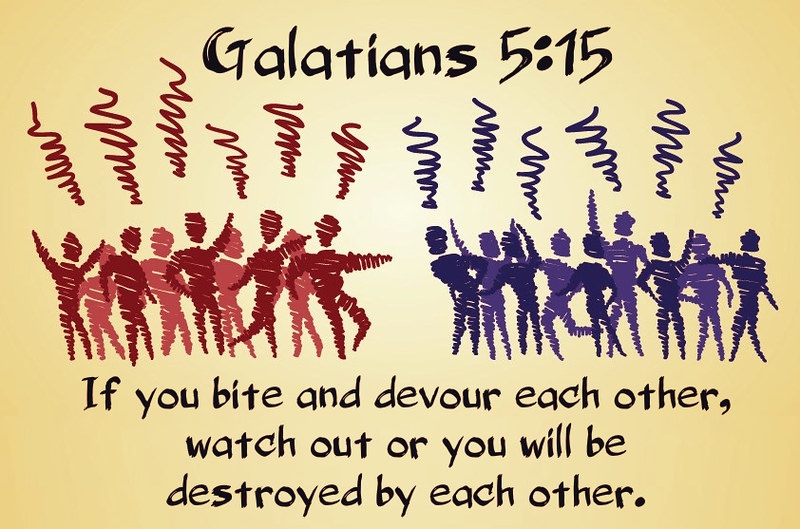
Paul himself, in his own letters, can demonstrate a caustic tongue and a critical attitude towards those who advocated differently from himself. In writing to the Galatians, for instance, he accuses them of being fools who have been bewitched by deceivers (Gal 3:1); he attacks them for biting and devouring one another (5:15); he criticises them for urging Gentile converts to be circumcised and to adopt full adherence to the Torah (5:2–4; 6:12–13). In his letter to Philippi, Paul mounts a strenuous invective against “the dogs … the evil workers … those who mutilate the flesh” (Phil 3:2), whom he later calls “the enemies of the cross of Christ” (3:18–19).
In his second extant letter to the Corinthians, he caricatures the “superapostles” as fools (2 Cor 11:19) who boast beyond their limits (10:12–18), preaching “another Jesus than the one we proclaimed … a different spirit from the one you received … a different gospel from the one you accepted” (11:4). He sees them as “ false apostles, deceitful workers, disguising themselves as apostles of Christ” (11:13); they have fostered “quarreling, jealousy, anger, selfishness, slander, gossip, conceit, and disorder” as well as “impurity, sexual immorality, and licentiousness” amongst the Corinthians (12:20–21). These are not words designed to foster a gentle, reflective spiritual meditation; this is full-on partisan polemics!
The same ethos appears in this letter, to Timothy; but the polemic is intensified, the arrows are sharpened, and the affirmations are hardened into strong dogmatic assertions. In contrast to the “different doctrine” of others, the letter writer believes in “the sound words of Jesus” (6:3) and “the words of the faith and of sound teaching” (4:6); he passes them on to Timothy “through the laying on of the hands of the elders” (4:14).
In this letter, the “glorious gospel of the blessed God” (1:11) is formalised as “the faith” (1:2, 19; 3:9, 13; 4:1, 6; 5:8; 6:10, 12, 21) or “the truth” (2:4, 7; 3:15; 4:3; 6:5). This faith is summed up in short, succinct sayings which are “sure and worthy of full acceptance” (4:9; we can see examples at 1:15; 2:5–6; 3:1; 3:16; 4:9–10; 6:15–16).
This is a step or three beyond the more fluid and flexible ethos of the authentic letters of Paul, where he is working out his theological commitments in the context of the cut-and-thrust of contextual debate. Here, “the faith” is a complete package, standing in its own right, to be believers, or rejected. The formulaic sayings state the dogmas that mist now be accepted.
These sayings are set within a defensive framework, for as Timothy receives a message of “faith and truth” (1:18; 2:7), he is to “guard” it (6:20) to ensure that he can hand it on to local leaders (4:6, 11), for this how they will be saved (4:16). The church is “the household of God” which acts as “the pillar and bulwark of the truth” (3:15). The leaders described in chapter 3 must ensure that the communities they serve will reject any differing viewpoints and “hold fast to the mystery of the faith” (3:9).
So we see that the central concern of the letter is to ensure obedience and pass on the essential teachings of the faith, under the leadership of designated office bearers in local churches, in order to refute the false teachings and immoral lifestyle to which they have been exposed.
There can be no doubt that Paul functioned in a leadership role within many of the early communities of faith. He presented himself—and was accepted and recognised by others—as a father-figure within that movement.
In his shortest letter, addressed to Philemon—which is offered by the lectionary this coming Sunday—he explicitly styles himself as “father” of the runaway slave, Onesimus (Phlm 10). This is obviously not a physical claim; rather, Paul is laying claim to the role that he played in converting Onesimus; and perhaps also to the role which he wishes to play, in guiding the community of faith which meets in the house of Philemon and Apphia.
This letter reveals something of the cultural context in which Paul operates; and something of his own expectations regarding his role within the Jesus movement. It is Paul’s shortest letter; it largely follows the pattern of a first-century letter in most respects. There is an opening set of greetings, encompassing Philemon, Apphia, Archippus and the church gathered in their house (Phlm 1–3), followed by an expression of thanksgiving for the love and faith of this group of believers (4– 7).
The letter omits the traditional conveying of news in order to come straight to the point with Paul’s central petition: “for this reason…I appeal to you… welcome him” (8–22). Paul is sending the slave Onesimus with an expectation that he will be received by Philemon and company in the spirit of the gospel: “not as a slave, but as a beloved brother” (15–16).
The letter does not address the structural issues inherent in a society in which slavery is a reality. Paul simply accepts that Onesimus is, and will remain, a slave; but he exhorts Philemon to treat him with equity, as a brother. Modern sensibilities about the injustice of one human being “owning” another human being, as a piece of property, are far from the awareness of Paul, Philemon, and all slave-owning people in the society of that day.
The letter ends in typical style, with Paul’s farewell by the sending of greeting from others with him, and pronouncement of a blessing upon those who hear the letter read to them (23–25).
The situation of writing appears to overlap with Paul’s situation as portrayed in Col 4:7–18. Paul himself is a prisoner (Phlm 1, 9, 23; Col 4:18) in the company of Epaphras (Phlm 23; Col 4:12); the precise location of his imprisonment is not revealed. Close by are Mark and Aristarchus (Phlm 24; Col 4:10) as well as Demas and Luke (Phlm 24; Col 4:14). Onesimus and Tychicus are Paul’s emissaries to Colossae (Col 4:7–9); this appears to place Philemon and his fellow believers in or very near to that city, as Paul sends Onesimus to them (Phlm 12).
The letter functions as a personal commendation of Onesimus. Paul sends him to Philemon with his strong support; he is “my child” (10), “my own heart” (12), “a beloved brother” (16). When he arrives, Paul exhorts Philemon to “welcome him as you would welcome me” (17). Paul undergirds these words with the declaration that he will personally rectify any wrong caused or repay any debt owed to Philemon by Onesimus (18). The stance he takes is that of a benefactor, acting to ensure the best interests of Onesimus.
This is just a short letter, and it lends itself really well to an exercise in reading (that I used each time I taught Paul) that exposes the way that the presuppositions we bring to a text can really influence the way that we understand that text.
First, read the the letter as the character of Philemon. How do you receive the letter? What are the most important things that Paul says in this letter? What does it inspire you to want to do?
Now read the letter as the character of Onesimus. How do you receive the letter? What are the most important things that Paul says in this letter? If you were the runaway slave, what would you do?
Then, compare how you responded to the letter as each character. What, in the light of all of this, do you want to say back to Paul?
The section of the letter to the Colossians that appears in the lectionary for this coming Sunday (Col 2:6–15) contains some intriguing phrases. It offers a portrayal of Jesus that stretches beyond what we find in the earlier, authentic letters of Paul. There, Jesus is a Jewish man, chosen by God, designated as God’s Son, raised from the dead, and designated as Lord (see, for instance, Gal 4:4 and Rom 1:1–4).
In this letter, Jesus becomes the one “in whom the fullness of deity dwells” (2:9; also 1:19). There is no evident sense of the humanity of Jesus; he is swept up into the mystical-philosophical world of “elemental spirits” (2:8) and deals with the “rulers and authorities” of that dimension (2:15). Indeed, in the previous chapter, the writer of this letter (whom I don’t believe was Paul) praises Jesus in full blown terms: “he is the image of the invisible God, the firstborn of all creation; for in him all things in heaven and on earth were created, things visible and invisible, whether thrones or dominions or rulers or powers—all things have been created through him and for him” (1:15–16).
In contrast to the expressions that Paul provides about the community of believers being “the body of Christ” (1 Cor 12:12, 27), in this letter, the mystical speculation grows; “he himself is before all things, and in him all things hold together” (1:17); and indeed, rather than the whole body being Christ, here Christ is “the head of the body, the church; he is the beginning, the firstborn from the dead, so that he might come to have first place in everything (1:18).
So when we see the figure of Christ placed into this mystical-speculative-philosophical context, we know that we have moved quite a way from the thoughts about Jesus that the apostle Paul dictated in his letters; we have entered a world that scholars call proto-Gnosticism. Gnostics were those who—to put it very simply—believed that salvation came, not through faith, but by means of knowledge. The one who knows is the one who is saved.
Thus, in this letter written to “the saints and faithful ones in Colossae” (1:1), knowledge is emphasised (1:9–10; 2:2–3; 3:10). The author sends this letter to the Colossians to encourage and strengthen them in their knowledge. Paul, by contrast, commends those to whom he writes for their faith (Rom 1:5, 8; Phil 1:25; 1 Thess 1:2–3).
To be sure, the anonymous writer of this letter, drawing from Paul’s practices, does commend the Colossians for their faith (Col 1:4), but it is his prayer “that you may be filled with the knowledge of God’s will in all spiritual wisdom and understanding” (1:9), that they may “grow in the knowledge of God” (1:10), that they may “have all the riches of assured understanding and have the knowledge of God’s mystery, that is, Christ himself, in whom are hidden all the treasures of wisdom and knowledge” (2:2–3).
*****
So, this letter is somewhat different from the style and theology of the seven letters authentically written by Paul. Another way in which is is different from the thoughts set out in those letters, can be seen in verses 3–15 of chapter 2.
First, let’s note that the verses immediately before this do seem to correlate with Paul’s way of thinking. The notion of “spiritual circumcision” (2:11) bears similarities with the claim that “it is we who are the circumcision, who worship in the Spirit of God and boast in Christ Jesus and have no confidence in the flesh” (Phil 2:3), or “real circumcision is a matter of the heart—it is spiritual and not literal” (Rom 2:29). Although, Paul does also dismiss circumcision as being “nothing” (1 Cor 7:19), “for neither circumcision nor uncircumcision is anything” (Gal 6:15). Perhaps in those verses he is dismissing physical circumcision as it gets in the way of “spiritual circumcision” ?
And the description of being “buried with [Christ] in baptism” (Col 2:12) does seem similar to the statements that “all of us who have been baptized into Christ Jesus were baptized into his death … we have been buried with him by baptism into death … we have been united with him in a death like his” (Rom 6: 3–5).
Although, once again, it has to be noted that the sequence in Romans 6 looks to a future union with Christ in his resurrection, whereas in Colossians that union is now present, having been achieved by a (perhaps recent) past event: “when you were buried with him in baptism, you were also raised with him through faith in the power of God, who raised him from the dead” (Col 2:12). So there is a subtle difference; a development in thinking beyond that of the authentic Paul.
It is in what follows, however, that a striking difference emerges. In verses 13–15 the letter writer considers exactly what was achieved by Jesus when he was crucified. In Paul’s authentic letters, he draws on what many consider to be a very early, pre-existing formulation which seeks to convey just what Jesus did when he submitted to death on the cross, when he gave up his life.
In those letters, Paul notes that “Christ died for us”. That’s a short and simple way to describe the significance of the death of Jesus; we find it at Rom 5:6,8, 14:15; 1 Cor 8:11, 15:3; 2 Cor 5:14-15; Gal 2:21; and 1 Thess 5:10. That’s five of the seven authentic letters; the matter of the death of Jesus does not figure at all in what is being discussed in Philemon; and in Philippians, the death of Jesus serves to emphasise his humility and obedience (Phil 2:8), and Paul’s main interest is in his this death serves to effect a transformation in believers (Phil 3:21).
This affirmation, “Christ died for us”, forms the foundation for an intricate and complex system of sacrificial atonement theology which is developed beyond the time of the New Testament. These eight times when Paul says, “Christ died for us”, join with a number of other passing comments elsewhere in New Testament texts, to provide the basis for what would become, over time, a detailed understanding of the death of Jesus as a death made on behalf of, and in the place of, believers. An explanation is developed, drawing especially on the Jewish sacrificial system, in which the sacrifices of animals were understood to be the way by which the sins of people were forgiven.
But not in the letter to the Colossians. A different understanding of the significance of the death of Jesus is offered. A different way to explain how God forgives us our sins, how we have atonement made for our transgressions, how we are reconciled with God. The language used, and the concepts referenced, are quite different. And this opens the door to a different way of understanding and appreciating the death of Jesus.
*****
This area of Christian theology—how to understand the death of Jesus—is known as soteriology (relating to “how we are saved”), with a strong emphasis being placed on atonement (that is, what is the mechanism for bringing us back into reconciled relationship with God). The atonement has become a debated and disputed arena. How do we understand this today?
One concern that is often expressed concerns the way that a religious system has a focus on a violent action at the centre of its belief system. Can it be a good thing to celebrate the way that God causes, or at least approves of, the putting to death of Jesus? We have every right to ask critical and penetrating questions about this aspect of our faith.
Another element of the debate is the claim that can be paraphrased as “Jesus died in my place, he was sacrificed for my sins, to save me from hell”. This is the classic way that I hear this view expressed, and it is often described as the substitutionary atonement theory. It depends on, but moves well beyond, the understanding that was inherent in the Jewish sacrificial system.
Certainly, dealing with the sinful manifestations of human nature is at the heart of Christian doctrine, and theories of atonement regularly grapple with how this is effected. However, I can’t see that the New Testament, anywhere, sets forth such a fully-developed theory of atonement. In true systematic theology style, verses have been plucked from various places in the New Testament, and woven together, with little regard for their original context or intention, to form a developed theory that owes more to rationalist deductive argumentation, than it does to biblical texts.
*****
The explanation in Col 2:13–15 is quite different. Here, the author sees the scene of the crucifixion in his mind’s eye; but rather than relating what was happening there to the Jewish sacrificial system, the vision of the author draws on other imagery. The scene envisaged is much more like a triumphal procession, as seen in the Roman Empire, when captured slaves were paraded through the city streets as captives, and the people celebrated another great victory of the Empire.
The cross, the place where Jesus was nailed and hung until he died (most usually from suffocation), is not envisaged as similar to the place in the Temple where the sacrificial animals were burnt, or even where the blood of the slain animals was smeared (the language of Rom 3:25 draws on on this quite explicitly). It is seen as a public place where “legal demands” (dogmata, 2:14) are nailed for all to see; a public place where those “legal demands” are erased. The language here is about “stripping bare” so that the inequity of those demands is revealed for all to see.
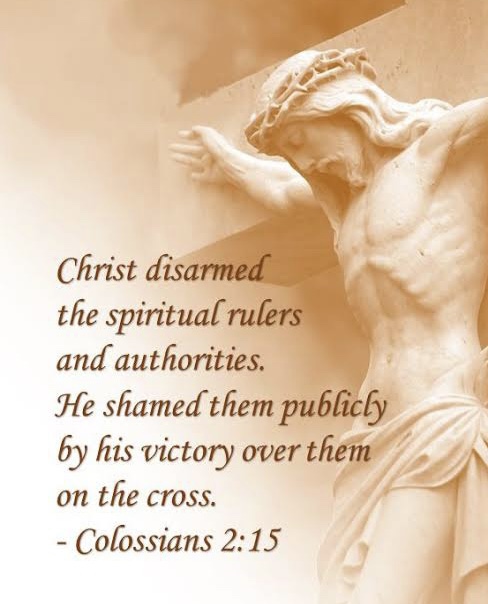
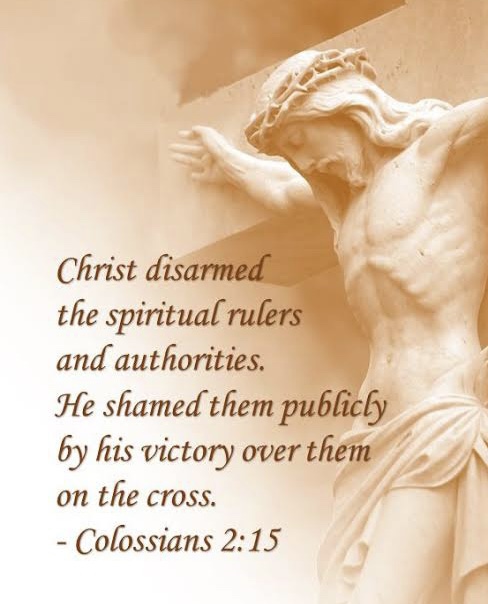
As a result of this, what Jesus is doing on the cross is “disarm[ing] the rulers and authorities”, removing their power, rendering them ineffective (2:15). The Greek word translated as “make a public example of” in this verse, points to a scene of public shaming. The only other place it is used in the New Testament is Matt 1:19, where it refers to the “public disgrace” of Mary being revealed as pregnant without a husband. It would be a moment of intense shaming for her, such that “Joseph, being a righteous man and unwilling to expose her” in this way was planning to “dismiss her quietly”, in accordance with custom—until an angel of the Lord intervened!
So the “legal demands” have been “disarmed” or (in another possibility) “divested”, in a process of “making a public example”. As a consequence, what the author sees as Jesus hangs, naked, whipped, gasping for water, dying on the cross, is nothing other than a celebratory triumphal match (“he made a public example … triumphing over them” (2:15).
Who does Jesus triumph over? The “rulers and authorities”—most likely the same as the “thrones, dominions, rulers, powers” referred to earlier (1:16), or the “elemental spirits of the universe” (2:10). The crucifixion has been the location for God’s cosmic battle— remembering that Hod is the subject of the whole clause of 2:13–15.
These “rulers and authorities” are most likely the same entities referred to in Colossian’s companion letter, Ephesians; “all rule and authority and power and dominion” (Eph 1:21), “the rulers and authorities in the heavenly places” (Eph 3:10); “the rulers … the authorities … the cosmic powers of this present darkness … the spiritual forces of evil in the heavenly places” (Eph 6:12), that are best combatted by “tak[ing] up the whole armour of God” (Eph 6:13–17).
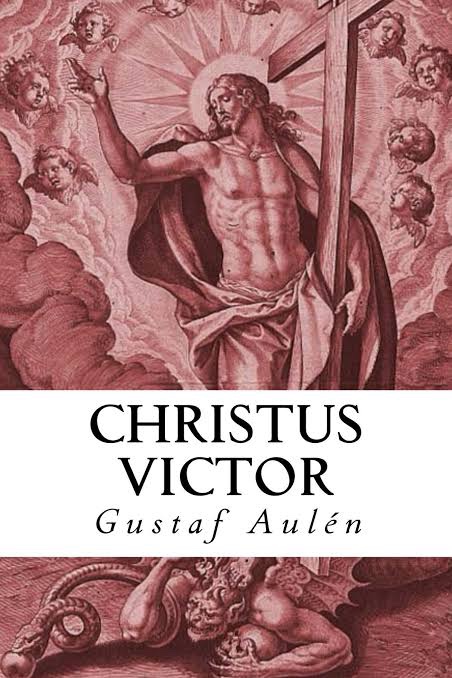
Almost a century ago, a theologian named Gustav Aulen wrote a hugely-influential book, Christos Victor, in which he put forward a theory of atonement quite different from the sacrificial-victim, ransom-theory, penal-substitutionary-atonement line of thought. This passage fuelled his argument. The crucifixion, Aulen proposed, declared the liberation of humanity from the bondage of sinfulness and death; it was the way that God declared victory over demonic forces.
Later, an American biblical scholar named Walter Wink took this theory, re-engaged with the relevant biblical texts, and proposed that the victory won by God was not simply over spiritual beings in a heavenly realm, but actually a gritty, this-earthly battle with the systems and forces within society that embedded sinfulness in our very way of living. Wink wrote an influential series, Naming the Powers (1984), Unmasking the Powers (1986), Engaging the Powers (1992), When the Powers Fall (1998), and The Powers that Be (1999), in which he wrote about the myth of “redemptive violence”.
So this short passage in Colossians is very important. It opens the door to a different way of thinking about the crucifixion. It invites us to take seriously our earthly context, and to consider how we are engaged, along with Jesus, in executing the work of God, to disarm the rulers and authorities, publically expose them, and triumph over their evil force.
*****
For more discussion of the atonement and the way that the New Testament writers understood this, see
This coming Sunday, we turn from a letter written in the name of Paul, which few interpreters doubt is an authentic letter of Paul, to a slightly shorter letter which also claims to be written by Paul—but about which there is quite some debate as to whether Paul did write it. We will hear the opening section of the letter this Sunday (Col 1:1–14).
The letter begins with a clear claim to be a letter from “Paul, an apostle of Christ Jesus by the will of God, and Timothy our brother, to the saints and faithful brothers and sisters in Christ in Colossae” (Col 1:1-2). Despite this claim, there are signs that Paul may not be the author.
A more complex grammatical structure at some points, and some unusual vocabulary when compared with the vocabulary of the authentic letters of Paul, suggest a different hand in the creation of this letter. Some theological motifs are developed further than is found in the authentic letters of Paul, while the situation addressed appears to be different from—and probably later than—any situation envisaged in the lifetime of Paul.
It is typical of Paul’s letters that the opening “prayer of thanksgiving” sets out some of the key contenders which will be addressed in the body of the letter. (This is the case in many other letters from the time that survive to today; whether Christian, or Jewish, or pagan, letters invariably flag key issues in the opening sentences.) Here, the key concerns seem to be about “the knowledge of God’s will in all spiritual wisdom and understanding” which will enable the readers and hearers of this letter to “lead lives worthy of the Lord” and “be prepared to endure everything with patience”.
The letter refers to Onesimus (Col 4:9), the slave about whom Paul wrote to Philemon (Phlm 10), as well as one of the addressees of that letter, Archippus (Col 4:17; Phlm 1). The greetings at the end of the letter contain a number of names also found in the greetings of Philemon 23–24: Epaphras (Col 4:12), Mark and Aristarchus (Col 4:10), and Demas and Luke (Col 4:14).
This suggests that the two letters might have originated at the same time in the ministry of Paul—when he was in prison (Col 4:3, 8; Phlm 10, 13), perhaps in Rome towards the end of his life. However, there is little else to connect Colossians with Philemon. The content of each letter is quite different.
Alternatively, the Colossian references to Paul’s imprisonment might link the letter with Philippians, written similarly during an imprisonment (Phil 1:7, 12– 14, 17). This would be so if Epaphroditus in Philippians (2:25; 4:18) was the same person as Paul’s associate, Epaphras, noted in Colossians (1:7–8; 4:12– 13). That possibility suggests a common origin; but no further links between these letters are evident.
A more fruitful connection is found between Colossians and Ephesians, where there are a number of similarities in theological development as well as a significant overlap of text. Eph 6:21b–22 replicates almost exactly the underlined phrases in Col 4:7–9. The most persuasive theory is that Ephesians, written well after the death of Paul by a follower of Paul’s teachings, drew on that section of Colossians, believing it to be the words of Paul.
Returning to Colossians itself, we note that it follows the traditional form of a letter, with opening greetings (1:1–2) and thanksgiving (1:3–8) leading into a further prayer for the Colossians (1:9–14) before the body of the letter (1:15–2:23) and a series of exhortations (3:1–4:6). The closing greetings (4:7–17) and grace (4:18) bring the letter to a close in conventional fashion.
There are a number of indications of the distinctive situation to which the letter is addressed, although these insights are mediated through the perspective of the writer of the letter. The Colossians, although believers in Christ, continue to recognise the “elemental spirits of the universe” (2:8, 20). They are “deceived with plausible arguments” (2:4) and thus are captive to a “philosophy and empty deceit” (2:8) which is contradictory to Christian belief. They take part in “festivals … new moons … sabbaths” (2:16), engage in “self-abasement and worship of angels” (2:18) and adhere to strict regulations (2:20–22).
These terms seem to be describing people who are Gentiles (elemental spirits) who have adopted some Jewish practices (new moons, sabbaths, worship of angels) yet have an ascetic flavour (self-a basement) with rhetorical interests (plausible arguments) mediated through their philosophical interests. That’s quite a thick description of the presumed recipients, and not like others who received authentic letters from Paul.
Along with clear evidence for syncretism amongst the Colossians, there is a thought that the believers in Colossae were proto-Gnostics—that is, precursors of the kind of Christianity that emerged fully in the second century onwards, and which we know about most directly through the documents collected in the Nag Hammadi library (discovered in Egypt in 1945). See http://gnosis.org/naghamm/nhl.html
Over against this cluster of beliefs, the letter-writer advocates the gospel, which is described as “the word of truth” (1:5) and “the faith” (1:23; 2:7), and exhorts the readers to be “mature in Christ” (1:28; 4:12). The opening thanksgiving (1:9–10) contains key terms which express the writer’s hopes for the readers: understanding (2:2) and growth (2:19), and especially wisdom (1:28; 2:3, 23; 3:16; 4:5) and knowledge (2:2, 3; 3:10). These last terms, particularly, point in the direction of the developing Gnostic movement which held sway in some parts of the developing Jesus movement.
Some of these terms do appear in Paul’s authentic letters; some others appear less frequently, if at all. They do appear, however, in the Pastoral Epistles (written “in the name of Paul” some decades after his death) and then in various documents, not part of the New Testament, which demonstrate the growing Gnostic and speculative-philosophical tendencies in some parts of Christianity in the late first century and on into the second and third centuries.
The positive qualities which are highlighted in this letter, noted above, are especially related to Christ, in whom “the whole fullness of deity dwells” (2:9–10), a doctrine which sits at the core of a distinctive hymn in which Christ is portrayed as an all-encompassing cosmic figure (1:15–20). This is one key point where the letter moves beyond what is found in Paul’s authentic letters to the formulation of a post-Pauline doctrine. This, it seems, is central to “the word of truth” that is highlighted from the start of the letter.
My own conclusion is that Colossians was most likely written by a follower of Paul, writing in his teacher’s name in order to claim his authority as he addressed a situation different from, and some time after, Paul’s own time. Paul’s theological and ethical positions are known by the author. However, the problematic situation addressed, the theological ideas expressed, and the ethical instructions offered, each point to an origin after the lifetime of Paul.
This coming Sunday, the lectionary offers us a final section from Paul’s letter to the Galatians (6:1-16). In recent blogs on this letter, we’ve seen that Paul writes to the churches in Galatia with passion. He can be aggressive and cutting with his language. He writes as a person deeply convinced about what he is saying, intensely aggrieved by the resistance he has encountered, and fully committed—heart and mind, body and soul, and all his words—to the message he brings.
Paul was an innovator. Nowhere is this evident more than in his letter to the Galatians. It is clear that Paul knows, and appreciates, the worth of the Jewish tradition and culture in which he has been raised. In his letter to the Romans, he quotes a number of the Ten Words, which sat at the heart of the Law (Rom 13:9–10) and he praises these commandments as “holy and just and good” (Rom 7:12).
Paul’s own heritage as a Pharisee (Phil 3:5; Acts 23:6; 26:5) shaped the way that he valued and used scripture. His understanding is that Jesus has brought the Law to its final, climactic fulfilment (this is how teleios should be rendered in Rom 10:4; and see Gal 5:14; Rom 13:10). And yet, in writing to the Galatians, he criticises them for their adherence to this same Law.
We have noted in an earlier blog post that Paul argues that the gospel he proclaims brings believers into the unity of being “one in Christ” (3:28). This unity overshadows all divisions—as the most famous words in this letter declare, “there is no longer Jew or Greek, there is no longer slave or free, there is no longer male and female” (3:28). The incorporation of Gentiles into the community alongside Jews was fundamental for Paul.
Yet Paul shows awareness of a significant threat against this unity in Galatia; it has arisen through the insistence of teachers who do not have Paul’s way of seeing things, who insist that true faith in Jesus requires, first of all, circumcision. This is the group which Paul calls “the circumcision faction” (2:12; compare Acts 15:1, 5). They are advocating that the sign par excellence of being a Jew (for males, st least)—that of circumcision (Gen 9:9–14; Lev 12:1–3; Josh 5:2–9)—must continue to be practised by those who come to faith in Jesus.
Paul was always on high alert regarding people teaching differently from him (see Phil 1:15–18, 3:2–4; 2 Cor 10:5, 12, 18, 11:4–6, 12–15; and perhaps reflected in the ‘slogans’ of 1 Cor 6:12–13, 7:1, 8:1–2, 10:23). Here, he criticises the teachers in Galatia because they want their followers to be circumcised (6:12)—although he notes that they themselves, surprisingly, “do not obey the law” (6:13). This contradicts Paul’s understanding that every circumcised male “is obliged to obey the entire law” (5:3). But they teach that circumcision is necessary for (male) followers of Jesus.
Paul’s problem, of course, is that he himself is circumcised, as he mentions at Phil 3:5 (a fact which he omits when he rehearses his past at Gal 1:13–14). How can he advocate the opening of the faith to those who are not circumcised, when he himself bears this sign of the covenant?
He boldly insists that the Galatians “become as I am” (4:12), and yet threatens that “if you let yourselves be circumcised, Christ will be of no benefit to you” (5:2). The believers in Galatia , it would seem, were Gentiles who had previously worshipped “beings that by nature are not gods”, namely, “the weak and beggarly elemental spirits” (Gal 4:8–10). What applied to these Gentile converts must be different from what is the case amongst Jewish converts, Paul maintained.
Paul makes his case against circumcision for converted Gentiles by re-interpreting the scriptural passage which lies behind this Jewish custom. It was Abraham who was the patriarch to whom the requirement of circumcision was first commanded, to be a sign of the covenant (Gen 17). So the story of Abraham needs to be addressed.
It is striking that Paul explains the story of Abraham without once mentioning circumcision (3:6–18). According to Paul, it is the faith of Abraham, in believing God’s promise, which secured him righteousness (3:6–7) and opens the promise to Gentiles (3:8–9). It is that promise which is now fulfilled in Christ (3:13–14, 16, 29). This compact argument in this letter would form the basis for the more expansive exposition that Paul,provides in his letter to the Romans.
Circumcision is central to the Law, and the Law is the basis of the promise that God has made, to Israel, and then to believers in Christ. Paul asserts that the Law supports the promise, in its role as a paidagogos (3:21–24). This word described a position in Greek society in which a tutor both instructs and disciplines a young man until he reaches his maturity. Now that maturity has arrived, in Christ, the paidagogos is no longer needed (3:25).
Paul has earlier asserted that doing “the works of the Law” does not result in justification (2:16); he cites Hab 2:4 to affirm that “the one who is righteous will live by faith” (3:11)—the same scriptural text which forms the basis for his argument in Romans. Does he portray the Law as now completely irrelevant? He does not draw this conclusion, and insists that “the Law is not opposed to the promises of God” (3:21).
Paul supports his position with an argument drawn from “the Law”, that is, Hebrew scripture—the accounts of the two children of Abraham (found in Gen 16 and 21) provides an allegory for the two covenants made by God (4:21–31). Believers are heirs of the free woman, Sarah; Jews are heirs of the slave woman, Hagar. This leads to a firm rhetorical conclusion for the Galatians: “for freedom, Christ has set us free” (5:1).
The point fits well with the situation which he addresses; it does a disservice, however, to his opponents, who were putting a position that had long been supported by Jewish tradition and scripture. And if Paul was really wanting to create unity within the church, then he has unfairly caricatured and marginalised those who came to Galatia, teaching about the Law.
Paul’s language is intensely passionate in this letter; when he describes the earlier stage of his relationship with the Galatians, his emotions are dominant (4:12–20). They once had much goodwill towards him; he claims that they were willing to tear out their eyes and give them to him (4:15). Paul here refers to his “physical infirmity” (4:13; see also 6:17); is this infirmity the “thorn in the flesh” to which he refers at 2 Cor 12:7? Although this infirmity tested the acceptance that the Galatians felt for Paul (4:14), they did welcome him “as an angel of God” (4:14).
Now, he fears that he has become “an enemy” (4:16), yet he still feels “the pain of childbirth” for them (4:19) and admits he is perplexed about them (4:20). They “bite and devour one another” and risk consuming one another (5:15).
All of this is Paul at his most impassioned, pleading what may well be a lost cause in Galatia. He notes that they have fallen back into their pagan ways (“enslaved to beings…that are not gods”, 4:8–9), mixed with practices that seem more Jewish (“special days, and months, and seasons, and years”, 4:10). Their previous religious practices may well have contained a combination of such aspects; this phenomenon, known as syncretism, was well-known in the Hellenistic world.
Undeterred by the complexities of the debate concerning the Law in 3:1–5:1, Paul presses on to sound a further notes of liberty and unity in his letter. The call to freedom (5:1, 13) is a platform for ethical guidance, grounded in love (5:13–14), manifested in living by the spirit (5:22–26), not by the flesh (5:16– 21). This ethic requires them to “bear one another’s burdens “(6:2) and “work for the good of all” (6:10). In this way, they will become “a new creation” (6:15).
And so it is that Paul concludes, neither circumcision nor uncircumcision is anything; but a new creation is everything! (6:15). The gospel which brings liberation in community (3:28) will also lead to liberation for the whole creation (6:15).
*****
Based on material in PAUL: an exploration, by John Squires and Elizabeth Raine (self-published 2014; revised 2018).
The lectionary is currently providing a short series of excerpts from one of Paul’s earliest letters—the one he wrote to the Galatians, possibly in the late 40s, more likely (in my view) by the middle of the 50s.
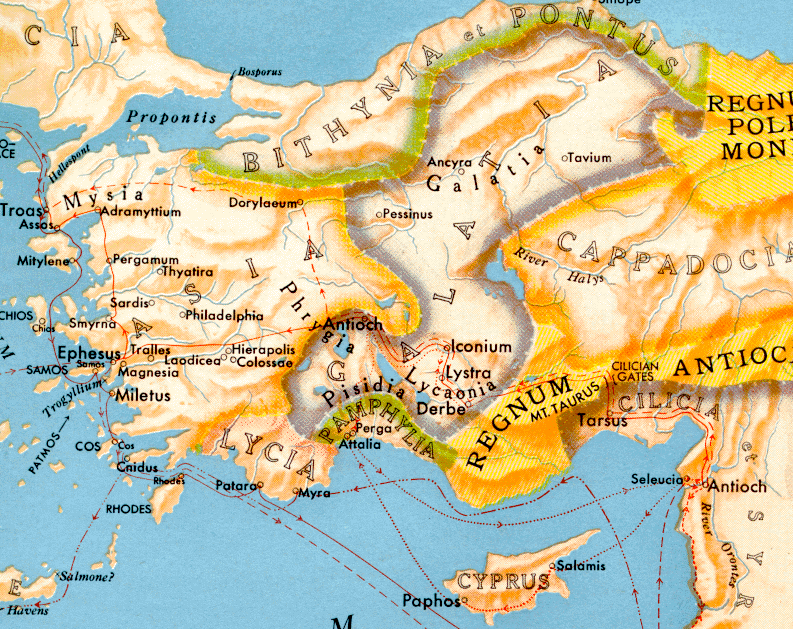
This letter is distinctive in a couple of ways. The audience is not a gathering of believers in one city (as in Thessalonians, or Philippi, or Corinth, or even Rome), but the various communities of believers across the whole region of Galatia, which was one of the Roman provinces in the area we today call Turkey.
A second distinctive feature is that this letter completely omits any of the “friendly overture” elements that are typically found at the start of the letters widely recognised as the authentic letters of Paul. Many of these letters, after the requisite formalities (Paul, to the believers in X, grace and peace to you), contain a prayer of thanksgiving: “we always give thanks to God for all of you and mention you in our prayers, constantly …” (1 Thess 1:2–10); “I give thanks to my God always for you because of the grace of God that has been given you in Christ Jesus …” (1 Cor 1:4–9), “when I remember you in my prayers, I always thank my God because I hear of your love for all the saints and your faith toward the Lord Jesus …” (Phlmn 4–7); “first, I thank my God through Jesus Christ for all of you, because your faith is proclaimed throughout the world …” (Rom 1:8-15); and in the letter known as “the friendly letter”, “I thank my God every time I remember you, constantly praying with joy in every one of my prayers for all of you …” (Phil 1:3–11).
The second letter to the Corinthians replaces this prayer of thanksgiving with an extended blessing: “Blessed be the God and Father of our Lord Jesus Christ, the Father of mercies and the God of all consolation, who consoles us in all our affliction …” (2 Cor 1:3–7); that pattern is followed by the anonymous scribe who wrote decades later, modelling his circular letter on earlier Pauline examples, “Blessed be the God and Father of our Lord Jesus Christ, who has blessed us in Christ with every spiritual blessing in the heavenly places …” (Eph 1:3–14), just as the unknown person who crafted a letter to Colossae likewise followed the model of the earlier prayers of thanksgiving: “in our prayers for you we always thank God, the Father of our Lord Jesus Christ, for we have heard of your faith in Christ Jesus and of the love that you have for all the saints …” (Col 1:3–14).
The letter to the Galatians has no indication, either of a prayer of thanksgiving, or of a blessing. Instead, this letter cuts right to the chase, in direct words which accuse and denounce: “I am astonished that you are so quickly deserting the one who called you in the grace of Christ and are turning to a different gospel … there are some who are confusing you and want to pervert the gospel of Christ … if anyone proclaims to you a gospel contrary to what you received, let that one be accursed!” (Gal 1:6–9). The letter continues swiftly, “Am I now seeking human approval, or God’s approval? Or am I trying to please people? If I were still pleasing people, I would not be a servant of Christ.” (Gal 1:10).
*****
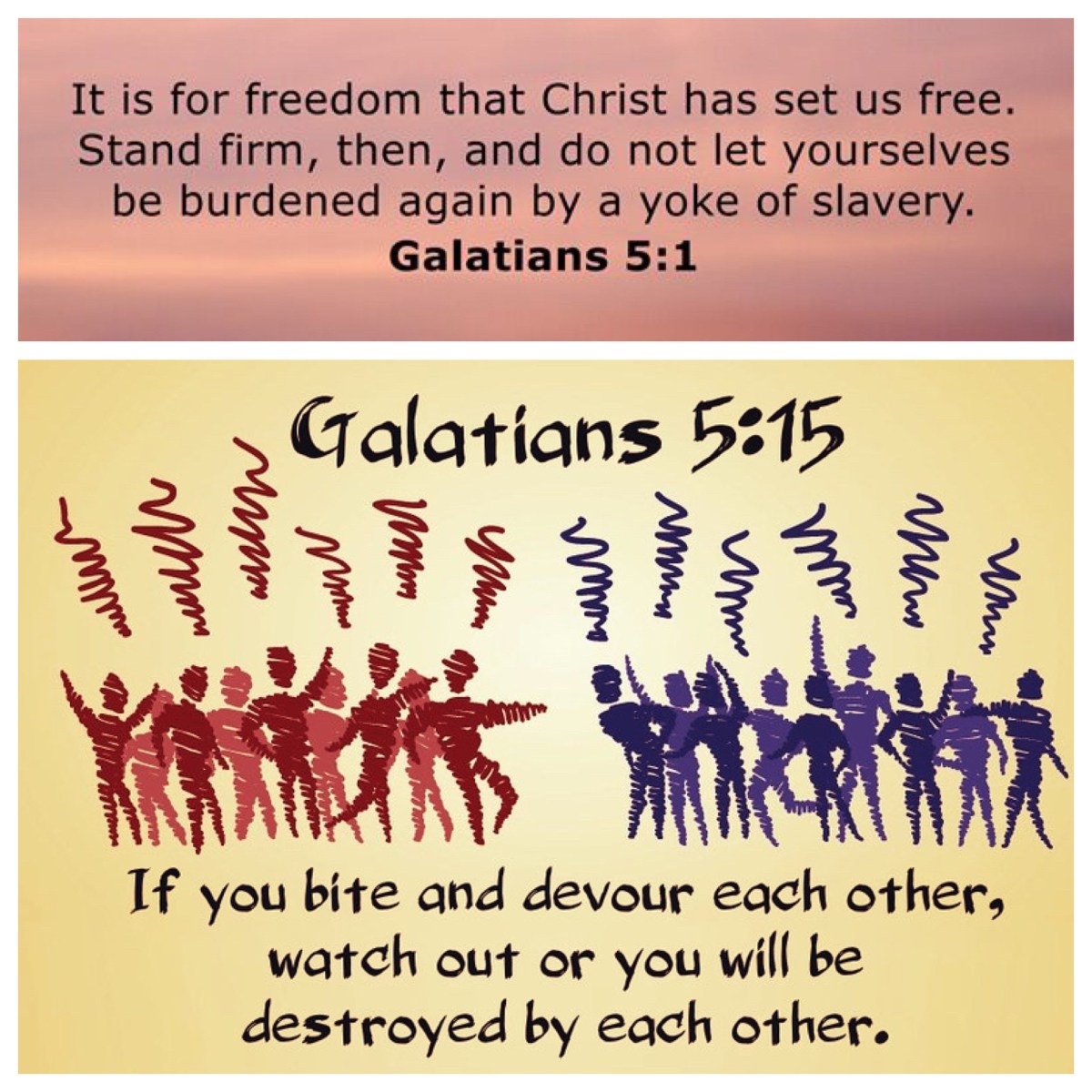
This opening accusation is reflected in words that we find in the section offered by the lectionary for this coming Sunday (5:1, 13–25) when, five chapters after this direct opening, Paul rounds back on his audience, declaring that “if you bite and devour one another, take care that you are not consumed by one another” (5:15).
In a striking juxtaposition, however, the letter continues on from this warning, to provide a contrast, which has become well-known, between “the desires of the flesh” (5:16–21) and “the fruit of the Spirit” (5:22–26).
I have no doubt that most, if not all, sermons that are preached on this lectionary offering will focus primarily, if not exclusively, on the nine qualities identified as the fruit of the Spirit, namely, “love, joy, peace, patience, kindness, generosity, faithfulness, gentleness, and self-control” (5:22-23).
Swimming against the tide, I intended to reflect here, not on the fruit of the Spirit, but on those earlier words, about “biting and devouring one another”.
To understand the reason for Paul’s direct words, we need to understand the presumed situation in Galatia which he was addressing. We can glean a number of clues about this from references and statements in Paul’s letter to the Galatians.
It is evident from Paul’s opening comments that other teachers had visited the Galatian community, and had taught them things that were at odds with what Paul was teaching. He derogatively labels them as “some who are confusing you and want to pervert the gospel of Christ” (1:7), and later as those who have “bewitched” the Galatians (3:1) and, by inference, those who “prevented [them] from obeying the truth” (5:7). As a result, he calls the Galatians “foolish” (3:1) and expresses a wish that “those who unsettle you would castrate themselves” (5:12).
These teachers, in Paul’s opinion, proclaim “a gospel contrary to what you received” (1:9)—namely, what Paul himself had taught them, when he had earlier visited the Galatians, a time “when you did not know God, you were enslaved to beings that by nature are not gods” (4:8). The Galatians turned from their gentile faith to adopt faith in Jesus, by which “you have come to know God, or rather to be known by God” (4:9). It is “for freedom [that] Christ has set us free” (5:1). See https://johntsquires.com/2022/06/15/for-freedom-christ-has-set-us-free-galatians-pentecost-2c-3c-4c/
*****
If we knew precisely who the Galatians were, what group of teachers had been active amongst them, or what specific matters caused Paul to write this letter, we might be better placed to adjudicate on this matter. Unfortunately, we do not have specific information about the identity of the addressees of this letter or their location.
Acts indicates that Paul had preached in a number of locations in Galatia: initially with Barnabas he visited Pisidian Antioch (Acts 13:14–52), Iconium (14:1–5), Lystra (14:6–20) and Derbe (14:6, 21–23). Subsequently he revisited the area, once passing through swiftly with Timothy, saying nothing (16:6), and later going “from place to place” in the region, “strengthening the disciples” (18:23).
In the first two cities there were Jews who were opposed to the preaching of Paul and Barnabas: they persecuted them in Antioch and attempted to stone them in Iconium. However, such figures are common in Acts, for in almost every place Paul encounters such Jewish opposition. We learn no specifics of the Galatian churches from the Acts accounts.
Paul argues that the gospel he proclaims brings believers into the unity of being “one in Christ” (3:28). This unity overshadows all divisions—as the most famous words in this letter declare, “there is no longer Jew or Greek, there is no longer slave or free, there is no longer male and female” (3:28). See https://johntsquires.com/2022/06/19/inclusion-welcome-unity-gal-3-pentecost-2c/
The threat against this unity has arisen through the insistence of these teachers, that true faith requires, first, circumcision. This is the group which Paul calls “the circumcision faction” (2:12; compare Acts 15:1, 5). They are the ones whom Paul blames for the destructive behaviour of the believers in Galatia, as they bite and devour one another, because they have been (in Paul’s view) bewitched and confused. (So much for the wonderful days of the “golden era” of the early church … … …)
Paul has much to say about the teaching of these people, identifying circumcision as the central issue, but actually dealing with a whole set of matters regarding the place of the Jewish Torah, the law, in the communities which recognised Jesus as Messiah. Paul comes back to this is his final chapter of the letter, which is what the lectionary offers us on the Sunday after next … so more musings on that, next week.
My sermon for the 45th anniversary of the Uniting Church in Australia, preached at the Tuggeranong Uniting Church on 19 June 2022
*****
On the Sunday closest to 22 June every year, across this continent, people gather to celebrate the formation of the Uniting Church in Australia. And as it happens, today the lectionary offers us a section of one of Paul’s letters, from our New Testament, which is quite relevant. It’s from the latter part of chapter 3 of his letter to the church in Galatia.
It is good to have this passage as our focus. It speaks to who we want to be, together, as the church. It is a word for our times. In fact, I think that this passage could well express the fundamental calling of the Uniting Church. It taps into many of those key things that are at the heart of our DNA as the UCA. (You might have read what I wrote about this in the newsletter this week, or on our website; see https://tuc.org.au/conversations/the-dna-of-the-uca/)
Paul’s letter to the Galatians was written in the midst of an intense and ferocious debate within the early movement that had been started by Jesus. It was a time of great transition. Things were changing. Old practices were being challenged. New practices were being proposed.
In Galatia, a region in the area we today would call Turkey, the communities of new believers were practising Circumcision as a sign of their faith in Jesus. That was how Jewish people had long signalled their faith, by circumcising their infant males. Jesus himself was circumcised. So it made sense to the believers in Galatia to require that any males who professed faith in Jesus would be circumcised.
This practice came under criticism. In Galatia, as in many other places where the good news of the Jesus movement had been proclaimed, baptism was being proposed as a new ritual, to mark the new faith of the growing numbers of the followers of Jesus.
The argument about circumcision has behind it the issue as to how much, or how little, of the Jewish Law should apply to believers within that movement – those whom we now call the early Christians. This was an incredibly contentious issue at the time, which caused much dispute. Galatians is a letter that was written in the heat of this intense debate; so, at many points, it bears more evidence of rash fury than it does of considered reflection on the part of Paul.
Paul’s language in Galatians is ferocious. He accuses the Galatian believers of being fools who have been bewitched by deceivers; he attacks them for biting and devouring one another; he criticises them for urging Gentile converts to be circumcised and to adopt full adherence to the Torah. This is no gentle, reflective spiritual meditation; this is full-on partisan polemics! Nevertheless, it is part of the collection of letters that were included, long ago, in the canon of our scriptures. We are called to hear it, read it, and reflect on it.
So it is wonderful to find, right within the midst of this turbulent flow of argument and disputation, that we come across comments that do provide cause for reflection; ideas that do invite deeper consideration; insights that do offer the opportunity for spiritual growth to those who would read, ponder, and reflect.
In today’s passage, we find these two well-known verses from the third chapter of this letter: “As many of you as were baptized into Christ have clothed yourselves with Christ. There is no longer Jew or Greek, there is no longer slave or free, there is no longer male and female; for all of you are one in Christ Jesus” (Gal 3:27–28).
Here, Paul sets out a vision for people of faith; a vision for believers within community; we would say, a vision for the church. It could well be our central mission statement, as the Uniting Church in Australia, for we so much value grace-filled inclusiveness, we so strongly reject divisive and judgemental stances, we so yearn to live in accord with this grand vision, where all belong to a welcoming and loving community.
It is a vision that should resonate with us here at Tuggeranong. In this congregation, we work to ensure that people are welcomed and included. The door is open to all who want to walk through it and gather with us. And such people do walk through the door: people of Anglo heritage, of Islander heritage, of Indian and Asian heritage; people of mature age, those “in their prime” (yes, that’s most of us!), those who participate regularly in Girls’ Brigade, and those in the very early years of their lives.
In the fellowship of this congregation, we have people who identify as heterosexual and those who identify as homosexual; those who have transitioned genders, those who are intersex, those who prefer the pronoun “they” to “he” or “she”. Rainbow Christian Alliance offers a safe place for such folks, as well as this morning worship gathering. We have in our midst people for whom life has been a struggle, and those who have been blessed with good health and happy relationships throughout.
People from this Tuggeranong congregation offer ministry to those at Karralika who are grappling with issues in their life, to those who are finding it hard to make ends meet and value the opportunities to shop at Red Dove, or to collect food parcels, and to those who simply want a weekly time of friendly companionship over a meal. All of these activities, and more, indicate that we are open, welcoming, inclusive. This resonates with the vision of the church that Paul long ago articulated.
And it indicates that we are, as we have prayed earlier, heading towards being a church that “dreams ambitiously, loves with purpose, and dances with danger … that lives the politics of the kingdom and discovers the beauty of humanity, that loves to bless the stranger … and has courage to step out in faith … as God’s companions on this way”. [Prayer by Rocky Hamilton, abbotsford.org.uk]
Paul’s vision of the church is one of harmony, inclusion, unity. Yet some were clinging to the old practices, of circumcision, while others were seeking to move on, through practising baptism. Paul envisages great changes within the community of faith, because of Jesus. If the people in Galatia had failed to achieve this change, nevertheless the vision stood firm; Paul envisaged a community that would bring together strikingly disparate opposites.
In this community, the religious differences of Jew and Gentile would matter no more; the different levels of social status, of people living in freedom and those serving as slaves, would become irrelevant; and the societal roles and expectations associated with the gender of a person—male or female—would no longer function as dominant. These three conditions of difference would melt away, within the community of faith, into a cohesive unity of co-operation and interconnection. This was a huge change to take place all those centuries ago.
Indeed, as we ponder these three key instances of the way in which difference would disappear, we might even push it further: is this vision not simply one for the church, but even one for society as a whole? Might it be that the vision, the hope, which Paul set out in his letter to the Galatians, could be brought about within the patterns of living and relating right across his society? Was Paul passionate, not only about partisan points of religious practice, but also – and more significantly – about visionary ideals for human society as a whole?
“There is no longer Jew or Greek, there is no longer slave or free, there is no longer male and female; for all of you are one in Christ Jesus” – this unity within the church might well become a model for harmony within society. Certainly, that is the way that the church has interpreted this statement in the centuries since Paul wrote it.
The church of the late first century continued the battle begun in the time of Paul; over time, Jews and gentiles were equally welcomed within most of the faith communities of the ancient world.
The church of the Enlightenment was at the forefront of the movement to end the slave trade, to enable black Africans to live unhindered by white masters seeking to profit from selling them as slaves.
And the western church from the later part of the 20th century onwards has been active alongside many other community organisations to ensure that the opportunities available to women were not less than those available to men.
In each of these battles, the church at large has understood Paul’s words to the Galatians to be words for both the church, and for the society as a whole. It is a grand vision. Today in our society, we are pursuing this vision particularly in relation to gender and sexual identity, a conversation which has been to the fore in society in recent years, a conversation in which the Uniting Church has played a key role as a faith organisation.
Inclusion. Welcome. Unity. One in Christ Jesus. May this be a reality for us, in this community of faith, and amongst the people of the place where you live, sleep, eat, work, and rest.
“There is no longer Jew or Greek, there is no longer slave or free, there is no longer male and female; for all of you are one in Christ Jesus” (Gal 3:27–28).
As the epistle is the lectionary for this Sunday and the following two Sundays comes from Paul’s letter to the Galatians, here is an Introduction to Galatians.
Paul’s letter to the Galatians begins in a dramatic, striking fashion. Almost all of Paul’s letters begin with a prayer of thanksgiving, designed to strengthen the relationship between Paul and those to whom he writes.
Not so in Galatians: in place of a friendly thanksgiving, Paul launches straight into a devastating criticism of the Galatians (1:6–9). In quick succession, he criticizes their activities, attacks the beliefs they have adopted from their teachers, and invokes a curse on their heads. What do we make of this language used by Paul?
Strong language is not uncommon in Paul’s letters. It was also widespread amongst the educated class of the day, who had been taught how to mount a strong and effective criticism by the careful use of rhetorical techniques. Rhetoric was taught to privileged young (male) members of Graeco-Roman society—which would have included Paul.
So Paul uses familiar rhetorical techniques to address the situation in Galatia. Other teachers had visited the Galatian community, and had taught the Christians there things that were at odds with what Paul was teaching. Paul uses rhetoric to persuade the Galatians to dissociate themselves from the teachings that apparently had been so effective amongst them.
If we knew precisely who the Galatians were, what group of teachers had been active amongst them, or what specific matters caused Paul to write this letter, we might be better placed to adjudicate on this matter. Unfortunately, we don’t have this kind of information.
The letter is sent to communities of faith in a whole region (Galatians 1:2), not a single city or town. Acts indicates that Paul visited there with Barnabas: he visited Pisidian Antioch (Acts 13:14–14:23) and later with Timothy (18.23). But we learn no further specifics of the Galatian churches from Acts. (There is a similar vagueness about the date of the letter: “late 40s or early 50s” is most often cited.)
The key themes of this letter relate to the Law, freedom, and unity.
The gospel that Paul proclaims makes believers “one in Christ”. This unity overshadows all divisions: as the most famous words in this letter declare, “there is no longer Jew or Greek, there is no longer slave or free, there is no longer male and female” (3:28).
The threat against this unity has arisen through the insistence of other teachers that true faith requires, first, circumcision (2:12; see Acts 15:1, 5). Paul asserts that these other teachers want their followers to be circumcised—although surprisingly, he notes, they themselves “do not obey the law” (6:13).
Paul claims that the “circumcision faction” were preaching “another gospel” (1:6) in which they actually “pervert the gospel” (1:7). He calls them “false believers” (2:4) who have “bewitched” the Galatians (3:1). His vehemence at one point is such that he exclaims, “I wish those who unsettle you would castrate themselves!” (5:12).
Paul’s problem, of course, is that he himself is circumcised, as he mentions at Philippans 3:5 (a fact that he omits when he rehearses his past at Galatians 1:13–14). How can he advocate the opening of the faith to those who are not circumcised, when he himself bears this sign of the covenant?
He insists that the Galatians “become as I am” (4:12), and yet threatens that “if you let yourselves be circumcised, Christ will be of no benefit to you” (5:2). What applies to Gentile converts must be different from what is the case amongst Jewish converts.
Circumcision was the pre-eminent sign of the Law for Jewish believers. Paul wants to move the Galatians away from their understanding of the Law. He re-interprets the scriptural passage that lies behind this Jewish custom. Galatians 3:1–5:1 thus contains a tightly-argued, complex argument concerning the Law.
Paul uses the story of Abraham, the patriarch to whom the requirement of circumcision was first commanded, as a sign of the covenant (Genesis 17). He interprets this story without once mentioning circumcision (3:6–18). It is the faith of Abraham, in believing God’s promise, that secured him righteousness (3:6–7) and opens the promise to Gentiles (3:8–9). It is that promise which is now fulfilled in Christ (3:13–14, 16, 29). This is the pathway to freedom in faith.
This letter demonstrates that freedom is at the heart of the Gospel. Paul offers this freedom anew to the believers in Galatia. The Gospel frees them from the complex web of duties and responsibilities under the Law.
The call to freedom (5:1, 13) becomes a platform for ethical guidance, grounded in love (5:13–14), manifested in living by the spirit (5:22–26), not by the flesh (5:16–21). This ethic requires believers to “bear one another’s burdens” (6:2) and to “work for the good of all” (6:10). In this way, they will become “a new creation” (6:15). The gospel, which brings liberation in community (3:28), will also lead to liberation for the creation (6:15).
Galatians is important because of the central theme of freedom that it articulates. In what ways does your faith provide you with a sense of freedom?








 An Informed Faith