Abiding in love (John 15; Easter 6B)

The Gospel passage that the lectionary designates for reading this coming Sunday (John 15:9–17) continues from the passage we heard last Sunday, where Jesus uses traditional imagery (the vine and the branches) to describe the relationship he has with his disciples (John 15:1–8).

Jesus then continues with the instruction to his disciples, “as the Father has loved me, so I have loved you; abide in my love” (15:9), continuing with the injunction, “if you keep my commandments, you will abide in my love, just as I have kept my Father’s commandments and abide in his love” (15:10).

This references the earlier words of Jesus, where he gave his followers “a new commandment”, namely, “that you love one another” (13:34). This command to “love one another” is a striking element in this Gospel. It is one of the very few places where Jesus gives direct instructions about the kind of behaviour that is expected of his followers.

Unlike what we find in the Synoptic Gospels, in this Gospel there is very little in the way of explicit ethical instruction. The focus is much more on the revelatory task that Jesus undertakes, as “the one who comes from heaven” (3:31; 6:38) to declare “the truth” (8:45; 14:6; 18:37), to “speak plainly of the Father” (16:25), to “make known everything that I have heard from my Father” (15:15), to glorify the Father (17:1–5).

The task of Jesus is to teach the people (7:14–16; 8:2) and so he is regularly addressed as Teacher (1:38; 3:2; 8:4; 11:28; 13:13–14; 20:16). Indeed, in this Gospel, Jesus is no less than The Authoritative Teacher, revealing God to those who have already been chosen (13:18; 15:19).

Consequently, the basic position with regard to ethics is that those who know Jesus, will do as God wills (13:35; 14:7). As for those who do not know him, they are condemned to the darkness (3:19; 12:35). As a result, it would seem that there is no urgency about instructing believers how to behave; for they will surely know what to do.

Rather than providing believers with guidelines and resources for living faithfully in the world, the Johannine Jesus assures his followers, “I have chosen you out of the world” (15:19). They will know how they are to live, what they are to do, because they have been chosen by him and consequently equipped by him.

John offers a number of images which offer glimpses into how the central quality of love is made possible. One of these is the image of the vine and the branches (15:1–11). Here, Jesus portrays the foundations of ethical awareness; because believers abide in the Son, he is then able to bear fruit in their lives and “become my disciples” (15:8). So, love is made possible for those who believe, because they abide in the love of Jesus (15:10).

The commandment is repeated in verse 12: “this is my commandment, that you love one another as I have loved you”, and then is further explained with reference to Jesus’ own act of self-sacrifice: “no one has greater love than this, to lay down one’s life for one’s friends” (15:13). The commandment is then repeated once more at the end of this section: “I am giving you these commands so that you may love one another” (15:17).

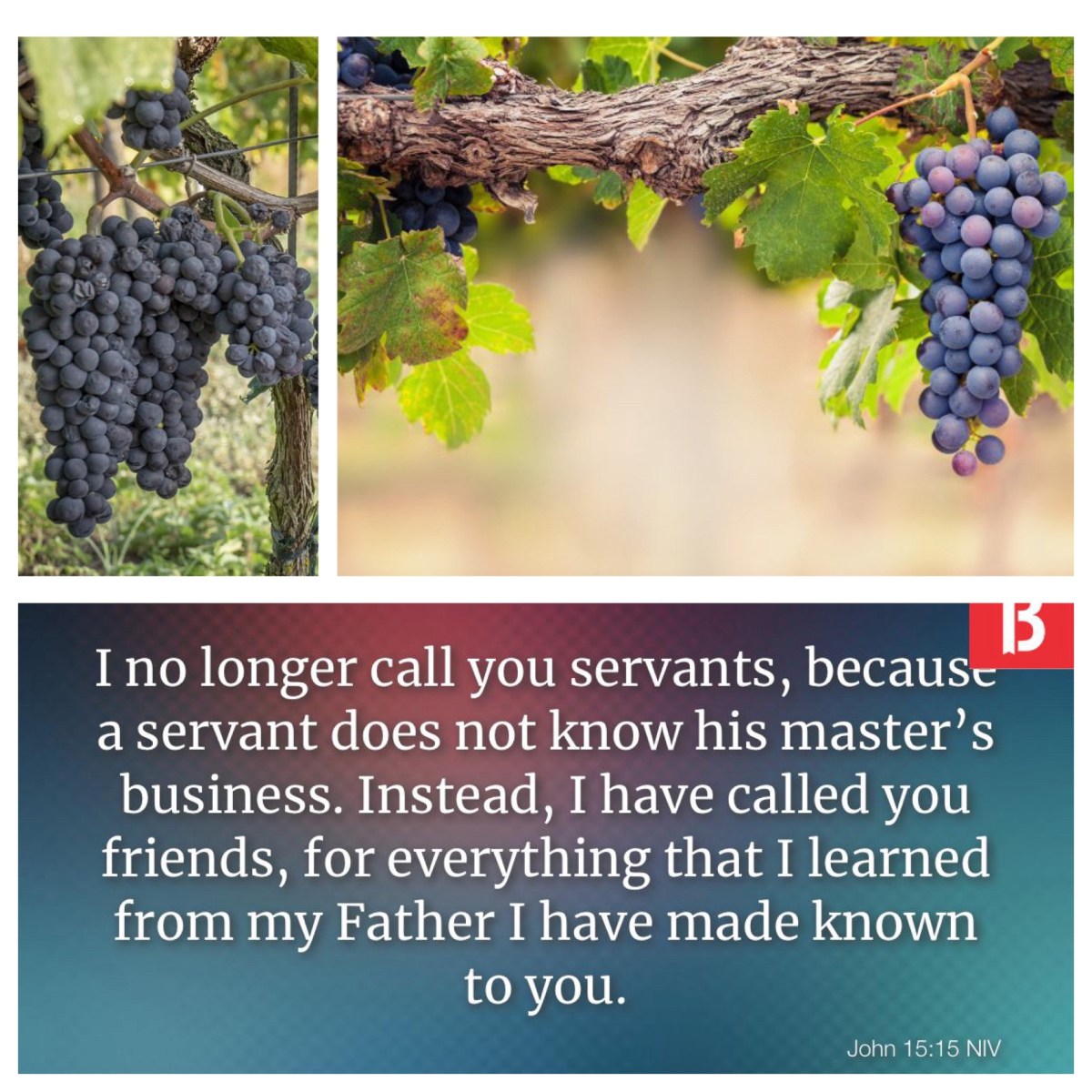
“You are my friends”, Jesus says, “if you do what I command you” (15:14). He tells his disciples, “I do not call you servants any longer, because the servant does not know what the master is doing; but I have called you friends” (15:15). Where does this valuing of friendship come from?

Friendship is in view in only fleeting scenes throughout the Law and the Prophets. More important is the sense of being bound to the covenant which God has made with the people of Israel. In the Wisdom literature, however, friendship is highly valued. “Some friends play at friendship”, one of the proverbs begins, “but a true friend sticks closer than one’s nearest kin” (Prov 18:24).

Solomon is attributed with these words in one of his hymns in praise of Wisdom: “in every generation she [Wisdom] passes into holy souls and makes them friends of God, and prophets; for God loves nothing so much as the person who lives with wisdom” (Wisd Sol 7:27–28). Perhaps these words have somehow influenced the author of John’s Gospel, moving him to shape the words he attributes to Jesus in this part of his farewell discourse?

Ben Sirach offers praise to true friends: “Faithful friends are a sturdy shelter; whoever finds one has found a treasure. Faithful friends are beyond price; no amount can balance their worth. Faithful friends are life-saving medicine; and those who fear the Lord will find them.” (Sir 6:14–16). In subsequent Jewish literature written during the Hellenistic period, when Greek culture and language was dominant, friendship is referenced far more often (35 times in 1–2 Maccabees, 13 times in 3–4 Maccabees, 7 times in 1–2 Esdras).

This could well be because, in Greek literature stretching back many centuries, friendship is highly valued. Two traditional Greek proverbs about friendship, “friends have one soul” and “the goods of friends are common property”, had appeared in Greek writings since the time of Aristotle (Aristotle, Nicomedian Ethics 9.8.2; Cicero, De officiis 1.16.51; Plutarch, On Brotherly Love 490E, How to Tell a Flatterer 65A and On Having Many Friends 96E; Iamblichus, Life of Pythagoras 65A; Dio Chrysostom Oration 34.20; Diogenes Laertius Lives of Eminent Philosophers 5.20, 8.10).

The Jewish monastic community of Essenes were described in a similar way by Philo, Every Good Man is Free 85, and Josephus, Jewish War 2 §122. It was a common trope, known to hellenised Jews. Various scholars throughout the 20th century have proposed that there are a number of signs of hellenistic influence on the final author of John’s Gospel—who was not the beloved disciple of Jesus, John, but a person writing late in the first century in a community where Greek was spoken.

And so this writer’s attribution to Jesus, the Jewish prophet, of a concept highly valued in the hellenised world, is not surprising. It’s one of many signs of the contextualisation of the Gospel that was taking place even within the earliest documents in the first century of the Common Era.


The true vine (John 15; Easter 5B)

The Gospel passage that the lectionary designates for reading this coming Sunday opens with the statement by Jesus, “I am the true vine, and my Father is the vinegrower” (15:1). In a later verse, the statement is reworked: “I am the vine, you are the branches” (15:5).

“I am the vine” is the last in a series of seven I AM statements found within the book of signs, the Gospel we attribute to John. “I am the bread of life” (6:48) is the first such instance in this series. The others are “the light of the world” (8:12), “the door of the sheep” (10:7, 9), “the good shepherd” (10:11, 14), “the resurrection and the life” (11:25), “the way, the truth, and the life” (14:6), and “the true vine” (16:1).

The vine, of course, was a standard image for Israel. The psalmist sings, “you brought a vine out of Egypt; you drove out the nations and planted it; you cleared the ground for it; it took deep root and filled the land; the mountains were covered with its shade, the mighty cedars with its branches; it sent out its branches to the sea, and its shoots to the River” (Ps 80:8–10). The prophet Hosea reflects a similar understanding, declaring, “Israel is a luxuriant vine that yields its fruit; the more his fruit increased, the more altars he built; as his country improved, he improved his pillars” (Hosea 10:1–2).

In the book of Judges, Jotham, the youngest son of Jerubbaal, tells a parable in which the trees seek a king, asking first the olive tree and the fig tree, before approaching to the vine, saying, “You come and reign over us”. However, the vine replied, “Shall I stop producing my wine

that cheers gods and mortals, and go to sway over the trees?”, before the bramble ultimately accepted the role (Judg 9:8–15).

Various prophets portray Israel as a vine. Isaiah sings God’s “love-song for my beloved … concerning his vineyard”, in which Israel is portrayed as the vineyard. He ends it by declaring that God “expected justice, but saw bloodshed; righteousness, but heard a cry!” (Isa 5:1–7).

In similar vein, Jeremiah laments the state of Israel, conveying God’s plea, “I planted you as a choice vine, from the purest stock. How then did you turn degenerate and become a wild vine?” (Jer 2:21). In a later oracle, the lament continues: “I wanted to gather them, says the Lord, there are no grapes on the vine, nor figs on the fig tree; even the leaves are withered, and what I gave them has passed away from them” (Jer 8:13).

Fellow prophet Ezekiel also utilises the imagery of the vine as a way to berate Israel for its sinful state. He reflects on the uselessness “the vine branch that is among the trees of the forest”—nothing useful is made from it, it simply provides wood for the fire (Ezek 15:1–8). The prophet draws the pointed comparison: “thus says the Lord God: like the wood of the vine among the trees of the forest, which I have given to the fire for fuel, so I will give up the inhabitants of Jerusalem; I will set my face against them” (Ezek 15:7–8).

Another parable told by Ezekiel involves a vine, planted and flourishing; it bore fruit and became a noble vine (Ezek 17:3–19). The parable ends with the rhetorical questions, “Will it prosper? Will he not pull up its roots, cause its fruit to rot and wither, its fresh sprouting leaves to fade? No strong arm or mighty army will be needed to pull it from its roots” (Ezek 17:9). Regarding the king who presides over this situation, God declares, “I will surely return upon his head my oath that he despised, and my covenant that he broke. I will spread my net over him, and he shall be caught in my snare; I will bring him to Babylon and enter into judgment with him there … all the pick of his troops shall fall by the sword, and the survivors shall be scattered to every wind” (Ezek 17:19–21).

A third use of the image begins positively, as Ezekiel speaks to the people, “Your mother was like a vine in a vineyard transplanted by the water, fruitful and full of branches from abundant water. Its strongest stem became a ruler’s sceptre; it towered aloft among the thick boughs; it stood out in its height with its mass of branches” (Ezek 18:10–11). But the sins of the people meant that God plucked out the vine and burnt it in fury, “so that there remains in it no strong stem, no sceptre for ruling” (Ezek 18:12–14).

In developing this parabolic image, Jesus applies it to his followers, both positively and negatively. The negative application comes directly from the way the prophets used this image in their parables and oracles; Jesus declares that “whoever does not abide in me is thrown away like a branch and withers; such branches are gathered, thrown into the fire, and burned” (John 15:6).

The more positive dimension of the imagery receives a more extended treatment by Jesus, both in this chapter and in other places in John’s Gospel. “Those who abide in me and I in them bear much fruit, because apart from me you can do nothing”, says Jesus (John 15:5b). “If you abide in me, and my words abide in you, ask for whatever you wish, and it will be done for you”, he continues (15:7).

The close relationship of the vine and the branches thus provides significant statements about the mutual indwelling of the Son with the disciples, in these verses. This is a theme that runs throughout John’s Gospel. “Abide in me as I abide in you. Just as the branch cannot bear fruit by itself unless it abides in the vine, neither can you unless you abide in me. I am the vine, you are the branches.” (15:4–5a).

The sense of “abiding in” is a mysterious inner connection that binds followers to their master; but because that master has likewise been bound with the Father, the intimacy of connection between Father, Son, and disciples is clear. In an earlier chapter, where the saying “I am the bread of life” is prominent, the Johannine Jesus had introduced this theme in relation to Eucharistic practice: “those who eat my flesh and drink my blood have eternal life, and I will raise them up on the last day … those who eat my flesh and drink my blood abide in me, and I in them” (6:54, 56).

Thus, in the extended explanation that Jesus had provided in response to the request of Philip, “Lord, show us the Father” (14:8), he affirms that “you will know that I am in my Father, and you in me, and I in you” (14:20). Those who are linked inextricably with the Son, who abide in him, are linked through his intimate connection with the Father, as he abides in the Father. Father, Son, and Disciples: this is what I refer to as the Johannine version of the trinity; it comes to full fruition in the chapter that provides the Gospel,passage for the Sunday after this coming Sunday (John 17).

On the way that this three-part unity of Father, Son, and Disciples is developed in John’s Gospel, see more detail at

I am the good shepherd [who] lays down his life for the sheep (John 10; Easter 4B)

Each year, on the fourth Sunday of the season of Easter, the Revised Common Lectionary provides a section of John 10 as the Gospel reading for the Sunday. That chapter is where Jesus teaches about his role as “the good shepherd” who lays down his life for the sheep. The chapter is divided over the three years: 10:1–10 in Year A, then 10:11–18 in Year B, and 10:22–30 in Year C. For this reason, this particular Sunday is sometimes called the Good Shepherd Sunday.

The section offered in Year A concludes with the classic claim of Jesus, “I came that they may have life, and have it abundantly” (10:10). The passage set for Year B, this year, begins with the famous affirmation, “I am the good shepherd; the good shepherd lays down his life for the sheep” (10:14-15).

Both passages develop the image of Jesus as the shepherd of the sheep, in intimate relationship with the sheep; the shepherd knows his own (10:15), calls them by name (10:3), shows them the way of salvation (10:9), and lays down his life for the sheep (10:11, 15, 17–18).

These two sections of this chapter (10:1–10, 11–18) follow on from the story of the man born blind (9:1–41), which itself has emerged out of the conflicts between Jesus and Jewish authorities (7:10—8:59), reported as taking place in Jerusalem during the Festival of Booths (7:2). That sequence of conflicts had culminated with the Jewish authorities picking up stones to throw at Jesus (8:59).

The story told in chapter 9, like the whole Gospel, reflects the situation of a group of followers of Jesus towards the end of the first century CE, inheriting the richness of the Jewish faith, convinced that they have found The Teacher of the way that God requires, in Jesus of Nazareth. As a result, they have encountered opposition, argumentation, and expulsion from their familiar faith community, and through this they have engaged in verbal warfare with those who have pushed them out.

Retelling the story of the man born blind, who encounters Jesus and claims faith in him, validates their perspective on life and faith. The story reveals what God intends and desires, through the way that an unknown member of their community has constructed this narrative. The story reinforces the views that have been developed by members of the community, as they hope that others might “come to believe that Jesus is the Messiah, the Son of God, and that through believing [they] may have life in his name” (20:31).

See

John’s Gospel is known for its series of I AM statements. In the first offering from John 10 (verses 1–10), Jesus has said, “I am the gate” (v.9)—the avenue for entry into the sheepfold, which was a place of care and protection for the sheep.

But “I am the gate” makes sense only because of what goes before it; the gatekeeper, who opens the gate for the sheep (v.3). This image then morphs into the more familiar image of the shepherd of the sheep (vv.11, 14)—the one who knows the sheep, calls them by name, and guides them in the paths that they should follow.

In fact, Jesus refers to his followers as “sheep” 13 times throughout the chapter. This draws on the common description of the people of Israel as sheep, found in a number of psalms. The exodus from Egypt is described as the time when “he led out his people like sheep, and guided them in the wilderness like a flock; he led them in safety, so that they were not afraid” (Ps 78:52–53).

The psalmist encourages the people to sing with joy, for “he is our God, and we are the people of his pasture, and the sheep of his hand” (Ps 95:7). The people rejoice that it is this God who “made us, and we are his; we are his people, and the sheep of his pasture” (Ps 100:3; see also Ps 44:11, 22; 74:1).

Alongside this, in Hebrew Scripture, God is explicitly identified as a shepherd; the psalmist declares that God is the “Shepherd of Israel, who lead[s] Joseph like a flock” (Ps 80:1). Elsewhere, the opening line of perhaps the best-known psalm is simply, “the Lord is my shepherd” (Ps 23:1).

But many other passages contain mentions of shepherds. As he was dying, with his sons gathered around him, Jacob spoke to his son Joseph, praying, “the God before whom my ancestors Abraham and Isaac walked, the God who has been my shepherd all my life to this day … bless the boys [Ephraim and Manasseh]” (Gen 48:15–16).

Later, Jacob indicated that Joseph’s strength came “by the hands of the Mighty One of Jacob, by the name of the Shepherd, the Rock of Israel, by the God of your father, who will help you, by the Almighty who will bless you” (Gen 49:24–25). Then, when David was anointed as king, Samuel said to him “it is you who shall be shepherd of my people Israel, you who shall be ruler over Israel” (2 Sam 5:2; 1 Chron 11:2).

Subsequent rulers in Israel were accorded this title; yet key prophets during the exile lamented that there had been “stupid shepherds” with “no understanding” (Jer 10:21; Isa 56:11) and had done evil (Jer 12:10–13; 23:1–2; 50:6–7; Ezek 34:1–10). Some prophets in the Exile then looked beyond this to a better kind of shepherd-leader.

The anonymous exilic figure we know as Second Isaiah declared that the Lord God “will feed his flock like a shepherd; he will gather the lambs in his arms, and carry them in his bosom, and gently lead the mother sheep” (Isa 40:11). Later, he declares that Cyrus, king of Persia, would be anointed as Messiah, to carry out God’s purpose (Isa 44:28–45:1). He is the one of whom the Lord says, “he is my shepherd and he shall carry out all my purpose” (Isa 45:28). That is a striking extension of the strong scriptural imagery of the shepherd, normally applied to the God of Israel or rulers within Israel, which is now placed onto a foreign ruler.

Also during the exile, the prophet Jeremiah looked to the time when God would restore “shepherds after my own heart” in their midst (Jer 3:15) and Ezekiel prophesied God’s intentions: “I myself will search for my sheep, and will seek them out. As shepherds seek out their flocks when they are among their scattered sheep, so I will seek out my sheep. I will rescue them from all the places to which they have been scattered on a day of clouds and thick darkness.” (Ezek 34:12). Ezekiel then extends this role to the king when he reports God’s words: “my servant David shall be king over them; and they shall all have one shepherd” (Ezek 37:24).

This is the scriptural heritage that Jesus draws on in his famous statement, “I am the good shepherd” (John 10:11, 14). Jesus refers to his followers as “sheep” 13 times throughout the chapter, drawing on the equally common description of the people of Israel as sheep, found in a number of psalms (Ps 44:11, 22; 74:1; 78:52; 95:7; 100:3).

Jews would have recognised immediately the claim that he was making for himself—and the way that he has intensified it by noting that “the good shepherd lays down his life for the sheep” (John 10:11; see also v.15). The passage thus looks forward to the death he will suffer on the cross—the example supreme of “the good shepherd”.

See also

and

We declare to you what was from the beginning (1 John 1–2; Easter 2B)

This week, the lectionary starts a series, for the Epistle reading, of selections from the book known as 1 John. By tradition, this work is called a letter (or epistle)—a communication from a specific individual to another individual or to a community of people. But the form of this book raises immediate questions.

There is neither the kind of opening address expected in a letter, nor any form of epistolary conclusion at its end. The opening verses, instead of providing information about the context in which the document came into being, present with urgent rhetorical force the importance of the message which follows. The letter ends quite abruptly, with a stark admonition (5:21)— no discussion of travel plans or the sending of an emissary, no greetings, no final blessing. Is it a book, a letter, or a sermon?

The book clearly has the ethos of a letter, as found in the first person plural of the opening verses (“we declare…we declare…we are writing…”, 1:1–4), the direct address to “little children” (2:1; 3:18; 5:21) and “beloved” (2:7; 4:1, 7), and the repeated assertion that “I write these things” (2:1, 7, 12–14, 26; 5:13). Moral exhortation and doctrinal teaching, elements regarded as being classic component parts of early Christian letters, are interwoven throughout the book without clear distinction.

Yet there appears to be no marshalling of a case and no logical development of thought, such as is found in the carefully-shaped rhetoric of the letters of Paul. At first reading, the letter’s structure is somewhat circular and repetitive, more an extended meditation on “love” (the term appears around fifty times) than a tightly-argued instruction. The tone is often reflective—although there are moments of contention and dispute.

The author of the letter is never named, but the opening verse makes the claim that the letter comes from one who has “heard…seen…looked at and touched” for himself, the very “word of life” (1:1). The inference is that the author has had personal contact with Jesus himself; in the third century, Irenaeus made the definitive claim that the letter was written by “John, the disciple of the Lord” (Against Heresies 3.16.5).

This claim goes beyond any direct assertion within the letter itself; although such a claim might be reinforced by the author’s reiteration of his privileged status as eyewitness (and earwitness): “we have seen it” (1:2), “what we have seen and heard” (1:3), “the message we have heard from him” (1:5), as well as a later reminder: “just as he has commanded us” (3:23).

The frequent use of “from the beginning” (1:1; 2:7, 13, 14, 24; 3:11) might also be taken as a reference back to the teachings of Jesus, mediated through the writing of this author.

Likewise, from the text of the letter itself, its recipients cannot be specifically identified in any meaningful way. There are references to “little children…fathers…young people” (2:12–14) which are formulaic and generalised. They already know the message about Jesus, for they “know him who is from the beginning” (2:13, 14) and have already heard his commandment to “love one another” (2:7; 3:11).

Their situation involves a controversy about how to live in obedience to Jesus; the contrast between darkness and light, love and hate is marked throughout the work (1:5–10; 2:9–11; 3:11–15; 4:20–21). A key idea in this regard is the way that love reaches “perfection” (2:5; 4:12, 17–18) in the lives of believers. This is what the recipients of the letter are to set as their aim.

Set in stark contrast to the believers is “the world”, which is both personified and portrayed as a negative character. The world is full of desire (2:16); those in it do not help a person who is in need (3:17); it hates the believers (3:13) and does not know God (3:1; 4:3–6). The letter ends with the strong assertion that “the whole world lies under the power of the evil one” (5:20). This suggests high tension, even outright conflict, between the people addressed in this letter, and some indeterminate “opponents”.

The sectarian tendencies, already seen in John’s Gospel, appear to have intensified in the situation addressed in this letter. Yet, in the end, “the world” is only temporary (2:17); victory over the world is assured, for it has already come (4:4; 5:3–5). Indeed, the author of this document insists that God’s intention is to save the whole world (2:1–2; 4:9, 14).

The hour has come (John 12; Lent 5B)

“The hour has come for the Son of Man to be glorified” (John 12:23). So Jesus says to Andrew and Philip, who come with a request from “some Greeks” who were in Jerusalem for the festival of Passover (12:20; see 12:1). Two terms in this declaration by Jesus require exploration; two terms which are key ideas in this Gospel, the book of signs.

The story which John’s Gospel reports contains a contrast between the largely public activities of Jesus, and a secret element, described as the hour, which does not come until the climax of the story is reached. There are pointers to this contrast from the very first sign, at a wedding in Cana, when Jesus declares, “my hour has not yet come” (2:4).

What is this hour? The first part of the Gospel leaves it as a mystery, for the time being (see 7:30 and 8:20). Then, after the seventh sign, events in Jerusalem show that the hour has come (12:23, 27); the narrator explains that “Jesus knew that his hour had come to depart from the world” (13:1).

Thus, at the beginning and at the end of the public activities of Jesus in this Gospel narrative, the focus is firmly on “the hour”.

Then, some time later on, at the end of his last meal with his followers, Jesus finally prays: “Father, the hour has come: glorify your Son” (17:1). In what will take place after this prayer—the arrest, trial, crucifixion, burial, and resurrection of Jesus (John 18–21)—this “hour” is realised.

The Johannine Jesus describes these events, the fulfilment of “the hour”, as the means by which God is glorified (11:16, 23–33; 13:31–32; 17:4).

The word glory, in Hebrew Scriptures, signals the divine presence (Exod 16:1–12; 24:15–18; 40:34–39; Lev 9:22–24; Num 14:10–12; 16:19; Deut 5:22–27; 1 Sam 4:19–22). In the book of signs, it is God’s glory which is now made manifest in Jesus (John 1:14; 2:11; 12:27–28; 17:5).

The language of “hour” and “glory” thus provides a framework for interpreting the events in chapters 2–12 as steps on the way towards a full understanding of Jesus, and the events of chapters 13–21 as the realisation of God’s presence in the world in all its fullness. This is the heart of the incarnational theology that is advocated by the writer of this Gospel.

The story of the Gospel fills out the details as to how it is that “the Word became flesh and lived among us”, which means that for human beings, “we have seen his glory, the glory as of a father’s only son, full of grace and truth” (John 1:14).

The passage offered in this Sunday’s lectionary readings provide part of the Johannine account of the final public moments of Jesus before his arrest (12:20–50). Here, Jesus speaks of this imminent glory (12:20–26), an angel testifies to God’s glory in the death of Jesus (12:27–33), Jesus explains that he comes as light into the world (12:34–36), the scriptures join as witnesses (12:37–43) and Jesus asserts that he speaks God’s commandment of eternal life (12:44–50).

This scene sums up what has come before and opens the door to the events which follow, culminating in the cry of the crucified Jesus, “it is fulfilled” (19:30; the NRSV translation, “it is finished”, downplays the sense of fulfilment in the verb used, teleō). The author of this Gospel thereby indicates that the deepest fulfilment of the hour of Jesus comes on the cross, as the glory of God is revealed in its entirety.

We have found him of whom Moses and the prophets spoke (John 1; Epiphany 2B)

“Follow me”. We most likely know these words of Jesus as the words that he spoke to Peter and his brother Andrew, as they were fishing in the Sea of Galilee (Mark 1:16–17). This was also, presumably, what Jesus said to the brothers James and John, soon after (Mark 1:20), as well as to Levi the tax collector (Mark 2:14), and then, later on, to the crowd that was following him through Galilee (Mark 8:34) and, quite poignantly, to the rich man who felt unable to follow (Mark 10:21–22).

We encounter these words in the Synoptic parallels to these incidents; but as well, we hear them spoken by Jesus in the book of signs which we know as the Gospel according to John. The resurrected Jesus tells Peter, “follow me” (John 21:19), and soon after, speaks the same words to the beloved disciple (John 21:22). At the last meal he shared with his followers, he had warned them, “where I am going, you cannot follow me now; but you will follow afterward” (John 13:36), and a little before that, he had said to Philip and Andrew, “whoever serves me must follow me, and where I am, there will my servant be also; whoever serves me, the Father will honour” (John 12:26).

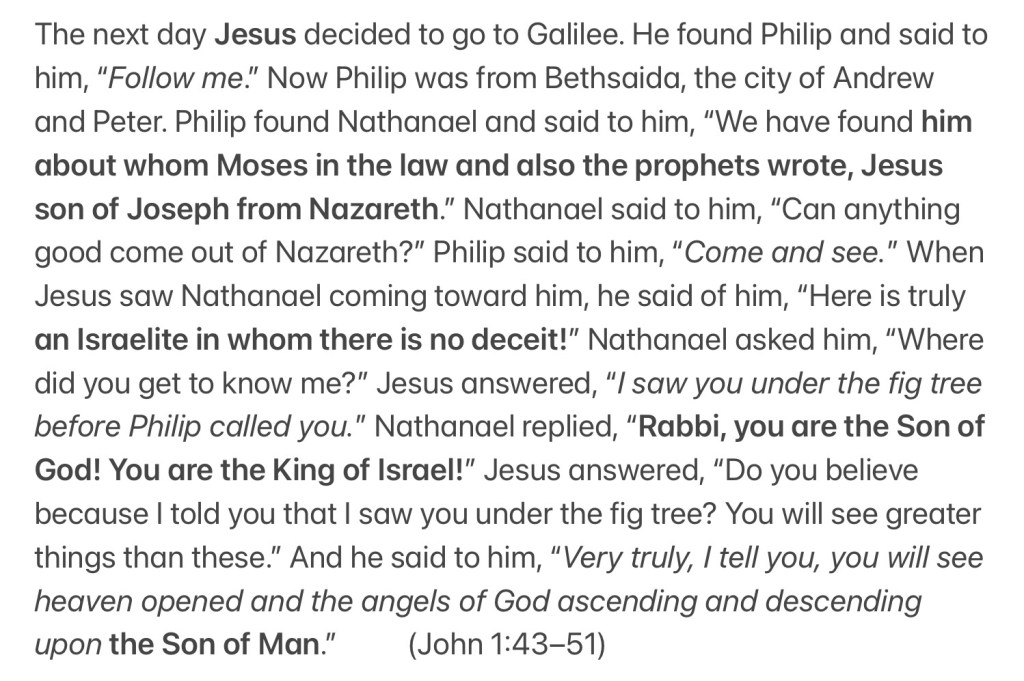
The first time these words occur in the book of signs is in the scene when Jesus first meets Philip (1:43–51). This is the passage which is offered by the lectionary for this coming Sunday, the second Sunday after Epiphany. The scene also involves Nathaniel, who poses the sceptical question to Philip concerning Jesus: “can anything good come out of Nazareth?” (1:46). The following interaction with Jesus leads to Nathaniel making a high claim about Jesus: “Rabbi, you are the Son of God! You are the King of Israel!” (1:49). The scene itself ends with another description of Jesus, from his own lips, as “the Son of Man”, upon whom the very angels of heaven are resting (1:51).

This scene concludes the extended prose narrative (1:19–51) that follows the majestic poetic prologue which opens this opening chapter (1:1–18). Throughout the various scenes in this prose narrative (which I call the Prelude to the Gospel), a series of revelations of the identity and significance of Jesus are made.

It is noteworthy that there are a number of Jewish titles which are embedded in this prose narrative, as key characters confess the significance of Jesus throughout this extended preface (1:19–51). Jesus is addressed as “Rabbi” (1:38, 49), “Messiah” (1:41), “King of Israel” (1:49), and “Son of God” (1:49). It is worth noting that these claims about Jesus are each made also within the Synoptic traditions. Indeed, the Johannine Jesus himself refers, in the allusive synoptic fashion, to the “Son of Man” (thirteen times, from 1:51 to 13:31), which we must presume to be a self–reference.

In later scenes in the book of origins, Jesus is also addressed by these Jewish terms, when he is called “prophet” (4:19), “Messiah” (4:29; 11:27), and “Rabbouni” (my teacher, 20:16). Then, the ultimate Christological confession of the Gospel is uttered by Thomas, when he moves beyond this viewpoint in the phrase, “my Lord and my God” (20:28), echoing the perception of the Jews, that Jesus was “making himself equal to God” (5:18).

Perhaps we tend to remember the fourth Gospel as the one which reveals the extensive cosmic significance of Jesus—the Word made flesh (1:14), the one closest to the heart of the Father who has “made the Father known” (1:18), and most famously, the one through whom God shows that “God so loved the world” (3:16). This Gospel seems to offer much in terms of a Saviour for the whole world (4:42), a sign for Greeks (that is, Gentiles) from beyond Judaism (12:20).

Yet, for the most part of this Gospel, Jesus is presented in terms drawn from within a Jewish context. Indeed, even the final, climactic confession by Thomas can be understood within a particular stream of Jewish tradition, for the hellenistic Jewish author Philo uses the terms “Lord” and “God” to designate the two major divine powers of creation (signified by “God”) and eschatological judgement (signified by “Lord”). In light of this usage of the terms by Philo, Jerome Neyrey wisely concludes that “Jesus is correctly called ‘God’ because he exercises creative power, and ‘Lord’ because he has full eschatological power”; see https://www3.nd.edu/~jneyrey1/MyLord.God.htm

So an important clue to a central motif running throughout this Gospel is placed in the mouth of Philip, when he says to Nathanael, “We have found him about whom Moses in the law and also the prophets wrote, Jesus son of Joseph from Nazareth” (1:45). The Jewish terms point to this reality about how Jesus was understood in the community within which the book of signs was written: Jesus is to be regarded as the fulfilment of scripture.

Notice that the author of this Gospel takes Philip, an almost anonymous figure in the Synoptic Gospels, and places in his mouth these key sayings, about the fulfilment of the scriptures (1:45), and the relevance of Jesus to Gentiles (12:20–26), and, indeed, the fundamental request, “Lord, show us the Father” (14:8). Philip articulates what the author of the book of signs seeks.

Now, it is true that the affirmation that Jesus fulfils scripture is common to all four canonical Gospels. It is very clear in the Synoptic accounts; we should not, however, diminish its significance on the fourth Gospel. This interpretive stance is hinted at as early as the Prologue, in the comparison between Jesus and Moses (1:17).

This perspective is stated explicitly, as we have noted, in the claim put on the mouth of Philip, “we have found him of whom Moses and the prophets wrote” (1:45), and later in the words attributed to Jesus, “You search the scriptures, because you think that in them you have eternal life; and it is they that bear witness to me” (5:39).

There are fifteen clear quotations from Hebrew Scriptures in this Gospel. There are eight explicit references to scripture in the early chapters (1:23; 2:17; 6:31; 6:45; 7:38; 7:42; 10:34; 12:13–15), while a “fulfilment formula” is used in later chapters, to introduce seven such scriptural quotations (12:38–40; 13:18; 15:25; 18:9; 19:24, 28, 36–37). There is also a passing note that Judas died after betraying Jesus “so that the scripture might be fulfilled” (17:12).

However, the total significance of the Hebrew Scriptures in this Gospel is much greater than these sixteen occurrences, as the Gospel contains numerous allusions to specific scripture passages, such as references to Jacob’s ladder (1:51) and the sacrificial lamb (1:29, 36), as well as more generalised allusions to scripture. These allusions are much freer in their form and indicate that, for the author of this Gospel, the Hebrew Scriptures had become an integral part of his mind and heart, for he treats them with a freedom born from intimate familiarity. (For this last phrase, I am indebted to an unpublished paper on this topic by my first New Testament teacher, the late Rev. Dr Robert Maddox.)

So this Gospel passage for the second Sunday in Epiphany reminds us of the Jewish origins of Jesus and also the continuing appreciation of Jesus in Jewish terms, throughout the early decades of the movement that was initiated by his proclamation and action in Galilee and (especially in John’s account) in Jerusalem, over some years. In our Christian appropriation of the figure of Jesus, we would do well to remember his Jewish origins, and the strongly Jewish nature of early Christian interpretation of Jesus. We owe much to Judaism, both as our ancient heritage and indeed as an enduring living faith which continues to proclaim faith in the God whom Jesus knew, and loved, and revealed.

In defence of Thomas: a doubting sceptic? or a passionate firebrand? (John 20; Easter 2A)

The Gospel reading for this coming Sunday provides the name by which this Sunday is often known in church tradition: it is Thomas Sunday. (The reading is John 20:19-31.)

We all know about Thomas: he had to have proof … had to see with his own eyes … had to touch to know it was real … did not have faith without tangible proof. Thomas often gets a bad rap: oh he of little faith! … why did he not believe straight away, like the others who followed Jesus? … why was he in the thrall of doubt at precisely the time that faith was called for?

Thomas wants to pin the matter down, to have the evidence produced, to know without question what has taken place. We remember him from this story, as the doubting sceptic.

Let us reflect a little on this: Thomas was not alone. All the other early witnesses, followers, and writers, in the movement of people clustered around Jesus, had the same need to pin the matter down. There were many sceptics in this movement. They needed some form of proof. They looked for evidence. They sought signs that would validate the new way that Jesus was in their midst.

The endings of the Gospels testify to this. The earliest Gospel ended with an open narrative, hanging on those words: the tomb is empty — he is not here! (See https://johntsquires.wordpress.com/2019/04/21/the-tomb-is-empty-he-is-not-here-he-is-risen/)

Subsequent compilers of the narrative about Jesus could not live with the uncertainty of an open-ended story, with an absent Jesus who would appear only in a distant, remote, unimportant location (Galilee). No; they had to have him come to the women, the travellers, even the inner core of disciples, in or near to Jerusalem. Indeed, Luke explicitly reports that the risen Jesus provided them with “many convincing proofs” after his resurrection (Acts 1:3).

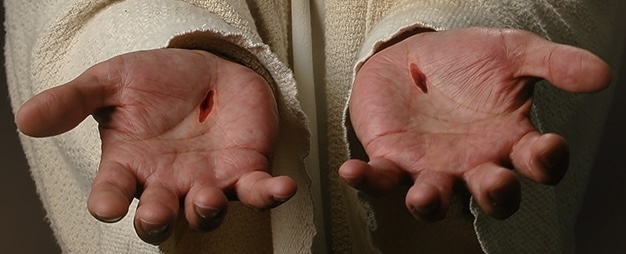
Thomas, of course, is the disciple whom we most closely associate with doubt, not with faith, derived from this very report of his encounter with the risen Jesus. “Unless I see, I will not believe”, the sceptic Thomas says, in John 20. “Unless I can put my finger in the mark in the side of my master, I will not believe that he has risen”, declares Thomas.

And in the modern scientific era, where we operate by testing, questioning, doubting, and seeking to prove hypotheses, this kind of approach has a certain attractiveness. For some Christians in the present time, in the period of probing scientific hypotheses and seeking historical certainties, Thomas has become a kind of patron saint—a saint of doubting, questioning, and proving. “Unless I see, I will not believe” is the mantra of such a saint.

But Thomas appears in two other places in John’s Gospel. One is at the last meal that Jesus shared with his followers, when Thomas asks Jesus a question: “Lord, we do not know where you are going. How can we know the way?” This question provokes one of the most well-known sayings of Jesus: “I am the way, and the truth, and the life. No one comes to the Father except through me. If you know me, you will know my Father also. From now on you do know him and have seen him.” (John 14:5-7). It is thanks to Thomas that we have this saying of Jesus!

The other time that Thomas is mentioned in this Gospel provides us with another insight into the character of Thomas. He appears early on, in the story of the raising of Lazarus from the dead, as told in chapter 11 of John’s Gospel. In that story, we encounter a rather different Thomas. In that incident, Thomas was a man on a mission who was filled with faith. He spoke with Jesus with the intensity of a fervent believer. He declared that he was prepared to follow Jesus, whatever it cost him.

Faced with a request to travel to Bethany, near Jerusalem, because of the death of Lazarus, Jesus and his followers discuss whether they should make this trip. John’s Gospel tells us that the message of Jesus was so provocative to the southerners in Judea, that they had already mounted a number of attempts to stone him (John 8:59, 10:31).

So the disciples were convinced that if Jesus travelled close to Jerusalem, he would be walking to his death. What to do, they wonder, when this urgent message comes from friends in Bethany: “Lazarus is dead; please come; we need you here!” (John 11:1-8).

At that moment, Thomas springs into action. There is no doubt about it, he declares:  Jesus needs to go there; and the disciples need to go with him. “We need to get moving! Come on, why are we waiting?” And from the mouth of Thomas come these incredible words: “We should go too, and die with him” (John 11:16).

Thomas utters the excitable words of a zealous follower of Jesus; he gives a fervent declaration of commitment and trust in the one who had been his guide for many months now. Thomas was not paralysed by fear, not distressed by doubt; here, Thomas was fired up by faith, and committed to a journey that could well lead to death. If Jesus, our master, is going to die—then we, too, should be prepared to die with him! (See https://johntsquires.com/2020/03/23/yes-lord-i-believe-even-in-the-midst-of-all-of-this-john-11/)

This portrayal of Thomas as a committed follower, as a passionate firebrand, is not how we normally remember him, because the story from chapter 20 of the Gospel holds sway. Yet in this earlier story in chapter 11 of the Gospel, it is clear that Thomas has faith, even if it is somewhat unusual, and it is abundantly clear that he is prepared to put his life on the line for what he believes.

So, perhaps we should place this Thomas, the passionate firebrand of John 11, alongside the hesitating, doubting figure that we imagine him to be like, courtesy of John 20. Where are the signs of this passionate, committed, fervent, zealous man of faith, in this encounter? Where was the fiery partisan Thomas living out his faith in the risen Jesus?

I like to imagine (and it is only an imagination … a speculation … as the biblical txt is silent on this point) … I like to imagine that, as the disciples gather behind locked doors, paralysed by their fear, Thomas was not to be found in their midst, because he was back into his regular life, living out his faith in the public arena.

Even after Jesus had been raised from the dead, the transformation of Easter, as we know it, had not really kicked in for the disciples. They were locked into their fear. Where were the disciples living out their faith? It seems they took the line of least resistance, and shared their faith only in the safety of their own group, hidden away, safe in the seclusion of a private home.

And where was Thomas? He was not there. He was out beyond the locked doors, out in the community, in the full gaze of the antagonistic authorities. What was he doing? We are not told; we have to imagine.

Is it feasible to imagine that Thomas was back into his regular routine, going about his business, attending to his daily tasks? That he was seeking to live out his faith, not cowed by the threat of persecution, but firmly holding fast to his belief in Jesus in public? That he was continuing to live as that fiery, fanatical believer who was still willing to put his faith on the line? It is a tempting, enticing way to imagine him.

If Thomas was really the passionately committed believer whom we met in the Lazarus story, then it is quite plausible that this is why he was not with the other disciples, behind locked doors, hiding out of fear.

Perhaps Thomas was wanting to demonstrate his faith to those who did not yet believe. Something had happened to Jesus—the tomb was empty, believers were testifying that he was risen—so he was wanting to show others that his faith had not been shattered.

Where was Thomas living out his faith? In his everyday life, amidst acquaintances and friends—and even enemies. Now that is a model that we would do well to ponder, and imitate, in our lives!

(The image is of Saint Thomas, by Georges de La Tour, a French painter of the 17th century.)

See also

Reading scripture with attention to its context (John 11, Year A)

The lectionary has offered us a series of readings during Lent which show Jesus encountering and conversing with others (John 3, 4, 9, and 11). The anonymous author of the Gospel of John had high-level literary and dramatic skills. The lectionary has very clearly demonstrated this in the series of readings offered in weeks 2–5 of Lent.

The Pharisee in Jerusalem (Ch.3) is really a foil who asks leading questions which offer Jesus the opportunity to speak forth at some length for the first time in the Gospel (3:11–21). The woman in Samaria is a genuine dialogue partner for Jesus who learns through the back-and-forth of their conversation about a number of matters (4:7–26). The story of the man born blind (9:1–41) is presented as a seven-part comedic drama, illustrating the “light of the world” claim of Jesus (8:12; 9:5) and showing how people respond in varied ways to that.

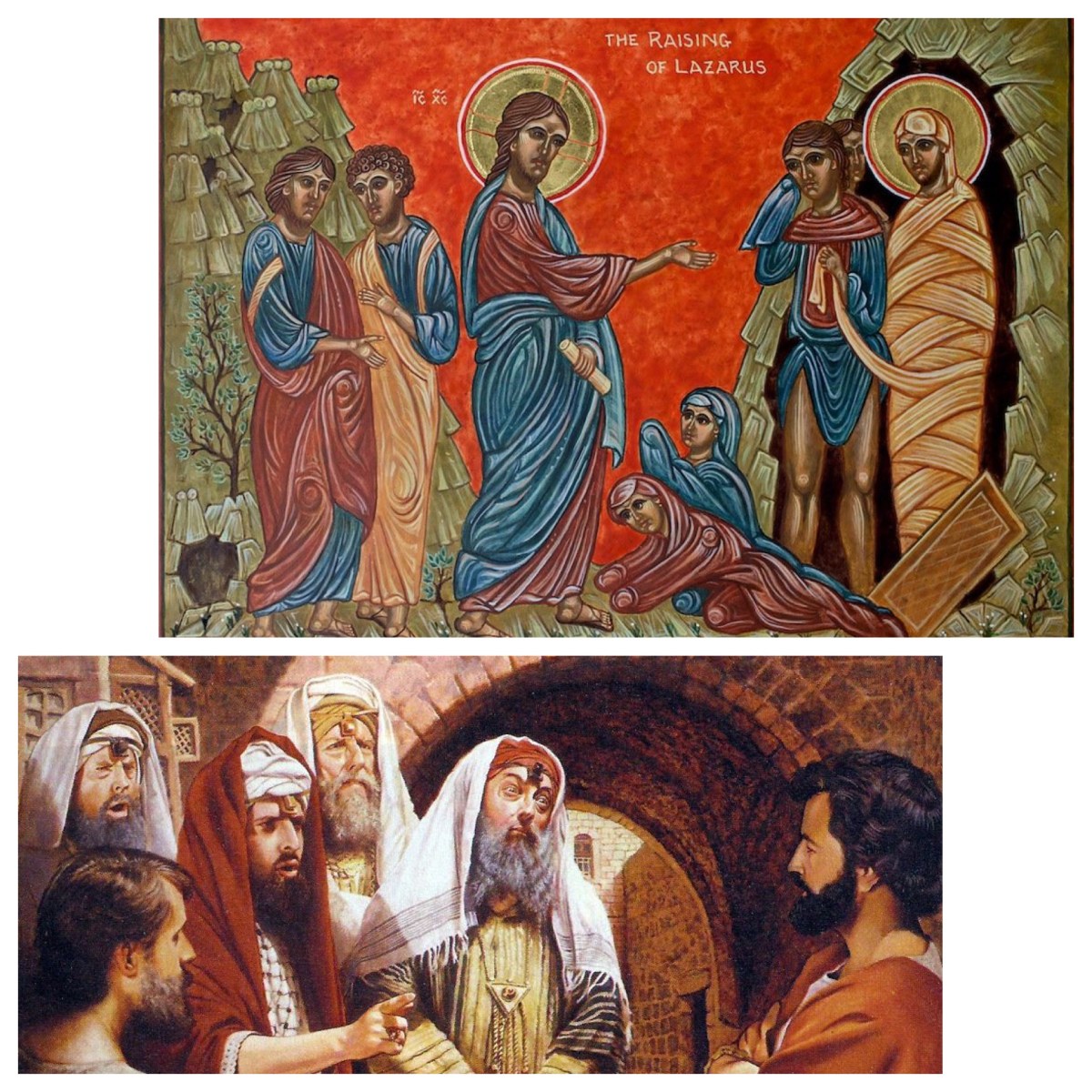
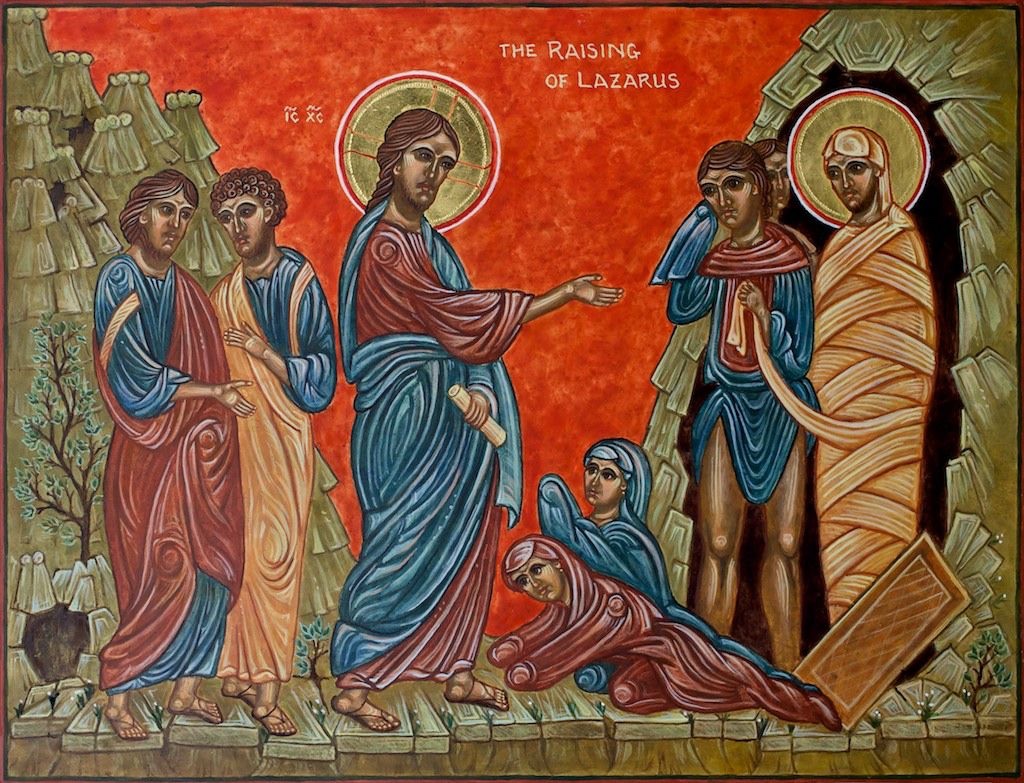
Then, the story of Lazarus (11:1–45) is a complex dramatic moment, a story with its own integrity and form, with a range of characters and varied dramatic moments. This story also serves as the seventh and final sign in the Gospel; these signs commenced at 2:1–11 and are interspersed throughout the ensuing narrative (4:46–54; 5:1–9; 6:1–15; 6:16–21; 9:1–7; and 11:38–44). This sign, like others before, has lead many to believe (11:45), but it serves also to confirm the plot of the Sanhedrin leaders to arrest and kill Jesus: the reason for the crucifixion, in this author’s eyes (11:46–53; 11:57; 18:1–12).

All of this is a masterly dramatic development through the first half of this “book of signs”. These stories are certainly worth hearing in full every three years!

These encounters, however, are told in the context of an emerging story which places Jesus into a position of antagonist, arguing and dissenting, disputing and disagreeing, with some regularity. This thread comes to a head in the story of Martha and Mary, their recently-deceased brother Lazarus, and Jesus (John 11:1–45).

The emergence of Lazarus from the tomb marks a climactic moment, for the family in Bethany and many of their neighbours (11:44–45), but also for the chief priests and Pharisees, who together determine to put Jesus to death (11:53). The seventh sign recounted in this Gospel is the most significant miracle of Jesus, but also the deed that determines the fate of Jesus, for it leads immediately to the plot to arrest Jesus (11:53) and then inevitably to his death at the hands of the Romans (19:30).

Soon after he has raised Lazarus back to life in Bethany, Jesus says, “I have come to this hour” (12:27), the hour when “I am lifted up from the earth, [when I] will draw all people to myself” (12:32), the hour when the Father will “glorify your Son so that the Son may glorify you” (17:1). The death of Jesus is to be, paradoxically, the complete fulfilment of his mission (19:30). Its inevitability has been flagged since early in the Gospel narrative.

Antagonism begins early in that narrative. It is initially signalled by “the incident in the Temple” (John 2:13–22). In his conversation with Nicodemus, Jesus tells the Pharisee, “we speak of what we know and testify to what we have seen; yet you do not receive our testimony. If I have told you about earthly things and you do not believe, how can you believe if I tell you about heavenly things?” (3:11–12). The plural form of the Greek word translated “you” makes it clear that the “you” being addressed is at least the collective Sanhedrin Council, if not the whole population of Judea. It is an oppositional, confrontational encounter at this point.

In talking with the Samaritan woman, Jesus reflects the historical antagonism between the Judeans of the south and those of the north. “Our ancestors worshiped on this mountain, but you say that the place where people must worship is in Jerusalem”, the woman says to Jesus (4:20). Jesus replies, pugnacious oh, “you worship what you do not know; we worship what we know, for salvation is from the Jews” (4:22). The use of the plural “you” once again in these verses makes clear the antagonism between the peoples, especially if we translate that final phrase, “salvation is from the Judeans”.

When Jesus heals a man born blind, the Jewish authorities function as the chorus reflecting on, and reacting to, the events taking place in Jerusalem. First, some Pharisees declare, “This man is not from God, for he does not observe the sabbath” (9:16). Then, they declare to the healed man, “we know that God has spoken to Moses, but as for this man, we do not know where he comes from” (9:29).

Their view of Jesus is quite negative— in an earlier debate with him, they had called him “a Samaritan and have a demon” (8:48), and that encounter ends, “they picked up stones to throw at him” (8:59). Mind you, Jesus had said to them, “you are from your father the devil, and you choose to do your father’s desires” (8:44), so it was a vigorous two-way argument!

So Jesus responds to the negativity of the Jewish authorities who questioned his credentials after learning of the healing of the man born blind, with a statement, “I came into this world for judgment so that those who do not see may see, and those who do see may become blind” (9:39), followed by, “if you were blind, you would not have sin; but now that you say, ‘We see,’ your sin remains” (9:41). This encounter ends, yet again, on a negative note.

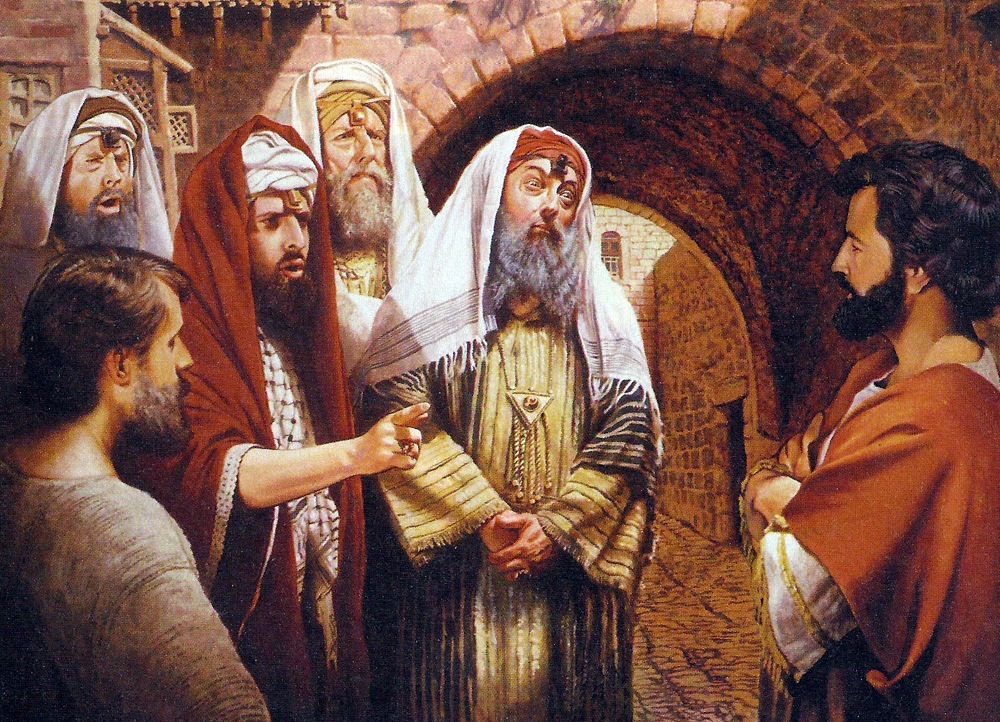
Then, after Jesus has raised Lazarus back to life, the Jewish authorities decide to make their move. Worried that, “if we let him go on like this, everyone will believe in him, and the Romans will come and destroy both our holy place and our nation” (11:48), Caiaphas leads with these prophetic words: “it is better for you to have one man die for the people than to have the whole nation destroyed” (11:50). And so, “from that day on they planned to put him to death” (11:53).

Jesus is clearly aware of this antagonism; he later warns his disciples, “the world hates you” (15:19), and then, “they will put you out of the synagogues; indeed, an hour is coming when those who kill you will think that by doing so they are offering worship to God” (16:2). And of course, the narrative of the Gospel ends with Jesus handed over to die by crucifixion (18:28). We need to think carefully about how we interpret this antagonism.

*****

Was the world an evil place, in the sway of the devil, which would inevitably turn against Jesus? But what, then, of the claim that God sent Jesus because he “so loved the world” (3:16)? How are we to see the relationship between Jesus and “the world”?

Of course, it needs to be said that none of these scenes offered by the lectionary—nor any of the intervening scenes in this Gospel—come as eyewitness (or rather, earwitness) accounts of what actually happened in a real, historical encounter. Of none of the scenes can we say with certainty that they actually occurred, let alone that the dialogue recorded by the author of the book of signs was what was actually said. These scenes are all literary creations, perhaps based on a report of an encounter that took place, but most certainly elaborated and developed over a period of time, worked into a narrative that catches attention, invites reflection, and has a life all of its own.

“John” wrote his book of signs some 50 to 80 years after the lifetime of Jesus. The account of each of these conversations—at night with Nicodemus, at noon with the woman, in Jerusalem with the authorities, and then the encounter in Bethany and the council meeting in Jerusalem—are thus far removed from each of these events. (How could we possibly claim to know verbatim what was said in a Sanhedrin meeting in the early 30s CE? — especially since the High Priest articulates a central tenet of later Christian doctrine!).

I recently read a comment that said, “The television show MASH was set during the Korean War but was about the Vietnan War. While the framework was faithful to the earlier conflict with regard to combatants, equipment, etc., the issues selected reflected Vietnam: distrust of authority, questioning blind patriotism, the need to get around the rules, the effort to ‘get out of this place’, the cynicism-based humor.”

Similarly, John tells a story set in the the time of Jesus; but this period is seen through the lens of the division of Christians and Jews that has eventuated and the heartache that comes when there’s a separation. I think that’s a helpful analogy. The later situation, when the work is created, is reflected in so many ways, even though the story is set decades earlier. As with MASH, so with John’s Gospel.

The depictions of these encounter scenes in the first half of John’s Gospel are shaped by the events that have taken place over those intervening decades—particularly, the rising antagonism between “messianic Jews” following Jesus, and “rabbinic Jews” adhering to the teachings of their teachers. The antagonism reflects the situation.

John’s Gospel indicates, three times, that followers of Jesus were expelled from the synagogue (9:22; 12:42; 16:1–2). That’s quite a schism! So any negative comments or portrayals of people from years back may well have as much to do with what has transpired in those intervening years, as with the actual event—probably, I think, much more to do with those intervening years than with the conversations and encounters as reported in the book of signs. All of this is basic Gospel interpretation.

The church to which I belong, the Uniting Church in Australia, adopted a Statement on Jews and Judaism in 2009 (I was on the working group that developed initial material for this) which offered guidance about our theology, exegesis, and preaching. It is in the same vein as many other statements issued by various enlightened denominations around the world, ever since the lead was taken by the Roman Catholic Church in promulgating Nostra Aetate in 1965.

(I published an analysis of these statements as “Christians relating to Jews: key issues in public statements”, Journal of Ecumenical Studies 44/2, 2009, 180–202.)

Nostra Aetate covered important new ground: it repudiated the centuries-old “deicide” charge against all Jews, stressed the religious bond shared by Jews and Catholics, reaffirmed the eternal covenant between God and the People of Israel, and dismissed church interest in trying to baptize Jews. It called for Catholics and Jews to engage in friendly dialogue and biblical and theological discussions to better understand each other’s faith. Many other Christian denominations have followed suit in the decades since.

The 2009 Uniting Church Statement declares that “The Uniting Church acknowledges with repentance a history of interpretation of New Testament texts which has often failed to appreciate the context from which these texts emerged, viz. the growing separation of Christianity and Judaism with attendant bitterness and antagonism, resulting in deeply rooted anti-Jewish misunderstandings” (para. 9).

See https://assembly.uca.org.au/resources/key-papers-reports/item/1704-jews-and-judaism

That’s a key guiding principle for me, as I read and interpret the Gospels—particularly those attributed to John and Matthew, for these books contain texts which have been grossly and inventively distorted and misused by the Church over many centuries, to fuel the false doctrine of supersessionism and thus the hatred of antisemitism. They do provide evidence for the growing separation between Judaism and Christianity, but they should not be used in a supersessionist way or to fuel antisemitism.

The Uniting Church Statement offers concise definitions of supersessionism (“the belief that Christians have replaced Jews in the love and purpose of God”) and antisemitism (“a term coined in imperial Germany during the 1870s by propagandists who did not wish Jews to enjoy equal rights with Christians. Its true political meaning is ‘I am against the Jews’.”). We should take care not to reflect either of these in our interpretation of scripture. Passages from John’s Gospel, especially, present us with the temptation to be negative about “the Jews”. We need to resist these temptations with all our heart!

*****

See also