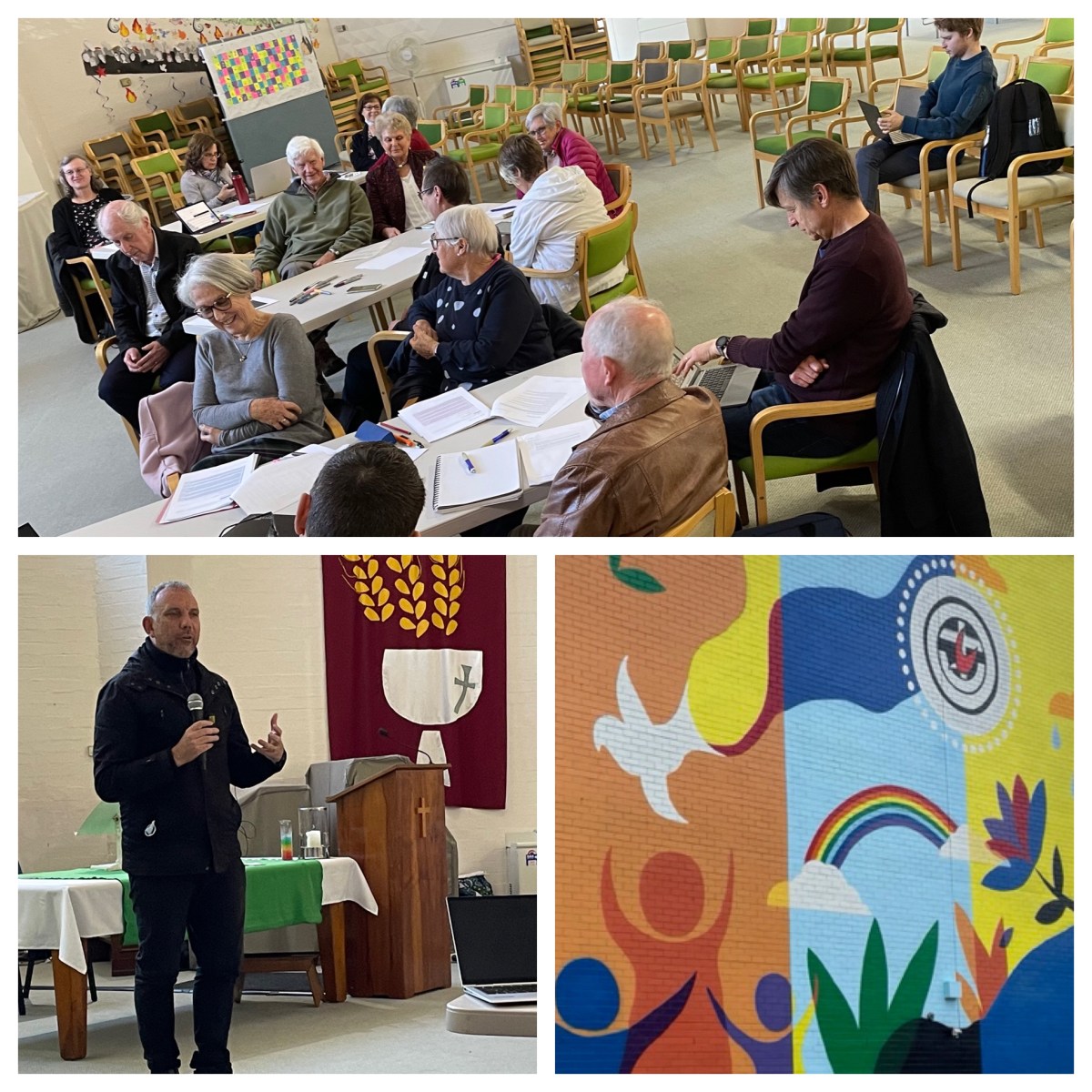
Members of the Tuggeranong Uniting Church Council and a group of leaders from within the Congregation met recently in a workshop based around the CliftonStrengths Inventory. It was a most enjoyable and productive day, and something that other Church Councils could well consider doing when they come to the place that Tuggeranong finds themselves in, looking to call a new minister into placement with them.
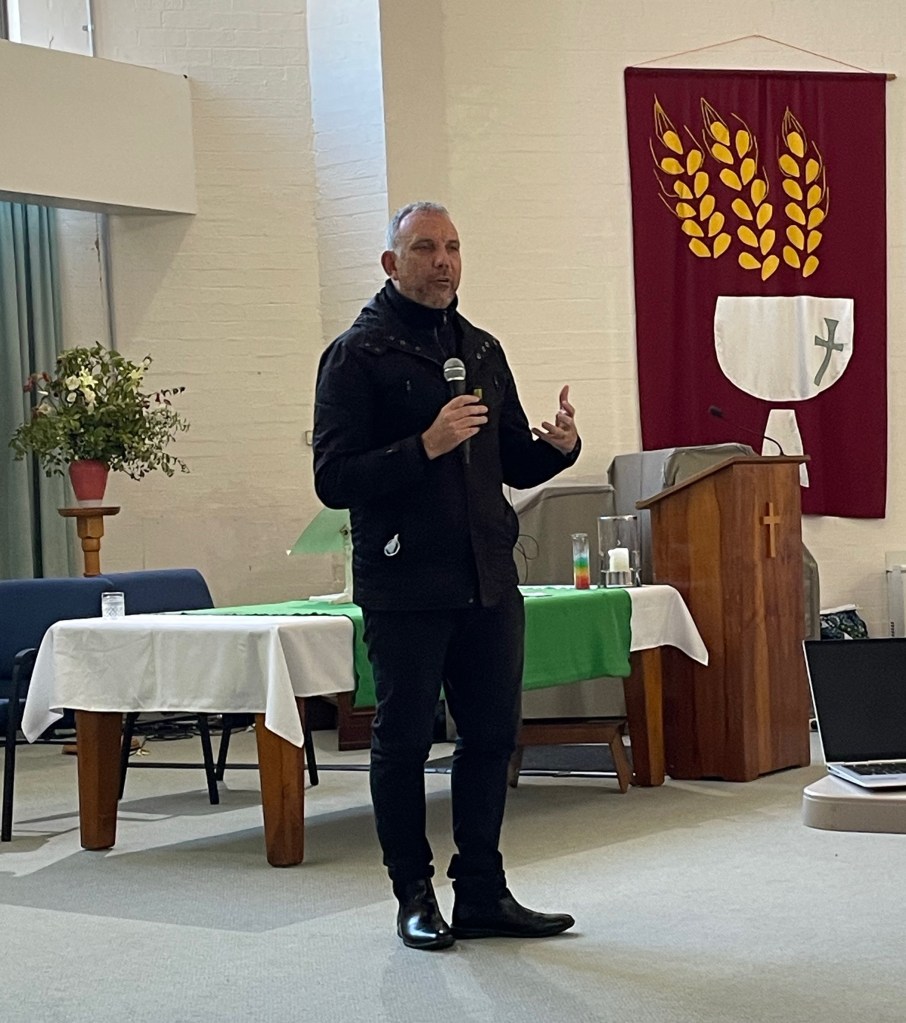
Ben Gilmour, Director of Vital Leadership in the Synod of NSW.ACT of the Uniting Church in Australia, led the group through a process of discussion, designed to assist with the task of discerning “the gifts and graces” that would be needed in the minister who would be called to follow Elizabeth Raine in ministry at Tuggeranong, as she retires later this year. Presbytery members of the Joint Nominating Committee who would be involved with representatives of the Congregation in that task were also participating on the day. There were eight discrete sections to the workshop.
Ben is trained in the use of the Inventory in various situations, and he is able to adapt the programme to suit the specific needs of a Congregation, be it team building, leadership development workshops, or coaching of an individual or a leadership team.
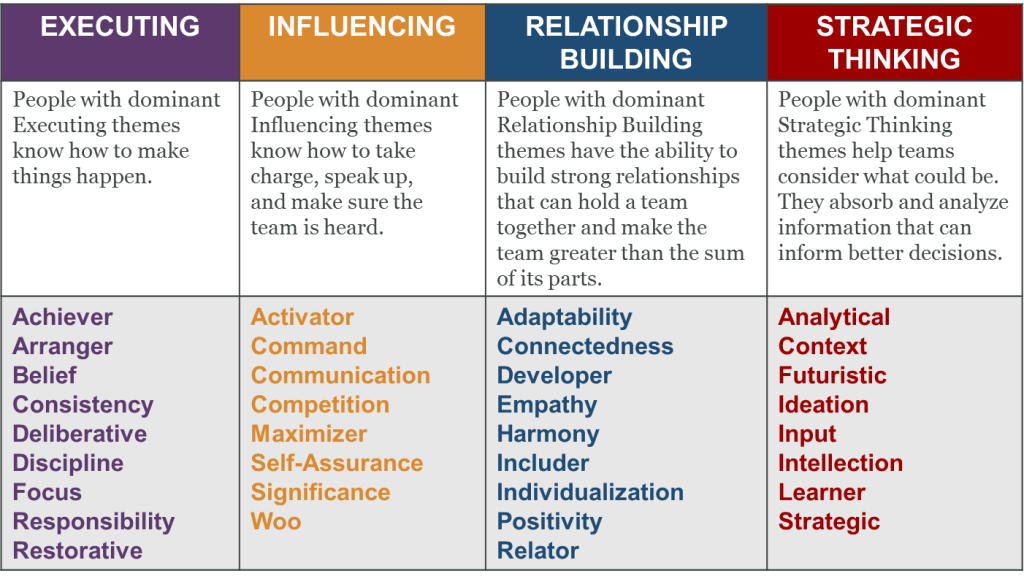
Those present for the Tuggeranong workshop had completed the CliftonStrengths Inventory ahead of the meeting, enabling Ben to prepare an overview of the relative strengths of the combined leadership in each of the four areas measured by this Inventory: Strategic Thinking, Relationship Building, Influencing, and Executing. This was a revelatory exercise in itself. Ben then had collated a comprehensive statement of the practices and vision of the Congregation, as seen through the collated leadership reports.
Personally, as a longterm sceptic about psychological-type assessment tools, I was cautious. I know that Myers-Briggs and the Enneagram offer some value, but I don’t like the way that people can be “boxed” into certain categories by the way they are used. (You’re a Number Four? With a Seven Wing? Oh! A Thinking Introvert? With a tendency to Perception? Really?)
But this was a more detailed tool, open to greater complexities and subtleties, than anything I had previously experienced. The online assessment tool is capable of describing 34 themes that make up the user’s personality. The results of the test “are intended to help individuals understand their unique strengths and how they can use them to achieve their goals and improve their performance.”
Collated together, the results of the twenty people who completed the inventory provided a rich description of the active leadership within the Congregation. When I read my own report, it felt like I was “looking into a mirror”—the person described was me! Others who took part had similar experiences. The reports are realistic and honest (and detailed).
The 34 themes are divided into 4 domains. First, Strategic Thinking covers Analytical, Context, Futuristic, Ideation, Input, Intellection, Learner, and Strategic strengths. Next, Relationship Building encompasses Adaptability, Connectedness, Developer, Empathy, Harmony, Includer, Individualization, Positivity, and Relator.
Then, Influencing details Activator, Command, Communication, Competition, Maximizer, Self-assurance, Significance, and something charmingly called “Woo”. Finally, in the area of Executing, the test dealt with Achiever, Arranger, Belief, Consistency, Deliberative, Discipline, Focus, Responsibility, and Restorative.
The “payout” at the end of the day was a strong awareness amongst the Congregation’s leadership of what the community values, where their strengths of the collective leadership lie, what might be done to build on these strengths, and what areas could benefit from attention in the future.
The workshop has assisted the JNC to form a clear picture of what they would be looking for in a minister who might be called to Tuggeranong in 2024. That JNC has a strong base for the discernment conversations that they will have, and the wider leadership team of the Congregation has a firm foundation for developing and extending the already fruitful ministries that the Congregation is undertaking in its mission to the people of the Tuggeranong Valley.
The Voice to Parliament is not a partisan political issue; it is a national matter that draws together a wide range of Australian society in support of the First Nations people of this continent and its surrounding islands.
In early 2023, Common Grace launched the national Listen to the Heart campaign, calling Christians to vote yes in the referendum for a constitutionally enshrined Indigenous Voice to Parliament.
Common Grace describes itself as “a movement of individuals, churches and communities pursuing Jesus and justice together for the flourishing of all people and all creation”. Its campaign, Listen to the Heart, is led by Aboriginal and Torres Strait Islander Christian Leaders, including Aunty Jean Phillips, Uncle Ray Minniecon, Uncle Vince Ross, Adam Gowan, Sabina Stewart, Bianca Manning, and Aunty Sue Hodges.
The campaign invites Christians across Australia to deeply listen to the calls of Indigenous peoples for justice, through Voice, together with Treaty and Truth-Telling, reflecting the three key commitments sought by the Statement from the Heart. See https://www.listentotheheart.org.au
The Voice to Parliament will be Voice structured to allow local, regional, state and territory voices to be heard through this National Voice.
*****
In 2015, the Social Justice Committee of The Hunter Presbytery made a submission to the Joint Parliamentary Inquiry into Constitutional Recognition in 2015. The three key elements in their submission still hold good some eight years later:
1. Australian people are ready for change; there is agreement the Constitution should be changed as soon as possible.
2. Practical Recognition is required, not just Symbolic Recognition. One way to implement practical recognition in the Constitution is through a Voice to Parliament.
3. The recognition of Aboriginal and Torres Strait Islander people in the Australian Constitution is important and long overdue.
For people in the Uniting Church, voting YES in the proposed referendum is a clear way to express our long-held and enduring commitment to our covenant relationship with First Peoples. Voting in this way to support the referendum would be one more step along a pathway that has been clear for many decades, that the UCA stands in solidarity with First Peoples in Australia. In 1980, at Noonkanbah in Western Australia, Uniting Church members stood in solidarity with the traditional owners, the Yungngora people, against the mining of their land.
The Uniting Aboriginal and Islander Christian Congress was established in 1985, and a Covenant between the UAICC and the UCA was formalised in 1994. This Covenant recognises that working for reconciliation amongst people is central to the Gospel. In 2009, the Preamble to the UCA Constitution was revised to recognise the difficult history of relationships between the First Peoples and the later arrivals, as Second Peoples. Our present relationship is one which seeks to ensure that we commit to the destiny together which we share as Australians.
Supporting a vote for an Indigenous Voice to Parliament is yet another step along that pathway of sharing a destiny together. It’s an expression of our central commitment to justice for First Peoples. It is an act that sits at the very heart of the Gospel.
*****
The Statement from the Heart is a consensus statement which was born out of extensive discussions across the nation and finalised at a Constitutional Convention at Uluru in May 2017. The Statement offers a way forward for Australia that is practical, not merely symbolic. It advocates for the three key elements: Treaty, Truth, and Voice.
Last year, a number of Australian religious leaders declared their support of the Uluru Statement from the Heart, which includes the request for just such a Voice to Parliament. There are Anglicans, Catholics, Buddhists, Jews, Muslims, Quakers, Baptists, and others who support this, along with the Uniting Church.
Aboriginal and Torres Strait Islander Christian Leaders, including Aunty Jean Phillips, Uncle Ray Minniecon, Uncle Vince Ross, Adam Gowan, Sabina Stewart, Bianca Manning, and Aunty Sue Hodges, are supporting the YES campaign for the Voice to Parliament.
A Joint Resolution of Australian religious leaders in support of the Uluru Statement from the Heart, which includes the request for just such a Voice to Parliament, was signed in May 2022, on the fifth anniversary of the Statement from the Heart. Anglicans, Catholics, Buddhists, Jews, Muslims, Quakers, Baptists, and others support this, along with the Uniting Church.
Last month, representatives of another batch of “religious” organisations have come out in support, as the peak bodies of many sporting organisations joined together to advocate a YES vote in the coming referendum: the AFL, NRL, Rugby Union, Cricket Australia, Baseball Australia, Deaf Sport Australia, Football Australia, Basketball, Taekwondo, Golf, and more.
All of which means, it makes sense for people of faith to Vote YES!!!
When they met in early February this year, every First Minister in Australia—territory, state, and federal—agreed to support the Voice to Parliament. This is a highly significant bi-partisan step by a group of informed leaders who recognise the importance of taking this step. It is only one step—there is still the matter of Truth Telling to be implemented, as well as Treaty (or, more accurately, Treaties) to be concluded. But the Voice is a key step forward.
The Prime Minister said that “the Voice will recognise Aboriginal and Torres Strait Islander people in our constitution, and consult on matters affecting them”. The statement from the joint meeting indicated that the Voice “provides independent advice … is accountable and transparent, does not have a program delivery function, and does not have a veto power”. These are all important details that the Australian electorate should consider, when making a decision on this matter in the proposed referendum later this year.
*****
The structure of the proposed Voice to Parliament was set out in a report issued in 2021, co-authored by University of Canberra chancellor and now Senior Australian of the Year Professor Tom Calma and University of Melbourne Professor Marcia Langton. This report envisages a network of local and regional Voice bodies covering 35 areas Australia-wide, which would deal with issues raised by local communities and contribute members to form the national Voice.
Under the Calma–Langton proposal – the result of extensive consultation – each local region would determine for itself how it should be formed. The national body would have 24 members. They would comprise 18 base members, two each from every state and territory and two from Torres Strait. Another five members would represent different remote regions and one would represent Torres Strait Islanders living on the mainland.
The membership would be gender-balanced, with an option to include two more with specialist skills as required, jointly appointed by the federal government and the Voice itself. Members would serve no more than two four-year terms and two of them, of different genders, would be selected to serve full time as co-chairs.
*****
A few months before the First Ministers had signed their declaration of support for the Voice to Parliament, earlier this year, the Uniting Church had joined with many other religious organisations in Australia to sign a Joint Resolution of Australian religious leaders in support of the Uluru Statement from the Heart, which includes the request for just such a Voice to Parliament.
The Joint Resolution was signed in May 2022, on the fifth anniversary of the Statement from the Heart, by representatives of nine Australian religious bodies. They called for immediate bipartisan action to hold a referendum on a First Nations voice to Parliament. Uniting Church President Rev Sharon Hollis was the signatory to the Joint Resolution on behalf of the Uniting Church Assembly. See https://uniting.church/supporting-uluru-statement/
The Statement from the Heart is a consensus statement which was born out of extensive discussions across the nation and finalised at a Constitutional Convention at Uluru in May 2017. The Statement offers a way forward for Australia that is practical, not merely symbolic. It advocates for the three key elements: Treaty, Truth, and Voice.
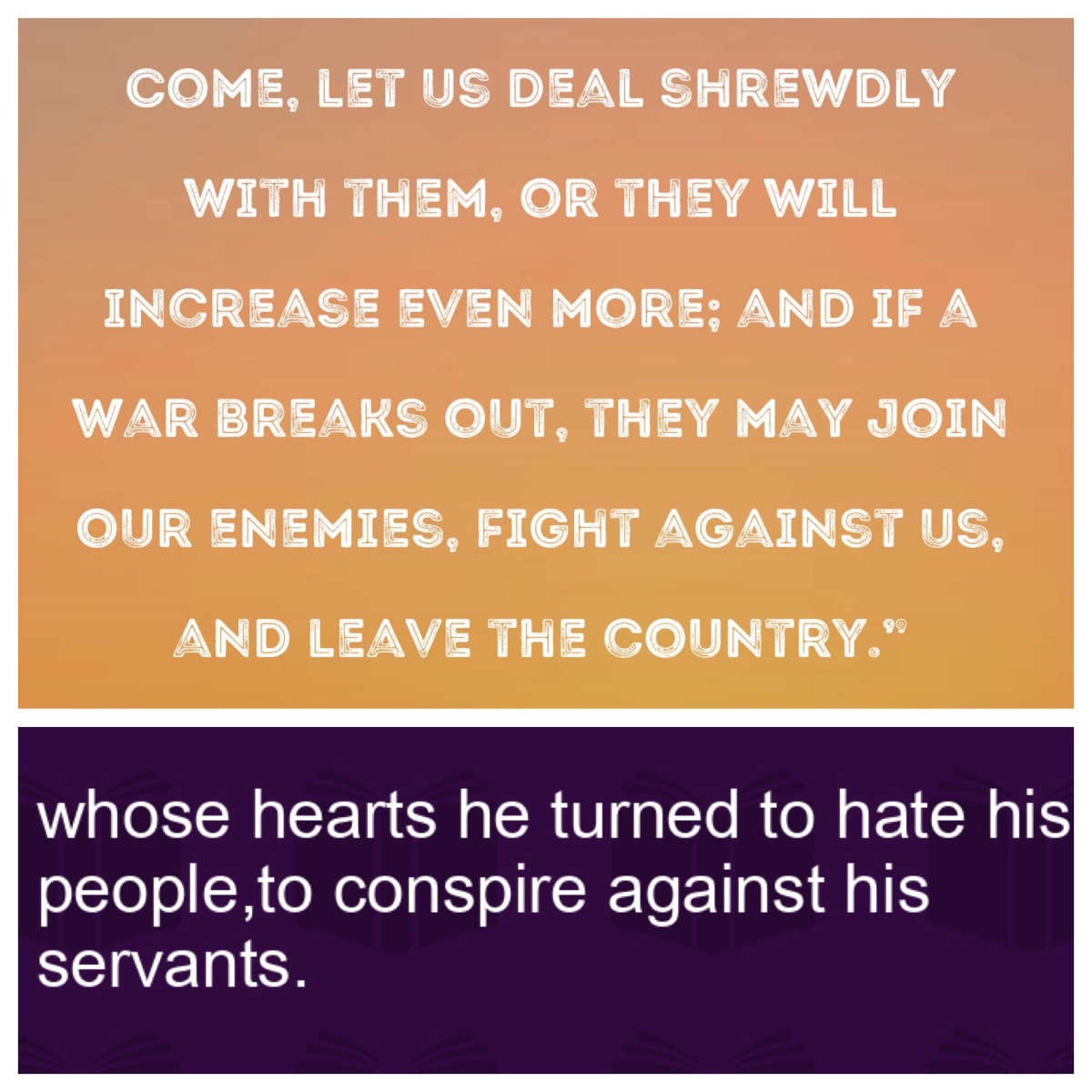
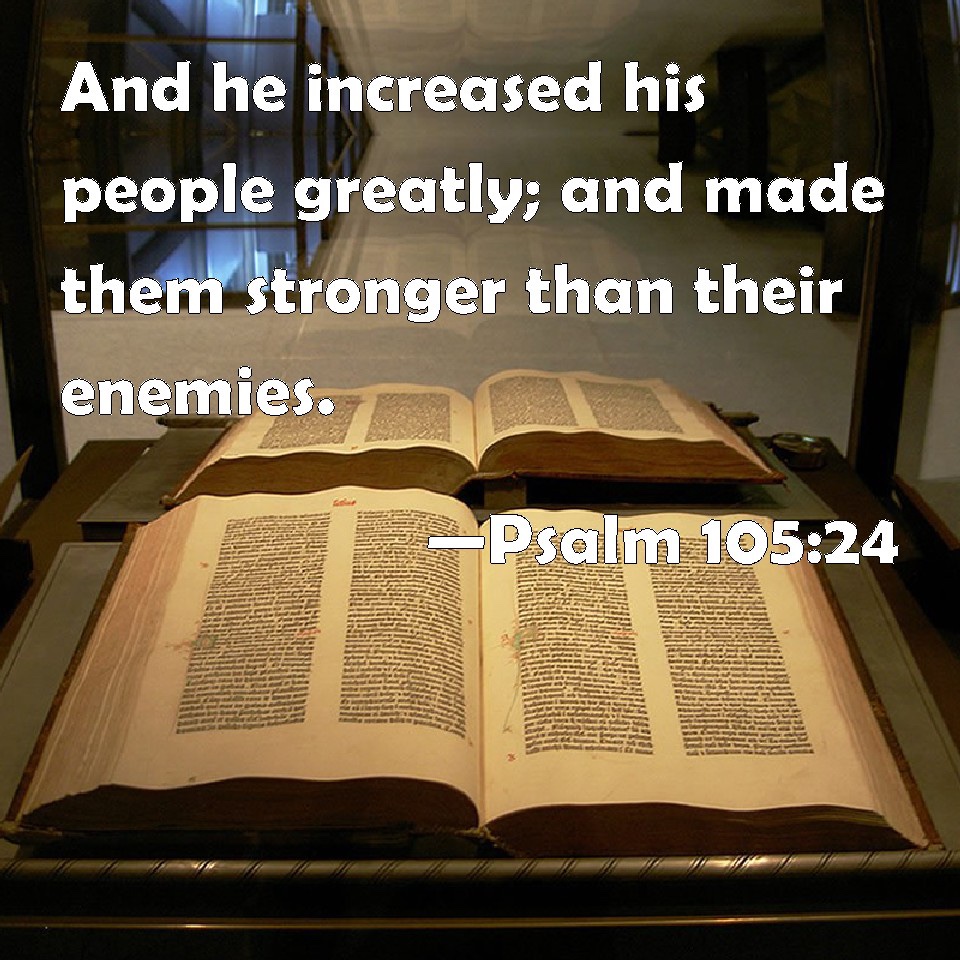
“The Lord made his people very fruitful, and made them stronger than their foes, whose hearts he then turned to hate his people, to deal craftily with his servants” (Ps 105:24–25). These words appear in the psalm that is offered by the Revised Common Lectionary this coming Sunday (Ps 105:1–6, 23–26, 46b).
“Dealing craftily” is presented as something quite negative; a characteristic of the way that the “foes” of Israel deal with the “servants” of the Lord. The reference is made in the course of providing a summation of one part of the Joseph episode within the overall story of Israel that is told by this psalm.
In the course of the 45 verses of this psalm, there are summaries of key episodes in this story, from the ancestral covenant with Abraham, Isaac, and Jacob (vv.7–11), through the times involving the elderly Jacob, his sons, the famine in Canaan, and the rescue provided by Joseph in Egypt (vv.12–25), on to the period of Moses and Aaron (vv.26–36), the Exodus from Egypt and wilderness wandering (vv.37–42) and then the entry into the land of Canaan (vv.43–45).
This lyrical retelling of the story of Israel fits it well for singing on the first day of Passover, remembering the escape from slavery in Egypt. However, the portion offered by the lectionary this Sunday tells of a time prior to that, when “Israel came to Egypt; Jacob lived as an alien in the land of Ham” (v.23). Of that period, the psalmist sings that “the Lord made his people very fruitful” (v.24).
This presumably reflects the time after the severe famine in Canaan (Gen 43:1), when, after various machinations, Jacob and his family relocate to Egypt, and Joseph, having revealed his true identity to his family (Gen 45:1–5), “settled his father and his brothers, and granted them a holding in the land of Egypt, in the best part of the land, in the land of Rameses, as Pharaoh had instructed; and Joseph provided his father, his brothers, and all his father’s household with food, according to the number of their dependents” (Gen 47:11–12).
Of course, soon after this, famine hit Egypt as well (Gen 47:13). Joseph’s scheme for surviving the famine works (Gen 47:14–26), the country survives, and “Israel settled in the land of Egypt, in the region of Goshen; and they gained possessions in it, and were fruitful and multiplied exceedingly” (Gen 47:27). This bounty is reiterated in the opening chapter of Exodus, which declares that “the Israelites were fruitful and prolific; they multiplied and grew exceedingly strong, so that the land was filled with them” (Exod 1:7).
All of this is conveyed in the highly compressed summation of the psalm, “the Lord made his people very fruitful” (Ps 105:24). But then, according to the psalmist, the Lord turned the hearts of the Egyptians “to hate his people, to deal craftily with his servants” (Ps 105:25). This marries with the way that the narrative continues in Exodus, which notes that “a new king arose over Egypt, who did not know Joseph”, and so “they set taskmasters over them to oppress them with forced labour” (Exod 1:11).
The Egyptians are described as acting “shrewdly” (Exod 1:10). Is this the same as the psalmist’s note that the foes of Israel “dealt craftily” with them (Ps 105:25)? The Hebrew word used in the quasi-historical narrative of Exodus is chakam, which is most often translated as “act wisely”. Thus it is applied to Solomon (1 Ki 4:31), the simple who are made wise through “the decrees of the Lord” (Ps 19:7; so also 119:97–100), the instruction of Wisdom herself (Prov 8:33), and the activity (as whispily vain as it is) of the Preacher, Qohelet (Eccles 2:15, 19). The way the Egyptian treated the Israelites had a certain cunning involved—they acted with a canny, shrewd wisdom.
The Hebrew word chosen in the poetry of the psalmist’s song is nakal, “to be crafty, deceitful, or knavish”, according to Brown, Driver, and Briggs. This word is also employed in the Genesis narrative, when the brothers of Joseph plot to kill him. “Here comes this dreamer; come now, let us kill him and throw him into one of the pits”, they say (Gen 37:19–20), as he approaches them in his “long robe with sleeves” (Gen 37:3). Such behaviour is described in various translations as being a conspiracy or a plot—the translation offered here for nakal.
Attributing this mode of behaviour to the sons of Jacob should not surprise us—after all, they have inherited the DNA which has previously led their ancestors to lie, deceive, and even threaten to murder their own child! Remember: Abraham lying about his wife Sarah as his sister (Gen 12 and again in Gen 20) and threatening to sacrifice his own son (Gen 22); Isaac, who also lied that his wife Rebekah was his sister (Gen 26); and Jacob, the deceiver, who stole his birthright from his twin brother Esau (Gen 27) and then deceived his father-in-law Laban and profited from his flock (Gen 30–31). They are not exactly wonderful role models!
But the Exodus narrative attributes such “shrewdness” to the Egyptians, as the foes of Israel (Exod 1:10); a shrewdness that overlaps, as we have seen, with divinely-granted wisdom. The Egyptians were being wise in pressing the foreigners in their midst to work for them in their building projects. And no, they were not being used as slave labour to build the great pyramids of Egypt. Those structures are dated to “the Old Kingdom”, from 2686 until about 2160 BCE—well, well before any possible dating of the Israelites were in Egypt.
It’s interesting that the psalmist called out the Egyptians for what they saw them to be—shrewd, conniving, deceitful—whereas the Exodus story leaves open a sliver of possibility they the Egyptians were being shrewd and wise in the way they use (and, it would seem, greatly abused) the Israelites living in their land. Interesting.
Aboriginal and Torres Strait Islander peoples have long struggled for constitutional recognition. As far back as YortaYorta elder William Cooper’s letter to King George VI (1937), the Yirrkala Bark Petitions (1963), the Larrakia Petition (1972) and the Barunga Statement (1988), First Peoples have sought a fair place in our country.
All Prime Ministers of the modern era were conscious of the original omission of First Peoples from our constitutional arrangements. Prime Minister the Hon Gough Whitlam spoke of the need for Aboriginal and Torres Strait Islander peoples to take “their rightful place in this nation”. Prime Minister the Rt Hon Malcolm Fraser established a Senate inquiry whose report, 200 Years Later: Report by the Senate Standing Committee on Constitutional and Legal Affairs on the Feasibility of a Compact or ‘Makarrata’ between the Commonwealth and Aboriginal People, was delivered after the 1983 election.
Prime Minister the Hon Bob Hawke sought to respond to the BarungaStatement with his commitment for a treaty or compact at the bicentenary of 1988. In his Redfern Speech in 1991, Prime Minister the Hon Paul Keating said, How well we recognise the fact that, complex as our contemporary identity is, it cannot be separated from Aboriginal Australia.
Prime Minister the Hon John Howard committed to a referendum on the eve of the 2007 federal election, saying: I believe we must find room in our national life to formally recognise the special status of Aboriginal and Torres Strait Islanders as the first peoples of our nation.
In 2010 Prime Minister the Hon Julia Gillard established the Expert Panel on the Recognition of Aboriginal and Torres Strait Islander Peoples in the Constitution, co-chaired by Patrick Dodson and Mark Leibler, which reported in 2012.
Prime Minister the Hon Tony Abbott established a Joint Select Committee on Constitutional Recognition of Aboriginal and Torres Strait Islander Peoples, co-chaired by Senator Ken Wyatt and Senator Nova Peris, which reported in June 2015.
Prime Minister the Hon Malcolm Turnbull and Opposition Leader the Hon Bill Shorten then established the Referendum Council in December 2015. The Council worked to build on the work of the Expert Panel and the Joint Select Committee. It reported in 2017, taking into account the political and legal responses to the earlier reports, as well as the views of Aboriginal and Torres Strait Islander peoples and the general public.
This is the first time in Australia’s history that such a process has been undertaken. It is a significant response to the historical exclusion of First Peoples from the original process that led to the adoption of the Australian Constitution. The outcomes of the First Nations Regional Dialogues and the National Constitutional Convention are articulated in the Uluru Statement from the Heart.
The findings of our broader community consultation supported the findings of the First Nations Regional Dialogues. This strengthens our conviction that the Voice to the Parliament proposal and an extra-constitutional Declaration of Recognition will be acceptable to Aboriginal and Torres Strait Islander peoples and to the broader Australian community.
In their Final Report, the Co-Chairs of the Referendum Council, Pat Anderson AO and Mark Leibler AC, say, “We propose these reforms because they conform to the weight of views of First Peoples expressed in the First Nations Regional Dialogues as well as those of the wider community. With focussed political leadership and continued multiparty support for meaningful recognition, the Voice to the Parliament proposal can succeed at a referendum.
“The consensus view of the Referendum Council is that these recommendations for constitutional and extra-constitutional recognition are modest, reasonable, unifying and capable of attracting the necessary support of the Australian people.”
This is the work that lies behind the request to Vote YES in the proposed 2023 referendum. It has been a long process, with bipartisan political support, and there is a lot of information that is available.
from the Foreword from the Co-Chairs of the Final Report of the Referendum Council, 2017
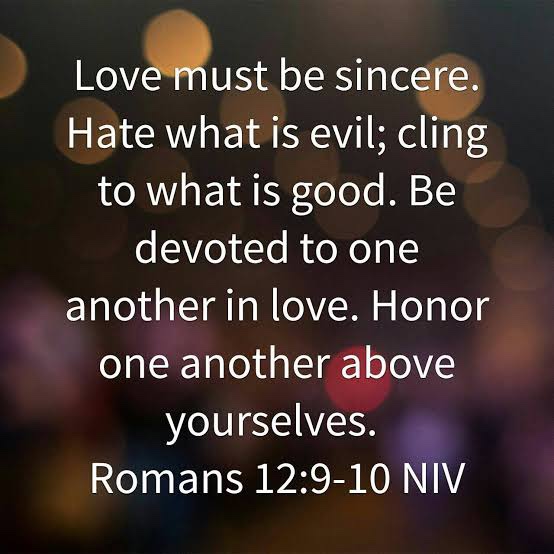
Last week we saw Paul pivoting from complex theological argumentation into encouraging ethical instruction (Rom 12:1–8). This week, the lectionary offers us a section of Romans (12:9–21) in which all of the convoluted syntactical constructions and flowery rhetorical declarations of those preceding 11 chapters have faded into the distance. In this passage, we have a sequence of twenty-one short, precise, punchy phrases through which Paul offers advice and guidance to the believers in Rome.
Paul never lost an opportunity to provide advice and instruction to people in the churches to whom he wrote letters. In many of those letters, there are sections where he peppers his communications with short, sharp, direct instructions. In 1 Thess 5:12–22, he shoots off a string of seventeen mostly staccato-short instructions: “admonish the idlers, encourage the fainthearted, help the weak, be patient …”.
In Phil 4:8–9 he encourages the Philippians to “think about” the eight qualities that he lists in rapid-fire order: “whatever is true, whatever is honorable, whatever is just, whatever is pure, whatever is pleasing, whatever is commendable, if there is any excellence, if there is anything worthy of praise”.
In his letter to the believers in Galatia, he gives both a list of fifteen “works of the flesh” and then of nine qualities that comprise “the fruit of the Spirit” (Gal 5:16–26), while near the end of his first letter to the Corinthians, he provides a more modest list of five commands: “keep alert, stand firm, be courageous, be strong, let all you do be done in love” (1 Cor 16:13–14).
Here in Romans 12, he excels himself, with a sequence of twenty commands, the first of which (“let love be genuine”, v.9) stands as a heading for the section; and the last of which (“never avenge yourselves”, v.19) is extended into a brief excursus about “the wrath of God”, before a final two-part concluding instruction, “do not be overcome by evil, but overcome evil with good” (v.21).
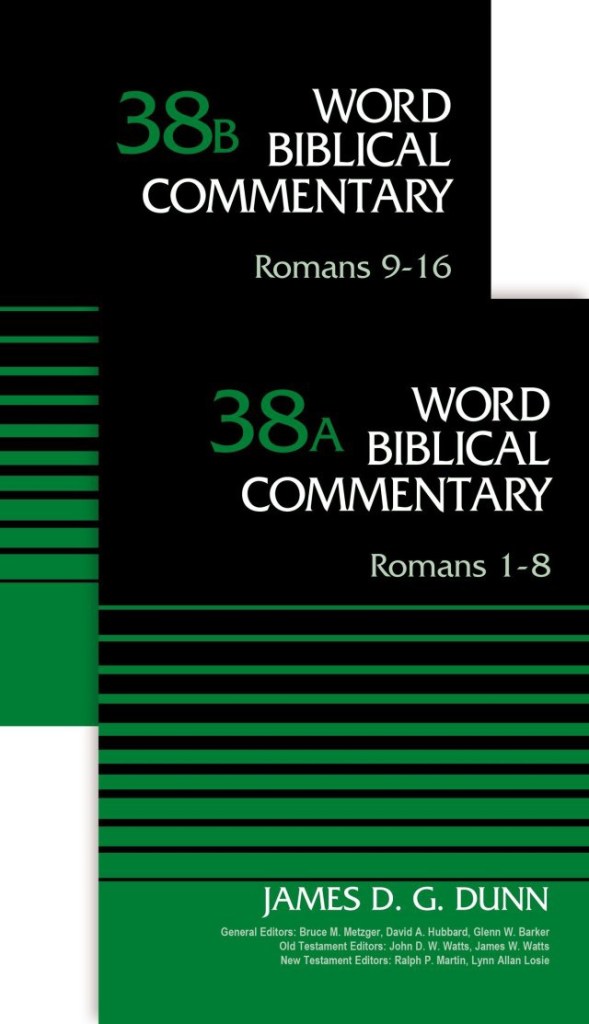
The go-to commentaries on my bookshelf which deal with Romans are the two-volume (976 pages) Word Commentary by James D.G. Dunn, and the even larger (1140 pages) Hermeneia Commentary by Robert Jewett. I had the privilege of spending a sabbatical year at Durham in the UK while Jimmy Dunn was Professor there (he was supervising the doctoral research into Matthew’s Gospel being undertaken by my wife, Elizabeth Raine) and also of being one of the respondents to the commentary of Jewett when he was a visiting scholar at Macquarie University in Sydney, Australia.
Dunn follows the typical scholarly description of this passage as “the most loosely constructed of all the paragraphs, consisting mainly of individual exhortations (stringing pearls) held together in part by particular words and thematic links (especially love … bad … and good)” (Romans, Word, p.737). Jewett demurs, arguing that this passage “is artfully constructed for rhetorical impact and closely related to the tensions between Christian groups in Rome” (Romans, Hermeneia, p.756).
I can see that the links suggested by Jewett are evident in the words that Dunn has suggested. “Let love be genuine” (v.9) functions as a heading; the motif is repeated with “love one another with mutual affection” (v.10) and then explained in a series of practical instructions: “contribute to the needs of the saints; extend hospitality to strangers; bless those who persecute you; bless and do not curse them; rejoice with those who rejoice, weep with those who weep; live in harmony with one another; do not be haughty, but associate with the lowly; do not claim to be wiser than you are” (vv.12–16).
These words apply directly, it would seem, to the situation in Rome, where tensions between groups are evident. The points of view that are reflected in the phrases “those who are weak in faith” (14:1) and those who “believe in eating anything” (14:2), for instance, appear to reflect the same disagreement that is dealt with in more detail in 1 Cor 8—10.
In that context, “the weak” is regularly interpreted to be a Gentile portrayal of Jews within the Roman conglomerate of faith communities, who refrain from eating meat that had previously been offered to idols and then sold on in the marketplace. “The strong” would thus be the Gentile self-description of those who are not troubled by this, since they know that “no idol in the world really exists” since “there is no God but one” (1 Cor 8:4).
*****
Could a similar dynamic be at work regarding the same issue in Rome? It seems to me to be a reasonable line of interpretation—in which case, the exhortations grouped together under the heading of love (Rom 12:9–10, 13–17) would undergird the later teachings about love as “the fulfilling of the law” (13:8–10) and the direct command to “welcome one another” (15:7). They would also,seem to relate to the specific directions that the believers “no longer pass judgement on one another” (14:13, drawing together all of 14:1–23) and the clear admonition that “each of us must please our neighbour for the good purpose of building up the neighbour” (15:2, summing up 15:1–13).
Indeed, I find myself strongly persuaded by a line of scholarship which Jewett summarises and develops in his hugely-detailed Hermeneia commentary, which sees the list of names to whom Paul sends greetings in Rom 16:3–16 offers clear indications of different “house church” groups which were meeting in Rome. Phrases such as “the church in their house” (v.5), “the family of Aristobulus” (v.10), “those in the Lord who belong to the family of Narcissus” (v.11), “the brothers and sisters who are with them” (v.14), and “all the saints who are with them” (v.15) indicate various potential groupings.
Jewett distinguishes three types of people being addressed—close personal friends and coworkers of Paul, leaders of house churches known only by hearsay (since Paul had not yet visited Rome when he wrote this letter), and five house or tenement churches (identified by some of those phrases already noted in the previous paragraph). The rhetorical function of this closing section of the letter is, in part, to strengthen “emotional and affectional bonds … across barriers erected by previous conflicts”. (See Jewett, Romans, Hermeneia, pp.952–954).
In similar fashion, the instructions “hate what is evil, hold fast to what is good” (v.9) and “do not be overcome by evil, but overcome evil with good” (v.21) enclose the passage as markers of a related key theme, in which the opposites of evil (bad) and good are in view. In this regard, the instruction, “do not repay anyone evil for evil, but take thought for what is noble in the sight of all” (v.17) is also related, and it shows the connection with the “love” motif already noted. It is yet another indication that the cohesiveness of the community is what Paul has in mind as he writes.
What follows immediately after that instruction adds to this theme: “if it is possible, so far as it depends on you, live peaceably with all” (v.18) is clearly aimed at ensuring mutual respect amongst those drawn together by their common faith in Jesus as “the righteousness of God”. And perhaps, then, the mention of God’s wrath (v.19a) and the following instructions (vv.19b—20) fit within this framework. God’s vengeance (noted in the short quote from Deut 32:25) requires behaviour that is ethical and other-oriented. That is how to live as those who have been “transformed by the renewing of your minds” (Rom 12:2).
That behaviour—feeding the hungry, giving a drink to the thirsty—points quite directly to the teaching of Jesus, which we find expressed in the succinct word, “whoever gives you a cup of water to drink because you bear the name of Christ will by no means lose the reward” (Mark 10:41) and embedded in the more extended parable of the final judgement (Matt 25:31–46).
In like fashion, the exhortation to “bless those who persecute you; bless and do not curse them; rejoice with those who rejoice, weep with those who weep” (Rom 12:14–15) resonates with the blessing offered by Jesus to those who weep (Luke 6:21b) and the subsequent exhortation to “do good to those who hate you, bless those who curse you, pray for those who abuse you” (Luke 6:27b—28).
*****
That Paul was aware of the ethical stance of Jesus, and indeed of some of his specific teachings, may well be indicated by his clear referencing of them in these words at this point in his letter to the Romans. Dunn certainly believes this to be the case; “the probability that the Pauline paraenesis does reflect the exhortation of Jesus must be judged to be very strong” (Dunn, Romans, Word, p.745).
Jewett takes a broader view, noting “close Hebraic parallels to this exhortation concerning emotional responsiveness”, citing Sir 7:34 (“do not withdraw yourself from weepers—mourn with the weepers”) as well Testament of Joseph 17:7–8 (“their life was my life, all their suffering was my suffering, all their sickness was my infirmity … my land was all their land, and their counsel my counsel”).
Jewett also references a Greek maxim by Menander (“return grief for grief, and more than love for love”, Sent. Byz. 448), and a dictum by Epictetus (“where a man rejoices with good reason, there others may rejoice with him”, Diss. 2.5.23). (See Jewett, Romans, Hermeneia, p.767.)
So the wider existence of this ethical stance needs to be noted; Paul—and indeed Jesus—was not alone in recognising the virtue of fostering a sympathetic understanding of others, and of working collaboratively towards a cohesive and cordial communal life. Indeed, it can be no accident that this string of ethical exhortations which Paul collected in 12:9–21 follows immediately after his use of the image of the body as a metaphor for the interconnected and interdependent life of the community, in 12:3–8.
So the various injunctions collected in this passage—“live in harmony with one another”, “contribute to the needs of the saints”, even “extend hospitality to strangers” and indeed “live peaceably with all”—stand as important guides for the communities of faith in Rome, and indeed prove to be wise guides for life in any community, at any time, through into the present day. Faith calls us into relationship with others, and those relationships are to be marked by respect and integrity. May it be so!
I have been thinking about the upcoming referendum,,now announced for 14 October, for quite some time. I was recently asked why I planned to vote YES, and after giving this some consideration, I decided that there are eight key reasons to Vote YES:
1. There has been a long period of preparation leading to this present moment. Many Prime Ministers, each one since Gough Whitlam, have spoken in support of according a special place for First Peoples (yes—even John Howard!) In the last decade, our federal leadership has acted by setting up an Expert Panel in 2010 (Gillard), and then a Joint Select Committee in 2012 (Abbott), and then the Referendum Council in 2015 (Turnbull). This has been a bi-partisan political trajectory, culminating in the decision to go to a referendum in 2023 (Albanese).
2. As a result, Indigenous consultations have taken place, led by intelligent, compassionate, informed Elders, leading to the 2017 Consultation at Uluṟu. The Uluṟu Statement provides a clear Indigenous voice which speaks clearly about what is required: recognition in the Australian Constitution, a permanent Voice to Parliament, the telling of truth about our national history, and a Makarrata Commission to oversee the formalisation of treaties with the various First Nations. This is what the Elders of the First Nations are now asking of us.
3. Reputable polling shows that a vast majority of Aboriginal and Torres Strait Islander people support the request of the Statement from the Heart, which forms the basis for the proposed referendum. We all need to listen, acknowledge, and respond to that clear request. Voting YES will not solve everything, but it will be a very important basis for future action in this regard.
4. Many community groups and organisations are supporting a YES vote. This proposal has seized the imagination of people around the country. Sporting organisations, religious organisations, members of all major political parties, leaders of many ethnic and cultural community groups, leaders of many businesses, first ministers of every state and territory as well as our Prime Minister, each have joined their voice to the call for a YES vote. Support cuts across all distinctions and divisions in our society to unify in a strong call to vote YES.
5. Regular advice from the Indigenous-elected Voice will shape future policies of the national government in ways that will provide practical support to First Peoples, and help move us closer towards Closing the Gap in all areas. There is much work to be done. Governments in recent years have said that they want to Close the Gap, but progress has been slow. Regular, informed advice from the people most impacted will surely help us to move forward in this regard.
6. A resounding YES vote, akin to what took place in the 1967 referendum, will give a clear indication of how we have, at last, matured as a nation, moving beyond the xenophobic fear of the white Australia era and its continuation into the “white blindfold” years in the “history wars” of the late 20th and early 21st centuries. In recent decades in our society, we have taken a number of important steps in this regard, and this vote invites us to take a very important leap forward.
7. A YES vote will not be a divisive decision. Recognising First Peoples in the Constitution will not drive a wedge between “us” and “them”, nor will it give any privilege to these people. It will simply be a formal, legal recognition of the reality of the fact that when British colonisers invaded and settled on this continent, claiming it is their land, that land had in fact been cared for over millennia by the people already living on that land. In fact, a YES vote will provide good grounds for coming together in a more cohesive way in our society. It will speak truth about our past. Any future progress towards real reconciliation within our society depends on our taking this step, now.
8. A strong YES vote will provide a solid foundation for positive, constructive, hope-giving actions in the coming years, that will ensure we address the situation and redress the disadvantages of Aboriginal and Islander peoples. We recognise them with flags, we acknowledge them when we are on country, we encourage their languages and nurture their community groups; now we need to recognise them within our Constitution and ensure that there is a permanent Voice which can speak clearly on their behalf into the public arena.
I think that for the sake of First Nations peoples and for the health of the country as a whole, it is imperative that we vote YES!!!
The section of the Gospel that is offered in the lectionary this coming Sunday (Mark 16:21–28) contains a striking paradox. As the author of this passage portrays Jesus, looking forward to the public shaming that he will experience on the cross, he places on his lips a call to his followers, to take up the cross themselves. The cross is at the centre of the story that the evangelists tell—and at the heart of Christian faith. And yet that cross subjects Jesus to the shame of being subjected to this degrading punishment.
The cross is introduced by Jesus himself, when he teaches his followers “that he must go to Jerusalem and undergo great suffering at the hands of the elders and chief priests and scribes, and be killed, and on the third day be raised” (16:21). So important is this teaching, that Jesus repeats it twice more, following the threefold appearance of this prediction in one of Matthew’s key sources, “the beginning of the good news of Jesus, Messiah”, which we know as Mark’s Gospel (Mark 9:31; 10:33–34).
So Jesus restates this briefly: “the Son of Man is going to be betrayed into human hands, and they will kill him, and on the third day he will be raised” (Matt 17:23); and then, with more details: “the Son of Man will be handed over to the chief priests and scribes, and they will condemn him to death; then they will hand him over to the Gentiles to be mocked and flogged and crucified; and on the third day he will be raised” (Matt 20:18–19).
I don’t think that these three predictions were spoken, historically, by Jesus, as he made his way towards Jerusalem. Rather, the author of a placed them in this strategic place in the centre of his narrative (Mark 8:27–38). The author of “the book of origins of Jesus, Messiah”, which we know as Matthew’s Gospel, sees the value of this repetition, and follows his source.
These statements mark the turn in the story from Galilee, where the earlier activity of Jesus took place (Matt 4:12—18:35), towards Jerusalem, where the final days of Jesus will play out (19:1—28:15). The dynamic of the narrative indicates that, as Jesus leaves behind the days of preaching and teaching, healing and casting out demons, his focus turns to the confrontation that he knows lies in store for him.
The public nature of crucifixion was humiliating and shaming. The typical process of crucifixion involved moment after moment of humiliation, undermining any sense of honour that the victim had, increasing the sense of public shame that they were experiencing.
In the Roman world, crucifixion was variously identified as a punishment for slaves (Cicero, In Verrem 2.5.168), bandits (Josephus, War 5.449-451), prisoners of war (Josephus, War 5.451), and political rebels (Josephus, Ant. 17.295). These were people whose situations or actions had generated shame.
In the case of Jesus, he is accused of treason through the inference that he is King of the Jews—a claim that was anathema to the Romans (John 19:12)—and he is crucified in the company of political rebels (Mark 15:27; Matt 27:38; the term used, lēstēs, is the one most often found in the writings of Josephus to denote a political rebel).
A public trial, followed by a public execution on the cross, was a ritual in which the accused person was shamed, through a public ritual of status degradation. Cicero, in speaking as the counsel of Rabinio, a man accused of treason, asserted that “the ignominy of a public trial is a miserable thing” and described a public execution as “the assembly being polluted by the contagion of an executioner … [exhibiting] traces of nefarious wickedness” (Pro Rabinio 11, 16).
I have explored the humiliation and shaming inherent in the act of crucifixion in more detail in a blog at
And yet, immediately after he spoke this prophetic word, Jesus issued his disciples with a call to take up their crosses themselves: “if any want to become my followers, let them deny themselves and take up their cross and follow me” (Matt 16:24). He invites them—indeed, he commands them—to enter into the public shame that he will experience in his own crucifixion.
In the narratives that recount the crucifixion of Jesus, it is not so much the physical torment of Jesus which is highlighted (although, admittedly, a slow death by suffocation whilst hanging on a cross for hours, even days, was a terrible fate). Rather, it is the various ways in which Jesus was shamed: he was spat upon, physically struck on the face and the head, verbally ridiculed and insulted, and treated contemptuously.
This is the way of Jesus; and the way of his followers. Instead of saving their life, the followers of Jesus are instructed to lose their life (16:25). Instead of aiming to “gain the whole world”, and thereby “forfeit their life”, a follower is, by implication, to let go of all hopes of “gaining the world” (16:25–26). To gain the world was presumably referring to occupying a position of power, prestige, and popularity—precisely the kind of issues that later writers, Matthew and Luke, reflected in their more detailed accounts of the testing of Jesus in the wilderness. (See https://www.google.com.au/amp/s/johntsquires.com/2019/03/05/a-testing-time-forty-days-in-the-wilderness-1/)
Then, Jesus specifies the sense of shame that is involved in “taking up your cross” and “losing your life”, but he turns the tables as he declares that “the Son of Man is to come with his angels in the glory of his Father, and then he will repay everyone for what has been done” (16:27).
This reversal of fortune, repaying everyone for their deeds, reflects the shame, in God’s eyes, of rejecting Jesus. (The way this saying is expressed in Mark’s earlier version is clearer in this regard; see Mark 8:38.) Here is the paradox: to gain honour, Jesus had to be subjected to the shame of the cross.
Likewise, to gain honour as a disciple following Jesus, a person must take up the shameful instrument of punishment (the cross), lay aside all desire to gain prestigious and powerful positions of honour, give up any claim on life itself, and (as Jesus later asserts), live as a servant, being willing to be dishonoured for the sake of the shame of the Gospel.
And that’s the paradox of discipleship that this passage illuminates.
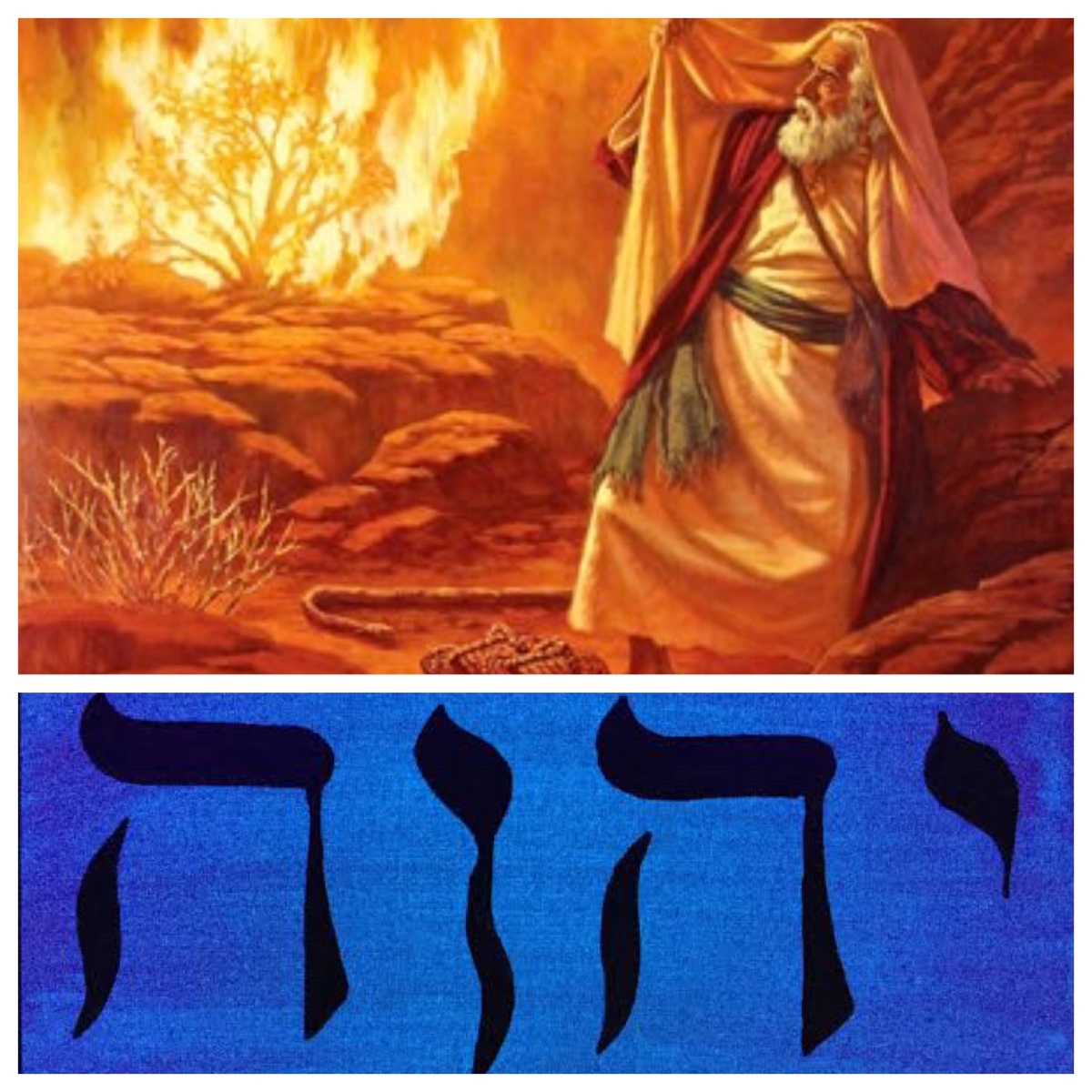
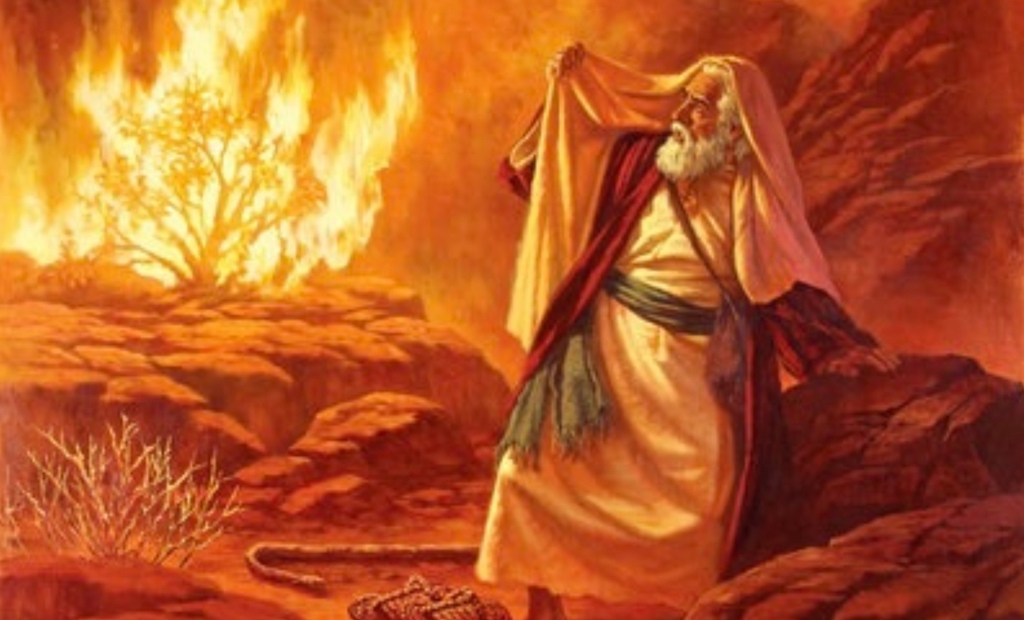
“The angel of the Lord appeared to [Moses] in a flame of fire out of a bush; he looked, and the bush was blazing, yet it was not consumed. Then Moses said, ‘I must turn aside and look at this great sight’ … and [when] the Lord saw that he had turned aside to see, God called to him out of the bush, ‘Moses, Moses!’ And he said, ‘Here I am.’ Then he said, ‘Come no closer! Remove the sandals from your feet, for the place on which you are standing is holy ground.’” (Exod 3:2–5)
The story of the burning bush is well-known; it is the moment when Moses, the murderer who has fled from Egypt (2:11–15), is galvanised by a striking event to become the one who will “go [back] to Pharaoh to bring my people, the Israelites, out of Egypt” (3:10), to become Moses the liberator. The transformation is striking—although perhaps the transformation is not quite as dramatic as many envisage.
It may well be the case for Moses that a strong sense of justice undergirds both his act of killing the Egyptian who was beating a Hebrew (2:11), and his commitment to deliver the Israelites from “the misery of Egypt” (3:17). Moses was passionate about the need for justice in society. Paradoxically, this passion led him to say NO to a man he witnessed committing a crime, and YES to a body of people who were suffering oppression in a foreign land.
Of course, common sense says that Moses should not have taken things into his own hands when he saw that Egyptian man beating one of his fellow-Israelites. But the passion within him—passion for fairness and justice—boiled up inside him and overflowed into unjust actions. This was in keeping with the charge given to the father of his people, when God mused about Abraham, “I have chosen him, that he may charge his children and his household after him to keep the way of the Lord by doing righteousness and justice” (Gen 18:19).
No wonder Moses fled, escaping the wrath of Pharaoh, travelling east across the desert areas of the Sinai Peninsula, all the way to Midian! (Exod 2:15). His action, out of proportion with the crime he saw being committed, was unjust. It is not a very propitious start for Moses, the man who towers over the story of the people,of Israel—ironically, best remembered as Moses the lawgiver!
Mind you, throughout Genesis, we have been regaled by tales of men behaving badly—Abraham lying about his wife Sarah as his sister (Gen 12 and again in Gen 20) and threatening to sacrifice his own son (Gen 22); Isaac, who also lied that his wife Rebekah was his sister (Gen 26); and Jacob, the deceiver, who stole his birthright from his twin brother Esau (Gen 27) and then deceived his father-in-law Laban and profited from his flock (Gen 30–31). They are not exactly wonderful role models!
Yet the story about Moses that we are offered in the lectionary this week presents Moses in a much more positive light, and it contains two fundamental elements in the story of Israel: the declaration that Moses stands on holy ground, and the revelation of the name of God.
Holy ground
God’s word to Moses, after calling for his attention, is to declare that “the place on which you are standing is holy ground” (Exod 3:5). This is the first occurrence of the concept of holiness in the Torah—the word is absent from all of the narratives in Genesis. And it is fascinating that this “holy ground” is in Midian, both far away from Egypt and far away from Canaan, the land that would subsequently be decreed as holy (Exod 15:13; Jer 21:23; Zech 2:12). This God is now able to appear in places far away from Canaan., and declare them holy.
A central motif in Hebrew Scripture is that holiness was a defining character of the people of Israel. A section of Leviticus (chapters 17—26) is known as “The Holiness Code”; its main purpose was to set out laws to mark Israel as different from the surrounding cultures. “You shall not do as they do in the land of Egypt, where you lived”, God told Moses, “and you shall not do as they do in the land of Canaan, to which I am bringing you” (Lev 18:2).
The rules of Leviticus were meant to set the Israelites apart from the Canaanites and Egyptians, who at that time had customs and rituals that were not to be adopted by the Israelites. Moses is instructed to relay to the people, “you shall be holy, for I the Lord your God am holy” (Lev 19:2), and to remind them to “consecrate yourselves therefore, and be holy; for I am the Lord your God. Keep my statutes, and observe them; I am the Lord; I sanctify you” (Lev 20:7). The whole book details those many statutes and commandments, all designed to keep the practices of the Israelites “holy to the Lord” (Lev 19:8; 23:20; 27:14–24).
Once the Temple was constructed, as a holy place within that holy land, those who ministered to God within the Temple, as priests, were to be especially concerned about holiness, both in their daily life and in their regular activities in the Temple (Exod 28–29; Lev 8–9). The priests oversaw the implementation of the Holiness Code, explaining the various applications of the word to Israel, that “you shall be holy, for I the Lord your God am holy” (Lev 19:2; also 20:7, 26).
In the years before and during the exile, a number of prophets took to addressing the Lord God as “the Holy One of Israel” (Hos 11:9, 12; Isa 1:4; 5:9, 24; 10:20; 12:6; 17:7; 29:19; 30:11–15; 31:1; 37:23; 41:14–20; 43:3, 14; 45:11; 47:4; 48:17; 49:7; 54:5–6; 60:9, 14; Jer 50:29; 51:5; Ezek 39:7; Hab 1:12; 3:3). The psalmists also pick up this phrase (Ps 71:22; 78:41; 89:18), reflecting the affirmation made by Hannah, “there is no Holy One like the Lord, no one besides you; there is no Rock like our God” (1 Sam 2:2).
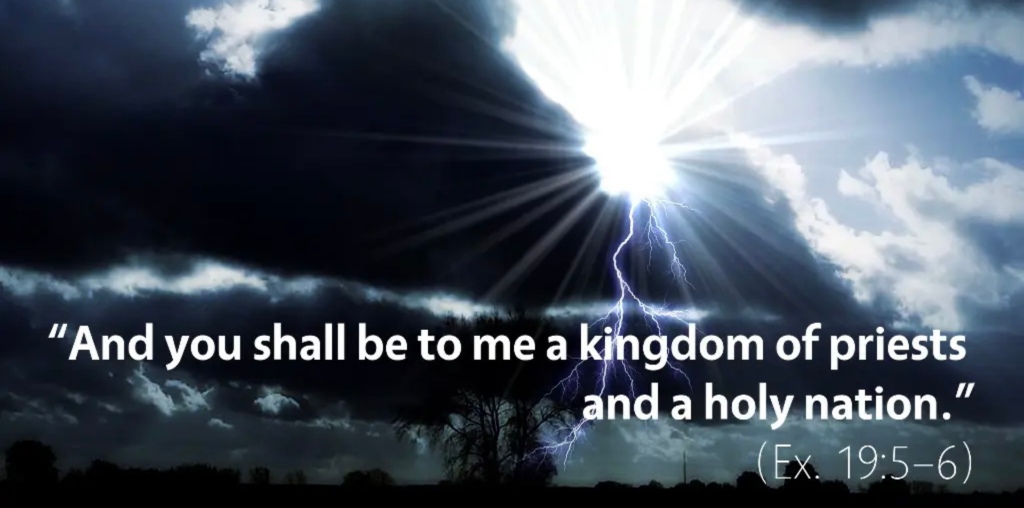
As a consequence, Israel is regularly assured that the whole nation is a “chosen people” (Deut 7:6–8, 14:2; Ps 33:12; Isa 41:8–10, 65:9), set apart as “a kingdom of priests, a holy nation” (Exod 19:4–6), called to be “a light to the nations” (Isa 42:6, 49:6). So in the towns and villages of Israel, by contrast to the centralised priests, the scribes and Pharisees provided guidance in the interpretation of Torah and in the application of Torah to ensure that holiness was observed in daily living of all people in Israel.
These dispersed teachers undertook the highly significant task of showing how the Torah was relevant to the daily life of Jewish people. It was possible, they argued, to live as God’s holy people at every point of one’s life, quite apart from any pilgrimages made to the Temple in Jerusalem. These figures, scribes and Pharisees, are evident in a number of interactions with Jesus that are reported in the Gospels—interactions focussed on interpreting the Torah (Mark 7:1–23 and Matt 15:1–20 exemplify such encounters).
Perhaps the origins of this localised interpretive role are told in the post-Exilic narrative of Nehemiah, when “the priest Ezra brought the law before the assembly, both men and women and all who could hear with understanding”, ably assisted by men who “helped the people to understand the law, while the people remained in their places”, explaining the significance of “this holy day” and other matters (Neh 7:73b—8:12). The story explains the modus operandi of these teachers.
Certainly, the culture and religion of the Israelites was to be marked by a concern for holiness. This is read back into the foundational narrative of the call given to Moses, “to bring my people, the Israelites, out of Egypt” (Exod 3:10, 17). When he hears this call in Midian, Moses is standing on holy ground (3:1-12).
The Name of God
Although he is in Midian, far away from Canaan (later to become Israel), Moses encounters the God who is most firmly identified with that land. It is “the Lord, the God of your ancestors, the God of Abraham, of Isaac, and of Jacob” who appeared to Moses (Exod 3:6, 16). This is the first occurrence of this characteristic linkage of the Lord God with the three patriarchs (see also Exod 3:15–16; 4:5; 6:3, 8; 33:1; Lev 26:42; Num 32:11; Deut 1:8; 6:10; 9:5, 27; 29:13; 30:20; 34:4; 2 Ki 13:23; Jer 33:26).
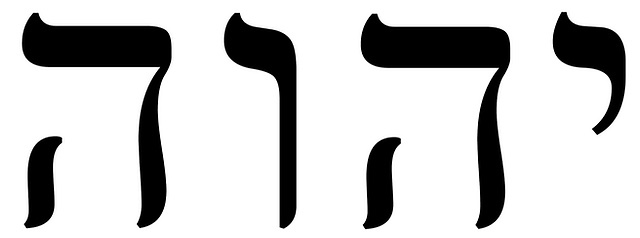
Identified, therefore, as “the God of your ancestors” (in Hebrew, elohe abotekem) (3:15, 16; 4:5), a distinctive term is added into the mix, and highlighted by God as “my name forever … my title for all generations” (3:15). The term is regularly translated as Lord, and is often capitalised to indicate its distinctive nature. In fact, the name comprises just four consonants (transliterated as yhvh or yhwh).
Despite its apparent simplicity, the meaning of the word has occasioned intense discussion amongst interpreters over the centuries. First, we should note that many Jews today adhere to the age-old prohibition and do not speak the name of God. This is based on the third of the Ten Commandments, “You shall not take his name in vain” (Exod 20:7; Deut 5:11).
Rabbi Baruch Davidson, writing on the website chabad.org, explains: “Although this verse is classically interpreted as referring to a senseless oath using G‑d’s name, the avoidance of saying G‑d’s name extends to all expressions, except prayer and Torah study. In the words of Maimonides, the great Jewish codifier: ‘It is not only a false oath that is forbidden. Instead, it is forbidden to mention even one of the names designated for G‑d in vain, although one does not take an oath. For the verse commands us, saying: “To fear the glorious and awesome name. Included in fearing it is not to mention it in vain.’” See
Since Hebrew words are constructed with a set of consonants as the base, to which a variety of vowels can be added, this short word is often expanded to either Jehovah or Yahweh. The former places the vowels of the word Adonai (meaning “lord”) to form the artificial term Jehovah, a title that has been popularised by the Jehovah Witnesses. The latter is a more accurate rendition of the blending of these consonants with the vowels of the verb to be, hayah, forming Yahweh.
The name of God that is given to Moses in this story is often referred to as the Tetragrammaton (meaning “four letters”), because it is a four-letter word, yud-hey-vav-hey (יהוה). This name is derived from the verb “to be”, which has led to speculation that it could be translated as “I am who I am” or “I will be whom I will be”—revealing nothing, really, about the nature of this divine being, other than the existence of God. It is a curious “revelation”. What has Moses actually learnt about God in this encounter??
This name is certainly mysterious. What does it mean to say, “I am who I am”? or “I will be who I will be”? The mystery of each phrase invites the listener or reader to pause, ponder, and consider what is being conveyed. This is not a direct propositional statement, declaring a closed statement along the lines of, “God is love”, or “God is all-knowing”, or “God desires justice”, or other such statements. It is, rather, mystical, evocative, inviting, something that is invitational and encouraging exploration. Perhaps that, in itself, is enough of a basis for our considering as to who God is and what God desires?
Jewish mystical literature actually teaches that there are seventy names for God; and if you explore the biblical texts (the Torah), the developing rabbinic literature (Mishnah, Talmud, and Midrash) and then the proliferation of Jewish mystical terms, God is referred to by almost more names than can be counted.
Rabbi Stephen Carr Reuben asks “Why so many names, and why does God tell Moses that the name he knows God by is different from that of Abraham, Isaac, and Jacob?” As he explores this question, he notes that “Every name reflects a quality in relation to human beings that each of us can choose to emulate in our own lives. Thus in Jewish mysticism, the ideal state is to be in harmony with the Divine by emulating the attributes reflected in the great diversity of divine names.”
The rabbi offers some examples: “As God is called, ‘The Compassionate One’ (HARAKHAMAN in Hebrew), so each of us can strive to be compassionate in our behavior toward others. As God is called EL SHADDAI (The Nurturer), so we can be nurturing of the dreams and longings of others. As God is called The Righteous Judge (DAYAN EMET), so we can express righteousness and stand up for justice in our lives.”
What, then, of the revelation to Moses? Rabbi Carr Reuben suggests that “when God tells Moses that he was known by a different name to the patriarchs, it is because every moment in history, and every challenge we face personally demands that we draw upon a different quality of holiness to emulate in our lives. We must choose the name of God that captures the essence of the attributes of Godliness that is appropriate to the moment, and up to the challenge of the day.” See
Today, 25 August, is Wear It Purple Day. This day was founded in 2010 in response to global stories of real teenagers, real heartache, and their very real responses. The day is specifically designed to foster supportive, safe, empowering and inclusive environments for rainbow young people around the world.
On the website for Wear It Purple Day, we are told more about the story of its origins:
“In 2010, several rainbow young people took their own lives following bullying and harassment resulting from the lack of acceptance of their sexuality or gender identity. One member of this group was 18 year old Tyler Clementi, who took his own life after being publicly ‘outed’ as gay by his roommate, prompting a frenzy as reports poured in of various young people sadly in the same situation.
“As the world saw the faces of precious young lives lost, some young people found a new sense of conviction and purpose to ensure that young people everywhere would know that there were people who did support and love them. Wear it Purple was established to show young people across the globe that there was hope, that there were people who did support and accept them, and that they have the right to be proud of who they are.”
Locally, in the lead up to this day, the Rainbow Christian Alliance (RCA) that meets at Tuggeranong Uniting Church (TUC) once each month held an evening to give a local focus on Wear It Purple Day. So, on Sunday 13 August, RCA members and visitors came dressed in purple—it was a dazzling display!
Local Greens MLA, Johnathan Davis, was the guest for the evening. (Sadly, as Johnathan does not own any purple clothing, he didn’t come dressed in purple, as the phot above shows!). Johnno, as he likes to be called, describes himself as “a young shamelessly queer person in public life”. He was elected to the Legislative Assembly of the Australian Capital Territory in 2020, as one of a number of Green members of that Assembly.
In the ACT, the Greens and Labor have formed a coalition government for the past few years, working together to provide reasonable and intelligent government for the territory. Johnno is not the only gay member of the Legislative Assembly—in fact, the ACT Chief Minister is a gay man in a longterm relationship. And he pointed out that while the Deputy Leader of the Greens is a practising Muslim, this indicates the breadth of opinions amongst the local political parties in the ACT.
Johnathan spoke about how he was radicalised politically by his own public school experiences—including a time when the then government was proposing to close the high school that he was attending. Indignant at this move, Johnno mobilised the school community and was successful in stopping the closure of his school. His first successful political campaign!
Wear It Purple is a day that is important to celebrate, he said. Visibility is so important to young gay and lesbian people—and, also, to young intersex and transgender people, as well as asexual and bisexual young people. Visibility such as like Wear It Purple Day provides is personally empowering for such people and it works to ensure that young rainbow people are not isolated. The Day helps to provide a shared sense of identity amongst young rainbow people, giving them encouragement and support from others of same identity—and, indeed, from straighten allies in the wider community who support this Day.
Johnathan talked about some of the initiatives that the ACT Government has introduced to strengthen mental health support for young rainbow people. We know that rainbow people are more liable to have mental health crisis, to attempt suicide, and indeed to die from their own hands, than those in the straight community. This is exacerbated even more for younger members of the rainbow community.
Studies show that the situation is very serious for members of this community. For instance, I have found that LGBTIQ+ Health Australia has stated the following in its October 2021 report:
The ACT Government has recently opened a “queer space cafe”, which is a safe haven space, in the northwest of Canberra. Already, after just a short period of time, the impact of this safe haven space has proved to be incredibly powerful. It is based on the observation that early intervention, when a person is facing a mental health crisis, is far more effective than waiting until the issues have magnified and become far more difficult to manage.
The cafe is staffed by people who transform a simple space to sip coffee and chat into a one-stop shop to refer people in need to whatever services might best be able to support their need. Johnathan says that this reflects the current approach of the ACT Minister for Mental Health, Emma Davidson, MLA, to divert mental health funding away from government-run services into supporting existing community services that are working well. (Emma Davidson is, like Johnathan Davis, a member of the Greens Party.)
Johnathan also spoke quite candidly about his own faith. He volunteered that “Faith has not been an issue for me for many years, but my recent connections with Tuggeranong Uniting Church has led me to re-evaluate my position and rethink faith questions”. He noted that his understanding of God and his experience of church did not correlate—a disjuncture that, sadly, is the case for many people in today’s society, especially when they experience a church that is dogmatic, and judgemental, and what they experience is condemnation and exclusion.
“When I came out”, Johnno said, “everyone who had a problem with my sexuality attributed that to their faith”. That is, they judged him on the basis of what they believed (and what they had been taught) was “right”, rather than encountering him as he was, and building relationships with him from that.
The approach at Tuggeranong Uniting is quite different from this; the community has worked hard to develop an inclusive and welcoming community where relationships are valued over judging, where being an inclusive space has a higher value than being a set-apart, “holy” community of faith. (There are quite a number of other Uniting Churches which are similar in this regard.)
So Johnno continued, saying that “I feel like I can reconsider my faith because of the contact I have had with Tuggeranong; this church is prodding me to re-evaluate my faith”. He had said the same when interviewed for the recent video, “Transforming Connections”, which was recently released. He finished with an indication that he would like to continue to develop his relationship with TUC in the future.
The website for Wear it Purple Day notes that the Day has developed into an international movement. “New generations of rainbow young people continue to be dedicated to promoting the annual expression of support and acceptance to rainbow young people. What started out small has now grown; however the message remains the same: Everybody has the right to be proud of who they are.”
On 25 August, why not celebrate Wear it Purple Day? Be part of a movement that has the potential to save thousands of lives. Be part of this change.













 An Informed Faith