Today is the second day in the season of Christmas, which technically runs from 25 December to 5 January. This day brings together an unlikely combination of characters, worth pondering.
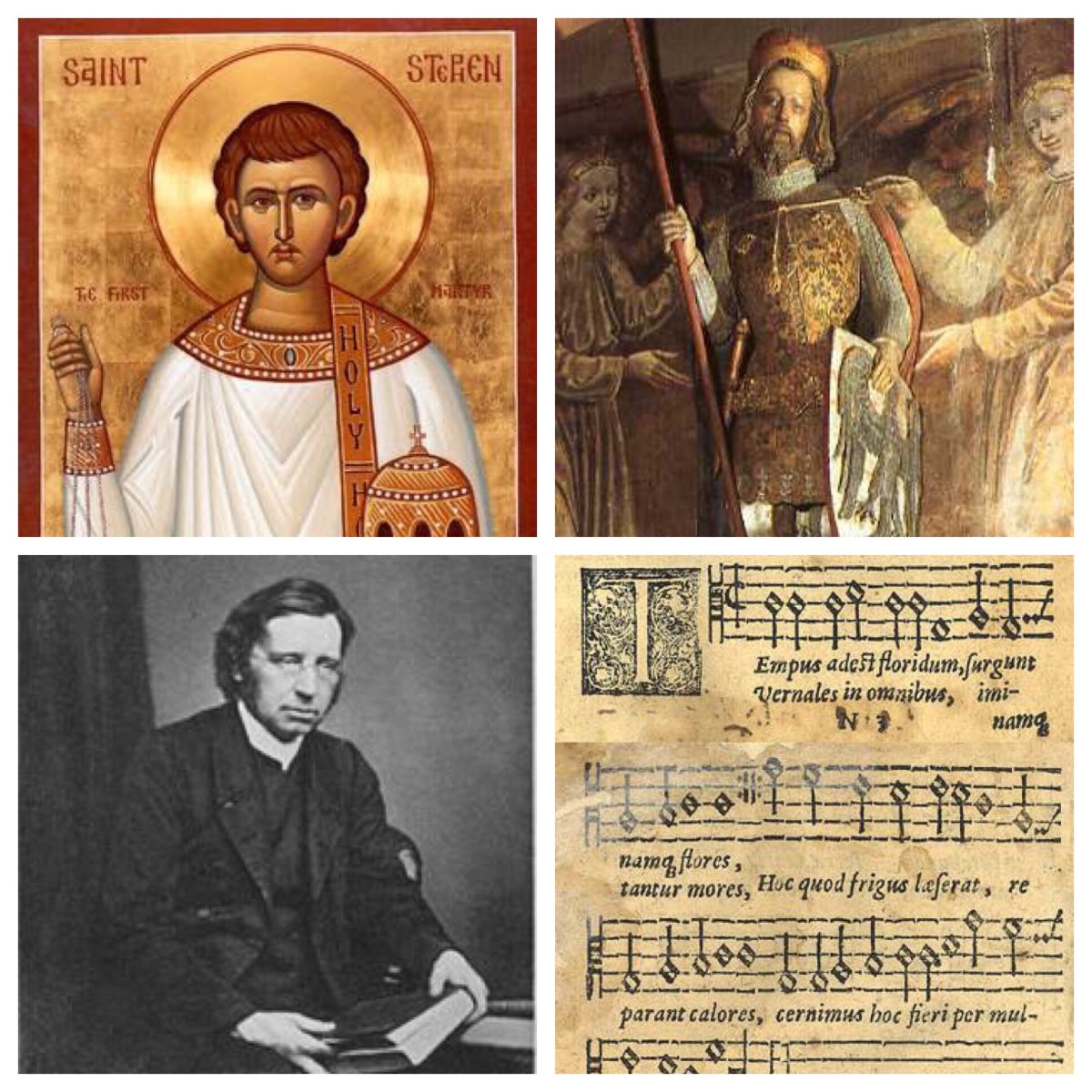
26 December is the day when the Western Church especially recognises Stephen, the person who lays claim to being the first Christian martyr. (The Eastern Church allocates 27 December for this purpose). In reflecting on Stephen, we find a richness in what Luke recounts in his second volume, the Acts of the Apostles. Here are seven things to note about Stephen.
Stephen represents the ministry of Deacon. He was one of the seven appointed in the Jerusalem church “to wait on tables” during “the daily distribution of food”. In this account, we find the Greek term diakonia (6:1,4) and its cognate verb (6:2). These terms have a general reference to waiting at table in ordinary hellenistic Greek usage (Luke 4:39; 10:40; 12:37; 17:8), but here take on the distinctive sense which they collect in Luke-Acts, by referring to a leadership role in the community (Luke 8:3; 22:26-27; Acts 1:17,25; 12:25; 19:22; 20:24; 21:19).
Stephen represents those gifted by the Spirit for ministry. As the first named of the seven, he is explicitly identified as being “a man full of faith and the Holy Spirit” (Acts 6:5). The phrase “filled with the Spirit” is applied to Peter (4:8), Stephen (6:3,5; 7:55), Saul (9:17; 13:9) and Barnabas (11:24). Earlier, in Luke’s Gospel, other individuals were identified as spirit-filled: John the baptiser (1:15), Zachariah (1:67), Simeon (2:25-26) and Jesus himself (4:1,14). The phrase “full of faith and the Holy Spirit” reinforces the role of the spirit-filled prophet within the messianic Jewish community. Indeed, all members of this community are typically “filled with the spirit” (4:31). They all had a ministry to exercise.
Stephen exemplifies grace, wisdom and power–qualities to be found amongst those in ministry and leadership. Stephen is described as being “full of grace” (6:8), a defining mark of the community noted at 2:47, 4:33, and of power, a divine gift (2:22) exhibited by the apostles (4:33). He is able to perform wonders and signs (6:8), a divinely-inspired capacity (2:19) exhibited by Jesus (2:22) and the apostles (2:43; 5:12). Luke notes again that Stephen speaks with “wisdom and spirit” (6:10), attributes already noted as divine in origin the spirit is a direct gift of God (2:17), as is faith, or believing (5:14); wisdom is given by God (7:10) and is linked with spirit (6:3,10) and other divine gifts (grace, 7:10; power, 7:22).
Stephen also represents those called to the Ministry of the Word. Acts 7 contains the longest speech of the book (and the only one spoken by Stephen). Stephen is portrayed as one powerful speaker. The speech serves to set the events that took place in Jerusalem (the accusations brought against Stephen, 6:9-15; and the stoning of Stephen, 7:51-60) within the broader framework of divine sovereignty (how God has been at work in Israel, 7:2-50). As is typical of speeches in Acts, Stephen makes God the subject of the speech (7:2); we see the same pattern in speeches by Peter (2:17; 3:13; 5:30) and Paul (13:17, 21; 17). The phrase used here, “the God of glory”, is drawn from scripture (Ps 29:3), and retells the story with this consistent perspective: what took place in the past was God working in and through human history. God is regularly the initiator of the actions reported (see verses 2,4,5,6,9,10,20,25,32,36,38,42,44,45,46).
Stephen represents the continuation of the prophetic tradition in the early church. The speech Luke places on the lips of Stephen rebuts the charges that have been laid against Stephen; it demonstrates that, far from speaking “blasphemous words against God” (6:11), Stephen has a fulsome understanding of God’s place in Israel’s history. At the end of his speech, Stephen takes up the charge that he spoke “against the holy place” (6:13). Luke has Stephen quote scripture (7:49-50, citing Isa 66:1-2) in order to show that his criticism of the temple (God’s “place of rest”, 7:49) arises from within Jewish tradition itself. There are numerous scriptural allusions and quotations in this speech by Stephen. He provides a detailed rehearsal of significant parts of Israel’s history, by focussing in turn on Abraham (7:2-8), Joseph (7:9-16) and Moses (7:17-44). Then, after making brief mention of Joshua (7:45a), David (7:45b-46) and Solomon (7:47), Stephen moves to the climactic claim of the speech (7:48-53). Now, lengthy recitals of key features of Israel’s history are already found in Hebrew Scripture (Deut 26; Josh 24; Neh 9; Pss 78; 105; 106; 135; 136; Ezek 20). The long recital of the earlier part of Israel’s history reinforces Stephen’s Jewish credentials. When he begins to speak critically of the temple, and of the Jerusalem authorities, it is clear that he does so from within the Jewish tradition. Stephen is not an outsider, but an insider, offering a prophetic critique. This is at the heart of the proclamation of the good news.
Stephen represents martyrs—those who bear witness to their faith, to the point of offering up their own lives. The Greek word martys actually derives from the word to bear witness; it is applied to Stephen at Acts 22:20, and this usage has come to define its central quality in later Christian thinking. Stephen stands for what he believes, to the point of death. The task of bearing witness is enabled by the gift of the spirit and given to all followers of Jesus (1:8), but Stephen is the first to reveal the extent to wich bearing witness requires total life commitment. The Greek word stephanos means “crown”, and much has been made of this in later Christian tradition (the crown of martyrdom, etc); but Luke avoids any such wordplay in his account of Stephen. In Luke’s description of the charges brought against Stephen in Jerusalem (Acts 6), there are echoes of the charged laid against Jesus, according to Synoptic traditions. Those in conflict with Stephen are Diaspora Jews who have returned to Jerusalem, where they worship in a synagogue (6:9). They conscript agitators to stir up the crowd (6:11-12). This is reminiscent of a detail in the trial of Jesus (Mark 15:11; Matt 27:20) which Luke omits, transferring it to Stephen’s trial. Similar agitation of the crowd will later be encountered by Paul (13:50; 14:19; 17:5,13); in Luke’s eyes, it is a typical characteristic of what was experienced by the early followers of Jesus. Likewise, the “false witnesses” who accuse Stephen of speaking against the temple (6:13) recall the false witnesses who charge Jesus with the claim that he would destroy the temple (Mark 14:55-58; Matt 26:59-61). This is another detail which Luke omits from his Gospel narrative and transfers to Stephen’s trial. The speech which Stephen delivers thus serves as the “defence speech” in his trial; a true witness to God, over against the charge of the false witnesses.
Stephen shows us what it means to follow Jesus. Luke consciously models Stephen’s death on the death scene of Jesus (7:54-60; cf. Luke 23:34, 44-46). He is once again described as “filled with the spirit” (7:55, evoking 6:3,5), and he experiences an epiphany in which he sees “the glory of God” (7:55). At this liminal moment, Stephen is already transported into the divine presence. The same happens for Jesus in Luke’s account of his crucifixion. In 7:56, when Stephen describes the heavens opening, he evokes the Lukan account of Jesus’ baptism (Luke 3:21), and his vision of the Son of Man is similar to the apocalyptic vision which Jesus paints at his trial (Luke 22:69). In both scenes, it is as if God intervenes into the events taking place. Stephen’s two cries “in a great voice” (7:57,60) are reminiscent of the death of Jesus (Luke 23:46), and his dying words, “receive my spirit” (7:59), are patterned on the final words of the Lukan Jesus (Luke 23:46, citing Ps 31:6). He is close to God at his death—as is the Lukan Jesus. Stephen’s last cry, a petition that the Lord overlook this sin (7:60), is similarly evocative of the words of the Lukan Jesus, offering forgiveness to those who crucified him (Luke 23:34). In life, and in death, Stephen faithfully follows Jesus.
(These reflections are adapted from sections of my commentary on Acts, published in 2003 in the Eerdmans Commentary on the Bible.)
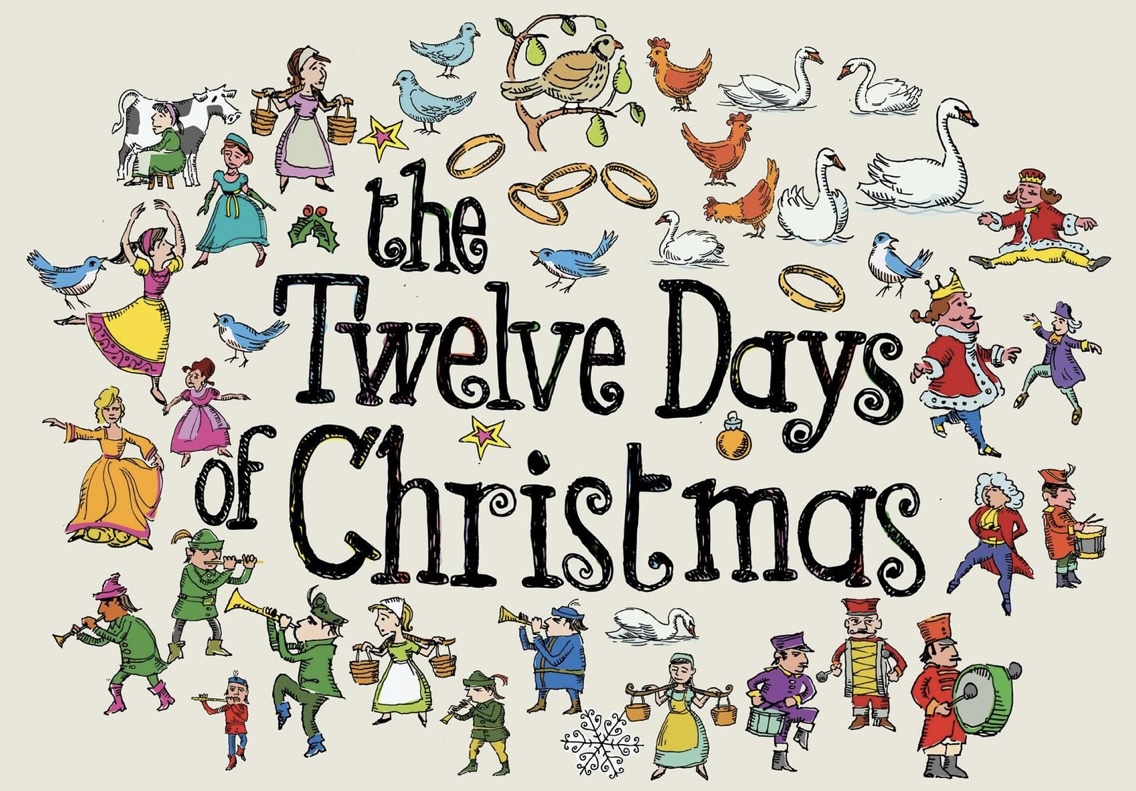
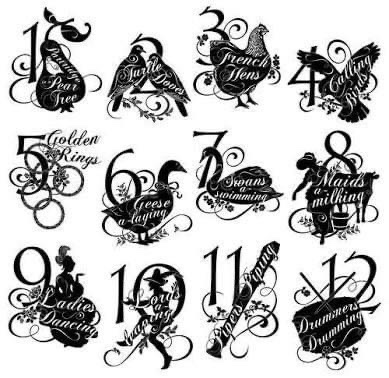
So, it is the night of Christmas Day, and it feels like it is all over—done and dusted, finished, put to bed. Hold it—not so fast!! This is only just the start. Christmas Day is just the first of twelve days of the Christmas season. You might have heard about those twelve days in the song, The Twelve Days of Christmas. This is an English Christmas Carol which is often sung in the lead up to Christmas. It actually belongs to the Christmasseason—that is, the days on and after Christmas Day.
Now, some have claimed that this song had a pietistic purpose: a kind of sung catechism about the central features of the Christian Faith, put into code by Roman Catholics in England when their faith was outlawed. (One is Jesus, two symbolises the two testaments, three indicates faith, hope and love, four refers to the Gospels, five to the Books of Moses, ten to the Ten Commandments, twelve to the apostles, and so on …)
Nice theory, but there is no evidence at all that this was the case … and the origins of the theory go back no further than a speculation by a Canadian hymn writer in an article published in 1979. (And snopes.com agrees; you can read the detailed rebuttal at http://www.snopes.com/holidays/christmas/music/12days.asp)
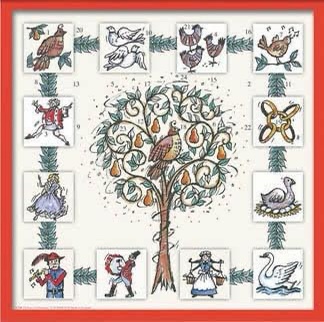
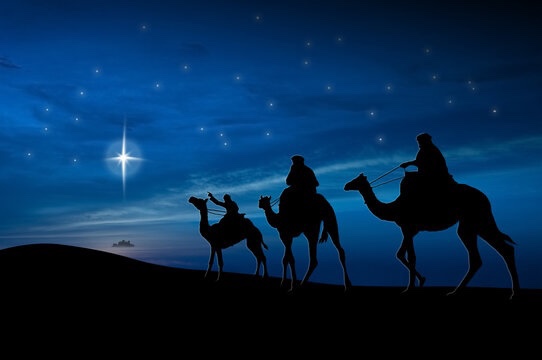
The Twelve Days of the #twelvedaysofchristmas technically refer to the days from Christmas Day, the first day of Christmas, through to Twelfth Night. So the song should be sung from Christmas Day onwards. And the gifts that are given each day accumulate until the twelfth night, the evening before Epiphany, when gifts were given to Jesus by the Magi visiting from the east.
Professor Bruce Forbes writes that “In 567 the Council of Tours proclaimed that the entire period between Christmas and Epiphany should be considered part of the celebration, creating what became known as the twelve days of Christmas, or what the English, called Christmastide. On the last of the twelve days, called Twelfth Night, various cultures developed a wide range of additional special festivities. The variation extends even to the issue of how to count the days.” (Christmas: A Candid History, 2008; see p. 27).
Forbes also notes that there are divergent chronologies at work in different parts of the church: “If Christmas Day is the first of the twelve days, then Twelfth Night would be on January 5, the eve of Epiphany. If December 26, the day after Christmas, is the first day, then Twelfth Night falls on January 6, the evening of Epiphany itself.”
There’s a suggestion that The Twelve Days of Christmas song was originally sung in French . . . or, at least, that the line for the First Day originally included both French and English terms for the bird; thus, “partridge” (in English, and then in French, “perdrix” (pronounced per-dree) . . . which makes no sense, really; but this is a Christmas Carol, and such songs don’t really have to make sense, do they?
On the Second Day, two turtledoves are to be given. But for what purpose? Since this song relates to Christmas, can we assume that there is some religious or spiritual significance with this gift??
Turtle doves could be offered as a sin-offering (Lev 5:7). Is this why they were given? Or perhaps, as the alternate offering for a poor woman, seeking purification after giving birth (Lev 12:8)? This at least links in to the Christmas story (at Luke 2:24), which is what the song is supposed to be about! But it does seem like a long shot …
So, what about as a guilt-offering when cleansing a leper (Lev 14:22)? Or maybe for a Nazirite who has touched a corpse (Num 6:9)? Or as a means of cleansing after sexual discharge (Lev 15:14)? Or maybe the text is multivalent, and we are supposed to bring all of these allusions to mind. Because we know our Bible so well. And we know this is meant to be symbolic. Eh?
Next, on Day Three, the gift to be given is three French hens. Some suggest they are Faith, Hope and Charity, the key Theological Virtues. But only three? There are actually four types of French Hens (Faverolles, La Fleche, Crevecoeurs and Marans). So do we know which one of the four missed out on its moment of glory in this Christmas carol? It’s a worry.
On Day Four, four birds form the gift. Ah, but what type of birds? Calling birds? So you might think. But older versions of the song identify them as Colly Birds. Which are … …??? A colly bird is a black bird. A coal mine is called a colliery, so ‘colly’ or ‘collie’ is a derivation of this and means black like coal. So, no more whitewashing, let’s sing “four black birds”, and be clear about it, eh?
And … while we are at it … Day Five: Five Golden Rings? But they are surrounded by flocks of birds (swans, geese, colly birds, hens de la France, turtle doves, and a partridge). Rings are out of place. So, it is believed that this verse originally referred not to jewellery but to ring-necked birds such as the ring-necked pheasant. So, let’s now sing: “five ring-necked birds”! Context is everything!
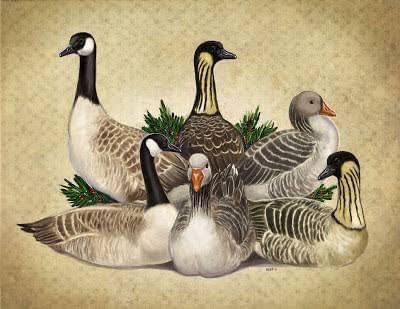
The sixth of the #twelvedaysofchristmas is the midpoint of the 12 days, when we can look back on the story of Christmas (the birth and the shepherds), and forward to the story of Epiphany (the visit of the Magi). The gift for the Sixth Day focusses on new life: six geese a-laying.
It is said that, while chickens lay eggs regularly (usually each day ), geese only lay 30-50 eggs a year. This means they are a less productive bird to keep. It takes longer to increase the size of the flock for meat production. And their eggs are very high in cholesterol. Was this a wise gift? (Of course, you may well score the goose that lays the golden egg.)
On Day Seven, the gift is seven swans a-swimming. Well, yes; that’s what swans do. But who in their right might give this as a gift? Where would they all be put so that they could keep swimming? In a huge bathtub? This is quite unrealistic. Anyway, I guess it proves that the carol was not written by a football-mad fanatic. (They would have had swans kicking goals.)
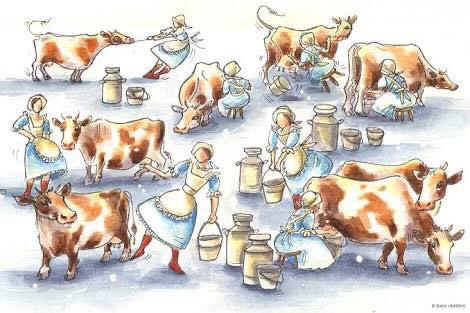
On Day Eight, we are exhorted to give eight maids a-milking. In older English, to “go a-milking” could mean to ask a woman for her hand in marriage; OR to ask a woman to go “for a roll in the hay”, as it were. Is this Christmas carol concealing a reference to illicit sexual encounters? And does that make it more interesting than just getting some milk in order to make some cheese?
Next: Day Nine. Nine ladies dancing. Liturgical dances, I presume? In explore the significance of these ladies, I am somewhat stumped. Any clues, anyone?
Meanwhile, I am starting to compile my list of ‘not relevant in Australia’ secular Christmas carols. Because here, downunder, we are in the midst of summer—not winter, as all the upover northern hemisphere Christmas songs assume. So, not relevant to downunder would include: Anything with snow, for a start. And bells. And holly. And fir trees. And … well, the possibilities are endless.
On Day Ten, the gift is to be ten Lords a-leaping. Alliteration, indeed; but why leaping? Perhaps there is a textual transmission problem here. Maybe it should be: Lords a-leasing? (what to do with their huge old castles and manors)? Or Lords a-sleeping? (in the upper chamber of the British parliament)? Or perhaps Lords a-weeping? (at the decline of their much- loved aristocratic powers). Who knows?
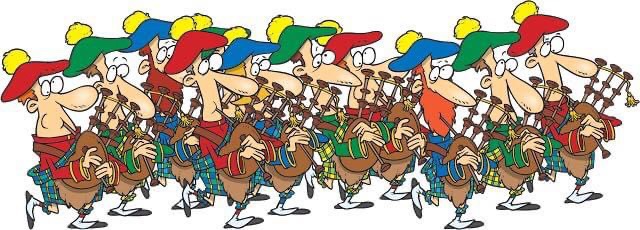
Which brings us to the eleventh day of (the season of) Christmas. On Day Eleven we meet eleven pipers piping. So perhaps this comes from a Scottish variant (like day one comes from the French version). Perhaps the Scots packed their song full of food? In this, the gifts would include twelve alka seltsers, eleven Blue Lagoons, ten creme de menthe, nine vodka and limes, eight nips of whisky, seven rum and cokes, six Carlsberg specials…you get the picture? (Yes, I know, this is becoming quite speculative!!)
Or — does the Scottish reference (bagpipes) mean that I should refer to the crackpot theory that this whole carol was a coded reference to the right of Bonny Prince Charlie to regain the British throne? Yegods … …
But I do note that, in other versions, there are eleven ladies spinning, eleven ladies dancing, eleven lads a-louping, eleven bulls a-beating, and eleven badgers baiting!! Make of them, what you will.
And then, we come to the ultimate (last) of the #twelvedaysofchristmas. Day Twelve. Twelve drummers drumming.
Since the gifts are cumulative, and repeated on each day, on Day Twelve we actually have drummers drumming, along with piping pipers, leaping lords, bleating cows, tapping toes, shuffling shoes, a horde of aviary escapees, and the whole schemozzle. 78 gifts in all (count them) just on this last, twelfth, day. Presumably the others gifts from earlier days are still there. That’s one heck of a menagerie!! It’s all too loud, I think — and the incessant fights amongst all those squawking birds! Oh dear; time for a doze, instead.
The evening of Day Twelve is thus Twelfth Night. The day after is Epiphany, a day to celebrate the coming of the magi to the infant Jesus. Time, indeed, to rest—when you get there. But, for the moment, there’s some geese to be sourced. And some drummers. And milkmaids … and Lords (Lords??) … and ………….
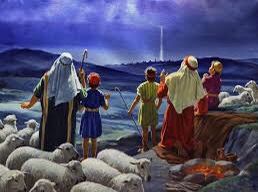
Not wise ones, not foreign, exotic and learned; but shepherds unnamed, keeping watch in the fields; impure and unclean, outsiders, at best; some scorn them, and say they are robbers.
Not great men, prestigious, important and powerful; but common folk, forced to be on the move; back to his home town, seeking their refuge, a place of safety, where she gives birth.
No gold for the king, nor frankincense pure, no myrrh as a sign of suffering to come; but the stench of the sheep, the dirt of the fields, the news of the angels—of peace, goodwill.
No grand cosmic vision of word and eternity, but stable and manger, the rupture of waters and shedding of blood; a birthing, a crying piercing the air: now mother and child.
Although long expected, so deeply yearned for, it was not impressive, nor was it grand, but coming in flesh in a backwater place to an unknown family at night? A surprise!
And where would this lead her? And what fate awaits him? In ways unforeseen, with a radical cry, provoking, confronting, disturbing, evoking the kingdom of God, upturning the world.
Every year, the “Christmas story” gets swamped by Luke’s story in his orderly account, of the angels, the shepherds, “no room at the inn” and “good news of great joy”. From Matthew’s account in his book of origins, the visit of the sojourning magi from the east, offering their splendid gifts to the newborn, gets a place in the story—but not the tragedy of the terrible massacre perpetrated by the vengeful ruler, Herod.
Every Christmas, the majestic, soaring words from the poetic prologue to John’s book of signs is read in worship, and sometimes preached on; “in the beginning was the Word … and the Word became flesh, and pitched his tent in amongst us”. What never gets a look in, at any point in the Advent or Christmas seasons, is how the other Gospel, that attributed to Mark, portrays the beginnings of Jesus.
“In those days Jesus came from Nazareth of Galilee and was baptized by John in the Jordan” (Mark 1:9) is how Jesus is introduced. This is the adult Jesus, not the newborn infant. There is no mention of Bethlehem, nor the rampage of Herod; no reference to magi travelling from the east, bearing gifts, nor to a census ordered under Quirinius, necessitating short-term accommodation. There is no story of the infant Jesus at all—and most strikingly, no mention of Mary and Joseph.
Rather, in Mark’s narrative which reports the beginning of the good news about Jesus, the chosen one, Jesus distances himself from his family. “Who are my mother and my brothers?”, he asks, when confronted by scribes from Jerusalem and labelled as “out of his mind” by his own family (Mark 3:21, 33). People of his hometown (Nazareth) identify him, not as “son of Joseph”—only in John’s book of signs do his fellow-Jews identify him as “son of Joseph” (John 6:42). And it is up to Luke and Matthew, each in their own way, to link Jesus, as a newborn, to these parents.
In Mark’s account of the scene when the adult Jesus returns to his hometown, he is “the carpenter, the son of Mary” (6:3). This is the only time that the name of his mother appears in this earliest account of Jesus; and there is simply no mention, by name, or by relationship, of his putative father. (Some scribes later modified this verse (Mark 6:3) to refer to him as “son of the carpenter and of Mary”, to align Mark’s account with how Matthew later reports it at Matt 13:55.)
Other than this one reference, Mark makes no reference to Jesus’s parents. He is simply, and consistently identified as “the son of God” (Mark 1:1; 3:11; 5:7; 9:7; 15:39). On one occasion, he is addressed as “son of David” (10:47–48; although this description is the subject of debate at 12:35–37). More often, in this earliest of Gospels, using a term taken from Hebrew Scripture, Jesus refers to himself, or others refer to him, as “the son of humanity” (2:10, 28; 8:31, 38; 9:9, 12, 31; 10:33, 45; 13:26; 14:21, 41, 62; see Ezek 2:1, 8; 3:1, 4, 16; etc; and Dan 7:13). The origins and identity of Jesus, in Mark’s eyes, relate more to the larger picture—of his Jewish heritage, in his relationship to the divine, and with his role for all humanity—than to the immediacy of parental identification.
Mark knows nothing of what transpires in Luke’s orderly account, as “Joseph went from the town of Nazareth in Galilee to Judea, to the city of David called Bethlehem, because he was descended from the house and family of David; he went to be registered with Mary, to whom he was engaged and who was expecting a child” (Luke 2:4–5).
He certainly knows nothing of the way that Luke has spliced the story of Jesus into the story of John the baptiser (related through their mothers, Luke 1:36) such that John is filled with “the spirit and power of Elijah” (Luke 1:17) to function as “the prophet of the Most High [who will] go before the Lord to prepare his ways” (Luke 1:76), whilst Jesus “will be great, and will be called the Son of the Most High, and the Lord God will give to him the throne of his ancestor David” (Luke 1:32), and then himself will be “filled with wisdom” (Luke 2:49) and, indeed, “filled with the Holy Spirit” (Luke 4:1, 14).
Mark also knows nothing of what is narrated in the Matthean book of origins, of the time when, after a visit from magi from the east, “Joseph got up, took the child and his mother by night, and went to Egypt”, and then “Joseph got up, took the child and his mother, and went to the land of Israel” (Matt 2:14, 21).
This author’s concern is both to locate Jesus firmly and schematically in his genealogy as “the chosen one, the son of David, the son of Abraham” (Matt 1:1–17), and to make as many parallels as possible with the story of Moses, the one whose life was imperilled by a powerful ruler (Exod 2:15; cf. Matt 2:13–14), who escaped the murderous rampage that occurred (Exod 1:22; cf. Matt 2:16), who fled into a foreign land (Exod 2:15; cf. Matt 2:14), and who then returned to where he had been born (Exod 4:20; cf. Matt 2:21). The regular reminder that “this took place to fulfil what the Lord has said through the prophets” (Matt 1:22; 2:4, 15, 17, 23) underlines this Mosaic typology.
In this regard, Mark is very much like Paul, the famous apostle who, some decades earlier, was able to refer to Jesus as “born of a woman, born under the law” (Gal 4:4)—that is, his Jewishness was important, but the name of that woman was not. And Paul refers to God’s Son as being “descended from David according to the flesh” (Rom 1:3)—that is, his Davidic ancestry was important, but even the name of his father, a descendant of David, was not. Mark and Paul both place their focus elsewhere, away from the baby, the manger, the magi, the star. The earlier witnesses to Jesus show no concern at all in this later accretions to the story, with which Luke and Matthew each introduce Jesus.
What would Mark (or Paul) think of the way we have appropriated these two later narratives, offered by their creators as myths, stories to convey deep truths through striking storylines which have been creatively constructed? What would he think of the ways that we have read them as historical reports, literally chronicling actual happenings? What would he think of the thoroughly unhistorical blurring together of the two stories, with shepherds and magi coming together at the crib at the same time?
Perhaps next year, when the lectionary focusses on the Gospel of Mark, we might let this Gospel govern the way that we approach the season of Christmas? Perhaps the focus might be, not on angels and magi, not on shepherds and tyrants, not on the trimmings and trappings of the commercialised season, not even on the incarnate presence of the eternal Word, but on the significance in daily, human, life, of this person, Jesus? Now that would be truly counter-cultural, truly alternative, truly faith-focussed amidst the razzamatazz of the times!
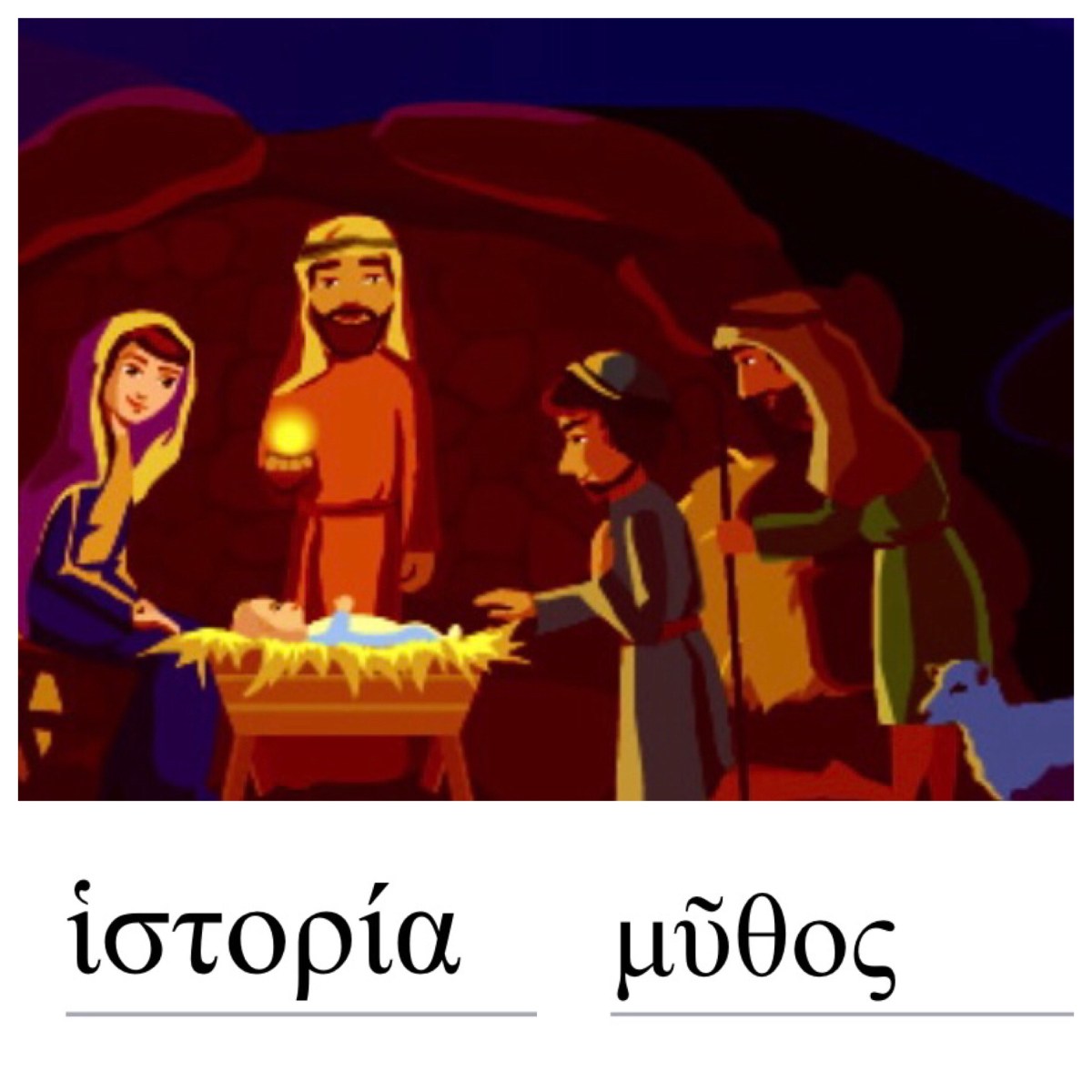
As I have written in two earlier posts, the biblical accounts of the birth of Jesus are not actual history. They are stories told to indicate the special nature of Jesus. Which means, we shouldn’t read them as history (ἱστορία). The Christmas story isn’t history. The Christmas story is myth (μῦθος).
As myth, the story points to important truths. It orients us to the claim that God is involved in human history. It sets the foundations for hearing the narratives about Jesus as accounts which resonate with God’s intentions for humanity.
The stories told at Christmas are located in specific human situations, and point to specific human needs. Outsiders and outcasts are included in the story told by Luke. Shepherds, despised for their work and marginalised from society, appear front and centre in his story. Strangers travel from distant foreign lands in Matthew’s narrative, bearing gifts to pay homage to the infant Jesus.
Women, not men, play central roles in the opening chapters of Luke’s story. Elizabeth, cursed as barren, blossoms into pregnancy, and speaks where her husband is struck dumb. Mary, young and virginal, receives startling news from an angel; she holds her own stands up to the angel, commits to the task, and then sings powerful words of justice, signalling in advance the revolutionary message that will be spoken by the child whom she is bearing.
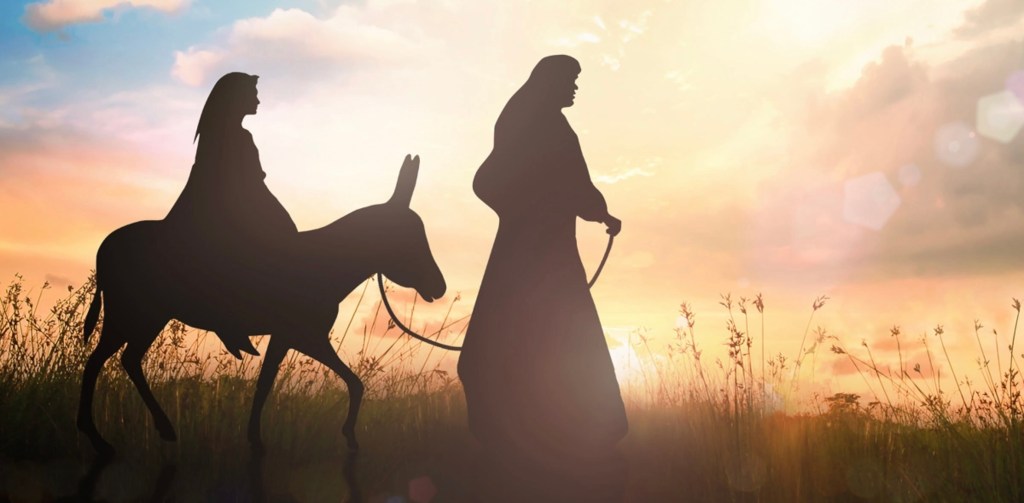
Both Luke and Matthew include the gritty reality of the refugee situation in their accounts. Luke has a pregnant Mary undertake an enforced journey with Joseph, from Nazareth to Bethlehem, the hometown of his family line, only to be forced to give birth in precarious circumstances. There is no historical evidence for the census that occasioned this journey, but the story provides a compelling vision of what refugees faced then, and still face today.
Matthew has Mary and Joseph, with Jesus now a two-year-old toddler, making an even longer forced trek, from Bethlehem into Egypt, because of the excessive reaction of the king of the time. There is also no historical evidence for the slaughter of all boys aged two and under in Bethlehem at that time, but the story in Matthew’s Gospel again highlights the tenuous situations faced by refugees, then as now.
Matthew’s Moses typology leads him to place the slaughter of the Innocents right at the heart of his narrative. He grounds the story of Jesus in the historical, political, and cultural life of the day, when a tyrant could exercise immense power, when the sensibilities we have about human life seem absent. It provides a dreadful realism to a story which, all too often in the developing Christian Tradition, became etherealised, spiritualised, and romanticised.
We need to remember the Christmas story as an important pointer to the counter-cultural, alternative-narrative impact of the person of Jesus. It is not history, but it offers a powerful myth. It grounds our faith in a revolutionary understanding of reality, and in actions that establish an alternative reality. The story is not to be domesticated and coated in syrup; its stark reality and honest grappling with life needs to be grasped and valued.
As we sing songs of this story, let us not reify the story (that is, turn the narrative into “a thing”, like history) … let us not collapse the story into a surface “real history”, but let us allow the story to speak in a deep way of who we are as humans, and of the reality of our lives today. That is how the story functions, as myth (μῦθος) — not in the sense of myth being “not true”, but rather, in the sense of myth plumbing the depths of human existence.
Myths are the stories we tell that convey deep-seated and fundamental insights about life. Whether they “actually happened” is not the point. More fundamental is that they help us to make sense of our lives. They draw us out of our comfort and preoccupations, and challenge us to see a different reality, to live a different life.
Bernard F. Batto (Professor Emeritus of Religious Studies at DePauw University, Indiana), writes: “In everyday usage today, myth carries a meaning of something untrue, a fable, a fiction, or an illusion. Anthropologists and historians of religion, however, use the term ‘myth’ with a quite different meaning. For them myth refers to a traditional story, usually associated with the time of origins, that has paradigmatic significance for the society in which the story is operative.”
So, this Christmas, let’s rejoice that we have this foundational and paradigmatic story which is not history (ἱστορία), but which functions as myth (μῦθος). And as myth, this story stirs our imaginings and challenges our presuppositions, giving us a different perspective on the realities of life in this world, indicating to us how God engages with us and interacts with our world.
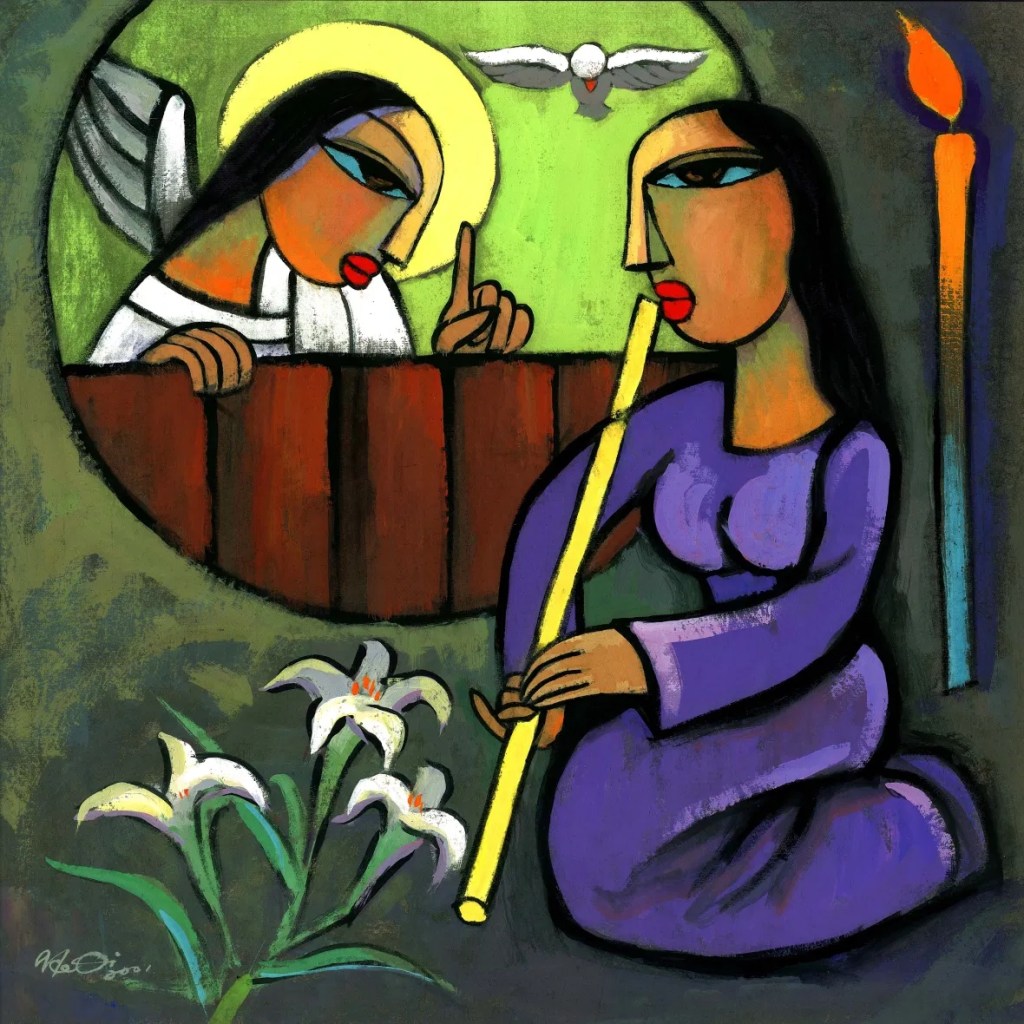
It’s a scene, set in a Jewish context, in the region of Galilee, in a town named Nazareth. We are not sure exactly when this scene took place; the only clue is that it was “in the sixth month” (Luke 1:26) after a previous announcement, about the birth of another child, to her cousin, Elizabeth, and her husband Zechariah (Luke 1:5).
The scene in Nazareth thus most likely occurred “in the days of King Herod of Judea” (Luke 1:5), which places it some years before the year in which we traditionally reckon that Jesus was born—the fictive “year zero”, or more accurately, the time when 1 BCE became 1 CE.
At that time Nazareth was but a tiny village, with no more than 50 residents. It was an insignificant, obscure place. Not the location that might have been presumed for this announcement about the imminent birth of the Messiah.
Now, King Herod died soon after an eclipse of the moon soon before a Passover, according to the Jewish historian Josephus; that was most likely in March/April of 4BCE, by our reckoning. So Mary was pregnant, and gave birth, some years before the mythical “year zero”.
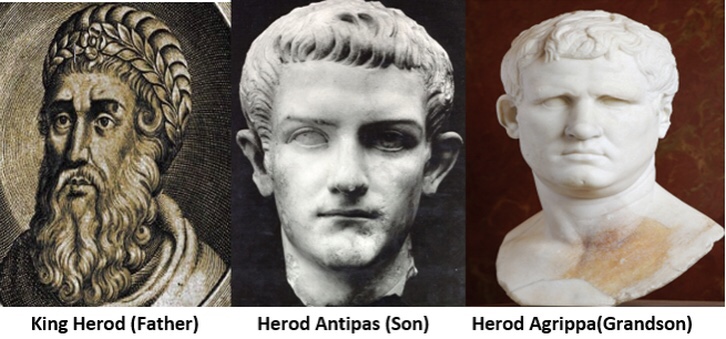
Later, after the death of Herod, the region of Galilee came under the control of Herod Antipas, the son of Herod the Great and one of his wives, Malthace, from Samaria. Herod senior was the king who, according to Matthew, ordered the slaughter of all males born in Israel (Matt 2:16-18). Herod Antipas was, according to Mark, the ruler who, against his better judgement, ordered the beheading of John the baptiser (Mark 6:17-29). Herod Agrippa was another member of the family, a grandson of King Herod by another of his wives, Mariamne, who ruled as King of Judea from 41 to 44 CE.
Herod Antipas ruled as tetrarch of the region of Galilee and Perea from the time his father died (4 BCE by our reckoning—before the alleged birth of Jesus!) until sometime after 39 CE. He held power only by favour of the Romans, who were occupying the whole region. To keep in favour with his Roman overlords, Herod set in motion a number of major building projects.
One of those projects involved the creation of a whole new port city, to serve as the region’s capital. It was named Tiberius, in honour of the Emperor. Another building project was based in Sepphoris, a town about eight kilometres north of Nazareth. That probably meant that Nazareth, previously a tiny village of no more than 50 people, had grown to be a town of perhaps 2,000 people—a dormitory suburb for the grand building project underway in Sepphoris. That is most likely the context in which Jesus grew up.
According to Luke, it was in pre-building-boom Nazareth, in the northern region of Galilee, that an angel named Gabriel appeared to Mary, to inform her that she would bear a child (Luke 1:26). That is different from the story told in Matthew’s Gospel, where an unnamed angel delivers the same message, not to Mary, but to Joseph, to whom she was engaged (Matt 1:18). Who knew first? Joseph (according to Matthew)? Or Mary (according to Luke)?
The location of the announcement in Matthew’s account is not specified, but it is reasonable to assume from the flow of the narrative that this took place in the southern region of Judah, in Bethlehem (Matt 2:1, 6). Matthew, having located the family initially in the southern city from the beginning, has no need of the story of a census and a forced trip from Nazareth to Galilee (Luke 2:1-4). The family is already in Bethlehem, another small village, but in the south, in Judea.
Nor does Matthew feel the need to describe the place into which the new baby was born: in a manger, “because there was no place for them in the inn” (Luke 2:7). Indeed, even though Matthew declares that “the birth of Jesus the Messiah took place in this way” (Matt 1:18), he then goes on to describe the announcement made to Joseph (1:18b-23), and the only detail about the actual birth that he offers is that Joseph “took her [Mary] as his wife, but had no marital relations with her until she had borne a son” (1:24-25). Too much information? Or not enough, maybe?
But Luke has a problem. He has located the announcement of the birth in Nazareth; yet the tradition is that Jesus was born, not in Galilee, but in Bethlehem (see John 7:41-42, and Matt 2:1). Matthew explains this birthplace in his typical style, as being a fulfilment of prophecy: he cites Micah 5:2 at Matt 2:5-6. That is just one of a number of elements in the story of the birth of Jesus that Matthew has crafted, which claim “fulfilment of prophecy” as their rationale (see Matt 1:22-23, 2:5-6, 2:15, 2:17-18, and 2:23).
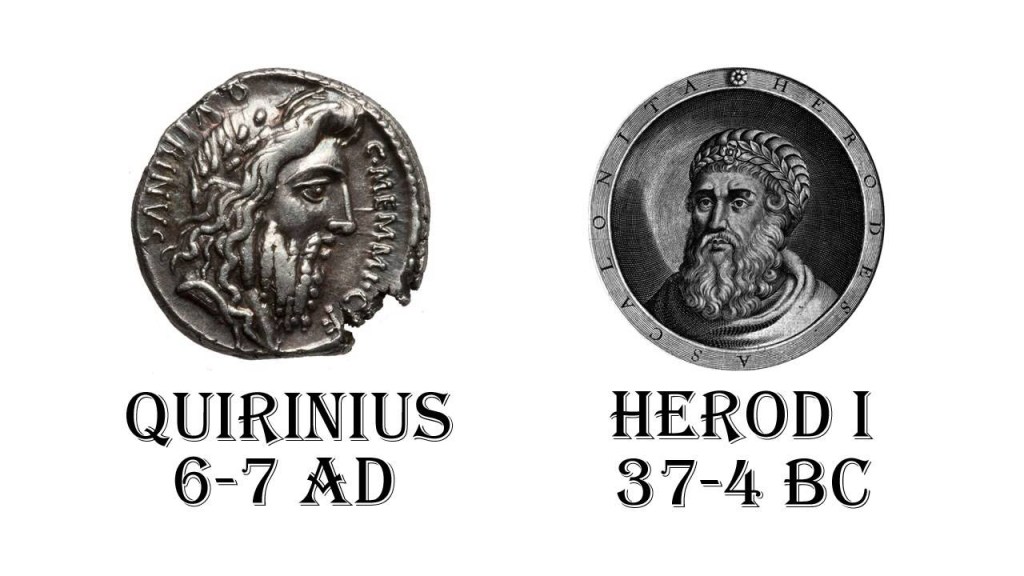
Now, Luke needs to get the family from Nazareth, the place of the annunciation to Mary, to Bethlehem, the place of the birth of Jesus. So he calls on the census (Luke 2:1-2) as the means by which Joseph and Mary, heavily pregnant, had to travel. He even identifies the census as having taken place under Publius Sulpicius Quirinius, who was governor of the province of Roman Syria. Luke operates, not by the fulfilment of prophecies, but by noting the actions of Roman rulers.
Publius Sulpicius Quirinius
Only problem is, Quirinius became governor in 6 CE, almost a decade after the announcement of the birth as Luke tells it (Luke 1:5, 26ff) and as Matthew reports it (Matt 2:1). And, to add insult to injury, other historical problems arise: this was just a local census, we know of no single census of the entire empire under Caesar Augustus, no Roman census ever required people to travel from their own homes to those of distant ancestors, and the census of Judea would not have affected Joseph and his family, as they were living in Galilee. So Luke’s account is problematic in terms of historical accuracy.
Not that Matthew is off the hook. In my view, it is highly unlikely that the events reported in Matthew 2 actually took place. (Other interpreters take a different view.) In particular, the slaughter of all male infants under two years, ordered by Herod, is problematic.
Why? Well, first of all, Matthew provides the only account of such an event in any piece of literature from that time. Surely an event with so many deaths would have been noted by other writers. Yes, it is true that Herod was a tyrannical ruler; but amongst the various accounts of his murderous deeds, there is nothing which correlates to the events reported in Matthew’s Gospel.
Second, the story is embedded in the opening section of the Gospel, which, as we have noticed, uses typical Jewish typology and scripture-fulfilment to present the story of Jesus as a re-enactment of the story of Moses. Just as Exodus tells of the slaughter of infants at the time of the birth of Moses, so Matthew replicates this with an account of the slaughter of infants at the time of the birth of Jesus. The later account simply fits the pattern of the earlier account. (And there is no evidence that the pogrom at the time of Moses took place, either.)
So both accounts of the birth of Jesus have problems if we want to read them as historical narratives. And one very peculiar aspect is that the wise men, supposedly coming to visit the young child, Jesus, during the time of Herod, made their trek from the east to Bethlehem a full decade before Joseph and the pregnant Mary made their trek from Galilee down south to Bethlehem, during the census!!
The biblical accounts of the birth of Jesus are not history. They are stories told to indicate the special nature of Jesus. Which means, we shouldn’t read them as history. The Christmas story isn’t history.
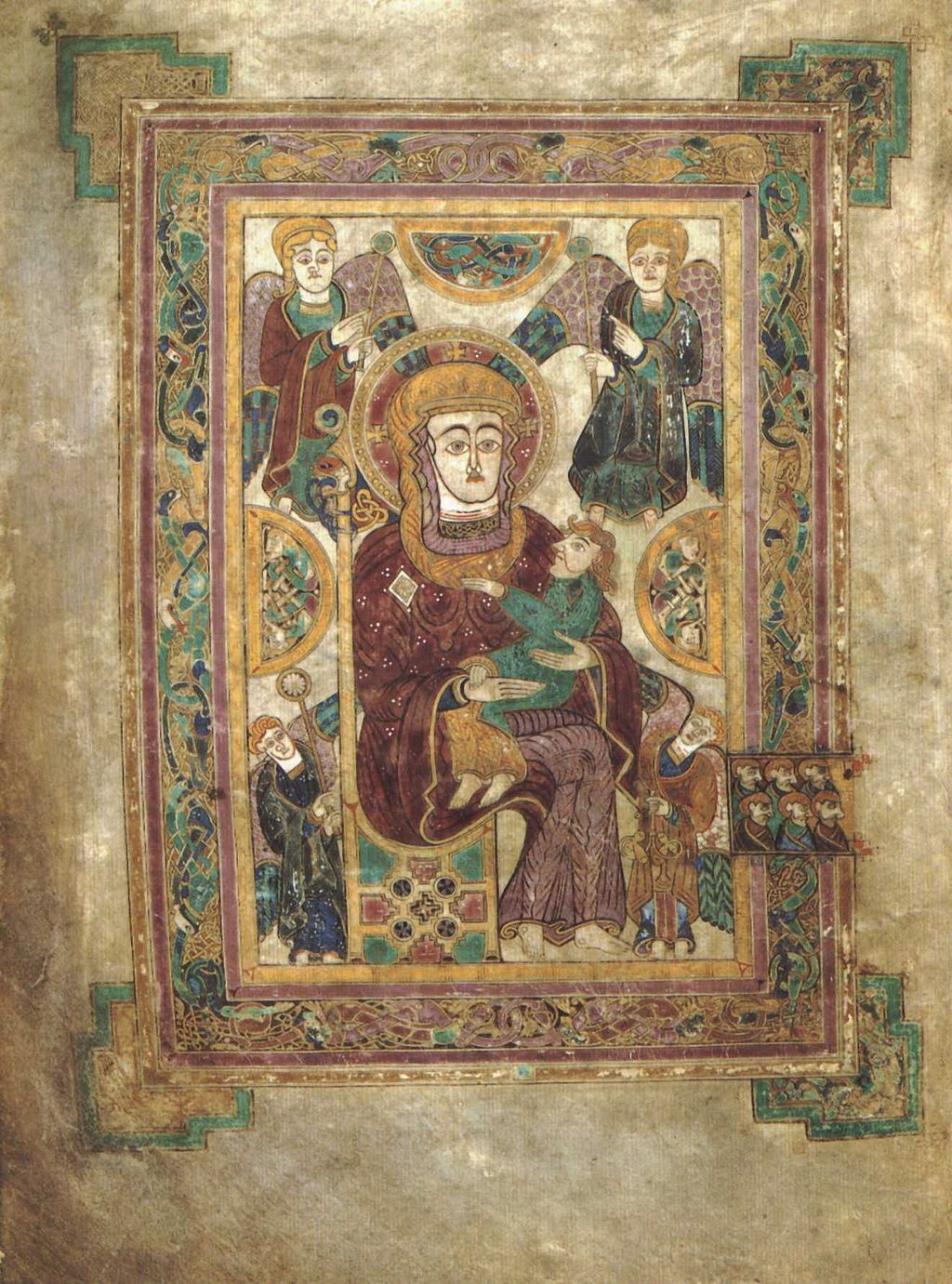
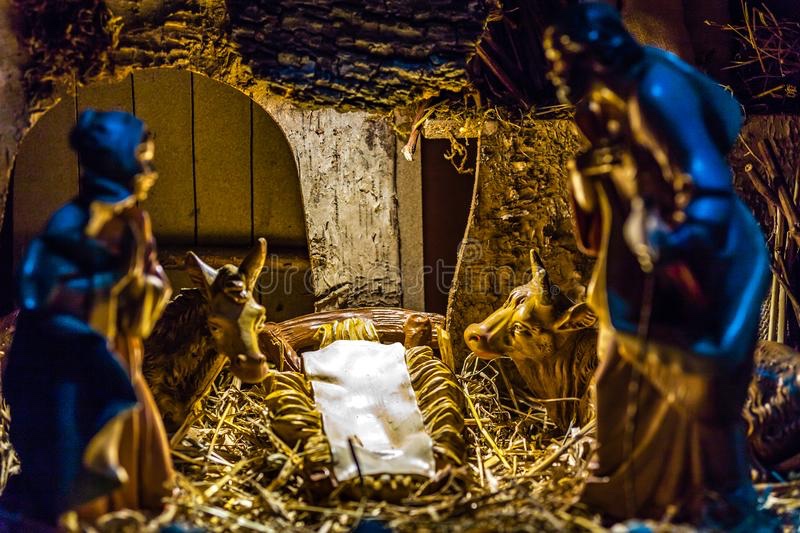
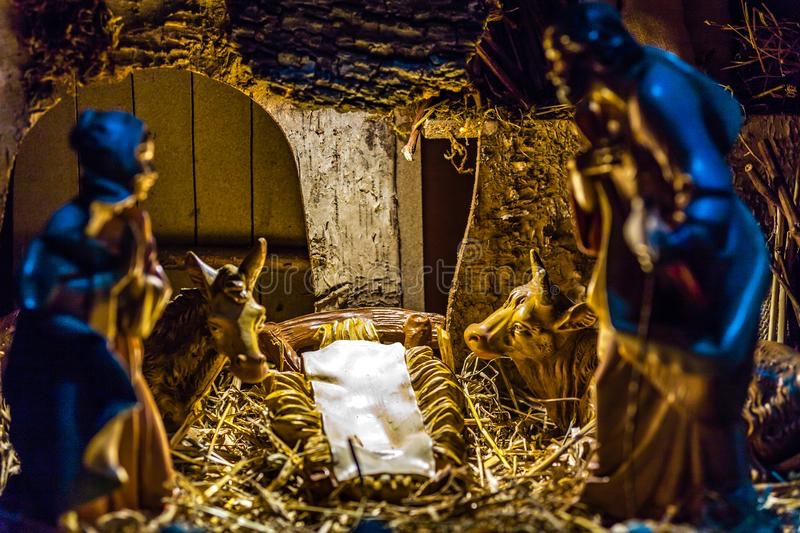
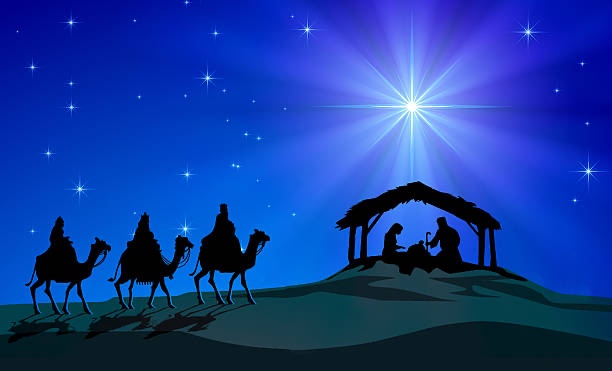
Every Christmas, we are surrounded by images of the much-loved nativity scene: the infant Jesus, in a cradle, with his mother Mary sitting and his father Joseph standing nearby, surrounded by animals (cows, most often), with a group of shepherds (perhaps with their sheep) to one side, whilst on the other side three colourfully-dressed men stand with presents in hand: gold, frankincense, and myrrh.
We see this image everywhere. But it is not an accurate portrayal of what was happening at the time when Jesus was born. For one thing, it is not a photograph of an actual event. Far from it. It is not even based on a written report from the first century, telling that this was what happened.
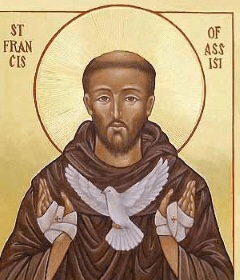
The traditional scene that we see today did not come into being until it was invented by the medieval friar, Francis of Assisi. Before that, it did not exist. And no Gospel account actually tells of cows mooing beside the newborn child, or of the newborn infant making no crying sounds, or of the sheep baaing alongside the cows, that we see in the traditional nativity scene.
Francis is the most popular Catholic saint in the world. He is the one who preached to the birds; blessed fish that had been caught, releasing them back into the water; and communicated with wolves, brokering an agreement between one famous ferocious wolf and the citizens of a town that were terrified of it. There is no surprise, then, that Francis used real animals when he created the very first, live, Christmas nativity scene. As a result of all these stories, Francis is the patron saint of animals and the environment. And he is the inventor of the familiar nativity scene.
Actually, this scene is a compilation of two quite discrete stories, told decades later, offering very different perspectives on the event, providing two somewhat different emphases in the story of the birth of this child. The nativity scene merges and blends the story found in the orderly account constructed by Luke, and the book of origins compiled by Matthew. Wise men and shepherds sit on each side of the family group, at the same time, in the same place, in this traditional scene. But not in our biblical accounts.
In the opening chapters of Matthew, we encounter the pregnant Mary, the newborn infant Jesus, his father Joseph, a bright star in the sky, visitors from the east, the tyrannical rule of Herod, and slaughtered infant boys. In this story, Matthew is working hard to place Jesus alongside the great prophet of Israel, Moses. The early years of Jesus unfold in striking parallel to the early years of Moses. The parallel patterns are striking.
Luke tells a more irenic version of the story than what is found in Matthew’s Gospel. The story told by Luke (usually represented through idyllic pastoral scenes and sweetly-singing angels), actually tells of a widespread movement of the population that meant a pregnant Mary, accompanied by Joseph, had to travel afar and find lodging in a crowded town just as the most inconvenient time.
There are historical problems with this story: identifying the census as an actual historical event, and locating it accurately in time, both present challenges; the fact that Herod, ruling in Matthew’s account, died in 4BCE, but Quirinius, who ordered the census noted in Luke’s account, began as Governor in 6 CE. However, the combined story has entered the popular mindset as a real event and provides a clear and compelling picture of the holy family as refugees, because of decisions made by political authorities, whether Herod or Quirinius.
We overlook, perhaps, that the shepherds who came in from the fields to pay homage to the newborn child would have been despised for carrying out a lowly and unworthy occupation. They were outcasts, considered impure and unclean, placed outside the circle of holiness within which good Jews were expected to live. In the Mishnah, a third century work which collects and discusses traditional Jewish laws, shepherds are classified amongst those who practice “the craft of robbers”. These are not highly valued guests!
Even though this is not an historical story, it is important for theological reasons. It is part of the foundational myth of the Christian faith. The writer of Matthew’s Gospel wants to make strong correlations between Jesus and Moses, not only in the mythological account found in the opening chapters, but also throughout the following chapters of the Gospel. The writer of Luke’s Gospel hints at his key themes in the opening chapter, and the develops a strong political and economic message throughout his Gospel: God reached out to the poor and powerless, and harshly judges the wealthy and powerful.
As myth, the tradition points to important truths. Matthew’s account of “the Slaughter of the Innocents”, for instance, although generated by his Moses typology, still grounds the story of Jesus in the historical, political, and cultural life of the day, when tyrants exercised immense power. Even though we recognise Matthew is not reporting an actual historical event, his narrative provides a dreadful realism to a story which, all too often in the developing Christian Tradition, became etherealised, spiritualised, and romanticised.
By the same token, Luke’s recounting of the visit of the outcast shepherds to the infant child and his family indicates that those on the edge were welcomed by Jesus throughout his ministry. He grounds the message of the Gospel in the heart of the needs of the people of his day.
So even as we recognise that the Christmas story is not history, we can appreciate the insights that it offers us as a mythological narrative. It is worth celebrating: not as an actual historical event, in the way it is traditionally portrayed, but as the foundation of the faith that we hold: in Jesus, God has come to be with us.
This week, the daily Bible study resource With Love to the World (which I edit) is currently using readings from the Womens’ Lectionary for the Whole Church, devised by Prof. Wilda Gafney, of the USA, alongside readings from the Revised Common Lectionary. A number of the readings (including the familiar Gospel from Luke 2) refer to childbirth. The cover image, by Australian artist the Rev. Dr Geraldine Wheeler, depicts the newborn child and his young mother, wonderfully contextualised for the Australian location.
Associate Professor Monica Jyotsna Melanchthon, the Academic Dean of Pilgrim Theological College in the University of Divinity, writes about Isaiah 26:16–19, that “The prophet Isaiah, familiar with the pain and the agony of a woman in labor, uses this uniquely female experience as metaphor to describe the suffering and distress of the people, here personified as the pregnant woman, ready to give birth. The labor of pregnant woman Judah is futile (vv.17–18) … But pregnant Judah is assured by God who midwifes life, that this time of pain will cease … the dead will rise and the slain will be restored to life. Relationships between humanity and nature, and between nations, ruptured and shredded by enmity and war, will be healed and transformed.”
On the familiar Gospel,count of the birth of Jesus, Luke 2:1–20, Prof. Melanchthon writes, “Mary was one of the ‘anawim’, a young, lower class working Jewish woman betrothed to Joseph, a local carpenter, living in occupied territory. She becomes an active agent, cooperating with God to become the bearer of God’s child. The invisible God is made present and available in the visible, the finite, the historical, the concrete, the tangible, and the fleshly. The baby is born and laid in a feeding trough. The first people, divinely notified of this birth, are not princes and powers, but another marginal category of people—shepherds, symbols of subalternity (referring to lower social classes and other social groups who are displaced to the margins of a society) … Their initial fear turned into amazement, joy and praise and they spread the good news.”
Later in the week, Prof. Melanchthon reflects on the alternative account of the early years of Jesus, Matt 2:13–23, noting that “Rachel the mother figure, weeping and inconsolable, draws us to the figure of Mother God; Rachel’s tears and lament stirs the inner parts (the womb) of the Divine which trembles (yearns) for the child. The human mother refuses consolation; the Jeremiah text quoted here assures that the divine mother changes grief into consolation.” She notes also that, “In the context of male tyranny and power politics, Joseph paves the way for a different or new understanding of masculinity, which is kenotic (self-emptying). He gives up his own power for a positive and mutually transformative masculinity, reminiscent of fathers who risk their lives for their children.”
Voices from the edge, or beyond—exiles from their own community—are important for us to hear, to recall us to the core of what we believe and what we know is right and good for all. Scripture offers consistent testimony about the importance of valuing the voices of exiles. It is a word for the church today, not to dismiss those who think, act, speak, behave differently. It is a word for the church today, not to force out those who do not conform to assumed norms. The value of each and every person underlies the motif of “exile” that appears in scripture.
Every year, at Christmas time, as we remember the story of Jesus, we can feel the moments when he might be classed as being “in exile”, even amongst his own people. Luke reports that he was born to parents who were forced to be on the move, uncomfortably displaced (albeit temporarily) from their home town of Nazareth at the critical moment of his birth (Luke 2:4–6). He was born in a manger, as no room was available in the kataluma, the guest chamber in what we might presume to have been a house of Joseph’s relatives (Luke 2:7).
He was born to parents facing potential disgrace—it is said that they were betrothed, but not yet formally married (Matt 1:18), and the putative father was preparing to “dismiss quietly” the mother of Jesus (Matt 1:19). In Matthew’s account, Jesus was born into a situation of some danger, as King Herod so feared that “the child who has been born king of the Jews” (Matt 2:2) that he arranged for a savage pogrom, having “all the children in and around Bethlehem who were two years old or under” put to death (Matt 2:16).
In the Matthean version of the origins of Jesus, the family became refugees, fleeing Israel for the safety of (ironically) Egypt (Matt 2:13–15). When it was safe, they would return, not to their home town of Bethlehem in Judea (as Matthew has it), but to the less-known village of Nazareth in Galilee (Matt 2:19–23).
The moments of exile in this story—disturbed, displaced, under threat, in fear of life—resonate strongly with the experience of millions of people in the contemporary world. Perhaps these elements in the story also resonate with people of faith, who have found themselves “in exile” from their community of faith, for various reasons?
Deep in the experience of physical and cultural exile that the people of Israel had been immersed some six centuries before Jesus, Joseph, and Mary were themselves thrust into exile, a prophetic voice declared that good news still held firm, despite the unfamiliar surroundings and the uncomfortable, even disturbing, dislocation which that experience brought.
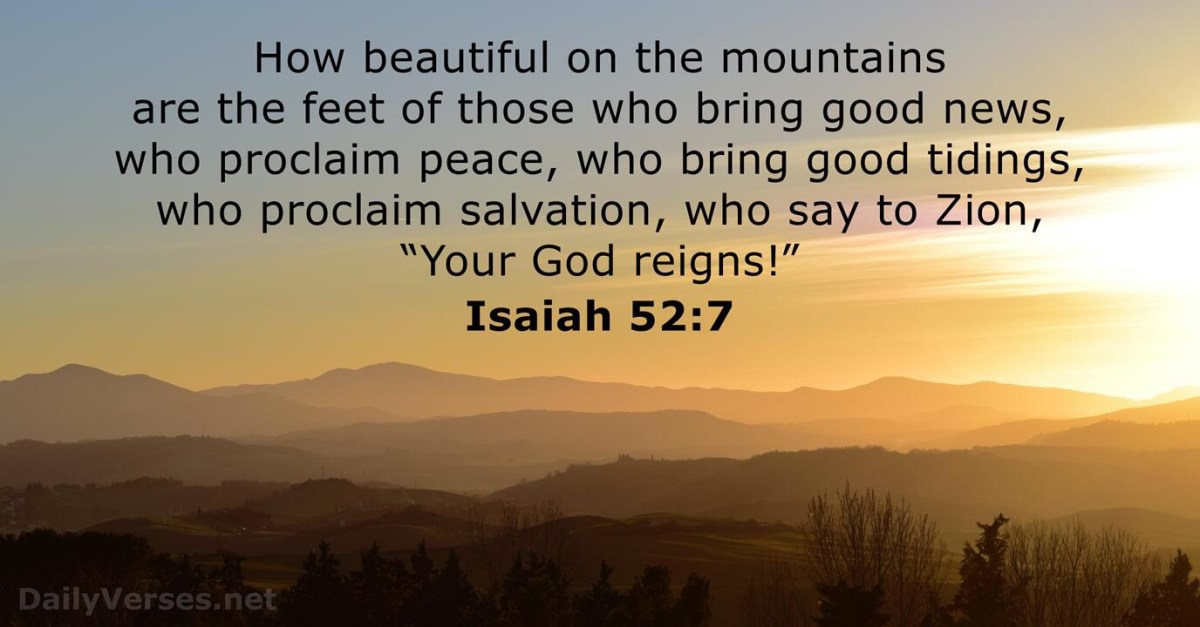
“How beautiful upon the mountains are the feet of the messenger who announces peace”, this prophet-in-exile proclaims, praising the one “who brings good news, who announces salvation, who says to Zion, ‘Your God reigns’” (Isa 52:7). Looking back with longing on his ruined homeland, he exhorts “the ruins of Jerusalem” to “break forth together into singing … for the Lord has comforted his people, he has redeemed Jerusalem” (Isa 52:9).
It’s only a few verses later that the prophet begins a song that expresses the depths of despair in exile, and yet looks beyond that immediate experience to a time of restoration and joyous salvation—a song that we know as the fourth “Servant Song” (Isa 52:13–53:12). That’s the song that Christians interpret as applying to Jesus: “my servant shall prosper; he shall be exalted and lifted up, and shall be very high … he was despised and rejected by others; a man of suffering and acquainted with infirmity … he has borne our infirmities and carried our diseases … out of his anguish he shall see light; he shall find satisfaction through his knowledge … the righteous one, my servant, shall make many righteous, and he shall bear their iniquities”.
Read through the lens of the story of Jesus, this song describes him, the servant, chosen by God for this task. Read in the context of exile, and identifying the servant with Israel (see Isa 41:8, 9; 44:21; 49:3), the song points to a redemption that must mean return to the land and restoration of the city. It is, in the end, a song of hope for the exiles.
The prophet has a strong and clear faith, which may not have sounded so clearly to those holding him captive in exile; he can see that “all the ends of the earth shall see the salvation of our God” (Isa 52:10). This stands as a word of hope that would echo through the later pages of history, in songs sung by the people (Ps 22:27; 65:5–8; 67:7; 98:3), in the advice given by the sage (Prov 30:4), in the prayer offered by Tobit (Tob 13:11), and on into the story of the one born in exile, chosen by God to be “light of the world” (Matt 5:14; John 8:12; 9:5) such that the good news that he brings will be known “to the ends of the earth” (Acts 1:8; 13:47).
The value of holding firmly to this faith, despite the oppositions and sufferings of the time of exile, is what the prophet offers to his people. It is a living-out in advance of what Jesus teaches and models in his own life. In keeping with this motif of “exile” in the Christmas story, here is a poem written by a self-styled exile, my friend and colleague Janet Dawson, which I share with you today (with the permission of Janet).
A Prayer for the Exiles
Holy One, have mercy on your exiles,
those of us who no longer fit
within the traditional teachings of the church.
Those whose voice falters in the songs,
who cannot say “Amen”,
who desperately think of something else during the sermon.
Those who think the greatest heresy of all
is to say that You require suffering and death
in order to forgive.
Those who have given up on going to church at all.
Have mercy on us, Holy God,
those exiles who cling to faith
and yearn for a bigger, wider story,
a bigger, wider community.
A story that embraces the vast expanses of time and space,
and the enormous complexity of the cosmos.
A community in which everything and everyone is connected
and embraced.
Holy God, as we approach the Feast of Incarnation,










 An Informed Faith