The Final Minor Prophets: Malachi, Jonah, and Joel

The Uniting Church Basis of Union declares that we are followers of Jesus, and that in Jesus, God made a representative beginning of a new order of righteousness and love. It is righteousness and love which is at the heart of God, and it is righteousness and love which is at the centre of the work that Jesus undertakes. That is the perpetual dynamic that expresses the essential nature of God—and, indeed, that describes the demands and requirements of living with others in society.

We have considered prophets from Miriam in the story of the Exodus, through Deborah in the prime of the judges, through the time of the divided kingdoms (Amos, Hosea, Isaiah, Micah, and others), after the conquest of the northern kingdom, as the southern kingdom continues (Huldah and Jeremiah) into the time of exile in Babylon (Jeremiah, still, as well as Ezekiel and Second Isaiah), and on into the return to the land after exile (Third Isaiah, Haggai, and Zechariah). Today we move beyond those periods into the ongoing life of post-exiled Israel.

Each of these prophets wrestles with this dynamic; how does God express deep seated covenant love to show his mercy, whilst holding the covenant people to the terms of their agreement, living in a just and righteous manner, and executing punishment for their failure to uphold what that covenant requires. Righteousness and mercy, judgement and grace, belong together in an unbroken whole within God. That is the dynamic that each prophet is aware of, and that each prophet articulates in the oracles the speak to their people.

As the later Jewish writer Ben Sirach, a scribe and sage in the 2nd century BCE, wrote: “Do not say, ‘His mercy is great, he will forgive the multitude of my sins,’ for both mercy and wrath are with him, and his anger will rest on sinners” (Sir 5:6). That phrase, “both mercy and wrath are with him”, articulates the tensions inherent in the developing Jewish understanding of God.

The final group of prophets that we consider now are also grappling with that same dynamic. The tension between mercy and anger, between gracious forgiveness and fierce punishment, between righteousness and love, runs through these books. How do they deal with this?

*****

The prophet Malachi was active after the Babylonian Exile, soon after Haggai and Zechariah had been prophesying. The city and temple had been fully restored and worship was now active in the temple. In this context, Malachi called the people to repentance, starting with the priests, whom he attacks for their corruption (1:6–2:9); “the lips of a priest should guard knowledge, and people should seek instruction from his mouth, for he is the messenger of the Lord of hosts; but you have turned aside from the way; you have caused many to stumble by your instruction; you have corrupted the covenant of Levi, says the Lord of hosts” (2:8–9).

He then turns to the religious profanity of the people; “Judah has been faithless, and abomination has been committed in Israel and in Jerusalem; for Judah has profaned the sanctuary of the Lord, which he loves, and has married the daughter of a foreign god” (2:11), and instructs them to “take heed to yourselves and do not be faithless” (2:16). God threatens punishment in graphic terms: “I will rebuke your offspring, and spread dung on your faces, the dung of your offerings, and I will put you out of my presence” (2:3).

Malachi then identifies a range of ways by which social inequities are practised; God threatens, “I will be swift to bear witness against the sorcerers, against the adulterers, against those who swear falsely, against those who oppress the hired workers in their wages, the widow and the orphan, against those who thrust aside the alien, and do not fear me, says the Lord of hosts” (3:5). He notes that people regularly shortchange the Lord with incomplete tithes (3:8–15); rectifying this will result in blessings from God (3:10–12).

The prophet looks to the coming of a messenger from God (3:1) who will bring judgment “like a refiner’s fire and like fullers’ soap; he will sit as a refiner and purifier of silver, and he will purify the descendants of Levi and refine them like gold and silver, until they present offerings to the Lord in righteousness” (3:2–3).

The fierce imagery continues with a description of “the day [which] is coming, burning like an oven, when all the arrogant and all evildoers will be stubble; the day that comes shall burn them up, says the Lord of hosts, so that it will leave them neither root nor branch” (4:1). The motif of “the day” has run through the prophets, from before the exile (Amos 5:18–20; Isa 2:12, 17; 13:6–8; 34:8; Zeph 1:7, 14–15), during the years of exile (Jer 35:32–33; 46:10), and on into the years after the return from exile (Joel 2:1–3, 30–31).

What is required of the people is clear: “remember the teaching of my servant Moses, the statutes and ordinances that I commanded him at Horeb for all Israel” (4:4). Adherence to the covenant undergirds the claims of this prophet, as indeed it does with each prophet in Israel.

This short book ends with a memorable prophecy from Malachi: “Lo, I will send you the prophet Elijah before the great and terrible day of the Lord comes. He will turn the hearts of parents to their children and the hearts of children to their parents, so that I will not come and strike the land with a curse.” (4:5–6). These words are picked up in the Gospel portrayals of John the Baptist as the returning Elijah (Matt 17:9–13; Luke 1:17), turning the hearts of people so that they might receive the promise offers by Jesus. Whether Malachi himself understood these words to point to John and Jesus, of course, is somewhat dubious.

*****

The final two “minor prophets”, Jonah and Joel, are hard to locate within the timeline of Israel. Whether Jonah was an actual historical figure is hotly debated; in fact, the four chapters of this book tell a rollicking good tale, that makes us suspect that it was, in fact, “just a story”, rather than actual history.

The large city in this book is Nineveh (Jon 1:2; 3:1–10); it was the capital of Assyria (2 Ki 19:36; Isa 37:37) and we learn at the end of the story of Jonah that it had a huge population of more than 120,000 people. The story thus appears to be set during the period of Assyrian ascendancy, in the 8th century BCE. But many of the literary characteristics of this book reflect a later period, perhaps even a post- explicitly time.

It is true that 2 Kings 14:25 mentions that God speaks through “Jonah son of Amittai, the prophet” during the time of Jeroboam II (about 793–753 B.C.), but this was a time before Nineveh was the capital of Assyria. There is no other indication that this individual was the prophet whose story is told in the book of Jonah, for it does not provide any specific dating; nor does the mention of Jonah in 2 Kings indicate how he exercised his prophetic role.

The charge that Jonah is given is a stock standard prophetic charge: “go to Nineveh, that great city, and cry out against it; for their wickedness has come up before me” (1:2; cf. Amos 1:3; Isa 6:9–13; Jer 1:9–10; Ezek 2:3–4; 3:18–21; Nah 1:2–3; Hab 2:2–5; Zeph 1:2–6). The response of Jonah is like some of those prophets: an initial reluctance to accept the charge (Isa 6:5; Jer 1:6; and see Moses at Exod 3:11, 13; 4:1, 10).

However, whilst other prophets accede to the divine pressure to take up the challenge and declare the judgement of the Lord to a sinful people, Jonah holds fast to his reticence—when commanded to go northeast to Nineveh, he immediately flees in the opposite direction, boarding a ship that was headed west across the Mediterranean Sea, to Tarshish, “away from the presence of the Lord” (Jon 1:3).

The escape of Jonah from the command of the Lord may be deeply troubling; but the narrative spins the story into burlesque, as “the Lord hurled a great wind upon the sea”, all the cargo on the ship is thrown overboard, and then Jonah (blissfully sleeping, apparently unaware of the great storm—as if!) is interrogated by the sailors, and eventually offers himself as a sacrifice to save the boat (1:12).

The sailors try in vain to save the ship; realising that this is futile, they throw Jonah into the sea—and immediately “the sea ceased from its raging” (1:15). Then, adding further incredulity to the unbelievable narrative, “the Lord provided a large fish to swallow up Jonah” (1:17). The three days and three nights that he spends “in the belly of the fish” before he is vomited onto dry land (2:10) add to the comic exaggeration.

The psalm that Jonah prays from inside the fish (2:1–9) and the successful venture to Nineveh, where even the king “removed his robe, covered himself with sackcloth, and sat in ashes” (3:1–10) apparently demonstrate that Jonah should have obeyed the command of the Lord in the first place. However, Jonah’s response continues the exaggerated response of a burlesque character; “this was displeasing to Jonah, and he became angry” (4:1).

Jonah’s resentment and his plea for God to take his life (4:2–4) and his patient waiting for God to act (4:5) lead to yet another comic-book scene, as a bush grows and then is eaten by a worm and Jonah is assaulted by “a sultry east wind” (4:6–8). The closing words of the book pose a rhetorical question to Jonah (4:9–11) which infers that God has every right to be concerned about the lives of pagans in Nineveh. The last laugh is on Jonah; indeed, he has given his readers many good laughs throughout the whole story!

******

The final prophet for us to consider is Joel, who speaks words of lament and calls for repentance amongst the people of Judah. Nothing in this book provides any clues as to the time when Joel was active. The identification of the prophet as “son of Pethuel” (Joel 1:1) gives no clue, as Pethuel appears nowhere else in the Hebrew Scriptures—indeed, the name Joel, itself appears nowhere else. The name appears to combine the divine names of Jah and El, suggesting that it may be a symbolic creation. Was Joel an historical person?

Joel calls on the “ministers of God” to “put on sackcloth and lament” (1:13); this reminds us of the response of the pagans in Nineveh (Jonah 3), whilst his remonstrations that “the day of the Lord is near” (1:15) echoes the motif of “the day” already sounded by other prophets (Amos 5:18–20; Isa 2:12, 17; 13:6–8; 34:8; Zeph 1:7, 14–15; Jer 35:32–33; 46:10).

This day forms the centrepiece of Joel’s undated prophecies, as he describes that day as “a day of darkness and gloom, a day of clouds and thick darkness!” (Joel 2:2), when “the earth quakes before them, the heavens tremble, the sun and the moon are darkened, and the stars withdraw their shining” (2:10). He describes the response of the people “in anguish, all faces grow pale” (2:6).

However, Joel adheres to the constant thread running through Hebrew Scriptures, that the Lord is “gracious and merciful, slow to anger, and abounding in steadfast love, and relents from punishing” (2:13). Because of this, he yearns for the people to “turn with all your heart, with fasting, with weeping, and with mourning” (2:12), sensing that there might be hope of restitution for the people.

Joel calls for the people to gather (2:15–16); the oracle that follows paints a picture of abundance and blessing (2:18–27), affirming that “my people shall never again be put to shame” (2:27).

The prophet then speaks words which have been given a central place in the later story of the Christian church, when he foreshadows that the blessings of God will be manifest through the outpouring of the spirit: “your sons and your daughters shall prophesy, your old men shall dream dreams, and your young men shall see visions; even on the male and female slaves, in those days, I will pour out my spirit” (2:28–29). This promise is specifically for “all flesh”; this universal vision informs the whole outward impulse of the movement of followers of Jesus, after the day of Pentecost, which Peter interprets as being a fulfilment of this prophecy (Acts 2:14–21).

The day of the Lord that is then envisaged (2:31) will signal a significant reversal for Israel. The Lord laughs at other nations (3:1–8), a reversal that pivots on a turn from despair to hope, from the threats of judgement to a glorious future (3:9–21). Joel repeats the irenic vision of swords being beaten into ploughshares (3:10; see Isa 2:4; Mic 4:3); he sees a ripe harvest (3:13), the land will drip with sweet wine, and there will be milk and water in abundance (3:18). The voice of the Lord “roars from Zion, and utters his voice from Jerusalem, and the heavens and the earth shake” (3:16; cf the similar pronouncement of Amos at Am 1:2; 3:8).

The last word of this book, “the Lord dwells on Zion” (3:21), provides assurance and certainty for the future. These words of hope promises a peaceful future for the nation. When Joel might have been speaking these words cannot be definitively determined; it could have been under the Assyrian threat, during the Babylonian dominance, in the time of exile, or after the return to the land—the promise of hope holds good in each of these scenarios.

********

See also

Houses and fields and vineyards again (Jeremiah 32; Pentecost 16C)

Jeremiah is usually associated with doom and gloom, as we saw in last week’s lectionary offering: “my joy is gone, grief is upon me, my heart is sick … is there no balm in Gilead?” (Jer 8:18, 22). In the reading for this week, however, offered by the lectionary (Jer 32:1–3a, 6–15), Jeremiah is optimistic. Even though he is being held under arrest in the royal court (Jer 32:1–3), he is planning for a future—a personal future, as well as a future for the besieged nation.

Jeremiah arranges, through Baruch, to purchase a field from his cousin Hamael, the son of his uncle, Shallum (32:7, 16). He is a child of Judah, and here is sending down his roots even deeper into the land that God had given his ancestors. He believes that, even though the Babylonian army was encircling Judah and he was unable to move about freely, nevertheless the time would come when God would ensure that ‘houses and fields and vineyards shall again be bought in this land’ (v.15). This attitude is thoroughly grounded in trust in God.

Jeremiah “serves as an examplar for exiles by acting with obedient hopefulness in the face of invasion and captivity”. The land purchase “begins the fulfilment of the visions of 30:1–31:40.” It is located at “the nadir of Judah’s story, during the bleakness of invasion” (587 to 586 BCE by our reckoning). (Quotations from Kathleen O’Connor, Oxford Bible Commentary, 515)

On the surface, the purchase appears futile, as Jeremiah foresees the dominance of the Babylonians, under Nebuchadnezzar, their king; this dominance shall remain, it seems, for some time, “until I attend to him, as the Lord declares” (32:5). So the prophet insists that the transaction take place, as a sign of hope in the future amidst the despair and devastation of his present.

This is what scholars call a “prophetic sign-act”, one of a number that Jeremiah enacts: wearing a linen loincloth, then hiding it, recovering it, and finding it “ruined, good for nothing” (13:1–7), a sign of the punishment to come on Judah (13:8–11); living as a celibate (16:1–2) as a sign of the exile to come (16:3–9); and pointing to the work of the potter, shaping a vessel, spoiling the vessel, and remaking it (18:1–4) as a sign of the way the Lord will treat Israel (18:5–11). Indeed, the last word of Jeremiah is to have his words written on a scroll which is thrown into the Euphrates River (51:59–63), to indicate that “Babylon shall sink, to rise no more”. (51:64).

The redemption of this parcel of land is a “prophetic sign-act” offering hope. It is reminder of the commands about the land found in Leviticus 25, where the Lord is said to have declared that “the land shall not be sold in perpetuity, for the land is mine; with me, you are but aliens and tenants” (Lev 25:23). The last concept is picked up in New Testament texts describing the people as aliens (1 Pet) and looking to the promise of a heavenly city (Heb 11).

The Levitical decree sits in the chapter concerning the Sabbatical Year (Lev 25:1–7) and the Year of Jublilee (Lev 25:8–55), a time of cancellation of debts and restitution of the land, a liberating sign of the liberating God who is to be worshipped; “the people of Israel are my servants whom I brought out from the land of Egypt; I am the Lord your God” (Lev 25:55). The redemption of the land by Jeremiah, acting through Baruch, signals an ongoing commitment to the covenant which the people had with the Lord God.

The purchase of land demonstrates a trust in the promise spoken in the preceding chapter. Jeremiah famously speaks about the new covenant; his words, however, are often spiritualised—the law is not written on stones, but written in the hearts of the people (Jer 31:31–33), the knowledge of God is not to be taught, but will be innate—“they shall all know me” (Jer 25:34).

By contrast to this common spiritualised interpretation, Jeremiah intends that this new covenant is to be lived in all of life; it is not simply a promise for an ethereal future, but it is to be a tangible reality in the immediacy of life in the present. So Jeremiah enfleshes the promise through the purchase of land. It is an incarnation of action some centuries before Jesus!

Interestingly, although the lectionary shifts the order of these passages, the purchase of land in Jer 32, signalling the promises made in the oracles of Jer 30–31, is placed immediately after the letter that Jeremiah wrote to the exiles in Babylon, urging them to come to terms with their situation in exile: “build houses and live in them, plant gardens and eat what they produce, take wives and have sons and daughters … multiply there [in Babylon] and do not decrease” (Jer 29:1–9). They, too, are to express their covenant faith in the realities of everyday life, even if they are in exile in a foreign land.

The details of this commercial transaction, involving money, property, and a deed of purchase (vv.9–12), are important; they indicate that how we treat our possessions, the land on which we live, the land which we own, reflects our faith. Jeremiah knows the trust of Lev 25:24; the land is of God—in this case, it has been given over to the family of Jeremiah as a trust, for them to care for. That trust is to “last for a long time” (v.14).

So the story invites us to consider how we exercise our responsibilities in property matters, how we live on the land, how we show that we believe that the land is of God. (It sits well alongside the Gospel passage offered in the lectionary, from Luke 16, which also emphasises the importance of responsible dealing with property and material things, in the life of faith.)

Our attitude to the land is actually a live current issue in Australia, as we mark the turning of an era (as the Queen dies, so the King reigns). Signs and symbols of British imperialism in this Great Southern Land remind us that, although the land was, and is, and will remain, central to the lives of the First Peoples of this continent, British colonisers have invaded, settled, massacred, and imposed a foreign way of life on those First Peoples. For them, being on country is being in spirit—connected with the spirit of the ancestors, living in harmony with the spirit of the creator God. There are resonances, surely, with the close connection to the land that Jeremiah here exhibits.

So in our context, the fact that Jeremiah buys the land is a challenge to our expectations that we can simply assume and take control of these lands. The fact that Jeremiah exchanges a contract for the land reinforces the importance of our dealings with real estate, property, finances, and people. His property transaction attests to the promise of the Lord to a besieged and soon-to-be exiled people, “ houses and fields and vineyards shall again be bought in this land” (32:15). The sign, to us, is clear: what we do with our material, physical lives ought to reflect the spiritual hopes and commitments that we have as people of faith.

*****

See also

On godliness, dignity, and purity: the life of faith in 1 Timothy (Epiphany 16C)

This Sunday we are offered an excerpt from the final chapter of the first letter to Timothy (1 Tim 6:6–19). The letter is attributed by tradition to Paul, but more likely, I believe, it was written by a student of Paul some decades after his life. The author draws on the authority of Paul to lend weight to the teachings that he provides in this letter.

We have seen that the central concern of this letter appears to be to ensure obedience and pass on the essential teachings of the faith in order to refute the false teachers. This ideal is very different from the one Paul reflected in 2 Cor 11: the dangers of life, the centrality of suffering. Paul lived in the tension between this world and the next, full of expectation that Jesus will return soon (1 Thess 1:9–10; 1 Cor 7:26–31; Rom 8:18–25).

Here, however, the belief in an imminent return of Jesus has passed (6:14–15); the demands for unqualified and unquestioning adherence to “the truth” are based in obedience to the resplendent figure of Jesus, in the heavenly realm, who “alone has immortality, and dwells in unapproachable light” (6:15–16).

Paul had enthusiastically testified to the post-resurrection appearances of Jesus; but this letter asserts, “no one has ever seen or can see” him (6:16).

This picture of Jesus offers a pointer to how the theology of the early church was developing. The groundwork for disputes over correct doctrine and heresy was here being laid for the debates of the early church councils in subsequent centuries.

Associated with this emphasis on right belief is an intensifying of ethical demands on the believers; what is important is to teach moderation, prudence and order. The instruction to Timothy to “keep yourself pure” (5:22; see also 1:5; 4:12) reflects Paul’s criticism of impurity (Rom 1:24; 6:19; 2 Cor 12:21; Gal 5:19; 1 Thess 4:7) and advocacy of purity (Phil 1:10; 4:8; 1 Thess 2:10). The offering of prayers “so that we might lead a quiet and peaceable life in all godliness and dignity” (2:2) also evokes Paul (compare 1 Thess 4:11).

Yet a number of terms point to significant differences from Paul’s authentic letters: the use of the term “godliness”; the inclusion of numerous moral qualities required of leaders which are either unique to the Pastorals (temperate, sensible, serious, manage, double-tongued) or found only rarely in other Pauline letters (noble, hospitable, above reproach); the emphasis on financial responsibility; the way that “conscience” is used (1 Tim 3:9) and the striking phrase, “fight the good fight” (1:18; 6:12). The letter takes strides beyond the teachings set out in Paul’s authentic letters.

Most controversial of all is the section of this letter instructing women (2:8–15). Almost every element of the passage stands in contradiction to what Paul has stated. The “dress code” (2:9) is not something that would be written by Paul, as is the emphasis on “good works” (2:10). The demand for silence and submission (2:11) is reminiscent of 1 Cor 14:34 (which may well not have been written by Paul) but is counter to the guidelines for women when speaking in worship (1 Cor 11:2–16), as is the directive that women not teach (2:12).

The interpretation of the Genesis narrative (2:13–14) is strikingly different from the way that Paul treats it at 1 Cor 11:8–12 and Rom 5:12–21. The assertion that a woman “will be saved through childbirth” (2:15) is likewise contrary to Paul’s emphasis on faith and grace as the means by which salvation is granted. For more on the difficult passages in letters attributed to Paul where female subjugation appears to be in view, see https://johntsquires.com/2020/11/19/women-in-the-new-testament-2-six-problem-passages/

The passage in 1 Tim 2:8–15 appears to be attacking excesses within the community of faith, but it does so by insisting upon good order, obedience and submission—qualities which are held in high regard throughout this letter.

The author instructs Timothy to “pursue righteousness, godliness, faith, love, endurance, gentleness” (6:11). The list is slightly evocative of the list of “gifts of the Spirit” that Paul provides at Gal 5:22–23, “love, joy, peace, patience, kindness, generosity, faithfulness, gentleness, and self-control”, although the list in 1 Tim 6 is not linked in any way with the Spirit. That is typical of this and other letters which came from later in the first century, some decades after Paul himself was writing letters.

In Paul’s authentic letters, the Spirit is an important element. Paul retains from his Jewish upbringing a sense of the Spirit as a manifestation of divine energy; the Spirit is God’s gift to believers (Rom 5:5) and thus the source of life and peace (Rom 7:6; 8:2, 5–6). In Hebrew Scripture, the Spirit is seen to breathe over the waters of chaos as God’s primary agent in creation, to gift the elders appointed by Moses, to anoint the prophets and to inspire their pointed words of warning. In Paul’s understanding, the Spirit gifts believers with a multitude of gifts (1 Cor 12:4–11).

Paul also imbues the Spirit with an eschatological role—first, the Spirit acts by raising Jesus from the dead (Rom 1:4; 8:11) and then by adopting believers as “children of God” (Rom 8:14–23). The Spirit is a marker of life in the kingdom of God (Rom 14:17). The kingdom, for Paul, remains a future promise, to become a reality within the eschatological timetable (1 Cor 15:23-26).

Paul speaks with passion about how the creation groans in the present time of distress (Rom 8:18–23), as believers hold fast to their hope in the renewal of creation (Rom 8:17, 21, 24–25; see also 1 Cor 7:28–31). The role of the Spirit in this period is to strengthen believers by interceding for them (Rom 8:26–27).

Paul reminds the Romans that they are “in the Spirit” (Rom 8:9); this is reminiscent of his guidance to the Galatians to live “by the Spirit” (Gal 5:16, 22–25) and his exposition to the Corinthians of the gifts which are given “through the Spirit” (1 Cor 12:1, 4–11). The understanding of the gifting of believers by the Spirit, articulated in the first letter to the Corinthians, has played a significant role throughout the history of the church over the centuries.

The life of faith, lived “in the Spirit”, is therefore to be characterised by “spiritual worship” (Rom 12:1). Paul immediately explains that this requires believers to be “transformed by the renewing of your minds” (Rom 12:2). After making this bold programmatic statement, Paul devotes significant time (in Rom 12–15) to spelling out some of the ways in which this transformation might take place. The Spirit effects transformation, which then governs the behaviour as well as the words of believers. The dynamic, pervasive role,of the Spirit is evident at many places in Paul’s authentic letters.

In the first letter to Timothy, by contrast, the almost total absence of the Spirit is striking. Only two explicit references to the spirit occur. The first is completely formulaic; the claim that Jesus was “vindicated in spirit” sits second in a series of six clauses which set out some key aspects of “the truth” to which Timothy is to be bound: “the mystery of our religion is great: He was revealed in flesh, vindicated in spirit, seen by angels, proclaimed among Gentiles, believed in throughout the world, taken up in glory” (1 Tim 3:16). The Spirit is not an active, energising force in this formula; rather, the spirit is the static realm in which Jesus was “vindicated”.

This formula is followed immediately by the claim that “the Spirit expressly says that in later times some will renounce the faith” (4:1). Once again, the context and the terminology drives incessantly towards the affirmation of “the truth”; those revealed as renouncing the faith are condemned for “paying attention to deceitful spirits and teachings of demons, through the hypocrisy of liars whose consciences are seared with a hot iron” as well as their teachings that “forbid marriage and demand abstinence from foods, which God created to be received with thanksgiving by those who believe and know the truth” (4:1–3). The revelation by the Spirit points away from these doctrines and practices and orients decisively towards “the truth”.

For discussion: What do you make of the discussion above, setting out the differences between the authentic letters of Paul, and the first letter to Timothy? Do you think that there was a different author for this letter?

*****

See also

As I watched visions in the night, I saw one like a human being (Daniel)

In this series on the prophets of ancient Israel, the figure of Daniel is something of an anomaly. He does not say “woe is me”, as many of the priests do. He does not stand and declaim words of divine judgement on the people for their sinfulness. He does not deliberately use symbolic actions to dramatise his message, as do many other prophets, although his book is replete with many symbols that invite—indeed, require—interpretation.

Whilst he does speak of the wrath of God (Dan 9:16), this to be executed “later, in the period of wrath” (8:19; 11:36). Like other prophets, he does affirm that “the God of heaven” exhibits mercy (2:18; 9:9) and prays seeking that mercy from God (4:27; 6:11). He also affirms the covenant of Israel with their God (11:28–35), although this is set in the context of specific timeframes: a period of seventy weeks (9:24), including a period for “a strong covenant with many” for one week (9:27), followed immediately by “an abomination that desolates, until the decreed end is poured out on the desecration” (9:27).

Daniel himself is never “called to be a prophet”, as we have seen in other prophetic books; he is introduced as one of a number of “young men without physical defect and handsome, endowed with knowledge and insight”, who were chosen “to be taught the literature and language of the Chaldeans” (1:3–5). Indeed, the Israelite Daniel is given a Babylonian name, Belteshazzar (1:7; 4:8), and his entire story takes place in the Babylonian court.

(The Chaldeans were part of the Babylonian Empire; centuries earlier they had settled beside the Euphrates in what became the southeastern edge of the Babylonian Empire. Abraham is said to have come from Ur, a city in the region of the Chaldea; see Gen 11:31; 15:7.)

The story of the prophet Daniel is thus set outside Israel, in the time of exile, after the conquest of the southern kingdom by the Babylonians in 587 BCE (Dan 1:1–2; see 2 Kings 25). Daniel had been chosen to serve in the court of Nebuchadnezzar, who reigned from 605 BCE to 562 BCE (Dan 1:3–7); when the Persians took control of the Babylonian empire in 539 BCE, Daniel continued to serve in a position of some power.

Scholars believe, however, that the story is told at a much later time, after the exile—perhaps even during the time of Seleucid superiority in the second century BCE. Two centuries after they had returned to the land of Israel, rebuilt their Temple, restored their cities and towns, and living under Persian rule, the people of Israel were over run by the troops of Alexander the Great, King of Macedonia, as he swept across the eastern Mediterranean region as Far East as modern day India. A new foreign power, and a new attitude towards the religion and customs of Israel.

Initially the interaction between Israelites and Macedonians was one of integration. Greek became the language of trade; syncretism marked the religious life of the people, as they adopted Greek customs. But when Antiochus Epiphanes came to power over the region, he introduced an altar in the temple to receive pagan offerings—something which, in Israelite eyes, was known a “desolating sacrilege” (Mark 13:14; 1 Mac 1:54). This appears to be clearly described in the final vision, recounting how forces “shall occupy and profane the temple and fortress, abolish the regular burnt offering and set up the abomination that makes desolate” (Dan 11:31).

A clear reflection of the exile experience is that an extended section of the book (2:4b—7:28) is written in Aramaic, a language which evolved from Hebrew because of the influence of Babylonian culture and language on the exiled Israelites. The rest of the book (like all the rest of Hebrew Scripture) is written in Hebrew. Whereas Aramaic became the common language of Jews even when they were living back in Israel (and this was the case by the time of Jesus), Hebrew was preserved as the holy language of scripture.

Curiously, the book has two distinct parts, which overlap this linguistic division; each part is likely to have originated in a different time after the exile. The first six chapters recount stories about Daniel, who was serving in the court and enjoyed friendly relations with the monarch; the style is one found in other legends about courtiers and dream interpreters. Chapters 7–12 comprise a series of apocalyptic visions which appear to contain some very direct references to events that took place in the second century BCE. These chapters come “from the mouth of Daniel”, as it were, rather than being stories about him (as in chapters 1–6).

*****

This first half of the book of Daniel contains a number of dramatic scenes. In these first six chapters, we find some striking stories about Daniel (given the Babylonian name Belteshazzar) and his companions, each of whom are also given Babylonian names (Shadrach, Meshach, and Abednego). While Daniel and his companions are serving in the Babylonian court (1:3–18), a number of dramatic incidents are narrated.

One striking aspect of Daniel is that he provides interpretation of the king’s two dreams (chapters 2 and 4). To the intense frustration of King Nebuchadnezzar, none of his wise men are able to explain the meaning of the first dream about a huge statue made of gold, silver, bronze, iron, and clay; he is on the brink of having them all executed (2:12–13) when Daniel intervenes.

It is then that we learn that Daniel has been gifted by God to be “a revealer of mysteries” (2:47), and he is able to explain what each element in the dream signifies (2:24–45), and to assure the king that “the dream is certain, and it’s interpretation is trustworthy” (2:45). As a result, Daniel is promoted and his three friends are installed in responsible and powerful positions (2:46–49).

However, under the influence of “certain Chaldeans” (3:8), the three friends of Daniel are denounced and are cast into the fiery furnace by an infuriated king (3:19–21). Miraculously, the three men survive this ordeal; King Nebuchadnezzar “was astonished”, called the three mean out of the furnace, blessed them, and condemned those opposing them to be “torn limb from limb, and their households laid in ruin” (3:24–30).

The king subsequently has a second dream, and the narrative follows the same pattern: the king is afraid, he calls his wise men, they are unable to provide any explanation, and then Daniel is asked to offer an interpretation, because “you are endowed with a spirit of the holy gods” (4:18). Once again, Daniel’s interpretation is offered—but what he foresees for the king fails to please him; and just twelve months later, “the sentence was fulfilled against Nebuchadnezzar” and he becomes mad: “he ate grass like oxen, and his body was bathed with the dew of heaven, until his hair grew as long as eagles’ feathers and his nails became like birds’ claws” (4:33).

This time of madness fortunately is soon lifted. Nebuchadnezzar prays to God: “I blessed the Most High, and praised and honoured the one who lives forever” (4:34–35), praising God “for all his works are truth, and his ways are justice” (4:37). What follows is an account of “a great festival for a thousand of his lords”, organised by Belshazzar, the son of Nebuchadnezzar—but during the festivities, those present demonstrate their pagan traditions, as they “drank the wine and praised the gods of gold and silver, bronze, iron, wood, and stone” (5:1–4).

During the feast, fingers of a human hand wrote on the wall of the palace (5:5–9). The king’s advisors were (once again) unable to understand what what written; Daniel is brought in and offers an interpretation of “the writing on the wall” (5:10–31), warning the king of the end of his kingdom: “you have been weighed on the scales and found wanting”, so the kingdom will be divided between the Medes and the Persians (5:25–28). So it was that Daniel was clothed in purple and accorded a high ranking in the kingdom (5:29); but Belshazzar was killed that night, leading to the accession of Darius (5:30–31).

*****

Daniel was thus thrust once again into the murky arena of national politics (then, as now, a fraught environment!). Whilst Daniel exercised his role as a satrap under Darius the Mede, a conspiracy was formed against him as opponents looked to bring him down. When he is caught praying to the Lord God, despite the interdict of the king (6:1–15), he is thrown into the lion’s den (6:16).

The next morning, the king hurries to the den, and finds Daniel alive; his prayers have miraculously saved him (6:19–22). Daniel is released from the lion’s den and rescued from danger (6:23–28); Darius issues an edict praising “the living God” whose “kingdom shall never be destroyed, and his dominion has no end; he delivers and rescues, he works signs and wonders in heaven and on earth” (6:26–27).

If the story was written (as is thought by many) during the time of the Seleucids, its depiction of a foreign ruler who is positively disposed towards Israel’s God is striking. Under Antiochus Epiphanes, the colonising forces of the Macedonians “built a gymnasium in Jerusalem, according to Gentile custom, and removed the marks of circumcision, and abandoned the holy covenant; they joined with the Gentiles and sold themselves to do evil” (1 Mac 1:14–15). Antiochus not only erected an image in the temple (the “desolation of sacrilege”), but even had the scrolls of Torah collected and burnt—many centuries before the Nazis did this (you can read the details of his rule in 1 Mac 1:41–64).

The author of Daniel is writing political literature as political critique. We know that Antiochus provoked a political uprising led by the Maccabees, the sons of Matthias (1 Mac 2—6)—figures later upheld as heroes by the Zealots in the time of Jesus. The book of Daniel provides a rationale for the zealous ideology of the Maccabees, seeking to put in place a righteous leadership in Israel.

Carol Newsom observes that “in several narratives in the book of Daniel, the king humbly confesses the sovereignty of the God of the Jews, acknowledging that he rules by the will of God” (“Political Theology in the Book of Daniel: An Internal Debate”, Review andn Expositor, vol. 109, 2012, pp.557–568). Prof. Newsom continues, “other parts of the book depict the gentile king as being part of God’s plan, but a part that will ultimately be destroyed as incompatible with divine sovereignty.” We see this clearly in view in chapters 1—6.

*****

By contrast, Prof. Newsom observes that when we read on into chapters 7—12, we encounter “the most negative view of gentile kingship, finding it to be monstrous and utterly evil. Although one can understand the different perspectives based on particular historical circumstances, a more fruitful hermeneutical approach is to read the different perspectives in Daniel as a never-fully-resolved conversation about the good or evil nature of political power, a conversation that continues to this day.” In this way, the book of Daniel is quite timely and relevant.

In this second half of the book (chapters 7–12) we read a series of visions seen by Daniel. The opening vision of the four beasts (7:1–8) famously contains a description of “one like a human being [son of man] coming with the clouds of heaven [who] came to the Ancient One and was presented before him” (7:13–14). This vision appears to inform the later words of Jesus, when he predicts that people “will see ‘the Son of Man coming in clouds’ with great power and glory” (Mark 13:26) and tells the Jerusalem Sanhedrin that they will see “‘the Son of Man seated at the right hand of the Power,’ and ‘coming with the clouds of heaven’” (Mark 14:62).

The involvement of the angel Gabriel (chapters 8 and 9) brings the decree of “seventy weeks … to atone for iniquity” (9:20–27) and opens up a full-scale apocalyptic scenario, with battles, floods, the rise of a warrior king, shifting alliances amongst the various kings, more battles, the besieging of a city, the dominance of a “contemptible person”, the profaning of the temple and violation of the covenant in Israel, the disrespecting of “the God of gods” (10:1–11:39).

It also leads to a grand vision “at the time of the end” (11:40–12:13) when “many of those who sleep in the dust of the earth shall awake, some to everlasting life, and some to shame and everlasting contempt” (12:2), thereby providing a key Hebrew Scripture text which is used in discussions of the resurrection as reported in the New Testament.

The notion of “The End” has been developing in prophetic literature, emerging from the earlier prophet’s declarations about “The Day of the Lord”. This theme will continue to be developed and expanded in apocalyptic texts both in Second Temple Judaism and in earthly Christian texts in the New Testament and in works of the following century or two. See

At this time, a “man in linen” declares that “when the shattering of the power of the holy people [namely, Israel] comes to an end, all these things would be accomplished” (12:7). The language is reminiscent of the extended apocalyptic response that Jesus gives when his disciples ask him, “what will be the sign that all these things are about to be accomplished?” (Mark 13:4).

Daniel, the supreme interpreter, has been able to make sense of all that has gone before; at this point, however, he “heard but could not understand” (12:8). The “man in linen” informs him that “the words are to remain secret and sealed until the time of the ends (12:9); Daniel is dismissed and the story ends. The ending invites readers to “make sense” for themselves of what they have read—and so, apocalyptic speculation continues unabated to this day!

More importantly, perhaps, is the observation that apocalyptic speaks not only into the future, but especially into the present time of the author; and therefore, the political edges of the narrative and especially of the apocalyptic visions portray what is needed to remain faithful to God in the challenges of those times. That dynamic translates into a challenge for us, today.

*****

There’s a good discussion of politics and religion in the book of Daniel in this article: https://spectrummagazine.org/sabbath-school/2020/daniel-and-empire-then-and-now

Is there no balm in Gilead? (Jeremiah 8; Pentecost 15C)

The prophet Jeremiah lived at a turning point in the history of Israel. The northern kingdom had been conquered by the Assyrians in 721 BCE; the elite classes were taken into exile, the land was repopulated with people from other nations (2 Kings 17). The southern kingdom had been invaded by the Assyrians in 701 BCE, but they were repelled (2 Kings 18:13–19:37).

King Hezekiah made a pact with the Babylonians, but the prophet Isaiah warned that the nation would eventually fall to the Babylonians (2 Kings 20:12–19). Sure enough, after Babylon conquered Assyria in 607 BCE, they pressed hard to the south; the southern kingdom fell of Judah in 587 BCE (2 Kings 24–25) and “Judah went into exile out of its land” (2 Ki 25:21).

Jeremiah lived in the latter years of the southern kingdom, through into the time of exile—although personally, he was sent into exile in Egypt, even though most of his fellow Judahites were taken to Babylon. The difficult experiences of Jeremiah as a prophet colour many of his pronouncements.

Early in the opening chapters, as Jeremiah prophesies against Israel, he reports that God muses, “you have played the whore with many lovers; and would you return to me?” (3:1). The idolatry and injustices practised by the people of Israel have caused God concern. Throughout the poetry of the prophetic oracles in chapters 1—25, God cajoles, encourages, warns, and threatens the people.

“I will not look on you in anger, for I am merciful” (3:13), the Lord says; then Jeremiah instructs the people, “put on sackcloth, lament and wail: ‘the fierce anger of the Lord has not turned away from us’” (4:8). Next, God says, “I am now making my words in your mouth a fire, and this people wood, and the fire shall devour them” (5:14), and then, “take warning, O Jerusalem, or I shall turn from you in disgust, and make you a desolation, an uninhabited land” (6:8), and so on, for 25 chapters.

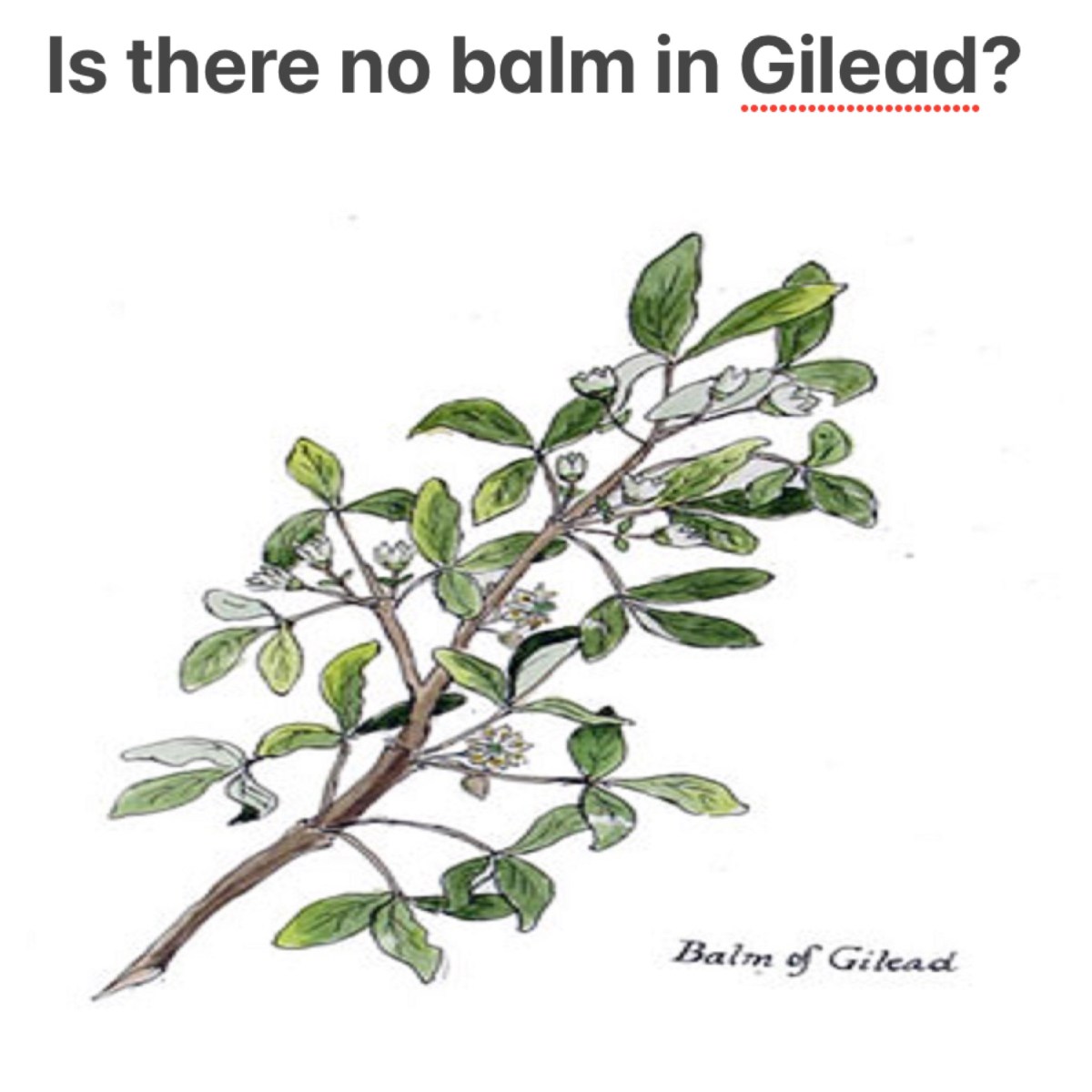
Whilst God laments the “perpetual backsliding” of the people, who “have held fast to deceit, they have refused to return” (8:5), the prophet laments, “my joy is gone, grief is upon me, my heart is sick … is there no balm in Gilead? Is there no physician there? why then has the health of my poor people not been restored?” (8:18–22). That is the passage that is offered by the lectionary this coming Sunday. The grief of the times led Jeremiah to an expression of utter despair: “is there no balm in Gilead?” (8:22).

The region of Gilead was the mountainous northern region of Transjordan, the land to the east of the Jordan River—an area which now is in the nation of Jordan. Whilst it was not part of the land of Canaan, it was promised to “half the time of Manasseh” (Deut 3:13; also Num 32:40). A medicinal perfume was made from a balsam shrub that grew in the area; it is noted in the Joseph story as being carried by a company of Ishmaelites who “came from Gilead with their camels bearing spicery and balm and myrrh, going to carry it down to Egypt” (Gen 37:25).

This balm is also included in the present which Jacob later sent to the ruler of Egypt: “a little balm, and a little honey, spices, and myrrh, nuts, and almonds” (Gen 43:11). According to Josephus, the Queen of Sheba brought “the root of the balsam” as a present to King Solomon (1 Ki 10:10; Antiquities of the Jews 8.6); the balm was later noted, admiringly, by a string of writers (Pliny, Tacitus, Florus, and Diodorus Siculus). It forms a saying in contemporary life, referring to a certain cure,

Jeremiah continues after this oracle of woe to denounce the worship of idols that the people perpetuate (10:1–16) and their breaches of the covenant (11:1–17). As a result, his life is placed in danger: “I was like a gentle lamb led to the slaughter, and I did not know it was against me that they devised schemes” (11:18–20). He declares that God condemns others who are prophesying; “they are prophesying lies in my name; I did not send them, nor did I command them or speak to them; they are prophesying to you a lying vision, worthless divination, and the deceit of their own minds” (14:13–18).

The prophet then dramatises his message of divine judgement on the people with reference to the familiar image of the potter, shaping and moulding the clay (18:1–11), a broken earthenware jug (19:1–15), two baskets of figs (one bunch good, the other inedible; 24:1–10), and “the cup of the wine of wrath” which, when “all the nations to whom I send you drink it, they shall drink and stagger and go out of their minds because of the sword that I am sending among them” (25:15–38).

The message of Jeremiah up to this point is stark, confronting, demanding: turn around, reshape your life, repent—or suffer the consequences. It’s no wonder that he felt aggrieved and despairing; who would respond? It’s a message that remains confronting and demanding for us, today. How do we respond?

A ransom for all: a formulaic claim (1 Tim 2; Pentecost 15C)

This week the lectionary offers us an excerpt from the second chapter of the first letter to Timothy, attributed by tradition to Paul, “a herald and an apostle, a teacher of the Gentiles in faith and truth” (1 Tim 2:7). The passage is 1 Tim 2:1–7.

Just before making this authorial statement, the author offers one of the assorted short, formulaic statements about “the faith” that pepper the three pastoral letters: “there is one God; there is also one mediator between God and humankind, Christ Jesus, himself human, who gave himself a ransom for all” (1 Tim 2:5–6). (The other instances of such formulaic statements are at 1:15; 3:1; 3:16; 4:9–10; 6:15–16.)

Ransom is a term that we associate with the forced kidnapping of a person and the demand for a payment in order for them to be released. This is not the way the term is used in biblical texts, where payment in return for release of a captive is not in view. Rather, the orientation is towards the idea that there is a significant cost involved in the process of ransoming.

The Greek word used here is antilutron, a compound word comprised of the prefix anti- (in the place of) and the noun lutron. This noun also appears in a saying of Jesus, “the Son of Man came not to be served but to serve, and to give his life a ransom for many” (Mark 10:45).

The noun lutron comes from a verb, lutrein, which means “to release”. It was a common term for the payment needed to secure the release of slaves, debtors, and prisoners of war. The noun, translated as ransom, occurs in the Septuagint. It identifies the price paid to redeem a slave or captive (Lev 25:51–52) or a firstborn (Num 18:15). It also indicates the price to be paid as recompense for a crime (Num 35:31–32) or injury (Exodus 21:30). In these instances, it translates the Hebrew word koper, which has the basic meaning of “covering”.

Another form of that word appears in another form in the name of the Great High Holy Day in Judaism—Yom Kippur, the Day of Atonement (see Lev 16:1–34; Num 29:7–11). On that day, as the cloud of incense covers the mercy seat (kapporeth, Lev 16:13), the mercy seat is smeared with the blood of the sacrificed bull (16:14) and then the blood of the goat which provides the sin offering (16:15). According to Leviticus, it is these actions which “shall make atonement (kipper) for the sanctuary, because of the uncleannesses of the people of Israel, and because of their transgressions, all their sins” (16:16).

The process of atonement in the Israelite religion was to cover up, to hide away from view, the sins of the people. This is developed to some degree in the fourth Servant Song of Deutero-Isaiah, when the prophet honours the servant because “he was wounded for our transgressions, crushed for our iniquities” (Isa 53:5). His life was understood as “an offering for sin” (53:10) which “shall make many righteous” (53:11). Indeed, as the Song ends, it affirms that “he bore the sin of many” (53:12). The Song resonates with the language and imagery of righteous suffering as the means of dealing with, and perhaps atoning for, sins.

That notion is further expounded in a later text which provides an account of the way that a righteous man, Eleazar, was martyred as a means of ransoming the nation during the time of upheaval under Antiochus Epiphanes (175–167 BCE). “Be merciful to your people, and let our punishment suffice for them”, he prays; “make my blood their purification, and take my life in exchange for theirs” (4 Macc 6:28–29).

The idea then appears in New Testament texts which describe the effect of the death of Jesus for those who have placed their trust in him. Paul uses ransom language tells the saints that they were “bought with a price” (1 Cor 6:20; 7:23). He also uses apolutrosis, a compound word but from the base word lutrein, to describe the redemption which was accomplished by Jesus, both in a formulaic way (1 Cor 1:30) and in a more discursive manner (Rom 3:24; 8:23).

The term recurs in later letters which likely were not written by Paul (Col 1:14; Eph 1:7, 14; 4:30), as well as in the Lukan redaction of the final eschatological speech of Jesus (Luke 21:28). In another late first century work, providing an account of Paul by an author at some remove from him, the book of Acts, Paul was said to have declared of the church that God “obtained [it] with the blood of his own Son” (Acts 20:28).

It was the combination of such passages that led the third century scholar, Origen of Alexandria to develop an idiosyncratic theory of the atonement (the way that Jesus enables God to deal with human sinfulness). Origen’s ransom theory of atonement reads Genesis 3 as an account of Adam and Eve being taken captive by Satan; this state was then inherited by all human beings. The death of Jesus is what enables all humans to be saved; the means for this was that the blood shed by Jesus was the price paid to Satan to ransom humanity (or, in a variant form, a ransom paid by Jesus to God to secure our release).

However, none of these texts require this overarching theological superstructure to make sense of what they say. Origen’s ransom theory held sway for some centuries, but was definitively rejected by the medieval scholar Anselm of Canterbury. It is not a favoured theory of atonement in much of the contemporary church (though it is still advocated in various fundamentalist backwaters). Certainly, none of this should be attributed to the saying we find at 1 Tim 2:5–6.

See also

The Day, The End: themes in The Prophets

Eight centuries before Jesus, the prophet Amos had declared, “the LORD said to me, ‘the end has come upon my people Israel; I will never again pass them by’” (Amos 8:2). Amos continues, declaring that God has decreed that “on that day … I will make the sun go down at noon, and darken the earth in broad daylight. I will turn your feasts into mourning, and all your songs into lamentation; I will bring sackcloth on all loins, and baldness on every head; I will make it like the mourning for an only son, and the end of it like a bitter day” (Amos 8:9–10).

That image of The Day when the Lord enacts justice and brings punishment upon the earth, because of the evil being committed by people on the earth, enters into the vocabulary of prophet after prophet. Amos himself declares that it is “darkness, not light; as if someone fled from a lion, and was met by a bear; or went into the house and rested a hand against the wall, and was bitten by a snake. Is not the day of the LORD darkness, not light, and gloom with no brightness in it?” (Amos 5:18–20).

Isaiah, just a few decades after Amos, joined his voice: “the Lord of hosts has a day against all that is proud and lofty, against all that is lifted up and high … the haughtiness of people shall be humbled, and the pride of everyone shall be brought low; and the Lord alone will be exalted on that day” (Isa 2:12, 17). He warns the people, “Wail, for the day of the Lord is near; it will come like destruction from the Almighty!” (Isa 13:6).

Isaiah uses a potent image to describe this day: “pangs and agony will seize them; they will be in anguish like a woman in labour” (Isa 13:7). He continues, “the day of the Lord comes, cruel, with wrath and fierce anger, to make the earth a desolation, and to destroy its sinners from it” (Isa 13:8), and later he portrays that day as “a day of vengeance” (Isa 34:8).

Zephaniah, who was active at the time when Josiah was king (640–609 BCE) declares that “the day of the Lord is at hand; the Lord has prepared a sacrifice, he has consecrated his guests” (Zeph 1:7); “the great day of the Lord is near, near and hastening fast; the sound of the day of the Lord is bitter, the warrior cries aloud there; that day will be a day of wrath, a day of distress and anguish, a day of ruin and devastation, a day of darkness and gloom, a day of clouds and thick darkness ” (Zeph 1:14–15).

Habakkuk, active in the years just before the Babylonian invasion of 587 BCE, declares that “there is still a vision for the appointed time; it speaks of the end, and does not lie” (Hab 2:3); it is a vision of “human bloodshed and violence to the earth, to cities and all who live in them” (Hab 2:17).

Later, during the Exile, Jeremiah foresees that “disaster is spreading from nation to nation, and a great tempest is stirring from the farthest parts of the earth!” (Jer 35:32); he can see only that “those slain by the Lord on that day shall extend from one end of the earth to the other. They shall not be lamented, or gathered, or buried; they shall become dung on the surface of the ground” (Jer 35:33). He also depicts this day as “the day of the Lord God of hosts, a day of retribution, to gain vindication from his foes” (Jer 46:10).

And still later (most likely after the Exile), the prophet Joel paints a grisly picture of that day: “the day of the Lord is coming, it is near—a day of darkness and gloom, a day of clouds and thick darkness! Like blackness spread upon the mountains, a great and powerful army comes; their like has never been from of old, nor will be again after them in ages to come. Fire devours in front of them, and behind them a flame burns. Before them the land is like the garden of Eden, but after them a desolate wilderness, and nothing escapes them.” (Joel 2:1-3).

Later in the same oracle, he describes the time when the Lord will “show portents in the heavens and on the earth, blood and fire and columns of smoke; the sun shall be turned to darkness, and the moon to blood, before the great and terrible day of the Lord comes” (Joel 2:30–31). Joel also asserts that “the day of the Lord is near in the valley of decision; the sun and the moon are darkened, and the stars withdraw their shining” (Joel 3:14–15).

*****

The language of The Day is translated, however, into references to The End, in some later prophetic works. In the sixth century BCE, the priest-prophet Ezekiel, writing in exile in Babylon, spoke about the end that was coming: “An end! The end has come upon the four corners of the land. Now the end is upon you, I will let loose my anger upon you; I will judge you according to your ways, I will punish you for all your abominations.” (Ezek 7:2–3).

And again, Ezekiel declares, “Disaster after disaster! See, it comes. An end has come, the end has come. It has awakened against you; see, it comes! Your doom has come to you, O inhabitant of the land. The time has come, the day is near—of tumult, not of reveling on the mountains. Soon now I will pour out my wrath upon you; I will spend my anger against you. I will judge you according to your ways, and punish you for all your abominations.” (Ezek 7:5–8). This day, he insists, will be “a day of clouds, a time of doom for the nations” (Ezek 30:3; the damage to be done to Egypt is described many details that follow in the remainder of this chapter).

Obadiah refers to “the day of the Lord” (Ob 1:15), while Malachi asserts that “the day is coming, burning like an oven, when all the arrogant and all evildoers will be stubble; the day that comes shall burn them up, says the Lord of hosts, so that it will leave them neither root nor branch” (Mal 4:1).

Malachi ends his prophecy with God’s promise that “I will send you the prophet Elijah before the great and terrible day of the Lord comes; he will turn the hearts of parents to their children and the hearts of children to their parents, so that I will not come and strike the land with a curse” (Mal 4:5–6). This particular word is the final verse in the Old Testament as it appears in the order of books in the Christian scriptures; it provides a natural hinge for turning, then, to the story of John the baptiser, reminiscent of Elijah, who prepares the way for the coming of Jesus, evocative of Moses.

Another prophet, Daniel, declares that “there is a God in heaven who reveals mysteries, and he has disclosed to King Nebuchadnezzar what will happen at the end of days” (Dan 2:28), namely, that “the God of heaven will set up a kingdom that shall never be destroyed, nor shall this kingdom be left to another people. It shall crush all these kingdoms and bring them to an end, and it shall stand forever” (Dan 2:44).

Whilst the story of Daniel is set in the time of exile in Babylon—the same time as when Ezekiel was active—there is clear evidence that the story as we have it was shaped and written at a much later period, in the 2nd century BCE; the rhetoric of revenge is directed squarely at the actions of Antiochus IV Epiphanes, who had invaded and taken control of Israel and begun to persecute the Jews from the year 175BCE onwards.

The angel Gabriel subsequently interprets another vision to Daniel, “what will take place later in the period of wrath; for it refers to the appointed time of the end” (Dan 8:19), when “at the end of their rule, when the transgressions have reached their full measure, a king of bold countenance shall arise, skilled in intrigue. He shall grow strong in power, shall cause fearful destruction, and shall succeed in what he does. He shall destroy the powerful and the people of the holy ones.” (Dan 8:23–24). This seems to be a clear reference to Antiochus IV.

Still later in his book, Daniel sees a further vision, of seventy weeks (9:20–27), culminating in the time of “the end” (9:26). In turn, this vision is itself spelled out in great detail in yet another vision (11:1–39), with particular regard given to the catastrophes taking place at “the time of the end” (11:1–12:13; see especially 11:25, 40; 12:4, 6, 9, 13).

This final vision makes it clear that there will be “a time of anguish, such as has never occurred since nations first came into existence” (12:1), when “evil shall increase” (12:3) and “the wicked shall continue to act wickedly” (12:10). The visions appear to lift beyond the immediate context of the Seleucid oppression, and paint a picture of an “end of times” still to come, after yet worse tribulations have occurred.

Attention to The Day which will bring The End continues in Jewish literature that was written in the Diaspora, amongst Jews that remained in the lands outside Israel, as well as by Jews whose ancestors had returned to Israel from the late 6th century onwards. Jews continued to write apocalypses (3 Enoch; Apocalypse of Abraham; Genesis Apocryphon; and a number of works in the Dead Sea Scrolls).

Interest in “the end times” appears also in Christian literature, both in words attributed to Jesus (Mark 13; Matt 25–25; Luke 17 and 21) as well as statements in various letters written by leaders in the movement initiated by Jesus (1 Thess 4:13–5:11; 1 Cor 7:29–31; 15:21–28; and all of 2 Thess) and in the seven letters found early in the book of Revelation. This interest continues on into other documents from the first few centuries that are not canonical (Didache 16; Barnabas 15; Apocalypse of Peter).