What has happened at Bondi Beach is a tragedy. Many are grieving, many are injured; many will be traumatised, many will be more anxious and more afraid of life in Australian society. Amongst other things, it might give us pause to consider who we are, together, as a society.
The black-clad figure on the bridge at Bondi Beach in Sydney, Australia, shooting into Archer Park, where a Hanukkah celebration was taking place
Jewish people are an integral part of contemporary Australian society. There was a handful of Jews on the ships of the First Fleet (estimates range from eight to sixteen people), arriving here in 1788. A Jewish burial society (Chevra Kadisha) was established in 1817. The first Jewish marriage took place in 1832. Jews have served as members of parliament, as justices in various courts, as Governor-Generals, as military officers, as surgeons and nurses and police officers, as actors and artists and journalists and business people, indeed in all areas of society. They have contributed in so many ways to making our society what it is today: diverse, welcoming, hardworking, tolerant.
Muslims people are an integral part of contemporary Australian society. Muslims from Makassar (Sulawesi, Indonesia) had traded with the First Peoples of the northern part of the Australian continent for centuries before 1788. Some married First peoples and over time the Macassars contributed to the developing culture of the First Peoples. Muslims sailors and convicts came on ships in the early decades of British colonisation onwards. Muslims later came from India and Pakistan to provide transport, labour, and support in the building of essential infrastructure in the vast inland desert area of the continent like the Overland Telegraph Line and the Ghan Railway. Later Muslim migration occurred especially from Albania, Bosnia, Lebanon, Afghanistan, Iraq, Sudan, and Somalia. They have all brought their vibrant cultures with them and become an important part of contemporary Australian society.
I have known many Jews through my ministry in the eastern suburbs of Sydney and participation in the Uniting Church’s dialogue with the Jewish community. I have also known some Muslims through the relationships built between United Theological College and ISRA, the Islamic Studies organisation that, like UTC, is now an integrated part of Charles Sturt University. All of these Muslim people and these Jewish people are honest, ethical, law-abiding, dedicated, creative, intelligent, compassionate people. They would each be horrified at what has taken place at Bondi Beach yesterday.
I know a number of Jewish people who are horrified at the policies of the current Israeli government, and who are working in various ways to find peace with justice in the fraught environment of Gaza, the West Bank, and the illegal settlements. What is happening in the Middle East is the result of distorted extremist fundamentalist views that are not held by the vast majority of Jews living in Israel, or Jews living in Diaspora around the world. Israeli government actions do not represent general Jewish viewpoints.
The best of who we are today as a society is because, in part, of the persistent, faithful, dedicated contribution of both Jews and Muslims over the centuries. They are part of the whole of us, and we are all interrelated to and interdependent on Jews and Muslims in so many positive ways. We should not let the scare tactics and dog whistling of marginal voices in our society blight our minds and lead us to snap judgements about “all Muslims” or “all Jews”. We would do best to stand with those who grieve and commit to working to ensure peace, safety, and respect in Australian society.
The Coexist image was created by Polish graphic designer Piotr Młodożeniec in 2000
The Hebrew Scripture passage set by the lectionary for Ash Wednesday, the first day in the season of Lent, is part of an extended announcement by the prophet Joel (1:13–2:17), calling the people of Israel to “put on sackcloth and lament” (1:13), “sanctify a fast” (1:14), “blow the trumpet” (2:1) in order to “return to [the Lord] with all your heart, with fasting, with weeping, and with mourning” (2:12). He exhorts the people to offer a prayer to “spare your people, O Lord” (2:17).
The prophet makes this call in the midst of describing the Day of the Lord that is coming—“a day of darkness and gloom, a day of clouds and thick darkness” (2:1–2). He evokes the traditional imagery of repentance—sackcloth and lament, weeping and mourning, prayer and fasting—as the appropriate responses to that Day, even as he utilises the traditional imagery of the doom that awaits on that Day.
The prophets warned of the Day of the Lord; it will be “darkness, not light” (Amos 5:18), it will come “like destruction from the Almighty” (Isa 13:6), as “a day of distress and anguish” (Zeph 1:14). Joel joins his voice with this parade of doom: “Blow the trumpet in Zion; sound the alarm on my holy mountain! Let all the inhabitants of the land tremble, for the day of the LORD is coming, it is near—a day of darkness and gloom, a day of clouds and thick darkness! Like blackness spread upon the mountains a great and powerful army comes; their like has never been from of old, nor will be again after them in ages to come.” (Joel 2:1–2).
Yet the response desired is not meek acceptance, but rather to “return to me with all your heart, with fasting, with weeping, and with mourning; rend your hearts and not your clothing” (Joel 2:12). “Return to the Lord, your God”, Joel advises, highlighting the central purpose of the role of the prophet, to recall the people from their waywardness and lead them to recommit to the covenant with God, which lies at the heart of the identity of the people of Israel. That’s probably the reason that this passage from centuries before the time of Jesus (let alone our time) is set for Ash Wednesday, when the season of Lent begins.
The tradition about Lent is that it is a time for “giving up”, for restraint and abstention and ascetic practices. However, Lent is also a time for returning; for re-connecting with God, for turning back to depend on God, for returning to the heart of faith. And this passage helps to remind us of that purpose.
The passage also provides a further thought which undergirds the call to “return to the Lord”, and that is what it says about the fundamental nature of God. Joel repeats a mantra that must have been important to the people of ancient Israel; an affirmation about the nature of God, the one who, in the midst of the turmoil of the Day of the Lord, stands firm as the one who is “gracious and merciful, slow to anger, and abounding in steadfast love, and relents from punishing” (Joel 2:13).
For, although the Lord is credited as the one who demonstrates his wrath on the Day of the Lord, this divine figure is also one who is willing to step back from the threat of judgement and destruction, who is willing to give a new opportunity to a repentant person, and reach out to them in grace. “Who knows whether he will not turn and relent?”, the prophet asks. And so, he advocates that the people leave “a grain offering and a drink offering for the Lord, your God” (Joel 2:13–14). The process requires maintaining a tangible sign of the intention to return to God: an offering, in ancient Israel, a marking of ashes, on Ash Wednesday, for Christians.
The mantra that Joel offers about God is sounded by another prophet, Jonah; in his prayer to God, begging that God take his life, he affirms that “I knew that you are a gracious God and merciful, slow to anger, and abounding in steadfast love, and ready to relent from punishing” (Jonah 4:2).
The same affirmation about God is made in the story of Moses, after the account of the Golden Calf and the smashing of the first set of tablets containing The Ten Words. Here, Moses is instructed to cut two new tablets of stone, in preparation for renewing the covenant. The Lord then passed before him, declaring, “The Lord, the Lord, a God merciful and gracious, slow to anger, and abounding in steadfast love and faithfulness, keeping steadfast love for the thousandth generation, forgiving iniquity and transgression and sin (Exod 34:6). This citation, however, does maintain the ominous threat that this same Lord is yet “by no means clearing the guilty, but visiting the iniquity of the parents upon the children and the children’s children, to the third and the fourth generation”, so the picture is fuller and more realistic here.
During the time of King Hezeziah (king of the southern kingdom from 715 to 686 BCE, after the reign of Ahaz), after the neglected Temple had been cleansed and sanctified, Hezekiah restored the worship 9f the Lord in the Temple, exhorting the people, “do not now be stiff-necked as your ancestors were, but yield yourselves to the Lord and come to his sanctuary, which he has sanctified forever, and serve the Lord your God, so that his fierce anger may turn away from you” (2 Chron 30:8).
It was a time to “return to the Lord”, and Hezekiah encouraged the people, especially encouraging northerners who had suffered under the Assyrians to return, saying “your kindred and your children will find compassion with their captors, and return to this land; for the Lord your God is gracious and merciful, and will not turn away his face from you, if you return to him.” (2 Chron 30:8–9). That same mantra appears.
Still later, after the southern kingdom had been exiled to Babylon, and then returned to the land and the city, after Ezra had reinstated the Law in Jerusalem and the people had celebrated the Festival of Booths, Ezra prayed at a ceremony to recommit to the covenant, confessing that “our ancestors acted presumptuously and stiffened their necks and did not obey your commandments; they refused to obey, and were not mindful of the wonders that you performed among them; but they stiffened their necks and determined to return to their slavery in Egypt” (Neh 9:16).
Ezra continued in praise of God: “you are a God ready to forgive, gracious and merciful, slow to anger and abounding in steadfast love, and you did not forsake them.” (Neh 9:17). Again, we hear that central affirmation about God, who is also described as “the great and mighty and awesome God, keeping covenant and steadfast love” (Neh 9:32).
It’s a mantra that appears in a number of Psalms. In one, a fry for divine help, we hear, “you, O Lord, are a God merciful and gracious, slow to anger and abounding in steadfast love and faithfulness” (Ps 86:15). Here, the psalmist pleads, “turn to me and be gracious to me; give your strength to your servant; save the child of your serving girl; show me a sign of your favour, so that those who hate me may see it and be put to shame, because you, Lord, have helped me and comforted me” (Ps 86:16–17).
In another, a thanksgiving in praise of God’s steadfast love, we hear the familiar refrain, that “the Lord is merciful and gracious, slow to anger and abounding in steadfast love (Ps 103:8). This psalm continues, “He will not always accuse, nor will he keep his anger forever. He does not deal with us according to our sins, nor repay us according to our iniquities. For as the heavens are high above the earth, so great is his steadfast love toward those who fear him; as far as the east is from the west, so far he removes our transgressions from us. As a father has compassion for his children, so the Lord has compassion for those who fear him.” (Ps 103:9–13).
In another psalm of praise, the psalmist exults, “Great are the works of the Lord, studied by all who delight in them. Full of honour and majesty is his work, and his righteousness endures forever. He has gained renown by his wonderful deeds; the Lord is gracious and merciful. He provides food for those who fear him; he is ever mindful of his covenant.” (Ps 111:2–5).
And in still another psalm of praise, the psalmist affirms, “the Lord is gracious and merciful, slow to anger and abounding in steadfast love; the Lord is good to all, and his compassion is over all that he has made.” (Ps 145:8–9). It is this aged, gracious and merciful, abounding in steadfast love, to whom we turn on this Ash Wednesday, seeking to return to our foundational commitment.
Over the last few weeks I have been watching yet another church engage in the painful and difficult process of disagreeing publically about matters that are held strongly by the various proponents involved, with the inevitable trajectory of increasing rancour and ultimate schism becoming clearer each day.
We have already seen the slow-burn amongst Methodists over recent years that has led to the formation of the so-called Global Methodist Church earlier this year. The GMC was launched as a sectarian schismatic movement, splitting from the United Methodist Church, on the basis of—you guessed it—sexuality.
I’ve already discussed the attempts over many years to do the same within the Uniting Church in Australia—from the early efforts of the Evangelical Members of the Uniting Church (EMU) through the Reforming Alliance (RA) and on into the self-styled Assembly of Confessing Churches (ACC). Each of these conservative splinter groups sought to enforce their narrow and retrograde understanding of matters pertaining sexuality on the whole UCA—with persistent, and increasing, failure.
As I’ve explored these two church contexts, one in Australia and the other in the USA, I have noticed how the proponents of the conservative theological perspective buttress their claims with a particular way of reading scripture, and with a particular mode of theological argumentation that slots well into the field called Apologetics.
That’s the name given to a way of arguing that sets out a collection of beliefs that are held by a certain group and advocates that this cluster of beliefs represents right doctrine, the true faith, what Bible-believing Christians hold to, or some other catchphrase that revolves around being right—and others, holding different viewpoints, being wrong. It’s a style of speaking and writing that often, in these kinds of situations, takes on a hard edge—moving from assertions about beliefs, to a much more aggressive manner of apologetic argumentation.
(I should indicate that I have nothing against Apologetics; done well, it can be a helpful process, and indeed, being able to engage apologetically ought to be a basic skill for anyone undertaking a missional engagement with people in society. And I should confess that the research that I did, many years ago, for my PhD thesis, was focussed on a set of ancient documents that are often described as being apologetic—including the writings of Flavius Josephus, and the two books in the New Testament attributed to Luke, namely, the Gospel of Luke, and the Acts of the Apostles—two fundamental apologetic works in the Christian canon.)
In recent weeks, I’ve been an interested observer “from the sidelines”, watching an aggressively dogmatic style of apologetic argumentation that has been taking place within the Anglican Communion. The holding of the recent Lambeth Conference in the UK was the focus for the surfacing in the public arena of this aggressive argumentative apologetics (which we know was always active under the surface).
Episcopal leaders from Anglican churches around the globe gathered (or, at least, were expected to gather—not all of them came) in Lambeth, hosted by the Archbishop of Canterbury, to discuss designated matters and to issue “Calls” to the Anglican Church around the world, relating to these topics.
Sexuality, of course, was the most contentious area to be discussed; and so it transpired, with some bishops refusing to attend, some bishops decrying the stance of other bishops, and some bishops seeking to find a way forward that all could hold to. It was a fraught, and ultimately failed, enterprise. The battle-lines, drawn so strongly before Lambeth 2022, remained in place; so much so that, this week, the head of the breakaway schismatics in Australia, GAFCON Australia, has announced the formation of a new Diocese, “an Anglican home for those who feel they need to leave their current Dioceses”. Doctrinal Apologetics are, in my mind, clearly driving this development.
I’m not making further substantive comment on the trench-warfare of my brothers and sisters in the Anglican Communion—I am most grateful to friends and colleagues who have posted numerous articles, commentaries, statements, and analyses, of what has happened before, during, and now after the Lambeth Conference. Nothing, it seems, was clarified, other than perpetual disagreement will continue.
The best that those of us outside that denomination can do is to offer prayerful and personal support to those who continue to press for a compassionate and relevant approach to matters of gender and sexual identity.
It is worth noting that there has been a local manifestation of this issue within Australia—it has, of course, been “alive and well” for many years, and has recently come strongly to the surface in the wake of the recent General Synod of the Anglican Church in Australia (ACA), and the formation of the Southern Cross Diocese, an action that has created, de facto, a new denomination in Australia, outside the formal structures of the ACA.
Alongside the experience of watching Anglicans agitate and argue about sexuality, I’m engaged in a parallel, but rather different, process, within my own denomination. It’s a process that also arises out of consideration of sexuality—well, both gender identity and sexual attraction and behaviour, to be perfectly clear. It is characterised, not by a process of apologetic argumentation, but rather by a process of listening, engaging in conversations, and developing resources that will be fit for a specific purpose.
I am referring to the fact that, within the Uniting Church, there is currently a Task Group which has been established by the Assembly Standing Committee, to prepare for the offering of an Apology to members of the LGBTIQA+ people in Australia.
A proposal to offer such an apology was presented to the National Assembly in 2018, as a result of which the Task Group was established, with a view to having a final report to give to the Assembly when it meets in 2024. (Yes, things move slowly in this church, as in other churches!) The Apology, it is envisaged, will apologise for the church’s role in the silence, rejection, discrimination and stereotyping of LGBTIQ people, couples and families.
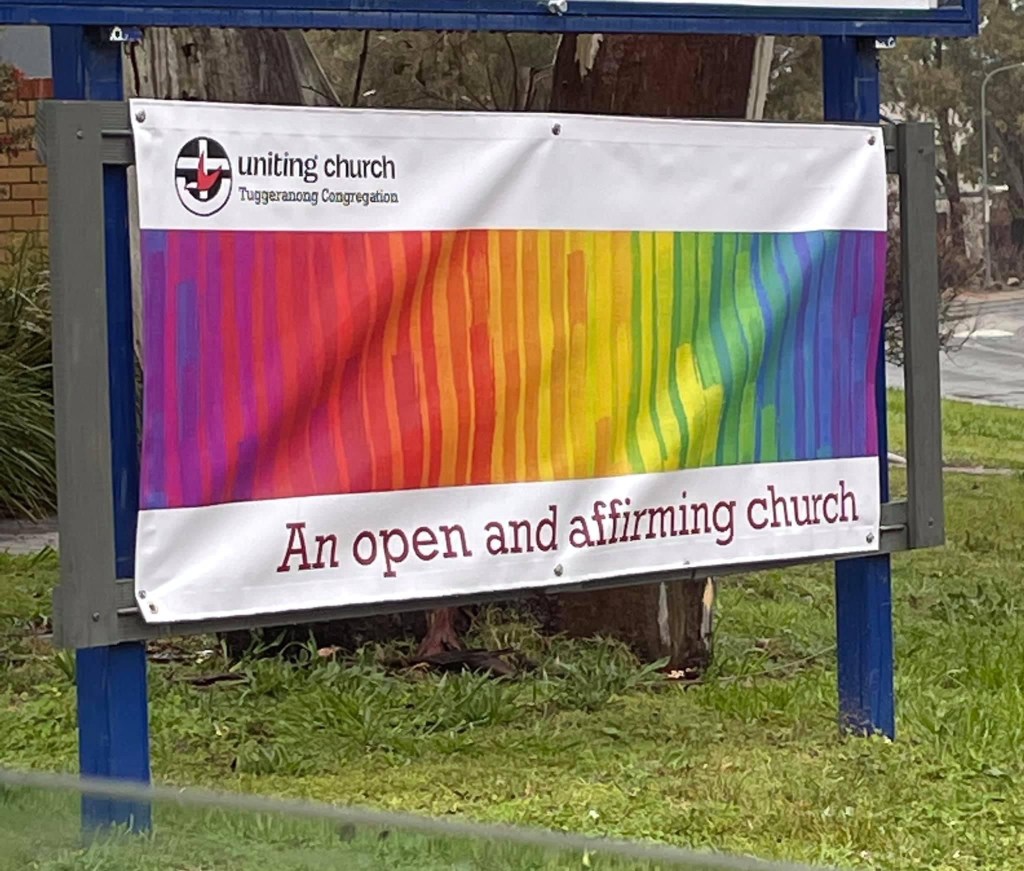
The Task Group is currently engaged in a series of listening encounters with members of the LGBTIQA+ community within the Uniting Church, to hear the views of such people about the proposed apology. I was present earlier this week as three members of the Task Group met with members of the Rainbow Christian Alliance, which meets monthly at Tuggeranong Uniting Church in Canberra, a congregation which is an open and affirming church.
The work of the Task Group was explained, and there was opportunity for LGBTIQA+ people who were present in person and online to make comments about their experiences in the church, and their hopes for the process of formulating and delivering the apology.
The conversation was respectful, caring, and person-centred. There was an indication that the Uniting Church had recognised how words and actions from many church people over many years have caused hurt, grief, and despair. There was a recognition that we need to demonstrate that we see, hear, acknowledge, value, and honour LGBTIQA+ people in their own right, as they are, without reservation, and certainly without in any way pressuring them to change.
It struck me during this time of conversation how different the two approaches are; those who take an aggressively apologetic stance towards people who hold a different point of view, and seek to prosecute their case through debate and argumentation, are presenting a very different model of church to that offered by the process of listening to LGBTIQA+ people in order to develop an apology to them.
(I’m not saying that we in the Uniting Church have got this right—not at all—just that we are aware of the need to take care in our stance, and to shape a careful and compassionate path; and that we are trying to do this with good intentions and in partnership with LGBTIQA+ people.)
Given all the negativity that currently exists in society in relation to “the church”, I think it is important that we carefully consider how we present ourselves to people in that wider society. A posture of compassionate listening and respectful conversation, and the offering of a deeply-felt apology, is surely what we need for our times.
*****
The ecumenical group Equal Voices has prepared an Apology for consideration by people of all denominations; see https://equalvoices.org.au/apologise/
A dialogue from the first century, presented at Tuggeranong Uniting Church on Sunday 10 July 2022, by the Rev. Elizabeth Raine and the Rev. Dr John Squires. The characters are Boaz and his neighbour, Abigail.
*****
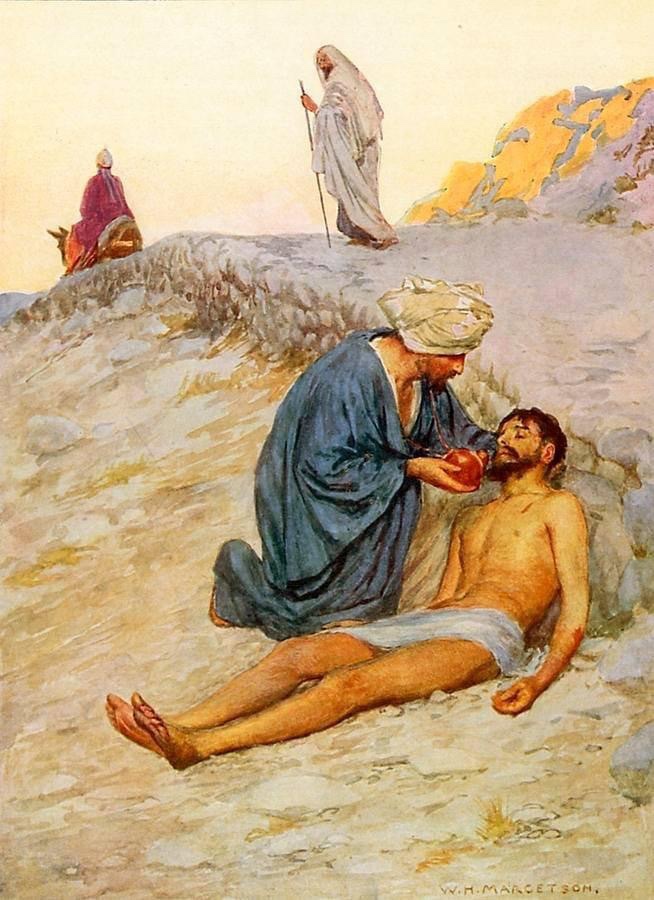
Ah, Abigail. I have been looking for you. I wanted to get your opinion of the story that was told by Jeshua yesterday. Imagine! A Samaritan helping a Jew! Unheard of! Impossible! What was Jeshua thinking?
I thought it was a good story. It showed that God’s love should be extended to all people by all people. Don’t you think that by using the character of the Samaritan Jeshua made the point well?
Well, yes, I understand the broad principle. But a Samaritan helping a Jew? I haven’t forgotten the time when the Samaritans scattered bones of dead people in the Temple precincts and defiled it. To say nothing of their wholesale rejection of Jerusalem and our priests.
But isn’t that part of Jeshua’s point? This is a story to push the boundaries. This is a story about radical love. This story is not just about etiquette for travelers. It is not even just about compassion, and generosity. This story demands that we embrace opportunities to practice love for others in powerful and new ways.
Whoa, there, Abigail. You are getting carried away. Let us talk about this story a little bit more. I want to start at the beginning. You know, of course, that one of the scribes challenged Jeshua about his knowledge of the law. I thought it was a good question, aimed at seeing whether the disciples were operating within the law when they went on their mission. “Teacher, what must I do to inherit eternal life?”
Well, I thought the question came from nowhere. I thought the scribe was testing Jeshua. I thought the scribe was trying to embarrass Jeshua in front of the crowd, and trying to make himself look good.
Of course the scribe was trying to make himself look more learned. That is the whole point of these debates, Abigail. You women do not understand these things. This was a normal debate between men, a verbal banter with Jeshua about interpretation and understanding of Torah. The scribe did this because he respected Jesus. This is a common social exchange in which one learned person challenges the actions or words of another. The scribe was not “testing” Jeshua in a right and wrong sense. This was a challenge about honour, to see whether Jeshua could back up his beliefs.
You can see this from the way that Jeshua responds to the scribe’s question with two questions of his own: “What does the law say? What do you read there?” The scribe would have been well versed in the law and would know the answer to the question he poses to Jeshua. He would also have known the answer to the question of the law Jeshua asks of him. This is how these things work.
I think I understand. You are saying that is why the scribe replied with an answer based on the law (Deut. 6:4–5; Luke 19:18), and why Jeshua commends him.
Yes. The scribe then keeps the debate going with the next question: “And who is my neighbour (v.29)?” This is a good question. The Torah states clearly who is a neighbor and how that neighbour should be treated. The scribe is waiting for Jeshua to give a response that is consistent with the teaching of the law.
Ah, But he doesn’t does, he? I thought Jeshua’s response was very unexpected. He tells a story. I think this appreciated by the crowd. Not everyone understands these learned debates about Torah. Jeshua set his teaching in a place that is familiar, though a place that is a bit uncomfortable – on the road between Jericho and Jerusalem.
You are right about the uncomfortable bit. That road is notorious for bandits and thieves. I thought it strange that Jeshua had all his characters alone on this road. Sensible people travel this route in groups for protection. I can tell you, the thought of being alone on this road made me feel very uncomfortable, even a tad afraid.
Yes, I felt the same way. A lone man going down the road from Jerusalem to Jericho is asking for trouble. It was no surprise to hear that he was stripped beaten, and left half dead. And imagine how difficult it would be to help him. He has been stripped of his clothes, and everything that would identify him and his social class and his religion. You wouldn’t be able to tell whether he was Jew or Gentile, or Roman or Greek.
The next part of the story reminded me of those jokes you hear. A priest, a Levite and an Israelite come walking by … you know the ones I mean.
Ah, but that was the twist. You know, beginning with a priest made me feel a bit awkward. You know how high and mighty they can appear. And they are in cahoots with the Romans. Not surprised a priest wouldn’t stop.
Or a Levite. They are just as snobbish. Think they are better because they are descended from an ancient lineage. I am descended from equally ancient people, so I don’t see why they believe they are closer to God than me.
Yes indeed. But it is the next bit that is surprising. You mentioned those stories that start with a priest, a Levite and an Israelite. That is the twist. We expected Jeshua to make an Israelite the hero of the story.
Well, that’s right. The hero is meant to be one of our kind, a regular down-to-earth type like you and me, the one you are expecting to come to the rescue of the poor, wounded man. But no! Jeshua goes and gets it mixed up. It’s not one of our own kind who saves the day – it’s an enemy, a Samaritan, an outsider. Samaritans don’t worship like us, they don’t act like us, they don’t live where we live, and there’s no way one of them should have been the hero.
I bet your stomach was churning by then, Boaz! But really, why should you be so offended?
You seem to have forgotten how Jeshua himself was treated by the Samaritans. Remember when a Samaritan village refused to welcome him? This was very poor form, you know how much hospitality means to travellers.
Well, the priest and the Levite weren’t much use, were they?
My friend Zedekiah says that the priest and Levite couldn’t stop because they risked making themselves unclean on behalf of a stranger. Or maybe they were afraid they would become victims themselves if they stopped. I suppose we should remember that the priest and Levite are both descendants of the tribe of Levi with different sets of duties in the temple, and they are bound to obey the Law. They could have been in violation of the Law as written in Leviticus (Lev. 21:11) if they touched a body by the road.
I think you are asking the wrong question here. Jeshua did not mean us to start inventing excuses as to why the priest and Levite didn’t stop. I think that Jeshua wants us to consider why he picked a priest, a Levite and a Samaritan. What were they symbolizing, do you think?
Mmmm, let me think. The wounded man, though unidentified, is a Jew. The Priest and Levite are also Jews. The debate with the scribe is about interpreting Jewish law governing ‘neighbour’. Are you suggesting that the Priest and the Levite somehow represent the law?
Well, one would expect them to know the law. And the law says ‘Love you neighbour as yourself’. They would know that. They were not obeying this law by walking past, and let’s face it, they could easily purify themselves once they got back to the Temple and Jerusalem. No, Jeshua is asking a deeper question here. To really drive home his point, Jeshua then sticks the most unlikely hero into the story, the one most likely to make us feel uncomfortable.
I am sorry, but the hostility between our races is well founded. We do not worship in the same place. We have different versions of the Torah. The Samaritans married foreign women. And the list goes on.
You forget that we are all descendants of the same ancestors. Why should we allow what are really small things to become a great wall that divides us?
The Torah speaks of loving of God and loving neighbour, and surely it is clear that the neighbour being understood is a Jew.
This comes back to my original point. This is a story to push the boundaries. This is a story about radical love. It challenges us to think differently. The Samaritan, the one who is hated and despised by Jews, becomes the hero of the story. Surely this must bring a new dimension to understanding what we mean by ‘neighbour’?
I think I begin to see your point. The scribe’s question: “Who is my neighbour?” has a different answer from what we are expecting.
Yes. Jesus does not answer the question directly for this reason. The parable poses a new question, “Which of these three, do you think, was a neighbour to the man who fell into the hands of the robbers?”
Of course. The Samaritan is the one who tends the injured man. Jeshua is saying that acting as a neighbour is what is important. Neighbour is not a group, or a religion, or a race. It is about doing the right thing.
I cannot help thinking, Boaz, that Jeshua wants us to act in this way ourselves, not just with very injured people, but with others in need. Surely he is asking us who are those fallen by the way in our communities and the ones who need our help? I am ashamed to admit that like the Priest and the Levite, I see situations where I could help and walk away because I have other things to do or I don’t want to get involved.
So to truly follow the law is to embrace everyone as neighbour. So you think that for the scribe, God is the God of Israel, and neighbours are Jewish neighbors. But for Jeshua, Israel’s God is the God for the whole world and a neighbour is anybody in need.
Yes, but it is more than that. Jeshua is not just saying ‘help those in need’ but also don’t judge others who you don’t agree with – like the Samaritan.
It seems to me that a lot of hatred in our country is religiously based and rooted in historical things like wars and other arguments. No doubt Samaritans are taught to hate the Jews in the same way Jews are taught to hate them.
And remember that the Samaritan in the story is in our territory, and the robbers might still be hanging around, waiting for their next victim. But he doesn’t let the Law, or fear, or the knowledge that he is hated keep him from providing care and compassion. He doesn’t even know if will be paid back, yet he still does this amazing act of kindness. Surely this is the sort of kindness and faith that Jesus is all about?
*****
(at this point we lose contact with the dialogue, and return to the 21st century)
This story prompts us to be more open to opportunities to be neighbour. We need to look for places where we can engage with those who need our help, and not just with those who are like us.
Can compassion move us in a way that defies traditional stereotypical understandings of people and embraces all as equals, as neighbours, as residents of a global community?
Jesus challenges the lawyer to go out and do likewise, to be such a neighbour. Are we willing to do the same?
Australian citizens go to the polls to elect a federal government on 21 May. The 17 million people eligible to vote will be electing both a local member to sit in the House of Representatives for the next three years; and a number of senators, to sit in the Senate for the next six years.
To assist voters in considering how they might vote, the Uniting Church has prepared a resource that identifies a number of issues, in seven key areas, that should inform the way that we vote, if we take seriously how the Gospel. calls us to live.
The third area reflects the vision of the Uniting Church for A Welcoming, Compassionate, and Diverse Nation. The election resource acknowledges that we are a nation of diverse cultures, languages, faiths, ethnic groups and experiences, and affirms: “We celebrate and value the strength of this diversity. We see this diversity reflected in our leaders, key decision makers, institutions, industry, sports and media. We are a compassionate nation, where every person who seeks refuge here is treated fairly and made to feel welcome and safe – regardless of their country of origin or mode of arrival.”
Australia’s immigration policies continue to leave some people in indefinite detention. Some refugees and asylum seekers in Melbourne’s Park Hotel have been in offshore and onshore detention for up to nine years. Across the country, it is estimated more than 70 people are being held in hotel detention, and, as of 31 December 2021, 105 people remained in PNG and 114 on Nauru. In response to the Afghanistan crisis, the Australian Government has committed to 10,000 humanitarian and 5,000 family reunion places over four years.
However, the 10,000 places will be taken from Australia’s current refugee and humanitarian program, which was cut by 5,000 places a year from 2020. Australia has received applications from more than 145,000 Afghan nationals and very few of those people have any hope of building a life of safety in Australia1. In addition, the recent and ongoing conflict in Ukraine will see more people fleeing their homes in fear, seeking refuge in other countries.
The key issues to inform our voting in this regard are what each candidate or their party says about:
• An end to mandatory and indefinite off-shore and on-shore detention either in Alternative Places of Detention (hotels) or detention centres.
• Community detention of refugees and asylum seekers must allow access to education, work and housing support.
• A target for Afghan and Ukrainian refugee resettlement much higher and appropriate to the magnitude of the problem.
• Permanent protection for Afghan people already in Australia but on temporary visas.
• Enhance safeguards for people on temporary visas including including overseas students andmigrant workers.















 An Informed Faith