Maintaining faith in God in difficult circumstances (Psalm 22; Lent 2B)

In the psalm that is set for the Second Sunday in Lent (a section of Psalm 22), the psalmist exults the worldwide dominion of the Lord God and sings that “to [the Lord], indeed, shall all who sleep in the earth bow down; before him shall bow all who go down to the dust, and I shall live for him” (Ps 22:29).
This psalm is best known for its opening line, “my God, my God, why have you forsaken me?” (Ps 22:1a), as this is the last word of Jesus as he dies on the cross, at least according to two evangelists (Mark 15:34; Matt 27:46). The psalm is one of the psalms of individual lament, as the psalmist reflects the wretched condition of a person who is suffering unjustly, as the psalmist cries, “why are you so far from helping me, from the words of my groaning? … I am a worm, and not a human … all who see me mock at me; they make mouths at me, they shake their heads …. I am poured out like water, and all my bones are out of joint; my heart is like wax; it is melted within my breast; my mouth is dried up like a potsherd, and my tongue sticks to my jaws; you lay me in the dust of death.” (Ps 22:1, 6, 14–15).

The other psalms usually considered to express individual lament reflect similar ideas: Ps 3 (“O Lord, how many are my foes! many are rising against me), Ps 6 (“be gracious to me, O Lord, for I am languishing”, Ps 13 (“how long will you hide your face from me?), Ps 25 (“I am lonely and afflicted; relieve the troubles of my heart, and bring me out of my distress”), Ps 31 (“my eye wastes away from grief, my soul and body also; for my life is spent with sorrow, and my years with sighing”), Ps 71 (“in your righteousness deliver me and rescue me; incline your ear to me and save me”), Ps 77 (“I think of God, and I moan; I meditate, and my spirit faints”), Ps 86 (“O God, the insolent rise up against me; a band of ruffians seeks my life, and they do not set you before them”), and Ps 142 (“with my voice I cry to the Lord; with my voice I make supplication to the Lord”).
However, the section of the psalm that is offered for this coming Sunday (Ps 22:23–31) comes from the second half of the psalm, where—as is typical of many psalms of lament—the mood turns from internal personal introspection, to an external offering of praise and adoration to God. In each psalm the undergirding assumption is that God does care, God will act, and the trials of the present will be swept away. They are psalms imbued both with the sober reality of the human condition, and an unswerving optimism that faith in God will ensure an ultimate condition of salvation, deliverance, redemption.

Although the psalms offered by the lectionary are chosen each Sunday to provide a companion piece to the Hebrew Scripture passage, this element of this psalm makes it a most fitting accompaniment to the Gospel passage offered this coming Sunday in Lent, as the path that Jesus walks towards the cross is in view during this season.

So the psalmist rejoices. God has dominion over the whole earth: “all the ends of the earth shall remember and turn to the Lord and all the families of the nations shall worship before him; for dominion belongs to the Lord and he rules over the nations” (vv.27–28). This affirmation reflects other parts of Hebrew Scripture where the global reach of God is asserted.

One psalmist calls the ends of the earth “the possession of the Lord” (Ps 2:8), for they “have seen the victory of our God” (Ps 98:3). Both the name and the praise of the Lord “reaches to the ends of the earth” (Ps 48:10), for when God acts to judge the nations, “the it will be known to the ends of the earth that God rules over Jacob” (Ps 59:13). One psalmist declares that God is “the hope of all the ends of the earth and of the farthest seas” (Ps 65:5) and another prays, “may God continue to bless us; let all the ends of the earth revere him” (Ps 67:7).

But in this psalm, the dominion of God reaches beyond this life, to humans who lie in the realm of those who have died. “To him shall all who sleep in the earth bow down; before him shall bow all who go down to the dust” (v.29). A number of other psalms indicate that “in the dust” is where the dead rest (Ps 7:5; 30:9; 90:3; 104:29; likewise Job 10:9; 17:16; 20:11; 21:23–26; 40:12–13).

In Daniel’s grand vision “at the time of the end” (11:40–12:13) he refers to “many of those who sleep in the dust of the earth shall awake, some to everlasting life, and some to shame and everlasting contempt” (12:2). This is a key Hebrew Scripture text which is used in discussions of the resurrection as reported in the New Testament. Clearly, those who “sleep in the dust” are dead.

In the archetypal story that opens Hebrew Scripture, “the dust of the ground” is identified as the source for God’s creation of humanity (Gen 2:7)—and as the place where people’s bodies go when they die. The man Adam is told, “you return to the ground, for out of it you were taken; you are dust, and to dust you shall return.”

God, indeed, “knows how we were made; he remembers that we are dust” (Ps 103:14), and in the end, “all go to one place; all are from the dust, and all turn to dust again” (Eccles 3:20). The Preacher wistfully observes that at the end, “when the years draw near … the silver cord is snapped, and the golden bowl is broken, and the pitcher is broken at the fountain, and the wheel broken at the cistern, and the dust returns to the earth as it was, and the breath returns to God who gave it”, before drawing his inevitable and well-known conclusion, “Vanity of vanities, says the Teacher; all is vanity” (Eccles 12:1, 6–7).

In other passages in the Hebrew Scriptures, those who are dead are located, not in the dust, but in Sheol, in The Pit. These terms each describe the state of the nephesh (the essence of being) of those whose bodies have died. In one psalm, the pit that is dug for “the wicked” describes this place as “the land of silence” (Ps 94:17), while the prophet Ezekiel imagines it as the place where the dead, the “people of long ago” lie “among primeval ruins” (Ezek 26:20).

In Psalm 88, when the psalmist laments “my soul is full of troubles”, they use these and other terms in poetic parallelism to describe their fate: “my life draws near to Sheol; I am counted among those who go down to the Pit; I am like those who have no help, like those forsaken among the dead, like the slain that lie in the grave, like those whom you remember no more, for they are cut off from your hand; you have put me in the depths of the Pit, in the regions dark and deep” (Ps 88:3–6).

In this state, people simply lie in darkness, not living, with no future in view, no hope in store. Job laments, “if I look for Sheol as my house, if I spread my couch in darkness, if I say to the Pit, ‘You are my father,’ and to the worm, ‘My mother,’ or ‘My sister,’ where then is my hope?” (Job 17:13-15). Job also equates entering the Pit with “traversing the River” (Job 33:18), in words that seem to reflect the River Hubur (in Sumerian cosmology) or the River Styx (in Greek cosmology), the place where the souls of the dead cross over into the netherworld.

Other words for Sheol in Hebrew Scripture include Abaddon, meaning ruin (Ps 88:11; Job 28:22; Prov 15:11) and Shakhat, meaning corruption (Isa 38:17; Ezek 28:8). These terms indicate the forlorn, lost, irretrievable nature of this state of being. This is the fate in store for all human beings, whether righteous or wicked; there is no sense of judgement or punishment associated with this state. It is simply a state of non-being.

And yet, even in this state—this state where “my mouth is dried up like a potsherd, and my tongue sticks to my jaws; you lay me in the dust of death” (Ps 22:15)—the psalmist finds hope. They are confident that the Lord God “raises up the needy out of distress” (Ps 107:41) and “lifts up the downtrodden” (Ps 147:5). In like manner, Hannah has sung that the Lord “raises the poor from the dust and lifts the needy from the ash heap” (1 Sam 2:8; also Ps 113:7).

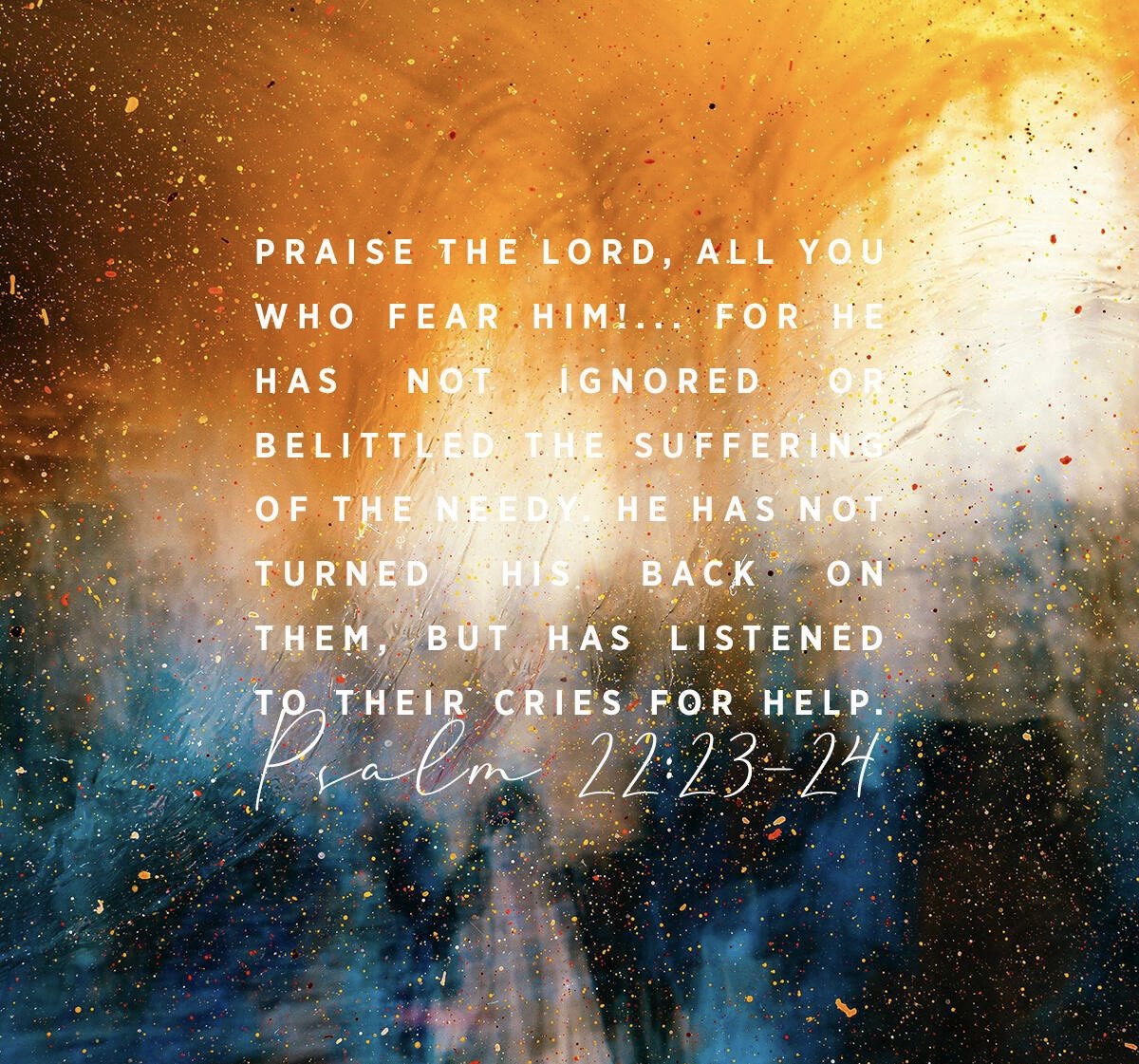
And so the psalmist bursts into praise for what, they are confident, God will do. Calling for their listeners to “praise [the Lord] … glorify him … stand in awe of him” (Ps 22:23), they affirm that God “did not despise or abhor the affliction of the afflicted; he did not hide his face from me, but heard when I cried to him” (v.24) and rejoice that “the poor shall eat and be satisfied” (v.26).

The psalmist is certain not only that “the ends of the earth shall remember and turn to the Lord and all the families of the nations shall worship before him” (v.27), but also that “posterity will serve him; future generations will be told about the Lord, and proclaim his deliverance to a people yet unborn, saying that he has done it” (vv.30–31).

And so, they offer this resounding declaration of hope: “to him, indeed, shall all who sleep in the earth bow down; before him shall bow all who go down to the dust” (v.29). It is that hope which we hear, and affirm, when these closing verses of this psalm (vv.23–31) are read or sung during this coming Sunday’s worship.

A prophet like Moses (Deut 18; Epiphany 4B)

“I will raise up for them a prophet like you from among their own people; I will put my words in the mouth of the prophet, who shall speak to them everything that I command” (Deut 18:18). These words are the heart of the Hebrew Scripture passage which the Revised Common Lectionary proposes for this coming Sunday, the Fourth Sunday after Epiphany.

Here, Moses informs the people that, just as he spoke words placed into his mouth by God, so there will be later individuals who also will speak words given to them by God. And so, Israel is assured of the presence of a prophet in their midst throughout the centuries.

Indeed, a number of the prophets of Israel remind us that they speak forth “the voice of the Lord” (Isa 66:6; Jer 42:5–6; Dan 9:9–10; Mic 6:9; Hag 1:12; Zech 6:15). Jesus stands in this tradition, offering words of guidance, challenge, and judgement. In traditional Christian understanding, he is the way by which, “in these last days, God … has spoken to us” (Heb 1:1–2).

What will the prophet speak? In so many reports of prophetic activity, it is justice which is the heart of their message—God’s justice; the justice which God desires for the people of God; the justice which God speaks through the voice of the prophets; the justice that God calls for in Israel; the justice that provides the measure against which Israel will be judged, and saved, or condemned.

Moses himself was charged with ensuring that justice was in place in Israelite society. One story told of the time after the Israelites had escaped from Egypt places Moses as a judge. Whilst in the wilderness of Sin, being visited by his father-in-law Jethro, we learn that “Moses sat as judge for the people, while the people stood around him from morning until evening” (Exod 18:13).

Noticing that Moses was overwhelmed by the volume of matters requiring adjudgment, Jethro suggested—and Moses adopted—a system whereby appointed men who “judged the people at all times; hard cases they brought to Moses, but any minor case they decided themselves” (Exod 18:14–16). The charge given to these men is clear: they are to give a fair hearing to every member of the community, and they “must not be partial in judging: hear out the small and the great alike; [do] not be intimidated by anyone, for the judgment is God’s” (Deut 1:16–17).

Prophets coming after Moses thus inherited this responsibility to ensure that justice was upheld within society. Amos calls for “justice and righteousness” (Amos 5:22). Micah asks the question, “what does the Lord require of you but to do justice?” (Mic 6:8), while through the prophet Hosea, the Lord God promises to Israel, “I will take you for my wife in righteousness and in justice, in steadfast love, and in mercy” (Hos 2:19).

Isaiah ends his famous love-song of of the vineyard by declaring that God “expected justice” (Isa 5:7); Jeremiah notes the need to “not oppress the sojourner, the fatherless, or the widow” (Jer 7:5–7). Second Isaiah foresees that the coming Servant “will bring forth justice to the nations” (Isa 42:1) while Third Isaiah begins his words with a direct declaration, “maintain justice, and do what is right” (Isa 56:1), for “I the Lord love justice” (Isa 62:8).

This commitment resonates with the psalmist, who praises “the God of Jacob … who executes justice for the oppressed; who gives food to the hungry … [who] sets the prisoners free, [who] opens the eyes of the blind, [who] lifts up those who are bowed down [and] loves the righteous, [who] watches over the strangers [and] upholds the orphan and the widow” (Ps 146:5, 7–9). See

It may be significant that, in this year when Mark’s Gospel is featured in the lectionary, the Hebrew Scripture passages offered during the short season of Epiphany are drawn from the books of the prophets: 1 Samuel, Jonah, this passage from Deuteronomy, Isaiah, and then the story of Elijah and Elisha in 2 Kings. These passages help us to see in clear focus the way that Jesus operates like a prophet in Mark’s narrative. See

So the offering of the Deuteronomy passage this week particularly pushes us to consider how Jesus might be seen as a prophet, one whom God raised up to be like Moses (Deut 18:15-18). There are three key features of Mark’s portrayal of Jesus which depict him in a prophetic vein: words and deeds, a kingdom focus, and the importance of repentance.

I Words and deeds

Words, of course, are important, both for the prophets, and for Jesus. “Thus says the Lord”, a commonplace of prophetic rhetoric, is reflected in the comments of the Markan narrator that Jesus “went about all the villages teaching” (Mark 6:6), proclaiming his message (1:14–15, 38) and speaking of the kingdom of God in parables (4:11, 26–32; 12:1–12), in sayings (9:1, 47; 10:14–15, 23–25; 12:34), and in an extended apocalyptic discourse (13:3-37). Words were central to his public and private activity.

Jesus is remembered, however, as “a prophet mighty in deed and word” (Luke 24:19), so the deeds he performed are equally as important as the words he spoke. Indeed, this was always the case for prophets; God gave Moses words to speak and signs to perform (Exod 4:28–30), and the prophets that followed him accompany their message with acts that manifest the truth of what is proclaimed: Ahijah tearing his garment into twelve pieces (1 Ki 11), Isaiah walking naked for three years (Isa 20), Jeremiah buying and then breaking an earthenware jug (Jer 19), Ezekiel eating a scroll (Ezek 3), Ezekiel shaving his head and slashing the hair with a sword (Ezek 5), and many more.

In like manner, Jesus sent out his followers to proclaim his message, but also to “cast out many demons and anoint with oil many who were sick and cure them” (Mark 6:12–13). Word and deed belong together. So Mark reports, alongside the parables and sayings of Jesus, numerous instances when Jesus healed people (2:1–12; 3:1–6; 3:22; 5:21–43; 6:5, 53–56; 7:31–37: 8:22–26; 10:46–52), cast out demons and unclean spirits (1:21–28, 32–34, 39; 3:11; 5:1–20; 7:24–30; 9:14–29), as well as miraculously fed multitudes (6:30–44; 8:1–10), cleansed a leper (1:40–45), stilled a storm (4:35–41), and walked on water (6:45–52).

II The coming kingdom

Another way in which Jesus reflects his prophetic calling was through the kingdom focus in his teaching. That the imminence of the kingdom is a key note for Jesus is reflected both in his opening words in Mark (“the time is fulfilled, and the kingdom of God has come near”, 1:15a) and in some of his final words to his closest followers (“I will never again drink of the fruit of the vine until that day when I drink it new in the kingdom of God”, 14:25).

Jesus has so shaped the expectations of his followers that they anticipate this coming with intensity. “There are some standing here who will not taste death until they see that the kingdom of God has come with power”, he told them (9:1); to one enquirer, he affirmed, “you are not far from the kingdom of God” (12:34), and after his death, another follower who was “waiting expectantly for the kingdom of God ensured that the body of Jesus was cared for (15:43).

When some of his disciples hindered children wanting to come to him, Jesus chided them, saying, “whoever does not receive the kingdom of God as a little child will never enter it” (10:15); a little later, to his disciples, he warned, “how hard it will be for those who have wealth to enter the kingdom of God!” (10:23).

The final extended discourse of Jesus that Mark reports (13:4–37) provides reassurance of the sovereignty of God in the midst of crises and calamities. These events are but “the beginning of the birth pangs” (13:8). Jesus affirms that those enduring will be saved by divine action (13:13, 20), culminating in the appearance of “‘the Son of Man coming in clouds’ with great power and glory” (13:26) and the gathering of the elect by the angels of God (13:27).

The kingdom is the realm in which God will act decisively. In the words of the prophets, the kingdom of David and his successors was the realm in which God was seen to be active; after that kingdom was conquered and its people taken captive, the prophetic voices of Israel began to develop a notion that, at some time in the future, there would indeed be a kingdom which would be the realm in which God would be active. The prophetic hope in The Day when God would act came to full, dramatic expression in the apocalyptic portrayals of The End that was anticipated.

See

III Metanoia: a complete transformation

Proclaiming that repentance, metanoia, is the essential prerequisite for entry into that kingdom in order to fulfil God’s justice is a third feature of Mark’s portrayal of Jesus in the manner of a prophet. The first word of Jesus in Mark’s early account is clear: “the time is fulfilled, and the kingdom of God has come near; repent (metanoeite) and believe (pisteuete) in the good news” (1:15).

In this programmatic Markan announcement, the two statements (in the indicative mood) about “the time” and “the kingdom” are followed by two commands (in the imperative mood) to “repent” and “believe”. The imminence of the kingdom is the motivation for the call to repent and believe.

This call to repent is evident in the activity of the followers of Jesus who are sent out in pairs with “authority over the unclean spirits”; as they cast out demons and cured the sick, so they also “they proclaimed that all should repent” (6:7–13). Beyond that, the explicit call to repent is not repeated by Jesus, but its presence is evident throughout the narrative.

Jesus calls people to follow him; fishermen Peter and Andrew “left their nets and followed him” (1:18), fishermen James and John “left their father Zebedee in the boat with the hired men, and followed him” (1:20), and tax collector Levi son of Alphaeus, “got up and followed him” (2:14). Leaving behind signals the complete transformation undertaken by following Jesus.

Following Jesus is akin to taking up the cross, a sign of social rejection and alienation as well as personal denial (8:34). Jesus delivers a sequence of three sayings that reflect the complete turnaround that is required to effect metanoia. First, “those who want to save their life will lose it, and those who lose their life for my sake, and for the sake of the gospel, will save it” (8:35). Next, “whoever wants to be first must be last of all and servant of all” (9:35).

And then, “whoever wishes to become great among you must be your servant, and whoever wishes to be first among you must be slave of all” (10:43–44). Jesus himself provides the foundational model for this way of living; as the Son of Man, he came “to give his life a ransom for many” (10:45).

This persistent demand for complete life transformation—metanoia—resonates with Isaiah’s signal declaration that “Zion shall be redeemed by justice, and those in her who repent, by righteousness” (Isa 1:27), and regular prophetic calls to “return to me, says the Lord of hosts … return from your evil ways and from your evil deeds” (Zech 1:3–4); “repent and turn away from your idols; and turn away your faces from all your abominations” (Ezek 14:6; also 18:30), “return to me … remove your abominations from my presence and do not waver” (Jer 4:1); “return to me with all your heart, with fasting, with weeping, and with mourning” (Joel 2:12).

The recurring refrain of Amos, lamenting, “yet you did not return to me, says the Lord” (Amos 4:6,8,9,10,11), leads the prophet to assure Israel that “I will do this to you; prepare to meet your God, O Israel!” (Amos 4:12)—words akin to what the psalmist says, “if one does not repent, God will whet his sword; he has bent and strung his bow; he has prepared his deadly weapons, making his arrows fiery shafts” (Ps 7:12–13).

“I will raise up for them a prophet like you from among their own people; I will put my words in the mouth of the prophet, who shall speak to them everything that I command” (Deut 18:18). In the way that Mark presents Jesus in his narrative, we can see how Jesus speaks and acts in the manner of a prophet like Moses, the archetype of prophetic leadership.
*****

Please Note: in the above comments, I am not seeking to “ prove” that Jesus “fulfils prophecy”. Rather, I am interested to explore the ways that an understanding of Hebrew Scripture can inform the way we read and understand the Gospel narratives about Jesus. For further thoughts on how we read prophetic texts in a Christian context, see

and

Here I am; speak, for your servant is listening (1 Sam 3; Epiphany 2B)

Next Sunday is the second Sunday in the season of Epiphany. The word epiphany refers to the manifesting of light, the shining forth of revelation. It is applied to this season, which follows on from Christmas, and is initiated by the story of “the star in the east” told in Matthew 2:1-12.

The birth of Jesus, and the story of the Magi following the star, signals the early Christian belief that God was acting in a new way through this child. The Magi come from the east, following the star, to pay homage to the infant Jesus. Light is of symbolic significance in this story, as is the theological claim that the child Jesus provides a revelation of God.

Throughout the five Sundays of Epiphany, as indeed throughout much of the year, we hear and read the stories contained in the earliest account of Jesus, the beginning of the good news of Jesus, which we know more typically as the Gospel according to Mark. During these five Sundays, we will hear and read most of the opening chapter of this Gospel (with a detour this coming Sunday to the first chapter of John’s Gospel).

Alongside these Gospel excerpts, the passages set by the lectionary from the Hebrew Scriptures for the season of Epiphany have been carefully chosen. These passages illuminate the message of the Gospel which we hear each week from the New Testament, as we celebrate Christ as the light that comes into the world, illuminating and enlightening.

This week, we hear the story of the call of Samuel to be a prophet of the Lord (1 Sam 3:1–20). We may think of prophets as loud and assertive, boldly proclaiming their “word of the Lord” in the marketplace; but today we learn that Samuel was different. In this story, he is marked by obedience and an openness to listen.

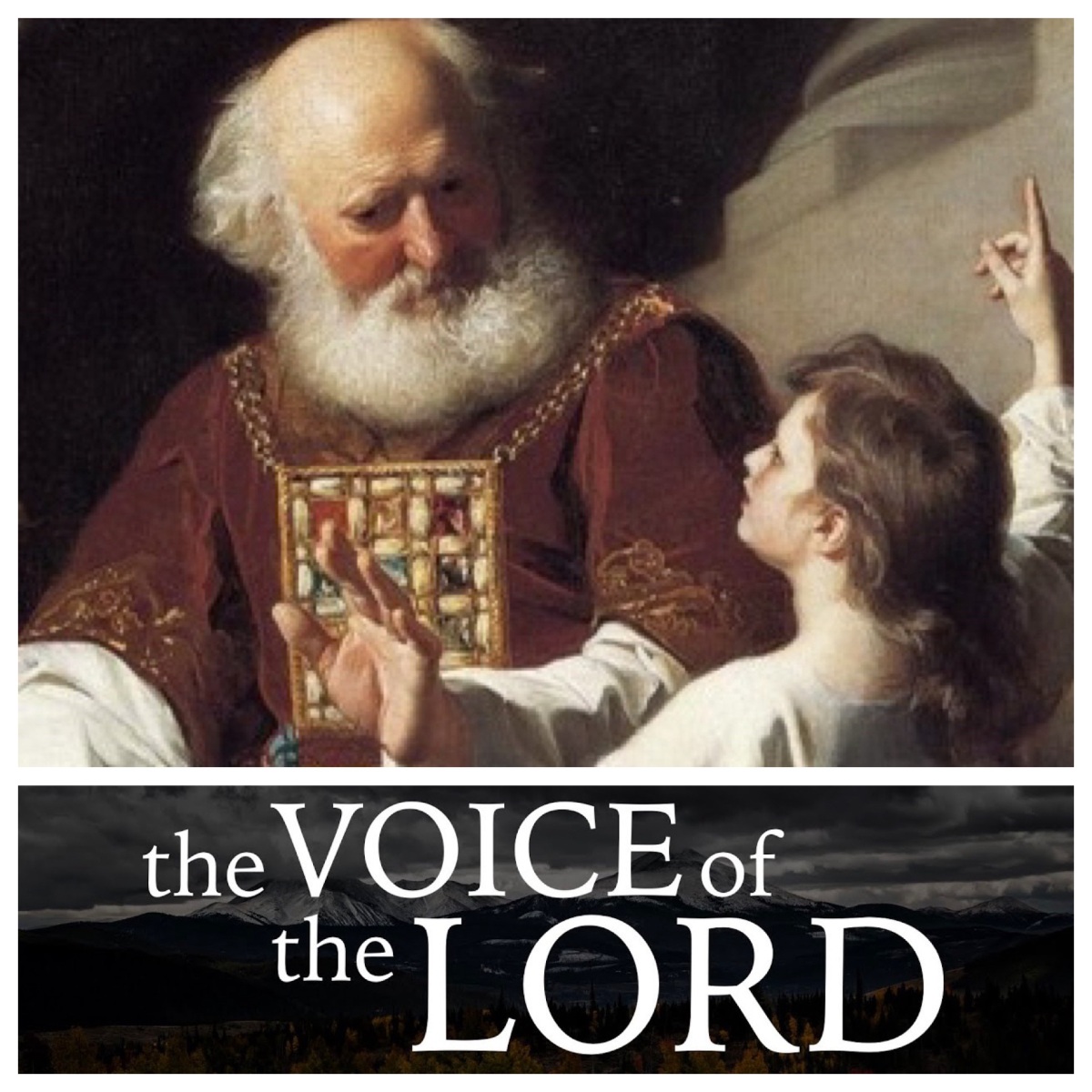
Young Samuel was in the temple, where the elderly Eli was priest. In the evening, while the lamp was still burning, Samuel hears a voice. The voice simply calls his name. “Here I am”, Samuel responds when he hears that voice. He is sure that it is Samuel,speaking to him—there is nobody else around. Three times, he hears “Samuel”; and three times, he responds “here I am” (vv.4,6,8).

Samuel had been thinking that it was Eli speaking to him; but it was not the priest, it was the voice of the Lord. The story conveys a sense of confusion and unknowing. This reflects something of the uncertainty that people of faith often have with regard to “hearing the voice of the Lord”.

Indeed, the fragility of living by faith without clear and obvious demonstration of he presence of God is signalled in the opening verse: “the word of the Lord was rare in those days; visions were not widespread” (v.1). The poor vision of the elderly priest, Eli (v.2), is a second signal of this uncertainty. The priest cannot see; the child hears but does not understand.

Paying attention to the voice of the Lord is a persistent refrain in Hebrew Scriptures. Indeed, the psalmist rejoices in the clarity of God’s voice: “the voice of the Lord is over the waters; the God of glory thunders, the Lord, over mighty waters; the voice of the Lord is powerful; the voice of the Lord is full of majesty” (Ps 29:3–4). Yet another psalmist recalls the time, in the wilderness, when the people of Israel “grumbled in their tents, and did not obey the voice of the Lord” (Ps 106:25). The people were not always faithful, even though the voice sounded with clarity. They needed reminders of that voice.

In the foundational saga of Israel, Moses is called by the voice of God while tending sheep on Mount Horeb (Exod 3:4). In obedience, he leads the people to freedom—and then informs the people, “if you will listen carefully to the voice of the Lord your God, and do what is right in his sight, and give heed to his commandments and keep all his statutes”, then God promises not to inflict them with disease (Exod 15:26). Later, when Moses has delivered to them “all the words of the Lord and all the ordinances”, the response of the people is an affirmative “all the words that the Lord has spoken we will do” (Exod 24:3).

A number of the prophets indicate that they are impelled to declare “the word of the Lord” to a sinful people because they have heard, and are obedient to, “the voice of the Lord”. Isaiah hears the voice of the Lord calling him: “whom shall I send, and who will go for us?” (Isa 6:8). Isaiah is given words of woe to pronounce over the people (Isa 6:9–13); he warns the leaders of Israel, “listen, and hear my voice; pay attention, and hear my speech” (Isa 28:23).

His fellow-southerner, the shepherd Amos, opens his words with the bold declaration, “the Lord roars from Zion, and utters his voice from Jerusalem” (Amos 1:2), before he launches into his long series of oracles against the surrounding nations (Amos 1:3—2:3) and then against Judah and Israel (Amos 2:4–16).

The image of the Lord God as a roaring lion is used also by Joel, “the Lord roars from Zion, and utters his voice from Jerusalem, and the heavens and the earth shake” (Joel 3:16), while in another oracle he says, “the Lord utters his voice at the head of his army; how vast is his host!” (Joel 2:11).

Joel’s words of judgement penetrate to the heart of the evil of the people: the coming day will be “a day of darkness and gloom, a day of clouds and thick darkness!” (Joel 2:2), and so he calls the people to “return to [the Lord] with all your heart, with fasting, with weeping, and with mourning; rend your hearts and not your clothing” (Joel 2:12–13).

Micah also declares, “the voice of the Lord cries to the city (it is sound wisdom to fear your name)” (Mic 6:9) before he lambasts the people for their wickedness: “your wealthy are full of violence; your inhabitants speak lies, with tongues of deceit in their mouths” (Mic 6:12; the whole damning oracle is 6:9–16).

Called as a youth by “the word of the Lord” (Jer 1:4–8), Jeremiah hears the assurance, “I have put my words in your mouth” (Jer 1:9); the prophet later instructs the people, “amend your ways and your doings, and obey the voice of the Lord your God, and the Lord will change his mind about the disaster that he has pronounced against you” (Jer 26:13). Again, he tells them, “obey the voice of the Lord in what I say to you, and it shall go well with you, and your life shall be spared” (Jer 38:20). Eventually, the people affirm, “whether it is good or bad, we will obey the voice of the Lord our God to whom we are sending you, in order that it may go well with us when we obey the voice of the Lord our God” (Jer 42:6).

In the return from exile, both Haggai (Hag 1:12) and Zechariah (Zech 6:15) rejoice that Israel “obeyed the voice of the Lord their God”; but Daniel laments that his people “have not obeyed the voice of the Lord our God by following his laws, which he set before us by his servants the prophets; Israel has transgressed your law and turned aside, refusing to obey your voice” (Dan 9:10).

And yet, various prophets had hesitated when first hearing “the voice of the Lord”. The initial response of Moses is “who am I that I should go to Pharaoh, and bring the Israelites out of Egypt?” (Exod 3:11), followed by a series of further objections that he raises (Exod 3:13; 4:1; 4:10). Amos explains to the priest Amaziah how his call had surprised him: ““I am no prophet, nor a prophet’s son; but I am a herdsman, and a dresser of sycamore trees” (Amos 7:14).

Isaiah seeks to excuse himself from the prophetic task: “I am lost, for I am a man of unclean lips, and I live among a people of unclean lips” (Isa 6:5). Jeremiah objects, “truly I do not know how to speak, for I am only a boy” (Jer 1:6). A number of the prophets are, initially at least, reluctant spokespersons for the Lord God.

By contrast, in the story told in 1 Sam 3, after hearing his name spoken by the Lord for a third time, Samuel responds with a declaration of obedience: “speak, for your servant is listening” (v.10). This was just as the priest Eli had instructed him (v.9). Here, Samuel demonstrates careful listening, patience, openness to what he encounters, and complete obedience to that voice.

His response is similar to that of Mary when she is given startling news: “Here am I, the servant of the Lord; let it be with me according to your word” (Luke 1:38). Soon after that, she produced an amazing prophetic oracle, which we know as the Magnificat, declaring that God has “scattered the proud in the thoughts of their hearts … brought down the powerful from their thrones, and lifted up the lowly … filled the hungry with good things, and sent the rich away empty” (Luke 1:51–53). Like Samuel, she proves to be an important prophetic voice.

This story from the early years of Samuel’s life is remembered and retold because it instructs those who hear it in later generations, to listen, and to obey. It is a reminder that being “guided by God” is not always clear and obvious. It is also a reminder of the need to respond with faith and openness; to be obedient. It is a story worth hearing, and pondering.

A star and some magi, a tyrant and some infants (Matt 2; Epiphany)

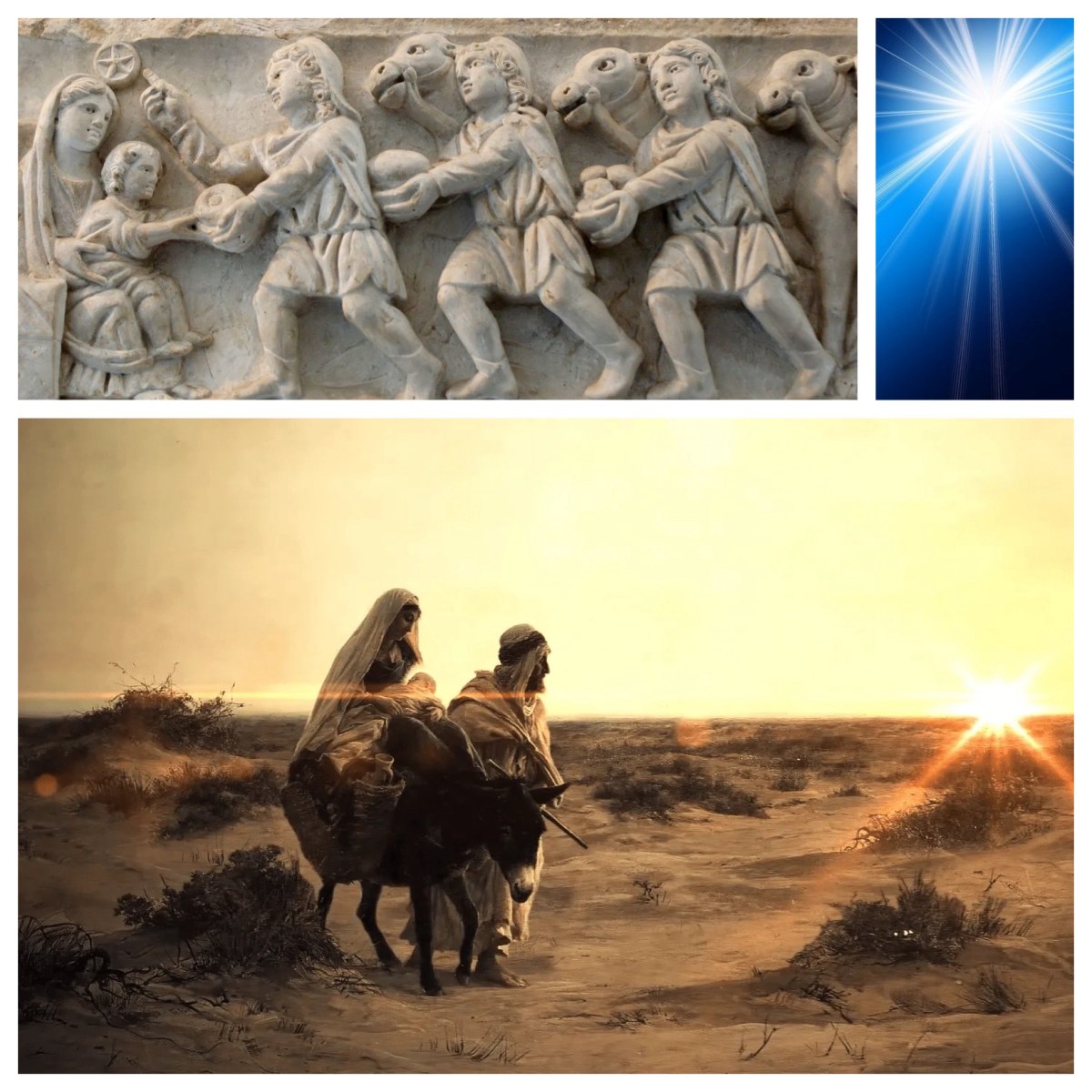
Each year, on the Feast of the Epiphany (6 January), we hear the story that is told in the book of origins (the Gospel according to Matthew) about the infant Jesus, the magi who travel with gifts to offer him, and the tyrant Herod (Matt 2:1–12). We usually stop the story before the account of the slaughter of children which Herod orders, and the flight into Egypt which Jesus undertakes with his mother, Mary, and his father, Joseph (Matt 2:13–18).

The much-loved Christmas story, found only in the orderly account of Luke, says nothing of any such high-status visitors to the newborn Jesus. The magi appear only in Matthew’s account. The actual birth of Jesus is mentioned very quickly by Matthew (1:18, 25). By contrast, the dark story of the slaughter of boys aged two and under dominates Matthew’s narrative (Matt 2:16–18). It is in connection with that part of the story that the magi appear.

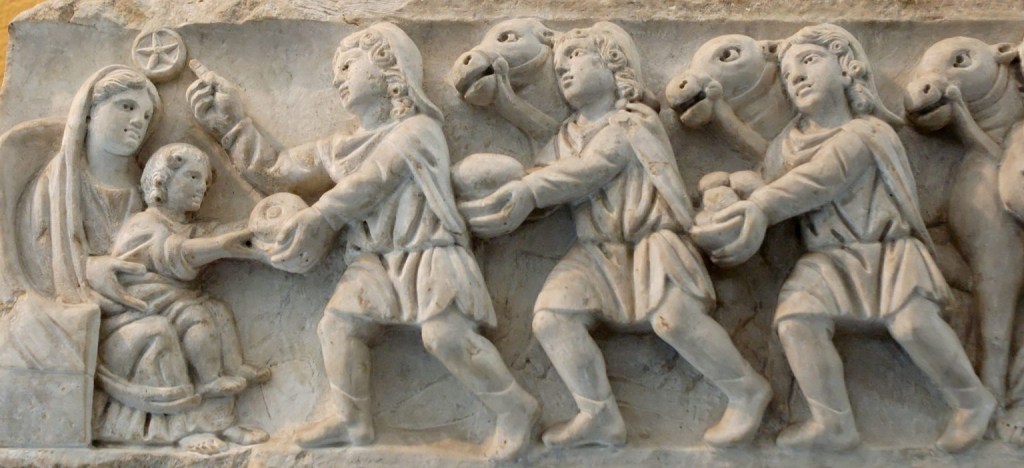
Adoration of the Magi, detail from a 4th century sarcophagus
in the Vatican Museum

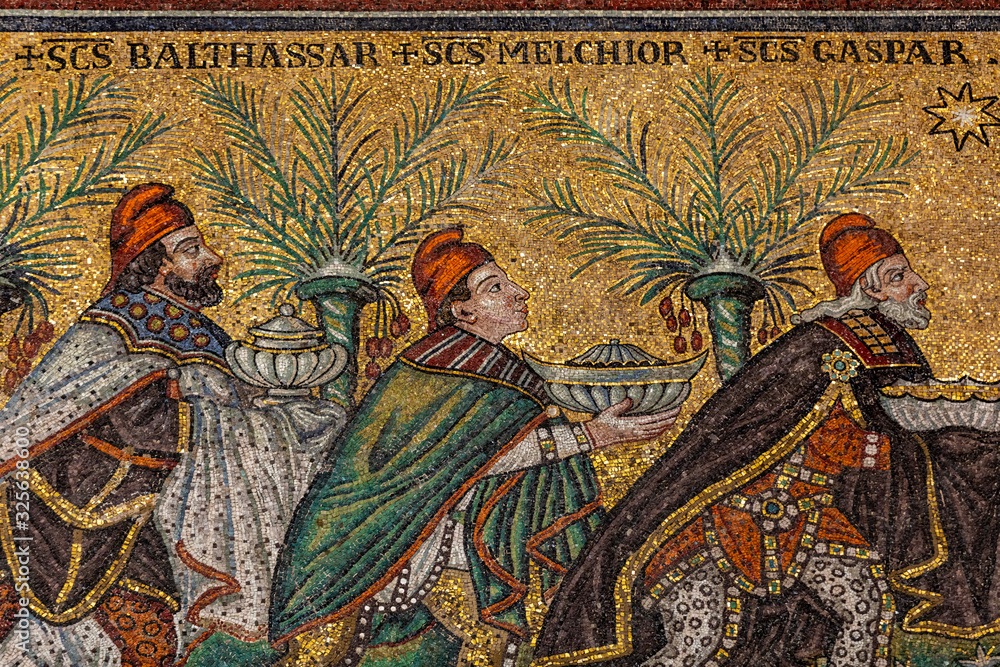
We are not told their names, nor how many they were. They are described as magi, probably meaning that they were astrologers. Only in later church tradition would they be identified as the three men, Caspar, Balthasar, and Melchior. Although Matthew’s gospel does not include the names or number of the magi, many believe that the number of the gifts he notes is what led to the tradition of the Three Wise Men—and, of course, they then needed to gain names (as do many anonymous biblical figures in the evolving church tradition over subsequent centuries).

These magi appear to have come from Gentile lands. They could be seen as exemplars of faithful obedience, travelling far to “adore the child”. But they are very mysterious figures in Matthew’s account. The gifts they bring were valuable items—reflecting a standard of gifts that might be offered to honour a king or deity in the ancient world: gold as a precious metal, frankincense (incense) as perfume, and myrrh as anointing oil.

It is claimed that these same three items were among the gifts that the Seleucid ruler, Seleucus II Callinicus, who ruled for 20 years (246–225 BCE), offered to the god Apollo at the temple in Miletus in 243 BCE. (I found this claim often in online articles, but I can’t trace any of them back to the actual historical source.)

The Three Magi (including the traditional names), Byzantine mosaic
in the Basilica of Sant’ Apollinare Nuovo, Ravenna, Italy

More significant for Matthew, I believe, would be the fact that two of the gifts resonate with a Hebrew Scripture passage, late in the book of Isaiah. Jerusalem’s restoration is portrayed as a time when “nations shall come to your light, and kings to the brightness of your dawn” (Isa 60:3); they will “bring gold and frankincense and proclaim the praise of the Lord” (Isaiah 60:6).

The visitors bringing these gifts come from Sheba (a kingdom in South Arabia). The gifts, it is claimed by interpreters, are symbolic of what is to come. The gold is considered to symbolise the royal status of the child Jesus, as he is of the line of David. The frankincense is connected with the Temple cult, and thus considered a symbol of the priestly role eventually to be played by that same child.

The myrrh, in Christian tradition, is linked with the death that will be experienced by the infant when he has grown to maturity—death at the hands of a Romans, who offered him wine mixed with myrrh as he hung dying on a cross (Mark 15:23). This symbolism reveals the reasons for adopting and expanding the earlier oracle.

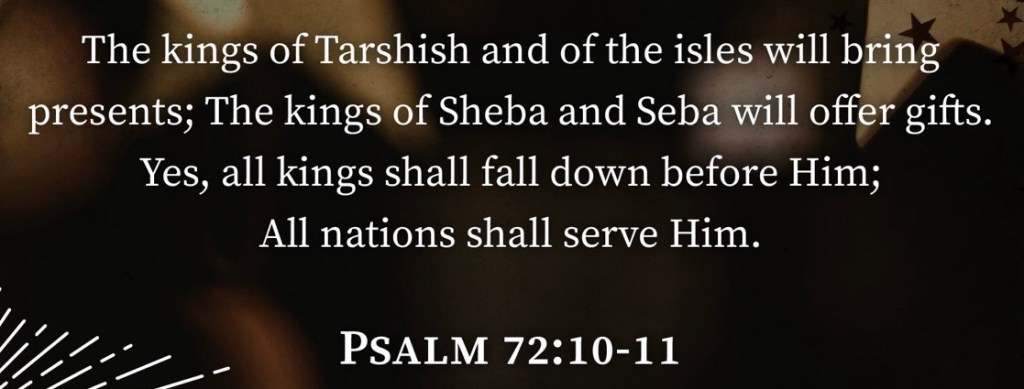
And the notion that was developed later in Christian writings, that the three magi were kings in their respective kingdoms (as in, “we three kings of orient are”), derives from the application of Isaiah 60:3 , noted above, and Psalm 72:10–11, as the psalmist praises the King of Israel and prays, “may the kings of Tarshish and of the isles render him tribute; may the kings of Sheba and Seba bring gifts; may all kings fall down before him, all nations give him service.”

This is typical midrashic practice, to link up verses from different verses in different books which contain the same key words. It indicates that Matthew is “spinning a yarn”, telling a story, narrating a myth that contains important clues as to the nature and significance of the person about whom the story is told. It is not a factual historical account.

Matthew, who portrays Jesus as the new Moses throughout his Gospel, considers that his mission was solely to “the lost sheep of the house of Israel” (Matt 10:6; 15:24)—and to them alone. The visit of the magi from the East plays a symbolic role in the story. It represents a Gentile acknowledgement of the high role that Jesus will play, bringing to fulfilment the intentions of God for the covenant people. So this element, told very early in the narrative, is simply a literary technique to introduce a key theme which will reach fulfilment in the time well beyond the tale that the narrative offers.

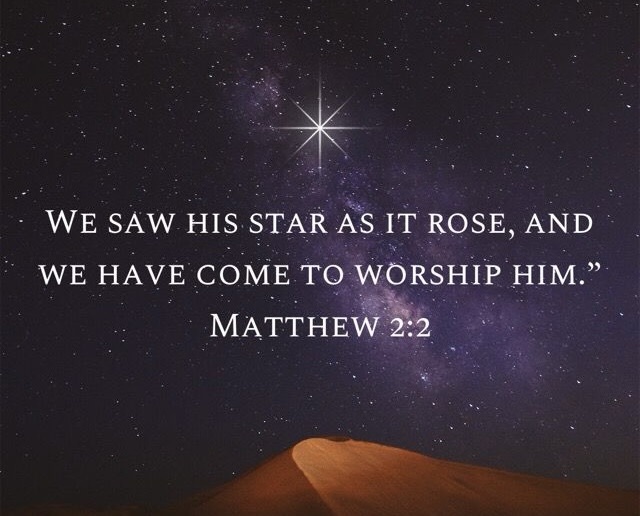
I’m not going to go down the rabbit-hole of trying to identify the actual star that these magi followed (Matt 2:2, 9–10) and correlate it with known astronomical events from the early first century. It’s too complicated and anything I have ever seen requires us to put aside our historical-critical skills and believe in a series of “amazing coincidences”.

Besides, as this post makes abundantly clear, I don’t regard the story found in Matt 2 as in any way historical! It is yet another component of his story which draws heavily from Hebrew Scripture, as befits a Jew writing to Jews. The rising of the star in the east correlates well with the prophet Balaam’s prediction in Num 24:17 that “a star shall come out of Jacob and a sceptre shall rise out of Israel”.

The identification of the star as being “in the east” comes because, in Greek, the word for “east” is the same as “rising”. The Greek translation thus is ambiguous about whether the star simply “rises up out of Israel” or whether it is “to the east” of Israel. We can see this ambiguity if we compare how different recent translations of the Bible render this phrase in Matt 2:9 — “a star they saw in the east” (KJV), “the star they had seen when it rose” (NIV and ESV), “the star they had seen at its rising” (NRSV), “the star they had seen in the east” (NLT).

So this is another element in the story that has been shaped by Hebrew Scripture.

Evidence from beyond the Bible, that the baby boys in Bethlehem were actually slaughtered by Herod’s troops (Matt 2:16), is absent. The story that Matthew presents is grounded, not in history, as we know it, but in the art of story-telling, where recognisable themes and characters are presented in a new, creative combination.

So it is that in the opening chapters of this Gospel, we encounter the pregnant Mary, the newborn infant Jesus, his father Joseph, a bright star in the sky, visitors from the east, the tyrannical rule of Herod, and slaughtered infant boys. Many of these characters and events are “types”, imitations of an earlier story—for in his narrative, Matthew is working hard to place Jesus alongside the great prophet of Israel, Moses.

The early years of Jesus unfold in striking parallel to the early years of Moses. The parallel patterns are striking—deliberately shaped that way by the author of this Gospel, I would maintain. Moses, for instance, was in danger of being killed as a small boy, as the Pharaoh instructed the midwives, “When you act as midwives to the Hebrew women, and see them on the birthstool, if it is a boy, kill him; but if it is a girl, she shall live” (Exod 1:16). The child Moses was rescued by midwives who “feared God; they did not do as the king of Egypt commanded them, but they let the boys live” (Exod 1:17).

Matthew’s account of “the Slaughter of the Innocents” is generated by his Moses typology. This grounds the story of Jesus in the historical, political, and cultural life of the day, when tyrants exercised immense power. But it raises our suspicions about whether this event actually took place. There is no other evidence for it in any ancient writing, apart from Matthew’s Gospel. Can we be sure that it took place? Not by any standard of historical assessment.

Massacre of the Innocents, ca. 1520;
engraving by Marco Dente (1486–1527),
based on a design by Baccio Bandinelli (1493–1560)

(I recognise that some claim that a report by Josephus in book 2 of his account of the Jewish War, about an uprising related to a certain shepherd named Athrongeus, might be telling of this event—except that this took place after the death of Herod, and it took place in Jerusalem, not in Bethlehem, as Matthew’s account maintains. And, of course, Matthew has no shepherds in the story, so the connection is even more diffuse. The search for a parallel account in another ancient source is undertaken in vain.)

We recognise that, in this narrative, Matthew is not reporting an actual historical event; yet his narrative of what allegedly happened to those children does provide a dreadful realism to a story which, all too often in the developing Christian Tradition, became etherealised, spiritualised, and romanticised.

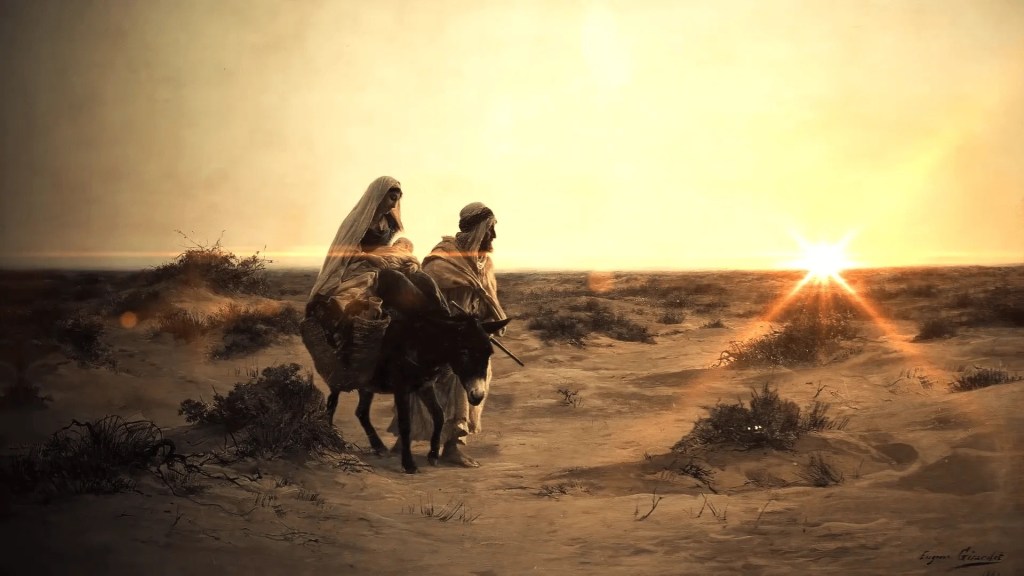
Matthew has Jesus escape this fate by fleeing, with his parents, to Egypt (Matt 2:13–15). Once again, there is no evidence for this journey outside of Matthew’s book of origins, so the story is just that: a story, not an historical account. The Moses typology we have already noted is also relevant here. Matthew emphasises the many ways in which events in the early years of Jesus fulfilled the prophecies found in Hebrew Scripture (see Matt 1:22–23; 2:5–6, 15, 17, 23; and for the adult Jesus, see 3:3; 4:12–16; 12:15–21; 13:14–15, 35).

So many parts of the early life of Jesus as Matthew recounts it are presented in a way that makes them consistent with these prophecies—although one of them (2:23) cannot actually be found in the Bible! It is most likely that Matthew has constructed his story so that it fits with these scriptural prophecies. They provide him with a familiar framework for telling the story.

Only Matthew tells about Herod and his slaughter of the innocents. Such an event is unknown from any other ancient literature. Had it actually taken place, it is likely that it would have been reported elsewhere. This event, together with others in Matthew’s version of Jesus’ early life, mirror the pattern of events at the start of Moses’ life.

With Moses, as with Jesus, there is the slaughter of infant males under 2 years by a tyrannical ruler, and the flight into another country by the boy’s parents, so that the boy is saved. In this way, Matthew presents Jesus as “the new Moses”. That is the key concern that he has in this opening sequence—not providing an historical narrative, but introducing his story of Jesus through the typology of Moses.

See also

From the old to the new: a blessing for the season (Eccles 1, Num 6; Jan 1)

As the year turns from “old” to “new” (at least in our secular calendrical reckoning), we hear familiar words reflecting on the passing of time. For the Preacher, the author of Ecclesiastes (Ecclesiastes 1:1), time is not a linear progression of units, ceaselessly marching forward, relentlessly ageing us, continually moving us on,,driving us to growth, improvement, and “progress”. Rather, time is seen as a sequence of moments, each with their own significance, about which we are invited to pause, reflect, and consider deeply.

The Hebrew Scripture passage that the lectionary proposes for New Year’s Day, 1 January (Eccles 3:1–13), gives a clear indication of how time was regarded in the ancient world. As some people are dying, infants are being born; as some people are weeping, so others celebrate joyously. As some people hunker down in protracted warfare, so others are enjoying a much-yearned-for peace; as some people are happily moving into a new house, a new community, so others are bidding a sad farewell to what has been a beloved home for decades.

At this moment, the continuation of the war in the Ukraine, the perpetuation of bombing in Gaza, the ongoing Sudanese conflict, and the insurgencies in numerous African nations—all of this, and more, continues, while people across the world rejoice at the birth of a new child, celebrate a new marriage, give thanks for a milestone reached in the long life of a much-loved family member. Each and every day, there is “a time to weep, and a time to laugh”.

The Preacher invites us to consider what the season, the time, might be for us at this moment; what might we embrace, and what might we relinquish? How might we best speak into a situation, and when is it wisest to hold our tongue and keep silent? Will this be a year when war continues, or peace grows? Shall we dance—or mourn?

These questions are posed, implicitly, by the rhetorical impact of the repeated “a time to … and a time to …”; for God “has made everything suitable for its time”. What is the time, for us, for me, at this moment, as the year turns?

Pondering what is suitable for this time led me to look also at what the lectionary offers for this same day, 1 January, which is recognised in some parts of the one, holy, catholic and apostolic church as the Feast of The Holy Name of Jesus. There is evidence that this feast was celebrated from the 15th century onwards, and it is usually placed on 1 January because this is eight days after Christmas Day, the conclusion of the “octave of Christmas” in Catholic churches.

The feast is based on the simple declaration by Luke: “after eight days had passed, it was time to circumcise the child; and he was called Jesus, the name given by the angel before he was conceived in the womb” (Luke 2:21). This is the concluding verse of the section of Luke’s orderly account which is proposed as the Gospel for this day. The lectionary also suggests that the Epistle reading be Gal 4:4–7.

On this, see https://johntsquires.com/2023/12/28/born-of-a-woman-born-under-the-law-gal-4-christmas-1b/

The Hebrew Scripture suggestion is the short poetic fragment in Num 6:22–27, which ends with the comment, “they [Aaron and his sons] shall put my name on the Israelites, and I will bless them” (Num 6:27), so in a sense it fits for a day which remembers “the name”, even if not that of Jesus. The blessing which the priestly family speaks over the Israelites is well-known: “the Lord bless you and keep you …” (Num 6:24).

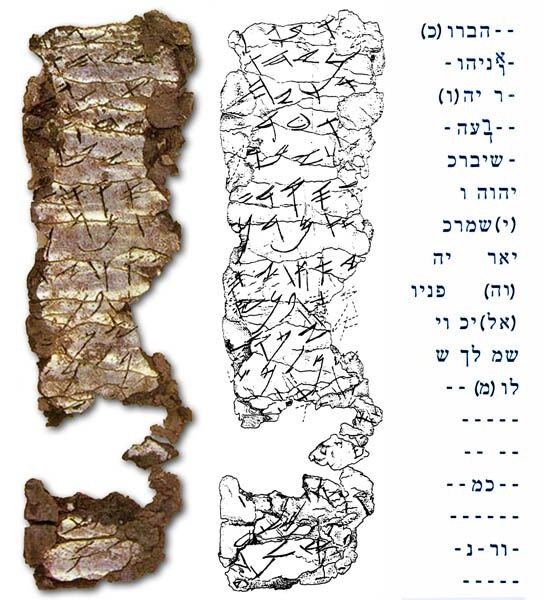
This short poetic blessing lays claim to being an ancient part of scripture—perhaps one of the oldest passages? Indeed, the oldest artefact which contains a text from scripture is a silver scroll, dated to around 600 years before the time of Jesus, just before the Exile began. The scroll has a part of these words of blessing inscribed on them. We moderns have only known about this scroll since 1979, when it was discovered as one of a pair of silver scrolls in a cave in the Old City of Jersualem. See https://www.ancient-hebrew.org/inscriptions/140.html

and for a more detailed analysis,

As the year turns from old to new, it is most fitting that we recall this ancient priestly blessing, to send us on our way in the year that lies ahead.

The words on that tiny tightly-rolled strip of silver were well-known, of course, for centuries before Jesus. They are fragments of the beautiful words of blessing, given by God to Aaron through Moses, for Aaron and his priestly descendants to use as a blessing upon the people of Israel (Num 6:24–26), as well as a fragment from Deut 7:9 in which the importance of keeping the Torah is stated.

The blessing of Num 6 is simple in structure: three parallel clauses, with three verbs that express the same action (bless you / make his face shine on you / lift up his countenance upon you), followed by three further verbs in parallel (keep you / be gracious to you / give you peace). The movement from beraka, blessing, to shalom, peace (or better, wholeness) surely reflects God’s desire and intention towards faithful people of all time.

This blessing, for God’s light to shine, is reflected elsewhere in scripture. The psalmist prays “restore us, O God, let your face shine, that we may be saved (Ps 80:3, 7, 19). “There are many”, says another psalmist, “who say, ‘O that we might see some good! Let the light of your face shine on us, O Lord!’” (Ps 4:6). In Psalm 31, another psalmist sings, “Let your face shine upon your servant; save me in your steadfast love” (Ps 31:16).

In the seventeenth section of the longest of all psalms, Psalm 119, a prayer asking for God to help the psalmist keep the Law culminates with the request for God’s face to shine: “Turn to me and be gracious to me, as is your custom toward those who love your name. Keep my steps steady according to your promise, and never let iniquity have dominion over me. Redeem me from human oppression, that I may keep your precepts. Make your face shine upon your servant, and teach me your statutes.” (Ps 119:132–135).

The author of Psalm 67 echoes more explicitly the Aaronic Blessing, praying, “May God be gracious to us and bless us and make his face to shine upon us—Selah—that your way may be known upon earth, your saving power among all nations” (Ps 67:1–3). This reflects the wording and pattern of the ancient priestly blessing recorded in Num 6:24–26: “The Lord bless you and keep you; the Lord make his face to shine upon you, and be gracious to you; the Lord lift up his countenance upon you, and give you peace.”

In this three-line prayer, the second line includes the phrase, “the Lord make his face to shine upon you”. The simple parallelism in this blessing indicates that for God to “make his face shine” (v.25) is equivalent to blessing (v.24) and lifting up his countenance (v.26). The second verb in each phrase is, likewise, in parallel: the psalmist asks God to keep (v.24), be gracious (v.25), and grant peace (v.26).

These words offer a prayer seeking God’s gracious presence for the people of Israel. They are also words which we might well hear, and appropriate, for our lives of faith in the year stretching ahead of us. May there be keeping, grace, and peace, in our lives, and in the lives of others around us and far from us.

The silver scroll found at Ketef Hinnom
which contains part of the text of the Priestly Blessing:
a photograph, a transcription, and the fragmentary text in Hebrew script

Promise and proclamation: passages from the Prophets at Christmas

There is a richness of scriptural resources for reflecting on our faith at Christmas. These resources come from the developing traditions of Christmas worship in the early centuries of Christianity. This post concerns especially some passages from the prophet Isaiah that are proposed by the Revised Common Lectionary for our Christmas worship celebrations.

In the ancient Roman church, a Christmas Mass was originally celebrated as a vigil service at the manger of St Mary Major in Rome. It was a small service originating under Pope Sixtus III, and was known as The Angel’s Mass, as the story was told of the angels appearing to the shepherds in the fields (Luke 2:1–14).

In time, a large public service was added at the church of St Peter on the morning of Christmas Day, presided over by the Pope. This practice continues to this day. This service was known as The Shepherd’s Mass, for the story of the shepherds coming to visit the newborn child (Luke 2:8–20).

A third service, The Mass of the Divine Word, was added in the fifth century, originally to celebrate St Anastasia, whose body, it was said, rested in the palace church of the Byzantine Governor in Rome. The focus of this service shifted, over time, from a veneration of the saint’s remains, to a celebration of the Incarnation. The Gospel read at this service was John 1:1–14.

These three Gospel passages were retained in the Common Lectionary when it was created in 1983, drawing on the ancient Roman practices, and continued on in the Revised Common Lectionary of 1992. To the three Gospel passages were added nine additional readings—three psalms, three from the prophets, and three from the epistles. The three options are identified as Nativity of the Lord Proper I, Proper II, and Proper III.

Alongside the Gospel passage and the prophetic passage for each of the three traditional services for Christmas (Nativity of the Lord I, II, and III), there is a psalm offered for each service, as well as a passage from the book of Isaiah. We would do well to use them to guide our response at Christmas, as we hear the story and celebrate the birth of Jesus.

The three psalms (Psalms 96, 97, and 98) come from a sequence of songs offering praise—a note that is entirely suitable for the Christmas season! The three passages from the book of Isaiah come from the three different sections of that large prophetic book, each offering words of hope.

The book of Isaiah comprises three sections, which most scholars believe originated in three different periods during the history of Israel. The first section (chs. 1–39) is located in Judah in the eighth century BCE, as the Assyrians conquered the northern kingdom of Israel and attempted to gain control of the southern kingdom, but that effort failed.

The second section of Isaiah (chs. 40–55) dates from the time of exile for the southern kingdom, after the people of Judah had been conquered by the Babylonians in 587 BCE; it offers words of hope as the people look to a return to the land. Then, the third section (chs. 56–66) is dated to a time when the exiles had returned to Judah, sometime after 520 BCE. By convention, the three parts are known as First Isaiah, Second Isaiah, and Third Isaiah.

The first of these three passages from the book of Isaiah proposed as Christmas readings is an oracle in the early part of the first section (chs.1—39). Here, the prophet is looking forward to the birth of a child (Isa 9:6). This, of course, is a most appropriate theme for Christmas. Yet the child of whom Isaiah of Jerusalem spoke was not Jesus, but rather, a royal child, already announced at Isa 7:14.

This child would be born in difficult circumstances (Isa 9:4–5), for the people were under attack by the Assyrians to the north (as reported in 2 Kings 16). The hope that the prophet holds out is of darkness in light, joy in the midst of hard work, release from oppression, and the establishment of justice and righteousness.

Is not that what we hope for, pray for, and work for, through the coming of Jesus which we celebrate at Christmas? Although the prophet did not “predict Jesus”, yet we can see how Jesus invites us to work with him for this desired result.

The second reading from Isaiah comes from the third section of the book (chs. 56—66). It comprises a set of prophecies delivered many decades after the prophet Isaiah of Jerusalem himself lived. As the people returned to the land of Israel, hopes were high. The anonymous prophet whose words are collected in the book of Isaiah speaks about justice and deliverance (56:1), with light illuminating the darkness (60:1–3) and the Spirit inspiring leaders “to proclaim the year of the Lord’s favour” (61:1–2). The security that is foreseen (Isa 62:8–9) and the celebration that takes place (v.10) is marked with names that signal to the people how God has been at work (v.12).

In the same spirit of hope, we prepare for the annual celebration of the coming of Jesus, in whom we surely find the Spirit at work, bringing salvation, proclaiming God’s way “to the end of the earth” (v.11). Once again, the prophet is not specifically forthtelling the coming of Jesus; but as we have experienced Jesus and know him in our lives, we can see how he brings to fruition these hopes, held firm from centuries ago, still alive for our own times.

The third reading from the book of Isaiah offered for Christmas is a rather short reading (Isa 52:7–10). It comes from the middle section of the book (chs. 40—55). a set of prophecies delivered to people from Judah who had been in exile in Babylon for some decades. This section of the book begins with a clear signal of the great hope of the time: “prepare the way of the Lord … every valley shall be lifted up, and every mountain made low” (40:3–4).

A key figure at that time was the Servant, called to lead the people with teaching and example. (The resonances with Jesus are frequently noted; but the prophet was not speaking directly about Jesus.) This passage speaks about those who “announce peace, bring good news, announce salvation” (52:7); all activities that we associate with Jesus, through the Christmas story and the Gospel narratives.

However, this particular herald, some eight centuries before Jesus, would bring comfort to the exiled people, assuring them of their redemption when they return to the land. This good news must surely be made known “before the eyes of all the nations”, so that “all the ends of the earth shall see the salvation of our God” (v.10). These sentiments surely correlate with how we, joyfully and hopefully, regard Jesus, in our Christmas celebrations.

See

I will be a father to him, and he shall be a son to me (2 Sam 7; Advent 4B)

During this season of Advent, the lectionary offers a selection of biblical passages designed to help us in our preparations, building to the climactic moment of Christmas Day, when we remember that “the Word became flesh and lived among us, and we have seen his glory, the glory as of a father’s only son, full of grace and truth” (John 1:14).

These scripture passages have include a sequence of excerpts from the Hebrew Scriptures—largely from the book of Isaiah—which orient us to the saving work of God, experienced by faithful people in Israel through the ages. These scripture passages inform us as to how God might be understood to be at work in the story of Jesus. For my part, I don’t read these Hebrew Scripture passages as “predictions” pointing to Jesus. Rather, I consider that the prophets and psalmists of ancient times were addressing their own situations, not peering into the distant future.

How I read these passages is not in a simplistic prophecy—fulfilment pattern. That is too crass, and it pays no respect at all to the wisdom of faithful people in ancient Israel. Rather, I read these passages as testimonies to the way that faithful people of old understood and experienced God to be at work in their own times, in their own lives. What they wrote—the word of the Lord for their own time—has been repeated and remembered, retold by word of mouth and written onto scrolls which, over time have become recognised as important, influential, even inspired words of wisdom.

So whilst the Hebrew Scripture passages tell us of how God had been at work in years past, they are retained as relevant words which provide guidance and direction for understanding how God would presumably be at work in later times, in the times of Jesus, and indeed in our own times today. When we read and hear and ponder these ancient words, we are opening our hearts and minds to the guidance of God’s Spirit, instructing us in our lives of faith today.

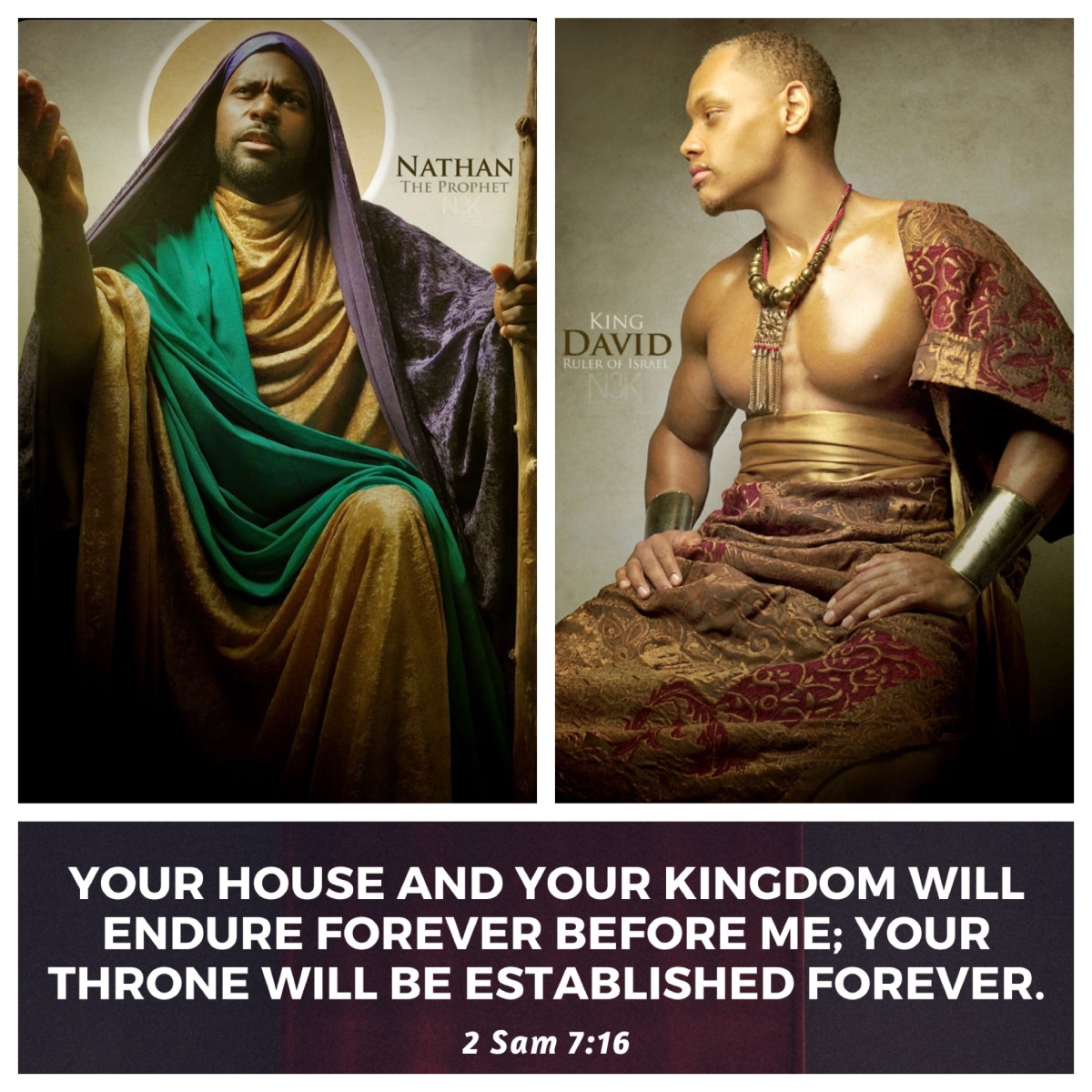
For the fourth Sunday in Advent, we are offered a well-known passage from 2 Samuel; the message that the prophet Nathan receives from the Lord God, which he is instructed to convey to King David (2 Sam 7:1–11, 16). Curiously, the lectionary omits the final comment of the narrator, “in accordance with all these words and with all this vision, Nathan spoke to David” (2 Sam 7:17).

It is worth understanding where this passage comes in the narrative flow of events, for it occurs at a critical time in the story of the people of Israel. In earlier chapters, the prophet Samuel had (somewhat reluctantly) anointed Saul as king in Israel (1 Sam 10:1). This was done in obedience to a direct word of the Lord to Samuel: “I will send to you a man from the land of Benjamin, and you shall anoint him to be ruler over my people Israel. He shall save my people from the hand of the Philistines; for I have seen the suffering of my people, because their outcry has come to me.” (1 Sam 9:16).

However, in the midst of his battles with the Philistines, Saul eventually kills himself, when he sees how hopeless the situation has become (1 Sam 31). The early chapters of 2 Samuel recount the antagonism and chaos of the ensuing days, as “the people of Judah … anointed David king over the house of Judah” (2 Sam 2:4). However, “there was a long war between the house of Saul and the house of David”; during the course of this war “David grew stronger and stronger, while the we Bw ww c house of Saul and and became weaker and weaker” (2 Sam 3:1).

At this point in the story, David recognises an incongruity: “I am living in a house of cedar, but the ark of God stays in a tent”, he tells Nathan (2 Sam 7:2). The implication is that David is now about to redeploy the carpenters and masons whom King Hiram of Tyre had earlier provided for him to build his own house (2 Sam 5:11), and commission them now to build a house for God to live in (2 Sam 7:5).

So the Lord God directs the prophet Nathan to intervene, reminding him that “I have not lived in a house since the day I brought up the people of Israel from Egypt to this day, but I have been moving about in a tent and a tabernacle” (2 Sam 7:6). Samuel is to inform David that God does not need a house to be built for his residence. Rather, God will create a “house” for David; but that house will not be a cedar lodge of multiple rooms, but a royal dynasty with a lineage of monarchs.

The wordplay on “house” is at the heart of this passage. In Hebrew, the word bayith can equally refer to a structure built for people to live in, or to a collection of people living together as a household or related as a family group. That is the same as the English word “house”, which can refer to a domestic structure or a family group. While David yearns to build a structure to house the Lord God—a temple—the intentions of God for David are rather that he will build a family—a dynasty—which will ensure the security of the nation in future generations.

God promises David that he will make him the first in a line of men to rule over Israel—indeed, God promises that “I will establish the throne of his kingdom forever” (2 Sam 7:13). So confident is the Lord God about this promise that he repays it; “your house and your kingdom shall be made sure forever before me; your throne shall be established forever” (7:16).

I think the thrice-repeated claim “forever” is hyperbolic grandstanding; the united kingdom that David inherited from Saul and bequeathed to Solomon did not last “forever”. In less than a century, the kingdom was divided; in another two centuries, the northern kingdom had been defeated and there were no rulers in the line of David, and within another one-and-a-half centuries the southern kingdom had met the same fate.

Later generations would cling to that promise and interpret it in various ways. The narrator of 1–2 Samuel and 1–2 Kings tells of the continuation of this promise over the centuries. Whoever edited the final version (sometime in the Exile, is the best guess) would have known that the promise did not actually last “forever”; yet they retained that claim in the narrative of 2 Sam 7. The promise had been made; even knowing that it was not carried through in history, that story still was to be told.

Various psalms follow suit, celebrating that God “shows steadfast love to his anointed, to David and his descendants forever” (Ps 18:50), bestowing blessings on David forever (Ps 21:6; 45:2), ensuring that “your throne, O God, endures forever and ever” (Ps 45:6), and offering prayers for the king, “may he be enthroned forever before God” (Ps 61:7), “may his name endure forever” (Ps 72:17).

Similarly, even whilst in exile, the prophet Jeremiah celebrates the promise that “David shall never lack a man to sit on the throne of the house of Israel” (Jer 33:17). However, as the prophet surveys “the towns of Judah and the streets of Jerusalem that are desolate, without inhabitants, human or animals” (Jer 33:10), he considers, at least fleetingly, the consequence that David “would not have a son to reign on his throne” (Jer 33:21).

(Nevertheless, the oracle ends with a reversion to the hope that God “will restore their fortunes, and will have mercy upon them”, v.26; earlier, Jeremiah had spoken of the “righteous Branch” who would “spring up for David”, v.15. Indeed, all the exilic prophets hold strongly to the hope of a restored and renewed kingdom.)

However, the definitive break of the line is clearly envisaged at the same time, during the exile, by one of the psalmists, in Psalm 89. Initially, in this psalm, the psalmist declares that “your steadfast love is established forever” (v.2), notes that God’s “hand shall always remain” with David (v.21), and affirms that “his line shall continue forever” (v.36).

And yet, that psalmist continues, “you have spurned and rejected him; you are full of wrath against your anointed” (v.38), “you have removed the scepter from his hand and hurled his throne to the ground” (v.44). The psalm ends with lament: “Lord, where is your steadfast love of old, which by your faithfulness you swore to David?” (v.49).

Clearly, “forever” did not mean for all time, in some aspects of the developing Jewish understanding. The period of exile was indeed the catalyst for consideration of how a Jewish nation might continue; from this time onwards, many Jews continued to practice their religion in the Diaspora, right through to the present. But their practices and customs changed, developed, adapted. And as the sages of the people grappled with ways to live out their faith in a healthy way in those dispersed contexts, they developed various reassessments of the previously strong links between the king, the covenant, and the Lord God. “Forever” did not mean “forever”.

And yet in Christianity, the promise was seen to be still valid; indeed, the Christian claim is that it was continuing in Jesus. The angel Gabriel tells the pregnant Mary that the child she will bear “will reign over the house of Jacob forever, and of his kingdom there will be no end” (Luke 1:33). The writer of the letter to the Hebrews quotes Psalm 45:6 and applies it directly to the Son: “your throne, O God, is forever and ever” (Heb 1:8), while the author of Revelation foresees that when the seventh angel blew his trumpet, “there were loud voices in heaven, saying, ‘The kingdom of the world has become the kingdom of our Lord
and of his Messiah, and he will reign forever and ever’” (Rev 11:15).

So the inclusion of this story in the readings for Advent 4 is, no doubt, because of the Christian understanding that Jesus stands in the line of David, as the shepherd of his sheep, and as the one who rules over the house of God in an eternal kingdom that will never end. (Quite uncharacteristically for me, I have here combined ideas from a number of biblical texts into one harmonised theological statement. This is what systematic theology often does.)

David, the shepherd boy, is anointed as King and designated as the head of a house that will provide leaders stretching into the future in a kingdom that will “be made sure forever before me” (2 Sam 7:16). Jesus is claimed to be of the house of David (Luke 1:27; Matt 1:20) and is acclaimed as “Son of David” (Mark 10:47–48; Matt 20:30–31; Luke 18:38–39), a title that is especially emphasised elsewhere in Matthew’s Gospel (Matt 9:27; 12:23; 15:22; 21:9, 15). The title, for Jewish hearers of those early Gospels, signals the belief that God is at work through this person, Jesus, to guide and lead the people of God.

This Hebrew Scripture passage, like others we have read and heard during Advent, thus orients us to the saving work of God, experienced by faithful people in Israel through the ages, which is later claimed by followers of Jesus to have been manifested in his life. For that reason, we hear it during this Advent season; not as a prophecy which was fulfilled by Jesus, but as a testimony to the ways of God which continue from aeons ago into the present time.

The year of the Lord’s favour (Isa 61; Advent 3B)

As we move on in the new year in the church’s calendar, this coming Sunday we celebrate the third Sunday in the season of Advent, and continue our preparations for Christmas—the coming of Jesus, Saviour, chosen one, and Lord (Luke 2:11). During Advent, the lectionary offers a selection of biblical passages designed to help us in our preparations, building to the climactic moment of Christmas Day, when we remember that “the Word became flesh and lived among us, and we have seen his glory, the glory as of a father’s only son, full of grace and truth” (John 1:14).

These scripture passages include a sequence of excerpts from the Hebrew Scriptures—largely from the book of Isaiah—which orient us to the saving work of God, experienced by faithful people in Israel through the ages. These scripture passages inform us to sense how God was at work in the story of Jesus.

The passage proposed by the lectionary for this third Sunday in Advent (Isa 61:1–11) is another very well-known one. It comes from the third main section of Isaiah (chs.56—66), recording the words spoken by an unnamed during the return to the land after exile in Babylon. This prophet is often called Third Isaiah.

This passage is best known because the opening few verses are the words read by Jesus when he was handed the scroll to read in his hometown synagogue (Luke 4:16–19). Following that story offered by Luke, we read that Jesus “rolled up the scroll, gave it back to the attendant, and sat down, and the declared, “Today this scripture has been fulfilled in your hearing” (Luke 4:20–21). That statement shapes the interpretive approach of Christians to the words in Isaiah 61; we are guided to read them as a prophetic declaration about Jesus.

However, we need to take care not to override and exclude the intention of the message (to the extent that we can assess it) of the original speaker and the faithful scribe in that ancient post-exilic context. To do so would be to perpetuate a supersessionist reading of scripture, which claims that “the old” is no longer relevant because “the new” has superseded it. This is poor interpretive practice and bad theology.

How might we best understand this passage? Understanding the dynamics at play at the time the words were spoken and then written down is instructive. For the returning exiles, preparing to re-establish their distinctive society in their much-loved land, the call of the prophet, through the gifting of the Spirit, was orienting them clearly to face the ethical issues of that society. Oppression and captivity had been the experience of past decades; liberty and joyful encouragement were now to be the markers of life in the land.

So central to the task of rebuilding society was the age-old commitment of care for the vulnerable and support for the needy. Prophets of times past had expressed this in terms of care for the widow, the orphan, and the foreigner in the land. Isaiah proclaims God’s judgement on those who “turn aside the needy from justice … and rob the poor of my people, that widows may be your spoil, and that you may make the orphans your prey!” (Isa 10:1–2).

Other prophets join their voices to Isaiah’s declaration. Ezekiel laments that “the sojourner suffers extortion in your midst; the fatherless and the widow are wronged in you” (Ezek 22:7). Jeremiah encourages the people of Jerusalem with a promise that God will allow them to continue to dwell in their land if they “do not oppress the sojourner, the fatherless, or the widow” (Jer 7:5–7).

The words of Third Isaiah continue in this prophetic stream. They also resonate with the psalmist, who praises “the God of Jacob … who executes justice for the oppressed; who gives food to the hungry … [who] sets the prisoners free, [who] opens the eyes of the blind, [who] lifts up those who are bowed down [and] loves the righteous, [who] watches over the strangers [and] upholds the orphan and the widow” (Ps 146:5, 7–9). See

https://johntsquires.com/2023/05/14/father-of-orphans-and-protector-of-widows-psalm-68-easter-7a/

The distinctive contribution of this particular prophet is to frame the task through the story of the Jubilee, “the year of the Lord’s favour” (v.2). That Jubilee year had, as its flip side, the ominous “day of vengeance of our God” for those who failed to follow the way of Jubilee justice. The Jubilee entailed the release of slaves and the cancelling of debts; it was meant to be practised in society every fifty years during the year of Jubilee (Lev 25:8–17; see esp. v.13).

Whilst these levitical prescriptions appear to be the ideal that the priests hoped for, actual evidence that this was ever implemented in Israelite society is lacking. Indeed, it is suggested that while the people were in Exile, the land of Israel would “lie desolate”, and “enjoy its sabbath years” (Lev 26:34), providing recompense for all those years when “it did not have on your sabbaths when you were living in it” (Lev 26:35).

The return to the land, as far as Third Isaiah is concerned, meant that these levitical prescriptions should indeed be adhered to, as the people promised “to walk in God’s law, which was given by Moses the servant of God, and to observe and do all the commandments of the Lord our Lord and his ordinances and his statutes” (Neh 10:29). In the way that Jesus cited this prophetic passage in his hometown synagogue (Luke 4:16), implementing the Jubilee prescriptions in his own time was also what he envisaged.

The prophet lays claim to the work of the Spirit in setting forth this programme for the people. “The spirit of the Lord is upon me”, he declares (Isa 61:1), placing himself in a long line of spirit- inspired leaders in Israel. The Spirit had guided Moses and was then gifted to chosen elders (Num 11:16–25). That Spirit was subsequently imparted to Joshua (Num 27:18; Deut 34:9) and then to a string of Judges: Othniel (Judg 3:10), Gideon (6:34), Jephthah (11:29), and Samson (13:24–25; 14:6,19; 15:14).

In later years, the Spirit guides Saul (1 Sam 10:6–7), David (2 Sam 23:2), Solomon (Wisd Sol 7:7), the line of prophets (Neh 9:30), the servant of the Lord (Isa 42:1), Ezekiel (Ezek 3:12, 14; 8:3; and many subsequent references), Daniel (Dan 5:12), Micah (Mic 3:8), and Zechariah (Zech 4:6). The activity that the Spirit undertook in these instances was invariably to provide guidance regarding the conduct of Israelite society, through these anointed leaders and inspired prophetic voices.

The oracle of the post-exilic prophet thus blends notes of celebration and justice, such that “righteousness and praise [will] spring up before all the nations” (v.11). There will be “a garland instead of ashes, the oil of gladness instead of mourning” (v.3), “everlasting joy” (v.7), with rejoicing and exultation akin to a wedding celebration (v.10). Society will be marked by righteousness (vv.3, 10, 11), to demonstrate that “I the Lord love justice, I hate robbery and wrongdoing” (v.8).

Jesus stands firmly in this line. His connection of Spirit with justice in society is drawn directly from Third Isaiah. The Jubilee he announces in his hometown (Luke 4:19) is explained in his series of blessing and woes (Luke 6:20–26), his welcome of and advocacy for poor and outsiders (Luke 7:34; 10:8–9; 15:1–2), and in a number of parables which prefigure reversals in society (for instance, 14:7–24; 16:19–31).

Alongside these sounds of justice, a note of joy runs through the public activities of Jesus (Luke 6:23; 8:13; 10:17; 15:6, 7, 9, 10, 32). It is in this sense that we can affirm that Jesus has “fulfilled this scripture”, and that this prophetic passage is a helpful guide for us during Advent.

The Lord has done great things for us (Psalm 126; Advent 3B)

During this season of Advent, the lectionary offers a selection of biblical passages designed to help us in our preparations, building to the climactic moment of Christmas Day, when we remember that “the Word became flesh and lived among us, and we have seen his glory, the glory as of a father’s only son, full of grace and truth” (John 1:14).

These scripture passages include a sequence of psalms which orient us to the saving work of God, experienced by faithful people in Israel through the ages. In the psalms, faithful people over the ages have sung of their trust in God and their joy at what God has been doing. These psalms thus bring us to the point of anticipation that we can sense God’s work in the story of Jesus.

It is the seventh of the fifteen Songs of Ascent (Psalm 126) that is suggested by the lectionary for this coming Sunday, Advent 3. This short song celebrates that “when the Lord restored the fortunes of Zion, we were like those who dream”, rejoicing that “our mouth was filled with laughter, and our tongue with shouts of joy” (Ps 126:1–2), offering the prayer “restore our fortunes, O Lord, like the watercourses in the Negeb” (Ps 126:4).

*****

Each one of these 15 songs (Psalms 120—134) are identified as shir hammalowt, “a song of ascents”. They are so called because it is believed they were sung by faithful Israelites as they made their pilgrimage, ascending to Jerusalem, on one of the three annual festivals—the Feast of Unleavened Bread (Passover), the Feast of Weeks (Pentecost), and the Feast of Tabernacles (as listed in Deut 16:16).

The series begins, “in my distress I cry to the Lord” (Ps 120:1), moving on to “I lift up my eyes to the hills” (Ps 121:1). I like to imagine that this was being sung as the outline of the city built on and around Mount Zion appeared in the far distance. We can imagine the pilgrims drawing closer to the walls of the city as the psalmist sings, “I was glad when they said to me, ‘Let us go to the house of the Lord!’” (Ps 122:1), then sings of lifting up their eyes to “you who are enthroned in the heavens” (Ps 123:1).

Next, the pilgrims offer expressions of trust in God (Ps 124:8; 125:1–2), celebrating “when the Lord restored the fortunes of Zion” (Ps 126:1), and yearn that the Lord God might “restore our fortunes … like the watercourses in the Negeb” (Ps 126:4).

By this time, I imagine the pilgrims viewing both the city from outside its walls and the Temple on its highest point, singing “unless the Lord builds the house, those who build it labor in vain; unless the Lord guards the city, the guard keeps watch in vain” (Ps 127:1). This psalm then celebrates the gift of sons (Ps 127:4–5) and the following psalm celebrates “your wife [who] will be like a fruitful vine within your house; your children will be like olive shoots around your table”, concluding “thus shall the man be blessed who fears the Lord” (Ps 128:3–4).

I also like to imagine that, as the pilgrims were entering the city, the pilgrims sang to celebrate, “the Lord is righteous; he has cut the cords of the wicked” (Ps 129:4), followed by a heartfelt cry to God from “out of the depths” (Ps 130:1) and an affirmation that “with the Lord there is steadfast love, and with him is great power to redeem” (Ps 130:7).

Next, the psalmist simply observes, “I have calmed and quieted my soul” (Ps 131:2); and then, as the Temple is immediately before them, the pilgrims sing, “Let us go to his dwelling place, let us worship at his footstool” (Ps 132:7).

Then follows the two shortest of all the Songs of Ascent, to bring the series to a close. One song celebrates the unity of the people, with oil running down the head “like the dew of Hermon, which falls on the mountains of Zion” (Ps 133:3), and then in the final song the pilgrims are “stand[ing] by night in the house of the Lord”, concluding with the prayer, “may the Lord, maker of heaven and earth, bless you from Zion” (Ps 134:3). It is a beautiful blessing to conclude the whole sequence.

*****

The particular song offered for Advent 3 (Psalm 126) is filled with upbeat notes. There are dreams of good things to come (v.1), with laughter (v.1) and three rousing “shouts of joy” (vv.1, 5, 6). There are sheaves of wheat, signalling a bountiful harvest (v.6). There are fortunes restored, like running streams (v.4) and stories of “the great things” that have been experienced (v.3). These joyful notes sit well in the Advent season, when joyful anticipation of the coming good news of Christmas is building.

Of course, we need to take care that when we read and hear passages from Hebrew Scripture in a season that has strong Christian overtones, such as Advent, that we do not override the earlier meaning with a reading that relates everything to Jesus. So when we hear this psalm, we need to have in mind the hope and expectation of the pilgrims as they approach the city and anticipate bringing their offerings to the Temple.

As the three pilgrim festivals (Pesach, Shavuot, and Sukkoth) were originally agricultural festivals, the reference to “going out weeping, bearing the seed for sowing … [and] coming home with shouts of joy, carrying their sheaves” (v.6) resonates with these times, as does the briefer note about “sowing in tears … reaping with shouts of joy” (v.5).

We might also hear in this psalm something of the hope that the exiles had as they were returning home to the land of Israel. The reference to “restoring the fortunes of Israel” (v.1, and again in v.4) might hint at this. If so, then the “coming home” in v.6 might have the double sense of coming in from the fields after harvest, and coming back the land after five decades (or more) or exile. The joy of vv.2–3 and vv.5–6 might well represent how they feel as they come to do something that had high value and worth in ancient Israelite society.

For Christians, today, singing this psalm in the season of Advent, the notes of hope and anticipation, joy and celebration, resonate with our expectations as we prepare to celebrate to coming of Jesus during the season of Christmas. Let us, like those of old, fill our mouths with laughter, shout out loud for joy, and rejoice!

He will feed his flock like a shepherd (Isa 40; Advent 2B)

As we move on in the very new year in the church’s calendar, this coming Sunday we celebrate the second Sunday in the season of Advent, and continue our preparations for Christmas—the coming of Jesus, Saviour, chosen one, and Lord (Luke 2:11). During Advent, the lectionary offers a selection of biblical passages designed to help us in our preparations, building to the climactic moment of Christmas Day, when we remember that “the Word became flesh and lived among us, and we have seen his glory, the glory as of a father’s only son, full of grace and truth” (John 1:14).

These scripture passages include a sequence of excerpts from the Hebrew Scriptures—largely from the book of Isaiah—which orient us to the saving work of God, experienced by faithful people in Israel through the ages. These scripture passages lead us along a path that brings us to the point when we can sense God’s work in the story of Jesus.

The passage proposed for this second Sunday in Advent is a very well-known one; it is cited near the beginning of all four canonical Gospels, where it is used to describe what John the baptiser was doing as he called people to repentance and baptised them by dunking them in the River Jordan (Mark 1:2–5; Matt 3:3–6; Luke 3:1–6; John 1:24–28). One reason for hearing this Hebrew Scripture passage on Advent 2 may well be that the account of John, preaching and baptising, is the Gospel reading for this Sunday (Mark 1:1–8).

Whilst the voice which cries out “in the wilderness prepare the way of the Lord” (Isa 40:3) is applied directly to John in the Gospels, it has a different reference in its original context. The words of the exilic prophet whose work forms the second section (chs. 40–55) are oriented towards the appearance of God to the people of Israel as they wait and hope for the end of their exile in Babylon. The prophet says that God will comfort the people (v.1), speaking tenderly to Jerusalem, declaring that “her penalty is paid” (v.2)—and then, that “the glory of the Lord shall be revealed, and all people shall see it together” (v.5).

In the ensuing chapters, the prophet sets out the promise of God: “I will send to Babylon and break down all the bars, and the shouting of the Chaldeans will be turned to lamentation” (Isa 43:14; 48:14; and see the extended oracle of 47:1–15). He specifically nominates Cyrus of Persia as the one chosen (or anointed) by God to bring the exiles home (Isa 44:28—45:1; 45:13).

The prophet describes the journey leaving Babylon and returning to Jerusalem in terms reminiscent of the journey that Israel undertook in the wilderness, after leaving Egypt (Isa 41:17–20; 43:16–17; 49:9–10; 50:2). Because it was the Lord who “dried up the sea, the waters of the great deep [and] made the depths of the sea a way for the redeemed to cross over”, the prophet declares exultantly, “the ransomed of the Lord shall return, and come to Zion with singing” (Isa 51:10–11).

So the voice crying out in the original prophecy is not calling the people to repentance, but noting that they have already served their time of punishment (Isa 40:2), and that God is acting now to save them (43:3, 11; 45:15, 21; 49:26). Of Jerusalem, the prophet declares, “she has served her term … her penalty is paid … she has received from the Lord’s hand double for all her sins” (Isa 40:2).

Rather than declaring the judgements that are coming from the Lord in God and sounding a call to repentance, like the earlier pre-exilic prophet had done (Isa 1:27; 2:5; 5:1–7), this exilic prophet emphasises the positive deeds of the Lord as the exiles prepare to return to the land. The Lord will gather people from nations in all four directions into the land (Isa 43:5–7, 9) and will do “a new thing” for the people (Isa 42:9; 43:19; 48:6).

It is the statement about how the Lord will act that comes in the final verse of the prophetic passage which the lectionary offers for this coming Sunday (Isa 40:1–11) which resonates with us as we hear and ponder this passage at this time of the year (the second Sunday in Advent). The Lord God, we are told, “will feed his flock like a shepherd; he will gather the lambs in his arms, and carry them in his bosom, and gently lead the mother sheep” (Isa 40:11).

God, says the psalmist, is “Shepherd of Israel, who lead[s] Joseph like a flock” (Ps 80:1). Elsewhere, a psalmist sings, “he is our God, and we are the people of his pasture, and the sheep of his hand” (Ps 95:7); and of course the opening line of perhaps the best-known psalm is simply, “the Lord is my shepherd” (Ps 23:1).

The prophet Ezekiel declares that God himself “will search for my sheep, and will seek them out. As shepherds seek out their flocks when they are among their scattered sheep, so I will seek out my sheep” (Ezek 34:11–12). Ezekiel then extends this role to the king when he reports God’s words: “my servant David shall be king over them; and they shall all have one shepherd” (Ezek 37:24).

And then another exilic prophet most dramatically describes Cyrus of a Persia as both the Lord’s anointed one (Isa 45:1) and the one of whom the Lord says, “he is my shepherd and he shall carry out all my purpose” (Isa 45:28). That is a striking extension of the strong scriptural imagery of the shepherd, normally applied to the God of Israel or rulers within Israel, which is now placed onto a foreign ruler.

In this season of Advent, as Christians anticipate the celebration of Christmas, the scriptural imagery of the shepherd caring for their flock evokes Jesus, whose birth is remembered at Christmas. The birth of Jesus was first announced to shepherds, who were the earliest visitors (according to Luke) to the newborn and his parents (Luke 2:8–20). Mark and Matthew report that Jesus, as an adult, “had compassion for [the crowd], because they were like sheep without a shepherd” (Mark 6:34; also Matt 9:36).

And in one of his famous teaching sections in John’s Gospel, Jesus declares that he is the shepherd (John 10:11)—indeed, “the good shepherd” (John 10:14), “the good shepherd [who] lays down his life for the sheep” (John 10:11). Jesus himself extends the metaphor, noting that there are “other sheep that do not belong to this fold” and promising that “I must bring them also, and they will listen to my voice; so there will be one flock, one shepherd” (John 10:16).

Many in his Judean audience were not impressed at the way that Jesus, in these words, took on a key function of God and claimed it for himself. “He has a demon and is out of his mind. Why listen to him?”, they said (John 10:20). Aggrieved by Jesus’ claim, “the Father and I are one” (John 10:30), they sought to stone him, recalling the earlier antagonism of Judeans who sought to kill Jesus when he was “calling God his own Father, thereby making himself equal to God” (John 5:18). It seems that the care shown by this shepherd for his sheep failed to evoke the same response from his audience.

So this ancient prophecy reaches out across centuries, from Babylonian exile to Roman oppression, and on into the postmodern 21st century, with a promise of compassionate care for the people of God. Whilst the prophet was describing how God would care for the people of Israel in his time, the underlying dynamic is applicable, with due care, to the relationship of Jesus to his people, centuries later. It is in this regard that we can hear and read this passage as one that is appropriate for the season of Advent.