Forty days, led by the Spirit: Jesus in the wilderness (Mark 1)

This week we once more read and hear the beginning of the story that Mark tells, about the very early stages of the public activity of Jesus. We have already read about John the baptiser during Advent (Advent 2), and heard Mark’s account of the baptism of Jesus (Epiphany 1).

Now, in this week’s Gospel reading (Lent 1), Jesus is baptised, plunged deep into the water, from which he emerges changed (1:9–11), driven into the wilderness, with wild beasts and angels, to be tested (1:12–13), and then announces what his message and mission will be (1:15–15).

This baptism is sometimes regarded as Jesus attesting to a deeply personal religious experience that he had in his encounter with John, who had been preaching his message of repentance with some vigour (1:4-11). His encounter with John deepens his faith and sharpens his commitment.

The relationship between Jesus and John is interesting. In the orderly account of things being fulfilled, which we attribute to Luke, it is clear from the start that John is related to Jesus (Luke 1:36). By tradition, they are considered to be cousins–although the biblical text does not anywhere expressly state this.

It seems also that some of the early followers of Jesus had previously been followers of John himself. This is evidenced in the book of signs, which we attribute to the evangelist John. Andrew, later to be listed among the earliest group of followers of Jesus, appears initially as one of two followers of John (John 1:35-40). They express interest in what John is teaching (John 1:39).

Andrew is the brother of Simon Peter, later acknowledged as the leader of the disciples of Jesus. He tells his brother about Jesus. It is Peter who comes to a clear and definitive understanding of the significance of Jesus, even at this very early stage: “we have found the Messiah” (John 1:41). Andrew and John are thenceforth committed disciples of Jesus.

Was Jesus engaging in “sheep-stealing”? Certainly, the dynamic in the narrative is of a movement shifting away from John the baptiser towards Jesus the Messiah; the juxtaposition of these two religious figures can be seen at a number of points (John 1:20, 29-34, 35-36; see also 3:22-30).

See further thoughts on John the baptiser in John’s Gospel at

and

(And I am looking forward to reading more about John in the most recent book by James McGrath, Christmaker: a life of John the Baptist, published by Eerdmans.)

None of this story relating to John is in view in the account we read in this Sunday’s Gospel. The rapid-fire movement in this opening chapter simply takes us from John, baptising in the Jordan, to Jesus at the Jordan and then in the wilderness, and on into Galilee, beside the lake and in Capernaum (Mark 1:1–45).

See my comments on the character of Mark 1 at

Mark has no concern with exploring the relationship between Jesus and John. He wishes only to indicate that, at the critical moment of the beginning of the public activity of Jesus, it was through contact with John, his message and his actions, that Jesus was impelled into his mission.

The Gospel account moves quickly on from the baptism, to a very different scene, set in the wilderness, where Jesus is tested, challenged about his call (1:12-15). The wilderness was the location of testing for Israel (Exod 17:1-7; Num 11:1-15; Deut 8:2). By the same token, the wilderness was also the place where “Israel tested God” (Num 14:20-23), when Israel grumbled and complained to God (see Exod 14-17, Num 11 and 14). Wilderness and testing go hand-in-hand.

The reference to Jesus being “forty days” in the wilderness evokes both the “forty years” of wilderness wandering for the people of Israel (Exod 16:35; Deut 2:7, 8:2, 29:5; Neh 9:21; Amos 2:10, 5:25), as well as the “forty days” that Moses spent fasting on Mount Sinai (Exod 34:28; Deut 9:9-11,18,25; 10:10).

Forty, however, should be regarded not as a strict chronological accounting, but as an expression indicating “an extended period of time”, whether that be in days or in years. It points to the symbolic nature of the account.

We see this usage of forty, for instance, in the comment in Judges, that “the land had rest forty years” (Judges 5:31, 8:28)–a statement that really means “for quite a long time”. Likewise, Israel was “given into the hands of the Philistines forty years” (Judges 13:1) and Eli the priest served for 40 years (1 Sam 4:18).

David the king reigned for 40 years (2 Sam 5:4, 1 Kings 2:11; 1 Chron 29:27), his son Solomon then reigned for another 40 years (1 Kings 11:42; 2 Chron 9:30), as also did Jehoash (2 Kings 12:1) and his son Jeroboam (2 Kings 14:23). If we take these as precise chronological periods, it is all very neat and tidy and orderly–and rather unbelievable!

Other instances of forty point to the same generalised sense of an extended time. Elijah journeyed from Mount Carmel to Mount Horeb “forty days and forty nights” (1 Kings 19:8), whilst the prophet Ezekiel’s announcement of punishments lasting forty years (Ezekiel 29:10-13) is intended to indicate “for a long time”, not for a precise chronological period. Jonah’s prophecy that there will be forty days until Nineveh is overthrown (Jonah 3:4) has the same force.

So the story of the testing of Jesus for “forty days in the wilderness” is not a precise accounting of exact days, but draws on a scriptural symbol for an extended, challenging period of time.

Details about the conversation that took place whilst Jesus was being tested in the wilderness are provided in the accounts in the Gospels attributed to Matthew (4:1-11) and Luke (4:1-13). This is not the case in Mark, where the much shorter account (1:12-13) focusses attention on the key elements of this experience: the wilderness, testing, wild beasts, angels–and the activity of the Spirit.

For more on Jesus in the wilderness, see

and

The Markan account of this period of testing is typically concise and focussed. The constituent elements in the story continue the symbolic character of the narrative.

The note that “he was with the wild beasts” sounds like the wilderness experience was a rugged time of conflict and tension for Jesus. However, commentators note that the particular Greek construction employed here is found elsewhere in this Gospel to describe companionship and friendly association: Jesus appointed twelve apostles “to be with him” (3:14); the disciples “took him [Jesus] with them onto the boat” (4:36); the man previously possessed by demons begged Jesus “that he might be with him” (5:14); and a servant girl declares to Peter that she saw “you also were with Jesus” (14:67).

If this Greek construction bears any weight, then it is pointing to the companionable, friendly association of the wild beasts with Jesus—a prefiguring of the eschatological harmony envisaged at the end of time, when animals and humans all live in harmony (Isaiah 11:6-9; Hosea 2:18). The wilderness scene has a symbolic resonance, then, with this vision.

Alongside the wild beasts, angels are present—and their function is quite specifically identified as “waiting on him” (1:13). The Greek word used here is most certainly significant. The word diakonein has the basic level of “waiting at table”, but in Markan usage it is connected with service, as we see in the descriptions of Peter’s healed mother-in-law (1:31), the women who followed Jesus as disciples from Galilee to the cross (15:41), and most clearly in the saying of Jesus that he came “not to be served, but to serve” (10:45). The service of the angels symbolises the ultimate role that Jesus will undertake.

Finally, we note that the whole scene of the testing of Jesus takes place under the impetus of the Spirit, which “drove him out into the wilderness” (1:12). This was the place that Jesus just had to be; the action of the Spirit, so soon after descending on him like a dove (1:11), reinforces the importance and essential nature of the testing that was to take place in the wilderness.

And the action of “driving out” is expressed in a word, ekballō, which contains strong elements of force—the word is used to describe the confrontational moment of exorcism (1:34, 39; 3:15, 22-23; 6:13; 9:18, 28, 38). The testing in the wilderness becomes a moment when Jesus comes face to face with his adversary, Satan—and casts his power aside. The more developed dialogues in Matthew and Luke expand on this understanding of the encounter.

Both of the key elements in this reading (baptism and testing) serve a key theological purpose in Mark’s narrative. They shape Jesus for what lies ahead. They signal that Jesus was dramatically commissioned by God, then rigorously equipped for the task he was then to undertake amongst his people. The two elements open the door to the activities of Jesus that follow in the ensuing 13 chapters, right up to the time when the long-planned plot against Jesus, initiated at 3:6, is put into action (14:1-2).

Of course, this story is offered in the lectionary each year on the first Sunday in the season of Lent. It serves as an introduction to the whole season. Jesus being tested in the wilderness points forward, to the series of events taking place in Jerusalem, that culminate in his crucifixion, death, and burial.

The narrative arc of Mark’s Gospel runs from the baptism and wilderness testing, through to death at Golgotha and burial in a tomb. The weekly pattern of Gospel readings during Lent follows a parallel path, from the wilderness testing of Lent 1, to the entry into Jerusalem on Lent 6, the farewell meal on Maundy Thursday, and the death and burial on Good Friday.

That is the path that Jesus trod. That is the way that he calls us to walk.

Changed. Transformed. Transfigured. (Mark 9; Narrative Lectionary for Transfiguration, Epiphany 6)

The story that is told in the Gospel for this coming Sunday (included in the longer reading of Mark 8:27—9:8) is a story about being changed; about being transformed. It’s a story that shows that being transformed means you are able to stand and challenge others to be transformed.

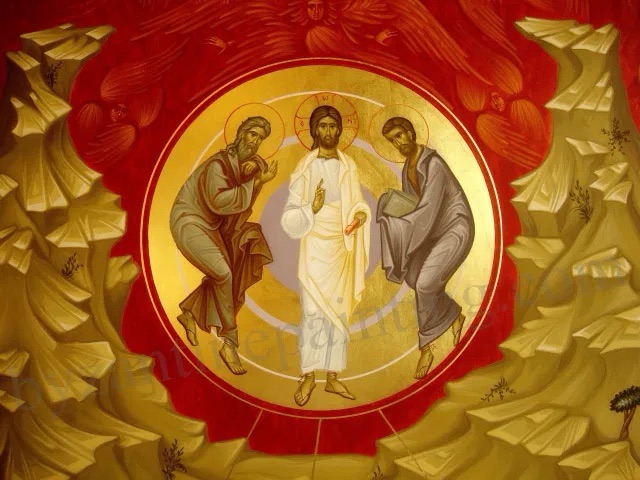
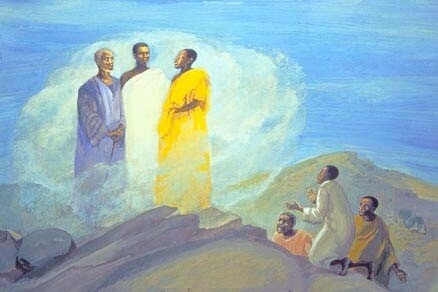
It’s the story of when Jesus took his three closest friends to a mountain, and they had a shared experience of seeing Jesus standing between two of the greats of their people: Moses, to whom God had given the Law to govern the people of Israel, and Elijah, through whom God had established a long line of prophets in Israel (Mark 9:2–8). It’s a story that in Christian tradition is called The Transfiguration.

The word Transfiguration is a strange word. It is not often found in common English usage. It’s one of those peculiar church words, that seems to be used only in church circles. Like thee and thy, holy and righteous, sanctification and atonement … and trinity. These words don’t usually pop up in regular usage!

I looked for some helpful synonyms for the word transfiguration, and found these: change, alter, modify, vary, redo, reshape, remodel, transform, convert, renew … and transmogrify. I am not sure whether that last one gets us anywhere nearer to a better understanding, but some of the others are helpful. Transfiguration is about change, adaptation, and taking on a new shape or size or appearance.

One of the other words offered as a synonym was metamorphose; and that caught my eye, because that word comes directly from the Greek word, metamorphidzo, which is used by Mark in his Gospel, when he tells his account of this incident. “After six days, Jesus took Peter, James and John with him and led them up a high mountain, where they were all alone; and he was metamorphosed before them” (Mark 9:2). Mark then explains that this metamorphosis was evident in that “his clothes became dazzling white”.

The story of the Transfiguration tells of the moment that Peter, James, and John perceived Jesus in a new way. No longer did they see him as the man from Nazareth. In this moment, they see him as filled to overflowing with divine glory. He was not simply the son of Joseph; he was now the divinely-chosen, God-anointed, Beloved Son (9:7).

Jesus brings the heavenly realm right to the earthly disciples. It is what is known, in Celtic Christianity, as a “thin place”: the place where heaven breaks into earthly life.

The disciples had the possibility, in a moment of time, to feel intensely close to the heavenly realm, to stand in the presence of God. They symbolise the desire of human beings, to reach out into the beyond, to grasp hold of what is transcendent—to get to heaven, as that is where God is (see Gen 28:10-12 and Deut 30:12; Pss 11:4, 14:2, 33:13, 53:2, 80:14, 102:19; although compare the sense of God being everywhere in Ps 139:8-12).

This key mountaintop moment contains the words from the heavens about Jesus, “This is my Son, the Beloved; listen to him!” (9:7). These words link back to the initial baptism of Jesus, when the same words were heard (1:11) and forward to the final scene of crucifixion, when a centurion and those with him at the foot of the cross witnesses Jesus’ death, and declares, “Truly this man was God’s Son!” (15:39).

All three scenes contain the foundational statement, recognising Jesus as Son of God, reiterating the words of the unclean spirits in Galilee (3:11) and the man possessed by demons in the country of the Gerasenes (5:7). For, as Simon Peter declares in the pivotal scene at Caesarea Philippi that is also included in this Sunday’s reading, Jesus is “the Messiah” (8:29).

The voice, booming forth from the clouds, “This is my Son, the Beloved; with him I am well pleased; listen to him!” (9:7) seems, at first hearing, to be quoting Hebrew scripture: perhaps the second Psalm, which praises the King of ancient Israel as the one whom God has begotten; or perhaps the song in Isaiah 42, which extols the servant as the one whom God has chosen, or anointed; or perhaps even the oracle in Deuteronomy 18, which instructs the people to listen carefully to the words of the prophet.

Whatever scripture, or scriptures, are here spoken by the divine voice, making this bold declaration from the cloud, it is clear that God has a special task, a special role, and a special place for Jesus. The words of this heavenly voice link this story back to the opening scenes of the story of the adult period in the life of Jesus, and also to a moment towards the end of that adult life.

As this voice is heard, Jesus is on a mountain, with three of his closest followers—and also with two key figures from the past of Israel: Moses, who led the people out of slavery, who then was the instrument for delivering the Torah to Israel; and Elijah, who stood firm in the face of great opposition, whose deep faith bequeathed him the mantle of prophet, as he ascended into heaven.

Mark says that “there appeared to them Elijah with Moses, who were talking with Jesus” (9:4). Matthew reverses the order, placing Moses before Elijah: “suddenly there appeared to them Moses and Elijah, talking with him” (Matt 17:3). Priority, in Matthew’s narrative, goes to Moses. Indeed, Matthew’s concern has been to make as many parallels as possible between the story of Jesus and the story of Moses. The regular reminder that “this took place to fulfil what the Lord has said through the prophets” (Matt 1:22; 2:4, 15, 17, 23) underlines this Mosaic typology.

The covenant given to Moses on Mount Sinai (Exod 19:1–6) is accompanied by the giving of the law (Exod 20:1–23:33), and is later sealed in a ceremony by “the blood of the covenant” (Exod 24:1–8). The scene on the mountaintop, with Jesus and his three disciples, evokes the mystery of the mountaintop scene in Exodus. This story is but one part of the story of Jesus which draws connections with the story of Moses.

*****

The Gospel writers say that Jesus was transformed at that moment. But in this story, also, there is the indication that the friends of Jesus were transformed. That moment on the mountain was a challenge to each of them; the response that Peter wanted to make was seen to be inadequate. Jesus challenged him to respond differently. It was another moment when metanoia, complete transformation, took place. And these disciples did change; yes, it took some time, but these friends of Jesus ultimately became leaders amongst the followers of Jesus, and spearheaded the movement that became the church.

The change, the metanoia, that occurred within Peter, James, and John, spread widely. They faced the challenge head on, and responses, in metanoia. That is mirrored, today, in changes that are taking place in society. Especially, that has been the experience of people over the last few years. We have met the challenge of a global viral pandemic; patterns of behaviour have been modified, as we prioritise safety and care for the vulnerable, and wear masks, sanitise, and socially distance. We have changed as a society.

In the church generally, through the pandemic that hit with such force in 2020, we have changed how we gather, how we worship, how we meet for Bible studies and fellowship groups, how we meet as councils and committees, how we attract people to our gatherings. Transformation has been widespread.

In my own church of these past few years, we worked hard to meet the challenge of reworking our understanding of mission; for across the church, we now see the importance of people from each Congregation engaging with the mission of God in their community as the priority in the life of the church. See

So in each place where people gather as church, there is a pressing need to consider how we might grow fresh expressions of faith, nurture new communities of interest, foster faith amongst people “outside of the building” and outside the inner circle of committed people. It is an ongoing process.

Change is taking place. Change is all around us. Change is the one thing that is constant about life: we are always changing. Sometimes we think that the church doesn’t change, isn’t changing, even resists changing. But that is not the case. Our church is changing. Our society is changing. And the story of the Transfiguration of Jesus encourages us throughout this change.

We have found him of whom Moses and the prophets spoke (John 1; Epiphany 2B)

“Follow me”. We most likely know these words of Jesus as the words that he spoke to Peter and his brother Andrew, as they were fishing in the Sea of Galilee (Mark 1:16–17). This was also, presumably, what Jesus said to the brothers James and John, soon after (Mark 1:20), as well as to Levi the tax collector (Mark 2:14), and then, later on, to the crowd that was following him through Galilee (Mark 8:34) and, quite poignantly, to the rich man who felt unable to follow (Mark 10:21–22).

We encounter these words in the Synoptic parallels to these incidents; but as well, we hear them spoken by Jesus in the book of signs which we know as the Gospel according to John. The resurrected Jesus tells Peter, “follow me” (John 21:19), and soon after, speaks the same words to the beloved disciple (John 21:22). At the last meal he shared with his followers, he had warned them, “where I am going, you cannot follow me now; but you will follow afterward” (John 13:36), and a little before that, he had said to Philip and Andrew, “whoever serves me must follow me, and where I am, there will my servant be also; whoever serves me, the Father will honour” (John 12:26).

The first time these words occur in the book of signs is in the scene when Jesus first meets Philip (1:43–51). This is the passage which is offered by the lectionary for this coming Sunday, the second Sunday after Epiphany. The scene also involves Nathaniel, who poses the sceptical question to Philip concerning Jesus: “can anything good come out of Nazareth?” (1:46). The following interaction with Jesus leads to Nathaniel making a high claim about Jesus: “Rabbi, you are the Son of God! You are the King of Israel!” (1:49). The scene itself ends with another description of Jesus, from his own lips, as “the Son of Man”, upon whom the very angels of heaven are resting (1:51).

This scene concludes the extended prose narrative (1:19–51) that follows the majestic poetic prologue which opens this opening chapter (1:1–18). Throughout the various scenes in this prose narrative (which I call the Prelude to the Gospel), a series of revelations of the identity and significance of Jesus are made.

It is noteworthy that there are a number of Jewish titles which are embedded in this prose narrative, as key characters confess the significance of Jesus throughout this extended preface (1:19–51). Jesus is addressed as “Rabbi” (1:38, 49), “Messiah” (1:41), “King of Israel” (1:49), and “Son of God” (1:49). It is worth noting that these claims about Jesus are each made also within the Synoptic traditions. Indeed, the Johannine Jesus himself refers, in the allusive synoptic fashion, to the “Son of Man” (thirteen times, from 1:51 to 13:31), which we must presume to be a self–reference.

In later scenes in the book of origins, Jesus is also addressed by these Jewish terms, when he is called “prophet” (4:19), “Messiah” (4:29; 11:27), and “Rabbouni” (my teacher, 20:16). Then, the ultimate Christological confession of the Gospel is uttered by Thomas, when he moves beyond this viewpoint in the phrase, “my Lord and my God” (20:28), echoing the perception of the Jews, that Jesus was “making himself equal to God” (5:18).

Perhaps we tend to remember the fourth Gospel as the one which reveals the extensive cosmic significance of Jesus—the Word made flesh (1:14), the one closest to the heart of the Father who has “made the Father known” (1:18), and most famously, the one through whom God shows that “God so loved the world” (3:16). This Gospel seems to offer much in terms of a Saviour for the whole world (4:42), a sign for Greeks (that is, Gentiles) from beyond Judaism (12:20).

Yet, for the most part of this Gospel, Jesus is presented in terms drawn from within a Jewish context. Indeed, even the final, climactic confession by Thomas can be understood within a particular stream of Jewish tradition, for the hellenistic Jewish author Philo uses the terms “Lord” and “God” to designate the two major divine powers of creation (signified by “God”) and eschatological judgement (signified by “Lord”). In light of this usage of the terms by Philo, Jerome Neyrey wisely concludes that “Jesus is correctly called ‘God’ because he exercises creative power, and ‘Lord’ because he has full eschatological power”; see https://www3.nd.edu/~jneyrey1/MyLord.God.htm

So an important clue to a central motif running throughout this Gospel is placed in the mouth of Philip, when he says to Nathanael, “We have found him about whom Moses in the law and also the prophets wrote, Jesus son of Joseph from Nazareth” (1:45). The Jewish terms point to this reality about how Jesus was understood in the community within which the book of signs was written: Jesus is to be regarded as the fulfilment of scripture.

Notice that the author of this Gospel takes Philip, an almost anonymous figure in the Synoptic Gospels, and places in his mouth these key sayings, about the fulfilment of the scriptures (1:45), and the relevance of Jesus to Gentiles (12:20–26), and, indeed, the fundamental request, “Lord, show us the Father” (14:8). Philip articulates what the author of the book of signs seeks.

Now, it is true that the affirmation that Jesus fulfils scripture is common to all four canonical Gospels. It is very clear in the Synoptic accounts; we should not, however, diminish its significance on the fourth Gospel. This interpretive stance is hinted at as early as the Prologue, in the comparison between Jesus and Moses (1:17).

This perspective is stated explicitly, as we have noted, in the claim put on the mouth of Philip, “we have found him of whom Moses and the prophets wrote” (1:45), and later in the words attributed to Jesus, “You search the scriptures, because you think that in them you have eternal life; and it is they that bear witness to me” (5:39).

There are fifteen clear quotations from Hebrew Scriptures in this Gospel. There are eight explicit references to scripture in the early chapters (1:23; 2:17; 6:31; 6:45; 7:38; 7:42; 10:34; 12:13–15), while a “fulfilment formula” is used in later chapters, to introduce seven such scriptural quotations (12:38–40; 13:18; 15:25; 18:9; 19:24, 28, 36–37). There is also a passing note that Judas died after betraying Jesus “so that the scripture might be fulfilled” (17:12).

However, the total significance of the Hebrew Scriptures in this Gospel is much greater than these sixteen occurrences, as the Gospel contains numerous allusions to specific scripture passages, such as references to Jacob’s ladder (1:51) and the sacrificial lamb (1:29, 36), as well as more generalised allusions to scripture. These allusions are much freer in their form and indicate that, for the author of this Gospel, the Hebrew Scriptures had become an integral part of his mind and heart, for he treats them with a freedom born from intimate familiarity. (For this last phrase, I am indebted to an unpublished paper on this topic by my first New Testament teacher, the late Rev. Dr Robert Maddox.)

So this Gospel passage for the second Sunday in Epiphany reminds us of the Jewish origins of Jesus and also the continuing appreciation of Jesus in Jewish terms, throughout the early decades of the movement that was initiated by his proclamation and action in Galilee and (especially in John’s account) in Jerusalem, over some years. In our Christian appropriation of the figure of Jesus, we would do well to remember his Jewish origins, and the strongly Jewish nature of early Christian interpretation of Jesus. We owe much to Judaism, both as our ancient heritage and indeed as an enduring living faith which continues to proclaim faith in the God whom Jesus knew, and loved, and revealed.

Dealing with divine violence (Matt 18; Pentecost 16A)

“Lord, if another member of the church sins against me, how often should I forgive? As many as seven times?” (Matt 18:21). We know the question—and we know the answer. “If a person sins against you seven times a day, and turns back to you seven times and says, ‘I repent,’ you must forgive”, Jesus says, at least according to Luke’s Gospel (Luke 17:4).

Not so in Matthew’s Gospel. Forgiving seven times, as demanding as that is, is not enough—at least according to the Jesus of Matthew’s Gospel. “Not seven times”, says this Jesus, “but, I tell you, seventy-seven times” (Matt 18:22).

We hear this conversation, and an ensuing parable, on this coming Sunday, as it is the Gospel passage proposed by the lectionary. It follows on from last week’s passage dealing with conflict within the community (18:15–20).

And so, this particular Matthean representation of Jesus appears, on the face of it, to be a more generous, accepting, grace-filled version, than even the Jesus of Luke’s Gospel! Forgiveness is important—so important that it needs to be offered, over and over again, we might assume.

Well, hold on—not so fast. Because immediately after reporting this word of Jesus, the author of Matthew’s Gospel reports him offering a parable which contains a number of difficult—indeed, troublesome—elements. He sets a scene involving a king and a number of slaves. How those characters behave is interesting. The end result is that one slave is thrown into prison “to be tortured until he would pay his entire debt” (18:34).

Slaves, of course, were present in the world in which Jesus lives. Their presence is noted in scenes, such as when we see mention of the sick slave of a centurion (Matt 8:5–13; Luke 7:1–10) and a slave of the high priest (Mark 14:47; Matt 26:51; Luke 22:50; John 18:10). They are recurrent characters in the parables of Jesus (Mark 12:1–12 and parallels; Matt 24:45–51; Luke 12:35–40, 42–48; 14:15–24; 19:11–27; 20:9–19). Slaves are also referred to in a number of the sayings of Jesus (Mark 10:44; Matt 6:24; 10:24–25; 20:27; Luke 16:13; 17:7–10; John 8:34–36).

The character of a king appears in a number of parables of Jesus, in both the Gospel of Luke (Luke 14:31–32; and see also 19:27) and that of Matthew (Matt 18:23–35; 22:1–14; 25:31–46). In this last parable, the final scene of judgement of the nations (25:31–46), the king functions as God’s representative, delivering his commendation of those who acted correctly, but judgement on those who failed to do so.

In the parable we will hear this coming Sunday (18:21–35), the king initially demands repayment of a large debt owed to him by one of his slaves. When the slave cannot pay, he plans to sell him and all his goods and family. However, after being begged by the slave, the king remits the debt (18:27). This part of the parable clearly illustrates the instruction of Jesus concerning forgiveness (18:22).

In the next parable found in Matthew’s Gospel (22:1–14), whilst dealing with guests who turn down his invitation to attend a wedding feast and murder the slaves he had sent to them, the king does not act so graciously; we are told that he “was enraged; he sent his troops, destroyed those murderers, and burned their city” (22:7).

Then, when a guest does enter dressed without his wedding robe, the king was initially rendered speechless, before ordering his attendants, “Bind him hand and foot, and throw him into the outer darkness, where there will be weeping and gnashing of teeth” (22:13). This is hardly the action of a leader who is following the exhortation to “forgive seventy times seven”!

This destructive rampage by the king fits alongside the reaction of the slave in the earlier parable. Although himself forgiven of his massive debt of “ten thousand talents” (18:27)—an impossible huge debt, completely unrealistic—he refuses to forgive his fellow-slave who owes him much less, “a hundred denarii” (18:28–30)—a more realistic amount to owe. He has this slave thrown into prison—but on hearing of this, his master, the king, who had earlier practised forgiveness (18:25–27), turns on his slave, now seen as “you wicked slave”, and condemns him “to be tortured until he would pay his entire debt” (18:34).

So I am somewhat bemused by the inclusion of this parable. Had Jesus stopped at verse 27 (“out of pity for him, the lord of that slave released him and forgave him the debt”), the parable would have been a fine example of the principle of “forgive seventy times seven”. But it doesn’t stop there. It continues on for another eight verses, and those verses tell of the complete opposite of gracious forgiveness.

The idea of forgiving someone who himself had failed to show forgiveness is thus doomed to failure. And not only that—it is not simply the king in the parable who acts with vengeance, it is the “heavenly Father” who will act in this way towards anybody who “does not forgive your brother or sister from your heart” (18:35). It seems that God is fundamentally a God of vengeance, not of grace.

This should not surprise us if we look elsewhere in this Gospel, to see how Jesus portrays God. Whilst God feeds the birds of the air (6:24), “clothes the grass of the field” (6:30), casts out demons through the Spirit (12:28), commands the honouring of parents (15:4), joins together man and woman to be come “one flesh” (19:4–6), and is able to deliver “the one who trusts in him” (27:43), there are more ominous actions of the divine being that Jesus reflects in his teachings.

Whilst Jesus teaches that the kingdom of heaven will be characterised by being like a child (18:1–5), a number of parables indicate that what transpires in the kingdom will vary, depending on how a person has behaved in life. Those who commit to the righteous-justice that Jesus teaches (5:20; 6:33; 21:32) “will shine like the sun in the kingdom of their Father” (13:53) and will hear gracious words of welcome: “come, inherit the kingdom prepared for you from the foundation of the world” (25:34). Their fate is to enter into “eternal life” (25:46).

However, those who fail to live in accord with this way of righteous-justice will encounter a different message: “you that are accursed, depart from me into the eternal fire prepared for the devil and his angels” (25:41). Their fate is terrible; the “eternal punishment” that is noted at the conclusion of this parable (25:46) is variously described in other places within this Gospel.

The slave who was not prepared for the return of his master—in the first of four parables (24:45–51) which conclude the final teaching discourse of Jesus—ends with clear punishment: “put him with the hypocrites, where there will be weeping and gnashing of teeth” (24:51). Jesus had spoken the instruction to “throw him into the outer darkness, where there will be weeping and gnashing of teeth” in the parable where a person came to a wedding inappropriately dressed (22:14). This is a recurrent motif in Matthew’s Gospel.

He has also pointed to the same punishment for lawless and disobedient people in other places: in his words of judgement spoken in Capernaum, where he encounters a distressed centurion (8:12); in his explanation of the parable of the weeds and the wheat (13:42); in the parable of the good and bad fish (13:50); and in the parable of the talents (25:30).

It is a punishment that is taken from Hebrew Scripture texts: “the wicked plot against the righteous and gnash their teeth at them (Ps 37:12); “the wicked gnash their teeth and melt away; the desire of the wicked comes to nothing” (Ps 112:10); “malicious witnesses … impiously mocked more and more, gnashing at me with their teeth” (Ps 35:11,16). The prophet laments that when Jerusalem is ransacked, “all your enemies open their mouths against you, they hiss, they gnash their teeth, they cry ‘we have devoured her!’” (Lam 2:16). It is a well-known form of torment and punishment.

The parable of the unprepared servant also has this apparently savage instruction: “he will cut him in pieces” (24:51). We find that in Hebrew Scripture, this was an action used in sacrificing animals (1 Kings 18:23, 33) and as a warning of judgement against sinners—in the terrible story of the Levite’s concubine (Judges 19:29), after Saul defeated the Ammonites (1 Sam 11:7), and also in direct prophetic warnings (Isa 45:2; 51:9; Ezek 16:40; Dan 2:34; also Judith 5:22). This is the fate decreed for the unprepared slave—a terrible end, indeed!

Throughout this Gospel, Jesus declares that sinners are destined for “the judgement of fire” (Matt 5:22; 7:19; 13:40, 42, 50; 18:8–9; 25:41). This picks up from the warning of John the baptiser, which Matthew has added to his Markan source: “You brood of vipers! who warned you to flee from the wrath to come? … even now the ax is lying at the root of the trees; every tree therefore that does not bear good fruit is cut down and thrown into the fire” (Matt 3:7, 10).

That place is described by Jesus, in parables unique to Matthew, as “the furnace of fire” (Matt 13:43, 50; 25:41). Sinners will be sent to a place of “eternal fire” (18:8; 25:41), “the hell of fire” (5:22; 18:9), the “unquenchable fire” threatened by John: “the chaff he will burn with unquenchable fire” (3:12). This builds on the warnings found in Mark’s Gospel about the punishment in store for those who put stumbling blocks in the way of “these little ones”—they will be condemned to “the unquenchable fire” (Mark 9:42–48). These warnings are repeated by Jesus in Matt 18:6–9.

Matthew’s portrayal of Jesus is consistent in reporting that he warns his followers, again and again, of the fiery fate that awaits evildoers. Once again, this picks up on Hebrew Scripture passages in which various prophets declare that God will use fire to destroy people and places because of their sinfulness (Isa 1:7; 5:24; 30:27–28, 30, 33 18–19; Jer 4:4; 6:27–30; 20:47–48; Hos 8:14; Joel 2:1–3; Amos 1:4—2:5; Nah 1:15).

Amongst those prophetic oracles, Zephaniah, for instance, portrays utter devastation through divine judgement: “neither their silver nor their gold will be able to save them on the day of the Lord’s wrath; in the fire of his passion the whole earth shall be consumed” (Zeph 1:18).

However, the final prophet in the Christian Old Testament, Malachi, reworks this imagery, offering some hope; God’s messenger on The Day of the Lord “is like a refiner’s fire and like fullers’ soap; he will sit as a refiner and purifier of silver, and he will purify the descendants of Levi and refine them like gold and silver, until they present offerings to the Lord in righteousness” (Mal 3:1–4).

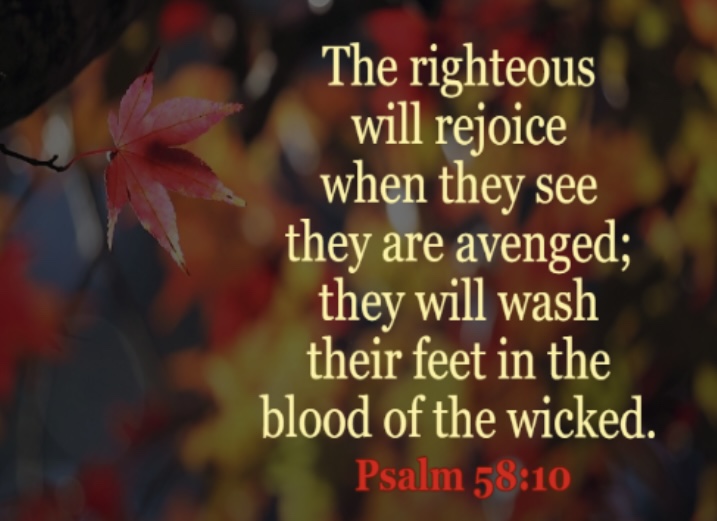
A number of psalms reflect the desire for God to punish evildoers severely; “pour out your indignation upon them, and let your burning anger overtake them” is the cry of one psalm (Ps 69:24). Another psalm notes the vengeance of God—“in your hearts you devise wrongs; your hands deal out violence on earth” (Ps 58:2)—and suggests that “the righteous will rejoice when they see vengeance done; they will bathe their feet in the blood of the wicked” (Ps 58:10). We must wonder: did Jesus pray these psalms? did he concur with their ideas? did he pray for God to act with vengeance?

The image of fiery punishment comes from the story of Daniel (Dan 3:1–30) and appears again in the last book of the New Testament, where the prophet describes his visions of “the lake of fire that burns with sulfur” (Rev 19:20; 20:10, 14–15), also described as “the second death” (Rev 20:14; 21:8). It is there that the devil, the beast, and the false prophet “will be tormented day and night forever and ever” (Rev 20:10). Matthew appears to share some similarities with the writer of this book, for as we have noted, eternal punishment in a fiery furnace features also in the words of Jesus in Matthew’s Gospel.

So we can’t simply brush aside the closing words of the parable which is in focus this coming Sunday—the Heavenly Father, we are told, will follow the example of the unforgiving servant, who will be “tortured until he would pay his entire debt” (18:34–35), in the service of ensuring that faithful people do indeed forgive one another! (How he will be able to pay off his debt while he is being tortured in prison, I do not know!)

Such punishment is consistent with the way that God’s justice will be implemented, according to the various teachings and parables of Jesus in Matthew’s Gospel that we have already noted. It will be incredibly hard to be let off the hook by this fierce, punitive God!! We are left with the conundrum: what are we to make of this aggressively violent, retributive God?

*****

I have had a go at addressing this conundrum in terms of how it is presented in Hebrew Scripture, at

and

The Disruptive, Transforming Spirit (part two): the Spirit in Acts

Whenever Christians think about the Spirit—and specifically about the dynamic force that is displayed by the Holy Spirit—our attention goes most immediately to the story of the Day of Pentecost in Acts 2. That’s when the coming of the Spirit was experienced as “a sound like the rush of a violent wind [which] filled the entire house where they were sitting”, followed by “tongues, as of fire … resting on each of them” (vv.2–3).

In the chaos that resulted—“all of them … began to speak in other languages”—the crowd that heard them were bewildered, amazed, astonished, and thought that they were drunk! That’s a disruptive event initiated and impelled by the Spirit right there. The story of Pentecost is a story about God intervening, overturning, and reshaping the people of God. The Spirit certainly was active at Pentecost.

As Luke tells the story of Pentecost, he is deliberately linking his second volume, not only to the activity of the Spirit in Hebrew Scriptures, but also to the way the Spirit overshadowed Mary (Luke 1:35), nurtured John, son of Zechariah and Elizabeth (1:80), descended upon Jesus at his baptism (3:22), led Jesus out into the Judean wilderness (4:1) and then back into Galilee (Luke 4:14) to sustain the activities and preaching of Jesus (4:18; 10:21).

Luke, of course, had received the account of the active role of the spirit in the baptism and testing of Jesus (Mark 1:10, 12) and developed it, just as Matthew had done likewise, introducing the saying of Jesus, “if it is by the Spirit of God that I cast out demons, then the kingdom of God has come to you” (Matt 12:28).

Certainly, the activities of Jesus can only be thought of as both disruptive—framed by the breach of the heavens at his baptism, the tearing of the temple curtain at his death—and as transformative—signalled by the transfiguration on the mountain top, as well as the change in the disciples effected by their time with Jesus.

Some interpreters have noted that the book of Acts is less about “the acts (deeds) of the apostles” than it is about “the acts of the Hoy Spirit”.

The author himself described the two-volumes work (Luke’s Gospel Acts) as “an orderly account of the things that have come to fulfilment amongst us”. The work highlights how the Holy Spirit plays a central, active role in what is being reported—and how the dual motifs of disruption and transformation continue apace in the movement that Jesus inspired.

The events reported in Acts are generated from the dramatic intervention of the Spirit into the early community formed by the followers of Jesus after his ascension. The story of that intervention reports that Jews came from around the eastern Mediterranean are gathered in Jerusalem for the annual festival (Acts 2:1–13), when the Spirit comes upon them. Each bursts out, “speaking about God’s deeds of power” (2:11). The joy and excitement is tangible even as we hear the story at two millennia’s distance.

Unthinkingly, the wider group of pilgrims hear the cacophony of Spirit-inspired voices, and assume that this is a sign of drunkenness (2:13, 15). Actually, as Luke has made clear, the tongues being heard are not the unintelligible gibberish evident in Corinth, but known languages from the various places of origin of those speaking. And the disruptive element is not from the tongues spoken, but from the actions undertaken by believers in the days, months, and years ahead—as the narrative of Acts conveys.

A second story of the coming of the Spirit is told at a later point in Acts—after Peter sees a vision in which God declares “all food is clean”, and he is summoned to the home of the Gentile centurion, Cornelius, in Caesarea (10:1–33). As Peter preaches to the Gentiles, the Spirit falls on them, “just as it had upon us [Jews] at the beginning (11:15). This event is specifically portrayed as a complementary event alongside the falling of the Spirit on Jews on the Day of Pentecost (2:1–4). It is a further disruptive action that the Spirit impels.

The activity of the Spirit is noted at various places in this sequence of events. The Spirit guides Peter to meet the men sent by Cornelius and travel with them to Caesarea (10:19; 11:12). In reporting to the church in Jerusalem about the arrival of messengers from Cornelius (11:11–12), Peter notes simply that “the spirit said to me to go with them without criticism” (11:12; cf. 10:19–20).

In this report to the Jerusalem church, Peter is short on factual reporting, as it were; he simply states that the spirit fell on them (11:15). His omission of many details (character traits, travel details, conversation and personnel; even, surprisingly, the name of Cornelius) places the focus on the role of the spirit. Once again, what the Spirit impels from this vision, visit, and sermon, is highly disruptive for the early communities of faith.

Jews had been used to eating separately from Gentiles and selectively in terms of food, in accordance with the prescriptions of Leviticus. Now, they are now invited—indeed, commanded—to share at table with Gentiles and to put aside the traditional dietary demarcations.

This is disruptive: just imagine being commanded by God to become vegan and eat meals with the family of your worst nightmares, for instance! And it is transformative: from this sequence there emerge inclusive communities of Jews and Gentiles across the Mediterranean basin, sharing at table and in all manner of ways. That becomes the way of the church.

The importance of the Spirit in Luke’s account of the early movement cannot be underestimated. The significance for the church today of the Spirit’s disruptive, empowering, transformative presence at Pentecost is likewise high. And that transformative activity continues on throughout Acts.

After Peter’s sermon in Caesarea and the gifting of the Spirit to the Gentiles (Acts 10—11), the Spirit guides Barnabas and Paul to Seleucia and onwards (13:2) and then later guides Paul away from Asia Minor, towards Macedonia (16:6–7). This latter move marks a critical stage in the story that Luke tells.

At this key moment of decision in Troas, three injunctions are given; each one is from a divine source. The first of these, an instruction not to speak in the southern region of Asia, comes from the Holy Spirit (16:6). The second direction, a prohibition against any attempt to head north and enter Bithynia, comes from the same spirit, here described as “the spirit of Jesus” (16:7). The third divine interjection takes place at Troas, where a vision is seen in the night with a petition to “come across into Macedonia” (16:9).

The new spirit-inspired direction of travel is disorienting; a serious disagreement between Paul and Barnabas had just occurred (15:39). But this disruption provides the springboard for Paul and Silas to undertake a new mission in Philippi, Thessalonica, and Beroea (16:11—17:15), before visiting the centre of Greek philosophy and politics, Athens (17:16–34), and then Corinth, where Paul stayed eighteen months (18:1–17). Indeed, all that takes place, as Paul travels relentlessly with various companions across many places (13:4—21:17), is driven by the Spirit (13:2, 4), a constantly disruptive and transformative presence.

Much later, Paul’s final visit to Jerusalem and his subsequent arrest takes place under the guidance of the Spirit (20:22-23; 21:11). That event had hugely disruptive consequences for Paul, of course, as he is arrested and spends the rest of his life as a prisoner under Roman guard.

The story of the early years of the movement initiated by Jesus, then, is of multiple events inspired and propelled by the Spirit over these years—intrusive, disruptive, yet transformative events. The Spirit who guides all of this is both disruptive and transform. We need, today, to be open to the same disruption and transformation today.

Liminal experiences and thin places (Matt 14; Pentecost 11A)

“Immediately he made the disciples get into the boat and go on ahead to the other side, while he dismissed the crowds” (Matt 14:22). And then, “early in the morning he came walking toward them on the sea; but when the disciples saw him walking on the sea, they were terrified, saying, ‘It is a ghost!’, and they cried out in fear” (Matt 14:25–26).

Both incidents come from the Gospel passage which is offered in the schedule of lectionary readings for this coming Sunday (Matt 14:22–33). The first excerpt, telling of a crossing of the Sea of Galilee by boat, reports a liminal experience, as the disciples cross over from one side of the lake to the other side. The second excerpt tells of a thin place moment, when the eyes of the disciples are opened up to see Jesus in a new way. Both liminal experiences and thin place moments are important in the Christian life. And often they are interconnected and occur almost simultaneously, as in this story.

Liminal experiences occur at times of transition, when we move from one place to another. The word liminal comes from the Latin word līmen, which means “a threshold”. Technically, that is the place that marks off one space from another. Its origin was the strip of wood or stone at the bottom of a doorway, which was crossed in entering a house or room.

The thresh is the place where one treads as one enters a room. So the threshold is where you take hold of the thresh, where you put your foot as you walk into a new room or new place. Anthropologists define liminality as “the quality of ambiguity or disorientation that occurs in the middle stage of a ritual”. It is the moment when participants no longer hold their preritual status but have not yet begun the transition to the status they will hold when the rite is complete.

Sociologists say that in the liminal stage of a rite, participants “stand at the threshold” between their previous way of structuring their identity, time, or community, and a new way, which completing the rite establishes. I wonder how that might apply the story of Jesus sending his disciples away, across the lake, while he went “up a mountain” to pray. Why has he sent them on ahead of him? What kind of experience was he anticipating that they might have, without him?

The concept of liminality was developed in the early twentieth century sociologists. It was applied particularly to religious rituals marking the movement of a person from one stage to another. More recently, usage of the term has broadened to the political and cultural arena, alongside the religious or faith area.

During liminal periods of all kinds, the experts tell us, “social hierarchies may be reversed or temporarily dissolved, continuity of tradition may become uncertain, and future outcomes once taken for granted may be thrown into doubt. The dissolution of order during liminality creates a fluid, malleable situation that enables new institutions and customs to become established.”

[I found this on Wikipedia, which references the source as Agnes Horvath, Bjørn Thomassen, and Harald Wydra, Introduction: Liminality and Cultures of Change (International Political Anthropology 2009). Accessed 18 March 2019.]

That’s where the disciples found themselves, as they sailed across the lake, pushing from land on one side of the lake, heading towards the land they could see on the other side, but on the water, in the midst of the lake: in a liminal moment.

And the liminal moment is precisely where change takes place, where a new reality can be experienced. In liminal moments, a thin place might be experienced. Is that what happened to the disciples on the lake, as they saw a figure walking towards them? A figure that they recognised as Jesus—for when “the disciples saw him walking on the sea, they were terrified, saying, ‘It is a ghost!’ And they cried out in fear” (14:26).

In the Celtic world, thin places are those places where the veil between this world and the otherworld is porous. They are places where human beings on the earth sense that they are standing in a place where the sky opens up, as it were, and they are drawn into a strong connection with the world beyond—with the spiritual realm, with the place where the deity is, with heaven, if you like.

The thin place is the place where the thick, dividing barrier between “heaven” and “earth” is lessened, where it becomes thin—a place where a person feels that they could reach out and “touch God”.

Thin places are often experienced where there is a sense of mystery in the landscape, or where there is a deep sense of belonging to the land as a sacred place, a sense of being so deeply earthed, yet at a place, paradoxically, which opens up to reveal something of a transcending reality, enabling contact beyond the immediate time and place. This is particularly the case among peoples whose connection to place has remained unbroken through the ages—indigenous people in Australia, in the United States and Canada, and Celtic people in Ireland and Scotland.

For the disciples, the Sea of Galilee was familiar territory. Indeed, four of them had made their living by fishing in that sea before they encountered Jesus and responded to his call to “follow me” (4:18-22). Would they have regarded that sea as a thin place where they could encounter God? Perhaps it had become a holy place for them, as they carried out their daily tasks, and felt that the difference between themselves and the sea was falling away?

Earlier in Matthew’s narrative, the disciples had been in a boat with Jesus on the sea (8:23), when a dramatic experience took place. Crossing the sea, a huge storm whips up the water. Mark’s earlier account had described this as a lailaps, a ferocious wind (Mark 4:37); Matthew modifies his version, such that the disturbance of the water was explained as being due to a seismos, an earthquake (Matt 8:24).

In both versions, the sleeping Jesus is woken, and he stills the storm (Mark 4:39; Matt 8:26). Seeing this, the disciples have an epiphany; the moment has opened up a new insight into Jesus for his disciples, as they utter the words, “What sort of man is this, that even the winds and the sea obey him?” (Matt 8:27). In asking this question, the disciples are alluding to Psalm 107, which affirms of God, “he made the storm be still, and the waves of the sea were hushed” (Ps 107:29–30). In like manner, another psalm praises God that “you rule the raging of the sea; when its waves rise, you still them” (Ps 89:9).

The question of the disciples is rhetorical; it is clear that when Jesus stills the storm, he is manifesting divine powers. Indeed, Matthew’s reworking of the story to introduce the earthquake links this “thin place” experience with other moments in the story of Jesus when the divine interposes into human life—as Jesus dies on the cross (27:51, 54), as soldiers keep watch at the tomb (28:2), and at the predicted “beginning of the birth pangs” at the coming “end of the age” (24:7–8).

That moment on the sea, in the midst of the earthquake-indicted storm, is a liminal experience that functions like a thin place for the disciples; the reality of God’s presence is glimpsed by the disciples. So it seems that on the second journey across the lake to “the other side” (8:18; 14:22), another thin place experience takes place for them. The ferocious wind and the battering of the waves places them, once again, in a precarious situation. Did they have in mind the earlier experience,when Jesus stilled the storm? The terra that leads them to exclaim” it is a ghost” (14:26) suggests that they were quite discombobulated.

Jesus had sent the disciples on across the lake ahead of himself, while he took time to go “up the mountain by himself to pray” (14:23). Jesus, of course, is often up a mountain in Matthew’s Gospel: early on, when he is tested by the devil (4:8); then as he teaches his disciples (5:1–8:1), after he had cured many people beside the Sea of Galilee (15:29), and when he is transfigured (17:1–9); and in the very final scene of the Gospel, after his resurrection (28:16–20).

The mountain, in earlier stories, had been the place where Moses engaged with God (Exod 19:3–25), where Joshua is appointed to succeed Moses (Num 27:12–23), where Solomon builds the Temple (1 Ki 5:5; 6:1–38), where Elijah experiences “the sound of sheer silence” (1 Ki 19:11–18), and where generations of faithful Israelites worshipped the Lord God (Ps 99:9). In Matthew’s narrative, Jesus is on the mountain to draw near to his Father—to find his own thin place, as it were.

So this narrative has elements that invite us to consider our own faith journey; to reflect on the liminal moments in that journey, when we have moved from one place, through a transition, into another; and to ponder when it was that we felt closest to God, to the extent that we were at a thin place, where we could reach out and touch God. The story we hear this coming Sunday, a story about Jesus and his disciples, invites us yet again to ponder our own story.

Parables, riddles, and allegories: the craft of Jewish storytelling (Matt 13; Pentecost 8A)

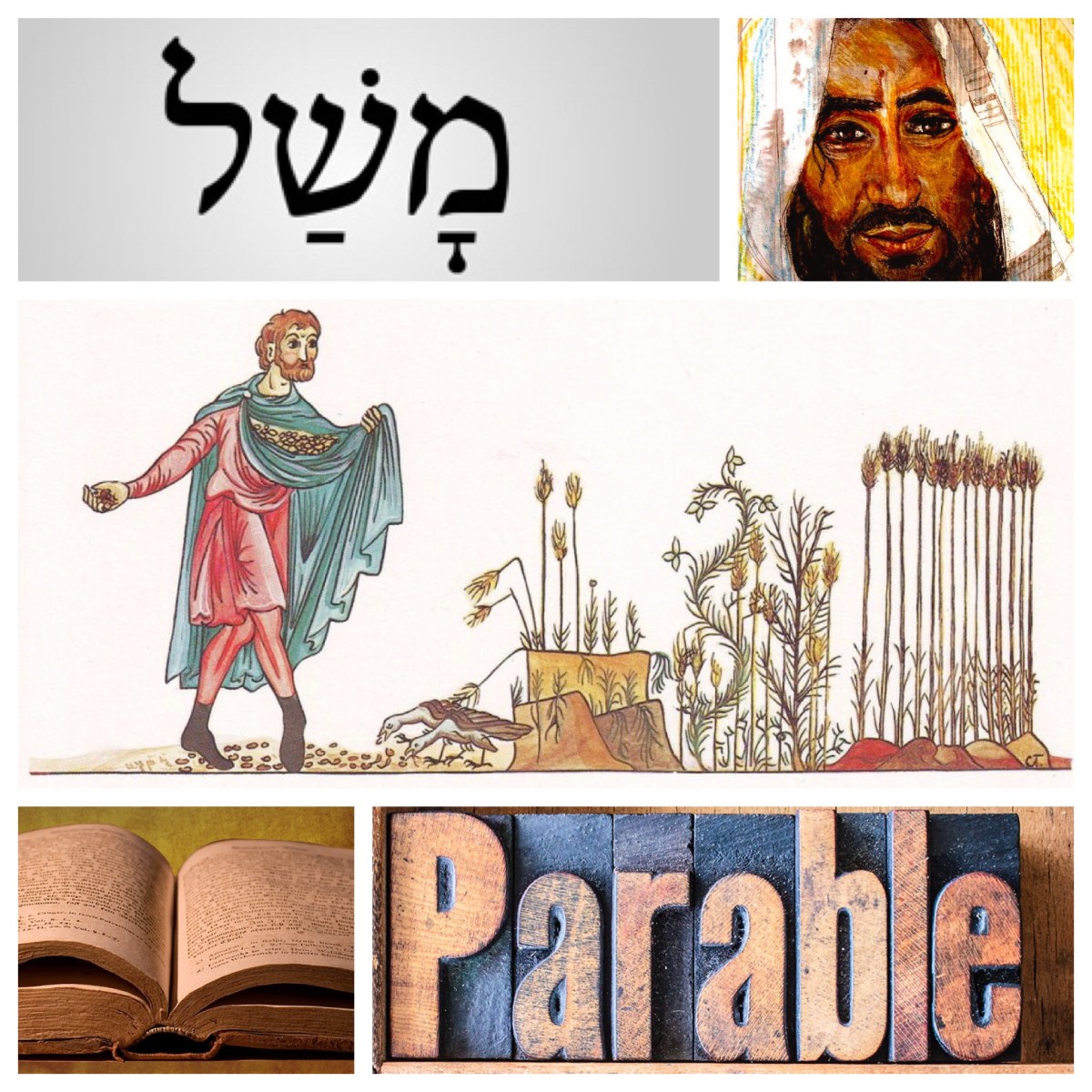
Jesus used parables as the chief means of his story-telling. A parable is a story told in a specific way, often to make a single clear point. Parables are conundrums. They contain unresolved tensions. They invite multiple understandings. They press for exploration and investigation. We have another parable in the Gospel reading for this coming Sunday!

The accounts of Jesus that we have in scripture—Mark’s beginning of the good news of Jesus, Matthew’s book of origins of Jesus, Chosen One, and Luke’s orderly account of the things fulfilled—each contain a number of parables. Even in John’s book of signs, there are some parable-like sections, buried in the midst of the long discourses that this book contains.

Last week (Pentecost 7A), we had the parable of the seeds and the sower (13:3-9) and its interpretation (13:18-23). This week (Pentecost 8A), we will hear the parable of the weeds among the wheat (13:24-30) and its interpretation (13:36-43). Then in the following week (Pentecost 9A), we will hear the other five parables in this chapter: the mustard seed (13:31-32), the yeast in the flour (13:33), hidden treasure (13:44), a pearl of great value (13:45-46), and the net that caught fish (13:47-48)—each one offered without interpretation.

As with last week, so also this week we are given a parable, followed immediately by an interpretation of the parable. I had a spout last week about the way that a later allegorising understanding of the parable has been placed on the lips of Jesus, in this Gospel account. You can read that at https://johntsquires.com/2020/07/09/parables-the-craft-of-storytelling-in-the-book-of-origins-matt-13/

However, Elizabeth and I have had a rolling conversation about parables, and how they were seen and used in Judaism. The idea that the allegorising interpretation was a later addition, beyond the time of Jesus, has held sway for a number of decades in critical biblical scholarship. Christian scholars are dubious about whether Jesus would have utilise this somewhat hellenised approach to stories. (We know that allegories were in evidence centuries before Jesus in Greek literature. Whether Jesus knew this long tradition is debatable.)

Yet this critical Christian perspective overlooks the claim that Judaism, and the long stream of Jewish tellers of parables, have on such stories. Parables are found, in Jewish literature, in various forms. There are, for a start in Hebrew Scripture, a number of short, succinct, one-liners, often introduced as a simple comparison (“this is like that”), making just one focussed point. (Indeed, that is what the Greek word parabolē means—it signals two things that are “thrown beside” each other.)

The widow in Tekoa explains her plight to King David, explaining that “your servant had two sons, and they fought with one another in the field; there was no one to part them, and one struck the other and killed him; now the whole family has risen against your servant” (2 Sam 14:6–7).

When Ahab was king, a prophet waited beside the road, disguised with a bandage over his eyes, and taunts the king: “your servant went out into the thick of the battle; then a soldier turned and brought a man to me, and said, ‘Guard this man; if he is missing, your life shall be given for his life, or else you shall pay a talent of silver.’ While your servant was busy here and there, he was gone.” (1 Ki 20:38–40).

The “song of my lover about his vineyard” that Isaiah tells (Isa 5:1–7) is longer, but drives relentlessly to the single point: the Lord of hosts “expected justice, but saw bloodshed; righteousness, but heard a cry!”. Another agricultural parable relates the skill of the farmer who utilises good practices to produce abundant harvests; “they are well instructed; their God teaches them”, and so “this also comes from the Lord of hosts; he is wonderful in counsel, and excellent in wisdom” (Isa 28:24–29).

The classic example from Hebrew Scripture comes after David pursues Bathsheba, the wife of Uriah, after he has sent Uriah off into battle. The adultery of King David leads the prophet Nathan to confront him with a story about “a rich man who had many flocks” and “a poor man who had nothing but one little ewe lamb” (2 Sam 12:1–4).

As the story develops, and the rich man took the poor man’s lamb to feed a visitor, the king explodes into anger (2 Sam 12:5–6)—only to be met by the damning words of the prophet: “you are the man!” (2 Sam 12:7). The parable had drawn David into the web of the story, and there was now no escape!

In the parable of the weeds and the wheat which Jesus tells (Matt 13:24–30), there is a simple contrast drawn between the weeds and the wheat, and a story which develops so that the conclusion that is drawn can only be seen as inevitable. That simplicity, and also that technique of drawing the listener into the story, is typical of parables that Jesus told.

A number of the parables told be Jesus were indeed short and direct, making a single point and needing little explanation: see the parables of the treasure (13:44) and the pearl (13:45), for instance. This made the parable easy to remember and repeat orally.

These parables are little more than an introduction (“the kingdom of heaven is like…”) and a single image which is used to describe a characteristic of the kingdom (hidden treasure, or fine pearls). The first part of this week’s parable (13:24–26) has this form. It is short and direct.

It starts with the classic introduction, “the kingdom of heaven may be compared to …”. It goes on to tell of the good seeds, which grow into wheat, and the bad seeds, which grow into weeds. This part of the parable has a simple contrasting form, like the parable of the good fish and the bad fish caught in the net, as told in the last of the seven parables (13:47–48).

But the parable has a story attached to these weeds among the wheat (13:27–30). So Jesus continues with a little plot development, which brings in a reflection on the human characters who sowed the seeds. In this regard, this is like other parables of Jesus, which are a little more developed; they still make a single point, but it is developed or explained a little more. And the questions are raised … and the listeners ponder, and consider their responses …

This parable plays,quite cleverly, on the fact that there is, indeed, a type of “weed” which, for much of its life, looks quite like wheat (the bearded darnel, lolium temulentum, or Darnel Ryegrass). So it is a story which is quite credible in the scenario it proposes. And then, added to the actual parable, there comes a separate section that provides a strongly allegorised interpretation of what happened in the field where the wheat and the weeds grew (13:24–30).

That development in the plot of this parable, and the subsequent allegorical interpretation, might well relate to the fact that the Hebrew Scriptures also contain parables with developed plots and allegorical elements. In an allegory, particular individual features can play an independently figurative role, so that the story told becomes a kind of riddle which invites a response from the listener. “What do you think?” becomes the implied way that the allegory-riddle ends. Listening to the story is not enough—the listener needs to engage, enter the conundrum, make up their mind!

A classic short, simple riddle is that spoken by Samson, “out of the eater came something to eat; out of the strong came something sweet” (Judg 14:14). The narrative comment that follows is delightful: “for three days they could not explain the riddle”! Another example is the proverb quoted by two prophets, about the impact of the Exile: “the parents have eaten sour grapes, and the children’s teeth are set on edge” (Jer 31:29; Ezek 18:2). The point of this saying is clear, and telling.

In Hebrew Scripture, the allegory of the Eagles and the Vine (Ezek 17:3–10) is described as both ḥidah (“riddle”) and mashal in verse 2. The parable first describes “a great eagle, with great wings and long pinions”, who carried seed far away where it took root and became a vine (a classic symbol of Israel). It then offers a further description of “another great eagle, with great wings and much plumage”, which the teller of the parable fears may seek to uproot the vine.

“When it is transplanted, will it thrive”, the parable ends (v.10)—will Israel, transplanted into exile, manage to survive that experience? Then follows an explanation of the details of the parable (Ezek 17:11–21), relating the story to the immediate situation of Israel.

Further parable-riddles occur in subsequent chapters in Ezekiel. There is the Lamenting of the Lioness (Ezek 19:2–9) and the Transplanted Vine (Ezek 19:10–14), and the stories of the Harlot Sisters (ibid. 23:2–21). There is also one of my favourites, the very vivid—and gruesome—parable of the Cooking-Pot (Ezek 24:3b—5).

In this parable, the prophet warns the people of judgement: “set on the pot … pour in water … put in the pieces, the thigh and the shoulder … fill it with choice bones” (that is, the meat and bones of the Israelites being punished). The prophet concludes with a booming denunciation: “woe to the bloody city … the blood is shed inside it … to rouse my wrath, I have placed the blood she shed on on a bare rock” (Ezek 24:6–8, and then the metaphor extended still further in 24:9–14).

Each of these parables are clearly allegorical, in that the overall point is clear, and yet also the details in the story invite connection with specific people or events. Ezekiel is a powerful speaker, who utilises this dramatic story-form with great flair, and effect.

A third type of mashal is the fable, where animals or inanimate objects are made to speak and act like men. We know about fables in Greek literature from Aesop, of course, and in more recent literature through those tales collected by the Brothers Grimm; but the article on “Parables” in the Jewish Virtual Library notes a number of instances where Hebrew Scripture contains fables. One good example is Judges 9:8–15, where the trees confer as to who will become king. Another is 2 Kings 14:9–10, where a thornbush sends a message to a cedar, but a wild animal tramples down the thornbush. These fables can be seen to relate directly to the political situation of Israel at different times in their history.

The article on “Parable” in the Jewish Virtual Library also notes: “Mashal and ḥidah are used almost synonymously in Ezekiel 17:2; Habakkuk 2:6; Psalms 49:5 and 78:2; and Proverbs 1:6. Certain proverbs are in effect parable-riddles, e.g., Proverbs 30:15a, 15b–16, 18–19, and 21–31.

“Other biblical forms related to the parable type of mashal are: prophetic oracles where a metaphor is extended into a lively description, e.g., Isaiah 1:5–6; Hosea 2:2–15; 7:8–9, 11–12; Joel 4:13; and Jeremiah 25:15–29; prophetic oracles proclaimed through symbolic actions, e.g., I Kings 11:29; II Kings 13:15–19, and Isaiah 20:2–6; extended personifications as of Wisdom and Folly in Proverbs 1:20–33; 8:1–36; 9:1–6, 13–18; and revelatory dreams and visions having symbolism which the sequel interprets as allegorical, e.g., Genesis 37:6–11; 40:9–13, 16–19; Zechariah 1:8–11; 2:1–4; and Daniel 2:31–45.

Beyond these many examples, there are the multitudes of parables in rabbinic literature (about which, see the further resources listed at the end of this blog).

Returning to the parable of the wheat and the weeds: if we take an agricultural approach to the story, it is a mystery why the weeds had to be burnt, and not just pulled out—as in the version of this parable found in the Gospel of Thomas—and composted—as would occur in my own gardening!

My own take would be that this links with the Jewish prophetic tendency to connect burning with God’s judgement (see Isa 27:2–4; Jer 4:4, 7:20, 15:14, 17:4; Nahum 1:13; Malachi 4:1; see also Ps 79:5, 89:46, and Exod 15:7). And we saw in my comments on the earlier parable that God’s judgement was a strong motif in the parables and teachings of Jesus, especially strengthened in Matthew’s account.

The parable of the mustard seed (13:31–32) is another example of a simple parable with a short plot development. This parable uses the same introductory phrase, “the kingdom of heaven is like …”, and conveys its main point in an image (mustard seed, 13:31) which is further developed to convey what happens to the mustard seed as it grows and forms “the greatest of shrubs” (13:32).

So the plot of the parable of the wheat and the weeds continues until the punchline is reached. It is not during the growing that any distinction is to be made; it is at the harvest that this distinction is enforced. Wheat that grew from good seeds is to be collected and stored; weeds that grew from bad seeds are to be bundled and burnt (13:28–30).

That much, as a parable, has a clear message: don’t intervene into the process of growing, don’t judge (recalling words of Jesus reported at Matt 7:1), but let the end result of the process of growing be the moment when the judgement occurs—and let that judgement be undertaken by God. And that taps into a strong interest, throughout the book of origins, for depicting Jesus as the eschatological preacher of judgement. See

This probably explains one curious aspect of the parable, that we noted above: why the weeds had to be burnt, and not just pulled out. It connects with Jewish understandings of judgement. Consistently throughout the book of origins, Jesus is presented as a prophetic eschatological figure. And yet alongside that, he functions as a master story-teller, in the mode of prophets of old as well as the rabbis to come!

In his capacity as God’s Messiah, Jesus frequently promises (or threatens) judgement (5:21–26; 7:1–2; 10:15; 11:21–24; 12:36–37; 19:28– 30; 21:33–44; 22:1–14; 24:29–31, 36-44, 45–51; 25:1–13, 14–30, 31–46; 26:64). The language of burning in the eternal fire characterises both conclusions to parables of Jesus, and the warnings of earlier prophets. Many of these declarations occur in eschatological contexts, where Jesus is warning about the punishment that is to come at “the end of time”, unless the righteous-justice that he advocates is followed in the present.

In the previous chapter, a quotation from the prophet Isaiah (Isa 42:1–4, at Matt 12:15–21) includes an extended quotation from Isaiah 42, where the servant of the Lord proclaims judgement to the Gentiles and they are said to have hope in his name (presumably because they repent and believe him). This is the function that Jesus, as God’s servant, the Chosen One, carries out. It’s not for us human beings to take on the role of judge. That belongs to God, carried out through his chosen agent, Jesus.

The parable of the wheat and the weeds has an intensity because of its focus and orientation towards this fearsome judgement, executed by Jesus as “the Son of Man” (24:30–31), in obedience to the desire of God. The interpretation of the parable might be seen to defuse the intensity of the parable by fussing about what each element refers to: the Sower is the Son of Man, the good seeds are the children of the kingdom, the bad seeds are the children of the evil one, the enemy is the devil, and so on (13:39). But the end point remains clear: judgement is a hand!

The interpretation of the parable ends with a repetition and expansion of the scene of judgement that ended the parable—but the good seed is not simply stored, it morphs into the righteous in the kingdom, and the bad seed is not burnt as seed, but it becomes the ones who disobeyed the law, burning in the furnace (13:41–43). And there will be “weeping and gnashing of teeth” (13:42; see also 13:50; 22:14; 25:30). So the same punchline holds in this section, as in the parable itself.

Interestingly, the interpretation ends with the same punchline that concluded the parable of the seeds and the sower: let anyone with ears, listen! (13:43, cf. 13:9). Jesus continues to press the point. Judgement is inevitable. He will continue to articulate this ominous message throughout the remainder of the Gospel—right through to the sequence of the four parables of judgement that conclude the final teachings of Jesus (24:44—25:46). Let anyone with ears, listen, indeed!

This blog draws on material in MESSIAH, MOUNTAINS, AND MISSION: an exploration of the Gospel for Year A, by Elizabeth Raine and John Squires (self-published 2012), and from ongoing conversations that Elizabeth and I have had about parables, Christian interpretation, Jewish storytelling techniques, and associated matters.

On Jesus’ language of judgement elsewhere in Matthew’s book of origins, see

The Jewish Virtual Library is a project of the American-Israeli Cooperative Enterprise (AICE), which was established in 1993 as a nonprofit and nonpartisan organization to strengthen the U.S.-Israel relationship by emphasizing the fundamentals of the alliance — the values which those two nations share. The extensive online resource on Jewish history, politics and culture provides a one-stop shop for users from around the world seeking answers to questions on subjects ranging from anti-Semitism to Zionism.
AICE seeks to provide a vehicle for the research, study, discussion and exchange of views concerning nonmilitary cooperation (Shared Value Initiatives) between the peoples and governments of the United States and Israel.

The Jewish Virtual Library article on “Parable” can be found at https://www.jewishvirtuallibrary.org/parable

For further reading on parables in the rabbinic tradition, see

https://www.cfi.org.uk/downloads/rabinnic-parables.pdf

https://www.jewishencyclopedia.com/articles/11898-parable

https://www.jerusalemperspective.com/2721/

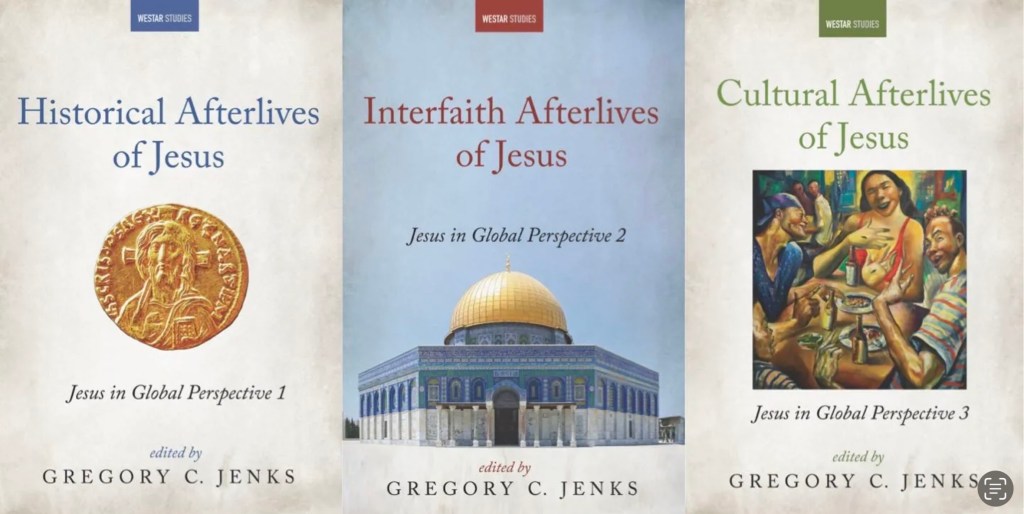
The Afterlives of Jesus: historical, interfaith, and cultural perspectives

Jesus has been important ever since his earthly life. Through his teachings, his death, and the experience of resurrection, his early followers recognised his significance. They held together after the crucial events in Jerusalem that brought the earthly life of Jesus to an end. In a sense, Jesus lived on through what they said and did in the ensuing decades … and centuries.

Jesus had a life after his (earthly) life … or, perhaps we might say, Jesus had an afterlife; although, to be more accurate, we might better say, Jesus had many afterlives. In the preaching, serving, writing, singing, drawing, painting, and witness of many later followers of Jesus, he lived on … in ways that each person represented, contextualising Jesus to their own situation, their own experience, their own cultural practices.

So over the centuries there has been Jewish Jesus, Black Jesus, Asian Jesus, African Jesus, White European Jesus, Jesus in song, Jesus in art, Jesus in orthodox doctrine, Jesus in “heretical” understandings, Jesus in Islam, Jesus in Buddhism, Jesus represented and communicated in a myriad of ways.

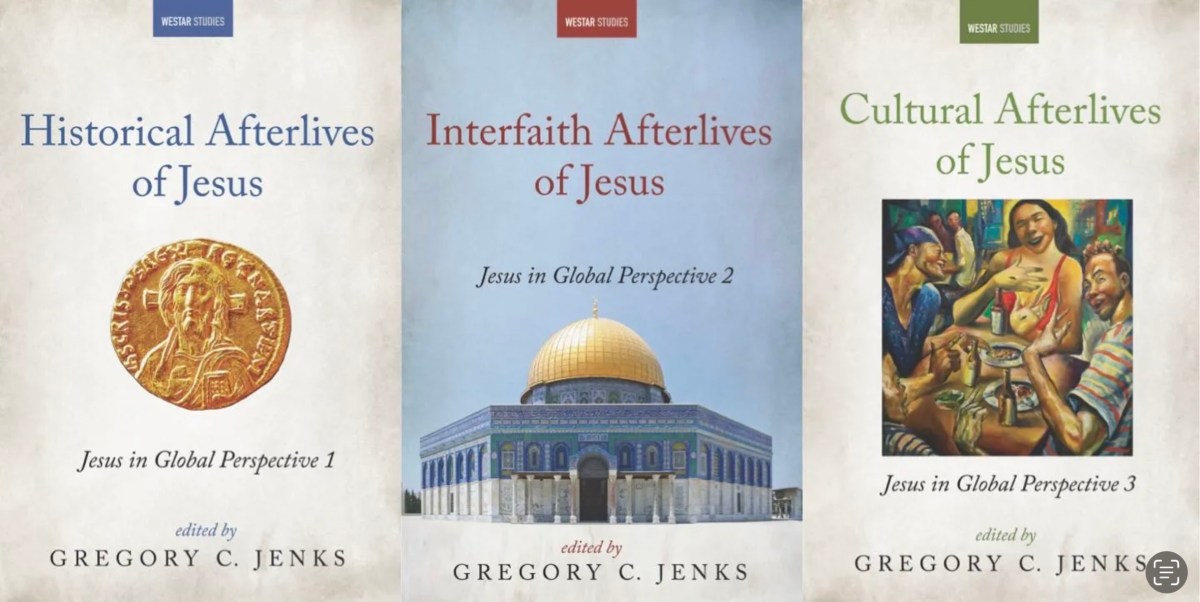
Australian Anglican priest and biblical scholar, Dr Greg Jenks, has been working for some time to collate a collection of writings which explores some of these “afterlives of Jesus”. The result is a set of three volumes, The Afterlives of Jesus, with contributions from a wide variety of people, providing fascinating insights into the way that Jesus has “lived on” through the centuries.

It is a collection of essays which explores the impact of Jesus within and beyond Christianity, including his many afterlives in literature and the arts, social justice, and world religions during the past two thousand years and especially in the present global context.

The first volume, Historical Afterlives, focusses on explicitly Christian afterlives, exploring how scripture passages relating to Jesus have been interpreted, as well as how patristic writers, Byzantine coins, mand contemporary social insights engage with Jesus.

In the second volume, Interfaith Afterlives, the focus is on the diverse ways that Jesus was understood in other faith traditions. Jesus has significant afterlives in Islam, Judaism, Hinduism, Ruism and Mormonism, as well as assorted secular afterlives in progressive Christianity.

In volume three, Cultural Afterlives, a range of writers reflect on how Jesus has been proclaimed, appropriated, and adapted into a range of cultures—Indigenous Australian, Māori, Pacific, and Asian Jesus; the “Jesus of King’s Cross”, Jesus in post-colonial art, in comedic film, in feminist understanding.

The contributors include religion scholars from the respective traditions, as well as faith practitioners reflecting on Jesus within their own religious context. While the essays are all grounded in critical scholarship, reflective practice, or both, they are expressed in nontechnical language that is accessible to interested nonspecialists.

Australian theologian Dr Val Webb says that the work offers “a wonderful sweep of ‘afterlives’ that free Jesus of Nazareth from the confines of Christian orthodoxy, a Jesus who has fed the imagination of people, cultures, and contexts far beyond the streets of Jerusalem and Rome.” Professor Monica Jyotsna Melanchthon, of the University of Divinity, observes that “the rich set of afterlives discussed here provoke conversation in terms of our continued life, faith, and reflection on the Jesus of History and the Christ of faith”.

Professor Arthur Dewey, of Xavier University, rejoices that, in reading these volumes, “we slowly begin to realise that Jesus is no longer embalmed in doctrinal winding sheets; he has slipped ecclesial controls and continues his walkabout on this fragile planet.” He continues, “whether reading the Jesus traditions anew through indigenous eyes or recognizing how the tradition itself emerged within the lethal atmosphere of patriarchy, the authors challenge us to nothing less than a radical revisioning of that elusive and alluring figure, dancing in the unnoticed gaps and crevices of our planet”.

Greg Jenks has done a fine job in commissioning and editing the 33 essays included in these three volumes. The contents of each volume and a link to order The Afterlives of Jesus in hardcopy can be found at https://afterlives.org

Matthew: tax collector, disciple, apostle, evangelist—and “scribe trained for the kingdom”? (Matt 9; Pentecost 2A)

At last! This coming Sunday, we return to Gospel passages in sequence, drawn from the book of origins—the Gospel attributed by tradition to Matthew. None of the four Gospels in the New Testament originally gave any indication as to who wrote those works; it was up to the evolving tradition within the early church to infer, claim, deduce, and assign specific authorship—either to apostles (Matthew and John) or to close followers of apostles (Mark, following Peter, and Luke, following Paul).

This year—Year A—we began with the early chapters of the Gospel according to Matthew (from 2:1 through to 5:37); but when the season of Lent began, the Gospel readings were taken largely from John, with John and Luke featuring during the Sundays after Easter. Only now, after Trinity Sunday, does the sequential pattern resume.

This coming Sunday, we will hear the story of the call of Matthew the tax collector (Matt 9:9–13) as well as the interlinked account of the healing of a haemorrhaging woman along with the raising of a young girl from death (9:18–26). The story of the call of Matthew is told with a somewhat astringent sparseness. “He said to him, ‘Follow me.’ And he got up and followed him.” (9:9). That’s it. No fuss, no fanfare. Just plain and simple, straight to the point: follow me—and he followed him.

This first Gospel, in the order that the four Gospels appear in the New Testament, bears the name of Matthew. It wasn’t the first written Gospel—that was Mark’s, which clearly was a source used by the author of Matthew’s Gospel. By tradition, the attributed author of this Gospel, Matthew, was a tax collector whom Jesus called to follow him. (Why a tax collector who followed Jesus would take the work of a junior and erratic follower as the basis for his work, remains unexplained.)

At any rate: after this tax collector became a disciple of Jesus, he was appointed as an apostle, and later he allegedly wrote an eye-witness account of the time he spent with Jesus. That account runs up until the crucifixion and burial of Jesus, and is wrapped around with some opening chapters about the beginnings of the life of Jesus, and a closing chapter relating to the body of Jesus, his resurrection and departure from his followers.

The tradition that this first Gospel was an eye-witness account by one of the twelve apostles has come under careful scrutiny from biblical scholars, exploring the language, structure, imagery, and ideas found in that narrative.

The consensus from this scholarly work is that the first Gospel in the New Testament was not an eye-witness account, but a carefully crafted account of Jesus, originating in a community of people who had maintained their Jewish culture and practices whilst affirming that Jesus of Nazareth was the long-awaited Messiah—a community that was, therefore, in conflict with the views and teachings of the synagogue leaders in their town, who did not see Jesus in that way.

Within ecclesial tradition, the picture of Matthew, tax collector—disciple—apostle, who subsequently wrote an eye-witness account of the time he spent with Jesus, holds sway. Within biblical scholarship, Matthew is simply a character who appears briefly in the story told by the first Gospel in the New Testament.

Matthew is identified in one short verse narrating his call by Jesus (Matt 9:9). He is also included in the list of twelve who were called to be apostles, with the added descriptor, “the tax collector” (Matt 10:3). He is also named in three other books, with nothing further said about him (Mark 3:18; Luke 6:15; and Acts 1:13). But little else about him is conveyed in the four books that name him. See

Those five fleeting references are the only times we see directly this person in the biblical narratives. He is surely there in other scenes, but he simply blends into the collection of “the disciples” (Mark 2:23; 3:7; 5:31: 6:1, 35, 41, 45; 7:17; 8:1–10, 14, 27, 34: 9:14, 28, 31; 10:10, 13, 23–24; 11:19; 12:43; 13:1; 14:12–16; and Synoptic parallels), “the twelve” (Mark 4:10; 6:7; 9:35; 14:20; and Synoptic parallels; and John 6:66–71; 20:24), or, even more anonymously, into “the crowd” (Mark 2:4, 13; 4:1; Matt 7:28; 13:2; Luke 5:1; 6:17; 7:11–12; 8:4; John 6:2; 12:9, 12; Acts 1:15; 2:6; etc.).

And yet, in the evolving church traditions, Matthew emerges from the shadows to take centre stage as disciple, apostle, saint, and author of the Gospel which is placed first in the New Testament. Some churches even maintain the patristic claim that Matthew wrote in Aramaic, and was later translated into the Greek version that forms the basis of the New Testament text.

The claim about Aramaic comes from a fourth century report by Eusebius of Caesarea that a second century bishop, Papias of Heirapolis, claimed that Matthew “put the logia in an ordered arrangement in the Hebrew language (Ἑβραΐδι διαλέκτῳ), but each person interpreted them as best he could” (Eusebius, Ecclesiastical History 3.39.16). We should note that this is a somewhat indirect witness at quite some remove, and also that the Greek word Ἑβραΐδι can be translated either as Hebrew or as Aramaic.

But this claim falls down from the clear evidence of the Greek text of Matthew’s Gospel, which mirrors very closely both the Gospel of Mark, at many points, and the Gospel of Luke, at other points, in passages found only in Matthew and Luke.

The two key conclusions drawn by many scholars are twofold: first, that Matthew (like Luke) used the Gospel of Mark as a basis for writing a narrative about Jesus—but modified and adapted both the order and wording of passages; and second, that Luke and Matthew had access to another source (whether oral or written) for many of the sayings of Jesus (the source is known as Q). This makes it completely unlikely that Matthew wrote, in Aramaic, or in Hebrew, the earliest account of Jesus.

And ascribing the authorship of this Gospel to the tax collector identified at Matt 9:9 is also a patristic move. The title of this (and the other) Gospels, identifying the alleged author, is found only in later manuscripts and patristic writings; the narrative itself fails to identify anyone as the author, let alone the tax collector named Matthew. This claim is a later apologetic move, most likely made to provide an “apostolic authorisation” to the Gospel.

See

So what do we say, then, of “Matthew”, the purported author of this Gospel, a work which the author declares at the start to be “the book of origins of Jesus, Messiah” (Matt 1:1)? For me, a key to the way that the author of this “book of origins” operated is provided at Matt 13:52, where Jesus concludes a sequence of parables with the statement that “every scribe who has been trained for the kingdom of heaven is like the master of a household who brings out of his treasure what is new and what is old”.

That description encapsulates very clearly, for me, who the author of this Gospel was—a scribe, “trained for the kingdom”, drawing on old resources, but reshaping them so that they are seen to be new. We can see this in many ways in the narrative that he constructs. We can especially see this in the way he presents Jesus as an authoritative teacher of Torah—the one whose words are to be heard, remembered, studied, and passed on. Thus, the reason for his writing of this Gospel.

In this Gospel, we are offered a distinctive, at times unique, portrayal of Jesus. Only in this Gospel does Jesus affirm that all of “the law and the prophets” stand, are not to be annulled, and indeed have been “fulfilled”, or given new life and meaning, by what Jesus teaches (Matt 5:17–20).

So the encounters between Jesus and his disciples, and the scribes and Pharisees, at various moments in the narrative (9:2–8, 10–13; 12:38–42; 15:1–20; 16:1–4; 19:3–9; 21:15–16; 22:34–46) inevitably revolve around differing interpretations of Torah prescriptions and include regular references to (Hebrew) scriptural passages.

Jesus debates the way that the scribes and Pharisees interpret Torah; he meets them on their terms, and engages in these debates in accordance with “the rules” of scripture interpretation. Far from abandoning the Torah, he rather keeps the commandments, valued as “what is old”, and provides distinctive insights and understandings, “what is new”, as he intensifies and radicalises them. (“You have heard it said …”, hard enough; “but I say to you …”, an impossible counsel of perfection?)

In this Gospel alone, Jesus affirms “the scribes and the Pharisees” as those who “sit on Moses’ seat” and teach well—but fail to live by that teaching in their lives (23:1–3). Accordingly, Jesus not only teaches how to live by the law, with a ferocious intensity (5:21–48; 23:13–36), but he puts his teachings into practice; he maintains the old but fills it with new meaning. All of this lies ahead in the passages that will be proposed by the lectionary over the coming months.

Speaking out for equality: a sermon for Lent 3A

A sermon preached on Sunday 12 March 2023 (the third Sunday in Lent) in the Tuggeranong Uniting Church, by the Rev. Elizabeth Raine.

Last Thursday was International Women’s Day, and we are at the end of the week which has both celebrated women and called for true equality. We learnt that women still earn a million dollars less than men over their lifetime and retire with $136,000 less superannuation, according to research from the Australia Institute’s Centre for Future Work.

This research also noted that men still have higher average salaries than women in 95% of all occupations, even in female-dominated ones such as midwifery. Women also suffer more from gendered violence, with around 30% of women worldwide subjected to either physical and/or sexual intimate partner violence or non-partner sexual violence in their lifetime.

All religions tend to subjugate women and view them as lesser mortals. Many forbid women to become leaders or to preach, and see women’s religious duties as almost domestic. This includes Christianity, with many denominations and churches not allowing women’s ordination or meaningful leadership. Look, they say as they point to 1 Timothy 2:12 “I do not permit a woman to teach or to have authority over a man; she is to keep silent.”

This verse has taken on an authority and power that apparently trumps many a story of women leading, teaching, ministering and preaching in the Old and New Testaments. It has coloured the view of the Catholic and Orthodox traditions and many an evangelical church. And not only have women been seen as lesser in these traditions, they have also acquired reputations as sinners, temptresses and Jezebels, to be feared and not trusted.

In today’s bible reading, we meet such a woman. She has been frequently cast as an outsider, a prostitute, an adulteress, despite the text neither saying or even inferring she is any of these things. I find myself getting increasing annoyed at this view of the unnamed Samaritan woman. Many of these accepted views of her originate with male biblical scholars.

I think these views are usually quite moralistic and border on misogyny. They are also applied to other New Testament women, leaders of the early church who have been besmirched and relegated to an inferior status.

I invite you to join me in the redemption of the Samaritan and other NT women, and to explore their stories from a different perspective. I hope this will lead you to different conclusions.

*****

The Samaritan woman is the antithesis of Nicodemus, who we met last week seeking Jesus under the cover of night in a private location. She is not skulking about in the dark, she talks to Jesus in the full light of noon, in a public place. Further, her journey to belief doesn’t take the whole gospel as Nicodemus’ did, it takes one chapter, and she is well on the way in this encounter – so much so, that she convinces the people of her town to come and meet with Jesus as a potential messiah. Due to her missionary efforts, everyone ends up believing Jesus is the Saviour of the world.

This woman has frequently been called an outcast and a adulteress and occasionally a prostitute, due to her coming to the well at noon (an unusual time of the day) and the fact she has had 5 husbands and is currently with a 6th man who is not her husband. It is highly unlikely a serial adulteress would still be alive and not stoned, let alone find 5 men to marry her. Nor are 5 men likely to marry a prostitute. The 6th man may well be her protector or goel (a word we met in Ruth) as women could not manage alone in the ancient world. Whoever he is, Jesus offers no condemnation on the arrangement.

Further, an outcast would not have been listened to by the village folk in the way she is listened to and believed. Lastly, this is the gospel of John, where light and dark and day and night are highly symbolic. The author is deliberately contrasting her with Nicodemus and she is the one represented as grasping the truth and passing it on – in broad daylight.

*****

I also want to mention some other women who led in the bible, who have either been tarnished by the moral brush of sexist scholars or had their roles downplayed. To begin, the feminine is undergirded by the Old Testament view that all the characteristics of God are feminine – the Spirit, ruach, present at creation and in all creation, Wisdom, hochma, also present at creation and something to be highly desired, the shekinah, the glory of God, and finally, the voice of God, the bat kol. These feminine characteristics permeate the work of God and the very essence of God, undermining the idea that the being of God is male.

Next, we have the wonderful women of the Old Testament. Deborah the judge, leading Israel to victory in battle. Prophets Miriam and Huldah, the latter confirming that the book that had been found was indeed God’s law. Tamar, Sarah, Ruth and Naomi and the woman of Endor, all who changed their’s and Israel’s destiny by their resourcefulness and courage.

In the New Testament, we find Mary Magdelene (another women accused of being a prostitute without a shred of textual evidence), devoted follower of Jesus; Phoebe, a deacon highly commended by Paul; Priscilla, a co-worker of Paul and a teacher so famous she is mentioned in no less than four different books in the NT; and Lydia, a merchant in her own right who ran the house church in Philippi.

An important figure is Junia, imprisoned alongside Paul and called prominent among theapostles. Junia actually had her sex changed to male by later scribes who couldn’t countenance a female apostle. We also have Tabitha, called a disciple as she ministers to poor widows in Acts; and Martha, sister of Lazarus and faithful follower of Jesus, who like the Samaritan woman, confessed him as Messiah.

There are many others, including the women who ministered to Jesus and the disciples and who supported Jesus’ ministry with their resources, including Mary of Bethany who sat at Jesus’ feet as a male disciple would to learn from him. All were highly esteemed by Jesus, their peers, Paul and the writers of the gospels. All have been relegated to lesser roles by later male Christians, with a number standing accused of immoral behaviour or having their status relegated to cooks and assistants.

It is this sort of relegation that has led to the subjugation and poor treatment of women in many countries. Christianity has a lot to answer for in terms of its missionary and cultural heritage that taught girls were to be domesticated and boys educated. The notion that woman must subjugate herself to a husbandand unquestioningly obey a male leader has led to much violence and abuse, even in churches.

Recent research in Australia by Julia Baird found that domestic abuse in churches that taught male headship was prevalent in Australia churches and it is now widely accepted that gender inequality is a contributing factor to violence against women.

*****

The Australian Institute of Family Studies in a study concluded that in terms of violence against women “the vital element to consider is the gender norms and beliefs surrounding male dominance and male superiority, created by power hierarchies that accord men greater status.”

This is confirmed by global research. A study published in the Lancet in 2015 analysed data from 66 surveys across 44 countries, covered the experiences of almost half a million women. It found that the greatest predictor of partner violence was “environments that support male control”, especially “norms related to male authority over female behaviour”. Many of these unequal environments are supported by religions, including Christianity.

It does say something about such teachings and beliefs that the plight of abused women was acknowledged literally decades after many countries had established laws to prohibit the abuse of animals.

*****

In contrast to this narrow role-related view of women, we find that Jesus clearly elevated women to a position of equality with men in a way that must of astounded his audiences.

Jesus defied Jewish custom and spoke to women directly and in public, as we see in our story today. The Samaritan woman is the first person he reveals his messiahship too. He disclosed to her deep truths about his role in human history and salvation. She was not just a passive recipient of what Jesus offers to her. While aware of the potential barriers and boundaries created by her society, all of which make sure that she stays in her place, this does not stop her challenging Jesus’ authority and tradition: “Are you greater than our ancestor Jacob, who gave us the well, and with his sons and his flocks drank from it?” (4:12).

The concept of “living water” becomes intertwined with what Jesus knows about her; she herself becomes a vessel of living water because of the relationship she has formed with Jesus, and his insight into her identity gives her insight into his. As a result of this, she leaves behind her water jar, going into the city, and invites the people to encounter Jesus for themselves.

As her enthusiasm spills out, she enacts what Jesus says later in this Gospel, where he speaks about an overflowing of enthusiasm as he quotes Hebrew scripture: “Out of the believer’s heart shall flow rivers of living water” (7:38). This living water is not simply a gift which Jesus offers to the woman; it became a gift to others who she encounters in her village. This first missionary is dynamic. Could a man have done a better job? I doubt it.

*****

This story, and indeed all the pages of Scripture, reveal women being used by God in practically every imaginable way – prophets, judges, negotiators,leaders, teachers and disciples. 

Phyllis and James Alsdurf in their paper, The Church and the Abuse of Women (from the Journal, The Priscilla Papers) say, “For Christians, the liberating message of the Gospel is that a redeemed social order is possible because in Christ “there is neither Jew nor Greek, slave nor free, male nor female” (Gal. 3:28). The good news the church is called to proclaim is that Christ’s transforming power ends injustice and oppression, and that within the Body of Christ discrimination and abuse based on sex, race, or class is no longer permitted.”

*****

Prayer

So let us pray that we continue to remember the women of silenced generations, whose names have been lost to time, and whose roles were lost to power.

Let us remember those who led churches, healed the sick and opened up their houses to the faithful, but who have been downgraded to helpers in historical patriarchal oppression.

Let us also speak out, leaving a legacy of equality for our grandchildren.

We will be the waves at their back, their encouragement and voices crying for true fairness. We will not lose hope.

May we support each other in our resilience, our strength, and our resistance.

May we recognize that we are all uniquely beautiful and powerful. May we honour each other, and challenge each other. Then together, we will recover the bones of justice from the archaeology of inequity.

Go forth, women of worth, and be your ancestors’ wildest dreams. Amen.

*****

The featured image is a depiction of Jesus and the Samaritan woman painted by Mackey Dickerson for the cover of What Jesus Learned from Women, by James McGrath (Cascade, 2021)