Skip to content

An Informed Faith

John T Squires

An Informed Faith

Tag: Luke

What do we know about who wrote the New Testament Gospels? (2)

What do we know about who wrote the New Testament Gospels? (2)

We don’t have “signed autograph copies” of any of the Gospels in the NT, and we also don’t have any clear and explicit identification, in the texts of those Gospels, of who actually wrote them. I’ve already considered what we can reasonably deduce from within the contents of the Gospels; see https://johntsquires.com/2020/10/15/what-do-we-know-about-who-wrote-the-new-testament-gospels-1/

This post explores what was said about the Gospels by others.

1. Oral preferred to written. The first thing to note will seem rather curious to us. That is, the value placed on written accounts was far less than the value given to oral accounts, at least in the first few centuries of the history of the church.

A writer named Eusebius, who was Bishop of Caesarea from 314 until his death in 340, quotes an earlier bishop, Papias of Hierapolis (who lived 60-130 CE) as saying that he “did not suppose that the things from the books would aid me so much as the things from the living and continuous voice” (quoted in Eusebius, Ecclesiastical History 3.39.5).

Gnostic writers claimed that the sayings of Jesus were preserved in secret oral traditions (Ptolemaeus, Letter to Flora 3.8; Valentinus, Epistle to Rheginos 22, 25). These oral traditions were seen to validate their distinctive understandings of the faith. These writers came to be regarded as “heretical”; but a solidly “orthodox” theologian, Titus Flavius Clemens, a teacher in the Catechetical School of Alexandria in the later second century, wrote that he greatly valued the oral traditions because the early preachers all relied on the oral rather than the the written means of communicating (Clement, Stromata 5.26.5).

Likewise, Justin Martyr, a Samaritan who was trained in philosophy and became a Christian after encountering a very persuasive Syrian preacher, refers favourably to the oral traditions in his second century writings (Dialogue with Trypho 122.1, First Apology 61.4) even though he identifies and quotes from written sources.

So Eusebius of Caesarea writes that Matthew only wrote down his Gospel because he “compensated by his writing for the loss of his presence to those from whom he was sent”, and John had long preferred “unwritten preaching” but “finally resorted to writing also” (Ecclesiatical History 3.24.5). Written Gospels were originally seen as a second-best option.

2. The Gospel of Mark. Eusebius seeks to validate Mark’s Gospel by directly associating this written work with the verbal preaching of Peter. Mark, said Eusebius, simply wrote down “the things that Peter said”, and when Peter learnt of this, “he neither obstructed nor commended it” (Ecclesiastical History 6.14.5). In another place, Eusebius claimed that Peter had ratified the finished written product as acceptable “for study in the churches” (Ecclesiastical History 3.15.1).

The association of Mark’s Gospel with Peter’s preaching is subsequently claimed in the early third century by by Tertullian (Against Marcion 4.5) and Origen (quoted by Eusebius at Ecclesiastical History 6.14.5), and later in the fourth century by Jerome (in his Prologue to In Matt). There is no explicit link with the teachings of Peter in the text of Mark’s Gospel, however.

Likewise, the connection with Rome, where Peter is claimed to have died, is not found in any text until the fourth century Prologues (see further below).

3. The Gospel of Matthew. However, not everyone saw it this way. Augustine, in the early fifth century, considered that Mark’s Gospel was rougher than Matthew’s Gospel. Along with Origen and Jerome, Augustine considered that Matthew’s Gospel was written in Hebrew–and Mark, he wrote, “followed him closely and looks like his imitator and epitomiser” (Augustine, On the harmony of the Gospels 1.2.4).

Modern scholarly study of the Gospels has clearly demonstrated that Mark’s Gospel was earlier than Matthew’s, that Matthew used Mark as his source, and that it is quite unlikely that Matthew wrote in Hebrew, given that his Greek follows that of Mark so often! So we can discount Augustine’s claim—as almost all biblical scholars do today.

4. The Gospel of Luke. Eusebius argues that the limited value and significance of oral traditions is conveyed in the opening verses of Luke’s Gospel (Ecclesiastical History 3.24.15). Luke, he infers, had found the written narratives which he consulted to be somewhat unreliable, so he conferred with “eyewitnesses” to gain better insight from the oral traditions. (Eusebius identifies those “eyewitnesses” as Paul and other Apostles).

In the early discussion of Luke’s Gospel, the author is described simply as the companion of Paul: we find this in Origen (quoted in Ecclesiastical History 6.25) and Jerome (On Famous Men 7). This is also the description of the author found in the Muratorian Canon, a list of books which most likely dates from the fourth century, as well as the Anti-Marcionite Prologue to Luke, and the Monarchian Prologue to Luke, from the same period.

Luke is first claimed as a doctor in the Anti-Marcionite Prologue to Luke, which simply states that Luke “was born in Antioch, by profession was a physician … he died at the age of 84 years”. This is also claimed in the Monarchian Prologue to Luke. These are fourth century documents; this claim about Luke had not been made in any extant work before this time.

Around the same time, Jerome affirms that the author of Luke’s Gospel was indeed a doctor who offered “medicine for the sick soul” (Jerome, Epistle 53.9). Whilst this aspect of Luke’s identity appears not ever to have been noted in the second or third centuries, it was apparently well-known in the fourth century.

Also in the fourth century, Epiphanius of Salamis placed Luke amongst the seventy people who were sent out on mission (who are described only in Luke’s account, Luke 10:1-20) (Epiphanius, Panarion 51.11), whilst John Chrysostom, the famous preacher of Antioch and later Bishop of Constantinople, identified him as “the brother who is famous among all the churches for his proclaiming the good news”, who is mentioned by Paul in 2 Cor 8:18 (Chrysostom, Homily 18 on Second Corinthians). In neither case it is claimed that Luke had medical expertise.

This leads to a striking observation: the further away in time we get from when the Gospels were actually written, the more that we seem to know about who wrote each of them! Or, to put it the other way, close to the time of writing we know very little about the authors; some centuries later, after discussion of these texts by Christian writers, we seem to know much more about the authors!! Traditions grew and expanded over time, under the impetus of “needing to know” more about the authors of the Gospels.

5. The Gospel of John. The differences of context between the first three Gospels and John’s Gospel did not escape the notice of early writers. Clement of Alexandria states that “John, noticing that the physical things had been set forth in the Gospels … wrote a spiritual Gospel” (quoted by Eusebius at Ecclesiastical History 6.14.5).

The fourth-century Muratorian Canon claims that John wrote his Gospel in response to the urgings of “his fellow disciples and bishops”, especially Andrew. Jerome has a similar claim, that John wrote “when asked by the bishops of Asia” (Jerome, On Famous Men 9).

It needs to be noted that Jerome was reading back his fourth century context into the first century, assuming that there were bishops in all the churches. Of course, that is what is claimed by later church tradition; but historical reality was probably that bishops did not emerge until some time in the second century, and were not universally in place until later in the third century. So this is a confected story, surely.

Jerome says more about the author of John’s Gospel, who, “reclining on the breast of the Lord, drank the purest streams of teachings”. Even though he wrote “in haste”, nevertheless “he was saturated with revelation and burst forth into that heaven-sent prologue” (Jerome, prologue to John In Matt.)

Then, in the Monarchian Prologue to John, John is portrayed as an incorruptible virgin, writing to reveal deep mysteries, which he can do because he is not merely one of the Apostles; he is “one of the disciples of God”, a totally inspired writer.

In like manner, in these prologues, Luke is praised as “serving God without blame … never having either a wife or children”, whilst Mark, a Jew who was “a Levite according to the flesh”, was said to have “amputated his thumb after he embraced the faith, that he might be accounted unfit for the priesthood”, and thus able to devote himself to his writing task. And thus arose the story that Mark was colobodactylus (“stump-fingered”).

But now, we are such a long way from any rigorous historical investigation into the actual identity of the writers of the Gospel, and deep into the developing myths and traditions of the church!

*****

For interest sake, here are the three anti-Marcionite Prologues (the prologue to Matthew is not extant). They come from later in the fourth century and contain far more “information” about the evangelists than is evident in any earlier literature. How reliable, really, is all of this additional “information”?

Mark made his assertion, who was also named stubby-fingers, on account that he had in comparison to the length of the rest of his body shorter fingers. He was a disciple and interpreter of Peter, whom he followed just as he heard him report. When he was requested at Rome by the brethren, he briefly wrote this gospel in parts of Italy. When Peter heard this, he approved and affirmed it by his own authority for the reading of the church. Truly, after the departure of Peter, this gospel which he himself put together having been taken up, he went away into Egypt and, ordained as the first bishop of Alexandria, announcing Christ, he constituted a church there. It was of such teaching and continence of life that it compels all followers of Christ to imitate its example.

The holy Luke is an Antiochene, Syrian by race, physician by trade. As his writings indicate, of the Greek speech he was not ignorant. He was a disciple of the apostles, and afterward followed Paul until his confession, serving the Lord undistractedly, for he neither had any wife nor procreated sons. [A man] of eighty–four years, he slept in Thebes, the metropolis of Boeotia, full of the holy spirit. He, when the gospels were already written down, that according to Matthew in Judea, but that according to Mark in Italy, instigated by the holy spirit, in parts of Achaea wrote down this gospel, he who was taught not only by the apostle, who was not with the Lord in the flesh, but also by the other apostles, who were with the Lord, even making clear this very thing himself in the preface, that the others were written down before his, and that it was necessary that he accurately expound for the gentile faithful the entire economy in his narrative, lest they, detained by Jewish fables, be held by a sole desire for the law, or lest, seduced by heretical fables and stupid instigations, they slip away from the truth. It being necessary, then, immediately in the beginning we receive report of the nativity of John, who is the beginning of the gospel, who was the forerunner of our Lord Jesus Christ, and a partaker in the perfecting of the people, and also in the induction of baptism, and a partaker of his passion and of the fellowship of the spirit. Zechariah the prophet, one of the twelve, made mention of this economy. And indeed afterward this same Luke wrote the Acts of the Apostles. And later John the apostle from the twelve first wrote down the apocalypse on the isle of Pathmos, then the gospel in Asia.

John the apostle, whom the Lord Jesus loved very much, last of all wrote this gospel, the bishops of Asia having entreated him, against Cerinthus and other heretics, and especially standing against the dogma of the Ebionites there who asserted by the depravity of their stupidity, for thus they have the appellation Ebionites, that Christ, before he was born from Mary, neither existed nor was born before the ages from God the father. Whence also he was compelled to tell of his divine nativity from the father. But they also bear another cause for his writing the gospel, because, when he had collected the volumes from the gospel of Matthew, of Mark, and of Luke, he indeed approved the text of the history and affirmed that they had said true things, but that they had woven the history of only one year, in which he also suffered after the imprisonment of John. The year, then, having been omitted in which the acts of the tribes were expounded, he narrated the events of the time prior, before John was shut up in prison, just as it can be made manifest to those who diligently read the four volumes of the gospels. This gospel, then, after the apocalypse was written was made manifest and given to the churches in Asia by John, as yet constituted in the body, as the Hieropolitan, Papias by name, disciple of John and dear [to him], transmitted in his Exoteric, that is, the outside five books. He wrote down this gospel while John dictated. Truly Marcion the heretic, when he had been disapproved by him because he supposed contrary things, was thrown out by John. He in truth carried writings or epistles sent to him from the brothers who were in Pontus, faithful in Christ Jesus our Lord.

And here are the four Monarchian Prologues from a similar timeframe, with equally loquacious and imaginative expositions about each of the evangelists.

Matthew, from Judea, just as he is placed first in order, so wrote the gospel first in Judea. His calling to God was from publican activities. He presumed in the genealogy of Christ the beginnings of two things, the first of which was circumcision in the flesh, the other of which was election according to the heart, and by both of which Christ was in the fathers. And, the number having thus been put down as three fourteens, he shows by extending the beginning from the faith of the believer unto the time of election, and directing it from the election to the day of the deportation, and defining it from the deportation up to Christ that the generation of the advent of the Lord had been reached, so that, in making satisfaction both in number and in time, and in showing itself for what it was, and in demonstrating that the work of God in itself was still in these whose race he established, the time, order, number, economy, or reason of all of these matters might not deny the testimony, which is necessary for faith, of Christ, who was working from the beginning. God is Christ, who was made from a woman, who was made under the law, who was born from a virgin, who suffered in the flesh, who fixed all things on the cross so that, triumphing over them for eternity, rising in the body, he might restore both the name of the father to the son in the fathers and the name of the son to the father in the sons, without beginning, without end, showing that he is one with the father, because he is one. In this gospel it is useful for those desiring God to know the first things, the medial things, and the perfect things, so that, reading of the calling of the apostle and the work of the gospel and the choosing of God, born into the universe in the flesh, they might understand and recognize it in him, in whom they have been apprehended and seek to apprehend. It was certainly possible in this study of the subject matter for us to both convey the fidelity of what was done and not be silent that the economy of God at work must be diligently understood by those seeking to do so.

This is John the evangelist, one from the twelve disciples of God, who was elected by God to be a virgin, whom God called away from marriage though he was wishing to marry, for whom double testimony of his virginity is given in the gospel both in that he was said to be beloved by God above others and in that God, going to the cross, commended his own mother to him, so that a virgin might serve a virgin. Furthermore, manifesting in the gospel that he himself was starting up the work of the incorruptible word, he alone testifies that the word was made flesh and that light was not comprehended by darkness, placing the first sign which God did in a wedding so as to demonstrate to those reading, by showing what he himself was, that where the Lord is invited the wine of weddings ought to cease and also that all things which have been set up by Christ, now that the old things have been changed, might appear new. Concerning this the reason for [composing] the gospel to those seeking shows the separate things which were done or said in a mystery. Moreover, he wrote this gospel in Asia, after he had written the apocalypse on the island of Patmos, so that, to whom the incorruptible beginning was attributed in the beginning of the canon, in Genesis, to him also the incorruptible end through a virgin in the Apocalypse might be attributed, since Christ says: I am the alpha and the omega. And this is the John who, knowing that the day of his departure had come upon him, his disciples having been called together in Ephesus, producing Christ through the many signs that were accomplished, descending into the place dug out for his sepulture, after a prayer was made, was laid with his fathers, as much a stranger to the pain of death as he was found alien to the corruption of the flesh. And, if he is said to have written the gospel after all [the others], he is however placed after Matthew in the disposition of the canon as it is ordered, since in the Lord those things that are newest are not as if last and rejected for their number, but rather have been perfected by the work of fulness; and this was due to a virgin. Neither the disposition of the writings by time nor the order of the books, however, are exposited by us in the details, so that, when the desire to know has been settled, both the fruit of labor and the doctrine of teaching for God might be reserved for those who seek.

Luke, Syrian by nationality, an Antiochene, physician by art, disciple of the apostles, later followed Paul up until his confession, serving God without fault. For, never having either a wife or sons, he died in Bithynia at seventy-four years of age, full of the holy spirit. When the gospels through Matthew in Judea, through Mark, however, in Italy, had already been written, he wrote this gospel at the instigation of the holy spirit in the regions of Achaea, he himself also signifying in the beginning that others had been written beforehand. For whom, beyond those things which the order of the gospel disposition implores, there was that necessity of labor especially, that he should labor first for the Greek faithful lest, after all the perfection of God come in the flesh was made manifest, they either be intent on Jewish fables and held by a sole desire for the law or slip away from the truth, seduced by heretical fables and stupid instigations; furthermore, that in the beginning of the gospel, after the nativity of John had been taken up, he might indicate to whom it was that he wrote his gospel and by what [purpose] he elected to write it, contending that those things that had been started by others were completed by him. To him, therefore, was permitted the power [to record events] after the baptism of the son of God, from the perfection of the generation fulfilled and to be repeated in Christ, from the beginning of his human nativity, so that he might demonstrate to those who thoroughly seek, insofar as he had apprehended it, that, by the admitted introduction of a generation which runs back through a son of Nathan to God, the indivisible God who preaches his Christ among men made the work of the perfect man return into himself through the son, he who through David the father was preparing a way in Christ for those who were coming. To this not immeritorious Luke was given the power in his ministry of writing also the acts of the apostles so that, when God had been filled up in God and the son of treachery extinguished, and prayers made by the apostles, the number of election might be completed by the lot of the Lord, and that thus Paul, whom the Lord elected despite long kicking against the pricks, might give a consummation to the acts of the apostles. Though it were also useful for those reading and thoroughly seeking God that this be explained by us in the details, nevertheless, knowing that it is fit for the working farmer to eat from his own fruits, we have avoided public curiosity, lest we should be seen as, not so much demonstrating God to those who are willing, but rather having given it to those who loathe him.

Mark, the evangelist of God and in baptism the son of the blessed apostle Peter and also his disciple in the divine word, performing the priesthood in Israel, a Levite according to the flesh, but converted to the faith of Christ, wrote the gospel in Italy, showing in it what he owed to his own race and what to Christ. For, setting up the start of the beginning with the voice of the prophetic exclamation, he showed the order of his Levitical election so that he, preaching by the voice of the announcing messenger that John the son of Zechariah was the predestinated one, might show at the start of the preaching of the gospel not only that the word made flesh had been sent out but also that the body of the Lord had been animated in all things through the word of the divine voice, so that he who reads these things might realize not to be ignorant to whom he owes the start of the flesh in the Lord and the tabernacle of the coming God, and also that he might find in himself the word of the voice which had been lost in the consonants. Furthermore, both going on with the work of the perfect gospel and starting that God preached from the baptism of the Lord, he did not labor to tell of the nativity of the flesh, which he had conquered* in prior portions, but rather right at first he offered the expulsion into the desert, the fasting for the number, the temptation by the devil, the gathering of the beasts, and the ministry by angels, so that, in setting us up to understand by sketching out the details in brief, he might not diminish the authority of what was already done, nor deny the work to be perfected in fulness. Furthermore, he is said to have amputated his thumb after faith so that he might be held to be unfit for the priesthood. But the predestinated election held such power, consenting to his faith, that he did not in his work of the word lose what he had previously merited by his race, for he was the bishop of Alexandria, whose work it was to know in detail and to apply the things said in the gospel on his own, and not to be ignorant of the discipline of the law for himself, and to understand the divine nature of the Lord in the flesh. These things we also wish to be sought first, and, when they have been sought, not to be ignored having the reward of the exhortation, since he who plants and he who waters are one; he who yields the increase, however, is God.
Unknown's avatarAuthor John T SquiresPosted on October 15, 2020October 15, 2020Categories A Book of Origins: Gospel of Matthew, An Orderly Account: Gospel of Luke, Scripture and Theology, The Book of Signs: the Gospel of JohnTags John, Luke, Mark, Matthew, scripture, theologyLeave a comment on What do we know about who wrote the New Testament Gospels? (2)

What do we know about who wrote the New Testament Gospels? (1)

We don’t have “signed autograph copies” of any book in the NT. So what we say about authorship needs to be deduced, from what is in each book, and what is said about the books in the earliest literature.

The indications about authorship from within each book need to be seen as most important. The claims made about authorship in the later traditions have a secondary significance.

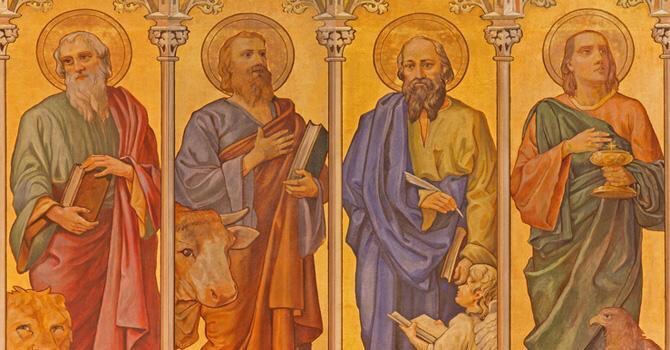
Tradition has it that the authors of the four Gospels were men. This depiction, like so many others, portrays them as mature aged and bearded—but the Gospels were most likely first written on papyri scrolls, rather than bound codices (which are like a modern book).

None of the Gospels identify a specific, named individual as their author. The closest we come is in the two Gospels usually considered to be the later works written: Luke, and John. But first, let’s consider the earlier works: Mark, and Matthew. There are some deductions that have been made from within these two Gospels about who wrote them.

The author of Matthew’s Gospel is often assumed to be “a man called Matthew sitting at the tax booth” (Matt 9:9) whom Jesus called to follow him. In Mark and Luke, this person is named Levi; some interpreters consider that the fact that he is named Matthew in the first Gospel is a pointer to the author. But the text itself does not make this explicit claim anywhere.

The Gospel begins with what looks like a title: a book of origins of Jesus, chosen one, son of a David, son of Abraham (my translation of Matt 1:1), but gives no indication at any point as to who has compiled this book of origins.

Calling the author “Matthew” is thus a convention from later tradition.

The author of Mark’s Gospel is sometimes claimed to be “a certain young man … wearing nothing but a linen cloth” (Mark 14:51), as this is the only Gospel that refers to this person; but yet again, there is no explicit claim anywhere in the text that this is the man who wrote the Gospel.

Nor is there any warrant for connecting the author of this Gospel with John Mark, the companion of Paul and Barnabas (Acts 12:25, 13:5, 13, 15:37) and son of the Mary who lived in Jerusalem (Acts 12:12). There is nothing in the text of the earliest Gospel that points to this identification.

This Gospel also begins with what looks like a title: the beginning of the good news of Jesus, chosen one, son of God (my translation of Mark 1:1), but, like Matthew, there is no indication at any place in the text as to who has compiled this narrative.

Calling the author “Mark” is also a convention from later tradition.

The Gospel of John concludes with the claim, “this is the disciple who is testifying to these things and has written them” (John 21:24). This comes immediately after an account of an interaction between Peter and “the disciple whom Jesus loved” (John 21:20-23).

The figure of the beloved disciple appears in the Gospel four times: at the last supper (13:23), at the foot of the cross as Jesus is crucified (19:26), at the beginning of the empty tomb scene (20:2), and beside the Sea of Tiberias, after the resurrection of Jesus, along with other disciples (21:7).

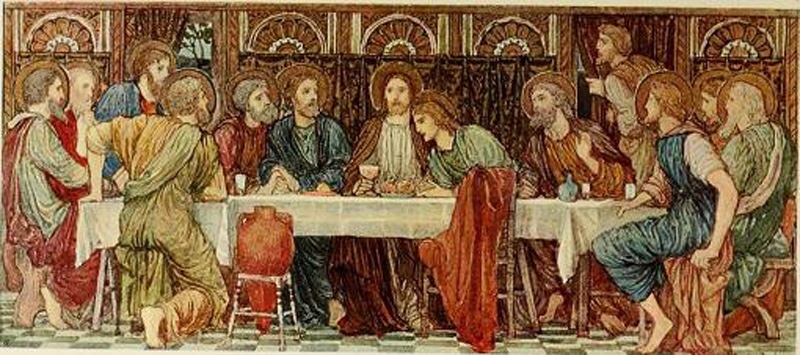
A classic medieval depiction of “the disciple whom Jesus loved”, resting on his chest in a pose of intimacy (as per John 13:23 and 21:20). Of course, an authentic depiction would have shown the group reclining right around a low table, not sitting on one side of a raised table.

Yet “the disciple whom Jesus loved” is never identified by any personal name. Indeed, there is never an explicit claim that is made anywhere in the text that “the disciple whom Jesus loved” was, in fact, the apostle John. The Gospel may infer this, but it never states it.

Alongside that, there is the curious fact that whenever the name John appears in this Gospel, it never refers to John the apostle. (The named apostles in this Gospel have some overlap with the names of the Twelve in the Synoptic Gospels, but John is not named amongst those men in this Gospel.) Indeed the name John in the fourth Gospel refers either to John the baptiser (1:6, 15, 19-40; 3:22-30; 4:1; 5:33; 10:40-41) or to the father of Simon Peter (1:42; 21:15-17).

And there are many scholars who believe that John 21 was a much later addition to the original version of John’s Gospel (John 1—20). So it is most likely that this authorial claim was not actually written by the person who wrote the vast majority of the Gospel!

A chapter before this addition, at John 20:30-31, there is an explanation as to the purpose of this work: “Jesus did many other signs … but these (signs) were written in order that you may believe …”. From this, I deduce that this work intended to present itself as a book shaped around a number of signs: the book of signs, I call it.

Calling the author “John” is thus a convention from later tradition, made on the basis of the observations and deductions noted above.

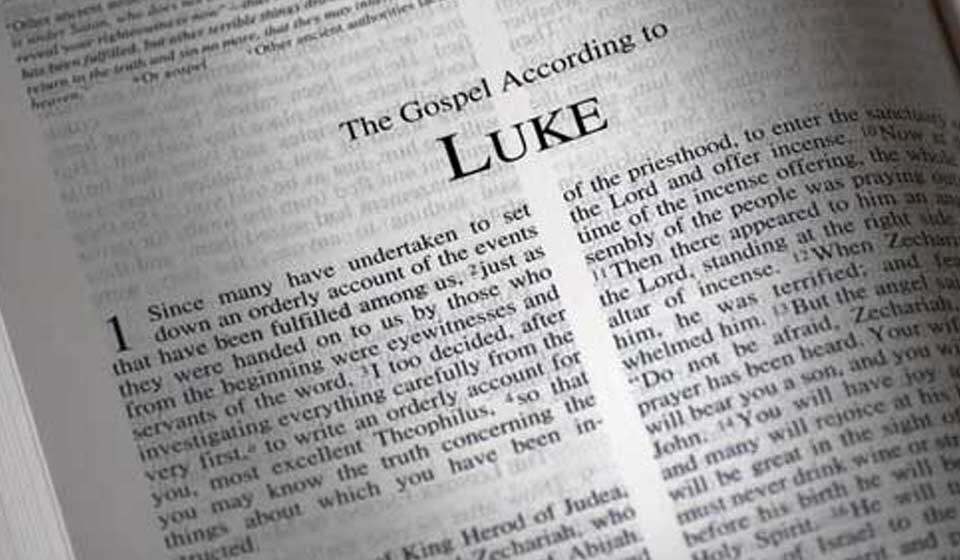
The Gospel of Luke begins with a personal statement by the anonymous author: “I decided … to write an orderly account for you, most excellent Theophilus” (Luke 1:3). No indication is given by the author as to his (or her) identity. The only name here—ironically—is of the recipient of the work, “most excellent Theophilus”.

We don’t know anything about who Theophilus was, as an historical person, let alone who the “I” actually was. All we have is that this work is presented as an orderly account of the things fulfilled amongst us (1:3).

The same occurs in the opening verse of the Acts of the Apostles, which reads, “In the first book, Theophilus, I wrote about all that Jesus did and taught …” (Acts 1:1). Once again, the author remains unidentified.

The traditional title of Acts (in Greek praxis, from the verb prasso, to do or to act) may perhaps have derived from the use of this verb in relation to Paul, in the concluding comments of Agrippa, Berenice and Festus, about “what this man is doing”, or, “the acts of this man” (Ac 26:31). But it provides no pointer to the identity of the author.

But in the traditions that developed in the early church, there are two things that are regularly claimed about the person who wrote both Luke’s Gospel, and the Acts of the Apostles. These claims rely on piecing together elements in the text of Luke or Acts, and figures referred to in other places in the NT.

First, the author of these two linked works is often designated as a companion of Paul. A person named Luke is identified at Col 4.14; it appears that he is with Paul when this letter was written. In Phlm 24, Paul refers to Luke as one of his “fellow workers”; there is another reference to him at 2 Tim 4.11.

But there is no specific indication in the Gospel that this companion of Paul was the author of this Gospel, nor of Acts.

The closest we come is in the references to the travels of Paul in which the author appears to be present (from Troas to Philippi, Acts 16:10-17; from Troas to Miletus, 20:5-15; from Miletus to Jerusalem, 21:1-18). But it is entirely possible that these “we” references (“we set sail … we were going … we joined them … when we had parted from them, we set sail … we arrived … we started to go up … we arrived in Jerusalem”) are literary devices designed to bring the narrative to life in a vivid way.

And besides this, there are questions as to whether Paul actually wrote the letter to the Colossians and the letters to Timothy–the very places where we find this description of Luke as a companion to Paul.

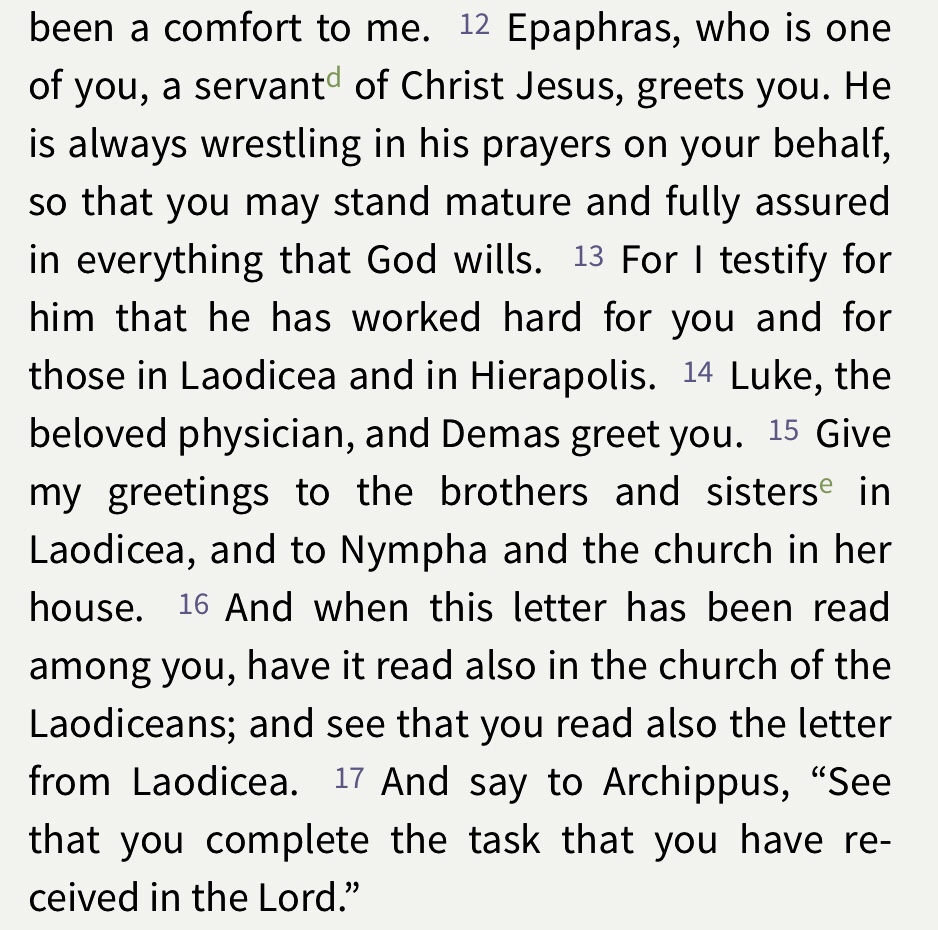
Col 4:12-17 (NRSV)

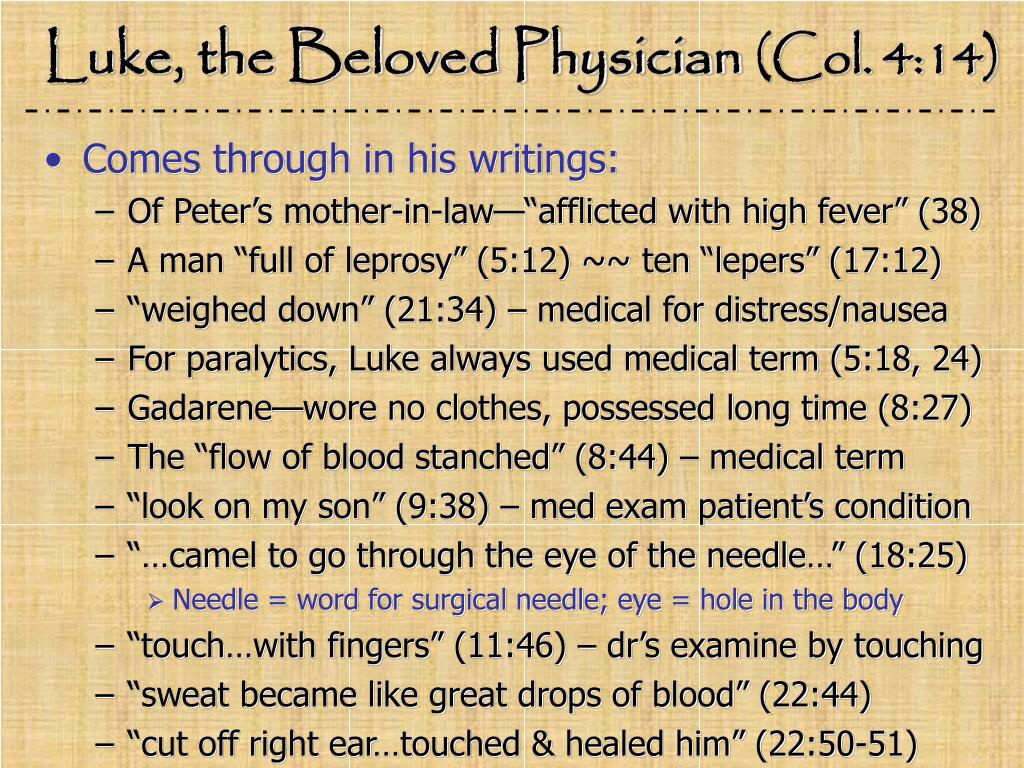
A second claim about the author of Luke and Acts is that it was Luke, the beloved physician. This phrase also appears in Col 4:14 (which, as we have noted, may—or may not—have been written by Paul). The claim that “Luke was a doctor” is often supported by reference to the various medical terms which, it is noted, appear throughout the Gospel of Luke.

However, the mere use of medical terminology does not guarantee that the person using those terms practised as a medical doctor! Many patients in today’s world acquire an ease of using technical medical terminology which relates to their own conditions, or the medical condition of a family member or friend.

Furthermore, scholars have compared the technical medical language found in Luke’s writings, with similar technical medical language in other works of the time, written by historians and philosophers, as well as ancient medical practitioners such as Galen. This comparison shows that educated writers were quite well aware of technical medical terms, and used them, even though they did not practise medicine.

The claim that the author of Luke’s Gospel used medical terminology, and thus must have been a medical practitioner, is based on texts such as these. The flimsy nature of this claim can be seen in this collation of texts.

At the very least, what we can say about the author of the Gospel of Luke and the Acts of the Apostles was an educated person of the hellenistic world. The works contain a relatively high literary style of Greek and a knowledge of Roman chronology; they present Jesus at table in the manner of a teacher at a symposium (or drinking party), and make a number of allusions to classical Greek sayings and proverbs.

Indeed, the fact that the author also appears to be most knowledgeable about Judaism and familiar with the Hebrew Scriptures indicates that he may have been a Gentile Godfearer, or, even more likely, an educated, hellenised Jew.

Calling the author “Luke” is thus a convention from later tradition, made on the basis of the inferences and deductions noted above.

We do know that each of these deductions about who wrote the four canonical Gospels was accepted at a relatively early date. We know this from the fact that “headings” for each of these works start to appear on manuscripts from the early 3rd century.

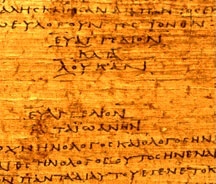
A portion of p75 (Papyrus 75), containing Luke and John, written around 200 CE. This picture shows the place where Luke ends and John begins. The scribe has added: EUAGGELION KATA LOUKAN . . . EUAGGELION KATA IOANEN (Gospel according to Luke . . . Gospel according to John).

We find “the Gospel according to …” and then the relevant name at the head or the end of various Gospel manuscripts. But there is nothing within the actual text of each Gospel which provides a clear and unambiguous identification of the specific identity of the author.

What transpires in the evolving traditions found in the writings of the church fathers of the second to fifth centuries, however, reveals much more “information” about the authors of the four Gospels. See https://johntsquires.com/2020/10/15/what-do-we-know-about-who-wrote-the-new-testament-gospels-2/

Unknown's avatarAuthor John T SquiresPosted on October 15, 2020October 15, 2020Categories A Book of Origins: Gospel of Matthew, An Orderly Account: Gospel of Luke, Scripture and Theology, The Book of Signs: the Gospel of JohnTags John, Luke, Mark, Matthew, scripture, theologyLeave a comment on What do we know about who wrote the New Testament Gospels? (1)

Pentecost: the spirit is for anyone, for everyone.

Pentecost: the spirit is for anyone, for everyone.

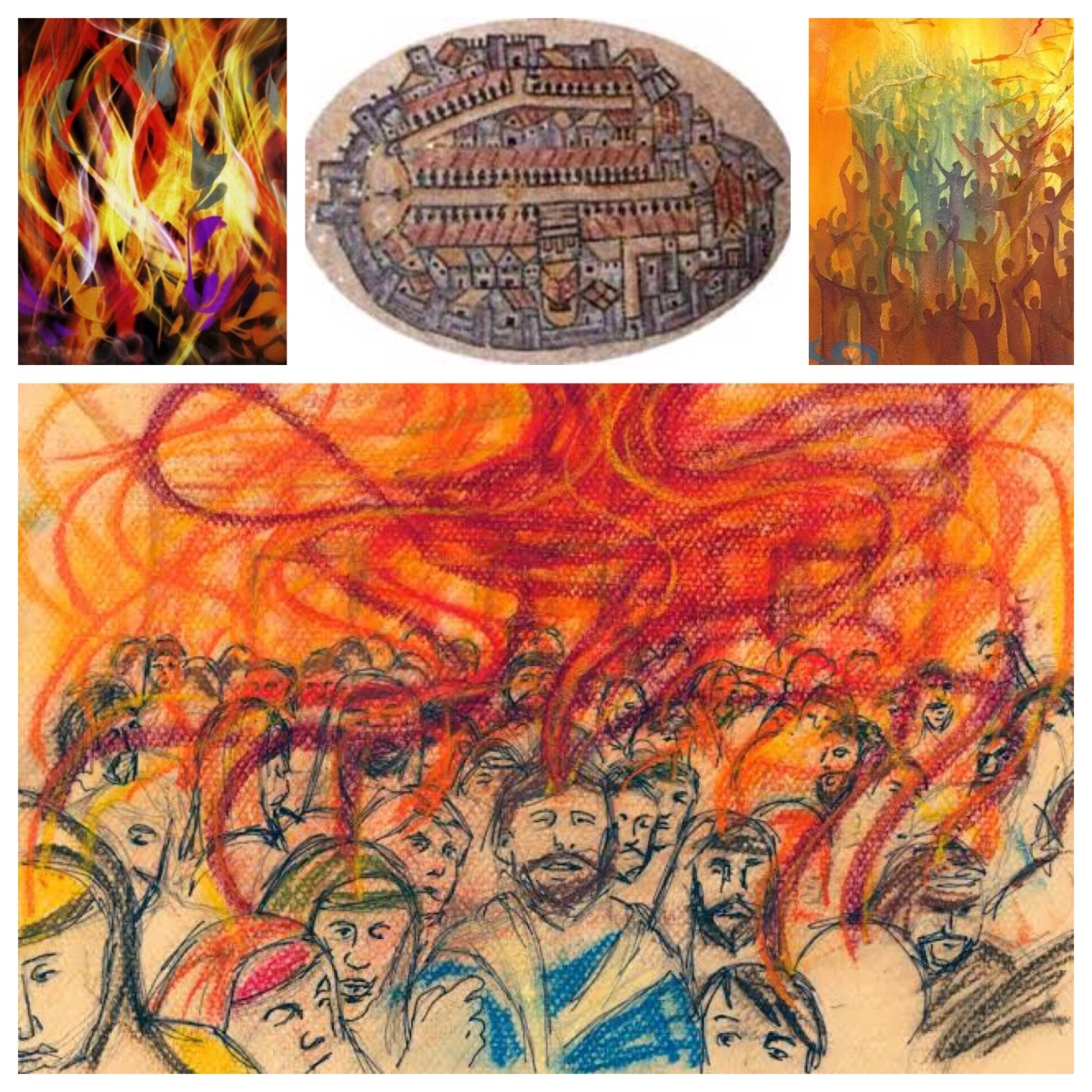
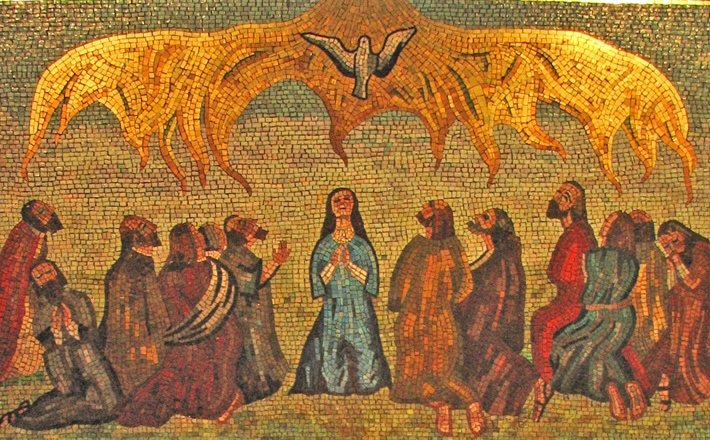
This Sunday is Pentecost Sunday. Winds and flames, swirling fire and the stimulus of the spirit, are the images that come to mind when we think about this day. All very energising and inspiring. Yet how often do we take the story of the first Pentecost, that Luke tells in Acts 2, and focus it inwards, into the faith community? It becomes a story of “the birthday of the church”—the day on which the church was breathed into existence.

But the readings provided by the lectionary for this festival day point in precisely the opposite direction. They are outward-oriented texts, inviting and encouraging people of faith to be open and inclusive towards others in society.

“Let anyone who is thirsty come to me”—an invitation placed on the lips of Jesus, as he speaks to the crowd of pilgrims who were gathered in Jerusalem for the a Festival of Booths (John 7:37). The invitation is to anyone, to anyone who is thirsty. It is a wide, open, welcoming invitation. Jesus welcomes all. Anyone. Everyone.

“God declares, that I will pour out my spirit upon all flesh”, proclaims Peter, quoting the prophet Joel, in the account that Luke provides of the time when the spirit energised and inspired the early followers of Jesus, gathered also in Jerusalem, this time for the Festival of Pentecost (Acts 2:17). Those words declare that the gift of God’s spirit is given to all. Anyone. Everyone.

The gift is not for a select few, not just for chosen minority amongst humanity—but to all flesh. And that must surely include the possibility, not only of human flesh, but of animal flesh. God’s spirit is gifted to all creatures. Any creature. Every creature.

This hypothesis is confirmed when we turn to the psalm set for Pentecost Sunday. “O LORD, how manifold are your works! In wisdom you have made them all; the earth is full of your creatures”, the psalmist declares. “When you send forth your spirit, they are created; and you renew the face of the ground.” (Psalm 104:24, 30).

The creative force that God sets to work in the world breathes spirit, ruach (Hebrew), the very life-force itself, into all living creatures. God’s spirit is present in every single living, breathing creature—humans, marsupials, reptiles, insects; even plants. Any of them. Every one of them. That is an amazing thought!

And the story of Noah and the ark, the flood and the rainbow, confirms this: it ends with a covenant, made not solely with humanity, but with all living creatures: “As for me (God is reported as saying), I am establishing my covenant with you and your descendants after you, and with every living creature that is with you, the birds, the domestic animals, and every animal of the earth with you, as many as came out of the ark.” (Gen 9:9-10). Any animal. Every animal.

This spirit is a generous spirit, a creative energy moving in the lives of all people and all creatures. We live in a world that is God-breathed, spirit-imbued. In any of us. In every one of us.

*****

Alongside this, scripture indicates that the spirit also bestows particular gifts upon specific human beings. Filled with the spirit is a phrase found in both testaments, referring to individuals or groups who were granted particular ability—to prophesy, to proclaim good news, to speak in tongues, to discern the spirits.

Being filled with the spirit, or having the spirit poured out, to enable particular activities, is a regular biblical refrain; see Num 11:17; 1 Sam 10:6; Neh 9:30; Isa 11:2, 32:51, 37:7, 42:1, 44:3, 59:21, 61:1-3; Ezekiel 2:2, 3:24, 11:1, 36:26-27, 37:1, 14; Joel 2:28-29; Micah 3:8; Haggai 2:5; Zechariah 4:6, 7:12, 12:10; Luke 1:15, 41, 67; Luke 4:14; Acts 2:4; 4:8, 31; 7:55; 9:15; 13:9, 52; Rom 5:5, 8:1-17; 1 Cor 2:9-13, 12:1-13; Gal 4:6, 5:22-26; 1 Thess 1:5; Eph 5:18; Heb 2:1-4.

The Hebrew Scripture narrative chosen for Pentecost Sunday gives an insight into the width of generosity inherent in the spirit. Moses had appointed seventy elders to assist him in leading the people of Israel; the spirit granted them the ability to prophesy (Num 11:26).

However, two other men, Eldad and Medad, who had not been appointed as elders, were also prophesying. In response to the mean-spirited request, to stop them prophesying, Moses responds, “Would that all the Lord’s people were prophets, and that the Lord would put his spirit on them!” (Num 11:29). He does not consider the spirit to be limited in the people that can be so inspired. Prophecy could be for anyone. For everyone.

The apostle Paul follows in that vein with his affirmation to the Corinthians about the wide reach and inclusive invitation that characterises the work of the spirit: “For in the one Spirit we were all baptized into one body–Jews or Greeks, slaves or free–and we were all made to drink of one Spirit.” (1 Cor 12:13).

I rejoice that these words have been taken up in my church as the basis for fostering a broad community of faith, across multiple social factors which could divide rather than unite (in paragraph 13 of the Basis of Union). Ministry is enabled by the gift of the spirit. To anyone. To everyone.

So the Lukan story of the first Pentecost embeds this strong sense of yearning to include all, with the glittering description of what was, in Luke’s mind, the first Christian community. “All of them were filled with the Holy Spirit and began to speak in other languages, as the Spirit gave them ability.” (Acts 2:4) All of them. Every single one.

The good news is for all. Anyone. Everyone. The community of faith is for all. Anyone. Everyone. The spirit is in all. Anyone . Everyone.

May it be so!

See also https://johntsquires.com/2020/05/27/what-does-this-mean-wind-and-fire-tongues-in-the-temple-on-pentecost-sunday-acts-2/ and https://johntsquires.com/2019/06/03/ten-things-about-pentecost/

Unknown's avatarAuthor John T SquiresPosted on May 29, 2020May 31, 2020Categories An Orderly Account: Gospel of LukeTags Acts, Luke, Pentecost, scripture, theology2 Comments on Pentecost: the spirit is for anyone, for everyone.

What does this mean? Wind and fire, tongues in the temple, on Pentecost Sunday (Acts 2; Pentecost)

What does this mean? Wind and fire, tongues in the temple, on Pentecost Sunday (Acts 2; Pentecost)

This Sunday is the festival of Pentecost. It falls fifty days after Easter Sunday, and brings the season of Easter to a rousing conclusion. Every year, a reading from Acts 2 is scheduled. This is the account in the second volume of the orderly account of things being fulfilled that we know as the book of Acts.

Pentecost was one of the annual festivals of the Jewish people; it was known as the Festival of Harvest (Exod 23:16) or Festival of Weeks (Exod 34:22; Num 28:26-31; Deut 16:9-12). It was a significant time for Jewish people, being linked with the giving of the Law to Israel through Moses (Exodus 19–24).

The particular significance for Luke of what happened on this festival day is evident initially from its placement in the narrative as the first major event reported at length, as well as from the portentous introduction it receives, literally, “in the complete filling-up of the day of Pentecost” (2:1). The phrase recalls Luke 9:51, a similarly momentous phrase in the Gospel.

Many of the elements of this story will recur in later sections of the narrative, confirming the programmatic significance of the Pentecost account for the whole of Acts. This scene thus performs a function for Acts similar to that of Luke 4:16-31, which establishes the pattern for Jesus’ ministry in Galilee (Luke 4-9) and Jerusalem (Luke 19-21).

*****

The initial action, as narrated, is a portent, comprising miraculous phenomena both auditory (“a sound like the rush of wind”, 2:2) and visual (“there appeared to them tongues as of fire”, 2:3). Such portents would be understood by any reader, in the hellenistic context, as being divine in origin. For Jews, these phenomena might evoke scriptural resonances from the story of Moses on Mount Sinai, when God gave the Ten Commandments, accompanied by thunder, lightning, thick cloud, smoke, and violent shaking of the mountain (Exodus 19:16-19).

Initially, those gathered are said to be “filled with the spirit” (2:4). In Hebrew Scripture, the spirit is known as a manifestation of God’s actions in relation to Israel, guiding selected leaders (Moses, Num 11:16-17; Joshua, Deut 34:9; Othniel, Judg 3:10; Gideon, Judg 6:34; David, 1 Sam 16:17) and inspiring various prophets (Saul, 1 Sam 10:6; 19:23-24; Isa 42:1; 61:1; Ezek 37:1; Micah 3:8).

The spirit granted specific gifts (Num 11:25; Deut 34:9; Dan 4:8-18; Prov 1:23; Joel 2:28-29) and will rest upon the future Davidic leader (Isa 11:2-5). The Priestly writer attributed the spirit with a role in creation (Gen 1:1-2; see also Job 33:4) and the Psalmist envisioned the spirit as playing an eschatological role (Ps 104:30). 

Luke has noted the strategic role of the spirit in the lives of Jesus (Luke 4:1) and John the baptiser (Luke 1:15), as well as of John’s parents (Elizabeth, Luke 1:41; Zacharias, Luke 1:67). The giving of the spirit at Pentecost thus stands in continuity with God’s actions in Israel; it also prefigures the state of many individuals later in the narrative of Acts (4:8; 6:3,5; 7:55; 9:17; 11:24; 13:9; and cf. 18:25). The Pentecost narrative signals that the spirit is to be an integral factor in leadership of the messianic movement.

The action of the spirit immediately results in ecstatic phenomena, as “they began to speak in different tongues” (2:4). This phenomenon recurs in Caesarea (10:46) and in Ephesus (19:6). Often, the gift of tongues has been taken as being the key element in this narrative. In the light of the comment of the bystanders (2:7-8), it cannot be doubted that Luke understands the phenomenon to be “xenoglossy”, that is, the way that individuals miraculously spoke publically in identifiable foreign languages.

This is different from the “glossolalia”, or speaking in unknown languages in a private prayer-like communication with God, which Paul reports in 1 Cor 12-14; although it is entirely plausible that Luke has reinterpreted such a phenomenon as “xenoglossy” for his own purposes (Wilson 1973:121-122). For Luke, the foreign languages which were spoken begin to fulfil Jesus’ prediction that the message was to be preached in every nation (Luke 24:47-48; Acts 1:8). This is the programme which now begins to be implemented in Acts; the spirit of prophecy gives an empowering for witness (Turner in Marshall and Peterson 1998:327-348).

*****

Luke 24:53 leads us to expect the location of the Pentecost story to be in the temple; certainly, it soon becomes explicit that events occur in Jerusalem (2:5). The ”Jews, devout men (sic.) from all the nations under heaven” who are present are identified as having come to live in Jerusalem from the nations at the eastern end of the Mediterranean basin (2:9-11), in four quadrants with Jerusalem at the centre.

The scene already points to events later in Acts; although the particular setting is the Jewish context of festive Jerusalem, this gathering from the nations surrounding Jerusalem foreshadows the wider awareness of the Gospel which is to come. However, for the moment, the focus remains strictly Jewish, both in terms of the individuals who are present (“Jews”, 2:5) and in terms of how the story echoes the prophetic vision of the eschatological gathering of the nations (see Isa 2:2-4; 34:1-4; 42:1-6; 43:8-9; 45:20-23; 49:22-23; 52:7-10; 55:1-5; 60:1-7,11,14; 62:1-2; 66:18-24. At Isa 11:12 it is ”the outcasts of Israel and the dispersed of Judah” who are gathered.)

It is a deliberate narrative decision to portray God acting amidst this gathering of diaspora Jews. For the crowd of pilgrims the precise action narrated is unexpected and is capable of diverse interpretations (“all were amazed”, 2:12; “others sneered”, 2:13).

Peter offers what, for Luke, is the definitive interpretation: “this is what was spoken by the prophet” (2:16). In speaking in this way, Peter not only refers to the prophetic words of Joel, but also functions himself as a prophet, in that he sets forth the divine perspective on the events that are taking place. What has taken place is what God said he would do “in the last days” (2:16-17). The event has deep and enduring significance.

*****

The speech offers an interpretation of the phenomena which have just been experienced, through recourse to scripture (2:14-21). This is Peter’s second speech and, like his first, it is grounded in scripture. Fulfilment of prophecy which is reported here is a strong thematic strand which runs throughout Acts. It is the most explicit of a range of ways in which scripture figures in his narrative; for Luke, scripture is the matrix which will provide full understanding of the events he narrates.

The citation of “what was spoken through the prophet Joel” in 2:17-21 already contains more than adequate points of connection with the immediate context: reference to the spirit (2:17,18; see 2:4), prophecy (2:17; this appears to be the force of 2:7-11), and wonders (2:19; again, this describes 2:2-4).

It will also provide points of connection with subsequent events in other places: male prophets (11:28; 21:10-11); female prophets (21:9); the seeing of dreams and visions (9:10; 10:3,10-12; 12:9; 16:9; 18:9; 22:17-18; 23:11; 27:23) and the granting of salvation to those who “call on the name of the Lord” (4:12; 16:31). This scripture citation thus has a strategic significance in terms of the ensuing narrative.

The particular version of the scriptural text that Luke cites intensifies these connections with the immediate events, thereby highlighting the way he wishes them to be interpreted. The emphatic “God says” (2:17) makes explicit the intention of the prophetic oracle, that these phenomena are divinely given (“I will pour out my spirit”, 2:17; “I will give wonders”, 2:19).

In Luke’s version of the text, the divine gift of prophecy is (2:17) is repeated in the phrase “and they will prophesy” after the reiteration of “I will pour out my spirit” (2:18), and the divine portents are emphasised through the inclusion of signs after the reference to wonders in 2:19. Each of these gifts recur throughout the narrative of Acts: prophecy at 11:28; 19:6; 21:9-11, and signs and wonders at 4:30; 5:12; 6:8; 14:3; 15:12.

Finally, the inclusion of a reference to “in the last days” (2:17) heightens the significance of the event as the beginning of eschatological fulfilment. The interpretation which Luke has Peter provide thus uses language about God to elucidate the inner significance of the Pentecost phenomena. Interpreting the tongues and wonders as divine gifts provides a paradigm for understanding subsequent occurrences of such features in the later narrative.

*****

Towards the end of his speech, Peter uses a number of terms to interpret the manifestation of the spirit. It is said to be “poured out” at Pentecost (2:33). The same term recurs in the description of events in Caesarea (10:45). The parallelism between events in Jerusalem and Caesarea is reinforced when Peter declares that “they received the holy spirit as we also did” (10:47; see also 11:15,17). However, it is not just this one subsequent event which is patterned on the Pentecost Day experience. The terminology of “receiving the spirit” (2:38) occurs not only in Caesarea (10:47), but also in Samaria (8:15,17,19) and Ephesus (19:2), as well as Jesus’ own case (2:33).

Peter describes the spirit as a gift (2:38); he continues to interpret the spirit in this way in later speeches (5:32; 10:45; 11:17; 15:8). Peter also notes that such a gift is the fulfilment of the promise (2:33,39) which was spoken of by Jesus (Luke 24:49; Acts 1:4). He associates it with the forgiveness of sins, not only in his Pentecost speech (2:38) but also in subsequent speeches (5:31; 10:43); the same link is made by Paul in Pisidian Antioch (13:38). Thus, the Pentecost narrative introduces the central elements of the role accorded to the spirit in the ensuing narrative.

This blog is based on a section of my commentary on Acts in the Eerdmans Commentary on the Bible, ed. Dunn and Rogerson (Eerdmans, 2003).

See also https://johntsquires.com/2019/06/03/ten-things-about-pentecost/

Unknown's avatarAuthor John T SquiresPosted on May 27, 2020May 11, 2021Categories An Orderly Account: Gospel of LukeTags Luke, Pentecost, scripture, theologyLeave a comment on What does this mean? Wind and fire, tongues in the temple, on Pentecost Sunday (Acts 2; Pentecost)

Is this the time? Sovereignty, Spirit, and witness (Acts 1; Easter 7A)

Is this the time? Sovereignty, Spirit, and witness (Acts 1; Easter 7A)

This Sunday (the seventh Sunday in the season of Easter) we return to an early section of the second volume of the orderly account that, by tradition, is attributed to Luke. The narrative offers an expanded version of the ascension of Jesus (Acts 1:6-11), an event already reported in brief in the first volume (Luke 24:50-53) but here repeated with additional details.

The ascension forms the pivotal moment in Luke’s narrative; it is the hinge between the two volumes, and attention is drawn to the ascension and exaltation of Jesus at a number of points elsewhere (Luke 9:51; 22:69; Acts 2:33; 3:21; 5:31; 7:56). Luke expands this second narrative account of the ascension through the explicit recording of words spoken on that occasion: the last words of Jesus to his followers, and the words of the two angel-like men to the followers of Jesus after his ascension.

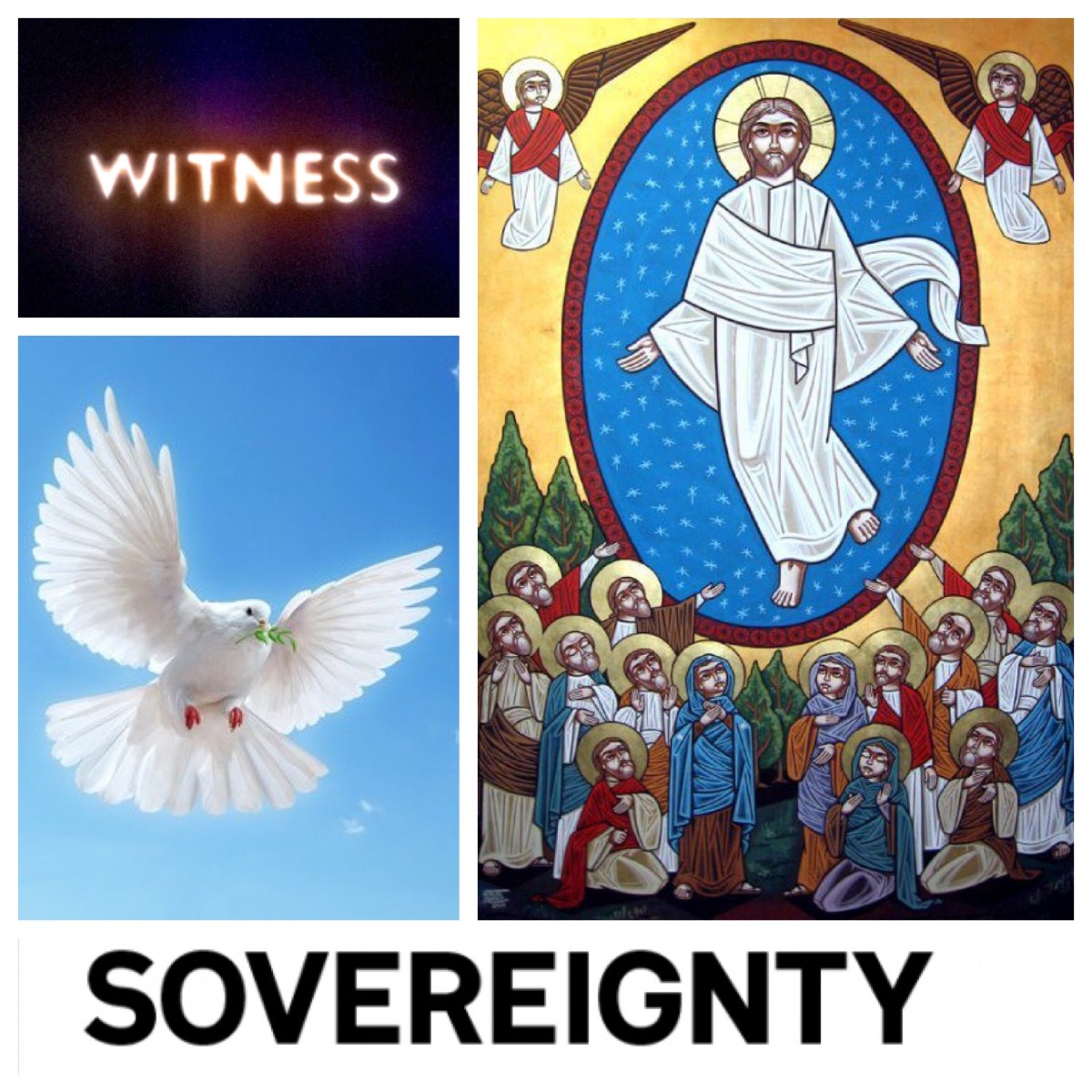
The dialogue between Jesus and his disciples raises the central theological issue of sovereignty (the kingdom of God). The disciples ask “Lord, (may we ask) if you will at this time restore sovereignty to Israel?” (1:6) — quite rightly, for the issue of sovereignty was central to Jesus’ preaching (1:3). Here, however, the orientation of the question is concerned with the sovereignty of Israel. Jesus replies with three clear affirmations, which stand as his last words before he ascends into heaven.

The first affirmation of Jesus in 1:8 turns the question away from Israel, back to the primary theme of God’s sovereignty, with the clear declaration that the times and seasons are under the sovereignty of God who has “set them by his own authority” (1:7). Rather than the political independence of Israel, it is God’s unfettered freedom to act in history which is crucial to his enterprise.

The second affirmation, “you will receive power when the holy spirit has come upon you” (1:8), is a promise which reinforces the key role of the spirit, as divine agent, throughout this volume (beginning with the events of 2:1-4).

The third affirmation introduces the important motif of witness (1:22; 2:32; 3:15; 4:33; 5:32; 10:39,41,43; 13:31; 22:15,18,20; 23:11; 26:11,22) and provides a condensed geographical summation of the course of the ensuing events: “in Jerusalem [1:12-8:3] and in all Judaea and Samaria [8:4-12:25] and to the end of the earth [13:1 onwards]”.

What does “the end of the earth” refer to? A contemporary Jewish work, the Psalms of Solomon 8:15, may suggest that it refers to Rome, it is preferable to see the reference as drawn from Isa 49:6, a verse cited at Luke 2:32 and Acts 13:47. It is thus a poetic statement about the extensive scope of the ensuing events. These departing words of the Lukan Jesus neatly conjoin the geographical pattern and theological foundation of Acts: from Jerusalem outwards, the divine spirit will enable followers of Jesus to bear witness to the sovereignty of God.

Two men in white robes then appear (1:10), evokes similar appearances in earlier chapters: the two men in the tomb (Luke 24:4), the transfigured Jesus in the company of two scriptural figures (Luke 9:29-31). The prominence they have at this point establishes the important role of such epiphanies throughout Acts. The words spoken to the followers of Jesus who witness his ascension stress that his return will be in the same manner as his departure (1:11), although no detailed description is provided (cf. 1 Thess 4:16; Mark 13:27; Matt 24:31).

Ten days separate the ascension (forty days after Passover, 1:3) from the day of Pentecost (2:1, fifty days after Passover). Only two things are told of these ten days; already the process of selectivity which shaped Luke’s Gospel can be seen in his second volume. Thus, we learn only that the community had gathered on the day of ascension (1:12-14) and that at some stage in these days a replacement was found for Judas Iscariot (1:15-26).

Luke’s report of the regathering of the community (1:12-14) establishes key features of this community. Firstly, since they returned to Jerusalem immediately after the ascension (1:12), the focus remains on Jerusalem, which retains its pre-eminent position as the birthplace of the movement. Any gathering of believers elsewhere is incidental to the single-minded picture painted by Luke, of the Jerusalem community as the movement’s place of origin. This is the only community which matters for Luke at this moment.

Secondly, the description reveals that this was a community that met continuously during these ten days (“these [the eleven] all were unanimously attending constantly to prayer with the women and Mary the mother of Jesus and his siblings”, 1:14). The constant and communal nature of their meetings will later become important in Luke’s narrative; for the moment, the emphasis rests on the line of continuity between Jesus and this group.

Those present here in Jerusalem relate to those who journeyed with Jesus, in Galilee: the women (Luke 8:2-3), the family of Jesus (Luke 8:19), and the inner group of named male followers who are identified as apostles (Luke 6:14-16; ‘the twelve’ of Luke 8:1).

The specific reference to the inclusion of women within the community continues a particular interest already unveiled in Luke’s Gospel (Luke 8:1-3; 10:38-42; 23:49,55-56); it is subsequently explicitly noted throughout the second volume (Acts 5:14; 8:3,12; 9:2; 17:4,12).

This blog is based on a section of my commentaryn on Acts in the Eerdmans Commentary on the Bible, ed. Dunn and Rogerson (Eerdmans, 2003).

Unknown's avatarAuthor John T SquiresPosted on May 19, 2020May 11, 2021Categories An Orderly Account: Gospel of LukeTags Acts, Luke, scriptureLeave a comment on Is this the time? Sovereignty, Spirit, and witness (Acts 1; Easter 7A)

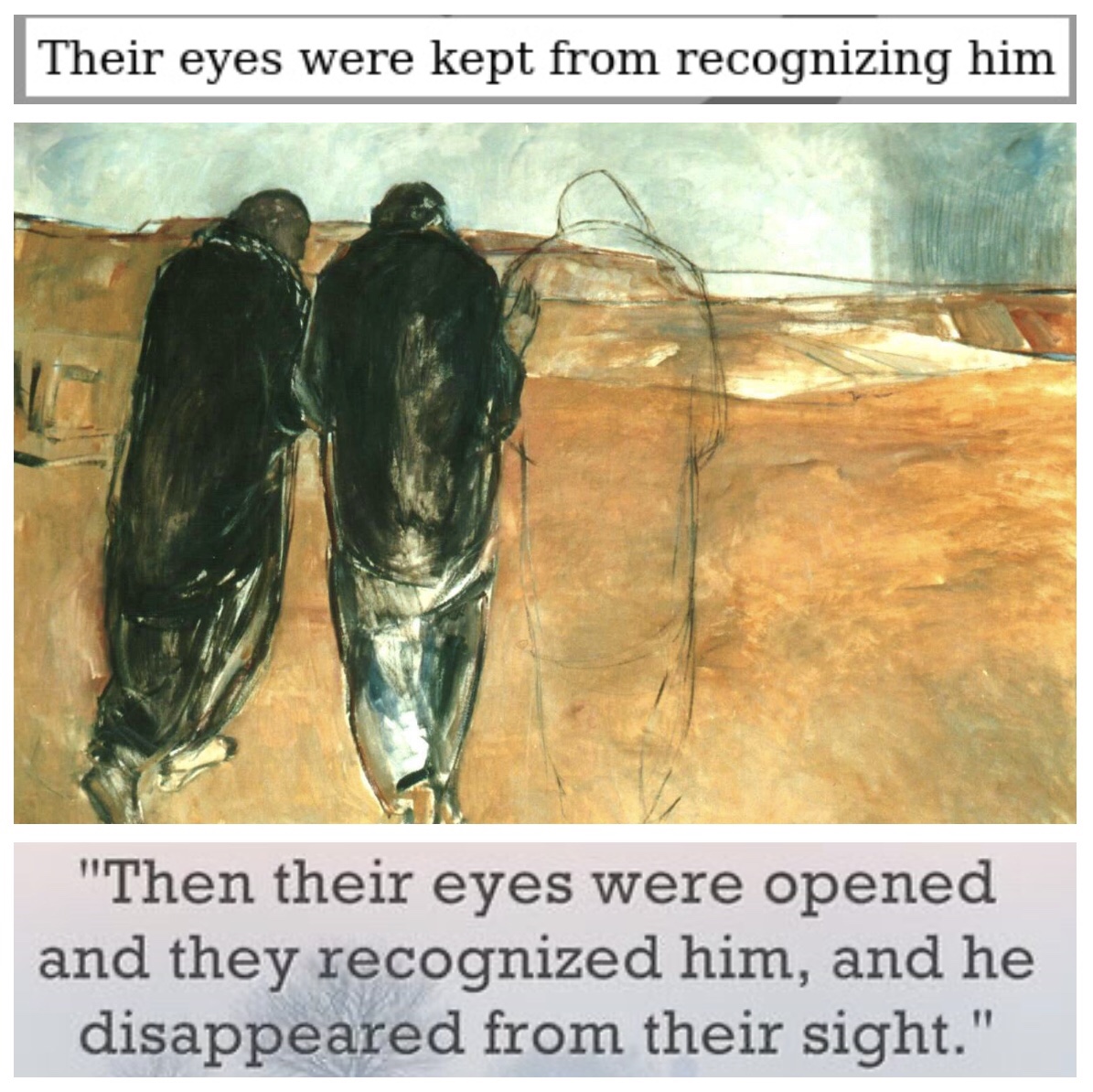
Their eyes were kept from recognizing him … then their eyes were opened, and they recognized him; and he vanished from their sight (Luke 24; Easter 3A)

Their eyes were kept from recognizing him … then their eyes were opened, and they recognized him; and he vanished from their sight (Luke 24; Easter 3A)

In a room in Jerusalem, followers of Jesus gather behind closed doors, their fears intensified by events (John 20:19). They are not connected in any way with the news that had begun to percolate through the city. They are behind locked doors, because their fear was dominating their every thought, their every move.

Thomas was not with them. He was elsewhere; not bound by his fear, not huddled behind locked doors. As we heard his story last week, it may well be that he found some certainty, for himself, after the tragic events of the days around Passover. Perhaps he had moved on, back into his life. But the others were gripped by that fear, that uncertainty.

We know, from our vantage point, that those believers were gripped by fear, even though the most amazing story was being recounted, about what had happened to their leader. The tomb was empty, the body was gone. Some were saying they had seen him, alive. But the group in Jerusalem were unaware, it would seem, of any such dramatic news.

That was the case with others, too. On the road to Emmaus, two followers of Jesus lament that their hopes were shattered (Luke 24:21). They are completely unaware of the identity of the stranger who walks with them; they are caught in their own grief and despair at what they had seen happen.

They knew there had been a betrayal, and a trial; they heard the baying crowd, screaming “crucify him”, they saw a savage whipping. He was nailed to the cross, a savage torture, and they could not bear to watch any more.

He was taken down, they were told, and placed in the tomb. That was it, as far as they were concerned. The movement had ended. Their hopes were all dashed. They were out of there, leaving Jerusalem, heading to Emmaus.

So, on the road, they walk from the fateful city: shoulders stooped, cheeks moist with tears, hearts heavy with grief. A stranger falls into step alongside them. A conversation begins, halting, careful, sensitive. Their deep hopelessness is surely understood by the stranger walking with them. He is gentle. They are grief-stricken. We all know those kinds of conversations: words almost too heavy to utter, sadness from the very depths of distress and despair.

Some days earlier, Thomas had uttered prophetic words, before the critical events had occurred, when he cried, “Lord, we do not know where you are going. How can we know the way?” (John 14:5). That speaks for how the disciples were feeling, after the crucifixion and burial of Jesus. That most certainly points to how the two travellers, on the road to Emmaus, were feeling, that day, as they walked, and talked, with this enigmatic stranger. They did not know which way they were now going. They did not have any sense of joy, or anticipation, about what lay ahead.

The stranger engaged them in a way that led them back, deeper, into what they had hoped for. He talked, asked questions, shared scriptures, offered insight. They told the story, as they knew it, deep in grief, locked into the events of that terrible Friday and the grief of early morning after Sabbath (Luke 24:22-24). They could not hear, could not comprehend, the insights he offered. He pressed hard, berated them as foolish, explained what had happened (24:25-27); but deaf to his words, blind to his presence, they were caught in their unknowing.

Could this sense of fear, uncertainty, and hopelessness, be a point of connection with the story, for us for this current period? In this time of global pandemic, we are in a period of waiting, not knowing, a time of deepened fear and broken hopes. We look around and see that things are different, so, so different, now. We may be afraid for what will happen next. We do not know what is sure and certain, what is transient and passing. Life has suddenly looked so different.

The two on the road arrive at Emmaus arrive and find their home. At this point, they do something quite amazing. They reach out in hospitality, although their hearts are breaking, and they are emotionally tired and worn. As their companion prepares to walk on to his next destination, they implore this stranger—still unknown, still unrecognised to them—to stay with them, to sit at table, to share a meal (24:29).

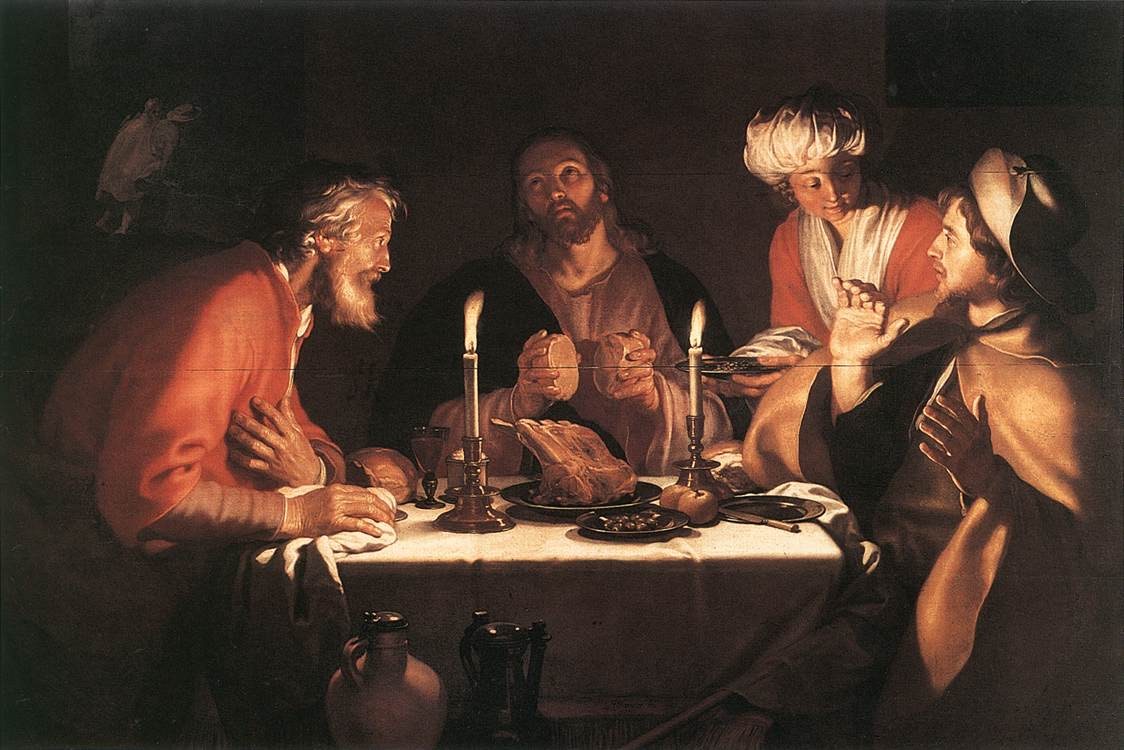
That was the moment; that was the time, when the familiar actions pierced the darkness of their despair: he took bread, blessed it, broke it, and gave it to them (24:30). He was in their home; he was guest, they were hosts. Yet he undertook the role of host: they were now in his place, his home.

Rembrandt Emmaus Supper

And as he spoke the words, the familiar words, a recognition dawned in their minds, a hope began to be rekindled, the green shoots of joy began to grow in the midst of their grief (24:31). Could this really be? Could this be the man of Nazareth? The one on whom our hopes depended? The “prophet mighty in deed and word before God and all the people” (24:19)? Yes, the familiar words and actions indicated so. He was, indeed, alive!

It was the breaking of bread which was the transforming event; it was “then their eyes were opened”. In the ordinary and mundane world, suddenly they were aware they were in the presence of God. It was then that the relationship moved into maturity. He was back with them!

Yet at precisely at this moment of recognition, the stranger disappeared from their sight (24:31). The stranger, now known as Jesus, now encountered as risen one. Yet at this moment, they found themselves alone: alone with the certainty of their new-found faith, but together with their leader. And together with others who, in other places, at other times, would experience the same recognition: a flash of awareness, surging joy, and then the sudden disappearance.

Let us remember, then, that precisely at the moment when maturity seemed in view, when the relationship was created: Jesus disappears! Why did Jesus ‘vanish from their sight’? How disturbing that must have been for the disciples!

Perhaps this reminds us, that sooner or later, they were going to have to press on and discover the way ahead for themselves. Those two disciples needed to develop their understanding in relationship with Jesus, but they also needed to go on alone themselves. He couldn’t be around forever. It was impossible for them to hold onto the Jesus they knew.

So too, for all of us, mystical experiences come and go. Moments of assurance are often fleeting. Inspiration is short lived. But despite this, God invites us to remember, and by remembering we create new memories and new possibilities. And as this story notes, hospitality is the open door to enter into a maturity of faith and to gain an expanded vision of what is possible.

And so, at last, the story reaches its climax: not in the spiritual ecstasy of full engagement with Jesus, but rather, returning back home, approaching the gathered group of disciples, zealous to share the excitement of what they had experienced (24:33). “Hey people, look at us; we’ve been changed!! Remember what we were like when we left you? Now we are back, and look what has happened to us!!!”

So the travellers return, expecting to be the missionaries, sharing the gospel, recounting their amazing experience. Out of the darkness of grief and loss, they have moved on to a joyful encounter, to a renewed faith. That’s a sign of hope and encouragement for us, in this period of waiting, unknowing, fearing the worst, hoping for the best. There is the promise of a way out of this current scenario.

The travellers return to Jerusalem, they want to share their excitement, to share that Jesus is alive, to strategise for ways to spread that good news with others. It was time to be identifying with the needy, proclaiming the gospel, being on mission, doing ministry amongst the people.

They have experienced the mission of God, on the road to Emmaus; they know that God has intervened into the passage of history and raised from the dead the once-crucified Jesus. “Were not our hearts burning within us while he was talking to us on the road, while he was opening the scriptures to us?”, they reflect (24:32). Overflowing with enthusiasm, they want to tell out this news for all to hear! They wanted to tell about the mission of God, at work in the world.

And yet, when they approached the group remaining in Jerusalem, the travellers find they are listening to the stories of the crowd who stayed home – and they too have experienced the mission of God, they too know that God has intervened into the passage of history and raised from the dead the once-crucified Jesus. For they, too, have seen him! (24:34). Overflowing with enthusiasm, they want to tell the travellers from Emmaus what they have experienced!

Might it be, that in these strange, unsettling times, in the midst of continuing uncertainty, in the centre of our unknowing, we might hold to this story? Might we be open to this insight: God comes to us in strange, unpredictable, mysterious ways. May Jesus be present to us, in our unknowing, and enable our eyes to recognise, our hearts to burn, our minds to comprehend. Even now, in this strange, unsettling time. Especially now, in this strange, unsettling time!

As we wait in our homes, as we hope for what will transpire, and we look with faith to the future, may there be a sense that our journey forwards in faith leads us into unexpected delights and enabling encounters, which lead us on to daunting, unforeseen pathways, which become energising, enabling pathways for us all.

So go, journey, travel onwards as the people of the risen one;
i
n the midst of the ordinary, be attentive to the mystery;
to the opportunity of the moment, bring gifts and resources;
a
t the time of encounter, be open to the story;
an
d may the stranger that is Jesus
guide you, confront you, serve you, equip you
to go forth with God’s blessing, to love and to serve.
In the name of Christ: Amen.

Unknown's avatarAuthor John T SquiresPosted on April 21, 2020April 18, 2023Categories An Orderly Account: Gospel of LukeTags Easter, Luke, scriptureLeave a comment on Their eyes were kept from recognizing him … then their eyes were opened, and they recognized him; and he vanished from their sight (Luke 24; Easter 3A)

On the move. A reflection on Christmas.

On the move. A reflection on Christmas.

At Christmas, we recall a familiar story. Central to the story is the baby born in a manger, because there was no room in the inn. This element is, of course, told and retold countless times in the weeks leading up to Christmas, and in churches in every country around the world, on Christmas Eve and Christmas Day.

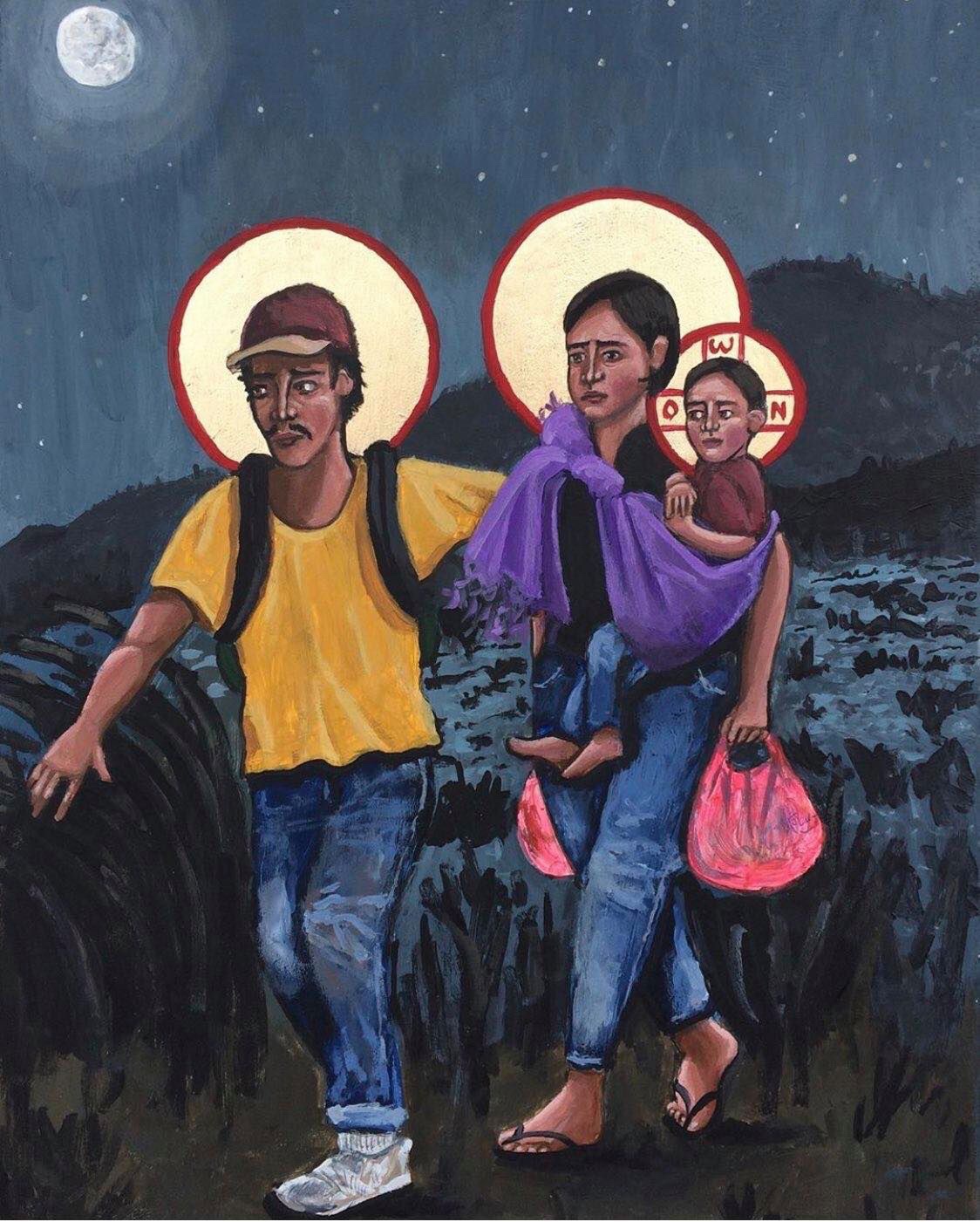
That part of the story gets disseminated widely. That part of the story contributes strongly to the warm, fuzzy vibe that Christmas brings to many people. Less well shared, however, is that part of the story which reports that this family were soon under threat, and they hurriedly fled to another country, seeking the safety of refuge, until the threat was over.

Christmas cards, and Christmas carols, have tended to encourage us to romanticise and sentimentalise the first part of the story—the babe in the manger in Bethlehem. We sing so easily about the scene that Luke recounts in his Gospel, imagining it in the picture perfect way of so many cards and carols: the baby lying peacefully asleep in the manger, the adoring mother and doting father, the shepherds who come from the fields to worship.

It all sounds so peaceful, so relaxed, so comfortable, so ideal.

As we sing all of this, I suspect that we forget that the newborn infant was born in the area that was shared with the animals; there were no homely comforts, but there would have been the sights and sounds and smells of the barnyard, all around.

We overlook, perhaps, that the shepherds who came in from the fields to pay homage to the newborn child (Luke 2:8–16) would have been despised for carrying out a lowly and unworthy occupation. They were outcasts, considers impure and unclean, placed outside the circle of holiness within which good Jews were expected to live. In the Mishnah, a third century work which collects and discusses traditional Jewish laws, shepherds are classified amongst those who practice “the craft of robbers”. These are not highly valued guests!

We forget, also, that Luke’s account of this birth places it in Bethlehem, which is not the place where the newly-formed family lived. They had been forced to travel there, according to Luke’s account, because of a nation-wide census that was required by the Romans (Luke 2:1-7). Giving birth to the child in that town, in that inn, in that manger, was not the plan that his parents initially had; this was a temporary, unforeseen situation, basic and crude.

This part of the story is not at all the comfortable and soothing scene that cards and carols regularly depict. The birth takes place after a forced journey, in an less than desirable setting.

The second part of the story, that found in the Gospel of Matthew, also has an unexpected and forced journey involved. This part of the story relates to the rapid flight that the family took after the child was born, heading away from Herod, fleeing into the safety of Egypt, a foreign country (Matt 2:13-15).

Matthew’s contribution to the story rarely fosters those warm, fuzzy vibes that many associate with Christmas. And often, in church, this part of the story is left for the time after Christmas Day—which is logical, since this is where it comes in the flow of the story; but which means that, downunder at least, it is featured during the Great Summer Holiday which comes immediately after the feasting and festivities of Christmas Day (and Boxing Day, if there are still plentiful left overs!)

Matthew’s account sets out very clearly that this journey was not part of the original plan, worked out methodically in advance. Rather, this was a rapid response to an emergency situation, a hurried seeking of refuge. It was a temporary measure, undertaken under great duress.

The ruler who gives the order which provokes the family to undertake this journey is the man whom Jesus once called “that fox”: Herod. Ruling over Judea as a client king of the Romans, Herod was a half-Jewish man who had risen to the top of Jewish society through political cunning and strategic marriages. He had a reputation for violent brutality.

Matthew’s story recounts that Herod ordered that all male children under two years of age should be killed, to ensure that this potential rival to his rule would be safely despatched (Matt 2:1-3, 16-18). Jesus survived this because his parents were advised of the imminent pogrom by visitors “from the east” who had come via the court of Herod (Matt 2:13-15).

This part of the story also does not sound relaxed, sweet, and comfortable!

And then, as the story in Matthew’s account continues, there is yet another journey, returning from Egypt, back into Israelis–but not Judea, for fear of the ruler who followed Herod, his son Archelaus; rather, to Galilee, where the family,settled in Nazareth (Matt 2:19-23).

Another episode of dislocation and disruption, that rarely features in the classic carols and Christmas cards.

It is because of these disruptive and confronting elements in the story that, in my mind, Christmas challenges us to think about those who have no shelter. It especially invites us to think about those who have nowhere safe to shelter because their homes are beset by warfare, their lives are constrained by oppression, their families have been decimated by murders, their houses have been bombed or shelled.

In that spirit, as we celebrate Christmas, let us also commit to working to ensure safety and security for those who are imperilled, homeless, stateless, and on the move. There are so many such people in our world today. There are so many ways we can live out the Christmas story as we reach out to them.

The image is La Sagrada Familia by Kelly Latimore

https://kellylatimoreicons.com/gallery/img_2361/

See also

https://johntsquires.com/2019/12/25/acting-for-peace-through-the-christmas-bowl/

https://johntsquires.com/2019/12/11/the-origins-of-jesus-in-the-book-of-origins-matthew-1/

https://johntsquires.com/2019/12/19/descended-from-david-according-to-the-flesh-rom-1/

https://johntsquires.com/2019/12/17/now-the-birth-of-jesus-the-messiah-took-place-in-this-way-matthew-1/

https://johntsquires.com/2019/12/04/for-our-instruction-that-we-might-have-hope-rom-15-isa-11-matt-3/

https://johntsquires.com/2019/11/28/leaving-luke-meeting-matthew/

https://johntsquires.com/2018/12/19/what-can-we-know-about-the-birth-of-jesus/

Unknown's avatarAuthor John T SquiresPosted on December 24, 2019December 25, 2019Categories A Book of Origins: Gospel of Matthew, An Orderly Account: Gospel of LukeTags Christmas, Luke, Matthew, scripture2 Comments on On the move. A reflection on Christmas.

Ministry and Mission in the midst of change and transition (Luke 21:13; Pentecost 23C)

Ministry and Mission in the midst of change and transition (Luke 21:13; Pentecost 23C)

When you hear of wars and insurrections, do not be terrified; for these things must take place first, but the end will not follow immediately.” Then he said to them, “Nation will rise against nation, and kingdom against kingdom; there will be great earthquakes, and in various places famines and plagues; and there will be dreadful portents and great signs from heaven.

“But before all this occurs, they will arrest you and persecute you; they will hand you over to synagogues and prisons, and you will be brought before kings and governors because of my name. This will give you an opportunity to testify. (Luke 21)

In the long and disturbing speech that Jesus gave to his earliest followers towards the end of his ministry with them, he outlines what lay ahead in time for the people of his time—a speech referring to wars and insurrections, earthquakes, famines and plagues; betrayals, arrests and imprisonments; and even hatred. And we might want to add, from our immediate context, in the midst of a changing climate, more aggressive heatwaves and out of control bushfires—with all the damage and grief that this brings, as we have so recently seen.

In the midst of this speech, Jesus offers these simple, potent words: [all of] this will give you an opportunity to testify (Luke 21:13). I hear this as a piercing call to be on mission in precisely the tumult and turmoil of life as it rolls along, amidst all the upheaval and distress that life throws at us. Testifying to the hope we have and the love we know because of Jesus, is fundamental to who we are as the church.

To be on mission means to have a sense that we are sent to the people of the world. Mission comes from the Latin missio, the verb “to send”. Towards the end of the Gospel of John, we read that the risen Jesus appeared to his followers and said to them, “Peace be with you. As the Father has sent me, so I send you” (John 20). The first followers of Jesus were charged to be missionaries, sent, on mission, into the world.

In Greek, the corresponding term is apostello, the verb “to send”. The person who is sent for a specific purpose is known, in Greek, as an apostolos. We know how important it was, for the writers of the Synoptic Gospels, to depict the central role of a foundational group within the early church – those known as apostles, or “sent ones”.

We also know how important it was for Paul, who was not numbered among the first twelve, to be accepted as “an apostle of God, sent neither by human commission nor from human authorities, but [sent] through Jesus Christ and God the Father” (Gal 1). The first followers of Jesus understood themselves to be apostles, sent ones, on mission, into the world.

All of these texts feed into the call to be a church of mission, with a clear focus on mission. So the move for a Mission Focus in the local church has emerged out of a growing international and ecumenical grasp of the missio dei … the mission of embracing love towards the world, which God offers through Jesus Christ.

I reflect on this now, in the context of my own denomination, the Uniting Church in Australia. In our Basis of Union, there is a clear articulation of the centrality of Mission in the life of the church. The Basis clearly affirms that, as a Uniting Church, we seek “to enter more deeply into the faith and mission of the Church in Australia, by working together and seeking union with other Churches” (para. 2). Being on mission forms a central and essential dimension of contemporary life for the church.

Mission is at the heart of who we are, as the people of God. Mission is the key feature that we are seeking to highlight, and develop, within the contemporary church.

The importance of mission has been articulated in the Five Marks of Mission, developed by the Anglican Church in the UK and adopted by numerous denominations in many nations around the world.  The Five Marks of Mission are:

1.    To proclaim the Good News of the Kingdom TELL

2.    To teach, baptize and nurture new believers TEACH

3.    To respond to human need by loving service TEND

4.    To seek to transform unjust structures of society TRANSFORM

5.    To strive to safeguard the integrity of creation
and sustain and renew the life of the earth. TREASURE

They are often summarised in a succinct shorthand fashion, as:

Tell … Teach … Tend … Transform … Treasure

And those key terms help to focus the work of Congregations and people of faith in our current context.


Unknown's avatarAuthor John T SquiresPosted on November 14, 2019November 8, 2022Categories An Orderly Account: Gospel of Luke, Scripture and TheologyTags change and transition, Luke, mission, scripture4 Comments on Ministry and Mission in the midst of change and transition (Luke 21:13; Pentecost 23C)

In defence of the Pharisees: on humility and righteousness (Luke 18; Pentecost 20C)

In defence of the Pharisees: on humility and righteousness (Luke 18; Pentecost 20C)

The Gospel parable set for this coming Sunday is a parable which Jesus told about a Pharisee and a tax collector (Luke 18:9-14). This is one of the texts that is regularly used, in a most negative way, to berate the Pharisees for their self-righteousness and legalism. This feeds into an understanding of Jesus as a hardline critic of the Pharisees, regularly berating them for these deficiencies. That is a most unfortunate line of interpretation to take.

First, it is noteworthy that the Pharisees in Luke’s Gospel are regularly portrayed in ways that demonstrate a positive relationship with Jesus. Most strikingly, Jesus is found at table with Pharisees on a number of occasions: in the house of Simon, a Pharisee (7:36–50); by invitation of another Pharisee, in his house along with a lawyer, and scribes (11:37–54); again, in the house of a prominent Pharisee, with lawyers also present (14:1–24).

There is another occasion, when Jesus eats with tax collectors and sinners (15:1–32), where the opening verses (15:1–2) infer the additional presence of Pharisees and scribes at the meal. Eating a meal together was a clear sign that positive and mutually respectful relationships existed between Jesus and some Pharisees, at least.

Pharisees also acts in friendly ways to Jesus when they come to him to warn him about Herod (13:31) or ask him to explain his understanding of the kingdom of God (14:20-21) or seek to quell the uproar being caused by the disciples of Jesus (19:39-40). Not all of the encounters that Jesus had with Pharisees were negative or confrontational.

The early movement of followers of Jesus included Pharisees (Acts 15:5 — and even, quite strikingly, some priests, in 6:7 !). Paul was one such Pharisee, as he declares that he had been raised as a Pharisee (Acts 23:6), and there is an interesting scene later in Acts where some Pharisees (in dispute with some Sadducees) actually stand in support of Paul (Acts 23:7-9).

So the relationship is not thoroughly antagonistic. Both Jesus and, later, Paul, did have robust discussions and disagreements with Pharisees, but neither of them wrote the Pharisees off as lost causes or doomed to perdition. We should not use Pharisee as a cipher for a self-righteous or hypocritical person who has no humility — accusations that could well have been made in the heat of an argument.

Second, this unfortunate negative line of interpretation concerning Pharisees is based on a gross misunderstanding of the Pharisees, their faith, and their activities. All too often, Pharisees are misrepresented and scapegoated by Christians (especially since the rise of anti Semitic theologies in Germany in the late 19th and early 20th centuries), using them as a foil for their own views of a more positive Christian faith.

So: what do we really know about the Pharisees?


The scribal Pharisees specialised in the interpretation of Torah and in the application of Torah to ensure that holiness was observed in daily living. In contrast to the Sadducees, the Pharisees were very popular amongst the ordinary Jewish folk. This may well have been because they undertook the highly significant task of showing how the Torah was relevant to the daily life of Jewish people.

The story of Ezra, told in Nehemiah 8, gives an example of this in practice, referring especially those who “helped the people to understand the law” (Neh 8:7). Whilst the priests upheld the Torah as the ultimate set of rules for operating the Temple, the Pharisees showed how the Torah could be applied to every aspect of daily life as a Jew.

Most Jews went to the Temple only rarely—and found it to be an expensive enterprise when they got there! But in seeking guidance for daily life, the people were greatly helped by those skilled interpreters of Torah, the scribes and the Pharisees. Josephus comments that the Pharisees were usually held in high regard by the ordinary people of the day.


Since nine out of every ten persons could not read, the importance of scribes—literate, educated, and sympathetic—could not be underestimated. Whilst the Pharisees clustered around towns in Judea, the scribes were to be found in the synagogues of villages throughout greater Israel, and indeed in any place where Jews were settled. Their task was to educate the people as to the ways of holiness that were commanded in the Torah. It was possible, they argued, to live as God’s holy people at every point of one’s life, quite apart from any pilgrimages made to the Temple in Jerusalem.


Over time, the Pharisees and scribes developed particular methods for interpreting the Torah; many of these methods are reflected within the New Testament, as it seems that Paul, each of the Gospel writers, and even Jesus himself, were familiar with such methods of interpretation. They were certainly people of faith, devoted to serving God in humility, and focussed on fostering a sense of righteousness (obedience to the way that God had instructed them) amongst their people.

Associated with this, the Pharisees and scribes devoted much time to verbal discussion of the written texts of Torah, probing the meaning of every law that was recorded in their scripture. These debates were remembered and passed on by word of mouth. Over time, the accumulated body of these oral discussions and debates was accorded a certain authority in its own right. Eventually, the claim was made that the oral teachings were of similar importance to the written text; the Pharisees were said to have had an “oral Torah” alongside the written Torah. Debate over this matter is reflected in texts such as Mark 7 and Matt 15.

So, just as Pharisees debated amongst themselves about how best to interpret the laws given in scripture, so too Jesus engaged in such debates and disputations with them as to how the laws should be interpreted and applied. He used precisely the methods and techniques that the Pharisees themselves employed, with questions, counter-argument, scripture citations, and analogies, for instance.

This form of engagement wasn’t an antagonistic dispute; it was just the vigorous style of such debates. Jesus wasn’t looking to dismiss the Pharisees, but to reach into the heart of each law that they were debating together. The debate was taking place to clarify how people were to be faithful to God, living according to the righteousness (or holiness) that God required.

Later, accounts of these oral debates between Jesus and Pharisees were written down in the Gospels that we have in Christian scripture. However, these debates were remembered and recorded in ways that seem to reflect the intensity of fervent debate that was apparently taking place, at that later time, between followers of Jesus, and authorities in the synagogues. They retained the vigorous manner of debates about Jewish Torah, but were set into a polemical context that highlighted the differences and sharpened the sense of argumentative antagonism.

Accordingly, it is reasonable to regard many of the accounts of Jesus in debate with the scribes and Pharisees (such as Luke 11:37-54 and Matt 23:1-36) as more reflective of the antagonism, conflict, and even hatred that had grown between these two groups.

That wasn’t the historical reality. But it came to be the way that the followers of Jesus after his lifetime (and after the destruction of the Jerusalem Temple in 70 CE) most often remembered the Pharisees. And so the trajectory of the stereotype of the Pharisee began.


Both older academic Christian scholarship and popular Christian tradition today perpetuate the stereotype that the Judaism of the time of Jesus was a harsh, legalistic, rigid religion—precisely because of the claimed “hardness of heart” of the Pharisees in their debates with Jesus.

This stereotype was heightened by an unquestioning acceptance of the New Testament caricature of the Pharisees as hypocritical legalists who made heavy demands but had no soul commitment to their faith. It was claimed that they were the leaders of a static, dying religion.

This stereotype has been completely demolished in recent decades—both through the growing interaction between Christian and Jewish scholarship, and also through a more critical reading of the relevant primary texts. It has no place in our contemporary preaching.

In 2009, the Twelfth Assembly of my church (the Uniting Church in Australia) adopted a Statement on Jews and Judaism in which we resolved to:

acknowledge that many of the early Christian writings collected in the New Testament were written in a context of controversy and polemic between the Church and Synagogue;

not accept Christian teaching that is derogatory towards Jews and Judaism;

and encourage its members and councils to be vigilant in resisting antisemitism and anti-Judaism in church and society.

The full statement can be read at https://assembly.uca.org.au/resources/key-papers-reports/item/download/1022_7d707d6a8cd8a2fe2188af65d6f04548

I hope that those who are preaching on the parable of the Pharisee and the tax collector in Luke 18, bear in mind these things as they prepare and deliver sermons this coming Sunday. Yes, Jesus criticises the particular Pharisee in this parable. No, this was not how Jesus viewed each and every Pharisee that he knew. Yes, Jesus was a friend of Pharisees and entered enthusiastically into robust debate with them. No, he was not intending to write off all Pharisees as pious, hypocritical, self-righteous legalists.

You can read about how the Uniting Church has sought to engage the Jewish Community in constructive dialogue for many years, now, at https://uniting.church/an-introduction-to-the-uca-jewish-dialogue/

and learn about an excellent resource it has produced entitled Light Eternal at https://assembly.uca.org.au/rof/rof-news/item/1986-light-eternal

On the UCA commitment to interfaith relations, see https://johntsquires.com/2019/05/04/friendship-in-the-presence-of-difference-a-gospel-call-in-a-world-of-intolerance-and-hatred/

Unknown's avatarAuthor John T SquiresPosted on October 21, 2019October 29, 2021Categories An Orderly Account: Gospel of LukeTags interfaith, Luke, scripture, theology3 Comments on In defence of the Pharisees: on humility and righteousness (Luke 18; Pentecost 20C)

Unjust judge, shameless widow (Luke 18; Pentecost 19C)

Unjust judge, shameless widow (Luke 18; Pentecost 19C)

Jesus told many parables. The kingdom of God was the primary theme of many of these parables. Quite a number of his parables are found only in the “orderly account of the things that have been fulfilled among us”— the document which we know as the Gospel according to Luke. We have been hearing a number of these this year, as the lectionary has taken us through this Gospel: the lost coin, the lost sheep, the lost (prodigal) son and the lost (elder) son; the Good Samaritan, the rich man who built barns, the man planning to build a tower and the king planning to go to war.

In the parables of Jesus which are found only in Luke’s Gospel, we meet a variety of upper-class people: a rich man who built larger barns for his produce, a tower builder and a king at war, a rich father of two sons, a steward of a wealthy man, a rich man who dressed in purple and feasted daily, a farmer with slaves and a prestigious and powerful judge. In a number of these parables, the way that Jesus tells the story raises challenges for such people: they are called to account for the benefits and blessing s that they enjoy in their lives.

The parable set as the Gospel passage for this coming Sunday (Luke 18:1-8) is a case in point: the prestigious and powerful judge is called to account for the way he does (and does not) dispense justice. Alongside the judge, the widow is held up as a positive role model, because of the way she continues to raise the difficult questions with the judge.

This is regularly understood to be a parable about persistence, with the widow as the key figure. Don’t give up! Keep on pressing the point! Knock on the door of that judge, and keep knocking, until he rises from his sleep and opens the door to you. Don’t let the authorities ignore you or marginalise you. Make a noise! Rouse the sleepers! Agitate! Work to see your demands brought to fruition!

Now, a standard way of interpreting parables is to allegorise them. That means, drawing clear lines of connection between the characters in the story, and people in real life. Classically, the judge who was being disturbed by the persistent widow, knocking on his door, perhaps crying out in the dead of night, this judge is usually equated with God. The persistent widow, by contrast, is equated with faithful people, praying to God.

If that is done, then we are provided a most disturbing picture of God. Do we really see God as unjust, oblivious to the cries of need around him, asleep in bed as the needs of the world grow larger and more pressing? It is not, I would suggest, how people of faith really conceive of God.

What about turning this interpretation on its head? Even though the text suggests that we interpret the judge as a symbol,for God, that isn’t the end of the matter. If the text is about prayer, then it is about the two-way interaction that happens when we pray. Prayer is as much about what we say to God, as it is about what God says to us, what we hear when we pray, what is pressed upon us from our close and intimate engagement with our Creator.

So, if we flip things in the parable—what about if we see the judge as a symbol of systems in our human society? Like our systems often become, the judge was inflexible, aloof, resistant to interference, opposed to alteration. And why not see the woman as a picture of God? Persistent, incessant, calling out the injustices of our society, raising a ruckus when things are unfair or inequitable.

Read like this, the parable is about the way that God continues to press on us, challenging us, confronting us, pushing us to grow in our discipleship and deepen in our faith.

Finally, there is one more aspect of this parable that I want to raise. If we explore the word used to describe the widow in the original Greek of this Gospel, the word that is usually translated as “persistent”, we will find that the original Greek is more accurately rendered as “shameless”. How about that picture of God—the one who is utterly shameless–shamelessly persistent in making demands of us?

Widows in ancient Hebrew society were in a perilous position. In a strongly patriarchal society, the patronage of a man was vital: a man as husband and provider, a man as father and protector, a man as the household head. Children without fathers—orphans—as well as women without husbands—widows—were in equally perilous situations. They were vulnerable people, often at risk of being mistreated and exploited, of being pushed to the edge of society and being forgotten.

In our time, we require those in leadership in the church to have obtained a Working With Vulnerable People card, to signal that they are aware of the power imbalances present in situations where they minister. In the ancient world, no such system existed; but we do find in the Hebrew Scriptures that there are regular exhortations and instructions to the people to take care of widows and orphans, such as the command, “you shall not mistreat any widow or fatherless child” (Exod 22:22), or the instruction to gather a tithe of produce and invite “the Levite, the foreigner, the fatherless, and the widow to come and eat and be filled” (Deut 14:28–29), or the prophetic decree, “do not oppress the sojourner, the fatherless, or the widow” (Jer 7:5), and then in the New Testament true religion is defined as being “to care for orphans and widows in their distress” (James 1:27). Even in ancient society, vulnerable people needed protection.

The judge ought to have taken special care of the widow, if he had been paying attention to his scriptural teachings; but he shuts her out, literally and metaphorically, and wishes to have nothing to do with her. The widow needs to represent herself; there seems to be no male relative to speak for her in the male-dominated court. She needs to make multiple attempts to engage with the judge; she has no resources to offer a bribe which would ensure a swift hearing. And the woman appears to have suffered an injustice; she pleads, “grant me justice against my opponent”.

So the widow persists. She steps out of the submissive pattern of behaviour that is expected of her, the culture required women to keep shame, by remaining in the private sphere, and not to claim honour, by acting in the public sphere. This widow steps out of that private sphere, into public life, and takes responsibility for her own wellbeing, no longer dependant on a man to advocate for her. By doing this, she claims her own portion of honour, and so acts with no shame. She is shameless.

In this way of reading the parable, the widow acts in precisely the way that Lady Wisdom is portrayed in Proverbs 8:1-4. She, a female, is on the public arena of ancient Israel: On the heights, beside the way, at the crossroads she takes her stand; beside the gates in front of the town, at the entrance of the portals she cries out. These locations were where men were expected to be active, and the gates to the town were the places where men gathered to discuss Torah and determine cases brought to them as judges.

For a woman to be there, and to be vocally active in such a public way, was a breach of the honour-shame code. Women speaking out in public were acting in a way that challenged the honour of the men who alone “rightly” belonged there. They did not adhere to the posture and action of shame that they were required to demonstrate, as the flip side of honour. They were acting in a way that demonstrated they were shameless.

The widow, pressing the point with the judge, is not only persistent, but—like Lady Wisdom, like God as we listen to and engage with God—utterly shameless. She demonstrates intense, ongoing, persistence. How might she be a model for us to emulate in our discipleship?

See also

https://johntsquires.com/2019/02/05/costly-discipleship-according-to-luke/

https://johntsquires.wordpress.com/2019/01/31/an-orderly-account-a-quick-guide-to-luke-and-acts/

https://johntsquires.wordpress.com/2019/02/19/the-beloved-physician-the-lover-of-god-and-loving-our-enemies-luke-6/

https://johntsquires.wordpress.com/2019/04/17/the-death-resurrection-and-ascension-of-jesus-in-lukes-orderly-account/

https://johntsquires.wordpress.com/2019/04/26/the-cross-cultural-nature-of-the-early-jesus-movement/

https://johntsquires.wordpress.com/2019/04/30/the-calling-of-saul-and-the-turn-to-the-gentiles-modelling-the-missional-imperative-acts-8-12/

https://johntsquires.com/2019/05/22/jesus-and-his-followers-at-table-in-lukes-orderly-account/

https://johntsquires.com/2019/07/02/from-learners-to-leaders-deepening-discipleship-in-lukes-orderly-account/

Unknown's avatarAuthor John T SquiresPosted on October 16, 2019October 16, 2022Categories An Orderly Account: Gospel of LukeTags Luke, scripture2 Comments on Unjust judge, shameless widow (Luke 18; Pentecost 19C)

Posts pagination

Previous page Page 1 … Page 9 Page 10 Page 11 … Page 14 Next page

The Book of Origins

  • Leaving Luke . . . Meeting Matthew
  • Matthew: tax collector, disciple, apostle, evangelist—and “scribe trained for the kingdom”? (Matt 9; Pentecost 2A)
  • For our instruction … that we might have hope (Rom 15, Isa 11, Matt 3; Advent 2A)
  • The origins of Jesus in the book of origins: Matthew 1 (Advent Year A)
  • Now the birth of Jesus the Messiah took place in this way (Matthew 1; Advent 4A)
  • Descended from David according to the flesh (Rom 1; Advent 4A)
  • A young woman? A virgin? Pregnant? About to give birth? (Isa 7:14 in Matt 1:23; Advent 4A)
  • More on Mary (from the Protoevangelium of James)
  • Tales from the Magi (the Revelation of the Magi)
  • Herod waiting, Herod watching, Herod grasping, holding power (Matt 2; Christmas 1A)
  • Herod was infuriated, and he sent and killed all the children (Matt 2; Christmas 1A)
  • Repentance for the kingdom (Matt 4; Epiphany 3A)
  • Proclaiming the good news of the kingdom (Matt 4; Epiphany 3A)
  • Teaching in “their synagogues” (Matt 4; Epiphany 3A)
  • Teaching the disciples (Matt 5; Epiphany 4A)
  • Blessed are you: the Beatitudes of Matthew 5 (Epiphany 4A)
  • An excess of righteous-justice (Matt 5; Epiphany 5A)
  • You have heard it said … but I say to you … (Matt 5; Epiphany 6A)
  • The missing parts of the Sermon on the Mount (Matt 6 and 7; Epiphany Year A)
  • Our Father in heaven: a pattern for prayer (Luke 11, Matt 6) part III
  • Our Father in heaven: a pattern for prayer (Luke 11, Matt 6) part II
  • Our Father in heaven: a pattern for prayer (Luke 11, Matt 6) part I
  • “Go nowhere among the Gentiles” (Matt 10:5): the mission of Jesus in the book of origins (Pentecost 3A)
  • “Even the hairs of your head are all counted.” (Matt 10:30; Pentecost 4A)
  • Come to me, take my yoke, I will give you rest (Matt 11; Pentecost 6A)
  • Parables: the craft of storytelling in the book of origins (Matt 13; Pentecost 7A)
  • The righteous-justice of God, a gift to all humanity (Romans; Year A)
  • Let anyone with ears, hear! (Matt 13; Pentecost 8A)
  • Chopping and changing: what the lectionary does to the parables of Matthew (Pentecost 7–9A)
  • Nothing but five loaves and two fish (Matt 14; Pentecost 10A)
  • Liminal experiences and thin places (Matt 14; Pentecost 11A)
  • It’s all in the geography. Jesus, the Canaanite woman, and border restrictions (Matt 15; Pentecost 12A)
  • A rock, some keys, and a binding: clues to the identity of Jesus (Matt 16; Pentecost 13A)
  • An invitation that you just cannot … accept! (Pentecost 19A)
  • Towards Palm Sunday (Matt 21): Passover and politics
  • Towards Palm Sunday (Matt 21): Riding on a donkey (or two) as the crowd shouts ‘Hosanna’
  • Towards Palm Sunday (Matt 21): Waving branches, spreading cloaks
  • Towards Palm Sunday (Matt 21): Acclaiming the king, anticipating the kingdom
  • Producing the fruits of the kingdom (Matt 21; Pentecost 19A)
  • Darkness, weeping, and gnashing of teeth: the scene of judgement (Matt 22; Pentecost 20A)
  • The greatest and first commandment … and a second, like it (Matt 22)
  • On these two commandments hang all the law and the prophets (Matt 22; Pentecost 22A)
  • Sitting on the seat of Moses, teaching the Law—but “they do not practice what they teach” (Matt 23; Pentecost 23A)
  • Discipleship in an apocalyptic framework (Matt 23–25; Pentecost 23–26A)
  • A final parable from the book of origins: on sheep and goats, on judgement and righteous-justice (Matt 25; Pentecost 26A)
  • Scripture debate and disputation in the wilderness (Matt 4; Lent 1A)
  • Testing (not temptation) in the wilderness (Matt 4; Lent 1A)
  • Practising righteous-justice: alms, prayer, and fasting (Ash Wednesday)
  • Forcing scripture to support doctrine: texts for Trinity Sunday (2 Cor 13, Matt 28; Trinity A)

An Orderly Account: Luke and Acts

  • “An orderly account”: a quick guide to Luke and Acts
  • Costly discipleship, according to Luke
  • Did Luke write the first “orderly account” about Jesus?
  • With one eye looking back, the other looking forward: turning to Luke’s Gospel I (Year C)
  • Leaving out key moments, so they can appear later in the story: turning to Luke’s Gospel III (Year C)
  • “A light for the Gentiles, salvation to the ends of the earth”: turning to Luke’s Gospel II (Year C)
  • The scriptural resonances in the Annunciation (Luke 1; Advent 4B)
  • Magnificat: the God of Mary (Luke 1) is the God of Hannah (1 Sam 2) (Advent 4C)
  • “To give knowledge of salvation”: Luke’s portrayal of John the baptiser (Luke 3; Advent 2C)
  • On angels and virgins at Christmastime (Luke 2; Christmas Day B)
  • A light for revelation to the Gentiles and for glory to your people Israel (Luke 2; Christmas 1B)
  • John the baptiser’s call for ethical, faithful living (Luke 3; Advent 3C)
  • A Testing Time: forty days in the wilderness (Luke 4)
  • Sacred place and sacred scripture: forty days in the wilderness (2)
  • Scripture fulfilled in your hearing (Luke 4:16-30; Epiphany 3C, 4C)
  • Jesus and conventional Jewish piety (Luke 4:16; Epiphany 3C)
  • Jesus, scripture and experience (Luke 4:17, 21; Epiphany 3C)
  • The holistic spirit-inspired mission of Jesus (Luke 4:18–19; Epiphany 3C)
  • Jesus, the widow of Sidon and the soldier of Syria: representatives of the community of faith (Luke 4:25–27; Epiphany 4C)
  • Two prophets of Israel, the widow of Sidon and the soldier of Syria: an inclusive community of Jews and Gentiles (Luke 4:25–27; Epiphany 4C)
  • Leave everything, follow Jesus (Luke 5:1-11; Epiphany 5C)
  • On a level place, with a great crowd (Luke 6; Epiphany 6C)
  • Blessed are you … poor, hungry, weeping … (Luke 6; Epiphany
  • The plain, the synagogue, and the village (Luke 6, 4 and 1; Epiphany 6C)
  • Bless—Love—Forgive—and more. The teachings of Jesus (Luke 6; Epiphany 6C, 7C)
  • The beloved physician, the lover of God, and loving our enemies (Luke 6; Epiphany 7C)
  • Perfect, or merciful? The challenge Jesus poses (Matt 5, Epiphany 7A; Luke 6, Epiphany 7C)
  • Jesus and his followers at table in Luke’s “orderly account”
  • Before Transfiguration Sunday, the stories of the dying slave and the grieving widow (Luke 7; Epiphany 9C; Proper 4C)
  • What have you to do with me, Jesus? (Luke 8; Pentecost 2C)
  • Bringing his ‘exodos’ to fulfilment (Luke 9; Transfiguration C)
  • Setting his face to go to Jerusalem (Luke 9:51, 13:33, 17:11, 19:11; Lent 2C)
  • Through Samaria, heading to Jerusalem (Luke 9; Pentecost 3C)
  • Sent out in Samaria, proclaiming the kingdom (Luke 10; Pentecost 4C)
  • Listening and learning at the feet of Jesus (Luke 10; Pentecost 6C)
  • Mary and Martha: models of women following and learning from Jesus (Luke 10; Pentecost 6C)
  • There is need of only one thing. Or, maybe, two. (Luke 10; Pentecost 6C)
  • Where have all the women gone? Women in the movement initiated by Jesus (Luke 10; Pentecost 6C)
  • On earth, as in heaven: the key to The Lord’s Prayer (Luke 11; Pentecost 7C)
  • Sins or trespasses? Trial or temptation? Thine or yours? The prayer that Jesus taught (Luke 11; Pentecost 8C)
  • “Where your treasure is, there your heart will be also” (Luke 12; Pentecost 8C)
  • Coming to grips with the judgement of God (Luke 12 and Isaiah 5; Pentecost 10C)
  • She stood up straight and they were put to shame (Luke 13; Pentecost 11C)
  • Jerusalem, Jerusalem: holy city, holy calling (Luke 13; Lent 2C)
  • Disturbing discipleship: exploring the teachings of Jesus in Luke 14 (Pentecost 12C to 13C)
  • Disreputable outsiders invited inside: parables in Luke 14 (Pentecost 12C, 13C)
  • The discomfort of ambiguity (Luke 15; Lent 4C)
  • Human sinfulness and divine grace (Jeremiah 4; Luke 15; 1 Timothy 1; Pentecost 14C)
  • Shrewd? dishonest? manipulative? or contributing to the common good? (Luke 16; Pentecost 15C)
  • Lazarus and the rich man (Luke 16; Pentecost 16C)
  • Faith the size of a mustard seed (Luke 17; Pentecost 17C)
  • Was none of them found to return and give praise to God except this foreigner? (Luke 17; Pentecost 18C)
  • Unjust judge, shameless widow (Luke 18; Pentecost 19C)
  • In defence of the Pharisees: on humility and righteousness (Luke 18; Pentecost 20C)
  • Zacchæus: patron saint of change and transition (Luke 19; Pentecost 21C)
  • “When these things begin to take place … your redemption is drawing near” (Luke 21; Advent 1C)
  • “Be alert at all times, praying that you may have the strength … to stand before the Son of Man” (Luke 21; Advent 1C)
  • Look up to the sky? Look down to your feet! (Luke 20; Pentecost 22C)
  • Don’t take it at face value: on former things and new things
  • Don’t take it at face value: on what lies behind and what lies ahead (Lent 2C)
  • The death, resurrection and ascension of Jesus in Luke’s “orderly account”
  • What do you see? What do you hear? (Luke 19; Palm Sunday C)
  • Holy Week: the week leading up to Easter
  • Sacrificial death and liberating life: at the heart of Easter
  • Ministry and Mission in the midst of change and transition (Luke 21:13; Pentecost 23C)
  • Easter in Christian tradition and its relation to Jewish tradition
  • A time in-between the times, a space in no-space.
  • The tomb is empty. He is not here. He is risen. (Luke 24; Easter Sunday)
  • He Is Not Here Day
  • Discovering new futures … letting go of the old
  • The moment of recognition: walking … talking … listening … understanding … (Luke 24; Easter evening; Easter 3A)
  • Ten things about Pentecost (Acts 2)
  • The cross-cultural nature of the early Jesus movement
  • From Learners to Leaders: deepening discipleship in Luke’s “orderly account”
  • Constantly devoting themselves to prayer (Acts 1; Easter 7A)
  • You will be my witnesses (Acts 1; Easter 7A)
  • Judas: reconsidering his part in the Easter story (Acts 1; Easter 7B)
  • Pentecost, the Spirit, and the people of God (Acts 2; Pentecost B)
  • What God did through him: Peter’s testimony to Jesus (Acts 2; Easter 2A)
  • What God did through him: proclaiming faith in the public square (Acts 2; Easter 2A)
  • Repent and be baptised: Peter’s Pentecost proclamation (Acts 2; Easter 3A)
  • The church in Acts: Times of refreshing (Acts 3; Easter 3B)
  • Boldly proclaiming “no other name” (Acts 4; Easter 4 B)
  • The church in Acts: Unity, testimony, and grace (Acts 4; Easter 2B)
  • We must obey God rather than human authority (Acts 5; Easter 2C)
  • Edging away from the centre (Acts 8; Easter 5B)
  • What happened after Philip met the Ethiopian? (Acts 8; Easter 5B)
  • The calling of Saul and the turn to the Gentiles: modelling the missional imperative (Acts 8—12; Easter 3C)
  • People of ‘The Way’ (Acts 9; Easter 3C)
  • You will be told what you are to do (Acts 9; Easter 3C)
  • Resurrection life, economic responsibility, and inclusive hospitality: markers of the Gospel (Acts 9)
  • Another resurrection! (Acts 9; Easter 4C)
  • Even to the Gentiles! (Acts 10; Easter 6B)
  • Even to the Gentiles (Acts 11; Easter 5C)
  • On literary devices and narrative development (Acts 16; Easter 7C)
  • The unknown God, your own poets, and the man God chose: Paul on the Areopagus (Acts 17; Easter 6A)
  • Paul, Demetrius and Damaris: an encounter in Athens (Acts 17:16-17,22–34)
  • Lydia, Dorcas, and Phoebe: three significant strategic leaders in the early church
  • An Affirmation for Our Times
  • I make prayers on your behalf (Letters to Luke #1; Year C)
  • I rejoice in the gift of writing (Letters to Luke #2; Year C)
  • How exciting it was! (Letters to Luke #3; Year C)
  • I write briefly (Letters to Luke #4; Year C)
  • I am happy to report that we have held another reading (Letters to Luke #5; Year C)
  • I was astonished to receive your brief note (Letters to Luke #6; Year C)
  • Leaving Luke . . . Meeting Matthew

Scripture and Theology

  • The Word of God, Scripture, and Jesus Christ
  • Marrying same-gender people: a biblical rationale
  • Discernment
  • Interpreting the creeds “in a later age”
  • Affirming the Teachings of Jesus
  • To articulate faith contextually
  • Let your gentleness be known to everyone
  • What can we know about the birth of Jesus?
  • “An orderly account”: a quick guide to Luke and Acts
  • Costly discipleship, according to Luke
  • In the wake of the verdict about Pell …
  • Another Time, Another Place: towards an Australian Church
  • Holy Week: the week leading up to Easter
  • Sacrificial death and liberating life: at the heart of Easter
  • The death, resurrection and ascension of Jesus in Luke’s “orderly account”
  • Easter in Christian tradition and its relation to Jewish tradition
  • The cross-cultural nature of the early Jesus movement
  • Jesus and his followers at table in Luke’s “orderly account”
  • Once again: affirming our diversity, celebrating joyous marriages
  • Ten things about Pentecost (Acts 2)
  • The Paraclete in John’s Gospel: exploring the array of translation options (John 14, 15, 16)
  • “Do you believe in the Triune God?”
  • The DNA of the UCA (part I)
  • The DNA of the UCA (part II)
  • Harness the passion, but restrain the rhetoric. Musing on the role model which Paul offers in Galatians.
  • Providing for the exercise by men and women of the gifts God bestows upon them: lay people presiding at the sacraments in the Uniting Church
  • Freedom and unity: themes in Galatians
  • Australian Religious Leaders support renewable energy
  • Human sexuality and the Bible
  • Dividing the unity, splintering the connections: more ACC agitation
  • Giving Voice, Telling Truth, Talking Treaty: NAIDOC 2019
  • Advocacy and Climate Change, Growth and Formation, Treaty with First Peoples: Synod 2019
  • Climate Change: a central concern in contemporary ministry
  • On earth, as in heaven: the key to The Lord’s Prayer (Luke 11; Pentecost 7C)
  • Ramping up the rhetoric, generating guilt and provoking panic: the failed strategy of conservatives in the UCA (part I)
  • Ramping up the rhetoric, generating guilt and provoking panic: the failed strategy of conservatives in the UCA (part II)
  • Ramping up the rhetoric, generating guilt and provoking panic: the failed strategy of conservatives in the UCA (part III)
  • International Day of the World’s Indigenous Peoples
  • In the wake of the verdict (and appeal decision) relating to Pell …
  • Where will we find hope? When will we see justice?
  • Supporting the Climate Strike
  • Gracious openness and active discipleship as key characteristics of church membership
  • Please Leave ?? No — Please Stay !!
  • Stones singing and rivers vibrating … a liturgy for Holy Communion
  • Faith in Action: a religious response to the Climate Emergency (Part One)
  • Faith in Action: a religious response to the Climate Emergency (Part Two)
  • Faith in Action: a religious response to the Climate Emergency (Part Three)
  • Celebrating Transitions: into a strange and graceful ease … (part one)
  • Celebrating Transitions: into a strange and graceful ease … (part two)
  • We wait, and hope, and grieve, anticipating …
  • On the move. A reflection on Christmas.
  • Reflecting on faith amidst the firestorms
  • This is the world we live in, this is the Gospel we believe in
  • Giving up? Or going deep? The opportunity of Lent
  • Passing the peace, sharing the elements, greeting the minister
  • When you come together … reflections on community in the midst of a pandemic
  • Holy Week: a week set apart, in a time set apart.
  • It was on that night that everything came to a head. Maundy Thursday Reflections.
  • Sacrificial Death: to give his life. Good Friday Reflections
  • Liminal Space: waiting and not knowing. Holy Saturday Reflections
  • Liberating Life: a new way of being. Easter Sunday Reflections
  • It’s been just over a month—but there have been lots of learnings!
  • Not this year. So what about next year?
  • The times, they are are a-changin’.
  • When we come together (2) … values and principles in the midst of a pandemic
  • It’s been two months under restrictions—what will our future look like? (1)
  • It’s been two months under restrictions—what will our future look like? (2)
  • Saying sorry, seeking justice, walking together, working for reconciliation
  • Worship like the first Christians. What will our future look like? (3)
  • Pentecost: the spirit is for anyone, for everyone.
  • Racism and Reconciliation
  • Paul’s vision of “One in Christ Jesus” (Gal 3:28) and the Uniting Church
  • In memory of James Dunn (1939–2020)
  • Black Lives Matter. Now—and Then.
  • Hiroshima and Nagasaki (1945), and the commitment to seek peace (2020)
  • Sexuality and Gender Identity Conversion Practices Bill: A Christian Perspective
  • Always Was, Always Will Be. #NAIDOC2020
  • The Lectionary: ordering the liberty of the preacher
  • Women in the New Testament (1): the positive practices of Jesus and the early church
  • Women in the New Testament (2): six problem passages
  • Reflections on a significant anniversary
  • What do we know about who wrote the New Testament Gospels? (1)
  • What do we know about who wrote the New Testament Gospels? (2)
  • What do we know about who wrote the letters attributed to Paul? (3)
  • What do we know about who wrote the letters in the name of the apostles? (4)
  • Revelation: a complex and intricate world of heavenly beings and exotic creatures
  • Why the Christmas story is not history (1): the “nativity scene” and the Gospels
  • Why “the Christmas story” is not history (2): Luke 1-2 and Matthew 1-2
  • Advent Greetings from Canberra Region Presbytery
  • Honours. Honestly?
  • Celebrations in Canberra (in the Uniting Church Presbytery)
  • Enough is Enough!
  • Earth Day 2021
  • From BC (Before COVID) to AD (After the Disruption)
  • The identity of the Uniting Church
  • #IBelieveHer: hearing the voice of women (Easter Day; John 20)
  • An Affirmation for Our Times
  • The missional opportunity of Trinity Sunday
  • The Murugappans of Biloela
  • World Refugee Day 2021: “when I was a stranger, you welcomed me”
  • The climate is changing; the planet is suffering; humanity is challenged.
  • 20 years on, and the shame continues: the Palapa, the Tampa, and “children overboard”
  • Rosh Hashanah: Jewish New Year
  • Remembering John Shelby Spong (1931–2021)
  • International Day of Indigenous Peoples
  • A Safe Place for Rainbow Christians
  • Working with First Peoples and advocating for them
  • Jesus, growing, learning: a review of ‘What Jesus Learned from Women’
  • “The exercise by men and women of the gifts God bestows upon them”: celebrating women in leadership in the Uniting Church
  • On vaccinations, restrictions, and fundamentalism
  • We are buying more debt, pain, and death: a case against nuclear-powered submarines
  • World Rivers Day (27 September)
  • Affirming and inclusive passages from scripture
  • The challenge of COVID-19 to Social Ethics as we know them
  • Mental Health Day, 10 October
  • The shame continues: SIEV X after 20 years
  • What does it mean to be Protestant in the Contemporary World?
  • Eye of the Heart Enlightened: words for the opening of the Parliamentary Year (2023)
  • Saltiness restored: the need for innovation. An Ordination Celebration.
  • God of all the tribes and nations
  • A Day of Mourning, ahead of Invasion Day (26 January)

Life during COVID 19

  • Passing the peace, sharing the elements, greeting the minister
  • When you come together … reflections on community in the midst of a pandemic
  • Pastoral Letter to Canberra Region Presbytery on COVID-19 pandemic
  • Pastoral Letter to the Canberra Region Presbytery of the Uniting Church in Australia. 31 March 2020
  • Liminal Space: waiting and not knowing. Holy Saturday Reflections
  • It’s been just over a month—but there have been lots of learnings!
  • Not this year. So what about next year?
  • The times, they are are a-changin’.
  • When we come together (2) … values and principles in the midst of a pandemic
  • It’s been two months under restrictions—what will our future look like? (1)
  • It’s been two months under restrictions—what will our future look like? (2)
  • Worship like the first Christians. What will our future look like? (3)
  • Pastoral Letter to Canberra Region Presbytery: June 2020
  • “Greet one another” (2 Cor 13). But no holy kissing. And no joyful singing. (Trinity Sunday A)
  • When you come together (3) … wait for one another (1 Cor 11)
  • Going “back” to church—what will our future look like? (4)
  • Minimising risks in the ongoing reality of COVID-19
  • Pastoral Letter to Canberra Region Presbytery—September 2020
  • Reimagining—the spirit of our times
  • Coping in the aftermath of COVID-19: a global perspective, a local response
  • From BC (Before COVID) to AD (After the Disruption)
  • Values and Principles in the context of a pandemic (revisited)

The First Peoples of Australia

  • The sovereignty of the First Peoples of Australia
  • Affirming the Sovereignty of First Peoples: undoing the Doctrine of Discovery
  • On Covenant, Reconciliation, and Sovereignty
  • Learning of the land (1): Eora, Biripi, Whadjuk Noongar
  • Learning of the land (2): Ngunnawal, Namadgi and Ngarigo
  • The profound effect of invasion and colonisation
  • “Endeavour by every possible means … to conciliate their affections”
  • “We never saw one inch of cultivated land in the whole country”
  • “They stood like Statues, without motion, but grinn’d like so many Monkies.”
  • “Resembling the park lands [of a] gentleman’s residence in England”
  • On Remembering: Cook and Flinders (and Trim), Bungaree and Yemmerrawanne
  • “They are to be hanged up on trees … to strike the survivors with the greater terror.”
  • So, change the date—to what?
  • Learning of the land (3): Tuggeranong, Queanbeyan, and other Canberra place names
  • Learning from the land (4): Naiame’s Nghunnhu—fishtraps at Brewarrina
  • We are sorry, we recognise your rights, we seek to be reconciled
  • Reconciliation on the land of Australia: learning from the past
  • Reconciliation on the land of Australia: Bennelong and Yemmerrawanne
  • Reconciliation on the land of Australia: Bungaree and Mahroot
  • Reconciliation on the land of Australia: Cora Gooseberry and Biddy Giles
  • Reconciliation on the land of Australia: “these are my people … this is my land”.
  • Reconciliation on the land of Australia: living together with respect
  • Dark deeds in a sunny land: the exposé offered by John B. Gribble
  • This is the proper way: no climbing
  • “They appear’d to be of a very dark or black colour”. Cook, HMS Endeavour, and the Yuin people and country.
  • “Three canoes lay upon the beach—the worst I think I ever saw.” James Cook at Botany Bay, 29 April 1770
  • Saying sorry, seeking justice, walking together, working for reconciliation
  • Racism and Reconciliation
  • “We weigh’d and run into the Harbour”. Cook, the Endeavour, and the Guugu Yimithirr
  • Black Lives Matter. Now—and Then.
  • James Cook, the Endeavour, twelve turtles and the Guugu Yimithirr (3)
  • James Cook: Captain? Discoverer? Invader? Coloniser? Cook, the Endeavour, and Possession Island.
  • Always Was, Always Will Be. #NAIDOC2020
  • Invasion and colonisation, Joshua 3 and contemporary Australia (Pentecost 23A)
  • This whispering in our hearts: potent stories from Henry Reynolds
  • A vision, a Congress, and a struggle for justice
  • What’s in a name? Reconciliation ruminations
  • NAIDOC WEEK 2021
  • Heal Country: the heart of the Gospel (for NAIDOC WEEK 2021)
  • The Spirit was already in the land. Looking back on NAIDOC WEEK (2017–2021)
  • Working with First Peoples and advocating for them
  • World Rivers Day (27 September)
  • Eye of the Heart Enlightened: words for the opening of the Parliamentary Year (2023)
  • God of all the tribes and nations
  • A Day of Mourning, ahead of Invasion Day (26 January)

Paul

  • The calling of Saul and the turn to the Gentiles: modelling the missional imperative (Acts 8—12; Easter 3C)
  • The unknown God, your own poets, and the man God chose: Paul on the Areopagus (Acts 17; Easter 6A)
  • Freedom and unity: themes in Galatians
  • Paul’s vision of “One in Christ Jesus” (Gal 3:28) and the Uniting Church
  • Descended from David according to the flesh (Rom 1; Advent 4A)
  • Reckoning what is right (Romans 4; Lent 2A) part one
  • Reckoning what is right (Romans 4; Lent 2A) part two
  • Original Sin? or Innate Goodness? (Genesis 2, Romans 5; Lent 1A)
  • We have obtained access to this grace (Romans 5, Pentecost 3A)
  • Dead to sin and alive to God (Romans 6; Pentecost 4A)
  • The best theology is contextual: learning from Paul’s letter to the Romans (Year A)
  • The righteous-justice of God, a gift to all humanity (Romans; Year A)
  • Paul and the Law, sin and the self (Rom 7; Pentecost 6A)
  • Paul, the law of the Spirit, and life in the Spirit (Rom 8; Pentecost 7A)
  • Paul, the spirit of adoption, and the “Abba, Father” prayer (Rom 8; Pentecost 8A)
  • Sighs too deep for words: Spirit and Scripture in Romans (Rom 8; Pentecost 9A)
  • Praying to be cursed: Paul, the passionate partisan for the cause (Rom 9:3; Pentecost 10A)
  • A deeper understanding of God, through dialogue with “the other” (Romans 10; Pentecost 11A)
  • God has not rejected his people. All Israel will be saved. (Rom 11; Pentecost 12A)
  • The rhetoric of the cross (1 Cor 1; Epiphany 3A)
  • The paradox of “the word of the cross” in Corinth (1 Cor 1; Epiphany 4A)
  • Who has known the mind of the Lord? (1 Cor 2; Epiphany 5A)
  • “We do not lose hope” (2 Corinthians; Pentecost 3B—6B)
  • For our instruction … that we might have hope (Rom 15, Isa 11, Matt 3; Advent 2A)
  • When you come together (3) … wait for one another (1 Cor 11)
  • A new creation: the promise articulated by Paul (2 Cor 5; Pentecost 6B)
  • “Greet one another” (2 Cor 13). But no holy kissing. And no joyful singing. (Trinity Sunday A)
  • Paul the travelling philosopher (1 Thessalonians; Pentecost 21–25A)
  • The sincerest form of flattery? Or a later, imperfect imitation? (2 Thessalonians; Pentecost 21C to 23C)
  • To the saints [not just in Ephesus] who are faithful (Ephesians 1; Pentecost 7B)
  • Declare boldly the gospel of peace, put on the armour of God (Ephesians 6; Pentecost 13B)
  • To the saints [not just in Ephesus] who are faithful (Ephesians 1; Pentecost 7B)
  • Making (some) sense of the death of Jesus (Colossians 2; Pentecost 7C)
  • No longer as a slave: Paul, to Philemon, about Onesimus (Pentecost 13C)
  • An example to those who come to believe (1 Timothy 1; Pentecost 14C)
  • Human sinfulness and divine grace (Jeremiah 4; Luke 15; 1 Timothy 1; Pentecost 14C)
  • A ransom for all: a formulaic claim (1 Tim 2; Pentecost 15C)
  • On godliness, dignity, and purity: the life of faith in 1 Timothy (Epiphany 16C)
  • In the name of the apostle … (2 Timothy, Pentecost 17B to 21B)
  • Rightly explaining the word of truth (2 Tim 2:15; Pentecost 18C)
  • Guard the good treasure entrusted to you (2 Tim 1; Pentecost 17C)
  • What does it mean to say that the Bible is inspired? (2 Tim 3:16; Pentecost 19C)
  • On care for orphans and widows (James 1; Pentecost 14B)
  • Fulfilling the Law (James 2; Pentecost 16B)
  • Wisdom from ages past for the present times (Leviticus, Jesus, James, and Paul) (Pentecost 15B, 23B)
  • The wisdom from above (James 3; Pentecost 18B)
  • The ‘word of exhortation’ that exults Jesus as superior (Hebrews 1; Pentecost 20B)
  • A great high priest who “has passed through the heavens” (Hebrews 4; Pentecost 23B)
  • A priest forever, “after the order of Melchizedek” (Hebrews 5; Pentecost 21B)
  • The perfect high priest who mediates “a better covenant” (Hebrews 9; Pentecost 23B)
  • The superior high priest who provides “the better sacrifices” (Hebrews 9; Pentecost 24B)
  • The assurance of hope in “the word of exhortation” (Hebrews 10: Pentecost 25B)
  • Strangers and foreigners on the earth (Hebrews 11; Pentecost 9C)
  • Jesus, the pioneer and perfecter of faith (Hebrews 11–12; Pentecost 10C)
  • Jesus, justice, and joy (Hebrews 12; Pentecost 11C)
  • I will not be afraid; what can anyone do to me? (Hebrews 13; Pentecost 12C)
  • A new birth into a living hope (1 Peter 1; Easter 2A)
  • The living and enduring word of God (1 Peter 1; Easter 3A)
  • ‘Christ died for us’: reflections on sacrifice and atonement
  • Christ suffered for you, leaving you an example (1 Peter 2; Easter 4A)
  • On suffering as a virtue (1 Peter 3; Easter 6A)
  • The spirit of glory is resting on you (1 Peter 4–5; Easter 7A)

The Beginning of the Good News: Mark

  • The Lectionary: ordering the liberty of the preacher
  • Forty days, led by the Spirit: Jesus in the wilderness (Mark 1; Lent 1B)
  • The kingdom is at hand; so follow me. The Gospel according to Mark (Year B)
  • The more powerful one who is coming (Mark 1; Advent 2B)
  • The whole city? (Mark 1; Year B). Let’s take that with a grain of salt
  • “Let’s get down to business”: beginning the story of Jesus (Mark 1; Epiphany 3B)
  • Textual interplay: stories of Jesus in Mark 1 and the prophets of Israel (Year B)
  • 1: Where has Mark gone ?
  • 2 Mark: collector of stories, author of the passion narrative
  • 3 Mark: placing suffering and death at the heart of the Gospel
  • 4 The structure of the passion narrative in Mark
  • Reading the crucifixion as a scene of public shaming
  • In his house, out of his mind (Mark 3; Pentecost 2B)
  • The kingdom, God’s justice, an invitation to all (Mark 4; Pentecost 3B)
  • Mark: a Gospel full of questions (Mark 4; Pentecost 4B)
  • On ‘twelve’ in the stories of the bleeding woman and the dying child (Mark 5; Pentecost 5B)
  • On not stereotyping Judaism when reading the Gospels (Mark 5; Pentecost 5B)
  • Just sandals and a staff—and only one tunic (Mark 6; Pentecost 6B)
  • Shake off the dust that is on your feet (Mark 6; Pentecost 6B)
  • What’s in, and what’s out (Mark 6; Pentecost 8B)
  • Stretching the boundaries of the people of God (Mark 7; Pentecost 15B, 16B)
  • Wash your hands (Mark 7; Pentecost 14B)
  • On Jesus and Justa, Tyre and Decapolis (Mark 7; Pentecost 16B)
  • Disturbance, disruption, and destabilising words (Mark 8; Lent 2B)
  • Transfigured lives—in the here and now (Mark 9 and 1 Kings 2; Epiphany 6B)
  • The paradoxes of discipleship (Mark 8; Pentecost 17B)
  • Giving priority to “one of these little ones” (Mark 9; Pentecost 19B)
  • Boundary lines and the kingdom of God (Mark 9–10; Pentecost 18B to 20B)
  • Not to be served, but to serve: the model provided by Jesus (Mark 10; Pentecost 21B)
  • A ransom for many: a hint of atonement theology? (Mark 10; Pentecost 21B)
  • Seeing and believing as Jesus passes by (Mark 10; Pentecost 22B)
  • Love God, love neighbour: prioritising the Law (Mark 12; Pentecost 23B)
  • Love with all that you are—heart and soul, completely and entirely (Deut 6 in Mark 12; Pentecost 23B)
  • Jesus, the widow, and the two small coins (Mark 12; Pentecost 24B)
  • The beginnings of the birth pangs (Mark 13; Pentecost 25B)
  • Towards the Coming (Mark 13; Advent 1B)

The Book of Signs

  • In the beginning … the Prologue and the book of signs (John 1; Christmas 2B)
  • Living our faith in the realities of our own times … hearing the message of “the book of signs”
  • John (the baptizer) and Jesus (the anointed) in the book of signs (the Gospel of John; Epiphany 2A)
  • Righteous anger and zealous piety: the incident in the Temple (John 2; Lent 3B)
  • Raise up a (new) temple: Jesus and “the Jews” in the fourth Gospel (John 2; Lent 3B)
  • The serpent in the wilderness (John 3, Num 21; Lent 4B)
  • The complex and rich world of scriptural imagery in ‘the book of signs’ (John 3; Lent 4B)
  • The Pharisee of Jerusalem and the woman of Samaria (John 3 and 4; Lent 2–3A)
  • “How can anyone be born after having grown old?” The questions of Nicodemus (John 3; Lent 2A)
  • On the Pharisees: “to help the people to understand the Law”
  • From the woman at the well to a Byzantine saint: John 4, St Photini, and the path to enlightenment (Lent 3A)
  • A well, two mountains, and five husbands (John 4; Lent 3A)
  • Speaking out for equality: a sermon for Lent 3A
  • Misunderstanding Jesus: “they came to make him a king” (John 6; Pentecost 9B)
  • Claims about the Christ: affirming the centrality of Jesus (John 6; Pentecost 9B—13B)
  • In the most unlikely company: confessing faith in Jesus (John 9; Lent 4A)
  • In the most unlikely way … touching the untouchable (John 9; Lent 4A)
  • We do not know how it is that he now sees (John 9; Lent 4A)
  • Perception is everything: a sermon on John 9 (Lent 4A)
  • I am the gate for the sheep (John 10; Easter 4A)
  • The Father and I are one (John 10; Easter 4C)
  • Reading scripture with attention to its context (John 11, Year A)
  • Flesh and bones, spirit and life (Ezek 37, Psalm 130, Rom 8, John 11, Lent 5A)
  • Holding out for hope in the midst of turmoil (John 11; Lent 5A)
  • Yes, Lord, I believe—even in the midst of all of this! (John 11; Lent 5A)
  • We wish to see Jesus (John 12; Lent 5B)
  • Love one another: by this everyone will know (John 13; Easter 5C)
  • “I am the way” (John 14): from elitist exclusivism to gracious friendship? (Easter 5A)
  • The Paraclete in John’s Gospel: exploring the array of translation options (John 14, 15, 16)
  • Father, Son, and Disciples (I): the *real* trinity in John’s Gospel (John 17; Easter 7A,B,C)
  • Father, Son, and Disciples (II): the *real* trinity in John’s Gospel (John 17; Easter 7A,B,C)
  • #IBelieveHer: hearing the voice of women (Easter Day; John 20)
  • In defence of Thomas: a doubting sceptic? or a passionate firebrand? (Easter Sunday)
  • Hands and fingers: the work of God (John 20; Easter 2A)
  • The third time that Jesus appeared to the disciples (John 21; Easter 3C)
  • Back to the lake, back to fishing: a late resurrection story (John 21; Easter 3C)
  • “See what love the Father has given us”: the nature of 1 John (1 John 3; Easter 3B)
  • “We know love by this, that he laid down his life for us” (1 John 3; Easter 4B)
  • “In this is love: that God sent his son” (1 John 4; Easter 5B)
  • “The one who believes that Jesus is the Son of God” (1 John 5; Easter 6B)
  • Images drawn from the past, looking to the future, as a message for the present (Revelation; Easter, Year C)
  • “Worthy is the lamb that was slaughtered”: a paradoxical vision (Rev 5; Easter 3C)
  • With regard to Revelation … and the “great multitude that no one could count” in Rev 7 (Easter 4C)
  • With regard to Revelation … and the “great multitude that no one could count” in Rev 7 (Easter 4C)
  • A new heaven and a new earth … musing on Revelation 21 (Easter 5C, 6C)
  • I will offer a sacrifice and call on the name of the Lord (Psalm 116; Easter 3A)

The Basis of Union

  • What I really like about the Basis of Union
  • What is missing from the Basis of Union?
  • Alongside the Basis of Union, there was the Statement to the Nation
  • Fresh words and deeds
  • The Word of God, Scripture, and Jesus Christ
  • The sovereignty of the First Peoples of Australia
  • Affirming the Sovereignty of First Peoples: undoing the Doctrine of Discovery
  • On Covenant, Reconciliation, and Sovereignty
  • Forty four years on …

Marriage and the Uniting Church

  • Marrying same-gender people: a biblical rationale
  • A diversity of religious beliefs and ethical understandings
  • Marriage and the matter of being vital to the life of the church
  • Seven Affirmations
  • Recognising Pain, Working for Reconciliation
  • The “additional marriage liturgy” for Uniting Churches
  • An Explainer, in nine easy steps
  • Marriage of same gender people: a gift to the whole Church
  • Let your gentleness be known to everyone
  • The Uniting Church is not a political democracy
  • So, what just happened? (An Explainer, Updated)
  • A Prayer for the Uniting Church in Australia
  • “When you suffer, the whole body of Christ suffers”
  • Affirmations we can make together
  • Once again: affirming our diversity, celebrating joyous marriages

Archives

  • January 2026
  • December 2025
  • November 2025
  • October 2025
  • September 2025
  • August 2025
  • July 2025
  • June 2025
  • May 2025
  • April 2025
  • March 2025
  • February 2025
  • January 2025
  • December 2024
  • November 2024
  • October 2024
  • September 2024
  • August 2024
  • July 2024
  • June 2024
  • May 2024
  • April 2024
  • March 2024
  • February 2024
  • January 2024
  • December 2023
  • November 2023
  • October 2023
  • September 2023
  • August 2023
  • July 2023
  • June 2023
  • May 2023
  • April 2023
  • March 2023
  • February 2023
  • January 2023
  • December 2022
  • November 2022
  • October 2022
  • September 2022
  • August 2022
  • July 2022
  • June 2022
  • May 2022
  • April 2022
  • March 2022
  • February 2022
  • January 2022
  • December 2021
  • November 2021
  • October 2021
  • September 2021
  • August 2021
  • July 2021
  • June 2021
  • May 2021
  • April 2021
  • March 2021
  • February 2021
  • January 2021
  • December 2020
  • November 2020
  • October 2020
  • September 2020
  • August 2020
  • July 2020
  • June 2020
  • May 2020
  • April 2020
  • March 2020
  • February 2020
  • January 2020
  • December 2019
  • November 2019
  • October 2019
  • September 2019
  • August 2019
  • July 2019
  • June 2019
  • May 2019
  • April 2019
  • March 2019
  • February 2019
  • January 2019
  • December 2018
  • November 2018
  • October 2018
  • September 2018
  • August 2018
  • July 2018

Archives

Recent Comments

Michelle's avatarMichelle on Why Jesus never did, and never…
John T Squires's avatarJohn T Squires on Why Jesus never did, and never…
Michelle's avatarMichelle on Why Jesus never did, and never…
Karen M Brown O.A.M.'s avatarKaren M Brown O.A.M. on Wisdom from ages past for the…
John T Squires's avatarJohn T Squires on Controversy, Context, and Crea…

Posts

February 2026
M T W T F S S
 1
2345678
9101112131415
16171819202122
232425262728  
« Jan    

Recent Posts

  • A Reflection for A Day of Mourning 2025
  • “The young woman will conceive and bear a son”: a sign that is vague, nebulous, and longterm
  • Antisemitism: yes, it’s about legislation—but more, it’s about our culture
  • They are part of the whole of us
  • Truly God and truly human: the reason for the season

Recent Comments

Michelle's avatarMichelle on Why Jesus never did, and never…
John T Squires's avatarJohn T Squires on Why Jesus never did, and never…
Michelle's avatarMichelle on Why Jesus never did, and never…
Karen M Brown O.A.M.'s avatarKaren M Brown O.A.M. on Wisdom from ages past for the…
John T Squires's avatarJohn T Squires on Controversy, Context, and Crea…

Archives

  • January 2026
  • December 2025
  • November 2025
  • October 2025
  • September 2025
  • August 2025
  • July 2025
  • June 2025
  • May 2025
  • April 2025
  • March 2025
  • February 2025
  • January 2025
  • December 2024
  • November 2024
  • October 2024
  • September 2024
  • August 2024
  • July 2024
  • June 2024
  • May 2024
  • April 2024
  • March 2024
  • February 2024
  • January 2024
  • December 2023
  • November 2023
  • October 2023
  • September 2023
  • August 2023
  • July 2023
  • June 2023
  • May 2023
  • April 2023
  • March 2023
  • February 2023
  • January 2023
  • December 2022
  • November 2022
  • October 2022
  • September 2022
  • August 2022
  • July 2022
  • June 2022
  • May 2022
  • April 2022
  • March 2022
  • February 2022
  • January 2022
  • December 2021
  • November 2021
  • October 2021
  • September 2021
  • August 2021
  • July 2021
  • June 2021
  • May 2021
  • April 2021
  • March 2021
  • February 2021
  • January 2021
  • December 2020
  • November 2020
  • October 2020
  • September 2020
  • August 2020
  • July 2020
  • June 2020
  • May 2020
  • April 2020
  • March 2020
  • February 2020
  • January 2020
  • December 2019
  • November 2019
  • October 2019
  • September 2019
  • August 2019
  • July 2019
  • June 2019
  • May 2019
  • April 2019
  • March 2019
  • February 2019
  • January 2019
  • December 2018
  • November 2018
  • October 2018
  • September 2018
  • August 2018
  • July 2018

Categories

  • 15th Assembly
  • A Book of Origins: Gospel of Matthew
  • An Orderly Account: Gospel of Luke
  • Australian society
  • Convicted: Convict Ancestors
  • Environment
  • Family History
  • First Peoples in Australia
  • Hebrew Scripture
  • Hebrews
  • James
  • Living in Canberra
  • Narrative Lectionary
  • Paul
  • Peace with Justice
  • Psalms
  • Scripture and Theology
  • The Beginning of the Good News: Mark
  • The Book of Signs: the Gospel of John
  • The Hebrew Prophets
  • Uncategorized

Meta

  • Create account
  • Log in
  • Entries feed
  • Comments feed
  • WordPress.com
An Informed Faith Start a Blog at WordPress.com.
An Informed Faith
Start a Blog at WordPress.com.
  • Subscribe Subscribed
    • An Informed Faith
    • Join 259 other subscribers
    • Already have a WordPress.com account? Log in now.
    • An Informed Faith
    • Subscribe Subscribed
    • Sign up
    • Log in
    • Report this content
    • View site in Reader
    • Manage subscriptions
    • Collapse this bar
 

Loading Comments...