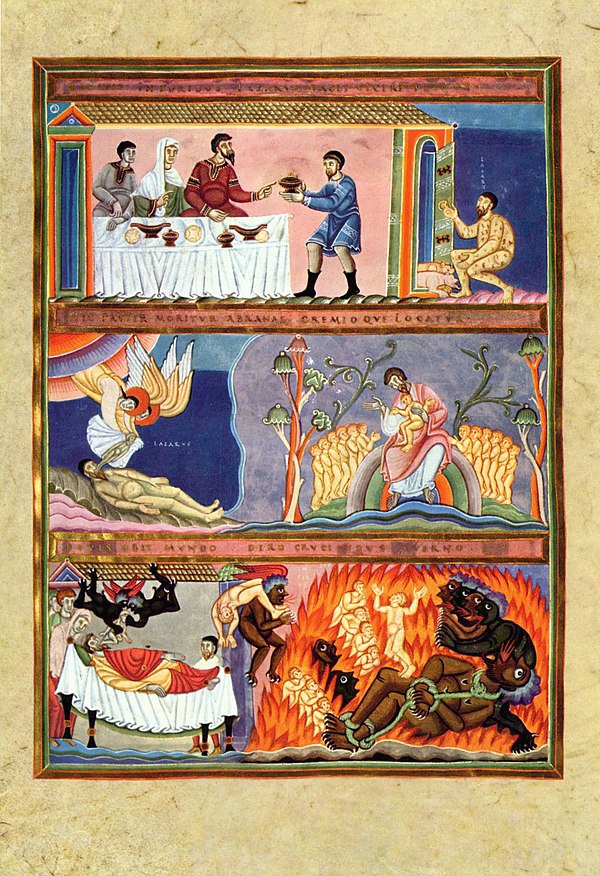
For the last two Sundays, the lectionary has offered us parables of Jesus (Luke 15:1–10; 16:1–13). This coming Sunday, the lectionary leads us to another parable of Jesus—that of the rich man and the poor man (Luke 16:19–31).
Interestingly, in this parable, whilst the rich man in not named, it is the poor man whose name is noted: Lazarus. This is a latinised version of the Hebrew name Eleazar, which means “God is my helper”. (It is only in later developments that the rich man acquires a name—Dives. This occurred in the Vulgate, an early Latin translation; the word dives simply means “rich man”, so it’s not really an actual name, just a shorthand descriptor.)
This parable is found only in Luke’s Gospel—one of many such parables. Some of them are much-beloved (the Good Samaritan in Luke 10, the Prodigal Son in Luke 15); some are pointedly provocative (the two parables about banquets in Luke 14) or challenging (the parables of the widow and the judge, and of the Pharisee and the tax collector, in Luke 18); this one is deeply disturbing. Once again, Jesus is addressing the responsible way to use the resources at our disposal. The rich man was selfish in his use of all that he had; he did not ever deign to offer some of his wealth and resources to the poor man, Lazarus.
In Luke’s Gospel, there are many places where Jesus talks about the use of money and resources. Some replicate Mark’s Gospel, namely the encounter between Jesus and the rich man (Mark 10:17– 27; Luke 18:18–30), and the story of the widow in the temple (Mark 12:41–44; Luke 211–4).
Other passages, however, are added into Luke’s narrative. For Luke, the ministry of Jesus is characterized by “preaching good news” to the poor (4:18; 7:22). In his preaching, Jesus reassures the poor, “yours is the kingdom of God” (6:22), and promises the hungry, “you will be filled” (6:23). He contrasts this with the punishments due to the selfish rich and powerful who do not share their blessings (6:24–26).
The desperately poor (those who are desperate, with no home and no regular source of income—and no social security net, such as we know today) are very prominent throughout Luke’s “orderly account”. They are the ones who benefit from the message preached by Jesus: “he has anointed me to bring good news to the poor” (4:18).
Such teachings are reminiscent of the hymn sung by Mary, before the birth of Jesus: “[God] has filled the hungry with good things, and sent the rich away empty” (1:53). Those words themselves evoke many of the proclamations of the prophets of earlier eras. See
Subsequently, as an adult, Jesus tells parables in which the poor are reassured of their invitation to share in the feast of the kingdom (14:21; 16:19–31). The instruction is to be deliberate in broadening the groups of people who are to be welcomed at table: “when you give a banquet, invite the poor, the crippled, the lame, and the blind” (14:13); “go out into the streets and lanes of the town and bring in the poor, the crippled, the blind, and the lame” (14:21). The reason for this is made crystal clear by Jesus: “they cannot repay you, [but] you will be repaid at the resurrection of the righteous” (14:14).
Jesus sends his followers out with minimal possessions (10:4), tells a parable of the rich man and his barns (12:13–21), and commands his followers to “sell your possessions” (12:32–34). He advises his followers, “you cannot serve God and wealth” (16:13) and later commends Zacchaeus for giving half of his possessions to the poor (19:1–10). All of this, as we have noted, had long ago been sung out loud by his pregnant mother (1:52–53).
A simple statistical analysis shows that Jesus in Luke’s Gospel makes more references to the poor than in the other canonical Gospels. Alongside this, he also makes more references to people drawn from the upper classes of his society. They have a responsibility to share their resources with those who have much less. One such well-to-do person, a ruler with wealth, is instructed to “sell all that you own and distribute the moment to the poor” (18:22); soon after that, Jesus encounters Zacchaeus, who is transformed by Jesus to the extent that he says, “half of my possessions I will give to the poor” (19:8).
In the second volume of his orderly account, Luke reports that Joseph Barnabas from Cyprus “sold a field that belonged to him, then brought the money, and laid it at the apostles’ feet” (Acts 4:37). This exemplified the way that within the community of believes in Jerusalem, “as many as owned lands or houses sold them and brought the proceeds of what was sold”, so that “there was not a needy person among them” (Acts 4:34; so also 2:45).
As we read the story which Jesus tells of these two men—one rich, one poor—if we identify with Lazarus, the parable offers abundant grace. If we (as people living in the richest nation in the Western world) identify with the rich man (as we undoubtedly should), then the parable offers profound distress and enduring pain. It is a challenge!
*****
Cover illustration: Lazarus and Dives, illumination from the 11th century Codex Aureus of Echternach Top panel: Lazarus at the rich man’s door Middle panel: Lazarus’ soul is carried to Paradise by two angels; Lazarus in Abraham’s bosom Bottom panel: The rich man’s soul is carried off by Satan to Hell; the rich man is tortured in Hades
Currently, as we follow the lectionary, we are reading a sequence of parables that Jesus tells in Luke’s orderly account (Luke 15:3–16:31). A key theme for these parables is sounded at the start: “all the tax collectors and sinners were coming near to listen to him, and the Pharisees and the scribes were grumbling and saying, ‘This fellow welcomes sinners and eats with them’” (15:1). That introduction sets the scene for what follows.
In the first two of these parables, the punchline is about “the joy in heaven over one sinner who repents” (15:7, 10), while the third parable concerns a son who confesses to his father, “I have sinned against heaven and before you” (15:18, 21) and whose return is celebrated, for “he was dead and has come to life; he was lost and has been found” (Luke 15:24, 32).
In the fourth parable, a shrewd steward is commended for forgiving debts owed to his master (16:3–7); by contrast, in the fifth parable, the sinful life of “a rich man who was dressed in purple and fine linen and who feasted sumptuously every day” is condemned (16:19, 25). All have to do with sin and forgiveness; in the three “lost-and-found” parables of Luke 14, the grace of the one who welcomes back the lost is highlighted.
What do we make, this week, of the shrewd steward? Amy-Jill Levine describes him as “a picaresque figure, or a conniving, deceiving cheat … who gets what he wants through manipulation” (Luke, p.437).
What do you think? Was he a dishonest intermediary, arranging things to his benefit—and, it should be said, to the benefit of the clients as well? Was he acting as a manipulative manager without his master’s knowledge? or did his actions result in a win-win-win situation for the rich master, his manager, and all the clients—a positive contribution to the common good?
*****
Whilst it is the rich man (16:1) who has overarching responsibility in this story, the key figure in the parable is actually the manager, who is described as an oikonomos (16:1, 3, 8). This, incidentally, is the word that provides the basis for our English term economics. In Greek, it is a compound word, joining together oikos, meaning household, and nomos, meaning organisation or arrangement. Thus, the oikonomos is the person who oversees the organisation and management of the household.
The manager is called to come before his master, the rich man, in what will likely be a confrontation (16:1). The NRSV says that he was “charged” with “squandering his property”; the NIV says he was “was accused of wasting his possessions”. The word translated as “charged” or “accused” is dieblēthē, from the root word diaballō. That translation has the inference of a formal charge being laid against the manager.
However, the word actually means to slander or gossip about someone, so it does not bear the formal sense that either “ charge” or “accuse” has. It seems to indicate that “stories were going around” about the manager. So the rich man was not bringing the manager to report to him because he had heard of malpractice. He is simply responding to some news about his activities—perhaps he wants to get it straight, to hear direct from the manager,rather than rely on the gossip mill.
The manager, however, is described as adikias (16:8). So all,is not rosy, it seems. The a- prefix means the word is a negative; the adjective that follows, dikias, refers to doing things right, keeping the law, being upright and honest. Thus, the manager is portrayed as acting in contradiction to the law, acting in a dishonest or unfair way. The rich man is gearing up to dismiss the manager from his post (16:2). The implication, then, is that something untoward has taken place. But we are not told what this is, other than “squandering his property” (16:1).
The manager is also described as being “shrewd” (16:8). The word used, phronimos, is translated, appropriately, as shrewd. It comes from the verb phroneō, which simply means to think, to use one’s brain. There is no malice involved in this; the manager is simply being intelligent.
The first character in the Bible who was called shrewd was the serpent, in Genesis 3. This creature is called “more shrewd than all other beasts”. Shrewd, of course, is an ambiguous term. On the one hand, it is a virtue the wise should cultivate: “show their anger at once, but the prudent ignore an insult” (Prov 12:16), and “a fool despises a parent’s instruction, but the one who heeds admonition is prudent (Prov 15,5). However, when this capacity is misused, it become wiliness and guile; the same Hebrew word is used to refer to those who are “crafty” (Job 5:12; 15:5), who “act with cunning” (Josh 9:4), or who practise “treachery” (Exod 21:14).
(In the Genesis account, the craftiness or cunning of the serpent is emphasised; he was “more crafty than any other wild animal” (3:1). The Hebrew, however, has a wordplay here; in the previous verse (2:25), Adam and Eve were “naked” (arummim); then (3:1) the serpent is described as “more crafty” (arum, shrewd) than all others. Paul, by contrast, takes a much more negative line, claiming that “as the serpent deceived Eve by his craftiness, so your minds may be corrupted from the simplicity that is in Christ” (2 Cor 11:3).)
So the manager exercises his mind and comes up with a plan of action that pleases his master and save his job, and also pleases the clients who find that their debts have been reduced to a more manageable level (16:3–7). The result is that the rich man commends the manager for being phronimōs—shrewd, or crafty (16:8); and then Jesus goes on to commend this way of acting to his disciples (16:9). The common good, the best for all, comes when the rich man forgoes a portion of what is due to him, meaning that those owing debt are released from some of their burden, and they rejoice.
So the narrator has Jesus spell out a clear way of acting in accord with the course of action taken by the manager (16:10–13). The parable must surely speak to contemporary Western society, where the rich get increasingly more and the poor get less and less. There is no common good in this situation. The message of the parable is one of letting go of possessions and wealth, for the benefit of the common good.
*****
The next verse, then, has a very sharp edge: accusing the Pharisees of being “lovers of money” (16:14) means that they would not actually do what the manager has done, and release their wealth for the common good.
(Incidentally, there is no evidence elsewhere in the New Testament or in ancient Jewish sources that the Pharisees were so inclined. By contrast, a number of interpreters have claimed that it was the Sadducees, working with the priests in the Temple, who profited from an oppressive system that laid heavy burdens on the people. The Pharisees, Josephus observes, lived in the towns and villages with and alongside the people. He wrote that “they live meanly, and despise delicacies in diet; and they follow the contract of reasons” (Antiquities of the Jews, 18.3), so presumably they lived without the ostentation and wealth that Josephus ascribes to the Sadducees.)
Is the steward acting in a way that opposes what is considered right and just? He is described as adikias, the opposite of dikiaos, just, or righteous. This may well be yet another parable or saying in which the perceived ways of adhering to the law is undercut by a deeper “righteousness” that appears “unrighteous” but is actually fundamentally faithful to the demands of God. This correlates with the later parable about the Pharisee and the tax collector (18:9–14), in which the “righteous man” is not the Pharisee, teacher of the law, but the tax collector, allegedly sitting outside the law.
It also links with the story of the rich man (18:18–30) who is instructed to “sell all your possessions”—not just to reduce his holdings by 20% (which is what the steward does). The steward gave just some away, and he gains all. The rich man, sadly, is not able to give any away, and he loses all. And in the famous parable that precedes this passage, the father gives away the inheritance of the younger son to that son, who loses it all; yet the father still has an abundance that enables him to kill the fatted calf and throw a party for all to come (15:11-24).
Jesus is accused of being a wastrel, consorting with sinners (15:1–2). The father gives his inheritance away to the son, and rejoices with a party when he returns (15:22–24). The manager, shrewdly organising the financial affairs of his rich master, works to the benefit of all—the rich master, whose debts will be paid, the clients, whose debts are reduced, and himself, whose position may well be saved by his clever actions—thus ensuring the common good is upheld (16:5–8).
It also links with the story of the rich man (18:18–30) who is instructed to “sell all your possessions”—not just to reduce his holdings by 20% (which is what the steward does). The steward gave just some away, and he gains all. The rich man, sadly, is not able to give any away, and he loses all. And in the famous parable that precedes this passage, the father gives his inheritance away to the son, and rejoices with a party when he returns (15:22–24).
Jesus had previously exhorted wealthy people to invite all manner of people to the feats they host (14:1–24). The manager, shrewdly organising the financial affairs of his rich master, works to the benefit of all, ensuring the common good is upheld (16:5–8). The responsible use of resources is a significant theme in all of these stories. And we will see that theme continue in the parable we read next week (16:19–31).
*****
Thanks to Elizabeth Raine and Andrew Jago for a very stimulating discussion in our weekly Greek class, which provided the basis for this blog!
A dialogue from the first century, presented at Tuggeranong Uniting Church on Sunday 10 July 2022, by the Rev. Elizabeth Raine and the Rev. Dr John Squires. The characters are Boaz and his neighbour, Abigail.
*****
Ah, Abigail. I have been looking for you. I wanted to get your opinion of the story that was told by Jeshua yesterday. Imagine! A Samaritan helping a Jew! Unheard of! Impossible! What was Jeshua thinking?
I thought it was a good story. It showed that God’s love should be extended to all people by all people. Don’t you think that by using the character of the Samaritan Jeshua made the point well?
Well, yes, I understand the broad principle. But a Samaritan helping a Jew? I haven’t forgotten the time when the Samaritans scattered bones of dead people in the Temple precincts and defiled it. To say nothing of their wholesale rejection of Jerusalem and our priests.
But isn’t that part of Jeshua’s point? This is a story to push the boundaries. This is a story about radical love. This story is not just about etiquette for travelers. It is not even just about compassion, and generosity. This story demands that we embrace opportunities to practice love for others in powerful and new ways.
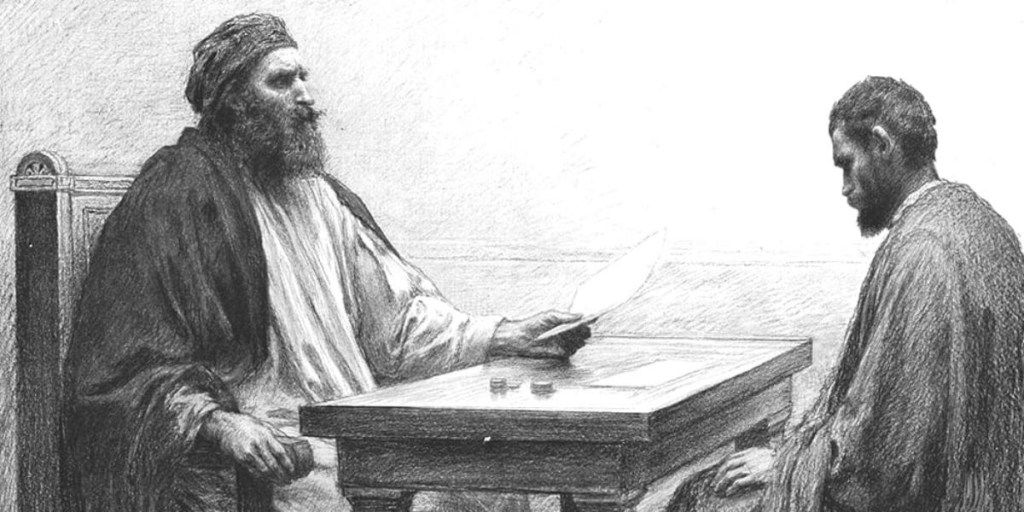
Whoa, there, Abigail. You are getting carried away. Let us talk about this story a little bit more. I want to start at the beginning. You know, of course, that one of the scribes challenged Jeshua about his knowledge of the law. I thought it was a good question, aimed at seeing whether the disciples were operating within the law when they went on their mission. “Teacher, what must I do to inherit eternal life?”
Well, I thought the question came from nowhere. I thought the scribe was testing Jeshua. I thought the scribe was trying to embarrass Jeshua in front of the crowd, and trying to make himself look good.
Of course the scribe was trying to make himself look more learned. That is the whole point of these debates, Abigail. You women do not understand these things. This was a normal debate between men, a verbal banter with Jeshua about interpretation and understanding of Torah. The scribe did this because he respected Jesus. This is a common social exchange in which one learned person challenges the actions or words of another. The scribe was not “testing” Jeshua in a right and wrong sense. This was a challenge about honour, to see whether Jeshua could back up his beliefs.
You can see this from the way that Jeshua responds to the scribe’s question with two questions of his own: “What does the law say? What do you read there?” The scribe would have been well versed in the law and would know the answer to the question he poses to Jeshua. He would also have known the answer to the question of the law Jeshua asks of him. This is how these things work.
I think I understand. You are saying that is why the scribe replied with an answer based on the law (Deut. 6:4–5; Luke 19:18), and why Jeshua commends him.
Yes. The scribe then keeps the debate going with the next question: “And who is my neighbour (v.29)?” This is a good question. The Torah states clearly who is a neighbor and how that neighbour should be treated. The scribe is waiting for Jeshua to give a response that is consistent with the teaching of the law.
Ah, But he doesn’t does, he? I thought Jeshua’s response was very unexpected. He tells a story. I think this appreciated by the crowd. Not everyone understands these learned debates about Torah. Jeshua set his teaching in a place that is familiar, though a place that is a bit uncomfortable – on the road between Jericho and Jerusalem.
You are right about the uncomfortable bit. That road is notorious for bandits and thieves. I thought it strange that Jeshua had all his characters alone on this road. Sensible people travel this route in groups for protection. I can tell you, the thought of being alone on this road made me feel very uncomfortable, even a tad afraid.
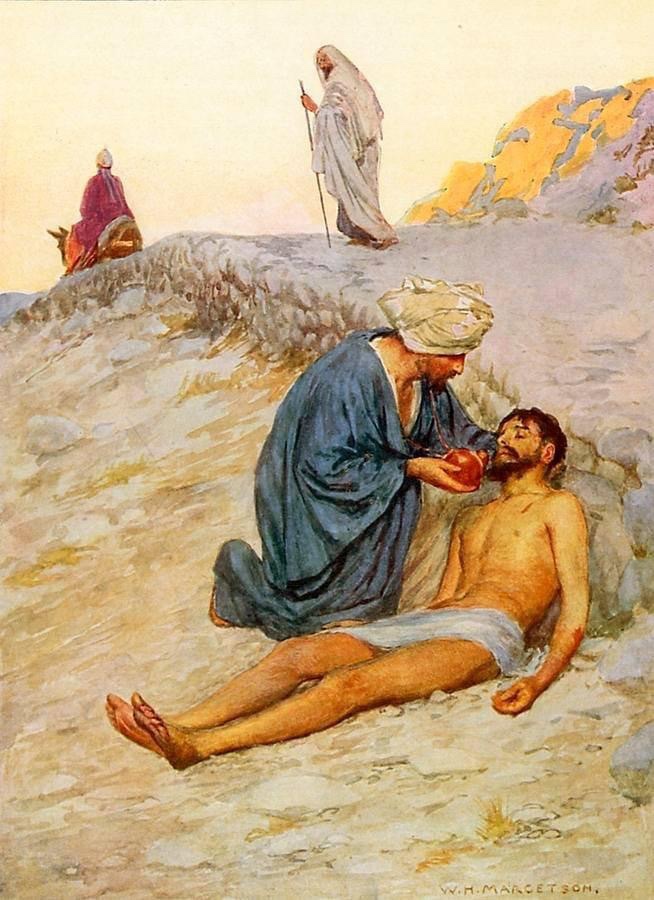
Yes, I felt the same way. A lone man going down the road from Jerusalem to Jericho is asking for trouble. It was no surprise to hear that he was stripped beaten, and left half dead. And imagine how difficult it would be to help him. He has been stripped of his clothes, and everything that would identify him and his social class and his religion. You wouldn’t be able to tell whether he was Jew or Gentile, or Roman or Greek.
The next part of the story reminded me of those jokes you hear. A priest, a Levite and an Israelite come walking by … you know the ones I mean.
Ah, but that was the twist. You know, beginning with a priest made me feel a bit awkward. You know how high and mighty they can appear. And they are in cahoots with the Romans. Not surprised a priest wouldn’t stop.
Or a Levite. They are just as snobbish. Think they are better because they are descended from an ancient lineage. I am descended from equally ancient people, so I don’t see why they believe they are closer to God than me.
Yes indeed. But it is the next bit that is surprising. You mentioned those stories that start with a priest, a Levite and an Israelite. That is the twist. We expected Jeshua to make an Israelite the hero of the story.
Well, that’s right. The hero is meant to be one of our kind, a regular down-to-earth type like you and me, the one you are expecting to come to the rescue of the poor, wounded man. But no! Jeshua goes and gets it mixed up. It’s not one of our own kind who saves the day – it’s an enemy, a Samaritan, an outsider. Samaritans don’t worship like us, they don’t act like us, they don’t live where we live, and there’s no way one of them should have been the hero.
I bet your stomach was churning by then, Boaz! But really, why should you be so offended?
You seem to have forgotten how Jeshua himself was treated by the Samaritans. Remember when a Samaritan village refused to welcome him? This was very poor form, you know how much hospitality means to travellers.
Well, the priest and the Levite weren’t much use, were they?
My friend Zedekiah says that the priest and Levite couldn’t stop because they risked making themselves unclean on behalf of a stranger. Or maybe they were afraid they would become victims themselves if they stopped. I suppose we should remember that the priest and Levite are both descendants of the tribe of Levi with different sets of duties in the temple, and they are bound to obey the Law. They could have been in violation of the Law as written in Leviticus (Lev. 21:11) if they touched a body by the road.
I think you are asking the wrong question here. Jeshua did not mean us to start inventing excuses as to why the priest and Levite didn’t stop. I think that Jeshua wants us to consider why he picked a priest, a Levite and a Samaritan. What were they symbolizing, do you think?
Mmmm, let me think. The wounded man, though unidentified, is a Jew. The Priest and Levite are also Jews. The debate with the scribe is about interpreting Jewish law governing ‘neighbour’. Are you suggesting that the Priest and the Levite somehow represent the law?
Well, one would expect them to know the law. And the law says ‘Love you neighbour as yourself’. They would know that. They were not obeying this law by walking past, and let’s face it, they could easily purify themselves once they got back to the Temple and Jerusalem. No, Jeshua is asking a deeper question here. To really drive home his point, Jeshua then sticks the most unlikely hero into the story, the one most likely to make us feel uncomfortable.
I am sorry, but the hostility between our races is well founded. We do not worship in the same place. We have different versions of the Torah. The Samaritans married foreign women. And the list goes on.
You forget that we are all descendants of the same ancestors. Why should we allow what are really small things to become a great wall that divides us?
The Torah speaks of loving of God and loving neighbour, and surely it is clear that the neighbour being understood is a Jew.
This comes back to my original point. This is a story to push the boundaries. This is a story about radical love. It challenges us to think differently. The Samaritan, the one who is hated and despised by Jews, becomes the hero of the story. Surely this must bring a new dimension to understanding what we mean by ‘neighbour’?
I think I begin to see your point. The scribe’s question: “Who is my neighbour?” has a different answer from what we are expecting.
Yes. Jesus does not answer the question directly for this reason. The parable poses a new question, “Which of these three, do you think, was a neighbour to the man who fell into the hands of the robbers?”
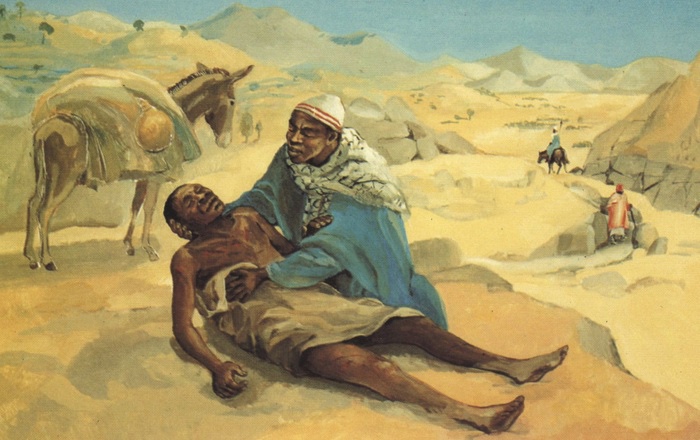
Of course. The Samaritan is the one who tends the injured man. Jeshua is saying that acting as a neighbour is what is important. Neighbour is not a group, or a religion, or a race. It is about doing the right thing.
I cannot help thinking, Boaz, that Jeshua wants us to act in this way ourselves, not just with very injured people, but with others in need. Surely he is asking us who are those fallen by the way in our communities and the ones who need our help? I am ashamed to admit that like the Priest and the Levite, I see situations where I could help and walk away because I have other things to do or I don’t want to get involved.
So to truly follow the law is to embrace everyone as neighbour. So you think that for the scribe, God is the God of Israel, and neighbours are Jewish neighbors. But for Jeshua, Israel’s God is the God for the whole world and a neighbour is anybody in need.
Yes, but it is more than that. Jeshua is not just saying ‘help those in need’ but also don’t judge others who you don’t agree with – like the Samaritan.
It seems to me that a lot of hatred in our country is religiously based and rooted in historical things like wars and other arguments. No doubt Samaritans are taught to hate the Jews in the same way Jews are taught to hate them.
And remember that the Samaritan in the story is in our territory, and the robbers might still be hanging around, waiting for their next victim. But he doesn’t let the Law, or fear, or the knowledge that he is hated keep him from providing care and compassion. He doesn’t even know if will be paid back, yet he still does this amazing act of kindness. Surely this is the sort of kindness and faith that Jesus is all about?
*****
(at this point we lose contact with the dialogue, and return to the 21st century)
This story prompts us to be more open to opportunities to be neighbour. We need to look for places where we can engage with those who need our help, and not just with those who are like us.
Can compassion move us in a way that defies traditional stereotypical understandings of people and embraces all as equals, as neighbours, as residents of a global community?
Jesus challenges the lawyer to go out and do likewise, to be such a neighbour. Are we willing to do the same?
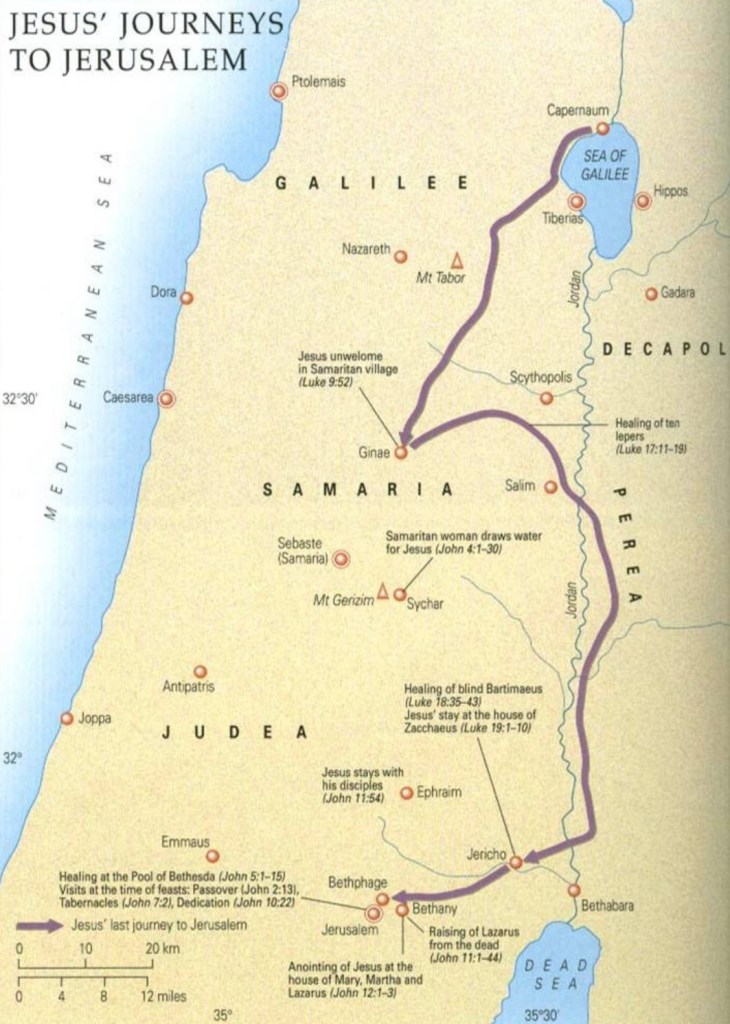
In this second post on the story of “the Good Samaritan” (the story set as the Gospel passage for this coming Sunday), we give consideration to where this story takes place—and whether than matters for how we hear and understand the story. Was Jesus telling this story in Galilee? Or in Jerusalem? Or somewhere else? And how might this matter?
Much of the activities of Jesus take place in Galilee, in both Mark’s earliest account (Mark 1–9), and in Matthew’s later reworking of his narrative (Matt 4–18). Those activities, in Luke’s orderly account, are compressed into a much shorter narrative (Luke 4–9). At a crucial turning point, Jesus “set his face to go to Jerusalem” (9:51). Galilee was behind him; Jerusalem was before him.
However, to get from Galilee in the north to Judea in the south, it was necessary to pass through Samaria. Matthew, following Mark, skips over this essential component of this trip; Jesus leaves Galilee and arrives in “the region of Judea beyond the Jordan” in the space of just one verse (Matt 19:1, following Mark 10:1a). For the Matthean Jesus, who insisted that he had nothing to do with Samaritans (Matt 10:5), the avoidance of any comment about this geographical necessity in this Gospel is quite understandable.
Not so for Luke. Jesus quite explicitly travels through the region of Samaria, as we have noted in exploring previous sections of this Gospel. He journeys in Samaria in 9:52–56. He is “on the way” to Jerusalem (10:38; 13:22, 31–35), but is apparently still in Samaria many chapters later. Curiously, Luke reports that, after a full seven and a half chapters, Jesus was still “going through the region between Samaria and Galilee” (17:11). He heals ten lepers and sends them to the priests to be “made clean” (17:14); and the one who returned to thank Jesus was a Samaritan (17:16).
We should note that when Luke tells of the meal that Jesus and with Martha and Mary (10:38–42), we might well expect that he was in Bethany, far to the south, near to Jerusalem—for this is where John locates the sisters (John 11:1; 12:1–2). However, Luke simply says that this meal was in “a certain village” (10:38), and it is clear that Jerusalem is still some way in the distance (13:33–35).
We know from other sources that there was entrenched, longterm distrust, even hatred, between the Jews and the Samaritans. John reflects this in his account of Jesus’s encounter with a Samaritan woman by the well of Jacob (“Jews do not share things in common with Samaritans”, John 4:9).
The Samaritans were regarded as being the descendants of the people who committed idolatry after the Assyrians had conquered the northern kingdom (2 Kings 17:5–6) and resettled the northern region with people from other locations in their empire (2 Kings 17:24), from “every nation [who] still made gods of its own and put them in the shrines of the high places that the people of Samaria had made, every nation in the cities in which they lived” (2 Kings 17:29).
Flavius Josephus, a late 1st century CE historian, retells the sequence of events we read in 2 Kings, indicating that the Samaritans descended from this hybrid, unfaithful group of people (Antiquities 11.297–347). He also recounts an incident which entrenched the antagonism of southern Judeans towards the northern Samaritans (Antiquities 11.297–347).
The Samaritans attempted to undermine the returning exiled Judeans with their Persian rulers and slowed the rebuilding of Jerusalem and its temple (Ezra 4:6–24). Josephus notes disagreement about which site should be the location for the temple (Josephus, Antiquities 12.9-10); the same issue is reflected at John 4:20-22.
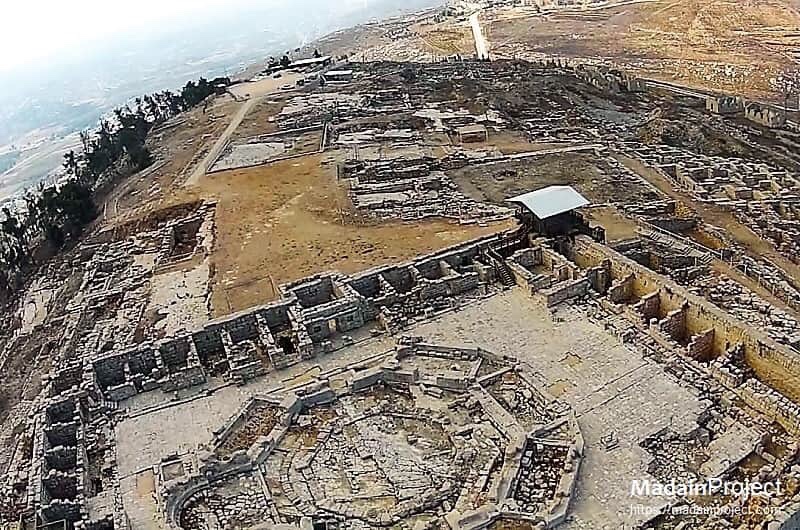
Samaritans had built a temple on Mount Gerizim, one of the ancient holy sites in the northern kingdom (Deut 27:12; Josh 8:33–34; Judg 9:7). That temple was destroyed in 107BCE, when John Hyrcanus destroyed the temple and the capital city of Samaria.
Josephus recounts a later time when some Samaritans scattered bones of dead people in the in portico of the Jerusalem Temple, thus rendering it unclean (Antiquities 18.29-30), and he gives a graphic description of the time when Cumanus (governor of Judea 48-52 CE) was bribed by some Samaritans, leading some Judean brigands to mount an uprising. Cumanus ordered the Romans to join with the Samaritans in battling the Judeans; many were killed, many more taken captive (Antiquities 20.118-123).
References to the Samaritans in the 3rd century CE Mishnah may reflect views current at the time of Jesus: “Rabbi Eliezer used to say, ‘He that eats of the bread of Samaritans is as one who eats the flesh of swine’” (m. Seb. 8.10); “the daughters of Cutheans [Samaritans] are menstruants from their cradle” (m. Nid. 4.1).
The Lukan Jesus takes a clear stance on the Samaritans; he is deliberate in his acceptance of those most hated of outsiders, the Samaritans. He stops his disciples from bringing harm on the Samaritans (9:52–56); he uses a Samaritan as an example of neighbourliness (10:29–37); and he commends a Samaritan leper for his faith after he had offered thanks to Jesus for being healed (17:15–19).
The Samaritan motif continues into the story of the early faith communities; it was the people of Samaria who first accepted the Gospel when it was preached outside of Judea (Acts 8:5–25). Indeed, Samaria figures in the programmatic statement that Jesus makes when he appears, resurrected, to his followers, and instructs them, “you will receive power when the Holy Spirit has come upon you; and you will be my witnesses in Jerusalem, in all Judea and Samaria, and to the ends of the earth” (Acts 1:8).
These Samaritans bear witness to the ways that Jesus and the earliest followers of Jesus would welcome outcasts into their midst. The community of the faithful would reflect diversity in this way, that both respectable and disreputable would be given a place.
That Jesus was, according to Luke’s erratic geography during the journey narrative of chapters 9–19, still in Samaria when he tells a story about who is “a good neighbour”, is telling. That it is a Samaritan who is that good neighbour, adds power to the story he tells. In this story, no Jew exhibits the behaviour that the Torah mandates, of loving your neighbour; it is a Samaritan who lives this way. The power of the story is intensified by where it is being told.
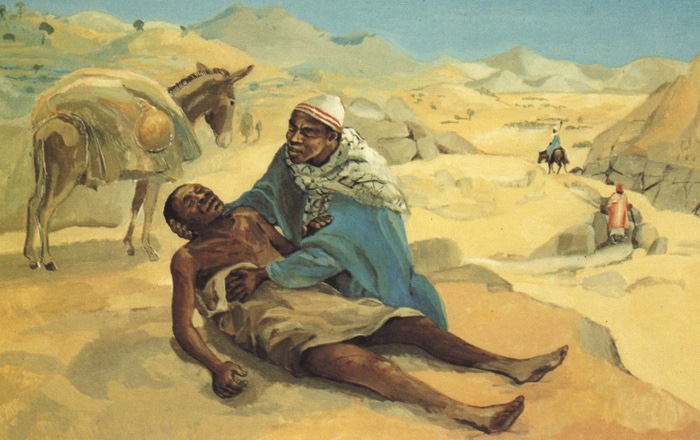
I think that most people know about the story of the man who was “going down from Jerusalem to Jericho, and fell into the hands of robbers” (Luke 10:30). The story that Jesus tells probably rates as one of the two most widely-known “parables” of Jesus. Alongside the “parable of the prodigal son” (Luke 15:11–32), the “parable of the Good Samaritan” (10:30–37) must have a similar recognition level.
As we hear this story read in worship this coming Sunday, what is there that is new, or not much known, to be said about this story? I’m going to canvass three different aspects of the story, over three consecutive posts.
First, I want to propose that we consider the nature of this story—and we might reconsider whether this story was actually a “parable”. A parable is a story which puts one thing alongside another; in Hebrew, it was called a mashal, meaning “comparison”, whilst the Greek word, parable, literally means “thrown side-by-side”.
The classic parable in the Gospels begins, “With what can we compare the kingdom of God, or what parable will we use for it? It is like a mustard seed …” (Mark 4:30–31), or “it is like yeast that a woman took …” (Luke 13:21), or “the kingdom of heaven is like treasure hidden in a field …” (Matt 13:44), or “the kingdom of heaven is like a landowner who went out early in the morning to hire laborers for his vineyard …” (Matt 20:1).
Most parables told by Jesus begin this way. But not the story of the man travelling from Jerusalem to Jericho; Jesus simply starts into the story in response to a question from a lawyer, “who is my neighbor?” (Luke 10:29). And the story of the prodigal younger son, and gracious father, and resentful elder son, simply begins, “there was a man who had two sons …” (Luke 15:11).
In this regard, these stories (found only in Luke’s Gospel) are much like the classic mashalim (comparisons) found in the Hebrew Scriptures, which simply launch into things: “there were two men in a certain city, the one rich and the other poor; the rich man had very many flocks and herds; but the poor man had nothing but one little ewe lamb …”(2 Sam 12:1–3), or “let me sing for my beloved my love-song concerning his vineyard … “ (Isa 5:1).
The comparison is revealed at the end of the story: “you are the man”, says Nathan to David (2 Sam 12:7), “the vineyard of the Lord of hosts is the house of Israel, and the people of Judah are his pleasant planting” (Isa 5:7); and in the case of the story told by Jesus, a closing question, posed to the lawyer: “of these three, do you think, was a neighbor to the man who fell into the hands of the robbers?” (Luke 10:36). In this case, the lawyer draws the comparison intended (“the one who showed him mercy”), to which Jesus then concludes, “go and do likewise” (10:37).
So is this parable a parable? Yes, in the terms of the Hebrew Scripture, it is. But it is not explicitly a parable about what “the kingdom of God is like”. It is, rather, a story which instructs on how to live as a “good neighbour” to others in this world, in this time. The punchline (10:37) is instruction about living a just and righteous life.
As a story with a clear ethical punchline, it sits alongside of many of the explicit teachings of Jesus, indicating how we are to live in this life: “love your enemies, do good, and lend, expecting nothing in return” (6:35); “if any want to become my followers, let them deny themselves and take up their cross daily and follow me” (9:23); “sell your possessions, and give alms” (12:33); “when you give a banquet, invite the poor, the crippled, the lame, and the blind” (14:13); “none of you can become my disciple if you do not give up all your possessions” (14:33); “you cannot serve God and wealth” (16:33); “give to the emperor the things that are the emperor’s, and to God the things that are God’s” (20:25); and so on.
The story is told after a discussion between Jesus and a scribe (an interpreter of the Law), about the question raised by the scribe: “what must I do to inherit eternal life?” (10:25). In the discussion, conducted in typical rabbinic style (a question posed, answered with another question, leading to yet another question …).
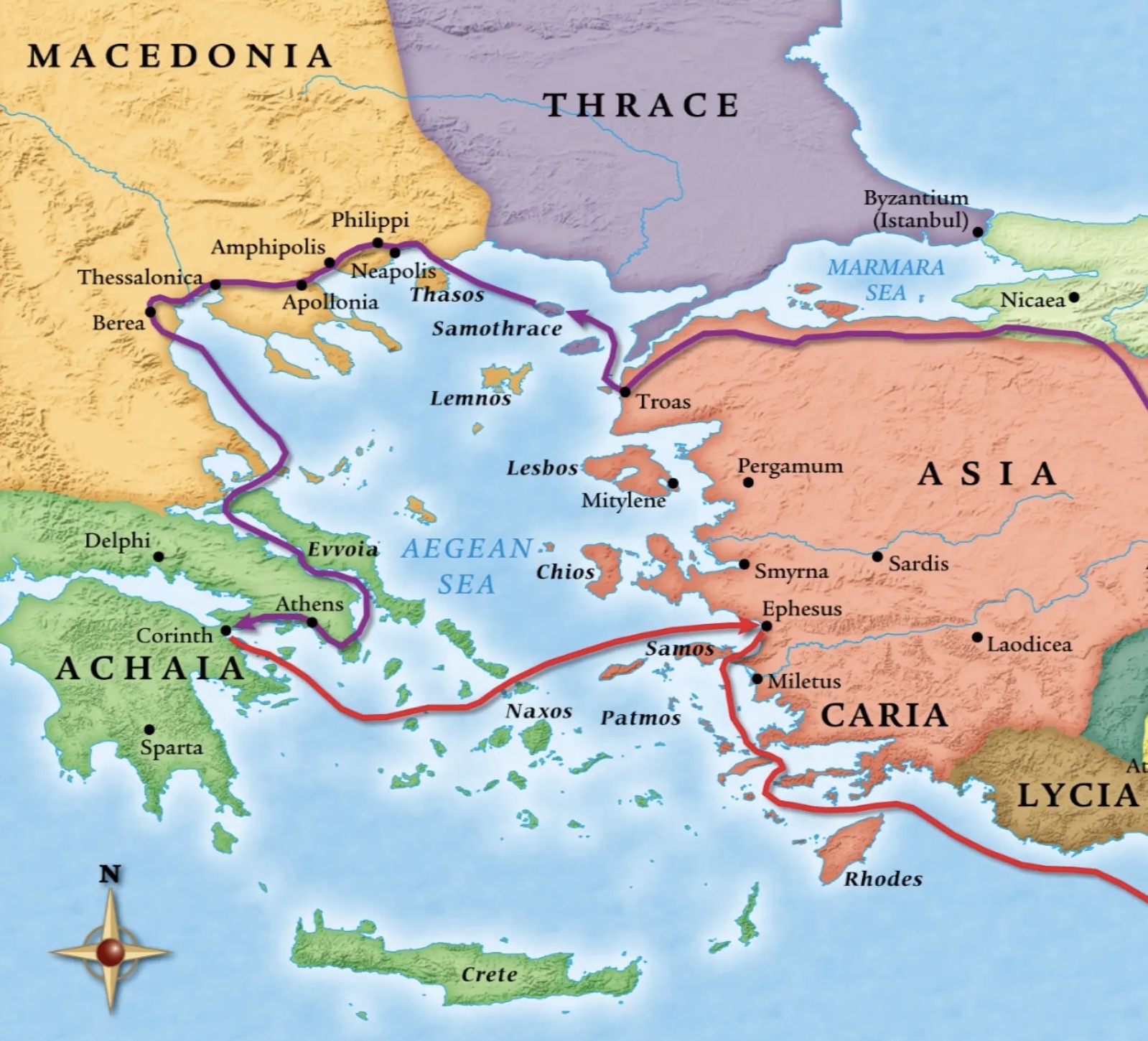
The section from Acts which we hear this coming Sunday (Acts 16:16–34) recounts various incidents from the time that Paul spent in Philippi (16:11–40). Last week we heard of the decision to “cross over” from Asia Minor into Macedonia (16:6–8). This week, we learn of the interaction of Paul and Silas with a slave woman and her owners, resulting in their arrest and imprisonment—and subsequent interaction with the gaoler. It’s a section of acts filled with dramatic tension and entertaining scenes, even whilst it provided illumination about the mission undertaken in the early years after Jesus.
1 The demon-possessed slave woman (16:16–18) recognises Paul and his companions as “slaves of the most high God” (16:17), just as Jesus had been identified by demon-possessed characters as “the son of the most high God” (Luke 8:28; cf. 4:41). Their message is identified as the “way of salvation” (16:17), a phrase consistent with the terms already used to describe the movement and its message. (On “salvation”, see 2:21; 5:31; on “the Way”, see https://johntsquires.com/2022/04/26/people-of-the-way-acts-9-easter-3c/)
The subsequent casting-out of this spirit (16:18) reinforces the perception that Paul exercises the divine power, in the manner already shown by Jesus (Luke 4:41; 8:26–33), Peter (5:16) and Philip (8:7). However, it also precipitates the ensuing drama.
2 The arrest, trial and imprisonment of Paul and Silas (16:19–24) is a scene with drama aplenty, as the owners of the slave woman protest the actions of Paul and Silas (16:19) and accuse them of “disturbing our city … advocating customs that are not lawful for us as Romans to adopt or observe” (16:19–20).
The accusation against Paul and Silas (16:20–21) anticipates the later claim from the Thessalonican crowd, that they are “people who have been turning the world upside down … acting contrary to the decrees of the emperor, saying that there is another king named Jesus” (17:6–7), and reflects the claims of the crowd in Jerusalem, that Jesus was “perverting our nation, forbidding us to pay taxes to the emperor, and saying that he himself is the Messiah” (Luke 23:2). Social upheaval appears to have been integral to the proclamation of the good news of the kingdom!
The scene builds feverishly to the dramatic climax of their imprisonment by the local authorities, here identified as strategoi (16:20), the same term that is used on inscriptions from Philippi. Paul and Silas are placed in stocks “in the innermost cell” (16:24). This is the first imprisonment for Paul in Acts; others await him (20:23; 21:27–28). Such imprisonments are also referred to in Paul’s own letters (Phil 1:7,13–14; 2 Cor 11:23; Phlm 1,9–10,23; and see Col 4:3,10,18; 2 Tim 3:11).
In the course of this scene, a fleeting reference to Roman customs is made (16:21). The crowd believes that the Jewishness of Paul and Silas places them outside of Roman customs; that they are misguided will become evident when Paul and Silas are released (16:37–38). Until this point in the narrative, the only explicit reference to Rome has been at Pentecost (2:11). After this point, there will be no further such reference until the very end of this section (21:16), at the moment when Paul’s long journey to Rome comes into view.
In this Philippi scene, then, the Roman citizenship of Paul is established (16:37; see also 22:25–29). The opposition he encounters from this point onwards is thus to be seen in light of his Roman right of appeal to the Emperor. What is established as obvious for Luke and his readers will only become gradually apparent to Paul’s opponents in the narrative—in much the same way as the inexorable plan of God is worked out, scene by scene, in apparently disjointed ways which can eventually be seen within the overall plan of God.
3 Paul and Silas in prison (16:25–34) exhibit the typical attitude of praying (16:25; see 2:42). Suddenly “a great earthquake” shakes open the prison doors (16:26). The universal scope of the earthquake’s impact (“all the doors opened … everyone’s chains unfastened”) is striking, but perhaps a Lukan exaggeration (see 26:4). Although there is no explicit indication of divine guidance at this point, an earthquake was widely considered to be a portent of the divine will.
In Hebrew Scriptures, Psalmist expresses the common scriptural view that God was the initiator of earthquakes: “O God, you have rejected us … you have caused the land to quake, you have torn it open” (Ps 60:1–2; see also Judg 5:4–5; 2 Sam 22:8–16; Pss 18:7–9; 29:3–9; 68:7–8; 97:4–5; 104:32; 144:5-6; Isa 13:13; 29:4-6; 64:1-3; Jer 4:24; 10:10; Ezek 32:7; Joel 2:10–11; Nah 1:5–6; Zeph 1:14–15; Hag 2:6–7, 20–23; Zech 14:5).
In hellenistic literature, we find a similar view often expressed. The historian Dionysius of Halicarnassus articulates such a view, when he lists among “the terrible portents sent from the gods” such phenomena as “flashes shooting out of the sky and outbursts of fire … the rumblings of the earth and its continual tremblings” (Rom. Ant. 10.2.3; for descriptions of such portents, see Cicero, De div. 1.33.72-49.109, De nat. deor. 2.5.13-14; Minucius Felix, Oct. 7.1-6).
Indeed, the narrative of Acts has already reported how God can sovereignly release a person from prison (as with Peter in Jerusalem, 12:6–11). Although it is not described with explicit reference to God, the earthquake in Philippi is nevertheless a clear portent of divine providence.
The melodramatic response of the gaoler (16:27) enables Paul and Silas to speak the word of the Lord (16:32), explaining that what must be done to be saved is to “believe on the Lord Jesus” (16:31). The ensuing scene replicates familiar elements: the gaoler and his household were baptised (16:33; see 2:38), he set a table (16:34; see 2:42,46; also 10:23,48), and they rejoiced (16:34; see 5:41). His conversion now makes him “one who has come to belief in God” (16:34).
The section offered by the lectionary ends at 16:34, with the conversion of “the entire household” of the gaoler; but the story needs to be read and heard through to the end of the chapter, when Paul and Silas are released from prison and are able to continue their journey (16:39–40).
4 The release of Paul and Silas (16:35–40) actually takes place, not by divine intervention, but through the invocation of Paul’s Roman citizenship (16:37-38). Roman writers documented the prohibition against flogging a Roman citizen (Livy, Hist. 10.9.4; Cicero, Pro Rabiro 4.12-13). Paul’s mention of his Roman citizenship brings the police up with a start; they immediately hand him, and Silas, over to the magistrates, who immediately apologised for their actions (16:38–39).
The name Paul may well have been the Roman name adopted by the Jew, Saul of Tarsus. But he nowhere makes this claim in his letters, nor does Luke in his orderly account. How do we assess Paul’s claim to be a Roman citizen? He makes no reference to it in his letters—but there is no need for him to have done so in those contexts. Was it historical? Could it be yet another Lukan history-like claim that we cannot corroborate from any other source?
Certainly, Paul’s claim plays a strategic role in Luke’s narrative at two points (here, and in Jerusalem, 22:25–29), as it plants the seeds for Paul’s eventual journey to Rome. This scene (as also the scene in Jerusalem) is shaped by Luke’s rhetorical purposes, to put the spotlight on Paul as a positive role model.
After an official apology (16:39), Paul and Silas leave the prison, paying a parting visit to Lydia’s home where, in typical fashion, they exhorted the community members (16:40; see 13:15). Paul’s own description of his time in Philippi notes that he “had suffered and been shamefully mistreated” (1 Thess 2:2), but his letter to the Philippian believers rejoices in the fellowship that they shared with him (Phil 1:5,7; 4:14–16).
*****
This blog is based on a section of my commentary on Acts in the Eerdmans Commentary on the Bible, ed. Dunn and Rogerson (Eerdmans, 2003). I have also explored the theme of the plan of God at greater depth in my doctoral research, which was published in 1993 by Cambridge University Press as The plan of God in Luke-Acts (SNTSM 76).
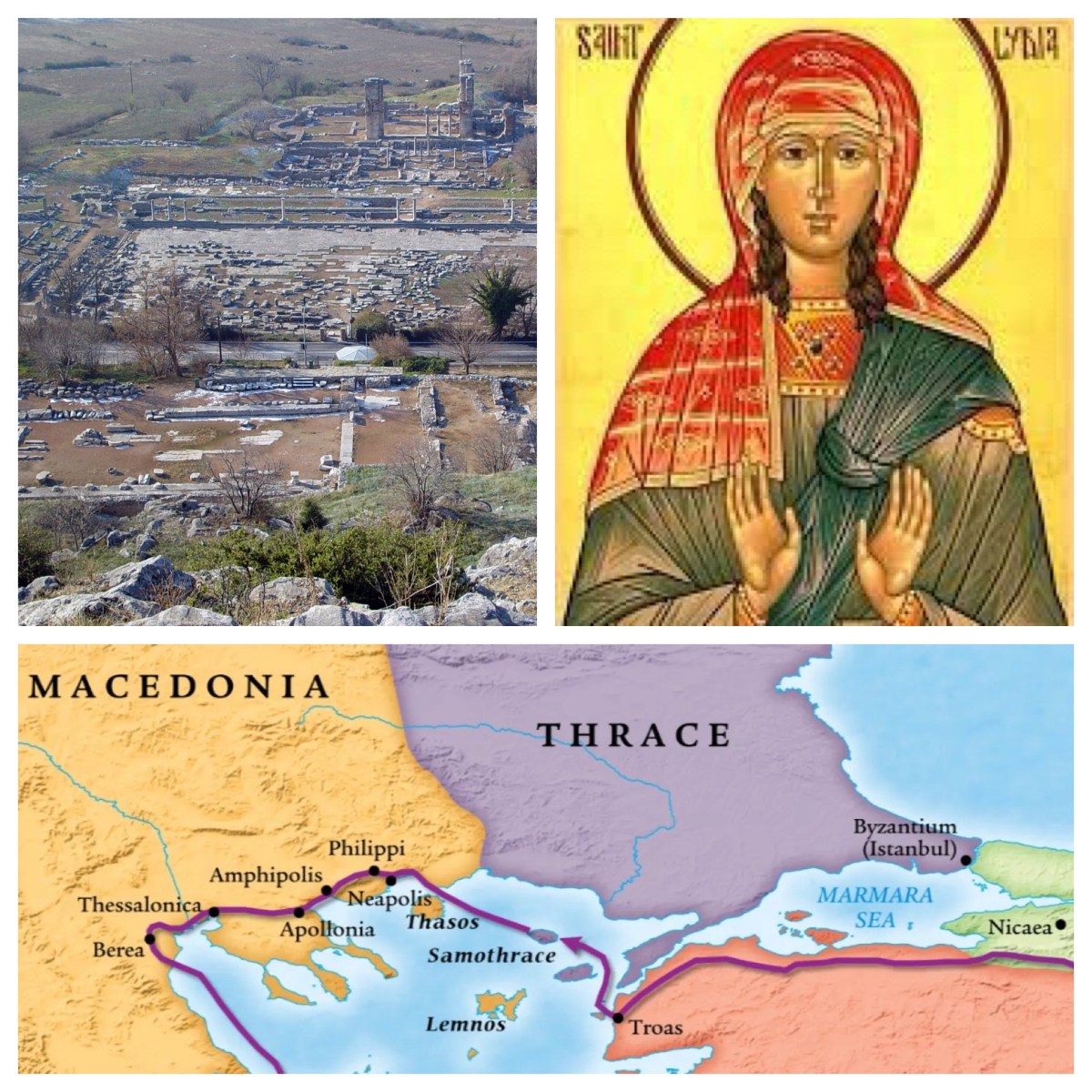
In the reading from Acts offered by the lectionary this coming Sunday, we have a curious selection of verses (Acts 16:9–15). We start at verse 9, in the midst of a story (16:6–10) which recounts how Paul undertakes a highly significant geographical shift, moving from Asia Minor (Phrygia and Galatia, 16:9—that is, modern-day Turkey), across the northern Aegean Sea, into Macedonia (16:10—that is, modern-day Greece).
1 A call to cross over
The earlier verses not included in the lectionary (16:6—8) are important for setting the context of what follows. The move that takes place, from Troas, in Asia Minor, across to Macedonia, is highly significant. In these verses, there is a concentration of references to God, which demonstrate that this move is completely in accord with the plan of God. Paul’s separation from Barnabas and co-option of Timothy will continue his earlier work and will open up new avenues for fruitful work.
Three injunctions are given; each one is from a divine source. The first of these, an instruction not to speak in the southern region of Asia, comes from the holy spirit (16:6). The second direction, a prohibition against any attempt to head north and enter Bithynia, comes from the same spirit, here described as “the spirit of Jesus” (16:7).
The third divine interjection takes place at Troas, where a vision is seen in the night with a petition to “come across into Macedonia” (16:9). Being guided by the spirit and seeing visions are common occurrences in Acts. The nature of such phenomena has already been established as divine in origin (2:14-21); the move into Macedonia is thus in accord with the divine will.
This understanding is explicitly underscored as the transition ends with the succinct statement that “God has called us to preach the good news to them” (16:10). Events still to follow are thus introduced in as strong a manner as possible through the use of explicit language about God.
2 The ‘we sections’ of Acts
This statement (16:10) begins the first of the so-called ‘we-sections’ of Acts, which are narrated in the first person plural. Three of these are but brief notes concerning journeys (from Troas to Philippi, 16:10-17; from Troas to Miletus, 20:5-15; from Miletus to Jerusalem, 21:1-18). Each of these passages contain lists of the places visited and the means of travel (16:11-12; 20:5-6,13-15; 21:1-3,7-8,15) and small vignettes concerning one incident that took place on the journey (16:13-15; 20:7-12; 21:4-6, 10-14).
The fourth ‘we-section’ encompasses the extensive series of journeys by which Paul travels from Caesarea to Rome (27:1-28:16). It also includes mention of places and means of travel, as well as a number of particular incidents.
Scholarly opinion over the historical value of the ‘we sections’ is divided. Some have argued that there is evidence for an ancient literary convention, by which an author can alternate third person (“he”, “they”) and first person (“I”, “we”) narratives. In this view, Luke makes use of the first person narrative to strengthen the sense of unity felt between author and audience, and the characters in the events narrated.
However, others have criticised this claim and argued that the use of “we” indicates that these passages, at least, must go back to an eyewitness. The likelihood of ever being able to prove that the author of Acts was himself present with Paul in these journeys is low; at best, we might conclude that Luke had available to him a very brief source which may possibly have had its origins amongst Paul’s fellow travellers. (See also 20:5).
3 Paul in Philippi
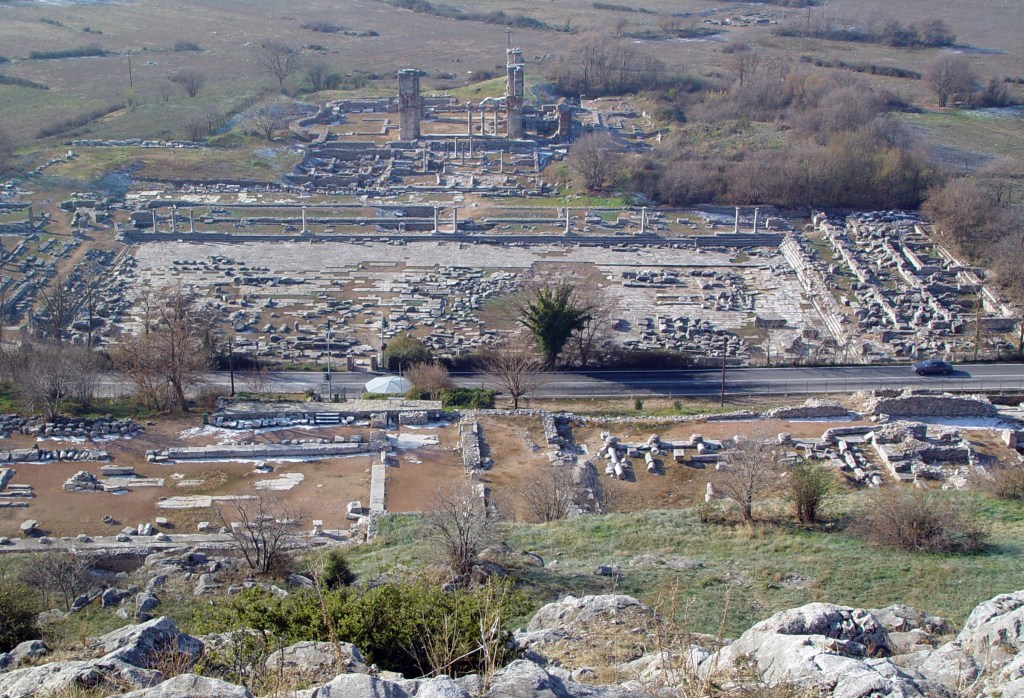
The group crosses over into Macedonia, an ancient province of Greece which had been the dominant political power four centuries earlier. They arrive in Philippi (16:12), a city founded by Philip of Macedonia in 356 BCE, taken under Roman rule in 167 BCE, and declared a Roman colony (as Luke accurately notes) in 31 BCE. The group proceeds, in typical fashion, to find a place of worship on the sabbath (16:13)—not, as expected, a synagogue (see 13:5), but “a place of prayer” (16:13) for some women.
One of this number, Lydia, is singled out for attention. Lydia is a godfearer (16:14), as was Cornelius (10:2) and probably the Ethiopian (8:27). Lydia is the first individual convert identified once Paul, Silas and Timothy, under divine guidance, have crossed over into Macedonia (16:6-10). She presents a paradigm for the process of conversion and leadership; as the first convert in Europe, she models a faithful response to the message that Paul proclaims.
Lydia is one of a number of significant women in Acts who are presented as positive models of faithfulness. These include Tabitha of Joppa, who was raised from the dead (9:36–42); Priscilla, who with her husband, Aquila, teaches Apollos in Ephesus (18:26); and the four female prophets in Caesarea (21:9). Each of these women exercise a leadership role in the early church.
What takes place as Lydia encounters Paul is directly interpreted as an act of God, for “the Lord opened her heart” (16:14) to listen eagerly to Paul’s words. The “opening of her heart” (16:14) echoes the discoveries made by the archetypal disciples on the walk to Emmaus (Luke 24:31,32) and by the larger group of followers gathered in Jerusalem later that day (24:45). Her “eager listening” (16:14) repeats the response evoked by Philip in Samaria (8:6).
Lydia is judged as being “faithful to the Lord” and, with her household, is baptised (16:15), in accord with the programmatic declaration of Peter’s Pentecost exhortation (2:38-39). The baptism of her household follows the pattern already seen in Caesarea (10:24-48; 11:13-16) and foreshadows a pattern which will be repeated soon in Philippi (16:31-33), and subsequently in Corinth (18:8).
Her belief leads to the offer of hospitality (16:15), as was also the case with the Gentiles in Caesarea (10:48); this same pattern follows in the story of the conversion of the Philippian gaoler and his household (16:34). Belief, baptism and table fellowship have also been linked in the accounts of the conversion of Saul (9:18-19), Cornelius and his household (10:24-48) and the events on Pentecost in Jerusalem (2:41-47).
Lydia’s role as a patroness echoes that of Mary, the mother of John Mark, in Jerusalem (12:12) and prefigures that of Priscilla (with Aquila, 18:13). Paul will encounter, and convince, other women of relatively high social status later in Thessalonika (17:4) and Beroea (17:12). And women, often of high social status, figure also in the letters of Paul (Rom 16:1-2, 3-4, 6, 7, 12, 13, 14, 15; 1 Cor 1:11; Phil 4:2-3; and see Gal 3:27-28).
This blog is based on a section of my commentary on Acts in the Eerdmans Commentary on the Bible, ed. Dunn and Rogerson (Eerdmans, 2003). I have also explored the theme of the plan of God at greater depth in my doctoral research, which was published in 1993 by Cambridge University Press as The plan of God in Luke-Acts (SNTSM 76).
Society celebrates Easter over a four-day holiday period, then packs it away, to be rolled out again next year. In the church, Easter is not a short-term holiday opportunity. It is a full-on season, taking place over seven full weeks. The season of Easter begins on Easter Sunday, and concludes with the Day of Pentecost.
Pentecost, of course, means 50th, and it is actually a Jewish festival in origin; the festival of Pentecost was the Feast of Weeks (the spring harvest festival of Shavuot), taking place after seven weeks of weeks (7 x 7 = 49 days). So we have forty nine days to celebrate and remember Easter, and then the great feast of Pentecost, the 50th day!
One way that the church has devised to continue the celebrations of Easter Sunday throughout those seven weeks, has been to lay aside the First Reading from the Hebrew Scriptures, and provide readings from the book of Acts for that period.
Why? Because, in traditional Christian understanding, the church was brought into being on the Day of Pentecost, when the Spirit fell upon the followers of Jesus “gathered in one place” (Acts 2:1) Presumably they were in the Temple court for the festive celebrations, along with the crowd of “about three thousand persons” mentioned later in the narrative (2:41). They were certainly in the Temple at 3:1–4:3, and again at 5:20–26, and quite regularly according to 5:42.
From that event at Pentecost, the church grew and spread; and this is what the book of Acts recounts. So, in anticipation of that pivotal Pentecostal moment, the First Reading on each Sunday in Easter offers one of the important moments in the growth and spread of the church in its early years.
Each year, the lectionary offers selected incidents from the earliest days of the church in Jerusalem (Acts 2:43–8:3); in the early dispersion of disciples (8:4–12:25); and in the missionary travels undertaken by Paul and his companions (13:1–21:26).
This year, Year C, we have just such a selection: the early morning at the tomb of Jesus (John 20) and the journey on the road to Emmaus (Luke 24) on Easter Sunday; then an incident involving Peter and John (Acts 5), the early section of the life-changing call of Paul (ch.9), a striking account of the resurrection of Tabitha (ch.9), the report of Peter’s revolutionary vision to the church in Jerusalem (ch.11), and two stories from the time that Paul spent in Philippi (ch.16), before hearing again the story of Pentecost (ch.2). It is a rich fare!
1 Peter and John on trial
The reading from Acts this coming Sunday (Acts 5:27–32) is a small part of Luke’s account of the second trial of Peter and John (5:17-40). They had been brought to trial previously (4:1—22), but released because of the recognition that these “uneducated and ordinary men” were companions of Jesus and had effected a miracle in his name (4:13—14). Nevertheless, the antagonism of “the priests, the captains of the temple, and the Sadducees” (4:1) continued, so that the high priest once again intervened, having them arrested for a second time (5:17-18).
The account that Luke provides offers one of the most striking statements about the responsibility that followers of Jesus have, to give first priority to God (5:29). The authorities are “filled with jealousy” (5:17), indicating that they were at odds with the divine will (13:45; 17:5; 22:3-4), and contrasting with being “filled with the spirit” (see 4:8).
The apostles were released overnight by God’s intervention (5:19—21), and they resume their teaching in the temple (5:21a). The authorities order their re-arrest and return to the court (5:21b-26) on the charge of “standing in the temple and teaching the people” (5:25,28), in defiance of their earlier command (4:18).
2 Peter’s speech: “we must obey God”
A response to the charge is given in the fifth speech of Peter reported in Acts (5:29-32). Although brief, this speech nevertheless reflects the elements already established in Peter’s speeches, through the use once more of explicit talk about “the God of our ancestors” (5:30; see 3:13) who “raised Jesus” (5:30; see 2:24,32; 3:15) and exalted him” (5:31; see 2:33). There follow the standard references to repentance and forgiveness of sins (5:31; see 2:38), the apostolic witness (5:32; see 2:32; 3:15) and the gift of the holy spirit (5:32; see 2:33).
Most striking, however, is the introductory statement, “we must obey God” (5:29). Luke justifies the apostles’ action by having Peter employ this widely-known Greek proverb.
Plato includes this proverb in his Apology 29D: “I must obey God rather than you”; the proverb is used also by Sophocles, Antigonus 453-455; Herodotus 5.63; Epictetus, Diss. 1.30.1; Athenaeus, Deipn. 12.502A; Livy 39.37.17; Plutarch, Conviv. 125C. It was well-known in Greek literature. It is striking that this “uneducated and ordinary man” (4:13) has such erudite knowledge; surely a sign that the author of Acts has shaped the speeches himself.
The proverb also has strong resonances with the persistent scriptural language of obedience to YHWH. The language about the obedience that is due to God is particularly Deuteronomistic and prophetic. Abraham is told, “by your offspring shall all the nations of the earth gain blessing for themselves, because you have obeyed my voice” (Gen 22:18) and Moses warns the people of Israel, “like the nations that the Lord is destroying before you, so shall you perish, because you would not obey the voice of the Lord your God” (Deut 8:20).
Samuel laments to the disobedient Saul, “why then did you not obey the voice of the Lord? Why did you swoop down on the spoil, and do what was evil in the sight of the Lord?” (1 Sam 15:19) and instructs him, “surely, to obey is better than sacrifice, and to heed than the fat of rams” (1 Sam 15:22). Solomon is assured by God, “if you will walk in my statutes, obey my ordinances, and keep all my commandments by walking in them, then I will establish my promise with you, which I made to your father David. I will dwell among the children of Israel, and will not forsake my people Israel” (1 Kings 6:12)
Jeremiah persistently laments that the people “have sinned against the Lord our God, we and our ancestors, from our youth even to this day; and we have not obeyed the voice of the Lord our God” (Jer 3:25), whilst Ezra declares to those returning to settle in Jerusalem, “all who will not obey the law of your God and the law of the king, let judgment be strictly executed on them, whether for death or for banishment or for confiscation of their goods or for imprisonment” (Ezra 7:26).
(See also Gen 26:5; Exod 19:3-6; Deut 4:30, 9:23, 11:13,27-28, 13:4,18, 15:5, 26:14,17, 28:1-2,13,15,45,62, 30:2,8,10,16,20; 1 Sam 28:18; 1 Kgs 13:21,26; 2 Kgs 18:11-12; Neh 9:16-17; Jer 3:13,25, 7:23-24,28, 9:13, 11:7-8, 22:21, 25:8, 26:13, 32:23, 34:17, 38:20, 40:3, 42:6, 43:4,7,23; Dan 9:9-14; Hag 1:11; Zech 6:14.)
“We must obey God”. This proverb sounds forth the note of divine necessity which resonates throughout the book of Acts: obedience is a necessity. (I wrote about the various ways that language about God is used by Luke to validate the course of events he narrates, in my book on The plan of God in Luke-Acts). The speech is framed with references to God’s effort to persuade human beings (5:29,32). The authorities, however, are not yet persuaded; they seek to kill the apostles (5:33).
The necessity which presses upon the apostles ensures that they, and others in their movement, will be seen as “people who have been turning the world upside down” (17:6).
In this, they have remained faithful to the way set forth by Jesus, who regularly called people to follow him (5:27: 9:23; 9:59; 14:27; 18:22). Jesus himself was accused by the Jewish authorities of “perverting our nation, forbidding us to pay taxes to the emperor, and saying that he himself is the Messiah, a king” (23:2), of “stir[ring] up the people by teaching throughout all Judea, from Galilee where he began even to this place” (23:5). Following Jesus does require a way of life that others will perceive as political activism.
3 The speech of Gamaliel: “this is of God”
Unfortunately, the lectionary omits Gamaliel’s speech (5:34-39), which provides support to the apostles and ensures their release (39b—40). Gamaliel, a Pharisee in the council who is described as “a teacher of the law, respected by all the people” (5:34) provides a surprising witness in defence of the apostles.
Rabban Gamaliel
Gamaliel refers to the Jewish uprisings under Judas and Theudas, which serve as warnings to the council (5:36-37).
Josephus calls Judas the Galilean the leader of “the fourth of the philosophies” (Ant. 18 §23; J.W. 2 §433). But let’s not be fooled by the description of Josephus; he was no armchair philosopher; Judas, son of Hezekiah the Zealot, was an activist, an insurgent, a renowned rebel, a clever and capable organiser of men bonded by a desire to rid the nation of the Roman overlords. Planning insurrection and leading rebellion was what Judas was on about.
Luke dates the activity of Judas to “the time of the census”, already referred to in Luke 2:1-3. This was probably around 6 CE. Josephus also refers to the uprising under Theudas (Ant. 20 §97-98), but places him at the time when Cuspius Fadus was governor (c.44-46 CE). This is more than a decade after the presumed date of the trial scene reported in Acts 5. So there is a problem with this dating.
Although the historical references are somewhat inexact, the apologetic purpose of this speech is clear. The Pharisee Gamaliel reinforces the claim made by Peter. His speech ends with a forthright exposition of the Lukan perspective: “if this is of God, we will not be able to resist them, and we may be found fighting against God” (5:39; cf. Luke 7:30). This sentence climaxes this subsection and holds the whole sequence of events in the temple (3:1-5:42) within the framework of God’s overarching sovereignty.
So the outsider, one who was not a follower of Jesus, underlines what the leader of those followers had claimed. “We must obey God”, the apostle Peter declared. “This may well be of God”, the Pharisee Gamaliel concurred. Insights from the outsiders are valuable; they may, in fact, confirm our hunches, consolidate our thinking, and lead us to creative and courageous ways of living.
It is a pity that the lectionary cuts short the excerpt that is offered. Perhaps you might include it in your reading, and sermon, if you are preaching on this passage?
This blog is based on a section of my commentary on Acts in the Eerdmans Commentary on the Bible, ed. Dunn and Rogerson (Eerdmans, 2003). I have also explored the theme of the plan of God at greater depth in my doctoral research, which was published in 1993 by Cambridge University Press as The plan of God in Luke-Acts (SNTSM 76).
This is the sixth and final post in a series offering a number of imaginary letters from the ancient world, only recently “discovered”. The letters, we might imagine, reflect what the recipient of the “orderly account of the things that have come to fulfilment” (what we know as the Gospel of Luke), the man named Theophilus, might have written to the author of that work, as he received sections of the “orderly account” in sequence.
Theophilus to Luke, greetings. I am returning soon.
I was astonished to receive your brief note to the effect that you had in fact been raised a Jew. I had no idea! This explains your own depth of understanding of things Jewish. And to think that you have laboured so hard and long to acquire a knowledge of the great writers and thinkers of our Greek civilisation—I am filled with awe.
I must now think harder about the various people who come to the regular gatherings of our group, where we hear the good news of Jesus proclaimed. I wonder just how diverse a group we actually are? The fact that I have come only of late to this gathering has meant that there is much that I do not know.
I look forward to being able to talk with you face to face about the things that we have touched on in our letters to one another.
I am happy to hear that you have continued writing so productively, and I will of course be keen to read your second volume once I have returned.
Greetings to all.
*****
Questions for discussion: The use which Theophilus makes of Luke’s Gospel changes in the course of these six letters. What different stages can you identify in the way that he uses the Gospel?
These letters suggest one way that the story of Jesus became known to those outside of the Jewish culture and religion. Can you think of other ways that this may have happened?
Do you think that Luke was a Jew? What would support this idea? What might count against it?
This is the fifth post in a series offering a number of imaginary letters from the ancient world, only recently “discovered”. The letters, we might imagine, reflect what the recipient of the “orderly account of the things that have come to fulfilment” (what we know as the Gospel of Luke), the man named Theophilus, might have written to the author of that work, as he received sections of the “orderly account” in sequence.
I give thanks to God, etc., etc. But I must turn swiftly to the matter at hand!
After the success of my earlier reading from your narrative at table with my companions, I am happy to report that we have held another reading. I was of the opinion that we ought to pick up at the point where we had stopped last time, but two of my companions indicated that they were about to leave the city, and they strongly desired to hear the conclusion of your story before they left.
I, of course, was grateful for the opportunity to convey more of the story to my fellow-diners; and I was anxious that they hear the good news about how, even after Pilate sentenced Jesus to death, God was able to raise him from the dead. So together the company of diners agreed that I would read two selections from the later part of your work.
The first selection was of the teachings of Jesus in the temple (Luke 20:1– 21:4). I chose this so that my audience might appreciate the wisdom of God which was manifested in the words of Jesus, and hear how he was able to refute all objections placed in front of him. How I admired this capacity to better any opponent!
The second selection was of the death and burial of Jesus (23:26–56) and of the way the good news of the risen Lord became known (24:1–53). By this means, I was able to avoid difficult questions about some of the final teachings of Jesus, when he predicted the destruction of the temple and spoke about the cosmic catastrophes yet to come; and about the precise status of Jesus, for he was crucified as a rebel under the Roman authority of Pilate.
Instead, I was able to focus on the valiant and stoic manner in which he faced death, as you especially emphasise in your narrative of that sombre moment. And, of course, I was able to convey the essence of the good news about Jesus, that God raised him from the dead in a sovereign act of grace.
However, I must recount to you the striking turn which was taken in the course of our discussion. I had not realised at the start of our meal that there was a person at table who was present with us for the first time in this group. I suspect that he had been properly introduced to the group before I arrived; to my shame, I confess, I had been delayed and did not arrive until the group was already eating.
It was by sheer grace that my host welcomed me to the table and that those present agreed to the reading from your work, as we had earlier agreed. I was afraid that my late arrival might have prejudiced this agreement. But I digress. It turns out that this visitor was not only a learned man (as was soon evident from his contributions to the discussion) but also a man very familiar with the scriptures of the Jewish people.
Here I must make another confession. In your narrative, you make many references to such scriptures (as I now recognise). Sometimes these are direct references, which you occasionally signal as such; elsewhere, as I have learned, you subtly allude to portions of these scriptures. Indeed, I now appreciate the depth of your learning; for not only do you show a profound understanding of Greek history writing, but also a fine knowledge of the prophecies of the ancient Jews.
Of course, I had always understood that it was natural for Jesus to make reference to these scriptures, for they were his sacred books. He was, as you so clearly demonstrate, a Jew. But now, I am happy to say, I also have an appreciation (I believe) of how you have made appropriate use of these scriptures in your work.
What I learned from our visiting scholar can be traced to the explicit references to these scriptures in the final section of your work: your description of the conversation about the scriptures which Jesus had at table with the travellers in Emmaus (Luke 24:25–27), and especially the words of Jesus spoken to the group of his followers who were gathered in Jerusalem: “everything written about me in the law of Moses, the prophets and the psalms must be fulfilled” (24:44). Aha—there it is again, that potent little word, “must be fulfilled”! At any rate, our discussion this past evening ventured into new fields for me.
The learned visitor was struck with these references to the prophets, and asked me no end of questions about this matter. As I had the whole of your manuscript with me, I was able, with only a little difficulty, to find other instances where Jesus, in your narrative, had referred directly to the prophecies in those scriptures, and also to the prophecies which he himself uttered. I must say, I was surprised just how many such instances there were throughout your work!
What was of fascination to myself, and I hope to others at the meal, was the way in which this scholar drew comparisons with the scriptures of Israel. Apparently, the idea that a prophecy such as an oracle bought from an oracle monger, or the reading of entrails, or the explanation of an omen, might be fulfilled. This idea is not at all strange to us; it is also to be found in the narratives of the Jews.
This information was not known to the company as a whole, and so the visitor found that he had acquired a platform for explaining the history of the Jewish people to an interested audience. This was not what many of us would have anticipated at the start of the evening! Indeed, what struck me as the man expounded his theme, was just how familiar some of this was to me.
Strange, for I am not known as one who religiously reads the Jewish scriptures! Yet I realised that the patterns and structures of the stories told and analysed by our learned companion were very close to some of the patterns and structures that I had encountered in my reading of your narrative.
The way that Jesus uttered prophecies and they came to pass later in the narrative—this is very close to the Jewish pattern. So too, the explicit note of scriptural prophecies coming to fulfilment in the narrative itself—this formulaic patterning of events is also akin to the Jewish pattern. I began to wonder just how much of this you might have been aware of. Were you consciously writing in the style of the Jewish historians?
Towards the end of the evening, the visitor spoke of the work of an acquaintance of his, who is presently writing in Rome, in an attempt to tell us gentiles about the Jewish people. Apparently this writer, one Flavius (Josephus) by name, makes abundant use of this pattern of prophecy and fulfilment in the course of his narrative.
And, I should tell you, he also deploys the motif of divine providence to interpret the story of the Jewish people to the learned Romans. What a striking coincidence; the very same features that we find in your work! Do you, perchance, know of this Flavius? Or is it simply that you and he have both been trained in the same manner, with due attention to the essential features of Greek history writing and Jewish scripture interpretation? A fascinating question, I dare say, even if I have posed it myself!
Incidentally, it must be noted that it was with no little surprise that I learned, at the conclusion of our dinner and discussion, that the visiting scholar at our table was himself a Jew. I had imagined that he was, like you, a gentile scholar who had made a special study of the Jewish scriptures; but apparently he was raised himself as a Jew, and he bears the bodily marks to prove this. (I must assure you that this last statement is made on the basis of a statement made by the man himself, not on any personal inspection which I carried out!)
Although I had long heard of such a phenomenon, this was in fact the first time that I had encountered a Jew who displayed no clear sign of his religion in the way that he behaved. To all intents and purposes, he acted like one of us—until the discussion turned to prophecies from scripture, I must add. Back home, the Jews in our city are much more distinctive; and even those of Jewish origin in our own group are quite noticeably so, I believe.
Well, I must conclude. I confess that I had not before thought so hard about the matters which I have canvassed above. I am glad, now, that we were able to discuss these things around the table in the house of Themistocles. It has shed a new light on your work.
I wonder, now, just how much of this was your intention as you wrote your story of Jesus? Perhaps we should add this to our list of things to discuss when we are able to meet face to face in Achaia.
Greetings to all.
*****
Question for discussion: what is the importance, for you, of the parts of scripture that say, “this fulfilled the scriptures”?










 An Informed Faith