Carols for the Season of Christmas (5) The Fifth Day of Christmas, 29 December

Yesterday, we focussed on “the slaughter of the innocents” which is commemorated in the Western Church on 28 December. Today, 29 December, is the day when this commemoration takes place in the Eastern Church.

This this potent story, full of pathos, is so resonant with events in the world in which we live today: people dying in invasions and wars; people fleeing, seeking refuge, in a safe place. Sadly, this part of the story has all but faded from view in “the Christmas story” that is recounted each Christmas. So here are some more thoughts—largely from the words written by contemporary hymn writers that tell this story.

There are clear words in these carols which show how the story challenges political values and policies and how it connects with the deepest feelings of human existence.

One contemporary hymn writer who has turned his attention to the story of Herod’s tyrannical rampage against the male children in Bethlehem, is the British Methodist, the Rev. Dr Andrew Pratt. Here is a powerful hymn which he has written about this story.

Herod waiting, Herod watching,

Herod grasping, holding power,

Herod fearful for the future,

Herod counting every hour.

Now the thing that he was fearing:

love and justice, peace and health,

here embodied in a person,

God incarnate, heaven’s wealth.

This was more than he could stomach,

human wine skins tear and rend.

Herod’s dream had been confounded,

human power had met its end.

Many children now were crying,

temper triumphed, babies dead.

Mary, Joseph made an exit,

every step was filled with dread.

Into exile they were driven,

fear would ripple through each life:

Jesus challenged vested interests.

Gracious love fuelled hate and strife.

And the children still are crying,

forced to war and harmed by hate.

Still our world is deaf to hear them,

still our loving comes too late.

© Andrew Pratt 18/11/2010. For the First after Christmas, Matthew 2: 13 – 23; Herod, Holy Innocents, the flight into Egypt.

See https://www.umcdiscipleship.org/resources/herod-waiting-herod-watching

Another person who has worked well with words over many decades is the late Shirley Erena Murray, a Presbyterian from Aotearoa New Zealand. She was right on the money when she highlighted the violence and fear at the heart of the story, claiming that the infant in the story has “come to plead war’s counter-case”, and articulating the hope that “goodness will outclass the gun, evil has no tooth that can kill the truth.” Here’s her words:

Summer sun or winter skies, Christmas comes —

shepherds, angels, lullabies, words recorded by the wise:

read it in the book — take another look . . . .

Shadows track the hawk in flight, Christmas now —

children born in fire and fight, silent night a violent night,

hawks are in control of a nation’s soul.

There where terror plies its trade, Christmas now —

children learn to be afraid, minefields of distrust are laid,

evil is in force on a winning course.

Child of peace, God’s human face, Christmas now —

come to plead war’s counter-case, bring the dove a nesting place,

though her wings are torn, though her blood is drawn.

Winter skies or summer sun, Christmas comes —

still the threads of hope are spun, goodness will outclass the gun,

evil has no tooth that can kill the truth.

This ancient story resonates so strongly with our situation today, not because “it really happened, exactly like this”, but because (like a good myth does) it takes us to the centre of our humanity and reveals the depth of God’s presence in our midst. We ought to sing more about it!

See http://www.hopepublishing.com/html/main.isx?sitesec=40.2.1.0&hymnID=430

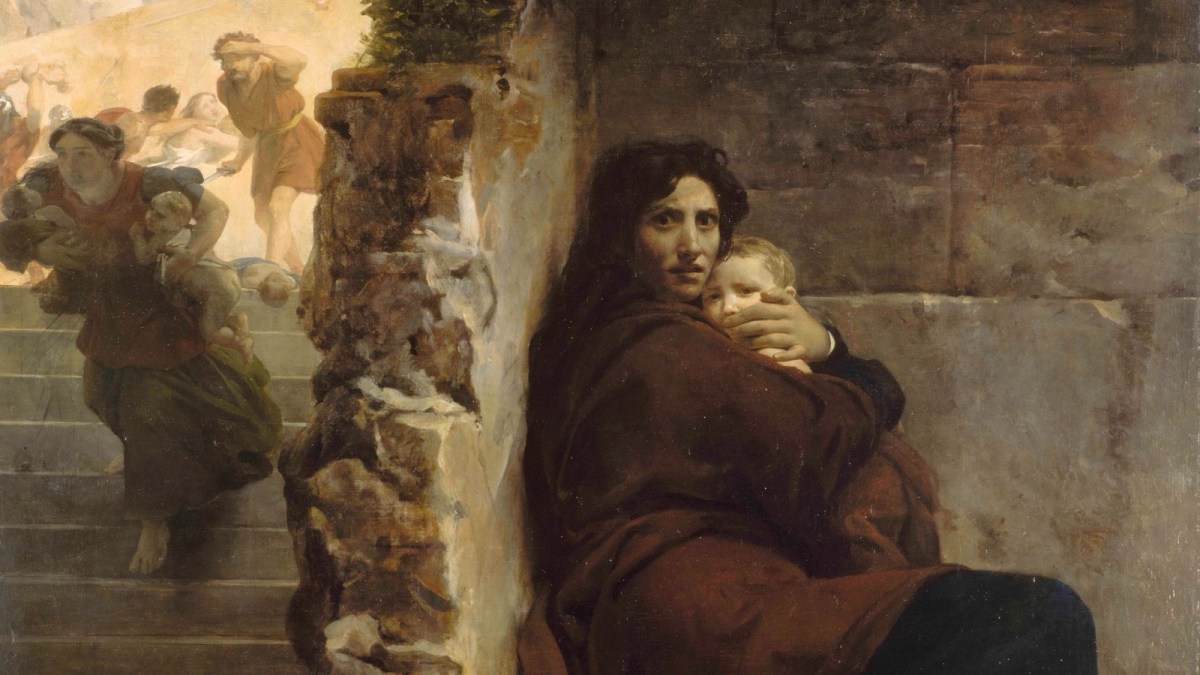
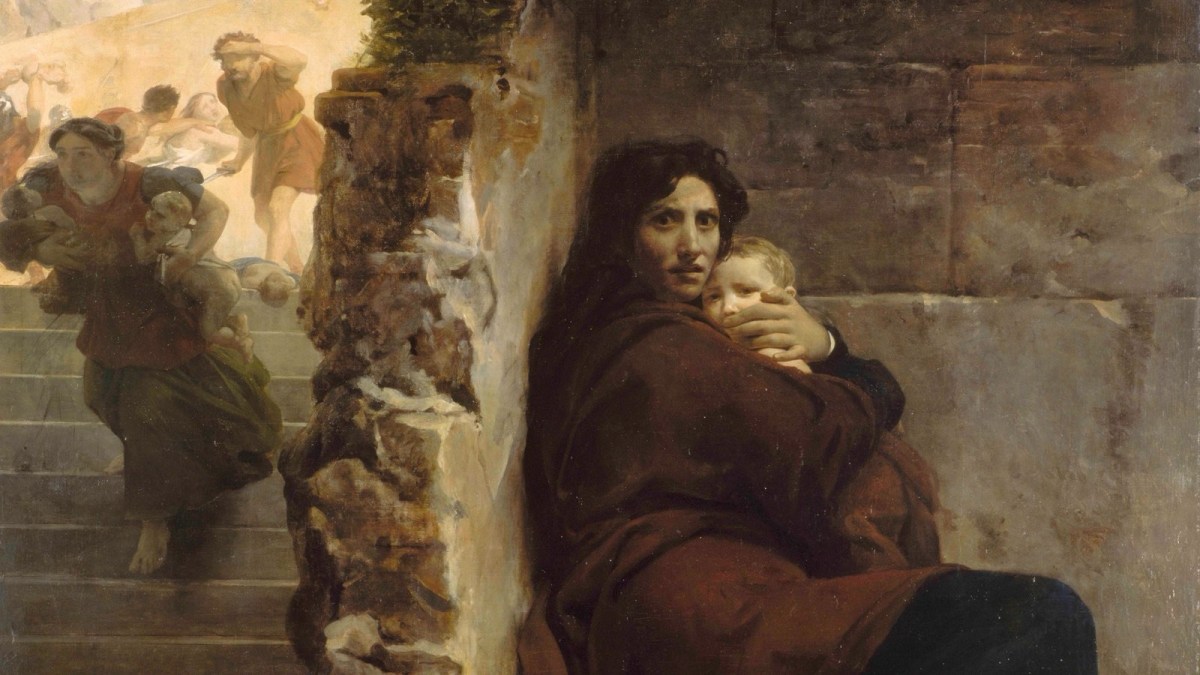
“The Massacre of the Innocents,” an 1824 painting
by Léon Cogniet, held in the Musée des Beaux-Arts

Carols for the Season of Christmas (4) The Fourth Day of Christmas, 28 December

Today (in the Western Church) is designated as the Feast of the Holy Innocents. (It is celebrated tomorrow in the Eastern Church.) This festival day commemorates a tradition known as “the slaughter of the Innocents”,  reportedly ordered by King Herod. It’s a gruesome attachment to the story that is told in the Gospel of Matthew that begins, “now the birth of Jesus the Messiah took place in this way” (Matt 1:18). 

The tradition is that when Herod learnt of the birth of “the King of the Jews”, he feared that this king would pose a threat to his own rule (as a client king under the Roman Empire) over the Jewish people. Herod, it is said, ordered that all male children under two years of age should be killed, to ensure that this rival king was safely despatched (Matt 2:16). Jesus survived this because after visitors “from the east” came from the court of Herod to pay tribute to him (2:11), his parents were advised of the imminent pogrom by an angelic visitation (2:13).

“The Massacre of the Innocents,” an 1824 painting
by Léon Cogniet, held in the Musée des Beaux-Arts

The story is told only in Matthew’s Gospel. It is highly unlikely that the events reported by Matthew actually took place. First, his is the only account of such an event in any piece of literature from that time. An event with so many deaths would surely have been noted by other writers. It is true that Herod was a tyrannical ruler; but amongst the various accounts of his murderous deeds, there is nothing which correlates to the events reported in Matthew’s Gospel.

Second, the story is embedded in the opening section of the Gospel, which uses typical Jewish typology and scripture-fulfilment to present the story of Jesus as a re-enactment of the story of Moses. The author of Matthew’s Gospel, a follower of Jesus who had been raised as a faithful Jew, was especially partial in the opening chapters of his work  to quoting scripture and claiming that events that he reports “took place to fulfill what had been spoken by the Lord through the prophet” (1:22–23). 

The chief priests and scribes in the royal court, says this author, told Herod that Jesus had been born in Bethlehem, “for so it has been written by the prophet” (2:4–6); the flight into Egypt of Joseph, Mary, and their newborn child was “to fulfill what had been spoken by the Lord through the prophets (2:15); the slaughter of the children itself “fulfilled what had been spoken through the prophet Jeremiah” (2:17–18); and the return of the family some time later and their settling in Nazareth was “so that what had been spoken through the prophets might be fulfilled” (2:21–23). 

Aiding and abetting these notes of scripture fulfilment are other typical elements in the Jewish traditions of storytelling, namely, that the events as they take place are guided by the appearance of an angel in the dreams of Joseph (1:20–21; 2:13; 2:19) as well as direct guidance mediated by a dream of the visitors “from the east” (2:12) and again in a further dream of Joseph (2:22). The story that appears in Matt 1:18–2:23 would readily have been recognised by Jewish listeners as employing the typical elements and patterns of Jewish haggadic midrash.

See https://jwa.org/encyclopedia/article/midrash-and-aggadah-terminology

The book of Exodus also employed these elements and patterns. It opens in the time when “a new king arose over Egypt, who did not know Joseph” (Exod 1:8). This king, unnamed except for the designation of “Pharaoh”, feared the increasing numbers and growing power of the Israelites who been enslaved in Egypt for hundreds of years, determined that he would slow the rate of increase and lessen the power of the Israelites by decreeing, “every boy that is born to the Hebrews you shall throw into the Nile, but you shall let every girl live” (Exod 1:22). 

It is in this context that Moses is born; he is hidden “among the reeds on the bank of the river” (Exod 2:1–4), and then taken home by the daughter of Pharaoh (Exod 2:5–9), adopted by her, and raised as a member of the royal household (Exod 2:10). The origin of the child is revealed to the readers (but presumably not to the Pharaoh) by his being named Moses, because, as Pharaoh’s daughter said, “I drew him out of the water” (Exod 2:10b). 

The fact that a name conveys a deeper meaning has been found again and again in the traditional tales collated to form the narrative of Genesis: Adam reflects his creation “from the dust of the ground” (Gen 2:7), Eve’s name indicates that she is “the mother of all living” (3:20), Cain means “acquired” and is reflected in Eve’s comment that “I have produced [or acquired, qanah] a man with the help of the Lord” (4:1), and Abel is related to the Hebrew word for “emptiness” (havel). 

Abram’s name is changed to Abraham, which means “leader [ab] of multitudes [raham]”, to signal the covenantal promise of the Lord God that “I will make you exceedingly fruitful; and I will make nations of you, and kings shall come from you … for an everlasting covenant, to be God to you and to your offspring after you” (17:4–6).  The name of the aged, barren Sarai is changed to Sarah, meaning “she laughed” (17:15),  to signal her incredulous response to the news that she will bear a child (18:9–15). The name of Ishmael literally means “God listens” (16:11) and that of Jacob means “he who supplants” (25:24–26); after his all-night struggle with a man at the ford of Jabbok (32:22–24), his name was changed to Israel, meaning “the one who strives with God” (32:28). Names are deeply significant!

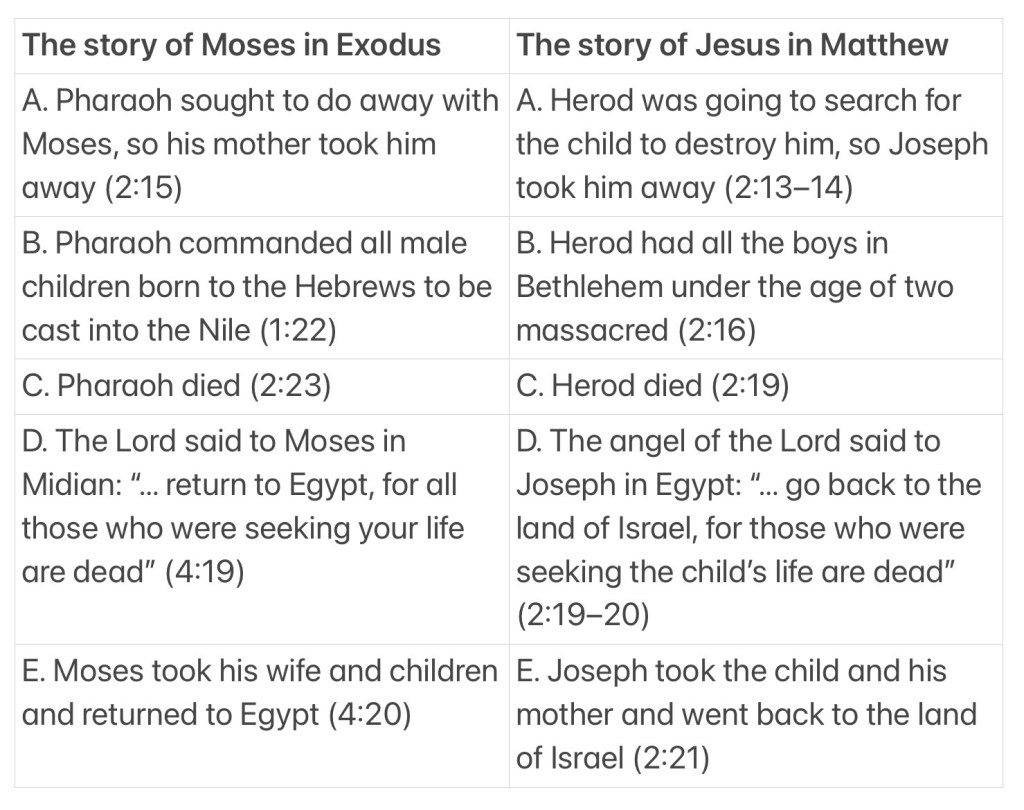
So Moses means “drawn from water”, and Jospeh is given the message that his son is to be given the name that signifies his role, Jesus: “for he will save his people from their sins” (Matt 1:21). And the ancient tale of the slaughter of infants at the time of the birth of Moses is replicated at many points in Matthew’s account of the slaughter of infants at the time of the birth of Jesus (Matt 2:1–18). This later account simply fits the pattern of the earlier account, as this chart shows:

The parallels are very clear!

And just as the literary structure of each story runs in the same pattern, so also the “historical” similarities are clear. Just as there is no historical evidence beyond Exodus to corroborate that the story of the pogrom at the time of Moses took place, neither is there evidence beyond the Gospel of Matthew to corroborate the account found there. Both patterns of events were stories, tales told, not history recorded.

But these non-historical stories are important for theological reasons. The Moses story is part of the whole Exodus complex that provides the fundamental explanation for the identity of Israel. The Jesus story as Matthew presents it is part of the foundational myth of the Christian faith. The writer of Matthew’s Gospel wants to make strong correlations between Jesus and Moses, as the two key figures in their respective stories—and religious systems. This starts in the mythological account found in the opening chapters, and continues throughout the following chapters of the Gospel.

As myth, the tradition found in Matt 1—2 points to important truths. The Slaughter of the Innocents grounds the story of Jesus in the historical, political, and cultural life of the day. It provides a dreadful realism to a story which, all too often in the developing Christian Tradition, has become etherealised, spiritualised, and romanticised.

So we remember this story as an important pointer to the counter-cultural, alternative-narrative impact of the person of Jesus. It is not history, but it offers a powerful myth.

A traditional hymn which remembers this tradition is the Coventry Carol. This dates from the 16th century, when it was performed in Coventry, England, as a part of a mystery play entitled The Pageant of the Shearman and Tailors.

The single surviving text of this pageant (including the words of this carol) was published by one Robert Croo, who dated his manuscript 14 March 1534. The carol is in the form of a lullaby, sung as a poignant remembrance by the mother of a child who is doomed to die in the pogrom.

Lully, lullay, thou little tiny child,

Bye bye, lully, lullay.

Lully, lullay, thou little tiny child,

Bye bye, lully, lullay.

O sisters too, how may we do

For to preserve this day

This poor youngling for whom we sing,

“Bye bye, lully, lullay”?

Herod the king, in his raging,

Charged he hath this day

His men of might in his own sight

All young children to slay.

That woe is me, poor child, for thee

And ever mourn and may

For thy parting neither say nor sing,

“Bye bye, lully, lullay.”

A star and some magi, a tyrant and some infants (Matt 2; Epiphany)

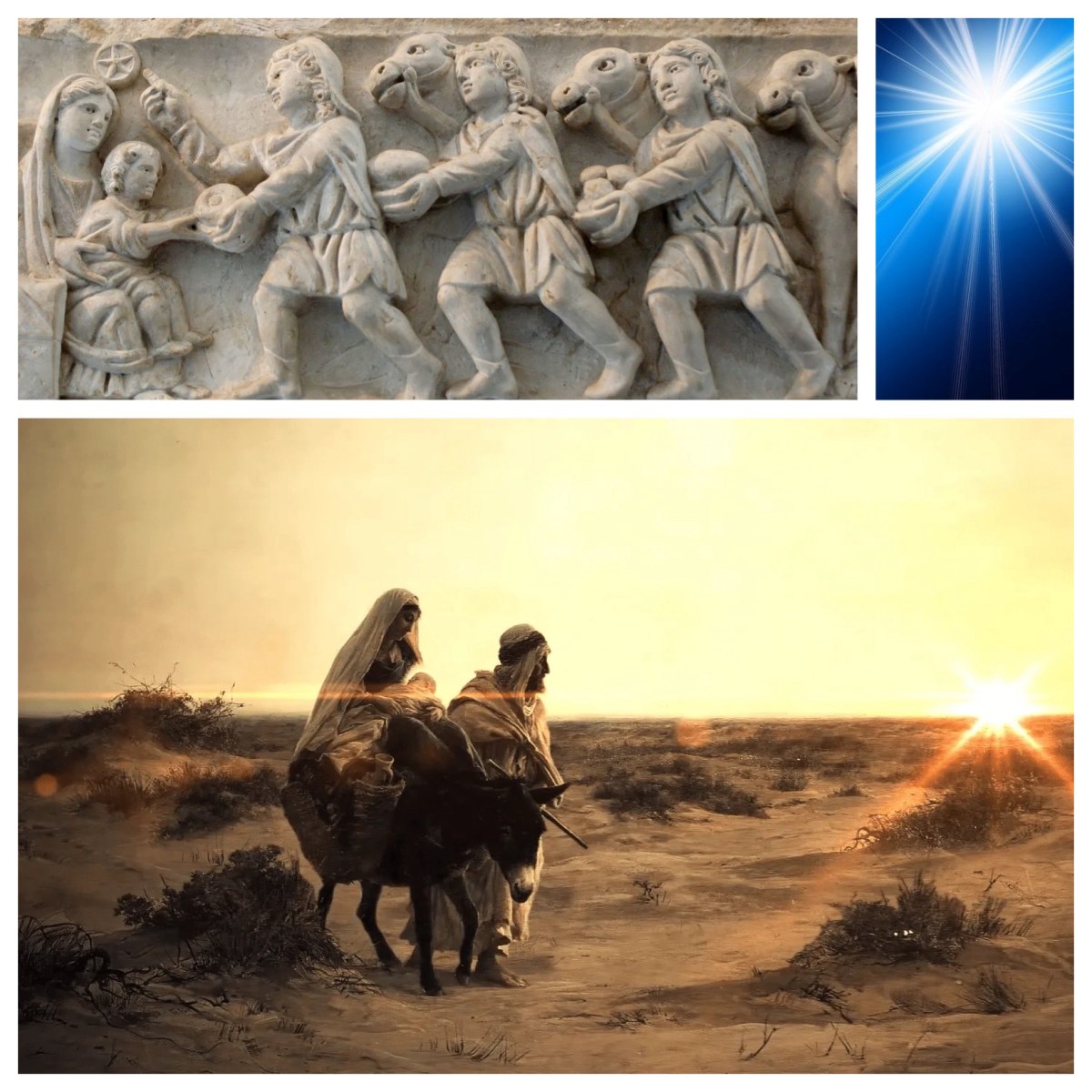
Each year, on the Feast of the Epiphany (6 January), we hear the story that is told in the book of origins (the Gospel according to Matthew) about the infant Jesus, the magi who travel with gifts to offer him, and the tyrant Herod (Matt 2:1–12). We usually stop the story before the account of the slaughter of children which Herod orders, and the flight into Egypt which Jesus undertakes with his mother, Mary, and his father, Joseph (Matt 2:13–18).

The much-loved Christmas story, found only in the orderly account of Luke, says nothing of any such high-status visitors to the newborn Jesus. The magi appear only in Matthew’s account. The actual birth of Jesus is mentioned very quickly by Matthew (1:18, 25). By contrast, the dark story of the slaughter of boys aged two and under dominates Matthew’s narrative (Matt 2:16–18). It is in connection with that part of the story that the magi appear.

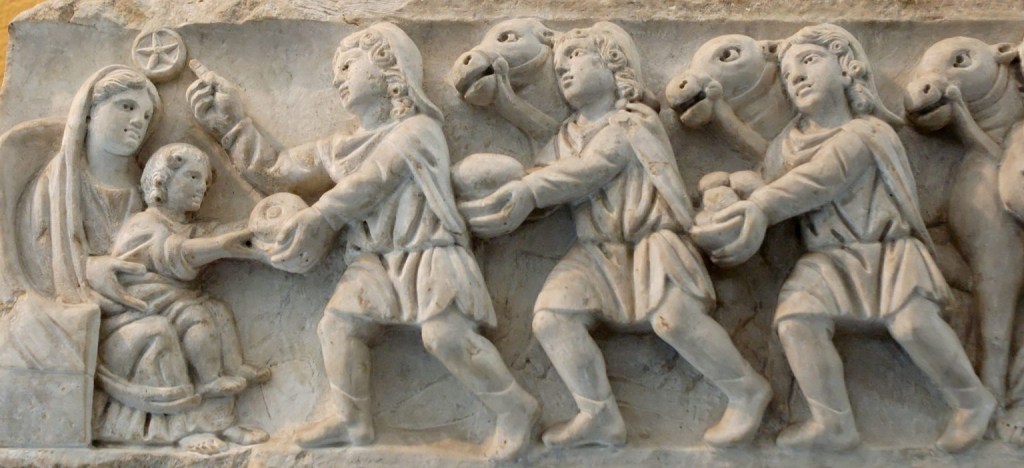
Adoration of the Magi, detail from a 4th century sarcophagus
in the Vatican Museum

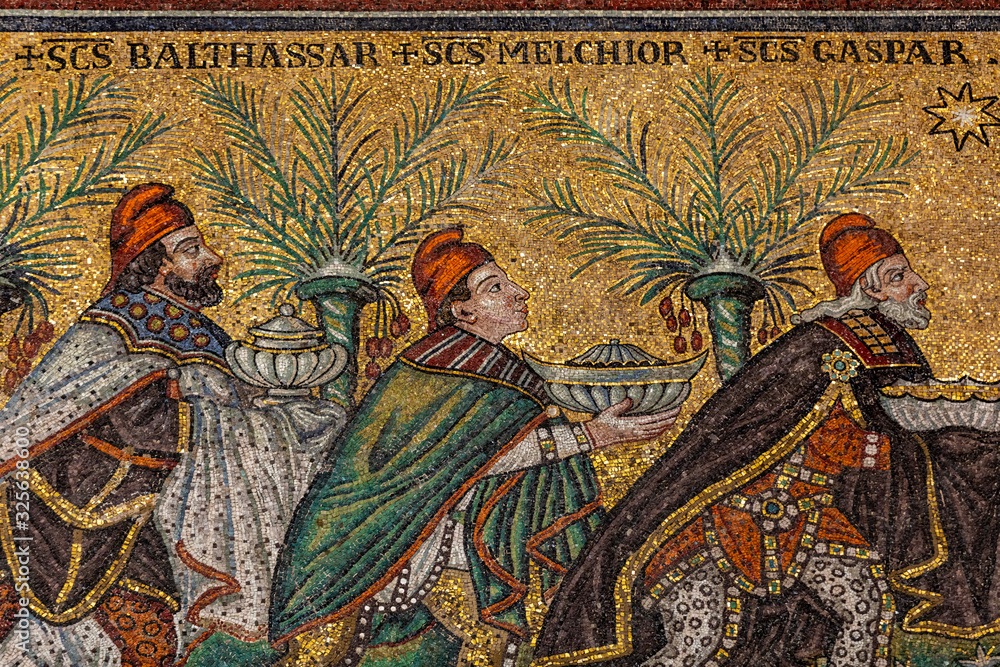
We are not told their names, nor how many they were. They are described as magi, probably meaning that they were astrologers. Only in later church tradition would they be identified as the three men, Caspar, Balthasar, and Melchior. Although Matthew’s gospel does not include the names or number of the magi, many believe that the number of the gifts he notes is what led to the tradition of the Three Wise Men—and, of course, they then needed to gain names (as do many anonymous biblical figures in the evolving church tradition over subsequent centuries).

These magi appear to have come from Gentile lands. They could be seen as exemplars of faithful obedience, travelling far to “adore the child”. But they are very mysterious figures in Matthew’s account. The gifts they bring were valuable items—reflecting a standard of gifts that might be offered to honour a king or deity in the ancient world: gold as a precious metal, frankincense (incense) as perfume, and myrrh as anointing oil.

It is claimed that these same three items were among the gifts that the Seleucid ruler, Seleucus II Callinicus, who ruled for 20 years (246–225 BCE), offered to the god Apollo at the temple in Miletus in 243 BCE. (I found this claim often in online articles, but I can’t trace any of them back to the actual historical source.)

The Three Magi (including the traditional names), Byzantine mosaic
in the Basilica of Sant’ Apollinare Nuovo, Ravenna, Italy

More significant for Matthew, I believe, would be the fact that two of the gifts resonate with a Hebrew Scripture passage, late in the book of Isaiah. Jerusalem’s restoration is portrayed as a time when “nations shall come to your light, and kings to the brightness of your dawn” (Isa 60:3); they will “bring gold and frankincense and proclaim the praise of the Lord” (Isaiah 60:6).

The visitors bringing these gifts come from Sheba (a kingdom in South Arabia). The gifts, it is claimed by interpreters, are symbolic of what is to come. The gold is considered to symbolise the royal status of the child Jesus, as he is of the line of David. The frankincense is connected with the Temple cult, and thus considered a symbol of the priestly role eventually to be played by that same child.

The myrrh, in Christian tradition, is linked with the death that will be experienced by the infant when he has grown to maturity—death at the hands of a Romans, who offered him wine mixed with myrrh as he hung dying on a cross (Mark 15:23). This symbolism reveals the reasons for adopting and expanding the earlier oracle.

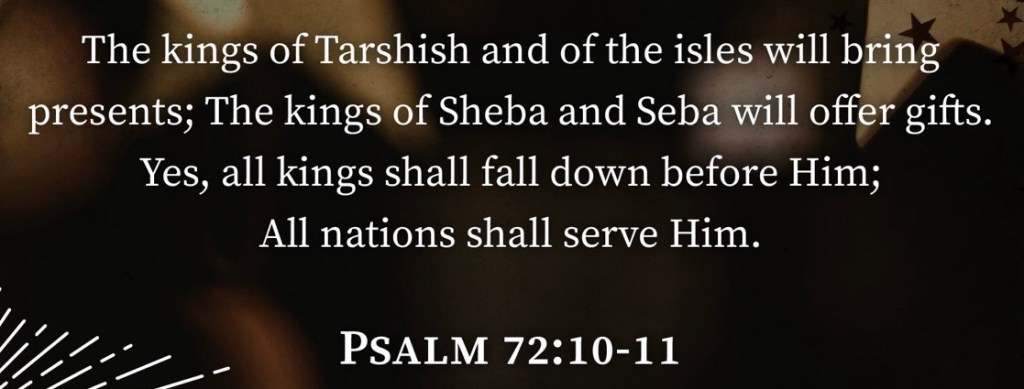
And the notion that was developed later in Christian writings, that the three magi were kings in their respective kingdoms (as in, “we three kings of orient are”), derives from the application of Isaiah 60:3 , noted above, and Psalm 72:10–11, as the psalmist praises the King of Israel and prays, “may the kings of Tarshish and of the isles render him tribute; may the kings of Sheba and Seba bring gifts; may all kings fall down before him, all nations give him service.”

This is typical midrashic practice, to link up verses from different verses in different books which contain the same key words. It indicates that Matthew is “spinning a yarn”, telling a story, narrating a myth that contains important clues as to the nature and significance of the person about whom the story is told. It is not a factual historical account.

Matthew, who portrays Jesus as the new Moses throughout his Gospel, considers that his mission was solely to “the lost sheep of the house of Israel” (Matt 10:6; 15:24)—and to them alone. The visit of the magi from the East plays a symbolic role in the story. It represents a Gentile acknowledgement of the high role that Jesus will play, bringing to fulfilment the intentions of God for the covenant people. So this element, told very early in the narrative, is simply a literary technique to introduce a key theme which will reach fulfilment in the time well beyond the tale that the narrative offers.

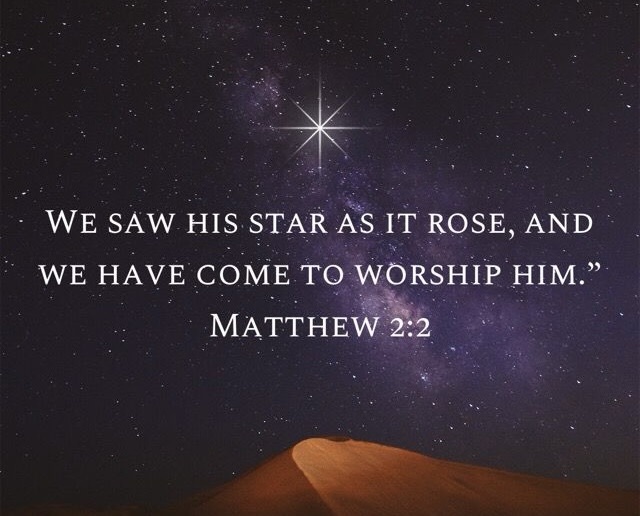
I’m not going to go down the rabbit-hole of trying to identify the actual star that these magi followed (Matt 2:2, 9–10) and correlate it with known astronomical events from the early first century. It’s too complicated and anything I have ever seen requires us to put aside our historical-critical skills and believe in a series of “amazing coincidences”.

Besides, as this post makes abundantly clear, I don’t regard the story found in Matt 2 as in any way historical! It is yet another component of his story which draws heavily from Hebrew Scripture, as befits a Jew writing to Jews. The rising of the star in the east correlates well with the prophet Balaam’s prediction in Num 24:17 that “a star shall come out of Jacob and a sceptre shall rise out of Israel”.

The identification of the star as being “in the east” comes because, in Greek, the word for “east” is the same as “rising”. The Greek translation thus is ambiguous about whether the star simply “rises up out of Israel” or whether it is “to the east” of Israel. We can see this ambiguity if we compare how different recent translations of the Bible render this phrase in Matt 2:9 — “a star they saw in the east” (KJV), “the star they had seen when it rose” (NIV and ESV), “the star they had seen at its rising” (NRSV), “the star they had seen in the east” (NLT).

So this is another element in the story that has been shaped by Hebrew Scripture.

Evidence from beyond the Bible, that the baby boys in Bethlehem were actually slaughtered by Herod’s troops (Matt 2:16), is absent. The story that Matthew presents is grounded, not in history, as we know it, but in the art of story-telling, where recognisable themes and characters are presented in a new, creative combination.

So it is that in the opening chapters of this Gospel, we encounter the pregnant Mary, the newborn infant Jesus, his father Joseph, a bright star in the sky, visitors from the east, the tyrannical rule of Herod, and slaughtered infant boys. Many of these characters and events are “types”, imitations of an earlier story—for in his narrative, Matthew is working hard to place Jesus alongside the great prophet of Israel, Moses.

The early years of Jesus unfold in striking parallel to the early years of Moses. The parallel patterns are striking—deliberately shaped that way by the author of this Gospel, I would maintain. Moses, for instance, was in danger of being killed as a small boy, as the Pharaoh instructed the midwives, “When you act as midwives to the Hebrew women, and see them on the birthstool, if it is a boy, kill him; but if it is a girl, she shall live” (Exod 1:16). The child Moses was rescued by midwives who “feared God; they did not do as the king of Egypt commanded them, but they let the boys live” (Exod 1:17).

Matthew’s account of “the Slaughter of the Innocents” is generated by his Moses typology. This grounds the story of Jesus in the historical, political, and cultural life of the day, when tyrants exercised immense power. But it raises our suspicions about whether this event actually took place. There is no other evidence for it in any ancient writing, apart from Matthew’s Gospel. Can we be sure that it took place? Not by any standard of historical assessment.

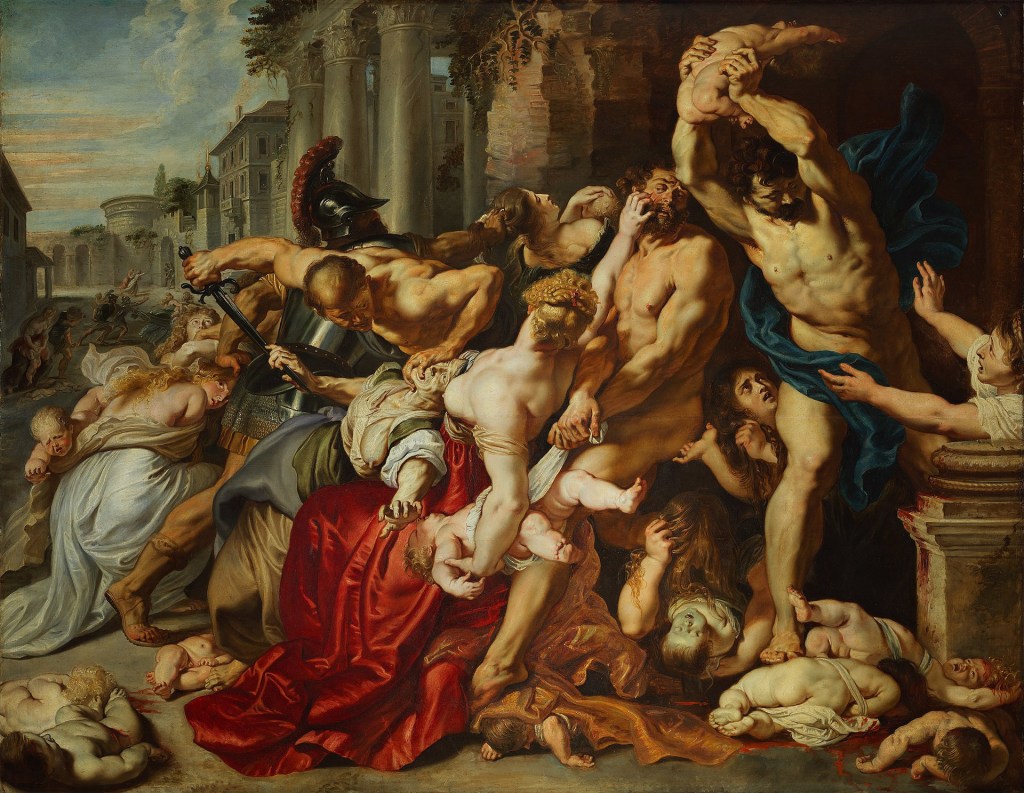
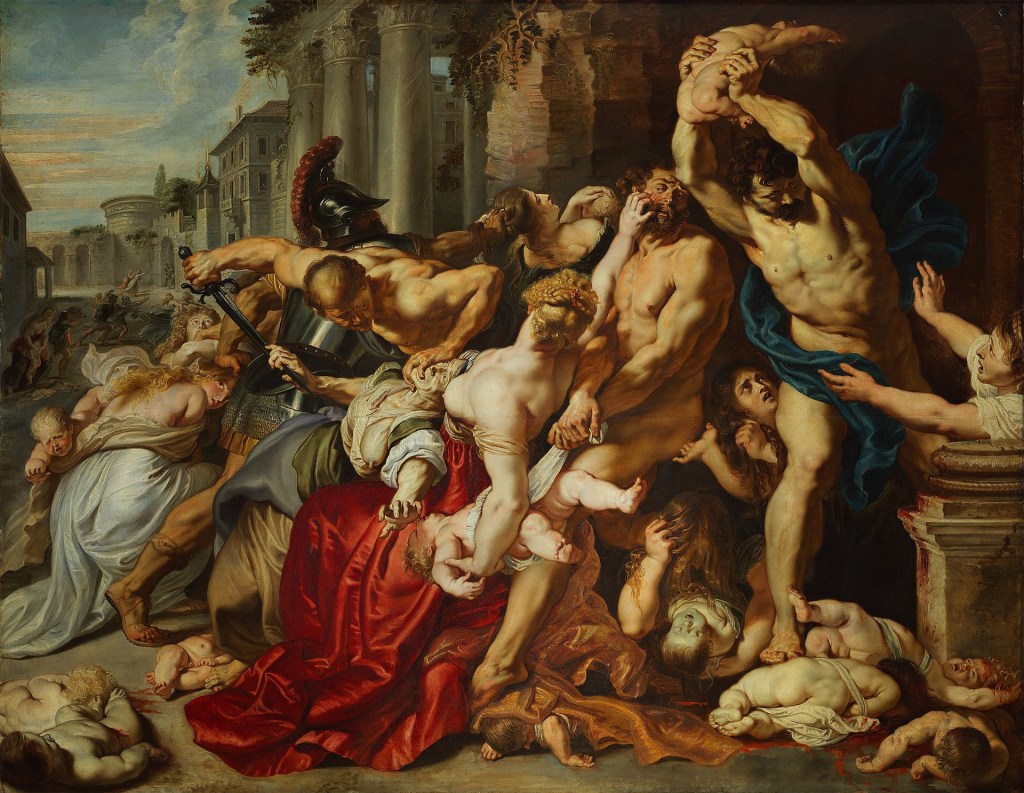
Massacre of the Innocents, ca. 1520;
engraving by Marco Dente (1486–1527),
based on a design by Baccio Bandinelli (1493–1560)

(I recognise that some claim that a report by Josephus in book 2 of his account of the Jewish War, about an uprising related to a certain shepherd named Athrongeus, might be telling of this event—except that this took place after the death of Herod, and it took place in Jerusalem, not in Bethlehem, as Matthew’s account maintains. And, of course, Matthew has no shepherds in the story, so the connection is even more diffuse. The search for a parallel account in another ancient source is undertaken in vain.)

We recognise that, in this narrative, Matthew is not reporting an actual historical event; yet his narrative of what allegedly happened to those children does provide a dreadful realism to a story which, all too often in the developing Christian Tradition, became etherealised, spiritualised, and romanticised.

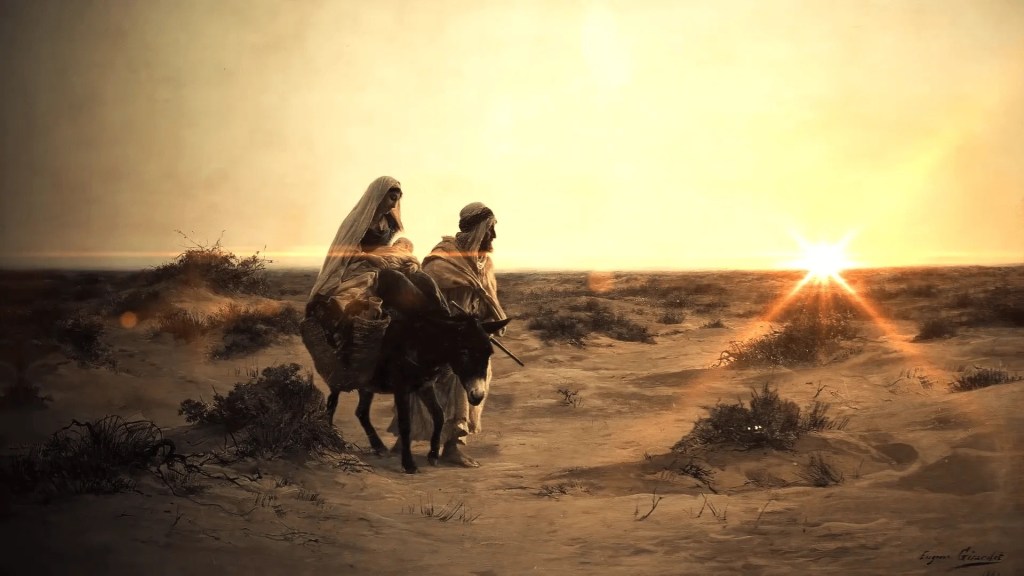
Matthew has Jesus escape this fate by fleeing, with his parents, to Egypt (Matt 2:13–15). Once again, there is no evidence for this journey outside of Matthew’s book of origins, so the story is just that: a story, not an historical account. The Moses typology we have already noted is also relevant here. Matthew emphasises the many ways in which events in the early years of Jesus fulfilled the prophecies found in Hebrew Scripture (see Matt 1:22–23; 2:5–6, 15, 17, 23; and for the adult Jesus, see 3:3; 4:12–16; 12:15–21; 13:14–15, 35).

So many parts of the early life of Jesus as Matthew recounts it are presented in a way that makes them consistent with these prophecies—although one of them (2:23) cannot actually be found in the Bible! It is most likely that Matthew has constructed his story so that it fits with these scriptural prophecies. They provide him with a familiar framework for telling the story.

Only Matthew tells about Herod and his slaughter of the innocents. Such an event is unknown from any other ancient literature. Had it actually taken place, it is likely that it would have been reported elsewhere. This event, together with others in Matthew’s version of Jesus’ early life, mirror the pattern of events at the start of Moses’ life.

With Moses, as with Jesus, there is the slaughter of infant males under 2 years by a tyrannical ruler, and the flight into another country by the boy’s parents, so that the boy is saved. In this way, Matthew presents Jesus as “the new Moses”. That is the key concern that he has in this opening sequence—not providing an historical narrative, but introducing his story of Jesus through the typology of Moses.

See also

The outer darkness, the eternal fire, and the threat of Hell (Matt 25; Pentecost 25A) part two

There have been a number of posts on my Facebook feed in recent weeks, on the matter of Hell. A number of them have made the claim that Hell does not appear in the New Testament. It’s a common claim made by hardline “progressive” Christians. I have started to address this in an earlier post; see

The Gospel passage proposed by the Revised Common Lectionary for this coming Sunday (Matt 25:14–30) raises this matter quite directly. This passage offers a parable of Jesus (found here and, in another version, in Luke 19), in which two slaves are commended for their shrewd stewardship of a huge amount of money that was entrusted to them, whilst one slave is punished for not improving the amount he was given.

That slave is called “wicked and lazy” (Matt 25:26) as well as “worthless”, and his punishment is far more severe: he is to be thrown “into the outer darkness” (25:30). That is often interpreted, with some justification, as being thrown into Hell.

I know about the way that Hell can be used in Christian rhetoric. In the past, I have been labelled, by a fellow-member of my church, with derogatory and insulting labels regarding my marital status. I have been condemned for “worshipping Satan” and being “doomed to hell”. I have been called out, publically, as an “apostate” who “has been deceived”, and told that I am “hell-bound without repentance”.

Graphic descriptions of my fate, as being condemned to “the eternal lake of burning sulphur” (Rev 20:7–10 and 21:8), have been provided for me to ruminate over. And worse, this particular individual has justified this way of responding by maintaining that there is “nothing unchristian about warning demonically inspired LGBTI advocates against Hell and the Lake of Fire”. How charmingly pastoral!

The slave who was not prepared for the return of his master—in the first of four parables (24:45–51) which conclude the final teaching discourse of Jesus—faces this clear punishment: “put him with the hypocrites, where there will be weeping and gnashing of teeth” (24:51). Where was that place, where the hypocrites are to be found? Jesus does not specify that here.

Jesus had earlier spoken a similar instruction to “throw him into the outer darkness, where there will be weeping and gnashing of teeth” in the parable where a person came to a wedding inappropriately dressed (22:13). This is a recurrent motif in Matthew’s Gospel; but this passage gives no further description of where that outer darkness with its weeping and gnashing of teeth is located.

Elsewhere in this Gospel, Jesus has pointed to the same punishment for lawless and disobedient people: such weeping and gnashing of teeth is cited in his words of judgement spoken in Capernaum, where he encounters a distressed centurion (8:12); in his explanation of the parable of the weeds and the wheat (13:42); in the parable of the good and bad fish (13:50); and in the parable of the talents (25:30). But where is the outer darkness where this experience located?

The gnashing of teeth is a punishment that is taken from Hebrew Scripture texts: “the wicked plot against the righteous and gnash their teeth at them (Ps 37:12); “the wicked gnash their teeth and melt away; the desire of the wicked comes to nothing” (Ps 112:10); “malicious witnesses … impiously mocked more and more, gnashing at me with their teeth” (Ps 35:11,16). The prophet laments that when Jerusalem is ransacked, “all your enemies open their mouths against you, they hiss, they gnash their teeth, they cry ‘we have devoured her!’” (Lam 2:16). It is a well-known form of torment and punishment.

The Matthean parable of the unprepared servant also has this apparently savage instruction: he will cut him in pieces (24:51). In a similar version, found in Luke’s Gospel (Luke 12:42–48), the master similarly “will cut him in pieces, and put him with the unfaithful” (Luke 12:46), but again the location of the unfaithful is not specified.

In a number of places in Hebrew Scripture, cutting a body into pieces was an action used in sacrificing animals (1 Kings 18:23, 33) and as a warning of judgement against sinners—in the terrible story of the Levite’s concubine (Judges 19:29), after Saul defeated the Ammonites (1 Sam 11:7), and also in direct prophetic warnings (Isa 45:2; 51:9; Ezek 16:40; Dan 2:34; also Judith 5:22). This is the fate decreed for the unprepared slave—a terrible end, indeed!

Throughout Matthew’s Gospel, Jesus declares that sinners are destined for the judgement of fire (Matt 5:22; 7:19; 13:40, 42, 50; 18:8–9; 25:41). This gives a clearer indication of the location where punishment will be meted out to the unfaithful, the hypocrites, and those who disobey the law. The reference to the judgement of fire picks up from the warning of John the baptiser, which Matthew has added to his Markan source: “You brood of vipers! who warned you to flee from the wrath to come? … even now the ax is lying at the root of the trees; every tree therefore that does not bear good fruit is cut down and thrown into the fire” (Matt 3:7, 10).

That place is described by Jesus, in parables unique to Matthew, as “the furnace of fire” (Matt 13:43, 50; 25:41). Sinners will be sent to a place of “eternal fire” (18:8; 25:41), “the hell of fire” (5:22; 18:9), the “unquenchable fire” threatened by John, as he baptised repentant sinners and warned that “the chaff he will burn with unquenchable fire” (3:12). This builds on the warnings found in Mark’s Gospel about the punishment in store for those who put stumbling blocks in the way of “these little ones”—they will be condemned to “the unquenchable fire” (Mark 9:42–48). These warnings are repeated by Jesus in Matt 18:6–9.

Matthew’s portrayal of Jesus is consistent in reporting that he warns his followers, again and again, of the fiery fate that awaits evildoers. Once again, this picks up on Hebrew Scripture passages in which various prophets declare that God will use fire to destroy people and places because of their sinfulness (Isa 1:7; 5:24; 30:27–28, 30, 33 18–19; Jer 4:4; 6:27–30; 20:47–48; Hos 8:14; Joel 2:1–3; Amos 1:4—2:5; Nah 1:15).

Amongst those prophetic oracles, Zephaniah, for instance, portrays utter devastation through divine judgement: “neither their silver nor their gold will be able to save them on the day of the Lord’s wrath; in the fire of his passion the whole earth shall be consumed” (Zeph 1:18).

However, the final prophet in the Christian Old Testament, Malachi, reworks this imagery, offering some hope; God’s messenger on The Day of the Lord “is like a refiner’s fire and like fullers’ soap; he will sit as a refiner and purifier of silver, and he will purify the descendants of Levi and refine them like gold and silver, until they present offerings to the Lord in righteousness” (Mal 3:1–4).

A number of psalms reflect a desire for God to punish evildoers severely; “pour out your indignation upon them, and let your burning anger overtake them” is the cry of one psalm (Ps 69:24). Another psalm notes the vengeance of God—“in your hearts you devise wrongs; your hands deal out violence on earth” (Ps 58:2)—and suggests that “the righteous will rejoice when they see vengeance done; they will bathe their feet in the blood of the wicked” (Ps 58:10). We must wonder: did Jesus pray these psalms? did he concur with their ideas? did he pray for God to act with vengeance? The words that Matthew attribute to Jesus in his Gospel would suggest that he did.

The image of fiery punishment is often noted by the psalmists: “on the wicked [God] will rain coals of fire and sulfur; a scorching wind shall be the portion of their cup” (Ps 11:6); “the voice of the Lord flashes forth flames of fire; the voice of the Lord shakes the wilderness” (Ps 29:6-7); and again, “your hand will find out all your enemies; your right hand will find out those who hate you; you will make them like a fiery furnace when you appear; the Lord will swallow them up in his wrath, and fire will consume them.” (Ps 21:8-9).

Indeed, one psalmist prays to God, “as fire consumes the forest, as the flame sets the mountains ablaze, so pursue them with your tempest and terrify them with your hurricane” (Ps 83:14-15). After one such prayer, other psalmists must have been astounded as “smoke went up from his nostrils, and devouring fire from his mouth; glowing coals flamed forth from him” (Ps 18:8; see also 18:12; 46:9; 68:2; 78:21, 63; 97:3; 104:4; 106:18). And so the psalmist laments, “how long, O Lord? will you be angry forever? will your jealous wrath burn like fire?” (Ps 79:5; 89:46).

This imagery is picked up and placed into the story of Daniel (Dan 3:1–30) and appears again in the last book of the New Testament, where the prophet describes his visions of “the lake of fire that burns with sulfur” (Rev 19:20; 20:10, 14–15), also described as “the second death” (Rev 20:14; 21:8). It is there that the devil, the beast, and the false prophet “will be tormented day and night forever and ever” (Rev 20:10). Matthew appears to share some similarities with the writer of this book, for as we have noted, eternal punishment in a fiery furnace features also in the words of Jesus in Matthew’s Gospel.

So we can’t simply brush aside the closing words of the parable which is in focus this coming Sunday—the Heavenly Father, we are told, will follow the example of the unforgiving servant, who will be “tortured until he would pay his entire debt” (18:34–35), in the service of ensuring that faithful people do indeed forgive one another! (How he will be able to pay off his debt while he is being tortured in prison, I do not know!)

Such punishment is consistent with the way that God’s justice will be implemented, according to the various teachings and parables of Jesus in Matthew’s Gospel that we have already noted. It will be incredibly hard to be let off the hook by this fierce, punitive God!! We are left in no doubt whatsoever, that Jesus believed in a place where divine wrath would visit punishment and wreak revenge on evildoers.

So as we read and hear and interpret this parable, today, and as we reflect on the matter of punishment, Hell, and the afterlife, we are left to ponder for ourselves: do we still hold to this place, Hell, as a place of eternal torment for sinners? or can we move on in our understanding and reshape our theology to form a belief system that offers a different way of addressing injustice and rewarding faithfulness? (I would like to think we can.)

Certainly, the survey of passages above reveals a clear development in various Hebrew Scripture passages, on through into New Testament textswhich raises the question, why, then, do we need to stop our thinking about these ideas—our conceptualisation of how God deals with sin—with late first century texts? And let’s note that understandings of these ancient texts have been mediated especially through interpreters of late antiquity and the medieval period, and their more recent followers. Is it not legitimate for us, today, to continue that development and for us to articulate new understandings?

We are also left with the conundrum: what are we to make of this aggressively violent, retributive God, condemning sinners to the misery of “hell”? Is this the last word about God? or can we legitimately form a different, more nuanced understanding of the divine? (Again, this is the direction I would like to move.)

These questions focus the the challenge of preaching and interpreting this parable of Jesus, and these ancient texts as a whole, in our contemporary world.

************

Material in this and the previous blogs is drawn in part from the research of Elizabeth Raine and from MESSIAH, MOUNTAINS, AND MISSION: an exploration of the Gospel for Year A, by Elizabeth Raine and John Squires (self-published 2012)

See also

The outer darkness, the eternal fire, and the threat of Hell (Matt 25; Pentecost 25A) part one

There have been a number of posts on my Facebook feed in recent weeks, on the matter of Hell. A number of them have made the claim that Hell does not appear in the New Testament. It’s a common claim made by hardline “progressive” Christians. The Gospel passage proposed by the Revised Common Lectionary for this coming Sunday (Matt 25:14–30) would suggest otherwise, however.

This passage offers a parable of Jesus (found here and, in another version, in Luke 19), in which two slaves are commended for their shrewd stewardship of a huge amount of money that was entrusted to them, whilst one slave is punished for not improving the amount he was given.

In Luke’s version, the third slave is called “wicked” (Luke 19:22) and the money he was given is taken from him and given to the first slave, to illustrate the saying, “to all those who have, more will be given; but from those who have nothing, even what they have will be taken away” (Luke 19:24–26). In Matthew’s version of this this parable, the slave is called “wicked and lazy” Matt 25:26) as well as “worthless”, and his punishment is far more severe: he is to be thrown “into the outer darkness” (25:30).

This is the third reference by the Matthean Jesus to “outer darkness” (8:12; 22:13; 25:30). As the parable that follows refers to “the eternal fire prepared for the devil and his angels” (25:41)—to which Jesus had earlier referred (18:8)—it does seem that Jesus is referring to a place that we know by the term “hell”. Indeed, words spoken by Jesus in Matt 18:9 are rendered explicitly as “the hell of fire” in the NRSV, while the NIV renders this “the fire of hell”. They are both translating a Hebrew word, here transliterated into Greek, Gehenna (on which, see more, below).

Over the years I have had a number of interesting conversations about these passages, and others, and about “hell” in biblical texts, with my wife, Elizabeth Raine, as she has studied both Matthew’s Gospel (where there is a preponderance of passages referring, in one way or another, to “hell”), as well as the relevant Hebrew Scripture passages often linked with “hell”, so what follows is strongly informed by those conversations.

Now, my search of the NRSV indicates that the word “hell” does appear 13 times in this translation of the New Testament. 11 of these are in the Synoptic Gospels, each time in words attributed to Jesus (the other two are in James and 2 Peter). The NIV has the same 13 occurrences of the word “hell”; but in the 17th century translation authorised by King James, the word appears 23 times in the New Testament (15 of these in the Synoptics) as well as 31 times in the Old Testament. Clearly, the reticence to use this word in translating relevant Hebrew or Greek words grew between the 17th and the 20th century. Why might that have been?

I think that this reticence might relate, in part, to a developing clarity about what the various words in Hebrew and Greek actually described. Rather than lumping them all together under the catch-all term “hell”, more recent translators take care to provide more distinctive descriptors.

There are a number of concepts which need to be considered. This takes us into the strange world of ancient Hebrew cosmology—the world, heavens and earth, what was above and what was below, was understood in a different way from the way that 21st century people understand such things.

In Hebrew Scripture, there are references to the Deep, the Pit, and Sheol. These three words appear to describe the state of being of human beings after they have died. In the King James Version, the word “hell” is used to translate these Hebrew words on quite a number of occasions. But we need to explore them more carefully.

Sheol is the opposite of heaven in spatial terms; as heaven is in the heights, so Sheol is in the depths. (Gen 49:25). Isaiah says that God invited King Ahaz to “ask a sign of the Lord your God; let it be deep as Sheol or high as heaven” (Isa 7:11; the sign that is then given is the famous child, to be named Immanuel, 7:14). Ezekiel describes the demise of “Assyria, a cedar of Lebanon … [that] towered high and set its top among the clouds” in these words from God: “on the day it went down to Sheol I closed the deep over it and covered it” (Ezek 31:15). In this fate, it shared with those who “are handed over to death, to the world below … with those who go down to the Pit” (Ezek 31:14).

The terms found here—Sheol, the Deep, the Pit, the world below—are part of a cluster of terms which appear throughout Hebrew Scripture. Technically, The Deep describes the waters of chaos, outside the Dome, which can rise up to flood the world, as in the story of Noah, when in one version “all the fountains of the great deep burst forth, and the windows of the heavens were opened” (Gen 7:11) and, after 150 days, “God made a wind blow over the earth, and the waters subsided; the fountains of the deep and the windows of the heavens were closed, the rain from the heavens was restrained, and the waters gradually receded from the earth” (Gen 8:2).

Sheol and The Pit each describe the state of the nephesh (the essence of being) of those whose bodies have died. In Psalm 88, when the psalmist laments “my soul is full of troubles”, they use these and other terms in poetic parallelism to describe their fate: “my life draws near to Sheol; I am counted among those who go down to the Pit; I am like those who have no help, like those forsaken among the dead, like the slain that lie in the grave, like those whom you remember no more, for they are cut off from your hand; you have put me in the depths of the Pit, in the regions dark and deep” (Ps 88:3–6). Another psalm describes this as “the land of silence” (Ps 94:17), while the prophet Ezekiel imagines it as the place where the dead, the “people of long ago” lie “among primeval ruins” (Ezek 26:20)

In this state, people simply lie in darkness, not living, with no future in view, no hope in store. Job laments, “if I look for Sheol as my house, if I spread my couch in darkness, if I say to the Pit, ‘You are my father,’ and to the worm, ‘My mother,’ or ‘My sister,’ where then is my hope?” (Job 17:13-15). Job also equates entering the Pit with “traversing the River” (Job 33:18), in words that seem to reflect the River Hubur (in Sumerian cosmology) or the River Styx (in Greek cosmology), the place where the souls of the dead cross over into the netherworld.

Other words for Sheol in Hebrew Scripture include Abaddon, meaning ruin (Ps 88:11; Job 28:22; Prov 15:11) and Shakhat, meaning corruption (Isa 38:17; Ezek 28:8). These terms indicate the forlorn, lost, irretrievable nature of this state of being. This is the fate in store for all human beings, whether righteous or wicked; there is no sense of judgement or punishment associated with this state. It is simply a state of non-being.

By the time of the New Testament, however, there had been quite some development in this direction within Jewish thinking. In the apocalyptic visions of 2 Esdras, Ezra is depicted as foreseeing that “the pit of torment shall appear, and opposite it shall be the place of rest; and the furnace of hell shall be disclosed, and opposite it the paradise of delight” (2 Esd 7:36).

Likewise, the seven Maccabean brothers tell “the tyrant Antiochus” that “justice has laid up for you intense and eternal fire and tortures, and these throughout all time will never let you go” (4 Macc 9:9; also 12:12). In the teaching contained in the Wisdom of Solomon, however, a complementary element is noted, as Solomon is said to declare “the souls of the righteous are in the hand of God, and no torment will ever touch them” (Wisd Sol 3:1).

The New Testament—largely in the Synoptic Gospels, but also in Revelation—reflects these developments in the way that it portrays the afterlife, with a number of sayings portraying a place of punishment for sinners after death, as well as the promise of eternal life for the righteous with God in the kingdom of heaven.

There are three Greek words that are relevant at this point: Gehenna, Hades, and Tartarus. The first, Gehenna, was a geographical term, referring to the Valley of Hinnom, to the southwest of Jerusalem, where in periods of sinfulness before the Exile, children had been sacrificed to Molech (2 Ki 23:10; 2 Chron 28:3; 33:6; Jer 7:31-32; 32:35). This practice was the cause of punishments experienced by the people for their sinful behaviour.

Gehenna appears twelve times in the New Testament—eleven of those being in words attributed to Jesus (Mark 9:43, 45, 47, paralleled in Matt 18:9; Matt 5:22, 29, 30; 10:28; 23:15, 33; and Luke 12:5). In some of these occurrences, Gehenna is placed into parallel with other ideas which suggest it is no longer the simple geographical reference of Hebrew Scripture texts, but it has become a place of punishment for sinners in the afterlife (see further below).

The potency of Gehenna is noted when James warns those who misuse their tongue as “a restless evil, full of deadly poison” (James 3:8) that “the tongue is placed among our members as a world of iniquity; it stains the whole body, sets on fire the cycle of nature, and is itself set on fire by hell [translating the Greek Gehenna]” (James 3:6).

A second word, found ten times in the New Testament, is Hades; a word adopted from older Greek literature, where it appears from Homer onwards as the name of the God of the lower regions (Hades, later Pluto, the brother of Zeus and Poseidon) and of the realm of the dead. This was where all people went after their death; leaving Hades was not possible (with the exception of a few heroic figures in the myths of the Greeks).

Jesus speaks of going down to Hades (Matt 11:23; Luke 10:15); perhaps he himself went there? (1 Pet 3:19 may allude to this). The deceased rich man in Hades looks up to heaven to see the poor man, Lazarus, with Abraham (Luke 16:22–23). Hades in this parable is a place of torment (Luke 16:23, 25); the rich man endures punishment which apparently cannot be revoked (Luke 16:26).

In Acts, Peter is said to have quoted Ps 16:10, referring to the soul being abandoned in Hades, in his speech at Pentecost (Acts 2:27, 31), and four times in Revelation Hades is linked with death (Rev 1:18; 6:8; 20:13–14). The Matthean Jesus informs Peter that “the gates of Hades will not prevail” against the church, founded in Peter, the rock (Matt 16:18). Hades has gates, presumably to ensure its inhabitants cannot escape the fate determined for them.

It is interesting that for a number of verses in the Septuagint, the Greek word Hades translates Sheol, thereby turning it from a Hebrew idea into a Greek concept for the hellenised Jewish readers of the Septuagint.

The introduction of punitive elements into the way that Gehenna and Hades are described leads to a third Greek word which is relevant to our considerations. The Greek noun is Tartarus, which the Encyclopedia Britannica explains in this way: “the name was originally used for the deepest region of the world, the lower of the two parts of the underworld, where the gods locked up their enemies. It gradually came to mean the entire underworld. As such it was the opposite of Elysium, where happy souls lived after death.” See https://www.britannica.com/topic/Tartarus

Whilst that name itself does not appear in the New Testament, the cognate verb tartaróō is found once, in the very late and pseudonymous epistle, 2 Pet 2:4. It is translated as “to cast down to hell” in the KJV and in most recent modern translations, where it describes what God did to sinful angels, demonstrating that “the Lord knows how to rescue the godly from trial, and to keep the unrighteous under punishment until the day of judgment —especially those who indulge their flesh in depraved lust, and who despise authority” (2 Pet 2:9–10). So be warned!

All of which indicates that notions of Hell as a place in the afterlife where sinful people are sent, to experience divine punishment, are alive and well at the time the various New Testament books were written.

And so: what of the parable that Jesus tells (Matt 25:14–30) ??

… to be continued …

*****

With thanks to Elizabeth Raine for insights about relevant texts at many places through this discussion.

Oil and light, and being prepared (Matt 25; Pentecost 24A)

“When the foolish took their lamps, they took no oil with them; but the wise took flasks of oil with their lamps. As the bridegroom was delayed, all of them became drowsy and slept.” (Matt 25:3–4) These words come from the parable of Jesus which is offered by the lectionary for this coming Sunday (Matt 25:1–13). The parable serves as a warning to be ready for the arrival of the bridegroom. “Keep awake therefore, for you know neither the day nor the hour”, Jesus ends this parable (25:13).

It seems that many people in the earliest church communities expected the parousia to occur and Jesus to return from heaven into their midst at any day. Paul had indicated this some decades before this Gospel was written, telling the Corinthians that “the appointed time has grown short” (1 Cor 7:29) and “the present form of this world is passing away” (1 Cor 7:31), and warning the Thessalonians that “the day of the Lord will come like a thief in the night” (1 Thess 5:2).

Paul also describes to the Thessalonians the scene in which “the Lord himself, with a cry of command, with the archangel’s call and with the sound of God’s trumpet, will descend from heaven, and the dead in Christ will rise first; then we who are alive, who are left, will be caught up in the clouds together with them to meet the Lord in the air; and so we will be with the Lord forever”(1 Thess 4:16–17).

When writing to the Romans, Paul says that “the creation waits with eager longing for the revealing of the children of God” ahead of “the glory about to be revealed to us” (Rom 8:18–19), which again suggests an imminent occurrence; whilst the first letter attributed to Peter simply declares that “the end of all things is near” (1 Pet 4:7).

However, this much-anticipated return of Jesus to earth did not take place in the lifetime of that first generation of believers. Matthew’s Gospel, written at least four decades after the lifetime of Jesus, contains indications of how this delay impacted on people. The fact that Jesus was delayed in his appearance to his followers may have affected the faith of members of the community, or influenced others to leave the community for which Matthew was writing.

Matthew’s Jesus has in mind the coming eschatological deliverance, a deliverance which is expected imminently and that will vindicate the community as faithful and righteous to the will of God. So he tells his followers that “you will not have gone through all the towns of Israel before the Son of Man comes” (10:23). The mission that his followers undertake amongst Jews only is urgent; the end of time is coming soon, and they will not have shared “the good news [that] the kingdom of heaven has come near” (10:7) before “the Son of Man appears in heaven, and then all the tribes of the earth will mourn, and they will see ‘the Son of Man coming on the clouds of heaven’ with power and great glory” (24:30).

In this way, Matthew is typical of one type of Judaism after the destruction of the Second Temple; that of apocalyptic hope. Most of the post-70 sectarian groups express hope that God will remember his covenant with them, the faithful few of Israel, and save them; for example, 2 Baruch and 4 Ezra write that God will provide consolation for their suffering and vindicate them, whilst also punishing their enemies on the Day of Judgement (2 Baruch 6:21; 82:1–2; 4 Ezra 8:51–59; 12:34).

In these sectarian documents, the kingdom of God is eschatological is nature; it has not yet arrived on earth, though signs telling of its coming can be detected. These communities also agree that much of Israel no longer truly follows the Law of God, and that the dominant Jewish leadership is unfaithful and wicked, and that they are the ones alone representing the true Israel. Therefore, entry to the kingdom is dependent upon faithfulness to the Law as interpreted by the community.

Matthew reflects this in his reporting of words of Jesus found only in this Gospel: “do not think that I have come to abolish the law or the prophets; I have come not to abolish but to fulfill .. until heaven and earth pass away, not one letter, not one stroke of a letter, will pass from the law until all is accomplished … unless your righteousness exceeds that of the scribes and Pharisees, you will never enter the kingdom of heaven” (Matt 5:17–20). There is a fierce apocalyptic intensity behind the interpretation of Torah which the Matthean Jesus provides.

It is, however, the delay of the return of Jesus, rather than the detailed development of scenarios relating to that predicted coming, which is the issue undergirding the chapter of the Gospel that appears in our lectionary this Sunday, as well as the two following Sundays. Although the lengthy apocalyptic discourse of chapter 24 shows that Jesus appears to “buy in” to the speculative apocalyptic hypothesising of contemporary Jews, Matthew reorients this traditional material to focus on one key issue.

All three Synoptic Gospels have brought the apocalyptic discourse of Jesus to a climax with the vision, taken from Daniel 7, of “the Son of Man coming in a cloud with power and great glory” (Mark 13:26; Matt 24:30; Luke 21:27), followed soon after by the saying, “this generation will not pass away until all these things have taken place” (Mark 13:30; Matt 24:34; Luke 21:32). They each report this, surely, because Jesus believed he would be returning in glory soon after his death. Jesus was firmly grounded in the apocalyptic worldview and saw himself as the crucial prophet figure in the fulfilment of that coming end.

Mark emphasises the point with the thrice-repeated warning: “beware, keep alert, for you do not know when the time will come … keep awake … keep awake” (Mark 13:34, 35, 37). Luke likewise reports Jesus as saying “be on guard … be alert” (Luke 21:34, 36). The implication is that the return will be soon (although Luke has undertaken various editorial alterations to his sources to indicate this has not been the case).

Matthew ends the apocalyptic discourse of Jesus with a similar warning: “you also must be ready, for the Son of Man is coming at an unexpected hour” (Matt 24:44). However, he then moves immediately to report four parables, told by Jesus to remind people that they need to hold fast to their faith, be ready for whenever “the master returns”, “the bridegroom comes”, “the Son of Man comes [and] sits on his throne in glory”. In these parables, he emphasises the need to practise a sense of active waiting (24:45–25:46).

Two parables contain specific warnings about the behaviour that is expected during this period of waiting (24:45–51; 25:1–13); the second of these, which we encounter it in the lectionary this coming Sunday, is unique to Matthew. The story told in this parable indicates that active waiting involves making wise decisions, persisting tenaciously in hope for what lies in the future. The wise virgins are commended: “those who were ready went with him [the bridegroom] into the wedding banquet” (25:10). The foolish are rejected by Jesus: “truly I tell you, I do not know you” (25:12).

Similar warnings occur in other parables drawn from the Q tradition: the parable of the banquet (22:1–14), which we have read some weeks back; and the well-known parable of the talents (25:14–30), which appears next Sunday, in which the master commends his two “good and trustworthy slaves” with the words, “you have been trustworthy in a few things, I will put you in charge of many things; enter into the joy of your master” (25:21,23). By contrast, the third slave is condemned as worthless: “throw him into the outer darkness, where there will be weeping and gnashing of teeth” (25:30).

These parables all advocate active waiting as the desired form of discipleship. Being faithful to the way of Jesus means being ready for his coming, prepared for the kingdom. The message is driven home by the contrasting pairs: in this parable, wise virgins and foolish virgins; in subsequent parables, two trustworthy slaves and a worthless slave (25:14–30), and then the righteous and those who do evil (25:31–46).

The contrast between those who are wise and those who are foolish is a trope in the Wisdom literature from which Jesus is drawing in this parable. Amongst the collected proverbs attributed to Solomon we read these aphorisms: “A wise child makes a glad father, but a foolish child is a mother’s grief” (Prov 10:1), slightly varied in “A wise child makes a glad father, but the foolish despise their mothers” (Prov 15:20), and “The wise woman builds her house, but the foolish tears it down with her own hands” (Prov 14:1).

In Ecclesiastes, the Preacher observes, “Better is a poor but wise youth than an old but foolish king, who will no longer take advice” (Eccl 4:13) and muses, “and who knows whether they will be wise or foolish?” (Eccl 2:19). The parable told by Jesus makes clear how to distinguish between the wise and the foolish: the wise are prepared, their lamps are filled with oil; the foolish had no oil.

The lack of preparedness of the five foolish bridesmaids is telling. Oil, of course, is needed to keep the lamp burning, and thus to shine light in the darkness. This basic fact lies underneath the exhortation of Jesus to his followers: “let your light shine before others, so that they may see your good works and give glory to your Father in heaven” (Matt 5:16). Well might we think that the five bridesmaids who took no oil with them were foolish! (25:1–3).

Ready access to oil in the land of Israel was secured by the blessing of God, reported in Deuteronomy: “The Lord your God will maintain the covenant loyalty that he swore to your ancestors; he will love you, bless you, and multiply you; he will bless the fruit of your womb and the fruit of your ground, your grain and your wine and your oil, the increase of your cattle and the issue of your flock, in the land that he swore to your ancestors to give you.” (Deut 7:12–13). Of course, olive trees are well suited to the Mediterranean climate, and so would have grown prolifically, ensuring a steady supply of olives for making oil, regardless of God’s covenant loyalty!

Ben Sirach affirms that “the basic necessities of human life are water and fire and iron and salt and wheat flour and milk and honey, the blood of the grape and oil and clothing” (Sir 39:26); so oil ought to have been at hand for the five foolish bridesmaids to secure.

Oil plays a key role in the religion of the Israelites. In the instructions relating to the tabernacle, Moses was instructed to “command the people of Israel to bring you pure oil of beaten olives for the lamp, that a light may be kept burning regularly” (Lev 24:1), and Aaron and his sons are delegated to ensure that it keeps burning each night as “a perpetual ordinance to be observed throughout their generations by the Israelites” (Exod 27:20–21). Oil was added to many sacrifices and offerings that were brought to the temple, as almost all of the 88 appearances of the word in Exodus, Numbers, and Leviticus attest.

Oil was also central in the ceremonies of anointing new kings—Saul (1 Sam 10:1), David (1 Sam 16;13; Ps 89:20), Solomon (1 Ki 1:39), Jehu (2 Ki 9:6), and presumably all other kings of Israel and Judah. Oil anoints the heads of faithful believers (Ps 23:5; 45:7) and “makes the face to shine” as one of the gifts provided by God to all humanity (Ps 104:15). The followers of Jesus anointed with oil those who were sick (Mark 6:13), accompanied with prayer (James 5:14); even the Good Samaritan “went to [the injured man] and bandaged his wounds, having poured oil and wine on them” (Luke 10:34).

Given its importance in Israelite culture and religion, as well as in daily life, one would have thought that the five bridesmaids would have been well prepared to meet the bridegroom, ensure their lamps were filled with oil!

Perhaps when he told this parable, Jesus also had in mind the following story involving the prophet Elisha? In this story, the wise use of oil reflects the faithfulness of a widow and her trust in the word of the prophet, which brings her an assured future. She was wise.

Now the wife of a member of the company of prophets cried to Elisha, “Your servant my husband is dead; and you know that your servant feared the LORD, but a creditor has come to take my two children as slaves.” Elisha said to her, “What shall I do for you? Tell me, what do you have in the house?” She answered, “Your servant has nothing in the house, except a jar of oil.” He said, “Go outside, borrow vessels from all your neighbors, empty vessels and not just a few. Then go in, and shut the door behind you and your children, and start pouring into all these vessels; when each is full, set it aside.” So she left him and shut the door behind her and her children; they kept bringing vessels to her, and she kept pouring. When the vessels were full, she said to her son, “Bring me another vessel.” But he said to her, “There are no more.” Then the oil stopped flowing. She came and told the man of God, and he said, “Go sell the oil and pay your debts, and you and your children can live on the rest.” (2 Ki 4:1–7)

*****

For more on apocalyptic in Israelite tradition, see

and in this section of Matthew’s book of origins, see

Plotting Pharisees: a public confrontation in the honour-shame culture (Matt 22; Pentecost 21A)

The dynamic at work in the Gospel passage which is offered by the lectionary this coming Sunday (Matt 22:15–22) is compelling. Some people might worry about the way that the Pharisees—strong advocates for the importance of Torah in everyday life—are collaborating with the Herodians—presumed to be more hellenised Jews sympathetic to (or even employed in the court of) Herod and his successors.

It’s a strange alliance, to be sure, but Matthew has inherited this story from Mark, who placed the two groups side-by-side (Mark 12:13–17), and he chooses not to alter that.

Others might be excited by the coin presented to Jesus for his adjucation—said to be a δηνάριον (a denarius), the standard Roman coin in use at the time, and reputed to be “the usual daily wage” for a labourer (so the NRSV translates the word at Matt 20:2, 9, 10, 13). The fact that staunch Jews were carrying such a coin has engaged some interpreters—although I reckon that they simply needed to, in order to survive in daily life in Roman-occupied Palestine.

What interests me more in this story is the dynamic at work in the interaction between Jesus and the people of these two Jewish groups. The passage begins, “the Pharisees went and plotted to entrap him in what he said” (v.15). In league with the Herodians, they approach Jesus with flattery (v.16) before posing a simple question: “is it lawful to pay taxes to the emperor, or not?” (v.17). So the story is set up as a trap: a public confrontation designed to bring Jesus down.

The narrator notes that Jesus is “aware of their malice”, responding to their question with one of his own: “why are you putting me to the test, you hypocrites?” (v.18). There is then an interaction relating to a coin which is produced at the request of Jesus (vv.19–20), before Jesus makes a concluding statement (v.21), which leads to the narrator’s summation of the scene: “when they heard this, they were amazed; and they left him and went away” (v.22).

The dynamic in this back-and-forth can best be understood by reference to the honour-shame culture which was the foundational culture of ancient Mediterranean societies. Malina and Rohrbaugh describe the process of challenge and riposte, in which “a challenge … that seeks to undermine the honour of another person” must be met with “a response that answers in equal measure or ups the ante and thereby challenges in return … to avoid a serious loss of face” (Social Scientific Commentary, p.307).

Such challenge-riposte encounters typically involved the challenger setting forth a claim, through either words or actions; a response to the challenge by the persons who was challenged; then, after further back-and-forth amongst the participants, once the challenge and riposte has run its course, the verdict is declared by the public who was watching the encounter. (See a clear description of this process, as it applies in Mark 11:27–12:34, using the analysis of Jerome Neyrey and Bruce Malina, at https://www.etsjets.org/files/JETS-PDFs/43/43-2/43-2-pp213-228_JETS.pdf)

The challenge that the Pharisees and Herodians raise to Jesus in this passage is one in which he bests the authorities with his responses; he maintains his place of honour within society. Had that not been the case, he would have been publically shamed. And a public shaming for a male in that society was a very demeaning experience.

The incident narrated in this passage (Matt 22:15–22) is one of a series of public confrontations that Jesus had whilst he was teaching in the temple (21:23 through to 22:46). Prior to this debate about the coin that was used to pay tax to the Emperor, Jesus had defended his authority to teach (21:23–27), before telling three parables which provoked his listeners to think out of the box about how God was at work (21:28–32; 21:33–44; 22:1–14).

Jesus, of course, was a Jew, instructed in the way of Torah. He knew his scriptures—he argued intensely with the teachers of the Law over a number of different issues. He frequented the synagogue, read from the scroll, prayed to God, told parables, and went on pilgrimage to Jerusalem and into the Temple—all typically Jewish activities.

Immediately prior to this encounter with Herodians and Pharisees, Jesus had offered a scathing critique of the practices that were taking place in the courtyard of the Temple (21:12–17). It was the response of the children to his actions, echoing the earlier son of the crowd by singing out “Hosanna to the Son of David” (21:9) had angered the chief priests and the scribes (21:15). The way that he resolved this situation (at least temporarily) was to quote scripture (21:16, citing Psalm 8:2)—a very Pharisaic-rabbinic way of operating!

Earlier in his narrative, Matthew has reported a number of tense encounters between Jesus and his disciples on the one hand, and the scribes and Pharisees on the other (9:2–8, 10–13; 12:38–42; 15:1–20; 16:1–4; 19:3–9; 21:15–16). Those encounters inevitably revolved around differing interpretations of Torah prescriptions and included regular references to (Hebrew) scriptural passages.

Whilst teaching in the Temple, Jesus engaged in debate and disputation with various Jewish authorities: chief priests and elders (21:23), Pharisees and Herodians (22:15–16), Sadducees (22:23), and then Pharisees once more (22:34, 41). Each of those groups came to Jesus with a trick question, which they expected would trap Jesus (22:15). Jesus inevitably bests them with his responses (21:27; 22:22, 33, 46).

Each of the parables that Jesus told ends with a twist that snares the opponents of Jesus more intensely. The short parables of the two sons (21:28–32) ends with a barb: “John came to you in the way of righteousness and you did not believe him, but the tax collectors and the prostitutes believed him; and even after you saw it, you did not change your minds and believe him” (21:32).

The third parable, of the wedding banquet (22:1–14) ends with words that are surely intended to put the Pharisees well and truly in their place: “many are called, but few are chosen” (22:14). Are they the ones who will be “[bound] hand and foot, and [thrown] into the outer darkness, where there will be weeping and gnashing of teeth” (22:13)?

In the middle parable (21:33–44), the conclusion is equally damning: “the kingdom of God will be taken away from you and given to a people that produces the fruits of the kingdom” (21:43). Recognising that they were the targets of this teaching, the chief priests and Pharisees “realized that he was speaking about them; they wanted to arrest him, but they feared the crowds, because they regarded him as a prophet” (21:46).

Indeed, this whole sequence of conflicted encounters—public disputations, challenge-riposte displays—ends with a recognition of the fact that Jesus has retained (and perhaps even increased) his share of honour: “no one was able to give him an answer, nor from that day did anyone dare to ask him any more questions” (22:46).

As Matthew had noted earlier, in the passage for this Sunday, the Pharisees and Herodians “were amazed; and they left him and went away” (22:22); and then, after dialogue with the Sadducees, “when the crowd heard it, they were astounded at his teaching” (22:33). To the crowd, it is clear: Jesus is the man of honour, who has publically shamed Pharisees, Sadducees, priests, and Herodians.

Pharisees plotting with malice; that is a sharply negative portrayal of these characters in this encounter. Elsewhere in Matthew’s Gospel, the Pharisees are the subject of similar invective, placed on the lips of Matthew. Although Jesus affirms “the scribes and the Pharisees” as those who “sit on Moses’ seat” and teach well, he criticises them as failing to live by that teaching in their lives (23:1–3).

What follows this affirmation is an incessant string of criticisms, each introduced with the uncompromising invective, “woe to you, scribes and Pharisees, hypocrites!” Jesus accuses them of “lock[ing] people out of the kingdom of heaven” (23:13), “tith[ing] mint, dill, and cummin, and neglect[ing] the weightier matters of the law: justice and mercy and faith” (23:23), and acting in ways that are “full of greed and self-indulgence” (23:25).

He accuses them directly, noting that they are “child[ren] of hell” (23:15), that “inside you are full of hypocrisy and lawlessness” (23:28), and that they are “descendants of those who murdered the prophets” (23:31). The punishment due to them is the fate in store for all who are lawless—to depart from Jesus, who never knew them (7:23), to be “throw[n] into the furnace of fire, where there will be weeping and gnashing of teeth” (13:42), to be “sentenced to hell” (23:33) as they “fill up the measure of your ancestors” (23:32).

And so, in the face of the abandonment of the Law by the very teachers of the Law, Jesus teaches how to live by the Law, with a ferocious intensity that exceeds anything that the Pharisees and scribes might offer (5:21–48), for “unless your righteousness exceeds that of the scribes and Pharisees, you will never enter the kingdom of heaven” (5:20). He is positioned in a way that places him as the supreme teacher of Torah, over and above the Pharisees.

Judaism was in a state of flux after the destruction of the Temple in 70 CE. Evidence indicates that there were a number of sectarian groups contesting with each other for recognition and influence. During this period, the Pharisees became increasingly important as an alternative to the Temple cult, and in time they emerged as the dominant Jewish religious movement. Their power base was moved from Jerusalem and spread throughout the area.

Josephus comments that the Pharisees lived in the towns and villages with and alongside the people. He wrote that “they live meanly, and despise delicacies in diet; and they follow the contract of reasons” (Antiquities of the Jews, 18.3), so presumably they lived without the ostentation and wealth that Josephus ascribes to the Sadducees.

Josephus also comments that the Pharisees were usually held in high regard by the ordinary people of the day. Since nine out of every ten persons could not read, the importance of scribes—literate, educated, and sympathetic—could not be underestimated. Whilst the Pharisees clustered around towns in Judea, the scribes were to be found in the synagogues of villages throughout greater Israel, and indeed in any place where Jews were settled. Their task was to educate the people as to the ways of holiness that were commanded in the Torah. It was possible, they argued, to live as God’s holy people at every point of one’s life, quite apart from any pilgrimages made to the Temple in Jerusalem.

The way that Jesus is portrayed in the Gospels–especially the three Synoptic Gospels–places him in opposition to the Pharisees, as the authoritative teacher of Torah. In Matthew’s Gospel, as we have noted, this opposition is further intensified, for Jesus is seen as the only one able to interpret and apply the laws for them in their lives.

So there is a clear reason for the negative language used in the incident about the coin: “the Pharisees went and plotted to entrap him” (22:15), and Jesus was “aware of their malice” (22:18). In the context of the latter part of the first century, in which Matthew’s Gospel was written, this antagonism can be understood. The intensity of conflict heightened the sharpness of antagonism that the author of this Gospel has drawn.

****(

For those of us reading, hearing, and preaching on this passage in the 21st century, we need to be very careful not to use negative, derogatory, or judgemental language about the Pharisees of the first century, or about Jewish people in our own times. Judaism is a living faith with its own integrity, and Jews today should be recognised and valued as people of faith and not valued in terms of conflicts from centuries ago.

In 2009, my own church, the Uniting Church, adopted a Statement on Jews and Judaism in which we resolved to:

acknowledge that many of the early Christian writings collected in the New Testament were written in a context of controversy and polemic between the Church and Synagogue;

not accept Christian teaching that is derogatory towards Jews and Judaism;

and encourage its members and councils to be vigilant in resisting antisemitism and anti-Judaism in church and society.

The full statement can be read at https://assembly.uca.org.au/resources/key-papers-reports/item/download/1022_7d707d6a8cd8a2fe2188af65d6f04548

You can read about how the Uniting Church has sought to engage the Jewish Community in constructive dialogue for many years, now, at https://uniting.church/an-introduction-to-the-uca-jewish-dialogue/

and learn about an excellent resource it has produced entitled Light Eternal at https://assembly.uca.org.au/rof/rof-news/item/1986-light-eternal

On the UCA commitment to interfaith relations, see https://johntsquires.com/2019/05/04/friendship-in-the-presence-of-difference-a-gospel-call-in-a-world-of-intolerance-and-hatred/