I did not hide my face from insult and spitting (Isa 50 and the Passion Narrative; Lent 6B)

The passage of Hebrew Scripture we hear this coming Sunday (Isa 50:4–9a) is a significant passage. It comes from the second section of this long book (Isa 40—55), which opens with the familiar song, “comfort, comfort all my people” (Isa 40:1). Widely considered to be written in a period later than the earlier section (Isa 1—39), this section of Isaiah is called Second Isaiah. (The third main section, chapters 56—66, is called Third Isaiah.)

The comfort sung about by the prophet speaks to the situation of the people: their forebears had been taken into exile by the Babylonians in 587 BCE, and now a new generation (perhaps four to five decades later) yearns to return to the land of Israel, given to the people in ancient times, as recounted in the foundational myth—story of the Exodus. Other parts of the Hebrew Bible reflect the anguish of the people during their time of Exile (Ps 137 is the most famous instance). Deutero-Isaiah, however, focuses consistently on the hope of return to the land of Israel.

Looking to the new power of Persia to permit this return, the prophet of this later period speaks with hope and joy, to the people living in exile, using vivid imagery and dramatic scenes of promise and confidence. A joyous, positive tone runs right through the oracles in this section of Isaiah. “I am about to do a new thing”, says the Lord; “I will make a way in the wilderness and rivers in the desert” (43:19). “I will pour water on the thirsty land and streams on the dry ground”, the Lord continues; “I will pour my spirit upon your descendants, and my blessing on your offspring” (44:3).

Deutero-Isaiah is fundamental for the theological developments that we find in the New Testament. Scattered through this section, we find four Songs of the Servant—three relatively brief (42:1–9; 49:1–7; 50:4–11); and the fourth, best-known within Christian circles, a longer description of the servant who “was despised and rejected by others; a man of suffering and acquainted with infirmity” (Isa 52:13–53:12).

The resonances that this longer song has with the passion narrative of Jesus are crystal clear. The song is explicitly linked with Jesus six times in the New Testament (Matt 8:14–17; Luke 22:35–38; John 12:37–41; Acts 8:26–35; Romans 10:11–21; 1 Pet 2:19–25); furthermore, so many of the details of the passion narrative are shaped in the light of this song, along with a number of psalms of the righteous sufferer. (See

The third of these songs, which we hear this coming Passion Sunday, portrays the speaker as a Teacher. The resonances of this song with the story of Jesus are also clear. The punishment experienced by the Teacher—his back is struck, his beard is pulled, he is insulted, people spit on his face (Isa 50:6)—is echoed in the punishments inflicted on Jesus by Roman soldiers and Jewish passers-by. He is struck with a reed by Roman soldiers and spat upon (Mark 15:19). He is insulted by passers-by and the Jewish authorities (Mark 15:29–32).

The lectionary offers us this passage for Passion Sunday, a time when we reflect at some length on the passion of Jesus, which we recall also each Good Friday. The lectionary also offers the full story of the fate of Jesus after he entered Jerusalem at Passover. This part of the Gospel story (chapters 14–15 in Mark) is known as the passion narrative, because it tells about what Jesus suffered in his final days. (“Passion” comes from the Latin word passio, meaning suffering.)

The author of the beginning of the good news, which we know as Mark’s Gospel, seems to have been the first person (as far as we know from the evidence) who drew together a number of expressions about the way of Jesus, and worked them into a single, cohesive whole, in a continuous narrative style.

This narrative recounts the death of Jesus by relating it to the figure of righteous person who suffers injustice, who appears in various Hebrew Scripture passages. The author of this Gospel takes great pains to show that Jesus remains faithful to his calling despite the pressures he faces, just as the righteous sufferer of old also held to their faith.

The Gethsemane scene (Mark 14:32–42) draws on imagery from Hebrew Scripture to underline this. The narrative evokes the suffering of the faithful righteous person, referring especially to some phrases found in the Psalms. The Golgotha scene (Mark 15:21–41) also contains this orientation. What takes place is interpreted with reference to scripture; here, the allusions are both subtle, and more direct. The cry which Jesus utters at the ninth hour, Eloi, Eloi, lama sabachthani (15:34), is a clear reference to Psalm 22, by quoting its first verse. See more at

The offering of Isa 50:4–9a thus “fits” with the way that the author of the Markan passion narrative presents to story of the final hours of Jesus. His intense feeling of the agony inflicted on him, and yet his steadfast grappling with the faith he holds, is to the fore. The story invites us into sombre meditation as we approach the annual return of Easter.

Not to be served, but to serve: the model provided by Jesus (Mark 10; Narrative Lectionary for Lent 2)

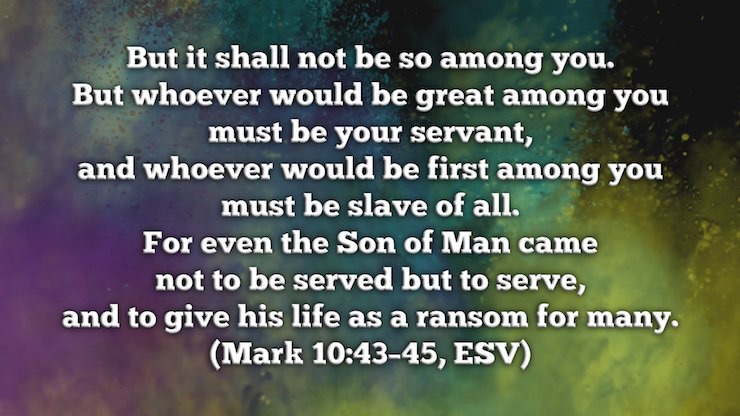
“The Son of Man came not to be served but to serve, and to give his life a ransom for many” (Mark 10:35-45). So Jesus instructs his followers, after a bruising encounter with James and John, two of the leading followers of Jesus (10:35-40) which enraged the rest of the disciples (10:42).

The dispute was over status; James and John wanted to claim the places next to Jesus: “one at your right hand and one at your left, in your glory” (10:37). This was not unusual in the world of that time (indeed, this is still the case in our own times). Public debate that was intended to best the other person was common in ancient Mediterranean societies. Seeking greater honour (higher status) by getting the upper hand, or the last word, in public debate, was common.

In an honour—shame society, such as that in which Jesus, James, and John lived, the culture was characterised by a constant and ongoing “challenge—riposte,” enacted in the public arena. Jesus engaged in such challenges on a regular basis; see the disputations of 2:1-3:6, when Jesus was travelling around Galilee, and later during his time in Jerusalem, in 11:27-12:34.

Such challenge—riposte encounters typically involved the challenger setting forth a claim, through either words or actions; a response to the challenge by the persons who was challenged; then, after further back-and-forth amongst the participants, once the challenge and riposte has run its course, the verdict is declared by the public who was watching the encounter.

(For a clear description of this process, as it applies in Mark 11:27–12:34, using the analysis of Jerome Neyrey and Bruce Malina, see https://www.etsjets.org/files/JETS-PDFs/43/43-2/43-2-pp213-228_JETS.pdf)

At this moment, Jesus critiques the common process of public disputation; he distances himself from the common cultural practice of seeking honour and working for a higher status. Those who lord it over others, who act as tyrants, are not to be the role models for his followers; “it is not so among you; but whoever wishes to become great among you must be your servant, and whoever wishes to be first among you must be slave of all” (10:43–44).

Indeed, Jesus rubs salt into the wound by inferring that James and John were acting like Gentiles (10:52). That was an insult, to be sure, for good Jews (see the sayings attributed the Jesus at Matt 5:47; 6:7, 32).

This was the third time, after demonstrating their misunderstanding of what Jesus was teaching, that his disciples were directly rebuked for their attitude. First, Peter represents the disciples’ lack of clarity about Jesus (8:27–38); then a number of the disciples arguing about being great, and John fails to welcome the activity of a person casting out demons (9:33–48); and now, James and John demonstrate their continued inability to understand the attitude of Jesus towards status (10:35–40).

At least in this last scene, the other ten disciples are angry about what James and John have asked for (10:41). Far too often, on earlier occasions, Jesus has lamented that the disciples failed to understand (4:22, 13; 6:52; 7:18: 8:17, 21; 9:32). It seems that finally, at this moment, things had fallen into place for the disciples. (Or were they simply annoyed at the way the brothers promoted their own interests over the hopes of the other disciples?)

On each of those three occasions of misunderstanding, Jesus responds by correcting the inadequacies displayed by his followers: he refers to the fate that is in store for him in Jerusalem (8:31; 9:31: 10:32–34), and then he indicates that his followers must tread that same pathway of humility and submission (8:34–38; 9:35–37; 10:38–44). See

On this occasion, Jesus goes one step further. His own life—or, more precisely, the laying-down of his own life—is to be seen, not just as the model for his followers to emulate, but as “a ransom for many” (10:45). This will be the focus of a subsequent blog post. See

A ransom for many: a hint of atonement theology? (Mark 10; Narrative Lectionary for Lent 2)

The voice of the Lord, made manifest in Jesus (Matt 3; Epiphany 1A)

The readings that are collected for this coming Sunday seem to gather around the theme of “the voice of the Lord”. This is one of those Sundays when the selection of four readings clearly focusses on a topic found in each of them (in contrast to the many “ordinary” Sundays where each of the four readings follow their own independent lines).

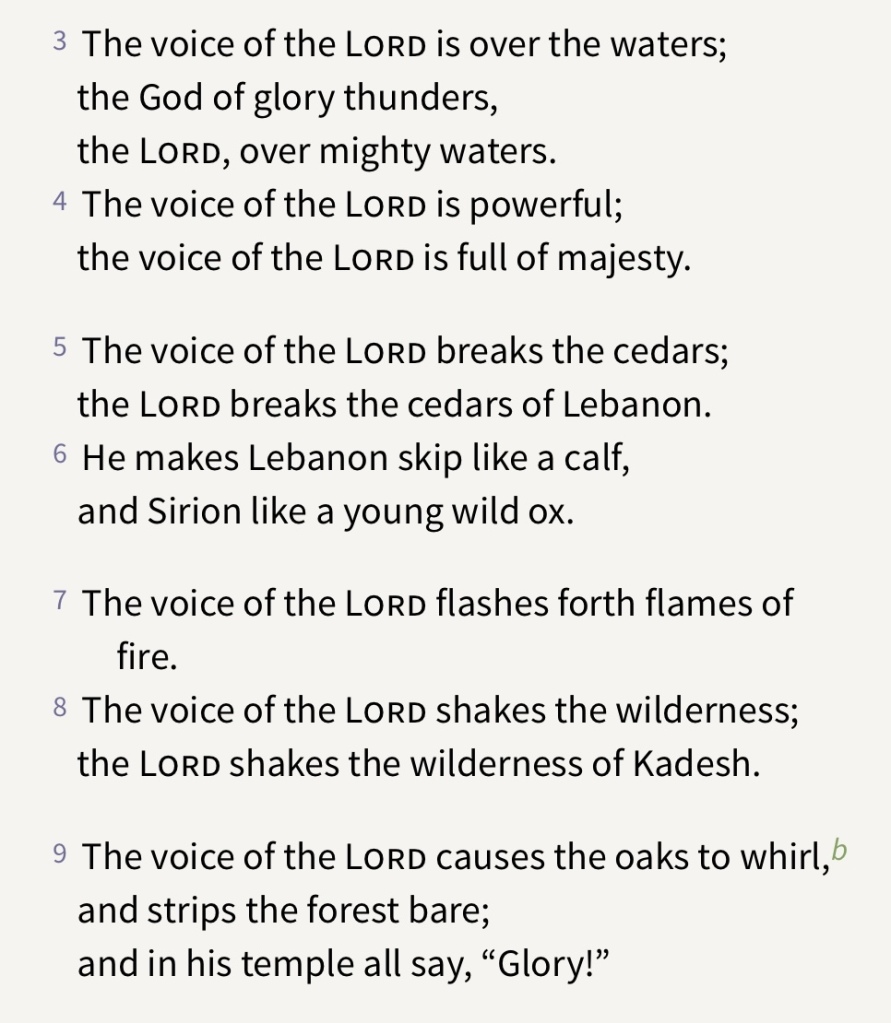
The theme of “the voice of the Lord” is sounded clearly in the psalm (Psalm 29), with a repeated refrain, “the voice of the Lord” through verses 3 to 9. First, the psalmist announces, “the voice of the Lord is over the waters; the God of glory thunders … the voice of the Lord is powerful; the voice of the Lord is full of majesty” (29:3–4).

Then follows a repeated affirmation, “the voice of the Lord breaks the cedars … the voice of the Lord flashes forth flames of fire … the voice of the Lord shakes the wilderness … the voice of the LORD causes the oaks to whirl, and strips the forest bare; and in his temple all say, ‘Glory!’” (29:5, 7–9). The message declared by the Lord God is conveyed by the natural order of things, in the elements of the creation, made by God (see Gen 1–2; Ps 104; and in this Sunday’s reading, Isaiah 42:5).

The speaking forth of God, made manifest and evident in God’s creation, is a fitting theme for the first Sunday in the season of Epiphany—a season that celebrates the shining forth, the manifestation, of God. However, this Sunday is designated, not only as the first Sunday in the season of Epiphany, but also as the day on which The Baptism of the Lord is recalled.

In the Gospel selection (Matt 3:13–17), the first evangelist reports that the Spirit of God “descended on [Jesus] like a dove” (3:16) as Jesus was baptised by John in the River Jordan. At that event, “a voice from heaven said, ‘This is my Son, the Beloved, with whom I am well pleased’” (3:17). The voice of the Lord is clear and prominent in this account of what was likely to have been the commissioning event for Jesus as he started into his public activities in the region of Galilee (Matt 4:12–25, and on until 19:1).

In the reading from Acts, in place of a section of an epistle, we hear Luke’s report of a speech of Peter, given in the house of the centurion Cornelius in Caesarea (Acts 1:34–43). In this speech, Peter announced how “the message spread throughout Judea, beginning in Galilee after the baptism that John announced; how God anointed Jesus of Nazareth with the Holy Spirit and with power” (Acts 10:38).

That message was to be continued by the disciples; Peter says that God “commanded us to preach to the people and to testify that he is the one ordained by God as judge of the living and the dead” (10:42). The voice of the Lord that has been heard in the early testimony (see Acts 2, 3, 7) continues through the later apostolic proclamation (see Acts 13, 17, 20).

Linked with this is the first of the four songs found in Second Isaiah (Isa 40–55) that are linked explicitly with the Servant (42:1–9; 49:1–7; 50:4–11; and 52:13–53:12). Here, the Servant is designated as the one in whom God delights (42:1); the phrase recurs in the message of the voice from the cloud which speaks at the baptism of Jesus, declaring that he is the one “with whom I am well pleased” (Matt 3:17). The Servant has God’s spirit within him (Isa 42:1), something which is directly enacted in the baptism of Jesus when he “saw the Spirit of God descending like a dove and alighting on him” (Matt 3:16).

The work of the Servant is to bring justice to the nations (Isa 42:1, 3, 4); that will be evident in the work of Jesus (Matt 12:18–21, quoting directly these verses from the first Servant Song). Through the Servant, the Lord calls people “in righteousness” (Isa 42:6); that call is echoed by Jesus as he calls his followers to demonstrate righteousness (Matt 5:20) and exhorts them to “strive first for the kingdom of God and his righteousness” (6:33). Indeed, the baptism of Jesus narrated by Matthew is said to have taken place “to fulfil all righteousness” (3:15).

Through the Servant, God establishes God’s people “as a covenant to the people, a light to the nations” (Isa 42:6); that charge is repeated by Jesus, who came as light shining in the darkness (Matt 4:15–16) and who equips his followers to be “the light of the world” (5:14–16), whose whole body will be “full of light” (6:23).

Through the Servant, God announces that “the former things have come to pass, and new things I now declare” (Isa 42:9); this is exemplified, according to Jesus, by “every scribe who has been trained for the kingdom of heaven [who] is like the master of a household who brings out of his treasure what is new and what is old” (Matt 13:52).

The identity of the Servant was debated in Israel; was this an individual, or a symbolic representation of the whole nation? The many resonances of the Servant Song in the story of Jesus indicate why Christian interpreters have identified Jesus as this servant. The story of his baptism provides a most appropriate occasion for underlining this connection. The shapers of the lectionary have thus linked these two passages on this Sunday, and set them into the context of passages declaring how “the word of the Lord” has been made manifest. It is a compelling start to the season of Epiphany.

The tongue of a teacher, to sustain the weary (Isaiah 50; Lent 6C)

“The Lord God has given me the tongue of a teacher, that I may know how to sustain the weary with a word” (Isa 50:4). So begins this Sunday’s Hebrew Scripture selection that is offered by the lectionary—yet another passage from the section of Isaiah which is set in the period when Israel was in exile in Babylon. We have read other passages from this section of Isaiah on Lent 3 and Lent 5.

In considering those passages (Isa 43 and Isa 55), we noted that the experience of exile was experienced as a time of great difficulty for the people of Israel. The hope for a return to the land of Israel was strong and insistent throughout those years of exile. The imagery in the verses immediately before this passage (50:2–3) clearly convey this bitter sense. Hope is waning amongst the people. There is a need for strong leadership.

In this section of the text, the anonymous prophet speaks of an unnamed figure who will take on this function. He is known as the Servant (50:10).

In this song, the Servant specifically identifies himself as a Teacher, to encourage the weary and offer them hope (50:4). The Teacher is resolute, determined, fully committed. Yet he encounters opposition, resistance, aggression. He is called to stand up for what is right in the face of opposition (50:8) as well as to endure the negativity and abuse from those opponents (50:6). The call he has received is not an easy task. It requires resilience, being able to see the long view in the midst of immediate setbacks. The Servant, says the prophet, has “set my face like flint” (50:7).

The use of the term Servant at 50:10 (as well as at 42:1; 49:3, 5, 6; 52:13; 53:11) means that this passage is one of four songs known collectively as The Servant Songs (42:1–9; 49:1–7; 50:4–11; and 52:13–53:12). The identification of the Servant is contested. Do the songs refer to an individual? Or is the term intended to refer to the collective experience of Israel, as a nation? Certainly the hardships and oppression of life under various empires—Egyptian, Assyrian, and Babylonian—would attest to this latter identification.

Another aspect which points to a collective understanding (the whole nation as the Servant of the Lord) is the occurrence of the imagery of light. Israel as “a light to the nations” (42:6; 49:6) reflects a national understanding, developing and extending the earlier sense that nations would come to Zion to worship God (Isa 2:2–4; Mic 4:1–4).

Both of these elements feed into the later Christian interpretation that these song provide a prefiguring of the person of Jesus, “the servant of the Lord” (Acts 3:13, 4:27). The way that Jesus was treated in his trials and on the cross resemble the mistreatment of the Servant—and worse. The insistent description of suffering in 52:13–53:12 particularly correlates with the sufferings of Jesus in his passion (Acts 8:32–33; 1 Peter 2:21–25).

And the universal extent of the “light to the nations” image is also deliberately applied to the way the message about Jesus spread across the world (Luke 2:29–32; Acts 13:47; 26:23). In Christian interpretation, the songs of the Servant are usually taken to provide a pointer to the fate of Jesus—dedicated to God, committed to his calling, speaking forth with passion, enduring opposition, being utterly humiliated and thoroughly abused, and dying an abject death. Yet the power of the figure of the Servant was such that—for Israel, and for followers of Jesus—the message and example of the Servant (be that Israel, or Jesus) lived on for centuries.

See also