“What do you wish me to do?” Interrogating the unlikely portrayal of Pilate (Mark 14–15; for Holy Week)

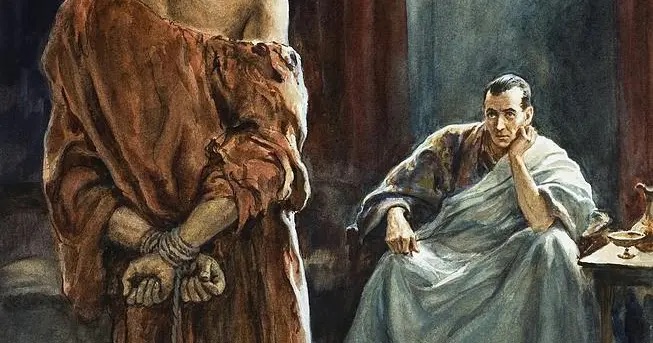
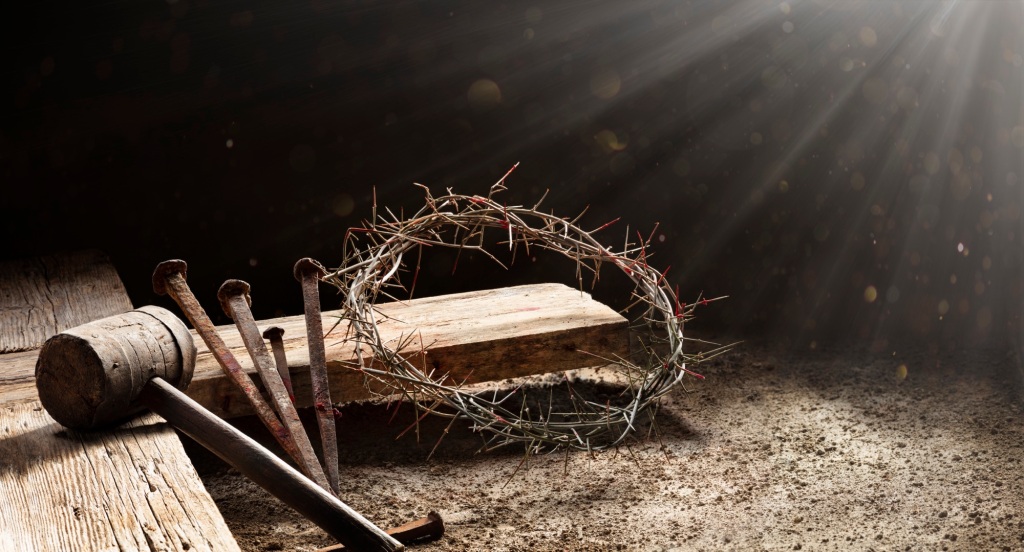
“What do you wish me to do?”, Pilate asks—according to the earliest account of his interaction with Jesus of Nazareth, recounted in the Gospel we attribute to Mark (although the narrative itself refrains from offering any identification of the author). Pilate, the Governor, representative of the mighty Roman Empire, asking a rag-tag crowd of Jews for advice on what he should do? Is there any historical plausibility in this scene which the unknown first century writer constructs?

I have had a number of discussions of this issue with my wife, Elizabeth Raine, whose knowledge of ancient authors and ancient Roman practices has been illuminating for the way we might understand the Gospel accounts. Much of what follows reflects those discussions.

“What do you wish me to do?” (Mark 15:12). It is not only this question that should cause us to question the narrative. Earlier, Pilate had seemed at a loss: “do you want me to release for you the King of the Jews?” (15:9). The narrative offers an explanation: “he realized that it was out of jealousy that the chief priests had handed him over” (15:10). And then it presses the point: “the chief priests stirred up the crowd to have him release Barabbas for them instead” (15:11), and so he asks the crowd, “what do you want me to do?” (15:12). For us, the question is: what do we make of this dithering, indecisive Pilate?

The narrative plays out the conflict by making sure that we understand Pilate has been cowed by the crowd, reporting that the crowd shouted at the Governor, “Crucify him!” (15:13). Instead of portraying the Governor as responding with all his imperial might, the narrative continues with Pilate asking a naïve question, “Why, what evil has he done?” (15:14a). To this, the crowd pressed still louder, “Crucify him!” (15:14b). And so, the denouement plays out: “Pilate, wishing to satisfy the crowd, released Barabbas for them; and after flogging Jesus, he handed him over to be crucified” (15:15).

We know that the Gospels were not written as “eye-witness accounts”. It would especially have been unlikely that one of the followers of Jesus was there, taking notes, as Pilate dealt with Jesus Barabbas and Jesus of Nazareth. The unlikelihood of this slim possibility is intensified by the comment in Mark’s Gospel, about the followers of Jesus, that “all of them deserted him and fled” (14:50). Clearly, the author envisages that none of those followers were there at this scene. (The reference to a group of women “who used to follow him and provided for him when he was in Galilee” refers, not to this moment in the sequence of events, but only to the later scene when Jesus is dying on the cross; see 15:40–41.)

We can’t treat the Gospels as actual “history-as-it-took-place”. We can’t treat the Markan account of Jesus before Pilate as historical. That is especially the case regarding the way that Pilate is portrayed. Most of our knowledge of Pilate outside the New Testament comes from the writings of the Romano-Jewish historian Flavius Josephus, who details many incidents during the governorship of Pilate, and Philo Judaeus, a learned Jewish philosopher living in diaspora in his Alexandria. The Pilate they describe is quite different.

Their Pilate is said to have displayed a serious lack of empathy for Jewish sensibilities, for example by displaying Roman battle standards in Jerusalem. Josephus writes, “On one occasion, when the soldiers under his command came to Jerusalem, he caused them to bring with them their ensigns, upon which were the usual images of the emperor. The ensigns were brought in privily by night, but their presence was soon discovered. Immediately multitudes of excited Jews hastened to Caesarea to petition him for the removal of the obnoxious ensigns. For five days he refused to hear them, but on the sixth he took his place on the judgment seat, and when the Jews were admitted he had them surrounded with soldiers and threatened them with instant death unless they ceased to trouble him with the matter.”

The story does end with Pilate backing down; but this is in the face of a large uprising, and not just in relation to one individual. Josephus continues, “The Jews thereupon flung themselves on the ground and bared their necks, declaring that they preferred death to the violation of their laws. Pilate, unwilling to slay so many, yielded the point and removed the ensigns.” (Josephus, Jewish War 2.169–174; Antiquities of the Jews 18.55–59)

Philo of Alexandria tells us that on other occasion Pilate dedicated some gilt shields in the palace of Herod in honour of the emperor. On these shields there was no representation of any forbidden thing, but simply an inscription of the name of the donor and of him in whose honour they were set up. The Jews petitioned him to have them removed; when he refused, they appealed to Tiberius, who overrode the governor, ordering that they should be removed to Caesarea. (Philo, Legatio ad Gaium, 38)

Josephus also reports how Pilate appropriated Temple funds for the construction of an aqueduct: “At another time he used the sacred treasure of the temple, called corban (qorban), to pay for bringing water into Jerusalem by an aqueduct. A crowd came together and clamoured against him; but he had caused soldiers dressed as civilians to mingle with the multitude, and at a given signal they fell upon the rioters and beat them so severely with staves that the riot was quelled.” (Josephus, Jewish War 2.175–177; Antiquities of the Jews 18.60–62)

Pilate may possibly have responded harshly to the unrest in Jerusalem during the Passover in 33 CE, because, due to other political machinations at that time, the powerful neighbouring Roman province of Syria was unable to provide him military support, as usual. (This the hypothesis that Elizabeth has developed; I think it makes sense.) Pilate wanted to suppress the potential uprising before it got momentum.

We do know that in approximately 36 CE, Pilate used arrests and executions to quash a Samaritan religious uprising. After complaints were then made to the Roman legate of Syria, Pilate was recalled to Rome; he is believed to have later committed suicide.

So, we can see that the character of Pilate in other ancient texts beyond the earliest Christian texts is far more ferocious and determined than how he is depicted in the Gospels; and, indeed, he is antagonistic towards Jews in particular. His vascillation, and his bowing to the shouted demands of the crowd, do not correlate with the character of the figure to which these two Jewish writers attest.

Thus, there is a clear political improbability to the account found in Mark’s Gospel—indeed, in all four Gospels, whose authors each strengthen the Markan portrayal. Matthew has Pilate wash his hands of his decision, saying, “I am innocent of this man’s blood; see to it yourselves” (Matt 27:24). Luke has Pilate declare that Jesus was innocent not once, but three times (Luke 23:4, 14, 22). And John’s Pilate engages in a philosophical discussion with Jesus (John 18:33–38) and questions him further, seeking to find a way to excuse him (John 19:8–12), before bowing to the pressure of the crowd (John 19:13–16).

So Pilate as we know him from other accounts was a ferocious and fearless leader whose strength of character is made clear by the numerous times that, according to Josephus, he sent in his troops to quell an uprising, to scatter a crowd, to squash a rebellion.

American scholar Bart Ehrman concludes that Pilate “was a brutal, ruthless ruler with no concerns at all for what the people he governed thought about him or his policies. He was violent, mean-spirited, and hardheaded. He used his soldiers as thugs to beat the people into submission, and he ruled Judea with an iron fist.” (See https://www.patheos.com/blogs/rationaldoubt/2019/05/pilate-released-barabbas-really/)

Surely Pilate would not have been cowed by the crowd in Jerusalem for Passover? Had he wanted to act, he would simply have ordered his troops to attack, scatter the crowd, and disperse the built-up tension. The Gospel accounts of Pilate, across all four narratives, are improbable; the apologetic purpose (to show the Romans in a better light, to avoid being seen as an agitator or rebel, and to place the blame on the Jewish authorities) becomes clear, when we read in this way. We need to bear all of this in mind, as we read and listen to the familiar narrative this Easter, and each Easter.

Would a Roman Governor ask a Jewish crowd for advice? That would be an untenable act, completely undermining his authority. Would a Roman Governor release a known insurrectionist from his sentence? There is no known precedent for this—indeed, no evidence at all, apart from the Gospels, of this practice. It is historically implausible (particularly in the light of the fact that Barnabas means “son of God”).

On the (mythological) story of Barabbas:

Would a Roman Governor be so under the control of the Jewish Sanhedrin to act in this way? Especially since it was Rome which appointed the High Priest; it was the Jewish hierarchy which needed to do as Rome commanded. In the earliest account, Pilate questions the crowd as to whether he should sentence Jesus (Mark 15:5, 14). The same question is noted in Matt 27:23. By the time of Luke’s Gospel, he speaks a clear threefold affirmation of the innocence of Jesus (Luke 23:4, 13–16, 22).

By the fourth Gospel, the scene where Jesus is brought to Pilate is changed from a trial to a philosophical discussion (John 18:29–31, 38). Pilate (quite uncharacteristically) backs down in the face of a baying crowd (Mark 15:6-15, and parallels). In Matthew’s account, Pilate enacts the potent symbol of washing his hands of the whole affair (Matt 27:24).

The Jewish Sanhedrin, by contrast, is placed firmly in the firing line. All four Gospels tell the story in the same way: the central factor that leads to Jesus being condemned to death is the decision of the Jewish Sanhedrin (Mark 14:63-64, and parallels), and their agitation amongst the crowd (Mark 15:11; Matt 27:20; Luke 23:13-16; John 18:38b-40). Mind you, the Gospel accounts are also on shaky historical ground in the way they describe the actions of the Sanhedrin. See

So another relevant question is: Would a follower of a man put to death under Roman rule for treason write a narrative which placed the blame squarely on the shoulders of the Roman Governor? I can see exactly why the Gospel writers sought to move the blame away from Pilate, onto the Jewish leadership in Jerusalem. Yes, Jesus was crucified by order of the Roman Governor (Mark 15:15 and parallels); but his hand was forced, they say.

So, with supreme irony, the inscription set over Jesus identifies him as King of the Jews (Mark 5:26). Ironic, because the inscription was ordered by Pilate, the Roman Governor over Judea—and Romans did not honour kingship, did not value kingship. Their rulers were Caesars, not Kings, elected by the Senate, not inherited by birth. The irony of the way that this story is told is that the Roman Governor apparently recognises the kingship of Jesus. The reality of the moment was that the Governor recognised a threat to the power of Rome, and acted to quell that.

In Luke, the Roman soldiers at the cross taunt Jesus, saying, “If you are the King of the Jews, save yourself!” (23:37)—a taunt provoked by the sign that was affixed to the top of the cross, bearing an inscription that read, “This is the King of the Jews” (23:36). That inscription; although it is intended to identify Jesus, is actually a statement of power and authority, made by Governor Pilate on behalf of the Roman Empire which he served. In the end, he asserts his authority. The Roman Governor has a pretender King put to death for treason. That much, I believe, can be retrieved as bedrock history, nestled within this rather fanciful narrative.

And so, in the end, even the Gospel accounts attest to the reality of Roman power. Their constant presence, their marching legions, their brutal commanders, intervening to execute their bloodthirsty justice … and their governor, Pilate, as fierce and rough and unbending as any governor ever known, ensured that Jesus went to his death.

Reflecting on scripture for Good Friday

We are offered an abundance of richness in the scripture passages that the lectionary proposes for our use during the coming week. The passages in the opening days of Holy Week help us to prepare for what follows over the Easter weekend. As well as passages for each day in Holy Week, there is a collection of four important passages that are offered for Good Friday: Isaiah 52–53, Psalm 22, Hebrews 4–5, and the full passion narrative of John’s Gospel.

Unlike the majority of Sundays throughout the year, when the selections in each category (First Reading, Epistle, Gospel) run largely in parallel and do not regularly correlate with one another—except for the choice of Psalm on many Sundays—these four readings have been chosen deliberately to focus in on a common theme, as befits the day, Good Friday.

The first passage comes from prophetic words within the second main section of Isaiah (chs. 40—55), known as Deutero-Isaiah. These chapters are fundamental for the theological developments that we find in the New Testament. In these chapters, Israel,is addressed as “my servant, Jacob, whom I have chosen,the offspring of Abraham, my friend; you whom I took from the ends of the earth, and called from its farthest corners” (Isa 41:8–9; see also 42:1; 43:10; 44:1–2, 21; 45:4; 48:20; 49:3, 5–6; 52:13; 53:11).

Scattered through this section, we find four oracles known as the Songs of the Servant—three relatively brief (42:1–9; 49:1–7; 50:4–11); and the fourth, best-known within Christian circles, a longer description of the servant who “was despised and rejected by others; a man of suffering and acquainted with infirmity” (Isa 52:13–53:12).

The resonances that this longer song has with the passion narrative of Jesus are crystal clear. The song is explicitly linked with Jesus six times in the New Testament (Matt 8:14–17; Luke 22:35–38; John 12:37–41; Acts 8:26–35; Romans 10:11–21; 1 Pet 2:19–25); furthermore, so many of the details of the passion narrative are shaped in the light of this song, along with a number of psalms of the righteous sufferer. (See https://johntsquires.com/2021/03/22/3-mark-placing-suffering-and-death-at-the-heart-of-the-gospel/)

The prophet describes the marred appearance of the Servant (52:14); he is despised, rejected, and suffering (53:3), bearing our infirmities (53:4), and wounded for our transgressions (53:5). The Servant is led like a lamb to the slaughter (53:7), suffering “a perversion of justice” (53:8). We can hear clear prefigurings of the passion of Jesus.

Furthermore, the Servant does not act with violence nor speak deceit (53:9). He is buried with the rich (53:9); the song declares that he gives his life as “an offering for sin” (53:10), carrying the iniquities of many (53:11), making them righteous (53:11), bearing the sin of many (53:12), making “intercession for the transgressors” (53:12). The resonances with the way that the death of Jesus is understood in later Christian theology are strong.

The narrative of the death of Jesus that Mark narrates in his passion narrative (and which was offered for last Sunday’s Passion Sunday) relates Jesus to the figure of the righteous person who suffers injustice, who appears in various Hebrew Scripture passages beyond this fourth, and longest, Servant Song. The author of this Gospel takes great pains to show that Jesus sought to remain faithful to his calling despite the pressures he faced, just as the righteous sufferers of old also held to their faith.

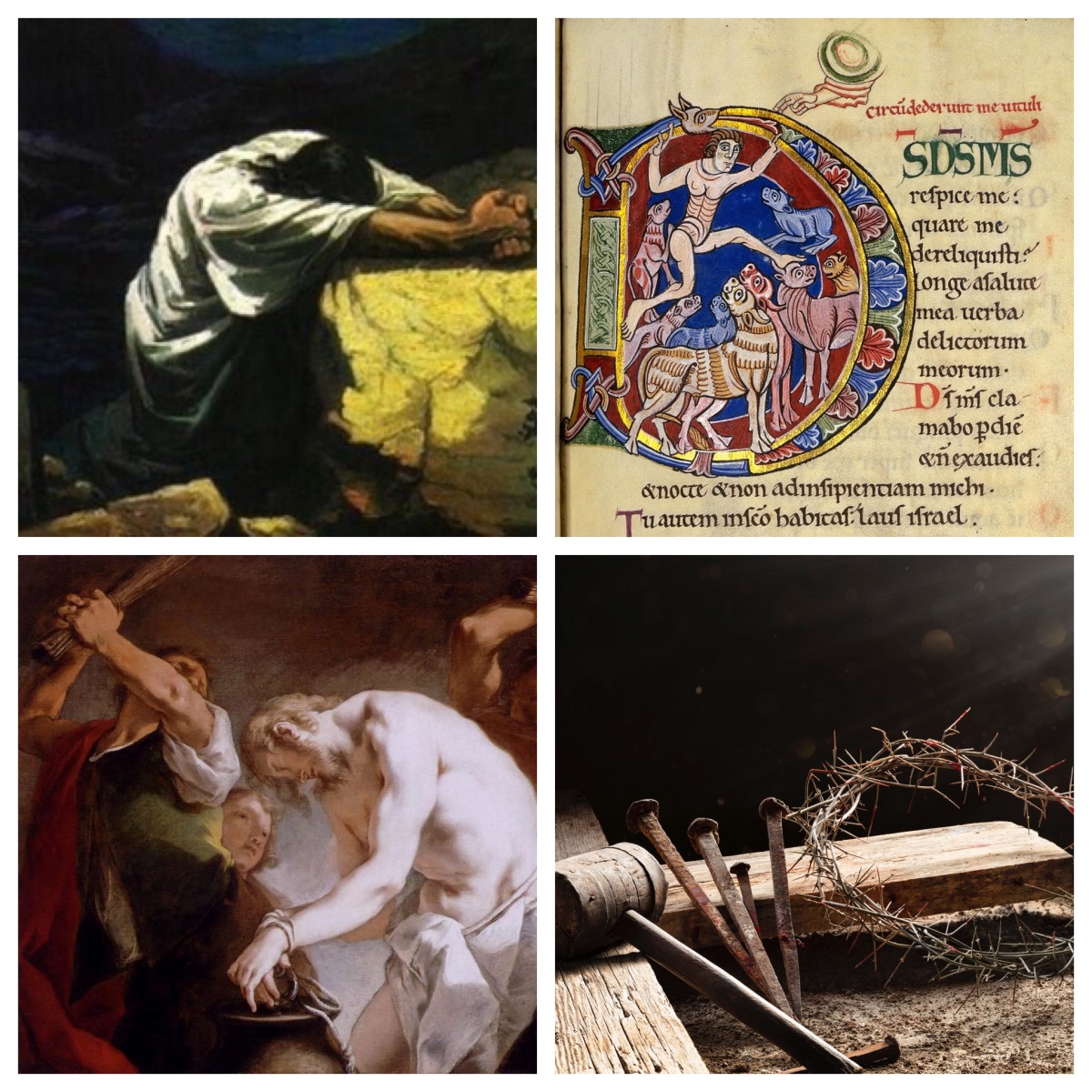
The Gethsemane scene draws on imagery from Hebrew Scripture to underline this. The narrative evokes the suffering of the faithful righteous person, referring especially to some phrases found in the Psalms. The Golgotha scene also contains this orientation. What takes place is interpreted with reference to scripture; here, the allusions are both subtle, and more direct.

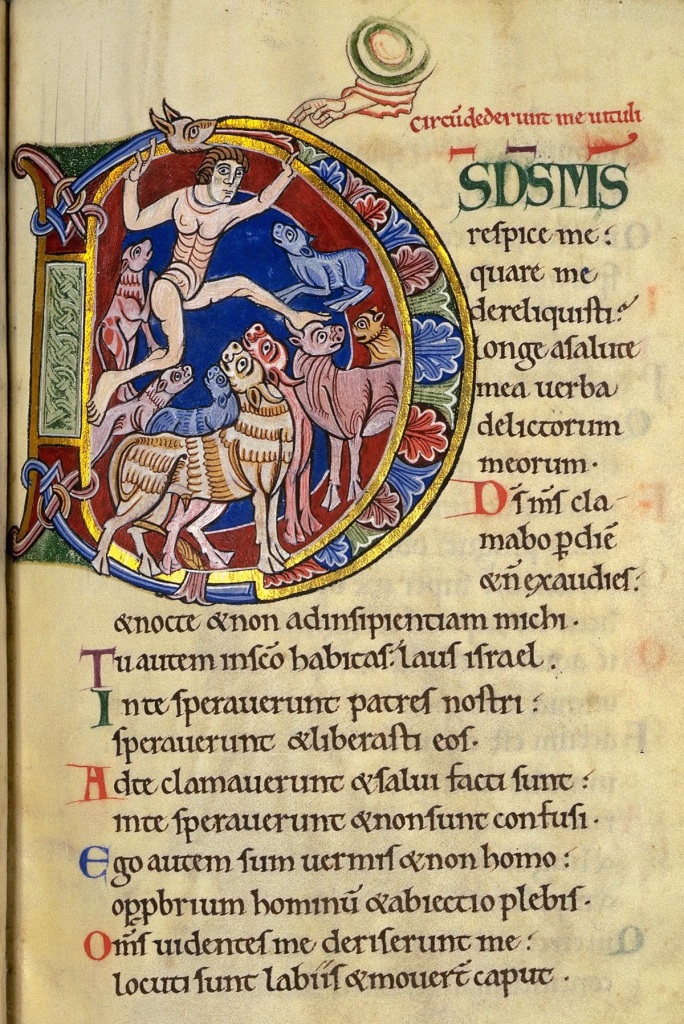
However, at the end, Jesus appears to lament that God has abandoned him; yet the cry which Jesus utters at the ninth hour, Eloi, Eloi, lama sabachthani (15:34), is a clear reference to Psalm 22, one of the psalms of the righteous sufferer, as he quotes its first verse.

Psalm 22:1-8 in the St. Albans Psalter.
The first words of the Psalm in the Latin Vulgate are
Deus, Deus meus, abbreviated here as DS DS MS.

This is the Psalm, unsurprisingly, which the lectionary offers for Good Friday. It is a psalm of individual lament, as the psalmist reflects the wretched condition of a person who is suffering unjustly, crying out, “why are you so far from helping me, from the words of my groaning? … I am a worm, and not a human … all who see me mock at me; they make mouths at me, they shake their heads …. I am poured out like water, and all my bones are out of joint; my heart is like wax; it is melted within my breast; my mouth is dried up like a potsherd, and my tongue sticks to my jaws; you lay me in the dust of death.” (Ps 22:1, 6, 14–15). It is a psalm most suitable to,shape our reflection as we hear the narrative of crucifixion and death on Good Friday.

Two passages from Hebrews are suggested by the lectionary for this day. The “word of encouragement” to the Hebrews is best known for its thoroughly theological explanation of the death of Jesus as both the new high priest and also the sacrifice supreme. It is strongly supercessionist in its dismissal of the Jewish sacrifical system that was practised in the Temple; it posits that Jesus and his sacrifice replaces all of that. We need to take great care as we preach on such passages!

The first section of Hebrews that is offered for Good Friday (Heb 10:16–25) affirms “the confession of our faith” which is offered by the writer in response to God’s fidelity to the covenant in which “I will put my laws in their hearts, and I will write them on their minds” (10:16, quoting Jer 31:33b). This covenant provides “confidence” as it assures believers that “our hearts [are] sprinkled clean from an evil conscience and our bodies [are] washed with pure water” (10:22).

The writer affirms that “he who has promised is faithfully (10:23), for God asserts “I will remember their sins and their lawless deeds no more” (10:17, quoting Jer 31:34b). This understanding of the significance of the death of Jesus, as God’s chosen victim who effects redemption, plays a key role in the development of an understanding of the atonement in later generations. The writer rejoices with his audience that they have “our hearts sprinkled clean from an evil conscience and our bodies washed with pure water” (10:22).

The other excerpt from Hebrews (4:14–16; 5:7–9) provides two brief snapshots of Jesus. These two excerpts focus more on the humanity of Jesus, helping us to enter more fully into the Good Friday story. Jesus is tested as we are, yet has the strength of character not to submit to sin (4:15). The effect of the story of his passion in light of this would therefore be to provide the exemplar supreme for faithful people, holding fast in the midst of suffering.

This letter also indicates that Jesus knew the anguish and despair of human tragedy, as he prayed “with loud cries and tears” (5:7). Submission, suffering, and obedience lead, for Jesus, to perfection (5:9), making him “the source of eternal salvation for all who obey him” (5:10). As we reflect on this story from centuries ago, may we know the same dynamic, moving us from our sufferings into a sense of God’s salvation.

Last week, the lectionary offered Mark’s account of the passion of Jesus, in preparation for Passion Sunday. On Good Friday the whole story is offered again for our reflection on those events, from John’s account, which has some distinctive features. As we consider the significance of the death of Jesus, the comment in 18:14 (hearking back to 11:50) provides a classic political (and theological) insight. Jesus then asserts that “I have always taught in synagogues and in the temple … I have said nothing in secret” (18:20). His words and life are for all.

When he is before Pilate, rather than being silent (Mark 15:5), Jesus here engages in a quasi-philosophical debate about kingship and truth which is reported only in John’s Gospel (John 18:33–38; 19:8–12). Mocked by the Roman soldiers as a king (19:1–3), Jesus is sentenced by the Roman Governor under the ironic accusation, “King of the Jews” (19:15, 19–22). The irony in this title is made clear by the Johannine author’s observation that “the chief priests of the Jews said to Pilate, “Do not write, ‘The King of the Jews,’ but, ‘This man said, I am King of the Jews.’ ” (19:21).

Distinctive to John’s account is the presence of the mother of Jesus and the beloved disciple (19:25–27), witnessing a majestic final moment for Jesus. “It is finished” (19:30), the final word of Jesus in this Gospel, is better translated, “It now comes to complete fulfilment”, a recognition that now “the hour has come for the Son of Man to be glorified” (12:23).

The whole sequence of events recounted in this narrative (John 18–19) is understood as fulfilment of scripture (19:24, 28, 36, 37). God’s will is done. That is the ultimate perspective that this particular narrative offers each Good Friday.

“All of them condemned him as deserving death.” Interrogating the unlikely narrative of the Council (Mark 14; for Holy Week)

“They took Jesus to the high priest; and all the chief priests, the elders, and the scribes were assembled” (Mark 14:53). That’s how the author of the good news of Jesus the chosen one reports the scene when the fate of Jesus is sealed (Mark 14:53–65). Accused of predicting that the Temple would be destroyed (14:58), Jesus is interrogated by the high priest (14:60–63) before the declaration is made: “you have heard his blasphemy!” (14:64).

After further consultation by the chief priests “with the elders and scribes and the whole council”, Jesus is led away to Pilate, the Roman Governor (15:1). And so the fateful course of events is set in motion—questioned by Pilate, sentenced to be crucified, nailed to a cross where he dies, and the the lifeless body of Jesus is handed over to some of his followers (15:2–47).

The other evangelists follow suit. One notes that “the assembly of the elders of the people, both chief priests and scribes, gathered together, and they brought him to their council” (Luke 22:66), another specifies that “they took him to Caiaphas the high priest, in whose house the scribes and the elders had gathered” (Matt 26:57). The fourth gospel reports that “first they took him to Annas, who was the father-in-law of Caiaphas, the high priest that year” (John 18:13), and subsequently “Annas sent him bound to Caiaphas the high priest” (John 18:28).

The account of the time that Jesus spent being interrogated by them Jewish leadership appears, on the surface, to be an objective account of what transpired in that meeting. The council was the Great Sanhedrin, the supreme religious body in Israel during the Second Temple period—from the time when the exiles returned to the land under Nehemiah, until the destruction of the Temple in the year 70 CE. See more at https://www.jewishvirtuallibrary.org/the-sanhedrin

The source of the narrative in Mark 14 is unclear; indeed, the narrator has emphasised just before reporting on this meeting that when Jesus was seized in the garden by “a crowd with swords and clubs [who had come] from the chief priests, the scribes, and the elders” (14:43), after a token display of resistance (14:47), “all [of his followers] deserted him and fled” (14:50).

The narrator underscores this with a tantalising glimpse of the figure whom I (anachronistically) call “the first Christian streaker”— “a certain young man [who] was following him” who escaped the grasp of those in the crowd, shedding his linen cloth, “and “ran off naked” (14:51–52). And Peter, most pointedly, was outside the chamber, warming himself by the fire (14:54), and denying that he even knew Jesus—not once, but three times (14:68,70,71). There was nobody—absolutely nobody—from amongst the followers of Jesus who was present to witness what transpired as Jesus was brought before “the chief priests and the whole council” (14:55).

So how do we know what happened in that council meeting?

Further exploration of the scene is warranted. Such further examination might well consider some key factors. When did the council meet? Where did they meet? How did they conduct their business? And how did they come to a decision about Jesus?

To guide any exploration of these matters, scholars have turned—with due caution—to a Jewish text which sets out the designated procedures for a meeting of the Jewish council at which serious matters such as blasphemy were considered. The due caution is warranted, because the text is found in the Mishnah, a document written early in the third century CE—thus, almost 200 years after the time when Jesus was said to have been brought before the council. Did the provisions of this 3rd century text apply in the 1st century?

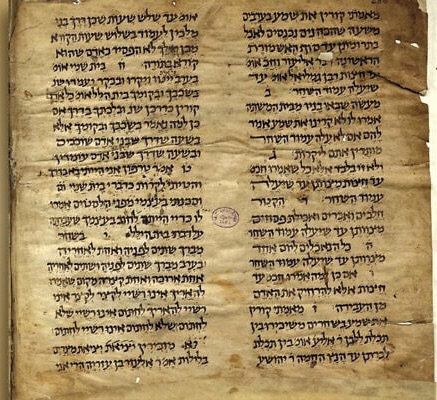
The opening page of the Kaufmann manuscript of the Mishnah, the most complete early manuscript of the Mishnah,
dated to the 10th or 11th centuries CE.

And such caution is intensified by the fact that the Mishnah is written at a time long after most Jews had been expelled from Jerusalem. This expulsion was finalised during the abortive uprising by Bar Kochba in 132–135 CE. Indeed, the book was written well after the time when the Sanhedrin had ceased to function as the peak legislative and judicial body in Jerusalem. After the failed war against the Romans of 66—74 CE, there was no longer any such body operating in Jerusalem. Yet 150 years later, a text was written that set out specific details of how the council was to function.

So some interpreters claim that this account is simply to be seen as an idealistic, romanticised recreation of “how things used to be”, expressed in such a way that is oblivious to the reality of the time—that there was no longer a functioning Sanhedrin in Jerusalem.

Alongside these notes of caution, we must hear also the claim that is made, not just about this text, but about many texts within the body of rabbinic literature that survives, from first through to sixth centuries. That claim is that, in an oral culture such as Second Temple Judaism and Rabbinic Judaism, where stories and laws and prescriptions and debates were passed on by word of mouth, from teacher to student, from that student to their student, and so on—the reliability and historical validity of what is written can be assessed positively.

For a more detailed discussion of the oral Torah, see https://www.jewishvirtuallibrary.org/the-oral-law-talmud-and-mishna

For myself, given what I have learnt in recent years about the importance and validity of stories and laws passed on over time in the oral cultures of First Nations peoples in Australia, I am inclined to accept this positive assessment of the ancient Jewish oral traditions in general, although specific texts are always open to informed critical exploration of their details.

I’m aware also, from discussions that have happened in the Uniting Church Dialogue with Jewish People that Elizabeth and I were members of for some years, that many rabbis today, who know their sacred texts well, consider that the Gospel narratives about this scene cannot be historical—for reasons that will be explored in what follows.

So, what does this text from the Mishnah say about a council meeting called to interrogate a possible criminal, such as we find in the Gospel narratives about Jesus? The relevant passages are in chapters 4 and 5 of tractate Sanhedrin, a part of the fourth order, Nezikin, which deals with Jewish criminal and civil law and the Jewish court system. And a comparison between the Gospel narratives and the Mishnah provisions raises a number of problems.

At night

The first matter is that the meeting with Jesus took place at night. Earlier, the narrator of Mark’s account has reported that the disciples “prepared the Passover meal; when it was evening, he came with the twelve” (14:16–17). Some hours later, after Jesus is apprehended in the Garden, he is taken to “the high priest … the chief priests, the elders, and the scribes” (Mark 14:53). It is still night when that meeting takes place. After coming to their decision that Jesus was “deserving death”, (14:64), the narrator notes that “as soon as it was morning, the chief priests held a consultation with the elders and scribes and the whole council” (15:1a).

So this meeting took place at night. But Mishnah Sanhedrin 4:1 states, “in cases of capital law, the court judges during the daytime, and concludes the deliberations and issues the ruling only in the daytime.” A court meeting at night, to determine a matter in which a person is determined to be “ deserving death”, is contrary to this provision.

The same section of the Mishnah also states that “in cases of capital law, the court may conclude the deliberations and issue the ruling even on that same day to acquit the accused, but must wait until the following day to find him liable” (Sanhedrin 4:1). Coming to a decision of guilty in the same session as the evidence is heard, without an overnight pause for the members of the council to consider, was also contrary to what was required. In the case of Jesus, this provision has been breached.

On a feast day

A second matter is that the meeting with Jesus took place during a festival. The whole sequence of events begins “on the first day of Unleavened Bread, when the Passover lamb is sacrificed” (14:12). At the end of their interrogation of Jesus, the narrator notes that “they bound Jesus, led him away, and handed him over to Pilate” (15:1b), and then observes that “at the festival he used to release a prisoner for them, anyone for whom they asked” (15:6).

Again, the provisions in Sanhedrin 4:1 state that “since capital cases might continue for two days, the court does not judge cases of capital law on certain days, neither on the eve of Shabbat [Sabbath] nor the eve of a Festival.” So the Markan narrative is in breach of this provision as well, by reporting that this meeting took place during Passover.

In the lack of evidence for this custom of releasing a prisoner at Passover, see more at

In the house of Caiaphas

Where exactly did this interrogation of Jesus take place? The implication in Mark is that the council was meeting in the house of Caiaphas. “Peter had followed him at a distance, right into the courtyard of the high priest; and he was sitting with the guards, warming himself at the fire” (14:54). This implication is made explicit at Matt 26:57 (“they took him to Caiaphas the high priest, in whose house the scribes and the elders had gathered”) and Luke 22:54 (“bringing him into the high priest’s house”).

Once more, this flies in the face of the prescriptions of tractate. Later in the tractate Sanhedrin, there is a reference to “the Sanhedrin of seventy-one judges that is in the Chamber of Hewn Stone” (Sanhedrin 11:2). This means the meeting should have taken place in this part of the Temple; in the Babylonian Talmud, it is stated to have been in the north wall (b.Yoma 25a). The Gospel narratives locate the meeting with Jesus in the house of the high priest; this is a third breach of the Mishnaic provisions.

The witnesses did not agree

A fourth issue is the observation that Mark makes and then repeats, that “many gave false testimony against him, and their testimony did not agree. Some stood up and gave false testimony against him … even on this point their testimony did not agree” (14:56–59).

Tractate Sanhedrin requires a verdict to be made only if the witnesses are in agreement, declaring, “At a time when the witnesses contradict one another, their testimony is void” (Sanhedrin 5:2). In a later rabbinic text, the Talmud, this requirement is expanded: “afterward they bring in the second witness and examine him in the same manner. If their statements are found to be congruent the judges then discuss the matter” (b.Sanhedrin 29a). This clearly did not occur in the case of Jesus.

A page of the Babylonian Talmud, showing how
the central text of Mishnah (in large print)
is then commented upon in Gemara (in medium print)
and later medieval notes (in small print)
surround these in the margins.

These various matters would seem, on the surface, to indicate that the members of the council were so panicked by Jesus that they acted to condemn him with flagrant disregard for their own provisions—assuming that the later text of the Mishnah does, in fact, describe the requirements in place in the first century.

An alternative explanation is that the narrative was compiled by someone who was ignorant of these provisions, and they simply “made up” a narrative which demonstrated the desperation of the Jewish authorities to deal with Jesus and have him out of the way.

We should place this view alongside the observation that the narratives in the Gospels take a number of steps to minimise the blame that Pilate must bear for sentencing Jesus to he crucified.

On the flawed picture of Pilate in the Gospels and the implausibility of the role assigned to him in these accounts, see

Minimising the culpability of the governor of the imperial power in these events, and strengthening the role of the Jewish authorities, go hand-in-hand. A clear apologetic purpose is at work in this narrative. It made sense for the narrator to avoid further condemnation by Rome, which held continuing power during the time he was writing, and to magnify the blame of the Jewish authorities, with whom the fledgling movement of followers of Jesus had been in increasing tension and conflict.

In other words, the narrative of this trial before the Sanhedrin is both historically implausible, and apologetically purposeful, as it shifts the blame for sentencing Jesus more onto the Jewish authorities than on Pilate. And in a later scene, it is the Jewish crowd which calls for Pilate to hand down the sentence of death (“crucify him! crucify him!”, 15:13–14). That is a most unlikely occurrence, indeed.

And so another element grew in the developing Christian ideology which placed the blame for the death of Jesus on the Jewish authorities (and sadly, in later centuries, on “the Jews” themselves). It is a view that we would do well to reject.

See also

I did not hide my face from insult and spitting (Isa 50 and the Passion Narrative; Lent 6B)

The passage of Hebrew Scripture we hear this coming Sunday (Isa 50:4–9a) is a significant passage. It comes from the second section of this long book (Isa 40—55), which opens with the familiar song, “comfort, comfort all my people” (Isa 40:1). Widely considered to be written in a period later than the earlier section (Isa 1—39), this section of Isaiah is called Second Isaiah. (The third main section, chapters 56—66, is called Third Isaiah.)

The comfort sung about by the prophet speaks to the situation of the people: their forebears had been taken into exile by the Babylonians in 587 BCE, and now a new generation (perhaps four to five decades later) yearns to return to the land of Israel, given to the people in ancient times, as recounted in the foundational myth—story of the Exodus. Other parts of the Hebrew Bible reflect the anguish of the people during their time of Exile (Ps 137 is the most famous instance). Deutero-Isaiah, however, focuses consistently on the hope of return to the land of Israel.

Looking to the new power of Persia to permit this return, the prophet of this later period speaks with hope and joy, to the people living in exile, using vivid imagery and dramatic scenes of promise and confidence. A joyous, positive tone runs right through the oracles in this section of Isaiah. “I am about to do a new thing”, says the Lord; “I will make a way in the wilderness and rivers in the desert” (43:19). “I will pour water on the thirsty land and streams on the dry ground”, the Lord continues; “I will pour my spirit upon your descendants, and my blessing on your offspring” (44:3).

Deutero-Isaiah is fundamental for the theological developments that we find in the New Testament. Scattered through this section, we find four Songs of the Servant—three relatively brief (42:1–9; 49:1–7; 50:4–11); and the fourth, best-known within Christian circles, a longer description of the servant who “was despised and rejected by others; a man of suffering and acquainted with infirmity” (Isa 52:13–53:12).

The resonances that this longer song has with the passion narrative of Jesus are crystal clear. The song is explicitly linked with Jesus six times in the New Testament (Matt 8:14–17; Luke 22:35–38; John 12:37–41; Acts 8:26–35; Romans 10:11–21; 1 Pet 2:19–25); furthermore, so many of the details of the passion narrative are shaped in the light of this song, along with a number of psalms of the righteous sufferer. (See

The third of these songs, which we hear this coming Passion Sunday, portrays the speaker as a Teacher. The resonances of this song with the story of Jesus are also clear. The punishment experienced by the Teacher—his back is struck, his beard is pulled, he is insulted, people spit on his face (Isa 50:6)—is echoed in the punishments inflicted on Jesus by Roman soldiers and Jewish passers-by. He is struck with a reed by Roman soldiers and spat upon (Mark 15:19). He is insulted by passers-by and the Jewish authorities (Mark 15:29–32).

The lectionary offers us this passage for Passion Sunday, a time when we reflect at some length on the passion of Jesus, which we recall also each Good Friday. The lectionary also offers the full story of the fate of Jesus after he entered Jerusalem at Passover. This part of the Gospel story (chapters 14–15 in Mark) is known as the passion narrative, because it tells about what Jesus suffered in his final days. (“Passion” comes from the Latin word passio, meaning suffering.)

The author of the beginning of the good news, which we know as Mark’s Gospel, seems to have been the first person (as far as we know from the evidence) who drew together a number of expressions about the way of Jesus, and worked them into a single, cohesive whole, in a continuous narrative style.

This narrative recounts the death of Jesus by relating it to the figure of righteous person who suffers injustice, who appears in various Hebrew Scripture passages. The author of this Gospel takes great pains to show that Jesus remains faithful to his calling despite the pressures he faces, just as the righteous sufferer of old also held to their faith.

The Gethsemane scene (Mark 14:32–42) draws on imagery from Hebrew Scripture to underline this. The narrative evokes the suffering of the faithful righteous person, referring especially to some phrases found in the Psalms. The Golgotha scene (Mark 15:21–41) also contains this orientation. What takes place is interpreted with reference to scripture; here, the allusions are both subtle, and more direct. The cry which Jesus utters at the ninth hour, Eloi, Eloi, lama sabachthani (15:34), is a clear reference to Psalm 22, by quoting its first verse. See more at

The offering of Isa 50:4–9a thus “fits” with the way that the author of the Markan passion narrative presents to story of the final hours of Jesus. His intense feeling of the agony inflicted on him, and yet his steadfast grappling with the faith he holds, is to the fore. The story invites us into sombre meditation as we approach the annual return of Easter.

A new and right spirit (Ps 51; Lent 5B)

“Put a new and right spirit within me”, the psalmist sings (Ps 51:10), in the psalm that is offered by the lectionary for this coming Sunday, the Fifth Sunday in Lent, as a companion piece for the well-known Hebrew Scripture passage for this Sunday about the “new covenant” to be given to Israel and Judah (Jer 31:31–34).

Perhaps the key to this passage comes in the prophet’s words from God, “this is the covenant that I will make with the house of Israel; I will put my law within them, and I will write it on their hearts; and I will be their God, and they shall be my people.” (Jer 31:33). For more on this passage, see

The prophet indicates that the promise God offers is that “I will forgive their iniquity, and remember their sin no more” (Jer 31:34b), which is perhaps why the psalmist is confident to pray for God to have mercy: “blot out my transgressions, wash me thoroughly from my iniquity, and cleanse me from my sin” (v.2), then “purge me with hyssop, and I shall be clean; wash me, and I shall be whiter than snow” (v.7), and still more, “hide your face from my sins, and blot out all my iniquities” (v.9).

Forgiveness of sin has been a characteristic of the Lord God throughout the narrative books which tell the saga of Israel. Abraham bargains with God about forgiving Sodom (Gen 18:22–33). Moses likewise pleads with God, after the people had built a Golden Calf, to forgive them—“but if not, blot me out of the book that you have written” (Exod 32:32).

Yet these narratives also make it clear that God’s forgiving nature needs to be balanced by an understanding of the vengeance that upholds divine justice. In the wilderness of Paran, after spies returned from Canaan and stirred up discontent amongst the people, Moses recognises this capacity for vengeance; he implores the Lord not to kill the people in retaliation, praying, “forgive the iniquity of this people according to the greatness of your steadfast love, just as you have pardoned this people, from Egypt even until now”—to which the Lord God replied, “I have forgiven them, just as you have asked” (Num 14:19–20).

This story also indicates that divine forgiveness was conditional, for God immediately declared, “none of the people who have seen my glory and the signs that I did in Egypt and in the wilderness, and yet have tested me these ten times and have not obeyed my voice, shall see the land that I swore to give to their ancestors; none of those who despised me shall see it” (Num 14:22–23).

Later in this same book, note is made that “the Lord will forgive” a woman who makes a vow that displeases her father (Num 30:5) or her husband (Num 30:8, 12). God clearly sided with the male who had positional authority in the patriarchal structures of society!

At the renewal of the covenant when the people are in the land of Canaan, Joshua reminds the people that “you cannot serve the Lord, for he is a holy God. He is a jealous God; he will not forgive your transgressions or your sins. If you forsake the Lord and serve foreign gods, then he will turn and do you harm, and consume you, after having done you good” (Josh 24:19–20).

When Solomon dedicates the temple, he recounts the saga of Israel and five times asks for God to “hear in heaven” and “forgive your people who have sinned against you, and all their transgressions that they have committed against you” (1 Kings 8:30, 34, 36, 39, 50). And when Ezra leads a ceremony of rededication for the people as they return to the land after exile, in his extended prayer he reminds God, “you are a God ready to forgive, gracious and merciful, slow to anger and abounding in steadfast love, and you did not forsake them” (Neh 9:17).

So the psalmists pray for God to forgive sins (Ps 25:18; 65:3; 79:9), confident that “there is forgiveness with you, so that you may be revered” (Ps 130:4). Amos prays to God, “O Lord God, forgive, I beg you!How can Jacob stand? He is so small!” (Amos 7:2), Daniel likewise pleads, “O Lord, hear; O Lord, forgive; O Lord, listen and act and do not delay!” (Dan 9:19).

Both Jeremiah (Jer 33:8; 36:3) and Ezekiel (Ezek 16:63) envisage that God will forgive, although Hosea reports the strident command of God when his wife bore a daughter: “name her Lo-ruhamah, for I will no longer have pity on the house of Israel or forgive them” (Hos 1:6). This is what we have come to expect from the prophetic word, which consistently berates the people and warns them of the judgement that God will bring upon them because of their sinfulness. See

By contrast, God continues, “I will have pity on the house of Judah, and I will save them by the Lord their God” (Hos 1:7). So forgiveness—limited, directed by divine decree—is indeed possible. Accordingly, we see in the psalm for this Sunday (Psalm 51:1–12) that the psalmist is confident to seek divine forgiveness, declaring “I know my transgressions, and my sin is ever before me” (v.3), even going so far as to say “I was born guilty, a sinner when my mother conceived me” (v.5).

That’s a serious claim. Augustine would certainly agree, no doubt. Personally, I find this a hard view to agree with, however; see

It is in the spirit of seeking divine compassion for the sinfulness of humanity that the psalmist ends this section of the psalm with another petition for forgiveness: “restore to me the joy of your salvation, and sustain in me a willing spirit” (v.12). In forgiveness, there is joy at what God does and a willingness to continue to work with God into the future.

These ancient words, we can be confident, stand as relevant and nourishing for people of faith today, deep into this Lenten season. And so we hear this psalm this coming Sunday.

A steadfast love that endures forever (Psalm 107; Lent 4B)

“O give thanks to the Lord, for he is good; for his steadfast love endures forever” (Ps 107:1) is the opening sentence of the psalm that is proposed by the lectionary for this coming Sunday, the Fourth Sunday in Lent. The reference to “steadfast love” recurs in verses 8, 15, 21, and 31, as the psalmist recounts key moments in the long story of the people of Israel and invites those hearing their words, “let them thank the Lord for his steadfast love”, before the psalm concludes, “let those who are wise give heed to these things, and consider the steadfast love of the Lord” (v.43).

Elsewhere throughout the psalms there are many references to God’s steadfast love: an affirmation that “with the Lord there is steadfast love, and with him is great power to redeem” (Ps 130:7); a plea, “let your face shine upon your servant; save me in your steadfast love” (Ps 31:16); a note of praise that “steadfast love and faithfulness will meet; righteousness and peace will kiss each other” (Ps 85:10); and the recurring phrase, “his steadfast love endures forever”, throughout the song recalling the acts of God in Ps 136. (The phrase occurs in each of the 26 verses of this psalm, and then around 100 times in the other psalms.)

The English phrase “steadfast love” translates an important Hebrew word, חֶ֫סֶד (hesed). It signifies a love that is loyal, faithful, dependable, and on many occasions, unconditional. The word is applied both to human beings, as they exhibit “steadfast love” to one another, but also—and more often—to God, who shows “steadfast love” to the people of Israel, with whom God was bound in covenant. This is clear from the use of the word in the final verse of Micah’s prophetic words, affirming that God “will show faithfulness to Jacob and unswerving loyalty (hesed) to Abraham, as you have sworn to our ancestors from the days of old” (Mic 7:20).

Moses is reported as having told Israel that “the Lord your God is God, the faithful God who maintains covenant loyalty (hesed) with those who love him and keep his commandments, to a thousand generations” (Deut 7:9). God, speaking through the prophet Nathan, offers assurance that “I will not take my steadfast love (hesed) from him [David], as I took it from Saul, whom I put away from before you” (2 Sam 7:15).

The unnamed prophet (by tradition, Jeremiah) who laments the destruction of Jerusalem and the ravaging of her people includes at the heart of their extended poems the ringing affirmation that “the steadfast love (hesed) of the Lord never ceases, his mercies never come to an end” (Lam 3:22). And then Nehemiah, when he hears about the damage in the city to which the exiles are returning, prays to the Lord, “God of heaven, the great and awesome God who keeps covenant and steadfast love (hesed) with those who love him and keep his commandments” (Neh 1:5; also 9:32).

So the steadfast love of the Lord is celebrated in the foundational sagas of the Israelite people, where it is found in words attributed to key characters such as Jacob (Gen 32:9–10), Moses (Exod 15:13; Num 14:18–19), David (2 Sam 2:6; 15:19–20; 22:51; 1 Chron 16:34), Solomon (1 Ki 3:6; 8:23-24; 2 Chron 1:8; 6:14–15, 42), Ezra (Ezra 7:27–28; 9:9; Neh 9:32) and Nehemiah (Neh 1:5; 13:22).

The Chronicler reports that under David, a specific group was engaged in the Temple “to render thanks to the Lord, for his steadfast love endures forever” (1 Chron 16:41); this continues under Solomon (2 Chron 7:4-6) and is reinstated after the Exile under Nehemiah (Ezra 3:10-11). So there is recurrent noting of the song which is regularly offered to God, “O give thanks to the Lord, for he is good; for his steadfast love endures forever” (1 Chron 16:34; 2 Chron 5:13; 7:3; 20:21; Ezra 3:11; Jer 33:10-11; in Ps 136 and in a number of other psalms).

Furthermore, God is affirmed as being “merciful and gracious, slow to anger, and abounding in steadfast love and faithfulness, keeping steadfast love for the thousandth generation” in a number of books (Exod 34:6; 2 Chron 30:8–9; Neh 9:17, 32; Jonah 4:2; Joel 2:13; Ps 86:15; 103:8, 11; 111:4; 145:8–9).

The compilers of the Revised Common Lectionary have selected a psalm for each Sunday of the year, noting that this has normally been in order to provide a passage that complements the First Reading, which is most often a passage from Hebrew Scripture. In this instance, the portion of the psalm chosen (Ps 107:17-22) appears to match a story told in Numbers, when poisonous serpents are sent by God to punish the complaining Israelites (Num 21:4–9).

The psalm summarises the incident as a time when “some were sick through their sinful ways” (v.17) and “loathed any kind of food” (v.18); this only generally approximates the account of Numbers, in which the people complain that “there is no food and no water, and we detest this miserable food” (Num 21:5). There is no mention in the psalm of the “poisonous [or fiery] serpents” sent by God to punish the people (Num 21:6), simply that “they drew near to the gates of death” (v.18), presumably because they did not eat the “miserable food”, whereas in the narrative of Numbers “many Israelites died” from being bitten by the serpents (Num 21:6).

Certainly, in both the poetry of the psalm and the prose of the narrative account, the people seek relief from the Lord God. The psalmist reports that “they cried to the Lord in their trouble, and he saved them from their distress … he healed them, and delivered them from destruction” (v.19-20). The prayer has been effective, so the song continues with the refrain, “let them thank the Lord for his steadfast love, for his wonderful works to humankind” (v.21) and an encouragement to the people to offer sacrifices and joyful songs (v.21).

In Numbers, it is Moses who offers prayer (Num 21:7), but an additional element is included: the Lord instructs Moses to “make a poisonous [or fiery] serpent, and set it on a pole; and everyone who is bitten shall look at it and live” (Num 21:8). Moses does as instructed, and so “whenever a serpent bit someone, that person would look at the serpent of bronze and live” (Num 21:9). Simply looking at the bronze figure was sufficient to effect healing! (And the narrative gives no indication of the response of the people to such healing, in contrast to the extended joyful response of the psalmist.)

On the language for “poisonous [or fiery] serpent” used in the story told in Numbers, see

As we hear this psalm this coming Sunday, we would do well to recall the joyful response to the way that God has acted, with a steadfast love that endures forever, that the psalmist reports. May this be our experience and our practice as we encounter difficulties in our lives and, through faith and persistence, surmount them and thrive.

The priority of the Torah: love God, love neighbour (Mark 12; Narrative Lectionary for Lent 4)

“You shall love the Lord your God with all your heart, and with all your soul, and with all your strength, and with all your mind” (Deuteronomy 6:5). “You shall love your neighbour as yourself” (Leviticus 19:8). These two commandments are cited in a story about Jesus engaging in a discussion with a scribe, a teacher of the Law, which ends with Jesus saying, “there is no commandment greater than these” (Mark 12:31).

The Narrative Lectionary includes this story (Mark 12:28–34) as the opening section of a longer Gospel passage that is proposed for worship this coming Sunday (12:28–44). It’s a passage that takes us deep into the heart of Torah—those guidelines for living all of life in covenant faithfulness with God. Torah sits at the centre of Judaism. See more on this at

Of course, Jesus hasn’t answered the question precisely in the terms that it was asked; he doesn’t indicate what is “the first” commandment, but which two are “greatest”. It’s like a dead heat in an Olympic race: a race when even a finely-tuned system can’t differentiate between the two winners, even down to one thousandth of a second. Both love of God and love of neighbour are equally important. Joint winners—like that high jump competition a year or two back where the two leading jumpers just decided to share the gold medal, rather than keep competing—and risk not getting gold.

Both commands are biblical commands, found within the foundational books of scripture within Judaism. They were texts that Jewish people, such as Jesus and his earliest followers would have known very well. Each command appears in a significant place within the books of Torah, the first five books of Hebrew Scriptures.

The command to “love God” sits at the head of a long section in Deuteronomy, which reports a speech by Moses allegedly given to the people of Israel (Deut 5:1–26:19). The speech rehearses many of the laws that are reported in Exodus and Leviticus, framing them in terms of the repeated phrases, “the statutes and ordinances for you to observe” (4:1,5,14; 5:1; 6:1; 12:1; 26:16–17), “the statutes and ordinances that the Lord your God has commanded you” (6:20; 7:11; 8:11).

After proclaiming the Ten Commandments which God gave to Israel through Moses (Deut 5:1–21; cf. Exod 20:1–17) and rehearsing the scene on Mount Sinai and amongst the people below (5:22–33; cf. Exod 19:1–25; 20:18–21). Moses then delivers the word which sits at the head of all that follows: “Hear, O Israel: The LORD is our God, the LORD alone. You shall love the LORD your God with all your heart, and with all your soul, and with all your might. Keep these words that I am commanding you today in your heart” (Deut 6:4–6). This, it would seem, is the key commandment amongst all the statutes and ordinances.

These words are known in Jewish tradition as the Shema, a Hebrew word literally meaning “hear” or “listen”. It’s the first word in this key commandment; and more broadly than simply “hear” or “listen”, it caries a sense of “obey”. These words are important to Jews as the daily prayer, to be prayed twice a day—in keeping with the instruction to recite them “when you lie down and when you rise” (Deut 6:7). As these daily words, “love the Lord your God” with all of your being are said, they reinforce the centrality of God and the importance of commitment to God within the covenant people.

The command to “love your neighbour” in Leviticus 19 culminates a series of instructions regarding the way a person is to relate to their neighbours: “you shall not defraud your neighbour … with justice you shall judge your neighbour … you shall not profit by the blood of your neighbour … you shall not reprove your neighbour … you shall love your neighbour” (Lev 19:13–18).

These instructions sit within the section of the book which is often called The Holiness Code—a section which emphasises the word to Israel, that “you shall be holy, for I the Lord your God am holy” (Lev 19:2; also 20:7, 26). Being holy means treating others with respect. Loving your neighbour is a clear manifestation of that ethos. Loving your neighbour exemplifies the way to be a faithful person in covenant relationship with God.

So it is for very good reasons that Jesus extracts these two commandments from amongst the 613 commandments that are to be found within the pages of the Torah. (The rabbis counted them all up—there are 248 “positive commandments”, giving instructions to perform a particular act, and 365 “negative commandments”, requiring people to abstain from certain acts.)

Jesus, of course, was a Jew, instructed in the way of Torah. He knew his scriptures—he argued intensely with the teachers of the Law over a number of different issues. He frequented the synagogue, read from the scroll, prayed to God, and went on pilgrimage to Jerusalem and into the Temple—where, once again, he offered a critique of the practices that were taking place in the courtyard of the Temple (11:15–17).

Then he engaged in debate and disputation with scribes and priests (11:27), Pharisees and Herodians (12:13), and Sadducees (12:18). Each of those groups came to Jesus with a trick question, which they expected would trap Jesus (12:13). Jesus inevitably bests them with his responses (11:33; 12:12, 17, 27). It was at this point that the particular scribe in our passage approached Jesus, perhaps intending to set yet another trap for him (12:28).

So Jesus, good Jew that he was, is well able to reach into his knowledge of Torah in his answer to the scribe. The commandments that he selects have been chosen with a purpose. They contain the essence of the Torah. His answer draws forth the agreement of the scribe—there will be no robust debate now! In fact, in affirming Jesus, the scribe reflects the prophetic perspective, that keeping the covenant in daily life is more important that following the liturgical rituals of sacrifice in the Temple (see Amos 5:21–24; Micah 6:6–8; Isaiah 1:10–17).

The scene is similar to a Jewish tale that is reported in the Babylonian Talmud, a 6th century CE work. In Shabbat 31a, within a tractate on the sabbath, we read: “It happened that a certain non-Jew came before Shammai and said to him, ‘Make me a convert, on condition that you teach me the whole Torah while I stand on one foot.’ Thereupon he repulsed him with the builder’s cubit that was in his hand. When he went before Hillel, he said to him, ‘What is hateful to you, do not to your neighbour: that is the whole Torah, the rest is the commentary; go and learn it.’”

Hillel, of course, had provided the enquiring convert, not with one of the 613 commandments, but with one that summarised the intent of many of those commandments. We know it as the Golden Rule, and it appears in the Synoptic Gospels as a teaching of Jesus (Matt 7:12; Luke 6:31).

Some Jewish teachers claim that the full text of Lev 19:18 is actually an expression of this rule: “You shall not take vengeance or bear a grudge against any of your people, but you shall love your neighbour as yourself: I am the LORD.” Later Jewish writings closer to the time of Jesus reflect the Golden Rule in its negative form: “do to no one what you yourself dislike” (Tobit 4:15), and “recognise that your neighbour feels as you do, and keep in mind your own dislikes” (Sirach 31:15).

Paul clearly knows the command to love neighbours, for he quotes it to the Galatians: “the whole law is summed up in a single commandment, ‘You shall love your neighbour as yourself’” (Gal 5:14), and James also cites it: “you do well if you really fulfill the royal law according to the scripture, ‘You shall love your neighbour as yourself’” (James 2:8). Both writers reflect the fact that this was an instruction that stuck in people’s minds!

And I wonder … perhaps there’s a hint, in these two letters, that the greater of these two equally-important commandments is actually the instruction to “love your neighbour”?

*****

I have provided a more detailed technical discussion of the words used in this passage, and its Synoptic parallels, in this blog:

On the Pharisees and Torah, see

Reading Hebrew Scripture throughout Lent (Exodus 20 and other passages)

We are in the season of Lent, a 40-day season in the Christian calendar when the focus is firmly on the pathway that Jesus trod as he walked towards Jerusalem, where he would meet his fate. The Gospel passages offered by the lectionary include the baptism and testing of Jesus at the start of his ministry (Mark 1), his prediction about what awaits him in Jerusalem (Mark 8), the incident in the temple (in the version told in John 2), his saying about a grain of wheat falling into the ground and dying (John 12), and ultimately his entry into the city to the acclamation of the crowd (Mark 11).

These passages, rightly, attract the attention of preachers during the season of Lent. And each Sunday, a psalm is offered to accompany and often complement the particular Gospel reading for that Sunday. These psalms offer reflections on the nature of God and God’s covenant relationship with the people of God. I have been offering weekly blogposts reflecting on the Gospel and the Psalm for each Sunday.

However, the sequence of Hebrew Scripture passages proposed by the lectionary during Lent also merit our consideration. At this midpoint of the season, it is appropriate to pause and reflect somewhat on the passages that are designated by the lectionary. For this past Sunday, the Ten Words that God gave to Moses (Exodus 20:1–17) were the Hebrew Scriptures passage. These words set out the requirements of the people as they commit to the covenant with the Lord God. I have reflected on this when the passage occurred last year during the season after Pentecost; see

This sequence of passages began with two excerpts from Genesis, in which that covenant is described in passages. In the first passage (Gen 9:8–17), the covenant is made with Noah, “with you and your descendants after you, and with every living creature that is with you, the birds, the domestic animals, and every animal of the earth with you, as many as came out of the ark” (Gen 9:9–10). It is striking that this is not just a covenant with a select group of human beings, but a covenant with the whole of creation—humans and other creatures, “every living creature of all flesh” (Gen 9:15–17).

The Hebrew word translated as “creature” is nephesh, which is a highly significant word. being. In Hebrew, nephesh has a unified, whole-of-person reference, quite separate from the dualism that dominates a Greek way of thinking. It is used to refer to the whole of a human being.

Nephesh appears in the second creation story, where it describes how God formed a man from the dust of the earth and breathed the breath of life into him, and “the man became a living being (nephesh hayah)” (Gen 2:7). It appears also a number of times in the first creation story in Hebrew scripture, where it refers to “living creatures” in the seas (Gen 1:20, 21), on the earth (Gen 1:24), and to “every beast of the earth, and to every bird of the air, and to everything that creeps on the earth, everything that has the breath of life (nephesh hayah)” (Gen 1:30).

The claim that each living creature is a nephesh is reiterated in the Holiness Code (Lev 11:10, 46; 17:11). The fact that all living creatures are nephesh signals the inherent interconnectedness of all creation. The covenant forged in Gen 9 is one that has a cosmic scope.

In the second passage (Gen 17:1–7, 15–16), the covenant is made, or perhaps renewed, with Abraham as “the ancestor of a multitude of nations” (Gen 17:4). The Lord God declares that this covenant relationship is “between me and you, and your offspring after you throughout their generations, for an everlasting covenant, to be God to you and to your offspring after you” (Gen 17:7).

The means for sealing this covenant is circumcision (Gen 17:10–14). The lectionary skips over these verses, which have been critical for Israelites and Jews through the centuries, as circumcision has been one of the central identity markers for those who adhere to the Torah given by God through Moses.

The covenant had been made with Abraham after his meeting with Melchizedek (Gen 15:18), with the cutting of animals to signify this covenant (Gen 15:9–10). In this passage, however, it is the circumcising of all males which confirms this covenant relationship. And the passage makes it clear that it is not Ishmael, the son of Abraham through Hagar (Gen 16:15–16) who will provide the line through which the covenant continues; it will be a son born to Sarai who will provide that continuity (Gen 17:16).

That same covenant is then renewed with that son, Isaac (Gen 17:19, 21) and then with Jacob (Israel) (Gen 35), and later is extended to Moses and the whole people (Exod 19), which is where the Ten Words are given, articulating the terms and conditions of that covenant. Later still, the promise that this covenant is to be renewed with the people again is articulated by Jeremiah (Jer 31).

For my consideration of the covenant with Abraham, see

The passages that follow after this Sunday’s focus on the Ten Words (Exod 20:1–17) continue the theme of covenant. The story of the impatience of the people, in the wilderness after they had left Mount Hor (Num 21:4–9), offers both a warning to those who would breach the covenant—they will die (v.6)—and also a reaffirmation of the centrality of the covenant relationship between Israel and God.

The people recognise that they have sinned (v.7) and thus the punishment has been merited. However, Moses stands as intermediary between the people and the Lord God (v.7), and a reminder of the commitments that the people had made is raised before them (vv.8–9). And as the psalmist sings, it is because of the steadfast love of the Lord (Ps 107:1, 21) that they are healed and saved (vv.19–20). This is the love that undergirds the covenant and drives the relationship of the Lord God with regard to Israel. See

On the following Sunday, the lectionary offers a visit to a familiar and widely-cited passage from the prophet Jeremiah, in which the “new covenant” is canvassed (Jer 31:31–34). In this covenant, God promises that “I will put my law within them, and I will write it on their hearts” (v.33); the blessings continue to be that “I will forgive their iniquity, and remember their sin no more” (v.34).

These terms and conditions reflects the initial covenant, the words of which the people are to “write on the doorposts of your house and on your gates” (Deut 6:9), and which likewise promised that God will forgive iniquity (Num 14:18–20). It seems that what Jeremiah is speaking about is not a new covenant, per se, but a renewal of the covenant made earlier with Noah, Abraham, and then Moses. See

Finally, the Hebrew Scripture passage for the sixth Sunday in Lent (Isa 50:4–9a) is one of the well-known Servant Songs from the second main section of Isaiah (Isa 40—55). There are four Songs of the Servant—three relatively brief (42:1–9; 49:1–7; 50:4–11); and the fourth, best-known within Christian circles, a longer description of the servant who “was despised and rejected by others; a man of suffering and acquainted with infirmity” (Isa 52:13–53:12).

In the second of these songs, Isaiah had looked for “my servant … my chosen … [who] will bring forth justice to the nations … he will faithfully bring forth justice … [he will] establish justice in the earth” (Isa 42:1–4). In this third song, the Servant is described as a teacher, “that I may know how to sustain the weary with a word” (v.4), who would stand up to his adversaries (v.8). So he declares, “I have set my face like flint, and I know that I shall not be put to shame” (v.7), exuding confidence because “he who vindicates me is near” (v.8).

The song provides a firm assurance that the justice for which the Servant is working will, indeed, eventuate. That Servant fulfils the word announced at the start of this prophet’s work; of “the voice … crying in the wilderness” (40:4, 6), the prophet poses the rhetorical,question, “who. did he consult for his enlightenment, and who taught him the path of justice? who taught him knowledge, and showed him the way of understanding?” (40:14).

It is, of course, the Lord God who so instructs the voice in the wilderness (40:9–11, 22–23). And it is the Servant who brings to fulfilment the promises articulated by the prophet, and whom Christians see as being brought to fruition in Jesus of Nazareth—which makes this a most appropriate Hebrew Scripture passage to conclude this sequence of passages offered throughout Lent.

As we look over these passages, we need to remember that we are to be very careful in how we speak about these passages. We do well to remember that we are taking passages from scriptures that are sacred to people of another faith, which existed long before the Christian faith came into being as a system of belief; indeed, long before Jesus himself was born.

We know “in our heads” that Christianity emerged from the Jewish faith—but often we act as if this newly-formed religious system now stands in the place of Judaism, as the body of belief to which the Lord God, the ancient of days, now relates and responds; and that Judaism itself is now obsolete, no longer relevant, superseded. Presenting readings from Hebrew Scripture as if they speak directly and clearly about Jesus, and about us as followers of Jesus, without any reference to what came before him, continues such an attitude.

Judaism is not, of course obsolete; there are still millions of people holding the beliefs of Judaism and keeping the practices of Judaism around the world—in Israel, in the United States, in Australia, and in any other countries. The Jewish faith has not ended; Christian believers have not superceded Jews as God’s chosen people.

God’s covenant with Jewish people continues; as Paul declared so clearly, “God has not rejected God’s people” (Rom 11:1), “the gifts and the calling of God [to Israel] are irrevocable” (Rom 11:29). The covenant traced through these Lenten passages flows on, into the story of Jesus and then of his followers. And whilst “salvation has come to the Gentiles” (Rom 11:11), even so, Paul asserts, “all Israel will be saved” (Rom 11:26), for “as regards election, they are beloved” (Rom 11:28). See more at

https://johntsquires.com/2020/08/10/god-has-not-rejected-his-people-all-israel-will-be-saved-rom-11/

Indeed, there is much in common amongst these two faith. Jews and Christians each orient our belief towards the same God, the God of Abraham and Sarah, of Isaac and Rebekah, the God of Moses, Aaron, and Miriam—those who first entered into covenant with the Lord God. Christians believe that this God is the same as the God of Mary and Jesus, of Peter and Paul, of Priscilla and Phoebe, and the God in whom we believe; and so, that ancient covenant continues on today, not only amongst Jews, but also amongst Christian’s. We need to give due acknowledgement of that reality in our worship and preaching.

Supersessionism is a term used to describe the way that the Church, through the centuries, has simply taken over Jewish elements (such as scripture, the covenant, the Ten Commandments, Pentecost, the Passover Seder—and these specific passages that we are hearing this Lent). We have “baptised” them so that believers have the view that these are Christian elements, without any sense of their Jewish origins—and their continuing place in contemporary Jewish life.

The church to which I belong, the Uniting Church in Australia, adopted a Statement on Jews and Judaism in 2009 (I was on the working group that developed initial material for this) which offered guidance about our theology, exegesis, and preaching. It is in the same vein as many other statements issued by various enlightened denominations around the world, ever since the lead was taken by the Roman Catholic Church in promulgating Nostra Aetate in 1965.

This document repudiated the centuries-old “deicide” charge against all Jews, stressed the religious bond shared by Jews and Catholics, reaffirmed the eternal covenant between God and the People of Israel, and dismissed church interest in trying to baptize Jews. It called for Catholics and Jews to engage in friendly dialogue and biblical and theological discussions to better understand each other’s faith.

The 2009 Uniting Church Statement declares that “The Uniting Church acknowledges with repentance a history of interpretation of New Testament texts which has often failed to appreciate the context from which these texts emerged, viz. the growing separation of Christianity and Judaism with attendant bitterness and antagonism, resulting in deeply rooted anti-Jewish misunderstandings” (para. 9). See https://assembly.uca.org.au/resources/key-papers-reports/item/1704-jews-and-judaism

That’s a key guiding principle for me, as I read and interpret the Gospels—particularly those attributed to John and Matthew, for these books contain texts which have been grossly and inventively distorted and misused by the Church over many centuries, to fuel the false doctrine of supersessionism and thus the hatred of antisemitism. They do provide evidence for the growing separation between Judaism and Christianity, but they should not be used in a supersessionism way or to fuel antisemitism.

The Uniting Church Statement offers concise definitions of supersessionism (“the belief that Christians have replaced Jews in the love and purpose of God”) and antisemitism (“a term coined in imperial Germany during the 1870s by propagandists who did not wish Jews to enjoy equal rights with Christians. Its true political meaning is ‘I am against the Jews’.”). We should take care not to reflect either of these in our interpretation of scripture, during this Lent, or at any time.

In praise of Torah (Psalm 19; Lent 3B)

The compilers of the Revised Common Lectionary have selected a psalm for each Sunday of the year, noting that this has normally been in order to provide a passage that complements the First Reading, which is most often a passage from Hebrew Scripture.

The psalm for this coming Sunday, Psalm 19, was obviously chosen as a companion reading alongside the Hebrew Scripture passage from Exodus 20, which recounts The Ten Words given to Israel, through Moses, when he met with the Lord on Mount Sinai (Exod 20:1–17). For that passage, see

Creation is the focus in the first six verses of the psalm, where the psalmist’s view is fixed on “the heavens”, which are “telling the glory of God” (v.1). In those heavens the Lord “has set a tent for the sun, which comes out like a bridegroom from his wedding canopy, and like a strong man runs its course with joy” (v.4–5)—clearly a description of the daily movement of the sun across the sky (from our perspective), from east to west, as verse 6 then elucidates.

However, at this point the focus changes to Torah. The psalmist expresses a consistently positive attitude towards Torah in verses 7–14. Those verses contain a ringing affirmation of the Torah as “perfect, reviving the soul … sure, making wise the simple … right, rejoicing the heart … clear enlightening the eyes … pure, enduring forever … true and righteous altogether … more to be desired than gold … sweeter also than honey” (Ps 19:7–14).

The terms used here in parallel to describe Torah (law, decrees, precepts, commandment, fear, ordinances) are found regularly in the narrative books to describe the collection of laws (Deut 8:11; 11:1; 1 Ki 2:3; 6:12; 8:58; 2 Ki 17:34–37; 1 Chron 22:13; 28:17; Neh 9:13; 10:29) as well as right throughout Psalm 119. See

Such affirmations of Torah sound out insistently throughout the majestically grand doublets of the longest psalm, Psalm 119. The 176 verses of this psalm, artistically arranged into acrostic stanzas of eight verses at a time, are bracketed by delight and confidence (“happy are those … who walk in the way of the Lord … I long for your salvation, O Lord, and your law is my delight”, vv.1, 174). This psalm indicates that the Law shapes the way that the covenant is kept; and the covenant gives expression to the steadfast love and grace of God.

*****

So much is Torah valued, that it apparently offers perfection: “the law of the Lord is perfect” (Ps 19:7), which we might compare with “I have seen a limit to all perfection, but your commandment is exceedingly broad” (Ps 119:96). In this regard, the psalmist’s appreciation for Torah as perfection seems to reflect the priestly desire for people to offer perfect sacrifices, without blemish (Lev 22:21), and Solomon’s desire to build the Temple as a perfect house for God (1 Ki 6:22).

Indeed, such a conception of perfect Torah also resembles the sage’s musings regarding Wisdom: “to fix one’s thought on her is perfect understanding” (Wisdom 6:15), and thoughts found in a prayer attributed to Solomon: “even one who is perfect among human beings will be regarded as nothing without the wisdom that comes from you” (Wisdom 9:6).

Much value is accorded to these words of Torah. As well as calling the law “perfect”, we hear that “the decrees of the Lord are sure” (Ps 19:7), a claim echoed in another psalm (Ps 93:5). The precepts of the Lord that are right (Ps 19:8; see also 119:75, 137, 172) means that one who is faithful and obedient will be led “in right paths” (Ps 23:3) as they pray “put a new and right spirit within me” (Ps 51:10). “The commandment of the Lord is clear” (Ps 19:8) is a claim that informs the later portrayal of those who trace the course of Wisdom “from the beginning of creation … [who] make knowledge of her clear” (Wisd Sol 6:22).

The psalmist extends the adoration of the Law, declaring that “the fear of the Lord is pure” (Ps 19:9), a claim extended in another statement found in wisdom texts, “the fear of the Lord is the beginning of wisdom” (Ps 111:10; Prov 1:7; 9:10; 15:33; Sir 1:18, 27; 19:20). A further elaboration, “the ordinances of the Lord are true and righteous altogether” (Ps 19:9), is the way that Ezra describes the laws given to Moses on Mount Sinai (Neh 9:13). They are righteous (Ps 119:7, 62, 106, 160, 164), good (119:39), the basis of hope (119:43) and comfort (119:52).

The closing affirmation in this shorter psalm, “more to be desired are they than gold, even much fine gold; sweeter also than honey, and drippings of the honeycomb” (Ps 19:10), is echoed in the longest psalms, “how sweet are your words to my taste, sweeter than honey to my mouth!” (Ps 119:103).

By contrast, when Job asks, “where shall wisdom be found? and where is the place of understanding?”, he proposes that “gold and glass cannot equal it, nor can it be exchanged for jewels of fine gold” (Job 28:12–19), and concludes, “the fear of the Lord, that is wisdom; and to depart from evil is understanding” (Job 28:28).

Wisdom, love, the fear of the Lord, enlightenment, and rejoicing—these are the fruits of Torah, as the psalmist sings. These are the benefits of the law which are to be valued even into our own times, as this Sunday we hear again the words of this ancient psalm and affirm its relevance and importance in the contemporary world.

The stone that the builders rejected (Mark 12; Narrative Lectionary for Lent 3)

The parable of Jesus which is set in this Sunday’s lectionary appears to offer an invitation to adopt a negative approach towards Jews and Judaism. The author of “the good news of Jesus, chosen one” (by tradition, the evangelist Mark) interpreted this story as a polemic against the Jewish authorities who had gathered to hear Jesus teach (Mark 11:27).

As Jesus concludes his parable with a typical rabbinic scripture citation, designed to drive the point home with deep authority (Mark 12:10–11, citing Ps 118:22–23), the narrator comments, “when they realized that he had told this parable against them, they wanted to arrest him, but they feared the crowd; so they left him and went away” (Mark 12:12).

Often in Christian history, that negative portrayal of the Jewish authorities of the first century has been used as the basis for a direct attack on Jews of later times. That’s a very poor line of interpretation that we should ensure we do not follow.

The parable that Jesus tells is set in a vineyard. That’s an age-old symbol for the people of Israel. We can see this most clearly in passages of Hebrew Scripture such as Isaiah 5:1–7 and Psalm 80:7–15; they show how old and enduring this imagery was.

The parable that Jesus tells recounts the hard-hearted way in which the tenants in the vineyard (a traditional symbol for the people of Israel) reject the messengers sent to them by the landowner (seen as a symbol for God), culminating in the atrocious treatment meted out to the landowner’s son (whom we are meant to identify as Jesus, son of God).

The son is put to death. The punchline that Jesus crafts for this parable is potent: the owner of the vineyard “will come and destroy the tenants and give the vineyard to others” (vv.8–9). In Matthew’s parallel version of this parable, Jesus extends this ending to include the clear statement that “those who do not produce the fruits of the kingdom will not inherit the kingdom” (Matt 21:43).

The parable of the vineyard is one of the passages that has been difficult for us to understand accurately. When taken at a literal level, it has led to modern interpretations that are as damaging as they are unfair. The assumption is that the Pharisees and scribes are the ‘bad guys’, and this has led to the belief that Pharisee equals hypocrite. It is disturbing that such a stereotype has found its way into the language of our modern church.

The context of the parable suggests that although its message was aimed at the chief priests and the Pharisees, it does not exclude other Jewish people. The parable is told in one of a number of encounters between Jesus and Jewish leaders (11:27—12:44). Was this a consistent attitude of Jesus?

Equally disturbing is the notion that Jesus here seems to contradict his own teaching about loving one’s enemy and turning the other cheek. He depicts God as the avenging Lord. So what is really happening here?

I don’t think the parable of Jesus is intended to be simply an anti-Jewish polemic, an invitation to deride or dismiss Judaism and Jews.

It is true that, in the Gospel of Matthew, we find Jesus making some strident accusations and engaging in some vigorous debate with the Jewish authorities. But does he really believe that no faithful Jew will ever again enter the kingdom of heaven?

Judaism was in a state of flux as people lived under the continuing oppression of Roman rule. The destruction of the Temple in 70 CE was a pivotal moment. Evidence indicates that, during this time, there were various sectarian groups within Judaism who were contesting with each other for recognition and influence. Instead of making common cause against Rome, they continued to fight each other. Vigorous polemic and robust debate amongst Jews were not uncommon. See

During this period, the Pharisees were becoming increasingly important as an alternative to the Temple cult, and emerging as the dominant Jewish religious movement. Their power base was moved from Jerusalem and spread throughout the area. When the Temple was destroyed, they moved into the vacuum that was created, and became even more dominant.

(From this time on, Pharisees evolved into the “Rabbis”, and they developed the kind of Judaism that became dominant through to the present time. We need to be sensitized to the fact that, for many modern Jews, when we make damning criticisms of the Pharisees, they hear that as a criticism of their Rabbis, and, by extension, of the faith that they practise today.)

The kind of debates that we see in the Gospels—debates where Jesus goes head-on with the Pharisees—need to be understood in this context. Jesus was not “cutting the cord” of his connection with Judaism. He was not rejecting his faith as irrelevant or obsolete.

He was advocating, vigorously and persistently, for the kind of faith that he firmly believed in—and criticisng the Pharisees for their failure, in his eyes, to adhere to all that they taught. He wanted to renew Israel, to refresh the covenant, as the prophets before him had done.

And let’s remember that the accounts that we have of these debates come from years later than when they actually occurred; years that had been strongly shaped by the polemic and antagonism of the intervening decades.

Older academic Christian scholarship and popular evangelical Christian tradition perpetuate the stereotype that the Judaism of the time of Jesus was a harsh, legalistic, rigid religion—a stereotype heightened by an unquestioning acceptance of the New Testament caricature of the Pharisees as hypocritical legalists who made heavy demands but had no soul commitment to their faith. It was claimed that they were the leaders of a static, dying religion.

This stereotype has been completely demolished in recent decades—both through the growing interaction between Christian and Jewish scholarship, and also through a more critical reading of the relevant primary texts. I am very pleased that the church to which I belong, the Uniting Church in Australia, has made it very clear that we do not adhere to these inaccurate and hurtful stereotypes.

In 2009, the UCA national Assembly adopted a Statement which says, amongst other things:

The Uniting Church does not accept Christian teaching that is derogatory towards Jews and Judaism; a belief that God has abolished the covenant with the Jewish people;  supersessionism, the belief that Christians have replaced Jews in the love and purpose of God; and forms of relationships with Jews that require them to become Christian, including coercion and manipulation, that violate their humanity, dignity and freedom.

We do not accept these things.

See https://www.jcrelations.net/article/jews-and-judaism.pdf

Indeed, when we look to Matthew’s Gospel, Jesus does nothing to overturn the Law or to encourage his followers to disregard the Law; he is portrayed as a Jew who keeps Torah to the full. “I have come, not to destroy, but to fulfil the Law”, he says (5:17). See

And in that same section of the Gospel, Jesus is quoted as advocating for a better righteous-justice; a righteous-justice that “exceeds that of the scribes and Pharisees” (5:20). See

Virtually all of his criticisms of the Pharisees in the Synoptic Gospels can be understood within the framework of first century debates over the meaning and application of Law. The memory of Jesus is as a Torah-abiding Jew, who nevertheless stakes out a distinctive position within the context of those contemporary debates.

We should not interpret the parable of Jesus in Mark 12 as an outright condemnation of Judaism as a whole. As he debates the Jewish leadership of his day, he makes strong statements. But let’s not claim that Jesus validates any sense of anti-Jewish or antisemitic attitude.

Unfortunately, these words of Jesus and other parts of the New Testament story have been used throughout the centuries to validate anti-Jewish attitudes, to foster antisemitic hatred of the Jews. It is important for us to remember the real sense of the words of Jesus, and not follow the pathway to bigotry, hatred, persecution, and tragic attempts to annihilate the Jews.