I’ve heard the sad news that New Testament scholar Prof. Richard Hays has died this week. He recently had a recurrence of an earlier pancreatic cancer and just last week entered hospice care. I remember him as a compassionate, insightful, and articulate person, and am sad to hear of his death.
Richard was a member of the Faculty at Yale University when I started my doctoral studies there in 1983. I got to know him through our mutual participation in the NT seminar each semester, and in 1984 I took a seminar course on “War and Peace in the Bible” with him one semester. We grappled with many relevant biblical texts and ethical issues as we engaged with interpreters through 2000 years of Christian history and tradition, across a range of perspectives, from “just war” advocates to Mennonite pacifists, including Reinhold Neibuhr and Roland Bainton, former Yale professors and eminent contributors to the debate. It was a vigorous semester-long exploration of ethics and hermeneutics in relation to the matter of war and peace. It was immensely stimulating!
The major paper that I wrote in this seminar (“Hermeneutical Issues in the Search for the Historical Political Jesus”) was most helpful for me in establishing and consolidating some key elements of my own hermeneutical practice. Then, in 1988, Richard was one of the three examiners of my PhD dissertation—and provided a number of pages of detailed commentary and critique of what I had written about. (He agreed that I should be awarded the degree, however!)
It’s sobering for me to reflect that all three of my examiners, Wayne Meeks, Richard Hays, and Rowan Greer, and my doctoral supervisor, Abraham Malherbe, are now deceased. I am grateful for the important roles that each had (along with other teachers) in preparing me for my subsequent years of teaching, research, and writing.
Just after the turn of the millennium, Richard visited Australia for a conference and spent some time at United Theological College, leading a seminar for interested members of the college community. Elizabeth and I were scheduled to take him out to dinner was, but she was then in her period of extended hospital stays, fighting recurrent lung infections, and so we couldn’t do that. In his typically gracious way, he came with me to RNSH and met with her and me for a meal in the private hospital cafeteria. We had a long, long exegetical discussion as Elizabeth had most recently been immersed in her controversial doctoral research into Matthew’s Gospel. It was not the kind of conversation that usually occurs in a hospital café! We were both very grateful for, and much energised by, this conversation!
Richard has been one of the most well-respected NT scholars in the world. He was the George Washington Ivey Professor Emeritus of New Testament at Duke University in the USA—a prestigious and important post. In an early work, he developed a technical argument that Paul was referring, not to our “faith IN Jesus Christ”, but rather to “the faith OF Jesus Christ” as the basis for salvation. It was a technical linguistic argument with huge theological consequences, and was debated, explored, for it grounded our salvation in Jesus, not in our own actions of believing. This understanding has been largely taken up by a number of leading scholars in subsequent years.
A decade after I had studied with him, Richard had famously argued *against* LGBTQ inclusion in his landmark ethics book, The Moral Vision of the New Testament (1996). In the book, he was seeking to develop a wider framework for ethical decision-making that was not simply pegged onto “proof texts”, but which was developed from the broad sweep of biblical and theological understandings. I realised on reading it that the 1984 seminar had provided the basis for one of the chapters in this book.
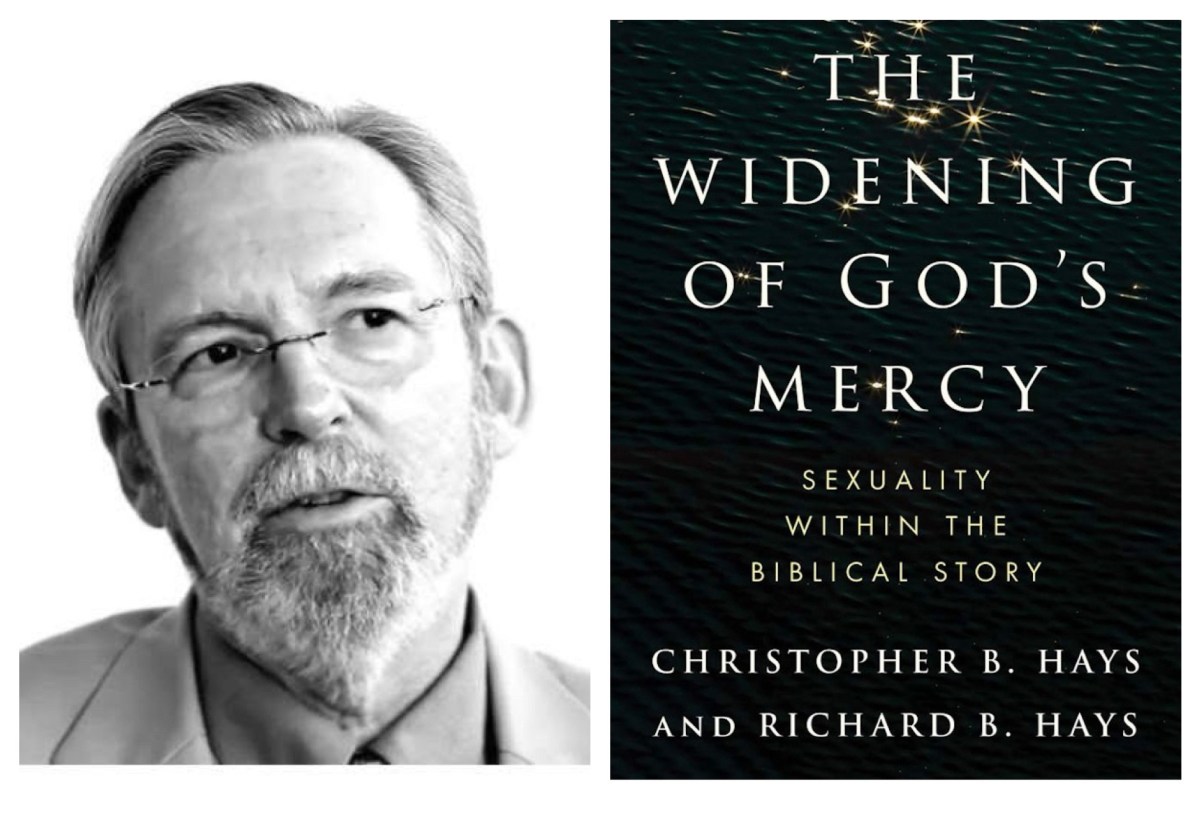
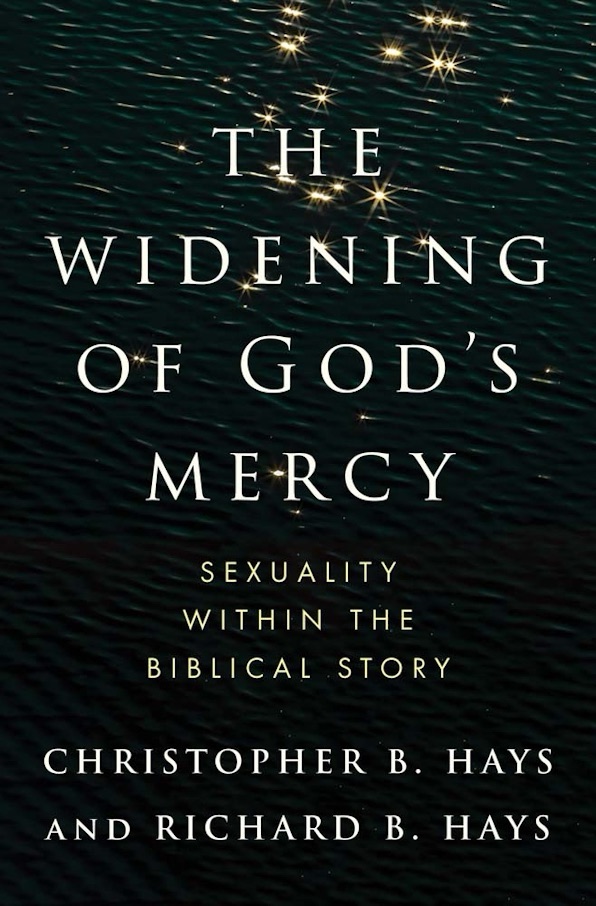
The search for a broad biblical-theological basis for ethics eventually led him, more recently, to become a proponent of affirming and inclusion of LGBTG people within the church. With his son, Christopher Hays, a well-respected OT/Ancient Near Eastern scholar at Fuller Seminary, he co-wrote The Widening of God’s Mercy: Sexuality Within the Biblical Story (2024).
The publisher’s blurb says that in this book, the authors write about “a dynamic and gracious God who is willing to change his mind, consistently broadening his grace to include more and more people. Those who were once outsiders find themselves surprisingly embraced within the people of God, while those who sought to enforce exclusive boundaries are challenged to rethink their understanding of God’s ways.”
In closing the last chapter, the father and son authorial team write, “This book is therefore not just an argument about the meaning of the Bible in the past, but an invitation to readers to make new meaning in the present by listening to the Spirit and joining God now in saying, “I will gather others to them besides those already gathered” (Isa 56:8) … We hope that this book offers encouragement to see that the inclusion of sexual minorities is not a rejection of the Bible’s message but a fuller embrace of its story of God’s expansive mercy.” Richard in particular offered his own declaration of repentance for his earlier writing.
It was an act of deep humility; and a wonderful “last word” from this great scholar and fine man.
Contextualising our Carols: the work of Shirley Erena Murray
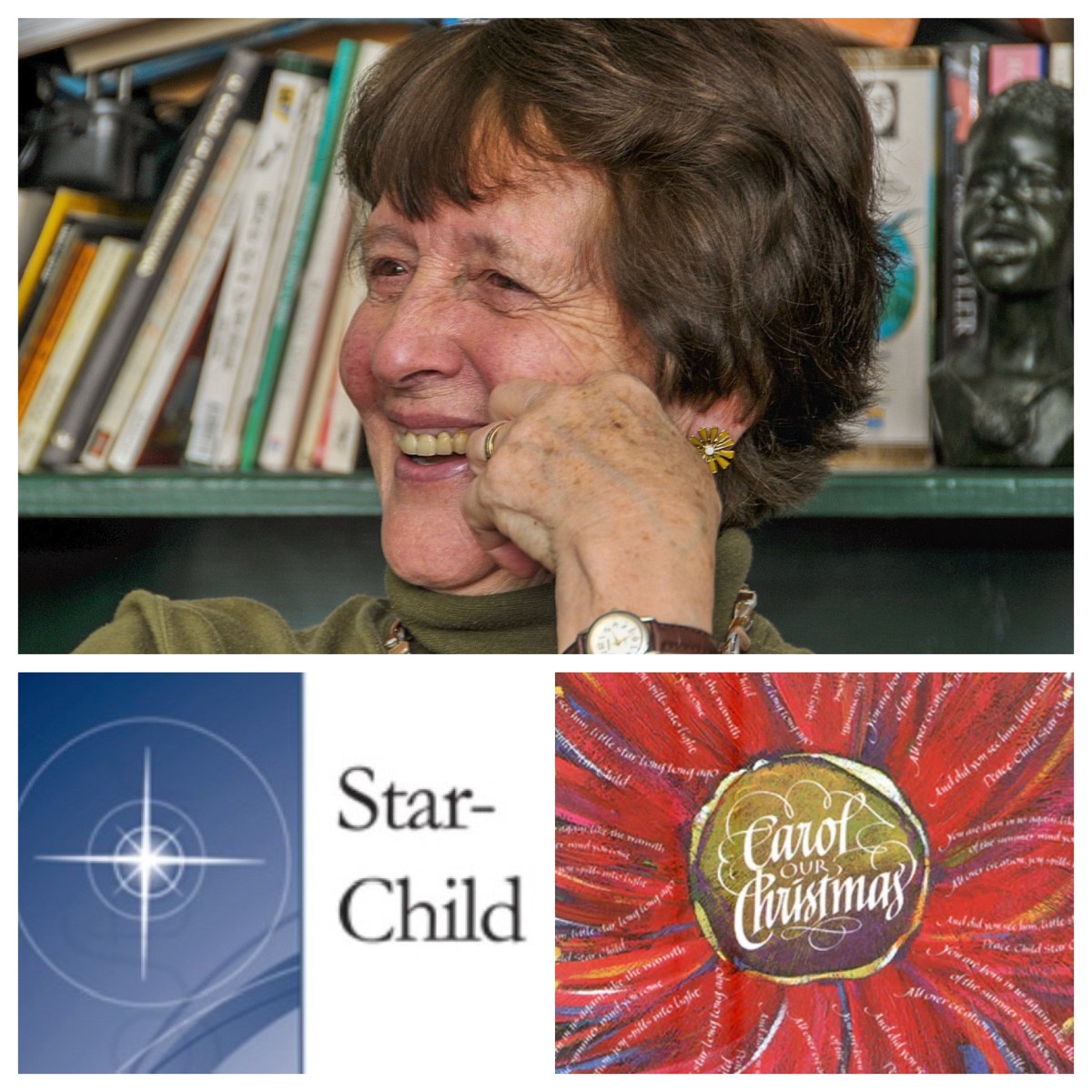
Shirley Erena Murray, of Aotearoa New Zealand, has been one of the most prolific and important hymn writers of the 20th century. One of my favourite quotes from her is “I’m despairing of outdated hymns and songs that are irrelevant to contemporary life and the way we live it”. As you may have guessed, I am right on the same wavelength as Shirley Murray!
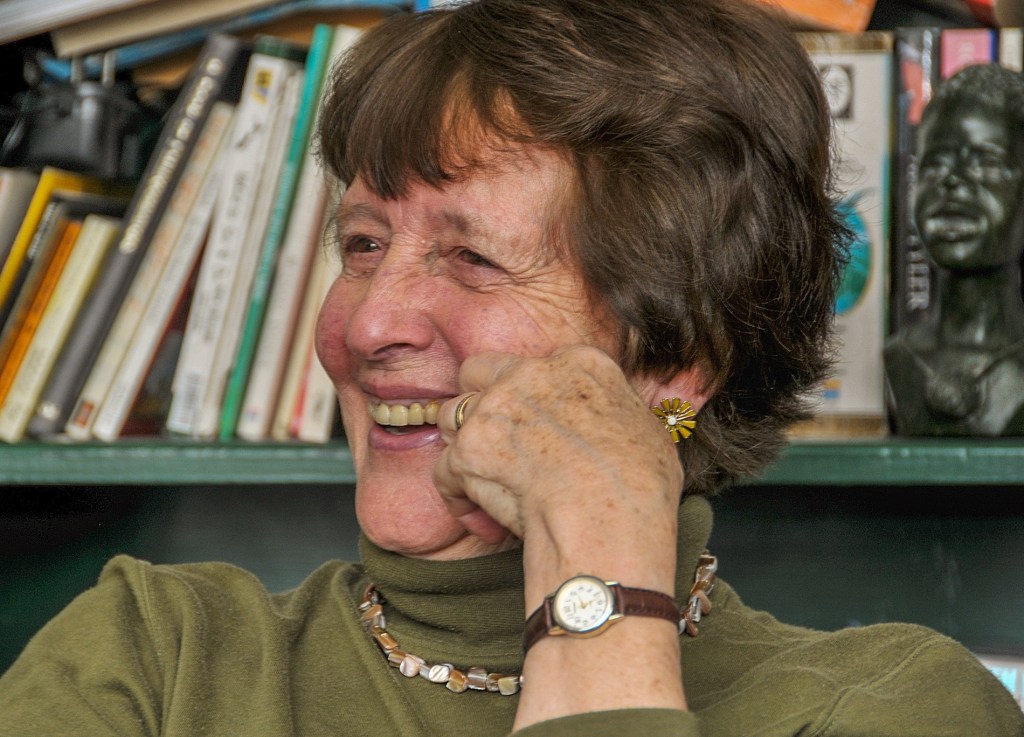
Shirley Erena Murray, pictured in 2009
“I choose to write with liberal intent, persuading people to look again at what the Gospels actually say and what new truths can come out of them”, she said. With over 400 hundred hymns written by her over her life, and many of them published in more than 140 collections across denominations, countries and continents—including Together in Song—she is well-qualified to speak about this. “What has nudged and provoked me”, she continued, “are the people I admire who have gone to the edge in terms of taking the gospels seriously and followed the Jesus principles.”
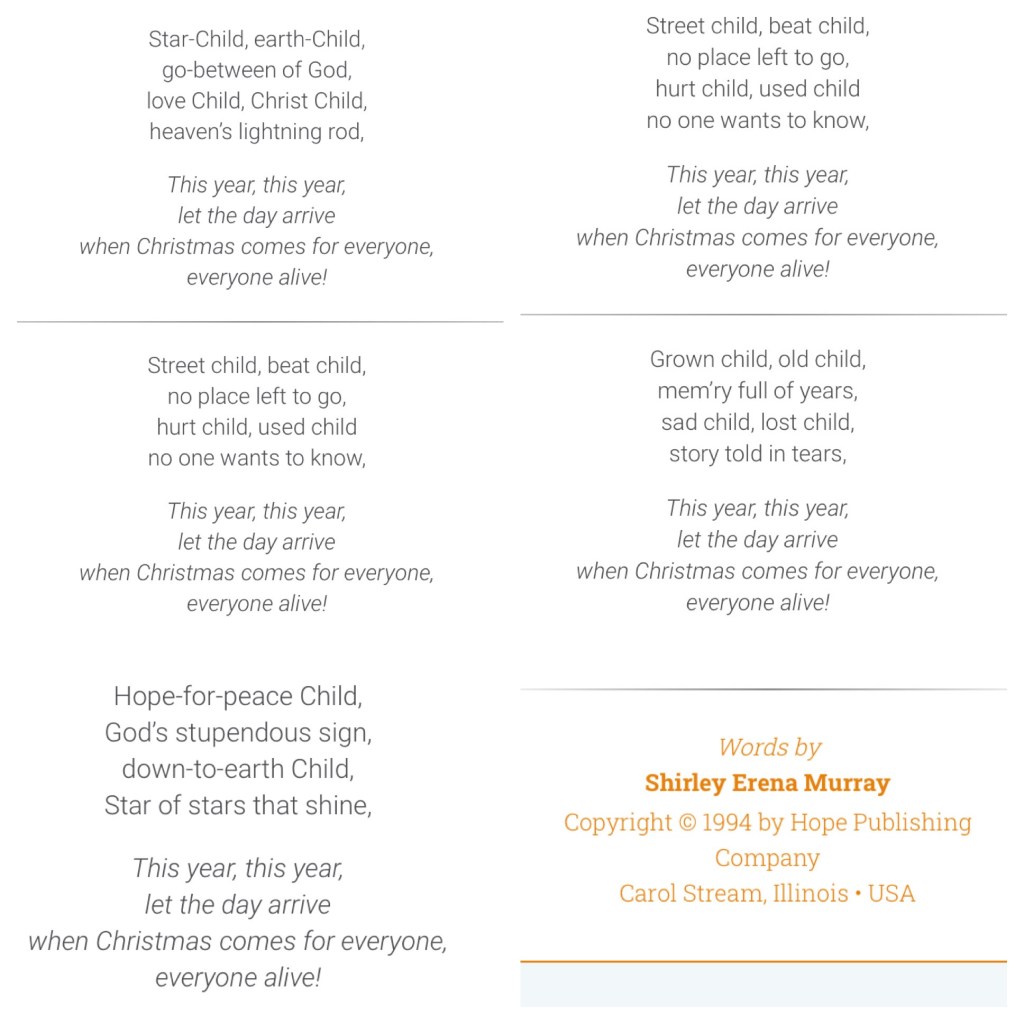
Perhaps her best-known Christmas hymn is surely Star-Child, earth-Child:
Another insightful carol reflects the “upside-down” nature of Christmas in the southern hemisphere. It begins:
Carol our Christmas, an upside-down Christmas: /snow is not falling and trees are not bare. / Carol the summer, and welcome the Christ Child, / warm in our sunshine and sweetness of air.
Commenting on how she approaches such seasonal carolling in a 1996 interview, Shirley said: “All our theology in New Zealand is upside down. We don’t have springtime at Easter. Instead, we think of burning leaves and planting bulbs for the spring. We can’t talk about robins and reindeer and snow at Christmas time, which is why I wrote Upside Down Christmas. This explores the images that make sense to us in summertime.” (Peace is Her Song p.137).
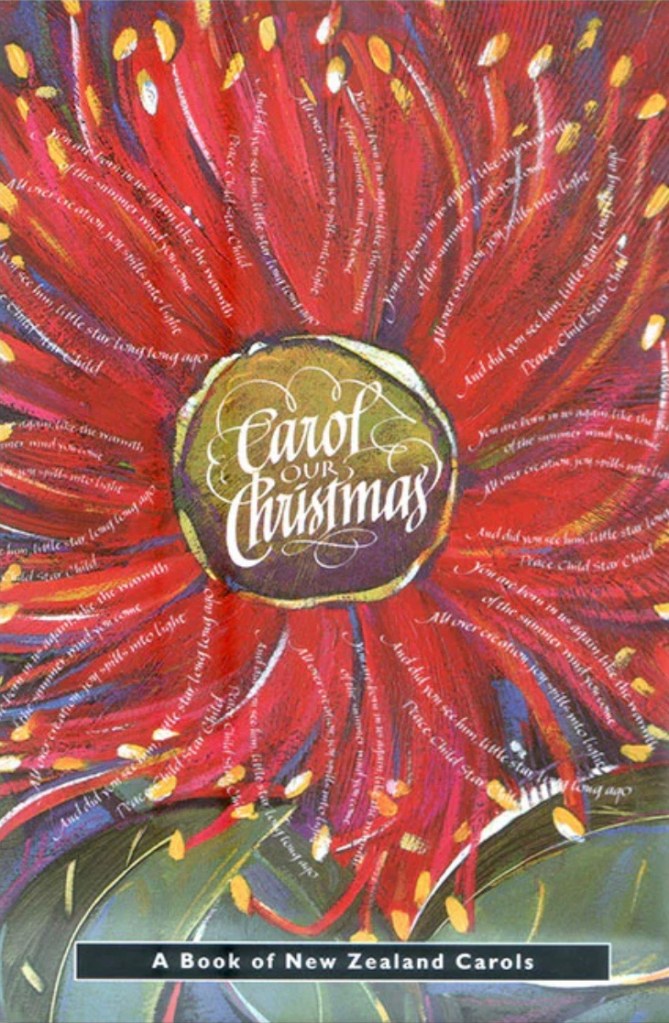
Joy Cowley, in her introduction to the 1996 collection that was entitled Carol Our Christmas, wrote: “For this country and its people, the prevailing symbol of the Christmas season is not snow but light. The star that heralds the Christ child in our midst is the sun, and even the sound of its name is symbolic blessing … In this volume of New Zealand carols … not only do the words and the music here reflect Christmas in Aotearoa, they offer us a wide experience of music and rejoicing.” (Peace is Her Song p.115)
In a 2004 interview, Shirley Murray said: “Carols are one of my favourite areas of work, because they are so challenging, not just because I am a southern hemisphere person when Christmas comes. They are the most theologically challenging part of the story for me. Incarnation is much more important than arguing about resurrection; being embodied is more important than talking about where we go hereafter.”
So in “Summer sun or winter skies”, she writes a carol with many of the “classic” carol elements (Christmas, shepherds, angels, silent night, lullabies) but with a potent message for the contemporary world: “silent night a violent night, hawks are in control of a nation’s soul … goodness will outclass the gun, evil has no tooth that can kill the truth”.
She continued: “Carols have always posed a lot of questions. How do you relate to what might be called the gaiety and festivity of what Christmas is meant to be and how do you say something about the child in the manger? … I have written about 20 carols and every Christmas, I struggle again to deal with humanity and God and this amazing baby. Carols have kept hustling me, annoying me, making me work on them.” (Peace is Her Song p.114)
So in 2013 she published The Christmas Child is a Troublesome Child, containing the insightful words that this child was “as troublesome as the Word that stirred the waters from the deep … who questions given rule, who flouts convention’s pious face … whose vision takes a thorny path whose cross may be our own”.
Commenting on this carol, Murray observed: “The childhood of Jesus … was surely like any other kid’s. Jesus became very annoying to the system. When you remember that, carols cease to be throw-away, jolly songs, and start to dig at you, to make you worry and wonder what God is saying through this. I sometimes introduce imagery from my own country but generally I write songs that will apply to almost anybody wanting to talk about the Jesus person, not just the Jesus baby.” (Peace is Her Song p.114)
I am going to include the words of a wonderful Epiphany hymn that she wrote in tomorrow’s post in this series. But for today, perhaps a novel way to end this exploration of Murray’s Christmas carols is to offer the words of her Lullaby for Judas (2001). In Peace is Her Song, her grandson Alex specifically notes this hymn, and reflects on how his grandmother “wanted to picture the human experience in its highs and lows, humans as fallible beings, with weaknesses and strengths. She dealt with the light and the dark of human experience—she didn’t gloss over things. She had the courage to confront the difficult topics, I find this particularly inspiring, and it is what makes her reputation so great.” (p.167)
The child is sleeping sound whose star is yet to rise. Like any baby born, an innocent he lies, this Judas child, a happy child, with laughter in his eyes.
The child can never dream the wonders he will meet: the hungry filled with bread, the bitter lives made sweet, the friend, forgiving to the end, who sees his heart’s deceit.
The child is sleeping sound who knows no horoscope: his kiss that will betray, his hand to grasp, in hope, the money bag, the silver swag, and then, the knotted rope.
Unfortunately the hyperlinks no longer appear to be active.
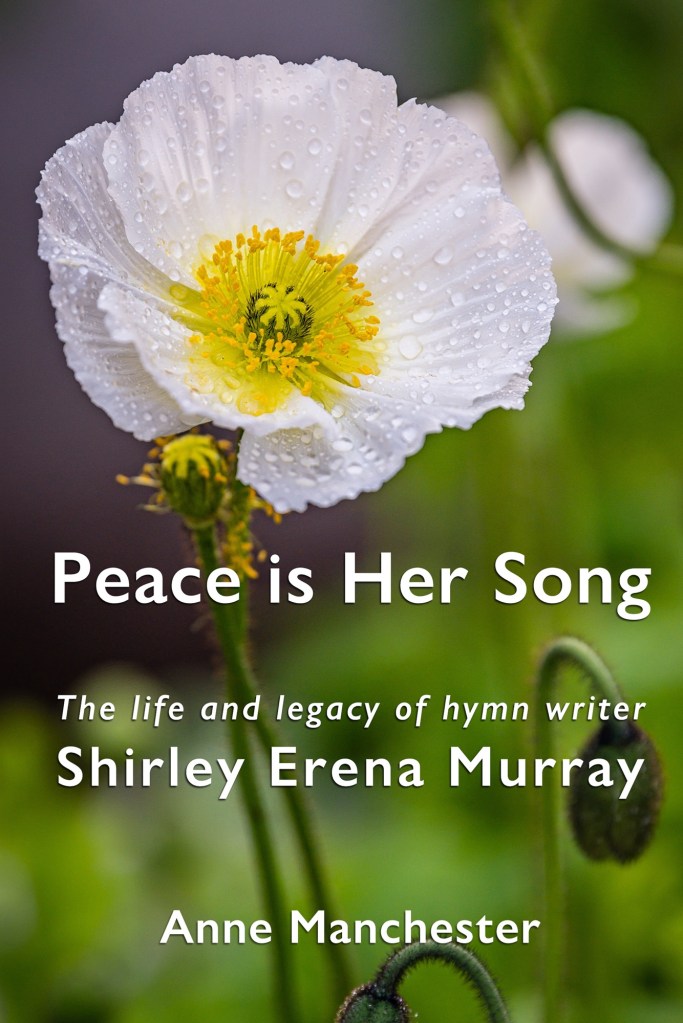
Shirley’s life and contribution to the worldwide church are now told in a biography, Peace is Her Song: The life and legacy of hymn writer Shirley Erena Murray. Written by journalist Anne Manchester, the book draws on rich sources of material, particularly Shirley’s own words as recorded in several audio and video interviews, and published articles.
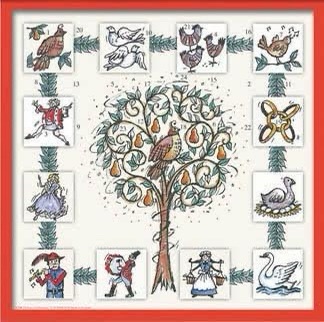
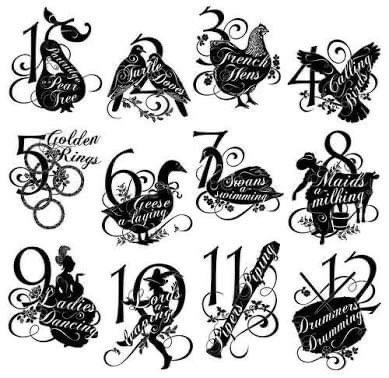
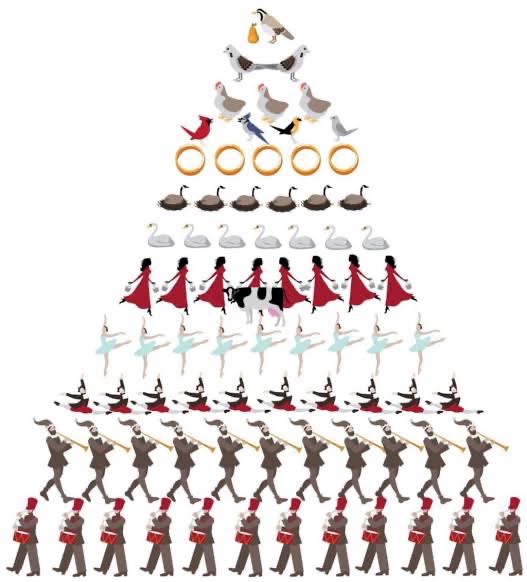
While we are looking into carols for the season of Christmas: what about The Twelve Days of Christmas? This English Christmas Carol, some have claimed, had a pietistic purpose: a kind of sung catechism about the central features of the Christian Faith, put into code by Roman Catholics in England when their faith was outlawed. (One is Jesus, two symbolises the two testaments, three indicates faith, hope and love, four refers to the Gospels, five to the Books of Moses, and so on …)
Nice theory, but there is no evidence at all that this was the case … and the origins of the theory go back no further than a speculation by a Canadian hymn writer in an article published in 1979. (And snopes.com agrees; you can read the detailed rebuttal at http://www.snopes.com/holidays/christmas/music/12days.asp )
The Twelve Days of the #twelvedaysofchristmas technically refer to the days from Christmas Day, the first day of Christmas, through to Epiphany, Twelfth Night. So the song should be sung from Christmas Day onwards. And the gifts that are given each day accumulate until the twelfth night, the evening before Epiphany, when gifts were given to Jesus by the Magi visiting from the east.
Professor Bruce Forbes writes that “In 567 the Council of Tours proclaimed that the entire period between Christmas and Epiphany should be considered part of the celebration, creating what became known as the twelve days of Christmas, or what the English, called Christmastide. On the last of the twelve days, called Twelfth Night, various cultures developed a wide range of additional special festivities. The variation extends even to the issue of how to count the days.” (Christmas: A Candid History, 2008, p.27).
Forbes also notes that there are divergent chronologies at work in different parts of the church: “If Christmas Day is the first of the twelve days, then Twelfth Night would be on January 5, the eve of Epiphany. If December 26, the day after Christmas, is the first day, then Twelfth Night falls on January 6, the evening of Epiphany itself.”
There’s a suggestion that The Twelve Days of Christmas song was originally sung in French . . . or, at least, that the line for the First Day originally included both French and English terms for the bird; thus, “partridge” (in English, and then in French, “perdrix” (pronounced per-dree) . . . which makes no sense, really; but this is a Christmas Carol, and such songs don’t really have to make sense, do they?
On the Second Day, two turtledoves are to be given. But for what purpose? Since this song relates to Christmas, can we assume that there is some religious or spiritual significance with this gift??
Turtle doves could be offered as a sin-offering (Lev 5:7). Is this why they were given? Or perhaps, as the alternate offering for a poor woman, seeking purification after giving birth (Lev 12:8)? This at least links in to the Christmas story (at Luke 2:24), which is what the song is supposed to be about! But it does seem like a long shot …
So, what about as a guilt-offering when cleansing a leper (Lev 14:22)? Or maybe for a Nazirite who has touched a corpse (Num 6:9)? Or as a means of cleansing after sexual discharge (Lev 15:14)? Or maybe the text is multivalent, and we are supposed to bring all of these allusions to mind. Because we know our Bible so well. And we know this is meant to be symbolic. Eh?
Next, on Day Three, the gift to be given is three French hens. Some suggest they are Faith, Hope and Charity, the key Theological Virtues. But only three? There are actually four types of French Hens (Faverolles, La Fleche, Crevecoeurs and Marans). So do we know which one of the four missed out on its moment of glory in this Christmas carol? It’s a worry.
On Day Four, four birds form the gift. Ah, but what type of birds? Calling birds? So you might think. But older versions of the song identify them as Colly Birds. Which are … …??? A colly bird is a black bird. A coal mine is called a colliery, so ‘colly’ or ‘collie’ is a derivation of this and means black like coal. So, no more whitewashing, let’s sing “four black birds”, and be clear about it, eh?
And … while we are at it … Day Five: Five Golden Rings? But they are surrounded by flocks of birds (swans, geese, colly birds, hens de la France, turtle doves, and a partridge). Rings are out of place. So, it is believed that this verse originally referred not to jewellery but to ring-necked birds such as the ring-necked pheasant. So, let’s now sing: “five ring-necked birds”! Context is everything!
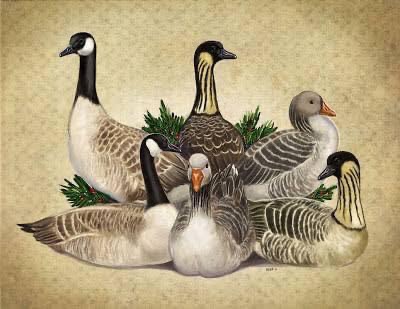
The sixth of the #twelvedaysofchristmas is the midpoint of the 12 days, when we can look back on the story of Christmas (the birth and the shepherds), and forward to the story of Epiphany (the visit of the Magi). The gift for the Sixth Day focusses on new life: six geese a-laying.
It is said that, while chickens lay eggs regularly (usually each day ), geese only lay 30-50 eggs a year. This means they are a less productive bird to keep. It takes longer to increase the size of the flock for meat production. And their eggs are very high in cholesterol. Was this a wise gift? (Of course, you may well score the goose that lays the golden egg.)
On Day Seven, the gift is seven swans a-swimming. Well, yes; that’s what swans do. But who in their right might give this as a gift? Where would they all be put so that they could keep swimming? In a huge bathtub? This is quite unrealistic. Anyway, I guess it proves that the carol was not written by a football-mad fanatic. (They would have had swans kicking goals.)
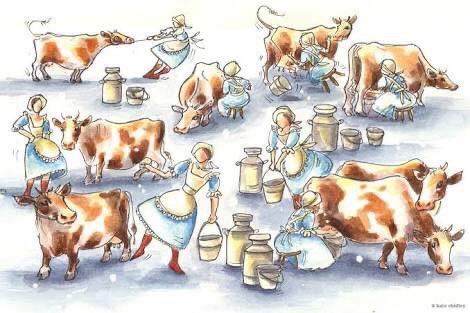
On Day Eight, we are exhorted to give eight maids a-milking. In older English, to “go a-milking” could mean to ask a woman for her hand in marriage; OR to ask a woman to go “for a roll in the hay”, as it were. Is this Christmas carol concealing a reference to illicit sexual encounters? And does that make it more interesting than just getting some milk in order to make some cheese?
Today is Day Nine. The gift is nine ladies dancing. Liturgical dances, I presume? In explore the significance of these ladies, I am somewhat stumped. Any clues, anyone?
Meanwhile, I am starting to compile my list of ‘not relevant downunder’ secular Christmas carols. Because here, in Australia, we are in the midst of summer—not winter, as all the upover northern hemisphere Christmas songs assume. So, not relevant to downunder would include: Anything with snow, for a start. And bells. And holly. And fir trees. And … well, the possibilities are endless.
Tomorrow, on Day Ten, the gift is to be ten Lords a-leaping. Alliteration, indeed; but why leaping? Perhaps there is a textual transmission problem here. Maybe it should be: Lords a-leasing? (what to do with their huge old castles and manors)? Or Lords a-sleeping? (in the upper chamber of the British parliament)? Or perhaps Lords a-weeping? (at the decline of their much- loved aristocratic powers). Who knows?
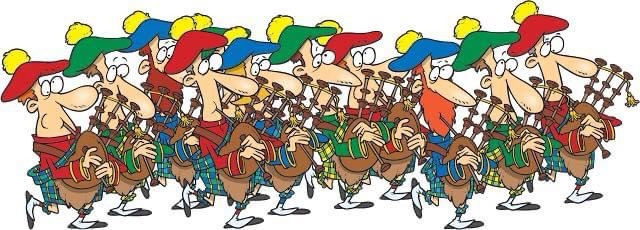
Then comes the eleventh day of (the season of) Christmas. With eleven pipers piping. So perhaps this comes from a Scottish variant (like day one comes from the French version). Perhaps the Scots packed their song full of food? In this, the gifts would include twelve alka seltsers, eleven Blue Lagoons, ten creme de menthe, nine vodka and limes, eight nips of whisky, seven rum and cokes, six Carlsberg specials…you get the picture? (Yes, I know, this is becoming quite speculative!!)
Or — does the Scottish reference (bagpipes) mean that I should refer to the crackpot theory that this whole carol was a coded reference to the right of Bonny Prince Charlie to regain the British throne? Yegods … …
But I do note that, in other versions, there are eleven ladies spinning, eleven ladies dancing, eleven lads a-louping, eleven bulls a-beating, and eleven badgers baiting!! Make of them, what you will.
Finally, we will arrive at the ultimate (last) of the #twelvedaysofchristmas. Day Twelve. Twelve drummers drumming. Since the gifts are cumulative, and repeated on each day, on Day Twelve we actually have drummers drumming, along with piping pipers, leaping lords, bleating cows, tapping toes, shuffling shoes, a horde of aviary escapees, and the whole schemozzle. It’s all too loud, I think — and the incessant fights amongst all those squawking birds! Oh dear; time for a doze, instead.
The evening of this twelfth day will, quite obviously, be Twelfth Night. What follows that is Epiphany, a day to celebrate the coming of the magi to the infant Jesus. Time, indeed, to rest.
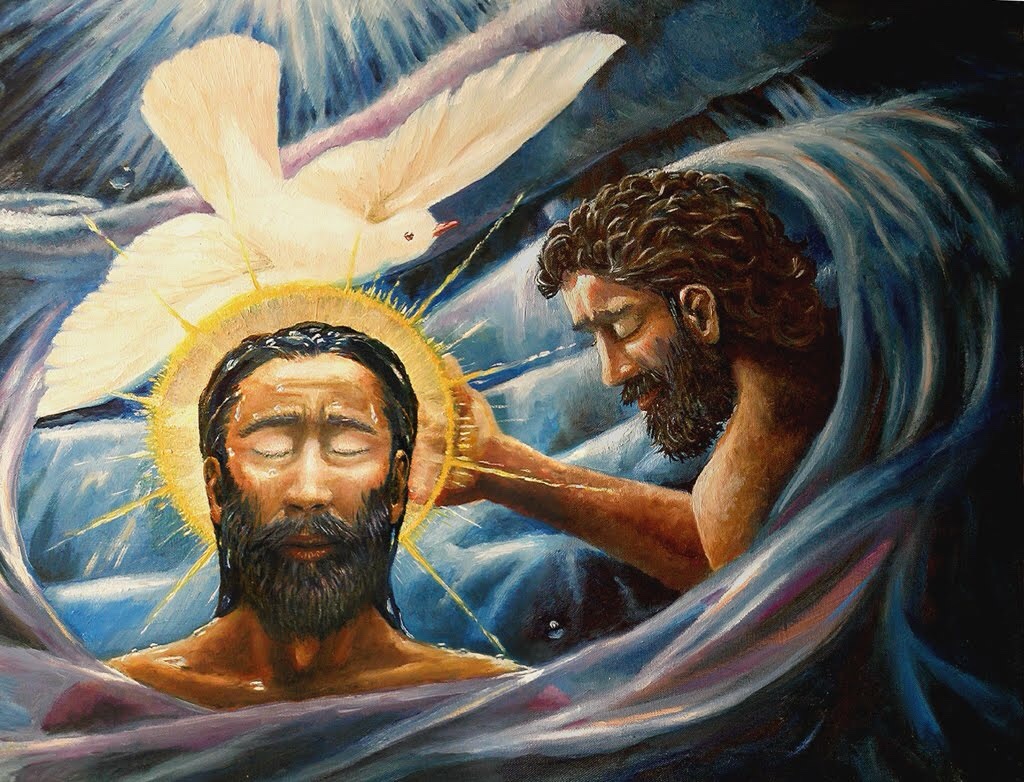
The lectionary for this Sunday suggests, as a companion piece to Luke’s account of The Baptism of Jesus, when the Spirit descends on Jesus (Luke 3:1–22), a short section from Luke’s second volume telling of further baptisms and gifting of the Spirit to new believers in Samaria (Acts 8:14–17).
In chapter nine of Acts, Saul is “converted” by a vision seen on the road to Damascus, is struck blind, then has his sight restored, is “filled with the Spirit”, and receives his commission to preach to the Gentiles (Acts 9:1–19). This would prove to be a significant turning point in the story Luke tells, which soon morphs into an account of the travels undertaken by Saul, who adopts the name Paul, and his various companions, as they preach to Jews and Gentiles in many different towns and cities.
In chapter ten of Acts, Peter is likewise “converted” by a vision seen on a rooftop in Joppa, travels to Caesarea, preaches to the household of Cornelius, and sees that “the gift of the Holy Spirit had been poured out even on the Gentiles, for they heard them speaking in tongues and extolling God” (Acts 10:45–46). This was a second crucial turning point, for it enabled Peter, at a later gathering of leaders in Jerusalem, to affirm that “God made a choice among you, that I should be the one through whom the Gentiles would hear the message of the good news and become believers” (15:7), and then that God “testified to them [the Gentiles] by giving them the Holy Spirit, just as he did to us; and in cleansing their hearts by faith he has made no distinction between them and us” (15:8–9).
So it was that, in Luke’s telling of the story, these two key figures each pressed the case that “God has given even to the Gentiles the repentance that leads to life” (11:18, my emphasis added). The third dominant figure in the early days of this movement, James the brother of Jesus, joined his voice to theirs at the council in Jerusalem, giving the final decision of the council that “we should not trouble those Gentiles who are turning to God” (15:19)—they are to be fully accepted within the fellowship of the growing movement. The council sent four members to Antioch with the declaration that “it has seemed good to the Holy Spirit and to us” to convey this good news (15:28).
Before all of this, in chapter eight of Acts, there is another story involving the Spirit. Philip travels to Samaria, preaches to crowds of people, encounters a man named Simon, a local magician, and rejoices when Simon, as well as many others, accept his message and are baptised (8:4–13). However, there is a problem; as Luke comments in a narrator’s aside, “as yet the Spirit had not come upon any of them; they had only been baptized in the name of the Lord Jesus” (8:16). So the two lead apostles, Peter and John, are despatched to Samaria to deal with the situation.
This is the story that the lectionary chooses to place alongside the account of the baptism of Jesus for this coming Sunday, the first Sunday in the season of Epiphany. This day is designated each year as the time to recall the baptism of Jesus. So this passage from Acts seems a suitable companion reading.
In particular, it invites us to explore a little further the place of the Spirit in the early decades of the movement initiated by Jesus. And although the selected passage stops short at verse 17, the narrative continues on, describing the disruption which came from the preaching of Philip and the visit of Peter and John. It was a disruption that brought transformation to Simon the magician (see his prayer at 8:24) and to the Samaritans in other villages where the good news was proclaimed (8:25).
Giorgio Vasari (1511-1574), “Apostles Peter and John Blessing the People of Samaria”
In this short narrative of the apostolic visit to Samaria, the Samaritans who had already “received the word of God” from Philip (8:14) were enabled to “receive the holy spirit” through the laying on of hands by the apostles who had been sent to the region (8:15-18). Although the gift of the spirit (8:17) had been separated from baptism (8:12), as it would later be in a narrative concerning events in Ephesus (19:1-7), Luke does not intend this pattern to be read as prescriptive for all situations, as other accounts of baptisms indicate (2:38-41; 8:38; 10:44-48; 19:1-7).
Baptism had been proclaimed as necessary by Peter, on the day of Pentecost (2:38); this appears to link baptism closely with the gift of the Spirit (2;1-4, 17-21). However, there is no formulaic pattern or process to be followed each time a baptism takes place. The various narratives are somewhat ad hoc. The spirit guides Philip in the encounter with a eunuch returning from Jerusalem to Ethiopia (8:29, 39)—but the spirit appears to have no direct contact with the Ethiopian himself.
Baptism is accompanied by the laying-on of hands here in Samaria (8:15-16) and later in Ephesus (19:6), but not with the Ethiopian. The laying-on of hands results in the holy spirit coming upon those in Ephesus (19:6), a link similar to that made in Samaria (8:15-17, 19) and Antioch (13:3-4). The gift of the spirit leads to speaking in tongues in Ephesus (19:7), as in Jerusalem (2:4) and Caesarea (10:45-46), but not for the Ethiopian.
In Acts, baptism may come both prior to (2:38-42; 8:14-17) and after (10:44-48; 11:15-17) the gift of the spirit; further, the gift of the spirit is not necessarily linked with baptism (for instance, at 2:1-4 and 4:31). Confused? We need to remember that Luke is telling stories, recounting happenings that he has been told about or that he has read in earlier sources. He is not setting out precise liturgical or doctrinal instruction. So, whilst the time sequence of the elements of spirit—laying on hands—water—baptism is found in different patterns, the collation of similar elements across all these stories implies a consistent cluster of elements. Read this way, there is strong continuity with events in Jerusalem, Samaria, Caesarea, and Ephesus. The baptisms in Samaria fit, by inference, within that sequence.
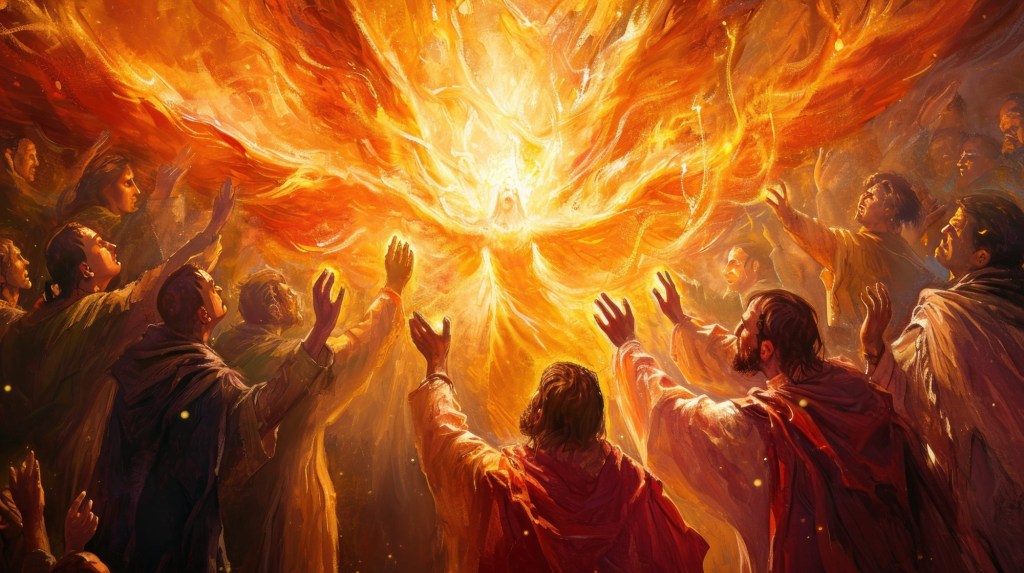
Whenever Christians think about the Spirit—and specifically about the dynamic force that is displayed by the Holy Spirit—our attention goes most immediately to the story of the Day of Pentecost in Acts 2. That’s when the coming of the Spirit was experienced as “a sound like the rush of a violent wind [which] filled the entire house where they were sitting”, followed by “tongues, as of fire … resting on each of them” (vv.2–3).
In the chaos that resulted—“all of them … began to speak in other languages”—the crowd that heard them were bewildered, amazed, astonished, and thought that they were drunk! That’s a disruptive event initiated and impelled by the Spirit right there. The story of Pentecost is a story about God intervening, overturning, and reshaping the people of God. The Spirit certainly was active at Pentecost. It was a transformative moment.
As Luke tells the story of Pentecost, he is deliberately linking his second volume, not only to the activity of the Spirit in Hebrew Scriptures, but also to the way the Spirit overshadowed Mary (Luke 1:35), nurtured John, son of Zechariah and Elizabeth (1:80), descended upon Jesus at his baptism (3:22), led Jesus out into the Judean wilderness (4:1) and then back into Galilee (Luke 4:14) to sustain the activities and preaching of Jesus (4:18; 10:21).
Luke, of course, had received the account of the active role of the spirit in the baptism and testing of Jesus (Mark 1:10, 12) and developed it, just as Matthew had done likewise, introducing the saying of Jesus, “if it is by the Spirit of God that I cast out demons, then the kingdom of God has come to you” (Matt 12:28).
Certainly, the activities of Jesus can only be thought of as both disruptive—framed by the breach of the heavens at his baptism, the tearing of the temple curtain at his death—and as transformative—signalled by the transfiguration on the mountain top, as well as the change in the disciples effected by their time with Jesus.
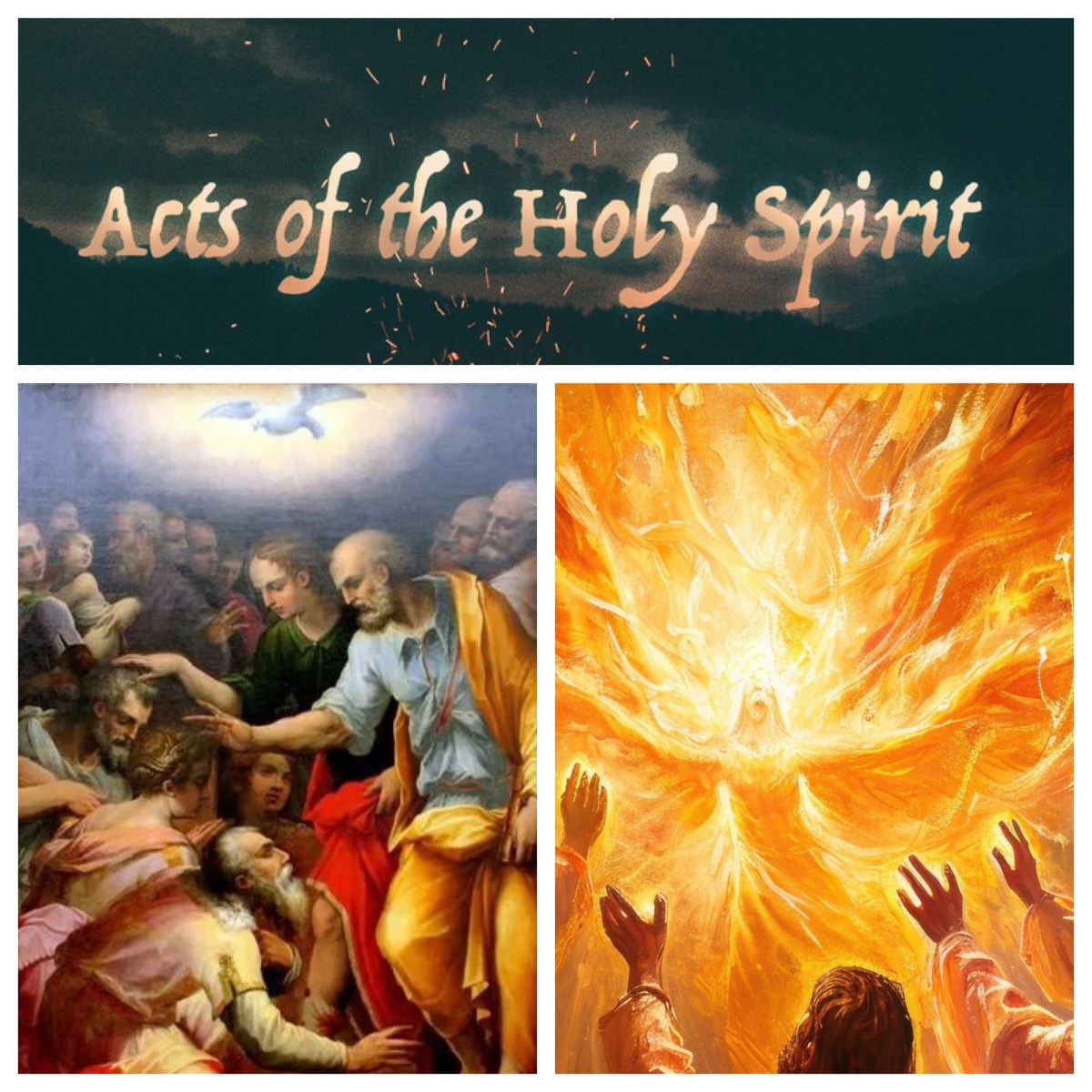
Some interpreters have noted that the book of Acts is less about “the acts (deeds) of the apostles” than it is about “the acts of the Holy Spirit”.
The author himself described the two-volume work (Luke’s Gospel and Acts) as an orderly account of the things that have come to fulfilment amongst us. The work highlights how the Holy Spirit plays a central, active role in what is being reported—how the Spirit might be seen to bring, first disruption, and then transformation, in the movement that Jesus inspired.
The events reported in Acts are generated from the dramatic intervention of the Spirit into the early community formed by the followers of Jesus after his ascension. The story of that intervention reports that Jews came from around the eastern Mediterranean are gathered in Jerusalem for the annual festival (Acts 2:1–13), when the Spirit comes upon them. Each bursts out, “speaking about God’s deeds of power” (2:11). The joy and excitement is tangible even as we hear the story at two millennia’s distance.
Unthinkingly, the wider group of pilgrims hear the cacophony of Spirit-inspired voices, and assume that this is a sign of drunkenness (2:13, 15). Actually, as Luke has made clear, the tongues being heard are not the unintelligible gibberish evident in Corinth, but known languages from the various places of origin of those speaking. And the disruptive element is not from the tongues spoken, but from the actions undertaken by believers in the days, months, and years ahead—as the narrative of Acts conveys. It’s a dramatic story with clear theological guidelines.
Another dramatic story of the coming of the Spirit is told at a later point in Acts—after Peter sees a vision in which God declares “all food is clean”, and he is summoned to the home of the Gentile centurion, Cornelius, in Caesarea (10:1–33). As Peter preaches to the Gentiles, the Spirit falls on them, “just as it had upon us [Jews] at the beginning (11:15). This event is specifically portrayed as a complementary event alongside the falling of the Spirit on Jews on the Day of Pentecost (2:1–4). It is a further disruptive action that the Spirit impels. And its consequences—full acceptance of the place of Gentiles in this movement—were fully transformative.
The activity of the Spirit is noted at various places in this sequence of events. The Spirit guides Peter to meet the men sent by Cornelius and travel with them to Caesarea (10:19; 11:12). In reporting to the church in Jerusalem about the arrival of messengers from Cornelius (11:11–12), Peter notes simply that “the spirit said to me to go with them without criticism” (11:12; cf. 10:19–20).
In this report to the Jerusalem church, Peter is short on factual reporting, as it were; he simply states that the spirit fell on them (11:15). His omission of many details (character traits, travel details, conversation and personnel; even, surprisingly, the name of Cornelius) places the focus on the role of the spirit. Once again, what the Spirit impels from this vision, visit, and sermon, is highly disruptive and thoroughly transformative for the early communities of faith.
Jews had been used to eating separately from Gentiles and selectively in terms of food, in accordance with the prescriptions of Leviticus. Now, they are now invited—indeed, commanded—to share at table with Gentiles and to put aside the traditional dietary demarcations.
This is disruptive: just imagine being commanded by God to become vegan and eat meals with the family of your worst nightmares, for instance! And it is transformative: from this sequence there emerge inclusive communities of Jews and Gentiles across the Mediterranean basin, sharing at table and in all manner of ways. That becomes the way of the church.
The importance of the Spirit in Luke’s account of the early movement cannot be underestimated. The significance for the church today of the Spirit’s disruptive, empowering, transformative presence at Pentecost is likewise high. And that transformative activity continues on throughout Acts.
After Peter’s sermon in Caesarea and the gifting of the Spirit to the Gentiles (Acts 10—11), the Spirit guides Barnabas and Paul to Seleucia and onwards (13:2) and then later guides Paul away from Asia Minor, towards Macedonia (16:6–7). This latter move marks a critical stage in the story that Luke tells.
At this key moment of decision in Troas, three injunctions are given; each one is from a divine source. The first of these, an instruction not to speak in the southern region of Asia, comes from the Holy Spirit (16:6). The second direction, a prohibition against any attempt to head north and enter Bithynia, comes from the same spirit, here described as “the spirit of Jesus” (16:7). The third divine interjection takes place at Troas, where a vision is seen in the night with a petition to “come across into Macedonia” (16:9).
The new spirit-inspired direction of travel is disorienting; a serious disagreement between Paul and Barnabas had just occurred (15:39). But this disruption provides the springboard for Paul and Silas to undertake a new mission in Philippi, Thessalonica, and Beroea (16:11—17:15), before visiting the centre of Greek philosophy and politics, Athens (17:16–34), and then Corinth, where Paul stayed eighteen months (18:1–17). Indeed, all that takes place, as Paul travels relentlessly with various companions across many places (13:4—21:17), is driven by the Spirit (13:2, 4), a constantly disruptive and transformative presence.
Much later, Paul’s final visit to Jerusalem and his subsequent arrest takes place under the guidance of the Spirit (20:22-23; 21:11). That event had hugely disruptive consequences for Paul, of course, as he is arrested and spends the rest of his life as a prisoner under Roman guard.
The story of the early years of the movement initiated by Jesus, then, is of multiple events inspired and propelled by the Spirit over these years—intrusive, disruptive, yet transformative events. The Spirit who guides all of this brings both disruption and transformation. We need, today, to be open to the same disruption and transformation.
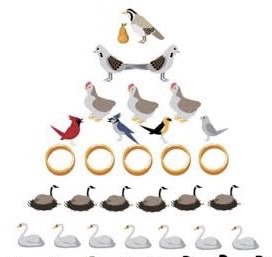
I guess those with diligent true loves are busy, today, trying to feed the seven partridges, twelve turtle doves, fifteen French hens, sixteen colly birds, twelve laying geese, and seven swimming swans that their true loves have delivered to them (thus far) to commemorate the twelve days of Christmas. And I hope they have their fifteen gold rings locked away securely!
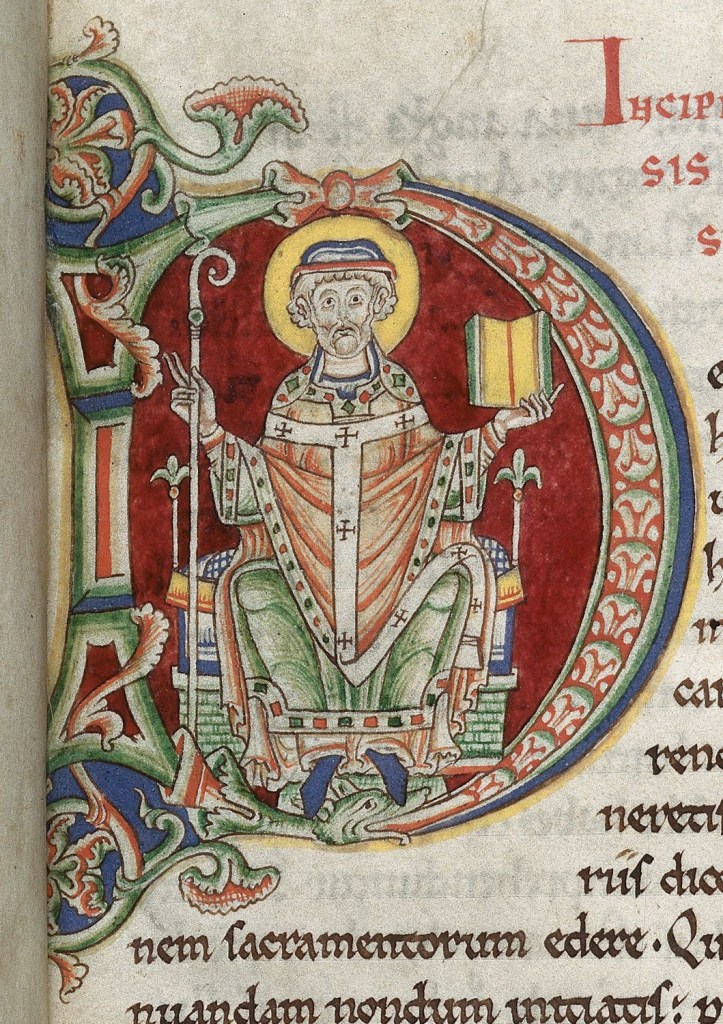
For my part, I am offering a further carol for The Season of Christmas: another one from the early centuries of Christianity, when theologians wrote the words of songs for the faithful to sing—thereby providing them with meaty teaching in the faith (at least as they understood it). Today, it is one by the forth century theologian Ambrose, who was Bishop of Milan from 374 until his death in 397.
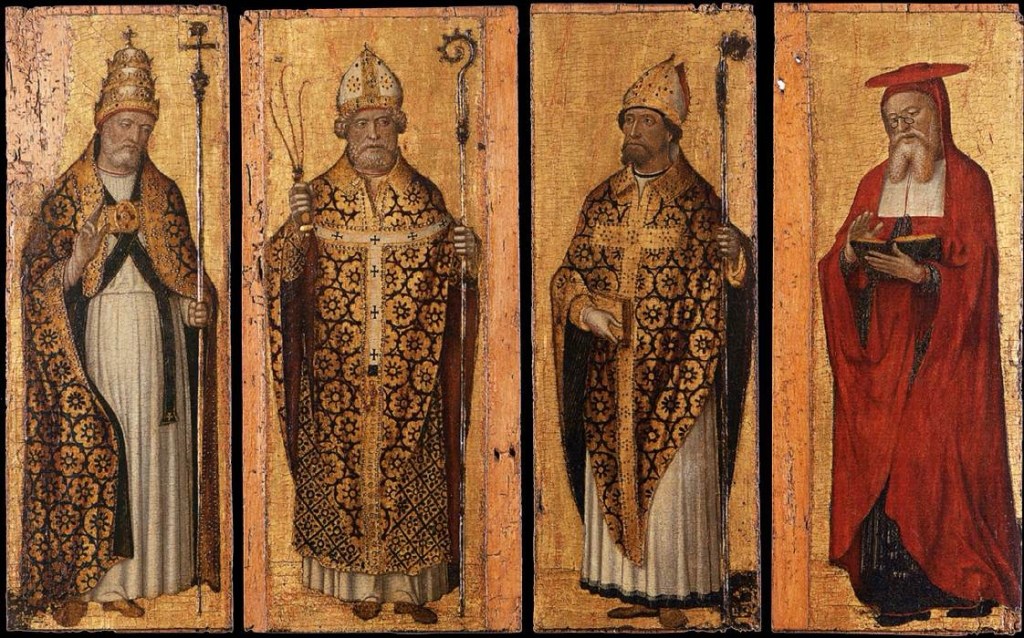
Four Doctors of the Church Four panels from a partially-preserved polyptych, dated c. 1495, and attributed to Galleria Franchetti, Ca’ d’Oro, Venice
Amongst the western church, dominated by Roman Catholicism, Ambrose of Milan (339—397) is counted as one of the four Doctors of the Church, along with his contemporaries Augustine of Hippo (354—430) and Jerome of Stridon (342—420). Pope Gregory the Great (540—604) is accounted as the fourth Doctor. All four had the title Doctor attributed to them, in the true sense of the word (it comes from the Latin word for Teacher).
In the eyes of many theological writers, the fourth century was critical in the development of classic orthodoxy, for this was when the various disputes about the nature of Jesus took place. Those who were leading the theological argumentation—including Ambrose, Augustine, and Jerome—contributed to the development of orthodox dogmas which were confirmed by various church councils: Nicea in 325, Constantinople in 381, Ephesus in 431, Chalcedon in 451, and others in subsequent centuries.
Those whose arguments failed to persuade—or who were condemned by decree of one of the councils—are known to us as “heretics”; they include Theodotius of Byzantium, Nestorian of Constantinople, Paul of Samosata, Apollinaris of Laodicea, Eutyches of Constantinople, and perhaps most famously of all, Arius of Alexandria. Legend has it that at the Council of Nicea, Arius slapped Nicholas of Myra (the historical figure who later morphed into Saint Nicholas and then Santa Claus) and so was temporarily defrocked and imprisoned.
Although their writings were instrumental in developing orthodox theology, such men have long been denigrated as heretics—although, in my mind, a number of these “heretics” offered wise and helpful insights. But the verdict of history stands, cemented now by centuries of church tradition and theological dogma.
Ambrose of Milan
It is in this context of debate, disputation, denigration, and entrenched doctrinal disagreements, that Ambrose penned this carol, Veni redemptor gentium (Come, Redeemer of Nations). It is filled with patristic theologising, reflecting the debates of the day, depicting Jesus as “a giant in twofold substance in one” and “equal to the Father”, whilst also affirming his mother as having “virgin honour all unstained”, a “royal home of purity”. These are the seeds for the theological affirmations about Jesus in some of the much later Christmas carols that we sing today!
Here is the hymn of Ambrose in a translation of the original Latin by John Mason Neale (whom we noted a few days ago provided us with the English of Good King Wenceslas).
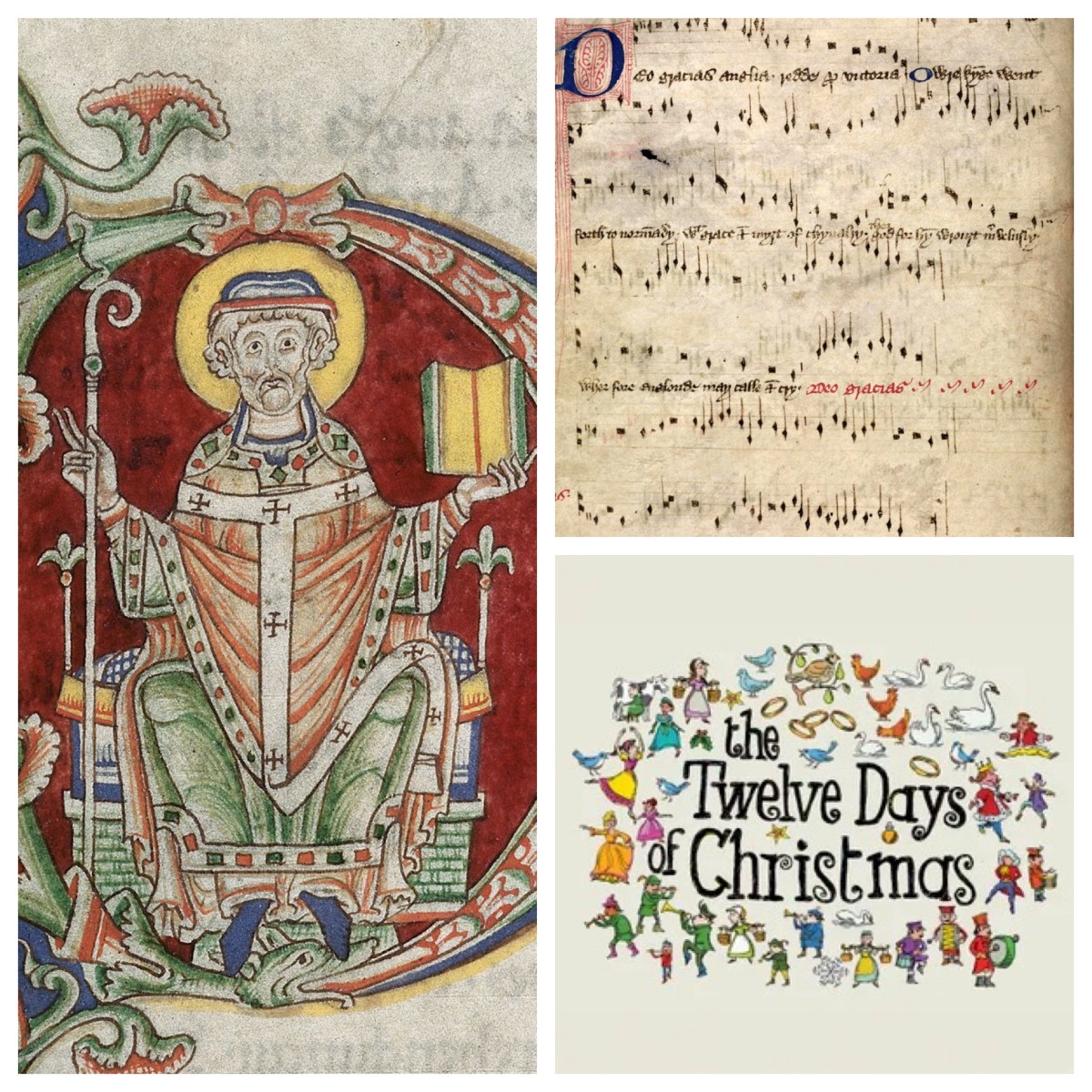
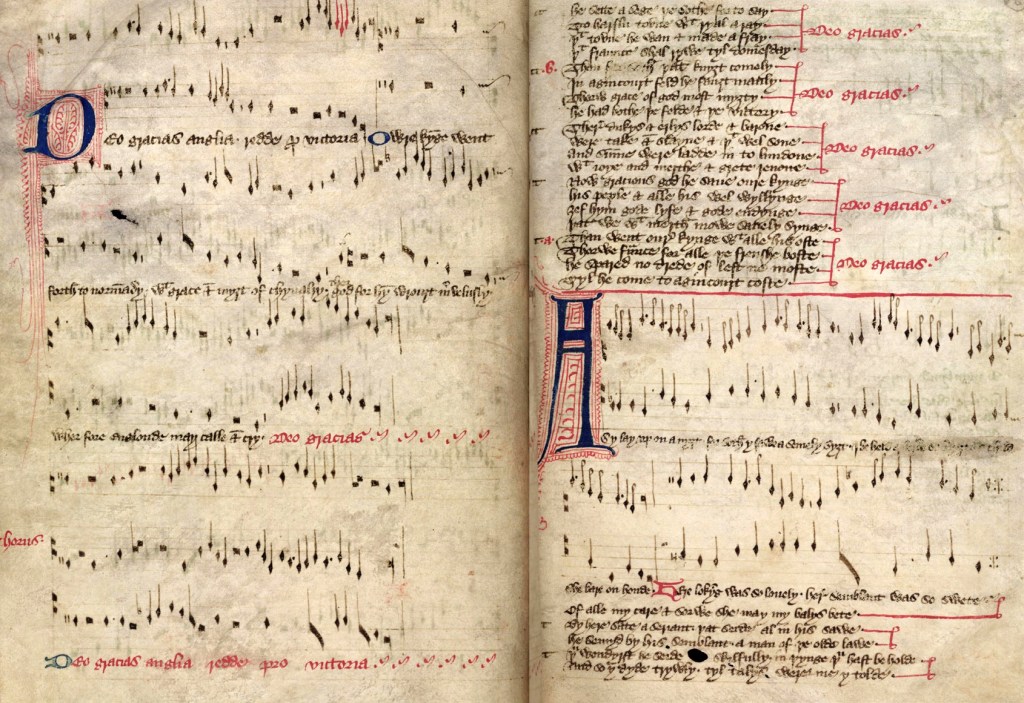
Closely related to this carol, there is another carol in a 15th century manuscript, the Selden Carol Book, a document which contains music and words for thirty carols of the day. (The manuscript is held in Oxford at the Bodleian Library.)
A page from the manuscript of the Selden Carol Book
This carol, number 28 in the collection, both uses the refrain of Ambrose’s original, and, in verse 3, refers directly to the work by Ambrose. Its author, as with all the carols in the Selden manuscript, is unknown.
Veni, redemptor gencium, Veni, redemptor gencium.
This worle wondreth of all thynge
Howe a maide conceyved a kynge;
To yeue us al therof shewynge,
Veni, redemptor gencium.
Whan Gabriel come with his gretynge
To Mary moder, that swete thynge,
He graunted and saide with grete lykynge,
Veni, redemptor gencium.
Ambrose saide in his writynge
Cryst sholde be in a maide dwellynge;
To make sothe alle that syngynge,
Veni, redemptor gencium.
And Davyd saide in his spellynge
That truthe sholde be in erthe growynge
To us, byer of alle thynge,
Veni, redemptor gencium.
Cryst, ycrowned at oure begynnynge,
Be with us at oure endynge
Us to thy ioye for to brynge,
Veni, redemptor gencium.
The text is from Richard Greene, The Early English Carols (Oxford, 1977), p.36. A version in modern English is offered at
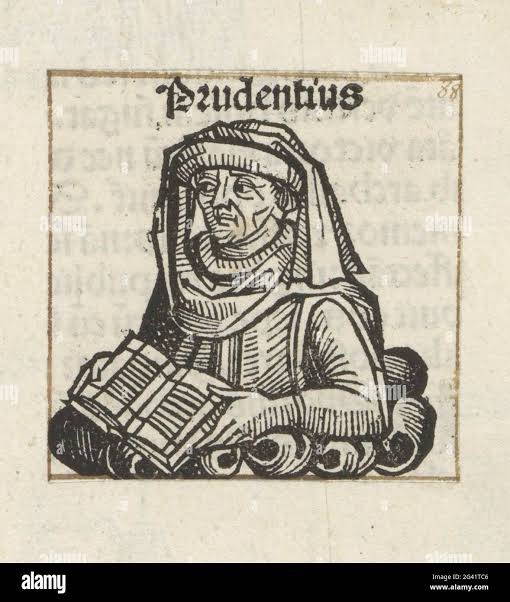
I have been amazed to learn that, back in the fifth century, the poet Prudentius wrote a number of hymns that tell the story of the slaughter of innocent children, ordered by King Herod.
Whilst the basic theological orientation of these hymns is clearly patristic orthodoxy, they do contain a gritty realism that seems to have largely flown out the window when modern day carols are sung!
Here is a hymn which remembers those innocent children who were, according to the theology of Prudentius, “victims slain for Christ the King”.
All hail, you infant martyrs’ flow’rs,’
Cut off in life’s first dawning hours
As rosebuds, snapt in tempest strife
When Herod sought the Savior’s life.
O tender flock of Christ, we sing
Of victims slain for Christ the King
Oppression’s loud lament we raise,
Then join the martyrs’ song of praise:
All honor, laud, and glory be,
O Jesus, Virgin-born, to thee;
All glory, as is ever meet,
To Parent and to Paraclete.
(Prudentius, 5th century, alt.)
This hymn is a cento (a patchwork quilt of words from various sources) from the twelfth and last poem in the Cathemerinon of Prudentius, and in its full form it contains 208 lines. The first line of the complete hymn is Quicumque Christum quaeritis. Four beautiful centos from this hymn were included in the Breviary by Pius V (1568); see https://media.churchmusicassociation.org/pdf/hymnsofbreviary.pdf
The original Latin text of the hymn is:
Salvete, flores Martyrum, in lucis ipso lumine Quos ssevus ensis messuit, ceu turbo nascentes rosas.
Vos prima Christi victima, grex immolatorum tener, Aram sub ipsam simplices palma et coronis luditis.
Quid proficit tantum nefas ? Quid crimen Herodem juvat? Unus tot inter funera impune Christus tollitur.
Inter coaevi sanguinis fluenta solus integer, Ferrum quod orbabat nurus party’s fefellit virginis.
Qui natus es de Virgine Jesu, tibi sit gloria, Cum Patre, cumque Spiritu, in sempiterna secula.
Another of his compositions recounts the same story from the perspective of King Herod.
With boding fears the tyrant hears A King of Kings is hard at hand, Who rule shall claim o’er Israel’s name And high in David’s palace stand.
With wild surprise, ” We die,” he cries, “ Around us lurks a traitor brood ; ” Up, guard, awake, thy weapon take, “ And every cradle drown in blood.”
What boots his ire, and dark desire; What help, if he his thousands slay ? Alone of all, around that fall, The Christ is safely borne away.
Jesu, to Thee all glory be, Of Mary, Virgin-Mother born ; To God Triune all praise be done, Through endless life’s unwaning morn.
The Latin text:
Audit tyrannus anxius adesse regum principem,
qui nomen Israel regat teneatque David regiam.
Exclamat amens nuntio, successor instat, pellimur;
satelles i, ferrum rape, perfunde cunas sanguine.
Quid proficit tantum nefas, quid crimen Herodem iuvat?
unus tot inter funera inpune Christus tollitur.
Iesu, tibi sit gloria, qui natus es de Virgine,
cum Patre et almo Spiritu, in sempiterna saecula. Amen.
This is the 12th and last poem in his Cathemerinon, and in its full form consists of 208 lines. It is found in a 5th century manuscript in the Bibliotheque Nationale, Paris (Prudentius, Opera, 8048, f. 39b).
Though one of the finest poems of Prudentius, it was apparently little used in the services of the Church until the revision of the Roman Breviary after the Council of Trent.
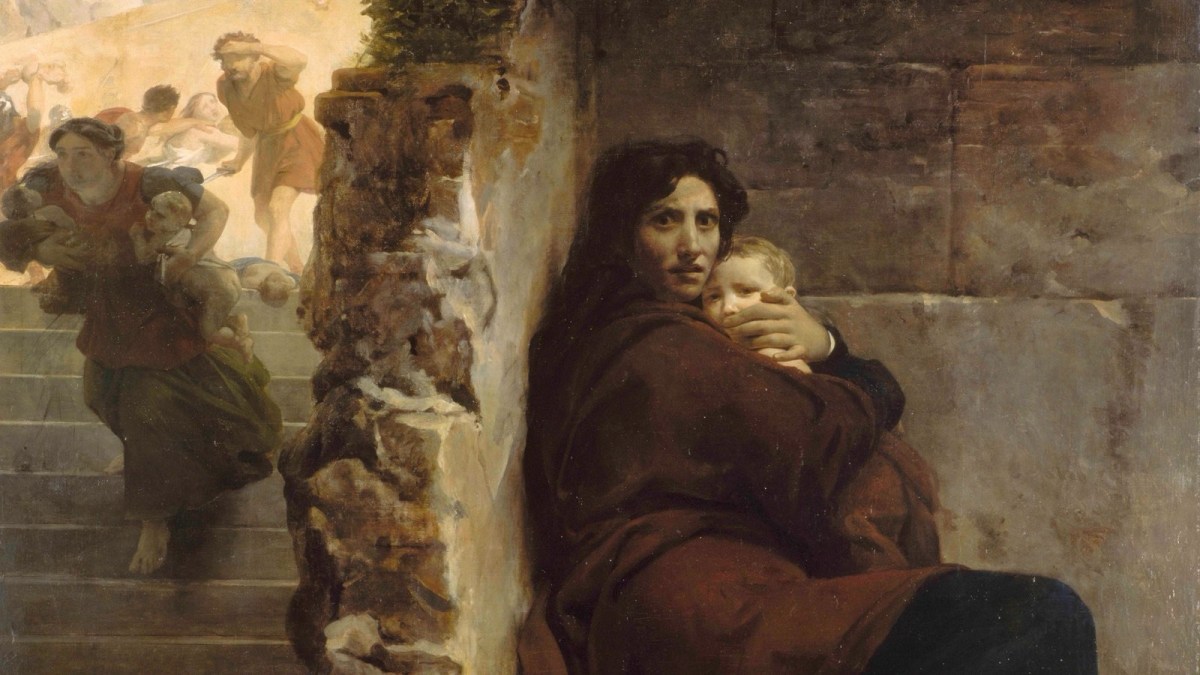
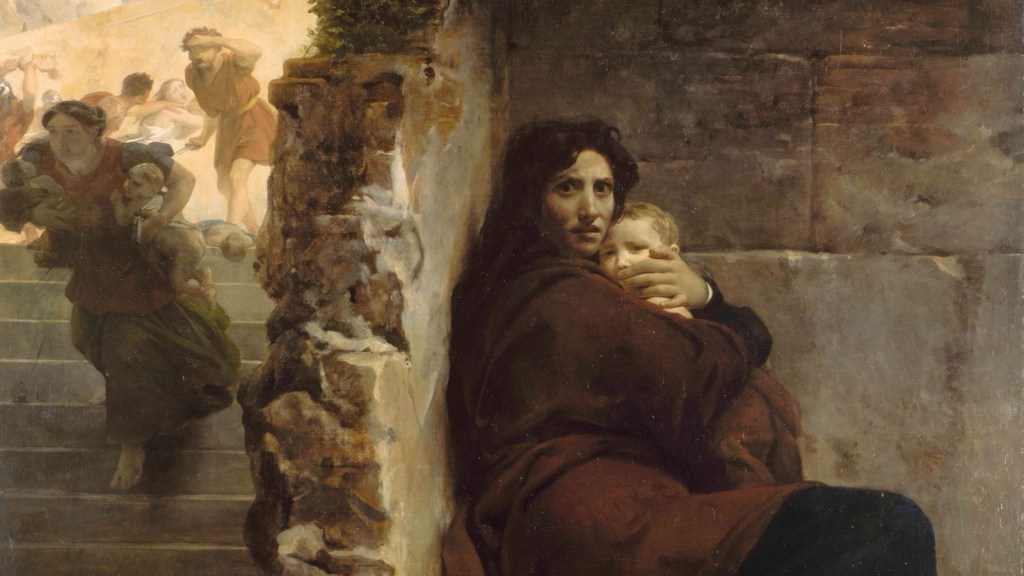
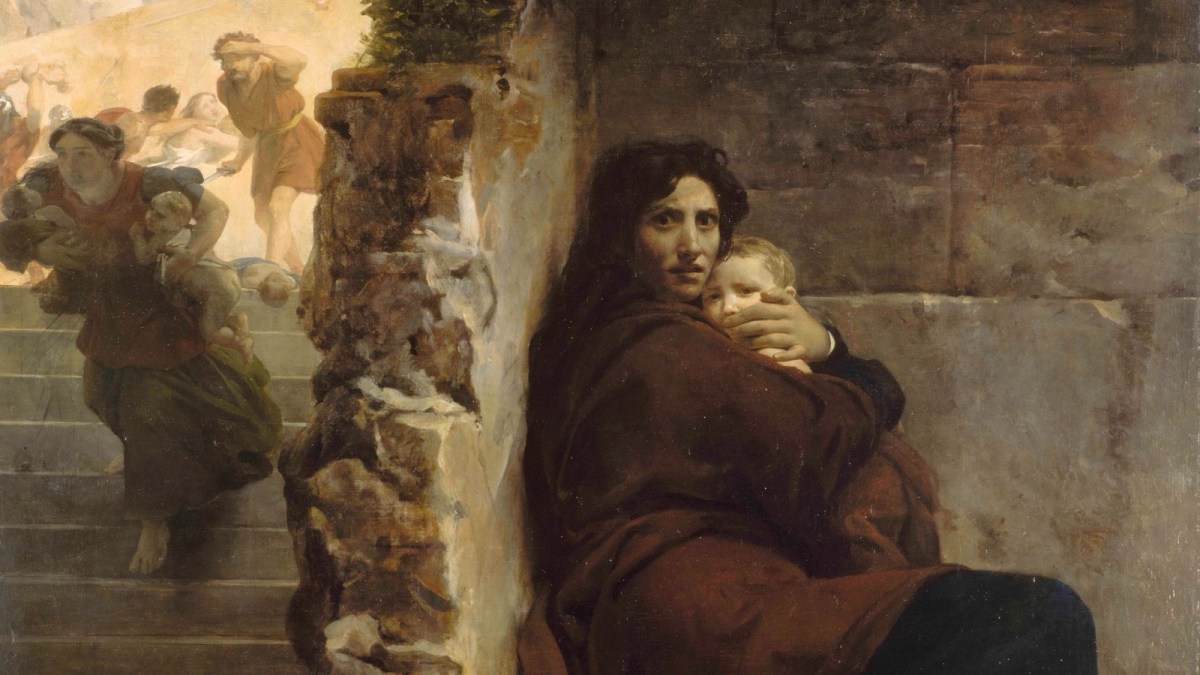
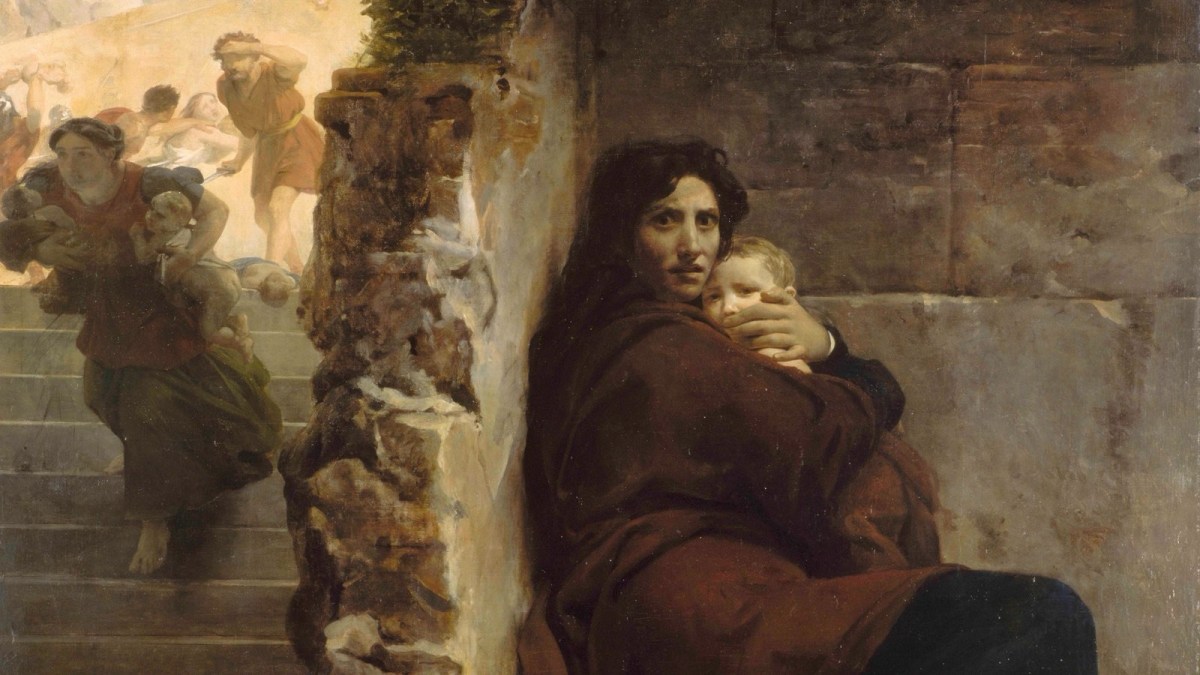
“The Massacre of the Innocents,” an 1824 painting by Léon Cogniet, held in the Musée des Beaux-Arts
Yesterday, we focussed on “the slaughter of the innocents” which is commemorated in the Western Church on 28 December. Today, 29 December, is the day when this commemoration takes place in the Eastern Church.
This this potent story, full of pathos, is so resonant with events in the world in which we live today: people dying in invasions and wars; people fleeing, seeking refuge, in a safe place. Sadly, this part of the story has all but faded from view in “the Christmas story” that is recounted each Christmas. So here are some more thoughts—largely from the words written by contemporary hymn writers that tell this story.
There are clear words in these carols which show how the story challenges political values and policies and how it connects with the deepest feelings of human existence.
One contemporary hymn writer who has turned his attention to the story of Herod’s tyrannical rampage against the male children in Bethlehem, is the British Methodist, the Rev. Dr Andrew Pratt. Here is a powerful hymn which he has written about this story.
Another person who has worked well with words over many decades is the late Shirley Erena Murray, a Presbyterian from Aotearoa New Zealand. She was right on the money when she highlighted the violence and fear at the heart of the story, claiming that the infant in the story has “come to plead war’s counter-case”, and articulating the hope that “goodness will outclass the gun, evil has no tooth that can kill the truth.” Here’s her words:
Summer sun or winter skies, Christmas comes —
shepherds, angels, lullabies, words recorded by the wise:
read it in the book — take another look . . . .
Shadows track the hawk in flight, Christmas now —
children born in fire and fight, silent night a violent night,
hawks are in control of a nation’s soul.
There where terror plies its trade, Christmas now —
children learn to be afraid, minefields of distrust are laid,
evil is in force on a winning course.
Child of peace, God’s human face, Christmas now —
come to plead war’s counter-case, bring the dove a nesting place,
though her wings are torn, though her blood is drawn.
Winter skies or summer sun, Christmas comes —
still the threads of hope are spun, goodness will outclass the gun,
evil has no tooth that can kill the truth.
This ancient story resonates so strongly with our situation today, not because “it really happened, exactly like this”, but because (like a good myth does) it takes us to the centre of our humanity and reveals the depth of God’s presence in our midst. We ought to sing more about it!
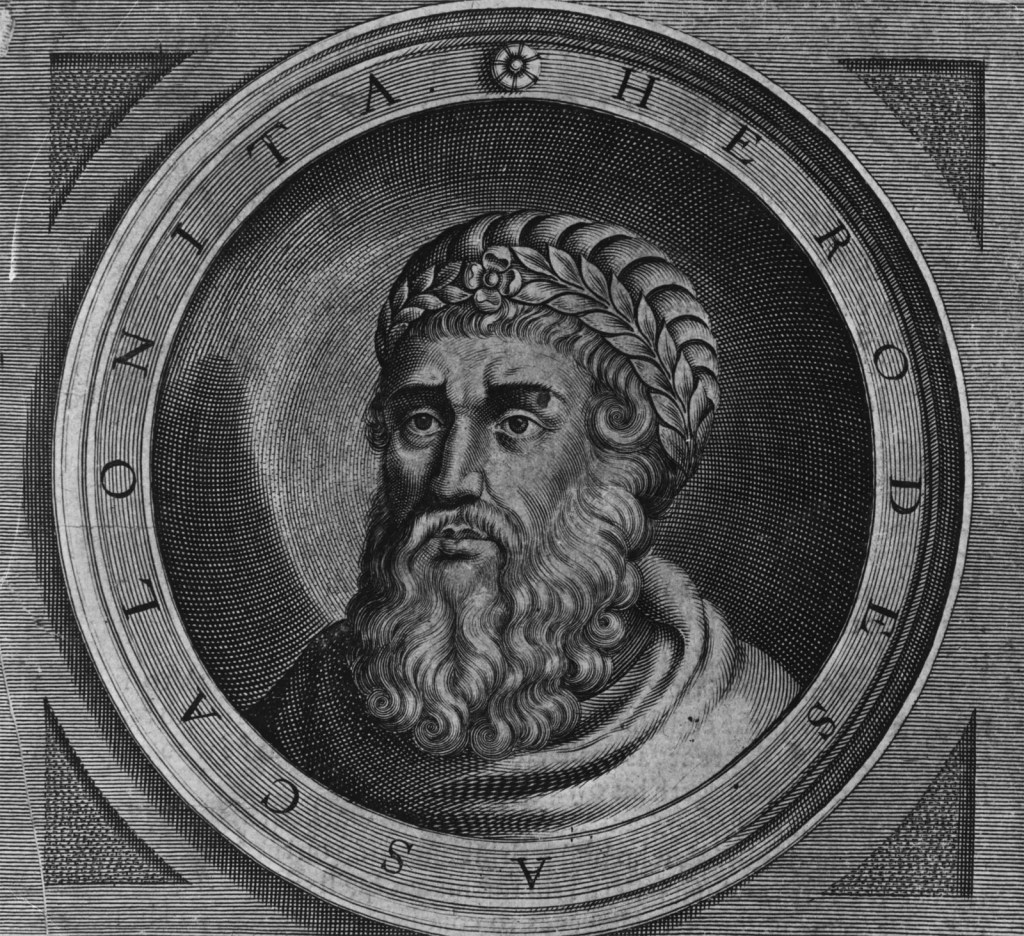
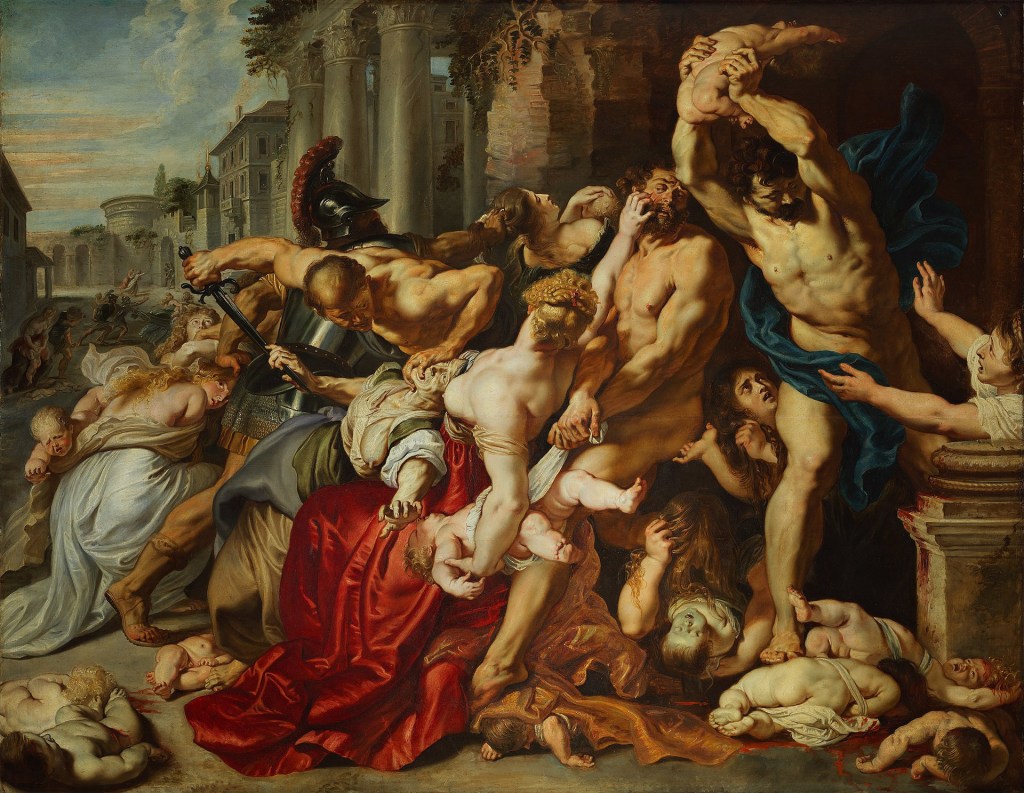
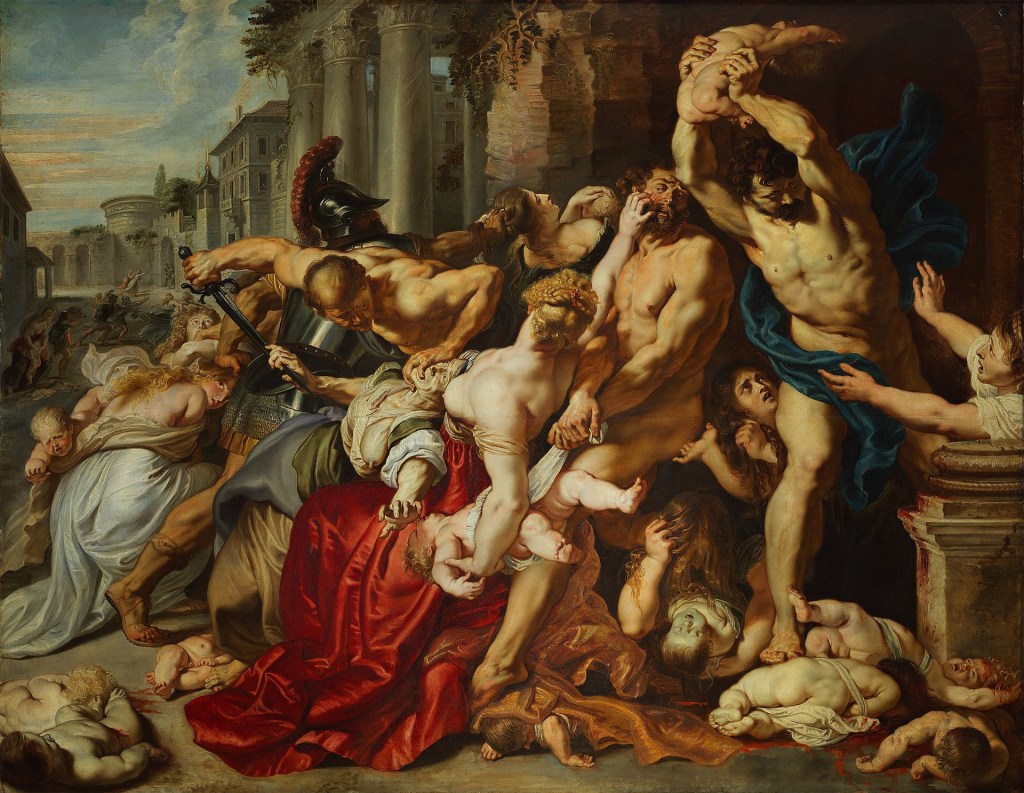
Today (in the Western Church) is designated as the Feast of the Holy Innocents. (It is celebrated tomorrow in the Eastern Church.) This festival day commemorates a tradition known as “the slaughter of the Innocents”, reportedly ordered by King Herod. It’s a gruesome attachment to the story that is told in the Gospel of Matthew that begins, “now the birth of Jesus the Messiah took place in this way” (Matt 1:18).
The tradition is that when Herod learnt of the birth of “the King of the Jews”, he feared that this king would pose a threat to his own rule (as a client king under the Roman Empire) over the Jewish people. Herod, it is said, ordered that all male children under two years of age should be killed, to ensure that this rival king was safely despatched (Matt 2:16). Jesus survived this because after visitors “from the east” came from the court of Herod to pay tribute to him (2:11), his parents were advised of the imminent pogrom by an angelic visitation (2:13).
“The Massacre of the Innocents,” an 1824 painting by Léon Cogniet, held in the Musée des Beaux-Arts
The story is told only in Matthew’s Gospel. It is highly unlikely that the events reported by Matthew actually took place. First, his is the only account of such an event in any piece of literature from that time. An event with so many deaths would surely have been noted by other writers. It is true that Herod was a tyrannical ruler; but amongst the various accounts of his murderous deeds, there is nothing which correlates to the events reported in Matthew’s Gospel.
Second, the story is embedded in the opening section of the Gospel, which uses typical Jewish typology and scripture-fulfilment to present the story of Jesus as a re-enactment of the story of Moses. The author of Matthew’s Gospel, a follower of Jesus who had been raised as a faithful Jew, was especially partial in the opening chapters of his work to quoting scripture and claiming that events that he reports “took place to fulfill what had been spoken by the Lord through the prophet” (1:22–23).
The chief priests and scribes in the royal court, says this author, told Herod that Jesus had been born in Bethlehem, “for so it has been written by the prophet” (2:4–6); the flight into Egypt of Joseph, Mary, and their newborn child was “to fulfill what had been spoken by the Lord through the prophets (2:15); the slaughter of the children itself “fulfilled what had been spoken through the prophet Jeremiah” (2:17–18); and the return of the family some time later and their settling in Nazareth was “so that what had been spoken through the prophets might be fulfilled” (2:21–23).
Aiding and abetting these notes of scripture fulfilment are other typical elements in the Jewish traditions of storytelling, namely, that the events as they take place are guided by the appearance of an angel in the dreams of Joseph (1:20–21; 2:13; 2:19) as well as direct guidance mediated by a dream of the visitors “from the east” (2:12) and again in a further dream of Joseph (2:22). The story that appears in Matt 1:18–2:23 would readily have been recognised by Jewish listeners as employing the typical elements and patterns of Jewish haggadicmidrash.
The book of Exodus also employed these elements and patterns. It opens in the time when “a new king arose over Egypt, who did not know Joseph” (Exod 1:8). This king, unnamed except for the designation of “Pharaoh”, feared the increasing numbers and growing power of the Israelites who been enslaved in Egypt for hundreds of years, determined that he would slow the rate of increase and lessen the power of the Israelites by decreeing, “every boy that is born to the Hebrews you shall throw into the Nile, but you shall let every girl live” (Exod 1:22).
It is in this context that Moses is born; he is hidden “among the reeds on the bank of the river” (Exod 2:1–4), and then taken home by the daughter of Pharaoh (Exod 2:5–9), adopted by her, and raised as a member of the royal household (Exod 2:10). The origin of the child is revealed to the readers (but presumably not to the Pharaoh) by his being named Moses, because, as Pharaoh’s daughter said, “I drew him out of the water” (Exod 2:10b).
The fact that a name conveys a deeper meaning has been found again and again in the traditional tales collated to form the narrative of Genesis: Adam reflects his creation “from the dust of the ground” (Gen 2:7), Eve’s name indicates that she is “the mother of all living” (3:20), Cain means “acquired” and is reflected in Eve’s comment that “I have produced [or acquired, qanah] a man with the help of the Lord” (4:1), and Abel is related to the Hebrew word for “emptiness” (havel).
Abram’s name is changed to Abraham, which means “leader [ab] of multitudes [raham]”, to signal the covenantal promise of the Lord God that “I will make you exceedingly fruitful; and I will make nations of you, and kings shall come from you … for an everlasting covenant, to be God to you and to your offspring after you” (17:4–6). The name of the aged, barren Sarai is changed to Sarah, meaning “she laughed” (17:15), to signal her incredulous response to the news that she will bear a child (18:9–15). The name of Ishmael literally means “God listens” (16:11) and that of Jacob means “he who supplants” (25:24–26); after his all-night struggle with a man at the ford of Jabbok (32:22–24), his name was changed to Israel, meaning “the one who strives with God” (32:28). Names are deeply significant!
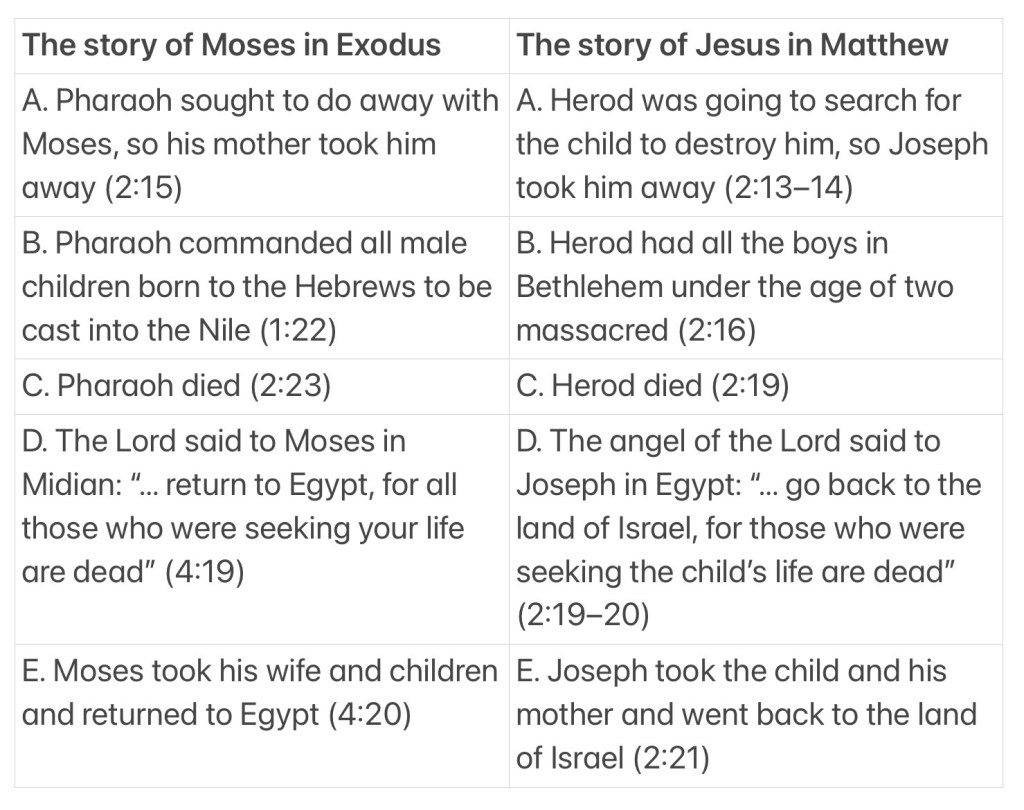
So Moses means “drawn from water”, and Jospeh is given the message that his son is to be given the name that signifies his role, Jesus: “for he will save his people from their sins” (Matt 1:21). And the ancient tale of the slaughter of infants at the time of the birth of Moses is replicated at many points in Matthew’s account of the slaughter of infants at the time of the birth of Jesus (Matt 2:1–18). This later account simply fits the pattern of the earlier account, as this chart shows:
The parallels are very clear!
And just as the literary structure of each story runs in the same pattern, so also the “historical” similarities are clear. Just as there is no historical evidence beyond Exodus to corroborate that the story of the pogrom at the time of Moses took place, neither is there evidence beyond the Gospel of Matthew to corroborate the account found there. Both patterns of events were stories, tales told, not history recorded.
But these non-historical stories are important for theological reasons. The Moses story is part of the whole Exodus complex that provides the fundamental explanation for the identity of Israel. The Jesus story as Matthew presents it is part of the foundational myth of the Christian faith. The writer of Matthew’s Gospel wants to make strong correlations between Jesus and Moses, as the two key figures in their respective stories—and religious systems. This starts in the mythological account found in the opening chapters, and continues throughout the following chapters of the Gospel.
As myth, the tradition found in Matt 1—2 points to important truths. The Slaughter of the Innocents grounds the story of Jesus in the historical, political, and cultural life of the day. It provides a dreadful realism to a story which, all too often in the developing Christian Tradition, has become etherealised, spiritualised, and romanticised.
So we remember this story as an important pointer to the counter-cultural, alternative-narrative impact of the person of Jesus. It is not history, but it offers a powerful myth.
A traditional hymn which remembers this tradition is the Coventry Carol. This dates from the 16th century, when it was performed in Coventry, England, as a part of a mystery play entitled The Pageant of the Shearman and Tailors.
The single surviving text of this pageant (including the words of this carol) was published by one Robert Croo, who dated his manuscript 14 March 1534. The carol is in the form of a lullaby, sung as a poignant remembrance by the mother of a child who is doomed to die in the pogrom.
The Gospel for the first Sunday in the season of Christmas (Luke 2:41–52) tells a story found only in this Gospel. It is set when Jesus was twelve years old, and he goes missing on what Luke reports was an annual pilgrimage to Jerusalem for the Passover festival (Luke 2:41).
The canonical Gospels included very little at all about the childhood of Jesus: Mark and John have nothing at all, while Matthew leaps from the two-year Jesus to his adult years, and Luke has only a couple of stories about the infant Jesus in the temple—except for this passage, set twelve years later. Because of this absence of material about the childhood of Jesus, from the second century onwards, various works were produced which recounted tales of “the missing years” of the childhood of Jesus.
Some of these works focussed on expanding the story of the birth of Jesus. TheProtoevangelium of James, also known as TheInfancy Gospel of James, is a mid-2nd century work, which provides many more details than found in the canonical infancy narratives. It claims that Mary was a temple virgin who remained a virgin for her entire life. I have explored some of the content of this work in
The Infancy Gospel of Matthew, also known in antiquity as The Book About the Origin of the Blessed Mary and the Childhood of the Saviour, offers an expanded account of the Flight into Egypt (it is not known on what this is based), and an edited reproduction of The Infancy Gospel of Thomas. This work which bears Mary’s name in the alternative title is dated to the 8th century; it has been the basis for developing Catholic traditions about Mary which still hold sway in popular piety.
In The Infancy Gospel of Thomas, a Gnostic work of perhaps the late second century, elaborated stories about the childhood of Jesus are told. One writer has described it as “a flamboyant and entertaining account of Jesus as a little child growing up in his hometown”.
The most famous incident in this work is when Jesus created gives clay birds on the sabbath; when accused of breaking Torah by working on the sabbath, he clapped his hands and the birds came to life and flew away! (The story is retold in the Quran, 5.10.) But Jesus in this Gospel also curses other children and causes some of them to die.
The last story it tells is of the twelve year old Jesus in the Temple, which we know from Luke 2:41–52. In Luke’s version, the teachers of the Law heard Jesus and “they did not understand what he said to them” (Luke 2:50). In the version told in Thomas, in this place in the story there stands this interchange between Mary and the scribes and Pharisees: “‘Are you the mother of this child?’ She said ‘I am’. And they said to her, ‘Blessed are you among women because God has blessed the fruit of your womb. For such glory and such excellence and wisdom we have neither seen nor heard at any time.’” (Infancy 19:4).
Most manuscripts that we have of this Gospel are medieval, although a fragmented manuscript of this work, dated to the fifth century, is held by a German library. For a translation of the Infancy Gospel of Thomas from the medieval manuscripts , see http://www.gnosis.org/library/inftoma.htm
Other later texts that contain material on the childhood years of Jesus include The Syriac Infancy Gospel (sixth century?) and The History of Joseph the Carpenter (seventh century?). The earliest manuscripts we have for these works are medieval.
So the story that Luke includes, from the end of the childhood years of Jesus, is somewhat related to these non-canonical works, in that it reveals a curiosity about the earlier years of Jesus. Perhaps Luke includes this story to satisfy a little of that curiosity. However, Luke’s story is quite different from these non-canonical accounts, which inevitably are speculative, flamboyantly elaborated, and utterly unreliable as any form of historical evidence.
The story told by Luke relates to some central themes found throughout his two-volume work. A number of elements in the story point forward to themes that recur later in the Gospel.
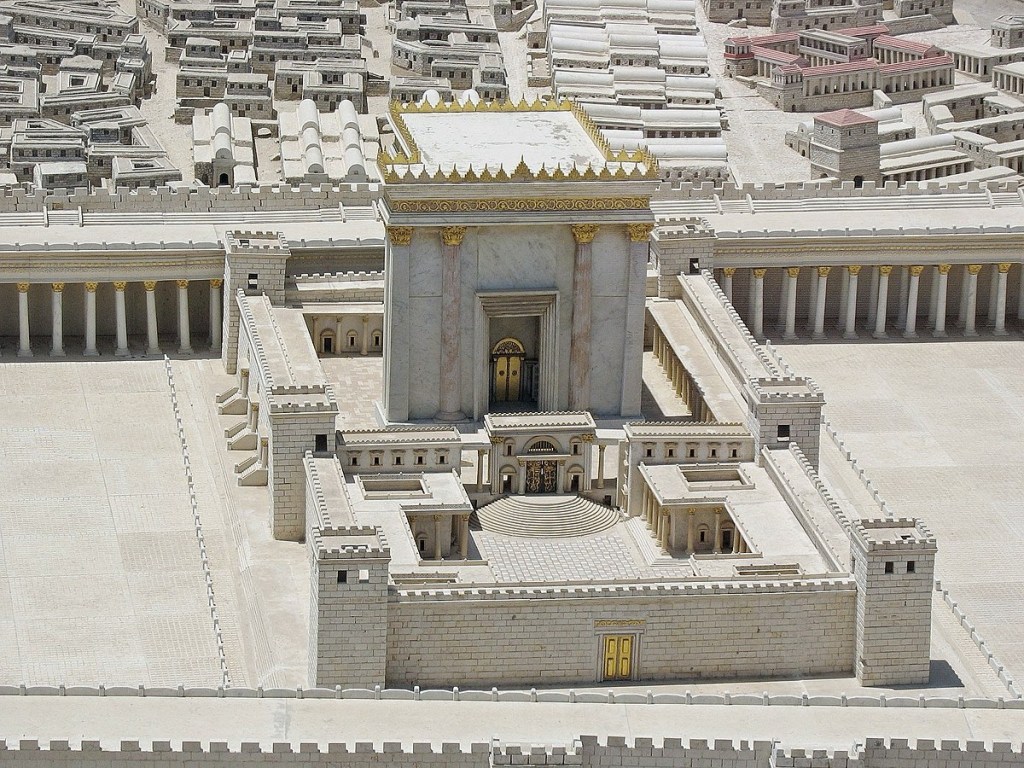
First, the setting is the Temple (2:46). In the Lukan version of the story of Jesus, the Jerusalem Temple plays a significant role. His “orderly account of the things that have been fulfilled among us” begins in the temple in Jerusalem, where we meet faithful Jewish people, Zechariah and Elizabeth (Luke 1:8–22) and then Simeon and Anna (2:22–38). This is the only Gospel that refers to these figures.
In Luke’s account of the story of the testing of Jesus (Luke 4:1–14), the order of testings found in Matthew’s account is altered, so that the testing relating to the Jerusalem Temple is placed at the climactic point of the last testing (4:11–13).
A reconstruction of how the Temple may have looked in the time of Jesus, towards the end of the Second Temple period
At a crucial point during his ministry in Galilee, Jesus “sets his face” to go to Jerusalem (9:51). On the way towards Jerusalem, Jesus laments the fate that is in store for Jerusalem (13:33–35) and when he enters the city, he weeps over the city (19:41–44) and provides more prophetic words about their fate (21:20–24). Each of these passages is found only in this particular Gospel.
Once Jesus has arrived in the city, the narration of his arrest, trial, betrayal, sentencing, death and burial follows the pathways recounted in other canonical Gospels. However, the risen Jesus appears, not in Galilee (as in other versions), but only in the nearby town of Emmaus (24:28–32) and then in Jerusalem itself (24:33–49). The final sentence of this Gospel indicates a return to the location of the opening scene, as the disciples “were continually in the temple blessing God” (24:53; cf. Acts 1:8–9).
The Lukan focus is singularly on the early movement as it formed in Jerusalem (Acts 1—7, 12) before spreading out from Jerusalem into other regions. Indeed, Acts 1:8 provides a programmatic statement that prioritises Jerusalem amongst all locations. And the disciples are noted as being in the temple a number of times (Acts 2:46; 3:1: 4:1–2; 5:21, 42). Indeed, this is specifically commanded by an angel of the Lord, who said, “Go, stand in the temple and tell the people the whole message about this life” (Acts 5:20). The Temple is a highly significant location in this Gospel.
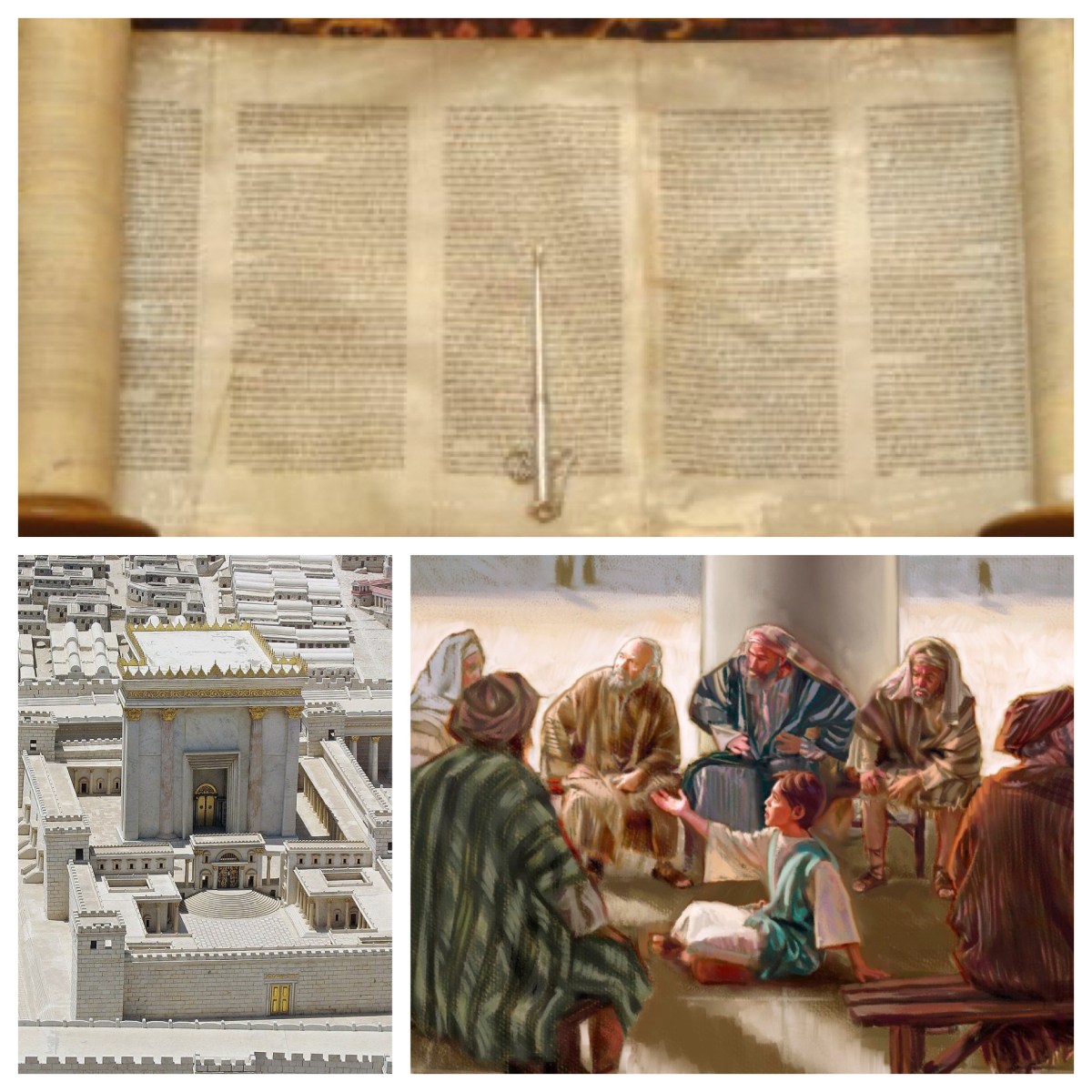
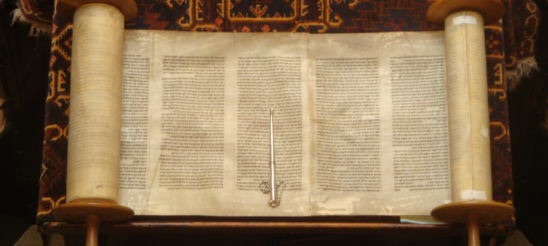
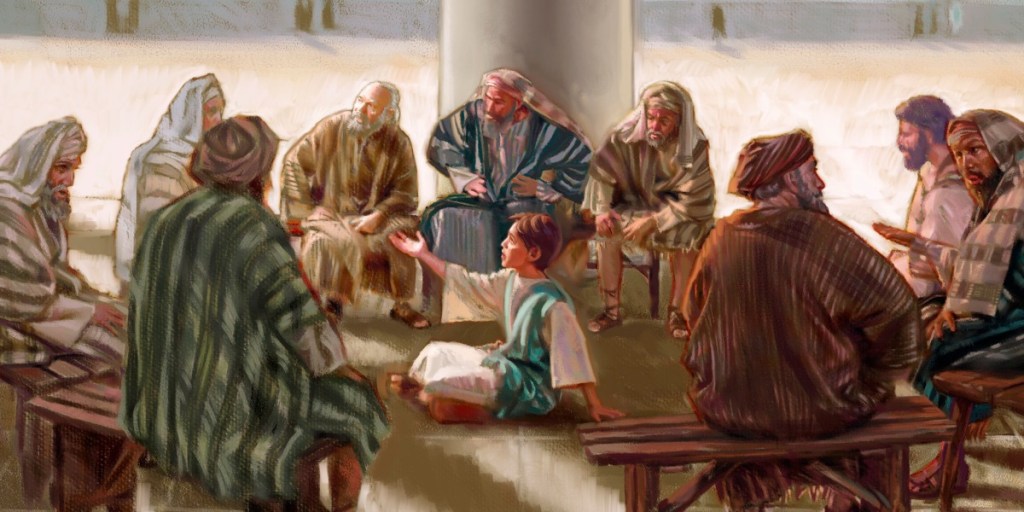
A second important feature that points ahead is the fact that Jesus is engaged in discussion with the teachers of Torah. When he was found, he was “sitting among the teachers, listening to them and asking them questions” (Luke 2:46). Discussion about Torah runs through Luke’s narrative, just as it had done in the Markan source that we presume he used (5:17–26; 6:1–5, 6–11; 10:25–37; 11:37–52; 12:1–3; 13:10–17; 14:1–6; 16:14–18; 18:18–30; 20:1–47).
A Torah scroll
Indeed, such is the vigour with which Jesus debates the teachers of Torah that “the scribes and the Pharisees began to be very hostile toward him and to cross-examine him about many things, lying in wait for him, to catch him in something he might say” (11:53–54). And then “the elders of the people” conspire with the Temple authorities to arrest Jesus (22:52) and bring him to trial (22:66), “vehemently accusing him” when he is brought before Herod (23:10) and pressing Pilate to sentence him to death (23:13–18).
However, all of this is far into the future as the twelve year old Jesus sits in the Temple, “sitting among the teachers, listening to them and asking them questions” (Luke 2:46). The response at this stage is positive and encouraging; Luke comments that “all who heard him were amazed at his understanding and his answers” (2:47). The story thus points to the way that amazement will be the response of people later in Luke’s narrative when the adult Jesus teaches and heals (4:22, 36; 5:9, 26; 8:25; 9:43; 11:14).
A third element looking ahead to later in the Gospel occurs in the words spoken by Jesus. During this exchange in the Temple, the young Jesus speaks words of wisdom. “Did you not know that I must be in my Father’s house” (2:49) is the first example of many of the short, pithy sayings which Jesus speaks throughout the Gospel.
We know this kind of saying well: “the Son of Man is lord of the sabbath” (6:5), “do to others as you would have them do to you” (6:31), “wisdom is vindicated by all her children” (7:35), “let anyone with ears to hear listen!” (8:8), “my mother and my brothers are those who hear the word of God and do it” (8:21), “if any want to become my followers, let them deny themselves and take up their cross daily and follow me” (9:23), “whoever is not against you is for you” (9:50) … and so on. The words of Jesus in this story, “I must be in my Father’s house?” (2:49) prefigure this wise saying style of Jesus.
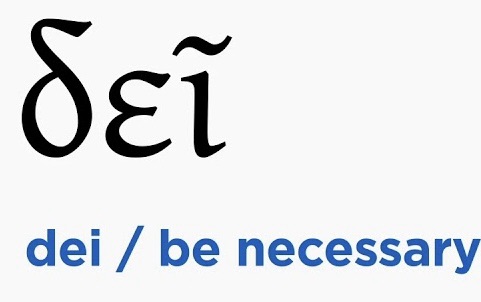
And the one small word “must” plays a key role at the centre of Luke’s theological explanation that all that takes place is integral to “the plan of God” (see esp. Acts 2:23 and Luke 7:30). (This was the topic for my PhD thesis, published as The plan of God in Luke-Acts, CUP, 1993; one whole chapter was devoted to the motif of divine necessity that is conveyed by this word and a cluster of terms used in Luke—Acts.)
What “must” take place is Jesus’s proclamation of the kingdom of God (Luke 4:43), the suffering of the Son of Man (9:22; 17:25), the necessary journey on the road to Jerusalem (13:34), and the inevitable occurrence of wars and insurrections (21:9), the flight from Jerusalem (21:20–21),, and the death of Jesus itself (22:36–37), followed by his being raised from the dead (24:7, 44–46). In Acts, this divine necessity continues to impel the activities of the apostles (Acts 4:19–20; 5:29) and of Paul (9:16; 14:22; 19:21; 23:11). All of this (and more) “must” take place.
Indeed, an alternative translation of Jesus’ words from the Greek, οὐκ ᾔδειτε ὅτι ἐν τοῖς τοῦ πατρός μου δεῖ εἶναί με; (and the translation that I prefer) is that he says “do you not know that I must be about the business of my Father?”. This rendering highlights how this verse performs a key programmatic function for the Gospel narrative as a whole, which tells of how Jesus carries out the business of his Father. That adds another depth to the significance of this passage.
Finally, what might we make of the fact that in this story Jesus was twelve years of age? Modern readers might connect this note with the fact that today, Jewish boys celebrate their bar mitzvah—a coming-of-age ritual—when they turn 13. (Jewish girls have a similar ceremony, a bat mitzvah.) So could this story about the 12 year-old Jesus somehow relate to his own bar mitzvah?
However, there is no reference to a bar mitzvah ceremony in the Hebrew Scriptures or the New Testament, nor in later rabbinic texts such as the Mishnah (3rd century) and the Talmuds (5th to 7th centuries). There is discussion in various medieval rabbinic texts that begins to develop the idea that such a ceremony was known; but as is always the case with rabbinic discussion, the discussions are subtle, complex, and not crystal clear to those not used to reading these kinds of texts.
My Jewish Learning places the first reference to a bar mitzvah in a fifth-century rabbinic text which references a blessing to be recited by the father thanking God for freeing him from responsibility for the deeds of his child, who is now accountable for his own actions. However, this is simply a prayer, not a full ritual ceremony. It then notes: “A 14th-century text mentions a father reciting this blessing in a synagogue when his son has his first aliyah [the “going-up” to the front of the synagogue to be blessed]. By the 17th century, boys celebrating this coming of age were also reading from the Torah, chanting the weekly prophetic portion, leading services, and delivering learned talks.”
So we should not read any magical significance into the age of Jesus in the story that Luke tells, other than it seems to mark a moment in the orderly account that Luke writes which reveals something of the character of Jesus at a time well before his public adult activity began. We can’t attribute any historical value to the story (the author of Luke’s Gospel was probably not even born at the time that this story was alleged to have taken place). But it does play an important role in the literary structure of the Gospel—it is a hinge between the infant Jesus and the adult Jesus—as well as offering some key theological elements in the understanding of Jesus that this Gospel develops.
Where are the women in the story we tell at Christmas? We know that there was “no room at the inn” for Mary and Joseph, as they prepared for the birth of their son, Jesus. But it seems that there is precious room in the story for women. Where are the women in this story?
There are lots of men in the “traditional” story that is retold and enacted every year: the faithful father-figure Joseph, the excited shepherds (presumably males?) coming in from the fields, the innkeeper at the place where “there was no room”, and of course the infant baby, a little boy. Then, the angel who makes appearances to announce the imminent births of John and Jesus is identified as Gabriel, another male.
There are the “three wise men”—well, it is usually presumed that they were men—travelling from the east and the evil tyrant Herod conferring with his male advisors (the chief priests and the scribes, more men) before ordering the slaughter of infant boys. There is the census ordered by the male ruler, Emperor Augustus, and implemented by the male Governor, Quirinius, throughout the region of Syria. All men. Where are the women?
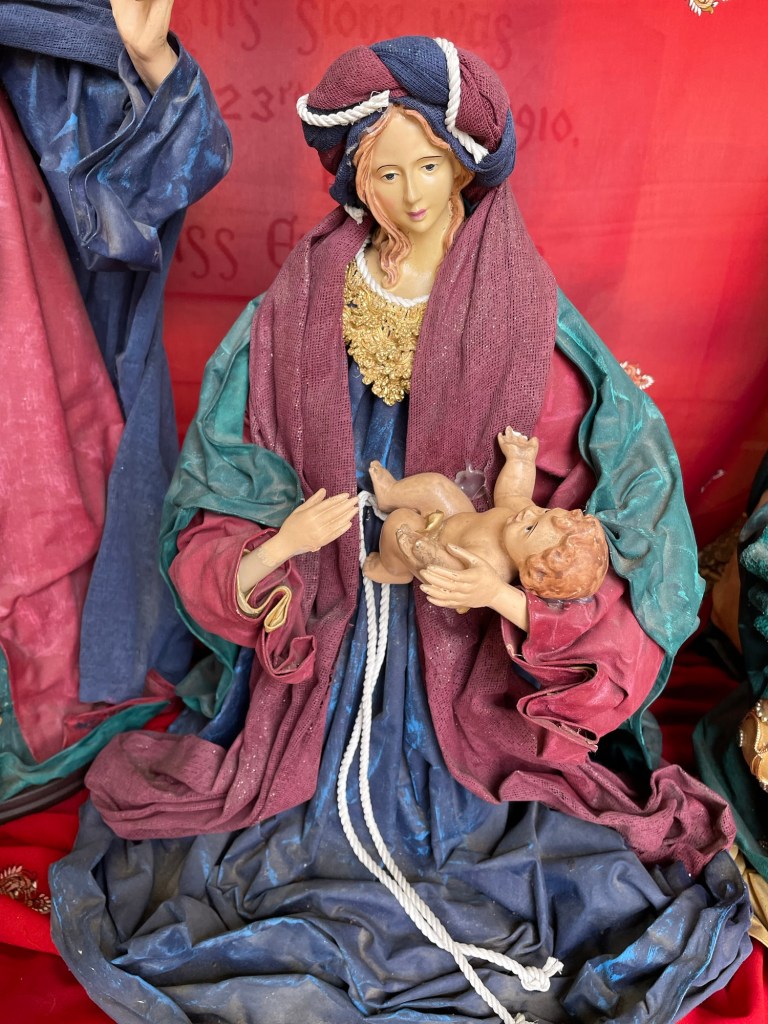
Many-a-time the girls and women who take part in the “traditional” nativity scene that we re-enact each year have to don the costume of a male character, and perhaps at times a false beard, so that they “fit the part”. It’s another way that women become invisible in the story that is told—as is so often the case with stories in the Bible.
Of course, we know that the “traditional” nativity scene is a fiction—an invention of Francis, a medieval monk (another man) who collated the two Gospel accounts (both written by men) and then added additional elements on the basis of his own informed (male) imagination. We sing about that scene in carols written, largely, by men: Joseph Mohr (Silent Night), Philip Brooks (O little town of Bethlehem), Edmund Sears (It came upon the midnight clear), Cecil Alexander (Once in Royal David’s city), Nahum Tate (While shepherds watched their flocks), Charles Wesley (Hark! the herald angels sing), John Henry Hopkins (We three kings), John Mason Neale (Good King Wenceslas), and John Francis Wade (O come, all ye faithful). All men.
And as far as the tunes we sing are concerned, there are yet more men involved: Felix Mendelssohn (Hark! the herald angels), Henry John Gauntlett (Once in royal David’s city), William J. Kirkpatrick (Away in a manger), John Henry Hopkins (We three kings), and Richard Storrs Willis (It came upon a midnight clear). The origins of the tune for O come, all ye faithful is not known, although at different times it has been attributed to no less than seven different composers—all, of course, being men! (George Frederick Handel is the best-known of the possible, but unproven, composers.)
And at least until fairly recently, most people have sent Christmas cards to each other that have been developed largely by men. These cards were originally popularised by the Hallmark company that began life as the Norfolk Post Card Company, established in 1907 by J.C. Hall and his older brothers, William and Rollie—three more men.
Lots of men. But where are the women?
Yes, there are some women in the story. Mary, for a start; every birth story needs a mother, and mothers must be female, and so we have Mary. And then there is Elizabeth, a relative of Mary, who is included in the story that Luke tells. And, in a wonderful version of the Christmas tale that my wife uses regularly in Christmas worship services, the cranky innkeeper has a wife who does her best to look after the visitors and keep the peace. So there are some women, explicit, and implicit, in the story.
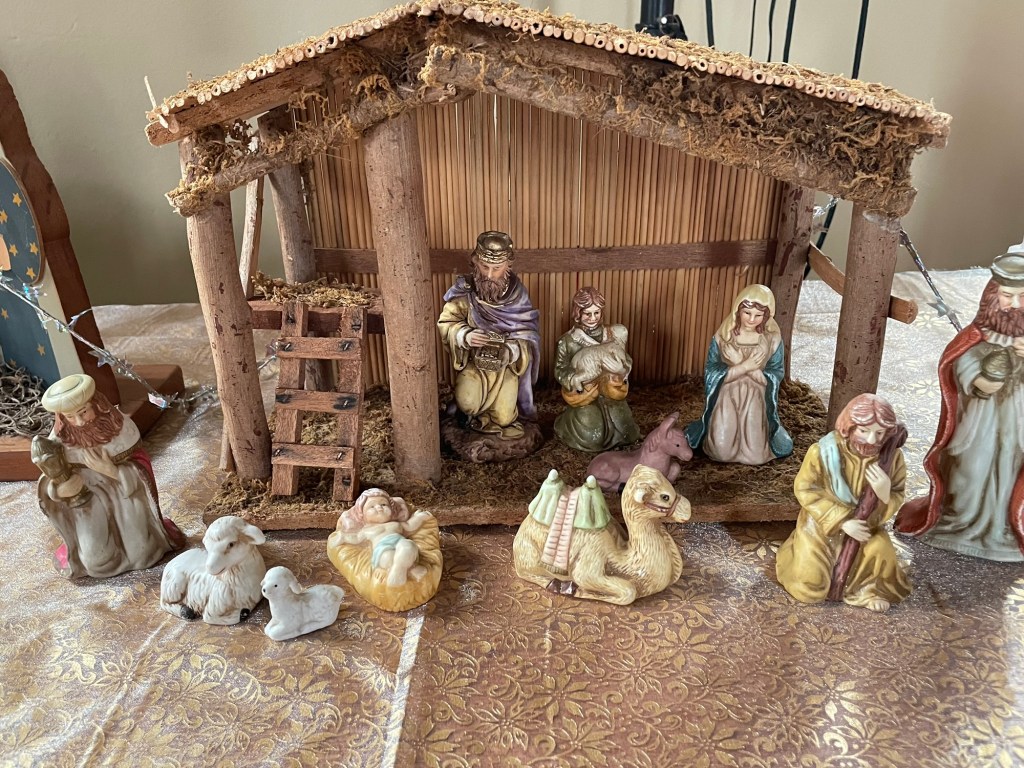
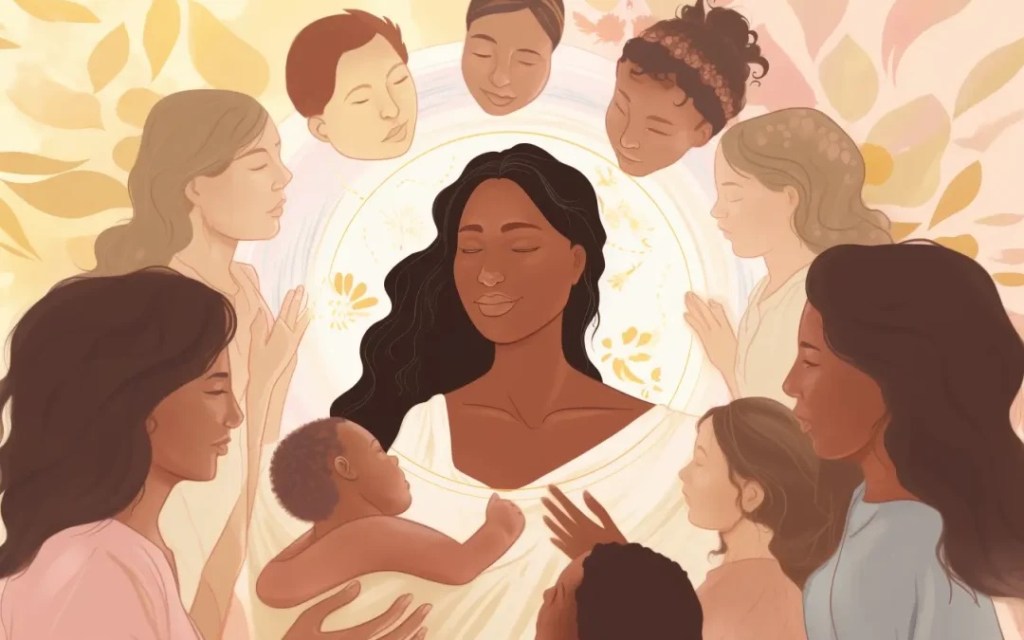
But there are more women who would have been involved in the events surrounding the birth of Jesus. For a start, Mary would have had assistance—female assistance—as she gave birth. Midwives were present at births in the ancient world; the story of Moses refers to the midwives in Egypt—and they are rare amongst women in biblical narratives in that their names are recorded: Shiphrah and Puah (Exod 1:15–22). Midwives are also noted in the birth narratives about Benjamin, whose mother Rachel sadly died giving birth (Gen 35:16–20) and the twin boys, Perez and Zerah, born to Tamar (Gen 38:27–30).
Prof. Carol Meyers, writing in the Jewish Women’s Archive, notes that “the presence of such a health care professional, called meyalledet (“one who causes, helps birth”), was probably routine in Israelite and pre-Israelite society”. She further notes that “the belief that god is the creator of life underlies the metaphor of God as a midwife, one of several female metaphors for God in the Hebrew Bible”, citing a line of a psalm addressing God as a clear example: “it was you who took me from the womb; you kept me safe on my mother’s breast” (Ps 22:9). Prof. Meyers astutely observes that “the status of midwives—and their power to transform childbirth from what might be a negative experience to a positive one—did not erode until the advent of modern, male-dominated medicine”. See
J.M. Hochstetler, writing about “Childbirth in Jesus’ Time”, has hypothesised further: “Midwives, skilled practitioners of their profession, were significant figures in ancient society who provided comfort, pain relief, and encouragement to the laboring woman. They performed rituals and prayers to protect her and her baby, used their expertise to deal with any complications that might arise, delivered the baby and the afterbirth, and supervised the mother and baby’s aftercare.” Commenting specifically on the birth of Jesus, she deduces that “Joseph would definitely have been excluded, nor would he have protested. Giving birth was the province of women, and men were happy to absent themselves.” See
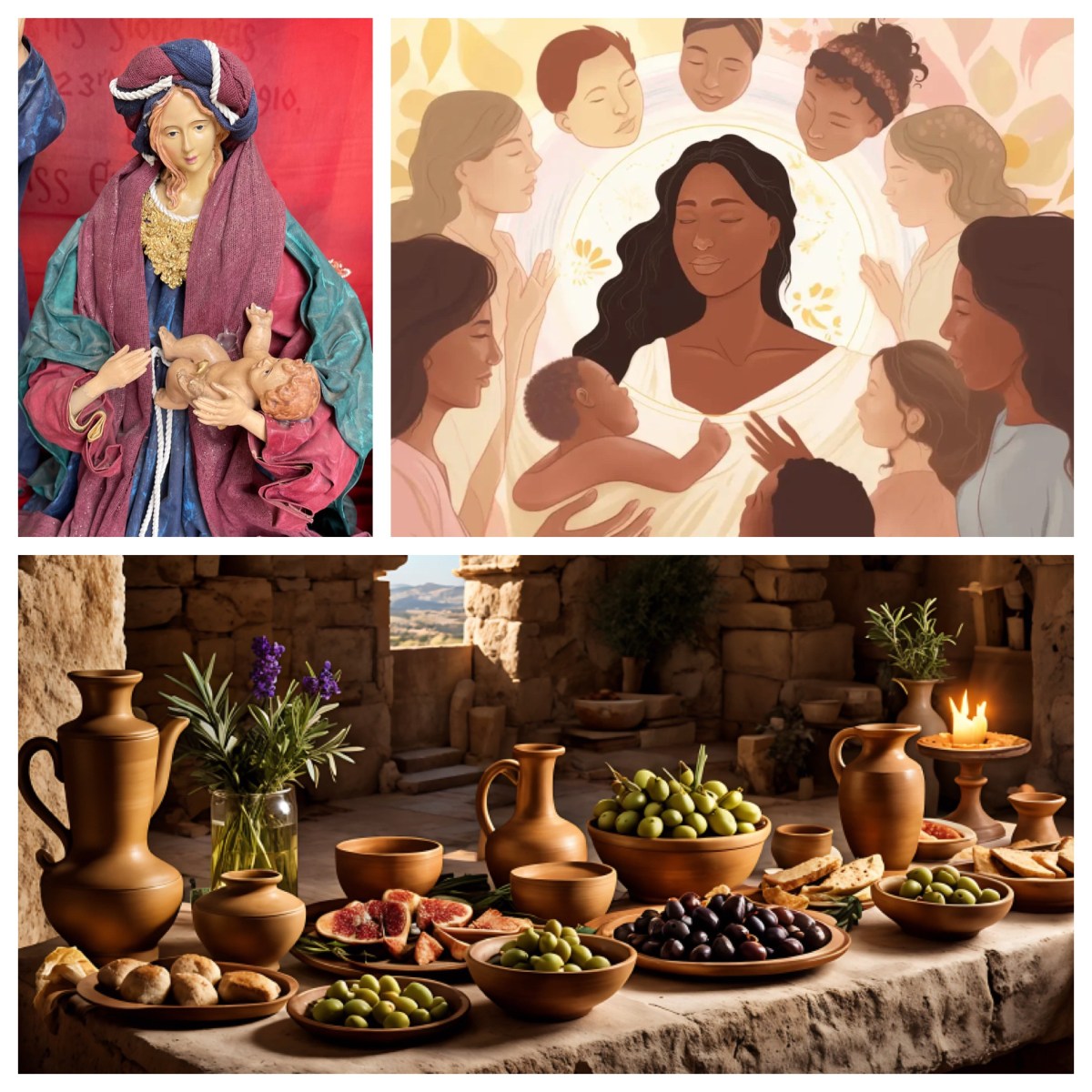
So it is a reasonable assumption that a midwife would have been present at, and assisted in, the birth of Jesus to his mother Mary. Why is there not at least a midwife (if not also some assistants) present in the “traditional” nativity scene that we re-enact each year?
Another place in the story at which women would most surely have been present would have been in the house where Joseph and Mary were staying at the time of this birth. Despite what the “traditional” story portrays, it was most definitely not a case of Joseph knocking on the doors of all the hotels in town, only to discover that, because of the census, every one of them was filled to overflowing, and so they had to settle for “a room around the back” with the animals.
Luke gives a minimum amount of detail concerning the birth of Jesus, informing us that Mary “laid him in a manger, because there was no place for them in the inn” (Luke 2:7). The word translated as “inn” is the Greek word κατάλυμα (kataluma). This is relatively rare in the New Testament, but appears in many places in ancient Greek literature, where it usually refers to a guest chamber or lodging place in a private home. The same term appears in Luke 22:11 with the meaning “guest room,” and the verb derived from this noun appears in two other places (Luke 9:12; 19:7) where it means something like “find lodging” or “be a guest.”
Moreover, and by contrast, in the story of the Good Samaritan, when Jesus refers to the place where the injured traveller rests—clearly a commercial inn—a different word is used; it means an inn frequented by travellers is used (pandokian; see Luke 10:34). So Joseph and Mary were not looking for lodging in an inn; they were most likely hoping to find shelter with a member of their family in Bethlehem.
That would make sense, given what we know of ancient life; in Jewish society (indeed, in all ancient Mediterranean societies), hospitality was very important. Travel to a town where members of the extended family lived would usually mean staying with them. Unfortunately for the key figures in the “traditional” Christmas story, once they arrived in town they found many other family members had arrived before them. So there was no room in the kataluma, the guest house in the family member’s home.
Luke’s story probably suggests that Joseph and Mary were planning to stay at the home of friends or relatives; but the home where they arrived was so full, even the guest room was overflowing, and so they had to be housed with the animals in a lower in the lower part of the house. It was the custom to house animals in a special section of the house, and that, of course, would be where the manger was to be found.
But once Mary and Joseph were given that space to stay, they would have been accepted into the family for the duration of their stay. And that meant including them in the family meals. And guess who prepared the meals? That’s right—the women of the family! And we know from familiar biblical stories that it was the women of the household who prepared and served the meals. When three visitors arrive unexpectedly at the tent of Abraham near the oaks of Mamre, the text says that “Abraham hastened into the tent to Sarah, and said, ‘Make ready quickly three measures of choice flour, knead it, and make cakes’” (Gen 18:6).
The last chapter of Proverbs praises the “woman of valour” who runs her household with such efficiency. Amongst her many and varied responsibilities, this woman “rises while it is still night and provides food for her household” (Prov 31:15). Overseeing the kitchen was integral to the efficient running of the household. The story of Abigail feeding the troops of David while they were in the wilderness, fleeing from Saul’s men and seeking sustenance from her husband, Nabal, a rich Calebite (1 Sam 25), reveals the proficiency of women as they brought provisions for the troops: Abigail took “two hundred loaves, two skins of wine, five sheep ready dressed, five measures of parched grain, one hundred clusters of raisins, and two hundred cakes of figs” and sent them off to feed David and his men (1 Sam 25:18). Abigail was the overseer of quite an impressive domestic operation, if these figures are to be believed!
So in Luke’s Gospel narrative, when Jesus visits the home of Martha and Mary, it is usually understood that “all the work” that Martha is undertaking, without the expected assistance of Mary, involved the preparation and serving of a meal for Jesus and those travelling with him (Luke 10:38–42). The same undertakings would have been the work of the women in the house where Joseph and Mary were staying when she gave birth to Jesus. They would have fed the new parents and ensured that they were well provided for as they cared for the infant Jesus in his first few days. There are more women at this point in this story!
So we ought to remember that there were actually many more women in the story of the birth of Jesus: present at the birth and immediately after it, involved in the food preparation and sharing food at table as the wider family gathered together, ensuring that there was support for the parents of the newly-born child. And we should make space in the story for these important characters to be seen and heard. Let’s remember that, and act on it, next time we prepare to tell or act out the “traditional” Christmas story.












 An Informed Faith