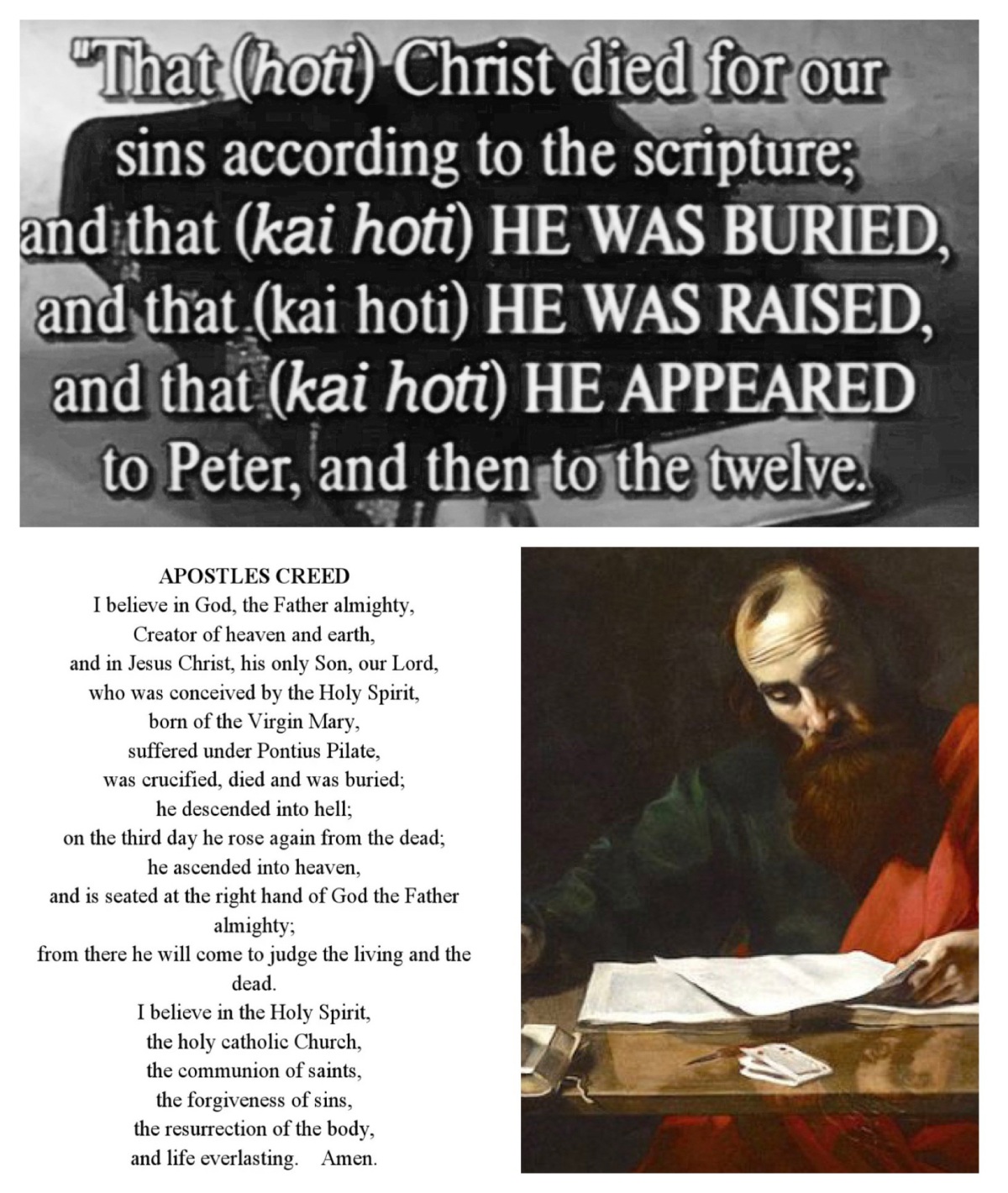
Receiving and passing on a living tradition: died and buried, raised and appeared (1 Cor 15; Easter Sunday)

On Easter Sunday, we say: “Christ is risen! He is risen indeed!”, to celebrate that “God raised Jesus from the dead” (Gal 1:1; Rom 4:24; 10:9; Acts 2:32). Paul affirms this good news in this extract from his first letter to the saints in Corinth, which is the Epistle reading that the lectionary offers for Easter Sunday (1 Cor 15:1–11). Some verses in this passage have played a key role in the development of Christian tradition, which affirms in creeds and confessions a belief in “Jesus Christ … who was crucified, died, and was buried … who rose again from the dead on the third day”.

What is the nature of the confessional affirmation that Paul offers in this passage? The previous chapters of 1 Corinthians have alerted us to the disorganised ethos of the community in the cosmopolitan port city of Corinth. Those earlier chapters have indicated a number of problems that existed within the community of followers of Jesus. There was factionalism (chs.1–4), immorality (ch.5), resorting to civil lawsuits (ch.6), and dissension regarding marriage, celibacy, and sexuality (ch.7). There were differing attitudes towards consuming meat bought in the marketplace after it had been offered to idols (chs.8–10), and multiple issues that manifested in their gatherings for worship (chs.11–14).

Paul addresses each of these matters with the same intention, to bring about order in the midst of the chaos that he has been told about. His words in the midst of the lengthy discussion about marriage, celibacy, and sexuality state his purpose with clarity: “I say this for your own benefit, not to put any restraint upon you, but to promote good order and unhindered devotion to the Lord” (7:35).

The disorder and chaos evident in worship, in particular, led Paul, in the chapter immediately preceding this passage, to advise the Corinthians to seek to speak to others in worship “for their upbuilding and encouragement and consolation” (14:3). He advises them to exercise their spiritual gifts appropriately; to “strive to excel in them for building up the church” (14:12), to “not be children in your thinking … but in thinking be adults” (14:20). He advises them, “let all things be done for building up” (14:26), noting that “all things should be done decently and in order” (14:40), for “God is a God not of disorder but of peace” (14:33).

People speaking over the top of each other in worship, not attending to important words of prophecy and tongues, reflected the disordered chaos of the apparently quite libertine community. The infamous words ordering women to “keep silent” (14:33b—36), along with the adjacent commands to “keep silent” while one interprets tongues that are spoken (14:27–28) and “keep silent” to those seeking to offer a word of prophecy while others are still prophesying (14:29–31), are included in this letter precisely to address this chaotic disorder. And not for the first time in this letter, Paul invokes his higher authority to support his directions: “[you] must acknowledge that what I am writing to you is a command of the Lord” (14:37; see also 5:3–4; 7:40; 10:20–22; 11:27–28; 16:10; and cf. 7:25).

Immediately after this extensive discussion about worship, Paul turns to his foundational message about Jesus, in a four-part statement: Christ died—was buried—was raised—and then appeared to various people (15:3–5). He uses terms that denote the passing on of traditions: “I received … I handed on … which you received … in which you stand” (15:1); and he insists on the importance of what he passes on: “you are being saved, if you hold firmly to the message that I proclaimed to you” (15:2). These two verses provide a strong, insistent introduction to what follows in the ensuing verses.

We see this dynamic also in an earlier chapter, in the familiar words associated with the Last Supper: “I received from the Lord what I also handed on to you” (1 Cor 11:23), as well as in the commendation of the Corinthians as they “maintain the traditions just as I handed them on to you” (11:2).

The core tradition that Paul cites is the fourfold declaration that Jesus died, was buried, was raised, and appeared (vv.3–5). It may have already have been an existing formula; we know that Paul, in this letter and elsewhere, makes use of very short credal-like statements that it is likely had already been developed by others, some of which he cites in order to refute, such as: “is well for a man not to touch a woman” (7:1), “all of us possess knowledge” (8:1), “all things are lawful” (10:23), and “how can some of you say there is no resurrection of the dead?” (15:12).

There are other succinct sayings which Paul uses as the basis for further developments in his argument, such as “I decided to know nothing among you except Jesus Christ, and him crucified” (2:2), “knowledge puffs up, but love builds up” (8:1), “there is no God but one” (8:4), and “all things are lawful, but not all things build up” (10:24). The discussion of factions in chs.1–4 is built off “I belong to Paul … I belong to Apollos … [but] what then is Apollos? what is Paul?” (3:4–5), while Paul’s lengthy discussion of spiritual gifts (12:4—14:40) jumps off from the unspiritual “Jesus be cursed!” and the spirit-inspired response, “Jesus is Lord” (12:3).

Furthermore, Paul writes a number of longer credal-like statements, some of which seem shaped for liturgical usage: the words which became the “words of institution” in the church’s eucharistic practice (1 Cor 11:23–26), and others such as Rom 8:28; 2 Cor 4:14; Gal 1:3–5; Phil 2:6–11. The writers in the school of Paul who later wrote letters claiming to have his authority ( the “pastoral epistles”) followed this practice (see 1 Tim 2:5–6; 3:16; 2 Tim 2:11–13; Titus 2:11–14).

Two clauses in Paul’s tradition-based affirmation of 1 Cor 15:3–5 are buttressed by reference to scripture, another voice of authority alongside “the tradition”. What the specific scripture passages are, Paul does not state; this has left open the door for speculation by later interpreters.

Supporting arguments by reference to scripture is not unknown in Paul’s writings; as a Pharisee, he had attained a good awareness of Torah and its application to life (see Gal 1:14; Phil 3:5–6). He bases his magnum opus, Romans, on a scripture citation (Rom 1:17, citing Hab 2:4) and there is barely a chapter of this letter that does not contain scripture quotations and allusions in abundance.

Key moments in 1 Corinthians are likewise supported by verses from Hebrew Scripture (1 Cor 1:19, 31; 2:9, 16; 3:19–20; 14:21; 15:54–55), and the well-known “words of institution” themselves (11:23–26) reference the tradition which emerges in later decades in the Synoptic Gospels, recording the words of Jesus himself at the last supper (Mark 14:22–25; Matt 26:26–29; Luke 22:14–20).

By using the terminology of traditions being received and handed on, Paul is reining in the wayward Corinthians, recalling them to the fundamentals of their faith. So he sets out the dynamic of died—buried—raised—appeared (15:3–5) as the foundation for then discussing, in the remainder of the chapter, issues associated with the resurrection of Jesus (15:6–58).

Who saw the risen Jesus? First, Paul tells of an appearance to the early leaders, Cephas (Peter) (v.5) and James (v.7)—of which, neither appearance is reported in any Gospel. Then, Paul indicates that Jesus appeared to “the twelve” (v.5) and “all the apostles” (v.8)—apparently alluding to narratives found in the later texts of three Gospels Matt 28:16–20, Luke 24:33–48; John 20:19–23, 24–29; 21:1–14. (The appearances narrated in the shorter and longer endings of Mark, added after 16:8, are not relevant; these are later patristic additions based on the other three Gospels, designed to harmonise the ending of Mark with these others.) Acts 1:6–11 might also be relevant here.

An interesting question is, how did he distinguish between these two groups—“the twelve” on the one hand, and “all the apostles” on the other. Indeed, these terms appear to be inherited by Paul from earlier traditions. This is the only place in all Pauline letters which refer to “the twelve”; and besides, the Gospel narratives noted above do not have Jesus appearing to “the twelve”, as Judas was absent from all of them, and so was Thomas in John 20:19–23.

As far as the word “apostle” is concerned, in 16 of the 18 occurrences in the Pauline corpus (including those not authentic to Paul) Paul explicitly apply the term to himself. Paul acknowledges others as apostles: James (Gal 1:19), Peter (Gal 2:8), perhaps Barnabas (1 Cor 9:1, 5–6), an unspecified number of believers who were given gifts to be apostles (1 Cor 12:28–29; see also Eph 4:11), and most strikingly, Andronicus, a male, with Junia, a female (Rom 16:7). Are these the people that Paul has in mind at 1 Cor 15:8? Or is this simply a phrase inherited from the tradition, which Paul has repeated?

Next, Paul identifies an appearance to “more than five hundred brothers and sisters at one time” (v.6), which again has no place in any Gospel account. Last, Jesus appears to Paul himself (v.8), which he briefly reports at 1 Cor 9:1 and Gal 1:1. Strikingly absent from his list is the empty tomb and the appearances to Mary in the garden (John 20:14), to the women as they left the tomb (Matt 28:9–10), to the two travellers to Emmaus (Luke 24:15), or to the seven fishing by the Sea of Tiberias (John 21:1–4). What a perplexing inconsistency between the various testimonies to these appearances!!

This is an early collection of “witnesses to the resurrection”; Paul wrote to the Corinthians in the mid 50s. But there is no mention of what was important to all four evangelists, writing in later decades: the women at the empty tomb and the role that women played in bearing testimony to the risen one. Is this accidental? or deliberate? Given what we have noted about 1 Corinthians as a whole—and especially what ch.14 reveals about the disorderly behaviour of Corinthian women—we might well wonder, is Paul shaping the received tradition to “fit the context” already at this early stage? It is a tantalising suggestion.

There is a wonderful quote that is pertinent to this issue, which is attributed to Gustav Mahler, the late 19th century Austro—Bohemian composer: “Tradition is not the worship of ashes, but the preservation of fire.” These words indicate that if tradition stands still, it will run out of momentum and fizzle out of energy. Tradition always needs to be reinvigorated and renewed, in the way that fire sizzles and snaps as it continually changes its shape and form.

And that’s a fine thought for us to have as we consider the resurrection of Jesus. As the Apostles Creed affirms, echoing 1 Cor 15:3–5, “we believe in Jesus Christ … who was crucified, died, and was buried … who rose again from the dead on the third day”. We need to renew and rekindle that tradition, to find fresh ways to understand and proclaim that mysterious happening, which sits at the heart of classic Christian confessions.

I’ve offered my own initial reflections on precisely that task in this blog:

He is not here. He is risen (Mark 16; Easter Sunday year B)

The time is early in the morning – quiet, dark, peaceful; the same time of day as when we came to this place. The cast of characters is well-known; Mary Magdalene; Salome, Joanna, another Mary; we know these women. And the message is, likewise, a comforting, familiar refrain: The tomb is empty. He is not here. He is risen. In all that we have heard, we are on familiar ground.

It is most likely that each of us are also well-acquainted with the flow of the story—the women come, bearing their spices, to anoint the body; the stone is found rolled away; the tomb is seen to have no body; and the message is delivered in short, succinct phrases: The tomb is empty. He is not here. He is risen.

The place may be a little unusual, in our way of thinking: it is a tomb, carved out of the rock, large enough to enable a number of adults to be buried together. As people of Anglo heritage, we are used to individual plots, dug deep into the ground, where one person, or maybe a married couple, are laid to rest.

But this is different: it is a large cavity in the side of a rockface, carved out to enable space for a number of adults to enter; space enough for generations of a family to be laid to rest within the one very large tomb. This practice can be seen in phrases, frequently used in mentioning the Patriarchs and David, in Hebrew Scriptures: when such an eminent person died, he would be “gathered unto his fathers,” “sleeping with his fathers,” or “gathered unto his people.”

But these aren’t just euphemisms for death—like we say, ‘passed away’, or ‘went to their eternal rest’; no, this was a literal, physical description of what was done with the bodies of deceased people in ancient times: they were placed in the family tomb, alongside the resting-places of relatives and ancestors.

So the physical location, and the cultural custom, is rather unfamiliar to us today. But the rest of the story, we reassure ourselves, runs along familiar lines, following the well-trodden pathway.

Or does it?

Step back from the empty tomb; walk away, for a moment, from the Easter narrative. Consider the broad sweep of our Christian faith; the overarching drama of our Christian lives.

What do we expect to be central and essential to our Christian faith? What is it that we anticipate finding at the very heart of our faith? How does faith function in the lives of people today, in or time, amidst the stresses and pressures of 21st century living?

Psychologists—those who study the human mind—tell us that people in our times are more likely than ever before to be depressed. Our deepest yearning is to be happy, to feel appreciated, to have assurance that we are valued, that we are loved.

Sociologists—those who study human societies—tell us that people in our times feel disconnected, isolated, and cut off from one another. Our common yearning is to be a part of a group, to feel that we belong. We need to know that others need us.

What this analysis often leads to, is a sense that people today are looking for certainty—we want to be grounded in a group, we want to be part of the tribe, we want to be loved and appreciated, we want to know the assurance of the absolute.

And faith—Christian faith, or indeed any form of faith—can then be offered as the way for people, in their fear and anxiety, in their loneliness and uncertainty—faith can be offered as an answer to these ills. ‘Just take this pill (this pill of absolute faith) and you will be right.’ ‘Just switch your allegiance in one fell swoop, and all will be different.’

Let me invite you to think about these issues in the light of the story which we have heard retold today. For as we encounter and engage with the unfamiliar dimensions of the story, we will find a rather different response to our situation emerging from the interplay.

There are two striking and unfamiliar elements in the story of the empty tomb. The first has to do with who is there. And the second has to do with who is NOT there.

Who is there, that early morning, in the tomb where the body of Jesus had been laid, just a few days earlier? Who are the ones who see, and hear, and experience for themselves, the jarring reality of that early morning encounter?

In a society so dominated by males—male priests, male scribes, male teachers of the Law, male heads of each household—is it not striking and jarring that the great news of Easter is entrusted, first of all, and in all its fullness, to a group of women?

Women—who come to perform their traditional female role, of anointing the freshly-interred body. Women—who come in subservience and devotion, to enact the ritual which has been set aside for them to undertake, as befits their allocated role in society. Women—who, if the traditional pattern is to be followed, will come, unwind the covering on the body, anoint the body with spices, reroll the covering and replace the body, and reverently leave the tomb.

But these women are unable to carry out the male-determined ritual for the body of the recently deceased. The familiar pattern is interrupted; the servant role is removed; and it is these women to whom the striking news of Easter is given.

It is to these women that the responsibility is given, for declaring that the body of Jesus is no longer gripped by death. It is to these women that the role of being the first, the primary, witnesses, to the interrupting action of God: the one who was dead, Jesus, our Master, is no longer here.

The tomb is empty. He is not here. He is risen.

God is now working in ways that challenge, disturb, and overturn the well-worn, familiar, traditional patterns of society. The women cannot carry out the duties and responsibilities that they have long been given. The women, now, are to be witnesses to what God has done. They are to return and tell the men—the apostles, the pillars, the chosen ones—what God has been doing. He is not here. He is risen.

It is the women, and not the men, as expected, who are the ones to break the news: He is not here. He is risen. It is the women who become the first evangelists, the first to proclaim the good news of God. It is the women who become apostles, even to the apostles, the men waiting in the city, unaware of what has occurred at the tomb, and unacquainted with what God has been doing through Jesus. He is not here. He is risen.

If the first striking feature of this story is, who IS here; then the second arresting aspect, is who is NOT here. This is a story about Jesus, in which Jesus does not appear.

This is an account of the most dramatic and significant moment in the whole narrative about Jesus—but there is no Jesus to be seen!   No Jesus to be touched!
No Jesus with whom to talk!   No Jesus to stand, centre-stage, as demonstration of the realities of how God is now at work.

So here is the conundrum: this is the precise moment in the story when God acts in a new and surprising way. This is the pivot point upon which the whole of the narrative turns.

And yet, at the heart of the story, there is—nothing!   No central character. No resurrected Jesus, shining forth God’s glory for all to see. No dramatic, booming voice from the heavens, declaring the risen Jesus as the Lord of all. All that we have, are the words of the young men: He is not here. He is risen. There is nothing, but a startling absence, precisely at the moment when we expect a dramatic presence.

In my mind, this paradoxical turnaround is highly significant, hugely important. At the centre of our faith, there is an enticing invitation—to explore, to ponder, to imagine, to wonder.

There is no clear, black-and white, unequivocal proof. There is no definitive dogmatic assertion, no unquestionable, unambiguous deed, no unarguable proclamation—no resurrected Jesus standing in the tomb. There are simply the women, stunned; and the young men, explaining: He is not here. He is risen.

So, at the heart of the Easter story, we find absence; mystery; the glimpse of a possibility; the wisp of a wondering; the beginnings of a pondering: ‘how can this be’; ‘what does this mean?’; ‘what do we do next?’; ‘where is this all leading?’.

And in my mind, this central absence, at the heart of the story, reminds us of the essence of our faith. In our faith, we have no clearcut, unquestionable dogma; we have no unchangeable given, no unarguable declaration.  We have no absolute assurance, no certainty set in concrete.

Rather, we have an invitation to walk the way of faith, with openness; an invitation to delight in the mysteries which God unravels before our eyes, in our own lives; an invitation to search, to explore, to ponder; and perhaps then, to encounter, to marvel, and to rejoice.

He is not here. He is risen. So let us enter into the mystery, the enticement, and the joy, of faith!

“What do you wish me to do?” Interrogating the unlikely portrayal of Pilate (Mark 14–15; for Holy Week)

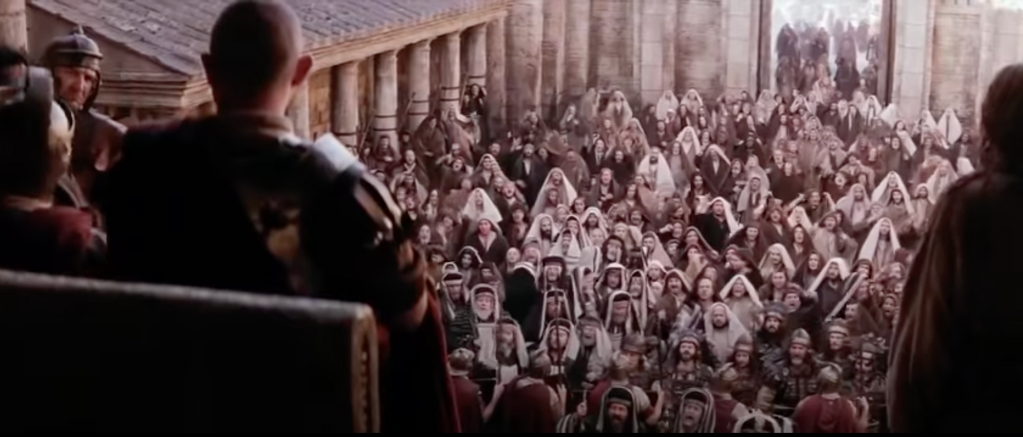
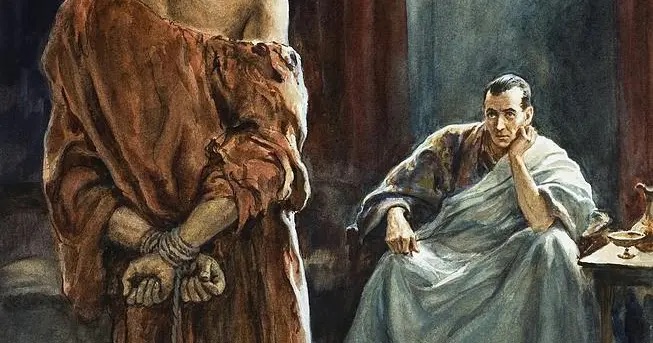
“What do you wish me to do?”, Pilate asks—according to the earliest account of his interaction with Jesus of Nazareth, recounted in the Gospel we attribute to Mark (although the narrative itself refrains from offering any identification of the author). Pilate, the Governor, representative of the mighty Roman Empire, asking a rag-tag crowd of Jews for advice on what he should do? Is there any historical plausibility in this scene which the unknown first century writer constructs?

I have had a number of discussions of this issue with my wife, Elizabeth Raine, whose knowledge of ancient authors and ancient Roman practices has been illuminating for the way we might understand the Gospel accounts. Much of what follows reflects those discussions.

“What do you wish me to do?” (Mark 15:12). It is not only this question that should cause us to question the narrative. Earlier, Pilate had seemed at a loss: “do you want me to release for you the King of the Jews?” (15:9). The narrative offers an explanation: “he realized that it was out of jealousy that the chief priests had handed him over” (15:10). And then it presses the point: “the chief priests stirred up the crowd to have him release Barabbas for them instead” (15:11), and so he asks the crowd, “what do you want me to do?” (15:12). For us, the question is: what do we make of this dithering, indecisive Pilate?

The narrative plays out the conflict by making sure that we understand Pilate has been cowed by the crowd, reporting that the crowd shouted at the Governor, “Crucify him!” (15:13). Instead of portraying the Governor as responding with all his imperial might, the narrative continues with Pilate asking a naïve question, “Why, what evil has he done?” (15:14a). To this, the crowd pressed still louder, “Crucify him!” (15:14b). And so, the denouement plays out: “Pilate, wishing to satisfy the crowd, released Barabbas for them; and after flogging Jesus, he handed him over to be crucified” (15:15).

We know that the Gospels were not written as “eye-witness accounts”. It would especially have been unlikely that one of the followers of Jesus was there, taking notes, as Pilate dealt with Jesus Barabbas and Jesus of Nazareth. The unlikelihood of this slim possibility is intensified by the comment in Mark’s Gospel, about the followers of Jesus, that “all of them deserted him and fled” (14:50). Clearly, the author envisages that none of those followers were there at this scene. (The reference to a group of women “who used to follow him and provided for him when he was in Galilee” refers, not to this moment in the sequence of events, but only to the later scene when Jesus is dying on the cross; see 15:40–41.)

We can’t treat the Gospels as actual “history-as-it-took-place”. We can’t treat the Markan account of Jesus before Pilate as historical. That is especially the case regarding the way that Pilate is portrayed. Most of our knowledge of Pilate outside the New Testament comes from the writings of the Romano-Jewish historian Flavius Josephus, who details many incidents during the governorship of Pilate, and Philo Judaeus, a learned Jewish philosopher living in diaspora in his Alexandria. The Pilate they describe is quite different.

Their Pilate is said to have displayed a serious lack of empathy for Jewish sensibilities, for example by displaying Roman battle standards in Jerusalem. Josephus writes, “On one occasion, when the soldiers under his command came to Jerusalem, he caused them to bring with them their ensigns, upon which were the usual images of the emperor. The ensigns were brought in privily by night, but their presence was soon discovered. Immediately multitudes of excited Jews hastened to Caesarea to petition him for the removal of the obnoxious ensigns. For five days he refused to hear them, but on the sixth he took his place on the judgment seat, and when the Jews were admitted he had them surrounded with soldiers and threatened them with instant death unless they ceased to trouble him with the matter.”

The story does end with Pilate backing down; but this is in the face of a large uprising, and not just in relation to one individual. Josephus continues, “The Jews thereupon flung themselves on the ground and bared their necks, declaring that they preferred death to the violation of their laws. Pilate, unwilling to slay so many, yielded the point and removed the ensigns.” (Josephus, Jewish War 2.169–174; Antiquities of the Jews 18.55–59)

Philo of Alexandria tells us that on other occasion Pilate dedicated some gilt shields in the palace of Herod in honour of the emperor. On these shields there was no representation of any forbidden thing, but simply an inscription of the name of the donor and of him in whose honour they were set up. The Jews petitioned him to have them removed; when he refused, they appealed to Tiberius, who overrode the governor, ordering that they should be removed to Caesarea. (Philo, Legatio ad Gaium, 38)

Josephus also reports how Pilate appropriated Temple funds for the construction of an aqueduct: “At another time he used the sacred treasure of the temple, called corban (qorban), to pay for bringing water into Jerusalem by an aqueduct. A crowd came together and clamoured against him; but he had caused soldiers dressed as civilians to mingle with the multitude, and at a given signal they fell upon the rioters and beat them so severely with staves that the riot was quelled.” (Josephus, Jewish War 2.175–177; Antiquities of the Jews 18.60–62)

Pilate may possibly have responded harshly to the unrest in Jerusalem during the Passover in 33 CE, because, due to other political machinations at that time, the powerful neighbouring Roman province of Syria was unable to provide him military support, as usual. (This the hypothesis that Elizabeth has developed; I think it makes sense.) Pilate wanted to suppress the potential uprising before it got momentum.

We do know that in approximately 36 CE, Pilate used arrests and executions to quash a Samaritan religious uprising. After complaints were then made to the Roman legate of Syria, Pilate was recalled to Rome; he is believed to have later committed suicide.

So, we can see that the character of Pilate in other ancient texts beyond the earliest Christian texts is far more ferocious and determined than how he is depicted in the Gospels; and, indeed, he is antagonistic towards Jews in particular. His vascillation, and his bowing to the shouted demands of the crowd, do not correlate with the character of the figure to which these two Jewish writers attest.

Thus, there is a clear political improbability to the account found in Mark’s Gospel—indeed, in all four Gospels, whose authors each strengthen the Markan portrayal. Matthew has Pilate wash his hands of his decision, saying, “I am innocent of this man’s blood; see to it yourselves” (Matt 27:24). Luke has Pilate declare that Jesus was innocent not once, but three times (Luke 23:4, 14, 22). And John’s Pilate engages in a philosophical discussion with Jesus (John 18:33–38) and questions him further, seeking to find a way to excuse him (John 19:8–12), before bowing to the pressure of the crowd (John 19:13–16).

So Pilate as we know him from other accounts was a ferocious and fearless leader whose strength of character is made clear by the numerous times that, according to Josephus, he sent in his troops to quell an uprising, to scatter a crowd, to squash a rebellion.

American scholar Bart Ehrman concludes that Pilate “was a brutal, ruthless ruler with no concerns at all for what the people he governed thought about him or his policies. He was violent, mean-spirited, and hardheaded. He used his soldiers as thugs to beat the people into submission, and he ruled Judea with an iron fist.” (See https://www.patheos.com/blogs/rationaldoubt/2019/05/pilate-released-barabbas-really/)

Surely Pilate would not have been cowed by the crowd in Jerusalem for Passover? Had he wanted to act, he would simply have ordered his troops to attack, scatter the crowd, and disperse the built-up tension. The Gospel accounts of Pilate, across all four narratives, are improbable; the apologetic purpose (to show the Romans in a better light, to avoid being seen as an agitator or rebel, and to place the blame on the Jewish authorities) becomes clear, when we read in this way. We need to bear all of this in mind, as we read and listen to the familiar narrative this Easter, and each Easter.

Would a Roman Governor ask a Jewish crowd for advice? That would be an untenable act, completely undermining his authority. Would a Roman Governor release a known insurrectionist from his sentence? There is no known precedent for this—indeed, no evidence at all, apart from the Gospels, of this practice. It is historically implausible (particularly in the light of the fact that Barnabas means “son of God”).

On the (mythological) story of Barabbas:

Would a Roman Governor be so under the control of the Jewish Sanhedrin to act in this way? Especially since it was Rome which appointed the High Priest; it was the Jewish hierarchy which needed to do as Rome commanded. In the earliest account, Pilate questions the crowd as to whether he should sentence Jesus (Mark 15:5, 14). The same question is noted in Matt 27:23. By the time of Luke’s Gospel, he speaks a clear threefold affirmation of the innocence of Jesus (Luke 23:4, 13–16, 22).

By the fourth Gospel, the scene where Jesus is brought to Pilate is changed from a trial to a philosophical discussion (John 18:29–31, 38). Pilate (quite uncharacteristically) backs down in the face of a baying crowd (Mark 15:6-15, and parallels). In Matthew’s account, Pilate enacts the potent symbol of washing his hands of the whole affair (Matt 27:24).

The Jewish Sanhedrin, by contrast, is placed firmly in the firing line. All four Gospels tell the story in the same way: the central factor that leads to Jesus being condemned to death is the decision of the Jewish Sanhedrin (Mark 14:63-64, and parallels), and their agitation amongst the crowd (Mark 15:11; Matt 27:20; Luke 23:13-16; John 18:38b-40). Mind you, the Gospel accounts are also on shaky historical ground in the way they describe the actions of the Sanhedrin. See

So another relevant question is: Would a follower of a man put to death under Roman rule for treason write a narrative which placed the blame squarely on the shoulders of the Roman Governor? I can see exactly why the Gospel writers sought to move the blame away from Pilate, onto the Jewish leadership in Jerusalem. Yes, Jesus was crucified by order of the Roman Governor (Mark 15:15 and parallels); but his hand was forced, they say.

So, with supreme irony, the inscription set over Jesus identifies him as King of the Jews (Mark 5:26). Ironic, because the inscription was ordered by Pilate, the Roman Governor over Judea—and Romans did not honour kingship, did not value kingship. Their rulers were Caesars, not Kings, elected by the Senate, not inherited by birth. The irony of the way that this story is told is that the Roman Governor apparently recognises the kingship of Jesus. The reality of the moment was that the Governor recognised a threat to the power of Rome, and acted to quell that.

In Luke, the Roman soldiers at the cross taunt Jesus, saying, “If you are the King of the Jews, save yourself!” (23:37)—a taunt provoked by the sign that was affixed to the top of the cross, bearing an inscription that read, “This is the King of the Jews” (23:36). That inscription; although it is intended to identify Jesus, is actually a statement of power and authority, made by Governor Pilate on behalf of the Roman Empire which he served. In the end, he asserts his authority. The Roman Governor has a pretender King put to death for treason. That much, I believe, can be retrieved as bedrock history, nestled within this rather fanciful narrative.

And so, in the end, even the Gospel accounts attest to the reality of Roman power. Their constant presence, their marching legions, their brutal commanders, intervening to execute their bloodthirsty justice … and their governor, Pilate, as fierce and rough and unbending as any governor ever known, ensured that Jesus went to his death.

Reflecting on scripture for Good Friday

We are offered an abundance of richness in the scripture passages that the lectionary proposes for our use during the coming week. The passages in the opening days of Holy Week help us to prepare for what follows over the Easter weekend. As well as passages for each day in Holy Week, there is a collection of four important passages that are offered for Good Friday: Isaiah 52–53, Psalm 22, Hebrews 4–5, and the full passion narrative of John’s Gospel.

Unlike the majority of Sundays throughout the year, when the selections in each category (First Reading, Epistle, Gospel) run largely in parallel and do not regularly correlate with one another—except for the choice of Psalm on many Sundays—these four readings have been chosen deliberately to focus in on a common theme, as befits the day, Good Friday.

The first passage comes from prophetic words within the second main section of Isaiah (chs. 40—55), known as Deutero-Isaiah. These chapters are fundamental for the theological developments that we find in the New Testament. In these chapters, Israel,is addressed as “my servant, Jacob, whom I have chosen,the offspring of Abraham, my friend; you whom I took from the ends of the earth, and called from its farthest corners” (Isa 41:8–9; see also 42:1; 43:10; 44:1–2, 21; 45:4; 48:20; 49:3, 5–6; 52:13; 53:11).

Scattered through this section, we find four oracles known as the Songs of the Servant—three relatively brief (42:1–9; 49:1–7; 50:4–11); and the fourth, best-known within Christian circles, a longer description of the servant who “was despised and rejected by others; a man of suffering and acquainted with infirmity” (Isa 52:13–53:12).

The resonances that this longer song has with the passion narrative of Jesus are crystal clear. The song is explicitly linked with Jesus six times in the New Testament (Matt 8:14–17; Luke 22:35–38; John 12:37–41; Acts 8:26–35; Romans 10:11–21; 1 Pet 2:19–25); furthermore, so many of the details of the passion narrative are shaped in the light of this song, along with a number of psalms of the righteous sufferer. (See https://johntsquires.com/2021/03/22/3-mark-placing-suffering-and-death-at-the-heart-of-the-gospel/)

The prophet describes the marred appearance of the Servant (52:14); he is despised, rejected, and suffering (53:3), bearing our infirmities (53:4), and wounded for our transgressions (53:5). The Servant is led like a lamb to the slaughter (53:7), suffering “a perversion of justice” (53:8). We can hear clear prefigurings of the passion of Jesus.

Furthermore, the Servant does not act with violence nor speak deceit (53:9). He is buried with the rich (53:9); the song declares that he gives his life as “an offering for sin” (53:10), carrying the iniquities of many (53:11), making them righteous (53:11), bearing the sin of many (53:12), making “intercession for the transgressors” (53:12). The resonances with the way that the death of Jesus is understood in later Christian theology are strong.

The narrative of the death of Jesus that Mark narrates in his passion narrative (and which was offered for last Sunday’s Passion Sunday) relates Jesus to the figure of the righteous person who suffers injustice, who appears in various Hebrew Scripture passages beyond this fourth, and longest, Servant Song. The author of this Gospel takes great pains to show that Jesus sought to remain faithful to his calling despite the pressures he faced, just as the righteous sufferers of old also held to their faith.

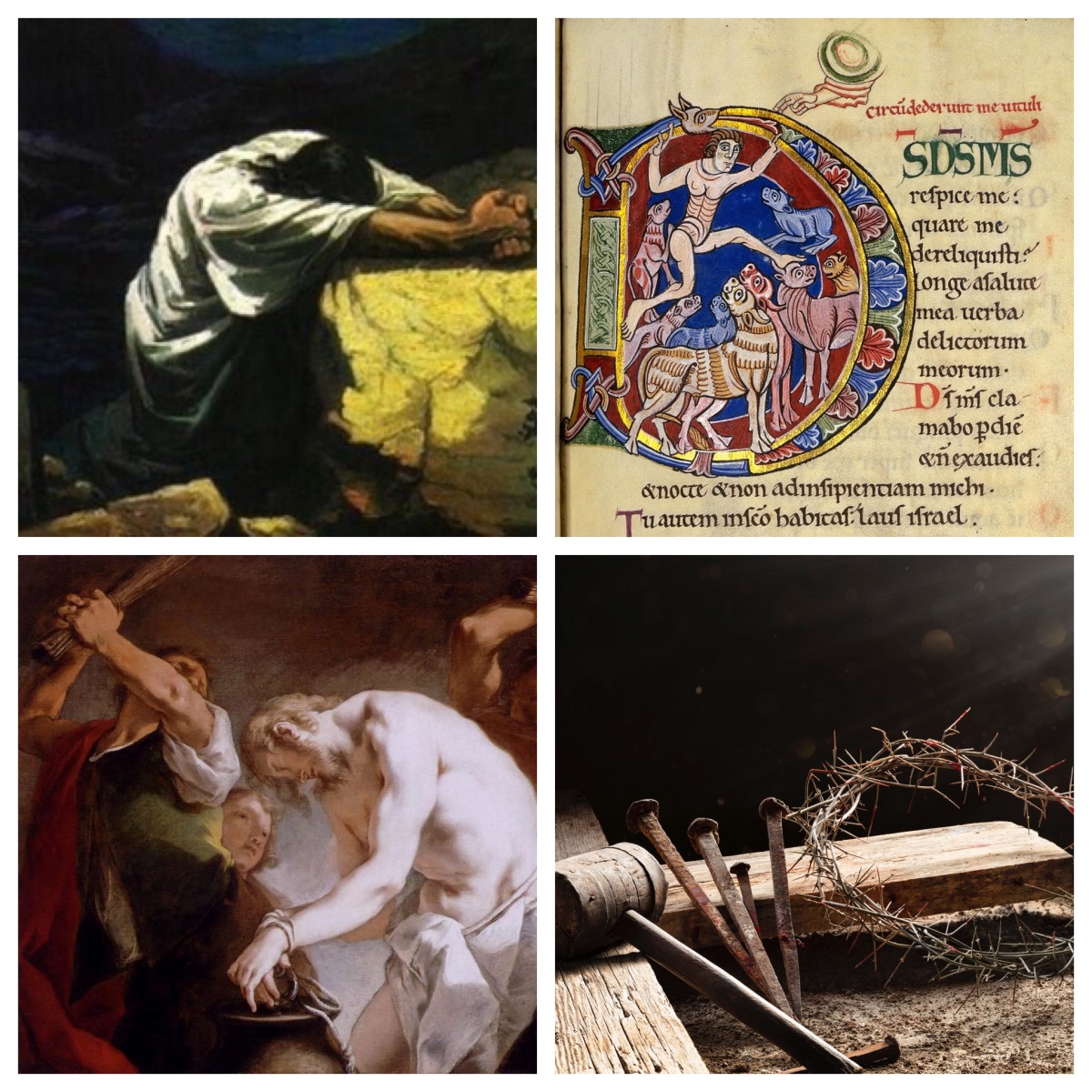
The Gethsemane scene draws on imagery from Hebrew Scripture to underline this. The narrative evokes the suffering of the faithful righteous person, referring especially to some phrases found in the Psalms. The Golgotha scene also contains this orientation. What takes place is interpreted with reference to scripture; here, the allusions are both subtle, and more direct.

However, at the end, Jesus appears to lament that God has abandoned him; yet the cry which Jesus utters at the ninth hour, Eloi, Eloi, lama sabachthani (15:34), is a clear reference to Psalm 22, one of the psalms of the righteous sufferer, as he quotes its first verse.

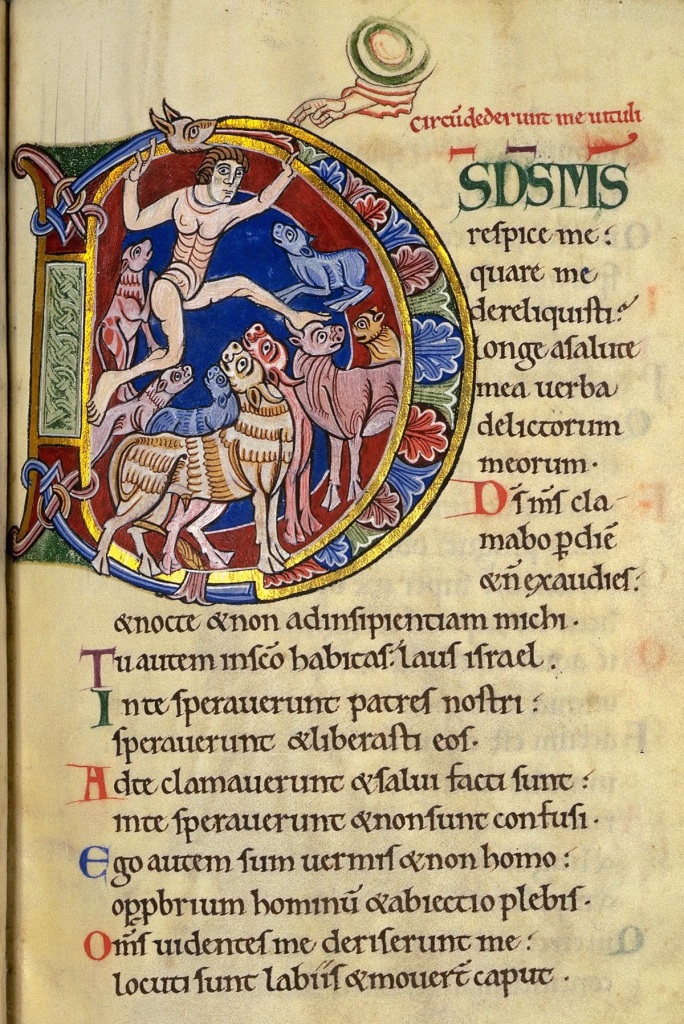
Psalm 22:1-8 in the St. Albans Psalter.
The first words of the Psalm in the Latin Vulgate are
Deus, Deus meus, abbreviated here as DS DS MS.

This is the Psalm, unsurprisingly, which the lectionary offers for Good Friday. It is a psalm of individual lament, as the psalmist reflects the wretched condition of a person who is suffering unjustly, crying out, “why are you so far from helping me, from the words of my groaning? … I am a worm, and not a human … all who see me mock at me; they make mouths at me, they shake their heads …. I am poured out like water, and all my bones are out of joint; my heart is like wax; it is melted within my breast; my mouth is dried up like a potsherd, and my tongue sticks to my jaws; you lay me in the dust of death.” (Ps 22:1, 6, 14–15). It is a psalm most suitable to,shape our reflection as we hear the narrative of crucifixion and death on Good Friday.

Two passages from Hebrews are suggested by the lectionary for this day. The “word of encouragement” to the Hebrews is best known for its thoroughly theological explanation of the death of Jesus as both the new high priest and also the sacrifice supreme. It is strongly supercessionist in its dismissal of the Jewish sacrifical system that was practised in the Temple; it posits that Jesus and his sacrifice replaces all of that. We need to take great care as we preach on such passages!

The first section of Hebrews that is offered for Good Friday (Heb 10:16–25) affirms “the confession of our faith” which is offered by the writer in response to God’s fidelity to the covenant in which “I will put my laws in their hearts, and I will write them on their minds” (10:16, quoting Jer 31:33b). This covenant provides “confidence” as it assures believers that “our hearts [are] sprinkled clean from an evil conscience and our bodies [are] washed with pure water” (10:22).

The writer affirms that “he who has promised is faithfully (10:23), for God asserts “I will remember their sins and their lawless deeds no more” (10:17, quoting Jer 31:34b). This understanding of the significance of the death of Jesus, as God’s chosen victim who effects redemption, plays a key role in the development of an understanding of the atonement in later generations. The writer rejoices with his audience that they have “our hearts sprinkled clean from an evil conscience and our bodies washed with pure water” (10:22).

The other excerpt from Hebrews (4:14–16; 5:7–9) provides two brief snapshots of Jesus. These two excerpts focus more on the humanity of Jesus, helping us to enter more fully into the Good Friday story. Jesus is tested as we are, yet has the strength of character not to submit to sin (4:15). The effect of the story of his passion in light of this would therefore be to provide the exemplar supreme for faithful people, holding fast in the midst of suffering.

This letter also indicates that Jesus knew the anguish and despair of human tragedy, as he prayed “with loud cries and tears” (5:7). Submission, suffering, and obedience lead, for Jesus, to perfection (5:9), making him “the source of eternal salvation for all who obey him” (5:10). As we reflect on this story from centuries ago, may we know the same dynamic, moving us from our sufferings into a sense of God’s salvation.

Last week, the lectionary offered Mark’s account of the passion of Jesus, in preparation for Passion Sunday. On Good Friday the whole story is offered again for our reflection on those events, from John’s account, which has some distinctive features. As we consider the significance of the death of Jesus, the comment in 18:14 (hearking back to 11:50) provides a classic political (and theological) insight. Jesus then asserts that “I have always taught in synagogues and in the temple … I have said nothing in secret” (18:20). His words and life are for all.

When he is before Pilate, rather than being silent (Mark 15:5), Jesus here engages in a quasi-philosophical debate about kingship and truth which is reported only in John’s Gospel (John 18:33–38; 19:8–12). Mocked by the Roman soldiers as a king (19:1–3), Jesus is sentenced by the Roman Governor under the ironic accusation, “King of the Jews” (19:15, 19–22). The irony in this title is made clear by the Johannine author’s observation that “the chief priests of the Jews said to Pilate, “Do not write, ‘The King of the Jews,’ but, ‘This man said, I am King of the Jews.’ ” (19:21).

Distinctive to John’s account is the presence of the mother of Jesus and the beloved disciple (19:25–27), witnessing a majestic final moment for Jesus. “It is finished” (19:30), the final word of Jesus in this Gospel, is better translated, “It now comes to complete fulfilment”, a recognition that now “the hour has come for the Son of Man to be glorified” (12:23).

The whole sequence of events recounted in this narrative (John 18–19) is understood as fulfilment of scripture (19:24, 28, 36, 37). God’s will is done. That is the ultimate perspective that this particular narrative offers each Good Friday.

“All of them condemned him as deserving death.” Interrogating the unlikely narrative of the Council (Mark 14; for Holy Week)

“They took Jesus to the high priest; and all the chief priests, the elders, and the scribes were assembled” (Mark 14:53). That’s how the author of the good news of Jesus the chosen one reports the scene when the fate of Jesus is sealed (Mark 14:53–65). Accused of predicting that the Temple would be destroyed (14:58), Jesus is interrogated by the high priest (14:60–63) before the declaration is made: “you have heard his blasphemy!” (14:64).

After further consultation by the chief priests “with the elders and scribes and the whole council”, Jesus is led away to Pilate, the Roman Governor (15:1). And so the fateful course of events is set in motion—questioned by Pilate, sentenced to be crucified, nailed to a cross where he dies, and the the lifeless body of Jesus is handed over to some of his followers (15:2–47).

The other evangelists follow suit. One notes that “the assembly of the elders of the people, both chief priests and scribes, gathered together, and they brought him to their council” (Luke 22:66), another specifies that “they took him to Caiaphas the high priest, in whose house the scribes and the elders had gathered” (Matt 26:57). The fourth gospel reports that “first they took him to Annas, who was the father-in-law of Caiaphas, the high priest that year” (John 18:13), and subsequently “Annas sent him bound to Caiaphas the high priest” (John 18:28).

The account of the time that Jesus spent being interrogated by them Jewish leadership appears, on the surface, to be an objective account of what transpired in that meeting. The council was the Great Sanhedrin, the supreme religious body in Israel during the Second Temple period—from the time when the exiles returned to the land under Nehemiah, until the destruction of the Temple in the year 70 CE. See more at https://www.jewishvirtuallibrary.org/the-sanhedrin

The source of the narrative in Mark 14 is unclear; indeed, the narrator has emphasised just before reporting on this meeting that when Jesus was seized in the garden by “a crowd with swords and clubs [who had come] from the chief priests, the scribes, and the elders” (14:43), after a token display of resistance (14:47), “all [of his followers] deserted him and fled” (14:50).

The narrator underscores this with a tantalising glimpse of the figure whom I (anachronistically) call “the first Christian streaker”— “a certain young man [who] was following him” who escaped the grasp of those in the crowd, shedding his linen cloth, “and “ran off naked” (14:51–52). And Peter, most pointedly, was outside the chamber, warming himself by the fire (14:54), and denying that he even knew Jesus—not once, but three times (14:68,70,71). There was nobody—absolutely nobody—from amongst the followers of Jesus who was present to witness what transpired as Jesus was brought before “the chief priests and the whole council” (14:55).

So how do we know what happened in that council meeting?

Further exploration of the scene is warranted. Such further examination might well consider some key factors. When did the council meet? Where did they meet? How did they conduct their business? And how did they come to a decision about Jesus?

To guide any exploration of these matters, scholars have turned—with due caution—to a Jewish text which sets out the designated procedures for a meeting of the Jewish council at which serious matters such as blasphemy were considered. The due caution is warranted, because the text is found in the Mishnah, a document written early in the third century CE—thus, almost 200 years after the time when Jesus was said to have been brought before the council. Did the provisions of this 3rd century text apply in the 1st century?

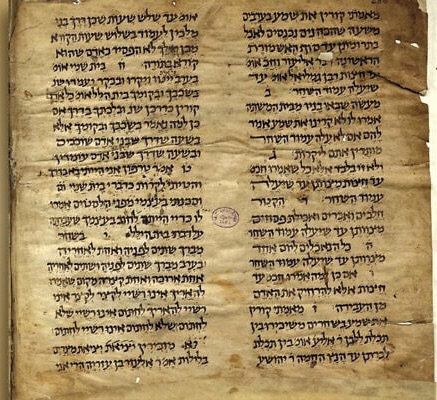
The opening page of the Kaufmann manuscript of the Mishnah, the most complete early manuscript of the Mishnah,
dated to the 10th or 11th centuries CE.

And such caution is intensified by the fact that the Mishnah is written at a time long after most Jews had been expelled from Jerusalem. This expulsion was finalised during the abortive uprising by Bar Kochba in 132–135 CE. Indeed, the book was written well after the time when the Sanhedrin had ceased to function as the peak legislative and judicial body in Jerusalem. After the failed war against the Romans of 66—74 CE, there was no longer any such body operating in Jerusalem. Yet 150 years later, a text was written that set out specific details of how the council was to function.

So some interpreters claim that this account is simply to be seen as an idealistic, romanticised recreation of “how things used to be”, expressed in such a way that is oblivious to the reality of the time—that there was no longer a functioning Sanhedrin in Jerusalem.

Alongside these notes of caution, we must hear also the claim that is made, not just about this text, but about many texts within the body of rabbinic literature that survives, from first through to sixth centuries. That claim is that, in an oral culture such as Second Temple Judaism and Rabbinic Judaism, where stories and laws and prescriptions and debates were passed on by word of mouth, from teacher to student, from that student to their student, and so on—the reliability and historical validity of what is written can be assessed positively.

For a more detailed discussion of the oral Torah, see https://www.jewishvirtuallibrary.org/the-oral-law-talmud-and-mishna

For myself, given what I have learnt in recent years about the importance and validity of stories and laws passed on over time in the oral cultures of First Nations peoples in Australia, I am inclined to accept this positive assessment of the ancient Jewish oral traditions in general, although specific texts are always open to informed critical exploration of their details.

I’m aware also, from discussions that have happened in the Uniting Church Dialogue with Jewish People that Elizabeth and I were members of for some years, that many rabbis today, who know their sacred texts well, consider that the Gospel narratives about this scene cannot be historical—for reasons that will be explored in what follows.

So, what does this text from the Mishnah say about a council meeting called to interrogate a possible criminal, such as we find in the Gospel narratives about Jesus? The relevant passages are in chapters 4 and 5 of tractate Sanhedrin, a part of the fourth order, Nezikin, which deals with Jewish criminal and civil law and the Jewish court system. And a comparison between the Gospel narratives and the Mishnah provisions raises a number of problems.

At night

The first matter is that the meeting with Jesus took place at night. Earlier, the narrator of Mark’s account has reported that the disciples “prepared the Passover meal; when it was evening, he came with the twelve” (14:16–17). Some hours later, after Jesus is apprehended in the Garden, he is taken to “the high priest … the chief priests, the elders, and the scribes” (Mark 14:53). It is still night when that meeting takes place. After coming to their decision that Jesus was “deserving death”, (14:64), the narrator notes that “as soon as it was morning, the chief priests held a consultation with the elders and scribes and the whole council” (15:1a).

So this meeting took place at night. But Mishnah Sanhedrin 4:1 states, “in cases of capital law, the court judges during the daytime, and concludes the deliberations and issues the ruling only in the daytime.” A court meeting at night, to determine a matter in which a person is determined to be “ deserving death”, is contrary to this provision.

The same section of the Mishnah also states that “in cases of capital law, the court may conclude the deliberations and issue the ruling even on that same day to acquit the accused, but must wait until the following day to find him liable” (Sanhedrin 4:1). Coming to a decision of guilty in the same session as the evidence is heard, without an overnight pause for the members of the council to consider, was also contrary to what was required. In the case of Jesus, this provision has been breached.

On a feast day

A second matter is that the meeting with Jesus took place during a festival. The whole sequence of events begins “on the first day of Unleavened Bread, when the Passover lamb is sacrificed” (14:12). At the end of their interrogation of Jesus, the narrator notes that “they bound Jesus, led him away, and handed him over to Pilate” (15:1b), and then observes that “at the festival he used to release a prisoner for them, anyone for whom they asked” (15:6).

Again, the provisions in Sanhedrin 4:1 state that “since capital cases might continue for two days, the court does not judge cases of capital law on certain days, neither on the eve of Shabbat [Sabbath] nor the eve of a Festival.” So the Markan narrative is in breach of this provision as well, by reporting that this meeting took place during Passover.

In the lack of evidence for this custom of releasing a prisoner at Passover, see more at

In the house of Caiaphas

Where exactly did this interrogation of Jesus take place? The implication in Mark is that the council was meeting in the house of Caiaphas. “Peter had followed him at a distance, right into the courtyard of the high priest; and he was sitting with the guards, warming himself at the fire” (14:54). This implication is made explicit at Matt 26:57 (“they took him to Caiaphas the high priest, in whose house the scribes and the elders had gathered”) and Luke 22:54 (“bringing him into the high priest’s house”).

Once more, this flies in the face of the prescriptions of tractate. Later in the tractate Sanhedrin, there is a reference to “the Sanhedrin of seventy-one judges that is in the Chamber of Hewn Stone” (Sanhedrin 11:2). This means the meeting should have taken place in this part of the Temple; in the Babylonian Talmud, it is stated to have been in the north wall (b.Yoma 25a). The Gospel narratives locate the meeting with Jesus in the house of the high priest; this is a third breach of the Mishnaic provisions.

The witnesses did not agree

A fourth issue is the observation that Mark makes and then repeats, that “many gave false testimony against him, and their testimony did not agree. Some stood up and gave false testimony against him … even on this point their testimony did not agree” (14:56–59).

Tractate Sanhedrin requires a verdict to be made only if the witnesses are in agreement, declaring, “At a time when the witnesses contradict one another, their testimony is void” (Sanhedrin 5:2). In a later rabbinic text, the Talmud, this requirement is expanded: “afterward they bring in the second witness and examine him in the same manner. If their statements are found to be congruent the judges then discuss the matter” (b.Sanhedrin 29a). This clearly did not occur in the case of Jesus.

A page of the Babylonian Talmud, showing how
the central text of Mishnah (in large print)
is then commented upon in Gemara (in medium print)
and later medieval notes (in small print)
surround these in the margins.

These various matters would seem, on the surface, to indicate that the members of the council were so panicked by Jesus that they acted to condemn him with flagrant disregard for their own provisions—assuming that the later text of the Mishnah does, in fact, describe the requirements in place in the first century.

An alternative explanation is that the narrative was compiled by someone who was ignorant of these provisions, and they simply “made up” a narrative which demonstrated the desperation of the Jewish authorities to deal with Jesus and have him out of the way.

We should place this view alongside the observation that the narratives in the Gospels take a number of steps to minimise the blame that Pilate must bear for sentencing Jesus to he crucified.

On the flawed picture of Pilate in the Gospels and the implausibility of the role assigned to him in these accounts, see

Minimising the culpability of the governor of the imperial power in these events, and strengthening the role of the Jewish authorities, go hand-in-hand. A clear apologetic purpose is at work in this narrative. It made sense for the narrator to avoid further condemnation by Rome, which held continuing power during the time he was writing, and to magnify the blame of the Jewish authorities, with whom the fledgling movement of followers of Jesus had been in increasing tension and conflict.

In other words, the narrative of this trial before the Sanhedrin is both historically implausible, and apologetically purposeful, as it shifts the blame for sentencing Jesus more onto the Jewish authorities than on Pilate. And in a later scene, it is the Jewish crowd which calls for Pilate to hand down the sentence of death (“crucify him! crucify him!”, 15:13–14). That is a most unlikely occurrence, indeed.

And so another element grew in the developing Christian ideology which placed the blame for the death of Jesus on the Jewish authorities (and sadly, in later centuries, on “the Jews” themselves). It is a view that we would do well to reject.

See also

I did not hide my face from insult and spitting (Isa 50 and the Passion Narrative; Lent 6B)

The passage of Hebrew Scripture we hear this coming Sunday (Isa 50:4–9a) is a significant passage. It comes from the second section of this long book (Isa 40—55), which opens with the familiar song, “comfort, comfort all my people” (Isa 40:1). Widely considered to be written in a period later than the earlier section (Isa 1—39), this section of Isaiah is called Second Isaiah. (The third main section, chapters 56—66, is called Third Isaiah.)

The comfort sung about by the prophet speaks to the situation of the people: their forebears had been taken into exile by the Babylonians in 587 BCE, and now a new generation (perhaps four to five decades later) yearns to return to the land of Israel, given to the people in ancient times, as recounted in the foundational myth—story of the Exodus. Other parts of the Hebrew Bible reflect the anguish of the people during their time of Exile (Ps 137 is the most famous instance). Deutero-Isaiah, however, focuses consistently on the hope of return to the land of Israel.

Looking to the new power of Persia to permit this return, the prophet of this later period speaks with hope and joy, to the people living in exile, using vivid imagery and dramatic scenes of promise and confidence. A joyous, positive tone runs right through the oracles in this section of Isaiah. “I am about to do a new thing”, says the Lord; “I will make a way in the wilderness and rivers in the desert” (43:19). “I will pour water on the thirsty land and streams on the dry ground”, the Lord continues; “I will pour my spirit upon your descendants, and my blessing on your offspring” (44:3).

Deutero-Isaiah is fundamental for the theological developments that we find in the New Testament. Scattered through this section, we find four Songs of the Servant—three relatively brief (42:1–9; 49:1–7; 50:4–11); and the fourth, best-known within Christian circles, a longer description of the servant who “was despised and rejected by others; a man of suffering and acquainted with infirmity” (Isa 52:13–53:12).

The resonances that this longer song has with the passion narrative of Jesus are crystal clear. The song is explicitly linked with Jesus six times in the New Testament (Matt 8:14–17; Luke 22:35–38; John 12:37–41; Acts 8:26–35; Romans 10:11–21; 1 Pet 2:19–25); furthermore, so many of the details of the passion narrative are shaped in the light of this song, along with a number of psalms of the righteous sufferer. (See

The third of these songs, which we hear this coming Passion Sunday, portrays the speaker as a Teacher. The resonances of this song with the story of Jesus are also clear. The punishment experienced by the Teacher—his back is struck, his beard is pulled, he is insulted, people spit on his face (Isa 50:6)—is echoed in the punishments inflicted on Jesus by Roman soldiers and Jewish passers-by. He is struck with a reed by Roman soldiers and spat upon (Mark 15:19). He is insulted by passers-by and the Jewish authorities (Mark 15:29–32).

The lectionary offers us this passage for Passion Sunday, a time when we reflect at some length on the passion of Jesus, which we recall also each Good Friday. The lectionary also offers the full story of the fate of Jesus after he entered Jerusalem at Passover. This part of the Gospel story (chapters 14–15 in Mark) is known as the passion narrative, because it tells about what Jesus suffered in his final days. (“Passion” comes from the Latin word passio, meaning suffering.)

The author of the beginning of the good news, which we know as Mark’s Gospel, seems to have been the first person (as far as we know from the evidence) who drew together a number of expressions about the way of Jesus, and worked them into a single, cohesive whole, in a continuous narrative style.

This narrative recounts the death of Jesus by relating it to the figure of righteous person who suffers injustice, who appears in various Hebrew Scripture passages. The author of this Gospel takes great pains to show that Jesus remains faithful to his calling despite the pressures he faces, just as the righteous sufferer of old also held to their faith.

The Gethsemane scene (Mark 14:32–42) draws on imagery from Hebrew Scripture to underline this. The narrative evokes the suffering of the faithful righteous person, referring especially to some phrases found in the Psalms. The Golgotha scene (Mark 15:21–41) also contains this orientation. What takes place is interpreted with reference to scripture; here, the allusions are both subtle, and more direct. The cry which Jesus utters at the ninth hour, Eloi, Eloi, lama sabachthani (15:34), is a clear reference to Psalm 22, by quoting its first verse. See more at

The offering of Isa 50:4–9a thus “fits” with the way that the author of the Markan passion narrative presents to story of the final hours of Jesus. His intense feeling of the agony inflicted on him, and yet his steadfast grappling with the faith he holds, is to the fore. The story invites us into sombre meditation as we approach the annual return of Easter.

Why Jesus never was, and never should be called, “meek and mild” (Lent 6; Palm Sunday)

This coming Sunday, known as Palm Sunday, we will hear the story of Jesus, riding into Jerusalem, acclaimed by the crowds, for the festival of Passover. This year, we hear the story as it is told by Mark (Mark 11:1–11). It is a story which is well-known across the church, and is often re-enacted by children waving branches, adults singing songs—and sometimes a co-opted donkey—at this time of the year. It is a story which is often misinterpreted as portraying the gentle Jesus, meek and mild, receiving the accolades of the crowd with a beatific smile as he gently trots in to the city amidst the cheering crowd of pilgrims.

The actual story is far from that, however. If we read it carefully, we will find a number of indications that point us in quite a different direction entirely. There is no “gentle Jesus, meek and mild” in this story. Instead, we find a politically acute Jesus, provocatively and deliberately entering the city at the start of the important festival of Passover, with a clear message to the people of Israel and to the powers of Rome.

(The interpretation that follows is the result of careful exploration of the text in the context of Jewish and Roman history, that my wife Elizabeth and I have undertaken. See the end of the blog for more details.)

The political focus of Passover

The festival of Passover recalls the story that is told in the Hebrew Scriptures, about the exodus of Israel out of Egypt. This is a story of the liberation of an oppressed people, suffering under the burdens of forced labour. Every year throughout the centuries, Jews have recounted the sequence of events that led to the miraculous escape from slavery of their ancestors, crossing through the Sea of Reeds, travelling unhindered through the wilderness, towards a land which the story claims was promised by God—a promised land, gifted to a chosen people by a holy God (Exod 13–15).

Passover is therefore a political festival, recalling a central event in which the leader of a group of enslaved people confronted the leader of an oppressive power and gained liberation through divine intervention. In the time of Jesus, Jews from around the ancient world flocked to Jerusalem for this high moment of celebration, and the story was retold each year with notes of jubilation and joy.

During feast days, especially at each Passover, tensions reached fever pitch. Fervent Jews known as Zealots would use the opportunity of the many pilgrims in the city to mingle in the crowd with daggers hidden under their tunic—and take the opportunity to cause a commotion in the crowd, hoping that they could stab Roman soldiers, their dreaded enemy. The Romans increased their military presence to prevent open revolt. (See Josephus, Jewish War 2:255; Jewish Antiquities 20:186.)

So the Roman soldiers charged with keeping the peace in Jerusalem at Passover would therefore have been on high alert as the pilgrims entered the city. It is in this context that the story of Mark 11 takes place.

Riding on a donkey shows messianic intention

Jesus, seated on the colt, riding on a donkey, was the centre of attention—at least for his own followers (Mark 11:7). Those in the crowd who knew their scriptures, would have immediately recognised the allusion. What did this mean for observant Jews? First, Jesus was on a donkey, not a horse. Indeed, Jesus, as a faithful Jew, would never ride in triumph on a horse! See more at

The account of this story that we find in Matthew’s Gospel actually specifies the verse that interprets the significance of the donkey (Matt 21:4-5). Matthew refers to Zechariah 9:9, where a clear vision is offered: “your king comes to you, triumphant and victorious, humble and riding on a donkey”. And Zechariah himself may well have been referencing the moment when the young Solomon is summonsed to his father, the old king, David, and instructed to “ride on my own mule, and bring him down to Gihon” (1 Ki 1:33)—which Solomon duly does (1 Ki 1:38).

On his arrival, “the priest Zadok took the horn of oil from the tent and anointed Solomon. Then they blew the trumpet, and all the people said, “Long live King Solomon!” And all the people went up following him, playing on pipes and rejoicing with great joy, so that the earth quaked at their noise.” (1 Ki 1:39–40). Solomon’s journey on a mule is the journey to his accession to the throne. The resonances in the story about Jesus are clear.

That is what the reference to the words of the prophet evokes. In this story of Passover pilgrims, Jesus can be seen to be bringing the prophetic vision to fruition, as the fulfilment of the role that kingship plays in Israel. Zechariah’s vision declares that this coming ruler “shall command peace to the nations, and his dominion will be from sea to sea, from the river to the ends of the earth” (Zech 9:10). That is the vision that Jesus evokes as he rides into Jerusalem on this donkey.

The cries of the crowd evoke political resistance to Rome

The crowd sings out, “Hosanna! Blessed is the one who comes in the name of the Lord” (Mark 11:9). The words were familiar words to observant Jews; they clearly evoke a well-known and oft-sung psalm, Psalm 118: “Save us, we beseech you, O Lord! Blessed is the one who comes in the name of the Lord” (Ps 118:25–26).

Why were they singing this psalm? Psalm 118 was one of the Hallel Psalms, the Praise Psalms, which were associated with celebrations on each of the three great festival days—the Feast of Tabernacles, or Booths; the Feast of Weeks, or Pentecost; and the Feast of Passover. These psalms of praise became particularly associated with the celebrations of the rebuilding of the Temple.

Rebuilding the Temple was an inherently political action. It was the foreign invasion of Palestine by the Hellenistic Seleucids some two centuries before Jesus which had led to the destruction of the Temple. It was the political activity of the Jewish Maccabees which had led to the reclaiming of the Temple two decades later.

The Hallel Psalms had become Psalms of Praise for liberating political activity. When the people cried out “hosanna”, a word from their native Hebrew language, they were crying “save us”. It is a cry for salvation; a yearning for deliverance. This is what the people were singing out; so the people singing this at the festival of Passover as Jesus entered the city was a strong political statement. See more at

The (palm) branches recall a political victory

This Sunday in the church year is traditionally called Palm Sunday. However, no palms are mentioned in the reading we have heard from Mark’s version of the story (nor in Matthew or Luke). That the branches are from palm trees is noted only in John’s version (John 12:13). Both Mark (11:8) and Matthew (21:8) refer to branches that the people cut and placed on the ground, even though they don’t specify that they are palm branches. (Nevertheless, waving palm branches has come to define this day—Palm Sunday—in contemporary re-enactments.)

This waving of palm branches was an activity intimately associated with the actions of the Maccabees, who were men from a priestly family who took up arms to fight back the Seleucid overlords and reclaim the Temple. The instructions in one of the Jewish books (2 Maccabees 10) direct the people to “carry ivy-wreathed wands and beautiful branches and fronds of palms, and offer hymns of thanksgiving to [God] who had given success to the purifying of their own holy place”. So the palms that are noted in John’s Gospel, at least, evoke the famous military campaign of centuries earlier.

The cloaks on the ground recall political leadership

Some people threw their cloaks over the donkey before Jesus sat on it—but Mark also notes that “many people spread their cloaks on the ground” (Mark 11:8). This is a curious detail; what can this mean? Perhaps the more astute of the Jews along the side of the road, would have had some insight; perhaps they recalled the story of the time when a young prophet from Ramoth-gilead declared that God was anointing Jehu, the son of Jehoshaphat, as the next king of Israel.

The story is recounted in 2 Kings 9, and it contains this striking detail, as the prophet decreed, “Thus says the Lord, ‘I anoint you king over Israel’”, and so they took their cloaks and spread them for him on the bare steps, and blew the trumpet, and proclaimed, ‘Jehu is King’” (2 Kings 9:13). There are clear resonances with the story of the Passover pilgrims. The cloaks on the steps, when Jehu is King … the cloaks on the wayside, when Jesus comes as King.

So Jesus, the prophet from Nazareth in Galilee, entered the city in the midst of the pilgrims, for the festival of Passover. Did he come as King, in the minds of the crowd? The festival of Passover was a most appropriate time for him to enter the city and make his mark as God’s chosen King. The donkey and the songs, the branches and the cloaks, all point to the immediate political significance of this event.

The incident in the temple sets the ball rolling

Once in the city, Jesus goes to the temple, where another famous incident occurs. Jesus, as he is portrayed in the striking account of this incident, demonstrates very little gracious, self-effacing humility. There is no “gentle Jesus, meek and mild” here, to be sure! Rather, Jesus is acting out his righteous anger, embodying zealous piety.

Jesus enters the temple precincts, overturning the tables of the money changers (Mark 11:15; Matt 21:12) and driving them out of the temple area (Mark 11:15; Matt 21:12; Luke 19:45). In John’s account, Jesus also tips out the coins of those money changers and knits together cords to form a whip (John 2:15), by which he drives out the moment changers. (Of course, John has completely relocated this scene to the beginning of the public activity of Jesus, rather than near its end, as in the Synoptic accounts of this scene).

Jesus was entering the area with intention and purpose. What was taking place there was, in his eyes, contrary to God’s will. So he performs a prophetic action designed to convey his message to those present (and to those of us in later times who hear and read the account of this incident).

James McGrath notes that “both the selling of animals for sacrifices and the payment of the temple tax were activities required by Jewish law and central to the temple’s functions” (see https://www.bibleodyssey.org/en/passages/main-articles/jesus-and-the-moneychangers). What Jesus does is therefore not an incidental act of anger; it is part of a deliberate plan of action.

McGrath suggests that the reference to the Temple as a marketplace might be an allusion to the eschatological prophecy of Zechariah, that “there shall no longer be traders in the house of the Lord of hosts on that day” (Zech 14:21). Is Jesus enacting this prophecy through his actions in the Temple forecourt?

Certainly, the actions of Jesus when “he would not allow anyone to carry anything through the temple” was confronting. He accuses the money changers of making the temple “a den of robbers” (Mark 11:17, Matt 21:13, and Luke 19:46). That most likely references the rhetorical question of the prophet Jeremiah: “Has this house, which is called by my name, become a den of robbers in your sight?” (Jer 7:11).

Gail O’Day considers that “by going to the Jerusalem temple and disrupting the practices that were necessary for the celebration of Passover, Jesus places himself in a long line of Israel’s prophets who go to Jerusalem, the center of religious and political power, and announce and enact the word of God.” (see https://www.bibleodyssey.org/en/passages/related-articles/cleansing-or-cursing)

In this dramatic prophetic action, Jesus acts and speaks carefully, deliberately, with “righteous anger”. He makes it clear what he is standing against, and what he is working towards—and he knows what the cost will be for him. After his dramatic entry into the city (Mark 11:1–11), he then presses on relentlessly into the temple (Mark 11:15–17), even symbolising his message in what he says to the fig tree: “may no one ever eat fruit from you again” (Mark 11:12–14).

Jesus knows exactly what he is doing. He has set in motion the events that will lead to his death: “when the chief priests and the scribes heard it, they kept looking for a way to kill him; for they were afraid of him” (Mark 11:18). His actions in the temple precincts were just as political as his entry into the city.

This is no “gentle Jesus, meek and mild”. This is a leader acting with a clear, focussed intent, regardless of the cost to himself and his followers. So this Palm Sunday, let us banish the Sunday School stereotype of Jesus, and acknowledge him in his full and fierce expression of his faith.

This blog on the Palm Sunday story is based on research by Elizabeth Raine and John Squires, published in Validating Violence—Violating Faith? Religion, Scripture and Violence. Edited by W. Emilsen & J.T. Squires, ATF Press, Adelaide 2008. See https://assembly.uca.org.au/rof/images/stories/interfaithsep/25sept.pdf

A version of this dialogue is also accessible at https://ruralreverend.blogspot.com/2019/04/palm-sunday-ps-1181-2-19-29-luke-1928.html

Learning from the land (7): the Gringai of the northern Hunter area (part two)

Continuing my explorations of the First Peoples of the area which has been cared for by the Gringai people for millennia. The traditional lands of the Gringai include an area centred on the place where the town of Dungog is situated, next to the Williams River. It is thought that the name Dungog is derived from a word meaning “clear hills” in the Gringai language.

It seems that in Gringai land (as elsewhere), contact with whites led to a decline in the numbers of Indigenous peoples in the area within a relatively short time. It is estimated that around 500 Gringai people would have lived in the area in the late 18th century. However, interactions with the invading settlers soon reduced this number. Syphilis contracted from convicts, and other introduced diseases, contributed to this decline in numbers. By 1847, thirty Gringai children had died of measles.

In 1845, Dr McKinlay, a Dungog-based doctor, had reported that the ‘District of Dungog’ (which he described as ‘from Clarence Town to Underbank’), had 63 Aboriginal inhabitants, made up of 46 ‘men and boys’, 14 women, and three children.

Dr Ellar McKellar McKinlay (1816–1889),
the first white medical practitioner in Dungog

There is a short article about Dr McKinlay at https://www.dungogchronicle.com.au/story/7378123/history-dungogs-first-doctor/

McKinlay also estimated that this was only half the number of Aboriginal people living there ten years earlier, which he attributed to “diseases which affected the women and children in particular”. Although typical of its time, this explanation offered an easy way for the invading settlers to excuse their dominating colonising activities, which included poisoning and shooting “the natives”.

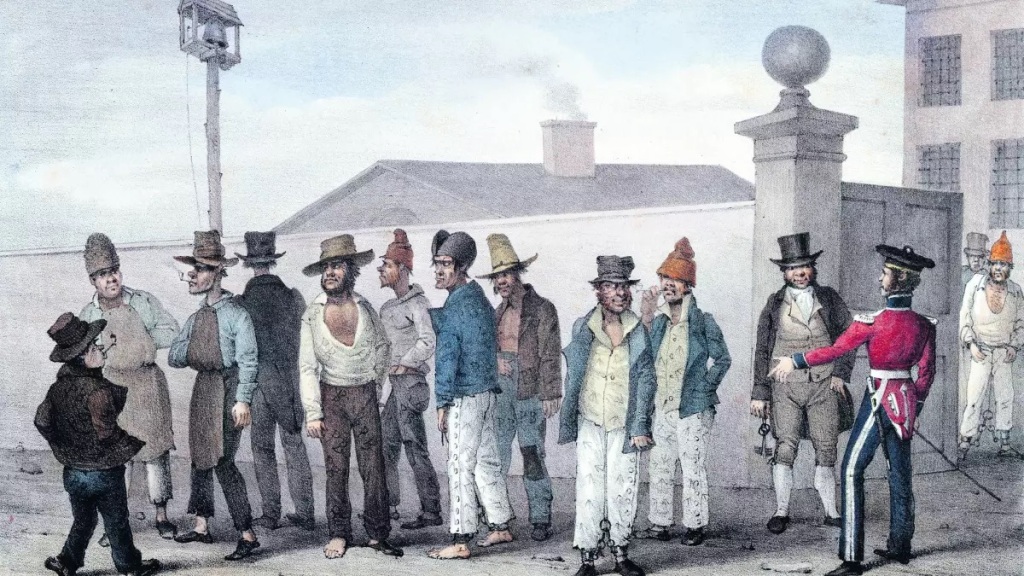
The well-to-do British settlers had high status within the developing society of the Colony. Many deployed their assigned convicts to the work of clearing land and building houses around the district. By the early 1830s the centre of the district was a small settlement first known as Upper William. A Court of Petty Sessions was established in 1833; in 1836, John M’Gibbons was appointed to be the Watch-house Keeper, and Thomas Brown, holding a Ticket-of-Leave, to be Constable at Dungog.

There is a most informative website, History in the Williams Valley, which provides further details. It notes that “Tenders were called in 1837 for the erection of a Mounted Police Barracks and the Police Magistrate was transferred from Port Stephens to Dungog. The first courthouse and lockup was on land now occupied by Dungog Public School and St Andrews Presbyterian Church. The barracks were placed on another hill dominating the town which, after the withdrawal of the troopers, was converted into a new courthouse that continues to operate today.”

See https://williamsvalleyhistory.org/law-order/

It is courtesy of the records of this local court house that two individuals of the Gringai are known by name, because of their arrests and trials. Wong-ko-bi-kan (Jackey) and Charley were both arrested within a year or so of each other in the 1830s.

Dungog early in the period of white settlement

On 3 April 1834, Jackey (Wong-ko-bi-Kan) was judged guilty and sentenced to be transported to Van Diemen’s Land for manslaughter, after he had speared and killed the settler John Flynn. Flynn had been a member of an armed troop of nine settlers who went to the Gringai camp at the Williams River at dawn to arrest some of them for culling sheep on their land.

From another perspective, of course, Wong-ko-bi-kan could be said to have been defending the native camp from armed intruders. True justice would have been to uphold his rights to his ancestral land—but in this instance, as with thousands of similar cases, the justice that was meted out favoured the recent invading colonisers, not the longterm inhabitants of the land.

It was said that Wong-ko-bi-kan’s case elicited some sympathy from the presiding judge and several observers, because of the way the settlers had approached the native camp with aggression. Wong-ko-bi-kan did not spend much time in Van Diemen’s Land; he died there in prison in October 1834. A sad end to a sorry tale.

The current Court House in Dungog
(built some decades after the original building)

Another Gringai man, known only as Charley, was arrested in May 1835, soon after the incident with Wong-ko-bi-kan. In August of that year, he was deemed responsible for the death of five convict shepherds who were working for Robert Mackenzie (who would later become Premier of Queensland). Mackenzie had a property at Rawden Vale, 26 miles west of Gloucester.

Charley’s interpreter in the course case was Lancelot Threlkeld, a missionary who had been appointed by the London Missionary Society (LMS) to teach Aboriginal people European agricultural and carpentry skills, and to establish a school for children. The LMS also required Threlkeld to learn the local language, for this was seen to be a precursor which would open the way for successful Christian conversions amongst the Aboriginal people.

Threlkeld reported Charley’s defence, that he had acted after an Englishman had stolen a sacred object, a talisman called a muramai. The man showed the muramai to a native woman with whom he was cohabitating. Charley’s actions were thus in accord with his tribal law, consistent with a decision had been made by the elders.

Charley was sentenced to be hung in public as a warning to other Gringai; this took place in Dungog. Local historian Michael Williams comments that “Charley … was both an enforcer of one law and the victim of the enforcement of another set of laws.” One later story, recounted in 1922 in the Wingham Chronicle, suggests that a raiding party set out to enforce the verdict by hunting other Gringai, managing to round some up and push them all over a cliff at Barrington.

An impression of a government convict gang in the 1830s

A report in the Sydney Gazette for 27 June 1835 that relates to the Dungog area refers to “the insolence and outrage of Convicts who in the service of gentleman squatters … and out of the reach almost of a magistrate, offend and ill-treat the poor blacks with impunity.” The next year, settler Lawrence Myles, J.P., requested assistance from mounted police because of intelligence he had received “that the Blacks are becoming more troublesome” (from the Dungog Magistrates’ Letterbook of 15 May 1836).

Nevertheless, in 1838 the Police Magistrate, Mr Cook, wrote to the Colonial Secretary that “the conduct of all the Blacks in this neighbourhood has been quiet and praiseworthy during the last two years”. Cook noted this in his Return on Natives taken at blanket distribution for 1838. In this region, as elsewhere in the Colony, the annual report of blankets distributed gives an idea of the numbers of Aboriginal people who were in contact with the British colony.

From the records of blanket distribution, names of some Gringai people are known today: Mereding, known as King Bobby, who had two wives; Dangoon, or Old Bungarry; Tondot, known as Jackey; as well as some men from the Wangat group. The report for 1837 lists 144 “natives”; undoubtedly there were more living in the area not identified in the report. Men named Fulham Derby and Pirrson are identified in a legal process of the same year, for instance, as noted in the Dungog Magistrates’ Letterbook for 14 December 1837.

In the Maitland Mercury for 18 July 1846 (p.2), a visitor to Dungog reported, “On the skirts of the brushwood, we came upon some tribes of blacks, encamped. They are a very fine race here, being chiefly natives of Port Stephens and its neighbourhood. A princely-looking savage, almost hid in glossy curls of dark rich hair, calling himself “Boomerang Jackey,” smiled and bowed most gracefully, saying, “bacco, massa? any bacco?” Some chiefs, with shields, and badges of honour on their breasts, sat silently by the fire with some very young natives, who were going to a “wombat,” or “grand corrobbaree,” when the moon got up.”

Later that same year, the Maitland Mercury (2 Dec 1848, p.2) reported that some farmers in the Paterson area were employing local natives—the price demanded by white labourers was considered too high. “They have certainly exhibited an industry, perseverance, and skill in the execution of their task which cannot be surpassed by Celt or Saxon”, said one farmer. Another noted, “they have done their work very creditably; but unfortunately their habits of industry are not of long duration, and they could not be kept long enough at work to make themselves really valuable.”

The Williams Valley Historical site then notes that “In the last quarter for the 19th century there was an increasing consciousness of severe Aboriginal population decline, the attitude to which was mixed. Many were indifferent; some welcomed it as removing a problem, while a few looked on with pity and made efforts to assist the survivors.”

This site also notes that a number of the settlers exhibited “an interest in tribal habits and customs … of a scientific and anthropological nature … thus James Boydell compiled lists of Aboriginal words, and Dr McKinlay and others made various observations, many of which were used by Howitt. Howitt [also] compiled a study based upon information elicited from many locations, including the Dungog area.” (Howitt, Alfred William, The native tribes of south-east Australia.)

A photograph of a group of Aboriginal children
(date and place unknown) under the care
of the Aborigines Protection Board

By the 1880s, across the Colony, a paternalistic approach to dealing with Aboriginal people had gained hold. A “Protector of Aborigines” was appointed, then replaced with the “Aborigines Protection Board”. The Board disapproved of “the system of issuing Government rations to able bodied aboriginals, as it tends to encourage idleness in a large degree”, and maintained that “a supply of flour, suet, and raisins sufficient to make a pudding can be issued to the aged, young and helpless, and those unable to earn a living through bodily infirmity, for Christmas Day”. (Maitland Mercury, 23 July 1887, p.13)

Numbers reported in ensuing years varied, but those noted in various locations were inevitably small. A man named “Brandy” was tagged as “The Last of the Gringai” by writers in the area—but, as is always the case (witness the famous case of Triganini, in Tasmania), this claim ignores the reality of the forced movement and relocation, as we as the continued intermarriage of Gringai with nearby Worimi and Wonnarua peoples. People of Gringai heritage are found today across many parts of The Hunter region, and in Sydney.

After the passing of the Native Title Act in 1993, a group of local Indigenous people worked to make a claim for an area of roughly 9,500 square kilometres (3,700 sq mi). The claim included the towns of Singleton, Muswellbrook, Dungog, Maitland, and the shire council lands of the Upper Hunter.

The claim was made on behalf of the Plains Clans of the Wonnarua People by Scott Franks and Anor, on 19 August 2013. The claim was registered in January 2015 and referred to the Federal Court to deliberate over the claim and to make a determination. However, it was ultimately discontinued and removed from the register of native title claims on 2 March 2020.

The discontinuance appears to have been the result of disputes with other Aboriginal people who claimed native title in the area. These disputes led to an independent anthropologist, Dr Lee Sackett, being appointed by the Court to prepare a report to resolve the different views of native title in the area. Dr Sackett’s conclusions were to the effect that key details of the claim’s structure were not supported by the evidence.

See

A new and right spirit (Ps 51; Lent 5B)

“Put a new and right spirit within me”, the psalmist sings (Ps 51:10), in the psalm that is offered by the lectionary for this coming Sunday, the Fifth Sunday in Lent, as a companion piece for the well-known Hebrew Scripture passage for this Sunday about the “new covenant” to be given to Israel and Judah (Jer 31:31–34).

Perhaps the key to this passage comes in the prophet’s words from God, “this is the covenant that I will make with the house of Israel; I will put my law within them, and I will write it on their hearts; and I will be their God, and they shall be my people.” (Jer 31:33). For more on this passage, see

The prophet indicates that the promise God offers is that “I will forgive their iniquity, and remember their sin no more” (Jer 31:34b), which is perhaps why the psalmist is confident to pray for God to have mercy: “blot out my transgressions, wash me thoroughly from my iniquity, and cleanse me from my sin” (v.2), then “purge me with hyssop, and I shall be clean; wash me, and I shall be whiter than snow” (v.7), and still more, “hide your face from my sins, and blot out all my iniquities” (v.9).

Forgiveness of sin has been a characteristic of the Lord God throughout the narrative books which tell the saga of Israel. Abraham bargains with God about forgiving Sodom (Gen 18:22–33). Moses likewise pleads with God, after the people had built a Golden Calf, to forgive them—“but if not, blot me out of the book that you have written” (Exod 32:32).

Yet these narratives also make it clear that God’s forgiving nature needs to be balanced by an understanding of the vengeance that upholds divine justice. In the wilderness of Paran, after spies returned from Canaan and stirred up discontent amongst the people, Moses recognises this capacity for vengeance; he implores the Lord not to kill the people in retaliation, praying, “forgive the iniquity of this people according to the greatness of your steadfast love, just as you have pardoned this people, from Egypt even until now”—to which the Lord God replied, “I have forgiven them, just as you have asked” (Num 14:19–20).

This story also indicates that divine forgiveness was conditional, for God immediately declared, “none of the people who have seen my glory and the signs that I did in Egypt and in the wilderness, and yet have tested me these ten times and have not obeyed my voice, shall see the land that I swore to give to their ancestors; none of those who despised me shall see it” (Num 14:22–23).

Later in this same book, note is made that “the Lord will forgive” a woman who makes a vow that displeases her father (Num 30:5) or her husband (Num 30:8, 12). God clearly sided with the male who had positional authority in the patriarchal structures of society!

At the renewal of the covenant when the people are in the land of Canaan, Joshua reminds the people that “you cannot serve the Lord, for he is a holy God. He is a jealous God; he will not forgive your transgressions or your sins. If you forsake the Lord and serve foreign gods, then he will turn and do you harm, and consume you, after having done you good” (Josh 24:19–20).

When Solomon dedicates the temple, he recounts the saga of Israel and five times asks for God to “hear in heaven” and “forgive your people who have sinned against you, and all their transgressions that they have committed against you” (1 Kings 8:30, 34, 36, 39, 50). And when Ezra leads a ceremony of rededication for the people as they return to the land after exile, in his extended prayer he reminds God, “you are a God ready to forgive, gracious and merciful, slow to anger and abounding in steadfast love, and you did not forsake them” (Neh 9:17).

So the psalmists pray for God to forgive sins (Ps 25:18; 65:3; 79:9), confident that “there is forgiveness with you, so that you may be revered” (Ps 130:4). Amos prays to God, “O Lord God, forgive, I beg you!How can Jacob stand? He is so small!” (Amos 7:2), Daniel likewise pleads, “O Lord, hear; O Lord, forgive; O Lord, listen and act and do not delay!” (Dan 9:19).

Both Jeremiah (Jer 33:8; 36:3) and Ezekiel (Ezek 16:63) envisage that God will forgive, although Hosea reports the strident command of God when his wife bore a daughter: “name her Lo-ruhamah, for I will no longer have pity on the house of Israel or forgive them” (Hos 1:6). This is what we have come to expect from the prophetic word, which consistently berates the people and warns them of the judgement that God will bring upon them because of their sinfulness. See

By contrast, God continues, “I will have pity on the house of Judah, and I will save them by the Lord their God” (Hos 1:7). So forgiveness—limited, directed by divine decree—is indeed possible. Accordingly, we see in the psalm for this Sunday (Psalm 51:1–12) that the psalmist is confident to seek divine forgiveness, declaring “I know my transgressions, and my sin is ever before me” (v.3), even going so far as to say “I was born guilty, a sinner when my mother conceived me” (v.5).

That’s a serious claim. Augustine would certainly agree, no doubt. Personally, I find this a hard view to agree with, however; see

It is in the spirit of seeking divine compassion for the sinfulness of humanity that the psalmist ends this section of the psalm with another petition for forgiveness: “restore to me the joy of your salvation, and sustain in me a willing spirit” (v.12). In forgiveness, there is joy at what God does and a willingness to continue to work with God into the future.

These ancient words, we can be confident, stand as relevant and nourishing for people of faith today, deep into this Lenten season. And so we hear this psalm this coming Sunday.

The hour has come (John 12; Lent 5B)

“The hour has come for the Son of Man to be glorified” (John 12:23). So Jesus says to Andrew and Philip, who come with a request from “some Greeks” who were in Jerusalem for the festival of Passover (12:20; see 12:1). Two terms in this declaration by Jesus require exploration; two terms which are key ideas in this Gospel, the book of signs.

The story which John’s Gospel reports contains a contrast between the largely public activities of Jesus, and a secret element, described as the hour, which does not come until the climax of the story is reached. There are pointers to this contrast from the very first sign, at a wedding in Cana, when Jesus declares, “my hour has not yet come” (2:4).

What is this hour? The first part of the Gospel leaves it as a mystery, for the time being (see 7:30 and 8:20). Then, after the seventh sign, events in Jerusalem show that the hour has come (12:23, 27); the narrator explains that “Jesus knew that his hour had come to depart from the world” (13:1).

Thus, at the beginning and at the end of the public activities of Jesus in this Gospel narrative, the focus is firmly on “the hour”.

Then, some time later on, at the end of his last meal with his followers, Jesus finally prays: “Father, the hour has come: glorify your Son” (17:1). In what will take place after this prayer—the arrest, trial, crucifixion, burial, and resurrection of Jesus (John 18–21)—this “hour” is realised.

The Johannine Jesus describes these events, the fulfilment of “the hour”, as the means by which God is glorified (11:16, 23–33; 13:31–32; 17:4).

The word glory, in Hebrew Scriptures, signals the divine presence (Exod 16:1–12; 24:15–18; 40:34–39; Lev 9:22–24; Num 14:10–12; 16:19; Deut 5:22–27; 1 Sam 4:19–22). In the book of signs, it is God’s glory which is now made manifest in Jesus (John 1:14; 2:11; 12:27–28; 17:5).

The language of “hour” and “glory” thus provides a framework for interpreting the events in chapters 2–12 as steps on the way towards a full understanding of Jesus, and the events of chapters 13–21 as the realisation of God’s presence in the world in all its fullness. This is the heart of the incarnational theology that is advocated by the writer of this Gospel.

The story of the Gospel fills out the details as to how it is that “the Word became flesh and lived among us”, which means that for human beings, “we have seen his glory, the glory as of a father’s only son, full of grace and truth” (John 1:14).

The passage offered in this Sunday’s lectionary readings provide part of the Johannine account of the final public moments of Jesus before his arrest (12:20–50). Here, Jesus speaks of this imminent glory (12:20–26), an angel testifies to God’s glory in the death of Jesus (12:27–33), Jesus explains that he comes as light into the world (12:34–36), the scriptures join as witnesses (12:37–43) and Jesus asserts that he speaks God’s commandment of eternal life (12:44–50).

This scene sums up what has come before and opens the door to the events which follow, culminating in the cry of the crucified Jesus, “it is fulfilled” (19:30; the NRSV translation, “it is finished”, downplays the sense of fulfilment in the verb used, teleō). The author of this Gospel thereby indicates that the deepest fulfilment of the hour of Jesus comes on the cross, as the glory of God is revealed in its entirety.