NAIDOC WEEK is an Australian observance lasting from the first Sunday in July until the following Sunday. This year, it starts today (3 July) and goes until 10 July.
The acronym NAIDOC stands for National Aborigines and Islanders Day Observance Committee. It has its roots in the 1938 Day of Mourning which became a week- long event in 1975.
Aboriginal and Islander people have a proud history of getting up, standing up, and showing up. They have therefore chosen this as their 2022 theme of Get Up! Stand Up! Show Up!
The NAIDOC Week Committee wants Aboriginal and Islander people to continue to Get Up! Stand Up! Show Up! for systemic change and to keep rallying around their mob, their Elders and their communities. Whether it’s seeking proper environmental, cultural and heritage protections, Constitutional change, a comprehensive process of truth-telling, working towards treaties, or calling out racism – they must do it together.
The Committee also says that the relationship between Aboriginal and Torres Strait Islander peoples and non Indigenous Australians needs to be based on justice, equity, and the proper recognition of Aboriginal and Torres Strait Islander peoples’ rights.
This theme has many resonances with the theological commitments of the Uniting Church, for whom standing against racism, recognising the sovereignty of the First Peoples, standing up for the environment, working to strengthen reconciliation, and supporting the call for makaratta, treaty, are all central commitments as we stand for justice and advocate for justice.
I’ll post more during the week about the ways that the NAIDOC WEEK themes of the past decade resonate with Uniting Church commitments.
My posts on NAIDOC WEEK themes prior to 2014 can be found at
The Coming of the Light is celebrated annually by Torres Strait Islander peoples on 1 July. It marks the adoption of Christianity through island communities during the late nineteenth century. The Reverend Samuel MacFarlane, of the London Missionary Society, arrived at Erub Island in the Torres Strait on 1 July 1871, introducing Christianity to the region. Since then, Torres Strait Islanders, whether living in the islands or on the mainland, celebrate this anniversary.
It might have symbolic resonance, then, that today, 1 July, in my series about the themes of NAIDOC WEEK, we turn to the next series of themes that are from the period of the Labor Government (2007–2013). It was after eleven years of regressive conservative government at the federal level that Kevin Rudd led the Labor Party back into government in December 2007. Although Rudd was a control freak who ultimately undid his own position of leadership, that of Julia Gillard, and then his own government, his time in leadership did shine some important lights onto Australia society.
During the the almost six years of the Labor Government, led by Rudd, then Julia Gillard, then Rudd once again, the National Apology to the Stolen Generation was made. On 13 February 2008, Prime Minister Kevin Rudd stood in Parliament to deliver the National Apology to Australia’s Aboriginal peoples and Torres Strait Islander peoples. The Apology recognised the injustices of past government policies, particularly as they related to the Stolen Generations.
For more than a decade, the Howard government had resisted making any apology. The stance that Howard took when he opened the 1997 Australian Reconciliation Convention, which we noted in the previous post, remained his opinion in the ensuing years. Still today, 25 years after that speech, Howard remains unmoved; he has called the apology that Rudd gave “meaningless” and “an empty gesture”.
But on 13 February 2008, newly elected Prime Minister Kevin Rudd spoke the federal government’s formal apology to Indigenous Australians. Rudd apologised on behalf of Parliament ‘for indignity and degradation’, declaring it was time to start ‘righting the wrongs of the past’. As he recognised the Stolen Generations, he affirmed that the policy of removing Aboriginal children from their families ‘inflicted profound grief, suffering and loss on these our fellow Australians’.
The key words of apology are worth remembering again:
For the pain, suffering and hurt of these Stolen Generations,
their descendants and for their families left behind, we say sorry. To the mothers and the fathers, the brothers and the sisters,
for the breaking up of families and communities, we say sorry. And for the indignity and degradation thus inflicted
on a proud people and a proud culture, we say sorry.
The themes of NAIDOC WEEK in those six years were:
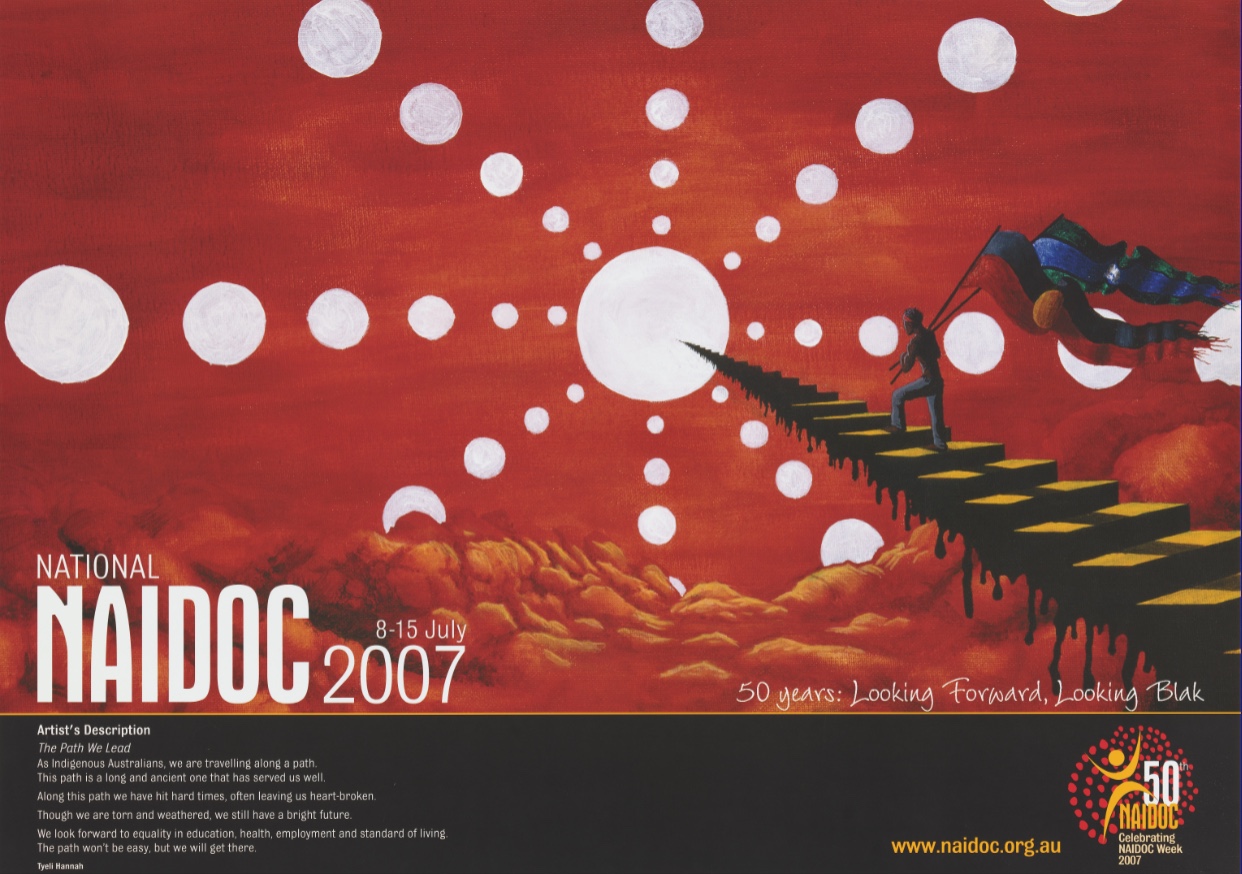
2007: 50 Years: Looking Forward, Looking Blak
This theme looks back to 1957, when the National Aborigines Day Observance Committee (NADOC) was formed. It had support and co-operation from Federal and State Governments, the churches, and major Indigenous organisations. Its aim was to promote Aboriginal Sunday as a day to focus community attention on the nation’s Aboriginal people.
In 1940, the National Missionary Council of Australia (NMCA) had given its support to a permanent annual Aborigines Day. The NMCA encouraged churches to observe the Sunday before the Australia Day weekend as “Aboriginal Sunday’. In 1955, the NMCA changed the date to the first Sunday in July.
In 1985, NADOC agreed to change the dates of the week from July to September, and in 1988, the committee’s name was changed to NAIDOC – National Aborigines and Islanders Day Observance Committee – to acknowledge Torres Strait Islander people. In 1991, the committee decided to shift the celebrations back to the first week in July (Sunday to Sunday) starting from 1992.
The committee was wound up in the mid-1990s when the Aboriginal and Torres Strait Islander Commission (ATSIC) assumed control of NAIDOC Week, making decisions on the theme, venue and poster.
2008: Advance Australia Fair?
This theme recalls both the 1972 theme, Advance Australia Where?, and, of course, the title of the song that became Australia’s national anthem, Advance Australia Fair. The question mark in both themes is very significant—the themes are asking questions about the direction of Australia as a country (in 1972) and drawing attention to the continuing injustices experienced by Indigenous peoples (in 2008). The questions still stand today.
The artwork used was striking: a large blue SORRY overlaid with a version of the national coat of arms, gesturing the kangaroo and emu, and the five stars of the Southern Cross.
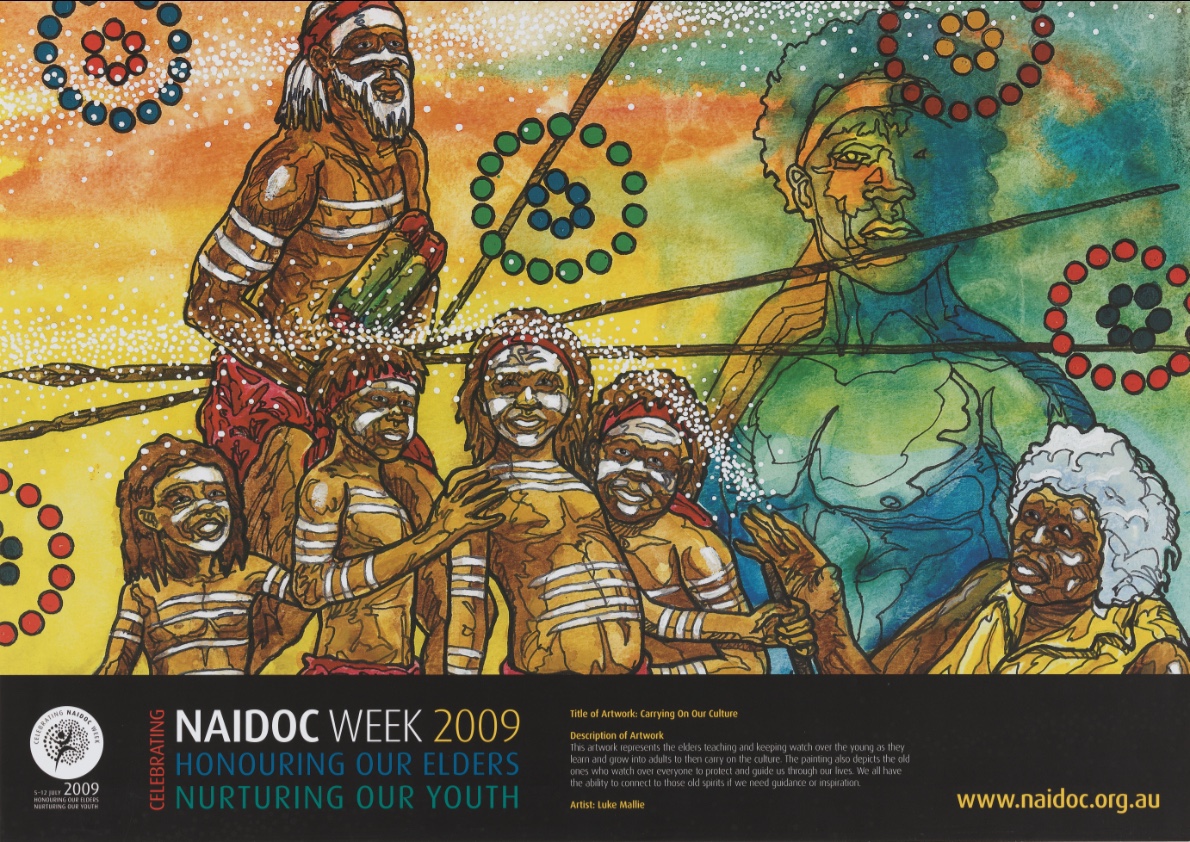
2009: Honouring Our Elders, Nurturing Our Youth
This theme is evocative of the 1976 theme, when Trucanini was remembered and honoured. It sits along with earlier themes that gave recognition, both to the culture of Indigenous peoples: 1978, Cultural Revival is Survival; Take a Journey of Discovery, 1984; Recognise and Share the Survival of the Oldest Culture in the World; 1990, Don’t Destroy, Learn and Enjoy our Cultural Heritage; as well as the importance of young people: 1979, What About Our Kids?; and 1994, Families are the basis of our existence: Maintain the Link.
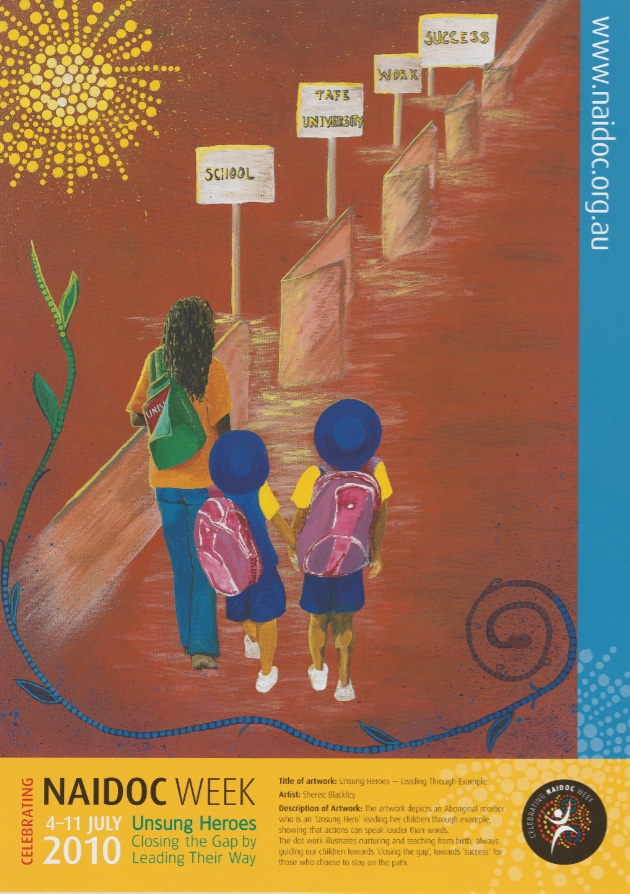
2010: Unsung Heroes: Closing the Gap by Leading the Way
For the last fifteen years, we have had a national policy known as Closing the Gap. The gap refers to the the inequalities in health and life-expectation that exist between Indigenous and non-Indigenous Australians. This inequality includes: shorter life expectancy, higher rates of infant mortality, poorer health, and lower levels of education and employment.
Indigenous Australians have a lower life expectancy than non-Indigenous Australians. Non-Indigenous girls born in 2010-2012 in Australia can expect to live a decade longer than Indigenous girls born the same year (84.3 years and 73.7 years respectively). The gap for men is even larger, with a 69.1 year life expectancy for Indigenous men and 79.9 years for non-Indigenous men
Indigenous women also experience approximately double the level of maternal mortality in 2016. In 2016, Indigenous children experienced 1.7 times higher levels of malnutrition than non-Indigenous children. In 2015, the Indigenous suicide rate was double that of the general population; Indigenous suicide increased from 5% of total Australian suicide in 1991, to 50% in 2010, despite Indigenous people making up only 3% of the total Australian population. The most drastic increase occurred among young people 10-24 years old, where Indigenous youth suicide rose from 10% in 1991 to 80% in 2010.
The employment to population rate for Indigenous 15–64 year olds was around 48% in 2014-15, compared to 75% for non-Indigenous Australians. Median weekly income for Indigenous Australians was $542 in 2014-15 compared with $852 for non-Indigenous Australians.
The Gap (or actually, the many gaps) still exist; despite an annual report on how the federal government is attempting to Close the Gap, there is still much ground to be covered.
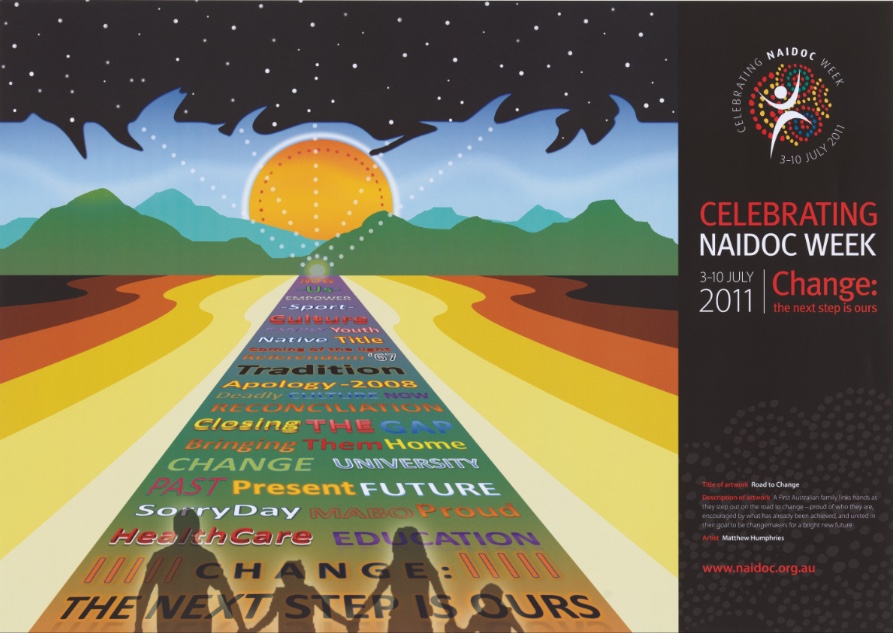
2011: Change: the next step is ours
This was an invitation to the whole population of Australia to join and work for change for the better for First Peoples.
2012: Spirit of the Tent Embassy: 40 years on
The Tent Embassy had been established in 1972. See the blog I wrote earlier in the year for the 50th anniversary, in 2022, of the Tent Embassy.
2013: We value the vision: Yirrkala Bark Petitions
This theme commemorates events of 50 years earlier. Yolngu people from Yirrkala in eastern Arnhem Land in the Northern Territory sent petitions to the Commonwealth Parliament in August 1963. On 13 March that year the Government had removed more than 300 square kilometres of land from the Arnhem Land reserve, with the purpose of being able to mine the bauxite which had been found there. Work started without talking to the people about their land.
The text of the petition was in two languages, English and Gupapuyngu. It was printed on paper then glued to a piece of bark that had been painted traditionally. The petition, signed by nine men and three women, stated that 500 people were residents of the land that was being removed, and that the whole deal had been kept secret from them.
It also declared that sacred sites in the area, such as Melville Bay, were vital to their livelihoods, and that the area had been used for hunting and food-gathering since time immemorial. The petition asked parliament to appoint a committee to hear the views of the Yolngu. They also asked that no arrangements be entered into with any company which would destroy their livelihoods and independence.
Silas Roberts, Northern Lands Council (NLC) Chairman (left), and Galarrwuy Yunupingu, NLC Manager (right), with the Yirrkala bark petition
Two Labor parliamentarians, Kim Beazley (senior) and Gordon Bryant visited Reverend Edgar Wells, Superintendent of the Yirrkala Methodist church mission, in July 1963. Yolngu leaders made plain their objection to the lack of consultation and secrecy of the Government’s agreement with Nabalco, and their concern about the impact of mining on the land unless their voices were heard.
The petitions were not successful; mining commenced in 1968. The Yolngu people began a court case, in which Justice Richard Blackburn ruled against the Yolngu claimants in 1971. He recognised that they had been living on the land for thousands of years, but found that any rights they had before colonisation had been invalidated by the Crown. The Australian legal system had been built around the concept of terra nullius, meaning ‘land belonging to no one’.
The Yolngu eventually received native title to their land in 1978, under the Aboriginal Land Rights (Northern Territory) Act 1976, which established a procedure for transferring 50 per cent of land in the Territory to Aboriginal ownership. The mining leases, which they had objected to since 1963, were excluded from the provisions of the Act, and also from the Yolngu native title claim.
The Yirrkala bark petitions were the first example of a native title litigation in Australia. They paved the way for the Aboriginal Land Rights Commission and the Aboriginal Land Rights (Northern Territory) Act 1976. In 1992 the concept of terra nullius, which had been used in the Milirrpum v Nabalco Pty Ltd judgement, was challenged by the High Court of Australia. Mabo v Queensland recognised the people of Murray Island as native titleholders to their land.
There is a post doing the rounds of Facebook at the moment that makes the claim that Jesus uttered “dangerous and heretical ideas”, “impossible, dangerous ideas—to love your enemy, to love the poor, to forgive others” which were “terrifying and unconscionable and forbidden in His day.”
It may be a fair assessment of the radical nature of the teachings of Jesus; taking his teachings seriously is indeed “terrifying”. But were his instructions “unconscionable and forbidden in his day”? Not at all! Such a fraudulent claim is built on the back of a completely erroneous portrayal of Jewish teachings, both in the time of Jesus, and in the centuries prior to his time. Hebrew Scripture, in particular, provides many passages that refute this hyperbolic claim.
On love of enemies, there are proverbs that are relevant: “If your enemies are hungry, give them bread to eat; and if they are thirsty, give them water to drink” (Prov 25:21); and “Do not rejoice when your enemies fall, and do not let your heart be glad when they stumble” (Prov 24:17). That’s love for enemies, surely?
There are injunctions in the Torah that are pertinent. “When you come upon your enemy’s ox or donkey going astray, you shall bring it back. When you see the donkey of one who hates you lying under its burden and you would hold back from setting it free, you must help to set it free” (Exod 23:4–5); and “When an alien resides with you in your land, you shall not oppress the alien. The alien who resides with you shall be to you as the citizen among you; you shall love the alien as yourself, for you were aliens in the land of Egypt: I am the LORD your God” (Lev 19:33–34). Both passages instruct behaviour that exemplifies love in action: one for an enemy, the other for an alien (a foreigner).
There is the story told concerning Elisha, at a time “when the king of Aram was at war with Israel” (2 Kings 6:1). Elisha had asked God to strike the army of Aram blind, and God did so; Elisha then led them into a trap in Samaria, after which they were given back their sight. The story continues: “When the king of Israel saw them he said to Elisha, “Father, shall I kill them? Shall I kill them?” He answered, “No! Did you capture with your sword and your bow those whom you want to kill? Set food and water before them so that they may eat and drink; and let them go to their master.” So he prepared for them a great feast; after they ate and drank, he sent them on their way, and they went to their master. And the Arameans no longer came raiding into the land of Israel.” (2 Kings 6:21–23). Elisha turned enemies into friends through this command to show love.
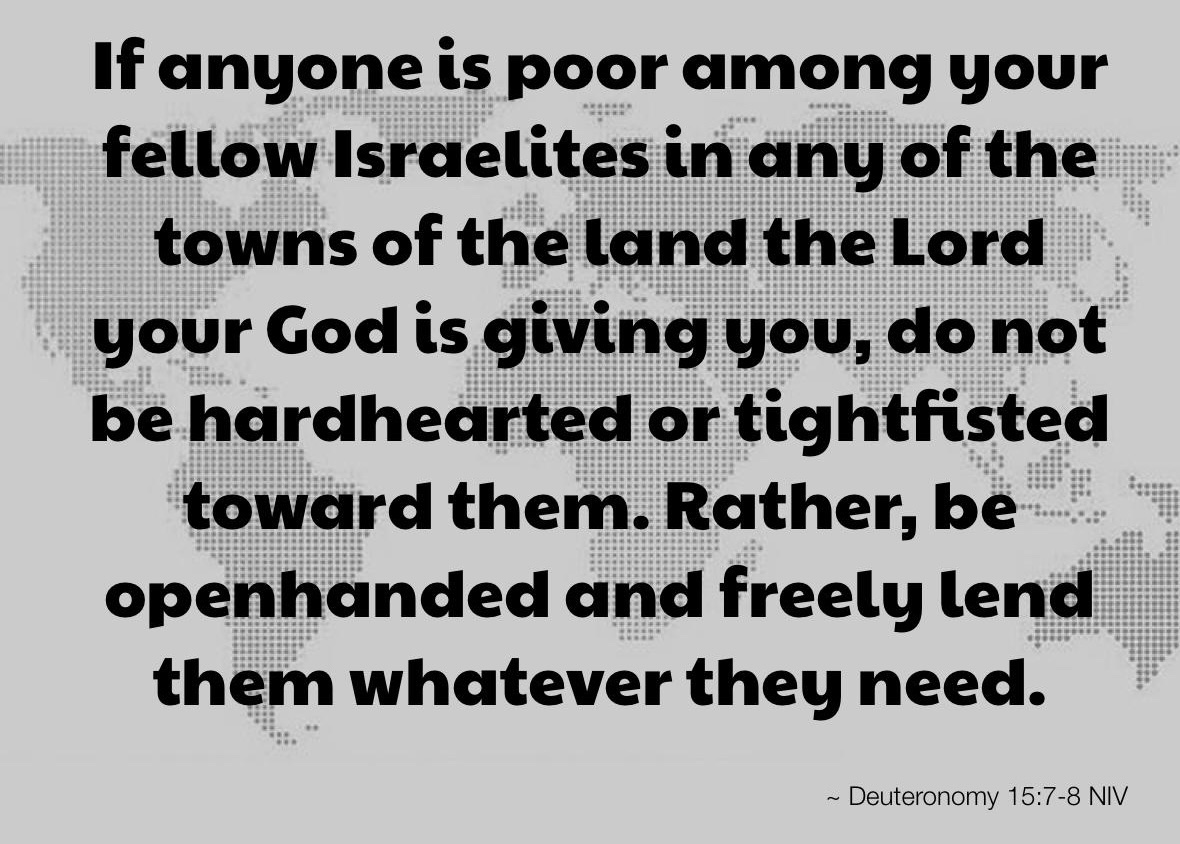
In relation to loving the poor, Hebrew Scripture is clear: “If there is among you anyone in need, a member of your community in any of your towns within the land that the LORD your God is giving you, do not be hard-hearted or tight-fisted toward your needy neighbour. You should rather open your hand, willingly lending enough to meet the need, whatever it may be” (Deut 15:7–8).
“Give liberally and be ungrudging when you do so, for on this account the LORD your God will bless you in all your work and in all that you undertake. Since there will never cease to be some in need on the earth, I therefore command you, ‘Open your hand to the poor and needy neighbour in your land’” (Deut 15:10–11).
“You shall not withhold the wages of poor and needy laborers, whether other Israelites or aliens who reside in your land in one of your towns. You shall pay them their wages daily before sunset, because they are poor and their livelihood depends on them; otherwise they might cry to the LORD against you, and you would incur guilt” (Deut 24:14–15).
Especially potent is the song found in the third, and latest, section of the book of Isaiah, where the prophet reports that God says: “Is not this the fast that I choose: to loose the bonds of injustice, to undo the thongs of the yoke, to let the oppressed go free, and to break every yoke? Is it not to share your bread with the hungry, and bring the homeless poor into your house; when you see the naked, to cover them, and not to hide yourself from your own kin?” (Isa 58:6–8). That is crystal clear about the need to love the poor!
And there is a succinct proverb that informs us: “Those who oppress the poor insult their Maker, but those who are kind to the needy honour him” (Prov 14:31).
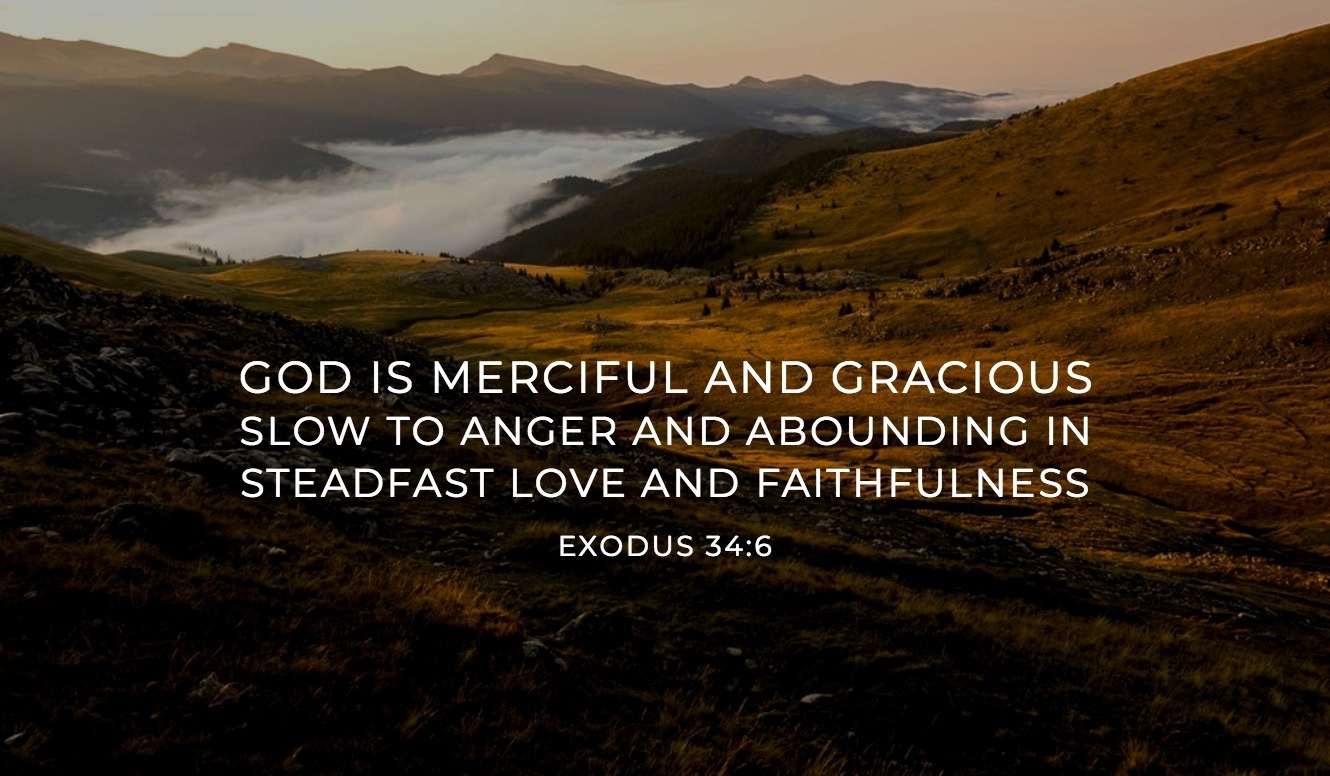
As for forgiveness, there is a constant refrain in Hebrew Scripture that God is a God who forgives; “a God merciful and gracious, slow to anger, and abounding in steadfast love and faithfulness” (Exod 34:6; this refrain also appears at Num 14:18; Neh 9:17b; Ps 145:8–9; Joel 2:13; Jonah 4:2; as well as 2 Kings 13:23; 2 Chron 30:9).
Alongside the many instances where God’s judgement is spoken of, there are also many references to the steadfast love and forgiving nature of God. The God of the Old Testament is not just a God of wrath; the Lord God requires justice, and will punish transgressors, but also offers an abundance of gracious, loving forgiveness.
The psalmist affirms that “there is forgiveness with you” (Ps 130:4), that “when deeds of iniquity overwhelm us, you forgive our transgressions” (Ps 65:3). The prophet Hosea declares that God says, “I will heal their disloyalty;
I will love them freely, for my anger has turned from them” (Hos 14:4). The prophet Jeremiah asserts that God promises that in the renewal of the covenant, “I will forgive their iniquity, and remember their sin no more” (Jer 31:34); while the prophet Ezekiel declares that God promises to “establish my covenant with you, and you shall know that I am the Lord … when I forgive you all that you have done” (Ezek 16:62–63). Finally, the prophet Daniel declares that “to the Lord our God belong mercy and forgiveness” (Dan 9:9).
This divine forgiveness is lived out in the story of human beings in various ways; take Abigail and David, for instance. Abigail asks David, “please forgive the trespass of your servant”; David replies, “Go up to your house in peace; see, I have heeded your voice, and I have granted your petition” (1 Sam 25:28, 35). Forgiveness, both divine and human, is clearly not unknown and unpractised in Israel.
My own view is that Jesus was standing firmly and resolutely in the prophetic tradition of Israel; they were the counter-cultural voices of their day, and Jesus adopts and re-speaks their damning words and challenging ethos to the people of his own time. See https://johntsquires.com/2021/08/16/justice-and-only-justice-you-shall-follow/
Certainly Jesus is confronting and challenging; but let’s not pile on negatively to his predecessors and to the religion of the Israelite prophets, which nurtured the ground for the development of rabbinic Judaism as well as the Jesus movement and then, over time, grew into the Christian church. We Christians are inheritors of the fullness of Israelite—Jewish traditions, mediated through Jesus, and we should rejoice in the richness of this heritage.
*****
I have blogged before about ensuring that we don’t fall into antisemitic stereotypes when talking about the Pharisees; see
This coming Sunday, the lectionary offers us a final section from Paul’s letter to the Galatians (6:1-16). In recent blogs on this letter, we’ve seen that Paul writes to the churches in Galatia with passion. He can be aggressive and cutting with his language. He writes as a person deeply convinced about what he is saying, intensely aggrieved by the resistance he has encountered, and fully committed—heart and mind, body and soul, and all his words—to the message he brings.
Paul was an innovator. Nowhere is this evident more than in his letter to the Galatians. It is clear that Paul knows, and appreciates, the worth of the Jewish tradition and culture in which he has been raised. In his letter to the Romans, he quotes a number of the Ten Words, which sat at the heart of the Law (Rom 13:9–10) and he praises these commandments as “holy and just and good” (Rom 7:12).
Paul’s own heritage as a Pharisee (Phil 3:5; Acts 23:6; 26:5) shaped the way that he valued and used scripture. His understanding is that Jesus has brought the Law to its final, climactic fulfilment (this is how teleios should be rendered in Rom 10:4; and see Gal 5:14; Rom 13:10). And yet, in writing to the Galatians, he criticises them for their adherence to this same Law.
We have noted in an earlier blog post that Paul argues that the gospel he proclaims brings believers into the unity of being “one in Christ” (3:28). This unity overshadows all divisions—as the most famous words in this letter declare, “there is no longer Jew or Greek, there is no longer slave or free, there is no longer male and female” (3:28). The incorporation of Gentiles into the community alongside Jews was fundamental for Paul.
Yet Paul shows awareness of a significant threat against this unity in Galatia; it has arisen through the insistence of teachers who do not have Paul’s way of seeing things, who insist that true faith in Jesus requires, first of all, circumcision. This is the group which Paul calls “the circumcision faction” (2:12; compare Acts 15:1, 5). They are advocating that the sign par excellence of being a Jew (for males, st least)—that of circumcision (Gen 9:9–14; Lev 12:1–3; Josh 5:2–9)—must continue to be practised by those who come to faith in Jesus.
Paul was always on high alert regarding people teaching differently from him (see Phil 1:15–18, 3:2–4; 2 Cor 10:5, 12, 18, 11:4–6, 12–15; and perhaps reflected in the ‘slogans’ of 1 Cor 6:12–13, 7:1, 8:1–2, 10:23). Here, he criticises the teachers in Galatia because they want their followers to be circumcised (6:12)—although he notes that they themselves, surprisingly, “do not obey the law” (6:13). This contradicts Paul’s understanding that every circumcised male “is obliged to obey the entire law” (5:3). But they teach that circumcision is necessary for (male) followers of Jesus.
Paul’s problem, of course, is that he himself is circumcised, as he mentions at Phil 3:5 (a fact which he omits when he rehearses his past at Gal 1:13–14). How can he advocate the opening of the faith to those who are not circumcised, when he himself bears this sign of the covenant?
He boldly insists that the Galatians “become as I am” (4:12), and yet threatens that “if you let yourselves be circumcised, Christ will be of no benefit to you” (5:2). The believers in Galatia , it would seem, were Gentiles who had previously worshipped “beings that by nature are not gods”, namely, “the weak and beggarly elemental spirits” (Gal 4:8–10). What applied to these Gentile converts must be different from what is the case amongst Jewish converts, Paul maintained.
Paul makes his case against circumcision for converted Gentiles by re-interpreting the scriptural passage which lies behind this Jewish custom. It was Abraham who was the patriarch to whom the requirement of circumcision was first commanded, to be a sign of the covenant (Gen 17). So the story of Abraham needs to be addressed.
It is striking that Paul explains the story of Abraham without once mentioning circumcision (3:6–18). According to Paul, it is the faith of Abraham, in believing God’s promise, which secured him righteousness (3:6–7) and opens the promise to Gentiles (3:8–9). It is that promise which is now fulfilled in Christ (3:13–14, 16, 29). This compact argument in this letter would form the basis for the more expansive exposition that Paul,provides in his letter to the Romans.
Circumcision is central to the Law, and the Law is the basis of the promise that God has made, to Israel, and then to believers in Christ. Paul asserts that the Law supports the promise, in its role as a paidagogos (3:21–24). This word described a position in Greek society in which a tutor both instructs and disciplines a young man until he reaches his maturity. Now that maturity has arrived, in Christ, the paidagogos is no longer needed (3:25).
Paul has earlier asserted that doing “the works of the Law” does not result in justification (2:16); he cites Hab 2:4 to affirm that “the one who is righteous will live by faith” (3:11)—the same scriptural text which forms the basis for his argument in Romans. Does he portray the Law as now completely irrelevant? He does not draw this conclusion, and insists that “the Law is not opposed to the promises of God” (3:21).
Paul supports his position with an argument drawn from “the Law”, that is, Hebrew scripture—the accounts of the two children of Abraham (found in Gen 16 and 21) provides an allegory for the two covenants made by God (4:21–31). Believers are heirs of the free woman, Sarah; Jews are heirs of the slave woman, Hagar. This leads to a firm rhetorical conclusion for the Galatians: “for freedom, Christ has set us free” (5:1).
The point fits well with the situation which he addresses; it does a disservice, however, to his opponents, who were putting a position that had long been supported by Jewish tradition and scripture. And if Paul was really wanting to create unity within the church, then he has unfairly caricatured and marginalised those who came to Galatia, teaching about the Law.
Paul’s language is intensely passionate in this letter; when he describes the earlier stage of his relationship with the Galatians, his emotions are dominant (4:12–20). They once had much goodwill towards him; he claims that they were willing to tear out their eyes and give them to him (4:15). Paul here refers to his “physical infirmity” (4:13; see also 6:17); is this infirmity the “thorn in the flesh” to which he refers at 2 Cor 12:7? Although this infirmity tested the acceptance that the Galatians felt for Paul (4:14), they did welcome him “as an angel of God” (4:14).
Now, he fears that he has become “an enemy” (4:16), yet he still feels “the pain of childbirth” for them (4:19) and admits he is perplexed about them (4:20). They “bite and devour one another” and risk consuming one another (5:15).
All of this is Paul at his most impassioned, pleading what may well be a lost cause in Galatia. He notes that they have fallen back into their pagan ways (“enslaved to beings…that are not gods”, 4:8–9), mixed with practices that seem more Jewish (“special days, and months, and seasons, and years”, 4:10). Their previous religious practices may well have contained a combination of such aspects; this phenomenon, known as syncretism, was well-known in the Hellenistic world.
Undeterred by the complexities of the debate concerning the Law in 3:1–5:1, Paul presses on to sound a further notes of liberty and unity in his letter. The call to freedom (5:1, 13) is a platform for ethical guidance, grounded in love (5:13–14), manifested in living by the spirit (5:22–26), not by the flesh (5:16– 21). This ethic requires them to “bear one another’s burdens “(6:2) and “work for the good of all” (6:10). In this way, they will become “a new creation” (6:15).
And so it is that Paul concludes, neither circumcision nor uncircumcision is anything; but a new creation is everything! (6:15). The gospel which brings liberation in community (3:28) will also lead to liberation for the whole creation (6:15).
*****
Based on material in PAUL: an exploration, by John Squires and Elizabeth Raine (self-published 2014; revised 2018).
“I am sending you out like lambs into the midst of wolves … carry no purse, no bag, no sandals; and greet no one on the road … cure the sick who are there, and say to them, ‘The kingdom of God has come near to you.’” (Luke 10:3, 4, 9). So Jesus instructs a group of his followers, preparing them to replicate the mission that he himself has commenced in the region of Galilee. It’s part of the passage that is offered by the lectionary for this coming Sunday.
Bearing witness in Samaria
It is important to note that this group of seventy disciples is sent out while the group is, presumably, in the region of Samaria. The earlier sending out on mission, of the twelve (9:1–6), was located in Galilee. The activity of Jesus, to this point, has been amongst his own people: in Galilee (4:14, 31; 5:17), in Nazareth (4:16 and presumably in 8:19–21), in Capernaum (4:31; 7:1), in Nain (7:11), and in synagogues in various towns (4:15, 33; 6:6; Galilee is inferred in 8:1; and the textual variant of 4:44, Galilee, is surely to be preferred). After a short sojourn across to the other side of the lake (8:22–40), Jesus returns to Galilee; soon after this mission of the twelve, he is in Bethsaida (9:10).
Just a little later, still in Galilee, Jesus “set his face to go to Jerusalem” (9:51), and thus he and his followers move south, into the region of Samaria (9:52–55). After some interactions relating to discipleship “follow me/you”, 9:57, 59, 61), Jesus sends out the seventy (10:1). So Samaria is the location for the mission of the seventy. And Samaria is the region where many hear the good news and respond in faith.
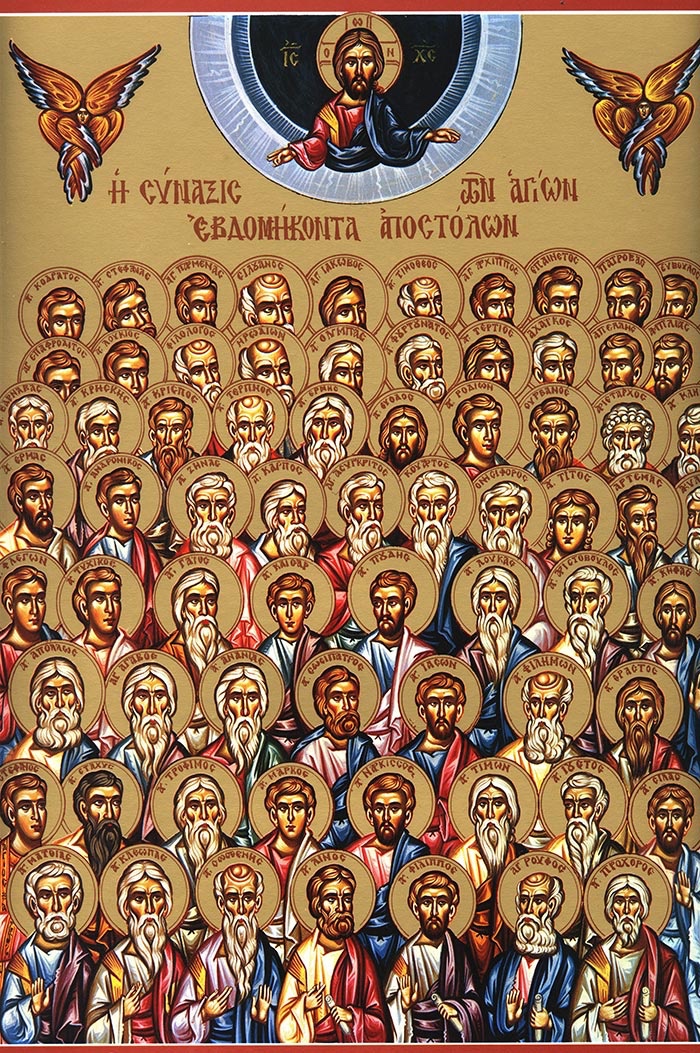
There is some debate as to whether there were seventy, or seventy-two, followers sent out by Jesus. Seventy represents the purported number of nations—as listed in Gen 10—or the number of Israelites who travelled to Egypt with Joseph (Gen 46:27)—or the number of elders appointed by Moses (Num 11:16)—but is found in only a small number of older manuscripts. There is a list of the names of the 70 disciples, drawn from later church traditions, at https://www.christian-pilgrimage-journeys.com/biblical-sources/christian-history/the-seventy-disciples/)
Seventy-two, found in most of the older manuscripts, is sometimes seen to correlate with the 72 scholars who translated the Septuagint, as the Letter to Aristeas reports: “In the presence of all the people I selected six elders from each tribe, good men and true, and I have sent them to you with a copy of our law. It will be a kindness, O righteous king, if you will give instruction that as soon as the translation of the law is completed, the men shall be restored again to us in safety. Farewell.” (Letter to Aristeas 46; the names of the 72 translators follow in Aristeas 47–50).
These seventy followers were to engage with people in the villages where they were, sharing a message of peace and proclaiming the good news of the kingdom (Luke 10:1-20). This is a critical moment in the development of the movement which was clustering around Jesus. And it is set in Samaria—not in Galilee, not in Judea, but in Samaria! In response to the call of the disciples to “call down fire from heaven” on some Samaritans, Jesus instructs his followers to move around the region, proclaiming the good news of the coming kingdom.
From learners to leaders
Throughout his “orderly account”, Luke portrays the inner circle of Jesus’ followers as disciples, committed to the task of learning from Jesus. They provide role models for those in a later generation who listen to the story which Luke has written in his Gospel and strive to be faithful followers of the way of Jesus in their own times. So the stories from long ago are not simply historical reminiscences; they are narratives which provide stimulus and encouragement for us, in the 21st century, as we seek to be faithful followers of Jesus.
Luke reports how, early in the ministry of Jesus, as growing numbers of people show interest in him (4:15, 36, 42; 5:1, 15), Jesus calls three fishermen to form the core group of his followers (5:1–11). Simon Peter is singled out at this point, but his business partners, James and John, are recruited with him to move from catching fish to “catching people”. The tax collector Levi then responds to Jesus’ challenge to “follow me” by leaving everything (5:27–28); these first four named followers thus stand as a pattern for how people were to respond to Jesus (as 14:26 reinforces).
Soon after these early recruitments, Luke reports the gathering of a group of twelve disciples, whom he names and designates “apostles” in recognition of their role in representing his message to those whom they encounter (6:12–16). This is the group that we often have in mind when we talk about “the disciples of Jesus”; but, as we shall see, Luke actually has many more in mind beyond this inner group.
Immediately after this scene, Luke reports at more length the teachings which Jesus directs towards his disciples: “love your enemies…be merciful…do not judge…hear my words, act on them” (6:20–49). The role of the disciples as learners is firmly established; these words are to be programmatic for all that they undertake. So their first task is to listen, and learner. Disciples are learners. (In fact, the Greek word translated as “disciple” actually comes from the root verb which means “to learn”!)
The narrative continues, and as the disciples travel with Jesus, they continue to learn—they witness how Jesus preaches, teaches, heals and exorcises (7:11, 22; 8:1, 9, 22, 45). After a period of such learning in the company of Jesus, this inner group is then commissioned to replicate these activities for themselves, going out in pairs to “proclaim the kingdom of God and to heal” (9:1–6). The twelve will later be promised a key role at the ultimate judgment of Israel (22:28–30). This inner circle thus transitions: from learners, to leaders.
Sent out to bear witness
An account of the sending out the twelve to bear witness to the kingdom is found in the source used by Luke, the beginnings of the good news (Mark 6:7–13), as well in the book of origins (Matt 10:5–25). Luke intensifies the importance of this missionary activity by reporting that, after sending out the twelve, Jesus then sends out a larger group of his followers, to do likewise. There were seventy such disciples (or in some versions, seventy–two) for the role that will later consume their lives: “cure the sick and say to them, ‘the kingdom of God has come near’” (10:1–12; cf. 9:2).
The rigour with which the seventy are sent out reflects the rigour required of the twelve before them: “no purse, no bag, no sandals”, intent on filling their purpose, instructed to “greet no on on the road” until arriving at the house of destination (10:4–5). The twelve were instructed to “take nothing for your journey, no staff, nor bag, nor bread, nor money—not even an extra tunic” (9:3).
One part of the instruction, to “greet no one on the road” (10:4) evokes the instructions of Elisha to Gehazi, “if you meet anyone, give no greeting” (2 Kings 4:29); another instruction, to say “peace to this house” (10:5) evokes the directions of David to ten young men to salute Nabal, “peace be to you, and peace be to your house” (2 Sam 25:5–6).
Alongside these moments of non-receptivity to the message, there are times when the message is accepted and believed. It is indeed striking that the success of these seventy, reported with great joy (10:17), occurs amongst the Samaritans. As we have seen, the Samaritans were difficult customers; James and John had actually wanted Jesus to invoke the wrath of God and consume them (9:54). Jesus, by contrast, refuses to do this (9:55) and charges the seventy to preach a message peace to the Samaritans (10:5) and to declare the good news, that God’s kingdom is right there, in midst of them (10:9,11; cf. 9:2). See https://johntsquires.com/2022/06/20/through-samaria-heading-to-jerusalem-luke-9-pentecost-3c/
The prayer of thanks that Jesus offers (10:21–22) and the blessing that he bestows upon his disciples (10:23–24) recognises this startling fact: Samaritans have responded positively to the good news proclaimed by the followers of Jesus! (This is similar to the successful witnessing to the significance of Jesus that is reported in the book of signs, at John 4:39–42, after Jesus had engaged with a Samaritan woman beside Jacob’s well, at Sychar, 4:4–6.)
“The disciples” in Luke’s account is a broad, inclusive group of followers—including Samaritans! Time spent with Jesus involves not just learning from him—although this is the bedrock of the relationship—but also putting his ethic into practice. So the seventy, having spent time with Jesus learning, are now challenged to exercise leadership within the Jesus movement.
(As Paul writes in the letter to the Galatians, also set in this week’s lectionary: “Those who are taught the word must share in all good things with their teacher”, Gal 6:6.)
The seventy have been charged with moving on, from being learners, listening in the crowd as Jesus teaches and tells parables, to become leaders, undertaking activities for which they need initiative, resolve, and capacity. And such leadership means addressing the challenges of the context and plunging into the difficult situations with the message and actions of hope. Samaria was not an easy gig!!
Teachings to deepen discipleship and strengthen leadership
The inner group of twelve is thus not depicted as being isolated from, or elevated above, the others who travel with Jesus in Galilee and on into Samaria. They form a kind of model for the seventy, and, by extension, later disciples—right up to the 21st century. We are all called to move from being learners, to become leaders.
Thus, in the following chapters, the teachings of Jesus are explicitly addressed to disciples on matters such as prayer (11:1–4), integrity (12:1–2), the appropriate lifestyle to lead (12:22–34), fidelity to God (16:1–13), forgiveness and preparedness (17:1–10, 22–37) and the nature of the kingdom (18:15–17). In keeping with his focus on those who are poor (4:18; 6:20; 7:22), the challenge to “give to the poor” is a motif which runs consistently through the words of Jesus (12:21, 33; 14:13, 21; 16:19–31; 18:22; cf. 19:8).
All of these teachings were important for the first followers of Jesus. They deepen their discipleship, expand their understanding, and strengthen their leadership skills. All of these teachings apply to our discipleship, as well, and help to us make the move from learners, to leaders.
Strategically, these teachings also include Jesus’ revelation of his own fate (9:43b–44; 18:31–33) and the high cost of discipleship (14:25–35). Jesus emphasizes the distinctive nature of leadership in his movement (20:45–47; 22:24–30). “Deny yourself” and “be like one who serves” provide central motifs for Jesus’ instructions to those who will continue his enterprise after his passion. The twelve and the seventy, who first heard these words of Jesus, thus function as role models for the way that leaders are to operate after the lifetime of Jesus, as we in turn listen to these teachings.
The second volume of Luke’s work shows a range of figures who have learned from Jesus (or his disciples) and are reported as putting into practice the charge which Jesus gave to his disciples, to “proclaim the kingdom of God and to heal”. The followers of Jesus throughout Acts are offering leadership: proclaiming the good news, undertaking acts of mercy and charity, standing up for justice, and other ways of being faithful to the way of Jesus.
Overall, the lines of continuity can be clearly traced from the example of Jesus through the activities of the leaders of the movement. The learners were diligent, and became effective and faithful leaders. May that be the pathway that we each walk, also, in our lives, as faithful followers of Jesus—learners, who now exercise leadership.
*****
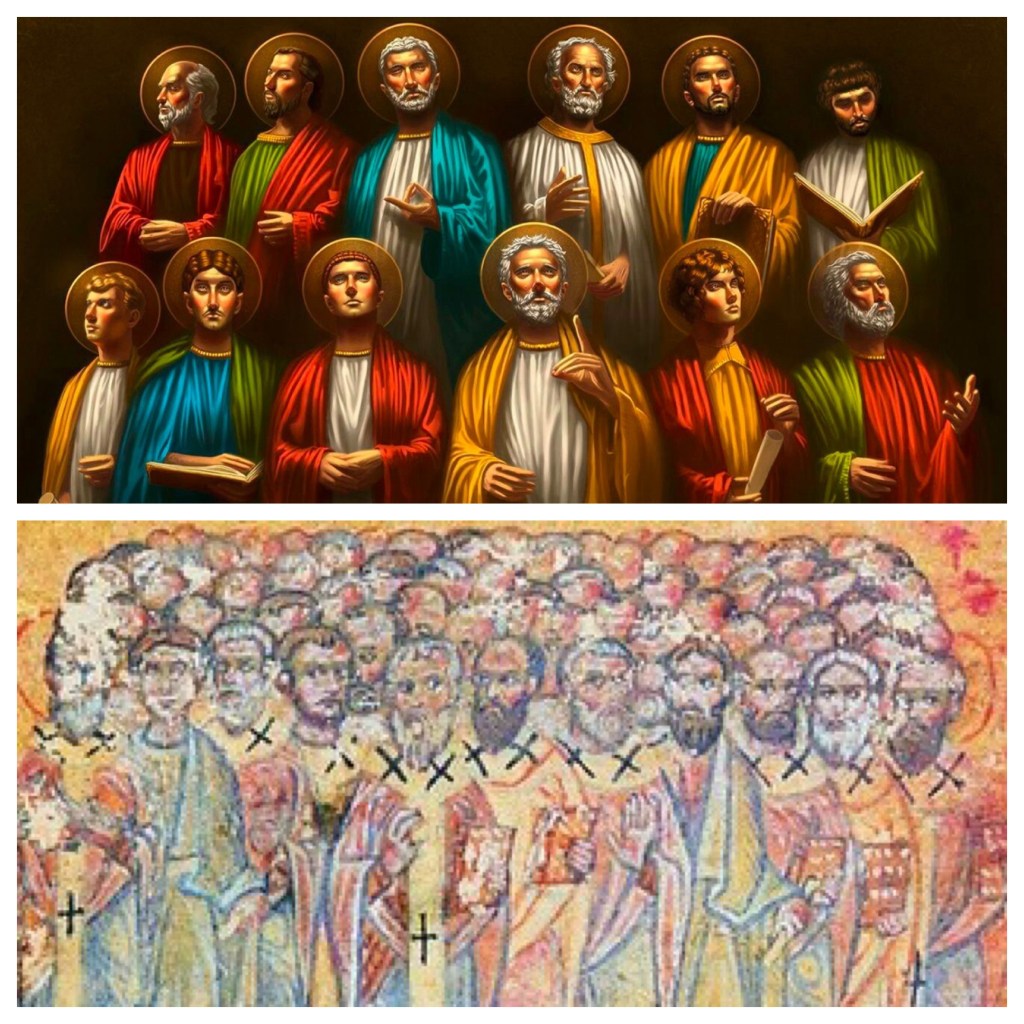
The cover images come from The Seventy-two Disciples (Unknown artist, Provenance Ethiopia, Dated about 1480 – 1520; Tempera on parchment).
Based on excerpts from a 64-page study booklet, FromLearners to Leaders: an exploration of the Gospel for Year C, by John Squires and Elizabeth Raine (self-published, 2014)
It’s been interesting to see the recent posts relating to the 45th anniversary of the inauguration of the Uniting Church on 22 June. I saw largely positive commentary, as well as a handful of more negative observations. All in all, it was time to consider and identify some key factors, both positive, and negative.
In the midst of all of this, I am thinking that it must be time for another post about organisation and governance in the Uniting Church in Australia. So this is a blog about the word THE.
Yes, that’s right: THE. Specifically, about the meaning and significance of that little word “the” in one sentence in a church document: the Basis of Union, the founding document for the church that I belong to, the Uniting Church in Australia (formed in 1977).
The particular sentence that I intend to focus on is found in paragraph 15(a) of the Basis. It reads: The Congregation is the embodiment in one place of the One Holy Catholic and Apostolic Church, worshipping, witnessing and serving as a fellowship of the Spirit in Christ.
Now, the word “the” actually appears four times in this sentence. However, it is the second of these four occurrences that is in my focus of attention: “the embodiment”.
The, in English grammar, functions as a definitive article; it sits before a noun and gives shape, specificity, definition to the noun that follows. So, “the cat” refers, not just to any old cat, but to that particular cat which I can see before me, sitting on the mat (yes, that particular mat, as opposed to any old mat).
The little word “the” thus has a specifying role, defining a particular thing for our consideration, in distinction from the great mass of other things just like it that we are not considering. “The” can thus place an emphasis on the singularity and particularity of the item that is so qualified.
But “the” can also be a generalising term, placed in front of a noun without any intention to give it concerted specificity. In this instance, the word “the” just has the generalised of kind of smoothing out the sentence. “Cat sat on mat” sounds clunky. “The cat sat on the mat” has a rounder and fuller feel to it, without ever intending to refer to THIS specific cat sitting on THAT particular mat. It’s actually a generic reference to what cats do when they find a mat. ANY cat. ANY mat.
So, when we turn to the section of the Basis of Union that deals with Governance, we first should note that the Congregation is not defined as a council. The Council (that is, the governing body) in a local context is named in the Basis as “the Elders or Leaders Meeting”. In practice, it was often called “the Parish Council”.
Some time after the Basis was written, the Assembly of the UCA determined that this body would be called the Church Council. It consists of “the minister and those who are called to share with the minister in oversight”. That oversight is the governance function of the Church Council, which is clearly identified and defined as being “the council within a congregation or group of congregations”.
There are three other councils which are so identified in paragraph 15 of the Basis: the Presbytery (“the district council”), the Synod (“the regional council”), and the Assembly (“the national council”). Together with the Church Council, these four bodies have responsibility for governance, the oversight of the various matters specified and allocated to each council in turn.
Now, the Congregation is not a Council. But it is an integral part of the Church. The Basis says that it is “the embodiment in one place of the One Holy Catholic and Apostolic Church”.
Does this means that the Congregation, as “the embodiment in one place of the One Holy Catholic and Apostolic Church”, is THE one and only way, THE pre-eminent way, THE most significant way, that the church is made manifest, or embodied, in human society? I have heard and read this claim many times, over the four decades that I have been active within the church. It is a commonly held (mis)belief.
Such a claim places an inordinate amount of emphasis on that little word “the”. It invests it with a priority sense, with an exclusive connotation—this is THE Church, the one and only way that it exists. This is a huge claim.
And it is often spoken in contexts where decisions of the Presbytery, or the Synod, or the Assembly, are in contention. The implication is clear: THEY are not really the Church. THIS, the Congregation, this is the Church!
It is important to note that the Basis does not ever make this claim. It never says only the Congregation is THE church, the Congregation is the WHOLE church, and the Congregation is the NOTHING BUT the Church. Not at all.
Besides, the Basis says that the Congregation is the embodiment IN ONE PLACE of the church. Across the railway line, there is another Congregation that is the embodiment IN ONE PLACE, over there, of the church. And further away, across the river there is another Congregation that is the embodiment IN ONE PLACE, across the river, of the church. They are all embodiments of the church in their own places.
And so, with the other entities mentioned in the Basis. These entities are clearly part of the church, as well. They may well also be understood to embody the church, as each one exercises its responsibilities and carries out its duties in the prescribed areas allocated to it. They give expression to the church as much as the Congregation does.
Indeed, other entities which have developed and evolved since the time that the Basis was written (in the mid-to-late 1960s) are clearly a part of the church as well. We cannot afford to invest that little word “the” with the sum totality of what we understand the church to be. The church is also aged care facilities, preschool centres, meals for the homeless programmes and theological training colleges, chaplains to the Defence Force and chaplains to those ill and in hospital, mental health chaplains and Frontier Service Padres—and much, much more.
And the Basis also notes and defines other elements which are undoubtedly part of the church. Is the Congregation to say to the Synod, you are not part of the Church? Or to the Presbytery, you are not part of the Church? Or to the Assembly? (Yes, I can feel myself channeling Paul via 1 Cor 12!)
So I recoil when I hear or read that the Congregation is THE Church, prioritised, privileged, and exclusively THE Church. It’s not. It is an important, local, expression of what we understand the Church to be.
But the Congregation is governed by a Church Council, which is in relationship with the other Councils of the Church. It’s the Church Council which is the local council of the church, not the Congregation. And we certainly wouldn’t claim that this Council is THE embodiment of the Church, any more than we would say this of a Presbytery, or a Synod, or the Assembly. Nor is the Congregation. Each of these bodies is, in some way, an expression of the Church; and each, by the provisions found in the Constitution, has its own set of responsibilities.
In the end, the Congregation is ONE of the manifestations, or embodiments, if the Church, related to each of the other manifestations and expressions and embodiments of the Church, seen through the various bodies, agencies, gatherings, and councils of the Church.
A personal postscript: I have a clear and firm commitment to the life of the Congregation, having participated actively for over 40 years in the life of seven congregations in Australia (and three more whilst studying in the USA, and in a Methodist Circuit whilst living for a year in the UK). During that time I have been a member of four Church Councils, two times a Treasurer, and once a Church Council chairperson.
Much of the time I have done those roles whilst being engaged in fulltime theological education and presbytery oversight roles. My current position is fully focussed on resourcing, supporting, encouraging, and even challenging Congregations and Church Councils in their life, service, and witness.
I’ve been privileged to have been a member of a Congregation which had a strong Congregational heritage. In fact, it was the home Congregation of the sole Congregationalist lay member of the Joint Commission on Church Union, Maynard Davies. I understand that Mr Davies was the member who pressed for the inclusion of paragraph 11 in the Basis of Union.
That’s the paragraph that affirms that the Uniting Church will remain open to new insights which emerge from scientific thinkers, historical researchers, our encounter with other cultural customs, and our engagement with people from societies different from our own.
This, of course, is a really important element in the theology and practice of the UCA—from this strong Congregational heritage, a progressive and engaged church has developed. The policies and values that have been promulgated by Synods and Assemblies over the decades owe much to this commitment, and to the ongoing work that has been done within “the wider church” in such areas. All from a strong Congregational ethos!
So I think it is entirely possible to value the local expression of church whilst engaging in and supporting broader expressions. All of this is us, as we say.
Now that all the results have been finalised in the Australian Federal Election 2022, we can see clearly the extent of Liberal losses. It’s been extensive, cutting right to the heart of the party in the so-called “blue-ribbon Liberal” seats.
From early on it was clear that six House of Representatives seats were lost to “teal independents”, standing on a platform of real action to address climate change, and the introduction of a corruption commission to begin to repair the shocking state of integrity in public life.
Three of these seats were in Sydney: Kylea Tink in North Sydney, the seat of former Treasurer Hockey; Sophie Scamps in Mackellar; and Allegra Spender in Wentworth, the seat of former PM Turnbull amd former Opposition Leader Hewson.
Two more were in Melbourne: Monique Ryan in Kooyong, the seat of former Treasuer Frydenberg, as well as former Opposition Leader Andrew Peacock, and foundation Liberal leader and (twice) Prime Minister Robert Menzies; and Zoe Daniel in Goldstein.
The sixth seat to fall to a “ teal independent” was in WA: Kate Chaney in Curtin, the seat of former Deputy Liberal Leader Bishop.
They join existing members Helen Haines in Indi and Zali Steggal in Warringah, both of which were once blue-Liberal seats; the latter was previously held by the former PM, the Abbott of Inequity.
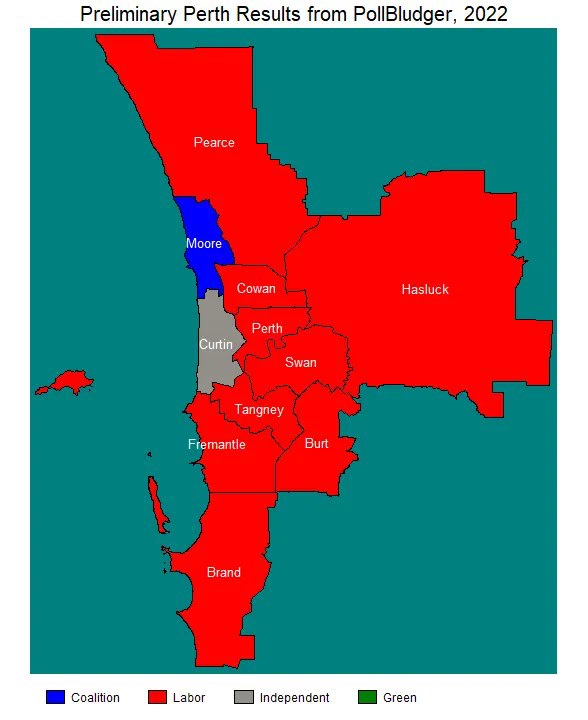
The Liberals also lost to Labor in Bennelong, the seat of former PM Howard, and Robertson in NSW; in Victoria, they lost to Labor in Higgins, the seat of former Treasurer Peter Costello and former Prime Ministers Harold Holt and John Gorton, and Chisholm. In SA, they lost Boothby to Labor, and the Centre Alliance held on to Mayo, which it had taken from the Liberals in 2016; while in QLD, they lost to the Greens in Ryan.
They lost massively in WA, with four seats going to Labor: Hasluck, Swan, Pearce, and Tangney. The map of electorates in the Perth area tells the story quite dramatically!
In the Senate, four Liberal seats were lost: to David Pocock in the ACT, to Labor in WA, to the Jacqui Lambie Network in Tasmania, and to “it’s my kinda party” Untied Australia in Victoria.
The Liberals now have only 23 seats in the Senate—but we add to that 5 from the Liberal National Party in QLD, 3 from the Nationals, and 1 from the Country Liberals in NT, to total 32 Senators as the main opposition body.
Labor now has 26 seats in the Senate, and no doubt they will work co-operatively with the 12 Greens and independent David Pocock on much of their legislative agenda. The 2 Jacqui LambieNetwork senators may well also figure in these negotiations.
The conservative rump is now irrelevant in the Senate, except for the predictably useless aggravating grunts that they will surely make as often as they can to gain media attention: Pauline Hanson and Malcolm Roberts in QLD, and newcomer Ralph Babet in Victoria.
Lots of Liberal losses overall. And a clear indication that the Liberals are no longer anything like “liberal” in their policies or their practices.
The true cost of the Howard—Abbott—Morrison conservative hegemony is now evident: years of rhetoric about fiscal conservatism masking disastrous social policies, especially amongst the poor; years of dog whistling promoting xenophobia and overt racism, often in cahoots with various rightwingnutjobs; years of resistance to any significant action on climate, signing off on a bleak future for all humanity whilst profiting from the largesse of always-profitable fossil fuel companies; years of resisting real support for renewables; years of offering leftover scraps to the First Peoples of the country, while ignoring Royal Commission recommendations; and years of blithely ignoring the misogynistic culture that tolerated (and generated) many acts of sexist abuse.
The lectionary is currently providing a short series of excerpts from one of Paul’s earliest letters—the one he wrote to the Galatians, possibly in the late 40s, more likely (in my view) by the middle of the 50s.
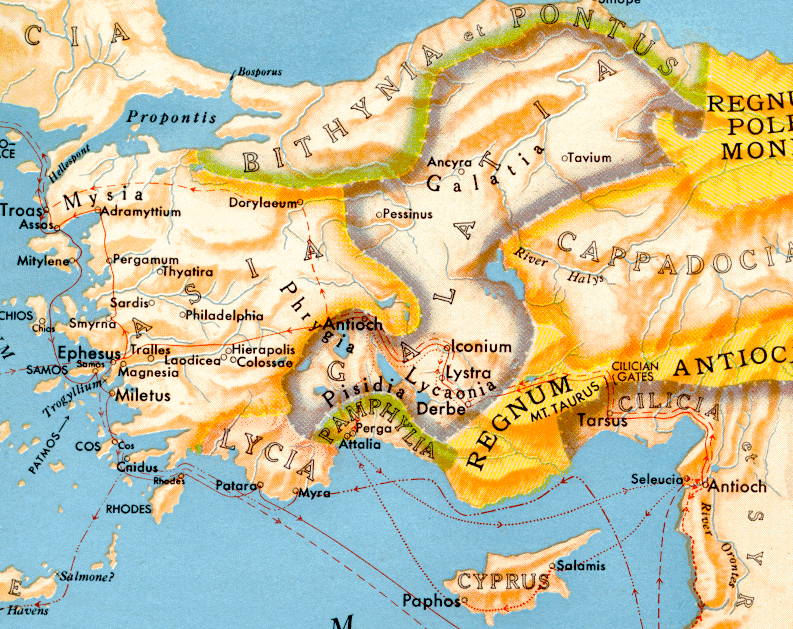
This letter is distinctive in a couple of ways. The audience is not a gathering of believers in one city (as in Thessalonians, or Philippi, or Corinth, or even Rome), but the various communities of believers across the whole region of Galatia, which was one of the Roman provinces in the area we today call Turkey.
A second distinctive feature is that this letter completely omits any of the “friendly overture” elements that are typically found at the start of the letters widely recognised as the authentic letters of Paul. Many of these letters, after the requisite formalities (Paul, to the believers in X, grace and peace to you), contain a prayer of thanksgiving: “we always give thanks to God for all of you and mention you in our prayers, constantly …” (1 Thess 1:2–10); “I give thanks to my God always for you because of the grace of God that has been given you in Christ Jesus …” (1 Cor 1:4–9), “when I remember you in my prayers, I always thank my God because I hear of your love for all the saints and your faith toward the Lord Jesus …” (Phlmn 4–7); “first, I thank my God through Jesus Christ for all of you, because your faith is proclaimed throughout the world …” (Rom 1:8-15); and in the letter known as “the friendly letter”, “I thank my God every time I remember you, constantly praying with joy in every one of my prayers for all of you …” (Phil 1:3–11).
The second letter to the Corinthians replaces this prayer of thanksgiving with an extended blessing: “Blessed be the God and Father of our Lord Jesus Christ, the Father of mercies and the God of all consolation, who consoles us in all our affliction …” (2 Cor 1:3–7); that pattern is followed by the anonymous scribe who wrote decades later, modelling his circular letter on earlier Pauline examples, “Blessed be the God and Father of our Lord Jesus Christ, who has blessed us in Christ with every spiritual blessing in the heavenly places …” (Eph 1:3–14), just as the unknown person who crafted a letter to Colossae likewise followed the model of the earlier prayers of thanksgiving: “in our prayers for you we always thank God, the Father of our Lord Jesus Christ, for we have heard of your faith in Christ Jesus and of the love that you have for all the saints …” (Col 1:3–14).
The letter to the Galatians has no indication, either of a prayer of thanksgiving, or of a blessing. Instead, this letter cuts right to the chase, in direct words which accuse and denounce: “I am astonished that you are so quickly deserting the one who called you in the grace of Christ and are turning to a different gospel … there are some who are confusing you and want to pervert the gospel of Christ … if anyone proclaims to you a gospel contrary to what you received, let that one be accursed!” (Gal 1:6–9). The letter continues swiftly, “Am I now seeking human approval, or God’s approval? Or am I trying to please people? If I were still pleasing people, I would not be a servant of Christ.” (Gal 1:10).
*****
This opening accusation is reflected in words that we find in the section offered by the lectionary for this coming Sunday (5:1, 13–25) when, five chapters after this direct opening, Paul rounds back on his audience, declaring that “if you bite and devour one another, take care that you are not consumed by one another” (5:15).
In a striking juxtaposition, however, the letter continues on from this warning, to provide a contrast, which has become well-known, between “the desires of the flesh” (5:16–21) and “the fruit of the Spirit” (5:22–26).
I have no doubt that most, if not all, sermons that are preached on this lectionary offering will focus primarily, if not exclusively, on the nine qualities identified as the fruit of the Spirit, namely, “love, joy, peace, patience, kindness, generosity, faithfulness, gentleness, and self-control” (5:22-23).
Swimming against the tide, I intended to reflect here, not on the fruit of the Spirit, but on those earlier words, about “biting and devouring one another”.
To understand the reason for Paul’s direct words, we need to understand the presumed situation in Galatia which he was addressing. We can glean a number of clues about this from references and statements in Paul’s letter to the Galatians.
It is evident from Paul’s opening comments that other teachers had visited the Galatian community, and had taught them things that were at odds with what Paul was teaching. He derogatively labels them as “some who are confusing you and want to pervert the gospel of Christ” (1:7), and later as those who have “bewitched” the Galatians (3:1) and, by inference, those who “prevented [them] from obeying the truth” (5:7). As a result, he calls the Galatians “foolish” (3:1) and expresses a wish that “those who unsettle you would castrate themselves” (5:12).
These teachers, in Paul’s opinion, proclaim “a gospel contrary to what you received” (1:9)—namely, what Paul himself had taught them, when he had earlier visited the Galatians, a time “when you did not know God, you were enslaved to beings that by nature are not gods” (4:8). The Galatians turned from their gentile faith to adopt faith in Jesus, by which “you have come to know God, or rather to be known by God” (4:9). It is “for freedom [that] Christ has set us free” (5:1). See https://johntsquires.com/2022/06/15/for-freedom-christ-has-set-us-free-galatians-pentecost-2c-3c-4c/
*****
If we knew precisely who the Galatians were, what group of teachers had been active amongst them, or what specific matters caused Paul to write this letter, we might be better placed to adjudicate on this matter. Unfortunately, we do not have specific information about the identity of the addressees of this letter or their location.
Acts indicates that Paul had preached in a number of locations in Galatia: initially with Barnabas he visited Pisidian Antioch (Acts 13:14–52), Iconium (14:1–5), Lystra (14:6–20) and Derbe (14:6, 21–23). Subsequently he revisited the area, once passing through swiftly with Timothy, saying nothing (16:6), and later going “from place to place” in the region, “strengthening the disciples” (18:23).
In the first two cities there were Jews who were opposed to the preaching of Paul and Barnabas: they persecuted them in Antioch and attempted to stone them in Iconium. However, such figures are common in Acts, for in almost every place Paul encounters such Jewish opposition. We learn no specifics of the Galatian churches from the Acts accounts.
Paul argues that the gospel he proclaims brings believers into the unity of being “one in Christ” (3:28). This unity overshadows all divisions—as the most famous words in this letter declare, “there is no longer Jew or Greek, there is no longer slave or free, there is no longer male and female” (3:28). See https://johntsquires.com/2022/06/19/inclusion-welcome-unity-gal-3-pentecost-2c/
The threat against this unity has arisen through the insistence of these teachers, that true faith requires, first, circumcision. This is the group which Paul calls “the circumcision faction” (2:12; compare Acts 15:1, 5). They are the ones whom Paul blames for the destructive behaviour of the believers in Galatia, as they bite and devour one another, because they have been (in Paul’s view) bewitched and confused. (So much for the wonderful days of the “golden era” of the early church … … …)
Paul has much to say about the teaching of these people, identifying circumcision as the central issue, but actually dealing with a whole set of matters regarding the place of the Jewish Torah, the law, in the communities which recognised Jesus as Messiah. Paul comes back to this is his final chapter of the letter, which is what the lectionary offers us on the Sunday after next … so more musings on that, next week.
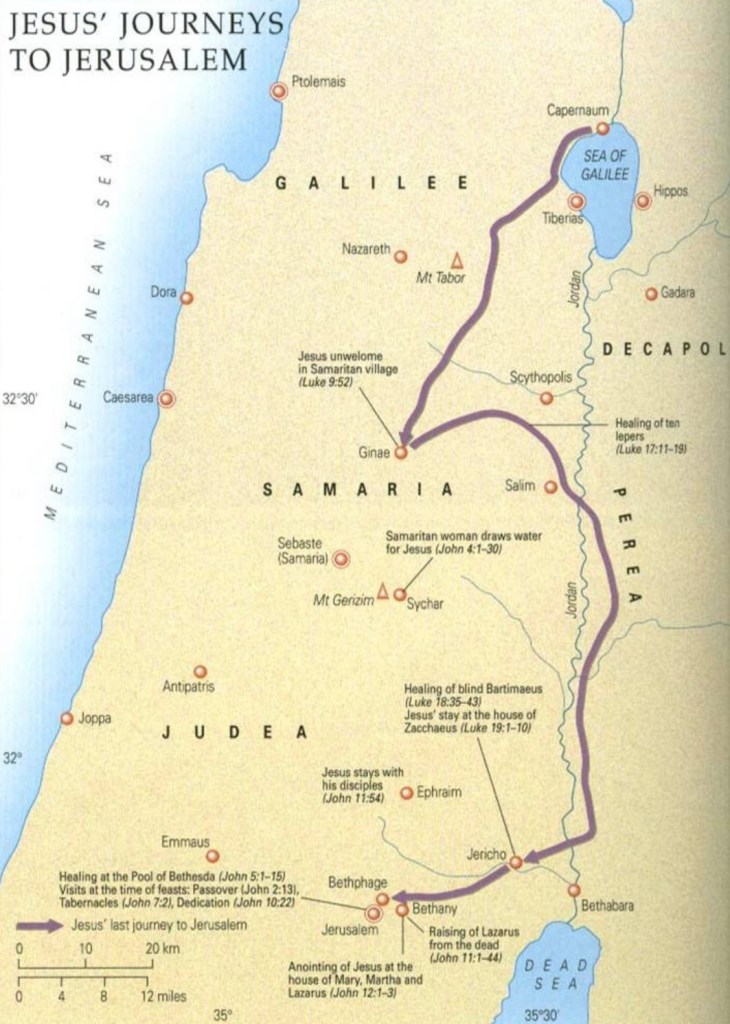
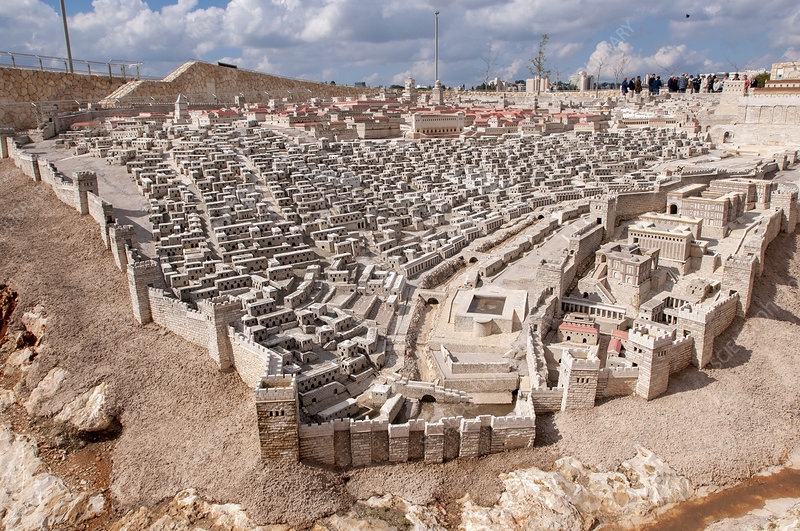
Jesus came from Nazareth in Galilee, in the northern region of Israel. His childhood and much of his adult life was lived in Galilee. Like many others of his time, that life included trips to Jerusalem, the city where kings had ruled; where the Temple sat at the pinnacle of Mount Zion; where sacrifices and offerings were presented to God; where festivals were celebrated, sins were forgiven, gratitude was expressed, psalms were sung.
But Jesus spent most of his time in Galilee, in the northern region of Israel, visiting the synagogues, encountering people on the streets, spending time at table with various people. There was a moment in time, however, when he made the decision to go to Jerusalem. It was a momentous decision; indeed, it would be a fatal decision, as it turned out. But at the time, nobody knew that would be the case. He had travelled south to Jerusalem, and then returned north to Galilee, on occasions before. But this time would be different. His disciples didn’t know that. Did Jesus himself have any inkling about this?
Towards Jerusalem
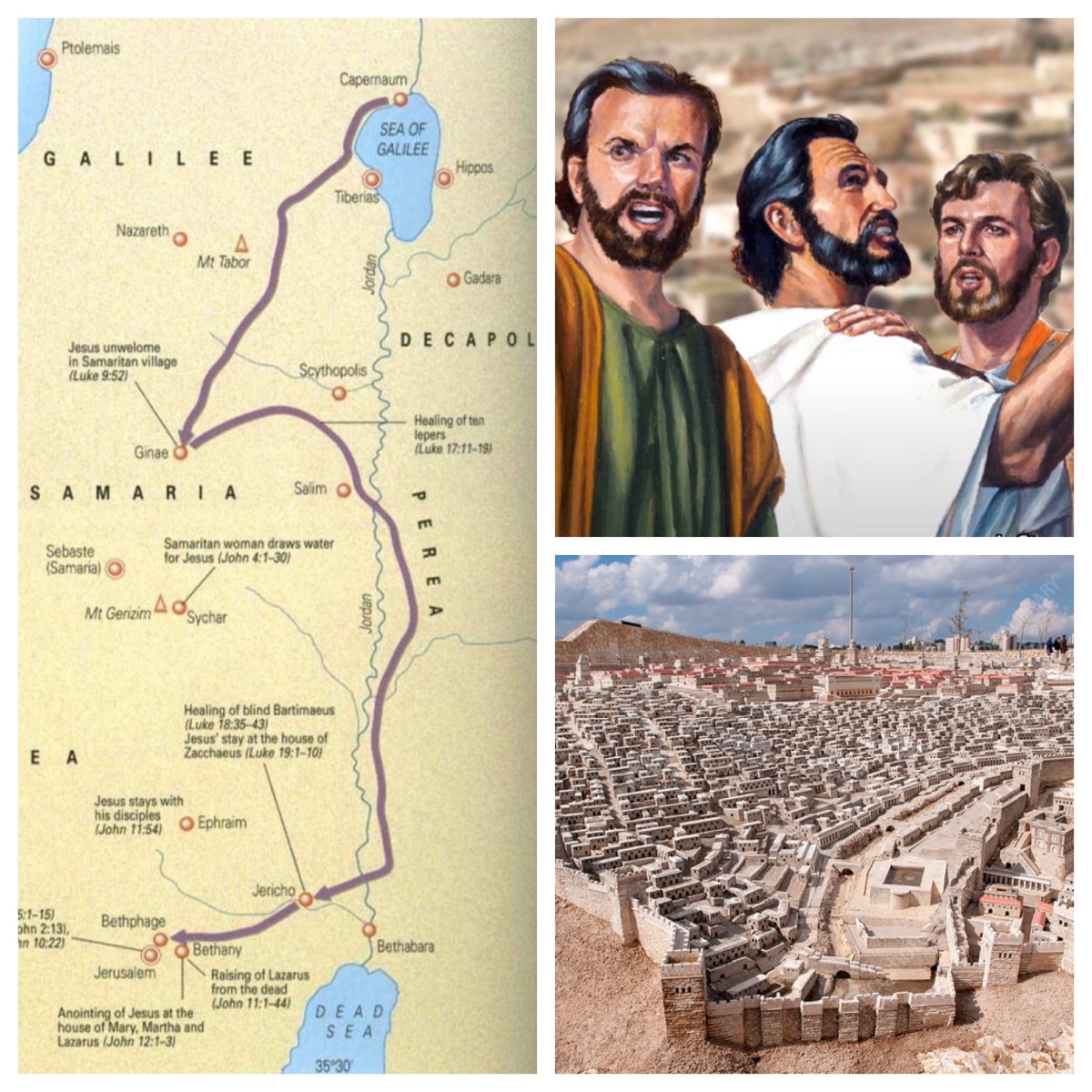
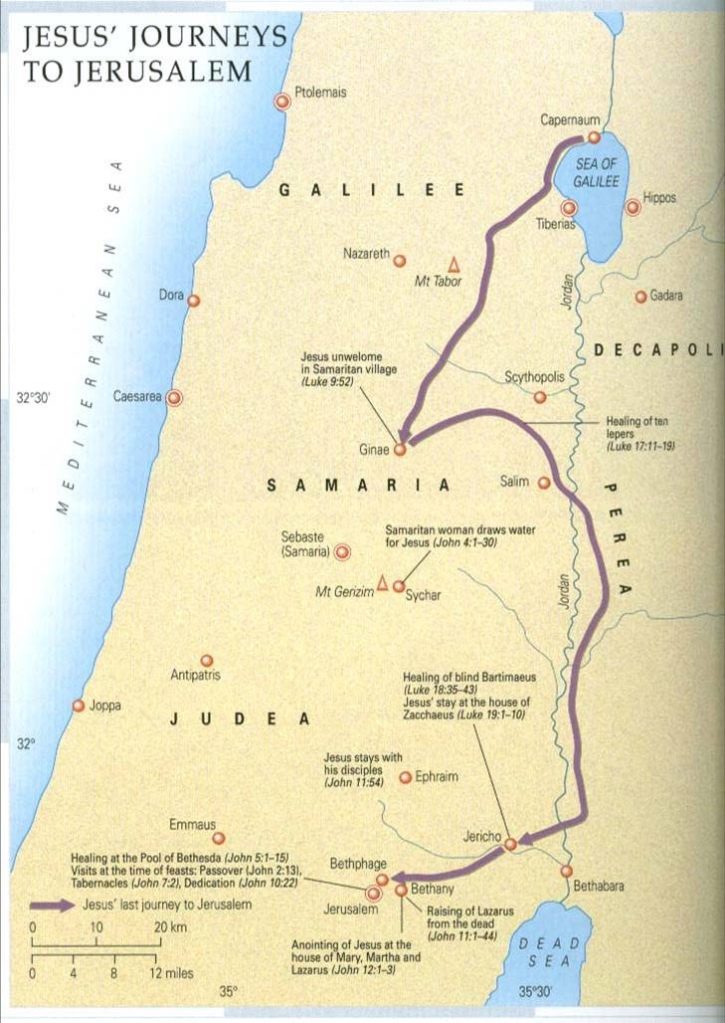
In the reading that the lectionary offers for this coming Sunday (Luke 9:51–62), we hear that Jesus “set his face to go to Jerusalem” (Luke 9:51). Then follows quite a saga, as that journey unfolds over ten full chapters. Matthew and Mark, by contrast, simply report that “he left that place [Galilee] and went to the region of Judea and beyond the Jordan” (Mark 10:1; Matt 19:1). Short, simple, quick. Yet Luke makes a big deal of it. It was a momentous decision.
As Mark reports Jesus’s journey to Jerusalem, he notes that “crowds again gathered around him; and, as was his custom, he again taught them” (Mark 10:1). But what he taught is not evident; Mark does not report many more details. Instead, Jesus is suddenly “in the region of Judea, beyond the Jordan” (Mark 10:1), back where he was first baptised (Mark 1:5). Soon, he would enter the city and then the Temple (Mark 11:11–15). It all takes place quite rapidly.
By contrast, in Luke’s orderly account of the things that have been fulfilled amongst us, the journey to Jerusalem, which begins at Luke 9:51 (“when the days drew near for him to be taken up, he set his face to go to Jerusalem”) takes ten full chapters to narrate. Jesus sets his face to Jerusalem at 9:51. He does not actually begin to approach Jerusalem until 19:11. Even then, his entry to the city is drawn out; Jesus tells a parable (19:11–27), rides down from the Mount of Olives on a donkey (19:28–38), and weeps over the city (19:39–44); then when he enters the city, he goes immediately to the temple (19:45).
Luke takes almost ten full chapters to narrate the journey that Jesus took, with his disciples, including much material that is found only in his narrative. What he taught on that journey, who he encountered on the road, and those whom he healed and exorcised along the way, are all reported by Luke. On this journey in Luke’s Gospel, see
The decision Jesus makes to travel to Jerusalem is reported in terms of weighty theological significance (9:51-56). “When the days drew near for him” might literally be rendered, “in the filling up to completion of the days”; the verb is an intensifying compound of pleroō, meaning to come to fruition or to be filled up.
Pleroō is the same verb used at the start of Luke’s narrative, at 1:1, where it also has a heavy theological sense (the things that God was bringing to fulfilment or completion). It also appears at the end of the narrative, when Jesus refers everything written about him “in the law of Moses and the prophets and the psalms” being fulfilled in accord with divine necessity (24:44).
The word appears also within the body of Luke’s narrative in relation to the fulfilment of scripture (4:21), the fulfilment of the time of the nations (21:24), and the fulfilment of the kingdom (22:16). And quite significantly, the exact same phrase introduces Luke’s account of the day of Pentecost (Acts 2:1). It is a signal that something very important is taking place.
The compound verb sumpleroo, which Luke uses at 9:51 and also at Acts 2:1, appears four times in the Septuagint, an early Greek translation of Hebrew Scripture. All four times it refers to the destruction of Jerusalem in 587BCE, and the seventy years that it lay fallow before the Israelites could return. So it is used with a weighty theological significance there, underlining its importance when it appears in Luke’s account.
(The other use of this compound verb is at Luke 8:23, in the account of the journey across the lake, when the boat in which Jesus and his disciples were sailing “was filling with water, and they were in danger” (8:23). The sense here is more prosaic—water is swamping the boat—but perhaps the linking of this word with “and they were in danger” points to the risk that Jesus was taking as he ventured across the lake, into Gentile lands, where he encounters the man possessed by a Legion of demons. See https://johntsquires.com/2022/06/14/what-have-you-to-do-with-me-jesus-luke-8-pentecost-2c/)
The phrase translated as “to be taken up” is analēmpsis, which could also be translated as “ascension”; the verb is used of Jesus rising into the clouds at Acts 1:2, 11, 22. This, of course, is the climactic moment at the end of the Gospel (Luke 24:50–51) and the opening scene of the second volume (Acts 1:6–11). That scene is in view from this earlier place in the narrative.
And when we read that Jesus “set his face to go to Jerusalem” (9:51), the language indicates a steely resolve, a fixed determination, to head towards the city. The verb used here is found in the LXX to refer to God’s determination (Lev 17:10; 20:3–8; 26:17; Ezek 14:8; 15:7) and it forms a consistent refrain in God’s directions to the prophet Ezekiel (Ezek 4:3, 7; 6:2; 13:17; 20:46; 21:2; 25:2; 28:21; 29:2; 35:2; 38:2). Jesus turns to Jerusalem with a fixed prophetic intent; when he arrives in the city, it is “a visitation from God” (19:44).
Through Samaria
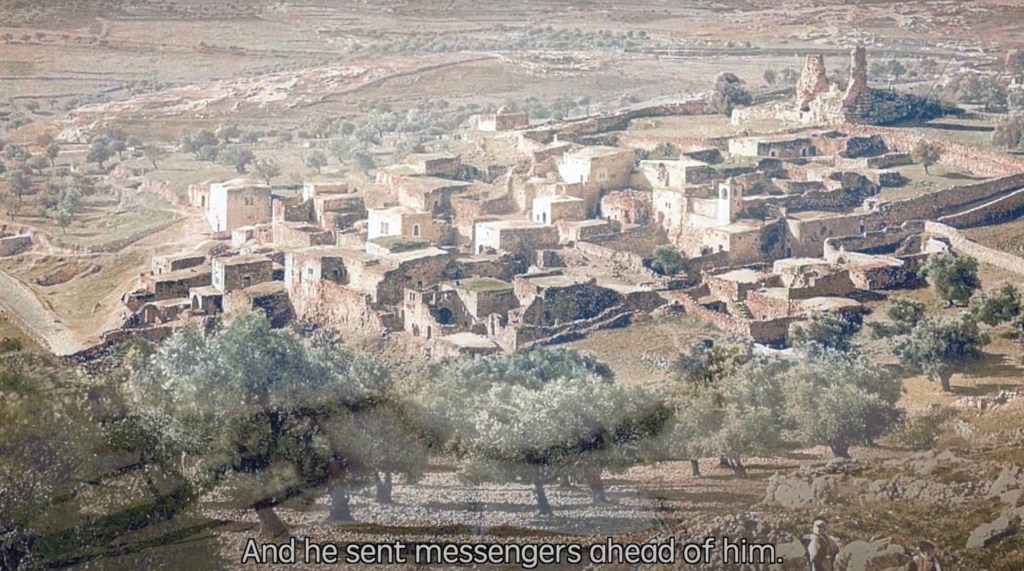
The determination that Jesus had to press on, heading south through Samaria, towards Jerusalem, is picked up by his disciples. Although some are sent on ahead into Samaria to make preparations from his coming, when Jesus and his group arrive, they encounter resistance from the Samaritans (9:52–53). It is presumed that the Samaritans, reflecting traditional antagonism between the two regions (as is reported at John 4:9), were not willing to provide hospitality to one known to be heading to the southern capital.
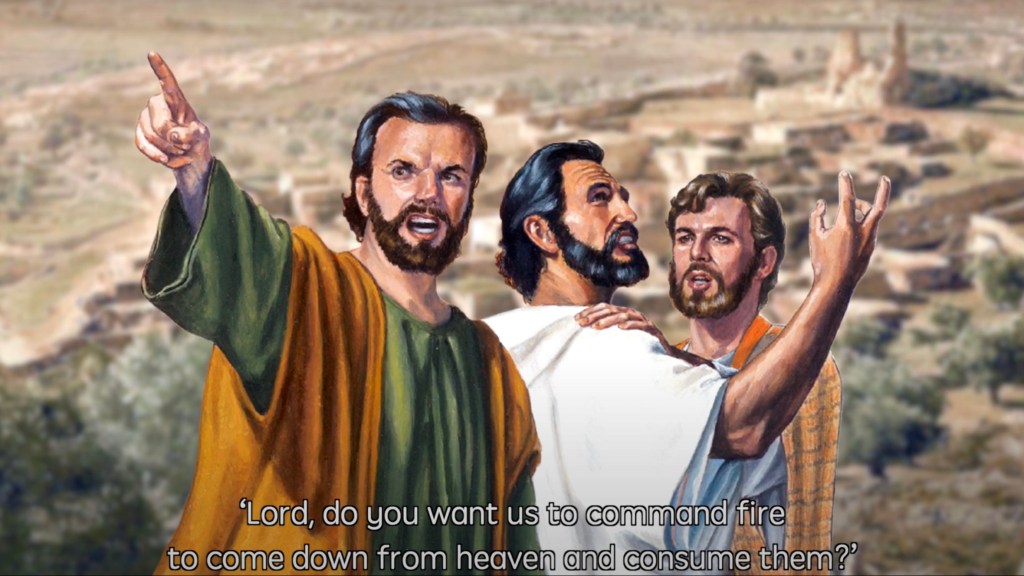
Incensed by this lack of support for their band as they made their way through the region, James and John said, “Lord, do you want us to command fire to come down from heaven and consume them?” (9:54). Their cry evoked a scene from the time of the king, Ahaziah, as two separate groups of fifty soldiers were consumed by fire when Elijah petitioned the Lord, “let fire come down from heaven and consume you and your fifty [men]” (2 Kings 1:10, 12). God had acted with vengeance in the past; surely God would do the same once more, the disciples presumably reasoned.
God did not intervene. Jesus was not pleased. He rebuked them (9:55) and they moved on to the next village. The comparison with Elijah is deemed inappropriate, at least at this point. (Later manuscripts from the medieval period add an explanation as to why Jesus rebukes them: “the Son of Man has not done to destroy the lives of human beings, but to save them”. The addition follows the form of the saying of Jesus recorded at Mark 10:45, and the substance of the saying at John 3:17. There are, however, no similar sayings in Luke’s narrative.)
The final section of the passage offered by the lectionary focuses on the singularity of purpose required to follow Jesus. The call to follow (implicit at 5:10–11; explicit at 5:27; 9:23; see also 14:27; 18:22) is here intensified by the collating together of three originally independent sayings of Jesus.
The first and third sayings are spoken in response to an approach to Jesus, “I will follow you”. The first occurrence (9:57) is an absolute statement; it evokes the response, “foxes have holes, and birds of the air have nests; but the Son of Man has nowhere to lay his head” (9:58). That is the same response which Jesus gave to a scribe who utters the same affirmation in Capernaum, much earlier in Jesus’s time in Galilee, in Matthew’s account (Matt 8:20).
The third occurrence (9:61) is conditional; “let me first say farewell to those at my home.” The response from Jesus, “no one who puts a hand to the plow and looks back is fit for the kingdom of God” (9:62) is found only in Luke’s narrative. The saying evokes the scene where Elisha is called by Elijah, but seeks to say farewell to his father and mother before following (1 Kings 9:19–21). Elijah permitted this last act of familial duty, before Elisha “set out and followed Elijah, and became his servant” (1 Kings 19:21).
Jesus, by contrast, will not countenance any conditional response; it must be a total commitment, if you wish to follow him. “Whoever comes to me and does not hate father and mother, wife and children, brothers and sisters, yes, and even life itself, cannot be my disciple”, he would later say (14:26). Refusing to allow the person to “look back” perhaps has in mind what happened to Lot’s wife, who “looked back and she became a pillar of salt” (Gen 19:26).
The middle saying of Jesus is a call spoken directly to one person, “follow me”, which is met by a conditional response: “first let me go and bury my father” (9:59). This response is also linked with the first response (“foxes have holes …”) in Matthew’s account (8:19–22). Jesus, of course, is unwilling to accept such a conditional response; he demands full and intense loyalty. (The words of Jesus, responding to Peter at Luke 18:29, verify this.) His rejoinder in both accounts is to “let the dead bury their own dead” (Luke 9:62; Matt 8:22); in Matthew, it is linked with the charge to “go and proclaim the kingdom of God.”
The call to follow Jesus will be put to the test immediately after this, when seventy of the followers of Jesus are sent out, two-by-two, charged to “cure the sick who are there, and say to them, ‘The kingdom of God has come near to you’” (10:9). That part of the story is what is provided by the lectionary for the Sunday after this coming Sunday (so see next week’s blog!).
Refugee Week is held each year, providing an opportunity to highlight aspects of the refugee experience and help the broader community to understand what it is like to be a refugee.
This year, Refugee Week runs from Sunday 19 June to Saturday 25 June. Healing is the theme of Refugee Week 2022. This theme builds on a recognition of the importance of human connections, which has been underscored by the current pandemic.
The website for this year’s Refugee Week says, “Mainstream and refugee communities alike can draw upon shared hardship to heal wounds, to learn from each other and to move forward. Healing can occur through storytelling, through community and also through realisation of our intrinsic interconnectedness as individuals.”
The first Refugee Week events were organised in Sydney in 1986 by Austcare (Australians Caring for Refugees). Austcare’s mission is to assist refugees overseas, displaced people and those affected by landmines to rebuild their lives, through the expert delivery of development programs in partnership with local communitities and other agencies.
In 1987, the Refugee Council of Australia (RCOA) became a co-organiser of the week, and the week became a national event from 1988. RCOA took on responsibility for the national coordination of Refugee Week from 2004.
According to the UNHCR, the United Nation’s Refugee Agency, there are now 89.3 million forcibly displaced people, as a result of persecution, conflict, violence, human rights violations or events seriously disturbing public order in their countries of origin. (A year ago, the figure was 82.4 million forcibly displaced people.)
35 million of these people are children, aged under 18 years. 1 million of these children were born as refugees; in the years 2018 to 2020, an average of between 290,000 and 340,000 children were born into a refugee life per year.
Over half of these people (53.2 million) are classified as “internally displaced”, meaning that they are homeless within their own country. 27.1 million are officially classified as refugees, meaning that they are “unable or unwilling to return to their country of origin owing to a well-founded fear of being persecuted for reasons of race, religion, nationality, membership of a particular social group, or political opinion.” This is the definition in the Convention and Protocol Relating to the Status of Refugees—an international agreement which Australia signed in 1951, the year it was published.
These statistics, from the UNHCR, illustrate the significant rise, globally, of displaced people, refugees, and asylum seekers in the past decade.
A further 4.6 million people are classified as asylum seekers. Under Article 14 of the 1948 Universal Declaration of Human Rights, everyone has the right to seek asylum The 1951 Refugee Convention prohibits states from imposing penalties on those entering ‘illegally’ who come directly from a territory where their life or freedom is threatened. (Terms such as ‘illegals’, ‘queue jumpers’ and ‘boat people’ are both inaccurate and unhelpful—even though they appear in the media with saddening regularity, they are terms that should be avoided.)
More than two thirds of all refugees currently under the UNHCR’s mandate come from just five countries: the Syrian Arabic Republic (6.7 million), Venezuela (4.0 million), Afghanistan (2.6 million), South Sudan (2.2 million), and Myanmar (1.1 million).
The countries which are currently hosting the most number of refugees are Turkey (3.6 million), Pakistan (1.4 million), Uganda (1.4 million), Germany (1.1 million), Sudan (just over 1 million), and the Islamic Republic of Iran (just under 1 million). Developing countries host 86 per cent of the world’s refugees, and the Least Developed Countries provide asylum to 27 per cent of the total.
In the last full year (2020–2021), Australia’s Refugee and Humanitarian Program was set at 13,750 places. We willingly accept this amount of incoming refugees, and recognise the value that such people do bring to the Australian society. we have fallen victim to the fear pedalled by unscrupulous elements in society, and in government, over the past decade, about the “hordes” of people seeking the safety of refuge in ur country.
In Australia, the most enduring myth about people seeking asylum is that most arrive by boat. They don’t. The clear fact is that most people seeking asylum arrive by air. It’s time for us to throw overboard the fear of people who come here seeking refuge and asylum on boats, and recognise that the fear fuelled by right-wing agitators over the past decade has not served us well at all.
Adhering to the provisions of the Refugee Convention, as a,country, would be an excellent step,for us to take this year. That would be a significant step towards Healing in our national life.