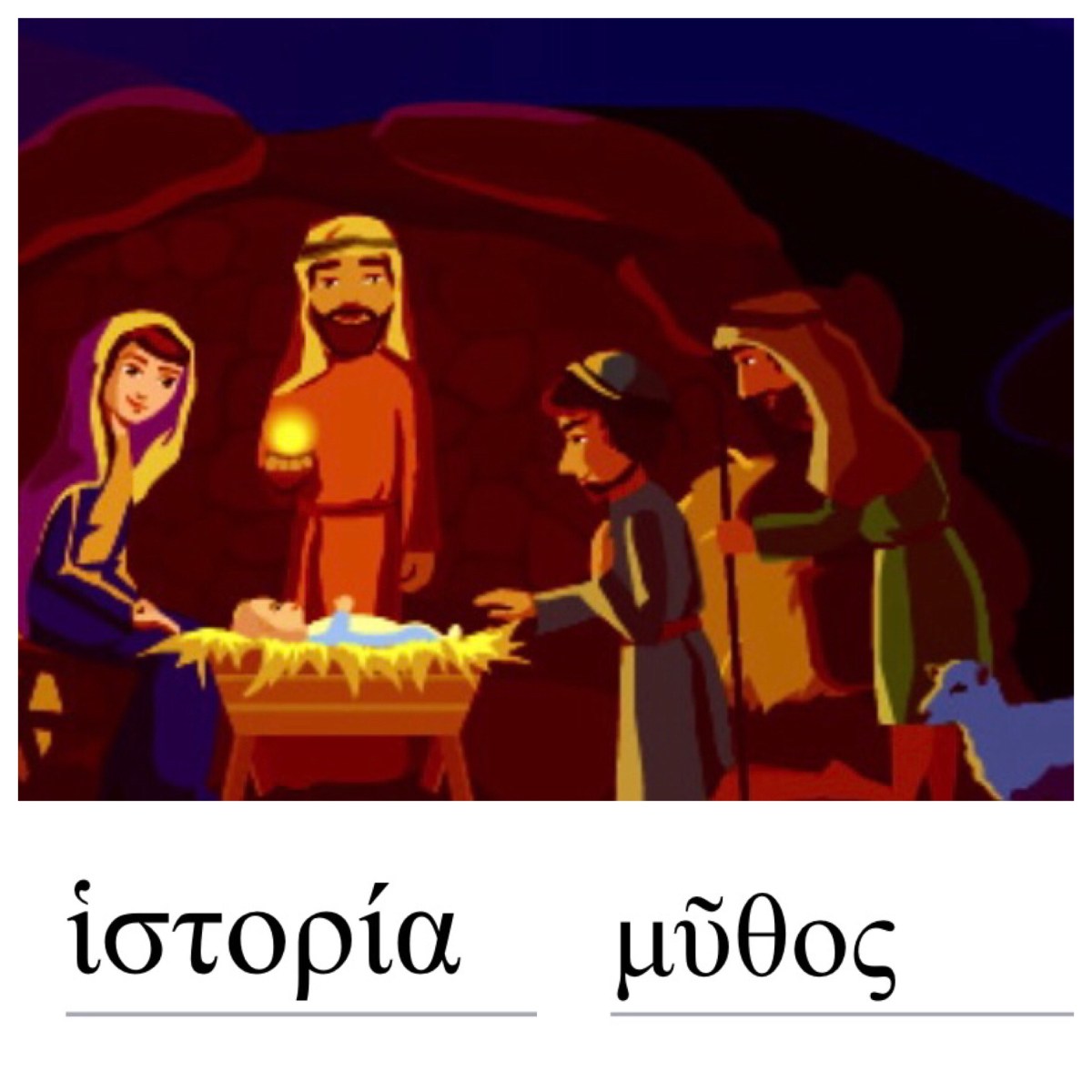
As I have written in two earlier posts, the biblical accounts of the birth of Jesus are not actual history. They are stories told to indicate the special nature of Jesus. Which means, we shouldn’t read them as history (ἱστορία). The Christmas story isn’t history. The Christmas story is myth (μῦθος).
As myth, the story points to important truths. It orients us to the claim that God is involved in human history. It sets the foundations for hearing the narratives about Jesus as accounts which resonate with God’s intentions for humanity.
The stories told at Christmas are located in specific human situations, and point to specific human needs. Outsiders and outcasts are included in the story told by Luke. Shepherds, despised for their work and marginalised from society, appear front and centre in his story. Strangers travel from distant foreign lands in Matthew’s narrative, bearing gifts to pay homage to the infant Jesus.
Women, not men, play central roles in the opening chapters of Luke’s story. Elizabeth, cursed as barren, blossoms into pregnancy, and speaks where her husband is struck dumb. Mary, young and virginal, receives startling news from an angel; she holds her own stands up to the angel, commits to the task, and then sings powerful words of justice, signalling in advance the revolutionary message that will be spoken by the child whom she is bearing.
Both Luke and Matthew include the gritty reality of the refugee situation in their accounts. Luke has a pregnant Mary undertake an enforced journey with Joseph, from Nazareth to Bethlehem, the hometown of his family line, only to be forced to give birth in precarious circumstances. There is no historical evidence for the census that occasioned this journey, but the story provides a compelling vision of what refugees faced then, and still face today.
Matthew has Mary and Joseph, with Jesus now a two-year-old toddler, making an even longer forced trek, from Bethlehem into Egypt, because of the excessive reaction of the king of the time. There is also no historical evidence for the slaughter of all boys aged two and under in Bethlehem at that time, but the story in Matthew’s Gospel again highlights the tenuous situations faced by refugees, then as now.
Matthew’s Moses typology leads him to place the slaughter of the Innocents right at the heart of his narrative. He grounds the story of Jesus in the historical, political, and cultural life of the day, when a tyrant could exercise immense power, when the sensibilities we have about human life seem absent. It provides a dreadful realism to a story which, all too often in the developing Christian Tradition, became etherealised, spiritualised, and romanticised.
We need to remember the Christmas story as an important pointer to the counter-cultural, alternative-narrative impact of the person of Jesus. It is not history, but it offers a powerful myth. It grounds our faith in a revolutionary understanding of reality, and in actions that establish an alternative reality. The story is not to be domesticated and coated in syrup; its stark reality and honest grappling with life needs to be grasped and valued.
As we sing songs of this story, let us not reify the story (that is, turn the narrative into “a thing”, like history) … let us not collapse the story into a surface “real history”, but let us allow the story to speak in a deep way of who we are as humans, and of the reality of our lives today. That is how the story functions, as myth (μῦθος) — not in the sense of myth being “not true”, but rather, in the sense of myth plumbing the depths of human existence.
Myths are the stories we tell that convey deep-seated and fundamental insights about life. Whether they “actually happened” is not the point. More fundamental is that they help us to make sense of our lives. They draw us out of our comfort and preoccupations, and challenge us to see a different reality, to live a different life.
Bernard F. Batto (Professor Emeritus of Religious Studies at DePauw University, Indiana), writes: “In everyday usage today, myth carries a meaning of something untrue, a fable, a fiction, or an illusion. Anthropologists and historians of religion, however, use the term ‘myth’ with a quite different meaning. For them myth refers to a traditional story, usually associated with the time of origins, that has paradigmatic significance for the society in which the story is operative.”
So, this Christmas, let’s rejoice that we have this foundational and paradigmatic story which is not history (ἱστορία), but which functions as myth (μῦθος). And as myth, this story stirs our imaginings and challenges our presuppositions, giving us a different perspective on the realities of life in this world, indicating to us how God engages with us and interacts with our world.
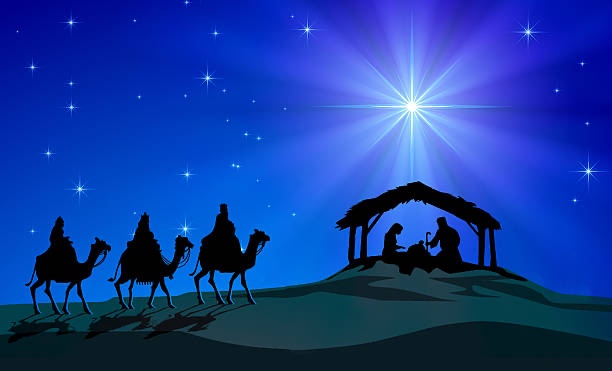
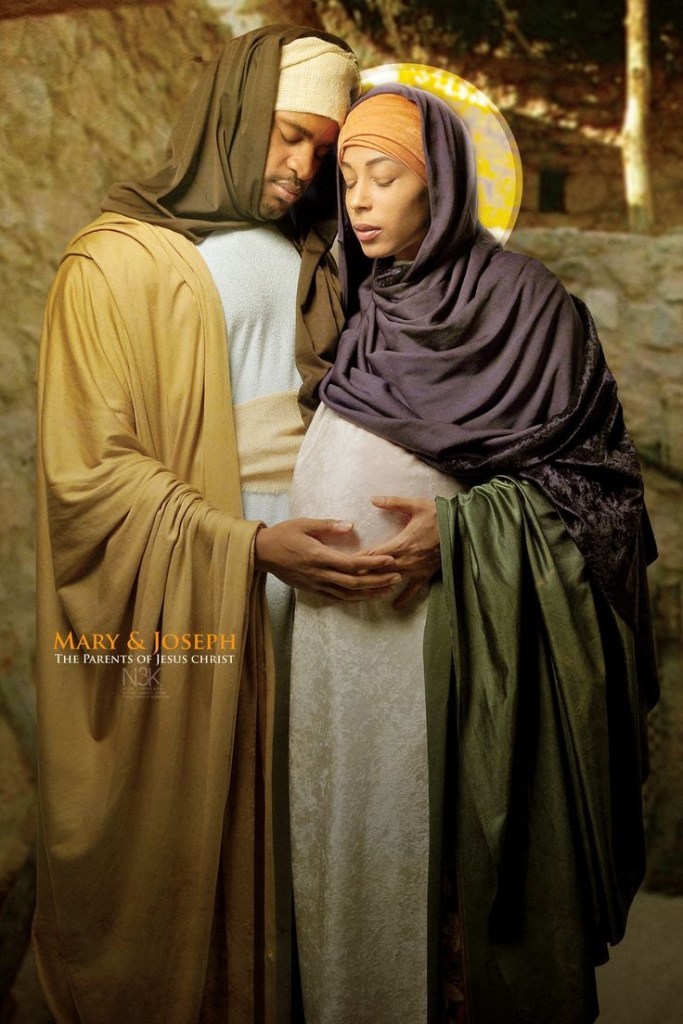
Every Christmas, we are surrounded by images of the much-loved nativity scene: the infant Jesus, in a cradle, with his mother Mary sitting and his father Joseph standing nearby, surrounded by animals (cows, most often), with a group of shepherds (perhaps with their sheep) to one side, whilst on the other side three colourfully-dressed men stand with presents in hand: gold, frankincense, and myrrh.
We see this image everywhere. But it is not an accurate portrayal of what was happening at the time when Jesus was born. For one thing, it is not a photograph of an actual event. Far from it. It is not even based on a written report from the first century, telling that this was what happened.
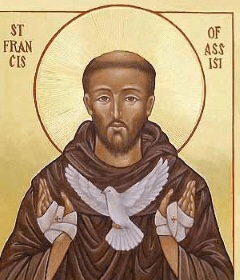
The traditional scene that we see today did not come into being until it was invented by the medieval friar, Francis of Assisi. Before that, it did not exist. And no Gospel account actually tells of cows mooing beside the newborn child, or of the newborn infant making no crying sounds, or of the sheep baaing alongside the cows, that we see in the traditional nativity scene.
Francis is the most popular Catholic saint in the world. He is the one who preached to the birds; blessed fish that had been caught, releasing them back into the water; and communicated with wolves, brokering an agreement between one famous ferocious wolf and the citizens of a town that were terrified of it. There is no surprise, then, that Francis used real animals when he created the very first, live, Christmas nativity scene. As a result of all these stories, Francis is the patron saint of animals and the environment. And he is the inventor of the familiar nativity scene.
Actually, this scene is a compilation of two quite discrete stories, told decades later, offering very different perspectives on the event, providing two somewhat different emphases in the story of the birth of this child. The nativity scene merges and blends the story found in the orderly account constructed by Luke, and the book of origins compiled by Matthew. Wise men and shepherds sit on each side of the family group, at the same time, in the same place, in this traditional scene. But not in our biblical accounts.
In the opening chapters of Matthew, we encounter the pregnant Mary, the newborn infant Jesus, his father Joseph, a bright star in the sky, visitors from the east, the tyrannical rule of Herod, and slaughtered infant boys. In this story, Matthew is working hard to place Jesus alongside the great prophet of Israel, Moses. The early years of Jesus unfold in striking parallel to the early years of Moses. The parallel patterns are striking.
Luke tells a more irenic version of the story than what is found in Matthew’s Gospel. The story told by Luke (usually represented through idyllic pastoral scenes and sweetly-singing angels), actually tells of a widespread movement of the population that meant a pregnant Mary, accompanied by Joseph, had to travel afar and find lodging in a crowded town just as the most inconvenient time.
There are historical problems with this story: identifying the census as an actual historical event, and locating it accurately in time, both present challenges; the fact that Herod, ruling in Matthew’s account, died in 4BCE, but Quirinius, who ordered the census noted in Luke’s account, began as Governor in 6 CE. However, the combined story has entered the popular mindset as a real event and provides a clear and compelling picture of the holy family as refugees, because of decisions made by political authorities, whether Herod or Quirinius.
We overlook, perhaps, that the shepherds who came in from the fields to pay homage to the newborn child would have been despised for carrying out a lowly and unworthy occupation. They were outcasts, considered impure and unclean, placed outside the circle of holiness within which good Jews were expected to live. In the Mishnah, a third century work which collects and discusses traditional Jewish laws, shepherds are classified amongst those who practice “the craft of robbers”. These are not highly valued guests!
Even though this is not an historical story, it is important for theological reasons. It is part of the foundational myth of the Christian faith. The writer of Matthew’s Gospel wants to make strong correlations between Jesus and Moses, not only in the mythological account found in the opening chapters, but also throughout the following chapters of the Gospel. The writer of Luke’s Gospel hints at his key themes in the opening chapter, and the develops a strong political and economic message throughout his Gospel: God reached out to the poor and powerless, and harshly judges the wealthy and powerful.
As myth, the tradition points to important truths. Matthew’s account of “the Slaughter of the Innocents”, for instance, although generated by his Moses typology, still grounds the story of Jesus in the historical, political, and cultural life of the day, when tyrants exercised immense power. Even though we recognise Matthew is not reporting an actual historical event, his narrative provides a dreadful realism to a story which, all too often in the developing Christian Tradition, became etherealised, spiritualised, and romanticised.
By the same token, Luke’s recounting of the visit of the outcast shepherds to the infant child and his family indicates that those on the edge were welcomed by Jesus throughout his ministry. He grounds the message of the Gospel in the heart of the needs of the people of his day.
So even as we recognise that the Christmas story is not history, we can appreciate the insights that it offers us as a mythological narrative. It is worth celebrating: not as an actual historical event, in the way it is traditionally portrayed, but as the foundation of the faith that we hold: in Jesus, God has come to be with us.
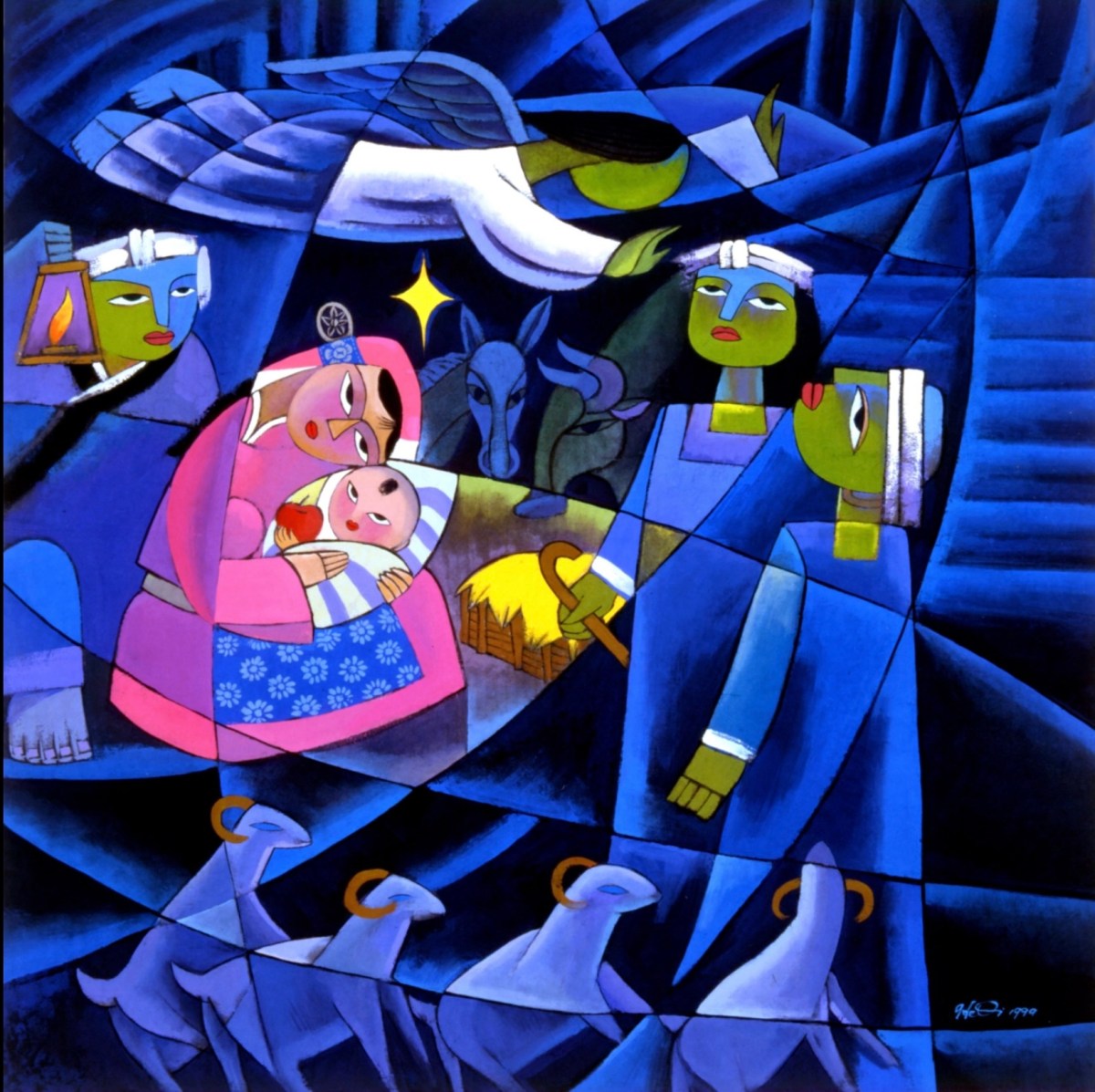
This week, the daily Bible study resource With Love to the World (which I edit) is currently using readings from the Womens’ Lectionary for the Whole Church, devised by Prof. Wilda Gafney, of the USA, alongside readings from the Revised Common Lectionary. A number of the readings (including the familiar Gospel from Luke 2) refer to childbirth. The cover image, by Australian artist the Rev. Dr Geraldine Wheeler, depicts the newborn child and his young mother, wonderfully contextualised for the Australian location.
Associate Professor Monica Jyotsna Melanchthon, the Academic Dean of Pilgrim Theological College in the University of Divinity, writes about Isaiah 26:16–19, that “The prophet Isaiah, familiar with the pain and the agony of a woman in labor, uses this uniquely female experience as metaphor to describe the suffering and distress of the people, here personified as the pregnant woman, ready to give birth. The labor of pregnant woman Judah is futile (vv.17–18) … But pregnant Judah is assured by God who midwifes life, that this time of pain will cease … the dead will rise and the slain will be restored to life. Relationships between humanity and nature, and between nations, ruptured and shredded by enmity and war, will be healed and transformed.”
On the familiar Gospel,count of the birth of Jesus, Luke 2:1–20, Prof. Melanchthon writes, “Mary was one of the ‘anawim’, a young, lower class working Jewish woman betrothed to Joseph, a local carpenter, living in occupied territory. She becomes an active agent, cooperating with God to become the bearer of God’s child. The invisible God is made present and available in the visible, the finite, the historical, the concrete, the tangible, and the fleshly. The baby is born and laid in a feeding trough. The first people, divinely notified of this birth, are not princes and powers, but another marginal category of people—shepherds, symbols of subalternity (referring to lower social classes and other social groups who are displaced to the margins of a society) … Their initial fear turned into amazement, joy and praise and they spread the good news.”
Later in the week, Prof. Melanchthon reflects on the alternative account of the early years of Jesus, Matt 2:13–23, noting that “Rachel the mother figure, weeping and inconsolable, draws us to the figure of Mother God; Rachel’s tears and lament stirs the inner parts (the womb) of the Divine which trembles (yearns) for the child. The human mother refuses consolation; the Jeremiah text quoted here assures that the divine mother changes grief into consolation.” She notes also that, “In the context of male tyranny and power politics, Joseph paves the way for a different or new understanding of masculinity, which is kenotic (self-emptying). He gives up his own power for a positive and mutually transformative masculinity, reminiscent of fathers who risk their lives for their children.”
Voices from the edge, or beyond—exiles from their own community—are important for us to hear, to recall us to the core of what we believe and what we know is right and good for all. Scripture offers consistent testimony about the importance of valuing the voices of exiles. It is a word for the church today, not to dismiss those who think, act, speak, behave differently. It is a word for the church today, not to force out those who do not conform to assumed norms. The value of each and every person underlies the motif of “exile” that appears in scripture.
Every year, at Christmas time, as we remember the story of Jesus, we can feel the moments when he might be classed as being “in exile”, even amongst his own people. Luke reports that he was born to parents who were forced to be on the move, uncomfortably displaced (albeit temporarily) from their home town of Nazareth at the critical moment of his birth (Luke 2:4–6). He was born in a manger, as no room was available in the kataluma, the guest chamber in what we might presume to have been a house of Joseph’s relatives (Luke 2:7).
He was born to parents facing potential disgrace—it is said that they were betrothed, but not yet formally married (Matt 1:18), and the putative father was preparing to “dismiss quietly” the mother of Jesus (Matt 1:19). In Matthew’s account, Jesus was born into a situation of some danger, as King Herod so feared that “the child who has been born king of the Jews” (Matt 2:2) that he arranged for a savage pogrom, having “all the children in and around Bethlehem who were two years old or under” put to death (Matt 2:16).
In the Matthean version of the origins of Jesus, the family became refugees, fleeing Israel for the safety of (ironically) Egypt (Matt 2:13–15). When it was safe, they would return, not to their home town of Bethlehem in Judea (as Matthew has it), but to the less-known village of Nazareth in Galilee (Matt 2:19–23).
The moments of exile in this story—disturbed, displaced, under threat, in fear of life—resonate strongly with the experience of millions of people in the contemporary world. Perhaps these elements in the story also resonate with people of faith, who have found themselves “in exile” from their community of faith, for various reasons?
Deep in the experience of physical and cultural exile that the people of Israel had been immersed some six centuries before Jesus, Joseph, and Mary were themselves thrust into exile, a prophetic voice declared that good news still held firm, despite the unfamiliar surroundings and the uncomfortable, even disturbing, dislocation which that experience brought.
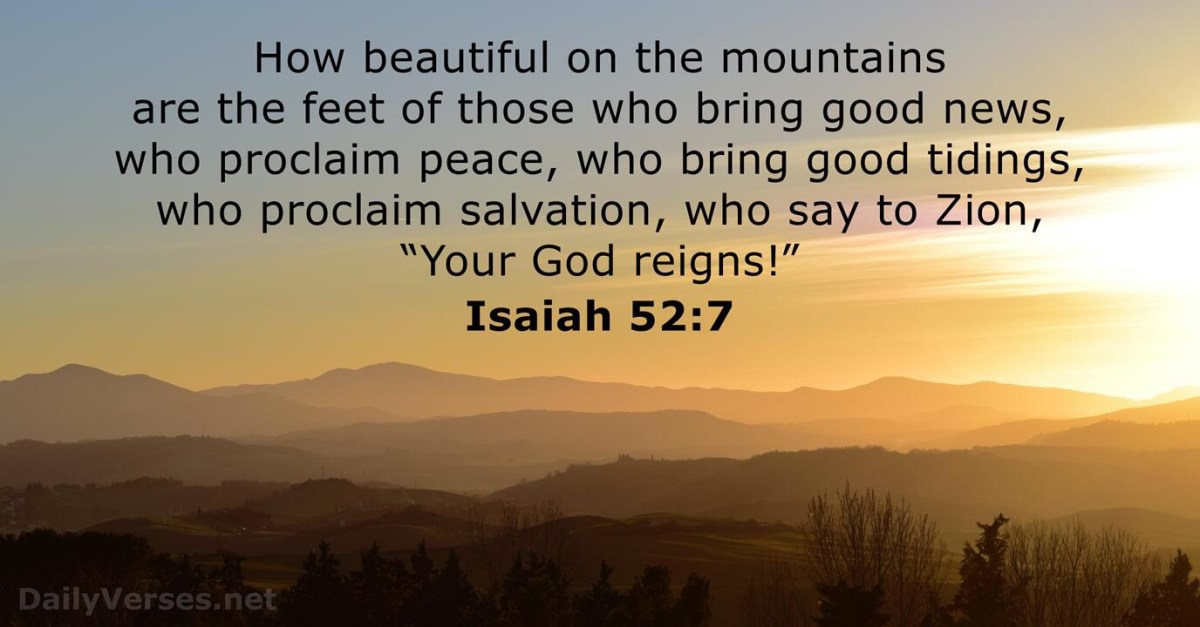
“How beautiful upon the mountains are the feet of the messenger who announces peace”, this prophet-in-exile proclaims, praising the one “who brings good news, who announces salvation, who says to Zion, ‘Your God reigns’” (Isa 52:7). Looking back with longing on his ruined homeland, he exhorts “the ruins of Jerusalem” to “break forth together into singing … for the Lord has comforted his people, he has redeemed Jerusalem” (Isa 52:9).
It’s only a few verses later that the prophet begins a song that expresses the depths of despair in exile, and yet looks beyond that immediate experience to a time of restoration and joyous salvation—a song that we know as the fourth “Servant Song” (Isa 52:13–53:12). That’s the song that Christians interpret as applying to Jesus: “my servant shall prosper; he shall be exalted and lifted up, and shall be very high … he was despised and rejected by others; a man of suffering and acquainted with infirmity … he has borne our infirmities and carried our diseases … out of his anguish he shall see light; he shall find satisfaction through his knowledge … the righteous one, my servant, shall make many righteous, and he shall bear their iniquities”.
Read through the lens of the story of Jesus, this song describes him, the servant, chosen by God for this task. Read in the context of exile, and identifying the servant with Israel (see Isa 41:8, 9; 44:21; 49:3), the song points to a redemption that must mean return to the land and restoration of the city. It is, in the end, a song of hope for the exiles.
The prophet has a strong and clear faith, which may not have sounded so clearly to those holding him captive in exile; he can see that “all the ends of the earth shall see the salvation of our God” (Isa 52:10). This stands as a word of hope that would echo through the later pages of history, in songs sung by the people (Ps 22:27; 65:5–8; 67:7; 98:3), in the advice given by the sage (Prov 30:4), in the prayer offered by Tobit (Tob 13:11), and on into the story of the one born in exile, chosen by God to be “light of the world” (Matt 5:14; John 8:12; 9:5) such that the good news that he brings will be known “to the ends of the earth” (Acts 1:8; 13:47).
The value of holding firmly to this faith, despite the oppositions and sufferings of the time of exile, is what the prophet offers to his people. It is a living-out in advance of what Jesus teaches and models in his own life. In keeping with this motif of “exile” in the Christmas story, here is a poem written by a self-styled exile, my friend and colleague Janet Dawson, which I share with you today (with the permission of Janet).
A Prayer for the Exiles
Holy One, have mercy on your exiles,
those of us who no longer fit
within the traditional teachings of the church.
Those whose voice falters in the songs,
who cannot say “Amen”,
who desperately think of something else during the sermon.
Those who think the greatest heresy of all
is to say that You require suffering and death
in order to forgive.
Those who have given up on going to church at all.
Have mercy on us, Holy God,
those exiles who cling to faith
and yearn for a bigger, wider story,
a bigger, wider community.
A story that embraces the vast expanses of time and space,
and the enormous complexity of the cosmos.
A community in which everything and everyone is connected
and embraced.
Holy God, as we approach the Feast of Incarnation,
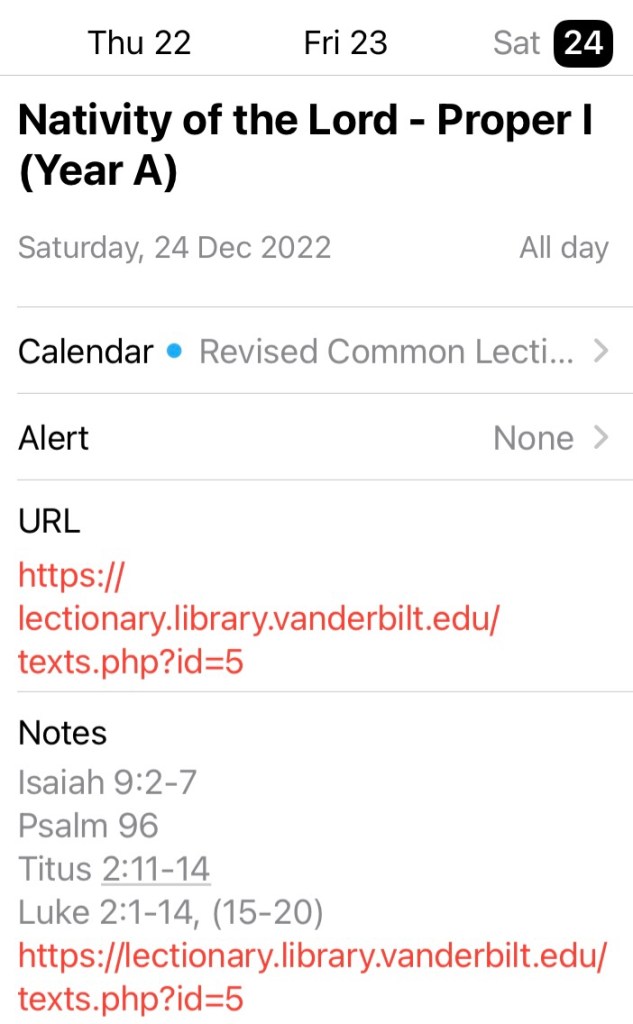
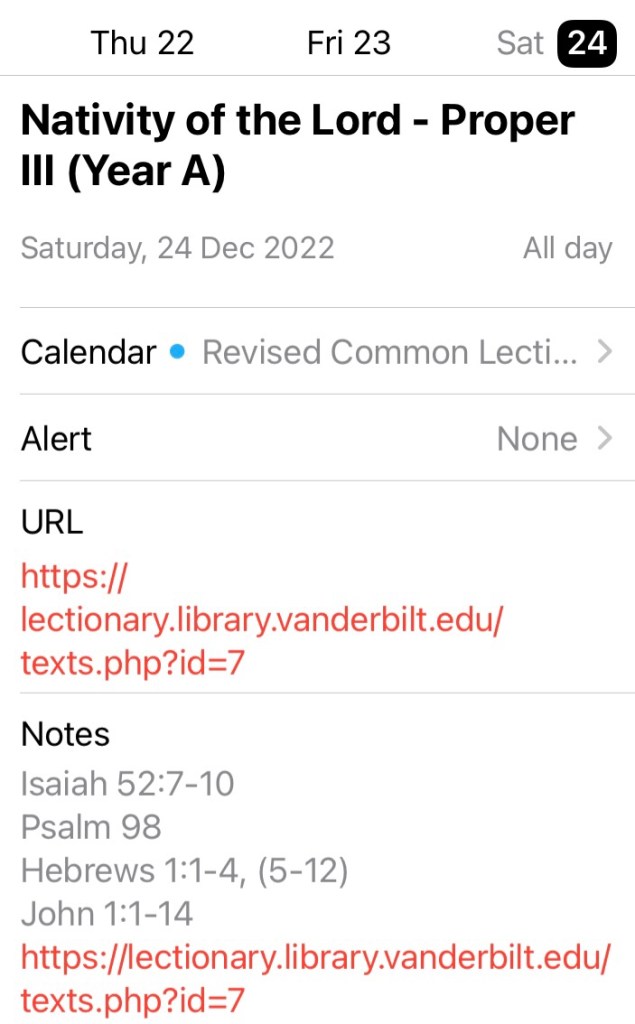
Earlier this year, I downloaded a new calendar into my online calendar app. It is a calendar that identifies each Sunday in the church’s liturgical year (First Sunday in Advent, Second Sunday in Epiphany, Ninth Sunday after Pentecost, and so on), as well as other significant days (Ash Wednesday, Good Friday, Ascension Day, and others).
It also provides the four readings that the Revised Common Lectionary provides for each Sunday, as well as for those additional liturgical days. It is a useful resource to have on hand! The calendar identifies each Sunday with a light blue band across the name, and sits alongside other calendars (with other colour-codings) that identify Public Holidays, Birthdays, Work commitments, and other specialised matters.
But look what it has done for December 24, which we all know is Christmas Eve: it has provided no less than three entries for the one day!
Why are there three different sets of readings for the “Nativity of the Lord” (aka Christmas)? I hunted through some church web sites, and found that it is because of developments way back before the so-called Middle Ages … back in the days when Christianity was still developing and evolving and finding its place in society.
The simple explanation is that three different services of worship relating to “the nativity of the Lord” developed over time within Rome, and, rather than one replacing another, each was added, each having its own focus and also being held at a different location.
Catholic Culture says that “the first Mass originally was connected with the vigil service at the chapel of the manger in the church of St. Mary Major in Rome”; it was a small service at midnight which Pope Sixtus III began in 440CE. This has continued as the first service, Proper I in the Revised Common Lectionary.
The second Mass, we are advised, was “the public and official celebration of the feast, held on Christmas Day at the church of St. Peter, where immense crowds attended the pope’s Mass and received Communion”. That continues to this day, when the Pope appears on a balcony overlooking the packed square outside St Peter’s.
Catholic Culture advises, however, that “under Pope Gregory VII (1085) the place of this Mass was changed from St. Peter’s to St. Mary Major, because that church was nearer to the Lateran Palace (where the popes lived). It forms Proper III in the Revised Common Lectionary.
The third service to develop is actually the “middle service”, or Proper II in the Revised Common Lectionary. Catholic Culture explains: “In the fifth century, the popes started the custom of visiting at dawn, between these two services, the palace church of the Byzantine governor. There they conducted a service in honor of Saint Anastasia, a highly venerated martyr whose body had been transferred from Constantinople about 465 and rested in this church which bore her name.”
This was a popular service, because Saint Anastasia was widely venerated in the Roman Empire; in later centuries, as the empire dissolved and Anastasia receded in significance, this middle service was still retained, and another Mass of the Nativity was held. This became the second of the three Masses on Christmas Day.
The Roman Missal has shaped the liturgy for each of these services to highlight different elements of the Christmas story. Thus, “the first Mass honors the eternal generation of the Son from the Father, the second celebrates His incarnation and birth into the world, the third His birth, through love and grace, in the hearts of men [sic.]”.
The Gospel passage set for each Mass—reflected in the Gospel passages proposed by the Revised Common Lectionary—has led to the popular name for each service. Proper I offers Luke 2:1–14, which tells of the birth of Jesus and the angelic announcement to the shepherds in the fields; thus, people came to call the first Mass Angels’ Mass. Proper II proposes Luke 2:8–20, when the shepherds visit the newborn child and his parents; accordingly, it became known as the Shepherds’ Mass.
Proper III takes us to the majestic prologue to John’s Gospel, John 1:1–14, which tells in beautiful poetry of the coming of The Word, who takes on human flesh to live amongst us; this then characterises this service as the Mass of the Divine Word.
The three readings from the Epistles contain excerpts with short credal-like affirmations: “the manifestation of the glory of our great God and Saviour” (Titus 2:11–14), “when the goodness and lovingkindness of God our Saviour appeared” (Titus 3:4–7), and the statement that “in these last days [God] has spoken to us by a Son”, whose nature is explicated by a string of Hebrew Scripture citations (Heb 1:1–12). Each of these fits well for Christmas celebrations.
Likewise, the three Hebrew Scripture passages themselves orient us towards God’s actions within human history. For Proper I, First Isaiah speaks about the child to be born, to be named “Wonderful Counsellor, Mighty God, Everlasting Father, Prince of Peace” (Isaiah 9:2–7). For Proper II, Third Isaiah declares, “the Lord has proclaimed to the ends of the earth, ‘see, your salvation comes’” (Isaiah 62:6–12). And for Proper III, Second Isaiah rejoices in “the messenger who brings good news, who announces salvation”, through whom “all the ends of the earth shall see the salvation of our God” (Isaiah 52:7–10).
Each prophetic passage, seen through the eyes of Christian faith, reflects the divine intention, made clear through Jesus, to offer salvation to every person on earth—prefiguring the good news of Jesus out of the different contexts of pre-exiling Israel (Isa 9), the hard years of Exile (Isa 52), and the time of rebuilding after that exile experience (Isa 62).
Finally, the psalms selected for these three services (Psalms 96, 97, and 98) contribute strongly to the joyful ethos of the Christmas celebrations, with the injunction to “sing to the Lord a new song” (96:1, 98:1) and “worship the Lord in the splendour of holiness” (96:9), singing praises (98:4–6) and rejoicing (96:11–12; 97:8, 12; 98:8), celebrating that “the Lord is king” (97:1) and “exalted overall gods” (97:9) and rejoicing that “the Lord, he is coming, coming to judge the earth … with righteousness, and with truth” (96:13; 97:2; 98:9). These are notes that are entirely appropriate and fitting for the joyful celebrations of Christmas!
The passages set in the lectionary for this coming Sunday place alongside each other a prophetic oracle spoken by Isaiah, and an angelic announcement delivered to Joseph. The Gospel selection from the book of origins recounts how the birth of Jesus the Messiah took place in this way. The prophetic selection looks to the predicted conception, birth, and naming of a child.
The prophet (Isaiah) was speaking some seven centuries before the time of Jesus, when Judah was ruled by a king. But it was a time when the kingdom was under pressure from stronger forces—the kingdom of Israel to the north, in league with the much stronger empire of Syria.
The angel (unnamed) was speaking to Josephus at a time when the Hebrew people were under Roman rule, after many centuries of foreign domination and oppression. The Assyrians had conquered Israel, in the north, and then the Babylonians had conquered Judah, in the south. In time, the Persians, then the Seleucids, and then the Romans, took control throughout the region.
The centuries of foreign rule took their toll on the national psyche. Hope for a leader from within the people, identified by the prophet, continued on in various forms throughout the period. Some who claimed such leadership met unhappy ends, and led the people into disastrous situations. Hatred of the foreigners grew and remained strong, alongside of persistent hope for the people of Israel.
The oracle of the prophet speaks about a child to be born. The message of the angel announces a child to be born. The context of this latter message, under Roman occupation, resonates strongly with the context of threat when the prophet was speaking. By this means, the overlapping of the child predicted by the prophet and the child announced by the angel is secured.
Thus the author of the book of origins (whom I refer to, following tradition, as Matthew) quotes the prophetic oracle and claims that it has been fulfilled in the angelic announcement. In subsequent verses, he clearly shapes the story of Jesus so that it fulfils scripture at each point along the way. “This took place to fulfil the scriptures” is a common refrain in the chapters that follow (see 1:22, 2:5, 2:17, 3:3, and so on).
Both angel and prophet affirm that child to be born would be a sign to the people, that God was still with them, in the midst of their difficulties. In traditional Hebrew fashion, the name given to the child signals the prophetic understanding of the role of the child. Thus, Emmanuel, meaning “God is with us”, is the name decreed for the child (Isa 7:14).
This prophetic pronouncement is quoted, with intent, in the book of origins (Matt 1:23). The child should be known as Emmanuel. And yet—the name actually given to the child whose birth was announced by the angel is “he saves”. Not, “God is with us”; but, “he saves”. And we know this child by this given name—in Hebrew, Yehoshua, or modified into English, Jesus. Saviour. The one who “will save his people from their sins” (1:21).
As Saviour, then, the child will serve as a signal of God’s enduring presence with the people. Salvation is effected by God and mediated through the child, it would seem.
The announcement reported in Matt 1 is made to Joseph. Not to Mary, as is the case in the orderly account that we know as the Gospel of Luke. In Matthew’s version, the angel speaks directly to Joseph, addressed as “son of David” (1:20). The story comes immediately after recounting a genealogy for the child, made through Joseph, “the husband of Mary, of whom Jesus was born” (1:16).
And the irony of this is that, if we take the literal explanation provided regarding the parentage of Jesus, then Mary is the mother (1:18), but she has had no marital relations with Joseph (1:25). Joseph is not presented as the “natural father”. And the citation of the prophetic oracle is intended to align Mary, the mother, with the virgin who shall conceive (1:23).
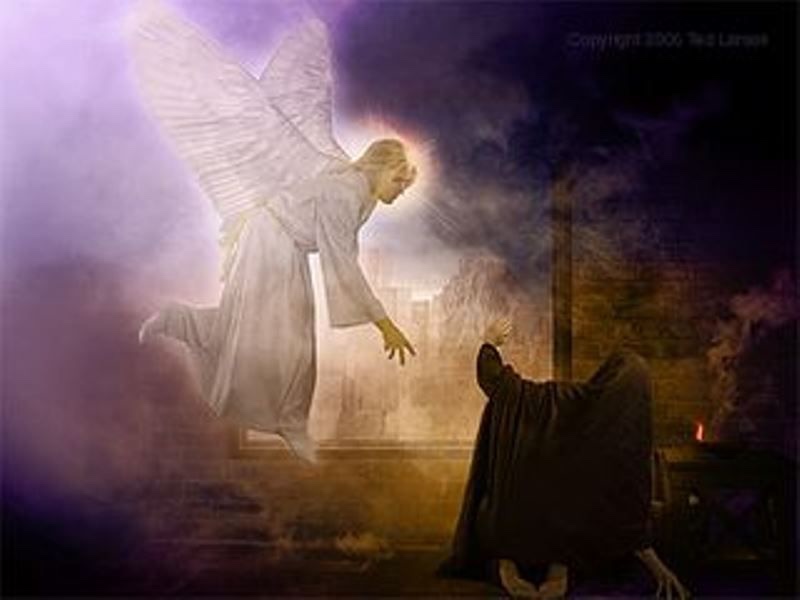
In Christian tradition, the fathering of the child is attributed to the Holy Spirit, who overshadows the virgin to produce the child (Luke 1:35; Matt 1:18,23). When did that tradition develop? Perhaps it was already known outside of the community of which the author of this book of origins was a part? Certainly, it was later articulated in the orderly account attributed to Luke. Awareness of this claim most likely influenced Matthew to include the prophetic oracle as a foundation for the angelic announcement—he turns to scripture to provide a foundation for his story at many points.
And so the tradition of the virginal conception of Mary arose—leading to the (less accurate) claim about the birth of Jesus having been a Virgin Birth, now strongly cemented in traditional Christian dogma.
But back to the book of origins. Here, we have a child named incorrectly and a lineage traced back to key figures through the apparent non-father. A strange way to start a story!!
And yet, the book of origins is insistent on the Davidic lineage of Jesus—through the line of Joseph. And that is clearly because the covenant with David was an important motif to many groups in Jewish history. God promised that there would always be a descendant of David upon the throne of Israel; by the time that a member of Matthew’s community started to write the book of origins, this had developed into a messianic expectation in certain groups.
Members of the Jewish community in which the book of origins itself originated firmly believed Jesus to be the Messiah. Accordingly, the stress upon the “correct” ‘Davidic’ genealogy of Jesus would have been of particular importance to this predominantly Jewish group, especially one challenging the authority of the Pharisaic Jews of the time. It is probable that this is why Matthew uses the term “son of David” for Jesus much more than the other Gospel writers (1:1, 20; 9:27; 12:24; 15:22; 20:30–31; 21:9, 15, 42).
Matthew’s use of “formula quotations” also provide indications that the life, work and death of Jesus, in its totality, is the fulfilment of prophecy in the Hebrew scriptures, and therefore the expected Messiah.
“This took place to fulfil what had been spoken by the prophet” (or a close variant of this formula) can be found five times within the infancy narrative (1:22; 2:5, 15, 17, 23), and then a further nine times throughout the remainder of the gospel (3:3; 4:14; 8:17; 12:17; 13:14, 35; 21:4; 26:56; 27:9).
There are other scripture quotations which are introduced by simpler formulae; for example:
“it is written” (4:4, 6, 7, 10; 21:13; 26:31)
“Isaiah prophesied rightly about you when he said…” (15:7)
“have you not read that…?” (19:4; 21:16)
“have you never read in the scriptures…?” (21:42)
“David by the Spirit calls him Lord, saying” (22:43).
Some passages are clearly quoted, but without any introductory formula (for instance, 24:29 and 26:64). Indeed, Hebrew Scripture influences many other parts of the gospel, through allusion and inference as well as through use of selected terminology.
More than half of these fulfilment quotations come from the book of Isaiah, indicating the importance of its themes and theology for Matthew. Matthew uses the fulfilment quotations to emphasise that what Jesus said and did was to fulfil the plan of God, as set out by the prophets and writers of old.
By adding so many of these quotations, Matthew emphasises something about Jesus and what it means to believe in him. Matthew wishes to stress beyond a shadow of a doubt, that Jesus is the chosen one of God and that the community’s belief in him as Messiah is completely justified; this justification can be found in the fulfilment of Hebrew scripture.
Therefore, in keeping with this notion, Matthew’s report of the baptism of Jesus highlights that Jesus is the fulfilment of righteousness. Only Matthew (3:14–15) reports the conversation between Jesus and John the Baptist, in which Jesus states that for John to baptise him “is proper for us in this way to fulfil all righteousness”.
Thus, Jesus begins his public ministry by demonstrating a central theme of this Gospel—that of obedience to the will of God. Not surprisingly, Jesus’ baptism is accompanied by a sign commonly found in scriptural theophanies, that of God’s voice. Jesus is announced as a “beloved son”, pleasing to God (3:17). He is, in this Gospel, not only the son of David, but the son of God.
As the book itself begins: the book of origins of Jesus the chosen one, descendant of David, descendant of Abraham.
In the selection from Paul’s letter to the Romans that is offered by this Sunday’s lectionary, Paul refers explicitly to the gospel concerning [God’s] Son, who was descended from David according to the flesh (Rom 1:3). In the midst of the Christmas carols and Christmas cake, the Christmas cards and the Christmas parties, there stands this stark affirmation: Jesus was a Jew. And, more specifically, that Jesus was a descendant of David.
It is noteworthy that Paul makes very little reference in his letters to the earthly life of Jesus; he is much more focussed on the death and the resurrection of Jesus, rather than his life of teaching, preaching, story-telling and miracle-working. In his letter to the Galatians, however, he makes a similar affirmation about the humanity, and the Jewishness, of Jesus: when the fullness of time had come, God sent his Son, born of a woman, born under the law (Gal 4:4).
Descended from David, born under the law: Jesus was clearly a Jew. That needs to sit at the heart of the story that we recall each year at this time. The Jewishness of Jesus is an essential element of the Christmas story.
Those who recount the story of Jesus, in the documents we know as the Gospels of the New Testament, are clear about this fact. Mark locates Jesus in Galilee, the northern part of the land of Israel, and identifies his home town as Nazareth (Mark 1:9; 10:47; 14:67; 16:6). Matthew and Luke follow the pattern established by Mark, in locating the vast majority of the activity of the adult Jesus in the northern regions of Israel.
Matthew intensifies this picture, however. At the start of his book of origins, he traces the lineage of Jesus back to David, and further back to Abraham (Matt 1:1-17). He traces this lineage of Jesus, not through his mother, Mary, but through Joseph—because it was Joseph who was of the lineage of David. This Davidic heritage of Jesus is central and important for Matthew, for he, most of all the evangelists, has characters in the story address Jesus as “Son of David” (1:1, 20; 9:27; 12:24; 15:22; 20:30–31; 21:9, 15, 42). He wants to advocate, as he tells his story, that it is through Jesus that the ancient promises to David will come to fruition.
At the start of his story, and at various places further on, Matthew notes that the actions and words of Jesus occur as fulfilment of prophetic words (Matt 1:22; 2:5, 15, 17, 23; 3:3; 4:14; 8:17; 12:17; 13:14, 35; 21:4; 26:56; 27:9).
Twice in his account of Jesus, Matthew is insistent that his active ministry and that of his first followers took place only amongst “the lost sheep of the house of Israel” (Matt 10:6; 15:24). For Matthew, Jesus was resolutely, scrupulously, Jewish.
The Gospel of John also reinforces the Jewish identity of Jesus. The Samaritan woman describes Jesus as “a Jew” (John 4:9), Jesus regularly travels to Jerusalem for Jewish festivals (John 2:13, 6:4, 7:1-10, 10:22, 12:12, 13:1), in conformity with Jewish piety. When Pilate questions Jesus, he recognises him as King of the Jews (18:33-35) and refers Jesus to Jewish leaders for their decision (18:31, 19:6-7, 19:14). Pilate then has him crucified under a sign identifying him as “Jesus of Nazareth, the King of the Jews” (as, indeed, the other three Gospels also report).
In the Gospel of Luke, the Jewish identity of Jesus is recounted, repeated, and intensified. Although often touted as the evangelist who most strongly orients the story of Jesus towards Gentiles throughout the hellenistic world of the Roman Empire, Luke actually sets his orderly account in the heart of Jewish piety, from the very opening scene of the Gospel which reveals a pair of righteous Jews who faithfully keep the commandments of God (Luke 1:5–6).
The man, Zechariah, is devoted to the service of God in the Temple (1:8–9). His wife, Elizabeth, expresses an attitude of deep faith in God, accepting her surprise pregnancy as “what the Lord has done for me” (1:25). Her relative, Mary, demonstrates a similar faith as she submits to a similar fate with the words, “here am I, the servant of the Lord” (1:38).
In turn, the traditional hopes and expectations of the people are articulated in spirit-inspired hymns sung by Mary (1:46–55), Zechariah (1:67–79) and Simeon the righteous (2:29–32). These are, by rights, the first Christmas carols—songs which sing of the one to come, which tell of the birth of one promised, which look with hope to the change he will effect. And they are resolutely Jewish.
The children whose births are recounted in these early chapters of Luke—Jesus and his cousin John—bear the weight of traditional Jewish hopes and expectations as they come into being. They are born as faithful Jews. They both lived in fidelity to the Jewish law. The mission of Jesus to fulfil the hopes articulated by Jewish prophets (Luke 4:18-21) and to point to the promise of the kingdom ruled by God (Mark 1:15; Matt 4:17) which, he proclaimed, was already becoming a reality in his own time (Luke 17:20).
The sense of deeply devoted and strongly conventional Jewish piety continues in the reports of the early years of Jesus. Luke’s Gospel reports that Jesus was circumcised (2:21) and dedicated in the Temple (2:22–24) in accordance with Jewish custom, and that he showed an early interest in the Law (2:41–51).
So we would do well not to skirt away from this very particular and specific aspect of the Christmas story.
As we come to the celebration of the child in the manger, let us remember that he spoke with a voice that called people—his people in Israel, and people beyond his people—to the enticing vision (sourced from the Hebrew prophets) of a world renewed and reconciled, where righteousness and justice were realities, where the hopes of Israel could flourish and come to fruition. That is the thoroughly Jewish vision that the story of Jesus offers.
…….
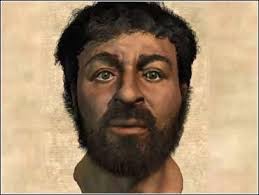
The featured picture portrays a Judean man from Jesus’s time, based on archaeological findings, and is often used as an image for what the historical Jesus may have looked like.
The passages set in the lectionary for this coming Sunday place alongside each other a prophetic oracle spoken by Isaiah, and an angelic announcement delivered to Joseph. The two passages seem to sit side-by-side very comfortably. The Gospel selection from the book of origins recounts how the birth of Jesus the Messiah took place in this way. The prophetic selection from Isaiah declares that the Lord himself will give you a sign and looks to the conception, birth, and naming of a child.
The oracle of the prophet speaks about a child to be born to a young woman. The message of the angel announces a child to be born to a young woman who was a virgin. The author of the book of origins (whom I refer to, following tradition, as Matthew) quotes the prophetic oracle about the birth of a child and claims that it has been fulfilled in the angelic announcement about the birth of a child to Mary and Joseph. The angel follows the prophet in affirming that child to be born would be a sign to the people, that God was still with them, in the midst of their difficulties. But the status of the young mother is a question that has long vexed interpreters.
How do we read the Gospel account when it takes up an ancient word of the prophet and interprets it to relate specifically to the story of Jesus? I have reflected on the issues we need to bear in mind as we do this, especially during this season of Advent, at
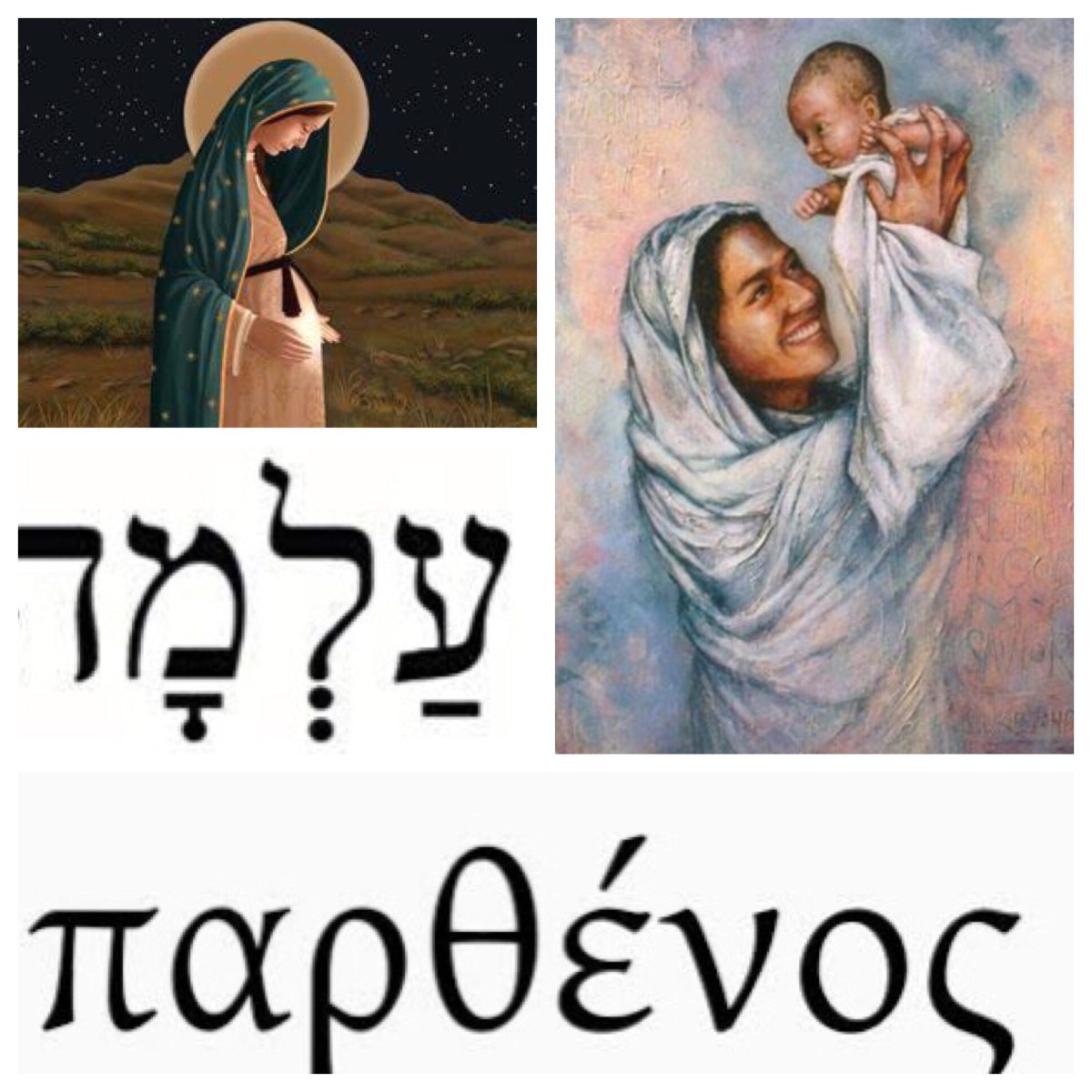
The Hebrew word found in the original oracle of the prophet, almah, refers simply to a young woman of childbearing age; it had no connotation at all relating to virginity. It occurs in eight other places in Hebrew scripture—with reference to Rebekah and Miriam, in three references to female musicians, and in wisdom texts relating simply to young women. In none of those places does it have any reference to the virginity of the young woman.
There is also, in Hebrew, the word bethulah, which refers specifically to a young woman who was a virgin; but it is important to note that this word was not employed by the prophet Isaiah. He clearly was referring to a young woman aged around puberty, who was now able to bear a child. He was not referring to a young woman who had never had sexual intercourse, who was still a virgin.
The Greek translation of these Hebrew texts was made some centuries before Jesus. The translation is known as the Septuagint, attributed to seventy wise scholars. In this translation, the Hebrew word bethulah is usually rendered in Greek as parthenos. This Greek word can refer quite generally to a young woman, but it can have a more specific reference to the virginity of the young woman.
Now, on two occasions in the Septuagint, the word almah is rendered as parthenos: Gen 34:3 and Isa 7:14. The first refers to Dinah. It occurs in the story at the point where the powerful prince Schechem rapes the young woman. The point is being made that her state of virginity has at that point been lost, so the Greek word is appropriate.
But the oracle of Isaiah 7 refers simply to a woman who, at an early stage in her capacity to bear a child, is indeed pregnant. So there appears to be no reference at all to her lack of sexual activity prior to this pregnancy. This much is clear in the Hebrew. But the Septuagint translators chose the Greek word parthenos.
We must wonder: is the choice of parthenos when translating Isa 7:14 from Hebrew a strategic move by the seventy wise scholars? Is it an inspired insight into the meaning of the Hebrew text? Or is it an unguarded moment, a slip of concentration, amongst the translators?
I incline to the latter view. I don’t think the intention of the Septuagint translators was to insist that we know more than what the original prophet knew—that is, the precise sexual status of the young woman in question, not just young, but still a virgin.
Nevertheless, Matthew uses the version of the prophet’s oracle that includes this Greek word. He quotes the Greek version of the Septuagint, since he is writing in Greek. Mind you, Matthew regularly and consistently quotes the Septuagint translation, rather than other options that would have been available to him. So this is not really a surprise.
Whatever identity we accord the author of this book of origins, it is quite clear that he was an educated Jewish male. As such, he would have known and used the scriptures of the people of Israel, in Hebrew. And yet, he is writing his account of Jesus in Greek—so he makes use, on a regular basis, of this version.
And this version places a focus on the virginal status of the young woman, who was to give birth to Jesus of Nazareth. So Matthew has deliberately chosen to include this in his story.
Why? That is a good question! Why?
Rather than seeing Matthew as trying to prove the historical veracity of the virginal status of Mary, however, I incline to the view that the primary purpose, as Matthew tells the origins of Jesus, is for him to prove Jesus’ legal status as the stepson of Joseph, as a legal heir of David. Whilst the infancy narrative in Luke places Mary at the centre of the story—and the angel makes his announcement directly to her—in Matthew’s version it is Joseph who is centre-stage—and the angel speaks to him, and only him, in this version.
This passage in Matthew 1 is the one and only time in the book of origins when the virginal status of the mother of Jesus is noted. By contrast, the Davidic lineage of Jesus, through Joseph, is a concern which is both in view here at the start of the whole story, and which returns at various points through the ensuing story. (See https://johntsquires.com/2019/12/17/now-the-birth-of-jesus-the-messiah-took-place-in-this-way-matthew-1/)
And as if to reinforce this lineage through Joseph, the book of origins takes pains to establish that Joseph, a descendant of David, was “a righteous man”, as befits a Davidic descendant (1:19; David is declared as righteous at 1 Sam 24:17).
Although, it is worth noting one way by which Joseph exemplifies the questionable moral character of his ancestor—initially he was “unwilling to expose her to public disgrace” and wanted to dismiss Mary (1:19). Nevertheless, after hearing the announcement of the angel, he remained faithful and “did as the angel of the Lord commanded him” (1:24).
And whilst he took Mary as his wife, Matthew maintains that, as a righteous man, Joseph “had no marital relations with her until she had borne a son” (1:25). At which point, we may presume, Joseph functions as the de facto father of the newborn child. So this is part of the pro-Davidic apologetic of this book, not the basis for the doctrine of the Virgin Birth.
Joseph, descendant of David, takes on the legal role of father of the child. (Indeed, we are never told that he refrained from relations when they were engaged, before Mary conceived; rather, might we infer that the shame that Joseph expresses incriminates him?)
Certainly, in Christian tradition the fathering of the child is attributed to the Holy Spirit, who overshadows the virgin to produce the child (see Luke 1:35). That developing tradition was presumably already known in early Christian communities of the first century. But how early, we do not know.
The letter of James, if it was authored by the brother of Jesus, is an early witness that shows no concern for this doctrine. Mark, the earliest extant Gospel, makes no reference at all to the virginal status of Mary. Early witnesses make no reference to the doctrine which emerged much later, they provide no hints or clues upon which this dogma can be founded.
What we do know is that this claim was articulated in the later part of the first century in the orderly account attributed to Luke, as well as in this book of origins, attributed to Matthew, who includes the prophetic oracle as a foundation for the angelic announcement and to refer directly to this claim (1:18, 20).
And so the tradition of the virginal conception of Mary arose, eventually leading to the (less accurate) claim about the birth of Jesus having been a Virgin Birth, now strongly cemented in traditional Christian dogma. But I don’t think that this particular book of origins was really concerned, either to establish this claim, or to utilise it as a foundation for a whole developed dogma about Jesus, as would subsequently occur in Christian tradition.
And thus, I don’t think we need to hold to a notion that the mother of Jesus was still a virgin when he was born. She was, quite simply, young, at the beginning of her childbearing years, around 14 or 15 years of age. What sexual activity she engaged in at that time can never be known. But she was, in due course, married to a descendant of David; and that is what mattered for Matthew.
So how did Joseph inform Mary of this news? Perhaps Matthew hints at a very early example of mansplaining?
There is more that we want to know, to fill in the gaps, in the accounts that both evangelists provide. And we are not alone in that desire to know more than what is in these Gospels. From early in the Christian movement, there were people whose curiosity led them to construct narratives which provided “more information” than what the earliest Gospels offer.
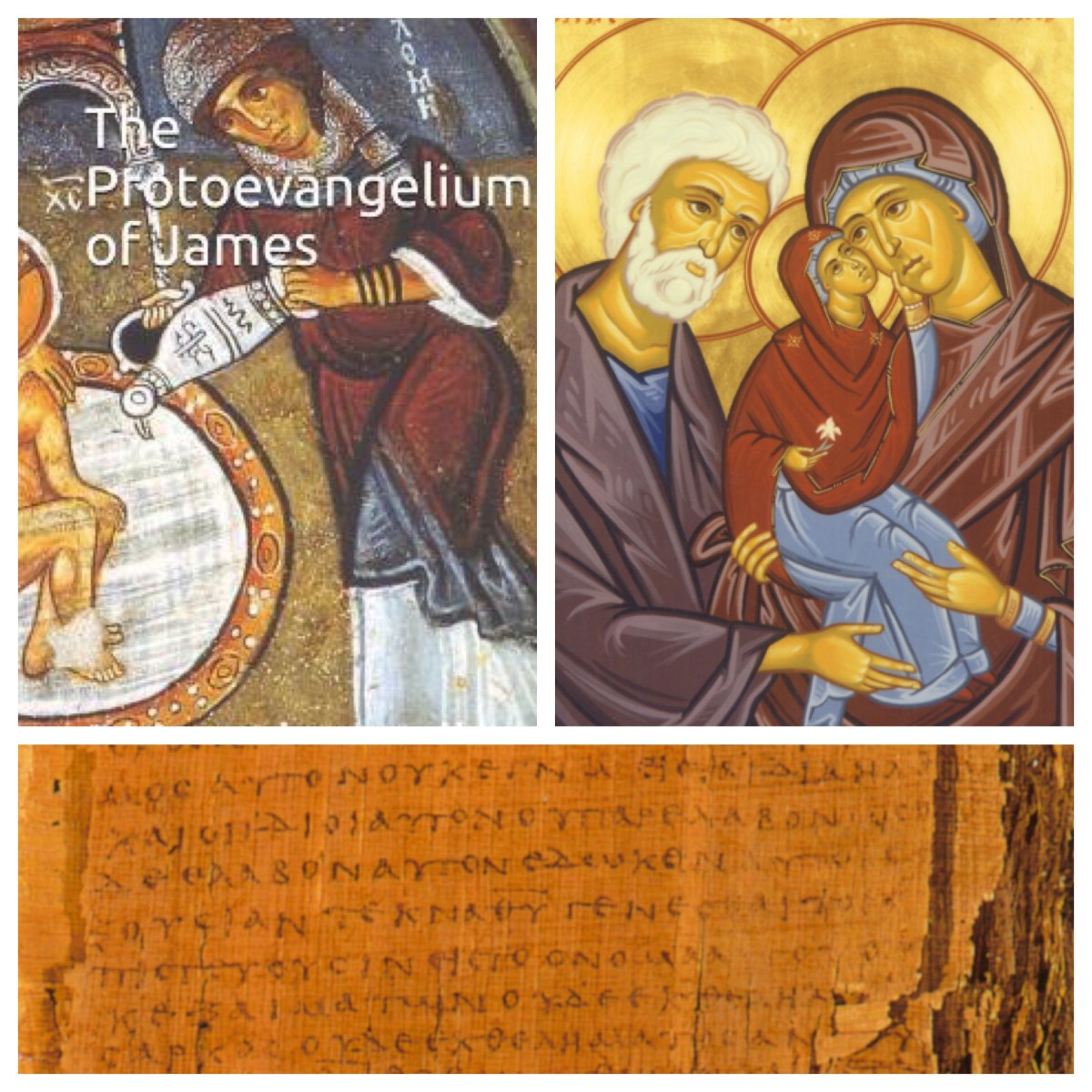
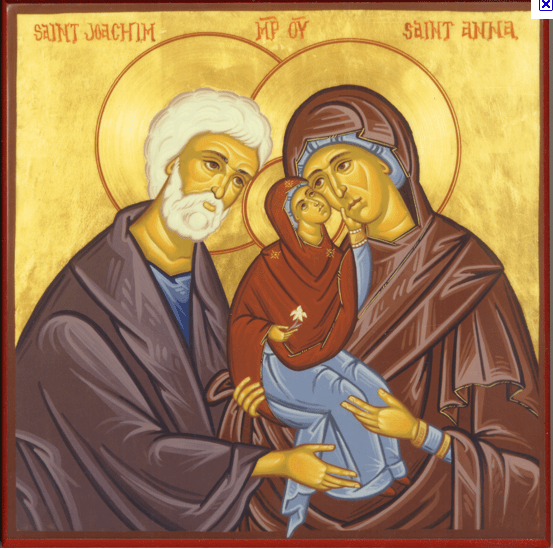
We find this, for example, in second century text, the Protoevangelium of James (also known as the Proto-Gospel of James, or the Infancy Gospel of James). This work weaves a long tale, commencing with Joachim and Anna, the parents of Mary, incorporating distinctive versions of the various events reported by both Luke and Matthew in their first two chapters—Zechariah and Elizabeth, Mary and Joseph, the census, Herod and the Magi—and it runs through until the mention of Simeon in the temple (towards the end of Luke 2).
In a later chapter, it describes a test that Mary had to take, when her pregnancy was discovered by the local authorities. The test follows the biblical prescription set out in Numbers 5:11-31, in which “if any man’s wife goes astray and is unfaithful to him … the man shall bring his wife to the priest; and he shall bring the offering required for her”.
After this, the priest shall make a mixture of “holy water that is in an earthen vessel … and some the dust that is on the floor of the tabernacle”, to form “the water of bitterness that brings the curse”. The priest is then instructed to make the woman take the oath of the curse, and say to the woman: “The LORD make you an execration and an oath among your people, when the LORD makes your uterus drop, your womb discharge; now may this water that brings the curse enter your bowels and make your womb discharge, your uterus drop!” The woman is then expected to reply, “Amen. Amen.”
In the Protoevangelium of James, both Mary AND Joseph are made to drink a potion in accordance with this test, to reveal whether they have committed adultery. If they have, it is anticipated that they will develop all sorts of physical ailments, to signal that they have, indeed, sinned by committing adultery. Chapter 16 reads:
16. And the priest said: “Give up the virgin whom you received out of the temple of the Lord.” And Joseph burst into tears. And the priest said: “I will give you to drink of the water of the ordeal of the Lord, and He shall make manifest your sins in in your eyes.” And the priest took the water, and gave Joseph to drink and sent him away to the hill-country; and he returned unhurt.
And he gave to Mary also to drink, and sent her away to the hill-country; and she returned unhurt. And all the people wondered that sin did not appear in them. And the priest said: “If the Lord God has not made manifest your sins, neither do I judge you.” And he sent them away. And Joseph took Mary, and went away to his own house, rejoicing and glorifying the God of Israel.
So Joseph and Mary return unscathed, and their examiner believes their story. They have survived the ordeal of the water of bitterness! But the story of miracles continues. This work provides a detailed description of events surrounding the birth of Jesus.
With no proper birthing room, let alone an epidural, one might think Mary had a tough time during labour. Matthew and Luke skip over the birth, mentioning it only off-handedly (Matthew 2:1; Luke 2:6–7), but some Christians were curious about the labour. As opposed to Luke’s account of the new-born Jesus lying in a Jesus manger (2:7), the Protoevangelium of James describes how Mary gives birth in a cave.
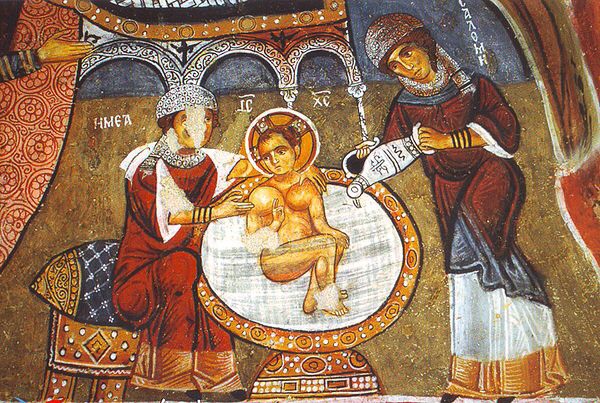
As soon as Mary enters the cave, it shines with bright light—reminiscent of the scene of the Transfiguration in our canonical Gospels. A midwife, arriving too late to help, is shocked when she sees the minutes-old Jesus walking over to Mary and suckling at her breast. Mary is said to have experienced no pain at all during the birth. The midwife then verifies that Mary retained her virginity even after giving birth.
Salome (right) and the midwife “Emea” (left), bathing the infant Jesus. A 12th-century fresco from Cappadocia.
Chapters 19-20 tell of the scene of the birth of the child in the cave.
19. And behold a luminous cloud overshadowed the cave. And the midwife said: “My soul has been magnified this day, because my eyes have seen strange things — because salvation has been brought forth to Israel.”
And immediately the cloud disappeared out of the cave, and a great light shone in the cave, so that the eyes could not bear it. And in a little that light gradually decreased, until the infant appeared, and went and took the breast from His mother Mary. And the midwife cried out, and said: “This is a great day to me, because I have seen this strange sight.”
And the midwife went forth out of the cave, and Salome met her. And she said to her: “Salome, Salome, I have a strange sight to relate to you: a virgin has brought forth — a thing which her nature admits not of.” Then said Salome: “As the Lord my God lives, unless I thrust in my finger, and search the parts, I will not believe that a virgin has brought forth.”
20. And the midwife went in, and said to Mary: “Show yourself; for no small controversy has arisen about you.” And Salome put in her finger, and cried out, and said: “Woe is me for mine iniquity and mine unbelief, because I have tempted the living God; and, behold, my hand is dropping off as if burned with fire.”
Of course, this offers us sooooo much information—too much information! There are intimate personal details, known in so much detail, that are recounted. At one level, it piques the interest and satisfies the curiosity of the human reader. But we should note that this comes from a writer who, according to scholarly consensus, was writing at a later time, many decades after the events reported. How did he have access to such detailed information, so many personal elements, so much later in time? We rightly adopt a scepticism about such a piece of literature. The “hermeneutic of suspicion” is clearly warranted in this instance.
(The author self-identifies as writing very soon after the events recounted: “I James that wrote this history in Jerusalem, a commotion having arisen when Herod died, withdrew myself to the wilderness until the commotion in Jerusalem ceased, glorifying the Lord God, who had given me the gift and the wisdom to write this history.” Nevertheless, contemporary scholars are unanimous in the view that the work was written by a person unknown, at least a century and a half, if not more, after the death of Herod in 4 BCE.)
It is worth noting, also, the way the story is written, throughout all 24 chapters. The book adopts a style that clearly and self-consciously imitates a scriptural way of writing. The author ensures that as many scriptural events and incidents are referred to in this work as is possible. The style is reminiscent of biblical passages which self-consciously evoke earlier writings, as a technique designed to bolster their validity. The method is a standard one, that nestles the later work into the stream of the earlier works. Some key sections of our canonical Gospels clearly adopt this technique—including Luke 1–2 and Matthew 1–2. Perhaps that is part of the reason why they were canonised?
Furthermore, the author, who calls himself James, seems to have enjoyed the tasks of harmonising the infancy narratives of Matthew and Luke, and adding in much more detail than is offered in either of these works. It feels to me that the author is working incredibly hard to establish his credentials as valuable and authoritative—perhaps too hard?
We know that the process of harmonising the Gospels became an industry in later centuries, as church fathers grappled with apparent discrepancies between the Gospels; witness the 2nd century Diatessaron by Tatian, the Gospel of the Ebionites from the same period (which unfortunately we don’t have in a full extant form), the Ammonian Sections, the EusebianCanons, Augustine’s Harmony of the Gospels, and then a series of manuscripts from late antiquity and the Middle Ages. The Protoevangelium sits in this company, as it works exclusively to harmonise the infancy narratives. It is a later enterprise, from beyond the first century.
I wonder whether, as we lay aside our curiosity to know more, and adopt a rigorously critical approach to this particular text (and others like it, from later centuries, presenting themselves in the mode of earlier documents), we might also consider the value of the “hermeneutics of suspicion” and the historical-critical approach taken, when we read our canonical texts? It seems easier to be critical of works that have not been incorporated into our canon of scripture. Why can we then not take the same approach to the works that have been deemed to be canonical?
The Protoevangelium of James provides the earliest assertion of the perpetual virginity of Mary (meaning she continued as a virgin during the birth of Jesus and afterwards). In this it is practically unique in the first four centuries. The only other place this view is expressed is by Origen, in his Commentary on John 1, 4, and also in his Commentary on Matthew 10, 17.
An edited version of the Protoevangelium, along with a set of letters alleged to have been exchanged between the scholar, Jerome, and two Bishops, Comatius and Heliodorus, forms the first part of a seventh or eighth century document entitled The Infancy Gospel of Matthew, also known in antiquity as The Book About theOrigin of the Blessed Mary and the Childhood of theSaviour. It is followed by an expanded account of the Flight into Egypt (it is not known on what this is based), and an edited reproduction of the Infancy Gospel of Thomas.
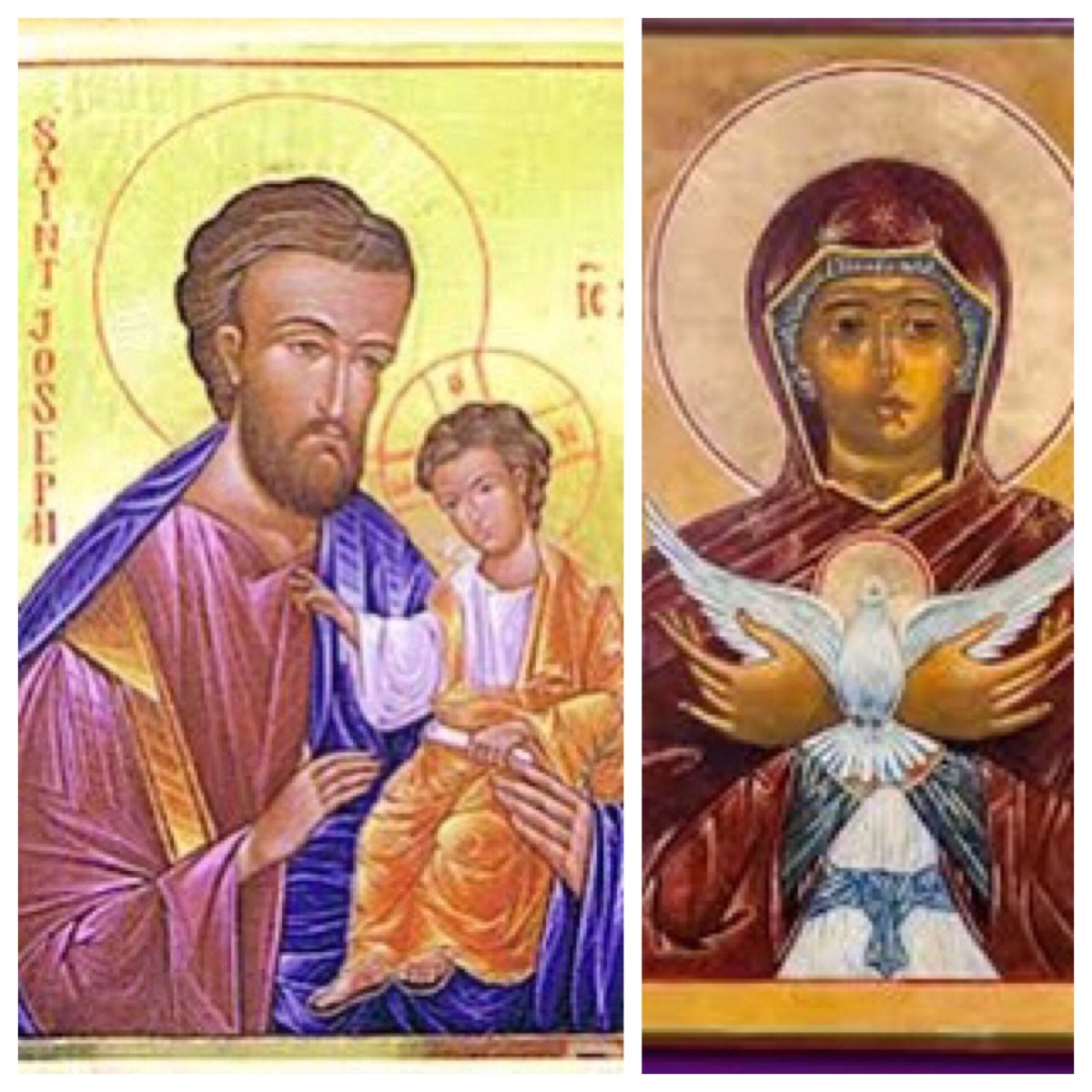
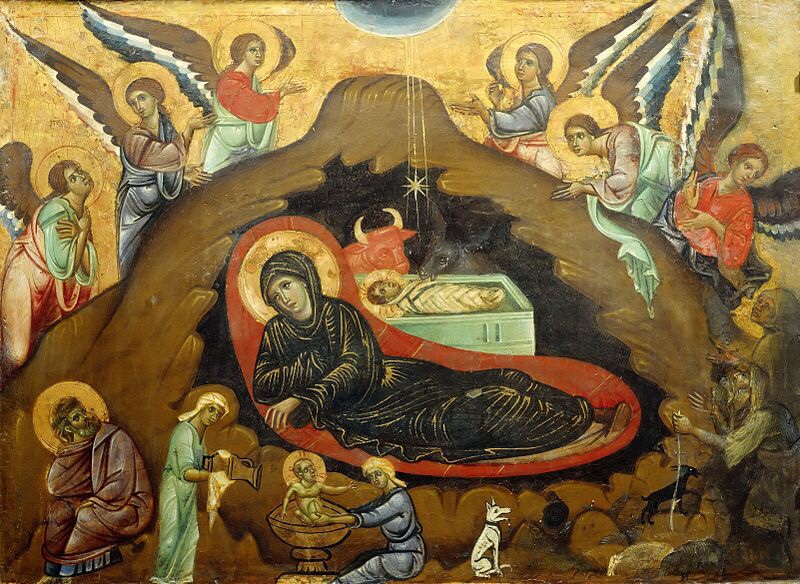
The Infancy Gospel of Matthew, of course, is the basis for developing Catholic traditions about Mary which still hold sway in popular piety. It provides the first known mention that an ox and a donkey were present at the birth of Jesus. The work also helped popularize the image of a very young Mary and relatively old Joseph. We see both of these features in the classic “nativity scene” which was first created by Francis of Assisi.
Byzantine Fresco (ca. 1175). Church of Karamlik Kilise, Cappadocia, clearly showing features from the apocryphal tradition. Salome (far right), ox and ass at the manger from Gospel of Pseudo-Matthew.
Finally, the Infancy Gospel of Matthew tells of how Mary, Joseph, and a two-year-old Jesus are surrounded by dragons. Jesus, unafraid, walks over and stands in front of them. The dragons worship him and then leave in peace. This event is linked to the prophecy of Psalm 148:7: “Praise the Lord from the earth, O dragons and all the places of the abyss.”
James McGrath has used this ancient document as the basis for a very creative consideration of “what Jesus learnt” from both his mother and his grandmother, in his fine book, What Jesus Learned from Women. See
Four years ago I created my own contribution to the festive cheer, in the words below. I think that our Christmas carols need some rigorous theological input, so I am offering it up this year with my tongue still firmly in my cheek.
…..
As I listened to the mesmerising schloppp of the muzakked carols during my occasional forays into the shopping malls, and pondered the calls to put Christ back into Xmas, I thought that it was about time to finish the job that some of the traditional carols have only just started.
References to “Word of the Father now in flesh appearing”, and “Veiled in flesh the Godhead see”, are just the start. Explanations about the one who “abhors not the Virgin’s womb” really need to be expanded and developed. “Hail the incarnate Deity” needs to ring through all of our carolling. Surely, the carols we sing should joyously and vigorously affirm the fullness of our faith!!
With this in mind, in the spirit of the Wesleys (who took popular tunes and put Christian hymn lyrics to them), I have grabbed Jingle Bells by the short and danglies, and consulted with my resident critic and editor-in-chief, who has made sure that the verses, at least, conform to the scheme of rhyming pairs.
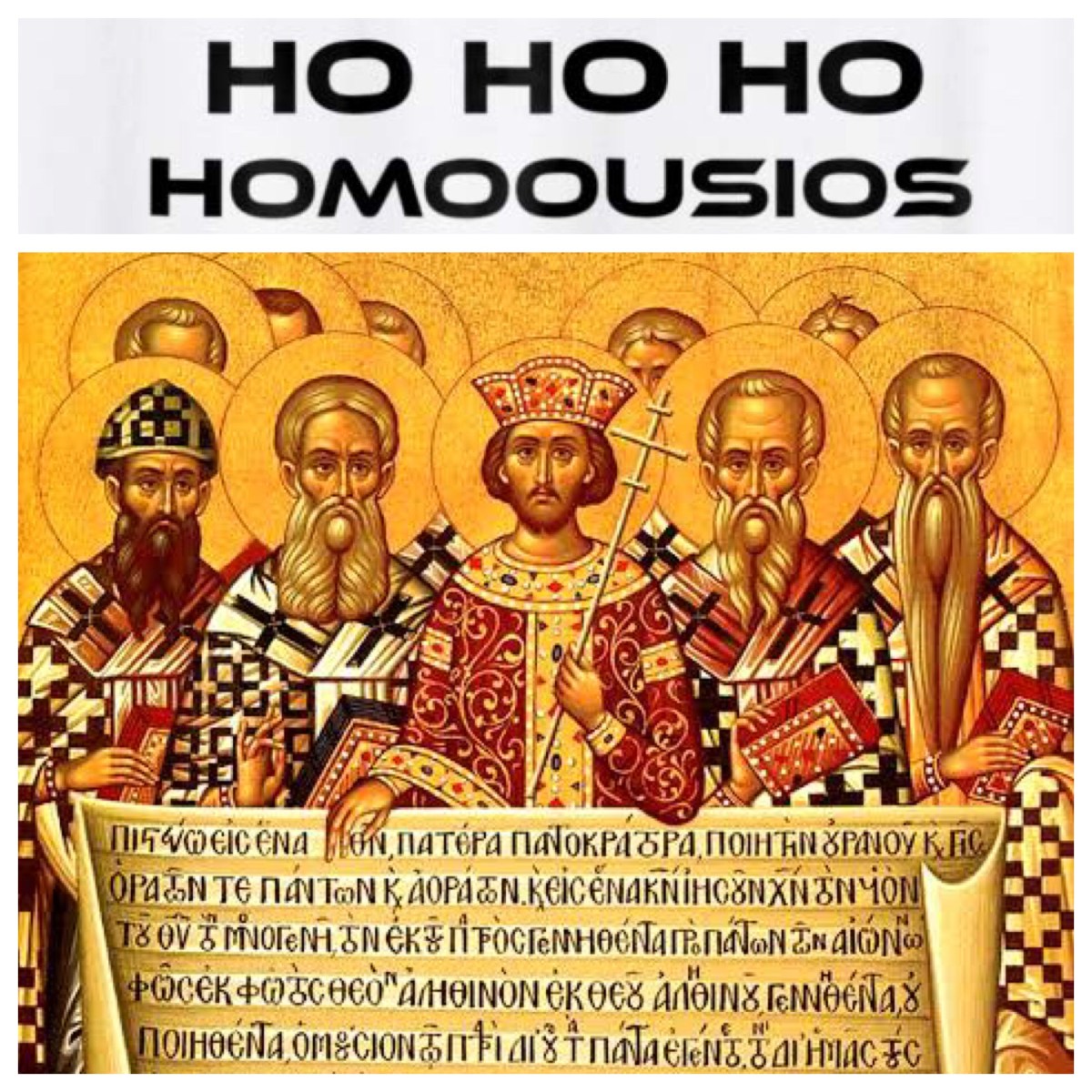
I therefore present the following offering, inspired by all that the Nicene-Chalcedonian tradition provides. And, in the spirit of this tradition, there is a special verse dedicated to the oft-overlooked Appendix to the Creed, which calls down a curse (an anathema, in Greek) on the heretics and their views.
Let the Homoousions rise to the heavens!
Enjoy!
1
Dashing through the mall
With a Christmas list to go,
Shoppers all around
Buzzing to and fro.
Carols sound on high
Repetitiously;
Santa, Rudolph, bells and snow,
But where can Jesus be?
Refrain A
Calchedon, Nicaea,
This is what we need:
Three in one and one in three,
Blessed Trinity, Hey!
God is now Incarnate,
God Emmanuel,
Human being, he became:
Homoousion!
2
Back in three two five,
The Emperor Constantine
Faced a mess of views,
which he needed to redeem.
“Sort this dogma mess,
Sort it once for all!”
And so the bishops did their job,
made a snappy Creed catch-all.
Refrain B
Jesus Christ, Son of God,
Essence of the Father,
Light from Light, and Very God,
Be-gotten not made. Hey!
Jesus Christ, Son of God,
Through whom all was made,
He came down, was incarnate,
Homoousion!
3
Though the bishops came,
met, and made a Creed,
Heretics were there,
Sowing their fake seeds.
So the Creed was stretched
To include some words
That ensured the views they held
Would damn them all with verbs:
Refrain C
Those who say, “he was not”,
Let them be accursed!
If they say “from naught he came”,
Let them be condemned! Hey!
If they claim “he’s changeable,
of quite another substance”,
Let them be condemned, we say,
Cast them out of church!
Refrain B
Jesus Christ, Son of God,
Essence of the Father,
Light from Light, and Very God,
Be-gotten not made. Hey!
Jesus Christ, Son of God,
Through whom all was made,
He came down, was incarnate,
Homoousion!
…..
The sections of the Nicene Creed which have informed this offering are:
We believe in one Lord Jesus Christ,
the only Son of God,
begotten from the Father before all ages,
God from God,
Light from Light,
true God from true God,
begotten, not made;
of the same essence as the Father.
Through him all things were made.
For us and for our salvation
he came down from heaven;
he became incarnate by the Holy Spirit and the virgin Mary,
and was made human.
and
‘There was a time when he was not;’ and ‘He was not before he was made;’ and ‘He was made out of nothing,’ or ‘He is of another substance’ or ‘essence,’ or ‘The Son of God is created,’ or ‘changeable,’ or ‘alterable’— they are condemned by the holy catholic and apostolic Church.








 An Informed Faith