We do not know how it is that he now sees (John 9; Lent 4A)

The lectionary offers us stories, during Lent, of encounters that Jesus had with a range of people. We have already heard of his conversation with a Pharisee in Jerusalem and a woman beside a well in Samaria. This week, he is in Jerusalem, where one of the people he encounters is a man who was born blind (John 9:1–41).

Of course, each of these scenes is a narrative which has been shaped and formed by the author, more in the nature of a developed literary creation than a verbatim account of an historical event. It may be that each extended scene is based on a report of an encounter that took place decades before the Gospel was written, but most certainly it has been elaborated and developed over a period of time, worked into a narrative that catches attention, invites reflection, and has a life all of its own.

“John” wrote his Gospel some 50 to 80 years after the lifetime of Jesus. The account of each of these conversations—at night with Nicodemus, at noon with the woman, in Jerusalem with the authorities, and then the encounter in Bethany and the council meeting in Jerusalem—are thus far removed from each of these events. (And how could we possibly claim to know verbatim what was said in a Sanhedrin meeting in the early 30s CE? — especially since the High Priest articulates a central tenet of later Christian doctrine! ).

But removing certainty with regard to the historical accuracy of the encounter does not in any way impair the power of the story to connect with us as we read and hear it, many centuries later, in a very different context—we still have stories from the 1st century, valued and passed on and collected in scripture, that speak to our own journeys of faith development in the 21st century.

The scene—or rather, the series of scenes—that we are offers this coming Sunday occur within a context that has set up antagonism and tension in the relationship that Jesus has with the authorities in Jerusalem. In John’s narrative, he has set things off in an interesting way: violence in the courtyard of the Temple (2:13–22) is his first action in the capital city.

Then follows the secret meeting with Nicodemus, “a leader of the Jews” in which Jesus appears to accuse Nicodemus and his ilk of misunderstanding what Jesus teaches about “heavenly things” (3:11–12), and the public noontime meeting with a Samaritan woman by the well, in which he contests the northern penchant for worship “on this mountain” (4:19–24).

However, the antagonism in these encounters pales into insignificance when compared with what follows. After he has healed an official’s son in Galilee (4:46–54) and a man challenged by his poor mobility (5:2–9), Jesus enters into debate with “the Judeans”—most likely the scribal and priestly authorities in Jerusalem—which has already stirred them up, as “they were seeking all the more to kill him” (5:18).

For my views on why references to “the Jews” in this Gospel should be translated as “the Judean authorities”, see

Then a long session of exposition with his disciples by the lake in Galilee (6:22–71) sees not only Judeans stirred by his words (6:52), but his own disciples resistant (6:60) and some, indeed, leaving his company of followers (6:66). We don’t hear much, usually, about Jesus’ failures!!

After a debate about whether Jesus and his followers should go south to Jerusalem (7:1–9), Jesus went, “not publicly but as it were in secret” (7:10), engaging in yet more discussion with “the Judeans” (7:15–62), in the course of which, the accusation is shouted by the crowd, “you have a demon!” (7:20). That languages comes back in the subsequent scene, an extended section in which Jesus remains in Jerusalem (8:12–10:21).

The claim that Jesus makes, “I am the light of the world” (8:12), introduces a section where accusation and counter-accusation intensify. “You are from your father the devil, and you choose to do your father’s desires”, Jesus declares, continuing with the accusation that “he was a murderer from the beginning and does not stand in the truth, because there is no truth in him” (8:44). In response, “the Judeans” ask, “are we not right in saying that you are a Samaritan and have a demon?” (8:48), and then “they picked up stones to throw at him” (8:59). Jesus escapes by leaving the temple.

This polemic continues in chapter 10, when many of “the Judeans” were saying, “He has a demon and is out of his mind. Why listen to him?” (10:20), whilst others were saying, “These are not the words of one who has a demon. Can a demon open the eyes of the blind?” (10:21). The long scene ends with the narrator reporting, “they tried to arrest him again, but he escaped from their hands” (10:39).

The antagonism will continue, nevertheless, for after Jesus has moved to Bethany, encountered a grieving family, and raised Lazarus back to life (11:1–44), the Jewish authorities decide to make their move. Worried that, “if we let him go on like this, everyone will believe in him, and the Romans will come and destroy both our holy place and our nation” (11:48), Caiaphas leads with these prophetic words: “it is better for you to have one man die for the people than to have the whole nation destroyed” (11:50). And so, “from that day on they planned to put him to death” (11:53).

*****

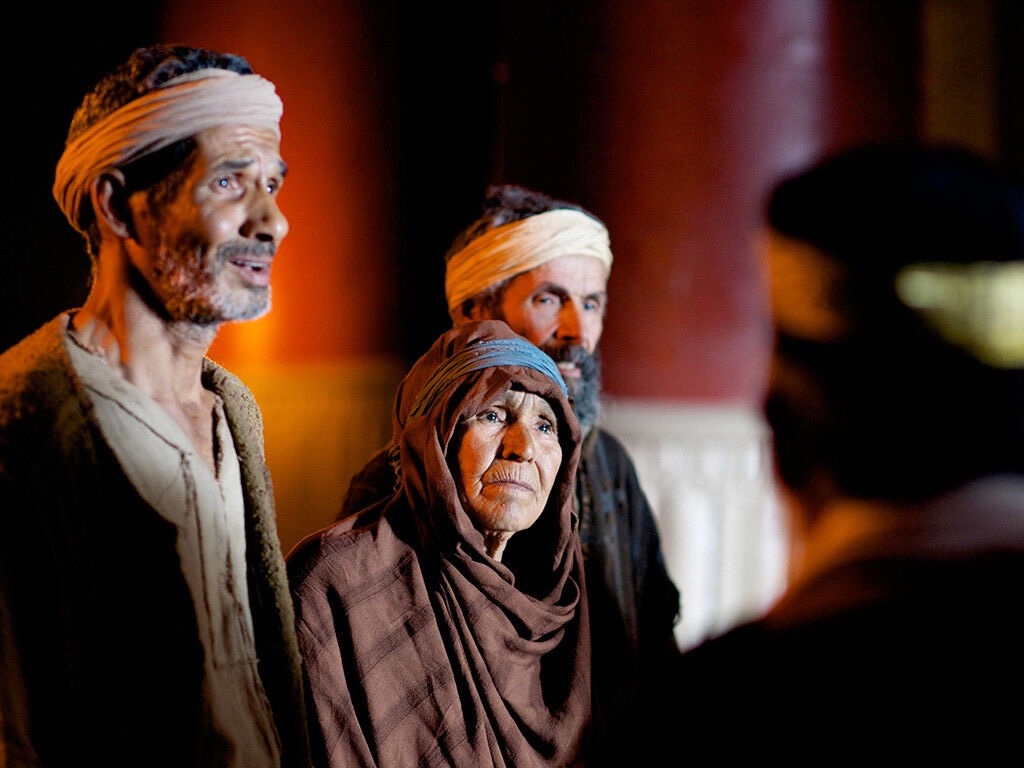
The extended narrative revolving around the man born blind, whom Jesus heals, and the associated controversy, is thus set at the heart of this extended sequence of conflict scenes. It is different, in character, from the earlier scenes of encounter, where the focus is on Jesus and the person with whom he is talking—Nicodemus, and the Samaritan woman in particular. This particular scene of encounter has quite a cast of characters—Jesus, his disciples, the blind man, his parents, the Pharisees, and a crowd of people in Jerusalem.

In fact, this encounter leads to a sequence that feels more like a dramatic portrayal of a court scenario, than a religious story. There are seven scenes in all. The first scene is narrated in the opening verses (9:1–7), telling of Jesus healing the man. The question from the disciples (9:2) allows Jesus to give an explanation about the purpose of “his work” (9:3–5) which culminates in a reprise of his earlier claim, “I am the light of the world” (9:5; see 8:12, as well as the initial reference at 1:5).

Jesus heals the man by forming mud with his own saliva (9:6)—something jarring to modern sensibilities, but a common practice amongst ancient miracle-workers and healers. For my reflections on the distinctive way that Jesus heals this blind man, see

The second scene involves the neighbours of the healed man debating with him about what has happened (9:8–12); “how were your eyes opened?”, they ask him (9:10), incredulous at the change that has taken place. This scene is something of “set-up”, to lead into the third scene, in which the complexities of the situation begin to be unravelled.

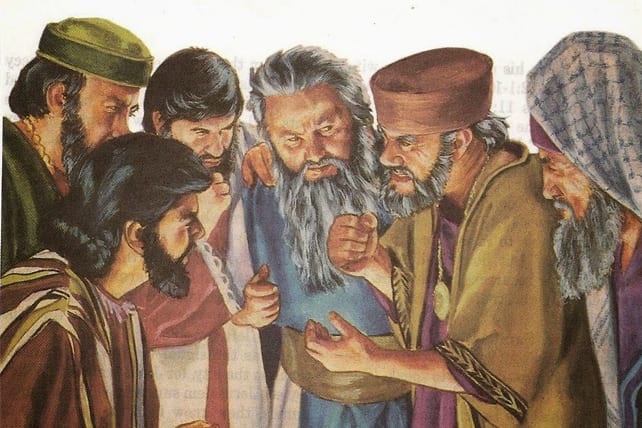
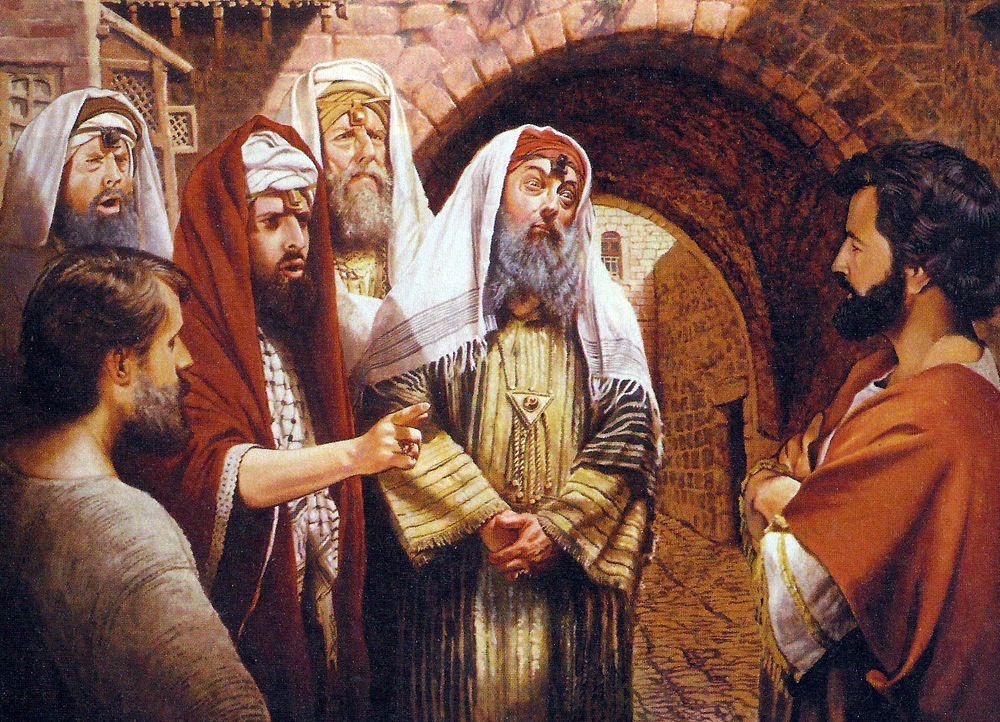
The third scene sees the healed man brought before the Pharisees (9:13–17); what ensues feels like it is setting up to be a cross-examination, since the healing took place on a sabbath (9:14) and thus the event comes under Torah prescriptions (cf. Mark 2:23–28; 3:1–6; Luke 13:10–17; 14:1–6; and John 7:19–24). In fact, the Pharisees accuse Jesus, “this man is not from God, for he does not observe the sabbath” (9:16), while the healed man, pressed hard, declares, “he is a prophet” (9:17).

A prophet: is the same affirmation made by the Samaritan woman (4:19), a crowd in Galilee after a miracle (6:14), and a crowd in Jerusalem (7:40)—and, by implication, perhaps some in the Sanhedrin, led by Nicodemus, say that also (7:52)?

Does the author want his hearers and readers to understand each of these affirmations in terms of the central one: “this is indeed the prophet who is to come into the world” (6:14), presumably along the lines of the earlier statement of Moses, “the Lord your God will raise up for you a prophet like me from among your own people; you shall heed such a prophet … I will raise up for them a prophet like you from among their own people; I will put my words in the mouth of the prophet, who shall speak to them everything that I command” (Deut 18:15, 18). Certainly, this is the text on the basis of which Samaritans were anticipating the return of Moses as their Taheb, their Restorer.

We resume the extended narrative of John 9 with the fourth scene, involving the parents of the man, whom the Pharisees summonses and proceed to question (9:18–23). They ask, “Is this your son, who you say was born blind? How then does he now see?” (9:19). The key element in this scene is the narrative comment—reflecting the experience of the followers of Jesus many decades after the setting of this scene, in Jerusalem in the early 30s—that “the [Judean authorities] had already agreed that anyone who confessed Jesus to be the Messiah would be put out of the synagogue” (9:22).

John’s Gospel indicates, three times, that followers of Jesus were expelled from the synagogue (9:22; 12:42; 16:1–2). That’s quite a schism! This indicates that the negative portrayals of people from years back may well have as much to do with what has transpired in those intervening years, as with the actual event—probably, I think, much more to do with those intervening years than with the conversations and encounters as reported in the book of signs.

The whole Gospel reflects a situation much developed from the time in which the story is set, when Jesus was a Galilean man preaching and teaching in Israel in the 30s CE. American scholar Raymond Brown developed a complex hypothesis about multiple stages of development of this Gospel, with the figure of the Beloved Disciple providing a focal point of leadership and identity—and perhaps also serving as the earliest source for the distinctive Johannine traditions?

Brown developed this hypothesis as he worked on a marvellous two-volume commentary on John’s Gospel (Anchor Bible, Yale Uni Press, 1966) and then published a clear analysis of this in his book The Community of the Beloved Disciple (Paulist Press, 1978).

Much had transpired in the decades between the time of Jesus and the finalisation of the Gospel—including an intensification of the antagonism between the followers of Jesus and the rabbinic leadership of Judaism. This antagonism is “written back” into the time of the story of Jesus through the verbal polemics that take place in chapters 5–12, between Jesus and the authorities in Jerusalem.

My own teacher, Wayne Meeks (in his classic article, “The Man from Heaven in Johannine Sectarianism”, JBL 91 (1972) 44–72), noted that the claims made about Jesus in the fourth Gospel function as reinforcements of the sectarian identity of the community. As this community had come into existence because of the claims that it had made about Jesus, so the reinforcement of the life of the new community took place, to a large degree, through the strengthening and refining of its initial claim concerning Jesus. The account of the interaction between Jesus, the man born blind, now healed, and the Pharisees and leadership in Jerusalem, reflects elements of that sectarian mindset.

This becomes clear in the fifth scene, in which the Pharisees recall the healed man to question him further (9:24–34). The Pharisees set the key issue: “as for this man, we do not know where he comes from” (9:29). The experience of the healed man, “you do not know where he comes from, and yet he opened my eyes”, leads him to testify, “never since the world began has it been heard that anyone opened the eyes of a person born blind. If this man were not from God, he could do nothing” (9:30–33). That clear affirmation of faith in Jesus, and recognition of his status, from one “on the inside”, brings the cross-examination to an abrupt close; incredulous, the Pharisees ask, “are you trying to teach us?”, and then drive him out from their gathering (9:34).

The issue at stake is the identity of Jesus and his status as prophet, teacher, “from God”. Of course, hearers and readers of the Gospel have known from the beginning that Jesus, the Word, “was with God, and … was God” (1:1), that this Word “became flesh and lived among us … full of grace and truth” (1:14), and that this Word was “the only Son, who is close to the Father’s heart, who has made him known” (1:18). We have been let into the insiders’ world, with access to full knowledge. This is where the healed man is to be found; he recognises Jesus, not only as miracle worker, but as “from God” (9:33).

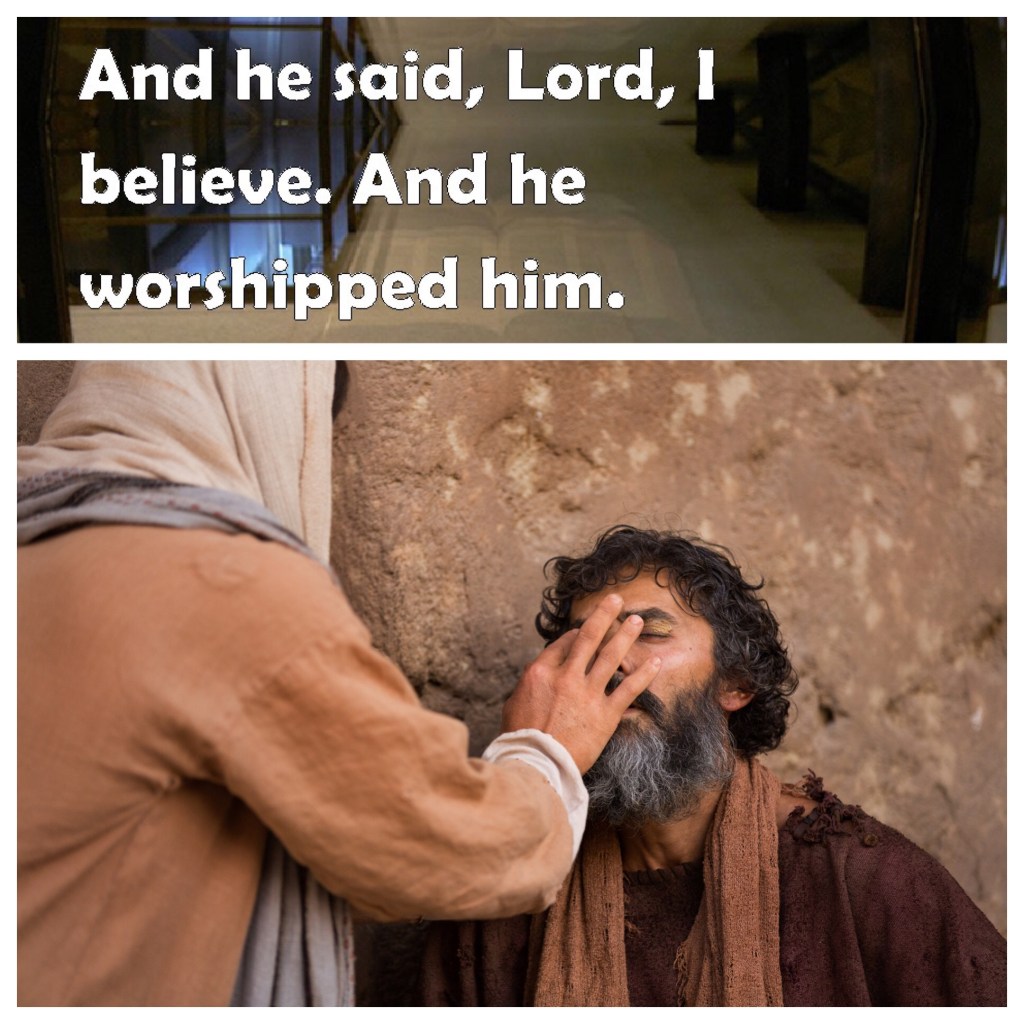
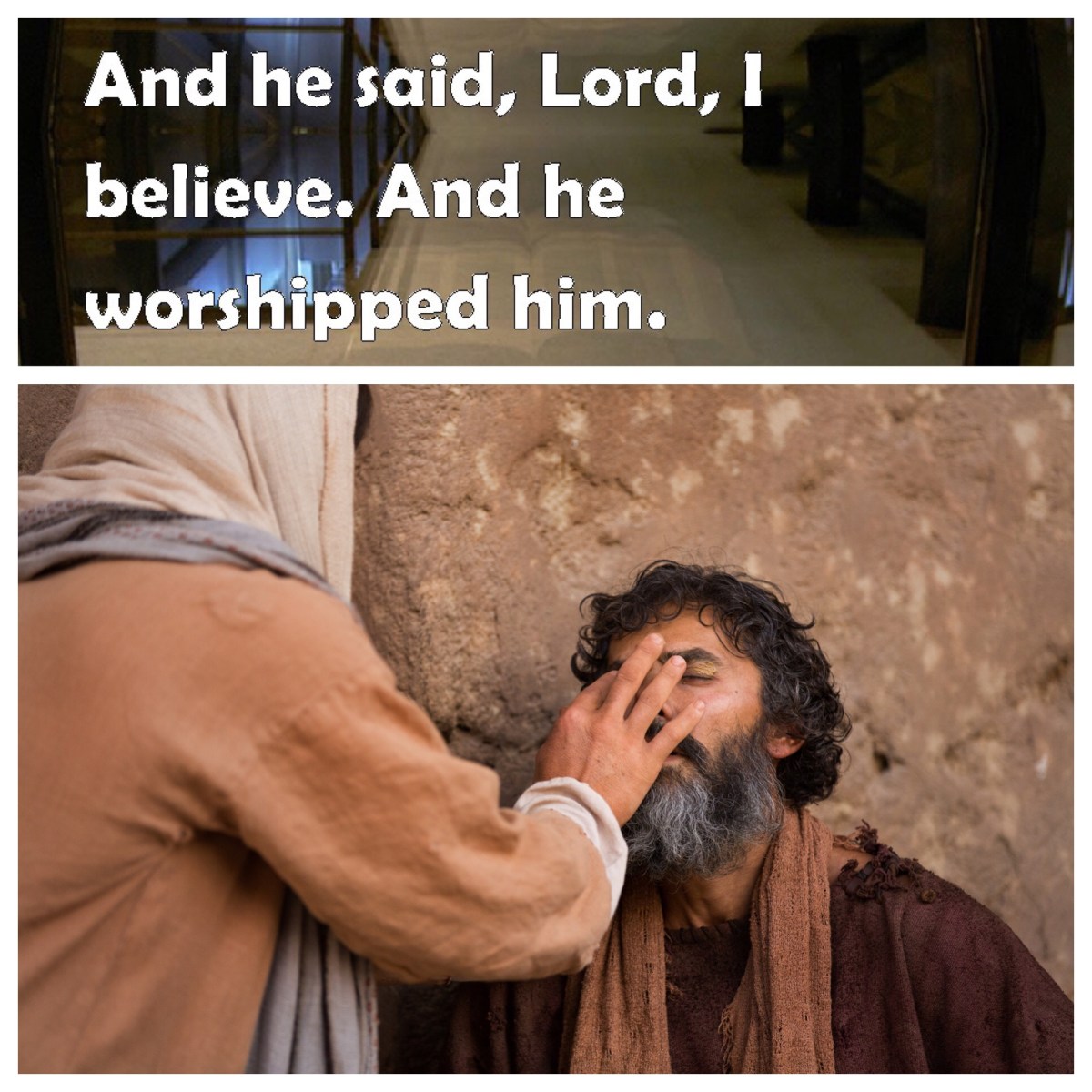
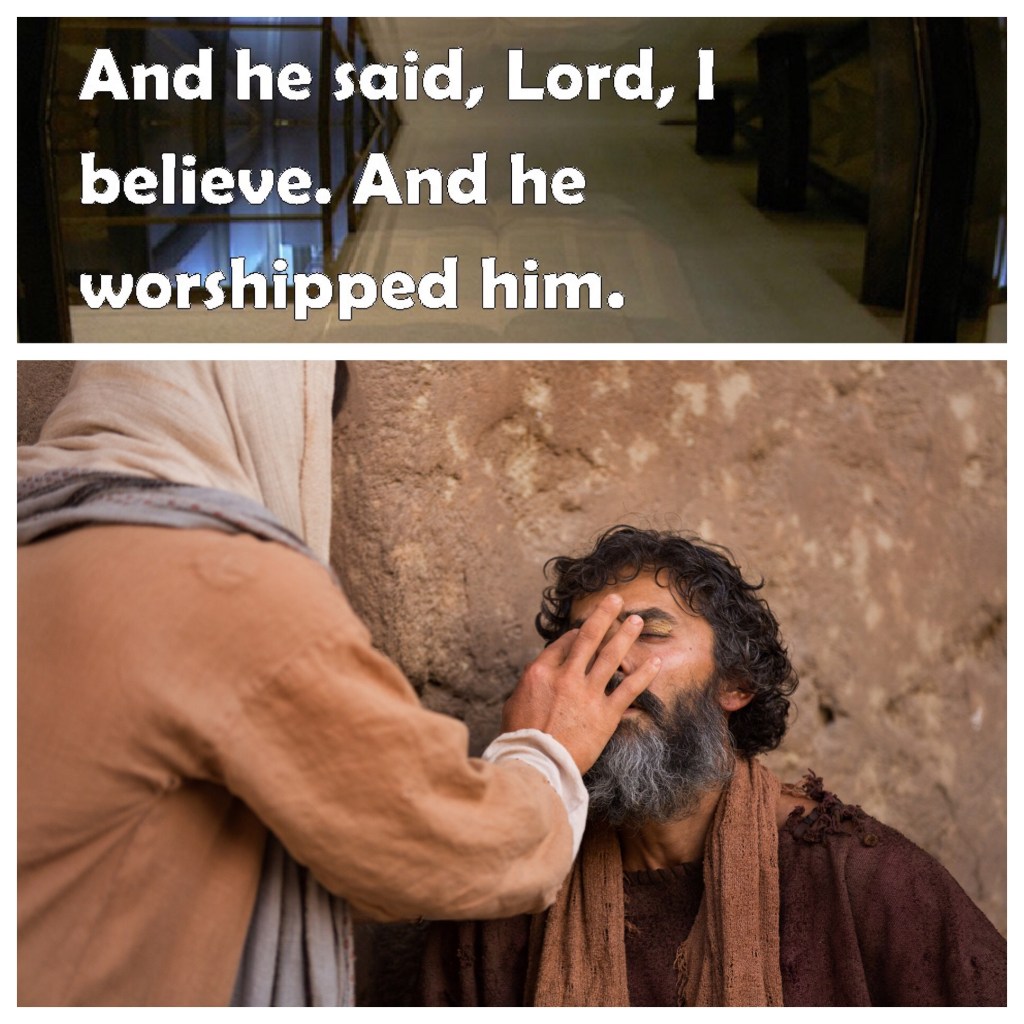
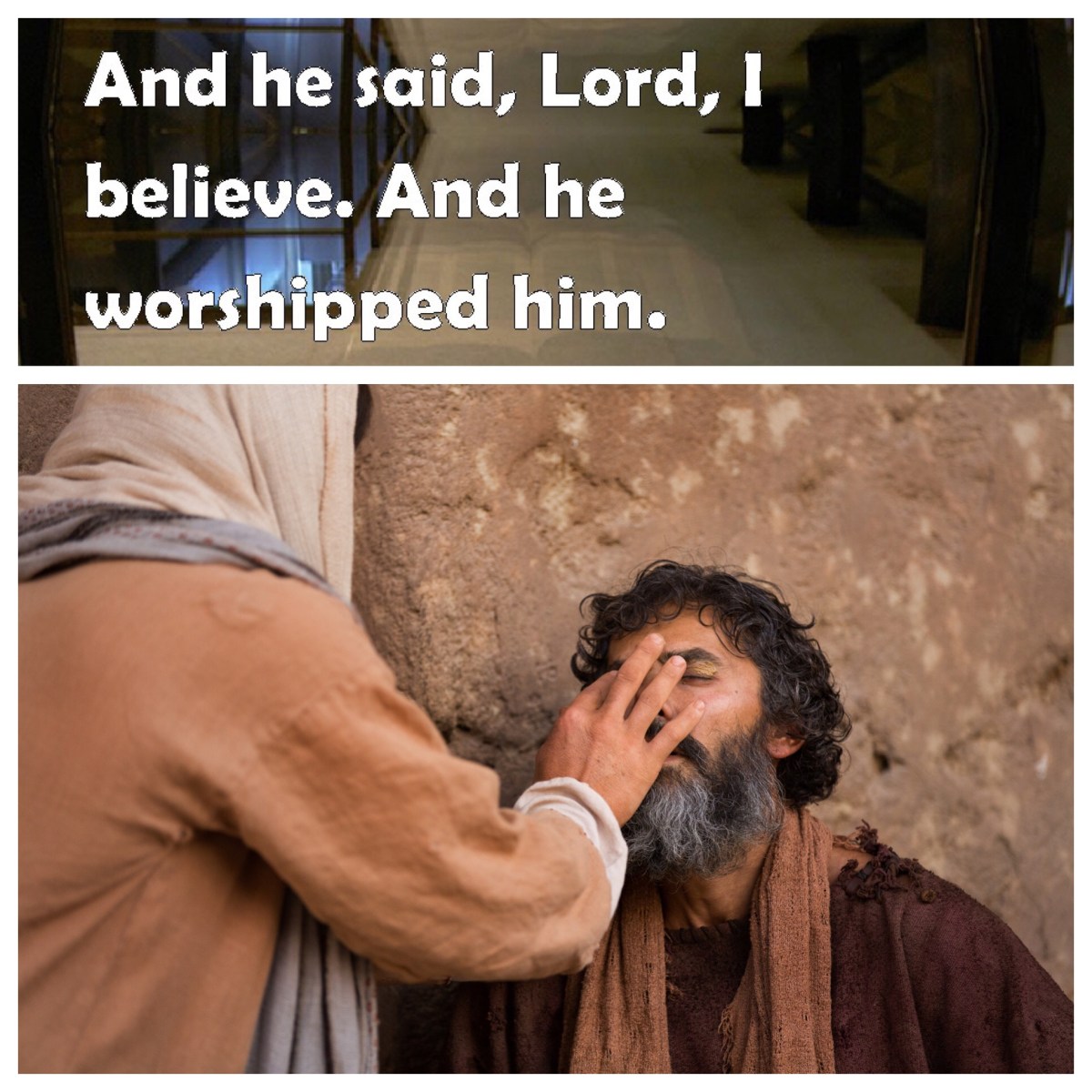
So the sixth scene (9:35–38) depicts Jesus interacting directly with the healed man once more—the last time he saw him was back in scene one, when he had spat onto the ground to make mud, rubbed it on the man’s eyes, and told him to “wash in the pool of Siloam” (9:6–7). Now, Jesus asks the leading question, “do you believe in the Son of Man?” (9:35), evoking the clear affirmation, “Lord, I believe” (9:38). That is the same affirmation of faith made by Simon Peter (6:69), Martha (11:27), and, by inference, Thomas (20:24–28). The identity of Jesus—Holy One of God, Messiah, Son of Man, Lord and God—is the critical issue which delineates insiders from outsiders.

For my reflections on the significance of this man’s confession of faith in the context of the book of signs as a whole, see

The seventh scene brings Jesus directly into contact with the Pharisees (9:39–41). Compared to the earlier extended debate of 8:31–59 and the less extensive debate which follows at 10:22–39, this is brief, succinct, and focussed on the theological issues of blindness and seeing, and sin. This links back to the opening question of the disciples about blindness and sin (9:2) and the consequent statement of Jesus, “as long as I am in the world, I am the light of the world” (9:5). This statement, of course, repeats the earlier declaration of Jesus (8:12) which has introduced the whole narrative context in which this encounter sits (8:12–10:21).

*****

So the whole scene (like the whole Gospel) is about the situation of a group of followers of Jesus towards the end of the first century CE, inheriting the richness of the Jewish faith, convinced that they have found The Teacher of the way that God requires, in Jesus of Nazareth. As a result, they have encountered opposition, argumentation, and expulsion from their familiar faith community, and through this they have engaged in verbal warfare with those who have pushed them out.

Retelling the story of that man in a way that validates their perspective as what God intends and desires, is what has led an unknown member of their community to construct this narrative, in which he reinforces the views that have been developed by the members of his community, even as he hopes that others might “come to believe that Jesus is the Messiah, the Son of God, and that through believing [they] may have life in his name” (20:31).

A well, two mountains, and five husbands (John 4; Lent 3A)

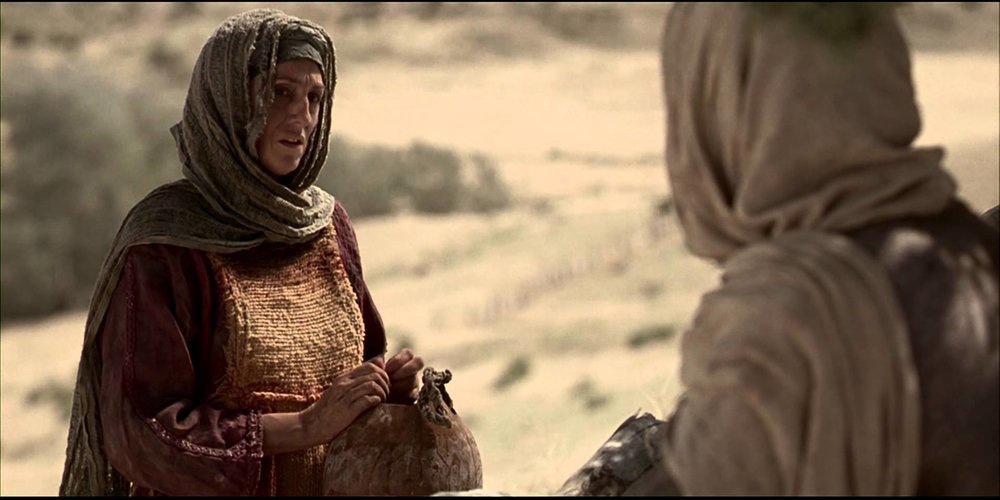
This is a post about a well, two mountains, and five husbands. We learn about each of these elements in a story told in the book of signs, which we know as the Gospel according to John. The story tells of an encounter between a teacher from Galilee and a woman from Samaria. That story is offered as the Gospel reading for this coming Sunday, the Third Sunday in Lent (John 4:5–42).

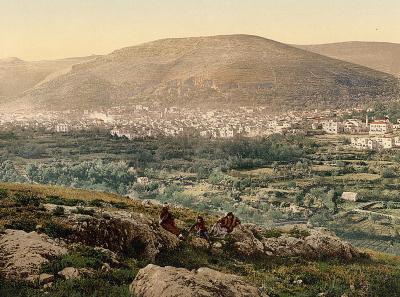
The well is Jacob’s well (John 4:6). It is the location for the meeting of the teacher and the woman. This site is not explicitly named in Hebrew Scriptures, but it is thought that the account of Jacob buying land in Shechem in Gen 33 records the site, which Jacob, it is said, calls El-Elohe-Israel (Gen 33:18–20). The name signifies “the God of Israel”, which is the name that Jacob had adopted just before this, after wrestling all night with a man at Peniel (Gen 32:22–32).

In fact the narrative has earlier given a long account of how Jacob married the two daughters of Laban—Leah and Rachel—after he had met the younger daughter, Rachel, at a well in the land of (Gen 29:1–35). Laban lived in Paddan-aram, a tableland area in northern Mesopotamia (28:5); the well in this region was where Jacob first sighted Rachel (29:4–12).

Wells, of course, were vital parts of the infrastructure of ancient societies—as indeed they continue to be so for many people today. As well as water for washing, drinking, and cooking, people needed wells to provide water for their animals. We are told that the oldest servant of Abraham, whilst journeying to Nahor, a city in Paddan-aram, “made the camels kneel down outside the city by the well of water; it was toward evening, the time when women go out to draw water” (24:11).

Not only was the well used to collect water for animals, however; it was a place where men could go to meet women—which is what the servant did, meeting Rebekah, Abraham’s niece by marriage (24:15–21), who would become the wife of Abraham’s son Isaac (24:67). So it was no surprise that Jesus would meet a woman beside the well identified as Jacob’s well.

What is a surprise is that he met her at noon (John 4:6). The clearest explanation for this is that it provides a striking juxtaposition to the story just told, of Nicodemus, who “came to Jesus by night” (3:2). It is one of the many literary devices so favoured by the author of the book of signs. We should not take this time reference as a direct historical fact in a story which the author of this Gospel has developed.

*****

The two mountains in this story (John 4:21) are Gerizim and Zion. We know about Mount Zion because the long historical narrative of Israel that exists in the Bible (from Deuteronomy through Joshua, Judges, 1–2 Samuel, 1-2 Kings, Ezra and Nehemiah) was compiled by southern kingdom writers, using sources from both the north and the south. Zion was captured from the Jebusites by David’s army (2 Sam 5:6–10) and was honoured as the location for the Temple built under Solomon (1 Ki 8:1–13).

It was on Zion that the Lord God dwelt (Ps 9:11)—at least for southerners—and Zion was praised as “beautiful in elevation, the joy of all the earth” (Ps 48:2). Jesus reflects the southern view of life when he asserts to the Samaritan woman that “salvation is from the Judeans” (John 4:22).

Centuries before, people in the northern kingdom had built a rival temple on Mount Gerizim, one of the ancient holy sites in the northern kingdom (Deut 27:12; Josh 8:33–34; Judg 9:7). That temple survived beyond the invasion and resettlement of the north, continuing on until it was destroyed in 107BCE, when John Hyrcanus razed the temple and the capital city of Samaria.

The city of Samaria gave its name to the whole region, and the people were known as Samaritans. Southerners looked down on them as being the descendants of the people who committed idolatry after the Assyrians had conquered the northern kingdom (2 Kings 17:5–6) and resettled the northern region with people from other locations in their empire (2 Kings 17:24), from “every nation [who] still made gods of its own and put them in the shrines of the high places that the people of Samaria had made, every nation in the cities in which they lived” (2 Kings 17:29).

Flavius Josephus, a late 1st century CE historian, retells the sequence of events we read in 2 Kings, indicating that the Samaritans descended from this hybrid, unfaithful group of people (Antiquities 11.297–347). He also recounts an incident which entrenched the antagonism of southern Judeans towards the northern Samaritans (Antiquities 11.297–347).

The Samaritans attempted to undermine the returning exiled Judeans with their Persian rulers and slowed the rebuilding of Jerusalem and its temple (Ezra 4:6–24). Josephus notes disagreement about which site should be the location for the temple (Josephus, Antiquities 12.9–10). This is the same issue that is reflected in words attributed to Jesus at John 4:20–22.

Josephus also recounts a later time when some Samaritans scattered bones of dead people in the in portico of the Jerusalem Temple, thus rendering it unclean (Antiquities 18.29–30), and he gives a graphic description of the time when Cumanus (governor of Judea 48–52 CE) was bribed by some Samaritans, leading some Judean brigands to mount an uprising. Cumanus ordered the Romans to join with the Samaritans in battling the Judeans; many were killed, many more taken captive (Antiquities 20.118–123).

References to the Samaritans in the 3rd century CE Mishnah may reflect views current at the time of Jesus: “Rabbi Eliezer used to say, ‘He that eats of the bread of Samaritans is as one who eats the flesh of swine’” (m. Seb. 8.10); “the daughters of Cutheans [Samaritans] are menstruants from their cradle” (m. Nid. 4.1). That undergirds the author’s comment in the Johannine narrative, that “Jews do not share things in common with Samaritans” John 4:9). Jesus was stepping across the prescribed boundaries by asking for a drink from the woman (John 4:7–9).

*****

The five husbands have occasioned much debate amongst interpreters. One entirely predictable and utterly incorrect interpretation is that the woman was an outcast amongst her people, because she had been married five times. Adultery and promiscuity are assumed by the—always male—interpreters.

This line of interpretation has no justification at all in the text. No reason is given for the five husbands—neither adultery nor promiscuity are mentioned in John’s narrative. Perhaps it could have been an application of the Levirate law of marriage to the brother of a deceased husband (see Deut 25:5–10; also Ruth 3:1–4:13; Mark 12:18–23)?

And if the woman had been such an outcast amongst the people of her own village, why would they have listened to what she had to say about Jesus (John 4:39)? Although Jesus comments that “the man you have now is not your husband” (4:18), this does not indicate sexual irregularity; this man could well have been the protector of the woman, the man who heads the household in which she has been given shelter.

Certainly, the main rationale for this particular interpretation can only be the patriarchal bias of the interpreters. The fact that it is so often cited does not lend weight to it; it simply reflects the ubiquity of sexist patriarchal interpreters!

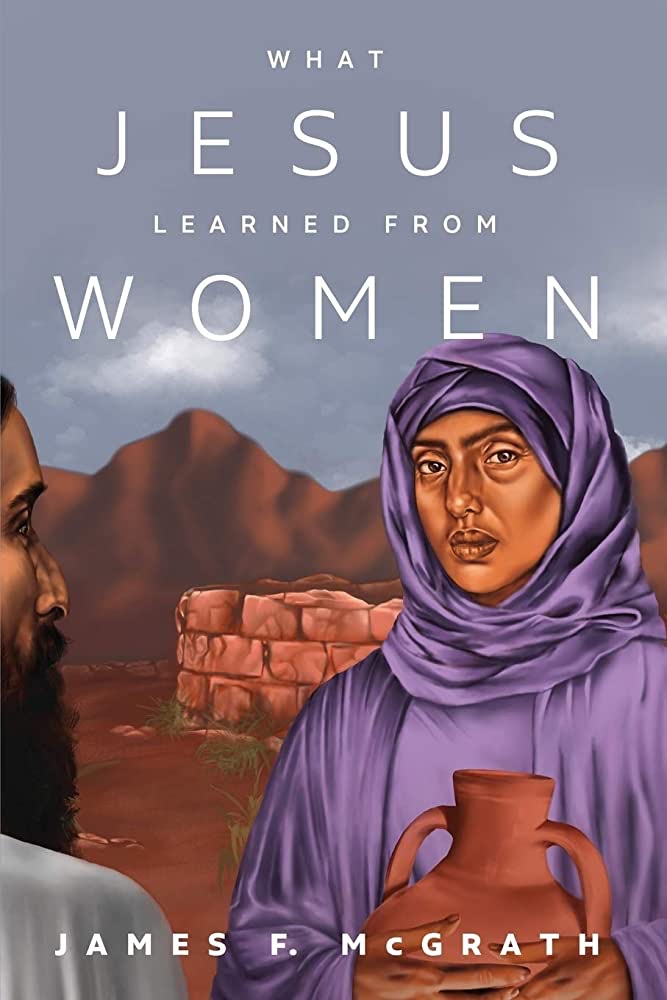
James McGrath has a chapter on what Jesus learnt from the woman of Samaria in his 2022 book, What Jesus Learned from Women (Cascade)

Other interpreters regard the “five husbands” as symbols for the five groups of people who were imported into the northern kingdom after it was conquered by the Assyrians. 2 Kings 17 does give an account of “the origins of the Samaritans”, in which it provides the claim that the Assyrians deported the Israelites living in the northern kingdom and imported people from five areas (people from Babylon, Cuthah, Avva, Hamath, and Sepharvaim; see 2 Ki 17:24) into the region.

This accurately reflects what we know of the practice of the Assyrians—deporting locals and importing vassals from other conquered territories from elsewhere in their kingdom. This was a clever power play; there was not much chance of local resistance, once the men were deported elsewhere, and a strong chance that those imported from elsewhere into the territory would maintain the status quo and ensure “peace” in the newly-conquered territory.

However, we need to bear in mind that 2 Kings and other historical narratives (1–2 Samuel, 1 Kings, Ezra—Nehemiah) are compiled and written by people in the southern kingdom, some time after the events reported—indeed, quite some time later, centuries later. The southern author(s) seem to have had a consistent programme to depict the northern kingdom as resolutely and persistently evil.

Just look at how so many of the northern kings are described in this formulaic manner: Jeroboam, son of Solomon, at 1 Ki 14:1–20 (and have a look at verse 11 for a gory fate!), the first king of the northern kingdom; and then Nadab at 1 Ki 15:25–26; Baasha at 1 Ki 15:33–34; Zimri at 1 Ki 16:15–20; Omri at 1 Ki 16:25–28; Ahab at 1 Ki 16:29–30, 22:37–40; Ahaz at 1 Ki 22:51–53; Jehoram at 2 Ki 3:1–2; Ahaziah at 2 Ki 8:26–27; Jehoash at 2 Ki 13:10–13; Jeroboam II at 2 Ki 14:23–29; Zechariah at 2 Ki 15:8–12; Menahem at 2 Ki 15:17–22; Pekahaiah at 2 Ki 15:23–26; Pekah at 2 Ki 15:27–31; and Hoshea at 2 Ki 17:1–4. In other words, almost all of the kings of Israel!!!

So what we have in 1–2 Kings is southern propaganda about those evil northerners, right from the time of Solomon’s death, on through the centuries, until the fall of the north under Assyria—who then imported pagan foreigners, had them “pretend” to follow the Lord God; but they brought their own various pagan religious practices, even whilst giving a show of worshipping the Lord God as the ancestral god of the land (2 Ki 17:7–18). So they defiled the land even further!!

We can see how the rhetoric in 2 Kings piles up against the northerners, courtesy of the southerners, writing at a time when great antagonism had built up about them. So I take the claim that this narrative was “history” with a big, big pile of salt.

And then we still have the question, how do we say that the text of John 4 is pointing to the story (the propaganda) told in 2 Kings 17? I can’t see anything in the John text that does so, other than the (typically southern) criticism of the northerners’ worship “on this mountain” (John 4:20–22) that is placed on the lips of Jesus—who, curiously, was a northerner from Galilee, not a southerner from Bethlehem. So the reference must maintain something of a mystery.

*****

The understanding of John 4 that I have outlined above has been developed through many fruitful conversations over the years with my wife, the Rev. Elizabeth Raine. My exploration of the “five husbands” has most recently been prompted by a question from Alison Campbell, a faithful reader of this blog.

“How can anyone be born after having grown old?” The questions of Nicodemus (John 3; Lent 2A)

The Gospel reading for this coming Sunday (John 3:1–17) is set in a house in the dark at night, as a prominent named male member of the Jerusalem Sanhedrin engages in conversation with a teacher from Nazareth, discussing faith and life. As Jesus engages with him, the conversation moves through a series of phases, going deeper into the issues raised. It’s a carefully-crafted literary piece—as, indeed, are all the encounters that Jesus has in the first half of John’s book of signs.

The conversation proceeds by means of a standard narrative technique: a question is posed, an answer is offered, leading to a further question, another response, and still further question-answer interchanges. This is an age-old technique used in teaching and in story-telling. It was also a standard aspect of the way that teachers of the Law operated in ancient Israel.

So the Pharisee of Jerusalem poses the question to the teacher from Nazareth: “How can anyone be born after having grown old?” and follows this immediately with a second question, “Can one enter a second time into the mother’s womb and be born?” (3:4). The reason for such a misunderstanding is that the Greek word used, anōthen, can be understood as “again” or “anew”, but can also be understood as “above”. In fact, “above” is by far the more common sense in which it was used. But the author has the teacher of Nazareth use this word, opening up a deliberate misunderstanding.

This misunderstanding, in turn, lead on to a response from the teacher (3:5) which digs deeper into the issues. Being born “from above” is akin to being born “of water and spirit”—or, it is possible to translate this, “of water and breath”. The Greek word placed on the lips of the teacher, pneuma, can refer to wind or breath—or spirit. Once again, a misunderstanding arises, giving opportunity for further exploration and instruction (3:5–8).

After the response from the teacher, the Pharisee asks a further question, “How can these things be?” (3:9)—to which the teacher from Nazareth responds, in the time honoured fashion (answer a question with another question), “Are you a teacher of Israel, and yet you do not understand these things?” (3:9-10). Touché!!

After this, the teacher from Nazareth launches into a longer explanation in response to the questions posed by the Pharisee of Jerusalem—an explanation which continues on for some time (3:11–21), leaving many commentators to wonder, just where does the conversation with the Pharisee from Jerusalem end, and where does the interpretive narrative of the evangelist take over? The Pharisee of Jerusalem has managed to draw from the man from Nazareth a teaching of some substance and significance.

This extended final section of the scene (3:11–21) contains clear evidence of the literary craft of the person who is telling the story. There are typical dualisms included in what the teacher says; he contrasts “earthly things” with “heavenly things”, “ascending into heaven” with “descending from heaven”, “perish” with “eternal life”, “condemn” with “save”—and, once again, “light” and “darkness”, a duality first expressed in the opening verses of the Gospel (1:4–9).

It also sets these dualisms into a pattern of parallel clauses, some of which provide a synonymous parallelism—two similar ideas placed in parallel (3:14; 3:19–20), some of which have antithetical parallelism—two contrasting ideas placed in parallel (3:12; 3:16–17; 3:18; and 3:20–21). Notice that this means that the final three verse of this section have an interweaving of both synonymous and antithetical parallelism, bringing the whole speech to a tight conclusion. “Coming to the light” is what Jesus desires, rather than “loving darkness”.

This is in fact the trajectory that Nicodemus has begun in this passage—the trajectory will continue on beyond into later sections of the Gospel. He has moved from an initial enquiry, through to a deeper pondering about what Jesus is saying. So this conversation has demonstrated a movement from the starting point, through a process that will ultimately lead to a clear expression of faith in in Jesus. We are left wondering, here in chapter 3: has the Pharisee become a disciple of the teacher from Nazareth?

The Pharisee of Jerusalem, we are told later in this Gospel, followed through after his initial conversation with the teacher (John 3)—in fact, he supported him in a debate in the Jerusalem council (John 7), and after the teacher had died, he publicly joined in the task of anointing his body and laying it to rest (John 19). His belief in what this teacher had taught, was now clear for all to see.

The Pharisee of Jerusalem had taken risks, explored his faith, and made significant changes in his life. He is a named high-status follower of Jesus, at least according to this particular Gospel, and his name is remembered throughout Christian history, by believers across the world: Nicodemus.

*****

In the Synoptic Gospels, it is Joseph of Arimathea who requests the body of Jesus from Pilate, and secures a safe place as the resting place for the body. In John’s Gospel, he does this in company with Nicodemus (John 19:39).

Joseph was “waiting expectantly for the kingdom of God” (Luke 23:51)—a phrase that recalls the discussion reported in John 3 (see verses 3 and 5). This “kingdom of God” was the very same phrase that is key to the preaching of Jesus in Mark and Luke. So Joseph was firmly aligned with Jesus and with his followers in Luke’s Gospel, whilst Matthew directly reports that he was “a disciple of Jesus” (Matt 27:57).

When Nicodemus first encounters Jesus, he had engaged in what might be characterised as an appreciative enquiry with Jesus, under the cover of night (3:2), presumably so that he didn’t “out” his interest in what Jesus was teaching. Some chapters later in John’s narrative, as Jesus experiences intensified opposition whilst in Jerusalem for the Festival of Booths (7:1–13), and the Pharisees and temple authorities join forces to send the temple police to arrest him (7:32), Nicodemus appears once more. The temple police return the temple, saying that they will not arrest him (7:45–46).

Nicodemus steps in; he is introduced as the one who “had gone to Jesus before, and who was one of them”—that is to say, one of the disciples (7:50). He speaks boldly: “our law does not judge people without first giving them a hearing to find out what they are doing, does it?” (7:51). The dismissive reply of the Pharisees further aligns him with Jesus; “surely you are not also from Galilee, are you?” is their rejoinder (7:52). His allegiance is clear, at least in the minds of the Pharisees, if not also the narrator of the Gospel.

Nicodemus returns a third time, after the death of Jesus, when the body of Jesus is requested by Joseph of Arimathaea, who is here clearly identified as being “a disciple of Jesus, but secretly, for fear of the Jews” (19:38). The fear of the Judean authorities has been a recurrent motif in John’s narrative (5:1; 7:13; 9:22; here, and 20:19). (The term I translate as “Judean authorities” is most commonly rendered as “Jews”, but this translation is too wide and does not accurately reflect the way the term is used in John’s Gospel.)

See further on “the Jews” at

Once again, Joseph is identified as a disciple of Jesus (John 19:38; so also Matt 27:57, and, as we have argued above, that is the implication in both Mark 15 and Luke 23). Both Joseph and Nicodemus, we might presume, were numbered among the “many, even of the authorities, [who] believed in him”, but who, “because of the Pharisees, did not confess it, for fear that they would be put out of the synagogue” (12:42).

The manner in which the body of Jesus is removed from the cross into the grave, anointed with an extravagantly large amount of spices, myrrh and aloes and wrapped in linen cloths “according to the burial custom of the Jews”, and placed in a previously unused tomb (19:38–40), reflects the tender, respectful approach of these two of Jesus’s disciples.

See more on Joseph at

So the Pharisee of Jerusalem is a character of some significance in John’s book of signs; he traces a pathway which the author hopes that those who hear his story or read his book will also follow, for “these are written so that you may come to believe that Jesus is the Messiah, the Son of God, and that through believing you may have life in his name” (20:31). It’s a most appropriate story, and relevant invitation, for the season of Lent.

*****

On what we know historically about the Pharisees, see

Tracing the saga of faithful people during Lent (Year A)

This year during the season of Lent, the Gospel readings offer a series of narratives which describe encounters that Jesus had (largely from the Gospel according to John). We hear of Jesus in dialogue with the devil in the desert (Matt 4, Lent 1), a Pharisee in Jerusalem (John 3, Lent 2), and a woman by a well in Samaria (John 4, Lent 3).

We then learn of a blind man to whom Jesus brings the gift of sight (John 9, Lent 4) and a dead man whom Jesus brings back to life (John 11, Lent 5), before we come to the annual retelling of the familiar story of Jesus, riding a donkey, entering the city of Jerusalem, to the cheers of the crowd (Matt 21, Lent 6 or Palm Sunday).

These stories tell of people who mostly, as a result of their encounters with Jesus, have their faith in God strengthened—the Pharisee, Nicodemus, at John 7:50 and 19:39; the woman of Samaria at 4:29, 39; the healed blind man at 9:17, 33; Martha, the sister of Lazarus at 11:27, and presumably Lazarus, as 12:10–11 may indicate; and the joyful crowd, at Matt 21:9–11. I am posting blogs on each of these readings as they come, in sequence, throughout Lent.

Alongside these well-known readings from the New Testament, the lectionary offers another sequence of rich readings from Hebrew Scripture. Starting with the story of the first man and first woman (Gen 2-3, Lent 1), we read in turn of four key moments in the story of Israel. This sequence begins with God’s call to Abram (Gen 12, Lent 2), followed the gift of water given to the Israelites as Moses leads them in the wilderness (Exod 17, Lent 3), and the story of the anointing of David as king (1 Sam 16, Lent 4).

The next moment is set during the Exile in Babylon (Ezek 37, Lent 5), when Ezekiel speaks a prophecy which assures Israel of a hopeful future: “I will put my spirit within you … and I will place you on your own soil” (Ezek 37:14). This reading sits neatly with the account of the raising of Lazarus (John 11) which appears alongside it on Lent 5.

For the celebration of Palm Sunday on Lent 6, there is only one Hebrew Scripture reading—Psalm 118, the psalm which the crowd is singing as Jesus enters Jerusalem: “blessed is the one who comes in the name of the Lord” (Ps 118:26; Matt 21:9). If, on the other hand, the Liturgy of the Passion is the focus of that Sunday, then the Hebrew Scripture passage is Isaiah 50:4–9a, the third of four songs attributed to The Servant, who declares that “the Lord has given me the tongue of a teacher, that I may know how to sustain the weary with a word” (Isa 50:4).

The sequence of key moments in the story of Israel offers a series of vignettes of faithful people from the last—our ancestors in the faith who stand as role models to encourage us, centuries later, in our own journey of faith. They are figures which are worth holding up for our reflection and consideration. These stories each have the function of an aetiology—that is, a mythic story which is told to explain the origins of something that is important in the time of the storyteller.

The online Oxford Classical Dictionary defines the term as follows: “Aetiology in religion and mythology refers to an explanation, normally in narrative form (hence ‘aetiological myth’), of a practice, epithet, monument, or similar.” Whilst telling of something that is presented as happening long back in the past, the focus is on present experiences and realities, for “such explanations elucidate something known in the contemporary world by reference to an event in the mythical past”.

See https://oxfordre.com/classics/display/10.1093/acrefore/9780199381135.001.0001/acrefore-9780199381135-e-7050;jsessionid=3DB38C42C54D01E1CBFA8682FB55DA4C

The ancestral narratives of Israel (Gen 12–50), as well as the series of books known as “the historical narratives” (Exodus to 2 Kings, Ezra—Nehemiah) are all written at a time much later that the presumed events which they narrate. The final form of the books as we have them most likely date to the Exile or post-exilic times, although pre-existing sources would have been used for many of these stories. Those older stories are remembered, retold, and then written, because they speak into the present experiences of the writers.

[Evidence for this is found, for instances, in references throughout the two books of Kings to “the Books of the Chronicles of the Kings of Israel” (1 Kings 14:19; 15:31; 16:5, 14, 20, 27; 22:39; 2 Kings 1:18; 10:34; 13:8, 12; 14:15, 28; 15:11, 15, 21, 26, 31), “the Books of Chronicles of the Kings of Judah” (1 Kings 14:29; 15:7, 23; 22:45; 2 Kings 8:23; 12:19; 14:18; 15:6, 36; 16:19; 20:20; 21:17, 25; 23:28; 24:5), and “the Book of the Chronicles of Solomon” (1 Kings 11:41). Many stories in other books may well be derived from oral tellings in past times.]

*****

The sequence of Hebrew Scripture readings in Lent begins with an aetiology which attempts to explain the place of humanity within God’s good creation, as well as offering an explanation for the presence of evil in the world (Gen 2:15–17; 3:1–7, Lent 1A). We need to read such a narrative with critical care; it is not an historical narrative, but it is a myth in the best sense of that word, a story told with creativity to explain aspects of contemporary life (for the writer) which may well hold good for later generations—but which need to be read with awareness of emerging insights in human knowledge over time.

Second in this sequence is the account of the calling of Abram, who journeys into a new future (Gen 12:1–4a, Lent 2A). We need to read beyond the point where the lectionary ends this passage; that selection indicates that Abram took Lot with him, but the narrative actually continues, indicating that Abram travelled with his wife Sarai and his nephew Lot, “and all the possessions that they had gathered, and the persons whom they had acquired in Haran; and they set forth to go to the land of Canaan” (Gen 12:5).

The lectionary is, sadly, blatantly sexist at this point: it includes the names of the two leading males, but omits noting that they travelled with their spouses, and indeed the reference to the presence of many others with them in their journey. We need to read this ancient aetiology with a contemporary critical awareness. Certainly, the faith of Abram and Sarai and their extended family is a key message conveyed by this passage.

The story explains four important aspects of life and faith for the people of ancient Israel and on into contemporary Judaism: the land is given to this people, the people (of Israel) will become “a great nation”, the name (of Abram) will be blessed, and the descendants of Abram, “all the families of the earth”, will likewise be blessed. These four points—land, people, name, descendants—loom large throughout the history of Israel. Indeed, they maintain their potency into the present age—and need to be read and understood with political and cultural sensitivity today.

After Abram and Sarai comes Moses and the people he is leading in the wilderness (Exod 17, Lent 3A). The long saga of the Exodus, the wanderings in the wilderness, the giving of the Law, and the understandings of the details of that Law, receives attention throughout four of the five books of the Torah (Exodus to Deuteronomy).

This particular incident in that long saga focusses on the providential care that the Lord God gives to the people of Israel during those “forty years in the wilderness”. The giving of water in the wilderness at Massah and Meribah (Exod 17) sits alongside the giving of manna and quails in the wilderness of Sin (Exod 16; Num 11). The model to emulate here is the faithful Moses, holding fast to the promise given to him by the Lord God, in the face of the complaining of the people (Exod 16:3, 6–7; 17:2–3, 7; Num 11:1–6; 14:27).

Next in the sequence of faithful people is David, chosen and anointed as king (1 Sam 16, Lent 4A). The passage offered by the lectionary tells of how David, the youngest of Jesse’s eight sons, was chosen by the prophet Samuel for the role of King, even while Saul was occupying that position. David will feature as a key player in the stories about the ensuing years, as “the house of David” is established and Jerusalem is developed as his capital city; and of course his place as the nominal author of the book of Psalms also ensures his leading role on Jewish tradition.

Next in order is the best-known prophecy of Ezekiel, the priest called to be prophet (Ezek 1:3). Ezekiel had been exiled to Babylon during the siege of Jerusalem by King Nebuchadnezzar II of Babylon (599 BCE; see 2 Kings 24:10–17). His prophetic activity was thus undertaken entirely in exile. He addresses both those in exile with him in Babylon, and also those left behind in Judah. His prophecies continue through the period when the people in Judah were conquered and taken to join Ezekiel in exile (587 BCE; see 2 Ki 25:1–21), and then for some time after that.

Ezekiel had declared that “the spirit entered me” (3:24), a process which he promises will be experienced by Israel as a whole (36:26–28)—for the Lord says he will “pour out my spirit upon the house of Israel” (39:29). This emphasis on the renewing spirit of God is seen, most dramatically, by Ezekiel when he is taken by the spirit into “the middle of a valley … full of bones” (37:1) and sees a vision that he conveys in what must be his most famous oracle (Ezek 37:1–14, Lent 5A). What Ezekiel sees in this valley of dry bones is the work of God, as God puts sinews and flesh and skin on the bones, and breathes into the bodies so created, so that they live (37:5–6, 8, 10).

The vision indicates what God will do: “I will put my spirit within you, and you shall live, and I will place you on your own soil” (37:14). The end of the exile, it seems, is in sight. This passage is often interpreted in a Christian context as a pointer both to the resurrection of Jesus, and also to the general resurrection; for Ezekiel, however, it is not a far-into-the-future prediction (foretelling), but a word of hope to the people in their immediate situation (forthtelling).

The sequence ends, of course, with the example of Jesus, riding steadfastly towards the city of Jerusalem (Matt 21:1–11, Lent 6A). That is the city where Jesus knows, and has already revealed, the fate in store for him: “see, we are going up to Jerusalem, and the Son of Man will be handed over to the chief priests and scribes, and they will condemn him to death; then they will hand him over to the Gentiles to be mocked and flogged and crucified; and on the third day he will be raised” (Matt 20:18–19).

Why did Jesus continue into the city, knowing this in advance? That’s a fascinating question, worthy of later consideration. For the moment, in this series of passages, we simply note his determined faithfulness and commitment to the task to which he had been called. He is the final figure of faithful commitment in the series that the lectionary takes us through during the season of Lent.

What are you looking for? Come and see! (John 1; Epiphany 2A)

“When Jesus turned and saw them following, he said to them, ‘What are you looking for?’ They said to him, ‘Rabbi’ (which translated means Teacher), ‘where are you staying?’ He said to them, ‘Come and see.’ (John 1:38–39).

“Come and see” is the key invitation spoken by Jesus in these opening scenes in the book of signs. First, in Judea, Jesus extends an invitation to Andrew, at that stage a follower of John, and one other, a fellow-disciple of John (1:35–40). Later, in Galilee, Jesus calls Philip to follow him (1:43), and when Philip is asked by Nathaniel about this interaction, Philip invites Nathaniel to “come and see” (1:46).

Some years later, “we wish to see Jesus” is the request made by some Greeks to Philip in Jerusalem at the Passover (12:21). And then, after the momentous events that ensure, “come, see” is the invitation that Jesus makes to his disciple Thomas, at the end of the book of signs, when he invites his doubting friend to “put your finger here and see my hands” (20:27).

This reading from the book of signs (which we know as the Gospel according to John) is an appropriate offering for this coming Sunday, the second Sunday in the season of Epiphany. The season celebrates the manifestation of God in Jesus, the one chosen by God to show God’s love to the world. The reading contains a number of pointers to that key theme of the book of signs—stories that reveal how God was present in Jesus.
In that interaction between Philip and “some Greeks”, Philip gathers Andrew, and together they approach Jesus to report the request made of them to “see Jesus” (12:22). Jesus informs them that what they will see, if they look with care, is “the hour … for the Son of Man to be glorified” (12:23)—a moment that occurs soon after, when the crowd mistakes “the voice from heaven” for thunder (12:28–29), but which is actually the light that shines in the darkness (12:35–36).

In Hebrew Scripture, the “glory of God” is the shekinah, the visible sign of the presence of God amongst God’s people (Exod 25:8)—in the stories of the wilderness wanderings, the shekinah was “the pillar of cloud by day to lead them on the way, and in a pillar of fire by night to give them light” (Exod 13:21–22). In John’s Gospel, when Jesus is glorified, he reveals the divine presence amongst human beings (John 1:14; 2:11; 11:4, 40; 12:16, 28, 41–43; 17:5, 22–24).

This is the climactic revelation of Jesus in the book of signs; and whilst this is signalled in the poetic prologue to the book (1:14), in the prose narrative that ensues in this opening chapter (1:19–51), a number of revelations of the identity and significance of Jesus are made.

Indeed, there is a series of Jewish titles which are embedded in this prose narrative, as key characters confess the significance of Jesus throughout this extended preface (1:19–51). Jesus is addressed as “Rabbi” (1:38, 49), “Messiah” (1:41), “King of Israel” (1:49), and “Son of God” (1:49). It is worth noting that these claims about Jesus are each made also within the Synoptic traditions. Indeed, the Johannine Jesus himself refers, in the allusive synoptic fashion, to the “Son of Man” (thirteen times, from 1:51 to 13:31), which we must presume to be a self–reference.

In later scenes, Jesus is also addressed by these Jewish terms, when he is called “prophet” (4:19), “Messiah” (4:29; 11:27), and “Rabbouni” (my teacher, 20:16). Then, the ultimate Christological confession of the Gospel is uttered by Thomas, when he moves beyond this viewpoint in the phrase, “my Lord and my God” (20:28), echoing the perception of the Jews, that Jesus was “making himself equal to God” (5:18).

Perhaps we tend to remember the fourth Gospel as the one which reveals the extensive cosmic significance of Jesus—the Word made flesh (1:14), the one closest to the heart of the Father who has “made the Father known” (1:18), and most famously, the one through whom God shows that “God so loved the world” (3:16). This Gospel seems to offer much in terms of a Saviour for the whole world (4:42), a sign for Greeks (that is, Gentiles) from beyond Judaism (12:20).

Yet, for the most part of this Gospel, Jesus is presented in terms drawn from within a Jewish context. Indeed, even the final, climactic confession by Thomas can be understood within a particular stream of Jewish tradition, for the hellenistic Jewish author Philo uses the terms “Lord” and “God” to designate the two major divine powers of creation (signified by “God”) and eschatological judgement (signified by “Lord”). In light of this usage of the terms by Philo, Jerome Neyrey wisely concludes that “Jesus is correctly called ‘God’ because he exercises creative power, and ‘Lord’ because he has full eschatological power”; see https://www3.nd.edu/~jneyrey1/MyLord.God.htm

So an important clue to a central motif running throughout this Gospel is placed in the mouth of Philip, when he says to Nathanael, “We have found him about whom Moses in the law and also the prophets wrote, Jesus son of Joseph from Nazareth” (1:45). The Jewish terms point to this reality about how Jesus was understood in the community within which the book of signs was written: Jesus is to be regarded as the fulfilment of scripture.

Notice that the author of this Gospel takes Philip, an almost anonymous figure in the Synoptic Gospels, and places in his mouth these key sayings, about the fulfilment of the scriptures (1:45), and the relevance of Jesus to Gentiles (12:20–26), and, indeed, the fundamental request, “Lord, show us the Father” (14:8). Philip articulates what the author of the book of signs seeks.

Now, it is true that the affirmation that Jesus fulfils scripture is common to all four canonical Gospels. It is very clear in the Synoptic accounts; we should not, however, diminish its significance on the fourth Gospel. This interpretive stance is hinted at as early as the Prologue, in the comparison between Jesus and Moses (1:17). It is stated explicitly, as we have noted, in the claim put on the mouth of Philip, “we have found him of whom Moses and the prophets wrote” (1:45), and later in the words attributed to Jesus, “You search the scriptures, because you think that in them you have eternal life; and it is they that bear witness to me” (5:39).

There are fifteen clear quotations from Hebrew Scriptures in this Gospel. There are eight explicit references to scripture in the early chapters (1:23; 2:17; 6:31; 6:45; 7:38; 7:42; 10:34; 12:13–15), while a “fulfilment formula” is used in later chapters, to introduce seven such scriptural quotations (12:38–40; 13:18; 15:25; 18:9; 19:24, 28, 36–37). There is also a passing note that Judas died after betraying Jesus “so that the scripture might be fulfilled” (17:12).

However, the total significance of the Hebrew Scriptures in this Gospel is much greater than these sixteen occurrences, as the Gospel contains numerous allusions to specific scripture passages, such as references to Jacob’s ladder (1:51) and the sacrificial lamb (1:29, 36), as well as more generalised allusions to scripture. These allusions are much freer in their form and indicate that, for the author of this Gospel, the Hebrew Scriptures had become an integral part of his mind and heart, for he treats them with a freedom born from intimate familiarity.

So this Gospel passage for the second Sunday in Epiphany reminds us of the Jewish origins of Jesus and also the continuing appreciation of Jesus in Jewish terms, throughout the early decades of the movement that was initiated by his proclamation and action in Galilee and (especially in John’s account) in Jerusalem, over some years. In our Christian appropriation of the figure of Jesus, we would do well to remember his Jewish origins, and the strongly Jewish nature of early Christian interpretation of Jesus. We owe much to Judaism, both as our ancient heritage and indeed as an enduring living faith which continues to proclaim faith in the God whom Jesus knew, and loved, and revealed.

John: fisherman and follower, eyewitness and evangelist, apostle and saint

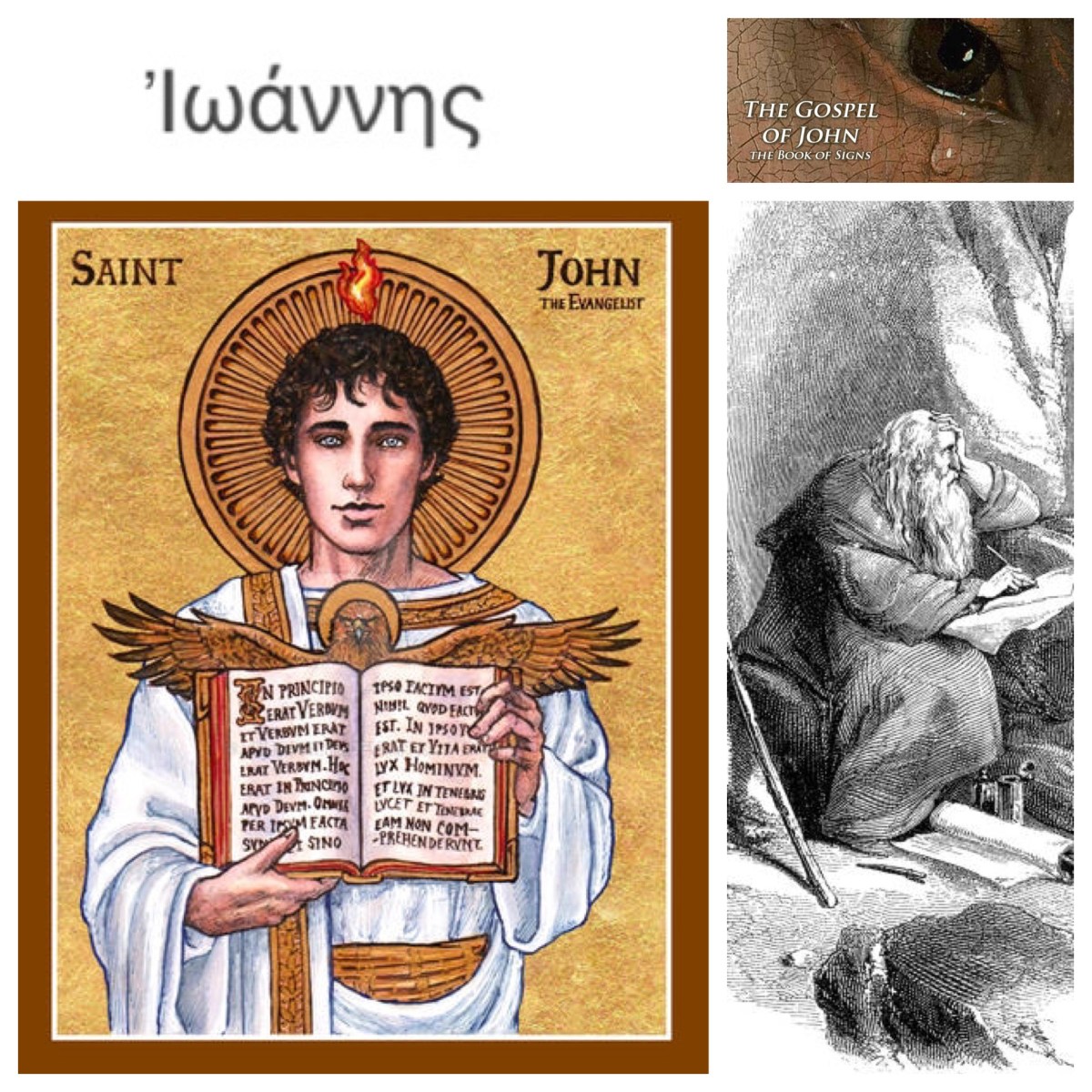
Today is the feast day of John, remembered in the Catholic tradition as Saint John the Apostle and Evangelist, and included in the Uniting Church’s list of commemorations as John, Witness to Jesus.

The fourth Gospel in the New Testament has long been accredited to the disciple named in the three Synoptic Gospels as the fisherman who was the brother of James and the son of Zebedee, one of the earliest called to follow Jesus (Mark 1:19: 3:17; Matt 4:21; 10:2; Luke 5:10; 6:14). Ironically, however, this disciple is not specifically named in the fourth Gospel. (Apart from John the baptiser, the other John noted in this Gospel is the father of Simon Peter; John 1:52; 21:15–17).

In the early fourth century CE, Eusebius wrote in his Ecclesiastical History (6.14.7) that Clement of Alexandria had described this Gospel as the “spiritual” Gospel, written to complement the “physical” depictions of Jesus found in the other three Gospels. (Clement was Bishop of Alexandria at the end of the second century CE.)

This view has exercised a widespread influence throughout Christian history; in the twenty–first century, John’s Gospel is often cited as the easiest way for new converts to understand the “spiritual truths” of the Christian faith. It is frequently said that it contains the most direct expression of the simple Gospel message: “God so loved the world that he gave his only Son …” (John 3:16).

More recent scholarly study of this Gospel, however, has indicated that it is a complex and intricate piece of literature. The literary style of this Gospel is distinctive amongst the Gospels found in the New Testament. Jesus speaks at far greater length than the succinct sayings and compressed argumentation reported of the Synoptic Jesus. Some of the key images included in these speeches are ripe with symbolic significance.

There are multiple layers of meaning to be explored in the fourth Gospel. A number of key words contain ironic references or wry puns. Some scenes tell of misunderstandings which arise because of the different meanings built into the text. A hint of secrecy runs through the narrative—secrecy regarding the deeper, hidden meaning of Jesus and his story. The work is a complex literary creation.

An anonymous figure among the disciples—“the disciple whom Jesus loved”—lays claim to be the author of this work (John 21:20, 24). Who is this figure? Over time, the evangelist came to be equated with the disciple John, son of Zebedee, brother of James. Nothing in the text itself explicitly supports this, however.

Over the past few decades, a different understanding about the origins of this work have developed from scholars who have explored the authorship of this Gospel and the context in which it was written. There is widespread agreement that this work was not written, in the form that we have it, by this John who was one of the earliest followers of Jesus.

Some scholars developed the notion that this figure of “the beloved disciple” was a symbol embedded within the narrative, representing an earlier authority for the evolving traditions about Jesus. The Gospel itself, they consider, came to be written down many decades after this authority figure had first begun to recount the story of Jesus. The shape of the Gospel was heavily influenced by the nature of the community of faith through which these stories were passed, over a number of decades.

This has led to a detailed hypothesis concerning the origins and development of the community of believers which gave birth to this Gospel in written form. (The North American scholars most often associated with this line of interpretation are Raymond Brown and J. Louis Martyn.) This hypothesis makes two central claims.

The first claim is that, in its earliest stages, the community which produced this Gospel had been essentially Jewish. That community received and retold stories which may well have come from the John who was a follower of Jesus. The second claim is that, by the time the body of the Gospel was written in the form that we know it, this community found itself in an antagonistic relationship to the dominant form of Judaism. This opened the way for Gentile ideas, so that they are found mixed with Jewish ideas in the final form of the Gospel.

So if this Gospel was indeed stimulated by the teachings of one of the first followers of Jesus, a Jewish man in Galilee, known as John, it reflects a remarkable trajectory in the first century of the movement initiated by Jesus, tracing its development from a Jewish renewal movement towards a global religion. The stories from the Apostle have presumably been reworked and reshaped over decades as that trajectory develops.

The “disciple whom Jesus loved” certainly occupies a prominent place in the narrative of the fourth Gospel. He reclines on the breast of Jesus at the final meal in Jerusalem (John 13:23) and stands at the foot of the cross with Mary, the mother of Jesus (19:26–27).

After Mary Magdalene announced that the stone at the entrance of the tomb where the crucified Jesus had been laid had been removed (20:1–2), he runs to the tomb, with Simon Peter (20:3), arrives first, and sees that the tomb is empty (20:4–5)—but leaves it to Peter to see the inside first (20:6–7), before himself entering and attesting to the empty tomb with his own eyes (20:8).

Later, when seven of the disciples are fishing on the Sea of Galilee, this same beloved disciple is the first to recognise Jesus standing on the beach next to their fire; this time, he announces the identity of Jesus to Peter (21:7). A little later, Peter draws from Jesus the words about this disciple remaining with him (21:20–23). Finally, the same beloved disciple has the last word in the later-added Appendix to the Gospel, affirming his role as eyewitness and evangelist (21:24).

This is the figure that, in the tradition, is linked with John, the fisherman brother of James, the son of Zebedee, one of the earliest followers of Jesus, accorded a place as one of The Twelve Apostles.

In the book of Acts, the disciple John visits Samaria with Peter, in order to authorise and sanction what Philip had been teaching and doing in that region (Acts 8:14–17). That episode indicates the respect and authority that John was held to have as the movement developed—although the author of Luke and Acts writes some decades after the events he describes, at the end of the first century, and his material is filtered through various intermediaries (see Luke 1:2).

“Apostles Peter and John Blessing the People of Samaria,”
by Giorgio Vasari, 1511-1574, Italian.

However, in one of his early letters from the 50s, Paul himself acknowledges this important position of John, along with James (brother of Jesus) and Peter, the “acknowledged pillars” of the church. Paul relates how he went, with Barnabas and Titus, to Jerusalem (Gal 2:1), in order to receive the approval from the mother church for his activity amongst the Gentiles. Accordingly, “James and Cephas and John, who were acknowledged pillars, recognized the grace that had been given to me, they gave to Barnabas and me the right hand of fellowship, agreeing that we should go to the Gentiles and they to the circumcised” (Gal 2:9).

This corroborates the view we find in Acts, that John had a position of importance in the early church. It doesn’t demonstrate, however, that this John wrote the book of signs, the work we know as the Gospel of John.

The scholar Jerome, born in Dalmatia (now Albania), lived for some time in Palestine in the late 300s. Jerome recounts an anecdote still being told at that time about John the Evangelist. When John was old and feeble and no longer able to walk or preach, he would be carried among the faithful in church and would repeat only one thing over and over again: “My little children, love one another.”

This, of course, is the central mantra in the first of the three letters that bear the name of John (see 1 John 3:11-17; 3:23; 4:7–12; also 2 John 5; 3 John 6). The legend explains how these anonymous letters were attributed to the apostle John.

Polycarp, through Saint Irenaeus, tells us that the Apostle John lived a long life, which ended peacefully in Ephesus around the year 100 CE. If that was so, then John was the only Apostle not to die a martyr. That may then equate him with the John who claims authorship of the book of Revelation, exiled on the island of Patmos (Rev 1:9). However, the style and language of this last book of the New Testament differs significantly from the style of the Johannine gospel and letters.

The Encyclopedia Britannica reports that two rival sites at Ephesus initially claimed the honour of being the grave of John. One eventually achieved official church recognition, becoming a shrine in the 4th century. By the 6th century the healing power of dust from John’s tomb was famous, and the church of Ephesus claimed to possess the autograph of the Fourth Gospel. We don’t have that manuscript today, however.

John was said to have written the Acts of John, a domestic work that was known in the second century; but it was condemned as heretical at the Second Council of Nicaea in 787 CE. And so the traditions about John continued to grow.

Indeed, in some Medieval and Renaissance works of painting, sculpture and literature, John is often presented in an androgynous or feminized manner, perhaps reflecting the ambiguous identity of “the disciple whom Jesus loved”.

St. John the Apostle by Jacques Bellange, artist
and printmaker from the Duchy of Lorraine, c.1600

All of which demonstrates the maxim that I hold for early Christian writings: the further away from the first century we get, the more information is known about the writers of the Gospels!!

Descended from David according to the flesh (Rom 1; Advent 4A)

In the selection from Paul’s letter to the Romans that is offered by this Sunday’s lectionary, Paul refers explicitly to the gospel concerning [God’s] Son, who was descended from David according to the flesh (Rom 1:3). In the midst of the Christmas carols and Christmas cake, the Christmas cards and the Christmas parties, there stands this stark affirmation: Jesus was a Jew. And, more specifically, that Jesus was a descendant of David.

It is noteworthy that Paul makes very little reference in his letters to the earthly life of Jesus; he is much more focussed on the death and the resurrection of Jesus, rather than his life of teaching, preaching, story-telling and miracle-working. In his letter to the Galatians, however, he makes a similar affirmation about the humanity, and the Jewishness, of Jesus: when the fullness of time had come, God sent his Son, born of a woman, born under the law (Gal 4:4).

Descended from David, born under the law: Jesus was clearly a Jew. That needs to sit at the heart of the story that we recall each year at this time. The Jewishness of Jesus is an essential element of the Christmas story.

Those who recount the story of Jesus, in the documents we know as the Gospels of the New Testament, are clear about this fact. Mark locates Jesus in Galilee, the northern part of the land of Israel, and identifies his home town as Nazareth (Mark 1:9; 10:47; 14:67; 16:6). Matthew and Luke follow the pattern established by Mark, in locating the vast majority of the activity of the adult Jesus in the northern regions of Israel.

Matthew intensifies this picture, however. At the start of his book of origins, he traces the lineage of Jesus back to David, and further back to Abraham (Matt 1:1-17). He traces this lineage of Jesus, not through his mother, Mary, but through Joseph—because it was Joseph who was of the lineage of David. This Davidic heritage of Jesus is central and important for Matthew, for he, most of all the evangelists, has characters in the story address Jesus as “Son of David” (1:1, 20; 9:27; 12:24; 15:22; 20:30–31; 21:9, 15, 42). He wants to advocate, as he tells his story, that it is through Jesus that the ancient promises to David will come to fruition.

At the start of his story, and at various places further on, Matthew notes that the actions and words of Jesus occur as fulfilment of prophetic words (Matt 1:22; 2:5, 15, 17, 23; 3:3; 4:14; 8:17; 12:17; 13:14, 35; 21:4; 26:56; 27:9).

Twice in his account of Jesus, Matthew is insistent that his active ministry and that of his first followers took place only amongst “the lost sheep of the house of Israel” (Matt 10:6; 15:24). For Matthew, Jesus was resolutely, scrupulously, Jewish.

The Gospel of John also reinforces the Jewish identity of Jesus. The Samaritan woman describes Jesus as “a Jew” (John 4:9), Jesus regularly travels to Jerusalem for Jewish festivals (John 2:13, 6:4, 7:1-10, 10:22, 12:12, 13:1), in conformity with Jewish piety. When Pilate questions Jesus, he recognises him as King of the Jews (18:33-35) and refers Jesus to Jewish leaders for their decision (18:31, 19:6-7, 19:14). Pilate then has him crucified under a sign identifying him as “Jesus of Nazareth, the King of the Jews” (as, indeed, the other three Gospels also report).

In the Gospel of Luke, the Jewish identity of Jesus is recounted, repeated, and intensified. Although often touted as the evangelist who most strongly orients the story of Jesus towards Gentiles throughout the hellenistic world of the Roman Empire, Luke actually sets his orderly account in the heart of Jewish piety, from the very opening scene of the Gospel which reveals a pair of righteous Jews who faithfully keep the commandments of God (Luke 1:5–6).

The man, Zechariah, is devoted to the service of God in the Temple (1:8–9). His wife, Elizabeth, expresses an attitude of deep faith in God, accepting her surprise pregnancy as “what the Lord has done for me” (1:25). Her relative, Mary, demonstrates a similar faith as she submits to a similar fate with the words, “here am I, the servant of the Lord” (1:38).

In turn, the traditional hopes and expectations of the people are articulated in spirit-inspired hymns sung by Mary (1:46–55), Zechariah (1:67–79) and Simeon the righteous (2:29–32). These are, by rights, the first Christmas carols—songs which sing of the one to come, which tell of the birth of one promised, which look with hope to the change he will effect. And they are resolutely Jewish.

The children whose births are recounted in these early chapters of Luke—Jesus and his cousin John—bear the weight of traditional Jewish hopes and expectations as they come into being. They are born as faithful Jews. They both lived in fidelity to the Jewish law. The mission of Jesus to fulfil the hopes articulated by Jewish prophets (Luke 4:18-21) and to point to the promise of the kingdom ruled by God (Mark 1:15; Matt 4:17) which, he proclaimed, was already becoming a reality in his own time (Luke 17:20).

The sense of deeply devoted and strongly conventional Jewish piety continues in the reports of the early years of Jesus. Luke’s Gospel reports that Jesus was circumcised (2:21) and dedicated in the Temple (2:22–24) in accordance with Jewish custom, and that he showed an early interest in the Law (2:41–51).

So we would do well not to skirt away from this very particular and specific aspect of the Christmas story.

As we come to the celebration of the child in the manger, let us remember that he spoke with a voice that called people—his people in Israel, and people beyond his people—to the enticing vision (sourced from the Hebrew prophets) of a world renewed and reconciled, where righteousness and justice were realities, where the hopes of Israel could flourish and come to fruition. That is the thoroughly Jewish vision that the story of Jesus offers.

…….

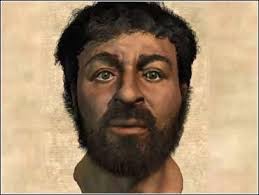
The featured picture portrays a Judean man from Jesus’s time, based on archaeological findings, and is often used as an image for what the historical Jesus may have looked like.

See also https://johntsquires.com/2019/12/11/the-origins-of-jesus-in-the-book-of-origins-matthew-1/

https://johntsquires.com/2019/12/17/now-the-birth-of-jesus-the-messiah-took-place-in-this-way-matthew-1/

https://johntsquires.com/2019/12/04/for-our-instruction-that-we-might-have-hope-rom-15-isa-11-matt-3/

https://johntsquires.com/2019/11/28/leaving-luke-meeting-matthew/

https://johntsquires.com/2018/12/19/what-can-we-know-about-the-birth-of-jesus/

The Paraclete as a “replacement Jesus” and the Doctrine of the Trinity (John 16; Trinity Sunday, Year C)

This coming Sunday is designated as Trinity Sunday. It’s an unusual occurrence, for two reasons. First, it’s the only time in the Christian calendar that a Sunday is named for a doctrine, rather than for a biblical story. And second, it is unusual in that it presents problems for the shapers of the lectionary, since (in my view) the Doctrine of the Trinity is not actually proclaimed in the biblical texts.

Yes, there are passages that canvass some aspects of the Doctrine—how the Son relates to the Father, what is the essential character of God, how the Spirit was experienced and understood, and how Son and Spirit might relate. But there is no biblical passage which articulates the full scope of the Doctrine of the Trinity: God is three, God is one, Father, Son, and Spirit, consubstantial, co-eternal, while unending ages run (as it were).

That’s quite understandable, since the full expression of this Doctrine took a number of centuries to develop, after the period in which the texts of the New Testament were written. If the latest NT text comes from the end of the first century, the earliest form of the Doctrine of the Trinity is found in the Apostles’ Creed, adopted by the Council of Nicea in 325 CE, and a more fulsome and complex form is to be found in the Nicene Creed, adopted by the Council of Constantinople in 381 CE.

So we should not expect the lectionary to provide any texts which set out the Doctrine of the Trinity. What we do find, however, is that certain texts are offered, in which some, or all, of the three persons of the Trinity—Father, Son, and Spirit—are in view.

In fact, two texts name all three persons in a quasi-formulaic way: the benediction at the close of 2 Corinthians 13, and final words of Jesus in Matthew 28. Indeed, these two passages are set for Trinity Sunday in the first of the three years of the lectionary, Year A. Associated with these two passages is a text that expounds something of the nature of one of these persons, God the Creator, in Genesis 1.

In Year B, two texts are offered which focus somewhat on the third person of the Trinity, the Spirit: Romans 8, where Paul wrestles with the role of the Sprit, and John 3, the conversation between Jesus and Nicodemus, which includes reference to the Spirit. The Hebrew Scripture offering in Year C draws from the wonderful depiction of Wisdom in Proverbs 8; while the epistle in Year C, from Romans 5, appears to be included because it manages to refer to each of the three person of the Trinity within the space of five verses.

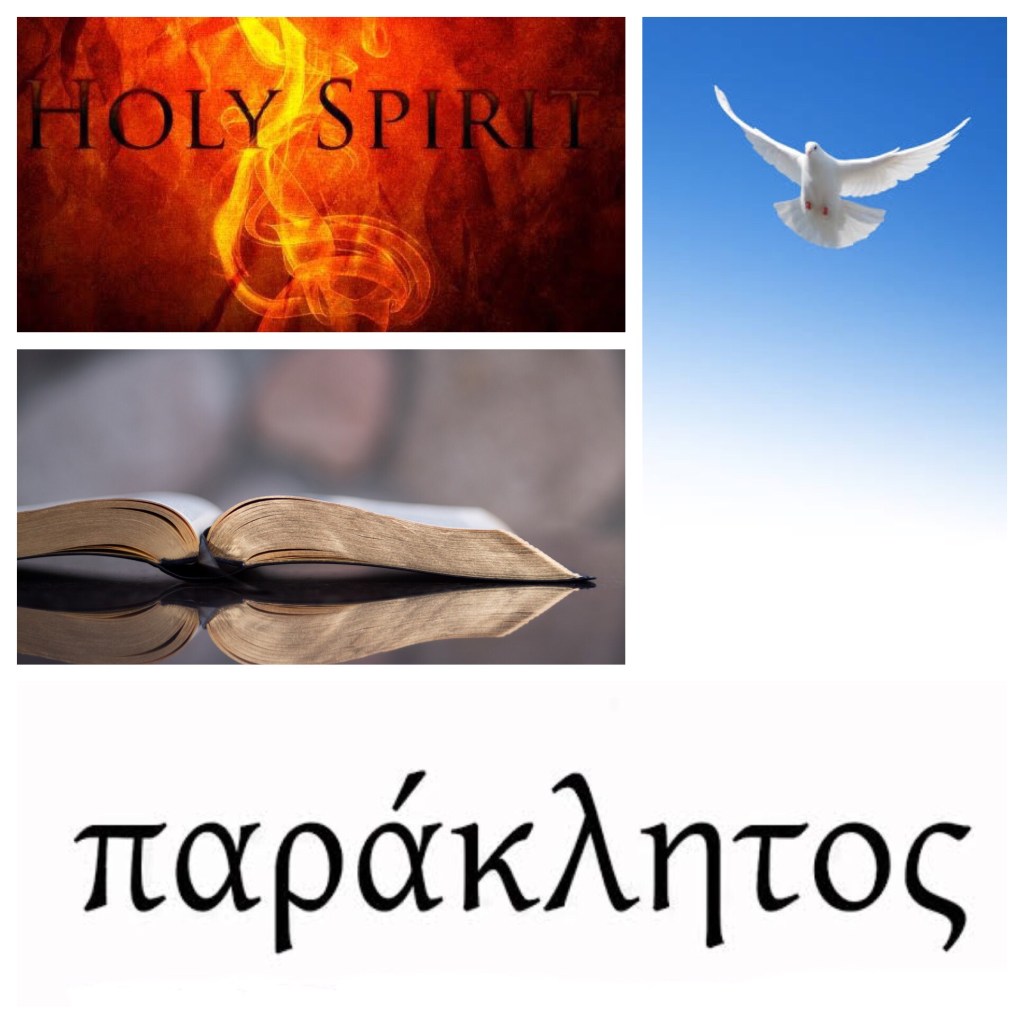
The Gospel offered in Year C (the current year) is just a short section (John 16:12–15) from the last chapter in the lengthy “farewell discourses” of Jesus (chs. 14–16), which John reports as being given to the disciples at the last meal that Jesus shared with his followers (from 13:1 onwards). It contains the fourth of four brief references in these “farewell discourses” to the Spirit, identified as “the Spirit of truth” (14:17; 15:26; 16:13), the parakletos (14:16, 26; 15:26; 16:7) and “the Holy Spirit” (14:26).

These passages are considered to provide some biblical material for the Doctrine of the Trinity relating specifically to the third person, the Holy Spirit. In particular, I am interested in how the Spirit is defined in relation to the other two persons of the Trinity.

There are three ways in which the Spirit is defined in relation to Jesus. First, the Spirit is identified as a parakletos—a word with multiple translation options. It could mean one who advocates for, one who provides counsel, one who offers help, or one who gives comfort.

See https://johntsquires.com/2019/06/07/the-paraclete-in-john-15-exploring-the-array-of-translation-options/

Whatever option we take in translating this word, it is striking that Jesus says that the main role of the Spirit (at least as we encounter the explanation in this gospel) is to be “another parakletos” (14:16). The implication is that Jesus himself has been a parakletos—an implication that is confirmed when we read the statement in 1 John, that “we have a parakletos with the Father, Jesus Christ the righteous; and he is the atoning sacrifice for our sins, and not for ours only but also for the sins of the whole world” (1 John 2:1–2).

This first statement about the Spirit thus places the Spirit in the position that Jesus had whilst living in human form amongst the people of Israel. The Spirit is the present manifestation of the role that Jesus of Nazareth had all those centuries ago. The Spirit is, in effect, a “replacement Jesus”.

Indeed, this is strengthened by the affirmation that this figure will “abide with you … and be in you”, precisely the same terminology used of Jesus in the earlier parable of the vine (“abide in me and I abide in you”, 15:4) and in the final prayer that Jesus prays before his arrest (“may [they] be one, as we are one, I in them and you in me, that they may become completely one”, 17:22–23]). The reality of the presence of the Spirit is the same as the reality of the presence of Jesus when he was with the disciples.

This idea is confirmed by the second statement about the parakletos, who is the one “whom the Father will send in my name” (14:26), the one “whom I will send to you from the Father” (15:26). Indeed, Jesus makes it clear that “if I do not go away, the parakletos will not come to you; but if I go, I will send him to you” (16:7). This seems to suggest that the Spirit is unable to take up the role assigned to it until Jesus has departed from his followers—the Spirit is a “replacement Jesus”.

Indeed, at an earlier point in the narrative, on “the last day of the festival, the great day” (7:37; the festival referred to was Booths, 7:2), Jesus was speaking about the Spirit, and portraying the “rivers of living water” that the Spirit would give, as something still to come. The narrator informs us that he was speaking “about the Spirit, which believers in him were to receive; for as yet there was no Spirit, because Jesus was not yet glorified” (7:37–39).

This, of course, is directly contradicted by the many references in Hebrew Scripture to the activity of the Spirit in Israel (Gen 1:1–2; Job 33:4; Ps 104:30; Isa 42:5, 44:3, 48:16, 59:21, 61:1, 63:11–14; Num 11:16–17; Deut 34:9; 1 Sam 10:6, 19:23–24; Ezek 37:1; Joel 2:28–29). Nevertheless, the definitive arrangement of things that is held to quite firmly in the book of signs, is that the Spirit comes only after Jesus has returned to the Father.

The language of sending is used frequently in the fourth Gospel, in describing the relationship between the Father and the Son. The Father is regularly described as the one who sent the Son (3:34; 4:34; 5:23, 30; 6:29, 39, 44, 57; 7:16, 18, 28–29, 33; 8:16, 18, 26, 29, 42; etc). In the final prayer of Jesus, the Father is “him who sent me” (17:3, 8, 18, 21, 23, 25). Amongst the final words of the risen Jesus, we hear Jesus say again, “as the Father has sent me” (20:21).

So, when Jesus refers to the parakletos as the one “whom the Father will send in my name” (14:26), he is reinforcing the notion that the Spirit is the “replacement Jesus”. This is further strengthened by the affirmation that the parakletos will “teach you everything, and remind you of all that I have said to you” (14:26). The language of teaching also recalls a key function of Jesus, who “went up into the temple and began to teach” (7:14), who “sat down and began to teach” the people in the temple (8:2), who characterises his ministry as “I have always taught in synagogues and in the temple, where all the Jews come together” (18:20).

Further, Jesus describes the role of the parakletos as “he will take what is mine and declare it to you” (16:15). Jesus has already declared that “my teaching is not mine but his who sent me” (7:16) and “the word that you hear is not mine, but is from the Father who sent me” (14:24); now he passes that divinely-given material on to the parakletos, clearly stating that “he will take what is mine and declare it to you. All that the Father has is mine. For this reason I said that he will take what is mine and declare it to you” (16:14–15). The teaching function that the parakletos performs is to replicate the teaching role that Jesus has already enacted.

The content of the teaching provided by the parakletos is also evocative of the teaching that Jesus has provided. The parakletos will teach “about sin and righteousness and judgment” (16:8, expanded in 16:9–11). In relation to sin, what Jesus does as “the lamb of God” is to “take away the sin of the world” (1:29); he provides freedom from the slavery of sin (8:34–36), and the final commission that he gives his disciples (who are sent just as he has been sent) is to decree that they have the authority of grant forgiveness of sins (20:23).

Likewise, in relation to judgement, Jesus has stated, “as I hear, I judge; and my judgment is just, because I seek to do not my own will but the will of him who sent me” (5:30), and again, “even if I do judge, my judgment is valid; for it is not I alone who judge, but I and the Father who sent me” (8:16)—although later, Jesus asserts that “I came not to judge the world, but to save the world. The one who rejects me and does not receive my word has a judge; on the last day the word that I have spoken will serve as judge” (12:47–48).

Thus, as the parakletos teaches about sin, and about judgement, the teachings of Jesus on these matters are repeated. (On the matter of righteousness—apart from a single reference to God as “righteous Father”, 17:25—this Gospel is silent.) Again, we see that the parakletos is a “replacement Jesus”.

Finally, the distinctive term used in this Gospel to describe the Spirit, “the Spirit of truth”, also reinforces this way of viewing the relationship between the Son and the Spirit. The Johannine Jesus is “the Word became flesh” who “lived among us … full of grace and truth” (1:14). It is through Jesus Christ that “grace and truth came” (1:17). Jesus describes himself to the leaders in Jerusalem as “a man who has told you the truth that I heard from God” (8:40), and to the Roman Governor, Pilate, he declares, “for this I was born, and for this I came into the world, to testify to the truth. Everyone who belongs to the truth listens to my voice” (18:37).

So Jesus tells his followers that “if you continue in my word, you are truly my disciples; and you will know the truth, and the truth will make you free” (8:31–32), and even affirms unreservedly that “I am the truth” (14:6). Again, the language applied to the Spirit links in with key terminology that describes Jesus and his role. The Spirit of truth now teaches “the truth that will make you free”, that the one who is the truth had taught.

Finally, it is noteworthy that nowhere in the book of signs is there any direct statement about the relationship between Father and Sprit. Although Jesus states that “God is spirit” (4:24), the relationship is always, apparently, mediated through the Son: the Father sends the Son, the Son sends the parakletos; the Son teaches what the Father provides, the parakletos continues the teaching of Jesus; the Father incarnates the Word “in truth”, the Son teaches and is “the truth”, so the Spirit is named as “the Spirit of truth”.

In summary, the relationship between Son and Spirit reads to me as a quite hierarchical style of relationship—not at all a relationship of equals who abide in each other, who are of the same nature and share the same substance with one another, who exist co-eternally and inherit co-equally. Indeed, in the relationship between Father and Spirit/Parakletos, there is no direct link, as there is in the classic Doctrine of the Trinity; all is mediated through the Son, as we have seen. The fourth Gospel offers a different, distinctive—we might even say, unorthodox—theology of Father, Son, and Spirit/Parakletos.

The Trinity is a complex idea, a doctrine with many subsets and dimensions and component parts. Although there are passages in scripture which many say point to this doctrine, nevertheless gaining a full understanding of this doctrine really means entering into the world of metaphysics, philosophy, and linguistics of a later age.

All of this is beyond the capacity of the lectionary to provide, nor can it be done in a relatively brief reflection time within a Sunday worship service—and it runs the risk of charging away from the world of ideas in which the biblical texts were written, and opening up the danger of imposing later ideas, anachronistically, onto those texts.

The little passage from the Gospel of John that we encounter in the lectionary this coming Sunday actually points us in quite another direction!

*****

See also

Scriptural resonances in Revelation 21–22 (Easter 6C)

The section of Revelation provided by the lectionary for this coming Sunday (21:10, 22–22:5) is the final vision from a long sequences of visions, in which the writer, carried “in the spirit” to “a great, high mountain”, sees “the holy city Jerusalem, coming down out of heaven from God” (22:10).

The top of a mountain is significant in biblical narratives; we only need to remember Moses atop Mount Sinai, receiving the commandments from God (Exod 19:1–25) and viewing the promised land, which he would not himself enter (Deut 34:1–4); and Jesus on the mountain in Galilee, teaching his disciples (Matt 5:1–7:28), being transfigured in the presence of Moses and Elijah (Matt 17:1–8), and giving his last instructions to his followers before departing from them (Matt 18:16–20).

Visions in Scripture

There are many accounts of visions being seen by people on earth, as God reveals guidance to them; noteworthy are the visions of Abraham (Gen 18:1–16), Moses (Exod 3:1–6), Balaam and his donkey (Num 22:22–35), Joshua (Josh 5:13–15), Eli (1 Sam 3:2–18), and the visions of various prophets (Isa 6:1–13; Ezek 2:1–10; Ezek 40:1–44:31; Dan 7:1–14; Dan 8:1–14; Amos 7:1–9; Amos 8:1–14; Zech chapters 1–6).

In early chapters of the Gospels, visions experienced by key figures shape the course of the story—Zechariah (Luke 1:8–20), Mary (Luke 1:26–38), shepherds (Luke 2:8–14), and Joseph (Matt 1:19–21; 2:13; 2:19–20). Paul experienced “visions and revelations of the Lord” (2 Cor 12:1–7a); according Luke’s account of the journey he took towards Damascus, it was the visions to both Ananias and to Paul himself (Acts 9:10–12) that brought Paul into the community of believers, in a life-transforming moment.

However, the most notable vision is surely that experienced by Peter, in Joppa: “he saw the heaven opened and something like a large sheet coming down, being lowered to the ground by its four corners. In it were all kinds of four-footed creatures and reptiles and birds of the air. Then he heard a voice saying, ‘Get up, Peter; kill and eat.’” (Acts 10:11–13). This vision not only changes Peter’s understanding of things; it sets forth the rationale for the fundamental nature of the movement founded by Jesus, as an inclusive community of Jews and Gentiles.

Visions in Revelation 19–22

The vision that the author of Revelation sees is part of an extended sequence of visions which are introduced by the same phrase that is used in Acts: “then I saw heaven opened” (19:11; cf. Acts 10:11). God’s opening of the heavens is recognised by the psalmist (Ps 78:23) as the means by which manna was provided in the wilderness; and perhaps this resonance is picked up in the Gospel accounts of the baptism of Jesus in the Jordan, when Jesus “saw the heavens torn apart and the Spirit descending like a dove on him” (Mark 1:10 and parallels). God tears open the heavens to bless and to commission.

More pertinent, however, is the statement by Isaiah, in an oracle describing incredible devastation wrought in divine judgement over Israel, when “the earth shall be utterly laid waste and utterly despoiled … the earth dries up and withers, the world languishes and withers; the heavens languish together with the earth [for] the earth lies polluted under its inhabitants” (Isa 24:3–4). The prophet declares that “the windows of heaven are opened, and the foundations of the earth tremble; the earth is utterly broken, the earth is torn asunder, the earth is violently shaken” Isa 24:18–19). This is a fearsome rending apart of the heavens!

So, too, in Revelation, where the opening of the heavens (19:1) reveals a series of seven visions. There is a vision of an intense, violent battle (19:11–21), a vision of the binding of a dragon and “the first resurrection” (20:1–6), and two visions of judgement (20:7–10, 11–15); followed by a vision of “a new heaven and a new earth” (21:1–8), a vision of “the holy city Jerusalem, coming down out of heaven from God” (21:9–27), and then the final vision of “the river of the water of life, flowing … through the middle of the street of the city” (22:1–5).

Scriptural resonances in the visions of Revelation 19–22

In the initial vision of a cataclysmic battle, “the beast and the kings of the earth”, along with their armies, are confronted by a fiery, blood-soaked rider on a white horse, with “the armies of heaven” (19:11–16). The description of this particular figure, as is so often the case on this book, draws from biblical imagery (eyes like a flame of fire, sharp sword, rod of iron, treading the winepress). Indeed, each of the visions that follow are themselves thoroughly shaped by biblical language and imagery. As the author looks forward, he draws heavily on the traditions and stories of his own faith, as expressed in the scrolls of Hebrew Scriptures with which he is intimately familiar.

An angel steps forward to issue the call to battle—yet his call is an invitation to “the great supper of God” (19:17). The image of a supper had been utilised by the prophet Isaiah, who saw the final gathering of the nations in terms of a lavish feast (Isa 25:6–10; see also 55:1–5). This time, however, the supper is a feast for cannibals—turning the imagery upside-down, in a manner reminiscent of a grisly oracle uttered by Ezekiel (Ezek 39:17–20).

The beast and his false prophet are thrown alive into a lake of burning sulphur, evoking the punishment visited upon Sodom and Gomorrah (Gen 19:24–25; Deut 29:23; 3 Macc 2:5; Luke 17:28–30). The armies of the kings of the earth are slain by the sword, and Satan is cast into a locked pit for one thousand years (19:17–20:6). This recalls an oracle delivered by Isaiah, in which he declared that God, in judgement, would imprison “the host of heaven and the kings of the earth” (Isa 24:21–22).

But for a thousand years? The Psalmist says that “a thousand years in [God’s] sight are like yesterday when it is past, or like a watch in the night” (Ps 90:4), and a late New Testament book affirms that “with the Lord one day is like a thousand years, and a thousand years are like one day” (2 Pet 3:8); however, we should note that the period of one thousand years is nowhere associated with divine punishment elsewhere in biblical texts.

After the release of Satan, one further battle takes place, against “the nations … Gog and Magog” (20:8). The account in Revelation 20 is brief, but the distinctive names (Gog and Magog) evoke a reference to an older battle against invaders from the north, described by Ezekiel (Ezek 38:1–39:20). This decisive encounter effected the definitive punishment of God and paved the way for the promised restoration of Israel to the land (Ezek 39:21–29) and the vision of a restored temple (Ezek 40:1–46:24). The same pattern is followed in Revelation 20. After the battle against Gog and Magog, the devil is also cast into the lake of burning sulphur, all the dead are judged, and Death itself is destroyed (20:7–15).

This is followed by the establishment of a new heaven and a new earth, a place devoid of death, bathed in light, sustained by the water of life, a city dazzling with jewels and home to “the throne of God and of the Lamb” (21:1–22:5). The vision appears closely related to the final visions reported at the end of the book of Isaiah (Isa 65:17; 66:22–23).

The imagery used in these verses relates particularly to various sections of the book of Isaiah. The bride prepared for her husband (21:2) recalls the scene of Isa 61:10; the wiping away of tears (21:4) evokes the banishing of sorrow (Isa 35:10). The gift of water from the spring of life (21:6) is suggestive of the way that water functions as an image of life (Isa 35:6–7; 41:18), and the prominent place of the river of the water of life in the new Jerusalem (22:1–2) evokes Isaiah’s link between “the new thing” and “rivers in the desert” (Isa 43:18–21).

Likewise, the description of the spectacular beauty of the city and the careful itemizing of its measurements (21:10–21) imitates the section of Ezekiel where the Temple of his vision is carefully described and numerous measurements are provided (Ezek 40–42). What is noteworthy, of course, is the pointed declaration that “I saw no temple in the city” (21:22) and the insistence that the divine presence will provide more than enough light for the whole city (21:23– 25; 22:5).

Despite the author’s lengthy and intricate entwining with scriptural sources, in this final vision he points beyond the past, to a new form of the future. Yet still, he reaches back before the temple, to the times when the shining light signaled the divine presence (Exod 3:2; 13:21–22; Ps 78:14). In similar fashion, perhaps the prominence of the tree of life (22:2) is intended to supplant the many trees beside the river in Ezekiel’s vision (Ezek 47:12) and provide a reminder of the single tree in the creation story (Gen 2:9).

The closing scenes this provide assurance of God’s providential care of the people of Israel, and perhaps even of the whole earth. Indeed, the familiar patterns of this life, as we know it—night and day, light and dark, even life and death—will be transcended in this new order of reality. Written for a people in the midst of oppressive persecution, this glorious vision and triumphant conclusion provides assurance, reinforcing their faith with hope and certainty.

So it is no wonder, then, that the prayer of those who first heard these visions proclaimed to them, is simply: “Come” (22:17, 20). As we know, that coming was not, as was hoped for, “soon” (22:7, 12, 20). How we now apply these visionary words to our own times is the challenge that rests with us!

See https://johntsquires.com/2022/05/04/with-regard-to-revelation-and-rev-14/

*****

This blog draws on material in JOURNEYING WITH JOHN: an exploration of the Johannine writings, by Elizabeth Raine and John Squires (self-published 2014)

The Father and I are one (John 10; Easter 4C)

Each year, on the fourth Sunday of the season of Easter, the Revised Common Lectionary provides a section of John 10 as the Gospel reading for the Sunday. That chapter is where Jesus teaches about his role as “the good shepherd” who lays down his life for the sheep. The chapter is divided over the three years: 10:1–10 in Year A, then 10:11–18 in Year B, and 10:22–30 in the current year, Year C. For this reason, this particular Sunday is sometimes called the Good Shepherd Sunday.

The section offered in Year A concludes with the classic claim of Jesus, “I came that they may have life, and have it abundantly” (10:10). The passage set for Year B begins with the famous affirmation, “I am the good shepherd; the good shepherd lays down his life for the sheep” (10:14-15).

Both passages develop the image of Jesus as the shepherd of the sheep, in intimate relationship with the sheep; the shepherd knows his own (10:15), calls them by name (10:3), shows them the way of salvation (10:9), and lays down his life for the sheep (10:11, 15, 17–18).

The third section from John 10, offered in Year C, is set at a different time. The earlier sections (10:1–10, 11–18) had followed on from the story of the man born blind (9:1–41), which itself has emerged out of the conflicts between Jesus and Jewish authorities (7:10—8:59), reported as taking place in Jerusalem during the Festival of Booths (7:2). That sequence of conflicts had culminated with the Jewish authorities picking up stones to throw at Jesus (8:59).

The second moment when Jewish authorities in Jerusalem prepare to stone Jesus (10:31) is at the end of the later part of John 10, in this Sunday’s reading (10:22–31). This section, still in Jerusalem, is set during the Festival of the Dedication (10:22), some time later than the earlier Festival of Booths (7:2). It includes a further statement about the shepherd: “my sheep hear my voice. I know them, and they follow me. I give them eternal life, and they will never perish. No one will snatch them out of my hand.” (10:27–28).

However, the focus on this section is less on the shepherd and the sheep, and more on Jesus and his relationship with the Father. Indeed, the lectionary ends the section before the climax of the conflict, when Jewish authorities pick up stones (10:31). Rather, the final verse places the emphasis in quite another direction: “The Father and I are one” (10:30). This is one of a number of key verses in this Gospel where important claims about Jesus are placed onto his lips.

Wayne Meeks (in his classic article, “The Man from Heaven in Johannine Sectarianism”, JBL 91 (1972) 44–72) notes that the claims made about Jesus in the fourth Gospel function as reinforcements of the sectarian identity of the community. As this community had come into existence because of the claims that it had made about Jesus, so the reinforcement of the life of the new community took place, to a large degree, through the strengthening and refining of its initial claim concerning Jesus.

Claims made about Jesus, the Messiah (Christ) thus function as markers of the emerging self–identity of the new community, over against the inadequate understandings of Jesus which continue to be held in the old community (the synagogue), still under the sway of the Pharisees. This function can be seen in a number of other terms which are used of Jesus in the Gospel according to John.

As Meeks notes, one of the most common self–designations of the Johannine Jesus is that he is “the one sent from God”. This is another phrase which is unique to the Gospel according to John; the nearest Synoptic equivalent is found in the parable of the vineyard (Mark 12:1–8 and parallels).

The phrase may well originate in the Jewish notion of the shaliach, or messenger (for the wordplay involved in this word, see 9:7). A recognisable form of this phrase occurs 42 times in this Gospel (for instance, at 1:33; 3:34; 4:34; 10:36; 11:42; 20:21).

This claim consolidates the link between Jesus and God, binding his mission to the mission of the Father, and making a claim for Jesus which transcends the kind of claim which could be made of a chosen messenger figure.

Jesus is clear that he belongs to the world “above”, the heavenly realm, where— according to the worldview of the time—God is to be found. He declares, “I am from above…I am not of this world” (8:23); this is in contrast to the Pharisees, who are “from below” and “of this world”.

As king, he informs Pilate, he rules over a kingdom which is “not from this world” (18:36). The distinction between Jesus and the earthly authorities of the day is firmly held; Jesus belongs with God. He comes to earth in order to bring into effect the judgement of God over “the ruler of this world” (12:30–33).

Another characteristic which dominates the Christology of this Gospel is the Father-Son relationship (3:35–36; 5:19–23, 26; 6:37–40; 8:34–38; 10:32–38; 14:8–13; 17:1–5). At the conclusion of the Prologue, the importance of this relationship is established: “it is God the only Son, who is close to the Father’s heart, who has made him known” (1:18).

In one of his disputes with the Jewish authorities, Jesus declares that he does his works “so that you may know and understand that the Father is in me, and I am in the Father” (10:38). This mutual interrelationship is brought to the pinnacle of its development in the lengthy prayer of chapter 17. The purpose of describing this relationship in this way is to strengthen the claims made for Jesus, to validate him as authoritative, in the context of debates with the Jewish authorities.

Finally, Jesus is perceived as being “equal with God” (5:18). At the narrative level, this is a polemical view of Jesus, attributed to the Jews. However, the author of the Gospel clearly wants the readers to agree with the claim. This is supported by further comments such as: it is clearly evident that he is the Messiah, for he is “doing the works of God” (10:24–25); he is one with the Father (10:30); he is “making himself a god” (10:33); “he has claimed to be the Son of God” (19:7); and he is acclaimed as “Lord and God” (20:28).

This is the strongest claim made about Jesus; it lifts him above the realm of human debate and, as a consequence, it also lifts the claims made by his disciples, in his name, above that human realm. By this means, the community of his followers lay claim to a dominant, privileged position, vis–a–vis the Jewish authorities.

The Christology which is proclaimed in the written Gospel has thus been developed and refined in the controversies and disputes of the community over the preceding decades, as each of these markers of the identity of Jesus were debated amongst Jewish groups, and as the community formed around Jesus differentiated itself in various ways from the dominant stream of Pharisaic Judaism (especially in the period after the destruction of the Temple in 70 CE).

Later Christian theology developed the doctrine of the Trinity, in which God, Jesus and the Spirit relate to one another as equals. Whilst the Gospel of John provides biblical warrant for the equality of Father and Son, the role of the Spirit is less prominent. Jesus is endowed with the Spirit at his baptism (1:32– 33) and gives the Spirit to others through the words he speaks (3:34).

However, the Spirit is clearly subordinated to the Son in this Gospel. It is not until after Jesus is glorified that the Spirit is given (7:39; 20:22). The role of the Spirit is to be the Advocate of the Son (14:16, 26; 15:26; 16:7), sent by the Son to testify on his behalf (15:26) and to represent what has already been spoken by Jesus (14:26; 16:13–15). As the Son testifies to the truth (1:14, 17; 8:32, 45–46; 14:6; 18:37), so the Spirit is “the spirit of truth” (14:17; 15:26; 16:13).

So the long, extended scene in Jerusalem ends as “they tried to arrest him again, but he escaped from their hands” (10:39). Jesus moves “across the Jordan to the place where John had been baptizing earlier” (10:40), where many expressed their belief in him. The next, more intense, conflict still lay ahead of Jesus—by raising Lazarus from the dead (11:38–44), Jesus placed himself firmly in the sights of the Jerusalem leadership; his own death was brought firmly into view (11:45–53; 12:10–11).