Reading the prophetic texts during Advent (Isaiah 11; Advent 2A)

For much of the year, the lectionary presents us with a First Reading taken from the Hebrew Scriptures. (The exception is during Easter, when a reading from Acts stands as the First Reading.) I am regularly asked, “why has this reading been chosen?” In Epiphany and the “ordinary” season of the Sundays Epiphany after Pentecost, the reading is consecutive—or almost consecutive—following the narrative of a designated book, or set of books, in order. So there is not necessarily any obvious, or intentional, link between the Hebrew Scripture, Epistle, and Gospel readings.

For the seasons of Lent and Advent, however, the selection of each Sunday’s First Reading and Epistle is made with a deliberate intention to connect with the Gospel for that Sunday. So the way the lectionary is built itself includes a bias towards seeing the Gospel reading as the primary focus, and the other readings as feeding into that focus. Nevertheless, the immediate connection with the Gospel for this Sunday—an account of the fiery apocalyptic preaching of John the baptiser (Matt 3:1–12)—is not immediately evident.

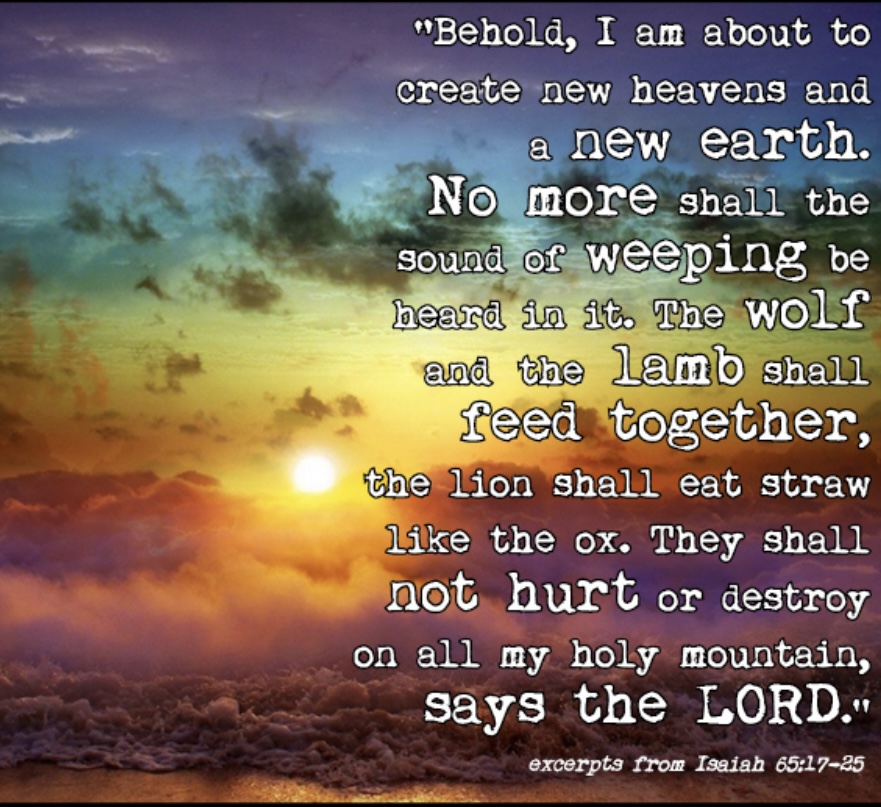
The First Reading offered for this coming Sunday is an oracle from Isaiah (Isa 11:1–10, Advent 2A) in which a vision of universal harmony is expressed: “the wolf shall live with the lamb, the leopard shall lie down with the kid … the nursing child shall play over the hole of the asp, and the weaned child shall put its hand on the adder’s den” (Isa 11:6–8).. It follows from the earlier reading last Sunday (Isa 2:1–5, Advent 1A) in which a similar vision is expressed: the nations “shall beat their swords into plowshares, and their spears into pruning hooks” (Isa 2:4).

In last week’s passage, the peoples of the nations stream in to Jerusalem, where they ascend to “the mountain of the LORD, to the house of the God of Jacob”. There, in the Temple, they will receive instruction in “the ways of the Lord” so that they will “walk in his paths” (2:3). Presumably this instruction will come from the priests of the Temple, for they were the authority figures who would “teach my people the difference between the holy and the common, and show them how to distinguish between the unclean and the clean” (Ezek 44:23; see also Mal 2:7). In disputes between people where the understanding of the law is at stake, “they shall act as judges, and they shall decide it according to my judgments” (Ezek 44:24).

In this week’s passage, we are told of a promised figure, who will arise to lead the nations into that time of peace: “a shoot shall come out from the stump of Jesse, and a branch shall grow out of his roots” (11:1). That figure will exude “the spirit of wisdom and understanding, the spirit of counsel and might, the spirit of knowledge and the fear of the Lord” (11:2); he will judge with tsedeqah, righteous-justice, and mishor, equity (11:4). The proposing of this promised figure is a significant development from the prophetic word we heard last week.

This “shoot” from Jesse will advocate for “the poor” and “the meek”, and stand firmly against “the wicked” (11:4). This is precisely the stance that the prophets had previously advocated (Amos 27; 4:1; 5:11; 8:4–6; Isa 3:14–15; 10:2; 25:4; 26:6; 29:19) and would subsequently express (Isa 41:17: 58:7; Jer 22:16; Ezek 18:11–13; 22:29–31; Zech 7:9–10). It is consistent with teachings in The Law about justice for the poor and punishment for the wicked.

This “shoot” will be girded with righteous-justice, for which the prophets have consistently advocated (Hos 10:12; Amos 5:24; Isa 1:22; 5:7; 28:17; 32:16–17; 54:14; Jer 22:3; Ezek 18:19–29; Dan 9:24; 12:3; Zeph 2:3; Mal 4:1–3; Hab 2:1–4). The “shoot” will also exhibit faithfulness, a quality that the prophets have valued (Hos 2:20; 4:1; 14:8; Isa 16:5), because its presence amongst the people reflects its centrality in God’s own nature (Isa 38:19; 65:16; Jer 31:3; 32:41; Zech 8:8).

Thus the “shoot from Jesse” will demonstrate two qualities that feature strongly in Hebrew Scriptures: fidelity to “the fear of the Lord” (11:3; see Job 28:28; Ps 19:9; 34:11; 111:10; Prov 1:7, 29; 9:10; 14:27; 15:33; 19:23; 23:17; Isa 33:6) and the “knowledge of the Lord” (11:9; see Gen 2:9, 17; Exod 31:3; 35:31; Num 24:16; Ps 94:10; 119:66; Prov 1:7; 2:5; 5:2; 8:10; 9:10; 10:14; Hos 6:6; Hab 2:14; Mal 2:7).

*****

This oracle thus sits firmly within the stream of prophetic speech about what God desires amongst the people of Israel, calling them to be faithful to the Law and walk in its oaths. Yet its presence in the Christian lectionary at this time of the year directs our attention to a way of reading it as a prophecy that foretells the coming of Jesus. Indeed, each of the Hebrew Scripture readings during Advent and at Christmas offer us a similar invitation to understand them as saying, “this is what the prophet of old said, and we can see that these words are fulfilled in the coming of Jesus”.

How are we to deal with this hermeneutical invitation, guiding us to interpret words spoken 800 years before Jesus as clear and direct statements about what Jesus himself will be like, and what he will do? I started pondering this question in my blog on last week’s passage from Isaiah; see https://johntsquires.com/2022/11/22/on-reading-scripture-during-advent-drawing-from-the-ancient-prophecies-isaiah-2-advent-1a/

After reading this blog, one person responded to me by quoting scripture and posing a rhetorical question that appears to resolve the matter. “‘And beginning with Moses and all the Prophets, (Jesus) explained to them what was said in all the Scriptures concerning himself.’ — Luke 24:27 As followers of Jesus, is this not our interpretation of the Bible?”

Well, yes. And, no. So, let me explain.

I think that we need to be careful in the way that we say that “this passage is about Jesus”. There is one way of saying this that drives us towards claiming that “when the prophet said these words, he was looking forward in the future to the coming of Jesus and predicting him”. That is to say, prophecy is understood as foretelling; looking into the distant future and predicting what God will be doing at that time. And so, these words are about Jesus.

I think that this way of reading texts actually does violence to them. It runs roughshod over the original context in which the words were spoken. It ignores, and perhaps even obliterates, the original context (in the time of Israel) for the sake of highlighting the later context (in the time of Jesus). And in the course of doing this, it actually wrenches the passage out of its earlier Israelite context—within the society that developed into Judaism—and forces it into a later Christian context.

This can actually lead to a form of supercessionism; a way of claiming that the Jewish texts, and the Jewish way of life and faith, are superceded by Christian faith and understanding; that Judaism is “old” and no longer relevant, because Christianity is “new” and now the way that God relates to us.

I don’t subscribe to this interpretive approach; Judaism is a living faith in its own right, with its own sacred texts. Those texts maintain an integrity in their own right, within that faith context, and should not be forced into a different, dogmatic Christian framework. My church does not hold to this way of reading things, either. See https://johntsquires.com/2020/10/01/producing-the-fruits-of-the-kingdom-matt-21/

Nor do I subscribe to the notion that prophecy is always and only about foretelling. The ancient prophets were not just fixated on “what would happen with Jesus”. Prophecy may be about foretelling—and not always centuries into the future, but also about the time soon to come as the prophet spoke. But prophecy is also (and perhaps primarily) about forthtelling; speaking the word of God into the immediate context, addressing issues of concern in the political and social life of the people.

That is to say, prophecy is multilayered, multivalent, open to a range of interpretative options. It is not to be reduced to one line of sight, but should remain open to the richness of interpretive possibilities it offers.

Another person who respond to my blog said, “God can accomplish two things at once. He can send a prophet that speaks words that the people in a specific time and place need to hear, while at the same time those words can speak to us now.” Not exactly how I would say it; but I agree that any passage in scripture, and any communication from God, can indeed convey meanings at different levels of understanding.

(And one thing I have learnt from my years in dialogue with the Jewish community, representing my church in that dialogue, is that Jewish interpreters are open to a wide range of meanings, and the process of exploring those meanings raises questions and possibilities that invite even wider understandings!)

So I would say that Isaiah 11:1–10, and the other Hebrew Scripture texts offered during Advent, need, firstly, to be understood in their own right, in their original historical and religious context; but secondly, are able to be understood as setting out features which we find, much later, with the benefit of hindsight, are manifested by Jesus. In that sense, the ancient forthtelling for the society of the day also is capable of being understood as foretelling into the time of Jesus.

The prophet of old was looking for someone to act in ways that would be faithful to God’s way and helpful for society of the day, holding to the standard of righteous-justice that God desired. That way of acting is indeed the way that Jesus behaved; he was faithful to God’s way, demonstrating righteous-justice in his own actions, and calling his followers to live in accordance with that same righteous-justice. The words of the prophet tell us significant things about Jesus. But let’s not make it “all about Jesus”. It’s not.

On reading scripture during Advent: starting with the end (Matt 24; Advent 1A)

Last Sunday, we drew to a close the series of readings that we have been following from “the orderly account of the events that have been fulfilled among us”, for our weekly Gospel passages. This orderly account, offered to a person named “lover of God” (in Greek, Theophilus), we are told, was written so that this Theophilus might “know the certainty concerning the things about which you have been instructed” (Luke 1:1–4).

In this narrative, Jesus has been positioned as “a light for revelation to the Gentiles and for glory to [the] people Israel” (2:32), through whom “all flesh shall see the salvation of God” (3:6). His final words to his followers charge them with proclaiming “repentance and forgiveness of sins … to all nations” (24:47)—indeed, “to the ends of the earth” (Acts 1:8). It’s the strongest biblical expression of the universal, scope of the Gospel.

Now we turn to the narrative entitled the origins of Jesus, chosen one, the son of David, the son of Abraham. This Gospel, by contrast, focuses intently on the Jewish origins of the Gospel. The opening chapters signal the Jewishness of Jesus (Matt 1:1), presents his Jewish genealogy (1:2–18), and locates him as the chosen ruler “who is to shepherd [God’s] people Israel” (2:6) and fulfil Isaiah’s words for “the people who sat in darkness have seen a great light” (4:16).

In this Gospel, Jesus affirms that he did not come “to abolish the law and the prophets”, but rather to fulfil them (5:17); he instructs his followers to “strive first for the kingdom of God and God’s righteousness” (6:33), is portrayed as one proclaiming justice (12:18–21), advocating what is central to the life of Israel—God’s justice and righteousness (Amos 5:24; Ps 33:4; 72:1–2; Prov 21:3; Isa 1:21; 5:7; 28:17; 32:16; Jer 22:3; 33:15).

In the Matthean narrative, Jesus becomes the teacher supreme, the sole instructor, of the people (23:8, 10); his final instructions to his followers are that they are to “teach all nations … to obey everything that I have commanded you” (28:20). So this Gospel invites us (indeed, it leads us) into the heart of Jewish faith, for it is there that Jesus takes his stand, calling for repentance, the enacting of righteous-justice, through a deeper, more radical commitment to the covenant that Israel has with the Lord God. See

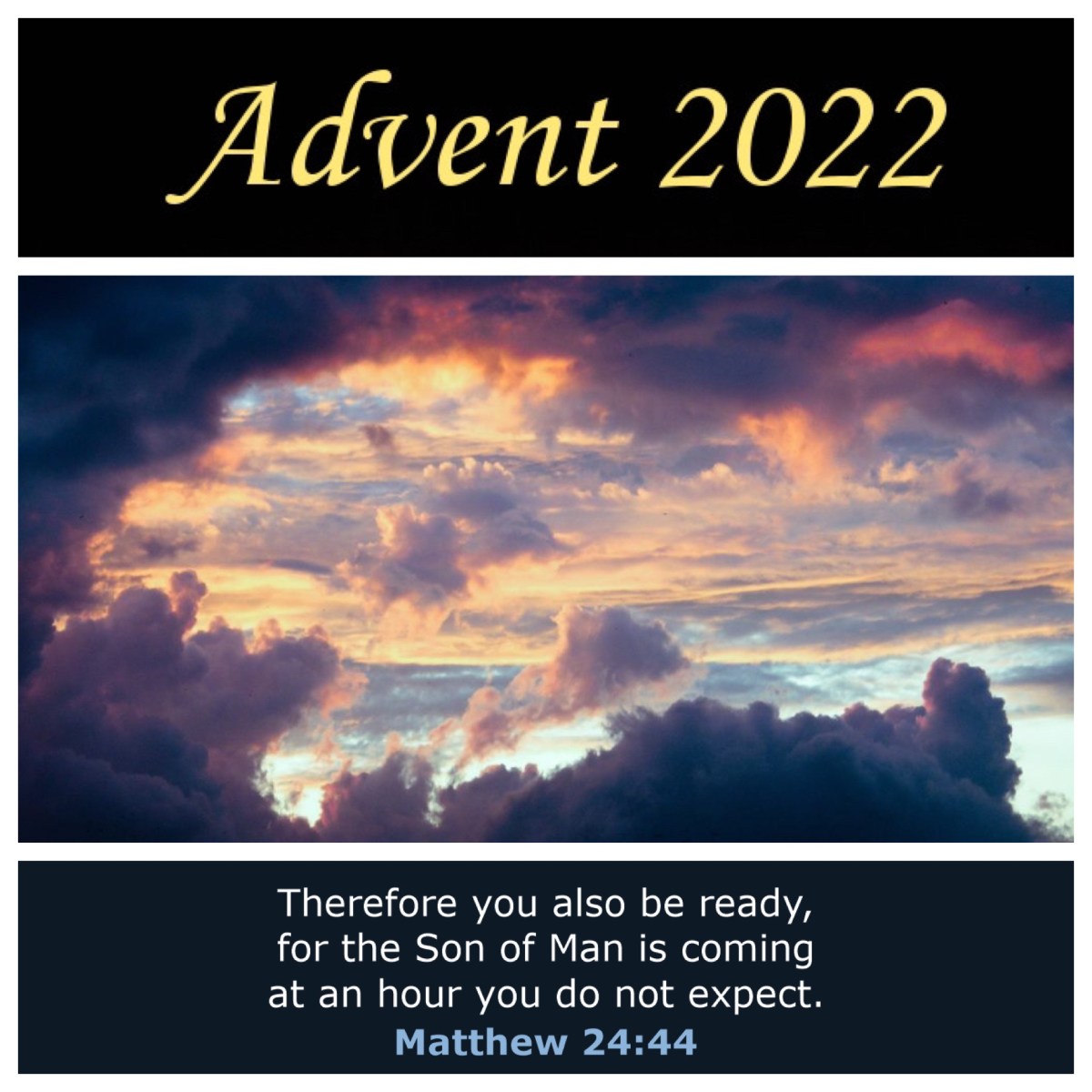
All of that lies ahead of us in the coming twelve months. Yet this Sunday, the first Sunday in Advent, we start with a confronting word from the latter part of the story: “two will be in the field; one will be taken and one will be left; two women will be grinding meal together; one will be taken and one will be left” (Matt 24:40–41). This striking declaration sits alongside exhortations to “keep awake, for you do not know on what day your Lord is coming” (24:42) and “you also must be ready, for the Son of Man is coming at an unexpected hour” (24:44).

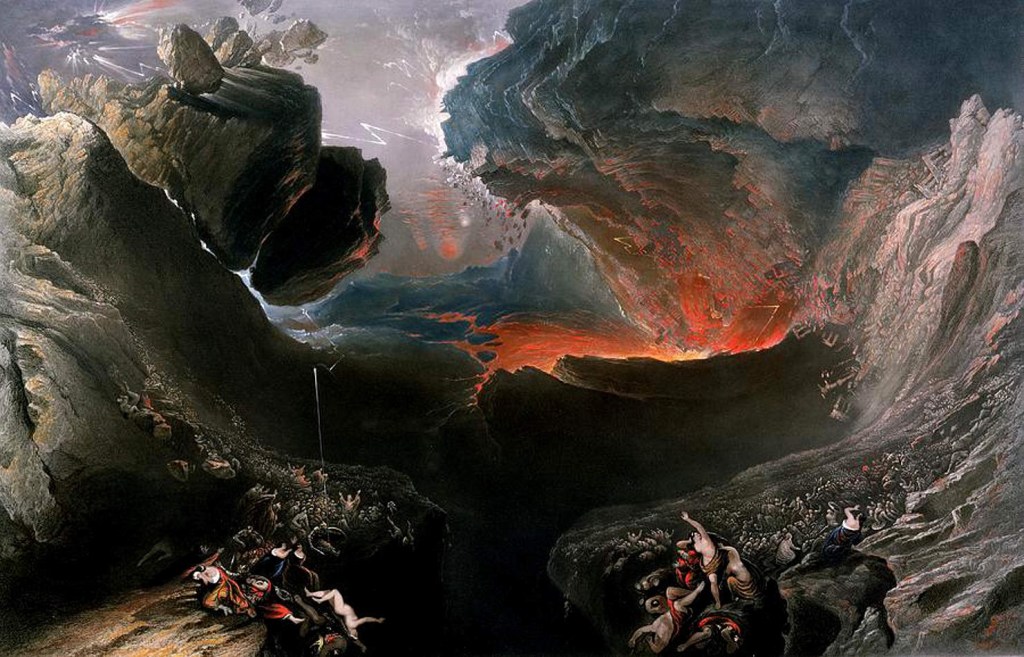
These exhortations are characteristic elements in apocalyptic literature of the time; and they crystallise the sense of an imminent catastrophic event which is set out in a longer speech which is vivid and explicit in its dramatic apocalyptic imagery (24:3–44). Immediately after these exhortations, Jesus tells a series of four parables (24:45–25:46) which further dramatise the message that “the end is near”, “you do not know when”, “make yourself ready”, “be prepared”.

The section offered by the lectionary for the first Sunday in Advent (24:36–44) seems a strange place to start a year of Matthean stories about Jesus. Why begin Advent with an apocalyptic passage? And yet, the injunctions of this passage seem to sit neatly with the opening words of Jesus in this Gospel: “repent, for the kingdom of heaven has come near” (4:17). See

These words echo exactly the message of John the baptiser (3:2) and point forward also to the demands that Jesus makes throughout his public ministry, culminating in the calls to “keep awake” and “be ready”, because “you do not know on what day your Lord is coming”. The opening message of Jesus is clearly echoed in this later apocalyptic speech.

David Cassian Cole is the founder and executive director of Waymark Ministries CIC. He is known as Brother Cassian. He writes about a custom in the early centuries of the Celtic church, for Advent to stretch for 40 days (mirroring Lent, the 40 days of preparation prior to Easter).

Cole writes, “It is believed that the 40 days of Advent were split into three sections, colloquially termed the three comings of Christ. The first is the incarnation, what we all focus upon at this time of year; the second is Christ coming into our lives; the third is the coming of Christ at the end of all things, as depicted in the book of Revelation. The third coming of Christ is that which comes at the end of all things, and through this period the Celtic Christians examine their own lives, not in a self-judgmental way, but in a positive self-reflection to see whether they are ready and prepared, in the way they are living, for Christ to return at any moment.” See more at

So we are offered these words from the final long sermon of Jesus as the introduction to the year of Matthew: a reminder of the claim that God holds authority of the creation as the one who will determine “the time”, and that “about that day and hour no one knows, neither the angels of heaven, nor the Son, but only the Father” (24:36), a call to “keep awake, for you do not know on what day your Lord is coming” (24:42), an exhortation to “be ready, for the Son of Man is coming at an unexpected hour” (24:44).

Those phrases set forth the attitude that is required, in being open to the coming of Jesus—an attitude that is quite appropriate for Advent, that is essential for personal faith in Jesus, and that is fitting for the whole year of reading and pondering stories about Jesus, in this “book of origins”.

God calls all Christians to be peacemakers

Today there is one of those regular reminders that occur in social media, about remembering war—the victims of war, those who have died, the consequences of armed struggle.

It is a good day to remember, also, that the Gospel is a call to peacemaking and reconciliation. This is at the heart of the commitments that the Uniting Church in Australia, amongst many other churches, has made over the decades.

At the Tenth Assembly in 2003, the Uniting Church affirmed “that God came in the crucified and risen Christ to make peace; and that God calls all Christians to be peacemakers, to save life, to heal and to love their neighbours; and that the Church is committed to be a peacemaking body”. (Uniting for Peace, Tenth Assembly, Uniting Church in Australia) A number of the UCA statements and resources relating to peacemaking are collected at https://www.unitingjustice.org.au/uniting-for-peace

Peacemaking has been a central concern of the Uniting Church since its inception in 1977. As early as 1982, the Assembly made a major statement on peacemaking, with two clear declarations: first, that “God came in the crucified and risen Christ to make peace [and] He calls all Christians to be peacemakers, to save life, to heal and to love their neighbours”; and second, that “the call of Christ to make peace is the norm, the onus of proof rests on any who resort to military force as a means of solving international disputes” (Militarism and Disarmament, 1982).

In 1988, in a Statement to the Nation issued for the Australian Bicentennial, the church declared, “In cooperation with all fellow Australians of goodwill, we are committed to work for justice and peace, calling for honesty and integrity, encouraging tolerance and compassion, challenging acquisitiveness and greed, opposing discrimination and prejudice, condemning violence and oppression and creating a loving and caring community”.

At that same Assembly, a statement on Nuclear Deterrence, Disarmament and Peace was also issued, with the statement that “All Christian affirmation about peace is grounded in the declaration that Jesus Christ is our peace. Through him the power of evil, sin and death is decisively broken, and the hostile and alienated world is reconciled to God and is itself renewed. We speak in hope, trusting God’s promise of the final transformation of all things.”

In 2003 the Assembly adopted an extensive statement entitled Uniting for Peace. In this statement the Uniting Church promised to “work together for peace, justice and reconciliation at the local, national and global level and in collaboration with local communities, secular movements, non- government agencies and people of other faiths”. We declared that we embraced “creative approaches to peacebuilding which are consonant with the spirit of the Gospel” and that we sought to “empower people who are systematically oppressed by violence, and to act in solidarity with those struggling for justice, peace and the integrity of creation”. The Statement also indicated an intention to “repent of our complicity in violence and attempt to overcome the spirit, logic and practice of violence”.

For the International Day of Peace in 2016, the church issued a resource which explored three important “Building Blocks for Peace— gender equality, climate justice, and nuclear disarmament”. See https://www.unitingjustice.org.au/images/stories/PDFs/160909_Peace_IDPResource2016.pdf

Continuing this commitment to peace today is important. One member of the Uniting Church, Len Baglow, has written this helpful piece on making peace, in which he gives serious consideration to a difficult question: “what does it mean in our time to be a peacemaker?” He indicates that he writes “to encourage others to join in this adventure that scripture calls peacemaking. I would particularly urge leaders in the Church community to see peacemaking not as a peripheral activity, but something which is urgent for our times.”

See https://ucforum.unitingchurch.org.au/?p=4660

Len notes that IPAN, the Independent and Peaceful Australia Network, is planning a national conference later this month, at which there will be consideration of AUKUS and the current threat of war for Australia, as well as sessions on “building the peace movement: planning collaborative activism”. The details of the programme and registration are at

Continuing the commitment to making peace that Jesus articulated is an integral and important part of Christian discipleship in the contemporary world. May the resolutions of this conference and the networks that it builds contribute to the ongoing work of making peace and forming reconciliation in our fractured world.

See also

Brothers and sisters, do not be weary in doing what is right (2 Thess 2 and 3; Pentecost 22C and 23C)

The closing words in the passage from 2 Thessalonians that appear in this Sunday’s lectionary offerings (2 Thess 3:6–13) exhort the believers in Thessaloniki to “do what is right”. It concludes a section telling them not to be idle, but to “do their work quietly and to earn their own living” (3:12), which itself has picked up the direction given in the earlier letter to Thessaloniki, “to aspire to live quietly, to mind your own affairs, and to work with your hands, as we directed you, so that you may behave properly toward outsiders and be dependent on no one” (1 Thess 4:11–12).

This could well be another instance in 2 Thess where a later writer, a follower of Paul, has mined the earlier letter of 1 Thess, authentic to Paul, to shape a letter drawing on the apostle’s authority to reinforce teachings for his own time. A clear way in which the letter deviates from Paul’s authentic thought is its apocalyptic content.

Paul himself (like Jesus) did have an apocalyptic view of the world. He affirms that “the appointed time has grown short” (1 Cor 7:29), “the night is far gone, the day is near” (Rom 13:12), and looks to the coming “day of the Lord” (1 Cor 1:8; Phil 1:10; 1 Thess 5:2), the “the day of wrath, when God’s righteous judgment will be revealed” (Rom 2:6; 1 Cor 3:13).

He foresees that “the trumpet will sound, and the dead will be raised imperishable, and we will be changed” (1 Cor 15:52) and asserts that “the Lord himself, with a cry of command, with the archangel’s call and with the sound of God’s trumpet, will descend from heaven, and the dead in Christ will rise first; then we who are alive, who are left, will be caught up in the clouds together with them to meet the Lord in the air; and so we will be with the Lord forever” (1 Thess 4:16–17).

However, this letter develops from those views in ways most uncharacteristic of Paul—more like the kind of hardline developments that we find in Jewish apocalypses of the general time. The “righteous judgment of God” (2 Thess 1:5) will be “when the Lord Jesus is revealed from heaven with his mighty angels in flaming fire, inflicting vengeance on those who do not know God and on those who do not obey the gospel of our Lord Jesus” (1:7–8), bringing “the punishment of eternal destruction” (1:9). This is an extreme position, beyond the hope for a return of Jesus to reconcile believers with God; this presses the notion of divine judgement into callous retribution.

Further consideration of that day of judgement is given in chapter 2; we had excerpts from this chapter in last week’s lectionary—but the critical verses, 2:6–12, were omitted in that offering! There, we read that this day “will not come unless the rebellion comes first and the lawless one is revealed, the one destined for destruction” (2:3). The Greek word translated as “rebellion” is apostasies, from which we get apostasy. It was used to describe those who wandered from the keeping of the Torah (1 Mac 2:15).

The writer continues, declaring that “the lawless one” (2:8) who brings “a powerful delusion” (2:11) will result in “all who have not believed the truth but took pleasure in unrighteousness will be condemned” (2:12). This portrayal resonates strongly with scenes in Jewish apocalyptic literature of the late Second Temple period, or soon thereafter, attributed to (but not actually written by) great luminaries in the history of Israel; see 4 Ezra 4:27–5:13; 2 Baruch 27; 1 Enoch 91; and also, in the Dea Sea Scrolls, 1QpHab 2:1–10.

On other ways that the letter indicates a later, non-Pauline authorship which goes well beyond Paul’s thinking—see

*****

To return to chapter 3; here we find a set of instructions, buttressed by Paul’s authority, in which the Thessalonians are encouraged to maintain “the tradition” they received from Paul (3:6), the “command” which he had given them (3:10), and are admonished to “have nothing to do with … those who do not obey what we say in this letter” (3:14).

A key verse in this section (3:13) draws strongly on a theme running through Hebrew Scripture, to “not be weary in doing what is right”. The Psalmist, for instance, sings that those who may abide on God’s holy hill are “those who walk blamelessly, and do what is right, and speak the truth from their heart” (Ps 15:2), and in a later psalm, sings that “I have done what is just and right; do not leave me to my oppressors” (Ps 119:131). Yet another psalm questions the gods: “do you indeed decree what is right, you gods? do you judge people fairly?” and immediately provides the answer, “no, in your hearts you devise wrongs; your hands deal out violence on earth” (Ps 58:1–2). The alignment of doing what is right with the Lord God of Israel is clear.

Accordingly, that deity is depicted in some of the foundational stories of Israel as requiring people to do what is right. At Marah in the wilderness, the Lord God tells the people, “if you will listen carefully to the voice of the Lord your God, and do what is right in his sight, and give heed to his commandments and keep all his statutes, I will not bring upon you any of the diseases that I brought upon the Egyptians; for I am the Lord who heals you” (Exod 15:26).

Likewise, when reminding the people “not to put the Lord your God to the test, as you tested him at Massah” (referring to Exod 17:1–7), Moses instructs them to “do what is right and good in the sight of the LORD, so that it may go well with you, and so that you may go in and occupy the good land that the LORD swore to your ancestors to give you” (Deut 6:18). That message is reinforced later in the long speech of Moses, when he gives instructions relating to the discovery of a murder whose perpetrator is unknown, concluding that “you shall purge the guilt of innocent blood from your midst, because you must do what is right in the sight of the Lord” (Deut 21:9).

The same instruction that is attributed to Moses is given by the prophet Ahijah the Shilonite, when Jeroboam led a rebellion against King Solomon: “if you will listen to all that I command you, walk in my ways, and do what is right in my sight by keeping my statutes and my commandments, as David my servant did, I will be with you, and will build you an enduring house, as I built for David, and I will give Israel to you” (1 Kings 11:38). The equation of “doing what is right “ with “keeping [God’s] statutes and commandments” in this passage, as also in the account of the incident at Marah (Exod 15:26), indicates the centrality of this command within the life of Israel.

Two prophets reinforce the importance of this command. Ezekiel declares that, “if the wicked turn away from all their sins that they have committed and keep all my statutes and do what is lawful and right, they shall surely live; they shall not die” (Ezek 18:21; see also 18:27; 33:14, 19; 45:9). Likewise, the opening oracle of the unnamed post-exiled prophet whose words are collected at the end of the scroll of Isaiah begins with the declaration, “maintain justice, and do what is right, for soon my salvation will come, and my deliverance be revealed” (Isa 56:1). This important text equates “do what is right” with divine justice; the two prophetic texts indicate that “doing what is right” is the prerequisite for life (Ezekiel) and salvation (Trito-Isaiah).

Finally, we note that the story of Tobit ends with his prayer of blessing to God (Tob 13:1–17), including the admonition, “turn back, you sinners, and do what is right before him; perhaps he may look with favor upon you and show you mercy” (Tob 13:6); followed by his farewell words to his son, Tobias, and the seven sons of Tobias, in which he declares, “so now, my children, I command you, serve God faithfully and do what is pleasing in his sight; your children are also to be commanded to do what is right and to give alms, and to be mindful of God and to bless his name at all times with sincerity and with all their strengths (Tob 14:9). This final passage explains that “doing what is right” includes both central religious activities (bless God) and helpful social activities (give alms).

To Jewish listeners, the simple instruction, “do not be weary in doing what is right” (2 Thess 3:13) evokes central aspects of faith: obedience, following God’s way, keeping the commandments, speaking the right words, enacting the required behaviours, receiving the gift of life, being assured of salvation, and doing justice. Beyond the authority of Paul, reinforced a number of times in this chapter, the resonances of Hebrew Scripture voices sound loudly.

New heavens and a new earth (Isaiah 65; Pentecost 23C)

The Hebrew Scripture passage offered by the lectionary this coming Sunday comes from the third main section of the book of Isaiah (chapters 56–66). This section of the book differs from the two main sections that precede it—the pre-exilic section (chapters 1–39) and the section as the exile itself is drawing to an end (chapters 40–55).

The prophet begins this third section with a familiar prophetic announcement which sets forth the classic prophetic programme, with the classic divine assurance: “maintain justice, and do what is right, for soon my salvation will come, and my deliverance be revealed” (Isa 56:1). The section offered by the lectionary (Isa 65:17–25) sets out how that justice will come to be, through the vision of “new heavens and a new earth”.

Written during the period when the people of Judah were returning to their land, to the city of Jerusalem (from the 520s BCE), this section of Isaiah sets out what this justice will look like through a series of powerful oracles. The prophet sounds a vivid counter-cultural note in the midst of the events of his time. He begins with the promise to foreigners and eunuchs that “I will give, in my house and within my walls, a monument and a name better than sons and daughters; I will give them an everlasting name that shall not be cut off” (Isa 56:5).

This is a striking contrast to the narrative provided in the books of Ezra and Nehemiah, which tell of the return to the city, the rebuilding of the walls, the renewal of the covenant and the public reading of the Law, the rededication of the Temple—and actions designed to remove foreigners (especially women) from within Israel (see Ezra 10; Neh 13).

Ezra and Nehemiah exhibited a zealous fervour to restore the Law to its central place in the life of Israel. Ezra, learning that “the holy seed has mixed itself with the peoples of the lands” (Ezra 9:2), worked with “the elders and judges of every town” to determine who had married foreign women; the men identified “pledged themselves to send away their wives, and their guilt offering was a ram of the flock for their guilt” (Ezra 10:19). (So much for the importance of families!)

Nehemiah considered that this project to “cleanse [the people] from everything foreign” (Neh 13:30) was in adherence to the command that “no Ammonite or Moabite should ever enter the assembly of God, because they did not meet the Israelites with bread and water, but hired Balaam against them to curse them” (Neh 13:1–2; see Num 22—24). The restoration of Israel as a holy nation meant that foreigners would be barred from the nation.

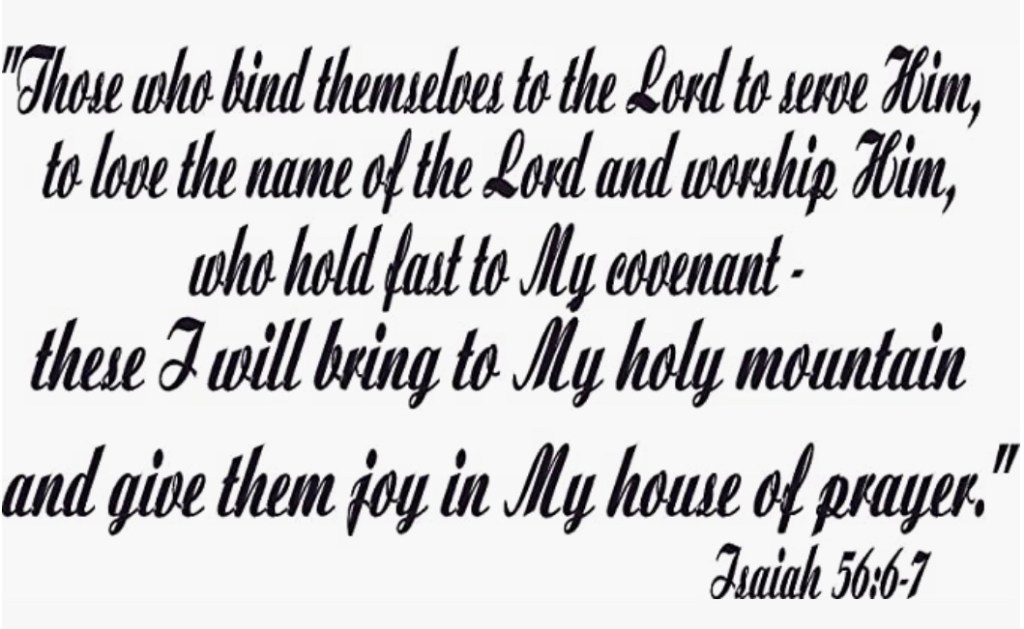
The oracle at the start of the third section of Isaiah stands in direct opposition to this point of view; “the foreigners who join themselves to the Lord … and hold fast my covenant—these I will bring to my holy mountain, and make them joyful in my house of prayer; their burnt offerings and their sacrifices will be accepted on my altar; for my house shall be called a house of prayer for all peoples” (Isa 56:6–7). This is what God’s justice looks like!

Jesus, of course, quoted this last phrase (“a house of prayer for all people”) in the action he undertook in the outer court of the Temple (Mark 11:17). Later, the welcome offered to the Ethiopian court official by Philip, who talked with him about scripture and baptised him, a eunuch (Acts 8:26–38), is consistent with the prophetic words, “to the eunuchs who keep my sabbaths, who choose the things that please me and hold fast my covenant, I will give them an everlasting name that shall not be cut off” (Isa 56:4–5).

From the earliest days, the church practised an inclusive welcoming of diversity that was consistent with this prophetic declaration. What went wrong, we may ponder, for the church to dig itself into the corner of exclusivism and judgementalism that unfortunately has characterised too many manifestation of church?

The particular passage that is provided for this coming Sunday is almost at the end of the book. It offers a wonderfully climactic vision to this section of the book—and indeed to the whole of Isaiah. The prophet has continued to explain what it means to adhere to the way of justice, practising the fast that the Lord desires.

The promise is that Israel will have a new name: “you shall no more be termed Forsaken, and your land shall no more be termed Desolate; but you shall be called My Delight Is in Her, and your land Married; for the Lord delights in you, and your land shall be married” (Isa 62:4). We can see the symbolic significance of names in considering the prophet Hosea and in Isaiah 8, for example.

By contrast, vengeance will be the experience of Edom; using the image of trampling down the grapes in the wine press, the prophet reports the intention of God: “I trampled down peoples in my anger, I crushed them in my wrath, and I poured out their lifeblood on the earth” (63:1–6). So vigorously does God undertake this task, that he is attired in “garments stained crimson” because “their juice spattered on my garments and stained all my robes” (63:1–3).

Once again, the prophet speaks in graphic terms. Edom is a symbolic portrayal of the Babylonian Empire, which had been dominant in the middle eastern world of the day for some time—yet it had recently been subsumed by the Persian Empire (under whom the people of Judah were able to return home). The punishment was on the horizon, either the horizon immediately in view, or the horizon that had just passed. Edom (Babylon) had been conquered—a happening interpreted by the anonymous prophet as divine retribution.

Confronted with this display of wrath and vengeance, the prophet adopts an attitude of penitence, yearning for God to “look down from heaven and see, from your holy and glorious habitation” (63:15). His plea for the Lord to “tear open the heavens and come down, so that the mountains would quake at your presence—to make your name known to your adversaries, so that the nations might tremble at your presence!” (64:1–2) must surely have been in the mind of the evangelists as the reported the baptism of Jesus, when he “saw the heavens torn apart and the Spirit descending like a dove on him” (Mark 1:10).

The book ends with a sequence in which the prophet reports the words of the Lord which indicate that Israel will be restored (65:1–16), followed by the statement that the Lord is “about to create new heavens and a new earth” (65:17–25; 66:22–23)—the passage provided by the lectionary this week. It is a wonderfully climactic, all-encompassing vision. Not only will Jerusalem enjoy prosperity, but “the wealth of the nations [shall be] like an overflowing stream” (66:12).

The vision of this penultimate chapter is global; it is for “all people” (picking up the hope of Isa 40:5), for “all the nations of the earth”, as both Jeremiah (Jer 33:9) and Haggai foresee (Hag 2:6–9), for “all flesh” as Joel predicts (Joel 2:28–29), for “every living creature”, as the final vision of Ezekiel portrays (Ezek 47:7–12). The “new heavens and new earth” (Isa 65:17) are for everyone of Israel (Isa 65:18–19), indeed, even for all creatures, “wolf and lamb, lion and ox” (Isa 65:25).

This vision is, of course, taken up and expanded in the closing chapters of the final book of the New Testament (Rev 21:1–22:7). That provides a globally wondrous vision to end the writings of the renewed covenant. The closing vision of Trito-Isaiah, the foundation for the vision of the seer at Patmos, has incorporated a number of references to earlier prophetic words: building houses and planting vineyards (65:21) recalls the words of Jeremiah (Jer 29:5–7); the image of wolves lying with lambs and lions “eating straw like the ox” recalls the vision of Isaiah (Isa 11:6–7).

The promise that “they shall not hurt or destroy all on my holy mountain” (65:25) recalls that same vision of Isaiah (Isa 11:9), whilst the next promise about not labouring in vain nor bearing children for calamity (65:23) reverses the curse of Gen 3:16–19. The story of creation from the beginning of Genesis is evoked when the Lord asserts that “heaven is my throne and the earth is my footstool … all these things my hand has made” (66:1–2); these are the words which Stephen will quote back to the council in Jerusalem (Acts 7:48–50) and will lead to his death at their hands. All the allusions together make this a fine conclusion to the visionary prophetic stream of the first covenant.

And yet, even to the very end of this book, the judgement of the Lord is evident; the prophet declares that “the Lord will come in fire, and his chariots like the whirlwind, to pay back his anger in fury, and his rebuke in flames of fire; for by fire will the Lord execute judgment, and by his sword, on all flesh; and those slain by the Lord shall be many” (66:15–16).

Nevertheless, the glory of the Lord shall be declared “among the nations” (66:19) and “they shall bring all your kindred from all the nations as an offering to the Lord” (66:20). The universalising inclusivism that was sounded in the oracle at the start of this prophet’s work (in chapter 56) is maintained through into this closing oracle. In “the new heavens and the new earth which I will make … all flesh shall come to worship before me, says the Lord” (66:22–23). The vision lives strong! It’s a good way to end the series of readings from the prophets we have followed during the past few months.

Prayers of the People for Pentecost 22C

Prayers of the People led by Cathy Rossiter at Tuggeranong Uniting Church on Sunday 6 November, during a service celebrating All Saints’ Day and reflecting on Halloween (All Hallow’s Eve)

At this time of much international and domestic uncertainty, of inequality and of hunger, let’s bring our prayers and thoughts for others before almighty God.

We ask you to be with us, O Lord, as we contemplate what it means to live out our faith in a world which seems more selfish and uncaring than ever before. Help us to stand up for what is right, just and compassionate.  Help us to meet people wherever they are at and not to be judgemental or self-righteous.  Help us to be generous with our time, our friendship and our finances.

We know that there are many troubling issues where the voice of compassion and justice needs to be raised.  We pray for those who influence the ways we act and think through their roles in the media, and we ask that those who are elected to represent us in our parliaments are always mindful of their responsibilities towards all Australians.  

We think of the many people whose lives and livelihoods have been turned upside down by extreme weather events, both here in Australia and elsewhere in the world.  As we come to grips with the dangers posed by the changing climate, help us to reassess our lives and the contributions that we make to the global situation.

O God, as the world contemplates the prospect of many more such catastrophes, and the destruction of more and more habitat, we ask that the coming meeting of nations in Egypt will move closer to serious commitments to drastically reduce the amount of greenhouse gases in the atmosphere.  As people of faith, we care for the world you have given us and we bring you our concerns for those who are least able to protect themselves from the ravages of extreme weather events.

As the evidence of ongoing cruelty and discrimination around the world continues to mount, we pray that the voices of calm and of wisdom will be heard in many places. We think especially of Myanmar, of North Korea, of China, of Ethiopia and of Iran.

We pray especially for the people of Ukraine and the people of Russia.  We pray for those who are afraid, for those who have lost loved ones, for those who choose war and for those who seek peace.   May the search for peace prevail.

In our own Canberra community, there are many who suffer from the indignities of poverty and discrimination, from long-term health problems, and from violence in their own families.  We ask that you will uphold them, give them strength and surround them with care and love.  

All these things we ask in the name of Jesus, who taught us how to live and to love, and to pray …

Ou Father in heaven, hallowed be your name … … …

*****

The sermon for the day is at http://ruralreverend.blogspot.com/2022/11/on-halloween-all-saints-and-ghosts-of.html

The righteous live by their faith (Habakkuk 2; Pentecost 21C)

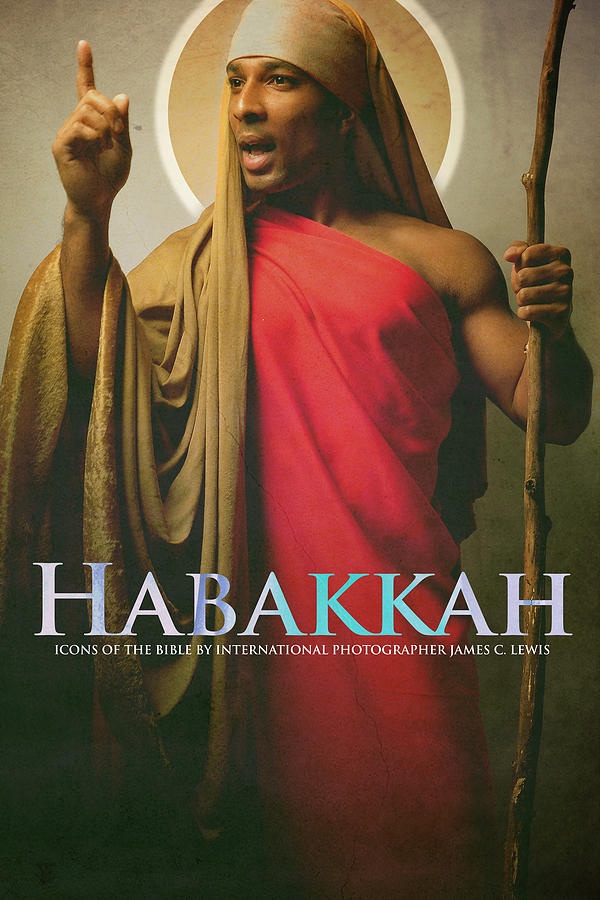
This Sunday, the lectionary invites us to hear two sections of the prophet Habakkuk (Hab 1:1–4, 2:1–4). Habakkuk is a shadowy figure, known, really, for only one statement—just half of one verse. That short statement, “the righteous live by their faith [or faithfulness]” (2:4b), stands as the text upon which Paul developed his important theological statement in Romans: “in it [the gospel] the righteousness of God is revealed through faith for faith; as it is written, ‘the one who is righteous will live by faith’” (Rom 1:17). As well, Paul quotes this verse in his letter to the Galatians (Gal 3:11) and the verse is cited in the “word of exhortation” sent to the Hebrews (Heb 10:38). So it appears in significant writings if the early Christian movement.

From an ancient Israelite figure about whom very little is known, this one short phrase has played such a foundational role in articulating a central tenet of Christian faith. It runs from Paul’s assertion that “the righteous live by their faith”, through Augustine’s affirmation that we are justified by grace through faith, to Luther’s central claim of “sola fide, sola scriptura, solus Christus, sola gratia”, into the contemporary evangelical doctrine of “justification by faith alone”.

Habakkuk was one of a number of Israelite prophets who were active in the few decades leading up to the conquering of the southern kingdom by Babylon in 587 BCE, and the removal into exile of the people as a result of that event. In this context, Habakkuk declares, “I will stand at my watch post, and station myself at the rampart” (Hab 2:1). From his watch post, he declaims the words of judgement given to him by God: the wealthy will be called to account by their creditors, violent terrors will arise, and “the cup in the Lord’s right hand will come around to you, and shame will come upon your glory” (Hab 2:15).

Amidst these thundering pronouncements, Habakkuk does offer hope, declaring that “the earth will be filled with the knowledge of the glory of the Lord, as the waters cover the sea” (2:14), and imploring the people, “the Lord is in his holy temple; let all the earth keep silence before him!” (2:20). He affirms that God’s “glory covered the heavens, and the earth was full of his praise” (3:3)—but that glory will swiftly lead to “the days of calamity” (3:16). The threat of Exile looms large for this prophet.

In the context of Habakkuk’s prophetic activity, the affirmation that “the righteous live by their faith [or faithfulness]” (2:4b) is the word that God gives to the prophet, responding to his complaints about what sufferings are taking place. God is “rousing the Chaldeans, that fierce and impetuous nation, who march through the breadth of the earth to seize dwellings not their own” (1:6), and through their dreadful and fearsome activities, God is “destroying nations without mercy” (1:17).

That God is using foreigners to deal with Israel is a striking theological development—one that is at odds with the traditions that emphasise Israel as a chosen nation, holy and set apart, dedicated to the Lord; the nation alone through whom the Lord God works. That this God will use foreigners is a theme found also in the later writings of Deutero-Isaiah (Isa 40–55), where Cyrus, the Persian ruler, is acclaimed as the one chosen by God, the Messiah, to allow the people of Judah to return to their land (Isa 44:24–45:13).

Habakkuk laments and complains; God instructs him to “look at the proud—their spirit is not right in them”, and to be assured that “the righteous live by their faith” (2:4). The theme of righteousness that is signalled here by the prophet is a central motif in Hebrew Scriptures. It appears in the ancestral stories concerning the key figures of Abraham (Gen 15:6), Saul (1 Sam 26:23), David (2 Sam 22:21–26; 1 Ki 3:6), and Solomon (1 Ki 10:9).

Further, Job exults in his righteousness (Job 27:6; 29:14) and the psalmists petition God on the basis of their righteousness (Ps 5:8; 7:8; 112:1–10). Righteousness is praised in assorted proverbs (Prov 1:3; 8:20; 11:4–6; 12:28; 15:9; 16:8; 21:3, 21) and figures in numerous prophetic oracles (Isa 1:22; 5:7; 28:17; 32:16–17; 54:14; Jer 22:3; Ezek 18:19–29; Dan 9:24; 12:3; Hos 10:12; Amos 5:24; Zeph 2:3; Mal 4:1–3). The message given to Habakkuk holds strong throughout Israelite history, and then continues to sound out, as we have seen, throughout the 20 centuries of Christian history.

I will pour out my spirit on all flesh (Joel 2; Pentecost 20C)

This Sunday, the lectionary invites us to hear a section of the prophet Joel. It is a passage which contains words well known to Christians, as the words about dreams and visions and prophesies (Joel 2:28–32) are quoted by Peter when speaking on the Day of Pentecost (Acts 2:14–21).

The words that Joel speaks to the people of his day begins with lament; he calls for repentance amongst the people of Judah as the day oft he Lord approaches. Nothing in this book provides any clues as to the time when Joel was active. The identification of the prophet as “son of Pethuel” (Joel 1:1) gives no clue, as Pethuel appears nowhere else in the Hebrew Scriptures—indeed, the name Joel, itself appears nowhere else. The name appears to combine the divine names of Jah and El, suggesting that it may be a symbolic creation. Was Joel an historical person?

Lament, as we have noted, is the opening note sounded by Joel, as he calls on the “ministers of God” to “put on sackcloth and lament” (1:13). This call reminds us of the response of the pagans in Nineveh (Jonah 3), whilst his remonstrations that “the day of the Lord is near” (1:15) echoes the motif of “the day” already sounded by other prophets (Amos 5:18–20; Isa 2:12, 17; 13:6–8; 34:8; Zeph 1:7, 14–15; Jer 35:32–33; 46:10).

This day forms the centrepiece of Joel’s undated prophecies, as he describes that day as “a day of darkness and gloom, a day of clouds and thick darkness!” (Joel 2:2), when “the earth quakes before them, the heavens tremble, the sun and the moon are darkened, and the stars withdraw their shining” (2:10). He describes the response of the people “in anguish, all faces grow pale” (2:6).

However, Joel adheres to the constant thread running through Hebrew Scriptures, that the Lord is “gracious and merciful, slow to anger, and abounding in steadfast love, and relents from punishing” (2:13). Because of this, he yearns for the people to “turn with all your heart, with fasting, with weeping, and with mourning” (2:12), sensing that there might be hope of restitution for the people.

Joel calls for the people to gather (2:15–16); the oracle that follows paints a picture of abundance and blessing (2:18–27), affirming that “my people shall never again be put to shame” (2:27).

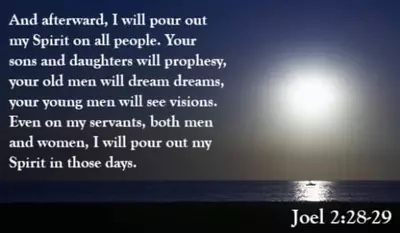
The prophet then speaks the words which are offered to us in this Sunday’s first reading; words which have been given a central place in the later story of the Christian church. Here, the prophet foreshadows that the blessings of God will be manifest through the outpouring of the spirit: “your sons and your daughters shall prophesy, your old men shall dream dreams, and your young men shall see visions; even on the male and female slaves, in those days, I will pour out my spirit” (2:28–29).

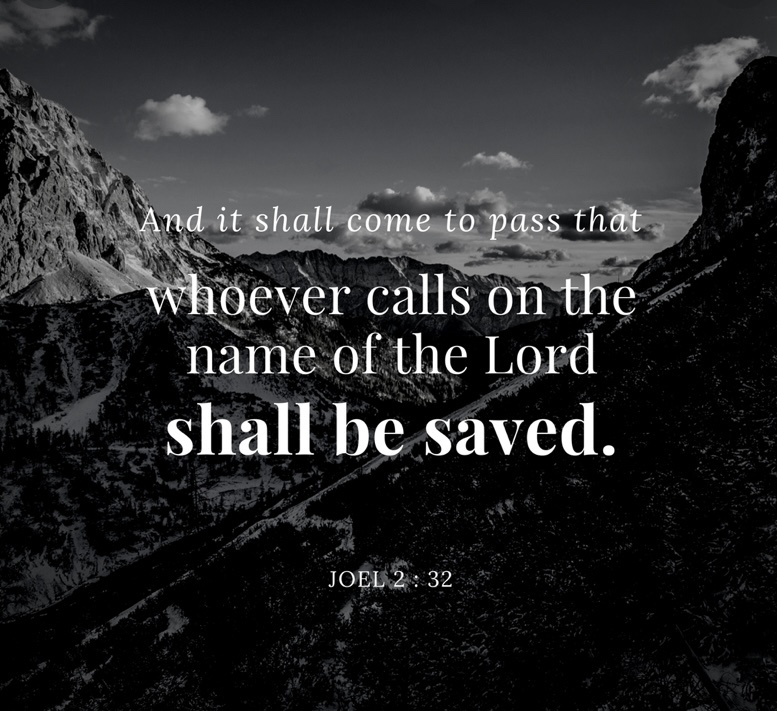
This promise is specifically for “all flesh”; this universal vision informs the whole outward impulse of the movement of followers of Jesus, after the day of Pentecost, which Peter interprets as being a fulfilment of this prophecy (Acts 2:14–21). Events following on from that day, as recorded in Acts, show how those words come to be fulfilled in the movement initiated by Jesus and his followers. And in the early days of this movement, in a letter written by Paul, the promise that “everyone who calls on the name of the Lord shall be saved” is reiterated (Rom 10:13, quoting Joel 2:32; and note a different version quoted at 2 Tim 2:19).

The day of the Lord that is envisaged by Joel (2:31) will signal a significant reversal for Israel. The Lord laughs at other nations (3:1–8), a reversal that pivots on a turn from despair to hope, from the threats of judgement to a glorious future (3:9–21). Joel repeats the irenic vision of swords being beaten into ploughshares (3:10; see Isa 2:4; Mic 4:3); he sees a ripe harvest (3:13), the land will drip with sweet wine, and there will be milk and water in abundance (3:18). The voice of the Lord “roars from Zion, and utters his voice from Jerusalem, and the heavens and the earth shake” (3:16; cf the similar pronouncement of Amos at Am 1:2; 3:8).

The last word of this book, “the Lord dwells on Zion” (3:21), provides assurance and certainty for the future. These words of hope promises a peaceful future for the nation. When Joel might have been speaking these words cannot be definitively determined; it could have been under the Assyrian threat, during the Babylonian dominance, in the time of exile, or after the return to the land.

Whenever the prophet spoke these words, the promise of hope holds good in each of these scenarios. And that promise of hope has been taken up in the movement that was initiated by Jesus, in Peter’s Pentecost speech—which provides a programmatic announcement of what then takes place as the good news spreads from Jerusalem and Judea, into Samaria, and out to the ends of the earth. God’s Spirit continues to be active. And so, “everyone who calls on the name of the Lord shall be saved”.

Seek the welfare of the city (Jeremiah 29; Pentecost 18C)

The Hebrew Scripture reading which the lectionary offers this coming Sunday is largely a letter—from Jeremiah, to some fellow-Jews, but written in the name of Jeremiah’s God. It is this letter which invites us to consider some important aspects of how we live our faith.

Jeremiah wrote this letter twenty-five centuries ago, a long, long time ago. Does this letter still hold relevance to us, today? Jeremiah wrote in the ancient Hebrew language, running from right to left across the page. It is most likely that the letter was written on a scrap cut from a roll of papyrus, or possibly leather; but there was no neat sheet of paper with carefully-inscribed words, or neatly-typed paragraphs, carefully folded into an envelope, such as we would expect of a letter today.

And not only does it look different, this letter was written to a very specific group of people, who were quite different from us. It was addressed to people in a very different situation from most of us; a group of people who had grown up in Israel, but were now refugees, sent into exile, forcibly removed from their homeland, mourning all that they had lost, and now trying to come to grip with their new life in the faraway land of Babylon.

Do you remember Psalm 137? By the waters of Babylon, we sat down and wept? This would have been the way that many of these people responded when they arrived in Babylon. And the fact that this Psalm is still in our Bible tells us that the people sang this song, for a long time; it was not just a top-40 wonder for a few weeks or months, but it was sung over and over, and became one of the sacred songs of the people for generations—through into our own time, in fact!

So this letter seems a somewhat unusual choice for the focus of our attention today, as the way in which the word of the Lord might possibly address us, in our settled, comfortable lives. What could it possibly have to offer us, as we reflect on our faith in the world of the 21st century?

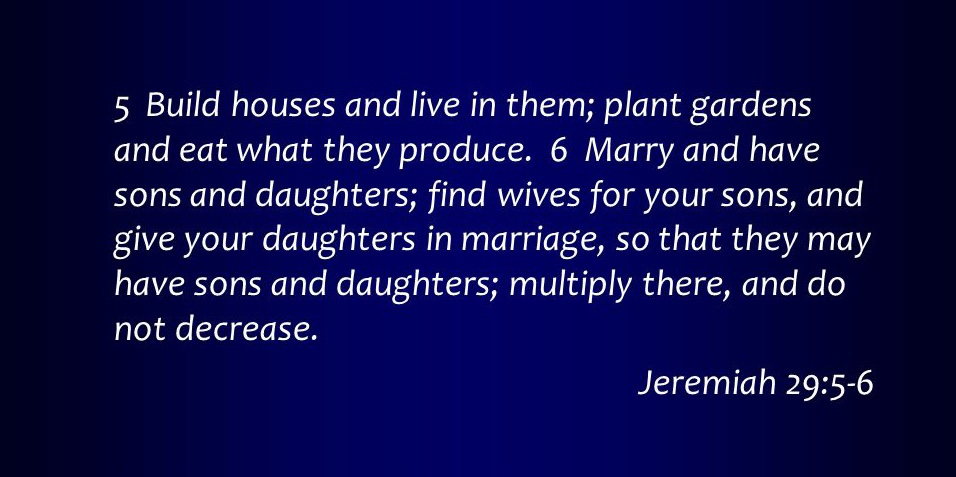
And yet, the words have a distinctively contemporary, relevant feel about them. They speak of ordinary life, of family and home, of a life which is comfortable, settled, and peaceable. They speak of building relationships, undertaking good, honest work, and living with responsibility for those under our care. Hear again the heart of the letter: Build houses and live in them; plant gardens and eat what they produce. Take wives and have sons and daughters; take wives for your sons, and give your daughters in marriage, that they may bear sons and daughters; multiply there, and do not decrease. But seek the welfare of the city where I have sent you into exile, and pray to the Lord on its behalf, for in its welfare you will find your welfare.

Perhaps the heart of Jeremiah’s letter is in this simple phrase: seek the welfare of the city. This was the word of the Lord which addressed the disturbed and dispossessed Israelites who had tearfully followed their deposed Israelite King Jeconiah and his court into exile under the Babylonian King Nebuchadnezzar, wondering what awaited them there in this strange land. Could it be that this is also the word of the Lord which addresses comfortable, settled Australians, enjoying the fruits of hard work over many years, living in a time of ongoing material prosperity?

Some knowledge of the original language of the letter might be relevant as we ponder this matter. In the last verse of the letter, Jeremiah three times uses the one Hebrew word that probably most of us have heard and would recognize: the word shalom. Each time the NRSV translates this word in this letter, it uses the English term welfare. We know this word, perhaps more familiarly, through the slightly different translation, peace.

And perhaps we are also aware that the ancient sense of shalom encompasses not just peace (the absence of conflict), but also wholeness, fulfillment, security, satisfaction, a co-operative spirit, a sense that all is well with the world. This is what the fearful exiles were being encouraged to work towards.

What would it have meant for those homesick Israelites, long ago, to have been prepared to seek the welfare [the shalom—the peace—the wholeness] of the city?

I think that it might have meant things like this: Get ready for a long period of time away from “home”; there will be no quick fixes, no easy answers, no instant gratification. You are here, in this strange land, for the long haul. Settle down, make your peace with the locals. Be prepared to make this the new “home” for yourselves and your descendants.

I wonder how would we feel if that were the situation we were facing? It could mean: Be prepared to work co-operatively and constructively with the very people who have inflicted pain and suffering on you and your people. They dragged you away from home and set you to work in this strange place. They are the ones who forced you into this bad situation. They are “the enemy”. But God is telling you to work with them. To co-operate with your enemies. To love your enemies, perhaps? To co-operate with those who hold different points of view from yourself—in precisely the way that various groups in our society are learning that they must do.

The word of the Lord presents a serious challenge, then, to the exiles in Babylon.

Even more than this; Jeremiah delivers God’s message to the people in very specific ways: Be prepared to marry and raise families with people from outside of your group … be prepared to marry these strange, alien, unfamiliar people. You won’t be able to keep on marrying your own people, those who have come with you from Israel; the gene pool is too small for that to work for too long. So get yourselves ready, to marry a foreigner. You are the ones who are going to create a multi-ethnic community, a multi-cultural society.

And perhaps, then, the challenge to the people of Israel, in exile, was for them to lift their eyes above their immediate grief and pain, and do what was good, what made for peace, for the whole city. Through Jeremiah, God was telling them: Set your goals, not on the basis of what is good for me as an individual, but rather on what is best for the whole community. Seek the shalom of the city; the whole collection of human beings who are gathered in this one sprawling metropolis.

What was this city, in which they found themselves? It has been estimated that Babylon was the largest city in the world in the 17th century BCE, and again between 612 and 320 BCE— and of course it is during this latter period that Jeremiah was writing.  Babylon was probably the first city to reach a population above 200,000—a figure which seems relatively small to us when we think about cities, but which would have required complex administration and organization to ensure that, just as a start, all 200,000 inhabitants were fed each day. So seek the shalom of the city means that the Israelites were being challenged to immerse themselves in the largest population, the most vibrant and diverse community of people, at that time, in the ancient Near East.

And this is the point at which I believe this ancient Hebrew letter comes alive and speaks to us with a message of relevance for our own times and our own place. Seek the shalom of the city in which you live, work, relax, shop, and worship. How might we seek the welfare of our own cities?

City life, today, is marked by its diversity, its complexity, its ambiguities and uncertainties. This is particularly so as the nature of particular suburbs and areas change over time. Once quiet dormitory suburbs for people working in the city, in nearby business centres, can change, as different groups of people move in. As times change, the old certainties of suburban life no longer hold; the predictable patterns of comfortable middle-class lifestyle are challenged. We cannot ignore these changes; we cannot hide our faith from engagement in what is taking place around us.

Perhaps a different ethos emerges in the quiet dormitory suburb, as the area transforms into a regional transport hub, is filled with medium-density housing, caters to a greater concentration of students and aged people. All of these features can be gleaned from census material; all of these factors, and more, need to be part of the deliberations for a local Congregation as they consider those vital questions: who are we? what is our ministry? what might our ministry be? what sort of leadership is required for us to develop accordingly? These are questions that all Congregations should ask on a regular basis.

In the city, says Jeremiah, the people of God are to seek the welfare, the wholeness, the shalom, of the whole population. It is a charge that we ought to hear as a clear and direct word to each of us, and to the Congregation where we are active, as we seek to contribute to the welfare of the city. What do we have to offer, as the people of God in this time, in this place?

The Uniting Church is committed to being a church that takes seriously the context in which we are located. Our Basis of Union set out to ensure that we were formed as a church that was relevant to our Australian location—not simply a colonial copy of an English or Scottish church, but an authentically Australian church. I was privileged to be trained in theology in the early years of this church, when living out our faith in the Australian context was of paramount importance.

In past years, I have been part of Congregations that have sought to engage in active ways with people in their local communities: through a weekly School for Seniors programme; by offering a weekly meal at no cost to people in the local community who are poor, or lonely; by volunteering with the telephone ministry Lifeline; by engaging with local artists in a programme called Arts in Action; by fostering constructive relationships with Indigenous students and their families; by supporting partnerships with people in the third world and developing robust micro-businesses; by undertaking training in the Sydney Alliance and engaging with local community groups on specific, focussed projects; by being active in a local environmental advocacy group, Climate Change Australia. These are but some examples of the many ways that our church has long been committed to seeking the welfare of the city.

So we, today, face the challenge of responding to the changing circumstances of our time, when fewer people claim an active belief and participation rates in church activities are much less than in the “glory days” of decades past. We might well be seeking to create new ways of being communities of faith; looking for new opportunities to make connections with people in our immediate locality; exploring the means for ensuring that our city is one which is marked by fairness and justice; and shaping a church which is committed to finding new and creative ways of expressing our faith in our own locality.

The Uniting Church is a participatory church. At every level, there are opportunities for people to play all sorts of roles, in contributing to the work of the church. We are not dominated by one group, a clergy-led church, or a male-led church, as some other denominations might appear to be. We affirm the equal role of people, regardless of their gender—males and females can exercise leadership and offer ministry; regardless of their race; regardless of their age. We believe that the Spirit is at work amongst people who are striving for justice, seeking fairness, working to create equity in the lives of other people.

As a Uniting Church, we are an inclusive church that values the contribution that each and every individual can make. We are also a church that values the commitment of groups of people—that is why we meet together, act together, and share with other groups who also act together, in organisations such as Sydney Alliance or Climate Change Australia or other local enterprises. As we work alongside others, we offer a way of understanding life which is guided by moral principles, shaped by ethical commitments, and always informed by standards based on our faith commitment. That is something of a distinctive quality which we bring.

Whilst our faith does not solve every problem or resolve every dilemma, it does equip us to think carefully and to act with integrity as we engage with others. In these ways, we can surely attend to the challenge that Jeremiah provides, and seek the welfare of the city (or town, or village) where we are.

*****

See also

*****

The Sydney Alliance is an organization which has been created in recent years, as one attempt to seek the welfare of the city of Sydney, to strive to make this city a better place to live for those who have lived here a long time, and for those who are recent arrivals to the city. It has a commitment to seek justice and fairness across the city. The Uniting Church is one of the foundation members of the Sydney Alliance, along with a number of community groups, trade unions, and other religious groups drawn from the Christian, Jewish, Muslim, Buddhist and Hindu faiths.

The website of this organization describes it in this way:

“The Sydney Alliance is a citizens’ coalition whose vision is to provide our community with a voice to express common values and aspirations for a fair and just Sydney.  The Alliance is broadly based across religious organisations, community organisations and unions establishing relationships that respect diversity, while building a cohesive society.  The Alliance is a non-party political organisation. Its primary purpose is the ability to act for the common good to achieve social change in our communities.”  

The way that the Sydney Alliance operates is through building bridges, engaging in dialogue between organisations, and seeking to find opportunities for its members to participate in reshaping the society of which we are a part. Why should the Uniting Church join itself with other organisations in our society in this way? Why should we commit time and energy to involvement in this kind of coalition, with a wide range of people who live alongside us in the city? Some of these are people who seem familiar to us—Catholics, nurses, teachers, members of the Cancer Council, bus drivers, public servants.

Some are people of nodding familiarity, perhaps, although we don’t know many of them very well—Jews, Asian women, hotel employees, members of the climate action network. Some are perhaps strongly alien to our regular lives—people from the Indian community organization Bharatiya Vidya Bhavan Australia, from the United Muslim Womens Association (complete with traditional Islamic female attire), from the Federation of African Communities Council. These are the people with whom our church is joining in this new, emerging Alliance.