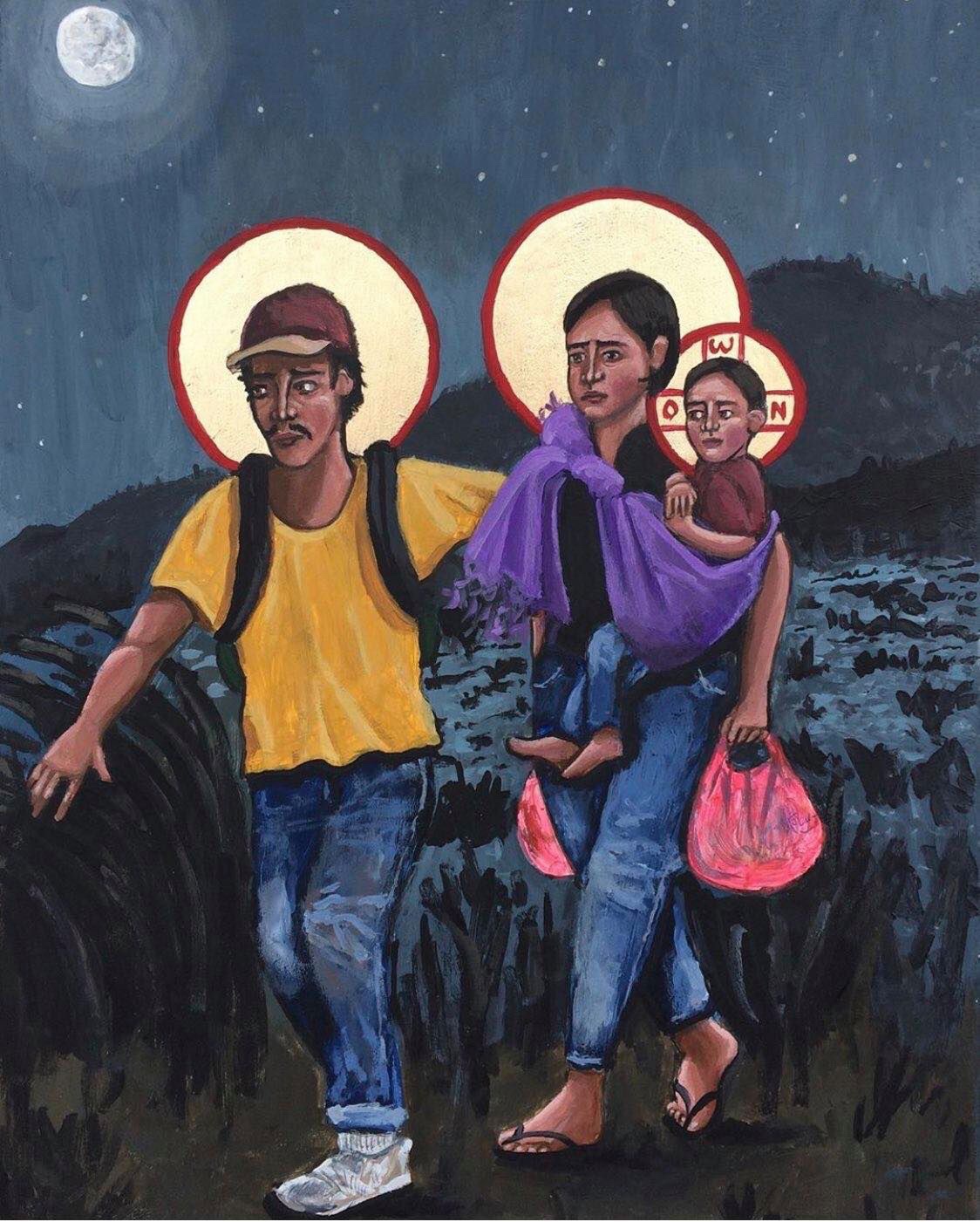
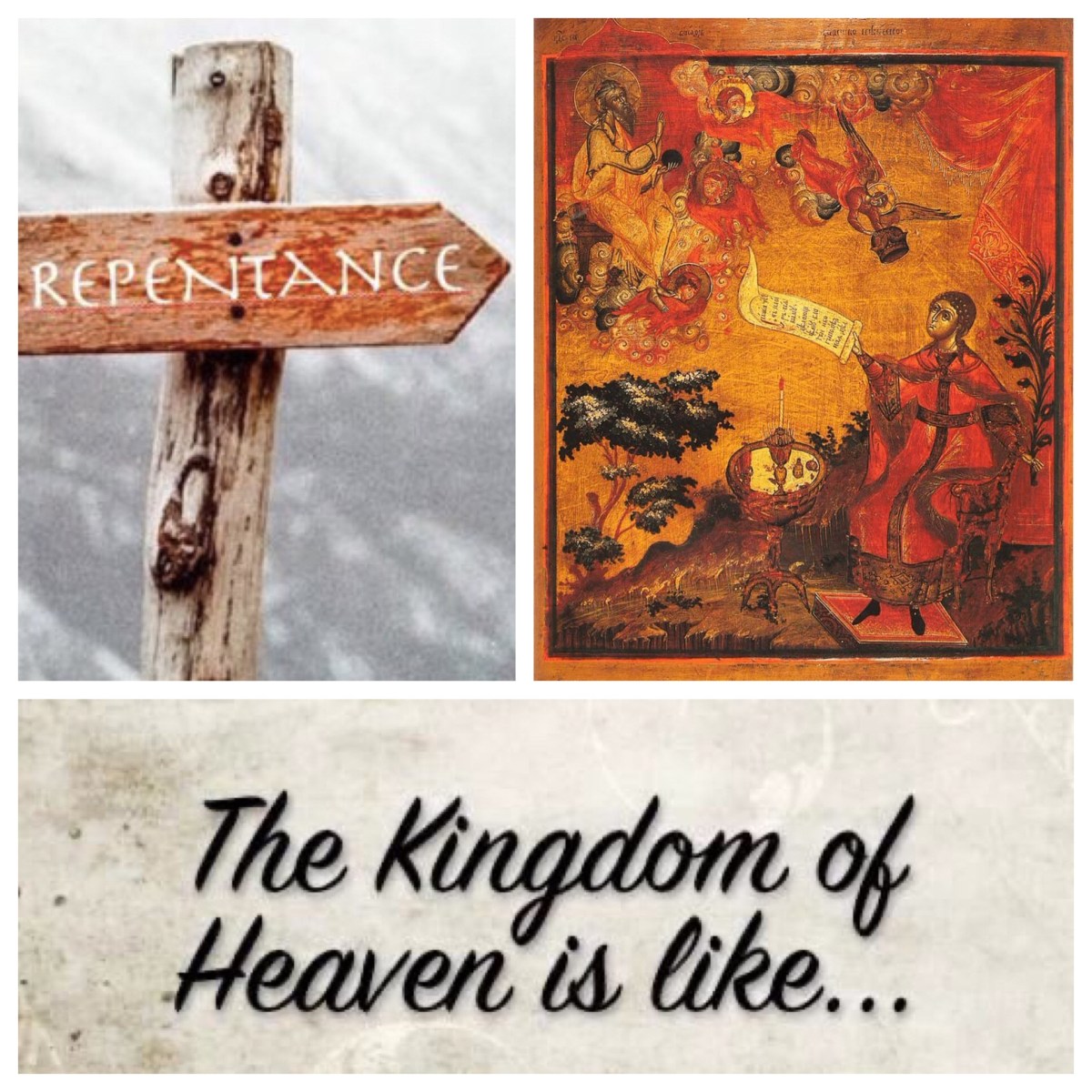
Repentance for the kingdom (Matt 4; Epiphany 3A)

From that time Jesus began to proclaim, “Repent, for the kingdom of heaven has come near” (Matt 4:13). The first public utterance of Jesus, in the book of origins which we know as the Gospel according to Matthew, is a word-for-word repetition of the signal proclamation by John the baptiser: In those days John the Baptist appeared in the wilderness of Judea, proclaiming, “Repent, for the kingdom of heaven has come near” (Matt 3:1-2).

This passage is set as part of the Gospel for this coming Sunday. It is an important passage in the book of origins, for it sets out two key elements in the declaration made by Jesus, which are central to understanding the purpose of of Jesus, as Matthew understands it.

The first element, repentance, is proclaimed by John and repeated by Jesus. The Greek word metanoia, which translated as “repentance”, is a powerful word; it refers to a complete and wholesale “change of mind”, a deeply permeating and thoroughgoing change of how one lives. It is no mere trifle; it is a serious, and challenging, concept.

John first asserts the need for such a thoroughgoing transformation, when he instructs the Pharisees and the Sadducees to bear fruit worthy of repentance (3:8). This theme is repeated by Jesus in various teachings: you will know them by their fruits (7:15-20), the tree is known by its fruit (12:33-37), and the warnings given to the towns of Chorazin, Bethsaida, and Capernaum (11:20-24).

In the teachings of Jesus included in this Gospel, Jesus provides clear and detailed instructions as to what “fruit” is entailed in this way of living, such as: go beyond what the Law says, to seek perfection (5:21-48); do not place stumbling blocks in another’s way (18:6-9); and give your possessions to the poor if you wish to be perfect (19:21-30). Repentance is serious and demanding.

The second element is the kingdom of heaven—also proclaimed by John (3:8) and then regularly included in the teachings and parables of Jesus. In Matthew’s understanding, the kingdom is closely linked with righteousness 5:10, 20; 6:33; 21:31-32; 25:46).

Such righteousness requires deep and abiding repentance—that change of mind, heart, and the whole being, that comes from entering into covenant relationship with God, and following the way of Jesus. (And dikaiosune, the Greek word usually translated as righteousness, can equally be translated as justice, which, of course, gives a different flavour to our understanding when we read that English rendering.)

The kingdom is both God’s gift to those who are righteous, or just, and the realm where God’s righteousness, or justice, will be the norm. There is a marvellous treasury of parables about the kingdom found in Matt 13, some additional parables in Matt 20 and 22, and then three final and powerful parables in Matt 25. They signify that the kingdom includes both a gift (it the place where God’s justice, or righteousness, is freely evident), and a demand (it is the way that God requires righteous lives, or just lifestyles, from human beings).

Often the parable is told with a single focus point: the kingdom of heaven is like … (hidden treasure, or fine pearls, or a mustard seed). Some parables are more developed, involving a series of characters, recounting a developing storyline. Each parable, nevertheless, drives towards a clear central point, explaining the nature of the kingdom that is proclaimed by Jesus, as gift and demand.

Jesus teaches that entry into the kingdom is premised on faithful service (7:21-23); it is those who produce the fruits of the kingdom who will share in this realm (21:43). Alongside Jews who are faithful followers of Jesus, the kingdom will include those from beyond Israel—a Gentile centurion (8:10,13) and a Canaanite woman (15:28) are specifically commended. They are welcomed because of their faith, which has been made evident in the way they respond to Jesus—they place their complete trust in him. (We are not told that they become followers of Jesus; they simply trust him in that moment of encounter.)

The passage set for this Sunday thus serves as an introduction to key themes that are expounded by Jesus throughout his teaching ministry, as well as an overview of key elements that will recur throughout the year, as excerpts from this Gospel appear in the lectionary week by week.

******

The icon shown is a 19th century representation of “the kingdom of heaven”, from Petersburg.

This blog draws on material in MESSIAH, MOUNTAINS, AND MISSION: an exploration of the Gospel for Year A, by Elizabeth Raine and John Squires (self-published 2012)

*******

See also

https://johntsquires.com/2019/12/27/reading-matthews-gospel-alongside-the-hebrew-scriptures-exploring-matthew-2/

https://johntsquires.com/2019/12/21/a-young-woman-a-virgin-pregnant-about-to-give-birth-isa-714-in-matt-123/

https://johntsquires.com/2019/12/11/the-origins-of-jesus-in-the-book-of-origins-matthew-1/

https://johntsquires.com/2019/12/19/descended-from-david-according-to-the-flesh-rom-1/

https://johntsquires.com/2019/12/17/now-the-birth-of-jesus-the-messiah-took-place-in-this-way-matthew-1/

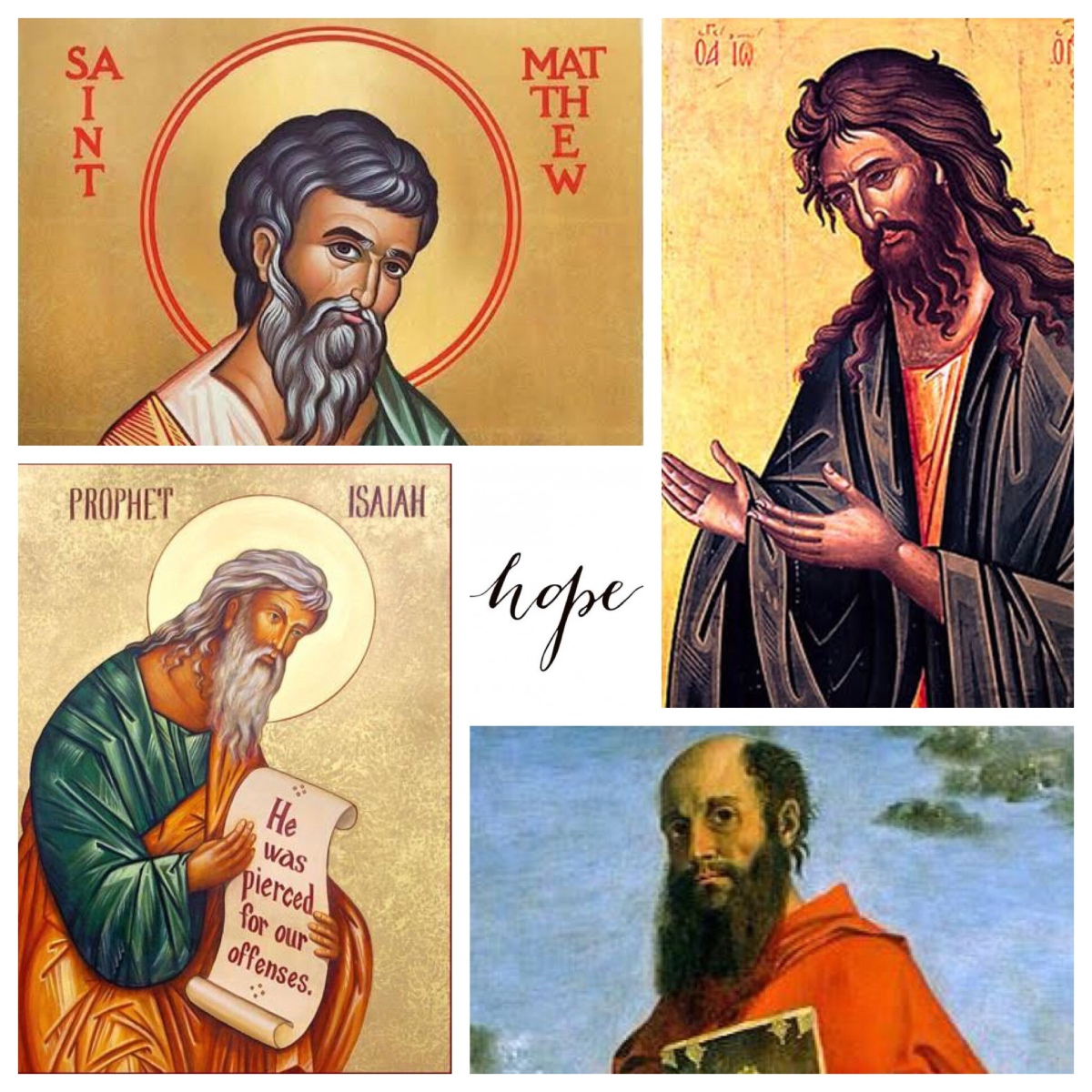
https://johntsquires.com/2019/12/04/for-our-instruction-that-we-might-have-hope-rom-15-isa-11-matt-3/

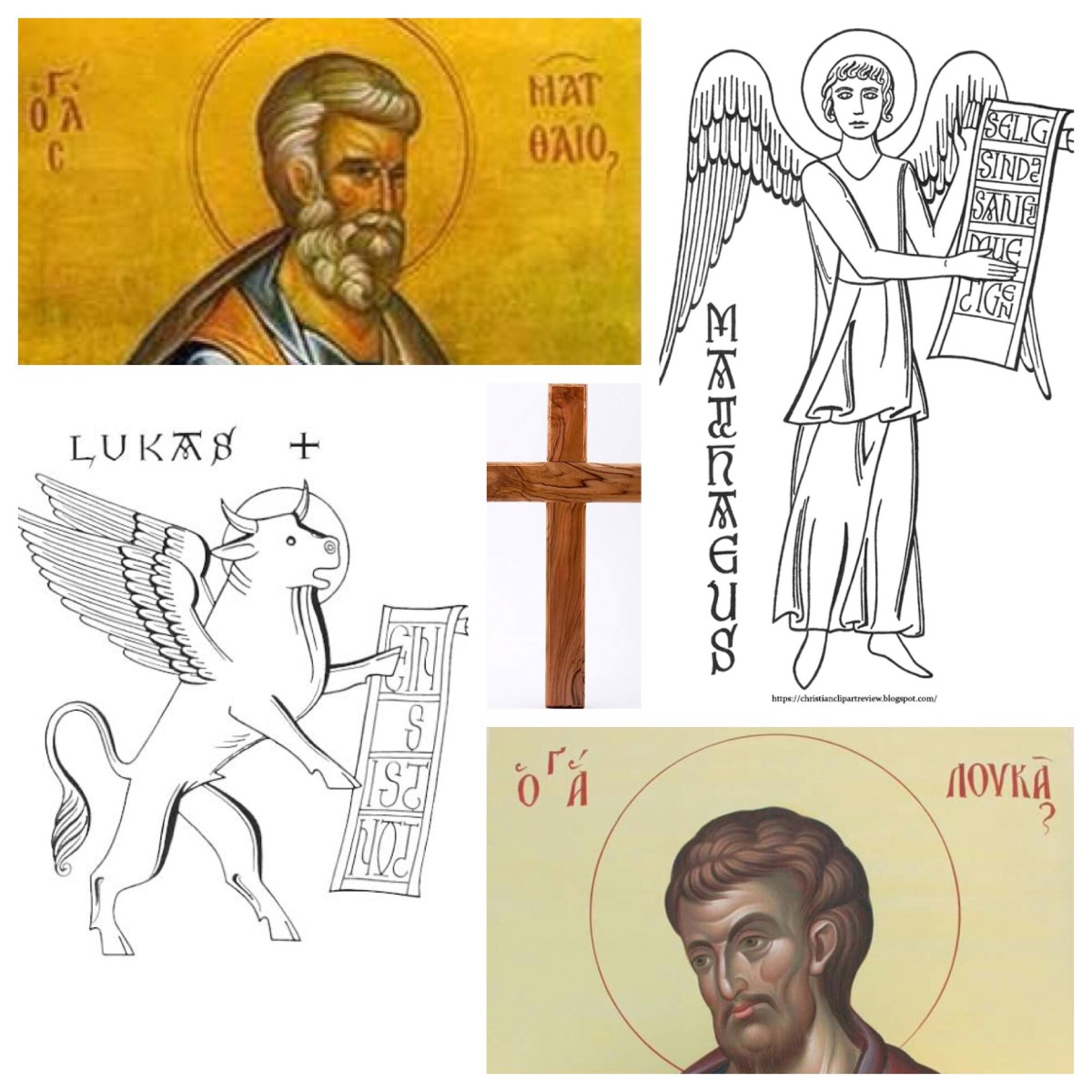
https://johntsquires.com/2019/11/28/leaving-luke-meeting-matthew/
Herod was infuriated, and he sent and killed all the children (Matt 2; Christmas 1A)

In the orderly account in which Luke tells the story of the first Christmas, we become engrossed in a story that is always presented in gentle, romanticised ways. It is a story about a pregnant woman and her partner, an angel appearing at the time of conception to the mother-to-be, announcing good news of great joy.

It is a story that reports how, nine months later, the angel appeared again, to some shepherds in the fields. It is a bucolic pastoral scene, or so we think. (Luke 1–2).

There is also a census and a journey, a choir of angels singing songs, announcing peace, declaring good news, celebrating joyfully. And there is an overfull stable, necessitating the birth of the child in a temporary location, and finally a child who is laid in a manger with his mother and father by his side. But all is calm, all is serene, all is gentle. So we believe. So we sing. So we think.

By contrast, in the book of origins, as Matthew tells that same story, we are invited into a different saga, with a different tone. Whilst there is a baby, with mother and father, in this version, there is no manger, no shepherds, and certainly no choir of angels.

In fact, there is just one angel, and this solitary angel speaks only with the father, not with the mother, not once, but three times in all. And each time, the message is ominous: she is pregnant! you must leave, now! and, hurry back home!

There is no announcement of good news of great joy. There is no census and no journey, at least, at the point of birth. But there is a tyrannical king, a set of visitors from foreign places, a prophecy that enrages the king, and a response which terrifies the visitors, who rapidly leave to return to their homeland.

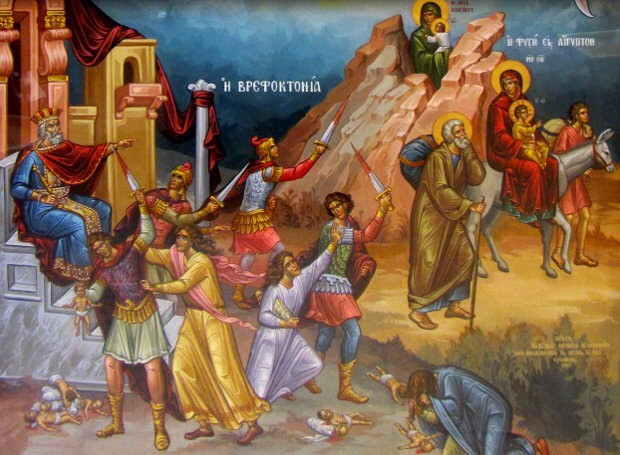
And the story as Matthew tells it continues with a violent pogrom, the slaughter of innocent babies. “Herod was infuriated, and he sent and killed all the children in and around Bethlehem who were two years old or under, according to the time that he had learned from the wise men” (Matt 2:16).

It continue with a rushed journey by the father and mother and their infant child, travelling as refugees seeking safety in a foreign place. They return home some time later, only after the tyrannical despot has died. This later part of the story is featured rarely, if at all, in the classic depictions of the Christmas story.

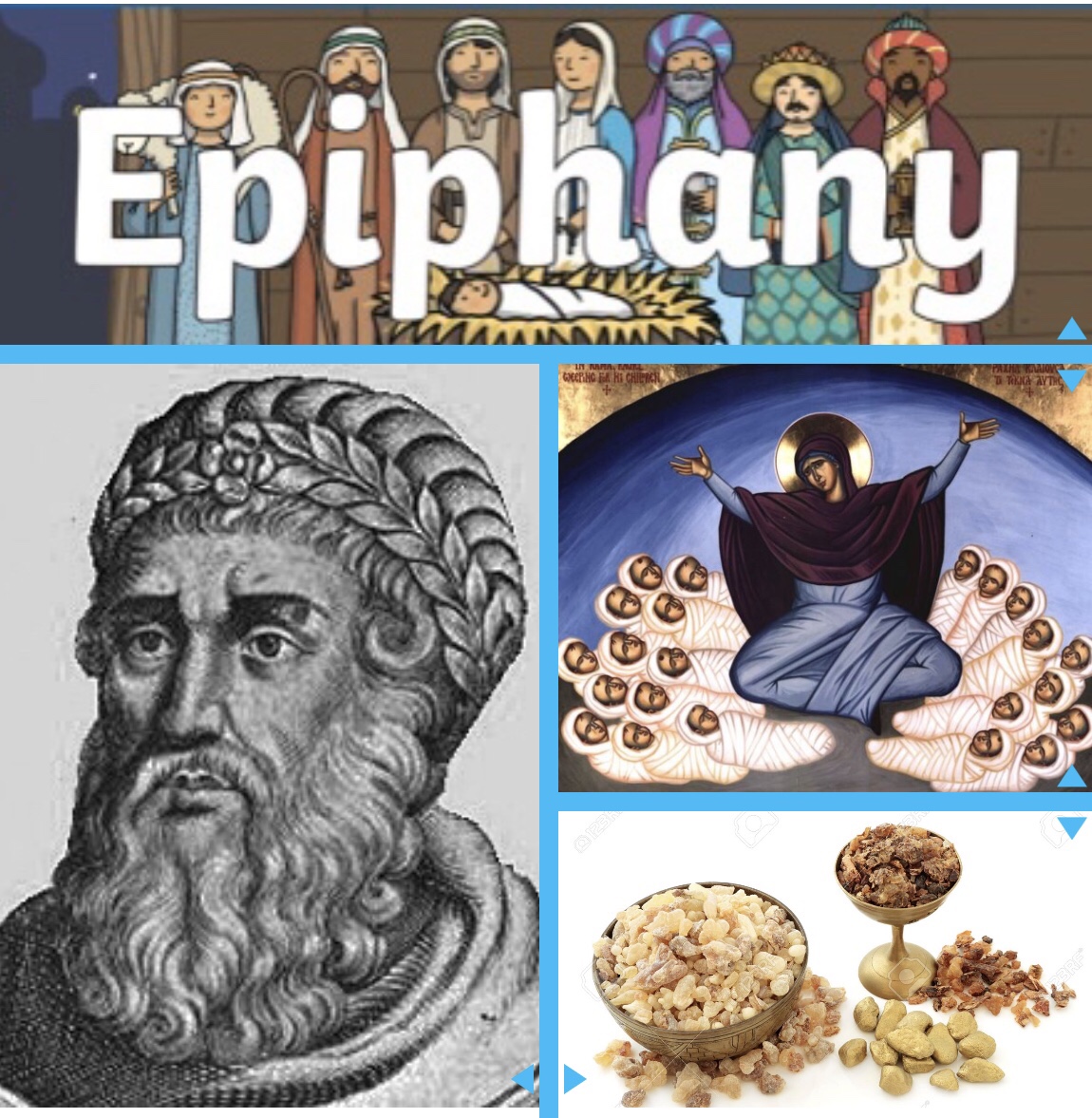
The festival of Epiphany, celebrated after the Twelfth Day of Christmas on 6 January, invites us to think about the journey made by these wise men. The journey is romanticised by the fact that they bring gifts to the infant and his family—gifts of gold, frankincense, and myrrh.

The gifts, it is claimed, are symbolic of what is to come. The gold is considered to symbolise the royal status of the child, as he is of the line of David. The frankincense is connected with the Temple cult, and thus considered a symbol of the priestly role eventually to be played by the child.

Then, there is myrrh, which Christian tradition links with the death that will be experienced by the infant when he has grown to maturity—death at the hands of a Romans, who offered him wine mixed with myrrh as he hung dying on a cross. The story of origins already prefigured the story of ending.

That part of the story—the gifts that the wise men brought—feeds into the romance and wonder that Luke’s version offers (at least, in the way it is usually understood). But the horror, the terror, the violence, the grief, of the events perpetrated under Herod, are not in view. Because Epiphany is about revelation, about light shining forth, about God being known and experienced in the midst of ordinary life.

This year, perhaps we might pause, and wonder: how does the story of Herod’s murderous rampage reveal the presence of God in the story?

I have no answer … just a question. How is God present, evident, shining forth, at such a time?

It is a question that is pressing, given the context in which I, and many Australians, have experienced Advent, Christmas and Epiphany this year.

As the bushfires rage, inflaming and destroying, purpling plumes of smoke into the air and ravaging forests, ecosystems, native animals and stock, as well as human property and human lives—the question seems ever more pertinent: where is God in this catastrophe?

As the early followers of Jesus found hope in the midst of the story of terror and violent destruction, so may we search, explore, and yearn for hope in this current situation.

On hymns that include the story of Herod’s rampage, see https://johntsquires.com/2020/01/03/herod-waiting-herod-watching-herod-grasping-holding-power-matt-2/

For prayers that are appropriate for a time in the midst of bushfires, see https://johntsquires.com/2019/12/22/we-wait-and-hope-and-grieve-anticipating/

and

blessed are you East Gippsland

For a reflective prayer on the wise men, see http://praythestory.blogspot.com/2019/12/make-it-now.html

For an overall comparison of Matthew with Luke, see https://johntsquires.com/2019/11/28/leaving-luke-meeting-matthew/
Herod waiting, Herod watching, Herod grasping, holding power (Matt 2; Christmas 1A)

The book of origins is unique, within the New Testament (and, indeed, within the whole literature of antiquity) in reporting a savage, indiscriminate pogrom, ordered by King Herod, and carried out under his watch—the murder of all infant males under two years of age within Bethlehem (Matt 2:16-18).

The story hardly ever features in any Christmas or Epiphany services or sermons. However, a number of contemporary hymn writers have turned their attention to this story. Shirley Erena Murray, a Presbyterian from Aotearoa New Zealand, is right on the money when she highlights the violence and fear at the heart of the story, claims that the infant in the story has “come to plead war’s counter-case”, and articulates the hope that “goodness will outclass the gun, evil has no tooth that can kill the truth.”

Summer sun or winter skies, Christmas comes —

shepherds, angels, lullabies, words recorded by the wise:

read it in the book — take another look . . . .

Shadows track the hawk in flight, Christmas now —

children born in fire and fight, silent night a violent night,

hawks are in control of a nation’s soul

There where terror plies its trade, Christmas now —

children learn to be afraid, minefields of distrust are laid,

evil is in force on a winning course

Child of peace, God’s human face, Christmas now —

come to plead war’s counter-case, bring the dove a nesting place,

though her wings are torn, though her blood is drawn

Winter skies or summer sun, Christmas comes —

still the threads of hope are spun, goodness will outclass the gun,

evil has no tooth that can kill the truth.

That is why the ancient story resonates so strongly with our situation today. Not because “it really happened, exactly like this”, but because it takes us to the centre of our humanity and reveals the depth of God’s presence in our midst. We ought to sing more about it!

http://www.hopepublishing.com/html/main.isx?sitesec=40.2.1.0&hymnID=430

Another contemporary hymn writer who has turned his attention to the story of Herod’s tyrannical rampage against the male children in Bethlehem, is the British Methodist, the Rev. Dr Andrew Pratt. Here is a powerful hymn which he has written about this story.

Herod waiting, Herod watching,

Herod grasping, holding power,

Herod fearful for the future,

Herod counting every hour.


Now the thing that he was fearing:

love and justice, peace and health,

here embodied in a person,

God incarnate, heaven’s wealth.


This was more than he could stomach,

human wine skins tear and rend.

Herod’s dream had been confounded,

human power had met its end.


Many children now were crying,

temper triumphed, babies dead.

Mary, Joseph made an exit,

every step was filled with dread.


Into exile they were driven,

fear would ripple through each life:

Jesus challenged vested interests.

Gracious love fuelled hate and strife.


And the children still are crying,

forced to war and harmed by hate.

Still our world is deaf to hear them,

still our loving comes too late.

© Andrew Pratt 18/11/2010

First after Christmas, Matthew 2: 13 – 23,

Herod, Holy Innocents, the flight into Egypt.

https://www.umcdiscipleship.org/resources/herod-waiting-herod-watching

What a pity that this potent story, full of pathos, and so resonant with events in the world in which we live today, has all but faded from view in the story that is recounted each Christmas. There are clear words in these carols which show how the story challenges political values and policies and how it connects with the deepest feelings of human existence.

For more on Epiphany, see next post

The origins of Jesus in the book of origins: Matthew 1 (Advent Year A)

The book of origins of Jesus the chosen one, descendant of David, descendant of Abraham. So begins the first book in the New Testament (in my own translation from the Greek). We know this book as The Gospel according to Matthew.

This book has long been regarded as a keystone of Christian doctrine and has enjoyed a pre-eminent place within the church. Because early believers considered it to be the earliest gospel, it was placed at the very beginning of the New Testament canon and came to be known as “the first gospel”. It thereby sets out some key aspects of the origins and significance of Jesus.

This book starts with an account of the ancestry of Jesus. (In the days before DNA testing, this information was retained and passed on by word of mouth from one generation to the next.) It mimics the Old Testament passages that are sometimes called “the begats” … so-and-so begat such-and-such, such-and-such begat another one … and so on.

You can find extensive lists of “begats” in Genesis, Numbers, and 1 Chronicles, and more briefly in Ruth and Nehemiah. These multiple “begat” passages indicate that a person’s heritage was an important part of Jewish tradition.

The author of Matthew, being himself a faithful Jew, is anxious to establish the credentials of Jesus’ ancestry, so he begins his work with a genealogy (1:1–17) in which he lays out some important signs as to the true nature of Jesus, following the age-old pattern of the Hebrew people.

First, he indicates that Jesus fulfils the promises of scripture by establishing that Jesus was descended from the Davidic kings (1 Chron 28; Ps 18:50), whose house was to rule over Israel forever, as God’s chosen.

Matthew structures the genealogy in three groups of 14 generations; this is quite different from the structure of the genealogy in Luke. In Hebrew numerology, each letter stands for a number; thus, DVD, the three consonants of David, add up to 14. So, the structure of the genealogy in Matthew underlines the claim that Jesus is a descendant of David (1:1).

Matthew also notes that Jesus is descended from Abraham, the first man to receive the covenant (1:2). Abraham was the one whose descendants would fulfil the blessings that God had promised for all the earth (1:2): David, the founder of the royal line and ancestor of the promised Messiah (1:6); and Zerubbabel, leader of the post-exilic community (1:12).

Even more interestingly, Matthew includes five women in the list: Tamar, who posed as a temple prostitute (1:3; Gen 38); Rahab, a prostitute from Jericho (1:5; Josh 2, 6); Ruth, a Moabite who married Boaz after a dubious meeting with him at night on the threshing floor (1:5; Ruth 1–4); the wife of Uriah (Bathsheba), who married David after an adulterous encounter (1:6; 2 Sam 11–12); and Mary, who became pregnant before her marriage to Joseph (1:16).

While the inclusion of the male ancestors is not surprising, the addition of these women is most unexpected. Different reasons have been put forward as to why they are there. Some scholars see them as foreshadowing the redemption of Gentiles, others as a more general symbol of the redemption of sinners. Others have felt they vindicate the pre-marital pregnancy of Mary.

One thing does stand out about all five, and that is they were independent of the traditional patriarchal system of Israel. Each one flouted convention in some startling way to ensure the fulfilment of God’s divine plan. All had humble beginnings. All were obedient to their faith and willing to submit to what they felt was the will of God. They are striking figures, each one of them!

Thus, Matthew’s genealogy is not just a list of names, but a theological statement about Jesus as the fulfilment of God’s promises to Israel through Abraham and David from its inception and throughout its history of prosperity and exile. Through Jesus, this plan for the salvation of Israel will indeed be fulfilled, and fulfilled in a most unexpected way. We should be reading the opening of this Gospel, not as a historical treatise or a family tree per se, but as a theological exposition signalling key motifs of the work that follows.

Matthew also includes many special events around the birth of Jesus (1:18– 2:23), events which we would expect to find attending the birth of a great prophet or the Messiah. The announcement of the name of Jesus follows a standard pattern as found in the Hebrew Scriptures for prominent figures: “bear a child … name him … what it means” (see 1 Sam 1:19; Gen 16:11; 17:19; Judg 13:3, 5).

The title given to Jesus in 1:23, “Emmanuel” (from Isaiah 7:14–16), is intended to show that in the coming of Jesus, God’s spirit became present among people through the messiahship of Jesus. In its original context, the text foretold the imminent birth of a child from the Davidic line, who would demonstrate that God continued to care for his people and was thus still “with us”. For Matthew, the verse emphasises further the Davidic origin of Jesus, and declares that the purpose of God was to save Israel at the coming of this child, Jesus.

In these ways, then, Matthew sets out the key elements of the origins and significance of Jesus: descendant of David, descendant of Abraham, chosen one of God. We will be following the story that Matthew offers us, throughout the coming year. It is a book of origins rich with resources for us as we seek to follow the way of Jesus today.

See also https://johntsquires.com/2019/11/28/leaving-luke-meeting-matthew/
https://johntsquires.com/2018/12/19/what-can-we-know-about-the-birth-of-jesus/

****

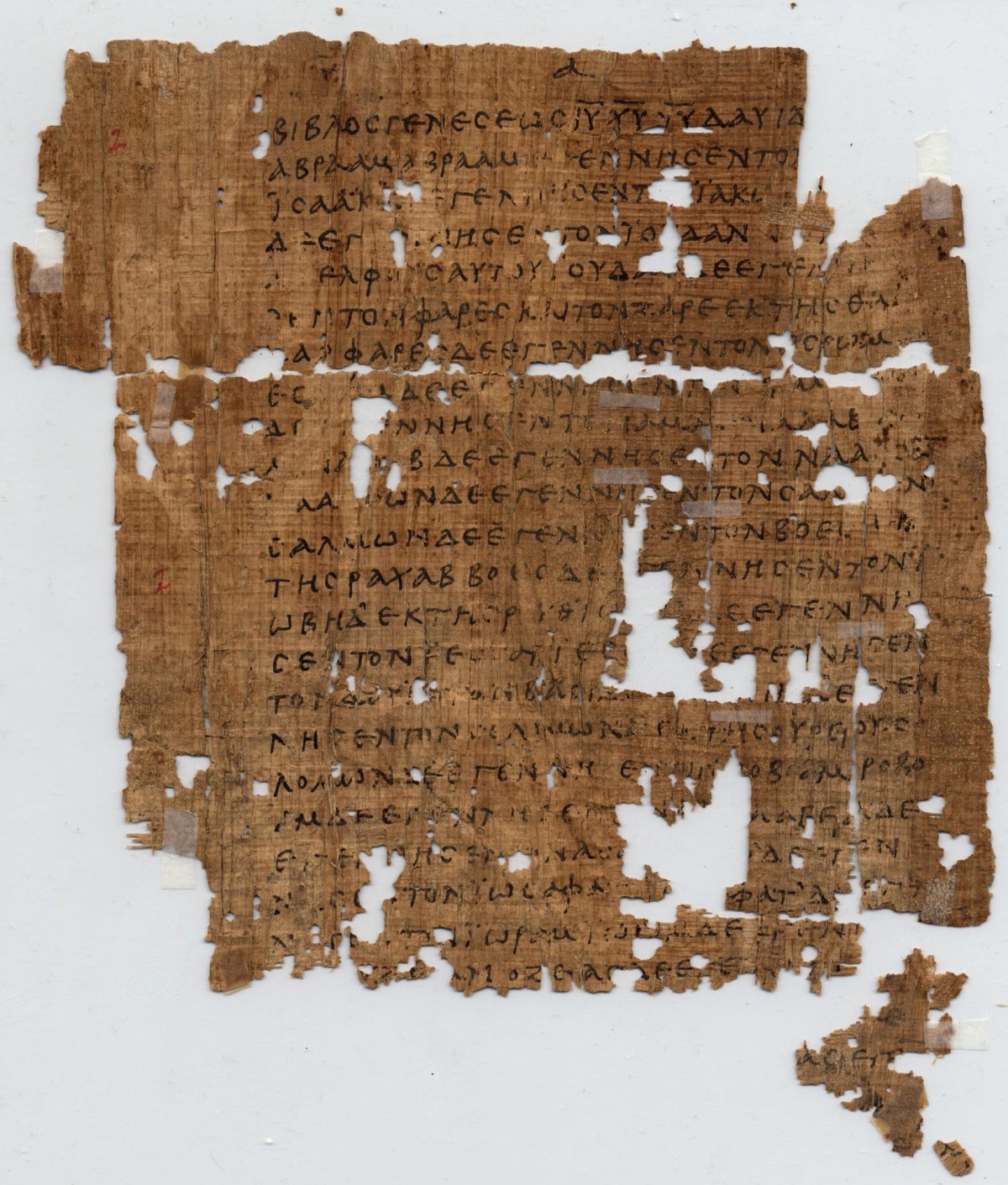
The image is of an early version of the genealogy of Jesus provided in Matthew 1:1-9,12 found on the recto side (the front side) of Papyrus 1, dated to about 250 CE

For our instruction … that we might have hope (Rom 15, Isa 11, Matt 3; Advent 2A)

As Paul comes to the end of his letter to the Romans—a letter in which he quotes, time and time again, from the scriptures of his people, the Hebrew people, the books we know as the Old Testament—he makes a passing comment which, in my mind, is a penetrating insight into how he operates.

Whatever was written in former days was written for our instruction,

so that by steadfastness and by the encouragement of the scriptures

we might have hope, he writes (Rom 15:4).

We have that section of the letter included in our readings this coming Sunday, the second Sunday in Advent. I suspect that the reason that this section is included is because Paul here goes on to quote from a collection of scriptures, each of which, in his mind, justifies what he is doing as he writes to the Romans.

My understanding of this letter is that Paul writes to persuade the Jewish Christians that they are to be welcoming, hospitable, and inclusive of the Gentile Christians who are part of the various house churches in Rome; as he says,

by grace, through faith, all are saved; there is no distinction, since all have sinned and fall short of the glory of God; they are now justified by his grace as a gift, through the redemption that is in Christ Jesus, whom God put forward as a sacrifice of atonement by his blood, effective through faith. (Rom 3)

And so, the letter moves towards its close with this quotation:

I tell you that Christ has become a servant of the circumcised on behalf of the truth of God in order that he might confirm the promises given to the patriarchs, and in order that the Gentiles might glorify God for his mercy.

As it is written, “Therefore I will confess you among the Gentiles, and sing praises to your name”;

and again he says, “Rejoice, O Gentiles, with his people”;

and again, “Praise the Lord, all you Gentiles, and let all the peoples praise him”;

and again Isaiah says, “The root of Jesse shall come, the one who rises to rule the Gentiles; in him the Gentiles shall hope.” (Rom 15)

This passage grounds the reality of the church in the gathering of disparates, Jews and Gentiles; it also grounds our faith in the advent of Jesus, the one who draws Jews and Gentiles together; and it provides us with this seasonal word, during the season of Advent, as it points us to hope.

In the prophetic oracle set in the lectionary alongside the apostolic letter, Isaiah offers a wonderful vision of cosmic peace and universal co-operation:

The wolf shall live with the lamb,

the leopard shall lie down with the kid,

the calf and the lion and the fatling together,

and a little child shall lead them.

The cow and the bear shall graze,

their young shall lie down together;

and the lion shall eat straw like the ox.

The nursing child shall play over the hole of the asp,

and the weaned child shall put its hand on the adder’s den.

They will not hurt or destroy on all my holy mountain;

for the earth will be full of the knowledge of the LORD

as the waters cover the sea. (Isaiah 11)

However, this vision of peace appears in our lectionary alongside some harsh striking words, about the judgement that is associated with this vision. As the evangelist writes about the coming of the promised one—the one who will,presumably bring about this era of peace—he reports words spoken by John the Baptiser, which offer this sense of judgement:

His winnowing fork is in his hand, and he will clear his threshing floor and will gather his wheat into the granary; but the chaff he will burn with unquenchable fire. (Matt 3)

And again, in the Gospel for today, this message of judgement and punishment is vividly conveyed:

Even now the ax is lying at the root of the trees; every tree therefore that does not bear good fruit is cut down and thrown into the fire. (Matt 3)

This is a stern word. It seems strange for us, during Advent, as we prepare for Christmas, to be hearing such clanging, jarring sounds. Although, as one of my colleagues said to me earlier this week, as we talked about the offerings on hand in the lectionary during this season:

The soundtrack of Advent is not jingle bells;

It is the sound of a hammer on an anvil.

For the incessant message of the prophets is one which calls us to account. The hammer strikes the anvil, once, twice, repeatedly, marking the surface, forging the shape, creating the essence of the person. And the message of the prophets places before us an insistence that we need to act ethically, live responsibly, with justice and equity, as we wait with hope for the coming of the one who will bring in the promised time of peace.

Indeed the prophet, as he envisages the presence of this one, so long hoped for, as he considers how “a shoot shall come out from the stump of Jesse, and a branch shall grow out of his roots”, describes him in this way:

Righteousness shall be the belt around his waist,

and faithfulness the belt around his loins. (Isaiah 11)

The one to come will exemplify righteousness, and will assess the fruit produced by those he encounters. He will execute judgement by swinging the axe, cutting down the tree, and burning the branches in the fire; and, as the prophet declares,

He shall strike the earth with the rod of his mouth,

and with the breath of his lips he shall kill the wicked.

The soundtrack of Advent is not jingle bells;

It is the sound of a hammer on an anvil.

As we reflect on these words during this season, we do so with prayerful anticipation, with resolute hopefulness, with persistence and openness to God’s way in our midst, for we yearn to encounter afresh this chosen one:

The spirit of the LORD shall rest on him,

the spirit of wisdom and understanding,

the spirit of counsel and might,

the spirit of knowledge and the fear of the LORD.

His delight shall be in the fear of the LORD.

He shall not judge by what his eyes see,

or decide by what his ears hear;

but with righteousness he shall judge the poor,

and decide with equity for the meek of the earth;

he shall strike the earth with the rod of his mouth,

and with the breath of his lips he shall kill the wicked.

Righteousness shall be the belt around his waist,

and faithfulness the belt around his loins.