Appropriating the words of an Israelite prophet for a Christian doctrine (Isaiah 6; Trinity B)

Trinity Sunday is one of the very few times in the Christian calendar that a Sunday is named for a doctrine, rather than for a biblical story (Easter, Pentecost, Christmas, and the like). The passages are chosen to encourage us to reflect on the doctrine of the Trinity, as a doctrine that is central to our faith, through selected biblical passages; this year, sections of Isaiah, John, and Romans (with a Psalm chosen to complement these selections).

So this Sunday we are being asked to approach scripture in a way quite different from many other Sundays, when biblical texts are offered for us to consider in their own right. Trinity Sunday, by contrast, pays scant attention to the historical and literary contexts of the chosen texts. Rather, they are selected as isolated “bites” that can be woven together to provide “a biblical basis” for a doctrine that was developed and expressed a number of centuries later.

In this regard, it has similarities with the way that we are encouraged to read selections from the prophets of ancient Israel—taking particular passages which are placed alongside certain Gospel stories because they “illuminate” or “complement” these later texts. The birth of Jesus at Christmas and the death of Jesus at Easter—and the weeks leading up to these days, in the seasons of Advent and Lent, respectively—are the times when this process is most evident.

So the choice of Isaiah 6:1–8 as the First Reading for this coming Sunday, Trinity Sunday, has both of those pressures running in parallel. First, this text is intended to speak from six centuries before Jesus about what people four centuries after Jesus thought about him, God, and the Spirit. That’s a leapfrog over a whole millennium!!

And second, this text is intended to focus our thoughts on the threefold nature of God—Father, Son, and Holy Spirit—through the somewhat fortuitous chanting of “holy, holy, holy” by seraphim in the smoke-filled temple atop Mount Zion (Isa 6:3). The only other place in scripture where this threefold acclamation of divine holiness appears is in the extravagantly symbolic visions of the spirit-infused prophet of Revelation, as he “sees things” in his old age (Rev 4:8).

The chanting of the seraphim in the former book, Isaiah, is the first articulation of a chant which, millennia later, became associated with the triune God, worshipped in Christian liturgies. In my own church, after the presiding minster prompts with the words: “And so we praise you with the faithful of every time and place, joining with the choirs of angels and the whole creation in the eternal hymn”, the people respond, “Holy, holy, holy Lord, God of power and might, heaven and earth are full of your glory. Hosanna in the highest. Blessed is he who comes in the name of the Lord. Hosanna in the highest.” (quoted from The Service of the Lord’s Day in Uniting in Worship 2; Assembly of the Uniting Church in Australia, 2005).

This song has an integral place in the liturgy, not just of the Uniting Church, but of numerous liturgical denominations around the world. It is sung or spoken in the Great Prayer of Thanksgiving, as people offer thanks to God and prepare to receive the sacrament. Its location within the Christian liturgy means that, in the minds of many believers, it is thoroughly Christianised.

And I suspect that the threefold expression, “holy, holy, holy”, is intended to evoke the three-in-one nature of God, as understood in classic Christian theology. Perhaps it is intended to be a subconscious evocation of “Holy God, Holy Son, Holy Spirit” — even though the song itself says nothing about the unity of those three elements?

The author of the latter book, Revelation, quotes this chant in the long sequence of visions that he reports in this book. He says that he was “in the spirit” (1:10; 4:2; 17:3; 21:10), hearing “the voice of many angels” (5:11–12), as four living creatures sing without ceasing, “Holy, holy, holy, the Lord God the Almighty, who was and is and is to come” (4:8). That’s a multiplying of the threefold aspect of God—three times holy, over three eras of time.

The creatures singing this song are “full of eyes in front and behind”, and they variously appear like a lion, an ox, a creature with a face like a human face, and a flying eagle (4:6–7). These strange creatures appear before the prophet then sees “a lamb standing as if it had been slaughtered, having seven horns and seven eyes” (5:6). The scene is quite fantastical.

There follows further, increasingly bizarre, visions: “the lamb” opens a series of seals with associated dramatic events (6:1–17; 8:1), angels are seen to be hold back nature (7:1), one angel speaks forth (7:2–3) and then seven angels each blow their trumpets (8:6—9:14) before another four angels who were “bound at the great river Euphrates” are released in order to wreak vengeance on the earth and on humanity (9:15–21). We are well and truly into the vividly creative inner mind of the prophet, surely.

After all of this, the prophet is offered a scroll by an angel “wrapped in a cloud, with a rainbow over his head; his face was like the sun, and his legs like pillars of fire” (10:1–2). The prophet takes the scroll and eats it (10:8–10); “it was sweet as honey in my mouth, but when I had eaten it, my stomach was made bitter” (10:10). That should hardly have been a surprise; the human digestive system is not intended for such a diet!

Then the prophet is instructed to “prophesy again about many peoples and nations and languages and kings” (10:11)—and he does so in a series of increasingly dramatic, vivid, and bizarre prophecies (chs. 11—22). It’s hardly the stuff that encourages me to think that the vision which included the threefold acclamation of God (4:8) was being considered in a rational way and employed in a constructive process of building a doctrine that would serve the church well over time!

Quite surprisingly, in the midst of this extravagant revelatory exotica, there is a little scene that is strongly reminiscent of the scene in the temple on Mount Zion that Isaiah had described centuries beforehand. An angel with a golden censer “came and stood at the altar; he was given a great quantity of incense to offer with the prayers of all the saints on the golden altar that is before the throne” (Rev 8:3). After this, “the smoke of the incense, with the prayers of the saints, rose before God from the hand of the angel” (8:4) before the angel took the censer and filled it with fire from the altar and “threw it on the earth; and there were peals of thunder, rumblings, flashes of lightning, and an earthquake” (8:5).

The scene that is narrated in Revelation, therefore, might have certain resonances with the scene when the thresholds of the doorway to the Temple building “shook at the voices of those who called, and the house filled with smoke” (Isa 6:4). However, the creative imagination of the later prophet on Patmos (Rev 1:9) has taken him far, far away from the scene of the earlier prophet, Isaiah, in Jerusalem. And he ends up even further away from the process of vigorous debate and philosophical disputation which was the context within which the doctrine of the Trinity was formulated.
Isaiah locates the moment when he sensed his calling to be a prophet precisely when those seraphs sang their song, “holy, holy, holy” (Isa 6:3). “Woe is me”, he cries, explaining that “I am lost, for I am a man of unclean lips, and I live among a people of unclean lips” (6:5a). An intense sense of personal and communal inadequacy grips the prophet.

“Yet”, he continues, “my eyes have seen the King, the Lord of hosts!” (6:5b). This is far from an exposition of the inner nature of God; there is nothing to provide a hint of the doctrine of the Trinity, to be sure. In fact, this vision is similar to that seen by the prophets Amos during the time of Uzziah of Judah and Jeroboam of Israel (Amos 9:1) and Micaiah during the time of Jehoshaphat of Judah and Ahab of Israel (1 Ki 22:19; 2 Chron 18:18), when “coals of fire flamed forth” from the brightness before the Lord God.

In what Isaiah sees in this vision of “the King, the Lord of hosts”, he reports that “one of the seraphs flew to me, holding a live coal that had been taken from the altar with a pair of tongs; the seraph touched my mouth with it” (6:7) and uttered words of cleansing and forgiveness (6:8), followed by a word of commissioning (6:8). The coals are reminiscent of David’s vision of the Lord in his prayer calling for help, as “smoke went up from his nostrils, and devouring fire from his mouth; glowing coals flamed forth from him” (Ps 18:8, 12; 2 Sam 22:9, 13).

This moment during the visionary experience in the smoke-filled Temple grounds the prophet in the realities of his earthly life. The seraphs fly from the envisioned presence of the Lord God to touch the prophet directly in his physical state. There is nothing speculative or metaphysical involved in this sixth century BCE experience, such as we find in the expressions of Trinity that have been formulated since the fourth century CE.

It is noteworthy that the content of the commissioning that Isaiah then hears (6:9–13) is omitted from the verses suggested by the lectionary for Trinity Sunday. This severs the scene in the middle; the charge given to Isaiah is integral to the scene, and should not be omitted! Granted, the words which Isaiah hears are challenging and complex, for he is to “listen, but not comprehend; keep looking, but not understand” (6:9); indeed, he is to “make the mind of this people dull, and stop their ears, and shut their eyes, so that they may not look with their eyes, and listen with their ears, and comprehend with their minds, and turn and be healed” (6:10).

This is sobering. It is also material which could have been considered—indeed, should have been considered—in the process of exploring the essence of God, and articulating the nature of the divine—which is precisely what the doctrine of the Trinity is attempting to do. The God who cleanses and calls (6:7–8) is the same God who challenges and convicts (6:9–10), and who then judges with a ferocious intensity which is born out of a deep integrity (6:11–13).

How long is Isaiah to prophesy his words of challenge? “Until cities lie waste without inhabitant, and houses without people”, the answer comes (6:11); until “vast is the emptiness in the midst of the land” (6:12). For better or worse, we need to reckon with this dimension of God’s nature—and this coming Sunday would have been as good a time as any to ponder it!

So on Sunday during worship, ignore the lectionary, don’t stop at verse 8, and keep reading to the end of the chapter; and then reflect on who this God whom we worship really is.

See also
I will put my spirit within you … I will place you on your own soil (Ezekiel 37; Pentecost B)

In the alternate reading that the Revised Common Lectionary proposes for the festival of Pentecost, this coming Sunday, we find a section from the exilic prophet Ezekiel (Ezek 37:1–14). This is the famous prophecy covering the dead bones, to which the Lord (through Ezekiel) declares, “I will cause breath to enter you, and you shall live. I will lay sinews on you, and will cause flesh to come upon you, and cover you with skin, and put breath in you, and you shall live; and you shall know that I am the Lord” (Ezek 37:5–6).

However, this passage also contains words which were filled with hope for the exiled people—but which, in the light of current events in the Middle East, and especially since the eruption of conflict on 7 October last year, are fraught with difficulties. God instructs Ezekiel, “prophesy, and say to them, Thus says the Lord God: I am going to open your graves, and bring you up from your graves, O my people; and I will bring you back to the land of Israel. … I will put my spirit within you, and you shall live, and I will place you on your own soil; then you shall know that I, the Lord, have spoken” (Ezek 37:12,14).

However, this passage also contains words which were filled with hope for the exiled people—but which, in the light of current events in the Middle East, and especially since the eruption of conflict on 7 October last year, are fraught with difficulties. God instructs Ezekiel, “prophesy, and say to them, Thus says the Lord God: I am going to open your graves, and bring you up from your graves, O my people; and I will bring you back to the land of Israel. … I will put my spirit within you, and you shall live, and I will place you on your own soil; then you shall know that I, the Lord, have spoken” (Ezek 37:12,14).

These words are fraught because of the long history of conflict relating to “the land of Israel”—the land to which the exiles would return under the decree of Cyrus of Persia; the land which today is the focus of such controversy and conflicted claims.

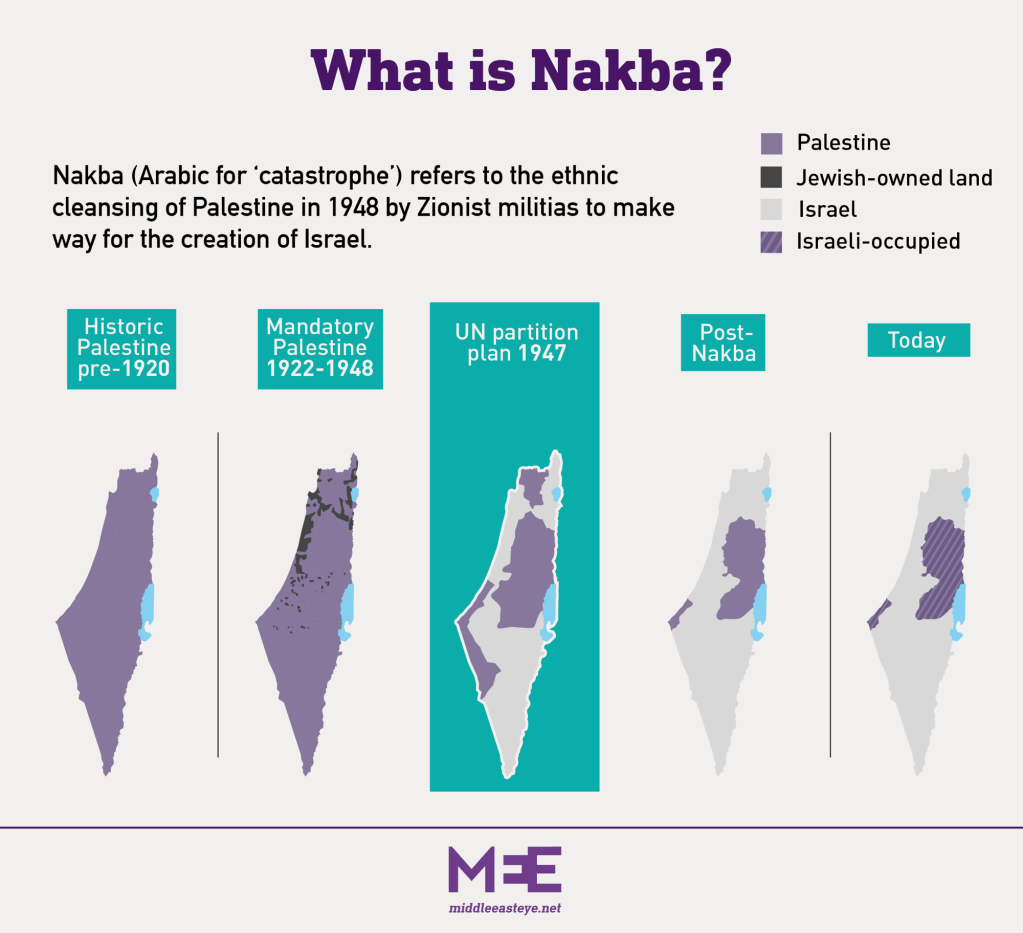
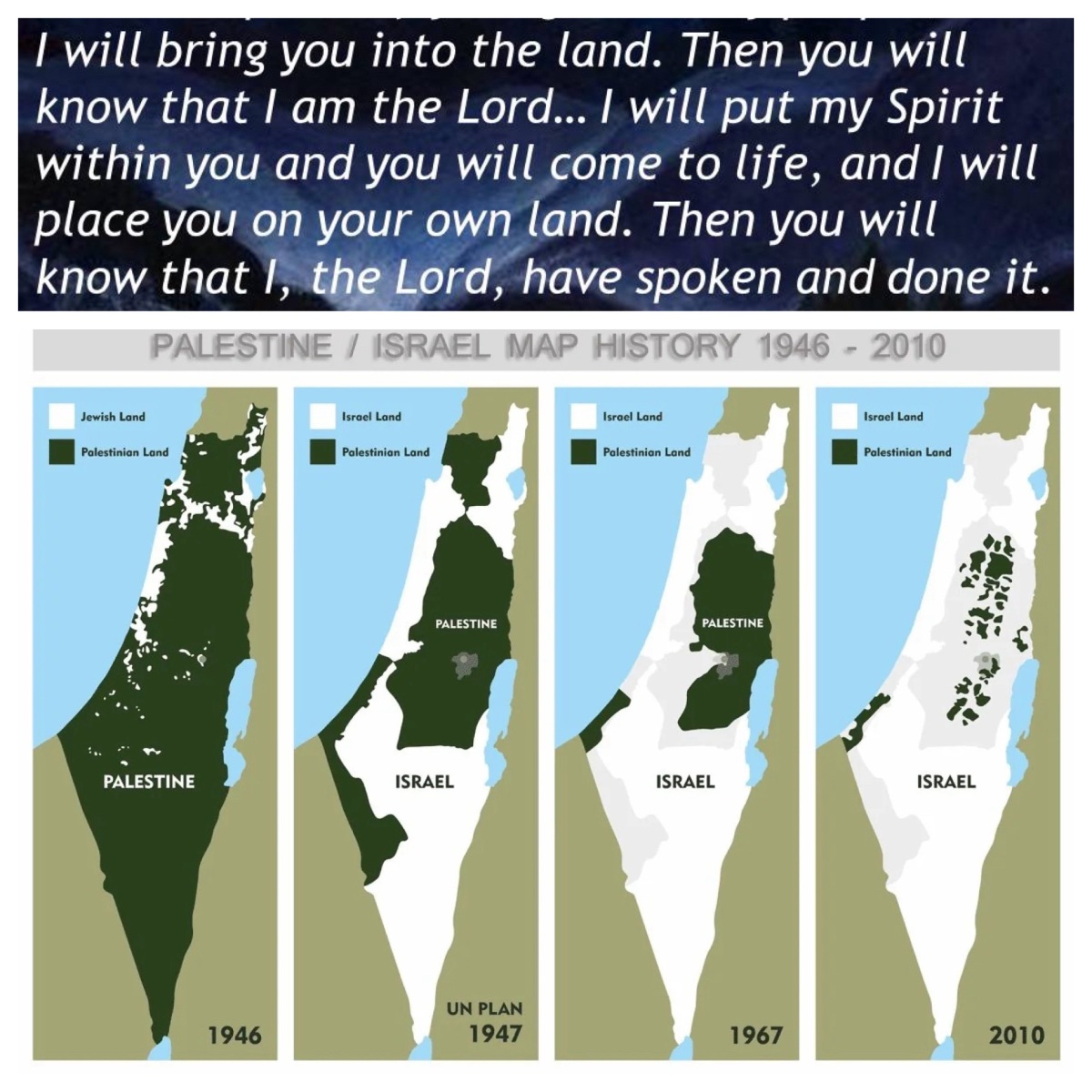
The land marked out for Israel was based on the historical reality that in ancient times Israelites/Jews had lived on that land for centuries until the scattering of all Jews under Roman rule first and second centuries of the Common Era. But since then, Arabs of various origins had held control of the land (see below), and those living there came to be known as Palestinians.

In the early 20th century, the place where Arabs who identified as Palestinians were living was decreed to be the British Mandate of Palestine (1920–1948). The ancient conflicts, it was hoped, would be well in the past. A place for Palestinians in the modern world was, it was thought, now settled. But this was not to be, as we well know today.

In part in response to the horrors of the Shoah, exposed by the ending of World War Two, the modern state of Israel was created in 1948. This was a hugely important, completely justified step to take, give the atrocities of genocide that had been inflicted on Jews in Europe by the Nazi regime of Germany.

The new nation of Israel took 78% of the area which had been provided for Palestinians in the British Mandate. That this was now Jewish territory was a blessing for Jews, but it was a huge and continuing irritant to Palestinian sensibilities, which is why the period from 1948 onwards is known as the Nakba, the Palestinian Catastrophe. A significant number of Palestinians fled the area declared as Israel, as (in one estimate) over 500 Palestinian villages were repopulated by Jews, becoming refugees with no national identity. That was indeed a catastrophe for those inhabitants.

The contested regions of the Gaza Strip (along the east coastline of the Mediterranean Sea) and the West Bank (land immediately to the west of the River Jordan) became known as the Palestinian Territories. They have been disputed territories ever since they were occupied by Israel, two decades later, in the Six-Day War of 1967. In the decades since then, continuing and increasingly aggressive expansion of Israeli settlements into areas where Palestinians were living has greatly exacerbated the situation.

And so those who were dispossessed—and offered the hope of return to “their land”—become the dispossessors of others, to whom that same land was also “their land”; and so the tragic cycle continues.

The biblical texts which claim that God gave land to a chosen people so long ago are not verbatim accounts of “what God said” long ago, nor are they historical reports of actual events. They were written by priests returning from Exile, trying to recapture the period when Israel had some autonomy, because of the strength of its army under various tribal leaders (presented as “kings”). The texts form aetiological tales—that is, they are written as stories at a point in time, purporting to be ancient records, laying the foundation for a claim such as “this is our land, God gave it to us”.

That same land, promised to Abraham, claimed by Moses, is in contention today. It has had a chequered history. The ancient land of Cana an eventually became the land of Israel, then (along with Judaea) part of the Roman province of Syria Palaestina (132–390), and then of the Diocese of the East in the Roman Empire (to 536). What followed the fall of the Roman Empire was a millennium and a half of Muslim rule of this land, first as a part of Bilad al-Sham, the Greater Syria region, under various Caliphates.

The region continued to be part of various organisational configurations under successive Muslim rule, on into the Ottoman Caliphate (from 1517) and then into the modern era, as already noted. (I am not an expert, by any means, of this ancient and medieval history; for this summary, I am dependent on what I read in what I consider to be reputable sources.)

An exaggerated, idealised view of the extent of the land claimed by modern-day Israelis is evident in so many ways in the portrayal of Solomon, who was seen to be filled with “wisdom and knowledge”, and granted “riches, possessions, and honour, such as none of the kings had who were before you, and none after you shall have the like” (2 Chron 1:7–12, especially verses 10 and 12). The biblical figure of Solomon is an exaggerated caricature, a description of an idealised ruler whose existence is actually still a matter of debate amongst ancient historians.

It is also worth noting that the large reach of land that Solomon ruled over, even more extensive than the oft-cited phrase “from Dan to Beersheba” (Judg 20:1; 1 Sam 3:20; 2 Sam 3:10; 17:11; 24:2, 15; 1 Ki 4:25; 1 Chron 21:2; 2 Chron 30:5), did not continue past his death. The hagiographical exaggeration of territory under Solomon is not noted in the period after his death. The narrative books that recount the stories of the kingdoms of Israel, in the north, and Judah, in the south, in the centuries after Solomon, indicate that the scope of those kingdoms was more constrained.

*****

In the light of this, we need to take care when we come across texts in the Hebrew Scriptures which dogmatically and definitively declare that this land belongs to the people of Israel. Indeed, even scripture itself tells the story of the invading colonisers who claimed this land for their own (in the book of Joshua).

So I don’t think it is responsible, today, to lay claim to the whole, extended territory of the land, from the biblical passages noted, as the scope for the modern state of Israel which was created in 1948. There is no justification for the continued aggressive expansion of Israeli settlements in Palestinian areas. So I have sympathy for Palestinians who have lived on the land for thousands of years prior to 1948, as they understand this to be their ancestral land. It has been a continuing Nakba, a catastrophe, for Palestinians over these decades.

I also have sympathy for Jews, both those living in the land of Israel today, as well as those living in diaspora, for whom the land of Israel has a powerful symbolic significance—especially since the Shoah of 1933—1945 and the terrible genocide perpetrated by the Nazis against Jews in so many countries during that period. Granting them land in the area where their ancestors long ago had lived, a homeland that gives them security in the modern world, is important and necessary.

That said, I don’t agree that Palestinians should take matters into their own hands to seek vengeance against people in Israel in the way that they have done, once again, in recent months. In the same manner, nor do I think that the Israeli forces should respond in the aggressive and violent manner that they have done, once again, in recent times, with deaths of women and children, and aid workers, noted on the news with dreadful persistence. Too many people—innocent people—are dying and being injured, making any possible progress towards peace with justice even more difficult each day.

We need to seek once more the peace of these peoples. And we need to find that peace on the basis of justice. Neither terrorist attacks nor military crackdowns will achieve this. They will simply exacerbate a dangerous situation.

How do we deal, today, with the promises of God made long ago? “I will bring you back to the land of Israel. … I will place you on your own soil” (Ezek 37:12,14). We need to tread with care. Perhaps some other texts from both Jewish scripture Christian scripture provide guidance.

“Depart from evil, and do good; seek peace, and pursue it.” (Psalm 34:14). “Blessed are the peacemakers, for they will be called children of God.” (Matt 5:9). “Justice, and only justice, you shall pursue, so that you may live and occupy the land that the Lord your God is giving you.” (Deut 16:20). “… the weightier matters of the law: justice and mercy and faith. It is these you ought to have practiced …” (Mat 23:23). May these be the principles that guide the leaders of the warring groups in Israel and Palestine today.

A prophet like Moses (Deut 18; Epiphany 4B)

“I will raise up for them a prophet like you from among their own people; I will put my words in the mouth of the prophet, who shall speak to them everything that I command” (Deut 18:18). These words are the heart of the Hebrew Scripture passage which the Revised Common Lectionary proposes for this coming Sunday, the Fourth Sunday after Epiphany.

Here, Moses informs the people that, just as he spoke words placed into his mouth by God, so there will be later individuals who also will speak words given to them by God. And so, Israel is assured of the presence of a prophet in their midst throughout the centuries.

Indeed, a number of the prophets of Israel remind us that they speak forth “the voice of the Lord” (Isa 66:6; Jer 42:5–6; Dan 9:9–10; Mic 6:9; Hag 1:12; Zech 6:15). Jesus stands in this tradition, offering words of guidance, challenge, and judgement. In traditional Christian understanding, he is the way by which, “in these last days, God … has spoken to us” (Heb 1:1–2).

What will the prophet speak? In so many reports of prophetic activity, it is justice which is the heart of their message—God’s justice; the justice which God desires for the people of God; the justice which God speaks through the voice of the prophets; the justice that God calls for in Israel; the justice that provides the measure against which Israel will be judged, and saved, or condemned.

Moses himself was charged with ensuring that justice was in place in Israelite society. One story told of the time after the Israelites had escaped from Egypt places Moses as a judge. Whilst in the wilderness of Sin, being visited by his father-in-law Jethro, we learn that “Moses sat as judge for the people, while the people stood around him from morning until evening” (Exod 18:13).

Noticing that Moses was overwhelmed by the volume of matters requiring adjudgment, Jethro suggested—and Moses adopted—a system whereby appointed men who “judged the people at all times; hard cases they brought to Moses, but any minor case they decided themselves” (Exod 18:14–16). The charge given to these men is clear: they are to give a fair hearing to every member of the community, and they “must not be partial in judging: hear out the small and the great alike; [do] not be intimidated by anyone, for the judgment is God’s” (Deut 1:16–17).

Prophets coming after Moses thus inherited this responsibility to ensure that justice was upheld within society. Amos calls for “justice and righteousness” (Amos 5:22). Micah asks the question, “what does the Lord require of you but to do justice?” (Mic 6:8), while through the prophet Hosea, the Lord God promises to Israel, “I will take you for my wife in righteousness and in justice, in steadfast love, and in mercy” (Hos 2:19).

Isaiah ends his famous love-song of of the vineyard by declaring that God “expected justice” (Isa 5:7); Jeremiah notes the need to “not oppress the sojourner, the fatherless, or the widow” (Jer 7:5–7). Second Isaiah foresees that the coming Servant “will bring forth justice to the nations” (Isa 42:1) while Third Isaiah begins his words with a direct declaration, “maintain justice, and do what is right” (Isa 56:1), for “I the Lord love justice” (Isa 62:8).

This commitment resonates with the psalmist, who praises “the God of Jacob … who executes justice for the oppressed; who gives food to the hungry … [who] sets the prisoners free, [who] opens the eyes of the blind, [who] lifts up those who are bowed down [and] loves the righteous, [who] watches over the strangers [and] upholds the orphan and the widow” (Ps 146:5, 7–9). See

It may be significant that, in this year when Mark’s Gospel is featured in the lectionary, the Hebrew Scripture passages offered during the short season of Epiphany are drawn from the books of the prophets: 1 Samuel, Jonah, this passage from Deuteronomy, Isaiah, and then the story of Elijah and Elisha in 2 Kings. These passages help us to see in clear focus the way that Jesus operates like a prophet in Mark’s narrative. See

So the offering of the Deuteronomy passage this week particularly pushes us to consider how Jesus might be seen as a prophet, one whom God raised up to be like Moses (Deut 18:15-18). There are three key features of Mark’s portrayal of Jesus which depict him in a prophetic vein: words and deeds, a kingdom focus, and the importance of repentance.

I Words and deeds

Words, of course, are important, both for the prophets, and for Jesus. “Thus says the Lord”, a commonplace of prophetic rhetoric, is reflected in the comments of the Markan narrator that Jesus “went about all the villages teaching” (Mark 6:6), proclaiming his message (1:14–15, 38) and speaking of the kingdom of God in parables (4:11, 26–32; 12:1–12), in sayings (9:1, 47; 10:14–15, 23–25; 12:34), and in an extended apocalyptic discourse (13:3-37). Words were central to his public and private activity.

Jesus is remembered, however, as “a prophet mighty in deed and word” (Luke 24:19), so the deeds he performed are equally as important as the words he spoke. Indeed, this was always the case for prophets; God gave Moses words to speak and signs to perform (Exod 4:28–30), and the prophets that followed him accompany their message with acts that manifest the truth of what is proclaimed: Ahijah tearing his garment into twelve pieces (1 Ki 11), Isaiah walking naked for three years (Isa 20), Jeremiah buying and then breaking an earthenware jug (Jer 19), Ezekiel eating a scroll (Ezek 3), Ezekiel shaving his head and slashing the hair with a sword (Ezek 5), and many more.

In like manner, Jesus sent out his followers to proclaim his message, but also to “cast out many demons and anoint with oil many who were sick and cure them” (Mark 6:12–13). Word and deed belong together. So Mark reports, alongside the parables and sayings of Jesus, numerous instances when Jesus healed people (2:1–12; 3:1–6; 3:22; 5:21–43; 6:5, 53–56; 7:31–37: 8:22–26; 10:46–52), cast out demons and unclean spirits (1:21–28, 32–34, 39; 3:11; 5:1–20; 7:24–30; 9:14–29), as well as miraculously fed multitudes (6:30–44; 8:1–10), cleansed a leper (1:40–45), stilled a storm (4:35–41), and walked on water (6:45–52).

II The coming kingdom

Another way in which Jesus reflects his prophetic calling was through the kingdom focus in his teaching. That the imminence of the kingdom is a key note for Jesus is reflected both in his opening words in Mark (“the time is fulfilled, and the kingdom of God has come near”, 1:15a) and in some of his final words to his closest followers (“I will never again drink of the fruit of the vine until that day when I drink it new in the kingdom of God”, 14:25).

Jesus has so shaped the expectations of his followers that they anticipate this coming with intensity. “There are some standing here who will not taste death until they see that the kingdom of God has come with power”, he told them (9:1); to one enquirer, he affirmed, “you are not far from the kingdom of God” (12:34), and after his death, another follower who was “waiting expectantly for the kingdom of God ensured that the body of Jesus was cared for (15:43).

When some of his disciples hindered children wanting to come to him, Jesus chided them, saying, “whoever does not receive the kingdom of God as a little child will never enter it” (10:15); a little later, to his disciples, he warned, “how hard it will be for those who have wealth to enter the kingdom of God!” (10:23).

The final extended discourse of Jesus that Mark reports (13:4–37) provides reassurance of the sovereignty of God in the midst of crises and calamities. These events are but “the beginning of the birth pangs” (13:8). Jesus affirms that those enduring will be saved by divine action (13:13, 20), culminating in the appearance of “‘the Son of Man coming in clouds’ with great power and glory” (13:26) and the gathering of the elect by the angels of God (13:27).

The kingdom is the realm in which God will act decisively. In the words of the prophets, the kingdom of David and his successors was the realm in which God was seen to be active; after that kingdom was conquered and its people taken captive, the prophetic voices of Israel began to develop a notion that, at some time in the future, there would indeed be a kingdom which would be the realm in which God would be active. The prophetic hope in The Day when God would act came to full, dramatic expression in the apocalyptic portrayals of The End that was anticipated.

See

III Metanoia: a complete transformation

Proclaiming that repentance, metanoia, is the essential prerequisite for entry into that kingdom in order to fulfil God’s justice is a third feature of Mark’s portrayal of Jesus in the manner of a prophet. The first word of Jesus in Mark’s early account is clear: “the time is fulfilled, and the kingdom of God has come near; repent (metanoeite) and believe (pisteuete) in the good news” (1:15).

In this programmatic Markan announcement, the two statements (in the indicative mood) about “the time” and “the kingdom” are followed by two commands (in the imperative mood) to “repent” and “believe”. The imminence of the kingdom is the motivation for the call to repent and believe.

This call to repent is evident in the activity of the followers of Jesus who are sent out in pairs with “authority over the unclean spirits”; as they cast out demons and cured the sick, so they also “they proclaimed that all should repent” (6:7–13). Beyond that, the explicit call to repent is not repeated by Jesus, but its presence is evident throughout the narrative.

Jesus calls people to follow him; fishermen Peter and Andrew “left their nets and followed him” (1:18), fishermen James and John “left their father Zebedee in the boat with the hired men, and followed him” (1:20), and tax collector Levi son of Alphaeus, “got up and followed him” (2:14). Leaving behind signals the complete transformation undertaken by following Jesus.

Following Jesus is akin to taking up the cross, a sign of social rejection and alienation as well as personal denial (8:34). Jesus delivers a sequence of three sayings that reflect the complete turnaround that is required to effect metanoia. First, “those who want to save their life will lose it, and those who lose their life for my sake, and for the sake of the gospel, will save it” (8:35). Next, “whoever wants to be first must be last of all and servant of all” (9:35).

And then, “whoever wishes to become great among you must be your servant, and whoever wishes to be first among you must be slave of all” (10:43–44). Jesus himself provides the foundational model for this way of living; as the Son of Man, he came “to give his life a ransom for many” (10:45).

This persistent demand for complete life transformation—metanoia—resonates with Isaiah’s signal declaration that “Zion shall be redeemed by justice, and those in her who repent, by righteousness” (Isa 1:27), and regular prophetic calls to “return to me, says the Lord of hosts … return from your evil ways and from your evil deeds” (Zech 1:3–4); “repent and turn away from your idols; and turn away your faces from all your abominations” (Ezek 14:6; also 18:30), “return to me … remove your abominations from my presence and do not waver” (Jer 4:1); “return to me with all your heart, with fasting, with weeping, and with mourning” (Joel 2:12).

The recurring refrain of Amos, lamenting, “yet you did not return to me, says the Lord” (Amos 4:6,8,9,10,11), leads the prophet to assure Israel that “I will do this to you; prepare to meet your God, O Israel!” (Amos 4:12)—words akin to what the psalmist says, “if one does not repent, God will whet his sword; he has bent and strung his bow; he has prepared his deadly weapons, making his arrows fiery shafts” (Ps 7:12–13).

“I will raise up for them a prophet like you from among their own people; I will put my words in the mouth of the prophet, who shall speak to them everything that I command” (Deut 18:18). In the way that Mark presents Jesus in his narrative, we can see how Jesus speaks and acts in the manner of a prophet like Moses, the archetype of prophetic leadership.

*****

Please Note: in the above comments, I am not seeking to “ prove” that Jesus “fulfils prophecy”. Rather, I am interested to explore the ways that an understanding of Hebrew Scripture can inform the way we read and understand the Gospel narratives about Jesus. For further thoughts on how we read prophetic texts in a Christian context, see

and

God changed God’s mind (Jonah 3; Epiphany 3B)

“Follow me and I will make you fish for people”, Jesus tells some fishermen, in the Gospel offered by the lectionary for this coming Sunday (Mark 1:14–20, the Third Sunday after Epiphany). Perhaps because of the fishing theme, the lectionary pairs with it an excerpt from what must be the best-known fish story of Hebrew Scripture—that of Jonah.

Although, curiously, in what the lectionary offers, we don’t get the actual fish scene (Jonah 1:17—2:10). What we have is the “second chance” that Jonah has, to act as a real prophet. Rather than running away to sea (1:3), in the opposite direction from where he had been commanded to go, Jonah this time accepts the call from God, “get up, go to Nineveh, that great city, and proclaim to it the message that I tell you” (3:2).

What we hear in this chapter is the simple report of Jonah’s fiery message—“forty days more, and Nineveh shall be overthrown!”—and the immediate response, “the people of Nineveh believed God; they proclaimed a fast, and everyone, great and small, put on sackcloth” (3:4–5).

The book of Jonah, of course, is one great comic burlesque from beginning to end. In the midst of the accounts of prophets who heard the call of God, hesitated, and then accede to the divine pressure to take up the challenge and declare the judgement of the Lord to a sinful people, we have Jonah.

We have Jonah, who when he is commanded to go northeast to Nineveh, immediately flees in the opposite direction, boarding a ship that was headed west across the Mediterranean Sea, to Tarshish, “away from the presence of the Lord” (Jon 1:3).

We have Jonah, escaping from the command of the Lord, only to find that “the Lord hurled a great wind upon the sea”—so all the cargo on the ship is thrown overboard. We have Jonah, blissfully sleeping, apparently unaware of the great storm (as if!), interrogated by the sailors, eventually offering himself as a sacrifice to save the boat (1:12). A comic hero, indeed.

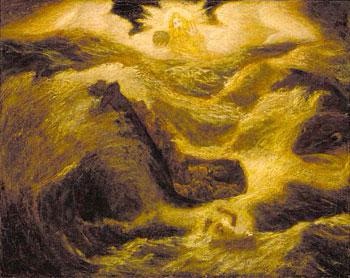
Jonah, by Albert Pinkham Ryder (1885)

So the sailors try in vain to save the ship; but realising that this is futile, they throw Jonah into the sea—and immediately “the sea ceased from its raging” (1:15). Then, adding further incredulity to the unbelievable narrative, “the Lord provided a large fish to swallow up Jonah” (1:17). The three days and three nights that he spends “in the belly of the fish” before he is vomited onto dry land (2:10) add to the comic exaggeration. You can just imagine the ancient audiences rolling with laughter.

The psalm that Jonah prays from inside the fish (2:1–9) and the successful venture to Nineveh, where even the king “removed his robe, covered himself with sackcloth, and sat in ashes” (3:1–10) apparently demonstrate that Jonah should have obeyed the command of the Lord in the first place. However, Jonah’s response continues the exaggerated response of a burlesque character; “this was displeasing to Jonah, and he became angry” (4:1).

Jonah’s resentment and his plea for God to take his life (4:2–4) and his patient waiting for God to act (4:5) lead to yet another comic-book scene, as a bush grows and then is eaten by a worm and Jonah is assaulted by “a sultry east wind” (4:6–8). The closing words of the book pose a rhetorical question to Jonah (4:9–11) which infers that God has every right to be concerned about the lives of pagans in Nineveh. The last laugh is on Jonah; indeed, he has given his readers many good laughs throughout the whole story!

However, the section offered by the lectionary does provide us with a matter warranting serious thought. In the midst of the comedy, the narrator reports that when God saw the repentance of the people of Nineveh, “God changed his mind about the calamity that he had said he would bring upon them; and he did not do it” (3:10).

God changed God’s mind. That is a striking statement! If we read from the perspective of classic Christian theology, then we read with the expectation that God knows everything (and thus would have known of Jonah’s initial resistance and subsequent obedience); that God is in control of everything (and thus would have engineered the vomiting fish and the sheepishly-repentant prophet); and that God has sovereign power to determine the course of events (and thus would have planned well in advance the repentance of the Ninevites).

So a classic theological approach is somewhat stymied, I would have thought, by the comment that “God changed God’s mind”. By contrast, reading the story as part of Hebrew Scripture (rather than from the lens of systematic theological thinking) means that we can recognise that there is a vigorous “debate” being undertaken amongst the various authors of different parts of scripture on precisely this issue.

On the one hand, some texts make it quite clear that God was understood to have been averse to any change of mind; once God had decided, that was the end of the matter. M

In the historical narrative of the story of Israel, when Samuel informs Saul that David will be anointed as king, he asserts that “the Glory of Israel will not recant or change his mind; for he is not a mortal, that he should change his mind” (1 Sam 15:29). In an earlier book in that extended narrative, Balaam tells Barak that “God is not a human being, that he should lie, or a mortal, that he should change his mind. Has he promised, and will he not do it? Has he spoken, and will he not fulfill it” (Num 23:19).

And in a well-known royal psalm (which Jesus was said to have quoted), the psalmist declares that “the Lord has sworn and will not change his mind, ‘You are a priest forever according to the order of Melchizedek’” (Ps 110:4, quoted at Heb 7:21). This idea of the unchanging deity whose mind remains resolutely fixed is also reflected in the oft-quoted line from Hebrews, “Jesus Christ is the same yesterday and today and forever” (Heb 13:8).

On the other hand, other biblical authors recount stories in which God is, indeed, capable of changing God’s mind. God has a change of mind in the story of Moses and the Golden Calf, narrated in Exodus 32. Moses is appalled when he discovers that the Israelites, in his absence, have created an idol—a Golden Calf—and have thereby breached one of the Ten Words that are at the heart of the covenant he has made with God. Moses mounts a passionate plea to God, asking for the divine fury to be turned away from the sinful people.

Invoking the covenant made with Abraham, Isaac, and Jacob, Moses implores God to “turn from your fierce wrath; change your mind and do not bring disaster on your people” (Exod 32:12–13). So the Lord repented (v.14), and Moses took revenge on the people (vv.19–20); he burned the idol and ground it into water, and made the people drink it. God clearly has a change of mind in this story.

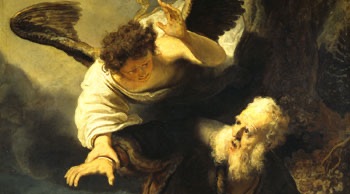
God also has a change of mind in Genesis. Abraham is instructed to take his son, Isaac, and “offer him there as a burnt offering on one of the mountains that I shall show you” (Gen 22:2). Abraham is obedient, and “reached out his hand and took the knife to kill his son”; but an angel of the Lord called to him from heaven and restrained him (Gen 22:11–12), providing instead “a ram, caught in a thicket by its horns” as the sacrificial victim (Gen 22:13). Clearly, God changed God’s mind.

The prophet Amos speaks two short oracles in which God was planning to judge the people, sending a plague of locusts (Amos 7:1) and then a shower of fire (Amos 7:4). In both instances, after petitions from the prophet, “the Lord relented concerning this; ‘it shall not be,’ said the Lord” (Amos 7:3, 6).

And how many psalms contain petitions to the Lord, from faithful people, imploring God to change God’s mind? “O Lord, do not rebuke me in your anger, or discipline me in your wrath” (Ps 6:1); “rise up, O Lord; O God, lift up your hand; do not forget the oppressed” (Ps 10:12); “do not cast me away from your presence, and do not take your holy spirit from me” (Ps 51:11); “hear a just cause, O Lord; attend to my cry” (Ps 17:1).

One psalm presses the point with intensity: “do not let the flood sweep over me, or the deep swallow me up, or the Pit close its mouth over me; answer me, O Lord … turn to me; do not hide your face from your servant, for I am in distress—make haste to answer me” (Ps 69:15, 17). Another reflects on their situation with pathos, pleading, “do not cast me off in the time of old age; do not forsake me when my strength is spent” (Ps 71:9; see also vv.12, 18).

And in the longest psalm of all, Psalm 119, even though the psalmist notes that they are consistently faithful to Torah, yet the plea comes: “do not utterly forsake me” (v.8), “turn away the disgrace that I dread” (v.39), “I implore your favour with all my heart” (v.58), “how long must your servant endure? when will you judge those who persecute me?” (v.84), “look on my misery and rescue me … plead my cause and redeem me” (vv.153–54). This psalm, like so many psalms, is premised on the understanding that God will hear the passionate prayer of the psalmist and have a change of mind.

The prophet Jeremiah considers the possibility, and then affirms the actuality of God changing God’s mind. “At one moment I may declare concerning a nation or a kingdom, that I will pluck up and break down and destroy it”, he says, in the name of the Lord; “but if that nation, concerning which I have spoken, turns from its evil, I will change my mind about the disaster that I intended to bring on it. And at another moment I may declare concerning a nation or a kingdom that I will build and plant it, but if it does evil in my sight, not listening to my voice, then I will change my mind about the good that I had intended to do to it.” (Jer 17:7–10). The capacity for a change of mind is crystal clear here (and see also Jer 26:3, 13).

Later, Jeremiah tells of the prophet Micah of Moresheth, from the days of King Hezekiah of Judah, who threatened destruction for the city in his oracle. Jeremiah comments, “did he not fear the Lord and entreat the favour of the Lord, and did not the Lord change his mind about the disaster that he had pronounced against them?” (Jer 26:18–19).

So while the systematicians want to locate our knowledge of God and our relationship with God within the constraints of doctrines and structures and systems, those attending carefully to the biblical text will know that the witness of scripture is diverse and varied, and also that there are different points of view put forward within the pages of the Bible, about important matters—including, as we have seen, the capacity of God to have a change of mind. Some authors consider God can do this; others reject the possibility.

So what do you think?

Promise and proclamation: passages from the Prophets at Christmas

There is a richness of scriptural resources for reflecting on our faith at Christmas. These resources come from the developing traditions of Christmas worship in the early centuries of Christianity. This post concerns especially some passages from the prophet Isaiah that are proposed by the Revised Common Lectionary for our Christmas worship celebrations.

In the ancient Roman church, a Christmas Mass was originally celebrated as a vigil service at the manger of St Mary Major in Rome. It was a small service originating under Pope Sixtus III, and was known as The Angel’s Mass, as the story was told of the angels appearing to the shepherds in the fields (Luke 2:1–14).

In time, a large public service was added at the church of St Peter on the morning of Christmas Day, presided over by the Pope. This practice continues to this day. This service was known as The Shepherd’s Mass, for the story of the shepherds coming to visit the newborn child (Luke 2:8–20).

A third service, The Mass of the Divine Word, was added in the fifth century, originally to celebrate St Anastasia, whose body, it was said, rested in the palace church of the Byzantine Governor in Rome. The focus of this service shifted, over time, from a veneration of the saint’s remains, to a celebration of the Incarnation. The Gospel read at this service was John 1:1–14.

These three Gospel passages were retained in the Common Lectionary when it was created in 1983, drawing on the ancient Roman practices, and continued on in the Revised Common Lectionary of 1992. To the three Gospel passages were added nine additional readings—three psalms, three from the prophets, and three from the epistles. The three options are identified as Nativity of the Lord Proper I, Proper II, and Proper III.

Alongside the Gospel passage and the prophetic passage for each of the three traditional services for Christmas (Nativity of the Lord I, II, and III), there is a psalm offered for each service, as well as a passage from the book of Isaiah. We would do well to use them to guide our response at Christmas, as we hear the story and celebrate the birth of Jesus.

The three psalms (Psalms 96, 97, and 98) come from a sequence of songs offering praise—a note that is entirely suitable for the Christmas season! The three passages from the book of Isaiah come from the three different sections of that large prophetic book, each offering words of hope.

The book of Isaiah comprises three sections, which most scholars believe originated in three different periods during the history of Israel. The first section (chs. 1–39) is located in Judah in the eighth century BCE, as the Assyrians conquered the northern kingdom of Israel and attempted to gain control of the southern kingdom, but that effort failed.

The second section of Isaiah (chs. 40–55) dates from the time of exile for the southern kingdom, after the people of Judah had been conquered by the Babylonians in 587 BCE; it offers words of hope as the people look to a return to the land. Then, the third section (chs. 56–66) is dated to a time when the exiles had returned to Judah, sometime after 520 BCE. By convention, the three parts are known as First Isaiah, Second Isaiah, and Third Isaiah.

The first of these three passages from the book of Isaiah proposed as Christmas readings is an oracle in the early part of the first section (chs.1—39). Here, the prophet is looking forward to the birth of a child (Isa 9:6). This, of course, is a most appropriate theme for Christmas. Yet the child of whom Isaiah of Jerusalem spoke was not Jesus, but rather, a royal child, already announced at Isa 7:14.

This child would be born in difficult circumstances (Isa 9:4–5), for the people were under attack by the Assyrians to the north (as reported in 2 Kings 16). The hope that the prophet holds out is of darkness in light, joy in the midst of hard work, release from oppression, and the establishment of justice and righteousness.

Is not that what we hope for, pray for, and work for, through the coming of Jesus which we celebrate at Christmas? Although the prophet did not “predict Jesus”, yet we can see how Jesus invites us to work with him for this desired result.

The second reading from Isaiah comes from the third section of the book (chs. 56—66). It comprises a set of prophecies delivered many decades after the prophet Isaiah of Jerusalem himself lived. As the people returned to the land of Israel, hopes were high. The anonymous prophet whose words are collected in the book of Isaiah speaks about justice and deliverance (56:1), with light illuminating the darkness (60:1–3) and the Spirit inspiring leaders “to proclaim the year of the Lord’s favour” (61:1–2). The security that is foreseen (Isa 62:8–9) and the celebration that takes place (v.10) is marked with names that signal to the people how God has been at work (v.12).

In the same spirit of hope, we prepare for the annual celebration of the coming of Jesus, in whom we surely find the Spirit at work, bringing salvation, proclaiming God’s way “to the end of the earth” (v.11). Once again, the prophet is not specifically forthtelling the coming of Jesus; but as we have experienced Jesus and know him in our lives, we can see how he brings to fruition these hopes, held firm from centuries ago, still alive for our own times.

The third reading from the book of Isaiah offered for Christmas is a rather short reading (Isa 52:7–10). It comes from the middle section of the book (chs. 40—55). a set of prophecies delivered to people from Judah who had been in exile in Babylon for some decades. This section of the book begins with a clear signal of the great hope of the time: “prepare the way of the Lord … every valley shall be lifted up, and every mountain made low” (40:3–4).

A key figure at that time was the Servant, called to lead the people with teaching and example. (The resonances with Jesus are frequently noted; but the prophet was not speaking directly about Jesus.) This passage speaks about those who “announce peace, bring good news, announce salvation” (52:7); all activities that we associate with Jesus, through the Christmas story and the Gospel narratives.

However, this particular herald, some eight centuries before Jesus, would bring comfort to the exiled people, assuring them of their redemption when they return to the land. This good news must surely be made known “before the eyes of all the nations”, so that “all the ends of the earth shall see the salvation of our God” (v.10). These sentiments surely correlate with how we, joyfully and hopefully, regard Jesus, in our Christmas celebrations.

See

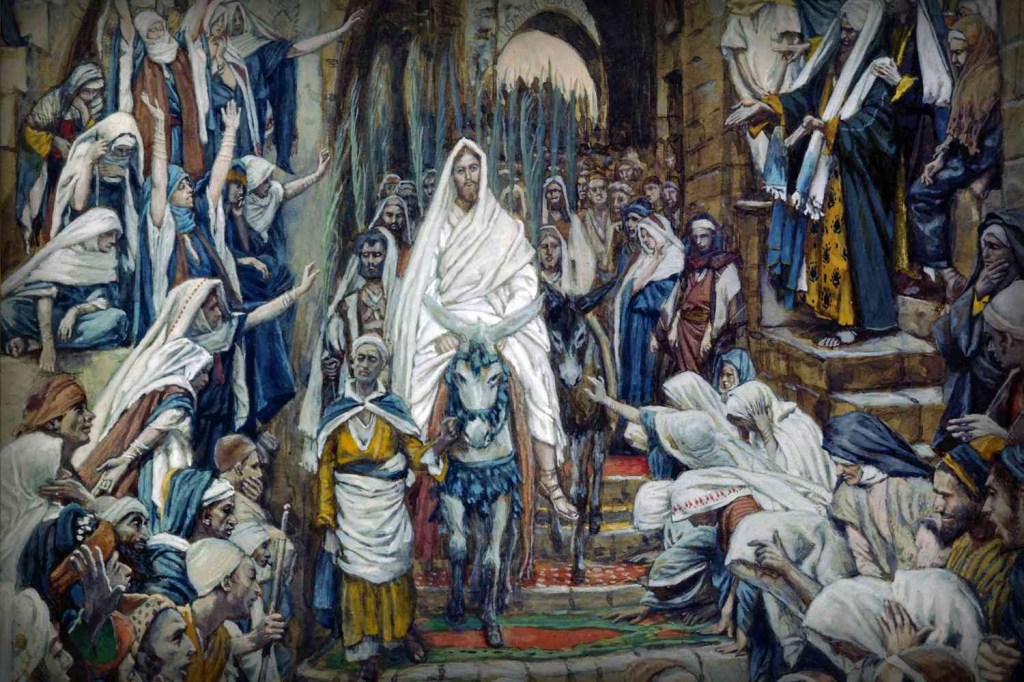
Your king is coming, sitting on a donkey (Zech 9; Matt 21; Lent 6A, Palm Sunday)

“Go into the village ahead of you, and immediately you will find a donkey tied, and a colt with her; untie them and bring them to me. If anyone says anything to you, just say this, ‘The Lord needs them.’ And he will send them immediately.” So reports the Gospel of Matthew, in the Gospel offered by the lectionary for this coming Sunday (Matt 21:1–11). The same story is told at Mark 11 and Luke 19.

John’s account is much more succinct; that Gospel simply notes, “Jesus found a young donkey and sat on it” (John 12:14), before explaining that this fulfils what was written in a scripture passage, “Do not be afraid, daughter of Zion. Look, your king is coming, sitting on a donkey’s colt!” (John 12:15, quoting Zech 9:9).

The narrator in Matthew’s Gospel explains that “this took place to fulfill what had been spoken through the prophet, saying, ‘Tell the daughter of Zion, Look, your king is coming to you, humble, and mounted on a donkey, and on a colt, the foal of a donkey’” (Matt 21:15). The prophet who is referred to in both John and Matthew is Zechariah, a post-exilic figure whose work is found as the eleventh of the twelve Minor Prophets in Hebrew Scripture.

Zechariah was active in the period when the exiles in Babylon were returned to Judah late in the 6th century BCE, by a decree of the Persian King, Cyrus (whom Second Isaiah described as God’s “Messiah”; see Isa 45:1). We are told that in his decree, Cyrus acknowledges “the Lord, the God of heaven” and states that “any of those among you who are of his people … are now permitted to go up to Jerusalem in Judah, and rebuild the house of the Lord, the God of Israel” (Ezra 1:2–4).

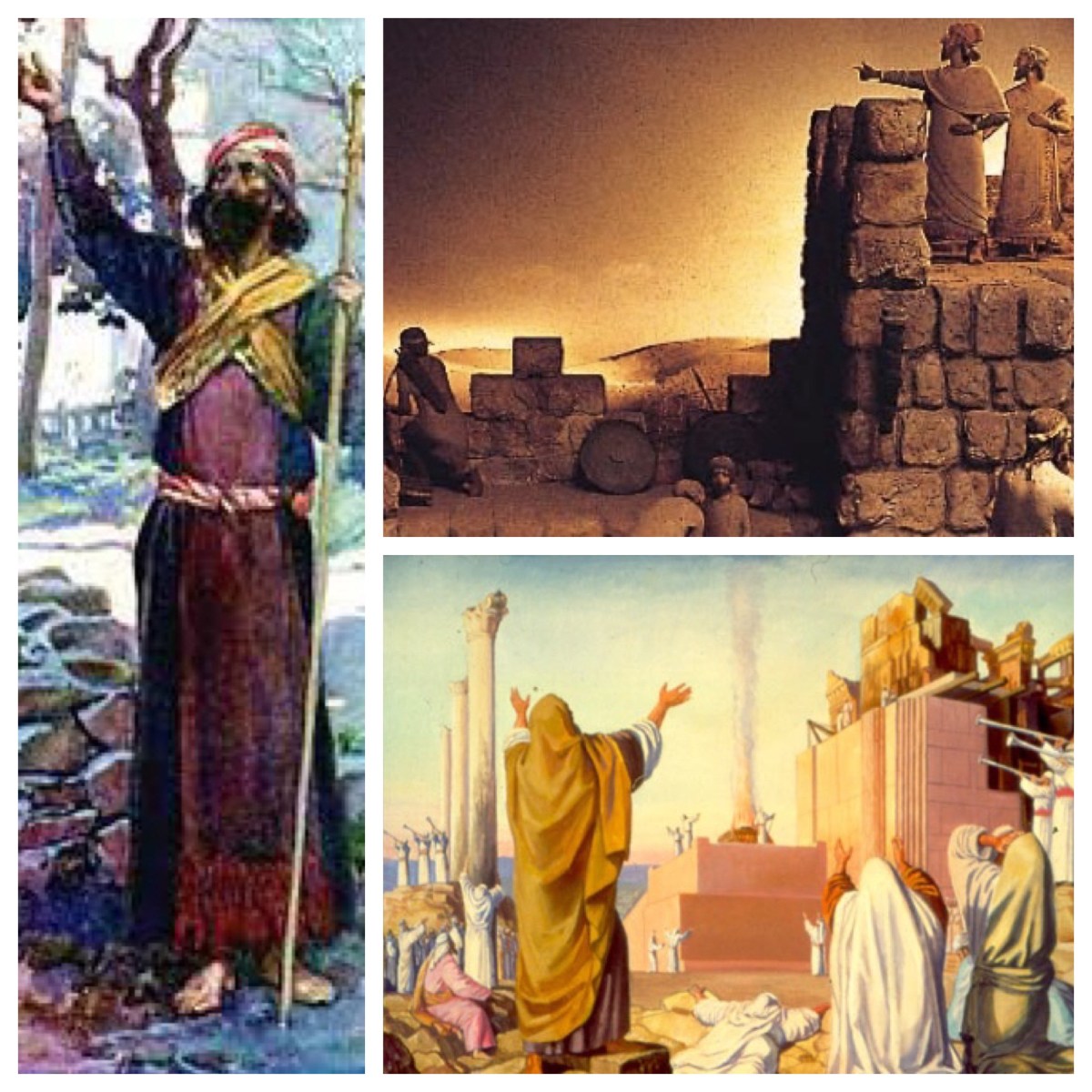
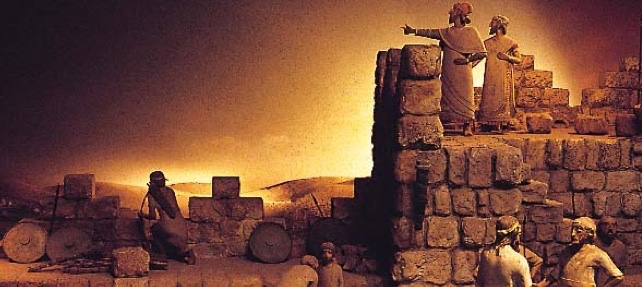
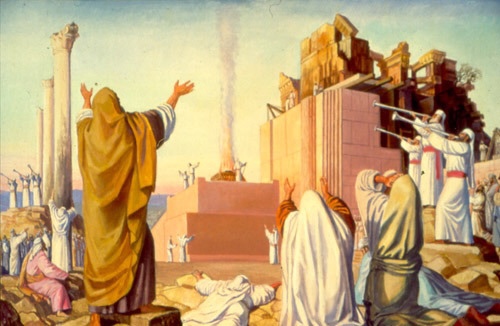
Under Nehemiah as Governor, worship had been reinstituted in Jerusalem (Ezra 3:1–7), the walls around the city of Jerusalem were rebuilt (Neh 2—6, 12), and the Temple was rebuilt and rededicated (Ezra 5–6). After this, the Law was read in the city under the guidance of Ezra, a priest who is also described as a scribe (Neh 8) and the covenant with the Lord is renewed (Neh 9–10).

Initially, there was opposition to the rebuilding works from “the enemies of Judah and Benjamin” (Ezra 4:1–16), and with intervention from King Artaxerxes, work on the temple ceased (Ezra 4:17–24). The narrative in Ezra reports that “the prophets, Haggai and Zechariah son of Iddo, prophesied to the Jews who were in Judah and Jerusalem, in the name of the God of Israel who was over them” (Ezra 5:1), and then work on restoring the temple recommenced (Ezra 5:2).

Further opposition emerged (Ezra 5:3–17), resulting in intervention from King Darius that decreed “let the house be rebuilt … let the Governor of the Jews and the elders of the Jews rebuild this house of God on its site … let it be done with all diligence” (Ezra 6:1–12).

The end result is that the prophets of the Lord and the rulers of the Persian Empire collaborated together to ensure that the temple would be restored: “So the elders of the Jews built and prospered, through the prophesying of the prophet Haggai and Zechariah son of Iddo. They finished their building by command of the God of Israel and by decree of Cyrus, Darius, and King Artaxerxes of Persia” (Ezra 6:14).

*****

Zechariah dates his opening prophecy to “the eighth month, in the second year of Darius” (Zech 1:1), which places him as a contemporary of Haggai and perhaps around the same time that the anonymous prophet whose words are known as Third Isaiah (Isaiah 56—66). Zechariah begins witha familiar prophetic refrain: “return to me, says the Lord of hosts, and I will return to you, says the Lord of hosts” (1:3), noting that when this message was presented to earlier Israelites, “they repented and said, ‘the Lord of hosts has dealt with us according to our ways and deeds, just as he planned to do’” (1:6).

What follows this opening salvo is a report of eight visions (1:7—6:8). They are dated to “the twenty-fourth day of the eleventh month, the month of Shebat, in the second year of Darius” (2:7), two months after the final prophecy of Haggai. The visions combine glimpses of hope with reminders of the need to remain faithful to the covenant: “if you will walk in my ways and keep my requirements, then you shall rule my house and have charge of my courts” (3:7). The fourth vision (3:1–10) includes the figure of “the accuser” (ha-satan in Hebrew) standing at the right hand of Joshua, to accuse him (3:1).

At the conclusion of the eighth vision there follows words of condemnation (7:1–7) and punishment (7:8–14), citing classic prophetic notes: “render true judgments, show kindness and mercy to one another; do not oppress the widow, the orphan, the alien, or the poor; and do not devise evil in your hearts against one another” (7:9–10).

Then come words of promise (8:1–23): “I will return to Zion, and will dwell in the midst of Jerusalem; Jerusalem shall be called the faithful city, and the mountain of the Lord of hosts shall be called the holy mountain” (8:3). Once again, prophetic injections are offered: “speak the truth to one another, render in your gates judgments that are true and make for peace, do not devise evil in your hearts against one another, and love no false oath” (8:16–17).

An oracle pronouncing judgement on other nations then follows (9:1–8), followed by a joyful celebration of the restoration of Judah (9:9–11:3), introduced by a rousing shout of joy: “rejoice greatly, O daughter Zion!Shout aloud, O daughter Jerusalem! Lo, your king comes to you; triumphant and victorious is he, humble and riding on a donkey, on a colt, the foal of a donkey.” (Zech 9:9). This verse is well-known, of course, from its quotation in the story of Jesus’s entry into the city of Jerusalem, which we will hear this Sunday (Matt 21:5).

A quirky feature is that some interpreters have taken the words of Zechariah so literally, that they imagine Jesus actually had two animals with him as he entered the city. Of course, the original oracle was formed in typical Hebraic parallelism, a pattern whereby an idea is expressed one way, then immediately repeated using other words. Thus, “riding on a donkey” was the first expression of the idea, followed immediately by “on a colt, the foal of a donkey”. One animal, two ways of expressing that.

The remaining chapters of Zechariah continue the note of exultation about the future, reworking the motif of “the day of the Lord” so that it signals joy for Jerusalem and terror for other nations (12:3, 4, 6, 8, 9, 11; 13:1, 2, 4; 14:1, 4, 6, 8, 9, 13, 20, 21). A triumphant note of universalism is sounded: “on that day “the Lord will become king over all the earth” (14:9) and “all who survive of the nations that have come against Jerusalem shall go up year after year to worship the King, the Lord of hosts, and to keep the festival of booths” (14:16).

The quotation from Zechariah in the story is a reminder that there is always hope; in the difficult situation of rebuilding the beloved ruins, reconstituting the fractured society, reconstituting the religious practices and customs that had lapsed, hope remains strong. Little did those travelling with Jesus into the city know what lay ahead of him, and them, in the coming days. Their hopes were high, very high, on this day. Joy came easily to them.

It was a day for celebration. This could well be the time when “the Lord will become king over all the earth”—even over the mighty Romans, they may well have felt. Joy was the dominant emotion, as the singing, waving of branches, and celebration demonstrated.

*****

On why Jesus was riding a donkey, and not a horse (definitely NOT a horse!), see https://johntsquires.com/2023/03/27/why-jesus-never-did-and-never-would-ride-a-horse-for-palm-sunday-lent-6/

Flesh and bones, spirit and life (Ezek 37, Psalm 130, Rom 8, John 11, Lent 5A)

On the Fifth Sunday in Lent, the scripture passages offered by the lectionary revolve around a central theme: life in contrast to death. It’s not every Sunday that all four passages line up to provide a clear and obvious focus on a single theme. For more than half of the Sundays in the year, the Hebrew Scripture, Epistle, and Gospel each follow their own course, and any overlap of theme is accidental, not planned. For Sundays in Advent, Christmas, and Lent, as well as key days like Pentecost, Trinity, and the Reign of Christ, the thematic overlap is intentional. This week we have just such a Sunday!

Death is at the heart of the story of Lazarus that forms the Gospel passage for Sunday (John 11:1–45). Initially, Jesus is told “he whom you love is ill” (John 11:3), but when he arrives in Bethany, Martha accosts him with “Lord, if you had been here, my brother would not have died” (11:21)—an accusation repeated by her sister Mary (11:31); and then comes a graphic description provided by Martha as they draw near to the tomb: “already there is a stench because he has been dead four days” (11:39).

The emergence of Lazarus from the tomb marks a climactic moment, for the family in Bethany and many of their neighbours (11:44–45), but also for the chief priests and Pharisees, who together determine to put Jesus to death (11:53). The seventh sign recounted in this Gospel is the most significant miracle of Jesus, but also the deed that determines the fate of Jesus. Soon after this event in Bethany, he says, “I have come to this hour” (12:27), the hour when “I am lifted up from the earth, [when I] will draw all people to myself” (12:32), the hour when the Father will “glorify your Son so that the Son may glorify you” (17:1). The death of Jesus is to be, paradoxically, the complete fulfilment of his mission (19:30)—the pathway into life eternal (3:16; 10:28; 17:3).

This climactic movement, of death moving to life in Bethany, resonates with the words of the prophet Ezekiel and also the writings of the apostle Paul that are offered for this coming Sunday. Ezekiel confronts the signs of death: “The Lord set me down in the middle of a valley; it was full of bones. He led me all around them; there were very many lying in the valley, and they were very dry” (Ezek 37:1–2). Paul considers the state of humanity: “to set the mind on the flesh is death … the mind that is set on the flesh is hostile to God; it does not submit to God’s law—indeed it cannot, and those who are in the flesh cannot please God” (Rom 8:6–8).

So, death is in view in these three readings. It is no wonder that the psalm we are offered alongside them speaks a cry of deep despair: “out of the depths I cry to you, O Lord” (Ps 130:1). The depths of the earth were the place where sinful people went (Ps 63:9; Isa 14:15), following the lead of the Egyptians who pursued the Israelites and “went down into the depths like a stone” (Exod 5:4–5; Neh 9:11; Isa 63:11–13). There, in the depths, God’s anger burned (Deut 32:22).

However, those banished to the depths were able to be brought back from the depths by God’s decree (Ps 68:22; 71:20; 86:13), so the cry of the psalmist from the depths is followed by the plea, “Lord, hear my voice! Let your ears be attentive to the voice of my supplications!” (Ps 103:2). As the prophet Micah affirms, God’s steadfast love will rescue those who “lick dust like a snake,

like the crawling things of the earth”, and will indeed “cast all our sins into the depths of the sea” (Mic 7:17, 19). So the psalmist affirms, “I wait for the Lord, my soul waits, and in his word I hope” (Ps 103:5).

Just as Lazarus emerges from the tomb where his dead body was laid, so Ezekiel foresees a wondrous revival amongst the dead bones of the people of Israel: “I will put my spirit within you, and you shall live, and I will place you on your own soil; then you shall know that I, the Lord, have spoken and will act,” says the Lord” (Ezek 37:11). The vision he sees emac s that dramatically. Likewise, Paul glimpses that same hope: “if the Spirit of him who raised Jesus from the dead dwells in you, he who raised Christ from the dead will give life to your mortal bodies also through his Spirit that dwells in you” (Rom 8:11).

Both prophet and apostle hold to the hope enacted in the Gospel and articulated by the psalmist: “Israel, hope in the Lord! For with the Lord there is steadfast love, and with him is great power to redeem. It is he who will redeem Israel from all its iniquities” (Ps 103:7–8).

*****

Ezekiel was both a prophet and a priest (Ezek 1:3). He had been exiled to Babylon during the siege of Jerusalem by King Nebuchadnezzar II of Babylon (599 BCE; see 2 Kings 24:10–17). His prophetic activity was thus undertaken entirely in exile. He addresses both those in exile with him in Babylon, and also those left behind in Judah. His prophecies continue through the period when the people in Judah were conquered and taken to join Ezekiel in exile (587 BCE; see 2 Ki 25:1–21), and then for some time after that.

A dramatic vision opens the book, in which “the glory of God” appears in the form of a fiery, flaming chariot (1:4–28). Priestly attention to detail marks the account of this vision, whilst contains multiple allusions to other scriptural stories. The bright cloud and flashing fire evokes the scene on Mount Sinai, when God gave Moses the Law (Exod 19:16–19); the “burning coals of fire” (1:13) remind us of the burning coals in the scene of the call of Isaiah (Isa 6:6); and “the bow in the cloud on a rainy day” evokes the sign of the covenant made with Noah (Gen 9:12–17). In seeing this vision, Ezekiel has had a life-transforming experience!

Ezekiel is impelled to play his role as a prophet by “the hand of the Lord” (1:3; 3:22; 8:1; etc); indeed, he says, “the spirit lifted me up” (3:12). That same spirit continues to lift him up with regularity (8:3; 11:1, 24; 37:1; 43:5) to show him vision after vision. More than this, Ezekiel declares that “the spirit entered me” (3:24), a process which he promises will be experienced by Israel as a whole (36:26–28)—for the Lord says he will “pour out my spirit upon the house of Israel” (39:29).

This emphasis on the renewing spirit of God is seen, most dramatically, by Ezekiel when he is taken by the spirit into “the middle of a valley … full of bones” (37:1) and sees a vision that he conveys in what must be his most famous oracle. What Ezekiel sees in this valley of dry bones is the work of God, as God puts sinews and flesh and skin on the bones, and breathes into the bodies so created, so that they live (37:5–6, 8, 10).

The vision indicates what God will do: “I will put my spirit within you, and you shall live, and I will place you on your own soil” (37:14). The end of the exile, it seems, is in sight. This passage is often interpreted in a Christian context as a pointer both to the resurrection of Jesus, and also to the general resurrection; indeed, its appearance on the Fifth Sunday in Lent means that it complements, and indeed illuminates, the dramatic story of Jesus bringing Lazarus back to life, as he approaches the tomb, and cries in a loud voice, “Lazarus, come out!” (John 11:38–44).

For Ezekiel, however, this vision is not a far-into-the-future prediction (foretelling), but a word of hope to the people in their immediate situation (forthtelling). Indeed, the very next section of this chapter reports a proclamation of Ezekiel which is quite directly forthtelling. The two sticks that he takes (37:16) stand for Judah and Israel; as he joins the sticks, so he points to the return of these peoples from their exile, their return “to their own land”, and a cleansing which will mean “they shall be my people, and I will be their God” (37:21–23, 27).

That final phrase is a common covenantal affirmation made by God (Lev 26:12; Ruth 1:16; Jer 7:23; 11:4; 24:7; 30:22; 31:1, 33; 32:38; Ezek 11:20; 14:11; 36:28; Zech 2:11; and Hos 1:10–11, overturning Hos 1:9). The reunited people shall have one king (37:24) and they will observe “an everlasting covenant” (37:26).

So the dramatic story that the prophet Ezekiel reports from his vision set in the middle of a valley full of dry bones is intended to speak directly into the life of the covenant people of God, the people of Israel, offering them hope despite their current circumstances.

*****

Paul also was commissioned for his task through a vision—reported in graphic terms by Luke, who makes the moment into a grand call-and-commissioning scene (Acts 9:3–8; 22:6–11; 26:12–18), but mentioned only briefly, in general terms, in passing by Paul himself (1 Cor 9:1; and perhaps Gal 1:1, 12). Of course, Luke was not present for this event, so he shaped in along the lines of classic call-and-commissioning narratives that existed in earlier Jewish writings. (I have explored this in detail in my commentary on Acts in the Eerdman’s Commentary on the Bible, 2003).

That vision turned Paul from persecutor of the followers of Jesus to an apostle fervently declaring “the good news of Jesus Christ” as far as possible, “from Jerusalem and as far around as Illyricum” (Rom 15:19). (Illyricum was a Roman province that covered the coastal area of the Balkans, northwest of Macedonia stretching towards Italy.) Paul delivers this good news in person to many communities, but he sets it out at length in his letter to believers in Rome, which he had not yet visited.

Paul is embued with the same hope that the psalmist and the prophet demonstrate. He rejoices with the Thessalonians that they share with him in “hope in our Lord Jesus Christ” (1 Thess 1:3), tells the Galatians that “through the Spirit, by faith, we eagerly waits for the hope of righteousness” (Gal 5:5), and reminds the Corinthians that “faith, hope and love abide” (1 Cor 13:13). In a subsequent letter to believers in Corinth, he asserts that “he who rescued us from so deadly a peril will continue to secure us; on him we have set our hope that he will rescue us again” (2 Cor 1:10)

Paul reports to the Romans that “we boast in our hope of sharing the glory of God” (Rom 4:2) and that it is “in hope that we were saved” (Rom 8:24). He affirms that it is “by steadfastness and the encouragement of the scriptures, we might have hope” (Rom 15:4), notes that scripture promises that “the root of Jesses shall come … in him the Gentiles shall hope” (Rom 15:12), and so characterises God as “the God of hope” (Rom 15:13). He shares in that strong hope which is sung by the psalmist and spoken by the prophet, and which is acted out in the Gospel reading for this Sunday.

Gracious and merciful, abounding in steadfast love (Joel 2; Ash Wednesday)

The Hebrew Scripture passage set by the lectionary for Ash Wednesday, the first day in the season of Lent, is part of an extended announcement by the prophet Joel (1:13–2:17), calling the people of Israel to “put on sackcloth and lament” (1:13), “sanctify a fast” (1:14), “blow the trumpet” (2:1) in order to “return to [the Lord] with all your heart, with fasting, with weeping, and with mourning” (2:12). He exhorts the people to offer a prayer to “spare your people, O Lord” (2:17).

The prophet makes this call in the midst of describing the Day of the Lord that is coming—“a day of darkness and gloom, a day of clouds and thick darkness” (2:1–2). He evokes the traditional imagery of repentance—sackcloth and lament, weeping and mourning, prayer and fasting—as the appropriate responses to that Day, even as he utilises the traditional imagery of the doom that awaits on that Day.

The prophets warned of the Day of the Lord; it will be “darkness, not light” (Amos 5:18), it will come “like destruction from the Almighty” (Isa 13:6), as “a day of distress and anguish” (Zeph 1:14). Joel joins his voice with this parade of doom: “Blow the trumpet in Zion; sound the alarm on my holy mountain! Let all the inhabitants of the land tremble, for the day of the LORD is coming, it is near—a day of darkness and gloom, a day of clouds and thick darkness! Like blackness spread upon the mountains a great and powerful army comes; their like has never been from of old, nor will be again after them in ages to come.” (Joel 2:1–2).

Yet the response desired is not meek acceptance, but rather to “return to me with all your heart, with fasting, with weeping, and with mourning; rend your hearts and not your clothing” (Joel 2:12). “Return to the Lord, your God”, Joel advises, highlighting the central purpose of the role of the prophet, to recall the people from their waywardness and lead them to recommit to the covenant with God, which lies at the heart of the identity of the people of Israel. That’s probably the reason that this passage from centuries before the time of Jesus (let alone our time) is set for Ash Wednesday, when the season of Lent begins.

The tradition about Lent is that it is a time for “giving up”, for restraint and abstention and ascetic practices. However, Lent is also a time for returning; for re-connecting with God, for turning back to depend on God, for returning to the heart of faith. And this passage helps to remind us of that purpose.

The passage also provides a further thought which undergirds the call to “return to the Lord”, and that is what it says about the fundamental nature of God. Joel repeats a mantra that must have been important to the people of ancient Israel; an affirmation about the nature of God, the one who, in the midst of the turmoil of the Day of the Lord, stands firm as the one who is “gracious and merciful, slow to anger, and abounding in steadfast love, and relents from punishing” (Joel 2:13).

For, although the Lord is credited as the one who demonstrates his wrath on the Day of the Lord, this divine figure is also one who is willing to step back from the threat of judgement and destruction, who is willing to give a new opportunity to a repentant person, and reach out to them in grace. “Who knows whether he will not turn and relent?”, the prophet asks. And so, he advocates that the people leave “a grain offering and a drink offering for the Lord, your God” (Joel 2:13–14). The process requires maintaining a tangible sign of the intention to return to God: an offering, in ancient Israel, a marking of ashes, on Ash Wednesday, for Christians.

The mantra that Joel offers about God is sounded by another prophet, Jonah; in his prayer to God, begging that God take his life, he affirms that “I knew that you are a gracious God and merciful, slow to anger, and abounding in steadfast love, and ready to relent from punishing” (Jonah 4:2).

The same affirmation about God is made in the story of Moses, after the account of the Golden Calf and the smashing of the first set of tablets containing The Ten Words. Here, Moses is instructed to cut two new tablets of stone, in preparation for renewing the covenant. The Lord then passed before him, declaring, “The Lord, the Lord, a God merciful and gracious, slow to anger, and abounding in steadfast love and faithfulness, keeping steadfast love for the thousandth generation, forgiving iniquity and transgression and sin (Exod 34:6). This citation, however, does maintain the ominous threat that this same Lord is yet “by no means clearing the guilty, but visiting the iniquity of the parents upon the children and the children’s children, to the third and the fourth generation”, so the picture is fuller and more realistic here.

During the time of King Hezeziah (king of the southern kingdom from 715 to 686 BCE, after the reign of Ahaz), after the neglected Temple had been cleansed and sanctified, Hezekiah restored the worship 9f the Lord in the Temple, exhorting the people, “do not now be stiff-necked as your ancestors were, but yield yourselves to the Lord and come to his sanctuary, which he has sanctified forever, and serve the Lord your God, so that his fierce anger may turn away from you” (2 Chron 30:8).

It was a time to “return to the Lord”, and Hezekiah encouraged the people, especially encouraging northerners who had suffered under the Assyrians to return, saying “your kindred and your children will find compassion with their captors, and return to this land; for the Lord your God is gracious and merciful, and will not turn away his face from you, if you return to him.” (2 Chron 30:8–9). That same mantra appears.

Still later, after the southern kingdom had been exiled to Babylon, and then returned to the land and the city, after Ezra had reinstated the Law in Jerusalem and the people had celebrated the Festival of Booths, Ezra prayed at a ceremony to recommit to the covenant, confessing that “our ancestors acted presumptuously and stiffened their necks and did not obey your commandments; they refused to obey, and were not mindful of the wonders that you performed among them; but they stiffened their necks and determined to return to their slavery in Egypt” (Neh 9:16).

Ezra continued in praise of God: “you are a God ready to forgive, gracious and merciful, slow to anger and abounding in steadfast love, and you did not forsake them.” (Neh 9:17). Again, we hear that central affirmation about God, who is also described as “the great and mighty and awesome God, keeping covenant and steadfast love” (Neh 9:32).

It’s a mantra that appears in a number of Psalms. In one, a fry for divine help, we hear, “you, O Lord, are a God merciful and gracious, slow to anger and abounding in steadfast love and faithfulness” (Ps 86:15). Here, the psalmist pleads, “turn to me and be gracious to me; give your strength to your servant; save the child of your serving girl; show me a sign of your favour, so that those who hate me may see it and be put to shame, because you, Lord, have helped me and comforted me” (Ps 86:16–17).

In another, a thanksgiving in praise of God’s steadfast love, we hear the familiar refrain, that “the Lord is merciful and gracious, slow to anger and abounding in steadfast love (Ps 103:8). This psalm continues, “He will not always accuse, nor will he keep his anger forever. He does not deal with us according to our sins, nor repay us according to our iniquities. For as the heavens are high above the earth, so great is his steadfast love toward those who fear him; as far as the east is from the west, so far he removes our transgressions from us. As a father has compassion for his children, so the Lord has compassion for those who fear him.” (Ps 103:9–13).

In another psalm of praise, the psalmist exults, “Great are the works of the Lord, studied by all who delight in them. Full of honour and majesty is his work, and his righteousness endures forever. He has gained renown by his wonderful deeds; the Lord is gracious and merciful. He provides food for those who fear him; he is ever mindful of his covenant.” (Ps 111:2–5).

And in still another psalm of praise, the psalmist affirms, “the Lord is gracious and merciful, slow to anger and abounding in steadfast love; the Lord is good to all, and his compassion is over all that he has made.” (Ps 145:8–9). It is this aged, gracious and merciful, abounding in steadfast love, to whom we turn on this Ash Wednesday, seeking to return to our foundational commitment.

See also
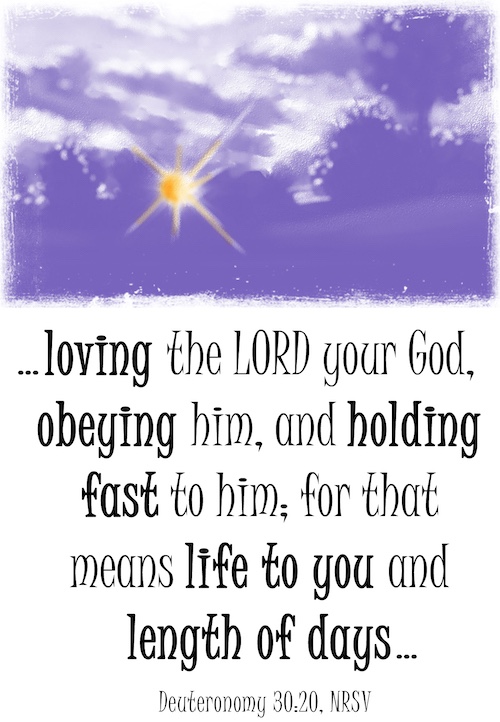
Choose life: loving, obeying, holding fast (Deuteronomy 30; Psalm 119; Epiphany 6A)

The season of Epiphany is marked by an emphasis on light, a symbol of the manifestation or revelation of God in Jesus. (Epiphany is from the Greek word for “shine forth”—thus, a manifestation, a revelation.)

The note of revelation through light was sounded in the announcement of an unnamed post-exilic prophet found in the Hebrew Scripture reading for The Feast of the Epiphany: “arise, shine; for your light has come, and the glory of the Lord has risen upon you … nations shall come to your light, and kings to the brightness of your dawn” (Isa 60:1, 3).

It was continued in the words of another, earlier, unnamed prophet in the Hebrew Scripture reading for Epiphany 1, the Feast of the Baptism of Jesus, in words sung to The Servant: “I have given you as a covenant to the people, a light to the nations, to open the eyes that are blind, to bring out the prisoners from the dungeon, from the prison those who sit in darkness” (Is 42:6–7).

Then, for Epiphany 2, we heard a repetition and extension of that imagery of light, in the second song sung to The Servant: “I will give you as a light to the nations, that my salvation may reach to the end of the earth” (Isa 49:6). There was also a repeated indication of the worship that kings will bring: “Kings shall see and stand up, princes, and they shall prostrate themselves, because of the Lord, who is faithful, the Holy One of Israel, who has chosen you” (Isa 49:7).

The motif of illumination continued on Epiphany 3, as the prophet Isaiah, some centuries earlier, foresaw the significance of the birth of a child in the royal line: “the people who walked in darkness have seen a great light; those who lived in a land of deep darkness on them light has shined” (Isa 9:2).

For Epiphany 4, the focus shifted to the way that people were to respond to the revelation of God’s ways, made known in the words of the prophets, through the testimony of The Servant, and even through the birth of a child. So, Micah proclaimed, “the Lord … has told you, O mortal, what is good; and what does the Lord require of you but to do justice, and to love kindness, and to walk humbly with your God?” (Mic 6:8).

Then followed, on Epiphany 5, the advice of the anonymous post-exilic prophet whose words are collected in the last section of the book of Isaiah. Ne advises the people to enact the fast that the Lord chooses: “to loose the bonds of injustice, to undo the thongs of the yoke, to let the oppressed go free, and to break every yoke … to share your bread with the hungry, and bring the homeless poor into your house; when you see the naked, to cover them, and not to hide yourself from your own kin” (Isa 58:6–7).

Immediately following this, the prophet returns to the Epiphany theme of illumination: “your light shall break forth like the dawn, and your healing shall spring up quickly; your vindicator shall go before you, the glory of the Lord shall be your rear guard” (Isa 58:8). These ways of acting are, as I have explored, central to the covenant between God and Israel; the prophet itemises a series of practical behaviours that would signal that Israelite society was founded on the justice and righteousness that God required through the covenant. That is how they were to respond to the illumination of the light, given to them time and time again. See

So each week, an excerpt from a prophetic text has undergirded the key feature of the ongoing season of Epiphany. Of course, the prophets weren’t speaking about our Christian season of Epiphany; but the compilers of the lectionary have chosen these passages, quite deliberately, to provide an ongoing focus each Sunday throughout this season.

*****

This coming Sunday, by contrast, there is no mention of light, or dark. However, the passage chosen from Hebrew Scripture (Deut 30:15–20) does continue the motif of justice, as articulated by prophets before the Exile (Micah 6) and on return to the land, after exile (Isaiah 58). We are offered an excerpt from the final speech of Moses, the great prophet, as it was attributed to him by a writer many centuries later from the time he is alleged to have lived—the unknown author of the book of Deuteronomy.

When Josiah was King of Judah (from 640 to 609 BCE), he instituted a series of reforms (probably during the late 620’s). What drove the reforms was the discovery, in the midst of the restoration of the Temple, of an ancient book of the Law, at the bottom of a money chest that had recently been raided to pay for renovations to the Temple (2 Ki 22:8–10).

This book set out the requirements of the Law; when it was discovered, Josiah realises that the nation has not been faithful to the covenant, and that God will punish them. He consults the prophet Huldah, who advised King Josiah to undertake the thoroughgoing reforms of religion in Judah that characterised his reign. “Josiah took away all the abominations from all the territory that belonged to the people of Israel, and made all who were in Israel worship the Lord their God. All his days they did not turn away from following the Lord the God of their ancestors” (2 Chron 24:33).

It is thought by some scholars that the book found in the money chest was Deuternonomy, or perhaps an earlier version of the book we now have. (The name, Deuteronomy, comes from two Greek words, meaning “second law”—perhaps a reference to the fact that in this book so many of the laws stated in Exodus and Leviticus are restated a second time.) There is no doubt that this book sounds a single, insistent theme, requiring that the people of Israel listen to the words that God gave Moses to speak to them, that they listen and obey, putting the instructions and commands into practice in every element of their daily lives.

Indeed, a key statement in this book is recited to this day by faithful Jews, reminding them of their obligation to respond to God’s gift: “Hear, O Israel: The Lord is our God, the Lord alone; you shall love the Lord your God with all your heart, and with all your soul, and with all your might” (Deut 6:4–5, known for the first word of these verses, the Shema).

So this passage continues: “Keep these words that I am commanding you today in your heart. Recite them to your children and talk about them when you are at home and when you are away, when you lie down and when you rise. Bind them as a sign on your hand, fix them as an emblem on your forehead, and write them on the doorposts of your house and on your gates.” (Deut 6:6–9; see also 11:18–21).
This central commandment is to be remembered and enacted at every time of the day, in every situation and place. Throughout this book, the people are regularly reminded to “keep” the commandments (4:2, 40; 5:10, 12, 15, 29; 6:2, 6, 17, 24; 7:9; 8:2, 6, 11; 10:13; 11:1, 8; 13:4; 16:10, 13, 15; 26:17–18; 27:1, 9; 28:9). They are told to “obey the voice of the Lord God” (8:20; 13:4, 18), the Lord who speaks through the commandments (11:27–28; 12:28; 15:5; 26:17; 27:10; 28:1–2, 13, 15; 30:2, 8, 10, 16). Loving the Lord God is at the heart of these commandments (6:5; 7:9; 10:12; 11:1, 13, 22; 13:3; 19:9; 30:6, 16, 20). In this way, the people “hold fast” to God (10:20; 11:22; 13:4; 30:20).

*****

In the passage offered for this coming Sunday, this requirement of diligent listening and faithful obedience is sounded for the final time in this long book; the people are instructed to “choose life, so that you and your descendants may live, loving the Lord your God, obeying him, and holding fast to him” (Deut 30:19–20).

And so, the benefits of such listening, obeying, and holding fast are set forth: “if you obey the commandments of the Lord your God that I am commanding you today, by loving the Lord your God, walking in his ways, and observing his commandments, decrees, and ordinances, then you shall live and become numerous, and the Lord your God will bless you in the land that you are entering to possess” (Deut 30:16).

We have already discussed how Torah (the Law) was widely appreciated and deeply valued amongst the people of Israel, such that psalms and prophetic voices could exclaim, “happy are those who fear the Lord, who greatly delight in his commandments” (Ps 112:1). See

It is worth noting that, in Hebrew, the same word (Shema) is translated into English by two key terms—most often, as “hear” (as in Deut 6:4), but on occasions, as “obey” (as in Deut 11:27–28, and other places in this book). The sense of obey, then, is to hear, register, and put into practice what has been heard—thus, to obey. Hearing is not simply an act of the ear; it is an act of the whole being, moving from what the ear registers to what the mouth says, the hands do, the heart shows. That is the full sense of the instructions that are given in this speech by Moses at the end of his life (according to the narrative setting of the whole book; see Deut 31:14; 32:48–52; 34:1–8).

In the verse prior to this section, the people are reminded of how they are to relate to God: “the word is very near to you; it is in your mouth and in your heart for you to observe” (30:14). Hearing God, obeying the commandments that God has given, and living God’s way, are all immediately at hand—indeed, they are within the people. This is much like Jeremiah’s vision of the new covenant, when “I will put my law within them, and I will write it on their hearts” (Jer 31:33), or Ezekiel’s vision of the valley of dry bones, when God promises, “I will put my spirit within you, and you shall live” (Ezek 37:14).

Indeed, this positive appreciation of the Law is picked up well in the Psalm offered for this Sunday, namely, the first stanza (verses 1–8) of the longest psalm in the Bible, Psalm 119. This psalm offers lavish and continued praise for Torah—identified variously as “the law of the Lord” (v.1), “his decrees” (v.2), “his ways” (v.3), “your precepts” (v.4), “your statutes” (v.5), “your commandments” (v.6), “your righteous ordinances” (v.7), and once again “your statutes” (v.8). These terms recur in each stanza of this lengthy, extended psalm of 178 verses, along with the familiar “your word” (vv.9, 11, 16).

The blessings of hearing and obeying this law are also set forth in this opening stanza of Psalm 119: those who hear and obey are blameless (v.1), blessed (vv.1,2), they do no wrong (v.3), keep the precepts diligently (v.4), have steadfast ways (v.5), will not be opus to shame (v.6), praise God with an upright heart (v.7) and are not forsaken by God (v.8). Similarly appreciative phrases recur through all 22 stanzas of this psalm.

“Choose life, that you may live; loving the Lord your God, obeying him, and holding fast to him” (Deut 30:19–20). “Happy are those whose way is blameless, who walk in the law of the Lord” (Ps 119:1). Or, as Jesus declares, “whoever breaks one of the least of these commandments, and teaches others to do the same, will be called least in the kingdom of heaven; but whoever does them and teaches them will be called great in the kingdom of heaven” (Matt 5:19).

See