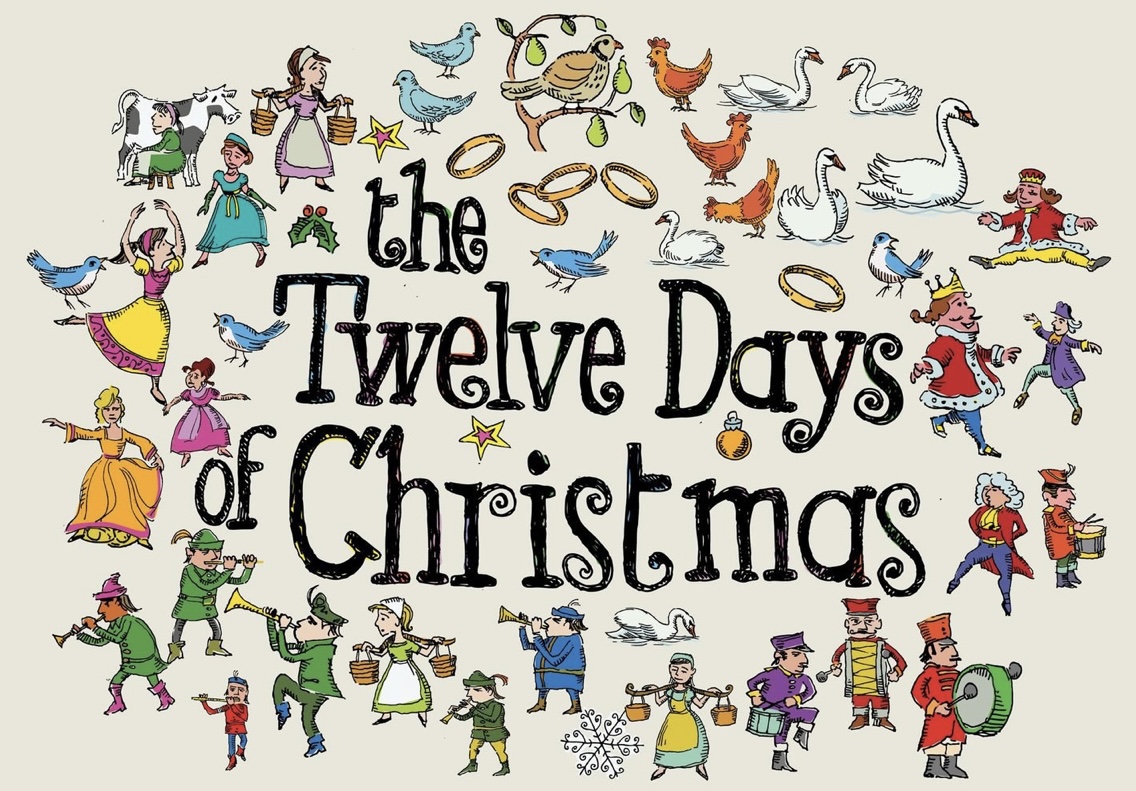
And so we come to the twelfth day of Christmas, 5 January—the day that ends with Twelfth Night, the Eve before Epiphany. And what a gift-giving bonanza it has been! Birds of various kinds, jewellery, milkmaids, dancing ladies, leaping lords, and a bunch of pipers, have been marshalled and then gifted by “my true live” to a deserving recipient. And celebrated in song! It has been quite an extravaganza.
We sing about this every year in “The Twelve Days of Christmas”. That popular song itemises the giving of gifts over those twelve days, mounting cumulatively day by day. The total number of gifts given is quite amazing—it actually totals 364! Each day’s gift is given, not only on that day, but on each of the subsequent days.
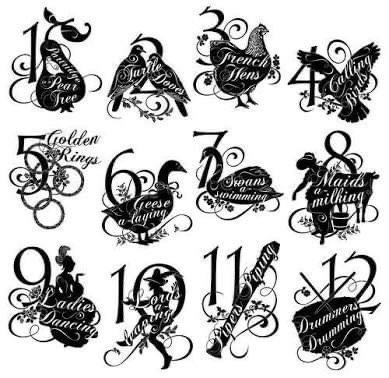
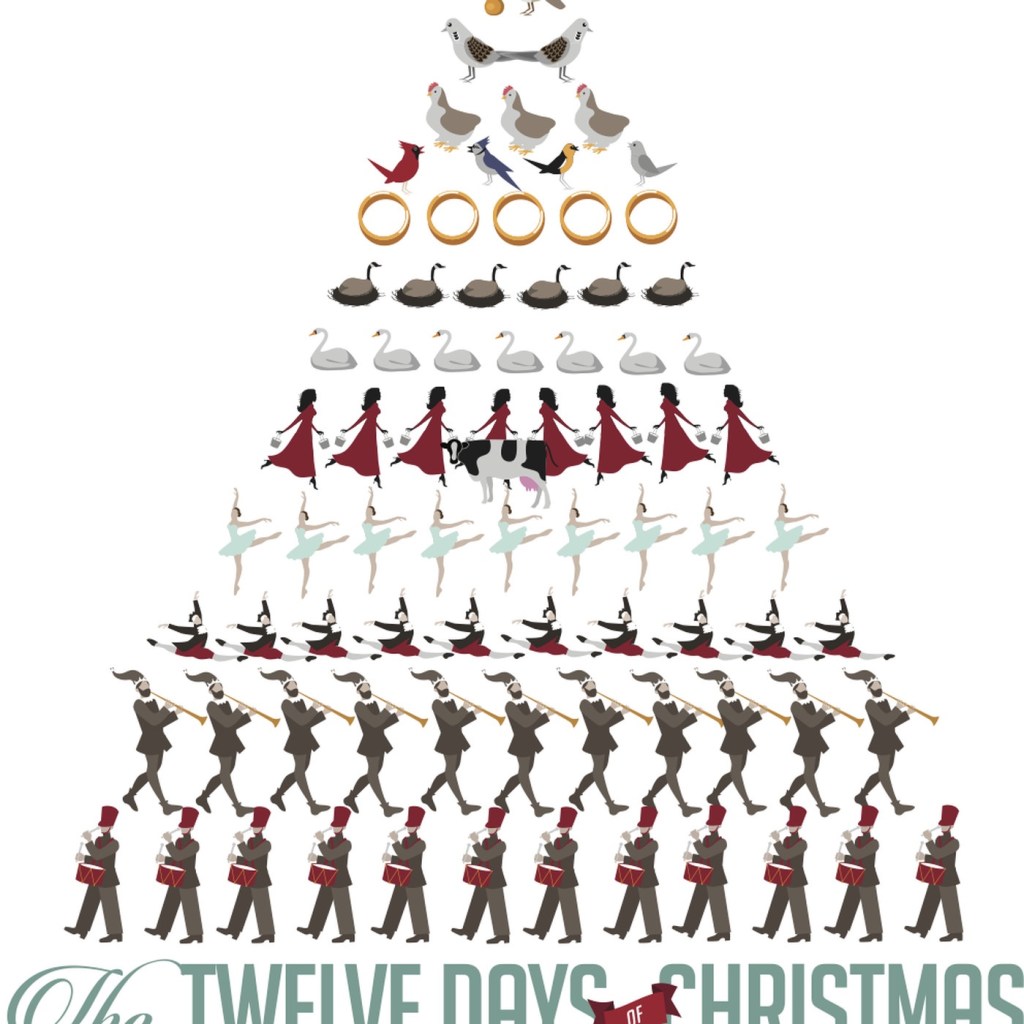
To calculate the total number of gifts, we need to multiply each gift by the number of times it recurs in a full round of the song. If we do this, we will soon realise that the gifts’ recipient would have to rent a storage unit and gain access to a lake, to contain the bounty, including 12 partridges (one each day for 12 days), 22 turtledoves (2each day for 11 days), 30 French hens (3 each day for 10 days), 36 colly birds, 40 gold rings, 42 laying geese, 42 swimming swans, 40 milking maids, 36 dancing ladies, 30 leaping lords, 22 pipers piping, and 12 drummers drumming.
And just think, how much all of this would cost! In fact, the cost each year has been calculated by the Christmas Price Index, published by the US bank PNC Wealth Management (only in America would a bank be called a “wealth management” company 😳). See https://en.wikipedia.org/wiki/Christmas_Price_Index
The Christmas Price Index chose the items in this popular Christmas carol as its market basket, calculating their cost by using local sources of information—purchasing the pear tree from a local Philadelphia nursery, assessing the costs of the partridge, turtle dove, and French hen prices as determined by the Cincinnati Zoo and Botanical Garden.
The price for the gold rings was guided initially by Gordon Jewelers (subsequently taken over by the Zale Corporation), and an assumption was made that the maids were unskilled laborers earning the federal minimum wage. The ten “lords a-leaping” are valued by using the cost of hiring male ballet dancers instead of real lords, since “lordships are a title of nobility not recognised in the United States”!
In 2012, the “true love” would have to spend $107,300 to buy all 364 presents. PNC Wealth Management has calculated the cost of the gifts every year since 1984–in that year, the same gift assortment would have cost $61,300. Those determinedly mobile swans were the most expensive item, at $1,000 each in 2012.
By 2019, the total cost would have been $38,993.59, but the next year, the cost dipped, because of the pandemic and associated restrictions. In 2020, the index did not include nine Ladies Dancing, ten Lords-A-Leaping, eleven Pipers Piping, or twelve Drummers Drumming due to COVID-19 restrictions on live performances. The total cost was $16,168.14. But in 2021, with performances in the USA once again possible, it rose to $41,205.50, and then to $45,523.27 in 2022.
So: as well as being a noisy enterprise (all those birds squawking, pipers piping, and drummers drumming) requiring large storage facilities, it’s an expensive business for the “true love” to keep this up, each and every year!
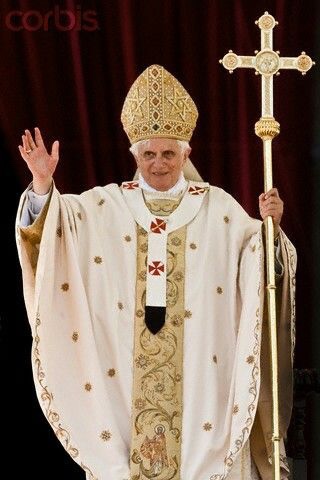
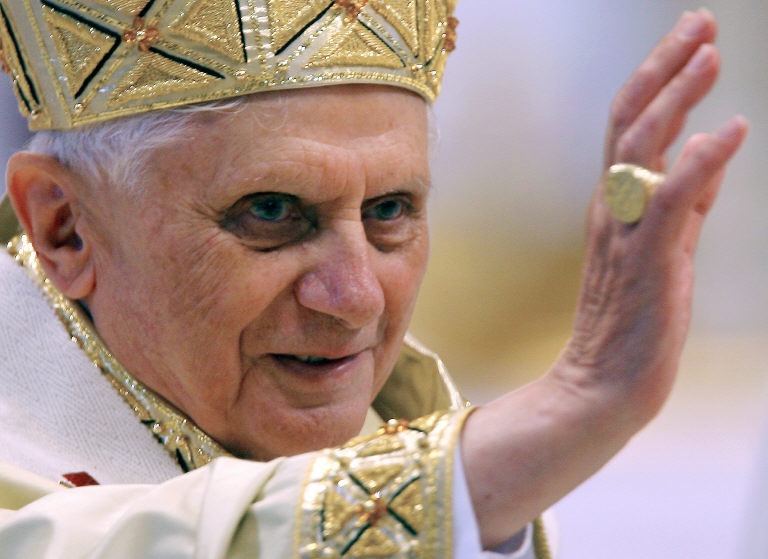
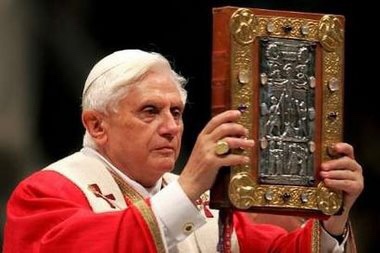
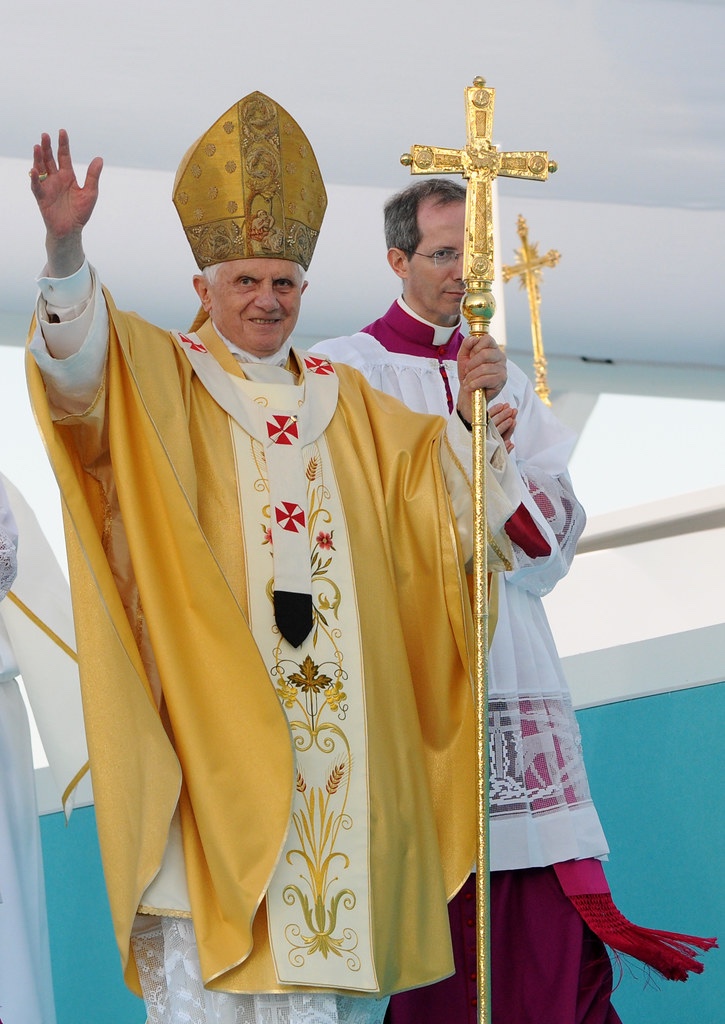
Following on from Noel Debien’s Obituary/Evaluation of the late Pope Emeritus Benedict XVI that I posted yesterday, I have collated some further comments that I’ve found in the media relating to the legacy of Benedict.
Former priest and media commentator Paul Collins assesses the papacy of Benedict as follows: “Benedict’s most important act was his resignation because in one fell-swoop he relativised the papacy and drained it of its ‘mystery’. It showed him as a normal man who admitted that he had ‘come to the certainty that my strengths, due to advanced age, are no longer suited to an adequate exercise of the Petrine ministry.’ That required humility; the last pope to have resigned was Celestine V in 1294.”
Theologian Ben Myers explores the theology of Ratzinger-the-academic who became Benedict-the-pope:
“For over half a century Ratzinger has challenged the subordination of truth to communal belonging. From his academic career in the 1950s and 60s to his papal ministry as Benedict XVI, one of Ratzinger’s most consistent themes has been the priority of reason and truth over communal identity. In his analysis, the most urgent theological task is the recovery of reason. It is, he thinks, the most urgent social and political task too.
“Ratzinger sees the split between faith and reason as inimical to both religion and secular society. Religion becomes pathological when its claims are reduced to private exhortations to insiders with no link to a universally accessible rationality or a shared conception of the human good. And reason, for its part, becomes pathological when it is confined to the sphere of fact, measurement, and technical manipulation with no accountability to moral considerations of justice, goodness, and the ends of human life.
“Ratzinger calls for faith to be animated by rationality and for reason to be open to its transcendent foundations as revealed to faith. Faith and reason alike, he argues, arise from the manifestation of the divine Logos, who is ultimately revealed as Love: a rationality that is living, personal, and directed toward us for our good.”
Writing in the National Catholic Reporter, Jamie Manson (president of Catholics for Choice) notes that “over the course of nearly 50 years, Benedict produced more than 65 books in theology, Christology and liturgy, as well as three papal encyclicals and three papal exhortations.”
However, she continues, “whatever contributions he made in his prolific and distinguished career may ultimately be overshadowed by the years he spent monitoring, and sometimes suppressing and silencing, the work of other Catholic theologians and ethicists. Though Benedict resigned from his papal,office in 2013, many theologians in the U.S. still struggle to separate the pope from his tenure as the Vatican’s doctrinal watchdog.”
The uncovering of the extensive sexual abuse committed by religious in the Roman Catholic Church (and many other churches, community organisations, and institutions around the world) has been a major factor in the leadership of the church for a number of years now. A year ago, in January 2022, a report on sexual abuse in Germany’s Munich diocese on Thursday faulted retired Pope Benedict XVI’s handling of four cases when he was archbishop in the 1970s and 1980s.
The law firm that drew up the report said Benedict strongly denies any wrongdoing. Writing for APNews, Geir Moulson wrote that “The findings were sure to reignite criticism of Benedict’s record more than a decade after the first, and until Thursday only, known case involving him was made public. … Benedict’s legacy as pope had already been colored by the global eruption in 2010 of the sex abuse scandal, although as a cardinal he was responsible for turning around the Vatican’s approach to the issue.”
Moulson continued, “Benedict gained firsthand knowledge of the global scope of the problem when he took over at the Congregation for the Doctrine of the Faith in 1982, after his time in Munich. Ratzinger took the then-revolutionary decision in 2001 to assume responsibility for processing those cases after he realized bishops around the world weren’t punishing abusers but were just moving them from parish to parish where they could rape again.”
Writing immediately after the news of his death was announced, Journalist Nicole Winfield has advocated for a favourable assessment of Benedict’s actions, noting that “it was the then-Cardinal Ratzinger who took the revolutionary decision in 2001 to assume responsibility for processing those cases after he realized bishops around the world weren’t punishing abusers but were just moving them from parish to parish where they could rape again.
“And from 2004 to 2014, the Vatican defrocked 848 priests and sanctioned another 2,572 to lesser penalties, a get-tough approach to remove predators outright that went unmatched by Francis. Benedict met with victims across the globe, wept with them and prayed with them. Under his leadership, the Vatican updated its legal code to extend the statute of limitations for cases and told bishops’ conferences around the world to come up with guidelines to prevent abuse.
“And most significantly, Benedict reversed his beloved predecessor by taking action against the 20th century’s most notorious pedophile priest, the Rev. Marcial Maciel. Benedict took over Maciel’s Legionaries of Christ, a conservative religious order held up as a model of orthodoxy by John Paul, after it was revealed that Maciel sexually abused seminarians and fathered at least three children.”
However, an article in The Conversation (first published in October 2021, updated after Benedict’s death in January 2022) collates many articles examining the crisis over the years – both its roots and the potential routes for reform. The perspective of the five authors is that this is work-in-progress for the Roman Catholic Church—whilst Benedict and Francis have taken various steps towards addressing the situation, it is still not clear that the Roman Catholic Church as a whole has fully reformed its practices as a global institution most highly implicated in this matter.
This matter will continue to figure prominently in all assessments of Benedict as Pope—and, indeed, Ratzinger in his Vatican role prior to this. And whoever follows Francis will need to take further, decisive steps—a call that will be hard to meet in the complex institutional framework of the church. Yet this will be the litmus test for how faithful the church as a whole, and its key leadership, holds to the scriptural injunctions to seek righteousness, practice justice, care for the vulnerable, and uphold the two great commandments, to love others as well as to love God.
The following Obituary for the recently-deceased Pope Benedict XVI was written by Noel Debien, a theologically-astute, practically-involved, faithful practising Roman Catholic Christian, who works as a Religion and Ethics Specialist for the ABC.
As a Protestant, I don’t share the same understanding of Roman Catholicism or hold to the same perspective on the Pope that Noel demonstrates in what he has written. It seems to me that the late Pope Emeritus was a complex character, in a difficult leadership role, in a larger, diverse, unwieldy institution that (like all churches, and all organisations) was facing multiple challenges, to which it responded in various ways, both helpful and unhelpful, both constructive and reactive.
But what Noel writes is worth our reading and our consideration. I do appreciate the clear insights and thoughtful analysis that he offers in this piece, and am sharing this with his permission. I think that this piece would merit its own nihil obstat as a good explanatory piece to those of us outside Roman Catholicism 😁
OBITUARY: Joseph Aloisius Ratzinger Born: 16/4/27 Marktl am Inn, Diocese of Passau, Germany Benedict XVI (19/04/2005–28/02/2013)
He was the first pope to step down in 600 years.
He had chosen his papal name to honour both Pope Benedict XV who led the church through World War I, and St Benedict of Nursia, European monastic leader. He said the name Benedict reminds us “to hold firm Christ’s central position in our lives”. He was deeply critical of the European union when, in its 2008 50th anniversary it failed to include Europe’s Christian heritage in its declaration.
The same pope Benedict XVI canonised our first Australian saint, Mary MacKillop in 2010. During his 2008 World Youth Day visit to Australia he reached millions, establishing him firmly in Australian awareness. He also consecrated the new permanent altar of St Mary’s Cathedral in Sydney. It was also during this visit that he made more world news with his first public apology to victims of child sex abuse by Catholic priests and religious. Over 4,444 survivors in Australia from Catholic religious leaders alone. Many more from other religious institutions.
He said his 8-year long pontificate was all about ensuring continuity and avoiding disruption. This was indeed a “continuity” with his predecessor John-Paul II. He was a traditionalist, yet his resignation and retirement marked him as a genuinely modern pope. A man who was generally averse to “novelty” ended up establishing that the retirement of modern popes is normal. He chose to serve as pope only while his health allowed.
As a smoker, he’d had an embolism in the eye in 1984, recovered from a stroke in 1991 – and was eventually completely blind in his left eye. While he was accused of “secularising” the papacy by stepping down “as if someone in public office”, he firmly rejected this allegation. He remarked that “Even a father’s role stops… he does not stop being a father, but he is relieved of concrete responsibility”. After he retired, he decided to be known as “Pope Emeritus”.
On clerical sexual abuse, he was relatively decisive. His interpretation of the abuse crisis was also “outside the usual model” of church response, as something that came from the outside secular culture. In a “culture war” perspective, he included the views of the broader world, not just internal church views.
More bishops were required to resign under Benedict than any previous pope. One of his first actions was to accelerate the investigation into Fr Maciel Degolado. Degolado, founder and head of the Legionaries of Christ was a drug-addicted sexual predator. Pope John Paul II had refused to believe horrendous allegations about Degolado, and even as this previous pope lay dying, the future Benedict XVI was already moving on Degolado. Still, critics point out that despite Benedict’s determination, Degolado was never arrested and charged.
As a 35 year-old professor of theology, Joseph Ratzinger participated in the 2nd Vatican Council. He was actively there, and lived right through it. He helped German Cardinal Josef Frings prepare for it. He accompanied Frings to the council as a “peritus” (expert). Along with famous names like Yves Congar, Hans Urs Von Balthasar, Jean Daniélou and Henri de Lubac, Ratzinger was deeply engaged in that momentous church reform. But his criticism of Vatican II started already when he took distance (like Rahner and de Lubac) from the theology of GAUDIUM ET SPES. He became Archbishop of Munich-Freising in 1977 at age 50, and a Cardinal in the same year.
Born in 1927, Benedict was the longest-lived person ever to have been pope. As pope, he was an absolute monarch, yet he had also known starvation during World war II. His family were anti-Nazi. His own 14 year old cousin (with Downs syndrome) had been murdered by the Nazis in 1941 in their “eugenics” program. He spent time as a reluctant German soldier (he deserted!), and then as a prisoner of war in a US camp at Ulm. He resumed his studies for priesthood as soon as World War II ended. This was in the midst of a devastated Germany.
Over his long life, he observed the repression of Christianity in China, the Cold War, the Cuban Missile crisis, man on the moon, the collapse of Soviet Communism and the American sub-prime mortgage crisis . He also presided over the increasingly shocking clerical sexual abuse crisis that brought large parts of his church to its knees.
He did try to deal with interfaith relations, and had some success, but the relative disaster of the speech he made in Regensburg on Islam (September 2006) was not particularly helpful for his overall record. His words sparked international controversy (to be fair, he accurately quoted the besieged Byzantine Emperor Manuel II Palaiologos) “Show me just what Muhammad brought that was new and there you will find things only evil and inhuman, such as his command to spread by the sword the faith he preached”.
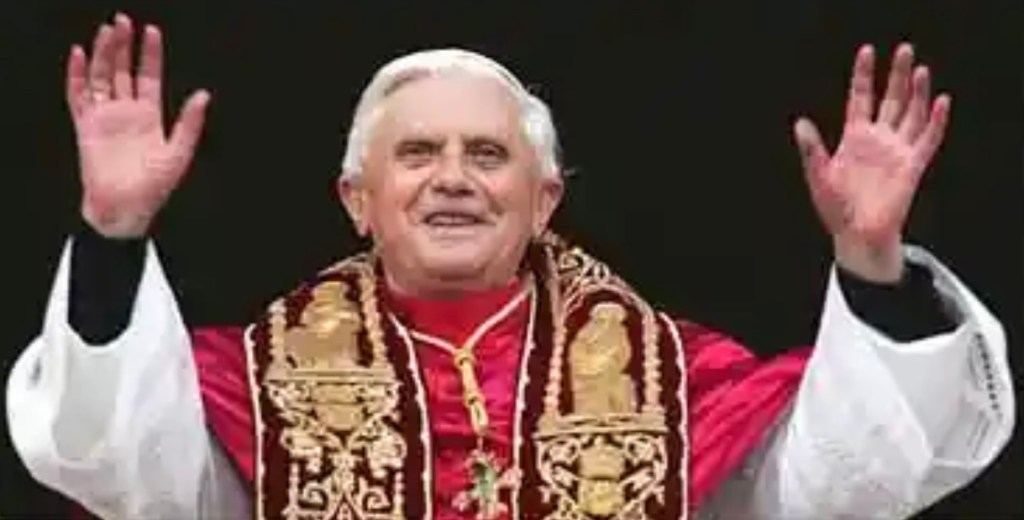
German cardinal Joseph Ratzinger, waving to the crowd from the central balcony of St Peter’s Basilica, at the Vatican, after his election as Pope in April 2005
German Cardinal Joseph Ratzinger had been elected pope on April 19th, 2005 at the age of 78. He said this was to his great surprise. “The falling of the guillotine” he called it. But it was his later decision to step down from the papacy at age 85 that helped define the type of active leadership he offered. He had seen his predecessor’s shocking mental and physical decline right to the end, and determined he himself would never die slowly and dramatically in office while leaving others to govern. As the conservative he was, he emphasised precedent from previous resignations of popes.
His theological contribution was immense – especially throughout Vatican Council II. He was a genuine intellectual. At age 39, he became the chair for dogmatic theology at the University of Tübingen in 1966. He wrote and spoke German, French and Latin fluently- so much so that he preferred Latin to Italian- a language he was less comfortable in academically. While describing himself as “shy” and “less emotional”, he was deeply influenced by the intellectual rigour, spiritual teaching and emotional struggle of Augustine of Hippo, the 4th Century North African Bishop and Doctor of the Church. He was a genuine “Augustinian”, who told of his wish to move past classical Thomism, the foundational Catholic theological contribution of St Thomas Aquinas. Thomism had been criticised as “frozen” and “manual-bound”.
Among many other things, St Augustine of Hippo defined “original sin” as Christian doctrine. Baptism was required to cleanse this world-sin though God’s gift of grace. Pope Benedict was deeply conscious of this original sin-of-the-world, and deeply cautious that human passions ought to be ordered and managed. His answer was doctrinal purity and adherence to Christian teaching. His experience of Nazi Germany and its post-war destruction left him in no doubt of the consequences of the “ways of the world”. By strategic appointments, he re-structured the worldwide membership of Catholic bishops to reflect his own views, and this can be seen (for example) among the conservative majority among the current members of the American Episcopal conference.
The “Vati-leaks” scandal that began in 2012 did nothing to allay Pope Benedict’s mistrust of “the world”. His own personal butler, Paolo Gabriele, later admitted (and was convicted) of stealing documents from within the papal household and leaking them. Those documents revealed Vatican intrigue, corruption and in-fighting. Pope Benedict was deeply distressed by this betrayal from one so trusted. He remarked the events “brought sadness in my heart”. It is impossible to know how seriously this personal betrayal affected him, but it is true that he resigned just a year later.
He drove forward many corrections of undesired Vatican Council II outcomes, including (with the help of Cardinal George Pell) a retranslation of the Roman Missal (the church’s key prayer book). Particularly in the English translation, its language was made much more literal to the Latin original – and correspondingly less English in idiom. German Catholics had rejected similar reforms, but they were nevertheless carried out for other language groups including English.
The English retranslations were controversial, and reflected his conservative approach. In January 2009, he had lifted the previous excommunication for renegade “Latin Mass” (“Tridentine”) bishops, one of them a Holocaust denier. It was not a particularly helpful moment for the wider church.
He also re-introduced the old Latin Tridentine rite of mass, the one he celebrated as a young priest. It had been banned by Pope Paul VI in an attempt to modernise worship. He liberalized the use of the Latin Mass in the pre-Vatican II rite alongside the existing one in the vernacular, and in this way he boosted the neo-traditionalist movement against Vatican II especially in the English-speaking world.
Benedict characterised his papacy by stressing “continuity”. He determined that the church in his time should be continuous with the church before the Second Vatican Council, and not ruptured from it. The Liturgy was one of his great loves, and in particular the Mass. Among others, his election as pope delighted traditional Catholic liturgists and musicians around the world. Progressives, and many Catholic bishops not ideologically labelled, were less enthusiastic. He once remarked that the reason he knew Pope John Paul II so well was not through his books, but by observing him celebrate the Eucharist. John Paul II was widely regarded as a mystic, and Josef Ratzinger was attuned to this.
Usually a bit tedious to read, Papal Encyclicals changed. These Papal letters to the world became masterful under Benedict. “CARITAS IN VERITATE” (on global development and progress towards the common good) was a particular success. His were accessible, clear and moving. Many expressed surprise that such an intellectual could hone language so simply and speak so clearly. Million and millions actually read his encyclicals – in itself a papal triumph of public relations. For a renowned University lecturer and writer of academic tomes, he also knew how to write for the people.
He played keyboard and sang, and he deeply enjoyed music. Although he was modest about his own voice (“pitch” he commented once). He had a deep knowledge and abiding interest in sacred music. Under his pontificate his own Sistine Chapel Choir was improved greatly. He was proud that his priest-brother Georg directed the world-famous “Cathedral Sparrows” choir in Regensburg (Germany)– and went to worship with them whenever he was able. Church musicians around the world took delight in his informed encouragement. However, the shadow of abuse later fell over even his beloved Regensburg Choir school.
As a Cardinal, he had been nicknamed the “Enforcer”. This was during his time heading the Congregation for the Doctrine of the Faith” (once known as the “Inquisition”). He was a man of rules. The career of many a Catholic theologian ended under his supervision. He was key to the deeply controversial teaching document “Dominus Jesus” in the year 2000. Critics described it as a ‘Public Relations Disaster’ for Ecumenism because it made clear that his Vatican did not consider Protestant churches to be authentic churches, yet supporters of “DOMINUS JESUS” praised it for its Catholic “clarity”. Overall, his was not a particularly ecumenical career, especially in terms of Protestant churches.
In 2009, he alarmed many Anglicans when he created an “Anglican Ordinariate”, designed to receive disaffected Anglicans into the Catholic church while keeping many of their own traditions. It had limited success, receiving many clergy who objected to the ordination of women. Nevertheless, his state visit to the United Kingdom one year later, the first such UK state visit of a Roman Pontiff, was hugely successful. During that visit he beatified the former Anglican Divine (and convert), Blessed John Henry Newman.
As a Cardinal he was also central in the drafting of the Catholic Catechism of 1992 – the worldwide standard source for Catholic teaching. Concerning his enforcer role, he saw it as “service”, and was satisfied someone had to admonish and to warn the church. He was not afraid of unpopularity, and there was a contrarian spirit in him typical of an academic more than a pastor. But his enforcement was not always decisive in outcome, such as with United States nuns in 2012. Pope Francis ended the investigation into the USA Leadership Conference of Women Religious relatively discreetly in 2015.
As a Cardinal, Joseph Ratzinger was known as the “enforcer”. As Pope and bridge-builder, Benedict XVI was required to be the “unifier”. His was a pontificate of intended continuity, but yet may prove to have been strained by competing factions, both within the church, and by the more general culture wars of the West.
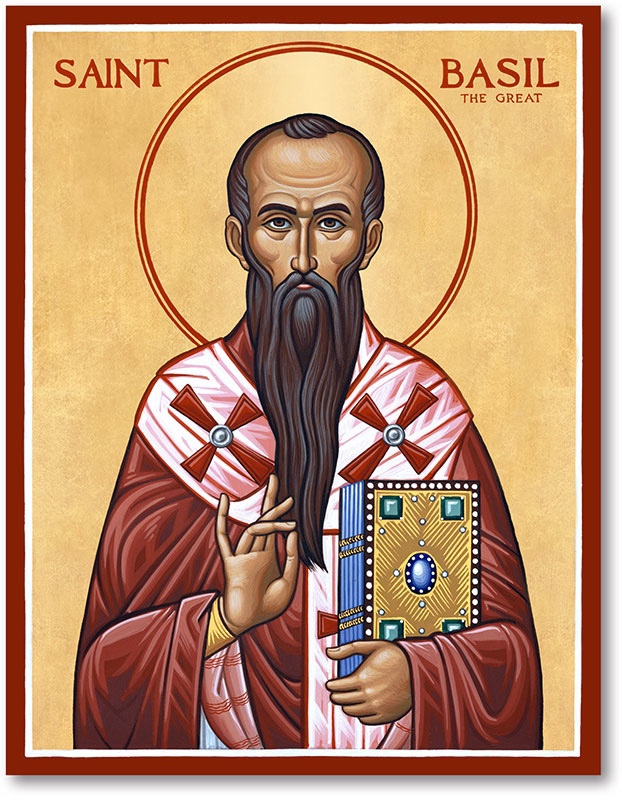
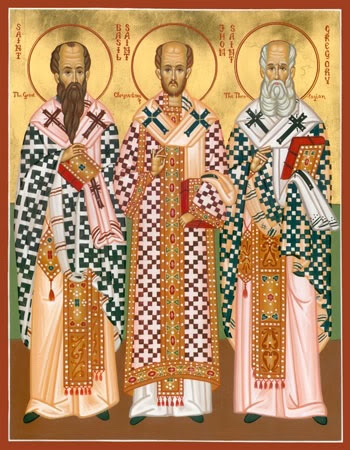
Today (1 January) is the feast day of Saint Basil the Great in the Eastern churches. Basil wrote many theological works and is remembered (along with the two Gregorys, of Nyssa and Nazianzus—pictured below) as one of the Cappadocian Fathers, who played an influential role in the development of patristic thinking about the triune God.
It is said that Basil was tall, thin, partly bald, with a long beard. (He is the one on the left in the icon above.) He ate no more than was absolutely necessary for his survival; he never ate meat. It is said that he had only one worn undergarment and one overgarment.
Basil said that prayer was the seasoning for our daily work, as we season food with salt; that sacred and holy songs can only inspire us and give us joy and not grief. His philosophy fits well into the Christmas Season, when we season our lives with carols!
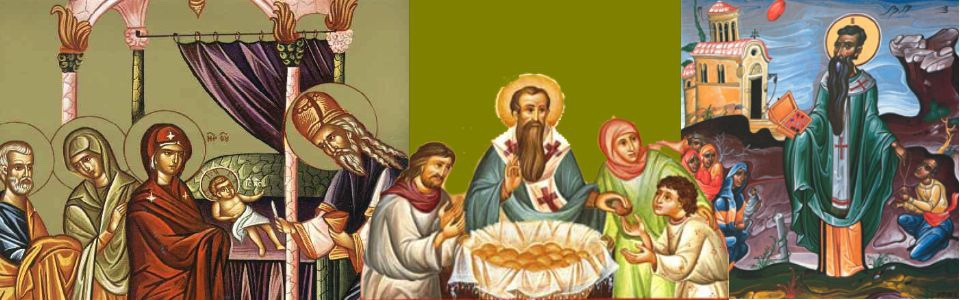
At the age of 28, Basil “left the world” and became a monk; at 35 a priest, then at 41, the Bishop of Caesarea. It is said that Basil, being born into a wealthy family, gave away all his possessions to the poor, the underprivileged, those in need, and children.
For Greeks and others in the Orthodox tradition, St Basil is the saint associated with Santa Claus. In Greek tradition, he brings gifts to children every January 1 (St Basil’s Day). It is traditional on St Basil’s Day to serve vasilopita, a rich bread baked with a coin inside.
It is also customary on his feast day to visit the homes of friends and relatives, to sing carols for the New Year, and to set an extra place at the table for Basil.
The celebration of St Basil on 1 January marks the day of his death. In the Western Church, because 1 January commemorates the Solemnity of Mary, Mother of God, Basil shares his saintly commemoration on the next day, 2 January, with Gregory of Nazianzus.
St Basil’s Hymn is one of many traditional Greek carols (often referred to as calanda) that are still sung by children on St Basil’s feast day (New Year’s Day). In the tradition still practiced to some extent in modern times, Greek children roam the neighborhoods from house-to-house on St Basil’s Day, playing instruments and singing songs, bidding New Year’s tidings to everyone, and receiving gifts of sweets and pastries from householders.
Here is the hymn (in a quirky and rather stilted translation):
It’s the beginning of the month beginning of the year High incense tree Beginning of my good year Church with the Holy Seat It’s the beginning of our Christ Saint and spiritual He got out to walk on earth And to welcome us St. Basil is coming from Caesarea And doesn’t want to deal with us May you long live, my lady He holds an icon and a piece of paper With the picture of Christ our Saviour A piece of paper and a quill Please look at me, the young man
One of the gifts that is treasured by many believers around the world is the ability to read the scriptures on their own language. It is something that we take for granted; but it is not something that has always been available to people of faith.
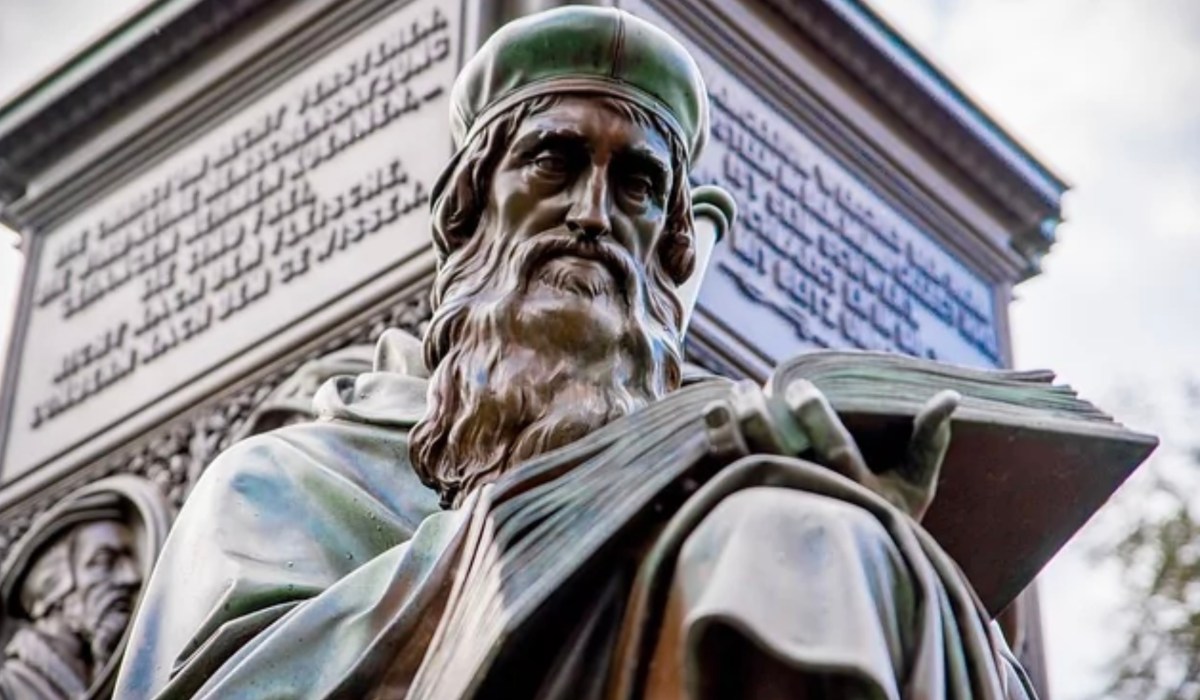
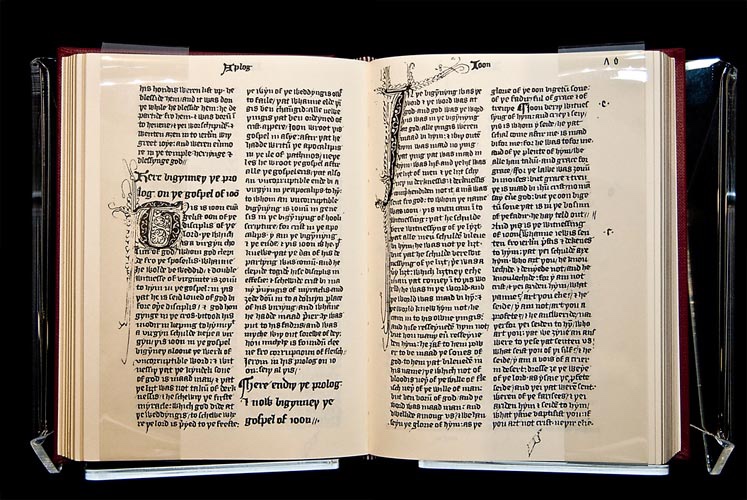
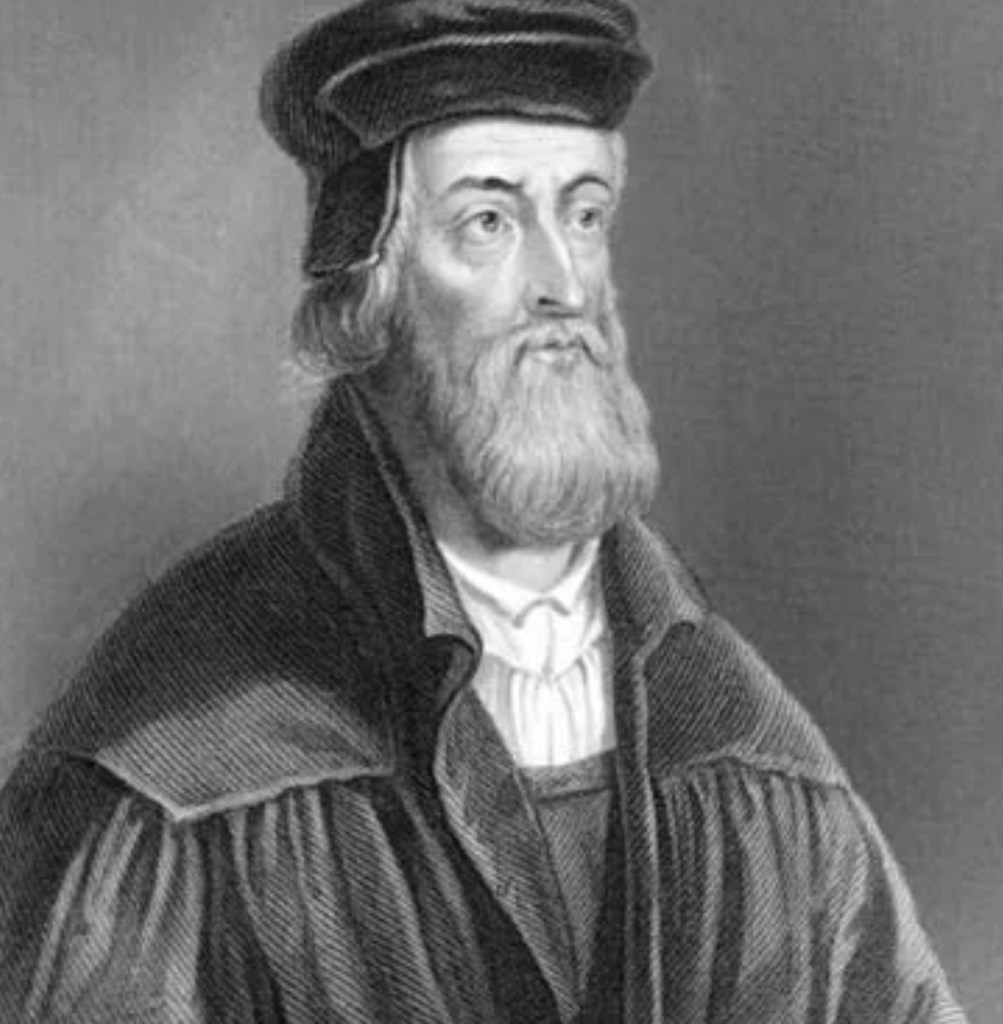
On this day it is good to pause and remember that we have the Greek and Hebrew and Aramaic writings of scripture translated into English and available for us to read. On this day perhaps we English-speaking people might spare a thought for the 14th century theologian and preacher, John Wycliffe (1328–1384), who is remembered as the person who made the first English translation of the Bible.
This copy is a facsimile reproduction of the very first translation of the Scriptures into the English language. The Wycliffe translations were hand-written manuscript Bibles, pre-dating printing by 70 years [Gutenberg, 1455]. https://digitalcommons.cedarville.edu/preserved_by_hand/7/
From his theological writings, it has been deduced that Wycliffe believed that “scripture was the only authoritative reliable guide to the truth about God”. That was a view that was later expressed by the key figures in the various Reformations that took place in the 16th century. Wycliffe therefore maintained that all Christians should rely on the Bible rather than on the teachings of popes and clerics—a position that drove Martin Luther two centuries later, in his criticisms of the church.
It follows from this, that all Christians should have direct access to those scriptures to nurture their own faith. “Englishmen learn Christ’s law best in English”, he wrote; “Moses heard God’s law in his own tongue; so did Christ’s apostles.” The many translations of the Bible into English that were made in the ensuing centuries stand on the foundation of Wycliffe’s work.
Certainly, the long list of people who translated the scriptures into their own vernacular attest to the importance of contextualising scripture and making it widely available to the people of God—a commitment that has enriched the lives of believers over the centuries. My own denomination continues that commitment with an affirmation that “the Uniting Church lays upon its members the serious duty of reading the Scriptures [and] commits its ministers to preach from these” (Basis of Union, para.5).
As a pre-Reformation protestor, Wycliffe said that there was no scriptural justification for the papacy (as did Luther). He also taught predestination (as did Calvin and Zwingli) and the consubstantiation of the elements in communion (as is sometimes attributed to Luther), in distinction from the Roman Catholic doctrine of transubstantiation. His theology also prefigured the Reformers in his affirmation that “faith in our Lord Jesus Christ is sufficient for salvation” (cf. Luther’s sola fide).
All of this, of course, set Wycliffe up for conflict with the authorities in the Roman Catholic Church. The “Constitutions of Oxford” of 1408 were issued after a synod called by the Archbishop of Canterbury, Thomas of Arundel. This decree aimed to reclaim authority in all ecclesiastical matters, and specifically named John Wycliffe as it banned certain writings, and noted that translation of Scripture into English by unlicensed laity was a crime punishable by charges of heresy.
In May 1377, Pope Gregory XI issued five bulls against John Wycliffe for heresy. In all, the Catholic Church in England tried him three times, and two Popes summoned him to Rome, but Wycliffe was never imprisoned nor ever went to Rome.
Three decades after his death, the Council of Constance declared Wycliffe a heretic on 4 May 1415, and banned his writings, effectively both excommunicating him retroactively and making him an early forerunner of Protestantism. Many Protestants consider Wycliffe to be something of a hero, for he stood against the Roman Church by insisting that the scriptures should not be locked up in Medieval Latin, but rather should be available in the vernacular—in his case, Middle English.
So, John Wycliffe: Bible translator and theologian, preacher and pre-Reformation protestor, a Roman Catholic declared a heretic whose name is remembered and highly valued by Protestants … how do you assess him: heretic? or hero?
My ancestor Nathan Taylor arrived in the colony of New South Wales on the ship Adelaide 173 years ago, on 24 December 1849. He had been sent to the Colony as a convict. For reasons that are explained below, Nathan was granted a Ticket of Leave just six days after his arrival in the Colony, on 30 December 1849—173 years ago today.
Nathan was my great-great-great-great-grandfather on my mother’s paternal line. He is the fifth reason that I was born in Sydney (along with Joseph Pritchard, Bridget Ormsby, and James Jackson, all from my father’s line, and Elizabeth Lawrence and her daughter Louisa, from my mother’s line.)
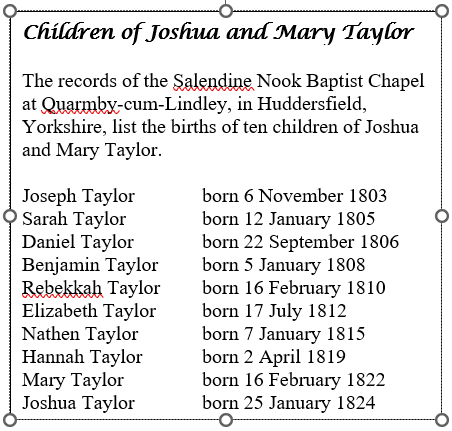
Nathan Taylor was born on 7 January 1815, the seventh of ten children born to Joshua and Mary Taylor, of Longwood, a village near Huddersfield in Yorkshire. Joshua and Mary were “non-conformists”, who attended the Salendine Nook Baptist Chapel at Quarmby-cum-Lindsey, a village to the west of Huddersfield, in West Yorkshire.
This Chapel had grown out of the meeting of a group of Scottish dissenters, who came to England seeking religious freedom just over a century before. A meetinghouse was built between 1739 and 1743, and worship has continued there for nearly three centuries.
Entry in the register of the Salendine Nook Baptist Chapel, for the birth of “Nathan Taylor”, to Joshua and Mary Taylor
The Chapel register contains the records for the birth of ten children to Joshua and Mary, over the period of 1803 to 1824 (see below). All ten children have biblical names, reflecting the strong religious convictions of these Baptist parents. (Notice the spelling “Nathen”.)
Marriage and children
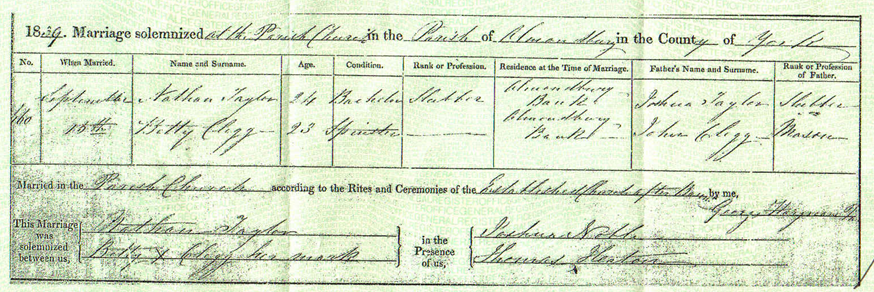
At the age of 24, Nathan Taylor married Elizabeth (Betty) Clegg, the daughter of John and Betty Clegg, at Almondbury, a village to the south-east of Huddersfield. The marriage took place on 15 September 1839; it was conducted by the vicar, George Hargreaves, in the Parish Church, and their place of residence is listed as Almondbury Bank. It seems that the Clegg family were members of the established Church of England.
Extract from the UK Register showing the 1839 marriage of Nathan Taylor and Betty Clegg.
A son, William, was born in 1839. (Perhaps he was the reason that Nathan and Elizabeth married?) Sadly, William later would die by drowning at the age of 18. Then a daughter, Mary, was born in 1841.
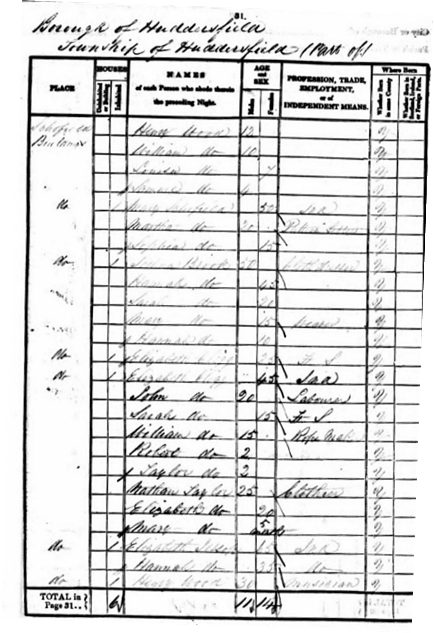
The returns for the 1841 Census for the division of Upper Agbrigg (Agbridge) in Huddersfield, Yorkshire (pictured below) list a family of Nathan Taylor, 25, Clothier, his wife Elizabeth, 20, a daughter, Mary, aged 5 months, living in Schofield Lane in the township of Huddersfield.
There is no mention of a son, William, in this record. However, it does appear to be the correct Taylor family, for in the building next door in Schofield Lane, there is recorded a family which is most likely to be the family of origin for Elizabeth (Betty).
This family comprised the mother, Elizabeth Clegg, aged 45, and children John, 20, Sarah, 15, William, 15, Robert, 2, and Taylor, 2. Elizabeth’s father, John Clegg, would appear to have died by the time of the Census.
A second son, John, was born to Nathan and Betty in Huddersfield on 7 January 1845, and then a further son, Ben (presumably short for Benjamin) was born on 19 January 1847. The record of baptisms in the parish of Huddersfield (see below) indicate that John and Ben were both baptised on 7 March 1847, by the parish priest, Rev. J. Haigh.
John was given the maiden name of his mother, Clegg, as his middle name, and he consistently appears in official records as John Clegg Taylor. (That’s a neat connection for me, as my middle name is Taylor, my mother’s maiden name—John Taylor Squires, the same pattern as my gtgtgtgtgrandfather, Nathan Clegg Taylor!)
The surname Clegg appears to have a local origin in northern England. It appears in earlier records from north Lancashire, initially with a prominent family at Clegg Hall at Rochdale, about 20 miles from Huddersfield. The name is most densely concentrated today in Oldham (near Rochdale) and Holdfirth (just south of Huddersfield). See https://www.jacksoneditorial.co.uk/yorkshire-surnames/#clegg
Active as a Chartist
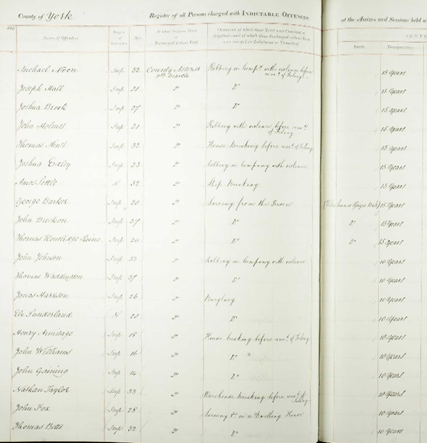
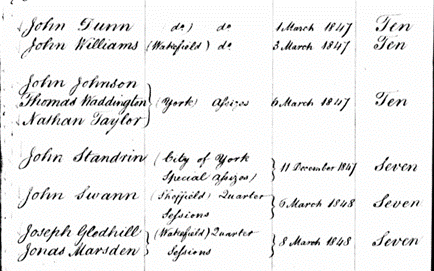
However, within two years, the family, was torn apart. On 6 March 1847, at the age of 33, Nathan Taylor was tried at the York Assizes, on the charge of “Warehouse breaking”. He was sentenced to ten years imprisonment. Also tried with him that day were John Johnson, 33, and Thomas Waddington, 37, both of whom received the same sentence for their crime of “Robbery in company with violence”. (See the court records below.)
Intriguingly, on the day immediately after this (as noted above), the two sons of Nathan and Betty, John and Ben, were baptised in Huddersfield!
John Johnson, Thomas Waddington, and Nathan Taylor were amongst 302 convicted men who subsequently were transported to the colony of New South Wales on board the ship Adelaide. They were Chartists.
A whole group of a Chartists had been sentenced to ten years, and then sent to the Colony, under special arrangements (as detailed below).
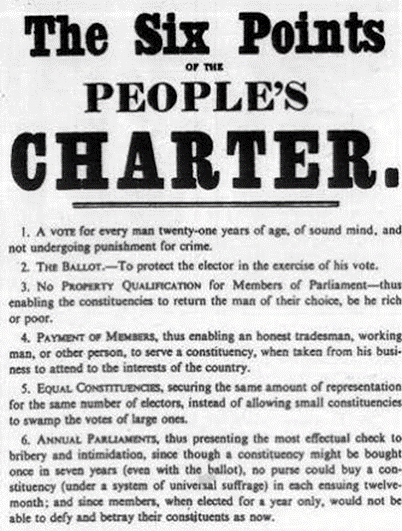
Chartism was a movement in Britain during the period of 1838 to 1857 which was initiated by the promotion of a Peoples Charter in 1838. The Chartists held mass protest meetings and collected petitions which were presented to Parliament. There were protest activities by Chartists in many English cities. It was especially strong in the northern regions of England—precisely where Nathan Taylor was living.
The Chartists were seeking a series of reforms to the political system (reforms which were eventually adopted, and which are taken for granted in modern democracies)—the vote for all adult males, the use of a secret ballot, the removal of a requirement for property ownership by Members of Parliament, payment of Members of Parliament, electorates with equal numbers of electors, and annual Parliamentary elections.
The arrangement concerning convicted Chartists was that such men would be sentenced to ten years and then sent to the colonies, and if they exhibited “exemplary” behaviour on the voyage to the south, they would be pardoned on arrival. This appears to have been what was done in relation to Nathan Taylor. See https://www.digitalpanopticon.org/A_Guide_to_Researching_Political_Prisoners
Transported on the Adelaide
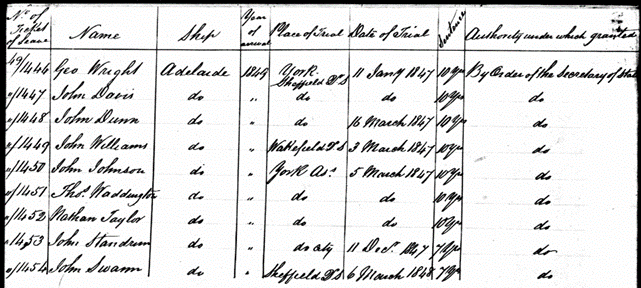
The Adelaide departed London on 17 August 1849, with John Johnson, Thomas Waddington and Nathan Taylor amongst the 302 convicted men who were on board. The Adelaide was a wooden ship which had been built in 1832 and was used three times as a convict transport (1849, to New South Wales; 1855, to Western Australia; and 1863-64, to Gibraltar.) See https://convictrecords.com.au/ships/adelaide
An extract from the ship’s record, listing the convicts on board, including Nathan Taylor.
The Sydney Morning Herald 30 November 1849 published this report from England:
Portland, England. On Monday morning, a party of 132 well-conducted convicts left the convict establishment, and were embarked for Port Phillip in the ship Adelaide, which had been some days waiting for them. We understand that, upon arriving in the colony (should their conduct on board be proved exemplary), they will each be presented with a ticket of leave which will entitle them to work for themselves, being comparatively speaking, free.
In addition to the above, there were 170 selected from Pentonville, the hulks, and Parkhurst prisons, who will be allowed a similar indulgence. A guard, composed of 50 soldiers, will accompany them on the voyage, selected from her Majesty’s 63rd, 65th, and 99th regiments of foot. There is an experienced surgeon on board, who has the care and management of the convicts, and also a religious instructor. The Adelaide was still in the roads on Tuesday night, waiting for a fair wind. See https://www.jenwilletts.com/convict_ship_adelaide_1849.htm
The last convict ship
The Adelaide duly arrived in Hobart on 29th November, where 40 men were disembarked. The ship sailed on to Port Phillip, with the intention of offloading more men, but it was refused entry and sailed on northbound to Port Jackson.
The settlement at Port Phillip had received around 1,750 convicts sent as political prisoners (often referred to as “Exiles”) in the years 1844 to 1849, but resistance to their presence grew in those years and was strong by 1849, as it attested by the failure to offload all the men on the Adelaide.
The Adelaide eventually arrived in Port Jackson on 24 December 1849, after a journey on the high seas that had lasted for 129 days. The Adelaide was the last convict ship to arrive in Sydney. Transportation, which began in 1788, had ended in Moreton Bay (Brisbane) in 1839, but continued to Van Diemen’s Land until 1853, and to Western Australia until 1868.
Arrival in the colonies
Once the ship had docked in Port Jackson, three prisoners were sent to the Hospital at Sydney and three were sent to Cockatoo Island on the recommendation of the Surgeon. The remaining prisoners on board were discharged daily as they were hired, commencing ship on 31 December 1849 and concluding on 9 January 1850.
The relevant page of the ship’s record relating to Nathan Taylor
Ticket of Leave
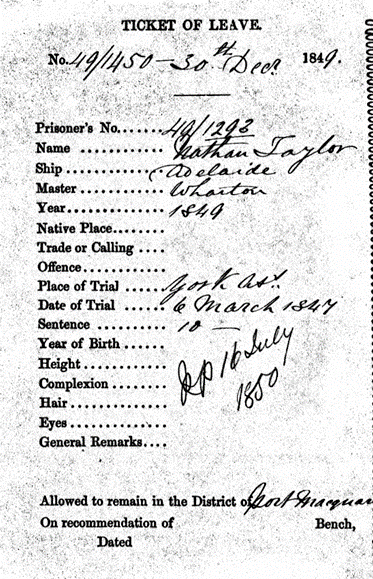
Within a week of arrival in the colony, the prisoners on board the Adelaide were given Tickets of Leave, by order of the Secretary of State. Nathan Taylor’s Ticket of Leave, number 49/1450, was granted on 30 December 1849 (see below).
Nathan was permitted to remain “in the district of Port Macquarie”, which stretched well north of Sydney, and included the northern rivers region (which is where later records place Nathan). From this point on, Nathan Taylor was once again a free man.
The journey of Betty and children on the Ramillies
His wife, Elizabeth, and two children, William and John, were still in Yorkshire. (Mary appears to have died by this time.) However, records indicate that Elizabeth and her two sons sailed to New South Wales on the ship Ramillies, which departed from Plymouth on 18 April 1850.
The Ramillies was a 757 ton barque ship which had been built at Sunderland in 1845. The Hobart Courier reported on 24 July 1850:
Arrived the ship Ramillies, 757 tons. [Master] Carvell, from Plymouth 18th April, with 271 bounty emigrants, and the following cabin passengers — Peter Nicholls, Esq., James Murphy, Esq., Mr. and Mrs. Linnell, one servant; Surgeon Superintendant, Dr. Fletcher. Cargo general. Health good, a few cases excepted. The ship’s records report that there were 97 women, 84 men, 31 boys and 23 girls who travelled in Steerage as Bounty Emigrants. See http://marinersandships.com.au/1850/08/013ram.htm
The records of the Assisted Immigrants Passenger Lists identify the passengers by name. These records include specific reference to Elizabeth Taylor, 34, House Servant, of Huddersfield, Yorkshire, daughter of John and Elizabeth Clegg, “both dead”; along with William, 11, and John Clegg, 5, as arrivals on board the ship Ramillies (see below).
In the column “Relations in the Colony” is written, “Husband Nathan Taylor, ‘Adelaide’, Huddersfield, 1847, present address Unknown” (presumably the year refers to the time of Nathan’s activity which caused his arrest). Elizabeth, William and John were all in a good state of “bodily health, strength and usefulness”, and they had no complaints about their treatment on the ship.
An additional annotation reports “£5.0.0 paid by self and £10.0.0 paid by the Relieving Officers of Huddersfield”. Relieving Officers were appointed under the Poor Law Act of 1834, to oversee the administration of relief to the poor. It appears that the system was such that Elizabeth was able to petition to be reunited with her husband in the Colony.
Life together in the colony
The Ramillies duly arrived at Port Jackson on 11 August 1850, at which time Elizabeth made enquiries regarding the whereabouts of her husband, Nathan, and ultimately Nathan was reunited with his wife and children.
Indeed, records indicate that, over the next decade, a further five children, three daughters and two sons, were born to Elizabeth and Nathan, all in the Richmond River region in northern New South Wales. Sadly, one of those sons, Charles, died in 1860, during the first year of his life; whilst William, the firstborn, had died by drowning three years earlier, in 1857.
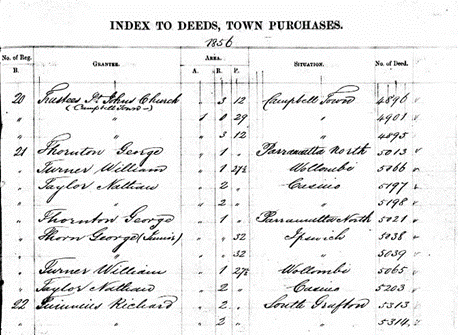
Nathan himself appears to have lived a full life in the Northern Rivers Region, where he was employed initially as a Labourer. In 1856 he bought land in East Ballina, and in 1862 additional land in Casino (see record below).
Nathan was appointed as a Foot Constable in the Northern Police District, on 22 November 1858. Police records describe him as 5’8” tall, with light brown hair, brown/grey eyes, and a sallow complexion. He worked as a Constable for six years (Number 782) before resigning on 31 October 1864.
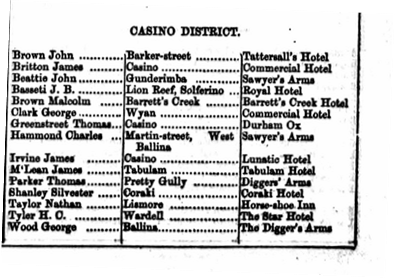
After this, Nathan conducted a store and then was licensed as the publican of the “Horse Shoe Inn” in Lismore in the 1870s. He later bought the warehouse and hotel of Henry Brown, which he kept until his death.
Extract from the Police Gazette for 1873, listing publicans licensed in the Casino District.
The final years
Elizabeth died of apoplexy in Lismore on 25 June 1871, and Nathan married Caroline Penelope Browning three years later on 28 May 1874, in the Lismore Presbyterian Church. Caroline had been married to Henry Johnson Brown in 1846 and had given birth to fourteen children over the period of 1847 to 1867. Henry died a year later, in 1868, aged on 47 years.
Record of the death of Nathan Taylor, Publican, on 7 August 1874
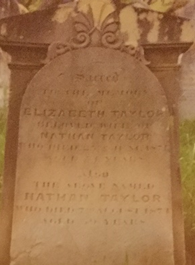
Soon after this marriage to Caroline, Nathan’s lungs became inflamed, and he died just ten weeks after his marriage, in Lismore, on 7 August 1874. He is buried with Elizabeth in the North Lismore Cemetery. (See his death certificate, above, and their tombstone, below.) Caroline subsequently married, for the third time, in 1878, and lived on until 1894.
My line of descent from Nathan and Betty Taylor is through their second son, John Clegg Taylor (1846–1878), who married Eliza Jane Wotherspoon; their son Herbert Taylor (1871–1936), who married Ada May Lee; and their son Jack Leslie Taylor (1897–1968), who married Hazel May Barron; they are the parents of my mother.
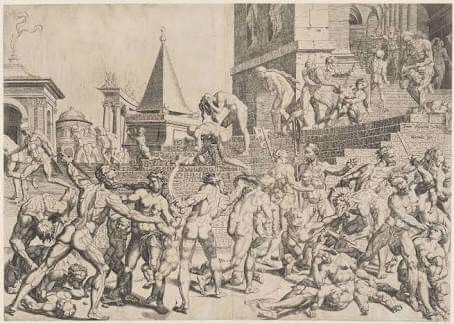
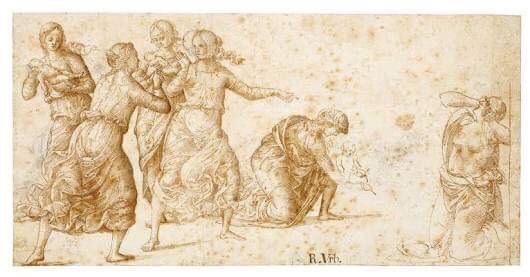
Today (in the Eastern Church) is designated as the Feast of the Holy Innocents. (It was celebrated yesterday in the Western Church.) This festival day commemorates the story of “the Slaughter of the Innocents”, reportedly ordered by King Herod, and recorded in the opening chapters of Matthew’s Gospel (and nowhere else). It is a tragic story, a myth which is filled with pathos, and it resonates with events in the world we live in today. It is a story with great power (as are all myths).
But this story is strikingly absent from the usual array of carols that are sung at this time of the year. Sugar-coated reminiscences of the cute li’l baby Jesus (“holy infant so tender and mild”, “the little Lord Jesus laid down his sweet head”, “but little Lord Jesus, no crying he makes”, “gentle and lowly lived below”) take us well away from the murderous acts of the tyrannical ruler.
Most of the traditional carols really want us to focus on Jesus the exalted Lord, resplendent in glory, coming to earth from heaven, so they move us quickly away from the vulnerable infant, and especially from the grim political and social realities of the time.
Some of the traditional carols take us to the edge of the story of violence and repression, and then leave it unspoken, or rather, unsung. “Unto us a boy is born” refers to the fury unleashed by Herod in slaughtering the baby boys, but fails then to go on and narrate the flight undertaken by Joseph, Mary and Jesus. In “The first Nowell”, the three wise men see the star in verse 4 and come to find Jesus in verse 5, but nothing further is told of the ensuing events of Herod—slaughter—flight into Egypt.
A similar dynamic happens in verse 4 of “O come, all you faithful”, verse 3 of “Angels, from the realms of glory”, verse 3 of “Silent night, holy night”, and in verse 3 of the rollicking calypso carol, “The Virgin Mary had a baby boy”. “Brightest and best of the stars of the morning” spends one verse describing the cradle scene and two verses reflecting on the gifts brought to the infant Jesus, but nothing more as to how the visitors had come to him via Herod.
“As with gladness, men of old” devotes three verses to the story of the men of old seeing the star and bringing their gifts, but then dovetails into a pietistic plea to Jesus to “keep us in the narrow way”. No mention of the scenes of slaughter of the innocent infants and the fearful flight of refugees in these carols.
The star and the visitors from the east get prime billing; the murdered children and the hastily-departing family of Jesus, seeking the safety of refuge in a foreign country, are passed over very quickly.
Why is this state of affairs so? The lack of reference to the murderous acts of Herod and the fearful flight of the family of Jesus indicates that our Christmas carols sanitise and sanctify this foundational story, gilding the lily, reshaping our perspective on the story. They completely omit any references to a part of the story that has gained such traction, and that occupies such attention, in the minds of carefully critical contemporary Christians. Children continue to be sacrificed today, in the course of jingoistic warfare waged for ideological reasons. The tragedy continues today …
A number of contemporary hymn writers have turned their attention to this story. Shirley Erena Murray is right on the money when she highlights the violence and fear at the heart of the story, claims that the infant in the story has “come to plead war’s counter-case”, and articulates the hope that “goodness will outclass the gun, evil has no tooth that can kill the truth.”
Summer sun or winter skies, Christmas comes —
shepherds, angels, lullabies, words recorded by the wise:
read it in the book — take another look . . . .
Shadows track the hawk in flight; Christmas now —
children born in fire and fight, silent night a violent night,
hawks are in control of a nation’s soul.
There where terror plies its trade; Christmas now —
children learn to be afraid, minefields of distrust are laid,
evil is in force on a winning course.
Child of peace, God’s human face, Christmas now —
come to plead war’s counter-case, bring the dove a nesting place,
though her wings are torn, though her blood is drawn.
Winter skies or summer sun, Christmas comes —
still the threads of hope are spun, goodness will outclass the gun,
evil has no tooth that can kill the truth.
That is why the ancient story retold at Christmas resonates so strongly with our situation today. Not because “it really happened, exactly like this”, but because it takes us to the centre of our humanity and reveals the depth of God’s presence in our midst. We ought to sing more about it!
In the resources for Daily Prayer with the Northumbrian Community, that Elizabeth and I currently use, there is this wonderful prayer for this day:
Where is the sound of hope, the cry of the child that wakes?
The dull, aching, continued breathing of the mother
becomes a wail of grief, a weeping for the children who are no more.
The silent landscape shudders.
God of mercy, light in darkness, hold gently to Your heart
the tiny ones we cradle in our prayer whose life was over before it had begun. Amen.
So today we come to the five gold rings in the twelve days of Christmas — you know, the place in the song where everyone turns into bathroom baritones (or the female equivalent), holding forth with the long notes in the “five go-old riiiiiiiiiiiiings” line!
And here we meet head-on the pietistic rhetoric about the song having hidden meanings—the five gold rings stand for the five Books of Moses, just as the two turtledoves signify the two testaments of the Bible, the three colly-birds point to the three persons of the Trinity, the ten lords a-leaping represent the Ten Commandments, and the twelve drummers drumming symbolise the twelve points of The Apostles’ Creed. Pietistic tosh, clearly debunked by snopes.com!
But beware: another danger lurks here! Recently, no less a venerable and reliable source than the UK Mirror (!!) has quoted a Canadian astrophysicist, Dr Anna Hughes, who tweeted that “’five gooolden riings’ is not in fact referring to 5 literal golden rings, but to five ring-necked pheasants, aka more birds”. Perhaps she felt that commenting on popular christmassy songs would bring her more fame and renown than her PhD is astrophysics and her research in quantum computing? (Thanks to my friend James Ellis for bringing this *learned* article to my attention 😁)
Sadly for the Mirror, and Dr Hughes, this theory is not new. In a 1951 article, Ben Shahn had suggested that “the five golden rings refer to the ringed pheasant”. A decade later (1962) William and Ceil Baring-Gould published a book in which they reiterate this idea, which implies that the gifts for first seven days are all birds. The Mirror, and Dr Hughes, are rather late to the party!!
According to Dr Wikipedia, “Others suggest the gold rings refer to “five goldspinks”—a goldspink being an old name for a goldfinch; or even canaries. In his blog entitled “The Illustrated Etymologicon”, journalist and author Mark Forsyth suggests “the rings could be ring-bills, ring-birds, ring-blackbirds, ring-buntings, ring-dotterels, ring-pigeons, ring-plovers, ring-sparrows or ring-thrushes. There’s a veritable aviary of birds that could be called rings and that, given the feathered context, is what the song is about.” So why pheasants?
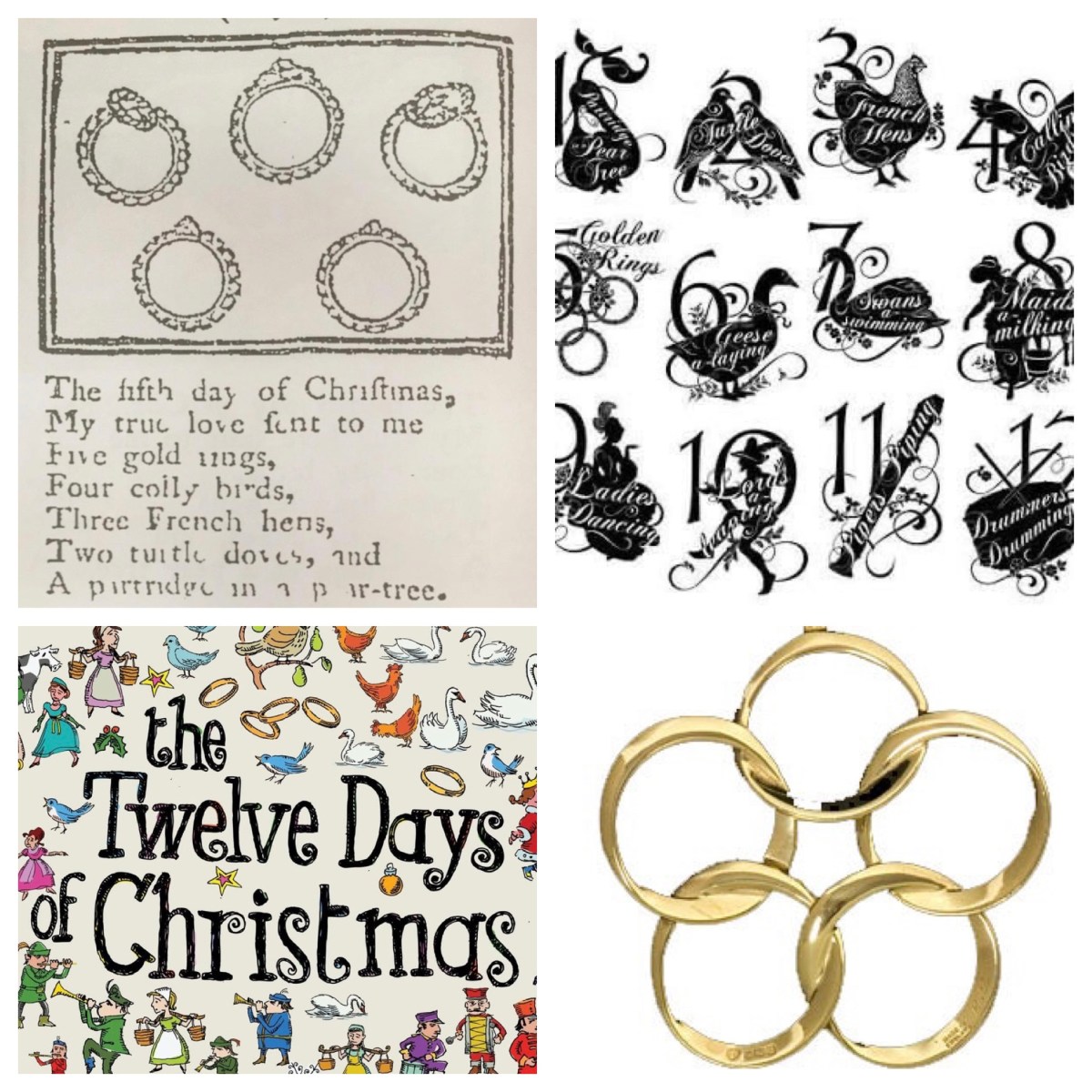
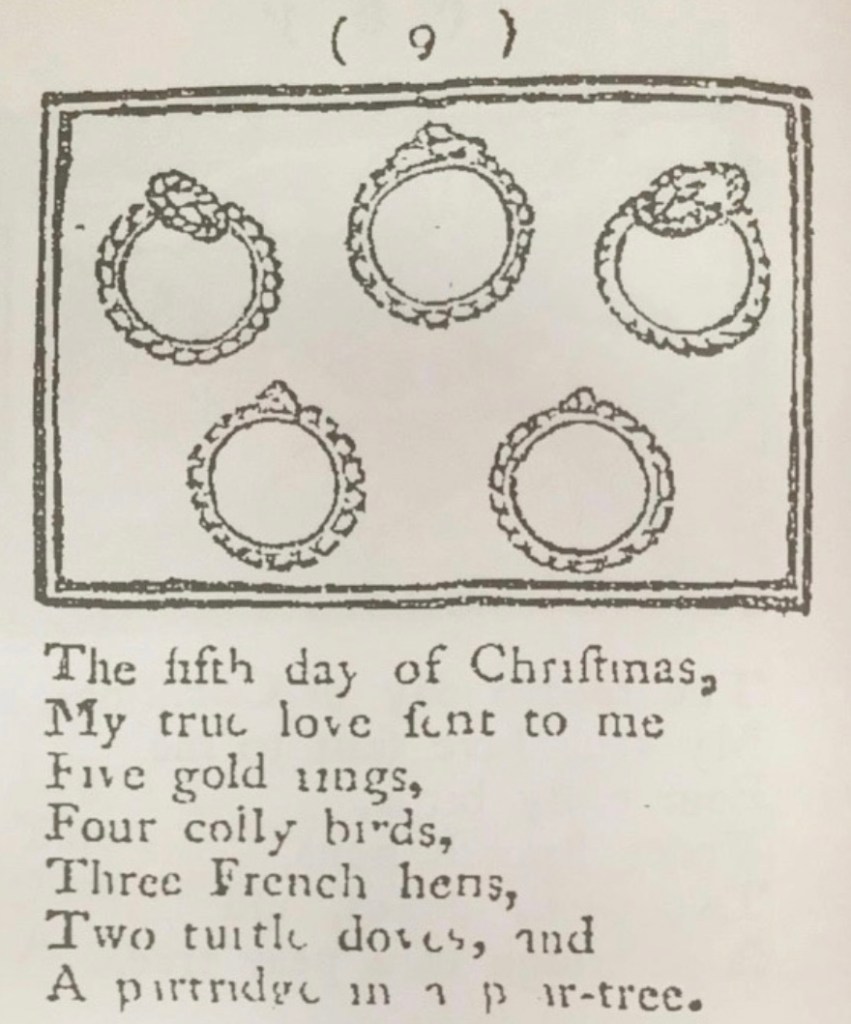
However, the original 1780 publication of the song included an illustration that clearly depicts the “five gold rings” as being jewellery.
Five Gold Rings from “The Twelve Days of Christmas sung at King Pepin’s Ball” in Mirth without Mischief (London: Printed by J. Davenport, George’s Court, for C. Sheppard, No. 8, Aylesbury Street, Clerkenwell [ca. 1780 or 1800?])
Further light is shed on the gold rings by Dr Pamela Patton, an art historian who has specialised in medieval Spanish art and currently teaches at Princeton University. Dr Patton writes, “the familiar version of the carol that emerged in 1909, when Frederic Austin published his arrangement. And the “five gold rings” part that’s so fun to belt out? It was Austin who composed those two famous bars and added them to his arrangement of the traditional melody, which was copyrighted by the publisher!”
On a roll, she continues, “It was also Austin who added the word “On” to the beginning of each verse. Interestingly, for the twelfth day, Austin doubled down on the melisma, so the final verse calls for the word “gold” to be sung with a flourish of four notes rather than the two usually sung today.”
The publication she refers to is Frederic Austin, arr., The Twelve Days of Christmas (Traditional Song) (London: Novello, 1909). She records all of this on her blog site, “The Index of Medieval Art”. (The arrangement by Austin is not medieval, and the song itself falls just beyond her area of expertise, having first been published in the 18th century, but her blog post contains a fine exposition about a number of gold rings from antiquity in various museum collections.)
So the combination of the artwork and the musical arrangement would point to the five go-old rings being just that—not a gift of yet more birds, but rather an expensive jewellery gift from the true love in the song!
Today (in the Western Church) is designated as the Feast of the Holy Innocents. (It is celebrated tomorrow in the Eastern Church.) This festival day commemorates a tradition known as “the slaughter of the Innocents”, reportedly ordered by King Herod.
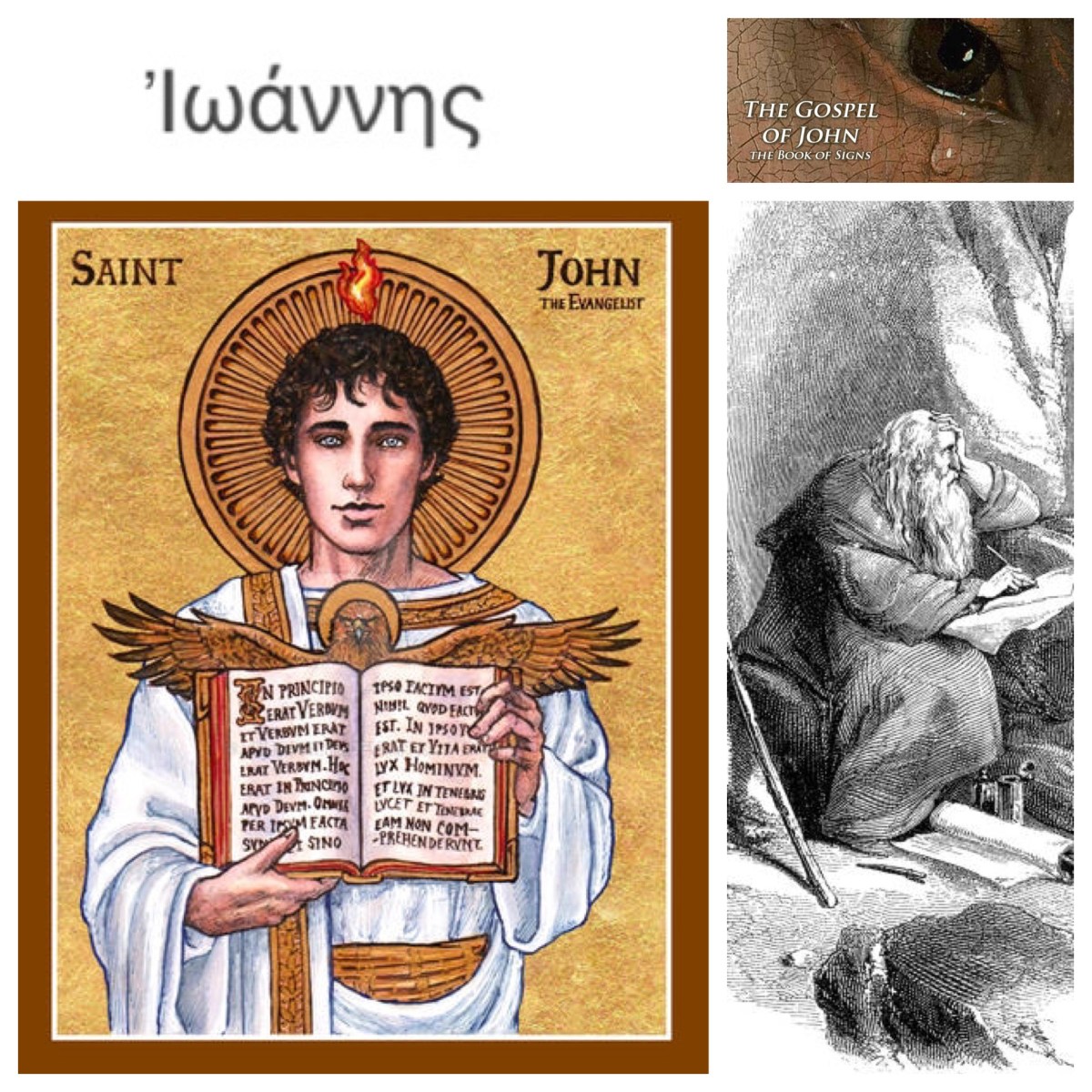
Today is the feast day of John, remembered in the Catholic tradition as Saint John the Apostle and Evangelist, and included in the Uniting Church’s list of commemorations as John, Witness to Jesus.
The fourth Gospel in the New Testament has long been accredited to the disciple named in the three Synoptic Gospels as the fisherman who was the brother of James and the son of Zebedee, one of the earliest called to follow Jesus (Mark 1:19: 3:17; Matt 4:21; 10:2; Luke 5:10; 6:14). Ironically, however, this disciple is not specifically named in the fourth Gospel. (Apart from John the baptiser, the other John noted in this Gospel is the father of Simon Peter; John 1:52; 21:15–17).
In the early fourth century CE, Eusebius wrote in his EcclesiasticalHistory (6.14.7) that Clement of Alexandria had described this Gospel as the “spiritual” Gospel, written to complement the “physical” depictions of Jesus found in the other three Gospels. (Clement was Bishop of Alexandria at the end of the second century CE.)
This view has exercised a widespread influence throughout Christian history; in the twenty–first century, John’s Gospel is often cited as the easiest way for new converts to understand the “spiritual truths” of the Christian faith. It is frequently said that it contains the most direct expression of the simple Gospel message: “God so loved the world that he gave his only Son …” (John 3:16).
More recent scholarly study of this Gospel, however, has indicated that it is a complex and intricate piece of literature. The literary style of this Gospel is distinctive amongst the Gospels found in the New Testament. Jesus speaks at far greater length than the succinct sayings and compressed argumentation reported of the Synoptic Jesus. Some of the key images included in these speeches are ripe with symbolic significance.
There are multiple layers of meaning to be explored in the fourth Gospel. A number of key words contain ironic references or wry puns. Some scenes tell of misunderstandings which arise because of the different meanings built into the text. A hint of secrecy runs through the narrative—secrecy regarding the deeper, hidden meaning of Jesus and his story. The work is a complex literary creation.
An anonymous figure among the disciples—“the disciple whom Jesus loved”—lays claim to be the author of this work (John 21:20, 24). Who is this figure? Over time, the evangelist came to be equated with the disciple John, son of Zebedee, brother of James. Nothing in the text itself explicitly supports this, however.
Over the past few decades, a different understanding about the origins of this work have developed from scholars who have explored the authorship of this Gospel and the context in which it was written. There is widespread agreement that this work was not written, in the form that we have it, by this John who was one of the earliest followers of Jesus.
Some scholars developed the notion that this figure of “the beloved disciple” was a symbol embedded within the narrative, representing an earlier authority for the evolving traditions about Jesus. The Gospel itself, they consider, came to be written down many decades after this authority figure had first begun to recount the story of Jesus. The shape of the Gospel was heavily influenced by the nature of the community of faith through which these stories were passed, over a number of decades.
This has led to a detailed hypothesis concerning the origins and development of the community of believers which gave birth to this Gospel in written form. (The North American scholars most often associated with this line of interpretation are Raymond Brown and J. Louis Martyn.) This hypothesis makes two central claims.
The first claim is that, in its earliest stages, the community which produced this Gospel had been essentially Jewish. That community received and retold stories which may well have come from the John who was a follower of Jesus. The second claim is that, by the time the body of the Gospel was written in the form that we know it, this community found itself in an antagonistic relationship to the dominant form of Judaism. This opened the way for Gentile ideas, so that they are found mixed with Jewish ideas in the final form of the Gospel.
So if this Gospel was indeed stimulated by the teachings of one of the first followers of Jesus, a Jewish man in Galilee, known as John, it reflects a remarkable trajectory in the first century of the movement initiated by Jesus, tracing its development from a Jewish renewal movement towards a global religion. The stories from the Apostle have presumably been reworked and reshaped over decades as that trajectory develops.
The “disciple whom Jesus loved” certainly occupies a prominent place in the narrative of the fourth Gospel. He reclines on the breast of Jesus at the final meal in Jerusalem (John 13:23) and stands at the foot of the cross with Mary, the mother of Jesus (19:26–27).
After Mary Magdalene announced that the stone at the entrance of the tomb where the crucified Jesus had been laid had been removed (20:1–2), he runs to the tomb, with Simon Peter (20:3), arrives first, and sees that the tomb is empty (20:4–5)—but leaves it to Peter to see the inside first (20:6–7), before himself entering and attesting to the empty tomb with his own eyes (20:8).
Later, when seven of the disciples are fishing on the Sea of Galilee, this same beloved disciple is the first to recognise Jesus standing on the beach next to their fire; this time, he announces the identity of Jesus to Peter (21:7). A little later, Peter draws from Jesus the words about this disciple remaining with him (21:20–23). Finally, the same beloved disciple has the last word in the later-added Appendix to the Gospel, affirming his role as eyewitness and evangelist (21:24).
This is the figure that, in the tradition, is linked with John, the fisherman brother of James, the son of Zebedee, one of the earliest followers of Jesus, accorded a place as one of The Twelve Apostles.
In the book of Acts, the disciple John visits Samaria with Peter, in order to authorise and sanction what Philip had been teaching and doing in that region (Acts 8:14–17). That episode indicates the respect and authority that John was held to have as the movement developed—although the author of Luke and Acts writes some decades after the events he describes, at the end of the first century, and his material is filtered through various intermediaries (see Luke 1:2).
“Apostles Peter and John Blessing the People of Samaria,” by Giorgio Vasari, 1511-1574, Italian.
However, in one of his early letters from the 50s, Paul himself acknowledges this important position of John, along with James (brother of Jesus) and Peter, the “acknowledged pillars” of the church. Paul relates how he went, with Barnabas and Titus, to Jerusalem (Gal 2:1), in order to receive the approval from the mother church for his activity amongst the Gentiles. Accordingly, “James and Cephas and John, who were acknowledged pillars, recognized the grace that had been given to me, they gave to Barnabas and me the right hand of fellowship, agreeing that we should go to the Gentiles and they to the circumcised” (Gal 2:9).
This corroborates the view we find in Acts, that John had a position of importance in the early church. It doesn’t demonstrate, however, that this John wrote the book of signs, the work we know as the Gospel of John.
The scholar Jerome, born in Dalmatia (now Albania), lived for some time in Palestine in the late 300s. Jerome recounts an anecdote still being told at that time about John the Evangelist. When John was old and feeble and no longer able to walk or preach, he would be carried among the faithful in church and would repeat only one thing over and over again: “My little children, love one another.”
This, of course, is the central mantra in the first of the three letters that bear the name of John (see 1 John 3:11-17; 3:23; 4:7–12; also 2 John 5; 3 John 6). The legend explains how these anonymous letters were attributed to the apostle John.
Polycarp, through Saint Irenaeus, tells us that the Apostle John lived a long life, which ended peacefully in Ephesus around the year 100 CE. If that was so, then John was the only Apostle not to die a martyr. That may then equate him with the John who claims authorship of the book of Revelation, exiled on the island of Patmos (Rev 1:9). However, the style and language of this last book of the New Testament differs significantly from the style of the Johannine gospel and letters.
The Encyclopedia Britannica reports that two rival sites at Ephesus initially claimed the honour of being the grave of John. One eventually achieved official church recognition, becoming a shrine in the 4th century. By the 6th century the healing power of dust from John’s tomb was famous, and the church of Ephesus claimed to possess the autograph of the Fourth Gospel. We don’t have that manuscript today, however.
John was said to have written the Acts of John, a domestic work that was known in the second century; but it was condemned as heretical at the Second Council of Nicaea in 787 CE. And so the traditions about John continued to grow.
Indeed, in some Medieval and Renaissance works of painting, sculpture and literature, John is often presented in an androgynous or feminized manner, perhaps reflecting the ambiguous identity of “the disciple whom Jesus loved”.
St. John the Apostle by Jacques Bellange, artist and printmaker from the Duchy of Lorraine, c.1600
All of which demonstrates the maxim that I hold for early Christian writings: the further away from the first century we get, the more information is known about the writers of the Gospels!!









 An Informed Faith